Why is the favourite search “patrick leigh fermor obituary”?

Just a quick comment. The blog has some useful tools to measure site hits and the search engine terms that visitors use to find their way to the blog. Of all the many terms used, the top one by a mile is “patrick leigh fermor obituary”!

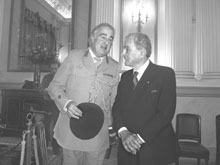
What does this signify? Do people not know that Paddy is alive and well and was recently seen at the British Embassy in Athens around 21 April at an event to remember the life of the illustrator of most of his books, John Craxton?

Paddy is alive and well. Read the article below!

Related article:

Remembering John Craxton

Subscribe to the Patrick Leigh Fermor blog

If you would like to keep up to date with the blog postings (of which there are many more to come I assure you!), why not subscribe to the blog? Enter your email, just in the top right where it says ‘Email Subscription’, and you will receive an alert each time a new post appears; that is all. No spam!

I hope you enjoy the posts and ferreting around the blog.

Don’t forget if you have something you would like the world to see that concerns Paddy, or his friends and colleagues, please get in touch with me either by a comment or email tsawford[at]btinternet.com, and I will publish it for you with full credit.

Tom

Profile of Patrick Leigh Fermor by Max Hastings

A personal view by Max Hastings who thinks that Paddy’s best book is Mani.

First published in the Daily Telegraph 12:01AM GMT 04 Jan 2004

Not long after the Second World War, an English couple chanced upon a remote taverna in the mountains of Greece. As they ate their simple lunch the proprietor, perceiving their nationality, remarked: “We had another English couple here once, before the war. They stayed for weeks. They were so beautiful and so in love. And every night they dressed for dinner!”

It was this last foible that had plainly captivated him, and indeed conjured for his listeners an enchanting vision of young lovers in “the full soup and fish”, as P G Wodehouse would have said, in this lonely Greek inn. All became clear when the innkeeper added: “His name was Lefemor.”

This was, of course, the inimitable Paddy (he has never been known as anything else), though the innkeeper was wrong about the nationality of his other guest – she was in truth a Romanian princess, Balasha Cantacuzene, with whom he enjoyed a romantic idyll through the last few years before the war.

Legend has it that “Lefemor’s” distraught family ordered him home, finally cabling the fare when he pleaded poverty to explain his inability to return. He merely used the money to protract the affair.

Like many stories told both by and about Sir Patrick Leigh Fermor – as he became this week at the age of 88 – this one may be a trifle fanciful, owing as much to soaring imagination as to historical fact. No matter. It is the sort of story about Paddy which ought to be true.

He richly deserves his honour not only for what he has written – some of the finest travel books of all time – but for what he has been. In prose, as I heard one of his oldest friends put it recently, “he possesses an extraordinary gift for expressing beauty in words”.

He has fulfilled the dream of so many upper-class Englishmen of his generation, to live, love, play the hero, sage and wit with a lightness of touch which, translated into the milieu of the kitchen, would produce a souffle of genius.

He was the son of Sir Lewis Leigh Fermor, a geologist who travelled widely and made his reputation in India. “His tall, straight figure might often be seen dancing in Calcutta,” the DNB observes playfully. Paddy’s somewhat erratic schooling terminated at King’s Canterbury, from which he was sacked for some misdemeanour – “holding hands with the greengrocer’s daughter” is his own version, which will serve as well as any other.

Rejecting parental plans for Sandhurst and the Army, in December 1933 at the age of 18 he set out instead to walk to Constantinople, with very little money but some rather grand letters of introduction. The consequence was that for the next 18 months, he was wafted from schloss to schloss across old Europe, plunging his insatiable social, cultural, intellectual and linguistic curiosity into a river of happy encounters.

These he has described in the two volumes, A Time of Gifts (1977) and Between the Woods and the Water (1986). A third instalment of the journey has been long in preparation, but it is unlikely that anyone except his publisher expects it to get finished.

He has always been a slow writer, each of the eight books in his modest output requiring long and painful labour. His dilatoriness has been reinforced, perhaps, by indifference to money. Though he has never had any, somehow God or friends have eagerly provided. He has practised a superior brand of Micawberism, founded upon the belief that something or somebody would turn up, which in his case it always has.

When war came in 1939 he left Baleni, the wonderful Romanian mansion where he had been living with his princess, to join the Irish Guards. Instead, however, he was commissioned into the Intelligence Corps as a Greek speaker. He spent the winter of 1940 as a liaison officer with the Greek Army.

Affectionately sceptical friends say that Paddy’s linguistic fluency is a trifle exaggerated. Sixty years ago an Englishman who heard him gassing away nineteen to the dozen said to a neighbouring Greek woman: “Is he as fluent as he sounds?” She replied: “No. He is simply making a wonderful noise.” This is a little unjust, and of course he has indeed become a master of the Greek language after living in the Peloponnese for so long. He possesses a gift for communicating with his fellow man of any nationality, class or condition, without need for anything as vulgar as a phrasebook. Continue reading

Back to the Hellespont – Swimming the Hellespont

As we know Paddy was 70 years of age when he swam the Hellespont with his wife Joan encouraging him ( whilst probably very worried) from a boat. His good friend Xan Fielding was waiting for him upon his return with a bottle of champagne. There is a long account in the excellent “In Tearing Haste”. Paddy was inspired by, amongst others, Lord Byron and his swim in 1810. There was a very interesting Radio Four programme about this yesterday … you have until approx 24 May to listen again on the BBC iPlayer.

Click here to listen again but only until approx 24 May 2010.

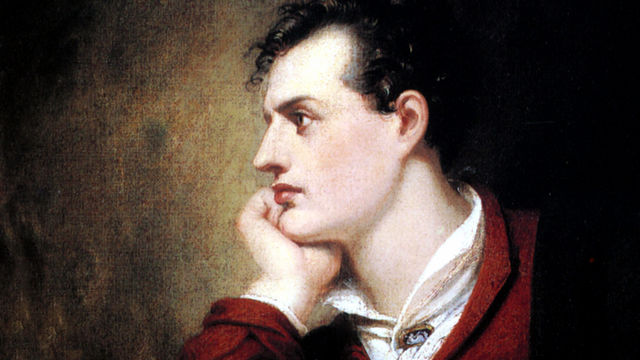
Lord Byron

It is 200 years since the poet Lord Byron swam the Hellespont, commemorating the feat in a poem and setting off a mania for swimming throughout Europe. He said it was his proudest moment.

His talent for swimming was one of the qualities that made him a legend and wherever he swam became almost a sacred spot. On the shore of the Bay of Spezzia, where Shelley drowned, stands a plinth dedicated to “Lord Byron, Noted English Swimmer and Poet”. Note which comes first!

Comedian and Channel swimmer Doon Mackichan takes a look at the man and the event through his poetry and journal entries, comparing Byron’s swim with the experiences of some of the swimmers who turn up every year for a race across this historical channel that separates Europe and Asia. Organised by the Canakkale Rotary Club, it is one of the highlights of the wild water swimming calendar.

Byron was inspired by Leander who, according to Ovid, nightly swam the strait to visit his beloved Hero and, after hours of love making, swam back home again. No slouch in the sack himself, Byron marvelled that Leander’s conjugal powers were not “exhausted in his passage to Paradise”.

Swimming gave Byron, lame as he was, some of the most exhilarating moments of his life. Only in swimming was he able to experience complete freedom of movement and freedom was a state he aspired to in all things – political and sexual.

How many of today’s swimmers have been inspired by Byron to put pen to paper? The programme set them a challenge and you can hear some of the best entries alongside Byron’s own effort.

Related website:

The Hellespont swim: following in Byron’s wake

Xan Fielding Obituary

After much searching I can bring you what I believe to be the only on-line obituary to Xan Fielding which I have retyped from the Daily Telegraph Second Book of Obituaries: Heroes and Adventurers. This includes a special tribute from Paddy to one of his closest friends.

First published in the Daily Telegraph 20 August 1991

Xan Fielding, the author, translator, journalist and adventurous traveller, who has died in Paris aged 72, lived a charmed life as a Special Operations Executive agent in Crete, France and the Far East during the Second World War.

Short, dark, athletic and a brilliant linguist, he was God’s gift to operations in rugged mountainous regions and wherever his languages were needed.

Major Fielding was awarded the DSO in September 1942, “for going into a town”, as he said later with a typical modesty.
He had a boyish, slightly rebellious spirit which he shared with many of his contemporaries in SOE. His self-confessed, or self-proclaimed, amateurishness certainly belied a tough professionalism, great resourcefulness and bravery in action. Fielding was the sort of man one would be happy to go into the jungle with.

While still in his early twenties he was responsible for clandestine and subversive activities in large areas of enemy-occupied Crete. He survived numerous encounters with German forces, only to be rumbled by the Gestapo in France towards the end of hostilities in Europe.

Even then his luck held. Locked in a death cell at Digne in 1944, he was “sprung” in an audacious move by Christine Granville (nee Krystyna Skarbeck) whose SOE exploits matched his.

Alexander Wallace Fielding was born at Ootacamund, India, on November 26 1918. His family had long links with the Raj and his father was a major in the 50th Sikhs.

Xan’s mother died at his birth and he was largely brought up at Nice, where his grandmother’s family had considerable property. Fluent in French, he subsequently became a proficient classicist at Charterhouse and then studied briefly at Bonn, Munich and Freiberg Universities in Germany. He saw what was happening in that country and was so shocked at the attitude of the Chamberlain government that he came close to joining the Communist party.

At the end of the 1930s Fielding – who had recently been sacked as a sub-editor on the Cyprus Times and was by now unsuccessfully running a bar – found himself a misfit in the Mediterranean colony. Colonial officials abhorred his refusal to adopt their disdainful description of Cypriots as “Cyps”. That he was also reasonably fluent in Greek rendered him suspect to district commissioners, who could not speak the language of the people they administered.

At the outbreak of the Second World War, haunted by the thought that he might find himself trapped in Cyprus for the duration, he fled to Greece and found asylum on St Nicholas, an island owned by the anthropologist, Francis Turville Petre. Fielding dreaded not so much the battlefield as joining the conventional officers’ mess. But eventually news of the fall of France, the Dunkirk evacuation and the Battle of Britain induced a “stab of guilt”.

He returned to the colony and was commissioned into the Cyprus Regiment, which appealed to him on account of its perverse refusal to have any regimental pride.

On hearing in Cairo that Cretans had taken up arms against the Germans, he yearned, as he wrote later, to help lead “this concerted uprising of the technically non-combatant”.

When Crete fell, Fielding was interviewed in Egypt by SOE. He was asked: “Have you any personal objection to committing murder?” His response being deemed acceptable, Fielding was put ashore in Crete with a load of weapons and explosives by Cdr “Crap” Miers, VC, skipper of the submarine Torbay.

Continue reading

Walking towards Byzantium

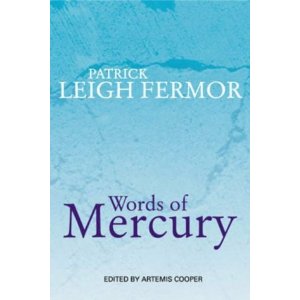
A Review of Artemis Cooper’s “Words of Mercury” by William Dalrymple published in the Guardian.

First published in the Guardian 13 December 2003

William Dalrymple relishes Words of Mercury, a selection from the work of Patrick Leigh Fermor, Britain’s greatest living travel writer.

Skill with the sword usually precludes much competence with the pen. For all that Sir Philip Sidney could write sequences of Petrarchan sonnets as well as lead buccaneering raids on the Spanish Netherlands, or Siegfried Sassoon write his anti-war memoirs while also winning the Military Cross, bookishness and military machismo are rarely found roosting together (after all, it’s no secret, as the old joke goes, that military intelligence is a contradiction in terms).

The great exception to this rule in our own time is Patrick Leigh Fermor. For though he is one of our finest prose stylists and – since the death this summer of his only possible rival, Norman Lewis – without question our greatest living travel writer, he was also responsible for one of the most audacious special operations coups of the second world war.

Leigh Fermor’s own account of the abduction of General Kreipe, the German commander of the Nazi occupation forces in Crete, is published for the first time in Artemis Cooper’s wonderful new anthology of Leigh Fermor’s work, Words of Mercury. The story is a famous one, and in the film version, entitled Ill Met by Moonlight, Paddy was played by the dashing Dirk Bogarde. But in Leigh Fermor’s own account, the climax comes not as the general’s staff car is stopped at night by a British SOE party dressed in stolen German uniforms, nor as the Cretan partisans help smuggle the general into the Cretan highlands and thence to a waiting British submarine; but instead as “a brilliant dawn was breaking over the crest of Mount Ida”: “We were all three lying smoking in silence, when the General, half to himself, slowly said: ‘ Vides ut alta stet nive candidum Socrate’. It was the opening lines of one of the few Horace odes I knew by heart. I went on reciting where he had broken off … The General’s blue eyes swivelled away from the mountain-top to mine – and when I’d finished, after a long silence, he said: ‘Ach so, Herr Major!’ It was very strange. ‘Ja, Herr General.’ As though for a moment, the war had ceased to exist. We had both drunk at the same fountains long before; and things were different between us for the rest of our time together.”

It is an archetypal Leigh Fermor anecdote: beautifully written, fabulously romantic and just a little showy. For Leigh Fermor’s greatest virtues as a writer are also his greatest vices: his incantational love of great waterfalls of words, combined with the wild, scholarly enthusiasms of a brilliant autodidact. On the rare occasions he gets it wrong, Paddy has been responsible for some of the most highly coloured purple passages in travel literature. But at his best he is sublime, unbeatable.

For as well as being a war hero, one of the world’s great long-distance walkers, and as tough a traveller as you could find, Leigh Fermor has always been a writer of great intelligence, sensitivity and profundity. Here he is, for example, describing a French Cistercian monastery, where he says he discovered “the capacity for solitude and the recollectedness and clarity of spirit that accompany the silent monastic life. For in the seclusion of a cell – an existence whose quietness is only varied by the silent meals, the solemnity of ritual and long solitary walks in the woods – the troubled waters of the mind grow still and clear, and much that is hidden away and all that clouds it floats to the surface and can be skimmed away; and after a time one reaches a state of peace that is unthought of in the ordinary world.”

Words of Mercury is a cornucopia, full of the rarest gems, but it is also a rather odd book: part collected journalism, part greatest hits anthology, with a few other surprising odds and ends thrown in, such as a memoir about the eccentric Scottish genealogist Sir Ian Moncrieffe of that Ilk. This tells of Moncrieffe’s huge pleasure in discovering that he was directly descended from “The Blood Countess, Elizabeth Bathory, Monster of Csejthe [who] was convicted in 1610 of the slow murder – in order that their blood might magically preserve her beauty – of more than six hundred girls.” In a similar mood, there is also a letter from Paddy to the editor’s grandmother, Lady Diana Cooper, and a footnote directing the reader towards the “strongly recommended” work of the military historian Antony Beevor, who just happens to be the editor’s husband (though in fairness, it appears that this warm endorsement comes from Leigh Fermor rather than Cooper).
-Read More!>

Philhellene’s progress: The writing of Patrick Leigh Fermor

As you know I trawl the net for Paddy related material to create the best online source of information about PLF and his friends and associates. Some of you may have come across this essay that attempts to analyse Paddy’s style and his literary achievement. In my view it is just one of many that emphasise how great the man is and how unequalled is his prose.

First published in New Criterion, Jan, 2001 by Ben Downing

I have carried the soldier’s musket, the traveler’s stick, the pilgrim’s staff. –Chateaubriand (what a great quote for Paddy!)

The captive must have been exhausted and afraid, but when, on the fourth day of his grueling forced march across Crete, he saw dawn break behind Mount Ida, the sight was so beautiful that it brought to his lips the opening of Horace’s Ode I.ix: “Vides ut alta stet nive candidum/ Soracte,”(1) he murmured. Then, just as he trailed off, one of his captors came in to take the poem over, reciting the rest of its six stanzas. At this, the captive’s startled eyes slanted down from the peak to meet those of his enemy, and, after a long thoughtful silence, he pronounced, “Ach so, Herr Major.” For the captive was a German soldier–the commander of the island’s garrison, no less. General Karl Kreipe (to give him his name) had been abducted on April 26, 1944 by a band of Greek guerrillas led by two English commandos. Over the next three weeks, the kidnappers picked their way across Crete, eluding the thousands of Nazi troops who hunted them, until eventually they were met by a British boat and whisked to Cairo, where Kreipe was handed over and the two commandos promptly awarded the D.S.O. One of these men was W. Stanley Moss, who in 1950 published a riveting account of the escapade, Ill-Met by Moonlight, later filmed by Michael Powell. The other was a certain Patrick Leigh Fermor. Disguised as a shepherd and (like Zeus in his Cretan boyhood) living largely in caves, he had spent much of the previous two years on the island organizing the resistance. Leigh Fermor it was who finished the quotation.

But where had he, who’d never completed high school, learned Horace so well? Had Kreipe asked him this, Leigh Fermor could have answered, savoring the irony, that he’d committed the odes to memory during his teenage Wanderjahr a decade earlier, when, just after Hitler’s rise to power, he’d walked clear across Germany (among other countries) with a volume of Horace for his vade mecum, often reciting the poems to himself as he tramped. About that experience he’d not yet written a public word, and would not do so for many more years. Similarly he held off recounting his aubade with Kreipe. At last, however, in the 1970s, he broached the subjects of his continental traverse and, in an aside to that account, of his fleeting bond with Kreipe. Some things are best waited for: the book in which Leigh Fermor set these matters down, A Time of Gifts (1977), along with its sequel, Between the Woods and the Water (1986), represent not only the capstone of his career but, in my opinion, the finest travel books in the language and a pinnacle of modern English prose, resplendent as Soracte or Ida in deep snow.

The deplorable fact that most Americans, even well-read ones, have never even heard, as I also had not until recently, of a figure who in Britain (to say nothing of Greece, where he lives to this day) is revered and beloved as war hero, author, and bon vivant; who is, in Jan Morris’s words, “beyond cavil the greatest of living travel writers”; and who, in those of the historian John Julius Norwich, “writes English as well as anyone alive”–all this spurs me to correct our oversight of the sublime, the peerless Patrick Leigh Fermor.

His turbulent early life is recounted in the introduction to A Time of Gifts. Shortly after his birth in 1915, his mother and sister went to join his father in India, while he was left behind “so that one of us might survive if the ship were sunk by a submarine.” For four years he was billeted with a Northamptonshire farming family, an experience that proved “the opposite of the ordeal Kipling describes in Baa Baa Black Sheep.” A halcyon period, this, but the taste for boisterous freedom he acquired in the fields made for trouble later on: “Those marvelously lawless years, it seems, had unfitted me for the faintest shadow of constraint.” Especially intolerable to him were academic strictures of any kind, and there ensued a long series of dust-ups and expulsions, hilariously related. At ten he was sent to “a school for difficult children,” among which misfits he lists

the millionaire’s nephew who chased motorcars along country lanes with a stick, the admiral’s pretty and slightly kleptomaniac daughter, the pursuivant’s son with nightmares and an infectious inherited passion for heraldry, the backward, the somnambulists … and, finally, the small bad hats like me who were merely very naughty. Continue reading

Writer and WWII hero honoured with Order of the Phoenix

Report of the presentation of the Greek Order of the Phoenix to Paddy

First published Ekathimerini online 3 March 2007

By Helbi

Patrick Leigh Fermor (right) with Colonel Mark Blatherwick, the British defense attache in Athens

The week that passed brought both joy and sorrow to those close to two British heroes who fought for Greece during World War II and whose love for the country never dimmed. The writer Sir Patrick Leigh Fermor, author of famous books such as “Mani” and “Roumeli,” “A Time of Gifts” and “Between Woods and Water,” even settled in Greece, near the Mani village of Kardamyli. This week President Karolos Papoulias bestowed upon him the Order of the Phoenix in the New Year honors for 2007. Ambassador Tassos Kriekoukis, director of protocol for the Foreign Ministry, spoke of “Sir Patrick’s love of writing and traveling but also for Greece, for whose freedom he fought at the side of Greek and British commandos. Who can forget his part in the kidnapping (in wartime Crete) of (German) General Kreipe?” Colonel Mark Blatherwick, the British Defense Attache in Athens, accompanied Sir Patrick Leigh Fermor to the event.

Lawrence Durrell and Patrick Leigh Fermor

I have been trawling again for PLF linkages and found this on James O’Fee’s blog on Impala Publications. O’Fee makes many references to Paddy and his blog section is worth a trawl. I like the last quote in particular.

In Bitter Lemons, the writer Lawrence Durrell describes a visit from Patrick Leigh Fermor –

“In that warm light the faces of my friends lived and glowed….Freya Stark…Sir Harry Luke…Patrick Leigh Fermor and the Corn Godess, who always arrive when I am on an island, unannounced and whose luggage has always been left at the airport (‘But we’ve brought the wine-the most important thing’).” [pp102-3]

“Last night the sound of the front door closing upon breathless chuckles and secretive ranting, then the voice of Patrick Leigh Fermor: ‘Any old clothes?’ in Greek. Appeared with his arm round the shoulders of Michaelis who had shown him the way up the rocky path in darkness. ‘Joan is winded, holed below the Plimsoll line. I’ve left her resting half way up. Send out a seneschal with a taper, or a sedan if you have one.’ It is as joyous a reunion as ever we had on Rhodes.

“After a splendid dinner by the fire he starts singing, songs of Crete, Athens, Macedonia. When I go out to refill the ouzo bottle at the little tavern across the way I find the street completely filled with people listening in utter silence and darkness. Everyone seems struck dumb. ‘What is it?’ I say, catching sight of Frangos. ‘Never have I heard of Englishmen singing Greek songs like this!’ Their reverent amazement is touching; it is as if they want to embrace Paddy wherever he goes.” (pp 104-5)

Related website:

James O’Fee blog at Impala Publications

Sir Lewis Leigh Fermor obituary from Proceedings of the Indian Academy of Science

The obituary of Paddy’s father, Sir Lewis Leigh Fermor, Kt. OBE. DSc. A.R.S.M. F.G.S. M.I.M.M. F.N.I. F.A.S.B. from Proceedings of the Indian Academy of Science, Section A, Volume 8.

Page one click here for the pdf file.

Page two click here for the pdf file.

Original source.

Literary legend learning to type at 92

An old interview for our archive. First published in The Guardian Friday 2 March 2007 18.12 GMT

By Helena Smith in Athens

Patrick Leigh Fermor in 2005 - Photograph: Eamonn McCabe

In a rare public appearance, the revered travel writer Patrick Leigh Fermor has revealed that he is only now – aged 92 – learning to type, in order to finish the trilogy that has been at the centre of his writing life for more than 30 years.

Leigh Fermor usually avoids the spotlight these days, to concentrate on his work, but this week made an exception as Greece, his adopted home, awarded him its highest honour, Commander of the Order of the Phoenix

Leigh Fermor, widely acknowledged as Britain’s greatest living travel writer, was unexpectedly told of the award in a letter from the office of Greece’s president last month. “I have no idea why they are doing this but I am deeply honoured and moved,” he told the Guardian after receiving the medal at a lavish ceremony in Athens.

“I think they’ve enjoyed reading my books and heard I was an eager participant, who got in the thick of things during the war,” said the author, who is also known for pulling off one of the greatest coups in Nazi-occupied Europe, orchestrating the capture of General Kreipe, the military commander on Crete – a feat immortalised by the book and film Ill Met by Moonlight.

Friends say Leigh Fermor, who has chronicled Greece for more than 60 years, is these days acutely aware of the passage of time and put aside precious writing time to make the trip from his home in the Mani on the southern Peloponnese. When he was handed the prestigious Travel Writers’ Guild award in 2004, he dispatched his biographer Artemis Cooper to pick up the gong.

Since the second half of the 80s, he has being toiling to complete the third volume of a trilogy depicting his extraordinary journey on foot from Rotterdam to Istanbul at the age of 18.

His painstaking perfectionism means his output has not been prolific. He wrote the first volume of the trilogy, A Time of Gifts – widely considered his greatest work – nearly four decades after the odyssey in 1977. The second, Between the Woods and the Water, was released in 1986. Ever since, fans have been desperate to read the third.

Like many of his generation, the acclaimed soldier-scholar has always written in longhand – delivering his masterpieces to his publisher in great flourishes of scrawl. It’s a process that has been widely blamed for the long gestation periods.

But help is at hand. Paddy, as he is known to his friends, has finally decided that with his handwriting degenerating into unreadability, it is time to type. This year he invested in a 1951 Olivetti (“I wouldn’t get a computer,”) and is currently working his way around the machine’s keyboard, according to friends.

“I’m going to finish that book,” he said. “I’m going home and I’m going to work really hard.”

Remembering John Craxton

An event in memory of the late English artist was held last week at the British Embassy in Athens, and Paddy was there.

The early works of John Craxton evoked an ‘arcadian’ feel but later became more schematic. Cubism and other 20th-century movements had an influence on his work.

First published in Ekathimerini online on 21 April 2010

By A Koroxenidis

When the late English painter John Craxton (1922-2009) first visited Greece in the mid-1940s he discovered what he called “human identities,” a world that suited him and was to soon become his home.

In the 60s Craxton settled in Hania, Crete, in a house facing the old harbor. He led a simple bohemian life, appreciated the local lifestyle and explored the country’s cultural history, especially the Byzantine churches on the island. For many years, he also served as as Britain’s consular correspondent in Hania.

John Craxton

His friends and the people close to him, who gathered last week at the British Embassy in an event dedicated to Craxton’s memory, remember him as a talented artist, an intellectual, a generous, straightforward and well-mannered person who had humor, sophistication and an optimist view of life. A learned artist, Craxton was part of an intellectual international milieu.

Following an opening by British Ambassador to Athens Dr David Landsman, novelist and playwright Paris Takopoulos, who met Craxton in London in the late 1940s, referred to the artist’s knowledge of Greek modern culture and also spoke of the great value that Craxton placed on friendship. He also noted that Craxton was an excellent critic of art.

John Craxton work from Greece

Maria Vassilaki, associate professor of Byzantine art at the University of Thessaly, was another longtime friend of Craxton. [Maria was co-curtaor of the Byzantium 330-1453 Exhibition – see myByzantine blog]

Vassilaki spoke of his [Craxton’s] deep knowlege of Byzantine art and of their long conversations on Byzantine art and culture, on which they had planned to publish a book. Craxton had abandoned the idea but Vassilaki has edited the book and plans to publish it with Crete University Press.

Journalist (formerly at Kathimerini) and writer Maria Karavia mused upon her memories of Craxton and his friendship with the painter Nikos Hadjikyriakos-Ghikas, with whom he stayed whenever he visited Athens. Her warm memories include Craxton’s tender and colorful use of the Greek language.

The British author Sir Patrick “Paddy” Leigh Fermor was also among the speakers. Craxton and Leigh Fermor had worked together on a number of projects, with the former illustrating the covers of many of the latter’s books.

Born to musician parents, Craxton was raised in an artistic and intellectual family. He studied art in Paris and, as a young artist, produced paintings of an “arcadian” feel. His first visits to Greece inspired him in the designs for a 1951 production of the ballet “Daphnis et Chloe” by the Royal Ballet.

A major retrospective on his work was held at the Whitechapel Art Gallery in 1967. In 1993, Craxton was elected Royal Academician by the Royal Academy of Arts, London.

PLF’s car ‘blown sky high’!

“In Tearing Haste” is such a good read. As time passes Debo’s letters become better and better. She is so funny. Highly recommended. Is it heresy to say that she is starting to pip Paddy?

One learns so much in this book, which in effect is the closest to an autobiography we are likely to get for Paddy’s post war life. Got to p175 of my paperback version today when out of the blue I read this:

Mayday 1979                                                                                                                     Athens

Darling Debo,

Last Sunday night – Easter Sunday in the Orthodox Church – our car was blown sky high with an explosive charge and a length of fuse, with a red poster with hammers and sickles. I think they’d got the feast confused with Ascension Day. I think it’s all part of an attempt of ours to erect a modest bronze plaque to Fallen Comrades in Crete. It was to go up at a certain Abbey in the island. The Abbot and monks all consented, there was a feast to honour the decision, but a week later it was withdrawn: four men in cars had turned up, Communists from Heraklion, and frightened and threatened the monks. The same thing happened at another monastery, where our submarines used to surface on the same coast. Then a splendid village said they’d have it, and shoot anyone who tried to disturb it; and a few days later, BANG! At our doorstep. There is quite a powerful Comm. Party in Eastern Crete. The West is all OK: shows what a minority can do. The amount of telephone calls and telegrams from Cretan pals and Greeks in general – indignation, sympathy, etc, has made it almost worthwhile. But not QUITE, as insurance pays nought for Malicious Acts. Bugger them all.

Tons of fond love from

Paddy

This rivalry with the Communists goes all the way back to the time of wartime operations on Crete. See “Ill Met by Moonlight” and the threats and betrayals by the Communist Andartes. Is there a seamless link on to the 8 June 2000 assasination of Brigadier Stephen Saunders, 53, the British military attaché in Athens?

Captain Henry Diacono

Captain Henry Diacono, who has died aged 86, was a member of SOE and was dropped into enemy-occupied France in 1944.

Published: 6:46PM BST 23 Apr 2010

Captain Henry Diacono

On February 6 that year, Diacono was dropped “blind” – that is to say, with no reception committee to meet him – into France, landing near Chartres. Accompanying him was René Dumont-Guillemet, who became leader of the “Spiritualist” circuit to the east of Paris.

They landed at 3am in a ploughed field some 15 miles from the farmhouse that was their destination. They had no time properly to hide their suitcases and parachutes, and after crossing fields, ditches and fences were still in the open when it grew light. A barn where they might have hidden up for the day had a sign on it in gothic lettering and they decided to avoid it. Then, as they passed a house in a small village, they heard the sound of a programme being broadcast in heavily-jammed English.

Dumont-Guillemet knocked on the door, while Diacono stood behind him, revolver drawn. After a few moments hesitation, they were allowed in. They washed and rested and were given directions for continuing their journey.

After a night in their “safe” house, they returned to collect their belongings but found, to their consternation, that they had disappeared. It seemed that their arrival had been spotted and that their arrest might be imminent.

At that moment a peasant appeared; and, after several minutes of verbal fencing, he told them that he had watched them hurriedly bury their possessions, had recovered them and put them in his house for safe-keeping.

Continue reading

Visit to the veteran of the Peloponnese by Wieland Freund (from Welt Online)

A 2007 interview with Paddy by Welt Online. The Germans have almost the same fascination for Paddy as we do. Afterall his first adventures took place in Germany (A Time of Gifts) and his part in the kidnap of General Kreipe has a particular fascination. 

He also confirms that “Volume Three” is being written – translated by Google – Oh yes, “he says in the rich sunshine,” I will write this book. There is to end on Mount Athos. From there, I have notes for every day. 

So here is the Google translated version. The original in German for the purists and the linguists is the next article below. 

Stop Press! I have had an offer to translate this properly and when I receive it I will replace the trash from Google. In the meantime, my apologies and enjoy trying to make sense of it!

Resistance fighters, hikers, travel writer Patrick Leigh Fermor went to Istanbul as a young man, kidnapped in 1944 in Crete an army general and now lives in Mani. There he kept on the typewriter by Bruce Chatwin. 

Since the sixties, the home of Patrick Leigh Fermor: the Mani peninsula in the Greek Peloponnese. 

That there could be his house did not think you would have to climb into a closet or throw himself into a rabbit hole in order to achieve it – this idea comes with the darkness and returns, turned back into the Enchanted. 

The way to Patrick Leigh Fermor, the Herodotus of the 20th century, leads, it seems, to the edge of the world and then one step beyond. The shimmering leaves of the olive grove, the giant lemon and the red, Greek past of heavy earth might as well be the props of a dream. 

“Paddy” came first in 1952 by Mani 

We keep a vigilant group of cypress trees and follow the overgrown path until a sky-blue gate. Do I need a spell, so it opens and appears Fermor, the travel writer, war hero, the legend? Knocking at least seems too little. 

With 92 years, Patrick Leigh Fermor of immortality as close as it is today even comes close. His way of fame is just off the beaten track to have the world, behind firmly closed doors or in such places as the taciturn Mani. 

Paddy, like not telling the familiar without reverence, came here in 1952 for the first time. How the Spartans and the Byzantines, who fled from Slavs and Turks, and of which he knows everything, he climbed the passes of the up to two and a half meters Taygetos, the Mani, the middle finger of the Peloponnesian hand, centuries made for a natural fortress.
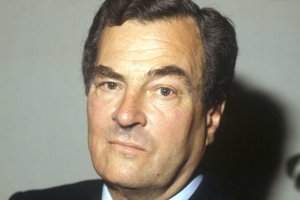
Patrick Leigh Fermor in Berlin

The knocking does not answer 

The back of the slopes wrinkly rich almost to the bay. Bruce Chatwin, who came to Paddy as a “guru to worship” or how to overthrow a king, saw eagles soar over the house of Leigh Fermor. Twenty years later, Paddy Chatwin ashes buried – next to a crumbling Byzantine church not far from here. The Mani is famous for its action songs. 

Southward, on the faded, twinkling towers over the tiny villages, run, it means that a chasm into Hades. Leigh Fermor found it flooded. “Phosphorgefiedert,” he wrote, dip it into the cold depths and swim “through the heart as a huge sapphire. 

We knock in vain to dare us to elaborate the cobbled courtyard and whisper with the housekeeper. It leads us through the garden open arcades, which might as well bend over a cloister. 

Leigh Fermor is tattooed like a sailor 

Leigh Fermor has written so many monasteries in Europe, in towers of “solid ivory, and if anyone here was an escapist, The doors to the rooms, however, the numerous tables, which depends on the sound of glasses and laughter as a smoke curtain, speak a different language. 

Leigh Fermor speaks many. Photographs show it once hung over bursting with charm and zest for life, sometimes almost professorial, and again obviously as a sailor and tattooed. 

We wait under the coffered ceiling of the spacious, wonderfully cluttered living room, from which the English poet John Betjeman once wrote that it was “one of the rooms of the world.” On one wall hang paintings by Nicolas Ghika and John Craxton, leaning on a shelf worn, faded volumes of the great English stylist. On the floor there is a band “Sherlock Holmes”. “Enchanting easy, right?” 

The family left behind her son with strangers 

This could be Merlin: a jumble the gray, wavy hair, sharp features and eons of age in the eyes. Leigh Fermor carries the threadbare sweater a garret of scholars and the trousers of an artist in his studio. 

He is of overwhelming kindness, perfectly shaped “upper class”. In the sunlit bay he called almost everyone who comes to the question, “marvelous”: writers, painters, musicians. “They all knew.” – “I am,” he says mildly, “that old.” 

“For at least one of us children would remain alive, if a submarine sank the ship,” Paddy was in the care of a small family back in England. 

1933 – the first trip to Istanbul 

“I ran,” he says, “shouting and screaming across the yard. I never learned discipline. I was a difficult student. “-” Lazy? “-” Disobedience. “Even a psychiatrist who also treated Virginia Woolf was consulted. Paddy still flew from the school. He had kept up with the daughter of the greengrocer’s hands. 

The autumn of 1933 found him in a room not far from trouble blowing from London’s Shepherd Market, where he should have been cramming so that at least the military school would take him. 

Instead, he took a verse of George Herbert at his word: My way is free, free to the horizon, / Much like the wind. “In December 1933 he embarked for Holland. From there, he wanted to walk into a “green dragon”, Byzantium, which he never called Istanbul. 

On the trip report, the fans are waiting until today 

He is famous for getting lost in the widely spread European history, which he knows like no other. In Mani, one of his best books, the “opposite of a travel guide,” as he says, there is a footnote, the sheer joy of the strangest here, “and there crafty peoples’ lists of Greece: the Melevi Dervishes of” Tower the winds “, the fire dancers from Mavroleki, the hiking quack Eurytaniens. With the gypsies, whom he met in 1934 in the highlands of the Carpathians, said Patrick Leigh Fermor Latin. 

Paddy arrived on New Year’s Day of 1935 in Constantinople, and had better things to do than to write about his trip. He is one of the great English stylists working, slowly, life itself seems always in your way. 

It was not until 1977 “was published, the time of the gifts,” which describes his journey from Hoek van Holland to the middle Danube, nine long years later, “between forests and water”, which leads to the Iron Gate. The third book, the description of the phenomenon must last up to Constantinople, is still expected with such longing that leave a few words from the mouth of Paddy’s heave a sigh British press today. 

Where Chatwin’s old typewriter? 

When Sir Patrick, as he was allowed to call since 2004, was awarded in March in Athens the “Order of the Phoenix,” he told his casual way that he, because his handwriting was always bad, just learn to touch type. 

Oh yes, “he says in the rich sunshine,” I will write this book. There is to end on Mount Athos. From there, I have notes for every day. “We are walking through the garden, the Gulf of Messinia in a dozen colors of light blue. On the burnt grass stretches herself a hangover: “His great-grandmother one day was just there.” 

The studio is housed in an outbuilding. In an iron chest, which bears the inscription of “Traveller’s Club” that tape, books are stacked on the wall a faded French hunting scene. Somewhere there must be also Chatwin old typewriter, a 51er Olivetti. But where? Where? 

Soldier, he was happy because “was always something going on” 

On Mount Athos celebrated his 20th Birthday, then went to Athens, as he later went to Paris and Rome. With a Romanian princess, he lived in an old water mill in the Peloponnese, and followed her to finally Balení, the seat of her family in northern Romania. 

Russia and the horrors of communism were suddenly within reach. “Many of your friends were communists at that time.” – “I did not speak up,” he says. “ “I was so apolitical.” 

In Balení reached him of the war. He, which six years earlier at the Shepherd Market has become clear, “how little I was good for soldiers in peace time,” volunteered. The departure was hasty. “Not even my notebook I took with me. We were so naive. In a few months ago we believed us again. “It took decades. “Were you like a soldier?” – “In a way, yes. “ There was always something going on. ” 

In 1944, he kidnapped a German general 

Books are also in the bathroom and somewhere between them is a plaque commemorating the Battle of Crete. When she was lost, went back Leigh Fermor as major of the Special Operations Executive to Crete. One and a half years he lived disguised as a shepherd in a cave – “wrapped in white cloth from goat and horribly dirty” – and organized the Cretan resistance against the German occupiers. 

The rest is legend, one of the most daring commando raid of the Second World War. One night in April 1944, a large Opel on the road to Knossos, Paddy in a stolen German uniforms on the way. A scuffle and then, at the roadblocks, again and again the cry of “General car. 

For days wandered Leigh Fermor, the people and kidnapped the German General Kreipe through the mountains until they reached the coast, and finally Libya (Egypt). On the difficult journey Kreipe murmurs once verses of Horace. Leigh Fermor is one. „Ach so, Herr Major“,  

About the death, he never speaks 

Paddy has never really written about it. “Ill Met by Moonlight,” the book that tells this story in full, comes from Bill Stanley Moss, his former deputy, and was filmed with Dirk Bogarde as Leigh Fermor. 

When it first appeared in 1950, just came Paddy’s first book, “The Traveller’s Tree,” a description of his travels in the Caribbean out. DThen he was – in the UK, famous in Greece “He embodied an idea of the Renaissance,” writes Cooper, Artemis, “a man of action, which is just as much a scholar.” 

Cooper, the friend and daughter of a friend is writing Paddy’s biography, when he, as he says, “is just gone.” “But now that you mention it: We never really talk about it.” 

The stones for the house came with the donkey 

For lunch there are lemon chicken, tzatziki and Retsina. We sit on chairs Andalusian, a Venetian table at the foot of a guillotined by the passage of time Roman Sibyl. Leigh Fermor has picked up in Rome on the way, he collects nothing. 

He tells the story of Niko Kolokotronis, the Mauerermeister that the contract was to build his house, because six generations were Kolokotronis wall masters, and played all the violin. That was the beginning of the sixties. In the bay there was no electricity, donkeys brought the stones, and Paddy and his wife Joan were living in tents, until the house was finally finished. 

“I scribble in the studio in front of me,” reads a letter from the most beautiful, vibrant with life days in the bay.”Through the window I can see Joan, their army cats invites you to dinner; mass meows to rise, and their tails make waves like the sea.” 

A picture of his wife Joan (cats) in her hand 

Leigh Fermor demands a picture of the mantel, Joan in the forties, which he portrayed with a pencil. “Come on!” She called from a boat, as Paddy, like his hero, Lord Byron swam the Hellespont. “It took three hours.” 

Joan died in June 2003 here.”She was,” he says, his drawing in hand, “in truth much more beautiful. 

Original article here.

Besuch beim Haudegen des Peloponnes Von Wieland Freund (Welt Online)

Widerstandskämpfer, Wanderer, Reiseschriftsteller: Patrick Leigh Fermor ging als junger Mann nach Istanbul, entführte 1944 auf Kreta einen Wehrmachtsgeneral und lebt heute auf Mani. Dort bewahrt er die Schreibmaschine von Bruce Chatwin auf.

Dass es sein Haus gar nicht geben könnte, dass man in einen Schrank steigen oder sich in einen Kaninchenbau stürzen müsste, um es zu erreichen – dieser Gedanke kommt mit der felszerklüfteten Dunkelheit und kehrt tags, ins Verwunschene gewendet, zurück.

Der Weg zu Patrick Leigh Fermor, dem Herodot des 20.Jahrhunderts, führt, scheint’s, an den Rand der Welt und dann noch einen Schritt darüber hinaus. Die flirrenden Blätter des Olivenhains, die riesenhaften Zitronen und die rote, von Vergangenheit schwere griechische Erde könnten ebenso gut die Requisiten eines Traums sein.

“Paddy” kam erstmals 1952 nach Mani
Wir halten auf eine Gruppe wachsamer Zypressen zu und folgen dem zugewachsenen Pfad bis vor eine himmelblaue Pforte. Braucht es einen Zauberspruch, damit sie sich öffnet und Fermor, der Reiseschriftsteller, der Kriegsheld, die Legende erscheint? Klopfen jedenfalls scheint zuwenig.

Mit 92 Jahren ist Patrick Leigh Fermor der Unsterblichkeit so nahe, wie man ihr heute noch nahe kommt. Seine Art Ruhm ist nur abseits des Weltenrummels zu haben, hinter fest verschlossenen Türen oder an so verschwiegenen Orten wie der Mani.

Paddy, wie die Vertrauten nicht ohne Ehrfurcht sagen, kam 1952 zum ersten Mal her. Wie die Spartaner und Byzantiner, die vor Slawen und Osmanen flohen und von denen er alles weiß, erklomm er die Pässe des bis zu zweieinhalbtausend Meter hohen Taygetos, der die Mani, den Mittelfinger der peloponnesischen Hand, Jahrhunderte lang zu einer natürlichen Festung machte.

Read more here!

The Friendly Isles: in the Footsteps of Patrick Leigh Fermor by Robin Hanbury-Tenison

Wake up. Stretch. Open eyes and look around. We’re in the most comfortable bedroom imaginable, physically and aesthetically. A great bed, soft sheets, pastel grey woodwork, white upholstery. Through the open French windows is a dream beach: a perfect crescent of pristine sand lapped by clear blue water and shaded by tall palm trees. A barefoot 50 paces across tightly mown grass and we are in the warm sea. It doesn’t get any better than this.

How different it was for Patrick Leigh Fermor and his companions 56 years ago. With Joan Eyres-Monsell, the woman who was to become his wife 20 years later, and Costa, the great Greek photographer, spent six months travelling through the Lesser and Greater Antilles. Then, the many islands they visited were thoroughly run down. The great buildings of church and state and planters’ wealth were mostly ruinous and rotten. The future in the depressed economic climate just after the Second World War looked bleak and, indeed, “King Sugar” was about to die, as it had on the abolition of slavery – only this time as a victim of sugar beet and the macro politics being played out between America and Europe.

Yet, Leigh Fermor still managed to reveal the romance and the magic of the archipelago and so start the obsession so many have since had with visiting the “Friendly Isles”. His vision saved them by helping to create a climate in which tourism could grow, and tourism has been the salvation of the Caribbean ever since.

In those immediate post-war days, the few hotels and boarding houses were grim. The tourism industry was embryonic and only when they stayed in some of the grand privately owned great houses, built by rich planters, “were we redeemed from the usual squalors of our island sojourns”. Most of these have now become hotels or “plantation inns” and they are delightful places to stay, combining old-world elegance with modern luxury.

Earlier this year, my wife, Louella, and I decided to follow in Leigh Fermor’s footsteps to see how much the islands had changed. Our pace was less leisurely than his and we were able to visit only 10 of the 15 islands he saw, but with his books as our vade-mecum we found our eyes, ears and all our senses opened and enhanced.

We started in Antigua and headed straight for the Carlisle Bay hotel. There, Gordon Campbell Gray has achieved the same understated excellence on a Caribbean beach as in his highly regarded One Aldwych in London.

Antigua has changed radically since Leigh Fermor’s day. Then, Nelson’s dockyard was in ruins. “The timbers were so eaten away,” he wrote, “that we had to step from beam to beam, for the boards between them had fallen to powder, or still hung from rusty nails in rotten fragments.” English Harbour, the great 18th-century naval base favoured by Rodney, Cochrane and Nelson and perhaps the prettiest and safest harbour in the whole Caribbean (the view of it from Shirley Heights is without equal), had no facilities whatever.

Read more here!

Life by the scenic route: Max Hastings reviews ‘Words of Mercury’

First publushed in the Daily Telegraph 12 Oct 2003

Paddy Leigh Fermor has lived one of the great picaresque lives of the 20th century. He left a minor public school under heavy clouds with no money and a penchant for wandering. From 1934, for five years, he sustained a lotus existence in eastern Europe and the Balkans, by charm, genteel begging and Byronic good looks. His parents must have despaired of him during this longest gap year in history.

Words of Mercury by Artemis Cooper

One of Evelyn Waugh’s characters observed in 1939: “It’s going to be a long war. The great thing is to spend it with friends.” Leigh Fermor pursued this policy with notable success. His 18 months as a British agent in Crete made him a legend, not least for the kidnapping of the German General Kreipe, theme of the later film Ill Met By Moonlight.

After the war, Paddy resumed his leisurely course. One can no more imagine him occupying an office desk, queueing for the weekly envelope, than some marvellous beast of the African bush taking up employment as a security guard. He wandered the world until, in 1950, he suddenly produced a small literary masterpiece about the Caribbean, The Traveller’s Tree.

Thereafter, at irregular intervals, he has written travel books and fragments of autobiography. On his visits to England, rural grandees and metropolitan hostesses fight for the privilege of his society. The home he created with his wife Joan on the south shore of the Peloponnese at Kardamyli is a small work of art in its own right, owing much to their pets, or – as he writes here – to four-footed “downholsterers and interior desecrators”. How he loves language and words!

What is charm? In Leigh Fermor’s case it is an infinite curiosity about other people. He treats Bulgarian peasants and English dukes exactly alike. John Betjeman once spoke of Paddy “sitting there listening to you, his eyes sparkling with excitement as he waited to hear what you might say next”. Generosity of spirit is among his notable qualities.

Read more here!

The Long Walk – song about Patrick Leigh Fermor

A personal tribute to PLF from a fan. A song about Paddy’s long walk to Constantinople in “A Time of Gifts” and “Between the Woods and the Water”.

I say, old chap, that’s my favourite Horatian ode too! By Justin Cartwright

A review of Words of Mercury by Patrick Leigh Fermor, ed Artemis Cooper first published in the Independent

Sunday, 2 November 2003

The overwhelming impression this book left on me was of a lost world of aesthetic public schoolboys, powerful newspaper editors, friendly ambassadors, and an unspoken understanding of what it meant to be upper- middle-class and English. What it meant was easy access to embassies and aristocratic houses around Europe, bicycle polo in Hungary, and the possibility that the next shepherd you met would be an Etonian Special Operations officer, speaking classical Greek. Here you will find the term “middle class” applied in a pejorative sense, rather than in the current usage which has such a wide catchment. That John Murray, the publishers of this book and upper-middle-class publishers par excellence, are no longer family-owned, perhaps confirms that this world has passed. And with it a love of language and literary decoration.

To quote Jan Morris, Paddy Leigh Fermor is beyond doubt the greatest of living travel writers, although the term “travel writing” barely does justice to the beauty, the lustrousness and sensuality of his writing. Take this, for example, speaking of how Greek temples once looked before they were stark ruins: “But the reality of the ruins, re-cohering in cobalt and blood-red, studded with metal, gaudy with idols, shiny with spilt honey and blood and reeking with sacrificial smoke, will have replaced the tinted ivory artefacts that had stolen their place and the void between the cutting of the flutes on the columns and the laying of the tramlines begins to fill up with people and events.”

There are about 40 short pieces divided into headings: Travels, Greece, People, Books and Flotsam. Many of these pieces are from Leigh Fermor’s great books, Mani, Roumeli and A Time of Gifts. (In 55 years he has only written eight books.) Others are from scattered newspaper pieces and obituaries. All the major phases of his life are represented here: the wandering schoolboy heading for Istanbul, the two years just before the war he spent in Romania with a doomed aristocratic family after meeting the daughter of the family in Athens (the woman Artemis Cooper describes as the love of his life), the extraordinary exploits in war-time Special Operations in Crete, where he captured the German General, Heinrich Kreipe, and his post-war exploration of Greece, particularly Mani where he has lived for 40 years in a house he built with his wife Joan, who died recently. Their story will be told by Artemis Cooper in a biography to be published after his death.

Read more!

Photographs of Ill Met by Moonlight

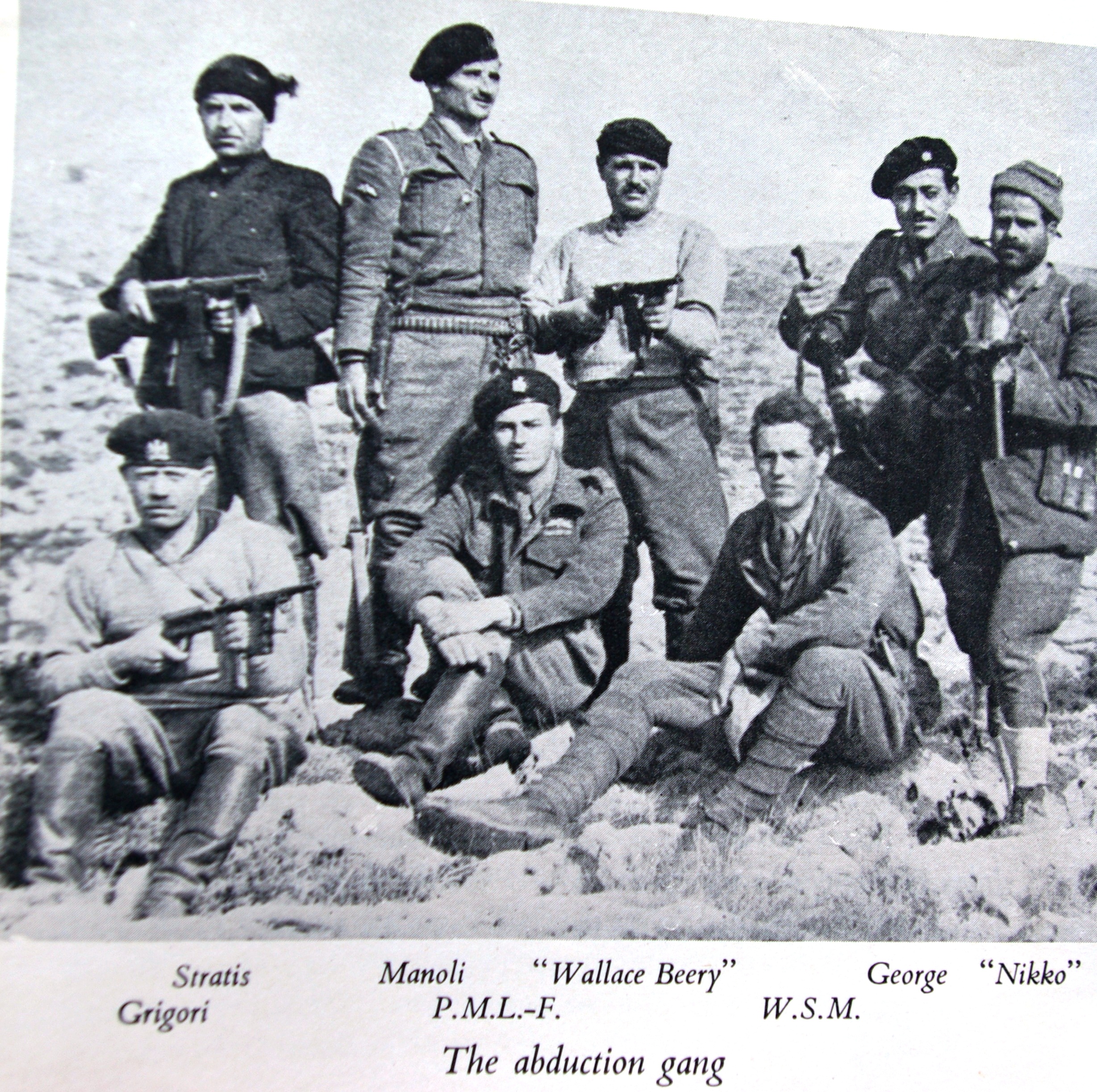
The abduction gang - PLF centre Moss to his left

Visit the photographs page to see pictures  from the book by William Stanley Moss which documents the famous abduction of the commander of German forces in Crete, General Heinrich Kreipe. They show the development of the story from the planning stage, the ‘abduction gang’ selection, and pictures taken during the escape with the General to the south coast and freedom.

A biography of Paddy by Artemis Cooper?

There are some tough jobs around, but few could be tougher than writing a biography of Patrick Leigh Fermor. However, according to the acknowledgements section of “In Tearing Haste” by Charlotte Mosley, Artemis Cooper is apparently doing so; ‘… to Artemis Cooper, who is preparing a biography of Paddy’. Artemis of course edited “Words of Mercury” (2003).

Given that we have been waiting twenty four years for “Vol 3” what are the chances of Artemis’ biography being published before that volume? Not great I would have thought. But what a challenge to write about the life of one of the greatest writers of the twentieth century. I wish her the best of luck!

Paddy’s Illustrator – John Craxton Telegraph Obituary

Published: 6:18PM GMT 18 Nov 2009

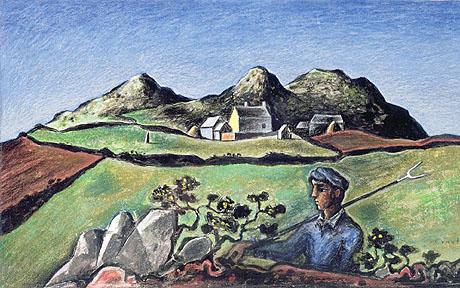
John Craxton, who died on November 17 aged 87, was one of the leading artists of the 1940s Neo-Romantic movement – a label which he detested throughout his life; although remaining essentially an English painter, for the past half-century he had lived an expatriate existence in Greece. He illustrated Paddy’s book covers (see blog header) and provided pen sketches for almost fifty years.

John Craxton's Reaper in a Welsh Landscape

John Craxton's 'Reaper in a Welsh Landscape', 1945 Photo: BRIDGEMAN ART LIBRARY

One of six children, and the fourth of five sons, John Leith Craxton was born on October 3 1922 at St John’s Wood, London, into a highly musical family. His father, Harold Craxton, was a pianist and Professor of Pianoforte at the Royal College of Music, his mother, Essie Faulkner, a violinist; his sister, Janet, was to become an oboist. The visual arts, however, were represented in his family history by the 18th-century painter Benjamin West, an ancestor on his mother’s side.

After attending seven different schools, of which the only one he enjoyed was Betteshanger, near Deal, at 17 John went to study at the Académie de la Grande Chaumière in Paris; on the outbreak of war he returned to London, enrolling at the Westminster and then the Central School of Art. By the age of 19 he was established in a maisonette at Abercorn Place in St John’s Wood, which he shared with another young artist, Lucian Freud.

The rent on the flat was paid by one of the most influential patrons of the day, Peter Watson, who owned Horizon magazine. Watson’s friendship was a boon in other ways: having lived in Paris before the war, he was a source of first-hand information about the latest developments in the Continental avant-garde.

Watson also gave the young artists introductions to such figures as John Piper, Graham Sutherland, Augustus John and the art historian Kenneth Clark. Clark called on the St John’s Wood flat dressed in tweeds and a country cap, and was soon giving Craxton and Freud the run of his Hampstead library as well as buying their pictures.

Because he suffered from pleurisy, in 1941 Craxton was rejected for military service. Poet in a Landscape (1941), executed after he heard that he would not be expected to fight, is typical in its combination of a subject from the romantic repertoire with disturbingly up-to-date elements. A youthful figure, based on the artist himself, sits reading in a field. But the landscape is far from idyllic: instead it is a threatening tangle of spiky, writhing branches and enormous, fleshy leaves. Both this drawing and a similar one, Dreamer in a Landscape, were reproduced in Horizon in March 1942.

Although in the early 1940s Craxton’s style oscillated rapidly between different influences – and was, to that extent, immature – it was during this period that he produced his most intense images. At this time both he and Freud were fond of using dead animals as models (when Clark called, there was a dead monkey hidden in their oven). This enthusiasm was expressed in Freud’s Chicken in Basket and Craxton’s Hare in Larder (1943), two memorable, if disturbing, works.

For Geoffrey Grigson’s anthology, The Poet’s Eye (1944), Craxton executed 16 colour lithographs which are widely regarded as among the finest book illustrations of the Neo-Romantic movement. In general they sustain the earlier mood, a point of balance between rustic dream and modernist nightmare; but some show the effect of the time he had spent in 1943-44 painting beside Sutherland in Pembrokeshire.

Sutherland’s stark influence was strong at this time, but another attraction was that, according to Peter Watson, west Wales represented the closest approach in Britain to the strong light and elemental landscape of the Mediterranean.

As soon as the war was over, Craxton took off for the Continent. By the end of 1946 he had spent time in France, where he met Picasso and patronised opium dens (but “did not inhale”). He had also visited Switzerland, where he exhibited; Italy, where he smoked a joint with Raymond Mortimer in Toscanini’s private box during the latter’s triumphant return to La Scala; and Greece, a country with which Craxton fell in love.

In Geoffrey Grigson’s monograph John Craxton: Paintings and Drawings (1948), Craxton is quoted as saying that in postwar London he felt “like an émigré… and squashed flat”. His intention, he declared, was to return to Greece as soon as possible. Years later he explained: “I wanted to put myself in an alien land and see if my talent would stand it.”

Over the next decade Craxton spent much of his time travelling in southern Europe, first settling on Poros, where he was visited by his old friend Freud. They sketched each other and exchanged the drawings as in the old days.

Back in London, Craxton joined his old friend at the gaming club Aspinalls. Over scrambled eggs and champagne, Freud told him that, desperate for money, he had sold the drawings Craxton had given him, adding: “You don’t mind, do you?”

Some time later Craxton too found himself strapped for cash, and was persuaded to sell some Freud drawings. When these were put up for sale in London, Freud was called upon to authenticate them. “Craxton is a —-“, he wrote on the back, which did no harm to their value.

In 1960 Craxton finally settled at Hania on the island of Crete, where his life was by all accounts as idyllic as his pictures had become. A devotee of Greek music, Byzantine art and Moto Guzzi motorcycles, he was for many years the honorary British consul on the island; from time to time he would be telephoned by the embassy and asked if he could find a hotel for a visiting dignitary such as the Duke of Kent, or girls for cocktail parties for the ships that came in.

From the late 1940s Craxton’s favourite subject had been the sun-baked south, with its sparkling seas, olive trees, goats and human inhabitants; and his characteristic mood was a lyric contentment very different from the bleak misanthropy of many of his contemporaries.

The Tate’s Pastoral for PW (Peter Watson) of 1948 is a good early example of Craxton’s mature manner. The subject – a solitary piper strolling among trees and grazing flocks – belongs to the world of Virgil’s Eclogues; but the paramount stylistic influences are now Picasso and Miró (purged, however, of their violence and savage vitality). The flat, numinous art of Byzantium also made a deep impression on the artist.

Craxton painted prolifically throughout his life. He also designed a ballet, Daphnis et Chloë, for Frederick Ashton in 1951, and produced the scenery and costumes for Stravinsky’s Apollo at the Royal Opera House in 1968.

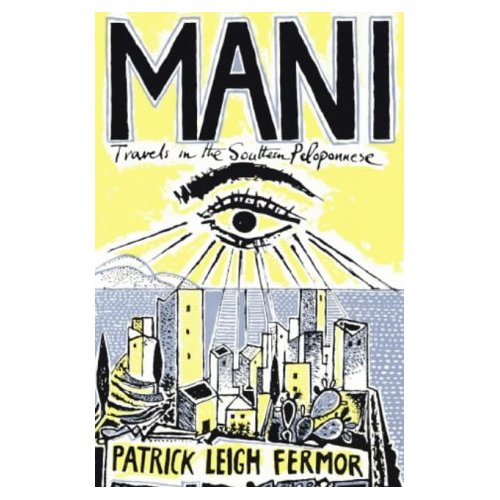
Mani: Travels in the Southern Peloponnese

Mani: Travels in the Southern Peloponnese

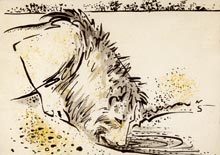
Of his many illustrations for the books of Patrick Leigh Fermor, the most delightful – and the most expressive of the ardent philhellenism he shared with the author – was the frontispiece for Mani (1958).

John Craxton was elected a Royal Academician in 1993. His last London exhibition was at Art First in 2001.

Craxton had his detractors – at the time of his Whitechapel retrospective in 1967 critics muttered scathingly about superior “Chelsea restaurant murals”.

His unfashionably happy later work may come to be valued more highly in the future, but it is probably for his early work that he is likely to be best remembered.

He is survived by his long-term partner, Richard Riley.

Original obituary in the Telegraph

Joan Leigh Fermor – Obituary from The Independent

Published Tuesday, 10 June 2003

Muse who enlivened a distinguished generation

Like all adorable people Joan Leigh Fermor had something enigmatic about her nature which, together with her wonderful good looks, made her a very seductive presence.

Joan Elizabeth Eyres Monsell, photographer: born London 5 February 1912; married 1939 John Rayner (marriage dissolved 1947), 1968 Patrick Leigh Fermor; died Kardamyli, Greece 4 June 2003.

Like all adorable people Joan Leigh Fermor had something enigmatic about her nature which, together with her wonderful good looks, made her a very seductive presence.

She was also naturally self- effacing. Even in a crowd she maintained a deep and private inner self. In fact I know she regarded every agora with phobia. Paradoxically, she loved good company and long and lasting friendships. It was her elegance, luminous intelligence, curiosity, understanding and unerring high standards that made her such a perfect muse to her lifelong companion and husband Patrick Leigh Fermor, as well as friend and inspiration to a host of distinguished writers, philosophers, painters, sculptors and musicians.

Cyril Connolly described her in a letter to his mother in 1949 as “a person with whom I have everything in common – friends, tastes, intellectual interests – and very beautiful: tall, fair, slanting eyes, yellow skin”. For the future editor of the Times Literary Supplement Alan Pryce-Jones, 17 years earlier, she was

very fair, with huge myopic blue eyes. Her voice had a delicious quaver – no, not quite quaver, an undulation rather in it; her talk was unexpected, funny, clear-minded. She had no time for inessentials; though she was a natural enjoyer, she was also a perfectionist whom [aged 20] experience had already taught to be wary.

When I first met her in 1942 through Peter Watson, owner and founder with Connolly of Horizon magazine, she was living as his neighbour in the only modern block of flats in London, 10 Palace Gate, designed by Welles Coates. She was a dazzling beauty and I, an awkward 20-year-old, was utterly stage-struck when she invited me to dance with her one evening at the very smart Boeuf sur le Toit night-club. The manager tried to remove me as I was wearing sandals, but was promptly reprimanded by Joan.

By wonderful good fortune she was already in Greece when in May 1946 I turned up for the first time in Athens, where she introduced me one evening to Paddy Leigh Fermor, who with his knowledge of the Greek countryside near Athens was instrumental in finding me a place to live and paint on the island of Poros. Joan’s love of Greece and the Greeks started, like mine, from this time.

Athens just after the Second World War was host to a unique group of marvellously talented men and women that included the philhellenes Steven Runciman, Maurice Cardiff, Lady Norton and Osbert Lancaster (whose secretary she had been), the Anglophile Greek painter Nico Ghika, the poet George Seferis and George Katsimbalis, Henry Miller’s colossus of Maroussi.

Anyone who thought foolishly that Joan herself was not really doing anything was as far from the truth as it is possible to get. Her unwavering empathy, generosity, taste and intelligence made her a creative catalyst to all who became her friends. Later on, Constant Lambert, Giacometti, Francis Bacon, Dadie Rylands, Louis MacNeice, Stephen Spender, Balthus, Maurice Bowra and Freddie Ayer, to name only a few, were all devoted admirers.

Joan herself was at that time one of the finest amateur photographers in England. Her photographs were first published, through her friend John Betjeman, in the Architectural Review, and then in Horizon, and are to be found in her husband Paddy’s books about Greece – Mani: travels in the southern Peloponnese (1958) and Roumeli: travels in northern Greece (1966). In 1948 she was employed by Cyril Connolly to be his photographer for a guidebook to south-west France, a book he never wrote, perhaps because, as he recorded in his journal, he “fell very much in love”, distracted by

her dark green cardigan and grey trousers, her camera slung over her shoulder and her golden hair bobbing as she walks, always a little fairer than you think, like the wind in a stubble-field.

During the war she was commissioned to take photographs of buildings vulnerable to bombing. After it a favourite subject was cemeteries – in Paris (Père la Chaise), notably, and Genoa. Somehow I never dared ask her why she gave up photography. It was always foolish to ask Joan a question when one already had a jolly good idea of what the answer might be: probably she did not think she was good enough.

At one time she owned a large convertible Bentley, appropriately nicknamed Moloch. It guzzled petrol as a row of thirsty Lombardy poplars needs water. One summer we set off in it with Paddy to drive to Italy, Joan at the wheel all the way, to meet up with Tom Fisher, Ruth Page, Freddy Ashton and Margot Fonteyn at the Villa Cimbroni in Ravello. We made frequent stops to explore Romanesque churches and eat unforgettable meals in little out-of-the-way restaurants, serving exactly the kind of French cooking admired and written about by Elizabeth David, whom Joan herself so much revered.

Joan and I shared a lifelong affection for cats. Paddy had less admiration and called them “interior desecrators and downholsterers”. Greek cats are good examples of a feline Parkinson’s Law. They prosper. Joan managed to have a large and endearing accumulation of them. One could not call them a collection; they were more like a flock, with Joan their shepherdess, handing out free meals. They repaid her generosity by offering her in winter a duvet of living fur for her bed.

With her beloved brother, Graham Eyres Monsell, she shared an exceptionally good and discerning ear for music. Her collection of eclectic and legendary performances of records was a constant joy for her and all her musical friends. Unfortunately, the vinyl long-playing discs made themselves irresistibly attractive to Greek dust.

She was born Joan Eyres Monsell in 1912, the second of three daughters of Bolton Eyres Monsell, the Conservative MP for South Evesham, later First Lord of the Admiralty and first Viscount Monsell. He had adopted the “Eyres” on his marriage in 1904 to Joan’s mother, Sybil Eyres, heiress to Dumbleton Hall in Worcestershire (subject of two Betjeman poems). Joan went to school at St James’s, Malvern, where in seven years she regretted that she learnt no Latin or Greek; all they taught, she said, was how to curtsy. She was “finished” in Paris and Florence.

When Alan Pryce-Jones fell in love with her in 1932, the First Lord saw him off. “I gather you want to marry my daughter,” he said. “What is your place? And what job have you?” Pryce-Jones had no “place” and no job. “And so, Pryce-Jones, having nothing, without prospects, without a home, you expect to marry my daughter, who has always had the best of everything . . . No, no, Pryce-Jones, come back in a few years when you have something behind you.”

Instead, two months before war broke out in 1939, she married John Rayner, then features editor of the Daily Express, but the marriage did not last, and they divorced in 1947. She served as a nurse, and then worked in the cipher department of embassies overseas, in Spain, then in Algiers and in Cairo, where she moved in the set that included Lawrence Durrell, Robin Fedden and Charles Johnston. It was in Cairo that she met Paddy Leigh Fermor.

She was happiest living with Paddy in what must be the most beautiful house in the Peloponnese, at Kardamyli in the Mani, which she and Paddy built of stone for themselves by the sea on a low promontory between two small bays. “Of course that big room,” John Betjeman wrote to the Leigh Fermors in 1969, “is one of the rooms in the world.”

John Craxton

Joan Leigh Fermor was one of the most remarkable people I have ever met. Apart from beauty and acute intelligence, she had to an unusual degree genuine goodness, both natural and willed, which informed all her actions and relationships. Her great generosity was as natural as discreet, based on her perceptive understanding of those less privileged or lucky than herself.

I first met Joan and Paddy when I married my English husband and settled in London in the early 1960s. Their house in Chelsea was always full of guests, and Joan was the most gracious and informal of hostesses. But unlike some hostesses she did not care whether her guests were successful or not, famous or obscure. I never heard her pronounce a second-hand opinion about a book or a picture. She helped both maternally and with friendship many an impecunious writer and artist whose work she liked, and her sympathy extended to all those to whom life had dealt less favourable cards.

Joan was not religious – just saintly. And although not a believer she was deeply spiritual, to me an example of alma naturalis Christiana. Although she had no children, she had a few daughters and sons – among whom I hoped to be counted – who adored her. She made one feel that, as long as she was there, all was not ill with the world.

Shusha Guppy (whose obituary can be read here)

From The Independent

Joan Leigh Fermor – Obituary from Daily Telegraph

Published: 12:00AM BST 05 Jul 2003

Joan Leigh Fermor, who has died aged 91, created a remarkable house in southern Greece with her husband, the writer Patrick Leigh Fermor, which attracted a host of distinguished figures from the literary and social spheres.

Joan Leigh Fermor was a noted beauty, with a ready gift for company and a sharp intelligence; her friends and admirers included Maurice Bowra, Cyril Connolly, Stephen Spender, Giacometti, Lawrence Durrell, and what sometimes seemed like almost every figure from the literary and scholarly worlds who gathered around the Mediterranean after the Second World War. She was also one of the most distinguished amateur photographers of her generation, and provided the illustrations for several of her husband’s books.

Patrick Leigh Fermor’s Mani (1958), an account of his travels with his wife in the southern Peloponnese, was illustrated with Joan’s photographs; eight years later, the couple produced Roumeli, devoted to the north of the country. In addition, Patrick Leigh Fermor’s Three Letters from the Andes (1991), an account of his mountaineering expedition 20 years earlier, were addressed to his wife. They provided a picture of the gentleman traveller, stoical in the face of all hardships (other than the preparation of a hard-boiled egg at altitude).

Joan Elizabeth Eyres Monsell was born on February 5 1912 at Dumbleton, Gloucestershire. Her father was Bolton Eyres Monsell, the Tory MP for South Worcestershire who went on to become Chief Whip and First Lord of the Admiralty before being created Viscount Monsell in 1935. He had added the name Eyres on his marriage to his wife (Caroline Mary) Sybil, who was lady of the manor and patroness of the living at Dumbleton.

Joan was educated at St James’s, Malvern, and at finishing schools in Paris and Florence. Afterwards she became keen on photography, concentrating – on the advice of her friend John Betjeman – on architectural studies. The first among these were published in Architecture Review; she went on to become a contributor to Horizon.

On the outbreak of war, Joan Monsell became a nurse, and also took photographs of architectural sites which were thought vulnerable to bombing. She then joined the cypher departments of the British embassies in Madrid, Algiers and then Cairo, where she became friendly with Lawrence Durrell, Robin Fedden and Charles Johnston, and where she met Patrick Leigh Fermor. From Cairo, she managed to escape on leave in order to travel in Kurdistan, before moving to Athens, where she became secretary to the cartoonist Osbert Lancaster.

Joan Leigh Fermor was passionately fond of cats, eight of which were settled about her her bed on her last morning. She was also addicted to chess, and kittens were reprimanded only if they had the temerity to muddle the pieces. She was accommodating, too, of her husband’s derring-do – though she watched him swim the Hellespont (at the age of 69) “sitting on her hands so as not to wring them”.

She died on June 4 after a fall in the Mani, where she and her husband had settled nearly half a century before, living in tents while constructing their home. The house, centred on a great room full of books (and often also music), stands on a wild peninsula on the southernmost tip of Greece, looking out on olive groves and cypresses toward the sea, against a backdrop of mountains. There the Leigh Fermors entertained many visitors, plying them with large quantities of wine and the sea-green olive oil from their own trees.

She married, first, in 1939, John Rayner, features editor of the Daily Express; but the match did not survive the war, and was dissolved in 1947. She married Patrick Leigh Fermor in 1968.

Billa Harrod writes: Joan and I met when we were both 18 and remained great friends for more than 70 years. Neither of us was quite the sort of daughter our mothers would have hoped for (luckily they had others). We were very lucky in our backgrounds of big comfortable houses – which we did not always treat as well as we should have, once breaking off an arm of a dignified candelabrum at Dumbleton. (Though when Joan’s father was First Lord of the Admiralty and they lived at Admiralty House in Whitehall, we did appreciate the beautiful fish furniture.)

Joan had more money than most of her friends and was quietly but largely generous when she saw that it would be helpful. She was beautiful and elegant, and also a highbrow, who had the highest standards, and did not suffer fools gladly. Although her actual schooling was rather feeble, she had read a vast amount and had an excellent memory. Music and literature were her real interests, but she was also a superb cook, and taught others to be. The food in her various houses was always delicious.

Major Dennis Ciclitira Obituary from Daily Telegraph

Published: 12:00AM BST 16 Jun 2000

SOE officer undercover in Crete who organised the German surrender

MAJOR DENNIS CICLITIRA, who has died aged 81, was in charge of SOE’s operations in western Crete during the Second World War and eventually arranged for the German surrender of the island.

Ciclitira arrived on Crete just before Christmas 1943, taking over supervision for the area around the town of Canea from Xan Fielding. Liaison with the Cretan Resistance was led by the classicist Tom Dunbabin, who from the spring of 1942 had been supervising the activities of a handful of SOE officers, among them Patrick Leigh Fermor, who were living rough with the andartes or guerrillas in mountain eyries.

Ciclitira at sea between Cairo and Crete. (The Times)

One of Ciclitira’s first important tasks was to help to organise the evacuation of Leigh Fermor after he and Billy Moss had successfully abducted the commandant of the island, General Kreipe, from his staff car in April 1944. In his book Ill Met By Moonlight (1950), Moss describes encountering Ciclitira in his cave hideout.

“He has grown an impressive beard,” he wrote, “which he treats with the affection of a spinster for her favourite cat, and wears an elegant sort of musical comedy costume, complete with wine-coloured cummerbund, turban and the usual trappings.”

Two of Ciclitira’s men had already been killed by the Nazis, but despite their strenuous efforts to catch him, he managed to maintain wireless communications with Cairo and to arrange for Leigh Fermor and his prize to be picked up by motor launch. When he arrived at the rendezvous he found Moss and Leigh Fermor flashing their torches out to sea in frantic desperation, as neither knew the Morse Code for the pre-arranged signal. Fortunately, Ciclitira did.

Ciclitira left with them on the boat, but subsequently returned to Crete, where he operated under the codename Dionysios. In January 1945, the German garrison of 12,000 began to withdraw to the western end of the island, taking with them prisoners who included Costa Mitsotakis, later the Prime Minister of Greece but then an agent for the Resistance. The Germans had orders to execute all such captives, but Ciclitira managed to contact the German authorities with a view to making an exchange of prisoners.

Ciclitira went to the meeting with Captain Lassen of the Special Boat Section, who soon became exasperated by the horse-trading and suggested that his commando unit, who were hiding in the mountains, should play the Germans at football, with the winner to take all. This suggestion greatly amused Bishop Xirouhakis of Kydonia, who was mediating at the talks and offered to act as referee in any such match.

In the event, after Ciclitira had travelled by caique to Athens for further discussions, 36 German PoWs were exchanged for 10 Cretan agents, probably saving their lives. On May 8, Ciclitira received a message to contact General Benthag, the German commander, to make arrangements for a formal surrender. Dressed in suits, he and Mitsotakis – a fluent German speaker – presented themselves at Benthag’s headquarters. Preliminary terms were then agreed, but since the general could only surrender to an officer of equal rank, it was decided that he should be flown to the British HQ at Heraklion.

Benthag asked how Ciclitira proposed to contact his senior officer, and was most put out to discover that Ciclitira’s transmitter was hidden next door to German HQ, where the volume of radio traffic concealed Ciclitira’s own signals from direction-finding cars. The next evening, although the surrender had not been made public, Ciclitira and his comrades sneaked into Canea and invited their German counterparts to a party; the garrison provided them with a jazz band. The next day, Ciclitira joined in the wild celebrations that greeted Liberation.

Read the full Telegraph obituary.

The Moss Conundrum

I have been reading ‘In Tearing Haste: Letters Between Deborah Devonshire and Patrick Leigh-Fermor’ (2008), edited by Charlotte Mosley. It is really quite good and gets better as Debo writes more often to Paddy; she is very funny.

On page 22 of my paperback version in a letter from Paddy written on 26 August 1956 he writes:

“I was asked by W.S.M. (William Stanley Moss – his partner in the Kreipe kidnap escapade – see Ill Met by Moonlight) to a meal of reconciliation and amends, where we met as affable strangers. It was really a gasbag’s penance and I, having learnt the hard way, vouchsafed little more than a few safe monosyllables.”

Well what does this mean? It is clear something had caused a breakdown in what was once a good friendship. They had been through a lot together and to feel like this, there must have been something terrible to cause such a rift. Was it the way Moss portrayed the events of the Kreipe kidnap? The fact that Moss married Sophie? Who knows?

If anyone knows please add a comment to this article.

Welcome to the Patrick Leigh Fermor blog

Tom at Lake Ohrid on the Via Egnatia, 2009

My name is Tom Sawford and I live in Winchester, Hampshire, England.

I first became aware of Paddy quite late in life; I guess he is an acquired taste. Maybe you need to have some awareness of the broad range of subject matter that he can, often without warning, cover in his books. Perhaps it is only after formal education, reading widely, developing a broad appreciation for history, and just plain living that you have the ability to grasp some of what he is getting at. A strongly developed vocabulary is also a boon; or at least a dictionary and of course now with access to Google it is possible to quickly research some of the more obscure topics that Paddy assumes mere mortals will be aware of. I remember the first time I read A Time of Gifts and being amused that Paddy clearly expected his readers to have at least a schoolboy/girl grasp of Latin as phrases pour out with no explanation or translation.

But surely that is the attraction of his work. It aims for the highest pinnacles of linguistic and intellectual endeavour and if you like what you read it drags you along with it, drinking from the cup of knowledge that Paddy offers.

He is of course so much more than a writer. It has been said that he is the ‘greatest English travel writer’. I don’t agree with that. I believe he travels to write, having so much more to say than to merely discuss the merits of one hotel over another or the quality of food in Greek fishing  villages. In my view he was the “Greatest Living Englishman”. Not that we don’t have other great Englishman (but perhaps less than we once had), but more than that he is that unique person who personifies what was once the mark of an Englishman; educated; heroic, handsome, generous; and modest (to a degree).

Sir Patrick Michael Leigh Fermor DSO OBE lived a full life, and had experiences that few others will likely ever have again. He had lived a pretty full life before the second world war, even living with a Romanian princess who was older than he, and during that conflict he applied his skills to fighting behind German lines, and was unique in achieving the capture, with “Billy” Moss, of the German Garrison Commander of Crete, Major General Kriepe. After the war he travelled, wrote, married, developed long-lasting friendships, and built a house in Greece. My epithet stands because few can match what he has done and also the manner in which he did it.

The purpose of this blog is to bring the life and work of Paddy, and his many colleagues, to the attention of a wider audience, and to create an archive of on-line material. He, and they, deserve to be recognised and remembered in a world that has changed much during their lives, but would be the poorer without them.

If you would like to help with the blog, make a contribution or anything else, please contact me tsawford[at]btinternet.com.

Tom Sawford

April 2010

Easter 1934 – Paddy reaches the Hungarian border at Esztergom

After what must have seemed an amazing four months to a young man of eighteen, Paddy arrives at the Czechoslovak-Hungarian border at Esztergom, which as he says (p 276 A Time of Gifts) contained ‘the Metropolitan Cathedral of all Hungary’. It is these last closing pages of his first volume that he describes the colourful preparations for an Easter service as he watches from no-man’s land in the middle of the bridge spanning the Danube. It is from this point that he picks up the story in volume two ‘Between the Woods an the Water’.

Wikipedia tells us: Esztergom (Hungarian pronunciation: [ˈɛstɛrɡom], also known by alternative names), is a city in northern Hungary, about 50 km north-west of the capital Budapest. It lies in Komárom-Esztergom county, on the right bank of the river Danube, which forms the border with Slovakia there.

Esztergom was the capital of Hungary from the 10th till the mid-13th century when King Béla IV of Hungary moved the royal seat to Buda.

Esztergom is the seat of the prímás (see Primate) of the Roman Catholic Church in Hungary. It’s also the official seat of the Constitutional Court of Hungary. The city has the Keresztény Múzeum, the largest ecclesiastical collection in Hungary. Its cathedral, Esztergom Basilica is the largest church in Hungary.

Imagine Paddy standing in the middle of this bridge looking at the cathedral

Ill Met by Moonlight movie

The final movie from the famed Powell and Pressburger partnership starring Dirk Bogarde (as Paddy), Cyril Cusack (as Captain Sandy Rendel), David Oxley (as W. Stanley “Billy” Moss, M.C.) and the superb Marius Goring (as Major General Heinrich Kreipe). Not forgetting the island of Crete of course. Click the picture to watch the trailer!