Patrick Leigh Fermor recounts the kidnap of General Kreipe on video

Patrick Leigh Fermor recounts the kidnap of General Kreipe

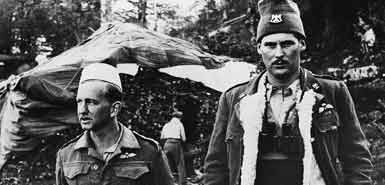
Finally we have Paddy on video! A kind soul has posted the movie 11th Day on You Tube. Part seven deals with the kidnap of General Kreipe and includes a detailed explanation of the famous Mount Ida Horace moment: “Ach so, Herr Major”.

I have found all parts of the film from You Tube and have embedded them on a special new page Video.

Why not put your feet up and enjoy the whole movie which covers the brave Cretan resistance and the part that Paddy, Moss and others played in it?

But to start you off here is Patrick Leigh Fermor recounting for you the events of what we now know as Ill Met by Moonlight.

Visit the movie 11th Day site.

Related article:

Ill Met by Moonlight movie trailer

Related categories:

Il Met by Moonlight

Bruce Chatwin: letters from a fallen angel (or, A Woman Scorned)

I had no great intention to continue delving into the life and work of Bruce Chatwin, but I found the following article in this week’s London Evening Standard absolutely fascinating. The forthcoming book of letters edited by his biographer Nicholas Shakespeare, with commentary by his long suffering wife is sure to prove quite explosive.

As I have said before I don’t know much about the man, but to be frank, from what I have read I don’t see him as much of a hero as some others clearly do. However good he may have been as a writer, he was clearly incapable of any form of loyalty, and seemingly indulged himself in fulfilling his bi-sexual fantasies during his extended journeys, where he clearly had many opportunities.  As Miranda Rothschild, told his biographer: “Sexually, Bruce was a polymorphous pervert … He’s out to seduce everybody, it doesn’t matter if you are male, female, an ocelot or a tea cosy.”

He seems to have carried over this trait into his writing; he does not appear to have been particularly honest with his readers, and in the forthcoming book of letters his wife demolishes many of the myths that have grown up around Chatwin. Elizabeth Chatwin has waited a long time to put over her own point of view and it seems that she has not held back. Beware a woman scorned.

Bruce Chatwin: letters from a fallen angel

by David Sexton

First published in The Evening Standard 25.08.10

Bruce Chatwin died in hospital in Nice in January 1989, suffering from Aids, aged just 48. His last days were all the more terrible for the fact that he had never been able to admit to himself or to others the nature of his illness or his sexuality.

Creator of his own myth: Bruce Chatwin died of Aids in 1989, aged 48. He had never been able to admit to himself or to others the nature of his illness or his sexuality

For Chatwin had spent his entire life turning himself into a fantastic story, a prize rarity, a human anecdote, and it continued right until the end. He gave various delusive accounts of his illness to his friends. He told Loulou de la Falaise that he had eaten a rotten thousand-year-old egg. He told George Ortiz it had come from bat’s faeces. To his mother-in-law he wrote, on first becoming ill: “Trust me to pick up a disease never recorded among Europeans. The fungus that has attacked my bone marrow has been recorded among 10 Chinese peasants (China is presumably where I got it), a few Thais and a killer whale cast up on the shores of Arabia.”

Among those who bought in to the Chatwin myth most eagerly during his lifetime was his friend, the novelist and literary journalist Nicholas Shakespeare, who loved to repeat such exotic stories about Chatwin as that “he once wore a live python as a bow-tie” or that “he once sold all he had, including a collection of 6th-century BC marble buttocks, and painted his flat the colour of a Nubian hut”. In a tribute published the week of Chatwin’s death, Shakespeare sentimentally proclaimed: “He was so inquisitive about all aspects of life, it is easy to believe he might have stumbled on its secret. That’s probably why the gods took him early.”

It is greatly to Shakespeare’s credit that, when he came to write the authorised biography of Bruce Chatwin, published in 1999, he steadily faced up to the often disappointing truth about his hero and produced such an excellent book. He researched deeply and he did not censor what he discovered, filling in the humdrum facts that Chatwin had excluded to make a more dashing effect. Famously, Chatwin once told Paul Theroux: “I don’t believe in coming clean.” Shakespeare did it for him, posthumously. Perhaps this very truthfulness has damaged Chatwin’s mystique and standing as a writer, which depended so much upon not being thus exposed.

Introducing Under The Sun: The Letters of Bruce Chatwin, shortly to be published, Shakespeare admits that Chatwin’s reputation is not what it was and that many — such as Barry Humphries — who used to admire him, no longer do. But he defends Chatwin nonetheless, hopefully maintaining that he was “less economical with the truth than spendthrift. He tells not a half-truth but a truth and a half”.

Chatwin’s biographer and editor of his letters, Nicholas Shakespeare was a lifelong friend

Salman Rushdie, Chatwin’s most perceptive critic, puts it differently. He has argued that Chatwin’s whole style as a writer resulted from the way he so persistently avoided the truth about himself and in particular his sexuality. “That’s the creature at the perimeter prowling around. All this fantastic entertainment and language and originality and erudition and display is a kind of hedge against letting in the truth.”

The great diarist James Lees-Milne, a Gloucestershire neighbour, was clear-headed and sceptical about Chatwin too. “I have seldom met a human being who exudes so much sex appeal with so comparatively little niceness.” He called him a “fallen angel” and, after his death, remembered himself nearly going to bed with him one night. “He admitted that he would never decline to sleep with any male or female if pressed, but only once. Nonce with me.”

In his memoir City Boy, published last year, Edmund White described his turn with Chatwin, which happened the moment they met. “Bruce … instantly groped me while we were still standing just inside the door, and a few minutes later we’d shed our clothes and were still standing. We had sex in the most efficient way, we put our clothes back on, and we never repeated the experience …”

Another of Chatwin’s once-and-once-only lovers, Miranda Rothschild, told his biographer: “Sexually, Bruce was a polymorphous pervert … He’s out to seduce everybody, it doesn’t matter if you are male, female, an ocelot or a tea cosy.” The act itself distressed her. “He was lust personified. It had nothing to do with anything else … I was lacerated as if by a Bengal tiger.” Continue reading →

OPRIG GAGINONANUS – a winner!

Garage in Constant Use

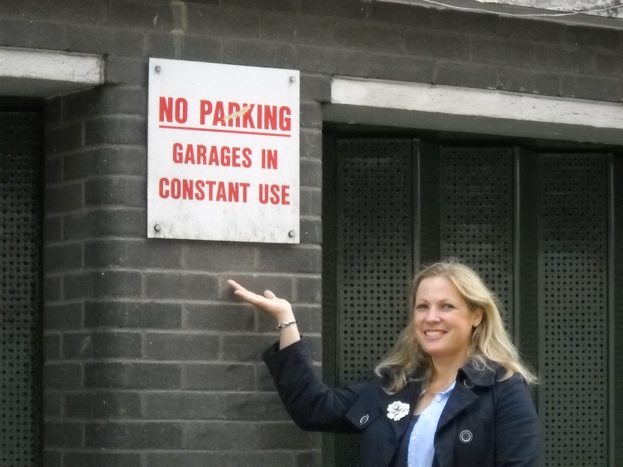
When the challenge to solve the mystery of OPRIG GAGINONANUS was laid down less than two weeks’ ago, I did not think we would have a winning entry within two days! Marion Worsley from Sussex emailed me from her Blackberry with an accompanying photo to tell me:

“I am standing in market mews, surrounded by garages and 10 signs to remind any fool who had not spotted the continuous double line that also every garage door is “No Parking.  Garage in Constant Use”.  This is however the only one with a concertina mechanism.  I’m afraid no cat. Could send you a picture of a blue tee shirt hanging out of the window instead? I am now going to walk away as I can see coming towards me the slightly perplexed postman who very kindly directed me to Market Mews but then went on to ask what I was looking for. I vaguely mumbled that I was looking for garage doors, smiled, thanked him and walked on. leaving hanging in the air a question mark over my sanity. I will send you more pictures this evening.

Marion Worsley

Sent from my BlackBerry® wireless device”

Winning entrant Marion Worsley in Market Mews

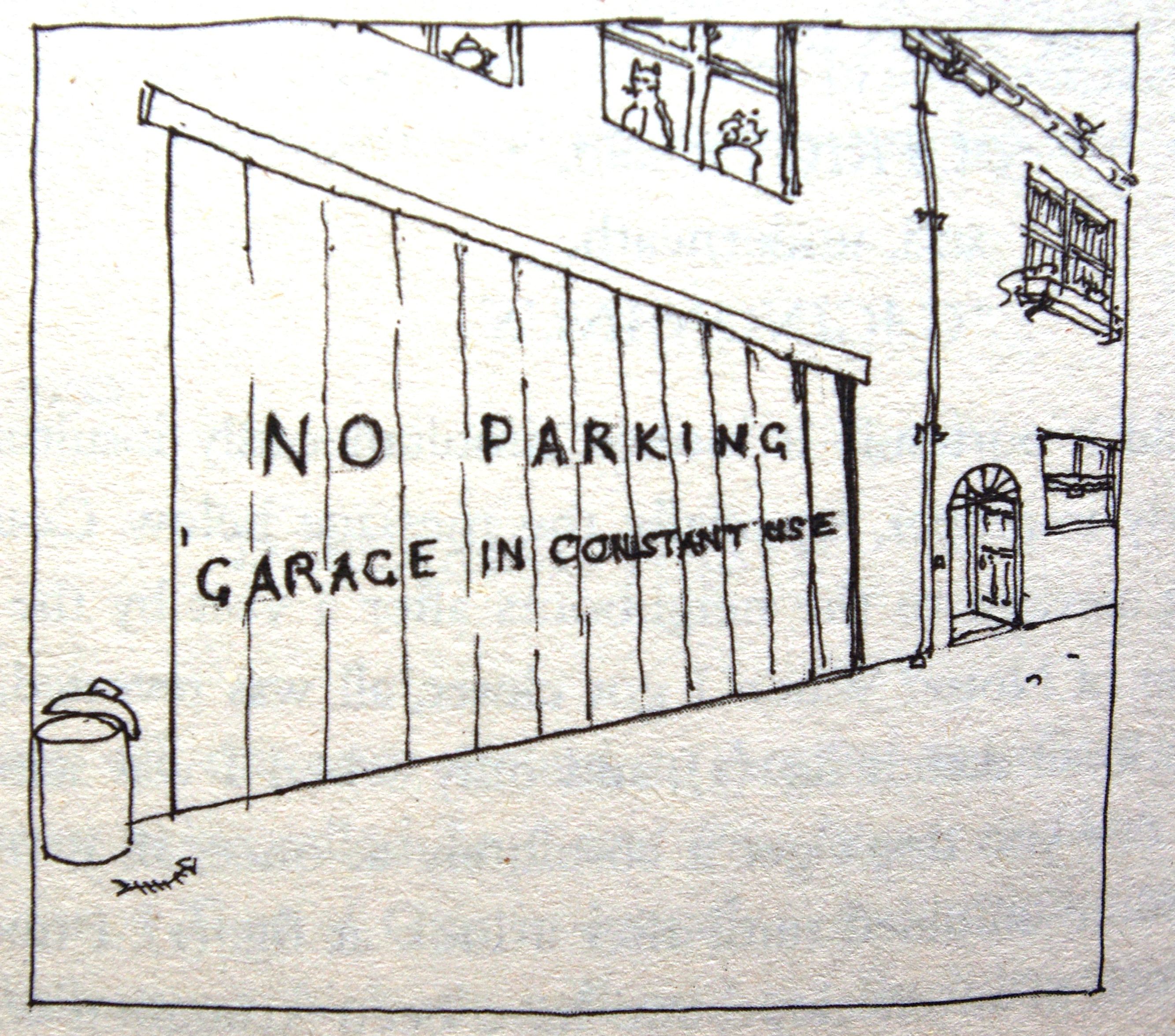
Remember the challenge was to try to find the location that Paddy had sketched in his letter to Debo Devonshire and if possible photograph the same combination of letters that faced Paddy in 1992. Extra marks were to be awarded for a photograph including a cat.

Later Marion mailed me with more pictures:

“Hi Tom

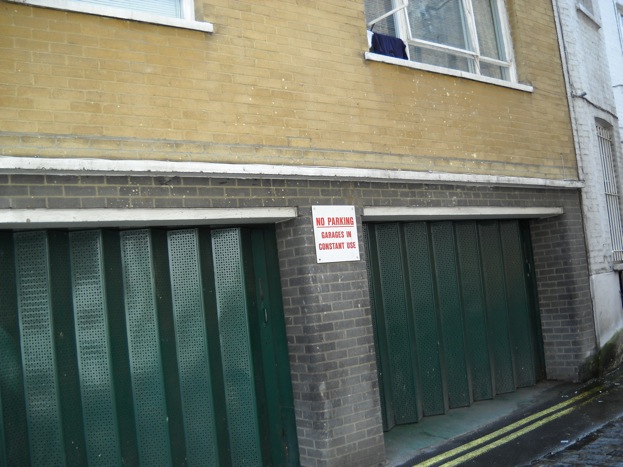
Here are the other photos from Market Mews. Slight artistic license for the cat… but did send you a picture of the tee shirt. I got a tourist who spoke very little English to take the picture.  I think that if I had tried to explain to him why I wanted a picture of myself next to a No Parking sign, he would have been even more confused. He will no doubt go back home and tell his friends that it is true that the English are a little mad. The entire mews consists of garages. I have added pictures of a few more should you want to add them to your Garage picture Collection. For the purists, the concertina garage is between No 9 and No 11 Market Mews.

Kind Regards

Marion”

The concertina doors from a similar perspective to Paddy's OPRIG sketch

From the other angle

It is no surprise that one or two things have changed; the doors seem to have been painted over and the cat has probably passed away. However, I was so pleased that a blog reader was inclined to be more than a little crazy and take up the challenge with such style. The ‘cat’ was a piece of improvised genius.

Very well done to Marion. We are planning an official presentation ceremony ‘on location’ later in the autumn. As you can tell she is a lady with some pretty mad ideas, one of which includes the possibility of walking some of Paddy’s route on 2011. Watch this space!

(For garage door enthusiasts I have posted all of Marion’s photographs in the photo section. It is clear that we are not alone in our obsession with OPRIG. Just Google OPRIG and look at images! I have placed some of these in the photo section.)

Related article:

OPRIG GAGINONANUS

To print this article or create a pdf do the following:

1. Copy the url of the article

2. Click on the Print Friendly button below – you will be taken to the Print Friendly page

3. Paste your url into box that appears and hey presto you will get a previewed page to print or pdf!

Print

Colonel David Smiley

We have come across David Smiley before. He was one of the occupants of Tara, worked with “Billy” McLean in Albania, and it seems he rearmed and led Japanese troops against the Vietminh. There cannot be many British officers who have led Japanese soldiers! Paddy was a friend and wrote the foreward to Smiley’s 1984 book, Albanian Assignment. One has to wonder, when reading the stories of these amazing characters, whether the British could ever find such people again. I hope so.

First published in the Telegraph 9 Jan 2009.

Special forces and intelligence officer renowned for cloak-and-dagger operations behind enemy lines on many fronts.

Colonel David Smiley, who died on January 9 aged 92, was one of the most celebrated cloak-and-dagger agents of the Second World War, serving behind enemy lines in Albania, Greece, Abyssinia and Japanese-controlled eastern Thailand.

After the war he organised secret operations against the Russians and their allies in Albania and Poland, among other places. Later, as Britain’s era of domination in the Arabian peninsula drew to a close, he commanded the Sultan of Oman’s armed forces in a highly successful counter-insurgency.

After his assignment in Oman, he organised – with the British intelligence service, MI6 – royalist guerrilla resistance against a Soviet-backed Nasserite regime in Yemen. Smiley’s efforts helped force the eventual withdrawal of the Egyptians and their Soviet mentors, paved the way for the emergence of a less anti-Western Yemeni government, and confirmed his reputation as one of Britain’s leading post-war military Arabists.

In more conventional style, while commanding the Royal Horse Guards (the Blues), Smiley rode alongside the Queen as commander of her escort at the Coronation in 1953.

During the Second World War he was parachuted four times behind enemy lines. On one occasion he was obliged to escape from Albania in a rowing boat. On another mission, in Japanese-controlled eastern Thailand, he was stretchered for three days through the jungle with severe burns after a booby-trap meant for a senior Japanese officer exploded prematurely.

Though a regular soldier, Smiley was frequently seconded to MI6. As an assistant military attaché in Poland after the war, when the Soviet-controlled Communists were tightening their grip, he was beaten up and expelled as a spy, after an operation he was running had incriminated a member of the politburo.

After that he headed the British side of a secret Anglo-American venture to subvert the newly-installed Communist regime in Albania led by the ruthless Enver Hoxha. But Kim Philby, who was secretly working for the Russians, was the liaison between the British and Americans; almost all the 100 or so agents dropped by parachute or landed by boat were betrayed, and nearly all were tortured and shot. This failure haunted Smiley for the rest of his life.

Smiley’s exploits led some to suggest that he was, along with several other candidates, a model for James Bond. It was also widely mooted that John le Carré, albeit unconsciously, had taken the name of his hero from the real-life Smiley.

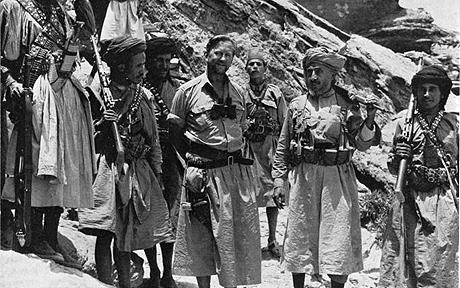
David Smiley with el Hassan and bodyguard in Yemen

Born on April 11 1916, David de Crespigny Smiley was the youngest son of Major Sir John Smiley, 2nd Bt, and Valerie, youngest daughter of Sir Claude Champion de Crespigny, 4th Bt, a noted jockey, balloonist, all-round sportsman and adventurer, also famed for his feats of derring-do.

After the Pangbourne Nautical College, where he excelled in sport, David went to Sandhurst in 1934. He served in the Blues from 1936 to 1939, based mainly at Windsor, leading the life of a debonair man-about-town, owning a Bentley and a Whitney Straight aircraft. Before the outbreak of war, he won seven races under National Hunt rules. In his first point-to-point with the Garth Hunt, he crashed into a tree, suffering serious injuries. Over the years Smiley was to break more than 80 bones, mainly as a result of sport; on two occasions he broke his skull, once in a steeplechase and once when he dived at night into an almost-empty swimming pool in Thailand.

After the war, he held the record for the most falls in one season on the Cresta Run in St Moritz; bizarrely, he represented Kenya (where he owned a farm) in the Commonwealth Winter Games of 1960.

After war broke out, the Blues sailed for Palestine, where one of Smiley’s first jobs, as a lieutenant, was to shoot his troop of 40 horses when it became clear they were of no use in modern combat. His introduction to warfare was against Vichy French forces in Syria. For his nocturnal reconnaissance work in ruins near Palmyra he was mentioned in despatches.

Later in 1940 Smiley joined the Somaliland Camel Corps, arriving at Berbera the very day it was decided to evacuate British Somaliland. Returning in frustration to Egypt, he persuaded General Wavell, a family friend, to recommend him for the newly-formed commandos, in which he became a company commander with the rank of captain. Sneaking from Sudan into Abyssinia, Smiley operated for the first of many times behind enemy (in this case Italian) lines.

In 1941 he returned to his regiment to command a squadron of armoured vehicles being sent from Palestine to raise the siege of Habbaniya, 60 miles west of Baghdad in Iraq, where the king and regent had been overthrown in a pro-German coup led by Rashid Ali. Under Colonel John Glubb, he led a charge alongside Bedouin levies in full cry (they were known to Smiley as “Glubb’s girls”, because of their long black locks). After helping to capture Baghdad, Smiley’s squadron was sent to Mosul with the task, among other things, of capturing the German ambassador, who escaped.

His squadron then moved east, to capture the Persian capital, Tehran, followed by “two weeks’ celebration with plenty of vodka, caviar and women”. After a spell in Palestine, Smiley led a Blues squadron of dummy tanks into the Western Desert pretending first to be British Crusaders and then, on a further foray, American General Grants, which were repeatedly attacked by Stukas. When Rommel broke through, they withdrew to Cairo. Three months later Smiley commanded a squadron of armoured cars at the battle of El Alamein – his last bout of conventional warfare.

After training at a school for secret agents in Haifa and taking a parachuting course with his friend David Stirling and his Special Air Service (SAS) near the Suez Canal, Smiley joined the Special Operations Executive (SOE), the organisation set up at Churchill’s instigation to “set Europe ablaze” by helping local partisans sabotage the Nazis’ infrastructure. He was parachuted with his life-long friend Neil (Billy) McLean into the mountains of Albania, then occupied by the Italians (and later by the Germans). For eight months he organised the fractious partisans in a series of ambushes and acts of sabotage (bridge demolition, sometimes by climbing under them at night while German troops were patrolling above, became a Smiley trademark). He was awarded an immediate MC. In early 1944 he was again parachuted into Albania, with McLean and Julian (later Lord) Amery, to liaise with the royalist guerrillas loyal to King Zog.

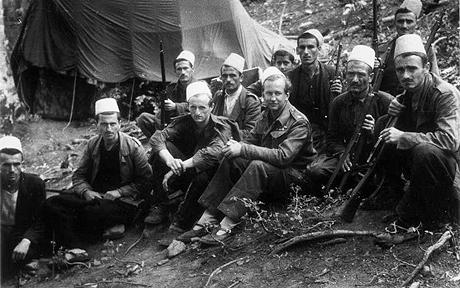
Colonel David Smiley, front 3rd right and band of Albanian fighters

Colonel David Smiley (left) in Albania

After leaving Albania, where his activities brought Smiley a Bar to his MC, he was transferred to the Siamese section of SOE, known in the Far East as Force 136, where he liaised with guerrillas operating against the Japanese who ruled the country through a proxy government. It was then that he was injured by the premature explosion of a booby-trap meant for a Japanese officer.

After recovering in Government House in Calcutta, where he consorted with both Nehru and Gandhi, he was parachuted behind enemy lines into eastern Siam, shortly before the dropping of the atomic bombs and the surrender of Japan, whereupon he organised the liberation of several prisoner-of-war camps, including the one on which the film The Bridge on the River Kwai was based. Though only a major, he personally took the surrender of the 22nd Division of the Imperial Japanese Army.

On Lord Mountbatten’s orders, Smiley re-armed a Japanese company and led them against the Communists of the fledgling Vietminh (who later became the Vietcong) in French Indo-China. Among other exploits, he freed 120 French women and children who had been taken hostage by the Communists. The only British officer in an area the size of Wales, he then took the surrender of Vientiane, Laos’s capital, from another Japanese general. For his activities in Siam and Indo-China Smiley was awarded a military OBE.

He later ruefully noted that, at that time, the Vietminh were backed by the American OSS (the CIA’s forerunner); Smiley was wary of what he considered to be America’s naïve enthusiasm for proclaimed democrats and its hostility to the British and French empires.

After his early post-war exploits in Poland and then his efforts to roll back communism in Albania were betrayed by Philby, Smiley returned to more conventional duties in Germany and thence to command his regiment, the Blues, at Windsor.

In 1955 he was appointed military attaché in Sweden, from where he made surveillance trips with his young family along the Russian border with Finland and Norway. But the pinnacle of Smiley’s post-war career was his three-year tenure as commander of the Sultan of Muscat and Oman’s armed forces during a civil war which threatened to bring down one of Britain’s more reactionary allies in the Gulf.

By now in his early forties, Smiley ran a gruelling counter-insurgency which gradually drove the guerrillas back from the scorching plains into their mountain retreat, the 10,000ft high Jebel Akhdar, which had never been successfully assaulted. With two squadrons of the SAS under his command, Smiley planned and led a classic dawn attack on the mountain fastness, finally crushing the enemy.

After leaving Oman in 1961, Smiley was offered the command of the SAS, but chose to retire from the British Army and file occasional reports for Raymond Postgate’s Good Food Guide.

He was not able to relax for long. Within two years he had been persuaded to help bolster royalist forces in Yemen. Liaising with King Faisal of Saudi Arabia and MI6, who arranged for former SAS and other mercenaries to accompany him, Smiley made 13 trips to Yemen between 1963 and 1968.

Often disguised as a local, Smiley travelled on foot or by donkey for weeks at a time across Arabia’s most rugged terrain. He won the admiration of his colleagues, both Arab and British, for his toughness, bluntness, and shrewdness as an adviser. King Faisal, whom Smiley greatly admired, personally expressed his appreciation.

After ending his Arabian career, Smiley moved to Spain, where, for 19 years, he grew olives, carobs and almonds, and continued to advise Albania’s surviving anti-Communists, by now all in exile, before returning to live in Somerset and then Earl’s Court.

To Smiley’s delight, he was welcomed back to Albania in 1990, as the Communist regime, which had sentenced him to death in absentia, began to collapse. He forged a friendship with the country’s first post-Communist leader, Sali Berisha.

Smiley was appointed LVO, and Knight Commander of the Order of the Sword in Sweden and Grand Cordon of the Order of Skanderbeg in Albania.

In 1947 he married Moyra, daughter of Lord Francis Scott KCMG, DSO, the 6th Duke of Buccleuch’s youngest son. He is survived by his wife, two sons, a stepson and a stepdaughter.

Related articles:

One Man’s Great Game: Lieutenant Colonel “Billy” McLean

Sophie Moss Obituary from Daily Telegraph

Related category:

Other SOE Obituaries

General’s long trip home


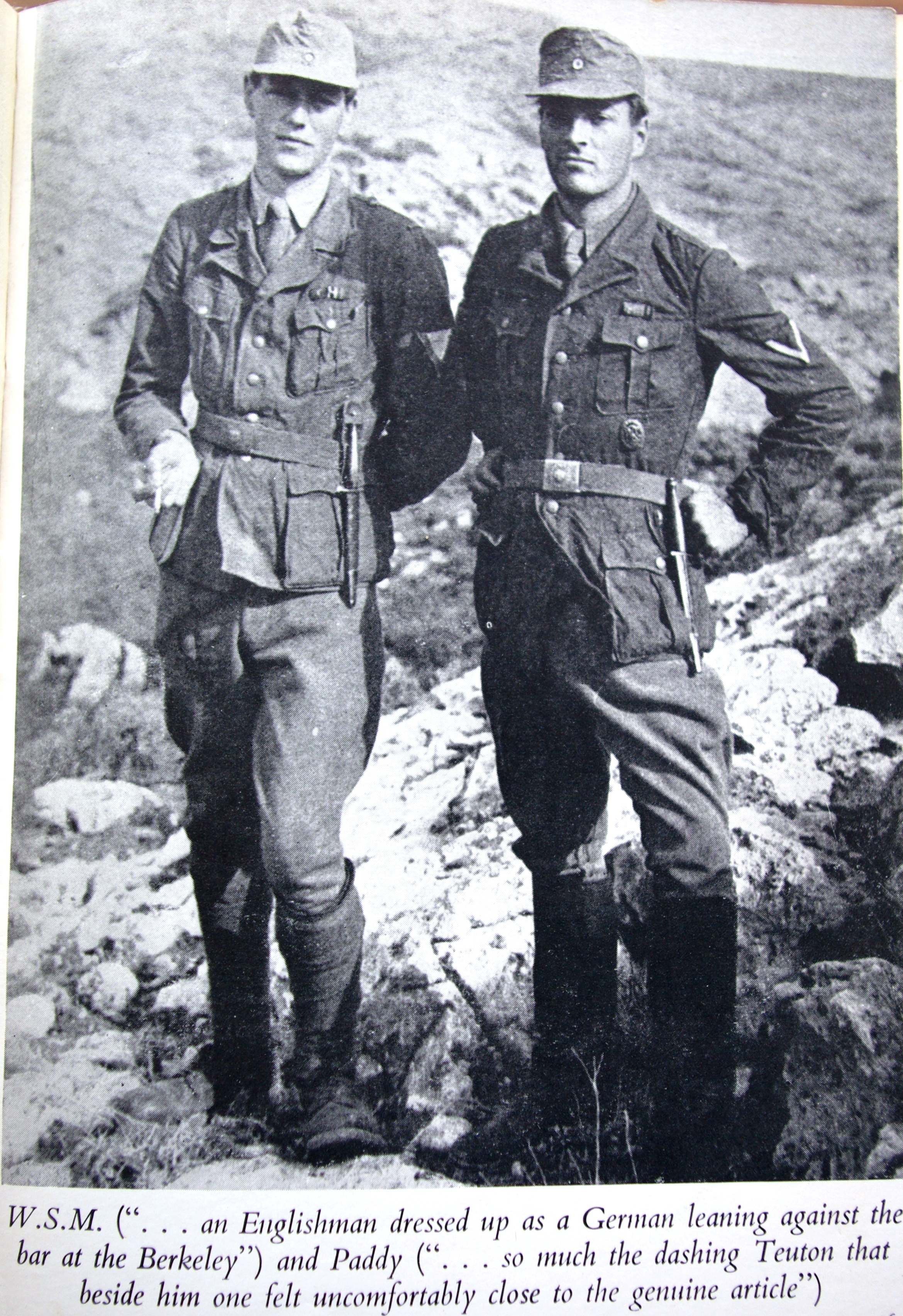
Patrick Leigh Fermor and Moss

Patrick Leigh Fermor and Moss in German Uniform Prior to the Abduction of General Kriepe

Something interesting to add to the Ill Met by Moonlight story.

First published in the Daily Mail 19 July 2007

By Charles Legge

Question: The book Ill Met by Moonlight tells the story of the kidnapping of German General Kreipe. What became of him after he was taken to Cairo?

In January 1944, Cairo East section of the British Special Operations Executive (SOE) hatched a daring plot to kidnap the commander of the 22nd InfantryDivision based on Crete, General-Leutnant Friedrich-Wilhelm Muller.

The plot was led by Major Patrick Leigh Fermor, along with his second-in-command, Captain W. Stanley Moss (later author of Ill Met by Moonlight, a book made into a film of the same name), and two Greek SOE agents, all of whom arrived by sea.

General Major Kreipe succeeded Muller on March 1, 1944, but SOE elected to continue with the kidnap mission. Joining with Cretan partisans, the SOE agents studied Kreipe’s daily work habits and his travel route from his quarters at Knossos to the divisional headquarters at Ano Arkhanais.

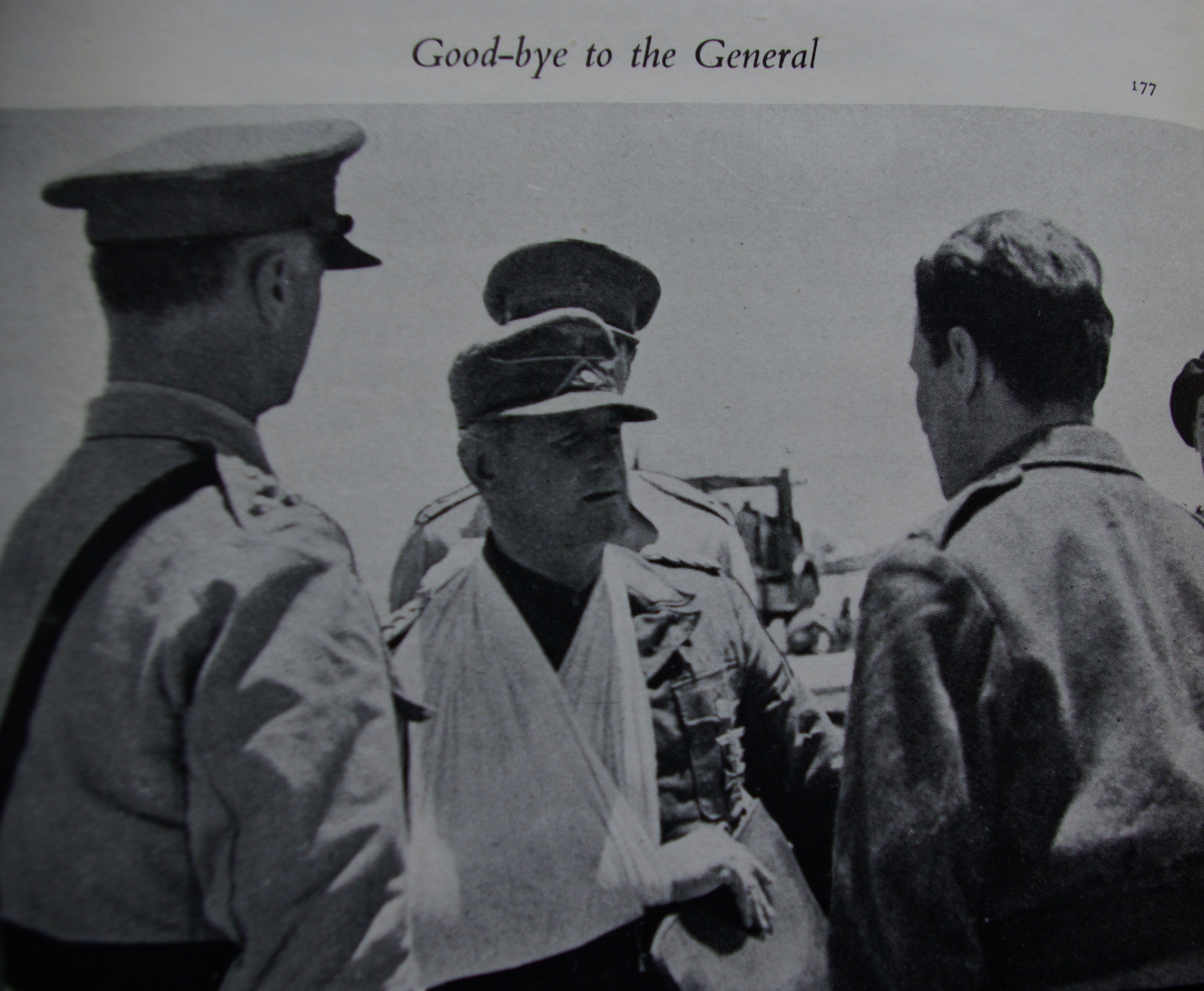
Saying goodbye to General Kreipe

On the evening of April 26, 1944, Major Leigh Fermor and Captain Moss, dressed as German military policemen, stopped Kreipe’s staff car on a hairpin turn under the guise of a routine traffic control point. After pulling the General out of the car and throwing him into the back seat, the agents drove him to an isolated spot, where he was taken on a gruelling cross-country trek over the mountains to the southern shore of the island.

On May 14, 1944, the SOE agents and their captive German general were picked up by a British motor launch off a desolate beach near Rodakino and spirited away to Mersa Matruh, Egypt. Leigh Fermor and Moss both received the Distinguished Service Order for the operation.

Kreipe was taken to London for interrogation before being transferred to prisoner-of-war camp near Calgary in Canada. He was later returned to the UK and imprisoned at Island Farm, Special Camp 11 near Bridgend. He was twice treated for diabetes at hospital Camp 99 at Shugborough Park in Staffordshire.

On October 10, 1947, he was transferred from Camp 99 to Hamburg via Southampton aboard the El Nil. Kreipe was honourably discharged from the military in 1947 and retired to Hanover.

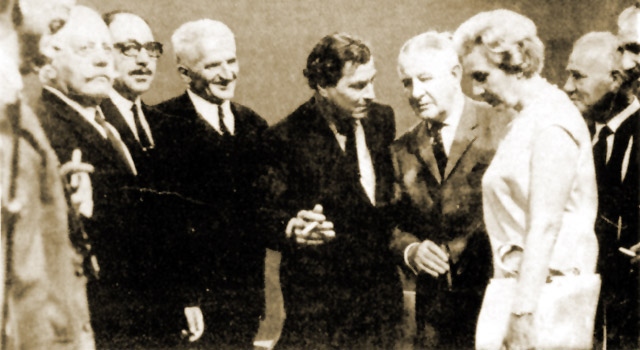
Kreipe flanked by surviving andartes while talking to Paddy on Greek TV

On May 7, 1972, the abduction team (minus Moss, who had died tragically in 1965) held a reunion in Greece at which Kreipe was also present. During the banquet, Leigh Fermor, in fluent Greek and German, said: ‘After 28 years, General, we apologise to you for what happened and hope you have no hard feelings.’ The white-haired general, sitting with his wife, nodded and said, ‘None; otherwise I would not be here.’ Later Kreipe and his captors appeared on the Greek This Is Your Life programme. When asked how he was treated by his abductors, Kreipe said firmly, ‘Ritterlich’ chivalrously.’ Kreipe died in Hanover in 1976 at the age of 81, Patrick ‘Paddy’ Leigh Fermor was knighted in 2004.

Related article:

Ill Met by Moonlight movie trailer

Related categories:

Ill Met by Moonlight – photographs from the book by William Stanley Moss

Ill Met by Moonlight

Bruce Chatwin’s Journey to Mount Athos

I will readily admit to knowing next to nothing about Bruce Chatwin. However, he seems to have a loyal following, has been flatteringly compared with Paddy as a writer, and of course Paddy was a friend and mentor to him. Chatwin’s ashes are scattered around a Byzantine church near to Paddy’s home in the Peloponnese.

This feature from the Telegraph last Sunday is very interesting. It focuses on Chatwin’s journey to find God and the path he was taking towards Orthodoxy  just prior to his death. Apparently he had made arrangements for his baptism on the Holy Mountain of Athos. Paddy would have been a good person to talk to about this but according to Paddy “There was never, not a word talked about God,” during his five month stay.

Paddy is mentioned a couple of times and I recommend this article to you all (note we have a blog link to a Chatwin website – see links).

Nicholas Shakespeare, the acclaimed biographer of Bruce Chatwin, follows the great travel writer on his final mysterious journey – to Mount Athos, a monastery overlooking the Aegean Sea

By Nicholas Shakespeare

First published in The Telegraph 16 Aug 2010

Bruce Chatwin

A strange osmosis takes place when you write the life of another person. After Bruce Chatwin died, his widow Elizabeth gave me the maté gourd that he had taken with him on his travels, together with its silver bombilla – the metal straw through which he sucked his addictive tea, like any Argentine farmhand. At times over the next seven years, I had the sudden deep conviction that I was absorbing the world through his perforated silver straw.

In the course of following Chatwin’s songline, I met his family and friends – some of whom became my friends. In Birmingham, I had tea with the charlady responsible for dusting the contents of his grandmother’s cabinet, including the scrap of giant sloth that had formed the genesis for In Patagonia. “It used to put the creeps up on me, an old bit of blacky, browny bristly stuff as didn’t look very nice at all… I thought it was only monkey fur.” In 1991, I drove with Elizabeth from Buenos Aires to Tierra del Fuego, to the cave on Last Hope Sound from where Chatwin’s cousin had salvaged the original hide – believed by the infant Chatwin to be a piece of brontosaurus.

In Sydney, I poked my nose into Ken’s Karate Club, a “sex on premises” venue designed in imitation of a fantasy Roman baths, with horned satyrs and concrete putti (from a garden supply shop). Near Alice Springs, I camped under the stars with the man on whom Chatwin had modelled Arkady, the protagonist of The Songlines. And so on, through 27 countries.

My biography of Chatwin was published in 1999, 10 years after he died of Aids. But in all the travels I had undertaken, there was one significant journey I overlooked.

In 1985, following his second visit to Australia, where he had picked up a mysterious illness, Chatwin was in Greece, grinding out another draft of The Songlines, when he interrupted his work to make a pilgrimage to Mount Athos. Before leaving, he wrote breezily to the Australian novelist Murray Bail: “Athos is obviously another atavistic wonder.”

Up until that moment Chatwin had not impressed friends as religious. “There was never, not a word talked about God,” says Patrick Leigh Fermor, his host in Greece, reflecting on their conversations over five months. Elizabeth was, and remains, a practising Catholic. In preparation for their wedding, Chatwin had taken religious instruction from a Jesuit in London. “Nearly became a Catholic,” he wrote in his notebook. Then, just before they were married, Elizabeth’s parish priest in New York State gave her a leaflet explaining why she should not marry a non-Catholic. “That put Bruce off forever,” says Elizabeth. Thereafter, his religious faith became subsumed in his nomadic theory: he believed that movement made religion redundant and only when people settled did they need it.

Since his illness, there were signs of a sea change. One entry in his notebooks reads: “The search for nomads is a search for God.” Another: “Religion is a technique for arriving at the moment of death at the right time.” While recuperating with Elizabeth in Nepal, his thoughts had turned to a man’s athos “in the Greek sense of abode or dwelling place – the root of all his behaviour for good or bad, his character, everything that pertained to him.” Continue reading →

Subscribe to the Patrick Leigh Fermor blog!

If you would like to keep up to date with the blog postings (of which there are many more to come I assure you!), why not subscribe to the blog?

It is easy. Enter your email, just in the top right –> where it says ‘Email Subscription, and you will receive an alert each time a new post appears; that is all. No spam!

I hope you enjoy ferreting around the blog. It is amazingly popular (well of course it is Paddy who is popular) with close to 4,000 visits a month (most seeking news of Paddy’s death – see Why is the favourite search “patrick leigh fermor obituary”?).

If you have an article or would like to share something you would like the world to see that concerns Paddy, or his friends and colleagues, please get in touch with me either by a comment or email tsawford[at]btinternet.com, and I will publish it with full credit to you.

Tom

Lady Anne Tree – Obituary from the Telegraph

Lady Anne Tree was Debo Devonshire’s sister-in-law and a friend to Paddy.

Duke’s daughter who became a prison visitor and persuaded inmates to earn money from needlepoint.

First published in The Telegraph 13 Aug 2010

Lady Anne Tree, who died on August 9 aged 82, was a scion of one of England’s most famous families, with friends and connections that ranged from John Betjeman to Lucian Freud, Oswald Mosley to John F Kennedy; but she became best known for her tireless campaigning on behalf of the incarcerated, and set up a successful, if unlikely, scheme that paid prisoners for needlepoint.

One of her prison acquaintances was the infamous Moors murderer Myra Hindley. Having been a regular prison visitor for more than a decade, in the late 1960s Lady Anne was appointed to see Hindley on a weekly basis, and introduced her to Lord Longford, who subsequently embarked on a quixotic campaign on the killer’s behalf. Unlike Longford, however, Lady Anne never saw reason to grant Hindley parole “because she wasn’t fit to come out. I don’t believe she was safe. She didn’t feel sorry and if you don’t feel sorry, you can do something again.”

The two women discussed books, and “kept pretty well off” the subject of Hindley’s crimes; the visits ended after a decade, to the relief of both.

Lady Anne continued to be involved with Britain’s growing prison population, and she wrote incessantly to the Home Office in an attempt to change the rules so that prisoners could earn money by working while they were locked up.

Lady Anne Tree (2nd left), her sister Lady Elizabeth Cavendish, John Betjeman (right) and the choreographer John Cranko Photo: GETTY

The work she had in mind was embroidery. “I noticed over the years what a terrible waste of time there was,” she said. “And I got such a lot of fun out of embroidery.” A long campaign finally brought a change in prison rules and the setting up, in 1997, of Fine Cell Work, a scheme in which prisoners are taught to produce high-quality needlepoint cushion covers, quilts and rugs – some to designs submitted by famous names.

Prisoners are allowed to keep a share of the proceeds (37 per cent), creating a small lump sum to help set themselves up on release. The financial attraction of Fine Cell was obvious, but embroidery also became popular as a “bird-killer”, or method of getting through jail time.

Perhaps surprisingly, 80 per cent of those inmates involved were men, with Lady Anne giving short shrift to those who considered themselves too manly for the pursuit. Her standard retort, delivered in an accent which she confessed was “too posh” for the surroundings, was: “If you feel this is poofy, don’t bother us, because we don’t want to train you.”

Anne Evelyn Beatrice Cavendish was born on November 6 1927, second daughter of the 10th Duke of Devonshire and Lady Mary Gascoyne-Cecil, Mistress of the Robes to the Queen. She grew up at Chatsworth in Derbyshire, but was never sent to school because her father disapproved of the idea. During the war she moved with her governess to Eastbourne, where she worked in an Army canteen.

Lady Anne began visiting prisons aged 22, shortly after marrying Michael Tree, a son of the Anglo-American Conservative MP Ronald Tree, whose house, Ditchley Park, had been used as a retreat by Churchill during the war. Michael was well-known in London society, where he was nicknamed “Radio Belgravia” because he was always first with the news. He was attached to Christie’s and was a good amateur painter.

In May 1944 Anne’s elder brother, William Cavendish, the Marquess of Hartington, had married Kathleen Kennedy, younger sister of the future president John Kennedy. But four months later, in September, he was killed in action while serving as a major in the Coldstream Guards. Kathleen “Kick” Kennedy herself died young, in a flying accident, in 1948.

The Kennedy connection reinforced Lady Anne’s interest in helping prisoners. “Kick Kennedy had a close friend who went to prison,” she said. “When he came out, I thought him in very bad shape.” Diana Mosley (née Mitford), who had been locked up with her husband Oswald during the war, was another source of advice. The two women had a family connection because Lady Anne’s brother, Andrew, had married Deborah, youngest of the Mitford girls.

Lady Anne described Oswald Mosley as “very charismatic, but a beastly man”. She had much more admiration for the artist Lucian Freud. Lady Anne introduced the artist to her brother Andrew Cavendish in 1959, by which time he had become the 11th Duke. More than a dozen Freuds now grace the collection at Chatsworth. Among Freud’s sitters were both Lady Anne and her sister Elizabeth.

Lady Anne cited two reasons for focusing on needlepoint in her campaign. Her mother-in-law, Nancy Lancaster, owned the interior designers Colefax and Fowler, so “I had the possibility to sell good-quality needlework for good prices through shops.” She was also convinced that sewing was therapeutic: “It is meditative, a way of thinking, of taking stock.”

Lady Anne did other prison work, at one point serving as deputy entertainments officer at Wandsworth jail. Under her stewardship prisoners were treated to a display of samurai swords brought in by a former general, and to a talk from John Betjeman. “He came waddling on and was funny, but too highbrow,” Lady Anne noted.

Within a decade Fine Cell work was generating £200,000 in sales from the prisoners’ creations (cushions cost £95; quilts up to £1,000), and today more than 60 volunteers train 400 prisoners. The work has been exhibited by the V&A, commissioned by English Heritage and sold to leading interior designers. Prison systems in other countries have expressed interest in starting similar schemes.

The Trees lived in fine houses, notably the Palladian house Mereworth Castle, in Kent, in the 1950s and 1960s, and later Shute House, near Shaftesbury, where in 1969 they commissioned Sir Geoffrey Jellicoe to design the superb water garden.

Lady Anne could be fabulously outspoken. When Lady Diana Cooper was entertaining Harold Macmillan to lunch at her London house in 1982, Lady Anne noticed her hostess reach down for something in her handbag on the floor. “Diana’s got Uncle Harold by the privates and he doesn’t like it!” she called out across the table.

Michael Tree died in 1999, and Lady Anne is survived by her two daughters.

OPRIG GAGINONANUS

Here is something completely ridiculous, a challenge for you all that recalls Paddy’s late night walk through Shepherd Market, London in early October 1992.

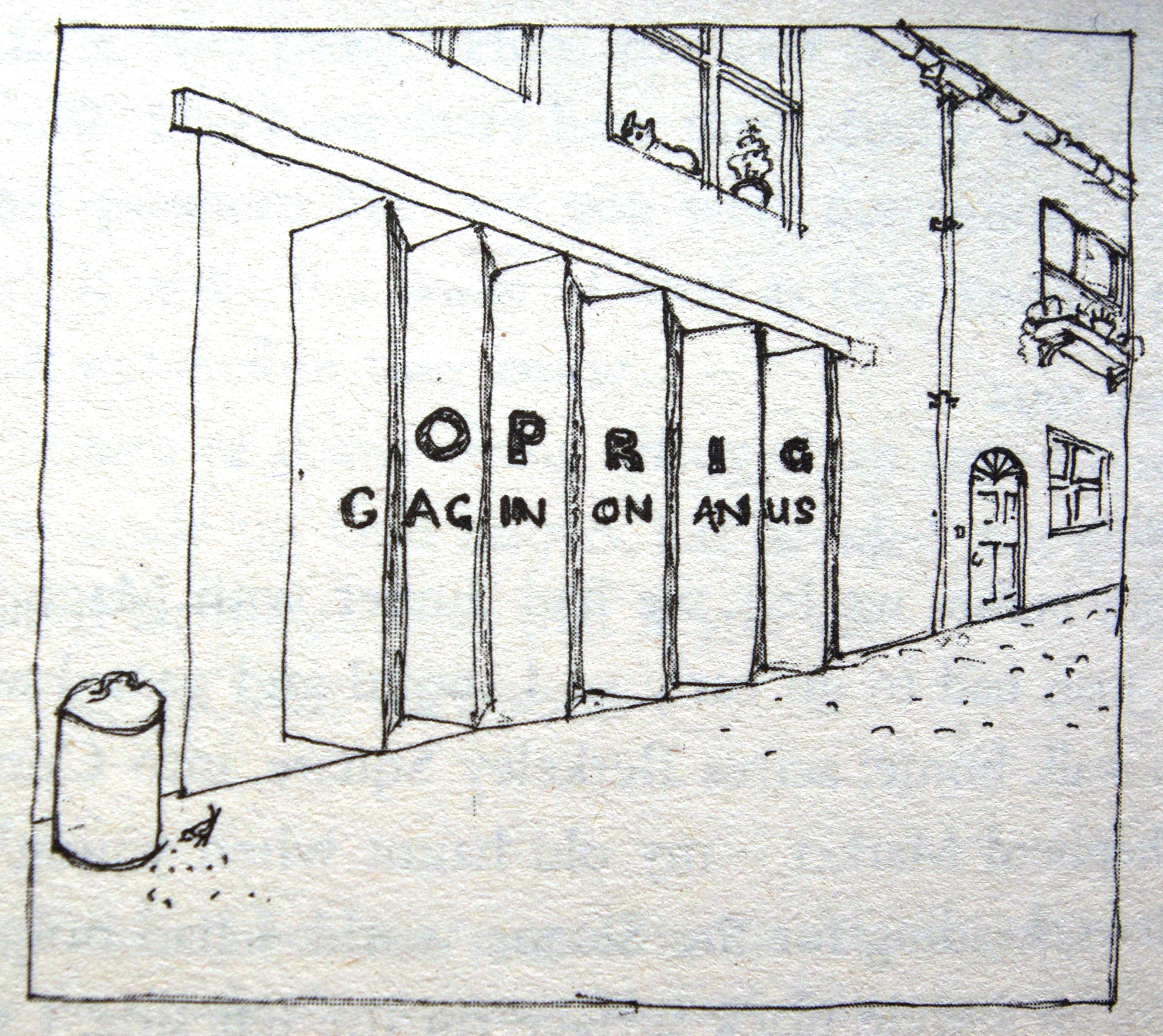
In a letter to Debo Devonshire dated 6 November 1992 (see page 293 of In Tearing Haste), Paddy writes to tell her of a strange experience just before he left for a trip to Antibes to collect a French literary prize for A Time of Gifts. Paddy and Joan had dinner with Magouche Fielding (Xan’s second wife). Joan left early and Paddy decided to walk home … “through Shepherd Market – my old haunt when young * – and into Market Mews. I had only gone a few paces when, on a wide black surface on the left side, I saw a strange message in huge letters in White:

‘OPRIG’, it said,

And underneath,

‘GAGINONANUS’

What could it portend? It looked simultaneously insulting, enigmatic and vaguely improper, especially the message below.”

Paddy enclosed a sketch.

Paddy's first sketch - OPRIG

It was only when he stood four square in front that all was revealed – click here to see the picture.

The challenge therefore is for those of you who live in London, or who are visiting this month, to see if you can find GAGINONANUS. There are enough geographic clues, and to add to this Paddy further writes to Debo, “If on leaving your front door, passing the Curzon Cinema, and turning right into the Mews, you’ll [see it].”

Let’s hope that like for Paddy the concertina doors will be ajar so that you can see it just as Paddy did. Perhaps they have been painted over? Do they still exist?

If you find GAGINONANUS then send me a photograph (tsawford[at]btinternet.com) with a brief retelling of your search. Special merit if you can include a cat in the picture!

The prize? Well, the satisfaction of ‘being there and having done it’ and a first edition copy of Words of Mercury for the first person to send a picture.

I shall personally resist the temptation to find it until the end of August. If we have had no responses by then, I shall go on a search myself.

* Paddy had lived at 43 Market Street before he departed on his journey in 1934

Sky Arts at the Notting Hill Travel Bookshop – A Time of Gifts

Sky Arts Book Club takes a look inside The Travel Bookshop in Notting Hill, London and explores the book A Time of Gifts by Patrick Leigh Fermor.

Click the picture to play.

Mani: A Guide and History

As I was killing time doing some web searches for Paddy related material, I stumbled across this website which the creator John Chapman claims as a comprehensive guide to the history, geography and sites of the Mani. It is linked to a German language Mani travel site .

Having had a quick scoot around it certainly looks very comprehensive so if you are planning on a visit to the Mani you may wish to use it. The navigation is a bit clumsy, but the content looks very comprehensive indeed.

I found an apartment on the accompanying site where my family stayed on two occasions in the 1990’s near the quiet fishing village of Agios Dimitrios. Right by the sea with wonderful sunsets it is a great place for a holiday enabling you to visit the wider Peloponnese as well. Little did I know at the time that a lovely beach we found near Kardamili, that was overlooked by an inviting looking stone house was none other than the beach where Paddy swims and that the house was his.

Visit —> Mani: A Guide and History by John Chapman

Where d’you get them bird-like ways recruit Leigh-Fermor?

I am currently reading my first edition of A War of Shadows, William Stanley Moss’ sequel to Ill Met by Moonlight. It covers Moss’ wartime activities from the point after he and Paddy arrived back in Cairo with the captured General Kreipe.

Moss returned to Crete to attempt a repeat of the first escapade but was frustrated in this by much increased levels of security and constant betrayal by the Communist ELAS andartes. He was then posted to (Greek) Macedonia and finally to the Far East where he saw out the war.

Paddy was unable to accompany Moss to Crete as he had been brought down with a very severe attack of rheumatic fever after the rigours of the Kreipe kidnap, and the harsh conditions they experienced whilst on the run. As we know Paddy did recover and returned to Crete. It is perhaps a little ironic that whilst Paddy was described as being somewhat less physically strong, it is Paddy who has outlived virtually all of his contemporaries and, as far as we know, still swims even to this day.

There is one little piece that amused me and I would like to share it with you. Whilst Moss was waiting upon his expected return to Crete after the failure of his second kidnap mission (he never made it back, being sent to Macedonia instead), he joined Paddy in Beirut where he was convalescing at the home of the commander of the British legation. Moss and Paddy were sitting on a patio enjoying whisky and soda, recounting stories and Moss relates the following (p 68):

Though a little thin in the face, Paddy looked surprisingly well; and it was only when he walked that one could have guessed that he had just recovered from so dangerous an illness. “But I manage to crack along,” he said, “—like some strange bird.”

We laughed at the recollection of an incident at the Guards’ Depot during the early days of the war, when Paddy had been a recruit in the Irish Guards. “Recruit Leigh-Fermor!” the drill sergeant had bawled across the parade ground. ”Why’re you walkin’ about like some strange bird? Where d’you get them bird-like ways? Put ‘im in the book, Corporal Driscoll. For walkin’ about like some strange birrrd!”

Having been on the wrong end of Guards sergeant-major’s humorous put-downs I can sympathise! Perhaps my fondest memory is of an Irish Guards Sergeant-Major ordering us to get sorted out before an orienteering event at Sandhurst: “Get into your t’ree groups … A, B, C, and D!”

Like a Post? Well Then, “Like” It!

WordPress getting more like Facebook? I would like to see a ‘Do Not Like’ option as well. I hope that does not apply to this blog!

Starting today you’ll notice a new feature at the bottom of all WordPress.com blog posts. We’ve enabled a “Like” button, which, when clicked, shows a Gravatar image for all the bloggers who like a post.

When you “like” a post two core things happen. First, the blog post’s author sees your “like” and can click-through to your Gravatar profile. Second, clicking “like” saves the post in your homepage dashboard (in the “Posts I Like” section), so you can share it with others, or just keep it around for future reference. If you’re interested in keeping track of how many likes your own blog posts are receiving, there’s a new “like count” column on the “Posts > Edit Post” screen. This will show you the total like count on each of your posts, right next to the total comment count.

We’re hoping this will be an awesome new way to discover other interesting bloggers, and start new conversations with people who — literally! — like you. If you haven’t updated your Gravatar profile yet, now would be a great time to upload a picture, a link to your blog, and any other details. Editing your profile is easy, just remember that all of your profile information is public.

For more information on this WordPress feature visit here.

Reisen nach Arkadien

Apart from the obvious interest in Paddy from Britain, and some from North America, it is the Germans who seem to have taken Paddy’s work to heart. Maybe it is due to the fact that a major part of Paddy’s 1934 journey was through Germany? This combined with his part in the kidnap of General Kreipe in Crete seems to hold their interest in him. Here is a recent piece about Mani from the Hamburger Abenblatt

Der britische Autor Patrick Leigh Fermor ist ein begnadeter Reiseschriftsteller, der wie kein zweiter die Eindrücke seiner Reisen nach Griechenland unmittelbar und atmosphärisch beschrieben hat. Längere Zeit verbrachte er als britischer Agent auf Kreta während des Zweiten Weltkriegs. Anfang der 50er Jahre kam Fermor auf die Halbinsel Mani auf der Peleponnes. Damals eine einsame Landschaft ohne Touristen, in der das mythische Griechenland und orientalische Byzanz lebendig scheinen.

Beim Dörlemann Verlag sind bereits zwei Bände mit seinen berühmten Wanderungen erschienen. Neu ist nun sein Buch “Mani – Reisen auf der südlichen Peleponnes”. Nie habe ich eine so wild-schöne Geschichte des Johannes-Festes gelesen wie hier:

“Die freudige Festtagsstimmung und die wahnwitzige Temperatur ließen die Luft vibrieren. Die Steinplatten am Wasser, wo ich mich mit Joan und Xan Fielding zum Essen niederließ, strahlten die Hitze ab wie ein Bratentopf, wenn man den Deckel abnimmt. Einer plötzlichen, stillschweigenden Eingebung folgend, wateten wir voll bekleidet ins Meer hinaus und trugen den eisernen Tisch ein paar Schritt weit ins Wasser, dann holten wir drei Stühle, auf denen wir, bis zur Taille im kühlen Naß, um den hübsch gedeckten Tisch Platz nahmen, der jetzt, wie von Zauberhand getragen, eine Handbreit über den Fluten zu schweben schien. Als der Kellner einen Augenblick später auftauchte, starrte er verblüfft auf den leeren Fleck am Kai; als er uns dann entdeckte, kam er, das amüsierte Aufflackern seiner Miene sofort wieder unter Kontrolle, ohne Zögern ins Wasser, näherte sich, selbst bis zur Taille eingetaucht, würdevoll wie ein Butler und verkündete nur lakonisch: ‘Dinnertime’.”

Fermor ist ganz der griechischen Welt verfallen und findet, die griechische Sprache inzwischen meisterlich beherrschend, Zugang zu den Menschen. In seinen Büchern verbindet er gekonnt persönliche Eindrücke und Ausflüge mit den geschichtlichen Zeugnissen, die diese bedeutsame Landschaft in Überfülle bereit hält.

Patrick Leigh Fermor Mani. Reisen auf der südlichen Peloponnes. Deutsch von Manfred und Gabriele Allié. Dörlemann Verlag. 24,90 Euro

In “Aufgeblättert” stellen im Wechsel Rainer Moritz, Annemarie Stoltenberg (NDR) und Wilfried Weber (Buchhandlung Felix Jud) Bücher vor.

(for a faintly humorous translation from Google translate copy and past the above into here )

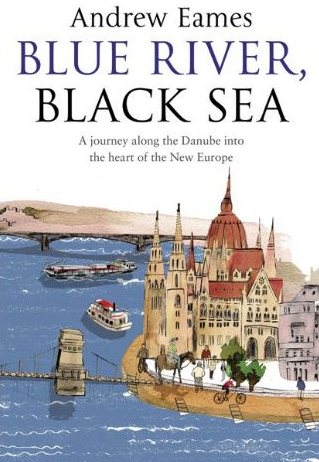
Blue River, Black Sea: A Journey Along the Danube Into the Heart of the New Europe

The following is a piece by Dimiter Kenarov from The Nation which contrasts the journey of Paddy along the banks of the Danube with the more recent account of Andrew Eames, recounted in Blue River, Black Sea. It is clear that if we were to try to follow the foosteps of Paddy that much has changed – I guess that much we knew – but that also the pace of change means that if we are to encounter the last feeble remnants of that post-Austro-Hungarian world, we had better move very fast. This is worth the read.

From Black to Black, a review of Blue River, Black Sea: A Journey Along the Danube Into the Heart of the New Europe
By Andrew Eames.

Every day, at three in the afternoon, I make a trip down the Danube. To travel from Germany’s Black Forest to Romania’s Black Sea takes a matter of minutes, so I try to enjoy myself as much as possible. I sink into a cushy armchair, rev up the stereo and embark on an epic voyage. “Information on the water levels of the Danube River, in centimeters,” the familiar voice on Horizont, the Bulgarian National Radio, announces with the deepest solemnity before reading out the relevant hydrographical values, first in Bulgarian and then in Russian and French. Vienna: 310 (+3); Mohács: 415 (+7); Novi Sad: 162 (-13); Vidin: 380 (+40); Giurgiu: 220 (0).

The captains of river vessels can easily map a course on the Internet, but the daily radio bulletin has remained a fixture in my life. For many years, listening to the fluctuations in the water levels of the Danube was the closest I could get to traveling abroad. Regensburg, Passau, Linz, Vienna: these names mesmerized me. Even places like Bratislava and Budapest, comrades in arms against the decadent West, had the ring of myth to a boy growing up in Bulgaria. Remembering his childhood in the Bulgarian river port of Ruschuk (now Ruse), Elias Canetti wrote, “There, the rest of the world was known as ‘Europe,’ and if someone sailed up the Danube to Vienna, people said he was going to Europe.” If people in Canetti’s immediate circle, at the beginning of the twentieth century, still had the occasional opportunity to waltz up to the palaces of the Habsburgs and back, however, the “Europe” I imagined in the 1980s existed only in a galaxy far, far away. To travel up the river as a tourist during the cold war required visas, special permissions, bureaucratic ballast. To swim across it, a negligible distance of a few hundred meters, was to risk both drowning and the bullets of border guards. For nearly fifty years the Danube was a demolished bridge, a liquid roadblock. The wall may have been in Berlin, but the truly impassable one was an invisible dam on the Danube, somewhere between Vienna and Bratislava.

The Danube—or Ister, as the ancient Greeks called it—is a natural highway of nearly 3,000 kilometers. “The greatest of all the rivers which we know,” declared Herodotus. “A path for the spirit to follow,” wrote Hölderlin, following the footfalls of the Greeks in his hymn “The Ister.” Human tribes traveled west against the current, colonizing the core of the continent, gradually shaping it. Before the Americas, there was Europe. The Romans made a few feeble attempts to bring traffic under control by turning the river into the fortified frontier, or limes, of their empire, but without much success. South of the Danube civilization cowered; in the north, the barbarians bided their time.

There is probably no other geographical element of Europe that has absorbed more political weather than the Danube. Unlike the Russian Volga and the Franco-German Rhine, it has served many masters, as a shield or a spear. In 1683, by the walls of Vienna, John III Sobieski and Charles of Lorraine routed the armies of Kara Mustafa, marking the beginning of the end of the Ottoman Empire. Not long thereafter, in 1704, the Duke of Marlborough and Prince Eugene of Savoy vanquished the Franco-Bavarian alliance at the Battle of Blenheim, an important event in the War of the Spanish Succession. Near the river town of Ulm, Napoleon forced the Austrians to surrender with barely a fight. And Hitler’s Drang nach Osten—yearning for the East—had a strong Danubian stink. “Do not forget,” the elderly Heinrich Heine wrote to the young Karl Marx, “the difference between water and a river is that the latter has a memory, a past, a history.”

It has taken twenty years of European integration for the memories of the cold war to seep away. Quietly meandering across ten countries—Germany, Austria, Slovakia, Hungary, Croatia, Serbia, Bulgaria, Romania, Moldova and Ukraine—and running softly past more than fifty-five towns and cities, including four capitals, the Danube is once again a major route for trade and tourism, diluting national and political borders and linking numerous shoreline communities into a single organism. The Rhine-Main-Danube Canal, completed in 1992, allows ships to navigate passage from the North Sea to the Black, chugging through the heart of the continent. The river’s delta, with its sprawling network of lagoons and marshes, is a Unesco World Heritage Site and an important bird sanctuary—with its own environmental problems, of course. Today, to sail along the Danube is to see the new face of Europe, old as it is. And, luckily for me perhaps, the daily radio bulletins on Horizont are no longer my only means of travel.

Traveling the Danube became a fad in 1829. That was the year two Englishmen, John Andrews and Joseph Pritchard, founded the First Danube Steamship Company, which lured scores of elated pleasure seekers. “A motley crowd on board, such perhaps as never met together on the deck of a steam-boat before,” wrote the Irish journalist and literary editor Michael Quin about one of those early voyages. Standing among Austrians, Moldavians, Jews, Hungarian nobles and Tyrolean emigrants, he traveled in style down the river from Pest (Budapest) to the Ottoman town of Ruschuk. It was a thrilling but perilous undertaking. Unlike the well-trodden path of the Grand Tour, with its picturesque Parisian streetscapes and Florentine galleries, the Danube offered a wilder ride for people with money and a taste for adventure. Although its waters flowed across half the continent, knowledge of the river was scarce and scattered, especially when it came to portions under Ottoman control. Europe was split in two long before the cold war, and the Danube was the main gateway into its eastern, darker territories. The course of “civilization” had gradually reversed directions.

William Beattie, another of those early steamboat passengers, portrayed that division with typical Victorian bigotry. East of Budapest, he wrote in his 1844 travelogue The Danube, the tourist “feels as if he were taking farewell of civilization, and entering upon a vast primeval desert, where man is still a semi-barbarian; and where the arts by which he converts to his use the natural products of the earth are still in their infancy, or wholly unknown.” As far as Beattie was concerned, Eastern Europe might as well have been an island in the middle of the Pacific. Quin was similarly dismayed by the seemingly crude ways of life he encountered but a little bit more optimistic in his vision of the future. He praised “the miracles of the age of steam” and then blithely prophesied, “Those countries, which have hitherto seemed scarcely to belong to Europe, will be rapidly brought within the pale of civilization…and new combinations…will be created, which may give birth to important changes in the distribution of political power on the continent.” He was right, of course: steam did alter the political landscape of Eastern Europe. (Could it be that James Watt was personally responsible for the fall of the Ottoman Empire and the whole contemporary history of the continent?) However, Quin’s journey down the Danube was also a reassertion of his cultural identity and his sunny view about technological progress. As the historian Larry Wolff pointed out in his seminal work Inventing Eastern Europe, “It was Western Europe that invented Eastern Europe as its complementary other half.” And the Danube was the road most inventors took.

So many writers have traveled the Danube that their tributary ink, if channeled into a single stream, would turn the water black. From the Italian naturalist and geographer Luigi Ferdinando Marsigli, who professed to have mastered “the anatomy of the river” and then published in 1726 his magisterial six-volume Opus Danubiale, to the contemporary Hungarian writer Péter Esterházy, with his playful travelogue The Glance of Countess Hahn-Hahn (Down the Danube), published in 1991, the outflow of words has been endless. To look for the authentic Danube would be futile, for nobody can describe the same river twice. “It is I who will say what the Danube is,” Esterházy’s protagonist, the Traveler, insists, as so many others before him have: Germans and Austrians, Hungarians and Russians, as well as the odd Serbian, Romanian and Bulgarian. For some reason, however, it was the British and a few American explorers, outsiders with ever-roving empirical eyes and an insatiable appetite for the foreign, who frequently attempted to distill the Danube’s essence. Some, like Quin and Beattie, were deeply prejudiced against the world they were about to encounter. Others, like the American painter Francis Davis Millet, who paddled downriver in a canoe in 1891, wrote about the local people and their environs with sympathy and understanding. Then there were those who transcended the ranks of mere travelers to join the great writers.

Patrick Leigh Fermor is the best of the lot. In the winter of 1933, at 18, he set out on foot from Rotterdam toward Istanbul—or Constantinople, as his romantic imagination insisted. With just a rucksack on his back and two books in hand—The Oxford Book of English Verse and the poems of Horace—he traversed the better part of the pre-war continent “like a tramp or a pilgrim or a wandering scholar.” His trek along the Danube made up only one leg of his amazing odyssey, but it was the most remarkable one. Poring over his maps and trying to decide whether to head for sunny Venice or press farther east, he writes, “Just in time, the windings of the Middle and the Lower Danube began to reassert their claims and the Carpathians and the Great Hungarian Plain and the Balkan ranges and all these mysterious regions which lay between the Vienna Woods and the Black Sea brought their rival magnetisms into play. Was I really about to trudge through this almost mythical territory?” Continue reading →

The development of steel-drum music in Trinidad – when did Paddy visit?

I wonder if anyone can help? Andrew Booker Rennie has posted a question on the Welcome page as follows. I am sure he would be grateful for any assistance. Please reply by adding a comment below or emailing me and I will pass on to him.

“I am researching the development of steel-drum music in Trinidad. PLF came to Trinidad and in the Traveller’s Tree described vividly what he saw of steel-band then. The problem is that no where in this account did PLF indicate what year he visited Trinidad. It is absolutely essential that I identify the year, 1945, 1946 or 1947. Can any one of Paddy’s researchers provide this information?”

abr

Xan Fielding’s Obituary from The Times

The following obituary of Xan Fielding was sent to me by blog correspondent Yvonne Carts-Powell to whom I am very grateful. It is from The Times and dated August 21, 1991. Times content is now subscription only so there is no point in putting up a link.

Xan Fielding, DSO, wartime secret agent and author, died in Paris on August 19 aged 72. He was born in India on November 26, 1918.

In his temperament, talents and physical courage Xan Fielding was well equipped to have made a mark in many spheres of life. Crete in the aftermath of the German invasion in May 1941 provided a theatre in which his individuality was able to blossom. Guerrilla warfare was particularly congenial to one of his character. He cherished the amateur’s view of war which saw it as a clash between the prowess of individuals and not as a contest between technologies backed by armaments industries and reserves of manpower. In addition to an innate romanticism, he possessed in abundance the classical Greek quality of arete (that excellence in thought and performance so often imperfectly translated as “virtue” in school texts) and revelled to the point of exultation in the exercise of his own initiative. Yet at the same time, through his mastery of the language and his psychological insight, he extended a discerning admiration to the often contrary and ferocious Cretan andarte groups which his efforts were designed, at least in part, to serve.

Regimental soldiering was anathema to him and the sharpest barbs of his wit were always reserved for the staff. But his exploits went far beyond being of mere nuisance value to the allied cause. In two remarkable years following the fall of Crete the efforts of Fielding and that other like-minded spirit, Patrick Leigh Fermor, built up a guerrilla network in the occupied island, facilitated the escape of many Australian and New Zealand soldiers who had remained in hiding and, most important, built up an intelligence network which provided invaluable information to the allies in North Africa on the movement of Axis materiel through this most important staging post.

Alas for the hopes of these romantics, who would have loved to have fulfilled the dream of the guerrillas and to have led an avenging descent out of the mountains to drive the German invader into the sea, such a moment was never to come. After the allied decision to invade Sicily and pursue the Italian option Crete was left to wither on the vine as a fruit to be plucked when a convenient moment should arrive. Guerrilla operations there were relegated to a sideshow and Fielding felt there was nothing more he could usefully do. More drama awaited him. Transferred to the Western European theatre, he was parachuted into France, captured by the Gestapo and escaped execution only thanks to the courage and resourcefulness of the ill-starred Christine Granville, to whom he later dedicated his book Hide and Seek (1954).

Alexander Wallace Fielding was born at Ootcamund, India, into a military family which had given long service in the subcontinent. His father was a major in the 50th Sikhs. After the death of his mother he was brought up in the South of France where her family had property and thus acquired fluent French. Sent to school in England at Charterhouse, he added the classics to his linguistic and cultural arsenal and acquired a profound knowledge of German through later studies at Bonn, Munich and Freiburg universities. This German sojourn gave him a thorough understanding of the nature of the Nazi threat to civilised values at a time when the British government under Chamberlain was temporising on the road to disaster. In a spirit of more than mild disillusionment Fielding wandered about Europe eventually gravitating to Cyprus. There after a short and unsuccessful flirtation with journalism on the Cyprus Times he ran a bar with not appreciably greater success. He simply could not comprehend the inability and unwillingness of his colonial compatriots to understand the island they administered while the automatic disdain which was extended to the governed populace was utterly odious to him. None of these attitudes endeared him to his British contemporaries and consequently made him a less than popular mine host in a colonial ethos. His determination to master Greek also made him an object of suspicion to the authorities, most of whom had neither the wit nor inclination to come to terms with the language. When war broke out Fielding went briefly to Greece, dreading the thought of being drafted into the forces in Cyprus and being forced to live by the dictates of the mess and the parade ground. But after Dunkirk, when Britain stood alone, this course came to seem a somewhat dishonourable one and he returned to Cyprus where he found a not totally uncongenial berth in army intelligence. Even this provided a somewhat circumscribed field for the exercise of his talents and it was not until after the German invasion of Crete that he was able to come into his own when he volunteered for service with the Special Operations Executive (SOE).

Put ashore on Crete from a submarine with a load of explosives and weapons, Fielding quickly linked up with local resistance leaders and adopted the protective camouflage of a Greek peasant. Nowhere in occupied Europe was resistance organised so quickly and effectively as it was in Crete. Clandestine operations took shape almost in the very chaos of evacuation. Fielding was lucky to team up with that other great linguist, philhellene and guerrilla leader, Patrick Leigh Fermor, and the mental kinship between the two men, who complemented each other in spite of their different temperaments, was instrumental in putting Cretan resistance operations on a sane and sound footing. Fielding realised at the outset that the task must be limited to building up an intelligence network and developing his guerrilla force with an eye to its use in the future, rather than wasting it in futile heroics which would certainly have drawn down ferocious reprisals on the unprotected civilian population. With great boldness he established an HQ not far from Crete’s northern coast from which he often sortied forth with impunity in his persona as a local to the town of Canea to visit the mayor who was astonished at the audacity with which the resistance leader virtually brushed shoulders with Wehrmacht officers on these calls.

With the battle for North Africa in full swing Crete had become a major staging post for the supply of Rommel’s forces and the intelligence Fielding was able to pass to the allies was invaluable. One of his most resounding successes was to be able to signal the precise air movements at Maleme airfield, thus enabling the RAF to intercept German supply aircraft on their way to the North African littoral.

After a spell in Egypt to rest and recuperate Fielding returned to Crete in 1942. In this second period one of his most remarkable feats was to engineer, in November 1943, a pact between the two main groups of andarte, the communist-led EAM-ELAS and the EOK, the national organisation of Crete.

But as the dream of liberating Crete faded Fielding felt more and more frustrated and early in 1944 he volunteered to join the French operations of SOE. Soon after being parachuted into the south of France, however, he and a French officer and another agent were stopped at a road block at Digne where minor discrepancies in papers, which had otherwise been forged with scrupulous care, led to their arrest and imprisonment by the Gestapo. Totally resigned to being shot, they were in fact rescued by the nerve and feminine guile of the SOE courier “Pauline”, Christine Granville, formerly a Polish countess. “Pauline” who had already been arrested herself but escaped after convincing her captors that she was a French peasant girl arrived at the prison at Digne and through a mixture of bribery and by telling the agents’ captors that the Americans had already landed on the French riviera, secured their release three hours before they were due to have been shot. Indeed Fielding was convinced that he was being marched from the prison to have precisely that sentence carried out on him and was astonished when he was, instead, bundled into “Pauline’s” car and driven off.

Fielding, who had already been awarded the DSO was given the Croix de Guerre by the French later in 1944 and did subsequently return briefly to Crete. But in the meantime Leigh Fermor had carried out his legendary abduction of the German general Kreipe later filmed as Ill Met By Moonlight, starring Dirk Bogarde as Leigh Fermor and with no decisive further action in prospect the atmosphere there was something of an anti-climax for Fielding. He was sent briefly to the Far East by SOE but here, too, the war was coming to an end. After witnessing the winding down of operations in Indo-China Fielding made a journey to Tibet on his own account.

After the war he wrote a number of books. Besides his account of SOE’s Cretan operations he published The Stronghold which combined the experience of his days as a kapetan of the resistance with a scholarly knowledge and love of the island, its history and culture, all of which shone through in his account. Among his other books were Corsair Country, an account of a journey overland along the Barbary coast from Tangier to Tripoli, and The Money Spinner, an elegantly constructed history of the Monte Carlo casino. At one time Fielding’s linguistic abilities gave him a useful income as a translator and he was also a technical adviser on Ill Met By Moonlight. He had, in spite of illness, been able, recently, to attend Greek celebrations of the 50th anniversary of the battle for Crete, and was among allied officers awarded the the commemorative medal of the resistance on that occasion.

He was twice married, first, in 1953, to Daphne Bath, nee Vivian. The marriage was dissolved and he married, secondly, in 1978, Agnes (“Magouche”) Phillips, daughter of Admiral John H. Magruder of the US navy.

Related post:

Xan Fielding Obituary (from The Telegraph)

Related category:

Obituaries

Paddy’s Friends

Where in the world have you come across Patrick Leigh Fermor?

Between the Woods and the Water

I have just returned from Montenegro where I had a holiday with my family. It is a place that is not at the top of the list for most people I guess, but it does attract many Serbians and Russians, particularly to its spectacular coast.

We were attracted because it was different, has spectacular scenery dominated by huge mountains, is relatively unknown, and it also enabled us to visit some very famous Serbian Orthodox monasteries as my wife and I are also very interested in Byzantium and its art (see MyByzantine blog).

On our first night, as I casually flicked through the books left in our villa by the owner and previous visitors, I was surprised to come across a paperback copy of Between the Woods and the Water. It had been read and was in good condition. This gave me the excuse to encourage Kim to read it as she happened to be coming to the end of A Time of Gifts which she was enjoying.

It made me think that many of you who read the blog may have come across Paddy’s work in unusual circumstances, and in faraway places. It would be interesting to hear more; why not paste a comment below or email me (tsawford[at]btinternet.com)? Let’s see who has the most interesting tale to tell!

On the Same Steps as Patrick Leigh Fermor

On the same steps as Paddy

“In the heart of them stood a massive building; my objective, the Hofbräuhaus. A heavy arched door was pouring a raucous and lurching party of Brownshirts onto the trampled snow.

I was back in beer territory. Halfway up the vaulted stairs a groaning Brownshirt, propped against the wall on a swastika’d arm, was unloosing, in a stanchless gush down the steps, the intake of hours. Love’s labour lost.”

Those of you well versed in Paddy’s writing will by now have realised that the above is not my own feeble prose but an excerpt from the passage in A Time of Gifts when Paddy enters Munich’s Hofbräuhaus in January 1934.

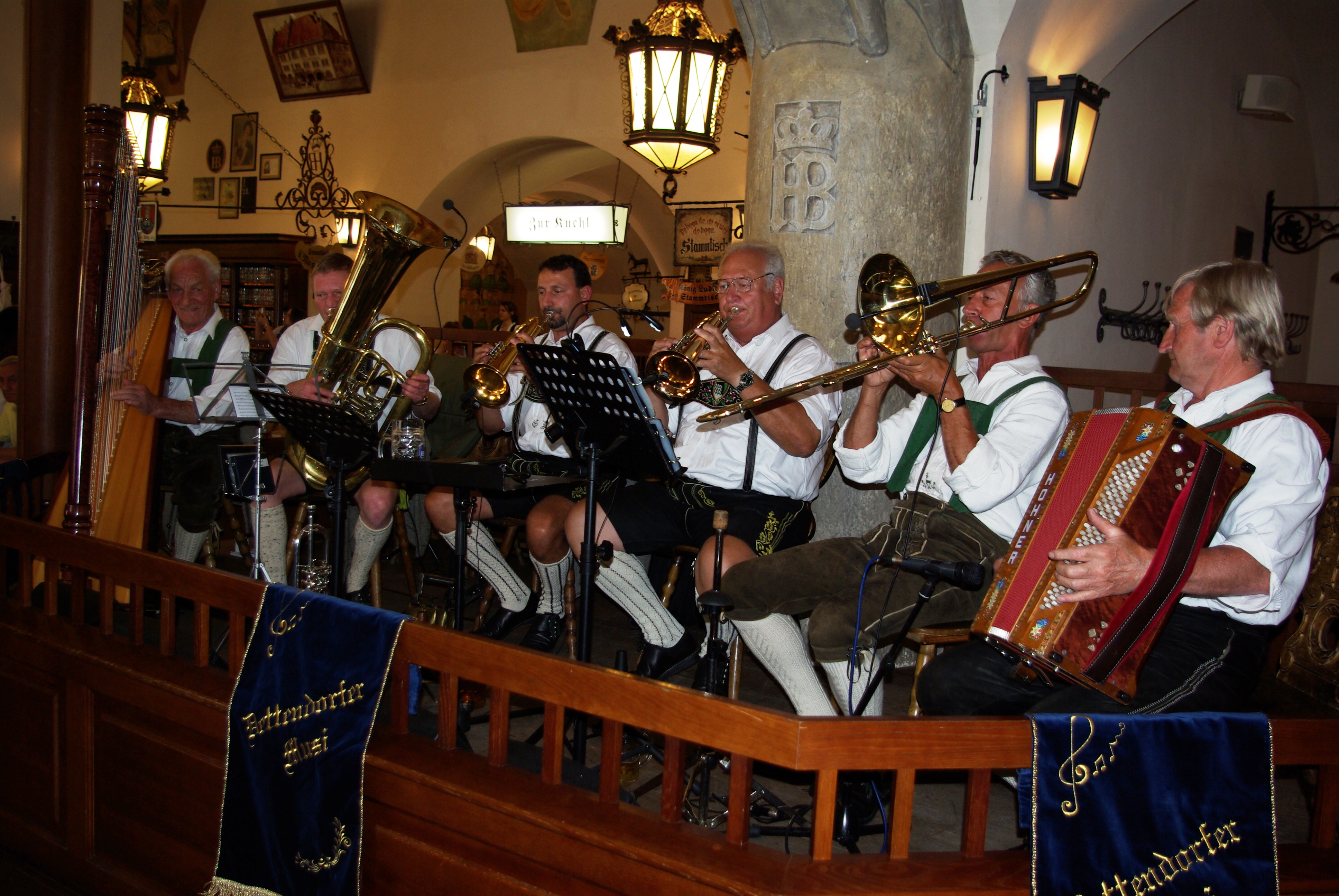
When I entered that vast temple to beer, sausage and sauerkraut at the end of June, I instantly felt like I had been there before, and indeed I had when I read Paddy’s finest work. Instantly I wanted to visit the chamber bursting with SA men singing Lore, lore, lore, and overweight young German burghers ‘as wide as casks ’ who were ‘… nimbly, packing in forkload on forkload of ham, salami, frankfurter, krenwurst, and blutwurst’ lifting stone tankards ‘for long swallows of liquid which sprang out again instantaneously on cheek and brow.’ Had it not been for the fact that this was midday instead of night I am sure I would have found it barely changed, save for the SA men, whose children and grandchildren (all aged now) have taken up residency.

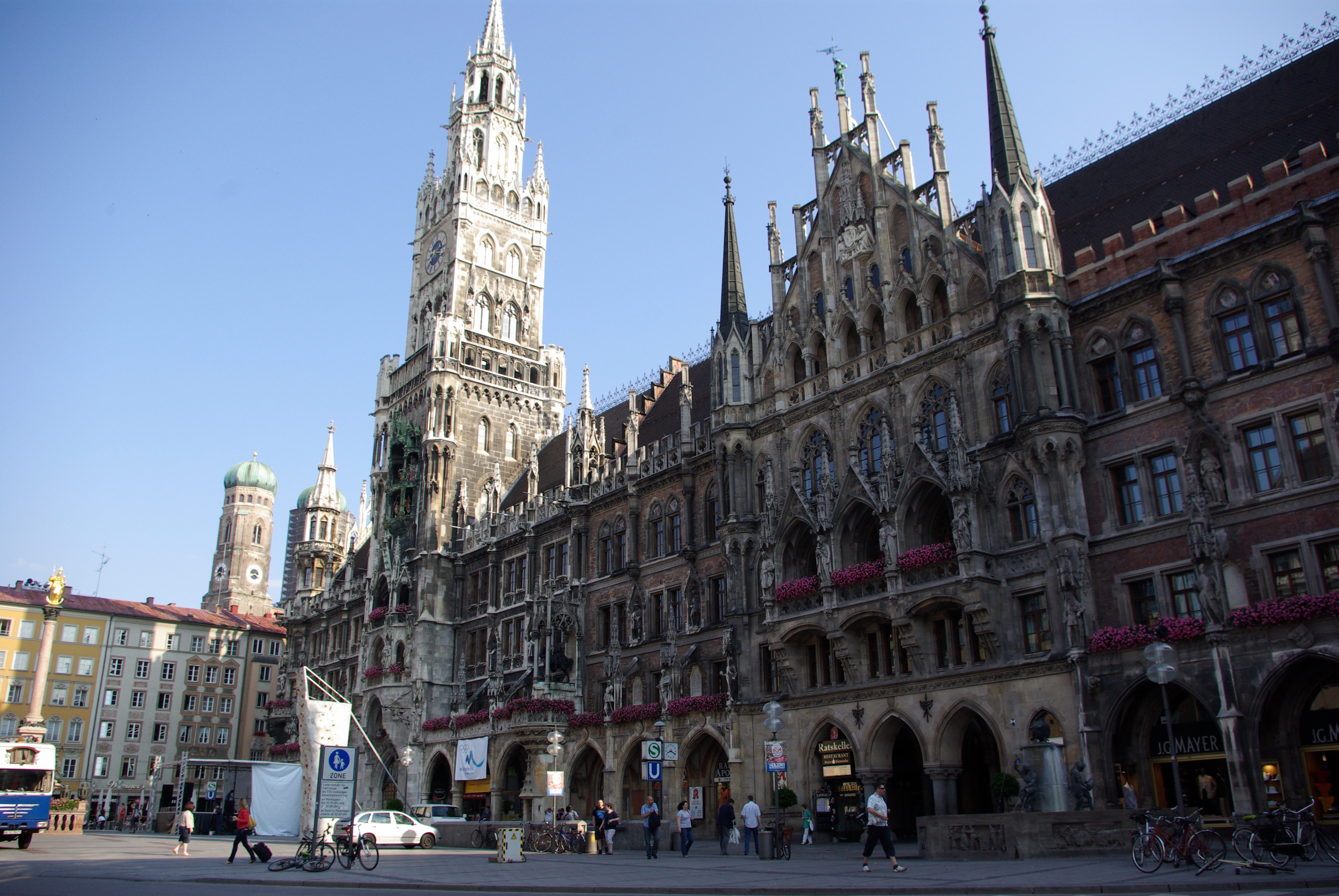
The Rathaus Munich

My wife and I were in Munich after taking the overnight sleeper from Paris Est to Munich on our journey to see the Passion Play (Passionspiele) at Oberammergau. We had arrived at the relatively ungodly hour of seven o’clock in the morning and had seen Munich come to life on a Saturday morning.

At the time the Alt Stadt was almost exclusively ours apart from some stall holders preparing their wares of ripe and juicy, brightly coloured fruit and vegetables for the Saturday market; two young men demonstrating their ability on MX bikes beside a fountain; and a couple of drunks who had obviously made the most of the warm Friday evening and had now belatedly discovered that the party was over.

During the war Munich was severely bombed by the Americans. When on a NATO course at the German Pioneerschule in the 1980’s I remember a particularly loud American officer asking in all seriousness, whilst we were on a tour of the city, when seeing the massive towers and basilica of the Dom, “How the hell did we miss that?”. Well, of course they did not miss it. Seventy per cent of Munich was destroyed by the bombing and after the war there was a serious proposal to abandon the city and rebuild nearby. Fortunately for the Hofbräuhaus (which sustained minor damage) and for us it was decided to rebuild the city. Many of the older buildings, as with so many German cities, were painstakingly restored. The Dom and the Hofbräuhaus were amongst these.

Following a morning of strolling around the centre, visiting some of the sights, drinking känchen’s of schokolade and eating cinnamon flavoured kuchen I was desperate to find the Hofbräuhaus. I was determined not to make the same mistake as Paddy and end up two miles away; although the prospect of doing so and having a couple of himbergeist to see us on our way was not so unappealing!

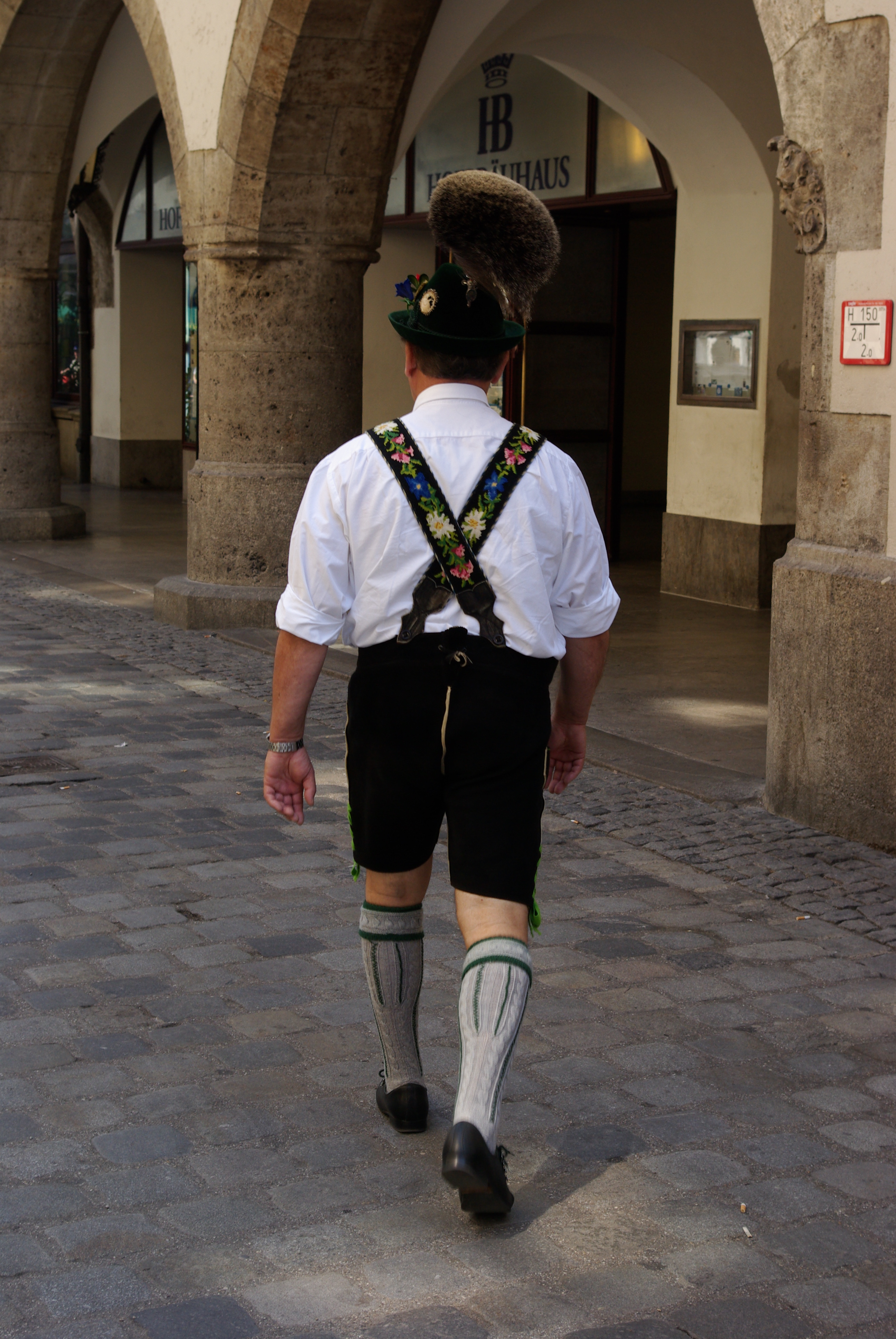
We followed a lederhosen clad gentleman ...

Inadvertently we had somehow attached ourselves to an American tour party and listened patiently whilst the bored German tour guide briefed them all on practical logistics like not entering their PIN number more than twice in those mysterious German cash machines, and what they might see on their one hour of ‘freedom from the group’ until it was time to meet up again, climb into their coach and visit yet another city. When it came to question time I asked where I might find the Hofbräuhaus. The guide looked quizzically at me, thinking I must have some obscure mid-western American accent and told me in all seriousness that eleven o’clock in the morning was rather too early to make such a visit and drink beer. I persisted and reluctantly she gave me the directions.

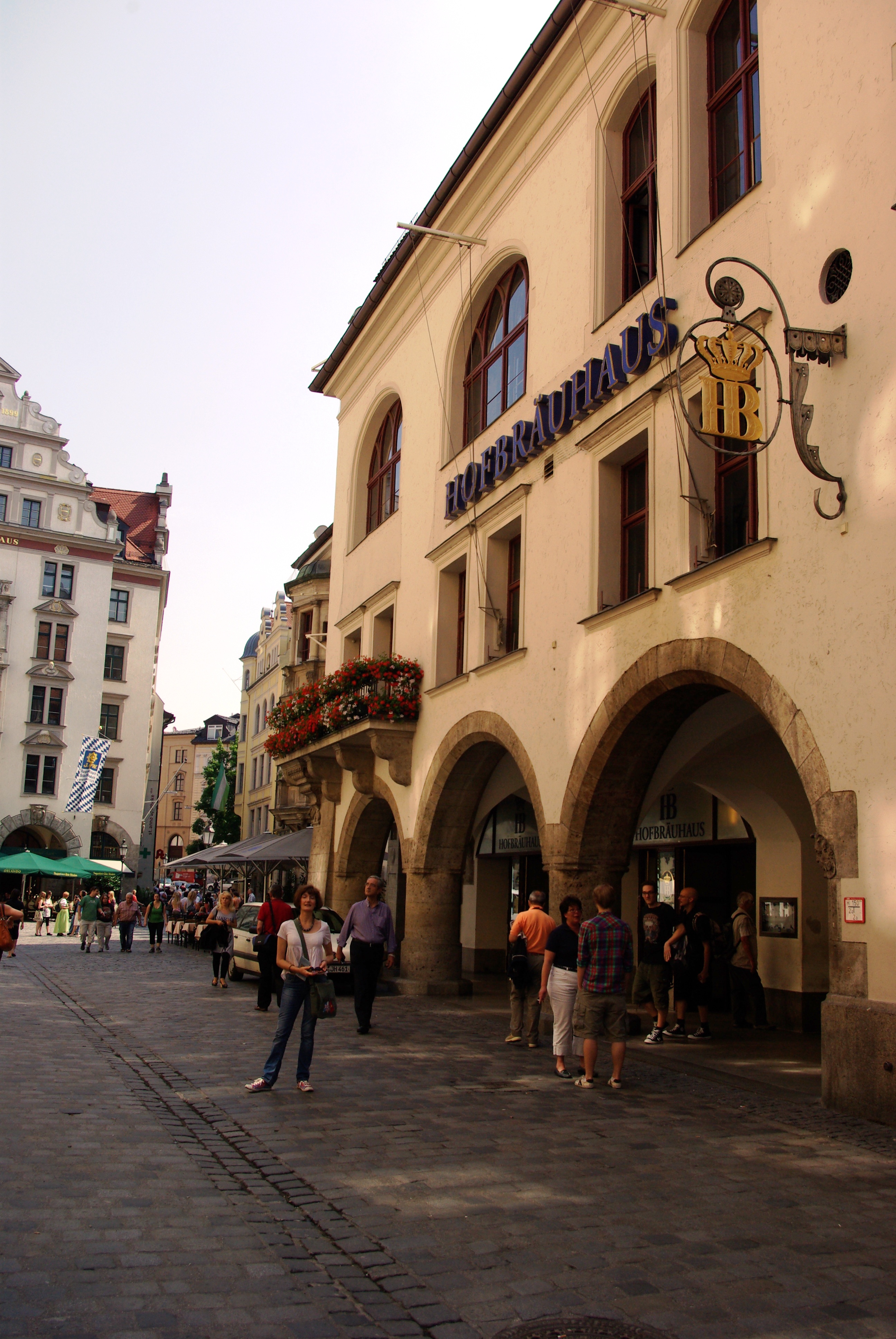
Hofbrauhaus exterior

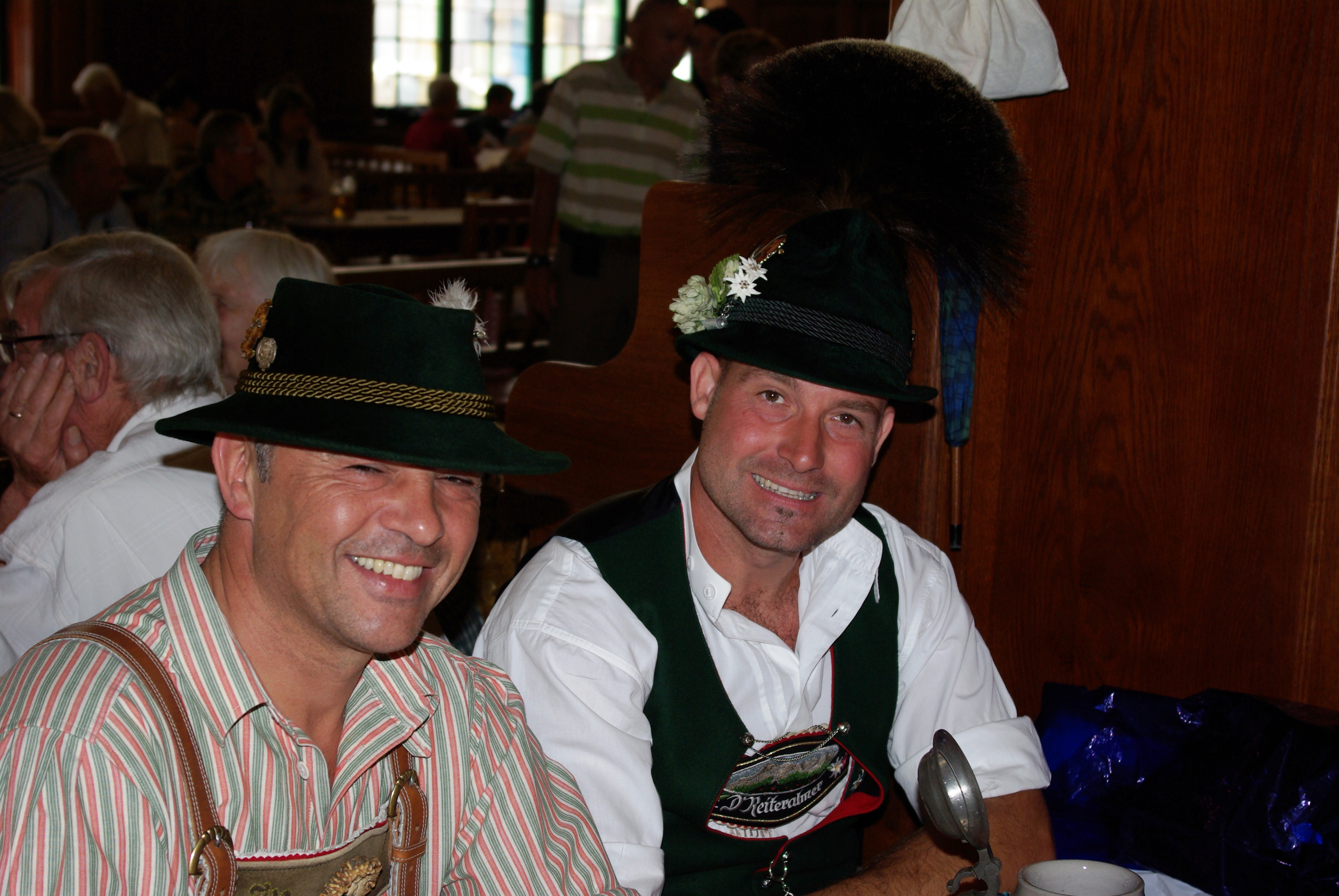
We walked in the sunshine past the old schloss and down a lane to the ‘slanting piazza’ but I do not recall the Virgin on a column presiding over all she surveyed. We followed a lederhosen clad gentleman wearing a traditional Bavarian felt hat which was adorned by the most amazing plume, reminding me of something that may have been worn by a Roman first spear centurion to enable his men to identify him in the midst of battle.

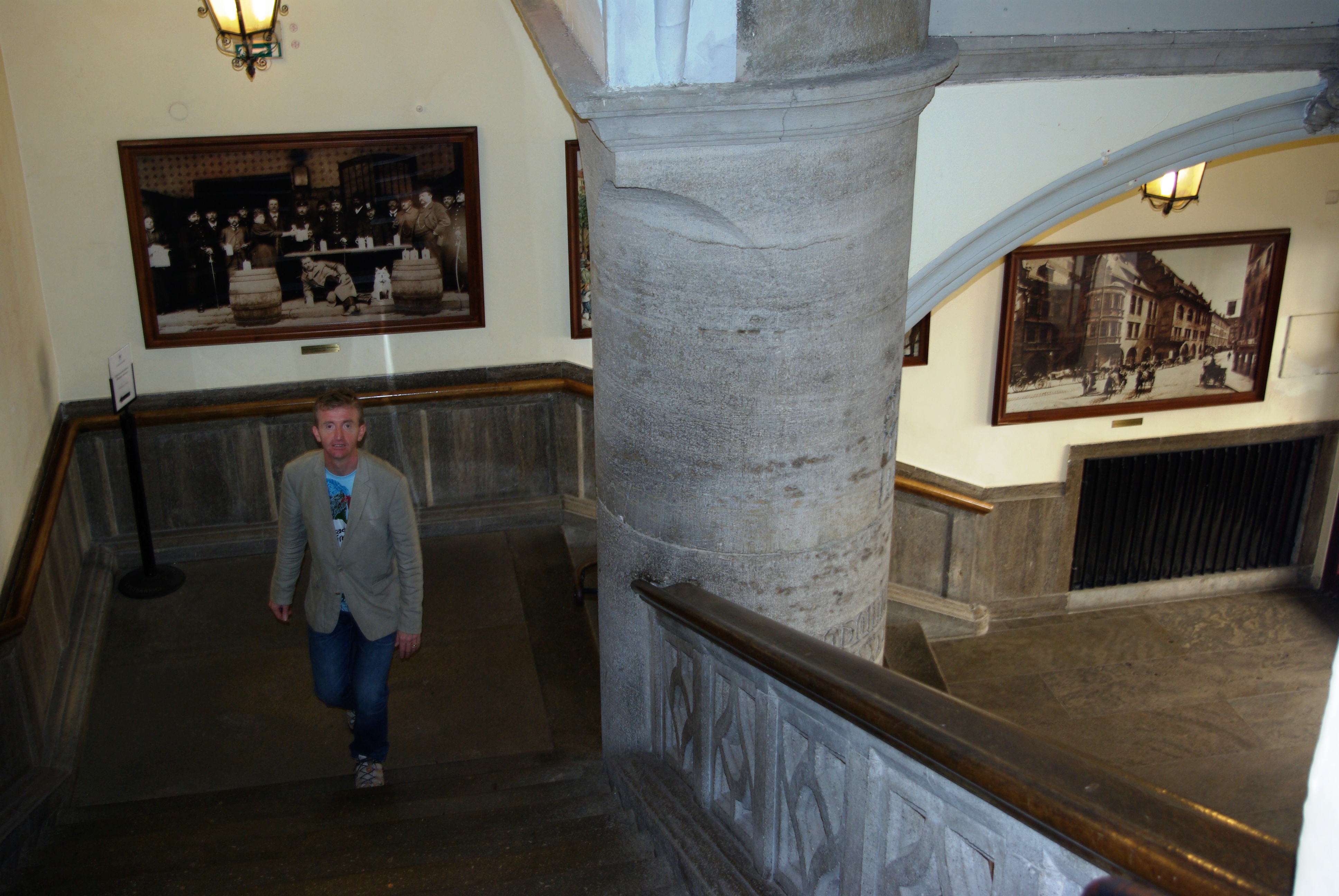
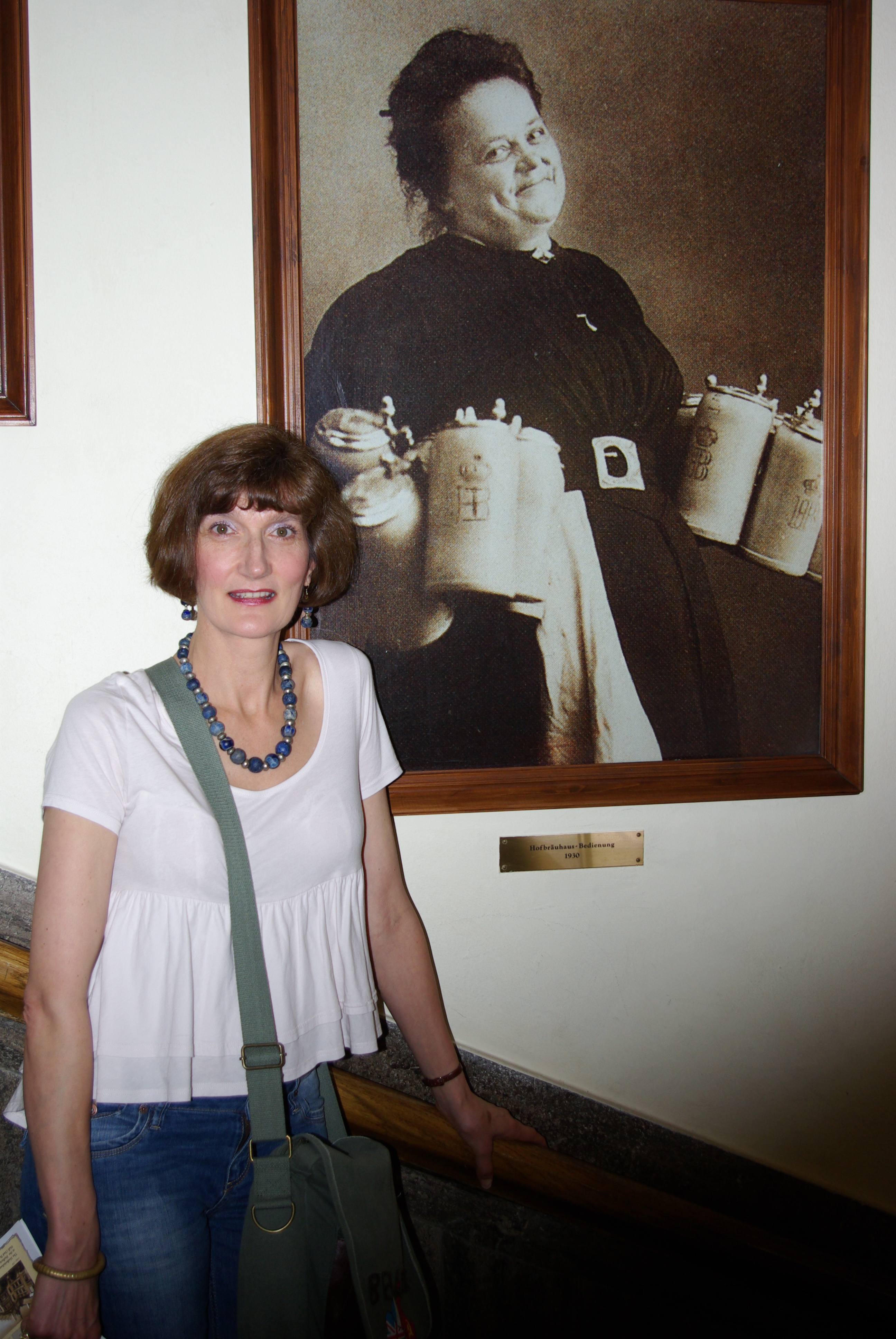
There before us was our goal. Gothic and grand just as Paddy described it, we entered through wide doors underneath Gothic arches and walked up those vaulted stairs which survived the damage of the war. It was here in January 1934 that Paddy encountered his Brownshirt. The steps are now lined with photographs, one of a maternal looking frau holding eight heavy steins full of the cool, golden Hofbräuhaus beer. Perhaps she had served Paddy on that famous, alcohol fuelled night?

Kim considers joining the waitressing team

The Hofbräuhaus has four floors devoted to the adoration of beer, sausage and pretzels. We visited each one. They were all decorated in a different style with a large communal drinking hall, and a number of smaller private function rooms (which are for hire). It is one of these higher floors that Paddy stumbled into when full of SS officers, Gruppen and Sturmbannfuhrers, black from their lightening-flash-collars to the forest of tall boots underneath the table.

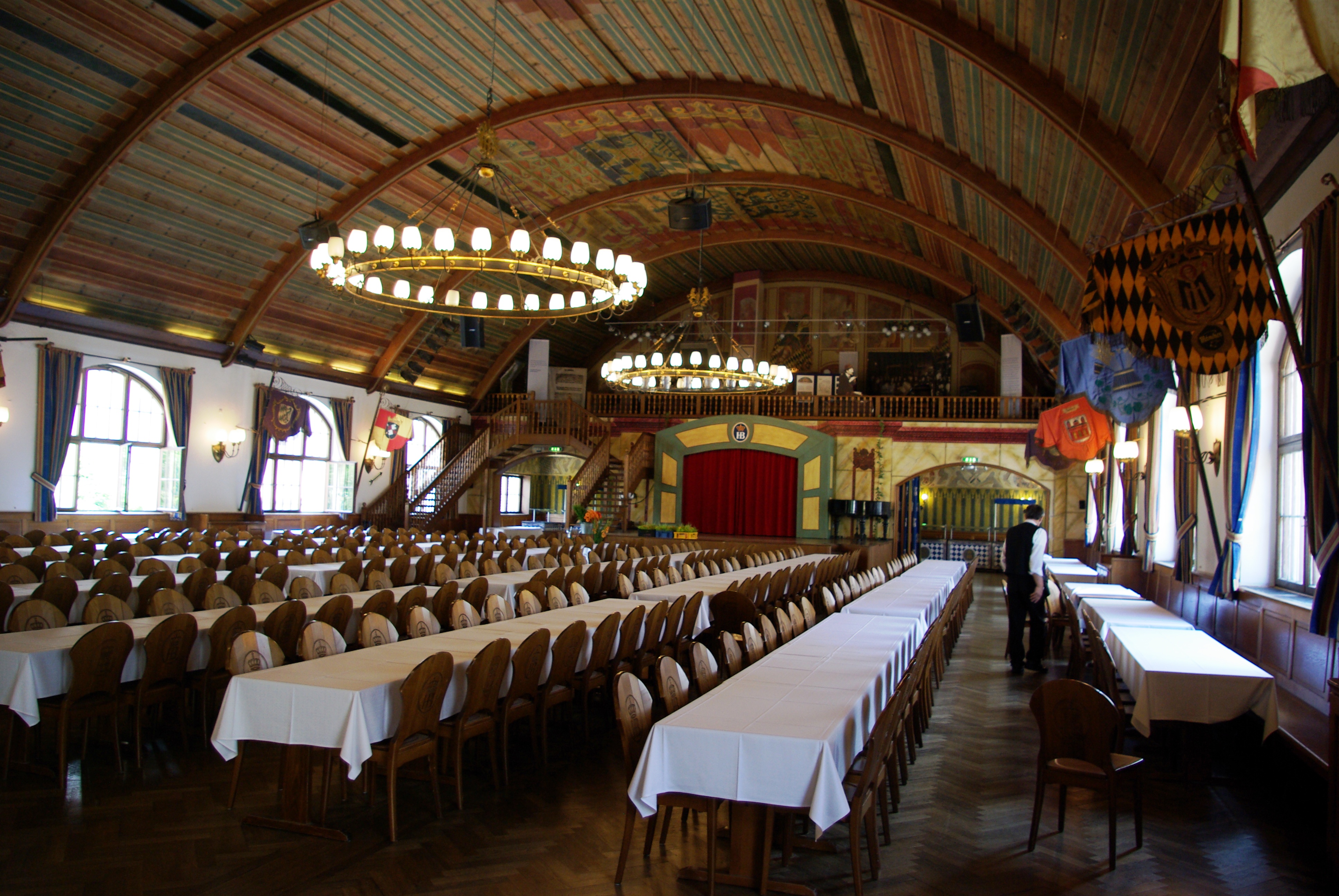
The highest floor is dominated by a large parquet floored room with a vaulted ceiling colourfully decorated with its predominantly pink and blue frescos of Bavarian coats of arms. The Festival Hall was built in 1589. It is light and airy with windows on each side, large chandeliers and dominated by a small stage with heavy, theatrically red velvet curtains. The Hall can seat over 900 on its long tables arrayed in neat rows before the stage, and gives the impression of being eternally ready for a party. Indeed on the occasion of our visit, it was being prepared for the post- Abitur celebration for a very lucky young girl. The mood darkens somewhat when you know that it was in this very room, standing on that very stage that the ambitious politician Adolf Hitler addressed his followers in the early days of the National Socialist Party in the late 1920’s and early 1930’s.

Hofbrauhaus Festival Hall

Given the passage of time this ceased to have any sinister effect, but it is a sobering thought and brought to life a period of history, and its aftermath, that has come to dominate my generation, and certainly those preceding us.

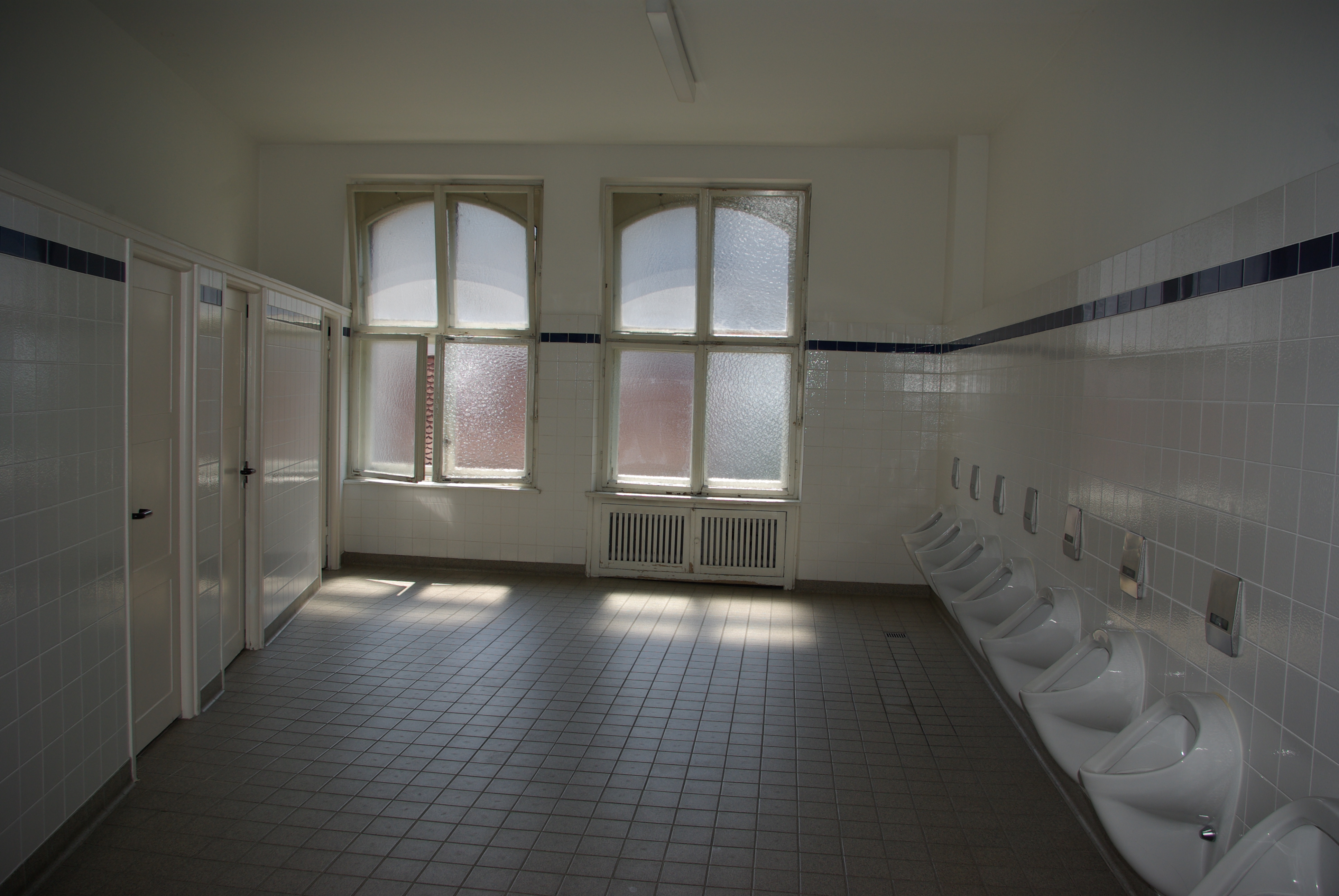
Did Adolf visit here?

It was about this time that I needed to answer the call of nature. Kim and I were virtually alone and I sought out a gentleman’s lavatory. Finding one at the end of a corridor leading from this function room, I hypothesised that perhaps Hitler had, on more than one occasion, made this same trip, perhaps accompanied by colleagues such as Herman Goering, and discussed the finer points of how to grab political power, and achieve revenge on all those who had sought to so humiliate Germany via the Treaty of Versailles.

Like Paddy we were now guided right down to the bottom of the stairs, out of the doors and back in another, larger door on the ground floor. After passing the obligatory ‘Hofbräuhaus shopping experience’ we entered a new hall where the vaults of the great chamber did not fade into infinity through blue strata of smoke as this was, unbelievably, 21st century smoke-free Germany.

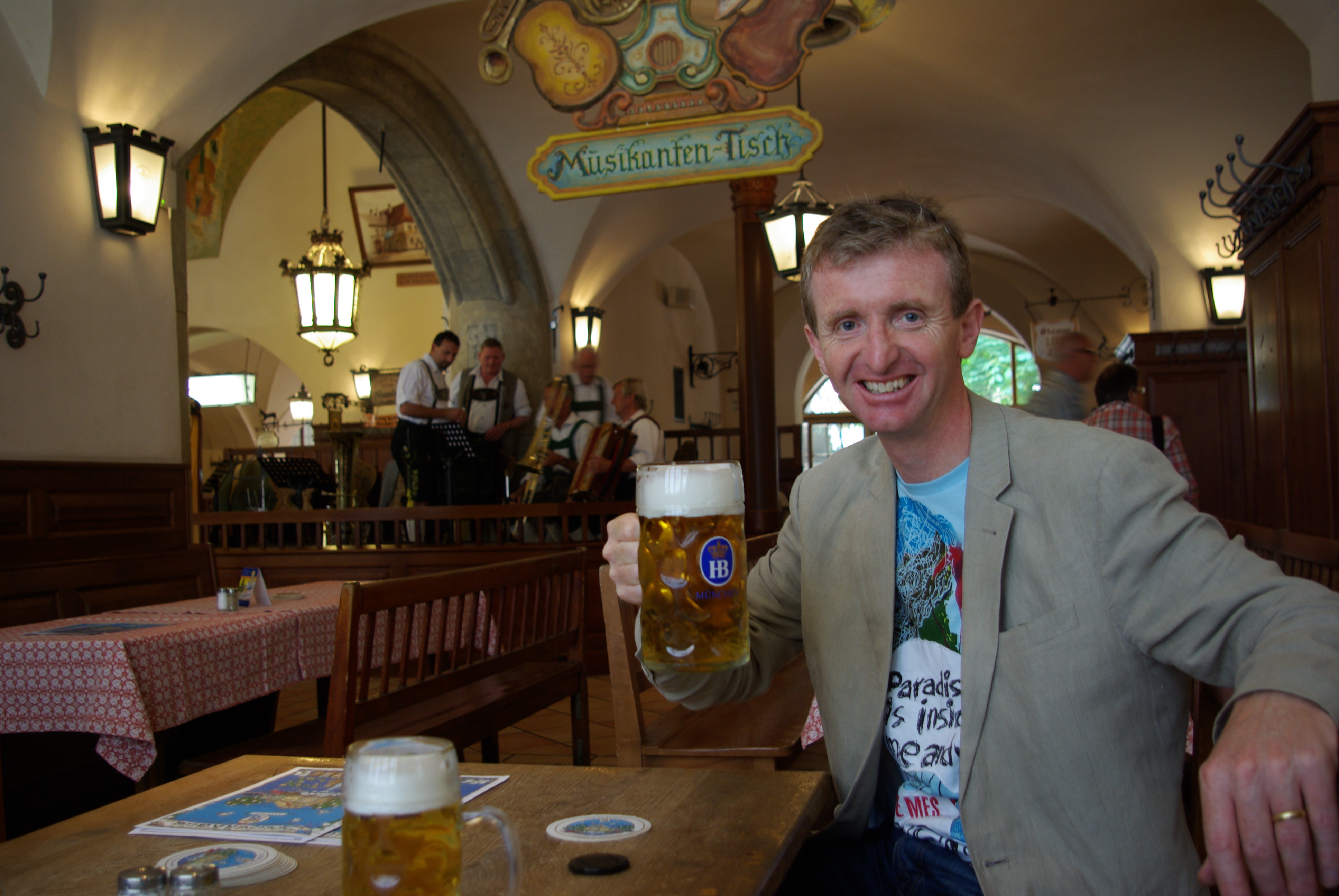
Drinking cool beer in The Schwemme

It was here that Paddy found the part of the Bastille he was seeking. The Schwemme is a huge, richly frescoed hall that wound this way and that, past huge stone pillars, toward the altar of Hofbrau beer where an army of male and female waiters attend upon the fountain of beer pouring litre upon litre of the marvelous nectar. And it did not stop there. What Paddy would have missed on a dark, cold, snowy night in 1934 was the courtyard beer garden which by now was filling with locals and tourists all keen to bathe in the unique Hofbräuhaus atmosphere.

If you visit the website of the Hofbräuhaus you will see it includes a list of ‘regulars’; those who attend services on a regular basis, with the specific visit days recorded. They have reserved seats and for larger groups, or even families, whole tables are kept for them so that they can indulge and worship whilst listening to the suitably attired Bavarian band that have a dedicated stage in the centre of the hall.

Hofbrauhaus Regulars

The band plays on

We had arrived early, at around 11.00 am and had spent forty-five minutes or so making our tour of the building. It was quiet, with just a few other like minded souls and the staff getting ready for the rush ahead. By midday we had chosen a table and ordered our first refreshing beer, a Würstlplatte for me and Spanferkel for Kim (read the menu in English here). The Schwemme was now filling with crowds of locals and tourists alike and the band had struck up. If you want to visit the Hofbräuhaus to look around, as we did, I would recommend going early, and you also need to be there pretty early to find a table.

It was a wonderful visit, and one that was brought to life even more as we imagined that young man avoiding Brownshirts and knocking back beer with the farming folk he found in the Schwemme. One thing that has not changed is the hospitality and friendliness of the Bavarian people, and it was with some reluctance that we walked out of the Hofbräuhaus into bright sunshine to catch our train to Oberammergau.

Now, where did I leave my rucksack?

Meeting Patrick Leigh Fermor in the Mani

Recently we have been musing in some posts about following Paddy’s route. For many of his fans this is perhaps a dream, but nevertheless, something many would like to make real. Topping that of course is meeting Paddy himself. In this piece, New Zealand author Maggie Rainey-Smith unexpectedly meets Paddy on a trip to Kardamyli on Greece’s Mani Peninsula, where Paddy has lived since the 1960’s. Some of you may have read it but I think it is such a nice article that it is worth re-visiting.

First published in the New Zealand Herald 15 June 2008

 
The village of Kardamyli is on the west coast of the Mani Peninsula, one of the more traditional and conservative areas of Greece.Recently, I spent two months in Greece chasing the muse, searching for clues, looking for inspiration.

The Mani Peninsula region is famous for the Maniots and their resistance of the Ottoman occupation. It is isolated by the Taygetus mountain range and enclosed by the Aegean and Ionian seas.

The Ottomans failed to infiltrate, but I have to advise that the English have. As I shopped for my Twinings tea and sat outside a cafe in the village of Kardamyli, using the free internet, I lamented the globalisation of this once-remote peninsula.

I wished, for just a moment, that I was back in time when to be a strange woman alone in this small village may have attracted disapproving stares.

In the local bookshop was the very book I’d been looking for: Mani – Travels in the Southern Peloponnese, by Patrick Leigh Fermor. On my terrace overlooking the sea, I opened the book and found myself mesmerised by the most exquisite, evocative travel writing I have ever read. Not only that, I discovered that Fermor is a resident of Kardamyli.

The owner of the bookshop was unimpressed when I asked where Sir Patrick lived, and his lips remained sealed, his expression disapproving. Fermor is almost a saint in Greece.

He was a resistance fighter in Crete during World War II; his exploits were the subject of a film starring Dirk Bogarde (my father was in Crete, but a more modest hero at Maleme, the point where the island was finally lost to the Germans).

At the local cafe, where I made use of the technology, the owner (who looks like a Maniot right out of Fermor’s book, with her blanket of black ringlets and beautiful olive eyes), told me Paddy (as the locals call him) would celebrate his Name Day that very week and that he always opens his home to the locals on that day.

By then, and after one week’s residence, I considered myself a local, and everyone agreed with me.

So with joyous disbelief at my good fortune, on Thursday, November 8, I joined the local villagers at Sir Patrick’s Name Day celebration at his majestic and yet still homely yellow stone house overlooking the Messinian Gulf.

By 10.30am the service in his private chapel was over and we were seated in his lounge – books lining the walls from floor to ceiling: Nancy Mitford, Henry James, James Joyce – eating olives, meatballs, feta and drinking local wine.

On a person’s Name Day you are required to take a gift, and all I had with me was a copy of my first novel About Turns, which I gave to Paddy. He signed my copy of his own book with a personal inscription and a small drawing. We talked about Crete and my dad and his book on the Mani. I gushed, he charmed.

Then the singing began and Paddy was surrounded by adoring local women who toasted him with traditional Name Day songs.

At the end of the singing, Paddy stood and pretended to fire a pistol into the air (an old tradition where real pistols were once used). He is of English and Irish descent. Although his name is Patrick, his Greek Name Day is the day of Michali. Michael is the name he assumed while fighting for the Greek resistance.

With me was an American Orthodox nun who worked in Moscow and a Danish man of the cloth who was studying Byzantine churches. We were Paddy’s “non-local” guests and pinched ourselves to check we weren’t imagining our good fortune.

When it was time to leave, another Michael (Michali), a neighbour of Paddy’s, invited us to his home. We walked through an olive grove up the hill along the coast to another beautiful stone home.

Our new host sold Paddy the land and helped him build his house in 1964. We were feted with fresh coffee and cakes and listened to Michali’s son, who told us that when he decided to leave Kardamyli some years ago to travel, Paddy told him: “You can’t leave.”

And when he returned years later, Paddy told him: “You know we are very fortunate, we live in Kardamyli. We are fortunate – we have the mountains. We are fortunate – we have good food. We are fortunate – we have clean air to breathe. We are fortunate – we have the beautiful sea to swim in.”

“Yes, Paddy, the mountains, the food, the air and the sea,” said the young man, nodding in agreement.

And then Paddy said to him: “And for all these reasons and more, we may just forget to die.”

Sir Patrick Leigh Fermor is 92 years old, he was wearing a double-breasted navy suit when I met him, had a full head of wavy grey-black hair and was still a handsome, charming man with just a slight deafness in one ear.

He spoke with a classical English accent which rather surprised me, considering the years he has spent in Greece.

He is still writing. If you’ve never heard of him, or never read his books, now is the time to start.

By Maggie Rainey-Smith

Book review: In Tearing Haste: Letters between Deborah Devonshire and Patrick Leigh Fermor from The Scotsman

First published in The Scotsman 13 September 2008

by Roger Hutchinson

THE MARVELLOUS THING ABOUT yours [books],” wrote the Duchess of Devonshire to Patrick Leigh Fermor in May 1974, “is that they never appear.”

Deborah Devonshire professes a pathological dislike of reading. Somewhere in the unfathomable depths of that eccentricity may be discovered the contrary reason for her having been, for over half a century, the favourite correspondent of one of the greatest British authors of the 20th century.

Debo and Paddy had been swapping letters from various parts of the globe for 20 years when she congratulated him on the paucity of his output. When he received that letter he was in fact just finishing A Time of Gifts, the first volume of the travelogue through Europe in the 1930s which would cement his reputation. If we are to believe the Duchess, she has never read a word of it or any of his other works.

This does not mean that their collected letters, expertly compiled by Charlotte Mosley, is entirely non-literary – there are plenty of gems here for the student of the Leigh Fermor oeuvre. It means rather that their friendship was established on broader grounds.

The youngest Mitford sister, Debo Devonshire, clearly possesses oodles of her siblings’ trademark charm, without the family handicap of being mad as a meat-axe. Patrick Leigh Fermor saw and fell for her at an officers’ ball early in the Second World War. She did not so much as notice him until several years later. By the early 1950s Paddy Leigh Fermor was difficult not to notice. Handsome, polyglot, rakish, wildly itinerant and with a war record straight out of a John Buchan novel, he fell upon London society like a wolf on the fold.

He must have been able to pick off debutantes at a hundred paces. But Deborah Mitford was made of sterner stuff. She had set her sights on a duke. PLF would have to settle for best male friend. We should say, one of her best male friends. Her roster of masculine admirers is extraordinary. President John F Kennedy tops the chart, but it winds down through almost every eligible and ineligible man in the developed world. Debo’s good fortune – and now that this engaging anthology has been published, ours too – is that not a single one of them was half so good a writer as her faithful Paddy.

Naturally, most of the words in this collection were authored by PLF. But if Deborah Devonshire has been a foil, she was a perfect one. Chatty, witty, teasing, gossipy, relentlessly cheerful and with more than a hint of modest good sense, her short replies bounce off his beautiful essays like volleys of tennis balls off a cathedral. Continue reading →

Subscribe to the Patrick Leigh Fermor blog!

If you would like to keep up to date with the blog postings (of which there are many more to come I assure you!), why not subscribe to the blog? Enter your email, just in the top right where it says ‘Email Subscription’, and you will receive an alert each time a new post appears; that is all. No spam!

I hope you enjoy the posts and ferreting around the blog.

Don’t forget if you have something you would like the world to see that concerns Paddy, or his friends and colleagues, please get in touch with me either by a comment or email tsawford[at]btinternet.com, and I will publish it for you with full credit.

Tom

One Man’s Great Game: Lieutenant Colonel “Billy” McLean

When you get involved with the life and times of Patrick Leigh Fermor, you find all sorts of possible avenues to explore. One group I am trying to bring together on the blog are the occupants of Tara in Cairo during the war. Given my interest in the Balkans, Albania in particular, I followed the route of “Billy” McLean and the British Military Missions to Yugoslavia and Albania which were manned by SOE men. Billy was an occupant of Tara and Xan Fielding wrote his biography. Of course Paddy was there as well.

In the course of my investigations I have read, in the last few weeks, the book Eastern Approaches by Fitzroy MacLean who as a very young Brigadier was personally chosen by Churchill to lead the mission to Tito’s partisans, and Billy McLean’s biography – One Man in His Time. Both books are interesting and I will review them if I have time. I have to say I was a little disappointed in Xan’s writing style, but it is workmanlike and is probably an accurate portrayal.

Billy McLean’s life is absolutely fascinating. He was a real adventurer and never stopped his adventures or travel until he died in 1986. I have dug out his obituary from the Daily Telegraph Second Book of Obituaries – Heroes and Adventurers, and as I did before with Xan Fielding’s obit, I have retyped it word for word as I cannot find an online version.

Go on, explore your own Paddy related avenue, and maybe write to me and we can publish for others to hear about!

First published in the Daily Telegraph, 20 November 1986.

Lieutenant Colonel “Billy” McLean, who has died aged 67, spent 40 years playing his own version of the Great Game. Like some latter-day knight errant, he travelled tirelessly in the Muslim world, working always against the encroaching influence of the Soviet Union, while at the same time seeking adventure among tribal peoples.

McLean’s unusual life often had elements of intrigue that no one else could unravel. “What is Billy really up to?” was a question that would be asked at the bar of White’s Club as he set off on another trip to Jordan or Iran, Morocco or the Yemen.

In McLean’s character there were shades of Buchan and Lawrence and Thesiger. All seemed to coalesce in the Yemen, where from five years, from 1962, McLean helped the royalists under Iman al-Badr to resist President Nassar’s attempts to take over the country. He made numerous reconnaissances in the Yemen desert and many arduous journeys, by camel and on foot, to the royalist forces in their remote mountain strongholds.

It was entirely due to McLean that Britain never followed America in recognising Nassar’s, and the Soviet Union’s, puppet republican government in the Yemen; and it was he who persuaded the Saudis to increase their aid to the Iman’s forces. Thanks also to McLean, the royalists received Western mercenary support and arms from the RAF. Largely as a result of McLean’s efforts, North Yemen did not become one of Nassar’s fiefdoms and did not join its neighbour South Yemen (Aden) in the Communist camp.

Neil Loudon Desmond McLean was born on November 28 1918, a direct descendent of “Gillean of the Battle-Axe”, known in Argyll in the 13th century.

After Eton and Sandhurst (where he rode several winners in point-to-points), McLean was commissioned into the Royal Scots Greys and sent to Palestine [prior to the war] in 1939.

At the end of the following year he went to occupied Abyssinia [Ed: Ethiopia] where he proved himself an outstanding guerrilla leader, as part of Orde Wingate’s Gideon Force. He led a force of Eritrean and Abyssinian irregulars – known as “McLean’s Foot” – against the Italians near Gondar.

His burgeoning career as an irregular soldier continued in Special Operations Executive; in 1943 he led a five man military mission to Albania, to co-ordinate resistance to the Axis powers. Peter Kemp (qv) described his first meeting with McLean when he parachuted into Albania to join the mission: “Approaching up the hill with long, easy strides came a tall figure in jodhpurs and a wide crimson cummerbund, a young man with long fair hair brushed back from a broad forehead and wearing a major’s crown on the shoulder straps of his open-necked army shirt.”

With one break, McLean remained in Albania until the German retreat from that country and inspired those under him with his military skill and courage. He was promoted to lieutenant-colonel at the age of 24.

His contacts with the Albanian communist leader Enver Hoxha turned sour when the left-wing elements of SOE favoured the partisans at the expense of the Zogist faction led by Abas Kupi, which McLean supported against charges of collaboration with the Germans.

In 1945 he volunteered for SOE duties in the Far East, where he became military adviser in Kashgar, Chinese Turkistan. Here he learnt the ways of the Turkis, Uzbeks, Kazaks, Tajiks and Tartars, who were under threat of domination by the Soviet Union, and travelled extensively in Asia. McLean’s fascination and sympathy with Muslim minorities and tribal peoples would continue for the rest of his life. He devoted much of his time to the cause of the Pathans and the Kurds, as well as the royalist Yemenis.

After the war he sought election to Parliament, twice unsuccessfully for the Preston South constituency, in 1950 and 1951. He became Conservative MP for Inverness in 1954, and held the seat until the 1964 general election.

As a Highlander himself, McLean was able to identify with the Celtic character of his constituents. But they could not be expected to appreciate the reasons for his long absences on the Middle East.

While he was an MP, and afterwards, McLean was, as described by a colleague, “a sort of unpaid under-secretary for the Foreign Office”. His political contacts in the Muslim world were probably unique among Westerners, in particular his relationship with King Saud during the Yemen war and his personal friendship with King Hussein over many years. In the mid-1960’s he was involved in an unsuccessful attempt to “spring” a revolutionary leader from jail in Algeria [Ed: using a yacht and accompanied by King Leka of the Albanians who fancied coming along for the ride. The attempt was foiled by the CIA who wanted the ‘kudos’ of freeing the man, which they did some months later].

McLean was always passionate in defence of British interests, as he saw them, which did not always accord with the Government’s view. In his later years, still pursuing those interests he visited Somalia, Iran, Western Sahara, the Pakistan-Afghanistan border, China, Israel, Turkey and Jordan.

In 1979 Harold Macmillan wrote to McLean: “You are one of those people whose services to our dear country are known only to a few.”

By his many friends and admirers he will be remembered as possibly the last of the paladins. While his role may not always have been appreciated in Britain, his independence and total integrity were recognised n all the countries where his influence was felt.

Alongside his flair for guerrilla fighting, he had a passion for secret enterprises, deep-laid schemes, and political complexities. He combined acute political understanding with military gifts ideally suited to irregular warfare.

His comrade-in-arms in Albania and the Yemen, David Smiley, has written of McLean: “His charming character seemed languid and nonchalant to the point of idleness, but underneath this façade he was unusually brave, physically tough and extremely intelligent, with a quick, active and unconventional mind.”

His wisdom, sense of humour, human curiosity and kindness endeared him to a wide circle of contemporary friends and younger people, who saw his values as ones they could respect without sentimentality or danger of being considered old-fashioned. He revelled in argument and banter, and was always interested in the opinions of the younger generation.

McLean was both a keen shot and underwater fisherman: one of his great pleasures was to spear moray eels off the coast of Majorca. He was very partial to Middle Eastern and Chinese cooking.

He married, in 1949, Daska Kennedy (neé Ivanovic), who supported, sustained and understood him during his unconventional life.

Related article:

Xan Fielding Obituary

Short obituary of George Psychoundakis from the BBC

The BBC also covered the death of George with this brief piece.

George Psychoundakis, who has died aged 85, became a hero figure to the Resistance in World War II by guiding Allied soldiers over the mountains of Crete so that they could escape the brutal German occupation. Later, he carried messages, wireless sets, batteries and ammunition. Wearing only worn-out boots, he would cover many miles each day. A poor shepherd, he had a love of learning, and formed a lifelong friendship with one of the Resistance officers, the writer Patrick Leigh Fermor. Fermor translated Psychoundakis’s account of his heroics in the Cretan Runner.

Major Stanley Beckinsale obituary

First published in the Telegraph: 12:03AM BST 06 Sep 2004

Major Stanley Beckinsale, who has died aged 84, was a founder member of the para-naval section of the Special Operations Executive (Middle East) and was awarded an MC for evacuating several hundred Allied soldiers from enemy-held Crete.

In May 1941, the Anglo-Anzac forces in Crete were narrowly but decisively defeated by General Student’s airborne force. The para-naval section of SOE Middle East, part of Force 133, based in Cairo, was given the task of putting agents on the island to organise the retrieval of British and Commonwealth servicemen who had taken refuge in the mountains.

 The operation was run from Alexandria by Commander Francis Pool, RNR, a rotund figure known as “Skipper”. He was landed by submarine to make contact with the Cretans who were assisting the fugitives, often at great risk to themselves, and travelled between them on the back of a donkey, dodging the German patrols en route.

A few troops were rescued in this way, but it was considered too great a risk for submarines – and a rusty old trawler from Haifa was chosen for the job. After being fitted with a captured Italian 20mm Breda gun in the stern and six Lewis guns mounted at various points, the vessel was named Hedgehog, and Beckinsale was made second-in-command.

On his first trip to the south coast of Crete, Beckinsale ran into a Force 10 gale. Hedgehog had several tons of concrete fore and aft as ballast, and the former fish-hold was loaded with captured Italian rifles and Army boots for the guerrillas. New Year’s Eve 1942 was spent pumping the bilges and throwing the deck cargo overboard; but on the evening of the fourth day, the crew could see the Cretan mountains looming in the distance and smell the wild thyme on the wind.

The inlet chosen for the landing was little more than a cleft in the rocks with a small beach, well away from the German garrisons. When the signal flashed from the shore, they came in and moored by the light of a full moon. Their agent, Tom Dumbabin, a Fellow of All Souls, emerged from the shadows to report that he had managed to collect 150 Allied soldiers and a Greek Orthodox priest.

They lay up the next day, loaded their passengers and slipped anchor at dusk in order to begin the return trip to Alexandria. But the following morning, the lookout heard the engine of an approaching plane, and they quickly altered course. The deck was strewn with passengers, and Beckinsale hastily covered them all with blankets and ran to his Lewis gun. The Italian Arado circled several times before turning away, apparently satisfied that the ship was a coaster on German business.

Stanley Eustace Beckinsale was born in London on March 9 1920. He went to grammar school at Belvedere, Kent, and then to Reading University, where he read Agriculture and rowed in the VIII. The outbreak of war interrupted his studies and, in 1939, he was commissioned into the 1st Battalion Royal Tank Regiment before being recruited by SOE.

Beckinsale joined Saad, the first para-naval ship in the Red Sea, as an engineer in 1940. The schooner carried a crew of four, and was the only one with a draught shallow enough to carry it over the minefields. After the fall of Massawa, Eritrea, his unit was given the task of cleaning up the Italian garrisons on the islands guarding the entrance. He and his comrades negotiated the surrender of more than 2,000 Italian troops manning the batteries on five separate islands.

In 1942, in a further three operations, Hedgehog landed at Crete, where Beckinsale and his comrades rescued more than 100 additional people who were trapped on the island. The trawler was also instrumental in putting ashore a number of British agents, including Patrick Leigh Fermor (who later kidnapped General Kreipe, the commander of the island’s garrison) and George Jellicoe, of the Special Boat Section, who was on his way to sabotage planes at Heraklion airfield.

On Beckinsale’s last trip to south Crete, Hedgehog docked at Mersa Matruh, escaping just a few hours before Rommel’s Panzers arrived on their way to El Alamein. He later made long-distance reconnaissance trips in his 26ft caique Constantinos, some of which covered 1,000 miles and kept him at sea for more than a month. He was awarded the MC and was also mentioned in dispatches for capturing several Italian schooners.

In 1945 the para-naval section was disbanded. Beckinsale was posted back to England for a spell before spending a year with the Central Commission, Food and Agriculture, in the North Rhine Province of Germany. After being demobilised in the rank of major, he farmed in Oxfordshire for 22 years.

Beckinsale subsequently settled in a village in Wiltshire, where he went into partnership with Tom Thain, a former fellow member of the SOE. Together they formed Dentiststone Restoration, a company specialising in restoring stonework, tracery and statuary; among their clients were Wells and Winchester Cathedrals, Romsey Abbey and the Brighton Pavilion.

He retired in 1990. An avid reader, he particularly enjoyed the study of English history and mediaeval architecture.

Stanley Beckinsale died on August 17. He married first, in 1946, Joyce Bolt, who predeceased him. He married secondly, in 1970, Mary Hackett (née Collins); she survives him with a son and a daughter from his first marriage and a daughter from his second.

Reluctant hero finally accepts his knighthood

I have edited this slightly to remove non-Paddy related stuff. something to add to the archive.

By Nigel Reynolds

First Published in the Telegraph : 12:01AM GMT 31 Dec 2003

Patrick Leigh Fermor, the veteran travel writer, philhellene, scholar and soldier, has finally accepted a knighthood, saying that it would have been “rude” to turn the honour down for a second time.

Leigh Fermor, 88, who lives in Greece where he is treated as a national hero, refused a knighthood in 1991.

 He said at his home in the Peloponnese last night: “I turned it down then because I didn’t think that I deserved it.

“I’d written a few books, that’s all.”

He was among a list of 300 prominent figures from the arts and entertainment world to have declined honours since the Second World War which was disclosed in a leaked Cabinet Office document shortly before Christmas.

The author, hailed by many critics as Britain’s best travel writer, receives his honour for services to literature and to British-Greek relations in the diplomatic and overseas list.

The Cabinet Office refused to discuss his change of heart…

… Leigh Fermor, whose wife, Joan, a photographer, died in the summer aged 91, first sprang to fame working for the SOE organising guerrilla operations in wartime Crete.

In a celebrated episode, for which he was awarded the DSO, he and a friend, disguised as German soldiers, kidnapped Gen Kreipe, the island’s garrison commander. For three weeks they evaded German search parties and Kreipe was eventually taken off Crete by motorboat.

The exploit was turned into the film Ill Met By Moonlight in 1956, with Dirk Bogarde cast as Leigh Fermor.

Until the war, Leigh Fermor had been rootless. After school, at the age of 18 he spent a year walking from Holland to Istanbul and then he roamed the Balkans.

After the war, he built himself a house and settled in the Peloponnese living off his writing, principally about his travels and Greek culture, history and folklore. His best-known books are The Mani, written in 1958, and Roumeli (1966).

Artemis Cooper talks about Words of Mercury

Short and to the point, a little video snippet of Artemis Cooper talking about her work on Words of Mercury.

Click the picture to play!

Artemis Cooper and Words of Mercury

A Long Walk Starts (and Ends) With a Step

I was just taking another look at Matt Gross’ Frugal Travel section of the New York Times and discovered that after writing the piece I published on 13 June he left the NYT. I wonder if he was so inspired by Paddy’s travels that he decided to take off and cover the whole route? Perhaps not. Here is his signing off piece from his NYT Blog.

By MATT GROSS

This weekend’s Travel section cover story — “Frugal Europe, On Foot” — is my last as the paper’s Frugal Traveler columnist. After four years of roaming the world on a budget, from Alabama and Albania to Uruguay and Urumqi, I’m taking a rest, and handing over the illustrious mantle to a new shoestringer, who’ll appear in this space next month.

But for my final feature, I wanted an adventure that would challenge me — physically, psychologically, culturally, linguistically, technologically, logistically and, of course, financially. Maybe a sailing adventure? Done that. A lengthy train journey? Done. A trek into the mountains? Done — on foot and on horseback. I’ve gone round the world, across America and grandly circled Europe, so what was left to be done?

The answer came in the form of Patrick Leigh Fermor, the 95-year-old war hero who’s known as Britain’s greatest living travel writer. His books “A Time of Gifts” and “Between the Woods and the Water” chronicle his nearly penniless journey, in 1933 and 1934, from Rotterdam to Istanbul — on foot. And when I looked at the route he took through the remains of the Austro-Hungarian Empire, I realized I had an adventure in the making: a two-week walking tour that would take me from Vienna through Slovakia to Budapest.

Throughout 180 miles, I dealt with three official languages (German, Slovak, Hungarian) and some unofficial ones (Italian, English, French, Hebrew). I used maps both paper and electronic. I took inspiration from literature: not just Mr. Leigh Fermor’s books but also “The Unnamed,” by Joshua Ferris, “The Road,” by Cormac McCarthy, “The Places in Between,” by Rory Stewart, and “The Long Walk,” by Stephen King (writing as Richard Bachman). I found great bars and restaurants via Twitter and Foursquare — and through common, random luck. I walked till my ankles screamed, and sang to myself during long hours alone.

And when I met new people — as I did just about everywhere — I was amazed, again and again, at their spontaneous generosity, their willingness to feed, shelter and befriend a mysterious stranger attempting to do what few sane travelers would even contemplate.

In other words, I don’t expect you, my readers, to follow precisely in my blistered footsteps, but I hope this story — and all the Frugal Traveler articles I’ve written — will inspire you to set off on your own crazy adventures, confident in the knowledge that no matter how little money you have, the world will, if you embrace it fully, take very good care of you indeed.

Are you inspired? I know I am. It would be a nice idea if perhaps next year we could get a bunch of people together and walk some of the route. On the other hand perhaps it is best to do as Paddy did and make a solo attempt. If anyone has ideas on this get in touch with me tsawford[at]btinternet.com or post a comment below.

Related article:

Walking Paddy’s Route in Mitelleuropa: Frugal Europe, on Foot

Hay Q and A: Who are the three greatest living writers?

Well done William!

The Hay Q&A

We asked some of the leading authors at this year’s Guardian Hay festival a series of questions. Here are their answers

Q4: Who are the three greatest living writers?

William Dalrymple: “Among novelists, Cormac McCarthy; among travel writers, Patrick Leigh Fermor; among short story writers, Jhumpa Lahiri.”

From the Guardian.

Walking Paddy’s Route in Mitelleuropa: Frugal Europe, on Foot

It’s time to be honest now: who amongst the regular readers of this blog, or even those that stumble across us because they have read ‘A Time of Gifts’ or ‘Between the Woods and the Water’, has not thought about following Paddy’s 1930’s route? For myself it is a definite goal. It is an ambition; probably a passion. I had come across the following article but have been inspired to re-produce it by Blog reader Matt who says he first got into Paddy’s work when stationed in Baghdad:

Tom, The New York Times travel writer, Matt Gross, just did an article on PLF. He walked the Vienna to Budapest stretch recently … I first read PLF while stationed in Baghdad four years ago and revisit him often. Living in Heidelberg, I’ve been able to visit some of the places he mentioned specifically and have recommended A Time For Gifts to many of my fellow Americans living here or travelling to Europe. As I’m in the process of moving back to the States, it will be a few years before I’m able to pick up the thread of his travels. I’m not sure if you’re in contact with PLF, but pass him the respects of this Yankee officer. Matt

Frugal Europe, on Foot

First published in the New York Times,  May 23, 2010

The article is written by New York Times’ Frugal Traveler columnist Matt Gross who attempted to follow in the footsteps of Patrick Leigh Fermor. Like all good stories it begins ….

ONCE upon a time, a young man went for a walk. It was December 1933, and an 18-year-old Englishman named Patrick Leigh Fermor put on a pair of hobnail boots and a secondhand greatcoat, gathered up his rucksack and left London on a ship bound for Rotterdam, where he planned to travel 1,400 miles to Istanbul [Ed: Constantinople!] — on foot. He had virtually no money; at best, he’d arrive in, say, Munich to find his mother had sent him £5. But what he did have was an outgoing nature, a sense of adventure, an affinity for languages and a broad network of friends of friends.

 “If I lived on bread and cheese and apples,” he later wrote, “jogging along on fifty pounds a year like Lord Durham with a few noughts knocked off, there would even be some cash left over for papers and pencils and an occasional mug of beer. A new life! Freedom! Something to write about!”

 Something to write about indeed! The books he produced from the yearlong journey — “A Time of Gifts” and “Between the Woods and the Water” — are gorgeously rendered classics that have led many to call Mr. Leigh Fermor, now 95, Britain’s greatest living travel writer. But to my mind, he’s always had another title: the original Frugal Traveler — the embodiment of that idea that, though a wanderer may be penniless, he doesn’t have to suffer.

 And Mr. Leigh Fermor never suffered, thanks to the miracle of human generosity. Peasants gave him baskets of eggs and swigs of raspberry schnapps. Small-town mayors found him beds. The lingering nobility of Europe put him up in their castles, invited him to balls and lent him their horses. When Mr. Leigh Fermor did sleep rough — in hayricks and barns or on the banks of his beloved Danube — he did it by choice, not because (or not merely because) poverty required it. He knew, even at 18, that the world is an experience to be savored in all its multifarious incarnations.
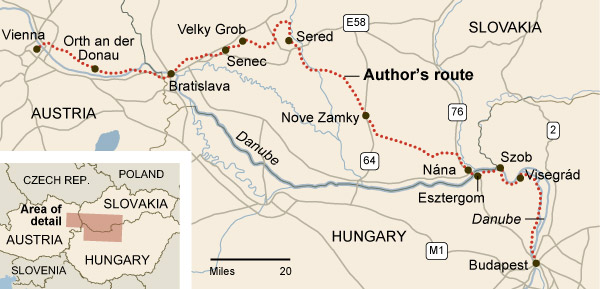
Matt Gross' route

Could a young person (is 35 still young?) with strong legs and little money find the same spirit of hospitality that Mr. Leigh Fermor encountered some 76 years ago? At the end of March, I set out to find the answer. With only two weeks free, my plan was to walk from Vienna to Budapest, a 180-mile route that would connect the old poles of the Austro-Hungarian Empire and track Mr. Leigh Fermor’s trail as closely as possible, taking me along the Danube to Bratislava, the Slovakian capital, and across the plains of Slovakia south to Hungary — through three countries whose languages, cultures and histories could not be more different, or more intertwined.

It was tempting, the day I arrived in Vienna, to just walk east from the airport, but I couldn’t completely skip the Austrian capital, where Mr. Leigh Fermor had spent three weeks among the “crooked lanes” and “facades of broken pediment and tiered shutter.” And so I followed his lead, going into the imperial crypt, where the grandest members of the Hapsburg family lay entombed in elaborate sarcophagi, and into the museums, although I shied away from the most famous in favor of oddities like the International Esperanto Museum. And I luxuriated in storied places like Cafe Alt Wien and Cafe Bendl.

But after two nights in Vienna, I was restless. So I crossed the Danube, put on my 45-pound pack and took off down the Donauradweg, a well-kept biking trail that runs from the river’s source to its mouth at the Black Sea. To my right, the Danube, more green than blue, sparkled in the cool sunlight, and I encountered fishermen tending their rods, elderly sunbathers, nordic hikers poling along and cyclists speeding in both directions.

This first day, I figured, I’d take it easy and do only 15 miles. Ideally, I’d need to hit 18 miles a day — about six hours of walking — to reach my goal. It seemed reasonable, especially with the terrain so uniformly flat. The path, sometimes dirt, sometimes paved, would often stretch so far and straight that I couldn’t imagine I’d ever reach the end, and then I’d finally hit a slight turn and face the same thing: an art-school lesson in perspective, complete with the first low foothills of the Carpathians at the vanishing point — and a scampering rabbit to remind me this was no still life.

Even with such straightforward terrain, there were snags. An attempted shortcut through a fuel depot left me with minor scratches and an extra three miles. But such mistakes have a way of turning out for the best. Had I stayed on the trail, I would have never crossed paths, two hours later, at the edge of Donau-Auen National Park, with Jean-Marc and Marie, newlywed French cyclists who stopped to say hello when they saw a lone hiker in the middle of nowhere. They were taking an extended honeymoon: a two-year bicycle journey from their home in Paris — to Japan!

“Do you know where you’re staying tonight?” I asked. They didn’t. I told them to meet me at Orth an der Donau, a small Austrian town a couple of miles farther down the Danube, where I had arranged for a place to stay via CouchSurfing.org. Maybe, I said, my host could find them somewhere to pitch their tent.

THE host, Roland Hauser, whom we met in front of Orth’s impressive castle, did better than that. He invited them home to his dreamland of soft beds and hot showers. Roland, 26, had traveled from California to Southeast Asia to New Zealand, and his German-accented English was peppered with words like “sí” and “bueno.” That evening, we cooked spaghetti Bolognese, nibbled Südtirolean ham and drank big bottles of beer. I went to sleep marveling at our extraordinary, Fermorian luck.

In the morning, after coffee, I threw out my underwear. This was a strategy to lighten my load — bring old undies and get rid of them day by day. Frankly, I should have done that with everything, as the pack was needlessly heavy. Along with two weeks’ worth of shirts, I had an ultralight down jacket, a waterproof shell and rain pants. A tent and sleeping bag. One pair of jeans and lightweight canvas shoes to change into at day’s end; nothing worse than walking 20 miles and spending the evening in the same clothes. And I packed Mr. Leigh Fermor’s books and Claudio Magris’s “Danube,” which I never had time to read. And my computer and camera gear — work necessities, alas.

When I set off, I was wearing my typical walking outfit: khaki pants by a company in Portland, Ore., called Nau; waterproof running sneakers by Lafuma; good socks (as important as good shoes); and a long-sleeved cotton shirt.

The walk began well. My feet were tender, but the flatness of the Marchfelddamm, a high berm that doubled as biking path and flood deterrent, ensured that I wasn’t struggling. This was the heart of the Donau-Auen National Park: forests of thin trees broken by occasional streams flowing to the Danube. At first, I appreciated the play of light on the water and between the trunks, but hour after plodding hour of unchanging scenery soon became mind-numbing, and I simply marched, putting one foot in front of the other and watching for kilometer markers. It would be 13 miles before I could stop for lunch, and another 10 before I reached my day’s goal: Bratislava.

But there’s a funny thing about long walks. With patience, all those steps add up, and by 2 p.m., I’d crossed a bridge over the Danube and settled into a cafe in the stately town of Hainburg, where an open-faced baguette pizza and glass of beer gave me the courage to face the miles ahead. And soon I found myself trudging along the shoulder of the small highway with cars flying past — and missing the monotonous near-silence of the forest.

Not far off, I could see Bratislava’s hilltop castle — in Mr. Leigh Fermor’s era, a burned-out wreck worked by prostitutes but in the 1950s rebuilt as a stately white-and-red palace — and it teased me with its apparent nearness. Still, I had far to go, past a derelict border post, and through three miles of snaking bike paths, before I crossed the Danube again and was in the heart of Bratislava’s old town, all cobblestones and tile roofs and sidewalk cafes.

After checking into the Hotel Kyjev — a 1970s tower turned budget boutique — I checked myself out: I wasn’t sore, out of breath or even tired. I did have blisters on my feet, but they were easily treated: puncture, drain, clean, bandage. My ankles, however, were terribly swollen, the peroneal tendons in particular, a result (I think) of how my body mechanics had altered with the weight on my back. I popped some ibuprofren, took a shower, then hobbled outside for dinner.

It was the Friday during Passover, and like any wandering Jew, I wanted a Sabbath meal. And thanks to Chabad, the Hasidic Jewish outreach organization, I got one, at the home of the transplanted American rabbi Baruch Myers. He was only too willing to share his food (cucumber salad, gefilte fish), his friendship and his family, including a battalion of adorable children who cheerily walked me through the Passover story.

It wasn’t just this heartfelt welcome that got to me; it was the very existence of a Jewish community in Bratislava. Back in his day, Mr. Leigh Fermor wrote, the Jews “were numerous enough to give a pronounced character to the town.” No longer. The Holocaust had reduced the Jewish population to, in Rabbi Myers’s estimate, 1,000 people. There was a synagogue, a few kosher restaurants, a Jewish museum and even a pension, but few visitors today would see in Bratislava a Jewish-inflected city.

On Saturday, partly inspired by the rabbi and partly because of my feet, I rested and contemplated the future. I had walked 40 miles so far, and if my ankles were any indication, there was no way I’d make the remaining 140. Unless … If I took a train a short way — say, 15 miles northeast — I could certainly walk another 10 miles. I’d be breaking my rules, but those rules were arbitrary. Continue reading →