Tag Archives: Crete

Ralph Stockbridge – Crete Memoir

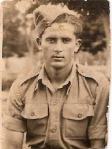
Ralph Stockbridge

Almost the very first article I posted back in 2010 when I started this blog was not about Paddy at all, although he does get a mention. It was the obituary of SOE officer Ralph Stockbridge which you can read here.

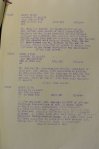
A fellow blogger, Kyle Glover, spent some time in the National Library of Scotland going through some of the documents in the Patrick Leigh Fermor archive. One of these was the memoir of Ralph Stockbridge (ACC. 13338/412), describing army life on Crete before the invasion, his interactions with civilians, an encounter with the famous archaeologist John Pendlebury, the battle of Crete and his desire to return and help liberate the “brave and wonderful” Cretan people.

Following the battle Stockbridge joined the Inter Services Liaison Department (a front organisation for MI6), trained as a radio operator and returned to Crete to set up an intelligence gathering network. Though not a member of the Special Operations Executive he worked closely alongside and became good friends with many of the SOE agents who were infiltrated onto Crete.

The following text is a direct transcription made by Kyle of Stockbridge’s unpublished memoir including the capitalisation of surnames. Kyle appears to have ceased writing his blog (last post 2024), so just in case it disappears I have posted his work below. Kyle and I have been on touch on Facebook in the past so I don’t think he will mind. His original work can be found here.

Ralph Stockbridge
Crete
December 1940 – May 1941


I came to Crete by accident. France was my first love, and I had joined the Field Security” Corps early in 1940 because someone had told me that, as I spoke fluent French, this was the best way of getting to France quickly. But, just as France was falling, I had found myself in one of the first Field Security Sections sent to the Middle East. Fate again intervened, this time in the shape of appendicitis, to prevent me joining the Section in Northern Greece and being involved in the subsequent retreat. Instead, I found myself in the Section sent to Crete at the end of December 1940.

My first impressions were unfavourable. We were under canvas in an olive-grove beside the main Chania Suda road, and it rained incessantly, our encampment became a morass, and we were wet and miserable Of the few weeks spent in Chania I remember curiously little, and the town has never had for me the attraction of Rethymnon and Heraklion. Three things from this period stick in my memory, however my instant liking of the Greek people, my first encounter with the Greek language; and the death of Metaxas. Our Field Security duties brought us into contact with Greek officials, in the harbour and elsewhere, and one met and drank coffee with Greek soldiers on their way to, or on leave from, Albania. Their friendliness and courtesy made a lasting impression on me. I have a photograph of some of them taken by the quayside at Chania, the names of four of them were loannis PALIDES, Michael KOUTROULES, LAMBAKES, and Spyros ORPHANOS, the latter with an address in Athens (108 Patission). The first words of Greek which I heard completely mystified me. They were of a peasant woman shouting at her small boy behind our tents, and she appeared to be saying “Come here at once, Adonis”. As the child was not particularly beautiful I thought this otherwise charming survival of a name from classical times somewhat inappropriate, and it took me some time to work out that his mother was really calling him Antoni (Tony in English) and even longer to learn that the accent is on the first syllable of the name Adonis in Greek.

The sudden death of the Prime Minister, General Metaxas, whose heroic rejection of the Italian ultimatum on 28 October 1940 brought Greece into the Second World War as Britain’s only ally at that time, caused consternation in Chania. I have never, before or since that date, seen people crying openly in the streets, and this was the more remarkable in of all places, Chania, the birthplace of Venizelos whose followers professed then, as their successors still do, hatred for the right wing in general and dictators in particular.

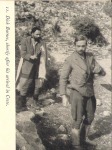
Early in March, two members of our Section, myself and David Bowe, he a well- informed and witty Fleet Street journalist before the war, now with the rank of Sergeant to my Lance-Corporal, were sent off on our motor-bikes to represent the Section in Heraklion. We passed through Rethymnon on March 8th and I contrived to be photographed in the company of the local Gendarmerie commander and a group of bystanders, one of whom was named Polydoros NIKOLOUDES. We rode on, through beautiful scenery, to Heraklion. I nearly coming to grief, and a premature end, on one of the dangerous comers near Yeni Kave (Drosia as it is known today) whose head-man, Mitsos KONTOGIANNES, was to play such a prominent part in resistance activities during the occupation.

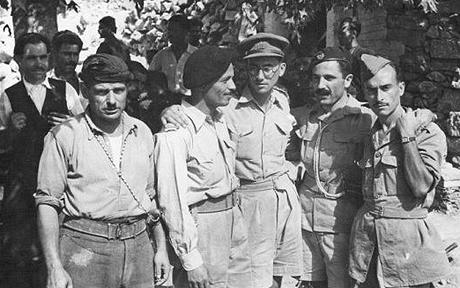
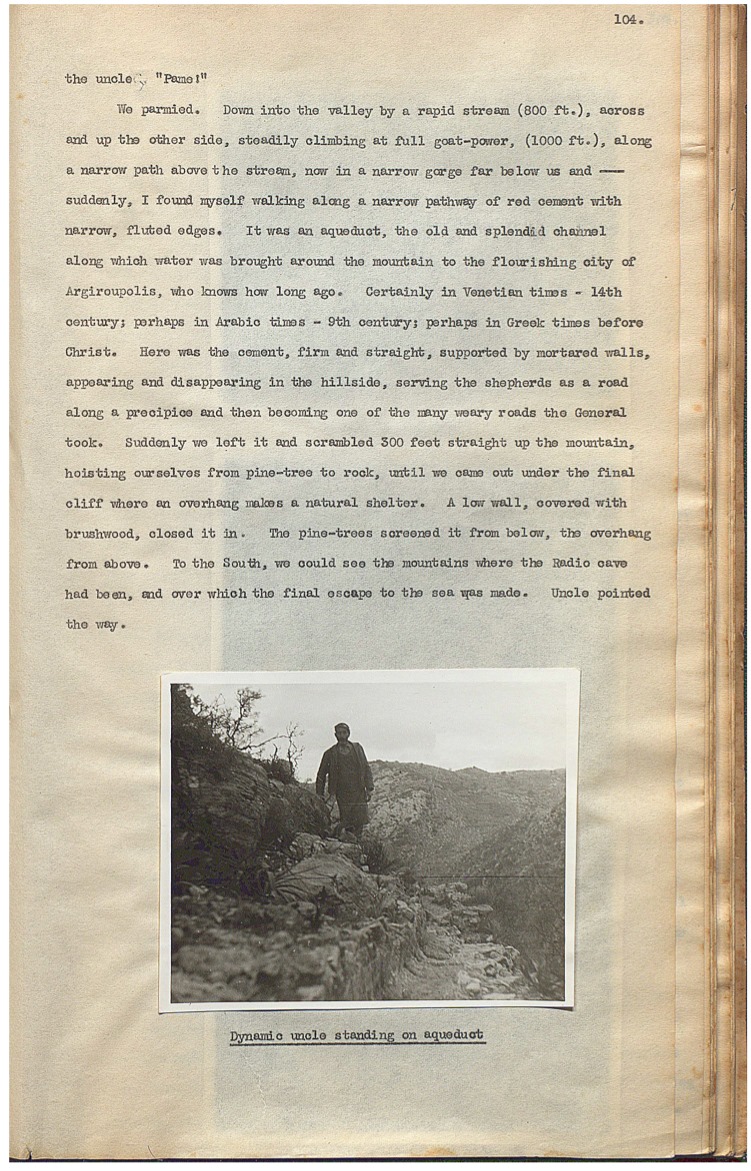
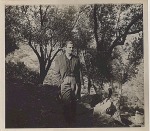
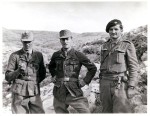
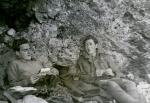
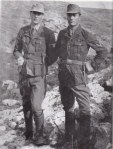
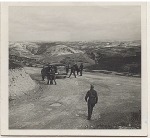
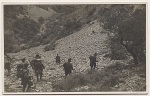
Stockbridge (centre, in the spectacles) with some of his comrades in Crete

Stockbridge (centre, in the spectacles) with some of his comrades in Crete

Thus began one of the happiest periods of my life. Bowe and I had the free run of Heraklion. Our section commander was a hundred miles away in Chania, and what our duties were, in this farcical unit to which we belonged I, at least, never clearly understood. I interpreted mine as the identification of pro-Germans in the town. There were probably not more than a score of these and all of them, I suspect, harmless people with business or family connections with Germany. Their names and details I passed on to Chania, to what purpose I cannot imagine Germany had not yet invaded Greece, the British Army certainly had no authority to take any action against civilians, however pro- German, while the Greek security section of the local Gendarmerie presumably knew a great deal more about the problem than we did and were geared to take any necessary action.

Meanwhile we enjoyed Heraklion. My first friend there was George Migades, the leading tailor in the town, who invited me into his shop for a cup of coffee as I was passing by one day. In his fifties, and immensely pro-British, Migades was a mine of information about Heraklion. He was also extremely voluble: his words came pouring out in a torrent I have never heard equalled except, possibly, by Isaiah Berlin. The efforts I made during the following weeks to understand what he was saying were certainly responsible for the fact that, without any lessons, I was fluent in Greek by the time the battle began, though I knew no modern Greek by the time I arrived in Crete five months earlier. This is less strange than it may seem, I had taken my degree in Classics at Cambridge before the war, and modern Greek is only a very much simplified version of the language spoken in Greece two thousand years ago

Migades introduced me to his wife and their four delightful children, two girls and two boys aged between 22 and 16, Modi and Rena, Yanni and Siphi (short for Joseph). All survived the war, the two girls making successful marriages, Rena to Micky Akoumianakes who was to become the most important contact in Heraklion during the occupation of successive British officers conducting resistance and intelligence activities; Yanni is today one of Greece’s best-know artists and stage designers, while Siphi retired as a senior pilot of Olympic Airways. The Migades family house was in the old part of the city which lies behind and to the east of the main street leading from Morosini Square down to the Harbour, an area of narrow streets and old houses with inner courtyards immortalized by Kazantzakes in his great novel Kapetan Mikhales (Freedom or Death in its English translation), and a tale of insurrection against the Turks during the 19th Century.

During this period I met, many of them through Migades, a cross-section of Heraklion society. There was Eleutherios ALEXIOU, scholar and schoolmaster, with a good library, with whom I discussed French literature, talking always French, which was at that time the foreign language most readily spoken by educated people in Greece. There was the honorary British Vice-Consul, M.N. ELIADES, an elderly man who had written in English a history of Crete (CRETE PAST AND PRESENT, published by Heath Cranton Ltd, London, in 1933). After Crete fell, Eliades was arrested and spent the next four years in internment in Germany, where he was, by all accounts, well-treated, and survived the war. Edith and Harry NEWLANDS were particular friends of mine, she from Newport in Essex, he originally from Lithuania and of mixed German-Lithuanian parentage (his real name was NEULANDS-JAUNTZE). They had met and married in Athens before the war where he ran a dancing school. They were kind and gentle people. He spoke German, of course, and during the occupation was obliged, much against his will, to act as a translator and interpreter in Heraklion, for which he was regarded with some mistrust as a result by local people. Both survived the war and lived in Crete, dying there at an advanced age, he in his nineties.

There were many other friends too. Coffee-housing was then, as now, a favourite pastime, and Regginakis’ establishment in the main square, facing Morosini’s beautiful Venetian fountain, our favourite rendezvous. Here we would sit for hours discussing the war and politics and anything else which occurred to us. One day. I recall, an elderly and bibulous English resident, named Foster, who was the representative in Heraklion of the Eastern Telegraph Company, stuffed with oranges the mouth of the fountain lions in a sudden fit of enthusiasm. In the square itself was always to be seen Andreas, the village, or rather town, idiot, whose harmless antics were a constant source of amusement. Andreas, I am told, was the only person in Heraklion allowed by the Germans to ‘cheek them with impunity during the occupation, he was of course often put up to it by the locals, who told him what to say.

This pleasant life came to an abrupt end on May 20, 1941, a cloudless and warm day. Although for some weeks, since the Germans had occupied mainland Greece, we had been expecting an early invasion, it was still something of a surprise when it happened. Proceedings began during the afternoon with some heavy bombing of the airfield area (two to three miles East of the town), but also of the harbour. Then, around 5pm, we saw the troop carriers and the first parachutists. I was in the western part of the city and so saw only those who descended some distance beyond the western entrance to the city. known as the Chania Gate. But a total of some 2000 German troops were landed on this first day, of whom at least half were wiped out by the end of it. They had, it seems, expected to capture the town and the airfield at once and without difficulty, but their intelligence must have been very poor since Brigadier Chapple’s British force consisted of 4000 men and there were also quite a large number of Greek troops plus many armed civilians, from elderly to very young men, who fought most valiantly and effectively. The Germans failed to take the airfield that day, and never did take it until after the evacuation, they did occupy the Greek barracks immediately to the South of the airfield, and they forced their way through the town to the harbour. But from both these areas they were driven out in the next day or two.

Just prior to the battle, I had met John Pendlebury, then in uniform as a Captain. Pendlebury, although still a young man, aged 36, had been Curator and resident archaeologist at Knossos. He knew Crete far better than any other Englishman and during this period, when there were no roads to nine out of ten villages, nor any other modern amenities, he had walked all over the island’s 200-mile length and knew hundreds if not thousands of people. It was not surprising therefore that he had been asked by the War Office (though I did not know this at the time) to organise and lead resistance to the Germans in the event of Crete being captured. In addition to his unrivalled knowledge of the terrain of the Cretans, he spoke Greek and was young and fit enough to face the physical hardships likely to be involved. He was indeed an impressive man to meet, tall, handsome, athletic-looking (he had an Athletic Blue at Cambridge and twice won the High Jump against Oxford) and with an air of considerable authority. The distinction was added to by his having a glass eye (the result of a boyhood accident) and sporting a swordstick instead of a swagger-cane. Pendlebury had in fact made detailed plans for resistance, based initially on the villages round Mount Ida (Psilorites) and this explains why, on May 21, he decided to get out of Heraklion in order to activate his resistance organisation, possibly, while the battle was still in progress and its outcome undecided. What has never been explained, and I for one have never been able to understand, is why so intelligent a man chose to leave the town by the West, or Chania Gate, and by car. All of us had seen the parachutists landing in the area beyond the Gate the day before, and it could be safely assumed that they now controlled the main road Pendlebury and his driver ran straight into a pocket of parachutists, he was seriously wounded in the ensuing skirmish, and taken to a nearby house where his wounds were dressed by a German Army doctor, and he was left overnight. The following morning more Germans returned, and Pendlebury was taken outside and shot. The assumption is that he had been identified by the Germans as potentially their most dangerous opponent in Crete and that they decided to eliminate him there and then. To shoot a wounded and defenceless enemy in cold blood was of course a war-crime, but one which could not subsequently be pinned on any individual German. It is said that, some weeks after the event, Pendlebury’s body was exhumed in order that the Germans could satisfy themselves beyond any doubt, by examination of his glass eye, that it really was Pendlebury whom they had killed. His loss was a serious one to the Allies as it put back resistance and intelligence operations in Crete until autumn when the first British personnel, of whom I had the honour to be one, were infiltrated. His reputation however lived on in the villages, and future resistance personnel always found it a valuable introduction to villagers they did not know to say they were friends of John Pendlebury. But why did he not make his way out of Heraklion on foot and to the South of the city? It must have been safer.

My personal recollections of the battle are a kaleidoscope of confusion. Our Field Security unit had been reinforced, if that is the word, by the arrival just beforehand of some NCOS and the Section Commander, Captain BURR, from Chania. We were billeted now in a half-built house opposite the Prefecture (Nomarcheion). There was no lighting and no hand-guards to the concrete staircase, and Captain Burr shortly fell from the first floor landing and broke his thigh. He was taken to hospital but could not be moved when the evacuation took place and so became a prisoner of war. The unit, composed of linguists (anything except Greek, and so useless) was hopelessly non-combatant, being armed only with Smith & Wesson 38 revolvers. We were only a hindrance to the military proper, but did odd guard jobs, acted as messengers and anything else we were asked to do. It is really only isolated incidents I remember from these seven or eight days of the battle in Heraklion: a German aircraft coming in from the sea on which a Bofors gun scored a direct hit-it became a ball of flame as it came down into the water, finding transport for a community of French nuns so that they could attempt to get out of the beleaguered town (I never discovered whether they did), the bombing of the town, diving very fast and head-first into a ditch as a Messerschmidt machine-gunned the street where I was standing, seeing some German prisoners held near Brigade HQ in a cave somewhere near the airfield- they were very arrogant and confident about the outcome of the battle; hearing my name called out down at the harbour during an air raid, and discovering it was not me but someone else who was being addressed he turned out, from my hurried enquiry, to be from Royston, the town nearest to the village of Melbourn where my family have lived since church records were kept, but I have never discovered who he was and whether he survived the war. During this time I at least had not the slightest idea of how the battle was going. In fact, it was going well as far as Heraklion was concerned, but its fate was being decided elsewhere. The capture of Maleme airfield at Chania, and complete air control, meant that the Germans could now land as many troops as required in Crete and that the battle was to all intents and purposes over. So an evacuation was ordered, the Chania garrison began the slow and arduous retreat to the South coast at Sphakia, and the Navy prepared to lift off Brigadier Chapple’s 4000 men from Heraklion. There was no possibility of rescuing the 2000 mostly Australian troops in Rethymnon most of whom in the event had to surrender though some took refuge in the villages, and were fed and sheltered at enormous personal risk by the inhabitants, often for months and in some cases years. Of these most were eventually secretly evacuated by submarine or small boat once British officers had returned to Crete to organise such operations and co-ordinate resistance

At midnight on May 28th a Royal Navy force of two cruisers and six destroyers reached Heraklion. For three hours the destroyers ferried troops to the cruisers which lay outside harbour and themselves took on board the remainder. We were marched down to the harbour in batches and I shall never forget the silence and desolation of the shattered town I knew so well. I took a vow at this moment to return to Crete as soon as possible and to help liberate its brave and wonderful people.

We sailed about 3.30am. For six hours, from first light until noon, by which time we were out of range of the aircraft, we were dive-bombed continuously. The noise of the screaming planes and of the anti-aircraft guns was deafening. Both cruisers were hit, Orion losing her Captain and nearly a hundred men killed among her crew and troops aboard. Of the six destroyers, Imperial had her steering-gear hopelessly crippled, her crew and passengers were taken aboard other ships and she was sunk. Hereward was badly damaged and had to be run aground on the East coast of Crete, her crew and passengers became prisoners of war. On board Jackal, where I was, we were packed like sardines, but suffered only near misses and minor damage. Towards nightfall we reached Alexandria, where good ladies with tea and sandwiches greeted us on the quayside. Then it was off to Cairo, and the bug-infested Kasr-el-Nil Barracks.

Back in Egypt, my first act was to approach my Commanding Officer Lt Col WORDSWORTH and beg him to get me transferred to whatever unit was responsible for secret operations in Crete, I am eternally grateful to him for abetting such a request. especially from a junior NCO quite unknown to him. I was introduced in the right quarters, given three months training in the operation of a transmitting and receiving wireless set and in encoding messages, and was back in Crete at the beginning of October 1941, where I was to spend a further two and a half years with the Resistance.

While in Egypt I sat down one day and wrote the following poem (not included) [Link to my transcription here]. It is to be read as an allegory of the bonds which unite our two island races, each with a famous history. I always thought of Crete as the last bastion of those allegedly fair-haired invaders from the North who had peopled Greece in pre-classical times, in particular the Dorians. It was noticeable in Crete at that time how many people had fair hair and blue eves, and noteworthy that nearly all of these turned out to originate from those mountain fastnesses to the South and South East of the White Mountains, the area of Sphakia, into which, for hundreds of years, successive occupiers, Venetians, Turks and now Germans never penetrated except to make brief forays. And so the race remained pure, without intermarriage with foreigners. There were even unmistakable traces of the old Greek language of classical times, eg the word “pempo” (I send) was regularly used instead of the modern Greek ‘stelno’.

Note:

Ralph Stockbridge was made an Officer, awarded the Military Cross in 1942 and a Bar in 1944, in which year he also received the Honorary Citizenship of Rethymnon on its liberation from the Germans.

The annual William Stanley Moss awards 2024 and update

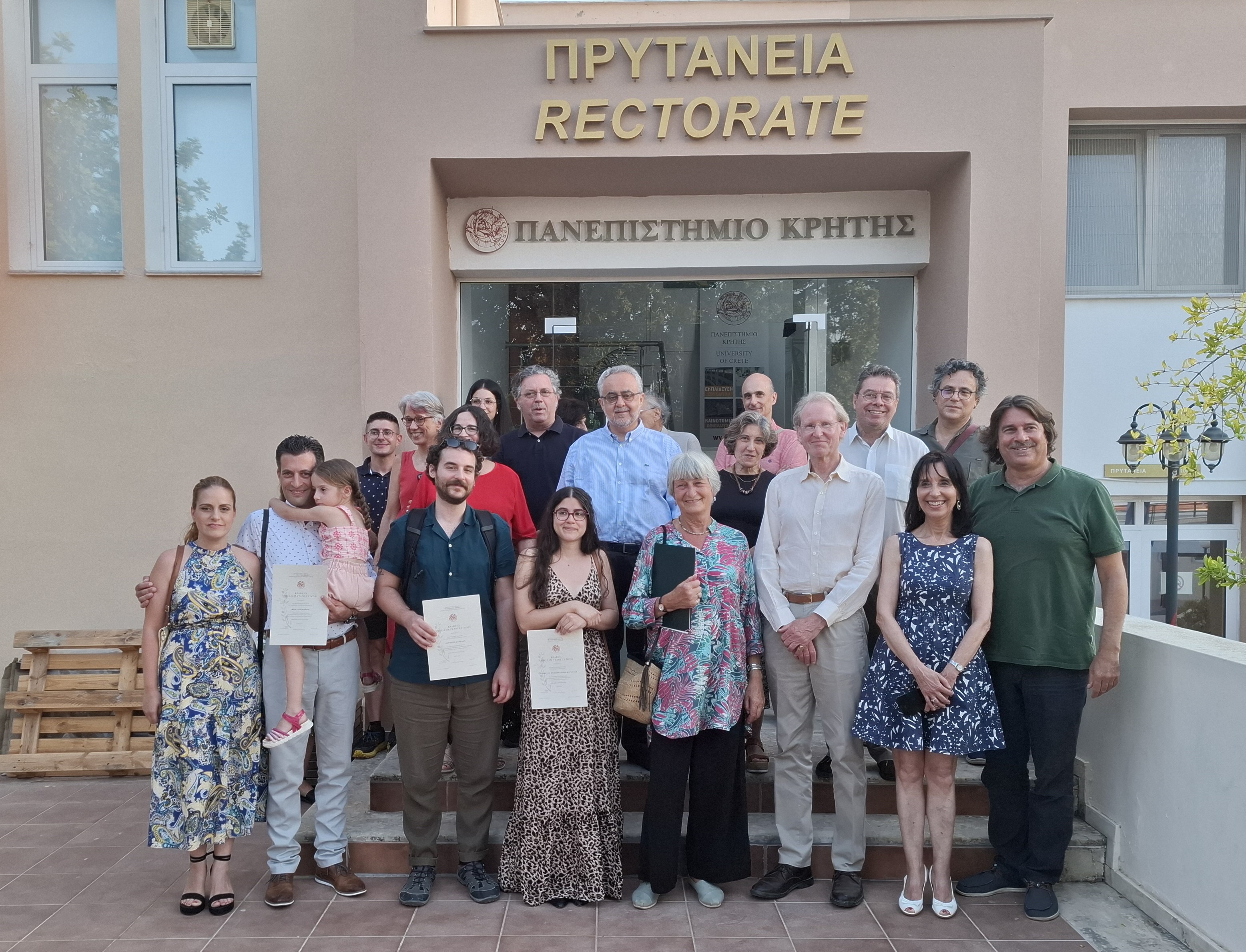
Recipents of the annual William Stanley Moss awards. Rethymno, Crete, 2024

Summer in England (such as it was this year) is well and truly over. We have misty and quite cold mornings with the grass soaked full with dew. I have been very busy for the last couple of months and now have some time to get back to the blog.

You will recall that in June I asked for donations to support the continuation of the annual William Stanley Moss awards which is the brainchild of Billy’s daughter Gabriella Bullock. Many of you were generous enough to donate and Gabriella is very grateful. Perhaps I could ask for one more push from those who were unable to give at the time; every few Pounds will help.

You can make a donation via PayPal by following this link.

Gabriella and Hugh have recently returned from Crete after this year’s awards. She wrote to me with a report and a message of thanks you you all.

Dear Tom,

Please forgive the delay in writing to you, I’m sorry it has taken rather too long. The material I was awaiting from Crete has now arrived, so here we go!

Firstly I want to say how dumbfounded I am that, of the many truly deserving causes you could have chosen to ask your readers across the world to support, you have chosen the really rather meagre prizes that we set up in my father’s name. It is such an unexpected, incredible honour – and such an overwhelmingly wonderful feeling to have your huge endorsement of my endeavour… I am lost for words.

But Tom, I hardly know how to put this – your website has been such a glorious thing, dedicated to Paddy – and in his lifetime it was called “The Greatest Living Englishman” – I’ll never forget telling him about this, and how covered he was in surprise and pleasure and modest confusion… You CAN’T re-dedicate it – it is his, and should be his, always! He’s way too special to share his website with anyone, let alone my father. He is the legend! The idea for the kidnap was all his – and what about the rest of his extraordinary life? Enough that he now shares a photograph on the staircase of the Special Forces Club with my father – but this – it mustn’t happen – please trust me… They may not say so, but I’m sure his legions of devotees among your readers feel the same, however generous they may be.

When we decided to support the University of Crete, it was in the hope of reaching out to the whole of Crete – and I do like to think that the idea would have had Paddy’s blessing… Two prizes are awarded annually to students of the Faculty of Philosophy at the University of Crete. One is awarded by the Department of Philology and one by the Department of History and Archaeology – it is all tirelessly overseen by the tutors and heads of the departments involved. I hadn’t foreseen this, but I can only say that these prizes are just as much a gift to me as to the students – they have given a very special dimension to my life! Small as they are, they bring a wonderful connection to a wonderful university – world class – and every year I am struck by the prize-winners, always so impressive and so delightful, and I am grateful for the unique opportunity I have to meet them. I love the way that, although the prizes are such a reminder of what happened in long-past wartime, they are all about the future.

This year’s prize-giving took place earlier this month in Rethymno. As well as the prize-winners, their families and friends and their tutors, the Dean of the Faculty and the Heads of Department were there, and gave memorable speeches. I too gave a short speech – which of course centred around you, your generosity and your extraordinary gesture…

Then came the prize-giving itself. This year there were three prize-winners:

1) Aikaterini Yakimtsouki-Magaraki (MA student in Philology) MA in “Classical Studies”. The title of her dissertation was “Medicine as a rival to Philosophy”.

2) Antonios Digalakis (PhD candidate in History and Archaeology), PhD thesis entitled “”Painting in ‘naturale’: The Ionian Islands in mid-17th – mid-18th century”. He was awarded the prize for the thesis chapter entitled “Cretan Painters on the Ionian Islands”.

3) Minas Chouvardas (Postgraduate student in History and Archaeology), MA in Ancient History. Title of MA Dissertation : “The Towns and Small Communities of the Aegean Islands and their Relationship to Athenian Hegemony’. He was awarded the prize for an extensive chapter entitled “Island Hegemonic Aspirations and the Prehistory of Athenian imperialism in the Aegean”.

These last two shared the Department of History and Archaeology prize.

Then each of the prize-winners gave a speech – thoughtful and philosophical in true Cretan fashion, whether long or short, in English or in Greek. Antonios also made the point that the prize money would enable him to visit art works and consult art books, especially in Italy. Aikaterini has sent the text of her speech:

“I am honoured to be the recipient of the William Stanley Moss award and I would like to thank the committee, my professors for their support in times of uncertainty and instability, my precious friends and my family. I would also like to thank Mrs Bullock for offering young people an incentive in our academic and professional journey. I hope that I will continue to explore the perplexity of the Greco-Roman antiquity focusing on scientific thought of the time and on the interaction of the Greeks and Romans with foreign cultures. But what matters most is that I follow my dreams with integrity. And this is the legacy that Major Stanley Moss left. Thank you.”

With the ceremony over, we set off for a wonderful evening and meal together at a restaurant on the sea front – everyone eager to learn more – and of course I was besieged with questions about you and your website… and many glasses were raised…

What can I say? Thank you …!

With love,

Gabriella

80th anniversay of the kidnap of General Kreipe – Video about the kidnap from the dinner held to mark the 10th anniversary of the death of Patrick Leigh Fermor

Some video focusing on the kidnap (and others not!) some of your may find interesting posted in 2021 of the dinner held to honour Paddy’s memory to mark the tenth anniversary of his death. Held on 24th June at the Aphrodite Taverna, London.

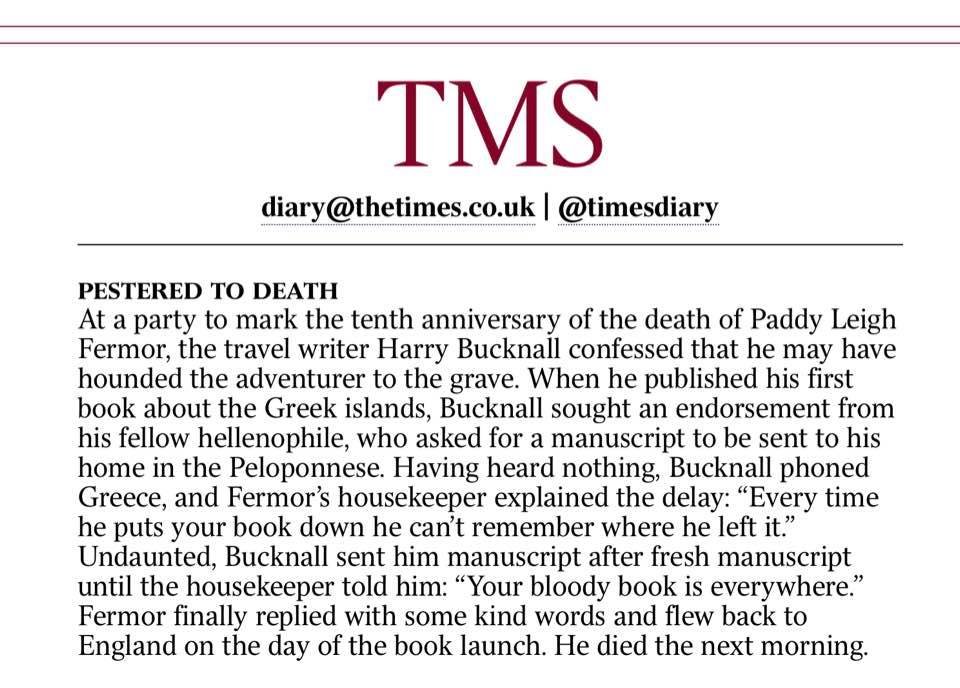
There were around 24 of us in attendance, including a number of notable writers: Artemis Cooper, Antony Beevor, and Alan Ogden. Former Coldstream Guards officer Harry Bucknall was also present, making a public confession which made The Times the next day.

Following requests from some of you to make a public record, here are some videos from the event which I hope you will enjoy. They are in “running order”. Enjoy!

Tom Sawford on the Paddy blog and some tributes posted ten years ago.

A little continuation of that one here starting with a memory by Nick Jellicoe, the son of George Jellicoe …

Chris White talking about the kidnap route and a proposed film documentary

Alan Ogden and the legacy of the kidnap

Artemis and Paddy’s charm …

Antony Beevor and the story of when Paddy met Helmut Kohl 🙂

Harry Bucknall’s confession …

Paddy’s thorough reading of They Were Counted …

And to conclude the fantastic evening, Isabelle Cole, one of Billy Moss’ daughters, offers a rendition of It’s a Long Way to Tipperary in French, as sung by Paddy.

Detailed location map for the kidnap and SOE operations in Crete

Chris White and his brother Peter have put together a wonderful website to support their book Abducting a General which you can find here.

For those who want to drill into the detail of locations they have put together an incredible map showing important SOE locations in Crete. You can find that here.


80th anniversay of the kidnap of General Kreipe – General Kreipe arrives in the UK

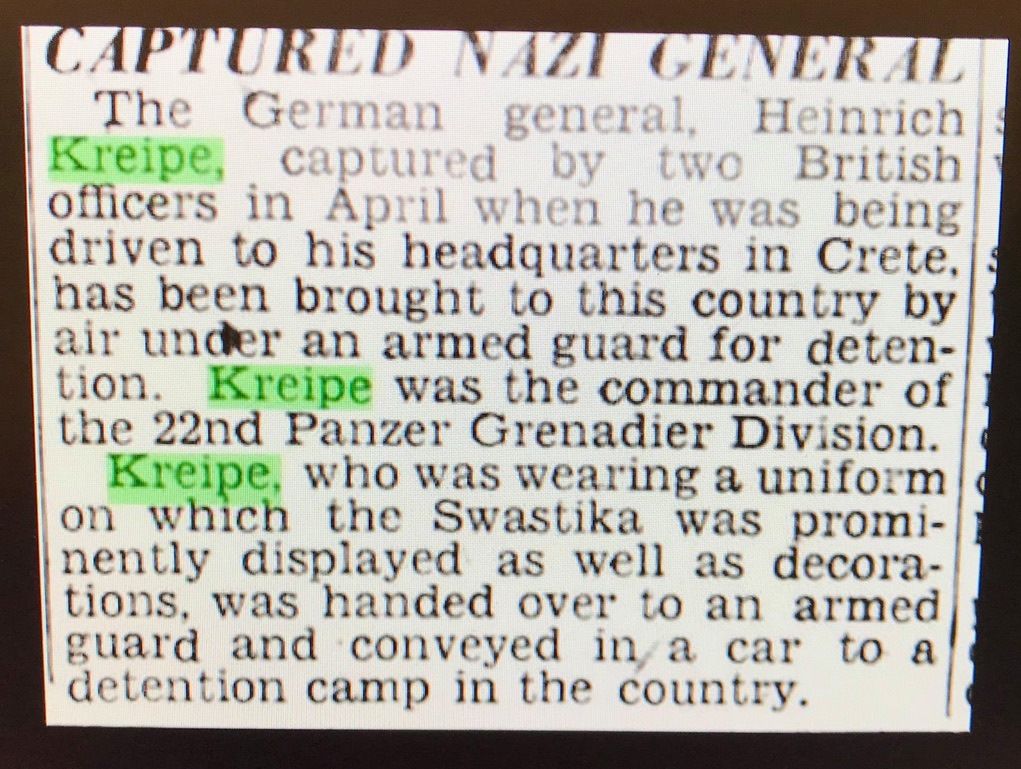
PW capture report on Kreipe

This is the last post in the series created by the excellent Chris White. He first published this on Facebook in 2020. During the first months of the pandemic, I was copying and pasting and adding his pictures to recreate here on the Paddy blog. I know that many of you have enjoyed this and your comments are appreciated. There will be a couple of follow on posts to tidy up this series, but once more, a huge round of thanks to Chris. 

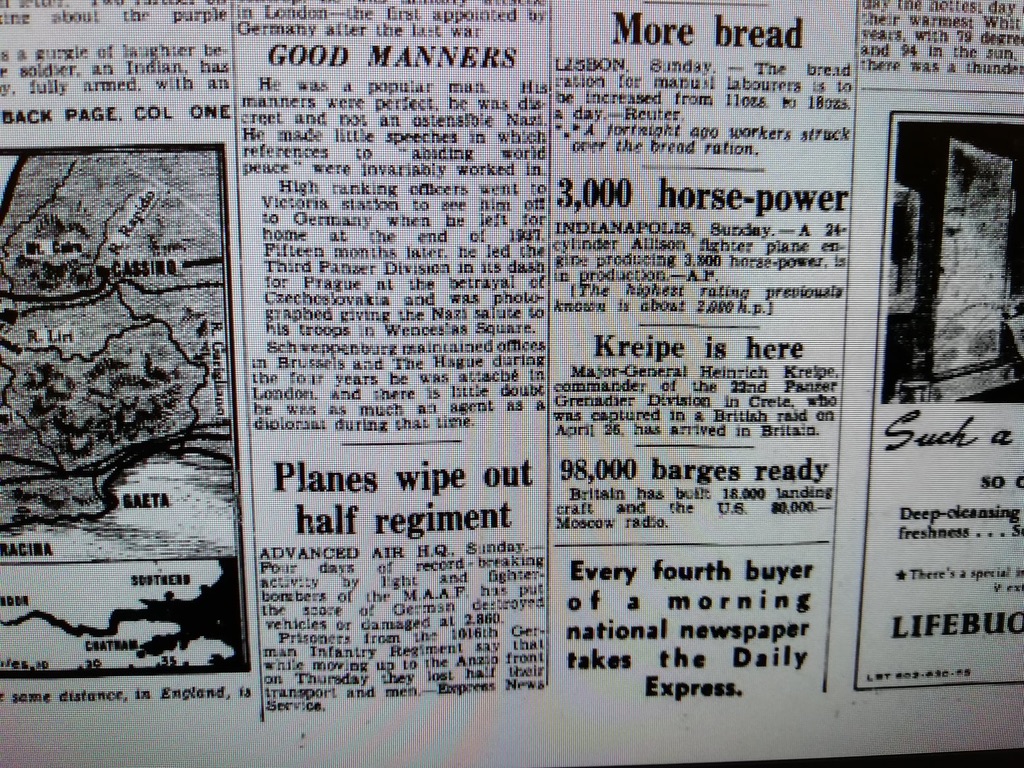
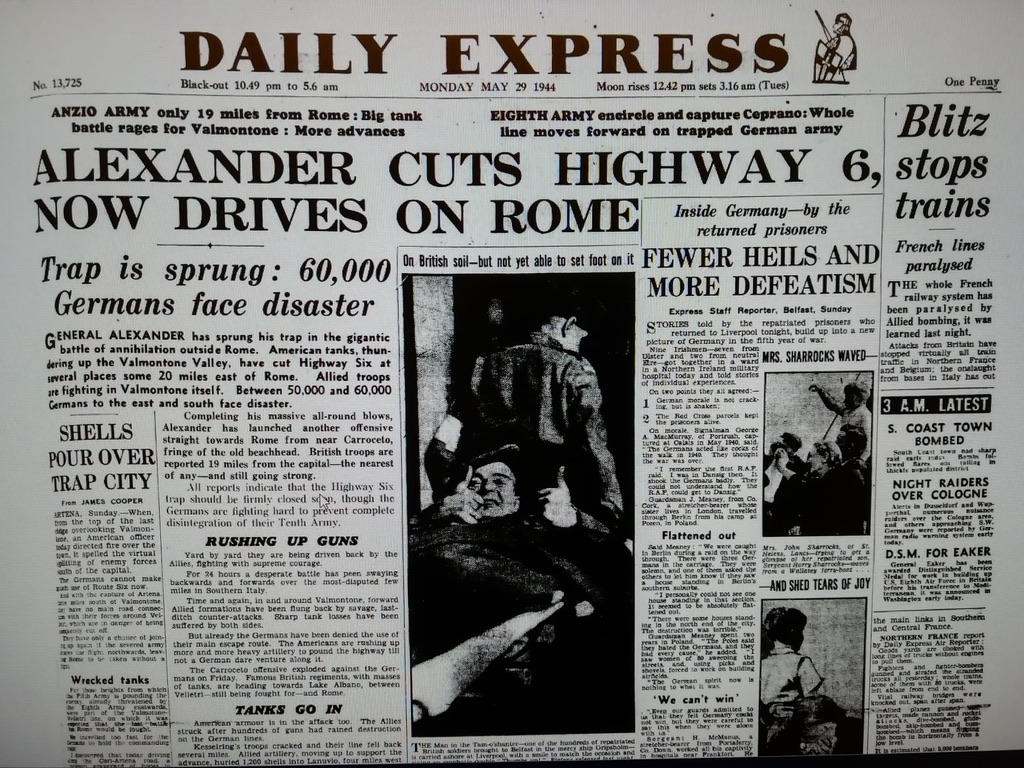
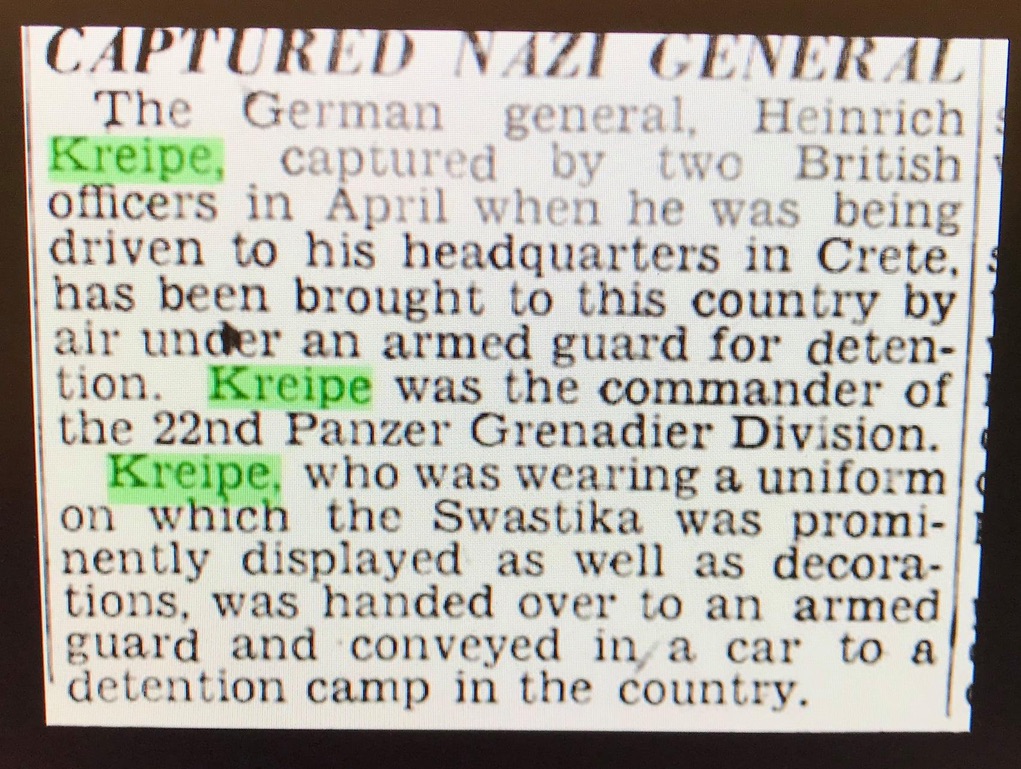
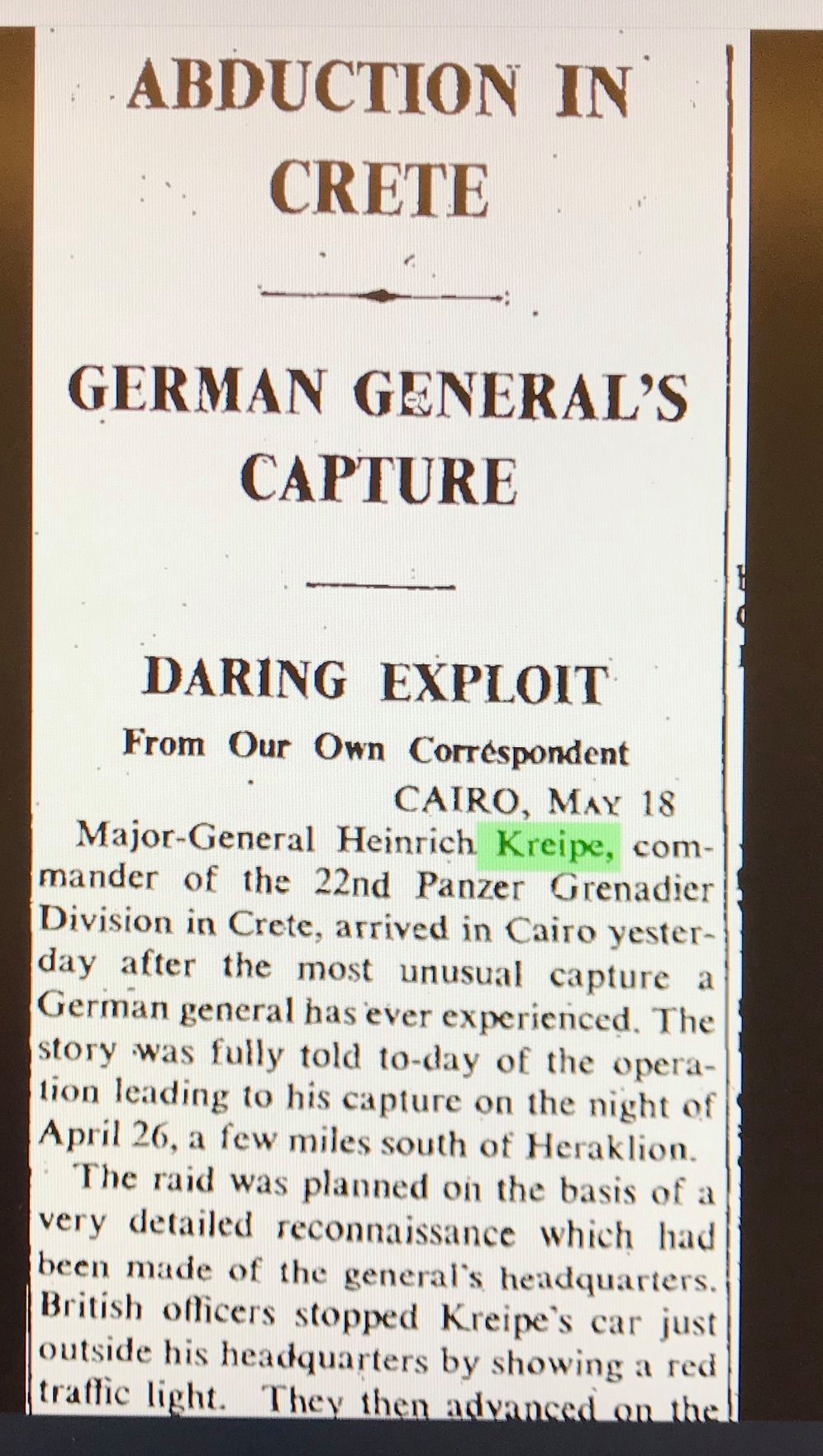
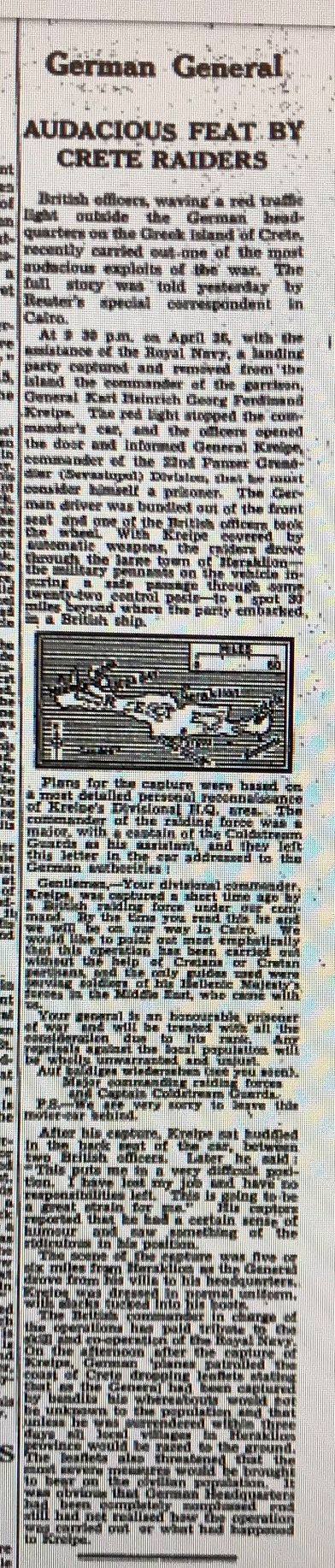
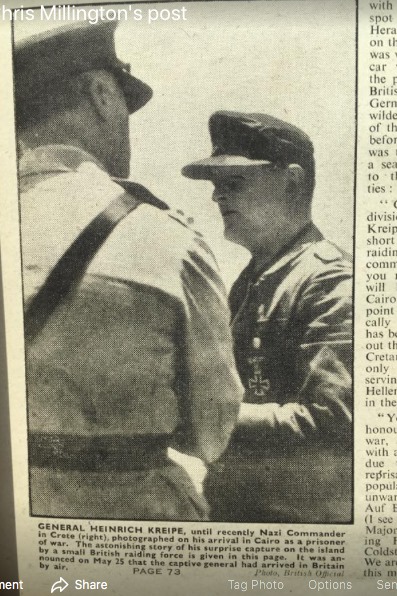
29th May 1944. General Kreipe arrives in the UK after a brief period of time in Cairo being interrogated. Again, it is front page news.

Kreipe in UK 1

A personal perspective of the kidnap of General Kreipe by Billy Moss’ daughter

As we come towards the end of the account of the kidnap I would like to share with you the text of a talk given in April by Gabriella Bullock (née Moss) – Billy Moss’ daughter – to her local history group. It recounts the story of the kidnap but includes many personal perspectives, particularly about Billy, and an important German perspective on the ‘reprisals’. At the end Gabrilla mentions the two annual prizes set up in her father’s name at the University of Crete. These are funded mostly by the royalties from his books and other work. 

Over to Gabriella …

In 1940 Winston Churchill launched the Special Operations Executive (SOE), with the rousing injunction to ‘set Europe ablaze’. I shall be speaking today about my father, William Stanley Moss – and the 1944 operation in which he was involved with Patrick Leigh Fermor, both British SOE agents. This was the abduction carried out by the two of them, together with a trusted handful of Cretan Resistance fighters, of General Heinrich Kreipe, Commander at that time of German Forces on occupied Crete. My father’s book Ill Met by Moonlight describes it all. It was a bestseller later made into an Emeric/Pressburger film, which I imagine most have you have seen – they tend to roll it out at Christmas.

To give you a bit of background first. My father was born in 1921 in Yokohama, Japan, where his family was living, and where his father was a businessman. His mother was a White Russian whose family had escaped the Revolution. When my father was two years old Yokohama was entirely destroyed in the Great Kanto earthquake; the family survived and returned at that point to settle in England. They travelled a great deal, however, and my father claimed to have voyaged around the world twice before his teens. Known as Billy, he was a much-loved only child, and his adventurous spirit was given fairly free rein. Treasure Island was and remained his favourite book. Also encouraged were his artistic and writing talents, and his love of animals. He was schooled at Charterhouse, leaving in 1939 before his 18th birthday, and before the outbreak of war.

He was commissioned into the Coldstream Guards in 1941, having trained at Caterham and Sandhurst. He served 18 months in and around London, on the King’s Guard, with a period of guarding Rudolph Hess, and a spell of Churchillian duty at Chequers – all thrilling for a junior officer – before suddenly being sent to join the 3rd Battalion the Coldstream in the Middle East. He saw action for the first time in the Desert Campaign with Montgomery’s Eighth Army, chasing Rommel across North Africa, after Alamein. Following a spell in Pantelleria, Italy, he parted from his regiment and headed for Cairo, and in September 1943, he volunteered to join Force 133 of SOE.

Meanwhile, at 22 years old he was the youngest inmate of the house known as Tara – which grew into something of a Cairo legend as a centre of uproarious and eccentric fun when its housemates were on leave. These were other SOE agents and included David Smiley and Billy McLean who worked together in Albania and the Balkans, Xan Fielding and Patrick Leigh Fermor – known as Paddy – these two were well embedded in the Cretan resistance and Paddy had already spent some two years in the mountains disguised as a shepherd. He had an almost Byronic love and affinity for Greece and Crete. He was fluent in Greek and many other languages, and would recite reams of epic poetry at the drop of a hat.

I can’t resist sharing with you this description of him, later in life, by his friend the writer Lawrence Durrell, when Paddy was staying with him in Cyprus:

After a splendid dinner by the fire Paddy starts singing, songs of Crete, Athens, Macedonia. When I go out to refill the ouzo bottle…. I find the street completely filled with people listening in utter silence and darkness. Everyone seems struck dumb. I catch sight of Frangos, who says ‘Never have I heard of Englishmen singing Greek songs like this!’ Their reverent amazement is touching; it is as if they want to embrace Paddy wherever he goes.

My father too was under his spell.

Paddy was 29 at the time of the abduction. He was less of a professional soldier than my father, with less experience of conventional warfare. He had served for a short time with the Irish Guards but his disposition was much more suited to undercover work with SOE. Eventually – but not without dissenting voices – he was granted permission by HQ to carry out the kidnap operation. He asked my father to join him as his second-in-command, who leapt at the chance.

Paddy wrote an Afterword for the 2001 edition of Ill Met by Moonlight. Writing from a historical perspective, he is at pains to insist that the kidnap was carefully planned – that it was the result of an idea of long and complex gestation. He longs to dispel the notion that it was somehow a tremendous jape. It is also true, however, that all the Tara inmates had had a great time adding their ha’penny-worth, towels around their middles, famously drawing plans and diagrams on a steamy bathroom wall.

Afterwards, one wireless announcer said, ‘of all the stories that have come out of the War this is the one which schoolboys everywhere will best remember’. Paddy’s words cannot stifle the ebullience of this story. Its enduring appeal hinges on a mix of danger and courage with dare-devilry, and on the fact that its aim was not destruction of any kind, but simply, with the co-operation of a huge swathe of the unbowed and complicit population, to get the better of the mighty Germans by stealing their general from under their noses. It was a wonderful idea. On Crete itself there is a joke that out of a population of 600,000, 599,999 were involved.

The German invasion of Crete in 1941 had been, uniquely, an airborne invasion, and The Battle of Crete raged for 11 days of total and bloody fighting. When the Germans prevailed, and thousands of British and Allied troops hurriedly evacuated as best they could be, Cretans were abandoned to their fate. In retaliation for the fierce resistance they had put up, the Germans instantly imposed a terrifying and pitiless rule on the entire population, which was enforced throughout the occupation. On the slightest pretext, or even none, there were summary executions, destructions of villages, massacres of their inhabitants, gratuitous cruelty of every kind. General Muller, commander of the German forces, was known as The Butcher of Crete, and later executed for war crimes. This was the general that Paddy and my father hoped to abduct, take prisoner and escort back to Cairo. However, in March 1944 Muller was temporarily replaced by General Kreipe who thus became the target.

In the wake of the Battle of Crete numbers of Cretan men had taken to the mountains – as they had the century before when under Turkish rule – forming and joining bands of resistance fighters. A handful of SOE agents such as Paddy then trickled into Crete to organise resistance.

I won’t narrate the full story, as many of you will have read the book or seen the film. I feel I should explain, though, that sadly I never knew my father, who died when I was a child. So, much of what I have to say is necessarily conjecture. Luckily he wrote books, letters, diaries. I shall be quoting from the fulsome contemporaneous diary that he kept, and upon which Ill Met by Moonlight is closely based.

One night in early February1944 they are flown out over Crete, and Paddy is dropped. But as the plane turns to make a second drop, clouds close in, ever more thickly, forcing the plane back to base. Subsequent attempts to reach Crete by plane and boat are all thwarted until finally, on the night of the 4th April, a small motor launch with my father on board edged towards the Cretan coast. “In the light of the half-moon the mountains loomed up large and misty-white so that it seemed that we were much, much closer”. Guided slowly in by a pinprick signal of torchlight, a dinghy landed him within wading distance and he was helped ashore by a score of hands.

“My first impressions were extraordinary – dark faces, heavy moustaches, turbaned heads, black and shabby clothes, tall boots, a hundred voices. And then I saw Paddy, and ran towards him. I can’t describe how wonderful it was to see the old son of a gun again. We talked of everything and of nothing for a few moments. Paddy looked radiantly healthy, and the sun (I think it must have been the sun) had darkened his face, so that he looked for all the world like a smuggler of old.

He had to leave me then to go and see to further unloading and to get the German POWs on board…

I saw him go off, and watched him, as he gave orders, commanded men to do this and that. I remember thinking ‘Here is the different Paddy’. He seemed to have the whole situation at his finger-tips and was capable of coping with anything”.

I wanted to read this to you to give you a flavour of it all in the diary’s words, and also because of the understated rather English way my father expresses his admiration for Paddy. Throughout the diary there never seems to be a jarring word between them. Rather, a close understanding and uncomplicated delight in each other’s company – a purity, somehow.

The beach in question had been mined, with German outposts only ¾ mile to the west and one mile to the east. Through that night their Cretan guide led them over mountains for four hours. In this way, and at each stage of the operation, the Cretans were guiding them, sheltering them, guarding them, providing for them. Taking unimaginable risks for them. Paddy always stressed that most of those involved in the kidnap were Cretan, and there was no doubt of the consequences for them of being caught. As for Paddy and Billy, Hitler’s Commando Order of 1942 was clear, stating “all enemies on so-called commando mission, whether armed or unarmed, in battle or in flight, are to be slaughtered to the last man”.

There were moments of hair-raising danger, but preparations went ahead, and the kidnap took place on the evening of the 26th April, as the General was being driven from German HQ to the Villa Ariadne, his sleeping quarters in Knossos. Paddy and Billy, in stolen German uniforms, and their team of seven Cretans, waited concealed.

At a signal that the General’s car, with its unmistakeable pennants on the front, was approaching – one hour later than expected – Paddy and Billy stepped into the road, swinging torches. The car slowed at the crossroads. Paddy cried HALT. The car stopped and they both approached it, one on each side – Billy on the driver’s side. Paddy questioned “Ist dies das General’s wagen?” “Ya, Ya” – and then they tore open the doors. The terrified chauffeur was reaching for his revolver, Billy hit him with a cosh, Paddy and Manoli pulled the General from the front seat. Struggling like mad and protesting loudly, he was bundled into the back, and sat upon by three hefty and armed Cretans, while the chauffeur was taken away by the others. Billy jumped in behind the steering wheel, and with Paddy beside him wearing the General’s hat, they set off. Paddy told the General that if he were willing to give his parole that he would neither shout nor try to escape, they would treat him not as a prisoner but as one of themselves; the General gave his parole immediately.

Billy drove the car, straight past the startled sentries guarding the Villa Ariadne, and through a number of checkpoints. At these, he slowed right down to give the sentries time to recognise the pennants, before gradually accelerating smoothly past – a tactic which seemed to work.

Their route took them through the centre of Heraklion, where, with nerve-wracking timing, a garrison cinema show had just spilled out its audience, so that the streets were milling with German soldiers, forcing them to proceed at snail’s pace. There were many more checkpoints – 22 in all, of which 5 were roadblocks – but somehow they negotiated them all.

They carried on along the coastal road and up into the mountains, and here the party split. So far, so good. Together with the Cretan team, Billy and the General set off into the mountains. Meanwhile, Paddy drove the car to a spot by the north coast, where it might seem that the occupants had left it to board a waiting submarine. He left a carefully composed and signed letter inside it. This was addressed to the German authorities and claimed full and sole British responsibility for the abduction, as well as hopefully giving the impression that the General would have already been taken off the island. The reality was that, having re-formed, the entire party was to trek over the mountains all the way across to the southern coast where hopefully there would be a rendezvous with a boat to take them to Cairo.

It had been pre-arranged with HQ that when news of the abduction broke, the BBC and other broadcasting channels would announce that General Kreipe was already on his way to Cairo. In fact, everywhere it was announced that the General was being taken off the island. This made matters for them very much worse: it was responsible for the Germans launching a full-scale manhunt.

Not only that, but the leaflets never materialised which were supposed immediately to be dropped, stating in both German and Greek that the operation had been carried out by a British raiding party – in this way, Paddy had hoped to prevent reprisals being taken on the islanders.

Over the next 19 days the party made its way across the mountains by night, taking cover in caves by day, while the full-scale manhunt picked up their trail and began to close in on them. As Billy wrote, they had everything to lose. But with their incredibly loyal tight-knit team, local lookouts and runners, they just managed to keep a step ahead of the tightening circle – fed and sheltered all the way without question and without fail.

There were of course also those whom they couldn’t trust. There was constant danger, setbacks, crises and changes of plan, failed communication systems, and mishaps of all kinds, but finally on the night of the 15th May they were safely chugging their way back to Cairo, in the same motor launch that Billy had arrived in, and their job was done.

On his return as General Commander that August, General Muller issued the following Order:

Because the town of Anogia is the centre of the English Intelligence of Crete, because the people of Anogia committed the murder of the sergeant commander of the Yeni-Gave as well as of the garrison under his orders, because the people of Anogia carried out the sabotage of Damasta, because in Anogia the guerrillas of the various groups of resistance take refuge and find protection and because it was through Anogia that the kidnappers with General Kreipe passed using Anogia as a transit camp, we order its COMPLETE DESTRUCTION and the execution of every male person of Anogia who would happen to be within the village and around it within a distance of one kilometer.

Anogia was then obliterated. Several villages in the Amari district were also razed that summer, with inhabitants rounded up and shot.

There are those who said – later –that the success of the mission came at too high a price. There were also those who had predicted such reprisals, such as Col. Sweet-Escott who as SOE Commander in the Balkans had experience of them – they were part of German policy, widely practised, and had been a ruthless feature of the occupation from its beginning.

Others, including Paddy – although he suffered lifelong agonies of doubt – believed that the meticulous care taken to avoid involving the Cretans in reprisals was in this case successful. They laid the cause of the reprisals on other factors. There was, by this stage of 1944, the question of the Germans’ imminent collapse and Muller’s strategic need to preclude attacks on his withdrawing troops. This he did by crushing centres of resistance across the whole island, the so-called ‘scorched-earth policy’, because in this way, ordinary German soldiers were compromised by participation in war crimes; this made their surrender or desertion impossible.

There were also the other attacks mentioned in Muller’s Order, such as the ambush carried out at Damasta, and attacks on Germans carried out in May by the Communist ELAS party (civil war was just over the horizon, and the Communist activists used such attacks on German targets in a cynical strategy, designed to trigger a violent response). It is also possible that Muller reversed the lenient line, which until then had been taken with regard to the bloodless Kreipe operation, out of straightforward revenge – for he must have realised he was the original-intended target.

Then there are those – perhaps especially in Crete – who are philosophical and stoical, saying that there were several factors and that Yes, perhaps the abduction was one of them; but that it was war.

Whatever the opinion expressed – and everyone in Crete has an opinion on this desperately emotive issue – it clearly meant a very great deal to people at the time that Paddy and my father who were British stood shoulder to shoulder with them, that they were not entirely abandoned. We see exactly this sentiment replicated right now in Ukraine. And in the midst of the humiliation of Occupation, this successful operation, which involved so many Cretans, enabled a proud people to hold up their heads. That is not nothing, nor is it forgotten.

Years later, amongst my father’s papers I found a long letter in German from a Dr. Beutin who at the time of the kidnap had been a serving German officer on Crete. The letter was dated 1950, which was the year that Ill Met by Moonlight was first published. In 1993 I had it translated and shared it with Paddy – to his great excitement, because it sheds light on the German perspective – as he wrote in a letter to me, “It really does seem that our stratagem worked and that for a very important gap in time, the contents of our letter (the one left inside the General’s car) were believed, before the enemy knew of the truth through their spies or our traitors – both, of course”.

He immediately embarked on his own translation of the letter, and tried to contact Dr. Beutin, only to discover that he had died some years before.

Among Dr. Beutin’s observations are these:

“General Kreipe arrived in Crete at the beginning of March 1944… Within a few days he became highly unpopular among the men because of his pettiness and rudeness, to officers as well…and he introduced a tone to which the men of the Division were not accustomed and which they perceived as undeserved… He always grew impatient at traffic points… where the rule was that every driver had to produce a movement-order for every journey… no exceptions to this rule were allowed, even for generals; but Kreipe deemed this unnecessary or unbecoming in his own case, and was very rude if his car was ever stopped… everyone took care not to examine his car too closely… so Kreipe was a victim of his own disobedience to orders… The soldiers were surprised but not upset that he had been abducted… in some quarters, it was maintained as a joke that the General had abducted himself. It was much discussed in officers’ messes, and many rakis were drunk to your health.”

Paddy’s response to these comments was, “I think your father was a better judge of Kreipe’s character than I was”. Let me explain.

My father was relieved that Kreipe wasn’t the raving Nazi he might well have been, and gave him credit for coping with arduous marches and hardships, especially in the early part of their trek. They did obtain a mule for him, but he had at least one nasty fall. However, my father found Kreipe increasingly difficult to please, and one day, as he perceived it, he saw an ugly side to Kreipe: throughout the afternoon, there had been the sound of explosions – it was Germans blowing up villages with dynamite, as a reprisal for a different agent’s actions. The General, with a grin, remarked that it was so easy to kill Cretans as reprisals for anything the British did. My father was appalled and could never warm to him after that incident, although two days later the General apologised and things carried on as before.

But Paddy wasn’t with them that day, and never saw that side; he saw a different side. There is a famous story – and it bears repeating. Two days after the abduction, as dawn broke over snow-covered Mount Ida (or Psiloritis, to give it its Greek name), the General quietly recited

Vides ut alta stet nive candidum Soracte “You see how Mt Soracte stands white with deep snow”

– the opening line of a Horatian ode. It was one that Paddy knew. He responded with the next line, and carried on to the end. I quote:

“The general’s blue eyes had swivelled away from the mountain top to mine – and when I’d finished, after a long silence, he said: “Ach so, Herr Major!” It was very strange. As though, for a long moment, the war had ceased to exist. We had both drunk at the same fountains long before; and things were different between us for the rest of our time together.”

Paddy loved to tell this story, and the wonder of it struck all who heard it, and the power of it only grew with time – so that it came to define his entire war, like a distillation, a jewel, that he treasured. And not surprisingly, it coloured his view of the General. Indeed, in 1972 (several years after my father’s death) there was a reunion in Athens for a sort of Greek version of This is your Life, featuring Paddy and General Kreipe and the core Cretan team – and a very jolly reunion it seemed. Kreipe was complimentary about the courteous treatment he had received as a prisoner on Crete, but he could never bring himself to say a nice word about my father, and I think I know another reason.

Some fifteen years ago, when my family was in the process of reclaiming the publishing rights to my father’s work, my husband made an interesting discovery: that when Ill Met by Moonlight was published Kreipe successfully took out an injunction against its publication in Germany, on the grounds that it falsely states that he gave his parole to Paddy that he would not try to escape. For such a senior officer to give his parole would have been highly shameful and dishonourable military conduct, and he denied it. But with the release in 2012 of classified wartime records in the National Archive, we were able to read Paddy’s report to HQ: it clearly states that parole was asked for and given. Ill Met by Moonlight has never been out of print, and it has been published in Greek, French, Spanish and Italian – but to this day, not in German.

It had been an ever-present wish of mine to go to Crete… and finally in 2010, with my husband Hugh, I made the journey. We didn’t tell Paddy or anyone else that we were going, wanting no proscribed introductions of any kind, but simply to make a private visit to see the places my father had written about. We were armed only with Ill Met by Moonlight and his other wartime memoir, A War of Shadows, and a few photographs.

In the mountain village of Kastamonitsa we got talking to a charming old man who kept a shop, and asked him for directions to the house where Billy and Paddy had stayed when making preparations for the kidnap. The old man made a phone call, and soon the street outside his little shop started to fill – news of my being there spread like wildfire – we could not believe it – shepherds with mobile phones appeared from the mountains, scions of those who had sheltered the kidnap party – we were invited into homes, feasts were prepared, glasses were raised… It was so extraordinary and so unexpected.

Over the next days we were taken up to Mount Ida – Psiloritis – along tracks and into caves where my father had trodden and slept. And then escorted to Anogia – I was so nervous about Anogia – after all, the reprisals… how dare I go there, and what would I be confronting there?

Anogia had risen phoenix-like from its ashes, the biggest village in all of Crete. The reprisals and the history were not brushed under the carpet for me – instead, wonderful guides showed us all, explained all, and then led us to meet well-known families of the Resistance… there was overwhelming hospitality, gunshots as a salute, more welcomes, more feasts, there and everywhere we went. We were taken to hideouts, to family chapels … Much later we learned more about Anogia in particular, and the dark complexities that these families had faced since helping the British – but I can only say that in our dozen or so visits to Crete since that first visit, I have on rare occasions met with reserve, but never once with hostility.

Mostly I have been deluged with goodwill, and astonished by the enthusiasm that my visit was generating. Now, as in war, it seemed that it meant a huge amount to be – how can I put it? remembered by the outside world. For their story not to be forgotten. For me this reception has been astonishing, and truly humbling. We met so many amazing people, who over these last years have become dear friends, like second families. Widows, children, even grandchildren. Even some very old but still vigorous men who remembered my father, and were with him in 1944 … they have all died now, but that was so precious!

I could tell you so many stories… I will tell you about Iorgis, from the tiny eyrie-like village of Patsos. Small and strong and wiry, he was close to ninety and almost completely blind when we met him. Much later, his daughter told us what a harsh and tragic life he’d had – we would never have guessed. He took us up to the large overhanging cave where my father was sheltered for many days – he was as sure-footed as a mountain goat and so quick we could barely keep up. He spoke no English, and we spoke no Greek. Luckily others translated for us – because as we sat down to an extraordinary instant feast, the stories were gushing out of him, and it was wonderful to see him chuckling away and so clearly enjoying his memories. He had been younger than my father, probably about 20, and he recounted how one day the two of them were out on the mountain when a German spotter plane appeared. They dived into a hollow, and my father pulled some vegetation over them, and there they stayed hidden while the plane circled and circled overhead, and my father sang It’s a long way to Tipperary. After nearly 70 years, how he laughed – this amazing man, who spoke not a single word of English – as he sang it to us!

Also in Patsos, we met Vassily who had been in the Greek Special Forces. Younger than us, and fiercely proud of his village’s history, his first words to me were “Congratulations on your father”. He told us that, to this day, the Army uses the kidnap route to train its Special Forces. And indeed people come from all over the world for expeditions along the route – have even written books about it. It is legend, and really tough. As my father wrote in his diary, “Crete appeared to be one big rock – only more so”.

After my family had successfully reclaimed the rights to Ill Met by Moonlight and my father’s other works, which happened to coincide with when we first started visiting Crete, my husband and I came to a decision. At the University of Crete we set up two annual prizes in my father’s name, funded mostly by the royalties from his books and other work. It is a world-class university which, as a result of Greece’s financial crisis, had had its budget cut by 50%.

I was very nervous at the inaugural prize-giving ceremony, that my father would be falsely presented as a sort of pure white hero for my benefit. But I need not have worried: the Dean gave an unforgettably philosophical speech, about war and atonement and redemption, and the time-honoured use, since Classical times, of acts of atonement or commemoration. The prizes are now in their eleventh year – and we feel we have acquired another, academic, family! Every year in my speech, lest they forget, I repeat that the prizes exist to honour the Cretans in my father’s name. They are the only means I have to salute them, to give something back on his behalf, and to express my gratitude and admiration. The very first prize-winner in 2014 was a young woman who grew up listening to her grandfather’s stories – he had been involved in the kidnap operation; she entered the competition in his memory. Last year, one of the winners told me that he had entered the year before, but had not won. This time he had won, and he was so pleased. He said that the prize was a real motivation to produce excellent work. This was lovely to hear – hopefully it is truly a legacy.

Next month will be the 80th anniversary of the abduction. The exact spot at the junction with the road to Knossos is marked by a memorial, and every year wreaths are laid. A ceremony will certainly be held this year. As for me, – I remember Paddy telling how they looked up at the stars – and it is whenever I look up at night and see the stars, especially Orion’s Belt, that I think of Paddy and Billy looking up at them and finding their way by them, all those years ago.

All text copyright Gabriella Bullock. Photos copyright Estate of William Stanley Moss

80th anniversay of the kidnap of General Kreipe – Morale boosting news item in ‘Union Jack’

Union Jack 1

20th May 1944

The kidnap is reported in a morale boosting news item in ‘Union Jack’, the newspaper produced for Allied Forces in the Second World War.

This is the edition for Allied forces fighting in Italy.

Union Jack front page

Union Jack 2

80th anniversay of the kidnap of General Kreipe – More front page news

Kreipe headlines 2

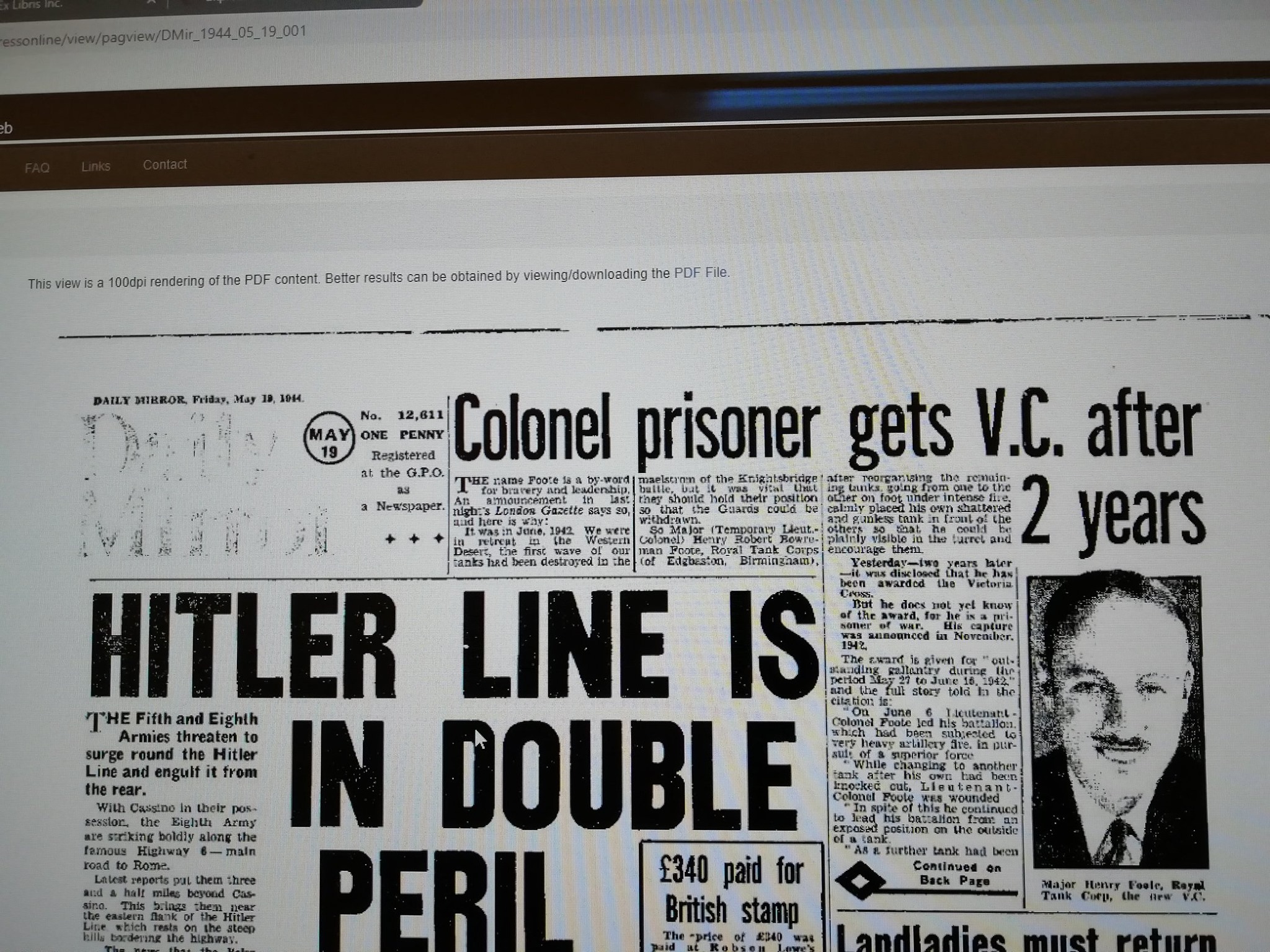
19th May 1944

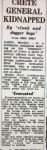
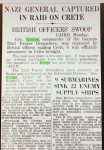
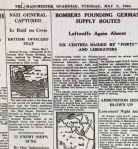
And finally the full story becomes major, even front page, news in Britain. Mirror, Times, Telegraph, Guardian, Express all report the kidnap – often alongside the major battles happening in Italy…

Kreipe headlines 1

Kreipe headlines 3

Kreipe headlines 4

Kreipe headlines 5

Kreipe headlines 6

80th anniversay of the kidnap of General Kreipe – General Kreipe arrives in Cairo after flying from Mersa Matruh

Kreipe Cairo arrival 1

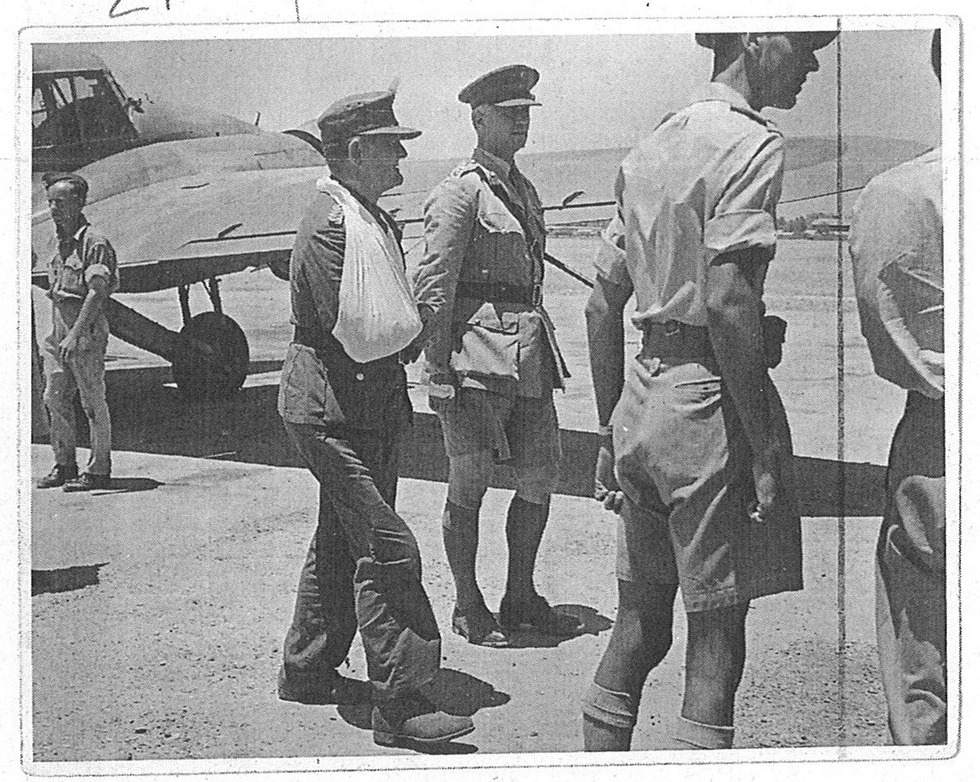
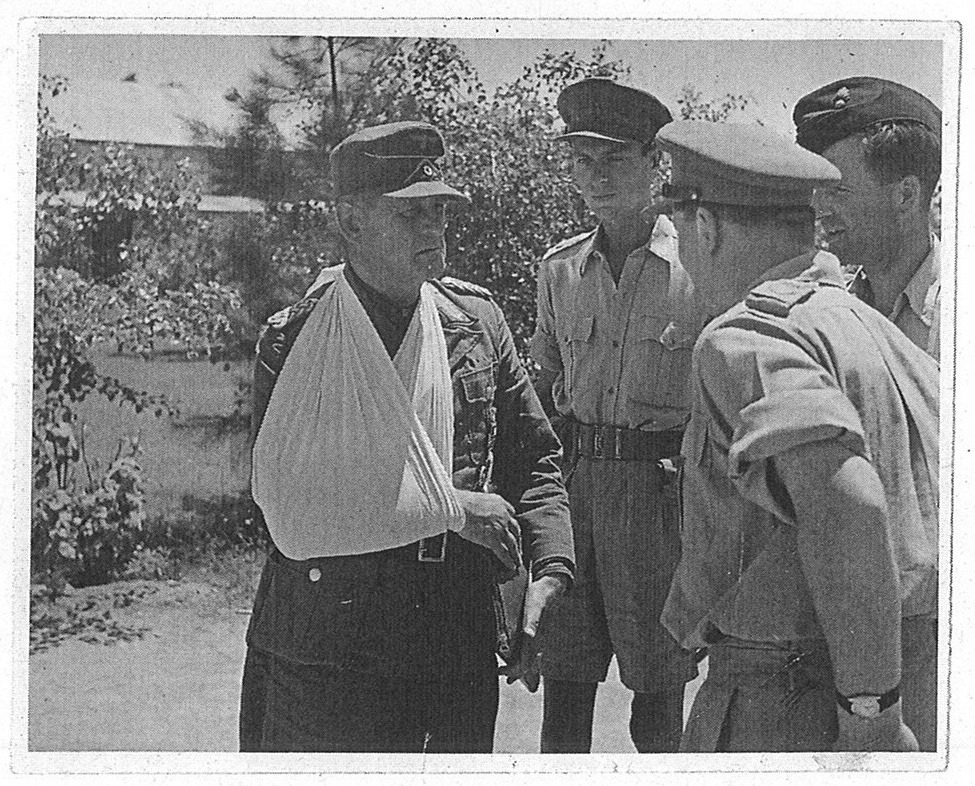
16th May: On the motor launch’s arrival in Mersa Matruh the General and the rest of the kidnap group were officially welcomed by Brigadier Barker-Benfield and the General spent his first night of captivity sharing a room with the Brigadier in the Officers Mess.

Kreipe Cairo arrival 2

Kreipe headline 17 May

Kreipe Cairo arrival 3

80th anniversay of the kidnap of General Kreipe – Waiting for the motor launch to arrive

RN Motor launch rescue Fermor Kreipe

14th May 1944

The final hours…..they have gathered in the rocks behind Peristeres beach, just below the village of Rodakino…..different andarte bands have joined them from the surrounding villages…and they are waiting for the motor launch to arrive…….

Paddy writes:

‘…..we all lay up till nightfall on a ledge in a deep hollow of the cliffs where an icy spring trickled down the rocks……Then we crossed the short distance to the little cove we hoped to leave from. It seemed to us all, with its walls of rock on either side and the sand and the pebbles, the lapping of the water and the stars, a quiet place for our adventure to end. As we stood about, talking in whispers at first, though there was no one to be afraid of, Andartes climbed down the rocks in two and threes to join us. There were the Rodakino Kapitans Khombitis and Manoli Yanna and Andrea Kotsiphis, and there too, suddenly, with the great fair moustache that had made us christen him Beowulf, was Petraka, the kapitan of the Asi Gonia band and one of our oldest friends on the island. He had brought a contingent of Goniots to join the other Andartes in guarding our departure and also to say goodbye. The place was filling up like a drawing room: groups were lounging about in the rocks or strolling with slung guns quietly conversing’

‘There was a slight coil of mist over the sea so it was not till she was quite close that we saw the ship. We could hear the rattle of the anchor going down; then two boats were lowered…….
The moment had come….We all pulled off our boots to leave behind; this was always done; even in rags they came in useful. Soon we were saying goodbye to Petraka and the Rodakino Kapitans and Yanni Katsias and the guerrillas and lastly to Antoni Zoidakis. We all embraced like grizzly bears. I tried to persuade Antoni to come with us; he wavered a moment and then decided against it. I wish he had. A sailor said “Excuse me Sir, but we ought to get a move on.”

As we neared the ship, the figures waving along the shore had begun to grow indistinct among the shadows and, very fast, it was hard to single out the cove from the tremendous mountain mass that soared from the sea to the Milky Way. The ship grew larger, her pom-poms and Bofors A.A. guns shining in the starlight. When we drew alongside sailors in spotless white were reaching down into the bulwarks to guide the General up the rope ladder (“That’s right Sir! Easy does it!”) while we – Billy, Manoli and George and I – helped from below. A moment later we were on the deck in our bare feet and it was all over.’

Peristeres beach 1

Peristeres beach 2

Peristeres beach 3

Peristeres beach 4

Peristeres beach 5

Peristeres beach 6

80th anniversay of the kidnap of General Kreipe – “Wunderbar, Herr General! We’re leaving!”

May 13th 1944

Nearly there…waiting in the rocky fissure outside Alones….

Paddy writes:
“Well, Herr Major, how are the plans for our departure progressing?” By now the General had become as solicitous for the success of our departure as we were.

“Wunderbar, Herr General! We’re leaving!”

It was true, the order of release or the promise of it, had come through. The German drive through the Asi Gonia mountains had driven Dennis to earth and put his set momentarily off the air. But messages from Cairo were beamed now to all stations and when the great news came through, Dick himself, hearing of our local troubles, and making a dash clean across the Nome of Retimo, reached our cheerless grotto long after dark. The boat would put in at a beach near Rodakino at 22 hours on the night of the 14th /15th May. – “10 o’clock tomorrow night!” It was in exactly a day from now. We would only just be able to manage it.

The thing was to get the main party to the coast under cover of darkness. I sent Billy off with George and the others and Yanni Katsias and his two wild boys by a short route which would bring them by daybreak to a place where they could wait for us. The General, Manoli and I would go by a much longer and safer way, where the mountains were so steep and deserted that, with a cloud of scouts out, we could move by day without much danger. Unfortunately it was too steep and uneven for a mule so the General would have to go on foot. But the sky was clear and there would be a bright moon and starlight.

The Krioneritis mountains which we were to cross are not one of the highest ranges of Crete, but they are among the steepest and are certainly the worst going. They are bare and, except for an occasional thistle or thornbush or sea squill, as empty of vegetation as a bone yard; the place is ringed with craters and fractured into a jig-saw of deep crevasses; worst of all there is not a path or even a flat square foot in the whole of this wilderness. The region is a never-ending upside-down harrow armed with millions of limestone sickles and daggers and yataghans.
Sustained perhaps by the thought of an end to his ordeal, the General tackled this Via Crucis with scarcely a groan. Helped by Manoli and me when he stumbled and then by the guerrillas that shimmered like ghosts out of the vacancy, he moved across the landscape in a sort of trance.”

Bletchley and a perspective on drinking from the same fountain

On the 28th April 1944, the code breakers at Bletchley Park deciphered possibly one of the most surprising stories of the Second World War. It was an intercept of a German signal stating that General Kreipe, commander of the Nazi Garrison in Crete, had been kidnapped.

By Nicholas Mellor

The code breaking huts worked in pairs. The tapes would come in from Hut 6, where Colossus churned away breaking the code. This resulted in a series of five letter groupings of words that would go to Hut 3 from Hut 6 by a connecting chute. Hut 3 was where there was an attempt to put these decoded messages into context where they could be translated, analysed and dispatched. That was where my mother came into the picture. On a watch there were normally 5 or so academics and intelligence experts responsible for reading them, translating them into English and deciding to whom they would be sent – the War Office, or the Air Ministry for example. It was my mother’s role to see they got to the right person as fast as possible. Sometimes she worked at the teleprinter sending them to London or would be asked to ring up the Cabinet office.

Bletchley Park for all its allure today was a shabby place near a railway junction with poor billeting, no clear picture of what they were actually doing or the impact they were having, and full of rather odd people. It was a very lonely time for my mother who had only just left school and found herself doing her shifts in a hut 3 at Bletchley and then trudging back to her billet next to one of the railway sidings. After the war she became a founding member with friends from SOE, or what is now the Special Forces Club. The staircase of the Club has portraits of its members or those who have been eligible if they had survived the war. The latter have ebony frames. The mix of pale pine and ebony is half in half.

One can only begin to imagine the incredulity of decrypting and then interpreting of such a message in the blizzard of messages being received at Bletchley Park, some only partially intercepted or decoded or translated or half understood. Eighty years ago it would have created a frisson in Bletchley in Buckinghamshire, but for the protagonists whether they were going to escape for Crete with both the General and their lives, were still in the balance.

On that very day the message arrived in Bletchley according to Billy Moss’s diary, PLF and the kidnap team had spent the day at Petrodolakkia with Xylouris and his Andartes (members of the Greek resistance), where they took many photos. Tom Dunbabin sent 3 members of his team from the Amari to the hideout, including Reg Everson and a wireless.

Their plan was to send a message to Cairo so that an evacuation date and beach can be identified, but their radio had broken. PLF sent off various messages, including one to Dick Barnes who has a radio station near Rethymno.

The team were joined by Andantes Grigori Chnarakis, Nikos Komis and Andoni Papaleonidas, who had walked up from the kidnap point. They were meant to bring the General’s driver, Alfred Fenske, but he has been killed on the journey.

PLF records the following incident:

‘A curious moment, dawn, streaming in the cave’s mouth, which framed the white crease of Mount Ida. We were all three lying smoking in silence, when the General, half to himself, slowly said:
“Vides ut alta stet nive candidum Soracte”

The opening line and a bit of one of the few odes of Horace I knew by heart. I was in luck. It was one of the few odes of Horace I knew by heart. I went on reciting where he had broken off:

‘… Nec iam sustineant onus
Silvae laboreantes, geluque
Flumina constiterint acuto’

… The General’s blue eyes swivelled away from the mountain-top to mine … after a long silence, he said:

‘Ach so, Herr Major!”

It was very strange.

‘Ja, Herr General.’ As though for a long moment, the war had ceased to exist. We both had drunk at the same fountains long before; and things were different between us for the rest of our time together.”

Paddy Leigh Fermor recounts this story in his book ‘Abducting a General’.

William Stanley Moss recorded in his own book ‘Ill Met by Moonlight’, this mutual love of the Classics of the General and his captor.

‘Paddy discovered that the General is a fair Greek scholar, and much to the amusement of our Cretan colleagues, the two of them entertained each other by exchanging verses from Sophocles.’

The Horatian scholar, Harry Eyres, might argue that the Odes of Horace have been working their magic for the last two thousand years, encouraging a more humble and human view of the world and extolling the virtues of fellowship.

Was it the sunlight on the frozen peak of Mount Ida that had inspired the General to think of that ode in its literal description of a snow-clad summit or was it about the whole Ode.

‘Vides ut alta stet nive candidum Soracte’ can be translated as ‘See how Soracte stands white with deep snow’

This is Harry’s translation.

Do you see the depth of snowfall,
On Soracte standing bright? This frost
Has stopped the rivers in their tracks;
The trees are bowed with their white, heavy pall.

In here we’re warm. Keep piling logs, Hugh,
On the blazing fire – and let’s uncork
A mellow four-year-old riserva,
Just the Sabine vino, not a fancy cru.

Give up trying to control the weather ; some god
Will calm the raging storm at sea.
The tall fame-cypresses and ancient ash
Won’t always shake and bend and madly nod.

Had the General realised that his best hope of escaping with his life was to set aside the grievances of him and his captors and recognise from now on they would be sharing the same food and drink?

The ode is underpinned by Horace’s Stoicism and Epicureanism. In the ode he is advising his friend Thaliarchus to seize the day (carpe diem) and enjoy the pleasures of the moment rather than worrying about a precarious future, living in the present, enjoying life’s simple pleasures, and remaining unfazed by the uncertainty of tomorrow.

Horace himself had fought against the Triumvirate, had escaped with his life and eventually set aside his own grievances to return to Rome, under the Augustan regime. Horace had sided with the forces of Brutus and Cassius after their assassination of Julius Caesar, but they were defeated by Mark Antony and Octavian (who would later be known as Augustus) at the Battle of Philippi in 42 BCE, he had to set aside his grievances and get on with the very people he had fought against.

General Kreipe might have realised that Horace’s own experience was the best he could hope for and Ode 1.9, the best advice he could have received.

Patrick Leigh Fermor’s ‘fountain’ has often been seen as representative of culture and conviviality, but perhaps the fountain was more specific, and he was thinking of Horace, his insight, his poetry and that Ode in particular.

80th anniversay of the kidnap of General Kreipe – Dennis Ciclitira has joined them and has a working radio

May 11th 1944

Things are looking up! Dennis Ciclitira has joined them and has a working radio set up the valley in Asi Gonia. And they hear from Ianni Katsias that the closest beaches – at Rodakino – has potential as a pick up point.
They spend the day and evening resting and recovering. They are all very tired and the General is clearly suffering. Billy Moss recorded, after the General fell off the mule the day before:

“General in great pain, saying: ‘I’ve had enough. Why don’t you shoot me and get done with it’.”

Paddy writes:

Rumours of a German descent on the region had prompted Stathi to conceal us in such a cramped and precarious eyrie the night before; next morning all seemed serene: we climbed up to a commodious and beautiful ledge of rock where the General was consoled for the agonies of the ascent by the coloured blankets and the cushions spread there under the leaves by my god-brother (Stathi) and Stavro (an old drinking companion of mine) and by the marvellous banquet of roast sucking pig and kalitsounias, – crescent shaped mizithracroquettes – and the wicker demi-john of magnificent old wine which was waiting. Stathi was a great bon viveur and a paragon of kindness and generosity as well as being Kapetanios of an armed band. His eager blue eyes kindled with delight to see us demolishing his feast. He hoped, (and so did we) that we could lie up here in luxury until we slipped off over the hill to the boat. There was a rushing stream hard by and sweet smelling herbs all round us and the trees were full of nightingales. We banqueted and slept and talked and sang. The sun set through the surrounding peaks and as we lolled exulting on the soft rugs under the moon and the stars, for ever plied with fresh marvels by the two brothers, who sped to and from the village like kindly djinns, this sudden change in our affairs seemed to all of us as magical as the sudden transportation to paradise for beggars in a Persian story.’

Watch Powell & Pressburger’s Ill Met by Moonlight in full

I know this is a bit of a spolier but we all know the story don’t we? We know how it ends. The evacuation events will come early next week as the tale of the kidnap of General Kreipe reaches it’s conclusion.

As it is the weekend, you might wish to settle down in front of your TV and watch the final movie from the famed Powell and Pressburger partnership starring Dirk Bogarde (as Paddy), Cyril Cusack (as Captain Sandy Rendel), David Oxley (as W. Stanley “Billy” Moss, M.C.) and the superb Marius Goring (as Major General Heinrich Kreipe).

If you have a Smart TV with the You Tube app, just search for Ill Met by Moonlight.

80th anniversay of the kidnap of General Kreipe – The General falls from his mule

10th May 1944

After a day resting in Photeinou the party continue to travel westward. They are heading to the Kato Poros gorge outside the village of Vilandredo.

Paddy writes: ‘A mishap occurred on this long night’s march: the girth of the General’s mule broke and sent his rider tumbling down a steep precipice. We chased after him; we thought at first that one of his shoulder blades was damaged; we arranged a sling and after a while the pain seemed to go. But his right arm remained in a sling for the rest of the journey. It was an anxious moment.

Outside the little village of Vilandredo we were met by kind and enthusiastic Stathi Loukakis and his brother, yet another Stavro.

He led us all, dog-tired and woe-begone, to a built up cave that clung to the mountainside like a martin’s nest. It was only to be reached by the clambering ascent of a steep ladder of roots and rocks – up which our disabled captive could only be hoisted by many hands and slow stages.’

Michael Powell was led to the cave in !951, and we finally tracked it down in 2015.

80th anniversay of the kidnap of General Kreipe – Our sun is rising

Chris White (C) with Charidimos Alevizakis (L) the nephew of Ianni Tsangarakis, Paddy’s greatest friend and guide. Charidimos had been a messenger for Paddy – and told us most emphatically that he and Paddy ‘were brothers.’

9th May 1944

After another day resting in Patsos the party head westward – reinforced by George Harokopos and George Pattakos, who supplies a mule for the General to ride on.

Paddy writes:

‘Our way westward over the plateau of Yious was our familiar east to west route over the narrowest part of western Crete. “Our sun is rising”, George had said as we set off at moonrise. It was a favourite saying in these nocturnal journeys. “Off we go,” Manoli said, “Anthropoi tou Skotous.” This phrase “men of Darkness!” was a cliché that often cropped up in German propaganda when referring to people like us, and we had eagerly adopted it. We were off, I hoped, on the last lap of our journey.’

‘Among the rocks and Arbutus clumps there was an ice-cold spring which was said to bestow the gift of immortality. We all lay on our faces and lapped up as much as we could hold. I told the General about the property of the water. He leant down from the saddle of his mule and asked urgently for a second mug.’
There destination for the night is the village of Fotinou – but they have to cross the main road from Rethymno to Spili without being spotted.

‘Men with guns whistled from the rocks and when we answered ran down to meet us and shepherd the party across the perilous highway. Others joined us out of the moonlight as we climbed into the conical hills where Fotinou is perched. Suddenly there was an alarm of a German patrol approaching directly ahead. Our party, by now quite large, fanned out along a ridge and lay waiting.’

‘Luckily it was only another contingent of our growing escort. There was relief and laughter. By the time we got to the grove of Scholari outside Fotinou, we were very numerous indeed. Most of the troop was composed of old Uncle Stavro Peros and his eighteen sons and their descendents with several members of the Tzangarakis and Alevizakis families as well. Andoni, the youngest of the Peros brothers had just contracted a dynastic match with the daughter of a family with whom the Peros tribe had been locked in discord for generations; so an atmosphere of concord and rejoicing reigned in the hills.’

In 1951 the film director Michael Powell, as part of his research for “Ill Met By Moonlight’, had visited the village, and photographed the Peros family.

In our early research trips we were able to meet Despina Peros, who had married Andoni Peros – the dynastic match – and whose olive grove they had stayed in. Despina was very proud of her association with the kidnap and that she had fed the group.

And on our first research trip in 2010 we met Charidimos Alevizakis, the nephew of Ianni Tsangarakis, Paddy’s greatest friend and guide. Charidimos had been a messenger for Paddy – and told us most emphatically that he and Paddy ‘were brothers.’

80th anniversay of the kidnap of General Kreipe – We might have been in a drawing room

8th May 1944

Tha main party stay resting outside Patsos. Billy writes about having a bathe in the tumbling stream nearby.
In the evening Paddy and Giorgos arrive from Genna and the group are reunited again.

Paddy writes: ‘The party, when I found them, were star-scattered about a tumble-down stone hut shaded by a clump of tall plane trees and a beetling rock with a waterfall and a deep pool. George Harocopos and his old father and his pretty little sister were looking after them in this Daphnis and Chloe décor.’

‘”Good morning, General. How are you?”
“Ah, Good morning, Major. We missed you.”
We might have been in a drawing room.’

The party are joined by another villager from Patsos – Giorgos Pattakos – who we were privileged to meet several times on our early research trips

80th anniversay of the kidnap of General Kreipe – ‘All was going according to plan’

7th May 1944

Messages are beginning to bear fruit….and Paddy realises they will have to travel further westward. They still don’t have a plan on how to depart but they are now getting better links with Cairo via the radio set at Dryade and their brave messenger, George Psychoundakis. Paddy and George stay on in Genna a further night.

In the evening Manoli, Billy, the General and the main party travel further westward to the village of Patsos, where they stay in a sheepfold in a gorge by a tumbling stream.

Paddy writes: ‘On the night of the 7th, the party with the General moved by an easy night march to Patsos, which was only two or three hours away from me. They were being fed and guarded by George Harocopos and his family, (George, a thoughtful and well read boy, later to become a gifted journalist, was the son of a very poor, but very brave and kind family, all of whom had been great benefactors to the wandering British). All was going according to plan.’

80th anniversay of the kidnap of General Kreipe – “But when we saw the branding mark, We only stole the ram, Sir”

6th May 1944

Paddy and Giorgos remain based in Genna – messengers coming and going as they desperately try to arrange a safe beach to be picked up from. Giorgos Psychoundakis returns with Dick Barnes – known as Pavlos.

Paddy writes: ‘This reunion with Dick – like many occasions in occupied Crete when one wasn’t actually dodging the enemy – became the excuse for a mild blind. ‘Mr Pavlo and I set off to Yeni,’ writes George Psychoundakis in ‘The Cretan Runner’, “where we found Mr Mihali (me) and Uncle Yanni Katsias. We sat there till the evening and the sun set. Yanni took us to the east side of the village where they brought us some food and first rate wine and our Keph (well-being) was great. The four of us were soon singing. Mr Mihali sang a sheep-stealing couplet to the tune of Pentezali, which went:

Ah, Godbrother, the night was dark
For lamb and goat and dam, Sir,
But when we saw the branding mark,
We only stole the ram, Sir.

The ram – the head of the flock – meant the General.’

Billy, Manoli, the General and the rest of the kidnap team remain in the sheepfold above Gerakari.

80th anniversay of the kidnap of General Kreipe – ‘This is very satisfactory news’

5th May 1944

Paddy and Giorgos remain in Genna, coordinating messengers. They are joined by Giorgos Harokopos and Giorgos Psychoundakis, who then heads back off to the wireless set run by Dick Barnes at Dryade with a message.

The main party in the evening leave Gomara and walk up the Amari valley via the village of Gourgouthi to their next hideout – a sheepfold above the village of Gerakari.

And in London Orme Sargent, the senior Foreign Office officer at Under Secretary level working to SOE, sends a memo to Harry Sporborg, deputy to Major-General Colin Gubbins, Head of SOE, expressing great approval of the coup. ’I have just heard of the success of an Allied Mission in Crete in capturing a high German officer. This is very satisfactory news and I hope it will be possible to get the German out to Cairo as I believe is intended.’

[1] National Archives HS 5/416

80th anniversay of the kidnap of General Kreipe – ‘… if my companions are feeling half as uncomfortable as I do they must be feeling terrible’

4th May 1944

The main party are still hiding in the valley of Gomara. Billy Moss records in ‘Ill Met by Moonlight’:
“It rained all night long , and, as was inevitable, we are soaked to the skin. Around me I see a picture of human misery, and I know that if my companions are feeling half as uncomfortable as I do they must be feeling terrible.”
Spirits are lifted in the afternoon when messengers arrive from Sandy Rendel and Dick Barnes.

Meanwhile in Fourfouras Paddy and Giorgos leave the comforts of Giorgos’ family home and travel 14kms further up the valley to Pantanassa…..searching for the whereabouts of a working radio set.

Paddy writes:

“Among the cypresses of Pantanasa George and I ran into a hitch. The Hieronymakis family, we knew, were in touch with at least one of our wireless stations. By ill luck it was about the only village in the region where neither of us had ever been. The Hieronymakis knew all about us, we knew all about them, but we had never met and there was no one to vouch for us. The old men were adamant: ‘You say you are Mihali, Mihali who? And who are Siphi (Ralph Stockbridge) and Pavlo (Dick Barnes)? Never heard of them. Tk. Tk. Tk! Englishmen? but, boys, all the English left Crete three years ago …?’ The white whiskered faces turned to each other for corroboration, beetling brows were raised in puzzlement, blank glances exchanged. They went on calmly fingering their amber beads, politely offering coffee. It was no good raging up and down, gesticulating under the onions and paprika pods dangling from the beams: every attempt to break through was met by identical backward tilts of head with closed eyelids and the placidly dismissive tongue click of the Greek negative. They wouldn’t give an inch until they knew (as they say) what tobacco we smoked. We could, after all, be agents provocateurs.”

“This impressive but exasperating wall of security was only broken at last, after two precious hours of deadlock, by the entry of Uncle Stavro Zourbakis from Karines – a friend of us all. Everything dissolved at once. In greetings, recognition, laughter, Raki, a crackle of thorns and sizzling in the hearth and the immediate summoning and despatch of runners to the two sets in the North West.”

Paddy and George move on for the evening back down the valley to the village of Genna, where they were to stay for several days:

“The goat-fold of Zourbovasili lay in rolling biblical hills. There was a round threshing floor nearby, where George and I could sleep on brushwood with a great circular sweep of vision. This place was to become, during the next three days, the centre of all going and coming of messengers as plans changed and options elapsed. But now, after the scrum of the last few days it seemed preternaturally quiet in the brilliant moonlight. Ida towered east of us now, Kedros due south: The White Mountains, which had come nearer to us during the day, loomed shining in the west. How empty and still after our huddled mountain life, was this empty silver plateau! A perfect place to watch the moon moving across the sky and chain smoke through the night pondering on the fix we were in and how to get out of it. There was not a sound except a little owl in a wood close by and an occasional clank from Vassilis’ flock.”

80th anniversay of the kidnap of General Kreipe – The Telegraph reports ‘martial law’ being declared on Crete

3rd May 1944

Another day spent in their hideout in the valley of Gomara. They are still stuck and have no contact with Cairo, and no idea of when, where or how they will get off the island.

But they have a plan….in the evening the party decide to separate.

Billy, Manoli Paterakis, the General and the main kidnap group will stay in Gomara.

Paddy and Giorgos Tyrakis will travel in the evening up the Amari to Fourfouras, Giorgos’ home village, in search of a working radio station.

They still remain in the news in the UK – the Telegraph reports ‘martial law’ being declared on Crete.

80th anniversay of the kidnap of General Kreipe – Front page news

2nd May 1944

If only they knew!

Paddy, Billy, the rest of the kidnap team and the General spend another miserable day in the ditch, fearing capture…but it is getting quieter for them, as the German patrols are now searching further up the mountain.

Meanwhile in the UK ….they are front page news – in the Express, Telegraph, Guardian and Times!

In the evening they decide to move a kilometre or so westward – to the valley of Gomara.

Giorgos Pharangoulitakis describes it his memoir ‘Eagles of Mt Ida’: ‘We decided to shift towards the valley of Gomara, just west of Ayia Paraskevi, a part where they had searched every inch, and where we could take up a better defence posture. It was a steep rocky place with a hole like a sort of grotto under a cliff where we could hide for the night.’

In the end they spend the night and the following day under the branches of ‘a very large pear tree …it was like an eagles nest’.

80th anniversay of the kidnap of General Kreipe – ‘the General realises that our capture would prove fatal for him’

1st May 1944

A long and dangerous day spent hiding in the ditch outside Agia Paraskevi. Probably the low point for all in the journey, and where they are most vulnerable to discovery by the German cordon – Moss records Kreipe’s realisation of his personal need for the success of the operation in order to ensure his own survival:

“I think the General realises that our capture would prove fatal for him.”

They can hear German patrols, sometimes as close as 50 metres, searching for them.

Paddy records that food is brought to them from Agia Paraskevi:

‘Antoni unpacked bread, cheese, onions, a dish of fried potatoes, some lamb and a napkin full of ‘kalitsounia!’ – crescent shaped fritters full of soft white cheese and chopped mint. Then a big bottle of mulberry raki came out and a handful of little tumblers. ‘This will warm you up,’ he said filling them: ‘White flannel vests all round.’ He splashed politely over to our guest with the first one, saying ‘stratege mou” (my General) then to the rest of us. They went down our throats like wonderful liquid flame. ‘And here,’ he said pulling out a gallon of dark amber wine, ‘red overcoats for all.’

What they don’t know is that in Cairo SOE have made a public announcement that Kreipe has been kidnapped and has already been taken off the island by submarine and is on his way to Cairo.

However they are still stuck, with no way of contacting Cairo and have no idea – as yet – of how they will get off the island.

80th anniversay of the kidnap of General Kreipe – The descent of Mt Ida

30th April 1944

The descent of Mt Ida has been exceptionally arduous in the dark so the day is spent recovering in Vorini Trypa, the large cave above Nithavris on the side of Mt. Ida.

That evening, in the rain and mist, they leave the cave and head further down the mountain into the bottom the Amari valley.

It is a difficult and very dangerous journey as the Germans are hunting for the General and are in all the villages immediately around them.

They first head west to the village of Kouroutes and then south until they stop and hide in a stream bed outside Agia Paraskevi.

Paddy records: Rain came swishing down: ‘Marvelous for the olives’, Manoli murmured. We waded through a stream and began to climb again. The rain turned to sleet. At last the village of Aya Paraskevi was only half an hour away. The Germans would have sentries out, perhaps patrols; better to stop there. We piled into a ditch mercifully overgrown with cistus, thyme and myrtle; protection from view, but not from the rain.

80th anniversay of the kidnap of General Kreipe – The ascent of Mount Ida in wind and snow

In the snow on top of Mount Ida

29th April 1944
The weather is deteriorating and the kidnap team need to walk over the side of Mt Ida and down into the Amari valley. It will be a long and arduous day and night.

At midday the party leave Petradolakkia and skirt the side of the Nidha plateau. They are heading for the mitato belonging to Roti, where they will rendezvous with Kapetan Petrakogiorgos and his andartes who will escort them over the side of the mountain. They climb up to the plateau of Akolyta and in rain, wind and snow they head over until they can see signal fires in the Amari telling them it is safe to descend. They shelter in the remains of a mitato before descending. After a long and arduous descent they are led to Vorini Trypa – North Hole – a large cave with tunnels and caverns heading off from the back of it. This cave has been used by the Resistance on several occasions before this visit, and is used by Dunbabin and George Psychoundakis in August 1944.

80th anniversay of the kidnap of General Kreipe – “Ach so, Herr Major.”

28th April 1944.

PLF and the kidnap team spend the day at Petrodolakkia with Xylouris and his andartes, where they take many photos. Tom Dunbabin has sent 3 members of his team from the Amari to the hideout, including Reg Everson and a wireless. The plan is to send a message to Cairo so that an evacuation date and beach can be identified, but the radio is broken. They are stuck. PLF sends off various messages, including one to Dick Barnes who has a radio station near Rethymno. The team are joined by Grigori Chnarakis, Nikos Komis and Andoni Papaleonidas, who have walked up from the kidnap point. They are meant to bring with them the General’s driver, Alfred Fenske, but he has been killed on the journey.
At Bletchley Park the codebreakers decode a German signal stating that Kreipe has been kidnapped.

PLF records the following incident:

‘A curious moment, dawn, streaming in the cave’s mouth, which framed the white crease of Mount Ida. We were all three lying smoking in silence, when the General, half to himself, slowly said:

“Vides ut alta stet nive candidum Soracte”

The opening line and a bit of one of the few odes of Horace I know by heart. I was in luck.

” … Nec jam sustineant onus” I went on
“silvae laborantes geluque
Flumina constiterint acuto”

And continued through the other stanzas to the end of the ode. After a few seconds silence, the General said: “Ach so, Herr Major.” For five minutes the war had evaporated without a trace.[i]

[i] William Stanley Moss recorded this mutual love of the Classics in ‘Ill Met by Moonlight.’

‘Paddy discovered that the General is a fair Greek scholar, and, much to the amusement of our Cretan colleagues, the two of them entertained each other by exchanging verses from Sophocles.’

80th anniversay of the kidnap of General Kreipe – PLF and George Tyrakis rendezvous with the team

27th April 1944.

PLF and George Tyrakis rendezvous with the General and the rest of the kidnap team north of Anogia. In the evening they begin the long trek up the slopes of Mt Ida to the Xylouris sheepfolds at Petrodolakkia. On the way they rest briefly in one of the many mitatos (cheese huts) in the area.

80th anniversay of the kidnap of General Kreipe – Third time lucky … the kidnap is on!

The first in the series of reposts of Chris White’s ‘diary’ of the events of the capture and kidnap of General Kreipe in Crete 80 years ago today. I first posted these in 2021 to keep readers occupied during the dreadful Covid lockdowns.

This repeat series is posted to honour the memory of all those involved from the brave Cretan Andartes, Patrick Leigh Fermor, other members of SOE and SBS, and the many Cretan civilians who aided the kidnap team, as well as all those who suffered under Nazi German occupation.

Captain William ‘Billy’ Stanley Moss MC, Coldstream Guards

A special tribute to Major William Stanley Moss, known to all as ‘Billy’ who, as a Captain at the time, was the second-in command of the operation and often lived under Leigh Fermor’s shadow. Billy was an out and out soldier. He fought between October 1942 and July 1943 with Montgomery’s Eighth Army chasing Rommel across North Africa after Alamein. In the aftermath of Operation Corkscrew, his battalion was then sent to garrison Pantelleria. He returned to Cairo, where he volunteered to join Force 133 of the Special Operations Executive (SOE) on 24 September 1943 where he met Paddy and Countess Zofia (Sophie) Tarnowska who was to become his wife. He continued to fight in Crete, then Greece, and in 1945 was parachuted into Thailand still serving with SOE. Billy was the author of Ill Met by Moonlight which is his detailed account of the kidnap, and War of Shadows as well as many other titles.

Moss was recommended for and received the Immediate Award of the Military Cross following the Kreipe abduction.

23 May 1944 Recommendation for MC.

This officer showed exceptional gallantry in taking part, with Major Leigh Fermor, in the organization and execution of the kidnapping of Major-General Kreipe at Arkhanes, Crete on 26 April 1944. It was due to Captain Moss’s swiftness in attacking the General’s car that the operation was made possible.

In the early stages of the kidnapping, Capt. Moss impersonated the chauffeur of the General’s car and for an hour and a half drove “the General” through Heraklion and passed 22 controlled road blocks before the car was finally abandoned. Subsequently Capt. Moss assisted in moving the General during a period of 17 days through enemy held territory.

For outstanding courage and audacity Capt. Moss is recommended for the Immediate Award of the MC.

Special thanks once more to Chris White for his exceptional work for this series and of course his co-authorship of Abducting a General.

If you want to read more about the events of April and May 1944 please click on the Tags that accompany each post at its end. You will find that there are literally hundreds of other items of news, analysis and memories.

Over to Chris …

26th April 1944.

Third time lucky…..the Kreipe kidnap team leave the Zographistos farmhouse outside Skalani and walk to the kidnap spot and wait for the General to drive past. At 9 pm they stop the car and the kidnap begins. The General is handcuffed and hidden on the back seat of the car. They drive past the Villa Ariadne and through Heraklion, entering by the Agios Giorgos gate and leaving by the Chaniaporta. They drive on into the mountains, stopping at Yeni Gave, where Billy Moss, Manoli Paterakis, Stratis Saviolakis and the General leave the car, heading up a track for a hideout in a ravine north of Anogia. PLF and Georgos Tyrakis drive for a further 2 kms and dump the car at Campo Doxaro, at the start of a track leading to the Cheliana ravine and the sea. They take with them the pennants from the car and head to the village of Anogia.

William Stanley Moss’ Diary April 1944
William Stanley Moss in Crete 1944

We are of course approaching the 80th anniversary of D-Day and the event that preceded it, the kidnap of General Kreipe are approaching their 80th anniversaries. I propose to repeat a series of posts written by Chris White that we placed on here back in Covid times and which run through the series of events from the day of the kidnap onwards.

For various reasons the remaining material in this particular post is no longer publicly available.