Yearly Archives: 2010

Andrew Nurnberg to handle world rights for Miklos Banffy’s The Transylvanian Trilogy

I am in the process of purchasing Banffy’s trilogy but still waiting for the first volume. Will I be able to read it all before they make a TV series or movie??

Book Trade Info reports on 5 October 2010

Arcadia Books appoints Andrew Nurnberg and Piers Russell-Cobb of MediaFund to handle world rights and film & TV rights respectively for Miklos Banffy

ON THE EVE OF THE FRANKFURT BOOK FAIR, Arcadia Books has appointed Andrew Nurnberg to handle world rights (ex Hungary) in The Transylvanian Trilogy (They Were Counted, They Were Found Wanting and They Were Divided) and Piers Russell-Cobb of MediaFund to sell film and TV rights on behalf of Arcadia and the Banffy Estate.

Originally published in the 1930s in Hungary, the trilogy was ignored under the communists and republished to acclaim in the 1990s. Following publication of Arcadia’s prize-winning translation by Katalin Banffy-Jelen and Patrick Thursfield a decade ago – Banffy’s writing has been compared to that of Proust, Tolstoy, Milosz, Galsworthy, Roth, Musil, Lampedusa and Dostoevsky among others – the trilogy has been published in France (by Phebus Editions, in C and B format editions), Spain (Libros del Asteroide, instant bestsellers last year), Italy (just out with Einaudi) and the Netherlands (Atlas, 2011).

The Transylvanian Trilogy, winner of the Weidenfeld Translation Prize (presented by Umberto Eco), has attracted praise from, among others, Patrick Leigh Fermor (who penned the Foreword at Chatsworth), Jan Morris, Simon Jenkins, Charles Moore, Martha Kearney, Francis King and Allan Massie, has been the subject of a Guardian editorial and was also chosen as one of ‘1000 Novels You Must Read’ in that newspaper.

Comments Arcadia’s publisher Gary Pulsifer: ‘The combination of Andrew and Piers is explosive and we look forward to taking the trilogy to a new international level, including with our B format reprints now coming out, for which we have ear-marked a high marketing spend and a high-profile marketing campaign. Just after Spain bought the rights Italy immediately followed suit and there is serious interest from various other European countries.’ Adds Andrew Nurnberg: ‘Banffy is potentially very big, quite something . . . this has a rhythm and sense of place that one simply doesn’t find these days.’ Says Piers Russell-Cobb: ‘Andrew will do a brilliant job and I agree with you that we are onto a bestseller.’

Crete: Island of Heroes

“The courage of the Cretan facing the firing squad is legendary … When executions were to take place I would leave my desk and walk out onto the balcony to watch their moment of death. Nowhere else have I witnessed such love of freedom and defiance for death as I did on Crete.” So said General Alexander Andre, the German Commander of the Occupation Forces on Crete.

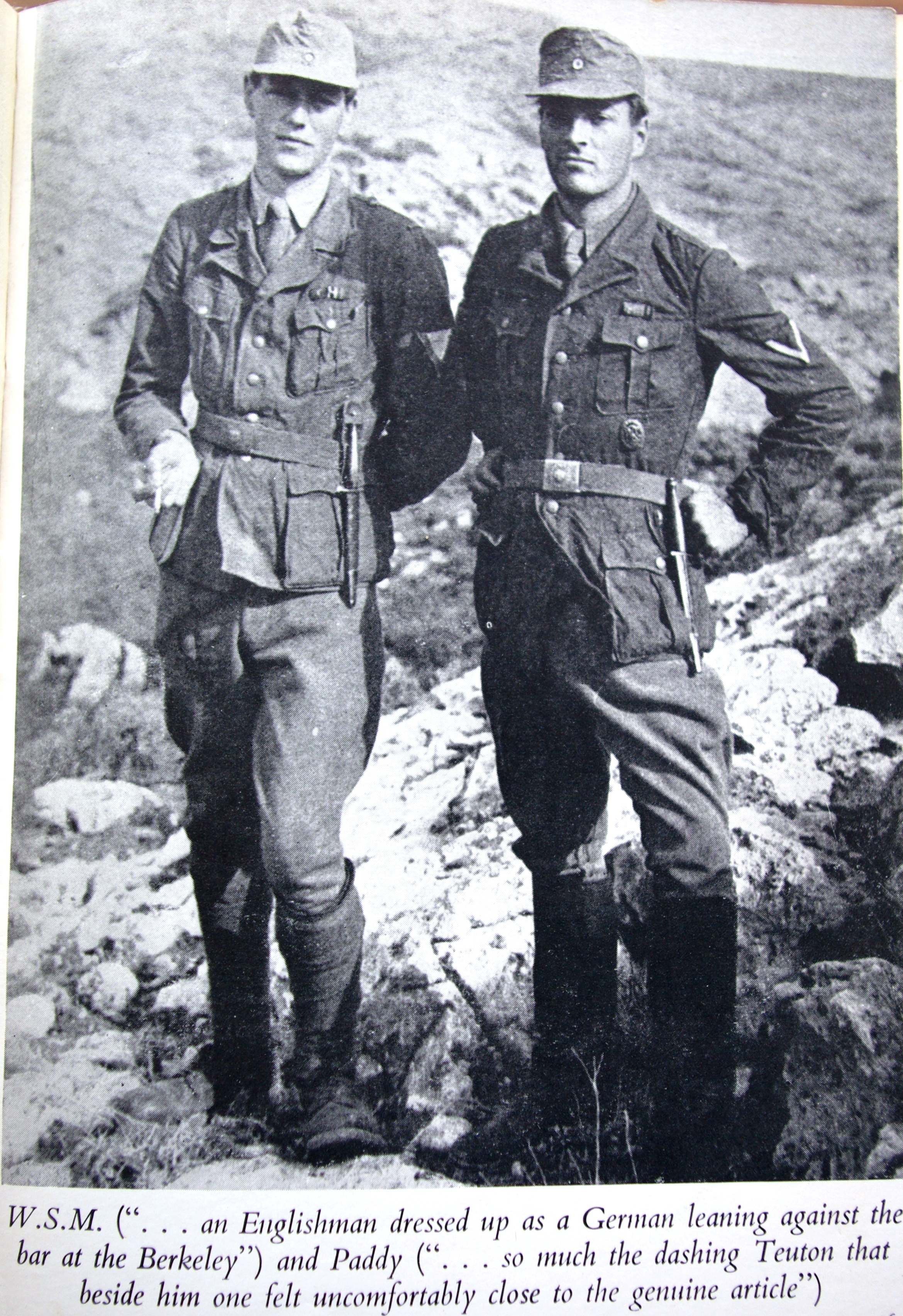
This video features pictures from the film 11th Day and includes some pictures of Paddy, including a new one to me at least of himself and Moss with the kidnap gang.

It is said that the Germans had never encountered the extent of civilian resistance that they encountered on Crete.

Retribution was swift. The German High Command wanted to break the spirit of the populace and do it quickly. In this they failed and failed miserably. In retaliation for the losses they incurred, the Nazis spread punishment, terror and death on the innocent civilians of the island. More than two thousand Cretans were executed during the first month alone and twenty five thousand more later.

Even in the face of certain death while standing in line to be executed, Cretans did not beg for their lives. This shocked the German troops. Kurt Student, the German Paratrooper Commander who planned the invasion, said of the Cretans, I have never seen such a defiance of death. General Alexander Andre, the German Commander of the Occupation Forces was amazed and said: “The courage of the Cretan facing the firing squad is legendary. Cretans turn into mythical figures. They are so proud of their moment of death that one can hardly fail to admire their courage. When executions were to take place I would leave my desk and walk out onto the balcony to watch their moment of death. Nowhere else have I witnessed such love of freedom and defiance for death as I did on Crete.”

Related article:

Patrick Leigh Fermor recounts the kidnap of General Kreipe on video

Crete: 11th Day Movie with Paddy

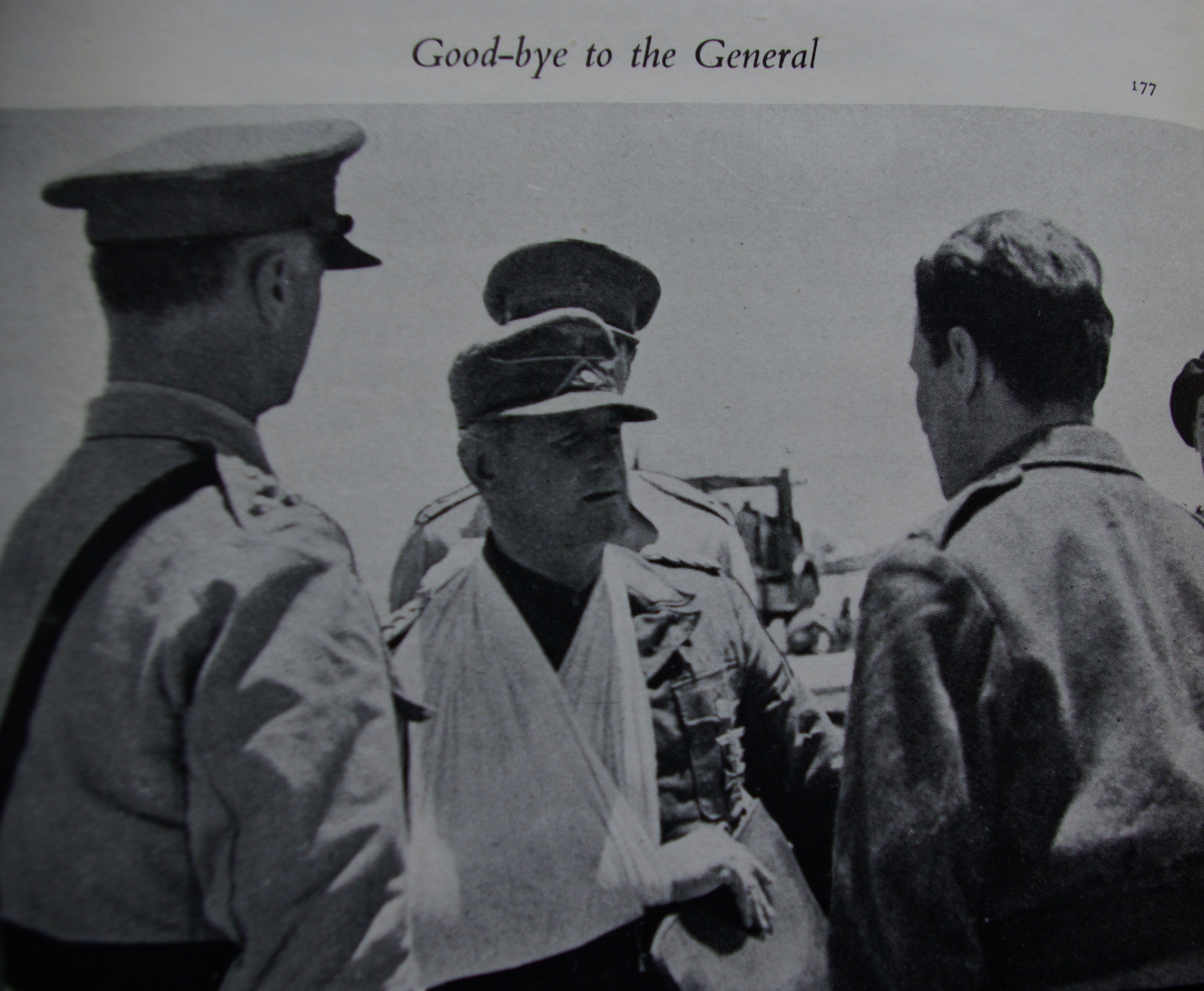
General’s long trip home

Related category:

Ill Met by Moonlight

GAGINONANUS SPEAKS

After a long, indolent summer chasing dragonflies, and an extended sojourn in the south of France courtesy of ‘Les Sans Coulottes’, the time has come for the winner of our OPRIG GAGINONANUS challenge, Marion Worsley to collect her prize. A full report will follow!

To celebrate this forthcoming event I thought we should enjoy the poem that the marvellous John Wells wrote and sent to Paddy after he too received a copy of Paddy’s drawings.

GAGINONANUS SPEAKS

By John Wells

Before the earliest burning light
Before the world that once was his
Hung turning the day to turning night
Gaginonanus was and is

Gaginonanus, mightiest Lord,
Whom all the Seven Kings obey,
At whose high uncreated word
Preadamites were prone to pray

Great God of Gods, all nature’s grail,
The inward soul of every thing
Behind the Maya’s rainbow veil
Withdrawn, within, inhabiting

New gods and false as empires rise
Are worshipped, spires fall and climb,
All-seeing and with placid eyes
Gaginonanus bides his time

Like leaves the centuries are born
Like leaves are born to bud and die.
Gaginonanus smiles to scorn
The drifting aeons as they fly

Ignored, unknown, forgotten still
Gaginonanus sees their play,
The awful working of His Will
Until His dreadful Judgement Day

*

But now, O Prig! O Lax! O Loose!
That hour is come! O sunk in crime!
Your garages in constant use,
You dare not park at any time

His awful Name is manifest!
No cloud-etched letters skyward burn
The Blessed Ones who love Him best
Know their Great God will soon return

Winning entrant Marion Worsley in Market Mews

Behold, in those condemned last days,
Gaginonanus, Lord of All!
As saints and sages dumbly gaze
His Name is written on the Wall.

Related article:

OPRIG GAGINONANUS

OPRIG GAGINONANUS – a winner!

Obituary: Peter Kemp MC DSO

Peter Kemp was a fellow SOE officer and would have known Paddy, Xan Fielding and Billy Moss.

by M. R. D. FOOT

First published in the Independent Thursday, 4 November 1993

Peter Mant MacIntyre Kemp, soldier and writer: born Bombay 19 August 1915; MC 1941; DSO 1945; twice married (marriages dissolved); died London 30 October 1993.

PETER KEMP was a distinguished irregular soldier during the Second World War, and long retained his nose for trouble spots thereafter.

His father was a judge in Bombay, where he was born. After conventional education at Wellington and Trinity, Cambridge, he started to read for the Bar, but was called away by the outbreak of civil war in Spain. Already alarmed at the menace of Communism, he joined a Carlist unit in General Franco’s forces in November 1936 and later transferred to the Spanish Foreign Legion in which – rare distinction for a non-Spaniard – he commanded a platoon. He was several times wounded, but stayed at duty till a mortar bomb broke his jaw in the summer of 1938.

He had barely recovered from this wound when a chance meeting with (Sir) Douglas Dodds-Parker brought him into MIR, a small research department of the War Office which was one of the starting components of the wartime Special Operations Executive. MIR sent him on an abortive expedition to Norway by submarine. He was one of the earliest pupils at the Combined Operations Training School at Lochailort on the shores of the Western Highlands; sailed in intense discomfort to Gibraltar in the hold of that dubious craft HMS Fidelity; and went on another abortive submarine voyage in pursuit of a German U-boat. This aborted because a British destroyer attacked the submarine carrying Kemp by mistake. The operation SOE had planned for him in Spain was cancelled. He returned to the United Kingdom for further training in parachuting sabotage and undercover tactics. Continue reading

My first edition of Hide and Seek by Xan Fielding

It may not look like much but today I managed to bag a first edition of the very rare Hide and Seek by Xan Fielding.

I am pleased with myself as I let the last one slip by on an eBay auction during the first election debate in April.

Hide and Seek – Xan Fielding 1st Ed. 1954

Title: Hide and Seek – The Story of a War-time Agent

Author: Xan Fielding

Publisher: Secker & Warburg, London

Pages: 255

Condition:  Good.  Tight copy, pages slightly foxed, in rubbed and marked boards.  No dust-wrapper.

Synopsis:  Illustrated with black-and-white plates, and maps on endpapers.  First Edition (1954).

A Milestone for the Patrick Leigh Fermor blog

After just six months existence this blog has passed a significant milestone. There have now been more than 20,000 visits to the site. Interest is growing all the time and in September it is likely that there will be over 6,000 visits in the month.

It just shows the level of interest that exists in Paddy’s work, his life, and those of his close friends and colleagues. There is still a mountain of material to gather so I hope that you will continue to read the blog in the months to come. Don’t forget that if you are doing some research I have categorised most things (on the right hand side lower) and the search facility near the header is quite excellent.

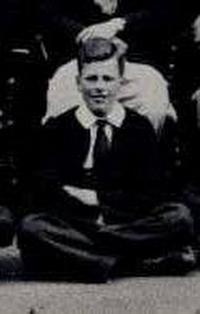
Patrick Leigh Fermor at school, Kings' Canterbury

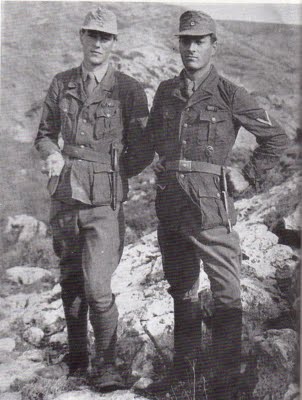
Patrick Leigh Fermor and Billy Moss

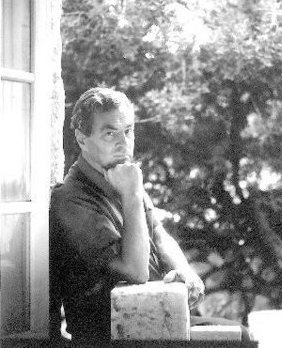
Patrick Leigh Fermor at home on the Mani

Angéla and Paddy’s visit to Cluj-Napoca

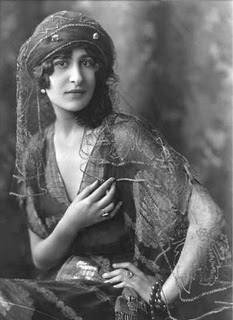
Balasha Cantacuzene

In response to requests from many of the citizens of Cluj who inhabit the pages of I Love Cluj on Facebook, I have scanned the pages which recount the story of Paddy and Angéla’s 1934 visit to Cluj in full.

This is taken from “Between the Woods and the Water”, the second volume of Patrick Leigh Fermor’s journey from London to Constantinople which commenced in December 1933 and ended with his arrival in Constantinople on New Year’s Day 1935. His time in Romania captures the beauty of the landscape, and the friendliness of the people be they aristocrat or peasant. It describes a time that would be lost forever due to the Second World War, which Paddy later described in an article for the Daily Telegraph as “Travels in a Land before Darkness Fell”.

His own extended sojourn in Romania was at Belani in Moldavia with the first love of his life, a young painter and Byzantine princess, Balasha Cantacuzene, whose family Paddy describes as part of an “old-fashioned, French-speaking, Tolstoyan, land-owning world. They were intensely civilised people.”

You can find pdfs of the story of the Cluj visit as follows (Cluj part starts page 143 but 142 gives you an introduction):

p142, p143, p144, p145, p146, p147 ………………. enjoy!

Related article:

Angéla, Paddy, István and Tom in Cluj-Napoca

Related category:

‘Between the Woods and the Water’

Parish Notice – Travels with Paddy forum

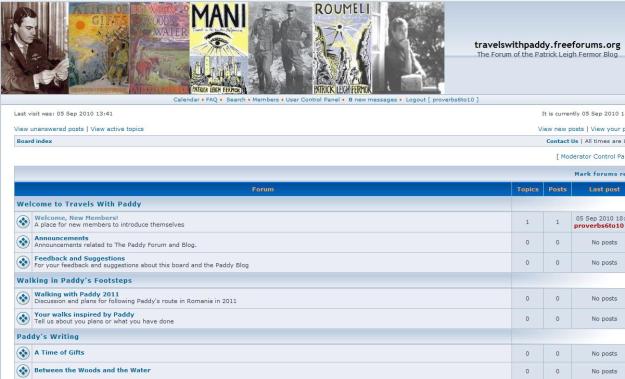
Just a reminder to you all that we now have our own discussion forum for all things related to Paddy.

If you visit the discussion board here (or click the picture) you can register (very easy and no spam) and join in current discussions or create your own topics.

There is a Welcome to New Members area where you can introduce yourself, with or without a pseudonym, and this is now growing.

The other section I would like to draw your attention to is a discussion about walking Paddy’s route in Romania in 2011. It looks like there may be interest in doing something as a group. Go on; have your say!

Some forums have been set up to start us off but you can add your own at any time; just keep it vaguely relevant to Paddy.

Click on the image to go to the forum

The forum will be an important place to discuss not only Paddy and his life, work, and times, but also some pretty exciting ideas, some of which I will be announcing soon.

You will be free to create your own identity or just be yourself. Go on visit the Welcome forum and introduce yourself. I look forward to seeing you there!

Never Marry a Mitford

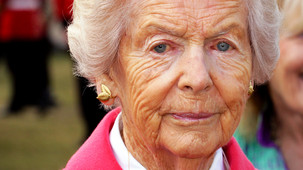
The title is taken from a sweater that Andrew Cavendish, 11th Duke of Devonshire used to wear around his Chatsworth estate in Derbyshire. However, just like us he must have been fascinated by the Mitford sisters. In this lengthy article entitled Elvis, Chatsworth, JFK and me, Deborah Cavendish, The Dowager Duchess of Devonshire, and the last of the Mitford sisters, talks about her extraordinary life.

By Jessamy Calkin

First published in the Telegraph 12 Sep 2010

The Dowager Duchess of Devonshire Photo: Emma Hardy/East Photographic

If you give the Dowager Duchess of Devonshire a fiver, she’ll show you round her house, an old vicarage in Edensor, Derbyshire. It would be tempting to think that she pocketed the money, but it goes towards the church roof fund. The occasion is the annual village fete.

‘It’s true,’ she says mildly. ‘What people love is the shoe cupboards and the lavatories and all that. And sometimes they say, “You’re very brave to do this,” and I say, “You’re very brave to come,” because there’s always a queue. So funny.’

Debo, as everyone calls her, was 90 this year. Having greeted me in her pretty garden, shaking my hand and looking me directly in the eye, she leads me into the apple-green-walled and flagstone-floored hall – ‘Do put your bags down, no burglars here’ – and shows me into her sitting-room, which has an extraordinarily nice atmosphere, and we take to the floral sofa, where she positively lounges, looking at me brightly, waiting to be amused.

There have been countless books about the Mitfords, both biographical and autobiographical, and now her own memoirs, Wait for Me!, are about to be published. (She has written several books, mostly about Chatsworth, her former home.)

Debo says she was motivated to write about her life because she had offers from other people to do it for her, and she didn’t really want them ‘to fiddle about with it’. She was appalled by some of the books about her sisters – in particular David Pryce-Jones’s book about Unity, and the books about Diana, who married the fascist Oswald Mosley. ‘They are so full of inaccuracies,’ she says. ‘No one ever really got my sister Diana, and she was such an incredible person. It was always a delight for me to see somebody who was prejudiced against her sitting by her on the sofa like you and I are now and… melting, absolutely melting.’

Debo became close to Diana, who was 10 years older, only later in her life, but now, she says, ‘hardly a day goes by when I don’t say to myself, “Oh I wish I could tell Diana that, she’d laugh so much.”’

It wasn’t an easy book to write; it has taken her four years. Debo suffers from the eye condition macular degeneration and can’t read at all, but she can write; she says it’s because she knows the shape of the words. She does all of her writing in bed, early in the mornings (‘My sheets are covered in ink’) and then her assistant, Helen Marchant, reads it back to her. ‘And you feel guilty asking someone to read it back three or four times but that is what I had to do to try and get it right. Helen in her genius way can translate it into ordinary English, because I don’t know grammar and she knows grammar.’

The book is full of stirring anecdotes, such as when a wounded soldier repatriated from Italy during the war brought home a lemon. ‘Such a luxury had not been seen in the shops for a long time and it caused a minor sensation when he put it on the post office counter at Ashford-in-the-Water and charged tuppence a smell – proceeds to the Red Cross.’ Or the dinner at Calke Abbey, where lived the Harpur Crewes. ‘The dining-room table was set with candles – the only light in that high-ceilinged room, which I imagine had not been used for years. The first course was melon; it was followed by cold beef; then melon for pudding.’ Her host, Airmyne, whose best friend was a goose, then took her up to meet ‘Nanny’ who, they said, used to be the Kaiser’s nanny, a tiny, ancient creature who was fast asleep in bed. It was the strangest evening she had ever had. ‘The Harpur Crewe siblings,’ she writes, ‘were the only true eccentrics I have ever met.’

Can this be true, I ask her. I imagined her life must be full of eccentrics. ‘Well, if you don’t count all my sisters, but I never thought of them as eccentric. I suppose my father was a bit outlandish; he was the source of all jokes in our family.’

The Mitford family

The Mitfords – there were six sisters and one brother – were a defining family of their time; Debo says now that they always thought they were ordinary, but their celebrity and influence has endured. Extreme behaviour seemed to run in the family. David Freeman-Mitford (Farve), later Lord Redesdale, married Sydney Bowles (Muv) in 1904.

Their eldest child, Nancy, wrote several historical biographies and eight novels, the most famous of which, The Pursuit of Love, was, in her own words, ‘an exact portrait of my family’. There was Pam, the least well-known sister, described by John Betjeman as ‘the most rural Mitford’. There was Tom, who used to pay his sisters a shilling an hour to argue with him and went on to become a barrister, but was killed in the war in 1945.

Diana married young, then left her husband for the British Union of Fascists leader Oswald Mosley, and was put in prison for three years for her beliefs; she was also one of the few people who knew both Churchill and Hitler. There was Unity, who moved to Germany in 1934 at the age of 19 and became devoted to Hitler, whom she got to know well; her dual loyalties to the Führer and her country caused her to attempt suicide by shooting herself in the head at the outbreak of war. Continue reading

Los violines de Patrick Leigh Fermor

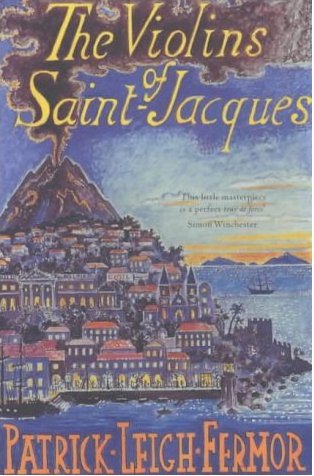
Finding online information about Paddy’s only novel (some call it a novella), The Violins of Saint-Jacques: A Tale of the Antilles, is very difficult. First published in 1953, the novel set in the Caribbean was adapted and set to music as an opera by the composer Sir Malcolm Williamson in 1966.

The typical product blurb describes the book thus:

On an Aegean island one summer, an English traveller meets an enigmatic elderly Frenchwoman. He is captivated by a painting she owns of a busy Caribbean port overlooked by a volcano, and, in time, she shares the story of her youth there in the early twentieth century. Set in the tropical luxury of the island of Saint-Jacques, hers is a tale of romantic intrigue and decadence amongst the descendents of slaves and a fading French aristocracy. But on the night of the annual Mardi Gras ball, catastrophe overwhelms the island and the world she knew came to an abrupt and haunting end. The Violins of Saint-Jacques captures the unforeseen drama of forces beyond human control. Originally published in 1953, it was immediately hailed as a rare and exotic sweep of colour across the drab monochrome of the post-war years, and it has lost nothing of its original flavour.

I have the book which is nearing the top of a pile of books to read, and when I am done I will contribute my own short review. It is not a long book and one that some readers may wish to obtain to understand more about Paddy’s writing.

I have found a recent discussion of the book on a Spanish website. For those of you who have the language the article is here. It can be translated very roughly with Google translate. Despite the wrath of some who may say I should not use such translations on the blog, I will post the final couple of paragraphs as they are so positive:

After reading the novel, it is really hard to resist the temptation to trace the footprint of the Caribbean island and going to see if, indeed, between the islands of Dominica and Guadeloupe, in the days of carnival, you can hear the sound of ‘the Violins of Saint-Jacques’, “which rises to the surface of the water, as if a ball at the bottom of the sea.”

No need to travel so far, one thing is a lot easier to contrast: the violins played by Patrick Leigh Fermor in perfect harmony and incomparable beauty. Regardless of the notes to interpret, they sound wonderful.

Why modesty is something to boast about

There have been many articles in the press these last two weeks about the service of women in the SOE prompted by the death at the age of 89 of Eileen Nearne who served as an agent in France with SOE, was captured, tortured by the Gestapo but survived the horrors of Ravensbrück concentration camp. This article by the excellent Christopher Howse who writes for the Telegraph is thought provoking; the sentiments reflect the way that Paddy and many of his colleagues have lived their lives.

Eileen Nearne: Why modesty is something to boast about

Christopher Howse wonders what happened to a generation of heroes like Eileen Nearne

First published in the Telegraph 15 Sep 2010

Eileen Nearne during WW2: a real-life Charlotte Gray; Photo: SWNS/ Rex

The astonishing life of Eileen Nearne, parachuted as an SOE officer into wartime France, horribly treated by the Gestapo and surviving Ravensbrück concentration camp by a rare providence, is one of those tales at which we can only marvel as they are recounted week by week in our Obituaries column.

But one cannot help wondering about her 65 years since the war. This heroine lived quietly, as such people do. Her sister helped her adjust to peacetime life. She trained as a nurse and ended up living in Torquay. She didn’t boast. She was no celebrity. “I liked the work,” she remarked modestly of her life-or-death undercover career. “After the war, I missed it.”

Modesty is a virtue generally noticed only in retrospect. That generation of war heroes who have been the glory of the Obituaries page since the 1980s, when Hugh Montgomery-Massingberd invented the modern narrative version of the art, spent decades of ordinariness after their exploits. They did not speak of them.

And here, there has been a most encouraging change in the past generation. In the 1960s and 1970s, the old major with the gammy leg and the whisky and water in the saloon bar was, shamefully, a figure of fun. The Angry Young Men of the 1950s gave way to the Sixties silliness that thought war would end if its most selfless survivors were mocked and shunned.

That has changed. Veterans at the Cenotaph are now regarded not as old buffers or worse, but as representatives of an unsentimental courage that stood between Britain and barbarism.

We can take these men and women seriously partly because they did not take themselves seriously. All those men nicknamed Jumbo or Buffy, sporting moustaches and a fine disrespect for bureaucracy, stormed machine-gun nests, swam rivers under fire, rescued comrades from burning tanks, disregarded their own wounds, and then came back home to Weybridge or Ormskirk for 30 years in the motor business or film distribution.

Who, the unanswerable question remains, will enliven the Obituaries page in half a century? Forgotten celebrities from the television jungle, or Big Brother? Surely not. For this new generation, celebrity skips the intermediate step of achievement. It is better to appear on television for a trivially shameful act than not to appear there at all. Today, celebrity is an enemy of promise. It is the end of the road at the cliff’s edge. Those who find fame now will in future be forgotten for attainments better not remembered.

That is not to rule out eccentricity among the preceding generation of heroes. Eccentricity does not stand as an obstacle to achievement. Take Sir Hugh Rankin, 3rd Bt. He was to become the oldest surviving member of the 1st Royal Dragoon Guards in the Sinn Fein Campaign of 1920–22 (by which time he was already broadsword champion of the British Army). But in the meantime, he had put in a year or two as a sheep-shearer in Western Australia and served as the British representative to the first all-European Muslim Congress at Geneva in 1937, before turning to Non-Theistic Theravada Buddhism in 1944, the year before he joined the Scottish Communist Party.

This did not interfere with his position as Hereditary Piper of the Clan Maclaine, nor with his multitude of recreations, such as hunting, riding bicycles to the tops of mountains, and becoming, in his own words, the only person to have crawled, alongside his wife, “under dwarf fir forest for the last mile of the most northerly known section of any Roman road in Europe, terminating opposite the end of Kirriemuir Golf Course”.

That would be something worth putting on Twitter – except, of course, that Sir Hugh wouldn’t have wanted to.

Related article:

The Telegraph obituary of Eileen Nearne

Charlotte Gray revealed: The truth behind the British heroine who died forgotten and the scars of her secret war which drove her to become a hermit

Sir Lewis Leigh Fermor

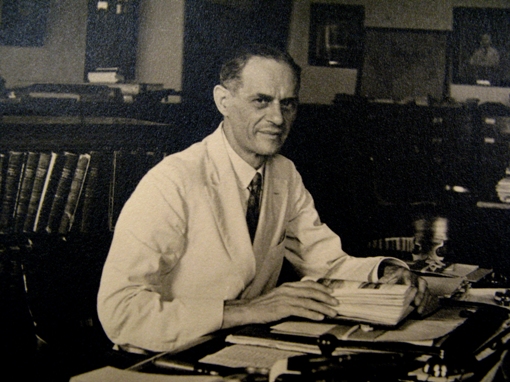
Sir Lewis is Paddy’s father. A couple of pictures from the Geological Society website.

Sir Lewis Leigh Fermor

This delicately embroidered “chain of office” was once the property of the Director of the Indian Geological Survey, Sir Lewis Leigh Fermor (pictured). It was presented to the Society by Richard Bateman, former Executive Secretary, to whom it had passed through Lady Fermor’s executor, the late Prof. Bob Savage, on her death.

Sir Lewis Leigh Fermor wikipedia page.

Related article:

Sir Lewis Leigh Fermor obituary from Proceedings of the Indian Academy of Science

Angéla, Paddy, István and Tom in Cluj-Napoca


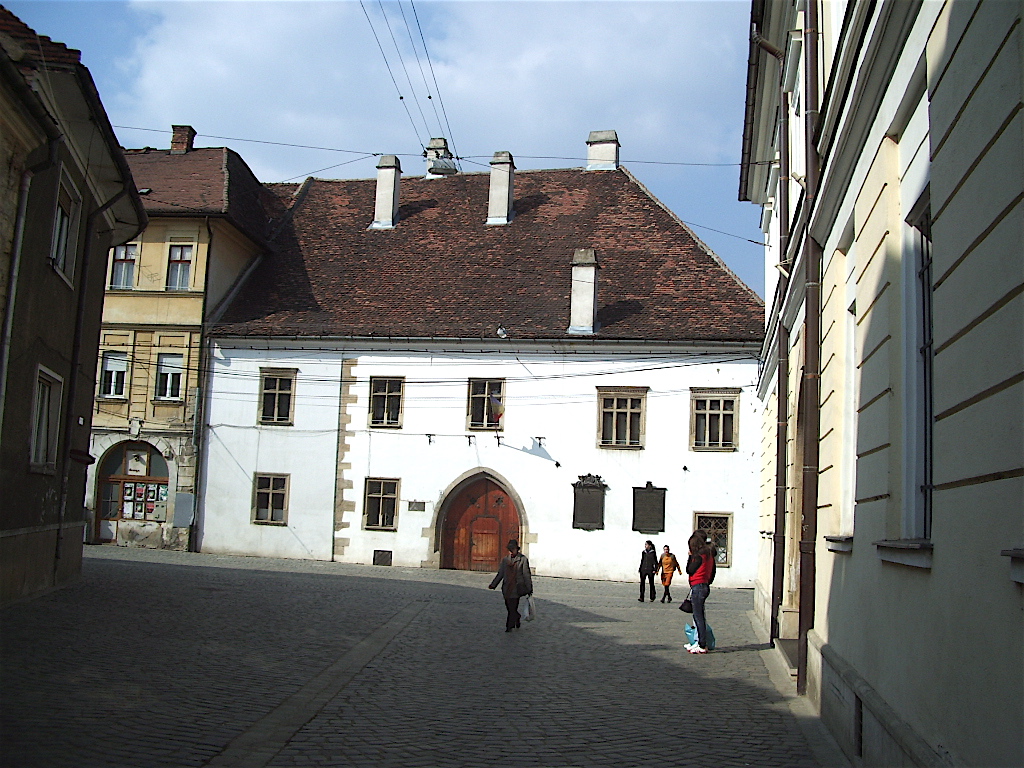
Matthias Corvin’s house Cluj-Napoca

If the lifespan of a crow can be up to thirty years, it is conceivable that the grandparents of the present day crows of Cluj observed Patrick Leigh Fermor and Angéla on their clandestine assignation to the city in 1934 when they were chauffeured by the understanding István. Their journey was a secret, but maybe the crows saw all and have passed on to their offspring the story of the young Englishman and the unhappily married Hungarian woman who was as ‘nimble as an ibex’.


As the sun set this evening I emerged from a restaurant near the Orthodox Cathedral to the sight and sound of thousands of crows flying westward at rooftop level, weaving in and out of the spires of the Cluj National Theatre. It was as if they were on some raid; they were in the stream, in squadrons of one hundred or more. I could neither see where they had come from, nor where they were going to, but this lasted for more than ten minutes and somehow it made me think of Paddy and Angéla.

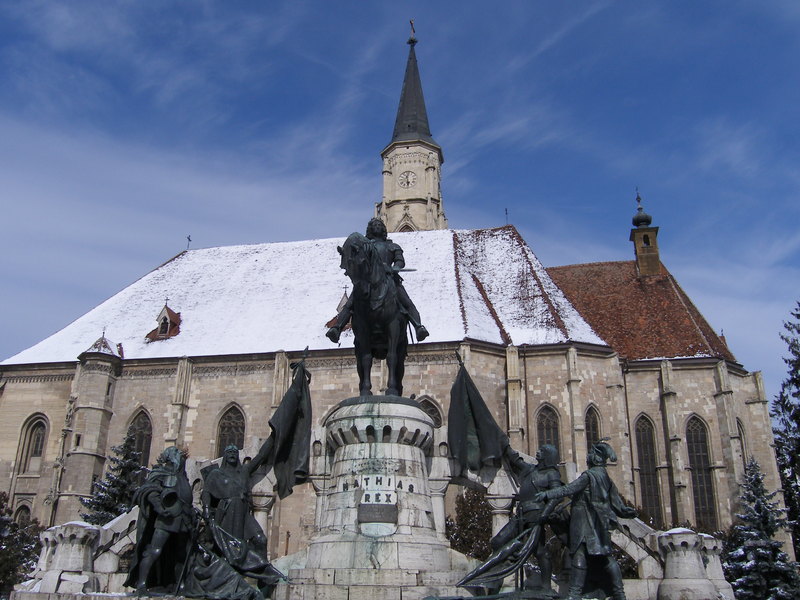
The statue of Matthias Corvin dominates the square. St Michael’s church behind.

Cluj is today a fast growing city. The centre is dominated by crumbling Austro-Hungarian Baroque buildings. One can see that in 1934, before the darkness came that engulfed Europe and Romania, the pink and yellow painted walls would have been bright and welcoming to the small party that crept into town that warm August day.

Never missing an opportunity I have followed some of Paddy’s descriptions of his short stay in the city found in ‘Between the Woods and the Water’. He said that he and Angéla took a room near the house of Matthias Corvin who is a hero to both the Hungarians and the Romanians of Transylvania. This part of the old town has substantial houses and I wonder where in those cobbled streets, near the museum, they awoke, entwined, in their ‘handsome vaulted room’ to the sound of ‘recriprocally schismatic bells’. The bells would have sounded from the Gothic Saint Michael’s church in the Matthias Corvin square. His statue, which Paddy describes as magnificent, dominates the open space.

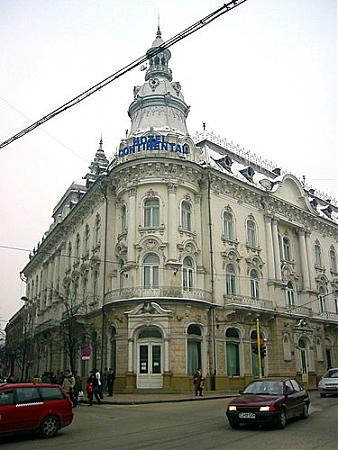
The New York/Continental Hotel

It was in a corner of this square that last night I set out on a search for the New York hotel, where the three of them had such fun and enjoyed an amazing cocktail, only surpassed, so István said, by the one called ‘Flying’ in the Vier Jahrszeiten bar in Munich. I was hoping that the secret of the cocktail had been passed down from generation to generation of barmen, but it was not to be. The hotel which is now named the Continental is closed, and the windows covered in posters proclaiming the Iron Maiden concert that took place last month to celebrate the success of the local football team, CFR-Cluj, in winning the Romanian league. It is a sad sight, but the building is nonetheless very grand with a turret on the corner facing the square and the Bánffy palace, which is now an art museum and next to the Melody nightclub with it’s huge neon sign, in the opposite corner.

So I did not get to sit in the seat of Patrick Leigh Fermor, nor drink his cocktail,  but instead walked in good company to my favourite bar in Cluj – Insomnia – and drank Ursus beer, whilst explaining to my Romanian friends Daniela and Vlad, why Patrick Leigh Fermor is the Greatest Living Englishman.

I knew Patrick Leigh Fermor through his words, and he will know me by mine

I think I am quite privileged to receive so many positive comments about the blog from people I have never met. One thing many agree upon is that Paddy has had a significant impact upon their lives. In some cases reading A Time of Gifts has been life changing, with some literally getting out there on the road and creating their own journey.

One message that really struck a chord was from Thos Henley – after the old abbreviation of Thomas I am told – who was originally from my neck of the woods in Hampshire, England, but who set off on the road two years ago and is now living what I imagine to be a bohemian life somewhere on the left bank of the Seine in Paris. He has even written and recorded some of his own songs, one which includes a reference to Paddy; it is good music and worth listening to. [Edit – I have listened to it a few times now and it really is quite good; have a listen]

Thos’ story is very moving and I asked if he would like to share it with other blog readers. He agreed so over to Thos …

Thos Henley at Paddy's door

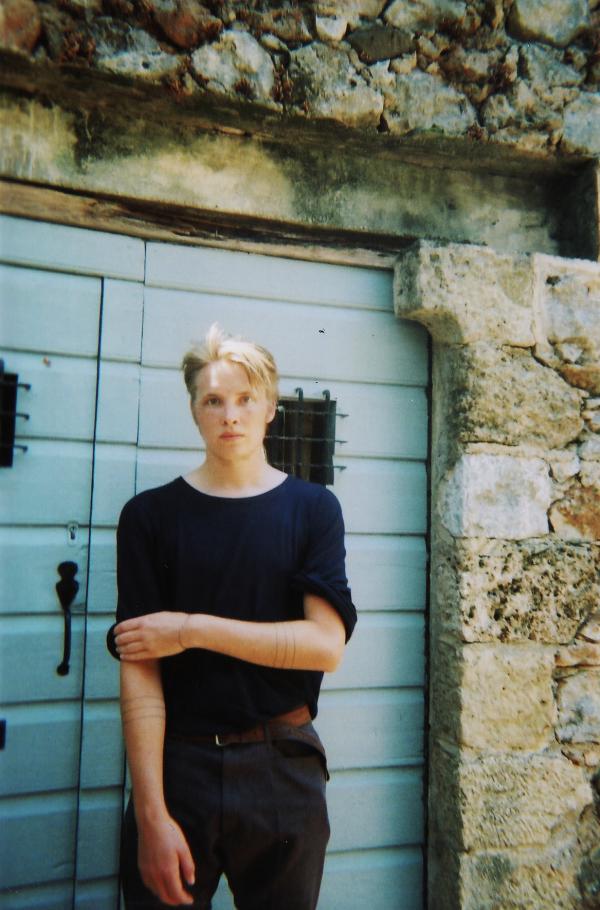
“I am a 22 year old musician and a writer from Netley Abbey, Hampshire. Around two years ago I set off the travel France. One of the reasons I did so, was because I had recently discovered Paddy’s work. After this eventful trip all around the country, I settled in Paris, which now acts as my home and I have not been back to England since. In this time I have walked around the largest lakes of Sweden, travelled the expanse of Europe, and released a record in Paris named GOLDEN EUROPE. One of the songs on the record is about my travelling companion on the trip through France. He was my Xan Fielding and in the song I reference Patrick Leigh Fermor. It is called ANOTHER BROTHER and you can find it by clicking here.

Recently, I took a trip with my girlfriend to Greece. We went to Patras and walked to the edge of the Peloponnese. Slowly moving down south we made our way to Kalamata and then Kardamyli. I became good friends with certain locals and on the third day I had a map drawn out for me, with the whereabouts to Paddy’s home.

When I got there, the soles of my shoes had withered away (an overdue happening as I had worn them out for years). I met his house-keeper who spoke a very gentle Greek-English. I was nervous and I could hear Paddy eating his lunch next door and after a few minutes of introducing myself to his assistant I learnt that he was just too old to see anyone. She explained that the emotional toll was too much for the man who had been through it all. Passion carried my persistence but in the end I started to feel like some kind of a stalker and I gave up. Leaving his incredible garden, I heard through an open window, the mumbled low tone of Sir Patrick himself, obviously inquiring about the energetic English boy who had just been at his ocean blue door.

Sitting on the wall that he had made some 20 years or so before my own birth, I began to write him a letter. I explained my story and the fact that in his words I had come to find some sense of freedom in this ever enclosing world in which we all reside. Tears and sweat dripped onto the scribbled words that, no matter how much I tried, would never portray truly what this man meant to me. I wrapped the piece of paper over and around my old Swedish compass. In the letter I had told him I left it for him, as I had no need for it now; it had guided me to his house, where I sat boiling in the Greek sun, and its job, in my eyes, was done.

I swam for hours that day, washing away the heat and the sadness of not meeting ‘my’ Byron. However after reaching my hotel, after the sun had died and the raging fire of the crickets sang in their clicking chorus, I began to see the up side of what I had done. Yes I may not have met the man, but the fact remained that I had been to his home which I wished to visit over my childhood home in England. It was his seas that I wished to swim in over any other ocean in the world and it was his door step where I wrote, what I still hold as the best piece of writing I have done to this day.

This is not an ego talking but personal victory. I can live my life here, in this rainy, grey city of lights, Paris, knowing in myself that Paddy read my words and opened the same compass that I had used for years, its red point quivering on the W. And he would go to sleep that night knowing once more that his life had indeed been the greatest life ever lived and was still just as appreciated as it had always been.

In the end I knew Patrick Leigh Fermor through his words, and he will know me by mine.”

Visit Thos’ MySpace page where there are more photographs, you can find some of his music and videos.

A Woman’s Hour special: ‘Debo’ – the Dowager Duchess of Devonshire

Woman’s Hour devoted a whole programme to an  interview with Deborah Cavendish, or as we know her ‘Debo’ – the Dowager Duchess of Devonshire in 2010.

Deborah Cavendish

You can listen to the podcast here!

Related article:

Deborah Cavendish is 90 years old and has witnessed the 20th century up close. She has met anybody who’s anybody – Churchill, Hitler, JFK. She is also the last survivor of a remarkable set of women – the Mitford sisters: Nancy, who became a writer, Jessica who became a Communist, Unity who became a Fascist – and Diana who married one. In a special edition of Woman’s Hour Jenni talks to ‘Debo’ – the Dowager Duchess of Devonshire about her life, and the times she lived through. In her autobiography ‘Wait for Me’ she also talks about her own personal challenges; her husband, the Duke, had a long battle with alcohol and three of her children died within hours of their birth. She’s also credited with helping to save one of Britain’s great country houses, Chatsworth, which is enjoyed by thousands of visitors each year.

A Review of In Tearing Haste: Letters between Deborah Devonshire and Patrick Leigh Fermor from the Spectator

Related category:

‘In Tearing Haste’ Category

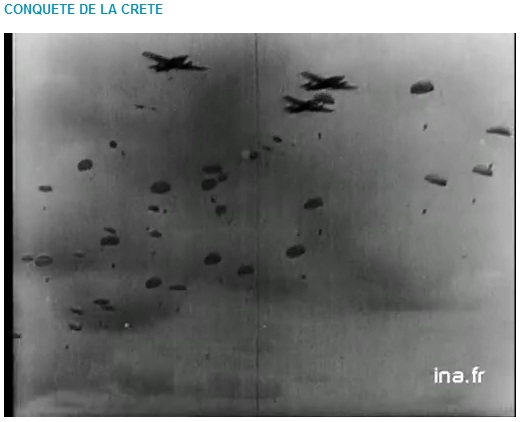
Ride of the Valkyries: The Vichy perspective on the German invasion of Crete

This is a very interesting perspective of the Nazi invasion of Crete sent to me by Marion Worsley. It is a German propaganda movie made by French Vichy government on what is called “The liberation of Crete from the occupying British Forces.” It is narrated by a Vichy collaborator. He seems to think they all did very well. However, the casualty rate amongst the German paratroops was around 50 per cent; many killed by Cretan peasants as they descended or landed. It was enough to persuade Hitler that such airborne operations should not be repeated.

For Churchill the initial surprise achieved was sufficient to persuade him that the British should create airborne forces which led eventually to the creation of the Parachute Regiment – the Red Devils.

The film starts with the musical accompaniment of  The Ride of the Valkyries. Was this what inspired Francis Ford Coppola for his Kilgore, Air Cavalry scene in Apocalypse Now?

Click the picture to play.

Alan Hare MC – Obituary from The Independent

Alan Hare was one of the SOE colleagues of Paddy who passed through Cairo and is mentioned as being an occupant of Tara.

by Richard Bassett

First published in the Independent Thursday, 13 April 1995

After a distinguished career in the service of his country first as a soldier, then in what he referred to always as the “Foreign Office so called” both during and after the Second World War, Alan Hare became chairman of the Financial Times in 1978, overseeing the paper’s all-important decision to print in Frankfurt and become “Europe’s Business Paper”.

Throughout his very varied career, Hare discharged his duties with a patrician, almost languid, charm which belied a sharp intellect and remarkable courage. During the war he was parachuted into Albania as a member of Brigadier “Trotsky” Davies’s mission. Betrayed by partisans and ambushed by the Germans, Hare only escaped after a grim chase across snow-bound mountains. Ravaged by frost-bite, he was the sole survivor of Davies’s ill-fated attempt to bring the discipline and turn-out of the parade ground to the isolated valleys of the Balkans. He remained far longer than either reason or compassion would have dictated, tending to the wounds of a fellow British officer. He was later awarded a Military Cross.

Characteristically, Hare took an optimistic line and another British officer in Special Operations Executive (SOE) found him in a half-submerged cowshed, recovering quite cheerfully, his unmistakable voice bringing back memories of Oxford dinners, tours of Burgundy and heated political discussion in London night-clubs.

Alan Hare was born in 1919, a son of the fourth Earl of Listowel, the head of an Anglo-Irish family burnt out in the troubles. Hare’s conventional education at Eton and then New College, Oxford, imparted little of the stuffiness which invested some of his contemporaries. Commissioned in the Irish Guards on the outbreak of war, he transferred as technical officer to the Life Guards. Here he derived satisfaction from the discovery that members of the Household Cavalry jumped into their unfamiliar new tanks more readily if the order shouted was “Mount” rather than a more modern command.

After his distinguished service with SOE in Albania, he found his knowledge of that country in demand. Today it is easy to forget how pertinent the eastern Mediterranean was to Britain’s interests immediately after the war. Significant colonies still existed east of Suez; Albania stood almost at Britain’s imperial jugular. The failure of the British SOE missions during the war to influence or prevent Communist regimes which took over in the Balkans directly affected British and then Nato foreign policy. In this Cold War world Hare’s knowledge was invaluable. In the Balkans and elsewhere, Hare brought his considerable intellectual gifts to bear on a range of security issues. While others developed an almost constipated approach to security, Hare mastered an opaque conversational style which a colleague at the Financial Times later, with some sense of frustration, described as “producing the most fascinating convoluted sentences, to which one had to pay close attention in order not to get lost”. Continue reading

Parish Notice – Travels With Paddy: The Blog Discussion Forum

We are in technology overload. First Twitter and now a dedicated Patrick Leigh Fermor discussion forum.

If you visit the discussion board here (or click the picture) you can register (very easy and no spam) and join in current discussions or create your own topics. I have set up some forums to start us off but I am open to your suggestions: it is your board not mine.

The forum will be an important place to discuss not only Paddy and his life, work and times, but also some pretty exciting ideas, some of which I will be announcing over the course of the next two to three weeks.

You will be free to create your own identity or just be yourself. Go on visit the Welcome forum and introduce yourself. I look forward to seeing you there!

Paddy’s eye for detail: Ian Fleming, Bondage, James Bond and Pol Roger

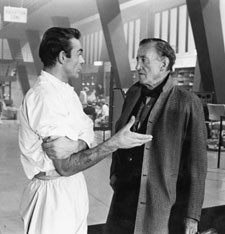
Sean Connery and Ian Fleming

As background to the Imperial War Museum’s 2008-09 exhibition For Your Eyes Only: Ian Fleming and James BondThe New York Review of Books  featured a discussion of the merits of Ian Flemings’s work by Geoffrey Wheatcroft. Entitled ‘Bondage’ it is a wide-ranging review, and for shock factor it intially does tend to focus on Fleming’s penchant for what Wheatcroft calls ‘schoolboy sexual fantasies’. One critic found Fleming’s ‘sex distasteful—male brutality and female submission, or what Bond himself called “the sweet tang of rape”—he lamented Fleming’s “vulgarity and display” and his love of luxury goods.’

Well, that all makes for good reading but two things caught my eye. First of all there is some mild criticism for the overrated Sebastian Faulks and his 2008 attempt at writing a Bond story Devil May Care; more on Mr Faulks at a later date. Not only do I not particularly rate his writing (and I doubt he cares) but he is also a critic of Paddy’s.

The second was a letter that Paddy wrote to Ian Fleming picking him up on a point about Pol Roger champagne. Fleming was probably the first proponent of what would now be called ‘brand placement‘. As anyone who has read a Bond book or seen a film cannot fail to have missed, Bond does not get by with ‘Tesco Value’ when he can obtain a top brand alternative, presumably on Her Majesty’s expenses.

Paddy and Joan were friends of the Flemings, but, along with Debo Devonshire, were particularly close to Anne Fleming, and supported her through the difficult times following Ian’s death and his failure to get his estate in order. Read In Tearing Haste for more on this.

The particular part of the NYRB article that caught my attention is below, and shows Paddy’s excellent eye for detail, which we see constantly in his own work:

“While Devil May Care is short on sex and sadism, it does begin with one unfortunate having his tongue torn out; but then Faulks’s own tongue is a little too obviously in his cheek. We get Gorner, an impossibly horrible villain, a brutal enforcer called Chagrin (nice touch), a glamorous heroine with whom James is far too diffident—and a distinctly autumnal flavour. The book is set in 1967, when Fleming not only didn’t write it but could not have written it, and 007, as he admits, is showing his age. Now and again the writing flags. Bond has been in Tehran a few days when he lunches alone on caviar and martinis, before spreading out “some maps he had bought from the hotel shop…. The country was between Turkey to the west and Afghanistan to the east. Its southern frontier was the Persian Gulf, its northern limit the Caspian Sea.” Well, yes.

There are a few other lapses which it would be tedious to list, including a tennis match that is not only implausible in itself but whose scoring goes awry. We all make mistakes, including the originator. After Fleming published On Her Majesty’s Secret Service, that worldly sophisticate was mortified to receive a magisterial rebuke from his friend Patrick Leigh Fermor: Ian surely knew that Pol Roger is the only champagne never sold in half bottles.”

You can read the full article from the NYRB here. I will publish it at some later date for the archive.

Obituary: Daphne Fielding

The obituary of Xan’s first wife of whom Paddy was very fond. She once said of him: “Do you know Paddy? He’s such a good friend. He should be turned into pills so that you can take him when you feel low.”

by Hugo Vickers

First published in the Independent Wednesday, 17 December 1997.

Daphne Winifred Louise Vivian, writer: born 11 July 1904; married 1926 Viscount Weymouth (succeeded 1946 as sixth Marquess of Bath, died 1992; two sons, and two sons and one daughter deceased; marriage dissolved 1953), 1953 Xan Fielding (died 1991; marriage dissolved 1978); died 5 December 1997.

Daphne Fielding was a society author in the decades between 1950 and 1980. Having been a part of the world of Bright Young Things in the 1920s, she was well known in society as the Marchioness of Bath, and following her marriage to Xan Fielding she produced a stream of books of easy charm which achieved great popularity. Good-looking when young, in later life she was a tall, handsome figure, and could have been mistaken for a distinguished actress.

Daphne was the daughter of the fourth Lord Vivian and his wife, Barbara, a former Gaiety Girl, who was to marry three further times. The family was eccentric; many years later, her brother the fifth Lord Vivian (who died in 1991), variously a farm labourer in Canada, a publicity manager in San Francisco and a partner of the impresario C.B. Cochran, had the misfortune to be shot in the stomach in 1954 by his mistress Mavis Wheeler, the former wife of Sir Mortimer Wheeler, the archaeologist, a drama which occupied the headlines for many days.

Daphne emerged from a childhood which was a mixture of hilarity and insecurity, later described with relish in her memoirs, Mercury Presides (though Evelyn Waugh declared these as “marred by discretion and good taste”). She passed through Queen’s College in London, and St James’s, Malvern, and gravitated, through her friends the Lygon sisters, to the stimulating world of Oxford in the 1920s, and to that set dominated by Harold Acton, Evelyn Waugh and Brian Howard. The friends she made then were friends for life, a group that gave each other unswerving loyalty despite infidelities and political differences, everlastingly self-protecting; and a group through which she met Viscount Weymouth, heir to the Marquess of Bath.

There was parental opposition to their union, Henry Weymouth’s father declaring that he needed “a steady wife” and finding that Daphne did not fit this category. Weighing in, her father announced that he thought Weymouth an unsuitable husband. They were married in secret at St Paul’s, Knightsbridge, in 1926, and then again considerably more publicly at St Martin-in-the Fields in 1927, the bride dressed by Norman Hartnell. (When eventually they were divorced, there was a prolonged court case before three judges to dissolve that earlier marriage, and regularise the unusual situation.)

Old Lord Bath in 1928 handed the running of the Wiltshire family seat, Longleat, to his son (not without certain misgivings about his capacity for work) and he and Daphne threw themselves wholeheartedly into the management of the estate. They employed Russell Page to redo the gardens and were involved in extensive forestry work. To supplement her income, Daphne wrote articles for newspapers and magazines, which brought her under the protective care of Lord Beaverbrook.

They had four sons and a daughter. The eldest boy died in 1930, just before his first birthday, and the youngest, Lord Valentine Thynne, died after hanging himself in 1979. Her daughter Caroline predeceased her, and she is survived by two sons, the present Marquess and his brother, Lord Christopher, who are on notoriously bad terms. (There was a rumour that at Lord Christopher’s wedding to Antonia Palmer in 1968 the cake was laced with LSD. The Queen was a guest.)

Henry Weymouth spent much of the Second World War as a prisoner of the Germans, which did not help the marriage. In 1946 he succeeded his father as Marquess of Bath. Forced by crippling death duties he opened Longleat to the public in 1949, with an entrance fee of half a crown a head. By 1953 he had added a tearoom and tennis court, laid out a putting green, and floated pedalos for hire on the lake. But the marriage was over and the Baths were divorced in May 1953.

Daphne wrote the first guidebook to Longleat, a lively history of the Thynne family from 1566 to 1949, which she researched and wrote in three weeks. This she followed with Before the Sunset Fades (1953), a slim 30- page book about life above and below stairs at Long- leat, decorated, appropriately, by her old friend and Wiltshire neighbour Cecil Beaton.

In 1953 she married the war hero and travel writer Xan Fielding, a man 14 years her junior, a happy marriage which lasted until 1978. During these years they lived variously in Cornwall, Morocco, Portugal and Uzes, where they settled for some years, surrounded by a variety of pets and visited by their many friends.

While married to Fielding, she wrote her books Mercury Presides (1954) and its sequel, The Nearest Way Home (1970), and a novel, The Adonis Garden (1961), of which Evelyn Waugh wrote that she had “squandered six books in one”, adding, “You have used almost everything that has happened in the last twelve years.”

The Duchess of Jermyn Street, a life of Rosa Lewis of the Cavendish Hotel subsequently serialised on television, was to have been written with the help of George Kinnaird (a writer who also used to help Baroness de Stoekl with her books), but he gave up while going through a divorce. It was published in 1964 and Evelyn Waugh described it as “jolly good but I think full of inaccuracies”.

She wrote a joint life of Lady Cunard and her daughter Nancy, Emerald and Nancy (1968), which her friend Dirk Bogarde judged “light on the intellect”, fearing that Fielding had whitewashed these two monsters on the grounds that “she couldn’t be beastly to chums”; and a portrait of Iris Tree, The Rainbow Picnic (1974).

Raleigh Trevelyan, of Hamish Hamilton, then commissioned her to write a life of Gladys Deacon, the 93-year-old Duchess of Marlborough, whom he had come across while researching his book about the Whitakers of Sicily, Princes Under the Volcano (1972). This was not her usual milieu, since the duchess belonged to the belle epoque and intellectual world of Paris of a generation older than Daphne Fielding. Nevertheless she was able to tap her wide circle of loyal friends for anecdotes. To her surprise a man wrongly described as “a young intellectual” proved to have embarked on the same research. However, her friends closed ranks around her, and a word from Lady Diana Cooper to her biographer, Philip Ziegler, caused him to drop the rival’s incipient Collins contract like a hot potato.

I know this, for I was that rival. Both books were in due course published, hers under the title The Face on the Sphinx (1978). But the story had a happy ending, for those same friends helped me with my life of Cecil Beaton, and Diana Cooper, in her more usual role as peacemaker, effected a successful rapprochement between us. I enjoyed a number of meetings with Daphne in New York in 1981, during which she chatted amicably about our experiences and regaled me with Cecil Beaton stories. I always remember her line about Patrick Leigh Fermor: “Do you know Paddy? He’s such a good friend. He should be turned into pills so that you can take him when you feel low.”

Her friend Robert Heber-Percy averred that Daphne Fielding was a better conversationalist and letter-writer than author of books.

In 1978 Xan Fielding left Daphne for a lady described by her friends as “an older woman”. Bereft but brave, she was lucky to meet once more an old Oxford friend, Ben Kittridge, an American millionaire, with whom she went to live in Arizona until his death in 1981. Thereafter she returned to England and settled in the Old Laundry in the shadow of Badminton, where for two years the fox-hunting 10th Duke of Beaufort (“Master”) lived on, and where, until her death from cancer in 1995, her daughter Caroline lived as the next Duchess of Beaufort.

Daphne Fielding’s last years were spent there. At the famous Horse Trials she could be seen driving about in a tiny self- propelled vehicle and every Sunday she lunched with her son-in-law, where she was a by no means unnoticed figure at the table.

Related article:

Xan Fielding Obituary

To print this article or create a pdf do the following:

1. Copy the url of the article from your browser above

2. Click on the Print Friendly button below – you will be taken to the Print Friendly page

3. Paste your url into box that appears and hey presto you will get a previewed page to print or pdf!

Print

We are now on Twitter


I am not sure what Paddy would say but we are now on Twitter so if you follow proverbs6to10 you can receive a tweet every time a new post is added. It is also a quick way of catching up on past posts when on the move. I hope it is useful and I hope it works!

Don’t forget your pith helmet by Mary Beard

An interesting, if somewhat lengthy, review of Mani and Roumeli by Mary Beard in the London Review of Books from 2005. She contrasts the advice and style of Victorian travel books and guides with the modern. Mary Beard is also a noted classicist and her views are always worth a read.

First published in the London Review of Books 18 August 2005.

‘In the language and manners of every Greek sailor and peasant the classical scholar will constantly recognise phrases and customs familiar to him in the literature of Ancient Hellas.’ So the anxious tourist was reassured in the preface to the 1854 edition of Murray’s Handbook for Travellers in Greece. The message was simple: on a Greek boat you will find yourself back with Odysseus (‘the nautical contrivances and tactics of the ancients may be observed in daily use … the Greek seas are still as fickle as ever’); in a country cottage you will find yourself entertained by someone who could pass for Homer’s swineherd Eumaeus. ‘Even the ferocious attacks of vermin, which soon find out an Englishman, are exactly described in the graphic accounts given by Aristophanes of similar sufferings in Greek houses of old.’

Recapturing this world of antiquity was not, of course, without its hazards and difficulties, and the Handbook tried to demonstrate its own indispensability with some very lurid warnings about what could happen to the traveller who ventured to Greece unprepared. Health, indeed survival, was top of the agenda. ‘The abundance of fruit is a temptation to foreigners,’ it warned, ‘but nothing is more pernicious, or more likely to lead to fatal consequences.’ Protection against the Aristophanic vermin could be achieved only by means of a cheap but enormously complicated mosquito net whose daily assembling must have defeated all but the most obsessive and dexterous: ‘I have found that the best mode of entering it is to keep the opening in the middle of the mattress, and, standing in it, draw the bag entrance over my head.’ The problems of travel came a close second. Was it worth taking an English saddle? On balance yes, since they were so much more comfortable, but they did tend to injure the backs of the animals, given ‘the wretched condition’ of Greek horses. English servants, on the other hand, were better left at home, or if not at home, then in Corfu: ‘They are usually but little disposed to adapt themselves to strange customs, have no facility in acquiring foreign languages, and’ – revealing the characteristic blindness of the elite to the habitual discomforts of the working class – ‘are more annoyed by hardships and rough living than their masters.’ It was far more ‘agreeable and advantageous’ to hire a local, so long as no antiquarian knowledge was expected, let alone trusted if offered. For that, (hand)books were the thing. Continue reading

The mystery of The Black Sea Cave

It seems that summer is the time that Paddy’s fans stir themselves to try and find locations associated with his travels. We have had my recent ‘On the Same Steps’ article about the Hofbrauhaus; excerpts from the New York Times frugal traveller following part of the ATOG route; the OPRIG GAGINONANUS challenge; and now the submission of Jean-Marc Mitterer from Switzerland who has been trying to solve the conundrum of the true location of The Black Sea Cave, in the context of the challenge of understanding more about Paddy’s route on his last leg in Bulgaria in 1934.

Jean-Marc wrote to me a while back and we have exchanged a few emails since on this subject. He has read the story very closely (which is found in Words of Mercury but was originally published in Holiday Magazine in May 1965) and has been in contact with academics and others in Bulgaria to see if any more is known to try and narrow down the possible sites.

I hope as ever that someone out there somewhere will be able to comment and add to our shared knowledge about the gaps in Paddy’s life and stories. Here is what Jean-Marc has to say ….

“As you wrote, many readers of Patrick Leigh Fermor’s books imagine travelling back on the route he followed. If the first part of the trip is pretty well documented, this might turn to be a bit more challenging for the third part – Vidin, Sofia, Vitosha, Plovdiv, Veliko Turnovo, Ruse, Southern Romania, Varna, Burgas, ending in Istanbul on New Year’s Day 1935. The publication of the third volume will probably give more details but one point might remain some kind of a mystery: the cave on the Black sea where PLF spent a night in December 1934.

This striking moment of PLF’s trip is described in Words of Mercury.” (Ed: I have added some background here)

Paddy had got lost on the coast and had plunged into either sea water or a pond near the coast. It was December and he was wet through and immediately felt the cold. He was exhausted and both his bootlaces had broken. I guess he was at a real low point, far away from civilisation; wet, cold, hungry and lost. Thoughts must have passed through his mind about how he would survive the night.

“… Breathless and exhausted, I lay on a ledge until spurred on by the cold. At last, lowering my half-shod foot on to what I thought was the surface of a pool, I felt the solidity of sand and the grate of pebbles. Another pace confirmed it; I was on the shore of an inlet. Round the buttress of a cliff a little way up the beach, a faint rectangle of light, surrounded by scattered chinks, leaked astonishingly into the darkness. I crossed the pebbles and I pulled open an improvised door, uttering a last dobar vecher into the measureless cavern beyond. A dozen firelit faces looked up in surprise and consternation from their cross-legged supper, as though a sea monster or a drowned man’s ghost had come in.”

Jean-Marc continues ….

“Its location is very vague: between Varna and Burgas.

PLF tried to retrace it after the war from memory in the area around  Nesebar, but without success.

Early in 2010 Bulgarian speleologists and geography societies were asked about the existence of this place. The answers were disappointing and came with the regularity of clichés. There are well known cave areas between Kavarna and Shabla (north of Varna) and Sozopol and Tsarevo (south of Burgas). But no one knew of anything in-between.

This absence of cave is not only a mismatch with the broad location mentioned in Words of Mercury, but also with the actual situation. The north of Varna can be excluded as between 1913 and the Second World War the area up to Balchik was in Romania and not Bulgaria. The south of Burgas can also be excluded as, apparently, Paddy traveled (sadly) the last bit of his journey by train. [Ed: Is this the case?]

So this place must be between Balchik and Burgas.

Here are the actual elements we know from the article:

1. No human presence seen during his day walk except a lone Tatar fisherman.

2. A cave not very deep but big enough to have hosted more than a dozen (12) people, with room enough to perform wild dances, and to house a fishing boat, equipment, and a flock of 50 goats and up to six dogs.

3. The use of masonry elements [Ed: I believe these to have been rocks or dry stone walling. Paddy said they were interspersed with “branches, planks and flattened petrol tins stamped with Sokony-Vacuum in Cyrillic characters” – I do wonder how Paddy recalled this with his self-admitted “clumsy rudiments of” Bulgarian, his stressed physical and mental state, and the absence of his notebook]

4. The presence of a mixed Greek and Bulgarian population [either in the vicinity] or not too far away.

5. The presence of stalactites (which is a very challenging element; according to one speleologist interviewed the rocks on the coast are not suitable for these geological formations).

6. The proximity to the shoreline – remember PLF saw the light from the cave while walking along the coast. [Ed: my reading indicates that the cave was very near the shore, perhaps no more than 20-50 metres as the later descriptions indicate this and one has to ask how far the fisherman would have wished or been able to carry their boat which was seen in the cave. If any of you have carried wooden boats you will know they are very heavy; porting any great distance is unlikely.]

7. A fisherman with only one hand [with a star tattooed on the back of it.]

According to these elements, the place apparently most suitable must have been between Biala and Sveti Vlas. The area is rocky, little inhabited and the presence of a Greek population is confirmed in old maps. (for an interesting selection of maps visit this site of which perhaps the most relevant is this map)

Considering that such a place, even if it should have been destroyed since then [Ed: can you destroy a cave easily?], should have left some memories. In June 2009 locals in this region – Biala, Obzor, Bania, Emine, Elenite – were asked about the cave. Though elder people remembered many old stories (the visits of King Boris, shipwrecks before the first world war, purchasing fish at the fishermen’s settlements on the coast, etc…) nothing concerning a cave used by people or the memory of a handless fisherman (who could have lived on for a couple of decades after the visit of PLF) could be found.

This is not very encouraging… However, everyone remembered the presence of Greek people in this region and there are still a few elderly Greek people alive.

Tcheren Nos cave view

One cave was mentioned by local people, located on the Tcheren Nos. (between Biala and Shkorpilovtsi). This place is actually big arch (about 50- 80 m long), the deepest part being 15-20m above ground. There is a pond in front of it, with a little river reaching the sea. Currently it is difficult to access the place in the wood, there is no path from the shore, which is about 300- 400 m away, I was there in May 2009 and there were no stalactites or visible masonry, though the presence of black surfaces seems to indicate the presence of soot and human uses (from when ?). Considering the distance to the beach and the situation of the cave, it is difficult to imagine that this could have been the cave Paddy described. [Ed: I agree it is probably too far from the sea as per my earlier comments. However, there is always the chance that some form of change in sea level or silting up of the shoreline has increased the distance of the cave from the beach. Paddy does describe sand and shingle on the floor of the cave. From Jean-Marc’s photographs it does not appear that this exists.]

At this stage, these informal investigations reached a dead-end… Many hypothesis could be built (maybe Paddy’s memory confused some elements – like the presence of the stalactites or the dimensions of the cave) but further research would be useful.

The location of this cave is a fascinating enigma that even PLF seems not to have been able to clarify. I hope that this question will also interest you.

Maybe you would consider that this issue could be raised on your website, with the hope that people having access to the 1935 notes taken by PLF (though if this data existed, I guess they would have been used by PLF during his second visit) or having a specific knowledge about the Bulgarian coast could help. I don’t think Paddy’s work has been translated in the Balkans [Ed; He is certainly known in Romania] and his work appears to be unknown in Bulgaria.

[Ed: Towards the end of his account Paddy again confirms that the cave was near the sea “A few yards off, beyond the twelve adjacent snores, I could hear the gasp of the Black Sea.” What is also useful is an indication of the direction the cave was facing as he could see “three quarters of Orion blazed in an icy slanting lozenge.” Where does Orion lie in the late December sky when in the Balkans?]

For Marion Worsley, after OPRIG GAGINONANUS, and for you all, this is a slightly more difficult challenge; to find the cave on the Black Sea where Paddy was simultaneously saved and experienced one of his wilder, most impromptu experiences.

Perhaps the defining episode of this blog will be the re-discovery this cave?

The challenge is now out there. Truly, finding this cave will place the person that discovers it in the Patrick Leigh Fermor Pantheon. It may be a fool’s errand. Paddy may have at the same time exaggerated and been confused after the passage of time. What is not in doubt is that he spent a night in a Black Sea cave with a polyglot group of Greek fisherman and Bulgarian fisherman. What needs to be done is to find that cave. Jean-Marc has set us upon our course. Will we reach our destination?

To print this article or create a pdf do the following:

1. Copy the url of the article from your browser above

2. Click on the Print Friendly button below – you will be taken to the Print Friendly page

3. Paste your url into box that appears and hey presto you will get a previewed page to print or pdf!

Print

Colonel David Smiley: Blues officer and MC recipient

The Times’ Obituary of David Smiley. Times’ content is now subscription only so no link I am afraid. Paddy was a friend and wrote the foreward to Smiley’s book Albanian Assignment.

First published in The Times January 2009.

When Lieutenant David Smiley was ordered to Palestine with the 1st Cavalry Division in January 1940 his immediate concern was how to dispose of his private aeroplane, two racehorses and Bentley. The next five years were to bring him more exacting problems, but he completed the war as a three-times decorated lieutenant-colonel.

The Life Guards and Smiley’s regiment, the Royal Horse Guards (The Blues), each provided two squadrons to make up the 1st Household Cavalry Regiment (HCR), which, together with two other horsed cavalry regiments already in Palestine and several mobilised Yeomanry regiments, provided the 1st Cavalry Division with the capability to relieve an infantry division in Palestine for service in the Western Desert. Smiley found Palestine interesting but, seeking more active duty, he volunteered to join No 52 (Middle East) Commando under training at Geneifa, Egypt, in November 1940. Continue reading

Patrick Leigh Fermor recounts the kidnap of General Kreipe on video

Patrick Leigh Fermor recounts the kidnap of General Kreipe

Finally we have Paddy on video! A kind soul has posted the movie 11th Day on You Tube. Part seven deals with the kidnap of General Kreipe and includes a detailed explanation of the famous Mount Ida Horace moment: “Ach so, Herr Major”.

I have found all parts of the film from You Tube and have embedded them on a special new page Video.

Why not put your feet up and enjoy the whole movie which covers the brave Cretan resistance and the part that Paddy, Moss and others played in it?

But to start you off here is Patrick Leigh Fermor recounting for you the events of what we now know as Ill Met by Moonlight.

Visit the movie 11th Day site.

Related article:

Ill Met by Moonlight movie trailer

Related categories:

Il Met by Moonlight

Bruce Chatwin: letters from a fallen angel (or, A Woman Scorned)

I had no great intention to continue delving into the life and work of Bruce Chatwin, but I found the following article in this week’s London Evening Standard absolutely fascinating. The forthcoming book of letters edited by his biographer Nicholas Shakespeare, with commentary by his long suffering wife is sure to prove quite explosive.

As I have said before I don’t know much about the man, but to be frank, from what I have read I don’t see him as much of a hero as some others clearly do. However good he may have been as a writer, he was clearly incapable of any form of loyalty, and seemingly indulged himself in fulfilling his bi-sexual fantasies during his extended journeys, where he clearly had many opportunities.  As Miranda Rothschild, told his biographer: “Sexually, Bruce was a polymorphous pervert … He’s out to seduce everybody, it doesn’t matter if you are male, female, an ocelot or a tea cosy.”

He seems to have carried over this trait into his writing; he does not appear to have been particularly honest with his readers, and in the forthcoming book of letters his wife demolishes many of the myths that have grown up around Chatwin. Elizabeth Chatwin has waited a long time to put over her own point of view and it seems that she has not held back. Beware a woman scorned.

Bruce Chatwin: letters from a fallen angel

by David Sexton

First published in The Evening Standard 25.08.10

Bruce Chatwin died in hospital in Nice in January 1989, suffering from Aids, aged just 48. His last days were all the more terrible for the fact that he had never been able to admit to himself or to others the nature of his illness or his sexuality.

Creator of his own myth: Bruce Chatwin died of Aids in 1989, aged 48. He had never been able to admit to himself or to others the nature of his illness or his sexuality

For Chatwin had spent his entire life turning himself into a fantastic story, a prize rarity, a human anecdote, and it continued right until the end. He gave various delusive accounts of his illness to his friends. He told Loulou de la Falaise that he had eaten a rotten thousand-year-old egg. He told George Ortiz it had come from bat’s faeces. To his mother-in-law he wrote, on first becoming ill: “Trust me to pick up a disease never recorded among Europeans. The fungus that has attacked my bone marrow has been recorded among 10 Chinese peasants (China is presumably where I got it), a few Thais and a killer whale cast up on the shores of Arabia.”

Among those who bought in to the Chatwin myth most eagerly during his lifetime was his friend, the novelist and literary journalist Nicholas Shakespeare, who loved to repeat such exotic stories about Chatwin as that “he once wore a live python as a bow-tie” or that “he once sold all he had, including a collection of 6th-century BC marble buttocks, and painted his flat the colour of a Nubian hut”. In a tribute published the week of Chatwin’s death, Shakespeare sentimentally proclaimed: “He was so inquisitive about all aspects of life, it is easy to believe he might have stumbled on its secret. That’s probably why the gods took him early.”

It is greatly to Shakespeare’s credit that, when he came to write the authorised biography of Bruce Chatwin, published in 1999, he steadily faced up to the often disappointing truth about his hero and produced such an excellent book. He researched deeply and he did not censor what he discovered, filling in the humdrum facts that Chatwin had excluded to make a more dashing effect. Famously, Chatwin once told Paul Theroux: “I don’t believe in coming clean.” Shakespeare did it for him, posthumously. Perhaps this very truthfulness has damaged Chatwin’s mystique and standing as a writer, which depended so much upon not being thus exposed.

Introducing Under The Sun: The Letters of Bruce Chatwin, shortly to be published, Shakespeare admits that Chatwin’s reputation is not what it was and that many — such as Barry Humphries — who used to admire him, no longer do. But he defends Chatwin nonetheless, hopefully maintaining that he was “less economical with the truth than spendthrift. He tells not a half-truth but a truth and a half”.

Chatwin’s biographer and editor of his letters, Nicholas Shakespeare was a lifelong friend

Salman Rushdie, Chatwin’s most perceptive critic, puts it differently. He has argued that Chatwin’s whole style as a writer resulted from the way he so persistently avoided the truth about himself and in particular his sexuality. “That’s the creature at the perimeter prowling around. All this fantastic entertainment and language and originality and erudition and display is a kind of hedge against letting in the truth.”

The great diarist James Lees-Milne, a Gloucestershire neighbour, was clear-headed and sceptical about Chatwin too. “I have seldom met a human being who exudes so much sex appeal with so comparatively little niceness.” He called him a “fallen angel” and, after his death, remembered himself nearly going to bed with him one night. “He admitted that he would never decline to sleep with any male or female if pressed, but only once. Nonce with me.”

In his memoir City Boy, published last year, Edmund White described his turn with Chatwin, which happened the moment they met. “Bruce … instantly groped me while we were still standing just inside the door, and a few minutes later we’d shed our clothes and were still standing. We had sex in the most efficient way, we put our clothes back on, and we never repeated the experience …”

Another of Chatwin’s once-and-once-only lovers, Miranda Rothschild, told his biographer: “Sexually, Bruce was a polymorphous pervert … He’s out to seduce everybody, it doesn’t matter if you are male, female, an ocelot or a tea cosy.” The act itself distressed her. “He was lust personified. It had nothing to do with anything else … I was lacerated as if by a Bengal tiger.” Continue reading

OPRIG GAGINONANUS – a winner!

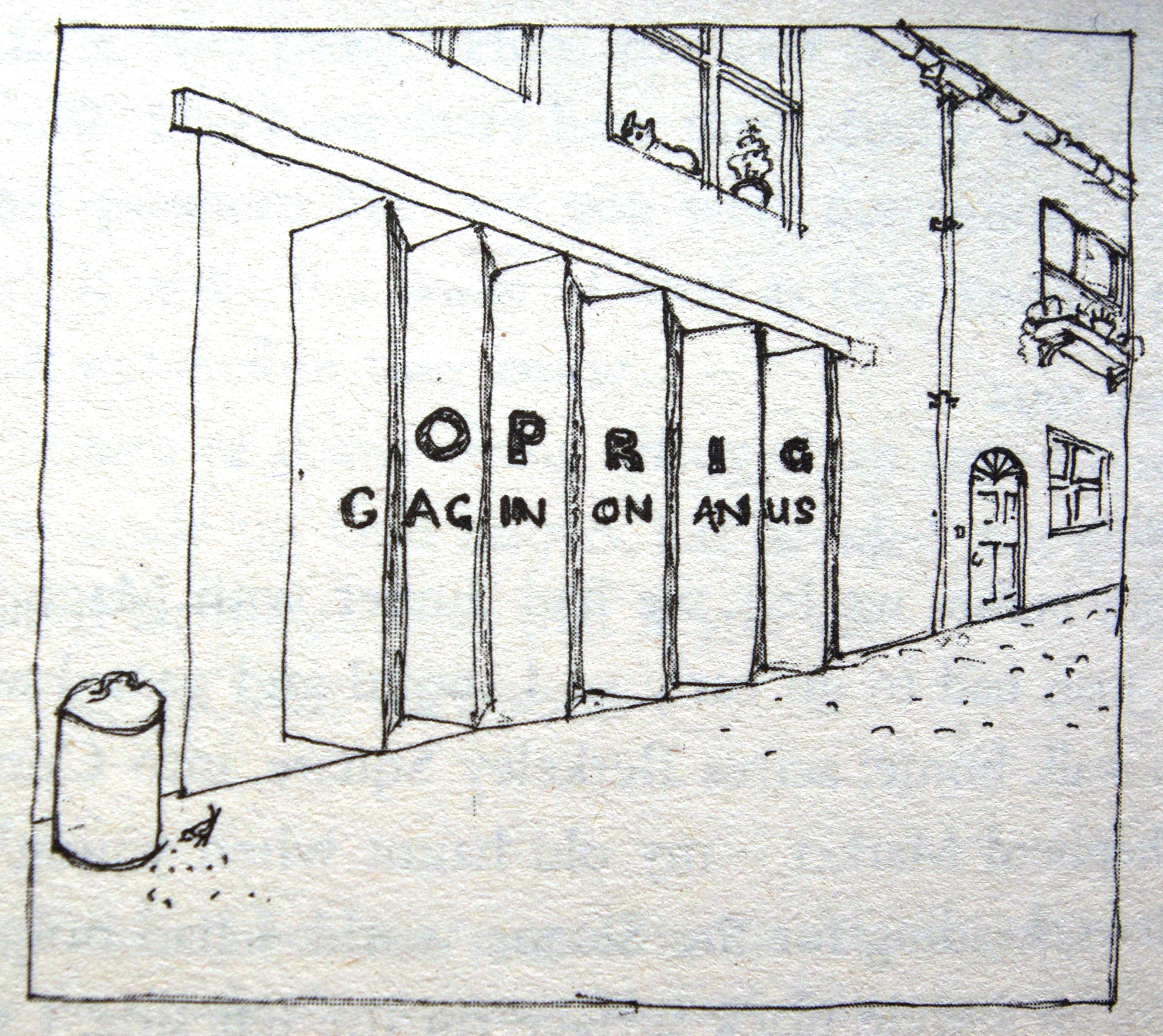
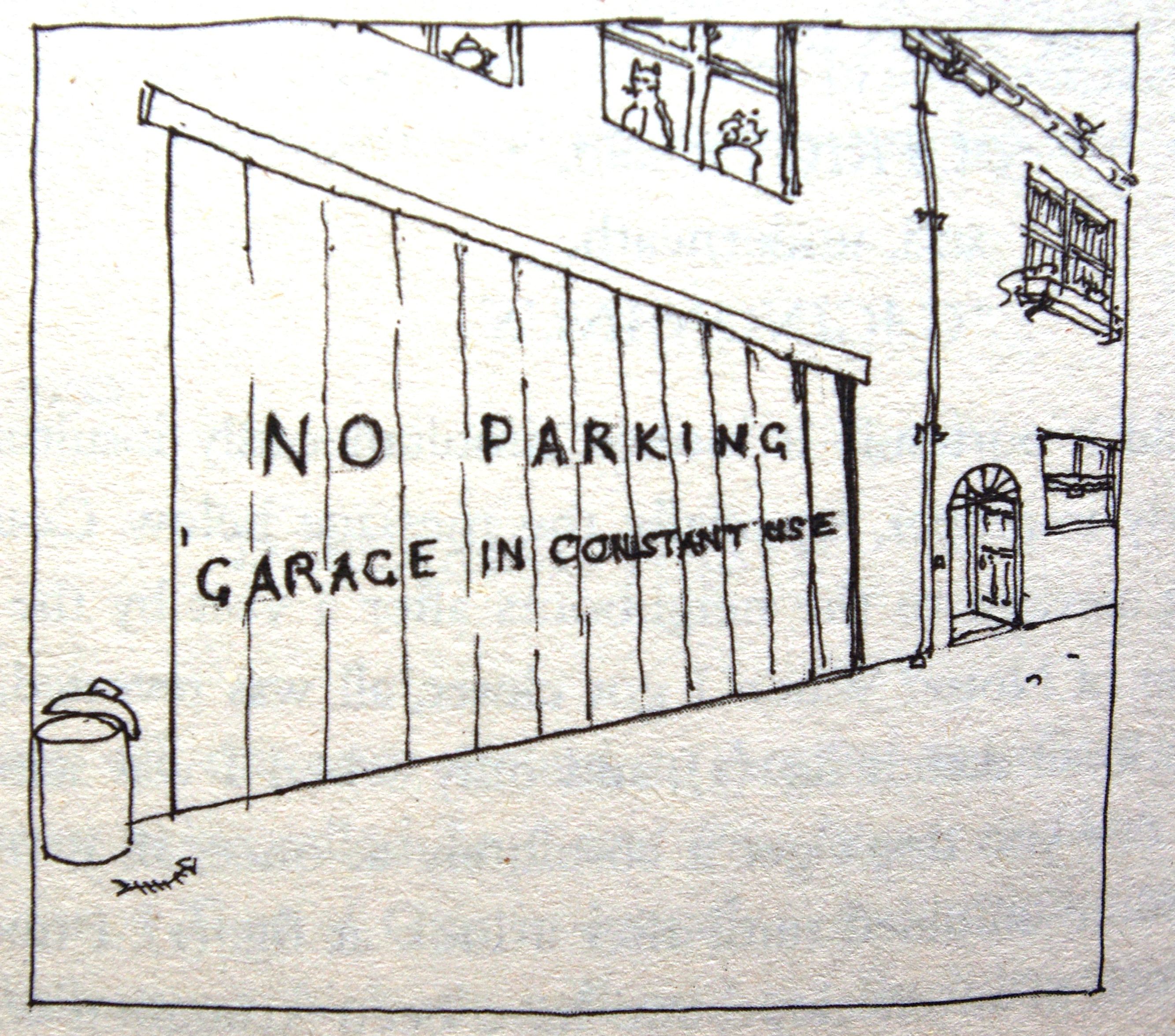
Garage in Constant Use

When the challenge to solve the mystery of OPRIG GAGINONANUS was laid down less than two weeks’ ago, I did not think we would have a winning entry within two days! Marion Worsley from Sussex emailed me from her Blackberry with an accompanying photo to tell me:

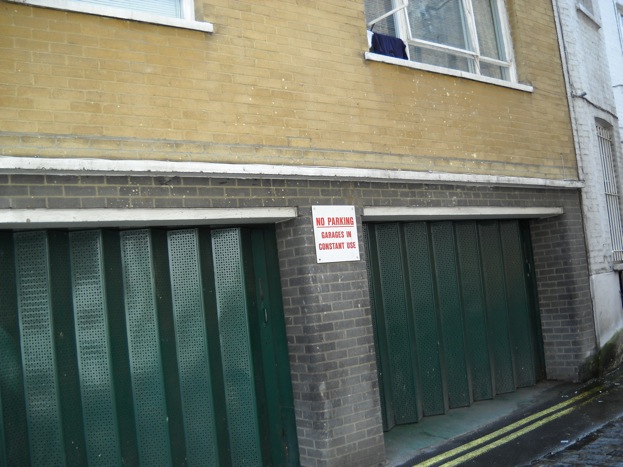
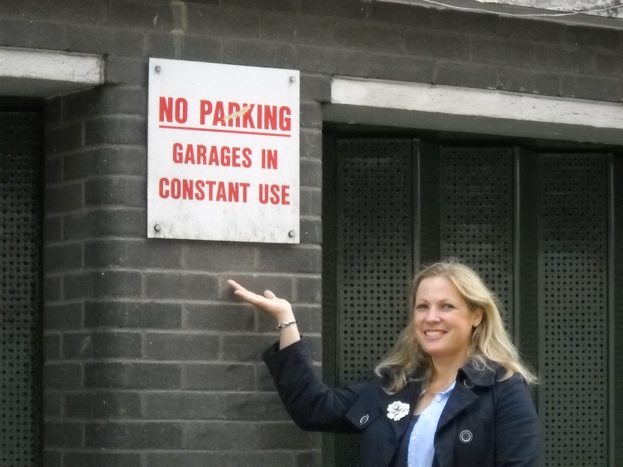
“I am standing in market mews, surrounded by garages and 10 signs to remind any fool who had not spotted the continuous double line that also every garage door is “No Parking.  Garage in Constant Use”.  This is however the only one with a concertina mechanism.  I’m afraid no cat. Could send you a picture of a blue tee shirt hanging out of the window instead? I am now going to walk away as I can see coming towards me the slightly perplexed postman who very kindly directed me to Market Mews but then went on to ask what I was looking for. I vaguely mumbled that I was looking for garage doors, smiled, thanked him and walked on. leaving hanging in the air a question mark over my sanity. I will send you more pictures this evening.

Marion Worsley

Sent from my BlackBerry® wireless device”

Winning entrant Marion Worsley in Market Mews

Remember the challenge was to try to find the location that Paddy had sketched in his letter to Debo Devonshire and if possible photograph the same combination of letters that faced Paddy in 1992. Extra marks were to be awarded for a photograph including a cat.

Later Marion mailed me with more pictures:

Hi Tom

Here are the other photos from Market Mews. Slight artistic license for the cat… but did send you a picture of the tee shirt. I got a tourist who spoke very little English to take the picture.  I think that if I had tried to explain to him why I wanted a picture of myself next to a No Parking sign, he would have been even more confused. He will no doubt go back home and tell his friends that it is true that the English are a little mad. The entire mews consists of garages. I have added pictures of a few more should you want to add them to your Garage picture Collection. For the purists, the concertina garage is between No 9 and No 11 Market Mews.

Kind Regards

Marion”

The concertina doors from a similar perspective to Paddy's OPRIG sketch

From the other angle

It is no surprise that one or two things have changed; the doors seem to have been painted over and the cat has probably passed away. However, I was so pleased that a blog reader was inclined to be more than a little crazy and take up the challenge with such style. The ‘cat’ was a piece of improvised genius.

Very well done to Marion. We are planning an official presentation ceremony ‘on location’ later in the autumn. As you can tell she is a lady with some pretty mad ideas, one of which includes the possibility of walking some of Paddy’s route on 2011. Watch this space!

(For garage door enthusiasts I have posted all of Marion’s photographs in the photo section. It is clear that we are not alone in our obsession with OPRIG. Just Google OPRIG and look at images! I have placed some of these in the photo section.)

Related article:

OPRIG GAGINONANUS

To print this article or create a pdf do the following:

1. Copy the url of the article

2. Click on the Print Friendly button below – you will be taken to the Print Friendly page

3. Paste your url into box that appears and hey presto you will get a previewed page to print or pdf!

Print

Colonel David Smiley

We have come across David Smiley before. He was one of the occupants of Tara, worked with “Billy” McLean in Albania, and it seems he rearmed and led Japanese troops against the Vietminh. There cannot be many British officers who have led Japanese soldiers! Paddy was a friend and wrote the foreward to Smiley’s 1984 book, Albanian Assignment. One has to wonder, when reading the stories of these amazing characters, whether the British could ever find such people again. I hope so.

First published in the Telegraph 9 Jan 2009.

Special forces and intelligence officer renowned for cloak-and-dagger operations behind enemy lines on many fronts.

Colonel David Smiley, who died on January 9 aged 92, was one of the most celebrated cloak-and-dagger agents of the Second World War, serving behind enemy lines in Albania, Greece, Abyssinia and Japanese-controlled eastern Thailand.

After the war he organised secret operations against the Russians and their allies in Albania and Poland, among other places. Later, as Britain’s era of domination in the Arabian peninsula drew to a close, he commanded the Sultan of Oman’s armed forces in a highly successful counter-insurgency.

After his assignment in Oman, he organised – with the British intelligence service, MI6 – royalist guerrilla resistance against a Soviet-backed Nasserite regime in Yemen. Smiley’s efforts helped force the eventual withdrawal of the Egyptians and their Soviet mentors, paved the way for the emergence of a less anti-Western Yemeni government, and confirmed his reputation as one of Britain’s leading post-war military Arabists.

In more conventional style, while commanding the Royal Horse Guards (the Blues), Smiley rode alongside the Queen as commander of her escort at the Coronation in 1953.

During the Second World War he was parachuted four times behind enemy lines. On one occasion he was obliged to escape from Albania in a rowing boat. On another mission, in Japanese-controlled eastern Thailand, he was stretchered for three days through the jungle with severe burns after a booby-trap meant for a senior Japanese officer exploded prematurely.

Though a regular soldier, Smiley was frequently seconded to MI6. As an assistant military attaché in Poland after the war, when the Soviet-controlled Communists were tightening their grip, he was beaten up and expelled as a spy, after an operation he was running had incriminated a member of the politburo.

After that he headed the British side of a secret Anglo-American venture to subvert the newly-installed Communist regime in Albania led by the ruthless Enver Hoxha. But Kim Philby, who was secretly working for the Russians, was the liaison between the British and Americans; almost all the 100 or so agents dropped by parachute or landed by boat were betrayed, and nearly all were tortured and shot. This failure haunted Smiley for the rest of his life.

Smiley’s exploits led some to suggest that he was, along with several other candidates, a model for James Bond. It was also widely mooted that John le Carré, albeit unconsciously, had taken the name of his hero from the real-life Smiley.
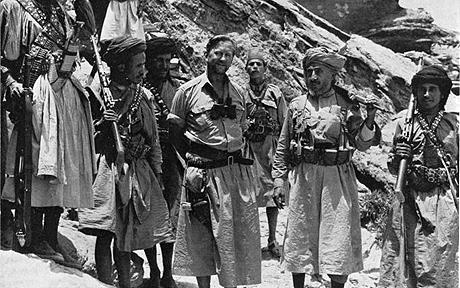
David Smiley with el Hassan and bodyguard in Yemen

Born on April 11 1916, David de Crespigny Smiley was the youngest son of Major Sir John Smiley, 2nd Bt, and Valerie, youngest daughter of Sir Claude Champion de Crespigny, 4th Bt, a noted jockey, balloonist, all-round sportsman and adventurer, also famed for his feats of derring-do.

After the Pangbourne Nautical College, where he excelled in sport, David went to Sandhurst in 1934. He served in the Blues from 1936 to 1939, based mainly at Windsor, leading the life of a debonair man-about-town, owning a Bentley and a Whitney Straight aircraft. Before the outbreak of war, he won seven races under National Hunt rules. In his first point-to-point with the Garth Hunt, he crashed into a tree, suffering serious injuries. Over the years Smiley was to break more than 80 bones, mainly as a result of sport; on two occasions he broke his skull, once in a steeplechase and once when he dived at night into an almost-empty swimming pool in Thailand.

After the war, he held the record for the most falls in one season on the Cresta Run in St Moritz; bizarrely, he represented Kenya (where he owned a farm) in the Commonwealth Winter Games of 1960.

After war broke out, the Blues sailed for Palestine, where one of Smiley’s first jobs, as a lieutenant, was to shoot his troop of 40 horses when it became clear they were of no use in modern combat. His introduction to warfare was against Vichy French forces in Syria. For his nocturnal reconnaissance work in ruins near Palmyra he was mentioned in despatches.

Later in 1940 Smiley joined the Somaliland Camel Corps, arriving at Berbera the very day it was decided to evacuate British Somaliland. Returning in frustration to Egypt, he persuaded General Wavell, a family friend, to recommend him for the newly-formed commandos, in which he became a company commander with the rank of captain. Sneaking from Sudan into Abyssinia, Smiley operated for the first of many times behind enemy (in this case Italian) lines.

In 1941 he returned to his regiment to command a squadron of armoured vehicles being sent from Palestine to raise the siege of Habbaniya, 60 miles west of Baghdad in Iraq, where the king and regent had been overthrown in a pro-German coup led by Rashid Ali. Under Colonel John Glubb, he led a charge alongside Bedouin levies in full cry (they were known to Smiley as “Glubb’s girls”, because of their long black locks). After helping to capture Baghdad, Smiley’s squadron was sent to Mosul with the task, among other things, of capturing the German ambassador, who escaped.

His squadron then moved east, to capture the Persian capital, Tehran, followed by “two weeks’ celebration with plenty of vodka, caviar and women”. After a spell in Palestine, Smiley led a Blues squadron of dummy tanks into the Western Desert pretending first to be British Crusaders and then, on a further foray, American General Grants, which were repeatedly attacked by Stukas. When Rommel broke through, they withdrew to Cairo. Three months later Smiley commanded a squadron of armoured cars at the battle of El Alamein – his last bout of conventional warfare.

After training at a school for secret agents in Haifa and taking a parachuting course with his friend David Stirling and his Special Air Service (SAS) near the Suez Canal, Smiley joined the Special Operations Executive (SOE), the organisation set up at Churchill’s instigation to “set Europe ablaze” by helping local partisans sabotage the Nazis’ infrastructure. He was parachuted with his life-long friend Neil (Billy) McLean into the mountains of Albania, then occupied by the Italians (and later by the Germans). For eight months he organised the fractious partisans in a series of ambushes and acts of sabotage (bridge demolition, sometimes by climbing under them at night while German troops were patrolling above, became a Smiley trademark). He was awarded an immediate MC. In early 1944 he was again parachuted into Albania, with McLean and Julian (later Lord) Amery, to liaise with the royalist guerrillas loyal to King Zog.
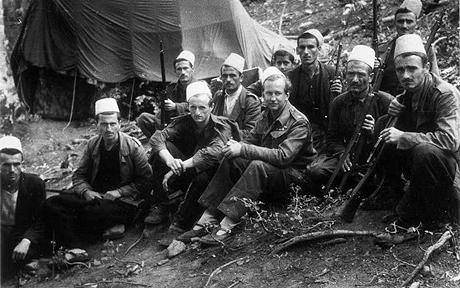
Colonel David Smiley, front 3rd right and band of Albanian fighters
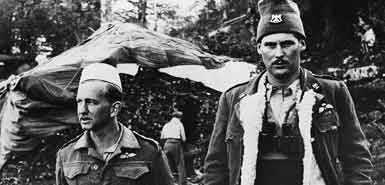
Colonel David Smiley (left) in Albania

After leaving Albania, where his activities brought Smiley a Bar to his MC, he was transferred to the Siamese section of SOE, known in the Far East as Force 136, where he liaised with guerrillas operating against the Japanese who ruled the country through a proxy government. It was then that he was injured by the premature explosion of a booby-trap meant for a Japanese officer.

After recovering in Government House in Calcutta, where he consorted with both Nehru and Gandhi, he was parachuted behind enemy lines into eastern Siam, shortly before the dropping of the atomic bombs and the surrender of Japan, whereupon he organised the liberation of several prisoner-of-war camps, including the one on which the film The Bridge on the River Kwai was based. Though only a major, he personally took the surrender of the 22nd Division of the Imperial Japanese Army.

On Lord Mountbatten’s orders, Smiley re-armed a Japanese company and led them against the Communists of the fledgling Vietminh (who later became the Vietcong) in French Indo-China. Among other exploits, he freed 120 French women and children who had been taken hostage by the Communists. The only British officer in an area the size of Wales, he then took the surrender of Vientiane, Laos’s capital, from another Japanese general. For his activities in Siam and Indo-China Smiley was awarded a military OBE.

He later ruefully noted that, at that time, the Vietminh were backed by the American OSS (the CIA’s forerunner); Smiley was wary of what he considered to be America’s naïve enthusiasm for proclaimed democrats and its hostility to the British and French empires.

After his early post-war exploits in Poland and then his efforts to roll back communism in Albania were betrayed by Philby, Smiley returned to more conventional duties in Germany and thence to command his regiment, the Blues, at Windsor.

In 1955 he was appointed military attaché in Sweden, from where he made surveillance trips with his young family along the Russian border with Finland and Norway. But the pinnacle of Smiley’s post-war career was his three-year tenure as commander of the Sultan of Muscat and Oman’s armed forces during a civil war which threatened to bring down one of Britain’s more reactionary allies in the Gulf.

By now in his early forties, Smiley ran a gruelling counter-insurgency which gradually drove the guerrillas back from the scorching plains into their mountain retreat, the 10,000ft high Jebel Akhdar, which had never been successfully assaulted. With two squadrons of the SAS under his command, Smiley planned and led a classic dawn attack on the mountain fastness, finally crushing the enemy.

After leaving Oman in 1961, Smiley was offered the command of the SAS, but chose to retire from the British Army and file occasional reports for Raymond Postgate’s Good Food Guide.

He was not able to relax for long. Within two years he had been persuaded to help bolster royalist forces in Yemen. Liaising with King Faisal of Saudi Arabia and MI6, who arranged for former SAS and other mercenaries to accompany him, Smiley made 13 trips to Yemen between 1963 and 1968.

Often disguised as a local, Smiley travelled on foot or by donkey for weeks at a time across Arabia’s most rugged terrain. He won the admiration of his colleagues, both Arab and British, for his toughness, bluntness, and shrewdness as an adviser. King Faisal, whom Smiley greatly admired, personally expressed his appreciation.

After ending his Arabian career, Smiley moved to Spain, where, for 19 years, he grew olives, carobs and almonds, and continued to advise Albania’s surviving anti-Communists, by now all in exile, before returning to live in Somerset and then Earl’s Court.

To Smiley’s delight, he was welcomed back to Albania in 1990, as the Communist regime, which had sentenced him to death in absentia, began to collapse. He forged a friendship with the country’s first post-Communist leader, Sali Berisha.

Smiley was appointed LVO, and Knight Commander of the Order of the Sword in Sweden and Grand Cordon of the Order of Skanderbeg in Albania.

In 1947 he married Moyra, daughter of Lord Francis Scott KCMG, DSO, the 6th Duke of Buccleuch’s youngest son. He is survived by his wife, two sons, a stepson and a stepdaughter.

Related articles:

One Man’s Great Game: Lieutenant Colonel “Billy” McLean

Sophie Moss Obituary from Daily Telegraph

Related category:

Other SOE Obituaries

General’s long trip home


Patrick Leigh Fermor and Moss

Patrick Leigh Fermor and Moss in German Uniform Prior to the Abduction of General Kriepe

Something interesting to add to the Ill Met by Moonlight story.

First published in the Daily Mail 19 July 2007

By Charles Legge
Question: The book Ill Met by Moonlight tells the story of the kidnapping of German General Kreipe. What became of him after he was taken to Cairo?
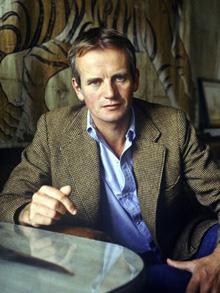
In January 1944, Cairo East section of the British Special Operations Executive (SOE) hatched a daring plot to kidnap the commander of the 22nd InfantryDivision based on Crete, General-Leutnant Friedrich-Wilhelm Muller.

The plot was led by Major Patrick Leigh Fermor, along with his second-in-command, Captain W. Stanley Moss (later author of Ill Met by Moonlight, a book made into a film of the same name), and two Greek SOE agents, all of whom arrived by sea.

General Major Kreipe succeeded Muller on March 1, 1944, but SOE elected to continue with the kidnap mission. Joining with Cretan partisans, the SOE agents studied Kreipe’s daily work habits and his travel route from his quarters at Knossos to the divisional headquarters at Ano Arkhanais.

Saying goodbye to General Kreipe

On the evening of April 26, 1944, Major Leigh Fermor and Captain Moss, dressed as German military policemen, stopped Kreipe’s staff car on a hairpin turn under the guise of a routine traffic control point. After pulling the General out of the car and throwing him into the back seat, the agents drove him to an isolated spot, where he was taken on a gruelling cross-country trek over the mountains to the southern shore of the island.

On May 14, 1944, the SOE agents and their captive German general were picked up by a British motor launch off a desolate beach near Rodakino and spirited away to Mersa Matruh, Egypt. Leigh Fermor and Moss both received the Distinguished Service Order for the operation.

Kreipe was taken to London for interrogation before being transferred to prisoner-of-war camp near Calgary in Canada. He was later returned to the UK and imprisoned at Island Farm, Special Camp 11 near Bridgend. He was twice treated for diabetes at hospital Camp 99 at Shugborough Park in Staffordshire.

On October 10, 1947, he was transferred from Camp 99 to Hamburg via Southampton aboard the El Nil. Kreipe was honourably discharged from the military in 1947 and retired to Hanover.

Kreipe flanked by surviving andartes while talking to Paddy on Greek TV

On May 7, 1972, the abduction team (minus Moss, who had died tragically in 1965) held a reunion in Greece at which Kreipe was also present. During the banquet, Leigh Fermor, in fluent Greek and German, said: ‘After 28 years, General, we apologise to you for what happened and hope you have no hard feelings.’ The white-haired general, sitting with his wife, nodded and said, ‘None; otherwise I would not be here.’ Later Kreipe and his captors appeared on the Greek This Is Your Life programme. When asked how he was treated by his abductors, Kreipe said firmly, ‘Ritterlich’ chivalrously.’ Kreipe died in Hanover in 1976 at the age of 81, Patrick ‘Paddy’ Leigh Fermor was knighted in 2004.

Related article:

Ill Met by Moonlight movie trailer

Related categories:

Ill Met by Moonlight – photographs from the book by William Stanley Moss

Ill Met by Moonlight

Bruce Chatwin’s Journey to Mount Athos

I will readily admit to knowing next to nothing about Bruce Chatwin. However, he seems to have a loyal following, has been flatteringly compared with Paddy as a writer, and of course Paddy was a friend and mentor to him. Chatwin’s ashes are scattered around a Byzantine church near to Paddy’s home in the Peloponnese.

This feature from the Telegraph last Sunday is very interesting. It focuses on Chatwin’s journey to find God and the path he was taking towards Orthodoxy  just prior to his death. Apparently he had made arrangements for his baptism on the Holy Mountain of Athos. Paddy would have been a good person to talk to about this but according to Paddy “There was never, not a word talked about God,” during his five month stay.

Paddy is mentioned a couple of times and I recommend this article to you all (note we have a blog link to a Chatwin website – see links).

Nicholas Shakespeare, the acclaimed biographer of Bruce Chatwin, follows the great travel writer on his final mysterious journey – to Mount Athos, a monastery overlooking the Aegean Sea

By Nicholas Shakespeare

First published in The Telegraph 16 Aug 2010

Bruce Chatwin

A strange osmosis takes place when you write the life of another person. After Bruce Chatwin died, his widow Elizabeth gave me the maté gourd that he had taken with him on his travels, together with its silver bombilla – the metal straw through which he sucked his addictive tea, like any Argentine farmhand. At times over the next seven years, I had the sudden deep conviction that I was absorbing the world through his perforated silver straw.

In the course of following Chatwin’s songline, I met his family and friends – some of whom became my friends. In Birmingham, I had tea with the charlady responsible for dusting the contents of his grandmother’s cabinet, including the scrap of giant sloth that had formed the genesis for In Patagonia. “It used to put the creeps up on me, an old bit of blacky, browny bristly stuff as didn’t look very nice at all… I thought it was only monkey fur.” In 1991, I drove with Elizabeth from Buenos Aires to Tierra del Fuego, to the cave on Last Hope Sound from where Chatwin’s cousin had salvaged the original hide – believed by the infant Chatwin to be a piece of brontosaurus.

In Sydney, I poked my nose into Ken’s Karate Club, a “sex on premises” venue designed in imitation of a fantasy Roman baths, with horned satyrs and concrete putti (from a garden supply shop). Near Alice Springs, I camped under the stars with the man on whom Chatwin had modelled Arkady, the protagonist of The Songlines. And so on, through 27 countries.

My biography of Chatwin was published in 1999, 10 years after he died of Aids. But in all the travels I had undertaken, there was one significant journey I overlooked.

In 1985, following his second visit to Australia, where he had picked up a mysterious illness, Chatwin was in Greece, grinding out another draft of The Songlines, when he interrupted his work to make a pilgrimage to Mount Athos. Before leaving, he wrote breezily to the Australian novelist Murray Bail: “Athos is obviously another atavistic wonder.”

Up until that moment Chatwin had not impressed friends as religious. “There was never, not a word talked about God,” says Patrick Leigh Fermor, his host in Greece, reflecting on their conversations over five months. Elizabeth was, and remains, a practising Catholic. In preparation for their wedding, Chatwin had taken religious instruction from a Jesuit in London. “Nearly became a Catholic,” he wrote in his notebook. Then, just before they were married, Elizabeth’s parish priest in New York State gave her a leaflet explaining why she should not marry a non-Catholic. “That put Bruce off forever,” says Elizabeth. Thereafter, his religious faith became subsumed in his nomadic theory: he believed that movement made religion redundant and only when people settled did they need it.

Since his illness, there were signs of a sea change. One entry in his notebooks reads: “The search for nomads is a search for God.” Another: “Religion is a technique for arriving at the moment of death at the right time.” While recuperating with Elizabeth in Nepal, his thoughts had turned to a man’s athos “in the Greek sense of abode or dwelling place – the root of all his behaviour for good or bad, his character, everything that pertained to him.” Continue reading