Category Archives: Paddy's Writing

Floral tourism: on the trail of Transylvania’s elusive crocus

Robin Lane Fox on Nemesis on an evening ride in the Carpathians, Romania © Harriet Rix

Robin Lane Fox on Nemesis on an evening ride in the Carpathians, Romania © Harriet Rix

In idyllic east European sunshine, I have been focusing on a crocus. It is not a purple or yellow-flowered hybrid, one of those Dutch fatties that city dwellers admire in spring. It is a lilac-flowered wild beauty, at home in Transylvania. Even in Romania, few realise the rare charm of its autumn flowers. It avoids main roads and towns, so I have had to ride to find it.

By Robin Lane Fox
First published in The Financial Times 17 October 2017

I recommend this sort of floral tourism. Mine was aimed at crocus banaticus, the iris-flowered crocus which has three big outer petals. I first discovered its distinctive beauty in the Bulletin of the Alpine Garden Society, that seminal influence on the prose-style of the great travel writer Norman Lewis, as he once told me in his sitting room in Essex. About 40 years later, the same crocus was discovered in the same bulletin by Harriet Rix in Devon, my indomitable companion on our ride last year into the high floral meadows of Kyrgyzstan. While we put brave faces on the mountain storms, we discovered a shared love of this crocus and pledged in mares’ milk to find it in its Romanian home. She, not I, realised that it overlaps there with Patrick Leigh Fermor’s Between The Woods and The Water, the immortal tale of his walk from London to Istanbul. In summer 1934, the 19-year-old Leigh Fermor trod above our crocus, dormant in the Transylvanian grass, while he eloped with high-spirited Angéla, one of those “times when hours are more precious than diamonds”. Between the woods and the meadows we might find gems which flowered in their wake.

The crocus is named “banaticus” from early finds in the Banat, territory that became a bitter triangular contest between Hungary, Yugoslavia and Romania, until the Treaty of Versailles divided it between the latter two in 1919. The most recent reports of the flower are further east, so we began our hunt in the Transylvanian villages founded by German-speaking Saxons. In the 12th century, the offer of land and a tax-free life lured thousands of Saxons to migrate from the area of modern Luxembourg and settle in Transylvania. They strengthened the land’s defences and vitalised its crafts and crops, terracing the hillsides and growing apples and productive vines. Between 1980 and 1990, many migrated in reverse. They were sold by Ceausescu, no friend of village life, to the Kohl government in Germany who saw them as loyal voters. Before Ceausescu’s fall, up to 250,000 Saxons returned to take up German citizenship, leaving only a rump to maintain churches, crafts and houses.

The base-camps for our adventures were Saxon houses restored since 1995 by the celebrated Mihai Eminescu trust. Its rentable properties range from double-fronted village houses to two fine manors at Richis and Malancrav with tempting libraries and rooms for up to nine guests.

We began in the Saxon heartland of Viscri whose fortified church gives a special sense of orderly Saxon life. Social ranks and the sexes were segregated in the congregation. Unmarried young men were sent up to the gallery from where they could look down on the plaited hair and hollow black headdresses of the unmarried Saxon girls. Only outside the church was contact possible, on a grassy circle that served as a dance floor. Inside, painted panels show sunflowers and lilies of the valley, “ladders to heaven” in German tradition, among roses and reflexed lilies. I thought of the red roses and “tiger lilies” that Leigh Fermor’s beloved Angéla pushed into his buttonhole at the train station as they took their sad farewell. Of crocus banaticus, there was no sign.

Crocus banaticus growing wild in the fields above Zalanpatak © Harriet Rix

Crocus banaticus growing wild in the fields above Zalanpatak © Harriet Rix

Evidence soon emerged. The main churches of the Saxon villages are Lutheran and in Brasov’s Black Cathedral, their choirs were to assemble and mark the 500th anniversary of the Reformation. As a noted soprano, Harriet was invited to join them and help with the higher notes. As a spectator with no religion, I was tagged with a wristband and allowed to watch from a front seat. While the choirs rehearsed, I researched the flower stalls of Brasov market and found two bunches of crocus banaticus on a flower-lady’s stall. She had no idea where they had been growing.

After Luther’s setting of Psalm 118, it was time to find out. Tagged by evangelicals, I set off for Copsa Mare where I met my Nemesis and fell in love. Nemesis is a 10-year-old Dutch warmblood mare, 17 hands 3, with a Czech passport. She is stabled nightly beside the tall dark Romulus who was once a gallop-on star in the film Prince Caspian. James and Rachel de Candole offer trips for up to four riders on their beautifully schooled horses, with picnics and overnight stays. Nemesis carried me smoothly past gardens of zinnias, cosmos and calendulas, flowers that I often recommend to readers here. White-flowered wild asters, another favourite, marked our ascent into beechwoods of exceptional beauty but as they also contain wild bears, we had to travel noisily. In Britain it is 12 years since I last halloaed legally for fox hounds. In Transylvania I have been halloaing to keep bears away.

In the crocus’s absence, nearby back gardens offered a big surprise instead — crops of exotic tuberose. An expert grower, Elisabeth, showed us the last tall stems of her crop before she sheltered their roots under winter covers. Tuberose is native to Mexico but it won favour with Maria Theresa, the Habsburg sovereign, and travelled east to the scent-loving Romanians. In rich acid soil, village growers water the plants that departing Saxons left in their care. They will either be gold or earth, they told Elisabeth, but she learnt the golden touch. Of the Banat crocus, however, she knew nothing.

In eastern Transylvania sightings of it are reported near villages of Hungarians, so we headed for a final hunt in Korospatak. There, horses are offered by Count Kalnoky, descendant of a great medieval line, but a sign saying “Shagya Club” marks his driveway, and at first we took it in an English sense. We reversed in haste, not realising it refers to crosses between Arab and thoroughbred horses. After an hour’s climb on brisk brown Rudi, I finally sighted our prey, lilac-blue crocus banaticus flowering leaflessly beneath beech trees.

The further we rode, the more it multiplied, always in damp semi-shade, never in open meadows. In the valley of Zalanpatak we found even thicker masses, including a rare white form, seldom in stock in any bulb-grower’s list. Spreading on the hillsides, were these crocuses natural escapees from gardens? Surely not: they have lived here for millennia, untroubled by Romans, Tatars and Turks who sacked the villages beyond.

In her superb book Peacemakers, Margaret Macmillan describes how the Banat, a “bucolic backwater”, was split between Romania and Yugoslavia in 1919. She warns that it may yet prove contentious territory. In antiquity, Philip, father of Alexander, won a great victory on what was called the Crocus Field in northern Greece. If fighting breaks out in the Banat, I now know my role. Mounted on Nemesis, I will guard the priceless crocuses in its hills.
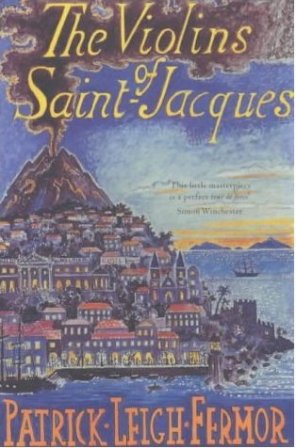
The Violins of Saint-Jacques Is a Lush Portrait of a Lost World

Click to purchase

It’s not often that we get to see anything about Paddy’s one and only novel so I thought that you might like to see this recent review by Joe Blessing. Why not take some time to take a look at some of the interesting stuff on the blog about The Violins of Saint-Jacques?

“A ball is almost a short lifetime in itself… the ball goes on and on and the incidents stand out in retrospect like a life’s milestones against a flux of time whose miniature years are measured out in dance tunes.”—Berthe de Rennes

Most parties sadly cannot live up to those words, but the tragic Mardi Gras ball in The Violins of Saint-Jacques, spoken by protagonist Berthe de Rennes, truly contains multitudes. The extravagant soiree acts as a glittering prism, reflecting all facets of the culture and curiosities of the fictional Caribbean island of Saint-Jacques (modeled on Martinique) before the island’s daunting volcano erupts and erases the island forever.

The Violins of Saint-Jacques is a slim novel of beguiling contradictions. Though taking place largely over the course of one night, it still feels broad in scope, as the reverberations of that night ring out across the length of a well-traveled life. Another contradiction is that the accomplished novel, first published in 1953 and now reissued by New York Review Books, is the only work of fiction produced in a long life of writing by Patrick Leigh Fermor. Fermor, who died in 2011, lived larger than life in a manner rarely practiced anymore. Compared by some to his friend Ian Fleming’s most famous creation, James Bond, his wartime kidnapping of a German general on Crete was so adventuresome that the great British directors Powell and Pressburger made a film of it, Ill Met By Moonlight (1957) starring Dirk Bogarde as Fermor.

But Fermor is best remembered for an even more youthful endeavor, his 1933 journey by foot across an entire continent, from Belgium to Constantinople, which he began when he was just 18 and documented decades later in a trilogy of modern classics of travel writing, beginning with A Time of Gifts in 1977. His literary reputation rests largely on those books, which both channel his youthful exuberance and also overlay it with a lifetime of erudition, allowing him to expertly pick apart the varying threads of culture he found interwoven as he traversed Europe. Readers of those books will find that the same excellent eye for detail and deep curiosity about local customs in The Violins of Saint-Jacques, which gives a truly staggering amount of cultural detail in just 140 pages.

A brief frame story set on an Aegean island (the area where Fermor lived most of his life) finds a Fermor-like Englishman meeting the mysterious but well-loved Berthe de Rennes in her twilight years. When her painting of Saint-Jacques catches his eye, he entices her to tell its story, the story of her wondrously happy childhood on the colonial outpost, and the fateful Mardi Gras night in 1902 when it all was lost.

Berthe moved from France to Saint-Jacques after losing her parents as a teen, taken in by her distant cousin, the Count de Serindan, and his family. Berthe is soon a cherished member of the family and a confidant of the witty Count. The Count is the kind of splendid character little seen outside of books, a patriarch who uses his wealth and power solely for the pleasure and amusement of those around him. On occasions like Mardi Gras, this largesse extends to the entire island and he spares no expense in hosting lavish parties the entire population looks forward to.

Berthe begins her narration on the day preceding such a ball, leading the reader through the elaborate preparations and the fierce anticipation felt by the young Serindans, especially Berthe’s closest companion, Josephine. A ball might seem a flimsy subject to some, but Fermor’s accomplishment is to see in the ball an embodiment of the island’s society and to organically provide details that cohere into a surprisingly complex portrait. Fermor gives readers the provenance of the songs played, the steps of dances, the length of the swizzle sticks, the scents of the floral decorations, the ingredients of certain drinks, and perhaps most fun, the colors and creatures on the elaborate costumes the black islanders wear as they dance through the streets.

Nor does Fermor withhold human detail, expertly sketching the prejudices and tensions between the proudly Royalist and conservative Creole aristocracy and the new governor just arrived from France with modern ideas. Berthe must leave the party when she learns her beloved Josephine is eloping with the governor’s rakish (and already married) son, leading her to a ship off the island’s coast that saves her from, but allows her to witness, the biblical destruction that wipes the site of her happy childhood off the map.

The Violins of Saint-Jacques is so engrossing and brief that its flaws are easily overlooked. Fermor’s portrayal of any colonial life as idyllic might prove offensive to some, although he takes pains to distinguish the relatively peaceful race relations on Saint-Jacques from the brutal regimes on other nearby islands. The novel has a rather 19th century, predetermined approach to character and never takes the time to delve into any complex interiority or psychology. However, this approach is perhaps fitting in a story that’s not about human agency, but rather about the futility of it in the face of inhuman, impossibly powerful forces.

Fermor was an excellent student of culture, but his own wartime experiences gave him no illusions about their fragility. Despite all readers knowing the eruption is coming (it’s on the back of the book and heavily foreshadowed), it’s still a shock at how brutally and completely it destroys everything that Fermor has just taken such care in describing. The Violins of Saint-Jacques is a charming portrait of a lost world and a potent reminder of just how quickly a culture can disappear.

Postcard from . . . Bulgaria

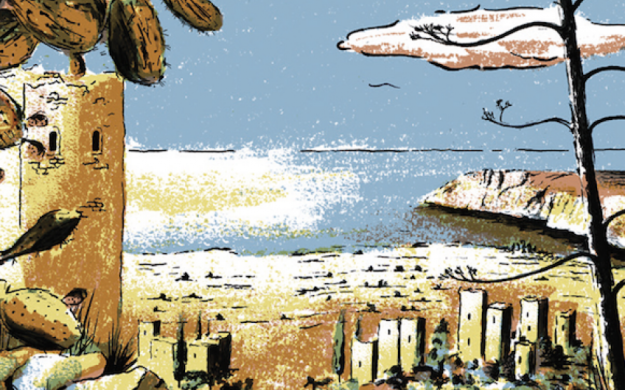
Illustration by Matthew Cook

Illustration by Matthew Cook

In a cramped office at Bulgaria’s Rila Monastery, a black-robed monk is swiping my passport. Set in a wooded valley 70 miles south of the capital Sofia, Rila is the country’s largest and oldest Orthodox Christian monastery, and a source of intense pride for Bulgarians. Travel writer Patrick Leigh Fermor stayed here in 1934 and found a place of “clattering hooves and constant arrivals and departures . . . like that of a castle in the Middle Ages.”

by Tom Allan

First published in the Financial Times

Today the clatter of hooves has been replaced by the rumbling tyres of tour buses and the monastery’s humbug-striped pillars and copper domes are one of Bulgaria’s major tourist attractions. One thing hasn’t changed: the monks still offer accommodation — there are 38 rooms available to pilgrims and non-believers alike. Stay the night and you can explore once the day trippers have departed.

The monastery was founded in the 10th century by the followers of St Ivan of Rila, a hermit who lived in a nearby mountain cave. Its library holds an important collection of medieval manuscripts and there are exceptional wood carvings, including the Cross of Rafail, which took 12 years of surgical chiselling to make, by which time its creator had lost his sight.

The surroundings are special too. The forested slopes that encircle the quadrangle are now a nature reserve with a network of hiking trails. After checking in to my room (basic but comfortable and en suite), I clump out over the cobbles and head for the summit of Dodov Vrah, a 2,597-metre peak that towers over the valley. The path ascends through a beech forest alive with cuckoos and drumming woodpeckers, eventually reaching an open landscape of tussocks, wild violets and creeping juniper bushes. This is halfway; I continue up past the tumbledown remains of shepherds’ huts to reach the snow drifts on the ridge.

From the summit I look north to the crags around the Seven Rila Lakes, then peer down to spot the red-tiled roof of the monastery, 1,500 metres below. The knee-jarring descent leaves me avoiding stairs for a week, but the river in the valley bottom provides a welcome ice bath for my feet.

No food is provided for guests, so I head to a nearby restaurant for a delicious meal of grilled local trout. A sign informs overnight visitors to return before the gates are locked at 8pm, so I gulp down my wine and rush back before curfew. With characteristic Bulgarian punctuality, the doors eventually swing shut at 9pm. Electric lights clunk on around the cloisters and the looming mountains turn a shade darker. Without the clamour of visitors’ voices, other sounds are amplified: the tinkle of the fountains, the screaming of the swifts wheeling around the courtyard, the gargled miaow of one of the monastery cats.

Church bells wake me early the next morning. I step out on to the creaking wooden veranda; overnight rain has drenched the cobbles and mist clings to the forested mountainsides. Apart from a group of doves purring and sipping from a puddle, the quadrangle is still. Inside the church, the monks have begun the morning service. They stand facing the ornate gold-plated iconostasis, a screen inlaid with icons that separates the main nave from the sanctuary, the holiest part of the church. Every so often, a robed figure appears through a door in the screen, vigorously distributing incense from a hanging censer.

After the service I speak to a monk in the reservations office, Hierodeacon Nektarii. In a soft, musical voice he tells me how he came to the monastery as a novice 10 years ago. There are just eight monks at Rila now, he says — in the 19th century there were 200. When the monastery became a national museum in 1961, the remaining monks were all moved out. “People asked: what kind of monastery has no monks? And a few years later a few of us were allowed to return.”

The gargantuan cooking utensils and 1,000-loaf bread oven displayed in the museum date from Rila’s 19th-century heyday. “On feast days the monastery attracted thousands of pilgrims,” Nektarii explains, “and we would feed them all”. Today’s operations are comparatively modest and Nektarii bakes the communion bread himself — still in a traditional ornamental mould “but we use a modern oven now”.

I pack my bags as the quadrangle begins to bustle with tourists again. As I head out past the tour groups and souvenir stands, I think about Nektarii’s description of the 19th-century monastery — a place of feasts, thronging with pilgrims — and of Leigh Fermor’s description of the carnival buzz of Rila. I feel a pang for the loss of that world but I won’t quickly forget the peace of Rila at dawn.

Details: Twin rooms at Rila Monastery cost from 50 levs (£22) and can be booked in person at the reservations office in the monastery or by phone (+359 07054 2208). For more general tourism information, see bulgariatravel.org

Painting Paddy’s Greece

Gerolimenas by Katyuli Lloyd (Source: Oldie magazine Aug 2017)

Some readers have advised me that there is an article in this month’s Oldie magazine by Katyuli Lloyd about her meeting with Paddy, and her work on the illustrations for Folio editions of Mani and Roumeli.

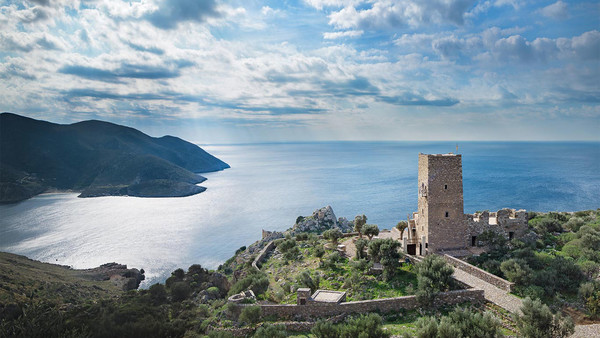
An example of her work is above and I’m pretty sure that’s Gerolimenas on the Mani, a place where I stayed on holiday last year.

You can access the article here online by subscription or if in the UK you ocan probably buy the magazine from your local newsagent.

Bicycle polo: did Paddy know he was playing an Olympic sport?

Thanks to Richard Augood who sent me this interesting little article from BBC News. Cycle polo was a demonstration sport at the 1908 London Olympics with Ireland winning the gold, beating Germany.

Many haven’t heard of bike polo but a surge in numbers could soon change that.
Bike polo players in Birmingham gather for their weekly game and have attracted the attention of many newcomers.
Major bike polo competitions are held across Europe and attracts large crowds.
An Olympic sport at the beginning of the last century, bike polo players back then competed on grass, rather than on today’s clay courts.
What do today’s players think of the sport?

Follow this link to watch a short video!

Read more on Wikipedia.

The Chiddingstone Castle literary festival

The festival season is rapidly approaching, and as a Kentish Man, I was interested in this one. Held in a very beautiful setting, the second Chiddingstone Castle literary festival runs over the first May bank holiday weekend, from Sunday, April 30 to Tuesday, May 2, with 22 authors appearing over three days.

The line-up is headed by Terry Waite. Joining him will be Artemis Cooper and Adam Sisman, discussing the life and writings of travel writer Patrick Leigh Fermor, and Radio 4 presenter of Saturday Live, Rev Richard Coles will give a reflective account of life as a parish priest and broadcaster.

Further details can be found here.

A funeral at Melk

The abbey at Melk

The abbey at Melk

Paddy described it as a “quinquireme amongst abbeys”. It is a benevolent sleeping giant above the little town of Melk and the Danube. To the east lies the Wachau, one of the most magnificent stretches of river scenery in Europe, and the eastern foothills of the Alps, to the west, Mauthausen and Bavaria. The huge and imposing Abbey at Melk continues to fascinate.

By Roslyn Jolly

First published in The Saturday Paper

This sure is a quiet town.” I’m almost whispering, unwilling to have my voice ring out in the silent streets. “Where is everybody?” It’s about seven in the evening, and as we climb the zigzag pathways to the great church on the hill, there is scarcely another soul around.

We’re going to a funeral. My friend saw the notice pinned unobtrusively to a post in the hotel bar: There will be a service at the abbey tonight for one of the monks, who has died suddenly, before his time. A popular man, a local favourite, highly regarded, sadly missed, the notice says. The community is invited to pay its respects.

We are not of the community, but we are curious, so through the dark streets and up the stone staircases we go. I haven’t yet connected the desertion of the town with the funeral at the abbey. As we approach the elegant arched entrance to the monastery precinct, we see fire engines crowding the forecourt. My friend interprets the scene better, and more quickly, than I do. I’m thinking, “A fire at the abbey? During a monk’s funeral? How very Umberto Eco.” But my friend has lived long enough in Austria to understand that not a Gothic but a civic explanation is required.

The people of Melk and all the parishes of the surrounding Wachau district have turned out in force, in uniform, through whatever structure of collective identity they can call upon, to mark the passing of their brother. Every club, team, order, guild, society, brotherhood, sisterhood, Bund, Verein and Gesellschaft is here. Not just represented here, but actually here, in body, en masse. Every fireman, policeman and Boy Scout wears his uniform; every teacher, nurse and union official is badged. The farmers are here, and so are the municipal councillors from nearby villages. Their gleaming trucks, cars and engines, freshly washed and highly polished, identify the various communities, trades and professions to which these people are clearly proud to belong.


This is the guard of honour outside the church. We walk through it. At the church door, uniformed officials keep watch. I would have turned away, but my friend is unabashed. His six years’ residence in Vienna probably helps. “We’re here for Brother A—’s funeral,” he says confidently, I forget whether in English or in German. The young man in his uniform scrutinises us for a second or two, then opens the door and gestures for us to proceed.

Inside there is colour, gold, incense, music, faces, voices, more gold. The Stiftskirche is a baroque jewellery box, glorious in candlelight, vibrant with song and incantation. There is only standing room. The service is already under way and, of course, being neither Austrian nor Catholic, I understand very little of what is being said or done, but experience the funeral as a dance of feeling between priests and townspeople. A modestly draped coffin is the focus for the energies of community expressed in music and liturgy, which, soaring, match the visual splendour of the scene.

Tomorrow we will come back, and we will see the abbey as the guidebooks and the travel writers promise it. We will see the palatial exterior, painted in sunny Schönbrunn yellow. We will see the beautiful rococo courtyard, with its palms and fountains, and think of it as a prettier Versailles. We will see the famous library with its ancient books, and peer into the pastel-coloured whorl of the shell-like spiral staircase. We will stand on the terrace and gaze at the lovely view of the Danube Valley. We will do all that a visitor to Melk is supposed to do, and it will be wonderful, but it will not be like this.

Patrick Leigh Fermor, in A Time of Gifts, called Melk Abbey the “high noon” of Europe, the highest point of the “high baroque style”. The prose he used to describe it is sunshiny and light-saturated. He even makes noon at Melk his hour of epiphany as well as his key metaphor: “Meridian glory surrounded us as a clock in the town struck twelve.” But I’ve fallen for Melk Abbey at night – not at midnight, the Gothic hour when romance writers find dark mysteries in conventual spaces, but at a civil hour, between seven and eight in the evening, when the river cruisers have gone back to their ships and the people of the town may come out, after work and an early dinner, to interact with the real working life of the monastic order that has existed here for more than a thousand years.

The funeral ends and we file out with the hundreds of mourners to watch the coffin carried to a vehicle that will take it to a burial ground beyond the monastery walls. My friend is troubled by the seeming severity of this custom. “But he would have served here his whole life,” he says. “Why can’t he be buried here too? It’s as if, at his death, he’s being expelled from the religious community.”

We puzzle over this and can’t really do anything with it. It feels harsh. The coffin looks very solitary as it waits to be conveyed through the gates into the darkness beyond. After the uplifted atmosphere in the church, the mood in the forecourt has become sombre, almost austere. All stand in silence, many with heads bowed. We – my friend and I – watch our unknown brother set out for the undiscovered country.

After the coffin has left, the firemen return to their trucks, the policemen to their cars. The Boy Scouts form lines and leave under the supervision of their troop leaders. We depart through the same archway by which we entered. At first we’re part of a throng, but the crowds quickly melt away. No one walks the same path as we do, the path that leads down stone stairs and through narrow alleys to the main street, where the hotels and restaurants are.

Melk will glow tomorrow in autumnal sunshine and we will see all that should be seen by a visitor to this beautiful mediaeval town. But tonight we’ve seen something different. We have interloped. We have slipped through the net that keeps tourists within the spaces designed for them. We’ve found our way to the secret life of a town. Just for an hour, we have gone to the other side.

The gravitational pull of a unique personality

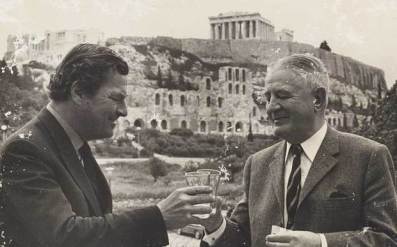
Patrick Leigh Fermor, left, met Heinrich Kreipe, his former captive, at a reunion in Greece in 1972 which included the famous Greek TV show

Patrick Leigh Fermor, left, met Heinrich Kreipe, his former captive, at a reunion in Greece in 1972 which included the famous Greek TV show

We all discovered Paddy by different routes, but if one follows the thread of certain ideas, one can often find it leads to Patrick Leigh Fermor. My own journey started with my interest in Byzantine history; the link with Constantinople and Steven Runciman being my link. It was therefore a great joy to hear from a former colleague with whom I had lost touch some years ago. Chris Wares has discovered Paddy through his interest in the work of Antony Beevor, and after finding this blog he wrote to me explaining his own Paddy journey. He has agreed to me publishing it here. How did you first encounter Paddy? Maybe you can tell us in the comments section.

by Chris Wares

Unlike probably everyone reading this I have yet to actually read any of Patrick Leigh Fermor’s books. In fact I’m ashamed to say that a year ago I hadn’t even heard of the man. But over the past twelve months I have found myself being inexorably drawn towards the man and his books. Unknowingly at first and then, after what I can only describe as a sort of literary epiphany, I realised that I was in the gravitational pull of a unique personality, a name that kept turning everywhere I looked. Gradually I came to terms with the realisation that I would be compelled to read his books.

I am sure everyone has their own story on how they became acquainted with PLF but, as I stand on the precipice of opening one of his books for the first time, I thought I would describe how I arrived at this point.

It all began about a year ago when I read Crete: The Battle and the Resistance by Antony Beevor. Beevor is one of my favourite authors and so, while not being especially interested in the war in Crete, I was confident that my investment would be rewarded. Amongst the broad sweep of battle Beevor describes the tale of a British SOE soldier who possessed a larger than life character. A man who captures a German general from under their noses and then marches him across the mountains with half the German army on his tail. It was a scintillating story but the name of the hero didn’t particularly register in my mind.

A few weeks later I read Natural Born Heroes: The Lost Secrets of Strength and Endurance by another of my favourite authors, Christopher McDougall. McDougall’s stories of long distance runners provide great inspiration for those that are needing motivation to get down to the business of training for a marathon. In the book McDougall writes of ancient Greek demigods who had discovered the secrets of endurance running. Switching to the twentieth century, he describes in reverential tones the superhuman endurance of a British soldier called Paddy who possessed the same qualities. It’s the same guy.

OK. So it’s a good tale and worth retelling but surely this was just coincidence. Sure, it’s a great yarn about the Battle of Crete and it also works as a modern day fable about god-like feats of endurance. But this was just one of those things right? The sort of tale anyone writing about Crete includes.

Then several months later I booked a romantic weekend in Brasov, Transylvania, for my wife’s birthday. A rare opportunity for us to get away without the kids and visit somewhere slightly off the beaten track. To get to know the place better I decided to do my homework and read up on Romania. These days, tied down by kids and mortgages, my wanderlust is largely restricted to armchair adventures. Travel books and histories providing an enjoyable way of vicariously travel the world.

I picked up Anthony Eales Blue River, Black Sea, a light and enjoyable read recounting his journey by bicycle and boat from the source of the Danube down to the Black Sea. Eales opens by describing how he decided to emulate the journey some guy called Patrick Leigh Fermor made in the 1930s down the Danube who also happened to kidnap a German general in Crete…. Hang on a minute? Kidnapped a German general in Crete? This can’t be the same bloke can it?

It’s at that point I turn to Google. Who was this guy? A good story can be a matter of circumstance; a combination of events that a person can just be caught up in. But appearing heroic in two separate dramas suggests a character that possesses something special. A man who “drank from a different fountain” as some might say.

I quickly found myself getting up to speed on the basics – SOE, renowned travel writer, author of three books about walking across Europe in the 1930s, the last of which was edited by Colin Thubron and Artemis Cooper. This was sounding good. I like Colin Thubron. And Artemis Cooper? That’s a name that rings a bell? Of course! – she co-wrote Paris After the Liberation: 1944 – 1949 with Beevor (which I also just read).

Another Google search and I realise that Beevor and Cooper are married and obviously share an admiration for PLF. And – just to reinforce the impression that everything was in some way joined up and connected to the man – it turns out that Cooper is the daughter of John Julius Norwich whose A History of Venice I read in August. I was beginning to get the feeling that Patrick Leigh Fermor was something special. I was in the orbit of something that deserved further investigation.

My armchair exploration of Romania continued through the Autumn and it soon felt as if all roads led to Patrick Leigh Fermor. The author Nick Thorpe talks about him in The Danube: A Journey Upriver from the Black Sea to the Black Forest while travelling along the Danube in the opposite direction to Eales. Nick Hunt follows in his footsteps in Walking the Woods and the Water: In Patrick Leigh Fermor’s Footsteps from the Hook of Holland to the Golden Horn. William Blacker quotes him extensively in Along the Enchanted Way: A Story of Love and Life in Romania (which incidentally is one of the loveliest books I have read in a long time) and Dervla Murphy contrasts 1990s Romania with his descriptions of the 1930s in Transylvania and Beyond. Georgina Harding quotes him in In Another Europe: A Journey to Romania. At times it felt as if everyone who had ever visited Romania in the past 40 years had read his books.
With his writing venerated by so many, the signs were clear that I needed to read him for myself. Here was someone who is not only considered one of the best travel writers ever but someone whose books inspired so much else that I read and enjoyed. My curiosity piqued I enthusiastically went on a bookstore spending spree and purchased all three books of the trilogy as well as his biography.

The books have sat patiently on my bedside table for some time now, but the moment of turning that first page is fast approaching. Logically the trilogy should form part of my Romanian literary journey but I have purposely set them aside and held back until the moment is right. The books may be the finalé to my Romanian odyssey but I feel as if they may also be first steps of an entirely new journey.

It’s rare to have such a sense of anticipation ahead of reading a new book. Such a build up runs the risk of the reality failing to live up to the expectation and I am nervous that perhaps I may not find his books as exquisite as I have come to imagine them to be. But on the other hand I am reassured with the knowledge that I am following in the footsteps of many others.

And now to turn that first page and follow path that is well trodden; one which all of those who are reading this will have already travelled….

Twelfth Night by Louis MacNeice

Louis MacNeice

Louis MacNeice

We all know the line “For now the time of gifts is gone” but are we familiar with the full poem? Louis MacNeice wrote Twelfth Night shortly after the end of World War 2. It is one of a group in which MacNeice records the loosening of the social bonds that bound British citizens, and the armed forces in particular, during the war.

Twelfth Night by Louis MacNeice

Snow-happy hicks of a boy’s world –
O crunch of bull’s-eyes in the mouth,
O crunch of frost beneath the foot –
If time would only remain furled
In white, and thaw were not for certain
And snow would but stay put, stay put!

When the pillar-box wore a white bonnet –
O harmony of roof and hedge,
O parity of sight and thought –
And each flake had your number on it
And lives were round for not a number
But equalled nought, but equalled nought!

But now the sphinx must change her shape –
O track that reappears through slush,
O broken riddle, burst grenade –
And lives must be pulled out like tape
To measure something not themselves,
Things not given but made, but made.

For now the time of gifts is gone –
O boys that grow, O snows that melt,
O bathos that the years must fill –
Here is dull earth to build upon
Undecorated; we have reached
Twelfth Night or what you will … you will.

Kennt ihr das Land in deutschen Gauen

One of my favourite posts from 2011. I thought I would share this one more time at this Christmas time. A Merry Christmas to you all and I wish you a peaceful 2017. Thank you for supporting the blog during the course of another year. Please keep sending in your contributions and comments; they keep it lively …

I guess that many of us enjoy the chapter in A Time of Gifts when the eighteen year old Paddy spent two nights in Stuttgart with two very pretty nineteen year old German girls, Lise and Annie. It was Epiphany, 6th January 1934, and they went to a party where Paddy had to pretend to be Mr Brown, a family friend. He particularly enjoyed singing a song about the Neckar Valley and Swabia. Paddy could not remember all the words but his stunning memory recalled most of them (page 66).

As we approach that time of year I thought we ought to share this delightful song.

Here is a link to the music sung by a German choir (it should download the file to your computer which is harmless and does still work). The words are below so that you too can sing along! Let’s hear it now, one two three ….

  1. Kennt ihr das Land in deutschen Gauen,
    Das schönste dort am Neckarstrand?
    Die grünen Rebenhügel schauen
    Ins Tal von hoher Felsenwand.

Refrain:
Es ist das Land, das mich gebar,
Wo meiner Väter Wiege stand,
Drum sing’ ich heut’ und immerdar:
Das schöne Schwaben ist mein Heimatland!

2. Kennt ihr das Land in deutschen Gauen,
Mit Wald und Flur so reich bekränzt,
Wo auf den weiten, reichen Auen
Im Sonnenschein die Ähre glänzt?
Es ist das Land, . . . . .

3. Kennt ihr das Land in deutschen Gauen,
Wo Tann’ und Efeu immer grün,
Wo starke Männer, edle Frauen
In deutscher Kraft und Sitte blühn?
Es ist das Land, . . . . .4. Kennt ihr das Land im deutschen Süden,
So oft bewährt in Kampf und Streit,
Dem zwischen seiner Wälder Frieden
So frisch die deutsche Kraft gedeiht? Ja, wackre Deutsche laßt uns sein!
Drauf reichet euch die deutsche Hand;
Denn Schwabenland ist’s nicht allein:
Das ganze Deutschland ist mein Heimatland!

A lifelong search for erotic, alcoholic, intellectual and courageous diversion

Paddy at Baleni, Romania 1938

Paddy at Baleni, Romania 1938

Alerted to this by blog correspondent Brent McCunn, he asks “How can one, considering age, standing, and a lower consumption of booze incorporate this quote into ones mission statement? …he was on a lifelong search for erotic, alcoholic, intellectual and courageous diversion..

By Harry Mount

First published in the Literary Review

Anthony Powell said that John Betjeman had ‘a whim of iron’. To judge by these compulsive letters, Patrick Leigh Fermor had a pleasure-loving streak of purest titanium. From the first letter, written in 1940, soon after he joined the Irish Guards, until the last in 2010, sent when he was ninety-four, he was on a lifelong search for erotic, alcoholic, intellectual and courageous diversion. One moment he’s in Crete, meeting the partisans who helped him kidnap the Nazi general Heinrich Kreipe, his most dashing escapade. The next he’s at Chatsworth, sitting next to Camilla Parker Bowles – ‘immensely nice, non-show-off, full of charm and very funny’.

In between, it’s back to the Mani peninsula and the enchanting seaside home he and his wife, Joan, built in the mid-1960s. It was only there, in Greece, and then, in his fifties, that Leigh Fermor had a real adult home and reined in the wanderlust – and the lust. Until then, he’d continued the manic travels that began with his walk as a teenager across Europe in the 1930s. In the letters we follow him as he flits from borrowed Italian castello to French abbey to Irish castle, taking the edge off his ‘high-level cadging’ by making jokes about it. In 1949, he wrote to Joan: ‘Darling, look out for some hospitable Duca or Marchesa with a vast castle, and try and get off with him, so that he could have us both to stay.’

Leigh Fermor was less in search of luxury than entertainment. A 1954 letter to Ann Fleming skewers the super-rich aboard Stavros Niarchos’s gin palace: ‘it’s pretty good hell aboard: no sort of connecting link between all the guests, disjointed conversation, heavy banter, sumptuous but straggling meals at all hours … Why the hell don’t they have more fun with their money?’ After each of his gilded weekends, there arrives the perfectly weighted and amusing thank-you letter for the relevant duchess or Schloss-proprietor. For those in search of the model of the perfect bread-and-butter letter, look no further.

Reading these letters is like gobbling down a tray of exotically filled chocolates, with no horrible orange creams to put you off. What prevents Leigh Fermor’s eternal pleasure hunt from getting a bit sickly are two things: the undeniable bravery – and seriousness – of his war record, and his intellect. Unlike most playboys, he was an addicted reader of high-minded obscurities, among them John of Ruusbroec, a 14th-century Flemish mystic, and St Angela of Foligno, a 13th-century founder of a religious order. Hardly light holiday reading. His literary gifts were considerable and are on display in a pitch-perfect Betjeman pastiche from 1954, reprinted here: ‘Beadles and bell ropes! Pulpits and pews! … And patum peperium under the yews!’ Moreover, Leigh Fermor’s appetite for socialising extended beyond dukes and Cretan war heroes. In a coffee house in Macedonia, his interest in other people and countries is so great that he recognises all the languages being spoken: Greek, Pontian, Turkish, Bulgarian, Romanian, Ladino, Russian, Georgian and Gheg, an Albanian dialect.

Unlike most writers – a narcissistic bunch, largely – Leigh Fermor had a longing to amuse. His letters are illustrated with little drawings of maps, castles and his half-built Mani house. The letters explain what propelled this desire: ‘whorish anxieties about being liked’. Underneath the titanium, pleasure-seeking exterior and the intellect lay melancholy, sparked by the failure to complete books on time – or at all, in the case of the third volume of his self-styled ‘Great Trudge’ memoir of his 1930s walk. Ever self-aware, he refers to himself as ‘L’Escargot des Carpathes’, a nickname first coined by Le Monde. He acknowledges, too, the inevitable ‘inaccuracies of memory’, which meant that journeys that had taken place half a century earlier were sexed up in his travel writing.

He is also aware of the selfishness of the affairs he conducted with the knowledge of his future wife, Joan, even as she subsidised him from her private income. The letters to his mistresses include grippingly salacious, easily decoded euphemisms. When he thinks he might have given crabs to Ricki Huston, wife of the film director John, he writes of ‘the beginnings of troop-movements in the fork’. And here’s an entry for the 1959 Bad Sex Award: ‘Woke up at midday, longing for ping-pong, and sentimentally stroked the handle of your cast-down bat.’

You get the impression that, after he was kicked out of King’s, Canterbury for holding hands with a greengrocer’s daughter, Leigh Fermor never really grew up; that he started walking across Europe, aged eighteen, and never properly stopped. References to his mother – ‘so terrifying and destructive … so full of odd delusions and manias’ – might explain why.

Adam Sisman is a model editor. He is prepared to admit faults in his subject, not least the baroque style of Leigh Fermor’s books, ‘which can seem convoluted and overworked’. Not so the letters, aimed more precisely at amusing rather than dazzling their recipients, albeit with the odd bit of purple prose – ‘Their horses are caparisoned to the fetlocks.’

Leigh Fermor was charm personified. It isn’t evanescent British charm, as described by Anthony Blanche in Brideshead Revisited: ‘Charm is the great English blight. It does not exist outside these damp islands. It spots and kills anything it touches. It kills love; it kills art.’ Leigh Fermor’s charm was of a healthier, more worthwhile variety, because underneath lay intellect and, ultimately, love and art.

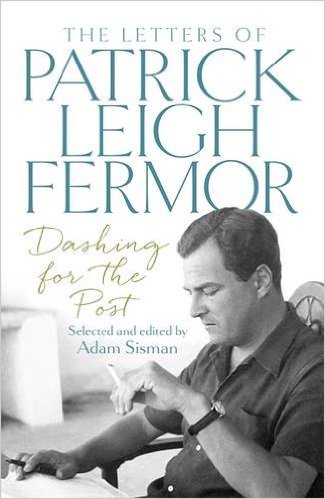
Buy Dashing for the Post: The Letters of Patrick Leigh Fermor

Event reminder: The Cretan Legacy, 26 October at 7.00 pm

If you are sorting out your diary for next week and happen to be in London on Wednesday, a good way to spend the evening may be to come along to Waterstones Piccadilly to this special event.

Our good friend, ex-Coldstream Guards officer, sometime Pilgrim, and author of In the Dolphin’s Wake and Like a Tramp, Like a Pilgrim, Harry Bucknall has been busy over the summer arranging a very special event be held at Waterstones Piccadilly on Wednesday 26th October at 7pm. The Cretan Legacy, a panel discussion, will examine the SOE abduction of General Heinrich Kreipe carried out by Paddy Leigh Fermor, Billy Moss and men of the Greek Andantes on Crete in 1943.

The panel, chaired by former Irish Guards Officer and SAS Squadron Commander, James Lowther-Pinkerton, will include Alan Ogden, SOE expert and author of Sons of Odysseus; Chris White, contributing author to Abducting a General; Rick Stroud, author of Kidnap in Crete and Dr Klaus Schmider, military historian, senior lecturer at the Dept of War Studies, RMA Sandhurst and Wehrmacht expert. With audience questions, the panel will discuss whether “this Hussar Stunt” – as Kreipe referred to his capture – was worth the undertaking in both the short and long term and assess its achievement, legacy and place in the annals of military history, endeavour and folklore.

No doubt there will be wine and a chance to chat to friends old and new so do come along if you can to Waterstones Piccadilly on Wednesday 26th October at 7pm. All you have to do is reserve a £5 ticket in store or by emailing Piccadilly@waterstones.com. I think just turning up on the night will be just fine too.

How can one live as a sponger?

Yes indeed. How can one live as a sponger? Quite well apparently if Paddy’s letters are to be believed. Sara Wheeler was clearly not that impressed by Paddy the man but she does like the book.

An extract from a Guardian book review by Sara Wheeler

The late Patrick Leigh Fermor was born 11 years before Morris, and the pair have long shone among the brightest stars in the travel writing firmament. Besides Artemis Cooper’s biography, we have recently had a selection of letters between PLF and Deborah Devonshire (In Tearing Haste). This new offering, Dashing for the Post: The Letters of Patrick Leigh Fermor, contains 174 letters spanning 70 years, from 1940 to 2010. What does it add?

When the volume opens our man is a 24-year-old officer cadet. Besides the chronological spread, the book has a geographical one, ranging from what is now Cameroon to Panama via Cyprus (Leigh Fermor devotes many fascinating pages to the 1956 Cyprus crisis). Much was written in the house the Leigh Fermors built in the 1960s in the Greek Mani.

Many characters and episodes are new. Lady Wentworth emerges wearing “a gigantic and very dishevelled auburn wig that looked as though it was made of strands from her stallions’ tails gathered off brambles”. Errol Flynn is “a tremendous shit but a very funny one”, and Leigh Fermor reports from his own groin, where he notes “troop movements in the fork” and has to tell an adulterous girlfriend that he has pubic lice. The references to Mt Athos are topical, given that Putin is buying up the holy mountain.

Dashing for the Post: The Letters of Patrick Leigh Fermor is hugely entertaining, funny and occasionally moving. Leigh Fermor was a prodigious and discerning reader and his literary comments are a joy. He quotes in French, Greek, Latin, Romanian and Russian. As a counterweight, in almost every letter he conjures a scene, whether “a square pool of icy starlight in the cloisters” or Greece in autumn, “suddenly clean deep earth and vegetation colours after the rain, lighter veils of shadow cast by solids, evening air the colour of hock, pale magnesium shadows, clarity of vision … all the way to Mars”. Diana Cooper is one of his most regular correspondents. PLF describes her letter-writing as “dazzling hell-for-leather style” – the phrase applies to his own style just as well.

One tires of the endless references to titled friends. It undignifies the writer, almost irretrievably
Adam Sisman has edited the book brilliantly and meticulously. At times he is wittier than Leigh Fermor. The great man, the reader learns from Sisman’s note, has been commissioned to contribute a chapter to a book “with the arresting title Memorable Balls”.

Great fun it might all be, but the reader balks at the man who emerges from these pages. First, how can one live as a sponger? PLF spent most of the years covered here cadging opulent dwellings from rich friends. If the accommodation isn’t up to scratch, he complains, describing a “scribbling stopgap” on the Greek island of Evia as “hellish”. I’ve spent many weeks in that particular house. It’s lovely. But it’s small, plain and simple, so not to his maj’s liking. Second, one tires of the endless references to titled friends. It demeans the writer, almost irretrievably. The people he lives among in his Greek village, on the other hand, “are so backward they don’t know the difference between nice and nasty”.

… one is left wondering about the inner life. Leigh Fermor talks of “whorish anxieties about being liked”, as if everyone doesn’t have them, and bouts of “melancholia”. Who knows? As Morris wrote: “Is that how it was?”

Buy Dashing for the Post: The Letters of Patrick Leigh Fermor

Dashing for the book: A lifetime of letters from Paddy Leigh Fermor

dashing for postWell. It is here. Almost. Coming soon!!. Dashing for the Post: The Letters of Patrick Leigh Fermor is published on 6 October, but you can pre-order now. The long awaited anthology of Paddy’s letters to a wide circle of friends and correspondents to complement the wonderful In Tearing Haste, a volume of letters between himself and Deborah Cavendish, Duchess of Devonshire. Something for the Christmas list perhaps?

by Justin Marozzi

First published in the Spectator

Here is a veritable feast for fans of Paddy Leigh Fermor. This is the story of a well-lived life through letters. The first is from a 24-year-old recruit eager to do battle with the enemy in 1940. The last is by a tottering nonagenarian of 2010, still hoping, 75 years after his ‘Great Trudge’ across Europe, that he might just finish the final volume that had eluded him for decades.

The anthology offers the most vivid explanation yet for why he didn’t. Letters were flying to and from all corners of the world — Adam Sisman reckons that Paddy wrote a whopping 5,000 to 10,000. There were parties to attend, cocktails to drink, countries and castles to visit, mountains to climb, literary-historical-geographical-anthropological quests to pursue, digressions to indulge, other books and articles to write along the way.

His wide array of correspondents reflected his interest in high society, literature and the arts, history, adventure, beautiful women and Greece, as well as an enduring gift for friendship. Apart from his beloved wife Joan, Deborah Devonshire, Ann Fleming and Diana Cooper were foremost among them. Then there was George Seferis, the poet, diplomat and Nobel laureate; the artist and sculptor Niko Ghika; George Katsimbalis, the ‘Colossus’ of letters; Lawrence Durrell; wartime brother in arms Xan Fielding; his lovers Princess Balasha Cantacuzène, Lyndall Birch and Ricki Huston. A regular recipient was his long-suffering publisher Jock Murray, a man of saintly patience.

Letters to Murray typically blend jaunty descriptions of place and adventures (the summer of 1959 found him playing lord of the manor in the castle of Passerano outside Rome, preparing to fly a ‘vast heraldic banner several yards square’ from the highest tower) with anguish and apologies for the endless tarrying and non-arrival of finished manuscripts. (‘No please don’t come here yet because I simply can’t face you till I hand over the completed vol., for shame, confusion etc.’) He agreed to write a foreword to the memoirs of Prince Michel Cantacuzène-Spéranski, kinsman of his first great love Balasha from his arrival in Athens in 1935 (he was 20, she was 36). In 2007, more than a decade later, he was still writing ruefully of his inability to get it done. ‘I am deeply sorry and penitent about behaving so hopelessly.’

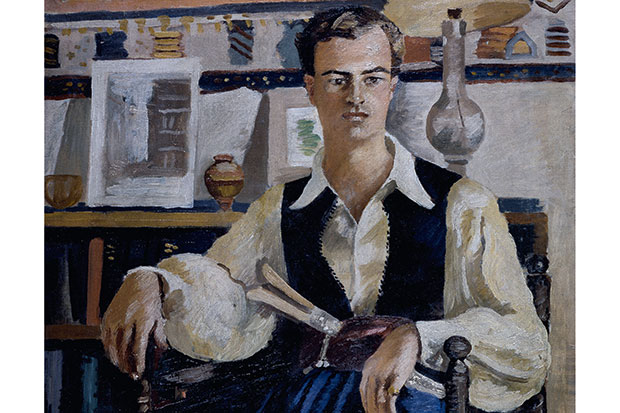
Portrait of a youthful Patrick Leigh Fermor in Cretan costume, by Adrian Daintrey (oil on canvas), Chatsworth House, Derbyshire

Portrait of a youthful Patrick Leigh Fermor in Cretan costume, by Adrian Daintrey (oil on canvas), Chatsworth House, Derbyshire

Generally impecunious, he charmed his way into borrowing houses from friends, from Diana Cooper’s farmhouse in Bognor to Sir Walter and Lady Smart’s manor-house in the Eure. The plan was always to write, the irresistible counterweighing temptation was for amusement and company. In 1954, he was inviting Lawrence Durrell to come and stay with him on Hydra, where he was staying in Niko Ghika’s mansion: ‘It’s the best bit of high-level cadging I’ve done for years, a real haul.’

Philhellene to the core, he was never keen on the Turks. One suspects he had never forgiven them for taking Constantinople (he couldn’t bear to call it Istanbul) in 1453. ‘I admire their undoubted stirring qualities — honesty, courage and so on — but have never managed to like them or be amused by them,’ he wrote to Freya Stark in 1953.

Luigi Barzini once likened reading Norman Lewis’s prose to ‘eating cherries’. Readers of this collection may feel the same thing. The prose is simultaneously poised and effervescent, polymathic in its dazzling range of references but never pompous. The funeral of the Duke of Devonshire in 2003, he wrote to his lifelong friend John Julius Norwich, was ‘a mixture of a vicarage garden party and the Field of the Cloth of Gold’. Hydriot girls in plastic high-heeled shoes and ‘blinding satin dresses of apple green, scarlet, royal blue and petunia… look exactly like boiled sweets’.

Though there are a few bleak times, including a letter to Colin Thubron in which he confesses to feeling ‘rather gloomy’ about not being included in a Times list of the 50 greatest writers since 1945, mostly they are banished by high spirits. He pokes fun at John Betjeman with an excruciating parody. The first verse sets the tone.

Eagle-borne spread of the Authorised Version!
Beadles and bell ropes! Pulpits and pews!
Sandwiches spread for a new excursion
And patum peperium under the yews!

And how about the impromptu limerick about a dubious cleric.

The Archbishop of Spetsai & Hydra
Condemned bestial vice ex-cathedra.
(But he rogered a bay-horse
Outside the pronaos
And a skewbald inside the exedra.)

For all his love of the great and the good, outright wealth on the grandest scale bored him. ‘There is something colossally depressing about contact with the very rich,’ he wrote after rubbing shoulders with Aristotle Onassis and Stavros Niarchos in the Aegean. ‘What I want to know is: why the hell don’t they have more fun with their money?’

Sisman has done a tremendous job selecting and editing this treasure-trove of letters. The guide to the dramatis personae and footnotes double up as a concise version of Debrett’s and pick up on literary references that would escape a lesser writer and reader.

In the last letter here, from 2010, Paddy expresses the by now familiar worry and apprehension about finishing that elusive third volume to complete the trilogy with A Time of Gifts and Between the Woods and the Water, perhaps his most admired titles. He closes with the hope that ‘perhaps it will all be OK in the end’. It was.

Buy Dashing for the Post: The Letters of Patrick Leigh Fermor

Event: The Cretan Legacy

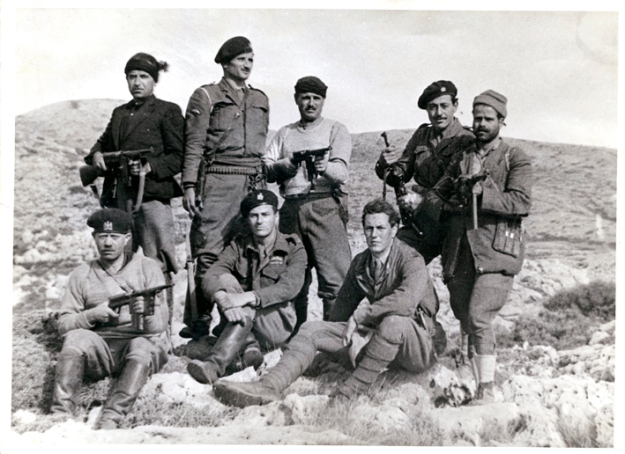
The kidnap gang pose before the action (Courtesy of Estate of William Stanley Moss)

The kidnap gang pose before the action (Courtesy of Estate of William Stanley Moss)

Our good friend, ex-Coldstream Guards officer, sometime Pilgrim, and author of In the Dolphin’s Wake and Like a Tramp, Like a Pilgrim, Harry Bucknall has been busy over the summer arranging a very special event be held at Waterstones Piccadilly on Wednesday 26th October at 7pm. The Cretan Legacy, a panel discussion, will examine the SOE abduction of General Heinrich Kreipe carried out by Paddy Leigh Fermor, Billy Moss and men of the Greek Andantes on Crete in 1943.

The panel, chaired by former Irish Guards Officer and SAS Squadron Commander, James Lowther-Pinkerton, will include Alan Ogden, SOE expert and author of Sons of Odysseus; Chris White, contributing author to Abducting a General; Rick Stroud, author of Kidnap in Crete and Dr Klaus Schmider, military historian, senior lecturer at the Dept of War Studies, RMA Sandhurst and Wehrmacht expert. With audience questions, the panel will discuss whether “this Hussar Stunt” – as Kreipe referred to his capture – was worth the undertaking in both the short and long term and assess its achievement, legacy and place in the annals of military history, endeavour and folklore.

No doubt there will be wine and a chance to chat to friends old and new so do come along if you can to Waterstones Piccadilly on Wednesday 26th October at 7pm. All you have to do is reserve a £5 ticket in store or by emailing Piccadilly@waterstones.com

Roumeli revisited? The Last Transhumance, a documentary film on shepherds


When I heard about this film it immediately made me think of the wonderfully compelling start to Roumeli and the story of the Sarakatsani, transhumance shepherds of Greek origin. This film by Romanian filmmaker and photographer Dragos Lumpan documents some of the last transhumance shepherds in Europe and Turkey. It is a record of something that will possibly completely die out in the next few years. Those Sarakatsani that Paddy mentions have almost all been absorbed into mainstream Greek society and the very first Romanian family that Dragos filmed gave up this lifestyle in 2008. It is interesting to note that despite writing for over forty pages about their origins, way of life, and most famously the details of their wedding ceremony, Roumeli is not directly mentioned in the Wikipedia references or bibliography; something that should perhaps be corrected.

Dragos Lumpan has 100’s of hours of footage from a project that has taken many years to complete, and he is now seeking some additional funding to help with post-producton costs. You may wish to help. Perhaps we can continue Paddy’s work by helping out a little? Dragos explains the importance of the project:

The title of the film wasn’t chosen for the sake of its dramatic sound. These ARE the last transhumances. These people and their way of life are not to be forgotten. Shepherds are strong enough to move mountains, which they actually did. They never back down and they never surrender to any obstacle. This is how they made their way into our history and this is how the history must remember them. The importance of this project goes beyond its artistic value. This film will be the last record of one of the things that shaped our history, out culture and ultimately our humanity.

The shepherds who still walk for hundreds and hundreds of miles in search of available pastures for their animals sleep outside most of the year, usually around their flocks protecting it.  They live in a parallel world not because they reject the modern times but because they embrace tradition. But the ones who still do it are fewer and fewer. The film will show the yearly cycle of life within these communities, showing their direct connection with nature cycle, with the astronomical calendar and with the people around them.

Transhumance represents a cultural heritage that has moulded for centuries the cultural landscape. Nowadays, transhumance is replaced by sedentary forms of sheep breeding. In many regions it is already extinct. The disappearing of transhumance affects not only the spiritual, social and cultural life, but also the mountain regions’ biodiversity.

To assist you can visit the Indiegogo page here. There are many rewards to those that can offer even modest amounts and a second movie trailer.

Dragos also has a website about the project with a number of photographs.

Following Michalis in Mycenae

13694300_10105313766032178_664315251_oSoon I will be travelling to the Mani and will make my first visit to Paddy’s house, something that is rather belated, but an experience that I am looking forward too very much. My friend Ryan Eyre from Seattle has been on a long trip to Europe this summer. Not long after he stayed with me here in Winchester, he travelled to Greece and found himself in historic Mycenae. What he discovered was a virtually moribund tourist industry, and an interesting story about Patrick Leigh Fermor.

By Ryan Eyre

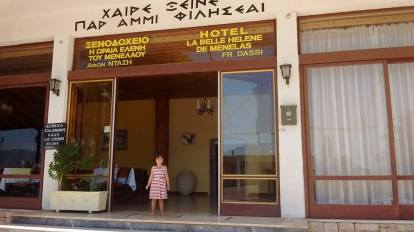
On a recent visit to Mycenae, the Oreia Eleni Hotel seemed the obvious place to stay. The Oreia Eleni, also known as La Belle Helene and the House of Schliemann, is a simple hotel but rich with historical associations. Heinrich Schliemann lived in the building during his excavation work at Mycenae in the 1870s and a generation or more later it was converted into a hotel. Agamemnon Dassis is the current proprietor and is the third-generation of his family to run it. He lives in a house next door with his wife and young daughter. A youthful looking man in his late 40s, Agamemnon is an energetic and quite attentive host.

Mycenae is one of the most visited archaeological sites in Greece but Greece’s economic woes have definitely affected business in the modern village half a mile below the citadel. The number of tourists has declined in recent years and most people who currently visit Mycenae do so as a day-trip and pass through the village without stopping. The owners of the almost empty shops, restaurants and hotels in Mycenae sit rather forlornly, waiting for customers who largely never appear.

I was the only guest at the Oraia Eleni during my two-night stay and Agamemnon told me that I was in fact the first guest they had had in three weeks. This was in July. As a guest, I benefited from being able to talk to Agamemnon at length.

The second day of my stay he showed me the small museum that is on the ground floor of the building. Agamemnon’s father photocopied famous people’s signatures from the guestbook and they are displayed in note-card size form behind glass. He pointed out the signatures of Agatha Christie (I was staying in the same room she supposedly did), Virginia Woolf, Stephen Spender, Carl Jung, Jean-Paul Sartre, Alec Guinness, Charlton Heston and J.K. Rowling (among others) and provided some anecdotal information about each visit. I was interested to note that Albert Speer, Heinrich Himmler, Joseph Goebbels and Herman Goering all passed through in the 1930s (it was unclear whether they visited separately or together).

Up to that point Patrick Leigh Fermor’s association with the hotel hadn’t crossed my mind. Thinking about it for a moment it seemed obvious he must have stayed here. I asked Agamemnon whether Leigh Fermor’s signature could be found anywhere on the display. “Oh, yes, I forgot to mention him”, Agamemnon said before pointing out PLF’s name scrawled in his own and dated from 1960.

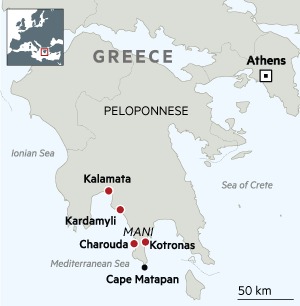
“He came here many times over the years. He came in the 1950s, and in the 1960s and many times afterwards I remember when I was a young man he telephoned and asked me whether I was George. I said no, I am his son. Who is this? This was in Greek but I could tell from the accent that it was a foreigner. He said, tell George that Michalis from Kardamyli called. I was a little confused. Later I met him. As I said, he came here a number of times. I also visited him in Kardamyli. One time when his wife was in England he came and stayed for a week. He was a great man, a very great man. I last saw him in 1998. When I came back here in 2007 after some years living abroad I did not contact him before he died. I regret this.”

I didn’t immediately tell Agamemnon my own story about meeting Patrick Leigh Fermor in Kardamyli in 2009. That evening at the dinner table and after drinking an ouzo and some wine, I asked him to sit with me because I wanted to tell him something. I began to recount my last trip to Greece when I had gone to the Mani to try to meet the author, who was then 94 years old.

“You met him in the end?” Agamemnon asked before I could go on much further. I told him I had written PLF a brief letter that I had dropped off at his house and ended up being invited to lunch the next day, where I spent several hours drinking, eating and talking with the great man.

I acknowledged I was extremely lucky. Agamemnon agreed and opened up more. He told me about how Paddy would come to Mycenae and disappear for the entire day, only returning at night. Paddy didn’t tell people he was a famous writer; Agamemnon only discovered this on his own.

Paddy was pretty self-deprecating and didn’t take himself so seriously. He was happy to talk to all sorts of people and showed genuine curiosity in their lives. “He had this constant curiosity about people and the world. That’s why he lived so long,” Agamemnon remarked.

He told me about various friends of Paddy’s who have stayed at the Oraia Eleni and that the Patrick Leigh Fermor Society had also passed through in the last two years.

Moving into more salacious territory, he then told me that he was going to tell me something about Paddy that most people haven’t heard. He didn’t have the heart to tell the members of the PLF Society when they visited. Agamemnon asked me to keep it off the record so I can’t fully disclose what I heard. What I will say is that it was an anecdote that I have very reason to believe is true and confirms that well into his 70s Paddy was sexually active with women who were not his wife and were considerably younger than himself. Agamemnon and I agreed that Paddy’s mixture of looks, charm and erudition was remarkable. “He really had the mentality of a teenager,” Agamemnon added.

Drinking wine and hearing these stories as the only guest in an atmospheric place gave me the thrilling feeling of luck and leventia, or feeling of lightness, that Paddy would refer to in connection with Greece. It was an evening that reminded me why I travel.

Transylvanian Saxon and polymath, Rudolf Fischer – obituary

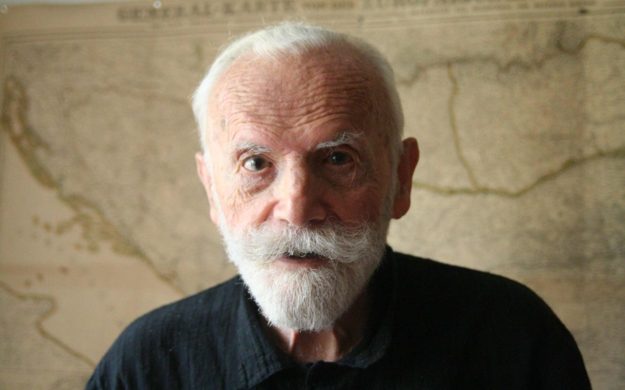
Rudolf Fischer

Rudolf Fischer

Rudolf Fischer, who has died aged 92, was a historian, linguist and polymath who advised and guided foreign writers through the minutiae of eastern European history, language, etymology and ethnography; the foremost of these, Patrick Leigh Fermor, acknowledged in 1986 that his debt to Fischer was “beyond reckoning”.

First published in the Telegraph 12 June 2016.

Fischer’s friendship with Leigh Fermor began after Fischer wrote a letter to him full of praise for A Time of Gifts (1972), the first volume of Leigh Fermor’s travel trilogy, with, attached to it, a long list of all the inaccuracies, misspellings and contradictions. Months passed without a response, and Fischer feared that his constructive criticism had gone down badly. In fact, Leigh Fermor was delighted, and wrote, eventually, asking if Fischer could bear to advise on his next volume. Gradually drafts of Between the Woods and the Water starting appearing in parcels from the Peloponnese which Fischer pored over meticulously.

There resulted a correspondence which lasted for decades, thrashing out the finer points of Transylvanian history, language, costume, traditions and legends. Fischer also read and made corrections to Leigh Fermor’s final, posthumous, volume of the trilogy, The Broken Road, published in 2013, and edited by Artemis Cooper and Colin Thubron.

Among others he also helped Bruce Chatwin, Robert Kaplan (who devoted an entire chapter to him in Eastward to Tartary), Dervla Murphy, Colin Thubron, Robin Hanbury-Tennison, Adam Sisman and William Blacker, many of whom made the pilgrimage to his small book-lined flat in Budapest.

Rudolf Fischer was born on September 17 1923 in the medieval city of Brasov, Kronstadt, in the Transylvania region of Romania. His father, Josef Fischer, was a Hungarian Jew, a descendant of the Hatam Sofer, the 19th-century leader of the Haredic movement which resisted modernisation and mysticism. His mother, Bertha Meldt, was a Saxon Lutheran. Rudolf attended the local Saxon school. But talk of war prompted his father to migrate with him to Australia, leaving his wife and younger son behind, for fear that the older one, Rudolf, would be enlisted.

The next few years were spent helping his father on a chicken farm on the outskirts of Sydney and serving in the alien corps of the Australian army in New Guinea, before attending Sydney University, where he met his first wife, Janet Gleeson-White.

At university Fischer studied under John Anderson, a Scottish philosopher, whose acolytes formed the libertarian movement known as the Sydney Push, one of whose principles was that no statement or assumption was to remain unchallenged. This, as one writer on Australian philosophy, James Franklin, later observed, was all very well but “hard on the wives and children”.

In the early 1950s Fischer moved to Britain, earning a living as a teacher. He felt that cultural life of London compensated for the poor living conditions in an attic flat; it was a view not shared by his wife, who was struggling with small children. So in 1957 the family travelled back to Australia. The marriage broke down, however, and Fischer returned alone to Europe in 1962 where, on a visit to Romania, he met his second wife, Dagmar von Melchner, a distant cousin.

After living in Greece for eight months, the couple moved to London, where, in 1968, Fischer became English Language editor for the New Hungarian Quarterly – an achievement given that his first language was German – and so they moved to Budapest, where they remained for 48 years. There, with Dagmar, he brought up his second family, deepened his knowledge of Central Europe and became a guide, critic and friend to writers of all nationalities who passed through Budapest.

Fischer’s library was packed with obscure 19th-century reference books on the Balkans and the Austro-Hungarian Empire, as well as a large map from 1853 of Europäischen Turkei – more accurate, he assured everyone, than the modern ones. Rudolf Fischer was a link to the pre-war Saxon world of Transylvania, and with his fine moustache, upright and dignified manner, collection of exotic Eastern European hats and excellent grasp of all the relevant languages, he more than fitted the part.

He was buried in Brasov in the family grave in a small Saxon Lutheran cemetery at the end of the street on which he had been born.

He is survived by his second wife Dagmar and his five daughters.

Rudolf Fischer, born September 17 1923, died February 18 2016

Accounts of audacious abduction of Nazi General Heinrich Kreipe now in Greek

Coincidence always plays a special role, particularly in times of war. One example is the abduction of German General Heinrich Kreipe in occupied Crete in World War II by Patrick Leigh Fermor, Stanley Moss and their Cretan comrades: Kreipe had not been their initial target. Two chronicles of what is probably the most famous kidnapping of WWII are now available in Greek, the first Fermor’s own “Abducting a General” and the second Moss’s “Ill Met By Moonlight,” telling the tale of the fascinating adventure as experienced by the two protagonists (both by Metaixmio publications and translated by Myrsini Gana).

By Elias Maglinis

First published in Ekathemarini

Who was Fermor’s original target? The despised General Friedrich-Wilhelm Muller, commander of the Nazi forces in Iraklio and responsible for the massacres at Viannos. Yet even the idea of the abduction was a matter of coincidence: Following Italy’s capitulation to the Allies in September 1943, the Italian commanders on Crete, and particularly General Angelico Carta, became aware of the danger they were in. Carta asked for a private meeting with Fermor to discuss the terms of his surrender to the British and, more importantly, his escape from the Greek island.

Indeed, Fermor and Carta came to an agreement and, according to plan, the Italian general was spirited away by boat from a remote part of the island to North Africa, together with Fermor who briefly accompanied him. In Cairo, Fermor came up with the idea that they could orchestrate something similar with Muller – though this time without the occupier’s acquiescence. Fermor thought of the plan after the Allies had made it clear that they had no intention of landing on Crete; he believed the scheme would provide a much-needed boost to the Cretans’ morale and ridicule the Germans to boot.

Fermor presented his plan to his superiors, got the green light (though not without some reservations), formed his team and was promoted to the rank of major. After his return to Crete in early 1944, the scheme was put into action, but a chance occurrence nearly scuppered the entire operation: Muller was being transferred to Hania. Instead of calling the whole thing off, Fermor and Moss simply chose a different target: Muller’s replacement in Iraklio, Kreipe. No one knew much about the German general other than that he had just arrived from the Russian front.

Working with Cretan resistance fighters Manolis Paterakis, Giorgos Tyrakis, Stratis Saviolakis, Michalis Akoumianakis, Ilias Athanasakis, Antonis Zoidakis, Mitsos Tzatzas, Grigorios Chnarakis, Nikolaos Komis, Antonios Papaleonidas and Pavlos Zografistos, Fermor and Moss embarked on their ambitious, audacious plan. As Artemis Cooper writes in her comprehensive biography “Patrick Leigh Fermor: An Adventure,” the two Britons were shocked by what they were about to do, excited and terrified at the same time.

The chronicle of the kidnapping reads like a novel, full of moments of uncertainty and unexpected humor, plenty of drama (such as the death of Kreipe’s driver) but also humanity (how Fermor and Kreipe developed what could almost be described as a friendship in the rugged conditions of Mount Psiloritis).

The abduction was carried out at Knossos on April 26, 1944. The team managed to reach the southern coast of Crete and escape to Egypt on May 14 after a monumental trek filled with danger, deprivation and bold achievements. German retribution was swift and brutal, and many today question the wisdom of the plan. After the war, however, Fermor was informed that when news of Kreipe’s abduction reached the German barracks in Iraklio, many a soldier popped open a beer and celebrated: Kreipe had not been a popular commander.

Ultramarathon on the kidnapping trail

Stanley Moss’s “Ill Met By Moonlight” brought fame to the achievements of the small band of resistance fighters. It became a best-seller in the UK and was made into a film in 1957, with Dirk Bogarde in the role of Fermor. More ethnographic than historical, the book is the romantic narrative of a man who experienced the events firsthand. The publication includes maps of the area and a wealth of photographic material.

Patrick Leigh Fermor’s “Abducting a General” tells the tale of those events through the eyes of the great British writer. The two friends had agreed that Moss, who kept a journal throughout the course of the operation, would be first to tell the tale, so Fermor didn’t write his book until 1965. It includes war reports Fermor sent from Crete, as well as a recent guide by Chris and Peter White with all the information needed to follow the abduction trail.

This chapter of World War II history remains so popular that the British company ECR Sport Limited this year is organizing an ultramarathon on Crete along the route, dubbed the KreipeRun 2016. On May 20 and 21, 250 runners will cover the same 154 kilometers as Fermor and his band in a maximum time of 30 hours.

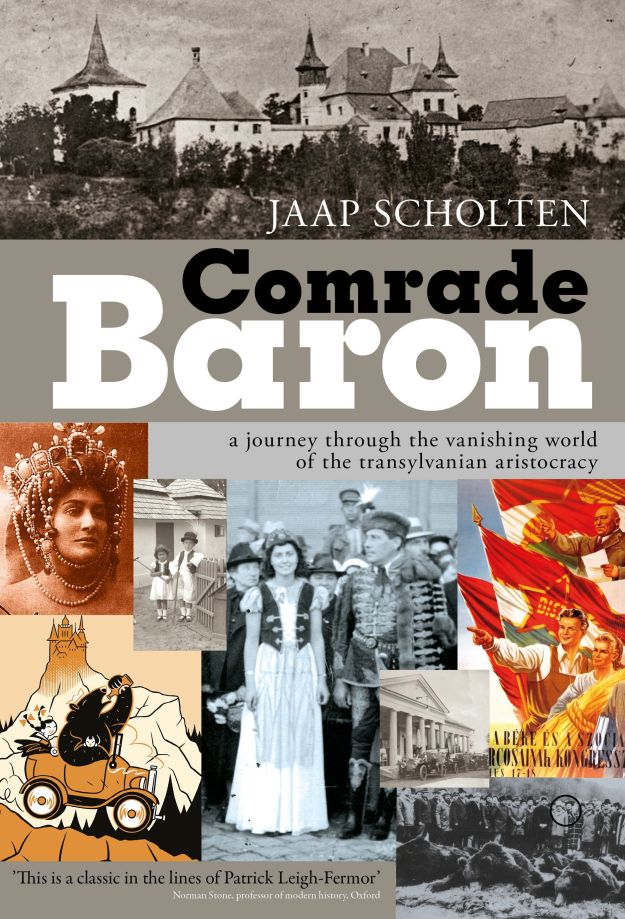
Jaap Scholten talks about Comrade Baron

Dutch writer Jaap Scholten knows a good story when he hears one. In the early 1990s, when his Hungarian wife’s grandmother began telling him about life before communism, he was entranced. This was the beginning of the road to writing “Comrade Baron: A Journey Through the Vanishing World of the Transylvanian Aristocracy,” Scholten’s first work of non-fiction and the first to be published in English, launched May 5th.

“I have enjoyed this book so much – such a great tale, with brilliant original research and source material, and so many stories, tragic, humiliating, painful, yet all engrossing and highly readable” Petroc Trelawny, BBC presenter and journalist.

“This is a classic in the lines of Patrick Leigh-Fermor and it should be on the shelves of anyone interested in Mitteleuropa.” Norman Stone, Professor of Modern History, Oxford.

You can buy Comrade Baron: A Journey Through the Vanishing World of the Transylvanian Aristocracy here.

The launch event for the book, hosted by Petroc Trelawney will take place on Wednesday 4 May 2016 at 7pm at the Hungarian Cultural Centre, 10 Maiden Lane, Covent Garden, London WC2E 7NA. Attendance at the event is free but booking is required on bookings@hungary.org.uk.

Comrade Baron: A Journey Through the Vanishing World of the Transylvanian Aristocracy by Jaap Scholten

baronI am very excited about this and I know that some you will be too as you have asked about it on many occasions.

Comrade Baron A journey through the vanishing world of the Transylvanian aristocracy, is written by Jaap Scholten and will be published for the first time in English on 5 May 2016. The book was winner of the Libris History Prize 2011 and shortlisted for the Bob den Uyl Prize for best travel book 2011.

Comrade Baron will be launched at an event, hosted by BBC presenter, Petroc Trelawny, at the Hungarian Cultural Centre, London, on 4 th May. A best-seller in The Netherlands with more than 30,000 copies sold, Comrade Baron has been translated into French, Hungarian and Romanian. An extraordinary, passionate and important work, Comrade Baron is “in part, an oral history of a group we know little about, in part the account of a journey through one of the most beautiful and mysterious regions of Europe and in part a record of a Dutchman’s impressions on finding himself in an extraordinary milieu in the company of some exceptional families.”

In the darkness of the early morning of 3 March 1949, practically all of the Transylvanian aristocracy were arrested in their beds and loaded onto trucks. That same day the Romanian Workers’ Party was pleased to announce the successful deportation and dispossession of all large landowners. Communism demanded the destruction of these ultimate class enemies. Taken away with just the clothes they stood up in, what happened to these once mighty families? Their stories, as told first-hand in this fascinating and enlightening book, are ones of hardship and fear but also of determination, solidarity, family tradition, resilience and indomitable spirit…

Jaap Scholten lives in Budapest, which is where, in 2006, he first heard about the nocturnal mass deportation of the Transylvanian nobility. Fascinated by their plight, he determined to track down as many of the older members of the former aristocracy as he could, recording their stories before they were lost forever. His journey took him the length and breadth of Transylvania (a magical land that comes to vivid life through descriptions in the book), to apartment blocks, slums and ruined castles, and brought him face-to-face with a group of rare and fascinating families with an extraordinary tale to tell.

Supported by a selection of black and white photographs and told through poignant and illuminating first-hand conversations, Comrade Baron is their story – from the days that preceded communism to after the communists came to power and through to the modern day.

Grand houses were exchanged for homes in cellars, attics, laundry rooms and sculleries and pleasure-seeking lifestyles for work in quarries, steelworks or domestic service. Interrogation was a daily occurrence and many were sent to hard labour in the Romanian gulags. Yet despite living under terrifying conditions, inflicted upon them firstly by Gheorghiu-Dej and later Ceauşescu, the aristocrats were leading a double life. Secretly gathering at night, they maintained the rituals of an older world – “they carried on kissing hands and using other formal gestures, their conversations were governed by long established rules… They met in cellars to play bridge, rummy and canasta. They read poetry aloud and made music. The older aristocrats taught the children foreign languages and gave them music lessons.” In contrast, as Jaap travels through Romania and observes the behaviour of the new Romanian elite –extravagant behaviour at parties and restaurants, driving their Mercedes and SUV’s – he recognizes what has been lost and consider how best to rebuild a country in a moral vacuum.

Jaap Scholten studied Industrial Design at the Technical University in Delft, Graphic Design at the Willem de Kooning Academy of Arts in Rotterdam (BA), and Social Anthropology at the Central European University in Budapest (MA). He is the award winning author of seven books, novels and short story collections. Comrade Baron is his first non-fiction book. Jaap has lived in Budapest since 2003. His Hungarian wife is of noble descent and distantly related to some of the families in the book.

“I have enjoyed this book so much – such a great tale, with brilliant original research and source material, and so many stories, tragic, humiliating, painful, yet all engrossing and highly readable” Petroc Trelawny, BBC presenter and journalist.

“This is a classic in the lines of Patrick Leigh-Fermor and it should be on the shelves of anyone interested in Mitteleuropa.” Norman Stone, Professor of Modern History, Oxford.

You can buy Comrade Baron: A Journey Through the Vanishing World of the Transylvanian Aristocracy here.

The launch event for the book, hosted by Petroc Trelawney will take place on Wednesday 4 May 2016 at 7pm at the Hungarian Cultural Centre, 10 Maiden Lane, Covent Garden, London WC2E 7NA. Attendance at the event is free but booking is required on bookings@hungary.org.uk.

The Kreipe kidnap from the Victor comic 1973

Victor coverIn 1973, the Victor comic, well-known to all boys of a certain age, published the story of the kidnap in their usual style. The British, brave and clever fighting against the odds. The Germans, cunning and morally bankrupt.

I have been able to obtain a copy of the Victor from October 6th 1973. Read and download the pdfs and enjoy! Page 1 and Page 2.


Dashing for the Post

dashing for postJohn Murray continues to offer us new insights into Paddy’s life and times. They will publish a collection of letters penned by Paddy on 6 October 2016.

The collection entitled Dashing for the Post was announced on 11th February on what would have been Leigh Fermor’s 101st birthday.

John Murray says the letters will exhibit many of his “endearing characteristics”, including “his zest for life, his unending curiosity, his keen sense of place, his lyrical descriptive powers, his love of words, his fluency in a remarkable range of languages, his boyish exuberance, and his sense of fun”.

Many of the letters are written to friends and family, but the collection also includes correspondence with Ian Fleming, Nancy Mitford, Lawrence Durrell, Diana Cooper and Deborah Devonshire.

Exclusive material will be taken from the National Library of Scotland, as well as letters drawn from private collections in the UK and abroad.

Adam Sisman, the book’s editor, is an honorary fellow of the University of St Andrews and a fellow of the Royal Society of Literature.

Dashing for the Post will be published in hardback and e-book on 6th October 2016. John Murray publisher Roland Philipps bought world rights from the Leigh Fermor estate.

Philipps said: “Paddy Leigh Fermor was one of the greatest prose stylists of the twentieth century. His letters have his hallmark high spirits, marvellous humour, magpie-like mind for the telling fact, erudition, linguistic mastery and sheer brilliance. Eight years ago In Tearing Haste (John Murray) Paddy’s letters to and from the Duchess of Devonshire, was a major bestseller. Dashing for the Post has his full range of correspondents, and is even more of a joy than that first book.”

You can pre-order Dashing for the Post: The Letters of Patrick Leigh Fermor by clicking here.

Reg Everson and his powdered egg breakfast for General Kreipe on Mount Ida

From time to time I plan to re-publish some of the best blog posts as we have over 700 posts on here and many get lost. This first re-post was inspired by my attendance last night at the presentation by Dr Roderick Bailey – Hazardous Operations: British SOE Agents in Nazi Occupied Greece – which was both informative and entertaining. The story of Reg Everson and powdered egg was first published on 10 June 2012 …

At Paddy’s funeral last year, I stayed afterwards for a drink with a small group at the hotel  which used to be the Dumbleton estate manor house, originally home to Joan’s family. A man from Wales introduced himself as Vince Tustin. I recognised the name as I had been in touch with Vince by email in the preceding weeks on the subject of his father-in-law who was in the SOE.

‘Reg Everson, my father-in-law, spent three years on Crete and much of that time he worked closely with Paddy as a radio operator.’ said Vince.

His wife then joined us and after a while she said ‘I asked my mum and dad why I was called Patricia. It was an unusual name for a girl in Wales at the time. And my dad told me I was named Patricia after his good friend Patrick Leigh Fermor. They had served together in Crete.’

Such was the impression that Paddy made on people. It is a lovely story in itself, and perhaps serves a reminder on this first anniversary of his death, that Paddy affected the lives of  many, in different ways, as a man as well as a writer.

Vince told me that in the 1950’s Reg was interviewed by a local reporter.

I am sure that Reg didn’t want it to sound as if he was alone [on Crete]. He was a quiet mild mannered gentleman, and was in the Royal Signals from 1931 to 1946 and like so many servicemen lied about his age to get in, he was only 15 when he enlisted. For the three years he was on Crete his wife didn’t hear from him. His commanding officer was the only contact she had. People in the village even thought Reg had left her!

It wasn’t until I wrote a piece in the local paper that people understood where he had been because he didn’t speak about it. In the newspaper cutting from the 50s Reg talks about his involvement in the kidnap of General Kreipe and how he cheered up the General by making him some powdered egg for breakfast on Mount Ida.

We have his forged Cretan papers here, also a leaflet that was dropped by the Germans. He was awarded the Military Medal and Africa Star among other medals. He was also presented with a solid silver medal for bravery from the Maharaja of India.

Reg Everson deployed to Crete with Xan Fielding, and Xan refers to this in his account of his time in Crete “Hide and Seek”.


In the newspaper interview Reg describes how he was summoned with his radio to Mount Ida to join the kidnap gang, but he had to wait for his heavy radio batteries to arrive so he made himself useful and he made breakfast for the General on Mount Ida …

“The General was pretty glum, but he perked-up a bit when I made him some breakfast with egg powder. Paddy Leigh Fermor and the others had to go on the run again with General Kreipe before my batteries arrived: so we couldn’t get the news [of the successful kidnap] back.”

Whilst we often hear the stories of the officers in SOE, we should not forget that they were supported by a large team including signallers such as Reg Everson who were especially brave. They risked being located by the Germans who were constantly trying to find the source of their signals to destroy the radios, and capture the highly skilled and valuable operators.

Event – Patrick Leigh Fermor and SOE in Crete

Costas Mamalakis at the Historical Museum of Crete. Photo: Mike Sweet.

Patrick Leigh Fermor and SOE in Crete – Costas Mamalakis is giving the next PLFS lecture. Costas Mamalakis is Crete’s leading expert on the Second World War and the resistance in Crete. Consultant in Modern History to the Historical Museum of Crete, Costas has been the moving force behind the publication of several memoirs of the resistance, including the most recent: ‘Tom J. Dunbabin: An Archaeologist at War’.

Costas will be spending the week prior to this presentation reviewing documents in the PLF Archive in Edinburgh, and will be able to bring new insights to the many documents in Greek that have yet to be properly evaluated. He will be supported by Chris and Peter White and Gabriella Bullock.

Monday 1 February, 7.15pm at Great Hall, Hellenic Centre, 16-18 Paddington St, London, W1U 5AS. Contact info@ patrickleighfermorsociety.org.

Paddy’s World – Transcript of John Julius Norwich’s talk for the PLF Society

Many blog readers and members of the PLF Society were privileged to her John Julius Norwich give a very personal account of his memories of Paddy at the Hellenic Centre in London on 10 November. My account of the evening is here

I am very lucky to be able to present the full transcript of the talk. Didn’t I say we had some good stuff coming up? Enjoy this 🙂

On 22 February 1951 my mother wrote to me: “Just off for my jaunt to Passy sur Eure to spoon with P. Leigh Fermor. Shy. Fluster.” At that time she had only just met Paddy and hardly knew him, and she would have been – as indeed she confessed she was – extremely nervous. But all was well. The next letter read:

Well, the gallivanting was a red letter. It took me a good two hours cross-country by Pontoise and Mantes. Strange little village house in which he lives – the loan of a Lady Smart – was warm and welcoming and I really felt myself back in the pond I was raised in. Fascinating conversation with a male man who delights in one. Paddy was superb. Cultured, funny, telling wonderful sagas, zealous. We had a charming filthy little lunch over the stove of sardines, Pernod and vin ordinaire and afterwards we walked for two hours over low wooded downs in sparkling sun, talking ten to the dozen about people, grievances and enthusiasms

That was the beginning. My parents saw quite a lot of Paddy and Joan – whom my mother thought looked just like Joan of Arc, except that Joan of Arc didn’t wear sun-glasses – in the next year or two. I was at Oxford at the time, and I remember seeing them once or twice during vacations, and being invariably knocked sideways – as everyone was – by the sheer brilliance of Paddy, and the glorious fun of him. Every time he walked into a room it was as if the sun had come out; never have I laughed more uncontrollably round a luncheon or dinner table, and as for his erudition, never have I met anyone who knew so much about everything under the sun, yet wore his learning so lightly. There seemed to be no language he could not speak, or indeed sing songs or recite poetry in: French, German, Italian, Spanish, Greek and Rumanian for a start, but there were probably several others as well.

Then, in the summer of 1955, a wonderful thing happened. By then I had joined the Foreign Service. My first wife Anne and I were by that time living in Belgrade, where I was Third Secretary at the British Embassy. Another letter arrived from my mother. She had been lent a Greek caïque by the ship-owner Stavros Niarchos for a fortnight’s sail through the isles of Greece. Paddy and Joan were coming; could we come too? As far as we were concerned, it was a question of “can a duck swim?” At the end of August we drove down from Belgrade – which in those days had no airport – to Athens, and thence to the Piraeus, where we boarded the Eros.

It was my first time in the Aegean, and Paddy gave it a whole new dimension. It was the first time I had seen him, as it were, on his home ground, and it was wonderful. He lived and breathed his beloved Greece – fluent in its language, encyclopaedic in his knowledge of its history, its customs and its literature. But nobody – and that was the wonder and joy of him and – I know I’ve said this before – nobody has ever carried his learning more lightly. His conversation was consistently dazzling. As we sailed from island to island – and in those days there were virtually no tourists, and I can’t begin to tell you what a difference that made – he talked about Greece, about Greek history, about Greek beliefs and traditions, about Byron and the Greek War of Independence, with those monstrously magnificent Greek heroes – men like Mavromichalis and Kolokotronis whose names roll so satisfactorily across the tongue – and about the Greek Orthodox Church and its quarrels with the west over more of those words, like filioque and ͑ομοούσιον; but his talk roamed far wider than that, taking in the whole eastern Mediterranean and, in particular, Byzantium.

Now in England Byzantium has always had a terrible press. The great nineteenth-century historian W.E.H. Lecky wrote that it constituted, “without a single exception, the most thoroughly base and despicable form that civilisation has yet assumed…. There has been no other enduring civilisation, he claimed, “so absolutely destitute of all the forms and elements of greatness”. He went on,

Its vices were the vices of men who had ceased to be brave without learning to be virtuous…. Slaves, and willing slaves, in both their actions and their thoughts, immersed in sensuality and in the most frivolous pleasures, the people only emerged from their listlessness when some theological subtlety, or some chivalry in the chariot races, stimulated them to frantic riots…. The history of the Empire is a monotonous story of the intrigues of priests, eunuchs and women, of poisonings, of conspiracies, of uniform ingratitude, of perpetual fratricides.

Strong words indeed – although to modern ears that last sentence makes Byzantine history sound not so much monotonous as distinctly entertaining. But that long campaign of denigration continued well into the twentieth century. It was only in the time of which I’m speaking – the fifties – that the writings of people like Robert Byron, David Talbot Rice and Steven Runciman, together with the new-found ease, speed and relative comfort of travel in the Levant, made the glorious heritage of the Byzantine Empire at last generally accessible. Now, thank heaven, the Empire has come into its own again, and is seen as a worthy successor to the two mighty civilisations which it followed and so beautifully combined, the Greek and the Roman.

The trouble was, for most of us, that we knew so little about it. Those old attitudes died hard. During my five years at Eton, the entire subject was the victim of what seemed to be a conspiracy of silence. I can’t honestly remember Byzantium being once mentioned, far less studied; and so complete was my ignorance that I should have been hard put to define it even in general terms till I went to Oxford. And, for heaven’s sake, why? After all, it was not even the successor, it was that same old Roman Empire of Augustus and Tiberius and Claudius and the rest, which continued to exist in its new capital of Constantinople for another one thousand, one hundred and twenty-three years before it was finally captured by the Ottoman Turks on that fateful day, Tuesday 29 May 1453, after one of the most heroic sieges in all history. It was Paddy and Paddy alone who revealed to me its mystery and its magic, although he also recommended to me, among much else, that I should read an extraordinary book by Robert Byron, The Byzantine Achievement, which that most precocious author wrote when he was twenty-five. I read it with utter fascination, and ended up completely captivated. When I got home I devoured every book I could find on the subject, and the following year Anne and I drove to Istanbul for a week. Twenty years later I was to write a History of Byzantium myself – three volumes of it, which were necessary if I was to cover more than a millennium; but I very much doubt whether, had it not been for that fortnight on the Eros, those three volumes would ever have been written.

One evening, I remember, Paddy was talking about a poor fisherman at Kardamyli – this was long before he went to live there – a friend of his called Strati Mourtzinos, who, he told us, might just possibly have been the last heir to the imperial throne of Byzantium. Suddenly his imagination took over, and he built a magnificent castle in the air. It seemed, by some miracle, that the Turks had restored Constantinople to Greece. Byzantium was reborn and Strati Mourtzinos was formally crowned as its Emperor. Paddy was later to work up the idea further in his first book about Greece, Mani:

Bells clanged; semantra hammered and cannon thundered as the Emperor stepped ashore. Then, with a sudden reek of naphtha, Greek fire roared, saluting in a hundred blood-red parabolas from the warships’ brazen beaks….. In the packed square of Constantine, a Serbian furrier fell from a rooftop. An astrologer from Ctesiphon, a Spanish coppersmith and a money-lender from the Persian Gulf were trampled to death; a Bactrian lancer fainted and, as we proceeded round the Triple Delphic Serpent of the Hippodrome, the voices of the Blues and Greens, for once in concord, lifted a long howl of applause. The imperial horses neighed in their stables, the hunting cheetahs strained yelping at their silver chains. Mechanical gold lions roared in the throne room, gold birds on the jewelled branches of artificial trees set up a tinkling and a twitter. The general hysteria penetrated the public jail: in dark cells, monophysites and bogomils and iconoclasts rattled their fetters across the dungeon bars. High on his Corinthian capital, a capering stylite, immobile for three decades, hammered his calabash with a wooden spoon….

Would you like a bit more? All right: Continue reading

Patrick Leigh Fermor’s Rhineland Christmas

This may just be a little late but I guess it is still “seasonal”. I have been recovering from the long walk (raised over £3,600 so thank to all who pitched in) and then my very own time in Germany up to Christmas with my youngest daughter Harriet followed by an English Christmas. All very hectic. I have promised myself a calmer 2016, with hopefully more time for the blog. Thank you for your continued readership, kind thoughts and ideas. A very Happy New Year to you and those you love.

Tom

Paddy spent Christmas, 1933, in Coblenz/Koblenz a German town on the Rhine. From A Time Of Gifts:

Coblenz is on a slant. Every street tilted and I was always looking across towers and chimney-pots and down on the two corridors of mountain that conducted the streams to their meeting. It was a buoyant place under a clear sky, everything in the air whispered that the plains were far behind and the sunlight sent a flicker and a flash of reflections glancing up from the snow; and two more invisible lines had been crossed and important ones: the accent had changed and wine cellars had taken the place of beer-halls. Instead of those grey mastodontic mug, wine-glasses glittered on the oak. (It was under a vista of old casks in a Weinstube that I settled with my diary till bedtime.) The plain bowls of these wine-glasses were poised on slender glass stalks, or on diminishing pagodas of little globes, and both kinds of stem were coloured: a deep green for Mosel and, for Rhenish, a brown smoky gold that was almost amber. When horny hands lifted them, each flashed forth its coloured message in the lamplight. It is impossible, drinking by the glass in those charmingly named inns and wine-cellars, not to drink too much. Deceptively and treacherously, those innocent-looking goblets hold nearly half a bottle and simply by sipping one could explore the two great rivers below and the Danube and all Swabia, and Franconia too by proxy, and the vales of Imhof and the faraway slopes of Würzburg journeying in time from year to year, with draughts as cool as a deep well, limpidly varying from dark gold to pale silver and smelling of glades and meadows and flowers. Gothic inscriptions still flaunted across the walls, but they were harmless here, and free of the gloom imposed by those boisterous and pace-forcing black-letter hortations in the beer-halls of the north. And the style was better: less emphatic, more lucid and laconic; and both consoling and profound in content; or so it seemed as the hours passed. Glaub, was wahr ist, enjoined a message across an antlered wall, Lieb was rar ist; Trink, was klar ist. [“Believe what is true; love what is rare; drink what is clear.”] I only realized as I stumbled to bed how pliantly I had obeyed.

It was the shortest day of the year and signs of the seasons were becoming hourly more marked. Every other person in the streets was heading for home with a tall and newly felled fir-sapling across his shoulder, and it was under a mesh of Christmas decorations that I was sucked into the Liebfrauenkirche next day. The romanesque nave was packed and an anthem of great choral splendour rose from the gothic choir stalls, while the cauliflowering incense followed the plainsong across the slopes of the sunbeams. A Dominican in horn-rimmed spectacles delivered a vigorous sermon. A number of Brownshirts — I’d forgotten all about them for the moment — was scattered among the congregation, with eyes lowered and their caps in their hands. They looked rather odd. The should have been out in the forest, dancing round Odin and Thor, or Loki, perhaps.

Paddy imaginatively and sensually explores local landscapes by drinking its wine. Notice too the glorious description of the Catholic church in Coblenz at Christmastime.  That beautiful old church, the Liebefrauenkirche, was destroyed in the Second World War.

Before and after: Paddy, Ralph Stockbridge and others in Crete

One thing I must do sometime is to take a trip to Edinburgh to visit Paddy’s archive at the National Library of Scotland. In the meantime I am very lucky to receive emails from time to time from Chris White (co-editor of Abducting a General) and it always pleases me to be able to share these with you. Chris has sent some more before and after photos from Crete.

I was visiting the PLF Archive in April and came across these photos ………..they were taken at a sheepfold called Korakopetra above Anogia – probably in May 1943, and feature – in the group photo – PLF and Ralph Stockbridge (slightly behind PLF on the right, wearing glasses) surrounded by Mihali Xylouris and members of his band. It was at this location at around this time that PLF accidentally killed his great friend Yanni Tsangarakis (described in ‘Abducting A General’ and Artemis’ biography).

Peter and I tracked down the sheepfold last year and I revisited there in May of this year with a Cretan historian called Costas Mamalakis.

Related articles:

Ralph Stockbridge obituary.

Leaving Kastamonitsa for the kidnap – before and after pictures

Print

Walks amid the watchtowers of the Mani

An early 19th-century watchtower, now the Tainaron Blue Retreat guesthouse, overlooking the coastline of Cape Matapan

The most recent of quite a number of articles about visiting the Mani that I have seen of late. This being the best, written by William Dalrymple.

First published in the Financial Times, 28 August 2015.

I first came to the Mani through the pages of my literary hero and travel writing guru, Patrick Leigh Fermor. Paddy, who was once described by the BBC as a “cross between Indiana Jones, James Bond and Graham Greene”, published Mani: Travels in the Southern Peloponnese, in 1958. It was the first non-fiction book he wrote about Greece, and in many ways it is his most passionate: a love song to the middle prong of the trident-shaped southern coast of the Peloponnese. This was the place where he had been happiest, and the destination he would eventually pick in which to settle down, and spend the final years of his life.

For Paddy, the Ottoman Mani was to Greece what Cornwall was to 18th-century Britain: the most remote of places, cut off from the rest of the country by distance, unpredictable tides and wild cliffs, the abode of brave brigands, chivalrous smugglers and gentleman pirates. It was, he liked to point out, the southernmost point of mainland Greece: only a few islands intervene between Cape Matapan, the tip of the peninsula and location of the cave which the ancients believed to be the Mouth of Hades, and the shoreline of north Africa.

Many years later, shortly before his death in 2011, I went to stay with Paddy at the house he built in the Maniot village of Kardamyli. His villa was the most perfect writer’s house I have ever seen, designed and partly built by the man himself in an olive grove a mile outside the town, and with a view out to a small coastal island. Each morning, until a heart bypass prevented him, he would swim around the island, before returning home for breakfast.

Since Paddy’s death, however, the house has been given to the Benaki museum in Athens, and on my most recent visit I could only drive past it with a melancholic wave. Instead I headed on a further 90 minutes southwards, past tavernas hung with vine trellising, past chapels with red pepper pot domes, through stripfields and a patchwork of walled olive groves. These lower slopes rose to steep and arid hilltops, and it was on one of these, above the whitewashed village of Kotronas, that lay the beautiful house where I would be staying. It dominated a blue, mirror-like bay on the south-east coast of the peninsula and it was here, watching the ships come and go below, and with the mountains rising on all sides, that I planned a succession of treks into the deep Mani to see for myself the landscapes that Paddy had described so lovingly in his book.

To my surprise, the more I walked in the cactus-haunted hills, through spires of yellow verbascum and the seed heads of dried grasses as straight as miniature cedar trees, the more I found that the wildness of the Mani reminded me less of the bucolic Mediterranean than the bleakly beautiful mountains of the north-west frontier of Pakistan. For both the turbulent Maniots and the Pashtuns have an ancient tradition of blood feuds, which has led them to live in the fortified towers that are still the dominant architectural feature of their regions. In both, every man is a chieftain, and every farm a fort.
Tourism bounces back

“In these contests,” wrote Paddy, “the first blow was never struck without warning. War was formally declared by the challenging side. The church bells were rung: We are enemies! Beware! Then both sides would take to their towers, the war was on, and any means of destroying the other side was fair.” These included, apparently “bombarding them from above with boulders and smashing their marble roofs; so the towers began to grow, each in turn, during periods of truce, calling his neighbour’s bluff with yet another storey.” Paddy was fascinated by the proximity of the combatants in these feuds, “the equivalent, in distance, of the cannonading of Brooks’s by White’s, Chatham House by the London Library . . . or of the Athenaeum and the Reform by the Travellers’.”

There was apparently only one thing that could reconcile the warring hamlets of the Maniots: “a Turkish inroad, when, suddenly, for brief idyllic periods of internal harmony, their long guns would all point the same way.”

Such a moment came in 1826 when the Ottoman commander Ibrahim Pasha arrived, intent on crushing the resistance of the most independent-minded of all the Sultan’s Greek subjects. From the point of view of the Sublime Porte, the Maniots were merely pirates and brigands, and a thorn in the flesh of honest Turkish shipping going about its business in the Mediterranean. The Maniots had a rather different view of themselves: as the flower of Hellenic chivalry and the last pure-blooded descendants of both the ancient kings of Sparta and the emperors of Byzantium. Both sides were spoiling for a fight; and they got it.

To block Ibrahim’s advance, the Maniots concentrated their forces at Verga, the entrance to the desolate passes of the Taygetus mountains, in the extreme north of the region. Ibrahim therefore decided instead to launch a surprise marine attack on Areopolis, far to the south, which the patriots had left undefended. Ibrahim successfully landed 1,500 Egyptian troops on the shingle beaches in Diros Bay, south of Kardamyli, a magnificent natural cauldron where the peaks of Taygetus dip down to the blue waters of the Aegean, so clear, even today, that it is said you can still see the wrecks of galleys lying on the seabed below. Soon the Ottoman troops were marching inland, up the coastal paths, looting as they went, and heading for the walls of Areopolis.

Ibrahim Pasha had achieved complete surprise; but he had not taken the women of the Mani into his calculations. As the church bells pealed from their Byzantine belfries, several hundred women who had been out in the fields harvesting converged on the Ottoman rear with their sickles and farm instruments. In an indignant song still sung in the region, the woman allegedly declaimed:

O Turkish men, have you no shame
To war with womenfolk?
We are alone, our men are gone
To fight at Almiro.
But we with sickles in our hands
Will lop off your heads like corn!

Within a few hours, those Egyptians who lived to tell the tale were running headlong for their boats. Only a third were rescued; the rest fell where they stood on the beach. That, at least, is the version of the story they tell today in the Mani.

Modern travellers to the region may end up feeling a certain sneaking sympathy with the Egyptians; for the descendants of those feisty Maniot women are still alive and well, and today they guard the keys to their village churches as determinedly as they once defended Areopolis. As Paddy knew, and wrote about so beautifully, the Mani contains some of the most ancient and Byzantine chapels and basilicas in Greece, dotted around olive groves above steep coastal cliffs; but any traveller who wants to get inside and see their celebrated frescoes must first find the guardian grannies who keep the keys, and then persuade them to disgorge them and to let you into their carefully tended holy places.

Watchtowers in the town of Vathia

Watchtowers in the town of Vathia

This can be more difficult than it sounds. On one occasion, trying to get inside the famed 11th-century church of the Taxiarches at Charouda, I was directed to the door of Antonia, a black-clad matriarch in widow’s weeds who looked so ancient she could almost have lost her husband to Ibrahim Pasha’s Egyptians. Yes, she said, with deep suspicion in her voice, she did hold the keys, but no, this was the time of her lunch. I should come back in an hour. I did as I was bid, only to find she was taking her siesta. Deciding to walk along the coast until she woke, I returned only to be told she was unable to take me to the church as she was feeding her great-grandchildren. Then she was putting out fodder for her donkeys: wouldn’t I like to come back tomorrow morning?

It was well past 7pm when, after a lot of begging and pleading, a huge primeval key was finally, reluctantly flourished and I followed the bent-backed matriarch to the church on the edge of the village. The sun was now slowly sinking over the hills at the end of a hot day; from the higher slopes, the tinkle of unseen goat bells cut through the background whirr of cicadas as shepherds led the flocks back for their night.

The church — in truth it was barely larger than a chapel — was very small, but very beautiful. It had a domed, tiled roof and round arcaded windows, whose brick tiles were made from fired red mud. It lay in a rocky graveyard dotted with oleanders and ilexes at the edge of olive groves, and was built from stone the colour of halloumi cheese. Only when Antonia finally ground the key in the wards of the ancient lock, and had crossed herself several times, was I allowed to step inside.

Nothing prepares you for the darkly melancholic and baleful beauty of the wall paintings of the Mani churches; but remote as it is, the church of the Taxiarches at Charouda is especially fine. The anonymous painter had a particular quirk of giving some of the saints a black triangular lower eyelid. The intention seem to be to enhance their gaunt asceticism and melancholic sadness, but I thought it gave them a look oddly like the buffoonish Pierrot in the Commedia dell ’Arte.

A grim-faced Christ Pantocrator glowers down from the decorative brickwork of the dome, hands opened and upheld as if in surprise at the wonders of his own creation. Below him, ranks of cherubim and seraphim stand with their wings raised. A phalanx of prophets line the lower drum; nearby stylites preach from pillars; and patriarchs in monochrome vestments like Malevich abstracts grip their bibles and proudly display the instruments of their martyrdom. More martyrs have their flesh ripped and eyes gouged out over the walls of the nave, the background landscapes to both virgins and saints as high and mountainously craggy as the Taygetus themselves, the men and the jagged rocks of the mountains sharing a clear affinity, and a similar angularity.

The most beautiful images of all lay at the west end, near the porch where the matriarch Antonia still stood silhouetted by the last rays of the sun. That light, reflecting off the foot-polished stone floor, illuminated a pair of youthful Byzantine soldiers: a young, swaggering St George astride his white charger, all glittering armour and levelled spear, while standing at ease slightly to his left, leaning on his javelin, was a swarthily beautiful St Demetrius with a glistening mail coat, a bow slung over his shoulder and sporting a single, rather dandyish earring; the very model of Maniot resistance to the encroachments of the outside world.

Looking both at Antonia, and the St Demetrius, it was no longer impossible to believe the old legends: that these remarkable, tough, independent Maniots really were the last descendants of Spartans who took refuge here when their hegemony beyond the Taygetus was finally destroyed, their struggle finally over.

Read more about where William Dalrymple stayed here.

Audible

An award in memory of William Stanley Moss at University of Crete

Gabriella Bullock (Left) and guests at the inaugural awards 21 July 2015

Gabriella Bullock (Left) and guests at the inaugural awards 21 July 2015

In July, Gabriella Bullock, one of “Billy” Moss’ daughters, travelled to Crete with her husband Hugh to present the inaugural prize in Billy’s memory at the University of Crete in Rehtymnon. The annual William Stanley Moss award is open to graduate students of the Faculty of Philosophy studying the subjects of Philology, History and Archaeology.

Gabriella is funding the award from royalties of her father’s books as an expression of gratitude and debt to the Cretan people on behalf of her father. She described the whole experience as ‘very moving, very dignified and warm and emotional for everyone.’

The ceremony on 21 July was attended by the Metropolitan of Rethymno and Avlopotamos the Reverend Nicholas Nikiforakis, the Rector Euripides C. Stephen, the Dean of the Faculty of Philosophy Lucia Athanassakis, the Dean of the School of Education Anthony Chourdakis, the Chairman of the Department of Literature Angela Kastrinaki the President of Department of History and Archaeology Antonia Kiousopoulou, Emeritus Professor Anastasios Nikolaidis, Professors of academic departments of the University of Crete, Foundation staff and students.

Gabriella and Hugh went on to deliver talks in Anogeia and Patsos where they met many relatives of those who worked with Billy and Paddy in those desperate days of the war.