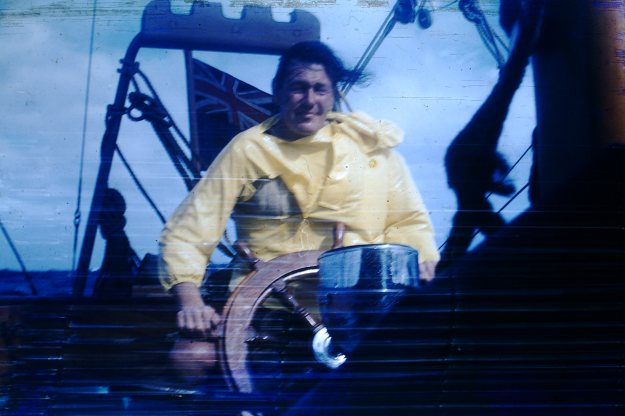
Captain William ‘Billy’ Stanley Moss MC, Coldstream Guards courtesy of Gabriella Bullock (Copyright Estate of William Stanley Moss)
This is the text of a talk given by ‘Billy’ Moss’ daughter, Gabriella in March 2024, at the time of the 80th Anniversary of the kidnap of General Kreipe. It includes some observatiosn and family detals which I hope you will enjoy.
In 1940 Winston Churchill launched the Special Operations Executive (SOE), with the
rousing injunction to ‘set Europe ablaze’. I shall be speaking today about my father, William
Stanley Moss – and the 1944 operation in which he was involved with Patrick Leigh Fermor,
both British SOE agents. This was the abduction carried out by the two of them, together
with a trusted handful of Cretan Resistance fighters, of General Heinrich Kreipe, Commander
at that time of German Forces on occupied Crete. My father’s book Ill Met by Moonlight
describes it all. It was a bestseller later made into an Emeric/Pressburger film, which I
imagine most have you have seen.
To give you a bit of background first. My father was born in 1921 in Yokohama, Japan,
where his family had settled the generation before, and where his father was a businessman.
His mother was a White Russian whose family had escaped the Revolution. When my father
was two years old Yokohama was entirely destroyed in the Great Kanto earthquake; the
family survived and returned at that point to settle in England. They travelled a great deal,
however, and my father claimed to have voyaged around the world twice before his teens.
Known as Billy, he was a much-loved only child, and his adventurous spirit was given fairly
free rein. Treasure Island was and remained his favourite book. Also encouraged were his
love of writing and drawing, and of animals. He was schooled at Charterhouse, leaving in
1939 before his 18 th birthday, and before the outbreak of war.
He was commissioned into the Coldstream Guards in 1941, having trained at Caterham and
Sandhurst. He served 18 months in and around London, on the King’s Guard, with a period of
guarding Rudolph Hess, and a spell of Churchillian duty at Chequers – all thrilling for a
junior officer – before suddenly being sent to join the 3rd Battalion the Coldstream in the
Middle East. He saw action for the first time in the Desert Campaign with Montgomery’s
Eighth Army, chasing Rommel across North Africa, after Alamein. Following a spell in
Pantelleria, Italy, he parted from his regiment and headed for Cairo, and in September 1943,
he volunteered to join Force 133 of SOE.
At 22 years old he was the youngest inmate of the house known as Tara – which grew into
something of a Cairo legend as a centre of uproarious and eccentric fun when its housemates
were on leave. These were other SOE agents and included David Smiley and Billy McLean who operated together in Albania and the Balkans; Xan Fielding and Patrick Leigh Fermor –
known as Paddy – these two were well embedded in the Cretan resistance and Paddy had
already spent some two years in the mountains disguised as a shepherd. He had an almost
Byronic love and affinity for Greece and Crete. He was fluent in Greek, German and many
other languages, and would recite reams of epic poetry at the drop of a hat.
I can’t resist sharing with you this description of him, later in life, by his friend the writer
Lawrence Durrell, when Paddy was staying with him in Cyprus:
After a splendid dinner by the fire Paddy starts singing, songs of Crete, Athens, Macedonia.
When I go out to refill the ouzo bottle…I find the street completely filled with people listening
in utter silence and darkness. Everyone seems struck dumb. I catch sight of Frangos, who
says ‘Never have I heard of Englishmen singing Greek songs like this!’ Their reverent
amazement is touching; it is as if they want to embrace Paddy wherever he goes.
My father too was under his spell.
Paddy was 29 at the time of the abduction. He was less of a professional soldier than my
father, with less experience of conventional warfare. He had served for a short time with the
Irish Guards but his disposition was far more suited to undercover work with SOE.
Eventually – but not without dissenting voices – he was granted permission by HQ to carry
out the kidnap operation. When he asked my father to join him as his second-in-command,
he leapt at the chance.
Paddy wrote an Afterword for the 2001 edition of Ill Met by Moonlight. Writing from a
historical perspective, he is at pains to insist that the kidnap was carefully planned – that it
was the result of an idea of long and complex gestation. He longs to dispel the notion that it
was somehow a tremendous jape. It is also true, however, that all the Tara inmates had had a
great time adding their ha’penny-worth, towels around their middles, famously drawing
maps, plans and diagrams on a steamy bathroom wall.
Afterwards, one wireless announcer said, ‘of all the stories that have come out of the War this
is the one which schoolboys everywhere will best remember’. Paddy’s words cannot stifle
the ebullience of this story. Its enduring appeal hinges on its mix of danger and courage with
dare-devilry, and on the fact that its aim was not destruction of any kind, but simply, with the co-operation of a huge swathe of the unbowed and complicit population, to get the better of
the mighty Germans by stealing their general from under their noses. It was a wonderful
idea. On Crete itself there is a joke that out of a population of 600,000, 599,999 were
involved.
To go back a bit. The German invasion of Crete in 1941 had been, uniquely, an airborne
invasion, and The Battle of Crete raged for 11 days of total and bloody fighting. When the
Germans prevailed, and thousands of British and Allied troops hurriedly evacuated as best
they could be, Cretans were abandoned to their fate. In retaliation for the fierce resistance
they had put up, the Germans instantly imposed a terrifying and pitiless rule on the entire
population, which was enforced throughout the occupation. On the slightest pretext, or even
none, there were summary executions, destructions of villages, massacres of their inhabitants,
gratuitous cruelty of every kind. General Muller, commander of the German forces, was
known as The Butcher of Crete, and later executed for war crimes. This was the general that
Paddy and my father hoped to abduct, take prisoner and escort back to Cairo. However, in
March 1944 Muller was temporarily replaced by General Kreipe – who thus became the
target.
In the wake of the Battle of Crete numbers of Cretan men had taken to the mountains – as
they had the century before when under Turkish rule – forming and joining bands of
resistance fighters. A handful of SOE agents such as Paddy then trickled into Crete to help
and organise this resistance.
I won’t narrate the full story, as many of you will have read the book or seen the film. I feel I
should explain, though, that sadly I never knew my father, who died when I was a child. So,
much of what I have to say is necessarily conjecture. Luckily he wrote books, letters, diaries.
I shall be quoting from the fulsome contemporaneous diary that he kept, and upon which Ill
Met by Moonlight is closely based.
One night in early February 1944 Paddy, Billy and two key Cretan members of the team,
Manoli and George, are flown out over Crete, and Paddy is dropped. But as the plane turns
to make a second drop, clouds close in, ever more thickly, forcing the plane back to base.
Subsequent attempts to reach Crete by plane and boat are all thwarted until finally, on the
night of the 4 th April, a small motor launch with my father on board edged towards the Cretan
coast. “In the light of the half-moon the mountains loomed up large and misty-white so that it seemed that we were much, much closer”. Guided slowly in by a pinprick signal of
torchlight, a dinghy landed him within wading distance and he was helped ashore by a score
of hands.
My first impressions were extraordinary – dark faces, heavy moustaches, turbaned heads,
black and shabby clothes, tall boots, a hundred voices. And then I saw Paddy, and ran
towards him. I can’t describe how wonderful it was to see the old son of a gun again. We
talked of everything and of nothing for a few moments. Paddy looked radiantly healthy, and
the sun (I think it must have been the sun) had darkened his face, so that he looked for all the
world like a smuggler of old.He had to leave me then to go and see to further unloading and to get the German POWs on
board…
I saw him go off, and watched him, as he gave orders, commanded men to do this and that. I
remember thinking ‘Here is the different Paddy’. He seemed to have the whole situation at
his finger-tips and was capable of coping with anything.
I wanted to read this to you to give you a flavour of it all in the diary’s words, and also
because of the rather English understated way my father expresses his admiration for Paddy.
Throughout the diary there never seems to be a jarring word between them. Rather, a close
understanding and uncomplicated delight in each other’s company – a purity, somehow.
The beach in question had been mined, with German outposts only ¾ mile to the west and
one mile to the east. Through that night their Cretan guide led them over mountains for four
hours. In this way, and at each stage of the operation, the Cretans were guiding them,
sheltering them, guarding them, providing for them. Taking unimaginable risks for them.
Paddy always stressed that most of those involved in the kidnap were Cretan, and there was
no doubt of the consequences for them of being caught. As for Paddy and Billy, Hitler’s
Commando Order of 1942 was clear, stating “all enemies on so-called commando mission,
whether armed or unarmed, in battle or in flight, are to be slaughtered to the last man”.
There were moments of hair-raising danger, but preparations went ahead, and the kidnap took
place on the evening of the 26 th April, as the General was being driven from German HQ to
the Villa Ariadne, his sleeping quarters in Knossos. Paddy and Billy, in stolen German
uniforms, and their team of seven Cretans, waited concealed. At a signal that the General’s
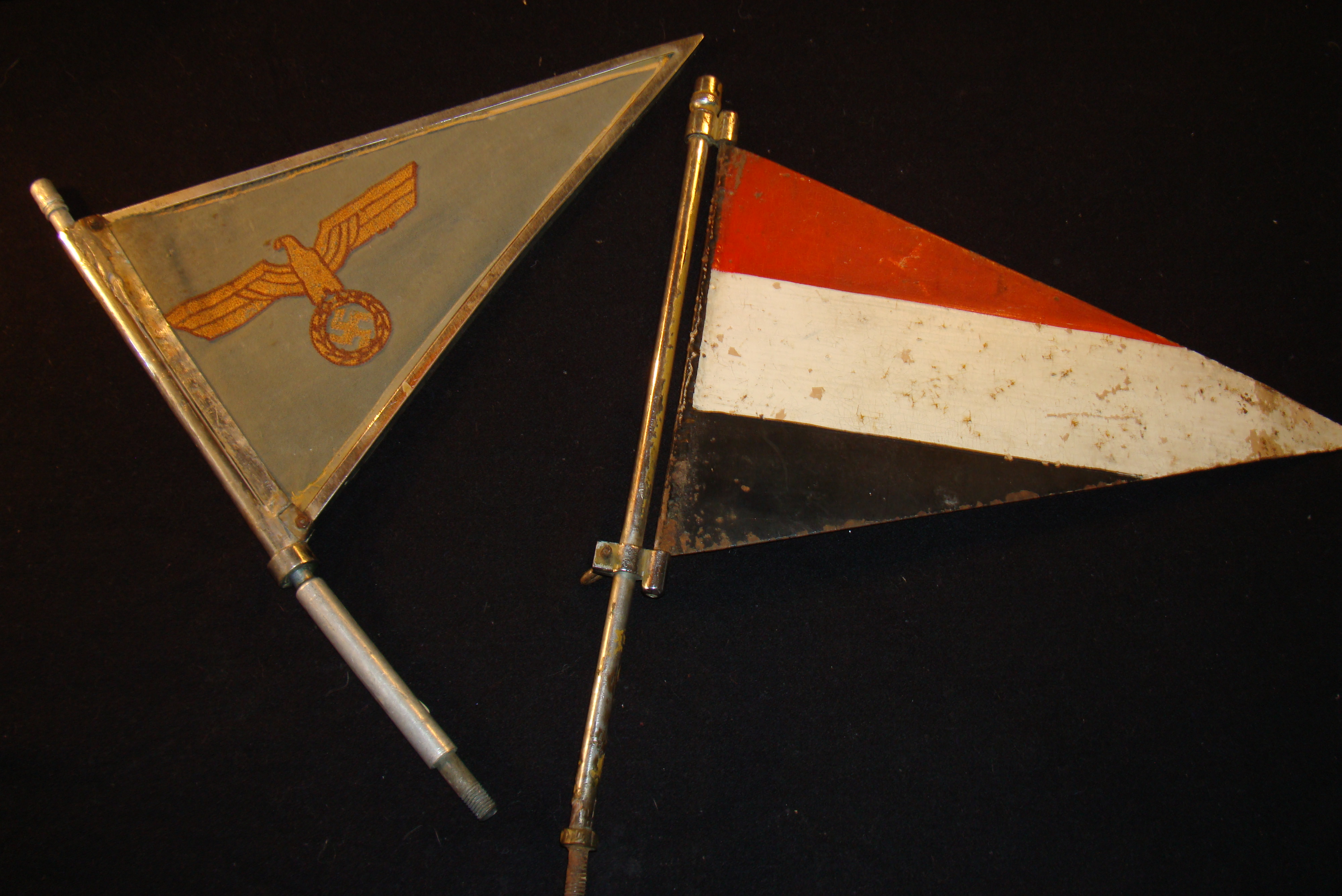
car, with its unmistakeable pennants on the front, was approaching – one hour later than expected – Paddy and Billy stepped into the road, swinging torches. The car slowed at the
crossroads. Paddy cried HALT. The car stopped and they both approached it, one on each
side – Billy on the driver’s side. Paddy questioned “Ist dies das General’s wagen?” “Ya, Ya”
– and then they tore open the doors. The terrified chauffeur was reaching for his revolver,
Billy hit him with a cosh, Paddy and Manoli pulled the General from the front seat.
Struggling like mad and protesting loudly, he was bundled into the back, and sat upon by
three hefty and armed Cretans, while the chauffeur was taken away by the others. Billy
jumped in behind the steering wheel, and with Paddy beside him now wearing the General’s
hat, they set off. Paddy told the General that if he were willing to give his parole that he
would neither shout nor try to escape, they would treat him not as a prisoner but as one of
themselves; the General gave his parole immediately. Billy drove the car, past the startled
sentries waiting at the guarded Villa Ariadne; and then through a number of checkpoints. At
these, he slowed right down to give the sentries time to recognise the pennants, before
gradually accelerating smoothly past – a tactic which seemed to work. Their route took them
through the centre of Heraklion, where unfortunately, with nerve-wracking timing, a garrison
cinema show had just ended and spilled out its audience – so that the streets were milling with
scores of German soldiers, and they were forced to weave through at snail’s pace, holding
their breath and their nerve. There were many more checkpoints: 22 in all, of which 5 were
roadblocks – but somehow they negotiated them all.
They carried on along the coastal roadand up into the mountains, and here the party split. So far, so good. Together with the Cretan team, Billy and the General set off into the mountains. Meanwhile, Paddy drove the car to a
spot by the north coast, where it might seem that the occupants had left it and had boarded a
waiting submarine. Inside it he left the signed letter which he and Billy had carefully
composed: this was addressed to the German authorities, and claimed full and sole British
responsibility for the abduction, as well as hopefully giving the impression that the General
would have already been taken off the island. The reality was that, having re-formed, the
entire party would then trek over the mountains all the way across to the southern coast where
hopefully there would make rendezvous with a boat to take them to Cairo.
It had been pre-arranged with HQ that when news of the abduction broke, the BBC and other
broadcasting channels would announce that General Kreipe was already on his way to Cairo.
In fact, everywhere it was announced that the General was being taken off the island. This
made matters for them very much worse: it was responsible for the Germans launching a full-
scale manhunt.
Not only that, but the leaflets never materialised which were supposed immediately to be
dropped, stating in both German and Greek that the operation had been carried out by a
British raiding party – in this way, Paddy had hoped to prevent reprisals being taken on the
islanders.
Over the next 19 days the party made its way across the mountains by night, taking cover in
caves by day, while the full-scale manhunt picked up their trail and began to close in on them.
As Billy wrote, they had everything to lose. But with their incredibly loyal tight-knit team,
local lookouts and runners, they just managed to keep a step ahead of the tightening circle –
fed and sheltered all the way without question and without fail. There were of course also
those whom they couldn’t trust. There was constant danger, setbacks, crises, near-disasters
and changes of plan, failed communication systems and mishaps of all kinds, but finally on
the night of the 15 th May Paddy and Billy were safely chugging their way back to Cairo in the
same motor launch that Billy had arrived in. They handed over General Kreipe and their job
was done.
General Muller returned as General Commander of Crete, and that August he issued the
following Order:
Because the town of Anogia is the centre of the English Intelligence of Crete, because the
people of Anogia committed the murder of the sergeant commander of the Yeni-Gave as well
as of the garrison under his orders, because the people of Anogia carried out the sabotage of
Damasta, because in Anogia the guerrillas of the various groups of resistance take refuge
and find protection and because it was through Anogia that the kidnappers with General
Kreipe passed using Anogia as a transit camp, we order its COMPLETE DESTRUCTION
and the execution of every male person of Anogia who would happen to be within the village
and around it within a distance of one kilometer.
Anogia was then obliterated. Several villages in the Amari district were also razed that
summer, with inhabitants rounded up and shot.
There are those who said – later –that the success of the mission came at too high a price.
There were also those who had predicted such reprisals, such as Col. Sweet-Escott who as
SOE Commander in the Balkans had experience of them – they were part of German policy,
widely practised, and had been a ruthless feature of the occupation from its beginning.
Others, including Paddy – although he suffered lifelong agonies of doubt – believed that the
meticulous care taken to avoid involving the Cretans in reprisals was in this case successful.
They laid the cause of the reprisals on other factors. There was, by this stage of 1944, the
question of the Germans’ imminent collapse and Muller’s strategic need to preclude attacks
on his withdrawing troops. This he did by crushing centres of resistance across the whole
island, the so-called ‘scorched-earth policy’, because in this way, ordinary German soldiers
were compromised by participation in war crimes; this made their surrender or desertion
impossible. There were also the other attacks mentioned in Muller’s Order, such as the
ambush carried out at Damasta, and attacks on Germans carried out in May by the
Communist ELAS party (civil war was just over the horizon, and the Communist activists
used such attacks on German targets as part of a cynical strategy, designed to trigger a violent
response). It is also possible that Muller reversed the lenient line, which until then had been
taken with regard to the bloodless Kreipe operation, out of straightforward revenge – for he
must have realised he was the original-intended target.
Then there are those – perhaps especially in Crete – who are philosophical and stoical, saying
that there were several factors and that Yes, perhaps the abduction was one of them; but that
it was war.
Whatever the opinion expressed – and everyone in Crete has an opinion on this desperately
emotive issue – it clearly meant a very great deal to people at the time that Paddy and my
father who were British stood shoulder to shoulder with them, that they were not entirely
abandoned. In our time we have seen exactly this sentiment replicated in Ukraine. And in
the midst of the humiliation of Occupation, this successful operation, which involved so
many Cretans, enabled a proud people to hold up their heads.
That is not nothing, nor is it forgotten.
Years later, amongst my father’s papers I found a long letter in German from a Dr. Beutin
who at the time of the kidnap had been a serving German officer on Crete. The letter was
dated 1950, which was the year that Ill Met by Moonlight was first published. In 1993 I had
it translated and shared it with Paddy – to his great excitement, because it sheds light on the
German perspective – as he wrote in a letter to me, “It really does seem that our stratagem
worked and that for a very important gap in time, the contents of our letter (the one left
inside the General’s car) were believed, before the enemy knew of the truth through their spies
or our traitors – both, of course”.
He immediately embarked on his own translation of the letter, and tried to contact Dr. Beutin,
only to discover that he had died some years before.
Among Dr. Beutin’s observations (Paddy’s translation) are these: “General Kreipe arrived in
Crete at the beginning of March 1944… Within a few days he became highly unpopular
among the men because of his pettiness and rudeness, to officers as well…and he introduced
a tone to which the men of the Division were not accustomed and which they perceived as
undeserved… He always grew impatient at traffic points… where the rule was that every
driver had to produce a movement-order for every journey… no exceptions to this rule were
allowed, even for generals; but Kreipe deemed this unnecessary or unbecoming in his own
case, and was very rude if his car was ever stopped… everyone took care not to examine his
car too closely… so Kreipe was a victim of his own disobedience to orders… The soldiers
were surprised but not upset that he had been abducted… in some quarters, it was maintained
as a joke that the General had abducted himself. It was much discussed in officers’ messes,
and many rakis were drunk to your health.”
Paddy’s response to these comments was, “I think your father was a better judge of Kreipe’s
character than I was”.
Let me explain.
My father was relieved that Kreipe wasn’t the raving Nazi he might well have been, and gave
him credit for coping with arduous marches and hardships, especially in the early part of their
trek. They did obtain a mule for him, but he had at least one nasty fall. However, my father
found Kreipe increasingly difficult to please, which put additional strain on the situation.
Moreover one day, as he perceived it, he saw an ugly side to Kreipe: throughout the
afternoon, there had been the sound of explosions – it was Germans blowing up villages with
dynamite, as a reprisal for a different agent’s actions. The General, with a grin, remarked that
it was so easy to kill Cretans as reprisals for anything the British did. My father was appalled
and could never warm to him after that incident, although two days later the General
apologised and things carried on as before.
But Paddy wasn’t with them that day, and never saw that side; he saw a different side. There
is a famous story – and it bears repeating. Two days after the abduction, as dawn broke over
snow-covered Mount Ida (or Psiloritis, to give it its Greek name), the General quietly recited Vides ut alta stet nive candidum Soracte “You see how Mt Soracte stands white with
deep snow” – the opening line of a Horatian ode. It was one that Paddy knew. He responded with the next line, and carried on to the end. I quote:
The general’s blue eyes had swivelled away from the mountain top to mine – and when I’d
finished, after a long silence, he said: “Ach so, Herr Major!” It was very strange. As though,
for a long moment, the war had ceased to exist. We had both drunk at the same fountains long
before; and things were different between us for the rest of our time together.
Paddy loved to tell this story, and the wonder of it struck all who heard it, and the power of it
only grew with time – so that it became the defining moment of his entire war, like a
distillation, a jewel, that he treasured. And not surprisingly, it coloured his view of the
General. Indeed, in 1972 (several years after my father’s death) there was a reunion in
Athens for a sort of Greek version of This is your Life, featuring Paddy and General Kreipe
and the core Cretan team – and a very jolly reunion it seemed. Kreipe was complimentary
about the courteous treatment he had received as a prisoner on Crete, but he could never
bring himself to say a nice word about my father, and I think I know another reason.
Some fifteen years ago, when my family was in the process of reclaiming the publishing
rights to my father’s work, my husband made an interesting discovery: that when Ill Met by
Moonlight was published, Kreipe successfully took out an injunction against its publication in
Germany, on the grounds that it falsely states that he gave his parole to Paddy that he would
not try to escape. For such a senior officer to give his parole would have been highly
shameful and dishonourable military conduct, and he denied it. But with the release in 2012
of classified wartime records in the National Archive, we were able to read Paddy’s report to
HQ: it clearly states that parole was asked for and given. Ill Met by Moonlight has never
been out of print, and it has been published in Greek, French, Spanish and Italian – but to this
day, not in German.
* * *
It had been an ever-present wish of mine to go to Crete… and finally in 2010, with my
husband Hugh, I made the journey. We didn’t tell Paddy or anyone else that we were going,
wanting no proscribed introductions of any kind, but simply to make a private visit to see the places my father had written about. We were armed only with Ill Met by Moonlight and his
other wartime memoir, A War of Shadows, and a few photographs. In the mountain village of
Kastamonitsa we got talking to a charming old man who kept a shop, and asked him for
directions to the house where Billy and Paddy had stayed when making preparations for the
kidnap. The old man said nothing, but made a phone call, and soon the street outside his little
shop started to fill – news of my being there spread like wildfire – we could not believe it –
shepherds with mobile phones appeared from the mountains, scions of those who had
sheltered the kidnap party – we were invited into homes, feasts were prepared, glasses were
raised… It was so extraordinary and so unexpected. Over the next days we were taken up to
Mount Ida – Psiloritis – along tracks and into caves where my father had trodden and slept.
And then escorted to Anogia – I was so nervous about Anogia – after all, the reprisals… how
dare I go there, and what would I be confronting there? Anogia had risen phoenix-like from
its ashes, the biggest village in all of Crete. The reprisals and the history were not brushed
under the carpet for me – instead, wonderful guides showed us all, explained all, sparing
nothing; and then led us to meet well-known families of the Resistance… there was
overwhelming hospitality, gunshots as a salute, more welcomes, more feasts, there and
everywhere we went. We were taken to hideouts, to family chapels … Much later we learned
more about Anogia in particular, and the dark complexities that these families had faced since
helping the British – but I can only say that in our dozen or so visits to Crete since that first
visit, I have on rare occasions met with reserve, but never once with hostility. Mostly I have
been deluged with goodwill, and astonished by the enthusiasm that my visit was generating.
Now, as in war, it seemed that it meant a huge amount – how can I put it? for their story not
to be forgotten. Remembered by the outside world. For me this reception has been
astonishing, and truly humbling. We met so many amazing people, who over these last years
have become dear friends, like second families. Widows, children, even grandchildren. A
few very old but still vigorous men who remembered my father, and were with him in 1944
… they have all died now, but that was so precious! I could tell you so many stories… I will
tell you about Iorgis, from the tiny eyrie-like village of Patsos. Small and strong and wiry, he
was close to ninety and almost completely blind when we met him. Much later, his daughter
told us what a harsh and tragic life he’d had – we would never have guessed. He took us up
to the large overhanging cave where my father was sheltered for many days – he was as sure-
footed as a mountain goat and so quick we could barely keep up. He spoke no English, and
we spoke no Greek. Luckily others translated for us – because as we sat down to an
extraordinary instant feast, the stories were gushing out of him, and it was wonderful to see him chuckling away and so clearly enjoying his memories. He had been younger than my
father, probably about 20, and he recounted how one day the two of them were out on the
mountain when a German spotter plane appeared. They dived into a hollow, and my father
pulled some vegetation over them, and there they stayed hidden while the plane circled and
circled overhead, and my father sang It’s a long way to Tipperary. Amazing Iorgis who
spoke not a single word of English – how he laughed as he sang it to us, after almost 70
years!
Also in Patsos, we met Vassily who had been in the Greek Special Forces. Younger than us,
and fiercely proud of his village’s history, his first words to me were an enthusiastic
“Congratulations on your father”. He told us that, to this day, the Army uses the kidnap route
to train its Special Forces. And indeed people come from all over the world for expeditions
along the route – have even written books about it. It is legend, and really tough. As my
father wrote in his diary, “Crete appeared to be one big rock – only more so”.
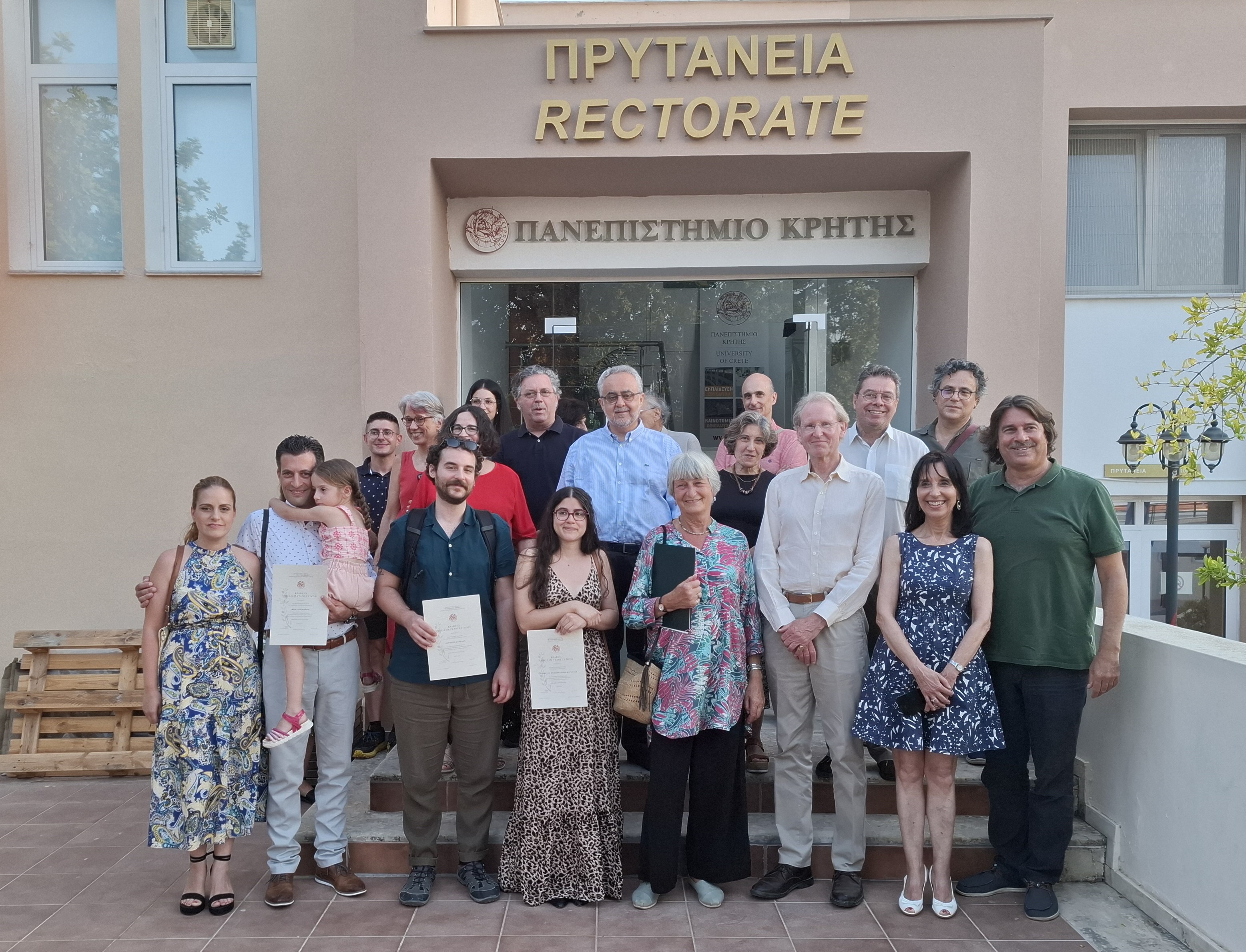
After my family had successfully reclaimed the rights to Ill Met by Moonlight and my
father’s other works, which happened to coincide with when we first started visiting Crete,
my husband and I came to a decision. At the University of Crete we set up two annual prizes
in my father’s name, funded mostly by the royalties from his books and other work. It is a
world-class university which, as a result of Greece’s financial crisis, had had its budget cut by
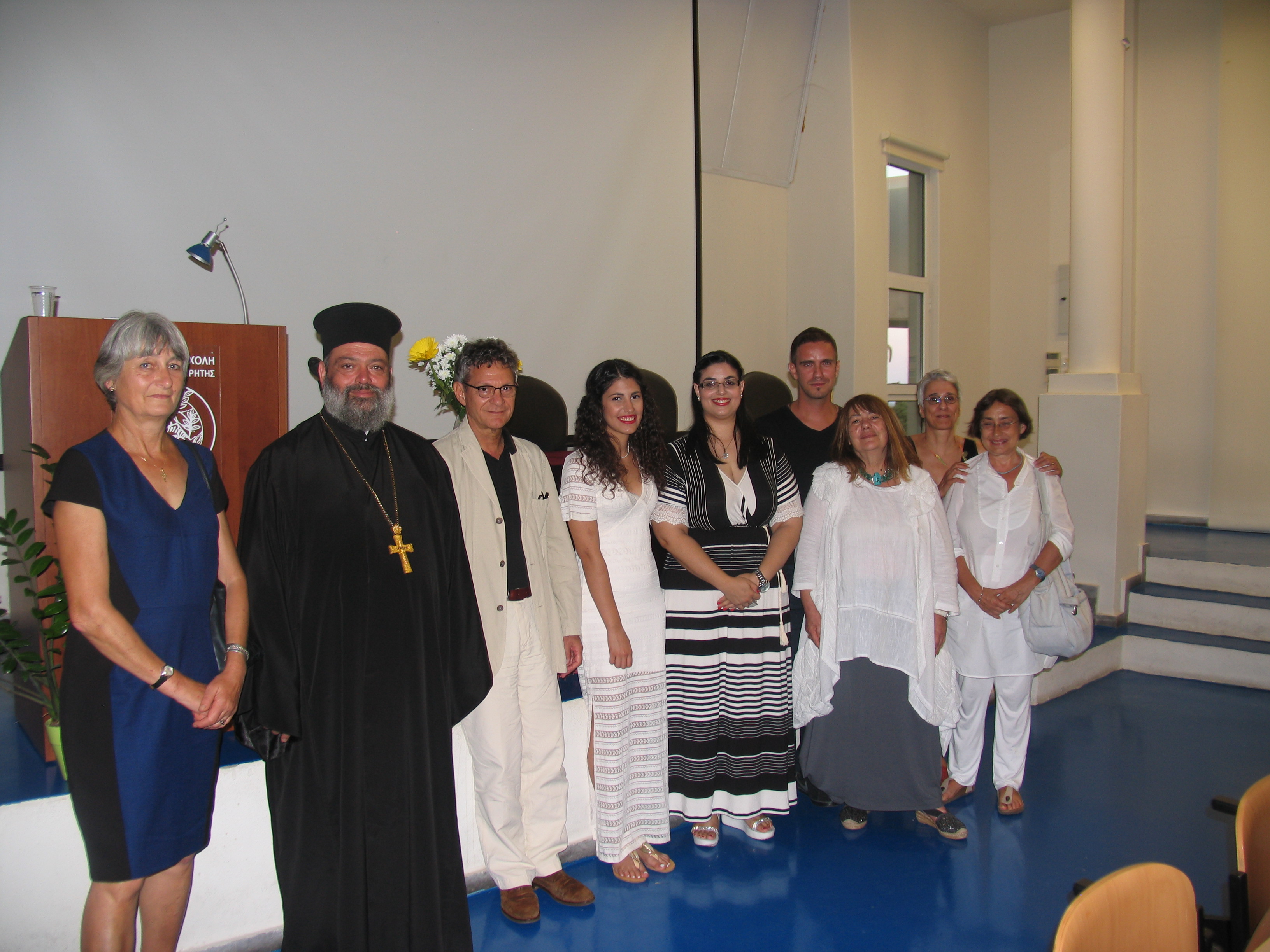
50%. I was very nervous at the inaugural prize-giving ceremony, that my father would be falsely
presented as a sort of pure white hero for my benefit. But I need not have worried: the Dean
gave an unforgettably philosophical speech, about war and atonement and redemption, and
the time-honoured use, since Classical times, of acts of atonement or commemoration. The
prizes are now in their eleventh year – and we feel we have acquired another, academic,
family! Every year in my speech, lest they forget, I repeat that the prizes exist to honour the
Cretans, in my father’s name. They are the only means I have to salute them, to give
something back on his behalf, and to express my gratitude and admiration. The very first
prize-winner in 2014 was a young woman who grew up listening to her grandfather’s stories
– he had been involved in the kidnap operation; she entered the competition in his memory.
Last year, one of the winners told me that he had entered the year before, but had not won.
This time he had won, and he was so pleased. He said that the prize was a real motivation to
produce an excellent piece of work. This was lovely to hear – hopefully it is truly a legacy.
Next month will be the 80th anniversary of the abduction. The exact spot at the junction with
the road to Knossos is marked by a memorial, and every year wreaths are laid. A ceremony
will certainly be held this year. As for me, – I remember Paddy telling how they looked up at
the stars – and it is whenever I look up at night and see the stars, especially Orion’s Belt, that
I think of Paddy and Billy looking up at them and finding their way by them, all those years
ago.