Category Archives: Between the Woods and the Water

Traveller’s Century – Benedict Allen seeking Patrick Leigh Fermor

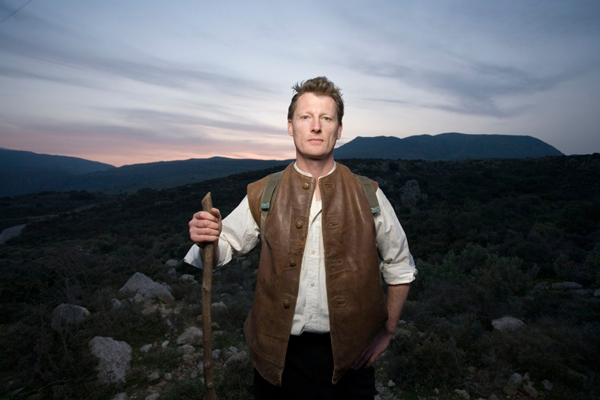
Benedict Allen

Benedict Allen

Many will be aware of Benedict Allen’s 2008 BBC documentary where he follows Paddy’s journey and eventually gets to meet with Paddy at Kardamyli. It is rarely shown and unavailable on iPlayer. However, there will be a chance for some to watch the programme at Waterstones Piccadilly on Thursday 9th October at 6.30pm.

As part of their “Traveller’s Film Club” series of events, Benedict will introduce the programme after which there will be a screening. Further details of how to book are on this web page.

The Traveller’s Film Club are also showing films on Norman Lewis (September 16) and Wilfred Thesiger (November 13). See the same list.

Thank you to Mark Granelli for pointing this out to me. See some of you there!


Baron Pips von Schey

Originally posted as a comment on the Your Paddy Thoughts page, I thought this too good to be left buried deep in that page. My thanks to Brian Human who posted it here.

One of the most significant of the characters that inhabit Paddy’s pre-war world is Baron Philipps (Pips) von Schey. Paddy’s stay with Pips at the Schey country house at Kovecses enlivens the later pages of A Time of Gifts. This episode gets an unexpected reference in Edmund de Waal’s sparkling biography The Hare with Amber Eyes (p. 177 of the illustrated edition, Chatto & Windus, 2010) due to an important family connection.

In 1899 Baroness Emmy Schey von Koromla married de Waal’s great grandfather, banker Viktor von Ephrussi. Pips was her younger brother and Kovecses becomes a recurring presence in the lives of the Ephrussi family.

In The Hare Kovecses is described as ‘a very large and very plain eighteenth century house (“a large square box such as children draw”…) set in a flat landscape of fields with belts of willows, birch forests and streams. A great river, the Vah, swept past, forming one of the boundaries of the estate…There was a swimming lake with fretted Moorish changing huts, lots of stables and lots of dogs.’ Trains stopped ‘at the tiny halt on the estate.’ The Hare includes several pictures of Kovecses.

Pips is pictured in a pen-and-ink drawing playing Wagner at the piano. He had been educated by tutors and had ‘a wide circle of friends in the arts and the theatre, is a man around town in several capitals and is impeccably dressed…’. A further sign of his high profile: ‘Pips appears as the protagonist of a highly successful novel of the time by the German Jewish novelist Jakob Wassermann…Our aesthetic hero is a pal of archdukes…He is erudite about incunabula and Renaissance art…’. Kovecses became a retreat for the Ephrussi family, a refuge from the banking hothouse of Vienna for games, music and plays, for swimming, walking riding and shooting in the years before 1914.

With the advent of war, ‘Uncle Pips is called up, handsome in his uniform with its astrakhan collar, to fight against his French and English cousins’. In 1915 he ‘is serving as an imperial liaison officer with the German high command in Berlin, where he is instrumental in helping Rilke get a desk job away from the Front.’ Wartime shortages beset the Ephrussies in Vienna and in 1916 they go to ‘…Kovecses for the whole long holiday. This means that at least they can eat properly. There is roast hare, game pies and plum dumplings…’. By August 1918, ‘There are only two old man to tend the gardens and the roses on the long veranda are unkempt’ at Kovecse.

After the war Pips maintains his friendship with Rilke and gives his niece, Elizabeth, de Waal’s grandmother, an introduction to the poet. She sends him her poems and they correspond, though they never meet.

By the early 1930s and with the ascendancy of fascism and anti Semitism life became increasing difficult for the Ephrussies. In 1934 (the year of Paddy’s visit) ‘Viktor and Emmy holiday together at Kovecses, but since the death of her parents it is a strangely diminished place, with only a couple of horses in the stables and fewer gamekeepers and no great weekend shoots any more…The swimming lake has been let go. Its edges are susurrating reeds.’ Following the Anschluss in 1938 Viktor and Emmy flee Vienna for the relative safety of Kovecses. ‘In the summer of 1938 Kovecses looks much the same as it has done, a jumble of grand and informal…[but] The roses are more unkempt…The house is much emptier.’ The safety is only relative: ‘The borders are under review and Czechoslovakia is fissile. And Kovecses is just too close to danger.’ Germany occupied the Sudetenland; Emmy died at Kovecses on 12th October 1938 and was buried in the churchyard of the nearby hamlet. In early March Viktor got permission to leave for Britain, where he died in 1945.

The war and its aftermath wreaked their havoc on Kovecses and the Schey family, though happily Pips survived and Paddy records that he died in Normandy in 1957.

I have found that you can read The Hare with Amber Eyes on-line here.

Ada Kaleh and the mosque controversy

An very interesting piece by Dr Dorel Bondoc, expert on Archaeology from Oltenia Museum, Craiova, Romania, about the history and archaeology of the submerged island in the middle of the Danube. It refutes Paddy’s claim in BTTW that the mosque was moved.

by Dr Dorel Bondoc

Published on the Alexis Project website.

At the beginning of the 15th century, the island was occupied by Turks, who understood its remarkable strategical importance for the development of the river trade on the Danube, after the exit from Kazan region. In 1718, as a result of the treaty from Passarowitz (Pojarevat), the northern Serbia, Banat and Oltenia became possessions of the Austrians, as was also the case of Ada-Kaleh island which then bore the name New Orsova.

The Austrians built a strong fortification of “Vauban” type on the island. In 1739, after the treaty from Belgrad, Austria returned Serbia and Oltenia to Turkey. As a result the island was occupied again by Turks, who gave it the name Ada-Kaleh, which may be translated as “the island of the fortress.” The toponym can also be found in the documents of that time as: Ada Kale, Ada Cale, Adakaleh, Ada Kaleh or Adacale.

Read more here.

Related article:

Ada Kaleh: the lost island of the Danube

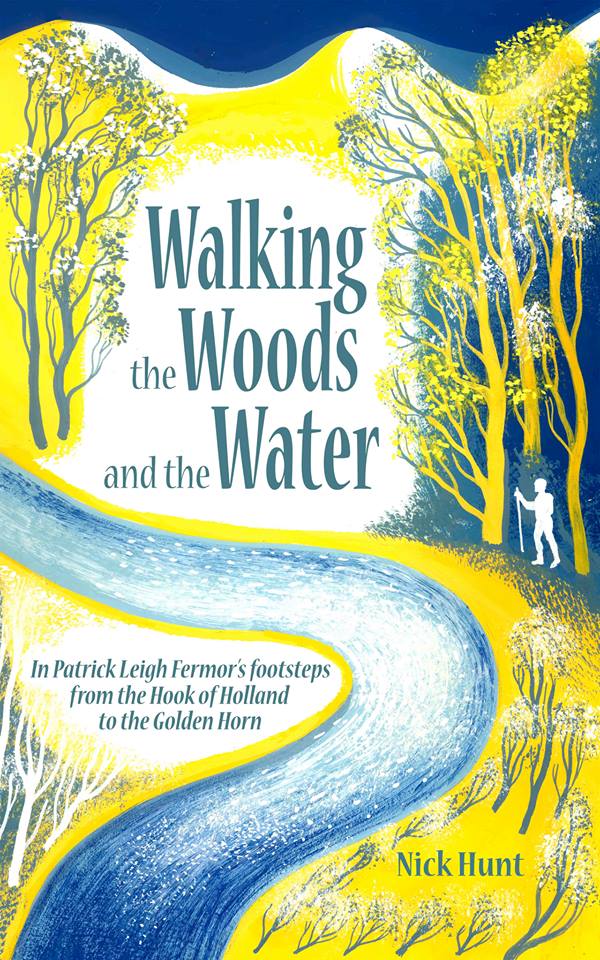
Walking the Woods and the Water – Nick’s book cover revealed

Walking the Woods and the Water

Walking the Woods and the Water

After a lot of labour, a change of publisher and book title, Nick’s book is finally to be published by Nicholas Brealey Publishing in March. Many of you will remember that two years ago Nick walked Paddy’s great trans-European walk, taking about the same time, using only Paddy’s books as a guide, and visiting many of the houses he stayed in en route.

Nick wrote to me saying “The cover has been designed and I’m very pleased to tell you it’s by Ed Kluz, the same artist who did The Broken Road. Looks very different of course, and not (as I was worried it might) overly derivative of the style of Paddy’s books. But a nice continuity.”

It will be interesting to see what you all think about that. As soon as I have further news I will update you. I do know that Nick will be giving some talks to support the publication and I will pass on these details as soon as I have them.

Ignore the xenophobic hysteria and welcome our EU neighbours

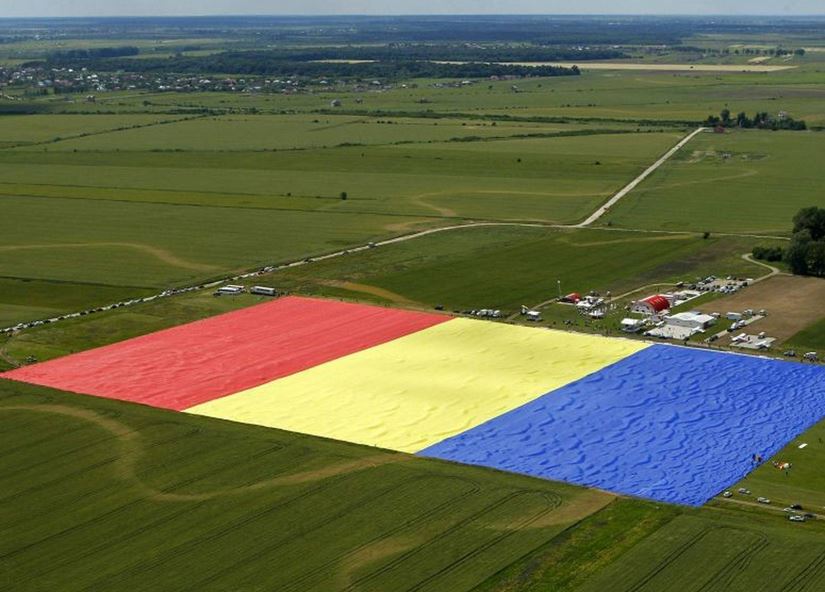
Villagers in Clinceni, Romania cover a field with what they claim is the world's biggest ever flag

Villagers in Clinceni, Romania cover a field with what they claim is the world’s biggest ever flag

Britain is in the Orwellian middle not of a Two-Minute Hate, but a Two-Year Hate.

By Boyd Tonkin.

First published in the Independent, 27 December 2013.

This may surprise alarmed observers in Sofia and Bucharest – or even in Westminster. But one of the best-loved British books of 2013 takes the form of a fervent and heartfelt tribute to the peoples of Bulgaria and Romania. War hero, writer and traveller Patrick Leigh Fermor died in 2011 before he could publish the third volume of memoirs about his “Great Trudge” though Europe in the mid-1930s. The Broken Road, which appeared posthumously in the autumn, takes the young literary vagabond from the “Iron Gates” on the Danube across both countries to the Black Sea coast.

Everywhere he walks, Leigh Fermor relishes the landscapes and the languages. He admires the culture and the customs. Above all, he comes to love the people of the Balkan peaks and plains: always hospitable and welcoming, forever willing even in the poorest backwater to greet this penniless young Englishman with unstinting generosity, feed him, shelter him and send him on his way with blessings – and with lunch.

Now, what would happen to a late-teenage Bulgarian or Romanian, without lodging, employment or any ready cash, who started to walk, say, from Dover to Glasgow in the spring of 2014? On the evidence of British public life just now, the result would not be a glorious trek across a land of smiles, fondly remembered from a ripe old age.

The Economist magazine has already issued its number-crunched fiat in their favour. Still, this column may count as an early squeak in the almost inaudible chorus of welcome for visitors or migrants to the UK from Bulgaria and Romania. More than a few of us belong to the open-hearted country of Paddy Leigh Fermor rather than the tight little island of Godfrey Bloom. If you wish to, fellow EU citizens, I hope that you will come. Should you choose, quite legitimately, to seek work here, then I hope that you prosper for as long as you stay. And most of all, I hope against hope that our morally bankrupt political class and ruthlessly cynical media will one day start to address the underlying reasons for home-grown fears: the living-standards crisis, deep-seated job insecurity, yawning chasms in wealth and opportunity, the greed and arrogance of a pampered “super-class”, and a chronic lack of decent homes for non-millionaires. Instead, they have set out on yet another sordid scapegoat hunt. Patrick Leigh Fermor Patrick Leigh Fermor

The grievances are genuine. But the actual culprits have got clean away. A useful watchword for 2014 might run: lay the blame where it belongs. August Bebel, a wise German social democrat at the turn of the 20th century, popularised the idea that “anti-Semitism is the socialism of fools”. A century on, the quarry may have changed, but not the toxic rhetoric, nor the squalid logic of victimisation. As all the 28 million people in the so-called “A2” accession countries of the EU must understand, this lather of dread has been whipped into a perfect storm by the confluence of cannily inflammatory media and the blind funk of a shaky governing party. As a result, if you’re looking for fraudulent crystal-ball predictions, outrageously deceitful hucksterism and a brisk trade in ideological scrap and junk, there’s no need to visit some mythical gypsy encampment. You can find all that and more via any visit to Westminster, TV studios and newsrooms – plus a detour, of course, to the Ukip HQ.

Crashing rollers of anti-immigrant vitriol break day after day, loud as an end-of-year storm surge, and just as implacable. Anyone who resists this tide – who says without any niggling proviso that all legal incomers from European Union member states, as from -everywhere else, presumptively deserve trust, goodwill, courtesy and fair dealing – may feel just now like the enemy within. The tone of paranoia, suspicion and targeted hatred has made British political discourse through

2013 resemble propaganda-fuelled dictatorships such as – well, let’s start with Nicolae Ceausescu’s Romania and Todor Zhivkov’s Bulgaria. As regards the citizens of those states, Britain is in the Orwellian middle not of a Two-Minute Hate, but a Two-Year Hate.

Plenty of the worried who fear this as-yet-phantom army of immigrants will have spent Christmas paying lip service at least to the festival’s religious roots. Presumably – and this, I’m afraid, is a rhetorical device shamelessly nicked from the works of Charles Dickens – their edition of the Bible fails to include the exhortation from Deuteronomy that insists “Love ye therefore the stranger, for ye were strangers in the land of Egypt”, the lines from Matthew’s gospel that run “For I was hungry, and ye gave me meat: I was thirsty, and ye gave me drink: I was a stranger, and ye took me in”, still less the advice of the Letter to the Hebrews: “Be not forgetful to entertain strangers, for thereby some have entertained angels unawares”. A few weeks ago, Nigel Farage commented: “We need a much more muscular defence of our Judaeo-Christian heritage.” To which one might reply: precisely.

Sentimental? Impractical? Airy-fairy? No more so that than the speculative pseudo-statistics that bedevil this “debate”. As to the likely numbers involved, absolute confusion reigns. An even-handed House of Commons briefing paper recently noted that the Foreign Office’s own inquiry into probable figures (commissioned from the National Institute of Economic and Social Research) had concluded that “it is not possible to predict the scale of future migration from Bulgaria and Romania to the UK numerically”. The Commons paper, by the way, also shows why the often-quoted Migration Watch prediction of circa 50,000 net arrivals per annum from Bulgaria and Romania is skewed. The numbers rest on an untested forward projection from events after the 2004 EU entry of Poland and its neighbours (the so-called “A8” countries) on to a wholly different set of circumstances.

Among the factors that suggest “low levels of migration”, the Commons researchers cite the obvious fact that “all remaining transitional controls will expire in all EU countries at the same time”. Among factors that may pull the numbers upwards are “high unemployment rates … in those EU countries that have so far been the preferred destinations for A2 nationals”, mainly Italy and Spain. In short, we don’t yet know. Maybe the invading wave will be crested by some of the estimated 14,000 doctors and 50,000 nurses who have left Romania since it joined the EU in 2007. If so, then our steam-driven pundits should on principle refuse treatment when their apoplectic xenophobia lands them in A&E.

Even if the feared influx of low-skill job-seekers does occur, and does put pressure on underfunded services in certain areas, then public figures still have a choice to make. Some of the windier press invective that craven politicians have done nothing to deflate – especially against Roma people – pretty much amounts to incitement to racial violence.

Whoever wins the dismal numbers game in 2014, a failure to condemn that sort of hate speech opens the door to further barbarism in political life.

We have been here, many times, before. Back in 1517, Londoners rioted on “Evil May Day” against foreign workers. According to legend, the mob was calmed by the then under-sheriff of London, Sir Thomas More. About 75 years later, the event was dramatised in a multi-authored play about the life of More – the kind of stage “biopic” common in the Elizabethan theatre. In the second act, when he faces down the racist rioters of London, the play’s language suddenly leaps into life. More’s great speech makes the case against anti-immigrant agitation with a moral force that still sings out today.

“Grant them removed,” says More about the detested foreigners. “Imagine that you see the wretched strangers,/ Their babies at their backs and their poor luggage,/ Plodding to the ports and costs for transportation.” “What had you got?” he asks the mob. “I’ll tell you. You had taught/ How insolence and strong hand should prevail.” In other words, mob rule – of the kind that, these days, tries to smash international treaties and tear up EU agreements. And what if the lawless migrant-bashers had to move abroad themselves, “to anywhere that not adheres to England”? In exile, “Would you be pleased/ To find a nation of such barbarous temper,/ That, breaking out in hideous violence,/ Would not afford you an abode on earth?” Just put yourselves in the foreigner’s shoes, More counsels: “What would you think/ To be thus used? This is the strangers’ case;/ And this your mountainish inhumanity.”

There used to be almost as much heated argument around the authorship of this passage (in a script known as “Hand D”) as about the imminent levels of migration from “A2” states. Now, a kind of scholarly consensus prevails. That scene was most probably written by William Shakespeare. Across the political mountains of inhumanity, let’s hope that the latest torrent, or quite possibly, trickle of “strangers” can locate and enjoy Shakespeare’s country.

Culture aside, a well-sourced report released this week by the Centre for Economic and Business Research argues that Britain will over the coming years overtake Germany as the strongest economy in Europe. And which ace do we hold up our sleeve as the Old Continent grows even older, less productive and more state-dependent? Why, “positive demographics with continuing immigration”. On which note, we should wish even the frostiest of Europhobes Chestita Nova Godina and Un An Nou Fericit!

The Broken Road: retracing the steps of a wild adventure

Walking in the footsteps of Patrick Leigh Fermor from Rotterdam to Constantinople, Nick Hunt found that, 78 years later, everything and nothing has changed.

Interview by Adrian Bridge

First published in the Telegraph, 12 Sep 2013

Walking through the continent, Nick saw the scenic beauty of Transylvania

This month the last volume was published of Patrick Leigh Fermor’s epic walk from Rotterdam to Constantinople, a journey he undertook in 1933/34. But how much has changed since Leigh Fermor’s day? Nick Hunt, a modern-day adventurer, is in a good position to say because he has recently retraced Leigh Fermor’s footsteps. This is what he found:

Why did you want to undertake this journey?

I was given A Time of Gifts when I was 18, the same age as Leigh Fermor when he set off on his journey. He was describing exactly what I wanted to do, which was to go out and have adventures and explore the world. I decided I’d do that journey one day: and 12 years later, at the age of 30, I did.

What was it about the route itself that appealed?

The books conveyed a great sense of freedom and wildness, mystery and wonder. The Europe of those books is a very magical place and I wanted to see if that magic still existed. These days we assume that Europe has become homogenised and dull; that it is a very tame continent. People go away to the other side of the world – that’s what I did as well – seeking this wonder out there somewhere, and I really wanted to see whether it is still possible to find it in Europe.

And is it?

Yes. I was amazed by how quickly things changed across borders: borders that are unmanned and unguarded. The most amazing crossing was at the border between Austria and Slovakia, when immediately everything was different: people smelled different, looked different; roads were different and buildings were different. For 50 years this was the crossroads between East and West, and it is still the place where you move between the Germanic and Slavic worlds.

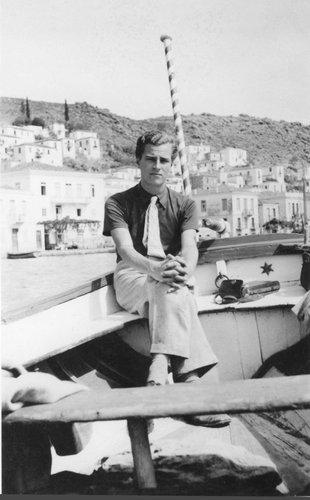
Paddy’s first passport photo

How long did it take you and what did it cost?

I set off on December 9, 2011 – exactly 78 years to the day after Leigh Fermor did – but whereas it took him 13 months, I completed the walk in seven. I gave myself a budget of £50 a week – the equivalent of the £1 a week Paddy allowed himself back in 1933. In total I walked some 2,500 miles through eight countries: Holland, Germany, Austria, Slovakia, Hungary, Romania, Bulgaria and Turkey.

So initially you were walking in the winter?

I wanted to walk through Germany and Bavaria in snow – that seemed to be the truest manifestation of that kind of fairy tale. Walking on dry snow is quite pleasant, and you don’t get too hot and sweaty. Of course it got dark early and night times were hard.

Were people you met aware of the Leigh Fermor books and still interested in them?

Before I left I was shocked to discover how well known he was. People from all over the world wrote to offer support and encouragement. Many said they had dreamed of doing something similar: there was a lot of vicarious enthusiasm for what I was doing. Once I was on the road, people were very curious about this account of their village written by an English writer who came through it nearly 80 years ago. One of the things I enjoyed most was showing people the passage in the book where their village was mentioned and reading it aloud.

What did you find that chimed most with Leigh Fermor’s account?

There was a lot more continuity with Paddy’s journey than I expected, especially in terms of how kind and generous people were. There was also continuity in the landscape. Even in Germany, walking along the Rhine is still quite special. There may be a big road running alongside it now, but it is still possible to see this older, wilder Europe.

The Rhine

I was also amazed by how little people’s prejudices had changed, especially in the east. Some of the things Slovaks were saying about Hungarians, Hungarians about everyone, Romanians about Hungarians, Romanians about Bulgarians – it could have been cut and pasted from the pages of the books. People have long memories.

Were you, like Paddy, entertained by counts?

No, but I did experience extraordinary hospitality. For the early part of my journey I stayed on people’s couches (arranged through the couch-surfing website). I was constantly amazed at people’s generosity, and the farther east I went the friendlier they became: in the latter stages of the journey it became common for people to say, “I’ve got friends in the next village, I’ll give them a call,” so I started staying with friends of friends rather than booking.

I had a tent with me, and once the weather turned warmer I began to camp out. Towards the end I struggled to spend my £50 a week: transport was covered, I hardly ever had to pay for accommodation; it was just food and occasional chocolate treats.

What was most different from what Leigh Fermor experienced?

Right away you see the impact of the war, especially in Holland and Germany. Rotterdam was flattened – one of many cities whose medieval hearts had been wiped out and turned into corporate, commercial hubs full of the same shops you can see in London.

Rotterdam

Farther along the route the hydroelectric dams on the Danube summed up for me the process of industrialisation that has tamed so many of the wilder parts of the continent’s rivers. Also, although I didn’t stay with a count, I did meet one of the descendants of one of the families that hosted Paddy. Their country home, once a place of dinners and dances, had been nationalised after the war and turned into a psychiatric hospital. That spoke volumes.

What were your favourite parts of the journey?

Walking through Transylvania and the Carpathian Mountains: the culture was warm and generous and I loved the fact that people still have time for old-fashioned courtesies. I was amazed at how little impact Ceausescu’s attempts to remodel that society had. It was in the Carpathians, too, that I felt completely alone. I was quite high, above the snow line, and not altogether sure about what I was doing. In terms of the adventure, that was pretty wonderful. Earlier on in the journey I had fantasised about the baths of Budapest: they didn’t disappoint.

And the not-so-good bits?

I didn’t enjoy trekking through miles of suburbs. Or walking on tarmac. In the southern German city of Ulm I had to stop for three weeks because of an Achilles tendon injury. On the plus side, I discovered the wonder of the German health service, but it was frustrating. Getting attacked by stray dogs in Romania was pretty hairy – as was coming face to face with a wild boar.

I can’t say I liked the “Sunny Beach” in Bulgaria between Varna and Burgas. Paddy described this stretch of coastline as one of the most delightful – offering solitude and peace, space and silence. Today it is just a long strip of concrete: one hotel after another.

Is walking the best way to go?

Absolutely. When you walk you are exposed to everything. You feel everything – the weather, you absorb all the atmosphere of the place around you – and you notice things that in a car would just be a blur. That said, much of the route I took was not pretty.

Paddy on horseback in Moldova

My advice to anyone doing a trip of this kind would be to try to find interest in everything you see. When I was in Budapest and said I was heading for the Great Hungarian Plain I was told to prepare for the 10 most boring days of my life. It is true the plain is no longer the wild place that Paddy described. But I found it quite extraordinary just having this space and silence, huge empty horizons, dust and heat. It felt a bit like walking through a desert. I’d advise avoiding tarmac (even walking through leaves and mud is preferable). And I’d advise taking a very good pair of boots.

What was the most important thing you learnt from your walk?

That the woods are not full of axe murderers and that people are generally quite kind and helpful and hospitable. That was heart-warming, and that was what I had wanted to believe. I also learnt how to slow down. At the beginning I got frustrated at how slowly I was travelling. It took a while to shake off the mentality of having to get somewhere quickly and to realise that I wasn’t trying to get anywhere in a hurry: that the destination was much less important than the getting there.

Are we going to have to wait 80 years for a full account of your walk to appear in print?

No. The book will be out next spring.

* ‘Walking the Woods and the Water: in Patrick Leigh Fermor’s footsteps from the Hook of Holland to the Golden Horn’ by Nick Hunt (Nicholas Brealey Publishing) is due out in spring 2014.

Help Build a Kiln in Transylvania

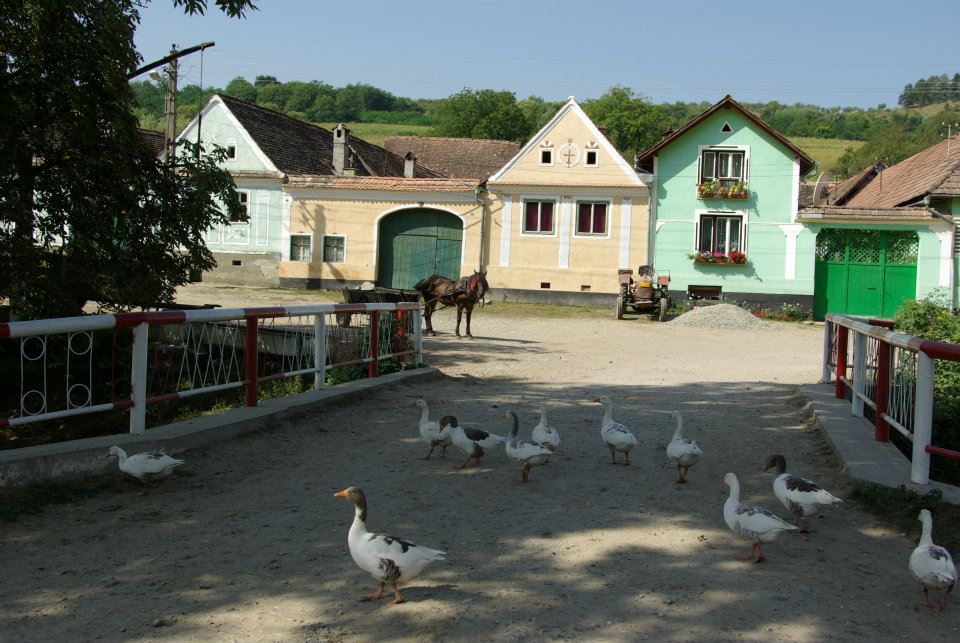
Malancrav, near Sighisoara, Romania

Malancrav, near Sighisoara, Romania

Global Heritage Fund UK and the Anglo-Romanian Trust for Traditional Architecture (chaired by William Blacker) have begun a project to protect and restore the cultural landscape of the Saxon villages of Transylvania.  The beautiful buildings are in desperate need of repair using only the traditional materials from the new kiln, and local people are in need of jobs. To address this, Global Heritage Fund is raising money to build a traditional brick and tile making kiln. Run by a Romanian expert, this kiln will directly employ locals and provide much-needed materials for the on-going work of restoration and conservation of the early vernacular buildings.

A crowd-funding site has been established to raise $20,000, of which they have raised almost $5,000,  and I support the attempt. If you would like to know more, and to donate, please visit the crowdfunding page here.

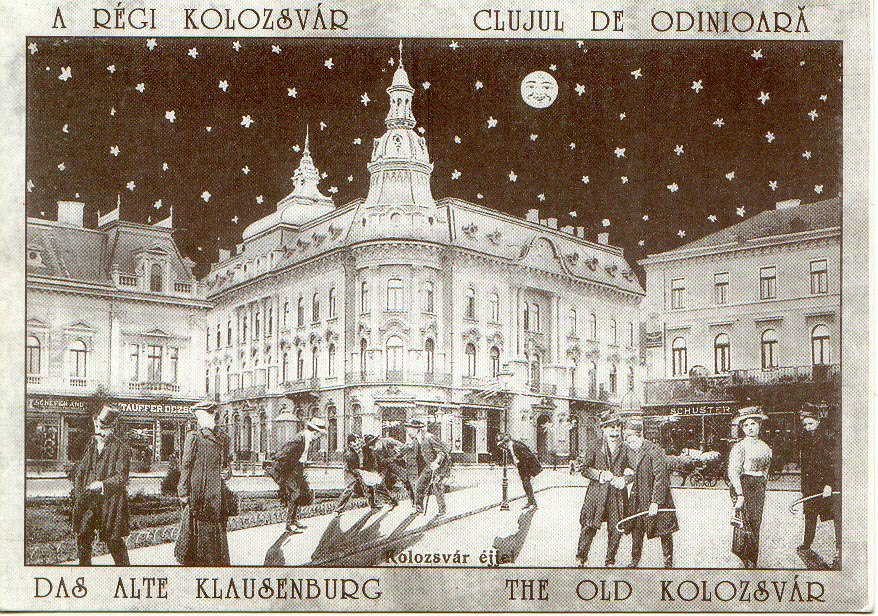
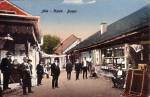
A postcard from Cluj

The Hotel New York in the 1920's

The Hotel New York in the early part of the 20th Century

Thank you to my friend and colleague in Cluj, Stefi Timofte, for finding this picture for me. Of course it shows the Hotel New York (now the sad and decaying Continental) that Paddy visited with Angéla and István in the summer of 1934.

This story has been debunked in Artemis’ biography but I am not entirely convinced by the explanation in her book. Paddy says he got the details from a book in German, but the level of detail (see my story about the internal decor) implies that this book had very good photographs in colour or Paddy at least visited during one of his later visits to Romania.

For me, Paddy’s description of the romance of those days on the road, and the nighttime trysts with Angéla can never be diminished.

Related articles:

An eye for detail and the memory of the Hotel New York in Cluj

Angéla, Paddy, István and Tom in Cluj-Napoca

£1 a week – Rendezvous in Cluj

Flying to the moon

Inside the Hotel New York (Continental), Cluj

As many of you will know by now, I travel to Romania pretty frequently and I am fortunate enough to stay and work in the beautiful city of Cluj which Paddy says he visited during his road trip tryst with Angéla in the summer of 1934.

Paddy’s descriptions in Between the Woods and the Water are very accurate and detailed, and the one of the Hotel New York was the most impressive which I highlighted in this article last year with accompanying photographs.

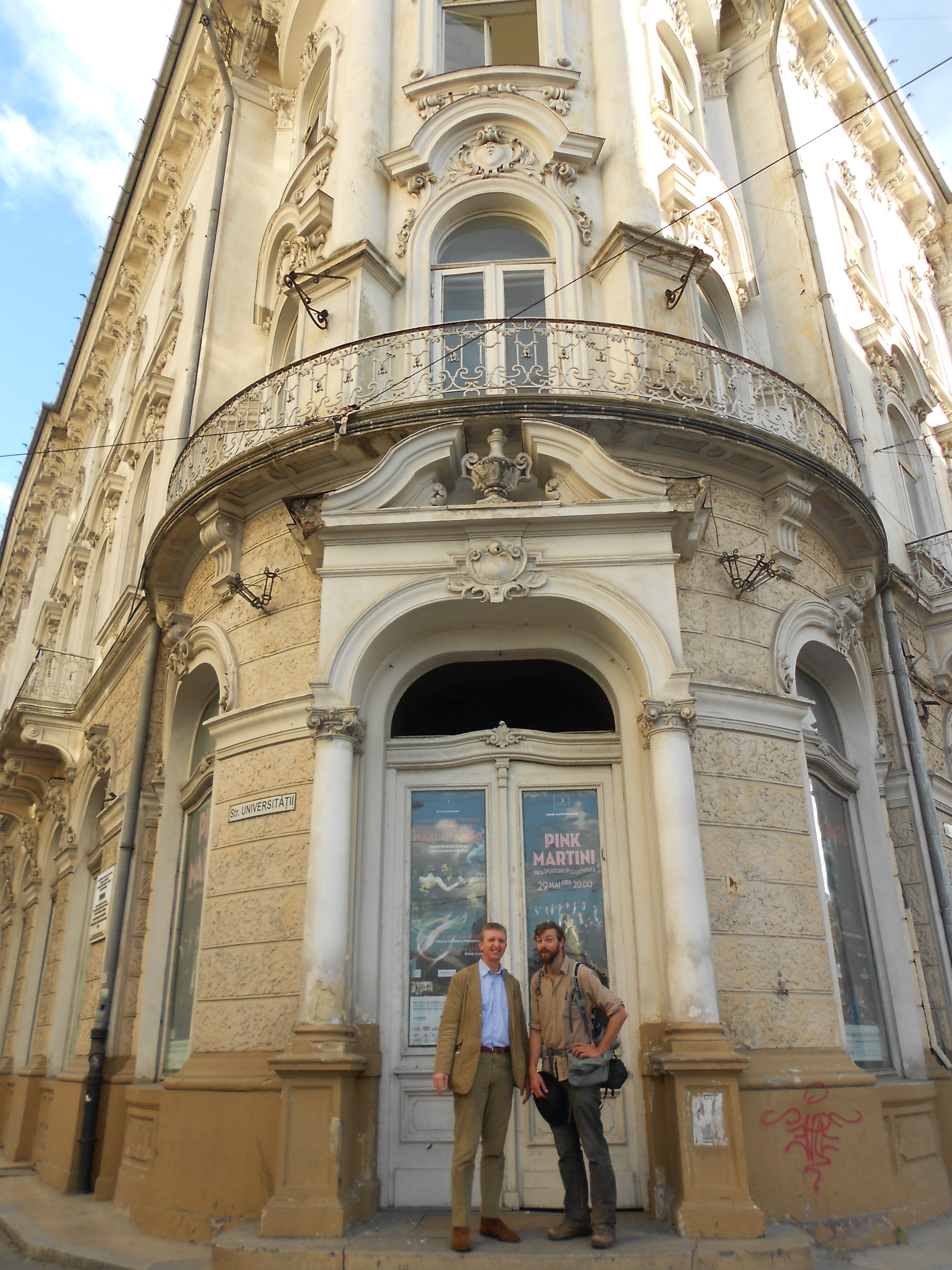
Nick and Tom outside the Hotel New York (Continental), Cluj

During Nick Hunt’s recent walk across Europe we were able to meet up outside of the hotel and I was desperate for us to drink a cocktail there just like Paddy, Istvan and Angéla. The fact that the hotel is closed should not have been a barrier to this; all I had to do was find the recipe and a willing local barman and all would be OK. Unfortunately following an ‘occupy’ protest security at the hotel was heavy and we were firmly told we could not enter. It must have been Nick’s road weary look and dusty attire which was the blocker!

I had done some research, and whilst I could not find the recipe of the Cluj cocktail which was described by Paddy thus in Between the Woods and the Water …

An hotel at the end of the main square, called the New York – a great meeting place in the winter season – drew my companions like a magnet. István said the barman had invented an amazing cocktail – only surpassed by the one called ‘Flying’ in the Vier Jahreszeiten bar in Munich – which would be criminal to miss

… I contacted the Bar Manager of the Hotel Vier Jahreszeiten Kempinski in München to find out the recipe for Flying. Florian Fischer kindly replied as follows, so maybe this autumn, to celebrate the publication of the biography, you may order one or even make it at home.

Dear Mr. Sawford,

thank you very much for your request. These are the things which are creating culture!

I am really interested in cocktails of this period. I was thinking about the recipe and I am quite sure, that it must be the following :

Flying Cocktail

2 parts of Gin
1 part of curacao Triple sec ( Cointreau preferred )
1 part of freshly squezzed lemon juice

fill up with champagne
served in a champagne flute

Actually it is the famous “White Lady” with champagne and this drink was really popular in these times.

Greetings from Munich and enjoy your “Flying Cocktail”

Cheers

Florian Fischer

Barmanager

Hotel Vier Jahreszeiten Kempinski München

Maximilianstr. 17 · 80539 München · Germany Tel +49 89 2125 2217· Fax +49 89 2125 2222 florian.fischer@kempinski.com

Related article:

An eye for detail and the memory of the Hotel New York in Cluj

Ada Kaleh: the lost island of the Danube

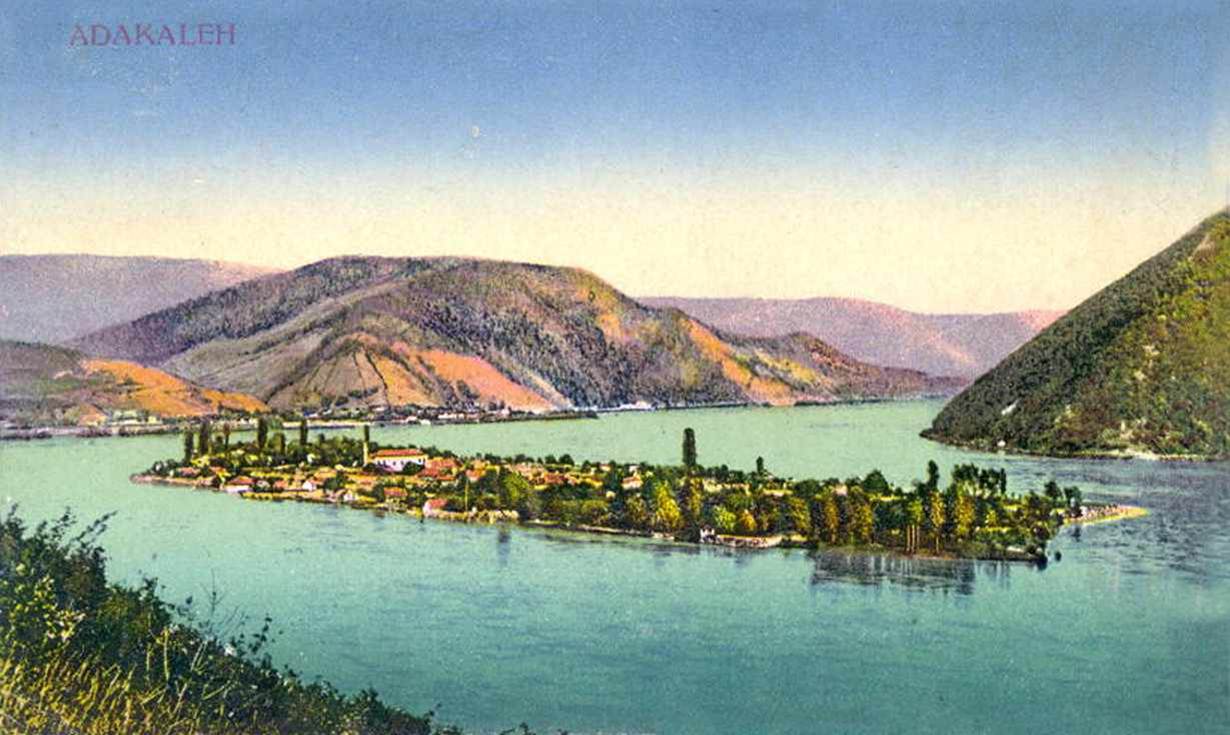
Ada Kaleh island postcard

Towards the end of Between the Woods and the Water, Paddy is exploring the Danube which he described as wild, with ‘many scourges to contend with’ including the Kossovar winds which in the spring could ‘reach a speed of fifty or sixty miles an hour and turn the river into a convulsed inferno.’ A long, long, way from the tamed beast that the once great river is now.

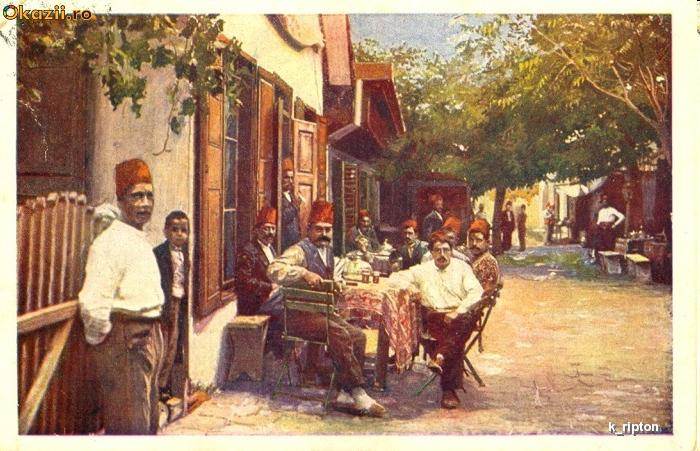
In the midst of this occasional inferno lay an island with a Turkish name, Ada Kaleh, which means ‘island fortress’. Paddy tell us that he had read all that he could find about the island, and was very keen to explore this lagoon of Turkish descendants which was quite probably abandoned by the retreating Ottomans as their empire shrank. Although placed under control of the Austro-Hungarian Empire following the Berlin Conference in 1878, very little changed and it was ceded to Romania at Versailles. The Romanians too had better things to do with their time and left the inhabitants undisturbed.

It was into this cultural, religious, and demographic time capsule that Paddy stepped in August 1934 and immediately joined a group of men at a rustic coffee-shop, who were armed with ‘sickles and adzes and pruning knives’. Paddy describes the moment as if he had suddenly been ‘seated on a magic carpet.’

Ada Kaleh – “as if seated on a magic carpet”

Paddy spent a night on the island, and slept out by the Danube, under the stars, watching meteors, and listening to the sounds of owls and barking dogs, interrupted by the occasional sound of a cart wheel or the splash of a fish in the now calm and lazy river. He dreamt of crusaders under King Sigismund of Hungary attempting to turn back the Turkish tide in 1396. They crossed the river almost at this point, and what excited Paddy most was the thought that ‘the last pikeman or sutler had probably reached the southern bank this very evening, five hundred and thirty-eight years ago.’ Sigismund’s allied army of Hungarians, Wallachians, French, Germans and Burgundians, with a few Englishman, was shattered by Sultan Bayazid at the battle of Nicopolis further down the Danube, with the captured dying in ‘a shambles of beheading lasting from dawn to Vespers’.

Like the storks he saw the next day, who were preparing to fly off to “Afrik! Afrik!”, as an old Turkish man gestured, Paddy departed after breakfast to Orsova. Ever one for losing things he discovered that he had left behind an antler which he had been carrying as a trophy. Paddy writes that ‘perhaps some future palaeontologist might think that the island had once teemed with deer’.  This cannot be as the river was dammed and Ada Kaleh submerged by the rising Danube. Its population was evacuated and its mosque removed to a new, safe location. Such mitigation measures did not satisfy Paddy as he states in the Appendix to BTWW. The second of the two attached presentations is also a heartfelt, but belated cry of protest in Romanian.

Please take a look at these presentations. If you have PowerPoint you will find there is appropriate musical accompaniment (slide show one has a song called Ada Kaleh). The images show the place and its people almost exactly as Paddy would have seen it, something that we can truly say will be seen no more. The pdf copy is for those who do not have access to PowerPoint. I do hope that you enjoy them.

Tom

PowerPoint 1

PDF of PowerPoint 1

PowerPoint 2

PDF of PowerPoint 2

There are lots more great pictures to be found on Google images.

Patrick Leigh Fermor’s archive acquired by the National Library of Scotland

From a National Library of Scotland press release dated today.

The archive of one of the most important travel writers of the 20th century and a war hero whose exploits were made into a major film has been acquired by the National Library of Scotland (NLS).

Sir Patrick (Paddy) Leigh Fermor, who died last year at the age of 96, is regarded as a central figure in understanding and appreciating mid-20th century culture.

To describe his life as colourful does scant justice to the reality. At the age of 18 he set off to walk from the Hook of Holland to Istanbul , a year long journey described in his books A Time of Gifts and Between the Woods and the Water. The Independent described the former as “rightly considered to be among the most beautiful travel books in the language.”

His war record is equally impressive. After the fall of Crete in 1941, he was sent back to the island to organise guerrilla operations against the occupying Nazis. He spent much of this time disguised as a Cretan shepherd, living in freezing mountains caves.

In 1944 Leigh Fermor organised one of the most daring feats of the war when he kidnapped the commander of the German garrison on Crete . This was made into a film Ill Met by Moonlight in 1956 starring Dirk Bogarde.

The archive consists of literary manuscripts and typescripts, correspondence with leading figures including the poet Sir John Betjeman, photographs, passports, portrait sketches and personal papers including visitor books and various honours awarded to Leigh Fermor. One of the star items is the only surviving notebook from his youthful trek across Europe .

It offers an unrivalled insight into his life and writings and adds to the wealth of travel literature at NLS. Acquisition of this archive is seen as helping to establish NLS at the forefront of 20th century travel literature research collections

“This is a fantastic collection which will be made available at NLS,” said David McClay, Manuscripts Curator. “We hope it will excite people who know of Paddy and introduce him to a whole new generation of people who may not be aware of his work.”

Its arrival at NLS comes just before a new biography of Leigh Fermor by the British writer and family friend Artemis Cooper is to be published.

Leigh Fermor died before he could complete the third volume in his travel trilogy. Artemis Cooper has worked on the uncompleted manuscript and this third volume – entitled The Broken Road – is expected to be published in 2013. This will all add to the interest in Leigh Fermor’s life and in the NLS archive.

The archive has been bought with a grant from the John R Murray Charitable Trust which assists NLS in the care and promotion of access to the Library’s John Murray Archive. Leigh Fermor was published by the Murray family.

The connection with the Murray publishing house was one of the reasons NLS was chosen by Leigh Fermor’s executors as the home for his archive. He also knew the Library, having donated his wife’s photographic collection to NLS just before he died.

NLS has also taken possession of the personal archive of Leigh Fermor’s close friend Xan Fielding, an author, translator and traveller who also fought in Crete . This has been donated to the Library by Fielding’s family.

Volume Three of Patrick Leigh Fermor’s trilogy to be published in Autumn 2013 and called The Broken Road

We have waited a long time, and now like London buses, or English summer rain, it is all coming at once. Following on from her work on Patrick Leigh Fermor’s biography, An Adventure, to be published in October 2012, Artemis Cooper will pull together Paddy’s work on Volume Three ready for publication in autumn 2013.

The book will have the title The Broken Road. If you Google that you will find a catchy country song by Rascal Flatts. In fact the title has been taken from the sixth volume of Freya Stark’s letters. I am told that everyone concerned with the publication is agreed that it “sets up the right resonances, because although The Broken Road completes the story, the text is taken from more than one unpublished source.”

It is perhaps not well-known that Paddy started to work first on the events of Vol 3. Much of it was written before his defining work on A Time of Gifts and Between the Woods and the Water, the other two volumes in the trilogy.

Artemis Cooper tells me that although “it does not have their high polish, it does provide an extraordinary insight into Paddy the writer, and the interplay of his memory and imagination.” and whilst “it’s not going to sound like ATOG or BWW”, I am sure it will be one of the most anticipated publication events of next year.

Whilst we wait we can sing along ….

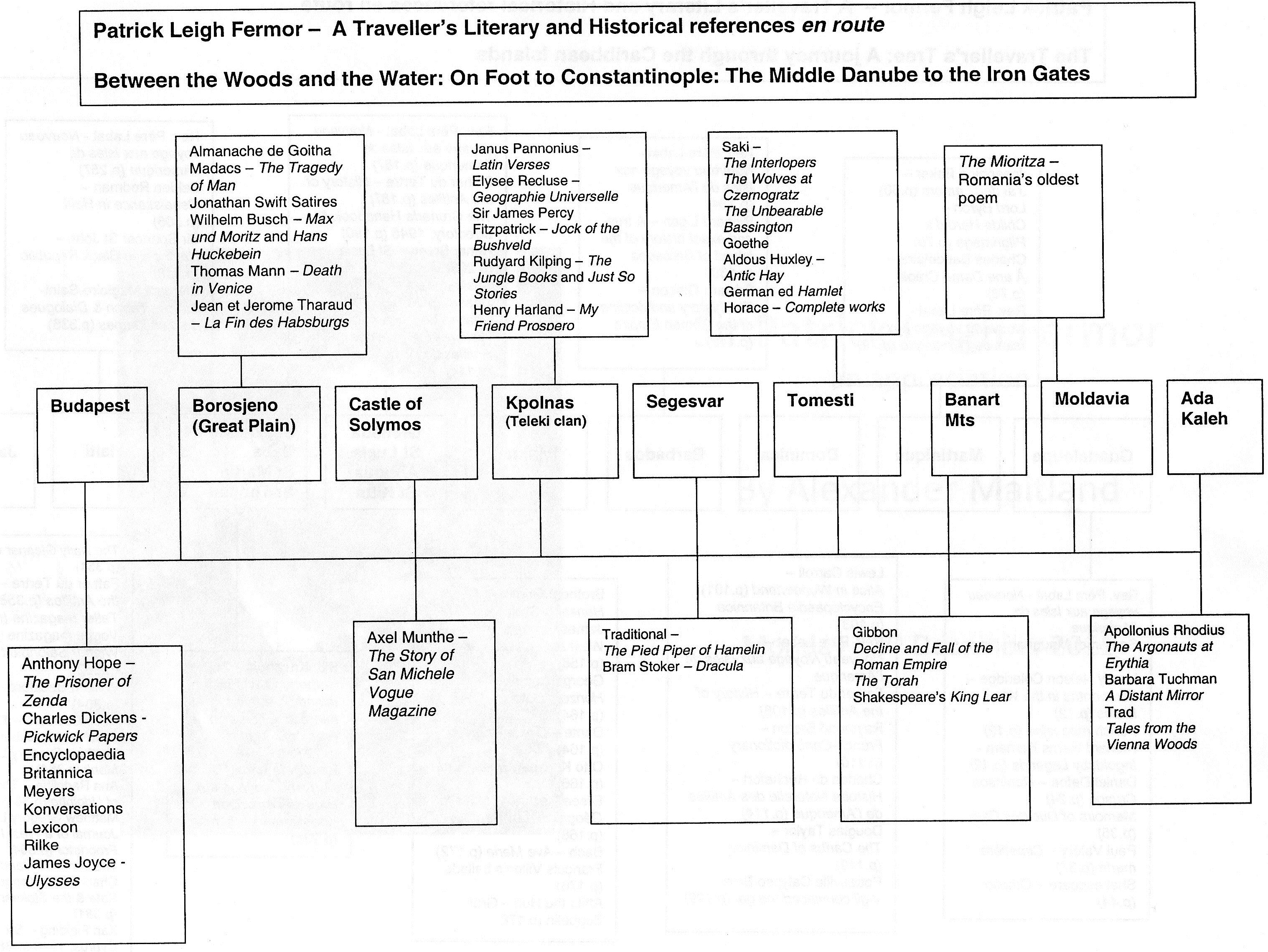
Literary and Historical References – Between the Woods and the Water

The last in the series which presents the work of members of the Royal Geographical Society which analyses chapter by chapter, literary and historical references from some of Paddy’s key works.

This was presented at the RGS in the afternoon talk on 12 December 2012,”Patrick Leigh Fermor: An Appreciation by Alexander Maitland, FRGS”.

My thanks to the Royal Geographic Society for permission to present this.

Download a pdf of this document here.

Related article:

Literary and Historical References – The Traveller’s Tree

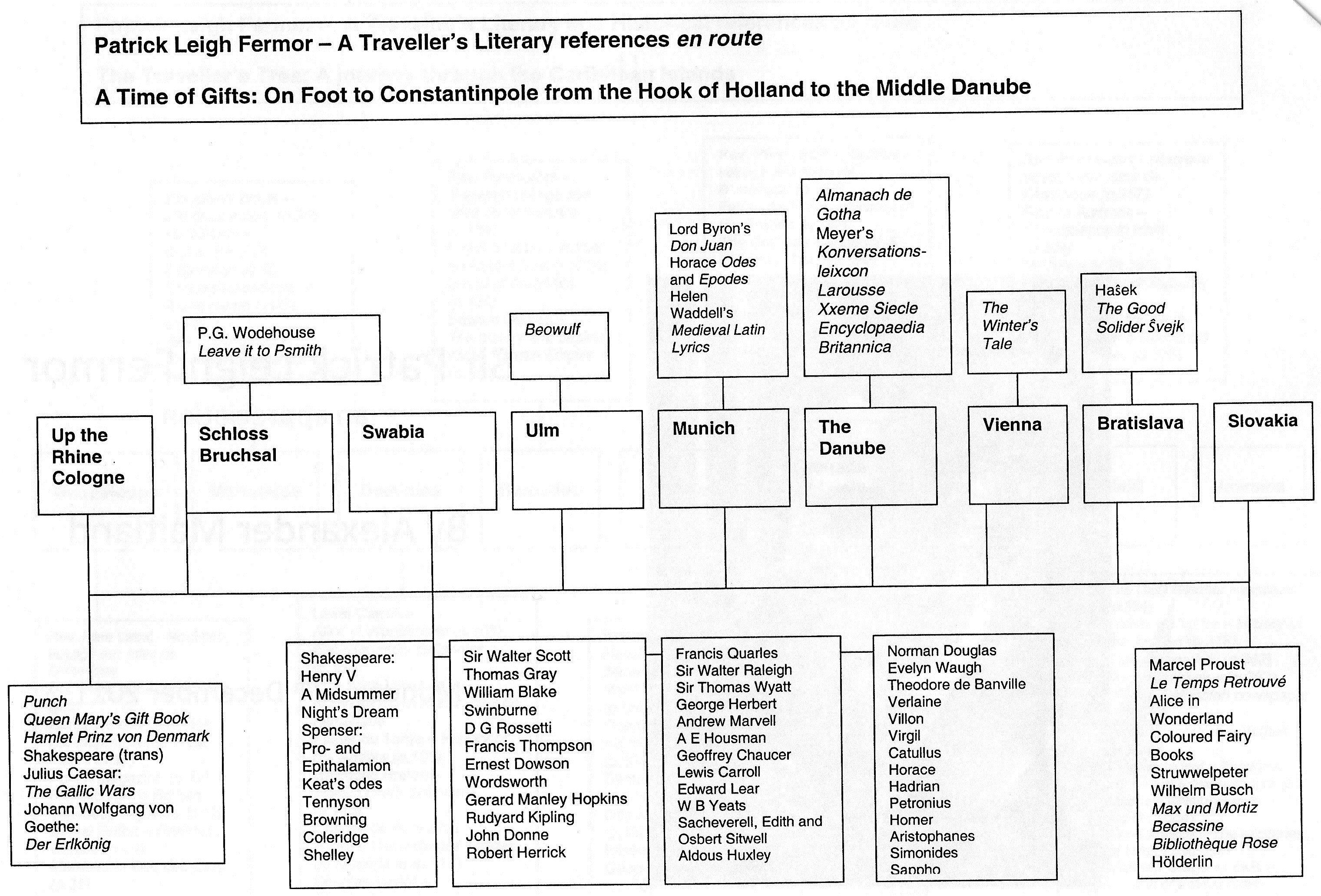
Literary and Historical References – A Time of Gifts

The second in the series which presents the work of members of the Royal Geographical Society which analyses chapter by chapter, literary and historical references from some of Paddy’s key works.

This was presented at the RGS in the afternoon talk on 12 December 2012,”Patrick Leigh Fermor: An Appreciation by Alexander Maitland, FRGS”.

My thanks to the Royal Geographic Society for permission to present this.

Download a pdf of this document here.

Related article:

Literary and Historical References – The Traveller’s Tree

Transylvanian hay-day – An afternoon’s diversion on the way to Constantinople, 78 years ago.

Between the Woods and the Water

As Nick Hunt is currently in the vicinity of the Hungarian-Romanian border on his walk in Paddy’s footsteps to Constantinople, I thought that it might be an appropriate time to publish this extract. It is one of the most memorable pieces of Paddy’s writing. What a way to spend a hot summer’s afternoon!

by Patrick Leigh Fermor

First published in The Spectator in 1986. This version 18 June 2011.

One day when we were invited to luncheon by some neighbours, István said, ‘Let’s take the horse’ and we followed a roundabout uphill track to look at a remaining piece of forest. ‘Plenty of common oak, thank God,’ he said, turning back in the saddle as we climbed a path through the slanting sunbeams, ‘you can use it for everything.’ The next most plentiful was Turkey oak, very good firewood when dry, also for stable floors and barrel staves. Beech came next, ‘it leaves scarcely any embers’; then yoke elm and common elm, ‘useful for furniture and coffins’. There was plenty of ash, too — handy for tools, axe-helves, hammers, sickles, scythes, spades and hay rakes. Except for a few by the brooks, there were no poplars up there but plenty by the Maros: useless, though, except for troughs and wooden spoons and the like. Gypsies made these. They settled in the garden and courtyard of the kastély with their wives and their children and whittled away until they had finished. ‘There is no money involved,’ István said. ‘We’re supposed to go halves, but, if it’s an honest tribe, we’re lucky to get a third. We do better with some Rumanians from out-of-the-way villages in the mountains, very poor and primitive chaps, but very honest.’

In a clearing we exchanged greetings with a white-haired shepherd leaning on a staff with a steel hook. The heavily embroidered homespun cloak flung across his shoulders and reaching to the ground was a brilliant green. His flock tore at the grass among the tree-stumps all round him. Then a path led steeply downhill through hazel woods with old shells and acorns crunching under the horses’ hooves.

It was a boiling hot day. On the way back from a cheerful feast, we went down to the river to look at some wheat. Overcome by the sight of the cool and limpid flood, we unsaddled in a shady field about the size of a paddock, took off all our clothes, climbed down through the reeds and watercress and dived in. Swimming downstream with lazy breaststroke or merely drifting in the shade of the poplars and the willows, we talked and laughed about our recent fellow guests. The water was dappled with leafy shade near the bank and scattered with thistle-down, and a heron made off down a vista of shadows. Fleets of moorhens doubled their speed and burst noisily out of the river, and wheat, maize and tiers of vineyard were gliding past us when all at once we heard some singing. Two girls were reaping the end of a narrow strip of barley; going by the colours of their skirts and their embroidered tops, braid sashes and kerchiefs, they had come for the harvest from a valley some way off. They stopped as we swam into their ken, and, when we drew level, burst out laughing. Apparently the river was less of a covering than we had thought. They were about 19 or 20, with sunburnt and rosy cheeks and thick dark plaits, and not at all shy. One of them shouted something, and we stopped and trod water in mid-Maros. István interpreted. ‘They say we ought to be ashamed of ourselves,’ he said, ‘and they threaten to find our clothes and run off with them.’

Then he shouted back, ‘You mustn’t be unkind to strangers! You look out, or we’ll come and catch you.’

‘You wouldn’t dare,’ came the answer. ‘Not like that, naked as frogs.’

What are these for?’ István pointed to the branches by the shore. ‘We could be as smartly dressed as Adam.’

‘You’d never catch us! What about your tender white feet in the stubble? Anyway, you’re too respectable. Look at your hair, going bald in front.’

‘It’s not!’ István shouted back.

‘And that young one,’ cried the second girl, ‘he wouldn’t dare.’

István’s blue eye was alight as he translated the last bit. Then without exchanging another word we struck out for the shore as fast as crocodiles and, tearing at poplar twigs and clumps of willow-herb, bounded up the bank. Gathering armfuls of sheaves, the girls ran into the next field, then halted at the illusory bastion of a hay-rick and waved their sickles in mock defiance. The leafy disguise and our mincing gait as we danced across the stubble unloosed more hilarity. They dropped their sickles when we were almost on them and showered us with the sheaves; then ran to the back of the rick. But, one-armed though we were, we caught them there and all four collapsed in a turmoil of hay and barley and laughter.

‘Herrgott!’ I heard István suddenly exclaim — much later on, and a few yards round the curve of the rick — smiting his brow with his hand. ‘Oh God! The bishop! The Gräfin! They’re coming to dinner, and look at the sun!’

It was well down the sky and evening was gathering. The ricks and the poplars and the serried rows of sheaves and haycocks were laying bars of shadow over the mown field and a party of birds was flying home across the forest. István’s hay-entangled hair was comically at variance with his look of consternation and we all laughed. Extracting strands of hay and the clinging barley, we tidied Safta and Ileana’s plaits, disordered by all this rough and tumble, and set off hand in hand with them for the river, István and I on tiptoe. ‘Poor feet,’ they murmured. After goodbyes we dived in and started the long swim back, turning many times to wave and call to those marvellous girls and they waved and answered until they were out of earshot and then, after a bend in the river, out of sight as well.

This piece first appeared in The Spectator in 1986; it forms part of Between the Woods and the Water (John Murray, £8.99). © Patrick Leigh Fermor, 1986.

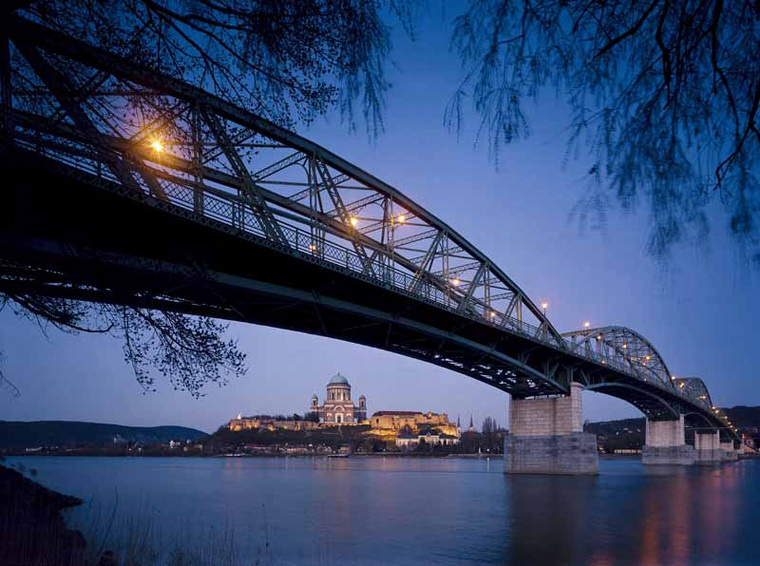
March 2012 – Nick reaches the bridge at Esztergom

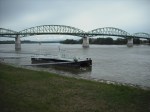
Imagine Paddy standing in the middle of this bridge looking at the cathedral

It took Paddy until Easter 1934 to get to this bridge. Nick is moving well now. The bridge at Esztergom was one of my first blog posts back in April 2010!

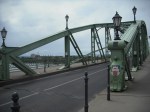
The bridge linking Slovakia and Hungary, between the towns of Štúrovo and Esztergom, also links A Time of Giftsand Between the Woods and the Water. Here Paddy paused both in his walking and his writing, ‘meditatively poised in no man’s air,’ before crossing into Hungary and the second phase of his journey.

I reached that bridge a week ago (or rather the reconstruction of that bridge — the original was destroyed in 1944), and in a rather unbelievable way came to the very last page of my notebook standing above the Danube … read more

Related article:

Easter 1934 – Paddy reaches the Hungarian border at Esztergom

A Year of Memory: the top ten posts on the Patrick Leigh Fermor blog

As the year comes to a close it is time to reflect upon what has passed and to look forward to 2012. I make no predictions for the coming year. There are some things which are almost certain such as the continuing Euro crisis and the much anticipated publication of Artemis Cooper’s authorised biography about Paddy, but forecasts tend to be overtaken by events and are quickly forgotten.

What we can do is to look back on this year in the life and times of Patrick Leigh Fermor. The major event of course was Paddy’s death on 10 June at the age of ninety-six. A sad event for his family and close friends, but also for those of us who admired him for his writing and the life he lived. As the year closed it was time to celebrate his life at his Memorial Service held on 15 December in London.

As I hoped the blog has become a significant source of material about his life including rarely seen video. There have been over 228,000 visits over the last year and you have made it a much more interactive experience by using the comment facility to exchange information, provide your own memories of Paddy, and to express your admiration for him. At the time of his death I opened a page where you could express your thoughts about Paddy which has run to over 120 comments.

Paddy would probably have been somewhat bemused by the whole idea of the blog, but perhaps even more so by the interaction we now have with social networking sites with nearly 4,500 visitors finding the site from Facebook, and 850 via Twitter.

To conclude the year, and as the 365th post on the blog, let us take a look at some of the most popular articles over the last twelve months. Perhaps I can make one promise to you all which is that there is much more to come on the blog in 2012 which includes a lot of material submitted by you the readers of the blog.

The Funeral Service of Patrick Leigh Fermor, 16 June 2011 

Paddy’s funeral service was held on a typical English summer’s day at his home in Dumbleton. He returned to England just one day before his death and is buried beside his beloved Joan.

Obituary from The Independent by Paddy Leigh Fermor’s biographer Artemis Cooper 

Perhaps the definitive obituary.

Patrick Leigh Fermor … This is Your (Ill Met by Moonlight) Greek Life 

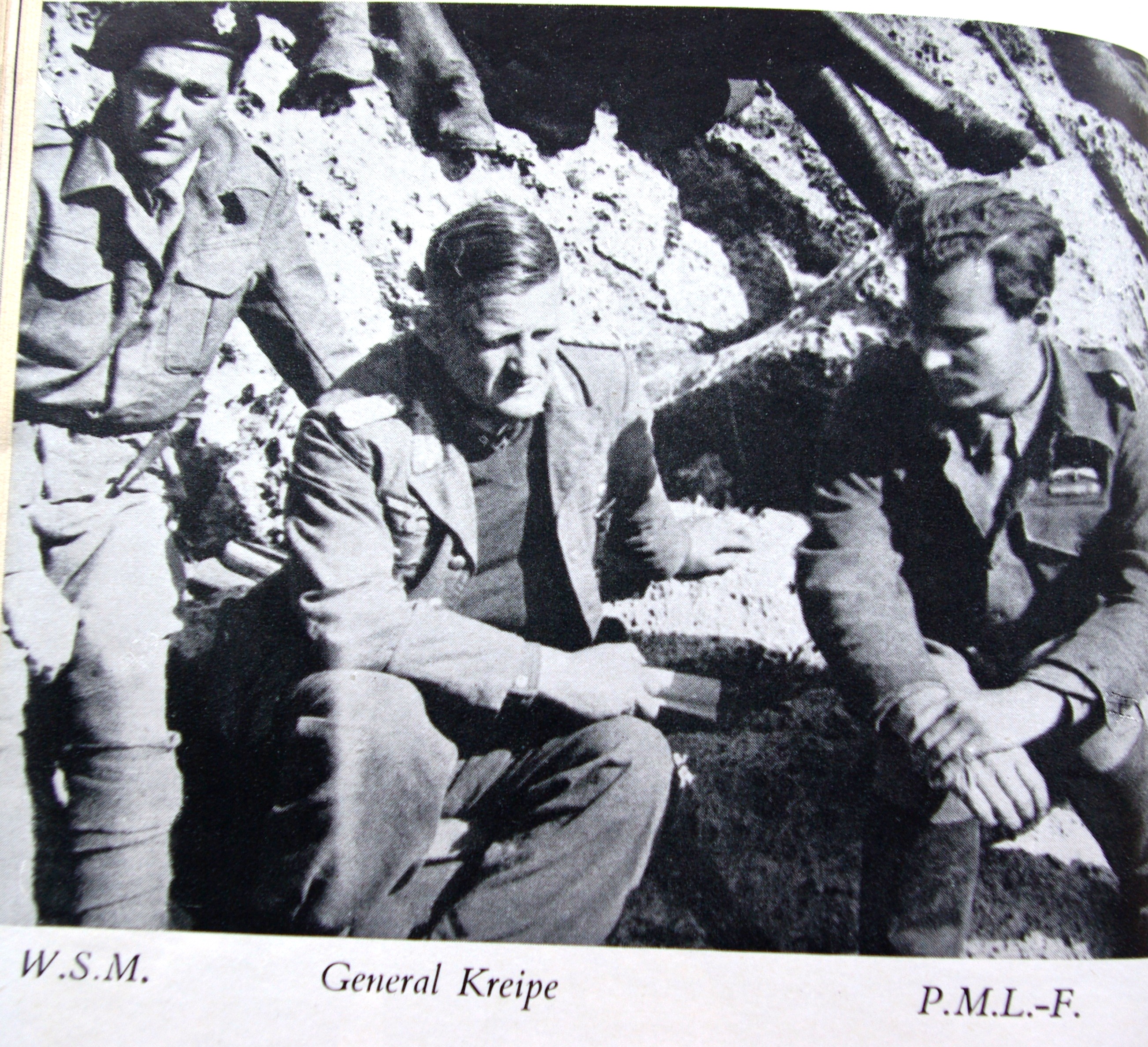
The amazing video from the Greek TV programme which reunited the participants of the Ill Met by Moonlight kidnap including Paddy, many of the Andartes, and General Kreipe and his wife.

Anthony Lane’s New Yorker article on Fermor is now free to view 

One of the most comprehensive profiles of Paddy which is now freely available to all. (the pdf download appears to be no longer available – click on the article to magnify to read and then drag your cursor to move around the page)

Intimate portraits from Kardamyli by Miles Fenton 

A series of personal photographs sent to me by Miles Fenton who is Paddy’s nephew and who now lives in Canada where he works as an artist.

Patrick Leigh Fermor recounts the kidnap of General Kreipe on video 

The ever popular video where Paddy talks in some detail about the Kreipe kidnap. (press play on Battle of Crete 7).

Colonel David Smiley 

David Smiley was a fellow occupant of Tara in Cairo with Paddy and Billy Moss et al who continued his military career with some distinction after the war and even led Japanese soldiers in a charge against VietMinh rebels!

Paddy’s eye for detail: Ian Fleming, Bondage, James Bond and Pol Roger 

It is probably the James Bond/Ian Fleming association which maintains the popularity of this article.

If food be the music of love … Bánffy’s lover in Cluj (Kolozsvár) 

No list of popular posts can be complete without the compelling combination of my passions for Paddy, Romania, Miklós Bánffy, and Cluj.

Patrick Leigh Fermor Memorial Order of Service 

The order of service from the joyful occasion that was Paddy’s Memorial Service.

Finally I would like to thank so many of you for your encouragement and support during 2011, and wish you all a very Happy New Year!

Tom Sawford

£1 a week to Constantinople – Bon Voyage to Nick and Nice Weather for Young Ducks

Paddy does not say if his last night in London before his epic journey was as busy as it was on Wednesday as Nick Hunt gathered with some friends in Shepherd Market to wish him well on his epic journey, but seventy-eight years ago today our hero, and let’s not be ashamed to say it, our hero, Patrick Leigh Fermor celebrated his last night in London as just another under-achieving public schoolboy, setting out to emulate Robert Byron, from this untouched corner of old London, which is now the haunt of hedge fund managers and buccaneering chief executives of junior mining companies; London clay brick Georgian squeezed into some of the highest priced real-estate in the land.

A new endeavour is about to start as Nick sets off on Friday to walk across the New Europe just as it is probably about to undergo the most significant peacetime turmoil since the rise of Nazism in the 1930’s into which Paddy stumbled with only a few links to ‘civilisation’ to accompany him, including his copy of Horace’s Odes.

Frankly I am as envious as I can be. Who could not wish to spend time away from the demands of today’s ever connected world? To endure physical challenges whilst encountering architectural marvels and meeting interesting people, each with a unique story to tell. It could well be the journey of a lifetime and I hope I send Nick off with all your best wishes. He has mine.

The weather today is better than that encountered by Paddy as he set out ….

The weather in London on December 9th 1933 was typical. The sky darkened, the clouds lowered and then it rained hard. A young man walked the cold pavements towards Cliveden Place to collect a rucksack that his friend Mark Ogilvie-Grant had used on a journey to Mount Athos accompanied by Robert Byron. After stopping to buy a stout ash stick, and probably some cigarettes, at the tobacconist on the corner of Sloane Square, the young man collected his new passport – occupation ‘student’ – from the office in Petty France. He cast his eyes up to the ominous clouds and then made his way quickly north across Green Park. Now the rain splashed down as he dashed between the traffic on Piccadilly and entered the house of his landlady, Miss Beatrice Stewart, in Shepherd Market.

A former model who sat for Sickert, and Augustus John, and who is said to be the model for the bronze figure of Peace atop Wellington Arch, Beatrice Stewart’s career was cruelly cut short after she lost a leg in a road accident. She had arranged a lunch for the eighteen year old Patrick Leigh Fermor and two of his friends to wish him bon voyage before the start of what was to become one of the most famous journeys of all time, and certainly the longest gap year in history.

After lunch, Paddy said thank you and goodbye to Miss Stewart, and jumped into a waiting taxi, which drove off through Mayfair, around Trafalgar Square, up Ludgate Hill, and past the Monument towards the Tower of London. It was raining so heavily that all they could see out of the steamed up windows were hordes of umbrellas, some carried by bowler hatted men, as the rain splashed down in the dark. “Nice weather for young ducks.” said the taxi driver as he dropped the small party by the first barbican on Tower Bridge.

The two companions, one a young girl wearing a mackintosh over her head like a coal shifter, stood in the rain to watch Paddy descend the stone steps down to Irongate Wharf. With a final wave, he strode up the gangplank of a Dutch steamer bound for Hook of Holland.

This was the start of Paddy’s journey down the Rhine and along the Danube which he so memorably describes for us in his book A Time of Gifts. This part of the story ends on Easter Sunday 1934 as Paddy stood on the long bridge over the Danube, in no-man’s land, between Czechoslovakia and Hungary at Esztergom, just as the Easter celebrations started in earnest.

A Time of Gifts is almost universally acknowledged as a masterpiece of English literature; Sebastian Faulks is a dissenter, but he would be. Described by some as a travel book, it is essentially the journal of a young man with a superb gift of memory, for languages, and for making friends, written with the benefit of a lifetime of amazing experience and learning, forty years after the events it describes. It is embellished by anecdotes and essential historical background, making it a rounded piece of literature and no mere travelogue. It should be compulsory reading for all seventeen year olds; it is truly inspirational. The sad part is that the very reason for the ending of Paddy’s ‘gap year’ whilst with his lover Balasha Cantacuzene in Romania in September 1939, resulted in the destruction of many of the towns and cities he passed through, and certainly ended the way of life of the peoples of Europe that he describes so well.

I have no doubt that today, were Paddy still with us that he would pause for a while to recall that day, wish Nick all the best, and reflect on the events that followed during his amazing and full life, and the friends and lovers who have gone before him.

Perhaps Sir Patrick Michael Leigh Fermor DSO OBE, who was the Greatest Living Englishman, would pen a short letter to Debo?

Wild Carpathia

Sorry I just can’t help myself. Romania is so magical and beautiful; Paddy is reported to have said that after Greece he loved Romania the most. I have to share this video with you. It was funded by The European Nature Trust (TENT) which is based in Marlow, Berkshire. It’s mission is ” the protection and restoration of threatened wilderness, wild habitats and the wildlife living within them.” and it is focused upon Romania and Scotland.

This is a high quality version in English. Watch it and maybe support the work of TENT.

The all star cast includes lots of bears, even more mountains, and huge (but endangered) forests. Presented by Charlie Ottley, with Count Kálnoky, and HRH Prince Charles who thinks because he has some ancestral links to Vlad Dracul he has a ‘stake’ in the country.

Related article:

Lost in Transylvania

My favourite travel book, by the world’s greatest travel writers

Paul Theroux, William Dalrymple, Kari Herbert, Colin Thubron and many more writers tell us about the travel book that most influenced their own life and work. Others that one could say are slightly less well-known, and very pleased to be placed into the pantheon of “world’s greatest travel writers” – Mr Jasper Winn 🙂 – are included.

I was very pleased to see two of Eric Newby’s books chosen; no surprises that they were A Short Walk in the Hindu Kush and my absolute favourite, Love and War in the Apennines.

William Blacker chose all of Paddy’s books, including Between the Woods and the Water. Yesterday he sent me an email pointing out some deficiencies in the way the Guardian had edited his submission – Now, what did he really expact from the Grauniad? – , including the quotation from Kim at the end. William’s original submission can now be revealed in all its full and original glory …

It was not just the books of Patrick Leigh Fermor – notably Between the Woods and the Water about Rumania – which inspired me, but also the man. He was the quintessential free spirit. He didn’t bother with university, but at the age of 18 set off into the blue, on foot, across Europe , simply hoping for the best. His journey lasted five years. On the way he picked up a bewildering multitude of European languages, which led on to extraordinary wartime adventures, and then to a series of breath-taking books, which are peerless, and among the great masterpieces of twentieth century literature. The resounding success he made of his special brand of non-conformity should fill all would-be wanderers and fellow free spirits with hope. Read about his life, read his books, and if you are not similarly inspired and exhilarated by Leigh Fermor’s example then, as Kim said, ‘Run home to your mother’s lap, and be safe’.

William emphasises, for those who might miss it, “that I wrote, very deliberately, ‘great masterpieces of twentieth century literature’ and not  ‘great masterpieces of twentieth century TRAVEL literature’ !”

The list of choices can be found in this article in the Guardian.

The troubled waters of the mind grow still and clear

Paddy in Greece photographed by Joan

Don’t you feel like me that with the passing of Paddy as one of the last of his generation we have clearly entered a new age dominated by uncertainty; a lack of confidence in the values we once held as unquestionably true? These beliefs that bound us (in the West?) together for the latter part of the twentieth century are now unravelling at an ever-increasing pace. As we enter the End Game of the economic crisis, and as the decade of The Forever War rumbles on like the noise of a busy road in the middle distance – there only when we take the trouble to notice – we suffer a dearth of leadership and heroes of substance. Paddy and those of his generation had no such crisis of confidence; they served without question. They sacrificed themselves for the things they believed in, and they provided the leadership, entrepreneurship, creativity, and wisdom that helped rebuild Europe after almost half a century of ethnic and social strife, and destructive war. Maybe they also share some blame for the way things turned out, but who will step up now?

In this considered profile, which prompted my rambling reflection, Paddy’s good friend Colin Thubron assesses his contribution, not as a warrior, but as a writer, and I think for the first time, reveals the torment of Paddy’s troubling writer’s block towards the end of his life.

by Colin Thubron

First published in the New York Review of Books, Volume 58, Number 14

When Patrick Leigh Fermor died in June at the age of ninety-six, it seemed as if an era had come to an end. He was the last of a generation of warrior–travel writers that included the Arabian explorer Wilfred Thesiger, the controversial mystic Laurens van der Post, and the indefatigable Norman Lewis of Naples ‘44. Among these, Leigh Fermor shines with the élan and the effortlessly cultured glow of an apparent golden age. A war hero of polymathic exuberance, brilliant linguistic skills, and an elephantine memory, he was sometimes fancifully compared to Lord Byron or Sir Philip Sydney.

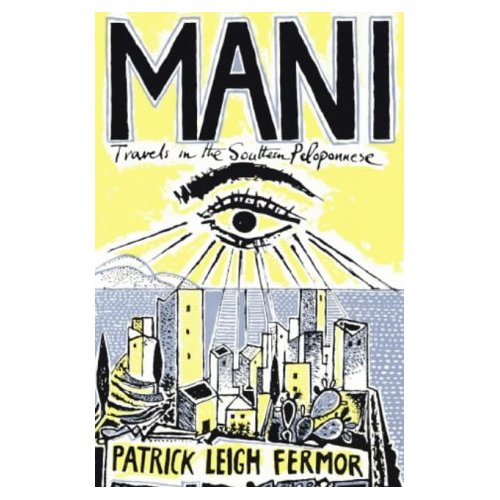
Two pairs of books came to exemplify his achievement. The first pair—Mani (1958) and Roumeli (1966)—celebrated the Greece that held his abiding fascination and where he lived for forty-five years on a once-wild promontory in the Peloponnese. In Mani, especially, he described this backwater region as a world whose way of life had survived in a fierce and enchanted time warp.

The land he depicted is barely recognizable now—tourism, he observed, destroys the object it loves—but it was less the Greece of classical antiquity that beguiled him than the spirit and folk culture of the hinterland: the earthy, demotic Romiosyne that he once contrasted with the Hellenic ideal in a playful balance sheet of the country’s character.

In these, and in later books, the style was the man: robustly imaginative, cultivated without pedantry, unstoppably digressive, forgivably swanky, and filled with infectious learning. The impression—overflowing into elaborate footnotes and flights of learned fantasy—is one of omnivorous delight in the quirks and byways of history, art, language, genealogy, myth, song, superstition, costume, heraldry, and everything else that struck his fancy.

His literary models were Norman Douglas and Robert Byron, but his writing was more vivid than the one, more kindly than the other. Despite the richness of his prose (occasionally slipping into purple) he forged an illusion of intimacy with his readers, as if they were sharing his mind in the moment of writing. But in fact his manuscripts were worked, reworked, and reworked again with such painstaking perfectionism that his publisher (the benign Jock Murray) often had to reset his galley proofs wholesale. The apparently natural flow of words was in reality a densely worked choreography, which came at cost.

Fifteen years ago, swimming in the Ionian Sea beneath his home, where nobody could overhear us, Paddy (as friends and fans called him) suddenly confessed to me the writer’s block that would plague the rest of his life. The expectations of a now-avid public, and his own obsessive perfectionism, were taking their toll, and he could not overleap this cruel impediment.

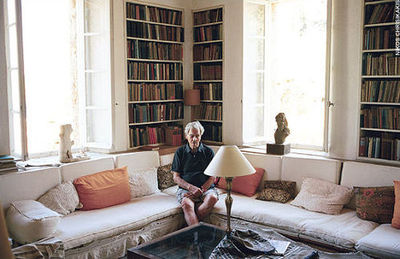
I remember him strong into old age. He swam every morning, with a sturdy breaststroke far out to sea, the tattoo of a twin-tailed mermaid glistening on his shoulder. He still kept up a striding march in the Taygetus foothills, where he and his wife Joan had designed their own house above the ocean. It was a place of “mad splendor,” he wrote. Its sitting-room library—bookshelves banked nine feet high—opened onto a vista of cypresses and the Messenian Gulf, and was flagged with the greenish stone of Mount Pelion. In the afternoon Paddy would disappear into his study to confront—or escape—the demons of his failed writing, and would emerge to the liberation of ouzo or whiskey, generally to report some arcane piece of research—that the Huns wore stitched field-mouse skins, perhaps—or to share a passage of Ovid. We dined in the monastic half-cloister he had built beside his home, and once we visited the tiny, red-tiled Byzantine chapel where—five years before—he had buried the ashes of Bruce Chatwin.

The conflict between a natural gregariousness and the solitude of writing never quite resolved for him. In a short, intriguing study named A Time to Keep Silence (1953) he recorded his sojourn in three great French monasteries. He described this retreat not as a religious exercise, but as a need for a haven for writing, and the nature of its cleansing—”the troubled waters of the mind grow still and clear”—remains suspended like a question mark in the oeuvre of a man to whom self-revelation seemed indulgence.

The second pair of books, which established Paddy’s primacy among travel writers, must be among the most extraordinary ever written. In 1933, as a youth of eighteen, he left England for a journey that would take a year and a half. As “a thousand glistening umbrellas were tilted over a thousand bowler hats in Piccadilly,” he set out to walk to Constantinople (as he nostalgically called Istanbul). Walking stick in hand, a copy of Horace’s Odes in his rucksack, he pursued a meandering course up the Rhine and down the Danube, across the Great Hungarian Plain, into Romania and through the Balkans to Turkey.

It was almost forty-five years before he published the first part of this journey, and another nine years before the second. A Time of Gifts (1977) and Between the Woods and the Water (1986) represent prodigious feats of memory. They record the rite of passage of a precocious, exuberant young man as he encounters the peoples and languages of a Middle Europe now littered with obsolete names: Bohemia, Transylvania, Wallachia. His story must have become the dream journey of every enterprising and footloose adolescent.

Inevitably the accuracy of Paddy’s memory was questioned, and he was frank about occasional imaginative license and conflation. (His first diary was stolen in Munich, a solitary last one recovered years later in Romania.) Certainly his recall was extraordinary. I remember the first time we met (by chance), when he quoted verbatim from my first book passages that I had myself forgotten. A year before his death we chanted verses from the Rubáiyát of Omar Khayyám together in an antiphonal competition (which he won).

His urge to describe his epic journey more than forty years after its end was a deeply natural one. He was revisiting his youthful persona with the judgment and knowledge of maturity; yet in a sense he had remained unchanged. Despite his sophisticated learning, he retained an almost boyish innocence, as if the troubles of the modern age had bypassed him. In the Peloponnese, where he settled to live in the 1960s, he had remained in thrall to a more ancient, rooted culture than that of the urban West.

The final volume of his proposed trilogy—carrying its author through the Balkans and down the Black Sea coast to Turkey—became his tormenting and elusive project for the next quarter- century, and was never completed. Some near-finished version, however, survives him, and will eventually be published.

With his youthful trek done, Leigh Fermor’s career took off into near fable. Caught up in Greek unrest, he joined in a triumphal royalist cavalry charge against wilting Venizelist rebels. In Athens he fell in love with the artist Princess Balasha Cantacuzene, twelve years older than him, and lived with her in Moldavia for over two years, before World War II recalled him to London.

As a fluent Greek speaker he was recruited by the Intelligence Corps, and sent as a liaison officer with the Greek army first to Albania and finally to Crete, where he survived the brutal German invasion. For almost two years, while an officer in the Special Operations Executive, he lived disguised as a shepherd in the Cretan mountains, organizing the gathering of intelligence.

Then, in 1944, occurred the exploit that—more than any other—was to burnish him into legend. He and his fellow SOE officer Stanley Moss dreamed up a scheme of harebrained bravado. Dressed in stolen German uniforms, with a party of Cretan guerrillas, they ambushed the car of General Heinrich Kreipe, the German commander of occupied Crete, kidnapped him, and concealed him under the back seat. Moss took the wheel, Paddy donned the general’s cap, and together they drove through twenty-two checkpoints to emerge on the far side of Herakleion and march Kreipe for three weeks over the mountains, to be picked up by motor launch and taken to Egypt.

It was during this hazardous Cretan march, as the dawn broke over Mount Ida, mythical birthplace of Zeus, that the abducted general began to murmur a verse of Horace: Vides ut alta stet nive candidum/Soracte….1 It was an ode that Paddy knew by heart, and he completed the six stanzas to their end. “The general’s blue eyes had swivelled away from the mountain-top to mine,” Paddy later wrote,

—and when I’d finished, after a long silence, he said: “Ach so, Herr Major!” It was very strange. As though, for a long moment, the war had ceased to exist. We had both drunk at the same fountains long before; and things were different between us for the rest of our time together.

This precocious kidnapping was later reimagined in a lackluster movie named Ill Met by Moonlight (1957) with Dirk Bogarde playing Paddy. But there were other exploits too. Paddy had already engineered the defection of the Italian General Angelico Carta from Crete; and he was due to undertake a near-suicidal mission to Colditz when the war ended.

His upbeat account of these events was tempered by regret. He had planned that the abduction of Kreipe be bloodless, but his accompanying Cretan partisans slit the chauffeur’s throat, and rumors of grim German reprisals for the abduction have never quite died down. Above all, Paddy’s accidental shooting of one of his fellow guerrillas may have stained his memory of the whole period.

On June 16 Leigh Fermor was buried back in the English countryside, attended by an Intelligence Corps guard of honor, to lie beside his wife Joan, his dear comrade since 1946. This was, in a sense, fitting. For in certain ways he was exemplary of a wartime Englishness now almost gone, whose more dashing qualities merged seamlessly into the hardy stylishness of Greek leventéa.

To those who knew him, his books are hauntingly redolent of his sensibility. His conversation was irrepressibly warm and inventive far into old age, moving from arcane anecdotes to fanciful wordplay or bursting into polyglot song (sometimes singing the lyrics backward). His friends ranged from Deborah, Duchess of Devonshire—last of the six legendary Mitford sisters (his correspondence with her was published in 20082)—to early acquaintance with a raffish interwar bohemia and his own great predecessor, the travel writer and aesthete Robert Byron, whose borrowed rucksack he bore across Central Europe as a youth.

Almost the last time I met Paddy, he had returned home after an operation for suspected cancer, and I feared he would be depleted, his old zest gone. He was growing deaf, and he suffered from tunnel vision (which he called Simplonitis). For a while, sitting over lunch, he seemed subdued. Then something struck him. He perked up, and said: “You know, there is an apple lying on a table in the hall. It’s been there all weekend. Wouldn’t it be marvelous if it cocked a snook at Newton, and simply took off into the air!”

This was typical of his boyish resilience. In the field of travel he evoked both the youthful wanderer who discovers another world and the avid scholar who melds with it. His prose was too rich and elaborate to be a safe influence on others (although a few have tried); but he brought to the genre not only the distinction of his densely brilliant books, but his innate dignity, ebullient mind, and capacious heart.

  1. 1″See Mount Soracte white with snow….”
  2. 2The correspondence, In Tearing Haste , edited by Charlotte Mosley, was published in the US by New York Review Books (2010), which has also republished the other books by Patrick Leigh Fermor mentioned in this article, as well as The Traveller’s Tree .

A pilgrimage to Esztergom

I am not the only one who takes the opportunity to visit some of the places mentioned by Paddy in his books when travelling. Here is a nice note I received recently from Ed Ricketts …

Dear Tom,

Just writing to say that, in Budapest last weekend with some spare time before a conference, and having just learned of Paddy’s passing, I felt it appropriate to make a brief trip out to Esztergom – the town on a bend in the Danube where, on the bridge, A Time of Gifts ends and Between the Woods and the Water commences.

After a winding 90-minute train ride down a single-track line, I emerged at the end of the line, Esztergom, and into a sleepy provincial eastern European town (the fact that it was Sunday lunchtime probably the defining reason for this). After a good 30 minute walk into the town centre, past a very pleasant main square with some almost northern Italian architecture, you suddenly see the mammoth marble basilica overlooking the town on a hill. This is the seat of the Hungarian Catholic Church, and an important place of pilgrimage. Around the basilica are grouped some nice old cobbled streets and religious buildings, while the Danube flows calmly by.

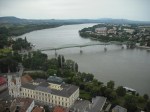
I scrambled up a back way to the basilica, then climbed up onto the cupola which provides an incredible view of the Danube bend and nearby hills (see the attached photos). All the while, I tried to imagine a young and inquisitive countryman with a knapsack doing a similar thing in 1934. What I left until last was walking over the bridge (destroyed in 1944, so it’s sadly not the same structure Paddy tramped over) which now links Slovakia and Hungary. Reading the two books had a considerable effect on me, so this was quite an exciting moment. After a brief meditative pause in the middle, and a few minutes’ ambling on the Slovakian side, I returned over the bridge into Esztergom having toasted Paddy with a small cigar en route.

So a very pleasing day trip overall, with just one slight regret – that I didn’t have the two books with me at the time!

Thanks,

Ed Ricketts

Related article:

Easter 1934 – Paddy reaches the Hungarian border at Esztergom 

An eye for detail and the memory of the Hotel New York in Cluj

There is often a debate about Paddy’s ability to recall so much of his journey with accuracy so long after the event and often without his precious notebooks. Benedict Allen put him to the test at the Red Ox Inn in Heidelberg and the Romanian spa resort of Baia Herculene: Paddy passed that test with flying colours.

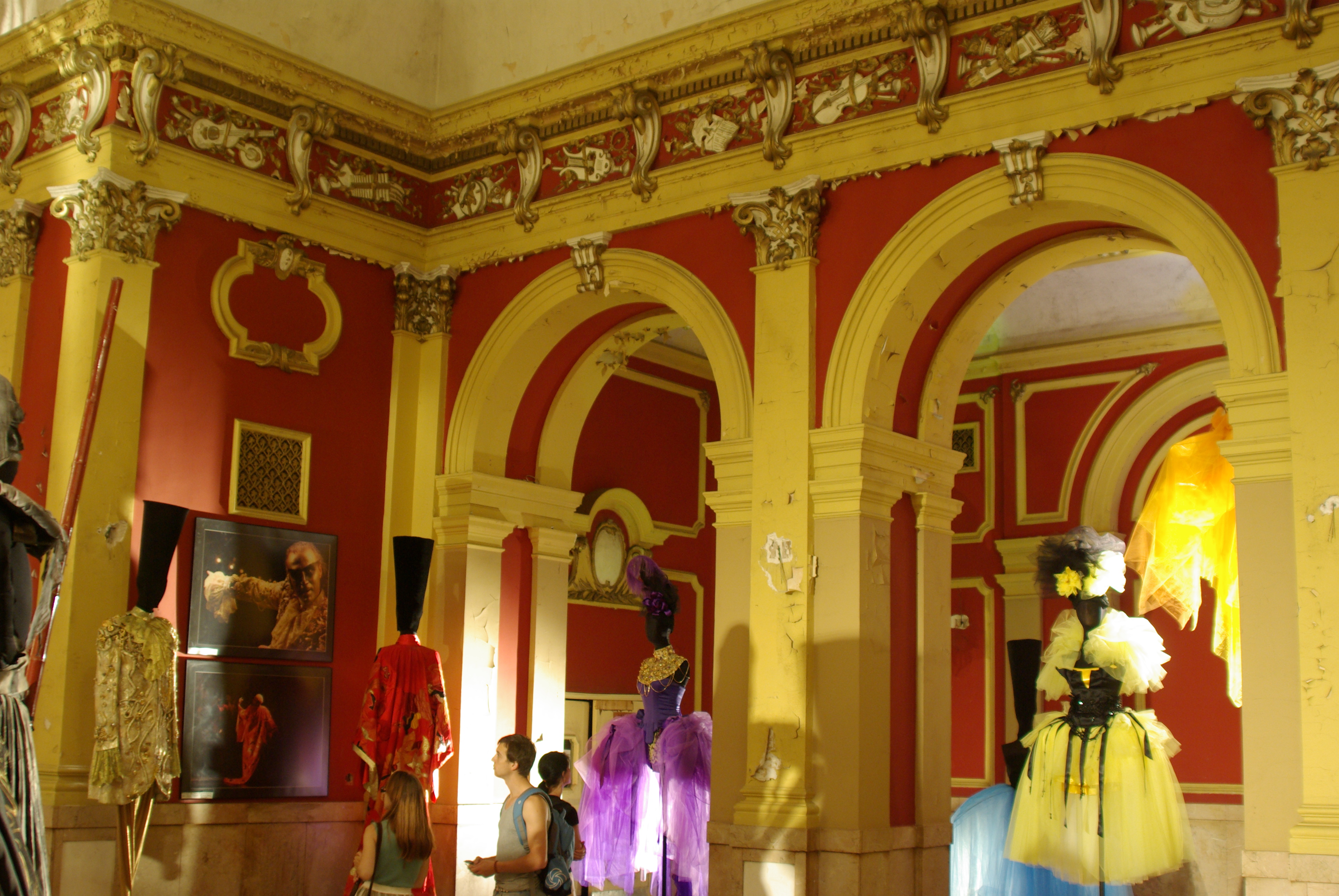
During one of my recent trips to Cluj I was able to enter the famous Hotel New York (now the Continental) during a small exhibition as part of the Transylvanian Film Festival. Immediately I reached for my copy of Between the Woods and the Water and turned to page 144 …

“An hotel at the end of the main square, called the New York – a great meeting place in the winter season – drew my companions like a magnet. István said the barman had invented an amazing cocktail – only surpassed by the one called ‘Flying’ in the Vier Jahreszeiten bar in Munich – which would be criminal to miss. He stalked in, waved the all clear from the top of some steps, and we settled in a strategic corner while the demon-barman went mad with his shaker. There was nobody else in the bar; it was getting late and the muffled lilt of the waltz from Die Fledermaus hinted that everyone was in the dining room. We sipped with misgiving and delight among a Regency neo-Roman décor of cream and ox-blood and gilding: Corinthian capitals spread their acanthus leaves and trophies of quivers, and hunting horns, lyres and violins were caught up with festoons between the pilasters.”

… and given the costume display, this next paragraph came to life for me as Angéla tries to disguise herself with a scarf Paddy and István suggested it might be better to turn into someone else:

“King Carol, Greta Garbo, Horthy, .. Groucho Marx … Queen Marie, and Charlie Chaplin; Laurel and Hardy, perhaps; one of the two; she would have to choose, but she insisted on both.”

Related article:

Angéla, Paddy, István and Tom in Cluj-Napoca

Anthony Lane’s New Yorker article on Fermor is now free to view

Anthony Lane's New Yorker article, May 2006

In trying to make this blog a focal point for all information related to Paddy I have had some problems accessing all on-line material. The one I most sought is the acclaimed May 22, 2006 profile by Anthony Lane which was published in the New Yorker.

This has sat behind their subscriber firewall, tempting us with one-off subscriptions. Now it appears that (possibly marking Paddy’s death?) this is no longer the case. You can now visit their archive, read the article in full on-line, print it or possibly even download it.

There are many profiles of Paddy. This is probably one of the longest and best, and includes interview material with him that many will have not seen before.

Take a trip to the New Yorker website and have a read.

Editor’s Note:  the pdf download appears to be no longer available – click on the article to magnify to read and then drag your cursor to move around the page.

Benedict Allen’s Travellers’ Century on Patrick Leigh Fermor

This is from the television review pages of the Independent covering Benedict Allen’s 2008 ‘Traveller’s Century’ series and the episode that focused on Paddy’s walk ending at the Iron Gates. I have seen this programme and share some of the frustrations of the author, but on balance it was a pretty fair programme given the tight time slot of just one hour.

by Deborah Orr

First published in The Independent 8 August 2008

The bit that delighted us all in this final episode of Travellers’ Century was a clip from another television show. There he was, Patrick Leigh Fermor, the star of the Greek version of This Is Your Life, meeting all the resistance fighters that he had worked with on Crete during the Second World War. And there, unbelievably, and every bit as thrilled to be reunited with Leigh Fermor as all the others, was the German former general Heinrich Kreipe. The two men grinned, hugged and fell into excited conversation, absolutely chuffed to see each other again. That is charm, is it not, the ability to inspire the deep affection of a man you only ever knew because you had spearheaded his humiliating wartime capture, then imprisoned him in a cave? A man, indeed, who was then portrayed in the film of the operation, Ill Met by Moonlight, as a bull-necked, grunting, Nazi ugly, while his nemesis was played by Dirk Bogarde?

I’ve been lucky enough to meet Leigh Fermor – dazzlingly charismatic company in his nineties – on a couple of occasions. So it seemed apposite to gather round the telly with the mutual friends who introduced us, so that we could all watch this film about his life together. Such is the fervour of loyalty that the man inspires, though, that it quickly became apparent that this show, or perhaps any show, would disappoint us. The first heckles came when Benedict Allen described Leigh Fermor as “the accidental superstar of travel writing”, a description we all decided would make him squirm. Concerns over tone were swiftly replaced with outright indignation, when Allen announced that he would be retracing the steps of Leigh Fermor’s first great walk across Europe, which he set off on in 1933, aged 18, in order to judge whether his descriptions had been “accurate”. This idea, again we all agreed with some disgruntlement, was facile beyond belief.

Allen’s idea was perhaps not such a weird one, though. Leigh Fermor’s book detailing the first leg of his journey had been published in 1977, after all, decades after he had made it. The delay had come about because his notes had been stolen in Romania. Again, it is testament to the affection he inspires that the local people who recovered the young Englishmen’s journal hung on to it in the hope that they would one day get the opportunity to return it to him. We all abhorred Allen’s attitude, nevertheless. When he suggested that Leigh Fermor’s two books describing his travels, A Time of Gifts and Between the Woods and the Water, might have been “endlessly worked and reworked, with whole decades of hindsight”, there was a generally mutinous feeling in the room that our man was being seriously impugned.

Allen regained a little trust when he decided, having visited some little-altered spots in Heidelberg, that the writer had indeed told it like it was. But when Allen changed his tune, and started suggesting that the books were weirdly apolitical, and offered too little detail about his own inner life, we sank again into despondency. The purity of Leigh Fermor’s writing comes from his scrupulous observation of what he encountered, and the beauty with which he describes it. He doesn’t bang on about himself. Anyway, on it went, as we nit-picked every assertion. By the time Allen got to interview Leigh Fermor, at his home of very many years in the Peloponnesus, we hated and resented him, and were only too happy to dismiss the interview itself as a dead loss. “And the programme was too long,” we agreed at the end. “If we thought that, what did everyone else think?” Actually “everyone else” would probably have enjoyed the thing a great deal more, not being hampered, like us, by an almost deranged sense of hyper-loyalty.

Scholar in the wilds – a profile of Patrick Leigh Fermor

A comprehensive profile of Patrick Leigh Fermor.

By James Campbell. First published in The Guardian 9 April 2005

As a teenager, Patrick Leigh Fermor walked through Europe to Turkey, sleeping in hayricks and castles. Forty years later he wrote two pioneering books about it; a third is still in progress. He lived in Romania, met his wife in Egypt, and was decorated for his wartime exploits in Crete. Now 90, he continues to work in the house he built in Greece in the 1960s.
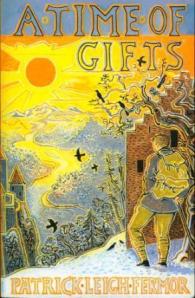
“So here’s the traveller,” a Hungarian hostess greets the teenage Patrick Leigh Fermor as he trudges towards her Danubian country house. The year is 1934 and Leigh Fermor is four months into his walk from the Hook of Holland to Constantinople, undertaken to shake off what he refers to, 70 years on, as “my rather rackety past”. The journey is captured, with erudition and fond detail, in A Time of Gifts (1977) and Between the Woods and the Water (1986). They are unique in several respects, not least that they were written more than 40 years after the events described. Leigh Fermor derived the former title from a couplet by Louis MacNeice, “For now the time of gifts is gone – / O boys that grow, O snows that melt”, which encapsulates the double vision involved in evoking one’s own adolescence from a distance. A concluding volume, which will take the boy to his destination, has long been promised.

Leigh Fermor is not a “travel writer” – like others, he disavows the term – but there is no denying he is a traveller. After Constantinople (as he still insists on calling it, though the name was changed to Istanbul in 1930), he moved to Romania, where he stayed for two years, barely conscious of the inklings of war from beyond the Carpathian mountains. In the 1950s, he explored the then-intractable southern finger of the Peloponnese known as Mani, where he lives, followed by a similar journey in the north of Greece, making his reports, in characteristically exuberant style, in the books Mani (1958) and Roumeli (1966). His stays in French monasteries, where he achieved “a state of peace that is unthought of in the ordinary world”, are recorded in an exquisite book of fewer than 100 pages, A Time to Keep Silence (1957).
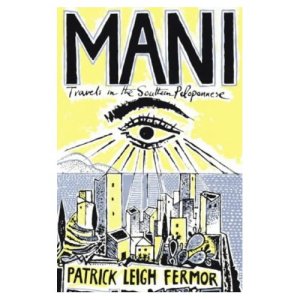
Mani: Travels in the Southern Peloponnese

Mani: Travels in the Southern Peloponnese

He is also a scholar, with a facility for languages so prodigious that he would amuse himself on his footslog by singing German songs backwards and, when those ran out, reciting parts of Keats the same way: “Yawa! Yawa! rof I lliw ylf ot eeht”, etc. “It can be quite effective,” he says. After a lunch of lemon chicken at home in Mani, accompanied by an endlessly replenished carafe of retsina, he entertains his guest with a rendering of “It’s a Long Way to Tipperary” in Hindustani.

In addition, Leigh Fermor is recognisably that figure many writers of the past century have yearned to be, the man of action. When the inklings could no longer be ignored in 1939, he abandoned his Romanian idyll and enlisted in the Irish Guards. A major in Special Operations Executive during the second world war, he was awarded the DSO for heroic actions on German-occupied Crete. Few writers are entitled to include in their Who’s Who entry: “Commanded some minor guerrilla operations.” His publisher, John Murray, whose father, the late “Jock” Murray, edited most of Leigh Fermor’s books, describes him as “almost a Byronic figure. If you met him on a train, before long he would be reciting The Odyssey , or singing Cretan songs. He loves talking, and people are always absorbed by him.”

Known as Paddy to the acquainted and unacquainted alike, Leigh Fermor has turned 90. He is still sturdy, with an all-round handsome appearance. Here is a man who at 69 swam the Hellespont (or Dardanelles), two kilometres wide at its narrowest, in emulation of Byron and Leander, who swam it nightly for the love of Hero. Leigh Fermor swam it under the concerned watch of his wife Joan, who followed in a small boat, and averted her eyes as he narrowly missed being sunk by a liner. An innocent sweetness hovers about his face, which finds a focus in his eyes as he makes a joke or stumbles on a happy recollection. There is a dash of the old soldier, clubbable and courteous, in his approach, his speech punctuated by “Look here …” and “I say …”, and not much of the “rather rackety” figure he claims to have been before he cured his ills by walking. When, relatively late in life, he became a mentor to Bruce Chatwin, the younger writer adopted Leigh Fermor’s motto, solvitur ambulando – it is solved by walking.
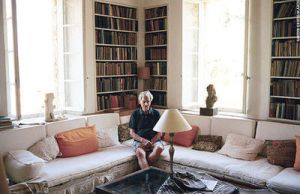
Paddy at home in the Mani

After more than six decades in the country, Leigh Fermor is inextricably tied to Greece. His command of the language extends to several regional dialects. He is an honorary citizen of the Cretan capital Heraklion, and of the village of Kardamili in Mani, and is a proud godfather to children in both places. In the mid-1960s, as if to lay the foundation for a committed life, he built a house that reflects the various aspects of his personality. Perched on a peninsula jutting into the Gulf of Messenia, it overlooks a small uninhabited island, behind which the sun sets nightly. He has described how he and Joan camped in tents nearby as the works progressed, studying Vitruvius and Palladio, but admits that the design was largely the result of improvisation. Ceilings, cornices and fireplaces allude to Levantine and Macedonian architecture. Hard by the commodious living room, an L-shaped arcade, which might have been built centuries ago, provides a link to the other rooms and gives on to an olive grove below. Out of nowhere, cats materialise on chairs and divans, prompting Leigh Fermor to remark on “interior desecrators and natural downholsterers”. The great limestone blocks of the main structure were hewn out of the Taygetus mountains, visible in the background, as the sea is present in the foreground. A weathered zigzag stone staircase leads down to a horseshoe bay. “There was no road here at all when we came. The stone had to be brought up by mule. We got most of the tiles from another part of the Peloponnese, after an earthquake. They were happy to be rid of them – couldn’t understand why we wanted this old stuff. They wanted everything new.” The master mason behind the house was a local craftsman, Niku Kolokatrones, whom Leigh Fermor met by accident while out walking. “I spotted his bag of carpenter’s tools and told him I was looking for somebody to help me build a house. He said, ‘Why not take me? I can do everything.’ And he was absolutely right.”

It was finally fit for habitation in 1968, and the couple “lived very happily here for 30 years”. Joan Leigh Fermor, daughter of the Conservative politician and First Lord of the Admiralty in Ramsay MacDonald’s coalition government, Bolton Eyres Monsell, died in 2003 at 91, after a fall. The couple met in wartime Cairo. She took the photographs for several of his books, including the first, The Traveller’s Tree (1950), an account of a journey through the West Indies, and for Mani and Roumeli – although these pictures have sadly been omitted from later editions.

He was born in London in 1915, to Sir Lewis Leigh Fermor, who became director-general of the Geological Survey in India, and Eileen Ambler, who was partly raised there. His childhood relationship with his parents was “rather strange, because I didn’t really know either of them until I was about three-and-a-half. My mother returned to India after I was born, leaving me with a family in Northamptonshire. I spent a very happy first three years of my life there as a wild-natured boy. I wasn’t ever told not to do anything.” When his mother returned, at the end of the first world war, “my whole background changed. We went to live in London. And she was rather unhappy, because I didn’t really know much about her, or my father or my sister, who had been born four years earlier. They hadn’t seen me since I was a few months old.” He claims he was “more or less tamed after that”, though he has written that his lawless infancy “unfitted me for the faintest shadow of constraint”.
Patrick Leigh Fermor at school, Kings Canterbury

His mother “adored anything to do with the stage” and wrote plays that were never produced. She made friends with Arthur Rackham, who painted a picture inside the front door of their house in Primrose Hill Studios “of Peter Pan in Kensington Gardens, being blown along in a nest with a ragged shirt for a sail”. He wonders if it’s still there. When the time came to think about school, the “wild boy” re-emerged, and he was beaten from one educational establishment to another. “I didn’t mind the beatings, because there was a bravado about that kind of thing.” At one stage, he was sent to a school in Suffolk for disturbed children – or, as he puts it, “where rather naughty children went” – and later to King’s School, Canterbury, the oldest public school in England, where the unruly old boys included Christopher Marlowe. “It was all rather marvellous,” says Leigh Fermor, who casts a rosy light on almost all experience, “but my discipline problems cropped up again. Things like fighting, climbing out at night, losing my books.” Among his contemporaries at King’s was Alan Watts, who later wrote popular books on Zen Buddhism and became a hippie guru. In his autobiography, Watts recalled Paddy “constantly being flogged for his pranks and exploits – in other words, for having a creative imagination”. Watts confirms the familiar tale that Paddy was expelled “for the peccadillo of taking a walk with the daughter of the local greengrocer”. Leigh Fermor recalls: “She was about eight years older than me – totally innocent, but it was a useful pretext for the sack. I think it was very kindly meant. Far better to get the sack for something slightly romantic than for just being a total nuisance.”

Believing that the best place for a nuisance was the army, his parents tried to direct him towards Sandhurst, but his academic failures put paid to that too. The military historian Antony Beevor, who was an officer cadet at Sandhurst, and has known Leigh Fermor for many years, believes he would not have prospered. “I think he may have had a romantic idea of what army life was like, but he would have found the peacetime garrison incredibly stultifying. Army life in the 1930s was very staid. Paddy was too much of a free spirit.”

It was then that Leigh Fermor came up with a scheme “to change scenery”. Envisaging himself as “a medieval pilgrim, an affable tramp with a knapsack and hobnailed boots”, he decided to walk across Europe to Turkey. “It was a new life. Freedom. Something to write about.” To make it even more improbable, he set out in December when, as he states in the opening paragraph of A Time of Gifts, “a thousand glistening umbrellas were tilted over a thousand bowler hats in Piccadilly; the Jermyn Street shops, distorted by stream ing water, had become a submarine arcade.” When his ship docked in Rotterdam, “snow covered everything”. He dossed down wherever he landed, on one occasion outside a pigsty to the sound of “sleepy grunts prompted by dreams, perhaps, or indigestion”.

In addition to his sleeping bag, Leigh Fermor packed the Oxford Book of English Verse and a volume of Horace. An allowance of £4 a month was to be collected along the way. “My general course was up the Rhine and down the Danube. Then to Swabia, and then into Bavaria.” At the time, he had published a few poems (“dreadful stuff”), but was inspired to switch to travel writing by Robert Byron, whose book about a journey to Mount Athos in north-eastern Greece, The Station , had recently been published. “I was keeping copious notes, songs, sketches and so on, but in Munich a disaster happened. I stayed at a Jugendherberge and my rucksack was pinched, with all my notes and drawings.” And then comes the Paddy stroke: “In a way it was rather a blessing, because my rucksack was far too heavy. It had far too many things.” His sleeping bag was lost too -“good riddance, really” – and his money and passport. “The British Consul gave me a fiver – said pay me back some time.”

Leigh Fermor has pursued his literary career haphazardly. His Caribbean book was originally meant to be a series of captions for photographs. Then came his only novel, The Violins of Saint-Jacques (1953), followed by A Time to Keep Silence and Mani , all written in the mid-50s, after which he restricted himself to one public outing per decade. However, the 40-year interlude between the events of his European journey and the writing of the books enhances their appeal. At times, the hero of A Time of Gifts seems like a boy faced with a tapestry on which the entire history and culture of Europe is portrayed, unpicking it thread by thread. Byzantine plainsong; Yiddish syntax; the whereabouts of the coast of Bohemia (it existed, for 13 years); the finer nuances of regional architecture – “the wild scholarly enthusiasms of a brilliant autodidact”, as the writer William Dalrymple says. Theories are worked out, set down and often jettisoned, before another day’s walking begins. No one modulates as energetically from speculations on the origin of Greek place names to the “not always harmful effects of hangovers” as Leigh Fermor does. “If they fall short of the double vision which turns Salisbury Cathedral into Cologne,” he writes of his sore heads, “they invest the scenery with a lustre which is unknown to total abstainers.” When it came to writing about the journey, Leigh Fermor claims that “losing the notebook didn’t really seem to matter. I’d got all the places I’d been to noted down in another little notebook. Early impressions and all that sort of thing would only have been a hindrance.” It is impossible to say where imagination gets the upper hand over memory, and aficionados are adamant it does not matter.

Dalrymple, who as a student set out to follow the route of the First Crusade in emulation of Leigh Fermor, says: “I can’t think of any younger writers who have tried to write like Paddy, who have succeeded in the attempt. Not that I haven’t tried. When I set out on my first long journey in the summer vacation I had just read A Time of Gifts and I tried to write my logbook in faux-Paddy style. The result was disastrous. Just last summer I visited Mani and reread his wonderful book, and found myself again trying to write like him. I should have learned my lesson by now.” Dalrymple feels that the strongest influence of Leigh Fermor on the younger generation of travel writers “has been the persona he creates of the bookish wanderer: the footloose scholar in the wilds, scrambling through the mountains, a knapsack full of good books on his shoulder. You see this filtering through in the writing of Chatwin and Philip Marsden, among others.”

According to Jeremy Lewis, author of a biography of Cyril Connolly, with whom Joan was friendly, “Occasionally, one comes across some unromantic soul who objects to Leigh Fermor on the prosaic ground that he couldn’t possibly remember in such persuasive detail the events of 60 years ago.” Lewis suspects that “quite a lot of it is made up. He’s a tremendous yarn-spinner, and he has that slight chip on the shoulder of someone who hasn’t been to university. Sometimes one gets the feeling that he’s desperate to show he’s not an intellectual hick. He’s quite similar to Chatwin in that way. With Chatwin I find it irritating, but not with Leigh Fermor.” Lewis adds, “There is also a strong boy-scout element about him, which annoys some people, singing round the campfire and so on. I doubt if there was ever anything very rackety about Paddy.”
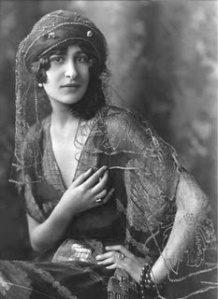
Balasha Cantacuzene

He has been asked many times why the composition of the books was delayed for so long, and has finessed the reply to his characteristic self-effacement: “Laziness and timidity.” He had a shot at writing during his sojourn in Romania in the late 1930s, “but I thought it was no good, so I shoved it aside. And I was right, actually, because when I tried it much later it all began to flow.” His companion in Romania, the first love of his life, was a young painter, Balasha Cantacuzene, whose family was part of an “old-fashioned, French-speaking, Tolstoyan, land-owning world. They were intensely civilised people. I spent the time reading a tremendous amount … when I wasn’t making a hash of writing. I felt rather different at the end of it all, from the kind of person I’d been before.”

After the communist takeover at the end of the war, the Ceausescu government branded the Cantacuzenes “elements of putrid background” and forced them to leave their property. Leigh Fermor made it his mission to rescue them from their new dismal circumstances, eventually succeeding in slipping into the country on a motorcycle and contacting Balasha and her sister. They met for only 48 hours. “We dared risk no more, and during that time I was unable to leave the tiny flat where they were then living, for fear of being seen.” He found that their early thoughts of leaving Romania had lapsed, “partly from feeling it was too late in the day; also, they said that Romania, after all, was where they belonged”.

His war service was spent mainly on Crete. After the British retreat from the island in May 1941, Leigh Fermor was among a small number of officers who remained, helping to organise resistance to the occupation, “living up in the mountains, dressed as a shepherd, with my wireless and so on”. In the spring of 1944, after an onslaught on villages “with fire and sword” by German troops in reprisal for the rash actions of some Cretan guerrillas, Leigh Fermor conceived a plan to kidnap the general responsible for the carnage, and to spirit him off to Cairo. The idea was to make a “symbolic gesture, involving no bloodshed, not even a plane sabotaged or a petrol dump blown up; something which would hit the enemy hard”. Together with a select band of associates, British and Cretan, he succeeded – except that the officer they were after, General Müller, had already left Crete, and they found themselves taking charge of his replacement, a milder figure by all accounts, General Kreipe. After three weeks of trekking through the mountains, they managed to get the captive on board a vessel bound for Egypt.

The events were drawn into a book, Ill Met by Moonlight (1950), by Leigh Fermor’s comrade in the operation, W Stanley Moss, and an inferior film in 1957, with Dirk Bogarde playing Paddy. He is polite about the actor, whom he met, but it is clear that Bogarde’s performance as Major Fermor failed to impress. “I didn’t go to the opening, or anything like that. It was all so much more interesting than they made it seem.” The military historian MRD Foot has referred to the Cretan escapade as “a tremendous jape”, which in Leigh Fermor’s opinion puts it in a “rather frivolous perspective”. Beevor, whose book The Battle for Crete (1991), pays handsome tribute to Leigh Fermor’s actions, feels the description of the kidnapping as a “jape” is unjust. “What was very clever about the Kreipe operation was that it was planned meticulously to give the Cretans a tremendous boost to morale. They needed to do something that would damage the Germans, but was not going to provoke civilian casualties. They were absolutely scrupulous about this.” Certain accounts of the exploit have suggested that it resulted in reprisals against the local pop ulation, but, says Beevor, “they are completely wrong. I’ve been through all the relevant documentation, and there is nothing to suggest that the kidnapping of General Kreipe provoked direct reaction from the Germans. It wasn’t just a jape. When I was researching my book, a member of the Cretan resistance told me, ‘The whole island felt two inches taller’.”

Captor and captive, stuck together in freezing caves (the general had to sleep between Leigh Fermor and Moss, all sharing a single blanket), found a common bond in the Odes of Horace. In a report written at the request of the Imperial War Museum in 1969, published in Artemis Cooper’s anthology of Leigh Fermor’s writings, Words of Mercury (2003), he described what happened: “We were all three lying smoking in silence, when the general, half to himself, slowly said: ‘Vides ut alta stet nive candidum / Soracte …’ [You see how Soracte stands gleaming white with deep snow]. I was in luck. It is the opening line of one of the few Odes of Horace I know by heart. I went on reciting where he had broken off: ‘… Nec iam sustineant onus …’ and so on, through the remaining five stanzas to the end.”
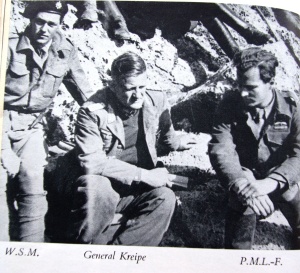
Moss, Kreipe and Paddy

The heroics in eastern Crete had a surprise sequel, which throws into relief the absurdity of war. Some 30 years later, Leigh Fermor was asked to take part in a Greek television programme based on This Is Your Life , in which the subject was to be General Kreipe. “I felt quite certain when I heard about it that it was not on the level, and so I found out General Kreipe’s number and got on the telephone to him. I said, ‘It’s Major Fermor’. He said, ‘Ach, Major Fermor, how are you? It seems we are going to meet again soon.’ I said, ‘So you are coming?’ He said, ‘Yes, of course I’m coming. Tell me, what’s the weather like? Shall I bring a pullover?’ And you know, it was the most terrific success. They were all there.” The exception was Moss, who died in 1965; and it is probably safe to discount the Cretan guerrillas who carried off the general’s chauffeur and slit his throat, much to Leigh Fermor’s displeasure.

He writes in a small studio apart from the main house. Dictionaries, volumes of Proust, books of verse in various languages and back issues of the TLS occupy every surface. Asked if he has a title in mind for the promised last volume of his European trilogy, he looks suddenly pained and answers no. He describes himself as “a very slow writer”. His pages are laboriously revised and readers who revel in his florescent style may be surprised to learn that the finished sentences are pared down from something the author considers “too exaggerated and flowery and overwritten”. Murray says: “It’s rather like a musician: each time he changes a word, he has to go back and change all the other words round about it so that the harmony is right.” Murray recalls “seven versions of A Time of Gifts being submitted to my father. And each one would be written-over, with bubbles containing extra bits. The early manuscripts are like works of art themselves.”

As he is writing, Leigh Fermor thinks of one or two friends “that it might amuse. How would they respond? Where would they sneer?” He refers to his old notebooks for things like dates and place names, but relies on memory for a clearer vision of the walking boy and the snows. “I’ve written quite a large amount. For some reason, I got a sort of scunner against it several years ago. I thought it wasn’t any good. I always think that. But now I think I was wrong. I’m going to pull my socks up and get on with it.”

Patrick Leigh Fermor

Born: February 11, 1915, London.

Education: 1929-33 King’s School, Canterbury.

Married: 1968 Joan Eyres Monsell.

Employment: 1945-46 deputy director British Institute, Athens.

Books: 1950 The Traveller’s Tree; ’53 The Violins of Saint-Jacques; ’57 A Time To Keep Silence; ’58 Mani; ’66 Roumeli; ’77 A Time of Gifts; ’86 Between the Woods and the Water; ’91 Three Letters from the Andes; 2003 Words of Mercury.

Some awards: 1944 DS0; ’47 honorary citizen of Heraklion, Crete; ’58 Duff Cooper Memorial Prize; ’78 WH Smith Award; ’86 Thomas Cook Travel Book Award; ’91 Companion of Literature; 2004 Knighthood.

The English in Hungary – for St George’s Day

From the blog of Greg Dorey, the UK Ambassador to Hungary. The  Ambassador takes us through many of the English associated with Hungary including our very own Patrick Leigh Fermor. You can download the PowerPoint including the notes here.

UK Ambassador to Hungary – England

Yesterday afternoon I participated as Patron in the 2011 BBC Entertainment and English Speaking Union (ESU) Public Speaking Awards in Hungary. Along with the Ministry of National Resources and Magyar Telekom, the event was also supported by the British Council, Oxford University Press and the Robert Burns International Foundation. It’s the first time the BBC have organised this event here, but it was such a success that they plan to repeat it in the future. The standard of English spoken by the young Hungarian participants was tremendous and the winner and runner up who go on to the ESU International Public Speaking Awards in London in May will be excellent representatives of their country.

And then it was off to the British Chamber of Commerce in Hungary’s (BCCH) third annual commemoration of St George’s Day – a week early because otherwise the concurrence with Easter would mean no one came! Having spoken about St George for the past two years I had exhausted my knowledge of him – so spoke instead of some of the famous Englishmen and Englishwomen with connections with Hungary (Edward the Exile, Sir Philip Sidney, Julia Pardoe, Patrick Leigh Fermor etc). For anyone interested, an edited version of my presentation is available on the Embassy website. The event was used to advance the cause of Corporate Social Responsibility. The BCCH Chairman Gergely Mikola has instituted a new annual St George’s Award to recognise examples of ethical business and together we presented the first such prize to Tibor Hejj of Proactive Management Consulting, whose firm helps prepare disabled people for the workplace.

Related category for more articles:

Between the Woods and the Water

If food be the music of love … Bánffy’s lover in Cluj (Kolozsvár)

I am currently reading two books. The first is a little known series that Paddy contributed to in 1962 about which I will say more very soon. The second is volume two of Bánffy’s trilogy. I am convinced of the semi-autobiographical nature of these books and I have become obsessed with trying to find the house in Cluj of the married woman, Adrienne, who becomes the lover of the hero Balint.

There are many clues, including street names, but Bánffy has been able to mix fact and fiction, and what is more, many of the street names have been changed from the traditional Hungarian to new Romanian names since 1918. I was discussing this with one of my work colleagues in Cluj, Boglarka Ronai, and I happened to say that I was convinced that Bánffy also had a lover in Cluj, and that Adrienne’s house in the story may have been based on this woman’s house.

We are not sure about the house part, but Bánffy did indeed have a long-term lover in Cluj, and Boglarka sent me the following article about her: Baroness Elemér Bornemissza née Karola Szilvássy. Quite bizarrely it is about a cookbook that she wrote. What is interesting is how the writer of the article positions the contributors to the cookbook within the context of the decline of the Hungarian nobility of Transylvania, and in some cases this had tragic endings. It was into this world that Paddy walked in 1934 as he enjoyed his long summer in Hungary and then Transylvania. I have not had the time to cross-check, but Paddy may well have met some of the characters mentioned in the article and written about them in “Between the Woods and the Water“. Many of those mentioned in the article were writers and members of a Hungarian-Transylvanian writer’s group, the Erdélyi Helikon. In the picture below I believe Count Miklós Bánffy can be seen second right sitting on the chairs.

Photo made at the second Erdélyi Helikon meeting at Marosvécs in 1927 (Banffy seated second from right?)

Here is the article by Iván Bächer from the Hungarian Quarterly. If ayone knows any more about the story or the people involved please get in touch with me:  tsawford[at]btinternet.com

The Taste of Old Transylvania

Baroness Elemér Bornemissza: Kipróbált receptek (Proven Recipes). Edited and with an Introduction by Ildikó Marosi. Csíkszereda–Budapest, Pallas—Akadémia Könyvkiadó, 1998, 153 pp.

A friend of mine brought a heartrending cookery book from Transylvania. At first sight the slim little volume looked ordinary enough; I expected some amusing oddity when I picked it up and read the name of the author—Baroness Elemér Bornemissza née Karola Szilvássy—and the title: Proven Recipes.

The cover showed a copperplate print of Marosvécs in the last century—I was able to identify it by the four sturdy corner towers. This Renaissance building on the site of the Roman castrum was, until recently, in the possession of the Kemény family—the descendants of János Kemény (1607–1662), Prince of Transylvania, who had fought the Turks and had been abandoned by the Habsburgs and Montecuccoli.

When I read the first recipe, I still thought I would be treated to a bit of “blue-blooded” diversion. Who in their right mind could take a recipe of Goose-liver paté à la Salzburg seriously, which requires three whole goose livers, of which two have to be soaked in lukewarm milk overnight, then fried with onions and white bread rolls previously also soaked in milk, then pounded in a mortar, pressed through a sieve, mixed with finely sliced truffles which had been soaked in sugared wine, then with more wine added, with cloves and pepper, and the whole mixture finely layered with the third goose liver, which had been fried, cut into thin slices, and then the whole thing finished in a hot oven.

Who would have time for all that today?

It was only when I read the foreword of more than thirty pages and then went through the recipes that my heart suddenly sank. Every single recipe permeated the air with transcience and death. What I held in my hand was the frozen, fossilized evidence of a social class, a culture and a world, which have been obliterated from the face of the Earth.

This class was the Hungarian aristocracy of Transylvania, which, as well as distinguishing itself in the culinary arts, maintained an extremely rich Hungarian tradition, culture and literature.

As Ildikó Marosi’s Introduction reveals, the book is the first publication of a hand-written cookery book. Besides being a fascinating document, an original collection of recipes found among the estate of János Kemény, the last titled resident of Marosvécs, it is invaluable also because in the case of most of the recipes the author also names the source: when and where the baroness had learned the secrets of preparing the dish concerned. And if we use Ildikó Marosi’s guide to keep track of the sources, then the book will, indeed, make heartrending reading.

Let’s get a foretaste of the names of people who cooked for Hungarian writers, poets and editors in Transylvania between the two world wars.

The author of the cookery book was Baroness Bornemissza née Karola Szil-vássy, daughter of the landowner Béla Szilvássy and Baroness Antónia Wass.

Karola’s character was captured in two novels by two twentieth-century Transylvanian writers of aristocratic blood, Count Miklós Bánffy (1874–1950) and Baron János Kemény (1903–1971).

Ever since her youth, Karola was a stunningly beautiful, unbridled and proud woman with a passion for fine food as well as for interesting, eccentric and talented people. She liked to have excitement around her, and when there were no scandals at hand, she personally intervened to remedy the situation. For many years, Karola had a housekeeper, who had been a convicted murderer’s lover, and whom she took into her house along with the hanged man’s child. Accompanied by one of her friends, herself a baroness, Karola travelled to South Africa—on rail, by boat and on a donkey—to erect a tombstone for her cousin, Albert Wass, who had died there while fighting for the Boers.

This extraordinary woman had a difficult time to find herself a husband; eventually she married Baron Elemér Borne- missza, but the marriage was a failure, and their only child died, so they lived separately, with Karola receiving a handsome allowance from her husband.

Between the two world wars, Karola made herself the heart and soul of the Kemény Zsigmond Society of Marosvásárhely, the publishing house Erdélyi Szépmives Céh, and the magazine Erdélyi Helikon. (Erdély is the Hungarian name of Transylvania.)

The society, which bore the name of the Kemény family’s greatest son, the novelist and liberal thinker Zsigmond Kemény, was formed after the writer’s death in 1876, and functioned until 1944. It acquired a unique role after Transylvania’s annexation by Romania in 1918, organizing and rallying the Hungarian writers and maintaining links with the mother country.

Erdélyi Szépmíves Céh was the most prestigious book publisher in interwar Transylvania, and Erdélyi Helikon, the magazine started by János Kemény, was published by them.

The writers who were associated with the publisher and the magazine—Károly Kós, Aladár Kuncz, Károly Molter, Jenoý Dsida, Benoý Karácsony and many others—annually gathered in János Kemény’s château in Marosvécs. On these occasions, Karola’s attendance could always be taken for granted, and all the memoirs name her as the spirit of the company. (below Karola is fourth from right)

In the castle park (Marosvécs?) 1942 From left to right: István Asztalos, László Szabédi, Albert Wass, Karola Bornemissza, Elemérné Szilvássy, Gizella Kemény, Berenice Kemény, Jánosné Kemény

In this way, Karola, the compiler of our cookery book, was at the centre of Transylvanian literary life, and her kitchen produced, from “proven recipes”, the fine food enjoyed by the writers and editors. Continue reading

One year on … the Patrick Leigh Fermor Blog

I am back. Sorry that I have been so quiet for the last few weeks. I don’t have any real explanation. Excuses may range from work commitments through some form of ‘writer’s block’ (where has my muse gone?) to the genuine excuse of being totally absorbed by Miklos Banffy’s first volume of his trilogy – They Were Counted.

This is an exceptionally good book. I will write about it at greater length at some future date, but I do recommend it. He can sometimes get a little bogged down by Hungarian politics, but when he gets going, describing balls, duels, gambling and love, he really does have a very fine style. Paddy wrote the forward to the English translation whilst staying at Chatsworth during Christmas 1998. Much of the story is set in Kolozvar (Cluj) and our old friend the Hotel New York, where Paddy and Angéla went for a cocktail, is frequently mentioned.

We have just had a blog anniversary. The Patrick Leigh Fermor blog started in late March 2010. In that time it has reached almost the very top in any Paddy search you care to mention. There have been over 64,000 visits, 156 postings, 206 comments, and there are now well over 100 subscribers (you can sign up in the top right of the home page so that you receive future posts by email – no spam).

When I started I wondered if there would be any interest in our heroic and talented subject. There were just a few dozen visits in the first month. But visits grew rapidly to a peak of 9,400 in January 2011. We now track at nearly 7,000 visits a month on average so you are not alone in your interest in The Greatest Living Englishman.

I am extremely grateful to all of you who have got in touch with me with messages of support; offers of information; and especially to those who have sent me material to publish. I can assure you that there is much more material (I have over 60 items in various stages of draft) and it will come in a steady stream. To one of you, please be assured I remain your #1.

Finally, let’s not forget why we are here. Paddy is now 96 years of age and, as far as I can tell, in reasonably good health. I am sure we wish him all good health and pray that he is working as fast as he can on that third volume. It is without doubt one of the most eagerly anticipated books of the decade.

Why not visit some of our top posts?

Patrick Leigh Fermor recounts the kidnap of General Kreipe on video

A Meeting between Paddy and George Psychoundakis the “Cretan Runner”

Patrick Leigh Fermor – star of the silver screen?

On the Pontic shores where the snowflakes fall

I knew Patrick Leigh Fermor through his words, and he will know me by mine

Images of Cluj by Alin Niculescu

There is one respect in which I have a definite advantage over Paddy in terms of the places he visited. I have been lucky enough to get to know well the city of Cluj-Napoca due to my regular visits. Paddy had but one night there with Angéla, but it was one of one of love and passion!

Last week I visited Bucharest for the first time. If this had been my first introduction to Romania I doubt that I would have been keen to return. To be fair it was literally a flying visit, and I did not make it right into the centre, however, it cannot compare with the genuine attractions of Cluj: its compact size; the Baroque architecture; the lively bars and restaurants in the old centre; the intimate cultural life; and its position in a valley surrounded by gently rolling hills. I have also made some good friends in this capital of Transylvania.

I have often written about Cluj, but to many of you the city probably remains a mystery. To help you get more of a feel for a place that I have come to feel strongly about, I wanted to showcase the work of  Alin Niculescu, a professional cameraman from Cluj. He has made a number of short films about the city, highlighting it over the seasons. They are just a few minutes long and if you are curious to know more about the city, they will give you a feel for its size, architecture, and position. In some scenes he also captures the relaxed and friendly mood of its citizens.

This first film is entitled Snowy Night at Cluj. This is broadly how the city looks at the moment.

Snowy Night at Cluj Full HD from Alin Niculescu on Vimeo.

This second movie shows a panorama over the city in the summer.

Cluj-Napoca from Alin Niculescu on Vimeo.

You can see more of Alin’s work on his website here

Related category:

Articles about Cluj and Transylvania