Category Archives: Paddy's Writing

Kennt ihr das Land in deutschen Gauen

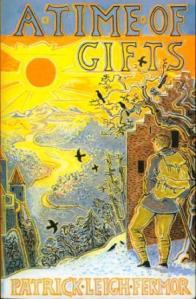
I guess that many of us enjoy the chapter in A Time of Gifts when the eighteen year old Paddy spent two nights in Stuttgart with two very pretty nineteen year old German girls, Lise and Annie. It was Epiphany, 6th January 1934, and they went to a party where Paddy had to pretend to be Mr Brown, a family friend. He particularly enjoyed singing a song about the Neckar Valley and Swabia. Paddy could not remember all the words but his stunning memory recalled most of them (page 66).

As we approach that time of year I thought we ought to share this delightful song.

Here is a link to the music sung by a German choir. The words are below so that you too can sing along! Let’s hear it now, one two three …. 

  1. Kennt ihr das Land in deutschen Gauen,
    Das schönste dort am Neckarstrand?
    Die grünen Rebenhügel schauen
    Ins Tal von hoher Felsenwand.

Refrain:
Es ist das Land, das mich gebar,
Wo meiner Väter Wiege stand,
Drum sing’ ich heut’ und immerdar:
Das schöne Schwaben ist mein Heimatland! 

2. Kennt ihr das Land in deutschen Gauen,
Mit Wald und Flur so reich bekränzt,
Wo auf den weiten, reichen Auen
Im Sonnenschein die Ähre glänzt?
Es ist das Land, . . . . .

  3. Kennt ihr das Land in deutschen Gauen,
Wo Tann’ und Efeu immer grün,
Wo starke Männer, edle Frauen
In deutscher Kraft und Sitte blühn?
Es ist das Land, . . . . .4. Kennt ihr das Land im deutschen Süden,
So oft bewährt in Kampf und Streit,
Dem zwischen seiner Wälder Frieden
So frisch die deutsche Kraft gedeiht? 

Ja, wackre Deutsche laßt uns sein!
Drauf reichet euch die deutsche Hand;
Denn Schwabenland ist’s nicht allein:
Das ganze Deutschland ist mein Heimatland!

A Traveler’s Tale: On Patrick Leigh Fermor

by Wes Davis

First published in The Nation, December 2010

At a Chelsea-to-Richmond boating party held sometime in the early 1950s, the Duchess of Devonshire, then a beautiful young woman of 30, met a dashing man, some five years her senior, who was dressed as a Roman gladiator and armed with a net and trident. It was a look she thought suited him.

The fancy-dress gladiator was Patrick Leigh Fermor, a former officer in Britain’s Special Operations Executive (SOE), a covert unit that aided resistance movements throughout occupied Europe, and an up-and-coming writer best known at the time for kidnapping a German general during the war. He had crossed paths with the duchess before and remembered her clearly from a regimental ball in 1940, when she was still Deborah Mitford—the youngest of the soon-to-be-famous Mitford sisters. She was then engaged to Andrew Cavendish, a tall naval officer and younger son of the Tenth Duke of Devonshire who had no expectation of inheriting his father’s title until the war took his older brother’s life four years later. Leigh Fermor had watched the couple dance their way through the evening, “utterly rapt, eyes shut, as though in a trance.” Mitford had not noticed him.

But when they met again—as duchess and gladiator—Deborah Devonshire and Patrick Leigh Fermor struck up a friendship that has endured for more than half a century. In Tearing Haste, a collection of their letters newly available in this country, gives the impression that the conversation that started at a boating party so many summers ago has never stopped. Spanning 1954 to 2007, the volume reads like an accidental memoir of a disappearing world stretching from the manor houses of the English aristocracy to the olive groves of Greece, its people and places rendered with a kind of care that’s becoming scarce in our age of helter-skelter communication. At the same time, the book’s title, a phrase deriving from Leigh Fermor’s habit of dashing off messages “with a foot in the stirrup,” captures the vigor and bustle of the lives that nourished the correspondence. I once happened upon the manuscript of a chatty letter Leigh Fermor had written in 1944 to an Englishwoman stationed in Cairo. Amusingly composed and illustrated with a witty hand-drawn cartoon, it closed with Leigh Fermor mentioning offhand that he was in hiding on occupied Crete and that an undercover runner was waiting outside to receive the communication.

In Tearing Haste is engaging from start to finish. There isn’t a dull letter among Charlotte Mosley’s selections. Even her annotations, often incorporating information from the book’s two correspondents, are as surprising as they are informative. One biographical note on the painter Augustus John includes Deborah Devonshire’s recollection of meeting him in London: “He looked me up and down and said, ‘Have you got children?’ ‘Yes.’ Another long look. ‘Did you suckle them?'” More than anything else, the collection is important as an addition to Leigh Fermor’s body of work, both because his letters constitute a larger portion of the volume and because the writing in them harmonizes with the books that established his literary reputation. But let it be said that the Duchess of Devonshire is no slouch either. Her letters, though generally shorter and less frequent than Leigh Fermor’s, share his wit and many of his interests—a fascination with language, for example, or with the byways of English and European history. She puts a charming twist on these topics while adding a few bright threads of her own to the correspondence.

Deborah Devonshire’s books—beginning with The House (1982) and The Estate (1990)—focus largely on the management of Chatsworth, the massive estate in Derbyshire that she and her husband put into charitable trust and opened to the public in 1981. (The house was a stand-in for Mr. Darcy’s Pemberley in a film adaptation of Pride and Prejudice, and throughout the letters Leigh Fermor refers to it as “Dingley Dell,” after Mr. Wardle’s house in The Pickwick Papers.) As a writer, she is best when describing the seasonal rhythms of country life (the arrival of the year’s pullets, say) or assessing the gamut of rural arts (from drystone walling to mushroom gathering) and tilling their linguistic soil. In Counting My Chickens, a collection of notes and essays published in 2001, she remembers leaving Leigh Fermor “stumped” by the meaning of words gleaned from the glossary of a pamphlet about sheep. “One sheep disease,” she recalls, “has regional names of intriguing diversity: Sturfy, bleb, turnstick, paterish, goggles, dunt, and pedro all are gid.” On the same page she can be found rhapsodizing over “the glorious language of the 1662 prayer book, with its messages of mystery and imagination.”

She takes any opportunity to undercut the preconceived notions one might have about a duchess’s likes and dislikes. “I buy most of my clothes at agricultural shows,” she says in Counting My Chickens, “and good stout things they are.” For the playwright Tom Stoppard, who contributed an introduction to the book, this was one of her most characteristic revelations. For me, a close runner-up is her discussion of flower gardening on a grand estate, where she admits, “I prefer vegetables.” Many of her stories turn on a similar blend of unexpected rusticity and unflagging old-school civility. In an essay about the life the Mitfords led for a time on the island of Inchkenneth in the Hebrides, she describes traveling by train in the company of a goat, a whippet and a Labrador back to her sister Nancy’s house in Oxfordshire when the war broke out. “I milked the goat in the first-class waiting room,” she confesses, “which I should not have done, as I only had a third-class ticket.”

For all her modesty, the duchess isn’t embarrassed to mention boldface names that have sailed in and out of her social circle. (They range from Fred Astaire to the Queen Mother, the latter called “Cake” when she appears in the letters.) The humor in one anecdote depends on knowing that John F. Kennedy was intimate enough with the duchess to employ her nickname. This caused some confusion when her uncle Harold Macmillan, then prime minister, found himself involved in a telephone conversation with the American president about matters involving Castro, SEATO and NATO. It took him a moment to switch tracks when Kennedy asked, “And how’s Debo?” (Evelyn Waugh, a friend of hers, might well have written the scene.) In the letters, Kennedy is counted among the “bodies to be worshipped,” and several entries describe the friendship that developed between JFK and the duchess in the years between his inauguration and his death.

Her relationship with Leigh Fermor has many dimensions, its ardor fueled by humor, charisma and delight in a good tale. The revealing joke that runs through In Tearing Haste is that Devonshire is not a reader and that despite her lively correspondence with Leigh Fermor, she can’t manage to read his books. She praises one of his letters not for its vivid language but because it has instructions about which parts to skip. Leigh Fermor takes revenge in another letter, marking a set of passages with notes “don’t skip” and “ditto.” The bit he wants her to see—a foray into history by way of language—might well have been lifted from one of the books that made him famous: “The inhabitants are Koutzovlachs who speak a v. queer Latin dialect akin both to Rumanian and Italian. Some say they are Rumanian nomad shepherds who wandered here centuries ago with their flocks and never found their way home again. Others, more plausibly, say they are the descendants of Roman legionaries, speaking a corrupt camp Latin, stationed here to guard the high passes of the Pindus, miles from anywhere.” Continue reading

Copy of Traveller’s Tree sold for £1,700 at James Bond book auction

A selection of highly sought after first editions of Ian Fleming’s legendary James Bond books were sold by Gloucestershire auctioneers Dominic Winter at a sale on 16 December 2010.

Casino Royale, the book that introduced 007 to the world, was anticipated to be a highlight of the auction. This rare first edition with its original dust-jacket was expected to fetch £12,000, but in fact went for £19,000.

Other first editions included a copy of Patrick Leigh Fermor’s first book ‘The Traveller’s Tree’ (1950), signed by Ian Fleming. There are also a few of Fleming’s marks in the margins on Haitian Voodoo, which he used for the scene-setting pages at the beginning of ‘Live and Let Die’.

This inspiration for one of the greatest Bond books was expected to fetch up to £800. In fact it finally went for £1,700.

Nice weather for young ducks

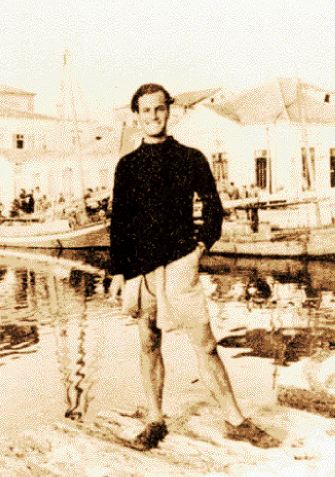
Patrick Leigh Fermor in Ithaka, 1946, photographed by his wife Joan Leigh Fermor

The weather in London on December 9th 1933 was typical. The sky darkened, the clouds lowered and then it rained hard. A young man walked the cold pavements towards Cliveden Place to collect a rucksack that his friend Mark Ogilvie-Grant had used on a journey to Mount Athos accompanied by Robert Byron. After stopping to buy a stout ash stick, and probably some cigarettes, at the tobacconist on the corner of Sloane Square, the young man collected his new passport – occupation ‘student’ – from the office in Petty France. He cast his eyes up to the ominous clouds and then made his way quickly north across Green Park. Now the rain splashed down as he dashed between the traffic on Piccadilly and entered the house of his landlady, Miss Beatrice Stewart, in Shepherd Market.

A former model who sat for Sickert, and Augustus John, and who is said to be the model for the bronze figure of Peace atop Wellington Arch, Beatrice Stewart’s career was cruelly cut short after she lost a leg in a road accident. She had arranged a lunch for the eighteen year old Patrick Leigh Fermor and two of his friends to wish him bon voyage before the start of what was to become one of the most famous journeys of all time, and certainly the longest gap year in history.

After lunch, Paddy said thank you and goodbye to Miss Stewart, and jumped into a waiting taxi, which drove off through Mayfair, around Trafalgar Square, up Ludgate Hill, and past the Monument towards the Tower of London. It was raining so heavily that all they could see out of the steamed up windows were hordes of umbrellas, some carried by bowler hatted men, as the rain splashed down in the dark. “Nice weather for young ducks.” said the taxi driver as he dropped the small party by the first barbican on Tower Bridge.

The two companions, one a young girl wearing a mackintosh over her head like a coal shifter, stood in the rain to watch Paddy descend the stone steps down to Irongate Wharf. With a final wave, he strode up the gangplank of a Dutch steamer bound for Hook of Holland.

This was the start of Paddy’s journey down the Rhine and along the Danube which he so memorably describes for us in his book A Time of Gifts. This part of the story ends on Easter Sunday 1934 as Paddy stood on the long bridge over the Danube, in no-man’s land, between Czechoslovakia and Hungary at Esztergom, just as the Easter celebrations started in earnest.

A Time of Gifts is almost universally acknowledged as a masterpiece of English literature; Sebastian Faulks is a dissenter, but he would be. Described by some as a travel book, it is essentially the journal of a young man with a superb gift of memory, for languages, and for making friends, written with the benefit of a lifetime of amazing experience and learning, forty years after the events it describes. It is embellished by anecdotes and essential historical background, making it a rounded piece of literature and no mere travelogue. It should be compulsory reading for all seventeen year olds; it is truly inspirational. The sad part is that the very reason for the ending of Paddy’s ‘gap year’ whilst with his lover Balasha Cantacuzene in Romania in September 1939, resulted in the destruction of many of the towns and cities he passed through, and certainly ended the way of life of the peoples of Europe that he describes so well.

I have no doubt that today, aged ninety-five, Paddy will pause for a while to recall that day, reflect on the events that followed during his amazing and full life, and the friends and lovers who have gone before him.

Perhaps Sir Patrick Michael Leigh Fermor DSO OBE, the Greatest Living Englishman, will pen a short letter to Debo?

The Crows of Cluj

It may seem strange but Crows are some of my favourite birds and never before have I seen so many as when in Cluj.

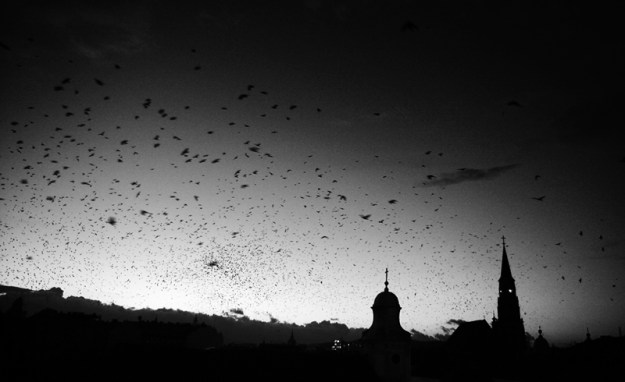
I first wrote about them during a visit to the city back in September 2010. There were thousands of them, flying in their squadrons in two streams. They took many minutes to fly past and I wondered from whence they had come and where they were flying to. During my last visit I was told that they spend their days at the city rubbish dump and fly back into the city in the evening. So the mystery was solved, and indeed confirmed by others in the pictures below.

This morning we had some crows in our garden and I thought of those Cluj crows once more. To my delight I found some photographs  after a Google search and thought I would share them with you.

The poetry of Ted Hughes is also amongst my favourites. His 1970 collection Crow includes a number of dark poems where the crow is often portrayed as a dark protagonist. In 1985 Hughes explained his inspiration for Crow:

“Crow grew out of an invitation by Leonard Baskin to make a book with him simply about crows. He wanted an occasion to add more crows to all the crows that flock through his sculpture, drawings, and engravings in their various transformations. As the protagonist of a book, a crow would become symbolic in any author’s hands. And a symbolic crow lives a legendary life. That is how Crow took off.”

You can listen to Ted Hughes’ wonderfully soft Yorkshire voice as he reads from Crow in this You Tube video.

The copyright of the photographer’s below is acknowledged.

Crows over Cluj-Napoca by Dragos Ludusan

Crows across Cluj by theophilus_austin

A Winter Afternoon in Cluj

Between the Woods and the Water

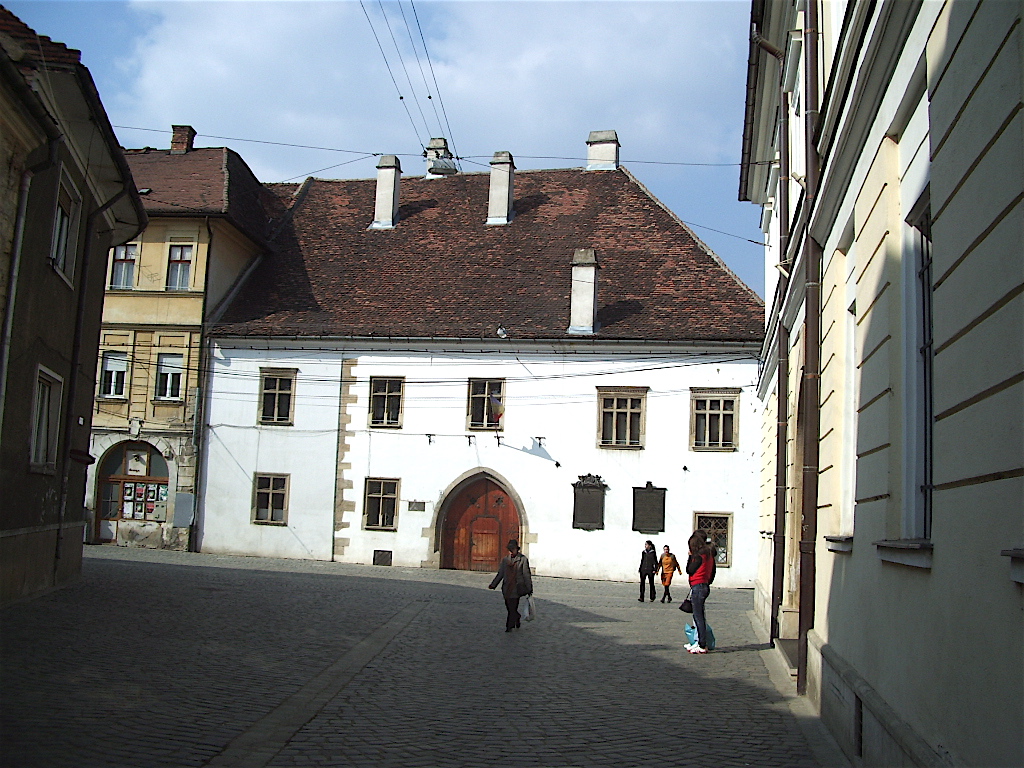
I am very fortunate to be able to visit Cluj quite often. We all know a little about the city from Paddy’s visit here during his brief love affair with Angéla in the summer of 1934. Today I find myself here again after a busy week in my company office. It is a cold overcast day, and the low cloud seems to make the sounds of the city travel a long way; the squeals of children playing, dogs barking and the famous Cluj crows cawing as they weave their way between the apartment blocks and the spires and domes of Cluj’s many churches.

Romania is not a country that many people visit on holiday, and Cluj is almost certainly not on many lists. I fail to understand why this is. You only have to visit the (open to public) Facebook page of Visit Romania and look at some of the incredible photographs to see that this country has varied and stunning scenery, and enough history on offer, from the Roman site at Parolissum, the artistic beauty of the painted monasteries of Bukovina or the wooden churches of Maramureş, and the castle of Hunyadi that Paddy visited during his walk south in the area of the Retezat on towards the Danube and the end of his journey as described in Between the Woods and the Water.

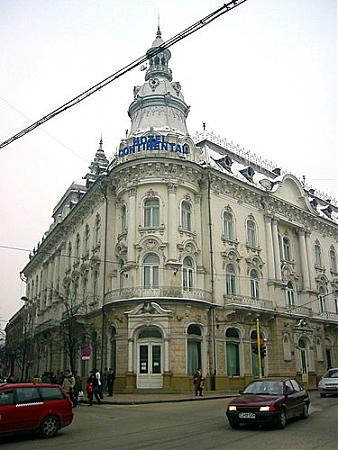
At its heart Cluj has wonderful Baroque architecture which dates from its heyday under the Austro-Hungarian Empire. Many of these buildings have fading, crumbling facades. The absence of western chain stores means that the streets are not despoiled by those so familiar signs. I may be wrong, but this general absence of branded outlets means that many Romanians (but to be fair probably only those that can afford it) still have a very individual sense of style.

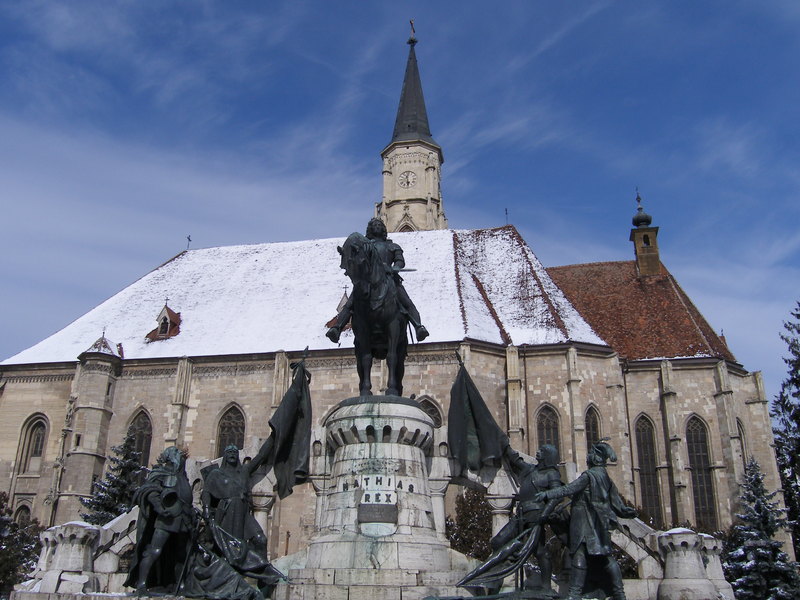
The statue of Matthias Corvinus

When one wanders just a few yards from the main roads in Cluj one enters a maze of smaller streets, many cobbled, with a myriad of bars, cafes and restaurants which all offer excellent value. Today I walked from the newly restored and very splendid statue of King Matthias Corvinus, past St Michael’s Church, towards Corvinus’ house. It is only a one minute walk. Paddy and Angéla stayed somewhere in those back streets within the sound of the bells of the church; quite where we shall probably never know. I too heard them ringing this evening as I walked to dinner.

Cluj is a very sociable place, possibly because there are something like 100,000 plus students here (an incredible number but that is what I have been told). It is also somewhere that makes you feel quite safe. I am sure it has its moments, but I have never encountered any problems and one feels safer here than in many places in England, particularly late at night.

What started out as just a short article about Cluj today, seems to have ended up as copy for the Romanian Tourist Board, and that is fine. In these difficult financial times, Romania offers a tremendous holiday alternative, and it remains low cost. So when making your plans for 2011 you could do worse than visiting this country, and possibly walking in some of Paddy’s footsteps. Romania could also do with the income. I call that a win win outcome.

Related articles:

Angéla, Paddy, István and Tom in Cluj-Napoca

Angéla and Paddy’s visit to Cluj-Napoca with pdf describing his visit

Links:

Facebook – Visit Romania


A review of Mani from Time written in 1960

“When God had finished making the world,” say the natives of Mani, “he had a sack of stones left over and he emptied it here.” Petroprolific Mani is the middle tine of a twisted three-pronged peninsular fork that jabs into the Mediterranean from Greece’s Peloponnesus. About as remote from the 20th century as the people of the Dead Sea Scrolls, the Maniots dwell in a kind of telescopic time capsule that includes Homer but little more than a hint of the Industrial Revolution. Few Maniots read or write. They have no radios, movies or telephones, and the family vehicle is the donkey. Matching the man of Aran in his barebones existence, the Maniot is scorched black by the fierce summer sun and lashed in win ter by the tramontana, a fearsome wind that tosses marble slabs about like pebbles.

First published in Time magazine, July 18 1960

From the Tower. Other Greeks shudder when they mention the Mani, and few ever go there. In his mad-dog-and-English-man way, Britain’s Patrick Leigh Fermor not only went but also brought back a fascinating traveler’s account of this bypassed pocket of civilization. Author Fermor, a passionate philhellene, has roamed Greece for 20 years, including a stint as a British commando, and his book is steeped in myth and history, which sometimes slacken the pace but rarely dim the interest of his chronicle.

Maniot girls are shy, grave and graceful, with large, luminous black eyes that reminded Fermor of the Madonnas in Byzantine icons. The men shave once a week, and some of them sport the black, eight-inch handlebar mustaches of their piratical forebears. Descendants of the

Spartans, the Maniots are famed for their blood feuds. From the iyth century on, they built tower dwellings resembling the Italian campanile, and the status symbol of the day was to have the highest tower. It was also a key vantage point from which to rain down rocks on an enemy neighbor’s marble roof. As soon as one member of a family was killed, clan warfare was declared, with the towers as citadels. When gunpowder was introduced, cannon fired away at point-blank range across the narrow streets, and not a move could be made by day without a fusillade of gunshots. Food and ammunition were smuggled into the towers by night, and since the feuds sometimes went on for years, each newborn boy was hailed as “another gun for the family.” Meanwhile, entire families of innocent bystanders resignedly moved out of town.

The Moles of Fate. The legendary patriot leaders of Greece’s struggle for independence from Turkey—Theodoros Kolokotronis and Petrobey Mavromi-chalis—campaigned from the Mani. Indeed, Mavromichalis was a Maniot who, in countless forays against the Turks, lost 49 relatives. He nailed the heads of Turks whom he killed around his own tower until it was studded with skulls. In the light of their rebel heritage, the Maniots of today are remarkably royalist. In private homes, Fermor found pictures of Greece’s King Paul and Queen Frederika right next to those of George VI and Elizabeth II. In one Maniot home, such pictures were flanked by a 1926 fashion advertisement of the “Be Smart Tailors of Madison Avenue.”

This probably seems like the height of modernity to a people who like to point out the island where Paris took Helen the first night after he stole her from Menelaus, and who still retain the purest links of Greece’s pagan past. Old Maniots are convinced that Nereids haunt the local fountains, and mothers believe that the three Fates hover over an infant’s cradle to write invisible destinies on the child’s brow (moles are known as “writings of the Fates”). Seafarers claim that Gorgons grip their caiques in a storm and ask in ringing tones, “Where is Alexander the Great?” If the captain shouts, “Alexander the Great lives and reigns!”, the sea turns calm. Otherwise, the Gorgon tilts the boat toward sea bottom, and all hands drown.

Couplets for Hector. Mani’s most cherished art form is the miroloy, the dirge with which keening womenfolk usher the Maniot out of a harsh world that neither man nor God seemingly made. More a lament for a hero being taken to the underworld than for a Christian going to his reward—even as she makes the sign of the cross, the grieving widow will say, “Charon took him”—the miroloy mirrors in its 16-syllable line the lament of Andromache over the body of Hector. At graveside, the chief mourner’s voice becomes a howl of hysteria (“Oh, my warrior! The arch and pillar of our house!”), her hair tumbles in disorder, and she tears at her cheeks with her fingernails till they are crisscrossed with red gashes and running with tears and blood. In the mesmeric half-trance of the dirge, the singer has been known to drift far out and lament high taxes, the price of salt, the need for roads, and the Bulgarian frontier—all in faultless couplets. Sans couplets, but with 20/20 sight and insight, Author Fermor has fashioned a durable portrait of the enduring people who inhabit the mythical rock garden of the gods.

Tracing a writer’s journey through Greece

There are many authors of articles that stake a claim to follow in Paddy’s footsteps (I have even written my own!), but I never tire of the new perspectives that people bring to these places, some of which I doubt I will ever have the time to visit. They also are standard bearers for Pay’s work, bringing his wonderful work to the attention of a new generation who may be inspired by the man who is The Greatest Living Englishman.

First published in The Boston Globe, October 17, 2010

By Heidi Fuller-love

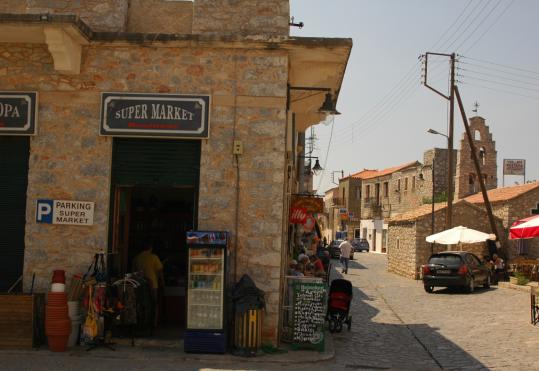
Areopoli (above) is a tiny town in Greece that helped inspire author Patrick Leigh Fermor to write “Mani.’’

KARDAMYLI, Greece — Named for Phrygia’s mythical king, Pelops, who is said to have conquered this savage region before his father had him chopped to pieces and fed to the gods, the Peloponnese region stretches a fat hand out from the bottom of Greece and points bony stone digits toward the Cyclades, Turkey, and Crete. “When God had finished making the world he had a sack of stones left over and he emptied it here,’’ the Maniots are fond of saying.

Passionate philhellene Patrick Leigh Fermor, the Irish adventurer-turned-travel-writer played by Dirk Bogarde in the classic war opus “Ill Met by Moonlight’’ (later called “Night Ambush’’) visited the middle “finger’’ in the 1950s . Impressed, he wrote “Mani,’’ his fascinating account of a journey by foot, mule, and “caïque,’’ or wooden boat, to the heart of this arid peninsula cut off from the world by the Taygetus mountains and dotted with stark stone towers inhabited by fiercely feuding locals.

Hiring a car at Kalamata to follow in his footsteps, I arrive 60 years later, via lush countryside spiked with cypress spears, at Kardamyli, where Fermor settled with his wife, Joan, after his Mani adventure. Fermor, now in his 90s, still lives in the pretty village that was once a major Spartan port.

Giorgos Giannakeas, the son of Lela, Fermor’s former housekeeper, runs a seaside taverna. He tells me that the sprightly writer is often seen striding down the main street lined with driftwood-decorated cafes. “Our village attracts hikers who come to climb the peaks of Taygetus mountain range, but our main visitors are British people who come seeking the great man,’’ he says, doling out a fragrant ladle of Lela’s moussaka .

Half an hour’s drive from Kardamyli, the tiny harbor of Gytheion, once the main seaport of ancient Sparta, bears little trace of its former glory. Worn marble steps climb to a warren of alleys where cats prowl hungrily and storekeepers sell feta cheese from grime-rimmed buckets.

Unable to feed their families, countless Maniots traveled from here to find work in the New World at the turn of the 20th century. “Our fathers had no choice. It was that or die of hunger,’’ says Zafeirakos Zafeiris, who owns a hotel overlooking the Laconian Gulf.

On leaving the port, they would have passed the Kranae peninsula where Paris and Helen shared that epic night of love whose belated climax was the Trojan war. As the sun descends over this weed-blown strip of land, fishermen beat squid like laundry and ink spurts out, staining the rocks.

Gateway to the Mani, Gytheion signals a dramatic change in scenery. Climbing steeply into the fierce sun, my rental car groans and spews clouds of cheap Greek diesel. At a gas station where I stop to fill the tank, pump attendant Adonis Grigorakakis, who, like many Maniots, grew up in the United States, tells me. “The thing you have to understand is it’s all mountains here, see? The only way you could get to one of the villages here was with a boat. And it was like that right up till, say, 20, 30 years ago.’’

I climb higher until the sea looks like shards of a broken mirror and I’m surrounded by scree-strewn slopes spiked with purple-flowered thyme where scrawny sheep, their udders ripe with the raw substance of the pungent local Sfela cheese, jingle fist-sized bells. It is the bleak scenery described so lovingly in Fermor’s book.

Just outside Areopoli — named for Greek war god Ares, I spot my first “pyrgospita.’’ Tall and square, these eyeless towers were once strongholds for a vendetta-loving local aristocracy. “Feuds lasted for centuries and were ended either by the destruction of a whole family in battle, or by the surrender of an entire clan who were then required to kiss the hands of the victors who had lost ‘guns’ (male children) in the battle,’’ a leaflet at the village’s eclectic war museum explains.

When Fermor arrived in Areopoli 60 years ago sporting rucksack, shorts, and a charmer’s grin, he met people who had never seen anyone from outside the Mani before. Nowadays, this atmospheric jumble of towers and tavernas woven together by skeins of bougainvillea attracts a multinational rag-bag of visitors who stop for “meze,’’ or snacks, before visiting the Diros grotto, a subterranean wonder world of salmon stalagmites sheltered in a booming sea cave beneath the village.

Vathia, farther along the coast, has changed too. The lively village where Fermor was teased by a shepherd girl is a ghost town where one or two renovated pyrgospita glitter, amid a brooding huddle of ruined towers. I peek into one of them. Cramped as a windmill, dank as a cave, it’s easy to imagine the misery of those feuding families who, as The Earl of Carnarvon reported in 1839 : “. . . have been born and married, have lived for 20 or 30 years, and in some cases . . . have even spent their whole lives within the enclosure of these gloomy walls.’’

High above a deeply indented coastline littered with shrines erected in the memory of those who lost control of their vehicles on these perilous roads, I reach the mule track leading to the remains of the Temple of Poseidon where sailors, about to round the dangerous Cape Matapan, once prayed for a safe passage. One of the mythical entrances to the Underworld, this is where Fermor ended his trip.

As a wind shrieks across the Taygetus’s scrub-covered shoulder blades, I contemplate the darkening stretch of sea where Fermor came in a caïque more than half a century ago. I imagine him jumping overboard and swimming into the tiny cave in pitchy blackness, hands feeling the splintered walls, seeking the crack that led down to Hades, and I suddenly feel very cold.

In the gathering gloom I drive back to Areopoli along a road lighted only by the flickering candles of accident-victim’s shrines. Entering a taverna I order Fermor’s favorite tipple as a pick-me-up.

Raising my tumbler of Retsina I drink a silent toast to the man who braved the capture of German General Kreipe during WWII, but was perhaps braver still in choosing to settle in this stunning, yet still savage region, whose history is one of constant strife.

Heidi Fuller-love can be reached at heidi.fullerlove@gmail.com.

The forgotten Saxon world that is part of Europe’s modern heritage

The careful conservation of pre-industrial villages in Transylvania is Europe at its best, guarding the relics of its diversity

by Simon Jenkins

First published in The Guardian Thursday 1 October 2009

Between the collapse of the Ceausescu regime in December 1989 and the spring of 1990, half a million indigenous so-called “Saxons” fled Romania for West Germany. It was the most astonishing, and little reported, ethnic migration in modern Europe. In the seven towns and 250 villages of Saxon Land in southern Transylvania, no less than 90% of the German-speaking population packed its bags and committed eight centuries of history to memory. They drove west to a country few of them knew, enticed by the notorious “return to the fatherland” speech of the German politician, Hans-Dietrich Genscher.

The exodus left behind a deserted landscape the size of Wales, hundreds of square miles of rolling beech woods, bears, lush pastures and wild flowers, once home to the Dracula legend. Across it are dotted medieval grid-planned villages, with Lutheran churches, schools, dignified houses, barns and smallholdings, their customs and exclusivity reminiscent of the Pennsylvania Dutch. For 800 years since being invited by the Magyar kings to form a bulwark against the infidel, the Transylvania Saxons guarded their Germanic tradition. They spoke a High German said to be similar to ancient Luxembourgish. They embraced the Reformation and resisted Ceausescu’s concrete communism. All this ended abruptly in 1990.

While the people have almost all gone, the villages remain, colonised mostly by Romania’sbooming Gypsies. It is estimated that as many as a million may now occupy this part of Transylvania, possibly rendering it one day the only majority-Gypsy province. The result is the most exciting and daunting cultural challenge in Europe.

The village of Archita is lost in a Carpathian valley near the 17th-century town of Sighisoara, whose medieval walls and nine towers lie at the heart of Dracula country. The village’s fortified church stands like a castle in its midst, encircled by not one but two high walls, with musket holes and archers’ galleries intact. It was built to protect the citizens against Tartar raids and still has its ham loft with hooks numbered for each house, an insurance against sudden siege. The interior displays its galleries, Protestant pulpit and baroque canopy. The churchyard is overgrown with unpicked plum and apple trees. From the rickety church tower the geometrical village plan reaches out into the surrounding woods. Wide streets and lime-washed, two-storeyed houses reflect the equal plots allotted to each Saxon family in the middle ages. Records show continuous family tenure from the 13th century to 1990. Just three Saxons remain.

The 18th-century town hall and school of Archita have fallen into dereliction. Since the families employed few servants there are no poor houses or suburbs. There is no water or sewerage and no tarmac roads. The village well and a few desultory horses and carts are attended by attractive Gypsy youths.

To the new inhabitants of these villages, the vanished Saxons represent an alien culture. But their ghosts flit round buildings that in most cases are unaltered since being converted from wood to stone in the 17th century. They are like the hill-station residences of British India, holding its genius loci in absentia.Ghosts linger too in the countryside round about, ironically preserved by Ceausescu’s order forbidding development beyond the confines of existing settlement. This yielded one of the most effective green policies in Europe, protecting miles of meadow and forest, now vulnerable to exploitation. The roads are already littered with loggers carting away loads of walnut, beech and oak.

Unesco has designated some of the Saxon churches as world heritage sites, as has the Romanian government, but not the villages. With no money for repairs and no enforcement, such designation carries little weight. There is thus a race to save the most endangered pre-industrial landscape in Europe from poverty-stricken newcomers understandably eager for modernity. One day these villages will be as treasured as those of the Cotswolds, Provence or Umbria, but until then they must pass through the valley of the shadow of possible death.

The response of the outside world to Saxon Land’s plight is uncertain. Money is seeping back. Some departed families have returned, some unhappy in exile, some as so-called “summer Saxons”, holidaying in their former homeland and hoping to capitalise on rising property prices.

I encountered one dedicated young German, Sebastian Bethge, in the dramatic hill village of Apold, labouring alone to restore the church interior with money raised in Berlin and elsewhere. A visiting pastor had just held a Lutheran service for a congregation of nine – four Romanians, three Hungarians and two Germans.

The EU is bringing infrastructure to some villages, even as it devastates their markets for milk and hops. Unesco has its designations. The Transylvania Trust has restored the castle home of the novelist, Miklos Banffy, whose Transylvanian Trilogy is so evocative of this region’s other, Hungarian, past. Britain’s Prince of Wales has bought and restored two Saxon village houses. But most international effort goes on hands-clean “awareness-raising”, on drawing up lists, holding conferences and restoring an occasional showcase palace. The most impressive venture is the London-based Mihai Eminescu Trust (Met), chiefly supported by the American Packard foundation. Its “whole village” concept is tailored to Saxon Land, yielding more than 600 projects in the past decade. A leading citizen is engaged in each village to glean what locals – now mostly Romanians and Gypsies – would like restored if money and expertise were available.

This is exemplary conservation practice. Work is carried out by local contractors, with some 130 craftsmen trained to restore Lutheran and Orthodox churches, schools, houses and barns. Nothing is too small, from patched barn roofs and re-plastered street facades to empty properties converted to guesthouses. Plastic bus shelters and concrete bridges have been replaced in wood.

A truly minimalist venture had a Gypsy in the village of Floresti asking for, and getting, a tiled roof over an appalling hovel shared with his wife, two horses and a mountain of manure. Virtually next door is a restored Evangelical church, its sun-bathed interior one of the most serene of any church I know.

In the 13th-century village of Viscri, the Met has undertaken 160 restorations led by its local leader, Caroline Fernolend, winning it the EU’s premier conservation award. Sewers were installed and a new kiln built to supply handmade tiles, operated by a local craftsman. The trust is even reinstating apple orchards and relaying a local narrow-gauge railway.

No such conservation can work against the grain of local consent or in the absence of local skills. Imported from outside, it will stir resentment and obstruction. The root cause of the Saxons’ exodus was starvation of the modern benefits of civilisation. These cannot be denied their successors.

Yet the conservation of town and village cultures across the sweep of Europe proves that ancient and modern can co-exist to the advantage of both. Such is the disregard of the past by other world continents that these survivors will one day be respected, valued and celebrated.

The Transylvanian Saxons ranked with the Mennonite Amish, the Patagonia Welsh and the Volga Germans among the dislocated tribes of Europe. They lasted a phenomenal eight centuries, leaving intact monuments of a culture distinct and yet integral to European history. If modern European union cannot guard such relics of its diversity it is not worth the name.

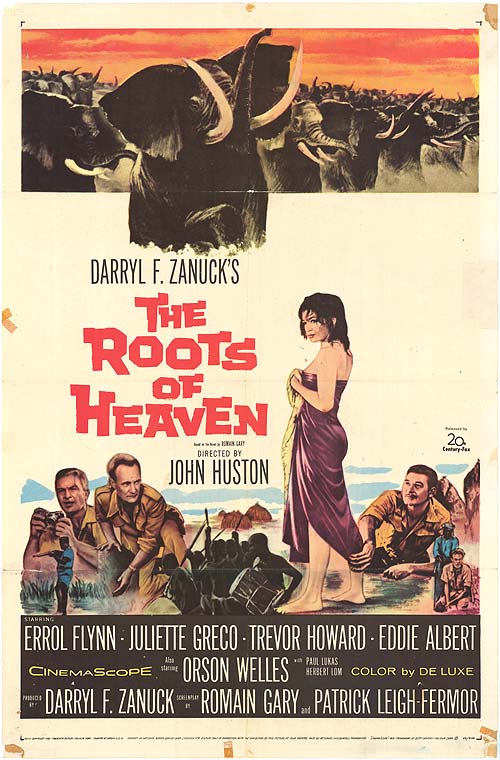
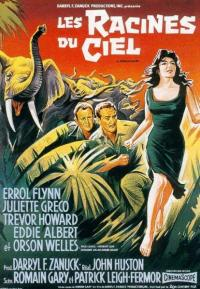
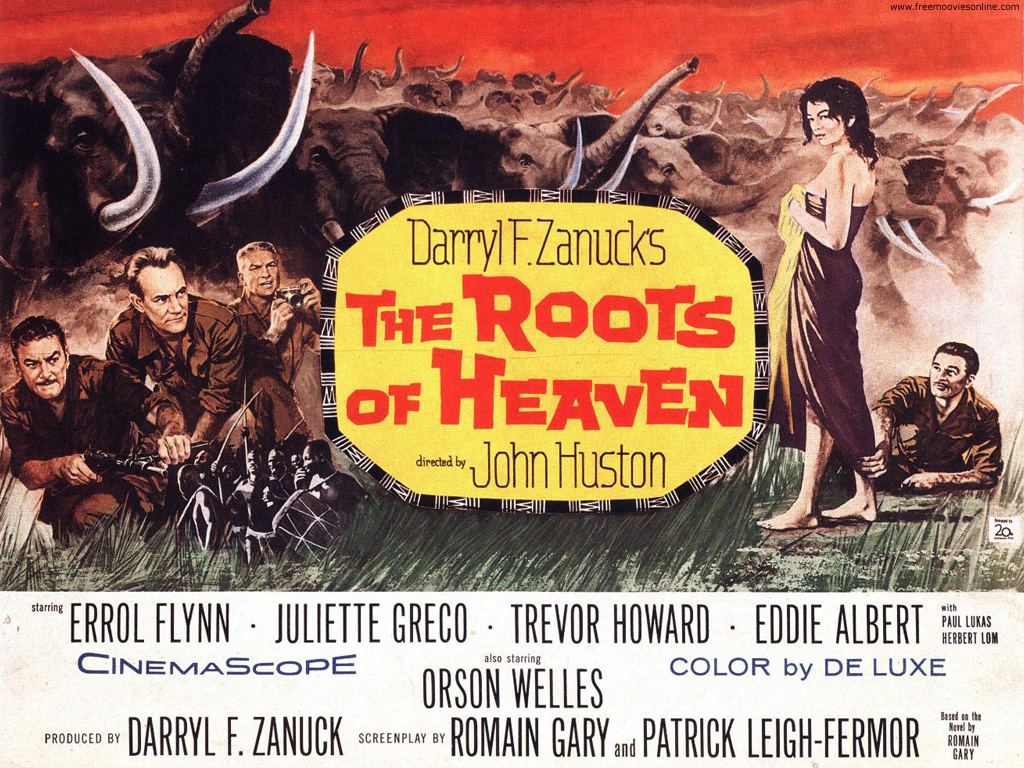
New York Times Review – The Roots of Heaven (1958)

By BOSLEY CROWTHER

First published in the New York Times October 16, 1958

THE first two-thirds of “The Roots of Heaven,” which opened at the Palace last night with a benefit première for The Lighthouse, looks like a highly potential adventure film. An odd situation as been uncovered in French Equatorial Africa, some interesting characters have been assembled and some delicate lines have been drawn.

A grim Trevor Howard has been presented as a zealot with the annoying idea that men should do something insistent to stop the hunting and killing of elephants. These large beasts are the symbols of freedom and dignity in a world that’s too full of nonsensical killing, he has vainly preached at the pub. And then, with the authorities yapping at him, he has gone off into the hills with a tiny band of disciples to try to rally a full-scale crusade.

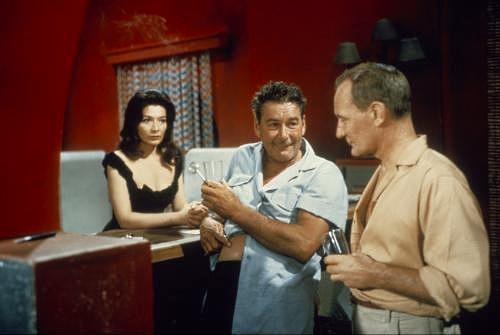
In his band are a couple of weird-beards from the far intellectual fringe and a violent pan-African organizer, whom Edric Connor plays. (The latter is against killing elephants only because he hopes to gain support for his political organization; he treacherously defects toward the end.) The band is later joined by Juliette Greco as a hotel “hostess” with a past and by a rapidly disintegrating boozer, blowzily played by Errol Flynn.

With a handful of natives toting rifles, these people have come down out of the hills, spanked a boastful female big-game hunter and spread leaflets proclaiming their aims. They are ready to defy the ivory-poachers when an intermission is announced on the Palace screen.

After the intermission, the final third of the film goes down the drain.

This is the more disappointing—and strangely surprising, indeed—because the elements, up to this point, have seemed so beautifully under control. While the screen play by Romain Gary and Patrick Leigh-Fermor, based on M. Gary’s book, could be firmer and less elaborate and garrulous in spots, it is studded with sharp dramatic incidents that accumulate and play extremely well, Under John Huston’s fine direction, the action moves along in splendid style.

More conspicuous is the rich production that Darryl F. Zanuck has arranged. There is an embarrassment of riches, as far as pictorial features are concerned. Most of the vivid outdoor action has been shot in Africa, in Cinema-Scope and color that catch the heat of the sun. And the cast is so large that Paul Lukas, Olivier Hussenot and Orson Welles—the last as an American television broadcaster—can be beautifully squandered in small roles.

Everything seems to be in order, until that final third.

Then the screen play just goes to pieces. The ivory-poachers do appear to raid a mammoth herd of lumbering elephants that the zealots are watching with glistening eyes. A battle takes place, the poachers win out and charitably let the zealots go free. And what do they do? They stumble off into the wilderness to an ending that is utterly vague.

Maybe some sort of allegory was intended to run through this film. Maybe the elephant lover was meant to be a modern Messiah, followed by feeble disciples and a Mary Magdalene. If so, the symbols are flimsy and the ideas are never firmed. There is no real dramatic implication, except that the elephant’s jig is up.

And the performances, which are forceful in the first two-thirds of the film, run progressively to twaddle as the survivors stagger toward the end. Mr. Howard appears to go crazy, Miss Greco slips into a drab decline and Mr. Connor, who has the one role with beef in it, is saved when he takes it on the lam. Eddie Albert comes in late as a news photographer when things are going to pot. He adapts quickly to disintegration.

“The Roots of Heaven” does not go deep in sandy soil.

The Cast

THE ROOTS OF HEAVEN, screen play by Romain Gary and Patrick Leigh-Fermor; based on the novel by M. Gary; directed by John Huston; produced by Darryl F. Zanuck; distributed by Twentieth Century-Fox. At the Palace, Broadway and Forty-seventh Street. Running time: 131 minutes.
Forsythe . . . . . Errol Flynn
Minna . . . . . Juliette Greco
Morel . . . . . Trevor Howard
Abe Fields . . . . . Eddie Albert
Cy Sedgewick . . . . . Orson Welles
Saint Denis . . . . . Paul Lukas
Orsini . . . . . Herbert Lom
Habib . . . . . Gregoire Aslan
Governor . . . . . Andre Luguet
Peer Qvist . . . . . Friedrich Ledebur
Waitari . . . . . Edric Connor
Baron . . . . . Olivier Hussenot
Major Scholscher . . . . . Pierre Dudan
De Vries . . . . . Marc Doelnitz
Madjumba . . . . . Dan Jackson
Haas . . . . . Maurice Cannon
Cerisot . . . . . Jacques Marin
Korotoro . . . . . Habib Benglia
Yussef . . . . . Bachir Toure
A. D. C. . . . . . Alain Saury
N’Dolo . . . . . Roscoe Stallworth
Inguele . . . . . Assane Fall
Father Fargue . . . . . Francie de Woff

Related article:

Patrick Leigh Fermor scriptwriter for The Roots of Heaven

The strange case of the Swabian poet by Patrick Leigh Fermor

An article Paddy wrote for The Spectator about his alarm at hearing of the possible piecemeal sale of the The Trumbull Papers and their subsequent salvation. The Trumbull Papers are an archive including letters from James I, Charles I and II, Sir Francis Bacon, John Donne, Samuel Pepys, John Locke, John Dryden and Alexander Pope, 29 letters from Philip II of Spain, secret correspondence about the Council of Trent and much concerning the British colonies in the New World long before the American War of Independence.

First published in the Spectator on 28 September 1996.

An image like a god’s I gazed on as I slept, Which a resplendent throne full richly did upraise,

While foolish multitudes, from need or pleasure, crept

To serve, or stand on guard there; and my gaze

Saw how, in the true God’s despite, it did accept

Hungry, but never fill’d – vows, offerings and praise,

And how its lightest whim spared some, but others reaped,

And joy’d in punishment, revenge, and wickedness.

To smite this ingrate image down did Heaven oft-time

Assemble all its stars in many a sign and wonder,

Yet still this idol’s voice rang out more loud than thunder,

Until at last, when pride did the high zenith climb,

A flash of lightning struck the shining form asunder

And all vainglory chang’d to worms and stink and slime.

Years ago, chancing on this sonnet in an anthology, I was fascinated by the metre – the extra foot at the end of each line and by the strange and ambiguous vision it conjured up. `Dream: on the D. of B.’, it was called, or rather `Traum: von dem H. von B’, for the poem was in German, and a footnote explained that the initials meant ‘H(erzog) von B(uckingham)’. I made an immediate dash at translating it, so the creaks, the faulty rhymes and the Wardour Street syntax are not the poet’s fault, but mine. (The poem in its original is given at the end of this article.)

Ever since reading The Three Musketeers, we have all been haunted by the Duke of Buckingham; haunted and dazzled by the satin and the diamonds and the strings of pearls, the starched lace zigzag ruff, the preposterous splendour and the panache; and when we learnt later on how this Phoebus Apollo had been stabbed to death at Portsmouth with a tenpenny knife, the horror, eerily laced with relish, was almost too much to take in.

And here, in the sonnet, was a contemporary foreign poet smitten by the same astonishment: ‘G. R. Weckherlin,’ the anthology said: ‘1584-1653’. I had never heard of him; nor had anyone else.

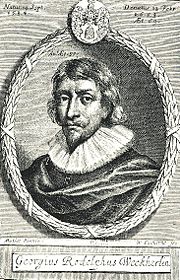
Georg Rodolf Weckherlin by Daniel Mytens, 1634.

In the German-speaking world, I learnt, Georg Rudolph Weckherlin, from Swabia, was thought second only to Martin Opitz, `the Father of German Poetry’, and though some writers call him `early Baroque’, both of them really belonged to a group of late Renaissance German poets (akin to the Pleiade in France a couple of generations earlier, with Ronsard and Du Bellay as their brightest stars).

He was also a scholar, a diplomatist and a courtier at the Duke of Wurtemberg’s palace at Stuttgart and travelled widely in France. Some time after 1602, he was three years at the Court of St James, and was sent on missions to Central European states and the Empire. In England again in 1616, he must often have been under the same ceilings as Buckingham. He entered the royal service and accompanied Charles on his expedition against the Scots, and soon afterwards he married Miss Elizabeth Raworth, of Dover, and took root in England. He seems to have changed sides at the Commonwealth: he became Latin Secretary, then Secretary of Foreign Tongues, to the Joint Committee of the Two Kingdoms, and held both posts until he was replaced by Milton, perhaps because of ill health. Paradoxically, he often helped the older poet when his eyes began to fail; then he succumbed to his adopted country’s distemper and died of gout.

He had been equally at home in German, Latin, French and English and almost certainly knew some Italian and some Greek. It was he who brought the sonnet and the sestina to Germany and he left a mass of poems, strongly influenced by his friend Samuel Daniel and his fellowdiplomatist, Sir Henry Wotton. (As I read about him a dignified figure began to take shape, with a kindly blue eye gleaming above a pale fog of beard and a wide collar fastened with tassels breaking over black broadcloth and silk: half-Van Dyck, halfHonthorst, lyrically wreathed, perhaps, in a chaplet of bays . . . )

Completely English by now, his daughter Elizabeth married Mr William Trumbull of Easthamstead in Berkshire, whose deer park was part of the King’s Chase. The latter served in several diplomatic posts, most notably in the Low Countries; and his son, Sir William Trumbull, followed him in his career. Beginning as a youthful Fellow of All Souls, he made the Grand Tour with Christopher Wren, visited Tangier with Pepys, sat in Parliament for a Cornish borough, became Charles II’s ambassador at Constantinople, then Principal Secretary of State to William III, and retired at last to his Berkshire library and the company of his friends. It was Sir William who first prompted Dryden to translate Virgil, and he performed the same office for Pope by suggesting Homer to him. Kneller painted him and Pope wrote the verse epitaph on his fine tomb at Easthampstead, where he still reclines in his full-bottomed wig.

I forgot all about them. But in the Times a few years ago, Miss Sarah Jane Checkland announced, with infectious alarm, the imminent sale of `the largest and most important collection of English state papers to be offered at auction this century’. They were the Trumbull Papers! The archive included letters from James I, Charles I and II, Sir Francis Bacon, John Donne, Samuel Pepys, John Locke, John Dryden and Alexander Pope, 29 letters from Philip II of Spain, secret correspondence about the Council of Trent and much concerning the British colonies in the New World long before the American War of Independence.

Perhaps the most exciting of all [the column went on, to my growing emotion] is the hitherto unrecorded series of papers belonging to William Trumbull’s relative, the German poet Georg Rudolph Weckherlin, Charles Is secretary from 1624 until the Civil War. These include letters, signed but not sent, from Charles to Louis XIII, Gustavus Adolphus and Marie de Medici, as well as many Royalist letters intercepted during the Commonwealth. Finally, there is a beautiful calligraphic manuscript of a still unpublished verse-translation of Book VI of the Aeneid, which Sir John Harington, Elizabeth’s `witty godson’, prepared and presented to James I, in 1604, for the young Prince Henry.

(Harington was also the author of a racy disquisition on water-closets that he punningly called The Metamorphosis of Ajax. When cross with him, the Queen used to catch him by the belt, even when he was grown up, and give him a good shake as she taxed him with his misdeeds.)

What a haul! And what a tragedy if such an Aladdin’s cave were to be ransacked! The contents had come down in a direct line of a dozen generations from Weckherlin and the Trumbulls to their present-day descendant, the Marquis of Downshire. The heritage lobby was in despair. There had been talk of a private sale to the nation; now it seemed that the open sale was to go ahead. The total price predicted – two million pounds — sounded enormous, but it was very little more than the damages which had been awarded in the recent Cossack libel action. If – albeit ludicrously – ordinary people were thought to be capable of forking out sums like this, there ought to be some public fund or government organisation to deal with such emergencies; but there isn’t, and things looked black. `In a few days’ time,’ the article had said, `this unique and wonderful collection comes under the hammer at Sotheby’s. Once split up, it will be scattered to the winds.’

At this point I was overcome, as though by an onslaught of heady gas, by dreams of grandeur. I would try to help save the Papers! After all, not every millionaire was an illiterate philistine. My mind’s eye evoked a rich, unknown and hypothetical humanist, steeped in concern for the country’s treasures. As he was only conjectural, the approach would have to be indirect.

Emulating Miss Checkland, I wrote two stirring pages and sent them to a famous weekly (this one, indeed) which I felt sure the unknown saviour was bound to see; on publication morning, kind fate and my wishful thoughts would waft him up the steps of clubland and lead him to the table where the weeklies were spread, and then guide his hand. Next, this not impossible he would be deep in an armchair with his glance halted at the right page. He would finish the piece with a pensive ‘H’m’; and a few minutes later my mind’s ear would detect a finger ruffling through the telephone directory; then dialling: `Lord Downshire? Good morning, this is – I’m so sorry to bother you. Could you spare me a few minutes, if I came round?’

It all ended happily, and fast, but not at all as it was planned. News suddenly came that the owner had solved the whole problem with impeccable generosity and public spirit, and all the treasures were safe. The piece, of course, never came out, the putative benefactor dissolved into the shadows and I suffered from a touch of the flatness Raleigh might have felt if the Queen had preferred a convenient plank. The anticlimax, bit by bit, gave way to exhilaration at the thought of the brimming deed-boxes, the crackling tiers of parchment, the faded pink tape, the hundreds of broken seals and all the mystery and the dust. The improper jokes of Harington cheered the air, and Buckingham’s ruffling plumage, and the thought of classical tags bandied by candlelight round Sir William’s table. I was buoyed up, above all, by adumbrations of Weckherlin, backed by youthful memories of the arcaded castles of bookish Stuttgart, and the vineyards and the ricks and the beetling oakwoods of Swabia: the landscape, after all, of the earliest sonnets and sestinas ever to be heard beyond the far bank of the Rhine and to the north of the Black Forest and the Danube.

Traum: von dem H. von B. Ich sah in meinem Schlaf ein Bild gleich einem Gott,

Auf einem reichen Thron ganz prachtiglich erhaben,

Auf dessen Dienst und Schutz, zugleich aus Lust und Not,

Sich die torichte Leut stets haufenwies begaben.

Ich sah, wie dieses Bild, dem wahren Gott zu Spott,

Empfing – zwar niemals satt – Gelubd, Lob, Opfergaben,

Und gab auch wem es wollt das Leben und den Tod

Und pflag sich mit Rach, Straf und Bosheit zu erlaben.

Und ob der Himmel schon oftmal, des Bilds Undank

Zu strafen, seine Stern versammlete mit Wunder,

So war doch des Bilds Stimm noch lauter dann der Dunder,

Bis endlich, als sein Stolz war in dem hochsten Schwang,

Da schlug ein schneller Blitz das schone Bild herunder,

Verkehrend seinen Pracht in Kot, Wrm und Gestank.

To print this article or create a pdf do the following:

1. Copy the url of the article from your browser above

2. Click on the Print Friendly button below – you will be taken to the Print Friendly page

3. Paste your url into box that appears and hey presto you will get a previewed page to print or pdf!

Print

Patrick Leigh Fermor – star of the silver screen?

When I first published the article about The Roots of Heaven, Jasper Winn wrote to me suggesting that we look at the film closely to see if Paddy made an appearance. This week Tim Todd made a comment suggesting that he had spotted Paddy.

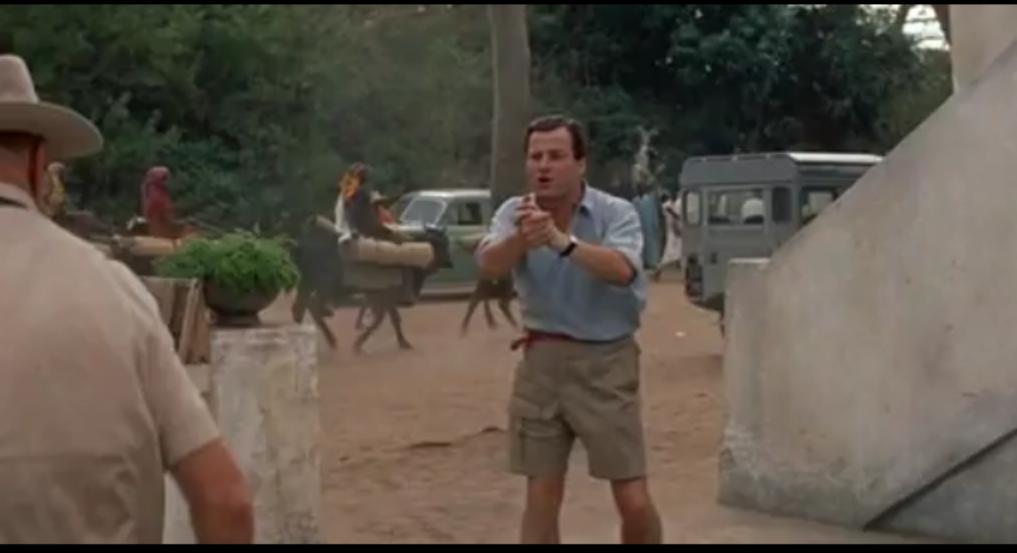
In the 12th ‘episode’. around 5.25 in, a character comes around a corner and calls to those seated around “Listen everybody, they’ve spotted him…”  The character looks to me like it is being played by Paddy! I don’t notice the character in any other scenes, and Paddy is only mentioned as the script writer from what I can see – but it looks so like him on my screen. Anyone any thoughts either way?

Patrick Leigh Fermor's run-on part in The Roots of Heaven

Well, I had a further look and I am absolutely sure it is Paddy with his good looks, immaculate hair, clipped voice and the watch which features in the photograph on the back of Words of Mercury. I froze an image; no doubt in my mind (click on it to enlarge). To see for yourself go to Patrick Leigh Fermor scriptwriter for The Roots of Heaven episode 12 of the You Tube embeds and then to time section 5.25.

Related article:

Patrick Leigh Fermor scriptwriter for The Roots of Heaven

Paddy recalls his time on set with Errol Flynn and Orson Welles for The Roots of Heaven

Paddy recalls his time on set with Errol Flynn and Orson Welles for The Roots of Heaven

Errol Flynn in The Roots of Heaven

In 1958, Patrick Leigh Fermor wrote the script for the film The Roots of Heaven, produced by Darryl Zanuck and directed by John Huston. In 2001, he recalled some of his time spent on location, during the shooting of the film:

‘The heroine of the film was Juliette Gréco, to whom Darryl [Zanuck] was deeply attached. I had seen her earlier, spinning round dance floors like a beautiful raven-haired mermaid in caverns full of jiving existentialists in St.-Germain-des-Prés. She was very well read, loved literature, and was full of interesting and amusing stories about Sartre and Simone de Beauvoir. She was a friend, too, of Raymond Queneau, whose books I had a passion for, and we shared a taste for the poems of Jacques Prévert. We became close friends, and still are.

After three weeks, we flew to Bangui, in what was then still French Equatorial Africa but was soon to become the realm of the wicked Emperor Bokassa. The little town clustered on the north bank of the Obangui River, a tributary of the Congo, and on the edge of a dense rain forest full of elephants—our main theme. A race of intelligent smiling pygmies dwelt there, armed with bows and arrows, twangling cheerfully on strange stringed instruments known as equatorial pianos.

John Huston and Darryl Zannuck on location

One day a small party of us were waiting for a canoe to take us somewhere, when a large crocodile was spotted, basking on an island in mid-stream. John [Huston], on the alert at once, dashed to his quarters and returned with a weapon about the size of a Bren gun, opened the front struts, flung himself down, took careful aim, and fired. The bullet kicked up a puff of sand just above the reptile, which leapt into the water and swam vigorously downstream. John got up, ejected the shell, and said, “Well, he’ll thrash around for a quarter-hour or so, maybe twenty minutes. But that’s a dead croc, kids.” The phrase gained immediate currency, sometimes altered to “That’s a dead kid, crocs.”

There were a lot of late parties, and at one of them—the last, as it turned out—I remember John singing “Johnny, I Hardly Knew You” and “The Streets of Laredo” with captivating verve. In the end, oblivious of forest dangers, I fell asleep under a baobab tree and woke up at dawn criss-crossed with hundreds of spiders, like the captured Gulliver in Lilliput.

On the last day of filming in the forest, enormous black clouds gathered and then broke in a deluge. Instantly soaked to the skin, we drove slithering and sliding back to Bangui and its one hotel, a modern skyscraper soaring above the treetops like an upended mouth organ. Indoors, the lights fused as we entered, and the floor was nearly a foot deep under a gleaming mattress of broken-off termites’ wings. A hundred termite-eating frogs were leaping in parabolas among their prey, and Juliette’s mongoose was whisking about in this sudden abundance with frogs’ legs sticking out of its jaws on both sides, peering round for more. The thunder sounded as though the sky were breaking in half, and the shuddering flashes of lightning lit up a vision of diluvial apocalyptic pandemonium.

Juliet Greco, Errol Flynn and Trevor Howard

The next day we were back on the Champs-Élysées and the rue de Rivoli.’

-recorded in ‘A Visit with Patrick Leigh Fermor,’ by Ben Downing, in The Paris Review, no. 165. From this website.

Related article:

Patrick Leigh Fermor scriptwriter for The Roots of Heaven

A Meeting between Paddy and George Psychoundakis the “Cretan Runner”


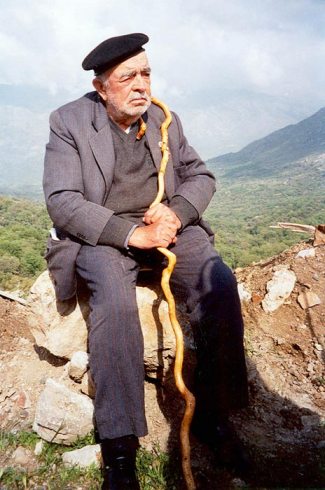
George Psychoundakis in 2004(?)

A bond deeper than blood. The friendship forged in wartime Crete between Patrick Leigh Fermor and shepherd George Psychoundakis was commemorated in George’s memoir about the Resistance, The Cretan Runner. With the book republished, it was time to meet again.

by Allison Pearson

First published in The Daily Telegraph, Saturday 13th June 1998

Two old men sitting at a table talking about the war. A Cretan and an Englishman. A voluble eye-popping tenor and a growly teddy-bear bass. “Remember the sick doctor we disguised as an old woman and carried for miles to get help?” “Yes, and remember when you dressed up as a general and kidnapped a real one!”

They interrupt each other. They sigh for the dead. They laugh for dear life, knowing exactly how much it can cost. Although one of the men speaks only Greek, I think I can detect a rhythm to their reminiscing: the Cretan talks everything up and the Englishman plays it right back down again. The sudden memory of one “bad Greek” acts on the Cretan’s weathered face like a drawstring, pulling it taut to a scowling walnut. But the Englishman, all silky diplomacy, jumps in and offers a more optimistic assessment of the fiend in question: “I think he just lost his head a bit.”

Later, when the Cretan mentions the Englishman’s name in the course of what sounds like a pretty fulsome tribute, his friend stops translating for me altogether. What did he say? “He was more than kind about me.” Yes, but what did he say? “Oh, I couldn’t possibly repeat it.”

The bashful Briton is Patrick “Paddy” Leigh Fermor, traveller, scholar- gypsy, war hero and writer of genius. His fiery friend is George Psychoundakis, author of The Cretan Runner, an extraordinary account of the anti- Nazi Resistance on the island, which was translated by Leigh Fermor and is now republished.
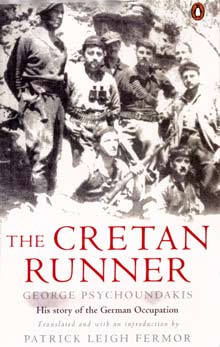
The Cretan Runner

There have been other memoirs of wartime Crete, such as Xan Fielding’s Hide and Seek and Ill Met by Moonlight, W Stanley Moss’s record of the kidnapping of General Kreipe (later made into a movie, with Dirk Bogarde assigned to fill Leigh Fermor’s dashing boots). But those were visitors’ books. George’s story, as Leigh Fermor points out in the introduction, is unique. It is no longer the locals who are colourful aliens, but the Allied officers and their wireless operators – good sorts and good sports in the main but, none the less, foreigners with some very dodgy customs. “A most peculiar man,” George says of one buffer. “He had pyjamas and a washbasin.”

Even more baffling for the Cretans, who think Nature is a place where you go and shoot things, the buffer turned out to be an amateur botanist and geologist: “He was not only in love with different kinds of weeds but with stones as well.”

Paddy and I have been sitting in the front room of George’s small vine-clad house, outside Khania in western Crete, for more than two hours now. At least one of us is reeling under the bombardment of Cretan hospitality. Celestial cheese tarts made by Sofia, George’s wife, have given way to nuts, glistening sweetmeats and, as if that weren’t enough, shots of tsikoudia, a spirit so lethal it feels less like drinking a liquid than sipping scalded air. After three of these, I am not entirely sure whether the spools on my tape recorder are going round: after four, I don’t care.

George – one eye sleepy, the other coal black with embers of mischief – is joking about whether he should have given lessons in sheep stealing (a local speciality) to one of the wireless operators. “So when he got back to Scotland he could have organised sheep rustling.” Paddy pretends, unconvincingly, to be shocked.

Through the window behind them, you can see the White Mountains – a range so towering and snowy, even on this May day, that it is hard to tell where rock stops and cloud begins. More than half a century ago, those slopes were Paddy and George’s stamping-ground. “George’s life was dangerous and absolutely exhausting,” explains Paddy. But George is having none of it: “I felt as if I were flying. Running all the way from the top of the White Mountains to Mount Ida. So light and easy – just like drinking a cup of coffee.”

George has difficulty walking now – at 78 he leans on a stick as gnarled as himself – but his mind can leap from memory to memory, as if he were still flying. I ask George what he thought the British had learnt from the Cretans and vice versa. “What they learnt, because there was very little to eat, was to drink a lot and to dance and to shoot for joy in the air. We saw how much they loved our country and it made us love it still more. The fact that they loved Crete so much gave us even greater courage.”

The first time George Psychoundakis met Patrick Leigh Fermor he thought he was very tall. The young Cretan had just crawled on all fours through thick bushes into the heap of boulders where the officer was hiding. In fact, the Englishman was not especially lofty (a touch over 5ft 9in, according to his passport). It was the Greek who was tiny. “As fine-boned as an Indian,” recalls Leigh Fermor. “Lithe and agile and full of nervous energy.”

Anyway, height didn’t matter much back then. It was the July of 1942 in occupied Crete and the stature of men was not measured in inches, rather in a bewildering range of abilities. These included: keeping cool when a member of the Gestapo approaches your mule while it is carrying a combustible load of wheat and wireless; keeping warm in a cave-bed with a canopy of stalactites; and finding the courage to tuck into a dinner of local produce – grass cooked with snails. “We took the grass blade by blade, picked off the broken shells and ate it with much laughter,” recalls George.

Psychoundakis was a runner for the Resistance – a vertical postman, he delivered messages and equipment at barely credible speed. On a map, Crete doesn’t look too daunting – a sirloin steak beaten to a succulent sliver by a butcher. But it rises so sharply into such broken-toothed cragginess that it is pointless to measure it in miles: the islanders calculate distances in the time taken to smoke cigarettes. George’s wartime business was mainly conducted at eagle-height, or as he felt his way down the vertebrae of his homeland towards some hiding place where even goats didn’t dare.

He was 21 years old when he first met the 27-year-old Leigh Fermor. George addressed Paddy as Michali (all the Allied soldiers had Greek nicknames) or sometimes Mr Michali in half-amused respect (irreverence being the key to the Psychoundakis psyche). Paddy, meanwhile, code- named George either the Clown or the Changeling, for his cockeyed wit, his impish insubordination and a magical ability to spirit himself out of trouble.

Patrick Paddy Leigh Fermor and Billy Moss

The two men were not just worlds apart: a glance at their biographies suggests you would need to hire a time machine to bring them together. Born in Asi Gonia, a village with a long history of giving invaders a hard time (asi is Arabic for uncommandable), George lived the kind of peasant life that had not changed for centuries. His family slept together in a single room with a beaten earth floor. After a scratchy education at the local primary school, he followed his father on to the mountains as a shepherd. By the time German parachutes blotted out the sky in May 1941, he had visited only two of Crete’s towns and had never seen the capital, Heraklion.

By contrast, Leigh Fermor was born into a smart Anglo-Irish family and educated at prep school and King’s, Canterbury. [Just like someone else we know] By 1939, he had walked across every country between London and Constantinople – a stroll commemorated in his two dazzling volumes, A Time of Gifts and Between the Woods and the Water – and also appeared to have drunk in most of their national literatures.

Scrape through what Leigh Fermor called his “Fauntleroy veneer”, though, and you find a rougher grain. With his parents abroad for the first four years of his life, Paddy was entrusted to the family of a small farmer and, left uncultivated, he ran wild. The experience, he later wrote, “unfitted me for the faintest shadow of constraint”. His behaviour at a flurry of schools led to his being sent to two psychiatrists, although it is unlikely that either rivalled Paddy’s clinical diagnosis of himself as “a very naughty boy”. He was finally expelled from King’s for crimes that included “trying to be funny” and holding the hand of a greengrocer’s daughter. His housemaster’s report noted: “He is a dangrous mixture of sophistication and recklessness, which makes one anxious about his influence on other boys.”

Almost 70 years later, I find it hard to improve on that verdict, save to replace the word dangerous with delightful. As it turned out, his influence on other boys was all to the good, and the most remarkable boy of all was George Psychoundakis.

While Paddy was in Kent writing “bad and imitative verse” and lapping up ancient Greek because it was a passport to a world of heroes, George was scavenging books from the village priest and the doctor, and occupying the long woolly hours by the sheepfold composing patriotic poems and beady skits on local life. (An early effort entitled Ode to an Inkspot on a Schoolmistress’s Skirt sounds distinctly Paddy-like in its high- flown cheekiness).

Although George’s father, Nicolas, was illiterate, he could recite by heart the whole of the Erotocritos, the 17th-century Cretan epic poem that comprises 10,000 lines of rhyming couplets. And the rhythm lodged in the son’s head and on his tongue: poetry to these people was not the object of solemn study but a spur to the spinning of legends and the cue for a bloody good song.
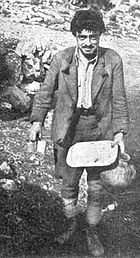
George Psychoundakis during the Resistance

Which is to say that when the ragged and practically barefoot Cretan wriggled into the hiding-place of the Englishman in 1942, they had more in common than an enemy. George spoke only one perfect sentence of English – “I steal grapes every day” – but Paddy soon extended his repertoire. On long marches to the coast to meet supply vessels or during the dark hours awaiting a parachute drop, the Britons taught the Greeks folk-songs and the Greeks taught them mantinadas – waspish local couplets with a sting in the tail.

On their first trek together, Paddy recalls how George recited a poem he had written on the unambitious theme of The Second World War So Far. “It covered the invasion of Poland, the fall of France, the German invasion of Greece and Rommel’s final advance. It lasted more than two hours and finished on a note of triumphant optimism and presage of vengeance, which he emphasised by borrowing my pistol and firing it into the sky with the remark that we would soon be eating the cuckolds alive.”

Leigh Fermor, meanwhile, attempted to satisfy Psychoundakis’s ravenous curiosity about the world. What was Churchill like? Why do the Scots wear kilts? How about astronomy, religion, trains? How many sheep does the average Englishman own?

The task of the British Special Operations Executive in Crete was to assist the local Resistance. Having spent centuries in revolt against the Venetians and the Turks, the islanders didn’t actually need much encouragement. During the airborne invasion in 1941, when many young Cretans were away on active service, descending parachutists were met by old men, women and children – by anyone, in fact, who could point upwards and shoot. “Aim for the legs and you’ll get them in the heart,” ran the local wisdom. Four thousand Germans died. Those who survived took swift revenge. Reprisals, read one Wehrmacht memo, “must be carried through with exemplary terror”. Between May and September of that year, 1,135 Cretans were executed.

The Cretan Runner begins with the invasion. “Out of the sky the winged devils of Hitler were falling everywhere … the aeroplanes came and went like bees in a bee-garden.” One grounded plane is set upon by furious locals till it resembles “a bit of bread thrown on to an ant-hill”. From the opening pages, you get a pungent impression of the Psychoundakis style – a vertiginous mix of the epic and the demotic, the Homeric and the homely. Of the enemy, George writes: “They reached to our very bowels and provoked a storm in the soul of the race like the hiss of a poisonous snake about to strike.” No British account of the battle of Crete could contain a sentence like that. Too purple. Too embarrassing, frankly. But it feels utterly true to George and the hot-blooded rhetoric of his race.

Perhaps the greatest surprise of a book that documents the burning of villages, the casual slaughter of comrades and a life of mesmerising danger is how often it makes you smile. No stranger to hardship anyway, George embraces discomfort as though it were a shy friend with a lot to offer. We see George at the end of a knackering three-day trek using pieces of wood to mime someone hobbling. We hear him enthusing over yet another dank hiding-place as though he were writing for some actionable travel brochure: “The cave was perfect. We collected our drinking and washing water from stalactites. We arranged luxurious couches for ourselves from the branches of various shrubs that were better than the softest mattress!”

Best of all, there is George richly enjoying his British friends, not least their congenital inability to walk over the rocky landscape. (In one incident, Leigh Fermor threw himself pluckily at a high stone wall in emulation of local bravado, only to fall off backwards: the Cretans in the party walked around the side of the wall, shaking their heads and laughing.)

SOE officer Ralph Stockbridge (centre, in the spectacles) with some of his comrades in Crete

“It was plain that George was enraptured with the excitement of our secret life,” says Paddy. The same could be said of all of them, I think. As a boy Leigh Fermor confessed to being guilty of “a bookish attempt to coerce life into a closer resemblance to literature”. In this case, the literature was Greek. The Cretans, for their part, seemed all too willing to live up to the legends the Englishmen had imbibed at school. Most battles look romantic only in retrospect, if then: Crete was different. It seems to have struck its leading men as touched with an air of romance, even as the drama was unfolding. As they approached by boat on a moonless night, the first the soldiers knew of the island was perfume, the scent of wild thyme that wafts miles out to sea.

Once on shore, they changed into local costume – breeches, black bandanas, embroidered waistcoats and spiffy jackboots. There were lessons in how to curl their new moustaches. They were an extraordinary bunch – poets, archaeologists, free spirits thirsty for adventure. SOE chose them because they had some knowledge of ancient Greek. But, as Leigh Fermor explains, since Greek was no longer compulsory at school, those who opted for it had already marked themselves out as “a perverse and eccentric minority”.

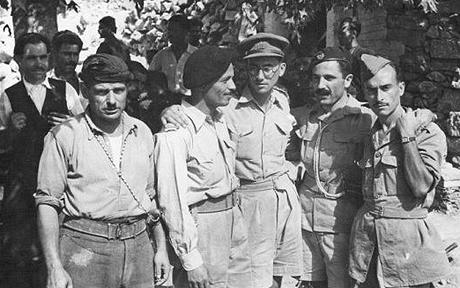
I cannot get enough of the photographs of the Resistance taken through those years in the mountains. Remember, these are snapshots captured at a time when to have a likeness of yourself in existence was itself a threat to that existence. There is the legendary Xan “Aleko” Fielding, looking uncannily like the young Hemingway. Gimlet-eyed and bare- chested, he regards the lens with Olympian amusement. And there is Yanni Tsangarakis, one of the bravest and most trusted guides, slightly woebegone behind a Zebedee moustache, and the redoubtable Manoli Paterakis, whose unforgettable profile suggests he may have been the love-child of Montgomery of Alamein and a peregrine falcon. [I think he’s trying to say he was nasally overendowed]

Looking at the smiley countenance of Tom Dunbabin – a fellow of All Souls in peacetime – you can see why he inspired such love; ditto the gaunt saintly faces of Aleko Kokonas, the schoolmaster of Yerakari, and his wife, Kyria Maria. And then, of course, there are Paddy and George: the first as debonair and unfeasibly handsome as Errol Flynn casting about for a galleon to capture; the second apparently auditioning for the role of Puck.

In Louis de Bernieres’s novel Captain Corelli’s Mandolin, set in wartime Cephalonia, there is a posh Englishman who lives in a cave and comes out declaiming ancient Greek. He is a bit of a joke. And, to be sure, there is something potentially laughable about the Boy’s Own aspect of all this dressing up and blowing stuff up. What redeems it from absurdity, what transforms it into real rather than fantastical heroism, is the nagging presence of death, which circled above these lives like a hawk. There was nothing comic-book about Anton Zoidakis, captured by German soldiers, tied to their vehicle and dragged along the road until his face and his life were wiped away. And even George’s account of merry scrapes is pulled up short when 20 Gestapo visit Asi Gonia: “They said I was wanted for interrogation and if didn’t go to Retimo before January 17 they would set fire to the whole village.”

Three of George’s fellow runners were executed, two after what the Wehrmacht would probably have considered exemplary torture. In his superb book Crete: The Battle and the Resistance, Antony Beevor points out that the penalty for a shepherd caught whistling to warn of the approach of a German patrol was death.

War had transformed George Psychoundakis’s life. In February 1943, it enabled the former shepherd boy to travel abroad for the first time. He was spirited off to SOE headquarters in Egypt, where he was knocked sideways by wonders, not least the grass in the Gezira gardens: “Fat, short grass like green velvet carpet.” As for the zoo, “I could almost have deemed that I was in the middle of paradise”. The most misguided character in the whole of The Cretan Runner is the soldier who advised George not to climb up the Pyramids because it was “very tiring and tricky”. A short hop later, the Cretan runner got out his stiletto and “cut my name and fatherland” into a stone at the top.
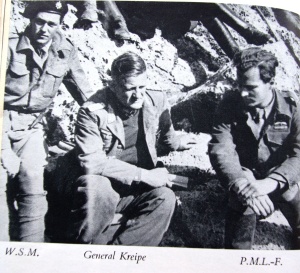
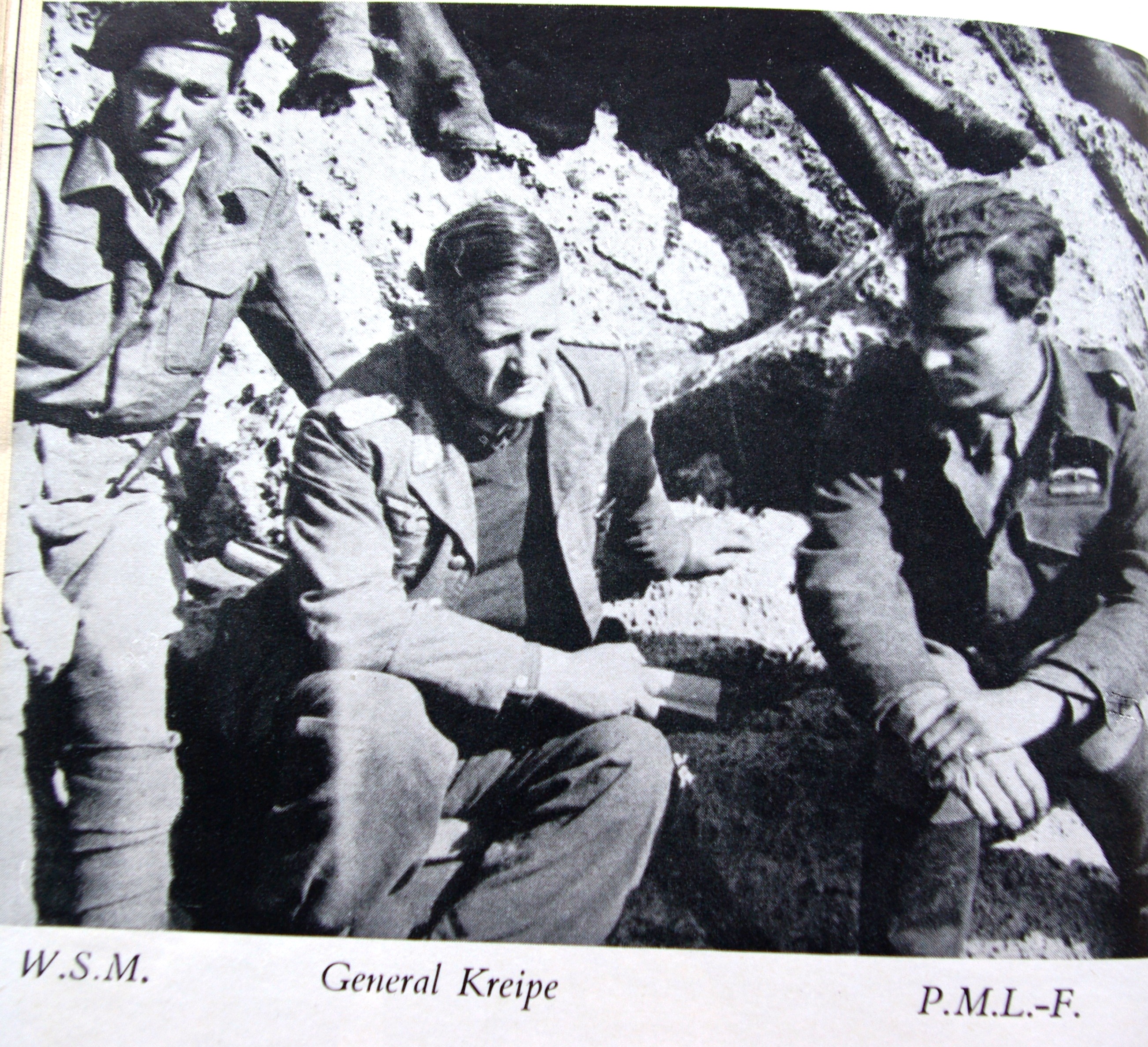
Moss, Kreipe and Paddy

On the day the war was over, a “high-spirited Mr Leigh Fermor” bought a dubious Mr Psychoundakis a lot of drinks. “If I drink all that I’ll be drunk,” protested George. “But my child, what is drink meant for? It’s no use for anything else,” replied Paddy.

Soon after, in a school where a whole village was gathered together, George recited a heart-stopping poem he had written on the lovely village of Yerakari, now destroyed, where once “white houses lay like doves asleep along the sill of heaven”. He had survived, but for a while it was hard to see what for.

Fortune, who had smiled on George in a time of insane adversity, appeared to doze off once the shooting stopped. Because of missing documents and in spite of his British Empire Medal (awarded in 1945), he was arrested as a deserter and imprisoned for several months. One can scarcely imagine the wound inflicted on his pride. Over three days, that great shaggy helmet of hair all fell out. Subsequently, he had to do two more years of fighting in the civil war. Returning at last to Asi Gonia, George found all the sheep stolen and his family in gruesome poverty. The Changeling had run out of magic.

George took a job as a navvy working on a road. At night, he sheltered once more in a cave and by the light of an oil lamp began to fill notebook after notebook with a furious, cramped hand. “I think he undertook this task as a kind of exorcism of the gloom of his circumstances, ” says Paddy. When they met up again in 1951, George gave his friend the completed work: Pictures of Our Life During the Occupation. Better known as The Cretan Runner.

Leigh Fermor, now living on the Greek mainland, took the precious grime-covered manuscript home to translate. George, meanwhile, was working to help his old friend, too. In 1943, with a German patrol approaching, Paddy, who was checking what he thought was an empty rifle, accidentally shot Yanni Tzangarakis in the leg. He died soon afterwards, but not before absolving his friend of all blame. Paddy was devastated: imagine killing the proud son of a country for which you were willing to lay down your own life.

This wretchedness was deepened by foolish rumours that eventually led to a vendetta being declared by some of Yanni’s relatives. This was only laid to rest after years of delicate negotiation by George, who found a very Cretan solution to the Englishman’s impasse: Paddy Leigh Fermor became godfather to Yanni’s great-niece. In Greek society, this bond is deeper than blood.

Two old men sitting at a table talking about the war. A Cretan and an Englishman. “We’d better censor that, George, it’s libellous,” says Paddy, trying to sound stern. As usual, he fails.

George goes off into the bedroom and comes back with a rifle. It is nearly as tall as he is, and its working parts are in similarly creaky order. As George poses with the gun, the photographer asks him to smile. George scowls and spits out a guttural retort. “Oh dear, oh dear,” says Paddy, shaking his head and laughing. What did George just say? “He said he won’t smile because he’s killing Germans.”

At the front of A Time of Gifts, Leigh Fermor quotes from Louis MacNeice’s great poem:

For now the time of gifts is gone
O boys that grow,
O snows that melt,
O bathos that the years must fill.

Since the war, both men have found satisfactions. Leigh Fermor, though unfairly saddled with the label of travel writer, has become one of the greatest exponents of English prose.

Psychoundakis, meanwhile, has translated both the Odyssey and the Iliad into Cretan and been honoured by the Academy of Athens. Still, I can’t help wondering whether the time since their great adventure had been an anti-climax.

“To some extent all our lives were in those years,” admits Paddy. “Of course, one went on to do interesting things, but … ” George has come up now and stretches out his fingertips to reach the shoulders of his friend, the tall Englishman. “Ah, George says to tell you that those years up in the mountains were the best years of his life. He’ll never forget it. Never. And that’s why he wanted to commemorate our days together.”

Just as we are getting ready to leave, George gives Paddy a photograph. It is of George himself and Xan Fielding, taken somewhere in the mountains. You can just make them out. The emulsion is breaking up and great snowy specks of it are blizzarding them into oblivion. Yet looking back at the Cretan resisters, we see only a thrilling clarity. Their existence was both mortally serious and a great wheeze – perhaps a definition of the best kind of life you can hope to lead.

Years after the war ended, George Psychoundakis sang for his friend Patrick Leigh Fermor a mantinada. This is what it said:
With patience first and patience last, and doggedness all through,
A man can think the wildest thoughts and make them all come true.

Related articles:

The obituary of George Psychoundakis aka The Cretan Runner

General’s long trip home

Related category:

Ill Met by Moonlight

Patrick Leigh Fermor scriptwriter for The Roots of Heaven

Some may not be aware that Paddy was pressed hard by Darryl F. Zanuck to be the scriptwriter for the 1958 film The Roots of Heaven, an adventure film made by 20th Century Fox, directed by John Huston and produced by Darryl F. Zanuck. The screenplay was by Romain Gary and Patrick Leigh Fermor and is based on Romain Gary’s 1956 Prix Goncourt winning novel The Roots of Heaven (Les racines du ciel).

The film had a fine cast and starred Errol Flynn, Juliette Gréco, Trevor Howard, Eddie Albert, Orson Welles, Paul Lukas, Herbert Lom and Gregoire Aslan. Paddy describes the negotiations and some of his time on set in Chad in letters to Debo Devonshire published in the book In Tearing Haste. I think Trevor Howard was drunk most of the time and Paddy appeared to be quite struck by the beautiful French actress Juliette Gréco. It was Errol Flynn’s last film

Set in French Equatorial Africa, the film tells the story of Morel (Trevor Howard), a crusading environmentalist who sets out to preserve the elephants from extinction as a lasting symbol of freedom for all humanity. He is helped by Minna (Juliette Gréco), a nightclub hostess, and Forsythe (Errol Flynn), a disgraced British military officer hoping to redeem himself.

I have a Spanish produced copy on DVD (English with Spanish subtitles available on eBay or Amazon) but the whole film (bar one scene) is available on You Tube. The quality is very good and you may like to watch it. It is scene eight that is missing.

One

Two

Three

Continue reading

On the Pontic shores where the snowflakes fall

I think this is a rare treat, even for those of us who have read much of Paddy’s work. This introduction to In the Trail of Odysseus by Marianna Koromila is full of longing for the world at the edge of the Black Sea that he discovered in 1934 and which so soon was to disappear forever.
“The whole region seemed an enormous and mysterious antechamber to the whole Mediterranean, unbelievably remote and enigmatic, and ever so soon in danger of fading.”

It is the story of Yiankos Danielopoulis who died in 1987 at the age of 88. As a Black Sea Greek living through the 20th century his life was uprooted time after time, until at last he was able to settle in Mount Hymettos in mainland Greece in the 1950’s.

I have been sent some scanned copies of Paddy’s introduction, by blog corespondent James, to the English translation to the book which I hope you will enjoy and inspire you to purchase the last few copies of the book from Amazon!

To help you further, here is a short synopsis by John Colvin Body which appears to have been published in the Daily Telegraph in 1994.

“In the Trail of Odysseus by Marianna Koromila tr by Nigel Clive Michael Russell, L14.95 this modern-day “Odysseus” is Yiankos Danielopoulos, one of 12 Thracian children born in Vasiliko, a whitewashed Greek village of the Ottoman Empire in 1899, and dying in Attica 88 years later. His life has been compiled by Marianna Koromila from a privately printed family record that she acquired from his daughter. It reflects the turmoil of that region in the 20th century. Born under the Empire, Yiankos lived in Bulgaria, Romania, Russia, Turkey and Greece, surviving two nationalities, seven homes and 13 professions, all imposed by “the gale of the world”. Bulgarian violence, Bolshevik revolution, civil war and Communist take-over were his Eumenides. As a child, he “listened to the rattle of the pebbles as they were washed up by the waves”; saw woods, vineyards, wheat fields and boats unloading below his window on return from fishing. The Thracian traders and shipowners, with relations in all the Black Sea ports, he described as the seagulls which followed the fish. In winter, wolves descended from the mountains, threatening the village. “Union is strength,” said Yiankos’s father when the horses drove them off.

The Great Powers then changed lines on maps. Vasiliko came under the Bulgars, and life became untenable. Yiankos and his brothers moved to Constanza in Romania and opened a grocer’s shop. An admiral’s wife fell in love with one of the brothers. The shop received the navy’s warrant. Funds accumulated. Bulgaria then invaded and the family fled to Galatz (also in Romania) with their assets – 50 cases of macaroni. Yiankos dealt profitably in foreign exchange; money was made. But Galatz became an impossible place, what with bombing and Cossacks shooting holes in wine-cases and drowning in the alcoholic flood. The Danielopouloses escaped to Russia, packed like sardines in a stinking refugee train. Life in their new Russian home, Berdiansk, was lucrative until the Bolshevik and Anarchist massacres began, when the family escaped to Novorosisk in 1917, where the Russian fleet had scuttled. They steered clear of politics, which preserved them, but chaos came. The family escaped by tug back to Constanza, having profitably run cafe, shop and currency exchange in the middle of a revolution. Back in Romania, they enjoyed “party-time” – the annees folles of the 1920s – until the Crash of 1929. Thanks to family unity, they picked themselves up again, flourishing even during the German occupation of 1940.

But later, in 1950, when Soviet theft and odious oppression became intolerable, Yiankos, his wife and daughters left for Greece. They arrived in Mount Hymettos penniless, but went on to farm pistachio, orange, lemon and tangerine trees, cows, hens and vegetables. Yiankos had survived once more. Nigel Clive’s sparkling translation of Koromilos’s book is richly enhanced by Patrick Leigh Fermor’s introduction to that legendary world of the day-before-yesterday.”


Buy In the Trail of Odysseus at Amazon.

Page 1


Pages 2-3


Page 4


Related article:

The mystery of The Black Sea Cave


Friends of England – Cultural and Political Sympathies on the Eve of the War

This is a fairly academic article about the views of Hungarians towards Britain prior to the Second World War. I thought this worth of publishing on the blog as it rhymes with a lot of what Paddy tells us in Between the Woods and the Water, and he of course gets a mention.

First published in the Hungarian Quarterly.

In a Hungary on the threshold of war, committed to Hitler’s side, “Pro-English: by 1939, at the latest by 1940, this adjective would encompass many things: liberal, democratic, humanist, pro-Jewish, even Catholic on occcasion, anti-Nazi in every case.”1 Those who sympathized with the English had other characteristics in common, such as a respect for tradition and disdain for demagoguery of all kinds. Between the wars, sympathy for England was palpable especially in the aristocracy, in the upper middle classes and amongst the educated. Sympathy for English traits and behaviour offers an explanation, as does what was felt for Shakespeare, English literature and English culture in general.

There was also a remote historical parallel, occasionally stressed by the post-1919 counter-revolutionary regime: the near contemporaneity of Hungary’s Golden Bull (1222), the East European document resembling England’s Magna Carta (1215), the crown as an institution, and the role of the aristocracy. Needless to say, scant heed was paid to such matters in England by politicians or public opinion. They were curious at most. Hungary was a small and distant country. However, in Hungary this sympathy was deep and widespread, showing itself, among others, in the reception given to some contemporary English fiction, such as the novels of Somerset Maugham and Aldous Huxley, which enjoyed an extraordinary popularity here at the end of the thirties. The reasons were not purely literary, though. Sándor Hunyadi, a writer, wondered why in an article, and many readers wrote in to say they were fond of Maugham because they liked the English. Not the writer, or his works, but the English. In Hunyadi’s words: “Surely a good many British passports could be issued to people who are not British subjects, perhaps they cannot even speak English but, deep down inside, they sympathize with the English.”2 This sympathy is all the more noteworthy since, by the end of the thirties, the economic and military might of Nazi Germany had made its mark abroad, and the openly fascist Arrow Cross had made its presence felt in Hungarian politics. Against this, Great Britain was seen as the paradigm of parliamentary democracy, liberal and masonic ideals, and the City of London was believed to embody the power of partially Jewish capital. Centuries old institutions, along with British traditions, stood for the past, for all that which was said not to be modern or “of our time.”

Nevertheless, numerous intellectuals and politicia Continue reading

Paddy’s Introduction to the Transylvanian Trilogy by Miklos Banffy

You may be interested in Paddy’s introduction to the trilogy written by Miklos Banffy. I have been able to find it on the web for you to enjoy. Paddy wrote this whilst staying with the Devonshire’s at Chatsworth, Christmas 1998.


Page One

Page 2

Page 3

Related article:

Andrew Nurnberg to handle world rights for Miklos Banffy’s The Transylvanian Trilogy

GAGINONANUS SPEAKS

After a long, indolent summer chasing dragonflies, and an extended sojourn in the south of France courtesy of ‘Les Sans Coulottes’, the time has come for the winner of our OPRIG GAGINONANUS challenge, Marion Worsley to collect her prize. A full report will follow!

To celebrate this forthcoming event I thought we should enjoy the poem that the marvellous John Wells wrote and sent to Paddy after he too received a copy of Paddy’s drawings.

GAGINONANUS SPEAKS

By John Wells

Before the earliest burning light
Before the world that once was his
Hung turning the day to turning night
Gaginonanus was and is

Gaginonanus, mightiest Lord,
Whom all the Seven Kings obey,
At whose high uncreated word
Preadamites were prone to pray

Great God of Gods, all nature’s grail,
The inward soul of every thing
Behind the Maya’s rainbow veil
Withdrawn, within, inhabiting

New gods and false as empires rise
Are worshipped, spires fall and climb,
All-seeing and with placid eyes
Gaginonanus bides his time

Like leaves the centuries are born
Like leaves are born to bud and die.
Gaginonanus smiles to scorn
The drifting aeons as they fly

Ignored, unknown, forgotten still
Gaginonanus sees their play,
The awful working of His Will
Until His dreadful Judgement Day

*

But now, O Prig! O Lax! O Loose!
That hour is come! O sunk in crime!
Your garages in constant use,
You dare not park at any time

His awful Name is manifest!
No cloud-etched letters skyward burn
The Blessed Ones who love Him best
Know their Great God will soon return

Winning entrant Marion Worsley in Market Mews

Behold, in those condemned last days,
Gaginonanus, Lord of All!
As saints and sages dumbly gaze
His Name is written on the Wall.

Related article:

OPRIG GAGINONANUS

OPRIG GAGINONANUS – a winner!

Angéla and Paddy’s visit to Cluj-Napoca

Balasha Cantacuzene

In response to requests from many of the citizens of Cluj who inhabit the pages of I Love Cluj on Facebook, I have scanned the pages which recount the story of Paddy and Angéla’s 1934 visit to Cluj in full.

This is taken from “Between the Woods and the Water”, the second volume of Patrick Leigh Fermor’s journey from London to Constantinople which commenced in December 1933 and ended with his arrival in Constantinople on New Year’s Day 1935. His time in Romania captures the beauty of the landscape, and the friendliness of the people be they aristocrat or peasant. It describes a time that would be lost forever due to the Second World War, which Paddy later described in an article for the Daily Telegraph as “Travels in a Land before Darkness Fell”.

His own extended sojourn in Romania was at Belani in Moldavia with the first love of his life, a young painter and Byzantine princess, Balasha Cantacuzene, whose family Paddy describes as part of an “old-fashioned, French-speaking, Tolstoyan, land-owning world. They were intensely civilised people.”

You can find pdfs of the story of the Cluj visit as follows (Cluj part starts page 143 but 142 gives you an introduction):

p142, p143, p144, p145, p146, p147 ………………. enjoy!

Related article:

Angéla, Paddy, István and Tom in Cluj-Napoca

Related category:

‘Between the Woods and the Water’

Los violines de Patrick Leigh Fermor

Finding online information about Paddy’s only novel (some call it a novella), The Violins of Saint-Jacques: A Tale of the Antilles, is very difficult. First published in 1953, the novel set in the Caribbean was adapted and set to music as an opera by the composer Sir Malcolm Williamson in 1966.

The typical product blurb describes the book thus:

On an Aegean island one summer, an English traveller meets an enigmatic elderly Frenchwoman. He is captivated by a painting she owns of a busy Caribbean port overlooked by a volcano, and, in time, she shares the story of her youth there in the early twentieth century. Set in the tropical luxury of the island of Saint-Jacques, hers is a tale of romantic intrigue and decadence amongst the descendents of slaves and a fading French aristocracy. But on the night of the annual Mardi Gras ball, catastrophe overwhelms the island and the world she knew came to an abrupt and haunting end. The Violins of Saint-Jacques captures the unforeseen drama of forces beyond human control. Originally published in 1953, it was immediately hailed as a rare and exotic sweep of colour across the drab monochrome of the post-war years, and it has lost nothing of its original flavour.

I have the book which is nearing the top of a pile of books to read, and when I am done I will contribute my own short review. It is not a long book and one that some readers may wish to obtain to understand more about Paddy’s writing.

I have found a recent discussion of the book on a Spanish website. For those of you who have the language the article is here. It can be translated very roughly with Google translate. Despite the wrath of some who may say I should not use such translations on the blog, I will post the final couple of paragraphs as they are so positive:

After reading the novel, it is really hard to resist the temptation to trace the footprint of the Caribbean island and going to see if, indeed, between the islands of Dominica and Guadeloupe, in the days of carnival, you can hear the sound of ‘the Violins of Saint-Jacques’, “which rises to the surface of the water, as if a ball at the bottom of the sea.”

No need to travel so far, one thing is a lot easier to contrast: the violins played by Patrick Leigh Fermor in perfect harmony and incomparable beauty. Regardless of the notes to interpret, they sound wonderful.

Angéla, Paddy, István and Tom in Cluj-Napoca


Matthias Corvin’s house Cluj-Napoca

If the lifespan of a crow can be up to thirty years, it is conceivable that the grandparents of the present day crows of Cluj observed Patrick Leigh Fermor and Angéla on their clandestine assignation to the city in 1934 when they were chauffeured by the understanding István. Their journey was a secret, but maybe the crows saw all and have passed on to their offspring the story of the young Englishman and the unhappily married Hungarian woman who was as ‘nimble as an ibex’.


As the sun set this evening I emerged from a restaurant near the Orthodox Cathedral to the sight and sound of thousands of crows flying westward at rooftop level, weaving in and out of the spires of the Cluj National Theatre. It was as if they were on some raid; they were in the stream, in squadrons of one hundred or more. I could neither see where they had come from, nor where they were going to, but this lasted for more than ten minutes and somehow it made me think of Paddy and Angéla.

The statue of Matthias Corvin dominates the square. St Michael’s church behind.

Cluj is today a fast growing city. The centre is dominated by crumbling Austro-Hungarian Baroque buildings. One can see that in 1934, before the darkness came that engulfed Europe and Romania, the pink and yellow painted walls would have been bright and welcoming to the small party that crept into town that warm August day.

Never missing an opportunity I have followed some of Paddy’s descriptions of his short stay in the city found in ‘Between the Woods and the Water’. He said that he and Angéla took a room near the house of Matthias Corvin who is a hero to both the Hungarians and the Romanians of Transylvania. This part of the old town has substantial houses and I wonder where in those cobbled streets, near the museum, they awoke, entwined, in their ‘handsome vaulted room’ to the sound of ‘recriprocally schismatic bells’. The bells would have sounded from the Gothic Saint Michael’s church in the Matthias Corvin square. His statue, which Paddy describes as magnificent, dominates the open space.

The New York/Continental Hotel

It was in a corner of this square that last night I set out on a search for the New York hotel, where the three of them had such fun and enjoyed an amazing cocktail, only surpassed, so István said, by the one called ‘Flying’ in the Vier Jahrszeiten bar in Munich. I was hoping that the secret of the cocktail had been passed down from generation to generation of barmen, but it was not to be. The hotel which is now named the Continental is closed, and the windows covered in posters proclaiming the Iron Maiden concert that took place last month to celebrate the success of the local football team, CFR-Cluj, in winning the Romanian league. It is a sad sight, but the building is nonetheless very grand with a turret on the corner facing the square and the Bánffy palace, which is now an art museum and next to the Melody nightclub with it’s huge neon sign, in the opposite corner.

So I did not get to sit in the seat of Patrick Leigh Fermor, nor drink his cocktail,  but instead walked in good company to my favourite bar in Cluj – Insomnia – and drank Ursus beer, whilst explaining to my Romanian friends Daniela and Vlad, why Patrick Leigh Fermor is the Greatest Living Englishman.

I knew Patrick Leigh Fermor through his words, and he will know me by mine

I think I am quite privileged to receive so many positive comments about the blog from people I have never met. One thing many agree upon is that Paddy has had a significant impact upon their lives. In some cases reading A Time of Gifts has been life changing, with some literally getting out there on the road and creating their own journey.

One message that really struck a chord was from Thos Henley – after the old abbreviation of Thomas I am told – who was originally from my neck of the woods in Hampshire, England, but who set off on the road two years ago and is now living what I imagine to be a bohemian life somewhere on the left bank of the Seine in Paris. He has even written and recorded some of his own songs, one which includes a reference to Paddy; it is good music and worth listening to. [Edit – I have listened to it a few times now and it really is quite good; have a listen]

Thos’ story is very moving and I asked if he would like to share it with other blog readers. He agreed so over to Thos …

Thos Henley at Paddy's door

“I am a 22 year old musician and a writer from Netley Abbey, Hampshire. Around two years ago I set off the travel France. One of the reasons I did so, was because I had recently discovered Paddy’s work. After this eventful trip all around the country, I settled in Paris, which now acts as my home and I have not been back to England since. In this time I have walked around the largest lakes of Sweden, travelled the expanse of Europe, and released a record in Paris named GOLDEN EUROPE. One of the songs on the record is about my travelling companion on the trip through France. He was my Xan Fielding and in the song I reference Patrick Leigh Fermor. It is called ANOTHER BROTHER and you can find it by clicking here.

Recently, I took a trip with my girlfriend to Greece. We went to Patras and walked to the edge of the Peloponnese. Slowly moving down south we made our way to Kalamata and then Kardamyli. I became good friends with certain locals and on the third day I had a map drawn out for me, with the whereabouts to Paddy’s home.

When I got there, the soles of my shoes had withered away (an overdue happening as I had worn them out for years). I met his house-keeper who spoke a very gentle Greek-English. I was nervous and I could hear Paddy eating his lunch next door and after a few minutes of introducing myself to his assistant I learnt that he was just too old to see anyone. She explained that the emotional toll was too much for the man who had been through it all. Passion carried my persistence but in the end I started to feel like some kind of a stalker and I gave up. Leaving his incredible garden, I heard through an open window, the mumbled low tone of Sir Patrick himself, obviously inquiring about the energetic English boy who had just been at his ocean blue door.

Sitting on the wall that he had made some 20 years or so before my own birth, I began to write him a letter. I explained my story and the fact that in his words I had come to find some sense of freedom in this ever enclosing world in which we all reside. Tears and sweat dripped onto the scribbled words that, no matter how much I tried, would never portray truly what this man meant to me. I wrapped the piece of paper over and around my old Swedish compass. In the letter I had told him I left it for him, as I had no need for it now; it had guided me to his house, where I sat boiling in the Greek sun, and its job, in my eyes, was done.

I swam for hours that day, washing away the heat and the sadness of not meeting ‘my’ Byron. However after reaching my hotel, after the sun had died and the raging fire of the crickets sang in their clicking chorus, I began to see the up side of what I had done. Yes I may not have met the man, but the fact remained that I had been to his home which I wished to visit over my childhood home in England. It was his seas that I wished to swim in over any other ocean in the world and it was his door step where I wrote, what I still hold as the best piece of writing I have done to this day.

This is not an ego talking but personal victory. I can live my life here, in this rainy, grey city of lights, Paris, knowing in myself that Paddy read my words and opened the same compass that I had used for years, its red point quivering on the W. And he would go to sleep that night knowing once more that his life had indeed been the greatest life ever lived and was still just as appreciated as it had always been.

In the end I knew Patrick Leigh Fermor through his words, and he will know me by mine.”

Visit Thos’ MySpace page where there are more photographs, you can find some of his music and videos.

A Woman’s Hour special: ‘Debo’ – the Dowager Duchess of Devonshire

Woman’s Hour devoted a whole programme to an  interview with Deborah Cavendish, or as we know her ‘Debo’ – the Dowager Duchess of Devonshire in 2010.

Deborah Cavendish

You can listen to the podcast here!

Related article:

Deborah Cavendish is 90 years old and has witnessed the 20th century up close. She has met anybody who’s anybody – Churchill, Hitler, JFK. She is also the last survivor of a remarkable set of women – the Mitford sisters: Nancy, who became a writer, Jessica who became a Communist, Unity who became a Fascist – and Diana who married one. In a special edition of Woman’s Hour Jenni talks to ‘Debo’ – the Dowager Duchess of Devonshire about her life, and the times she lived through. In her autobiography ‘Wait for Me’ she also talks about her own personal challenges; her husband, the Duke, had a long battle with alcohol and three of her children died within hours of their birth. She’s also credited with helping to save one of Britain’s great country houses, Chatsworth, which is enjoyed by thousands of visitors each year.

A Review of In Tearing Haste: Letters between Deborah Devonshire and Patrick Leigh Fermor from the Spectator

Related category:

‘In Tearing Haste’ Category

Paddy’s eye for detail: Ian Fleming, Bondage, James Bond and Pol Roger

Sean Connery and Ian Fleming

As background to the Imperial War Museum’s 2008-09 exhibition For Your Eyes Only: Ian Fleming and James BondThe New York Review of Books  featured a discussion of the merits of Ian Flemings’s work by Geoffrey Wheatcroft. Entitled ‘Bondage’ it is a wide-ranging review, and for shock factor it intially does tend to focus on Fleming’s penchant for what Wheatcroft calls ‘schoolboy sexual fantasies’. One critic found Fleming’s ‘sex distasteful—male brutality and female submission, or what Bond himself called “the sweet tang of rape”—he lamented Fleming’s “vulgarity and display” and his love of luxury goods.’

Well, that all makes for good reading but two things caught my eye. First of all there is some mild criticism for the overrated Sebastian Faulks and his 2008 attempt at writing a Bond story Devil May Care; more on Mr Faulks at a later date. Not only do I not particularly rate his writing (and I doubt he cares) but he is also a critic of Paddy’s.

The second was a letter that Paddy wrote to Ian Fleming picking him up on a point about Pol Roger champagne. Fleming was probably the first proponent of what would now be called ‘brand placement‘. As anyone who has read a Bond book or seen a film cannot fail to have missed, Bond does not get by with ‘Tesco Value’ when he can obtain a top brand alternative, presumably on Her Majesty’s expenses.

Paddy and Joan were friends of the Flemings, but, along with Debo Devonshire, were particularly close to Anne Fleming, and supported her through the difficult times following Ian’s death and his failure to get his estate in order. Read In Tearing Haste for more on this.

The particular part of the NYRB article that caught my attention is below, and shows Paddy’s excellent eye for detail, which we see constantly in his own work:

“While Devil May Care is short on sex and sadism, it does begin with one unfortunate having his tongue torn out; but then Faulks’s own tongue is a little too obviously in his cheek. We get Gorner, an impossibly horrible villain, a brutal enforcer called Chagrin (nice touch), a glamorous heroine with whom James is far too diffident—and a distinctly autumnal flavour. The book is set in 1967, when Fleming not only didn’t write it but could not have written it, and 007, as he admits, is showing his age. Now and again the writing flags. Bond has been in Tehran a few days when he lunches alone on caviar and martinis, before spreading out “some maps he had bought from the hotel shop…. The country was between Turkey to the west and Afghanistan to the east. Its southern frontier was the Persian Gulf, its northern limit the Caspian Sea.” Well, yes.

There are a few other lapses which it would be tedious to list, including a tennis match that is not only implausible in itself but whose scoring goes awry. We all make mistakes, including the originator. After Fleming published On Her Majesty’s Secret Service, that worldly sophisticate was mortified to receive a magisterial rebuke from his friend Patrick Leigh Fermor: Ian surely knew that Pol Roger is the only champagne never sold in half bottles.”

You can read the full article from the NYRB here. I will publish it at some later date for the archive.

Obituary: Daphne Fielding

The obituary of Xan’s first wife of whom Paddy was very fond. She once said of him: “Do you know Paddy? He’s such a good friend. He should be turned into pills so that you can take him when you feel low.”

by Hugo Vickers

First published in the Independent Wednesday, 17 December 1997.

Daphne Winifred Louise Vivian, writer: born 11 July 1904; married 1926 Viscount Weymouth (succeeded 1946 as sixth Marquess of Bath, died 1992; two sons, and two sons and one daughter deceased; marriage dissolved 1953), 1953 Xan Fielding (died 1991; marriage dissolved 1978); died 5 December 1997.

Daphne Fielding was a society author in the decades between 1950 and 1980. Having been a part of the world of Bright Young Things in the 1920s, she was well known in society as the Marchioness of Bath, and following her marriage to Xan Fielding she produced a stream of books of easy charm which achieved great popularity. Good-looking when young, in later life she was a tall, handsome figure, and could have been mistaken for a distinguished actress.

Daphne was the daughter of the fourth Lord Vivian and his wife, Barbara, a former Gaiety Girl, who was to marry three further times. The family was eccentric; many years later, her brother the fifth Lord Vivian (who died in 1991), variously a farm labourer in Canada, a publicity manager in San Francisco and a partner of the impresario C.B. Cochran, had the misfortune to be shot in the stomach in 1954 by his mistress Mavis Wheeler, the former wife of Sir Mortimer Wheeler, the archaeologist, a drama which occupied the headlines for many days.

Daphne emerged from a childhood which was a mixture of hilarity and insecurity, later described with relish in her memoirs, Mercury Presides (though Evelyn Waugh declared these as “marred by discretion and good taste”). She passed through Queen’s College in London, and St James’s, Malvern, and gravitated, through her friends the Lygon sisters, to the stimulating world of Oxford in the 1920s, and to that set dominated by Harold Acton, Evelyn Waugh and Brian Howard. The friends she made then were friends for life, a group that gave each other unswerving loyalty despite infidelities and political differences, everlastingly self-protecting; and a group through which she met Viscount Weymouth, heir to the Marquess of Bath.

There was parental opposition to their union, Henry Weymouth’s father declaring that he needed “a steady wife” and finding that Daphne did not fit this category. Weighing in, her father announced that he thought Weymouth an unsuitable husband. They were married in secret at St Paul’s, Knightsbridge, in 1926, and then again considerably more publicly at St Martin-in-the Fields in 1927, the bride dressed by Norman Hartnell. (When eventually they were divorced, there was a prolonged court case before three judges to dissolve that earlier marriage, and regularise the unusual situation.)

Old Lord Bath in 1928 handed the running of the Wiltshire family seat, Longleat, to his son (not without certain misgivings about his capacity for work) and he and Daphne threw themselves wholeheartedly into the management of the estate. They employed Russell Page to redo the gardens and were involved in extensive forestry work. To supplement her income, Daphne wrote articles for newspapers and magazines, which brought her under the protective care of Lord Beaverbrook.

They had four sons and a daughter. The eldest boy died in 1930, just before his first birthday, and the youngest, Lord Valentine Thynne, died after hanging himself in 1979. Her daughter Caroline predeceased her, and she is survived by two sons, the present Marquess and his brother, Lord Christopher, who are on notoriously bad terms. (There was a rumour that at Lord Christopher’s wedding to Antonia Palmer in 1968 the cake was laced with LSD. The Queen was a guest.)

Henry Weymouth spent much of the Second World War as a prisoner of the Germans, which did not help the marriage. In 1946 he succeeded his father as Marquess of Bath. Forced by crippling death duties he opened Longleat to the public in 1949, with an entrance fee of half a crown a head. By 1953 he had added a tearoom and tennis court, laid out a putting green, and floated pedalos for hire on the lake. But the marriage was over and the Baths were divorced in May 1953.

Daphne wrote the first guidebook to Longleat, a lively history of the Thynne family from 1566 to 1949, which she researched and wrote in three weeks. This she followed with Before the Sunset Fades (1953), a slim 30- page book about life above and below stairs at Long- leat, decorated, appropriately, by her old friend and Wiltshire neighbour Cecil Beaton.

In 1953 she married the war hero and travel writer Xan Fielding, a man 14 years her junior, a happy marriage which lasted until 1978. During these years they lived variously in Cornwall, Morocco, Portugal and Uzes, where they settled for some years, surrounded by a variety of pets and visited by their many friends.

While married to Fielding, she wrote her books Mercury Presides (1954) and its sequel, The Nearest Way Home (1970), and a novel, The Adonis Garden (1961), of which Evelyn Waugh wrote that she had “squandered six books in one”, adding, “You have used almost everything that has happened in the last twelve years.”

The Duchess of Jermyn Street, a life of Rosa Lewis of the Cavendish Hotel subsequently serialised on television, was to have been written with the help of George Kinnaird (a writer who also used to help Baroness de Stoekl with her books), but he gave up while going through a divorce. It was published in 1964 and Evelyn Waugh described it as “jolly good but I think full of inaccuracies”.

She wrote a joint life of Lady Cunard and her daughter Nancy, Emerald and Nancy (1968), which her friend Dirk Bogarde judged “light on the intellect”, fearing that Fielding had whitewashed these two monsters on the grounds that “she couldn’t be beastly to chums”; and a portrait of Iris Tree, The Rainbow Picnic (1974).

Raleigh Trevelyan, of Hamish Hamilton, then commissioned her to write a life of Gladys Deacon, the 93-year-old Duchess of Marlborough, whom he had come across while researching his book about the Whitakers of Sicily, Princes Under the Volcano (1972). This was not her usual milieu, since the duchess belonged to the belle epoque and intellectual world of Paris of a generation older than Daphne Fielding. Nevertheless she was able to tap her wide circle of loyal friends for anecdotes. To her surprise a man wrongly described as “a young intellectual” proved to have embarked on the same research. However, her friends closed ranks around her, and a word from Lady Diana Cooper to her biographer, Philip Ziegler, caused him to drop the rival’s incipient Collins contract like a hot potato.

I know this, for I was that rival. Both books were in due course published, hers under the title The Face on the Sphinx (1978). But the story had a happy ending, for those same friends helped me with my life of Cecil Beaton, and Diana Cooper, in her more usual role as peacemaker, effected a successful rapprochement between us. I enjoyed a number of meetings with Daphne in New York in 1981, during which she chatted amicably about our experiences and regaled me with Cecil Beaton stories. I always remember her line about Patrick Leigh Fermor: “Do you know Paddy? He’s such a good friend. He should be turned into pills so that you can take him when you feel low.”

Her friend Robert Heber-Percy averred that Daphne Fielding was a better conversationalist and letter-writer than author of books.

In 1978 Xan Fielding left Daphne for a lady described by her friends as “an older woman”. Bereft but brave, she was lucky to meet once more an old Oxford friend, Ben Kittridge, an American millionaire, with whom she went to live in Arizona until his death in 1981. Thereafter she returned to England and settled in the Old Laundry in the shadow of Badminton, where for two years the fox-hunting 10th Duke of Beaufort (“Master”) lived on, and where, until her death from cancer in 1995, her daughter Caroline lived as the next Duchess of Beaufort.

Daphne Fielding’s last years were spent there. At the famous Horse Trials she could be seen driving about in a tiny self- propelled vehicle and every Sunday she lunched with her son-in-law, where she was a by no means unnoticed figure at the table.

Related article:

Xan Fielding Obituary

To print this article or create a pdf do the following:

1. Copy the url of the article from your browser above

2. Click on the Print Friendly button below – you will be taken to the Print Friendly page

3. Paste your url into box that appears and hey presto you will get a previewed page to print or pdf!

Print

Don’t forget your pith helmet by Mary Beard

An interesting, if somewhat lengthy, review of Mani and Roumeli by Mary Beard in the London Review of Books from 2005. She contrasts the advice and style of Victorian travel books and guides with the modern. Mary Beard is also a noted classicist and her views are always worth a read.

First published in the London Review of Books 18 August 2005.

‘In the language and manners of every Greek sailor and peasant the classical scholar will constantly recognise phrases and customs familiar to him in the literature of Ancient Hellas.’ So the anxious tourist was reassured in the preface to the 1854 edition of Murray’s Handbook for Travellers in Greece. The message was simple: on a Greek boat you will find yourself back with Odysseus (‘the nautical contrivances and tactics of the ancients may be observed in daily use … the Greek seas are still as fickle as ever’); in a country cottage you will find yourself entertained by someone who could pass for Homer’s swineherd Eumaeus. ‘Even the ferocious attacks of vermin, which soon find out an Englishman, are exactly described in the graphic accounts given by Aristophanes of similar sufferings in Greek houses of old.’

Recapturing this world of antiquity was not, of course, without its hazards and difficulties, and the Handbook tried to demonstrate its own indispensability with some very lurid warnings about what could happen to the traveller who ventured to Greece unprepared. Health, indeed survival, was top of the agenda. ‘The abundance of fruit is a temptation to foreigners,’ it warned, ‘but nothing is more pernicious, or more likely to lead to fatal consequences.’ Protection against the Aristophanic vermin could be achieved only by means of a cheap but enormously complicated mosquito net whose daily assembling must have defeated all but the most obsessive and dexterous: ‘I have found that the best mode of entering it is to keep the opening in the middle of the mattress, and, standing in it, draw the bag entrance over my head.’ The problems of travel came a close second. Was it worth taking an English saddle? On balance yes, since they were so much more comfortable, but they did tend to injure the backs of the animals, given ‘the wretched condition’ of Greek horses. English servants, on the other hand, were better left at home, or if not at home, then in Corfu: ‘They are usually but little disposed to adapt themselves to strange customs, have no facility in acquiring foreign languages, and’ – revealing the characteristic blindness of the elite to the habitual discomforts of the working class – ‘are more annoyed by hardships and rough living than their masters.’ It was far more ‘agreeable and advantageous’ to hire a local, so long as no antiquarian knowledge was expected, let alone trusted if offered. For that, (hand)books were the thing. Continue reading

The mystery of The Black Sea Cave

It seems that summer is the time that Paddy’s fans stir themselves to try and find locations associated with his travels. We have had my recent ‘On the Same Steps’ article about the Hofbrauhaus; excerpts from the New York Times frugal traveller following part of the ATOG route; the OPRIG GAGINONANUS challenge; and now the submission of Jean-Marc Mitterer from Switzerland who has been trying to solve the conundrum of the true location of The Black Sea Cave, in the context of the challenge of understanding more about Paddy’s route on his last leg in Bulgaria in 1934.

Jean-Marc wrote to me a while back and we have exchanged a few emails since on this subject. He has read the story very closely (which is found in Words of Mercury but was originally published in Holiday Magazine in May 1965) and has been in contact with academics and others in Bulgaria to see if any more is known to try and narrow down the possible sites.

I hope as ever that someone out there somewhere will be able to comment and add to our shared knowledge about the gaps in Paddy’s life and stories. Here is what Jean-Marc has to say ….

“As you wrote, many readers of Patrick Leigh Fermor’s books imagine travelling back on the route he followed. If the first part of the trip is pretty well documented, this might turn to be a bit more challenging for the third part – Vidin, Sofia, Vitosha, Plovdiv, Veliko Turnovo, Ruse, Southern Romania, Varna, Burgas, ending in Istanbul on New Year’s Day 1935. The publication of the third volume will probably give more details but one point might remain some kind of a mystery: the cave on the Black sea where PLF spent a night in December 1934.

This striking moment of PLF’s trip is described in Words of Mercury.” (Ed: I have added some background here)

Paddy had got lost on the coast and had plunged into either sea water or a pond near the coast. It was December and he was wet through and immediately felt the cold. He was exhausted and both his bootlaces had broken. I guess he was at a real low point, far away from civilisation; wet, cold, hungry and lost. Thoughts must have passed through his mind about how he would survive the night.

“… Breathless and exhausted, I lay on a ledge until spurred on by the cold. At last, lowering my half-shod foot on to what I thought was the surface of a pool, I felt the solidity of sand and the grate of pebbles. Another pace confirmed it; I was on the shore of an inlet. Round the buttress of a cliff a little way up the beach, a faint rectangle of light, surrounded by scattered chinks, leaked astonishingly into the darkness. I crossed the pebbles and I pulled open an improvised door, uttering a last dobar vecher into the measureless cavern beyond. A dozen firelit faces looked up in surprise and consternation from their cross-legged supper, as though a sea monster or a drowned man’s ghost had come in.”

Jean-Marc continues ….

“Its location is very vague: between Varna and Burgas.

PLF tried to retrace it after the war from memory in the area around  Nesebar, but without success.

Early in 2010 Bulgarian speleologists and geography societies were asked about the existence of this place. The answers were disappointing and came with the regularity of clichés. There are well known cave areas between Kavarna and Shabla (north of Varna) and Sozopol and Tsarevo (south of Burgas). But no one knew of anything in-between.

This absence of cave is not only a mismatch with the broad location mentioned in Words of Mercury, but also with the actual situation. The north of Varna can be excluded as between 1913 and the Second World War the area up to Balchik was in Romania and not Bulgaria. The south of Burgas can also be excluded as, apparently, Paddy traveled (sadly) the last bit of his journey by train. [Ed: Is this the case?]

So this place must be between Balchik and Burgas.

Here are the actual elements we know from the article:

1. No human presence seen during his day walk except a lone Tatar fisherman.

2. A cave not very deep but big enough to have hosted more than a dozen (12) people, with room enough to perform wild dances, and to house a fishing boat, equipment, and a flock of 50 goats and up to six dogs.

3. The use of masonry elements [Ed: I believe these to have been rocks or dry stone walling. Paddy said they were interspersed with “branches, planks and flattened petrol tins stamped with Sokony-Vacuum in Cyrillic characters” – I do wonder how Paddy recalled this with his self-admitted “clumsy rudiments of” Bulgarian, his stressed physical and mental state, and the absence of his notebook]

4. The presence of a mixed Greek and Bulgarian population [either in the vicinity] or not too far away.

5. The presence of stalactites (which is a very challenging element; according to one speleologist interviewed the rocks on the coast are not suitable for these geological formations).

6. The proximity to the shoreline – remember PLF saw the light from the cave while walking along the coast. [Ed: my reading indicates that the cave was very near the shore, perhaps no more than 20-50 metres as the later descriptions indicate this and one has to ask how far the fisherman would have wished or been able to carry their boat which was seen in the cave. If any of you have carried wooden boats you will know they are very heavy; porting any great distance is unlikely.]

7. A fisherman with only one hand [with a star tattooed on the back of it.]

According to these elements, the place apparently most suitable must have been between Biala and Sveti Vlas. The area is rocky, little inhabited and the presence of a Greek population is confirmed in old maps. (for an interesting selection of maps visit this site of which perhaps the most relevant is this map)

Considering that such a place, even if it should have been destroyed since then [Ed: can you destroy a cave easily?], should have left some memories. In June 2009 locals in this region – Biala, Obzor, Bania, Emine, Elenite – were asked about the cave. Though elder people remembered many old stories (the visits of King Boris, shipwrecks before the first world war, purchasing fish at the fishermen’s settlements on the coast, etc…) nothing concerning a cave used by people or the memory of a handless fisherman (who could have lived on for a couple of decades after the visit of PLF) could be found.

This is not very encouraging… However, everyone remembered the presence of Greek people in this region and there are still a few elderly Greek people alive.

Tcheren Nos cave view

One cave was mentioned by local people, located on the Tcheren Nos. (between Biala and Shkorpilovtsi). This place is actually big arch (about 50- 80 m long), the deepest part being 15-20m above ground. There is a pond in front of it, with a little river reaching the sea. Currently it is difficult to access the place in the wood, there is no path from the shore, which is about 300- 400 m away, I was there in May 2009 and there were no stalactites or visible masonry, though the presence of black surfaces seems to indicate the presence of soot and human uses (from when ?). Considering the distance to the beach and the situation of the cave, it is difficult to imagine that this could have been the cave Paddy described. [Ed: I agree it is probably too far from the sea as per my earlier comments. However, there is always the chance that some form of change in sea level or silting up of the shoreline has increased the distance of the cave from the beach. Paddy does describe sand and shingle on the floor of the cave. From Jean-Marc’s photographs it does not appear that this exists.]

At this stage, these informal investigations reached a dead-end… Many hypothesis could be built (maybe Paddy’s memory confused some elements – like the presence of the stalactites or the dimensions of the cave) but further research would be useful.

The location of this cave is a fascinating enigma that even PLF seems not to have been able to clarify. I hope that this question will also interest you.

Maybe you would consider that this issue could be raised on your website, with the hope that people having access to the 1935 notes taken by PLF (though if this data existed, I guess they would have been used by PLF during his second visit) or having a specific knowledge about the Bulgarian coast could help. I don’t think Paddy’s work has been translated in the Balkans [Ed; He is certainly known in Romania] and his work appears to be unknown in Bulgaria.

[Ed: Towards the end of his account Paddy again confirms that the cave was near the sea “A few yards off, beyond the twelve adjacent snores, I could hear the gasp of the Black Sea.” What is also useful is an indication of the direction the cave was facing as he could see “three quarters of Orion blazed in an icy slanting lozenge.” Where does Orion lie in the late December sky when in the Balkans?]

For Marion Worsley, after OPRIG GAGINONANUS, and for you all, this is a slightly more difficult challenge; to find the cave on the Black Sea where Paddy was simultaneously saved and experienced one of his wilder, most impromptu experiences.

Perhaps the defining episode of this blog will be the re-discovery this cave?

The challenge is now out there. Truly, finding this cave will place the person that discovers it in the Patrick Leigh Fermor Pantheon. It may be a fool’s errand. Paddy may have at the same time exaggerated and been confused after the passage of time. What is not in doubt is that he spent a night in a Black Sea cave with a polyglot group of Greek fisherman and Bulgarian fisherman. What needs to be done is to find that cave. Jean-Marc has set us upon our course. Will we reach our destination?

To print this article or create a pdf do the following:

1. Copy the url of the article from your browser above

2. Click on the Print Friendly button below – you will be taken to the Print Friendly page

3. Paste your url into box that appears and hey presto you will get a previewed page to print or pdf!

Print

OPRIG GAGINONANUS – a winner!

Garage in Constant Use

When the challenge to solve the mystery of OPRIG GAGINONANUS was laid down less than two weeks’ ago, I did not think we would have a winning entry within two days! Marion Worsley from Sussex emailed me from her Blackberry with an accompanying photo to tell me:

“I am standing in market mews, surrounded by garages and 10 signs to remind any fool who had not spotted the continuous double line that also every garage door is “No Parking.  Garage in Constant Use”.  This is however the only one with a concertina mechanism.  I’m afraid no cat. Could send you a picture of a blue tee shirt hanging out of the window instead? I am now going to walk away as I can see coming towards me the slightly perplexed postman who very kindly directed me to Market Mews but then went on to ask what I was looking for. I vaguely mumbled that I was looking for garage doors, smiled, thanked him and walked on. leaving hanging in the air a question mark over my sanity. I will send you more pictures this evening.

Marion Worsley

Sent from my BlackBerry® wireless device”

Winning entrant Marion Worsley in Market Mews

Remember the challenge was to try to find the location that Paddy had sketched in his letter to Debo Devonshire and if possible photograph the same combination of letters that faced Paddy in 1992. Extra marks were to be awarded for a photograph including a cat.

Later Marion mailed me with more pictures:

Hi Tom

Here are the other photos from Market Mews. Slight artistic license for the cat… but did send you a picture of the tee shirt. I got a tourist who spoke very little English to take the picture.  I think that if I had tried to explain to him why I wanted a picture of myself next to a No Parking sign, he would have been even more confused. He will no doubt go back home and tell his friends that it is true that the English are a little mad. The entire mews consists of garages. I have added pictures of a few more should you want to add them to your Garage picture Collection. For the purists, the concertina garage is between No 9 and No 11 Market Mews.

Kind Regards

Marion”

The concertina doors from a similar perspective to Paddy's OPRIG sketch

From the other angle

It is no surprise that one or two things have changed; the doors seem to have been painted over and the cat has probably passed away. However, I was so pleased that a blog reader was inclined to be more than a little crazy and take up the challenge with such style. The ‘cat’ was a piece of improvised genius.

Very well done to Marion. We are planning an official presentation ceremony ‘on location’ later in the autumn. As you can tell she is a lady with some pretty mad ideas, one of which includes the possibility of walking some of Paddy’s route on 2011. Watch this space!

(For garage door enthusiasts I have posted all of Marion’s photographs in the photo section. It is clear that we are not alone in our obsession with OPRIG. Just Google OPRIG and look at images! I have placed some of these in the photo section.)

Related article:

OPRIG GAGINONANUS

To print this article or create a pdf do the following:

1. Copy the url of the article

2. Click on the Print Friendly button below – you will be taken to the Print Friendly page

3. Paste your url into box that appears and hey presto you will get a previewed page to print or pdf!

Print

OPRIG GAGINONANUS

Here is something completely ridiculous, a challenge for you all that recalls Paddy’s late night walk through Shepherd Market, London in early October 1992.

In a letter to Debo Devonshire dated 6 November 1992 (see page 293 of In Tearing Haste), Paddy writes to tell her of a strange experience just before he left for a trip to Antibes to collect a French literary prize for A Time of Gifts. Paddy and Joan had dinner with Magouche Fielding (Xan’s second wife). Joan left early and Paddy decided to walk home … “through Shepherd Market – my old haunt when young * – and into Market Mews. I had only gone a few paces when, on a wide black surface on the left side, I saw a strange message in huge letters in White:

‘OPRIG’, it said,

And underneath,

‘GAGINONANUS’

What could it portend? It looked simultaneously insulting, enigmatic and vaguely improper, especially the message below.”

Paddy enclosed a sketch.

Paddy's first sketch - OPRIG

It was only when he stood four square in front that all was revealed – click here to see the picture.

The challenge therefore is for those of you who live in London, or who are visiting this month, to see if you can find GAGINONANUS. There are enough geographic clues, and to add to this Paddy further writes to Debo, “If on leaving your front door, passing the Curzon Cinema, and turning right into the Mews, you’ll [see it].”

Let’s hope that like for Paddy the concertina doors will be ajar so that you can see it just as Paddy did. Perhaps they have been painted over? Do they still exist?

If you find GAGINONANUS then send me a photograph (tsawford[at]btinternet.com) with a brief retelling of your search. Special merit if you can include a cat in the picture!

The prize? Well, the satisfaction of ‘being there and having done it’ and a first edition copy of Words of Mercury for the first person to send a picture.

I shall personally resist the temptation to find it until the end of August. If we have had no responses by then, I shall go on a search myself.

* Paddy had lived at 43 Market Street before he departed on his journey in 1934