Author Archives: proverbs6to10

Unknown's avatar

About proverbs6to10

Interested in Byzantium and Patrick Leigh Fermor

Leave thy home, O youth, and seek out alien shores . . . Robert Macfarlane reads Petronius

One of the first things Patrick Leigh Fermor is given in A Time of Gifts is a book: the first volume of the Loeb edition of Horace. His mother (‘she was an enormous reader’) bought it for him as a farewell present, and on its flyleaf she wrote the prose translation of an exquisite short poem by Petronius, which could hardly have been more appropriate as a valediction to her son, or indeed to anyone setting out on a voyage into adulthood:

Leave thy home, O youth, and seek out alien shores . . . Yield not to misfortune: the far-off Danube shall know thee, the cold North-wind and the untroubled kingdom of Canopus and the men who gaze on the new birth of Phoebus or upon his setting

The journey of A Time of Gifts is set going by the gift of a book—and it is a book that has in turn set going many journeys. The edition of A Time of Gifts that Don gave me that day in Cambridge had as its cover a beautiful painting by John Craxton, commissioned specially for the book, and clearly alluding to Petronius’s poem. It shows a young man standing on snowy high ground, puttees on his ankles and a walking stick in his right hand, looking eastwards to where the sun is rising orange over icy mountains, from which runs a mighty river. Black crows fly stark against white trees: there is a sense of huge possibility to the day ahead and to the land beyond.

Extract from The Gifts of Reading , Robert Macfarlane. First published in Slightly Foxed Quarterly. Continue reading →

A Great Adventure

‘When I first read A Time of Gifts I felt it in my feet. It spoke to my soles. It rang with what in German is called Sehnsucht: a yearning or wistful longing for the unknown and the mysterious. It made me want to stand up and march out – to walk into an adventure.’ Robert Macfarlane

Andrew Merrills finds himself betwixt the woods and the water in this charming piece from Slightly Foxed Issue 38.

by Andrew Merrils

Few people living at the time would have regarded the early Thirties as a golden age, nor has posterity been kind to the period that W. H. Auden described as ‘a low, dishonest decade’. In 1933, the Japanese invaded Manchuria, Hitler became Chancellor of the Reich, and the first stirrings of the Spanish Civil War were felt in Catalonia. While hindsight bathes 1914 in the gentle summer glow of a prelapsarian world, the early Thirties seem autumnal and telescope all too easily into the bitter winter that was to follow. But for one man at least, the cold months of 1933–4 provided a still moment in time, which he would remember with fondness for the rest of his life.

In late December 1933, Patrick Leigh Fermor set out on foot for Constantinople (as he anachronistically termed it). Recently expelled from school for the unpardonable crime of holding hands with a local girl, and insufficiently inspired by the prospect of Sandhurst and a career of peacetime soldiering, the 19-year-old decided to head east on foot. His backpack was evidently stuffed to the brim, with a greatcoat, jerseys, shirts (including white linen ones for dressy occasions), puttees, nailed boots, a selection of stationery, a copy of The Oxford Book of English Verse and the first volume of the Loeb Horace. The clothing was soon lost but was replaced as he headed east by many generous donations from hosts and chance acquaintances. The literary ture was a more permanent part of his baggage; though he lost his Oxford volume, this was complemented by a vast corpus of writing in English, French and Latin that he had committed to memory. A little over a year later, the young traveller arrived at the Golden Horn.

Writing the account of the journey would take much longer. The first of three projected volumes, A Time of Gifts, was published in 1977, when the author was 62; the second, Between the Woods and the Water, which traces the journey from the Hungarian frontier (where the first leaves off) to the Iron Gates in Romania, came in 1982. The third book remained unfinished at the time of the author’s death in 2011.

Between the long adventure itself and its eventual publication, Patrick Leigh Fermor had led an improbably rich and full life. He was famous for his wartime heroism in occupied Crete, where he lived as a shepherd among the resistance fighters in the mountains and masterminded the daring abduction of the German garrison commander. These actions were commemorated in the memoir Ill Met by Moonlight by his colleague Sandy [sic] Moss, and his own role was played by Dirk Bogarde in the 1957 Powell and Pressburger film of the same title. In the decades that followed, Leigh Fermor produced some of the finest travel writing in English. His published books included a seminal study of the Caribbean in The Traveller’s Tree, a reflection on the monastic life in A Time to Keep Silence, and two remarkable books on Greece, Mani and Roumeli.

Much has been written about him since his death, and each of his books has its own admirers. But for those new to his writing, there is no better place to start than with A Time of Gifts and Between the Woods and the Water, as an introduction both to the young man on the brink of a great adventure, and the mature writer at the height of his powers. While both shine through in these two books, it is the former who strikes the reader most forcibly. Almost immediately, we are confronted with the extraordinary personality of the young man who wanders across their pages, and it is easy to imagine how this spirit must have charmed and delighted those with whom he came into contact.

His was a well-populated road, from the two German girls in Stuttgart who swept the young ‘Mr Brown’ into an exhilarating tumble of drinking, singing and Christmas parties, to the lugubrious Frisian in Vienna who shared his poverty and some ingenious schemes for generating money before disappearing into the murky world of saccharine-smuggling on the Middle Danube. And these are some of his less remarkable social successes. By the time he reached Mitteleuropa proper, Leigh Fermor had become the darling of the fading imperial aristocracy. We read of raucous games of bicycle polo on the lawns of castles, of horses borrowed for a few days’ ride across the Great Hungarian Plain, and a seemingly endless succession of benevolent Anglophiles who welcomed the dusty young traveller with food, alcohol and the free run of their libraries.

Even if we sometimes feel a tinge of envy at the ease with which the young Patrick drifted into this travellers’ inheritance, it is hard to begrudge him it: the same easy charms that won over the inhabitants of central Europe in the 1930s can still delight a reader eighty years later.

Leigh Fermor has always been loved for the richness of his prose, and both books do full justice to the deep romantic undercurrents of the rivers along which he was travelling. Yet even in his most purple passages, he has a peculiarly literary sensitivity; he writes, not as a traveller in uncharted lands, but as one who is acutely aware of the many writers who have come before him. Nor is this simply the prerogative of the adult writer, usurping the fresh observations of youth with his own literary stylizations. The wide-eyed observer at centre stage also views the world through the lens of his reading. Take this account of Wachau in A Time of Gifts:

Melk was the threshold of this unspeakably beautiful valley. As we have seen by now, castles beyond counting had been looming along the river. They were perched on dizzier spurs here, more dramatic in decay and more mysteriously cobwebbed with fable. The towered headlands dropped sheer, the liquid arcs flowed round them in semicircles. From ruins further from the shore the land sloped more gently, and vineyards and orchards descended in layers to the tree-reflecting banks. The river streamed past wooded islands and when I gazed either way, the seeming water-staircase climbed into the distance. Its associations with the Niebelungenlied are close, but later mythology haunts it. If any landscape is the meeting place of chivalrous romance and fairy tales, it is this. The stream winds into distances where Camelot or Avalon might lie, the woods suggest mythical fauna, the songs of Minnesingers and the sound of horns just out of earshot.

If anyone was attuned to the mythic properties of Old Europe it was the knight errant of 1934. Leigh Fermor gazed at the unfolding landscape with a romantic longing inflamed by a short life stuffed with literature and history. When he passed through the Low Countries, he looked through Bruegel’s eyes; his view of Vienna was a palimpsest of Ottoman armies and Habsburg emperors, against which the complex realities of the mid-1930s were not always visible to him. And when not prompted into reverie by the landscapes around him, he turned inward to the rich body of literature that he had committed to memory. The list of these works is among the most famous passages of Leigh Fermor’s writing. I won’t cite it in full here, since it runs to several pages, but it includes (among many other things) Shakespeare, Spenser, Keats, ‘an abundance of A. E. Housman’, the Sitwells, Norman Douglas and Evelyn Waugh, ‘large quantities of Villon’, and a respectable body of Virgil, Horace, Catullus and Lucan.If a love of literature brightened the colours of Leigh Fermor’s world, it also created a deeper yearning, and this is perhaps his most appealing trait, at least to me. Time and again, he writes of the fervour with which he engaged in spirited conversation with his learned hosts or plunged himself into their well-furnished libraries. Here, he gulped great draughts of European history, poring over details of Germanic folklore or piecing together the complex literary heritage of the world through which he was passing, and which was soon to be lost forever. In recounting these moments, his prose reaches its sublime best, as when he talks about the libraries of Prague:

Where, in this half-recollected maze, do the reviving memories of the libraries belong? To the Old University, perhaps, one of the most ancient and famous in Europe, founded by the great King Charles IV in 1384. I’m not sure. But I drive wedge-shaped salients into oblivion nevertheless and follow them through the recoiling mists with enfilading perspectives of books until bay after bay coheres. Each of them is tiered with burnished leather bindings and gold and scarlet gleam on the spines of hazel and chestnut and pale vellum. Globes space out the chessboard floors. There are glass-topped homes for incunables. Triangular lecterns display graduals and antiphonals and Books of Hours and coloured scenes encrust the capitals on the buckled parchment; block-notes and lozenges climb and fall on four-letter Georgian staves where Carolingian uncials and blackletter spell out the responses. The concerted spin of a score of barley-sugar pillars uphold elliptic galleries where brass combines with polished oak, and obelisks and pineapples alternate on the balustrades.

The conceit which underscores this passage – the image of memory as a library – is a key theme throughout both books. Not only does this recall the prodigious literary memory of the young man, it also reminds us of the act of memory that went into the composition of the books themselves. While A Time of Gifts and Between the Woods and the Water do an exquisite job in representing the world through the eyes of a 19-year-old, the reader never forgets the mature writer who acts as mediator and amanuensis. For the successful travel writer, war hero and beloved raconteur who wrote these books, these are stories of a half-remembered youth as well as a half-forgotten Europe.‘For now the time of gifts is gone’ runs the line from Louis MacNeice that provides Leigh Fermor’s first title, and it is this faint melancholy which makes both books so powerful. These are the memories of a lifetime, and in writing them down, in revisiting the notebooks and the maps that had lain untouched for years, the writer creates them anew. Nowhere is this more apparent than in the conclusion to the most intimate episode of the sequence. For a giddy chapter, the traveller had careered around Transylvania in a car with his close friend István, and with Angéla, something of a kindred spirit. The reader is caught up in the breathless pleasure of the episode, which climaxes in a manic motor chase with a west-bound train, but which deflates as the companions consider their parting:

The reader may think that I am lingering too long over these pages. I think so too, and I know why: when we reached our destination in an hour or two, we would have come full cycle. It wasn’t only an architectural world, but the whole sequence of these enchanted Transylvanian months that would come to a stop. I was about to turn south, away from all my friends, and the dactylic ring of Magyar would die away. Then there was István; I would miss him bitterly; and the loss of Angéla – who is little more than a darting luminous phantom in these pages – would be a break I could hardly bear to think of; and I can’t help putting off the moment for a paragraph or two.

Everyone has their favourite sections of these extraordinary books, whether they are drinking songs in snow-bound Germany, the majestic descriptions of pre-war Vienna, or the madcap charabanc rides through Transylvania. Mine comes at the beginning of the narrative. The account of the Groote Kirk in Rotterdam isn’t as succulent as some of the richer morsels later on – the young traveller had only just entered the continent, and both he and his older self were keen to get on. But it captures the themes of the book perfectly:

Filled with dim early morning light, the concavity of grey masonry and whitewash joined in pointed arches high overhead and the floor diminished along the nave in a chessboard of black and white flagstones. So compellingly did the vision tally with a score of half-forgotten Dutch pictures that my mind’s eye instantaneously furnished the void with those seventeenth century groups which should have been sitting or strolling there: burghers with pointed corn-coloured beards – and impious spaniels that refused to stay outside – conferring gravely with their wives and children, still as chessmen, in black broadcloth and identical honeycomb ruffs under the tremendous hatchmented pillars. Except for this church, the beautiful city was to be bombed to fragments a few years later. I would have lingered, had I known.

‘I would have lingered, had I known’: these are books for readers, for poets and for travellers. But most of all, they’re books for lingerers.

Book now for Transylvanian Book Festival 2018

Following the success of the first two festivals, Lucy Abel Smith has taken the plunge again and has organised a third event for this year. It will take place as usual in and around Richis, a village in the Saxon lands of Transylvania, during the period 13-16 September.

The Transylvanian Book Festival was set up by Lucy Abel Smith in 2013 to promote the literature and landscape of Transylvania. It could not have been envisaged that over the space of 5 years, the success of the festival would lead to a second and, now in 2018, a third edition.

This year, Lucy is especially keen to attract visitors from Romania and Hungary. There is a particular focus on the “Romania 100” events and there are special ticket prices for citizens of Romania and Hungary.

Unlike other book festivals, the Transylvanian Book Festival does not seek to collect the big names on random subjects, but to draw together those who have written or researched subjects relevant to Romania and the UK. It is important it takes place in the country and is about the country.

In 2018, some of the subjects are Louise XIV and a rebel prince; The Sublime Porte and the Transylvanian Princes; Queen Marie of Romania; Architecture in Romania between the wars; Patrick Leigh Fermor: Noble Encounters Between Budapest and Transylvania; The Vagabond and the Princess (the story of PLF’s affair with Princess Balasha Cantacuzino); Dracula – an international perspective; as well as music, poetry and film.

The Festival provides a relaxed venue for writers, musicians and academics to meet with audiences which are mainly English speaking, and takes place in Richis, once a Saxon village, which has a large hall and stage. Richis is surrounded by similar beautiful villages offering accommodation amid the foothills of the Carpathians. The Festival brings much needed income into these communities.

The excursions are led by locals and meals are produced locally from the Priest House by Tony Timmerman and her team. Tony is a trustee of Pro Richis – the village charitable trust to which all profits from the festival are given. Literary Festivals have a record in being re-generative and we hope that the festival, as well as building international friendships, will help bolster local Transylvanian tourism.

Discover more about the Festival at the Festival website or contact Lucy Abel Smith: lucy[at]realityandbeyond.co.uk

Paddy the Great, king of Greece

From the April 2018 edition of The Oldie magazine, a remarkable podcast interview with the late John Julius Norwich to celebrate the Charmed Lives in Greece retrospective exhibition at the British Museum. John Julius recalls the special life and tremendous spirit of his friend Patrick Leigh Fermor, the man whom John Julius credits with opening up the Byzantine world to him – the subject of his first book on the subject Byzantium: The Early Centuries.

John Julius talks about Paddy’s incredible intellectual curiosity and lightness of touch: ‘All the time you were aware of being in touch with perhaps the most extraordinary man you’d ever met.’

Listen to the interview here.

Anna Sándor de Kénos, friend of Patrick Leigh Fermor – obituary

I have been able to find a copy of the obituary for Anna Sándor de Kénos and hope that you find it interesting reading.

Anna Sándor de Kénos, who has died aged 97, knew Patrick Leigh Fermor in Transylvania when he made his now legendary journey on foot, beginning in 1933, which took him from the Hook of Holland to Constantinople.

They met in July 1934 when he was travelling through Transylvania and Anna Sándor de Kénos was staying with some of her aristocratic neighbours.

This was the period immediately before Communism annihilated the almost feudal way of life of these ancient Transylvanian noble families which Leigh Fermor recorded in Between the Woods and the Water.

Anna Sándor de Kénos was close to the Csernovits family, one of whom, Xenia, became Leigh Fermor’s lover in 1934 and whom he later immortalised as Angela when the book appeared in 1986. She was also close to one of the book’s most enigmatic characters, Elemér von Klobusiczky, who features under the pseudonym Istvan.

Just over a decade later, on the bitterly cold early morning of March 3 1949, the majority of the Transylvanian aristocracy, including the Sándor de Kénos family, were arrested and taken away to internal deportation, Anna among them.

Like many Hungarians she fled Budapest in November 1956 when the Hungarian Uprising was still raging, settling first in New York. She spent the rest of her life helping many of her fellow dispossessed and impoverished aristocrats to settle in the United States. These included members of the Almásy family, one of whom was depicted in the film The English Patient (1996).

Her munificence extended to all Hungarians. However, it was with those still trapped under the repressive Ceausescu regime in her native Transylvania that Anna Sándor de Kénos’s real sympathy lay.

Though tiny in physical stature she earned the nickname “the titaness of Transylvania” for her fearless disregard for officialdom. This extended even to the intimidating Communist apparatchiks in Ceausescu’s Romania, which she revisited regularly from the mid-1960s.

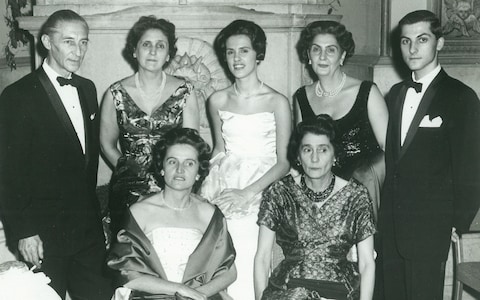
Anna Sándor de Kénos, seated front left, with other members of the Transylvanian nobility in exile at the Plaza Hotel, New York, 1960

Anna Sándor de Kénos, seated front left, with other members of the Transylvanian nobility in exile at the Plaza Hotel, New York, 1960

Another favourite target was officious airport check-in clerks. Once, at Sarasota Airport, Florida, in the mid-1960s when checking in for a connecting flight that would eventually take her onward to Budapest, and laden down with massive overweight baggage containing clothes and food for the poor of Transylvania, she was ordered to pay a substantial overweight baggage charge.

Her response was to point to a lady on her left hand side and declare in a strong Hungarian accent: “Sir, as you can see, I weigh a mere 44 kilos, the lady on my left I reckon about 144, why don’t we split the difference in our combined weights, or perhaps you would rather have me take her with me and make her into a delicious Goulash for my poor people in Transylvania.” The charge was immediately dismissed.

At the age of 92 Anna Sándor de Kénos applied to a US bank for a 30-year mortgage of $100,000. Three years earlier she had walked the excruciatingly long route of the Csíksomlyó pilgrimage to a Marian shrine in central Transylvania, a journey that would have challenged pilgrims half her age.

It was an 
unusual undertaking because the pilgrimage is the highlight of the Catholic calendar in Transylvania and she was a devoted Calvinist. She told a friend that she did it because “anything that was banned under Communism must be good for the soul”.

Anna Sándor de Kénos, known as Annuska, was born on March 21 1921 in Deva, the capital of Hunedoara County, which had been ceded from Hungary to Romania by the 1920 Treaty of Trianon.

The scion of a 16th-century Transylvanian noble family who were long characterised by unflinching determination and optimism in the face of adversity, she was one of two daughters born to Béla Sándor de Kénos and his wife Etelka (née Buda de Galacz), who were then living on the family estate near Deva.

The family’s circumstances were, like so many other “class enemies”, greatly reduced from quite comfortable to an indigent state under Communism in Romania. Though deprived of all the privileges that would have come to one of her class, Anna Sándor de Kénos was never resentful of her reduced situation.

She worked in New York for the renowned cosmetics company created by her fellow Hungarian Ernö László, whose client list included the Duchess of Windsor, Greta Garbo, Ava Gardner and Jacqueline Kennedy, before giving it up to work as a theatre nurse.

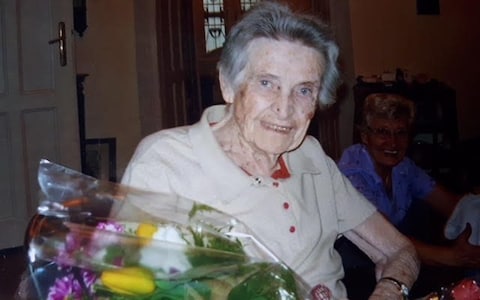
Anna Sándor de Kénos in Budapest on her 90th birthday

Anna Sándor de Kénos in Budapest on her 90th birthday

She spent much of her life in Sarasota, keeping open house for Hungarian émigrés. On occasion she had as many as 50 guests for dinner. The only rule was that guests should make a donation for her charitable interests in Transylvania. After the collapse of Communism in 1989 she spent part of the year between Budapest and her native Deva.

Although Anna Sándor de Kénos never married, her name was linked for many years to a Transylvanian nobleman who also never married.

With the death of Anna Sándor de Kénos, the last living link to the Transylvania and Hungary of Patrick Leigh Fermor’s Between the Woods and the Water has gone. She is survived by her nephew, Daniel Lészay de Lésza.

Anna Sándor de Kénos, born March 21 1921, died May 18 2018

The last of the Noble Encounters

Anna Sándor de Kénos in 1960

Michael O’Sullivan, the author of the recently published Patrick Leigh Fermor: Noble Encounters between Budapest and Transylvania writes to inform us:

It is with great sadness I write to inform the PLF blog readers that the last woman who knew Paddy in Transylvania in 1934 has died at the aged of 97. Anna Sándor de Kenós was thirteen when she met Paddy at the Csernovits mansion in Zam. She was from an ancient Transylvanian noble family and the doyen of the Hungarian ex patriot community in the United States where she moved after the 1956 Uprising against Soviet rule in Hungary.

An obituary was published in the Telegraph but it has some access restrictions.

My apologies to you all for the radio silence over the last few weeks. It was due to some personal reasons, and I now hope that all will get back on track with the blog!

John Julius Norwich – 1929-2018

Barry Cryer and John Julius Norwich at an Oldie lunch in 2017

Very sad news over the weekend to hear of the death of John Julius Norwich, writer, diplomat, broadcaster, father of Artemis Copper (Paddy’s biographer), and friend of Paddy and Joan. Thank you to AJ for sending me this link to his final article for the Oldie magazine. Like John Julius, it was Paddy that led me to my interest in Byzantium, although my Byzantine output is nothing like the wonderful three volume history of Byzantium that John Julius wrote.

First published in The Oldie, 1 June 2018.

By John Julius Norwich.

A new show at the British Museum – about three great lovers of Greece – takes me right back to the 1950s. The English painter Johnny Craxton (1922-2009) was a joy – the only dinner guest we ever had who came on his motorbike and left his leathers in the hall. He always came on his own; we were all intrigued by the idea of his long-term boyfriend, whom we never met. I think Johnny saw Greece as a larger Crete – just as Neville Chamberlain was always said to see Europe as a larger Birmingham. Johnny loved Crete with passion.

The Athenian painter Nikos Ghika (1906-1994) provided me with my first breath of Greece in the summer of 1954, when we went to stay with him in his lovely old house on the island of Hydra.

Also staying there were Paddy and Joan Leigh Fermor. Ghika later designed the serpentine pebble mosaic floors at Kardamyli – the Leigh Fermors’ enchanting house in the Mani. It was Paddy that I knew best of the three. Our friendship lasted from the 1950s until his death in 2011 at the age of 96.

In the spring of 1955, when we were living in Yugoslavia – I was working at the British Embassy – a letter arrived from my mother. She had been offered a caique for a fortnight’s sail among the isles of Greece. Paddy and Joan Leigh Fermor were coming; could we come, too? At the end of August, we drove down from Belgrade to Athens, and boarded the Eros at Piraeus.

It was my first time in the Aegean, and my best. Paddy lived and breathed his beloved Greece – fluent in its language, encyclopaedic in his knowledge of its history, people and literature. And nobody has ever carried his learning more lightly.

As we sailed from island to island – and, in those days, there were almost no tourists, and I can’t describe what a difference that made – he talked about Greece, Greek beliefs and traditions, about Byron and the Greek War of Independence, about those monstrously magnificent Greek heroes – men such as Mavromichalis and Kolokotronis, whose names roll so satisfactorily across the tongue – and about the Greek Orthodox Church and its quarrels with the West over words such as ‘filioque’ and ‘homoousion’, his talk taking in all the mystery and magic of the Byzantine world. Twenty years later, I was to write a history of Byzantium myself; but I doubt whether, had it not been for that fortnight on the Eros, I should ever have done so.

One day we were in a taverna on Santorini. Britain and Greece were then at the height of the Cyprus dispute and Paddy was, of course, firmly on the Greek side. Suddenly a member of the party at the next table, hearing us speaking English and being slightly drunk, launched into a stream of anti-British invective. We pretended not to notice. Then, suddenly, he and his companions burst into song.

‘Quick,’ whispered Paddy. ‘National anthem – everybody up.’

We leapt to our feet while he, naturally knowing all the words, sang them at the top of his voice. The mood of the other table changed immediately; and they were still more impressed when he continued with all the following verses – solo by now, since no one else knew them. Abject apologies followed: the ouzo went round once more, and we all departed friends.

It was characteristic of Paddy that, when he and Joan decided to build themselves a house in Greece, they chose the remotest corner: Kardamyli, at the far end of the Mani, the second of the three peninsulas that form the southern coast of the Peloponnese. And oh, how they loved it.

Paddy basically designed it himself. I remember him saying, while the building was in progress, ‘I want it to be part of outdoors, so that, if a chicken were found wandering through the library, no one would be a bit surprised.’

By November 1969, with its vast supply of bookcases, a huge desk and plenty of room to pace over a stone floor, the ‘powerhouse for prose’, as Paddy liked to call it, was ready at last. The two books describing his teenage walk across Europe, A Time of Gifts and Between the Woods and the Water, were both written there, together with hundreds of letters, articles and the jeux d’esprit which he so loved, and of which he was such a master. But those dread enemies procrastination and distraction were always hovering behind him, tempting him away. And as we shall see, they were to get him in the end.

Kardamyli was a huge success. It became the epicentre of Paddy’s world. For the first time, at 54, he had a home of his own. He continued to travel around Europe to see his innumerable friends, but it was here, I feel quite sure, that he was happiest. Outside Europe he was seldom tempted to roam. Except, surprisingly, for the Caribbean. A year or two after the war, he and Joan were persuaded by their old friend (and mine) Costa Achillopoulos to accompany him on a longish tour of the islands.

The result was Paddy’s first book, The Traveller’s Tree, which was published in 1950, and also his second, The Violins of Saint-Jacques, an exquisite little novella which was his only venture into fiction.

The islands fascinated him. His chapter on voodoo is a masterpiece. And then, when he got to Barbados, what did he find? A tablet in the churchyard of St John’s, carved with Doric columns and the cross of Constantine, reading: ‘Here lyeth ye body of Ferdinando Palaeologus, descended from ye Imperial lyne of ye last Christian Emperor of Greece. Churchwarden of this parish 1655-1656. Vestryman twentye years. Died Oct 3. 1679.’

Later, Paddy discovered that Ferdinando’s son Theodore had returned to England and had settled in Stepney, where he left a posthumous daughter baptised with the typically 17th-century name of Godscall Palaeologus.

She may have married, and had countless children; but, for the time being, this little girl in Stepney remains the last authentic descendant of the Palaeologi, the last imperial family of Byzantium.

Of course Paddy was a superb linguist; but I have never known anyone who enjoyed his languages so intensely. He loved on-the-spot translations: ‘To be or not to be’ in German, for example – occasionally recited backwards – or D’Ye Ken John Peel in Italian, which my daughter Artemis (his biographer) and I sang at his memorial service:

Conosce Gian Peel, con sua giacca tanta grigia?

Conosce Gian Peel, prima cosa la mattina,

Conosce Gian Peel, quand’ è lontano, è lontano,

Con suoi cani e suo corno la mattina.

And then there were the letters –letters that could have been written by no one else. Reading them, written at such terrific speed that sometimes they grow faint because the fountain pen can’t deliver the ink fast enough, one marvels at Paddy’s facility and fluency. And yet, when he was writing a book for publication, every sentence was a battleground. When, in July 1988, Sotheby’s sold the autograph manuscript of A Time of Gifts, it was described in the catalogue as follows:

‘c.450 pages, the majority written on rectos only, some on both sides, the first chapter on lined foolscap sheets, some cartridge paper, others lined, heavily revised and corrected, revised passages frequently written on separate sheets and pasted or clipped over the original, corrections or elucidations often in red ink, foreign or difficult words printed in the margin, many sheets with encouraging notes to the typist, often stapled or stitched with coloured thread into gatherings, generally of ten pages.’

I have an idea – I hate to have to say it and desperately hope I’m wrong – that Paddy’s last years were not as happy as the rest of his life had been. He missed Joan desperately after she died in 2003, he was getting old and he gradually had to face up to the fact that he would never complete the third volume of the story of that glorious European journey in his early youth. He produced bits and pieces for it by the dozen, but something always prevented him from organising them, connecting them and making them into a single coherent document. It was, I suppose, a kind of writer’s block.

He would seize on anything – letters, articles, translations, those ingenious word games he so loved – rather than face one of two facts: the first, that he must finish the job; the second – far worse – that he couldn’t. Eventually he knew that the second was the truth. When he came to London, people would say breezily, ‘How’s Volume III coming on?’, little realising that they were driving a dagger through his heart.

Volume III is not entirely lost. The Broken Road, compiled by Colin Thubron and Artemis, breathes Paddy through and through. And anyway, he has left us so much more to revel in.

As a travel writer, he was surely in a class by himself. But he was much more than a travel writer; he was the most extraordinary literary – and social – phenomenon I have ever known, and I am proud to have been his friend.

Noble Encounters between Budapest and Transylvania

In March 1934 a young man stood midway on a bridge over the Danube which connected Czechoslovakia and Hungary. He was taking stock of a world which, ten years hence, like the very bridge he stood on, would no longer exist. Patrick Leigh Fermor had left London the year before, at the age of eighteen, to walk from the Hook of Holland to Constantinople to complete a journey which would later become the source for some of the best travel writing in the English language. As he stood on the Mária Valéria bridge, facing the ancient Hungarian city of Esztergom, he had no idea that he would one day become the chronicler of a form of social life which was soon to be extinguished by the vicissitudes of war and by the repression which so often went hand in glove with Communism…

Noble Encounters takes a different perspective on Paddy’s 1934 journey, meticulously recreating Paddy’s time spent among the Hungarian nobility. It is the culmination of many years of work and research by author Michael O’Sullivan. He has had access to the private papers and correspondence of many of Leigh Fermor’s hosts, has used extensive interviews with surviving members of these old noble families, delved into the Communist Secret Police archives, and even met the last woman alive who knew Patrick Leigh Fermor in Transylvania in 1934.

O’Sullivan reveals the identity of the interesting characters from BTWW, interviewing several of their descendants and meticulously recreating Leigh Fermor’s time spent among the Hungarian nobility. Paddy’s recollections of his 1934 contacts are at once a proof of a lifelong attraction for the aristocracy, and a confirmation of his passionate love of history and understanding of the region. Rich with photos and other rare documents on places and persons both from the 1930s and today, Noble Encounters offers a compelling social and political history of the period and the area. Described by Professor Norman Stone as “a major work of Hungarian social archaeology,” this book provides a portrait of Hungary and Transylvania on the brink of momentous change.

The book will be officially launched at an invitation only party on 25 May in the house in Budapest where Paddy stayed in 1934, hosted by Gloria von Berg the daughter Paddy’s Budapest host, Baron Tibor von berg. Attending will be a representative of every Hungarian and Transylvanian noble family PLF stayed with as he went castle hopping across the old Magyar lands. They all want to gather to honour the man who was witness to a way of life, and of an entire class, soon to be part of a vanished world a mere ten years after he stayed with them. O’Sullivan has even managed to find Paddy’s signature in the von Berg’s guest book from 1934 when he was signing himself ‘Michael Leigh-Fermor’ – an amazing survival from the Nazi and Soviet occupations of Budapest. Petroc Trelawny will be MC for the evening and the book will be launched by Prince Mark Odescalchi whose ancestor, Princess Eugenie Odescalchi, Paddy met in 1934.

Michael O'Sullivan

Michael O’Sullivan

Michael O’Sullivan is an English Literature graduate of Trinity College Dublin where his postgraduate work was on the poet W.H. Auden. He curated the first major international symposium and exhibition on Auden in the Künstlerhaus Vienna in 1984. He was Vienna correspondent of the London Independent and later worked on both the Foreign and Parliamentary desks of Ireland’s national broadcasting service RTE. He is the author of bestselling biographies of Mary Robinson, Ireland’s first woman president and later UN High Commissioner for Human Rights. He has also written biographies of the founding father of the modern Irish state, Sean Lemass and of the playwright Brendan Behan. His association with Hungary began in 1982 when he became a frequent visitor to Budapest and when he met many of the old Hungarian noble families who met Patrick Leigh Fermor in 1934 and were then banished from their native land under Communism. O’Sullivan will be talking about his book at its public launch at the Danube Institute (Budapest) on 7 June (details here), and at the 2018 Transylvanian Book Festival

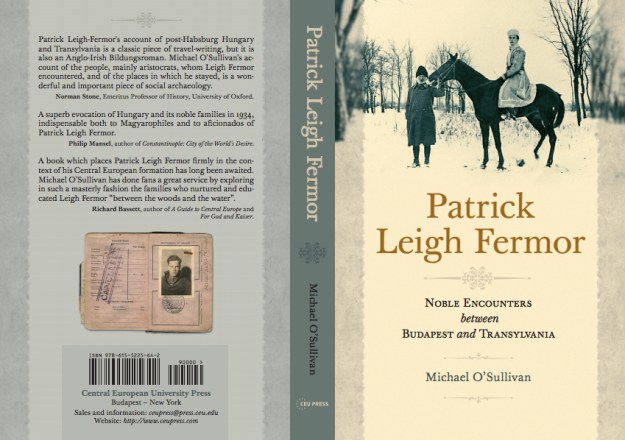
The book is published by CEU Press. It will be available soon on Amazon etc; I will endeavour to keep you updated. Here is a link to the pdf of the full book cover. PLF BOOK COVER FINAL EDITION

Until I have reached Constantinople

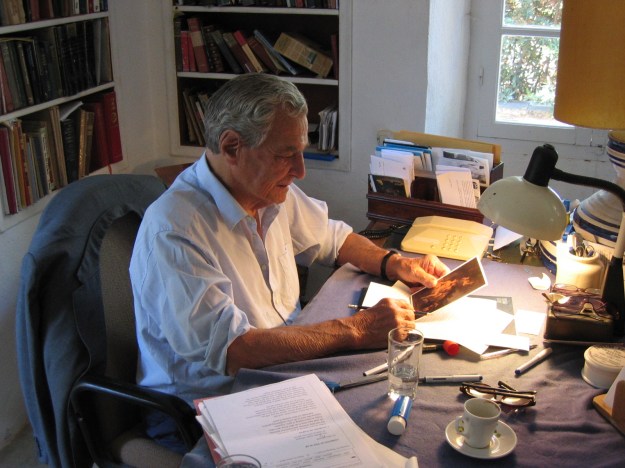
Patrick Leigh Fermor working at his home studio on 3 October 2004, then aged 89. Kardamyli. by Sean Deany Copyright 2012

In the catalogue to the exhibition Charmed Lives in Greece: Ghika, Craxton, Leigh Fermor (at the British Museum until July 15), Michael Llewellyn-Smith writes that, in his later years, Patrick Leigh Fermor “had an all-purpose excuse to send to pesterers”. The note read: “It was very kind of you to write. The trouble is that I am having to work to a strict deadline for the completion of my new book. This makes me a poor correspondent until I have finished it and have reached Constantinople – I am not sure when this will be”.

By James Campbell

First Published in The Times Literary Supplement 12 April 2018

The warning to inquisitive readers, colour-supplement journalists, adventurous holidaymakers and others was despatched from Kardamyli in Mani, in the Southern Peloponnese, from the house which Fermor had built himself, with local labour and expertise, in the mid-1960s. It was where he had completed the first two parts of his account of the “great trudge” across ­Central Europe in the 1930s, projected to end, in a long-anticipated third volume, in “Constantinople”. The book itself had become something of a pest, and he failed to complete it before his death in 2011, aged ninety-six. His wife Joan had died there eight years earlier.

I knew nothing of this when I posted a letter to Kardamyli in the autumn of 2003. I was not a Fermor devotee (there were many, though nothing like the numbers that exist today) and had read scarcely anything he had written. It was not my idea to seek him out, but that of my editor at the Guardian Saturday Review, for which I was at the time a contracted writer. The regular task was a literary profile, of a good length – 4,000 words – and of a certain seriousness. Starting from a position of ignorance didn’t bother me. I liked “finding out”, and enjoyed the homework.

Suggestions from Farringdon Road came by telephone, later email, and were always to the point. “How about Patrick Leigh Fermor?” That was it. No address, no telephone number, no deadline. The rest was up to me, but I was free to go where I liked and when I liked. I had fulfilled many commissions in this way, and had discovered something: it works better when you contact the intended subject yourself to make arrangements, rather than going through the publisher’s press office. The people there do necessary work, but with their more valued (and venerable) charges there is a protective instinct, and a need to control the show.

Fermor was definitely a protected species. His ninetieth birthday was approaching. His publisher John Murray was desperate for him to reach Constantinople. The journey, which had taken place in the 1930s, had been given elegant shape in two books written forty and fifty years after the events described: A Time of Gifts (1977) and Between the Woods and the Water (1986). The final volume, endlessly, pestiferously, inquired about, was said to be inching forwards. Both my editor and I made approaches to the publicity department; both received vague promises of representation. In the end, both were urged to think about volume 3, like everybody else.

I decided to take the direct route. But how to find him? I tried some acquaintances who might know his address. None did. Someone suggested Elizabeth Chatwin, widow of Bruce, Continue reading →

The Vagabond and the Princess – book update

Many of you have asked for details about the book. I have been able to obtain a flyer which still talks about publication in May. The book may be available to order at Foyles, but is not yet listed on Amazon. When it is more widely available I shall update you again!

The description of the book from the Benefactum marketing flyer is as follows:

Invention, passion, war and exile are but some of the elements in this revealing new insight into Paddy Leigh Fermor’s many Romanian journeys. Starting with the ‘great trudge’ on foot through Romania in 1934 and ending in 1990 with his assignment for The Daily Telegraph following the fall of Ceausescu, The Vagabond and The Princess by Alan Ogden unravels the tapestry of fact and fiction woven by Paddy and reveals in detail the touching story of the love affair between the youthful writer and Balaşa Cantacuzino, a beautiful Romanian Princess. After a poignant parting on the eve of the Second World War, they were reunited some twenty-five years later and remained in close touch until her death. Paddy had been the great love of her life. Alan Ogden brings great insight into this enduring and touching relationship as well putting into context the glamorous lost world of pre-WW2 Romania.

Event: The Vagabond and The Princess

Princess Balasha Cantacuzène by Lafayette, 9 June 1920

After his ‘great trudge’ on foot through Romania in 1934, Paddy returned there the following year but this time not alone.

In Alan Ogden’s new book, The Vagabond and The Princess, he tells the touching story of the love affair between the youthful writer and Balaşa Cantacuzino, a beautiful Romanian Princess. Inseparable for the next four years, they parted on the eve of the Second World War when Paddy determined to join up. Some twenty-five years later they were reunited in very different circumstances and remained in close touch until her death in 1976.

Alan Ogden will be signing copies of his book. Entry is free but non PLFS member attendees are invited to make a donation; booking essential

When? 14 May 2018
Time? 7.15 pm
Location? The Hellenic Centre, 16-18 Paddington Street, Marylebone, London W1U 5AS

If you would like to attend, please email info@patrickleighfermorsociety.org.

Faraway Greek fun in the third largest Greek city

It appears that the most fun is to be had in Melbourne these days. A report by Brent McCunn of some highlights of the recent Greek Week which included talks about Paddy and his Cretan links. Be like Brent; send in your thoughts and articles (no matter how obscure) to share with fellow Paddy enthusiasts in our community.

by Brent McCunn.

Further despatches from the Hellenic outpost of Melbourne-iniki!

What a week of Greek! I remind readers that Melbourne is the third largest Greek city! Our Grecian week started with the inaugural Rebetiko Music Festival at the Melbourne Recital Centre, a prestigious venue!

After recovery, Friday night offered a performance of Cretan music from the visiting Xylouris brothers from Crete. Saturday afternoon saw a lecture by Chris White at the Greek Culture Centre in Melbourne – the topic being, ‘The Resistance of Grete’ during WW2 and in particular the history of Patrick Leigh Fermor, Billy Moss and the SOE. Of particular interest to the audience were the unique collection of ‘then and now photographs’, collated, researched and photographed by Chris White and his brother.

At this point it is important to illustrate the global reach of the PLF Blog. As a result of this correspondent’s earlier post (to this blog), advertising the above lecture, Melbourne subscribers did indeed turn up!

Chris enthralled all with his unique collection of images and has been invited back to present again to a wider audience drawn together by the cultural centres head of lectures – watch this space! I, Brent McCunn then presented details related to the main books on the Subject – Ill Met by Moonlight and Abducting a General – and how to purchase copies.

We then attended the Messines Community’s Greek Independence dinner and dance (Once they found about the lecture it was compulsory for us to attend this event – how Greek!) – Messines is the region where Paddy and Joan’s house was located. Whilst at the Messiness dinner your correspondent spent quite a few minutes on Google maps, with locals, being shown the family village and its relationship to Kardamyli!

One for the road in Greece means an impromptu music session at a local Greek restaurant! Katerina Douka, a well known Rebetiko singer from Thessaloniki, who appeared at the Rebetiko festival with her band, was still in town and gathered some local musicians and presented an enthralling session of northern Greek music. Food, wine and beer flowed of course.

Chris’s lecture became a feature story (by Jim Clavens) in the local Greek newspaper which is published in both English and Greek. A main thrust was to seek out decedents of the villages featured in the Kreipe kidnap and SOE operations. They have been asked to make contact and add their histories.

Your Philhellene correspondent in Melbourne,

Brent (alpopolous) McCunn from Passport Travel.

The ANZAC Cretan theme continues in Melbourne in the month of April with a lecture by Professor Peter Monteath. Entry is free.

When: 19 April 2018 at 19:00
Where: The Ithacan Philanthropic Society, Level 2, 329 Elizabeth Street
Synopsis: In the Second World War many thousands of ANZAC’s were sent to mainland Greece and then Crete in the hope of preventing German invasion and occupation – but to no avail. After the Battle of Crete hundreds of ANZAC’s were stranded on the island and spent weeks, months and even years trying to get off it.

This presentation looks at the experiences of those ANZAC’s who found themselves trapped, but who also discovered the extraordinary hospitality of Cretans, who offered the ANZAC’s shelter even when they themselves were enduring great hardship and danger.

Beyond that, the presentation looks at the collaborative efforts made to evacuate these ‘stragglers’ from the island, and how those efforts evolved into a series of ‘special operations’ to resist a brutal German regime of occupation. The person who occupies the centre of attention here is the Tasmanian Tom Dunbabin, an important and influential figure in the resistance in Crete through to the last weeks of the war.

Peter Monteath was born in Brisbane and educated in Queensland and in Germany. He has taught previously at The University of Queensland, Griffith University, Deakin University, The University of Western Australia and The University of Adelaide. He has also been Adjunct Professor at The University of St. Louis Missouri and the Technical University of Berlin, where he was an Alexander von Humboldt Fellow. At Flinders University he is Professor of Modern European history. His research interests span modern European and Australian history. His latest book, Escape Artist: The Incredible Second World War of Johnny Peck (New South 2017), is about an Australian who spent time in Greece and Crete in World War II.


Easter 1934 Paddy arrives at the Danube read by Siân Phillips

An Easter treat for you. Siân Phillips reads from page 277 of A Time of Gifts (paperback) as Paddy arrives at the Danube, spots Esztergom, has his passport stamped by border guards, and lingers ‘in the middle of the bridge, meditatively poised in no man’s air.’

‘The air was full of hints and signs. There was a flicker and a swishing along the river like the breezy snip-snap of barbers’ scissors before they swoop and slice. It was the skimming and twirling of newly arrived swifts. A curve in the stream was re-arranging the landscape as I advanced, revealing some of the roofs of Esztergom and turning the Basilica to a new angle as though it were on a pivot. The rolling wooded range of the Bakony Forest had advanced north from the heart of Transdanubia, and the corresponding promontory on the northern shore – the last low foothills of the Marra mountains, whose other extremity subsides in the north eastern tip of Hungary – jutted into the water under the little town of Parkan. Reaching for each other, the two headlands coerced the rambling flood yet once more into a narrower and swifter flow and then spanned the ruffie with an iron bridge. Spidery at first, the structure grew more solid as the distance dwindled. (Twenty miles east of this bridge, the Danube reaches a most important point in its career: wheeling round the ultimate headland of the Balcony Forest and heading due south for the first time on its journey, it strings itself through Budapest like a thread through a bead and drops across the map of Europe plumb for a hundred and eighty miles, cutting Hungary clean in half. Then, reinforced by the Drava, it turns east again, invades Yugoslavia, swallows up the Sava under the battlements of Belgrade, and sweeps on imperturbably to storm the Iron Gates.)

In an hour, I had climbed the cliff-path into the main street of Parkan. A little later my passport was stamped at the frontier post at the Czechoslovakian end of the bridge. The red, white and green barrier of the frontier post at the far end marked the beginning of Hungary. I lingered in the middle of the bridge, meditatively poised in no man’s air.’

(Extract from A Time of Gifts by Patrick Leigh Fermor, with thanks to John Murray Publishers.)

A happy Easter

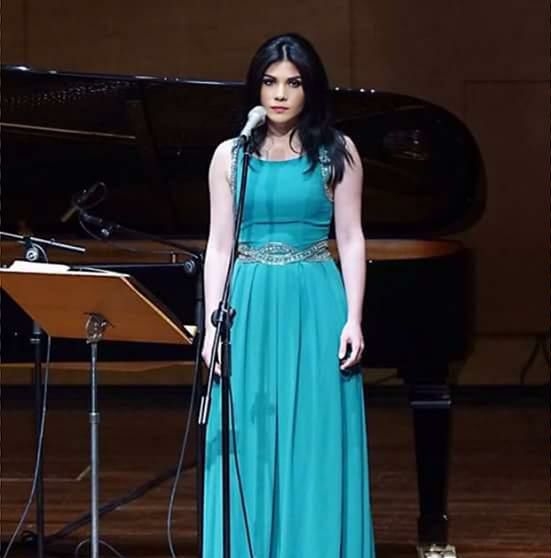
We here at the Paddy blog would like to wish you and your family a happy and peaceful Easter. This year I would like to share with you the beautiful voice of Nektaria Karantzi, a Greek singer of traditional Byzantine and Orthodox chant. Paddy was an admirer of Byzantium and I am sure also loved the music

Fine out more about Nektaria, her concerts and more video on her Facebook page.

Don’t forget to switch on the volume!

Who were Ghika, Craxton and Leigh Fermor?

A lovely video produced by the British Museum to accompany the exhibition Charmed lives in Greece: Ghika, Craxton, Leigh Fermor. Narrated by the exhibition curators. Discover more about their extraordinary friendship, creativity and life spent living together in Greece.

Charmed lives in Greece: Ghika, Craxton, Leigh Fermor
8 March – 15 July 2018
http://www.britishmuseum.org/charmedlives

Supported by the A. G. Leventis Foundation and organised with the A. G. Leventis Gallery. In collaboration with the Benaki Museum and Craxton Estate.

Benaki Museum and Aria Hotels announce alliance for the Patrick and Joan Leigh Fermor House

The Benaki Museum and Aria Hotels have announced an alliance for the Patrick and Joan Leigh Fermor House, situated in Kardamyli, Southeast Peloponnese, Greece.

In 1996 Sir Patrick and Joan Leigh Fermor bequeathed their home to the Benaki Museum with the express wish that the house would host intellectuals and scholars who wanted to work or study in an inspiring setting. The Leigh Fermors also granted the museum the right to rent the property for a period of three months per year, in order to cover the running costs of the house. Under the alliance the museum will ensure the preservation of the house and its contents, and enable members of the public to have access to the property, while hospitality services will be provided by Aria Hotels, a hotel and villas company that specializes in the provision of authentic retreats in restored, historic Greek properties.

In the 1960s Leigh Fermor and his wife Joan chose to spend the rest of their lives in Greece and to build their home, lavishing much love and attention on it, in the idyllic coastal town of Kardamyli. At present, repair works at the buildings and the garden are underway so that the original character of the property is meticulously preserved.

The Benaki Museum-Aria Hotels partnership will be launched in 2020. Aria Hotels has pledged that it will undertake operation of the property during the rental period with particular sensitivity to its unique legacy, offering guests a rare residential experience in an environment of immense charm and character. The Benaki Museum’s collaboration with Aria Hotels for the Patrick and Joan Leigh Fermor House will extend over the three-month rental period every year, in accordance with the terms of the bequest.

Aria Hotels is a family-owned boutique hotel and villas company that offers holidaymakers authentic Greek hospitality and the ultimate in simple, effortless charm. The company has several hotels and villas, all in exceptional destinations: Crete (Chania, Heraklion and Lassithi), Cyclades (Kimolos, Serifos, Milos, Santorini) and Epirus (Metsovo & Zagori). They are chosen to appeal to the discerning traveller looking for a secret hideaway in Greece. Each hotel has been selected for its architectural merit, and its contribution to the preservation of local heritage. Outstanding quality in service and accommodation are the core of the Aria Hotels experience.

The Transylvanian Book Festival 2018

Following the success of the first two festivals, Lucy Abel Smith has taken the plunge again and has organised a third event for this year. It will take place as usual in and around Richis, a village in the Saxon lands of Transylvania, during the period 13-16 September.

The Transylvanian Book Festival was set up by Lucy Abel Smith in 2013 to promote the literature and landscape of Transylvania. It could not have been envisaged that over the space of 5 years, the success of the festival would lead to a second and, now in 2018, a third edition.

The idea is not to collect the big names on random subjects, as many other festivals, but to draw together those who have written or researched subjects relevant to Romania and the UK. It is important it takes place in the country and is about the country.

In 2018, some of the subjects are Louise XIV and a rebel prince; The Sublime Porte and the Transylvanian Princes; Queen Marie of Romania; Architecture in Romania between the wars; Patrick Leigh Fermor: Noble Encounters Between Budapest and Transylvania; The Vagabond and the Princess (the story of PLF’s affair with Princess Balasha Cantacuzino); Dracula – an international perspective; as well as music, poetry and film.

The Festival provides a relaxed venue for writers, musicians and academics to meet with audiences which are mainly English speaking, and takes place in Richis, once a Saxon village, which has a large hall and stage. Richis is surrounded by similar beautiful villages offering accommodation amid the foothills of the Carpathians. The Festival brings much needed income into these communities.

The excursions are led by locals and meals are produced locally from the Priest House by Tony Timmerman and her team. Tony is a trustee of Pro Richis – the village charitable trust to which all profits from the festival are given. Literary Festivals have a record in being re-generative and we hope that the festival, as well as building international friendships, will help bolster local Transylvanian tourism.

Discover more about the Festival at the Festival website or contact Lucy Abel Smith: lucy[at]realityandbeyond.co.uk

Lament from Epirus

Some readers may be interested in this forthcoming book by Grammy-winning producer Christopher C King, about the oldest fold music tradition in Europe, music that Paddy almost certainly would have come across in his travels across northern Greece.

Described as being in the tradition of Patrick Leigh Fermor and Geoff Dyer, Christopher King discovers a powerful and ancient folk music tradition.

In a dark record shop in Istanbul, King uncovered some of the strangest and most hypnotic sounds he had ever heard. The 78s seemed to tap into a primal well of emotion inaccessible to contemporary music. The songs, King learned, were from Epirus, an area straddling southern Albania and northwestern Greece and boasting a folk tradition extending back to the pre-Homeric era. Lament from Epirus is an unforgettable journey into a musical obsession which follows a genre back to the roots of song itself. As King hunts for traces of two long-lost virtuosos, he tells the story of the Roma people who pioneered Epirotic folk music and whose descendants continue the tradition today. His journey becomes an investigation into song and dance’s role as a means of spiritual healing and what this may reveal about music’s original purpose.

The book is due for release in May and can be pre-ordered on Amazon. Lament from Epirus: An Odyssey Into Europe’s Oldest Surviving Folk Music

Patrick Leigh Fermor – the journey continues

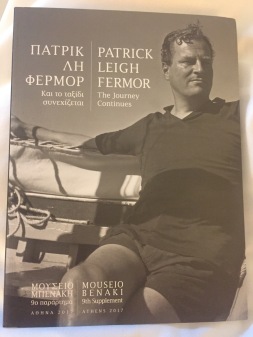
From time to time, the Benaki Museum publishes a supplement to its regular journal, and the 9th Supplement is a masterpiece dedicated to Paddy’s life.

Well bound, and coffee table book sized, there are over twenty new articles exploring a range of topics including Paddy’s intimates and friends, his walks, the Cretan resistance, wider discussions of Greece, Paddy’s writing and of course the house.

The Benaki have assembled a remarkable collection of writers including Hamish Robertson, Cressida Connolly, the Marques de Tamaron, Nick Hunt, John Kitmer, Chris White, Colin Thubron, John Julius Norwich, Adam Sisman, and Roberto Calasso amongst others.

The supplement is available from the Benaki Museum shop for 18 Euros plus worldwide DHL shipping.

Details of the contents are here.

Charmed lives in Greece: Ghika, Craxton, Leigh Fermor at the British Museum

Nikos Hadjikyriakos-Ghika (1906–1994), Study for a poster. Tempera on cardboard, 1948. Benaki Museum – Ghika Gallery, Athens. © Benaki Museum 2018.

The British Musem has at last started to publicise this exhibition which focuses on the friendship of the artists Niko Ghika and John Craxton, and the writer Patrick Leigh Fermor. Their shared love of Greece was fundamental to their work, as they embraced its sights, sounds, colours and people.

Where? The British Museum, Room 5

When? 8 March – 15 July 2018

How Much? It is free!

Nikos Hadjikyriakos-Ghika (1906–1994), John Craxton (1922–2009) and Sir Patrick Leigh Fermor (1915–2011) were significant cultural figures of the 20th century. Leigh Fermor is perhaps the most widely known of the three – largely through his travel writings – and Ghika and Craxton are now recognised as two of the most remarkable artists of this period. The three first met at the end of the Second World War, becoming lifelong friends and spending much of their subsequent lives in Greece. The time they spent together and their close bonds would shape each other’s work for the rest of their lives.

The exhibition brings together their artworks, photographs, letters and personal possessions in the UK for the first time. Highlights include Ghika’s extraordinary painting Mystras and Craxton’s exuberant Still Life with Three Sailors. Also featured is Craxton’s original artwork for the book covers of Leigh Fermor’s travel classics A Time of Gifts and Between the Woods and the Water. Many artworks and objects on display are on loan from the Benaki Museum, to which Ghika donated his house and works, from the Craxton Estate, and from institutions and private collections in the UK and Greece.

The exhibition focuses on four key places – Hydra, Kardamyli, Crete and Corfu – where they lived and spent time together. Hydra is an island where Ghika’s family home became a gathering place for the three friends, and Leigh Fermor built a house with his wife Joan at Kardamyli. Craxton restored a house at Chania on Crete, and Corfu is where Ghika and his second wife Barbara transformed an old building into an idyllic home and garden.

Together, these places chart the story of this remarkable friendship, and how the people and landscapes of Greece were a great influence on their enduring works.

Presentation in Melbourne, Australia: The Cretan Resistance and SOE in WW2

British-based author and historian, regular blog contributor, and co-author of Abducting a General, Chris White, will outline his research into the story of the resistance to German occupation on Crete during WW2, including the experience of the British SOE agents and the famous kidnapping of the German General Kreipe in 1944. The presentation will feature photographs from the time – many rarely seen before – as well as Chris’ own taken as part of his identification of the locations used by the resistance and SOE.

There will be an opportunity afterwards for attendees to meet with Chris to discuss specific villages and areas, and to consider some of the many photographs taken on Crete in WW2 in his collection.

A unique presentation not to be missed.

Where: Mezzanine, Greek Centre, 168 Lonsdale Street, Melbourne
When: 2.00pm start, Saturday, 17th March 2018

As an addendum, happening the week before, is the inaugural Rebeitiko Festival being held at the Melbourne Recital Centre (very prestigious venue). https://www.melbournerecital.com.au/events/2018/rebetiko/

Rebetiko is the music of struggle and resistance. Songs were written in Crete recording the exploits of the Cretan resistance and the kidnapping. It is possible that they include a few songs on that subject. No committal as yet!

Persian princes and twelve cadillacs

Paddy sent this letter to Deborah Devonshire in October 1960, having completed a road trip through the Balkans. Read more of their letters in Dashing for the Post: The Letters of Patrick Leigh Fermor

Darling Debo,

Off we set in Joan’s Sunbeam Rapier, hood down, singing at the wheel, heading from Le Touquet to our old friend Lady Smart’s, spent three days there, then into a deserted dusty summer Paris, so bare that it might have been emptied by a Bedouin raid, and south to Fontainebleau, for a further three days of utmost luxury and pleasure at your old pal Charles de Noailles and Natalie’s house … Then off hot wheel eastwards to Chatillon-sur-Marne, to see the Vix Vase, a huge Greco-Etruscan amphora dug up seven years ago …

Then across the Rhine, through the Black Forest, one night on the shores of Lake Constance surrounded by Germans; south into the Austrian Tyrol, on into Italy at Bolzano, then clean through the Dolomites, hundreds of miles of sheer and dizzy spikes a-gush with streams out of which beautiful trout virtually leap straight on to frying pan, grill and saucepan; north of Venice into Yugoslavia at last; through Slovenia to Lubliana, through Croatia to Zagreb, then east along a billiard table autostrada towards Belgrade. Now, a travel tip for motoring in Yugoslavia: there are only about three petrol pumps the country, and scarcely any motors. We ran out hundreds of miles from one on this autostrada in the heat of the day and settled for hours under an acacia tree … until at last a caravan of twelve Cadillacs drew up and succoured us by siphoning petrol out of their tanks. They were a party of Persian princes with their sloe-eyed princesses on the way from Claridge’s to Teheran. They partook freely of our wine flask, asked us to stay in their palaces (the competition began to look ugly) and then slipped into gear for Iran.

We continued south into wildest Bosnia, where mountains began to rise and minarets to sprout in every village, each alive with Moslem invocations intoned thrice daily. The roads became dust tracks across plains or twisty ledges of rubble little wider than eyebrows along the rims of deep gorges at the bottom of which huge rivers curled and swooped through echoing and forested ravines, with here and there an old Turkish bridge spanning them as thinly and insubstantially as a rainbow. The food became odd and wonderful, stuffed with garlic and paprika and the sunlight and our breath got stronger with every mile. So on to Sarajevo, scene of the Archduke’s murder, and, through range after range of mountains to Dubrovnik on the Dalmatian coast, a terrific medieval walled city full of renaissance palaces and belfries and winding columns and cloisters, and oysters too—huge and wonderful ones. South of this is the old kingdom of Montenegro, now part of Yugoslavia, reached after a three-hour zigzag up a sheer and cloud-topped wall of mountain, looking down on to strange rock fjords caked with water lilies and with pyramid-shaped mountains that hover on mist like the ones in Japanese pictures, and plenty of gliding storks …

Into Greek Macedonia at last, and then by familiar roads to Athens … a colossal road is being built outside, with fifty pneumatic drills, giant steel claws for rubble, hydraulic pumps, steamrollers and blasphemy. One has to talk in bellows. I have now bought some pink wax ear plugs, which makes everything even eerier. I see massed drills a-shudder, rollers a-crunch, and ten tons of broken concrete crashing from suddenly gaping steel claws all only a few yards off, and all in dead silence; lorries hurtle by as soundlessly as minnows. Meanwhile, one’s heart sounds like a steam hammer, and one’s own steps like nail-clad footfalls in a cathedral.

Published in The Paris Review

Crisp, clean images of the house at Kalamitsi

Some lovely new images of the house (pre-works) which you may enjoy. From Greek Gastronomy Guide.

Help needed – high resolution photos of John Pendlebury

John Pendlebury at Knossos

Hello all. I have a request from Crystalia Patouli who is writing an article for a magazine in Greek and English. She would like to include some high resolution pictures of John Pendlebury. If you can help please contact Crystalia – cpatouli[at]gmail.com

Thank you.

A forlorn ultimate border of reality

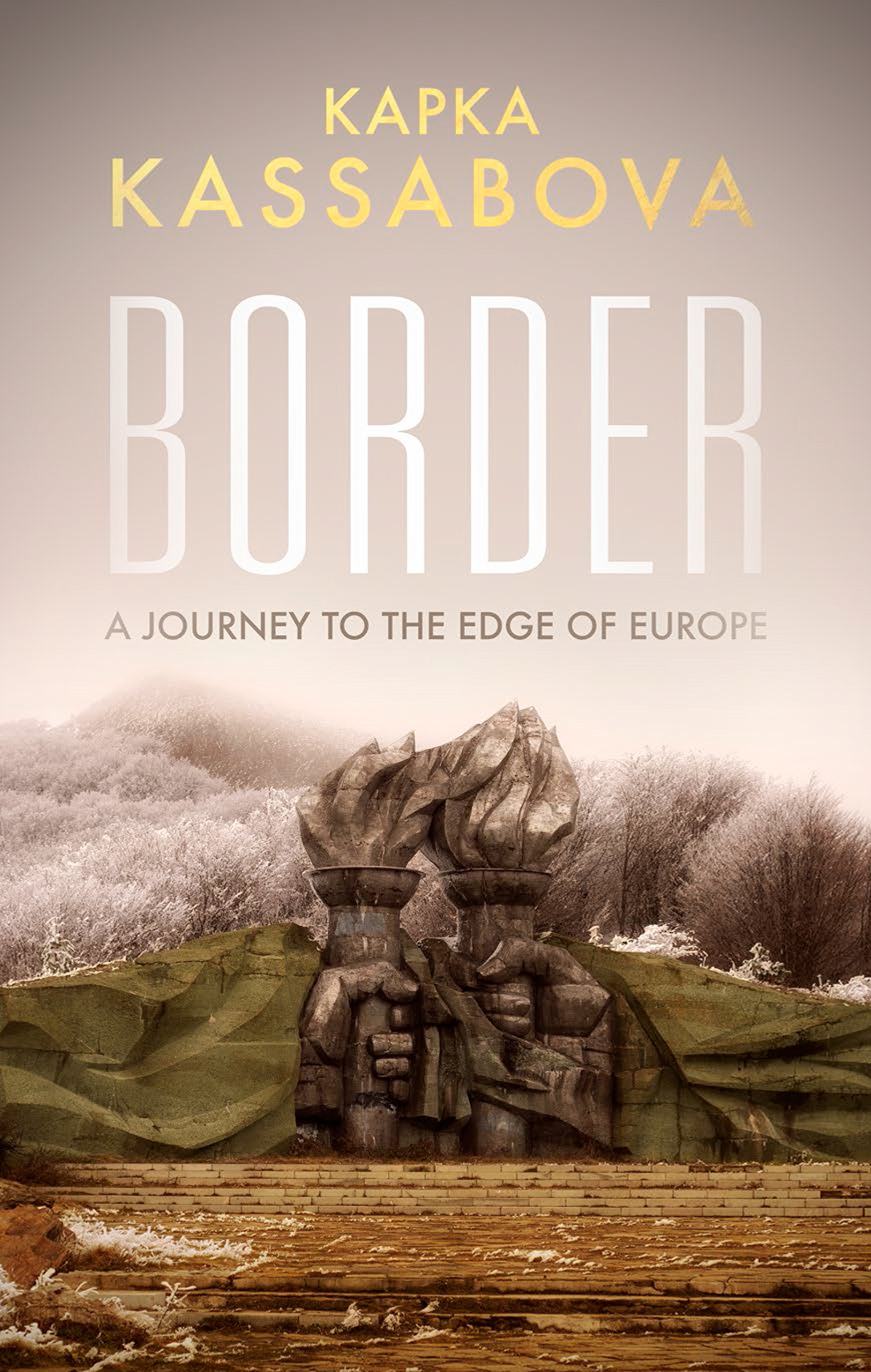
Kapka Kassabova’s Border: A Journey to the Edge of Europe is a timely, powerful story of immigration, friendship and travel.
By Caroline Moorhead

First published in The New Statesman

When Kapka Kassabova was in her late thirties, she decided to return to the place where she had grown up, but had not seen for 25 years: the borderlands of eastern Thrace, where Bulgaria, Greece and Turkey meet. Her parents were Bulgarian scientists who, after a spell in the UK, had settled in New Zealand, where, she writes, the Kiwi speech made “fish” sound like “fush” and “chips” like “chups”, where the stars were rearran­ged and the seasons inverted: an “upside-down world, but then it always is, for the immigrant”. It is again as an immigrant, a wanderer, that Kassabova – who now lives in the Scottish Highlands – went to find the forbidden places of her childhood.

“Forbidden” because her early years were confined by the militarised border that separated the three countries, acting as a cut-off line between the Warsaw Pact states of the Soviet bloc and Nato members, in the Western sphere of influence. Though the end of the Cold War and shared EU membership “softened” the border between Greece and Bulgaria, it was once “deadly”, she says, and it “remains prickly with dread to this day”. This is an exceptional book, a tale of travelling and listening closely, and it brings something altogether new to the mounting literature on the story of modern migration.

Kassabova started her journey on the Black Sea, dropped westwards to the border plains of Thrace, crossed the passes of the Rhodope Mountains, and made her way in a circle back to the sea again. (A better map would have been invaluable.) Everywhere she went she paused, took time to make friends and hear people’s stories, to look at her surroundings and understand them, to meditate on the nature of borders and to remember her own confined childhood, when she first became conscious that, unlike other holidaymakers to the Black Sea, she was not free to leave Bulgaria. A border, she writes, is something that you carry inside you without knowing. Like Freya Stark, who also wandered through remote parts, Kassabova has a gift for relating the past to the present: Herodotus, Atatürk and the Greek gods all accompany her on her travels.

The countryside she describes is wild, remote, sometimes scary, covered in the blackest of forests, where wolves, boar, bears and vipers are to be found, where the villages are inhabited by old people, the young having long since left, and where “entrepreneurs and consumers, desperadoes and smugglers” hold sway. She meets former border guards, traffickers, foresters and lighthouse keepers. Many of them are refugees from earlier migrations, expelled from their homes by conflicts, victims of nationalist feuds that had lain dormant for years, or the children of immigrants, whose love of their homeland is strong but who exist in a permanent sense of limbo, ever poised to flee.

With some of her new friends, she crosses backwards and forwards across the former border, travelling in cars so old it seems unlikely that they can cope with the steep mountain tracks. With others, she just sits and talks. There is Ivo the herbalist, a man with a “heroic” moustache, forced through bankruptcy to settle in what was once his holiday home, who grows aubergines as heavy as hand grenades and makes an ointment that cures everything from psoriasis to alopecia; and the divorced former teacher Ioanna, now a mountain climber, who patrols the forests for poachers, illegal loggers, drug dealers and illegal immigrants as she searches for abandoned treasure; and Mr Karadeniz, whose father was five years old when he threw a stone at a pig requisitioned by Greek soldiers and whose grandmother, fearing reprisals, whisked her son over the border to hide with Bulgarian neighbours.

Into this mix have come today’s refugees, the Syrians, Iraqis and Afghans, struggling to find safe routes to the West, their journeys truncated by new wire fences and hostile officials. “Europe,” one Kurdish woman marooned in a village on the Turkish border tells her sadly, “is where you are not afraid.” She fled with her eight children to prevent them being conscripted to fight Isis; but where she will go now, no one can say. The strength of Kassabova’s book lies in the skill with which she interweaves the narrative of these people into that of the inhabitants of the borderlands, giving the context for their lives in a way that the dozens of current books on the travels and travails of modern refugees seldom do. They enter her journey, and she listens to them, as she listens to everyone. It is an important reminder that refugees are not a separate species, moving inexorably away and towards, but part of a vast, complicated pattern of history.

Everywhere she goes, Kassabova takes stock of her surroundings, the birds and the mountains, the ruined monasteries and caves, the rock formations and waterfalls. Sometimes charmed, sometimes frightened, sometimes haunted by the ghosts that seem to inhabit these lost mountainous lands, she writes about roses, about belly dancing, fire worship and dragons. Her curiosity is limitless.

Patrick Leigh Fermor once wrote about a “forlorn ultimate border of reality beyond which a cloud of legend, rumour and surmise began”. This is Kassabova’s territory. And if, at the end of the book, it is hard to name the many characters she has met, or to recall with precision the places she has visited, she leaves a vivid image of these lands and the people who occupy them. Equally powerful is her own sense of sympathy for the uprooted and dispossessed. “I felt very strongly that within my lifetime, we may all become exiles,” she writes. “That we may all be robbed by devouring daemons disguised as policy and industry, that we may all walk down some road carrying in plastic bags our memories of forests and mountains, clean rivers and village lanes.” At a moment when Hungary has promised to incarcerate all who cross its borders ­illegally, and when asylum-seekers are adrift from one end of the world to the other, Border makes for timely reading.

Buy Border: A Journey to the Edge of Europe

How an idyllic Greek hideaway inspired a British war hero and travel writer

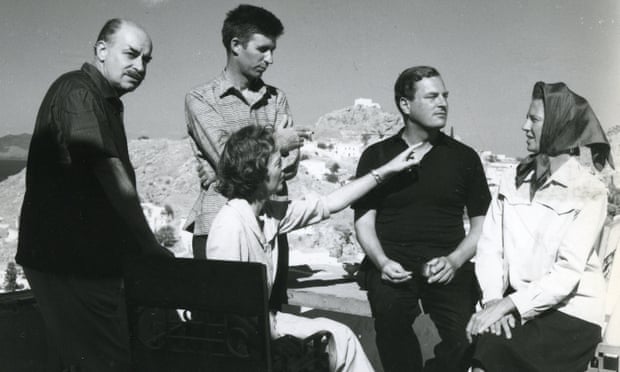
Nikos and Barbara Hadjikyriakos-Ghika with John Craxton, Patrick Leigh Fermor and Joan Fermor, in 1958. Photograph: Benaki Museum – Ghika Gallery, Athens.© Benaki Museum.

By Jamie Doward

First published in The Guardian

24 December 2017

Oh, to have been a fly on the bougainvillea-clad wall as the drinks flowed and the sun sank behind the beautiful house tucked away in a remote part of Greece.

One night a visitor might find Stephen Spender or Louis MacNeice. Another, Lawrence Durrell and John Betjeman.

But always holding court, cigarette in hand, ouzo glass raised, would be Sir Patrick “Paddy” Leigh Fermor, the war hero and travel writer often said to be the inspiration for his friend Ian Fleming’s most famous creation, James Bond.

In the late 1950s, the house Leigh Fermor built with his wife Joan in Kardamyli, a seaside village located in the Mani peninsula, in the southern Peloponnese, became a haven for writers and artists drawn to its owner’s extraordinary charisma and the wild, arid beauty of the surrounding landscape.

It was here that Leigh Fermor, who died in 2011 aged 96, built his close friendship with two men – the Greek artist Nikos Hadjikyriakos-Ghika, who lived on Hydra before moving to Corfu, and the British painter, John Craxton, who lived for a time on Crete. Now the remarkable friendship is to be explored in a new exhibition at the British Museum that will open next spring.

Charmed Lives examines the influence that post-war Greece had on the three men and brings together in the UK for the first time their artworks, photographs, letters and personal possessions. Among the items on display will be Leigh Fermor’s typewriter (which he never managed to master), his binoculars and a Leica camera belonging to Joan, a professional photographer.

Striking paintings of Greek landscapes and local people by both Craxton and Ghika will feature alongside extracts from Leigh Fermor’s many books.

John Craxton’s ‘Still Life with Three Sailors’ reflects his Greek inspirations. Photograph: John Craxton

Sir Michael Llewellyn-Smith, a former British ambassador to Athens, who knew all three men and is one of the exhibition’s curators, conceded many would be drawn by the cult of Leigh Fermor, a polyglot and autodidact once described as “a cross between Indiana Jones, James Bond and Graham Greene.”

“There’s a tremendous fashion for him,” Llewellyn-Smith said. “In a way you’d expect it to diminish over time but the opposite is happening and it’s very difficult to explain. I don’t think it’s fully related to his work. It is for some people but there are others who are attracted by the legend.”

Much of Leigh Fermor’s legend is burnished by his epic walk from the Hook of Holland to Istanbul, made as an 18-year-old, and his heroics during the second world war when, leading a group of Cretan resistance fighters, he captured the German commander General Heinrich Kreipe in one of the most audacious acts in the history of the Special Operations Executive.

While his postwar books such as A Time Of Gifts cemented his legend and led to Leigh Fermor being regarded as one of the great travel writers, it transpires that the real-life 007 also dabbled as an artist and several of his works will be on display in the exhibition. These include six portraits of Cretan resistance fighters painted in 1942. They are the only ones out of around 20 similar paintings to have survived. The majority were destroyed as the Germans advanced.

“Paddy had an extremely acute visual sense and was himself an artist, an amateur,” Llewellyn-Smith said. “When he was walking across Europe, when he was 18 to 20 years old, around Vienna he had virtually no money and so he started drawing portraits of people to get enough to get a crust of bread or more.”

Llewellyn-Smith said the fact that all three men had died only relatively recently –Ghika in 1994, Craxton in 2009 – meant there was much to be gained by producing an exhibition of their lives and friendship now.

“A lot of people who knew them are still around, and therefore for those organising the exhibition, such as myself, it was possible to talk to them and get their memories and anecdotes. This couldn’t have been done if the exhibition had been delayed by many years.”

The organisers say they hope it will offer visitors an opportunity to reflect on Greece’s enduring role as a source of artistic inspiration. It may also offer a subtle reminder that British-Hellenic relations can be about more than that most famous of British Museum attractions, the Parthenon marbles. “This period when these three men got to know each other was a period of artistic and literary collaboration, almost a renaissance between British and Greek artists and writers,” Llewellyn-Smith said. “It didn’t have anything to do with politics and returning sculptures to Greece. That’s a different century.”

It may also offer clues as to why, despite smoking around 80 cigarettes a day, just like Fleming’s Bond, Leigh Fermor managed to live so long. “When he was in the Peloponnese he would go for walks every day in the mountains behind the house and he’d swim for half an hour every morning,” Llewellyn-Smith said.

In his will, Leigh Fermor gave the house to the Benaki museum in Athens with instructions for it to be turned into a writers’ retreat. While some of Leigh Fermor’s devoted fanbase have grumbled about the pace of its renovation – which at one stage appeared to have fallen victim to Greece’s economic woes, – there are hopes the exhibition may elicit funds to speed things up.

If so, it would mean that more than half a century on from when Leigh Fermor built his idyll, it will once again help nurture a new generation of artists and writer.

Charmed Lives in Greece the exhibition will run at the British Museum 8 Mar-15 July 2018

Patrick Leigh Fermor and the Pleasures of Places and People

Patrick Leigh Fermor in later life

We are fortunate to have a number of articles by the American writer Ben Downing on the blog. Downing specialises in nineteenth- and twentieth-century British social life and literature. His three part A Visit with Patrick Leigh Fermor can be found here. The following article is his review of Patrick Leigh Fermor: A Life in Letters.

By Ben Downing

First published in the Wall Street Journal

1 December 2017

In a 1958 diary entry, the writer and Bloomsbury Group member Frances Partridge recalled a dinner during which “the conversation turned to present-day pessimism, or cafard. Where can one look to find enthusiasm for living? I could only think of Paddy Leigh Fermor.” Called Paddy by his legion of friends, Patrick Leigh Fermor (1915-2011) struck many as a paragon of zest, a man on whom scarcely a crumb of life’s banquet was wasted. Prodigiously smart, charming, funny and handsome as well, he dazzled most who met him. His social gifts, however, threatened his literary ones: Why struggle to write at a lonely desk when you can swill whiskey on the terrace all night and talk like a Roman candle?

Fortunately, Leigh Fermor did struggle, some of the time. The result is a body of prose—travel books, mostly—radiant with his brilliance and unique experience but also with his exuberance and warmth. Especially in his magnum opus, a three-volume account of walking as a teenager from Holland to Istanbul, his erudition and descriptive skill are balanced by simple likability—never, one feels, has so much riveting detail been so beautifully served up by such an irresistible person.

Leigh Fermor published little during his last decades, but the years since his death have yielded several books by or about him. All rewarding, at least to fans, were Artemis Cooper’s biography, Wes Davis’s account of Leigh Fermor’s most celebrated military exploit (the abduction of a Nazi general on Crete) and Nick Hunt’s book about retracing his route across Europe. The real treat, though, was a book few expected ever to see: the last part of his trilogy, posthumously published as “The Broken Road.” Leigh Fermor’s inability to finish it, despite a quarter-century of fitful labor, was the great frustration and sorrow of his life, yet the manuscript his executors assembled was nearly complete and full of his usual panache.

Nor was that the last of the manna. The publication, in 2008, of Leigh Fermor’s correspondence with Deborah Devonshire (the youngest Mitford sister) had shown his letters to have many of the virtues of his books, including a more casual version of their tumbling, gloriously idiosyncratic style. But the bulk of his letters—untold thousands of them—remained unseen. Then, last year, a selection, edited and introduced by the outstanding biographer Adam Sisman, appeared in Britain. Now available here, it spans 70 of Leigh Fermor’s 96 years. Like his travel books, it amounts largely to a gushing expression of pleasure in art, history, places and people, but it also gives glimpses of his battles with indolence and the toll they took.

Addressed mainly to friends, lovers and Leigh Fermor’s longtime partner, Joan Rayner (whom he married in 1968), the letters are notable for, if nothing else, the variety of their postmarks. Even after he got a place of his own—a house in the Peloponnese that he and Joan built in the early ’60s—Leigh Fermor spent half his life as a wandering guest, and from age 18 to almost 50 he hopped constantly between dwellings, most of them romantic, secluded, and either dirt cheap or free. A 1953 letter contains a typical update: “I am established in a damp and ruined Aragonese fortress on the edge of the Tuscan Maremma, a sort of Zenda, really.”

Though he often sought isolation in order to work, Leigh Fermor’s gregariousness and polyglotism made him a poor hermit. Ensconced in a French monastery in 1948, he wrote that its chatty abbot had befriended him. “Occasionally he lapses into Latin. . . . It is the first time I have ever heard it spoken as a living language, and . . . I flog my brains to construct a sentence, feverishly trying to get the syntax right, usually a question that at last I enunciate with as much nonchalance as I can muster, to keep going the flow of this silvery monologue.”

Odd encounters were routine for Leigh Fermor. In a 1975 letter he describes one three decades in the making. After he accidentally killed a Cretan guerrilla during the war, the man’s hothead nephew, Yorgo, refused to forgive him. Revisiting “old haunts in Crete” in the 1950s, he was warned that Yorgo, a crack shot, planned to assassinate him. Intermediaries pleaded fruitlessly with Yorgo for years after that. Then, out of the blue, Yorgo asked Leigh Fermor to be his infant daughter’s godfather. (“This is the classical and only happy ending to a Cretan blood feud.”) The very next week he flew to Crete for the baptism. At the drunken banquet for 300 that followed, Yorgo hugged him and offered to eliminate “anyone you want got rid of.” “I hastened to say that there was no one, absolutely no one! ”

Not surprisingly, Leigh Fermor’s sex life was robust: With Joan’s consent, he enjoyed flings, affairs and the low delights of the brothel. This activity rarely makes it into his letters, but the exceptions can be piquant. Writing in 1958 from Cameroon, where he was on the set of a John Huston movie, he told a (male) friend: “ Errol Flynn and I . . . sally forth into dark lanes of the town together on guilty excursions that remind me rather of old Greek days with you.” One of the book’s zaniest passages is in a 1961 letter to Huston’s wife, Ricki, with whom Leigh Fermor had been sleeping. “I say,” the passage begins, “what gloomy tidings about the CRABS! Could it be me?” Riffing on pubic lice and their crafty ways, he conjectures that, during a recent romp with an “old pal” in Paris, a force “must have landed” on him “and then lain up, seeing me merely as a stepping stone or a springboard to better things”—to Mrs. Huston, that is. As comic apologies for venereal infection go, the passage is surely a classic.

If high spirits dominate the letters, pain often throbs at their edges. What Leigh Fermor termed “neurotic literary paralysis” led to spells of depression, and the pattern worsened with age. “My reaction to any demand for writing,” he confessed to his long-suffering editor and publisher, Jock Murray, in 1965, “seems to be to dig an enormous bog and flounder in it.” The acute phase began after the publication, in 1986, of the second volume of his trilogy. Istanbul in sight, he hoped his sails would fill with steady wind but instead found himself largely becalmed.

Full of self-deprecation (“I can be a terrible gasbag”) and profuse apology (most often for his slowness as a correspondent), Leigh Fermor’s letters are remarkably free of backbiting, bellyaching and other standard epistolary vices. When referring to the Oxford don Maurice Bowra, he cannot resist the mocking anagram “Eroica Rawbum.” And in 1974 he rants, ever so briefly, about the decline of Greek civilization: “I can’t help feeling there has been a serious break since the times of Theocritus.” That’s about it, though.

However appealing, Leigh Fermor’s sunny disposition somewhat constrains his letters, which lack variety of tone and the kind of frank, piercing comment on human behavior and emotion one looks for in the genre. (An exception is the handful of psychologically astute letters about his troubled mother.) It is this that makes me not quite agree with Adam Sisman’s assertion that the best ones are “as good as any in the language.” What’s more, to fully appreciate Leigh Fermor’s letters you need to be familiar with, or at least curious about, the circles he moved in. If names like Lady Diana Cooper mean nothing and you couldn’t care less about the half-bohemian, half-aristocratic world of footloose Brits in the Mediterranean (dating back to Byron and Shelley), this might not be the book for you.

Then again, it might. For all their beau monde glitter, Leigh Fermor’s letters are touching in a universally appreciable way. Writing to, among others, the widowed Diana Cooper and his former lover Balasha Cantacuzène, a Romanian princess and painter who endured many hardships under communism, he displayed a tender solicitude and eagerness to raise spirits that must have brought both laughter and tears and that are, in the best sense, chivalrous. (When he was knighted in 2004, it seemed appropriate not just to his achievements but his character.)

Most moving of all is to watch Leigh Fermor maintain his gallantry, verve and humor to the end. (He was nearly 95 when he wrote the last letter in Mr. Sisman’s selection.) Having gotten to know him in 2001, I received a few of these late letters. Embellished with drawings of clouds and birds, they seemed at first sight to be written in Linear A, but as I slowly deciphered their scrawl I found jokes, flights of fancy, extravagant mea culpas, deep learning worn lightly as silk. Thanks to Mr. Sisman, readers everywhere can have (minus the furrowed brows and headaches) a similar experience, discovering how this wonderful man made sheets of stationery, like the pages of his incomparable travelogues, glow.

—Mr. Downing is the author of “Queen Bee of Tuscany: The Redoubtable Janet Ross. ”

Sisters Queen Margrethe and Queen Anne-Marie make rare joint appearance at “To Greece with Love” symposium

It looks like the PLF symposium held in Copenhagen was a great success with Royal attendees.

This report from Royal Central.

Her Majesty Queen Margrethe of Denmark and her younger sister, Queen Anne-Marie of Greece made a rare joint appearance together yesterday at the University of Copenhagen for the “To Greece with Love” symposium.

The two-day conference, attended by people from as far away as Texas, USA, was organised around the British travel writer and freedom fighter in Greece, Patrick Leigh Fermor. Their Majesties heard various lectures, including one from Patrick Leigh Fermor’s biographer, Artemis Cooper.

The Queen of Denmark had met Artemis Cooper in 2017 during a lunch in the United Kingdom.

Queen Margrethe, who has reportedly read all of Fermor’s travel books, and Queen Anne-Marie were private guests at the event and were welcomed by Charles Lock, an English professor at the University of Copenhagen upon their arrival.

Patrick Leigh Fermor died in 2011 and was considered as one of Britain’s greatest travel writers during his lifetime. He played a prominent role during the Second World War in the Cretan resistance in Greece.

Queen Anne-Marie (born Princess Anne-Marie of Denmark) is six years younger than Queen Margrethe. They have another sister, Princess Beneditke, who was born in 1944. Anne-Marie was 13 when she first met her future husband, the then Prince Constantine of Greece and Denmark in 1959. Their engagement was announced in July 1964 – just a few months after Constantine had become King of Greece. They married on 18 September 1964 and have five children: Princess Alexia, Crown Prince Pavlos, Prince Nikolaos, Princess Theodora and Prince Philippos.

The family was forced into exile in Greece in the late 1960s when a military junta took over. They first lived in Italy before relocating to England. They were not permitted to return to Greece until 1981 when they were allowed to enter the country for a few hours to attend the funeral of Constantine’s mother, Queen Frederika.

King Constantine, Queen Anne-Marie, their son Prince Nikolaos and his wife, Princess Tatiana now reside in Greece.

Where exactly is Paddy and Balasha’s watermill?

I have been contacted by Pilar Gonzalez, from Spain, seeking more information about the watermill where Paddy stayed with Balasha in 1935.

This May, Pilar and a friend plan to go Greece and they want to find the mill, named Los Limoneros. This apparently is in Lemonodassos in the southeast of Galatas, overlooking Poros.

Pilar would be grateful for any ideas or information about the exact location of the mill. Please get in touch by making a comment or emailing me (see About & Contact page).

Tom

A tour of Paddy and Joan’s house

A Greek video showing the house, Ethan Hawke, local characters, and a cat.