Tag Archives: Greece

A man so charming he won over his hostage

Charles Moore reviews ‘Patrick Leigh Fermor: an Adventure’ by Artemis Cooper (John Murray) 

By Charles Moore

First published in the Daily Telegraph 08 October 2012.

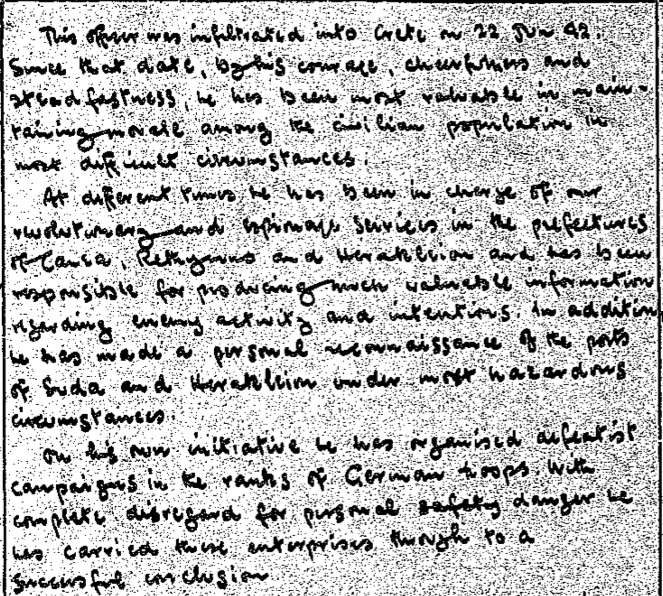
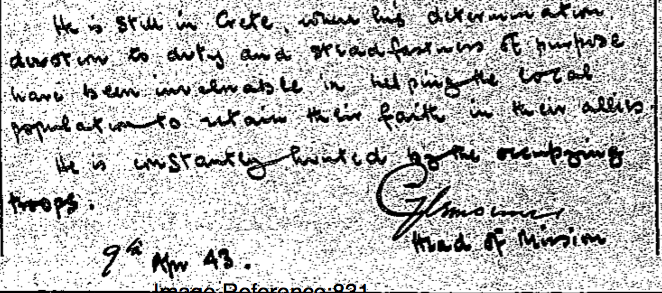
The single most famous story about Patrick Leigh Fermor is his kidnap of the German General Kreipe in occupied Crete in 1944. The fugitive party of two British officers and three Cretans spent an uncomfortable night on the slopes of Mount Ida. As the dawn broke, and lit the mountain, Leigh Fermor heard the General muttering the first line of Horace’s Ode to Thaliarchus: “See, Soracte’s mighty peak stands deep in virgin snow.” Leigh Fermor recognised the Latin, and quoted the rest of the poem. As he later put it, “…for a long moment, the war had ceased to exist. We had both drunk at the same fountains long before; and things were different between us for the rest of our time together.”

This moment of ancient, shared civilisation overcoming a terrible present is a great theme. It is the subject, for example, of Jean Renoir’s film La Grande Illusion, in which a French and a German officer on opposite sides in the First World War feel that they share what really matters.

Leigh Fermor’s long life (he died last year aged 96) was full of dash, variety and colour. He wrote beautifully, and entranced beautiful women. He was physically brave, and travelled widely, intrepidly and observantly. He was, in a self-taught way, learned, and a superb linguist. He could sing, dance, compose impromptu poetry and make everyone laugh. He and his wife Joan built a house in Greece of such character and interest that John Betjeman called it “a book in itself”. He was a war hero and, like Byron, a model for many aspiring writers greedy to combine art and life, rather than choosing between one and the other. I knew Paddy a bit myself, and I have never met a man with more charm, by which I mean the ability to create in his interlocutor the feeling of pleasure and possibility. But was it all a grande illusion, a wonderful holiday from reality?

Artemis Cooper was a family friend of Leigh Fermor, and loved him dearly. This excellent, well-sourced book is sympathetic to him. But she is aware of how he could be painted differently, and states the case. Was he, for example, a show-off and a sponger (he was chronically short of money and depended heavily on Joan’s private income)? Was he, as Somerset Maugham put it, “a middle-class gigolo for upper-class women”? Was he, both in life and art, a sort of Peter Pan, shying away from anything grown-up (such as fatherhood), always looking for a Wendy so that he could go on having smiling, heartless fun? He was once asked to contribute to a book about great parties in history with the astonishing title of Memorable Balls: does the phrase fit the life of Patrick Leigh Fermor?

There are certainly moments when it feels like it. The information that Joan used to give him cash so that he could visit prostitutes is one. So – though there is artistic reason for it – is his tendency to present the product of his imagination as fact. Some even argue that the famous kidnap was a piece of useless swagger – what Kreipe called a “hussar-stunt” – which ensured that the Cretans, in reprisal, were treated even more bestially by the Germans.

One cannot ignore these criticisms, and Leigh Fermor felt them himself. Like many delightful, gregarious companions, he doubted whether he deserved to be loved. But, in Artemis Cooper’s convincing reading, he wins in the end.

First, he wins as a friend. He was always grateful to people who helped him (not a well-known characteristic of most writers). He thanked them beautifully, and he did what he could to help them in return. He was famously hospitable, and his life was cluttered by efforts to advance the careers of others, particularly impecunious Greeks. As an editor, I quite often asked Paddy to write things. Most commissions would be refused or – he was famous for this – arrive incredibly late, but whenever I asked him to contribute a memoir of a friend who had just died, he did it with great speed and generosity.

Second, he wins as a writer. Not everyone likes what Lawrence Durrell called (in praise) his “truffled style”, but, unlike so much “fine writing”, it is saved by its energy and wit, its close attention to detail, and its astonishing virtuosity.

I think the friendships and the art went together. Leigh Fermor was profoundly sensitive to human character, particularly in its oddities. His interest in peasants, or monks, or petty gentry, cut off from industrialisation, his fascination with their traditions and customs, their languages and dialects (the more obscure the better) was a human interest, not an academic one. He loved them, and he wanted to rescue and decorate their story.

His most famous books, A Time of Gifts and Between the Woods and the Water, describe his journey on foot, which began in 1933, from the Hook of Holland to Constantinople. They capture, with painterly vividness, what he saw and whom he met. And because those scenes and people were almost obliterated by the Second World War and then by communism, by writing about them afterwards, he gave them the eternal status of literature rather than mere memoir.

In the early Seventies, Greek television did a sort of This is Your Life, in which Leigh Fermor was reunited with his Cretan companions and with General Kreipe himself. How had Paddy treated him, journalists asked the general. “Ritterlich. Wie ein Ritter,” Kreipe replied – “Chivalrously. Like a knight.” Possibly such virtues are dead, but if so, we are the poorer. In life and in literature, Patrick Leigh Fermor proved that chivalry was not all illusion.

Related article:

Patrick Leigh Fermor … This is Your (Ill Met by Moonlight) Greek Life

John Chapman’s ManiGuide

The publication this week of the article by Kevin Rushby about his search for the memories of Paddy and Bruce Chatwin in the Mani prompted a degree of comment; not much of it particularly flattering. There were many unfavourable comparisons made with the excellent work of John Chapman in his ManiGuide website.

Back in 2010 I did a feature about the Guide saying ‘Having had a quick scoot around it certainly looks very comprehensive, so if you are planning on a visit to the Mani you may wish to use it…  the content looks very useful indeed.’

Following the comments about Rushby’s article I thought it would be a good idea to bring John’s work back to your attention, particularly as he has now become a regular contributor to the blog, having provided some excellent photographic material and articles.

As I said ‘ …. if you are planning on a visit to the Mani you may wish to use it.’ In fact I would recommend it. Visit —> Mani: A Guide and History by John Chapman

Related articles:

On the trail of Patrick Leigh Fermor in Greece

John Chapman at Kardamyli

John Chapman’s photographs of Paddy at home in Kardamyli 2005

Fermor Honoured by Gennadeion Trustees

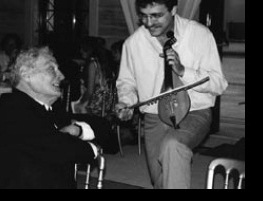
Sir Patrick sings mantinades with Cretan musician

In 2004, Paddy was honoured for his life and work and links with Greece by the American School of Classical Studies at Athens. A report of the evening appeared in the summer 2004 edition of the Gennadius newsletter.

War hero and renowned writer Sir Patrick Leigh Fermor was honored in June at the Gennadeion Trustees’ Second Annual Awards Dinner. Knighted this past February, Sir Patrick published his latest book, Words of Mercury, earlier in the winter. Regarded by many as one of the finest writers of the twentieth century, in Greece Sir Patrick is famed as the war hero who parachuted into Nazi-occupied Crete in World War II, capturing its German commander. After the war, Sir Patrick eventually settled in Greece near Kardamyli, where he has lived ever since. His love for Greece has infused much of his writing.

The evening began with cocktails in the new lobby of Cotsen Hall, followed by tributes presented in Cotsen Hall itself in an unofficial baptism of the new facility. Among the speakers were former Prime Minister of Greece Tzannis Tzannetakis, Alan L. Boegehold, Dimitris Daskalopoulos, Haris Kalligas, and, in response, Sir Patrick himself. The award was presented by Edmund Keely, the 2003 winner. After the tributes, guests sat down to dinner in the terrace in front of Cotsen Hall, transfigured by tents, lights, and flowers. Halfway through the evening, a pair of Cretan musicians serenaded Sir Patrick and guests with mantinades.

Among the 150 guests were former Prime Minister George Rallis and Mrs. Rallis; Lady Madden, wife of the British Ambassador to Greece; Mrs. Kelly Bourdara, Vice-Mayor of Athens; Mr. and Mrs. George David; Mr. and Mrs. Nicholas Egon; Mr. Sture Linnear; Mrs. Theodoti-Artemis Mandilas; Mr. and Mrs. Dimitri Marinopoulos, Mr. Panagis Vourloumis, and both the Mayor and the former Mayor of Kalamata, where Sir Patrick is an honorary citizen.

Co-organizers for the evening were Mrs. Margaret Samourkas and Mrs. Lana Mandilas. Thanks to underwriting from The Samourkas Foundation, the evening raised $29,000 for the Library’s gardens.

A copy of the newsletter with more pictures can be found on the American School of Classical Studies at Athens website, or downloaded from the blog archive here.

Related article:

Artemis Cooper “Patrick Leigh Fermor in Greece.” – webcast online at the Gennadius May 2012

On the trail of Patrick Leigh Fermor in Greece

This is a little bit toe-curling but as I always say we place all things Paddy related here …  for the record!

Ahead of a new Patrick Leigh Fermor biography, Kevin Rushby visits the Mani peninsula, home of the great man and unsung resting place of another British travel writing giant, Bruce Chatwin.

By Kevin Rushby

First published in the Guardian 28 September 2012.

Kardamyli, on Greece’s Mani peninsula, was home to Sir Patrick Leigh Fermor.

Old Mr Fotis turned my question over in his mind while sipping his morning coffee. Below the veranda some youths had been playing noisily on the harbour wall, but now they all dived into the turquoise sea and set off on the long swim to the rocky island in the bay. It had a fragment of crenellated wall on top of it, the ruins of a Venetian fortress. Fotis watched them go, half-smiling.

“We do seem to attract a lot of writers,” said the old man eventually. “But that’s a name I don’t remember.”

“Bruce Chatwin, Baroose Chit-win, Chaatwing.” I tried a few variations but none struck a chord. “His ashes are scattered somewhere in the hills.”

“No, I never heard of him.”

“What about Sir Patrick Leigh Fermor? You must know about him.”

I’d first heard of Kardamyli because of Leigh Fermor, who had made the place his home. I’d always hoped we might meet, but then the grand old man of British travel writing had died in June 2011 (leaving the literary world praying that he had finished the final volume of his Time of Gifts trilogy). I’d come to the Mani on a sort of literary homage, hoping to find a little of the magic that had attracted first Leigh Fermor and later Chatwin.

The old man shook his head. “No, I don’t think so. There was a writer called Robert. Now he was famous – cured himself of cancer by walking around Crete. [Former South Africa cricketer Bob Crisp wrote of his walk around Crete in the 1970s.] He was very famous.”

This felt all wrong. Was I in the right place? How annoying that the locals should raise this unknown above the two giants of travel literature.

Fotis leaned back and shouted in Greek to his wife in the kitchen. She came through, cloth in hand. “Robert Crisp,” she said, smiling. “What a wonderful man! So handsome! I remember him sitting up at Dioskouri’s taverna drinking and talking with Paddy. They were always laughing.”

My ears pricked up. Fotis’s face underwent a transformation. “Ah Paddy! That is him – your English writer. Of course, Paddy – or Michali we called him. Yes, Paddy was here for years and years. When I was young we used to say he was a British spy and had a tunnel going out to sea where submarines would come.”

It didn’t surprise me. Leigh Fermor had been, by all accounts, extremely old school, endlessly curious and an accomplished linguist – all well-known attributes of British spies. He produced a clutch of good books and two classics of the genre, A Time of Gifts and Between the Woods and the Water, detailing his journey as an 18-year-old on foot to Constantinople.

“Did you see a lot of him?” I asked.

Fotis shrugged. “Sometimes. He liked to walk a lot. Now Robert Crisp – I used to see him. What a character!”

“Is Paddy’s house still empty?” I persisted. “I heard it was now a museum.”

Fotis shook his head. “No, no. He left it to the Benaki Museum in Athens (benaki.gr) and they’re supposed to turn it into a writers’ centre. My guess is nothing will happen for a while.”

I could hardly complain about Greek tardiness: Leigh Fermor himself had taken 78 years over his trilogy, and even then no one seemed very sure if he had completed the task. There was, I decided, only one way to get close to the spirit of these colossi of travel-writing: to walk.

“Which paths did Paddy like best?”

Fotis fetched a map and gave me directions. It was already hot when I left him on his veranda. I could see the youths lazing on the harbour wall again, tired by their long swim. Was this really the time of year for walking?

I headed through the ruined village, as instructed, and found a narrow steep path rising up the hillside. Before too long I came across the stone tomb that locals say is the grave of Castor and Pollux, heavenly twins and brothers to Helen of Troy. Kardamyli is mentioned in Homer’s Iliad as one of the seven towns that Agamemnon gave to Achilles.

Sweat was pouring off me now, but I kept going. Scents of thyme and sage rose from the undergrowth. Fotis had said there were lots of snakes up here, but I didn’t see any. The views of the bay below, however, were becoming more and more magnificent.

The Mani is the middle finger of the three-pronged southern Peloponnese, a 40-mile long skeletal digit that was almost inaccessible, except by sea, until recently. When Leigh Fermor first came here in 1951, it was by a marathon mountain hike across the Taygetus range, whose slopes seem always to be either burned dry by summer sun, or weighted with winter snow.

Tower in the Taygetus mountains. Photograph: Kevin Rushby

The people here were different. For a start they had turned vengeance into a lifelong passion, building war towers to threaten their neighbours and generally making life on a stony mountain even grimmer than it needed to be and clinging to weird atavistic beliefs. No wonder that in the 1950s most of the younger people abandoned it for places not as badly infested with saltwater ghouls and blood-sucking phantoms – Melbourne and Tottenham were particularly popular.

Fotis himself had been one of them, settling in Australia for many years before coming home and opening a hotel. Nowadays some parts of the Mani are thick with holiday homes and development, but Kardamyli remains delightfully quiet and understated, the sort of Greek village where old widows in black sit out every morning watching the world go by.

Having reached a good height on the mountain I started to follow the contours, dipping in and out of the shade of walnut trees and cypress, drinking clear cold water from a spring. Further on I came to the village of Proastio, where Fotis had told me there was a church for every family, the ancestors having been sailors, and very superstitious. At the gorgeous little basilica of Agios Nikolaos in the main street I got the priest to come and unlock the door, revealing a gallery of perfect 17th-century Byzantine murals.

Byzantine murals in Proastio church. Photograph: Kevin Rushby

I tried the name Chatwin on him, and wondered how to mime death, cremation and scattering of ashes. But the Orthodox Church does not approve of cremation and his face told me I would not get far.

Returning to Kardamyli by a steep cobbled donkey trail, a kalderimi, I passed Fotis’s veranda once again.

“Who was that writer?” he called. “My wife thinks she knows.”

Anna came out. “Paddy himself scattered the ashes of a writer friend of his, up in Exochori.”

That was where I had just been walking, only higher. Next morning I started much earlier and with a water bottle. Fotis was already up and about when I passed his house.

“Exochori is my home village,” he said. “But what you see now is just old people up there. The old Maniati culture is gone. We used to grow silkworms and our mothers made all our underclothes from it. Can you believe it? We were peasants in the most remote part of Europe, but we wore silk.”

He tried to give me directions to the church, but it got so confusing that I just pretended to understand and resolved to ask along the way. As it happened, this was a useless strategy since the few old people I bumped into spoke no English, and my phrasebook was inexplicably silent on the important line, “Where are scattered the remains of the travel writer?”

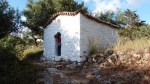
In the end I came across a small white-washed shrine with a view of the sea. There was just room to enter, and inside a votive candle burned on a tray with some fresh flowers. A white dog appeared. I elected to call it the Chatwin Church. After a few minutes of contemplation I set off again, southwards past one of the war towers, a gorgeous forest monastery and finally the unspoilt hamlet of Castania, where the taverna owner marched me into the kitchen, pointed out the various dishes and then served a vast quantity of delicious food with a jug of rough wine. It took several strong coffees to get me moving again for the long tramp home.

Back in Kardamyli late that afternoon, Fotis was keen to hear of my walk, but he scoffed at my description of the Chatwin Church. “No, no! That is not it. Come on – I’ll take you there.”

“I’m a bit tired.”

“Good God, we’re not walking! In my car.”

Soon we were on a longer, twisting route. Fotis pointed out landmarks and patches of land that his family owned. I asked about his ancestors.

“The Mani was always where people came to hide,” he said. “Our family are said to have arrived when Byzantium fell to the Ottomans in 1453.”

“They came from Constantinople?”

He nodded. “Our family tradition is that we were clowns for the Byzantine emperor.” He smiled. “But I’ve no idea if that is true.”

He slowed the car down. “Look. This is where you turn off the main road, between the school and the cemetery.”

We pulled up in the shade of two pine trees then set off walking. We picked our way through some old stone houses, their walls overgrown with vines, their shutters closed.

“Holiday homes now,” said Fotis. “Exochori people working in Athens.”

Sunset above Kardamyli. Photograph: Kevin Rushby

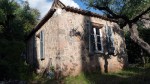
Then we were on a grassy rill of land and I could see the church, a tiny Byzantine basilica, its rough stone walls and ancient pantiles crusted with lichens. Laid out before it was a wonderful tranquil panorama of the sea, its surface smooth as a sheet of silk. It was obvious why a traveller would want to come to rest here, overlooking the sea Homer’s heroes had sailed.

I stood there for a long time. Fotis was searching for the key to the church, normally left in a crack or niche, but there was no sign of it and we gave up. Back in the car, I asked Fotis to point out the house of Paddy Leigh Fermor and glimpsed a low pantiled roof almost submerged in trees on a crag next to the sea.

“Is there no way to see it?”

He shrugged. “It’s all shut up.”

“Is there a beach?”

“Yes – a tiny one.”

I memorised the spot. When Leigh Fermor came to the Mani he did some impressive wild swimming. To honour his adventurous spirit I felt I should swim around to his house and take a look. So next morning, before the heat of day, I entered the sea by the harbour and swam south down the rocky coast hunting for that tiny beach. I swam for what seemed a long time and had given up and turned back when I saw it: a little shingly beach with a single-storey house above. I swam closer until I could stand in the water.

It was a lovely place: deep verandas and stone walls under a pantile roof. Mosaics of pebbles had been made on a flight of steps. I called out but got no answer. The house was shuttered and quiet as though still in mourning. I waded up the beach and sat at the foot of the pebble path. I could see a colonnade with rooms off it, then a larger living room.

I thought of the years that Leigh Fermor had spent here: by all accounts he was a great host and storyteller. When I’d asked one old lady in the village if she had read any of his books, she’d laughed, “Why would any of us read his books? He told us all the stories himself!”

The last story had been that third volume of his epic walk across Europe, but he had never finished it, perhaps never would have. And now a great peace had descended on the place, a peace I didn’t want to disturb. I walked back down to the water and swam out into the bay. Without thinking, I found myself heading for the island of Meropi, the one that those youths had swum to. I would explore the ruins of that Venetian castle.

Order Paddy’s biographyPatrick Leigh Fermor:An Adventure by Artemis Cooper here.

Related article:

Chatwin and Paddy: In the Footsteps of Bruce Chatwin

Patrick Leigh Fermor: extract from the new biography

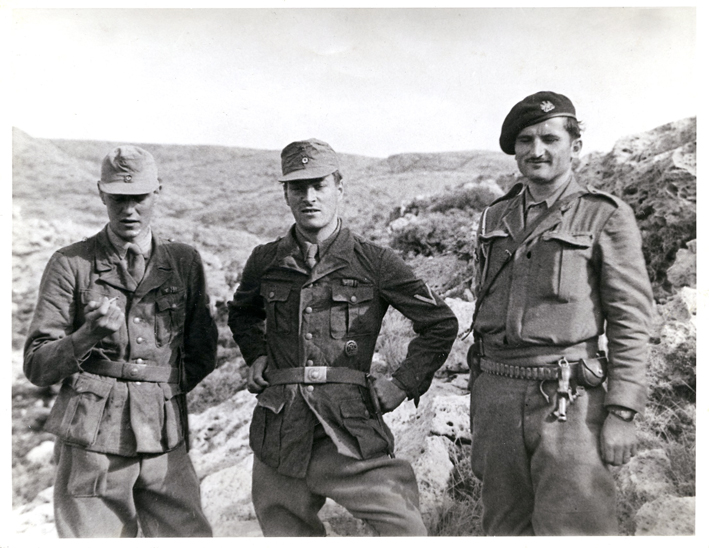
Patrick Leigh Fermor with Billy Moss in Crete, April 1944, wearing German uniforms Photo: Estate of William Stanley Moss, by permission

The Telegraph ran an extract from the biography over the weekend. It was the Kreipe kidnap again!

In an extract from her life of the travel writer and war hero Patrick Leigh Fermor, Artemis Cooper chronicles a daring kidnap in wartime Crete.

First published in the Daily Telegraph 29 September 2102.

After months of training in clandestine warfare in Palestine, Paddy Leigh Fermor joined the handful of SOE officers in occupied Crete who were working with the Cretan resistance in June 1942. His big chance came in the autumn of the following year when he formulated a plan to kidnap a German general: not just any general but the hated Gen Friedrich-Wilhelm Müller, responsible for the butchery of the Viannos villages in September 1943. Supposing Müller were kidnapped and whisked off the island? At a time when Greece was beginning to feel like a backwater as the war pushed up through Italy, an operation of this kind would generate a lot of noise and publicity: it would make the Germans look remarkably foolish, and give a terrific boost to Cretan morale.

Despite questions being asked about the mission because of the risks it posed to Cretan lives, the plan went ahead on January 6 1944. A car came to pick up Paddy and his number two, Billy Moss, a young Coldstreamer who had had a spell guarding Rudolf Hess, in the early hours of the morning, and drove them to Heliopolis where they met the rest of the party.

They flew to an airstrip east of Benghazi, where they spent two miserable weeks in sodden tents waiting for the weather to clear. Since it refused to oblige, they were flown to Bari, hoping for better flying conditions there. On February 4 they took off from Brindisi for Crete, aiming for the Omalo plateau, a tiny, shallow bowl in the jagged, snow-covered peaks in the mountains south of Neapolis. For the pilot, the zone was so restricted that the team could not be dropped in a “stick” formation – he would have to circle and come in again four times, dropping each man off individually.

Snow and loose cloud swirled around the open bomb-bay, and far below they could see the dropping zone marked by three pinpricks of light formed by three signal fires. Paddy was the first to jump. Welcoming Cretan hands hauled him to his feet, and then all eyes turned again to the snow-streaked sky. Paddy gave the all-clear with a torch to signal his safe arrival, but the clouds were thickening and the pilot could no longer see the signal fires: he was forced to turn back.

The bad weather continued. Paddy spent the next seven weeks in a cave with Sandy Rendel, the SOE officer in charge of the Lasithi area. But in late March came news that threw the whole mission into question. The intended victim, Gen Müller, had been posted to Chania as commander of Fortress Crete. SOE Cairo was informed, but decided to go ahead with the operation anyway. After all, the aim was to boost Cretan morale and damage German confidence; from this standpoint, one general was as good as another. Continue reading

Before Sunset sequel, Before Midnight movie shooting in Greece at Paddy’s House

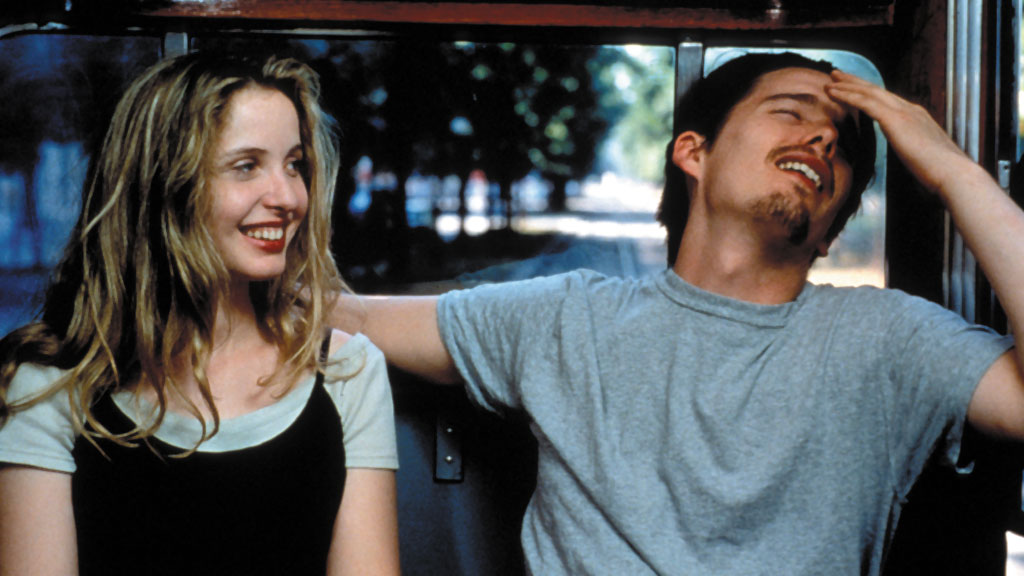
Julie Delpy and Ethan Hawke in Before Sunrise

The Paddy network is very wide and not much goes on without someone knowing something about anything Paddy related, and then getting in touch with your favourite blog. A couple of weeks ago I was contacted by our spy on the ground in Karadmyli to say that he had heard rumours that Paddy’s house was being used as a film set. Further investigations revealed this to be filming for a movie to be called Before Midnight which will star the actor Ethan Hawke, and co-start Julie Delpy. It is the third in a series of movies which I guess one could call the ‘Before Series’.

As we know the house was left by Paddy to the care of the Benaki museum and there have been some concerns voiced about the approach to essential maintenance at the house. Sources close to the museum and to Paddy’s family have confirmed that shooting has been taking place in the garden of the house and that Mr Hawke has been relaxing on the beaches playing his guitar whilst during some relaxed evening barbeques with fellow cast and crew and some locals.

The good news is that there should be a substantial fee for the use of the house which we hope will be put toward the essential maintenance, an issue highlighted only in July by John Chapman in his piece about a recent visit.

The movie series started with the 1995 film Before Sunrise which is all about a young man and woman who meet on a train in Europe, and wind up spending one romantic evening together in Vienna. Unfortunately, both know that this will probably be their only night together. But we all know that this can’t be the end, after all this is Hollywood, and nine years later the characters Jesse and Celine encounter one another during the French leg of Jesse’s book tour, and that film was called Before Sunset. I have no idea how that movie ended but it is possible that as travellers they had come across Paddy’s work and became true fans. Upset to hear that he had died each of them decided to make a summer pilgrimage to his house to make a ‘connection’. Whilst Celine gazes at the sunset across the bay from Paddy’s patio after sneaking in through the rickety blue gate, Jesse arrives with Elpida (Paddy’s housekeeper who has been kept on) and from then on they only have eyes for each other, and the local ouzo.

There is speculation that Hawke, who has apparently been in the area since late July, has plans to stay until early September so if you are quick you may be able to join as an extra. If it is of interest there are no reports of sightings of Delpy, so anything could be happening. So exciting! We will keep you posted.

John Chapman at Kardamyli


John Chapman is a regular contributor of material to the blog – you are all welcome to do so at any time; see Contact. Most notably John’s photographs of a visit to Kardamyli to meet Paddy in 2005 have been very popular with you all.

A while back he sent me some more photographs with some comments about the state of the villa at Kardamyli, and John’s personal thoughts about one of Paddy’s friends who died in May 2012.


Hi Tom

In May this year I made a return trip to Kardamili and Mani. I hadn’t been there for four years and this was just a week long catch up. Mani is still as effortlessly beautiful and tantalisingly fascinating as ever. One location I always visit is the church of St. Nicholas in Chora, where Paddy scattered Bruce Chatwin’s ashes in 1989. Still a remarkably special place.

At Paddy’s Memorial service in December I’d been sitting quietly in a pew as I could recognise some of the great and good but was not expecting anyone I knew to be there. I was suddenly clapped on the shoulder by a firm hand and an American accent bellowed ‘Well how you doing buddy?’ It was my old friend and correspondent Jon van Leuven. We had started writing to one another some 12 years earlier as we both were fascinated by the conundrum of the location of the Frankish castle of Grand Magne and various other puzzles in Mani’s medieval history. We’d since met on a number of occasions exploring cave churches near Langada and getting hideously lost in the Sangias Mountains in Mesa Mani.

With Jon was another Englishman, we were introduced but, I apologise, I’m useless with names. He had been attempting to catalogue Paddy’s books and papers. I asked if he knew what the Benaki Foundation intended to do with the house at Kalamitsi. “I’ve no idea”, was the reply,”…and I doubt if they do either”.

After the service Jon and I said our farewells. Jon was a long time friend of Paddy’s. He long had a house at the hamlet of Gournitsa (a Slavic name, lit. ‘the place above’) though nowadays often referred to as Agia Sofia, after the pepper-pot domed church which perches over Kardamili. The house itself had few comforts, Jon was adamant that he wasn’t go to pay any ‘damned taxes’ for electricity. But it was comfortable and clinging to the cliff top edge of the Viros Gorge it was a precious eyrie where Jon would stay from June to September, although his family and home were now in Gothenburg, Sweden.

I told Jon I was going to Mani and he asked me to give his house a quick look to see if all was OK. I replied I would. He emailed me on the 8 April.

‘Glad to hear you can get get up to Gour and give the hacienda a glance. Also in town I hope you hear what’s going on at Paddy’s villa these days – if you know Elpida the housekeeper she’d know better than anybody’.

I don’t know Elpida and anyway by the time I got to his Hacienda in Gournitsa I’d been given the sad news that Jon had died of complications of leukaemia. I’d known he was ill but had presumed he was indestructible. He could certainly outpace me on expeditions in Mani and was at least ten years my senior – I guess in his early seventies. On the 17 April he’d sent me his last of hundreds of emails. I might just publish them sometime…I’d asked if he’d ever met Bruce Chatwin, I was reading Chatwin’s letters.

The email was entitled ‘Drip Feeding’

“Hi John,

Just a note between hospital visits…but thanks for your epistles as ever. No, I never met Chatwin, but I once met Elizabeth at Paddy’s, and of course again in London in Dec tho she didn’t recognize me (nor I her but for Olivia’s tipoff)…Now I am taking a long pause from the airwaves to suck my thumb and medicine.

Best, Jon”

He died on the 2 May 2012

Jon was very wary of telling much about Paddy, he was a very private man and felt that there were too many people trying to grab a bit of Paddy’s aura. I was undoubtedly one of them in his judgement, so I didn’t pry and he didn’t tell., and frankly we had enough Mani stuff to keep us going for years. I did learn that Jon had first met Paddy as he was interested in ancient shrines to Artemis in the area, and had hoped (vainly) that Paddy could assist his researches. Jon helped Paddy construct the bookshelves in ‘that room’. He located picnics he had shared with Paddy and Joan, and, on very rare occasions, entrusted me with Paddy’s opinions on other ‘travel writers’. On one occasion when I briefly met Paddy striding towards Lela’s Taverna I mentioned Jon was a friend of mine. Paddy beamed and confirmed he was a very old and trusted friend, but Joan was very ill at the time and Paddy hurried on.

One evening this May we wandered down to Kalamitsi. It’s still filling up with more villas and concrete but somehow manages to remain beautiful. And on the cliffs stretching along the road to Proastio high above Kalamitsi more excrescences of domestic concrete demonstrated more concern for their owners’ views of the Gulf of Messenia than those below looking up. I delight in a domed church on a promontory (and Kardamili has three), but hate to imagine John Betjeman’s reaction to these lumpen edifices.

However Paddy’s villa is still a discrete surprise when you do chance upon it. The north wall of the garden has fallen down and we could have wandered the gardens, but resisted, though we’d been before and had had Paddy as a guide. A peer through the small window in the gates of the villa show that someone is tending the garden. Though there is a sad lack of flasks of retsina in the vestibule. The ‘Private Property’ sign has gone, maybe from neglect. Above the gateway there is a small stone hut. It was unlocked, so we guiltily crept in. A broken armchair, an old bed and some damp volumes which had obviously over spilt from the villa were on some shelves and in boxes. Hungarian Studies magazines, a history of Canterbury Cathedral, and a few gems. An offprint from a dictionary. In pencil at the top ‘In great appreciation Christmas 1958, New Year 1959 Eric Partridge.’ Naturally they were left there.

In the village no one I talked to had very much more knowledge of what was going to happen to the house than I did. And as one said – the Benaki are not as rich as they may appear. The house needs a fair bit of repair. After all it is, now, over fifty years old and shutters are beginning to disintegrate. If they want a librarian who’s soon to retire to look after the place, well, I might just volunteer.


To guidebook or not to guidebook

I just received this message from Andrew Bostock who authored the Bradt guide to the Peloponnese. It seems he is heading off there now. Paddy appears to have had some views on guidebooks; what are yours?

There are people who always seem to be fated to end up in their eventual career; children whose endless games of doctors and nurses or Lego translate into later careers in medicine or engineering. I used to think that I didn’t fit into this category, but now I’m not so sure.

In a week’s time I head out to the Peloponnese, the southern mainland of Greece, to complete the research to the second edition of my guide to the area, due to be published in early 2013 by the award-winning publishers Bradt. The first edition was written whilst I lived in the area, and whilst my daughter, who was born in Kalamata, grew up. Now I’m heading back for six weeks to show her where she comes from, and to introduce her one-year-old brother (middle name Telemachus) to the country.

How I ended up doing this seems to be due to huge smatterings of good luck and coincidence; but thinking about it there was an element of fate involved. This was mainly due to my mum, who instilled in me an early love of Greek mythology and history. It was also on her shelves that I first found the books of Paddy Leigh Fermor. I must have been about 14 at the time, and I devoured them. This quickly led to backpacking trips round Greece, sleeping in olive groves and abandoned tower houses, and eventually working there as a teacher, tour guide and writer.

Fate continued to intervene and my small family ended up living in a house on the headland above Kalamitsi bay, where Paddy had built his beautiful Greek house. In truth I had never really wanted to meet him, expectations are too easily let down, but in the end it seemed inevitable. He turned out to be just as affable, engaging and generous as the books would lead you to think.

He wasn’t really that keen on the idea of a guidebook to the Peloponnese, and I do see his point; but it was his books that guided me there. I think that if people are to travel, then a least they should travel with knowledge and understanding.

I’m pretty proud of my book, and hope to spend the next few weeks making it even better.

Andrew Bostock

07961 061 052 (cell)
Twitter: @andybostock
Website

The Kreipe pennants – the story of their rediscovery by Billy Moss’ daughter

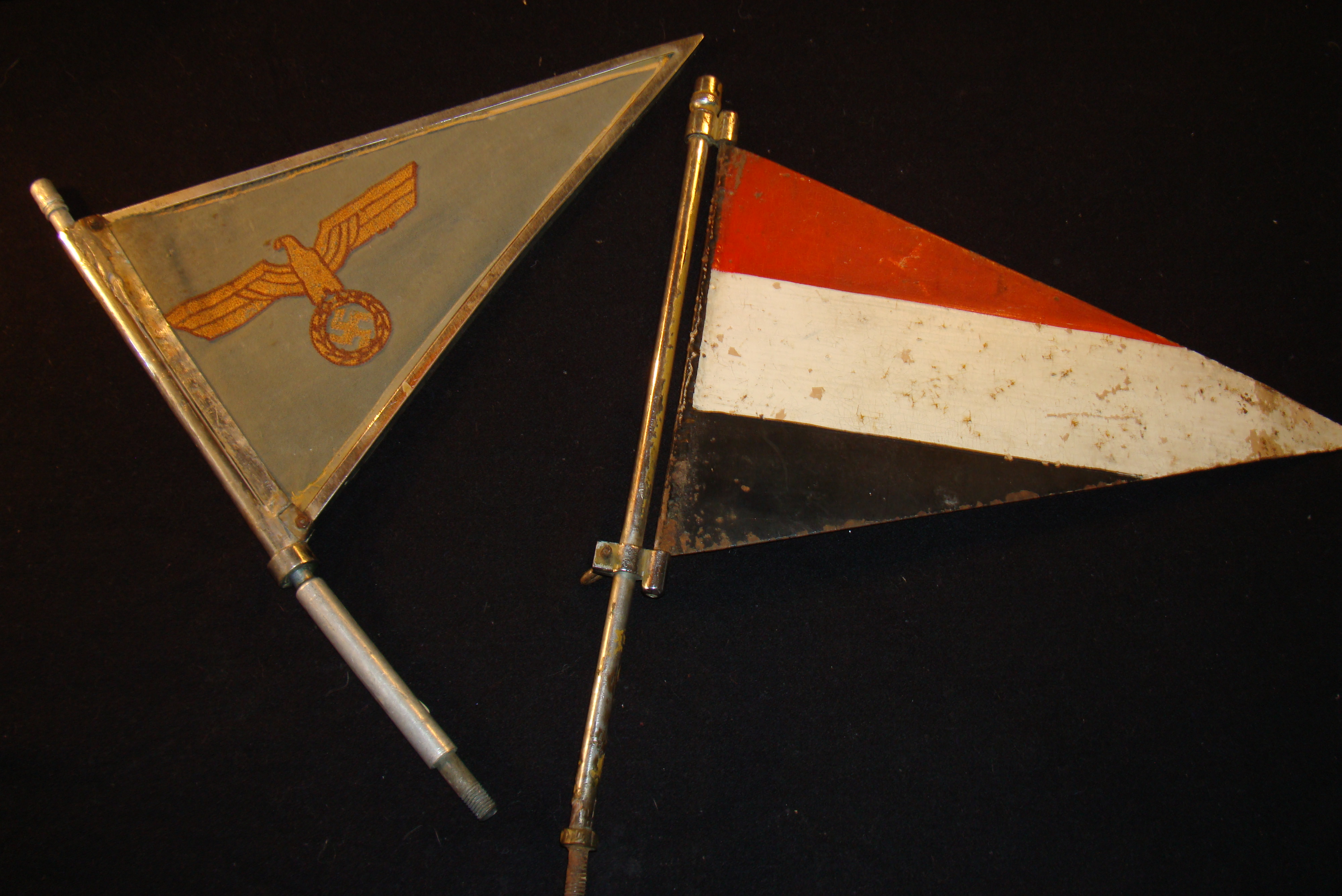
The pennants from General Kreipe’s car

Discovering the full details behind a particular story or event is often tricky with clarifications, enhancements, or downright contradictions emerging sometimes many years after the event. Fortunately we have not had to wait so long for some further detail to be added to the story I ran last year about what happened to the pennants on General Kreipe’s car at the time of the kidnap, and their subsequent discovery many years later.

‘Billy’ Moss’ daughter Gabriella Bullock read Artemis Cooper’s account of how the pennants were found after so many years in a trunk in Paddy’s house at Kardamyli. Gabriella then wrote to me to ask me to pass on the full story behind their (very fortunate) re-discovery in Ireland some years before and how they were passed by her mother (Sophie Moss née Tarnowksa) to her. It sounds like we are very lucky to have them at all.

Gabriella’s account starts during a recent visit to Crete …

In Rethymnon we met the delightful people who run the Folklore Museum. This is where the pennants from the General’s car are now housed, in accordance with PLF’s wishes. We found that they were very interested in the story of how the pennants were randomly and luckily rediscovered, and this leads me to think that the story definitely has a place on your website

In the early 1950s my family lived in Co. Cork, Ireland, but moved back (supposedly temporarily) to London in 1954. My parents intended to return, and left many of their possessions in the safe-keeping of various Irish friends or in store. My father never did go back to Ireland; indeed, in 1957, eight years before his death in 1965, my father also left England never to return. As things turned out, however, it was also many years before my mother went back, and all that had been left in storage was lost.

A number of years after my father’s death my mother bought a cottage near Cork, and thereafter divided her time between London and Ireland. I was staying with her at the cottage one summer in the late 1970s when a friend of hers announced that she had a trunk belonging to us which she wanted to return; it had been sitting in their attic since the 50’s.

A battered tin trunk duly arrived with my father’s name, rank and regiment painted on the outside in white. My elder sister has it now and it is, without doubt, the one described in the first chapter of our father’s book A War of Shadows, even down to the grains of sand:

“an old letter, a scrap of notepaper smeared with the sweat of one’s hip-pocket, the rain-spattered pages of a diary, an operational report written in the bloodlessly forbidding vocabulary of a headquarters’ clerk – these relics, discovered in a tin trunk which still creaks with grains of sand when you open the lid…”.

My mother opened and unpacked it, and said to me, “I think you’d better have these”. Amongst the things inside it were my father’s original diary, already entitled Ill Met by Moonlight, in remarkably good condition and perfectly legible, and the two German pennants.

It was a heart-stopping moment. My mother gave these things to me, and I gratefully and unthinkingly received them. I was in my mid-twenties then. The diary I still have. As for the pennants, they were much prized, and adorned a wall in my house for nearly 15 years.

But one day about 17 or 18 years ago, when I was re-reading IMBM, it dawned on me for the first time that in fact since it was Paddy who had taken them as trophies from the General’s car, they were rightfully his. So I gave them to him. This was in the early 90’s. Paddy was completely astonished, and moved, to see them again, so unexpectedly, after 50 years! He was awfully pleased, and after his death they were donated to the Folklore Museum in Rethymno, in accordance with his wishes.

And now they are back in Crete, which is absolutely as it should be.

With best wishes,

Gabriella Bullock

Further reading:

The Kreipe pennants

Articles about the kidnap in the Ill Met by Moonlight category

Previously unpublished images from the Kreipe kidnap

William Stanley Moss, PLF, and Manoli pose for photos before the kindap of General Kreipe

Paddy and ‘Billy’ Moss in a cave

I am very grateful to John Stathatos who sent these pictures from his family’s Cretan archive. The first with Manoli is one that I don’t think we have seen before in this setting.

I’m sending you a little present for the blog – scans of four original photographic prints of the Kreipe operation which I’ve dug out of the family archives.

The prints are on glossy photographic paper, and must have been produced by the British army press and propaganda section in Cairo very shortly after Paddy’s return. They were given a narrow white border, and all four have very slightly different dimensions, ranging from 185×143 mm for the vertical one to 147×199 mm for the group photo. They are in remarkably good shape considering their age, showing no evident deterioration beyond a very slight yellowing.

Note: certain of these images are kindly shown here by permission of John Stathatos. Please ask if you wish to reproduce.

Other pictures provided by John:

A map of Crete as drawn by Paddy on operations in Crete

Traveller’s Rest

New – Full length interviews with Kreipe and Paddy

We have all seen the famous 1972 video of Nico Mastorakis’ TV show “This is Your Life” which brought Kreipe and his old enemies together before the cameras. If you have not seen it you can find it here.

In this newly discovered video Nico Mastorakis presents a documentary about the whole kidnap event, and includes full length and exclusive interviews with Paddy and General Kreipe. The General even says that “next year I will spend my holiday in Crete.” I wonder if he ever did?

There is much more about the kidnap in the Video and Audio section. Take a visit now.


Reg Everson and his powdered egg breakfast for General Kreipe on Mount Ida

At Paddy’s funeral last year, I stayed afterwards for a drink with a small group at the hotel  which used to be the Dumbleton estate manor house, originally home to Joan’s family. A man from Wales introduced himself as Vince Tustin. I recognised the name as I had been in touch with Vince by email in the preceding weeks on the subject of his father-in-law who was in the SOE.

‘Reg Everson, my father-in-law, spent three years on Crete and much of that time he worked closely with Paddy as a radio operator.’ said Vince.

His wife then joined us and after a while she said ‘I asked my mum and dad why I was called Patricia. It was an unusual name for a girl in Wales at the time. And my dad told me I was named Patricia after his good friend Patrick Leigh Fermor. They had served together in Crete.’

Such was the impression that Paddy made on people. It is a lovely story in itself, and perhaps serves a reminder on this first anniversary of his death, that Paddy affected the lives of  many, in different ways, as a man as well as a writer.

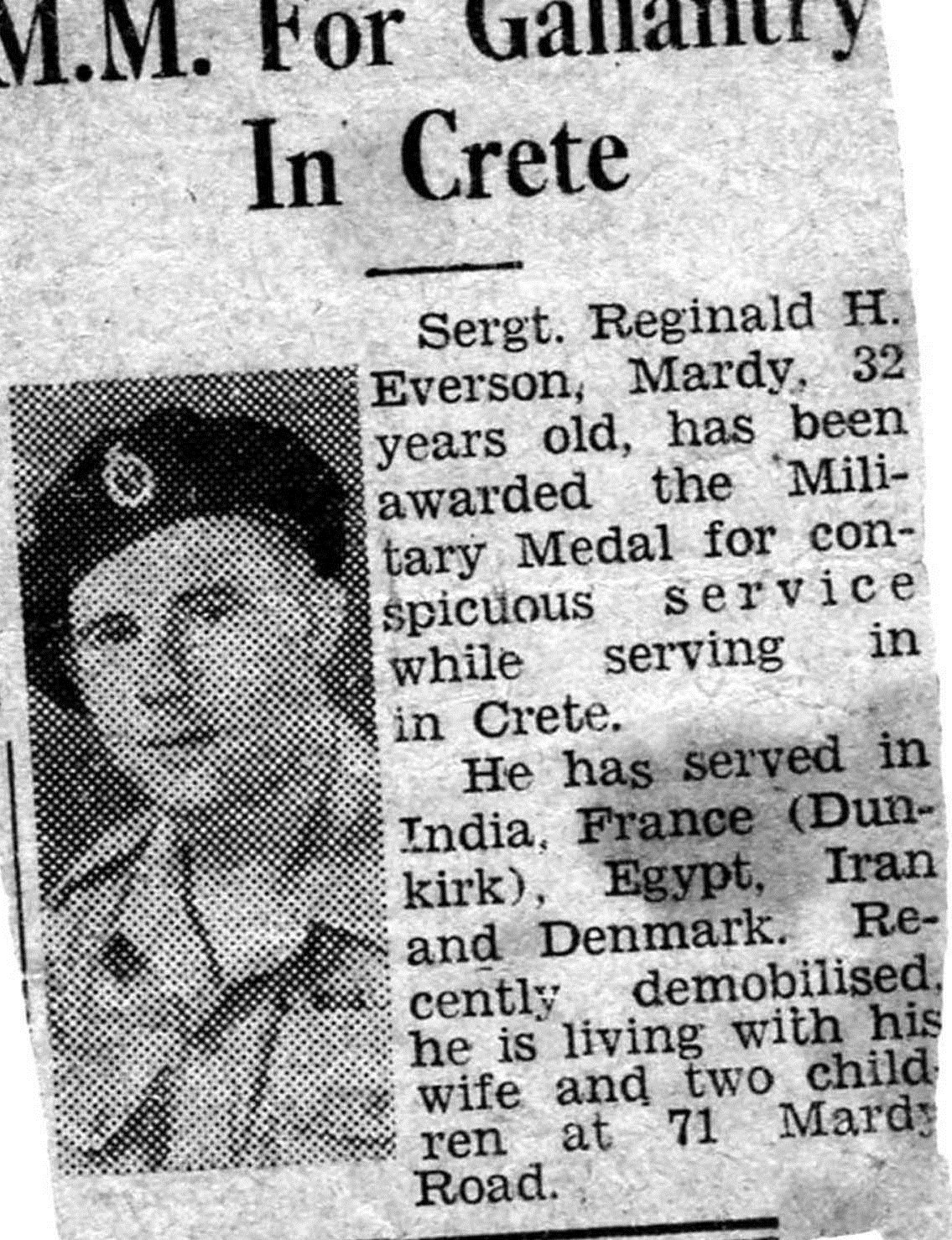
Vince told me that in the 1950’s Reg was interviewed by a local reporter.

I am sure that Reg didn’t want it to sound as if he was alone [on Crete]. He was a quiet mild mannered gentleman, and was in the Royal Signals from 1931 to 1946 and like so many servicemen lied about his age to get in, he was only 15 when he enlisted. For the three years he was on Crete his wife didn’t hear from him. His commanding officer was the only contact she had. People in the village even thought Reg had left her!

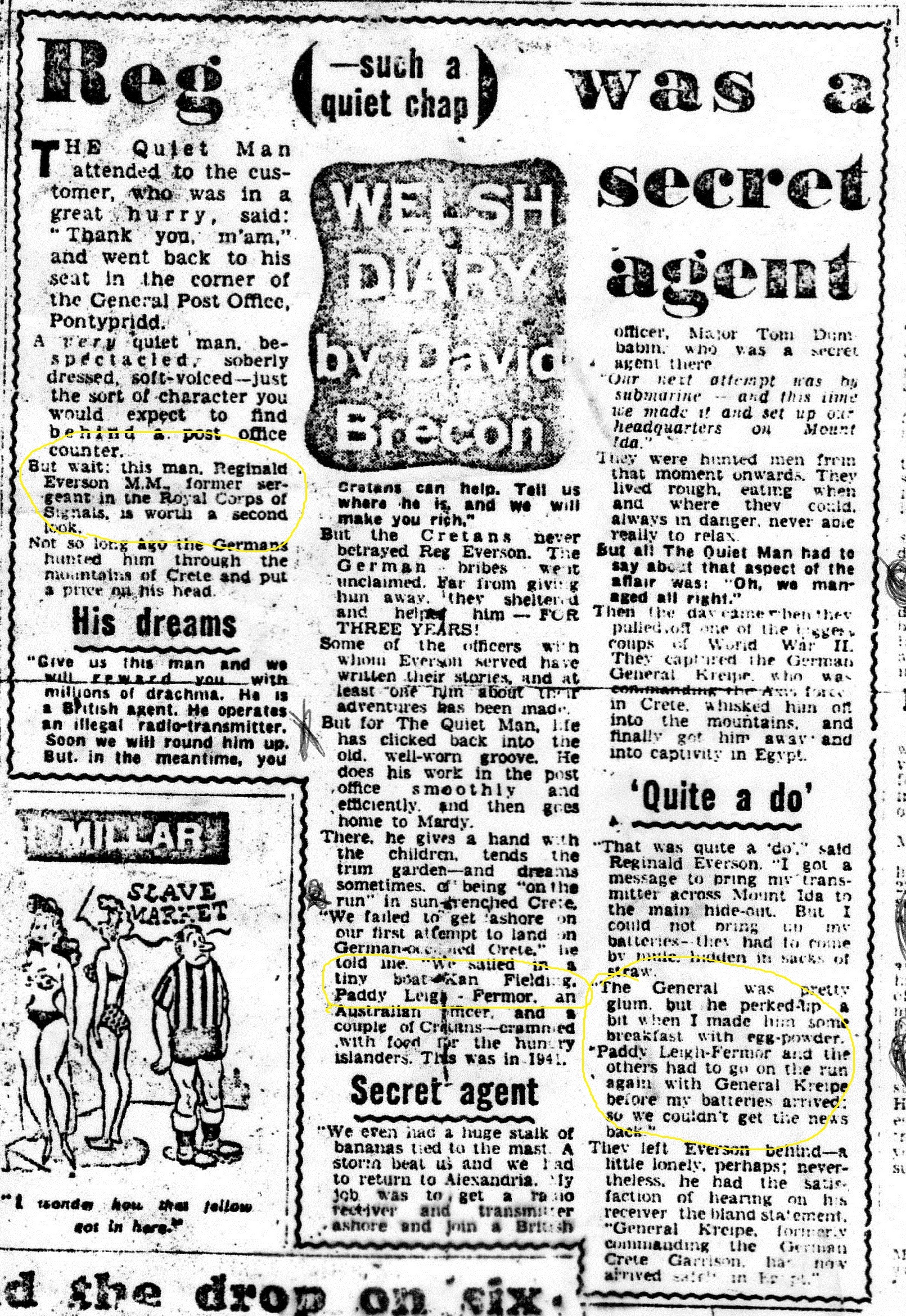
It wasn’t until I wrote a piece in the local paper that people understood where he had been because he didn’t speak about it. In the newspaper cutting from the 50s Reg talks about his involvement in the kidnap of General Kreipe and how he cheered up the General by making him some powdered egg for breakfast on Mount Ida.

We have his forged Cretan papers here, also a leaflet that was dropped by the Germans. He was awarded the Military Medal and Africa Star among other medals. He was also presented with a solid silver medal for bravery from the Maharaja of India.

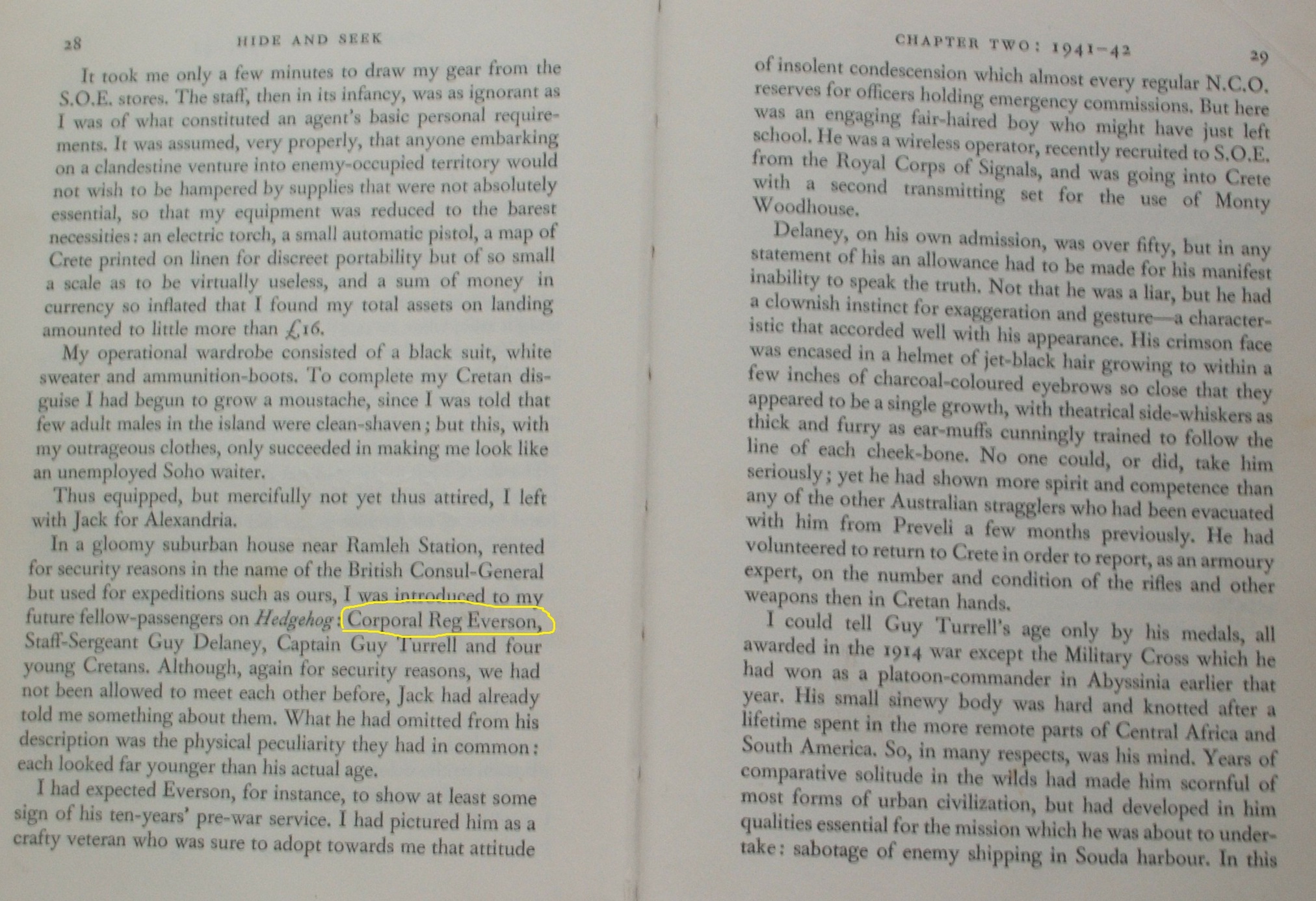
Reg Everson deployed to Crete with Xan Fielding, and Xan refers to this in his account of his time in Crete “Hide and Seek”.


In the newspaper interview Reg describes how he was summoned with his radio to Mount Ida to join the kidnap gang, but he had to wait for his heavy radio batteries to arrive so he made himself useful and he made breakfast for the General on Mount Ida …

“The General was pretty glum, but he perked-up a bit when I made him some breakfast with egg powder. Paddy Leigh Fermor and the others had to go on the run again with General Kreipe before my batteries arrived: so we couldn’t get the news [of the successful kidnap] back.”

Whilst we often hear the stories of the officers in SOE, we should not forget that they were supported by a large team including signallers such as Reg Everson who were especially brave. They risked being located by the Germans who were constantly trying to find the source of their signals to destroy the radios, and capture the highly skilled and valuable operators.

Artemis Cooper “Patrick Leigh Fermor in Greece.” – webcast online

Artemis Cooper

On May 24 2012, Artemis Cooper spoke at the Gennadius Library, Athens, on the subject of “Patrick Leigh Fermor in Greece.” Her lively and inspiring lecture stirred the interest of the audience that filled Cotsen Hall. She traced his life, experiences, and legacy in Greece from his early travels to the end of his life, on 10 June 2011. She talked about the things that drew Patrick Leigh Fermor to Greece in the first place; his ‘participation’ in the Venizelist rebellion of 1935; his early travels in Thrace and Macedonia, and first encounters with the Sarakatsani; his experiences in the war on the Albanian front and Crete, as well as the post-war explorations of Greece that produced Mani and Roumeli. She also touched on the Cyprus years; his friendship with George Seferis, George Katsimbalis, and Nicos Hadjikyriacos Ghika; how he and his wife came to settle in Kardamyli, and built their house with the architect Nicos Hadjimichalis; how the Greek translation of Mani was undertaken by Tzannis Tzannetakis, while he was in exile in Kythera under the Junta of the Colonels. Finally, she reflected on his position in the village of Kardamyli and how he is seen in Greece today.

Artemis Cooper studied English Literature at Oxford, and worked in Egypt and New Mexico before beginning her career as a writer. Her previous books include Cairo in the War: 1939-1945; Watching in the Dark, A Child’s Fight for Life; and Writing at the Kitchen Table, The Authorized biography of Elizabeth David. She has also edited two volumes of letters, and co-authored Paris After the Liberation: 1945-1949 with her husband, the historian Antony Beevor. Her biography of Patrick Leigh Fermor is based on unrestricted access to his private papers, and interviews with him in England and Greece over several years.

To watch the video visit the Gennadius Library website.

‘Europe is already falling apart’

Antony Beevor

‘I feel uneasy at the way historians are consulted as if history is going to repeat itself. It never does,’ says Antony Beevor Photo: ANDREW CROWLEY

‘Antony Beevor, chronicler of European history, has chilling warnings about the current rise in militant nationalism.’

by Elizabeth Grice

First published in The Telegraph, 28 May 2012.

Clearly the conversation that Elizabeth Grice had with Antony Beevor was a little more complelling than the article she has written, but in the context of his relationship with Paddy (and of course Artemis Cooper), and the state of Europe which, has at its epicentre Paddy’s beloved Greece, I thought I would share this with you.

Antony Beevor, chronicler of European history, has chilling warnings about the current rise in militant nationalism.

Nothing I’ve heard from politicians or economists on the world crisis has shivered my spine like an hour spent with the gentle‑mannered historian Antony Beevor, whose mighty new book on the Second World War is making him the pundit of the moment. He does not mean to be alarmist, and that is why the soft warnings in his sunlit garden are chilling.

Of course the rise of the Right in Europe is not the same as the rise of the Right in the Thirties, he soothes. But isn’t it terrifying the way the Greeks are portraying the Germans as Nazis in their popular press, with Angela Merkel in Nazi uniform? There are “far too many jibes” about a Fourth Reich. The weedlike eruption of extremist parties makes him “uneasy” – and if Beevor is uneasy, it probably means the rest of us should be scared witless.

“The great European dream was to diminish militant nationalism,” he says. “We would all be happy Europeans together. But we are going to see the old monster of militant nationalism being awoken when people realise how little control their politicians have. We are already seeing political disintegration in Europe.”

It’s fascinating the way serious historians are being treated as quasi-prophets for the economically bewildered. Tomorrow, Beevor is due to lecture to the Ministry of Foreign Affairs in the Hague on the Second World War and the current euro crisis and he says he is having to change his script daily “as more and more terrifying news comes in”.

“I feel slightly uneasy at the way historians are consulted as if history is going to repeat itself,” he says. “It never does. It is misleading and dangerous to make sweeping parallels with the Second World War. Politicians like Blair and Bush liked to sound Churchillian or Rooseveltian at times of crisis, but the comparisons of Saddam Hussein to Hitler were preposterous. Eden compared Nasser to Hitler and that led us into the Suez disaster.

“It is this compulsion to look backwards at a time of crisis because one’s got no idea of what lies ahead. There is a notion of security that somehow it must resemble the past. It’s never going to. Just because we muddled through in the past doesn’t mean we can automatically muddle through in the future.”

The only similarity between now and the late Thirties, he says unconsolingly, is that the public have not been told the truth about how desperate the situation is because no politician, then or now, dares to spell it out. “One must remember that Churchill was derided and scorned when he warned of the dangers of German rearmament. He could only come to power once war had started. That, I think, is rather alarming.”

Everything is rather alarming seen through the Beevor long lens. There is even drama in his person. He has a lot of silvery hair and leaping black eyebrows. Though his speech is a torrent of pure Queen’s English fluency, in occasional silences he picks at his fingers. Perhaps he is suppressing anxiety.

If so, it can’t be on account of his sales figures. The military historian – of whom it is always joyfully recorded that at Winchester he failed history and English A-level – has sold more than five million books. His most acclaimed, Stalingrad, won the Samuel Johnson prize for non-fiction, the Wolfson history prize and the Hawthornden prize, all in one week in 1999. With the money, he bought a house in Kent that friends like to nickname Schloss Stalingrad or Dunstalingrad. Here, in a pastoral retreat surrounded by sheep and alpacas, he and his wife, Artemis Cooper, do most of their writing. Her biography of Patrick Leigh Fermor comes out in the autumn.

After his non-compliance in formal education, Beevor joined the Army in 1965 and served with the 11th Hussars. On a posting to Wales, he was so bored that he began a semi-autobiographical novel that made him rethink his motives for being a soldier. They were all wrong: he realised he had a big chip on his shoulder about proving himself physically, a legacy of having been bullied as a child. From the age of four to seven he had walked with an armpit crutch, with one leg strapped up behind his back, because of a degenerative disease of the hip.

John Keegan, whose ground-breaking book Face of Battle revolutionised the chronicling of war, had taught him military history at Sandhurst. Once Beevor got into his considerable stride as a writer (he is from a long line of female authors), he found Keegan’s way of looking at history from the bottom up rather than the top down fitted with his own ideas of conveying the fear, chaos and horror of war from a soldier’s perspective. A soldier himself, he already understood the psychology of war.

“I’m not saying every military historian should have been a former soldier – that was the problem in the past – but some military experience is useful, if only to understand that armies are emotional organisations, not the cold mechanical institutions so often portrayed.”

Beevor’s skill is in making big historical events resonate with people through the detail of human experience gleaned from letters, interview transcripts and diaries. “I am not someone who believes I am going to find a historical scoop,” he says. “What I find satisfying is lots of good low-grade material [in Stalingrad’s cellars, lice are seen leaving the dead body of a German to take up residence in one that was still warm], which helps to build the mosaic through detail. I just love the days when you come out of the archives with half a dozen excellent descriptions or poignant accounts of personal experiences.”

Interest in the Second World War was flat when Beevor started his four-year project on Stalingrad. The book was expected to sell 6,000 copies, but flew off the shelves. Berlin: the Downfall 1945, six years later, was another triumph. The resurgence of interest in history was a phenomenon he could never have predicted. “People’s interest in the past had changed. My timing was lucky. Timing is a big percentage in life, in love or anything else.”

Beevor claims there is nothing he likes better than to start a book with an idea and then to realise he was completely wrong. He has no time for historians who are simply out to prove a thesis. Much historical fiction makes him grind his teeth, especially where words and thoughts are put into the minds of real historical characters, as in the Booker prize-winning Wolf Hall by Hilary Mantel. “We are part of an age where there is virtually no distinction between fact and fiction. The failure to distinguish between historical truth and the imagination of the novelist is a danger area. I am not attacking the quality of Mantel’s fiction but I would have preferred it if she had not called the character Thomas Cromwell. My wife does not agree with me. She thinks I am being far too pedantic.”

He was dragged by his daughter, Nella, 22, to see the film of Dan Brown’s novel The Da Vinci Code (“an absolute load of tripe”) on the basis that it was so bad he might find it amusing. On leaving, Beevor heard a man say to his girlfriend: “That really makes you think.”

“So depressing,” he slumps. “I didn’t know whether to laugh or cry. It is frankly grotesque that nearly 50 per cent of the population was persuaded that Mary Magdalene had a child by Jesus and the bloodline continued.” As for Tom Cruise in the 2008 film Valkyrie: “Most people seeing it would have thought it was an accurate account of the July bomb plot, when it was absolute rubbish. Sorry, but the interests of the entertainment industry and the interests of history are fundamentally incompatible.”

He admits to panic that he would drown in the sea of material for his latest book, The Second World War. Copying across information from the archives into skeleton chapters, he would find that he had 110 pages of notes for a single chapter. And yet there is one more massive Beevor analysis of the conflict still to come – about the Battle of the Bulge in the winter of 1944 – before he starts an epic life of Napoleon, followed perhaps by a novel set in 1917‑45. He is 65, and at his present rate of production, that will take him well into his seventies. “I can’t envisage stopping writing,” he says. “My dear father-in-law, John Julius Norwich, is still writing at 82. My God, it really keeps the marbles jangling.”

Antony Beevor’s ‘The Second World War’ is available to order from Telegraph Books for £20 plus £1.25 p&p. Call 0844 871 1515 or visit books.telegraph.co.uk. He will be at the Telegraph Hay Festival at 7pm on June 9; http://www.hayfestival.com

Ein edler Landstreicher – Roumeli republished in German

From der Freitag. The German love affair with Paddy’s work continues. Rumeli in German.

In den Romanen von Patrick Leigh Fermor werden Landschaften zu Kunstwerken – und der Leser zu dem, der er war, als er mit der Taschenlampe unter der Bettdecke hantierte

Es sind Bilder, die haften bleiben, Bilder einer wild zerklüfteten Felslandschaft an Europas äußerstem Rand, von Menschen mit gewaltigen Schnauzbärten, die noch in der Mitte des 20. Jahrhunderts Dolche an ihren Gürteln tragen und die archaische Praxis der Blutrache kennen. Ihr Schöpfer, der englische Schriftsteller Patrick Leigh Fermor, durchwandert im Jahre 1952 Griechenland, genauer: die Mani, wie der mittlere Finger des wie eine Hand ins Mittelmeer greifenden Peloponnes heißt. Vor sehr langer Zeit, nach seiner Eroberung Karthagos, war der Vandalenkönig Geiserich auf die Mani vorgerückt, wurde aber mit heftigen Verlusten geschlagen, woraufhin er voller Zorn 500 Gefangene nehmen, in Stücke schlagen und auf dem Rückweg nach Karthago im Meer verstreuen ließ. Wenn Patrick Leigh Fermor davon erzählt, entsteht der Eindruck, die Geschichte der Menschengattung sei eine deprimierende Aneinanderreihung wahnwitzigster Episoden.

Read more here.

New book about Paddy published in Greece

I have no further details but this was highlighted on the PLF group on Facebook. Those of you who read Greek may be able to provide more background.

Patrick Leigh Fermor in Greece – a talk by Artemis Cooper

Paddy’s biographer and good friend, Artemis Cooper, will talk about his life in Greece at the Gannadius Library in Athens at 7.00 pm on 24 May 2012. 

Full details of the event can be found here.

Biographer Artemis Cooper, who is preparing a biography of Patrick Leigh Fermor, will trace his life, experiences, and legacy in Greece from his early travels to the end of his life, on 10 June 2011. She will talk about what drew Patrick Leigh Fermor to Greece in the first place; his ‘participation’ in the Venizelist rebellion of 1935; his early travels in Thrace and Macedonia, and first encounters with the Sarakatsani; his experiences in the war on the Albanian front and Crete, as well as the post-war explorations of Greece that produced Mani and Roumeli. She will also touch on the Cyprus years; his friendship with George Seferis, George Katsimbalis, and Nicos Hadjikyriacos Ghika; how he and his wife came to settle in Kardamyli, and built their house with the architect Nicos Hadjimichalis; how the Greek translation of Mani was undertaken by Tzannis Tzannatakis, while he was in exile in Kythera under the Junta of the Colonels. She will also reflect on his position in the village of Kardamyli and how he is seen in Greece today.

PS – I have been told that there will be a webcast available after the event. I will post the details when I have them.

Patrick Leigh Fermor’s 1998 interview with Amalia Negreponte

Amalia Negreponte

I was alerted to this interview by Mark Granelli. As ever we have to be cautious about things that may have got lost in translation but I was a little suspicious about this interview as Paddy appears to go further out on a limb than recorded elsewhere. You will understand what I mean when you read it. Is she being totally honest? 

My reply to Mark was …

Mark – thanks for being such a good sleuth! I will put it up but I am slightly suspicious of this one. Paddy appears more political than I have ever read before. Maybe he opened up to her because she is very pretty, if a little thin.

But without further ado let’s go to the interview which can be found online at Amalia Negreponte’s website on 20 July 2011 ….

War hero, great hellenist, major British author, scholar and soldier, who played a prominent role behind the lines in the Cretan resistance during World War II (kidnapped German general, heading Nazi troops invading Greece). He was widely regarded as “Britain’s greatest living travel writer”, with books including his classic “A Time of Gifts” (1977).  A BBC journalist once described him as “a cross between Indiana Jones, James Bond and Graham Greene”

Patrick Leigh Fermor’s interview to Amalia Negreponti, published in my book:“Hellenists: Greece does not wound them” (LIVANIS publishing company, 1998), pre-published in “TA NEA” in 1998

Born: In England. First traveled to Greece: When he was 19 years old, in 1935, during his tour of Europe. Main bibliography: “Mani”, “Roumeli”, “The Violins of Saint-Jacques”, “Between the Woods and the Water’, “A Time of Gifts”. Lived most of his life after World War II: In Mani (Kardamyli); frequently travelling to England, where he recently passed away, 40 days ago. He will be remembered by all- and certainly by us Greeks- with gratitude, admiration, love.

Five images. A man dressed in a British Army uniform, alone, on a snowy mountain – he is in Albania, in 1941. He speaks fluent Greek. The Greek soldiers endearingly call him “The Englishman”. Whenever he can, he talks of poetry and literature. Second image, the same manly uniformed figure, next to Giorgos Seferis, in Cairo. He has just arrived, right after the tragic Battle of Crete. His sorrow is vividly reflected on his face. Third flash. Haifa, 1942. The officer, the blackboard and the class of uniformed men. It is one of the war lessons the officer with the penetrating gaze gives to the Allies.

Crete, 1944:While the British commando takes off the German Army uniform he has deceptively worn, his five Cretan companions and a British officer hold a German officer captive. He is General Heinrich Kreipe – the commander of the German Occupying Forces in Crete – recently kidnapped by the men. On peaceful nights, the captive and the English officer-kidnapper talk of Homer and the great tragedians.

Last image: Mani, 1998, in a small cottage. The man sets aside, just for a moment, his writing – the bookcase is full of his highly acclaimed books. His eyes sparkle. “Greece was in danger. She was suffering. I did what anyone else would have done. Nothing more, nothing less”. Without any need for introductions, he is Paddy. Michael. Filedem. Patrick Leigh Fermor.

Ramrod-straight, soft-spoken, keeping his youthful impetuousness intact. “Dear God! It was nothing!”, he says every once in a while, with extreme modesty and reserve, as soon as he is reminded of his legendary status and heroic activity. He talks of his books with the excitement of a small child.

Whenever he talks of the historical battles – always playing the leading role – he fought in Greece during World War II, he never uses the pronoun “I”. It is always “we”; whether he talks of British soldiers and fellow officers – he keeps mentioning Christopher “Monty” Woodhouse, Xan Fielding, John Pendlebury, the archaeologist-hellenist who died, fighting heroically, during the Battle of Crete – his Cretan companions – George Psychoundakis, Manolis Paterakis, George Tyrakis – or the whole of Greece.

We meet Patrick Leigh Fermor in mid-July at his home, in Kardamyli, Mani, where he permanently lives during the last few decades with his wife, in a cottage he built by himself. The 83-year-old Anglo-Irish Fermor, having fought for Greece throughout his life, throughout her difficult moments with vigour, self-sacrifice and passion that transcends heroism; awarded with all the possible military distinctions for his actions in battle; highly valued throughout the world for his books – they are considered “masterpieces” by the most severe European and American critics – and living a reclusive life, exclusively dealing with what he has been dreaming of since he was a child: book writing.

At the moment, he is fervently preparing the story of his adventures during the entire war. His achievements are known through official documents (Foreign Office), as well as his companions’ and historians’ memoirs. He, however, has remained silent until now.

“Since I was a child, I was determined to become a writer; that’s for sure”, Patrick Leigh Fermor – Paddy, to his friends – remembers. “For that reason – to collect experiences and meet different people and things – and since I wasn’t particularly good at school, I set out, when I was 18 years old, on a journey to Constantinople, a journey that would mark and determine my life”.

The journey lasted a whole year and included the whole of Europe. Alone and moneyless, Fermor sailed from England to the Netherlands and went on, through a snowy landscape, to Germany. He followed the course of the Rhine upstream and turned eastwards, towards the Danube. He crossed the borders to Austria and Czechoslovakia. He borrowed a horse in Hungary, crossed Transylvania, Romania and Bulgaria, over the Balkan mountain range and reached the Black Sea coast: Varna, Nesembar and Burgas; then, across the borders of Turkey, towards Edirne. On January 1, 1935, he reached Constantinople.

At the monasteries

His next stop was Greece. “My love for her was unconditional”. He lived in monasteries of Mount Athos, in Thrace and Macedonia, in Peloponnese and Athens. The few words of ancient Greek he had learnt at school turned, almost magically, to fluent modern Greek and Greece got an eternal hold on him. “And then, around 1936, I returned to England.

The months away from Greece seemed intolerable. That’s why when, in 1941, I joined the Intelligence Corps, I asked to be transferred to Greece, fighting at the time against Italy in Albania. It so happened”. And Patrick Leigh Fermor became an integral part of the Albanian Epic. And, right after that, of the Cretan Resistance. From 1941 until the bloody Battle of Crete, Fermor was there, in the first line, along the Cretan warriors who considered him “more Cretan than the Cretans”, he says with pride. “Where can I begin?

The long night marches, the growth of the Resistance form village to village, from mountain top to plain? Waiting for boats in secluded coves, waiting for drops of ammunition in plateaus, visiting intelligence gathering networks in cities, sending commandos on sabotage missions, escaping German raids, on the mountains, the eagle nests and the crags we used to live… Since the first Axis invasion of Greece, we English felt that we were allies of the only nation left to fight darkness and tyranny.

The rest of the world remained neutral, defeated “in peace” or, worse still, had joined the enemy – through alliances and treaties. When the war came to Crete, the solitary allies – Greece and England – fought hand in hand. And then came 1942. In horror and despair. England was being devastated by heavy bombardments, the Germans were marching at full speed towards Stalingrad, Erwin Rommel’s tanks and canons were hammering our lines in the desert, pushing us back towards our last line of defence, El Alamein; and the USA had not entered the war yet.

My men and I, driven out of Crete after the Battle of Crete on May 20, 1941, crushed and shattered, had escaped towards the Middle East. First Alexandria and Cairo. And then Haifa, near Palestine, where I taught allied officers in a war college. What did I teach? The essentials. Secret landings, sabotage, using enemy arms and ammunition, parachute drops, commando raids, evasion tactics, setting mobile radio stations – everything.

My heart and thought, however, were with Crete, suffering more than ever. Villages were being burnt. Thousands of Cretans were being taken captive. Inhuman tortures and mass executions were on the agenda every single day. But the Cretans had not given up. They were continuing the Resistance, in any possible way, with vigour and stoicism. But not only that. They were also helping, risking their lives and the lives of their own people, the English allies who had been trapped in the highland villages and mountains of Crete. They were taking care of them as if they had been their own children.

It was a great honour. We became and still are the children of the Greek people. I am grateful for that – to be part of such a brave and noble kind of people was the greatest honour for me. We were strangers who came to Greece from afar to take part in the battle, to fight, to shed our blood on your mountains. We, however, risked – of our own accord – our lives, whereas the Greeks who helped us at the time of our greatest weakness did not only risk their lives, but also the lives of their families and the destruction of their villages, their motherland. Therefore, let’s not talk of our own sacrifices…”. “I could no longer resist staying away from Crete – I longed to return there”.

Thus, on July 24, 1942, at midnight, he returned from the Middle East to Crete by fishing boat, assigned a special mission in Central Crete. “Hard times. We were cut off from Africa and any supply shipments, whereas the Germans ravaged Crete, killing and torturing civilians whenever the Resistance struck a blow against them. The only good thing for our Crete out of that period, until 1944, was that we were not affected by the Civil War raging in mainland Greece – we were not aware of it”. At the beginning of 1944, Filedem – who lived on the mountains of Crete, organizing the Resistance disguised as a Cretan shepherd – is ordered to return to Alexandria. “I didn’t want to leave”. However, he couldn’t help it. No matter how reluctant he was, Fermor finally left.

He returned a few months later as the leader of a highly important mission for Crete in particular and Greece in general: the kidnap of the German military governor of Crete. Unfortunately, the target, General Friedrich-Wilhelm Müller, was replaced by General Heinrich Kreipe just before he arrived.

“On February 4, 1944, I was parachuted into Lasithi, Crete. The rest of the team – Stanley Moss, Manolis Paterakis and George Tyrakis – couldn’t follow due to bad weather. During the next two months, they kept trying to join me, but it was impossible. Finally, on April 4, they arrived in Soutsouro by sea. We immediately started hatching the general’s kidnap plan.”

The kidnap

Fermor finally came up with an idea – dressed as a German soldier, he stopped the general’s car on his way home at what was supposed to be a routine check point; the rest of the team took care of the driver and drove the car and the general away – met with success.

Hunted by German patrols, the team moved across the mountains and villages of Crete “in order to evacuate our captive safely, making sure that no reprisals were taken against the civilian population”. Whenever he got off the car, Fermor was met with murderous stares and open enmity by the Cretans due to the German Army uniform he was wearing.

“I realized then what it meant to be a German. I felt lucky not to be one. Upon arriving in Sphachta, where my friend father Giannis Skoulas lived, his wife came out of their house and stared at me in disgust. Full of joy, I tried to embrace her. Get away! She screamed. It’s me, Michalis, I said. No point… It took some time for her to recognize me and get over the repulsion the German Army uniform was causing her”.

The outcome of the mission? General Heinrich Kreipe was sent to Cairo, safe and sound. “We treated him with respect, honour and care! After all, he was our captive”.

Fermor met Kreipe decades later – to discuss World War II. The atmosphere was genial… “He was well-versed in poetry, Latin and ancient Greek – I realized it when we kidnapped him. We had drunk from the same fountains, we had sprouted out of the same roots, well before the war started – and that changed things”. Even the usual reprisals were avoided.

Fermor left a letter to the Germans when he abandoned the general’s car: “Gentlemen, your Commander was taken captive by a British Battle Force under our command (editor’s note: Fermor and Moss). When you read this, the General will be in Cairo. We want to point out that the operation was conducted without any kind of help from the Cretans… Any reprisals against the local population would be unjustifiable and unfair. Auf baldiges Wiedersehen! (editor’s note: the two signatures). PS: We are sorry to leave the car”.

Fermor (his code names during the war were Michalis or Filedem), who was idolized by the Cretans because he constantly put his life at risk for Greece, seems to have been left alone, a symbol of an era of heroes. He transcends the meaning of the term hellenist; he is a philhellene, with all the idealism and struggle the term includes.

He reacts when I ask him whether Greece wounded him. “Of course not! How could she? I devoted my life to Greece; to justice. My success is my greatest satisfaction. I’m hurt when I see people attacking Greece – usually unjustly. I’m hurt when I see strangers treat her contemptuously and scornfully. I’m hurt when they ignore, use and distort history to strike a blow – for example, when they support FYROM.

The Turks

“I don’t want to hear anything more about “bad feelings” of the Greeks towards the Turks. For God’s sake! The Turks seized and illegally occupy Northern Cyprus – it’s a well-known fact. Fewer and fewer Greek are living in Constantinople anymore – as a direct result of the rioting, looting, extermination, murder, coercion and general pogrom they suffer.

Europe should never forget what Greece has offered and act accordingly. I’m not talking of ancient Greece; I’m talking of modern Greece – World War II Greece. Greece prevented the whole of Europe from collapsing when the sky blackened.

They should all remember what Greece stands for. Because ideas change, people die and monuments collapse with the passing of time.

What can’t be destroyed, however, is the spirit of the Greek people – it includes all virtues, it inspires, it shines – just like the light that shines on the Greek mountains: your mountains. Our mountains”.

“In 1941, those of us who survived the Battle of Greece fled to the Middle East. First Alexandria and then Cairo. Right there on the bank of the Nile and the city of Alexander the Great, I had the chance to meet and befriend Giorgos Seferis, who had also taken refuge there. His hard features betrayed an anxiety and a sorrow that transcended our everyday stress about the outcome of the war. In the Middle East during that critical phase of the war when everything seemed lost, Giorgos Seferis was giving his personal battle: in politics and letters – poetry”.

Seferis wrote the poem “Days of June 1941” when Fermor arrived in the Middle East, right after the Battle of Crete.

“The new moon came out over Alexandria with the old moon in her arms while we were walking towards the Gate of the Sun in the heart’s darkness–three friends”.

“There are times when I feel I’m still there”, says Fermor. “Feeling the sorrow for my dead companions and the lost battle, seeing that man with the dark eyes driving away the clouds with his words.

Just words. Words of an educated and scholarly man who had experienced the horror of broken bodies and the pain of loss”.

Fermor takes out an old photograph, depicting the poet and him. Both men are thoughtful. With heavy gazes. “We didn’t stay together long”, Fermor recalls, “I was always on the run – missions and training… “You have to reckon how to move. It’s not enough to feel, to think, to move”, he used to say – exactly the way he wrote.

He was always reserved and cautious. He didn’t talk much; you never got tired of listening to him. Modest and discreet. I respected him at the time. I loved him as a poet later. He was educated and had a breadth of knowledge transcending the borders of nations and civilizations.

Giorgos Seferis recorded our experiences with accuracy and sensitivity. Yes, we had come from all around the world, as he says in the poem “Last Stop”, “from Araby, Egypt, Palestine and Syria”. Although he was very reserved, he never got detached. You could see the accumulated strength inside him”.

Patrick Leigh Fermor The Art of Travel broadcast c.1990-1992

A recording of a BBC Radio 4 programme entitled “The Art of Travel” (broadcast c.1990-1992) in which Annette Kobrak interviewed PLF for about 26 minutes concerning his early life and his journey to Constantinople. There is some good discussion about his travels after Between the Woods and the Water, about Bulgaria and into Constantinople.

I am indebted to David Turner for taking the time to convert this to digital and very successfully too – the sound quality is excellent!

You can listen online or download (press the downwards pointing arrow on the right hand side menu bar of the player).

I have updated the Video and Audio page with the programme. Don’t forget to visit to find more interviews with Paddy.

Snail’s pace to Byzantium: journey of a lifetime

This is a combination of profile and review of Words of Mercury. An interesting piece.

by Ann Elder

First Published in Athens News, 9 Jan 2004

“I HATE the word travel-writer,” London-born, Mani-based Patrick Leigh Fermor told a British journalist in 1995. Under the title Words of Mercury, a selection of his writings was published by John Murray this autumn. The excerpts from half a dozen of his books, some articles and reviews show clearly why he must flinch from being slotted anywhere confining.

As his followers know, he writes with an enchanted pen. Any topic he takes up becomes something ‘rich and strange’. He has a story-teller’s knack of compelling interest, like the Ancient Mariner mesmerizing listeners with his glittering eye. And he has a particular flair for catching the heightened receptivity and visceral thrill felt at new encounters, what Cavafy wished the traveler in his poem Ithaka:

Pray that your journey may be long,
that many may those summer mornings be
when with what pleasure, what untold delight
you enter harbours never seen before.”
(Kimon Friar translation)

Not least, Leigh Fermor wins readers’ allegiance by creating the sense of affinity with an engaging personality, uncensorious, untinged by chauvinism, reveling in life, akin in spirit to A E Housman, onetime professor of Latin at Cambridge, in his lines:

Could man be drunk forever
With liquor, love or fights
Lief should I rouse at mornings
And lief lie down at nights.

Edited by Artemis Cooper, a writer (Cairo in Wartime) and wife of historian Antony Beevor (Crete: The Battle and the Resistance), the book has five parts: travel, Greece, people, books and flotsam (finishing with a poem on Christmas maybe better forgotten). Cooper gives brief introductions to each piece and starts off with a succinct biography.

As an 18-year-old living on a pound a week in a flat off Picadilly in 1933, Leigh Fermor spent more time partying than buckling down to write. As fate had it, he had read The Station: Athos: Treasures and Men by the irreverent young Robert Byron in 1928. The ‘great and misunderstood spirit of Byzantium’ had greatly impressed him.

“About lamp-lighting time at the end of a wet November day, I was peering morosely at the dog-eared pages on my writing table,” he related later. “A plan unfolded – to set out across Europe like a tramp – a pilgrim or a palmer, an errant scholar, a broken knight.”

“The chief destination was never in a moment’s doubt. The levitating skyline of Constantinople pricked its sheaves of thin cylinders and its hemispheres out of the sea-mist; beyond it hovered Mount Athos; and the Greek archipelago.”

In excess of his wildest dreams, he found material to write about. All was grist to his mill, but his mill ground slowly. His writing proved to require long gestation. He became fanatical about polishing his product, and research, the more obscure, the more it seemed to appeal to him, like the origins of the Sarakatsans or the Laz-speaking Greeks of Trebizond. The first book about his venture, A Time of Gifts, came out in 1977, over 40 years later, and the second, Between the Woods and the Water about “those mysterious regions between the Vienna Woods and the Black Sea” as Saki put it – in 1986. In France they called him “l’escargot (the snail) of the Carpathes.”

Real life and events also delayed his writing. The trek took him about a year. He reached his goal on New Year’s Eve, 1934, after ending his traverse of Bulgaria with a splash, falling into the Black Sea on a cold December evening. He came to the coast some 150 miles north of the Bosphorus. “An old man was smoking a narghileh on the doorstep of a hut beside a little boat beached among the rushes – a Tartar fisherman, the only human being I saw all day,” he  wrote over 20 years later in an article in the May 1965 Holiday Magazine.

Darkness fell. “I lost my footing on a ledge and skidded – waist-deep into a pool. Jarred and shaken, with a gash on my forehead and a torn thumb, I climbed out, shuddering with cold. At the bottom of the pool, about two fathoms down, my torch was sending a yellow shaft through sea anemones and a flickering concourse of fish.”

Crawling round the rocks, he came to a veritable Cyclop’s cave sheltering a dozen Greek fishermen and Bulgarian goatherds with their 50 goats and cheese-making apparatus, eating lentils by a thornbush fire. The young wayfarer was soon dried and warm, tossing back slivovitz and eating fresh fried mackerel.

Leigh Fermor is in his element in the climax of this thoroughly Homeric episode, when one of the Greeks, Costa, turns out to be an unsung Nijinsky, his dancing invested with a ‘tragic and doomed aura.’ He performed the stunt  with which Greek cruise ships like to wind up their Greek night shows: dancing with a table between the teeth.

“On a rock, lifted there to clear the floor, the low, round, heavy table was perched. Revolving past it, Costa leaned forward: suddenly the table levitated itself into the air, sailed past us, and pivoted at right angles to Costa’s head in a series of wide loops, the edge clamped firmly in his mouth and held here only by his teeth. The dancer whirled like a dervish, till the flying table melted into a disc, finally returned to its rock, glasses, cutlery, lentil pot and cigarette burning on the edge of a plate undisturbed.”

Time in Greece he dates from his 20th birthday, February 11, 1935, when he arrived at Mt Athos as ‘snowflakes were falling fast’ and ‘in deep snow, trudged from monastery to monastery.’ In Athens later, he frequented the  Romanian embassy, meeting descendants of Phanariot hospodars, Ypsilantes, Ghikas and Cantacuzenes. As with Greece, he fell in love with Balasha Cantacuzene whose forebear, Emperor John Vl, invited the Seljuk Turks to  Europe (and is recalled sorrowfully in a Cavafy poem for having coloured glass not jewels in his coronation crown).

After time writing and painting in an old mill among the lemon groves overlooking Poros, they went to her decaying family estate in Moldavia. Published in 1961 was a perfectly pitched account of a picnic in sunlit  countryside by open carriage and on horseback on September 2, 1939, the last day of peace. “It had been a happy day, as we had hoped, and it had to last us a long time, for the next day’s news scattered the little society for ever.”

Utterly desolating is the Daily Telegraph weekend magazine article of May 1990 on his first breaking through the Iron Curtain in 1965. He found the Cantecuzene sisters in a Bucharest attic eking out a communist state pension  teaching. The gracious old houses he had stayed in among flowery meadows and nightingale-filled woods were psychiatric hospitals, their owners dead.

Leigh Fermor seems happiest gilding the past, writing to ‘the brave music of a distant drum,’ as old Khayyan put it, not dwelling on ‘bitter furies of complexity’ or ‘that gong-tormented sea’ of Yeats’s “Byzantium” which he refers to at the outset in Time of Gifts. The days of his youth were the days of his glory and he evokes them with zest, if no doubt some selective memory. He admits he is beset with ‘retrogressive hankerings,’ but these add to the richness of the embroidered prose dazzling his readers, to twist Yeats a bit. And sometimes he might be shoulder-to-shoulder with the poet:

Of all Arabia’s lovers I alone
Nor dazzled by the embroidery, nor lost
In the confusion of its night-dark folds,
Can hear the armed man speak.

His review of Edmund Keeley’s Cavafy’s Alexandria in a 1977  Times Literary Supplement (TLS) shows him at his serious best. He recalls “the blacked-out, jolly, rather wicked wartime port” he knew as a young British World War Two agent, then is off with Cavafy into the Judaeo-Hellenic Franco-Levantine city “old in sin, steeped in history, warrened with intrigue.”

He notes the depths of irony and dark humour in the notion of citizens aghast with consternation when the barbarians fail to invade them on cue. He ponders “the jagged Ithaka at the long Odyssey’s end; the imminent Ephialtes ready to sell the Thermopylae of the spirit.” He goes on: “Issued without preamble from an atmosphere of earthly delights these warnings sound as harsh, for a moment, as the words of Mercury after the songs of Apollo at the end of ‘Love’s Labour’s Lost.'”

Leigh Fermor is a mild Mercury though. In a review of Oxford classicist CM Bowra’s Primitive Song in a 1962 Spectator he commends him for eschewing ‘a softer technique, swaying to the seductions of every coincidence  and historical chance-shot.’ He himself tends to yield to the tempting vistas of ‘alluring byways.’

The selections from his writings on Greece include a report he wrote for London’s Imperial War Museum archives in 1969 on how the German commander General Heinrich Kreipe was abducted by a Cretan-British force he led in April 1944. While still controversial, the coup makes a cracking good story.

At Anoyeia where captors and captive rested, villagers were ‘convulsed by incredulity, then excitement and finally by triumphant hilarity. We could hear running feet in the streets, shouts and laughter. “Just think, we’ve stolen their General!”‘

Heading south round Psiloritis – Mt Ida of antiquity, over 2,200 metres high and snow-covered till late May – the getaways were to meet a British vessel on the coast to spirit them to Egypt. After a night in a shepherd’s hut sharing  one blanket, “a brilliant dawn was breaking over the crest of Mt Ida which we had been struggling across for two days. We were lying smoking in silence, when the General, half to himself, slowly said (in Latin): ‘See, how it stands, one pile of snow’. I was in luck. It is the opening line of one of the few odes of Horace I know by heart. I went on reciting where he had broken off (likewise in Latin);

‘neath the pressure yield
Its groaning woods; the torrents flow
With clear sharp ice is all congealed.
Heap high the logs, and melt the cold,
Good Thaliarch; draw the wine we ask,
That mellower vintage, four-year-old,
From out the cellar’d Sabine cask.

(Conington’s translation)

The stanzas are much-loved, ‘a picturesque Christmas card,’ say scholars. They evoke the perfect ambience in which to peruse the book. Those unfamiliar with Leigh Fermor will surely have appetites whetted for more. Those who know him and have his books around will dash for them to locate the extracts, then hotly debate the choices, such as the punning Achitectural Notes from a 1994 Spectator: “If you squinch, aisle screen,” and “Put those Saxon  here Norman,” and “Overhung? Per apse, when dais done.”

The author has covered himself. “Pure nonsense is as rare among the arts as an equatorial snowdrop”, he wrote in a review of George Seferis’s Illustrated Verses for Small Children in a 1977  TLS.

Obituary Nikos Hadjikyriakos-Ghikas (Nikos Ghika)

From the left: Nikos Hadjikyriakos-Ghikas, John Craxton, Barbara Hutchinson-Ghika, Patrick Leigh Fermor, Lydia Aous, 1958

by John Craxton

First published in The Independent Wednesday, 7 September 1994

Nikos Hadjikyriakos-Ghikas (Nikos Ghika), artist: born Athens 26 February 1906; Hon RA 1986; married 1961 Barbara Warner (nee Hutchinson; died 1989); died Athens 3 September 1994.

It was in 1945 that Peter Watson, the owner and art editor of Horizon magazine, asked me to look at some photographs of paintings by a Greek artist which had just arrived through the post. I remember well our enthusiasm for their freshness, clarity and strength. Their subject was inspired by houses in Hydra, the geometry of which was full of Mediterranean light. The style was a revitalised Cubism. It was at once decided to reproduce the paintings in Horizon.

That autumn I met the painter himself – Nikos Ghika – on his first visit to London. I found an immediate rapport with him, talking to this seemingly most English of Greeks, elegantly dressed, serious, charming, approachable. Like so many of my fellow artists then I had a deep desire to go south to the Mediterranean. Greece was very much on my mind. To find a sympathetic artist who would welcome me in his native country gave me added impetus. I mention this first meeting with Ghika, for it is quite typical of how European painters are often cross-pollinated by chance encounters.

Next year, in May 1946, it was my good luck to find myself in Athens. There began a friendship with Ghika which lasted till his stoic death 48 years later.

Ghika was always aware of the importance of influences, both unexpected and those discovered by intent. These happen all the time in the arts, in music especially. In 1922 Ghika determined at the early age of 16 that he would go to Paris to continue his studies as a painter. He was already a mature student, raised in a cultivated European Athenian society, and was gifted with languages. A year later he was exhibiting in the Salon des Independants. His first one-man show was held in 1927 and presented by Maurice Raynal. These years were a wonderfully fertile period for a young painter. Ghika enjoyed a close friendship with most of the leading painters and poets of the time, especially Jean Arp and Jean Helion, with whom he had a joint exhibition in 1934. On this occasion, Ghika showed paintings and some stunning bas-reliefs which reveal how rapidly his artistry had developed.

Back in Athens later in 1934 he began to plan the publication of The Third Eye, a Greek-language monthly review of arts and letters, in which Ghika and his friends published the works of avant- garde painters and sculptors, such as Paul Klee and Wassily Kandinsky, and of writers not previously translated into Greek, among whom were Matila Ghyka, Alfred Jarry (Ubu-Roi) and James Joyce (Ulysses). Ghika himself was represented by his essays on ‘Elements of a Language of Plastic Art’, ‘Introduction to Harmonic Tracings’, and ‘Introduction to the Law of Numbers in Art and Technique’. The seeds of the modern movement had reached Greece, but were broadcast on very rocky terrain.

Once returned to his homeland, Ghika discovered that his rejuvenated philosophy of Cubism already had deep roots in medieval Greek painting: reversed perspectives, dismissal of the horizon line, economical use of colour and colour used emotionally rather than descriptively. These aesthetics are to be found in Byzantine art, for example in the mosaic of the city of Nazareth; in the church of Karye Tzami in Constantinople. What was dismissed in the 19th century as primitive, was now accepted as an escape from the tyranny of photographic representation. Painters were now free to find joy in transformation instead of being restricted by imitation. This was the freedom that Ghika reintroduced to his native country.

From his earliest years Ghika was an outstanding example of what a serious artist must be in order to survive. He was born with a naturally searching mind, the essential equipment of a creative artist. Furthermore, he was intelligent, human, and knowledgeable, inquisitive, learned, and daring. He possessed, too, a towering dignity and an aristocratic presence. Fortunately, he could also be mockingly witty, satirical, and full of fun. How else could he have translated so sympathetically Edward Lear’s ‘Yonghy-Bonghy- Bo’ into Greek?

Night ceremony

Ghika was in his element designing for the ballet and the theatre. He was an architect of originality, an illustrator of books, a superb etcher. He created some of the most lovely and inventive sculpture, much of it inspired by ancient themes. He animated whatever materials came into his beautiful hands. Deep down he was a classicist at heart; form and content always in happy union. There is no mistaking his style; he made no paintings that lacked underlying form and all of them respected the scale and dimensions of his canvases.

Into his sometimes hidden geometries he poured his poetry of light and darkness, infusing colour into his forms with unmatched confidence, inventiveness, and authority. Always hand in hand with imagination, he let the spirit of poetry invade the labyrinthine city and moonlit walls. Here were landscapes radiant and full of joy as well as of enigma and mystery, so rare these days when so much art is paper- thin.

Ghika was a lesson to all young artists for he drew endlessly, helped by an astonishing visual memory. I have never seen a drawing by him that was not searchingly elegant or clearly structural and informative. A recent book of his caricatures is my constant delight. His last years, despite the gnawing loss of his wife Barbara whom he mourned privately, and his failing eyesight, were borne with true stoicism. Fortunately, an Indian summer of recognition in his own land was a solace to him. This final period saw the publication of many superbly produced books on him and by him, among them Ghika: Drawings, by Evita Arapoglou (1992), and Ghika, by Jean-Francois Bonhomme (1993).

It is to the credit of the English that the first retrospective exhibition of his painting was held at the British Council in Athens in 1946, that he had six one-man exhibitions in London from 1953 onwards, and a major retrospective at the Whitechapel in 1968. He was elected an Honorary Royal Academician in 1986.

Like all great artists, Nico Ghika was an inspirer. He would rebuke all who claimed painting to be easy. Those whose way of painting seems to declare ‘I can do that, too’, would do well to gaze on Ghika’s art and recognise his individuality.

Related article:

Paddy’s Illustrator – John Craxton Telegraph Obituary

“He is consistently hunted by the occupying troops” – The commendation for Paddy’s OBE

It is clear the original intention was to award Paddy a DSO, but that was struck out in favour of an OBE. Paddy was later awarded the DSO for his part in the Kreipe abduction. Interestingly they had difficulties with his surname … Fermor is crossed out and replaced by Fermer!

The commendation reads:

This officer infiltrated into Crete on 22 Jun 42. Since that date, by his courage, cheerfulness and steadfastness, he has been most valuable in maintaining morale among the civilian population in most difficult circumstances.

At different times he has been in charge of our revolutionary and espionage services in the prefectures of Canea, Rethymnon and Heraklion and has been responsible for providing much valuable information regarding enemy activity and intentions. In addition he has made a personal reconnaissance of the ports of Suda and Heraklion under most hazardous circumstances.

On his own initiative he has organised defeatist campaigns in the ranks of German troops. With complete disregard for personal safety … he has carried these enterprises through to a successful conclusion.

He is still in Crete, where his determination, devotion to duty, and steadfastness of purpose have been invaluable in helping the local population to sustain their faith in their allies.

He is consistently hunted by the occupying troops.

Signed by Head of Mission 9 Apr 43.

(requested that should the award be made there should be no publicity for security reasons.)

The source for this is the Kew public records office. This is not in Paddy’s SOE file.


Post-operation interrogation of Patrick Leigh Fermor

A very revealing file from Paddy’s debrief upon his return from Crete. He operated under the cover name of Michaelis Frangielakis. It is very extensive discussing day-to-day operations and organisation in Crete. An interesting conclusion is that Italian interrogations of prisoners were less brutal than those of the Germans, and were more successful being psychologically more sophisticated: “The Italians understood the Mediterranean mind and methods much better than the Germans.”

Joanna Lumley’s Greek Odyssey – tonight in Crete

Apologies for a second post so soon but it appears that in tonight’s episode Joanna will visit Crete and according to the blurb ‘… in the high remote mountains she spends time with the shepherds who played a key role fighting the Nazi occupation alongside British SOE Agent, Patrick Leigh Fermor – whose exploits became the basis for the film Ill Met by Moonlight.’ Don’t expect too much accuracy but I am sure that there will be oodles of gushing admiration for Paddy. 

Apparently ‘… Crete is also the birth place of Zeus and the home of raki, a local firewater that fuels traditional festivities.’ Enjoy but only available in the UK … and I am currently in Romania. 😦

Intimate portraits from Kardamyli by Miles Fenton

Some delightful images of intimate corners of Paddy and Joan’s house in Kardamyli by Paddy’s nephew, Miles Fenton. These pictures were taken in 2009.

As you put some lovely photos of my uncle’s house in Kardamyli I thought you might like to see, and perhaps post, some of my photos of his house on your site.

These are, apart from the usual views, vignettes showing some of the more unique and charming architectural details.

Click an image to increase its size and to start the gallery.

Joanna Lumley’s Greek Odyssey

Let’s have a nice interlude from Crete and the Kreipe abduction and follow the ever lovely, and not too intellectually taxing Joanna Lumley as she experiences an ‘Odyssey’ through and across Greece, the country that Paddy loved so much. She may come out with blinding glimpses of the obvious – about Byron “he was one of our greatest poets” and “his mind was full of poetry” – but when she meets an old man who was the only survivor of a Turkish massacre her tears are as genuine as can be. She is a British National Treasure and she is in one of the most beautiful countries in the world.

You can catch up with the whole series here on ITV Player.

The oral heroic poetry of the Kreipe kidnap

I have extracted this from a fairly long book review about Professor M I Finley’s 1978 revised edition of his book The World of Odysseus. It has a fascinating section about an oral heroic song from Crete that is about Paddy and the Kreipe abduction, and how it had evolved in just the few years since the end of the war.

From Triumph of a Heretic by Bernard Knox, first published in the NYRB 29 June 1978.

It is now more than two decades since the Professor of Ancient History at Cambridge (who was then an ex-professor from Rutgers) published a book which in a limpid, hard-hitting prose and with a bare minimum of footnotes attempted to draw “a picture of a society, based on a close reading of the Iliad and Odyssey, supported by study of other societies….” This is how Professor Finley characterizes the book now, in the preface to a revised edition which makes only minor changes in the original text but adds two valuable and stimulating appendices, replying to criticism and bringing the argument up to date. He goes on to claim that “the social institutions and values make up a coherent system” which, however strange to us, is “neither an improbable nor an unfamiliar one in the experience of modern anthropology.” The fact that the later Greeks and the nineteenth-century scholars found it incomprehensible on its own terms he dismisses as “irrelevant” and adds that “it is equally beside the point that the narrative is a collection of fictions from beginning to end.” ….

… Oral heroic poetry is not a medium that preserves historical fact—as Finley pointed out, with a reference to the Chanson de Roland, which made out of a Basque attack on Charlemagne’s rear-guard an assault by Muslim beys and pashas, all carefully identified by names which are “German, Byzantine, or made-up.” A modern example, from the Second World War and from Greece itself, strengthens his case and gives a fascinating glimpse of epic “history” in the making.

In 1953 the late Professor James Notopoulos was recording oral heroic song in the Sfakia district of western Crete, where illiterate oral bards were still to be found. He asked one of them, who had sung of his own war experience, if he knew a song about the capture of the German general and the bard proceeded to improvise one. The historical facts are well known and quite secure. In April 1944 two British officers, Major Patrick Leigh Fermor and Captain Stanley Moss, parachuted into Crete, made contact with Cretan guerrillas, and kidnapped the German commanding general of the island, one Karl Kreipe.

The general was living in the Villa Ariadne at Knossos, the house Evans had built for himself during the excavations. Every day, at the same time, the general was driven south from the Villa to the neighboring small town of Arkhanes, where his headquarters were located. He came home every night at eight o’clock for dinner. The two British officers, dressed in German uniforms, stopped the car on its way home to Knossos; the Cretan partisans overpowered the chauffeur and the general. The two officers then drove the car through the German roadblocks in Heraklion (the general silent with a knife at his throat) and left the car on the coast road to Rethymo. They then hiked through the mountains to the south coast, made rendezvous with a British submarine, and took General Kreipe to Alexandria and on to Middle East Headquarters in Cairo.

Here, in Notopoulos’s summary, is the heroic song the bard produced:

“An order comes from British and American headquarters in Cairo to capture General Kreipe, dead or alive; the motive is revenge for his cruelty to the Cretans. A Cretan partisan, Lefteris Tambakis (not one of the actual guerrilla band) appears before the English general (Fermor and Moss are combined into one and elevated in rank) and volunteers for the dangerous mission. The general reads the order and the hero accepts the mission for the honor of Cretan arms. The hero goes to Heraklion, where he hears that a beautiful Cretan girl is the secretary of General Kreipe.

“In disguise the partisan proceeds to her house and in her absence reads the [English] general’s order to her mother. When the girl returns he again reads the general’s order. Telling her the honor of Crete depends on her, he catalogues the German cruelties. If she would help in the mission, her name would become immortal in Cretan history. The girl consents and asks for three days time in which to perform her role. To achieve Cretan honor she sacrifices her woman’s honor with General Kreipe in the role of a spy. She gives the hero General Kreipe’s plans for the next day.

“Our hero then goes to Knossos to meet the guerrillas and the English general. ‘Yiassou general,’ he says. ‘I will perform the mission.’ The guerrillas go to Arkhanes to get a long car with which to blockade the road. Our hero, mounted on a horse by the side of the blockading car, awaits the car of Kaiseri (that is what the bard calls Kreipe). The English general orders the pistols to be ready. When Kreipe’s car slows down at the turn he is attacked by the guerrillas. Kreipe is stripped of his uniform (only his cap in the actual event) and begs for mercy for the sake of his children (a stock motif in Cretan poetry).

“After the capture the frantic Germans begin to hunt with dogs (airplanes in the actual event). The guerrillas start on the trek to Mount Ida and by stages the party reaches the district of Sfakia (the home of the singer and his audience; actually the general left the island southwest of Mount Ida). The guards have to protect the general from the mob of enraged Sfakians. Soon the British submarine arrives and takes the general to Egypt. Our bard concludes the poem with a traditional epilogue—that never before in the history of the world has such a deed been done. He then gives his name, his village, his service to his country.”

So much for epic history. Nine years after the event the British protagonists have been reduced to one nameless general whose part in the operation is secondary and there can hardly be any doubt that if the song is still sung now the British element in the proceedings is practically nonexistent—if indeed it managed to survive at all through the years in which Britain, fighting to retain its hold on Cyprus, became the target of bitter hostility in Greece and especially among the excitable Cretans.

It took the Cretan oral tradition only nine years to promote to the leadership of the heroic enterprise a purely fictitious character of a different nationality. This is a sobering thought when one reflects that there is nothing to connect Agamemnon, Achilles, Priam, and Hector with the fire-blackened layer of thirteenth-century ruins known as Troy VII A (the archaeologists’ candidate for Homer’s city) except a heroic poem which cannot have been fixed in its present form by writing until the late eighth century, at least four illiterate centuries after the destruction.

To read the full article click here.

Getting it right and that Taki article

I have to admit that there have been times over the last two years, when, running two blogs, I have either clearly been wrong to publish something, or I have posted an article that has created significant controversy and I subsequently wished I had not done so.

Life is always easy if one takes the uncontroversial path. I dare not mention the post I had in mind a year or so ago with the working title “Patrick Leigh Fermor: the Court Jester?” which was sparked by an interesting series of conversations and impressions I gained from reading ‘In Tearing Haste’. Whilst remaining an ardent admirer of Paddy, it would be wrong to say that he was a saint and beyond criticism. Few of us are.

Which brings me neatly to Taki, and the article that I posted last week entitled ‘Better a Hero Than a Celebrity’. Clearly Taki believes that he himself is beloved by all and can say and write what he wishes without fear of recrimination. He has a very old and a very thick skin. The article has sparked some significant debate in the comment section and I think it is worth bringing this to the attention of a wider audience for it sheds some light on Taki’s character and addresses some of the inaccuracies that I warn of in the introduction.

However, I stand by my response to the first comment which was as follows. Taki Theodoracopulos has had a place in European society over the last fifty years or so. Some may not like him, but clearly he has a role in commenting on the lives and loves of celebrities, which today appears to be of greater importance than the state of European banks and the future of the Euro; it is very big business. In fact Taki was one of the first ‘gossip columnists’. Whatever the inaccuracies of his article it meets the criteria of this blog. It is about Paddy and does possibly bring some new perspectives. This blog is fundamentally an archive of all on-line material about Paddy, and therefore the article stays.

I think it would be useful to all to highlight the points discussed in the Comments section, particularly the major error Taki made in stating that Paddy had killed Albert Fenske, the driver of General Kreipe’s car. Paddy had nothing to do with his death which was against orders and not at all part of the plan. Additionally the story about Paddy witnessing the death of the last German commanding General of Crete is pure fiction; it just did not happen like that.

So what is the moral of this tale? Yes, I would like it to be all sweetness and light, but you can’t please all the people all of the time. Let’s keep up the debate and remember I am more than willing to take in and publish articles that you have found or have written yourself.

Here are the comments up to this evening …..

From Chris Lawson:

“Known to the cognoscenti as Taki Takealotofcokeupthenose, Theodoracopulos is a man for whom the word “snob” might have been invented. Note the casual dropping of Agnelli’s name into his piece and Taki’s snide comments on Dirk Bogarde. It is NOT true that Paddy killed the driver of Kreipe’s car. Apart from the story of the execution of Kreipe’s successor (Name, details of crimes? Doesn’t mean Kreipe’s predecessor?), this brings nothing new to the saga of Paddy’s life. I would respectfully request that you remove the piece.”

My reply:

“No Chris – I don’t do censorship. Your comment can stand as a beacon to my error in posting it. However, Taki has a place in society over the last 50 years and this blog is a repository about Paddy. It stays.”

Chris Lawson responds:

“Fine by me. Of course it was not an error posting it and I agree entirely and whole-heartedly about what you say about censorship. Yes, Taki certainly has a place in the cultural pantheon de nos jours, and my thoughts are just the latest in a stream of negative comments directed at the former inmate of H.M. prisons. Whatever else one has to say about the gent, he is certainly one of life’s great survivors.”

Tim Todd (who runs the Il Met by Moonlight site and is an expert on the operation) interjected:

“That Taki could be so fundamentally wrong about the death of Albert Fenske, Kreipe’s driver, tells me much about the appropriately named Taki.

I believe that Fenske’s death, at the hands of two of his Cretan andartes and contrary to instructions, caused Paddy no end of personal grief, perhaps second only to the accidental shooting of his Cretan friend. I once listened to Paddy talk about this latter incident when, in the mountains after a cadet’s exercise, he failed to check his rifle before cleaning it when it was returned to him. I have to tell you he was still mortified by the whole business and sixty odd years on he was still visibly upset by it. Tom our webmaster and I, know from the best of sources that Fenske’s death was much regretted by Paddy. My own feeling is that but for that we might have seen Paddy’s own account of the abduction published.

I am thoroughly disappointed that anyone claiming to know the man would dare suggest Fenske died at Paddy’s hand. Paddy, perhaps the most honourable man I have ever met, would though have accepted responsibility for anything that may have happened under his command. He was that sort of man.

It is perhaps as well that Tom has published Taki’s piece for it provides an opportunity to compare the two and set the record straight.

I am pleased to say that, through Annette Windgass, Fenske’s family have recently been made aware of Paddy’s great sadness of that particular outcome of the operation.”

 Chris Lawson gave us some more about the story of the General’s death:

“On the General who succeeded Kreipe, and two predecessors

The Commandant of Crete, appointed on 1 May 1944 after Kreipe’s kidnapping, was Generalleutnant Helmut Friebe, Commander of the LXIV Armeekorps. He was captured by the Americans in May 1945 and released in 1947.

Two former commanders of Crete were tried and executed in Athens on 20 May 1947, the anniversary of the German invasion of Crete. One was the bloodsoaked Friedrich-Wilhelm Mueller, who was to have been the original target for the kidnapping until he was replaced by Kreipe. Mueller had a reputation for brutality and numerous atrocities were committed under his regime.

The other was General Bruno Bauer, a paratroop officer, who was appointed in 1942, replacing General Alexander Andrae. Bauer had gained the reputation of being hard and fair, and the “most humane commander” of Crete. Antony Beevor describes him as truly unfortunate, as he was executed for crimes “committed under another general”. Three years later the Association of Former German Paratroopers requested that his remains be returned to Crete. George Psychoundakis, resistance fighter and author of the Cretan Runner (already much-mentioned by Tom), reburied his remains.
Taki’s fourth paragraph is a complete fantasy.”

George joined the argument:

“The only readable part of Taki’s remembrance (sic ) is the last sentence, horrible in its clarity and even worse that it is written by someone whose trotters are deep in that particular trough.

His comments however, are an excellent example of the sponger’s wiles. The mildly mocking comment by Agnelli, humbly repeated to establish the writer’s honesty, while at the same time making it clear that the writer enjoys the same societal position.

Then the personal revelations as told uniquely to Taki, and no other. Who is to say it did not happen? Taki’s favourite method of asserting inside knowledge always has been to quote the ‘ confidences ‘ of dead people.

The lustrously depicted tale of an unrepentant Nazi Officer going blithely to his death comes straight out of ‘Boys Own ‘.

Next we have the gay bitchiness in his description of PLF’s relationship with his wife. Once again the vampire straddles an innocent’s grave seeking the lifeblood of fame by association.

Chris Lawson ( thank you ) marshalled all the necessary facts to give the lie to Taki’s comments. He was probably as irked by them as I was.”

Tim Todd concludes it all: 

“Inaccurate accounts of historical events, for personal vanity, or a film-makers preference for ‘a story’ over fact, infuriate me. This is especially so when such accounts may subsequently become part of history for those without inquiring minds. Last week saw the release of a new video by National Geographic half of which was about the abduction of Kreipe. It is appallingly bad and inaccuracies abound. I am so glad that some colleagues of mine and I, who know a thing or two (but not all) about the abduction, rejected the film makers request to assist them for it has turned out every bit as bad as we feared. Having read some of Paddy’s comments about Ill Met By Moonlight, I can imagine what he might of thought of the latest misrepresentation.”

… and you say ….??

Better a Hero Than a Celebrity

Taki Theodoracopulos

Always a modest man, Taki Theodoracopulos, the great playboy and socialite, is someone who knows everybody, and it is no surprise that he too met Paddy as he recounts in this piece from his online Taki Magazine which humbly describes itself as being about ‘Cocktails, Countesses and Mental Caviar’! I am not sure if Taki gets the irony in the title 🙂 Beware some glaring errors.

First published in Taki Magazine 4 July 2011

I first met Sir Patrick Leigh Fermor in the summer of 1977 in Corfu. I was onboard Gianni Agnelli’s boat, and the charismatic Fiat chairman asked me to go ashore and bring “a very smart Englishman whose ancient Greek is much better than yours.” I knew “Paddy,” as everyone called him, by sight, because among us Greeks he was on a par with our ancient heroes. Leigh Fermor was not only famous for his books on Greece—Mani and Roumeli—he was renowned for his incredible heroics in a guerrilla operation in Crete in May 1944. Having spent two years disguised as a Cretan shepherd in the island’s rough mountains harassing German troops, Paddy dressed as a German police officer and stopped a car carrying General Karl Kreipe, the island commander. Having killed the general’s chauffeur, Leigh Fermor proceeded to wear the general’s hat and managed to bluff his way through Heraklion and 22 subsequent checkpoints. Kreipe was stuffed under the backseat while Leigh Fermor’s bat man and three hefty Greek rebels sat on him. For three weeks the group managed to evade frantic German search parties, finally marching the general over Mount Ida, the mythical post-birth hiding ground of Zeus.

“Heroics aside, Leigh Fermor was often compared to Lord Byron for being both a man of action and learning.”

One moonlit night high up, Fermor was guarding the general when Kreipe, gazing up at the snowy peak, recited the first line of Horace’s ode, Vides ut alta stet nive candidum…—“ You see how [Mount] Soracte stands out white with deep snow.…” Leigh Fermor then continued the poem in perfect Latin until the end. The two men stared at each other, realizing, as Paddy later wrote, that they had “drunk at the same fountain.” The German and the Englishman then made a pact. Kreipe gave his word as an officer that he would not try and escape; in return, Leigh Fermor never turned Kreipe over to the firing squad.

What follows came straight from Paddy to me in Corfu. Six months after Kreipe’s kidnapping, Leigh Fermor landed yet again on the island to celebrate its liberation. He was taken behind Heraklion’s main square, where the general who succeeded Kreipe was about to be shot. Paddy was aghast because the German was cool as ice and when Paddy introduced himself, the condemned said: “Ah, Leigh Fermor, you were lucky. Kreipe was an intellectual, a softie; I would have killed you on the spot.” When Paddy asked him if there was anything he could do for him, the German asked for one last cigarette, thanked him, smoked it while inhaling rather deeply, then said goodbye and went off and got shot ramrod-straight.

Heroics aside, Leigh Fermor was often compared to Lord Byron for being both a man of action and learning. His very good friend, Robert Byron (no relation), was a travel writer who greatly influenced Paddy, whose most celebrated book, A Time of Gifts, told the story of his walk across Europe from Rotterdam to Constantinople at age 18. Leigh Fermor continued writing travel books, and they stood out for rendering the past visible, for their evocation of youthful exuberance, and for the joy one felt reading them. He was a very good-looking man, an Anglo-Irishman whose adventures in Crete were made into a film back in 1957, Ill Met by Moonlight. The irony was that he was played by Dirk Bogarde, an outrageous homosexual whose greatest talent was spreading terrible rumors about others.

Leigh Fermor was 96 when he died but lived vigorously until the end. Three years ago his correspondence with the last surviving Mitford Girl, Deborah, dowager Duchess of Devonshire, was published to great acclaim. What a cast of characters in that book. Norman Douglas—another great influence—Steven Runciman, Osbert Lancaster, Cyril Connolly, Bruce Chatwin, and many others rich and famous and literate. Paddy was a hell of a ladies’ man, although he married only once—to Joan Rayner, who was his close and understanding companion until her death in 2003. The word ‘understanding’ is key. He also wrote the script for John Huston’s The Roots of Heaven, a vastly underrated film in which Errol Flynn made a comeback by playing a has-been of sorts, a character Flynn repeated successfully to the end.

One of Leigh Fermor’s great regrets was that while cleaning his weapon in the mountains of Crete it accidentally went off and killed his trusted guide. He told George Seferis, Greece’s first Nobel Prize winner for Literature, that this death was probably his life’s lowest point.

Leigh Fermor and his wife designed and built a beautiful but very simple house in Kardamyli, deep in the Peloponnese and overlooking the sea, and they lived there for most of his adult life. I was lucky to have met him, and now that I am of a certain age I realize how much better it must have been to have lived during heroic times—no matter whose side one was on—than today’s empty, horrible celebrity culture. Paddy, Rest in Peace.

The Eagle Has Two Faces: Journeys through Byzantine Europe

Alexander Billinis is an American with Greek parents and he is a very keen fan of Paddy’s writing. He has travelled and worked all over the Balkans and now lives with his family in Serbia, writing about the region, in particular the trials and tribulations of the Greeks. This review offers a very positive assessment of Alex’s latest book which is available from Amazon and all good booksellers

First published in Cape Cod Today.

Author Alexander Billinis’s subtitle to his book is, “Journeys through Byzantine Europe,” which he modestly describes as a “travelogue.”  Billinis, an international banker, traveler, and writer-journalist, has essentially written a romance with the Balkans. His love of the diverse Balkan peoples and of their history is evident with every paragraph.

The “Eagle” of his title is the two-headed Byzantine eagle, reflecting an empire, with Constantinople as its capital, that  looked eastward to Asia Minor and westward to the Balkans and Europe. The Byzantine Empire was the most advanced in the world, spreading knowledge and culture and prosperity until 1453, when Constantinople was ravaged by the Ottoman Turks and the whole empire thrown into its own dark ages for 500 cruel years.

It was not until the early 20th Century that the last of these lands, including Northern Greece, where my own parents were born, was freed from Ottoman rule. This left what are now the Balkan states 500 years behind the progress of the rest of Europe. Billinis’s travels take him and his wife through Greece and Bulgaria, Romania, Thrace, the region of Macedonia, to Serbia, the northern region of which fell under the Austro-Hungarian Empire rather than the Ottoman. Billinis’s father is from Hydra, an island near Athens, and his wife from northern Serbia. Their combined knowledge and impressions of the region give the book its unique flavor.

The book is liberally sprinkled with photographs reflecting the rich, different architectures of the various cultures that live in and have passed through the region. I’ve occasionally referred to the Balkans as “the dark region” of Europe because that area has been so eclipsed by Ottoman oppression that very little is known about its history and its own Christian empires compared with the rest of Europe. Billinis’s book sheds light on the darkness and brings the area and its people to life.

The book even addresses the Pontian Greeks of Russia and Greek-speaking enclaves that still exist in Italy.

For me, the book has been a Balkan primer and an enchanting read. It is essential reading if you want to round out your European history with 150 concise, but full, pages about Europe’s least known region written by one who has actually traveled its paths and tipped a glass of tsipouro with its people.