Tag Archives: Crete

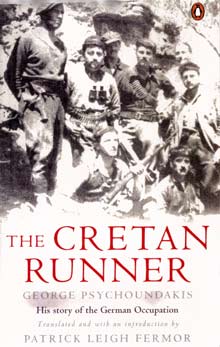
George Psychoundakis – The Cretan Runner’s obituary from The Times

A second obituary of George who as a fit young man risked life and limb running messages for the Cretan resistance and then for the SOE operatives in Crete. Paddy helped to get George out of gaol (when he was mistakenly detained by the Greeks as a deserter) and then translated The Cretan runner into English.

Cretan partisan who wrote an unvarnished account of the wartime occupation

First published in The Times February 23, 2006

AS a runner for the Resistance in Crete during the German occupation, George Psychoundakis carried messages over vast distances across one of the most mountainous regions in Europe. It was a life of constant risk — runners captured by the Germans were often tortured and shot. Wearing worn-out boots and with a minimum of rations, Psychoundakis would cover up to 50 miles in only a few days. The threat from collaborators meant that he often had to avoid villages, thus depriving himself of comforts that would have eased the rigours of his journeys.

Psychoundakis approached his missions with a humour and a charm that made him a popular figure in the Resistance, as well as with the British officers serving under cover. One officer was the writer Patrick Leigh Fermor, with whom Psychoundakis formed a lifelong friendship. It was Leigh Fermor who translated Psychoundakis’s account of life under the occupation, The Cretan Runner, republished in 1998.

In his foreword Leigh Fermor writes how he was captivated by the Cretan’s “gift for play on words, for funny repartee, light verse, improvisation, unpredictable flights of imagination and his instinct for teasing the great . . . which earned him a universal licence as a jester”.

More than merely fleet of foot, Psychoundakis was quick of mind. Before the war, as a shepherd boy, he was fascinated by literature. Among a barely literate population, he had to pester the village priest and the doctor for books, and even composed his own epic poems. Psychoundakis represented the Greek oral tradition: he had even composed a two-hour-long poem about the war. It ended with George firing Leigh Fermor’s pistol into the air, swearing vengeance on the German “ cuckolds”. At night and when the weather was awful, Psychoundakis would sit with his comrades in their caves, reciting the 10,000 lines of the 17th-century Cretan poem, the Erotokritos.

George Psychoundakis was born in 1920, the son of a shepherd from the village of Asi Gonia in Western Crete. The family was very poor — Psychoundakis, his two sisters and brother were raised in a one-room house — and owned only a handful of goats and sheep. After a few years at the village school Psychoundakis too became a shepherd until the German invasion in May 1941.

Had the invasion not happened, it is probable that he would have remained an unknown shepherd, eking out a tough existence on the craggy Cretan landscape. But the occupation allowed him to broaden his horizons, for the contacts he had made with scholarly warriors such as Leigh Fermor gave him the opportunity to make a name for himself as a man of letters.

But the transition from mountain boy to writer was not easy. Despite being awarded the British Empire Medal after the war, Psychoundakis was arrested as a deserter and imprisoned for several months, losing his thick head of hair through worry. Afterwards, he was forced to fight in the civil war, returning to Asi Gonia after two years to find his family poorer than ever.

It was then that he wrote The Cretan Runner. When he and Leigh Fermor met again in 1951, Fermor marvelled at the uniqueness of such a document. Most writing about the occupation had been by the English or the Germans, but here was a heartfelt testament to the horrors of being occupied. The book was published in 1955, and became a great success.

Written in a simplistic style, it is an episodic account of hardships and dangers, with moments of great humour set against a background of murder and torture.

“Nobody talked, but the Germans had positive information. They lined them all up, and, as they refused to speak, prepared to execute the lot. But, before they could press the trigger of their heavy machine-gun, ten Germans fell dead. For some of the village men — about ten — had taken up position along the top of a sheer cliff above the village, from where they could watch every detail, and, at just the right moment, had opened fire. Not a bullet went wide.”

Even after the publication of The Cretan Runner, Psychoundakis continued to live in Asi Gonia. There he translated the Iliad and the Odyssey into his Cretan dialect, and he was honoured by the Academy of Athens. He lived off the land and held a variety of jobs. That one of these was as the caretaker for the nearby German cemetery was a shining example of Psychoundakis’s sense of forgiveness.

He is survived by his wife, Sofia, their son and two daughters.

George Psychoundakis, BEM, shepherd, partisan and writer, was born on November 3, 1920. He died on January 29, 2006, aged 85.

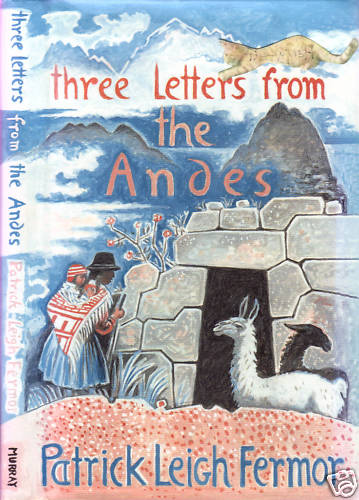
A quick review of Three Letters from the Andes

I have just finished reading Three Letters from the Andes published in 1991, but first written by Patrick Leigh Fermor during the month long expedition to the high Andes in Peru in 1971. He was accompanied by good friends, most notably his close friend Andrew Cavendish, 11th Duke of Devonshire.

The original text consists of three letters to his wife Joan and mailed by Paddy to her to try to describe to her much of what happened during the expedition which included some challenging climbing, which for the greater part, Paddy did not join. He describes his principal role as ‘minder of the primus stove’ and this duty enabled him to sleep in the spacious mess tent.

Three Letters from the Andes

The book is enjoyable enough and it does what it says; it describes the journey and I am sure Joan would have enjoyed the letters. Paddy did some editing prior to publication to make them more presentable for general readership (and probably removed any indiscreet comments). However, compared to the more familiar A Time of Gifts and Between the Woods and the Water, this is a lightweight affair. Perhaps it shows how much work Paddy must put into his constant redrafts to expand upon his first thoughts. This is clearly work that had minimal redrafting, and is interesting because of that.

The description of the journey and key events remain in my memory but it did not give the deep pleasure gained by the former books. Just a couple of my favourite bits:

When flying in to Lima the party had to go through Peruvian customs and immigration. Paddy describes the staff as ‘sleepy, rather blank faced … officials who were far from brisk.’ He goes on to describe Andrew Cavendish’s experience. ‘… our passports seemed to puzzle them and Andrew’s proved utterly enigmatic. He got through the last barrier half an hour after they’d finished with the rest of us, murmuring sadly: ‘I can’t deny there are countries where being a duke is a bit of an advantage; but Peru’s not one of them.’

Right at the end of the journey at a dinner given for the party at the British Embassy, Paddy is seated next to a ‘very quiet and very beautiful neighbour called Dona Diana de Dibos’. After a while he realized that she was the sister of Lt Mike Cumberlege, a naval officer who used to ferry partisans and SOE agents into and out of Crete during the German occupation. He had been shot in a concentration camp just four days before VE day. Paddy cheered her up by telling her many stories about her brother that she had never heard before.

Three Letters is short and easy to read. For Paddy fans it is essential reading to complete our picture of him and his life and his various publications. There are probably better ways of spending a few hours, but I don’t think anyone reading it will be disappointed … as long as they don’t expect a short version of ATOG.

Obituary: John Smith-Hughes who served in Crete with SOE

Young officer who served in Crete and then joined SOE working with many of Paddy’s colleagues. It is almost certain Paddy and Smith-Hughes met but there is no mention in this obituary.

by Antony Beevor

First published in The Independent Thursday, 17 March 1994

John Smith-Hughes, soldier and barrister: born 27 November 1918; OBE 1945; married 1945 Angela Louvaris (died 1972; one son, one daughter); died Tortola, Virgin Islands 4 March 1994.

LIKE many of those who joined Special Operations Executive in the Middle East, Jack Smith-Hughes possessed considerable intellectual talents matched by a lack of reverence for conventional army pieties. His path to SOE’s headquarters in Cairo had also been decidedly unpredictable.

At the end of 1940, Smith- Hughes, a portly and precocious 22-year-old subaltern in the Royal Army Service Corps, was shipped to Crete as part of the Allied garrison sent to defend the island after the Italian invasion of Greece. When the German airborne invasion took place in May 1941, he was in charge of shipping supplies to outlying detachments from Chania, in north- west Crete. On the night that Brigadier Robert Laycock and Evelyn Waugh landed with the Layforce commandos at Suda Bay, the most chaotic moment of the battle, Smith-Hughes was astonished to find himself walking up and down the jetty for a considerable time with General Bernard Freyberg VC, the Allied commander on the island. Freyberg was worried that the Australian force at Rethymno, on the coast to the east, would not receive the order to withdraw. Unfortunately, this concern for his troops meant that Freyberg was out of touch with his headquarters during several hours while the last Allied counter-attack collapsed in confusion.

The next day, retreat nearly turned into rout. Smith-Hughes was soon one of the 20,000 exhausted men making their way over the White Mountains to the southern coast for evacuation by the Royal Navy. He was one of the unlucky ones. On his way to join the queue on the last evening, he was turned back by an embarkation officer and told not to worry: the warships would be back again the following night. A couple of hours later, he realised that the man had lied to him. Captured by Austrian Alpine troops the next morning, he was marched back over the mountains, the most painful journey of all, to prison camp.

He escaped soon afterwards and hid at the house of Colonel Andreas Papadakis, who later proclaimed himself chief of the Cretan Resistance. George Psychoundakis, ‘The Cretan Runner’, then guided him to the monastery of Preveli on the south coast. Evacuated finally to Egypt by submarine, Smith- Hughes had the satistaction in a Cairo restaurant of encountering the embarkation officer again and telling him exactly what he thought of him.

To his surprise, Smith-Hughes was summoned to SOE’s Cairo headquarters, in Rustum Buildings – known to Cairene taxi-drivers as ‘secret building’. He was then sent back to Crete ‘to feel out the country and see who had influence’. Accompanied by Ralph Stockbridge of Inter-Services Liaison Department, the cover-name for MI6, he landed on 9 October 1941. Smith-Hughes was fortunate not to never encounter a German patrol or roadblock: his Cretan disguise only seemed to draw attention to his unusual bulk, his Britishly pink compexion, and his ungainly walk.

Smith-Hughes and Stockbridge set off to see Papadakis, the only person they knew who claimed to have influence. But Papadakis’s folies de grandeur made him impossible to use as a focus of resistance. Other leaders were sounded out, mainly those rallied by the archaeologist John Pendlebury who had then been executed by German paratroopers during the battle. Smith-Hughes handed over to Monty Woodhouse from Egypt shortly before Christmas and returned to Cairo, where he ran the Cretan desk at SOE headquarters with great skill.

Promoted to major, Smith- Hughes managed to preserve the section from the terrible infighting in Rustum Buildings by moving out to an annexe. It was Smith- Hughes who briefed and backed up Woodhouse’s successor, Tom Dunbabin, another distinguished archaeologist of great courage, and his two deputies, Xan Fielding for western Crete and Patrick Leigh Fermor for eastern Crete. Unusually for SOE in the Middle East, the Cretan section, B5, was neither riven by animosity nor plagued by rivalry with ISLD. Smith-Hughes’s joint mission with Stockbridge laid the foundations for an unusual degree of co-operation between the two organisations, and he managed to maintain it even in the torrid bureaucratic warfare carried out by the ‘Gaberdine swine’ in Cairo.

The Germans did all they could to track down the ‘espionage organisation of Captain Huse’, as one of their reports put it. But perhaps the greatest contribution made by SOE officers in the field and in Cairo was to prevent the latent civil war between the Cretan nationalist EOK and the Communist-dominated EAM-ELAS from exploding into a war to the knife. After the liberation of Heraklion, when a reactionary kapitan shot and wounded one of the Communist andarte leaders, Dunbabin and Smith-Hughes managed to prevent an explosion by driving round the town in open jeeps, and persuading both sides to back away from a battle which would have led to the virtual annihilation of the Communists. The Nationalists, unlike their counterparts on mainland Greece, were untainted by collaboration and much stronger than the Left.

Smith-Hughes, with typical self-deprecating humour, recounted that his most terrifying experience during the war was the formal liberation of Kastelli Kissamou, on the north-west tip of Crete. As a mark of honour, the Cretan kapitan for the area insisted that he should ride with him into the town. Smith- Hughes, who had never felt comfortable with horses, was obliged to overcome his fears, and when the cheering crowds made the horse caracole, he had to hold on to the saddle with both hands.

After the war, Smith-Hughes turned his incisive mind and astonishing memory to the law, first in the Army, and then as a barrister at Tortola in the Virgin Islands, where he became Attorney-General. In 1991, he returned to Crete for the 50th anniversary of the battle and was one of the guests at the memorable all-night glendi in honour of Patrick Leigh Fermor and his Cretan comrades who abducted General Heinrich Kreipe in April 1944.

Publication of Mani from Kathimerini

Selection: Michalis Katsigeras

First published in Kathimerini October 17, 1958

PATRICK LEIGH FERMOR: The latest book by the distinguished British writer and philhellene Patrick Leigh Fermor, titled “Mani,” is to be released in London on December 1. The book describes the region of Mani, its history and customs with the sympathy and wit that generally characterizes all his writing on Greek issues. Leigh Fermor came to Greece for the first time 1935. He has none of the reserve that is usually a characteristic of the British people [Ed –  Huh!!!] and fell in love with Greece at first sight. He learned to speak Greek very quickly and the next year, in 1936, translated Rodokanakis’s “Odysseus” into English. In the years before the war, he travelled a great deal. During the German occupation of Greece, he was sent to Crete where he played a leading role in the abduction of the German General Kreipe. He now lives in Crete, among his Cretan friends.[Ed – not quite true – Paddy was nomadic at this time eventually settling near Kardamyli in the mani] (Ed. Note: “Mani” was translated into Greek by Tzannis Tzannetakis in 1973 when he was in internal exile during the military dictatorship.) POPE PIUS XII: Vatican City – Vatican City’s radio station issued an official announcement today that Pope Pius XII has passed away. His death came at about 3.50 a.m. local time. Italian President Giovanni Gronchi and Prime Minister Amintore Fanfani ordered a period of national mourning.

The obituary of George Psychoundakis aka The Cretan Runner

The Cretan Runner

The obituary that follows is of George Psychoundakis, who as a young man was a runner for the resistance in Crete during the German occupation in World War II. First of all he ran for local partisans groups or andartes, but from about 1941 he did most of his work with the Special Operations Executive.  At the end of the war George was mistakenly taken for a deserter and locked up. He spent around 16 months in gaol and whilst there he wrote his wartime memoires. Somehow Paddy became aware of his incarceration and had George released. He then helped George by translating his memoires into English and sorting out a publisher. The book has been translated into many languages and is called The Cretan Runner. This obituary includes a section written by Paddy at the end.

First published: 12:10AM GMT 18 Feb 2006 in the Telegraph

George Psychoundakis, who died at Canea, Crete, on January 29 aged 85, was best known for his extraordinary account of clandestine life in the Resistance after the German occupation of his island in 1941; the book was translated into English by Patrick (now Sir Patrick) Leigh Fermor, and enjoyed success in Britain as The Cretan Runner.

George Psychoundakis was born on November 3 1920 at the village of Asi Gonia, perched high in a mountain pass in central Crete. He was the eldest of four children, born to a family whose only possessions were a single-room house and a few sheep and goats.

Education at the village school was basic; but unlike most of his fellows George learnt to write as well as read, and gleaned what learning he could from books lent by the schoolteacher and the village priest.

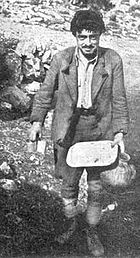
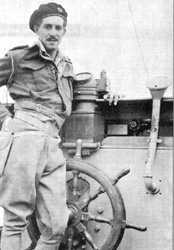
George Psychoundakis during the Resistance

When the German invasion of Crete began, he was 21, a light, wiry, elfin figure who could move among the mountains with speed and agility. While the Germans imposed their rule with the utmost brutality, Psychoundakis was among the many who guided straggling Allied soldiers over the mountains to the south coast, from where they could be evacuated.

As the Resistance grew more organised, Psychoundakis became a runner, carrying messages, wireless sets, batteries and weapons between villages and secret wireless stations, always on foot, always in danger, often exhausted and hungry, over some of the most precipitous terrain in Europe.

It was gruelling work, but in an interview many years later Psychoundakis made light of the hundreds of miles he covered at a run: “I felt as if I were flying, so light and easy – just like drinking a cup of coffee.”

Patrick Leigh Fermor, one of a handful of SOE officers whose job it was to co-ordinate the Cretan resistance, first met Psychoundakis at the end of July 1942 in a rocky hide-out above the village of Vaphé.

The messages Psychoundakis was carrying were twisted into tiny billets and hidden away in his clothes: “They were produced,” wrote Leigh Fermor, “with a comic kind of conjuror’s flourish, after grotesquely furtive glances over the shoulder and fingers laid on lips in a caricature of clandestine security precautions that made us all laugh.” His clothes were in rags, one of his patched boots was held together with a length of wire – but his humour and cheerfulness were infectious.

Humour and danger went hand in hand. Psychoundakis told how a couple of German soldiers decided to help him with an overladen donkey, which was carrying a heavy wireless set under bags of wheat. The Germans beat the poor creature so hard that Psychoundakis was afraid they would knock off the saddle-bags – but mercifully their attention was drawn to some village girls, and the soldiers started flirting with them instead.

He also describes British officers with wry amusement – one had “pyjamas, a washbasin, and a thousand and two mysterious objects. He wore a row of medals on his breast, and had a rucksack full of geological books which he studied all day long.”

At the same time, the harshness of everyday life was everpresent. Near starvation at one point with another SOE officer, Jack Smith-Hughes, Psychoundakis described how they picked broken snail shells off blades of grass and ate them, pretending that each was more delicious than the last.

A bed of springy branches in a dry cave was a luxury: George spent many a night freezing on a rain-soaked mountainside, listening out for German search-parties, knowing what they would do if he were caught. Tales of torture, burning villages and summary executions were all too familiar. On the one occasion he visited England, in 1955, Psychoundakis was awarded the King’s Medal for Courage in the Cause of Freedom. Continue reading

A chronicler of a bygone age a rememberer of things past

An interesting background piece from Kathimerini which mentioned that Vol 3 was due in 2007! This is the first time I have come across a possible publication date. Obviously missed now, and who knows if that is due to editorial problems, being incomplete or perhaps this too will be delayed like his biography until after his death?

Patrick Leigh Fermor keeps alive in shimmering prose the spirit of the Greece he reveres

by Willard Manus, a freelance journalist who lives in the US and spends time in Greece

First published in Kathimerini 20 July 2006.

Reading Patrick Leigh Fermor today is both an exhilarating and depressing experience. Exhilarating because of the depth and brilliance of his prose, depressing because the Greece he portrays so memorably has been hammered to dust by the march of time.

Fermor, who was knighted in 2003, is best known in Greece and in his native Britain, where he was born 92 years ago. «The Traveller’s Tree,» published in 1950, dealt with the journey he made around the Caribbean islands in 1947-48. It won the Heinemann Foundation Prize for Literature, and established him as a writer of note.

His next two books were «A Time to Keep Silence» (1952), which described his stay in various European monasteries, and «The Violins of Saint-Jacque» (1956), a novel. A decade later, he published two books on Greece, «Mani: Travels in the Southern Peloponnese» and «Roumeli: Travels in Northern Greece,» which quickly earned him a reputation as the pre-eminent non-native writer on 20th century Greece.

Fermor’s attachment to Greece goes deep. His first experience of the country dated back to 1933, when, as a rebellious and untamed 19-year-old, he dropped out of Sandhurst and set out on a walking tour of Europe whose eventual destination was Constantinople. Envisioning himself as «a medieval pilgrim, an affable tramp with a knapsack and hobnailed boots,» he embarked, in midwinter, on a journey that eventually spanned three years and took him through the Netherlands, Germany, Austria, Hungary, Romania and, eventually, Greece.

Remarkably, Fermor did not write about his picaresque adventures in pre-war Europe until many years later. «So when ‘A Time of Gifts’ appeared in 1977 and ‘Beneath the Winds and the Water’ in 1986, the life of the mid-30s that he described had been utterly destroyed,» his biographer Artemis Cooper has noted, «and much of the land he had walked over was in the grip of communism for years. Yet his memory recreated this world with an astonishing freshness and immediacy, and recaptured the young man he was then: full of curiosity, optimism and joy in the vibrant diversity of the world.»

The concluding volume of Fermor’s trilogy is scheduled for publication (by John Murray Ltd) in early 2007. Continue reading

Erotokritos as discussed in Roumeli

There is a very interesting discussion thread about this poem that I stumbled across recently.

Click here to have a look. It includes discussion about translation and some You Tube links. Here is what Paddy has to say about it in Roumeli:

Unknown outside Greece because of the deep vernacular that enshrouds it and its daunting length for a translator-though many, including me, have longingly toyed with the idea-it is one of the great epic poems of Europe. In Crete, this tremendous metrical saga plays the part of the Homeric cycle in Dorian times. Everyone knows it, all can quote vast tracts, and, astonishingly, some of the old men in the mountains, though unable to read and write, could, and still can, recite the whole poem by heart; when one remembers that it is nearly a thousand lines longer than the Odyssey, this feat makes one scratch one’s head with wonder or disbelief. They intone rather than recite it; the voice rises at the caesura and at the end of the first line of a couplet, and drops at the end of the second; now and then to break the monotony, the key shifts. During our winter vigils, it continued for hours; every so often another old man would take over; listening, I occasionally dropped off for an hour or two, and woke to find Erotokritos in the thick of yet another encounter with the Black Knight of Karamania. (He symbolized, at the time the poem first saw the light, the threat of the Ottomans; Turkey had already conquered the rest of Greece, and was soon to submerge Crete itself.) The rhythmic intoning might sway on till daybreak, with some of the listeners rapt, others nodding off or snoring.”

Musically it gets quite passionate as evidenced by these two samples:


Apparently the Erotokritos was written in about 1587. Here are some translated verses:

Of all the gracious things upon this earth
It is fair words that have the greatest worth,
And he who uses them with charm and guile
Can cozen human eyes to weep or smile.

— V. Kornaros, Erotokritos I 887-90 (Stephanides)

Begin your lesson now. It is a rule
That he who starts in time soon leaves the school.

— V. Kornaros, Erotokritos II 1871-2 (Stephanides)

There are full many, sweet, whose tongues are bland,
Who hide a poison phial in the hand.

— V. Kornaros, Erotokritos III 141-2 (Stephanides)

You straighten easily a fresh-cut stake,
Yet when it dries it will but split and break.

— V. Kornaros, Erotokritos III 279-80 (Stephanides)

True is that adage: “He who yields to rule
by woodenheads, becomes himself a fool.”

— V. Kornaros, Erotokritos III 967-8 (Stephanides)

Well said by the prudent who discover:
The heaviest pain lighter ones cover.

— V. Kornaros, Erotokritos III 1287-8 (Ragovin 1, p. 14)

Man shapes his plans as he intends and deems,
And not because of visions and of dreams;
The future is not yet, dreams cannot sway,
Man’s destiny this, that, or any way;
As each one makes his bed, so does he sleep;
The foolish only trysts with shadows keep.

— V. Kornaros, Erotokritos IV 139-144 (Stephanides)

Anyone who wants the great things of this life
Yet does not know he is only travelling the road,
And prides himself on his nobility and boasts of his wealth
-I dismiss him as a nobody, to be thought of as mad,
For these things are flowers which come and go,
They are changed by time, and time often takes them away.

— V. Kornaros, Erotokritos IV 601-6 (Bryans, p. 89)

Xan Fielding Obituary

After much searching I can bring you what I believe to be the only on-line obituary to Xan Fielding which I have retyped from the Daily Telegraph Second Book of Obituaries: Heroes and Adventurers. This includes a special tribute from Paddy to one of his closest friends.

First published in the Daily Telegraph 20 August 1991

Xan Fielding, the author, translator, journalist and adventurous traveller, who has died in Paris aged 72, lived a charmed life as a Special Operations Executive agent in Crete, France and the Far East during the Second World War.

Short, dark, athletic and a brilliant linguist, he was God’s gift to operations in rugged mountainous regions and wherever his languages were needed.

Major Fielding was awarded the DSO in September 1942, “for going into a town”, as he said later with a typical modesty.
He had a boyish, slightly rebellious spirit which he shared with many of his contemporaries in SOE. His self-confessed, or self-proclaimed, amateurishness certainly belied a tough professionalism, great resourcefulness and bravery in action. Fielding was the sort of man one would be happy to go into the jungle with.

While still in his early twenties he was responsible for clandestine and subversive activities in large areas of enemy-occupied Crete. He survived numerous encounters with German forces, only to be rumbled by the Gestapo in France towards the end of hostilities in Europe.

Even then his luck held. Locked in a death cell at Digne in 1944, he was “sprung” in an audacious move by Christine Granville (nee Krystyna Skarbeck) whose SOE exploits matched his.

Alexander Wallace Fielding was born at Ootacamund, India, on November 26 1918. His family had long links with the Raj and his father was a major in the 50th Sikhs.

Xan’s mother died at his birth and he was largely brought up at Nice, where his grandmother’s family had considerable property. Fluent in French, he subsequently became a proficient classicist at Charterhouse and then studied briefly at Bonn, Munich and Freiberg Universities in Germany. He saw what was happening in that country and was so shocked at the attitude of the Chamberlain government that he came close to joining the Communist party.

At the end of the 1930s Fielding – who had recently been sacked as a sub-editor on the Cyprus Times and was by now unsuccessfully running a bar – found himself a misfit in the Mediterranean colony. Colonial officials abhorred his refusal to adopt their disdainful description of Cypriots as “Cyps”. That he was also reasonably fluent in Greek rendered him suspect to district commissioners, who could not speak the language of the people they administered.

At the outbreak of the Second World War, haunted by the thought that he might find himself trapped in Cyprus for the duration, he fled to Greece and found asylum on St Nicholas, an island owned by the anthropologist, Francis Turville Petre. Fielding dreaded not so much the battlefield as joining the conventional officers’ mess. But eventually news of the fall of France, the Dunkirk evacuation and the Battle of Britain induced a “stab of guilt”.

He returned to the colony and was commissioned into the Cyprus Regiment, which appealed to him on account of its perverse refusal to have any regimental pride.

On hearing in Cairo that Cretans had taken up arms against the Germans, he yearned, as he wrote later, to help lead “this concerted uprising of the technically non-combatant”.

When Crete fell, Fielding was interviewed in Egypt by SOE. He was asked: “Have you any personal objection to committing murder?” His response being deemed acceptable, Fielding was put ashore in Crete with a load of weapons and explosives by Cdr “Crap” Miers, VC, skipper of the submarine Torbay.

Continue reading

Philhellene’s progress: The writing of Patrick Leigh Fermor

As you know I trawl the net for Paddy related material to create the best online source of information about PLF and his friends and associates. Some of you may have come across this essay that attempts to analyse Paddy’s style and his literary achievement. In my view it is just one of many that emphasise how great the man is and how unequalled is his prose.

First published in New Criterion, Jan, 2001 by Ben Downing

I have carried the soldier’s musket, the traveler’s stick, the pilgrim’s staff. –Chateaubriand (what a great quote for Paddy!)

The captive must have been exhausted and afraid, but when, on the fourth day of his grueling forced march across Crete, he saw dawn break behind Mount Ida, the sight was so beautiful that it brought to his lips the opening of Horace’s Ode I.ix: “Vides ut alta stet nive candidum/ Soracte,”(1) he murmured. Then, just as he trailed off, one of his captors came in to take the poem over, reciting the rest of its six stanzas. At this, the captive’s startled eyes slanted down from the peak to meet those of his enemy, and, after a long thoughtful silence, he pronounced, “Ach so, Herr Major.” For the captive was a German soldier–the commander of the island’s garrison, no less. General Karl Kreipe (to give him his name) had been abducted on April 26, 1944 by a band of Greek guerrillas led by two English commandos. Over the next three weeks, the kidnappers picked their way across Crete, eluding the thousands of Nazi troops who hunted them, until eventually they were met by a British boat and whisked to Cairo, where Kreipe was handed over and the two commandos promptly awarded the D.S.O. One of these men was W. Stanley Moss, who in 1950 published a riveting account of the escapade, Ill-Met by Moonlight, later filmed by Michael Powell. The other was a certain Patrick Leigh Fermor. Disguised as a shepherd and (like Zeus in his Cretan boyhood) living largely in caves, he had spent much of the previous two years on the island organizing the resistance. Leigh Fermor it was who finished the quotation.

But where had he, who’d never completed high school, learned Horace so well? Had Kreipe asked him this, Leigh Fermor could have answered, savoring the irony, that he’d committed the odes to memory during his teenage Wanderjahr a decade earlier, when, just after Hitler’s rise to power, he’d walked clear across Germany (among other countries) with a volume of Horace for his vade mecum, often reciting the poems to himself as he tramped. About that experience he’d not yet written a public word, and would not do so for many more years. Similarly he held off recounting his aubade with Kreipe. At last, however, in the 1970s, he broached the subjects of his continental traverse and, in an aside to that account, of his fleeting bond with Kreipe. Some things are best waited for: the book in which Leigh Fermor set these matters down, A Time of Gifts (1977), along with its sequel, Between the Woods and the Water (1986), represent not only the capstone of his career but, in my opinion, the finest travel books in the language and a pinnacle of modern English prose, resplendent as Soracte or Ida in deep snow.

The deplorable fact that most Americans, even well-read ones, have never even heard, as I also had not until recently, of a figure who in Britain (to say nothing of Greece, where he lives to this day) is revered and beloved as war hero, author, and bon vivant; who is, in Jan Morris’s words, “beyond cavil the greatest of living travel writers”; and who, in those of the historian John Julius Norwich, “writes English as well as anyone alive”–all this spurs me to correct our oversight of the sublime, the peerless Patrick Leigh Fermor.

His turbulent early life is recounted in the introduction to A Time of Gifts. Shortly after his birth in 1915, his mother and sister went to join his father in India, while he was left behind “so that one of us might survive if the ship were sunk by a submarine.” For four years he was billeted with a Northamptonshire farming family, an experience that proved “the opposite of the ordeal Kipling describes in Baa Baa Black Sheep.” A halcyon period, this, but the taste for boisterous freedom he acquired in the fields made for trouble later on: “Those marvelously lawless years, it seems, had unfitted me for the faintest shadow of constraint.” Especially intolerable to him were academic strictures of any kind, and there ensued a long series of dust-ups and expulsions, hilariously related. At ten he was sent to “a school for difficult children,” among which misfits he lists

the millionaire’s nephew who chased motorcars along country lanes with a stick, the admiral’s pretty and slightly kleptomaniac daughter, the pursuivant’s son with nightmares and an infectious inherited passion for heraldry, the backward, the somnambulists … and, finally, the small bad hats like me who were merely very naughty. Continue reading

Writer and WWII hero honoured with Order of the Phoenix

Report of the presentation of the Greek Order of the Phoenix to Paddy

First published Ekathimerini online 3 March 2007

By Helbi

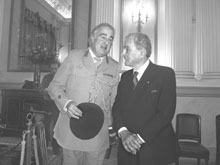
Patrick Leigh Fermor (right) with Colonel Mark Blatherwick, the British defense attache in Athens

The week that passed brought both joy and sorrow to those close to two British heroes who fought for Greece during World War II and whose love for the country never dimmed. The writer Sir Patrick Leigh Fermor, author of famous books such as “Mani” and “Roumeli,” “A Time of Gifts” and “Between Woods and Water,” even settled in Greece, near the Mani village of Kardamyli. This week President Karolos Papoulias bestowed upon him the Order of the Phoenix in the New Year honors for 2007. Ambassador Tassos Kriekoukis, director of protocol for the Foreign Ministry, spoke of “Sir Patrick’s love of writing and traveling but also for Greece, for whose freedom he fought at the side of Greek and British commandos. Who can forget his part in the kidnapping (in wartime Crete) of (German) General Kreipe?” Colonel Mark Blatherwick, the British Defense Attache in Athens, accompanied Sir Patrick Leigh Fermor to the event.

Remembering John Craxton

An event in memory of the late English artist was held last week at the British Embassy in Athens, and Paddy was there.

The early works of John Craxton evoked an ‘arcadian’ feel but later became more schematic. Cubism and other 20th-century movements had an influence on his work.

First published in Ekathimerini online on 21 April 2010

By A Koroxenidis

When the late English painter John Craxton (1922-2009) first visited Greece in the mid-1940s he discovered what he called “human identities,” a world that suited him and was to soon become his home.

In the 60s Craxton settled in Hania, Crete, in a house facing the old harbor. He led a simple bohemian life, appreciated the local lifestyle and explored the country’s cultural history, especially the Byzantine churches on the island. For many years, he also served as as Britain’s consular correspondent in Hania.

John Craxton

His friends and the people close to him, who gathered last week at the British Embassy in an event dedicated to Craxton’s memory, remember him as a talented artist, an intellectual, a generous, straightforward and well-mannered person who had humor, sophistication and an optimist view of life. A learned artist, Craxton was part of an intellectual international milieu.

Following an opening by British Ambassador to Athens Dr David Landsman, novelist and playwright Paris Takopoulos, who met Craxton in London in the late 1940s, referred to the artist’s knowledge of Greek modern culture and also spoke of the great value that Craxton placed on friendship. He also noted that Craxton was an excellent critic of art.

John Craxton work from Greece

Maria Vassilaki, associate professor of Byzantine art at the University of Thessaly, was another longtime friend of Craxton. [Maria was co-curtaor of the Byzantium 330-1453 Exhibition – see myByzantine blog]

Vassilaki spoke of his [Craxton’s] deep knowlege of Byzantine art and of their long conversations on Byzantine art and culture, on which they had planned to publish a book. Craxton had abandoned the idea but Vassilaki has edited the book and plans to publish it with Crete University Press.

Journalist (formerly at Kathimerini) and writer Maria Karavia mused upon her memories of Craxton and his friendship with the painter Nikos Hadjikyriakos-Ghikas, with whom he stayed whenever he visited Athens. Her warm memories include Craxton’s tender and colorful use of the Greek language.

The British author Sir Patrick “Paddy” Leigh Fermor was also among the speakers. Craxton and Leigh Fermor had worked together on a number of projects, with the former illustrating the covers of many of the latter’s books.

Born to musician parents, Craxton was raised in an artistic and intellectual family. He studied art in Paris and, as a young artist, produced paintings of an “arcadian” feel. His first visits to Greece inspired him in the designs for a 1951 production of the ballet “Daphnis et Chloe” by the Royal Ballet.

A major retrospective on his work was held at the Whitechapel Art Gallery in 1967. In 1993, Craxton was elected Royal Academician by the Royal Academy of Arts, London.

PLF’s car ‘blown sky high’!

“In Tearing Haste” is such a good read. As time passes Debo’s letters become better and better. She is so funny. Highly recommended. Is it heresy to say that she is starting to pip Paddy?

One learns so much in this book, which in effect is the closest to an autobiography we are likely to get for Paddy’s post war life. Got to p175 of my paperback version today when out of the blue I read this:

Mayday 1979                                                                                                                     Athens

Darling Debo,

Last Sunday night – Easter Sunday in the Orthodox Church – our car was blown sky high with an explosive charge and a length of fuse, with a red poster with hammers and sickles. I think they’d got the feast confused with Ascension Day. I think it’s all part of an attempt of ours to erect a modest bronze plaque to Fallen Comrades in Crete. It was to go up at a certain Abbey in the island. The Abbot and monks all consented, there was a feast to honour the decision, but a week later it was withdrawn: four men in cars had turned up, Communists from Heraklion, and frightened and threatened the monks. The same thing happened at another monastery, where our submarines used to surface on the same coast. Then a splendid village said they’d have it, and shoot anyone who tried to disturb it; and a few days later, BANG! At our doorstep. There is quite a powerful Comm. Party in Eastern Crete. The West is all OK: shows what a minority can do. The amount of telephone calls and telegrams from Cretan pals and Greeks in general – indignation, sympathy, etc, has made it almost worthwhile. But not QUITE, as insurance pays nought for Malicious Acts. Bugger them all.

Tons of fond love from

Paddy

This rivalry with the Communists goes all the way back to the time of wartime operations on Crete. See “Ill Met by Moonlight” and the threats and betrayals by the Communist Andartes. Is there a seamless link on to the 8 June 2000 assasination of Brigadier Stephen Saunders, 53, the British military attaché in Athens?

Visit to the veteran of the Peloponnese by Wieland Freund (from Welt Online)

A 2007 interview with Paddy by Welt Online. The Germans have almost the same fascination for Paddy as we do. Afterall his first adventures took place in Germany (A Time of Gifts) and his part in the kidnap of General Kreipe has a particular fascination. 

He also confirms that “Volume Three” is being written – translated by Google – Oh yes, “he says in the rich sunshine,” I will write this book. There is to end on Mount Athos. From there, I have notes for every day. 

So here is the Google translated version. The original in German for the purists and the linguists is the next article below. 

Stop Press! I have had an offer to translate this properly and when I receive it I will replace the trash from Google. In the meantime, my apologies and enjoy trying to make sense of it!

Resistance fighters, hikers, travel writer Patrick Leigh Fermor went to Istanbul as a young man, kidnapped in 1944 in Crete an army general and now lives in Mani. There he kept on the typewriter by Bruce Chatwin. 

Since the sixties, the home of Patrick Leigh Fermor: the Mani peninsula in the Greek Peloponnese. 

That there could be his house did not think you would have to climb into a closet or throw himself into a rabbit hole in order to achieve it – this idea comes with the darkness and returns, turned back into the Enchanted. 

The way to Patrick Leigh Fermor, the Herodotus of the 20th century, leads, it seems, to the edge of the world and then one step beyond. The shimmering leaves of the olive grove, the giant lemon and the red, Greek past of heavy earth might as well be the props of a dream. 

“Paddy” came first in 1952 by Mani 

We keep a vigilant group of cypress trees and follow the overgrown path until a sky-blue gate. Do I need a spell, so it opens and appears Fermor, the travel writer, war hero, the legend? Knocking at least seems too little. 

With 92 years, Patrick Leigh Fermor of immortality as close as it is today even comes close. His way of fame is just off the beaten track to have the world, behind firmly closed doors or in such places as the taciturn Mani. 

Paddy, like not telling the familiar without reverence, came here in 1952 for the first time. How the Spartans and the Byzantines, who fled from Slavs and Turks, and of which he knows everything, he climbed the passes of the up to two and a half meters Taygetos, the Mani, the middle finger of the Peloponnesian hand, centuries made for a natural fortress.
Patrick Leigh Fermor in Berlin

The knocking does not answer 

The back of the slopes wrinkly rich almost to the bay. Bruce Chatwin, who came to Paddy as a “guru to worship” or how to overthrow a king, saw eagles soar over the house of Leigh Fermor. Twenty years later, Paddy Chatwin ashes buried – next to a crumbling Byzantine church not far from here. The Mani is famous for its action songs. 

Southward, on the faded, twinkling towers over the tiny villages, run, it means that a chasm into Hades. Leigh Fermor found it flooded. “Phosphorgefiedert,” he wrote, dip it into the cold depths and swim “through the heart as a huge sapphire. 

We knock in vain to dare us to elaborate the cobbled courtyard and whisper with the housekeeper. It leads us through the garden open arcades, which might as well bend over a cloister. 

Leigh Fermor is tattooed like a sailor 

Leigh Fermor has written so many monasteries in Europe, in towers of “solid ivory, and if anyone here was an escapist, The doors to the rooms, however, the numerous tables, which depends on the sound of glasses and laughter as a smoke curtain, speak a different language. 

Leigh Fermor speaks many. Photographs show it once hung over bursting with charm and zest for life, sometimes almost professorial, and again obviously as a sailor and tattooed. 

We wait under the coffered ceiling of the spacious, wonderfully cluttered living room, from which the English poet John Betjeman once wrote that it was “one of the rooms of the world.” On one wall hang paintings by Nicolas Ghika and John Craxton, leaning on a shelf worn, faded volumes of the great English stylist. On the floor there is a band “Sherlock Holmes”. “Enchanting easy, right?” 

The family left behind her son with strangers 

This could be Merlin: a jumble the gray, wavy hair, sharp features and eons of age in the eyes. Leigh Fermor carries the threadbare sweater a garret of scholars and the trousers of an artist in his studio. 

He is of overwhelming kindness, perfectly shaped “upper class”. In the sunlit bay he called almost everyone who comes to the question, “marvelous”: writers, painters, musicians. “They all knew.” – “I am,” he says mildly, “that old.” 

“For at least one of us children would remain alive, if a submarine sank the ship,” Paddy was in the care of a small family back in England. 

1933 – the first trip to Istanbul 

“I ran,” he says, “shouting and screaming across the yard. I never learned discipline. I was a difficult student. “-” Lazy? “-” Disobedience. “Even a psychiatrist who also treated Virginia Woolf was consulted. Paddy still flew from the school. He had kept up with the daughter of the greengrocer’s hands. 

The autumn of 1933 found him in a room not far from trouble blowing from London’s Shepherd Market, where he should have been cramming so that at least the military school would take him. 

Instead, he took a verse of George Herbert at his word: My way is free, free to the horizon, / Much like the wind. “In December 1933 he embarked for Holland. From there, he wanted to walk into a “green dragon”, Byzantium, which he never called Istanbul. 

On the trip report, the fans are waiting until today 

He is famous for getting lost in the widely spread European history, which he knows like no other. In Mani, one of his best books, the “opposite of a travel guide,” as he says, there is a footnote, the sheer joy of the strangest here, “and there crafty peoples’ lists of Greece: the Melevi Dervishes of” Tower the winds “, the fire dancers from Mavroleki, the hiking quack Eurytaniens. With the gypsies, whom he met in 1934 in the highlands of the Carpathians, said Patrick Leigh Fermor Latin. 

Paddy arrived on New Year’s Day of 1935 in Constantinople, and had better things to do than to write about his trip. He is one of the great English stylists working, slowly, life itself seems always in your way. 

It was not until 1977 “was published, the time of the gifts,” which describes his journey from Hoek van Holland to the middle Danube, nine long years later, “between forests and water”, which leads to the Iron Gate. The third book, the description of the phenomenon must last up to Constantinople, is still expected with such longing that leave a few words from the mouth of Paddy’s heave a sigh British press today. 

Where Chatwin’s old typewriter? 

When Sir Patrick, as he was allowed to call since 2004, was awarded in March in Athens the “Order of the Phoenix,” he told his casual way that he, because his handwriting was always bad, just learn to touch type. 

Oh yes, “he says in the rich sunshine,” I will write this book. There is to end on Mount Athos. From there, I have notes for every day. “We are walking through the garden, the Gulf of Messinia in a dozen colors of light blue. On the burnt grass stretches herself a hangover: “His great-grandmother one day was just there.” 

The studio is housed in an outbuilding. In an iron chest, which bears the inscription of “Traveller’s Club” that tape, books are stacked on the wall a faded French hunting scene. Somewhere there must be also Chatwin old typewriter, a 51er Olivetti. But where? Where? 

Soldier, he was happy because “was always something going on” 

On Mount Athos celebrated his 20th Birthday, then went to Athens, as he later went to Paris and Rome. With a Romanian princess, he lived in an old water mill in the Peloponnese, and followed her to finally Balení, the seat of her family in northern Romania. 

Russia and the horrors of communism were suddenly within reach. “Many of your friends were communists at that time.” – “I did not speak up,” he says. “ “I was so apolitical.” 

In Balení reached him of the war. He, which six years earlier at the Shepherd Market has become clear, “how little I was good for soldiers in peace time,” volunteered. The departure was hasty. “Not even my notebook I took with me. We were so naive. In a few months ago we believed us again. “It took decades. “Were you like a soldier?” – “In a way, yes. “ There was always something going on. ” 

In 1944, he kidnapped a German general 

Books are also in the bathroom and somewhere between them is a plaque commemorating the Battle of Crete. When she was lost, went back Leigh Fermor as major of the Special Operations Executive to Crete. One and a half years he lived disguised as a shepherd in a cave – “wrapped in white cloth from goat and horribly dirty” – and organized the Cretan resistance against the German occupiers. 

The rest is legend, one of the most daring commando raid of the Second World War. One night in April 1944, a large Opel on the road to Knossos, Paddy in a stolen German uniforms on the way. A scuffle and then, at the roadblocks, again and again the cry of “General car. 

For days wandered Leigh Fermor, the people and kidnapped the German General Kreipe through the mountains until they reached the coast, and finally Libya (Egypt). On the difficult journey Kreipe murmurs once verses of Horace. Leigh Fermor is one. „Ach so, Herr Major“,  

About the death, he never speaks 

Paddy has never really written about it. “Ill Met by Moonlight,” the book that tells this story in full, comes from Bill Stanley Moss, his former deputy, and was filmed with Dirk Bogarde as Leigh Fermor. 

When it first appeared in 1950, just came Paddy’s first book, “The Traveller’s Tree,” a description of his travels in the Caribbean out. DThen he was – in the UK, famous in Greece “He embodied an idea of the Renaissance,” writes Cooper, Artemis, “a man of action, which is just as much a scholar.” 

Cooper, the friend and daughter of a friend is writing Paddy’s biography, when he, as he says, “is just gone.” “But now that you mention it: We never really talk about it.” 

The stones for the house came with the donkey 

For lunch there are lemon chicken, tzatziki and Retsina. We sit on chairs Andalusian, a Venetian table at the foot of a guillotined by the passage of time Roman Sibyl. Leigh Fermor has picked up in Rome on the way, he collects nothing. 

He tells the story of Niko Kolokotronis, the Mauerermeister that the contract was to build his house, because six generations were Kolokotronis wall masters, and played all the violin. That was the beginning of the sixties. In the bay there was no electricity, donkeys brought the stones, and Paddy and his wife Joan were living in tents, until the house was finally finished. 

“I scribble in the studio in front of me,” reads a letter from the most beautiful, vibrant with life days in the bay.”Through the window I can see Joan, their army cats invites you to dinner; mass meows to rise, and their tails make waves like the sea.” 

A picture of his wife Joan (cats) in her hand 

Leigh Fermor demands a picture of the mantel, Joan in the forties, which he portrayed with a pencil. “Come on!” She called from a boat, as Paddy, like his hero, Lord Byron swam the Hellespont. “It took three hours.” 

Joan died in June 2003 here.”She was,” he says, his drawing in hand, “in truth much more beautiful. 

Original article here.

Besuch beim Haudegen des Peloponnes Von Wieland Freund (Welt Online)

Widerstandskämpfer, Wanderer, Reiseschriftsteller: Patrick Leigh Fermor ging als junger Mann nach Istanbul, entführte 1944 auf Kreta einen Wehrmachtsgeneral und lebt heute auf Mani. Dort bewahrt er die Schreibmaschine von Bruce Chatwin auf.

Dass es sein Haus gar nicht geben könnte, dass man in einen Schrank steigen oder sich in einen Kaninchenbau stürzen müsste, um es zu erreichen – dieser Gedanke kommt mit der felszerklüfteten Dunkelheit und kehrt tags, ins Verwunschene gewendet, zurück.

Der Weg zu Patrick Leigh Fermor, dem Herodot des 20.Jahrhunderts, führt, scheint’s, an den Rand der Welt und dann noch einen Schritt darüber hinaus. Die flirrenden Blätter des Olivenhains, die riesenhaften Zitronen und die rote, von Vergangenheit schwere griechische Erde könnten ebenso gut die Requisiten eines Traums sein.

“Paddy” kam erstmals 1952 nach Mani
Wir halten auf eine Gruppe wachsamer Zypressen zu und folgen dem zugewachsenen Pfad bis vor eine himmelblaue Pforte. Braucht es einen Zauberspruch, damit sie sich öffnet und Fermor, der Reiseschriftsteller, der Kriegsheld, die Legende erscheint? Klopfen jedenfalls scheint zuwenig.

Mit 92 Jahren ist Patrick Leigh Fermor der Unsterblichkeit so nahe, wie man ihr heute noch nahe kommt. Seine Art Ruhm ist nur abseits des Weltenrummels zu haben, hinter fest verschlossenen Türen oder an so verschwiegenen Orten wie der Mani.

Paddy, wie die Vertrauten nicht ohne Ehrfurcht sagen, kam 1952 zum ersten Mal her. Wie die Spartaner und Byzantiner, die vor Slawen und Osmanen flohen und von denen er alles weiß, erklomm er die Pässe des bis zu zweieinhalbtausend Meter hohen Taygetos, der die Mani, den Mittelfinger der peloponnesischen Hand, Jahrhunderte lang zu einer natürlichen Festung machte.

Read more here!

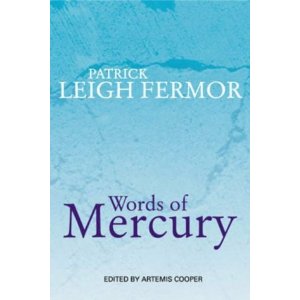
Life by the scenic route: Max Hastings reviews ‘Words of Mercury’

First publushed in the Daily Telegraph 12 Oct 2003

Paddy Leigh Fermor has lived one of the great picaresque lives of the 20th century. He left a minor public school under heavy clouds with no money and a penchant for wandering. From 1934, for five years, he sustained a lotus existence in eastern Europe and the Balkans, by charm, genteel begging and Byronic good looks. His parents must have despaired of him during this longest gap year in history.

Words of Mercury by Artemis Cooper

One of Evelyn Waugh’s characters observed in 1939: “It’s going to be a long war. The great thing is to spend it with friends.” Leigh Fermor pursued this policy with notable success. His 18 months as a British agent in Crete made him a legend, not least for the kidnapping of the German General Kreipe, theme of the later film Ill Met By Moonlight.

After the war, Paddy resumed his leisurely course. One can no more imagine him occupying an office desk, queueing for the weekly envelope, than some marvellous beast of the African bush taking up employment as a security guard. He wandered the world until, in 1950, he suddenly produced a small literary masterpiece about the Caribbean, The Traveller’s Tree.

Thereafter, at irregular intervals, he has written travel books and fragments of autobiography. On his visits to England, rural grandees and metropolitan hostesses fight for the privilege of his society. The home he created with his wife Joan on the south shore of the Peloponnese at Kardamyli is a small work of art in its own right, owing much to their pets, or – as he writes here – to four-footed “downholsterers and interior desecrators”. How he loves language and words!

What is charm? In Leigh Fermor’s case it is an infinite curiosity about other people. He treats Bulgarian peasants and English dukes exactly alike. John Betjeman once spoke of Paddy “sitting there listening to you, his eyes sparkling with excitement as he waited to hear what you might say next”. Generosity of spirit is among his notable qualities.

Read more here!

Photographs of Ill Met by Moonlight

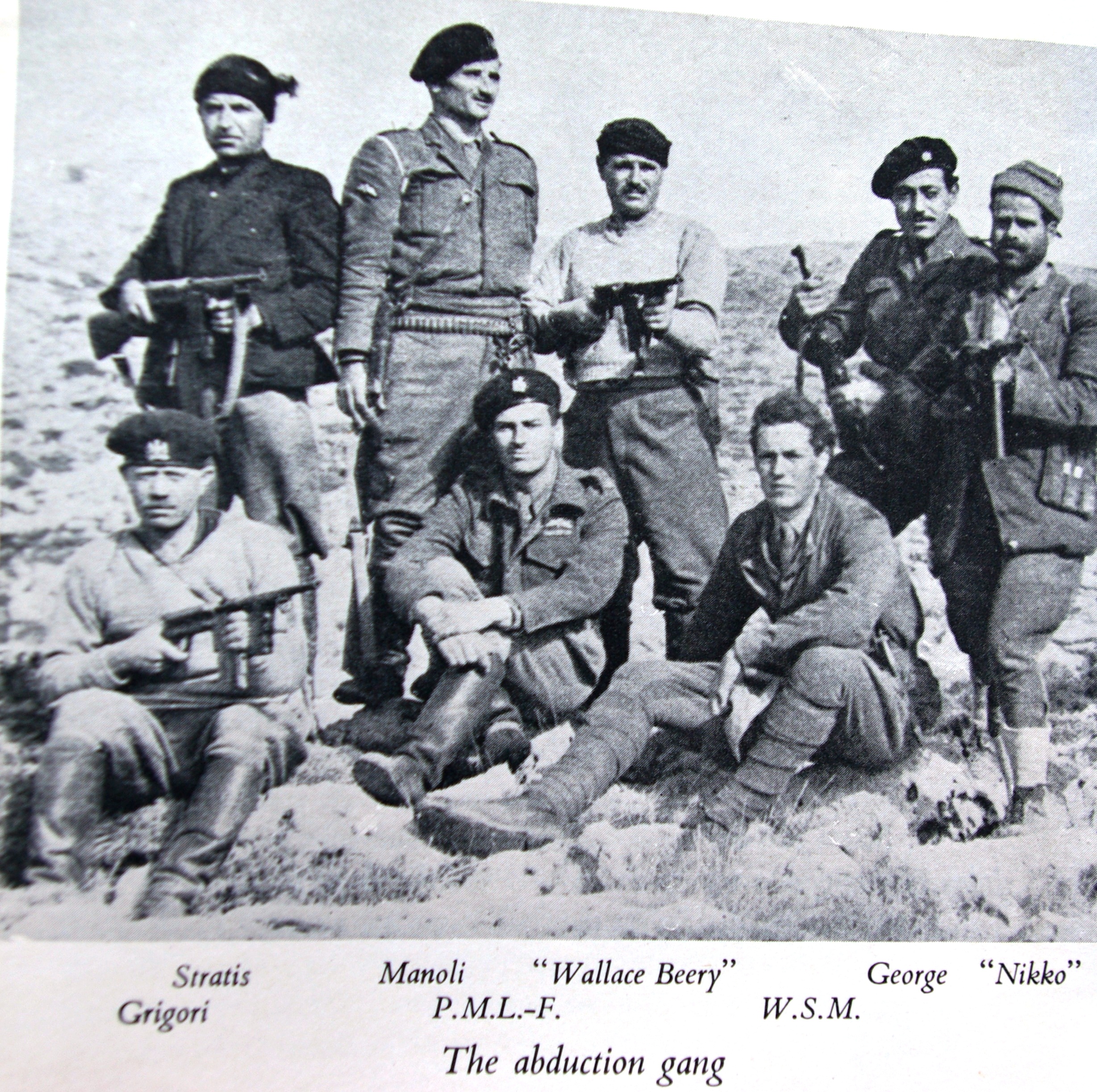
The abduction gang - PLF centre Moss to his left

Visit the photographs page to see pictures  from the book by William Stanley Moss which documents the famous abduction of the commander of German forces in Crete, General Heinrich Kreipe. They show the development of the story from the planning stage, the ‘abduction gang’ selection, and pictures taken during the escape with the General to the south coast and freedom.

Major Dennis Ciclitira Obituary from Daily Telegraph

Published: 12:00AM BST 16 Jun 2000

SOE officer undercover in Crete who organised the German surrender

MAJOR DENNIS CICLITIRA, who has died aged 81, was in charge of SOE’s operations in western Crete during the Second World War and eventually arranged for the German surrender of the island.

Ciclitira arrived on Crete just before Christmas 1943, taking over supervision for the area around the town of Canea from Xan Fielding. Liaison with the Cretan Resistance was led by the classicist Tom Dunbabin, who from the spring of 1942 had been supervising the activities of a handful of SOE officers, among them Patrick Leigh Fermor, who were living rough with the andartes or guerrillas in mountain eyries.

Ciclitira at sea between Cairo and Crete. (The Times)

One of Ciclitira’s first important tasks was to help to organise the evacuation of Leigh Fermor after he and Billy Moss had successfully abducted the commandant of the island, General Kreipe, from his staff car in April 1944. In his book Ill Met By Moonlight (1950), Moss describes encountering Ciclitira in his cave hideout.

“He has grown an impressive beard,” he wrote, “which he treats with the affection of a spinster for her favourite cat, and wears an elegant sort of musical comedy costume, complete with wine-coloured cummerbund, turban and the usual trappings.”

Two of Ciclitira’s men had already been killed by the Nazis, but despite their strenuous efforts to catch him, he managed to maintain wireless communications with Cairo and to arrange for Leigh Fermor and his prize to be picked up by motor launch. When he arrived at the rendezvous he found Moss and Leigh Fermor flashing their torches out to sea in frantic desperation, as neither knew the Morse Code for the pre-arranged signal. Fortunately, Ciclitira did.

Ciclitira left with them on the boat, but subsequently returned to Crete, where he operated under the codename Dionysios. In January 1945, the German garrison of 12,000 began to withdraw to the western end of the island, taking with them prisoners who included Costa Mitsotakis, later the Prime Minister of Greece but then an agent for the Resistance. The Germans had orders to execute all such captives, but Ciclitira managed to contact the German authorities with a view to making an exchange of prisoners.

Ciclitira went to the meeting with Captain Lassen of the Special Boat Section, who soon became exasperated by the horse-trading and suggested that his commando unit, who were hiding in the mountains, should play the Germans at football, with the winner to take all. This suggestion greatly amused Bishop Xirouhakis of Kydonia, who was mediating at the talks and offered to act as referee in any such match.

In the event, after Ciclitira had travelled by caique to Athens for further discussions, 36 German PoWs were exchanged for 10 Cretan agents, probably saving their lives. On May 8, Ciclitira received a message to contact General Benthag, the German commander, to make arrangements for a formal surrender. Dressed in suits, he and Mitsotakis – a fluent German speaker – presented themselves at Benthag’s headquarters. Preliminary terms were then agreed, but since the general could only surrender to an officer of equal rank, it was decided that he should be flown to the British HQ at Heraklion.

Benthag asked how Ciclitira proposed to contact his senior officer, and was most put out to discover that Ciclitira’s transmitter was hidden next door to German HQ, where the volume of radio traffic concealed Ciclitira’s own signals from direction-finding cars. The next evening, although the surrender had not been made public, Ciclitira and his comrades sneaked into Canea and invited their German counterparts to a party; the garrison provided them with a jazz band. The next day, Ciclitira joined in the wild celebrations that greeted Liberation.

Read the full Telegraph obituary.

Welcome to the Patrick Leigh Fermor blog

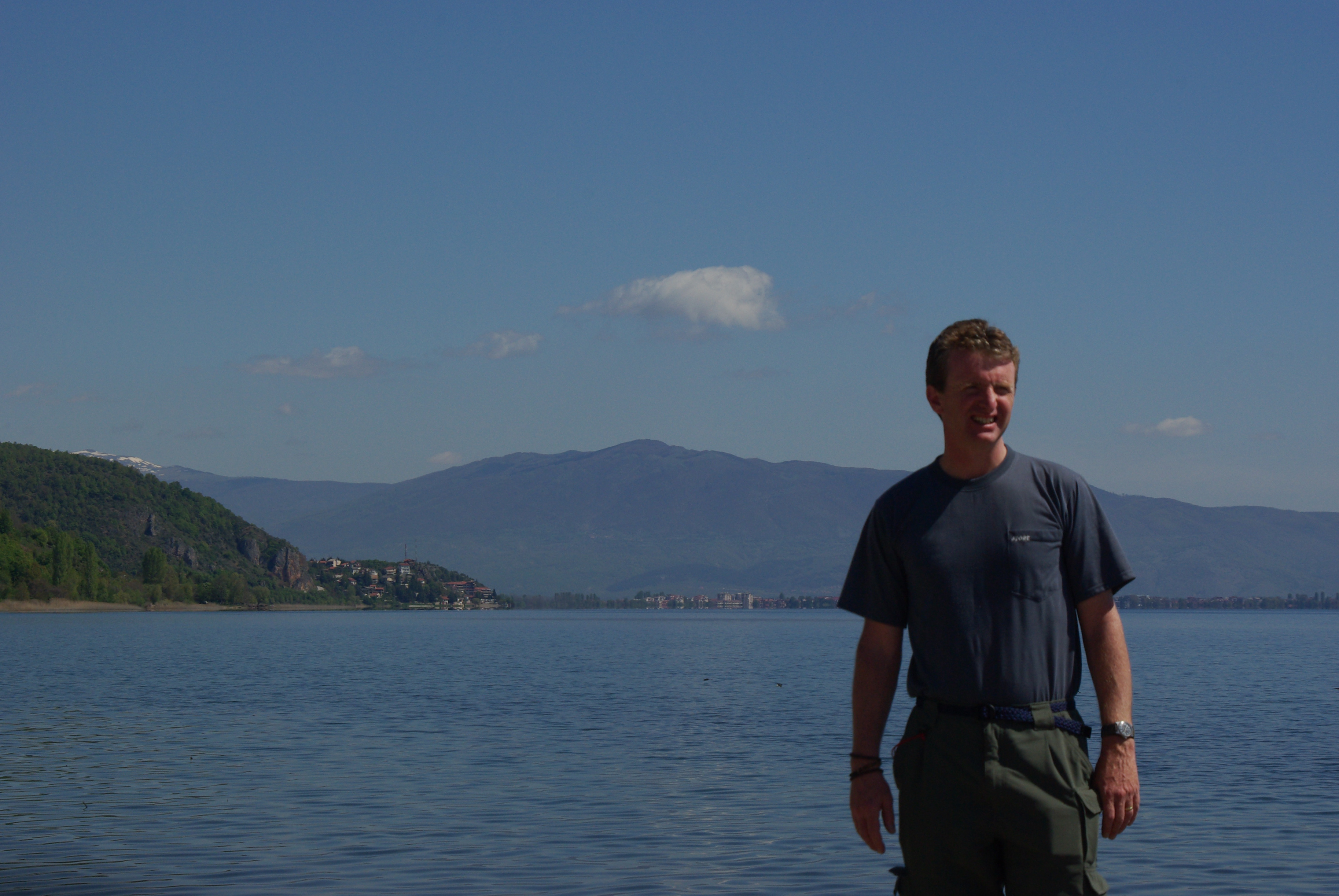
Tom at Lake Ohrid on the Via Egnatia, 2009

My name is Tom Sawford and I live in Winchester, Hampshire, England.

I first became aware of Paddy quite late in life; I guess he is an acquired taste. Maybe you need to have some awareness of the broad range of subject matter that he can, often without warning, cover in his books. Perhaps it is only after formal education, reading widely, developing a broad appreciation for history, and just plain living that you have the ability to grasp some of what he is getting at. A strongly developed vocabulary is also a boon; or at least a dictionary and of course now with access to Google it is possible to quickly research some of the more obscure topics that Paddy assumes mere mortals will be aware of. I remember the first time I read A Time of Gifts and being amused that Paddy clearly expected his readers to have at least a schoolboy/girl grasp of Latin as phrases pour out with no explanation or translation.

But surely that is the attraction of his work. It aims for the highest pinnacles of linguistic and intellectual endeavour and if you like what you read it drags you along with it, drinking from the cup of knowledge that Paddy offers.

He is of course so much more than a writer. It has been said that he is the ‘greatest English travel writer’. I don’t agree with that. I believe he travels to write, having so much more to say than to merely discuss the merits of one hotel over another or the quality of food in Greek fishing  villages. In my view he was the “Greatest Living Englishman”. Not that we don’t have other great Englishman (but perhaps less than we once had), but more than that he is that unique person who personifies what was once the mark of an Englishman; educated; heroic, handsome, generous; and modest (to a degree).

Sir Patrick Michael Leigh Fermor DSO OBE lived a full life, and had experiences that few others will likely ever have again. He had lived a pretty full life before the second world war, even living with a Romanian princess who was older than he, and during that conflict he applied his skills to fighting behind German lines, and was unique in achieving the capture, with “Billy” Moss, of the German Garrison Commander of Crete, Major General Kriepe. After the war he travelled, wrote, married, developed long-lasting friendships, and built a house in Greece. My epithet stands because few can match what he has done and also the manner in which he did it.

The purpose of this blog is to bring the life and work of Paddy, and his many colleagues, to the attention of a wider audience, and to create an archive of on-line material. He, and they, deserve to be recognised and remembered in a world that has changed much during their lives, but would be the poorer without them.

If you would like to help with the blog, make a contribution or anything else, please contact me tsawford[at]btinternet.com.

Tom Sawford

April 2010

Ill Met by Moonlight movie

The final movie from the famed Powell and Pressburger partnership starring Dirk Bogarde (as Paddy), Cyril Cusack (as Captain Sandy Rendel), David Oxley (as W. Stanley “Billy” Moss, M.C.) and the superb Marius Goring (as Major General Heinrich Kreipe). Not forgetting the island of Crete of course. Click the picture to watch the trailer!

Sophie Moss Obituary from Daily Telegraph

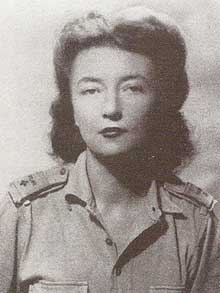
Sophie Moss

Sophie Moss, who has died aged 92, was, as Countess Zofia Tarnowksa, the hostess of a villa in wartime Cairo where high-spirited young SOE agents on leave from secret assignments behind enemy lines held some of the most riotous parties of the war.

With considerable misgivings (and a fictitious chaperone), she agreed to join the all-male household on Gezira island at the invitation of her future husband, the officer Billy Moss, and moved in with her few possessions, which included a swimsuit, an evening dress, a uniform and two pet mongooses.

In the field, Patrick Leigh Fermor, Billy McLean, David Smiley, Rowland Winn and Xan Fielding were cold, hungry, lice-ridden and in constant danger. But on leave with months of back pay to spend, they held uproarious parties at the villa, which they called Tara.

These attracted the most distinguished soldiers, diplomats, writers and, on one occasion, King Farouk, who arrived with a crate of champagne. The evenings grew steadily more rowdy. Usually glasses were smashed. One night some chairs were broken when a mock bullfight was staged. On another, Sophie’s Polish friends shot out all the light bulbs, and on yet another a sofa caught fire then was hurled through a plate-glass window.

Since costly repairs were needed afterwards, Abbas, the butler-cook, tried to raise funds by accosting guests at the gate and holding out his tarboosh for contributions. Sophie put a stop to this, then remembered how soft fruits were added to vodka to make delicious liqueurs on her father’s Polish estates. The household agreed to an experiment using the bath, in which prunes were mixed with raw alcohol from the local garage. The results were disappointing, though Sophie insisted that this was because they were too impatient to wait for the mixture to mature. When they started drinking it after three days, two imbibers passed out.

The bathroom had other uses. In late 1943, when Leigh Fermor and Moss were planning a kidnapping on Crete, they sat around wearing next-to-nothing while David Smiley, fresh from Albania, explained how to organise the perfect ambush – drawing a diagram on the steamed-up tiles. After their success in capturing General Heinrich Kreipe, Leigh Fermor and Moss returned to Tara as heroes.

Zofia Roza Maria Jadwiga Elzbieta Katarzyna Aniela Tarnowska was born on March 16 1917 at Rudnik, a forested estate near Tarnobrzeg, a town in south-eastern Poland founded by her family in 1593. Over the centuries the Tarnowskis had held some of the highest offices in Poland. But Sophie’s father descended from a cadet branch of the family, and wanted to be only a country gentleman. His marriage was unhappy, and Sophie and her brother Stanislaw grew up headstrong and mischievous.

Her tricks and practical jokes turned her governesses into nervous wrecks until her mother sent her to a convent. Sophie got into trouble for standing on a pudding to prove it was inedible, ran away and refused to go back. She was happiest with animals, galloping through the forests on horseback or playing with deer, foxes, a goat and a red squirrel.

In 1937 she married Andrew Tarnowski, a member of the senior branch of the family. Her first son was under two when he died (on the day she gave birth to her second) in July 1939. As war drew closer, Sophie decided that she would never abandon Poland and burned her passport. It was, as her daughter said, “a very romantic and Polish thing to do”, but it changed nothing. On September 8, when the Germans were pouring over the western frontier and the Russians were approaching from the east, she set off by car for Romania with her husband and their baby, her brother, his fiancée Chouquette and her sister.

On arriving in Belgrade she lost her second son before the family drove on to Greece and Palestine. Her husband, now a corporal in the Carpathian Rifles, was on leave in Jerusalem when he told Sophie he was in love with Chouquette. Later Sophie accompanied Chouquette and her son to Cairo, where an uncle of King Farouk, who had often hunted on the Tarnowski estates, had offered them a luxurious villa. She soon moved out.

After joining the International Red Cross, Sophie met General Sikorski, Poland’s prime minister, who suggested she start a Polish branch of the humanitarian organisation. She agreed, but only if it were established without ranks. “Are you a communist?” asked Sikorski. “No” was the reply. But senior Polish ladies might resent a badge of superiority on someone whose husband was only a corporal, she explained. The general agreed, but when he departed she had difficulty confirming her position.

Finally she presented a large bouquet of flowers to the wife of the British ambassador in Cairo, Sir Miles Lampson – with whose help she was equipped with a committee, an office and a truck to
deliver clothes and food. She also visited hospitals and arranged patients’ outings, and helped Polish PoWs in Germany to contact their scattered families.

After divorcing Andrew, she married Billy Moss in 1945. The couple settled in London, where he prepared his Cretan diary about the kidnapping for publication as the best-selling Ill Met By Moonlight. But money was always tight. She lost a third son, but had two daughters. She and Moss translated a book of short stories by the Polish writer Bruno Schultz. But by the late 1950s, their marriage was over. She took in lodgers and spent time in Ireland, where she became a keen gardener.

In 1957 Sophie and her brother were allowed to visit their childhood home, where the NKVD had used the cellars as a jail during the war. They were not allowed into the building, but were treated to an open-air banquet by dozens of old retainers and peasants. At Gora Ropczycki, the house where she and her first husband had lived till 1939, old farmhands thanked her for keeping up their spirits in the first days of the war.

After the fall of communism Sophie’s nephew Adam bought back Rudnik, and Sophie presided over a family gathering in 1999. But too much had changed for her to contemplate settling there.

Last year some of the poems she had written in Cairo were published in a private edition. One, which was translated into English, asks for the white wings of her childhood guardian angel to take her home.

She died on November 22, surrounded by her family in Sussex.

Ralph Stockbridge

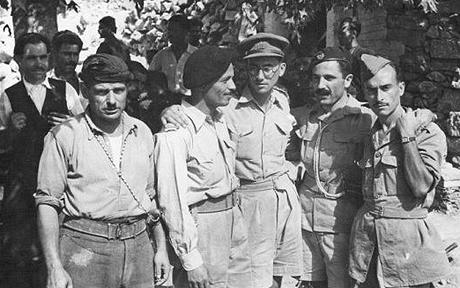
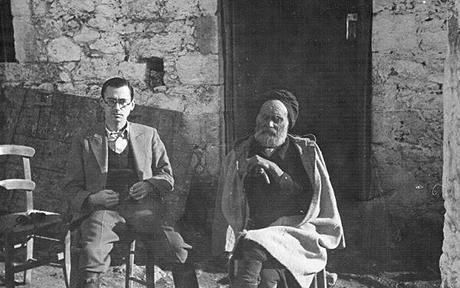
Stockbridge (centre, in the spectacles) with some of his comrades in Crete

Ralph Stockbridge, who has died aged 92, was awarded two MCs for the notable part that he played in the Cretan Resistance to the German occupation; he spent the remainder of his career working for MI6.

During his time in Crete he knew and worked with Paddy.

Read his Telegraph obituary here.