An award in memory of William Stanley Moss at University of Crete

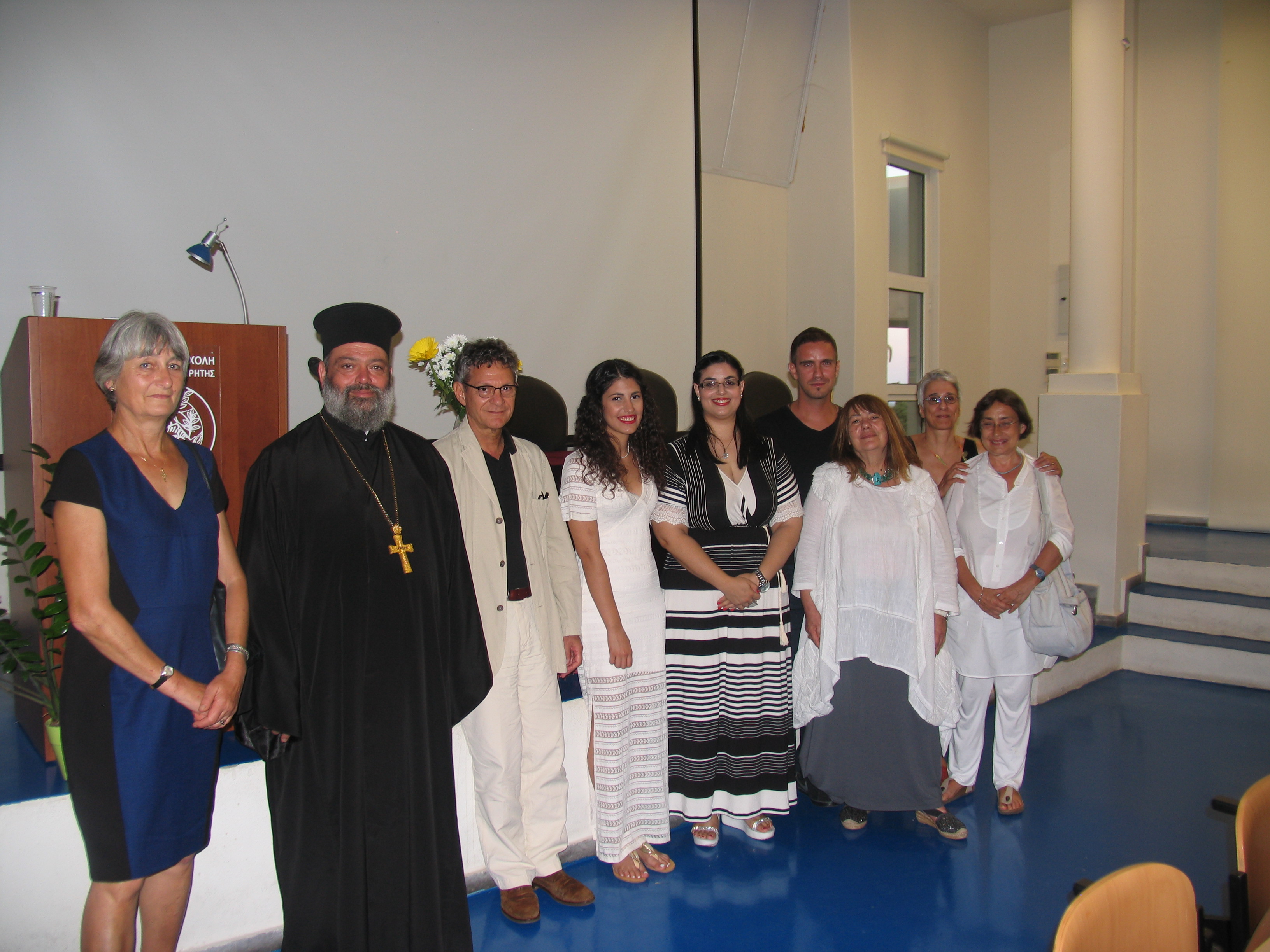
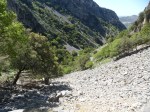
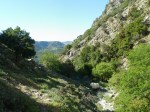
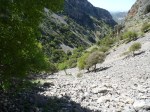
Gabriella Bullock (Left) and guests at the inaugural awards 21 July 2015

Gabriella Bullock (Left) and guests at the inaugural awards 21 July 2015

In July, Gabriella Bullock, one of “Billy” Moss’ daughters, travelled to Crete with her husband Hugh to present the inaugural prize in Billy’s memory at the University of Crete in Rehtymnon. The annual William Stanley Moss award is open to graduate students of the Faculty of Philosophy studying the subjects of Philology, History and Archaeology.

Gabriella is funding the award from royalties of her father’s books as an expression of gratitude and debt to the Cretan people on behalf of her father. She described the whole experience as ‘very moving, very dignified and warm and emotional for everyone.’

The ceremony on 21 July was attended by the Metropolitan of Rethymno and Avlopotamos the Reverend Nicholas Nikiforakis, the Rector Euripides C. Stephen, the Dean of the Faculty of Philosophy Lucia Athanassakis, the Dean of the School of Education Anthony Chourdakis, the Chairman of the Department of Literature Angela Kastrinaki the President of Department of History and Archaeology Antonia Kiousopoulou, Emeritus Professor Anastasios Nikolaidis, Professors of academic departments of the University of Crete, Foundation staff and students.

Gabriella and Hugh went on to deliver talks in Anogeia and Patsos where they met many relatives of those who worked with Billy and Paddy in those desperate days of the war.

Upcoming PLF Society events

A couple of dates for your diary from the PLF Society. A daughter and dad act for the autumn.

Patrick Leigh Fermor in Greece – Artemis Cooper

DATE: Tuesday 8th September 2015 TIME: 7:15pm

LOCATION: Great Hall, Hellenic Centre, 16-18 Paddington St, London W1U 5AS

RSVP info@patrickleighfermorsociety.org

Paddy’s World – John Julius Norwich

John Julius Norwich is patron of the Patrick Leigh Fermor Society and knew PLF for more than fifty years.

DATE: Tuesday 10th November 2015 TIME: 7:15pm

LOCATION: Great Hall, Hellenic Centre, 16-18 Paddington St, London W1U 5AS

RSVP info@patrickleighfermorsociety.org


Why (some of) the Most Popular Hiking Memoirs Don’t Go the Distance

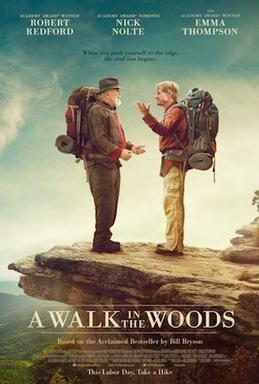
Whilst I find Bill Bryson amusing, his, possibly contrived, whimsey would probably get on my nerves if I read too much of him. I have never read A Walk in the Woods: Rediscovering America on the Appalachian Trail, but I have sometimes thought how it must be to walk it. During my Camino to Santiago de Compostela I walked for some days with a guy who had done it three times; he was all at once a loner but at the same time he craved company. I guess that you really do have to be a loner to walk all 2,200 miles of the Appalachian Trail. I thought that you might find this article interesting, and it may whet your appetite for watching the movie of the book (walking movies are all the rage) which stars Robert Redford and Nick Nolte, due for release 2 September.
By Robert Moor

First published in the New Yorker, 21 August 2015

When I was eighteen, I bought a copy of Bill Bryson’s A Walk in the Woods: Rediscovering America on the Appalachian Trail which remains, if my conversations with strangers are any indication, the only book anyone has ever read about the Appalachian Trail. It was summer. My friend Andy and I had driven across the country and ended up in the town of Sheridan, Wyoming, where we stayed for a week with a genial middle-aged couple, family friends of my friend. Scanning my hosts’ bookshelves, as I have a tendency to do, I was quietly horrified to discover that they were exclusively stocked with works of pop evangelicalism (Rick Warren and the like). It was a literary desert: xeric, Mosaic. Bryson’s book was the only one I’d brought, so, while Andy rode dirt bikes with a guy named Dusty, I lay on a fold-out couch in the basement, consuming it in controlled bursts, as if bolting food rations.

I had dreamed of hiking the Appalachian Trail since I was ten years old. From Bryson’s wry, well-researched account, I began to learn how it would feel to walk through two thousand miles of mountainous wilderness. What stood out most were the descriptions of “tranquil tedium,” a seemingly endless trudge through the “cubic” vastness of deep woods. “At times,” he writes, “you become almost certain that you slabbed this hillside three days ago, crossed this stream yesterday, clambered over this fallen tree at least twice today already. But most of the time you don’t think. No point. Instead, you exist in a kind of mobile Zen mode, your brain like a balloon tethered with string, accompanying but not actually part of the body below. Walking for hours and miles becomes as automatic, as unremarkable, as breathing.”

Around page one hundred, I reached the passage where Bryson and his hiking partner study a wall-map of the trail in an outdoors store, in Gatlinburg, and, overcome by the sight of how little of it they had already walked, decide to skip the state of North Carolina and drive to Virginia. I let out a howl of indignation and threw the book against the wall. But, needing to know how the book ended, I picked it back up again. I repeated the cycle (howl, throw, retrieve) when Bryson decided to skip the northern portion of Virginia and just drive up the trail, taking hikes here and there, and again when he quit a quarter of the way through the Hundred-Mile Wilderness, at which point he concludes, defiantly, “I don’t care what anybody says. We hiked the Appalachian Trail.”

There, in that basement, I resolved that one day I would hike the trail the right way: from end to end, in one continuous trip—what’s often called a “thru-hike,” always with that peculiar, abridged spelling, otherwise reserved for fast-food signage and nineteenth-century poetry.

I eventually did so, in 2009. It was roughly how Bryson described it: long, hard, and monotonous, but also beautiful and enlightening and wonderfully (and then, later, worryingly) slimming. While hiking the trail, I learned that whenever a thru-hiker met a day-hiker (as thru-hikers somewhat dismissively refer to those who are “just out for the day”), the day-hiker would invariably ask the same question: “Have you read ‘A Walk in the Woods’?”

Many thru-hikers bristle at this question. By quitting in Gatlinburg and then hop-skipping up the trail, Bryson bastardized the central conceit of a thru-hike, which is that you hike through—through mountains and valleys, through farms and small towns, through pain, through hunger, through nagging doubt. For thru-hikers, the continuity is the point, in the same way that running a marathon is more meaningful than running four separate 6.5-mile races. Certain thru-hikers, referred to as “purists,” take this emphasis on continuity to obsessive lengths. Some touch or kiss every blaze of white paint along the trail, while others carefully line up their shoes, like Japanese slippers, in the precise spot they entered a lean-to, so as to know exactly where to resume hiking the next day.

Bryson thus finds himself in the curious position of being both the outward face of the Appalachian Trail and its most inwardly mocked figure. This discrepancy will likely intensify when the film version of the book, starring Robert Redford and Nick Nolte, premières on September 2nd. I gather that some people who have thru-hiked the Pacific Crest Trail feel similarly about “Wild,” Cheryl Strayed’s best-selling hiking-memoir-turned-feature-film about hiking one third of the P.C.T. There is also the curious case of Paulo Coelho, the author of, among other books, “The Pilgrimage,” a best-selling account of walking the Camino de Santiago de Compostela, the famed network of pilgrimage routes across Spain (and beyond). Coelho quit in the town of O Cebreiro, some hundred miles short of his destination, and then rode in a bus to Santiago de Compostela. According to a profile of Coelho published in this magazine in 2007, the proprietor of a hotel along the Camino told Coelho that his book had done wonders for his business. “As Hemingway was for San Fermín, you are for the pilgrimage!” he exclaimed.

The question arises: why are the three most famous accounts of hiking three of the world’s most famous long-distance trails written by people who did not hike the whole distance?

One obvious answer: great writers are simply less athletic than your average human. But this theory crumbles upon closer inspection. John Muir walked a thousand miles, from Kentucky to the Gulf of Mexico, while Vachel Lindsay walked from Illinois to New Mexico, Matsuo Bashō walked the length of Honshu and back, Rory Stewart walked across the mountains of South Asia, Robyn Davidson walked across Australia, and Patrick Leigh Fermor walked across Europe.

In fact, I would argue that the loneliness and skull-bound nature of a long-distance hike fits quite nicely with the thinking out, if not the actual writing, of books. The dusty back aisles of Amazon are glutted with first-person accounts of successful thru-hikes, most of which tend to be buffed-up re-writes of the author’s trail journal. These books have a limited audience (namely, other thru-hikers), whereas the books that become best-sellers speak to people who would never embark on a long-distance hike in the first place. “A book about hiking the Appalachian Trail? Spare me. I could imagine it: We walked. We saw trees. We went up. We went down,” snarked a 1998 article in the New York Times, before praising the many charms of Bryson’s book.

The rare best-sellers leap this pitfall by hitching onto other well-established genres: Bryson’s is a humorous travelogue, Strayed’s a memoir about healing, and Coelho’s a quest novel. They also avoid the doldrums of strict, day-by-day linear storytelling. Instead, Bryson chunks his trip into discrete regions, drilling down into the history of each; Strayed pares the story back to a string of anecdotes, and then interweaves them with flashbacks from her rocky upbringing; and Coelho structures the walk around a series of spiritual “exercises”—battle a dog, climb a waterfall, raise a cross—assigned by his guide, Petrus. The reader is never tempted to skip ahead to see if the author finished the trek or not, because that has ceased to be the point.

Finally, all three narrators share the nervous, wide-eyed enthusiasm of a greenhorn. Reading the list of extraneous items that Bryson and Strayed packed for their thru-hikes—folding cutlery, a plastic dish, a spare gas bottle, four bandannas, a “big knife for killing bears and hillbillies”; a towel, binoculars, a foldable saw, a stainless-steel digging trowel, a metal votive-candle lantern, shampoo, conditioner, a hairbrush—made this minimalist’s teeth grind. But I imagine that a non-hiker might read that same list and think, “Oh wow, is that all? For four months?” Because they began in places of utter ineptitude and painfully ascended to the status of hardened veterans, Strayed, Bryson, and Coelho were able to fashion engaging emotional trajectories for their books. But that same lack of preparation and training made it exceedingly difficult for them to finish the trail, so they were ultimately forced to trim back their ambitions.

It has been twelve years since I last read A Walk in the Woods: Rediscovering America on the Appalachian Trail I picked it up once following my thru-hike, but I found I was too close to the material; I quibbled over every description, guffawed over every misstep. Recently, while working on my own book about trails, I picked up my old copy again. Reading it as a writer, rather than a hiker, it felt fresh. In a voice at turns erudite, acid, and tender, it somehow manages to provide a brisk overview of both the long history and the vast expanse of the trail. Bryson captures the alienating shift in perception that attends a return to civilization from an extended stay in the wilderness, and uses that weird lens to inspect the more grotesque aspects of American society. He manages to sound the depths of a lifelong friendship without becoming maudlin. And he ultimately succeeds in claiming a personal victory from an otherwise botched expedition. In the book’s concluding pages, he catalogues all he gained from his hike: “For a brief, proud period I was slender and fit. I gained a profound respect for the wilderness and nature and the benign dark power of woods. I understand now, in a way I never did before, the colossal scale of the world. I found patience and fortitude that I didn’t know I had. I discovered an America that millions of people scarcely know exists. I made a friend. I came home.”

In the end, as at the beginning, I found “A Walk in the Woods: Rediscovering America on the Appalachian Trail to be a delightful little book. Still, I don’t care what anybody, including the author, says: Bill Bryson did not hike the Appalachian Trail.

Buy A Walk in the Woods: Rediscovering America on the Appalachian Trail

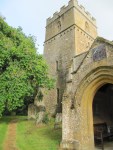
Views of Dumbleton Church

Thank you to Brooke Rozorio for sending me these recent shots of Dumbleton church to share with you all.

Help to fund Wild Carpathia 4

After a glorious few weeks enjoying Italy, its food, landscape and sites, I am returned and will get some interesting posts up on the blog. First up is an appeal to help fund the fourth in the wonderful series Wild Carpathia which will be set in winter and called White Carpathia. Charlie Ottley and the crew are looking for £50,000 to produce the film expected to be released in summer 2016. If you love Romania as much as Paddy did (and I do) then please consider helping via the Kickstarter page where Charlie makes a very impassioned plea for your support surrounded by beautiful images of Romania. Together, let’s make this happen!

Here’s what Charlie says on Facebook:

Hello everyone and……help!. We need to make another Wild Carpathia urgently – to promote the beauty of Romania through the winter, and show the world what an amazing country this is, any time of the year, especially given recent bad press like The Romanians Are Coming on UK’s Channel Four. In light of further illegal logging and the recent scandal involving Schweighofer we must again highlight the plight of Europe’s last great forest.

We also need to protect the cultural heritage of Romania’s rural areas, by encouraging, Eco-tourism, sensitive development and modernisation. The film we must make to help do this, will be seen by millions of people across the world (the previous episodes had over 3 million hits online) and screened first on Romanian national television. We have half the money from foreign donors. Help us raise the other half so this can be a film for Romania by Romania, something we can all be proud of. Even a few euros each will make a big difference. And please forward this post. if you and your friends all contribute, we can make this happen – together. Click on the following link and go to our Kickstarter Campaign.

Enjoy the previous films here on You Tube.

Episode One: Wild Carpathia

Episode Two: From the Mountains to the Sea

Episode Three: Wild Forever

The reader’s guide to walking: Why we do it and what we think about it

Walking for pleasure … No, let me start again. Walking as a recreational activity dates only from the late 18th century. Prior to that human beings walked because they had to – either they were nomadic or walking was their only way of going on a necessary journey. The Wordsworth family were pioneers; William and his sister Dorothy ate up the miles around their home in Grasmere. To read Dorothy’s journals is to be flabbergasted by how much walking the pair did, most days, in all seasons, all weathers, walking for maybe three hours at a time, Dorothy in her ankle-length skirts, and often just for a cup of tea. The curious side to this is how often Dorothy reports one or both of them as “ill” – bowel problems it seems – they got the exercise right but not the diet.

by Gerard Windsor

First published in The Sydney Morning Herald, 18 July 2015

Yet the Wordsworths were primitives on the recreational walking scene; generally they went out their own front door and were home the same day. As the 19th century wore on and the railways opened up, walkers could select a protracted itinerary far from home. That sub-species of travel writing, the record of the walking tour, was born.

First among the writers were the now unread George Borrow, and the rather more read R. L. Stevenson with his 1879 Travels with a Donkey in the Cevennes​ (read not least because of its re-enactment by the young Richard Holmes in his 1985 Footsteps). The genre flourished in the 20th century – Hilaire Belloc’s The Path to Rome (1902), Eric Newby’s A Short Walk in the Hindu Kush (1958), Patrick Leigh Fermor​’s trilogy of his walk from the Hook of Holland to Istanbul between 1933 and 1935 … On and on they stride.

Walking of this kind is a rarefied activity, restricted to the better-off citizens of First World countries. Compulsory walking, the endless forced marches of pedestrian refugees, is as common as ever. And over the whole enterprise of walking hangs the armageddon imagined by Cormac McCarthy in The Road where there’s no alternative, if there’s to be any salvation at all, but to walk. For a man such as McCarthy, whose other fiction has been so equestrian centred, this pedestrianism is the ultimate degradation.

Meanwhile leisure walking is a snowballing business, and increasingly up for analysis. A Foucault scholar, Frederic Gros​, has given us A Philosophy of Walking, a fair example of the Gallic intellectual’s blend of non-sequential abstraction and soaring rhetoric.

Gros doesn’t actually let on whether he himself has so much as walked to the boulangerie, but he does micro-studies of prodigious walkers, notably Rimbaud and Nietzsche. Given that one gave up his poetical vocation for a career (highly unsuccessful) in trade, and the other went mad, I can’t unravel Gros’ argument. But he does make one striking point – walking is very monotonous but never boring. I think that’s a very French, and fair, sort of distinction.

Much more feet on the ground is Canadian Dan Rubinstein​’s Born to Walk, an encyclopaedia of the benefits of walking, scary to the delinquent and cheering to the virtuous.

It’s full of facts and the results of studies – sitting is the new smoking, the catastrophic plunge in the number of children walking to school is in inverse proportion to the rise in obesity levels, regular exercise in a park or forest will halve chances of developing a mental illness, Australian adults average 9700 steps each day while Americans only manage 5100, and there was an epidemic of the wonderfully named hysterical fugue, alias dromomania, alias compulsive wandering, in Europe in the late 1800s.

Rubinstein, who likes to walk in the snow, is earnest, and also very secular, so that he’s sniffy about pilgrimages. But they’re not to be sneezed at; the walk to Santiago de Compostela​ is engendering books on an industrial scale: pioneer producers included David Lodge (solid), Paulo Coelho​ (an acquired taste), Shirley MacLaine (nutty).

For many Santiago pilgrims the walk ends on the Galician coast, at Finisterre. So Land’s End in Cornwall is also a fitting terminus for a walk. The superb Yorkshire poet, Simon Armitage, recently elected the new Professor of Poetry at Oxford, spent three weeks on the road in 2013, starting from Porlock (of Coleridgean memory) in Somerset and following the South West Coast Path for 250 miles to Land’s End. (He actually went on to the Scilly Isles, but not being Jesus he had to take a boat, so Land’s End is where he stopped walking.)

He records the trip in Walking Away, a sequel to his Walking Home, an account of his 2010 walk along the Pennine Way, the spine of England. He ends his new book unequivocally: “I won’t be doing any more long walks.” Twenty pages earlier he records his father (a great bit part) phoning him and saying, “I think this will be your last long walk”. Armitage comments “it’s less of an observation and more of an instruction, issued partly out of concern for my skeletal structure and partly as a response to increased child care duties.”
I wouldn’t bet on either of them being right. For both walks Armitage arranged in advance to give a reading every evening, pass a capacious sock around at the end, and spend the night as a guest of the local organiser. The strategy works well, and so do the books. Not least because Armitage is a born humorist, particularly adept at recording (or maybe recreating) snatches of dialogue. At his last reading, on the island of Tresco, a woman asks if she can come up and read some of his work.

” ‘I don’t know if that’s a good idea,’ I say. ‘I’ll be good at it. I’m an auctioneer,’ she replies.”

Walking books rely on two staples – the trials and the encounters of the way (once upon a time these were combined – dragons, or giants). Armitage’s encounters are fleeting; his hosts for the night, locals who accompany him part of the way. His family pop up in cameo appearances and he is joined periodically by his oldest male friend, an apparently charming sponger known as Slug. There is also a beautifully delivered story about someone thanked in the Acknowledgements as “the hooded lady who propositioned me on the path between Clovelly and Hartland Quay”.

In all these encounters Armitage presents himself as reticent, but readily recording the topics of the garrulous. There is no suggestion of any conversations about emotional issues or the meaning of life. It’s that sort of book. In one way Armitage’s main encounter is with the landscape. A student of geography at university, he weaves precision of observation and naming with a poet’s unforced lyricism.

The second staple of the walking book are the trials. The grimmer the better. I can’t think of a greater masterpiece of the genre than Apsley Cherry-Garrard’s 1922 The Worst Journey in the World, his account of an ordeal that no human should have survived during Scott’s fatal expedition to the Antarctic. Beside this account anything else is a stroll, a doddle. Cherry-Garrard has permanent rights to his title.

For Armitage the Pennines were infinitely bleaker than the South Coast, the weather far worse, his chances of getting lost stronger, the likelihood of his giving up more immediate. This gives an edge and a tension to Walking Home that Walking Away lacks, but the pair are a treat, just the things to slip into for a winter hike, around the heater.

Gerard Windsor’s most recent book is Angels Before Me: The Road to Santiago. He is about to attempt the European Peace Walk from Vienna to Trieste

Nick Hunt shortlisted for Stanford Dolman Travel Book of the Year

award1Great news to see that Nick Hunt’s magnificent book, Walking the Woods and the Water, has been listed for the 2015 Stanford Dolman Travel Book of the Year. I guess there will be lots of comments about the strength of the competition but I am backing Nick to win. Let’s wish him the best of luck!

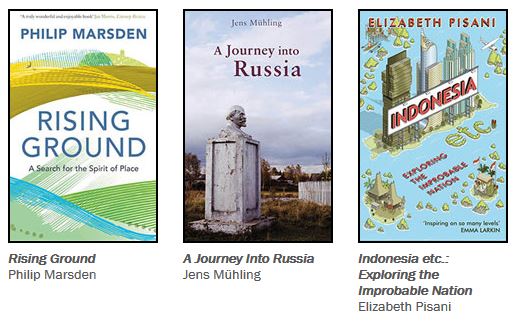
More about the award here. The Shortlist is:

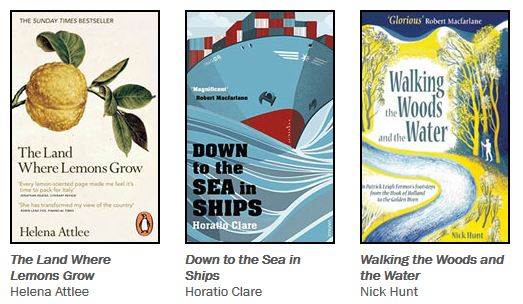
The Land Where Lemons Grow: The Story of Italy and its Citrus Fruit, Helena Attlee, Penguin (Penguin Random House)

Down To The Sea In Ships: Of Ageless Oceans and Modern Men, Horatio Clare, Vintage (Penguin Random House)

Walking the Woods and the Water: In Patrick Leigh Fermor’s footsteps from the Hook of Holland to the Golden Horn – A Time of Gifts, Between the Woods & the Water and The Broken Road, Nick Hunt, (Nicholas Brealey Publishing)

Rising Ground: A Search for the Spirit of Place, Philip Marsden, (Granta)

A Journey into Russia, Jens Mühling, (Haus Publishing)

Indonesia etc.: Exploring the Improbable Nation, Elizabeth Pisani, (Granta)

award2

In the footsteps of Marco Polo: the journey that changed William Dalrymple’s life

Taken from the introduction to the 25th anniversary edition of William Dalrymple’s first book In Xanadu: A Quest, and first published in The Spectator on 24 June 2015

At the end of the windy, rainy April of 1986, towards the end of my second year at university, I was on my way back to my room one evening, when I happened to trudge past my college notice board.

There my eyes fell on a bright yellow sheet of A4, headlined in capital letters THE GAILLARD LAPSLEY TRAVEL SCHOLARSHIP. It hadn’t been a good week. I was 21: broke, tired of revision for exams and already longing for the holidays. But stopping to look closer, I found that the notice was an announcement concerning a fund that had been established in the memory of some recently-deceased history don; its stated aim was to fund research travel for the college’s mediaeval historians. There were, I knew, barely a handful of mediaevalists in the college.

I walked straight over to the library, found a large quarto edition of The Times Atlas of World History and leafed through the pages to see what was the longest and most ambitious mediaeval journey I could think of following: the longer the trip, I figured, the larger the grant I could apply for.

An hour later I had typed out an application for an expedition to follow the outward journey of my childhood hero, Marco Polo, from Jerusalem to Kubla Khan’s Xanadu in Mongolia. The place names were the stuff of fantasy, and so, I felt sure, was the application. But I happened recently to have seen an article announcing that the Karakorum Highway linking Pakistan to China had just been opened to travellers. This meant that following Polo’s journey was technically feasible for the first time since the Soviet invasion had cut the hippy’s overland route a decade earlier. I posted the application in the letterbox of the don responsible, then went back to my revision and forgot all about it.

A month later, I was returning to my rooms from the last of the year-end exams when I found an embossed college envelope had been slipped under my door. Inside was a short letter and a cheque for the princely sum of £700: much the largest cheque anyone had ever written me. To my immense excitement, but also real foreboding, I found I had just committed myself to an enormously long and dangerous journey through a part of the world I was almost entirely ignorant about. To make matters worse, I had just been chucked by the girlfriend with whom I had planned to make the journey.

It was not a promising start; but the expedition which followed remains by far the most exhilarating I have ever undertaken: nothing I have done since, in half a lifetime of intense travel, has ever begun to equal the thrill of that 16,000-mile three month journey, walking, hitchhiking and bussing from one side of Asia the another. It was also a journey that, in a very real sense, changed my life forever.

I had already travelled in India, and the previous summer had hitchhiked from Scotland to Jerusalem following the route of the First Crusade. I read more widely still among the English travel writers, and Eric Newby, Bruce Chatwin, Peter Fleming, Patrick Leigh Fermor and especially Robert Byron were then my literary Gods, at whose altars I worshipped with an almost fundamentalist fervour. Now I was determined to write my own travel book, and from the first morning of the trip, on arrival in Jerusalem, I kept detailed notes with a view to producing a book that I wanted to be an updated homage to Robert Byron’s The Road to Oxiana, a text I loved so much and had read so often, that I knew great chunks of it by heart.

The result was In Xanadu: A Quest. The book, which was first published quarter of a century ago, in 1989, had a lucky reception. The early 1980’s was a time of disenchantment with the novel, and travel writing seemed to present a serious alternative to fiction. A writer could still use the techniques of the novel – to develop characters, select and tailor experience into a series of scenes and set pieces, arrange the action so as to give the narrative shape and momentum – yet what was being written about was true. Moreover, unlike most literary fiction, travel writing sold.

The success of Paul Theroux’s The Great Railway Bazaar, with its sales of 1.5m copies, had dramatically breathed life into the sort of travel memoir that had flourished in an earlier age, but which had languished since the European empires imploded after the Second World War. Its success inspired Bruce Chatwin to give up his job as a journalist and to go off to South America. The result – In Patagonia – was published in 1977, the same year Leigh Fermor produced A Time of Gifts. The final breakthrough came in 1984 with the publication of the celebrated travel writing issue of Granta: ‘Travel writing is undergoing a revival,’ wrote Bill Buford, the magazine’s editor, ‘evident not only in the busy reprinting of the travel classics, but in the staggering number of new travel writers emerging. Not since the 1930s has travel writing been so popular or so important.

So In Xanadu came out at just the right moment, when travel writing was at its most popular. Partly as a result of this lucky timing, the book got generous reviews, was an immediate bestseller and won a small clutch of prizes. It allowed me for the first time to think of writing as a feasible career. It nonetheless remains a text I have always felt deeply ambiguous about.

For In Xanadu records the impressions, prejudices and enthusiasms of a very young, naïve and deeply Anglocentric undergraduate. Indeed my 21 year old self – bumptious, cocky and self-confident, quick to judge and embarrassingly slow to hesitate before stereotyping entire nations – is a person I now feel mildly disapproving of: like some smugly self-important but charming nephew who you can’t quite disown, but feel like giving a good tight slap to, or at least cutting down to size, for his own good.

And yet this book brings back so very many happy memories. It retains, bottles and distills all the good humour, cheerfulness and joie de vivre of one of the very happiest periods of my life, a period when every day contained an adventure, a discovery or an epiphany. Re-reading it now, on the cusp of my 50th birthday, what was even more pleasurable than being reminded of forgotten places and adventures, was that sensation of recovering the raw intoxication of travel during a moment in life when time is endless, and deadlines, responsibilities and commitments are non-existent; when the constitution is elastic, and the optimism of youth undimmed; when experience is all you hope to achieve and when the world is laid out before you like a map, ready and waiting to be explored.

The great Swiss travel writer, Nicolas Bouvier, wrote that being on the road, ‘deprived of one’s usual setting, the customary routine stripped away like so much wrapping paper,’ reduces you, yet makes you at the same time more ‘open to curiosity, to intuition, to love at first sight… Travelling outgrows its motives. It soon proves sufficient in itself. You think you are making a trip, but soon it is making you—or unmaking you.’

For better or worse, In Xanadu made me. I am still with the editor who bought the book for Collins, Michael Fishwick: we have now worked on eight books together about the Middle East, and South and Central Asia – the world opened up for me by that 1986 journey. Shortly after it was published, I married my very charming flatmate, who had edited much of the manuscript, even though she was then working for finals. Together, we moved out to Delhi. She wanted to paint; I wanted to begin work on the book which became City of Djinns. Thirty years later, we’re still there, with three children, the eldest of whom is now herself at university, planning her own ambitious trips around the world.

I still see my two long suffering travelling companions. Lousia is now a skilled picture restorer, married a very handsome and rich young man, and they live in some style in the Anglo-Welsh marches south of Hay on Wye. Laura went on – to no one’s surprise – to become one of the country’s most successful – and formidable – businesswomen and pops up in the press every now and then having climbed some dizzying new corporate pinnacle.

Many of the countries we passed through have fared less happily. Syria, so hospitable to us, is now gripped by civil war and the Islamist anarchy of Isil. Pakistan, so thrillingly wild yet alluring then, is now a much more dangerous and tortured country than it was in the 1980s. Conversely, China – then a land of bicycles, Mao suits and tannoys blaring strident political slogans down every main street – has become the world’s newest economic superpower, something unimaginable at the time. So much has changed.

Travel writing has also changed. If travel writing used principally to be about place – about filling in the blanks of the map and describing remote places that few had seen – the best 21st-century travel writing is almost always about people: exploring the extraordinary diversity that still exists in the world beneath the veneer of globalisation. As Jonathan Raban memorably remarked: ‘Old travellers grumpily complain that travel is now dead and that the world is a suburb. They are quite wrong. Lulled by familiar resemblances between all the unimportant things, they miss the brute differences in everything of importance.’

Raban is not alone in this conviction. Colin Thubron, perhaps the most revered of all the travel writers of the 80s still at work. He is also clear that the genre is now more needed than ever: ‘Great swaths of the world are hardly visited and remain much misunderstood – think of Iran,’ he told me recently. ‘A good travel writer can give you the warp and weft of everyday life, the generalities of people’s existence that is rarely reflected in academic writing or journalism, and hardly touched on by any other discipline. Despite the internet, google maps and the revolution in communications, there is still no substitute.’

In Xanadu records a world that has in many ways already disappeared, and it is an oddly avuncular pleasure to see one’s own memories slowly turn into the raw material of history. Yet for all its youthful innocence and naivety, and the excruciating sense of entitlement exuded by the narrator, as well as the occasional downright silliness of the opinions he expresses, I am still immensely proud of this book, and prouder that the Folio Society have chosen to reissue it. This, after all, was the journey and the book which started everything for me. I feel immense nostalgia looking through the photographs the Folio Society has painstakingly selected from bundles of my old negatives, and hope that the text too still retains some interest, 25 years on: a message in a bottle from a lost moment in time and space, fished ashore and opened up anew.

Dervla Murphy in conversation with Jasper Winn, 8 July

dervla-murphy460_1670571cJasper Winn is a good friend of the blog and it seems he is to appear at Waterstones, Cork in conversation with Dervla Murphy on Wednesday 8th July at 7pm. For details phone 021 4276522.

Dervla Murphy will also be appearing at the Junction Festival in Clonmel on Monday 6th July at 7pm. For more information go to: The Junction Festival

And at the ‘Literary Brunch’ West Cork Literary Festival on Saturday 18th July with Anthony Sattin. For more information go to: West Cork Literary Festival

In November you can catch Dervla in London at the Slightly Foxed Readers Day, at the Art Workers Guild, Bloomsbury on Saturday 7th November. For more information go to: Slightly Foxed.


From Mystras to Kardamyli: A hike in honour of Sir Patrick Leigh Fermor

John Kittmer, the UK ambassador in Greece,recently completed a four-day hike, together with the Danish ambassador, from Mystras to Kardamyli, recreating part of PLF’s similar walk described in Mani.

The blog post starts as follows:

This morning, thanks to the Benaki Museum, I was standing in the study of the great man – war hero, romantic, philhellene – who wrote these words. Scanning the bookshelves of Sir Patrick Leigh Fermor, whose love of Greece was nurtured by wartime experience, by a lifetime of conversation and friendship with Greek people, and by deep reading and learning, I felt an inestimable sense of good fortune, veneration and humility. I fell in love with Greece because of Greece. But every would-be lover needs friends who encourage and nurture the love affair. For me, my teacher Gerald Thompson, about whom I wrote (in Greek) in February, and the travel-writer Patrick “Paddy” Leigh Fermor, whom I never met, were those such friends. In the past five days, I repaid through imitation the great debt I owe to Sir Patrick.

You can read more on John Kittmer’s English blog and one in Greek.

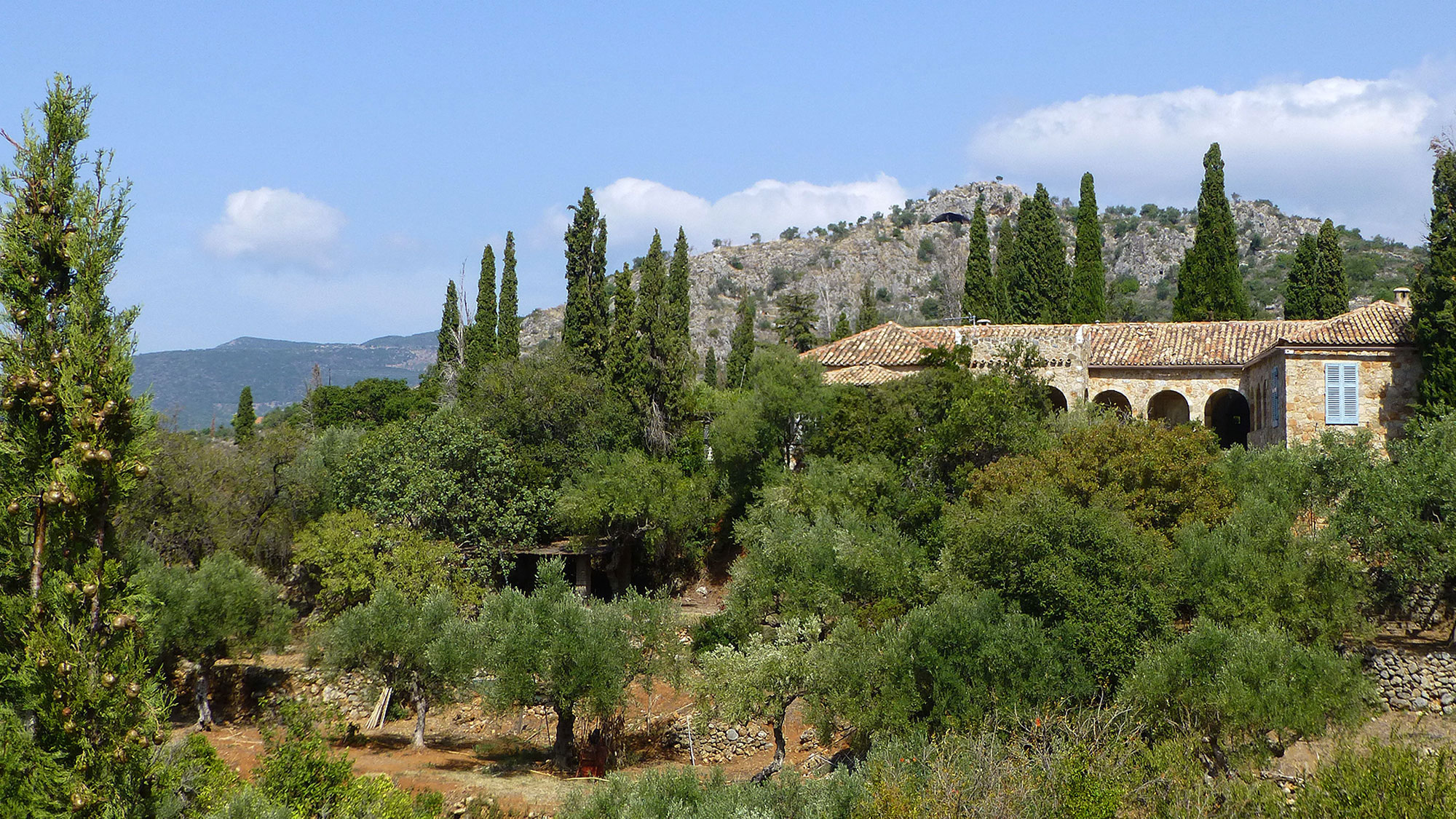
The House of the Mani

paddys house at kardamyliI wonder what John Humphrys will say about Paddy’s house in the programme on Monday? In fact I wonder more what the Benaki will say. I want to highlight a comment on a recent post from Michael Hanson, which if correct describes a property that is falling apart. Given that Paddy probably did little restoration and it has now been four years since his death, during which nothing appears to have been done, one can imagine it must look dilapidated and in serious need of attention.

I was in kardamyli recently and visited paddy’s house covertly. It is in a decrepit state, shutters rotten and falling off. Garden overgrown. Totally unloved and a disgrace, given that paddy gave it to the Benaki Foundation to be used as a haven for writers. Hopefully this programme will shame the Greeks into doing something. They say it will cost over £100,000 to restore. Nonsense!
We photographed paddy’s child hood public school trunk languishing in his study. Heartbreaking!

The PLF Society want to raise funds to cover immediate repair work and you can donate. Read how here. The higher figures mentioned above are not just for restoration and repairs but to cover renovation and reconfiguration to prepare the house so it can be used as a conference centre. The Benaki are due to report In July on whether it has been successful in raising finance for the main renovation works planned for the house which are expected to cost some € 630,000.

The Man of the Mani – BBC Radio 4 Monday 22 June

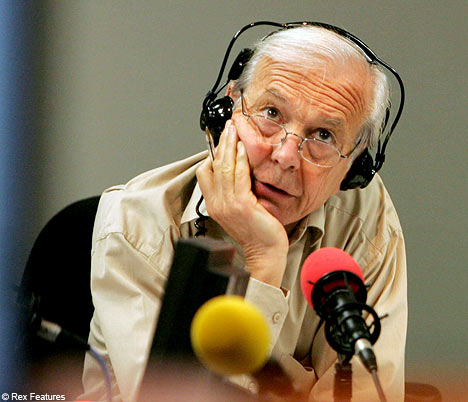
johnhumphMS2010_468x402Final scheduling for the John Humphrys’ BBC Radio 4 programme about Paddy is available on the BBC website. It will broadcast at 1600 hours on Monday 22 June and will be available later on the BBC website. Which tells us …

John Humphrys travels to Greece, to the village of Kardamyli in the Mani, to explore the life and work of travel writer Patrick Leigh Fermor.

Fermor is arguably the most influential travel writer of the 20th Century. At the age of eighteen he took off, with notebook in hand, on a walk across Europe. During the Second World War he fought in Greece and Crete, and is still remembered in the country today for his daring exploits with the resistance. His most celebrated action came in 1944 when he led a commando operation to abduct the German General Heinrich Kreipe.

In the early 1960s he moved to Greece, to the Southern Peloponnese. He built a house in the village of Kardamyli in the Mani. It was here that he wrote much of his most celebrated work and where he remained until his death in June 2011.

John Humphrys visits Fermor’s village to explore the influence that Greece had upon his life and work, and also to consider the impact that he had on the village and the people he lived alongside. John visits Fermor’s former home, now in the care of the Benaki Museum in Athens, and discusses the plans for its future. He meets those in the village who met Leigh Fermor when he first arrived in the 1960s – a man in his nineties recalls how they “danced on the tables into the night” – and he hears tales of influential guests, great writers like Bruce Chatwin and John Betjeman, even a King and Queen.

Accompanied by Fermor’s book ‘Mani: Travels in the Southern Peloponnese’, John Humphrys also travels into the deep Mani, one of the remotest, wildest and most isolated regions in Greece.

Visit the BBC website here for further details.

Walking from the east side of the Cascades across the Columbia Plateau to the Oregon border

When we imagine the interior of the United States I would guess that many of us think of wide open spaces where we can roam free on the range with what is left of the playing deer and antelope. Watching this longer installment from our long-time blog friend Owen Martel which covers the first part of his Walking the West – shore to shore across the USA – you realise that the US is not always walker friendly country.

For a place that values freedom there are an awful lot of No Trespassing signs, but it makes for interesting viewing. If you wish to watch more of Owen’s videos please visit his You Tube page.

Owen tells us

This one covers the whole stretch from the east side of the Cascades across the Columbia Plateau to the Oregon border. In retrospect, it was a shakedown, Murphy’s-law kind of episode, early enough in the trip that I was still getting into the swing of things. I was glad to revisit the happier interludes, and happy to work out a new perspective on the trickier parts.

Apologies in advance to Francis Fermor for another post not directly related to his relative.

Hachette UK Buys Nicholas Brealey Publishing

Whilst I have been busy moving house over the last month, hence the absence of posts – sorry – the publishing world has moved on. Hachette UK has acquired Nicholas Brealey Publishing in a deal that includes the company’s U.S. imprints, Davies L. Black and Intercultural Press. By the end of the summer three of Brealey’s Boston-based employees–Janet Crockett, Melissa Carl and Jen Delaney–will move into Hachette Book Group USA’s Boston offices.

Nicholas Brealey is headquartered in London and is best known for its business books list. Company founder Nick Brealey will continue to manage the firm from London as part of Hachette’s John Murray Press division, which is overseen by Nick Davies. According to HBG, Hachette UK will handle sales for all Nicholas Brealey titles. In addition to its business book program, Brealey publishes travel writing and a cross-cultural list.

Jamie Hodder Williams, CEO of Hodder and Headline (John Murray Press’ parent division), said: “Nick Brealey is a brilliant publisher. His areas of specialism–global business, personal and professional development and travel writing–are also areas of specialism for Nick Davies’ team at John Murray Press. I am absolutely delighted that Nick has chosen to come to Hachette so that together we can further develop the wonderful business he has created.

Nick Brealey said: “This is splendid news for everybody and just as an example of how good the fit is – John Murray famously publish Patrick Leigh Fermor’s classic backlist whilst one of our recent travel titles is Nick Hunt’s acclaimed Walking the Woods and the Water: In Patrick Leigh Fermor’s Footsteps from the Hook of Holland to the Golden Horn – a perfect piece of publishing serendipity.”

Before setting up his imprint, Brealey worked at Allen & Unwin and at Simon & Schuster UK.

Nicholas Brealey joins recent Hachette UK acquisitions Constable & Robinson, Quercus (also now part of Hodder), and the educational publisher Rising Stars.

Catch up here.

John Humphrys presents Paddy’s world on BBC Radio 4

John Humphrys on the Today programme

A little while ago I was approached to help provide some background information to help with research for a one-off Radio 4 programme about Paddy and his life in and around Kardamyli which will be presented by John Humphrys.

Kevin Dawson from Whistledown productions has confirmed that all is on schedule and the programme should be transmitted at 11.00 am on Monday 22 June. It will include interviews with Artemis Cooper and her father John Julius Norwich, as well as a contribution from the Benaki which may update us on progress about the house.

John Humphrys has a property in the Kardamyli area and is a fan of Paddy’s work. I believe that this may be his own idea which is great and will go someway to making up the deficit of BBC programming about one of our greatest writers.

Leaving Kastamonitsa for the kidnap – Chris White talk 19 May

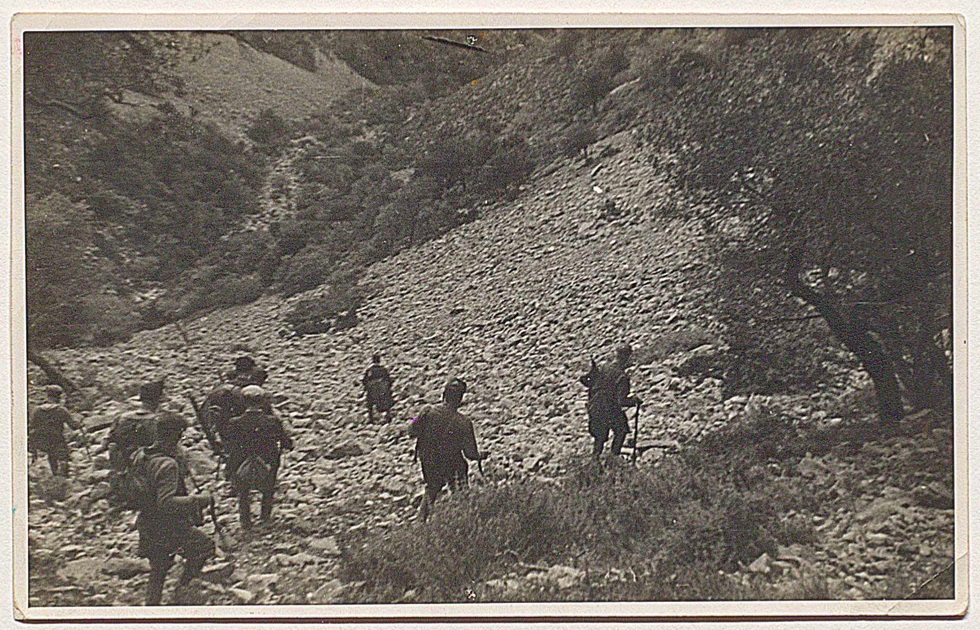
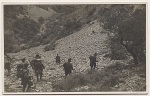
Some of the kidnap gang leaving Kastamonitsa April 1944

Some of the kidnap gang leaving Kastamonitsa April 1944

It is with great pleasure that I am able to release these images sent to me by Abducting a General co-editor, Chris White which show the locations photographed in April 1944 of the team leaving Kastamonitsa in preparation for the kidnap a few days later. Chris has sent me colour pictures taken by him on a recce to Crete just last week of the same locations for comparison.

Chris and his brother Peter are the experts on the kidnap and the route taken before, during and after the kidnap. They edited Paddy’s account which was published last year as Abducting a General: The Kreipe Operation and SOE in Crete, and have spent many months on the ground in Crete over recent years finding new information and making contact with the survivors from the time and the now aged offspring of those directly involved in the Kreipe kidnap and the resistance to the German occupation.
The brothers will be presenting their most up to date findings using newly discovered material from Paddy’s archive at the National Library of Scotland and the Liddell Hart Archive at the next PLF Society event to be held at the Hellenic Centre near Paddington on 19 May. Further details in this link. They make the whole thing come alive so if you want to find out more do please come along one and all. There is plenty of room at the venue.

Buy Abducting a General: The Kreipe Operation and SOE in Crete here.

An Adventure – asking the questions about Paddy and Joan’s marriage

Perhaps a rather belated link to the Harvard Review Online but one that openly questions some of the things that Artemis probably deliberately left out, and worthy for a quick read for that point only. We have no real discussion as to the reasons and background of Paddy and Joan’s “open marriage” and how it really impacted Joan, who frankly must have been deeply hurt by Paddy’s behaviour.

by Laura Albritton

First published in the Harvard Review Online, March 24 2014

The cover of Patrick Leigh Fermor: An Adventure is an excellent introduction to its subject. Leigh Fermor sits on deck with the sea behind him, his chest bare, cigarette casually in hand, his gaze focused on the discoveries ahead. By anyone’s estimation, Patrick Leigh Fermor’s life was an extraordinary adventure. His biographer, Artemis Cooper, has the advantage of having known him; she is also the granddaughter of Lady Diana Cooper, who carried on a great correspondence with him. As a result, she seems very much at ease with her subject, referring to him as “Paddy” throughout.

Leigh Fermor came to fame in the U.K. for his daring exploits in the Second World War and for a series of beautifully written travel books, including The Traveller’s Tree, Roumeli, Mani: Travels in the Southern Peloponnese, A Time of Gifts, and Between the Woods and the Water. As a teenager at King’s School, Canterbury, he learned Greek but was eventually thrown out. His housemaster reported that, “He is a dangerous mixture of sophistication and recklessness which makes one anxious about his influence on other boys.” A devotion to Greece, the pursuit of women, recklessness, and an irresistible charisma became defining elements in Paddy’s life.

Leigh Fermor’s originality becomes clear when, with no prospect of attending university, he decides to walk across Europe to Constantinople. Cooper does excellent work researching his trek (which Leigh Fermor himself chronicled in two volumes). She quotes from his diary and introduces us to the people he met, many of them members of the faded aristocracy. People welcome him because: “In Paddy’s company everyone felt livelier, funnier and more entertaining.”

Abroad, Leigh Fermor uncovers a world that seems preserved in amber, with intimations of the terrible events to come, including a pervasive anti-Semitism. In Athens he meets the cultivated and older Romanian painter Princess Balasha Cantacuzene and becomes her lover. He spends a year on her family’s dilapidated Romanian estate, Balani, after which he and Balasha move between London, Greece, and Romania. Cooper notes that:

Living with the Cantacuzenes in Rumania had granted Paddy several of the opportunities afforded by a university education . . . he had learnt Rumanian, studied its history, and read as much as he could in that language and French. Above all, Balasha and the Cantacuzenes had given him . . . a set of people among whom he felt he belonged and was understood.

Later, during World War II, Leigh Fermor was given a commission in the Intelligence Corps based on his skill with foreign languages: “He would be in Crete, out of uniform, living in the open, in constant danger.” Cooper supplies us with welcome context, from the political to the geological, though the initial passages chronicling Paddy’s war work lag in places due to too many actors. “The Hussar Stunt,” however, is nail-biting. With the aid of fearless Cretan partisans, Leigh Fermor and a few Brits capture German General Kreipe and sneak him off the island in a boat to Cairo. Their improbable success later inspires books and even a film.

After the suspense of the Cretan episodes, Cooper keeps things lively as she recounts Paddy’s meeting with his future wife, the photographer Joan Rayner (née Eyres Monsell), and his friendship with figures like Lawrence Durrell. Leigh Fermor had a relentless curiosity, traveling to the French West Indies (inspiration for his only novel, The Violins of Saint-Jacques) and to Haiti (inspiration for The Traveller’s Tree). Here, Cooper reveals some of Leigh Fermor’s unpublished judgments: “All the Caribbean islands have something wrong with them,” he wrote. “All are founded on bloodshed and slavery, and are now miserable, subsidized, impoverished places.”

Greece remains a central organizing principle in Leigh Fermor’s life, and Cooper does a fine job of weaving tumultuous Greek politics through his personal chronology. He and Joan eventually build their dream house in Kardamyli. Writing, however, was sometimes a torture, as Cooper observes: “He set great store by the initial surge of writing . . . Yet the moments of creative possession, when the self is lost and time becomes meaningless, were rare.”

As a biographer Cooper shows little interest in psychoanalyzing her subject. On one hand, this shows admirable restraint; on the other, Leigh Fermor remains enigmatic. We wonder, for example, how exactly he became so erudite. Leigh Fermor and his wife maintain an open marriage, but their motivations and emotions are often left unexplored. Elsewhere, Cooper points out that the Duchess of Devonshire adored him, but we’re given only glimpses of his charisma.

Cooper does, however, add a great deal in terms of tracing the trajectory of Leigh Fermor’s life, pinning down facts (as opposed to myths), providing historic context, and quoting from diaries and letters. The result, even with unanswered questions, is an excellent read and should revive interest in his writing. For that we owe Artemis Cooper a debt of gratitude.

Hito Steyerl Wins the First EYE Prize

In November last year I reported that EYE, the Dutch film museum and the previously unheard of Patrick & Joan Leigh Fermor (PJLF) Arts Fund had launched the EYE Prize. The annual £25,000 prize is aimed at supporting and promoting the artist or film-maker whose work unites art and film, and demonstrates quality of thought, imagination and artistic excellence. One of Paddy’s executors, Olivia Stewart is the trustee of this fund. I have repeatedly asked for some background information on this art fund but nothing has been forthcoming from Ms Stewart. The link between Paddy and Joan and the film world is tenuous to say the least (notwithstanding The Roots of Heaven). Perhaps it is more to do with Ms Stewart’s close connections to the film industry? One would have thought that a fund in memory of Paddy and Joan would be more focused on writing and photography.

By Tom Sawford

The latest news is that the first EYE Prize has been awarded to Berlin-based artist and cultural theorist Hito Steyerl.

The £25,000 prize ($37,100) was established by the Amsterdam film museum with the goal of supporting outstanding artists who work primarily in film. Steyerl was presented with the award in April in Amsterdam at the EYE Gala.

The 2015 EYE jury consisted of director and artist Chantal Akerman; MoMA’s chief curator for media and performance art, Stuart Comer; EYE CEO Sandra den Hamer; artist and director Isaac Julien; cultural entrepreneur, advisor, and art collector Martijn Sanders; producer, screenwriter, and Patrick & Joan Leigh Fermor (PJLF) Arts Fund trustee Olivia Stewart; and screenwriter and director Béla Tarr.

Steyerl is represented by Andrew Kreps gallery in New York. A retrospective of her work is currently on view at Artists Space gallery in New York. Her work will be included in a group show at the German Pavilion at the 2015 Venice Biennale.

A Paddy centenary event in Verona – Omaggio a Patrick Leigh Fermor

Luigi Licci, who runs the bookshop La Libreria Gulliver in Verona, Italy, has contacted me to say that he will be running an event on 8 May to celebrate Paddy’s centenary and the publication in 4 June of Italian translation of The Broken Road, under the title La Strada Interrotta, published by Adelphi.

All are welcome at the event to be held at Villa Ca’ Vendri, Via Vendri 39, Quinto di Valpantena, Verona kicking-off at 8.45 pm. There will be talks by Paddy’s friend William Blacker, author of The Enchanted Way, and Matteo Nucci, a well known Italian author specialized on Greece who is also a regular contributor to the major Italian daily La Repubblica. The evening will finish with some excellent Italian food and wine.

Further details can be found on the La Libreria Gulliver website or telephone 045 8007234. If you are able to attend I hope that you have a wonderful time and only wish I could be there.

Thank you – test successful

One word of advice. If you don’t want your email inbox jam-packed full, don’t ask hundreds of people to send you an email !!! Please stop replying now 🙂

Thank you all for your replies. The test was successful in that the notifications clearly work but there may be a problem with some email providers. We will work through it.

Have a great weekend and if in Europe a pleasant holiday weekend.

Tom

Testing email notifications for Followers

Hello dear readers. I have been told by a long-term blog follower who has signed up to receive emails that he has not been receiving them of late. There are over 700 of you signed up and I would be grateful if upon receiving this “post” you could email me at tsawford[at]btinternet.com to say that you have received it or add a comment to this post (click Leave a reply top left of post as shown in this picture) .

Capture10

This is just a test to see if the function is working correctly. If I get a few replies I will ask for a halt to stop my inbox being swamped! If I have none, then I know to contact WordPress to see what can be done.

If you appear to be having intermittent problems ie you receive some but upon visiting the site it appears that others might not have got through, it is worth checking your spam box and also to mark the notification email address as “not spam” and add to your safe senders list.

Thank you in anticipation for your help.

Tom

David Attenborough on John Craxton

attenborough

This is a powerfully enjoyable combination. In this short clip Sir David Attenborough looks back at the art of John Craxton, Paddy’s book cover illustrator, whose paintings reflect the artist’s intense encounter with the natural world.

The full programme was first shown in on the BBC Culture Show in June 2011.

To watch the video click this link.

The Craxton exhibition, A Poetic Eye, opened recently by Sir David runs at the Dorset County Museum in Dorchester from 28th March to 19th September 2015, moving to Salisbury Museum early in 2016. The Museum is open from 10.00am to 4.00pm, Monday to Saturday.

Natural Born Heroes: The lost secrets of strength and endurance

An interesting new perspective on SOE, the kidnap, why the SOE guys and gals were able to cope with the hardships of their particular kind of warfare, and how it may help us all live healthier lives. Well that appears to be the claim which we could take with a pinch of apparently unhealthy salt! A review of Natural Born Heroes: The lost secrets of strength and endurance
by Chrisopher McDougall.

by Chris Maume

First published in the Independent, 9 April 2015.

One of the most daring, madcap episodes of the Second World War was the kidnapping by Patrick Leigh Fermor, dirty trickster supreme, and his band of British eccentrics and Cretan hard men, of the German general Heinrich Kreipe.

Seventy years later, youngsters in inner-city London and the suburbs of Paris were becoming experts in parkour, using the urban landscape as an obstacle course to be negotiated with joyful freedom and intense physical discipline.

Christopher McDougall connects these two points, and many in between, in a heady confection that encompasses, among other subjects, military history, archaeology, Greek mythology, neat ways to kill a man and ideas on health and fitness that might just change your life. A line from an old M People song kept coming to mind as I read on, the one about searching for the hero inside yourself.

The Kreipe caper involved an insane trek across the murderous Cretan terrain, which by then should already have done for the motley crew of poets and classicists who had been tasked with detaining on the island German soldiers who would otherwise have been marching on Stalingrad. Had they failed, the progress of the war may have been very different, as Winston Churchill would later acknowledge.

Few of the Special Operations Executive men who joined Leigh Fermor in the Mediterranean could be described as hero material, however: they tended to be, like him, romantic misfits, many of whom might not even have got into the regular army. They proceeded by brain-power and imagination, but on the rugged island of Crete they also needed to hack it physically. And McDougall thinks he knows how they did that.

“The art of the hero,” he contends, is the art of natural movement,” and his answer to the question of how the Cretan mob were able to achieve so much boils down to two basic strands: one is the idea that true physical strength comes not from muscle power but from the fascia profunda, the net of fibres that envelopes our bones and muscles and imparts the energy of “elastic recoil” that allowed us to spring across the savannah in pursuit of lunch, as well as chuck the rocks or unleash the slingshot that killed the lunch for us.

Learn to use your fascia profunda, says McDougall, and you’ll find yourself able to do things you never thought possible. The Cretans, skipping across peaks and valleys like mountain goats, do it naturally, and the SOE boys, he says, learned from them.

The other ancient secret which Leigh Fermor and Co unwittingly accessed, according to McDougall, was the idea of using fat, rather than sugar, as fuel. The fatty-meat, low-carb diet which sustained our hunter-gatherer ancestors until agriculture came along and spoiled everything, has resurfaced from time to time (remember the Atkins diet?), and McDougall believes it’s the way to go.

Cut out those grains, all that pasta and anything remotely sugary, and get some flesh inside you, he recommends. Do that while preventing your heart rate exceeding a certain mark (for which there’s a simple formula) and soon you’ll be lean, lithe and fighting fit. The guru of carbo-loading for distance runners, Dr Tim Noakes, he reminds us, eventually recanted – and, McDougall notes, the SOE boys and their local comrades could cross the mountains on little more than a few nuts and a drop of wine.

He constructs a fascinating edifice of ideas around these two notions, and eventually finds a modern-day hero of his own. But the pleasures of the book are as much to do with the fascinating panoply of characters, war heroes all, British, Commonwealth and Cretan, whose exploits contributed so much to Hitler’s downfall.

Buy Natural Born Heroes: The lost secrets of strength and endurance

Remembering Gallipoli

A small tribute to remember those on both sides who fought and died in Gallipoli, a bloody campaign that started 100 years ago today.

The words of the great Mustafa Kemal Atatürk resound clearly today:

Those heroes that shed their blood and lost their lives … You are now lying in the soil of a friendly country. Therefore rest in peace. There is no difference between the Johnnies and the Mehmets to us where they lie side by side here in this country of ours … You, the mothers who sent their sons from faraway countries, wipe away your tears; your sons are now lying in our bosom and are in peace. After having lost their lives on this land they have become our sons as well.

The video below includes an extremely moving song by Eric Bogle and is mixed with pictures from Gallipoli with past and present Canadian troops.

Initial fundraising for Kardamyli

The PLF Society has been moving forward quickly in its dealings with the Benaki over Paddy’s house. Achieving its restoration, and Paddy and Joan’s goal of turning it into a writer’s retreat is one of the main aims of the Society. Today they report on progress and are making an appeal for initial funds to finance critical works at the house until funding for the long-term work has been raised. The Benaki have come up with a plan which encompasses many uses which if achieved would meet the goals of Paddy’s bequest.

A summary of the PLF Society’s appeal is below, with further details to be found on the attached PDF.

Steady progress is being made on the Kardamyli house. The Benaki Museum has now sent us a document that sets out its plans and we have finalised the team that will look after the interests of the Society and its members: our lawyers Watson Farley & Williams are now supported by an experienced architect and we have appointed Grant Thornton as accountants.

You will see from the attached summary that we are now able to proceed with raising 20,600 € (about £15,000 or US$24,000) for preliminary things that need to be done at the house. As the amount of this initial fundraising is relatively modest, we are hoping that it will be possible to raise it from our members and others associated with the Society.

In July the Benaki will know if it has been successful in raising finance for the main renovation works planned for the house which are expected to cost some 630,000 €. In the event that some or all of these funds are not raised by the Benaki, the Society has pledged to find the remainder and for this we have made contingent plans to extend the fundraising to include external sources.

Read the full initial fundraising PDF here.

Link

Capture1A broadcast on France Culture radio featuring Paddy speaking his best French, supported by Artemis Cooper and her father John Julius Norwich. Lovely to hear Paddy speaking and also to brush up some of the old French given that we all know the context. With contributions from others. Click the picture above to visit the site and then press the play icon. The player will open in a new window and can be a little slow to load so just be patient but the quality is fine and worth the wait.

Interesting that with this and the TV interview alongside the brilliant Nicolas Bouvier, the French are running neck and neck with the BBC for airtime about Paddy. Watch Paddy here (he appears around 29 minutes.)

The Traveller’s Tree: The Travel Writing of Patrick Leigh Fermor

William Dalrymple introduces Artemis Cooper discussing Paddy’s writing including his first major work, The Traveller’s Tree, at the Jaipur Literature Festival

Eric Newby and Paddy: Two events in London this week – your reminder

Tuesday 14th April.

Eland publications are pleased to announce that the Traveller’s Film Club is back! It is held at Waterstone’s, 203-206 Piccadilly, London W1.

Benedict Allen introduces the 2008 BBC documentary on Eric Newby from the Traveller’s Century series he presented, directed by Harry Marshall (Icon Pictures; this is a definite one for me! Again doors will open at 6.30pm, the screening begins at 7.00pm.

All screenings at 7pm, doors open at 6.30pm. Please book a free place at Piccadilly@waterstones.com

******************************************************************************
Thursday, 16 April

Historian and travel writer Alan Ogden, writer and journalist Tom Fort, as well as some of Patrick Leigh Fermor’s friends belonging to the Romanian exile in London – Michael de Styrcea, Şerban Cantacuzino and Marie-Lyse Ruhemann, discuss the famous writer’s fascination with Romania, examining his vivid and meaningful perceptions and observations, backed by solid historical, cultural and linguistic knowledge.

The Enamoured Way: Patrick Leigh Fermor and Romania, Romanian Cultural Institute in London, Thursday, 16 April 2015 from 19:00 to 22:00.

Preceded by: The Opening of ‘Patrick Leigh Fermor: A Romanian Romance’

The exhibition follows, through a collage of old photographs and emblematic excerpts, Patrick Leigh Fermor’s Romanian escapades recalled in his hugely successful travel memoirs Between the Woods and the Water and The Broken Road, depicting people and landscapes that were at the root of the author’s lifetime attachment towards Romania.

Free entry. Reserve your place via Eventbright.

El último aventurero romántico

A profile in Spanish from El Pais. The Spaniards appear to have a great interest in Paddy and his works, possibly encouraged by the translations of Dolores Payás, the author of Drink Time! which many of us enjoyed last year.

By Jacinto Antón

First published in El Pais, 3 July 2013

Es el efecto que provoca el recuerdo del viejo aventurero romántico, ¡diablo de hombre! Mientras hablamos de sir Patrick Leigh Fermor (Londres, 1915- Dumbleton, 2011) evocando sus hazañas, sus líos de faldas, sus viajes, la belleza de sus escritos, sus grandezas y debilidades, la admiración y, sí, el amor, que sentíamos por él, su amiga y biógrafa Artemis Cooper se pone de pie extemporáneamente y se pone ¡a bailar una danza griega! Yo diría que un sirtaki.

La escena resulta inesperada y sorprendente en esta tarde londinense en la pequeña librería Nomad Books de Fulham, donde tomamos los dos un té en tazas con portadas de Penguin rodeados de libros y silencio. La librera y los demás clientes nos miran con disimulo. La historiadora y editora Artemis Cooper, autora de la extraordinaria biografía Patrick Leigh Fermor, una aventura, recibida con unánimes elogios en Reino Unido y recién aparecida en España (RBA), es bien conocida en el barrio, donde vive con su marido, el célebre historiador militar Antony Beevor (inmerso, por cierto, en la batalla de las Ardenas), y su arrebato es recibido con británica flema. La observo danzar aferrado a mi cuaderno de notas, sin saber si he de sumarme al baile.

Hablábamos de la vitalidad de Leigh Fermor, el sensible y curioso adolescente que cruzó Europa andando en los años treinta, codeándose con aristócratas y domadores ambulantes de osos, el oficial de inteligencia, el valiente soldado de operaciones especiales que secuestró en un golpe de mano audaz al comandante de las tropas nazis en Creta, el guapo amante que conquistó a tantas bellas mujeres, el refinado, culto y políglota escritor que nos ha dejado libros tan hermosos como El tiempo de los regalos, Mani, Roumeli o Un tiempo para guardar silencio, el filoheleno émulo de Lord Byron que rescató las zapatillas del poeta y cruzó nadando el Helesponto a los 69 años. “Al entrar él en una habitación, todo el mundo se sentía más vivo, ligero”, recordaba la escritora. “En Atenas, cuando era pequeña, íbamos por las tardes a las tabernas y él hablaba con la gente, y pasaban cosas. Empezaba a cantar, canciones griegas que interpretaba de manera fenomenal. Y se ponía a bailar. Bailaba maravillosamente”. ¿Como Zorba?, le he preguntado interrumpiendo sus recuerdos. “Exacto. Mejor. Anthony Quinn bailaba de manera algo dejada, abandonándose. Paddy era más decoroso. Sus movimientos, majestuosos, enérgicos”. Y es entonces cuando Artemis Cooper, una mujer madura (1953), atractiva, culta y de refinada elegancia –no en balde, nacida como la honorable Alice Clare Antonia Opportune, es hija del segundo vizconde Norwich y nieta de Lady Diane Cooper– , ha retirado su silla con resuelta determinación, se ha levantado y ha ejemplificado cómo danzaba Leigh Fermor poniéndose ella a bailar. Observo que calza deportivas.

Read more here.

Among the Quick and the Dead

If you are coming to the end of a celebrated life, chances are that someone has already suggested writing your biography – a thought, as Oscar Wilde pointed out, that lends a new terror to death. The print run will be measured in thousands, and modern readers feel shortchanged unless all is revealed: sex, money, secrets, skeletons and dirty linen. The prospect is appalling but once you are dead, you probably won’t mind so much.

By Artemis Cooper

First published in The London Library Magazine, Spring 2013

I was commissioned to write the life of Elizabeth David by her literary executor, Jill Norman, in 1995 – by which time Mrs David had been in her grave for three years, and her papers had been expertly catalogued by Jill’s partner, the writer and book-dealer Paul Breman. Housed in two long rows of matching box-files, the archive marched the entire length of an airy studio in Rosslyn Hill. Most of the papers were to do with work, but my worries that there might not be enough material to make a good story soon evaporated. Her correspondents included Jane Grigson, Lawrence Durrell and John Lehmann, and in her own letters you can hear the irony in her voice, the salty chuckle.

And while her middle years were more sedate than her turbulent youth, what kept the narrative going was that in life Elizabeth was demanding and difficult. There was always a spectacular row brewing, with publishers, lovers, friends and family – sooner or later everyone fell foul of her, and a series of blistering letters (she kept copies) were left to tell the tale. When I wasn’t at Rosslyn Hill, sustained by cups of high-octane coffee, I was out interviewing. Derek Cooper told me how Elizabeth’s reluctance to be interviewed on radio almost wrecked an episode of The Food Programme devoted to her work, while Sybille Bedford described the way she could suddenly go cold on you from one second to the next. I had lunch with people who cooked a lot better than I did, and they often made me her favourite dishes. The exception was the novelist Paul Bailey who looked at what he had just bought for lunch and said, ‘I’m glad I’m cooking this for you and not Liza… She hated quail, and cauliflower.’

So I didn’t realise just how easy I’d had it until I began to tackle the life of Patrick Leigh Fermor, in 2001 – while he was still living it. I had known him since I was a child, and had already interviewed him for a previous book about wartime Cairo. He didn’t like the idea of a biography, and neither did his wife Joan. But friends had persuaded them that unless Paddy appointed someone to write his life, he might find himself the subject of a book whether he liked it or not. I was told I could go ahead, but I had to promise not to publish anything until after they were both dead, which I thought very sensible. I would be free to write without them looking over my shoulder, and they would never have to wince or groan at what I had written. The disadvantage was that it might be many years before the book saw the light, but that seemed a price worth paying.

Work got off to a slow start. Paddy did not like being interviewed, and would keep my questions at bay with a torrent of dazzling conversation. He was also very unwilling to let me see many of his papers, though the refusal always couched in excuses. ‘Oh dear, the Diary…’ It was the only surviving one from his great walk across Europe, and I was aching to read it. ‘Well it’s in constant use, you see, as I plug away at Vol III,’ he would say. Or, ‘My mother’s letters? Ah yes, why not. But it’s too awful, I simply cannot remember where they’ve got to…’ It was quite obvious that he and Joan, while being unfailingly generous, welcoming and hospitable, were determined to reveal as little as possible of their private lives. While they were more than happy to talk about books, travels, friends, Crete, Greece, the war, anything – they would not tell me any more than they would have told the average journalist. Oh to be back with the uncomplicated, properly archived dead!

Please don’t get me wrong, I did not wish Paddy and Joan dead. Far from it, because I realised I was going to need all the years that Providence could spare them just to write the book. I think I must have spent whole months in the doldrums: plodding away with the reading and the research, writing the easy passages, but feeling as if the book would never take off. It felt as heavy as cold dough.

In June 2003 Joan died unexpectedly, leaving Paddy numb with shock and grief. Joan had never stopped Paddy talking to me, encouraging us both to make the most of my visits to Kardamyli. Yet Paddy’s scruples did ease after her death. He talked more freely, but he could still wish he hadn’t said things. One afternoon he told me how he had written a long letter to his mother about the first great love of his life, Balasha Cantacuzene, soon after they began living together. He waited eagerly for his mother’s reply; but when it arrived, ‘all I found in the envelope was my own letter, torn to shreds.’ He looked up, and at that moment I suppose he caught a glimpse of his biographer’s cunning eyes, sharp teeth and whiskers. ‘You won’t put that in, will you?’ he said anxiously. ‘Oh no Paddy, of course not,’ I said, quickly resuming my expression of calm serenity.

As time went on I told similar fibs. When I stumbled on the fact that he had not been on horseback when first setting out on the Great Hungarian Plain (though he was a bit later) he looked rattled. ‘I thought the reader would be getting bored of me just plodding along on foot. I say, you won’t let on, will you?’ Oh no, Paddy, I won’t let on…

Most curious to me was how reluctant he was for the story of the Cretan vendetta to appear in print. It all began in occupied Crete in May 1943. As Paddy was checking a rifle he did not know was loaded, he inadvertently killed his Cretan guide, Yannis Tzangarakis. After the war Paddy sought out Yanni’s brother, Kanakis , to try and explain what had happened and beg his forgiveness. But Kanakis upheld the old Cretan code of honour, which demanded blood for blood. He used to lie in wait for Paddy on his regular returns to Crete, for reunions with his old brothers-in-arms. The feud was only dropped in 1972, and culminated with the traditional happy ending: Paddy was asked to baptize one of the Tzangarakis family. He called the little girl Ionna, after his wife Joan and the friend he had so tragically killed.

Paddy told me the story in great detail, and finished with the dreaded words ‘You won’t put that in, will you?’ Normally I would have reassured him, but this time I made a stand. ‘Why ever not?’ I asked. ‘Everyone concerned behaved according to their principles, until peace and reconcilliation triumphed: who could possibly object to that?’ He replied that the story was still a very sensitive one in Crete. I did not doubt it, but felt that enough time had elapsed for the tale to do no harm. I knew Paddy was still in touch with his god-daughter Ionna, then a young woman in her thirties, so I suggested we get in touch and ask her. If she didn’t mind, who else would? Paddy was not convinced: ‘I’ll have to dig out her address…’ And that was the last I heard of it, until I got in touch with Ioanna myself. How? By looking her up in his address book when he was taking a nap. Biography is not work for the morally squeamish.

There were certain things he hated talking about, one being his writing: ‘Well, you know, I just scribble away and then of course it has to be gone over quite a bit…’ Attempting to dig deeper, I once compared his vision of Greece to that of Kevin Andrews, author of a harrowing book which Paddy very much admired called The Flight of Ikaros. Andrews had much to say about the scars left by the Greek Civil War of the late 1940s, while in Paddy’s books it is scarcely mentioned. ‘His book shows Greece as Goya would have seen it,’ I went on, ‘wheras your Greece is more like a Claude Lorrain….’ It was a crude analogy, only made to get him to talk about why he wrote about Greece the way he did. Paddy looked utterly crestfallen and said, ‘Oh my God, am I that superficial?’

A romantic gallantry meant that he never talked about his girlfriends, either. After much cajoling he told me about Liz Pelly, to whom he lost his virginity; and after a while, I began to pick up the words and phrases he used to hint at his affairs. ‘We were terrific pals, you know,’ was one of them. Luckily, there were letters – but I had to be careful there, too. There was an open fireplace in his study, and I never wanted him to think of using it for anything other than keeping warm.

For people who went through the two world wars, letters were sacred. Not only did Paddy and Elizabeth keep all their letters, but their correspondents did too, giving you whole flights of conversation. Letters are the bedrock on which biography is built, and without their testimony, I don’t think biography as we know it is possible. I doubt that anyone can get under someone else’s skin on the basis of a lifetime’s worth of emails.

If writing lives of the recent past, the biographer relies on the goodwill of those who knew the subject best – usually their friends and family. It is they who are going to tell you what you need to know, show you the letters, point to possibilities. I have been blessed in those I have depended on, and have come to feel a great regard for nephews in particular – but I have never had to deal with a subject’s children, because neither Paddy nor Elizabeth had any. Elizabeth always knew she never wanted babies. Joan yearned for them, but by the time Paddy was ready to face the prospect of paternity it was too late.

Children must be one of the trickiest challenges one can face. How could they not resent this outsider rootling around? Even the most cooperative and understanding of people bring with them a freight of scruple and protectivness when they think about their parents’ lives.

I often thought about Elizabeth David and Patrick Leigh Fermor, when they first knew each other in Cairo towards the end of the war. Being young and attractive, they may well have fallen into bed together at some point. They remained in touch for the rest of their lives, having friends and books and tastes in common. They loved long lunches and dinners, too, especially if they stretched on for hours with plenty of talk and wine. Paddy drank for the sheer joy of being alive, and lived to be ninety-six. But after losing the love of her life in her later forties, Elizabeth drank to ease her sorrow. At one point the booze, mixed with sleeping pills, nearly killed her. She died aged seventy-nine.

Elizabeth was never in love with Paddy but she admired his books, and once invented an ice-cream – Glace au Melon de l’île St Jacques – inspired by his only novel: ‘[This] melon ice has a strange, almost magic flavour and that is why I have called it after that French Caribbean island so unfogettably conjured out of the ocean, only to be once more submerged, by Patrick Leigh Fermor in The Violins of Saint- Jacques’, she wrote in French Provincial Cooking. I made the ice for Paddy and Joan when they came to dinner one night. Paddy was delighted, and began thinking of all the artists, statesmen and writers who have given their name to particular dishes: Melba, Colbert, Demidoff, Rossini, Châteaubriant, Arnold Bennett… ‘I feel I’ve joined a very exclusive club,’ he mused. ‘An ice-cream – now there’s immortality for you! ’