Category Archives: Paddy in the News

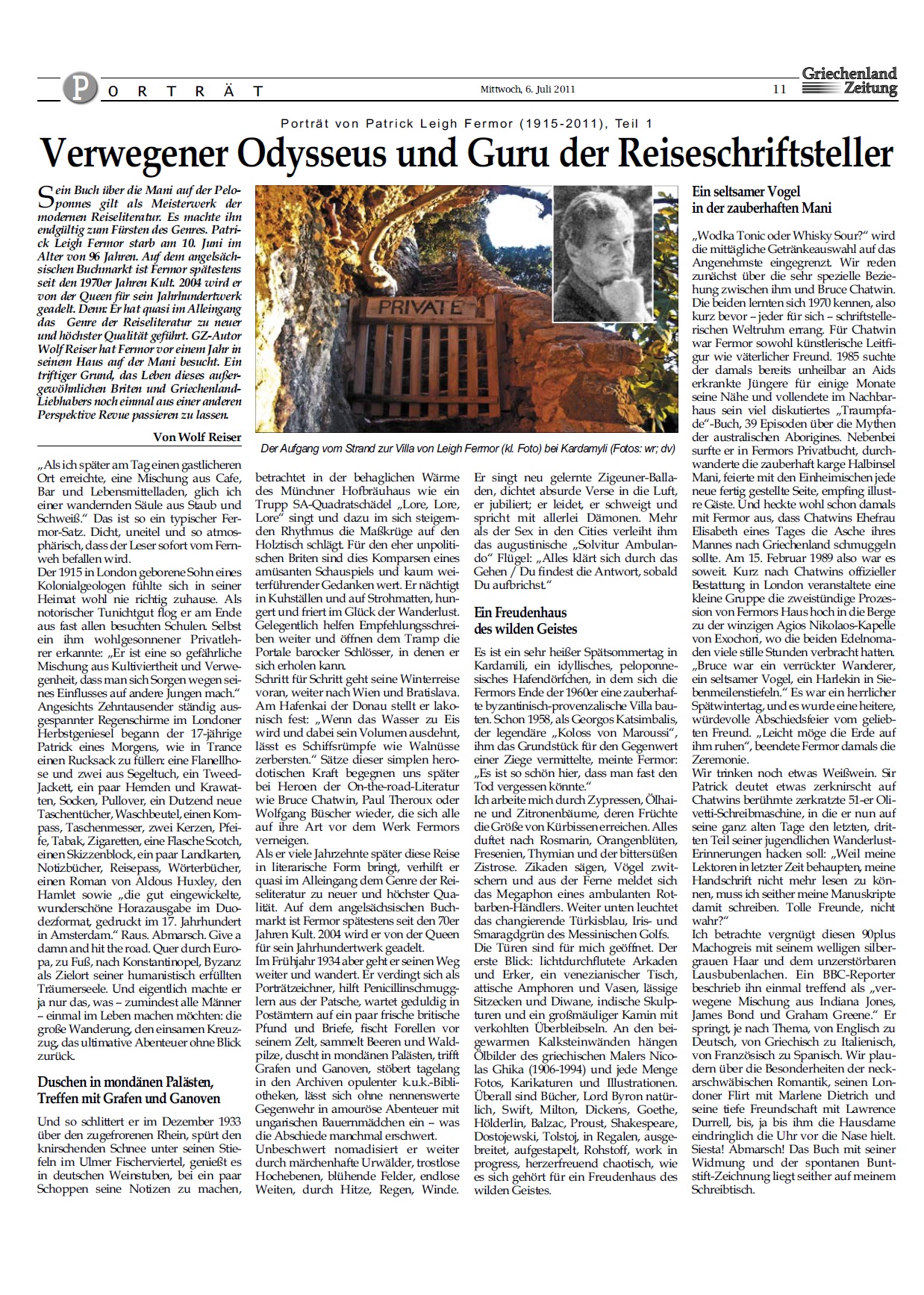
An obituary to Paddy in German

Greichenland Zeitung obituary

This obituary in German has been lurking in my drafts folder for too long. Christian Peters lives in Köln, Germany (Cologne) and keeps in touch regularly. I am not sure if he met up with Nick on his walk but I am sure Christian will tell us.

Dear Tom,

Thank you for bringing me in touch with Nick Hunt. I have had the plan to contact him for more than two months now, but now it came the other way around …

After Paddy’s death I tried to publish an article in the German newspaper in Athens called “Griechenland-Zeitung”. But a couple of days before my  article reached the editorial staff, they had published a much better one by Wolf Reiser. The chief editor was so nice to send me a copy of the first part of the article. Maybe that is interesting for the “German section” of your blog.

I am really pleased about your blog, day by day.

Next year I am gonna have a sabbatical in order to complete my dissertation on skateboarding . I am planning to write parts of it either in Kardamyli or in Sfakia /Crete, the region Xan Fielding has been writing about which is kind of my Greek homeland.

Thank you for your work.

Best from Cologne

Christian

Click the image to enlarge the text.

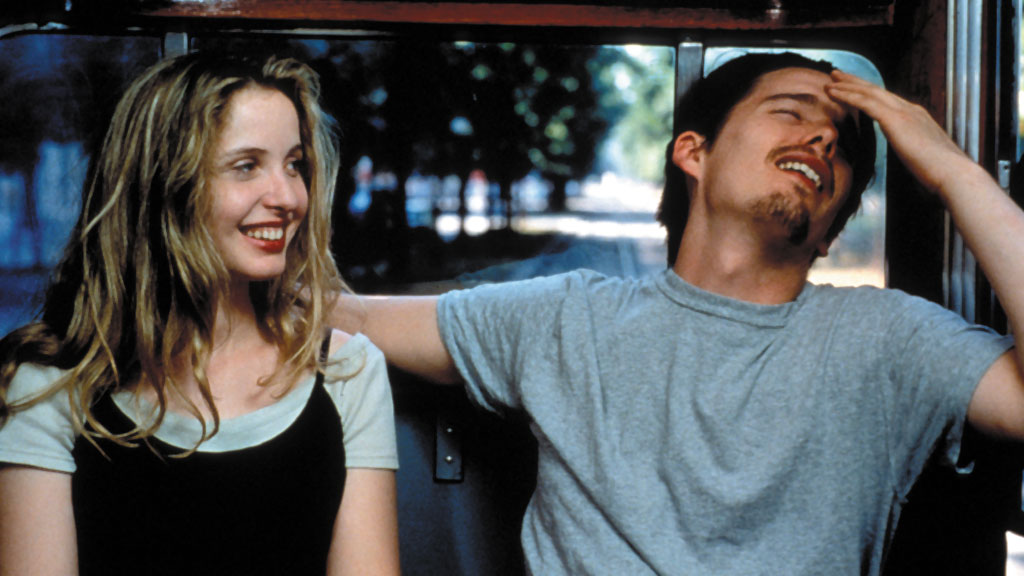
Before Sunset sequel, Before Midnight movie shooting in Greece at Paddy’s House

Julie Delpy and Ethan Hawke in Before Sunrise

The Paddy network is very wide and not much goes on without someone knowing something about anything Paddy related, and then getting in touch with your favourite blog. A couple of weeks ago I was contacted by our spy on the ground in Karadmyli to say that he had heard rumours that Paddy’s house was being used as a film set. Further investigations revealed this to be filming for a movie to be called Before Midnight which will star the actor Ethan Hawke, and co-start Julie Delpy. It is the third in a series of movies which I guess one could call the ‘Before Series’.

As we know the house was left by Paddy to the care of the Benaki museum and there have been some concerns voiced about the approach to essential maintenance at the house. Sources close to the museum and to Paddy’s family have confirmed that shooting has been taking place in the garden of the house and that Mr Hawke has been relaxing on the beaches playing his guitar whilst during some relaxed evening barbeques with fellow cast and crew and some locals.

The good news is that there should be a substantial fee for the use of the house which we hope will be put toward the essential maintenance, an issue highlighted only in July by John Chapman in his piece about a recent visit.

The movie series started with the 1995 film Before Sunrise which is all about a young man and woman who meet on a train in Europe, and wind up spending one romantic evening together in Vienna. Unfortunately, both know that this will probably be their only night together. But we all know that this can’t be the end, after all this is Hollywood, and nine years later the characters Jesse and Celine encounter one another during the French leg of Jesse’s book tour, and that film was called Before Sunset. I have no idea how that movie ended but it is possible that as travellers they had come across Paddy’s work and became true fans. Upset to hear that he had died each of them decided to make a summer pilgrimage to his house to make a ‘connection’. Whilst Celine gazes at the sunset across the bay from Paddy’s patio after sneaking in through the rickety blue gate, Jesse arrives with Elpida (Paddy’s housekeeper who has been kept on) and from then on they only have eyes for each other, and the local ouzo.

There is speculation that Hawke, who has apparently been in the area since late July, has plans to stay until early September so if you are quick you may be able to join as an extra. If it is of interest there are no reports of sightings of Delpy, so anything could be happening. So exciting! We will keep you posted.

A Poetic Tribute to Paddy by John Pinschmidt at the Whitehouse Bar, O’Connell Street, Limerick

I have just returned home from a trip to Kilrush in Co Clare, Ireland to visit the place of my father’s birth, and to see some of my family there. It has been far, far too long since I was there; I won’t say exactly, but far too long! The people were so friendly and by God the Guinness was good!

By pure chance, whilst I was in Ireland, a poet, John Pinschmidt from Limerick, which is just 40 miles away from Kilrush on the Shannon, stumbled across my blog and added a comment into the Your Paddy Thoughts section. It was a poem he wrote at the time of Paddy’s death in June 2011 and hs John’s personal tribute. Given that Ireland is a land full of saints, poets and scholars I thought it too much of a coincidence with my visit to leave it languishing in the tributes page so here is John’s poem …

A HIMBEERGEIST TOAST TO PATRICK LEIGH FERMOR

“Live, don’t know how long,/And die, don’t know when;
Must go, don’t know where;/I am astonished I am so cheerful”.
—A Time of Gifts, 1977

Oh, to read your restless spirit had set off on its last journey,
Age 96, sent me into the parlour for A Time of Gifts
And back to 1933, your age-18 trek across Europe
As clouds gathered above a soon-to-be lost world,
Which changed your life as much as my age-21 Europe
Hitchhiking Summer of 1968, my time of gifts too.

Oh, to see again your rich cascades of words,
Riffs on decaying schlosses, Passion artworks,
Architecture as music, the drunken Breugel-like chaos of
Munchen’s Hofbrauhaus—where I had gone in ’68—the debauched
Bavarian Brownshirts portending days far darker than that night.
And later, in bitter weather near Linz, you had your first Himbeergeist.

Oh, that riff sent me searching the yew cupboard for an old bottle
From Deutschland, and I froze it and a Waterford glass,
And late that night, by fire and candlelight, drank too much of your
Clear spirit, reading your words out loud to you and all,
Young or old, who set out on life-changing journeys:
“Oh for a thimble full of the cold north! Fiery-frosty potions,
Sequin flashers, rife with spangles to spark fires in the bloodstream,
Revive fainting limbs, and send travellers rocketing on through
Snow and ice. White fire, red cheek, heat me and speed me”.

Prost, Siar go Deo, Paddy!

And just to embarrass John further, I have found a video on You Tube of him reading the poem at the Whitehouse Bar, O’Connell Street, Limerick.

Patrick Leigh Fermor’s archive acquired by the National Library of Scotland

From a National Library of Scotland press release dated today.

The archive of one of the most important travel writers of the 20th century and a war hero whose exploits were made into a major film has been acquired by the National Library of Scotland (NLS).

Sir Patrick (Paddy) Leigh Fermor, who died last year at the age of 96, is regarded as a central figure in understanding and appreciating mid-20th century culture.

To describe his life as colourful does scant justice to the reality. At the age of 18 he set off to walk from the Hook of Holland to Istanbul , a year long journey described in his books A Time of Gifts and Between the Woods and the Water. The Independent described the former as “rightly considered to be among the most beautiful travel books in the language.”

His war record is equally impressive. After the fall of Crete in 1941, he was sent back to the island to organise guerrilla operations against the occupying Nazis. He spent much of this time disguised as a Cretan shepherd, living in freezing mountains caves.

In 1944 Leigh Fermor organised one of the most daring feats of the war when he kidnapped the commander of the German garrison on Crete . This was made into a film Ill Met by Moonlight in 1956 starring Dirk Bogarde.

The archive consists of literary manuscripts and typescripts, correspondence with leading figures including the poet Sir John Betjeman, photographs, passports, portrait sketches and personal papers including visitor books and various honours awarded to Leigh Fermor. One of the star items is the only surviving notebook from his youthful trek across Europe .

It offers an unrivalled insight into his life and writings and adds to the wealth of travel literature at NLS. Acquisition of this archive is seen as helping to establish NLS at the forefront of 20th century travel literature research collections

“This is a fantastic collection which will be made available at NLS,” said David McClay, Manuscripts Curator. “We hope it will excite people who know of Paddy and introduce him to a whole new generation of people who may not be aware of his work.”

Its arrival at NLS comes just before a new biography of Leigh Fermor by the British writer and family friend Artemis Cooper is to be published.

Leigh Fermor died before he could complete the third volume in his travel trilogy. Artemis Cooper has worked on the uncompleted manuscript and this third volume – entitled The Broken Road – is expected to be published in 2013. This will all add to the interest in Leigh Fermor’s life and in the NLS archive.

The archive has been bought with a grant from the John R Murray Charitable Trust which assists NLS in the care and promotion of access to the Library’s John Murray Archive. Leigh Fermor was published by the Murray family.

The connection with the Murray publishing house was one of the reasons NLS was chosen by Leigh Fermor’s executors as the home for his archive. He also knew the Library, having donated his wife’s photographic collection to NLS just before he died.

NLS has also taken possession of the personal archive of Leigh Fermor’s close friend Xan Fielding, an author, translator and traveller who also fought in Crete . This has been donated to the Library by Fielding’s family.

John Chapman at Kardamyli


John Chapman is a regular contributor of material to the blog – you are all welcome to do so at any time; see Contact. Most notably John’s photographs of a visit to Kardamyli to meet Paddy in 2005 have been very popular with you all.

A while back he sent me some more photographs with some comments about the state of the villa at Kardamyli, and John’s personal thoughts about one of Paddy’s friends who died in May 2012.


Hi Tom

In May this year I made a return trip to Kardamili and Mani. I hadn’t been there for four years and this was just a week long catch up. Mani is still as effortlessly beautiful and tantalisingly fascinating as ever. One location I always visit is the church of St. Nicholas in Chora, where Paddy scattered Bruce Chatwin’s ashes in 1989. Still a remarkably special place.

At Paddy’s Memorial service in December I’d been sitting quietly in a pew as I could recognise some of the great and good but was not expecting anyone I knew to be there. I was suddenly clapped on the shoulder by a firm hand and an American accent bellowed ‘Well how you doing buddy?’ It was my old friend and correspondent Jon van Leuven. We had started writing to one another some 12 years earlier as we both were fascinated by the conundrum of the location of the Frankish castle of Grand Magne and various other puzzles in Mani’s medieval history. We’d since met on a number of occasions exploring cave churches near Langada and getting hideously lost in the Sangias Mountains in Mesa Mani.

With Jon was another Englishman, we were introduced but, I apologise, I’m useless with names. He had been attempting to catalogue Paddy’s books and papers. I asked if he knew what the Benaki Foundation intended to do with the house at Kalamitsi. “I’ve no idea”, was the reply,”…and I doubt if they do either”.

After the service Jon and I said our farewells. Jon was a long time friend of Paddy’s. He long had a house at the hamlet of Gournitsa (a Slavic name, lit. ‘the place above’) though nowadays often referred to as Agia Sofia, after the pepper-pot domed church which perches over Kardamili. The house itself had few comforts, Jon was adamant that he wasn’t go to pay any ‘damned taxes’ for electricity. But it was comfortable and clinging to the cliff top edge of the Viros Gorge it was a precious eyrie where Jon would stay from June to September, although his family and home were now in Gothenburg, Sweden.

I told Jon I was going to Mani and he asked me to give his house a quick look to see if all was OK. I replied I would. He emailed me on the 8 April.

‘Glad to hear you can get get up to Gour and give the hacienda a glance. Also in town I hope you hear what’s going on at Paddy’s villa these days – if you know Elpida the housekeeper she’d know better than anybody’.

I don’t know Elpida and anyway by the time I got to his Hacienda in Gournitsa I’d been given the sad news that Jon had died of complications of leukaemia. I’d known he was ill but had presumed he was indestructible. He could certainly outpace me on expeditions in Mani and was at least ten years my senior – I guess in his early seventies. On the 17 April he’d sent me his last of hundreds of emails. I might just publish them sometime…I’d asked if he’d ever met Bruce Chatwin, I was reading Chatwin’s letters.

The email was entitled ‘Drip Feeding’

“Hi John,

Just a note between hospital visits…but thanks for your epistles as ever. No, I never met Chatwin, but I once met Elizabeth at Paddy’s, and of course again in London in Dec tho she didn’t recognize me (nor I her but for Olivia’s tipoff)…Now I am taking a long pause from the airwaves to suck my thumb and medicine.

Best, Jon”

He died on the 2 May 2012

Jon was very wary of telling much about Paddy, he was a very private man and felt that there were too many people trying to grab a bit of Paddy’s aura. I was undoubtedly one of them in his judgement, so I didn’t pry and he didn’t tell., and frankly we had enough Mani stuff to keep us going for years. I did learn that Jon had first met Paddy as he was interested in ancient shrines to Artemis in the area, and had hoped (vainly) that Paddy could assist his researches. Jon helped Paddy construct the bookshelves in ‘that room’. He located picnics he had shared with Paddy and Joan, and, on very rare occasions, entrusted me with Paddy’s opinions on other ‘travel writers’. On one occasion when I briefly met Paddy striding towards Lela’s Taverna I mentioned Jon was a friend of mine. Paddy beamed and confirmed he was a very old and trusted friend, but Joan was very ill at the time and Paddy hurried on.

One evening this May we wandered down to Kalamitsi. It’s still filling up with more villas and concrete but somehow manages to remain beautiful. And on the cliffs stretching along the road to Proastio high above Kalamitsi more excrescences of domestic concrete demonstrated more concern for their owners’ views of the Gulf of Messenia than those below looking up. I delight in a domed church on a promontory (and Kardamili has three), but hate to imagine John Betjeman’s reaction to these lumpen edifices.

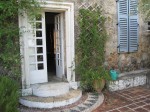
However Paddy’s villa is still a discrete surprise when you do chance upon it. The north wall of the garden has fallen down and we could have wandered the gardens, but resisted, though we’d been before and had had Paddy as a guide. A peer through the small window in the gates of the villa show that someone is tending the garden. Though there is a sad lack of flasks of retsina in the vestibule. The ‘Private Property’ sign has gone, maybe from neglect. Above the gateway there is a small stone hut. It was unlocked, so we guiltily crept in. A broken armchair, an old bed and some damp volumes which had obviously over spilt from the villa were on some shelves and in boxes. Hungarian Studies magazines, a history of Canterbury Cathedral, and a few gems. An offprint from a dictionary. In pencil at the top ‘In great appreciation Christmas 1958, New Year 1959 Eric Partridge.’ Naturally they were left there.

In the village no one I talked to had very much more knowledge of what was going to happen to the house than I did. And as one said – the Benaki are not as rich as they may appear. The house needs a fair bit of repair. After all it is, now, over fifty years old and shutters are beginning to disintegrate. If they want a librarian who’s soon to retire to look after the place, well, I might just volunteer.


Patrick Leigh Fermor: We May Just Forget to Die, an essay by Margot Demopoulos

This is the probably most significant full length profile of Paddy that has appeared since his death. It is by Margot Demopoulos a writer who lives and writes in Los Angeles. Her fiction has appeared in The Briar Cliff Review, Mondo Greco, The Athenian, and other publications.

The interesting aspect of this profile is an extensive exploration of the events surrounding the Kreipe kidnap with particular attention to the contentious subject of post-operation reprisal by the Germans.

The subject line appeared in an earlier blog post from June 2011 where I highlighted Diana Gilliland Wright’s correspondence with Paddy.

On to the profile ….

“Englischer Student . . . zu Fuss nach Konstantinopel…” eighteen-year-old Patrick Leigh Fermor told the kindly woman sewing by the fire that snowy night at Heidelberg’s Red Ox. He sat at a nearby table, recording the day’s events in a notebook, hunting for German words in a dictionary, consulting maps for the next leg of the journey, “thawing and tingling, with wine, bread, and cheese handy,” as melting snow pooled around his boots.

“Konstantinopel?” Frau Spengler said. “Oh Weh! ” O woe! So far!

Far indeed, especially in the snowdrifts of mid-winter, but there he was — undaunted, spirits high, finally setting out on his own path — nearly two months into his journey to cross Europe on foot, with Constantinople the terminus. Nearly forty-five years later, he would publish the story of that journey in A Time of Gifts. Read More ….

Access the pdf of the article here.

Patrick Leigh Fermor’s estate auctioned by Christie’s: A Life’s Collection

The auction house Christies will present the principal contents of Mill Farm, Dumbleton for auction at their sale rooms at 85 Old Brompton Road  London, Greater London SW7 3LD, on Tuesday 15 May 2012.

The collection includes furniture, books, silverware, and many works of art. How many of these were collected by Joan and Paddy, and which came from their families is difficult to assess.

You can view the e-catalogue here.

Remember that you don’t have to be present to buy but can bid on-line as described in the catalogue. I hope that some of you have the opportunity to make a purchase.

Estate of Dumbleton travel writer Sir Patrick Leigh Fermor could fetch £150,000

THE estate of travel writer and extraordinary war hero Sir Patrick Leigh Fermor is set to fetch £150,000 at auction.

Sir Patrick died in June 2011, aged 96, and now the first 100 lots of his estate, Mill Farm in Dumbleton, will go under the hammer in May.

It will include decorative objects, books, furniture, modern British and old master pictures, as well as silver objects.

Sir Patrick was a travel writer, who was most famous for his account of his year-long walk from Rotterdam to Istanbul in 1934, when he was 18 years old.

The journey was later published in his popular books A Time of Gifts (1977), and Between the Woods and the Water (1986).

He lived in caves in the mountains of Crete disguised as a shepherd during the Nazi occupation from 1941.

In 1944 he and fellow writer Bill Stanley Moss avoided capture by dressing as German police officers and bluffing their way through 22 different check-points.

After the war, Sir Patrick journeyed around Greece with his wife Joan, devoting much of his time to writing and staying with his artistic and creative friends, including the artist Nico Ghika.

Both Sir Patrick and Joan were very sociable personalities, and some of their many eminent friends and admirers included Alberto Giacometti, Lawrence Durrell, John Betjeman, Lucian Freud and Dowager Duchess of Devonshire, many of whom frequently visited The Mill House where they shared and cultivated a love for the arts.

The auction, at Christie’s in South Kensington, is on May 15. Edit – I can’t find anything specifc on the Christie’s site so I advise contacting them.

From This is Gloucestershire

Patrick Leigh Fermor in Greece – a talk by Artemis Cooper

Paddy’s biographer and good friend, Artemis Cooper, will talk about his life in Greece at the Gannadius Library in Athens at 7.00 pm on 24 May 2012. 

Full details of the event can be found here.

Biographer Artemis Cooper, who is preparing a biography of Patrick Leigh Fermor, will trace his life, experiences, and legacy in Greece from his early travels to the end of his life, on 10 June 2011. She will talk about what drew Patrick Leigh Fermor to Greece in the first place; his ‘participation’ in the Venizelist rebellion of 1935; his early travels in Thrace and Macedonia, and first encounters with the Sarakatsani; his experiences in the war on the Albanian front and Crete, as well as the post-war explorations of Greece that produced Mani and Roumeli. She will also touch on the Cyprus years; his friendship with George Seferis, George Katsimbalis, and Nicos Hadjikyriacos Ghika; how he and his wife came to settle in Kardamyli, and built their house with the architect Nicos Hadjimichalis; how the Greek translation of Mani was undertaken by Tzannis Tzannatakis, while he was in exile in Kythera under the Junta of the Colonels. She will also reflect on his position in the village of Kardamyli and how he is seen in Greece today.

PS – I have been told that there will be a webcast available after the event. I will post the details when I have them.

For our Australian readers: Event – Remembering a great Philhellene, 4 April

Paddy, remembering a great Philhellene, Patrick Leigh Fermor (1915-2011) a talk by Anastasia Anastasiadis will take place as part of the 30th Greek Festival of Sydney

‘Paddy’ arrived in Greece in 1935 — after walking from Holland to Constantinople — and promptly got involved in resisting an attempted coup. As a British liaison officer during World War II, he led the group which kidnapped General Kreipe. In later years Paddy and his wife had a house in Kardamyli (Mani). His acclaimed travel books include two on Greece: Mani and Roumeli.

The talk will take place on Wednesday 4 April at 7:00 pm at the Greek Orthodox Community Club, 206-210 Lakemba Street, Lakemba. Entry is free but for further information contact (02) 9750 0440 or email – greekfestival2@goc.com.au. The talk will be conducted in Greek.

From Neoskosmos.com

Sir Patrick Leigh Fermor and The Folio Society

Paddy and George Psychoundakis the “Cretan Runner”

From the Folio Society website.

Ten years ago, The Folio Society decided to publish a book by William Stanley Moss, entitled Ill Met by Moonlight. It told the story of a daring war-time adventure in Crete, in which Moss and Patrick Leigh Fermor, two young SOE officers, kidnapped a German general, spirited him away across the mountains and into captivity. The book was based on the detailed diary kept (entirely against the rules) by Moss, and its undeniably romantic aspects were highlighted when, in 1957, a film was made starring Dirk Bogarde as the dashing Leigh Fermor.

When we planned the book, it occurred to us that Patrick Leigh Fermor, known to his friends as Paddy, had never contributed any kind of comment on it in writing. We assumed there was a good reason for this – a certain delicacy perhaps, since, at the time of the operation, he was already embedded in Crete in a cave under Mount Ida, with the role of facilitating Commando raids on the island, and was dependent on the friendship and loyalty of the local partisans. But we wrote to him anyway and asked if he would contribute an introduction.

He rang up from his home in Greece. It was indeed, he said charmingly, ‘delicate’ and for various reasons he’d always felt the less said the better. We parted genially, my suggesting that we might ask Michael Foot, historian of the Special Operations Executive and an old friend of his, to do it instead. This we did. A week later, Paddy telephoned again. He’d been thinking about it, and he felt that there were things he would like to say: the coup had, in his view, been diminished by being reduced to the level of a ‘tremendous jape’ and he hoped to restore the balance by providing something of the context for the enterprise. He did not wish to interfere with Michael’s introduction, but would contribute a short Afterword, describing his own experience. It would be 500 to 1,000 words. It eventually emerged at 6,500 words, all of which had to be wrested from him in hand to hand combat, so anxious was he that nothing could be misinterpreted. Michael Foot, in the meantime, was triumphant to be able to tell Paddy that General Kreipe (who was not the intended victim of the kidnap, as that gentleman had been moved on) was so unpopular that, when they heard he had been snatched, his officers broke open the champagne.

Most Folio books have their unexpected rewards, but this one had more than most. Through it we met Billy Moss’s daughters who showed us photograph albums and the original diary; Sophie, their Polish mother, a formidably attractive SOE operative who had been based, with Moss and Leigh Fermor, at Tara, the Cairo House; Michael (M R D) Foot, whose own experiences as prisoner of war were at least as hair-raising as the exploits he went on to chronicle; and of course Paddy himself – courageous, witty, modest, famously attractive and – both with this book and The Cretan Runner – a good friend to The Folio Society. We will miss him.

Related article:

A Meeting between Paddy and George Psychoundakis the “Cretan Runner”

An interesting drawing (not) by Paddy

In a recent sale by auctioneer Dominic Winter, there were a number of lots sold from Paddy’s estate. The full list with sale prices can be found at this link. This drawing appears to have sold for £200.

The sale included pictures and books, and one drawing (originally thought to be) by Paddy of a woman, perhaps past her prime, looking forlornly into a mirror and maybe seeing her younger self, or has she been stood up and sees her younger rival staring back at her out of the mirror?

Described as …

489 *  Fermor (Patrick Leigh, 1915-2011). Room interior with seated female figure, pen and ink on paper, some correction fluid, unsigned, 35 x 50 cm (13.75 x 19.75 inches)

It is unsigned but does include some Greek lettering which I can’t make out. Perhaps one of you can help? See comments below about the origin of this drawing!

A combination of prefab, garage and potting shed

It is not Prince Charles alone who has opinions about architecture. From the King’s School website archive …

Patrick Leigh Fermor had been a boy in The Grange. Although his school career ended abruptly and prematurely, he always retained great affection for the place and in particular for the buildings.

In 1977 the School was planning to build two new houses in the Precincts: Luxmoore and Mitchinson’s. Leigh Fermor wrote to the Headmaster Peter Pilkington expressing his disappointment with what was envisaged in the Mint Yard: “The first impression made by this side of the project is of a combination of prefab, garage and potting shed…. What would William of Sens have thought? And Harry Austin?”

His response was not merely negative, however. Ten pages of ‘Notes on the Projected New Houses at the King’s School, Canterbury’ included several illustrations of possible alternatives in a variety of architectural styles. Despite his intervention, the School went ahead with the scheme.

Thirty years later, Sir Patrick returned to King’s to open the New Grange on the St Augustine’s site.

A Year of Memory: the top ten posts on the Patrick Leigh Fermor blog

As the year comes to a close it is time to reflect upon what has passed and to look forward to 2012. I make no predictions for the coming year. There are some things which are almost certain such as the continuing Euro crisis and the much anticipated publication of Artemis Cooper’s authorised biography about Paddy, but forecasts tend to be overtaken by events and are quickly forgotten.

What we can do is to look back on this year in the life and times of Patrick Leigh Fermor. The major event of course was Paddy’s death on 10 June at the age of ninety-six. A sad event for his family and close friends, but also for those of us who admired him for his writing and the life he lived. As the year closed it was time to celebrate his life at his Memorial Service held on 15 December in London.

As I hoped the blog has become a significant source of material about his life including rarely seen video. There have been over 228,000 visits over the last year and you have made it a much more interactive experience by using the comment facility to exchange information, provide your own memories of Paddy, and to express your admiration for him. At the time of his death I opened a page where you could express your thoughts about Paddy which has run to over 120 comments.

Paddy would probably have been somewhat bemused by the whole idea of the blog, but perhaps even more so by the interaction we now have with social networking sites with nearly 4,500 visitors finding the site from Facebook, and 850 via Twitter.

To conclude the year, and as the 365th post on the blog, let us take a look at some of the most popular articles over the last twelve months. Perhaps I can make one promise to you all which is that there is much more to come on the blog in 2012 which includes a lot of material submitted by you the readers of the blog.

The Funeral Service of Patrick Leigh Fermor, 16 June 2011 

Paddy’s funeral service was held on a typical English summer’s day at his home in Dumbleton. He returned to England just one day before his death and is buried beside his beloved Joan.

Obituary from The Independent by Paddy Leigh Fermor’s biographer Artemis Cooper 

Perhaps the definitive obituary.

Patrick Leigh Fermor … This is Your (Ill Met by Moonlight) Greek Life 

The amazing video from the Greek TV programme which reunited the participants of the Ill Met by Moonlight kidnap including Paddy, many of the Andartes, and General Kreipe and his wife.

Anthony Lane’s New Yorker article on Fermor is now free to view 

One of the most comprehensive profiles of Paddy which is now freely available to all. (the pdf download appears to be no longer available – click on the article to magnify to read and then drag your cursor to move around the page)

Intimate portraits from Kardamyli by Miles Fenton 

A series of personal photographs sent to me by Miles Fenton who is Paddy’s nephew and who now lives in Canada where he works as an artist.

Patrick Leigh Fermor recounts the kidnap of General Kreipe on video 

The ever popular video where Paddy talks in some detail about the Kreipe kidnap. (press play on Battle of Crete 7).

Colonel David Smiley 

David Smiley was a fellow occupant of Tara in Cairo with Paddy and Billy Moss et al who continued his military career with some distinction after the war and even led Japanese soldiers in a charge against VietMinh rebels!

Paddy’s eye for detail: Ian Fleming, Bondage, James Bond and Pol Roger 

It is probably the James Bond/Ian Fleming association which maintains the popularity of this article.

If food be the music of love … Bánffy’s lover in Cluj (Kolozsvár) 

No list of popular posts can be complete without the compelling combination of my passions for Paddy, Romania, Miklós Bánffy, and Cluj.

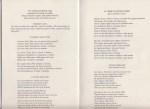
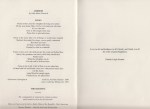
Patrick Leigh Fermor Memorial Order of Service 

The order of service from the joyful occasion that was Paddy’s Memorial Service.

Finally I would like to thank so many of you for your encouragement and support during 2011, and wish you all a very Happy New Year!

Tom Sawford

Why the lowly shepherd is the one who gets to hear the angels

Remembering honourable lives helps us understand the birth we celebrate on Christmas Day.

by Charles Moore

First published in The Telegraph 24 December 2011.

Tomorrow we celebrate the most important birth in human history, so forgive me for writing about a funeral and a memorial service.

Both occurred in this Christmas season. The memorial service, in St James’s, Piccadilly, was for Sir Patrick Leigh Fermor. Paddy, as all his friends knew him, was a man of unique distinction and unique charm. He won the DSO in the Second World War for his part in the celebrated kidnap (filmed with Dirk Bogarde in Ill Met by Moonlight) of the German General Kreipe in occupied Crete. He became famous as a writer. His best-known books, A Time of Gifts and Between the Woods and the Water, describe his slow walk from the Hook of Holland to Constantinople, begun in December 1933 (he spent Christmas that year in Bingen, in newly Nazi Germany) and not completed until January 1, 1935. His prose, at once romantic and scholarly, ornate and exact, could have no successful imitators, but it has tens of thousands of fans.

In his life as well as his writing, Leigh Fermor was, though he would have disliked the phrase, a role model – brave, handsome, witty, multi-lingual, widely and deeply read, a gifted singer, reciter and drinking companion, a traveller in exotic places, a man who gave delight. When he died, aged 96, this newspaper’s obituary described him as “one of the few genuine Renaissance figures produced by Britain in the 20th century”.

The funeral, the week after Paddy’s service, was for Tony Woodall. Tony was a woodman and neighbour of ours in Sussex. Unusually for a rural family in the South East, the Woodalls are Catholics (I am told there was an Irish grandmother in the case). Every Sunday at our Catholic church, Tony would pull a surplice over his open-neck shirt and frayed working trousers and serve, his huge hands carefully placing the chalice and the patten on the altar. He would ring the little altar bells with a shake as strong as that of a dog with a rabbit. At the intercessions, where people are invited to propose further prayers, it was most commonly Tony who did so. He tended to ask us to pray for people who might not be automatically popular, such as Myra Hindley. His compassion was radical, and universal. He never stopped working. He dropped dead outdoors a couple of weeks ago, aged 79.

Tony Woodall was not known beyond his small corner of rural England, but, like Paddy, he commanded people’s love. The church where he served fits only 120 people, but 200 came to the funeral and many had to stand outside. It fell to me to help flank the hearse as it arrived, trying (and failing) to hold up a candle without it blowing out. I had to pick my way to my place through wild-haired countrymen wielding chainsaws. As Tony’s wicker coffin was lifted up and carried into the church, the saws, by way of tribute, roared into synchronised action.

Both men’s services did justice to the person commemorated. In the case of Paddy Leigh Fermor, there were readings in four languages. Robin Lane Fox read Horace’s Ode 1.9. These were the lines which Paddy heard his prisoner General Kreipe reciting to himself as they watched the cold dawn break over Mount Ida in May 1944 (“See how resplendent in deep snow Soracte stands…”): Paddy knew the Latin words and completed the recitation, forming a bond between enemies. William Blacker chanted a Romanian ballad. Then John Julius Norwich and his daughter Artemis Cooper led us in one of Paddy’s specialities – his own translations of English songs into comically unsuitable foreign tongues. “Do ye ken John Peel, with his coat so grey?” became “Conosce Gian’ Peel, con sua giacca tanta griggia?”

The gospel was from Luke 12: “…take no thought for your life, what ye shall eat; neither for the body, what ye shall put on. The life is more than meat, and the body more than raiment.”

At Tony’s funeral, the gospel was Matthew’s account of the Beatitudes, the list of those who are blest for their meekness or mercy, poverty of spirit or purity of heart. Of them Jesus says: “Ye are the salt of the earth.”

Tony’s son John spoke to us. He remembered the night of the Great Storm of 1987, when he was 10 years old. At two in the morning, Tony came into his bedroom, grasping a chainsaw. “I’m going out,” he told him, “to saw up these trees that are falling and blocking the way. If the roof blows off, come and get me.” A tree fell on his arms that night, but he kept on sawing.

John recalled his father’s goodness, which included caring for his permanently sick wife. “Crikey,” he said, “if only more people were like Dad, I reckon the world would be a hell of a better place. Pardon my language.”

We more than pardoned it, of course. “Thank you for coming,” he said, “You are all honourable men and women.” Whether we were or we weren’t, we felt a renewed confidence that the old-fashioned word had meaning: it was shown in the life of the dead man.

The Romanian ballad recited at Paddy’s memorial service is called the Mioritza. It concerns a shepherd about to be murdered by rivals. He instructs his ewe-lamb, who has the gift of speech, to tell others no word of his death. She must tell them only that “I married tonight a king’s daughter”: “At my wedding, tell/ how a star fell,/ that the sun and the moon were holding our crown,/ how the guests at the feast/were maples and firs”.

At Tony’s funeral, when John had spoken, he moved from the lectern. Just as he was about to rejoin the congregation, he stopped by his father’s coffin. “That evening,” he said, “I stood at the spot where Dad had died. The moon was up, and I saw a firework. But then I realised it wasn’t a firework, because there was no noise. It was a meteorite. I thought: ‘That was Dad.’ ” He went back to his place.

Paddy Leigh Fermor wrote that he loved the Romanian ballad because “its magic lies in its linking together of directness and the tragic sense, its capture of the isolated feeling that surrounds shepherds and the forlorn exaltation that haunts their steep grazings and forests”.

After a life well lived, we can all look back on it with that directness, especially when we attend services such as these. As if from those “steep grazings”, we can see the life laid out, shining plain. We may forget that, for the people who lived it, it often did not seem plain at all. As we sang at Tony’s funeral: “Through many dangers, toils and snares,/ I have already come.” The achievement of something grandly simple is an endlessly complicated process, a lifelong work of trial and error.

Anyway, as I said at the beginning, tomorrow marks a birth, not a death. Another Telegraph obituary, this one of the 7th Earl of Yarborough, related how, at his village carol service, he read the lesson about the shepherds deserting their flocks to see the baby in Bethlehem. “I’d just like to say,” he told the startled congregation, “that if these men had been my shepherds, I’d have sacked them.” One must be glad that the earl was not present 2,000 years ago. The shepherds were the best people to receive the message of the angel. With their linking of “directness and the tragic sense”, they understood what the strange birth would mean.

Visionaries Who Changed Our World

This review is apparently about ‘the minds we will miss’ and actually it is pretty good. It starts with a picture of the recently departed Peter Hitchens. I am not sure about – “They opened doors, blazed trails, and left us all too soon.” – the left us too soon part is perhaps not something we can truly say about Paddy but the sentiment is well understood. It also has a link directly to the blog.

Patrick Leigh Fermor

Ulf Andersen / Getty Images from Newsweek.

Travel Writer, 96

He was a rare blend, penning some of the most memorable travel books of the 20th century and capturing a Nazi commander in Crete. Leigh Fermor related his adventures—watching a voodoo ceremony in Haiti, living with Trappist monks—in dazzling prose with a deep pathos for every place he visited.

Patrick Leigh Fermor Memorial Order of Service

The memorial service that took place on 15 December at Saint James’s, Piccadilly was a moving tribute to Paddy, whilst at the same time being a tremendous celebration of his life, and the music, poetry and people that he loved. The order of service is here for you to see.

If there has to be a highlight it was John Julius Norwich and his daughter Artemis Cooper singing versions of D’Ye Ken John Peel and Widdecombe Fair translated into Italian by Paddy. After this Lord Norwich gave a lively and affectionate Address about his good friend of over fifty years.

Artemis has to be congratulated for organising such a successful memorial service which gave a nod to Paddy’s boyhood by including the excellent Crypt Choir of King’s School Canterbury.

There was a final message to us all from Paddy himself:

“Love to all and kindness to all friends, and thank you all for a life of great happiness” – Patrick Leigh Fermor

Let’s celebrate a full life, and one well lived

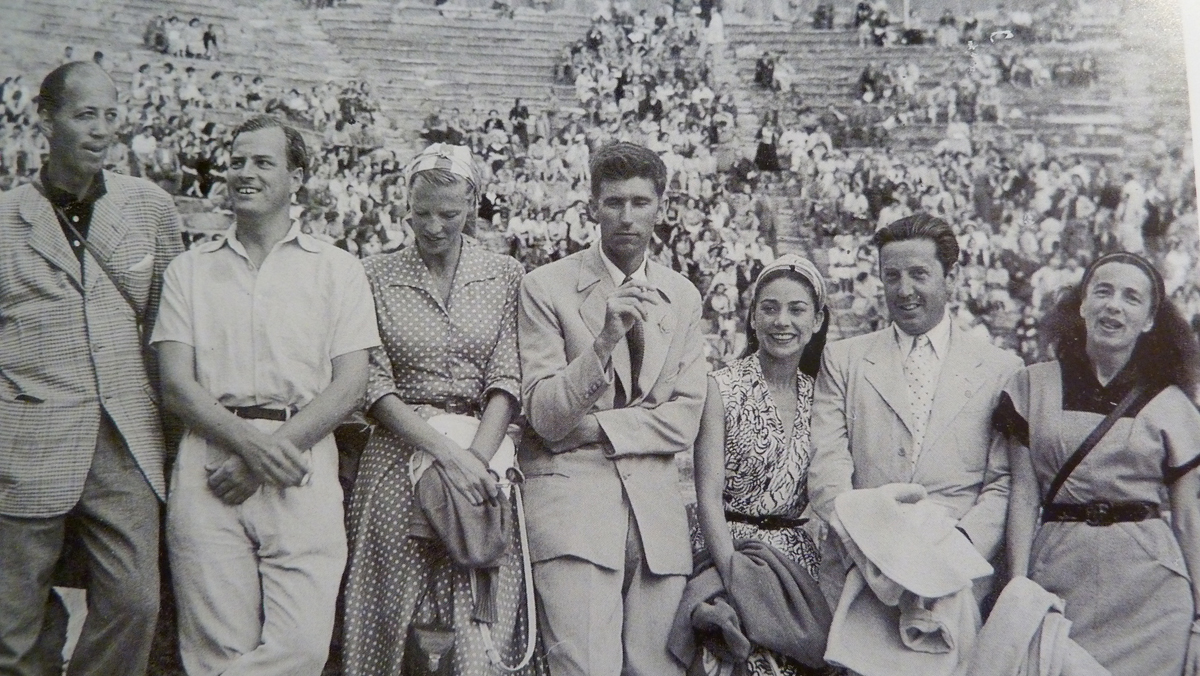
From left: Tom Fisher, Paddy, Joan , John Craxton, Margot Fonteyn, Frederick Ashton and Ruth Page. Photo: Costas Achillopoulos in Ian Collins’ book on the life of John Craxton

Today we can celebrate the memory of Patrick Leigh Fermor, whether we attend his memorial service in London, or are just able to take a moment to reflect on all he gave to his family, his many friends, to us his admiring readers, and of course his service to his country and to Greece.

I thought the best way to mark this day on the blog is to feature this fine photograph sent to me by John Chapman. It is from Ian Collin’s book about the life and work of John Craxton, the artist who illustrated most of Paddy’s book covers.

John tells me that Craxton “met Joan in wartime London years before he met Paddy, but became enamoured of Greece and for a large part of his life lived in Chania, Crete. It was both an escape from dull northern climes and a chance to express his sexuality.”

Craxton designed the sets for Daphnis & Chloe at the Royal Opera House in 1951 where the lead ballerina at the time was Margot Fonteyn. According to rumour they had an affair, and in the summer of 1951 they cruised together around the Meditterranean. Paddy was their guide to Greece, and it was at this time that this delightful photograph was taken which shows Paddy looking very happy, with good friends, and his much loved Joan.

The photograph shows Tom Fisher (a New York attorney and husband of Ruth Page) Paddy, Joan, John Craxton, Margot Fonteyn, Frederick Ashton and Ruth Page (choreographer). It was taken in the theatre at Epidavros, and is attributed to Costas Achillopoulos.

Snail’s pace to Byzantium: journey of a lifetime

This is a combination of profile and review of Words of Mercury. An interesting piece.

by Ann Elder

First Published in Athens News, 9 Jan 2004

“I HATE the word travel-writer,” London-born, Mani-based Patrick Leigh Fermor told a British journalist in 1995. Under the title Words of Mercury, a selection of his writings was published by John Murray this autumn. The excerpts from half a dozen of his books, some articles and reviews show clearly why he must flinch from being slotted anywhere confining.

As his followers know, he writes with an enchanted pen. Any topic he takes up becomes something ‘rich and strange’. He has a story-teller’s knack of compelling interest, like the Ancient Mariner mesmerizing listeners with his glittering eye. And he has a particular flair for catching the heightened receptivity and visceral thrill felt at new encounters, what Cavafy wished the traveler in his poem Ithaka:

Pray that your journey may be long,
that many may those summer mornings be
when with what pleasure, what untold delight
you enter harbours never seen before.”
(Kimon Friar translation)

Not least, Leigh Fermor wins readers’ allegiance by creating the sense of affinity with an engaging personality, uncensorious, untinged by chauvinism, reveling in life, akin in spirit to A E Housman, onetime professor of Latin at Cambridge, in his lines:

Could man be drunk forever
With liquor, love or fights
Lief should I rouse at mornings
And lief lie down at nights.

Edited by Artemis Cooper, a writer (Cairo in Wartime) and wife of historian Antony Beevor (Crete: The Battle and the Resistance), the book has five parts: travel, Greece, people, books and flotsam (finishing with a poem on Christmas maybe better forgotten). Cooper gives brief introductions to each piece and starts off with a succinct biography.

As an 18-year-old living on a pound a week in a flat off Picadilly in 1933, Leigh Fermor spent more time partying than buckling down to write. As fate had it, he had read The Station: Athos: Treasures and Men by the irreverent young Robert Byron in 1928. The ‘great and misunderstood spirit of Byzantium’ had greatly impressed him.

“About lamp-lighting time at the end of a wet November day, I was peering morosely at the dog-eared pages on my writing table,” he related later. “A plan unfolded – to set out across Europe like a tramp – a pilgrim or a palmer, an errant scholar, a broken knight.”

“The chief destination was never in a moment’s doubt. The levitating skyline of Constantinople pricked its sheaves of thin cylinders and its hemispheres out of the sea-mist; beyond it hovered Mount Athos; and the Greek archipelago.”

In excess of his wildest dreams, he found material to write about. All was grist to his mill, but his mill ground slowly. His writing proved to require long gestation. He became fanatical about polishing his product, and research, the more obscure, the more it seemed to appeal to him, like the origins of the Sarakatsans or the Laz-speaking Greeks of Trebizond. The first book about his venture, A Time of Gifts, came out in 1977, over 40 years later, and the second, Between the Woods and the Water about “those mysterious regions between the Vienna Woods and the Black Sea” as Saki put it – in 1986. In France they called him “l’escargot (the snail) of the Carpathes.”

Real life and events also delayed his writing. The trek took him about a year. He reached his goal on New Year’s Eve, 1934, after ending his traverse of Bulgaria with a splash, falling into the Black Sea on a cold December evening. He came to the coast some 150 miles north of the Bosphorus. “An old man was smoking a narghileh on the doorstep of a hut beside a little boat beached among the rushes – a Tartar fisherman, the only human being I saw all day,” he  wrote over 20 years later in an article in the May 1965 Holiday Magazine.

Darkness fell. “I lost my footing on a ledge and skidded – waist-deep into a pool. Jarred and shaken, with a gash on my forehead and a torn thumb, I climbed out, shuddering with cold. At the bottom of the pool, about two fathoms down, my torch was sending a yellow shaft through sea anemones and a flickering concourse of fish.”

Crawling round the rocks, he came to a veritable Cyclop’s cave sheltering a dozen Greek fishermen and Bulgarian goatherds with their 50 goats and cheese-making apparatus, eating lentils by a thornbush fire. The young wayfarer was soon dried and warm, tossing back slivovitz and eating fresh fried mackerel.

Leigh Fermor is in his element in the climax of this thoroughly Homeric episode, when one of the Greeks, Costa, turns out to be an unsung Nijinsky, his dancing invested with a ‘tragic and doomed aura.’ He performed the stunt  with which Greek cruise ships like to wind up their Greek night shows: dancing with a table between the teeth.

“On a rock, lifted there to clear the floor, the low, round, heavy table was perched. Revolving past it, Costa leaned forward: suddenly the table levitated itself into the air, sailed past us, and pivoted at right angles to Costa’s head in a series of wide loops, the edge clamped firmly in his mouth and held here only by his teeth. The dancer whirled like a dervish, till the flying table melted into a disc, finally returned to its rock, glasses, cutlery, lentil pot and cigarette burning on the edge of a plate undisturbed.”

Time in Greece he dates from his 20th birthday, February 11, 1935, when he arrived at Mt Athos as ‘snowflakes were falling fast’ and ‘in deep snow, trudged from monastery to monastery.’ In Athens later, he frequented the  Romanian embassy, meeting descendants of Phanariot hospodars, Ypsilantes, Ghikas and Cantacuzenes. As with Greece, he fell in love with Balasha Cantacuzene whose forebear, Emperor John Vl, invited the Seljuk Turks to  Europe (and is recalled sorrowfully in a Cavafy poem for having coloured glass not jewels in his coronation crown).

After time writing and painting in an old mill among the lemon groves overlooking Poros, they went to her decaying family estate in Moldavia. Published in 1961 was a perfectly pitched account of a picnic in sunlit  countryside by open carriage and on horseback on September 2, 1939, the last day of peace. “It had been a happy day, as we had hoped, and it had to last us a long time, for the next day’s news scattered the little society for ever.”

Utterly desolating is the Daily Telegraph weekend magazine article of May 1990 on his first breaking through the Iron Curtain in 1965. He found the Cantecuzene sisters in a Bucharest attic eking out a communist state pension  teaching. The gracious old houses he had stayed in among flowery meadows and nightingale-filled woods were psychiatric hospitals, their owners dead.

Leigh Fermor seems happiest gilding the past, writing to ‘the brave music of a distant drum,’ as old Khayyan put it, not dwelling on ‘bitter furies of complexity’ or ‘that gong-tormented sea’ of Yeats’s “Byzantium” which he refers to at the outset in Time of Gifts. The days of his youth were the days of his glory and he evokes them with zest, if no doubt some selective memory. He admits he is beset with ‘retrogressive hankerings,’ but these add to the richness of the embroidered prose dazzling his readers, to twist Yeats a bit. And sometimes he might be shoulder-to-shoulder with the poet:

Of all Arabia’s lovers I alone
Nor dazzled by the embroidery, nor lost
In the confusion of its night-dark folds,
Can hear the armed man speak.

His review of Edmund Keeley’s Cavafy’s Alexandria in a 1977  Times Literary Supplement (TLS) shows him at his serious best. He recalls “the blacked-out, jolly, rather wicked wartime port” he knew as a young British World War Two agent, then is off with Cavafy into the Judaeo-Hellenic Franco-Levantine city “old in sin, steeped in history, warrened with intrigue.”

He notes the depths of irony and dark humour in the notion of citizens aghast with consternation when the barbarians fail to invade them on cue. He ponders “the jagged Ithaka at the long Odyssey’s end; the imminent Ephialtes ready to sell the Thermopylae of the spirit.” He goes on: “Issued without preamble from an atmosphere of earthly delights these warnings sound as harsh, for a moment, as the words of Mercury after the songs of Apollo at the end of ‘Love’s Labour’s Lost.'”

Leigh Fermor is a mild Mercury though. In a review of Oxford classicist CM Bowra’s Primitive Song in a 1962 Spectator he commends him for eschewing ‘a softer technique, swaying to the seductions of every coincidence  and historical chance-shot.’ He himself tends to yield to the tempting vistas of ‘alluring byways.’

The selections from his writings on Greece include a report he wrote for London’s Imperial War Museum archives in 1969 on how the German commander General Heinrich Kreipe was abducted by a Cretan-British force he led in April 1944. While still controversial, the coup makes a cracking good story.

At Anoyeia where captors and captive rested, villagers were ‘convulsed by incredulity, then excitement and finally by triumphant hilarity. We could hear running feet in the streets, shouts and laughter. “Just think, we’ve stolen their General!”‘

Heading south round Psiloritis – Mt Ida of antiquity, over 2,200 metres high and snow-covered till late May – the getaways were to meet a British vessel on the coast to spirit them to Egypt. After a night in a shepherd’s hut sharing  one blanket, “a brilliant dawn was breaking over the crest of Mt Ida which we had been struggling across for two days. We were lying smoking in silence, when the General, half to himself, slowly said (in Latin): ‘See, how it stands, one pile of snow’. I was in luck. It is the opening line of one of the few odes of Horace I know by heart. I went on reciting where he had broken off (likewise in Latin);

‘neath the pressure yield
Its groaning woods; the torrents flow
With clear sharp ice is all congealed.
Heap high the logs, and melt the cold,
Good Thaliarch; draw the wine we ask,
That mellower vintage, four-year-old,
From out the cellar’d Sabine cask.

(Conington’s translation)

The stanzas are much-loved, ‘a picturesque Christmas card,’ say scholars. They evoke the perfect ambience in which to peruse the book. Those unfamiliar with Leigh Fermor will surely have appetites whetted for more. Those who know him and have his books around will dash for them to locate the extracts, then hotly debate the choices, such as the punning Achitectural Notes from a 1994 Spectator: “If you squinch, aisle screen,” and “Put those Saxon  here Norman,” and “Overhung? Per apse, when dais done.”

The author has covered himself. “Pure nonsense is as rare among the arts as an equatorial snowdrop”, he wrote in a review of George Seferis’s Illustrated Verses for Small Children in a 1977  TLS.

Reminder! Patrick Leigh Fermor: An Appreciation by Alexander Maitland, FRGS

The lecture postponed from October will be given by Alexander Maitland and takes place on Monday 12 December starting at 2.30 pm.
Tickets: free to RGS-IBG members and educational users. Non-members: £5 payable in advance. Venue: Education Centre, Lowther Lodge.

Pre-booking required: Telephone: 020 7591 3044 Email: showcase@rgs.org

When: Mon 31 October 14:30 – 16:00 London

Where: Education Centre, Royal Geographical Society (with IBG) 1 Kensington Gore London SW7 2AR (map). Exhibition Road entrance.

More details here.

Sir Patrick Leigh Fermor – Memorial Service

A reminder that Paddy’s Memorial Service will be held at St James’s Church, Picacadilly at 11.00 am on Thursday 15 December 2011.

You are advised to arrive early. Map.

An evening in memory of Sir Patrick Leigh Fermor

A typically quaint translation from Google Translate of a press release from the Benaki Museum website about the handing over of the house at Kardamyli to the Benaki.

The original pdf in Greek is to be found here.

“The Benaki Museum hosted the evening Saturday, the 17th September 2011 an event dedicated to Sir Patrick Leigh Fermor. Acquaintances and friends from Greece and England, between in which the Ambassador of England Dr. David Landsman, the director British Council Richard Walker, the executors and the biographer, gathered at his home in area Kalamitsi Kardamili for a wine in memory of one the most beloved British Philhellenes. Education, warmth, unparalleled bravery, his liveliness and politeness of Patrick Leigh Fermor came alive again in the hearts of all that was also attended.

It was an emotional night. O Sir Patrick Leigh Fermor died on June 10, 2011, at age 96 years in Dumbleton, England. For many years he lived in Mani, who built a house he designed by Nick Hatzi. His relationship with the Benaki Museum keeps a long time;had contacts with Antonis Benaki Peace Kalliga later and maintained close friendships with the Director Mr. Angel Foundation Delivorrias. The Benaki Museum chose Patrick Fermor alive to donate his house, mediated by Tzannis Tzannetakis, and received at the Foundation after his death it. For several years it had been agreed by donors and Museum that the house will be used for hosting researchers poets and writers who visit Greece to work a few months. While for certain intervals Benaki Museum will have the option to rent the house to ensure the maintenance and hosting.

The coming months, once the full record library and archive and make the necessary maintenance of the house, the Administrative Committee of the Museum Benaki will make its modes of space. “The Patrick Leigh Fermor, moreover, were more Kardamylitis and less; a thoroughbred Englishman Maniatis ie, a Real Greek, a patriot would say, “said Director Museum Angelos Delivorias. He continued, “The love of even for Greece not only recorded many books has dedicated, and the choice of the place chosen to live.

It is this love shown by his decision to bequeath the home of the Benaki Museum, a spiritual body purveyor in the service of our country … From the Greeks and Greece also carried the words of my prayer for good katefodio, but the certainty that his departure would not be definite. Why do you remain vibrant traces the steps in Crete and the Peloponnese, Attica and Roumeli. As live will remain the narratives of his books, the memories of those who lived close by, the historical deposits of the altars of freedom, the breezes of a fascinating personality. The gratitude to the Benaki Museum in particular will, however, only be measured by the degree to fulfill the legacy and desires of the man who benefited. ”

The text of his speech Museum Director, Mr. Angelo Delivorrias

“Ladies and gentlemen, dear friends of Patrick Leigh Fermor and equally dear fellow from Kardamyli

On behalf of the Executive Committee of the Benaki Museum and President, I welcome you to a celebration held to honor the memory of Patrick Leigh Fermor, fastening ties from now on you’ll connect with you and us. The Patrick Leigh Fermor, moreover, were more Kardamylitis and less; a thoroughbred Englishman Maniatis ie, a real Greek, a patriot, I would say. Even his love for Greece not recorded only in what books have devoted but also in the location chosen to live. It is this love illustrated by its decision to bequeath the house to the Museum Benaki, a spiritual body purveyor serving the site us.

The Paddy, as they called friends of the Sun during the Michael fellow, he was a mythical hero in life by history, an internationally acclaimed author of the rigorous critique of the fellow, a man of rare gifts integrity and high optimally. It is therefore coincidental that he was connected with that best available human capital of Greece, from the fighters in the Cretan mountains during the war as the residents Kardamili time of peace; the big painter and also the benefactor of the museum, Nick ChatzikyriakoGkika as the Tzannis Tzannetakis in Maniatis militant resistance against junta, known political and translator of the book for Mani also a friend of the Museum. In this short invitation I can not not mention Nick Hatzi, a brilliant architect, friend and him, from which the Fermor claimed, jokingly of course, the authorship of the plans of the house that hosts us.

Touched on only a few of those who truly elite Greeks were connected with him, because, as also several of the British friends, is no longer with us. By the way, but the tonight’s event would not be allowed to fail warmer thanks to the Benaki Museum executors, his Alexander Mitchell and Michael Casey, supervisors managers, the beloved Olivia Stewart in particular, and to Greeks supervisors, Anthony Masouridi, the Tonya and Giannidi Peter Tzannetakis, his two children Tzannes. We thank you, finally, the Artemis Cooper in advance for her biography of Fermor prepare, and from our side Peace Geroulanou with all worthy partners of the Foundation have already demonstrated practical interest for the protection and enhancement of this the house.

When she died by Patrick Leigh Fermor, say that the moments of Goodbye is anyway difficult. Being made ​​but still more difficult when they are leaving our own people. Friends who stood beside us in critical situations, we loved and our shortcomings. The Paddy had loved the Greeks and Greece. Greece, he chose to live and the Greeks to syngenepsei. From the Greeks and Greece also brought the the words of my prayer for good katefodio, but the certainty that departure would not be definitive. Why should remain Live traces the steps of Crete and the Peloponnese, Attiki and Roumeli. It will remain vivid narratives of books, the memories of those who lived close by, the historical deposits on the altars of liberty, the breezes of a fascinating personality.

The gratitude of the Benaki Museum in particular will, however, only be measured by the degree to fulfill the legacy and desires of the man who benefited. ”

Angel Delivorrias

Kardamili, September 17, 2011 “

The last of a magical breed

From Judy Stove who writes for The New Criterion.

“Readers may like to know that there is an excellent article by David Mason about PLF in The New Criterion, September 2011.  Unfortunately the online version is for subscribers only or by purchase.

Mason, as a young man, and his then wife visited PLF and Joan at Kardamyli.  He tried to impress with quoting Waugh and Anthony Powell, only to find that PLF and Xan Fielding actually knew these people…A funny and poignant memorial, one of the better PLF tributes going around.”

David Mason’s article begins thus:

The death of Sir Patrick Leigh Fermor on June 10 at age ninety-six has been mourned in virtually every major newspaper in the English-speaking world. He has been celebrated as the last of a magic breed, the Byronic hero, a man of action who was also one of our most vigorous writers. The fuss would have surprised Paddy, who never assumed his contributions were admired and became nonplussed when anyone heaped praise on his head. The long-refused knighthood he finally allowed to be conferred upon him in 2004 did nothing to elevate him above Greek shepherds or the myriad visitors to his villa in the southern Peloponnese. Paddy was youthful and convivial to the end, with an attractive and genuine interest in the world outside himself. People couldn’t get enough of him.

Yet his readers had to learn patience as the books arrived from his pen at a snail’s pace—he didn’t learn how to use a typewriter until in his nineties …

If you are a subscriber you can read the article here. If not go to the same link and you can access this one article for $3.00.

Intimate portraits from Kardamyli by Miles Fenton

Some delightful images of intimate corners of Paddy and Joan’s house in Kardamyli by Paddy’s nephew, Miles Fenton. These pictures were taken in 2009.

As you put some lovely photos of my uncle’s house in Kardamyli I thought you might like to see, and perhaps post, some of my photos of his house on your site.

These are, apart from the usual views, vignettes showing some of the more unique and charming architectural details.

Click an image to increase its size and to start the gallery.

Charles Moore on Paddy

‘The intellect of man,’ Yeats famously wrote, ‘is forced to choose between perfection of the life, or of the work.’ Patrick Leigh Fermor, who has just died aged 96, managed to refuse this choice and achieve both.

He was what is now called a role model — a war hero, an intrepid traveller, a witty guest, a man with whom women fell in love, a Byronic romantic without Byron’s unkindness — but he was also a writer with the most exacting standards and unique imagination. His highly wrought prose was not affected: it expressed his delight in and minute attention to life and art, places and people — the stranger the better; and it inspired that delight in others.

All the letters I have from him overflow with enthusiasms. There is a silly idea for a cartoon he has sketched out in which a spherical man and a thin one with a hawk on his wrist stand outside a castle gate, staring disconsolately at a castle gate on which is pinned the notice ‘No Hawkers, No Circulars’. There is a poem called Message to Skopje:

Your claim to the name “Macedonia”

Could scarcely be flimsier or phonier

If you want an old name

For your state, what a shame

Not to bring back the real one, Paeonia.

He writes about ‘marvellous girls in tricornes’ hunting in France, and to recommend (he was always generous in advancing the careers of others) a self-taught village boy who has translated the whole of Homer into ‘wonderful Cretan rhyming couplets, taking just about the same time over it as Pope in his villa at Twickenham’.

Paddy was the best companion. Once, when he was already well into his seventies, we had him to dinner in London. As he was reciting a comic poem, his chair leg snapped. we were horrified that our furniture might have done for him, but Paddy managed an athletic parachute roll and ended up in the corner of the room with his back against the wall, laughing like a boy.

From the Spectator

Getting it right and that Taki article

I have to admit that there have been times over the last two years, when, running two blogs, I have either clearly been wrong to publish something, or I have posted an article that has created significant controversy and I subsequently wished I had not done so.

Life is always easy if one takes the uncontroversial path. I dare not mention the post I had in mind a year or so ago with the working title “Patrick Leigh Fermor: the Court Jester?” which was sparked by an interesting series of conversations and impressions I gained from reading ‘In Tearing Haste’. Whilst remaining an ardent admirer of Paddy, it would be wrong to say that he was a saint and beyond criticism. Few of us are.

Which brings me neatly to Taki, and the article that I posted last week entitled ‘Better a Hero Than a Celebrity’. Clearly Taki believes that he himself is beloved by all and can say and write what he wishes without fear of recrimination. He has a very old and a very thick skin. The article has sparked some significant debate in the comment section and I think it is worth bringing this to the attention of a wider audience for it sheds some light on Taki’s character and addresses some of the inaccuracies that I warn of in the introduction.

However, I stand by my response to the first comment which was as follows. Taki Theodoracopulos has had a place in European society over the last fifty years or so. Some may not like him, but clearly he has a role in commenting on the lives and loves of celebrities, which today appears to be of greater importance than the state of European banks and the future of the Euro; it is very big business. In fact Taki was one of the first ‘gossip columnists’. Whatever the inaccuracies of his article it meets the criteria of this blog. It is about Paddy and does possibly bring some new perspectives. This blog is fundamentally an archive of all on-line material about Paddy, and therefore the article stays.

I think it would be useful to all to highlight the points discussed in the Comments section, particularly the major error Taki made in stating that Paddy had killed Albert Fenske, the driver of General Kreipe’s car. Paddy had nothing to do with his death which was against orders and not at all part of the plan. Additionally the story about Paddy witnessing the death of the last German commanding General of Crete is pure fiction; it just did not happen like that.

So what is the moral of this tale? Yes, I would like it to be all sweetness and light, but you can’t please all the people all of the time. Let’s keep up the debate and remember I am more than willing to take in and publish articles that you have found or have written yourself.

Here are the comments up to this evening …..

From Chris Lawson:

“Known to the cognoscenti as Taki Takealotofcokeupthenose, Theodoracopulos is a man for whom the word “snob” might have been invented. Note the casual dropping of Agnelli’s name into his piece and Taki’s snide comments on Dirk Bogarde. It is NOT true that Paddy killed the driver of Kreipe’s car. Apart from the story of the execution of Kreipe’s successor (Name, details of crimes? Doesn’t mean Kreipe’s predecessor?), this brings nothing new to the saga of Paddy’s life. I would respectfully request that you remove the piece.”

My reply:

“No Chris – I don’t do censorship. Your comment can stand as a beacon to my error in posting it. However, Taki has a place in society over the last 50 years and this blog is a repository about Paddy. It stays.”

Chris Lawson responds:

“Fine by me. Of course it was not an error posting it and I agree entirely and whole-heartedly about what you say about censorship. Yes, Taki certainly has a place in the cultural pantheon de nos jours, and my thoughts are just the latest in a stream of negative comments directed at the former inmate of H.M. prisons. Whatever else one has to say about the gent, he is certainly one of life’s great survivors.”

Tim Todd (who runs the Il Met by Moonlight site and is an expert on the operation) interjected:

“That Taki could be so fundamentally wrong about the death of Albert Fenske, Kreipe’s driver, tells me much about the appropriately named Taki.

I believe that Fenske’s death, at the hands of two of his Cretan andartes and contrary to instructions, caused Paddy no end of personal grief, perhaps second only to the accidental shooting of his Cretan friend. I once listened to Paddy talk about this latter incident when, in the mountains after a cadet’s exercise, he failed to check his rifle before cleaning it when it was returned to him. I have to tell you he was still mortified by the whole business and sixty odd years on he was still visibly upset by it. Tom our webmaster and I, know from the best of sources that Fenske’s death was much regretted by Paddy. My own feeling is that but for that we might have seen Paddy’s own account of the abduction published.

I am thoroughly disappointed that anyone claiming to know the man would dare suggest Fenske died at Paddy’s hand. Paddy, perhaps the most honourable man I have ever met, would though have accepted responsibility for anything that may have happened under his command. He was that sort of man.

It is perhaps as well that Tom has published Taki’s piece for it provides an opportunity to compare the two and set the record straight.

I am pleased to say that, through Annette Windgass, Fenske’s family have recently been made aware of Paddy’s great sadness of that particular outcome of the operation.”

 Chris Lawson gave us some more about the story of the General’s death:

“On the General who succeeded Kreipe, and two predecessors

The Commandant of Crete, appointed on 1 May 1944 after Kreipe’s kidnapping, was Generalleutnant Helmut Friebe, Commander of the LXIV Armeekorps. He was captured by the Americans in May 1945 and released in 1947.

Two former commanders of Crete were tried and executed in Athens on 20 May 1947, the anniversary of the German invasion of Crete. One was the bloodsoaked Friedrich-Wilhelm Mueller, who was to have been the original target for the kidnapping until he was replaced by Kreipe. Mueller had a reputation for brutality and numerous atrocities were committed under his regime.

The other was General Bruno Bauer, a paratroop officer, who was appointed in 1942, replacing General Alexander Andrae. Bauer had gained the reputation of being hard and fair, and the “most humane commander” of Crete. Antony Beevor describes him as truly unfortunate, as he was executed for crimes “committed under another general”. Three years later the Association of Former German Paratroopers requested that his remains be returned to Crete. George Psychoundakis, resistance fighter and author of the Cretan Runner (already much-mentioned by Tom), reburied his remains.

Taki’s fourth paragraph is a complete fantasy.”

George joined the argument:

“The only readable part of Taki’s remembrance (sic ) is the last sentence, horrible in its clarity and even worse that it is written by someone whose trotters are deep in that particular trough.

His comments however, are an excellent example of the sponger’s wiles. The mildly mocking comment by Agnelli, humbly repeated to establish the writer’s honesty, while at the same time making it clear that the writer enjoys the same societal position.

Then the personal revelations as told uniquely to Taki, and no other. Who is to say it did not happen? Taki’s favourite method of asserting inside knowledge always has been to quote the ‘ confidences ‘ of dead people.

The lustrously depicted tale of an unrepentant Nazi Officer going blithely to his death comes straight out of ‘Boys Own ‘.

Next we have the gay bitchiness in his description of PLF’s relationship with his wife. Once again the vampire straddles an innocent’s grave seeking the lifeblood of fame by association.

Chris Lawson ( thank you ) marshalled all the necessary facts to give the lie to Taki’s comments. He was probably as irked by them as I was.”

Tim Todd concludes it all: 

“Inaccurate accounts of historical events, for personal vanity, or a film-makers preference for ‘a story’ over fact, infuriate me. This is especially so when such accounts may subsequently become part of history for those without inquiring minds. Last week saw the release of a new video by National Geographic half of which was about the abduction of Kreipe. It is appallingly bad and inaccuracies abound. I am so glad that some colleagues of mine and I, who know a thing or two (but not all) about the abduction, rejected the film makers request to assist them for it has turned out every bit as bad as we feared. Having read some of Paddy’s comments about Ill Met By Moonlight, I can imagine what he might of thought of the latest misrepresentation.”

… and you say ….??

The Carpathian Snail

Patrick Leigh Fermor...British soldier and travel writer Patrick Leigh Fermor, 25th April 1966.

Paddy Leigh Fermor (obituary) was a man of many dimensions. He had an unquenchable curiosity about people and culture; when he met remote groups, be they Saxons in Transylvania, Vlachs in northern Greece or gypsies in Hungary, he would not just learn their language and song but remember it for the rest of his life. At Paddy’s last birthday party in London, William Blacker quoted two lines of a Romanian ballad in a speech about him; at the age of 96 Paddy sang the song in its entirety. There seemed no occasion at which he could not enliven the party by an adroit performance, or reminisce in half a dozen European languages.

by Patrick Reade.

First published in The Independent, 14 June 2011

For me it always involved a meal: the conversation would come to a point when there would an extraordinary outpouring of remembered verse or prose. He sang “Do you ken John Peel” in Italian once over tea in Dumbleton to entertain us – the verses were far more numerous than I had realised. And Peter Quennell told me many years ago of how Paddy pulled out of his memory an entire landscape of Cretan folk songs as they walked in the Abruzzi. He was known in Greece for his spontaneous ability to respond instantly to another table’s rhyming couplets – mandinathes, a feature of traditional party entertainment in which tables would compete for wit and content in the couplets.

His ear for language never failed him and he was interested in etymology, linguistics and semantics till the very end, correcting my own misattribution of medical terminology from Latin to Greek and then reciting in Ancient Greek the moment in Homer’s Iliad when Troy fell to the Greeks. He loved laughter, too, and in the Dean’s Close at Canterbury I heard him performing an entertaining parody of a John Betjeman poem in the garden where Thomas à Beckett’s assassins escaped. He had just been awarded an honorary degree by Kent University in the Cathedral and we were having tea with Jock Murray, his publisher.

He was the most generous person in spirit and in kind – he must have entertained thousands in his home in the Mani in southern Greece over many years – the names tumble out of the Dictionary of British Biography: academics, politicians and myriad writers, journalists and scholars, all ate at his table. He and his wife Joan were also extremely generous where they saw need and gave with an open hand.

Until last year he swam daily from his house, and swam across the Hellespont at the age of 70 – an astonishing feat, dodging the great liners from the Black Sea and coping with the current and the cold water and the Russian submarines beneath the surface.

On 1 June this year, 10 days before his death, he gave a small lunch party in the cool, stone-arched loggia of his home in Messenia and in the course of conversation we discussed our favourite 16th century pieces of poetry; he declaimed Sir Thomas Wyatt’s entire poem “They flee from me that sometime did me seek”.

For many he will be remembered for his correspondence as much as for his books – because by any reckoning he was a fabulous letter writer and responded to almost all who communicated with him until last year. From my first remembered encounter with him in 1961 when he pressed 12 shillings into my hand, until 50 years later, when he raised his wine glass to absent friends over lunch on the anniversary of Joan’s death, I can say that no other person I have encountered has shown such an embrace of laughter, learning, language and life as this towering genius of word and action. The great memorial will be his writing and a great excitement is that the third part of his trilogy about crossing Europe is due soon – I have seen it, and many have waited years for this crafted reminiscence so long in gestation, about which Paddy in self-mockery called himself “The Carpathian Snail”.

Event – Patrick Leigh Fermor: An Appreciation by Alexander Maitland, FRGS

A series of afternoon talks based on the Society’s Collections from 2.30-4.00 pm. This series of Collections-specific, monthly afternoon talks, given by speakers who have used the Collections to inspire their writing, travel or personal researches, intended to kindle interest from members and non-members alike in using our rich resources for their own projects.

Tickets: free to RGS-IBG members and educational users. Non-members: £5 payable in advance. Venue: Education Centre, Lowther Lodge.

Pre-booking required: Telephone: 020 7591 3044 Email: showcase@rgs.org

When: Mon 31 October 14:30 – 16:00 London

Where: Education Centre, Royal Geographical Society (with IBG) 1 Kensington Gore London SW7 2AR (map). Exhibition Road entrance.

More details here.

There are approximately 60 tickets left … see you there!

Better a Hero Than a Celebrity

Taki Theodoracopulos

Always a modest man, Taki Theodoracopulos, the great playboy and socialite, is someone who knows everybody, and it is no surprise that he too met Paddy as he recounts in this piece from his online Taki Magazine which humbly describes itself as being about ‘Cocktails, Countesses and Mental Caviar’! I am not sure if Taki gets the irony in the title 🙂 Beware some glaring errors.

First published in Taki Magazine 4 July 2011

I first met Sir Patrick Leigh Fermor in the summer of 1977 in Corfu. I was onboard Gianni Agnelli’s boat, and the charismatic Fiat chairman asked me to go ashore and bring “a very smart Englishman whose ancient Greek is much better than yours.” I knew “Paddy,” as everyone called him, by sight, because among us Greeks he was on a par with our ancient heroes. Leigh Fermor was not only famous for his books on Greece—Mani and Roumeli—he was renowned for his incredible heroics in a guerrilla operation in Crete in May 1944. Having spent two years disguised as a Cretan shepherd in the island’s rough mountains harassing German troops, Paddy dressed as a German police officer and stopped a car carrying General Karl Kreipe, the island commander. Having killed the general’s chauffeur, Leigh Fermor proceeded to wear the general’s hat and managed to bluff his way through Heraklion and 22 subsequent checkpoints. Kreipe was stuffed under the backseat while Leigh Fermor’s bat man and three hefty Greek rebels sat on him. For three weeks the group managed to evade frantic German search parties, finally marching the general over Mount Ida, the mythical post-birth hiding ground of Zeus.

“Heroics aside, Leigh Fermor was often compared to Lord Byron for being both a man of action and learning.”

One moonlit night high up, Fermor was guarding the general when Kreipe, gazing up at the snowy peak, recited the first line of Horace’s ode, Vides ut alta stet nive candidum…—“ You see how [Mount] Soracte stands out white with deep snow.…” Leigh Fermor then continued the poem in perfect Latin until the end. The two men stared at each other, realizing, as Paddy later wrote, that they had “drunk at the same fountain.” The German and the Englishman then made a pact. Kreipe gave his word as an officer that he would not try and escape; in return, Leigh Fermor never turned Kreipe over to the firing squad.

What follows came straight from Paddy to me in Corfu. Six months after Kreipe’s kidnapping, Leigh Fermor landed yet again on the island to celebrate its liberation. He was taken behind Heraklion’s main square, where the general who succeeded Kreipe was about to be shot. Paddy was aghast because the German was cool as ice and when Paddy introduced himself, the condemned said: “Ah, Leigh Fermor, you were lucky. Kreipe was an intellectual, a softie; I would have killed you on the spot.” When Paddy asked him if there was anything he could do for him, the German asked for one last cigarette, thanked him, smoked it while inhaling rather deeply, then said goodbye and went off and got shot ramrod-straight.

Heroics aside, Leigh Fermor was often compared to Lord Byron for being both a man of action and learning. His very good friend, Robert Byron (no relation), was a travel writer who greatly influenced Paddy, whose most celebrated book, A Time of Gifts, told the story of his walk across Europe from Rotterdam to Constantinople at age 18. Leigh Fermor continued writing travel books, and they stood out for rendering the past visible, for their evocation of youthful exuberance, and for the joy one felt reading them. He was a very good-looking man, an Anglo-Irishman whose adventures in Crete were made into a film back in 1957, Ill Met by Moonlight. The irony was that he was played by Dirk Bogarde, an outrageous homosexual whose greatest talent was spreading terrible rumors about others.

Leigh Fermor was 96 when he died but lived vigorously until the end. Three years ago his correspondence with the last surviving Mitford Girl, Deborah, dowager Duchess of Devonshire, was published to great acclaim. What a cast of characters in that book. Norman Douglas—another great influence—Steven Runciman, Osbert Lancaster, Cyril Connolly, Bruce Chatwin, and many others rich and famous and literate. Paddy was a hell of a ladies’ man, although he married only once—to Joan Rayner, who was his close and understanding companion until her death in 2003. The word ‘understanding’ is key. He also wrote the script for John Huston’s The Roots of Heaven, a vastly underrated film in which Errol Flynn made a comeback by playing a has-been of sorts, a character Flynn repeated successfully to the end.

One of Leigh Fermor’s great regrets was that while cleaning his weapon in the mountains of Crete it accidentally went off and killed his trusted guide. He told George Seferis, Greece’s first Nobel Prize winner for Literature, that this death was probably his life’s lowest point.

Leigh Fermor and his wife designed and built a beautiful but very simple house in Kardamyli, deep in the Peloponnese and overlooking the sea, and they lived there for most of his adult life. I was lucky to have met him, and now that I am of a certain age I realize how much better it must have been to have lived during heroic times—no matter whose side one was on—than today’s empty, horrible celebrity culture. Paddy, Rest in Peace.

The final gift of Patrick Leigh Fermor

We’d met him for the first time a few years ago at the memorial service for Earl Jellicoe in Athens, in his nineties but still handsome and charming. “You must come to our simple home”, he had said.

By Lauren O’Hara

First Published in Cyprus Mail 25 September 2011

I’d noted the “our” for I’d been told that although his beloved wife Joan had died in 2003, her room untouched and undisturbed.

It’s true the house nestling into the cliffs and olive groves just beyond Kardimyli has a simplicity, but as we gathered last week to raise a glass to the life of Patrick Leigh Fermor and his legacy for the future, with its arched walkways and pebbled courtyards, it was one of the most beautiful houses I had seen in Greece.

A place to find hidden stone benches, or cushioned window seats, to curl up with books: a place at which to reflect, as the cragged mountains of the Mani deepen to red and each angle on the Aegean provides another view.

We never made it there while he lived, so it felt strangely intrusive to wander at will through rooms still alive with his life, now he was dead.

The shepherd sacks from Crete, the stacks of hardbacks, the black and white photos of the many visitors who had sat on the same sofas. It was as if he has just popped down to Lela’s tavern for a gin and would be back soon.

So it is a relief to know that the house has been left in his will in the secure hands of the Benaki Foundation, to be used not as a place of pilgrimage, although there are many who would happily make that journey, but as a ‘study centre’.

One can’t help but wish that everything will remain unaltered, for it feels perfect as it is. A monument in our madcap e-world to another way of living: a world of books and blotters, of conversation and contemplation.

Of desks with inkwells and the time to handwrite notes laden with stories and sketches.

Around the garden as the sun dipped and the moon rose, people formed and reformed into casual groups: academics and locals, tradesmen and scholars.

It was as if the place itself had absorbed the personalities of its owners, still able to offer warm hospitality to all even though they had gone.

Nancy Mitford apparently once wrote to Evelyn Waugh that “Paddy” was “wasting his excellent language on Greek peasants.”

But as I listened to the conversations drifting into the night air, I thought that is exactly what she had misunderstood.

He may have come from a privileged background, but why he is so loved here in Greece – why he is so loved by so many people everywhere – is that he knew, like all great writers, including his close friend Bruce Chatwin, whose ashes are scattered nearby, that class is no owner of wisdom.

A Time of Gifts indeed…

Related articles:

John Chapman’s photos of Paddy’s house 

Paddy’s Gloucestershire home for sale for £2.5m