Author Archives: proverbs6to10

Unknown's avatar

About proverbs6to10

Interested in Byzantium and Patrick Leigh Fermor

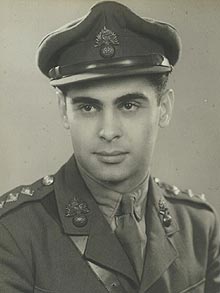
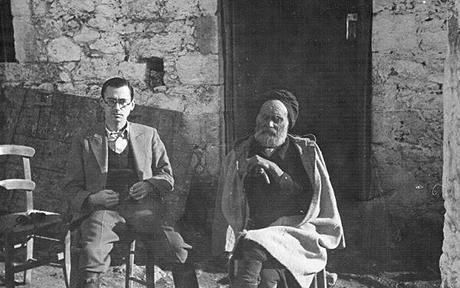
Captain Henry Diacono

Captain Henry Diacono, who has died aged 86, was a member of SOE and was dropped into enemy-occupied France in 1944.

Published: 6:46PM BST 23 Apr 2010

Captain Henry Diacono

On February 6 that year, Diacono was dropped “blind” – that is to say, with no reception committee to meet him – into France, landing near Chartres. Accompanying him was René Dumont-Guillemet, who became leader of the “Spiritualist” circuit to the east of Paris.

They landed at 3am in a ploughed field some 15 miles from the farmhouse that was their destination. They had no time properly to hide their suitcases and parachutes, and after crossing fields, ditches and fences were still in the open when it grew light. A barn where they might have hidden up for the day had a sign on it in gothic lettering and they decided to avoid it. Then, as they passed a house in a small village, they heard the sound of a programme being broadcast in heavily-jammed English.

Dumont-Guillemet knocked on the door, while Diacono stood behind him, revolver drawn. After a few moments hesitation, they were allowed in. They washed and rested and were given directions for continuing their journey.

After a night in their “safe” house, they returned to collect their belongings but found, to their consternation, that they had disappeared. It seemed that their arrival had been spotted and that their arrest might be imminent.

At that moment a peasant appeared; and, after several minutes of verbal fencing, he told them that he had watched them hurriedly bury their possessions, had recovered them and put them in his house for safe-keeping.

Continue reading →

Visit to the veteran of the Peloponnese by Wieland Freund (from Welt Online)

A 2007 interview with Paddy by Welt Online. The Germans have almost the same fascination for Paddy as we do. Afterall his first adventures took place in Germany (A Time of Gifts) and his part in the kidnap of General Kreipe has a particular fascination. 

He also confirms that “Volume Three” is being written – translated by Google – Oh yes, “he says in the rich sunshine,” I will write this book. There is to end on Mount Athos. From there, I have notes for every day. 

So here is the Google translated version. The original in German for the purists and the linguists is the next article below. 

Stop Press! I have had an offer to translate this properly and when I receive it I will replace the trash from Google. In the meantime, my apologies and enjoy trying to make sense of it!

Resistance fighters, hikers, travel writer Patrick Leigh Fermor went to Istanbul as a young man, kidnapped in 1944 in Crete an army general and now lives in Mani. There he kept on the typewriter by Bruce Chatwin. 

Since the sixties, the home of Patrick Leigh Fermor: the Mani peninsula in the Greek Peloponnese. 

That there could be his house did not think you would have to climb into a closet or throw himself into a rabbit hole in order to achieve it – this idea comes with the darkness and returns, turned back into the Enchanted. 

The way to Patrick Leigh Fermor, the Herodotus of the 20th century, leads, it seems, to the edge of the world and then one step beyond. The shimmering leaves of the olive grove, the giant lemon and the red, Greek past of heavy earth might as well be the props of a dream. 

“Paddy” came first in 1952 by Mani 

We keep a vigilant group of cypress trees and follow the overgrown path until a sky-blue gate. Do I need a spell, so it opens and appears Fermor, the travel writer, war hero, the legend? Knocking at least seems too little. 

With 92 years, Patrick Leigh Fermor of immortality as close as it is today even comes close. His way of fame is just off the beaten track to have the world, behind firmly closed doors or in such places as the taciturn Mani. 

Paddy, like not telling the familiar without reverence, came here in 1952 for the first time. How the Spartans and the Byzantines, who fled from Slavs and Turks, and of which he knows everything, he climbed the passes of the up to two and a half meters Taygetos, the Mani, the middle finger of the Peloponnesian hand, centuries made for a natural fortress.
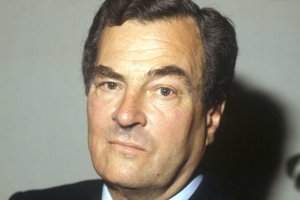
Patrick Leigh Fermor in Berlin

The knocking does not answer 

The back of the slopes wrinkly rich almost to the bay. Bruce Chatwin, who came to Paddy as a “guru to worship” or how to overthrow a king, saw eagles soar over the house of Leigh Fermor. Twenty years later, Paddy Chatwin ashes buried – next to a crumbling Byzantine church not far from here. The Mani is famous for its action songs. 

Southward, on the faded, twinkling towers over the tiny villages, run, it means that a chasm into Hades. Leigh Fermor found it flooded. “Phosphorgefiedert,” he wrote, dip it into the cold depths and swim “through the heart as a huge sapphire. 

We knock in vain to dare us to elaborate the cobbled courtyard and whisper with the housekeeper. It leads us through the garden open arcades, which might as well bend over a cloister. 

Leigh Fermor is tattooed like a sailor 

Leigh Fermor has written so many monasteries in Europe, in towers of “solid ivory, and if anyone here was an escapist, The doors to the rooms, however, the numerous tables, which depends on the sound of glasses and laughter as a smoke curtain, speak a different language. 

Leigh Fermor speaks many. Photographs show it once hung over bursting with charm and zest for life, sometimes almost professorial, and again obviously as a sailor and tattooed. 

We wait under the coffered ceiling of the spacious, wonderfully cluttered living room, from which the English poet John Betjeman once wrote that it was “one of the rooms of the world.” On one wall hang paintings by Nicolas Ghika and John Craxton, leaning on a shelf worn, faded volumes of the great English stylist. On the floor there is a band “Sherlock Holmes”. “Enchanting easy, right?” 

The family left behind her son with strangers 

This could be Merlin: a jumble the gray, wavy hair, sharp features and eons of age in the eyes. Leigh Fermor carries the threadbare sweater a garret of scholars and the trousers of an artist in his studio. 

He is of overwhelming kindness, perfectly shaped “upper class”. In the sunlit bay he called almost everyone who comes to the question, “marvelous”: writers, painters, musicians. “They all knew.” – “I am,” he says mildly, “that old.” 

“For at least one of us children would remain alive, if a submarine sank the ship,” Paddy was in the care of a small family back in England. 

1933 – the first trip to Istanbul 

“I ran,” he says, “shouting and screaming across the yard. I never learned discipline. I was a difficult student. “-” Lazy? “-” Disobedience. “Even a psychiatrist who also treated Virginia Woolf was consulted. Paddy still flew from the school. He had kept up with the daughter of the greengrocer’s hands. 

The autumn of 1933 found him in a room not far from trouble blowing from London’s Shepherd Market, where he should have been cramming so that at least the military school would take him. 

Instead, he took a verse of George Herbert at his word: My way is free, free to the horizon, / Much like the wind. “In December 1933 he embarked for Holland. From there, he wanted to walk into a “green dragon”, Byzantium, which he never called Istanbul. 

On the trip report, the fans are waiting until today 

He is famous for getting lost in the widely spread European history, which he knows like no other. In Mani, one of his best books, the “opposite of a travel guide,” as he says, there is a footnote, the sheer joy of the strangest here, “and there crafty peoples’ lists of Greece: the Melevi Dervishes of” Tower the winds “, the fire dancers from Mavroleki, the hiking quack Eurytaniens. With the gypsies, whom he met in 1934 in the highlands of the Carpathians, said Patrick Leigh Fermor Latin. 

Paddy arrived on New Year’s Day of 1935 in Constantinople, and had better things to do than to write about his trip. He is one of the great English stylists working, slowly, life itself seems always in your way. 

It was not until 1977 “was published, the time of the gifts,” which describes his journey from Hoek van Holland to the middle Danube, nine long years later, “between forests and water”, which leads to the Iron Gate. The third book, the description of the phenomenon must last up to Constantinople, is still expected with such longing that leave a few words from the mouth of Paddy’s heave a sigh British press today. 

Where Chatwin’s old typewriter? 

When Sir Patrick, as he was allowed to call since 2004, was awarded in March in Athens the “Order of the Phoenix,” he told his casual way that he, because his handwriting was always bad, just learn to touch type. 

Oh yes, “he says in the rich sunshine,” I will write this book. There is to end on Mount Athos. From there, I have notes for every day. “We are walking through the garden, the Gulf of Messinia in a dozen colors of light blue. On the burnt grass stretches herself a hangover: “His great-grandmother one day was just there.” 

The studio is housed in an outbuilding. In an iron chest, which bears the inscription of “Traveller’s Club” that tape, books are stacked on the wall a faded French hunting scene. Somewhere there must be also Chatwin old typewriter, a 51er Olivetti. But where? Where? 

Soldier, he was happy because “was always something going on” 

On Mount Athos celebrated his 20th Birthday, then went to Athens, as he later went to Paris and Rome. With a Romanian princess, he lived in an old water mill in the Peloponnese, and followed her to finally Balení, the seat of her family in northern Romania. 

Russia and the horrors of communism were suddenly within reach. “Many of your friends were communists at that time.” – “I did not speak up,” he says. “ “I was so apolitical.” 

In Balení reached him of the war. He, which six years earlier at the Shepherd Market has become clear, “how little I was good for soldiers in peace time,” volunteered. The departure was hasty. “Not even my notebook I took with me. We were so naive. In a few months ago we believed us again. “It took decades. “Were you like a soldier?” – “In a way, yes. “ There was always something going on. ” 

In 1944, he kidnapped a German general 

Books are also in the bathroom and somewhere between them is a plaque commemorating the Battle of Crete. When she was lost, went back Leigh Fermor as major of the Special Operations Executive to Crete. One and a half years he lived disguised as a shepherd in a cave – “wrapped in white cloth from goat and horribly dirty” – and organized the Cretan resistance against the German occupiers. 

The rest is legend, one of the most daring commando raid of the Second World War. One night in April 1944, a large Opel on the road to Knossos, Paddy in a stolen German uniforms on the way. A scuffle and then, at the roadblocks, again and again the cry of “General car. 

For days wandered Leigh Fermor, the people and kidnapped the German General Kreipe through the mountains until they reached the coast, and finally Libya (Egypt). On the difficult journey Kreipe murmurs once verses of Horace. Leigh Fermor is one. „Ach so, Herr Major“,  

About the death, he never speaks 

Paddy has never really written about it. “Ill Met by Moonlight,” the book that tells this story in full, comes from Bill Stanley Moss, his former deputy, and was filmed with Dirk Bogarde as Leigh Fermor. 

When it first appeared in 1950, just came Paddy’s first book, “The Traveller’s Tree,” a description of his travels in the Caribbean out. DThen he was – in the UK, famous in Greece “He embodied an idea of the Renaissance,” writes Cooper, Artemis, “a man of action, which is just as much a scholar.” 

Cooper, the friend and daughter of a friend is writing Paddy’s biography, when he, as he says, “is just gone.” “But now that you mention it: We never really talk about it.” 

The stones for the house came with the donkey 

For lunch there are lemon chicken, tzatziki and Retsina. We sit on chairs Andalusian, a Venetian table at the foot of a guillotined by the passage of time Roman Sibyl. Leigh Fermor has picked up in Rome on the way, he collects nothing. 

He tells the story of Niko Kolokotronis, the Mauerermeister that the contract was to build his house, because six generations were Kolokotronis wall masters, and played all the violin. That was the beginning of the sixties. In the bay there was no electricity, donkeys brought the stones, and Paddy and his wife Joan were living in tents, until the house was finally finished. 

“I scribble in the studio in front of me,” reads a letter from the most beautiful, vibrant with life days in the bay.”Through the window I can see Joan, their army cats invites you to dinner; mass meows to rise, and their tails make waves like the sea.” 

A picture of his wife Joan (cats) in her hand 

Leigh Fermor demands a picture of the mantel, Joan in the forties, which he portrayed with a pencil. “Come on!” She called from a boat, as Paddy, like his hero, Lord Byron swam the Hellespont. “It took three hours.” 

Joan died in June 2003 here.”She was,” he says, his drawing in hand, “in truth much more beautiful. 

Original article here.

Besuch beim Haudegen des Peloponnes Von Wieland Freund (Welt Online)

Widerstandskämpfer, Wanderer, Reiseschriftsteller: Patrick Leigh Fermor ging als junger Mann nach Istanbul, entführte 1944 auf Kreta einen Wehrmachtsgeneral und lebt heute auf Mani. Dort bewahrt er die Schreibmaschine von Bruce Chatwin auf.

Dass es sein Haus gar nicht geben könnte, dass man in einen Schrank steigen oder sich in einen Kaninchenbau stürzen müsste, um es zu erreichen – dieser Gedanke kommt mit der felszerklüfteten Dunkelheit und kehrt tags, ins Verwunschene gewendet, zurück.

Der Weg zu Patrick Leigh Fermor, dem Herodot des 20.Jahrhunderts, führt, scheint’s, an den Rand der Welt und dann noch einen Schritt darüber hinaus. Die flirrenden Blätter des Olivenhains, die riesenhaften Zitronen und die rote, von Vergangenheit schwere griechische Erde könnten ebenso gut die Requisiten eines Traums sein.

“Paddy” kam erstmals 1952 nach Mani
Wir halten auf eine Gruppe wachsamer Zypressen zu und folgen dem zugewachsenen Pfad bis vor eine himmelblaue Pforte. Braucht es einen Zauberspruch, damit sie sich öffnet und Fermor, der Reiseschriftsteller, der Kriegsheld, die Legende erscheint? Klopfen jedenfalls scheint zuwenig.

Mit 92 Jahren ist Patrick Leigh Fermor der Unsterblichkeit so nahe, wie man ihr heute noch nahe kommt. Seine Art Ruhm ist nur abseits des Weltenrummels zu haben, hinter fest verschlossenen Türen oder an so verschwiegenen Orten wie der Mani.

Paddy, wie die Vertrauten nicht ohne Ehrfurcht sagen, kam 1952 zum ersten Mal her. Wie die Spartaner und Byzantiner, die vor Slawen und Osmanen flohen und von denen er alles weiß, erklomm er die Pässe des bis zu zweieinhalbtausend Meter hohen Taygetos, der die Mani, den Mittelfinger der peloponnesischen Hand, Jahrhunderte lang zu einer natürlichen Festung machte.

Read more here!

The Friendly Isles: in the Footsteps of Patrick Leigh Fermor by Robin Hanbury-Tenison

Wake up. Stretch. Open eyes and look around. We’re in the most comfortable bedroom imaginable, physically and aesthetically. A great bed, soft sheets, pastel grey woodwork, white upholstery. Through the open French windows is a dream beach: a perfect crescent of pristine sand lapped by clear blue water and shaded by tall palm trees. A barefoot 50 paces across tightly mown grass and we are in the warm sea. It doesn’t get any better than this.

How different it was for Patrick Leigh Fermor and his companions 56 years ago. With Joan Eyres-Monsell, the woman who was to become his wife 20 years later, and Costa, the great Greek photographer, spent six months travelling through the Lesser and Greater Antilles. Then, the many islands they visited were thoroughly run down. The great buildings of church and state and planters’ wealth were mostly ruinous and rotten. The future in the depressed economic climate just after the Second World War looked bleak and, indeed, “King Sugar” was about to die, as it had on the abolition of slavery – only this time as a victim of sugar beet and the macro politics being played out between America and Europe.

Yet, Leigh Fermor still managed to reveal the romance and the magic of the archipelago and so start the obsession so many have since had with visiting the “Friendly Isles”. His vision saved them by helping to create a climate in which tourism could grow, and tourism has been the salvation of the Caribbean ever since.

In those immediate post-war days, the few hotels and boarding houses were grim. The tourism industry was embryonic and only when they stayed in some of the grand privately owned great houses, built by rich planters, “were we redeemed from the usual squalors of our island sojourns”. Most of these have now become hotels or “plantation inns” and they are delightful places to stay, combining old-world elegance with modern luxury.

Earlier this year, my wife, Louella, and I decided to follow in Leigh Fermor’s footsteps to see how much the islands had changed. Our pace was less leisurely than his and we were able to visit only 10 of the 15 islands he saw, but with his books as our vade-mecum we found our eyes, ears and all our senses opened and enhanced.

We started in Antigua and headed straight for the Carlisle Bay hotel. There, Gordon Campbell Gray has achieved the same understated excellence on a Caribbean beach as in his highly regarded One Aldwych in London.

Antigua has changed radically since Leigh Fermor’s day. Then, Nelson’s dockyard was in ruins. “The timbers were so eaten away,” he wrote, “that we had to step from beam to beam, for the boards between them had fallen to powder, or still hung from rusty nails in rotten fragments.” English Harbour, the great 18th-century naval base favoured by Rodney, Cochrane and Nelson and perhaps the prettiest and safest harbour in the whole Caribbean (the view of it from Shirley Heights is without equal), had no facilities whatever.

Read more here!

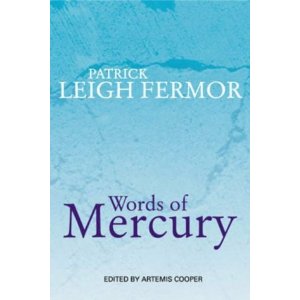
Life by the scenic route: Max Hastings reviews ‘Words of Mercury’

First publushed in the Daily Telegraph 12 Oct 2003

Paddy Leigh Fermor has lived one of the great picaresque lives of the 20th century. He left a minor public school under heavy clouds with no money and a penchant for wandering. From 1934, for five years, he sustained a lotus existence in eastern Europe and the Balkans, by charm, genteel begging and Byronic good looks. His parents must have despaired of him during this longest gap year in history.

Words of Mercury by Artemis Cooper

One of Evelyn Waugh’s characters observed in 1939: “It’s going to be a long war. The great thing is to spend it with friends.” Leigh Fermor pursued this policy with notable success. His 18 months as a British agent in Crete made him a legend, not least for the kidnapping of the German General Kreipe, theme of the later film Ill Met By Moonlight.

After the war, Paddy resumed his leisurely course. One can no more imagine him occupying an office desk, queueing for the weekly envelope, than some marvellous beast of the African bush taking up employment as a security guard. He wandered the world until, in 1950, he suddenly produced a small literary masterpiece about the Caribbean, The Traveller’s Tree.

Thereafter, at irregular intervals, he has written travel books and fragments of autobiography. On his visits to England, rural grandees and metropolitan hostesses fight for the privilege of his society. The home he created with his wife Joan on the south shore of the Peloponnese at Kardamyli is a small work of art in its own right, owing much to their pets, or – as he writes here – to four-footed “downholsterers and interior desecrators”. How he loves language and words!

What is charm? In Leigh Fermor’s case it is an infinite curiosity about other people. He treats Bulgarian peasants and English dukes exactly alike. John Betjeman once spoke of Paddy “sitting there listening to you, his eyes sparkling with excitement as he waited to hear what you might say next”. Generosity of spirit is among his notable qualities.

Read more here!

The Long Walk – song about Patrick Leigh Fermor

A personal tribute to PLF from a fan. A song about Paddy’s long walk to Constantinople in “A Time of Gifts” and “Between the Woods and the Water”.

I say, old chap, that’s my favourite Horatian ode too! By Justin Cartwright

A review of Words of Mercury by Patrick Leigh Fermor, ed Artemis Cooper first published in the Independent

Sunday, 2 November 2003

The overwhelming impression this book left on me was of a lost world of aesthetic public schoolboys, powerful newspaper editors, friendly ambassadors, and an unspoken understanding of what it meant to be upper- middle-class and English. What it meant was easy access to embassies and aristocratic houses around Europe, bicycle polo in Hungary, and the possibility that the next shepherd you met would be an Etonian Special Operations officer, speaking classical Greek. Here you will find the term “middle class” applied in a pejorative sense, rather than in the current usage which has such a wide catchment. That John Murray, the publishers of this book and upper-middle-class publishers par excellence, are no longer family-owned, perhaps confirms that this world has passed. And with it a love of language and literary decoration.

To quote Jan Morris, Paddy Leigh Fermor is beyond doubt the greatest of living travel writers, although the term “travel writing” barely does justice to the beauty, the lustrousness and sensuality of his writing. Take this, for example, speaking of how Greek temples once looked before they were stark ruins: “But the reality of the ruins, re-cohering in cobalt and blood-red, studded with metal, gaudy with idols, shiny with spilt honey and blood and reeking with sacrificial smoke, will have replaced the tinted ivory artefacts that had stolen their place and the void between the cutting of the flutes on the columns and the laying of the tramlines begins to fill up with people and events.”

There are about 40 short pieces divided into headings: Travels, Greece, People, Books and Flotsam. Many of these pieces are from Leigh Fermor’s great books, Mani, Roumeli and A Time of Gifts. (In 55 years he has only written eight books.) Others are from scattered newspaper pieces and obituaries. All the major phases of his life are represented here: the wandering schoolboy heading for Istanbul, the two years just before the war he spent in Romania with a doomed aristocratic family after meeting the daughter of the family in Athens (the woman Artemis Cooper describes as the love of his life), the extraordinary exploits in war-time Special Operations in Crete, where he captured the German General, Heinrich Kreipe, and his post-war exploration of Greece, particularly Mani where he has lived for 40 years in a house he built with his wife Joan, who died recently. Their story will be told by Artemis Cooper in a biography to be published after his death.

Read more!

Photographs of Ill Met by Moonlight

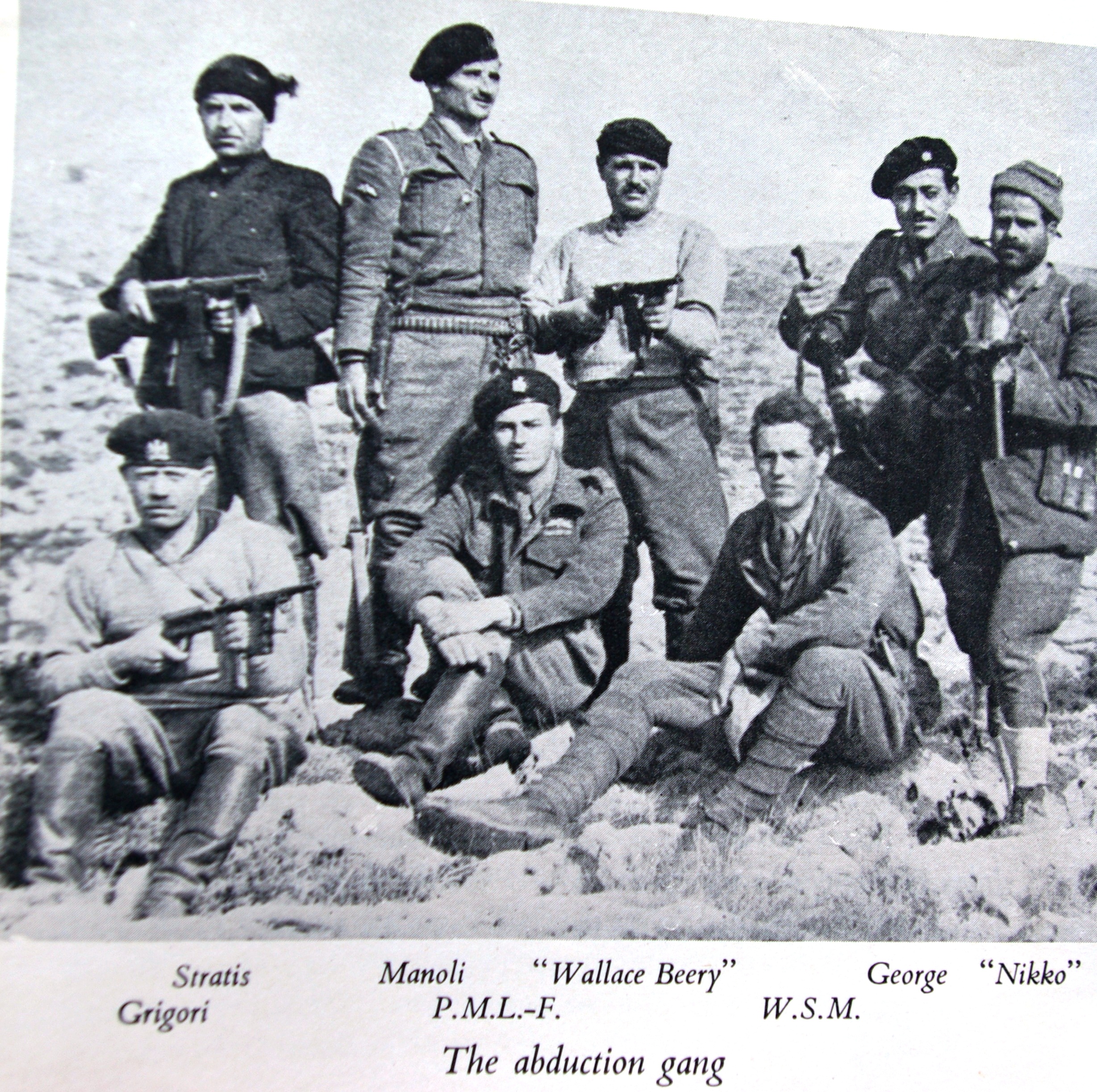
The abduction gang - PLF centre Moss to his left

Visit the photographs page to see pictures  from the book by William Stanley Moss which documents the famous abduction of the commander of German forces in Crete, General Heinrich Kreipe. They show the development of the story from the planning stage, the ‘abduction gang’ selection, and pictures taken during the escape with the General to the south coast and freedom.

A biography of Paddy by Artemis Cooper?

There are some tough jobs around, but few could be tougher than writing a biography of Patrick Leigh Fermor. However, according to the acknowledgements section of “In Tearing Haste” by Charlotte Mosley, Artemis Cooper is apparently doing so; ‘… to Artemis Cooper, who is preparing a biography of Paddy’. Artemis of course edited “Words of Mercury” (2003).

Given that we have been waiting twenty four years for “Vol 3” what are the chances of Artemis’ biography being published before that volume? Not great I would have thought. But what a challenge to write about the life of one of the greatest writers of the twentieth century. I wish her the best of luck!

Paddy’s Illustrator – John Craxton Telegraph Obituary

Published: 6:18PM GMT 18 Nov 2009

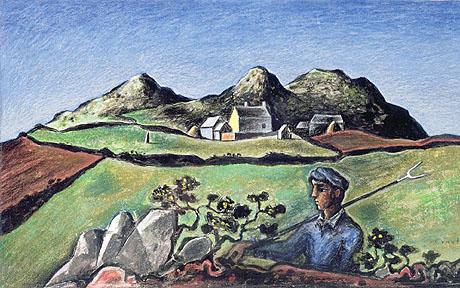
John Craxton, who died on November 17 aged 87, was one of the leading artists of the 1940s Neo-Romantic movement – a label which he detested throughout his life; although remaining essentially an English painter, for the past half-century he had lived an expatriate existence in Greece. He illustrated Paddy’s book covers (see blog header) and provided pen sketches for almost fifty years.

John Craxton's Reaper in a Welsh Landscape

John Craxton's 'Reaper in a Welsh Landscape', 1945 Photo: BRIDGEMAN ART LIBRARY

One of six children, and the fourth of five sons, John Leith Craxton was born on October 3 1922 at St John’s Wood, London, into a highly musical family. His father, Harold Craxton, was a pianist and Professor of Pianoforte at the Royal College of Music, his mother, Essie Faulkner, a violinist; his sister, Janet, was to become an oboist. The visual arts, however, were represented in his family history by the 18th-century painter Benjamin West, an ancestor on his mother’s side.

After attending seven different schools, of which the only one he enjoyed was Betteshanger, near Deal, at 17 John went to study at the Académie de la Grande Chaumière in Paris; on the outbreak of war he returned to London, enrolling at the Westminster and then the Central School of Art. By the age of 19 he was established in a maisonette at Abercorn Place in St John’s Wood, which he shared with another young artist, Lucian Freud.

The rent on the flat was paid by one of the most influential patrons of the day, Peter Watson, who owned Horizon magazine. Watson’s friendship was a boon in other ways: having lived in Paris before the war, he was a source of first-hand information about the latest developments in the Continental avant-garde.

Watson also gave the young artists introductions to such figures as John Piper, Graham Sutherland, Augustus John and the art historian Kenneth Clark. Clark called on the St John’s Wood flat dressed in tweeds and a country cap, and was soon giving Craxton and Freud the run of his Hampstead library as well as buying their pictures.

Because he suffered from pleurisy, in 1941 Craxton was rejected for military service. Poet in a Landscape (1941), executed after he heard that he would not be expected to fight, is typical in its combination of a subject from the romantic repertoire with disturbingly up-to-date elements. A youthful figure, based on the artist himself, sits reading in a field. But the landscape is far from idyllic: instead it is a threatening tangle of spiky, writhing branches and enormous, fleshy leaves. Both this drawing and a similar one, Dreamer in a Landscape, were reproduced in Horizon in March 1942.

Although in the early 1940s Craxton’s style oscillated rapidly between different influences – and was, to that extent, immature – it was during this period that he produced his most intense images. At this time both he and Freud were fond of using dead animals as models (when Clark called, there was a dead monkey hidden in their oven). This enthusiasm was expressed in Freud’s Chicken in Basket and Craxton’s Hare in Larder (1943), two memorable, if disturbing, works.

For Geoffrey Grigson’s anthology, The Poet’s Eye (1944), Craxton executed 16 colour lithographs which are widely regarded as among the finest book illustrations of the Neo-Romantic movement. In general they sustain the earlier mood, a point of balance between rustic dream and modernist nightmare; but some show the effect of the time he had spent in 1943-44 painting beside Sutherland in Pembrokeshire.

Sutherland’s stark influence was strong at this time, but another attraction was that, according to Peter Watson, west Wales represented the closest approach in Britain to the strong light and elemental landscape of the Mediterranean.

As soon as the war was over, Craxton took off for the Continent. By the end of 1946 he had spent time in France, where he met Picasso and patronised opium dens (but “did not inhale”). He had also visited Switzerland, where he exhibited; Italy, where he smoked a joint with Raymond Mortimer in Toscanini’s private box during the latter’s triumphant return to La Scala; and Greece, a country with which Craxton fell in love.

In Geoffrey Grigson’s monograph John Craxton: Paintings and Drawings (1948), Craxton is quoted as saying that in postwar London he felt “like an émigré… and squashed flat”. His intention, he declared, was to return to Greece as soon as possible. Years later he explained: “I wanted to put myself in an alien land and see if my talent would stand it.”

Over the next decade Craxton spent much of his time travelling in southern Europe, first settling on Poros, where he was visited by his old friend Freud. They sketched each other and exchanged the drawings as in the old days.

Back in London, Craxton joined his old friend at the gaming club Aspinalls. Over scrambled eggs and champagne, Freud told him that, desperate for money, he had sold the drawings Craxton had given him, adding: “You don’t mind, do you?”

Some time later Craxton too found himself strapped for cash, and was persuaded to sell some Freud drawings. When these were put up for sale in London, Freud was called upon to authenticate them. “Craxton is a —-“, he wrote on the back, which did no harm to their value.

In 1960 Craxton finally settled at Hania on the island of Crete, where his life was by all accounts as idyllic as his pictures had become. A devotee of Greek music, Byzantine art and Moto Guzzi motorcycles, he was for many years the honorary British consul on the island; from time to time he would be telephoned by the embassy and asked if he could find a hotel for a visiting dignitary such as the Duke of Kent, or girls for cocktail parties for the ships that came in.

From the late 1940s Craxton’s favourite subject had been the sun-baked south, with its sparkling seas, olive trees, goats and human inhabitants; and his characteristic mood was a lyric contentment very different from the bleak misanthropy of many of his contemporaries.

The Tate’s Pastoral for PW (Peter Watson) of 1948 is a good early example of Craxton’s mature manner. The subject – a solitary piper strolling among trees and grazing flocks – belongs to the world of Virgil’s Eclogues; but the paramount stylistic influences are now Picasso and Miró (purged, however, of their violence and savage vitality). The flat, numinous art of Byzantium also made a deep impression on the artist.

Craxton painted prolifically throughout his life. He also designed a ballet, Daphnis et Chloë, for Frederick Ashton in 1951, and produced the scenery and costumes for Stravinsky’s Apollo at the Royal Opera House in 1968.

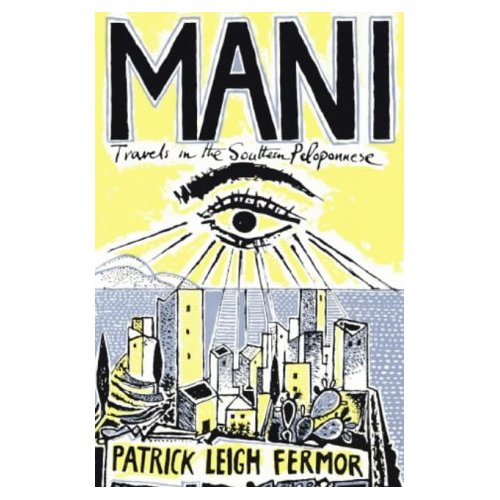
Mani: Travels in the Southern Peloponnese

Mani: Travels in the Southern Peloponnese

Of his many illustrations for the books of Patrick Leigh Fermor, the most delightful – and the most expressive of the ardent philhellenism he shared with the author – was the frontispiece for Mani (1958).

John Craxton was elected a Royal Academician in 1993. His last London exhibition was at Art First in 2001.

Craxton had his detractors – at the time of his Whitechapel retrospective in 1967 critics muttered scathingly about superior “Chelsea restaurant murals”.

His unfashionably happy later work may come to be valued more highly in the future, but it is probably for his early work that he is likely to be best remembered.

He is survived by his long-term partner, Richard Riley.

Original obituary in the Telegraph

Joan Leigh Fermor – Obituary from The Independent

Published Tuesday, 10 June 2003

Muse who enlivened a distinguished generation

Like all adorable people Joan Leigh Fermor had something enigmatic about her nature which, together with her wonderful good looks, made her a very seductive presence.

Joan Elizabeth Eyres Monsell, photographer: born London 5 February 1912; married 1939 John Rayner (marriage dissolved 1947), 1968 Patrick Leigh Fermor; died Kardamyli, Greece 4 June 2003.

Like all adorable people Joan Leigh Fermor had something enigmatic about her nature which, together with her wonderful good looks, made her a very seductive presence.

She was also naturally self- effacing. Even in a crowd she maintained a deep and private inner self. In fact I know she regarded every agora with phobia. Paradoxically, she loved good company and long and lasting friendships. It was her elegance, luminous intelligence, curiosity, understanding and unerring high standards that made her such a perfect muse to her lifelong companion and husband Patrick Leigh Fermor, as well as friend and inspiration to a host of distinguished writers, philosophers, painters, sculptors and musicians.

Cyril Connolly described her in a letter to his mother in 1949 as “a person with whom I have everything in common – friends, tastes, intellectual interests – and very beautiful: tall, fair, slanting eyes, yellow skin”. For the future editor of the Times Literary Supplement Alan Pryce-Jones, 17 years earlier, she was

very fair, with huge myopic blue eyes. Her voice had a delicious quaver – no, not quite quaver, an undulation rather in it; her talk was unexpected, funny, clear-minded. She had no time for inessentials; though she was a natural enjoyer, she was also a perfectionist whom [aged 20] experience had already taught to be wary.

When I first met her in 1942 through Peter Watson, owner and founder with Connolly of Horizon magazine, she was living as his neighbour in the only modern block of flats in London, 10 Palace Gate, designed by Welles Coates. She was a dazzling beauty and I, an awkward 20-year-old, was utterly stage-struck when she invited me to dance with her one evening at the very smart Boeuf sur le Toit night-club. The manager tried to remove me as I was wearing sandals, but was promptly reprimanded by Joan.

By wonderful good fortune she was already in Greece when in May 1946 I turned up for the first time in Athens, where she introduced me one evening to Paddy Leigh Fermor, who with his knowledge of the Greek countryside near Athens was instrumental in finding me a place to live and paint on the island of Poros. Joan’s love of Greece and the Greeks started, like mine, from this time.

Athens just after the Second World War was host to a unique group of marvellously talented men and women that included the philhellenes Steven Runciman, Maurice Cardiff, Lady Norton and Osbert Lancaster (whose secretary she had been), the Anglophile Greek painter Nico Ghika, the poet George Seferis and George Katsimbalis, Henry Miller’s colossus of Maroussi.

Anyone who thought foolishly that Joan herself was not really doing anything was as far from the truth as it is possible to get. Her unwavering empathy, generosity, taste and intelligence made her a creative catalyst to all who became her friends. Later on, Constant Lambert, Giacometti, Francis Bacon, Dadie Rylands, Louis MacNeice, Stephen Spender, Balthus, Maurice Bowra and Freddie Ayer, to name only a few, were all devoted admirers.

Joan herself was at that time one of the finest amateur photographers in England. Her photographs were first published, through her friend John Betjeman, in the Architectural Review, and then in Horizon, and are to be found in her husband Paddy’s books about Greece – Mani: travels in the southern Peloponnese (1958) and Roumeli: travels in northern Greece (1966). In 1948 she was employed by Cyril Connolly to be his photographer for a guidebook to south-west France, a book he never wrote, perhaps because, as he recorded in his journal, he “fell very much in love”, distracted by

her dark green cardigan and grey trousers, her camera slung over her shoulder and her golden hair bobbing as she walks, always a little fairer than you think, like the wind in a stubble-field.

During the war she was commissioned to take photographs of buildings vulnerable to bombing. After it a favourite subject was cemeteries – in Paris (Père la Chaise), notably, and Genoa. Somehow I never dared ask her why she gave up photography. It was always foolish to ask Joan a question when one already had a jolly good idea of what the answer might be: probably she did not think she was good enough.

At one time she owned a large convertible Bentley, appropriately nicknamed Moloch. It guzzled petrol as a row of thirsty Lombardy poplars needs water. One summer we set off in it with Paddy to drive to Italy, Joan at the wheel all the way, to meet up with Tom Fisher, Ruth Page, Freddy Ashton and Margot Fonteyn at the Villa Cimbroni in Ravello. We made frequent stops to explore Romanesque churches and eat unforgettable meals in little out-of-the-way restaurants, serving exactly the kind of French cooking admired and written about by Elizabeth David, whom Joan herself so much revered.

Joan and I shared a lifelong affection for cats. Paddy had less admiration and called them “interior desecrators and downholsterers”. Greek cats are good examples of a feline Parkinson’s Law. They prosper. Joan managed to have a large and endearing accumulation of them. One could not call them a collection; they were more like a flock, with Joan their shepherdess, handing out free meals. They repaid her generosity by offering her in winter a duvet of living fur for her bed.

With her beloved brother, Graham Eyres Monsell, she shared an exceptionally good and discerning ear for music. Her collection of eclectic and legendary performances of records was a constant joy for her and all her musical friends. Unfortunately, the vinyl long-playing discs made themselves irresistibly attractive to Greek dust.

She was born Joan Eyres Monsell in 1912, the second of three daughters of Bolton Eyres Monsell, the Conservative MP for South Evesham, later First Lord of the Admiralty and first Viscount Monsell. He had adopted the “Eyres” on his marriage in 1904 to Joan’s mother, Sybil Eyres, heiress to Dumbleton Hall in Worcestershire (subject of two Betjeman poems). Joan went to school at St James’s, Malvern, where in seven years she regretted that she learnt no Latin or Greek; all they taught, she said, was how to curtsy. She was “finished” in Paris and Florence.

When Alan Pryce-Jones fell in love with her in 1932, the First Lord saw him off. “I gather you want to marry my daughter,” he said. “What is your place? And what job have you?” Pryce-Jones had no “place” and no job. “And so, Pryce-Jones, having nothing, without prospects, without a home, you expect to marry my daughter, who has always had the best of everything . . . No, no, Pryce-Jones, come back in a few years when you have something behind you.”

Instead, two months before war broke out in 1939, she married John Rayner, then features editor of the Daily Express, but the marriage did not last, and they divorced in 1947. She served as a nurse, and then worked in the cipher department of embassies overseas, in Spain, then in Algiers and in Cairo, where she moved in the set that included Lawrence Durrell, Robin Fedden and Charles Johnston. It was in Cairo that she met Paddy Leigh Fermor.

She was happiest living with Paddy in what must be the most beautiful house in the Peloponnese, at Kardamyli in the Mani, which she and Paddy built of stone for themselves by the sea on a low promontory between two small bays. “Of course that big room,” John Betjeman wrote to the Leigh Fermors in 1969, “is one of the rooms in the world.”

John Craxton

Joan Leigh Fermor was one of the most remarkable people I have ever met. Apart from beauty and acute intelligence, she had to an unusual degree genuine goodness, both natural and willed, which informed all her actions and relationships. Her great generosity was as natural as discreet, based on her perceptive understanding of those less privileged or lucky than herself.

I first met Joan and Paddy when I married my English husband and settled in London in the early 1960s. Their house in Chelsea was always full of guests, and Joan was the most gracious and informal of hostesses. But unlike some hostesses she did not care whether her guests were successful or not, famous or obscure. I never heard her pronounce a second-hand opinion about a book or a picture. She helped both maternally and with friendship many an impecunious writer and artist whose work she liked, and her sympathy extended to all those to whom life had dealt less favourable cards.

Joan was not religious – just saintly. And although not a believer she was deeply spiritual, to me an example of alma naturalis Christiana. Although she had no children, she had a few daughters and sons – among whom I hoped to be counted – who adored her. She made one feel that, as long as she was there, all was not ill with the world.

Shusha Guppy (whose obituary can be read here)

From The Independent

Joan Leigh Fermor – Obituary from Daily Telegraph

Published: 12:00AM BST 05 Jul 2003

Joan Leigh Fermor, who has died aged 91, created a remarkable house in southern Greece with her husband, the writer Patrick Leigh Fermor, which attracted a host of distinguished figures from the literary and social spheres.

Joan Leigh Fermor was a noted beauty, with a ready gift for company and a sharp intelligence; her friends and admirers included Maurice Bowra, Cyril Connolly, Stephen Spender, Giacometti, Lawrence Durrell, and what sometimes seemed like almost every figure from the literary and scholarly worlds who gathered around the Mediterranean after the Second World War. She was also one of the most distinguished amateur photographers of her generation, and provided the illustrations for several of her husband’s books.

Patrick Leigh Fermor’s Mani (1958), an account of his travels with his wife in the southern Peloponnese, was illustrated with Joan’s photographs; eight years later, the couple produced Roumeli, devoted to the north of the country. In addition, Patrick Leigh Fermor’s Three Letters from the Andes (1991), an account of his mountaineering expedition 20 years earlier, were addressed to his wife. They provided a picture of the gentleman traveller, stoical in the face of all hardships (other than the preparation of a hard-boiled egg at altitude).

Joan Elizabeth Eyres Monsell was born on February 5 1912 at Dumbleton, Gloucestershire. Her father was Bolton Eyres Monsell, the Tory MP for South Worcestershire who went on to become Chief Whip and First Lord of the Admiralty before being created Viscount Monsell in 1935. He had added the name Eyres on his marriage to his wife (Caroline Mary) Sybil, who was lady of the manor and patroness of the living at Dumbleton.

Joan was educated at St James’s, Malvern, and at finishing schools in Paris and Florence. Afterwards she became keen on photography, concentrating – on the advice of her friend John Betjeman – on architectural studies. The first among these were published in Architecture Review; she went on to become a contributor to Horizon.

On the outbreak of war, Joan Monsell became a nurse, and also took photographs of architectural sites which were thought vulnerable to bombing. She then joined the cypher departments of the British embassies in Madrid, Algiers and then Cairo, where she became friendly with Lawrence Durrell, Robin Fedden and Charles Johnston, and where she met Patrick Leigh Fermor. From Cairo, she managed to escape on leave in order to travel in Kurdistan, before moving to Athens, where she became secretary to the cartoonist Osbert Lancaster.

Joan Leigh Fermor was passionately fond of cats, eight of which were settled about her her bed on her last morning. She was also addicted to chess, and kittens were reprimanded only if they had the temerity to muddle the pieces. She was accommodating, too, of her husband’s derring-do – though she watched him swim the Hellespont (at the age of 69) “sitting on her hands so as not to wring them”.

She died on June 4 after a fall in the Mani, where she and her husband had settled nearly half a century before, living in tents while constructing their home. The house, centred on a great room full of books (and often also music), stands on a wild peninsula on the southernmost tip of Greece, looking out on olive groves and cypresses toward the sea, against a backdrop of mountains. There the Leigh Fermors entertained many visitors, plying them with large quantities of wine and the sea-green olive oil from their own trees.

She married, first, in 1939, John Rayner, features editor of the Daily Express; but the match did not survive the war, and was dissolved in 1947. She married Patrick Leigh Fermor in 1968.

Billa Harrod writes: Joan and I met when we were both 18 and remained great friends for more than 70 years. Neither of us was quite the sort of daughter our mothers would have hoped for (luckily they had others). We were very lucky in our backgrounds of big comfortable houses – which we did not always treat as well as we should have, once breaking off an arm of a dignified candelabrum at Dumbleton. (Though when Joan’s father was First Lord of the Admiralty and they lived at Admiralty House in Whitehall, we did appreciate the beautiful fish furniture.)

Joan had more money than most of her friends and was quietly but largely generous when she saw that it would be helpful. She was beautiful and elegant, and also a highbrow, who had the highest standards, and did not suffer fools gladly. Although her actual schooling was rather feeble, she had read a vast amount and had an excellent memory. Music and literature were her real interests, but she was also a superb cook, and taught others to be. The food in her various houses was always delicious.

Major Dennis Ciclitira Obituary from Daily Telegraph

Published: 12:00AM BST 16 Jun 2000

SOE officer undercover in Crete who organised the German surrender

MAJOR DENNIS CICLITIRA, who has died aged 81, was in charge of SOE’s operations in western Crete during the Second World War and eventually arranged for the German surrender of the island.

Ciclitira arrived on Crete just before Christmas 1943, taking over supervision for the area around the town of Canea from Xan Fielding. Liaison with the Cretan Resistance was led by the classicist Tom Dunbabin, who from the spring of 1942 had been supervising the activities of a handful of SOE officers, among them Patrick Leigh Fermor, who were living rough with the andartes or guerrillas in mountain eyries.

Ciclitira at sea between Cairo and Crete. (The Times)

One of Ciclitira’s first important tasks was to help to organise the evacuation of Leigh Fermor after he and Billy Moss had successfully abducted the commandant of the island, General Kreipe, from his staff car in April 1944. In his book Ill Met By Moonlight (1950), Moss describes encountering Ciclitira in his cave hideout.

“He has grown an impressive beard,” he wrote, “which he treats with the affection of a spinster for her favourite cat, and wears an elegant sort of musical comedy costume, complete with wine-coloured cummerbund, turban and the usual trappings.”

Two of Ciclitira’s men had already been killed by the Nazis, but despite their strenuous efforts to catch him, he managed to maintain wireless communications with Cairo and to arrange for Leigh Fermor and his prize to be picked up by motor launch. When he arrived at the rendezvous he found Moss and Leigh Fermor flashing their torches out to sea in frantic desperation, as neither knew the Morse Code for the pre-arranged signal. Fortunately, Ciclitira did.

Ciclitira left with them on the boat, but subsequently returned to Crete, where he operated under the codename Dionysios. In January 1945, the German garrison of 12,000 began to withdraw to the western end of the island, taking with them prisoners who included Costa Mitsotakis, later the Prime Minister of Greece but then an agent for the Resistance. The Germans had orders to execute all such captives, but Ciclitira managed to contact the German authorities with a view to making an exchange of prisoners.

Ciclitira went to the meeting with Captain Lassen of the Special Boat Section, who soon became exasperated by the horse-trading and suggested that his commando unit, who were hiding in the mountains, should play the Germans at football, with the winner to take all. This suggestion greatly amused Bishop Xirouhakis of Kydonia, who was mediating at the talks and offered to act as referee in any such match.

In the event, after Ciclitira had travelled by caique to Athens for further discussions, 36 German PoWs were exchanged for 10 Cretan agents, probably saving their lives. On May 8, Ciclitira received a message to contact General Benthag, the German commander, to make arrangements for a formal surrender. Dressed in suits, he and Mitsotakis – a fluent German speaker – presented themselves at Benthag’s headquarters. Preliminary terms were then agreed, but since the general could only surrender to an officer of equal rank, it was decided that he should be flown to the British HQ at Heraklion.

Benthag asked how Ciclitira proposed to contact his senior officer, and was most put out to discover that Ciclitira’s transmitter was hidden next door to German HQ, where the volume of radio traffic concealed Ciclitira’s own signals from direction-finding cars. The next evening, although the surrender had not been made public, Ciclitira and his comrades sneaked into Canea and invited their German counterparts to a party; the garrison provided them with a jazz band. The next day, Ciclitira joined in the wild celebrations that greeted Liberation.

Read the full Telegraph obituary.

The Moss Conundrum

I have been reading ‘In Tearing Haste: Letters Between Deborah Devonshire and Patrick Leigh-Fermor’ (2008), edited by Charlotte Mosley. It is really quite good and gets better as Debo writes more often to Paddy; she is very funny.

On page 22 of my paperback version in a letter from Paddy written on 26 August 1956 he writes:

“I was asked by W.S.M. (William Stanley Moss – his partner in the Kreipe kidnap escapade – see Ill Met by Moonlight) to a meal of reconciliation and amends, where we met as affable strangers. It was really a gasbag’s penance and I, having learnt the hard way, vouchsafed little more than a few safe monosyllables.”

Well what does this mean? It is clear something had caused a breakdown in what was once a good friendship. They had been through a lot together and to feel like this, there must have been something terrible to cause such a rift. Was it the way Moss portrayed the events of the Kreipe kidnap? The fact that Moss married Sophie? Who knows?

If anyone knows please add a comment to this article.

Welcome to the Patrick Leigh Fermor blog

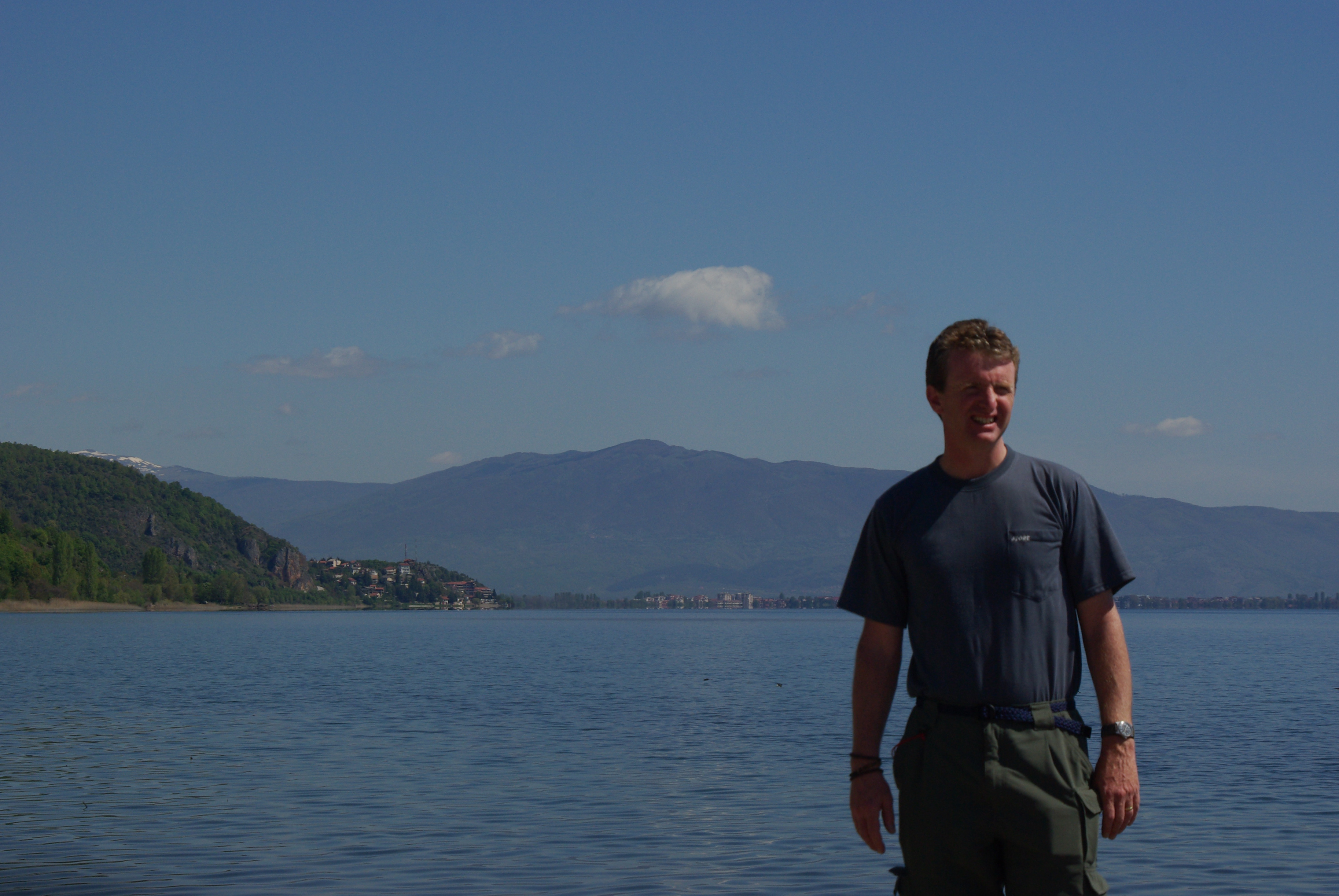
Tom at Lake Ohrid on the Via Egnatia, 2009

My name is Tom Sawford and I live in Winchester, Hampshire, England.

I first became aware of Paddy quite late in life; I guess he is an acquired taste. Maybe you need to have some awareness of the broad range of subject matter that he can, often without warning, cover in his books. Perhaps it is only after formal education, reading widely, developing a broad appreciation for history, and just plain living that you have the ability to grasp some of what he is getting at. A strongly developed vocabulary is also a boon; or at least a dictionary and of course now with access to Google it is possible to quickly research some of the more obscure topics that Paddy assumes mere mortals will be aware of. I remember the first time I read A Time of Gifts and being amused that Paddy clearly expected his readers to have at least a schoolboy/girl grasp of Latin as phrases pour out with no explanation or translation.

But surely that is the attraction of his work. It aims for the highest pinnacles of linguistic and intellectual endeavour and if you like what you read it drags you along with it, drinking from the cup of knowledge that Paddy offers.

He is of course so much more than a writer. It has been said that he is the ‘greatest English travel writer’. I don’t agree with that. I believe he travels to write, having so much more to say than to merely discuss the merits of one hotel over another or the quality of food in Greek fishing  villages. In my view he was the “Greatest Living Englishman”. Not that we don’t have other great Englishman (but perhaps less than we once had), but more than that he is that unique person who personifies what was once the mark of an Englishman; educated; heroic, handsome, generous; and modest (to a degree).

Sir Patrick Michael Leigh Fermor DSO OBE lived a full life, and had experiences that few others will likely ever have again. He had lived a pretty full life before the second world war, even living with a Romanian princess who was older than he, and during that conflict he applied his skills to fighting behind German lines, and was unique in achieving the capture, with “Billy” Moss, of the German Garrison Commander of Crete, Major General Kriepe. After the war he travelled, wrote, married, developed long-lasting friendships, and built a house in Greece. My epithet stands because few can match what he has done and also the manner in which he did it.

The purpose of this blog is to bring the life and work of Paddy, and his many colleagues, to the attention of a wider audience, and to create an archive of on-line material. He, and they, deserve to be recognised and remembered in a world that has changed much during their lives, but would be the poorer without them.

If you would like to help with the blog, make a contribution or anything else, please contact me tsawford[at]btinternet.com.

Tom Sawford

April 2010

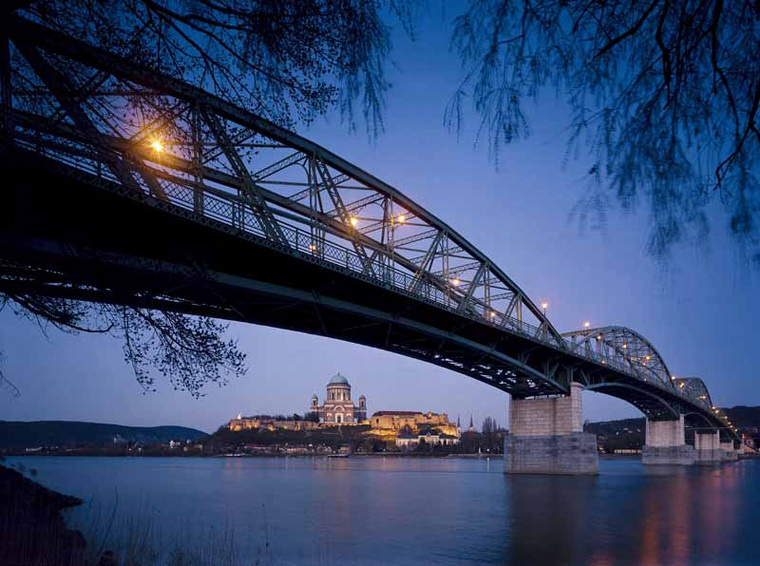
Easter 1934 – Paddy reaches the Hungarian border at Esztergom

After what must have seemed an amazing four months to a young man of eighteen, Paddy arrives at the Czechoslovak-Hungarian border at Esztergom, which as he says (p 276 A Time of Gifts) contained ‘the Metropolitan Cathedral of all Hungary’. It is these last closing pages of his first volume that he describes the colourful preparations for an Easter service as he watches from no-man’s land in the middle of the bridge spanning the Danube. It is from this point that he picks up the story in volume two ‘Between the Woods an the Water’.

Wikipedia tells us: Esztergom (Hungarian pronunciation: [ˈɛstɛrɡom], also known by alternative names), is a city in northern Hungary, about 50 km north-west of the capital Budapest. It lies in Komárom-Esztergom county, on the right bank of the river Danube, which forms the border with Slovakia there.

Esztergom was the capital of Hungary from the 10th till the mid-13th century when King Béla IV of Hungary moved the royal seat to Buda.

Esztergom is the seat of the prímás (see Primate) of the Roman Catholic Church in Hungary. It’s also the official seat of the Constitutional Court of Hungary. The city has the Keresztény Múzeum, the largest ecclesiastical collection in Hungary. Its cathedral, Esztergom Basilica is the largest church in Hungary.

Imagine Paddy standing in the middle of this bridge looking at the cathedral

Ill Met by Moonlight movie

The final movie from the famed Powell and Pressburger partnership starring Dirk Bogarde (as Paddy), Cyril Cusack (as Captain Sandy Rendel), David Oxley (as W. Stanley “Billy” Moss, M.C.) and the superb Marius Goring (as Major General Heinrich Kreipe). Not forgetting the island of Crete of course. Click the picture to watch the trailer!

Sex O’Clock High by Patrick Leigh Fermor

“Sex O’Clock High” – Get out your dictionaries, standby to Google … reading this short article by Paddy for the New Statesman (written in 1963) is at once both a joy and a frustrating, dizzying cornucopia of colourful and fiendish alliteration (thanks to my friend Carl Hagan for leading me to this)

Taken from the New Statesman archive, 1 March 1963. The author of The Traveller’s Tree and A Time of Gifts, Sir Patrick Leigh Fermor is the doyen of British travel writers. He is also the central figure of W Stanley Moss’s Ill Met By Moonlight, a true tale of derring-do in wartime Crete. Now aged 91, he has written only rarely for the New Statesman: perhaps this item taxed the sub-editors’ patience too far.

It was an iridescent August morning and the effects of morphia and onanism were wearing off. Sitting up, Jack sipped his Earl Grey. Then he slipped into the Isabella-coloured pantaloons and a pair of Blucher boots proffered by his plimsolled and Jesuitical Jeames, byronically knotted his lavallière, donned a cardigan and a spenser and threw on a raglan. Trying a gibus, a trilby, an Anthony Eden, a fedora and a tam o’shanter, he finally pulled a billycock over his ears, narcissistically fluffed out his imperial and his dundrearies and, putting a lucifer to his Henry Clay, strolled downstairs to the electronic brougham.

Jill, attended by her gamp-grasping Abigail, was waiting for him by the wistaria’d Belisha beacon, her marcelled pompadour peeping roguishly from a Dolly Vardon in sarsenet. Soon, however, the brougham broke down. (Lack of volts? of amps, ohms, farads or watts?) The Jehu whispered that Jeames was a Jonah. Jill panicked, but their neighbour, jovial, Good-Samaritan Tom – a true Nimrod, martial in a stetson fitted with a havelock, a macfarlane, knickerbockers and wellingtons – quixotically gave them a lift in his phaeton, leaving Jeames there with the titanic gladstone-bag. (It was Shanks’s mare for him: Hobson’s choice.) They bowled over the macadam, passing many a stanhope and many a victoria, past Boniface with his churchwarden stuffed with cavendish outside the Marquis of Granby, where a peeler saluted; they finally settled under the bougainvillaea. But the food? Would they have a Barmecide feast: dine with Duke Humphrey? Jim thought of wartime maconochies and murphies. But soon Jeames arrived and panglossian Tom declared that it was all Sir Garnett.

They sipped John Collinses and grog with their sandwiches and discussed a lucullan soubise while Jeames cooked an Arnold Bennett omlette, boeuf strogonoff and, though Jill was banting, a gargantuan Chateaubriand. They washed these down with a Toby jug full of negus followed by a jeroboam of Mouton Rothschild. (Saturnine Jeames, their Ganymede, a professing Rechabite but secret slave to John Barleycorn, pharisaically out-Heroded Herod by swallowing a dozen baby Guinnesses.) Hermetic bakelite yielded pralines of filberts and logan berries, and soon Tom was sadistically guillotining his pêche Melba into procrustean slices. Jill put a Maréchal Niel behind her ear and picked a posy of hyacinths, dahlias, eschscholtzias, zinnias and Lady Diana Manners, while Jack, their amphitryon – a true epicure – extracted Napoleon brandy from the tantalus and offered Tom a Romeo and Juliet.

How they laughed at Tom’s odysseys! Jill declared that their Homeric and stentorian Mentor was a regular Munchausen. He related that, to forget an Oedipus complex, he had once crossed from a zeppelin to a mongolfier over a volcano somewhere in the Atlantic (O, for an atlas!), and, in his halcyon days, had performed caesarians in the Americas and taken Wassermans in the Gilbert Islands, broken up manichaean cabals with colts, bowie knives and shrapnel, joined the Fabians in San Salvador, practised as a psychiatrist and cured some Hudson Bay cyprians of nymphomania and the lotharios of Baffin land of priapism, seduced vestals in Rhodesia with aphrodisiac cereals, played cicerone to a croesus in Saudi Arabia, haussmannized Washington with mansards, swapped sanbenitos for fermorite in Liechtenstein, galvanized vandals with sapphics, published clerihews in morse and braille, taught Monroevians Sir Roger de Coverley, diddled Jack Ketch in Vancouver with a coup de Jarnac, turned the Trotskyites of Gorki into luddites among the diesels, mithridatized himself against nicotine in Virginia, prosecuted paulicians for simony in Columbia, driven St Simonism out of the Sorbonne, won pyrrhic victories with half-nelsons over herculean apaches in Sidi-Bel-Abbès, performed veronicas with mackintoshes in Bolivia, buggered a Buchmanite in Tasmania, stolen a strad from a musical Wykehamist in the Dolomites, built a mausoleum for a Maxim-gun mogul, out-witted the dogberries of Port Said, and confuted the Arians of Alexandria. He had lost his burberry at the Derby but returned from the Cesarewitch with a tin Lizzy-load of bradburies. A Mae West once saved him from Davy Jones between the Behring Straits and the Humboldt current. He had ranted, Roscius-like, among the thespians of the Palladium, sold plutonium and ammonia to Zwinglians in Louisiana, hunted Reynard and Bruin with yahoos and mohocks beyond the Mason-and-Dixon line, eaten a shaddock in mistake for a greengage when struck by Daltonism in Smithfield, bowdlerized pasquinades for Huntingdonians in Ekaterinoslav, and been boycotted as a quisling and almost lynched by Stakhanovites in the Bodleian.

Over the Benedictine, Jill told a rocambolesque story of how, as a girl, in Paris, with her hair tied en cadogan, she had slipped on a melted esquimau by a Wallace and fallen into a vespasienne! Mesmerized by Tom, she only tittered masochistically when he said her spooneristic malapropisms were Freudian. It was turning into bacchanal.

Were her feelings for Tom just platonic, Jill mused. How namby-pamby Jack seemed after the other’s hectoring rhodomontades. Sitting on the edge of a chesterfield by a Chippendale davenport that evening, she heaved a maudlin sigh and unscrewed her Parker to write Jack a collins.

Colonel George Lane

Colonel George Lane, who has died aged 95, fought with SOE and was awarded an MC for his service with the Commandos during the Second World War; captured on a secret mission, he was invited to tea by Field Marshal Rommel, who, Lane always thought, courteously prevented him from being shot by the Gestapo.

Read the full Telegraph obituary.

Sophie Moss Obituary from Daily Telegraph

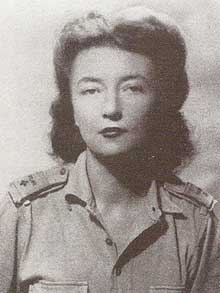
Sophie Moss

Sophie Moss, who has died aged 92, was, as Countess Zofia Tarnowksa, the hostess of a villa in wartime Cairo where high-spirited young SOE agents on leave from secret assignments behind enemy lines held some of the most riotous parties of the war.

With considerable misgivings (and a fictitious chaperone), she agreed to join the all-male household on Gezira island at the invitation of her future husband, the officer Billy Moss, and moved in with her few possessions, which included a swimsuit, an evening dress, a uniform and two pet mongooses.

In the field, Patrick Leigh Fermor, Billy McLean, David Smiley, Rowland Winn and Xan Fielding were cold, hungry, lice-ridden and in constant danger. But on leave with months of back pay to spend, they held uproarious parties at the villa, which they called Tara.

These attracted the most distinguished soldiers, diplomats, writers and, on one occasion, King Farouk, who arrived with a crate of champagne. The evenings grew steadily more rowdy. Usually glasses were smashed. One night some chairs were broken when a mock bullfight was staged. On another, Sophie’s Polish friends shot out all the light bulbs, and on yet another a sofa caught fire then was hurled through a plate-glass window.

Since costly repairs were needed afterwards, Abbas, the butler-cook, tried to raise funds by accosting guests at the gate and holding out his tarboosh for contributions. Sophie put a stop to this, then remembered how soft fruits were added to vodka to make delicious liqueurs on her father’s Polish estates. The household agreed to an experiment using the bath, in which prunes were mixed with raw alcohol from the local garage. The results were disappointing, though Sophie insisted that this was because they were too impatient to wait for the mixture to mature. When they started drinking it after three days, two imbibers passed out.

The bathroom had other uses. In late 1943, when Leigh Fermor and Moss were planning a kidnapping on Crete, they sat around wearing next-to-nothing while David Smiley, fresh from Albania, explained how to organise the perfect ambush – drawing a diagram on the steamed-up tiles. After their success in capturing General Heinrich Kreipe, Leigh Fermor and Moss returned to Tara as heroes.

Zofia Roza Maria Jadwiga Elzbieta Katarzyna Aniela Tarnowska was born on March 16 1917 at Rudnik, a forested estate near Tarnobrzeg, a town in south-eastern Poland founded by her family in 1593. Over the centuries the Tarnowskis had held some of the highest offices in Poland. But Sophie’s father descended from a cadet branch of the family, and wanted to be only a country gentleman. His marriage was unhappy, and Sophie and her brother Stanislaw grew up headstrong and mischievous.

Her tricks and practical jokes turned her governesses into nervous wrecks until her mother sent her to a convent. Sophie got into trouble for standing on a pudding to prove it was inedible, ran away and refused to go back. She was happiest with animals, galloping through the forests on horseback or playing with deer, foxes, a goat and a red squirrel.

In 1937 she married Andrew Tarnowski, a member of the senior branch of the family. Her first son was under two when he died (on the day she gave birth to her second) in July 1939. As war drew closer, Sophie decided that she would never abandon Poland and burned her passport. It was, as her daughter said, “a very romantic and Polish thing to do”, but it changed nothing. On September 8, when the Germans were pouring over the western frontier and the Russians were approaching from the east, she set off by car for Romania with her husband and their baby, her brother, his fiancée Chouquette and her sister.

On arriving in Belgrade she lost her second son before the family drove on to Greece and Palestine. Her husband, now a corporal in the Carpathian Rifles, was on leave in Jerusalem when he told Sophie he was in love with Chouquette. Later Sophie accompanied Chouquette and her son to Cairo, where an uncle of King Farouk, who had often hunted on the Tarnowski estates, had offered them a luxurious villa. She soon moved out.

After joining the International Red Cross, Sophie met General Sikorski, Poland’s prime minister, who suggested she start a Polish branch of the humanitarian organisation. She agreed, but only if it were established without ranks. “Are you a communist?” asked Sikorski. “No” was the reply. But senior Polish ladies might resent a badge of superiority on someone whose husband was only a corporal, she explained. The general agreed, but when he departed she had difficulty confirming her position.

Finally she presented a large bouquet of flowers to the wife of the British ambassador in Cairo, Sir Miles Lampson – with whose help she was equipped with a committee, an office and a truck to
deliver clothes and food. She also visited hospitals and arranged patients’ outings, and helped Polish PoWs in Germany to contact their scattered families.

After divorcing Andrew, she married Billy Moss in 1945. The couple settled in London, where he prepared his Cretan diary about the kidnapping for publication as the best-selling Ill Met By Moonlight. But money was always tight. She lost a third son, but had two daughters. She and Moss translated a book of short stories by the Polish writer Bruno Schultz. But by the late 1950s, their marriage was over. She took in lodgers and spent time in Ireland, where she became a keen gardener.

In 1957 Sophie and her brother were allowed to visit their childhood home, where the NKVD had used the cellars as a jail during the war. They were not allowed into the building, but were treated to an open-air banquet by dozens of old retainers and peasants. At Gora Ropczycki, the house where she and her first husband had lived till 1939, old farmhands thanked her for keeping up their spirits in the first days of the war.

After the fall of communism Sophie’s nephew Adam bought back Rudnik, and Sophie presided over a family gathering in 1999. But too much had changed for her to contemplate settling there.

Last year some of the poems she had written in Cairo were published in a private edition. One, which was translated into English, asks for the white wings of her childhood guardian angel to take her home.

She died on November 22, surrounded by her family in Sussex.

Sophie Moss

Sophie Moss was wilful, lively and bloody-minded, with an almost total recall of a past in pre-Second World War Poland that was privileged yet full of turmoil. Later, in wartime Cairo, she lived with members of Britain’s Special Operations Executive in a house where wild parties were the norm.

Sophie Moss was born Countess Zofia Roza Jadwiga Elzbieta Tarnowska on 16 March 1917 on the estate of her father, Count Hieronim Tarnowski, at Rudnik in Galicia, south-eastern Poland. She spent her childhood roaming free, taming foxes, birds and deer. When she was 13 her parents separated, and she went with her mother, née Countess Wanda Zamoyska.

She married Andrew Tarnowski, a close cousin she had fallen in love with at 17 on a wolf hunt, and by 1939 she had had two sons; the elder died the day his brother was born. Sophie never forgot her return to her marital home with her second baby, (who would also soon die). She stood on Krakow Station: “I saw my train arriving with blood streaming down its side. Young military conscripts had travelled on the roof and, as it passed under a low bridge, had lost their lives. The sight of that train pouring blood was an omen of what, within days, was to be the fate of Poland.”

Within hours of the German invasion, refugees from western Poland started arriving. Sophie put them in bedrooms, then on mattresses, and in the stables, then had sheep and cows from the estate killed to feed them. She said that it was then that she grew up. She was persuaded by her husband and brother to flee with them. The men wanted to enlist abroad to fight for their country and, after an arduous and long journey they ended up in Palestine, and eventually Cairo, where she started the Polish branch of the Cairo Red Cross.

In autumn 1943, estranged from Tarnowski, she was invited to live in a villa with seven young British officers working for the Special Operations Executive. She moved in with a bathing suit, an evening gown and two mongooses she had rescued for 10 shillings.

She called this time her “university”, her teachers being the daredevil officers. Tara residents included Arnold Breene, Billy Maclean, David Smiley, Rowland Winn (later Lord St Oswald) and Xan Fielding. Another was William Stanley Moss (Billy), whom Moss went on to marry, in 1945.

In 1944 Moss and Patrick Leigh-Fermor kidnapped General Major Karl Kriepe, commander of the German forces occupying Crete; Billy’s account of the incident, Ill Met by Moonlight (1952), was made into a 1957 film.

Wild parties were thrown at the house, for diplomats, officers, war correspondents, princes, the British Ambassador and King Farouk. Moss tried to replicate the liqueurs from her father’s estate, using plums added to vodka. However, the concoction was always drunk before it had had a chance to ferment. At one party, Poles shot out all the light bulbs.

Another resident was a beer-drinking, house-trained bear, acquired in Russia by Poles who had been let out of Stalin’s gulags to form the Second Polish Army. Worried that the British authorities would not allow the bear to continue fighting with them into Europe, they asked Moss to take him while they retrained. She appealed to King Farouk, who declared: “You are my guest, and so is the bear!” and delegated Egyptian policemen to take it for walks. The bear went on to experience many battles, including Monte Cassino, and died in Scotland of old age. He now resides, stuffed, in London’s Sikorski Museum.

Last year Sophie’s poems, written mostly in Cairo during the war in Polish, were found. Sophie’s relation, the actress Rula Lenska, helped translate them at a launch held at the Sikorski Museum, the stuffed bear nearby In one poem she wrote: “If I fear death / it is of dying of boredom.”

Elisa Segrave

This Patrick Leigh Fermor blog

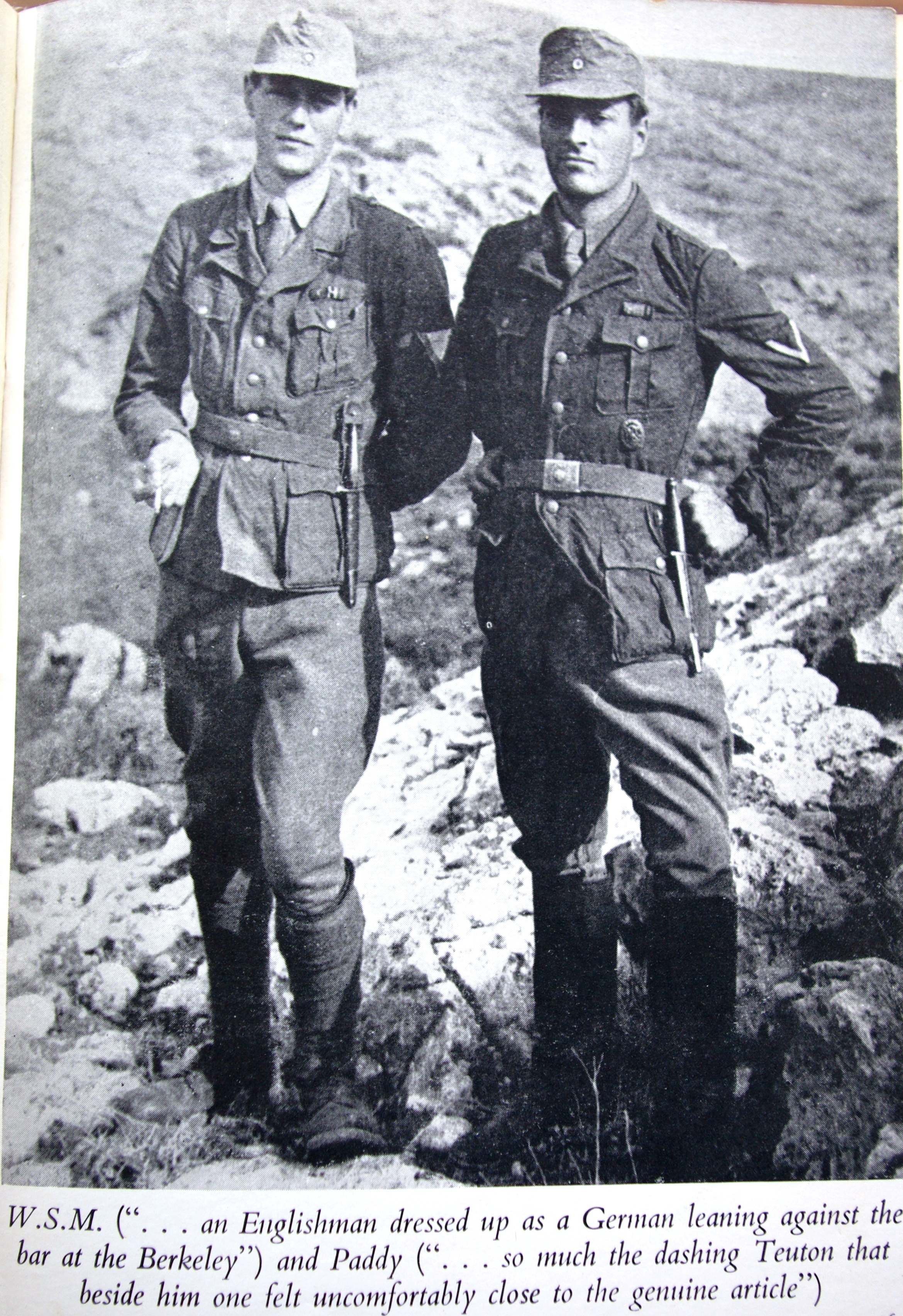
Patrick Leigh Fermor and Moss

W Stanley Moss and Patrick Leigh Fermor in German Uniform Prior to the Abduction of General Kriepe

The blog is live but only in a test phase at the moment. I will be adding a little more content before I am satisfied but the idea is to post interesting pieces about Paddy, his life, times, travels, war, friends etc.

As far as possible I also want to gather together what material I can such as photographs etc.

Once we are going I would welcome as many comments as possible!

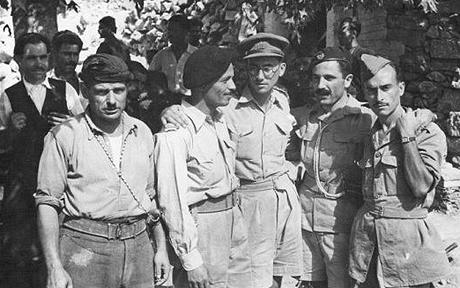
Ralph Stockbridge

Stockbridge (centre, in the spectacles) with some of his comrades in Crete

Ralph Stockbridge, who has died aged 92, was awarded two MCs for the notable part that he played in the Cretan Resistance to the German occupation; he spent the remainder of his career working for MI6.

During his time in Crete he knew and worked with Paddy.

Read his Telegraph obituary here.