Author Archives: proverbs6to10

Unknown's avatar

About proverbs6to10

Interested in Byzantium and Patrick Leigh Fermor

Travel writing creates adventurers

I saw this on the Stanfords website the other day. I liked it and thought many of you may as well.

Good travel writing makes you jealous.

It makes you want to walk in an author’s footsteps;
to see what they saw and feel what they felt.

The best travel writing inspires.

It instils the desire for discovery.

It challenges you to think new thoughts and find original experiences.

It creates adventurers.

Print

What was Patrick Leigh Fermor’s school reading list?

Not a normal post, but one where we are actively seeking your feedback and contribution via the comments section (see Leave a Reply above) in response to a question asked in an email from reader Jonathan in New Zealand.

One other question I have for the community , is (being a product of UK post 1970s progressive state education), what would be a basic reading list of the key classics (greek and Latin) that Paddy and his peers would have been exposed to during their school days?

Any ideas?

Print

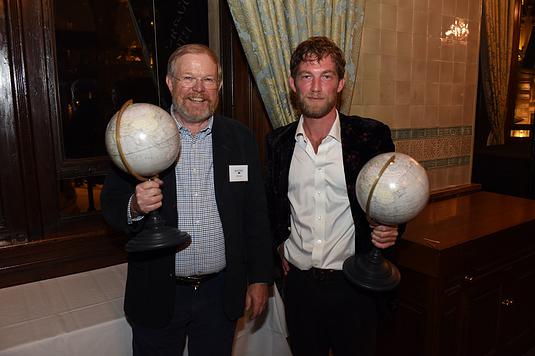
Horatio Clare and Bill Bryson winners at Edward Stanford Travel Writing Awards

Winners Bill Bryson and Horatio Clare at the Edward Stanford Travel Writing Awards

Winners Bill Bryson and Horatio Clare at the Edward Stanford Travel Writing Awards

Some disappointment for our friend Nick Hunt in the Edward Stanford Travel Writing Awards, the results of which were announced at an event at London’s National Liberal Club this week. The winner was Down To The Sea In Ships: Of Ageless Oceans and Modern Men, Horatio Clare’s account of the ordinary men that place their lives in extraordinary danger on container ships on the high seas.

“In selecting a winner from our wonderful shortlist, we kept in mind that one of the great litmus tests of travel writing is companionship, how much the reader relishes the company of the writer,” said prize Chair, Barnaby Rogerson. “We wanted to be led on an adventure, we wanted new doors opened, fresh horizons of inquiry unveiled, we want to be filled with wonder and enthusiasm at the dazzling riches of our world. Down To The Sea In Ships: Of Ageless Oceans and Modern Men ticked every box.”

“It is a book charged full of vim and passion,” continued Rogerson. “Filled with polished, near poetic prose, it is alert to labour as well as beauty, the loneliness of long-distance sea travel as well as the communities that form below deck, and are dissipated with each new voyage.”

Chris Schüler, outgoing Chairman of the Authors’ Club, echoed Rogerson’s words adding that “Down To The Sea In Ships: Of Ageless Oceans and Modern Men is a book entirely worthy of its place amongst the Stanford Dolman’s illustrious list of past victors. In this first year of our partnership with Stanfords, we couldn’t have hoped for a better choice from our judges to capture the essence of this vital prize – a work of true literary excellence and cultural importance.”

As winner, Clare received a cheque for £5,000 and a specially commissioned hand-made globe by master globe-makers, Lander & May.

Best-selling travel author Bill Bryson was also honoured at the Awards when he received the Edward Stanford Award for Outstanding Contribution to Travel Writing. Selected from public nominations by specialists at high street and independent bookshops, including Waterstones, Blackwell’s, Daunt Books and the Hungerford Bookshop, this is the first time the Award has been presented.

“I am hugely honoured to receive this award,” said Bryson, “particularly as it comes from booksellers, my favourite people on the whole planet.”

Tony Maher, Managing Director of Edward Stanford Limited, said “Bill’s elegant, witty and amiable prose has been entertaining readers for many years. From adventures walking the Appalachian Trail, to defining the British better than any Brit has ever managed, he has a turn of phrase at once insightful and hilarious.

“The beauty in his writing is often its brevity and sincerity; it is understatedly, unassumingly, powerful. I couldn’t be more thrilled that he is the first recipient of the Edward Stanford Award for Outstanding Contribution to Travel Writing, and commend the public and our bookselling partners on their choice.”

As well as receiving his own handmade globe trophy, Bryson’s name was inscribed on a commemorative globe which will go on permanent display at Stanfords, Covent Garden. The names of future winners will be added to the globe in due course.

Maher also announced that the 2016 Edward Stanford Travel Writing Awards ceremony would move to coincide with the Stanfords Travel Writers Festival, which will take place at the Destinations Show, Olympia in February 2017.

Stanfords entered into sponsorship of the Stanford Dolman prize earlier this year, in association with the Authors’ Club and donor, Rev. Dr. Bill Dolman, doubling its funds and adding it to the newly created Edward Stanford Travel Writing Awards, alongside the Edward Stanford Award for Outstanding Contribution to Travel Writing.

Buy: Down To The Sea In Ships: Of Ageless Oceans and Modern Men

Print

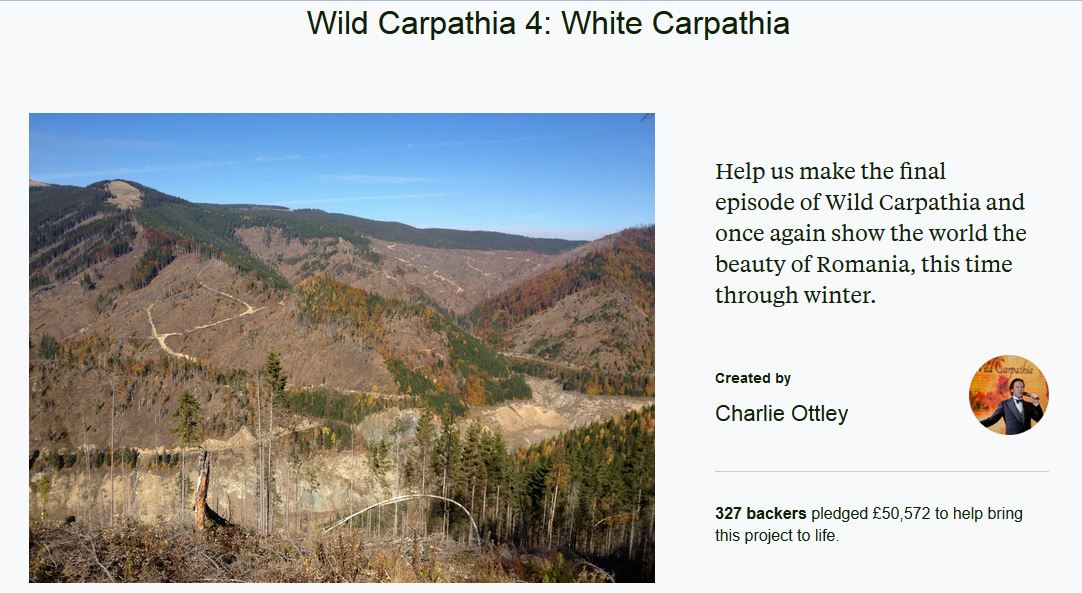
Wild Carpathia 4 fundraising a success!

CaptureFilming is to start immediately on Wild Carpathia 4. The target of £50,000 has been reached. A big donation of over Euro 20,000 was made by a Romanian country club and its members over the weekend which accelerated the funds towards the goal.

Thank you to all of you who follow the blog for your contributions. I am sure Paddy would have been pleased.

Audible

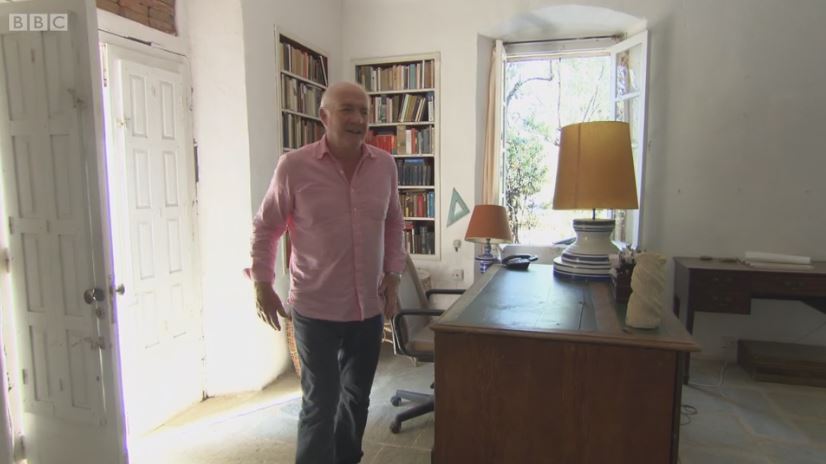
Rick Stein served moussaka by Elpida at Paddy’s house

Stein at Paddy'sThe global reach of the “celebrity chef” Rick Stein is unknown to me, but certainly for those of us in the UK he is a well known figure and is perhaps almost single-handedly responsible for the gentrification of the beautiful port of Padstow in Cornwall.

Unfortunately for most of you outside the UK you will remain unaware of the qualities that make Rick such an attractive figure (!!) as I understand that BBC iPlayer is unavailable outside of the UK.

But if you use your imagination, in this episode from Stein’s current TV programme – From Venice to Istanbul – he arrives in the Peloponnese, visits the obligatory taverna followed by Paddy’s house at Kardamyli, where he takes a tour and Elpida cooks him moussaka to her secret recipe. Apparently Paddy did not like moussaka, but one day Elpida served it to him, he loved it and the dish was then a firm favourite. We also discover what is Elpida’s favourite English dish. Angelica Deverell describes the whole scene is “quiet moving”.

Watch the episode here. Dive in at 33 mins 30 seconds if you don’t have time to watch it all. Only available until about the 9th of October under iPlayer rules.

Print

Jasper Winn in conversation with Dervla Murphy at Engage Arts Festival

Jasper Winn

Jasper Winn

Our good friend Jasper Winn is reprising his double act with Dervla Murphy this weekend at the Engage Arts Festival in Bandon, County Cork. Apologies for the short notice but perhaps some of our Ireland based followers will be able to attend. They appear at Bandon Grammar School on Sunday 27 September at 4.30 pm.

Jasper tells me he is currently working on a book about his time living with Berbers, and in October will be ‘setting off with a writer friend as his muleteer on a three week walk across England. I reckon it’s going to be fun.’ I have no doubt and will keep people updated.

Details of the Bandon Festival can be found here.

Audible

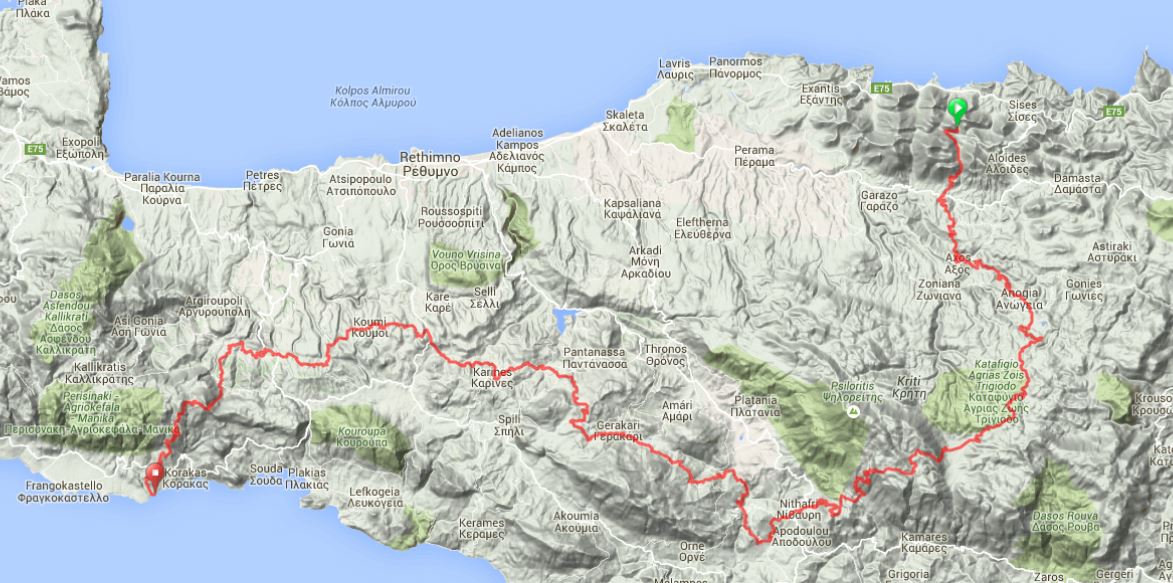
Before and after: Paddy, Ralph Stockbridge and others in Crete

One thing I must do sometime is to take a trip to Edinburgh to visit Paddy’s archive at the National Library of Scotland. In the meantime I am very lucky to receive emails from time to time from Chris White (co-editor of Abducting a General) and it always pleases me to be able to share these with you. Chris has sent some more before and after photos from Crete.

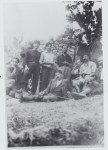
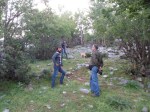
I was visiting the PLF Archive in April and came across these photos ………..they were taken at a sheepfold called Korakopetra above Anogia – probably in May 1943, and feature – in the group photo – PLF and Ralph Stockbridge (slightly behind PLF on the right, wearing glasses) surrounded by Mihali Xylouris and members of his band. It was at this location at around this time that PLF accidentally killed his great friend Yanni Tsangarakis (described in ‘Abducting A General’ and Artemis’ biography).

Peter and I tracked down the sheepfold last year and I revisited there in May of this year with a Cretan historian called Costas Mamalakis.

Related articles:

Ralph Stockbridge obituary.

Leaving Kastamonitsa for the kidnap – before and after pictures

Print

Dervla Murphy: ‘Older travellers are now more intrepid than the young’

Dervla Murphy

This makes great reading for those of us who are growing old, or who wish to grow old, disgracefully! Perhaps it is actually gracefully?

by Dervla Murphy

First published in the Telegraph, 23 September 2015

In her late 30s, Jane Austen serenely prepared for imminent middle age and soon was dressing as a maiden aunt with no hope of losing her maidenhood. Yet many of her relatives and friends lived energetically into their 80s and 90s; so why, 200 years ago, was middle age allowed to take over at 40? Was the bible to blame?

Until recently, its general prognosis seemed realistic: three-score years and 10, if you were lucky. My own generation took this ration so much for granted that I now feel absurdly smug about being 13 years into overtime. True, these last few years have revealed several tiresome worn parts, but the underlying logic here – that all machines wear out – makes restricted physical activity seem tolerable. And this despite the fact that the wanderlust, unlike other lusts, does not diminish with age.

For this reason I always feel one should avoid, for as long as possible, casual visits to the doctor. He/she is too likely to take blood samples, diagnose problems you haven’t yet noticed, prescribe medicines that benefit only Big Pharma and advise you not to go where you want to go.

In 1992, when I decided to cycle from Nairobi to Cape Town, my family and friends made no comment; it was the sort of thing Dervla did. Only a few anxious acquaintances, and sceptical interviewing journalists, drew my attention to the fact that I was 61; it wasn’t yet trendy to witter on about “40 being 60” and “80 being 60”.
In fact, ever since the bicycle was invented, cyclists have kept pedalling into their old age. Quite often one hears of grannies and grandads cycling across the United States or Canada, or from Helsinki to Gibraltar, or from Mexico to Patagonia. That’s the convenient thing about non-competitive cycling (or walking): the more of it you do, on a daily basis, the longer you can keep doing it.

Before affluence hit Ireland, many GAA (Gaelic Athletic Association) fans from my home town of Lismore thought nothing of cycling over the Knockmealdown mountains, on bicycles without gears, to an important hurling match in Thurles. They set out at sunrise and arrived home in the summer dusk having pedalled 120 miles. Now their grandchildren motor to fetch the milk from the corner.

Read the entire article here.

Audible

Painting the John Murray archive

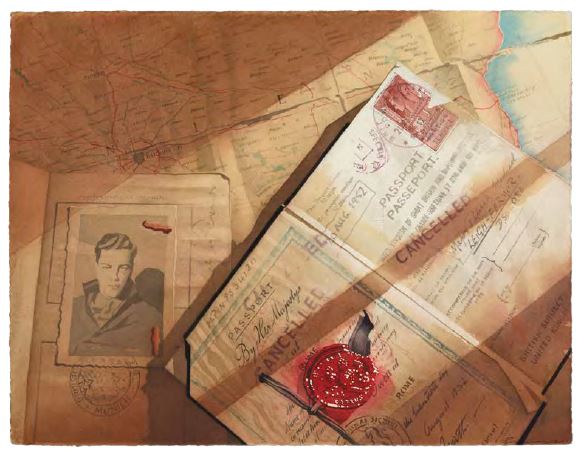
Buchannan PaddyIn January’s report on the presentation by David McClay, the curator of the John Murray archive at the National Library of Scotland, I mentioned an exhibition of watercolours by Hugh Buchannan which is now moving to the John Martin Gallery in Albemarle Street from 18 September.

Buchannan’s paintings include details from a wide range of author material included within the archive from Byron, Austin, Sir Walter Scott, Irving and of course Paddy’s legacy.

The exhibition runs from 18 September to 10 October 2015 at the John Martin Gallery, 38 Albemarle St, London, W1S 4JG. Further details here.

You can download the catalogue as a pdf here.

Audible

Walks amid the watchtowers of the Mani

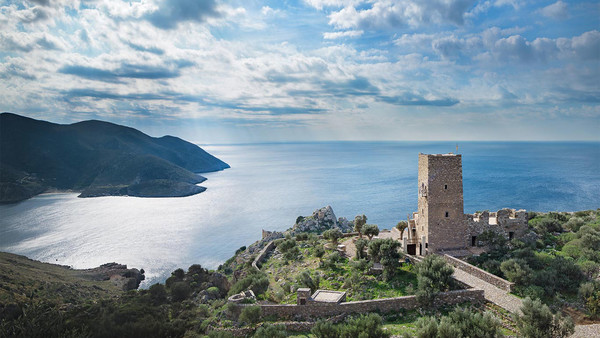
An early 19th-century watchtower, now the Tainaron Blue Retreat guesthouse, overlooking the coastline of Cape Matapan

The most recent of quite a number of articles about visiting the Mani that I have seen of late. This being the best, written by William Dalrymple.

First published in the Financial Times, 28 August 2015.

I first came to the Mani through the pages of my literary hero and travel writing guru, Patrick Leigh Fermor. Paddy, who was once described by the BBC as a “cross between Indiana Jones, James Bond and Graham Greene”, published Mani: Travels in the Southern Peloponnese, in 1958. It was the first non-fiction book he wrote about Greece, and in many ways it is his most passionate: a love song to the middle prong of the trident-shaped southern coast of the Peloponnese. This was the place where he had been happiest, and the destination he would eventually pick in which to settle down, and spend the final years of his life.

For Paddy, the Ottoman Mani was to Greece what Cornwall was to 18th-century Britain: the most remote of places, cut off from the rest of the country by distance, unpredictable tides and wild cliffs, the abode of brave brigands, chivalrous smugglers and gentleman pirates. It was, he liked to point out, the southernmost point of mainland Greece: only a few islands intervene between Cape Matapan, the tip of the peninsula and location of the cave which the ancients believed to be the Mouth of Hades, and the shoreline of north Africa.

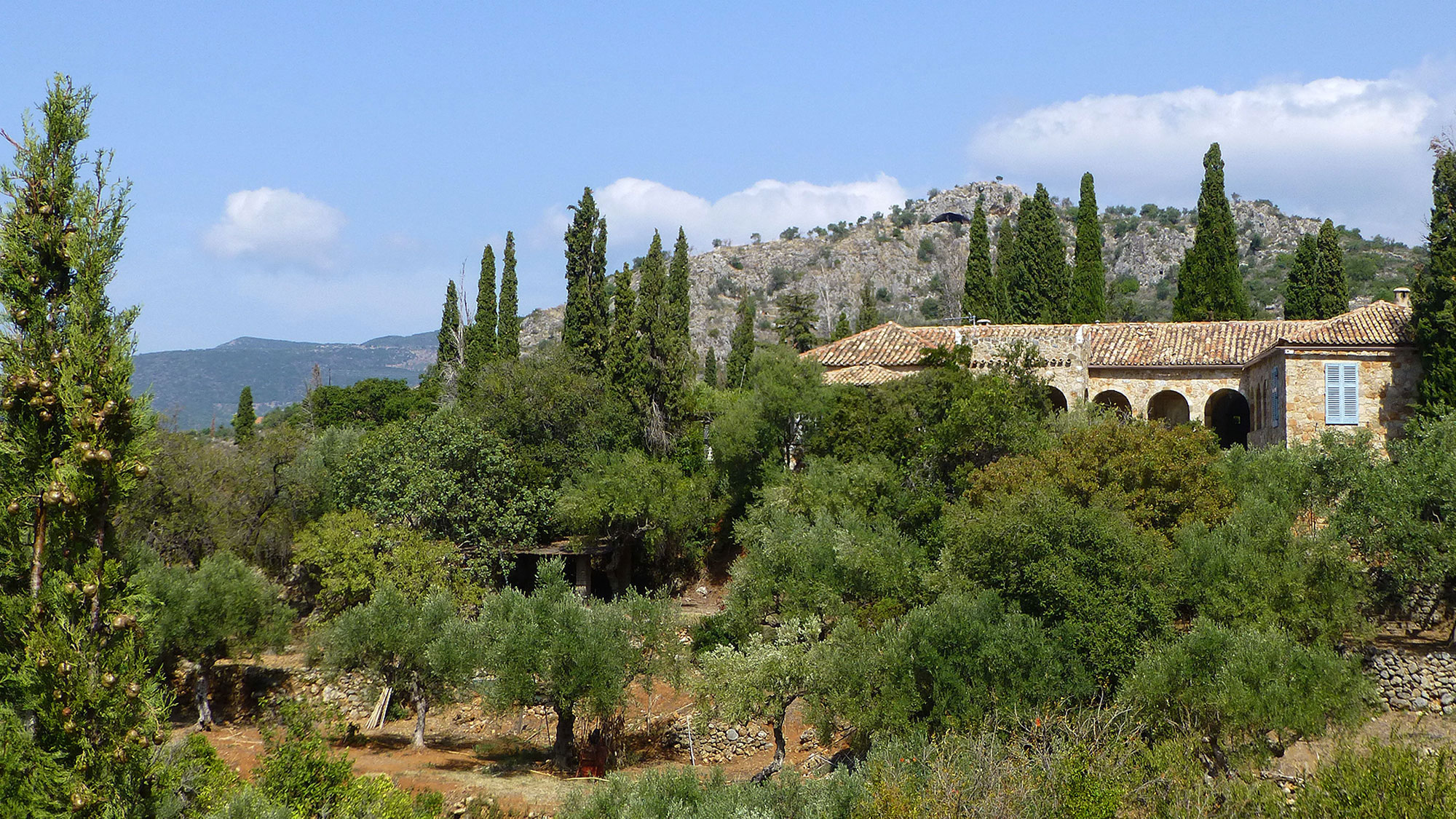
Many years later, shortly before his death in 2011, I went to stay with Paddy at the house he built in the Maniot village of Kardamyli. His villa was the most perfect writer’s house I have ever seen, designed and partly built by the man himself in an olive grove a mile outside the town, and with a view out to a small coastal island. Each morning, until a heart bypass prevented him, he would swim around the island, before returning home for breakfast.

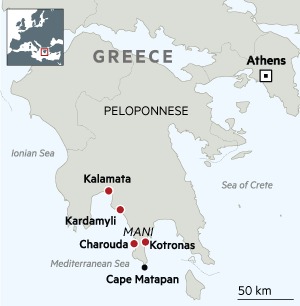
Since Paddy’s death, however, the house has been given to the Benaki museum in Athens, and on my most recent visit I could only drive past it with a melancholic wave. Instead I headed on a further 90 minutes southwards, past tavernas hung with vine trellising, past chapels with red pepper pot domes, through stripfields and a patchwork of walled olive groves. These lower slopes rose to steep and arid hilltops, and it was on one of these, above the whitewashed village of Kotronas, that lay the beautiful house where I would be staying. It dominated a blue, mirror-like bay on the south-east coast of the peninsula and it was here, watching the ships come and go below, and with the mountains rising on all sides, that I planned a succession of treks into the deep Mani to see for myself the landscapes that Paddy had described so lovingly in his book.
To my surprise, the more I walked in the cactus-haunted hills, through spires of yellow verbascum and the seed heads of dried grasses as straight as miniature cedar trees, the more I found that the wildness of the Mani reminded me less of the bucolic Mediterranean than the bleakly beautiful mountains of the north-west frontier of Pakistan. For both the turbulent Maniots and the Pashtuns have an ancient tradition of blood feuds, which has led them to live in the fortified towers that are still the dominant architectural feature of their regions. In both, every man is a chieftain, and every farm a fort.
Tourism bounces back

“In these contests,” wrote Paddy, “the first blow was never struck without warning. War was formally declared by the challenging side. The church bells were rung: We are enemies! Beware! Then both sides would take to their towers, the war was on, and any means of destroying the other side was fair.” These included, apparently “bombarding them from above with boulders and smashing their marble roofs; so the towers began to grow, each in turn, during periods of truce, calling his neighbour’s bluff with yet another storey.” Paddy was fascinated by the proximity of the combatants in these feuds, “the equivalent, in distance, of the cannonading of Brooks’s by White’s, Chatham House by the London Library . . . or of the Athenaeum and the Reform by the Travellers’.”

There was apparently only one thing that could reconcile the warring hamlets of the Maniots: “a Turkish inroad, when, suddenly, for brief idyllic periods of internal harmony, their long guns would all point the same way.”

Such a moment came in 1826 when the Ottoman commander Ibrahim Pasha arrived, intent on crushing the resistance of the most independent-minded of all the Sultan’s Greek subjects. From the point of view of the Sublime Porte, the Maniots were merely pirates and brigands, and a thorn in the flesh of honest Turkish shipping going about its business in the Mediterranean. The Maniots had a rather different view of themselves: as the flower of Hellenic chivalry and the last pure-blooded descendants of both the ancient kings of Sparta and the emperors of Byzantium. Both sides were spoiling for a fight; and they got it.

To block Ibrahim’s advance, the Maniots concentrated their forces at Verga, the entrance to the desolate passes of the Taygetus mountains, in the extreme north of the region. Ibrahim therefore decided instead to launch a surprise marine attack on Areopolis, far to the south, which the patriots had left undefended. Ibrahim successfully landed 1,500 Egyptian troops on the shingle beaches in Diros Bay, south of Kardamyli, a magnificent natural cauldron where the peaks of Taygetus dip down to the blue waters of the Aegean, so clear, even today, that it is said you can still see the wrecks of galleys lying on the seabed below. Soon the Ottoman troops were marching inland, up the coastal paths, looting as they went, and heading for the walls of Areopolis.

Ibrahim Pasha had achieved complete surprise; but he had not taken the women of the Mani into his calculations. As the church bells pealed from their Byzantine belfries, several hundred women who had been out in the fields harvesting converged on the Ottoman rear with their sickles and farm instruments. In an indignant song still sung in the region, the woman allegedly declaimed:

O Turkish men, have you no shame
To war with womenfolk?
We are alone, our men are gone
To fight at Almiro.
But we with sickles in our hands
Will lop off your heads like corn!

Within a few hours, those Egyptians who lived to tell the tale were running headlong for their boats. Only a third were rescued; the rest fell where they stood on the beach. That, at least, is the version of the story they tell today in the Mani.

Modern travellers to the region may end up feeling a certain sneaking sympathy with the Egyptians; for the descendants of those feisty Maniot women are still alive and well, and today they guard the keys to their village churches as determinedly as they once defended Areopolis. As Paddy knew, and wrote about so beautifully, the Mani contains some of the most ancient and Byzantine chapels and basilicas in Greece, dotted around olive groves above steep coastal cliffs; but any traveller who wants to get inside and see their celebrated frescoes must first find the guardian grannies who keep the keys, and then persuade them to disgorge them and to let you into their carefully tended holy places.

Watchtowers in the town of Vathia

Watchtowers in the town of Vathia

This can be more difficult than it sounds. On one occasion, trying to get inside the famed 11th-century church of the Taxiarches at Charouda, I was directed to the door of Antonia, a black-clad matriarch in widow’s weeds who looked so ancient she could almost have lost her husband to Ibrahim Pasha’s Egyptians. Yes, she said, with deep suspicion in her voice, she did hold the keys, but no, this was the time of her lunch. I should come back in an hour. I did as I was bid, only to find she was taking her siesta. Deciding to walk along the coast until she woke, I returned only to be told she was unable to take me to the church as she was feeding her great-grandchildren. Then she was putting out fodder for her donkeys: wouldn’t I like to come back tomorrow morning?

It was well past 7pm when, after a lot of begging and pleading, a huge primeval key was finally, reluctantly flourished and I followed the bent-backed matriarch to the church on the edge of the village. The sun was now slowly sinking over the hills at the end of a hot day; from the higher slopes, the tinkle of unseen goat bells cut through the background whirr of cicadas as shepherds led the flocks back for their night.

The church — in truth it was barely larger than a chapel — was very small, but very beautiful. It had a domed, tiled roof and round arcaded windows, whose brick tiles were made from fired red mud. It lay in a rocky graveyard dotted with oleanders and ilexes at the edge of olive groves, and was built from stone the colour of halloumi cheese. Only when Antonia finally ground the key in the wards of the ancient lock, and had crossed herself several times, was I allowed to step inside.

Nothing prepares you for the darkly melancholic and baleful beauty of the wall paintings of the Mani churches; but remote as it is, the church of the Taxiarches at Charouda is especially fine. The anonymous painter had a particular quirk of giving some of the saints a black triangular lower eyelid. The intention seem to be to enhance their gaunt asceticism and melancholic sadness, but I thought it gave them a look oddly like the buffoonish Pierrot in the Commedia dell ’Arte.

A grim-faced Christ Pantocrator glowers down from the decorative brickwork of the dome, hands opened and upheld as if in surprise at the wonders of his own creation. Below him, ranks of cherubim and seraphim stand with their wings raised. A phalanx of prophets line the lower drum; nearby stylites preach from pillars; and patriarchs in monochrome vestments like Malevich abstracts grip their bibles and proudly display the instruments of their martyrdom. More martyrs have their flesh ripped and eyes gouged out over the walls of the nave, the background landscapes to both virgins and saints as high and mountainously craggy as the Taygetus themselves, the men and the jagged rocks of the mountains sharing a clear affinity, and a similar angularity.

The most beautiful images of all lay at the west end, near the porch where the matriarch Antonia still stood silhouetted by the last rays of the sun. That light, reflecting off the foot-polished stone floor, illuminated a pair of youthful Byzantine soldiers: a young, swaggering St George astride his white charger, all glittering armour and levelled spear, while standing at ease slightly to his left, leaning on his javelin, was a swarthily beautiful St Demetrius with a glistening mail coat, a bow slung over his shoulder and sporting a single, rather dandyish earring; the very model of Maniot resistance to the encroachments of the outside world.

Looking both at Antonia, and the St Demetrius, it was no longer impossible to believe the old legends: that these remarkable, tough, independent Maniots really were the last descendants of Spartans who took refuge here when their hegemony beyond the Taygetus was finally destroyed, their struggle finally over.

Read more about where William Dalrymple stayed here.

Audible

Xan Fielding – the Armenian cousin of Vivien Leigh

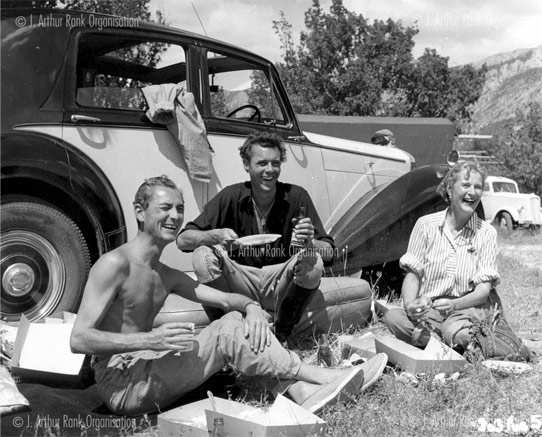
Xan and Daphne Fielding with Dirk Bogarde on the set of Ill Met by Moonlight

Xan and Daphne Fielding with Dirk Bogarde on the set of Ill Met by Moonlight

Running the blog I am very fortunate to have all sorts of people get in touch with me about a whole range of interesting subjects. Few however can be so detailed, well researched and fascinating as Liz Chater’s site which is dedicated to research about the Armenian diaspora to India, and related matters. In this latest article on her website, Liz explores the truth behind Vivien Leigh’s Armenian heritage and then goes on to uncover some fascinating facts about Xan Fielding’s family who also have an Armenian background. Liz has also traced the Anglicisation of his surname from the Germanic Feilmann to Fielding. The following is a series of excerpts from the article on Liz’s site which can be visited here and includes many digital copies of original documents.

From Liz Chater’s website Chater Genealogy

I want to touch on the lives of Vivien’s cousins, and one in particular, Alexander Fielding-Wallace aka ‘Xan’ Fielding (above). Whereas Vivien had loving and devoted parents, her cousin Alexander ‘Xan’ never got to know his parents, his early start in life was beset with tragedy. Knowledge of the cousin connection between Vivien and Alexander has diminished with the passing of time, there are very few who mention his Armenian ancestors or those individuals he had in common with Vivien.

‘Xan’ was officially named and baptised Alexander Percival Feilman Wallace, he was born on the 26th November 1918. Seven days later he was baptised at the Sacred Heart Church In Ootacamond, India. In fact Alexander was baptised twice, the second occasion was on the 18 February 1919at the Catholic Church Middleton Street, Calcutta in the name of Fielding-Wallace. I can only speculate about why he was baptised on a second occasion but I cannot help wonder if it was directly connected to the process of becoming a member of the Feilman family and how he eventually ended up using the name of Fielding. This will become clearer a little further on in the blog.

Ten days after his baptism, his mother Mary Wallace (nee Feilmann) died on the 13th December 1918 in Ootacamond from fever.

The weeks and months that followed on from the death of Mary were to shape the life of Alexander forever.

Alexander’s father Major Alexander James Lumsden Wallace had a deep Scottish heritage. Born in Kirkcaldy in 1889 the name Alexander served four consecutive generations as a Christian name. A great deal of the Wallace family history can be found on the internet on various genealogy websites including many connecting records on Scotlandspeople.com.

Alexander Senior, for whatever reason, be it grief or the realisation that as young widower and an Army Captain he (later became a Major) was not in a position to bring up such a young baby, appears to relinquish all parental responsibility for the young Alexander. Ironically, Alexander Wallace (sr) remarried in London in 1925 to Marjorie Evelyn Hime. He retrained as a barrister in 1927 successfully passing the Hilary examination of students of the Inns of Court held in Middle Temple Hall in December 1926. In March 1927 he passed the Easter exams held in Inner Temple Hall, and passed his final Bar exams in December 1928. He and Marjorie can be found living briefly with her parents Walter and Florence Hime in Hampstead in 1929, by then they had a 5 year old little girl, Margaret Xanne Wallace, she would have been a half sister to Xan. Alexander and Marjorie’s marriage didn’t last and by the middle of the 1930s they had separated and presumably they divorced. He married for a 3rd time in 1944, passing away on the 19th November 1966 in Hampstead. I can find no evidence that young Alexander had any contact with his father, half sister or two stepmothers.

After the death of Alexander’s mother Mary Gertrude in 1918, he was effectively scooped up by her Feilmann/Fielding parents and into their still growing family. Suddenly Alexander’s uncles and aunts (brothers and sisters to his mother Mary Gertrude) became his brothers and sisters. According to Hugo Vickers in his biography of Vivien Leigh “…Xan was raised for eight years in the belief that he was the son of his grandparents…”

It must have been quite a shock to him to find out that the children he thought were brothers and sisters weren’t.

Alexander’s grandparents Percival Maurice David Feilmann and Mary Patricia nee Yackjee were just as keen as Vivien’s parents Ernest Richard Hartley and Gertrude Mary Yackjee to remove themselves from India back to England so they could offer their children and their grandchild the opportunities they would not have access to if they stayed in India.

Perhaps influenced by his grandfather and his uncles (more on them later in the blog), after joining the British Army, ‘Xan’ Fielding went on to become a wartime secret agent, writer and translator as well as serving as a Special Operations Executive in the British Army in Crete, France and the Far East. Lengthy biographical information has been written by author Patrick Leigh Furmor, although Alexander’s Indian Armenian family history has been overlooked. A blog by Tom Sawford on Patrick Leigh Furmor’s findings with references to Xan fielding can be found here

Alexander ‘Xan’ fielding married twice, his second marriage was to reconnect him with his own Armenian heritage because he married the widow of renowned Armenian artist Arshile Gorky, she was Agnes ‘Mougouch’ Magruder, her obituary can be read here.

Although Mougouch was not Armenian, her connection to an Armenian, and Alexander’s own Armenian links to India were perhaps a psychological tie to the ancestors of his grandmother. The connection would not have been lost on Xan, but the subtly of it has long gone for the modern-day enquirer searching out his story, but it is one that the Armenian community of today will enjoy and perhaps be a little surprised at too.
Percy Feilmann’s Anglicising to Fielding

Again, stepping sideways for a moment in this story of Armenian ancestry, and Vivien Leigh and her cousins, I want to turn now to the Feilmann name. Although not directly connected to Vivien Leigh they would have been an enormous support to her mother Gertrude when her own father died. It goes a little way to explaining how, with some astute forward thinking, Xan’s grandfather Percy Feilmann (Vivien’s uncle) and his family went from being German Jews from Hamburg to accepted members of colonial society in India and England as well as the South of France. How exactly did Alexander Percival Feilmann Wallace aka ‘Xan’ end up with the surname Fielding and also having his Armenian heritage set aside, just as his cousin Vivien’s Armenian heritage had been?

We have already seen the evidence of Xan being baptised twice, once in the name of his birth father Wallace, and secondly in a subtle shift to the double-barrelled surname of Fielding-Wallace. The name of Feilmann in Calcutta was synonymous with the animal hide and tannery business.[13] Hugo Vickers in his biography of Vivien Leigh described Percival Feilmann as a “box-wallah” i.e. a travelling salesman or merchant. This is incorrect, in fact Percy was involved with the tanning business, an area his uncle Maurice Feilmann was also involved in. They regularly exported raw hides to Europe, which were then made into shoes, bags, rugs and other items. It was Vivien’s uncle by marriage Ernest Lehmann who had married Vivien’s aunt Agnes (Gertrude’s sister) in 1898 in Darjeeling that was an agent of wooden boxes and chemical remedies.

As I looked into the Feilmann name and in particular the background of Alexander’s grandfather Percival Feilmann/Fielding I made some fascinating, if a little disturbing discoveries. Firstly, his full name was Percival Maurice David Feilmann[14] born in Hamburg on the 27th September 1864[15] according to the naturalisation document of “doubtful origin”, meaning that although his father John Bernhard Feilmann was born and brought up in Germany, Percy strongly maintained that his father had been naturalised as a British Subject, purely on hearsay no proof was ever remitted to this effect. Other independent records suggest that the Feilmann’s had a Jewish German family history. As remarkable as ‘Xan’ was during his lifetime, so indeed was his grandfather. Percy underwent the most unusual step of acquiring naturalisation as a British subject THREE TIMES during his lifetime each with a distinct ruthless calculation to erase anything German from his background. According to official records, the first application was made in India in 1905. Unfortunately there are no copies available of the 1905 certificate, but there are for the other two.

The next in 1916 and lastly in 1919 he was again granted naturalisation as a British subject.

Percy’s Special Naturalization Certificate was granted in India by the Governor General and he swore Allegiance to His Majesty King George 5th on the 6th November 1919 when his application was finalised. His naturalization application stated his parents were John aka Julius Bernhard Feilmann and Caroline Farlow, both British subjects. Although Julius is likely to have also been born in Germany he must have also applied for Naturalisation, although I haven’t been able to locate it yet (and having read Percy’s file, I am in some doubt as to whether Julius really was ever a naturalised British citizen). John and Caroline had married in Calcutta in 1855[16] and had at least 8 children, 6 of whom were born in Calcutta, Percy and his sister Alicia were the only 2 who were not.

Feilmann’s Anglicising to Fielding

… In the 1919 application Percy Feilman in a clear contradiction to his signed and sworn affidavit of 1916 attempted to change his father’s nationality. He had effectively disowned and sold his late father down the river for 30 Rupees – which is what it cost to have the naturalisation certificate endorsed in India.

Xan Fielding would have learnt at the knee of a master manipulator the techniques he would use in later life on how to successfully play one side off against the other during the course of his career. His grandfather had successfully displayed such qualities and had no hesitation in lying and denying his own heritage. Percy cleverly manipulated the Indian Government authorities into granting him three naturalisation certificates just because he didn’t want his father listed as German. The erasure of his origins was the most important fact Percy needed to achieve. It makes one wonder exactly how he managed to pull off such an unusual act of administrative penmanship and who exactly he was on particularly friendly terms with to achieve such a collection of certificates. They were so readily agreed to in India but were looked upon with suspicion at the Home Office in London.

Read the full article with documents here.

Please consider supporting Wild Carpathia 4

Over seventy people have now backed the funding of the next Wild Carpathia film, White Carpathia, and many came from this site. They have pledged over £9,000, but much more is needed to meet the target of £50,000 over the 25 days left for fundraising.

As we saw with the shooting of Cecil the Lion in Zimbabwe in July, wildlife and habitats all over the world are in danger from thieves, poachers, corrupt officials, and frankly the rich trying to enrich themselves even further or taking what they think they can buy. This is our collective heritage and no-one has the right to take it away from us. The countryside of Romania, and the Carpathians in particular which are rich in native trees and wildlife including wolves, European bear, lynx and deer, are true gems with a complex eco-system which need to be preserved and managed to provide income for local people. What is happening there now with the illegal destruction of the pristine forest is not management but rape.  It is theft, aided and abetted by corrupt officials and locals who just need a job.

Please consider giving something to this cause to ensure that the film is made, which can only add to the common understanding of the the beauty and value of this land that Paddy loved possibly even more than Greece. Raising awareness leads to raised pressure on politicians and authorities to do more. A small donation now may make a big difference.

You can pledge anything from a few pounds to as much as you like at the Kickstarter site here. Thank you.

Read more here.

An award in memory of William Stanley Moss at University of Crete

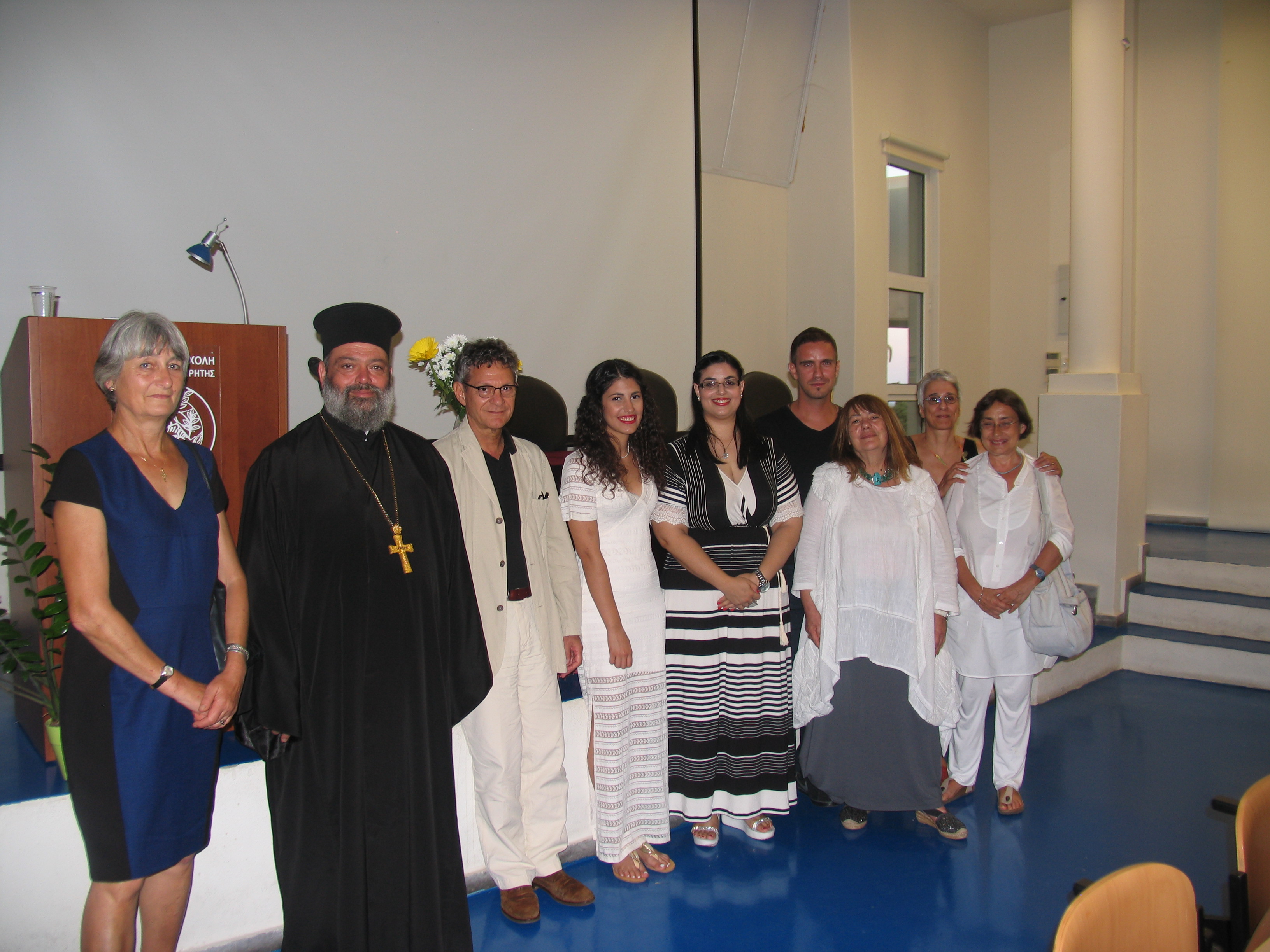
Gabriella Bullock (Left) and guests at the inaugural awards 21 July 2015

Gabriella Bullock (Left) and guests at the inaugural awards 21 July 2015

In July, Gabriella Bullock, one of “Billy” Moss’ daughters, travelled to Crete with her husband Hugh to present the inaugural prize in Billy’s memory at the University of Crete in Rehtymnon. The annual William Stanley Moss award is open to graduate students of the Faculty of Philosophy studying the subjects of Philology, History and Archaeology.

Gabriella is funding the award from royalties of her father’s books as an expression of gratitude and debt to the Cretan people on behalf of her father. She described the whole experience as ‘very moving, very dignified and warm and emotional for everyone.’

The ceremony on 21 July was attended by the Metropolitan of Rethymno and Avlopotamos the Reverend Nicholas Nikiforakis, the Rector Euripides C. Stephen, the Dean of the Faculty of Philosophy Lucia Athanassakis, the Dean of the School of Education Anthony Chourdakis, the Chairman of the Department of Literature Angela Kastrinaki the President of Department of History and Archaeology Antonia Kiousopoulou, Emeritus Professor Anastasios Nikolaidis, Professors of academic departments of the University of Crete, Foundation staff and students.

Gabriella and Hugh went on to deliver talks in Anogeia and Patsos where they met many relatives of those who worked with Billy and Paddy in those desperate days of the war.

Upcoming PLF Society events

A couple of dates for your diary from the PLF Society. A daughter and dad act for the autumn.

Patrick Leigh Fermor in Greece – Artemis Cooper

DATE: Tuesday 8th September 2015 TIME: 7:15pm

LOCATION: Great Hall, Hellenic Centre, 16-18 Paddington St, London W1U 5AS

RSVP info@patrickleighfermorsociety.org

Paddy’s World – John Julius Norwich

John Julius Norwich is patron of the Patrick Leigh Fermor Society and knew PLF for more than fifty years.

DATE: Tuesday 10th November 2015 TIME: 7:15pm

LOCATION: Great Hall, Hellenic Centre, 16-18 Paddington St, London W1U 5AS

RSVP info@patrickleighfermorsociety.org


Why (some of) the Most Popular Hiking Memoirs Don’t Go the Distance

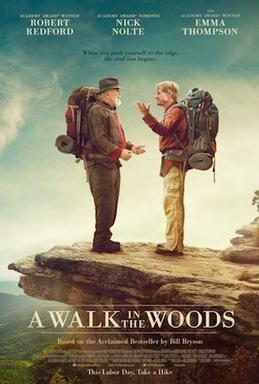
Whilst I find Bill Bryson amusing, his, possibly contrived, whimsey would probably get on my nerves if I read too much of him. I have never read A Walk in the Woods: Rediscovering America on the Appalachian Trail, but I have sometimes thought how it must be to walk it. During my Camino to Santiago de Compostela I walked for some days with a guy who had done it three times; he was all at once a loner but at the same time he craved company. I guess that you really do have to be a loner to walk all 2,200 miles of the Appalachian Trail. I thought that you might find this article interesting, and it may whet your appetite for watching the movie of the book (walking movies are all the rage) which stars Robert Redford and Nick Nolte, due for release 2 September.
By Robert Moor

First published in the New Yorker, 21 August 2015

When I was eighteen, I bought a copy of Bill Bryson’s A Walk in the Woods: Rediscovering America on the Appalachian Trail which remains, if my conversations with strangers are any indication, the only book anyone has ever read about the Appalachian Trail. It was summer. My friend Andy and I had driven across the country and ended up in the town of Sheridan, Wyoming, where we stayed for a week with a genial middle-aged couple, family friends of my friend. Scanning my hosts’ bookshelves, as I have a tendency to do, I was quietly horrified to discover that they were exclusively stocked with works of pop evangelicalism (Rick Warren and the like). It was a literary desert: xeric, Mosaic. Bryson’s book was the only one I’d brought, so, while Andy rode dirt bikes with a guy named Dusty, I lay on a fold-out couch in the basement, consuming it in controlled bursts, as if bolting food rations.

I had dreamed of hiking the Appalachian Trail since I was ten years old. From Bryson’s wry, well-researched account, I began to learn how it would feel to walk through two thousand miles of mountainous wilderness. What stood out most were the descriptions of “tranquil tedium,” a seemingly endless trudge through the “cubic” vastness of deep woods. “At times,” he writes, “you become almost certain that you slabbed this hillside three days ago, crossed this stream yesterday, clambered over this fallen tree at least twice today already. But most of the time you don’t think. No point. Instead, you exist in a kind of mobile Zen mode, your brain like a balloon tethered with string, accompanying but not actually part of the body below. Walking for hours and miles becomes as automatic, as unremarkable, as breathing.”

Around page one hundred, I reached the passage where Bryson and his hiking partner study a wall-map of the trail in an outdoors store, in Gatlinburg, and, overcome by the sight of how little of it they had already walked, decide to skip the state of North Carolina and drive to Virginia. I let out a howl of indignation and threw the book against the wall. But, needing to know how the book ended, I picked it back up again. I repeated the cycle (howl, throw, retrieve) when Bryson decided to skip the northern portion of Virginia and just drive up the trail, taking hikes here and there, and again when he quit a quarter of the way through the Hundred-Mile Wilderness, at which point he concludes, defiantly, “I don’t care what anybody says. We hiked the Appalachian Trail.”

There, in that basement, I resolved that one day I would hike the trail the right way: from end to end, in one continuous trip—what’s often called a “thru-hike,” always with that peculiar, abridged spelling, otherwise reserved for fast-food signage and nineteenth-century poetry.

I eventually did so, in 2009. It was roughly how Bryson described it: long, hard, and monotonous, but also beautiful and enlightening and wonderfully (and then, later, worryingly) slimming. While hiking the trail, I learned that whenever a thru-hiker met a day-hiker (as thru-hikers somewhat dismissively refer to those who are “just out for the day”), the day-hiker would invariably ask the same question: “Have you read ‘A Walk in the Woods’?”

Many thru-hikers bristle at this question. By quitting in Gatlinburg and then hop-skipping up the trail, Bryson bastardized the central conceit of a thru-hike, which is that you hike through—through mountains and valleys, through farms and small towns, through pain, through hunger, through nagging doubt. For thru-hikers, the continuity is the point, in the same way that running a marathon is more meaningful than running four separate 6.5-mile races. Certain thru-hikers, referred to as “purists,” take this emphasis on continuity to obsessive lengths. Some touch or kiss every blaze of white paint along the trail, while others carefully line up their shoes, like Japanese slippers, in the precise spot they entered a lean-to, so as to know exactly where to resume hiking the next day.

Bryson thus finds himself in the curious position of being both the outward face of the Appalachian Trail and its most inwardly mocked figure. This discrepancy will likely intensify when the film version of the book, starring Robert Redford and Nick Nolte, premières on September 2nd. I gather that some people who have thru-hiked the Pacific Crest Trail feel similarly about “Wild,” Cheryl Strayed’s best-selling hiking-memoir-turned-feature-film about hiking one third of the P.C.T. There is also the curious case of Paulo Coelho, the author of, among other books, “The Pilgrimage,” a best-selling account of walking the Camino de Santiago de Compostela, the famed network of pilgrimage routes across Spain (and beyond). Coelho quit in the town of O Cebreiro, some hundred miles short of his destination, and then rode in a bus to Santiago de Compostela. According to a profile of Coelho published in this magazine in 2007, the proprietor of a hotel along the Camino told Coelho that his book had done wonders for his business. “As Hemingway was for San Fermín, you are for the pilgrimage!” he exclaimed.

The question arises: why are the three most famous accounts of hiking three of the world’s most famous long-distance trails written by people who did not hike the whole distance?

One obvious answer: great writers are simply less athletic than your average human. But this theory crumbles upon closer inspection. John Muir walked a thousand miles, from Kentucky to the Gulf of Mexico, while Vachel Lindsay walked from Illinois to New Mexico, Matsuo Bashō walked the length of Honshu and back, Rory Stewart walked across the mountains of South Asia, Robyn Davidson walked across Australia, and Patrick Leigh Fermor walked across Europe.

In fact, I would argue that the loneliness and skull-bound nature of a long-distance hike fits quite nicely with the thinking out, if not the actual writing, of books. The dusty back aisles of Amazon are glutted with first-person accounts of successful thru-hikes, most of which tend to be buffed-up re-writes of the author’s trail journal. These books have a limited audience (namely, other thru-hikers), whereas the books that become best-sellers speak to people who would never embark on a long-distance hike in the first place. “A book about hiking the Appalachian Trail? Spare me. I could imagine it: We walked. We saw trees. We went up. We went down,” snarked a 1998 article in the New York Times, before praising the many charms of Bryson’s book.

The rare best-sellers leap this pitfall by hitching onto other well-established genres: Bryson’s is a humorous travelogue, Strayed’s a memoir about healing, and Coelho’s a quest novel. They also avoid the doldrums of strict, day-by-day linear storytelling. Instead, Bryson chunks his trip into discrete regions, drilling down into the history of each; Strayed pares the story back to a string of anecdotes, and then interweaves them with flashbacks from her rocky upbringing; and Coelho structures the walk around a series of spiritual “exercises”—battle a dog, climb a waterfall, raise a cross—assigned by his guide, Petrus. The reader is never tempted to skip ahead to see if the author finished the trek or not, because that has ceased to be the point.

Finally, all three narrators share the nervous, wide-eyed enthusiasm of a greenhorn. Reading the list of extraneous items that Bryson and Strayed packed for their thru-hikes—folding cutlery, a plastic dish, a spare gas bottle, four bandannas, a “big knife for killing bears and hillbillies”; a towel, binoculars, a foldable saw, a stainless-steel digging trowel, a metal votive-candle lantern, shampoo, conditioner, a hairbrush—made this minimalist’s teeth grind. But I imagine that a non-hiker might read that same list and think, “Oh wow, is that all? For four months?” Because they began in places of utter ineptitude and painfully ascended to the status of hardened veterans, Strayed, Bryson, and Coelho were able to fashion engaging emotional trajectories for their books. But that same lack of preparation and training made it exceedingly difficult for them to finish the trail, so they were ultimately forced to trim back their ambitions.

It has been twelve years since I last read A Walk in the Woods: Rediscovering America on the Appalachian Trail I picked it up once following my thru-hike, but I found I was too close to the material; I quibbled over every description, guffawed over every misstep. Recently, while working on my own book about trails, I picked up my old copy again. Reading it as a writer, rather than a hiker, it felt fresh. In a voice at turns erudite, acid, and tender, it somehow manages to provide a brisk overview of both the long history and the vast expanse of the trail. Bryson captures the alienating shift in perception that attends a return to civilization from an extended stay in the wilderness, and uses that weird lens to inspect the more grotesque aspects of American society. He manages to sound the depths of a lifelong friendship without becoming maudlin. And he ultimately succeeds in claiming a personal victory from an otherwise botched expedition. In the book’s concluding pages, he catalogues all he gained from his hike: “For a brief, proud period I was slender and fit. I gained a profound respect for the wilderness and nature and the benign dark power of woods. I understand now, in a way I never did before, the colossal scale of the world. I found patience and fortitude that I didn’t know I had. I discovered an America that millions of people scarcely know exists. I made a friend. I came home.”

In the end, as at the beginning, I found “A Walk in the Woods: Rediscovering America on the Appalachian Trail to be a delightful little book. Still, I don’t care what anybody, including the author, says: Bill Bryson did not hike the Appalachian Trail.

Buy A Walk in the Woods: Rediscovering America on the Appalachian Trail

Views of Dumbleton Church

Thank you to Brooke Rozorio for sending me these recent shots of Dumbleton church to share with you all.

Help to fund Wild Carpathia 4

After a glorious few weeks enjoying Italy, its food, landscape and sites, I am returned and will get some interesting posts up on the blog. First up is an appeal to help fund the fourth in the wonderful series Wild Carpathia which will be set in winter and called White Carpathia. Charlie Ottley and the crew are looking for £50,000 to produce the film expected to be released in summer 2016. If you love Romania as much as Paddy did (and I do) then please consider helping via the Kickstarter page where Charlie makes a very impassioned plea for your support surrounded by beautiful images of Romania. Together, let’s make this happen!

Here’s what Charlie says on Facebook:

Hello everyone and……help!. We need to make another Wild Carpathia urgently – to promote the beauty of Romania through the winter, and show the world what an amazing country this is, any time of the year, especially given recent bad press like The Romanians Are Coming on UK’s Channel Four. In light of further illegal logging and the recent scandal involving Schweighofer we must again highlight the plight of Europe’s last great forest.

We also need to protect the cultural heritage of Romania’s rural areas, by encouraging, Eco-tourism, sensitive development and modernisation. The film we must make to help do this, will be seen by millions of people across the world (the previous episodes had over 3 million hits online) and screened first on Romanian national television. We have half the money from foreign donors. Help us raise the other half so this can be a film for Romania by Romania, something we can all be proud of. Even a few euros each will make a big difference. And please forward this post. if you and your friends all contribute, we can make this happen – together. Click on the following link and go to our Kickstarter Campaign.

Enjoy the previous films here on You Tube.

Episode One: Wild Carpathia

Episode Two: From the Mountains to the Sea

Episode Three: Wild Forever

The reader’s guide to walking: Why we do it and what we think about it

Walking for pleasure … No, let me start again. Walking as a recreational activity dates only from the late 18th century. Prior to that human beings walked because they had to – either they were nomadic or walking was their only way of going on a necessary journey. The Wordsworth family were pioneers; William and his sister Dorothy ate up the miles around their home in Grasmere. To read Dorothy’s journals is to be flabbergasted by how much walking the pair did, most days, in all seasons, all weathers, walking for maybe three hours at a time, Dorothy in her ankle-length skirts, and often just for a cup of tea. The curious side to this is how often Dorothy reports one or both of them as “ill” – bowel problems it seems – they got the exercise right but not the diet.

by Gerard Windsor

First published in The Sydney Morning Herald, 18 July 2015

Yet the Wordsworths were primitives on the recreational walking scene; generally they went out their own front door and were home the same day. As the 19th century wore on and the railways opened up, walkers could select a protracted itinerary far from home. That sub-species of travel writing, the record of the walking tour, was born.

First among the writers were the now unread George Borrow, and the rather more read R. L. Stevenson with his 1879 Travels with a Donkey in the Cevennes​ (read not least because of its re-enactment by the young Richard Holmes in his 1985 Footsteps). The genre flourished in the 20th century – Hilaire Belloc’s The Path to Rome (1902), Eric Newby’s A Short Walk in the Hindu Kush (1958), Patrick Leigh Fermor​’s trilogy of his walk from the Hook of Holland to Istanbul between 1933 and 1935 … On and on they stride.

Walking of this kind is a rarefied activity, restricted to the better-off citizens of First World countries. Compulsory walking, the endless forced marches of pedestrian refugees, is as common as ever. And over the whole enterprise of walking hangs the armageddon imagined by Cormac McCarthy in The Road where there’s no alternative, if there’s to be any salvation at all, but to walk. For a man such as McCarthy, whose other fiction has been so equestrian centred, this pedestrianism is the ultimate degradation.

Meanwhile leisure walking is a snowballing business, and increasingly up for analysis. A Foucault scholar, Frederic Gros​, has given us A Philosophy of Walking, a fair example of the Gallic intellectual’s blend of non-sequential abstraction and soaring rhetoric.

Gros doesn’t actually let on whether he himself has so much as walked to the boulangerie, but he does micro-studies of prodigious walkers, notably Rimbaud and Nietzsche. Given that one gave up his poetical vocation for a career (highly unsuccessful) in trade, and the other went mad, I can’t unravel Gros’ argument. But he does make one striking point – walking is very monotonous but never boring. I think that’s a very French, and fair, sort of distinction.

Much more feet on the ground is Canadian Dan Rubinstein​’s Born to Walk, an encyclopaedia of the benefits of walking, scary to the delinquent and cheering to the virtuous.

It’s full of facts and the results of studies – sitting is the new smoking, the catastrophic plunge in the number of children walking to school is in inverse proportion to the rise in obesity levels, regular exercise in a park or forest will halve chances of developing a mental illness, Australian adults average 9700 steps each day while Americans only manage 5100, and there was an epidemic of the wonderfully named hysterical fugue, alias dromomania, alias compulsive wandering, in Europe in the late 1800s.

Rubinstein, who likes to walk in the snow, is earnest, and also very secular, so that he’s sniffy about pilgrimages. But they’re not to be sneezed at; the walk to Santiago de Compostela​ is engendering books on an industrial scale: pioneer producers included David Lodge (solid), Paulo Coelho​ (an acquired taste), Shirley MacLaine (nutty).

For many Santiago pilgrims the walk ends on the Galician coast, at Finisterre. So Land’s End in Cornwall is also a fitting terminus for a walk. The superb Yorkshire poet, Simon Armitage, recently elected the new Professor of Poetry at Oxford, spent three weeks on the road in 2013, starting from Porlock (of Coleridgean memory) in Somerset and following the South West Coast Path for 250 miles to Land’s End. (He actually went on to the Scilly Isles, but not being Jesus he had to take a boat, so Land’s End is where he stopped walking.)

He records the trip in Walking Away, a sequel to his Walking Home, an account of his 2010 walk along the Pennine Way, the spine of England. He ends his new book unequivocally: “I won’t be doing any more long walks.” Twenty pages earlier he records his father (a great bit part) phoning him and saying, “I think this will be your last long walk”. Armitage comments “it’s less of an observation and more of an instruction, issued partly out of concern for my skeletal structure and partly as a response to increased child care duties.”
I wouldn’t bet on either of them being right. For both walks Armitage arranged in advance to give a reading every evening, pass a capacious sock around at the end, and spend the night as a guest of the local organiser. The strategy works well, and so do the books. Not least because Armitage is a born humorist, particularly adept at recording (or maybe recreating) snatches of dialogue. At his last reading, on the island of Tresco, a woman asks if she can come up and read some of his work.

” ‘I don’t know if that’s a good idea,’ I say. ‘I’ll be good at it. I’m an auctioneer,’ she replies.”

Walking books rely on two staples – the trials and the encounters of the way (once upon a time these were combined – dragons, or giants). Armitage’s encounters are fleeting; his hosts for the night, locals who accompany him part of the way. His family pop up in cameo appearances and he is joined periodically by his oldest male friend, an apparently charming sponger known as Slug. There is also a beautifully delivered story about someone thanked in the Acknowledgements as “the hooded lady who propositioned me on the path between Clovelly and Hartland Quay”.

In all these encounters Armitage presents himself as reticent, but readily recording the topics of the garrulous. There is no suggestion of any conversations about emotional issues or the meaning of life. It’s that sort of book. In one way Armitage’s main encounter is with the landscape. A student of geography at university, he weaves precision of observation and naming with a poet’s unforced lyricism.

The second staple of the walking book are the trials. The grimmer the better. I can’t think of a greater masterpiece of the genre than Apsley Cherry-Garrard’s 1922 The Worst Journey in the World, his account of an ordeal that no human should have survived during Scott’s fatal expedition to the Antarctic. Beside this account anything else is a stroll, a doddle. Cherry-Garrard has permanent rights to his title.

For Armitage the Pennines were infinitely bleaker than the South Coast, the weather far worse, his chances of getting lost stronger, the likelihood of his giving up more immediate. This gives an edge and a tension to Walking Home that Walking Away lacks, but the pair are a treat, just the things to slip into for a winter hike, around the heater.

Gerard Windsor’s most recent book is Angels Before Me: The Road to Santiago. He is about to attempt the European Peace Walk from Vienna to Trieste

Nick Hunt shortlisted for Stanford Dolman Travel Book of the Year

award1Great news to see that Nick Hunt’s magnificent book, Walking the Woods and the Water, has been listed for the 2015 Stanford Dolman Travel Book of the Year. I guess there will be lots of comments about the strength of the competition but I am backing Nick to win. Let’s wish him the best of luck!

More about the award here. The Shortlist is:

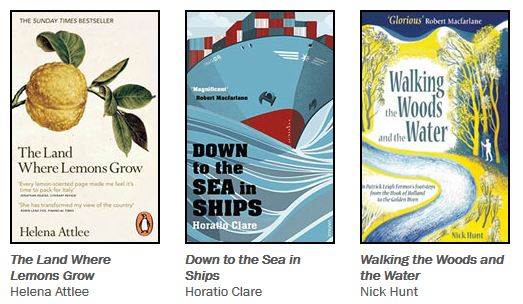
The Land Where Lemons Grow: The Story of Italy and its Citrus Fruit, Helena Attlee, Penguin (Penguin Random House)

Down To The Sea In Ships: Of Ageless Oceans and Modern Men, Horatio Clare, Vintage (Penguin Random House)

Walking the Woods and the Water: In Patrick Leigh Fermor’s footsteps from the Hook of Holland to the Golden Horn – A Time of Gifts, Between the Woods & the Water and The Broken Road, Nick Hunt, (Nicholas Brealey Publishing)

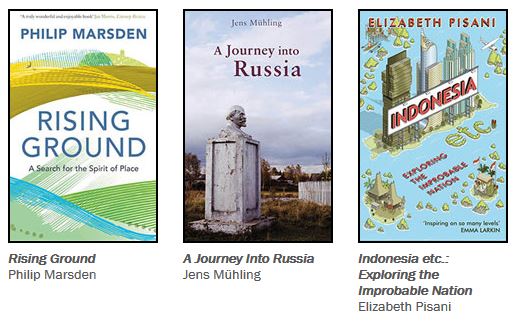
Rising Ground: A Search for the Spirit of Place, Philip Marsden, (Granta)

A Journey into Russia, Jens Mühling, (Haus Publishing)

Indonesia etc.: Exploring the Improbable Nation, Elizabeth Pisani, (Granta)

award2

In the footsteps of Marco Polo: the journey that changed William Dalrymple’s life

Taken from the introduction to the 25th anniversary edition of William Dalrymple’s first book In Xanadu: A Quest, and first published in The Spectator on 24 June 2015

At the end of the windy, rainy April of 1986, towards the end of my second year at university, I was on my way back to my room one evening, when I happened to trudge past my college notice board.

There my eyes fell on a bright yellow sheet of A4, headlined in capital letters THE GAILLARD LAPSLEY TRAVEL SCHOLARSHIP. It hadn’t been a good week. I was 21: broke, tired of revision for exams and already longing for the holidays. But stopping to look closer, I found that the notice was an announcement concerning a fund that had been established in the memory of some recently-deceased history don; its stated aim was to fund research travel for the college’s mediaeval historians. There were, I knew, barely a handful of mediaevalists in the college.

I walked straight over to the library, found a large quarto edition of The Times Atlas of World History and leafed through the pages to see what was the longest and most ambitious mediaeval journey I could think of following: the longer the trip, I figured, the larger the grant I could apply for.

An hour later I had typed out an application for an expedition to follow the outward journey of my childhood hero, Marco Polo, from Jerusalem to Kubla Khan’s Xanadu in Mongolia. The place names were the stuff of fantasy, and so, I felt sure, was the application. But I happened recently to have seen an article announcing that the Karakorum Highway linking Pakistan to China had just been opened to travellers. This meant that following Polo’s journey was technically feasible for the first time since the Soviet invasion had cut the hippy’s overland route a decade earlier. I posted the application in the letterbox of the don responsible, then went back to my revision and forgot all about it.

A month later, I was returning to my rooms from the last of the year-end exams when I found an embossed college envelope had been slipped under my door. Inside was a short letter and a cheque for the princely sum of £700: much the largest cheque anyone had ever written me. To my immense excitement, but also real foreboding, I found I had just committed myself to an enormously long and dangerous journey through a part of the world I was almost entirely ignorant about. To make matters worse, I had just been chucked by the girlfriend with whom I had planned to make the journey.

It was not a promising start; but the expedition which followed remains by far the most exhilarating I have ever undertaken: nothing I have done since, in half a lifetime of intense travel, has ever begun to equal the thrill of that 16,000-mile three month journey, walking, hitchhiking and bussing from one side of Asia the another. It was also a journey that, in a very real sense, changed my life forever.

I had already travelled in India, and the previous summer had hitchhiked from Scotland to Jerusalem following the route of the First Crusade. I read more widely still among the English travel writers, and Eric Newby, Bruce Chatwin, Peter Fleming, Patrick Leigh Fermor and especially Robert Byron were then my literary Gods, at whose altars I worshipped with an almost fundamentalist fervour. Now I was determined to write my own travel book, and from the first morning of the trip, on arrival in Jerusalem, I kept detailed notes with a view to producing a book that I wanted to be an updated homage to Robert Byron’s The Road to Oxiana, a text I loved so much and had read so often, that I knew great chunks of it by heart.

The result was In Xanadu: A Quest. The book, which was first published quarter of a century ago, in 1989, had a lucky reception. The early 1980’s was a time of disenchantment with the novel, and travel writing seemed to present a serious alternative to fiction. A writer could still use the techniques of the novel – to develop characters, select and tailor experience into a series of scenes and set pieces, arrange the action so as to give the narrative shape and momentum – yet what was being written about was true. Moreover, unlike most literary fiction, travel writing sold.

The success of Paul Theroux’s The Great Railway Bazaar, with its sales of 1.5m copies, had dramatically breathed life into the sort of travel memoir that had flourished in an earlier age, but which had languished since the European empires imploded after the Second World War. Its success inspired Bruce Chatwin to give up his job as a journalist and to go off to South America. The result – In Patagonia – was published in 1977, the same year Leigh Fermor produced A Time of Gifts. The final breakthrough came in 1984 with the publication of the celebrated travel writing issue of Granta: ‘Travel writing is undergoing a revival,’ wrote Bill Buford, the magazine’s editor, ‘evident not only in the busy reprinting of the travel classics, but in the staggering number of new travel writers emerging. Not since the 1930s has travel writing been so popular or so important.

So In Xanadu came out at just the right moment, when travel writing was at its most popular. Partly as a result of this lucky timing, the book got generous reviews, was an immediate bestseller and won a small clutch of prizes. It allowed me for the first time to think of writing as a feasible career. It nonetheless remains a text I have always felt deeply ambiguous about.

For In Xanadu records the impressions, prejudices and enthusiasms of a very young, naïve and deeply Anglocentric undergraduate. Indeed my 21 year old self – bumptious, cocky and self-confident, quick to judge and embarrassingly slow to hesitate before stereotyping entire nations – is a person I now feel mildly disapproving of: like some smugly self-important but charming nephew who you can’t quite disown, but feel like giving a good tight slap to, or at least cutting down to size, for his own good.

And yet this book brings back so very many happy memories. It retains, bottles and distills all the good humour, cheerfulness and joie de vivre of one of the very happiest periods of my life, a period when every day contained an adventure, a discovery or an epiphany. Re-reading it now, on the cusp of my 50th birthday, what was even more pleasurable than being reminded of forgotten places and adventures, was that sensation of recovering the raw intoxication of travel during a moment in life when time is endless, and deadlines, responsibilities and commitments are non-existent; when the constitution is elastic, and the optimism of youth undimmed; when experience is all you hope to achieve and when the world is laid out before you like a map, ready and waiting to be explored.

The great Swiss travel writer, Nicolas Bouvier, wrote that being on the road, ‘deprived of one’s usual setting, the customary routine stripped away like so much wrapping paper,’ reduces you, yet makes you at the same time more ‘open to curiosity, to intuition, to love at first sight… Travelling outgrows its motives. It soon proves sufficient in itself. You think you are making a trip, but soon it is making you—or unmaking you.’

For better or worse, In Xanadu made me. I am still with the editor who bought the book for Collins, Michael Fishwick: we have now worked on eight books together about the Middle East, and South and Central Asia – the world opened up for me by that 1986 journey. Shortly after it was published, I married my very charming flatmate, who had edited much of the manuscript, even though she was then working for finals. Together, we moved out to Delhi. She wanted to paint; I wanted to begin work on the book which became City of Djinns. Thirty years later, we’re still there, with three children, the eldest of whom is now herself at university, planning her own ambitious trips around the world.

I still see my two long suffering travelling companions. Lousia is now a skilled picture restorer, married a very handsome and rich young man, and they live in some style in the Anglo-Welsh marches south of Hay on Wye. Laura went on – to no one’s surprise – to become one of the country’s most successful – and formidable – businesswomen and pops up in the press every now and then having climbed some dizzying new corporate pinnacle.

Many of the countries we passed through have fared less happily. Syria, so hospitable to us, is now gripped by civil war and the Islamist anarchy of Isil. Pakistan, so thrillingly wild yet alluring then, is now a much more dangerous and tortured country than it was in the 1980s. Conversely, China – then a land of bicycles, Mao suits and tannoys blaring strident political slogans down every main street – has become the world’s newest economic superpower, something unimaginable at the time. So much has changed.

Travel writing has also changed. If travel writing used principally to be about place – about filling in the blanks of the map and describing remote places that few had seen – the best 21st-century travel writing is almost always about people: exploring the extraordinary diversity that still exists in the world beneath the veneer of globalisation. As Jonathan Raban memorably remarked: ‘Old travellers grumpily complain that travel is now dead and that the world is a suburb. They are quite wrong. Lulled by familiar resemblances between all the unimportant things, they miss the brute differences in everything of importance.’

Raban is not alone in this conviction. Colin Thubron, perhaps the most revered of all the travel writers of the 80s still at work. He is also clear that the genre is now more needed than ever: ‘Great swaths of the world are hardly visited and remain much misunderstood – think of Iran,’ he told me recently. ‘A good travel writer can give you the warp and weft of everyday life, the generalities of people’s existence that is rarely reflected in academic writing or journalism, and hardly touched on by any other discipline. Despite the internet, google maps and the revolution in communications, there is still no substitute.’

In Xanadu records a world that has in many ways already disappeared, and it is an oddly avuncular pleasure to see one’s own memories slowly turn into the raw material of history. Yet for all its youthful innocence and naivety, and the excruciating sense of entitlement exuded by the narrator, as well as the occasional downright silliness of the opinions he expresses, I am still immensely proud of this book, and prouder that the Folio Society have chosen to reissue it. This, after all, was the journey and the book which started everything for me. I feel immense nostalgia looking through the photographs the Folio Society has painstakingly selected from bundles of my old negatives, and hope that the text too still retains some interest, 25 years on: a message in a bottle from a lost moment in time and space, fished ashore and opened up anew.

Dervla Murphy in conversation with Jasper Winn, 8 July

dervla-murphy460_1670571cJasper Winn is a good friend of the blog and it seems he is to appear at Waterstones, Cork in conversation with Dervla Murphy on Wednesday 8th July at 7pm. For details phone 021 4276522.

Dervla Murphy will also be appearing at the Junction Festival in Clonmel on Monday 6th July at 7pm. For more information go to: The Junction Festival

And at the ‘Literary Brunch’ West Cork Literary Festival on Saturday 18th July with Anthony Sattin. For more information go to: West Cork Literary Festival

In November you can catch Dervla in London at the Slightly Foxed Readers Day, at the Art Workers Guild, Bloomsbury on Saturday 7th November. For more information go to: Slightly Foxed.


From Mystras to Kardamyli: A hike in honour of Sir Patrick Leigh Fermor

John Kittmer, the UK ambassador in Greece,recently completed a four-day hike, together with the Danish ambassador, from Mystras to Kardamyli, recreating part of PLF’s similar walk described in Mani.

The blog post starts as follows:

This morning, thanks to the Benaki Museum, I was standing in the study of the great man – war hero, romantic, philhellene – who wrote these words. Scanning the bookshelves of Sir Patrick Leigh Fermor, whose love of Greece was nurtured by wartime experience, by a lifetime of conversation and friendship with Greek people, and by deep reading and learning, I felt an inestimable sense of good fortune, veneration and humility. I fell in love with Greece because of Greece. But every would-be lover needs friends who encourage and nurture the love affair. For me, my teacher Gerald Thompson, about whom I wrote (in Greek) in February, and the travel-writer Patrick “Paddy” Leigh Fermor, whom I never met, were those such friends. In the past five days, I repaid through imitation the great debt I owe to Sir Patrick.

You can read more on John Kittmer’s English blog and one in Greek.

The House of the Mani

paddys house at kardamyliI wonder what John Humphrys will say about Paddy’s house in the programme on Monday? In fact I wonder more what the Benaki will say. I want to highlight a comment on a recent post from Michael Hanson, which if correct describes a property that is falling apart. Given that Paddy probably did little restoration and it has now been four years since his death, during which nothing appears to have been done, one can imagine it must look dilapidated and in serious need of attention.

I was in kardamyli recently and visited paddy’s house covertly. It is in a decrepit state, shutters rotten and falling off. Garden overgrown. Totally unloved and a disgrace, given that paddy gave it to the Benaki Foundation to be used as a haven for writers. Hopefully this programme will shame the Greeks into doing something. They say it will cost over £100,000 to restore. Nonsense!
We photographed paddy’s child hood public school trunk languishing in his study. Heartbreaking!

The PLF Society want to raise funds to cover immediate repair work and you can donate. Read how here. The higher figures mentioned above are not just for restoration and repairs but to cover renovation and reconfiguration to prepare the house so it can be used as a conference centre. The Benaki are due to report In July on whether it has been successful in raising finance for the main renovation works planned for the house which are expected to cost some € 630,000.

The Man of the Mani – BBC Radio 4 Monday 22 June

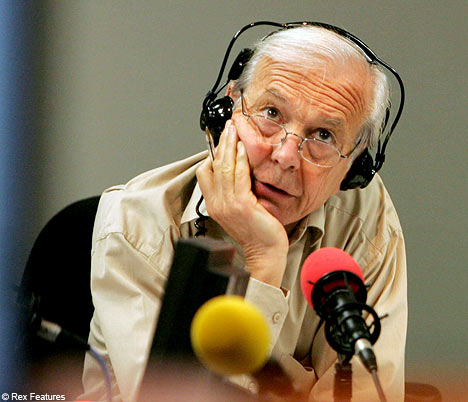
johnhumphMS2010_468x402Final scheduling for the John Humphrys’ BBC Radio 4 programme about Paddy is available on the BBC website. It will broadcast at 1600 hours on Monday 22 June and will be available later on the BBC website. Which tells us …

John Humphrys travels to Greece, to the village of Kardamyli in the Mani, to explore the life and work of travel writer Patrick Leigh Fermor.

Fermor is arguably the most influential travel writer of the 20th Century. At the age of eighteen he took off, with notebook in hand, on a walk across Europe. During the Second World War he fought in Greece and Crete, and is still remembered in the country today for his daring exploits with the resistance. His most celebrated action came in 1944 when he led a commando operation to abduct the German General Heinrich Kreipe.

In the early 1960s he moved to Greece, to the Southern Peloponnese. He built a house in the village of Kardamyli in the Mani. It was here that he wrote much of his most celebrated work and where he remained until his death in June 2011.

John Humphrys visits Fermor’s village to explore the influence that Greece had upon his life and work, and also to consider the impact that he had on the village and the people he lived alongside. John visits Fermor’s former home, now in the care of the Benaki Museum in Athens, and discusses the plans for its future. He meets those in the village who met Leigh Fermor when he first arrived in the 1960s – a man in his nineties recalls how they “danced on the tables into the night” – and he hears tales of influential guests, great writers like Bruce Chatwin and John Betjeman, even a King and Queen.

Accompanied by Fermor’s book ‘Mani: Travels in the Southern Peloponnese’, John Humphrys also travels into the deep Mani, one of the remotest, wildest and most isolated regions in Greece.

Visit the BBC website here for further details.

Walking from the east side of the Cascades across the Columbia Plateau to the Oregon border

When we imagine the interior of the United States I would guess that many of us think of wide open spaces where we can roam free on the range with what is left of the playing deer and antelope. Watching this longer installment from our long-time blog friend Owen Martel which covers the first part of his Walking the West – shore to shore across the USA – you realise that the US is not always walker friendly country.

For a place that values freedom there are an awful lot of No Trespassing signs, but it makes for interesting viewing. If you wish to watch more of Owen’s videos please visit his You Tube page.

Owen tells us

This one covers the whole stretch from the east side of the Cascades across the Columbia Plateau to the Oregon border. In retrospect, it was a shakedown, Murphy’s-law kind of episode, early enough in the trip that I was still getting into the swing of things. I was glad to revisit the happier interludes, and happy to work out a new perspective on the trickier parts.

Apologies in advance to Francis Fermor for another post not directly related to his relative.

Hachette UK Buys Nicholas Brealey Publishing

Whilst I have been busy moving house over the last month, hence the absence of posts – sorry – the publishing world has moved on. Hachette UK has acquired Nicholas Brealey Publishing in a deal that includes the company’s U.S. imprints, Davies L. Black and Intercultural Press. By the end of the summer three of Brealey’s Boston-based employees–Janet Crockett, Melissa Carl and Jen Delaney–will move into Hachette Book Group USA’s Boston offices.

Nicholas Brealey is headquartered in London and is best known for its business books list. Company founder Nick Brealey will continue to manage the firm from London as part of Hachette’s John Murray Press division, which is overseen by Nick Davies. According to HBG, Hachette UK will handle sales for all Nicholas Brealey titles. In addition to its business book program, Brealey publishes travel writing and a cross-cultural list.

Jamie Hodder Williams, CEO of Hodder and Headline (John Murray Press’ parent division), said: “Nick Brealey is a brilliant publisher. His areas of specialism–global business, personal and professional development and travel writing–are also areas of specialism for Nick Davies’ team at John Murray Press. I am absolutely delighted that Nick has chosen to come to Hachette so that together we can further develop the wonderful business he has created.

Nick Brealey said: “This is splendid news for everybody and just as an example of how good the fit is – John Murray famously publish Patrick Leigh Fermor’s classic backlist whilst one of our recent travel titles is Nick Hunt’s acclaimed Walking the Woods and the Water: In Patrick Leigh Fermor’s Footsteps from the Hook of Holland to the Golden Horn – a perfect piece of publishing serendipity.”

Before setting up his imprint, Brealey worked at Allen & Unwin and at Simon & Schuster UK.

Nicholas Brealey joins recent Hachette UK acquisitions Constable & Robinson, Quercus (also now part of Hodder), and the educational publisher Rising Stars.

Catch up here.

John Humphrys presents Paddy’s world on BBC Radio 4

John Humphrys on the Today programme

A little while ago I was approached to help provide some background information to help with research for a one-off Radio 4 programme about Paddy and his life in and around Kardamyli which will be presented by John Humphrys.

Kevin Dawson from Whistledown productions has confirmed that all is on schedule and the programme should be transmitted at 11.00 am on Monday 22 June. It will include interviews with Artemis Cooper and her father John Julius Norwich, as well as a contribution from the Benaki which may update us on progress about the house.

John Humphrys has a property in the Kardamyli area and is a fan of Paddy’s work. I believe that this may be his own idea which is great and will go someway to making up the deficit of BBC programming about one of our greatest writers.

Leaving Kastamonitsa for the kidnap – Chris White talk 19 May

Some of the kidnap gang leaving Kastamonitsa April 1944

Some of the kidnap gang leaving Kastamonitsa April 1944

It is with great pleasure that I am able to release these images sent to me by Abducting a General co-editor, Chris White which show the locations photographed in April 1944 of the team leaving Kastamonitsa in preparation for the kidnap a few days later. Chris has sent me colour pictures taken by him on a recce to Crete just last week of the same locations for comparison.

Chris and his brother Peter are the experts on the kidnap and the route taken before, during and after the kidnap. They edited Paddy’s account which was published last year as Abducting a General: The Kreipe Operation and SOE in Crete, and have spent many months on the ground in Crete over recent years finding new information and making contact with the survivors from the time and the now aged offspring of those directly involved in the Kreipe kidnap and the resistance to the German occupation.
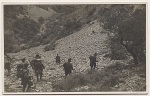
The brothers will be presenting their most up to date findings using newly discovered material from Paddy’s archive at the National Library of Scotland and the Liddell Hart Archive at the next PLF Society event to be held at the Hellenic Centre near Paddington on 19 May. Further details in this link. They make the whole thing come alive so if you want to find out more do please come along one and all. There is plenty of room at the venue.

Buy Abducting a General: The Kreipe Operation and SOE in Crete here.

An Adventure – asking the questions about Paddy and Joan’s marriage

Perhaps a rather belated link to the Harvard Review Online but one that openly questions some of the things that Artemis probably deliberately left out, and worthy for a quick read for that point only. We have no real discussion as to the reasons and background of Paddy and Joan’s “open marriage” and how it really impacted Joan, who frankly must have been deeply hurt by Paddy’s behaviour.

by Laura Albritton

First published in the Harvard Review Online, March 24 2014

The cover of Patrick Leigh Fermor: An Adventure is an excellent introduction to its subject. Leigh Fermor sits on deck with the sea behind him, his chest bare, cigarette casually in hand, his gaze focused on the discoveries ahead. By anyone’s estimation, Patrick Leigh Fermor’s life was an extraordinary adventure. His biographer, Artemis Cooper, has the advantage of having known him; she is also the granddaughter of Lady Diana Cooper, who carried on a great correspondence with him. As a result, she seems very much at ease with her subject, referring to him as “Paddy” throughout.

Leigh Fermor came to fame in the U.K. for his daring exploits in the Second World War and for a series of beautifully written travel books, including The Traveller’s Tree, Roumeli, Mani: Travels in the Southern Peloponnese, A Time of Gifts, and Between the Woods and the Water. As a teenager at King’s School, Canterbury, he learned Greek but was eventually thrown out. His housemaster reported that, “He is a dangerous mixture of sophistication and recklessness which makes one anxious about his influence on other boys.” A devotion to Greece, the pursuit of women, recklessness, and an irresistible charisma became defining elements in Paddy’s life.

Leigh Fermor’s originality becomes clear when, with no prospect of attending university, he decides to walk across Europe to Constantinople. Cooper does excellent work researching his trek (which Leigh Fermor himself chronicled in two volumes). She quotes from his diary and introduces us to the people he met, many of them members of the faded aristocracy. People welcome him because: “In Paddy’s company everyone felt livelier, funnier and more entertaining.”

Abroad, Leigh Fermor uncovers a world that seems preserved in amber, with intimations of the terrible events to come, including a pervasive anti-Semitism. In Athens he meets the cultivated and older Romanian painter Princess Balasha Cantacuzene and becomes her lover. He spends a year on her family’s dilapidated Romanian estate, Balani, after which he and Balasha move between London, Greece, and Romania. Cooper notes that:

Living with the Cantacuzenes in Rumania had granted Paddy several of the opportunities afforded by a university education . . . he had learnt Rumanian, studied its history, and read as much as he could in that language and French. Above all, Balasha and the Cantacuzenes had given him . . . a set of people among whom he felt he belonged and was understood.

Later, during World War II, Leigh Fermor was given a commission in the Intelligence Corps based on his skill with foreign languages: “He would be in Crete, out of uniform, living in the open, in constant danger.” Cooper supplies us with welcome context, from the political to the geological, though the initial passages chronicling Paddy’s war work lag in places due to too many actors. “The Hussar Stunt,” however, is nail-biting. With the aid of fearless Cretan partisans, Leigh Fermor and a few Brits capture German General Kreipe and sneak him off the island in a boat to Cairo. Their improbable success later inspires books and even a film.

After the suspense of the Cretan episodes, Cooper keeps things lively as she recounts Paddy’s meeting with his future wife, the photographer Joan Rayner (née Eyres Monsell), and his friendship with figures like Lawrence Durrell. Leigh Fermor had a relentless curiosity, traveling to the French West Indies (inspiration for his only novel, The Violins of Saint-Jacques) and to Haiti (inspiration for The Traveller’s Tree). Here, Cooper reveals some of Leigh Fermor’s unpublished judgments: “All the Caribbean islands have something wrong with them,” he wrote. “All are founded on bloodshed and slavery, and are now miserable, subsidized, impoverished places.”

Greece remains a central organizing principle in Leigh Fermor’s life, and Cooper does a fine job of weaving tumultuous Greek politics through his personal chronology. He and Joan eventually build their dream house in Kardamyli. Writing, however, was sometimes a torture, as Cooper observes: “He set great store by the initial surge of writing . . . Yet the moments of creative possession, when the self is lost and time becomes meaningless, were rare.”

As a biographer Cooper shows little interest in psychoanalyzing her subject. On one hand, this shows admirable restraint; on the other, Leigh Fermor remains enigmatic. We wonder, for example, how exactly he became so erudite. Leigh Fermor and his wife maintain an open marriage, but their motivations and emotions are often left unexplored. Elsewhere, Cooper points out that the Duchess of Devonshire adored him, but we’re given only glimpses of his charisma.

Cooper does, however, add a great deal in terms of tracing the trajectory of Leigh Fermor’s life, pinning down facts (as opposed to myths), providing historic context, and quoting from diaries and letters. The result, even with unanswered questions, is an excellent read and should revive interest in his writing. For that we owe Artemis Cooper a debt of gratitude.

Hito Steyerl Wins the First EYE Prize

In November last year I reported that EYE, the Dutch film museum and the previously unheard of Patrick & Joan Leigh Fermor (PJLF) Arts Fund had launched the EYE Prize. The annual £25,000 prize is aimed at supporting and promoting the artist or film-maker whose work unites art and film, and demonstrates quality of thought, imagination and artistic excellence. One of Paddy’s executors, Olivia Stewart is the trustee of this fund. I have repeatedly asked for some background information on this art fund but nothing has been forthcoming from Ms Stewart. The link between Paddy and Joan and the film world is tenuous to say the least (notwithstanding The Roots of Heaven). Perhaps it is more to do with Ms Stewart’s close connections to the film industry? One would have thought that a fund in memory of Paddy and Joan would be more focused on writing and photography.

By Tom Sawford

The latest news is that the first EYE Prize has been awarded to Berlin-based artist and cultural theorist Hito Steyerl.

The £25,000 prize ($37,100) was established by the Amsterdam film museum with the goal of supporting outstanding artists who work primarily in film. Steyerl was presented with the award in April in Amsterdam at the EYE Gala.

The 2015 EYE jury consisted of director and artist Chantal Akerman; MoMA’s chief curator for media and performance art, Stuart Comer; EYE CEO Sandra den Hamer; artist and director Isaac Julien; cultural entrepreneur, advisor, and art collector Martijn Sanders; producer, screenwriter, and Patrick & Joan Leigh Fermor (PJLF) Arts Fund trustee Olivia Stewart; and screenwriter and director Béla Tarr.

Steyerl is represented by Andrew Kreps gallery in New York. A retrospective of her work is currently on view at Artists Space gallery in New York. Her work will be included in a group show at the German Pavilion at the 2015 Venice Biennale.