Tag Archives: Patrick Leigh Fermor

The Wounded Gigolo

Here is something interesting, new, possibly amusing, but probably more than a little controversial. The Oxford scholar, poet, wit and acquaintance of the Leigh Fermors , Sir Cecil Maurice Bowra, wrote two poems (in 1950) that poked fun at Paddy’s relationships with Balasha Cantacuzene and Joan Leigh Fermor. It appears that Paddy objected to these and prevented their publication in the 2005 poetry collection New Bats in Old Belfries, or Some Loose Tiles. Paddy apparently refers to them in his correspondence with the Duchess of Devonshire. Now that Paddy is no longer with us, it would appear that Henry Hardy (also known as Robert Dugdale) has decided to make them public.

The poems appear to be buried within Hardy’s website which he maintains on the subject of Isaiah Berlin. This poem, The Wounded Gigolo, is in pretty poor taste (all round) but in particular in relation to Balasha; far from spurning Paddy she delighted in their relationship but they were separated first by the war, and then by communism. She knew that their relationship would not be rekindled after the war and she apparently was pleased that Paddy had found happiness with Joan.

Hardy explains himself thus:

When New Bats in Old Belfries was published in 2005, two poems had to be omitted from the book which stated at the time “because their subject was still alive, and unwilling to give his approval for their inclusion in his lifetime.” It can now be revealed that Bowra’s target in the excised poems was Patrick (‘Paddy’) Leigh Fermor, writer and traveller – and Cretan war hero as a result of his activities while serving in the Special Operations Executive (SOE) during the Second World War. Leigh Fermor, born on 11 February 1915, died on 10 June 2011, aged 96.

In an extended correspondence with one of the editors of Bowra’s poems, Paddy showed that he was much put out by the poems about himself, especially ‘The Wounded Gigolo’, which he felt was ‘a bit cracked’. He vacillated about the other poem, but in the end voted against, no doubt partly influenced by the opinion of his late wife Joan, who ‘thought that all the people mentioned in the collection would have been cut to the quick, however much they put on non-spoilsport faces’. When James Morwood of Wadham College visited him later in his Greek home – to ask about his friendship with Bowra on behalf of Leslie Mitchell, Bowra’s biographer – he found Paddy was still smarting.

To Hardy, Leigh Fermor wrote: ‘Could Maurice’s shade ponder all this now, I think I might emerge as more of a saviour than a spoilsport.’ [Edit: I think Paddy was probably right and I publish here for our usual completeness]

My thanks to Mark Granelli and Margaret Campbell for getting in touch about this. Here is the first poem:

The Wounded Gigolo

O Balasha Cantacuzène,
Hear the war-cry of the Gael!
In his last fierce fight he’s losin’;
He will fight, but he will fail.
Cruelly his lady spurned him,
Struck him when he asked for more,
Flung him down the stairs and turned him
Bag and baggage from the door.
Oh unhappy gigolo
Told to pack his traps and go;
He may mope and he may mow,
Echo only answers ‘No’.

Hasten, every loyal Cretan,
To your wounded master’s aid;
He will not admit he’s beaten
While there’s money to be made.
Stalwart heroes stand beside him,
Captain Moss and Major Xan,
Knowing that, whate’er betide him,
He is still their perfect man.
Oh the hero gigolo,
Bleeding from a mortal blow,
He’s been cut off from the dough,
And he murmurs ‘Woe, woe, woe!’

What avail him now the dances
Which he led on Ida’s peak?
No more like a ram he prances;
Gone the bums he used to tweak.
Let him pick and scratch his scrotum,
Wave his cock and shake his balls –
She will never turn to note ’em,
Never listen to his calls.
Oh the jigging gigolo,
Plying his fantastic toe –
Like a wounded buffalo,
He can only belch and blow.

What avails the apt quotation,
What the knowledge of the arts,
What the lore of every nation
Learned from many unpaid tarts?
Ah, his mistress will not listen,
Floating vaguely to the moon;
Vainly do his molars glisten
When he tries to break her swoon.
Oh the learned gigolo,
What was there he didn’t know?
Now there’s nothing left to show
To the girl he dazzled so.

Yet remains his greatest glory,
His proud prowess in the bed.
Never tool renowned in story
Had so fine a lustihead.
Can he not be up and at her?
Strike the target? Ring the bell?
Ah, to her it doesn’t matter;
Nothing can restore the spell.
Oh the potent gigolo,
He could make the semen flow!
Though the cock may crow and crow,
He must pack his traps and go.

17 April 1950

Rory Cooper at Souda Bay and Chania

The pictures below were sent in by Rory Cooper who is a regular correspondent to the blog.

Hello Tom,

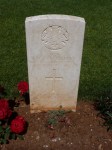
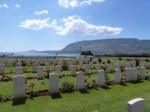
Am in Crete at the moment and have just come back from a visit to the CWGC in Souda Bay where John Pendlebury is buried. Here are a couple of photos as well as one of Gen. Kreipe from the Maritime Museum in Chania.

I have acquired a copy of the Erotokritos and will attempt a translation, although I have few illusions about making sense of 17th century Cretan dialect.

All the best,

Rory

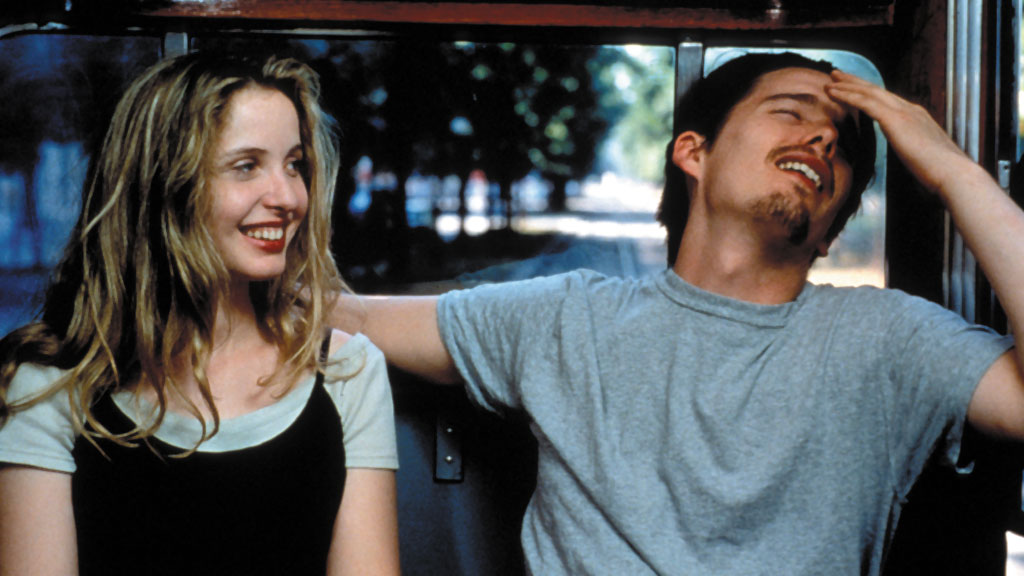
Before Sunset sequel, Before Midnight movie shooting in Greece at Paddy’s House

Julie Delpy and Ethan Hawke in Before Sunrise

The Paddy network is very wide and not much goes on without someone knowing something about anything Paddy related, and then getting in touch with your favourite blog. A couple of weeks ago I was contacted by our spy on the ground in Karadmyli to say that he had heard rumours that Paddy’s house was being used as a film set. Further investigations revealed this to be filming for a movie to be called Before Midnight which will star the actor Ethan Hawke, and co-start Julie Delpy. It is the third in a series of movies which I guess one could call the ‘Before Series’.

As we know the house was left by Paddy to the care of the Benaki museum and there have been some concerns voiced about the approach to essential maintenance at the house. Sources close to the museum and to Paddy’s family have confirmed that shooting has been taking place in the garden of the house and that Mr Hawke has been relaxing on the beaches playing his guitar whilst during some relaxed evening barbeques with fellow cast and crew and some locals.

The good news is that there should be a substantial fee for the use of the house which we hope will be put toward the essential maintenance, an issue highlighted only in July by John Chapman in his piece about a recent visit.

The movie series started with the 1995 film Before Sunrise which is all about a young man and woman who meet on a train in Europe, and wind up spending one romantic evening together in Vienna. Unfortunately, both know that this will probably be their only night together. But we all know that this can’t be the end, after all this is Hollywood, and nine years later the characters Jesse and Celine encounter one another during the French leg of Jesse’s book tour, and that film was called Before Sunset. I have no idea how that movie ended but it is possible that as travellers they had come across Paddy’s work and became true fans. Upset to hear that he had died each of them decided to make a summer pilgrimage to his house to make a ‘connection’. Whilst Celine gazes at the sunset across the bay from Paddy’s patio after sneaking in through the rickety blue gate, Jesse arrives with Elpida (Paddy’s housekeeper who has been kept on) and from then on they only have eyes for each other, and the local ouzo.

There is speculation that Hawke, who has apparently been in the area since late July, has plans to stay until early September so if you are quick you may be able to join as an extra. If it is of interest there are no reports of sightings of Delpy, so anything could be happening. So exciting! We will keep you posted.

A Poetic Tribute to Paddy by John Pinschmidt at the Whitehouse Bar, O’Connell Street, Limerick

I have just returned home from a trip to Kilrush in Co Clare, Ireland to visit the place of my father’s birth, and to see some of my family there. It has been far, far too long since I was there; I won’t say exactly, but far too long! The people were so friendly and by God the Guinness was good!

By pure chance, whilst I was in Ireland, a poet, John Pinschmidt from Limerick, which is just 40 miles away from Kilrush on the Shannon, stumbled across my blog and added a comment into the Your Paddy Thoughts section. It was a poem he wrote at the time of Paddy’s death in June 2011 and hs John’s personal tribute. Given that Ireland is a land full of saints, poets and scholars I thought it too much of a coincidence with my visit to leave it languishing in the tributes page so here is John’s poem …

A HIMBEERGEIST TOAST TO PATRICK LEIGH FERMOR

“Live, don’t know how long,/And die, don’t know when;
Must go, don’t know where;/I am astonished I am so cheerful”.
—A Time of Gifts, 1977

Oh, to read your restless spirit had set off on its last journey,
Age 96, sent me into the parlour for A Time of Gifts
And back to 1933, your age-18 trek across Europe
As clouds gathered above a soon-to-be lost world,
Which changed your life as much as my age-21 Europe
Hitchhiking Summer of 1968, my time of gifts too.

Oh, to see again your rich cascades of words,
Riffs on decaying schlosses, Passion artworks,
Architecture as music, the drunken Breugel-like chaos of
Munchen’s Hofbrauhaus—where I had gone in ’68—the debauched
Bavarian Brownshirts portending days far darker than that night.
And later, in bitter weather near Linz, you had your first Himbeergeist.

Oh, that riff sent me searching the yew cupboard for an old bottle
From Deutschland, and I froze it and a Waterford glass,
And late that night, by fire and candlelight, drank too much of your
Clear spirit, reading your words out loud to you and all,
Young or old, who set out on life-changing journeys:
“Oh for a thimble full of the cold north! Fiery-frosty potions,
Sequin flashers, rife with spangles to spark fires in the bloodstream,
Revive fainting limbs, and send travellers rocketing on through
Snow and ice. White fire, red cheek, heat me and speed me”.

Prost, Siar go Deo, Paddy!

And just to embarrass John further, I have found a video on You Tube of him reading the poem at the Whitehouse Bar, O’Connell Street, Limerick.

Patrick Leigh Fermor’s archive acquired by the National Library of Scotland

From a National Library of Scotland press release dated today.

The archive of one of the most important travel writers of the 20th century and a war hero whose exploits were made into a major film has been acquired by the National Library of Scotland (NLS).

Sir Patrick (Paddy) Leigh Fermor, who died last year at the age of 96, is regarded as a central figure in understanding and appreciating mid-20th century culture.

To describe his life as colourful does scant justice to the reality. At the age of 18 he set off to walk from the Hook of Holland to Istanbul , a year long journey described in his books A Time of Gifts and Between the Woods and the Water. The Independent described the former as “rightly considered to be among the most beautiful travel books in the language.”

His war record is equally impressive. After the fall of Crete in 1941, he was sent back to the island to organise guerrilla operations against the occupying Nazis. He spent much of this time disguised as a Cretan shepherd, living in freezing mountains caves.

In 1944 Leigh Fermor organised one of the most daring feats of the war when he kidnapped the commander of the German garrison on Crete . This was made into a film Ill Met by Moonlight in 1956 starring Dirk Bogarde.

The archive consists of literary manuscripts and typescripts, correspondence with leading figures including the poet Sir John Betjeman, photographs, passports, portrait sketches and personal papers including visitor books and various honours awarded to Leigh Fermor. One of the star items is the only surviving notebook from his youthful trek across Europe .

It offers an unrivalled insight into his life and writings and adds to the wealth of travel literature at NLS. Acquisition of this archive is seen as helping to establish NLS at the forefront of 20th century travel literature research collections

“This is a fantastic collection which will be made available at NLS,” said David McClay, Manuscripts Curator. “We hope it will excite people who know of Paddy and introduce him to a whole new generation of people who may not be aware of his work.”

Its arrival at NLS comes just before a new biography of Leigh Fermor by the British writer and family friend Artemis Cooper is to be published.

Leigh Fermor died before he could complete the third volume in his travel trilogy. Artemis Cooper has worked on the uncompleted manuscript and this third volume – entitled The Broken Road – is expected to be published in 2013. This will all add to the interest in Leigh Fermor’s life and in the NLS archive.

The archive has been bought with a grant from the John R Murray Charitable Trust which assists NLS in the care and promotion of access to the Library’s John Murray Archive. Leigh Fermor was published by the Murray family.

The connection with the Murray publishing house was one of the reasons NLS was chosen by Leigh Fermor’s executors as the home for his archive. He also knew the Library, having donated his wife’s photographic collection to NLS just before he died.

NLS has also taken possession of the personal archive of Leigh Fermor’s close friend Xan Fielding, an author, translator and traveller who also fought in Crete . This has been donated to the Library by Fielding’s family.

John Chapman at Kardamyli


John Chapman is a regular contributor of material to the blog – you are all welcome to do so at any time; see Contact. Most notably John’s photographs of a visit to Kardamyli to meet Paddy in 2005 have been very popular with you all.

A while back he sent me some more photographs with some comments about the state of the villa at Kardamyli, and John’s personal thoughts about one of Paddy’s friends who died in May 2012.


Hi Tom

In May this year I made a return trip to Kardamili and Mani. I hadn’t been there for four years and this was just a week long catch up. Mani is still as effortlessly beautiful and tantalisingly fascinating as ever. One location I always visit is the church of St. Nicholas in Chora, where Paddy scattered Bruce Chatwin’s ashes in 1989. Still a remarkably special place.

At Paddy’s Memorial service in December I’d been sitting quietly in a pew as I could recognise some of the great and good but was not expecting anyone I knew to be there. I was suddenly clapped on the shoulder by a firm hand and an American accent bellowed ‘Well how you doing buddy?’ It was my old friend and correspondent Jon van Leuven. We had started writing to one another some 12 years earlier as we both were fascinated by the conundrum of the location of the Frankish castle of Grand Magne and various other puzzles in Mani’s medieval history. We’d since met on a number of occasions exploring cave churches near Langada and getting hideously lost in the Sangias Mountains in Mesa Mani.

With Jon was another Englishman, we were introduced but, I apologise, I’m useless with names. He had been attempting to catalogue Paddy’s books and papers. I asked if he knew what the Benaki Foundation intended to do with the house at Kalamitsi. “I’ve no idea”, was the reply,”…and I doubt if they do either”.

After the service Jon and I said our farewells. Jon was a long time friend of Paddy’s. He long had a house at the hamlet of Gournitsa (a Slavic name, lit. ‘the place above’) though nowadays often referred to as Agia Sofia, after the pepper-pot domed church which perches over Kardamili. The house itself had few comforts, Jon was adamant that he wasn’t go to pay any ‘damned taxes’ for electricity. But it was comfortable and clinging to the cliff top edge of the Viros Gorge it was a precious eyrie where Jon would stay from June to September, although his family and home were now in Gothenburg, Sweden.

I told Jon I was going to Mani and he asked me to give his house a quick look to see if all was OK. I replied I would. He emailed me on the 8 April.

‘Glad to hear you can get get up to Gour and give the hacienda a glance. Also in town I hope you hear what’s going on at Paddy’s villa these days – if you know Elpida the housekeeper she’d know better than anybody’.

I don’t know Elpida and anyway by the time I got to his Hacienda in Gournitsa I’d been given the sad news that Jon had died of complications of leukaemia. I’d known he was ill but had presumed he was indestructible. He could certainly outpace me on expeditions in Mani and was at least ten years my senior – I guess in his early seventies. On the 17 April he’d sent me his last of hundreds of emails. I might just publish them sometime…I’d asked if he’d ever met Bruce Chatwin, I was reading Chatwin’s letters.

The email was entitled ‘Drip Feeding’

“Hi John,

Just a note between hospital visits…but thanks for your epistles as ever. No, I never met Chatwin, but I once met Elizabeth at Paddy’s, and of course again in London in Dec tho she didn’t recognize me (nor I her but for Olivia’s tipoff)…Now I am taking a long pause from the airwaves to suck my thumb and medicine.

Best, Jon”

He died on the 2 May 2012

Jon was very wary of telling much about Paddy, he was a very private man and felt that there were too many people trying to grab a bit of Paddy’s aura. I was undoubtedly one of them in his judgement, so I didn’t pry and he didn’t tell., and frankly we had enough Mani stuff to keep us going for years. I did learn that Jon had first met Paddy as he was interested in ancient shrines to Artemis in the area, and had hoped (vainly) that Paddy could assist his researches. Jon helped Paddy construct the bookshelves in ‘that room’. He located picnics he had shared with Paddy and Joan, and, on very rare occasions, entrusted me with Paddy’s opinions on other ‘travel writers’. On one occasion when I briefly met Paddy striding towards Lela’s Taverna I mentioned Jon was a friend of mine. Paddy beamed and confirmed he was a very old and trusted friend, but Joan was very ill at the time and Paddy hurried on.

One evening this May we wandered down to Kalamitsi. It’s still filling up with more villas and concrete but somehow manages to remain beautiful. And on the cliffs stretching along the road to Proastio high above Kalamitsi more excrescences of domestic concrete demonstrated more concern for their owners’ views of the Gulf of Messenia than those below looking up. I delight in a domed church on a promontory (and Kardamili has three), but hate to imagine John Betjeman’s reaction to these lumpen edifices.

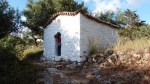
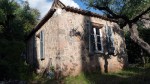
However Paddy’s villa is still a discrete surprise when you do chance upon it. The north wall of the garden has fallen down and we could have wandered the gardens, but resisted, though we’d been before and had had Paddy as a guide. A peer through the small window in the gates of the villa show that someone is tending the garden. Though there is a sad lack of flasks of retsina in the vestibule. The ‘Private Property’ sign has gone, maybe from neglect. Above the gateway there is a small stone hut. It was unlocked, so we guiltily crept in. A broken armchair, an old bed and some damp volumes which had obviously over spilt from the villa were on some shelves and in boxes. Hungarian Studies magazines, a history of Canterbury Cathedral, and a few gems. An offprint from a dictionary. In pencil at the top ‘In great appreciation Christmas 1958, New Year 1959 Eric Partridge.’ Naturally they were left there.

In the village no one I talked to had very much more knowledge of what was going to happen to the house than I did. And as one said – the Benaki are not as rich as they may appear. The house needs a fair bit of repair. After all it is, now, over fifty years old and shutters are beginning to disintegrate. If they want a librarian who’s soon to retire to look after the place, well, I might just volunteer.


Patrick Leigh Fermor Airport?

Here is an interesting suggestion passed to me by Danish blog reader Hans Christian Bogstad who is living in Belgium at the moment.

Dear Tom

You may be unaware but Crete is slowly building a new airport at Kastelli, which will eventually (2015 or later) replace the old  Heraklion airport currently in use. Kastelli is, of course, one of the sites where SBS units successfully carried out raids on German aircraft in 1942 and 1943 (Operation Albumen – I don’t think Paddy was involved personally).

In Greece it is the habit to name airports after national heroes. My personal initiative is to suggest to you and to the world at large that the new airport be named the Patrick Leigh Fermor Airport.

Is there any more distinguished hero to give his name to the new Cretan airport than Paddy? Even the much less deserving creator of 007 had an airport named after him in Jamaica.

It may help that Paddy already was an honorary citizen of Heraklion, and that he probably had a multitude of Greek friends, some in high places.

Clearly there is a distinct possibility that the Cretans already have a name in mind, but there is no harm in asking. Would any Greek (speaking) readers wish to take this on and make some approaches?

Hans Christian Bogstad


To guidebook or not to guidebook

I just received this message from Andrew Bostock who authored the Bradt guide to the Peloponnese. It seems he is heading off there now. Paddy appears to have had some views on guidebooks; what are yours?

There are people who always seem to be fated to end up in their eventual career; children whose endless games of doctors and nurses or Lego translate into later careers in medicine or engineering. I used to think that I didn’t fit into this category, but now I’m not so sure.

In a week’s time I head out to the Peloponnese, the southern mainland of Greece, to complete the research to the second edition of my guide to the area, due to be published in early 2013 by the award-winning publishers Bradt. The first edition was written whilst I lived in the area, and whilst my daughter, who was born in Kalamata, grew up. Now I’m heading back for six weeks to show her where she comes from, and to introduce her one-year-old brother (middle name Telemachus) to the country.

How I ended up doing this seems to be due to huge smatterings of good luck and coincidence; but thinking about it there was an element of fate involved. This was mainly due to my mum, who instilled in me an early love of Greek mythology and history. It was also on her shelves that I first found the books of Paddy Leigh Fermor. I must have been about 14 at the time, and I devoured them. This quickly led to backpacking trips round Greece, sleeping in olive groves and abandoned tower houses, and eventually working there as a teacher, tour guide and writer.

Fate continued to intervene and my small family ended up living in a house on the headland above Kalamitsi bay, where Paddy had built his beautiful Greek house. In truth I had never really wanted to meet him, expectations are too easily let down, but in the end it seemed inevitable. He turned out to be just as affable, engaging and generous as the books would lead you to think.

He wasn’t really that keen on the idea of a guidebook to the Peloponnese, and I do see his point; but it was his books that guided me there. I think that if people are to travel, then a least they should travel with knowledge and understanding.

I’m pretty proud of my book, and hope to spend the next few weeks making it even better.

Andrew Bostock

07961 061 052 (cell)
Twitter: @andybostock
Website

Volume Three of Patrick Leigh Fermor’s trilogy to be published in Autumn 2013 and called The Broken Road

We have waited a long time, and now like London buses, or English summer rain, it is all coming at once. Following on from her work on Patrick Leigh Fermor’s biography, An Adventure, to be published in October 2012, Artemis Cooper will pull together Paddy’s work on Volume Three ready for publication in autumn 2013.

The book will have the title The Broken Road. If you Google that you will find a catchy country song by Rascal Flatts. In fact the title has been taken from the sixth volume of Freya Stark’s letters. I am told that everyone concerned with the publication is agreed that it “sets up the right resonances, because although The Broken Road completes the story, the text is taken from more than one unpublished source.”

It is perhaps not well-known that Paddy started to work first on the events of Vol 3. Much of it was written before his defining work on A Time of Gifts and Between the Woods and the Water, the other two volumes in the trilogy.

Artemis Cooper tells me that although “it does not have their high polish, it does provide an extraordinary insight into Paddy the writer, and the interplay of his memory and imagination.” and whilst “it’s not going to sound like ATOG or BWW”, I am sure it will be one of the most anticipated publication events of next year.

Whilst we wait we can sing along ….

The Kreipe pennants – the story of their rediscovery by Billy Moss’ daughter

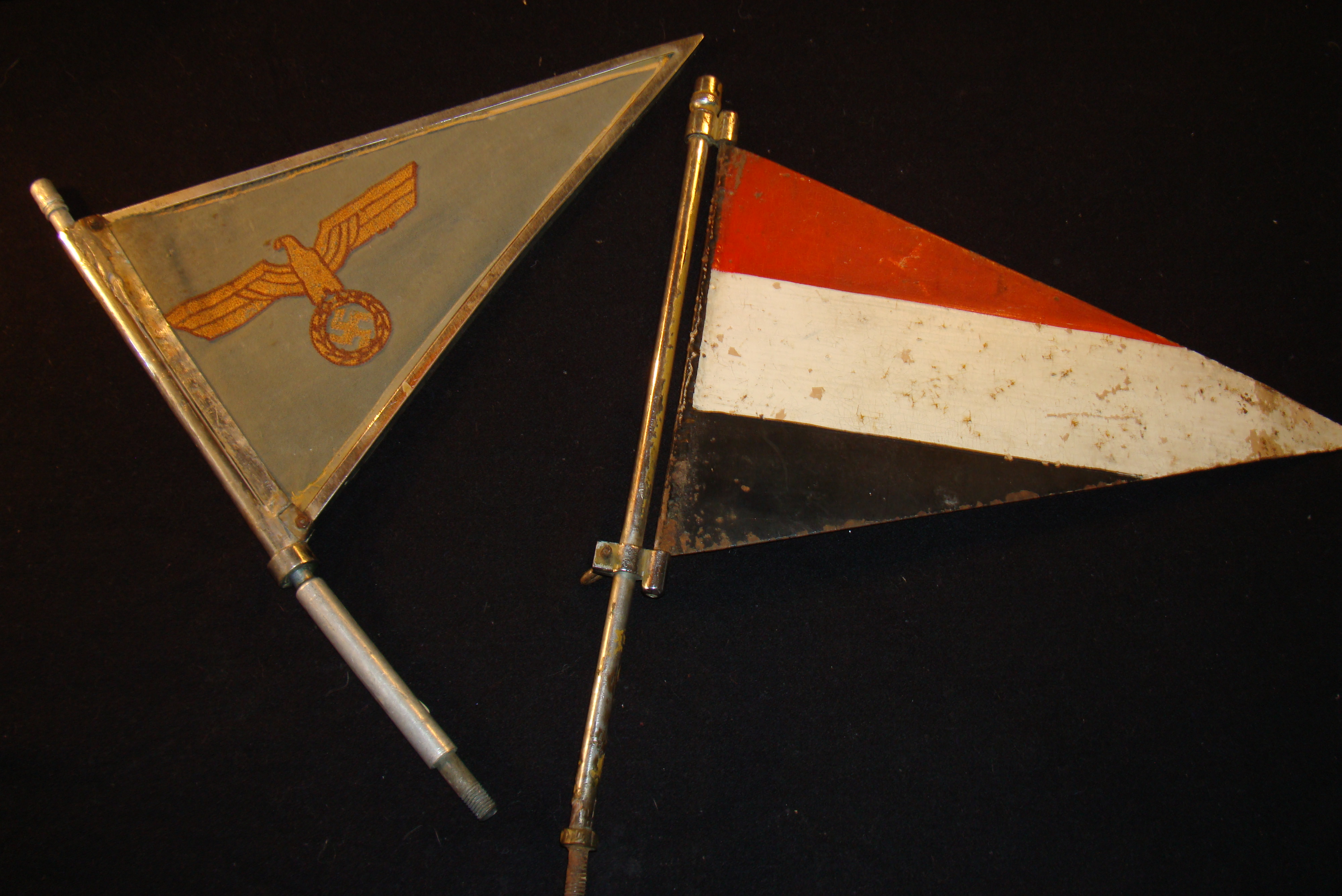
The pennants from General Kreipe’s car

Discovering the full details behind a particular story or event is often tricky with clarifications, enhancements, or downright contradictions emerging sometimes many years after the event. Fortunately we have not had to wait so long for some further detail to be added to the story I ran last year about what happened to the pennants on General Kreipe’s car at the time of the kidnap, and their subsequent discovery many years later.

‘Billy’ Moss’ daughter Gabriella Bullock read Artemis Cooper’s account of how the pennants were found after so many years in a trunk in Paddy’s house at Kardamyli. Gabriella then wrote to me to ask me to pass on the full story behind their (very fortunate) re-discovery in Ireland some years before and how they were passed by her mother (Sophie Moss née Tarnowksa) to her. It sounds like we are very lucky to have them at all.

Gabriella’s account starts during a recent visit to Crete …

In Rethymnon we met the delightful people who run the Folklore Museum. This is where the pennants from the General’s car are now housed, in accordance with PLF’s wishes. We found that they were very interested in the story of how the pennants were randomly and luckily rediscovered, and this leads me to think that the story definitely has a place on your website

In the early 1950s my family lived in Co. Cork, Ireland, but moved back (supposedly temporarily) to London in 1954. My parents intended to return, and left many of their possessions in the safe-keeping of various Irish friends or in store. My father never did go back to Ireland; indeed, in 1957, eight years before his death in 1965, my father also left England never to return. As things turned out, however, it was also many years before my mother went back, and all that had been left in storage was lost.

A number of years after my father’s death my mother bought a cottage near Cork, and thereafter divided her time between London and Ireland. I was staying with her at the cottage one summer in the late 1970s when a friend of hers announced that she had a trunk belonging to us which she wanted to return; it had been sitting in their attic since the 50’s.

A battered tin trunk duly arrived with my father’s name, rank and regiment painted on the outside in white. My elder sister has it now and it is, without doubt, the one described in the first chapter of our father’s book A War of Shadows, even down to the grains of sand:

“an old letter, a scrap of notepaper smeared with the sweat of one’s hip-pocket, the rain-spattered pages of a diary, an operational report written in the bloodlessly forbidding vocabulary of a headquarters’ clerk – these relics, discovered in a tin trunk which still creaks with grains of sand when you open the lid…”.

My mother opened and unpacked it, and said to me, “I think you’d better have these”. Amongst the things inside it were my father’s original diary, already entitled Ill Met by Moonlight, in remarkably good condition and perfectly legible, and the two German pennants.

It was a heart-stopping moment. My mother gave these things to me, and I gratefully and unthinkingly received them. I was in my mid-twenties then. The diary I still have. As for the pennants, they were much prized, and adorned a wall in my house for nearly 15 years.

But one day about 17 or 18 years ago, when I was re-reading IMBM, it dawned on me for the first time that in fact since it was Paddy who had taken them as trophies from the General’s car, they were rightfully his. So I gave them to him. This was in the early 90’s. Paddy was completely astonished, and moved, to see them again, so unexpectedly, after 50 years! He was awfully pleased, and after his death they were donated to the Folklore Museum in Rethymno, in accordance with his wishes.

And now they are back in Crete, which is absolutely as it should be.

With best wishes,

Gabriella Bullock

Further reading:

The Kreipe pennants

Articles about the kidnap in the Ill Met by Moonlight category

A Very Long Walk

A whimsical tribute to Paddy by Kate Fitt from the Etsy Blog.

Read it here.

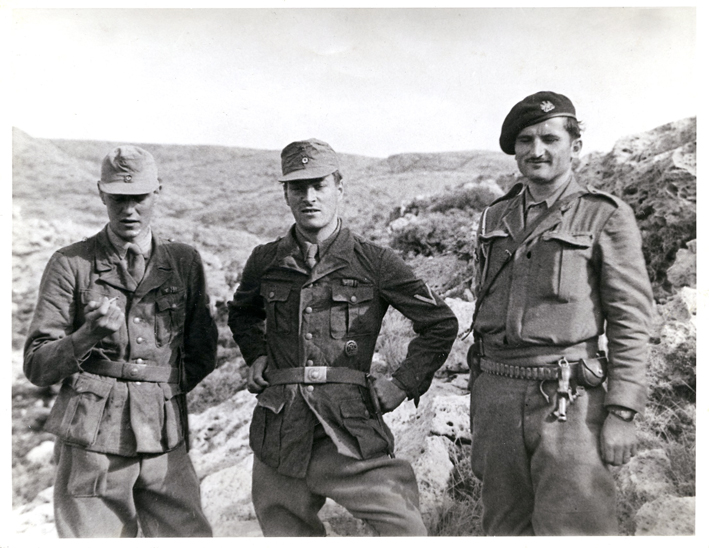
Previously unpublished images from the Kreipe kidnap

William Stanley Moss, PLF, and Manoli pose for photos before the kindap of General Kreipe

Paddy and ‘Billy’ Moss in a cave

I am very grateful to John Stathatos who sent these pictures from his family’s Cretan archive. The first with Manoli is one that I don’t think we have seen before in this setting.

I’m sending you a little present for the blog – scans of four original photographic prints of the Kreipe operation which I’ve dug out of the family archives.

The prints are on glossy photographic paper, and must have been produced by the British army press and propaganda section in Cairo very shortly after Paddy’s return. They were given a narrow white border, and all four have very slightly different dimensions, ranging from 185×143 mm for the vertical one to 147×199 mm for the group photo. They are in remarkably good shape considering their age, showing no evident deterioration beyond a very slight yellowing.

Note: certain of these images are kindly shown here by permission of John Stathatos. Please ask if you wish to reproduce.

Other pictures provided by John:

A map of Crete as drawn by Paddy on operations in Crete

Traveller’s Rest

Worldwide availability of An Adventure by Artemis Cooper

A short update to follow-up the question asked by many of you unlucky enough not to be resident in this wet and sceptered isle; will An Adventure be published elsewhere other than in the UK in October?

The answer is yes, and certainly for the following countries. I am informed that it will appear in bookshops in Canada, Germany, France, Greece, New Zealand (especially for you Maggie), and of course Australia. In the US it will be published by the New York Review of Books.

One would imagine that copies may only be available in English at this stage. I will keep you all updated.

To pre-order or purchase your copy of An Adventure click here.

Alan Watts on Paddy’s schooldays

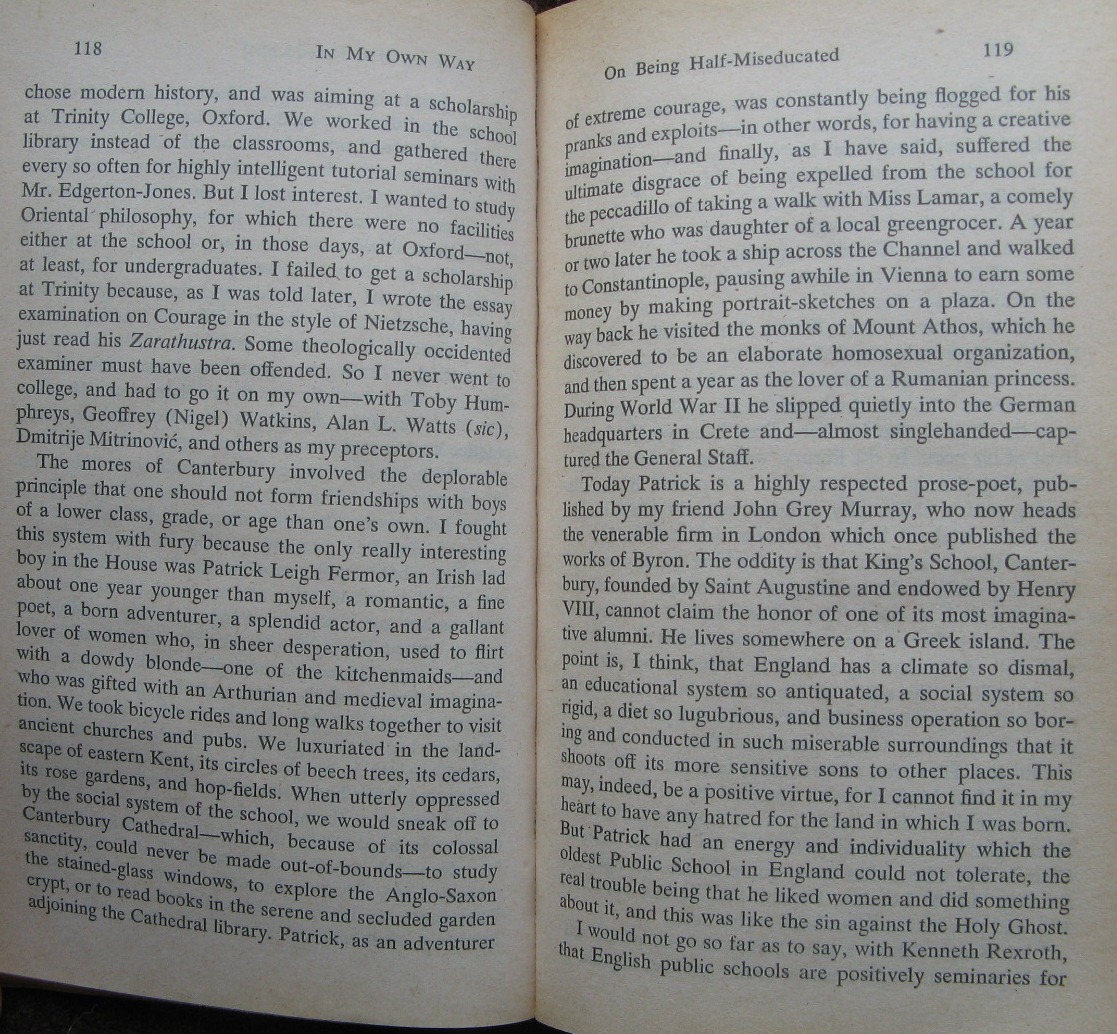
I am very grateful to Jasper Winn (author of Paddle: A long way around Ireland) for sending me this scan from Alan Watt’s autobiography In My Own Way in which he refers to his time at King’s with Paddy in the 1930’s.

Tom, hi,

You have possibly already seen this contemporary account of the young Paddy at school. Alan Watts – self-styled mystic, very credible explainer of eastern religion, and 60s guru to a swathe of Californians and beyond – was a fellow pupil. His – Watts’ – extensive writings tend to be accurate in detail and observation, though creative in colour and tone, and perhaps in any conclusions drawn. Still one of the few people who wrote about Paddy from first hand knowledge at such an early point in his life.

I hope that the high def photo of the relevant pages from Watts’ autobiography In My Own Way makes for legible reading.

Best,

Jasper

New – Full length interviews with Kreipe and Paddy

We have all seen the famous 1972 video of Nico Mastorakis’ TV show “This is Your Life” which brought Kreipe and his old enemies together before the cameras. If you have not seen it you can find it here.

In this newly discovered video Nico Mastorakis presents a documentary about the whole kidnap event, and includes full length and exclusive interviews with Paddy and General Kreipe. The General even says that “next year I will spend my holiday in Crete.” I wonder if he ever did?

There is much more about the kidnap in the Video and Audio section. Take a visit now.


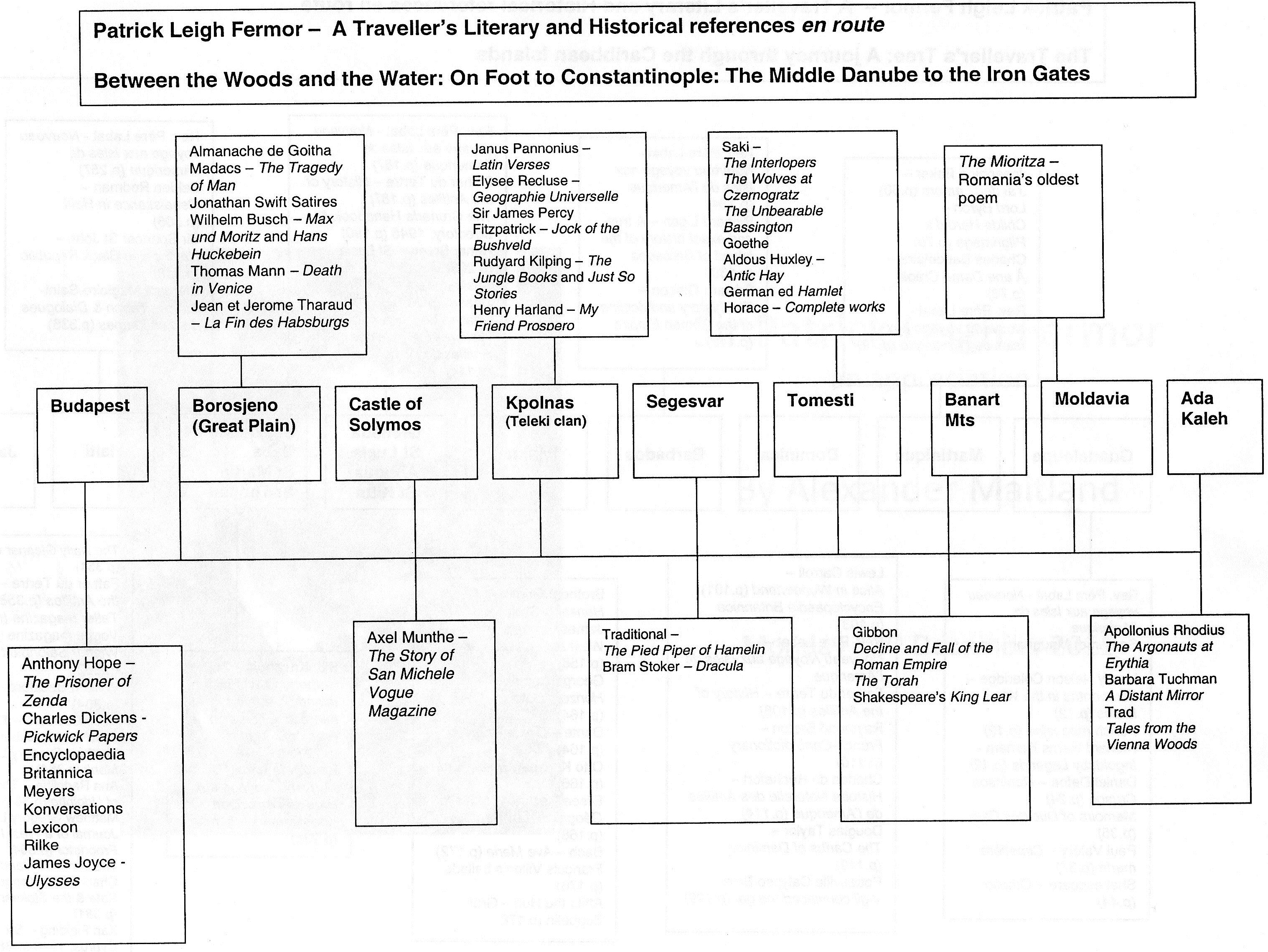
Literary and Historical References – Between the Woods and the Water

The last in the series which presents the work of members of the Royal Geographical Society which analyses chapter by chapter, literary and historical references from some of Paddy’s key works.

This was presented at the RGS in the afternoon talk on 12 December 2012,”Patrick Leigh Fermor: An Appreciation by Alexander Maitland, FRGS”.

My thanks to the Royal Geographic Society for permission to present this.

Download a pdf of this document here.

Related article:

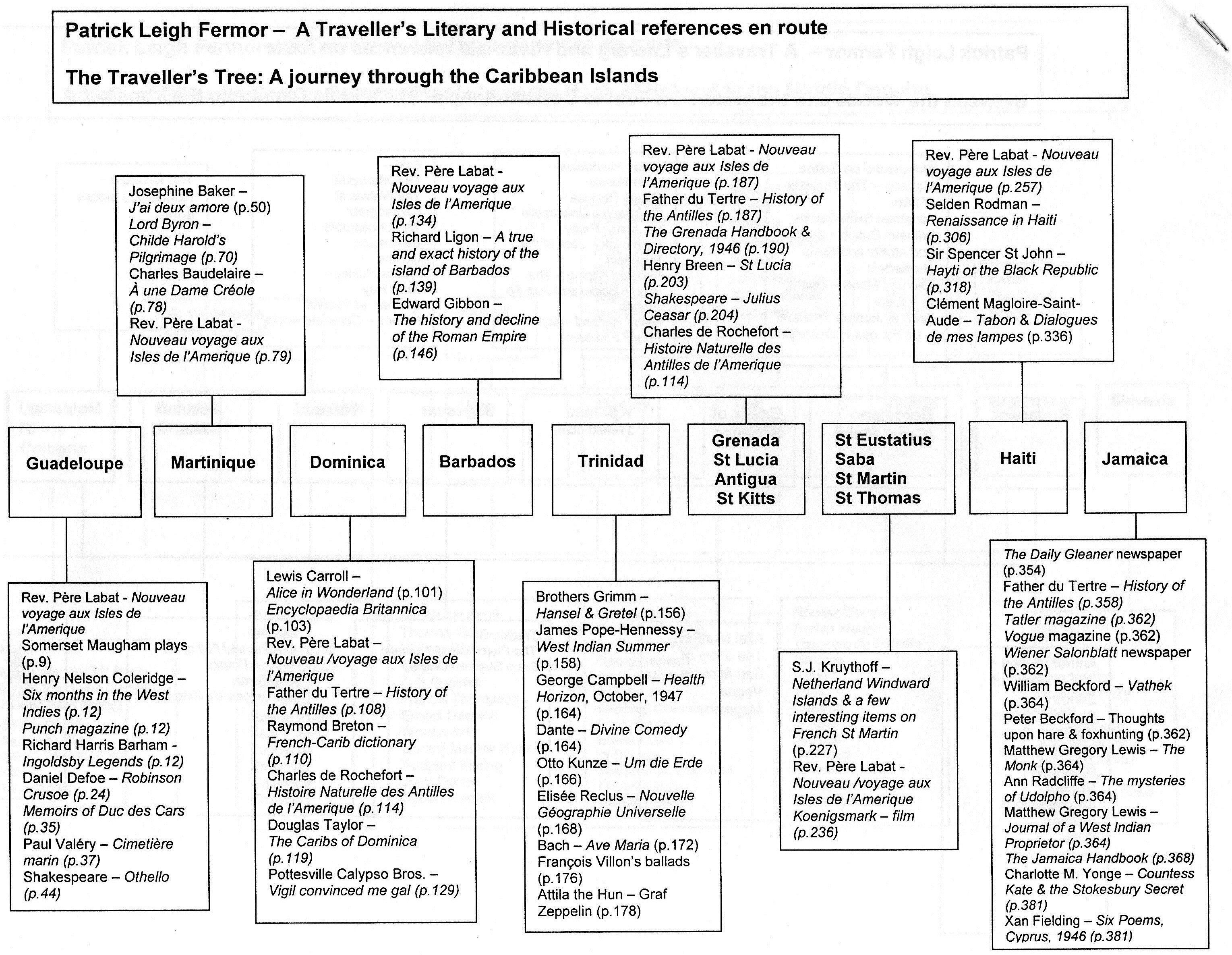
Literary and Historical References – The Traveller’s Tree

Happy times at Dumbleton

Some memories of Paddy at Dumbleton sent to me by Tim Todd and Alun Davies. The group is involved in finding out more about the Kreipe kidnap and especially the route used during the escape.

As Alun says … ‘A fond memory of Paddy from the time we lunched with him in 2005. I attach with this two photos taken in the garden that day – the 8th August 2005. The group shot shows from L-R John Ellis-Roberts, Richard Cowper, Chris Paul, PLF and Tim Todd.’

This slideshow requires JavaScript.

Reg Everson and his powdered egg breakfast for General Kreipe on Mount Ida

At Paddy’s funeral last year, I stayed afterwards for a drink with a small group at the hotel  which used to be the Dumbleton estate manor house, originally home to Joan’s family. A man from Wales introduced himself as Vince Tustin. I recognised the name as I had been in touch with Vince by email in the preceding weeks on the subject of his father-in-law who was in the SOE.

‘Reg Everson, my father-in-law, spent three years on Crete and much of that time he worked closely with Paddy as a radio operator.’ said Vince.

His wife then joined us and after a while she said ‘I asked my mum and dad why I was called Patricia. It was an unusual name for a girl in Wales at the time. And my dad told me I was named Patricia after his good friend Patrick Leigh Fermor. They had served together in Crete.’

Such was the impression that Paddy made on people. It is a lovely story in itself, and perhaps serves a reminder on this first anniversary of his death, that Paddy affected the lives of  many, in different ways, as a man as well as a writer.

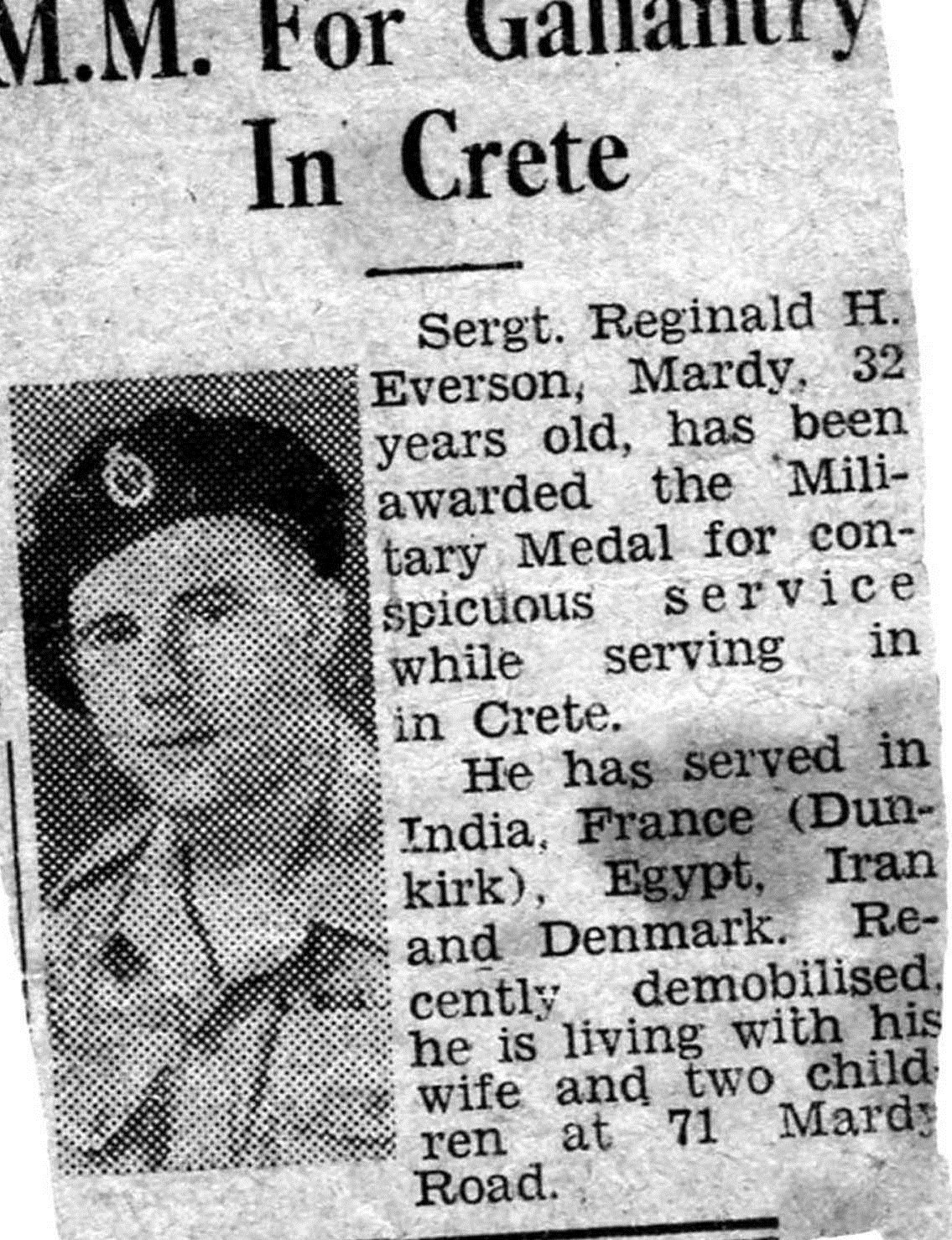
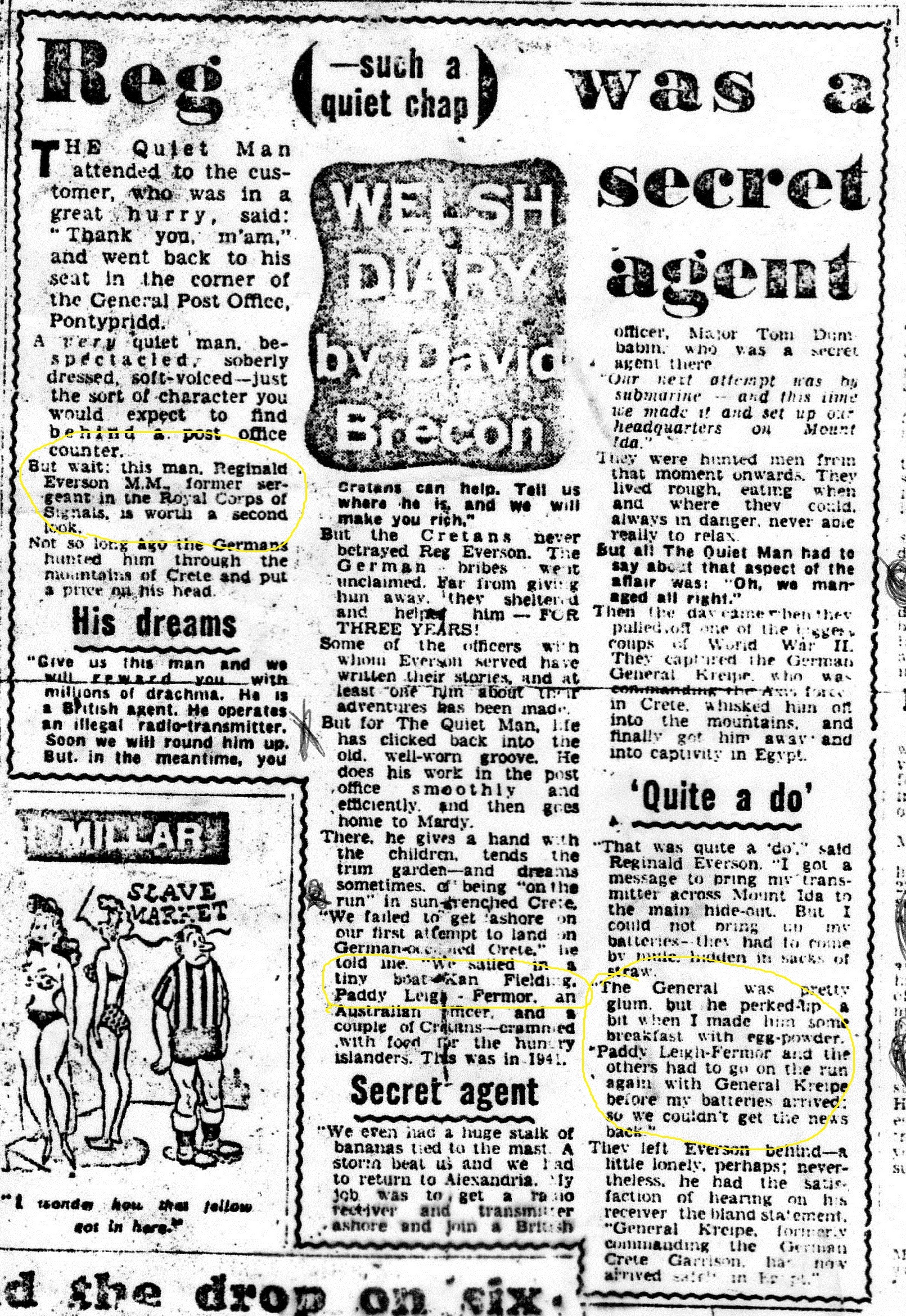
Vince told me that in the 1950’s Reg was interviewed by a local reporter.

I am sure that Reg didn’t want it to sound as if he was alone [on Crete]. He was a quiet mild mannered gentleman, and was in the Royal Signals from 1931 to 1946 and like so many servicemen lied about his age to get in, he was only 15 when he enlisted. For the three years he was on Crete his wife didn’t hear from him. His commanding officer was the only contact she had. People in the village even thought Reg had left her!

It wasn’t until I wrote a piece in the local paper that people understood where he had been because he didn’t speak about it. In the newspaper cutting from the 50s Reg talks about his involvement in the kidnap of General Kreipe and how he cheered up the General by making him some powdered egg for breakfast on Mount Ida.

We have his forged Cretan papers here, also a leaflet that was dropped by the Germans. He was awarded the Military Medal and Africa Star among other medals. He was also presented with a solid silver medal for bravery from the Maharaja of India.

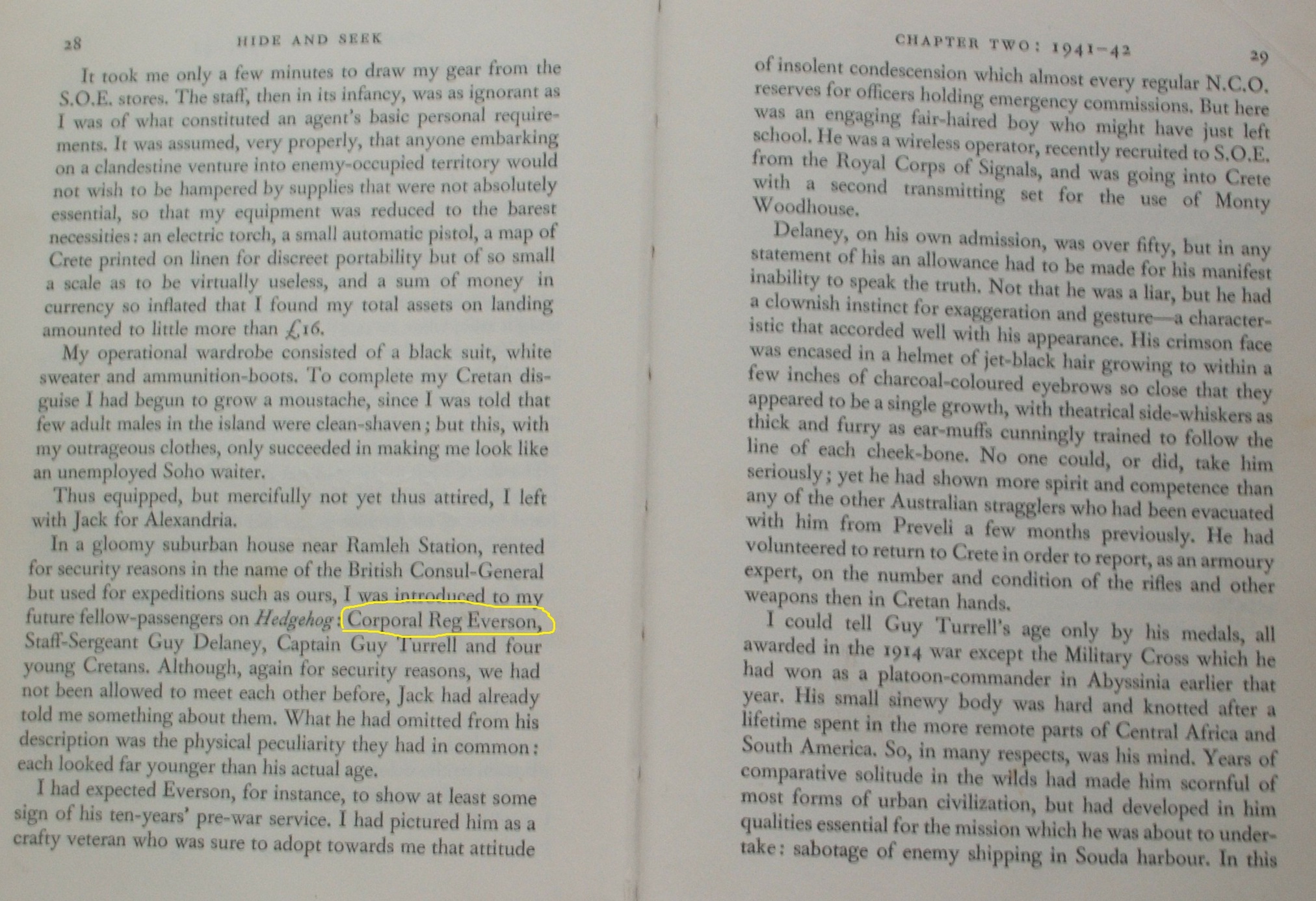
Reg Everson deployed to Crete with Xan Fielding, and Xan refers to this in his account of his time in Crete “Hide and Seek”.


In the newspaper interview Reg describes how he was summoned with his radio to Mount Ida to join the kidnap gang, but he had to wait for his heavy radio batteries to arrive so he made himself useful and he made breakfast for the General on Mount Ida …

“The General was pretty glum, but he perked-up a bit when I made him some breakfast with egg powder. Paddy Leigh Fermor and the others had to go on the run again with General Kreipe before my batteries arrived: so we couldn’t get the news [of the successful kidnap] back.”

Whilst we often hear the stories of the officers in SOE, we should not forget that they were supported by a large team including signallers such as Reg Everson who were especially brave. They risked being located by the Germans who were constantly trying to find the source of their signals to destroy the radios, and capture the highly skilled and valuable operators.

Artemis Cooper “Patrick Leigh Fermor in Greece.” – webcast online

Artemis Cooper

On May 24 2012, Artemis Cooper spoke at the Gennadius Library, Athens, on the subject of “Patrick Leigh Fermor in Greece.” Her lively and inspiring lecture stirred the interest of the audience that filled Cotsen Hall. She traced his life, experiences, and legacy in Greece from his early travels to the end of his life, on 10 June 2011. She talked about the things that drew Patrick Leigh Fermor to Greece in the first place; his ‘participation’ in the Venizelist rebellion of 1935; his early travels in Thrace and Macedonia, and first encounters with the Sarakatsani; his experiences in the war on the Albanian front and Crete, as well as the post-war explorations of Greece that produced Mani and Roumeli. She also touched on the Cyprus years; his friendship with George Seferis, George Katsimbalis, and Nicos Hadjikyriacos Ghika; how he and his wife came to settle in Kardamyli, and built their house with the architect Nicos Hadjimichalis; how the Greek translation of Mani was undertaken by Tzannis Tzannetakis, while he was in exile in Kythera under the Junta of the Colonels. Finally, she reflected on his position in the village of Kardamyli and how he is seen in Greece today.

Artemis Cooper studied English Literature at Oxford, and worked in Egypt and New Mexico before beginning her career as a writer. Her previous books include Cairo in the War: 1939-1945; Watching in the Dark, A Child’s Fight for Life; and Writing at the Kitchen Table, The Authorized biography of Elizabeth David. She has also edited two volumes of letters, and co-authored Paris After the Liberation: 1945-1949 with her husband, the historian Antony Beevor. Her biography of Patrick Leigh Fermor is based on unrestricted access to his private papers, and interviews with him in England and Greece over several years.

To watch the video visit the Gennadius Library website.

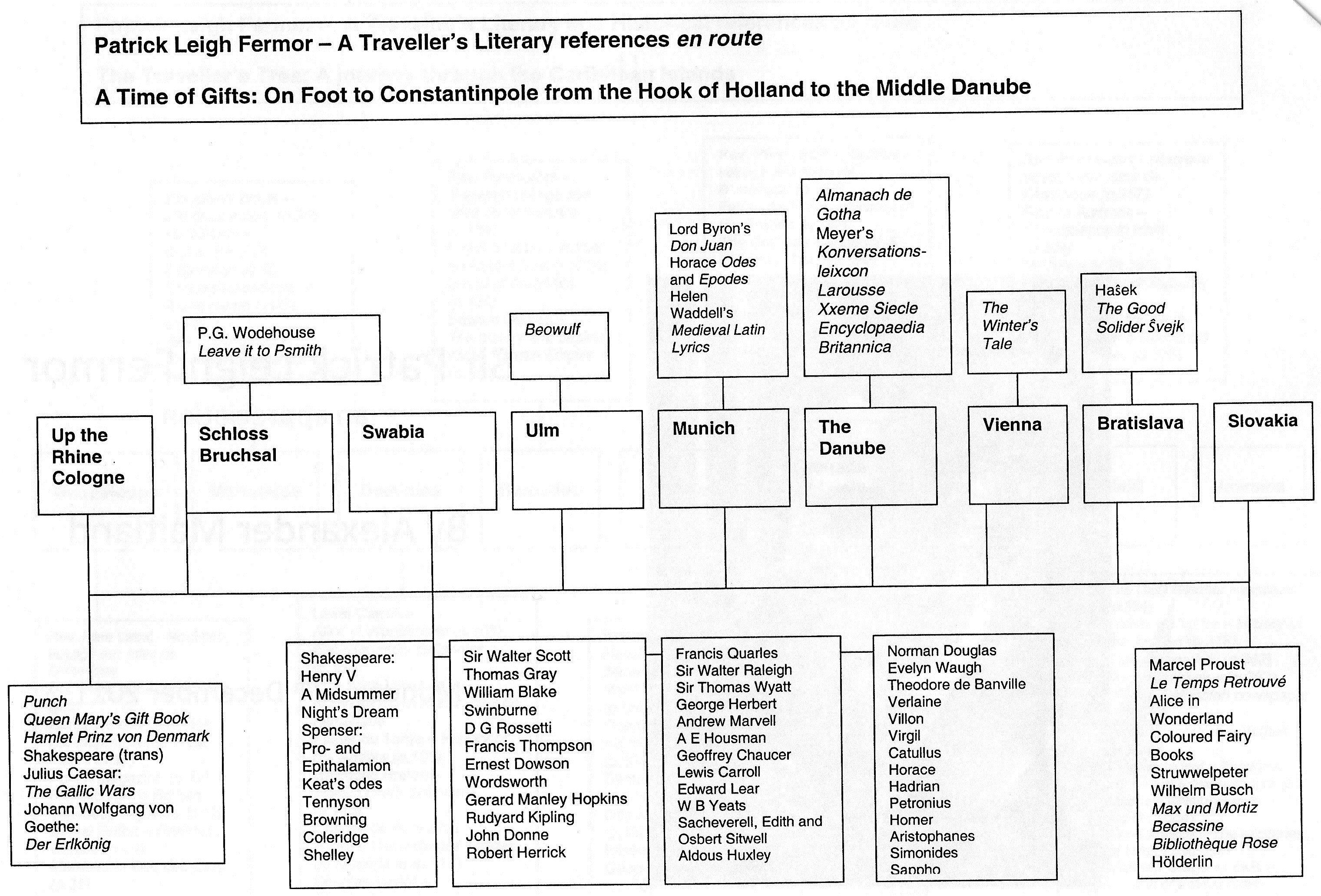
Literary and Historical References – A Time of Gifts

The second in the series which presents the work of members of the Royal Geographical Society which analyses chapter by chapter, literary and historical references from some of Paddy’s key works.

This was presented at the RGS in the afternoon talk on 12 December 2012,”Patrick Leigh Fermor: An Appreciation by Alexander Maitland, FRGS”.

My thanks to the Royal Geographic Society for permission to present this.

Download a pdf of this document here.

Related article:

Literary and Historical References – The Traveller’s Tree

Discussing Patrick Leigh Fermor at the Durrell 2012 conference in London, 16 June

The Lawrence Durrell Society are holding a centenary conference in London during the period 13-16 June 2012. There will be a session focused on Paddy and his relationship with Durrell on Saturday 16 June. The programme for the morning is: 9.00 AM – 10.30 AM :: Parallel Session :: VIIa (Large Common Room) :: Chaired by Pamela Francis (Northwestern State University, Louisiana). Martha Klironomos (San Francisco State University), “Travel Practices, Writing, & Photography: Comparing the Works of Patrick Leigh Fermor and Lawrence Durrell.” Marc Woodworth (Skidmore College), “Fiding Kovecses: An Open Letter to Patrick Leigh Fermor.” Dan Popescu (Partium Christian University, Romania), “‘In Clashing Hues’: Images of the Gypsies in Patrick Leigh Fermor’s Between the Woods & the Water.”

‘Europe is already falling apart’

Antony Beevor

‘I feel uneasy at the way historians are consulted as if history is going to repeat itself. It never does,’ says Antony Beevor Photo: ANDREW CROWLEY

‘Antony Beevor, chronicler of European history, has chilling warnings about the current rise in militant nationalism.’

by Elizabeth Grice

First published in The Telegraph, 28 May 2012.

Clearly the conversation that Elizabeth Grice had with Antony Beevor was a little more complelling than the article she has written, but in the context of his relationship with Paddy (and of course Artemis Cooper), and the state of Europe which, has at its epicentre Paddy’s beloved Greece, I thought I would share this with you.

Antony Beevor, chronicler of European history, has chilling warnings about the current rise in militant nationalism.

Nothing I’ve heard from politicians or economists on the world crisis has shivered my spine like an hour spent with the gentle‑mannered historian Antony Beevor, whose mighty new book on the Second World War is making him the pundit of the moment. He does not mean to be alarmist, and that is why the soft warnings in his sunlit garden are chilling.

Of course the rise of the Right in Europe is not the same as the rise of the Right in the Thirties, he soothes. But isn’t it terrifying the way the Greeks are portraying the Germans as Nazis in their popular press, with Angela Merkel in Nazi uniform? There are “far too many jibes” about a Fourth Reich. The weedlike eruption of extremist parties makes him “uneasy” – and if Beevor is uneasy, it probably means the rest of us should be scared witless.

“The great European dream was to diminish militant nationalism,” he says. “We would all be happy Europeans together. But we are going to see the old monster of militant nationalism being awoken when people realise how little control their politicians have. We are already seeing political disintegration in Europe.”

It’s fascinating the way serious historians are being treated as quasi-prophets for the economically bewildered. Tomorrow, Beevor is due to lecture to the Ministry of Foreign Affairs in the Hague on the Second World War and the current euro crisis and he says he is having to change his script daily “as more and more terrifying news comes in”.

“I feel slightly uneasy at the way historians are consulted as if history is going to repeat itself,” he says. “It never does. It is misleading and dangerous to make sweeping parallels with the Second World War. Politicians like Blair and Bush liked to sound Churchillian or Rooseveltian at times of crisis, but the comparisons of Saddam Hussein to Hitler were preposterous. Eden compared Nasser to Hitler and that led us into the Suez disaster.

“It is this compulsion to look backwards at a time of crisis because one’s got no idea of what lies ahead. There is a notion of security that somehow it must resemble the past. It’s never going to. Just because we muddled through in the past doesn’t mean we can automatically muddle through in the future.”

The only similarity between now and the late Thirties, he says unconsolingly, is that the public have not been told the truth about how desperate the situation is because no politician, then or now, dares to spell it out. “One must remember that Churchill was derided and scorned when he warned of the dangers of German rearmament. He could only come to power once war had started. That, I think, is rather alarming.”

Everything is rather alarming seen through the Beevor long lens. There is even drama in his person. He has a lot of silvery hair and leaping black eyebrows. Though his speech is a torrent of pure Queen’s English fluency, in occasional silences he picks at his fingers. Perhaps he is suppressing anxiety.

If so, it can’t be on account of his sales figures. The military historian – of whom it is always joyfully recorded that at Winchester he failed history and English A-level – has sold more than five million books. His most acclaimed, Stalingrad, won the Samuel Johnson prize for non-fiction, the Wolfson history prize and the Hawthornden prize, all in one week in 1999. With the money, he bought a house in Kent that friends like to nickname Schloss Stalingrad or Dunstalingrad. Here, in a pastoral retreat surrounded by sheep and alpacas, he and his wife, Artemis Cooper, do most of their writing. Her biography of Patrick Leigh Fermor comes out in the autumn.

After his non-compliance in formal education, Beevor joined the Army in 1965 and served with the 11th Hussars. On a posting to Wales, he was so bored that he began a semi-autobiographical novel that made him rethink his motives for being a soldier. They were all wrong: he realised he had a big chip on his shoulder about proving himself physically, a legacy of having been bullied as a child. From the age of four to seven he had walked with an armpit crutch, with one leg strapped up behind his back, because of a degenerative disease of the hip.

John Keegan, whose ground-breaking book Face of Battle revolutionised the chronicling of war, had taught him military history at Sandhurst. Once Beevor got into his considerable stride as a writer (he is from a long line of female authors), he found Keegan’s way of looking at history from the bottom up rather than the top down fitted with his own ideas of conveying the fear, chaos and horror of war from a soldier’s perspective. A soldier himself, he already understood the psychology of war.

“I’m not saying every military historian should have been a former soldier – that was the problem in the past – but some military experience is useful, if only to understand that armies are emotional organisations, not the cold mechanical institutions so often portrayed.”

Beevor’s skill is in making big historical events resonate with people through the detail of human experience gleaned from letters, interview transcripts and diaries. “I am not someone who believes I am going to find a historical scoop,” he says. “What I find satisfying is lots of good low-grade material [in Stalingrad’s cellars, lice are seen leaving the dead body of a German to take up residence in one that was still warm], which helps to build the mosaic through detail. I just love the days when you come out of the archives with half a dozen excellent descriptions or poignant accounts of personal experiences.”

Interest in the Second World War was flat when Beevor started his four-year project on Stalingrad. The book was expected to sell 6,000 copies, but flew off the shelves. Berlin: the Downfall 1945, six years later, was another triumph. The resurgence of interest in history was a phenomenon he could never have predicted. “People’s interest in the past had changed. My timing was lucky. Timing is a big percentage in life, in love or anything else.”

Beevor claims there is nothing he likes better than to start a book with an idea and then to realise he was completely wrong. He has no time for historians who are simply out to prove a thesis. Much historical fiction makes him grind his teeth, especially where words and thoughts are put into the minds of real historical characters, as in the Booker prize-winning Wolf Hall by Hilary Mantel. “We are part of an age where there is virtually no distinction between fact and fiction. The failure to distinguish between historical truth and the imagination of the novelist is a danger area. I am not attacking the quality of Mantel’s fiction but I would have preferred it if she had not called the character Thomas Cromwell. My wife does not agree with me. She thinks I am being far too pedantic.”

He was dragged by his daughter, Nella, 22, to see the film of Dan Brown’s novel The Da Vinci Code (“an absolute load of tripe”) on the basis that it was so bad he might find it amusing. On leaving, Beevor heard a man say to his girlfriend: “That really makes you think.”

“So depressing,” he slumps. “I didn’t know whether to laugh or cry. It is frankly grotesque that nearly 50 per cent of the population was persuaded that Mary Magdalene had a child by Jesus and the bloodline continued.” As for Tom Cruise in the 2008 film Valkyrie: “Most people seeing it would have thought it was an accurate account of the July bomb plot, when it was absolute rubbish. Sorry, but the interests of the entertainment industry and the interests of history are fundamentally incompatible.”

He admits to panic that he would drown in the sea of material for his latest book, The Second World War. Copying across information from the archives into skeleton chapters, he would find that he had 110 pages of notes for a single chapter. And yet there is one more massive Beevor analysis of the conflict still to come – about the Battle of the Bulge in the winter of 1944 – before he starts an epic life of Napoleon, followed perhaps by a novel set in 1917‑45. He is 65, and at his present rate of production, that will take him well into his seventies. “I can’t envisage stopping writing,” he says. “My dear father-in-law, John Julius Norwich, is still writing at 82. My God, it really keeps the marbles jangling.”

Antony Beevor’s ‘The Second World War’ is available to order from Telegraph Books for £20 plus £1.25 p&p. Call 0844 871 1515 or visit books.telegraph.co.uk. He will be at the Telegraph Hay Festival at 7pm on June 9; http://www.hayfestival.com

An Adventure

Artemis Cooper

Word has reached me that the biography of Paddy by Artemis Cooper is now completed and is going through the final editorial stages. The much anticipated book will be published by John Murray and is likely to hit the bookshops in October.

Artemis is Paddy’s literary executor and a good friend. Her father, the historian John Julius Norwich being a friend of Paddy’s for many years. She has had exclusive access to Paddy’s archive and will be able to fill in many of the gaps in his life story, including more details about the last stage of his 1934 journey through Bulgaria, Romania, and Thrace to Constantinople. We are all hopeful that her next project will be the completion of ‘Volume Three’, the book that Paddy was unable to complete despite attempts over many years.

I hope to bring you more news about the biography, which will be called ‘An Adventure’, in the coming months.

To pre-order or purchase your copy click here.

£1 a week – Rendezvous in Cluj

My visits to Cluj are always a pleasure, notwithstanding the need to get up at five o’clock in the morning to catch an early Wizz Air flight. However, as I prepared for my last visit, there was an extra dimension to my anticipation.

If you have been following Nick Hunt’s journey on his blog and the occasional updates here, you will know that he arrived in Romania in early April and was making good but steady progress in the Mures valley visiting some of the houses that Paddy had stayed in, including Istvan’s kastely. As I prepared for my visit it became clear that there was a chance that Nick and I might meet up in Cluj as he, like Paddy, had decided to complete the ‘Transylvanian Loop’ by motor; getting lifts from people he had met or just hitch-hiking.

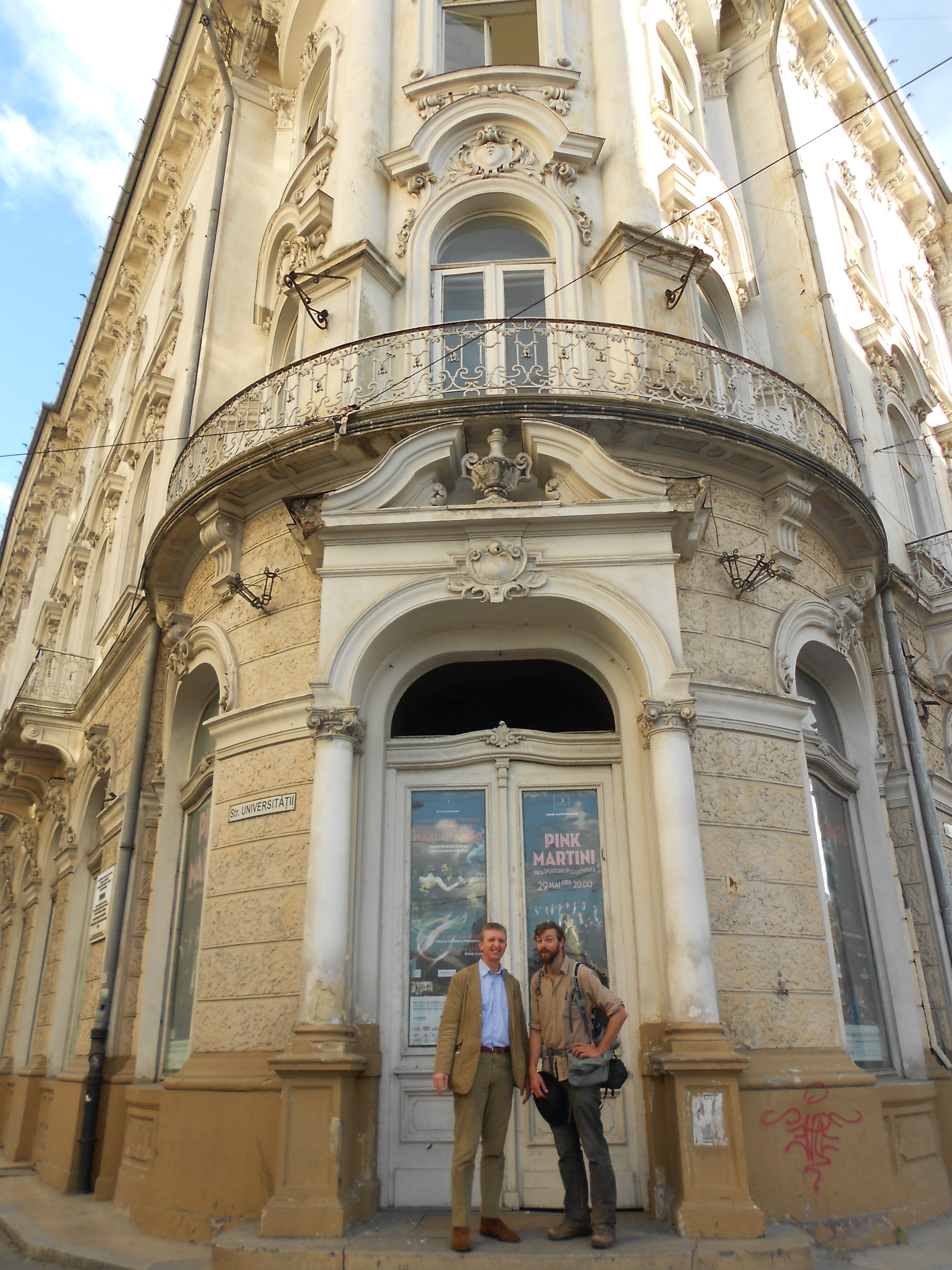
As the last week of April arrived Nick was staying at the house of a Romanian philanthropist in Turgu Mures. We corresponded and Nick told me that he would be getting a lift to Cluj on the Monday, the day of my arrival. I was able to arrange some accommodation for him through a colleague at work and suggested that we meet at the Hotel Continental (aka the New York) in the main square in Cluj after I had finished work.

This, therefore, is how we managed to meet after five months and, for Nick, over 1,300 miles of walking. He arrived at the Continental looking slightly bemused, carrying his quite small rucksack, sporting a well-developed beard, and wearing the most battered pair of walking boots I have seen for a long time (they are his original pair and a recently ‘serviced’ by a cobbler in Turgu Mures). Despite our pleading the security guard at the locked hotel would not let us in, and any thought of having a cocktail diminished.

Later we had a few beers and some food whilst talking about his journey. He is clearly enjoying it all and making daily discoveries. Whilst he is following Paddy’s route, and this provides an inspiration and an anchor, it is clearly very much his own expedition which he will tell in his own words in the book which will be published by Arcadia, possibly in 2013. Whilst Nick has as yet no definitive structure for the book he is making comprehensive notes every day and being very careful to guard his notebooks!  From what he told me I think it will be enjoyable, and having read some of the longer pieces on his blog it will be well written and easy to read.

I asked Nick if he was missing home. Only his girlfriend, he replied, and they keep in regular contact via email. Perhaps the biggest difference between his journey and that of Paddy is the ability to keep in touch using modern communications including the essential mobile phone. A striking comment that Nick made was that whilst the first part of the journey through Germany was to a degree well planned, the further east he has gone he has had to make arrangements for accommodation as he has gone along bringing a higher degree of spontaneity. “It is as if there are dark places on the map ahead of me that gradually illuminate the further I proceed, becoming brighter and more defined as each day passes.”

Nick is now somewhere in the heart of the Carpathians on his way to Baie Herculaneum and the Danube. We joked that he must take care to avoid the bears and wolves in the mountains and he promised he would keep a good look out. In two to three months his journey will end and I asked him how he will return home. He answered, after a long pause, that he does not know, but he is sure that he cannot just jump on a plane and return to London in one day, even mentioning the possibility of walking around the Black Sea. There was a certain wistfulness in his eyes as he answered, and it struck me that this may be the hardest part of the journey; giving it up and returning to what we call reality.

Related article:

An eye for detail and the memory of the Hotel New York in Cluj

Patrick Leigh Fermor: We May Just Forget to Die, an essay by Margot Demopoulos

This is the probably most significant full length profile of Paddy that has appeared since his death. It is by Margot Demopoulos a writer who lives and writes in Los Angeles. Her fiction has appeared in The Briar Cliff Review, Mondo Greco, The Athenian, and other publications.

The interesting aspect of this profile is an extensive exploration of the events surrounding the Kreipe kidnap with particular attention to the contentious subject of post-operation reprisal by the Germans.

The subject line appeared in an earlier blog post from June 2011 where I highlighted Diana Gilliland Wright’s correspondence with Paddy.

On to the profile ….

“Englischer Student . . . zu Fuss nach Konstantinopel…” eighteen-year-old Patrick Leigh Fermor told the kindly woman sewing by the fire that snowy night at Heidelberg’s Red Ox. He sat at a nearby table, recording the day’s events in a notebook, hunting for German words in a dictionary, consulting maps for the next leg of the journey, “thawing and tingling, with wine, bread, and cheese handy,” as melting snow pooled around his boots.

“Konstantinopel?” Frau Spengler said. “Oh Weh! ” O woe! So far!

Far indeed, especially in the snowdrifts of mid-winter, but there he was — undaunted, spirits high, finally setting out on his own path — nearly two months into his journey to cross Europe on foot, with Constantinople the terminus. Nearly forty-five years later, he would publish the story of that journey in A Time of Gifts. Read More ….

Access the pdf of the article here.

Ein edler Landstreicher – Roumeli republished in German

From der Freitag. The German love affair with Paddy’s work continues. Rumeli in German.

In den Romanen von Patrick Leigh Fermor werden Landschaften zu Kunstwerken – und der Leser zu dem, der er war, als er mit der Taschenlampe unter der Bettdecke hantierte

Es sind Bilder, die haften bleiben, Bilder einer wild zerklüfteten Felslandschaft an Europas äußerstem Rand, von Menschen mit gewaltigen Schnauzbärten, die noch in der Mitte des 20. Jahrhunderts Dolche an ihren Gürteln tragen und die archaische Praxis der Blutrache kennen. Ihr Schöpfer, der englische Schriftsteller Patrick Leigh Fermor, durchwandert im Jahre 1952 Griechenland, genauer: die Mani, wie der mittlere Finger des wie eine Hand ins Mittelmeer greifenden Peloponnes heißt. Vor sehr langer Zeit, nach seiner Eroberung Karthagos, war der Vandalenkönig Geiserich auf die Mani vorgerückt, wurde aber mit heftigen Verlusten geschlagen, woraufhin er voller Zorn 500 Gefangene nehmen, in Stücke schlagen und auf dem Rückweg nach Karthago im Meer verstreuen ließ. Wenn Patrick Leigh Fermor davon erzählt, entsteht der Eindruck, die Geschichte der Menschengattung sei eine deprimierende Aneinanderreihung wahnwitzigster Episoden.

Read more here.

Literary and Historical References – The Traveller’s Tree

The first of a series which presents work done by members of the Royal Geographical Society which analyses chapter by chapter literary and historical references from some of Paddy’s key work.

This was presented at the RGS in the afternoon talk on 12 December “Patrick Leigh Fermor: An Appreciation by Alexander Maitland, FRGS”.

My thanks to the Royal Geographic Society for permission to present this.

Download a pdf of this document here.

Patrick Leigh Fermor’s estate auctioned by Christie’s: A Life’s Collection

The auction house Christies will present the principal contents of Mill Farm, Dumbleton for auction at their sale rooms at 85 Old Brompton Road  London, Greater London SW7 3LD, on Tuesday 15 May 2012.

The collection includes furniture, books, silverware, and many works of art. How many of these were collected by Joan and Paddy, and which came from their families is difficult to assess.

You can view the e-catalogue here.

Remember that you don’t have to be present to buy but can bid on-line as described in the catalogue. I hope that some of you have the opportunity to make a purchase.

New book about Paddy published in Greece

I have no further details but this was highlighted on the PLF group on Facebook. Those of you who read Greek may be able to provide more background.

Estate of Dumbleton travel writer Sir Patrick Leigh Fermor could fetch £150,000

THE estate of travel writer and extraordinary war hero Sir Patrick Leigh Fermor is set to fetch £150,000 at auction.

Sir Patrick died in June 2011, aged 96, and now the first 100 lots of his estate, Mill Farm in Dumbleton, will go under the hammer in May.

It will include decorative objects, books, furniture, modern British and old master pictures, as well as silver objects.

Sir Patrick was a travel writer, who was most famous for his account of his year-long walk from Rotterdam to Istanbul in 1934, when he was 18 years old.

The journey was later published in his popular books A Time of Gifts (1977), and Between the Woods and the Water (1986).

He lived in caves in the mountains of Crete disguised as a shepherd during the Nazi occupation from 1941.

In 1944 he and fellow writer Bill Stanley Moss avoided capture by dressing as German police officers and bluffing their way through 22 different check-points.

After the war, Sir Patrick journeyed around Greece with his wife Joan, devoting much of his time to writing and staying with his artistic and creative friends, including the artist Nico Ghika.

Both Sir Patrick and Joan were very sociable personalities, and some of their many eminent friends and admirers included Alberto Giacometti, Lawrence Durrell, John Betjeman, Lucian Freud and Dowager Duchess of Devonshire, many of whom frequently visited The Mill House where they shared and cultivated a love for the arts.

The auction, at Christie’s in South Kensington, is on May 15. Edit – I can’t find anything specifc on the Christie’s site so I advise contacting them.

From This is Gloucestershire