Category Archives: Uncategorized

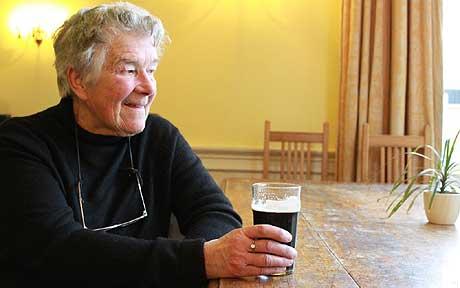
Dervla Murphy: ‘Older travellers are now more intrepid than the young’

Dervla Murphy

This makes great reading for those of us who are growing old, or who wish to grow old, disgracefully! Perhaps it is actually gracefully?

by Dervla Murphy

First published in the Telegraph, 23 September 2015

In her late 30s, Jane Austen serenely prepared for imminent middle age and soon was dressing as a maiden aunt with no hope of losing her maidenhood. Yet many of her relatives and friends lived energetically into their 80s and 90s; so why, 200 years ago, was middle age allowed to take over at 40? Was the bible to blame?

Until recently, its general prognosis seemed realistic: three-score years and 10, if you were lucky. My own generation took this ration so much for granted that I now feel absurdly smug about being 13 years into overtime. True, these last few years have revealed several tiresome worn parts, but the underlying logic here – that all machines wear out – makes restricted physical activity seem tolerable. And this despite the fact that the wanderlust, unlike other lusts, does not diminish with age.

For this reason I always feel one should avoid, for as long as possible, casual visits to the doctor. He/she is too likely to take blood samples, diagnose problems you haven’t yet noticed, prescribe medicines that benefit only Big Pharma and advise you not to go where you want to go.

In 1992, when I decided to cycle from Nairobi to Cape Town, my family and friends made no comment; it was the sort of thing Dervla did. Only a few anxious acquaintances, and sceptical interviewing journalists, drew my attention to the fact that I was 61; it wasn’t yet trendy to witter on about “40 being 60” and “80 being 60”.
In fact, ever since the bicycle was invented, cyclists have kept pedalling into their old age. Quite often one hears of grannies and grandads cycling across the United States or Canada, or from Helsinki to Gibraltar, or from Mexico to Patagonia. That’s the convenient thing about non-competitive cycling (or walking): the more of it you do, on a daily basis, the longer you can keep doing it.

Before affluence hit Ireland, many GAA (Gaelic Athletic Association) fans from my home town of Lismore thought nothing of cycling over the Knockmealdown mountains, on bicycles without gears, to an important hurling match in Thurles. They set out at sunrise and arrived home in the summer dusk having pedalled 120 miles. Now their grandchildren motor to fetch the milk from the corner.

Read the entire article here.

Audible

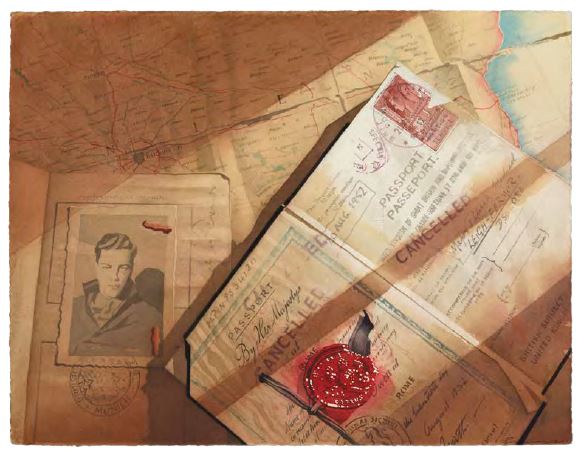
Painting the John Murray archive

Buchannan PaddyIn January’s report on the presentation by David McClay, the curator of the John Murray archive at the National Library of Scotland, I mentioned an exhibition of watercolours by Hugh Buchannan which is now moving to the John Martin Gallery in Albemarle Street from 18 September.

Buchannan’s paintings include details from a wide range of author material included within the archive from Byron, Austin, Sir Walter Scott, Irving and of course Paddy’s legacy.

The exhibition runs from 18 September to 10 October 2015 at the John Martin Gallery, 38 Albemarle St, London, W1S 4JG. Further details here.

You can download the catalogue as a pdf here.

Audible

Why (some of) the Most Popular Hiking Memoirs Don’t Go the Distance

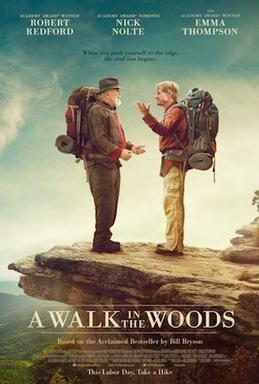
Whilst I find Bill Bryson amusing, his, possibly contrived, whimsey would probably get on my nerves if I read too much of him. I have never read A Walk in the Woods: Rediscovering America on the Appalachian Trail, but I have sometimes thought how it must be to walk it. During my Camino to Santiago de Compostela I walked for some days with a guy who had done it three times; he was all at once a loner but at the same time he craved company. I guess that you really do have to be a loner to walk all 2,200 miles of the Appalachian Trail. I thought that you might find this article interesting, and it may whet your appetite for watching the movie of the book (walking movies are all the rage) which stars Robert Redford and Nick Nolte, due for release 2 September.

By Robert Moor

First published in the New Yorker, 21 August 2015

When I was eighteen, I bought a copy of Bill Bryson’s A Walk in the Woods: Rediscovering America on the Appalachian Trail which remains, if my conversations with strangers are any indication, the only book anyone has ever read about the Appalachian Trail. It was summer. My friend Andy and I had driven across the country and ended up in the town of Sheridan, Wyoming, where we stayed for a week with a genial middle-aged couple, family friends of my friend. Scanning my hosts’ bookshelves, as I have a tendency to do, I was quietly horrified to discover that they were exclusively stocked with works of pop evangelicalism (Rick Warren and the like). It was a literary desert: xeric, Mosaic. Bryson’s book was the only one I’d brought, so, while Andy rode dirt bikes with a guy named Dusty, I lay on a fold-out couch in the basement, consuming it in controlled bursts, as if bolting food rations.

I had dreamed of hiking the Appalachian Trail since I was ten years old. From Bryson’s wry, well-researched account, I began to learn how it would feel to walk through two thousand miles of mountainous wilderness. What stood out most were the descriptions of “tranquil tedium,” a seemingly endless trudge through the “cubic” vastness of deep woods. “At times,” he writes, “you become almost certain that you slabbed this hillside three days ago, crossed this stream yesterday, clambered over this fallen tree at least twice today already. But most of the time you don’t think. No point. Instead, you exist in a kind of mobile Zen mode, your brain like a balloon tethered with string, accompanying but not actually part of the body below. Walking for hours and miles becomes as automatic, as unremarkable, as breathing.”

Around page one hundred, I reached the passage where Bryson and his hiking partner study a wall-map of the trail in an outdoors store, in Gatlinburg, and, overcome by the sight of how little of it they had already walked, decide to skip the state of North Carolina and drive to Virginia. I let out a howl of indignation and threw the book against the wall. But, needing to know how the book ended, I picked it back up again. I repeated the cycle (howl, throw, retrieve) when Bryson decided to skip the northern portion of Virginia and just drive up the trail, taking hikes here and there, and again when he quit a quarter of the way through the Hundred-Mile Wilderness, at which point he concludes, defiantly, “I don’t care what anybody says. We hiked the Appalachian Trail.”

There, in that basement, I resolved that one day I would hike the trail the right way: from end to end, in one continuous trip—what’s often called a “thru-hike,” always with that peculiar, abridged spelling, otherwise reserved for fast-food signage and nineteenth-century poetry.

I eventually did so, in 2009. It was roughly how Bryson described it: long, hard, and monotonous, but also beautiful and enlightening and wonderfully (and then, later, worryingly) slimming. While hiking the trail, I learned that whenever a thru-hiker met a day-hiker (as thru-hikers somewhat dismissively refer to those who are “just out for the day”), the day-hiker would invariably ask the same question: “Have you read ‘A Walk in the Woods’?”

Many thru-hikers bristle at this question. By quitting in Gatlinburg and then hop-skipping up the trail, Bryson bastardized the central conceit of a thru-hike, which is that you hike through—through mountains and valleys, through farms and small towns, through pain, through hunger, through nagging doubt. For thru-hikers, the continuity is the point, in the same way that running a marathon is more meaningful than running four separate 6.5-mile races. Certain thru-hikers, referred to as “purists,” take this emphasis on continuity to obsessive lengths. Some touch or kiss every blaze of white paint along the trail, while others carefully line up their shoes, like Japanese slippers, in the precise spot they entered a lean-to, so as to know exactly where to resume hiking the next day.

Bryson thus finds himself in the curious position of being both the outward face of the Appalachian Trail and its most inwardly mocked figure. This discrepancy will likely intensify when the film version of the book, starring Robert Redford and Nick Nolte, premières on September 2nd. I gather that some people who have thru-hiked the Pacific Crest Trail feel similarly about “Wild,” Cheryl Strayed’s best-selling hiking-memoir-turned-feature-film about hiking one third of the P.C.T. There is also the curious case of Paulo Coelho, the author of, among other books, “The Pilgrimage,” a best-selling account of walking the Camino de Santiago de Compostela, the famed network of pilgrimage routes across Spain (and beyond). Coelho quit in the town of O Cebreiro, some hundred miles short of his destination, and then rode in a bus to Santiago de Compostela. According to a profile of Coelho published in this magazine in 2007, the proprietor of a hotel along the Camino told Coelho that his book had done wonders for his business. “As Hemingway was for San Fermín, you are for the pilgrimage!” he exclaimed.

The question arises: why are the three most famous accounts of hiking three of the world’s most famous long-distance trails written by people who did not hike the whole distance?

One obvious answer: great writers are simply less athletic than your average human. But this theory crumbles upon closer inspection. John Muir walked a thousand miles, from Kentucky to the Gulf of Mexico, while Vachel Lindsay walked from Illinois to New Mexico, Matsuo Bashō walked the length of Honshu and back, Rory Stewart walked across the mountains of South Asia, Robyn Davidson walked across Australia, and Patrick Leigh Fermor walked across Europe.

In fact, I would argue that the loneliness and skull-bound nature of a long-distance hike fits quite nicely with the thinking out, if not the actual writing, of books. The dusty back aisles of Amazon are glutted with first-person accounts of successful thru-hikes, most of which tend to be buffed-up re-writes of the author’s trail journal. These books have a limited audience (namely, other thru-hikers), whereas the books that become best-sellers speak to people who would never embark on a long-distance hike in the first place. “A book about hiking the Appalachian Trail? Spare me. I could imagine it: We walked. We saw trees. We went up. We went down,” snarked a 1998 article in the New York Times, before praising the many charms of Bryson’s book.

The rare best-sellers leap this pitfall by hitching onto other well-established genres: Bryson’s is a humorous travelogue, Strayed’s a memoir about healing, and Coelho’s a quest novel. They also avoid the doldrums of strict, day-by-day linear storytelling. Instead, Bryson chunks his trip into discrete regions, drilling down into the history of each; Strayed pares the story back to a string of anecdotes, and then interweaves them with flashbacks from her rocky upbringing; and Coelho structures the walk around a series of spiritual “exercises”—battle a dog, climb a waterfall, raise a cross—assigned by his guide, Petrus. The reader is never tempted to skip ahead to see if the author finished the trek or not, because that has ceased to be the point.

Finally, all three narrators share the nervous, wide-eyed enthusiasm of a greenhorn. Reading the list of extraneous items that Bryson and Strayed packed for their thru-hikes—folding cutlery, a plastic dish, a spare gas bottle, four bandannas, a “big knife for killing bears and hillbillies”; a towel, binoculars, a foldable saw, a stainless-steel digging trowel, a metal votive-candle lantern, shampoo, conditioner, a hairbrush—made this minimalist’s teeth grind. But I imagine that a non-hiker might read that same list and think, “Oh wow, is that all? For four months?” Because they began in places of utter ineptitude and painfully ascended to the status of hardened veterans, Strayed, Bryson, and Coelho were able to fashion engaging emotional trajectories for their books. But that same lack of preparation and training made it exceedingly difficult for them to finish the trail, so they were ultimately forced to trim back their ambitions.

It has been twelve years since I last read A Walk in the Woods: Rediscovering America on the Appalachian Trail I picked it up once following my thru-hike, but I found I was too close to the material; I quibbled over every description, guffawed over every misstep. Recently, while working on my own book about trails, I picked up my old copy again. Reading it as a writer, rather than a hiker, it felt fresh. In a voice at turns erudite, acid, and tender, it somehow manages to provide a brisk overview of both the long history and the vast expanse of the trail. Bryson captures the alienating shift in perception that attends a return to civilization from an extended stay in the wilderness, and uses that weird lens to inspect the more grotesque aspects of American society. He manages to sound the depths of a lifelong friendship without becoming maudlin. And he ultimately succeeds in claiming a personal victory from an otherwise botched expedition. In the book’s concluding pages, he catalogues all he gained from his hike: “For a brief, proud period I was slender and fit. I gained a profound respect for the wilderness and nature and the benign dark power of woods. I understand now, in a way I never did before, the colossal scale of the world. I found patience and fortitude that I didn’t know I had. I discovered an America that millions of people scarcely know exists. I made a friend. I came home.”

In the end, as at the beginning, I found “A Walk in the Woods: Rediscovering America on the Appalachian Trail to be a delightful little book. Still, I don’t care what anybody, including the author, says: Bill Bryson did not hike the Appalachian Trail.

Buy A Walk in the Woods: Rediscovering America on the Appalachian Trail

The reader’s guide to walking: Why we do it and what we think about it

Walking for pleasure … No, let me start again. Walking as a recreational activity dates only from the late 18th century. Prior to that human beings walked because they had to – either they were nomadic or walking was their only way of going on a necessary journey. The Wordsworth family were pioneers; William and his sister Dorothy ate up the miles around their home in Grasmere. To read Dorothy’s journals is to be flabbergasted by how much walking the pair did, most days, in all seasons, all weathers, walking for maybe three hours at a time, Dorothy in her ankle-length skirts, and often just for a cup of tea. The curious side to this is how often Dorothy reports one or both of them as “ill” – bowel problems it seems – they got the exercise right but not the diet.

by Gerard Windsor

First published in The Sydney Morning Herald, 18 July 2015

Yet the Wordsworths were primitives on the recreational walking scene; generally they went out their own front door and were home the same day. As the 19th century wore on and the railways opened up, walkers could select a protracted itinerary far from home. That sub-species of travel writing, the record of the walking tour, was born.

First among the writers were the now unread George Borrow, and the rather more read R. L. Stevenson with his 1879 Travels with a Donkey in the Cevennes​ (read not least because of its re-enactment by the young Richard Holmes in his 1985 Footsteps). The genre flourished in the 20th century – Hilaire Belloc’s The Path to Rome (1902), Eric Newby’s A Short Walk in the Hindu Kush (1958), Patrick Leigh Fermor​’s trilogy of his walk from the Hook of Holland to Istanbul between 1933 and 1935 … On and on they stride.

Walking of this kind is a rarefied activity, restricted to the better-off citizens of First World countries. Compulsory walking, the endless forced marches of pedestrian refugees, is as common as ever. And over the whole enterprise of walking hangs the armageddon imagined by Cormac McCarthy in The Road where there’s no alternative, if there’s to be any salvation at all, but to walk. For a man such as McCarthy, whose other fiction has been so equestrian centred, this pedestrianism is the ultimate degradation.

Meanwhile leisure walking is a snowballing business, and increasingly up for analysis. A Foucault scholar, Frederic Gros​, has given us A Philosophy of Walking, a fair example of the Gallic intellectual’s blend of non-sequential abstraction and soaring rhetoric.

Gros doesn’t actually let on whether he himself has so much as walked to the boulangerie, but he does micro-studies of prodigious walkers, notably Rimbaud and Nietzsche. Given that one gave up his poetical vocation for a career (highly unsuccessful) in trade, and the other went mad, I can’t unravel Gros’ argument. But he does make one striking point – walking is very monotonous but never boring. I think that’s a very French, and fair, sort of distinction.

Much more feet on the ground is Canadian Dan Rubinstein​’s Born to Walk, an encyclopaedia of the benefits of walking, scary to the delinquent and cheering to the virtuous.

It’s full of facts and the results of studies – sitting is the new smoking, the catastrophic plunge in the number of children walking to school is in inverse proportion to the rise in obesity levels, regular exercise in a park or forest will halve chances of developing a mental illness, Australian adults average 9700 steps each day while Americans only manage 5100, and there was an epidemic of the wonderfully named hysterical fugue, alias dromomania, alias compulsive wandering, in Europe in the late 1800s.

Rubinstein, who likes to walk in the snow, is earnest, and also very secular, so that he’s sniffy about pilgrimages. But they’re not to be sneezed at; the walk to Santiago de Compostela​ is engendering books on an industrial scale: pioneer producers included David Lodge (solid), Paulo Coelho​ (an acquired taste), Shirley MacLaine (nutty).

For many Santiago pilgrims the walk ends on the Galician coast, at Finisterre. So Land’s End in Cornwall is also a fitting terminus for a walk. The superb Yorkshire poet, Simon Armitage, recently elected the new Professor of Poetry at Oxford, spent three weeks on the road in 2013, starting from Porlock (of Coleridgean memory) in Somerset and following the South West Coast Path for 250 miles to Land’s End. (He actually went on to the Scilly Isles, but not being Jesus he had to take a boat, so Land’s End is where he stopped walking.)

He records the trip in Walking Away, a sequel to his Walking Home, an account of his 2010 walk along the Pennine Way, the spine of England. He ends his new book unequivocally: “I won’t be doing any more long walks.” Twenty pages earlier he records his father (a great bit part) phoning him and saying, “I think this will be your last long walk”. Armitage comments “it’s less of an observation and more of an instruction, issued partly out of concern for my skeletal structure and partly as a response to increased child care duties.”

I wouldn’t bet on either of them being right. For both walks Armitage arranged in advance to give a reading every evening, pass a capacious sock around at the end, and spend the night as a guest of the local organiser. The strategy works well, and so do the books. Not least because Armitage is a born humorist, particularly adept at recording (or maybe recreating) snatches of dialogue. At his last reading, on the island of Tresco, a woman asks if she can come up and read some of his work.

” ‘I don’t know if that’s a good idea,’ I say. ‘I’ll be good at it. I’m an auctioneer,’ she replies.”

Walking books rely on two staples – the trials and the encounters of the way (once upon a time these were combined – dragons, or giants). Armitage’s encounters are fleeting; his hosts for the night, locals who accompany him part of the way. His family pop up in cameo appearances and he is joined periodically by his oldest male friend, an apparently charming sponger known as Slug. There is also a beautifully delivered story about someone thanked in the Acknowledgements as “the hooded lady who propositioned me on the path between Clovelly and Hartland Quay”.

In all these encounters Armitage presents himself as reticent, but readily recording the topics of the garrulous. There is no suggestion of any conversations about emotional issues or the meaning of life. It’s that sort of book. In one way Armitage’s main encounter is with the landscape. A student of geography at university, he weaves precision of observation and naming with a poet’s unforced lyricism.

The second staple of the walking book are the trials. The grimmer the better. I can’t think of a greater masterpiece of the genre than Apsley Cherry-Garrard’s 1922 The Worst Journey in the World, his account of an ordeal that no human should have survived during Scott’s fatal expedition to the Antarctic. Beside this account anything else is a stroll, a doddle. Cherry-Garrard has permanent rights to his title.

For Armitage the Pennines were infinitely bleaker than the South Coast, the weather far worse, his chances of getting lost stronger, the likelihood of his giving up more immediate. This gives an edge and a tension to Walking Home that Walking Away lacks, but the pair are a treat, just the things to slip into for a winter hike, around the heater.

Gerard Windsor’s most recent book is Angels Before Me: The Road to Santiago. He is about to attempt the European Peace Walk from Vienna to Trieste

In the footsteps of Marco Polo: the journey that changed William Dalrymple’s life

Taken from the introduction to the 25th anniversary edition of William Dalrymple’s first book In Xanadu: A Quest, and first published in The Spectator on 24 June 2015

At the end of the windy, rainy April of 1986, towards the end of my second year at university, I was on my way back to my room one evening, when I happened to trudge past my college notice board.

There my eyes fell on a bright yellow sheet of A4, headlined in capital letters THE GAILLARD LAPSLEY TRAVEL SCHOLARSHIP. It hadn’t been a good week. I was 21: broke, tired of revision for exams and already longing for the holidays. But stopping to look closer, I found that the notice was an announcement concerning a fund that had been established in the memory of some recently-deceased history don; its stated aim was to fund research travel for the college’s mediaeval historians. There were, I knew, barely a handful of mediaevalists in the college.

I walked straight over to the library, found a large quarto edition of The Times Atlas of World History and leafed through the pages to see what was the longest and most ambitious mediaeval journey I could think of following: the longer the trip, I figured, the larger the grant I could apply for.

An hour later I had typed out an application for an expedition to follow the outward journey of my childhood hero, Marco Polo, from Jerusalem to Kubla Khan’s Xanadu in Mongolia. The place names were the stuff of fantasy, and so, I felt sure, was the application. But I happened recently to have seen an article announcing that the Karakorum Highway linking Pakistan to China had just been opened to travellers. This meant that following Polo’s journey was technically feasible for the first time since the Soviet invasion had cut the hippy’s overland route a decade earlier. I posted the application in the letterbox of the don responsible, then went back to my revision and forgot all about it.

A month later, I was returning to my rooms from the last of the year-end exams when I found an embossed college envelope had been slipped under my door. Inside was a short letter and a cheque for the princely sum of £700: much the largest cheque anyone had ever written me. To my immense excitement, but also real foreboding, I found I had just committed myself to an enormously long and dangerous journey through a part of the world I was almost entirely ignorant about. To make matters worse, I had just been chucked by the girlfriend with whom I had planned to make the journey.

It was not a promising start; but the expedition which followed remains by far the most exhilarating I have ever undertaken: nothing I have done since, in half a lifetime of intense travel, has ever begun to equal the thrill of that 16,000-mile three month journey, walking, hitchhiking and bussing from one side of Asia the another. It was also a journey that, in a very real sense, changed my life forever.

I had already travelled in India, and the previous summer had hitchhiked from Scotland to Jerusalem following the route of the First Crusade. I read more widely still among the English travel writers, and Eric Newby, Bruce Chatwin, Peter Fleming, Patrick Leigh Fermor and especially Robert Byron were then my literary Gods, at whose altars I worshipped with an almost fundamentalist fervour. Now I was determined to write my own travel book, and from the first morning of the trip, on arrival in Jerusalem, I kept detailed notes with a view to producing a book that I wanted to be an updated homage to Robert Byron’s The Road to Oxiana, a text I loved so much and had read so often, that I knew great chunks of it by heart.

The result was In Xanadu: A Quest. The book, which was first published quarter of a century ago, in 1989, had a lucky reception. The early 1980’s was a time of disenchantment with the novel, and travel writing seemed to present a serious alternative to fiction. A writer could still use the techniques of the novel – to develop characters, select and tailor experience into a series of scenes and set pieces, arrange the action so as to give the narrative shape and momentum – yet what was being written about was true. Moreover, unlike most literary fiction, travel writing sold.

The success of Paul Theroux’s The Great Railway Bazaar, with its sales of 1.5m copies, had dramatically breathed life into the sort of travel memoir that had flourished in an earlier age, but which had languished since the European empires imploded after the Second World War. Its success inspired Bruce Chatwin to give up his job as a journalist and to go off to South America. The result – In Patagonia – was published in 1977, the same year Leigh Fermor produced A Time of Gifts. The final breakthrough came in 1984 with the publication of the celebrated travel writing issue of Granta: ‘Travel writing is undergoing a revival,’ wrote Bill Buford, the magazine’s editor, ‘evident not only in the busy reprinting of the travel classics, but in the staggering number of new travel writers emerging. Not since the 1930s has travel writing been so popular or so important.

So In Xanadu came out at just the right moment, when travel writing was at its most popular. Partly as a result of this lucky timing, the book got generous reviews, was an immediate bestseller and won a small clutch of prizes. It allowed me for the first time to think of writing as a feasible career. It nonetheless remains a text I have always felt deeply ambiguous about.

For In Xanadu records the impressions, prejudices and enthusiasms of a very young, naïve and deeply Anglocentric undergraduate. Indeed my 21 year old self – bumptious, cocky and self-confident, quick to judge and embarrassingly slow to hesitate before stereotyping entire nations – is a person I now feel mildly disapproving of: like some smugly self-important but charming nephew who you can’t quite disown, but feel like giving a good tight slap to, or at least cutting down to size, for his own good.

And yet this book brings back so very many happy memories. It retains, bottles and distills all the good humour, cheerfulness and joie de vivre of one of the very happiest periods of my life, a period when every day contained an adventure, a discovery or an epiphany. Re-reading it now, on the cusp of my 50th birthday, what was even more pleasurable than being reminded of forgotten places and adventures, was that sensation of recovering the raw intoxication of travel during a moment in life when time is endless, and deadlines, responsibilities and commitments are non-existent; when the constitution is elastic, and the optimism of youth undimmed; when experience is all you hope to achieve and when the world is laid out before you like a map, ready and waiting to be explored.

The great Swiss travel writer, Nicolas Bouvier, wrote that being on the road, ‘deprived of one’s usual setting, the customary routine stripped away like so much wrapping paper,’ reduces you, yet makes you at the same time more ‘open to curiosity, to intuition, to love at first sight… Travelling outgrows its motives. It soon proves sufficient in itself. You think you are making a trip, but soon it is making you—or unmaking you.’

For better or worse, In Xanadu made me. I am still with the editor who bought the book for Collins, Michael Fishwick: we have now worked on eight books together about the Middle East, and South and Central Asia – the world opened up for me by that 1986 journey. Shortly after it was published, I married my very charming flatmate, who had edited much of the manuscript, even though she was then working for finals. Together, we moved out to Delhi. She wanted to paint; I wanted to begin work on the book which became City of Djinns. Thirty years later, we’re still there, with three children, the eldest of whom is now herself at university, planning her own ambitious trips around the world.

I still see my two long suffering travelling companions. Lousia is now a skilled picture restorer, married a very handsome and rich young man, and they live in some style in the Anglo-Welsh marches south of Hay on Wye. Laura went on – to no one’s surprise – to become one of the country’s most successful – and formidable – businesswomen and pops up in the press every now and then having climbed some dizzying new corporate pinnacle.

Many of the countries we passed through have fared less happily. Syria, so hospitable to us, is now gripped by civil war and the Islamist anarchy of Isil. Pakistan, so thrillingly wild yet alluring then, is now a much more dangerous and tortured country than it was in the 1980s. Conversely, China – then a land of bicycles, Mao suits and tannoys blaring strident political slogans down every main street – has become the world’s newest economic superpower, something unimaginable at the time. So much has changed.

Travel writing has also changed. If travel writing used principally to be about place – about filling in the blanks of the map and describing remote places that few had seen – the best 21st-century travel writing is almost always about people: exploring the extraordinary diversity that still exists in the world beneath the veneer of globalisation. As Jonathan Raban memorably remarked: ‘Old travellers grumpily complain that travel is now dead and that the world is a suburb. They are quite wrong. Lulled by familiar resemblances between all the unimportant things, they miss the brute differences in everything of importance.’

Raban is not alone in this conviction. Colin Thubron, perhaps the most revered of all the travel writers of the 80s still at work. He is also clear that the genre is now more needed than ever: ‘Great swaths of the world are hardly visited and remain much misunderstood – think of Iran,’ he told me recently. ‘A good travel writer can give you the warp and weft of everyday life, the generalities of people’s existence that is rarely reflected in academic writing or journalism, and hardly touched on by any other discipline. Despite the internet, google maps and the revolution in communications, there is still no substitute.’

In Xanadu records a world that has in many ways already disappeared, and it is an oddly avuncular pleasure to see one’s own memories slowly turn into the raw material of history. Yet for all its youthful innocence and naivety, and the excruciating sense of entitlement exuded by the narrator, as well as the occasional downright silliness of the opinions he expresses, I am still immensely proud of this book, and prouder that the Folio Society have chosen to reissue it. This, after all, was the journey and the book which started everything for me. I feel immense nostalgia looking through the photographs the Folio Society has painstakingly selected from bundles of my old negatives, and hope that the text too still retains some interest, 25 years on: a message in a bottle from a lost moment in time and space, fished ashore and opened up anew.

Dervla Murphy in conversation with Jasper Winn, 8 July

dervla-murphy460_1670571cJasper Winn is a good friend of the blog and it seems he is to appear at Waterstones, Cork in conversation with Dervla Murphy on Wednesday 8th July at 7pm. For details phone 021 4276522.

Dervla Murphy will also be appearing at the Junction Festival in Clonmel on Monday 6th July at 7pm. For more information go to: The Junction Festival

And at the ‘Literary Brunch’ West Cork Literary Festival on Saturday 18th July with Anthony Sattin. For more information go to: West Cork Literary Festival

In November you can catch Dervla in London at the Slightly Foxed Readers Day, at the Art Workers Guild, Bloomsbury on Saturday 7th November. For more information go to: Slightly Foxed.


Walking from the east side of the Cascades across the Columbia Plateau to the Oregon border

When we imagine the interior of the United States I would guess that many of us think of wide open spaces where we can roam free on the range with what is left of the playing deer and antelope. Watching this longer installment from our long-time blog friend Owen Martel which covers the first part of his Walking the West – shore to shore across the USA – you realise that the US is not always walker friendly country.

For a place that values freedom there are an awful lot of No Trespassing signs, but it makes for interesting viewing. If you wish to watch more of Owen’s videos please visit his You Tube page.

Owen tells us

This one covers the whole stretch from the east side of the Cascades across the Columbia Plateau to the Oregon border. In retrospect, it was a shakedown, Murphy’s-law kind of episode, early enough in the trip that I was still getting into the swing of things. I was glad to revisit the happier interludes, and happy to work out a new perspective on the trickier parts.

Apologies in advance to Francis Fermor for another post not directly related to his relative.

Thank you – test successful

One word of advice. If you don’t want your email inbox jam-packed full, don’t ask hundreds of people to send you an email !!! Please stop replying now 🙂

Thank you all for your replies. The test was successful in that the notifications clearly work but there may be a problem with some email providers. We will work through it.

Have a great weekend and if in Europe a pleasant holiday weekend.

Tom

Testing email notifications for Followers

Hello dear readers. I have been told by a long-term blog follower who has signed up to receive emails that he has not been receiving them of late. There are over 700 of you signed up and I would be grateful if upon receiving this “post” you could email me at tsawford[at]btinternet.com to say that you have received it or add a comment to this post (click Leave a reply top left of post as shown in this picture) .

Capture10

This is just a test to see if the function is working correctly. If I get a few replies I will ask for a halt to stop my inbox being swamped! If I have none, then I know to contact WordPress to see what can be done.

If you appear to be having intermittent problems ie you receive some but upon visiting the site it appears that others might not have got through, it is worth checking your spam box and also to mark the notification email address as “not spam” and add to your safe senders list.

Thank you in anticipation for your help.

Tom

Natural Born Heroes: The lost secrets of strength and endurance

An interesting new perspective on SOE, the kidnap, why the SOE guys and gals were able to cope with the hardships of their particular kind of warfare, and how it may help us all live healthier lives. Well that appears to be the claim which we could take with a pinch of apparently unhealthy salt! A review of Natural Born Heroes: The lost secrets of strength and endurance
by Chrisopher McDougall.

by Chris Maume

First published in the Independent, 9 April 2015.

One of the most daring, madcap episodes of the Second World War was the kidnapping by Patrick Leigh Fermor, dirty trickster supreme, and his band of British eccentrics and Cretan hard men, of the German general Heinrich Kreipe.

Seventy years later, youngsters in inner-city London and the suburbs of Paris were becoming experts in parkour, using the urban landscape as an obstacle course to be negotiated with joyful freedom and intense physical discipline.

Christopher McDougall connects these two points, and many in between, in a heady confection that encompasses, among other subjects, military history, archaeology, Greek mythology, neat ways to kill a man and ideas on health and fitness that might just change your life. A line from an old M People song kept coming to mind as I read on, the one about searching for the hero inside yourself.

The Kreipe caper involved an insane trek across the murderous Cretan terrain, which by then should already have done for the motley crew of poets and classicists who had been tasked with detaining on the island German soldiers who would otherwise have been marching on Stalingrad. Had they failed, the progress of the war may have been very different, as Winston Churchill would later acknowledge.

Few of the Special Operations Executive men who joined Leigh Fermor in the Mediterranean could be described as hero material, however: they tended to be, like him, romantic misfits, many of whom might not even have got into the regular army. They proceeded by brain-power and imagination, but on the rugged island of Crete they also needed to hack it physically. And McDougall thinks he knows how they did that.

“The art of the hero,” he contends, is the art of natural movement,” and his answer to the question of how the Cretan mob were able to achieve so much boils down to two basic strands: one is the idea that true physical strength comes not from muscle power but from the fascia profunda, the net of fibres that envelopes our bones and muscles and imparts the energy of “elastic recoil” that allowed us to spring across the savannah in pursuit of lunch, as well as chuck the rocks or unleash the slingshot that killed the lunch for us.

Learn to use your fascia profunda, says McDougall, and you’ll find yourself able to do things you never thought possible. The Cretans, skipping across peaks and valleys like mountain goats, do it naturally, and the SOE boys, he says, learned from them.

The other ancient secret which Leigh Fermor and Co unwittingly accessed, according to McDougall, was the idea of using fat, rather than sugar, as fuel. The fatty-meat, low-carb diet which sustained our hunter-gatherer ancestors until agriculture came along and spoiled everything, has resurfaced from time to time (remember the Atkins diet?), and McDougall believes it’s the way to go.

Cut out those grains, all that pasta and anything remotely sugary, and get some flesh inside you, he recommends. Do that while preventing your heart rate exceeding a certain mark (for which there’s a simple formula) and soon you’ll be lean, lithe and fighting fit. The guru of carbo-loading for distance runners, Dr Tim Noakes, he reminds us, eventually recanted – and, McDougall notes, the SOE boys and their local comrades could cross the mountains on little more than a few nuts and a drop of wine.

He constructs a fascinating edifice of ideas around these two notions, and eventually finds a modern-day hero of his own. But the pleasures of the book are as much to do with the fascinating panoply of characters, war heroes all, British, Commonwealth and Cretan, whose exploits contributed so much to Hitler’s downfall.

Buy Natural Born Heroes: The lost secrets of strength and endurance

Remembering Gallipoli

A small tribute to remember those on both sides who fought and died in Gallipoli, a bloody campaign that started 100 years ago today.

The words of the great Mustafa Kemal Atatürk resound clearly today:

Those heroes that shed their blood and lost their lives … You are now lying in the soil of a friendly country. Therefore rest in peace. There is no difference between the Johnnies and the Mehmets to us where they lie side by side here in this country of ours … You, the mothers who sent their sons from faraway countries, wipe away your tears; your sons are now lying in our bosom and are in peace. After having lost their lives on this land they have become our sons as well.

The video below includes an extremely moving song by Eric Bogle and is mixed with pictures from Gallipoli with past and present Canadian troops.

Of Walking in Ice – a discussion with Jasper Winn

Copyright Jasper Winn http://www.theslowadventure.com/

Copyright Jasper Winn http://www.theslowadventure.com/

Many of you followed the slow adventure of Jasper Winn as he walked last November and December the 500 miles from Munich to Paris in the footsteps of German film-maker Werner Herzog. This podcast is the first of two that will cover the journey on the Outdoors Station. It is great to hear Jasper talking so eloquently and passionately about his walk and Herzog’s account, Of Walking In Ice: Munich – Paris: 23 November – 14 December, 1974, which was republished in the Autumn of 2014 to mark the fortieth anniversary of Herzog’s journey.
To listen to the podcast visit here.

Purchase Of Walking In Ice: Munich – Paris: 23 November – 14 December, 1974

Traveller’s Film Club

Eland publications are pleased to announce that the Traveller’s Film Club is back!It is held at Waterstone’s, 203-206 Piccadilly, London W1. Annoyingly the notification was sent late so I had no time to notify you all about the event on 10 February on Freya Stark. There is however, still time to put into your diaries two other events.

Tuesday 3rd March
Hugh Thomson introduces the film he made on the writer and human rights campaigner, Andrew Graham-Yooll in Argentina. Graham-Yooll, himself Anglo-Argentine, returns after many years of exile to Argentina, prior to the Falklands War, to confront some of the generals. Doors will open at 6.30pm, the screening begins at 7.00pm.

Tuesday 14th April
Benedict Allen introduces the 2008 BBC documentary on Eric Newby from the Traveller’s Century series he presented, directed by Harry Marshall (Icon Pictures; this is a definite one for me! Again doors will open at 6.30pm, the screening begins at 7.00pm.

All screenings at 7pm, doors open at 6.30pm. Please book a free place at Piccadilly@waterstones.com

Voices From Greece day at the University of East Anglia

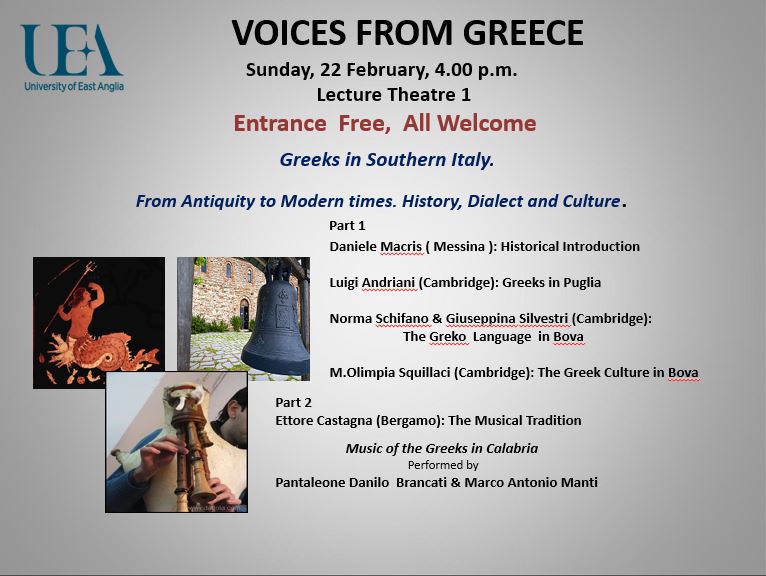
CaptureRegular blog correspondent Christos Paganakis has highlighted this event which is being held next weekend, 22 February, at the University of East Anglia. All are welcome. Contact  H.Anagnostopoulou[at]uea.ac.uk at UEA for details.

Christos tells me:

We have managed to resurrect our annual ” Voices From Greece ” day at the University here in Norwich ( the ones due for 2013+2014 were cancelled , due to funding from the Greek Min of Culture being unavailable due to the Economic Catastrophe in Greece )
I think the subject matter for this one might be of interest , and would certainly have interested Paddy , because it is all about the ethnically and culturally Greek populations still in southern Italy , their Language , Culture and Music , etc .

If it runs like previous ones it’ll start off with some lectures, then there’ll be a concert of traditional music and song related to the event theme , then mostly everyone goes out for a meal (where the musicians are usually inveigled into giving a second , extempore performance), and it all ends very late rather like a Greek peasant’s wedding, with earnest Oxbridge professors dancing the Pentoziali .

The Paddy blog is changing …

But don’t worry. It is only the look and layout that has changed. The format that I used up to now was no longer supported by WordPress who supply the engine behind the best blog about our favourite author and all round adventurer and gentleman.

I have chosen a neat and crisp format which is not so different to before and will enable me to take advantage of new features and plug-ins, when I get the time to find my way around.

You may find some of the older posts have lost a bit of formatting and where it is very bad I will try to sort out the issues, but with over 600 posts it won’t be possible to check them all. You can help me by getting in touch – see About & Contact – and informing me of howlers.

Would Paddy have understood any of the above? Probably not, but I am sure that if he had a computer he would enjoy browsing to find interesting articles and to look at pictures and videos of his dear friends and colleagues. More to come.

Finally it will be the centenary of Paddy’s birth on 11 February. If you have any suggestions about how we might mark this event please do come forward with your ideas and I will see what I can do.

Tom

A milestone passed

CaptureJust a little note say that in the very last minutes of yesterday we had our one millionth view of the Patrick Leigh Fermor blog. Not bad in just over four years.

Thank you for following and do come back for more in 2015.

Tom

The Patrick Leigh Fermor blog 2014 in review

CaptureHello to you all and a Happy New Year. I hope that your holidays were peaceful. This year promises to be interesting as it marks the centenary of Paddy’s birth on February 11th. As yet I know of no significant events to mark this but we shall see what occurs.

It is now traditional to review the previous years’ activity on the blog and as such I attach the report for 2014 prepared as usual by the WordPress.com stats helper monkeys. The big numbers are that you made around 230,000 visits to view the 82 new posts which brings our numbers up to 660 posts on the blog.

Quite amazingly we are just two or three thousand visits away from having over one million visits since I started the blog in 2010. I am looking forward to sharing more Paddy related material with you in 2015, and also to your comments which can sometimes be challenging but always informative and often very helpful to others who seek information.

Regards.

Tom

Here’s an excerpt from the WordPress report:

The Louvre Museum has 8.5 million visitors per year. This blog was viewed about 230,000 times in 2014. If it were an exhibit at the Louvre Museum, it would take about 10 days for that many people to see it.

Click here to see the complete report.

Update Walking from Winchester to Bath

Arrival in Bath

Arrival in Bath

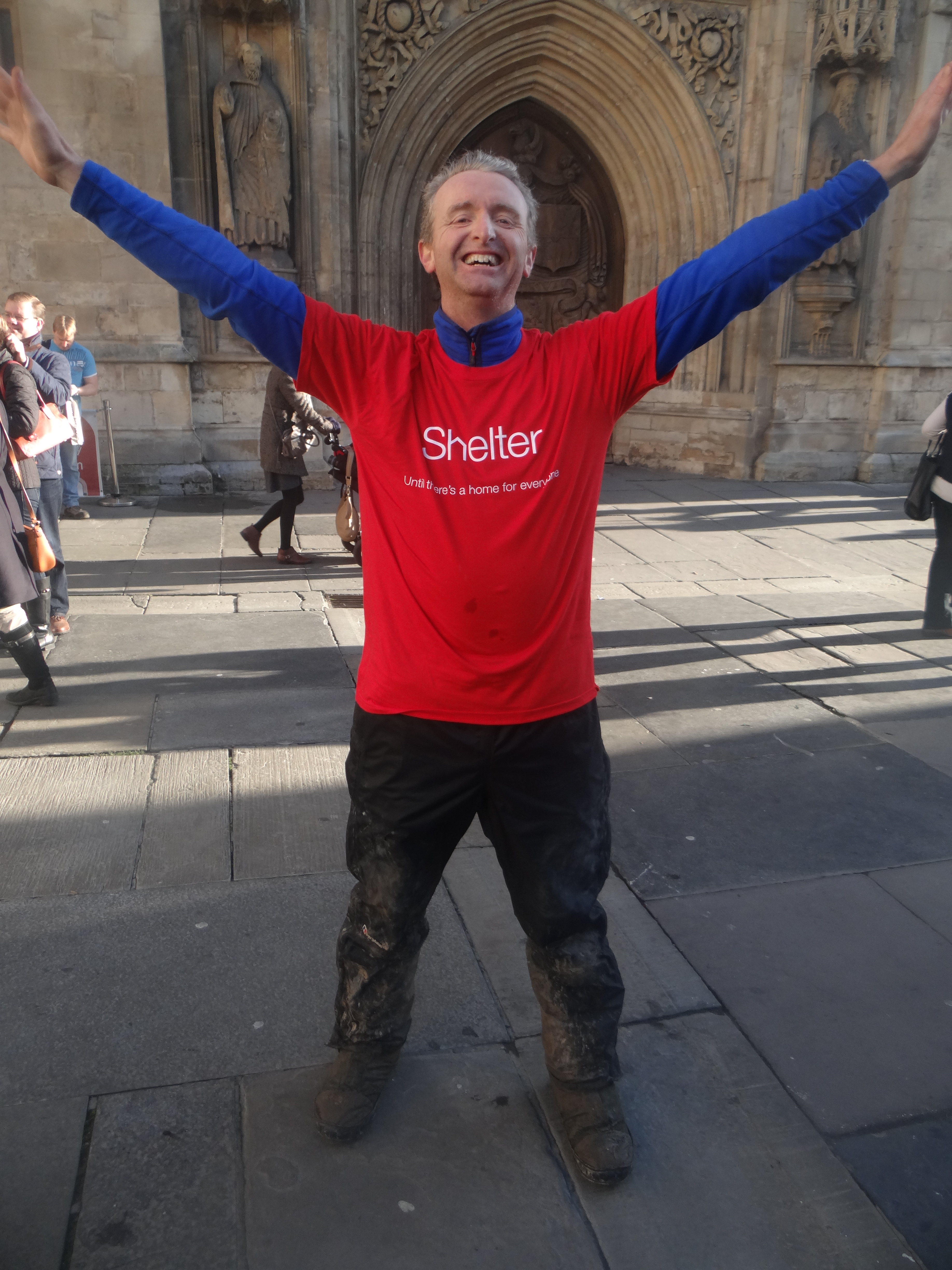
I wanted to pass on my thanks to all of you who gave financial and moral support to me during my walk from Winchester to Bath . My goal was to raise both money for, and raise awareness of, the plight of homeless people.

Both objectives were achieved. Donors gave around £2,400 for the charity Shelter when including Gift Aid (UK taxpayers) which is a really excellent amount. It was so encouraging for me to see the donations tick up as I paced out my walk.

It was a hard exercise and my experiences of sleeping rough gave me a new insight into what it may mean to try to find somewhere relatively warm, dry and safe to sleep. I managed to sleep in a shed in Winterbourne Gunner, a church porch in Heytesbury in Wiltshire, and an abandoned caravan in the Frome valley. The distance was around seventy miles or 115 km and lasted just over three days. Each day brought new challenges which were mostly environment related, with a big variation from the leafy by-ways of Hampshire, to the slippery and muddy remoteness of Salisbury Plain, and finally the boggy ground of Somerset and Avon. In order to make my proposed arrival time of 11 o’clock Saturday morning I had to make use of an abandoned bicycle to get me the last six miles into Bath along the Kennet and Avon canal towpath.

It is still possible to donate via my Just Giving page here.

I was quite speechless when I finally arrived at Bath Abbey but felt an enormous sense of release and relief when a busker started to play the Soft Cell hit Tainted Love – see video!


Here are some pictures if you would like to look at them.


This slideshow requires JavaScript.

Once again thank you and I wish you all a very Merry Christmas and a Happy New Year. All the best.

Tom

“Testing you sorely” or is it “Sorely testing you”?

Splitting the infinitive is almost as controversial as splitting the atom, but clearly a lot easier to do. What I hope is not easy dear readers is to upset you by the variety of posts on this blog, and in particular some of the more recent ones.

Yesterday Francis Fermor added a most unkind comment saying that the blog is no longer interesting as it is no longer all about Paddy and that “too many people are joining the band waggon and taking advantage for their own personal ends.” This was in relation to the post about Owen Martell’s walk across the USA.

For one thing I don’t think Owen has made any money out of his adventures. At least he has not written any books on the subject that I can find. I post such things as I personally find them interesting and they fit with my editorial policy of being “Paddy related”. Owen contacted me after his first walk as he was interested in Paddy and had been inspired by him. I am sure the man himself would have been most interested in Owen’s journeys: a lot of you are. Paddy would have encouraged him and wanted to hear his story.

Paddy may be dead, and not much new will emerge, but his work and his life remain as an inspiration to many, including those who read this blog. A lot of people are inspired to set out on journeys of their own. Nick Hunt’s attempt to follow Paddy’s route was not for any great “personal end” but because he wanted to do it and thought that others might like to read about the great changes that Paddy himself wrote about via his Polymath. Ed and Charlotte walk parts of his route each year for no other end than they enjoy it and find one of those Songlines to follow; a Songline chanted by Paddy and now in our memory.

How long can I continue with material on here? As long as there is an audience, and my stats tell me that there is one with over 20,000 regular visits each month. We are now within a few thousand visits of one million since opening in 2010. That I find pretty phenomenal. People visit here for a variety of reasons and the material that I post attempts to address those varied interests.

So how long can I continue? There is plenty more directly related material and my self-appointed “task” here is to create a unique on-line archive of Paddy related material. So I will continue to do that. And I will do it until I test you so sorely that you leave me alone with just a few die-hards.

Finally, to continue the theme of “personal ends” I would like to remind you that I will start my 70 mile walk to Bath tomorrow on behalf of the charity Shelter in aid of the homeless and there is still plenty of time to donate via my Just Giving page.

Between 10-13 Dec you can join with me to increase awareness of the scourge of homelessness and to help raise funds for the UK’s leading charity for the homeless, Shelter. I will walk 70 miles from Winchester to Bath over one of the most sparsely populated areas in England, sleeping rough under a simple shelter, enduring the December cold, and the long, cold, lonely nights: just like THEM. All you have to do to join me from your warm home is to please give some money to Shelter at my Just Giving page. These are your fellow human beings and they deserve some help and comfort. You can join me walking to Bath Abbey on 13 Dec. Just email me or comment on this post. PLEASE SHARE THE FACEBOOK EVENT I CREATED (click here) on your Facebook timelines: it is a public event. Give your money: £, Euros, US $, Yen, Lei, or whatever here.

lucy

Paddy, Pope Francis and the Second Vatican Council

I couldn’t resist the headline. It is not often that we get Paddy and the Pope mentioned in the same article. So, shameless as this is, I am going to publish as it meets my editorial requirements of “establishing an online archive of all things Patrick Leigh Fermor”. It is also in Italian, but there is always Google Translate for the non-Italian speakers.

The context of the article is the visit of Pope Francis to Turkey – Istanbul link to Paddy – and this new Pope’s role in reinvigorating the Catholic Church and the “trans-Mediterranean” role he is developing.

Read all here.

Thinking of buying a Kindle for Christmas?

Kindle fireThe time to start buying Christmas presents is upon us. Some may be considering buying a Kindle for their family members of even as a treat for themselves.

The Kindle Fire is now available at an amazingly low price from £129. It is ideal for reading your favourite books but gives you a whole lot more as it is a tablet allowing you to connect to the web, view video, check email and access thousands of apps. Accessing and buying kindle books online is so easy and takes just a minute to buy and download your books.

If you buy from the Paddy blog via any of the links here it will help raise a few pounds to assist with some of the running costs of the site.

Buy the Kindle Fire here.

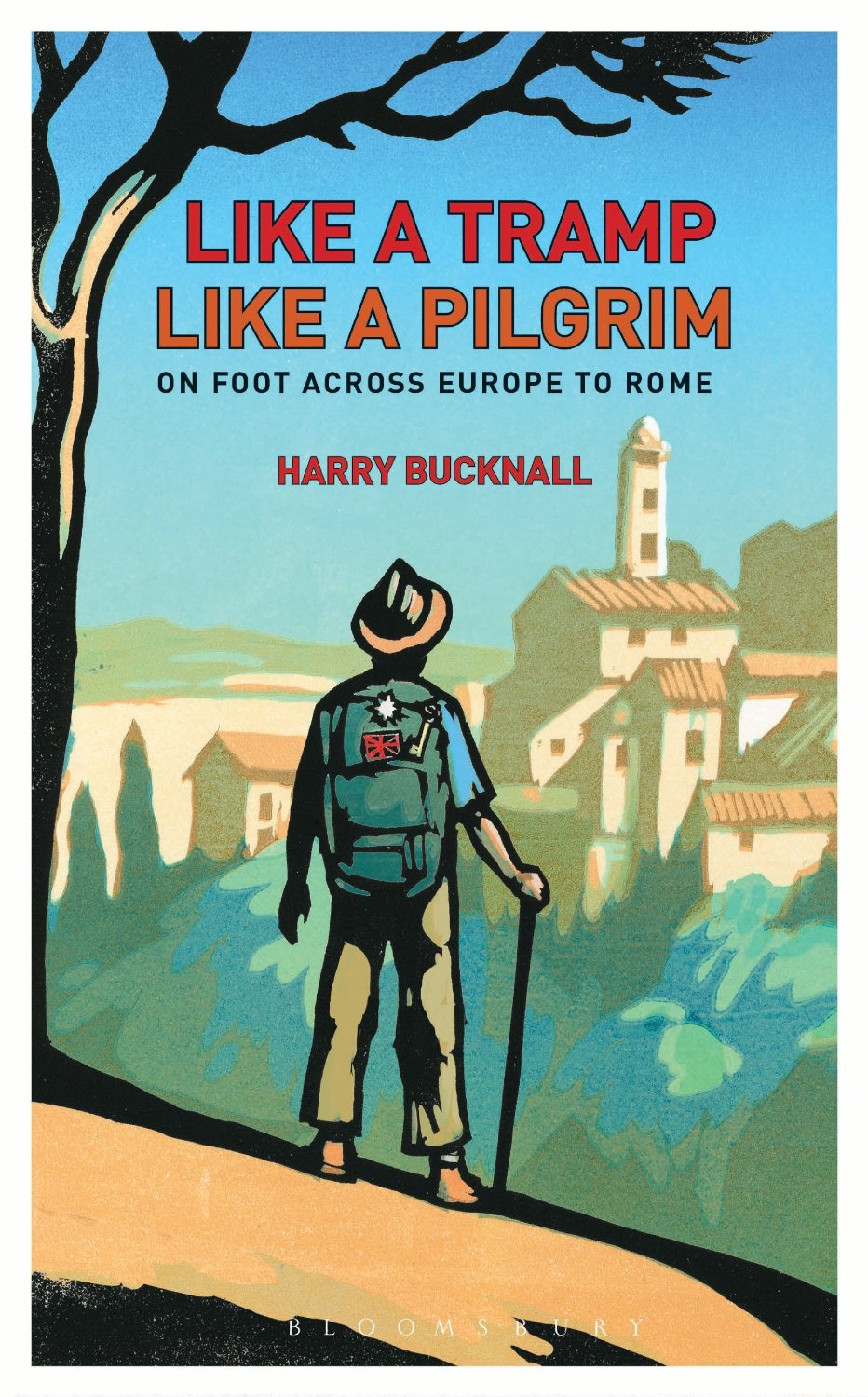
Like a Tramp Like a Pilgrim: On Foot, Across Europe to Rome by Harry Bucknall

Like a Tramp, Like a Pilgrim

One of the best travel books of the year has to be Like a Tramp, Like A Pilgrim: On Foot, Across Europe to Rome by former Coldstream Guards officer, and Blandford Forum’s premier travel writer, Harry Bucknall. Recounting his pilgrimage from Canterbury to Rome, it is fresh, and full of good humour.

By Tom Sawford

This is Harry’s second book. His first, In the Dolphin’s Wake, recounted a journey from Venice to Istanbul,  which is quite surprisingly a journey of more than 5,500 miles across the Aegean that included …
“the glories of Mount Athos, 36 islands, and every island chain in the Greek Archipelago. It also involved 57 sea passages on 35 ferries, four landing craft, three hydrofoils, a fishing caique, a sea plane, 11 buses, two trains, an open-top Land Rover, and a duck egg blue 1961 Morris Oxford.”

Like a Tramp, Like A Pilgrim: On Foot, Across Europe to Rome demonstrates Harry’s  development as a writer since his Greek Odyssey. As a Santiago peregrino myself I instantly empathised with the motivations, the pains, the joys, and the surprises to be found on the solo journey of a pilgrim. Even when walking with others there is a solitary dimension to pilgrimage which permits the walker to observe with a detached eye the changing landscapes, the historical dimensions of the road, and the sometimes absurd characters one meets on the way: Harry very successfully brings us a gently unfolding list of observations, anecdotes and stories of friendship.

The 1,500 mile route from Canterbury to Rome is an ancient and well travelled path. Our Anglo-Saxon chronicler Bede often sent his acolytes off to borrow books from the Vatican library but never made the journey himself. One has to ask if they managed to return them in time and how big the fines may have been.

It is a long journey and one much less well-known than other pilgrim routes such as the one to Santiago de Compostela. Only a handful of pilgrims start out each day, compared to sometimes hundreds in Spain. This makes Harry’s journey all the more interesting for his readers as he encounters things new, and brings a wryly observed perspective to others more familiar.

For me the second half of the journey was the most enjoyable. As Harry enters Italy the pace and temperament changes.  Less history.  More humour.  Rather like Nick Hunt and Paddy entering Slovakia there is some invisible border on such a journey.  One of the mind or the spirit. It may be related to something physical but it is more than this. From my own experience on the Camino it is clear that a long journey has many phases each with their own character. It is in Italy that Harry finds hilarious situations despite his tiredness. He reveals to us, and calmly copes with, the frustrations encountered in a country that does not function particularly well, whilst journeying with an ever growing band of assorted and garrulous pilgrims from many nations. 

As with all good travel books the tale ends with the enticing possibility of a further journey: a next phase. I look forward to that, but in the meantime I will recall with pleasure this enjoyable book. One for the Christmas list to help stave off (or possibly encourage?) wanderlust. It is potentially dangerous contraband.

Now, where did he get that title from? 🙂

Buy Like a Tramp, Like A Pilgrim: On Foot, Across Europe to Rome

Buy In the Dolphin’s Wake

Catch up with the Slow Adventure

Don’t forget to drop in now and then to catch up with Jasper Winn on his slow adventure from Munich to Paris in the footsteps of Werner Herzog. I have been enjoying Jasper’s short posts which are always insightful. He has crossed the Rhine, the Moselle and the picturesque but economic backwater of the Vosges. Clearly enjoying being in France he now faces mostly flat country in his last weeks walking to Paris, but as today’s post says, this brings it’s own challenges. Here is a little taster:

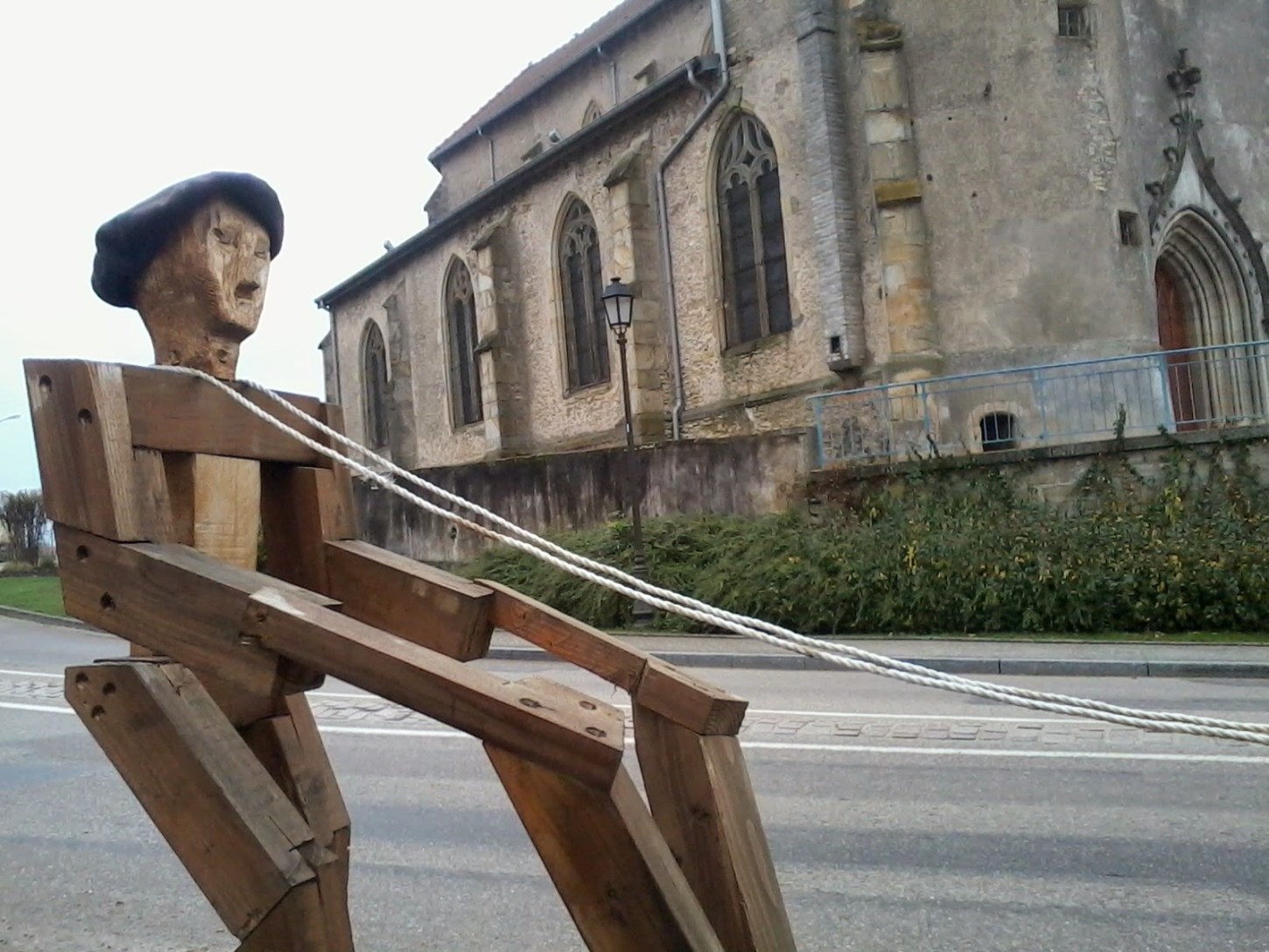
Always hard to avoid looking just a bit wooden in selfies. I’ve just crossed the Moselle at Thaon, so am across and out of the mountains that rise high on both sides of the Rhine valley, and with neither the snow nor storms that Herzog battled. The land being flatter brings it’s own challenges. Long slogs, little shelter, busy agriculture and so less hidden woods or derelict barns to sleep in, and speeding traffic on narrow twisting roads. And rural France is a struggle for many locals too – unemployment; so gambling, drinking, suicide. Symptomatic is the small number of village bars and cafes still open. I found just three still trading in over a hundred kms of walking and passing through tens of small villages. Now, in Thaon, I’ve found a joy. Bar Le Cosy. Good coffee. Wifi – hence another post. An armchair and friendly hostess and clients. It’s rather smart and chic and I may look a tad out of place

Read more ….

Patrick Leigh Fermor archive now fully available to public at National Library of Scotland

General archive itemsAfter a year of intensive work, Paddy’s archive is now available to the public at the National Library of Scotland. The inventory is 81 pages long and the list of Paddy’s correspondents is well over 1,000, with many many famous names including Gore Vidal, Truman Capote, Iris Murdoch, Lawrence Durrell, Bruce Chatwin, Cyril Connolly, the Duchess of Devonshire, Prince Charles and Paddy’s publisher John Murray. Future goals include digitising the most important material and to run some exhibitions.

The NLS have today issued a press release as follows:

The archive of one of the most charismatic characters of the last century, Sir Patrick Leigh Fermor, is fully available to the public from today (Tuesday, November 18) after being catalogued by the National Library of Scotland.

Sir Patrick, who was universally known as Paddy, was the finest travel writer of his generation and has been described as “a cross between Indiana Jones, Graham Greene and James Bond.” He was a decorated war hero, adventurer, scholar and Hollywood scriptwriter who could count princes and paupers among his friends.

The archive, which arrived at the National Library in 2012, is vast, occupying some 16 metres of shelving. Its contents offer a journey through the 20th century in the company of some of its key figures.

The inventory alone runs to 81 pages and lists extensive correspondence from fans, friends and associates; literary manuscripts, often with numerous annotations and revisions; diaries; notebooks, passports; sketches; photographs; articles and research papers. One of the star items is the only surviving notebook from his youthful trek across Europe which began in 1933 and provided the source material for his most famous books A Time of Gifts, Between the Woods and the Water and The Broken Road.

Sir Patrick died in 2011 at the age of 96 and is regarded as a central figure in 20th century cultural life. That is reflected in the archive which includes correspondence from many famous names including Gore Vidal, Truman Capote, Iris Murdoch, Lawrence Durrell, Bruce Chatwin, Cyril Connolly, the Duchess of Devonshire, Prince Charles and Sir Patrick’s publisher John Murray. One of the many unexpected items to be found in the archive is what appears to be an unpublished handwritten Sir John Betjeman poem, literally written on the back of an envelope.

Cataloguing the archive has taken a year and it has revealed a much larger number of correspondents than were expected – over 1000 – along with thousands more photographs.

“It is a history of the colourful life of a celebrated writer,” said Graham Stewart, the curator who worked on the cataloguing project. “He was undoubtedly a superstar of his day and his books have, if anything, grown in popularity over the years. There has already been a lot of interest in the archive and we expect this to increase now among Leigh Fermor fans and people interested in the 20th century more generally.”

The Library is working on digitising major elements of the archive which will be made available through its website. Plans are also being considered for staging exhibitions and displays of the material to reach as wide an audience as possible.

A major element of the archive is Sir Patrick’s war years which saw him organise guerrilla operations in Crete against the occupying Nazis. He spent much of this time disguised as a Cretan shepherd, living in freezing mountains caves.

In 1944 he organised one of the most daring feats of the war when he led the team that kidnapped the commander of the German garrison on Crete. This was made into a film Ill Met by Moonlight in 1957 starring Dirk Bogarde and the story was told by Sir Patrick in the recently published memoir Abducting a General.

“You get a real sense of how dangerous this work was when you come across letters that were smuggled from Cairo into Crete and carried miles across mountains, sewn into people’s clothes,” said Graham. “It’s an archive that holds many surprises and is likely to produce many more discoveries once it really starts to be used.”

The archive was presented to the National Library by the John R Murray Charitable Trust which also supported the cataloguing work. Sir Patrick’s books were published by the Murray family.


Robert Macfarlane on The Old Ways

Old WaysThe author of The Old Ways discusses some of the problems for any walker-writer such as how to spring surprises along the way, and how not to give your reader blisters.

by Robert Macfarlane

First published in the Guardian Book Club, 1 August 2014

“All I know is that at the very early stage of a book’s development”, wrote Vladimir Nabokov, “I get this urge to gather bits of straw and fluff, and eat pebbles.” Like Nabokov, I’m a pebble-eater and a straw-gatherer: my books begin as gleaned images, fragment-phrases and half-thoughts, scribbled on to file-cards or jotted in journals.

Tracking back to the earliest entries for what became The Old Ways: A Journey on Foot, from 2006, I find hundreds of these “pebbles”. Some are barely recognisable (“Dew ponds, ash frails, thin trails”), and others plain weird (“sunset as spillage; junk light of dusk”). Huh? Some mark the start of paths that never got followed: “Go see the bronze dragons in the Forbidden City; take Schiller along.” Why? Others now seem like fingerposts pointing in the right direction: “Dreamtracks and trespass; rites of way and rights of way.” “Each path to be told as a story, each story a path, leave cairns in the language as you go.”
That last line is pretty much The Old Ways: A Journey on Foot in miniature, though it would take another five years and 1,000 miles on foot for it to grow into a book. In that time I followed many different paths: Neolithic tracks on the chalk of southern England, pilgrim trails to a holy mountain in the winter Himalayas, a branch-line of the Camino in Spain, a tidal path into a mirror-world off the Essex coast and routes through the disputed territories of the occupied West Bank.

Because paths are places of encounter and company, I met scores of other walkers as I went: botanists, activists, archaeologists, poets, mapmakers – and everyday folk out with their dogs, taking a break. One early reviewer noted: “Macfarlane doesn’t seem to meet any dickheads.” Well I did meet them, several of them – but I didn’t find them interesting enough to write about. I had plenty to say as it was: songlines and pilgrimage, ghosts and memory, trespass and access, birdsong and light, the shimmer of detail … The book became an exploration of how paths run through people as well as places, and how landscape shapes – scapes – us both in the moment and in memory.

Walking is a repetitive activity. You put one damn foot after the other – and that’s what makes the walk. It’s often tiring and it’s sometimes boring. This poses a primary problem for any walker-writer: how to spring surprise along the way, how not to give your reader blisters. I wanted style to solve that problem. So I set out to devise a form that enacted its subject: to make a patterned book of path-crossings, full of echoes and back-glances, doubles and shadows. A book of many ways, then, through which readers might pick different routes. I also tried to leave those cairns as I went: guiding alignments of image, word and incident that only became visible at certain places along the journey.

I became obsessed with prose rhythm (Nabokov’s influence again). At one point I wanted to write each chapter with a different base-rhythm, a poetic foot (iamb, trochee, dactyl) that would tap its tempo through it. That ambition defeated me in the end (surely for the good) though I continued to scribble scansion marks above my sentences, revising some of them dozens of times to get the rhythms right on the ear. One chapter describes sailing old open boats along the sea-roads around the Outer Hebrides. Rhythm was crucial here to represent the sea’s own measures: the rolling whale-back swells that lofted us towards Sula Sgeir, 40 miles out into the north Atlantic; and the unforgettable experience of being in mid-Minch at the turn of tide: billions of tonnes of water pausing, trembling, unsure of their obligations – before starting the long slop back north.

“It’s hard to create a path on your own”, I note early on, and The Old Ways: A Journey on Foot accompanies other writers and artists as it goes, both dead (Edward Thomas, Nan Shepherd, Patrick Leigh Fermor) and alive (Ian Stephen, Raja Shehadeh, Steve Dilworth). The best contemporary non-fiction seems to me as formally intricate and experimental as any fiction, and among the books I kept close to hand while writing were the essays of John Jeremiah Sullivan, Rebecca Solnit and David Foster Wallace, the reportage of Katherine Boo, John McPhee and William T Vollmann, and the travelogues of Barry Lopez, William Dalrymple and Iain Sinclair. When energy was ebbing, I turned to the dark glitter of John Banville, or the baroque visions of Cormac McCarthy.

The book has lived some strange afterlives since it was published two years ago, and its paths have led me in unexpected directions and to fresh collaborations. One of the best things about being a writer is hearing from readers: a reminder that the artefact over which you privately labour for years goes into the world and – if you’re lucky – finds its way into the imaginations of others. Not all of these communications are kindly. “Robert Macfarlane, you are a charisma-free zone,” declared someone recently. But then a day or two later someone else got generously in touch: “Your writing gives me an erection of the heart!” I guess you can’t please all of the people all of the time.

Buy the book: The Old Ways: A Journey on Foot

The slow adventure – in the footsteps of German film-maker Werner Herzog

Jasper Winn

Jasper Winn

Adventurer, horseman, musician and walker, Jasper Winn will soon be striding in the footsteps of German film-maker Werner Herzog who walked a 500 mile route from Munich to Paris exactly forty years ago, starting in November 1974.

Herzog had heard that German film critic Lotte Eisner was ill and might die; she had championed his career from early on when his films challenged the notion of what films were for and how they were made; he decided that by making a pilgrimage on foot to her bedside he would stop her dying. He kept a private journal of his three week trudge. This was published some years later as the slim volume, Vom Gehen Im Eis/Of Walking In Ice. Jasper came across the book, in translation, when researching long walks and pilgrimages more than a decade ago, and it made an impression on him. He describes the writing as “stark, recounts only the images that he sees, and what he directly feels. It’s both beautiful and unsettling.” His trip was difficult – average 24 miles a day non-stop and he carried little to make him comfortable or weather proof. He left in cold and patchy snow and over the coming weeks it rained, snowed, froze and blew. At night he broke into holiday homes, barns or anywhere he could find shelter. There were occasional nights in inns.

Jasper Winn, the author of Paddle: A long way around Ireland, will be updating us on this recreation of the journey on his website, Slow Adventure. If you would like to keep up with him please subscribe to his posts here.
Good luck Jasper!

The Traveller’s Film Club – Wilfred Thesiger

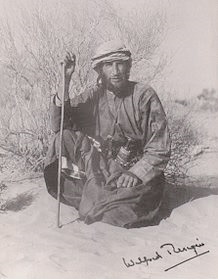
Wilfred ThesigerFollowing on from the successful showing of the film about Paddy, the next Traveller’s Film Club event will be held on Thursday 13 November hosted by the middle‐east scholar and writer, Peter Clark, who will present original footage and two documentaries about the legendary desert explorer Sir Wilfred Thesiger and his return to Oman.

It will take place as usual on the lower ground floor of Waterstones Piccadilly from 6.30pm. There is an excellent travel bookshop and café on the same floor. The film screening will commence at 7pm, after which you will have the opportunity to chat over a glass of wine. No charge, no reservations, first come, first served. Further details here.

Related article:

Obituary: Sir Wilfred Thesiger

Ghika – Fermor – Craxton: 3 places, 3 creators

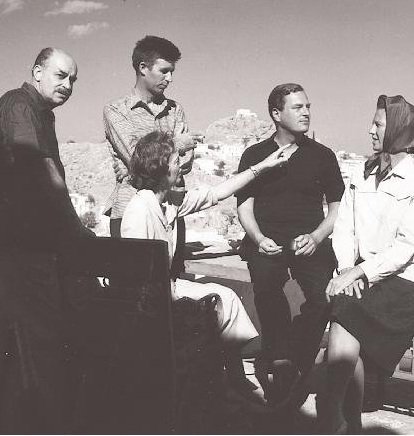
From the left: Nikos Hadjikyriakos-Ghikas, John Craxton, Barbara Hutchinson-Ghika, Patrick Leigh Fermor, Lydia Aous, 1958

Our favourite museum, the Benki, is presenting an exhibition dedicated to three creators, whose lives were bonded through common places: Hydra, Kardamyli, Corfu. Three houses-refuges, which became a source of artistic inspiration, and housed a friendship that lasted over 40 years.

Sir Patrick Leigh-Fermor, English travel writer, built his house in Kardamyli of Mani, a house that was later bequeathed to the Benaki Museum. There, he hosted since the 1960’s the painters N. H. Ghika and John Craxton, among other friends, whose works decorated the place.

Earlier, main feature for all three of them was Ghika’s manor in Hydra, “a perfect prose-factory” as it was called by Fermor, who lived there for two years, writing most of his book “Mani”.

John Craxton as well, was attracted by the landscape of Hydra and painted a series of them. His valuable help the days that folowed the fire at Ghika’s house in Hydra, in 1961, is described at their extensive correspondence. In one of these letters Craxton is suggesting to Niko and Barbara Ghika that perhaps it is about time to move on to other places. Indeed, the Corfu house was going to replace the void and become a new place of meeting and creation.

Letters, manuscripts, editions and photos are the main theme of the exhibition, accompanied by drawings by N. H. Ghika and John Craxton. Works of the above painters coming from the Fermor house in Kardamyli form a separate section at the exhibition which runs from 17 October 2014 to 10 January 2015. Further details here.

Why you should never meet your heroes

Would you have been disappointed if you had met Paddy?

By Philip Sidney

First published in The Spectator 14 October 2014

As we become steadily accustomed to life in the Age of Celebrity, it’s become a truth that, as Mark Mason put it in the Speccie last month, ‘meeting your heroes is almost always a bad idea’. Reading the letters page in the London Review of Books, it seems that this advice extends to visiting any place associated with your heroes. Last summer Max Long, an undergraduate at Magdalen College, Oxford, arrived at Patrick Leigh Fermor’s old house at Kardamyli in Greece, hoping to pay homage to one of his heroes (see The House is Not Always Empty). His visit, he reports, was unideal:

‘To the hairy, shirtless, sandalled old man who occupied Paddy’s studio as though he owned the place, and who refused entry on a sweaty August morning to a travelling student, despite his pleadings (and tears): you ruined a young man’s pilgrimage.’

It’s hard not to sympathise, particularly given the hospitality with which Fermor was himself received on his travels. But this kind of disenchantment isn’t exclusive to unsceptical youth. Jeremy Clarke laments the speed at which authors’ auras disperse:

‘Nothing lingers. When they’re gone, they’re gone. Even with a commemorative plaque on the wall, one is left only with a sense of vertigo at how easily all vestiges of even the recent past are obliterated and we move on.’

Both Long and Clarke are part of a rich tradition of disappointed pilgrims which began in the late 19th century, the joint result of improved transport networks and the growth of a mass audience for literature. In those days it was possible to be rebuffed by the great men themselves, as were the rather impatient tourists that called on Thomas Hardy in 1903:

‘[…] I have given mortal offence to some by not seeing them in the morning at any hour. I send down a message that they must come after 4 o’ clock, & they seem to go off in dudgeon.’

After any famous writer goes their own long journey, the difficulties of preserving their home for would-be pilgrims become more fraught: whether a literary shrine is tended or neglected, there will always be enthusiasts claiming that their idol has not been treated appropriately. As Simon Goldhill observes in Scott’s Buttocks, Freud’s Couch, Brontë’s Grave, Charlotte Brontë would have been horrified had she seen her stockings on public display at Haworth Parsonage, but in the 21st century they’re a precious link – however creepy – to a great talent now gone.

What options remain, then, for the would-be literary pilgrim? Continue to travel hopefully, sifting the let-downs for a trace of longed-for genius loci? Or stay at home, cherishing places in the imagination? Nick Hunt’s book, Walking the Woods and the Water: In Patrick Leigh Fermor’s footsteps from the Hook of Holland to the Golden Horn, provides a possible answer. His journey across Europe in the footsteps of Patrick Leigh Fermor shares the landscapes through which his hero moved (not to mention the physical strains incidental to thousand-mile walks), while also conscious of the changes that have reshaped the continent in the intervening 80 years. However fervently we revere our literary pin-ups, we must remain conscious, and as far as possible accepting, of the things that stand between us and them: be they an accumulation of years, a glass vitrine, or hirsute jobsworths in shorts.

Philip Sidney is a writer and academic, specialising in travel, literature and travel literature

Reminder for tonight – Traveller’s Century: Benedict Allen seeking Patrick Leigh Fermor

A reminder that Benedict Allen will be introducing his 2008 BBC documentary where he travels Paddy’s footsteps, tonight at Waterstones Piccadilly at 6.30pm.

There may be free tickets left. Call the shop on 0207 851 2400