Category Archives: Uncategorized

A word about boots


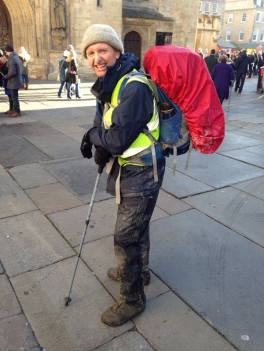
My Zamberlan 309 New Trail Lite GTX Walking Boots after walking 140 miles from Winchester to Exeter, October 2017

For those of us who walk, selecting good boots is probably the most difficult decision that we make. Whilst all other kit is binary – it either works or it doesn’t, like a stove or a waterproof – we never know about our boots until we have actually tried them in anger on an actual walk. Even then they may seem fine for the first few miles, or for a day walk. But how will they hold up to many days over varied terrain?

The choice is so very personal. Do we have wide feet, or balletically narrow? Are the toes on our right foot longer than those on the left? What about those seemingly large ankle bones that always rub? Of course we may also need to select boots for differing conditions such as the ability to take crampons.

I have struggled most of my life to find the right boots. The DMS boots issued to me in the Army were killers. The “improved’ version, the Combat High, was only marginally better. I had some fair success with a stout pair of Meindl boots which were much better suited to mountain walking than long trails. I used them on my 2013 walk to Santiago de Compostela, but I suffered various pains and blisters after a while. Eventually things settled, feet hardened and I wore them again (after a period in sandals and socks!!).

After the Camino, I searched for a replacement, seeking something lightweight and unsuccessfully tried some Scarpa boots which just didn’t size up correctly and caused problems after some miles, and another expensive pair of newer Meindl’s which again were not right and I gave them away.

Both my daughters successfully achieved Gold Duke of Edinburgh Awards and as they got older and their feet stopped growing I gave them each a pair of Zamberlan boots. My eldest still has hers. Ten or more years on and after many, many miles, they have never given her any reason to complain. I thought maybe I should try Zamberlan next, but they are difficult to find. Last year I invested in a pair of Zamberlan 309 New Trail Lite GTX Walking Boots from Uttings Outdoors which is where I had bought the boots for my daughters. Since then I have walked over 500 miles in them, often day after day, carrying weight, and have never suffered from any pain or blisters. My lifelong search is over! Having said that, selecting good socks is also very important, but don’t worry I shan’t be showing you pictures of mine.

I thought that I would share this with you, as many of you will be walkers, and may experience the same problems that I have had. These boots are Italian and are therefore made on a small last. I am normally a size UK 11-11.5 (with narrow-ish feet) but I bought a size “Euro 48 – UK 12.75”. Size charts (and conversion charts) vary enormously so in essence I bought a pair at least one full size larger than normal. They are made from one piece of leather which means no seams to rub you, and the Gore-Tex lining works very well keeping my feet dry. Zamberlan make many other styles of boots (and Uttings appear to have the best range in the UK), but for support, comfort, and confidence, I cannot recommend my boots too much. So, if you are thinking about buying a new pair of boots consider these. But remember, we are all different, and what works for one may not work for another.

It would be great if you could join the debate and comment, telling us about your boot experiences!

Where the wild winds are

Where the Wild Winds Are: Walking Europe’s Winds from the Pennines to Provence by Nick Hunt

If some of you are wondering what is happening with Nick Hunt’s new book, I can offer you some very good news.

First, it exists! I have a copy in proof form with a delightful new cover (see picture). Second, launch events are planned for September; I will update you where I can. Finally, Where the Wild Winds Are: Walking Europe’s Winds from the Pennines to Provence, is available for pre-order from Amazon.

I am currently with Nick battling the only named English wind, the Helm, as he struggles to find shelter in a bothy on the Pennine Way. Wind walking could be the next big thing.

Where Travel Writing is Now

A thought provoking piece for the Easter holidays from Barnaby Rogerson, founder of the wonderful Eland books. May I wish you all, wherever you are, a very happy and peaceful Easter (remember Paddy had arrived for the great Easter celebrations at Esztergom on the Danube).

By Barnaby Rogerson

First published in Errant Magazine 18 September 2015

I don’t just read all the new travel books I can get hold of, I collect whole library editions as well. Aside from their texts, they summon up a once devoted and attentive readership: Those lovely cloth-and-gilt-titled Everyman hardbacks are scented with craftsmanship and muscular Christian decency. The bashed-up magenta paperbacks produced by Penguin just before the war were part of a mission that made democratic socialism possible, while I imagine the blue-cloth hardbacks of Jonathan Cape’s traveller’s library, being read by the more thoughtful members of a colonial clubhouse in the 20s. From my own youth the massed volumes of the rival Picador, Penguin Travel Library and Century lists sit prolific on my shelves.

I acquire them to aid my work (which is to dig out lost classics of travel literature and add them to the Eland list) but there is also something more obsessive going on. The libraries allow me to watch how the ‘immortality’ of authorship ebbs away, how tastes evolve and how that which was so ‘needed and now’ to one generation, becomes so much recyclable garbage to the next. But like inspiring pin-pricks in the night sky, there are still travel books that keep shining, and have kept generation after generation of readers enthralled.

And, like it or lump it, we seem to be passing through a crunch point in travel writing at the moment, the long-term effects of which we do not understand. The revival of travel writing so brilliantly led by Bruce Chatwin in the 1980s, and aided and abetted by Redmond O’Hanlon, Colin Thubron, Bill Bryson, Eric Newby, Norman Lewis and Dervla Murphy, is coming to a close. The role of the professional travel writer will soon be at an end. You only have to look at how some of the most promising contemporary travel writers have adapted, to feel which way the wind blows. William Dalrymple, three books into a career as the darling of his generation, switched very successfully to history, just as the three very talented travel-writing Jasons of my acquaintance (J. Webster on Spain, J. Goodwin on Byzantium, and J. Elliot on Afghanistan/Iran) have all headed for fictional waters, as most recently, has Tim Mackintosh-Smith. There are still some stalwarts – Sarah Wheeler, Ian Thomson, Tim Parks, Philip Marsden, Hugh Thomson, Antony Sattin and Jeremy Seal – at the top of their game, delivering works that combine energy with a lifetime of experience. But in private conversation there is an acknowledgement that the advances from publishers are slipping away. It is a common joke that their agents dont reveal to them their sales figures because it would only discourage them from writing the next book. And as a corollary of this, as a basic rule of thumb, in the last decade the publishing advances have slipped from something near £50,000 for a top writer (an admirable sounding sum until you divide it by three years of travel and work) to a period when ‘fifteen is the new fifty’, which has now seeped down towards six. But travel writers are by nature adaptable, and are used to bolstering income by acting as tour guides, lecturers and jobbing journalists. Certainly the slow collapse in sales has not yet had any effect on the quality or the range of travel writing, though it is intriguing to reflect that the joint winners (Robert Macfarlane and Kathleen Jamie) of last year’s annual travel-writing prize, the Stanford-Dolman, are both fulltime academics, supported by a university salary.

Where have the readers gone? The easy answer is that they have gone travelling to see for themselves. There’s also been a gradual increase in translated fiction (a process entirely on the side of the angels) which has diminished the travel writers former role as cultural interpreter. And if they were alive today, it is not difficult to see that such prolific travel-writers of the past as Sacheverell Sitwell would surely be on television, conducting Michael-Pallin-style whirl-wind tours or architectural investigations à la Dan Cruikshank.

And there are other concerns. Over the last fifteen years, almost exactly mirroring the advance in the use of the internet, there has been an incremental collapse in the guide-book market by ten per cent, year on year. In their heyday, the big publishing outfits like Rough Guides, Dorling Kindersley, the AA and Lonely Planet (supplemented by smaller fry like Cadogan, Blue Guides, Hedonist, Footprint and Bradt) launched dozens of new books a year and a fleet of updated texts and foreign translations. Collectively they acted as a forcing house for talent, employing, training and feeding new writers, editors and travellers and producing a rich spin-off of travel magazines, maps, dictionaries, pocket histories, guides to world music, food and travel writing. Now this industry is virtually silent, like some old cotton mill in Bradford.

This experience is also reflected in the coverage of the broadsheet papers — The Sunday Times, Telegraph, Guardian and Independent — who even ten years ago were commissioning independent writers and photographers on a weekly basis, not to mention the half a dozen intelligent glossy magazines. Now their travel pages are dominated by churnalism (the re-writing of press releases), celebrity interviews, list-making and readers advice and ‘trip-advisor’ experience columns. The lyrical, investigative literary travel piece is not being published. On my last trip with Britain’s great post-war photographer, Don McCullin, we found ourselves stuck in southern Algeria. There I was able to have a long series of interviews with him which revealed just how important these papers had been to the careers of Bruce Chatwin, Eric Newby and Norman Lewis. He had worked with them all and watched their ideas incubate on the road.

So it looks like very slim pickings in the years ahead. But is this necessarily a bad thing? There has always been something determinedly quirky, if not down-right awkward, about a great travel writer. If I was given a vast lottery foundation by the Ministry of Books to fill this gap, could I be sure of nurturing a new generation of talent with the careful distribution of travel bursaries, salaries and decent advances? Go figure, or ask the Churchill Foundation how many of their grant-receivers have come good. I have also recently begun to notice how many of the travel writers were self-taught, if not actual autodidacts. Bruce Chatwin left university before they sacked him, Paddy Leigh Fermor learned most of his history in the bedroom and in the arms of his various lovers, Colin Thubron side-stepped university in order to try to make films. Dervla Murphy’s youth was locked in a caring relationship with her dependent, bedridden mother whilst Norman Lewis avoided college and spent his youth repairing crashed racing cars (picking them up cheap from grieving wealthy parents) and setting up a Leica-camera dealership.

I also like to tease myself about what sort of typescripts I would not like to be sent to read by an aspiring writer. I certainly wouldn’t be interested in reading a story about a couple of middle-aged men having a career break (so there goes Eric Newby’s A Short Walk in the Hindu Kush), nor about a middle-aged woman’s first bycyling trip abroad (there goes Dervla Murphy’s Full Tilt) and I most certainly wouldn’t look forward to reading about two bored young Swiss youths escaping their bourgeois parents by setting off on a road trip (there goes Nicolas Bouvier’s The Way of the World).

So what’s the trick? There is no formula, though you need a lot of skills. You have to get people talking and remember the flow of words. You have to be able to live for the moment and yet remember the scent and the touch of it on paper. You have to wish to learn through travelling and through the truth of chance encounters rather than through interview appointments, library-life and web searches. You also have to possess that sliver of ice near the heart of any writer, that ruthless search for story coupled with brutal honesty and the ability to ditch the dull from your pages. You have to be good company yet also inspiring on the page. You have to ‘catch the moment on the wing.’

Barnaby Rogerson has written a Biography of the Prophet Muhammad; a History of North Africa; an account of the early Caliphate, The Heirs of the Prophet; and the story of the battle for the Mediterranean from 1415-1580, The Last Crusaders. He has most recently edited a collection of sacred numerological traditions of the world, Rogerson’s Book of Numbers; co-edited a collection of the contemporary travel writing Ox-Tales for the charity Oxfam; edited a collection of the travel literature of Marrakech the Red City; a collection of contemporary travel encounters with Islam, Meetings with Remarkable Muslims; a collection of English Orientalist verse, Desert Air; and a collection of the poetry of place of London. Previous to this, he had written half-a-dozen guidebooks to the historical monuments of the Maghreb and the Mediterranean, including Morocco, Tunisia, Istanbul and Cyprus and created the text for Don McCullins photographic study of Roman North Africa, Southern Frontiers. Barnaby is on the advisory board of Critical Muslim, the editorial board of Middle East in London and is a Fellow of the Royal Asiatic Society and the Royal Geographical Society. He has been elected a Fellow of the Society of Antiquaries and an honorary member of The Travellers Club. He is also a book reviewer and journalist. Visit him at BarnabyRogerson.com.

His day job is running Eland, a publishing house that specializes in keeping classic travel books in print. To find out more about the over 100 classics in their catalogue, please visit http://www.travelbooks.co.uk.

Exo Mani hiking map 2017 revised edition available now

Our friends at the mapping and publishing company Anavasi have released a revised 2017 version of their 1:20,000 scale hiking map of the Exo Mani, which includes details of Paddy’s house at Kalamitsi. Just in time for your spring walking break or summer holiday planning.

Anavasi say this about the area:

Mani is the middle and southernmost peninsula of the Peloponnese and is split between Laconia and Messinia. Exo Mani is the name of the northwestern part, which belongs to the prefecture of Messinia. Exo Mani preserves a treasure trove of Byzantine and post-Byzantine churches and castles in breathtaking landscapes.The new map covers the entire Exo Mani, the are formerly covered by the three older maps “Verga-Kampos”, “Kardamyli-Stoupa” and “Agios Nikolaos-Trachila. ” The area has wonderful cobbled paths ideal for walking all year round.

Anavasi was created in 1997 by people with deep knowledge of the Greek countryside. They offer the traveler, the hiker and the researcher the best mapping material in terms of quality and reliability for Greece. The current catalogue numbers more than 100 titles in a variety of scales (from country scale maps, to maps of very small areas). The hiking maps are their flagship products and already cover most of the mountainous areas and many islands.

The company says “Our maps are cherished by hikers and “hip” travellers for the richness and accuracy of their data, but also for a variety of information provided in the form of comments or text for paths or sightseeing areas on the back side of the map.”

You can buy the Exo Mani map for 7 Euro here, and you may enjoy exploring the rest of their products from the homepage.

Where the Wild Winds Are: Walking Europe’s Winds from the Pennines to Provence

Our friend Nick Hunt has a publication date for his long-awaited new book Where the Wild Winds Are: Walking Europe’s Winds from the Pennines to Provence in which Nick sets off on an unlikely quest: to follow four of Europe’s winds across the continent.

His wind-walks begin on Cross Fell, the highest point of the Pennines, as he chases the roaring Helm – the only named wind in Britain. In southern Europe he follows the Bora – a bitter northerly that blows from Trieste through Slovenia and down the Croatian coast. His hunt for the ‘snow-eating’ Foehn becomes a meandering journey of exhilaration and despair through the Alpine valleys of Switzerland, and his final walk traces an ancient pilgrims’ path in the south of France on the trail of the Mistral – the ‘wind of madness’ which animated and tormented Vincent Van Gogh.

These are journeys into wild wind, but also into wild landscapes and the people who inhabit them – a cast of meteorologists, storm chasers, mountain men, eccentric wind enthusiasts, sailors and shepherds. Soon Nick finds himself borne along by the very forces he is pursuing, through rain, blizzards, howling gales, and back through time itself. For, where the wild winds are, there are also myths and legends, history and hearsay, science and superstition – and occasionally remote mountain cabins packed with pickles, cured meats and homemade alcohol.

Where the Wild Winds Are is a beautiful, unconventional travelogue that makes the invisible visible. Due out on 7 September 2017, pre-order Where the Wild Winds Are: Walking Europe’s Winds from the Pennines to Provence here.

The Travellers’ Film Club season continues on the 5th April with Man of Aran

Eland books, who run The Travellers’ Film Club, have said that the season continues on the 5th April with Man of Aran, Robert J. Flaherty’s masterpiece of the drama of noble simplicity. It documents the heroic life of a traditional family from one of the Aran isles, the cliff-girt archipelago off the west coast of Ireland. 18 months in the making, and first screened in April 1934, it was acclaimed ‘as a film that will influence directors all over the world’. Eland hope to have the film historian, Mark Le Fanu in the audience to answer questions.

The Club meets in the basement Travel Bookshop of Waterstones (where there is a café) from 6pm. Screenings in the meeting room start around 6.30pm, prefaced by a brief introduction with the opportunity for questions afterwards. These events are free, but please email to reserve a place events.piccadilly@waterstones.com

A Happy New Year to you all

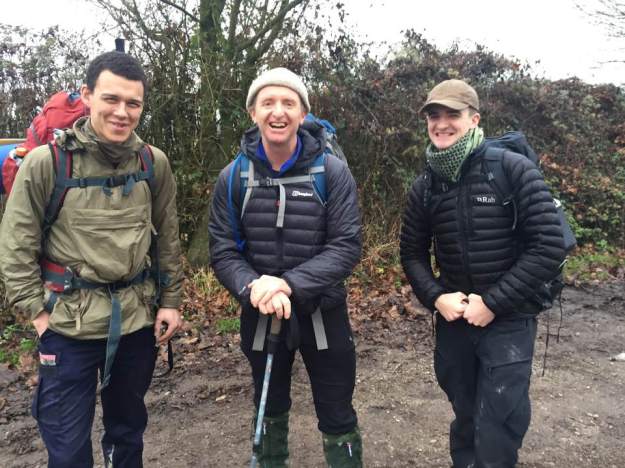
Teddy, Tom, and Patrick on the South Downs Way fundraising in December 2016

Teddy, Tom, and Patrick on the South Downs Way fundraising in December 2016

Thank you for reading the blog in 2016 and for engaging in lively debates via the comments section. The most controversial issue is the state and status of Paddy’s house, but we end the year with some hope that the Benaki will be able to make some progress as seen by their recent press release.

Please do keep sending me material. I probably say this every year, but I have a good backlog of items, many of which have been kindly donated by some of you. Forgive me if I don’t get round to publishing them immediately, or even quickly; it can often take me an hour or more for the more complex posts and time as you know is short and precious. My goal is to have everything up on the site one day. There is plenty of good material to come in 2017 and I wish you all a very Happy New Year.

The Like a Tramp 2016 Just Giving site will close in a few days. So far we have raised over £7,000 for homeless and mental health charirites. The most recent 2016 tramp has had donations of over £1,850. It would only take a few more donations to take us over the magic £2,000 mark. If you would like to donate in any currency, please follow this link.

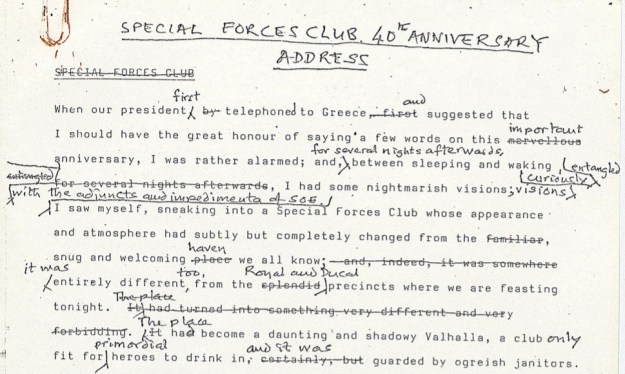
Patrick Leigh Fermor addresses the Special Forces Club on its 40th anniversary

Opening paragraph Special Forces Club 40th anniversary dinner

Opening paragraph Special Forces Club 40th anniversary dinner

My thanks to Gaz Wild who discovered this gem in the PLF archive of the National Library of Scotland last year. There are two versions, one a pdf of Paddy’s original with many handwritten corrections, and a tidied up draft made after his death. It would have been written in 1985 for the 40th Anniversary Dinner of the Special Forces Club, and is referred to in a letter of Paddy’s to Rudi Fischer dated 10 November 1985, which appears in Dashing for the Post page 393, para 2. Paddy remembers especially John Pendlebury, Mike Cumberlege, and Manoli Paterakis.

A special treat for the holiday period. I hope that you enjoy it.

19850000-plf_address_sf_club_40th_anniversary

19850000-plf_address_sf_club_40th_anniversary-tidied

Like a Tramp 2016 raises £1,500

Patrick, Teddy and Tom

Patrick, Teddy and Tom after a cold night in Exton church. A rare glimpse of the sun and blue sky which didn’t last.

Thank you to all who donated to Shelter and Combat Stress. Donations breached the £1,500 mark so we are very pleased. Fog and mist spoiled any views for the three and a half days we tramped along the South Downs Way which was a disappointment, but on the whole the weather was pretty kind; cold but no rain. As ever we walked like tramps seeking charitable shelter. We slept in churches and were offered drier accommodation near Midhurst which was a blessing.

If you would like to make a donation to help the homeless and veterans suffering from PTSD this Christmas, the Just Giving page remains open.

A Merry Christmas to you all.

Tom

https://www.justgiving.com/teams/likeatramp2016

Like a Tramp 2016

Completing my first walk to Bath in 2014

Completing my first walk to Bath in 2014

Hello to all Blog readers!

Thank you to so many of you for sponsoring me in the past as I have walked across southern England raising money for charity. This year, despite promising myself that I would retire from international competitive charity fundraising, I am off again.

This year (17-20 Dec) I will walk 70 miles along the South Downs Way with my son Patrick and his friend Teddy Chabo. We will walk as before, as tramps, sleeping rough and seeking charity and shelter along the way to continue our fund raising for Combat Stress and Shelter. Our goal is to continue to raise awareness of the need for support to veterans with mental health and PTSD issues, and the homelessness that can often come with it. These are two very worthy charities, and at this Christmas-tide, I am asking you once more, and for the last time, to make a small donation to help these causes.

Please visit our fundraising page linked below, and perhaps split any donation that you may make between the two charities, or give as you please.

To donate please click here to go to our Just Giving page.

Thank you from the three of us, and for all those who will be helped by your generosity and kindness.

A merry Christmas and a happy 2017 to you all.

With warm regards.

Tom Sawford

To donate please click here to go to our Just Giving page.

Sir Lewis Leigh Fermor’s Diary: Life in Colonial India

Map showing the area of India in which Fermor travelled during his first two field work seasons. [George Philip FRGS (ed.), Philips’ Record Atlas, London: The London Geographical Institute, 1934.]

Map showing the area of India in which Lewis Leigh Fermor travelled during his first two field work seasons. [George Philip FRGS (ed.), Philips’ Record Atlas, London: The London Geographical Institute, 1934.]

For those researching Paddy’s life, the Geological Society archives hold letters, papers and diaries of his eminent geologist father, Sir Lewis Leigh Fermor, and his experiences in India.

An introduction to the online element of his papers may be found here, and I quote …

The name Fermor may today be best known within the Society in association with the Fermor Fund, the bequest made by Sir Lewis Leigh Fermor’s second wife after her death to support research into her late husband’s areas of interest, or the Fermor Meeting. Outside geological circles it is more likely to be connected to Sir Patrick Leigh Fermor, Lewis Leigh’s celebrated travel writer son. Patrick could be said to have had adventure in his blood, with his father Lewis heading off to India at the age of 22, and being sent off on his first six month field work expedition less than a week later.

After applying for a job with the Geological Survey of India, Lewis Leigh Fermor (1880-1954) departed for Calcutta (Kolkata) in 1902. In 1909, after discovering six manganese minerals, his key report on the manganese deposits of the country was published. During WW1 he assisted the Railway Board and the Indian Munitions Board, for which he received an OBE in 1919. He led the surveying of the Archaean rocks of Madhya Pradesh both before and after the First World War. Although he officially became director of the Survey in 1932, he had previously acted as such for several years in the 1920s and from 1930 onwards. He retired from the Survey in 1935, but continued to live in India until 1939 as a consulting geologist, before returning to Britain.

The Society’s Archives hold a small number of notebooks and diaries formerly belonging to Fermor, in addition to personal papers such as his first Indian employment contract and a letter notifying him of a scholarship. His diaries are particularly interesting for the intriguing insight they give the reader into the life of both an early twentieth century geologist, and an English civil servant in British India.

Extracts from the diaries may be found online here.

Stavros Niarchos Foundation to Fully Repair and Restore Patrick Leigh Fermor’s House

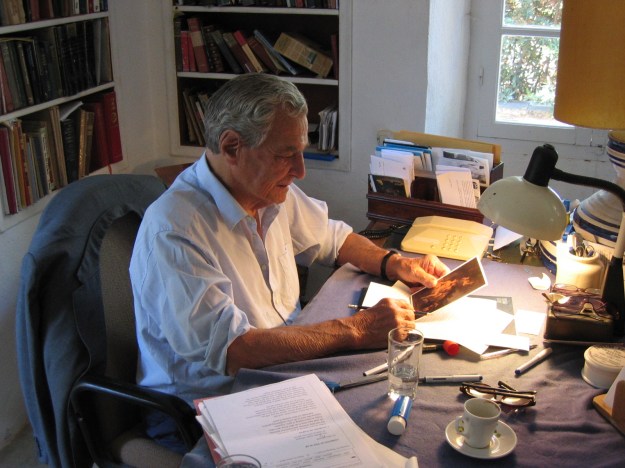
Patrick Leigh Fermor working at his home studio on 3 October 2004, then aged 89. Kardamyli. by Sean Deany Copyright 2012

Patrick Leigh Fermor working at his home studio on 3 October 2004, then aged 89. Kardamyli. by Sean Deany Copyright 2012

At last some very good news about the house at Kardamyli. The Benaki museum has made the following announcement in a press release as follows.

The Stavros Niarchos Foundation has approved a grant to the Benaki Museum to fully cover the repair and restoration works as well as the cost of the necessary equipment for the Patrick and Joan Leigh Fermor House in Kardamyli. This unique property will soon start operating as a centre for hosting notable figures from the intellectual and artistic worlds as well as a centre for educational activities in collaboration with Institutions in Greece and abroad.

The donation of Patrick and Joan Leigh Fermor

For many years Patrick and his wife Joan Leigh Fermor lived in Kardamyli in Messenian Mani, in the house which was designed by the architect Nikos Hadjimichalis in close collaboration with the Leigh Fermors.

In 1996, Patrick and Joan Leigh Fermor bequeathed their home in Kardamyli to the Benaki Museum, while still in life, with the intention that ownership of the house would be transferred to the Museum after their deaths. The option of donating the property to the Benaki Museum was suggested by their close friend Tzannis Tzannetakis. The bequest was accepted unreservedly by the Benaki Museum, particularly given Leigh Fermor’s close relationship with the Museum’s founder Antonis Benakis and his daughter Irini Kalliga.

According to the donation contract, the property must be used to foster the success of the Benaki Museum’s work, based on the decisions of its Board of Trustees. In addition, it may be used to host researchers seeking a quiet and welcoming place to work, while there is also provision for the option of renting the property for three months every year in order to secure its operating costs. Taking into consideration the donor’s personality and standing, the Museum added certain categories of guests such as writers, poets, artists and so on.

The Museum acquired full ownership of the property after the donor’s death, in the autumn of 2011. After receiving the gift, a study on its future use was initiated, and in parallel, a preliminary study on the repair and restoration of the property’s buildings was undertaken in collaboration with architects Andreas Kourkoulas and Maria Kokkinou and a budget was also drafted for the project. The Stavros Niarchos Foundation, in response to the Museum’s initial request for funding for the repairs and the acquis ition of the neces s ary equipment for the operation of the hous e, commissioned—and funded—a feasibility study, which was conducted by AEA Consulting, a firm specializing in the organization and management of cultural institutions. This study, which was based on the Benaki Museum’s proposal for the future operation of the house, led to a number of changes, mainly in regard to the financial planning respecting the sustainability of the project.

The Stavros Niarchos Foundation announced the approval of the Benaki Museum’s request to fully cover the repair works and the restoration of the Patrick and Joan Leigh Fermor House as well as its equipment, so that it can start operating as soon as possible.

The Benaki Museum’s Board of Trustees would like to once again thank the Stavros Niarchos Foundation for its continued and very generous support, and the inclusion of this project in its arts and culture grants. The unique location of the Leigh Fermor House, its distinctive architectural form and the luminance bestowed upon it by the author himself, in conjunction with the Benaki Museum’s supervision and the support of the Stavros Niarchos Foundation, guarantee the creation of an exceptional centre which will gain a high place among the many similar centers in Europe and the United States.

The property

The property is located in the Kalamitsi area on the outskirts of Kardamyli, in Messenia, and has a total area of about nine stremmata, a little over two acres. It is, by general consensus, one of the most beautiful properties in Greece. Its direct contact with the sea—narrow stone steps lead to a small pebble beach just below the estate—the low, discreet, stone buildings and the Mediterranean garden that goes down to the water, comprise an ideal environment for focus and the creative process.

In short, a sojourn in this place is a great gift that Greece can offer to notable figures from the intellectual and artistic worlds.

The vision

The creation of a centre in Greece (working title: The Patrick and Joan Leigh Fermor Centre), the operation of which, will commence in stages and planning of the following years will be based on evaluation of its activity.
The operations of the Patrick and Joan Leigh Fermor Centre will include:

– hosting of young writers and scholars for work and research purposes,
organization of higher-educational activities in collaboration with Universities and Institutions in Greece and abroad,
– honorary hosting of notable representatives from the fields of literature, the arts and other fields,
– organization of educational and cultural events for the general public and residents of Kardamyli,
– scheduled tours of the property, focusing on the donors, the history of the house and its use by the Benaki Museum,
– short term honorary hosting of benefactors and major supporters of the Benaki Museum.

As per a decision by the Museum’s Board of Trustees an international committee is to be set up, which will form and advise on the operation program of the Centre. The advisory committee will be unpaid, it will monitor the project underway and it will make recommendations regarding the selection of guests.

The Benaki Museum’s legal, financial and other services (including departments such as Educational Programs, Sponsorship and European Programs, Public Relations and Communication, and Conservation among others) will support and assist the project taking place at the Leigh Fermor House.

The Benaki Museum is aiming for the creation of an endowment based on third-party donations, which will be able to cover operating expenditure of the Centre and allow the proposed educational activities to evolve and grow.

Brief history – Up to date
– the archival material found in the house has been delivered to the executors of the will, in order for it to be handed over to the National Archives of the United Kingdom, as stipulated in the will,
– the staff selected by Leigh Fermor himself have been retained to ensure the ongoing care of the buildings and surrounding area are on a daily basis,
– the property has been insured,
– cataloguing of the library has progressed,
– detailed photography of the house and the recording of the household effects have been carried out,

– artworks and valuable books have been transferred to the facilities at the Benaki Museum in Athens for conservation and safekeeping, until completion of the requisite repairs,
– detailed mapping of the property has been completed as has the architectural and electromechanical study for repair of the buildings and maintenance of the gardens, with the principle of maintaining all those elements that render the property so unique (study team: Maria Kokkinou-Andreas Kourkoulas, Pantelis Argyros, Dimitris Pastras, Helli Pangalou),
– the process of legalizing buildings on the estate has been completed,
– the feasibility study by AEA Consulting on the future use, operation and viability of the house has been completed with funding from the Stavros Niarchos Foundation,
– two successive disinsectisations have been carried out for the protection of the house and
household effects, and in particular the wooden elements of the house such as the ceilings of the rooms, furniture, and so on,
– one bank account has been set up in Greece and one especially activated in the United Kingdom, in order to facilitate donations,
– discussions with Greek and foreign educational institutions regarding collaboration in the future operation of the Patrick and Joan Leigh Fermor Centre have been initiated,
– an implementation study for the repair work is in progress,
– a book in honor of Patrick Leigh Fermor, dedicated to his life and work, is in preparation and will be completed in 2016, and another publication about the house will follow,
– finally, a short—for the time being—presentation of the Leigh Fermor House has been uploaded onto the Benaki Museum website. A separate website for the house is currently in preparation, where detailed information about the project’s progress, the operation of the house, and scheduled events and guided tours will be posted. These presentations will also provide all the necessary details for donations to the endowment for the future operation of the Centre,
– from the day the Leigh Fermor residence came into the ownership of the Benaki Museum, the Museum has organized and/or coordinated a particularly large number of visits. During many of these visits, individuals working with the Museum have informed the guests about the house’s prospects and future programs. Revenue from visitor tickets is used exclusively for the needs of the house.

From now on:

– The commencement of the repair work is entirely contingent on the issue of the permit. It is anticipated that work will be completed in about 12 to 18 months from its commencement. Until such time as the preparation of the house for the repair work begins, the organized visits, upon arrangement with the Museum, will continue. (www.benaki.gr)
– The Benaki Museum is in the process of creating an endowment for the collection of donations, which will ensure that the operational expenditure of the Centre is covered and that the proposed educational activities will continue to evolve and grow.
– With the dual objective of informing the public of developments and the collection of donations, the Benaki Museum is planning a series of detailed presentations on the progress of the project and its future operation.
– More specifically, it is organizing a detailed presentation in early November 2016 in London, where there is a keen, ongoing interest in the author and the Kardamyli House, while in the interim, similar presentations are planned for Athens and Kardamyli.

For information about the Leigh Fermor House please contact Irini Geroulanou or Myrto Kaouki at the Benaki Museum, on the following numbers: 210 3671010 and 210 3671090, or by email: plfproject@benaki.gr

Download the full press release here.

Who was Stavros Niarchos?

What is the Stavros Niarchos Foundation?

The Sabotage Diaries – video by author Katherine Barnes


The Sabotage Diaries from Katherine Barnes on Vimeo.

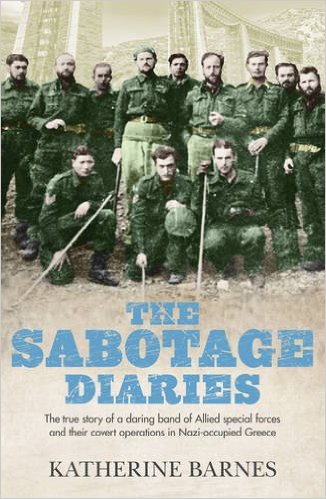
I first wrote about this excellent book in March. Author Katherine Barnes has now produced a video which is worth a watch, even if only to view some of the extraordinary photographs showing SOE operations in mainland Greece.

The Sabotage Diaries is the thrilling story of Allied engineer Tom Barnes, who was parachuted behind enemy lines in Greece In 1942 with eleven others to sabotage the railway line taking supplies to Rommel in North Africa. The target chosen was the Gorgopotamos bridge. Tom led the demolition party to lay the explosives while fighting raged between the Italian garrison and a combined force of Greek resistance fighters and Tom’s fellow-soldiers. A great story of courage and endurance.

Buy The Sabotage Diaries

The life, times and legacy of geologist Sir Lewis Leigh Fermor

Geoscientist Cover Dec_Jan15_16This article is by Ted Nield on the life, times and legacy of geologist Sir Lewis Leigh Fermor, as seen through the eyes of his more famous son.

First published by The Geological Society, in Geoscientist, December 2015.

“…having made the most solemn oaths to me [he] has quite cheerfully broken them all – you can never guess just what a blighter and a mongrel that man is – he even astonishers me – and I thought I knew him pretty thoroughly … there is one thing I regret and that is that I didn’t leave him straight away the first time I longed to – which was three days after my wedding day. He is impossible.”

So wrote Muriel Ӕileen Fermor (née Ambler, 1890-1997) on 1 February 1923 to her mother – convinced that her austere geologist husband Lewis Leigh Fermor (1880-1954) had been cheating on her in far-away Calcutta, where he was then Acting Director of the Geological Survey of India. (He became Director in 1932.) Their desultory marriage – already a separation in all but name – had but another two years to run. They were divorced in May 1925.

The marriage resulted in two children, Vanessa Opal (b. Calcutta, 1911) and Patrick Michael (b. Endsleigh Gardens, St Pancras, 1915). It is perhaps fortunate that ‘Paddy’ was born in England, away from Lewis, else he might also have copped a mineral for a middle name. After the Lusitania was sunk, Ӕileen decided to leave the baby in England rather than risk losing both her children. Thus Paddy was farmed out to friends and grew up hardly knowing his father at all.

For this reason, little of what we know of Lewis comes to us via him – despite the fact that Paddy grew up to be a great (and largely autobiographical) writer. However, his books do contain rare, but often highly touching glimpses of Lewis, illuminating the peculiar upbringing that colonial service often imposed upon the children of its staff.
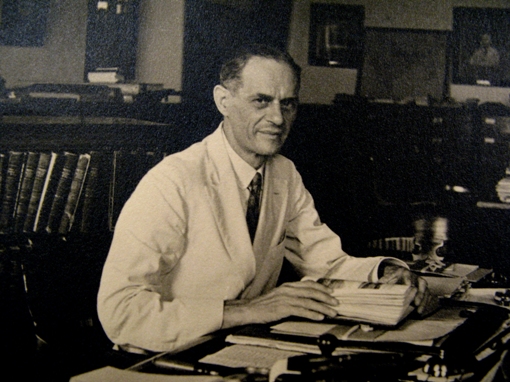
Sir Lewis Leigh Fermor at his desk in the Geological Survey of India, Calcutta.  From the Geological Society’s photograph collection.

By the time Paddy was 19, having been sacked from just about every school he was ever sent to and very far from achieving either his father’s ambitions (that he should study at science-strong Rugby, Haileybury or Oundle) or his mother’s (that he should go to Eton and join the ruling class) young Fermor was becoming tired of idling away his adolescence in Metropolitan dissipation. Aware he ought to become a writer but knowing he lacked material, he conceived the romantic idea of taking his meagre allowance and walking, alone, across Europe to Istanbul (or ‘Constantinople’, as he resolutely persisted in calling it), like a mendicant scholar of old.

The idea came to him in a flash, was the making of him, and met with (by today’s standards) shockingly little parental or other opposition. It was to prove the first in a lifetime of adventures, culminating most famously in his wartime work with the Special Operations Executive (SOE) in Crete, and his kidnap of the island’s commander-in-chief, General Kreipe – described in William Stanley Moss’s book Ill Met by Moonlight (1950) and the Powell & Pressburger film of the same name (1957), in which Paddy was dashingly portrayed by Dirk Bogarde.

The epic walk was described in three of the greatest travel books ever written in English (each, as they were published up to five decades later, a truly prodigious act of recall), marking the beginning of Paddy’s remarkable career as traveller, linguist, Hellenophile, polymath, autodidact, author, war hero and all-round national treasure. But when he set out for the Hook of Holland, just before Christmas on 8 December 1933, nobody would have believed that, one day, like his father, he too would become a Knight of the Realm – still less that his fame would completely eclipse that of his worthy forebear.

However, the eclipse is not quite total. The Society, at least, remembers Sir Lewis Leigh Fermor, through the gift of a substantial bequest that supports the Fermor Fund and the Fermor Meeting. But who was he, and what did he do?

Lewis Leigh Fermor (his middle name, given in honour of a family friend, was perpetuated through his children – but there is no hyphen) was born in Peckham on 18 September 1880, eldest of six. His father was a bank clerk. Adept at winning scholarships, after an initial 4d/week education at Goodrich Road Board School, Lewis moved to Wilson’s Grammar School, Camberwell, and the Royal School of Mines, studying metallurgy (with a view to a job in the Royal Mint).

Invited by Professor J W Judd (1840-1916, he became Student Assistant in Geology while working for his BSc. Judd also persuaded him to apply for a vacancy in the Geological Survey of India before graduating. He was appointed in 1902 – the year he joined the Society. He subsequently gained his degree by research, in 1909. Imperial later also bestowed upon him its DSc, for work he would perform in India: most notably a monumental tome on manganese ores.

We cannot be certain, but it is likely that his geological work in India led to his first marriage, because Muriel Ӕileen Ambler was the daughter of a quarrying magnate there. Educated by a series of governesses at the family home in Dulwich, she had returned to India, where the family had built a villa a few miles outside Dharhara, at Bassowni. While her brother Artie entered the family business, Ӕileen and her mother began the search for a husband in Calcutta. Ӕileen, spirited and venturesome, a lover of the theatre, was given to effusions and purple ink and liked to ennoble her Anglo-Irish family tree with glamorous royal connections of dubious accuracy.

She and Lewis met in 1907, probably in connection with the Survey’s work – the Survey had done load-bearing tests on the family’s product – and it was she who began the tradition of unofficially hitching the ‘Leigh’ onto the Fermor, even though it was only Lewis’s middle name. They seem an unlikely match, he so austere and ambitious, she so wild; but Lewis was, by all accounts a very elegant figure on the dance floor and his ambitiousness undoubtedly recommended him to his in-laws – and perhaps to Ӕileen, at least initially.

Colonial service staff received furloughs once every six years, so little Paddy was six when he first met his father. Embarrassed at being unable to impress this remote figure, Paddy camouflaged his youthful slowness, according to his biographer Artemis Cooper, by memorising long passages of literature by heart. Thus began his voracious love of books, and the first flexing of his prodigious memory.

Ӕileen never returned to India after World War 1, and (curiously for one so addicted to travel) Paddy never visited his father there. In 1924, Lewis once again came back to England, travelling with his family to Zweisimmen (near Gstaad). Paddy at that time had no school to go back to (having just been sacked again), so when sister Vanessa departed with her mother for England, Paddy stayed on with his father, who was joining a geological conference in Milan.

This was the first time Paddy and Lewis spent any time together, and sadly they were never to be as close again. Two particular memories turn up in Paddy’s writing about this special week. In the train to Lake Como, Lewis proudly demonstrated a knife he had just bought, by peeling an apple without breaking the skin. This he did – then tossing both peel and knife out of the window. Paddy became helpless with laughter. His annoyed father banished him to another carriage, where Paddy then tried to open the window – by pulling the communication cord.

Arriving in the Dolomites Lewis dressed for the field, where he collected specimens both geological and botanical. Paddy remembers cringing with embarrassment when he saw his father in this bizarre attire – his Norfolk jacket and ‘vast semi-circular cap, I think originally destined for Tibetan travel, like a bisected pumpkin of fur, armed with a peak, and with fur-lined ear-flaps that were joined (when not tied under the chin, which was worse still) by a disturbing bow on the summit.’

Worst of all, there was the geological hammer at his belt, bearing an arrow, marking it as government property. Lewis had joked to Paddy that only members of the civil service and convicts carried such hammers. Far from being amused however, and horrified by the thought that people might think his father a convict, nine year-old Paddy tried (under the guise of adjusting it for comfort) to turn the hammer around so that the arrow could not be seen.

This was to be the last time that father and son were to spend any extended time in one another’s company. As Cooper observes, Paddy was to grow up feeling ill at ease with his father, and the suspicion that he was a disappointment to him. On the other side, his mother was contrastingly jealous of him, seeing him as her, rather than Lewis’s, son (though she too, despite her possessiveness, blew hot and cold, turning clingy one minute and distant and uncaring the next).

Lewis had not been pleased to receive his gadabout son’s London tailoring bills (though he helped to settle them). So it is possible that Paddy’s proposed expedition may have seemed to him like a washing of hands. The hope that his son might become a scientist had died years before. Lewis (no doubt in desperation, because mathematics was one of Paddy’s many weak suits) had even suggested his son might consider a career in accountancy, so at a loss was the family to know what to do with him. At least this mad expedition was a goal, and his son’s own idea. His reply to news of his departure included a birthday gift of five pounds. (This was not the only birthday on which Paddy would have occasion to thank a geologist. On turning 21, two years into his trek, he learned that Sir Henry Hubert Hayden, one of Lewis’s predecessors as Director (1910-21) had bestowed a gift of £300 on him.)

Paddy would arrange for letters to be sent to him poste restante at various points along his projected route. Most important were those containing pound notes, but occasionally he found letters from his mother, often whimsical and amusing, and occasionally, more formal missives from Lewis: ‘full of geological advice’.

At the time when her favoured child was departing for Europe, Ӕileen herself was having a hard time. Divorced eight years, and suffering that diminution in her status, news had come through that Lewis was marrying again – to a certain Frances Mary Case. Within a year, Lewis was knighted, and thus her supplanter became ‘Lady Fermor’. Artemis Cooper speculates that this might have been a severe blow to the social-climbing Ӕileen; though in the days when directors of the British Empire’s geological surveys were habitually knighted, she surely realised what she was giving up – though this may not have made it any easier to bear.

Fermor’s main geological interest was (as reflected in the terms of the Fermor bequest) the rocks of the Archaean. Sir Thomas Holland had asked him to report on the manganese ore deposits of India, little expecting that Fermor (renowned for meticulous attention to detail) would take until 1909 to publish, nor that his report would run to nearly 1300 pages. Not only did this work earn Fermor great renown (and his FRS), it also revealed six new manganese minerals.

The experience gained in this work led to his being placed in charge, in 1911, of a systematic survey of the Archaean rocks of the Central Provinces (Madhya Pradesh), much of which he surveyed personally, at four inches to the mile. War interrupted this work, and Fermor finished his part of it in 1926.

His economic work continued – on copper, coal, iron ore, and mica, which led to an avalanche of publications in the Annual Reviews of the Mineral Production of India between 1921 and 1934. He also worked on the Deccan Traps, and even on meteorites (though his ideas about the origin of chondrules were incorrect – he thought they were formerly garnets). Finally, before retiring to Bristol and then Surrey, he began a memoir entitled ‘An attempt at the correlation of the ancient schistose formations of Peninsular India’. Sadly, this herculean project was destined never to advance beyond the opening general discussion (published 1940) and remained incomplete on his death.

His retirement in 1935, a year after being elected FRS, marked the beginning of a closer association with the Geological Society. He had already won its Bigsby Medal (1921), and he now joined Council (in 1943), and served as Vice President from 1945 to 1947.

When Paddy  learned that his father was dying, in 1954, he paid a final visit to him, in his new home near Woking. This at last was a home with the space to display his collection of early English glassware, as well as the fine Persian rugs he had collected. It was the first proper home that Lewis had ever owned – aptly named ‘Gondwana’ – and here he had hoped to finish his Archaean memoir. These hopes were dashed only a few months after moving in, when his final illness struck.

‘We had only met twice during the last six years and corresponded as little’ Paddy wrote. Hollow cheeked, and a sickly colour, ‘his enormous and luminous eyes, talking very slowly and almost inaudibly… The only consoling thing is that he has no idea he is dying. “Such a bore, being all cooped up when all the flowers are out”’. He died on 24 May. “What a strange business Daddy’s funeral was, a sort of nightmare’ Paddy wrote to Vanessa. ‘I am so glad you were there too – I don’t think I could have taken it if there hadn’t been your eye to catch now and then’.

In 1976, having just been declared clear of cancer himself, Paddy finally decided to visit India. After Christmas in Benares he went to Calcutta and found his way ‘rather timidly’ to the offices of the Survey. To his surprise, he found that ‘They seem to worship Daddy’s memory’. Indeed, Dr S V P Iyengar (1921-2012), Deputy Director General and a former pupil of H H Read and Robert Shackleton, described Lewis as ‘the most imaginative, helpful and constructive [figure, who] …contributed more than anyone else, and all his prophecies and conclusions have been proved right’ – a slight exaggeration, considering the chondrule theory, but understandable. As Cooper observes, such was the bitterness about Lewis that Paddy and his sister had absorbed from their mother, it was ‘strange’ for them to ‘discover him both loved and admired’.

The story of the Fermor bequest began in 1961, and in all took nearly 20 years. Lady Fermor wanted to make over a sum to be held in trust, the income being used to pay her a pension during her lifetime; but this was later shown to be impossible because of the Estate Duty that she would have to pay. Then, in October 1969, a letter from her solicitors arrived at Burlington House announcing her wish to make ‘a substantial bequest’. In March 1979, Lady Fermor presented the Society with a cheque for £1000 to establish the Fermor Lecture, held every three years, the first in October/November 1980. She was (eventually) granted Honorary Fellowship, and invited to attend the Fermor Lectures, which she did – enjoying the luxury of a free night in the ‘Fellows’ Bedroom’.

Lady Fermor died in November 1990, leaving the Society the residue of her estate minus some bequests to others. It is not known if the Society blushed about having made her sleep in the cellar when it found out that this residue amounted to £500,000-£600,000. It was, and remains, the Society’s biggest fund.

Related article:

Paddy’s childhood home: The Weedon Bec route near Northampton

Meeting Paddy at the 40th anniversary of the Battle of Crete

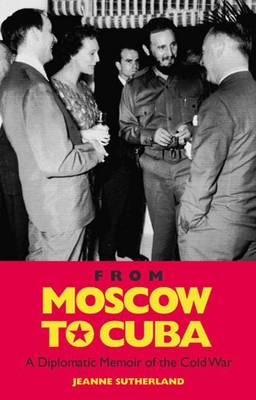
sutherlandJeanne Nutt and Iain Sutherland began their careers as professional diplomats in Moscow when Stalin was still alive. Although both had studied the language, literature and history they arrived in Moscow separately. Three decades later they would leave the city together, after three ageing leaders had died in a row and just as things were about to change for ever with Gorbachev’s perestroika.

By then, Jeanne’s career was long over. When she and Iain had married in 1955, she had been obliged, under rules not finally abolished until 1972, to resign. From then on her fate had been to pack and follow her husband wherever his career took him. She continued to take a lively and intelligent interest in the people and the politics of the places where she and her husband lived, and where they witnessed some of the turning points of the Cold War.

In her book From Moscow to Cuba and Beyond, A Diplomatic Memoir of the Cold War, she gave a flavour of the sometimes bizarre life diplomats led in those distant days.

The Sutherlands served in Cuba, Washington, Yugoslavia, Indonesia and Athens, where Iain was ambassador, and this is where they met Paddy. Her book focuses on their three tours of duty in Russia. The highlight of their first stint in Moscow was the death of Stalin in March 1953. That morning their maid arrived in their apartment shattered by grief. She made an inedible breakfast, broke down in tears, and fled. The old woman who guarded the front door was sobbing into her shawl. The following day the ambassador, the splendidly named Sir Alvary Gascoigne, went with his staff to pay their respects to Stalin as he lay in state in Moscow’s Hall of Columns. The ambassador insisted that all should wear top hats, wholly unsuitable headgear when the thermometer stood at -20C, and the diplomats were ushered past the coffin so fast that one of them missed Stalin altogether.

This account is taken from her diary of the events around the 40th Anniversary of the Battle of Crete.

Thursday, 21 May 1981

Lord and Lady Caccia arrived to take part in the Crete activities, this being the 40th anniversary of the battle. The Olympic (airlines) strike threatened to leave us without transport to Chania so we were all – the Australian and New Zealand delegations, Paddy Leigh Fermor and ourselves – given seats in the Minister (Averoff’s) plane which took off from Tatoi about 6. We arrived about 7.30 in Chania and poured into the already crowded Porto Veneziano Hotel. There were obviously too many, even of the British Delegation, to have a quiet taverna dinner altogether so we collected our party and Paddy and Johnny Craxton and had a fish meal at the taverna near the hotel.

The ceremonies of the next few days seemed never-ending as we toiled round with over 100 veterans, three Ministers of Defence and Mitsotakis, Scottish pipers, Australian buglers and Greek military bands. It was tiring, interesting and at times particularly moving, as in Galetas which was in the centre of the battle, and Souda Bay where the Australians broke into singing God Save the Queen as the anthems were played.

Sunday, 24 May 1981

The ceremony of the laying of the plaque dedicated to the members of the resistance in Crete who lost their lives, was delayed yet again and finally unveiled at 7.30 p.m. There were short speeches by Averoff and Iain and by Paddy Leigh Fermor at greater length after much agonising. (The story about the glass of water at the British Council lecture was true, he told me. When the attendant topped it up with more water it became cloudy and revealed to all that he was keeping up his courage with ouzo!)

Monday, 25 May 1981

The party set off from Heraklion for Mount Ida and the village of Anoya to meet Paddy Leigh Fermor’s resistance friends for a lunch in the mountains and to hear stories of how the men folk were shot and the village burned in reprisal for the acts of sabotage perpetrated by the SOE fighters. We collected the mayor and Dilys Powell in the Rolls and took it up the rough road to Psiloriti near the Cave of Zeus. Here the air was fresh and crisp, and together with the veterans of the underground resistance, we sipped raki and ate local cheese outside and then went inside for crisp hot lamb and more local wine; all this accompanied by playing of the lyre (lira) and singing by Paddy and his companions.

The climax was the ‘simple taverna party’ in the evening outside town for the veterans. It was given by Kefaloyannis, the large burly moustachioed Cretan (whom at the lunch I had taken to be a former shepherd and not a hotel owner), in his 600 bed hotel. Twenty or thirty of us were wined and dined, given champagne, serenaded by the hotel singers (more Filaden, Filaden), watched dancing and plate throwing and finally our host’s firing bullets through his hotel windows. Paddy told me the story of Kefaloyannis, who had abducted a young Cretan girl in the 1950s, the daughter of a Venizelos supporter and therefore a declared enemy, as K was a Royalist. When the island was on the brink of civil war over it he came down from the mountains, gave himself up and went to prison. Later they were married, but this did not last and he is now married to the sober black-dressed lady who was sitting on Iain’s right. Sitting opposite me was Paddy’s god-daughter whose father was shot, trying to escape from the village of Anoya, after sheltering Paddy several times during the war.

Home at 2 a.m.

Extracted from Jeanne Sutherland’s diaries and her book, From Moscow to Cuba and Beyond, A Diplomatic Memoir of the Cold War. Published by The Radcliffe Press in 2010 (p 276-277).

Greek media and environment professional seeking internship

Dear friends and readers.

I was recently stranded in Thessaloniki for a few hours whilst on my way to Skopje. It seemed like a good idea to see if I could have lunch with a Greek friend, Lia Papadranga, who I had met on my journey across Albania searching for the Via Egnatia in 2009. Lia is chief press officer for the Axios Delta national park, a great area of beautiful wetland just west of Thessaloniki.

Over a wonderful fish lunch Lia told me about her current Masters studies in Journalism and New Media, and the need to continue those studies with an Erasmus sponsored internship, ideally abroad. She told me that competition for such posts was tough and I offered to help by putting something on the Blog.

Lia is very hard working, bright and tenacious, with considerable experience in journalism and media. If you think that you may have an internship in your organisation please take a look at her CV here and introduction letter.

Thank you.

Tom

A bad day at the office

The Guardian newspaper is notorious for its errors. In these days of spell-checkers typos are less common. However, as this correction announcement shows, it, and its sister paper The Observer, are still capable of some major howlers. Clearly the author of the original book review had a very bad day at the office.

First published in the Guardian

A review of David Astor: A Life in Print, a biography of the former editor of the Observer, contained a number of errors (20 February, page 7, Review). In the article we suggested that William Waldorf Astor was named after a hotel, when in fact his name referred to the family’s native Rhineland village. He didn’t build Cliveden, as we suggested, but bought it, and he didn’t sack the editor of the Observer for spiking his contributions (although he did sack the editor of the Pall Mall Gazette, another Astor acquisition, for spiking his contributions). We said Katharine Whitehorn was women’s editor of the Observer when in fact she was a columnist. We said Patrick Leigh Fermor compared David Astor to Disney’s Pluto; Fermor actually compared the writer Philip Toynbee to that cartoon character. Terence Kilmartin replaced Jim Rose as Observer literary editor, not JC Trewin. During the war, David Astor didn’t merely suffer “a mild attack of dysentery” as suggested in the review. In fact he was wounded in action during a German ambush in the Ardennes. Terence Kilmartin is believed to have been involved in his rescue, and Astor was awarded the Croix de Guerre.

New Book: The Sabotage Diaries

Sabotage diariesThis book made much more sense to me following the excellent talk by Dr Roderick Bailey about the psychological effects of SOE operations on the men involved. Dr Bailey spoke at length about Operation Harling and this team.

The The Sabotage Diaries is written from the first person perspective of Tom Barnes (from his diaries) so has all the gripping suspense of a novel. It is a thrilling read of wartime exploits, daring, intrigue and resourcefulness. It is the true story of Allied engineer Tom Barnes, who was parachuted behind enemy lines in Greece in October 1942 with a small team of sappers and special operations officers. Their brief was to work with the Greek resistance in sabotage operations against the German and Italian occupation forces. Under-equipped and under-prepared but with courage to spare, their initial mission was to blow up a key railway bridge, cutting Rommel’s supply lines to North Africa, where the battle of El Alamein was about to begin. Operation Harling was only the start of a lengthy and perilous clandestine mission.

Written by Tom Barnes’ daughter-in-law, award-winning author Katherine Barnes, and drawn from Tom’s wartime diaries, reports and letters, plus many other historical sources and first-hand accounts, The Sabotage Diaries is a vivid and gripping tale of the often desperate and dangerous reality behind sabotage operations.

Buy The Sabotage Diaries

Catching up

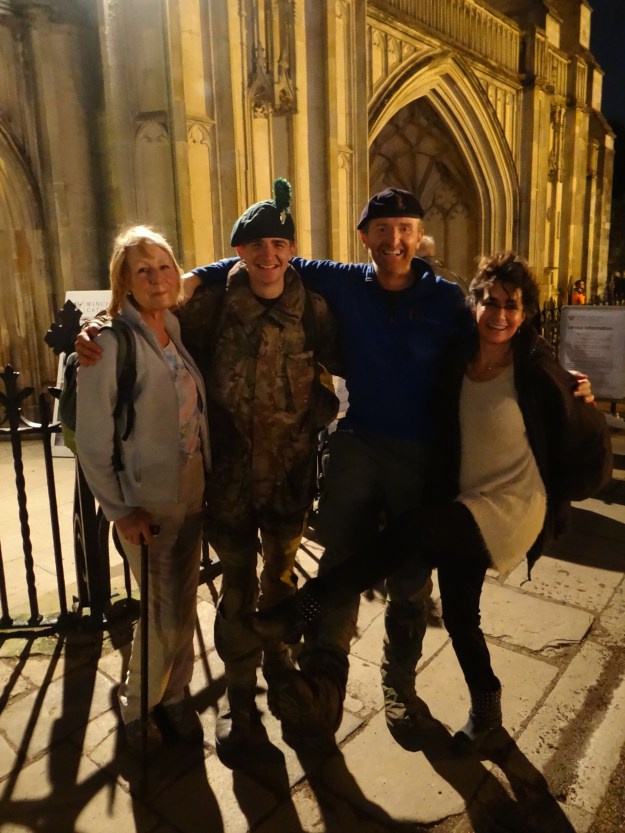
Journey's end with Billy Moss' daughter Isabelle and Jody Cole Jones at Winchester Cathedral

Journey’s end with Billy Moss’ daughter Isabelle and Jody Cole Jones at Winchester Cathedral

I have returned. Some of you may have wondered if I had disappeared in a bog on my long walk before Christmas, others perhaps that there is nothing more to add to the Paddy blog.

Fortunately neither is true although the walk was massively hard. I suffered a bout of flu the week before and was quite uncertain if I would be well enough to start on time. The main symptoms did disperse, but I was very weak and probably not strong enough to tackle the hills and terrible ground conditions that we found (see this video here). It was not really until we reached drier conditions in Hampshire in the last two days that I had recovered my strength enough, but aided my by walking companion, my son, and the ever-present need to meet the target and raise money for the two chosen charities, we pressed on. We were joined by Billy Moss’ daughter Isabelle and his grand-daughter Jody Cole Jones for the last 10 km into Winchester. They wished to support the causes, and Combat Stress in particular, as they wanted to highlight their belief that Billy probably suffered from some form of post-traumatic stress which may have led to his early demise. The Just Giving page remains open for any final donations here.

Since then I have been in Germany celebrating Christmas with my youngest daughter Harriet, and then preparing for a new job which I started in the New Year. So I am now ready to get back in harness and present you with some fascinating material. As ever I am grateful to those of you who have been in touch with ideas and material. I look forward to a successful 2016 for us all and send you my best wishes.

Tom

Two tramps walking!

patrickI am very pleased to announce that I will be joined by my son on the walk this year. He has a close affinity with the aims and objectives of our walk which are to raise awareness of mental health issues and homelessness amongst veterans, and to raise £5,000 for two charities that assist them.

By Tom Sawford.

The walk dates are now set at 14-19 December, starting in Ottery St Mary in Devon and ending early Saturday afternoon at Winchester Cathedral. If you would like to join us for a day or so please get in touch.

You can support the two if us in our walk and the charities that we support by giving on our Just Giving page here. We would like to start the walk with £2,000 raised and have a way to go to reach that so please, please consider giving something – the Just Giving site takes all major currencies. Every donation helps, no matter how small or large!

Combat Stress is the UK’s leading Veterans’ mental health charity. Mental ill-health such as PTSD affects ex-Service men and women of all ages. Right now, the charity supports over 5,900 Veterans aged from 18 to 97, and spends over £15 million per annum delivering its unique range of specialist treatment and welfare support which is always free of charge.

Winchester Churches Nightshelter provides a vital lifeline to the homeless, and remains the only night shelter offering direct access emergency accommodation in Hampshire. They support up to 200 homeless people annually. There is a direct link between mental health problems such as PTSD and homelessness. Money raised will go direct to the homeless which I feel may be a better outcome than through a larger charity.

We hope that you will feel inspired to support the fundraising and make some (doubly !!!) generous contributions at the Just Giving page where you can choose to split your donations between the two charities if you wish.

There is a public Facebook page if you want to follow the progress. https://www.facebook.com/walkinghomeforchristmas/

Thank you all very much. Please donate here. https://www.justgiving.com/teams/likeatramp

Print

Language Itself Resists

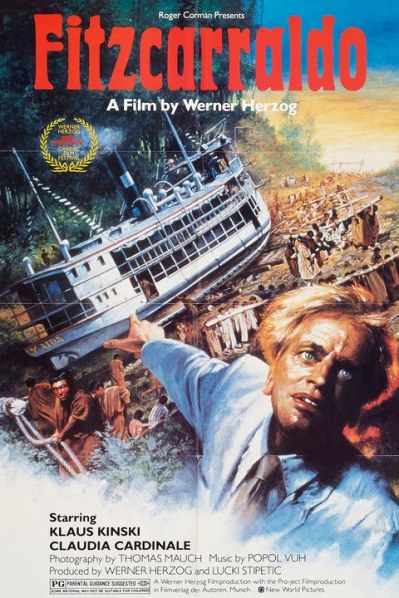
fitzAt the weekend I was watching with my partner the wonderful movie, The Mission, starring Jeremy Irons and Robert de Niro. The hot, humid, fly ridden jungle scenes reminded me of something by Werner Herzog that I had saved as a possible draft and it spurred me to share it with you.  It is clear that his experiences filming Fitzcarraldo were not particularly pleasant. This comes on the anniversary of our good friend Jasper Winn’s walk in the footsteps of Herzog’s 1974 walk from Munich to Paris in the depth of winter to save the life of a friend. 

by Werner Herzog

From the Paris Review

For reasons that escape me, I simply could not make myself go back and read the journals I kept during the filming of Fitzcarraldo. Then, twenty-four years later, my resistance suddenly crumbled, though I had trouble deciphering my own handwriting, which I had miniaturized at the time to microscopic size. These texts are not reports on the actual filming—of which little is said. Nor are they journals, except in a very general sense. They might be described instead as inner landscapes, born of the delirium of the jungle. But even that may not be entirely accurate—I am not sure.

A vision had seized hold of me, like the demented fury of a hound that has sunk its teeth into the leg of a deer carcass and is shaking and tugging at the downed game so frantically that the hunter gives up trying to calm him. it was the vision of a large steamship scaling a hill under its own steam, working its way up a steep slope in the jungle, while above this natural landscape, which shatters the weak and the strong with equal ferocity, soars the voice of Caruso, silencing all the pain and all the voices of the primeval forest and drowning out all birdsong. To be more precise: bird cries, for in this setting, left unfinished and abandoned by God in wrath, the birds do not sing; they shriek in pain, and confused trees tangle with one another like battling titans, from horizon to horizon, in a steaming creation still being formed. Fog-panting and exhausted they stand in this unreal world, in unreal misery—and I, like a stanza in a poem written in an unknown foreign tongue, am shaken to the core.

Santa Maria De Nieva, 14 October 1979

Seen from the air, the jungle below looked like kinky hair, seemingly peaceful, but that is deceptive, because in its inner being nature is never peaceful. even when it is denatured, when it is tamed, it strikes back at its tamers and reduces them to pets, rosy pigs, which then melt like fat in a skillet. This brings to mind the image, the great metaphor, of the pig in Palermo, which I heard had fallen into a sewer shaft: it lived down there for two years and continued to grow, surviving on the garbage that people threw down the shaft, and when they hauled the pig out, after it had completely blocked the drain, it was almost white, enormously fat, and had taken on the form of the shaft. it had turned into a kind of monumental, whitish grub, rectangular, cubic, and wobbly, an immense hunk of fat that could move only its mouth to eat, while its legs had shrunk and retracted into the body fat.

Iquitos, 8 December 1980

This morning, when I checked on the telex machine, Gloria was trying to make contact with the Narinho, the rusted-out ship that we had gotten to float here from Colombia, made buoyant with six hundred empty oil drums, but the onboard receiver must have been turned off. A young woman had shown up; she had no way to reach her husband, an electrician, who was on the ship. In the morning her child had been throwing up for two hours, then went into convulsions, and was suddenly dead. I did not know what I should say to the woman. She turned her face to the wall and cried; she had been keeping it in until then. I took her hand and held it, and when her silent sobbing had relaxed somewhat, I took her on the motorcycle and rode to the boat landing. The boatman did not want to set out because he was waiting for the cooks, but I hustled him off with the woman to the place where the Narinho was anchored. The woman was still very young, and it had been her first child, a son, only half a year old.

A still day, sultry. inactivity piled on inactivity, clouds staring down from the sky, pregnant with rain; fever reigns; insects taking on massive proportions. The jungle is obscene. everything about it is sinful, for which reason the sin does not stand out as sin. The voices in the jungle are silent; nothing is stirring, and a languid, immobile anger hovers over everything. The laundry on the line refuses to dry. As part of a conspiracy, flies suddenly descend on the table, their stomachs taut and iridescent. Our little monkey was wailing in his cage, and when I approached, he looked and wailed right through me to some distant spot outside where his little heart hoped to find an echo. I let him out, but he went back into his cage, and now he is continuing to wail there.

Iquitos, 18 December 1980

I have a snake on my roof again. A little while ago I heard something rustling up there, and then something dark fell into the banana fronds with a thwack. I took a look, and it was a poisonous brownish snake that had caught a bird, which was still peeping. I tried hitting the snake with a stick, but it disappeared like lightning into the grass. Only now and then did a blade quiver, and from the piteous cries of the bird I could tell where the snake was. I did not follow it into the grass, because I discovered that another snake was on the thatched roof, and directly above me a third snake was trying to get from a banana frond onto the platform of my hut. I tried to strike it with the machete, but the snake was too fast for me.

The power is still out. Evening descended on the countryside. What would happen if the rain forest wilted like a bouquet of flowers? Around me insects are dying, for which they lie on their backs. A woman in the neighborhood is suckling a newborn puppy after her baby died from parasites; I have seen this done before with piglets. Outside a bright moon is floating now above the treetops. The frogs, thousands of them, suddenly pause, as if they were following an invisible conductor, and start up again all at the same time. Their conversations come and go in curious waves. Waxy moonlight, as bright as neon, is shimmering on the banana fronds. I was called to the telephone in the house, and fell off the ladder that leads to my platform. It was one of very few phone calls that ever get through to us, and a stranger on the line was trying to make it clear to me that I was a madman, a menace to society. .. (more follows if you purchase the Paris Review issue here)

Read about Jasper Winn’s walk in Herzog’s footsteps here.

A glance at the life and times of Miklos Banffy

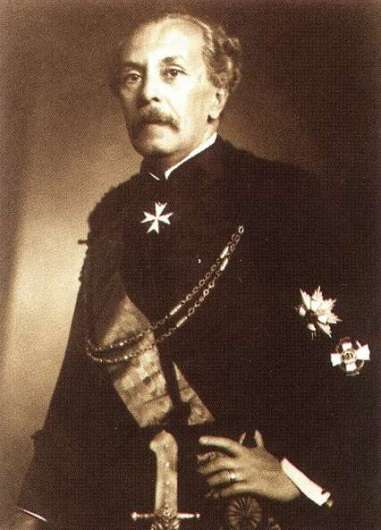
Count Miklós Bánffy

Count Miklós Bánffy

Many of you know that I admire the work of Miklos Banffy, the author and statesman who lived in Cluj, ran the opera house in Budapest, was foreign minister of Hungary and organised the last coronation of a king of Hungary. I have enjoyed the following article published on the blog of Lucy Abel-Smith who organised the first Transylvanian Book Festival and is planning a second for 2016. Enjoy this account of a recent tour through Hungary and Romania led by Lucy. Paddy very much followed in Banffy’s footsteps and wrote the foreword to the first English translation of Banffy’s wonderful Transylvanian Trilogy.

“In a brown velvet jacket and wide trousers he walked a little self conscious from one desk to the other… ‘I am drawing here, am writing there, at the third one I read’… I have forgotten what he did at the fourth… ’Somehow it seems more comfortable this way – he apologised and also I am very disorderly…”

In this charming description of his working habits, Miklos Banffy is disarmingly modest. This self deprecation is made all the more poignant by our visits to a few of his haunts – revealing something of this gifted, multilingual and many facetted man. Our journey was half in Budapest and then in Cluj and, at a slower pace in a few Hungarian Transylvanian villages in the traditional Saxon area. We behaved as if we were taking part in the Budapest Season before the war in a hectic race from place to place. From Cluj to Sibiu the pace was more measured.

Nearly seven decades after his death in Budapest in 1950, Miklos Banffy, one of the greatest novelists of the 20th century is only now being recognised by the English-speaking world. Jaap Scholten, in his Comrade Baron, describes what happened to so many of Banffy’s generation of Hungarian Transylvanians under Communism. Banffy’s own fate was no better. He died penniless, unsung and unread except by Hungarians. Jaap spoke to us over dinner on our first evening in the comfort of the Art’otel beneath the castle of Buda, on the bank of the Danube.

Day two began with a tour through the capital, bringing home the majesty of the Danube and the spirit of the 19th century movers and shakers in Buda and in Pest. At this time, Transylvania was still linked to the Kingdom of Hungary but ruled from Vienna. A visit to the truly National Museum, conceived by Ferenc Szechenyi, houses wonderful Renaissance furnishings from Slovakia and Transylvania including the great tomb monument of Michael Apafy (d. 1635), from Malancrav, which was relevant as this Baroque monument was carved by an artist from Spis and was commissioned for Malancrav, in Saxon Transylvania, where our journey would end.

Read more here.

Walking home for Christmas like a tramp

Tom in Bath at journey's end 2014

Tom in Bath at journey’s end 2014

Last year many of you made generous contributions to help me raise £2,500 for the homeless charity Shelter. This year I am almost doubling the distance I walk, and the nights out sleeping rough in the cold December weather, to achieve a doubling of the target to £5,000.

By Tom Sawford.

In December I will walk along the byways of England from the parish church of Ottery St Mary in Devon to Winchester Cathedral to raise awareness of the curses of Post Traumatic Stress Disorder and related homelessness. The route of around 120 miles will take me about 5-6 days and I will walk as a tramp, living off the goodwill of strangers, and sleeping rough in order to meet the goal of raising £5,000 for two charities that work tirelessly to assist those who struggle with these issues.

Combat Stress is the UK’s leading Veterans’ mental health charity. Mental ill-health such as PTSD affects ex-Service men and women of all ages. Right now, the charity supports over 5,900 Veterans aged from 18 to 97, and spends over £15 million per annum delivering its unique range of specialist treatment and welfare support which is always free of charge.

Winchester Churches Nightshelter provides a vital lifeline to the homeless, and remains the only night shelter offering direct access emergency accommodation in Hampshire. They support up to 200 homeless people annually. Residents benefit from a programme of practical and emotional support to help them to rebuild their lives and escape homelessness for good. Many of the people they deal with are ex-military. There is a direct link between mental health problems such as PTSD and homelessness. Money raised will go direct to the homeless which I feel may be a better outcome than through a larger charity.

I hope that you will feel inspired to support the fundraising and make some (doubly !!!) generous contributions at the Just Giving page where you can choose to split your donations between the two charities if you wish.

Some of you have asked about joining the walk and you would be very welcome to do so for some or all of the route. The dates are likely to be 12th or 13th December to 17th or 18th although these could shift to the right by a couple of days. I will publish the full route very soon.

There is a public Facebook page if you want to follow the progress. https://www.facebook.com/walkinghomeforchristmas/

Thank you all very much. Please donate here. https://www.justgiving.com/teams/likeatramp

#combatstress #homelessness #homeless #veterans

Print

Maggie Rainey-Smith’s new novel set in Greece

maggieFew of you may be familiar with the writing of Maggie Rainey-Smith, but you will most likely have seen her wonderful photographs taken at Paddy’s house during Maggie’s 2007 visit to Kalamitsi when researching the book that was to become Daughters of Messene. I am looking forward to reading more about the book but here is some background from a recent press release. You can review Maggie’s pictures and her tribute to Paddy written after his death here.

Maggie’s book is titled Daughters of Messene and seeks to shed light on the experiences of young Greek women shipped to New Zealand fifty years ago. The press release continues …

When almost 300 unmarried Greek women arrived in Wellington in the early 1960s, the established Greek community feared the scandal that might follow. Instead the women settled into life here and the event has largely been forgotten. Inspired by this migration, Maggie Rainey-Smith’s powerful third novel Daughters of Messene, explores the complex interweaving of family and political events that caused one young woman to flee Greece after the Civil War, and half a century later motivated her daughter to return.

Wellington writer Rainey-Smith’s idea for Daughters of Messene started with a friendship with her neighbour Maria, one of the original ‘Greek girls’ to settle here.

“My father was in Greece during the Second World War and was captured on Crete, spending four years as a prisoner of war in Poland,” says Rainey-Smith. “As a result, he was awarded a medal and certificate by the Greek Government in the 1980s. My neighbour at the time was Greek, and she helped me to apply to the Greek government on behalf of my dad.”

“We became good friends and I discovered that she had emigrated from Kalamata in Greece as part of a deal done between our two countries. The girls all had to be under thirty, unmarried, and they came to work in the hospitality industry. I became fascinated by their stories.”

Maggie’s two previous novels About Turns and Turbulence (Random House) are set in New Zealand, but research for her third novel – published by Wellington’s Mākaro Press working in collaboration with Whitireia publishing students – took her to Greece for three months in 2007. Although the trip wasn’t quite what she had expected.

“I spent most of my time in Kalamata searching for stories, but found that people were reluctant to speak of the Civil War. In desperation I caught a bus to the Mani and ended up staying ten days in picturesque Kardymili, where I had the great good fortune to meet eminent travel writer Sir Patrick Leigh Fermor. It seemed like a blessing on the story, and so I persevered with working through the secret and sometimes shocking stories of what was a terrible time for Greece.”

The book has taken seven years to write, and has been released as part of NZ Book Week this week.

Daughters of Messene is described by Owen Marshall as “A strong, fresh novel, dense with closely observed and convincing detail of life in Greece and aspects of its history.”

Greek-NZ poet Vana Manasiadis says, “In many ways Daughters of Messene is a tender love poem dedicated to a place and its people, to the profound bonds of blood, and the legacies such bonds leave us. The tale is both touching and vivid, the unfolding masterful, and the novel’s heroines, spirited, huge-hearted and tough (in the very best sense).”

You can pre-order Daughters of Messene here.

Print

Sons of Odysseus by Alan Ogden

Layout 1Sons Of Odysseus is a fascinating study of SOE heroes in Greece. Respected SOE expert and author Alan Ogden recounts how SOE missions through their courage, patience and determination, attempted to come to terms with reconciling British political and military objectives in the cauldron of internecine Greek politics.
From the very beginning, ‘political headaches’ abounded as SOE tried to establish a unified Greek resistance movement. For most Missions, it was a steep learning curve, accelerated by the experience of finding themselves in the middle of a bitter civil war during the winter of 1943 – 44, having to endure attacks by Axis occupation forces at the same time as being caught in fighting between EAM-ELAS and EDES guerrillas.

Living behind enemy lines for long periods of time, SOE officers and men were nevertheless able to bring off a series of spectacular sabotage acts and with the assistance of Greek partisan forces doggedly harassed German forces as they withdrew North in the autumn of 1944.

Ogden has been in contact with many of the families of these SOE heroes and has had access to letters, photographs and diaries. Drawing on these sources as well as official archives and published memoires, Sons Of Odysseus profiles the service records of nearly fifty SOE officers and men as they battled against a ruthless enemy, endured the privations of the Greek mountains and struggled to prevent civil strife. Their extraordinary stories illustrate the many and varied tasks of SOE missions throughout the different regions of Greece from 1942 – 44 and thus provide a fascinating collage of the history of SOE during the Axis occupation and in the run-up to the tragedy of the Greek Civil War of 1944-49.

Buy Sons Of Odysseus

Print

Travel writing creates adventurers

I saw this on the Stanfords website the other day. I liked it and thought many of you may as well.

Good travel writing makes you jealous.

It makes you want to walk in an author’s footsteps;
to see what they saw and feel what they felt.

The best travel writing inspires.

It instils the desire for discovery.

It challenges you to think new thoughts and find original experiences.

It creates adventurers.

Print

What was Patrick Leigh Fermor’s school reading list?

Not a normal post, but one where we are actively seeking your feedback and contribution via the comments section (see Leave a Reply above) in response to a question asked in an email from reader Jonathan in New Zealand.

One other question I have for the community , is (being a product of UK post 1970s progressive state education), what would be a basic reading list of the key classics (greek and Latin) that Paddy and his peers would have been exposed to during their school days?

Any ideas?

Print

Horatio Clare and Bill Bryson winners at Edward Stanford Travel Writing Awards

Winners Bill Bryson and Horatio Clare at the Edward Stanford Travel Writing Awards

Winners Bill Bryson and Horatio Clare at the Edward Stanford Travel Writing Awards

Some disappointment for our friend Nick Hunt in the Edward Stanford Travel Writing Awards, the results of which were announced at an event at London’s National Liberal Club this week. The winner was Down To The Sea In Ships: Of Ageless Oceans and Modern Men, Horatio Clare’s account of the ordinary men that place their lives in extraordinary danger on container ships on the high seas.
“In selecting a winner from our wonderful shortlist, we kept in mind that one of the great litmus tests of travel writing is companionship, how much the reader relishes the company of the writer,” said prize Chair, Barnaby Rogerson. “We wanted to be led on an adventure, we wanted new doors opened, fresh horizons of inquiry unveiled, we want to be filled with wonder and enthusiasm at the dazzling riches of our world. Down To The Sea In Ships: Of Ageless Oceans and Modern Men ticked every box.”

“It is a book charged full of vim and passion,” continued Rogerson. “Filled with polished, near poetic prose, it is alert to labour as well as beauty, the loneliness of long-distance sea travel as well as the communities that form below deck, and are dissipated with each new voyage.”

Chris Schüler, outgoing Chairman of the Authors’ Club, echoed Rogerson’s words adding that “Down To The Sea In Ships: Of Ageless Oceans and Modern Men is a book entirely worthy of its place amongst the Stanford Dolman’s illustrious list of past victors. In this first year of our partnership with Stanfords, we couldn’t have hoped for a better choice from our judges to capture the essence of this vital prize – a work of true literary excellence and cultural importance.”

As winner, Clare received a cheque for £5,000 and a specially commissioned hand-made globe by master globe-makers, Lander & May.

Best-selling travel author Bill Bryson was also honoured at the Awards when he received the Edward Stanford Award for Outstanding Contribution to Travel Writing. Selected from public nominations by specialists at high street and independent bookshops, including Waterstones, Blackwell’s, Daunt Books and the Hungerford Bookshop, this is the first time the Award has been presented.

“I am hugely honoured to receive this award,” said Bryson, “particularly as it comes from booksellers, my favourite people on the whole planet.”

Tony Maher, Managing Director of Edward Stanford Limited, said “Bill’s elegant, witty and amiable prose has been entertaining readers for many years. From adventures walking the Appalachian Trail, to defining the British better than any Brit has ever managed, he has a turn of phrase at once insightful and hilarious.

“The beauty in his writing is often its brevity and sincerity; it is understatedly, unassumingly, powerful. I couldn’t be more thrilled that he is the first recipient of the Edward Stanford Award for Outstanding Contribution to Travel Writing, and commend the public and our bookselling partners on their choice.”

As well as receiving his own handmade globe trophy, Bryson’s name was inscribed on a commemorative globe which will go on permanent display at Stanfords, Covent Garden. The names of future winners will be added to the globe in due course.

Maher also announced that the 2016 Edward Stanford Travel Writing Awards ceremony would move to coincide with the Stanfords Travel Writers Festival, which will take place at the Destinations Show, Olympia in February 2017.

Stanfords entered into sponsorship of the Stanford Dolman prize earlier this year, in association with the Authors’ Club and donor, Rev. Dr. Bill Dolman, doubling its funds and adding it to the newly created Edward Stanford Travel Writing Awards, alongside the Edward Stanford Award for Outstanding Contribution to Travel Writing.

Buy: Down To The Sea In Ships: Of Ageless Oceans and Modern Men

Print

Wild Carpathia 4 fundraising a success!

CaptureFilming is to start immediately on Wild Carpathia 4. The target of £50,000 has been reached. A big donation of over Euro 20,000 was made by a Romanian country club and its members over the weekend which accelerated the funds towards the goal.

Thank you to all of you who follow the blog for your contributions. I am sure Paddy would have been pleased.

Audible

Jasper Winn in conversation with Dervla Murphy at Engage Arts Festival

Jasper Winn

Jasper Winn

Our good friend Jasper Winn is reprising his double act with Dervla Murphy this weekend at the Engage Arts Festival in Bandon, County Cork. Apologies for the short notice but perhaps some of our Ireland based followers will be able to attend. They appear at Bandon Grammar School on Sunday 27 September at 4.30 pm.

Jasper tells me he is currently working on a book about his time living with Berbers, and in October will be ‘setting off with a writer friend as his muleteer on a three week walk across England. I reckon it’s going to be fun.’ I have no doubt and will keep people updated.

Details of the Bandon Festival can be found here.

Audible