Category Archives: Uncategorized

The return of the Travellers’ Film Club

Those lovely people at Eland Books who publish the most amazing range of classic travel books have announced that the Traveller’s Film Club is to return!

Previously held at Waterstones, Piccadilly, the film club will be relaunched in the hall of the magnificent Holy Redeemer Church on Exmouth Market on Thursday 6th December.

The first film will be Night Mail, a 1936 black and white classic that documents the nightly postal train operated by the London, Midland and Scottish Railway. Narrated by John Grierson and Stuart Legg, the film closes with the much loved lines from W. H. Auden with a score by Benjamin Britten.

‘This is the night mail crossing the border, bringing the cheque
and the postal order.’

The film is widely considered a masterpiece of the British documentary film movement.

Entry is free. 6.30pm drinks and pop-up bookshop

8pm film showing (The film is 23 minutes long)

Dear Mr Murray

David McClay is the former curator of the John Murray archive located at the National Library of Scotland which includes Paddy’s papers which were donated to the archive by Paddy in his will. This book may be of general interest to some of you.

by Rosemary Hill

First published in the London Review of Books

Some things in the relations between authors and publishers never change. Dear Mr Murray: Letters to a Gentleman Publisher, edited by David McClay, a collection of letters written to six generations of the Murray family, is full of familiar complaints. Jane Austen was ‘very much disappointed … by the delays of the printers’. Maria Rundell, author of A New System of Domestic Cookery (1805), was furious about misprints in the second edition, including an unfortunate mistake in a recipe for rice pudding. Byron objected to cuts in his work, as did David Livingstone, who also took exception to the ‘absolutely abominable’ illustrations of his Missionary Travels and Researches in South Africa, in particular the scene of his own encounter with a lion: ‘Everyone … will die with laughing … It’s like a dray horse.’ On the other side of the editorial desk successive John Murrays had their own difficulties. Rundell’s editor, Murray II, told his wife that ‘her conceit surpasses anything.’ Whitwell Elwin, the reader to whom Murray III sent the manuscript of On the Origin of Species, wrote back that, despite ‘the very high opinion’ he had of Darwin, he felt the book lacked substance. There was no proof of the argument. It would be better, he thought, to concentrate on one species, such as pigeons: ‘Everybody is interested in pigeons.’ Fortunately for Murray’s reputation, Whitwell was overruled.

Murray I began life as John McMurray in Edinburgh in 1737. On a friend’s advice he dropped the ‘wild Highland Mac’ when he came to London, setting up business in Fleet Street in 1768, at a time when publishers, booksellers, journalists and printers were often the same people. It was the age of Grub Street, of Boswell and Johnson, coffee houses, clay pipes and gallons of port. In 1812 Murray II moved the firm to Albemarle Street in the more respectable West End, where it remained until the seventh John Murray sold up in 2002. Here Murray’s built a list that included some of the best and most popular authors of their day, from Byron and Walter Scott to Patrick Leigh-Fermor and Freya Stark. It was Murray’s reputation for solid, conservative values that led both the geologist Charles Lyell and then Darwin to publish their potentially disruptive theories under its aegis. No. 50 Albemarle Street became famous for the great writers who passed through its door and notorious for its drawing-room fireplace in which Murray II burned Byron’s memoirs. Byron had wanted him to publish them but they were destroyed in deference to the family’s feelings about what David McClay refers to laconically as the ‘many ups and downs’ of Byron’s career.

McClay is an exasperating editor, vague about dates and details. The book is arranged thematically so that authors often feature in more than one section, but without an index it is hard to follow them. While he makes no claim to have done more than pick a few cherries from a vast archive, he seems unsure who they are for and the book is neither serious history nor stocking-filler. The reader who needs to be told that Alexander Pope was ‘an early 18th-century poet’ cannot be expected to know who ‘dear old Panizzi’ is in the same letter. His is one of many un-glossed names, some of them important. The ‘Owen’ referred to by Joseph Hooker in a letter to Murray III about Samuel Wilberforce’s hostile review of Origin of Species is Richard Owen, the palaeontologist who coined the word ‘dinosaur’, and who disagreed with Darwin about the transmutation of species. Hooker’s suggestion that Wilberforce, who is too often cast as merely a bigoted reactionary, had been ‘made a tool of’ by Owen for his rival evolutionary theory, is therefore significant. It is also interesting that the article, which sparked widespread controversy and led several months later to the famous debate on evolution between Wilberforce and Thomas Huxley at the Oxford Museum, appeared in the Quarterly Review, which was published by Murray’s. The editor was John Gibson Lockhart, but we aren’t told why he chose to commission what was guaranteed to be a savage review.

The Quarterly was founded by Murray II in 1809 when publishers’ operations in the last Georgian decades, if they were not as multifarious as in the first John Murray’s day, still extended beyond books. Archibald Constable, Walter Scott’s Scottish publisher, was also the publisher of the Whig Edinburgh Review, edited by Francis Jeffrey with the frequent assistance of Sydney Smith. The Quarterly was intended as a Tory rival and enjoyed Scott’s close co-operation. After an erratic start, its middlebrow conservatism built a large and loyal readership. The correspondence suggests, however, that as with books, a lot of time was spent on complaints: a subscriber cancelling because the titles chosen for review were so ‘utterly destitute of interest’, or a furious James Hogg in Edinburgh alleging Anglocentric bias in a review of Scott’s second novel, Guy Mannering: ‘How I do despise your London critics.’ Murray II sent a reply that was even-handedly disparaging of reviewer, author and complainant: ‘Our article is not good, & our praise is by no means adequate, but I suspect that you very greatly overrate the novel.’

In the days of anonymous reviewing editorial standards of impartiality were often compromised. Scott’s authorship of the Waverley novels was an open secret in the literary world but in 1816 Murray co-published his collected Tales of My Landlord, which carried no claim to be ‘by the author of Waverley’. Murray was sure it was ‘either by Walter Scott or the devil’, but Scott assured him it wasn’t and ingeniously suggested he should prove the point by reviewing it himself. He did and found he didn’t like it much: ‘unusually artificial; neither hero nor heroine excites interest of any sort.’ The piece concluded with a hefty hint that the author was his brother, Thomas Scott. The subterfuge worked and Murray was convinced, ‘to within an inch of [his] life’, that it was true.

The 19th century was Murray’s heyday, culminating in a selection of The Letters of Queen Victoria, which appeared in 1907, after the many exasperating delays and alterations attendant on all royal publications. As the editor A.C. Benson wrote to Murray in the course of a letter threatening to resign, ‘Royalty have no conception how much trouble they give.’ With the new century the correspondence changed in various ways. Telegrams began to appear, film rights became a consideration and so did commercial sponsorship. NBC paid $1000 for a radio adaptation of Beau Geste to be broadcast in the Campbell Soup Hour and Murray VI got his Oxford friend John Betjeman’s poems published by promising his uncle, who was then at the helm, that he would underwrite them with his own shares in Bovril. ‘I do appreciate the charity,’ Betjeman wrote when the book appeared, ‘for I can only call it that.’ In fact it was an instance of the benign self-interest that makes a far-sighted publisher succeed. As poet laureate Betjeman was worth his weight in Bovril.

Over its long life John Murray produced not only new books, but whole new genres. The famous red Murray’s handbooks were the original foreign guidebooks, a model for Baedeker. Samuel Smiles’s Self-Help of 1859 has had many successors. But this somewhat haphazard collection, intended as a tribute, has more the air of an obituary, and a lacklustre one at that.

Buy Dear Mr Murray: Letters to a Gentleman Publisher

Edit 19 Nov – it has been brought to my attention that David McClay is the former curator of the John Murray Archive. More positive reviews of Dear Mr Murray may be found in the Scottish Review of Books and a 5 star review in the Telegraph.

CORRESPONDENCE COURSE

https://www.telegraph.co.uk/books/what-to-read/darwins-pigeons-inventing-self-help-book-john-murray-letters/

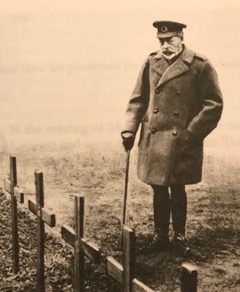
When our King went forth on pilgrimage

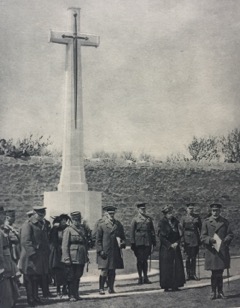
King George V address at Terlincthun

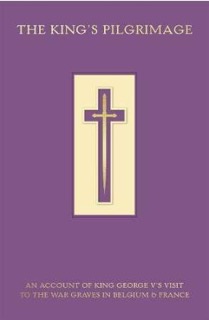
“It was our King’s wish that he should go as a private pilgrim, with no trappings of state nor pomp of ceremony, … to visit the tombs … of his comrades who gave up their lives in the Great War,” so began my Great Grandfather, the Australian War Correspondent, Sir Frank Fox, in the opening lines of his endearing 1922 book, The King’s Pilgrimage, about a simple three day journey by train to the War Cemeteries of France and Belgium in May 1922 by George V, the King Emperor; a man of great humility, modesty and wisdom.

by Dr Charles Goodson-Wickes DL

About ten million combatants lost their lives in the First War, but it is the concentrated nature of the ‘14-‘18 conflict combined with the horrors of trench warfare, losses on a scale never experienced before and its wide reporting through the novel media of film that mean its effects are still felt to this day.

Despite the fact that nearly double this dreadful figure were to be killed in the Second World War twenty years later, a far larger war conducted on many more fronts, it was as a result of the First War and remains to this day, commanders primary concern to minimize losses because of the negative and damning consequence such news and figures would have on morale at home and hence political will to see an operation through to its rightful end.

There is no one alive in this country today from that generation who so readily gave their lives in the Great War for our freedom today. It was a marker that would set the precedents for the Second World War and the principles of liberty by which we stand today. But, we cannot possibly comprehend the enormous sense of grief that cast its shadow across Europe for a lifetime. It was in recognition of this great collective sorrow that the King undertook his humble pilgrimage, following his State Visit to Belgium in 1922. It may seem strange that it took nearly four years to make a journey of such importance, but the numbers of dead were on such a scale that it took time to agree the manner and locations in which they were to be honoured; again the first time that the nature and manner of burial was to play a significant role in war, largely due to the work of Sir Fabian Ware, one time editor of The Morning Post which latterly became The Daily Telegraph, whose lobbying led to the establishment by royal charter of the Imperial War Graves Commission, now the Commonwealth War Graves Comission. By 1922, construction of the War Cemeteries was advanced enough to enable the King to pay his respects and see progress for himself.

Frank Fox, an experienced and tenacious journalist, had been reporting from battle fronts since the Boer War where he wrote of the controversy that created the Australian folk hero, Harry “Breaker” Morant; much of his work was for The Morning Post and it was his friendship with Ware that secured the invitation to accompany the monarch on this unique visit to the former Western Front. Fox was well qualified for this most sensitive of assignments, having been involved in many aspects of the Great War from its very outset when he was attached to the Belgian Army as The Morning Post’s War Correspondent when the Germans invaded Belgium in August 1914. For three months he reported the gallant Belgian resistance that culminated in the vital defensive action fought at the Battle of the Yser, which prevented the Channel Ports being overrun. On return, shocked by the atrocities meted out to the civilian population by German soldiers, he sought a Commission – at a relatively advanced age – and was sent to France as an officer in the Royal Field Artillery. In 1916, Fox was blown up in the quagmire of the Somme, taking him a year to recover from appalling wounds that left him almost totally deaf, with a shattered left arm and stump of a right foot. After convalescence, during which he worked for MI7 (Military Propaganda), he wangled his way back to France to serve on Field Marshal Haig’s staff in his GHQ at Montreuil-sur-Mer, where he assisted in the planning of the final offensive against the Germans.

It was in this nonchalant manner that my Great Grandfather, the Australian war correspondent, Sir Frank Fox, described in his diary, the appalling wounds he received in the quagmire of the Somme in 1916. It has yet to be explained what a 42-year old Artillery Officer was doing at the very apex of the Front Line.

“I was blown up in front of Le Sars by a salvo of shells. I refused to die on the battlefield. The gallant stretcher bearers got me in. I spent the next year in hospital.”

It was the King’s express wish that the nature of the Pilgrimage be low key, with the minimum of fuss, entourage or the usual pomp and ceremony that were the natural accompaniment to an official visit by the Sovereign; further the journey was undertaken in the workman like order of khaki service dress, then the equivalent of combat clothing worn by soldiers in the field today; the King keen to be seen and identified in the uniform that his soldiers had fought and died in. It was very much a working visit, void of the formality, scarlet and gold of the previous few days in Belgium.

On 11th May, the King left Brussels on board a special train that would be his home and transport for the three day journey, accompanied by a small party of five that included Field Marshal the Earl Haig, Sir Fabian Ware, Sir Frederick Ponsonby (Keeper of the Privy Purse), Colonel Clive Wigram (Equerry) and Major Seymour (Assistant Equerry). Later, he would be joined by Queen Mary and Admiral the Earl Beatty and at various points by representatives from countries of the Empire who played a vital role in the victory, Rudyard Kipling who was literary advisor to the Imperial War Graves Commission and had lost his only son, Jack, in 1917, while serving with the Irish Guards.

The port of Zeebrugge, was the first stop, where His Majesty was briefed on the daring raid to block the harbour by the Royal Navy in early 1918. After, it was to the Cemetery at Tyne Cot on the Passchendaele marshes, a name synonymous with appalling casualties and the largest British Military Cemetery in the world, at that time the place was a building site, home to gangs of veterans preparing the ground, masons, architects and all manner of site labourers and gardeners drawn from the local populace. Yet, wherever the King went, despite his wishes to the contrary, crowds of well-wishers gathered, singing the National Anthem, children bearing posies of flowers, gifts of thanks and messages of condolence. It was the spontaneity of incidents such as this that make this pilgrimage such a unique royal journey, like no other, and for George V, it must have been a most moving, touching and humbling experience.

At each cemetery, welcomed by local dignitaries, the King would dutifully inspect graves and a wreath would be laid before moving on. At Menin Gate, Ypres, he examined plans for the memorial to those who have no known grave; Vlamertinghe, Hop Store, Brandhoek followed until Lijssenthoek, the last cemetery in Belgian.

Arriving on French soil, the King was met with considerable ceremony at Notre Dame de Lorette – guards of honour, colour parties and much of the French General Staff, led by the grand old Marshal Foch.

‘“I have come”, said the King as he took Marshal Foch by the hand, “to lay a wreath in homage on the tombs of the French heroes who have fallen for their country,”’ Fox wrote and, after the two minute silence, noted how the King, and those around him was deeply moved at the sight of ‘row after row” of French gravestones and the loss of “a complete generation … in defence of their country.” Later, the King, turned to Foch, in animated conversation with his old friend, Haig who he had endured so much with and asked, “Always good friends, yes?” The old Marshal grasped Haig’s hand in response and replied fervently, “Toujours, toujours” (Always, always). At which point, the King too joined in placing his hand over theirs.

Queen Mary would join the entourage outside Boulogne at the final cemetery, Terlincthun, overlooking the English Channel, where 4,378 Commonwealth War Dead, including service personnel from Canada, Australia, New Zealand, New Foundland, the West Indies and South Africa are laid to rest. The Royal Party was greeted by a large delegation of French military and civil officialdom, whom the King officially thanked for their donation of land as burial grounds, support in construction of the cemeteries and sympathy for the great sacrifice made for French liberty.

In his moving speech before leaving on board ship with an escort of French destroyers to cross the English Channel, the King described the War Cemeteries as “potent advocates of peace upon earth” that would in time he prayed “serve to draw all peoples together in sanity and self-control”. In the words of Field Marshal the Lord Bramall, The King’s Pilgrimage marks the full stop to the Great War and its message of hope, succinctly summed up in George V’s closing words will ensure that as long as the graves stand, not one life lost in that war will have been in vain. (1509)
The Event

Dr Charles Goodson-Wickes invites you to the re-launch of this book at Sarum College, 19 The Close, Salisbury SP1 2EE on Monday 5th November 2018. His his Great Grandfather, Sir Frank Fox OBE, British War Correspondent was attached to the Royal Party and wrote this account of the events.

RSVP flora@medarc-limited.co.uk

Drinks 6.30 – 8.30pm
7pm In conversation with Harry Bucknall
NOTE: FOR SECURITY REASONS, PLEASE REPLY BY 30th OCTOBER – I am sure this can be waived a little, but please RVSP asp.

Purchasing the Book

If you can’t make the event you can still purchase the book at Amazon: The King’s Pilgrimage: An Account of King George V’s Visit to the War Graves in Belgium and France

Notes

“The King’s Pilgrimage” by Sir Frank Fox, OBE, first written in 1922, is republished with the blessing of the Commonwealth War Graves Commission to mark the Centenary of the 1918 Armistice by his Great Grandson, Literary Executor and Wiltshire resident, Dr. Charles Goodson- Wickes.

Dr. Charles Goodson-Wickes, served in The Life Guards in British Army of the Rhine, Northern Ireland and Cyprus. In 1991, while Member of Parliament for Wimbledon, he re-enlisted in the Army as a Lieutenant Colonel to participate in Gulf War 1 for the Liberation of Kuwait. Dr Goodson-Wickes, who lives in Bulford, was a driving force behind the reintroduction of the bustard to Wiltshire, is a Deputy Lieutenant for Greater London and the last sitting Member of Parliament to have seen active service.

At 6.30pm on Monday 5th November, Dr. Goodson-Wickes will talk about The King’s Pilgrimage, at Sarum College, The Close, Salisbury. To attend please email flora@medarc-limited.co.uk

The King’s Pilgrimage is available from amazon.co.uk & sirfrankfox.com

 

The King’s Pilgrimage and event in Salisbury 5 November

King George V at Etaples Cemetery

King George V at Etaples Cemetery

Whilst I have been away for the last few weeks on my own pilgrimage (again!!) to Santiago de Compostela, my good friend Harry Bucknall sent me some information about the republication of a book about a personal pilgrimage of King George V in 1922. It is now almost lost to the sands of time that our King, George V, went on pilgrimage to pay homage at the graves of the million or so war dead who not only gave their lives for our freedom but whose loss would scar a generation with grief.

This humble journey, recorded by the great war journalist, Sir Frank Fox, was written up in a little known but touching, moving and delightful book, The King’s Pilgrimage, which has been beautifully and faithfully reproduced by Fox’s Great Grandson, Charles Goodson-Wickes especially to mark the centenary of the Armistice in 1918.

“In the course of my pilgrimage, I have many times asked myself whether there can be more potent advocates of peace … than the massed multitude of silent witnesses to the desolation of war.” King George V, France 1922

This is a special book, and one as a former soldiers, Harry and I believe, every household should own … lest we forget.

The Event

Dr Charles Goodson-Wickes invites you to the re-launch of this book at Sarum College, 19 The Close, Salisbury SP1 2EE on Monday 5th November 2018. His his Great Grandfather, Sir Frank Fox OBE, British War Correspondent was attached to the Royal Party and wrote this account of the events.

RSVP flora@medarc-limited.co.uk

Drinks 6.30 – 8.30pm
7pm In conversation with Harry Bucknall
NOTE: FOR SECURITY REASONS, PLEASE REPLY BY 30th OCTOBER – I am sure this can be waived a little, but please RVSP asp.

About the Author

Sir Frank Fox (1874-1960) was an Australian born Journalist, Soldier, Author and Campaigner who lived in Britain from 1909 and wrote over 33 books.

Having warned on public platform and in the press of an impending war, he was appointed to the Morning Post and sent as their war correspondent to the Balkans. He was then attached to the Belgian Army and recorded the German invasion of 1914 in The Agony of Belgium. After being wounded, Fox served on Haig’s staff, which he wrote revealingly about in GHQ – both books recently republished.

Motivated by the atrocities he witnessed in Belgium, Fox was commissioned into the British Army at the age of 41. Appointed an O.B.E. (Military) and Mentioned in Dispatches, he was knighted by King George V in 1926.

Purchasing the Book

If you can’t make the event you can still purchase the book at Amazon: The King’s Pilgrimage: An Account of King George V’s Visit to the War Graves in Belgium and France

“Marks the full stop to the Great War. It is a very special book”
Field Marshal the Lord Bramall

“No better way to commemorate the Centenary of the Armistice than this account of King George V’s homage to the Fallen”
The Rt Hon the Lord Astor, Former Defence Minister
and grandson of Field Marshal Earl Haig

A Review of Noble Encounters between Budapest and Transylvania

From the July 2018 edition of the Hungarian Review. Gordon McKecknie reviews the recently published Patrick Leigh Fermor: Noble Encounters between Budapest and Transylvania by Michael O’Sullivan. “… he has (…) also given us, through personal and often tragic histories, poignant insights into the enormous social changes that Hungary underwent in the middle years of the twentieth century.”

In December 1933, Patrick Leigh Fermor, then 18, set out from Hook of Holland to walk to Constantinople. It was the first year of Nazi power in Germany, and the last days of the old romantic era there and in the former Habsburg realms of Mitteleuropa, an era that had not quite been swept away by the First World War. Of course, the Second World War – and, for many of the countries that Paddy travelled through, the subsequent dark years of Communism – did sweep the old order away. Since then the landscapes that Paddy tramped through, and the populations he met, have undergone the further, and not-always benign, influence of the ubiquitous automobile, instant global communications, hordes of tourists, a camera in every pocket, the spread of English as the modern lingua franca, and cheap clothing made in distant sweatshops. The old aristocratic way of life that Patrick Leigh Fermor, also known PLF to his numerous friends, saw in its dying days, and nowhere more clearly than in Hungary and Transylvania, vanished not long after his “Great Trudge”.

PLF’s first volume describing his journey – A Time of Gifts – was published in 1977. It became an instant classic among travel books. In painterly and sometimes almost absurdly lyrical language, A Time of Gifts told of his travels through the winter landscapes of the Netherlands, Germany, Austria and Czechoslovakia, and took him as far as the bridge across the Danube at Esztergom on Holy Saturday 1934, at the beginning of a magical spring and summer spent in Hungary and Transylvania. We had to wait until 1986 for Between the Woods and the Water recounting those Hungarian days. The third volume of the trilogy, The Broken Road, was pulled together from Paddy’s notes by Artemis Cooper (his biographer) and Colin Thubron (a fellow travel writer) after PLF’s death in 2011 at the age of 96. It appeared in 2013.

As PLF wrote in his introduction to Between the Woods and the Water, he had set out “meaning to mix only with chance acquaintances, but almost imperceptibly by the time I got to Hungary and Transylvania I found myself having a much easier time of it than I had expected or planned: ambling along on borrowed horses, drifting from one country house to another, often staying for weeks under patient and perhaps long-suffering but always hospitable roofs”.

Sometimes in his books, PLF tells us what became of the people he met on his 1930s walk across Europe. Fritz Spengel, son of the proprietors of the almost medieval Red Ox in Heidelberg “was killed in Norway (where the first battalion of my own regiment at the time was heavily engaged) and buried at Trondheim in 1940, six years after we met”. The Jewish, Proust-reading Baron Fülöp (Pips) von Schey de Koromla left his country house in Slovakia “when things began to go wrong in Austria and Czechoslovakia”, settled at Ascona on Lake Maggiore, and died in 1957 in Normandy at the home of his daughter, Alix, who had married into the French branch of the Rothschild family. But now, for a more comprehensive view, we have Patrick Leigh Fermor: Noble Encounters between Budapest and Transylvania.

In his very enjoyable book, Michael O’Sullivan follows PLF from the moment he was standing on that Danube bridge, with a letter of introduction to the mayor of Esztergom in his pocket, to Budapest, across the Alföld (the Great Hungarian Plain) and the Bánát region, and into Transylvania. On this part of his journey PLF was the guest of the aristocracy of the land. Continue reading

Faraway Greek fun in the third largest Greek city

It appears that the most fun is to be had in Melbourne these days. A report by Brent McCunn of some highlights of the recent Greek Week which included talks about Paddy and his Cretan links. Be like Brent; send in your thoughts and articles (no matter how obscure) to share with fellow Paddy enthusiasts in our community.

by Brent McCunn.

Further despatches from the Hellenic outpost of Melbourne-iniki!

What a week of Greek! I remind readers that Melbourne is the third largest Greek city! Our Grecian week started with the inaugural Rebetiko Music Festival at the Melbourne Recital Centre, a prestigious venue!

After recovery, Friday night offered a performance of Cretan music from the visiting Xylouris brothers from Crete. Saturday afternoon saw a lecture by Chris White at the Greek Culture Centre in Melbourne – the topic being, ‘The Resistance of Grete’ during WW2 and in particular the history of Patrick Leigh Fermor, Billy Moss and the SOE. Of particular interest to the audience were the unique collection of ‘then and now photographs’, collated, researched and photographed by Chris White and his brother.

At this point it is important to illustrate the global reach of the PLF Blog. As a result of this correspondent’s earlier post (to this blog), advertising the above lecture, Melbourne subscribers did indeed turn up!

Chris enthralled all with his unique collection of images and has been invited back to present again to a wider audience drawn together by the cultural centres head of lectures – watch this space! I, Brent McCunn then presented details related to the main books on the Subject – Ill Met by Moonlight and Abducting a General – and how to purchase copies.

We then attended the Messines Community’s Greek Independence dinner and dance (Once they found about the lecture it was compulsory for us to attend this event – how Greek!) – Messines is the region where Paddy and Joan’s house was located. Whilst at the Messiness dinner your correspondent spent quite a few minutes on Google maps, with locals, being shown the family village and its relationship to Kardamyli!

One for the road in Greece means an impromptu music session at a local Greek restaurant! Katerina Douka, a well known Rebetiko singer from Thessaloniki, who appeared at the Rebetiko festival with her band, was still in town and gathered some local musicians and presented an enthralling session of northern Greek music. Food, wine and beer flowed of course.

Chris’s lecture became a feature story (by Jim Clavens) in the local Greek newspaper which is published in both English and Greek. A main thrust was to seek out decedents of the villages featured in the Kreipe kidnap and SOE operations. They have been asked to make contact and add their histories.

Your Philhellene correspondent in Melbourne,

Brent (alpopolous) McCunn from Passport Travel.

The ANZAC Cretan theme continues in Melbourne in the month of April with a lecture by Professor Peter Monteath. Entry is free.

When: 19 April 2018 at 19:00
Where: The Ithacan Philanthropic Society, Level 2, 329 Elizabeth Street
Synopsis: In the Second World War many thousands of ANZAC’s were sent to mainland Greece and then Crete in the hope of preventing German invasion and occupation – but to no avail. After the Battle of Crete hundreds of ANZAC’s were stranded on the island and spent weeks, months and even years trying to get off it.

This presentation looks at the experiences of those ANZAC’s who found themselves trapped, but who also discovered the extraordinary hospitality of Cretans, who offered the ANZAC’s shelter even when they themselves were enduring great hardship and danger.

Beyond that, the presentation looks at the collaborative efforts made to evacuate these ‘stragglers’ from the island, and how those efforts evolved into a series of ‘special operations’ to resist a brutal German regime of occupation. The person who occupies the centre of attention here is the Tasmanian Tom Dunbabin, an important and influential figure in the resistance in Crete through to the last weeks of the war.

Peter Monteath was born in Brisbane and educated in Queensland and in Germany. He has taught previously at The University of Queensland, Griffith University, Deakin University, The University of Western Australia and The University of Adelaide. He has also been Adjunct Professor at The University of St. Louis Missouri and the Technical University of Berlin, where he was an Alexander von Humboldt Fellow. At Flinders University he is Professor of Modern European history. His research interests span modern European and Australian history. His latest book, Escape Artist: The Incredible Second World War of Johnny Peck (New South 2017), is about an Australian who spent time in Greece and Crete in World War II.


A happy Easter

We here at the Paddy blog would like to wish you and your family a happy and peaceful Easter. This year I would like to share with you the beautiful voice of Nektaria Karantzi, a Greek singer of traditional Byzantine and Orthodox chant. Paddy was an admirer of Byzantium and I am sure also loved the music

Fine out more about Nektaria, her concerts and more video on her Facebook page.

Don’t forget to switch on the volume!

Lament from Epirus

Some readers may be interested in this forthcoming book by Grammy-winning producer Christopher C King, about the oldest fold music tradition in Europe, music that Paddy almost certainly would have come across in his travels across northern Greece.

Described as being in the tradition of Patrick Leigh Fermor and Geoff Dyer, Christopher King discovers a powerful and ancient folk music tradition.

In a dark record shop in Istanbul, King uncovered some of the strangest and most hypnotic sounds he had ever heard. The 78s seemed to tap into a primal well of emotion inaccessible to contemporary music. The songs, King learned, were from Epirus, an area straddling southern Albania and northwestern Greece and boasting a folk tradition extending back to the pre-Homeric era. Lament from Epirus is an unforgettable journey into a musical obsession which follows a genre back to the roots of song itself. As King hunts for traces of two long-lost virtuosos, he tells the story of the Roma people who pioneered Epirotic folk music and whose descendants continue the tradition today. His journey becomes an investigation into song and dance’s role as a means of spiritual healing and what this may reveal about music’s original purpose.

The book is due for release in May and can be pre-ordered on Amazon. Lament from Epirus: An Odyssey Into Europe’s Oldest Surviving Folk Music

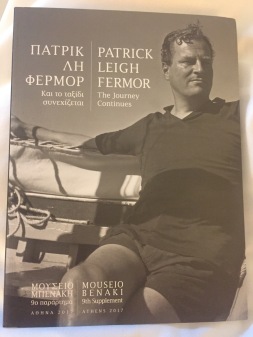
Patrick Leigh Fermor – the journey continues

From time to time, the Benaki Museum publishes a supplement to its regular journal, and the 9th Supplement is a masterpiece dedicated to Paddy’s life.

Well bound, and coffee table book sized, there are over twenty new articles exploring a range of topics including Paddy’s intimates and friends, his walks, the Cretan resistance, wider discussions of Greece, Paddy’s writing and of course the house.

The Benaki have assembled a remarkable collection of writers including Hamish Robertson, Cressida Connolly, the Marques de Tamaron, Nick Hunt, John Kitmer, Chris White, Colin Thubron, John Julius Norwich, Adam Sisman, and Roberto Calasso amongst others.

The supplement is available from the Benaki Museum shop for 18 Euros plus worldwide DHL shipping.

Details of the contents are here.

Help needed – high resolution photos of John Pendlebury

John Pendlebury at Knossos

Hello all. I have a request from Crystalia Patouli who is writing an article for a magazine in Greek and English. She would like to include some high resolution pictures of John Pendlebury. If you can help please contact Crystalia – cpatouli[at]gmail.com

Thank you.

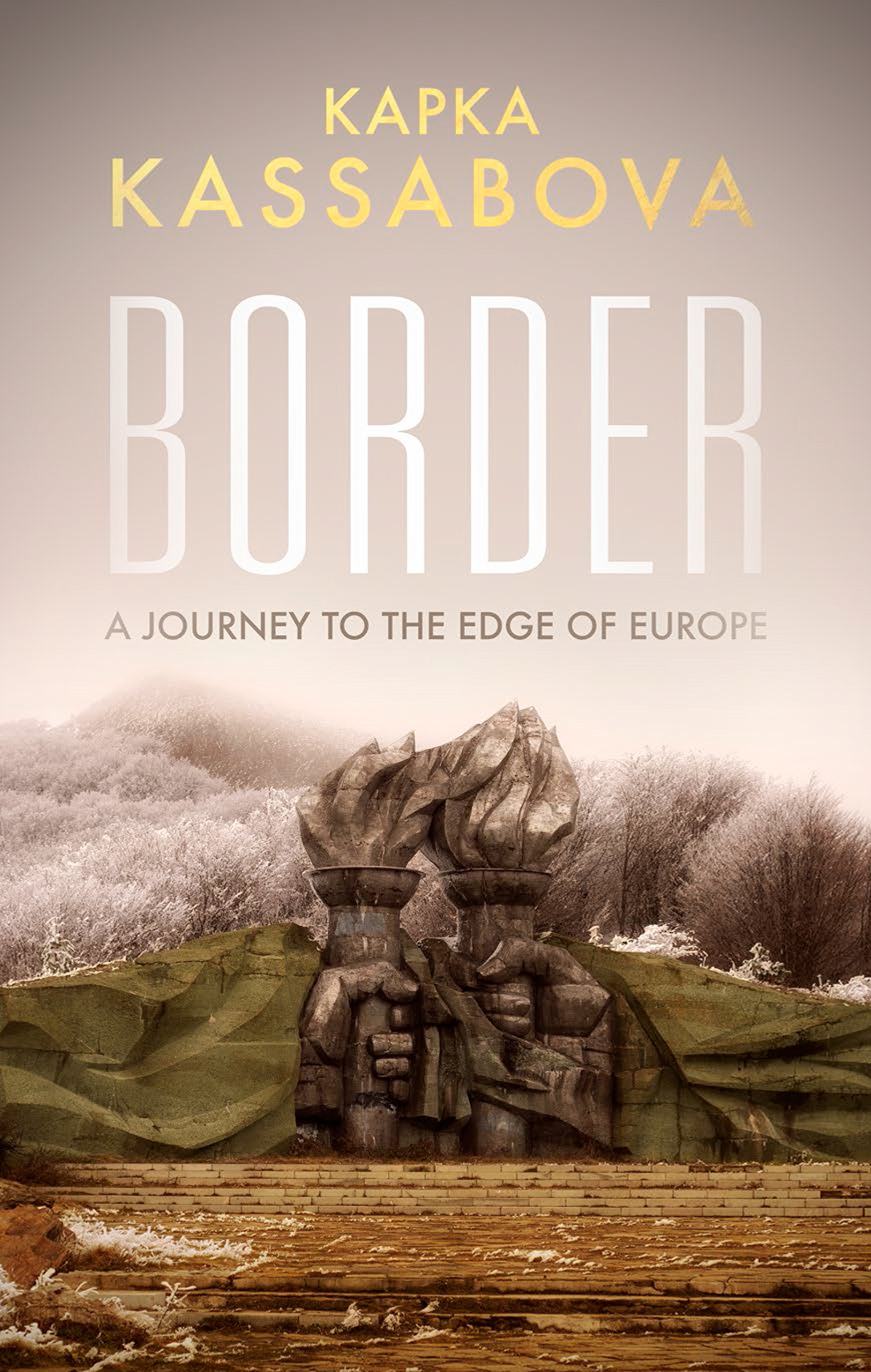
A forlorn ultimate border of reality

Kapka Kassabova’s Border: A Journey to the Edge of Europe is a timely, powerful story of immigration, friendship and travel.
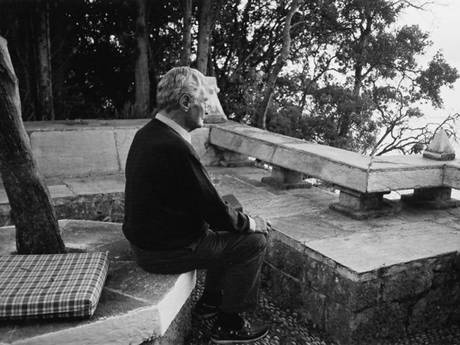
By Caroline Moorhead

First published in The New Statesman

When Kapka Kassabova was in her late thirties, she decided to return to the place where she had grown up, but had not seen for 25 years: the borderlands of eastern Thrace, where Bulgaria, Greece and Turkey meet. Her parents were Bulgarian scientists who, after a spell in the UK, had settled in New Zealand, where, she writes, the Kiwi speech made “fish” sound like “fush” and “chips” like “chups”, where the stars were rearran­ged and the seasons inverted: an “upside-down world, but then it always is, for the immigrant”. It is again as an immigrant, a wanderer, that Kassabova – who now lives in the Scottish Highlands – went to find the forbidden places of her childhood.

“Forbidden” because her early years were confined by the militarised border that separated the three countries, acting as a cut-off line between the Warsaw Pact states of the Soviet bloc and Nato members, in the Western sphere of influence. Though the end of the Cold War and shared EU membership “softened” the border between Greece and Bulgaria, it was once “deadly”, she says, and it “remains prickly with dread to this day”. This is an exceptional book, a tale of travelling and listening closely, and it brings something altogether new to the mounting literature on the story of modern migration.

Kassabova started her journey on the Black Sea, dropped westwards to the border plains of Thrace, crossed the passes of the Rhodope Mountains, and made her way in a circle back to the sea again. (A better map would have been invaluable.) Everywhere she went she paused, took time to make friends and hear people’s stories, to look at her surroundings and understand them, to meditate on the nature of borders and to remember her own confined childhood, when she first became conscious that, unlike other holidaymakers to the Black Sea, she was not free to leave Bulgaria. A border, she writes, is something that you carry inside you without knowing. Like Freya Stark, who also wandered through remote parts, Kassabova has a gift for relating the past to the present: Herodotus, Atatürk and the Greek gods all accompany her on her travels.

The countryside she describes is wild, remote, sometimes scary, covered in the blackest of forests, where wolves, boar, bears and vipers are to be found, where the villages are inhabited by old people, the young having long since left, and where “entrepreneurs and consumers, desperadoes and smugglers” hold sway. She meets former border guards, traffickers, foresters and lighthouse keepers. Many of them are refugees from earlier migrations, expelled from their homes by conflicts, victims of nationalist feuds that had lain dormant for years, or the children of immigrants, whose love of their homeland is strong but who exist in a permanent sense of limbo, ever poised to flee.

With some of her new friends, she crosses backwards and forwards across the former border, travelling in cars so old it seems unlikely that they can cope with the steep mountain tracks. With others, she just sits and talks. There is Ivo the herbalist, a man with a “heroic” moustache, forced through bankruptcy to settle in what was once his holiday home, who grows aubergines as heavy as hand grenades and makes an ointment that cures everything from psoriasis to alopecia; and the divorced former teacher Ioanna, now a mountain climber, who patrols the forests for poachers, illegal loggers, drug dealers and illegal immigrants as she searches for abandoned treasure; and Mr Karadeniz, whose father was five years old when he threw a stone at a pig requisitioned by Greek soldiers and whose grandmother, fearing reprisals, whisked her son over the border to hide with Bulgarian neighbours.

Into this mix have come today’s refugees, the Syrians, Iraqis and Afghans, struggling to find safe routes to the West, their journeys truncated by new wire fences and hostile officials. “Europe,” one Kurdish woman marooned in a village on the Turkish border tells her sadly, “is where you are not afraid.” She fled with her eight children to prevent them being conscripted to fight Isis; but where she will go now, no one can say. The strength of Kassabova’s book lies in the skill with which she interweaves the narrative of these people into that of the inhabitants of the borderlands, giving the context for their lives in a way that the dozens of current books on the travels and travails of modern refugees seldom do. They enter her journey, and she listens to them, as she listens to everyone. It is an important reminder that refugees are not a separate species, moving inexorably away and towards, but part of a vast, complicated pattern of history.

Everywhere she goes, Kassabova takes stock of her surroundings, the birds and the mountains, the ruined monasteries and caves, the rock formations and waterfalls. Sometimes charmed, sometimes frightened, sometimes haunted by the ghosts that seem to inhabit these lost mountainous lands, she writes about roses, about belly dancing, fire worship and dragons. Her curiosity is limitless.

Patrick Leigh Fermor once wrote about a “forlorn ultimate border of reality beyond which a cloud of legend, rumour and surmise began”. This is Kassabova’s territory. And if, at the end of the book, it is hard to name the many characters she has met, or to recall with precision the places she has visited, she leaves a vivid image of these lands and the people who occupy them. Equally powerful is her own sense of sympathy for the uprooted and dispossessed. “I felt very strongly that within my lifetime, we may all become exiles,” she writes. “That we may all be robbed by devouring daemons disguised as policy and industry, that we may all walk down some road carrying in plastic bags our memories of forests and mountains, clean rivers and village lanes.” At a moment when Hungary has promised to incarcerate all who cross its borders ­illegally, and when asylum-seekers are adrift from one end of the world to the other, Border makes for timely reading.

Buy Border: A Journey to the Edge of Europe

Patrick Leigh Fermor and the Pleasures of Places and People

Patrick Leigh Fermor in later life

We are fortunate to have a number of articles by the American writer Ben Downing on the blog. Downing specialises in nineteenth- and twentieth-century British social life and literature. His three part A Visit with Patrick Leigh Fermor can be found here. The following article is his review of Patrick Leigh Fermor: A Life in Letters.

By Ben Downing

First published in the Wall Street Journal

1 December 2017

In a 1958 diary entry, the writer and Bloomsbury Group member Frances Partridge recalled a dinner during which “the conversation turned to present-day pessimism, or cafard. Where can one look to find enthusiasm for living? I could only think of Paddy Leigh Fermor.” Called Paddy by his legion of friends, Patrick Leigh Fermor (1915-2011) struck many as a paragon of zest, a man on whom scarcely a crumb of life’s banquet was wasted. Prodigiously smart, charming, funny and handsome as well, he dazzled most who met him. His social gifts, however, threatened his literary ones: Why struggle to write at a lonely desk when you can swill whiskey on the terrace all night and talk like a Roman candle?

Fortunately, Leigh Fermor did struggle, some of the time. The result is a body of prose—travel books, mostly—radiant with his brilliance and unique experience but also with his exuberance and warmth. Especially in his magnum opus, a three-volume account of walking as a teenager from Holland to Istanbul, his erudition and descriptive skill are balanced by simple likability—never, one feels, has so much riveting detail been so beautifully served up by such an irresistible person.

Leigh Fermor published little during his last decades, but the years since his death have yielded several books by or about him. All rewarding, at least to fans, were Artemis Cooper’s biography, Wes Davis’s account of Leigh Fermor’s most celebrated military exploit (the abduction of a Nazi general on Crete) and Nick Hunt’s book about retracing his route across Europe. The real treat, though, was a book few expected ever to see: the last part of his trilogy, posthumously published as “The Broken Road.” Leigh Fermor’s inability to finish it, despite a quarter-century of fitful labor, was the great frustration and sorrow of his life, yet the manuscript his executors assembled was nearly complete and full of his usual panache.

Nor was that the last of the manna. The publication, in 2008, of Leigh Fermor’s correspondence with Deborah Devonshire (the youngest Mitford sister) had shown his letters to have many of the virtues of his books, including a more casual version of their tumbling, gloriously idiosyncratic style. But the bulk of his letters—untold thousands of them—remained unseen. Then, last year, a selection, edited and introduced by the outstanding biographer Adam Sisman, appeared in Britain. Now available here, it spans 70 of Leigh Fermor’s 96 years. Like his travel books, it amounts largely to a gushing expression of pleasure in art, history, places and people, but it also gives glimpses of his battles with indolence and the toll they took.

Addressed mainly to friends, lovers and Leigh Fermor’s longtime partner, Joan Rayner (whom he married in 1968), the letters are notable for, if nothing else, the variety of their postmarks. Even after he got a place of his own—a house in the Peloponnese that he and Joan built in the early ’60s—Leigh Fermor spent half his life as a wandering guest, and from age 18 to almost 50 he hopped constantly between dwellings, most of them romantic, secluded, and either dirt cheap or free. A 1953 letter contains a typical update: “I am established in a damp and ruined Aragonese fortress on the edge of the Tuscan Maremma, a sort of Zenda, really.”

Though he often sought isolation in order to work, Leigh Fermor’s gregariousness and polyglotism made him a poor hermit. Ensconced in a French monastery in 1948, he wrote that its chatty abbot had befriended him. “Occasionally he lapses into Latin. . . . It is the first time I have ever heard it spoken as a living language, and . . . I flog my brains to construct a sentence, feverishly trying to get the syntax right, usually a question that at last I enunciate with as much nonchalance as I can muster, to keep going the flow of this silvery monologue.”

Odd encounters were routine for Leigh Fermor. In a 1975 letter he describes one three decades in the making. After he accidentally killed a Cretan guerrilla during the war, the man’s hothead nephew, Yorgo, refused to forgive him. Revisiting “old haunts in Crete” in the 1950s, he was warned that Yorgo, a crack shot, planned to assassinate him. Intermediaries pleaded fruitlessly with Yorgo for years after that. Then, out of the blue, Yorgo asked Leigh Fermor to be his infant daughter’s godfather. (“This is the classical and only happy ending to a Cretan blood feud.”) The very next week he flew to Crete for the baptism. At the drunken banquet for 300 that followed, Yorgo hugged him and offered to eliminate “anyone you want got rid of.” “I hastened to say that there was no one, absolutely no one! ”

Not surprisingly, Leigh Fermor’s sex life was robust: With Joan’s consent, he enjoyed flings, affairs and the low delights of the brothel. This activity rarely makes it into his letters, but the exceptions can be piquant. Writing in 1958 from Cameroon, where he was on the set of a John Huston movie, he told a (male) friend: “ Errol Flynn and I . . . sally forth into dark lanes of the town together on guilty excursions that remind me rather of old Greek days with you.” One of the book’s zaniest passages is in a 1961 letter to Huston’s wife, Ricki, with whom Leigh Fermor had been sleeping. “I say,” the passage begins, “what gloomy tidings about the CRABS! Could it be me?” Riffing on pubic lice and their crafty ways, he conjectures that, during a recent romp with an “old pal” in Paris, a force “must have landed” on him “and then lain up, seeing me merely as a stepping stone or a springboard to better things”—to Mrs. Huston, that is. As comic apologies for venereal infection go, the passage is surely a classic.

If high spirits dominate the letters, pain often throbs at their edges. What Leigh Fermor termed “neurotic literary paralysis” led to spells of depression, and the pattern worsened with age. “My reaction to any demand for writing,” he confessed to his long-suffering editor and publisher, Jock Murray, in 1965, “seems to be to dig an enormous bog and flounder in it.” The acute phase began after the publication, in 1986, of the second volume of his trilogy. Istanbul in sight, he hoped his sails would fill with steady wind but instead found himself largely becalmed.

Full of self-deprecation (“I can be a terrible gasbag”) and profuse apology (most often for his slowness as a correspondent), Leigh Fermor’s letters are remarkably free of backbiting, bellyaching and other standard epistolary vices. When referring to the Oxford don Maurice Bowra, he cannot resist the mocking anagram “Eroica Rawbum.” And in 1974 he rants, ever so briefly, about the decline of Greek civilization: “I can’t help feeling there has been a serious break since the times of Theocritus.” That’s about it, though.

However appealing, Leigh Fermor’s sunny disposition somewhat constrains his letters, which lack variety of tone and the kind of frank, piercing comment on human behavior and emotion one looks for in the genre. (An exception is the handful of psychologically astute letters about his troubled mother.) It is this that makes me not quite agree with Adam Sisman’s assertion that the best ones are “as good as any in the language.” What’s more, to fully appreciate Leigh Fermor’s letters you need to be familiar with, or at least curious about, the circles he moved in. If names like Lady Diana Cooper mean nothing and you couldn’t care less about the half-bohemian, half-aristocratic world of footloose Brits in the Mediterranean (dating back to Byron and Shelley), this might not be the book for you.

Then again, it might. For all their beau monde glitter, Leigh Fermor’s letters are touching in a universally appreciable way. Writing to, among others, the widowed Diana Cooper and his former lover Balasha Cantacuzène, a Romanian princess and painter who endured many hardships under communism, he displayed a tender solicitude and eagerness to raise spirits that must have brought both laughter and tears and that are, in the best sense, chivalrous. (When he was knighted in 2004, it seemed appropriate not just to his achievements but his character.)

Most moving of all is to watch Leigh Fermor maintain his gallantry, verve and humor to the end. (He was nearly 95 when he wrote the last letter in Mr. Sisman’s selection.) Having gotten to know him in 2001, I received a few of these late letters. Embellished with drawings of clouds and birds, they seemed at first sight to be written in Linear A, but as I slowly deciphered their scrawl I found jokes, flights of fancy, extravagant mea culpas, deep learning worn lightly as silk. Thanks to Mr. Sisman, readers everywhere can have (minus the furrowed brows and headaches) a similar experience, discovering how this wonderful man made sheets of stationery, like the pages of his incomparable travelogues, glow.

—Mr. Downing is the author of “Queen Bee of Tuscany: The Redoubtable Janet Ross. ”

Sisters Queen Margrethe and Queen Anne-Marie make rare joint appearance at “To Greece with Love” symposium

It looks like the PLF symposium held in Copenhagen was a great success with Royal attendees.

This report from Royal Central.

Her Majesty Queen Margrethe of Denmark and her younger sister, Queen Anne-Marie of Greece made a rare joint appearance together yesterday at the University of Copenhagen for the “To Greece with Love” symposium.

The two-day conference, attended by people from as far away as Texas, USA, was organised around the British travel writer and freedom fighter in Greece, Patrick Leigh Fermor. Their Majesties heard various lectures, including one from Patrick Leigh Fermor’s biographer, Artemis Cooper.

The Queen of Denmark had met Artemis Cooper in 2017 during a lunch in the United Kingdom.

Queen Margrethe, who has reportedly read all of Fermor’s travel books, and Queen Anne-Marie were private guests at the event and were welcomed by Charles Lock, an English professor at the University of Copenhagen upon their arrival.

Patrick Leigh Fermor died in 2011 and was considered as one of Britain’s greatest travel writers during his lifetime. He played a prominent role during the Second World War in the Cretan resistance in Greece.

Queen Anne-Marie (born Princess Anne-Marie of Denmark) is six years younger than Queen Margrethe. They have another sister, Princess Beneditke, who was born in 1944. Anne-Marie was 13 when she first met her future husband, the then Prince Constantine of Greece and Denmark in 1959. Their engagement was announced in July 1964 – just a few months after Constantine had become King of Greece. They married on 18 September 1964 and have five children: Princess Alexia, Crown Prince Pavlos, Prince Nikolaos, Princess Theodora and Prince Philippos.

The family was forced into exile in Greece in the late 1960s when a military junta took over. They first lived in Italy before relocating to England. They were not permitted to return to Greece until 1981 when they were allowed to enter the country for a few hours to attend the funeral of Constantine’s mother, Queen Frederika.

King Constantine, Queen Anne-Marie, their son Prince Nikolaos and his wife, Princess Tatiana now reside in Greece.

Where exactly is Paddy and Balasha’s watermill?

I have been contacted by Pilar Gonzalez, from Spain, seeking more information about the watermill where Paddy stayed with Balasha in 1935.

This May, Pilar and a friend plan to go Greece and they want to find the mill, named Los Limoneros. This apparently is in Lemonodassos in the southeast of Galatas, overlooking Poros.

Pilar would be grateful for any ideas or information about the exact location of the mill. Please get in touch by making a comment or emailing me (see About & Contact page).

Tom

Despatch from the Hellenic infused colonies

My thanks to Brent McCunn for sending me this article which features PLF historian (co-editor of Abducting a General) and supplier of many “then and now” photographs, Chris White, on a trip to Australia.

by Brent McCunn

PLF (Patrick Leigh Fermor), SOE (Special Operations Executive) and Cretan WW2 history is alive and well in Melbourne. One should expect this, after all we are the third largest Greek city.

Recently our visiting ‘Pohm’ (Prisoner of his majesty), Chris White, was introduced to a circle of locals who have an above average interest in the afore mentioned historical proceedings.

Chris was staying with us (Brent and Elaine McCunn) and after Saturdays bush walks and BBQ, in unseasonable steamy heat, I introduced Chris and his ‘caveman photographs’, to a local historian Jim Claven who, despite being a ten pound Scot from Glasgow, lives in the suburb affectionately known as Oakleighopolis. This moniker is due to the, rather noticeable, ratio of Greek heritage residents, cafes and restaurants – their main mall area is like a downtown portion of an Athens café zone! Jim is a historian and freelance writer and specialises in ANZAC/Hellenic connections. In addition he has lead military history tours to Greece and is currently writing a book about Lemnos and its WW1 ANZAC history. He is a PLF fan, having read his Mani book many years ago and visiting PLF’s home last year along with members of the British Veterans of the Greek Campaign Association.

Following this Mythos lubricated encounter Jim rallied some of the heavier artillery of ANZAC history and the Cretan community, one of whom, a restaurant owner, offered us his establishment as a meeting venue for the Monday night. “Others have to see what you have done Chris’, exclaimed Jim.

After a traffic jammed drive across Melbourne during rush hour we arrived to the suburb of Moonee Ponds, “This is where Dame Edna came from exclaimed an excited Chris White”!

Our restaurant venue, The Philhellene, is recognised as being in the top three Greek eateries in Melbourne and serves a range of regional foods, in particular Cretan cuisine. I had heard about it before, as a friend plays there with his Rebetika band, but due to its location we had not ventured there – traffic you see!! We will revisit!!!!

With such short notice we were pleased to meet the owner John Rerakis, and another restaurant owner, Antonios (Tony) Tsourdalakis – I must mention that Tony (Antonius) is the owner of another of the ‘Top Three’ Greek restaurants – Kritamos in Richmond (Melbourne). Tony is also the secretary of the Melbourne based, ‘Battle of Crete and Greece Commemorative Council’. This Council was formed a few years ago and brings together historians, politicians, veterans descendants, service organization representatives and many representatives from Melbourne’s Greek community organizations. The Council organizes a series of annual events commemorating the Greek and Crete campaign as well as participating in events in Greece and on Crete.

Then we had Jim Claven of course, and Peter Ewer – historian and author of the seminal work, ‘The Forgotten Anzacs” – yes I brought along my copy for a dedication! Our two Cretan/Aussies were key people in the Cretan community committees and have extended family connections to the villages Chris has explored and the events of WW2. John, Jim and Peter are also committee members of the same organization mentioned. I had hoped to have the nephew of Manoli Paterakis – George Paterakis – in attendance, but he was not well at this time. We had only planned for a small group for this introduction.

The food and Cretan red wine started to flow and in between gastronomic groans of pleasure we discussed PLF and ANZAC history, along with our two hosts family connections. Chris was soon holding all the assembled attentions with his slide display. Our hosts recognised some valleys and villages, but not the caves!

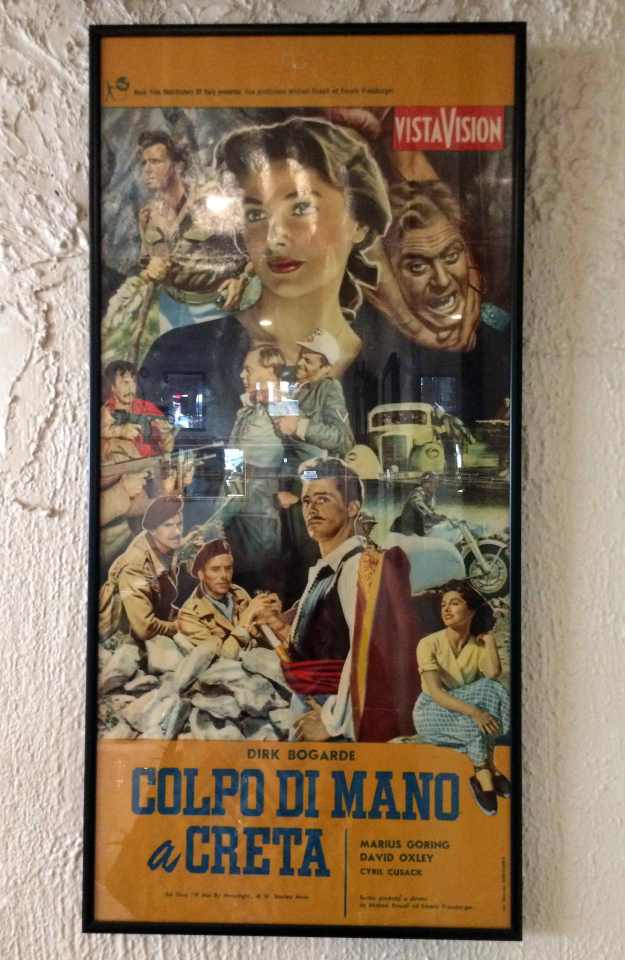
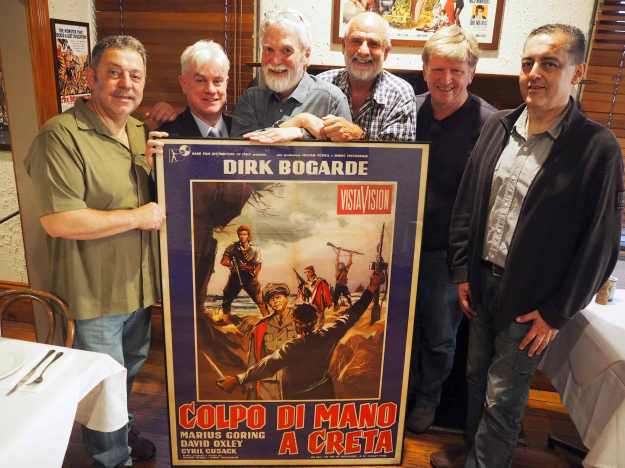
Our host then walked us around the small museum he has created on his restaurant walls. Framed photographs record his family history along with local Melbourne connections. In the dining area we were seated in was part of his extensive collection of movie posters collected by his father who operated a cinema playing English, Greek, Italian and other ethnic background movies. John said he had ‘piles’ of posters stored away, but pride of place here were the Italian posters for ‘Ill Met by Moonlight’!!!

The food continued and desert offered up freshly made Loukoumades, accompanied by home made Halva flavoured ice-cream!! Just when you think a Cretan has finish expanding your stomach out came a small elegant bottle twinned with a neat stack of small shot glasses. Yes it was spirit, but infused with Cretan herbs and honey!!

Brent and Elaine McCunn were paying participants on the inaugural PLF tour in 2016. They are the owners of specialist group tour operator, Passport Travel in Melbourne. In 2018 they are operating a rather unique tour to Greece, which weaves some PLF and ANZAC history into its core structure. The main theme is Rebetika Music. Brent has organised a number of music tours that have concentrated on themes such as, Blues, Reggae, African and Cuban Salsa and has been a fan of Greek Rebetika for many years. Perhaps his long association as an amateur Blues musician assisted with his discovery of the Greek Blues. The tour will be led by Australia’s premier Rebetika musician, Con Calamaris , a friend and near neighbour of Brent. The tour, whilst not designed for a hardened PLF, or military history enthusiast, it will bring these two topics into the itinerary and leave time at the end for those who desire more time to pursue further personal explorations.

There are many examples where the history of PLF conclaves with Australian and New Zealand history. The ANZACs on Crete is obvious. Hydra also casts up other connections.

There is also a strong link to Australian writers and the bohemia movement. From Sidney Nolan to Peter Finch, artists gravitated around the glamorous Australian literary couple, George Johnston and Charmian Clift, on this tiny Aegean island in a time of rebellion, romance and creativity. It was a time of great inspiration and camaraderie as the expat artists drank, argued, dreamed and created. It was here that Johnston wrote his novel, My Brother Jack, and his close friend Cohen penned the musical masterpieces Suzanne, Bird on a Wire and So Long Marianne

The tour is formatted to attract a younger audience and has been hailed by the local Greek community as being attractive to 2nd and 3rd generation descendants. In addition, to those with Greek ancestry, Rebetika also attracts interest from those of other backgrounds. Brent and Elaine’s own son is one such example.

The tour is not a rage trip. It does have a range of ages, all being united with a common musical and historical bond. Passport Travels long established contacts in Greece (we have operated special interest groups for some 25 years to multiple worldwide destinations) have expressed their own delight at seeing something so unique being offered. “We have not seen such a theme ever and it is nice to see something different for Greek tourism, rather than the cliche”, is the comment most relayed.

More details can be obtained via this website link. Questions, via the web page, will get to Brent McCunn. http://www.uniquepassport.com/EnterTitleGreekRebetika.php

On the return home journey, Jim took Brent, Elaine and Chris to visit the Lemnos Gallipoli Memorial in Albert Park, the first dedicated memorial to the major role of the Greek Island of Lemnos and its nurses, to the Gallipoli campaign of 1915. This memorial was erected with community support in August 2015, the centenary of the arrival of Australia’s nurses on Lemnos. This ANZAC nurse division continued its work in Greece and of course Crete during WW2.

One of two original movie promotional posters from the Italian language edition of ‘Ill Met by Moonlight

Team Crete. From left: John Rerakis: Peter Ewer: Brent McCunn: Chris White: Jim Claven: Tony Tsourdalakis: With 2nd of two original Italian Language release of “Ill Met by Moonlight”.

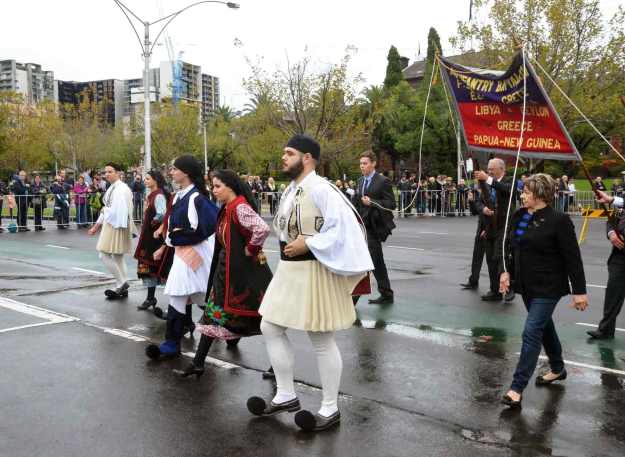
ANZAC Day March

This year other nationalities, in traditional costume marched with surviving diggers and family representatives. This was the first time this happened and is still subject to controversy. Within the organisers (The RSL – Returned Servicemen League) there are those who feel this divergence makes the event a ‘Parade’ rather than a ‘commemorative march’. They also feel that only, those that served, or direct descendants, should march and all be dressed formally as their ancestors would have. The other arena of thought is for the march to be more inclusive of those allies that worked with and for the ANZACs. The debate will continue.

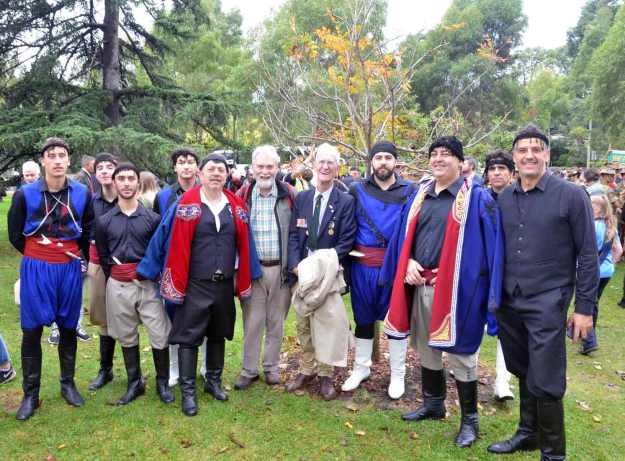
This party marched with an Australian battalion that saw action in Greece.

To the left of Brent McCunn is John Rekakis and then 3rd to the right is John Tsourdalakis. To Brent’s immediate right is a New Zealander, Peter Ford, who self published a book about his fathers experiences on Crete, eventual escape with others via a small fishing boat, unexpected meeting with Rommel in his staff car as they came ashore in Nth Africa, and eventual return to British lines.


When John opened up this current restaurant he hung the top image which showed a local ANZAC who knew his family since they arrived. According to John the ANZAC veteran couldn’t understand why he would want a picture of him on his wall. As John said to me, the image says why!

George Pakerakis. Nephew of Manoli Pakerakis at commemorative ‘Battle of Crete’ lunch in May 2017 at Cretan Centre. George recalls PLF coming to his village with his uncle. George, as a teenager ran messages for the local resistance and still carries the scars from being shot by German soldiers.

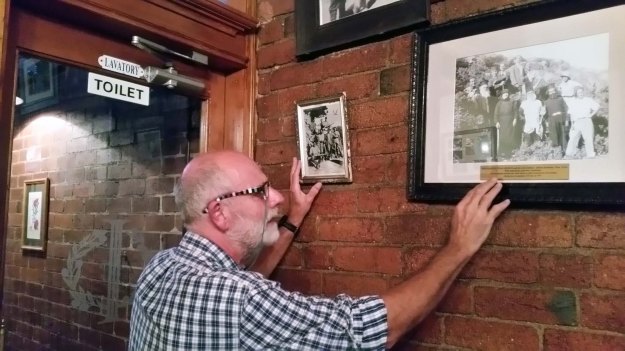
Chris examining an image featuring local; Cretans and priests with a group of New Zealanders and Australians they have sheltered. Taken in front of a stone walled sheep pen of some sort. Chris now has a new photograph to add to his further explorations! Perhaps we will see a copy a, ‘then and now’ gracing these walls in future years.

Lemnos Nurses Memorial

Beachside suburb of Albert Park. The closet parcel of land, local council would allow, to Melbourne passenger ship wharf – Princess Pier. This is where all troop and nurse convoys set sail from in WW1 and WW2. ‘Fitting Spot’ as they say for all Victorian Greek connected campaigners!

Remembering Steven Runciman by Patrick Leigh Fermor

Steven Runciman with his parakeet, photographed by Cecil Beaton c.1923.

Paddy remembers Steven Runciman in this 2001 article from The Spectator

by Patrick Leigh Fermor

First published in The Spectator

13 January 2001

It was on 12 September 1934, in Sofia, that Steven and I first met. He was 31 and I was 19, and I was trudging across Europe, heading for Constantinople. Having a drink in the Bulgaria Hotel, 1 found myself talking to my bar-neighbour, who was the dead spit of Holbein’s Erasmus; he turned out to be Thomas Whittimore, the famous Bostonian expert on Byzantium and the saviour of the St Sophia mosaics. He was in Sofia, he said, as part of a general congress of Byzantinists and art-historians. Two fellow delegates soon joined him, Roger Hinks and Steven Runciman, both of them impeccable in panama hats and white suits of the wonderful Athenian raw silk that used to be spun by Gladys Stewart-Richardson; their bi-coloured shoes were spotlessly blancoed and polished; and they both belonged far more aptly to the deck of an Edith Wharton yacht or to the cypress alley of a palazzo in a novel by Henry James than to this hot little Balkan capital. As I had just been scrambling about the Rhodope mountains and sleeping out on the way to Rila monastery, I must have been even filthier than usual. (Later on Steven often teasingly remarked, ‘You were a very grubby boy.’) Their conversation was dazzlingly erudite and comic and we met several times, and when the end of the conference scattered the delegates, they left for Italy: ‘Just off to stay in a Tuscan villa with one of those beautiful Italian gardens. You know, solid mud all winter and in summer, nothing but dust.’

We bumped into each other now and then in London later on, and after the war Steven was appointed British Council Representative in Athens; the novelist, poet and translator of Euripedes, Rex Warner, was in charge of the British Institute and I was rashly created his deputy director. It was a fascinating time to be in Athens. The war was over and the later troubles had not yet really begun. It was the Athens of the songs of Sophia Vembo and the rebirth of bouzottki; the place was full of Greek and English friends, and there were wonderful parties and newly discovered tavernas every single night. When it was thought that i might be more useful outside the capital. I was sent to lecture all over the mainland and the islands. This involved six months in the remotest places I could find. They were of the greatest possible value for literary purposes later on. But I was far from an ideal deputy director, and when this became plain and departure loomed, not an atom of blame attached to Steven. When we next met I had been nearly a year in the Caribbean and Central America. In London we often met in friends’ houses, and our shared devotion to Greece was always uppermost of both our feelings.

Before the war, the captivating books of Robert Byron were, for many people in England, their first introduction to Byzantium. He was soon caught up by Steven’s perhaps more academical approach, and after the ship carrying Robert Byron to Greece during the war was torpedoed and sunk (by the Scharnhorst, off Stornoway), Steven’s writings remained the unchallenged beacon in this particular field. There seemed to be no aspect of the Byzantine empire — its sovereigns, its Church, its saints and heresies, its wars and disasters and recoveries — that was left unexplored; and when his dazzling books on the Crusades began to appear, the skill of the writing, the vast range of his scholarship — even, here and there, the witty asides and brackets — called the name of Gibbon to many minds. To those of us who were brought up on the romance and glamour of the Crusades, there was something stimulating, salutary, and brand-new in the suggestion that these centuries of war and conquest were, in fact, the last of the barbarian onslaughts on the surviving civilisation of the Roman and now Greek empire and the lands of the cultivated Arab caliphate, Everyone rejoiced at the honours which were heaped on him; we still do, and how fitting it is that a street in Mistra now bears his name? When about 20 years ago I got a literary prize. I was very touched that the generous words spoken at such occasions were uttered by Steven, at his request. I felt that all my earlier sins had been forgiven. He came to stay in the Morea several times.

His generosity was extraordinary. The recent restoration of the tower of the Protaton church on Mount Athos was a gesture of the greatest magnificence and his arrival from the sky, followed by the blessings of the glittering dignitaries conducting the dedication service of the tower, and then Steven’s farewell and departure back into the air, belonged to a sweep of monastic wall-painting of the Cretan or Macedonian school, involving flights of archangels and seraphim and fanfares of long trumpets.

He seemed, somehow, in a curious fashion, to be in touch with the supernatural. He studied arcane matters and he loved telling fortunes with a pack of Tarot cards and — half in joke, or only a quarter, perhaps — he hinted at the mastery of magic powers; his catlike smile and the sudden surprised lift of his eyebrows seemed to underline the suggestion. Perhaps it was just a tease.

A month and a half ago, a Cumberland neighbour and an old friend of his and of mine, Pamela Egremont, drove me across the Solway Firth into Scotland to spend the afternoon at his massive tower, with its many thousands of books, at Elshieshiels in the Scottish Lowlands. He was not very mobile physically, but mentally he was as active as he had ever been, and there was much laughter. My grubby apparition of 66 years earlier was joyfully recalled — it always was — and the three of us talked for hours. Upright in his armchair, he was still, as it were, enclouded in Athonite glory. He told us that he was determined, if he was spared for another three years, to celebrate his 100th birthday by a large and cheerful party in Madame Tussaud’s (that famous waxwork gallery of past celebrities can be hired for such occasions, it seems). He gave us a cheerful wave as we left, and, assisted by his mood as we drove south, we played with the idea of Steven’s warlock privilege of summoning shades from the past to ask them to his centenary festival, and we wondered, could this sorcery be switched to the returning of such supernatural visits? Where would these imaginary journeys carry him? Whom would he choose?

As we motored through the Cumbrian dusk, we imagined him helping to plot the circumference of the dome of St Sophia, before a late supper with the Empress Theodora, or — he had a soft spot for crowned heads — advising Princess Anna about the accuracy of the Alexia& in other scenes, he was shaking his head over the wilder tenets of the Bogomils and persuading a team of iconoclasts to drop their hammers; or calming rebellious prelates at the Council of Ephesus. In yet other scenes, he was reasoning with Bohemond at Antioch; or counselling Richard Coeur de Lion about his policy at Acre; or playing chess with Saladin, in his tent; then, a bit later, rallying Bessarion for accepting the filioque clause at the same time as a cardinal’s hat; consoling the eastern Comnenes for the loss of Trebizond; or, under Mount Taygetus, exchanging syllogisms with Gemistos Plethon as they strolled along the future Runciman Street. Later on still, we imagined him hobnobbing with Phanariot hospodars in the snows beyond the Danube … It was hard to stop.

As we know, Fate arrived too soon and all we can now do is to express our gratitude for the life and the work of the astonishing man we are all assembled to mourn, and, still more, to celebrate. What a shame he can’t see us all, gathered in his honour! Perhaps he can.

A pilgrimage to Kalamitsi

We love to receive your input and proposed articles for the blog. Let’s start 2018 with something from our blog community. Dawn Mitchell sent me this and hopes that you all enjoy it.

In the Spring of 2001, my daughter, my then husband and I drove from Athens down the Peloponnese peninsular. A leisurely journey, visiting Olympus, then remoter sites inspired by PLF’s writings. We arrived at the hotel Kalamitsi in Kardamili on Easter Thursday. Like many before and since, this was a romantic pilgrimage to the spot Paddy, the wanderer, had chosen to put down roots.

It did not disappoint: olives, fruit trees, cypress, orchards running down to the rocks, the glittering sea beyond, enticing views of mountains across the bay. The hotel and the LF house lay on the peninsula beyond the village, in a completely rural area sixteen years ago. (I’ve never been back). The other hotel guests were all Greek, staying for the Greek Easter holiday, which coincided with ours that year.

The purpose of the pilgrimage was not intrude on Paddy,but more to enter the magical world he conjured up. Of course I’d been entranced by the walk across a vanished Germanic world, been warmed under the summer sun of the Hungarian harvest…, but the moment of absolute surrender came with ‘A Time to Keep Silence’. He wrote about the eternal struggle to reconcile spirituality with the human condition, reconciling the deprivations and absurdities of the monastic rule with a reluctant admiration for the sacrifice these extraordinary men had made over the centuries. Standing on a cold winter’s day in St Wandrille, I had marvelled at his perception. (Nowadays, reading his letters, his discomforts and his longing for his lover, give a rather different perspective.) I’d also been inspired by a girlfriend who’d driven alone to Greece with a copy of Roumelli as her travel guide!

Things did not go quite as planned; I’d started a cold en route, which turned into an incapacitating flu and raging temperature the next morning. I was bed bound, so my husband went into the village to look for some medication. In the newsagent he found himself standing next to PLF! Thinking that he lived elsewhere it was quite a shock to see him. He asked my husband what brought us to Kardamili. The latter, quite tongue tied with surprise, simply pointed to the window display where copies of “Mani” were piled up. PLF asked, how did it read nowadays? Not too many purple passages? Weakly my husband said no, not at all; when what he meant to say was how much pleasure the book had given him. Typically British he said nothing-not even remarking on the weather, or wishing a Happy Easter! Before he could regain his composure a young man carrying a heap of newspapers ushered PLF out of the shop. Imagine my chagrin, meeting such a legendary hero: ‘what more?’ I asked. He told me that Paddy had spilled egg down his pullover, that he was accompanied by a very tall young man, nothing more!

However there were more excitements to come: on the Saturday night there was a massive thunderstorm which took out the electricity in the whole region for 24 hours. Disaster, on Sunday, as the Easter lamb was to be roasted. Suddenly the hosts and the guests all came together: three old fashioned spits had been set up in the garden, and everyone worked turning these for several hours. Despite the relentless drizzle and only a single umbrella, the atmosphere was festive. Alcohol and high spirits ensued, and as the party ran into early evening, I realised that we had indeed entered Paddy’s magic world.

Dawn Mitchell
10/12/17

The Pontic Shores to Salisbury Plain, and Rimini by Rudyard Kipling

Salisbury Plain on Tuesday

As my son Patrick and I tramped south this week from Barbury Castle, past Avebury and Stonehenge, and across the great barren openness of Salisbury Plain, we crossed many Roman Roads. From Old Sarum, we mainly followed the old Roman road that connected the early incarnation of Salisbury with Venta Belgarum, modern-day Winchester. It made me think of Kipling’s poem, Rimini, which reminded me of Paddy and those hundreds of thousands of Legionaries tramping to and fro, from Britain and Gaul, to the Pontic Shores. Paddy also quoted the poem in his introduction to the marvellous In the Trail of Odysseus by Marianna Koromila. His introduction is full of longing for the world at the edge of the Black Sea that he discovered in 1934 and which so soon was to disappear forever. Read Paddy’s full introduction in this blog article from October 2010.

“The whole region seemed an enormous and mysterious antechamber to the whole Mediterranean, unbelievably remote and enigmatic, and ever so soon in danger of fading.”

In the Trail of Odysseus is the story of Yiankos Danielopoulis who died in 1987 at the age of 88. As a Black Sea Greek living through the 20th century his life was uprooted time after time, until at last he was able to settle in Mount Hymettos in mainland Greece in the 1950’s. A marvellous story which I highly recommend (only two copies in stock on Amazon).

Back to Rimini. This is my Christmas gift to you all, and a special thank you to all of you who donated once more to help raise money for the homeless and those suffering from combat induced mental illness. If you would still like to make a donation please visit our Just Giving page. Merry Christmas to you all and your families. Thank you for visiting the Paddy blog in 2017. Plenty of good things to come in 2018. By the way, we have now had almost 1.5 million visits to the blog since we started!

Rimini

by Rudyard Kipling

When I left Rome for Lalage’s sake
By the Legions’ Road to Rimini,
She vowed her heart was mine to take
With me and my shield to Rimini—
(Till the Eagles flew from Rimini—)
And I’ve tramped Britain, and I’ve tramped Gaul,
And the Pontic shore where the snow-flakes fall
As white as the neck of Lalage—
(As cold as the heart of Lalage!)
And I’ve lost Britain, and I’ve lost Gaul,
And I’ve lost Rome and, worst of all,
I’ve lost Lalage!

When you go by the Via Aurelia,
As thousands have travelled before,
Remember the Luck of the Soldier
Who never saw Rome any more!
Oh dear was the sweetheart that kissed him
And dear was the mother that bore,
But his shield was picked up in the heather
And he never saw Rome any more!

And he left Rome, etc.

When you go by the Via Aurelia
That runs from the City to Gaul,
Remember the Luck of the Soldier
Who rose to be master of all!
He carried the sword and the buckler,
He mounted his guard on the Wall,
Till the Legions elected him Cæsar,
And he rose to be master of all!

And he left Rome, etc.

It’s twenty-five marches to Narbo,
It’s forty-five more up the Rhone,
And the end may be death in the heather
Or life on an Emperor’s throne.
But whether the Eagles obey us,
Or we go to the Ravens—alone,
I’d sooner be Lalage’s lover
Than sit on an Emperor’s throne!

We’ve all left Rome for Lalage’s sake, etc.

At it again – walking from Avebury to Winchester

Despite my protestations, my son Patrick has drawn me out of retirement again to take on another walk at Christmas, to live like tramps, and to raise money for the homeless.

This year we will walk a modest 60 miles along the Great Stones Way to Salisbury and then back to Winchester. I’m hoping we can complete this in not much more than three days. Perhaps four.

We will be raising money for again for Combat Stress and Shelter. If you would like to donate please visit our Just Giving page where they take all currencies!

Merry Christmas!!

Nick Hunt weathers the storms of Europe

Where the Wild Winds Are: Walking Europe’s Winds from the Pennines to Provence by Nick Hunt

It’s good to see that people are still enjoying Nick Hunt’s book and finding a resonance with recent weather events. An article from The Spectator.

By Kathleen Jamie

First published in The Spectator

Irma, the storm that recently caused such damage in the Caribbean, was the ninth named tropical storm of the 2017 season, hence the initial I. You can while away a fascinating time on Wikipedia, learning how storms area named, when and why and by whom. There is, of course, a committee: the hurricane committee of the World Meteorological Organization. A list of names chosen by them operates on a six-year cycle. Since feminist protests in the 1970s, male names are also included. Later this year the tropical Atlantic region may be threatened by a storm called Sean. As in Connery. And as the season closes, Whitney. Quite a party. Next year we might meet Patty, which sounds more like the touch of an annoying breeze. Non-meteorologists have also taken to naming storms. In 2011 the great gale that hit Scotland was dubbed Hurricane Bawbag, not a name that features on any officially sanctioned list.

All of this is a digression, although one that exposes how the skew of our times and media means we in the UK now know more about seasonal tropical hurricanes than we do about the named winds of old Europe, which have shaped our cultures, architecture, and even our personalities and mental health. Perhaps we are too confined to cars to be wholly wind-aware. Indeed, until I opened Nick Hunt’s book, I hadn’t known there is a named wind in England: the Helm of Cumbria.

Read more here.

Buy Where the Wild Winds Are: Walking Europe’s Winds from the Pennines to Provence
By Nick Hunt
Nicholas Brearley Publishing 258pp

‘My darling wretch, you are as nearly perfect as can be’

It’s a long time since we had a Daily Mail article on here to raise the tone, so I thought I’d correct that (!!!) and the lack of features about Simon Fenwick’s book about Joan.

Which rather lucky woman managed to catch and keep hold of Patrick Leigh Fermor, the dashing travel writer who, while in Crete during World War II, famously managed to kidnap a Nazi general and was awarded an OBE for his heroism?
It was a woman called Joan. Not the most exotic of first names, but Joan Eyres Monsell, born in 1912, the daughter of Sir Bolton and Lady Eyres Monsell of Dumbleton Hall, Worcestershire, was not only stunningly pretty — ‘a beautiful ideal, with the perfect bathing dress, the most lovely face, the most elaborate evening dress’, as one suitor described her — she also stood out from the upper-class beauties of her day in that she supplemented her mean rich father’s allowance by earning her living.

She, like Leigh Fermor, was a roaming spirit, and the two beautiful people were, this book shows us, made for each other.

Read more here.

Buy Joan: The Remarkable Life of Joan Leigh Fermor by Simon Fenwick

The must-see art museums of Athens

23-hamish-bowles-guide-to-art-in-athens-greeceVogue’s Hamish Bowles visits the Must-See art museums of Athens.

This year I sandwiched a blissful break on a remote Greek island in between trips to Athens—a city that, although beleaguered by the country’s economic travails, remains a hotbed of creative activity and cultural excitement.

As ever, it is the pluperfect place in which to explore millennia of creative achievement. My first stop was the National Archaeological Museum of Athens and its embarrassment of treasures, along with the Acropolis Museum (with a surprising and stirring exhibition, “εmotions”). I also explored the fascinating Byzantine and Christian Museum for the first time—and found it to be still further testament to Greece’s many layerings of cultural influences.

Hidden away in the basement galleries, I might almost have missed the Techni Group exhibition, a tribute to the centenary of the group show of artists led by Nikolaos Lytras and his friends (among whom I particularly admired the work of Pavlos Mathiopoulos, Konstantinos Parthenis, and Lykourgos Kogevinas) that established modernism in Greece under the patronage of the visionary prime minister Eleftherios Venizelos. Thank goodness I managed to see it, because the work of the artists—evoking by turns the fashionable swagger portraits of Boldini and Sargent, the theatrical drama of Bakst, and the charm of the plein air painters of late-19th-century France—comes together as a powerful statement for a new national identity through art.

Onward to the Benaki Museum—one of my favorite museums not only in Athens but in the world. After my first visit a decade or so ago, I was so inspired by its beautifully displayed collections of vernacular Greek costumes (among many other treasures that span the millennia) that I raced to Paris to tell John Galliano about it. He sent a posse from his design team to research—and subsequently based one of his eponymous collections on the pieces (think: stiff wool dirndl skirts and rich embroideries). The museum has recently expanded its displays, so there are even more treasures to admire in its intimate rooms, and on this latest visit I was also lucky to catch the exhibition “Ghika, Craxton, Leigh Fermor: Charmed Lives in Greece,” which is centered around the friendship of the artists John Craxton and Nikos Hadjikyriakos-Ghika, whose spiky, highly colored works exemplify mid-century style, and the brilliant travel writer Patrick Leigh Fermor, who met one another in the 1940s after the war and were drawn together not least by their love of Greece.

The show, elegantly curated by Evita Arapoglou, Sir Michael Llewellyn-Smith, Ian Collins, and Ioanna Moraiti (and in collaboration with the Leventis Gallery and the Craxton Estate), brings together not only their work but also images of the remarkable houses that they created: Nikos and Barbara Hadjikyriakos-Ghika’s Baroque colonial finca on Corfu and Neoclassical mansion on Hydra; the ineffably stylish stone house that Patrick and Joan Leigh Fermor built above the craggy coastline of Kardamyli in their beloved Mani region of mainland Greece; and Craxton’s modest fisherman’s house on the Venetian harbor of Chania in Crete. Video—along with still images of these enduringly inspiring places and interviews with friends of the late artists—brought their worlds of fecund imagination brilliantly to life and created a moving tribute.

Thence to the truly astonishing Stavros Niarchos Foundation Cultural Center, the inspiring new home to the Greek National Opera and the National Library of Greece. Difficult as it is to imagine without the photographic evidence, the original site was apparently grim—a flat expanse of wasteland and concrete latterly used as parking for several of the stadiums built for the 2004 Athens Olympics and hemmed in by motorways that blocked the view of the Bay of Phalerum and the sea beyond. With a flourish of his pen and a giant bound of his imagination, master architect Renzo Piano envisaged the plot as a verdantly planted hill rising in a gentle slope the length of the site, and at its 33-meter peak it now soars far above the choking Athenian traffic below and offers heart-stopping views not only of the Aegean waters but a panorama of the city itself, along with its famed hills and the Parthenon. Beneath the slope, Piano placed the National Library of Greece and a sprawling, soaring cultural complex of performance and concert, dance, and operatic rehearsal spaces to house the Greek National Opera. (The ensemble that Piano has planned is meant to evoke the cultural meeting place of an ancient Greek agora.) The heart of the opera house is the 1,400-seat Stavros Niarchos Hall. The theater’s cherrywood and its scarlet fabrics evoke a classic 19th-century theater, but its state-of-the-art acoustics and Platinum LEED rating, along with Susumu Shingu’s mobile (which rises before performances much like the Swarovski Sputnik chandeliers at Manhattan’s Metropolitan Opera), place it firmly in the 21st century.

Social spaces and terraces on the upper floors, meanwhile, provide breathtaking panoramic views of the sprawling city itself and of the newly created park, the work of landscape architect Deborah Nevins, whose spectacular plantings of Mediterranean cypress, olive, almond, and pomegranate trees and stalwart maquis vegetation—including the sage, laurel, and rosemary that give the Greek islands and mainland landscapes their unique fragrance—have created a throbbing green heart in the city. I cannot wait to see a performance here.

Read the full article and look at the lovely images here.

A word about boots


My Zamberlan 309 New Trail Lite GTX Walking Boots after walking 140 miles from Winchester to Exeter, October 2017

For those of us who walk, selecting good boots is probably the most difficult decision that we make. Whilst all other kit is binary – it either works or it doesn’t, like a stove or a waterproof – we never know about our boots until we have actually tried them in anger on an actual walk. Even then they may seem fine for the first few miles, or for a day walk. But how will they hold up to many days over varied terrain?

The choice is so very personal. Do we have wide feet, or balletically narrow? Are the toes on our right foot longer than those on the left? What about those seemingly large ankle bones that always rub? Of course we may also need to select boots for differing conditions such as the ability to take crampons.

I have struggled most of my life to find the right boots. The DMS boots issued to me in the Army were killers. The “improved’ version, the Combat High, was only marginally better. I had some fair success with a stout pair of Meindl boots which were much better suited to mountain walking than long trails. I used them on my 2013 walk to Santiago de Compostela, but I suffered various pains and blisters after a while. Eventually things settled, feet hardened and I wore them again (after a period in sandals and socks!!).

After the Camino, I searched for a replacement, seeking something lightweight and unsuccessfully tried some Scarpa boots which just didn’t size up correctly and caused problems after some miles, and another expensive pair of newer Meindl’s which again were not right and I gave them away.

Both my daughters successfully achieved Gold Duke of Edinburgh Awards and as they got older and their feet stopped growing I gave them each a pair of Zamberlan boots. My eldest still has hers. Ten or more years on and after many, many miles, they have never given her any reason to complain. I thought maybe I should try Zamberlan next, but they are difficult to find. Last year I invested in a pair of Zamberlan 309 New Trail Lite GTX Walking Boots from Uttings Outdoors which is where I had bought the boots for my daughters. Since then I have walked over 500 miles in them, often day after day, carrying weight, and have never suffered from any pain or blisters. My lifelong search is over! Having said that, selecting good socks is also very important, but don’t worry I shan’t be showing you pictures of mine.

I thought that I would share this with you, as many of you will be walkers, and may experience the same problems that I have had. These boots are Italian and are therefore made on a small last. I am normally a size UK 11-11.5 (with narrow-ish feet) but I bought a size “Euro 48 – UK 12.75”. Size charts (and conversion charts) vary enormously so in essence I bought a pair at least one full size larger than normal. They are made from one piece of leather which means no seams to rub you, and the Gore-Tex lining works very well keeping my feet dry. Zamberlan make many other styles of boots (and Uttings appear to have the best range in the UK), but for support, comfort, and confidence, I cannot recommend my boots too much. So, if you are thinking about buying a new pair of boots consider these. But remember, we are all different, and what works for one may not work for another.

It would be great if you could join the debate and comment, telling us about your boot experiences!

Where the wild winds are

Where the Wild Winds Are: Walking Europe’s Winds from the Pennines to Provence by Nick Hunt

If some of you are wondering what is happening with Nick Hunt’s new book, I can offer you some very good news.

First, it exists! I have a copy in proof form with a delightful new cover (see picture). Second, launch events are planned for September; I will update you where I can. Finally, Where the Wild Winds Are: Walking Europe’s Winds from the Pennines to Provence, is available for pre-order from Amazon.

I am currently with Nick battling the only named English wind, the Helm, as he struggles to find shelter in a bothy on the Pennine Way. Wind walking could be the next big thing.

Where Travel Writing is Now

A thought provoking piece for the Easter holidays from Barnaby Rogerson, founder of the wonderful Eland books. May I wish you all, wherever you are, a very happy and peaceful Easter (remember Paddy had arrived for the great Easter celebrations at Esztergom on the Danube).

By Barnaby Rogerson

First published in Errant Magazine 18 September 2015

I don’t just read all the new travel books I can get hold of, I collect whole library editions as well. Aside from their texts, they summon up a once devoted and attentive readership: Those lovely cloth-and-gilt-titled Everyman hardbacks are scented with craftsmanship and muscular Christian decency. The bashed-up magenta paperbacks produced by Penguin just before the war were part of a mission that made democratic socialism possible, while I imagine the blue-cloth hardbacks of Jonathan Cape’s traveller’s library, being read by the more thoughtful members of a colonial clubhouse in the 20s. From my own youth the massed volumes of the rival Picador, Penguin Travel Library and Century lists sit prolific on my shelves.

I acquire them to aid my work (which is to dig out lost classics of travel literature and add them to the Eland list) but there is also something more obsessive going on. The libraries allow me to watch how the ‘immortality’ of authorship ebbs away, how tastes evolve and how that which was so ‘needed and now’ to one generation, becomes so much recyclable garbage to the next. But like inspiring pin-pricks in the night sky, there are still travel books that keep shining, and have kept generation after generation of readers enthralled.

And, like it or lump it, we seem to be passing through a crunch point in travel writing at the moment, the long-term effects of which we do not understand. The revival of travel writing so brilliantly led by Bruce Chatwin in the 1980s, and aided and abetted by Redmond O’Hanlon, Colin Thubron, Bill Bryson, Eric Newby, Norman Lewis and Dervla Murphy, is coming to a close. The role of the professional travel writer will soon be at an end. You only have to look at how some of the most promising contemporary travel writers have adapted, to feel which way the wind blows. William Dalrymple, three books into a career as the darling of his generation, switched very successfully to history, just as the three very talented travel-writing Jasons of my acquaintance (J. Webster on Spain, J. Goodwin on Byzantium, and J. Elliot on Afghanistan/Iran) have all headed for fictional waters, as most recently, has Tim Mackintosh-Smith. There are still some stalwarts – Sarah Wheeler, Ian Thomson, Tim Parks, Philip Marsden, Hugh Thomson, Antony Sattin and Jeremy Seal – at the top of their game, delivering works that combine energy with a lifetime of experience. But in private conversation there is an acknowledgement that the advances from publishers are slipping away. It is a common joke that their agents dont reveal to them their sales figures because it would only discourage them from writing the next book. And as a corollary of this, as a basic rule of thumb, in the last decade the publishing advances have slipped from something near £50,000 for a top writer (an admirable sounding sum until you divide it by three years of travel and work) to a period when ‘fifteen is the new fifty’, which has now seeped down towards six. But travel writers are by nature adaptable, and are used to bolstering income by acting as tour guides, lecturers and jobbing journalists. Certainly the slow collapse in sales has not yet had any effect on the quality or the range of travel writing, though it is intriguing to reflect that the joint winners (Robert Macfarlane and Kathleen Jamie) of last year’s annual travel-writing prize, the Stanford-Dolman, are both fulltime academics, supported by a university salary.

Where have the readers gone? The easy answer is that they have gone travelling to see for themselves. There’s also been a gradual increase in translated fiction (a process entirely on the side of the angels) which has diminished the travel writers former role as cultural interpreter. And if they were alive today, it is not difficult to see that such prolific travel-writers of the past as Sacheverell Sitwell would surely be on television, conducting Michael-Pallin-style whirl-wind tours or architectural investigations à la Dan Cruikshank.

And there are other concerns. Over the last fifteen years, almost exactly mirroring the advance in the use of the internet, there has been an incremental collapse in the guide-book market by ten per cent, year on year. In their heyday, the big publishing outfits like Rough Guides, Dorling Kindersley, the AA and Lonely Planet (supplemented by smaller fry like Cadogan, Blue Guides, Hedonist, Footprint and Bradt) launched dozens of new books a year and a fleet of updated texts and foreign translations. Collectively they acted as a forcing house for talent, employing, training and feeding new writers, editors and travellers and producing a rich spin-off of travel magazines, maps, dictionaries, pocket histories, guides to world music, food and travel writing. Now this industry is virtually silent, like some old cotton mill in Bradford.

This experience is also reflected in the coverage of the broadsheet papers — The Sunday Times, Telegraph, Guardian and Independent — who even ten years ago were commissioning independent writers and photographers on a weekly basis, not to mention the half a dozen intelligent glossy magazines. Now their travel pages are dominated by churnalism (the re-writing of press releases), celebrity interviews, list-making and readers advice and ‘trip-advisor’ experience columns. The lyrical, investigative literary travel piece is not being published. On my last trip with Britain’s great post-war photographer, Don McCullin, we found ourselves stuck in southern Algeria. There I was able to have a long series of interviews with him which revealed just how important these papers had been to the careers of Bruce Chatwin, Eric Newby and Norman Lewis. He had worked with them all and watched their ideas incubate on the road.

So it looks like very slim pickings in the years ahead. But is this necessarily a bad thing? There has always been something determinedly quirky, if not down-right awkward, about a great travel writer. If I was given a vast lottery foundation by the Ministry of Books to fill this gap, could I be sure of nurturing a new generation of talent with the careful distribution of travel bursaries, salaries and decent advances? Go figure, or ask the Churchill Foundation how many of their grant-receivers have come good. I have also recently begun to notice how many of the travel writers were self-taught, if not actual autodidacts. Bruce Chatwin left university before they sacked him, Paddy Leigh Fermor learned most of his history in the bedroom and in the arms of his various lovers, Colin Thubron side-stepped university in order to try to make films. Dervla Murphy’s youth was locked in a caring relationship with her dependent, bedridden mother whilst Norman Lewis avoided college and spent his youth repairing crashed racing cars (picking them up cheap from grieving wealthy parents) and setting up a Leica-camera dealership.

I also like to tease myself about what sort of typescripts I would not like to be sent to read by an aspiring writer. I certainly wouldn’t be interested in reading a story about a couple of middle-aged men having a career break (so there goes Eric Newby’s A Short Walk in the Hindu Kush), nor about a middle-aged woman’s first bycyling trip abroad (there goes Dervla Murphy’s Full Tilt) and I most certainly wouldn’t look forward to reading about two bored young Swiss youths escaping their bourgeois parents by setting off on a road trip (there goes Nicolas Bouvier’s The Way of the World).

So what’s the trick? There is no formula, though you need a lot of skills. You have to get people talking and remember the flow of words. You have to be able to live for the moment and yet remember the scent and the touch of it on paper. You have to wish to learn through travelling and through the truth of chance encounters rather than through interview appointments, library-life and web searches. You also have to possess that sliver of ice near the heart of any writer, that ruthless search for story coupled with brutal honesty and the ability to ditch the dull from your pages. You have to be good company yet also inspiring on the page. You have to ‘catch the moment on the wing.’

Barnaby Rogerson has written a Biography of the Prophet Muhammad; a History of North Africa; an account of the early Caliphate, The Heirs of the Prophet; and the story of the battle for the Mediterranean from 1415-1580, The Last Crusaders. He has most recently edited a collection of sacred numerological traditions of the world, Rogerson’s Book of Numbers; co-edited a collection of the contemporary travel writing Ox-Tales for the charity Oxfam; edited a collection of the travel literature of Marrakech the Red City; a collection of contemporary travel encounters with Islam, Meetings with Remarkable Muslims; a collection of English Orientalist verse, Desert Air; and a collection of the poetry of place of London. Previous to this, he had written half-a-dozen guidebooks to the historical monuments of the Maghreb and the Mediterranean, including Morocco, Tunisia, Istanbul and Cyprus and created the text for Don McCullins photographic study of Roman North Africa, Southern Frontiers. Barnaby is on the advisory board of Critical Muslim, the editorial board of Middle East in London and is a Fellow of the Royal Asiatic Society and the Royal Geographical Society. He has been elected a Fellow of the Society of Antiquaries and an honorary member of The Travellers Club. He is also a book reviewer and journalist. Visit him at BarnabyRogerson.com.

His day job is running Eland, a publishing house that specializes in keeping classic travel books in print. To find out more about the over 100 classics in their catalogue, please visit http://www.travelbooks.co.uk.

Exo Mani hiking map 2017 revised edition available now

Our friends at the mapping and publishing company Anavasi have released a revised 2017 version of their 1:20,000 scale hiking map of the Exo Mani, which includes details of Paddy’s house at Kalamitsi. Just in time for your spring walking break or summer holiday planning.

Anavasi say this about the area:

Mani is the middle and southernmost peninsula of the Peloponnese and is split between Laconia and Messinia. Exo Mani is the name of the northwestern part, which belongs to the prefecture of Messinia. Exo Mani preserves a treasure trove of Byzantine and post-Byzantine churches and castles in breathtaking landscapes.The new map covers the entire Exo Mani, the are formerly covered by the three older maps “Verga-Kampos”, “Kardamyli-Stoupa” and “Agios Nikolaos-Trachila. ” The area has wonderful cobbled paths ideal for walking all year round.

Anavasi was created in 1997 by people with deep knowledge of the Greek countryside. They offer the traveler, the hiker and the researcher the best mapping material in terms of quality and reliability for Greece. The current catalogue numbers more than 100 titles in a variety of scales (from country scale maps, to maps of very small areas). The hiking maps are their flagship products and already cover most of the mountainous areas and many islands.

The company says “Our maps are cherished by hikers and “hip” travellers for the richness and accuracy of their data, but also for a variety of information provided in the form of comments or text for paths or sightseeing areas on the back side of the map.”

You can buy the Exo Mani map for 7 Euro here, and you may enjoy exploring the rest of their products from the homepage.

Where the Wild Winds Are: Walking Europe’s Winds from the Pennines to Provence

Our friend Nick Hunt has a publication date for his long-awaited new book Where the Wild Winds Are: Walking Europe’s Winds from the Pennines to Provence in which Nick sets off on an unlikely quest: to follow four of Europe’s winds across the continent.
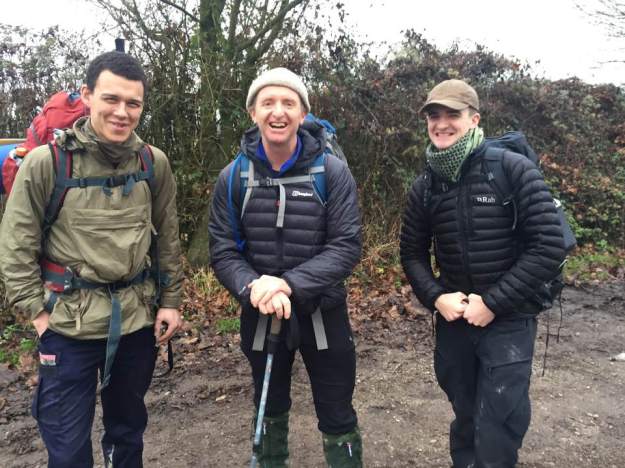
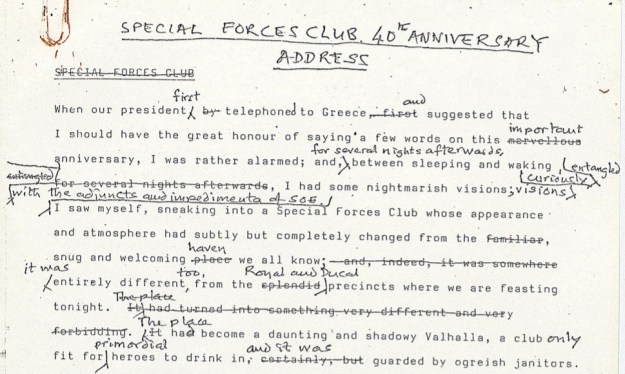
His wind-walks begin on Cross Fell, the highest point of the Pennines, as he chases the roaring Helm – the only named wind in Britain. In southern Europe he follows the Bora – a bitter northerly that blows from Trieste through Slovenia and down the Croatian coast. His hunt for the ‘snow-eating’ Foehn becomes a meandering journey of exhilaration and despair through the Alpine valleys of Switzerland, and his final walk traces an ancient pilgrims’ path in the south of France on the trail of the Mistral – the ‘wind of madness’ which animated and tormented Vincent Van Gogh.

These are journeys into wild wind, but also into wild landscapes and the people who inhabit them – a cast of meteorologists, storm chasers, mountain men, eccentric wind enthusiasts, sailors and shepherds. Soon Nick finds himself borne along by the very forces he is pursuing, through rain, blizzards, howling gales, and back through time itself. For, where the wild winds are, there are also myths and legends, history and hearsay, science and superstition – and occasionally remote mountain cabins packed with pickles, cured meats and homemade alcohol.

Where the Wild Winds Are is a beautiful, unconventional travelogue that makes the invisible visible. Due out on 7 September 2017, pre-order Where the Wild Winds Are: Walking Europe’s Winds from the Pennines to Provence here.

The Travellers’ Film Club season continues on the 5th April with Man of Aran

Eland books, who run The Travellers’ Film Club, have said that the season continues on the 5th April with Man of Aran, Robert J. Flaherty’s masterpiece of the drama of noble simplicity. It documents the heroic life of a traditional family from one of the Aran isles, the cliff-girt archipelago off the west coast of Ireland. 18 months in the making, and first screened in April 1934, it was acclaimed ‘as a film that will influence directors all over the world’. Eland hope to have the film historian, Mark Le Fanu in the audience to answer questions.

The Club meets in the basement Travel Bookshop of Waterstones (where there is a café) from 6pm. Screenings in the meeting room start around 6.30pm, prefaced by a brief introduction with the opportunity for questions afterwards. These events are free, but please email to reserve a place events.piccadilly@waterstones.com

A Happy New Year to you all

Teddy, Tom, and Patrick on the South Downs Way fundraising in December 2016

Teddy, Tom, and Patrick on the South Downs Way fundraising in December 2016

Thank you for reading the blog in 2016 and for engaging in lively debates via the comments section. The most controversial issue is the state and status of Paddy’s house, but we end the year with some hope that the Benaki will be able to make some progress as seen by their recent press release.

Please do keep sending me material. I probably say this every year, but I have a good backlog of items, many of which have been kindly donated by some of you. Forgive me if I don’t get round to publishing them immediately, or even quickly; it can often take me an hour or more for the more complex posts and time as you know is short and precious. My goal is to have everything up on the site one day. There is plenty of good material to come in 2017 and I wish you all a very Happy New Year.

The Like a Tramp 2016 Just Giving site will close in a few days. So far we have raised over £7,000 for homeless and mental health charirites. The most recent 2016 tramp has had donations of over £1,850. It would only take a few more donations to take us over the magic £2,000 mark. If you would like to donate in any currency, please follow this link.

Patrick Leigh Fermor addresses the Special Forces Club on its 40th anniversary

Opening paragraph Special Forces Club 40th anniversary dinner

Opening paragraph Special Forces Club 40th anniversary dinner

My thanks to Gaz Wild who discovered this gem in the PLF archive of the National Library of Scotland last year. There are two versions, one a pdf of Paddy’s original with many handwritten corrections, and a tidied up draft made after his death. It would have been written in 1985 for the 40th Anniversary Dinner of the Special Forces Club, and is referred to in a letter of Paddy’s to Rudi Fischer dated 10 November 1985, which appears in Dashing for the Post page 393, para 2. Paddy remembers especially John Pendlebury, Mike Cumberlege, and Manoli Paterakis.

A special treat for the holiday period. I hope that you enjoy it.

19850000-plf_address_sf_club_40th_anniversary

19850000-plf_address_sf_club_40th_anniversary-tidied