Category Archives: Paddy's Writing

Re-opening of Bánffy exhibition at Budapest Opera House

Zsuzsanna Szebeni, who is the curator of the Count Bánffy exhibition at the Budapest Opera House, contacted me to say that the exhibition has re-opened at the opera house from 3 April 2012. If my Magyar is up to scratch it appears to run until 24 June, but I could be wrong about that! From the 16th of July the exhibition will move to a larger location in the city of Sepsizsentgyörgy or Sfântu Gheorghe (in Romanian), a city which is predominantly Székely Hungarian, and lies to the north-east of Brasov in Transylvania.

Miklos Bánffy was a Transylvanian Count and director of the Budapest Opera House at the end of the Great War. At the same time he planned the very last coronation of a King of Hungary, the last Emperor of the Austro-Hungarian Empire, Charles I. This is all wonderfully described in the English Translation of Bánffy’s memoirs, The Phoenix Land, published by Arcadia Books.

As you will know by now, Paddy wrote the introduction to the English translation of Bánffy’s fictional Transylvanian Trilogy which is wonderful and an absolute must read. Cluj gets many a mention. You can read more about Count Bánffy here on the blog.

You can contact Zsuzsanna as follows: Mobil: +36 20 3304070 and Office: +36 1 3751184/128.

For those of you who speak Magyar you will find this video of interest. For those who don’t I hope that you will enjoy the colourful images!

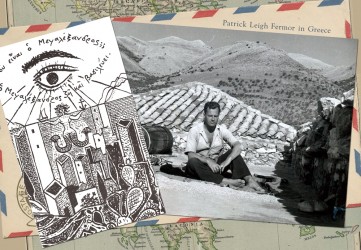
Patrick Leigh Fermor in Greece – a talk by Artemis Cooper

Paddy’s biographer and good friend, Artemis Cooper, will talk about his life in Greece at the Gannadius Library in Athens at 7.00 pm on 24 May 2012. 

Full details of the event can be found here.

Biographer Artemis Cooper, who is preparing a biography of Patrick Leigh Fermor, will trace his life, experiences, and legacy in Greece from his early travels to the end of his life, on 10 June 2011. She will talk about what drew Patrick Leigh Fermor to Greece in the first place; his ‘participation’ in the Venizelist rebellion of 1935; his early travels in Thrace and Macedonia, and first encounters with the Sarakatsani; his experiences in the war on the Albanian front and Crete, as well as the post-war explorations of Greece that produced Mani and Roumeli. She will also touch on the Cyprus years; his friendship with George Seferis, George Katsimbalis, and Nicos Hadjikyriacos Ghika; how he and his wife came to settle in Kardamyli, and built their house with the architect Nicos Hadjimichalis; how the Greek translation of Mani was undertaken by Tzannis Tzannatakis, while he was in exile in Kythera under the Junta of the Colonels. She will also reflect on his position in the village of Kardamyli and how he is seen in Greece today.

PS – I have been told that there will be a webcast available after the event. I will post the details when I have them.

Transylvanian hay-day – An afternoon’s diversion on the way to Constantinople, 78 years ago.

Between the Woods and the Water

As Nick Hunt is currently in the vicinity of the Hungarian-Romanian border on his walk in Paddy’s footsteps to Constantinople, I thought that it might be an appropriate time to publish this extract. It is one of the most memorable pieces of Paddy’s writing. What a way to spend a hot summer’s afternoon!

by Patrick Leigh Fermor

First published in The Spectator in 1986. This version 18 June 2011.

One day when we were invited to luncheon by some neighbours, István said, ‘Let’s take the horse’ and we followed a roundabout uphill track to look at a remaining piece of forest. ‘Plenty of common oak, thank God,’ he said, turning back in the saddle as we climbed a path through the slanting sunbeams, ‘you can use it for everything.’ The next most plentiful was Turkey oak, very good firewood when dry, also for stable floors and barrel staves. Beech came next, ‘it leaves scarcely any embers’; then yoke elm and common elm, ‘useful for furniture and coffins’. There was plenty of ash, too — handy for tools, axe-helves, hammers, sickles, scythes, spades and hay rakes. Except for a few by the brooks, there were no poplars up there but plenty by the Maros: useless, though, except for troughs and wooden spoons and the like. Gypsies made these. They settled in the garden and courtyard of the kastély with their wives and their children and whittled away until they had finished. ‘There is no money involved,’ István said. ‘We’re supposed to go halves, but, if it’s an honest tribe, we’re lucky to get a third. We do better with some Rumanians from out-of-the-way villages in the mountains, very poor and primitive chaps, but very honest.’

In a clearing we exchanged greetings with a white-haired shepherd leaning on a staff with a steel hook. The heavily embroidered homespun cloak flung across his shoulders and reaching to the ground was a brilliant green. His flock tore at the grass among the tree-stumps all round him. Then a path led steeply downhill through hazel woods with old shells and acorns crunching under the horses’ hooves.

It was a boiling hot day. On the way back from a cheerful feast, we went down to the river to look at some wheat. Overcome by the sight of the cool and limpid flood, we unsaddled in a shady field about the size of a paddock, took off all our clothes, climbed down through the reeds and watercress and dived in. Swimming downstream with lazy breaststroke or merely drifting in the shade of the poplars and the willows, we talked and laughed about our recent fellow guests. The water was dappled with leafy shade near the bank and scattered with thistle-down, and a heron made off down a vista of shadows. Fleets of moorhens doubled their speed and burst noisily out of the river, and wheat, maize and tiers of vineyard were gliding past us when all at once we heard some singing. Two girls were reaping the end of a narrow strip of barley; going by the colours of their skirts and their embroidered tops, braid sashes and kerchiefs, they had come for the harvest from a valley some way off. They stopped as we swam into their ken, and, when we drew level, burst out laughing. Apparently the river was less of a covering than we had thought. They were about 19 or 20, with sunburnt and rosy cheeks and thick dark plaits, and not at all shy. One of them shouted something, and we stopped and trod water in mid-Maros. István interpreted. ‘They say we ought to be ashamed of ourselves,’ he said, ‘and they threaten to find our clothes and run off with them.’

Then he shouted back, ‘You mustn’t be unkind to strangers! You look out, or we’ll come and catch you.’

‘You wouldn’t dare,’ came the answer. ‘Not like that, naked as frogs.’

What are these for?’ István pointed to the branches by the shore. ‘We could be as smartly dressed as Adam.’

‘You’d never catch us! What about your tender white feet in the stubble? Anyway, you’re too respectable. Look at your hair, going bald in front.’

‘It’s not!’ István shouted back.

‘And that young one,’ cried the second girl, ‘he wouldn’t dare.’

István’s blue eye was alight as he translated the last bit. Then without exchanging another word we struck out for the shore as fast as crocodiles and, tearing at poplar twigs and clumps of willow-herb, bounded up the bank. Gathering armfuls of sheaves, the girls ran into the next field, then halted at the illusory bastion of a hay-rick and waved their sickles in mock defiance. The leafy disguise and our mincing gait as we danced across the stubble unloosed more hilarity. They dropped their sickles when we were almost on them and showered us with the sheaves; then ran to the back of the rick. But, one-armed though we were, we caught them there and all four collapsed in a turmoil of hay and barley and laughter.

‘Herrgott!’ I heard István suddenly exclaim — much later on, and a few yards round the curve of the rick — smiting his brow with his hand. ‘Oh God! The bishop! The Gräfin! They’re coming to dinner, and look at the sun!’

It was well down the sky and evening was gathering. The ricks and the poplars and the serried rows of sheaves and haycocks were laying bars of shadow over the mown field and a party of birds was flying home across the forest. István’s hay-entangled hair was comically at variance with his look of consternation and we all laughed. Extracting strands of hay and the clinging barley, we tidied Safta and Ileana’s plaits, disordered by all this rough and tumble, and set off hand in hand with them for the river, István and I on tiptoe. ‘Poor feet,’ they murmured. After goodbyes we dived in and started the long swim back, turning many times to wave and call to those marvellous girls and they waved and answered until they were out of earshot and then, after a bend in the river, out of sight as well.

This piece first appeared in The Spectator in 1986; it forms part of Between the Woods and the Water (John Murray, £8.99). © Patrick Leigh Fermor, 1986.

Sir Patrick Leigh Fermor and The Folio Society

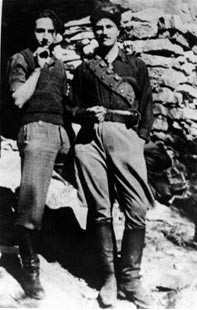
Paddy and George Psychoundakis the “Cretan Runner”

From the Folio Society website.

Ten years ago, The Folio Society decided to publish a book by William Stanley Moss, entitled Ill Met by Moonlight. It told the story of a daring war-time adventure in Crete, in which Moss and Patrick Leigh Fermor, two young SOE officers, kidnapped a German general, spirited him away across the mountains and into captivity. The book was based on the detailed diary kept (entirely against the rules) by Moss, and its undeniably romantic aspects were highlighted when, in 1957, a film was made starring Dirk Bogarde as the dashing Leigh Fermor.

When we planned the book, it occurred to us that Patrick Leigh Fermor, known to his friends as Paddy, had never contributed any kind of comment on it in writing. We assumed there was a good reason for this – a certain delicacy perhaps, since, at the time of the operation, he was already embedded in Crete in a cave under Mount Ida, with the role of facilitating Commando raids on the island, and was dependent on the friendship and loyalty of the local partisans. But we wrote to him anyway and asked if he would contribute an introduction.

He rang up from his home in Greece. It was indeed, he said charmingly, ‘delicate’ and for various reasons he’d always felt the less said the better. We parted genially, my suggesting that we might ask Michael Foot, historian of the Special Operations Executive and an old friend of his, to do it instead. This we did. A week later, Paddy telephoned again. He’d been thinking about it, and he felt that there were things he would like to say: the coup had, in his view, been diminished by being reduced to the level of a ‘tremendous jape’ and he hoped to restore the balance by providing something of the context for the enterprise. He did not wish to interfere with Michael’s introduction, but would contribute a short Afterword, describing his own experience. It would be 500 to 1,000 words. It eventually emerged at 6,500 words, all of which had to be wrested from him in hand to hand combat, so anxious was he that nothing could be misinterpreted. Michael Foot, in the meantime, was triumphant to be able to tell Paddy that General Kreipe (who was not the intended victim of the kidnap, as that gentleman had been moved on) was so unpopular that, when they heard he had been snatched, his officers broke open the champagne.

Most Folio books have their unexpected rewards, but this one had more than most. Through it we met Billy Moss’s daughters who showed us photograph albums and the original diary; Sophie, their Polish mother, a formidably attractive SOE operative who had been based, with Moss and Leigh Fermor, at Tara, the Cairo House; Michael (M R D) Foot, whose own experiences as prisoner of war were at least as hair-raising as the exploits he went on to chronicle; and of course Paddy himself – courageous, witty, modest, famously attractive and – both with this book and The Cretan Runner – a good friend to The Folio Society. We will miss him.

Related article:

A Meeting between Paddy and George Psychoundakis the “Cretan Runner”

March 2012 – Nick reaches the bridge at Esztergom

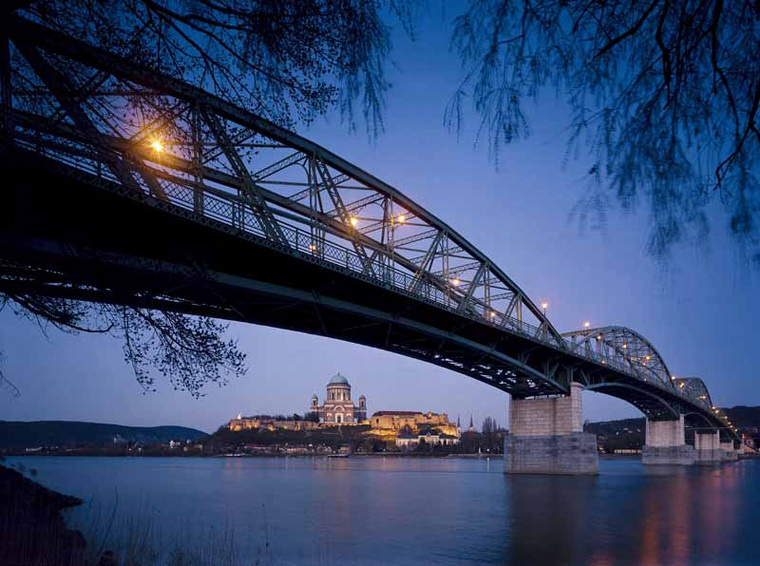
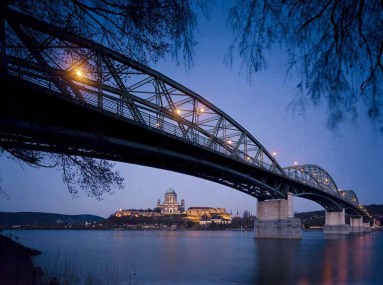
Imagine Paddy standing in the middle of this bridge looking at the cathedral

It took Paddy until Easter 1934 to get to this bridge. Nick is moving well now. The bridge at Esztergom was one of my first blog posts back in April 2010!

The bridge linking Slovakia and Hungary, between the towns of Štúrovo and Esztergom, also links A Time of Giftsand Between the Woods and the Water. Here Paddy paused both in his walking and his writing, ‘meditatively poised in no man’s air,’ before crossing into Hungary and the second phase of his journey.

I reached that bridge a week ago (or rather the reconstruction of that bridge — the original was destroyed in 1944), and in a rather unbelievable way came to the very last page of my notebook standing above the Danube … read more

Related article:

Easter 1934 – Paddy reaches the Hungarian border at Esztergom

The remains of a BBC interview with Paddy from 2004

The incompetence or just downright negligence of the BBC in relation to their archive never ceases to amaze. In 2004 when Paddy received his Knighthood he made the ‘Faces of the Week’ page on the BBC website. They also included a snippet of an interview with Paddy where he describes the loss of his rucksack in Munich in 1934. I have asked the BBC if they have a copy of the remainder of this interview (date of interview unknown), but their reply was that they had either lost it or it had been erased.

You can listen to the interview on the BBC page here but you will need RealPlayer (remember that?).

Click here to play the interview straight off.

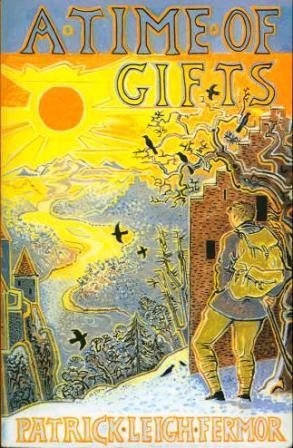
Colin Thubron recommends reading A Time of Gifts for 2012

A Time of Gifts, 1977

In the December edition of The Browser, Paddy’s good friend Colin Thubron talks about why A Time of Gifts remains one of this favourite travel books…

This is the first volume of Patrick Leigh Fermor’s journey in 1933-34 from the Hook of Holland, as he called it, to what he insisted on calling Constantinople [Istanbul]. It was to be in three volumes. This one takes him beyond Vienna. The second volume, Between the Woods and the Water, takes him through Hungary to the Balkans. The third volume was going to get him across Romania to Istanbul, but he never wrote it.

Like many people, I love the idea of this young 19-year-old gypsy going off on foot on his own, with just a pound a week, footloose and fancy free, full of delight at the world and fascination at where he’s going. That’s one of the lovely things about the book. It’s beautifully written, very rich prose. It’s model was Norman Douglas – rich in language, vocabulary, scholarship. It’s rather an acquired taste, and may seem old-fashioned to a younger generation.

I love the delight in everything, with all its byways in history or folklore, and the people he meets are so marvellously and generously described. He had such a big heart, a generous spirit. You feel he must have been a delightful companion for anyone to meet on the road. Some people find it a little bit showy-offy, because of all of the stuff he quotes as having by heart – but he did, it’s perfectly true. He had an excellent memory, and into his old age he was a great raconteur.

I know that you knew him quite well. Will you tell us about his character? He died not long ago of course.

Yes, he died [last June]. Well, he was what you would expect. In some ways, he was rather an innocent. He wasn’t an intellectual, but he loved facts and data and history and architecture. He also loved show, and a good story. He was a delightful companion, very funny, and he was a bit original. He would sometimes say something rather fanciful, he had a marvellous imagination. But there was this innocence about him.

It’s as if he was in a time warp, and in rejoining his youth in these two books he was rejoining somebody he still was, in a sense, his sensibility was so young. He hadn’t changed in many ways, he hadn’t been disillusioned. They are very “illusioned” books, if you like. It’s a very wonderful idea to go back to who he was, because he could so easily enter into the spirit of that liberated delight in the world which he kept with him always. He was very frail when he died, but he still kept that with him.

How does travel change a person? It’s a platitude that a physical journey is also an inner journey, but some platitudes are true.

I don’t know really. It’s supposed to broaden the mind. If I look at the travel writers I know and have known, there’s a certain breadth of knowledge. One would hope there’s a breadth of understanding or of sympathy too. Of course, it makes you a sort of amateur. You’re a free agent, you’re the oddball. One can understand why dictators find travellers a threat – you’re not beholden to anyone and you’re doing what you want, which is a marvellous privilege. But what it does to you character-wise, I don’t know.

The title A Time of Gifts comes from a line of poetry by Louis MacNeice …

“For now the time of gifts is gone / O boys that grow, O snows that melt.”

That certainly hints at growth of character.

Yes it does. This was his great extended epiphany, to be suddenly going out travelling. That was the time of gifts for him, when the world opened to him. He was obviously ready for it. He was always on the wrong side of authority in England, and he was expelled from school. He got into a rather posh artist society in London and he was enormously entertaining and fun, and very handsome as a young man. But he hadn’t travelled anywhere. So suddenly to loose yourself on the world was surely his time of gifts.

I love Leigh Fermor’s motto. Solvitur ambulando.

It is solved by walking

A Year of Memory: the top ten posts on the Patrick Leigh Fermor blog

As the year comes to a close it is time to reflect upon what has passed and to look forward to 2012. I make no predictions for the coming year. There are some things which are almost certain such as the continuing Euro crisis and the much anticipated publication of Artemis Cooper’s authorised biography about Paddy, but forecasts tend to be overtaken by events and are quickly forgotten.

What we can do is to look back on this year in the life and times of Patrick Leigh Fermor. The major event of course was Paddy’s death on 10 June at the age of ninety-six. A sad event for his family and close friends, but also for those of us who admired him for his writing and the life he lived. As the year closed it was time to celebrate his life at his Memorial Service held on 15 December in London.

As I hoped the blog has become a significant source of material about his life including rarely seen video. There have been over 228,000 visits over the last year and you have made it a much more interactive experience by using the comment facility to exchange information, provide your own memories of Paddy, and to express your admiration for him. At the time of his death I opened a page where you could express your thoughts about Paddy which has run to over 120 comments.

Paddy would probably have been somewhat bemused by the whole idea of the blog, but perhaps even more so by the interaction we now have with social networking sites with nearly 4,500 visitors finding the site from Facebook, and 850 via Twitter.

To conclude the year, and as the 365th post on the blog, let us take a look at some of the most popular articles over the last twelve months. Perhaps I can make one promise to you all which is that there is much more to come on the blog in 2012 which includes a lot of material submitted by you the readers of the blog.

The Funeral Service of Patrick Leigh Fermor, 16 June 2011 

Paddy’s funeral service was held on a typical English summer’s day at his home in Dumbleton. He returned to England just one day before his death and is buried beside his beloved Joan.

Obituary from The Independent by Paddy Leigh Fermor’s biographer Artemis Cooper 

Perhaps the definitive obituary.

Patrick Leigh Fermor … This is Your (Ill Met by Moonlight) Greek Life 

The amazing video from the Greek TV programme which reunited the participants of the Ill Met by Moonlight kidnap including Paddy, many of the Andartes, and General Kreipe and his wife.

Anthony Lane’s New Yorker article on Fermor is now free to view 

One of the most comprehensive profiles of Paddy which is now freely available to all. (the pdf download appears to be no longer available – click on the article to magnify to read and then drag your cursor to move around the page)

Intimate portraits from Kardamyli by Miles Fenton 

A series of personal photographs sent to me by Miles Fenton who is Paddy’s nephew and who now lives in Canada where he works as an artist.

Patrick Leigh Fermor recounts the kidnap of General Kreipe on video 

The ever popular video where Paddy talks in some detail about the Kreipe kidnap. (press play on Battle of Crete 7).

Colonel David Smiley 

David Smiley was a fellow occupant of Tara in Cairo with Paddy and Billy Moss et al who continued his military career with some distinction after the war and even led Japanese soldiers in a charge against VietMinh rebels!

Paddy’s eye for detail: Ian Fleming, Bondage, James Bond and Pol Roger 

It is probably the James Bond/Ian Fleming association which maintains the popularity of this article.

If food be the music of love … Bánffy’s lover in Cluj (Kolozsvár) 

No list of popular posts can be complete without the compelling combination of my passions for Paddy, Romania, Miklós Bánffy, and Cluj.

Patrick Leigh Fermor Memorial Order of Service 

The order of service from the joyful occasion that was Paddy’s Memorial Service.

Finally I would like to thank so many of you for your encouragement and support during 2011, and wish you all a very Happy New Year!

Tom Sawford

John Murray – “Patrick Leigh Fermor’s final volume will be published”

It is interesting that twice in one week we have a story about the publication of Vol 3. Is this the result of the commencement of the long, slow cranking up of the marketing machine, or one story leading to another as journalists follow each other’s tails in a quiet week for news? What we do now appear to know is that John Murray are now officially commenting so there is some real substance to the old rumours. Let’s not forget that we have Artemis Cooper’s biography to look forward to this time next year.

by Alison Flood

First published in guardian.co.uk, Tuesday 20 December 2011

Patrick Leigh Fermor’s final volume will be published Long-awaited conclusion to revered account of walk across Europe set to come out in 2013

Readers stranded on the edge of Bulgaria since 1986 by the travel writing great Patrick Leigh Fermor are set to be rewarded at last with the third and final volume chronicling the late author’s European odyssey.

Leigh Fermor, who died in June aged 96, was the author of what his biographer Artemis Cooper described as “two of the greatest travel books of the 20th century”, A Time of Gifts and Between the Woods and the Water. They trace his journey on foot from the Hook of Holland to Istanbul at the age of “18 and three-quarters”, how he travelled “south-east through the snow into Germany, then up the Rhine and eastwards down the Danube … in Hungary I borrowed a horse, then plunged into Transylvania; from Romania, on into Bulgaria”, with the second volume, published in 1986, ending as he was about to cross the Danube from Romania into Bulgaria.

Leigh Fermor always promised a final volume, announcing in 2007 that he had even bought a typewriter and was learning to type in order to complete it. “I’m going to finish that book,” he said. “I’m going home and I’m going to work really hard.”

His publisher John Murray has now announced that it will publish the final volume in 2013, drawing from Leigh Fermor’s diary at the time and an early draft of the book he wrote in the 1960s.

“His devoted readership have been stuck midstream, as it were, for over 20 years. A painstaking perfectionist, Leigh Fermor never did finish the final volume though he was working on it up to his death in June 2011,” said Cooper, whose biography of the author will be published in September 2012. “Based on the original diary he kept at the time and an early draft of the book written in the 1960s, this book takes up the story, and carries the reader to Constantinople and beyond.”

Roland Philipps, managing director of John Murray, called it “a treat to be back, immersed once again in this great pre-war walk across Europe”. It is “wonderful for his many admirers that this book will be published,” added Murray.

Final volume from Patrick Leigh Fermor

The latest snippet about Vol 3 from The Bookseller.

John Murray is to publish a posthumous book by travel writer Patrick Leigh Fermor, who died in June [Edit – the article says July – good research!!].

by Benedicte Page

First published in The Bookseller, 16 December 2011

The book will complete the story of the journey Leigh Fermor made on foot from the Hook of Holland to Constantinople at the age of 18, as told in his previous works A Time of Gifts and Between the Woods and the Water. The currently untitled volume will be published in September 2013.

Artemis Cooper, whose biography of Leigh Fermor will be published in September 2012, said: “By the end of the second volume, he was about to cross the Danube from Romania and plunge into Bulgaria; and his devoted readership have been stuck midstream, as it were, for over 20 years. A painstaking perfectionist, Leigh Fermor never did finish the final volume though he was working on it up to his death in June 2011.”

Based on the original diary he kept at the time and an early draft of the book written in the 1960s, this book takes up the story, and carries the reader to Constantinople and beyond.

John Murray m.d. Roland Philipps said: “I was told of the existence of a manuscript on the day that Sir Patrick died in June of this year, and read it shortly afterwards. It is a treat to be back, immersed once again in this great pre-War walk across Europe and wonderful for his many admirers that this book will be published.”

The publisher describes Leigh Fermor as “one of the outstanding prose stylists of modern time”.

The It girl and the war hero

A young and beautiful Debo

What the trigger-happy, book-hating Duchess of Devonshire said to Patrick Leigh Fermor

Kate McLoughlin

From The Times Literary Supplement November 26, 2008

Deborah, Dowager Duchess of Devonshire – known as Debo – was the youngest of those prototype It girls, the Mitford sisters; in faint and possibly euphemistic praise, the editor of this book of letters, her niece-by-marriage Charlotte Mosley, also describes her as “the most well-adjusted”. In this collection of letters, Debo comes across as jolly, plain-spoken and, where animals are concerned, murderous, her gun having taken her “from Sussex to Devon, from Anglesey to Norfolk and home via Northumberland”. Debo tends Chatsworth (the Devonshires’ stately home in Derbyshire), which she endearingly refers to as “the dump”, and engages in country pursuits. When asked by President Kennedy what she does all day, she admits she is “stumped”. A disarmingly simple soul – “I now prefer horse shows to lovers & I’ve never liked drink” – the Duchess is at her best on varieties of gooseberry and rare breeds of cattle. A running joke in this correspondence is her anti-intellectualism in general and antipathy to reading in particular. Invited to a literary lunch in Leamington Spa, she plans to tell her audience, “BOOKS how I hate them – as an avid non-reader it is awful to have added to their number”. The reader of her letters may be forgiven a wry smile.

The recipient of the Devonshire dispatches is Patrick Leigh Fermor (known as “Paddy” and occasionally “Whack”): war hero, author of travel books such as The Traveller’s Tree (1950), Mani (1958), A Time of Gifts (1977) and Between the Woods and the Water (1986), and the recipient of many honours, including a knighthood for services to literature and Anglo-Greek relations. During the Second World War, he was posted to Crete to support the local Resistance and led the successful abduction of the German commander on the island, an exploit that earned him the DSO and was later filmed as Ill Met By Moonlight (1957). Fermor attends the making of the movie and is enchanted when Dirk Bogarde portrays him as “a mixture of Garth and Superman, shooting Germans clean through the breast from a dentist’s chair, strangling sentries in an offhand manner”. From his letters, Fermor emerges as charming and whimsical, with a delightfully childlike imagination offsetting an annoyingly schoolboyish sense of humour. Still entranced by what he calls in A Time of Gifts “the glamour of fairy stories”, he hears the sea roar “like angry lions at feeding-time”, sees hills crowned with “tea-cosies of mist”, watches blackbirds mass “as if someone had rashly opened a pie”. In the best of his travel writings, Fermor combines a similar sense of wonder with local colour, an eye for ridiculousness (including his own) and vivid description in rangy sentences remarkable for their buoyancy. There is little of this soaring prose here: although some lengthy descriptions of travel are included, Fermor is reduced to telling his reluctant reader which passages she may skip.

Fermor and the then Deborah Mitford first met at a regimental ball in 1940. They bumped into each other at parties from time to time over the next decade but the first letter in this collection is a six-liner dated March 21, 1954, from Debo, now married to Andrew Cavendish, eleventh Duke of Devonshire, to Paddy saying that she hopes he will come and stay with them at Lismore, their house in Wexford. This sets the tone for the correspondence to follow: invitations are extended and accepted, thank-you notes are then sent. Too intermittent, the letters are unsatisfying records of festivities long finished. Although Charlotte Mosley claims to have excised plans for meetings, reports on health, grumbles about the weather and the slowness of the posts, the weeding out has not been thorough enough.

Another of Mosley’s claims in support of the correspondence is that the participants are indifferent to politics. It is difficult to decide whether this indifference is another instance of charming whimsicality or just unforgivable negligence. The exchange of letters is too sporadic to allow for political themes to be developed at length, but politics are not entirely absent. Andrew Cavendish was Harold Macmillan’s nephew-by-marriage and served in his government, later becoming an early member of the Social Democratic Party.

In 1958, with Macmillan a year into office, Debo “talks secrets with the PM” and finds it “most jolly and educational”. Much later, John Major “exudes goodness”, Tony Blair is “the wretched little Prime Minister”, Cherie “frightful”, and John Prescott “looks like a bare-knuckle fighter . . . from the East End”. This animosity may have been partly caused by the hunting ban, brought into force by the New Labour government in 2005, and the slaughter of livestock following the outbreak of foot-and-mouth disease. In their strongest expression of political feelings, Paddy calls the passing of the anti-hunt bill “a day of mourning” and Debo describes the cull as “truly ghoul”.

These references apart, the correspondence is largely devoted to the dramatis personae of high society, mostly long-gone minor aristocrats about whom Mosley provides rather more information than necessary in her footnotes. The Queen Mother, whom Debo calls “Cake”, having been lastingly impressed by her enthusiasm at a wedding when the cake was cut, puts in a few appearances, memorably crying “Oh God” and making a dash for the Royal Box when the conductor unexpectedly strikes up “God Save the Queen” at an opera gala. Princess Diana visits Chatsworth and Debo is stuck for what to give her to eat “as she prefers the fridge to the table, I’m told”. In other sly thrusts, Jackie Kennedy’s face “is put together in a very wild way” and Somerset Maugham’s is “so discoloured and green that it looks as though he has been rotting in the Bastille”.

Old age arrives suddenly for the correspondents – the long gaps between the letters mask the passing of time – but they sound the same as ever, still playing with the same phrases (“I freely admit” is one of Debo’s, much repeated by family and friends), the nicknames (Nancy Mitford is “the Old French authoress” and “the Ancient Dame of France”), the in-jokes (Debo’s supposed illiteracy), still “v v excited” about things or finding them “frightfully good”. Their lack of self-pity as they age is impressive and appealing; there are jokes about failing eyesight and “Dr. Oblivion” but, even though they have reached the stage in life when Paddy is constantly writing obituaries, they maintain good cheer. Twenty-first-century life fails to disconcert them. “There are marvellous entertainments called car-boot sales”, writes Debo. “You can buy a Rembrandt for a few quid in any old field. So why not sell a few?”

Did they love each other? Debo is “funny, touching, ravishing and enslaving”, Paddy tells mutual friends. In a letter of 1957 he rebukes her: “I wish you didn’t love everyone else more than me – it wouldn’t matter if I didn’t rather love you, as I suppose I do, otherwise I wouldn’t feel so selfish and possessive [. . . .] I do adore you”. His adoration is clear in his letters, which outnumber Debo’s: he chides her for not writing often enough, he delights over her average prose, he sends her long travelogues that she replies to with short letters about gooseberries. But her fondness and admiration for him are also evident, and a photograph in the volume of them aged ninety-three and eighty-eight shows a pair close together but not touching: a couple of old friends.

In one of her letters to Paddy, Debo marvels that the University of Texas has paid $10,000 for her sister’s papers: “They’ve got all Evie [Waugh]’s stuff, & Osbert [Sitwell]’s, & letters saying things like ‘Arriving on the 2.14 on Saturday so much looking forward to seeing you’ are put under glass and revered”. Similar feelings are induced by In Tearing Haste. The volume diminishes its subjects by preserving their off-the-cuff remarks and, in Fermor’s case, prose that does nothing to suggest that his finest writing is spectacular. It is good to know that the two are corresponding still, but it might be for the best to save their last letters for their own private pleasure.

£1 a week to Constantinople – Bon Voyage to Nick and Nice Weather for Young Ducks

Paddy does not say if his last night in London before his epic journey was as busy as it was on Wednesday as Nick Hunt gathered with some friends in Shepherd Market to wish him well on his epic journey, but seventy-eight years ago today our hero, and let’s not be ashamed to say it, our hero, Patrick Leigh Fermor celebrated his last night in London as just another under-achieving public schoolboy, setting out to emulate Robert Byron, from this untouched corner of old London, which is now the haunt of hedge fund managers and buccaneering chief executives of junior mining companies; London clay brick Georgian squeezed into some of the highest priced real-estate in the land.

A new endeavour is about to start as Nick sets off on Friday to walk across the New Europe just as it is probably about to undergo the most significant peacetime turmoil since the rise of Nazism in the 1930’s into which Paddy stumbled with only a few links to ‘civilisation’ to accompany him, including his copy of Horace’s Odes.

Frankly I am as envious as I can be. Who could not wish to spend time away from the demands of today’s ever connected world? To endure physical challenges whilst encountering architectural marvels and meeting interesting people, each with a unique story to tell. It could well be the journey of a lifetime and I hope I send Nick off with all your best wishes. He has mine.

The weather today is better than that encountered by Paddy as he set out ….

The weather in London on December 9th 1933 was typical. The sky darkened, the clouds lowered and then it rained hard. A young man walked the cold pavements towards Cliveden Place to collect a rucksack that his friend Mark Ogilvie-Grant had used on a journey to Mount Athos accompanied by Robert Byron. After stopping to buy a stout ash stick, and probably some cigarettes, at the tobacconist on the corner of Sloane Square, the young man collected his new passport – occupation ‘student’ – from the office in Petty France. He cast his eyes up to the ominous clouds and then made his way quickly north across Green Park. Now the rain splashed down as he dashed between the traffic on Piccadilly and entered the house of his landlady, Miss Beatrice Stewart, in Shepherd Market.

A former model who sat for Sickert, and Augustus John, and who is said to be the model for the bronze figure of Peace atop Wellington Arch, Beatrice Stewart’s career was cruelly cut short after she lost a leg in a road accident. She had arranged a lunch for the eighteen year old Patrick Leigh Fermor and two of his friends to wish him bon voyage before the start of what was to become one of the most famous journeys of all time, and certainly the longest gap year in history.

After lunch, Paddy said thank you and goodbye to Miss Stewart, and jumped into a waiting taxi, which drove off through Mayfair, around Trafalgar Square, up Ludgate Hill, and past the Monument towards the Tower of London. It was raining so heavily that all they could see out of the steamed up windows were hordes of umbrellas, some carried by bowler hatted men, as the rain splashed down in the dark. “Nice weather for young ducks.” said the taxi driver as he dropped the small party by the first barbican on Tower Bridge.

The two companions, one a young girl wearing a mackintosh over her head like a coal shifter, stood in the rain to watch Paddy descend the stone steps down to Irongate Wharf. With a final wave, he strode up the gangplank of a Dutch steamer bound for Hook of Holland.

This was the start of Paddy’s journey down the Rhine and along the Danube which he so memorably describes for us in his book A Time of Gifts. This part of the story ends on Easter Sunday 1934 as Paddy stood on the long bridge over the Danube, in no-man’s land, between Czechoslovakia and Hungary at Esztergom, just as the Easter celebrations started in earnest.

A Time of Gifts is almost universally acknowledged as a masterpiece of English literature; Sebastian Faulks is a dissenter, but he would be. Described by some as a travel book, it is essentially the journal of a young man with a superb gift of memory, for languages, and for making friends, written with the benefit of a lifetime of amazing experience and learning, forty years after the events it describes. It is embellished by anecdotes and essential historical background, making it a rounded piece of literature and no mere travelogue. It should be compulsory reading for all seventeen year olds; it is truly inspirational. The sad part is that the very reason for the ending of Paddy’s ‘gap year’ whilst with his lover Balasha Cantacuzene in Romania in September 1939, resulted in the destruction of many of the towns and cities he passed through, and certainly ended the way of life of the peoples of Europe that he describes so well.

I have no doubt that today, were Paddy still with us that he would pause for a while to recall that day, wish Nick all the best, and reflect on the events that followed during his amazing and full life, and the friends and lovers who have gone before him.

Perhaps Sir Patrick Michael Leigh Fermor DSO OBE, who was the Greatest Living Englishman, would pen a short letter to Debo?

Snail’s pace to Byzantium: journey of a lifetime

This is a combination of profile and review of Words of Mercury. An interesting piece.

by Ann Elder

First Published in Athens News, 9 Jan 2004

“I HATE the word travel-writer,” London-born, Mani-based Patrick Leigh Fermor told a British journalist in 1995. Under the title Words of Mercury, a selection of his writings was published by John Murray this autumn. The excerpts from half a dozen of his books, some articles and reviews show clearly why he must flinch from being slotted anywhere confining.

As his followers know, he writes with an enchanted pen. Any topic he takes up becomes something ‘rich and strange’. He has a story-teller’s knack of compelling interest, like the Ancient Mariner mesmerizing listeners with his glittering eye. And he has a particular flair for catching the heightened receptivity and visceral thrill felt at new encounters, what Cavafy wished the traveler in his poem Ithaka:

Pray that your journey may be long,
that many may those summer mornings be
when with what pleasure, what untold delight
you enter harbours never seen before.”
(Kimon Friar translation)

Not least, Leigh Fermor wins readers’ allegiance by creating the sense of affinity with an engaging personality, uncensorious, untinged by chauvinism, reveling in life, akin in spirit to A E Housman, onetime professor of Latin at Cambridge, in his lines:

Could man be drunk forever
With liquor, love or fights
Lief should I rouse at mornings
And lief lie down at nights.

Edited by Artemis Cooper, a writer (Cairo in Wartime) and wife of historian Antony Beevor (Crete: The Battle and the Resistance), the book has five parts: travel, Greece, people, books and flotsam (finishing with a poem on Christmas maybe better forgotten). Cooper gives brief introductions to each piece and starts off with a succinct biography.

As an 18-year-old living on a pound a week in a flat off Picadilly in 1933, Leigh Fermor spent more time partying than buckling down to write. As fate had it, he had read The Station: Athos: Treasures and Men by the irreverent young Robert Byron in 1928. The ‘great and misunderstood spirit of Byzantium’ had greatly impressed him.

“About lamp-lighting time at the end of a wet November day, I was peering morosely at the dog-eared pages on my writing table,” he related later. “A plan unfolded – to set out across Europe like a tramp – a pilgrim or a palmer, an errant scholar, a broken knight.”

“The chief destination was never in a moment’s doubt. The levitating skyline of Constantinople pricked its sheaves of thin cylinders and its hemispheres out of the sea-mist; beyond it hovered Mount Athos; and the Greek archipelago.”

In excess of his wildest dreams, he found material to write about. All was grist to his mill, but his mill ground slowly. His writing proved to require long gestation. He became fanatical about polishing his product, and research, the more obscure, the more it seemed to appeal to him, like the origins of the Sarakatsans or the Laz-speaking Greeks of Trebizond. The first book about his venture, A Time of Gifts, came out in 1977, over 40 years later, and the second, Between the Woods and the Water about “those mysterious regions between the Vienna Woods and the Black Sea” as Saki put it – in 1986. In France they called him “l’escargot (the snail) of the Carpathes.”

Real life and events also delayed his writing. The trek took him about a year. He reached his goal on New Year’s Eve, 1934, after ending his traverse of Bulgaria with a splash, falling into the Black Sea on a cold December evening. He came to the coast some 150 miles north of the Bosphorus. “An old man was smoking a narghileh on the doorstep of a hut beside a little boat beached among the rushes – a Tartar fisherman, the only human being I saw all day,” he  wrote over 20 years later in an article in the May 1965 Holiday Magazine.

Darkness fell. “I lost my footing on a ledge and skidded – waist-deep into a pool. Jarred and shaken, with a gash on my forehead and a torn thumb, I climbed out, shuddering with cold. At the bottom of the pool, about two fathoms down, my torch was sending a yellow shaft through sea anemones and a flickering concourse of fish.”

Crawling round the rocks, he came to a veritable Cyclop’s cave sheltering a dozen Greek fishermen and Bulgarian goatherds with their 50 goats and cheese-making apparatus, eating lentils by a thornbush fire. The young wayfarer was soon dried and warm, tossing back slivovitz and eating fresh fried mackerel.

Leigh Fermor is in his element in the climax of this thoroughly Homeric episode, when one of the Greeks, Costa, turns out to be an unsung Nijinsky, his dancing invested with a ‘tragic and doomed aura.’ He performed the stunt  with which Greek cruise ships like to wind up their Greek night shows: dancing with a table between the teeth.

“On a rock, lifted there to clear the floor, the low, round, heavy table was perched. Revolving past it, Costa leaned forward: suddenly the table levitated itself into the air, sailed past us, and pivoted at right angles to Costa’s head in a series of wide loops, the edge clamped firmly in his mouth and held here only by his teeth. The dancer whirled like a dervish, till the flying table melted into a disc, finally returned to its rock, glasses, cutlery, lentil pot and cigarette burning on the edge of a plate undisturbed.”

Time in Greece he dates from his 20th birthday, February 11, 1935, when he arrived at Mt Athos as ‘snowflakes were falling fast’ and ‘in deep snow, trudged from monastery to monastery.’ In Athens later, he frequented the  Romanian embassy, meeting descendants of Phanariot hospodars, Ypsilantes, Ghikas and Cantacuzenes. As with Greece, he fell in love with Balasha Cantacuzene whose forebear, Emperor John Vl, invited the Seljuk Turks to  Europe (and is recalled sorrowfully in a Cavafy poem for having coloured glass not jewels in his coronation crown).

After time writing and painting in an old mill among the lemon groves overlooking Poros, they went to her decaying family estate in Moldavia. Published in 1961 was a perfectly pitched account of a picnic in sunlit  countryside by open carriage and on horseback on September 2, 1939, the last day of peace. “It had been a happy day, as we had hoped, and it had to last us a long time, for the next day’s news scattered the little society for ever.”

Utterly desolating is the Daily Telegraph weekend magazine article of May 1990 on his first breaking through the Iron Curtain in 1965. He found the Cantecuzene sisters in a Bucharest attic eking out a communist state pension  teaching. The gracious old houses he had stayed in among flowery meadows and nightingale-filled woods were psychiatric hospitals, their owners dead.

Leigh Fermor seems happiest gilding the past, writing to ‘the brave music of a distant drum,’ as old Khayyan put it, not dwelling on ‘bitter furies of complexity’ or ‘that gong-tormented sea’ of Yeats’s “Byzantium” which he refers to at the outset in Time of Gifts. The days of his youth were the days of his glory and he evokes them with zest, if no doubt some selective memory. He admits he is beset with ‘retrogressive hankerings,’ but these add to the richness of the embroidered prose dazzling his readers, to twist Yeats a bit. And sometimes he might be shoulder-to-shoulder with the poet:

Of all Arabia’s lovers I alone
Nor dazzled by the embroidery, nor lost
In the confusion of its night-dark folds,
Can hear the armed man speak.

His review of Edmund Keeley’s Cavafy’s Alexandria in a 1977  Times Literary Supplement (TLS) shows him at his serious best. He recalls “the blacked-out, jolly, rather wicked wartime port” he knew as a young British World War Two agent, then is off with Cavafy into the Judaeo-Hellenic Franco-Levantine city “old in sin, steeped in history, warrened with intrigue.”

He notes the depths of irony and dark humour in the notion of citizens aghast with consternation when the barbarians fail to invade them on cue. He ponders “the jagged Ithaka at the long Odyssey’s end; the imminent Ephialtes ready to sell the Thermopylae of the spirit.” He goes on: “Issued without preamble from an atmosphere of earthly delights these warnings sound as harsh, for a moment, as the words of Mercury after the songs of Apollo at the end of ‘Love’s Labour’s Lost.'”

Leigh Fermor is a mild Mercury though. In a review of Oxford classicist CM Bowra’s Primitive Song in a 1962 Spectator he commends him for eschewing ‘a softer technique, swaying to the seductions of every coincidence  and historical chance-shot.’ He himself tends to yield to the tempting vistas of ‘alluring byways.’

The selections from his writings on Greece include a report he wrote for London’s Imperial War Museum archives in 1969 on how the German commander General Heinrich Kreipe was abducted by a Cretan-British force he led in April 1944. While still controversial, the coup makes a cracking good story.

At Anoyeia where captors and captive rested, villagers were ‘convulsed by incredulity, then excitement and finally by triumphant hilarity. We could hear running feet in the streets, shouts and laughter. “Just think, we’ve stolen their General!”‘

Heading south round Psiloritis – Mt Ida of antiquity, over 2,200 metres high and snow-covered till late May – the getaways were to meet a British vessel on the coast to spirit them to Egypt. After a night in a shepherd’s hut sharing  one blanket, “a brilliant dawn was breaking over the crest of Mt Ida which we had been struggling across for two days. We were lying smoking in silence, when the General, half to himself, slowly said (in Latin): ‘See, how it stands, one pile of snow’. I was in luck. It is the opening line of one of the few odes of Horace I know by heart. I went on reciting where he had broken off (likewise in Latin);

‘neath the pressure yield
Its groaning woods; the torrents flow
With clear sharp ice is all congealed.
Heap high the logs, and melt the cold,
Good Thaliarch; draw the wine we ask,
That mellower vintage, four-year-old,
From out the cellar’d Sabine cask.

(Conington’s translation)

The stanzas are much-loved, ‘a picturesque Christmas card,’ say scholars. They evoke the perfect ambience in which to peruse the book. Those unfamiliar with Leigh Fermor will surely have appetites whetted for more. Those who know him and have his books around will dash for them to locate the extracts, then hotly debate the choices, such as the punning Achitectural Notes from a 1994 Spectator: “If you squinch, aisle screen,” and “Put those Saxon  here Norman,” and “Overhung? Per apse, when dais done.”

The author has covered himself. “Pure nonsense is as rare among the arts as an equatorial snowdrop”, he wrote in a review of George Seferis’s Illustrated Verses for Small Children in a 1977  TLS.

Christmas reading as recommended by Paddy – James Knox’s biography of Robert Byron

In 2003 Paddy recommended James Knox’s biography of Robert Byron in the Spectator’s Christmas book selection. It is still available from Amazon. Maybe some of you will add it to your letter to Santa for this year.

by Patrick Leigh Fermor

James Knox’s biography of Robert Byron (John Murray) is a book we have been waiting years for, and it surpasses all expectations.

Outside strictly academic circles, in the early 20th century Byzantium was little known in England, but after the Great War things began to change. In the 1920s and ’30s, there was Steven Runciman at Cambridge and, at Oxford, Robert Byron. His was the Brideshead generation. How they managed between corks popping all day and parties all night to do more than hunt for Victorian china fruit in the afternoon remains a mystery.

In the heart of this chaos, fervent extra-curricular study was at work. Abstruse historical byways were trailed and notebooks were filled up. Byzantium was the goal, and soon, in his early twenties, Robert Byron, with several of his friends, set out on corroborative journeys, and on return published his findings. Europe in the Looking Glass — a sort of pan-European Three Men in a Boat — was soon to be followed by the brilliant Byzantine Achievement. The magic of Byron’s name opened every door in the Greek world, and The Station, a monumental and marvellous description of Mount Athos, remains unsurpassed. The Birth of Western Painting — an analysis and history of the earliest Byzantine inklings to the last of El Greco — is a defence and an assault. Classical Greece and the Renaissance both get it in the neck; so do Western Christianity and the Crusades, especially the Fourth. Some of his Quixotic giants turned out to be windmills, but much good was done and Byzantium emerged in glory. Youthful flair and high sophistication marked all his writings, and recondite knowledge was leavened by the surprising bonus of a hilarious narrative gift.

There’s a connecting chain running through all his travels: India, Afghanistan, Persia, Tibet, Russia; then he would bury himself in Savernake Forest for a winter of writing and hunting, setting out eastward again in spring. We are lucky to have James Knox to set down the details of this dynamic and many-sided figure, with his energies and angers and his unorthodox passions and his laughter.

In 1941 Byron was heading east again by the northern detour when a U-boat torpedoed his ship. He was 36. We can never know how many brilliant sequels to The Road to Oxiana were sunk off Stornoway.

Der letzte englische Gentleman

I have at last made a start on the book review section. This is an attempt to bring together as many online book reviews as I can find. Most are pretty formulaic, repetitive and dull, but in the quest to build as complete an on-line archive as possible it has to be done. 

This is my most recent addition, to add also to the content of the site which is in German. There is nothing startlingly new here I am afraid, but it is an opportunity to practice your German (if you have any!).

Copy and paste into Google Translate if you need to.

by Sven Boedecker

First published in the Sonntags Zeitung, 4 July 2010

Abenteurer, Kriegsheld und Künstler: Mit Patrick Leigh Fermor können wir ein Griechenland entdecken, das inzwischen verschwunden ist

Als Hitler kam, ist er gegangen. Wie ein mittelalterlicher Pilger ist er 1933 von London nach Konstantinopel gewandert, hat in Scheunen und Schlössern übernachtet. Da war er gerade mal achtzehn Jahre alt. Über diese Reise hat er Jahrzehnte später zwei Bücher voller Esprit, Wissen und Lebenslust geschrieben – «Die Zeit der Gaben» (1977) und «Zwischen Wäldern und Wasser» (1986) haben Patrick Leigh Fermor zur Schriftsteller-Legende gemacht.

Aber der Engländer kann mehr als nur gut schreiben, er vollbrachte auch Heldentaten, für die er bis heute in seiner Heimat wie in Griechenland verehrt wird. Denn als Soldat sprang er im Zweiten Weltkrieg über dem Nazi-besetzten Kreta mit dem Fallschirm ab, lebte dort verkleidet als Berghirte und organisierte den kretischen Widerstand. Und dann entführte er 1944 in einer Nacht-und-Nebel-Aktion einen General der deutschen Wehrmacht und schmuggelte ihn nach Libyen. Dieser Coup machte Leigh Fermor später sogar zum Leinwandhelden, gespielt von Dirk Bogarde. Continue reading

Wild Carpathia

Sorry I just can’t help myself. Romania is so magical and beautiful; Paddy is reported to have said that after Greece he loved Romania the most. I have to share this video with you. It was funded by The European Nature Trust (TENT) which is based in Marlow, Berkshire. It’s mission is ” the protection and restoration of threatened wilderness, wild habitats and the wildlife living within them.” and it is focused upon Romania and Scotland.

This is a high quality version in English. Watch it and maybe support the work of TENT.

The all star cast includes lots of bears, even more mountains, and huge (but endangered) forests. Presented by Charlie Ottley, with Count Kálnoky, and HRH Prince Charles who thinks because he has some ancestral links to Vlad Dracul he has a ‘stake’ in the country.

Related article:

Lost in Transylvania

Sex O’Clock High by Patrick Leigh Fermor

“Sex O’Clock High” – Get out your dictionaries, standby to Google … reading this short article by Paddy for the New Statesman (written in 1963) is at once both a joy and a frustrating, dizzying cornucopia of colourful and fiendish alliteration (thanks to my friend Carl Hagan for leading me to this). I am reposting this as it was first published in the days when the blog had just a few visits a day. Now I hope that more of you can appreciate it .

Taken from the New Statesman archive, 1 March 1963. The author of The Traveller’s Tree and A Time of Gifts, Sir Patrick Leigh Fermor is the doyen of British travel writers. He is also the central figure of W Stanley Moss’s Ill Met By Moonlight, a true tale of derring-do in wartime Crete. Now aged 91, he has written only rarely for the New Statesman: perhaps this item taxed the sub-editors’ patience too far.

It was an iridescent August morning and the effects of morphia and onanism were wearing off. Sitting up, Jack sipped his Earl Grey. Then he slipped into the Isabella-coloured pantaloons and a pair of Blucher boots proffered by his plimsolled and Jesuitical Jeames, byronically knotted his lavallière, donned a cardigan and a spenser and threw on a raglan. Trying a gibus, a trilby, an Anthony Eden, a fedora and a tam o’shanter, he finally pulled a billycock over his ears, narcissistically fluffed out his imperial and his dundrearies and, putting a lucifer to his Henry Clay, strolled downstairs to the electronic brougham.

Jill, attended by her gamp-grasping Abigail, was waiting for him by the wistaria’d Belisha beacon, her marcelled pompadour peeping roguishly from a Dolly Vardon in sarsenet. Soon, however, the brougham broke down. (Lack of volts? of amps, ohms, farads or watts?) The Jehu whispered that Jeames was a Jonah. Jill panicked, but their neighbour, jovial, Good-Samaritan Tom – a true Nimrod, martial in a stetson fitted with a havelock, a macfarlane, knickerbockers and wellingtons – quixotically gave them a lift in his phaeton, leaving Jeames there with the titanic gladstone-bag. (It was Shanks’s mare for him: Hobson’s choice.) They bowled over the macadam, passing many a stanhope and many a victoria, past Boniface with his churchwarden stuffed with cavendish outside the Marquis of Granby, where a peeler saluted; they finally settled under the bougainvillaea. But the food? Would they have a Barmecide feast: dine with Duke Humphrey? Jim thought of wartime maconochies and murphies. But soon Jeames arrived and panglossian Tom declared that it was all Sir Garnett.

They sipped John Collinses and grog with their sandwiches and discussed a lucullan soubise while Jeames cooked an Arnold Bennett omlette, boeuf strogonoff and, though Jill was banting, a gargantuan Chateaubriand. They washed these down with a Toby jug full of negus followed by a jeroboam of Mouton Rothschild. (Saturnine Jeames, their Ganymede, a professing Rechabite but secret slave to John Barleycorn, pharisaically out-Heroded Herod by swallowing a dozen baby Guinnesses.) Hermetic bakelite yielded pralines of filberts and logan berries, and soon Tom was sadistically guillotining his pêche Melba into procrustean slices. Jill put a Maréchal Niel behind her ear and picked a posy of hyacinths, dahlias, eschscholtzias, zinnias and Lady Diana Manners, while Jack, their amphitryon – a true epicure – extracted Napoleon brandy from the tantalus and offered Tom a Romeo and Juliet.

How they laughed at Tom’s odysseys! Jill declared that their Homeric and stentorian Mentor was a regular Munchausen. He related that, to forget an Oedipus complex, he had once crossed from a zeppelin to a mongolfier over a volcano somewhere in the Atlantic (O, for an atlas!), and, in his halcyon days, had performed caesarians in the Americas and taken Wassermans in the Gilbert Islands, broken up manichaean cabals with colts, bowie knives and shrapnel, joined the Fabians in San Salvador, practised as a psychiatrist and cured some Hudson Bay cyprians of nymphomania and the lotharios of Baffin land of priapism, seduced vestals in Rhodesia with aphrodisiac cereals, played cicerone to a croesus in Saudi Arabia, haussmannized Washington with mansards, swapped sanbenitos for fermorite in Liechtenstein, galvanized vandals with sapphics, published clerihews in morse and braille, taught Monroevians Sir Roger de Coverley, diddled Jack Ketch in Vancouver with a coup de Jarnac, turned the Trotskyites of Gorki into luddites among the diesels, mithridatized himself against nicotine in Virginia, prosecuted paulicians for simony in Columbia, driven St Simonism out of the Sorbonne, won pyrrhic victories with half-nelsons over herculean apaches in Sidi-Bel-Abbès, performed veronicas with mackintoshes in Bolivia, buggered a Buchmanite in Tasmania, stolen a strad from a musical Wykehamist in the Dolomites, built a mausoleum for a Maxim-gun mogul, out-witted the dogberries of Port Said, and confuted the Arians of Alexandria. He had lost his burberry at the Derby but returned from the Cesarewitch with a tin Lizzy-load of bradburies. A Mae West once saved him from Davy Jones between the Behring Straits and the Humboldt current. He had ranted, Roscius-like, among the thespians of the Palladium, sold plutonium and ammonia to Zwinglians in Louisiana, hunted Reynard and Bruin with yahoos and mohocks beyond the Mason-and-Dixon line, eaten a shaddock in mistake for a greengage when struck by Daltonism in Smithfield, bowdlerized pasquinades for Huntingdonians in Ekaterinoslav, and been boycotted as a quisling and almost lynched by Stakhanovites in the Bodleian.

Over the Benedictine, Jill told a rocambolesque story of how, as a girl, in Paris, with her hair tied en cadogan, she had slipped on a melted esquimau by a Wallace and fallen into a vespasienne! Mesmerized by Tom, she only tittered masochistically when he said her spooneristic malapropisms were Freudian. It was turning into bacchanal.

Were her feelings for Tom just platonic, Jill mused. How namby-pamby Jack seemed after the other’s hectoring rhodomontades. Sitting on the edge of a chesterfield by a Chippendale davenport that evening, she heaved a maudlin sigh and unscrewed her Parker to write Jack a collins.

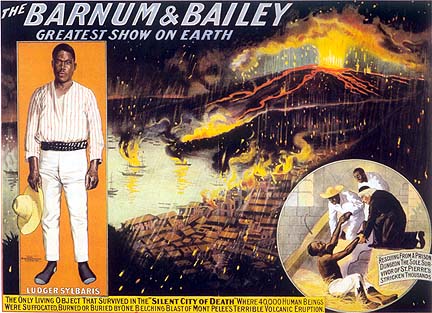
The only survivor of the devastating volcanic eruption of Mount Pelée

The ex-convict, Louis-Auguste Cyparis (aka Ludger Sylbaris), as billed as the last survivor of St. Pierre on this Barnum and Bailey Poster

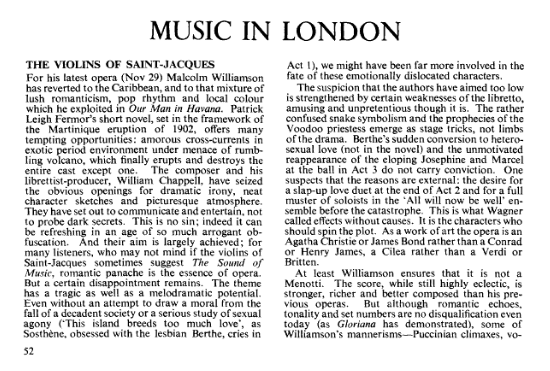
A nice short piece by Simon Winchester, which, if true, adds something to our knowledge around Paddy’s story in The Violins of Saint Jacques.

The Violins of St Jacques, Patrick Leigh Fermor. 

I think this may be my favourite book in the world. I was asked to write the preface for the Oxford University paperback edition. It’s about the eruption of Mt Pelée in 1902 on Martinique. It sent this thing, a glowing cloud, a nuée ardente, ash and lava and hot air rolling down the hillside. It completely devastated the town of St-Pierre and there was one survivor out of a population of 30,000. It was the worst volcanic disaster of the century, until the tsunami of 2005. Before that it was Krakatoa in 1883 when 40,000 people died, but most of those died from the tsunamis that followed the eruption.

Tsunamis were detected all around the world after that eruption.

Anyway, there was a ball being held in St-Pierre that night and, of course, everyone at the ball died, but the way it’s written is that he supposed all the guests survived and the party continued under the water. Fishermen say that a few miles out to sea when they are waiting for the fish they fancy they can hear music under the water.

Who was the survivor?

Louis-Auguste Cyparis. He was in prison and that’s what saved him, the only window was a narrow grating in the door. He was bad guy. A very violent man. I think he’d killed someone in a drunken fight. He went on to be a celebrity with Barnum and Bailey’s Circus. I love all Patrick Leigh Fermor’s books, but this is his sweetest.

From The Browser

The Wikipedia page devoted to  Louis-Auguste Cyparis

Read more from the blog about The Violins of Saint Jacques

The next stop After The Traveller’s Tree was ….

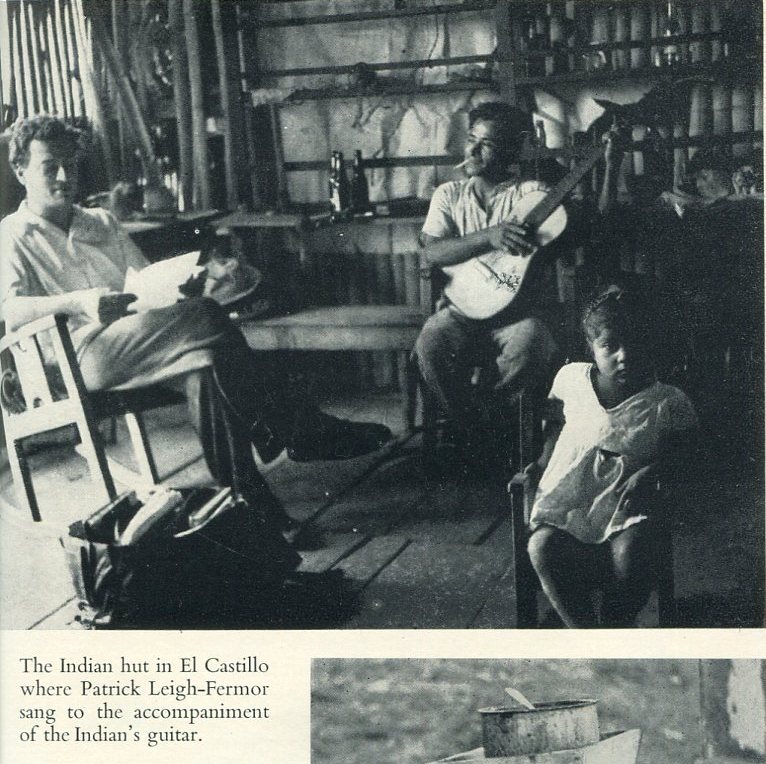
…. an Indian hut in El Castillo (Nicaragua?) where Paddy sang to the accompaniment of an Indian playing his guitar. What on earth did he sing? 

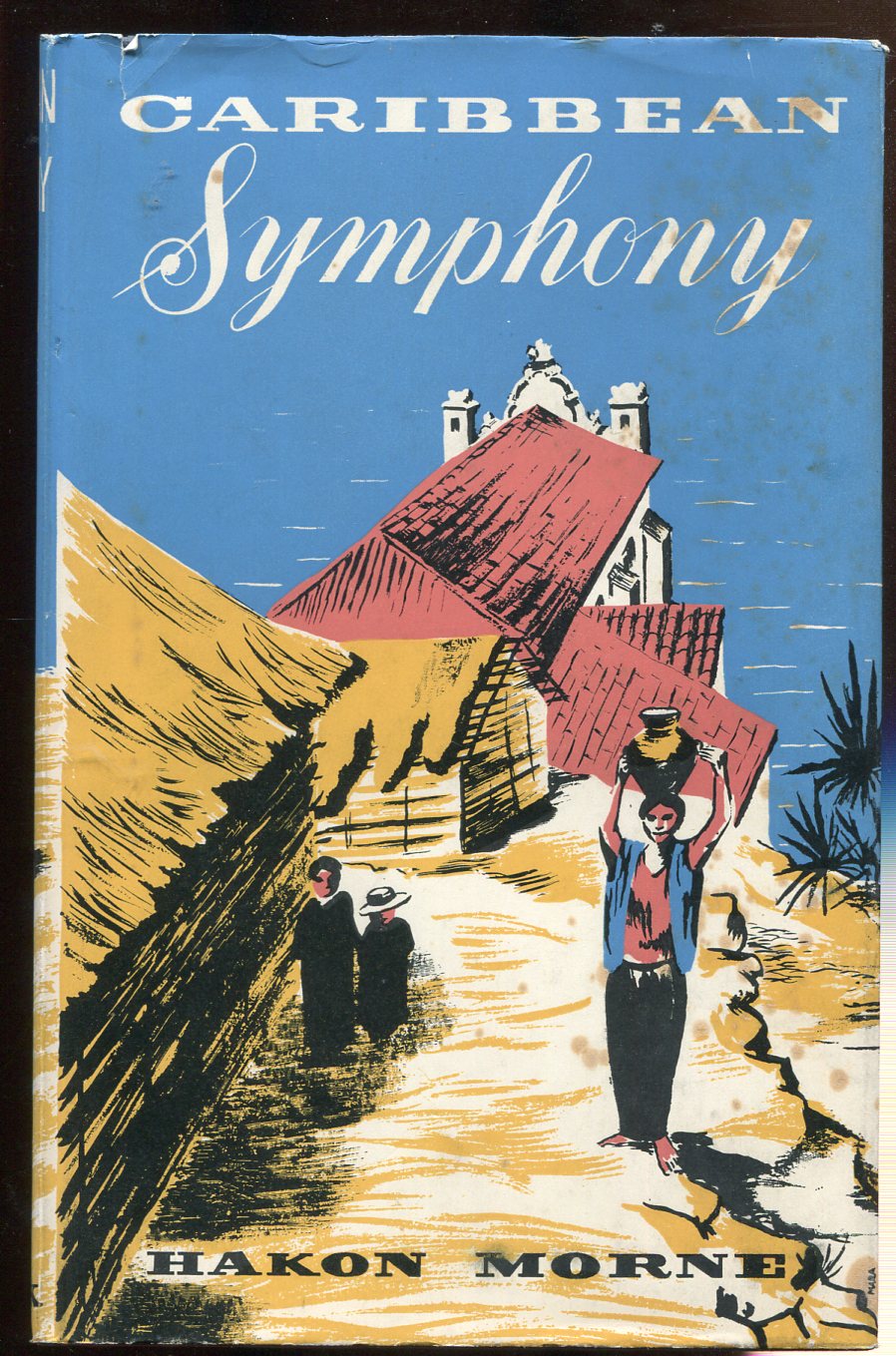
I am grateful to Phyllis Willis for being a better mole than me and finding Hakon Morne’s book translated into English as “Caribbean Symphony”. She has purchased a copy but was clever enough to get a couple of scans whilst she waits for her book to arrive. I am delighted to be able to share these with you now.

A few copies of the book are still available on Amazon.co.uk

After The Traveller’s Tree … what was the next stop?

I have received a very interesting email from Bo Nensén  in Sweden. He recounts a story from the work of the prolific Swedish travel writer  Håkan Mörne, about Joan and Paddy travelling onwards to mainland South America after their travels in the Antilles. I think this is something that we know little about. It raises the question of how do we find out more about this episode in their travels? Take a look at Bo’s message and let’s see if we can find out more together.

[Edit: something this morning reminded me that Paddy once wrote about speaking Greek in South America – was it in Roumeli, Mani or even Three Letters? This may give us a clue. … Further edit – found it: the start of Chapter 3 of Roumeli when in Panama City]

Tom,

Like many others I was also delighted to find your PLF blog. I must have missed it when I made a search for PLF last year but in any case I then noted the existence of “In tearing haste” and ordered it even if I haven’t read it until two months ago when I first learned about his death.

I first discovered PLF when I in a Swedish English language book-club found “Between the Woods and the Water” in early 1988. Soon I ordered “A Time of Gifts” as well. Later in the 90’s I read the books again in correct order. Later I also ordered “Mani” and “Roumeli” but never really got to read them in full. Still earlier I even bought “A Time to Keep Silence” but it remains unread. In the later part of the 90’s I discovered through the Internet “Three Letters from the Andes”. A year before, 1996, when following my son to a shop for second-hand comics when investigating the shelfs for ordinary books I to my surprise found a Swedish translation of “The Traveller’s Tree” from 1954! Price 2:- SEK, i.e. approx. 20 p! This of course only covers the Antilles and as far as I know he has not written anything about the part of the travel through Central America(?)

I had no idea about his visit to the mainland until I happened to read a book by a Finland-Swedish travel writer by the name Håkan Mörne (1900-1961). In one of his books he describes how he on a ship on Lago de Nicaragua meets Joan and Patrick (and Costa) and how they travel together to the Atlantic coast. This part comprises 30-40 pages and there is even a picture of PLF when singing(!) Mexican songs.

Are you aware of this book? I don’t know if anything by Håkan Mörne is translated into English. The version I’ve got is called, in translation, “Volcanoes and Bananas” but there is a previous, somewhat longer edition titled “TheGilded Poverty” (which I’m now about to order from an antiquarian bookshop.

Yours

Bo Nensén, Örnsköldsvik, Sweden

Related category:

The Traveller’s Tree 

My favourite travel book, by the world’s greatest travel writers

Paul Theroux, William Dalrymple, Kari Herbert, Colin Thubron and many more writers tell us about the travel book that most influenced their own life and work. Others that one could say are slightly less well-known, and very pleased to be placed into the pantheon of “world’s greatest travel writers” – Mr Jasper Winn 🙂 – are included.

I was very pleased to see two of Eric Newby’s books chosen; no surprises that they were A Short Walk in the Hindu Kush and my absolute favourite, Love and War in the Apennines.

William Blacker chose all of Paddy’s books, including Between the Woods and the Water. Yesterday he sent me an email pointing out some deficiencies in the way the Guardian had edited his submission – Now, what did he really expact from the Grauniad? – , including the quotation from Kim at the end. William’s original submission can now be revealed in all its full and original glory …

It was not just the books of Patrick Leigh Fermor – notably Between the Woods and the Water about Rumania – which inspired me, but also the man. He was the quintessential free spirit. He didn’t bother with university, but at the age of 18 set off into the blue, on foot, across Europe , simply hoping for the best. His journey lasted five years. On the way he picked up a bewildering multitude of European languages, which led on to extraordinary wartime adventures, and then to a series of breath-taking books, which are peerless, and among the great masterpieces of twentieth century literature. The resounding success he made of his special brand of non-conformity should fill all would-be wanderers and fellow free spirits with hope. Read about his life, read his books, and if you are not similarly inspired and exhilarated by Leigh Fermor’s example then, as Kim said, ‘Run home to your mother’s lap, and be safe’.

William emphasises, for those who might miss it, “that I wrote, very deliberately, ‘great masterpieces of twentieth century literature’ and not  ‘great masterpieces of twentieth century TRAVEL literature’ !”

The list of choices can be found in this article in the Guardian.

The troubled waters of the mind grow still and clear

Paddy in Greece photographed by Joan

Don’t you feel like me that with the passing of Paddy as one of the last of his generation we have clearly entered a new age dominated by uncertainty; a lack of confidence in the values we once held as unquestionably true? These beliefs that bound us (in the West?) together for the latter part of the twentieth century are now unravelling at an ever-increasing pace. As we enter the End Game of the economic crisis, and as the decade of The Forever War rumbles on like the noise of a busy road in the middle distance – there only when we take the trouble to notice – we suffer a dearth of leadership and heroes of substance. Paddy and those of his generation had no such crisis of confidence; they served without question. They sacrificed themselves for the things they believed in, and they provided the leadership, entrepreneurship, creativity, and wisdom that helped rebuild Europe after almost half a century of ethnic and social strife, and destructive war. Maybe they also share some blame for the way things turned out, but who will step up now?

In this considered profile, which prompted my rambling reflection, Paddy’s good friend Colin Thubron assesses his contribution, not as a warrior, but as a writer, and I think for the first time, reveals the torment of Paddy’s troubling writer’s block towards the end of his life.

by Colin Thubron

First published in the New York Review of Books, Volume 58, Number 14

When Patrick Leigh Fermor died in June at the age of ninety-six, it seemed as if an era had come to an end. He was the last of a generation of warrior–travel writers that included the Arabian explorer Wilfred Thesiger, the controversial mystic Laurens van der Post, and the indefatigable Norman Lewis of Naples ‘44. Among these, Leigh Fermor shines with the élan and the effortlessly cultured glow of an apparent golden age. A war hero of polymathic exuberance, brilliant linguistic skills, and an elephantine memory, he was sometimes fancifully compared to Lord Byron or Sir Philip Sydney.

Two pairs of books came to exemplify his achievement. The first pair—Mani (1958) and Roumeli (1966)—celebrated the Greece that held his abiding fascination and where he lived for forty-five years on a once-wild promontory in the Peloponnese. In Mani, especially, he described this backwater region as a world whose way of life had survived in a fierce and enchanted time warp.

The land he depicted is barely recognizable now—tourism, he observed, destroys the object it loves—but it was less the Greece of classical antiquity that beguiled him than the spirit and folk culture of the hinterland: the earthy, demotic Romiosyne that he once contrasted with the Hellenic ideal in a playful balance sheet of the country’s character.

In these, and in later books, the style was the man: robustly imaginative, cultivated without pedantry, unstoppably digressive, forgivably swanky, and filled with infectious learning. The impression—overflowing into elaborate footnotes and flights of learned fantasy—is one of omnivorous delight in the quirks and byways of history, art, language, genealogy, myth, song, superstition, costume, heraldry, and everything else that struck his fancy.

His literary models were Norman Douglas and Robert Byron, but his writing was more vivid than the one, more kindly than the other. Despite the richness of his prose (occasionally slipping into purple) he forged an illusion of intimacy with his readers, as if they were sharing his mind in the moment of writing. But in fact his manuscripts were worked, reworked, and reworked again with such painstaking perfectionism that his publisher (the benign Jock Murray) often had to reset his galley proofs wholesale. The apparently natural flow of words was in reality a densely worked choreography, which came at cost.

Fifteen years ago, swimming in the Ionian Sea beneath his home, where nobody could overhear us, Paddy (as friends and fans called him) suddenly confessed to me the writer’s block that would plague the rest of his life. The expectations of a now-avid public, and his own obsessive perfectionism, were taking their toll, and he could not overleap this cruel impediment.

I remember him strong into old age. He swam every morning, with a sturdy breaststroke far out to sea, the tattoo of a twin-tailed mermaid glistening on his shoulder. He still kept up a striding march in the Taygetus foothills, where he and his wife Joan had designed their own house above the ocean. It was a place of “mad splendor,” he wrote. Its sitting-room library—bookshelves banked nine feet high—opened onto a vista of cypresses and the Messenian Gulf, and was flagged with the greenish stone of Mount Pelion. In the afternoon Paddy would disappear into his study to confront—or escape—the demons of his failed writing, and would emerge to the liberation of ouzo or whiskey, generally to report some arcane piece of research—that the Huns wore stitched field-mouse skins, perhaps—or to share a passage of Ovid. We dined in the monastic half-cloister he had built beside his home, and once we visited the tiny, red-tiled Byzantine chapel where—five years before—he had buried the ashes of Bruce Chatwin.

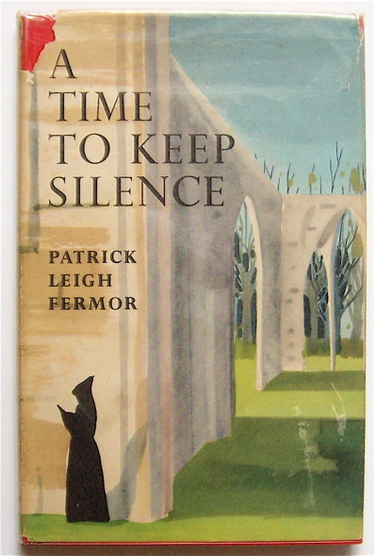
The conflict between a natural gregariousness and the solitude of writing never quite resolved for him. In a short, intriguing study named A Time to Keep Silence (1953) he recorded his sojourn in three great French monasteries. He described this retreat not as a religious exercise, but as a need for a haven for writing, and the nature of its cleansing—”the troubled waters of the mind grow still and clear”—remains suspended like a question mark in the oeuvre of a man to whom self-revelation seemed indulgence.

The second pair of books, which established Paddy’s primacy among travel writers, must be among the most extraordinary ever written. In 1933, as a youth of eighteen, he left England for a journey that would take a year and a half. As “a thousand glistening umbrellas were tilted over a thousand bowler hats in Piccadilly,” he set out to walk to Constantinople (as he nostalgically called Istanbul). Walking stick in hand, a copy of Horace’s Odes in his rucksack, he pursued a meandering course up the Rhine and down the Danube, across the Great Hungarian Plain, into Romania and through the Balkans to Turkey.

It was almost forty-five years before he published the first part of this journey, and another nine years before the second. A Time of Gifts (1977) and Between the Woods and the Water (1986) represent prodigious feats of memory. They record the rite of passage of a precocious, exuberant young man as he encounters the peoples and languages of a Middle Europe now littered with obsolete names: Bohemia, Transylvania, Wallachia. His story must have become the dream journey of every enterprising and footloose adolescent.

Inevitably the accuracy of Paddy’s memory was questioned, and he was frank about occasional imaginative license and conflation. (His first diary was stolen in Munich, a solitary last one recovered years later in Romania.) Certainly his recall was extraordinary. I remember the first time we met (by chance), when he quoted verbatim from my first book passages that I had myself forgotten. A year before his death we chanted verses from the Rubáiyát of Omar Khayyám together in an antiphonal competition (which he won).

His urge to describe his epic journey more than forty years after its end was a deeply natural one. He was revisiting his youthful persona with the judgment and knowledge of maturity; yet in a sense he had remained unchanged. Despite his sophisticated learning, he retained an almost boyish innocence, as if the troubles of the modern age had bypassed him. In the Peloponnese, where he settled to live in the 1960s, he had remained in thrall to a more ancient, rooted culture than that of the urban West.

The final volume of his proposed trilogy—carrying its author through the Balkans and down the Black Sea coast to Turkey—became his tormenting and elusive project for the next quarter- century, and was never completed. Some near-finished version, however, survives him, and will eventually be published.

With his youthful trek done, Leigh Fermor’s career took off into near fable. Caught up in Greek unrest, he joined in a triumphal royalist cavalry charge against wilting Venizelist rebels. In Athens he fell in love with the artist Princess Balasha Cantacuzene, twelve years older than him, and lived with her in Moldavia for over two years, before World War II recalled him to London.

As a fluent Greek speaker he was recruited by the Intelligence Corps, and sent as a liaison officer with the Greek army first to Albania and finally to Crete, where he survived the brutal German invasion. For almost two years, while an officer in the Special Operations Executive, he lived disguised as a shepherd in the Cretan mountains, organizing the gathering of intelligence.

Then, in 1944, occurred the exploit that—more than any other—was to burnish him into legend. He and his fellow SOE officer Stanley Moss dreamed up a scheme of harebrained bravado. Dressed in stolen German uniforms, with a party of Cretan guerrillas, they ambushed the car of General Heinrich Kreipe, the German commander of occupied Crete, kidnapped him, and concealed him under the back seat. Moss took the wheel, Paddy donned the general’s cap, and together they drove through twenty-two checkpoints to emerge on the far side of Herakleion and march Kreipe for three weeks over the mountains, to be picked up by motor launch and taken to Egypt.

It was during this hazardous Cretan march, as the dawn broke over Mount Ida, mythical birthplace of Zeus, that the abducted general began to murmur a verse of Horace: Vides ut alta stet nive candidum/Soracte….1 It was an ode that Paddy knew by heart, and he completed the six stanzas to their end. “The general’s blue eyes had swivelled away from the mountain-top to mine,” Paddy later wrote,

—and when I’d finished, after a long silence, he said: “Ach so, Herr Major!” It was very strange. As though, for a long moment, the war had ceased to exist. We had both drunk at the same fountains long before; and things were different between us for the rest of our time together.

This precocious kidnapping was later reimagined in a lackluster movie named Ill Met by Moonlight (1957) with Dirk Bogarde playing Paddy. But there were other exploits too. Paddy had already engineered the defection of the Italian General Angelico Carta from Crete; and he was due to undertake a near-suicidal mission to Colditz when the war ended.

His upbeat account of these events was tempered by regret. He had planned that the abduction of Kreipe be bloodless, but his accompanying Cretan partisans slit the chauffeur’s throat, and rumors of grim German reprisals for the abduction have never quite died down. Above all, Paddy’s accidental shooting of one of his fellow guerrillas may have stained his memory of the whole period.

On June 16 Leigh Fermor was buried back in the English countryside, attended by an Intelligence Corps guard of honor, to lie beside his wife Joan, his dear comrade since 1946. This was, in a sense, fitting. For in certain ways he was exemplary of a wartime Englishness now almost gone, whose more dashing qualities merged seamlessly into the hardy stylishness of Greek leventéa.

To those who knew him, his books are hauntingly redolent of his sensibility. His conversation was irrepressibly warm and inventive far into old age, moving from arcane anecdotes to fanciful wordplay or bursting into polyglot song (sometimes singing the lyrics backward). His friends ranged from Deborah, Duchess of Devonshire—last of the six legendary Mitford sisters (his correspondence with her was published in 20082)—to early acquaintance with a raffish interwar bohemia and his own great predecessor, the travel writer and aesthete Robert Byron, whose borrowed rucksack he bore across Central Europe as a youth.

Almost the last time I met Paddy, he had returned home after an operation for suspected cancer, and I feared he would be depleted, his old zest gone. He was growing deaf, and he suffered from tunnel vision (which he called Simplonitis). For a while, sitting over lunch, he seemed subdued. Then something struck him. He perked up, and said: “You know, there is an apple lying on a table in the hall. It’s been there all weekend. Wouldn’t it be marvelous if it cocked a snook at Newton, and simply took off into the air!”

This was typical of his boyish resilience. In the field of travel he evoked both the youthful wanderer who discovers another world and the avid scholar who melds with it. His prose was too rich and elaborate to be a safe influence on others (although a few have tried); but he brought to the genre not only the distinction of his densely brilliant books, but his innate dignity, ebullient mind, and capacious heart.

  1. 1″See Mount Soracte white with snow….”
  2. 2The correspondence, In Tearing Haste , edited by Charlotte Mosley, was published in the US by New York Review Books (2010), which has also republished the other books by Patrick Leigh Fermor mentioned in this article, as well as The Traveller’s Tree .

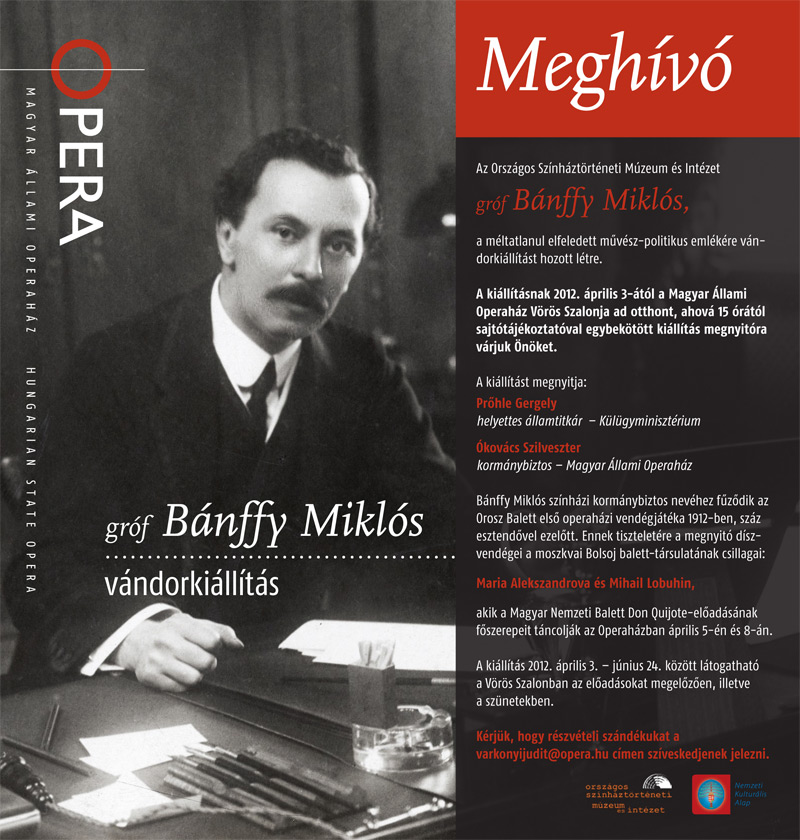
A long stillness scooped out of the very heart of the sound

On this tenth anniversary of 9/11.

by Patrick Leigh Fermor

Conventual High Mass was at ten every morning, immediately after Tierce. The beginning of this office was austere enough: the same silent entry of the monks, the same taking up of positions in the stalls that I had seen the first day at Vespers. At a tap from the Abbot, the monks stooped almost double in silent prayer, their rows of tonsures appearing for a minute on either side of the aisle like tiers of discs.(Their heads were shaved once a fortnight. One day their scalps were as blue as burglars’ jowls; the next freshly pollarded and gleaming in their circles of hair.) All the canonical hours began in the same way: ‘Deus in adjutorium’, the hebdomadary monk’s voice sang on one note, ‘intende.’ ‘Domine’, the rest intoned in unison, ‘ad adjuvandum me festina.’ A hymn followed, one of those short poems with four-line verses in the Latin of the early church, sung to an unseizable little tune. Then, sitting back in their stalls, the monks chanted the morning psalms in antiphony, the Gregorian music booming from opposite sides of the chapel as each verse of St Jerome’s Latin succeeded its forerunner. Tierce ended, the officiating monk entered in his vestements, and the deacon and sub-deacon, the acolytes and torch-bearers. They genuflected together, and the Mass began. Every moment the ceremony gained in splendour. If it was the feast of a great saint, the enthroned abbot was arrayed by the myrmidons in the pontificalia. A gold mitre was placed on his head, and the gloved hand that held the crosier was jewelled at the point of the stigmata and on the third finger the great ring sparkled over the fabric. The thurifer approached the celebrant and a column of incense climbed into the air, growing and spreading like an elm-tree of smoke across the shafts of sunlight. The chanting became steadily more complex, led by a choir of monks who stood in the middle of the aisle, their voices limning chants that the black Gregorian block-notes, with their comet-like tails and Moorish-looking arabesques, wove and rewove across the threads of the antique four-line clef on the pages of their graduals. Then, with a quiet solemnity, the monks streamed into the cloister in the wake of a jewelled cross. Slowly they proceeded through the cylinders of gold into which the Gothic tracery cut the sunlight. Their footfalls made no noise and only the ring of the crosier’s butt on the flags and the clanging of the censer could be heard across the Greogorian. The procession reached the shadow-side, pausing a few minutes while the sixty voices sailed out over the tree-tops; and then back through the church door, where arcs and parentheses of smoke from the burning gums, after the sunlit quadrangle, deepened the vaulted shadows. The antiphonal singing from the stalls continued to build its invisible architecture of music: a scaffolding that sent columns of plainsong soaring upwards, to be completed by an anthem from the choir that roofed it like a canopy. The anthem was followed by a long stillness which seemed to be scooped out of the very heart of the sound. After long minutes, a small bell rang and then the great bell from the tower which told of the rites that were being celebrated and the mysterious events taking place; and the heads of the monks fell as if one blow had scythed them away. Next, an unwinding, a decrescendo. The Mass sang itself out, the kiss of peace passed like a whispered message down the stalls, the officiating court dispersed, and the vestements were removed. A monk extinguishing the candles, the hood went up, the Abbot intoned the opening verse of Sext and still on the same note, the response came booming back …

[Note: there are no paragraph breaks as that is how Paddy wrote this piece; 628 words and he really does not want to finish there! Paddy is writing about the Abbey of St Wandrille]

Excerpted from A Time To Keep Silence by Patrick Leigh Fermor Copyright 1957, 1982 by Patrick Leigh Fermor

The Traveller’s Tree: A Journey Through the Caribbean Islands

Before he was a writer, Patrick Leigh Fermor was merely a war hero, having earned his first fame from deep-cover exploits with the Greek Resistance. During World War II he hid in the rugged mountains of Crete, leading cat-and-mouse strikes against the German occupiers—experience that surely served him well a couple years later when, as he describes in his account of postwar travels in the Caribbean, The Traveller’s Tree, he ventured once again into hostile territory: the Dunghill in Kingston, Jamaica. This rickety slum, the “refuge of all the robbers and footpads and murderers of Jamaica,” was also the stronghold of the “passionately anti-white” Rastafari. Despite being warned that even police officers and black Jamaicans scarcely dared enter their compound, he strolls in with only feigned ignorance for armor. “I was just going for a walk,” he explains when accosted. “What are the Rastafari?”

by Timothy Farrington

First published in Book Forum

Before long, the droopy-lidded devotees of Jah are not only answering his question in detail but also “hospitably” rolling him a joint “unwieldy as an ice-cream cone.” Here already in Leigh Fermor’s first book, originally published in 1950, is the winning mix of nerve, curiosity, and cheer, so charming to readers and other cultists, that marks his two-part masterpiece, A Time of Gifts (1977) and Between the Woods and the Water (1986), an account of a rather longer walk, from Holland to Turkey. But unlike those volumes, The Traveller’s Tree, which skips along the Antillean island chain from Trinidad to Cuba, was written within only a year or two of the trip it records. Leigh Fermor’s European trek, on the other hand, had four decades to mellow and ramify in memory before he wrote about it. For all its remarkable vivacity, that later work doesn’t preserve the sort of small irritations that give some passages here a cranky (and often very funny) edge, complementing his usual lyricism. He notes that “hotel cooking in [Trinidad] is so appalling that a stretcher may profitably be ordered at the same time as dinner,” complains of the “thuggish vegetation” that blankets the southerly islands, and, on realizing that he has been the victim of a friendly prank, emits a “H’m” of pique.

The pranksters are three black waitresses—not a coincidence in a book that unavoidably centers on racial tension. Leigh Fermor revels in genealogy and loves explaining why who ended up where, historically speaking; elsewhere, he focuses on the “ethnological rock-pools of Europe,” peripheral groups whose racial history, rightly or wrongly, often feels slightly academic. But here, in presenting a “report on the birth pangs of our postwar world,” as Joshua Jelly-Schapiro puts it in his introduction, Leigh Fermor confronts again and again the raw wounds of incipient decolonization. A chance meeting with a Guadeloupean woman sets the tone: “You’re white and we’re black,” she shouts. “What of it?”

He worries at that question throughout with an open-mindedness unusual for his class and era (notwithstanding the use of terms, such as childish and primitive, that have long since been struck from the anthropological lexicon). He doesn’t just condemn segregation, he seems actually to feed on cultural miscegenation. The “blood-curdling gentility” of white Barbados looks all the more pathetic when juxtaposed with his portrait of “startlingly cosmopolitan” and “fantastically carefree” Trinidad—itself a mere appetizer compared with his thirty-eight-page treatment of Haitian voodoo (a certain slackness of narrative is one of the flaws he had yet to iron out). It supplements diligent fieldwork—he counts seventy distinct voodoo spirits—with library digging, Leigh Fermor being a man so book-drunk that he compares the delicate task of harvesting hearts of palm to the “handling of a codex.” In fact, he seems to stop at every library and graveyard in the islands, grateful for these rare outcroppings of history in the “recent world of the Antilles.”

Some people travel to blot home, or the past, from their minds. Not Leigh Fermor, who always keeps one compass leg fixed in his intellectual home—literary Europe. The book closes with words from his seatmate on the return trip, an emigrant Greek, and opens by describing his trip as an Odyssey. Sixty years and seven books later, that almost seems like an understatement. After all, Odysseus left home only once.

The magnetic John Pendlebury

Archaeology’s first modern hero was dazzling in life and heroically defiant in death. Paddy wrote the foreward to the 2007 book – The Rash Adventurer: A Life of John Pendlebury by Imogen Grundon.

J. D. S. Pendlebury, excavator of Amarna, Curator at Knossos, he of the glass eye and the swordstick, who died defending Crete from German invasion in 1941, is archaeology’s first modern hero: brilliant, magnetic and self-aware. In The Rash Adventurer, Imogen Grundon gives us the substance behind his dazzling brief career. John Pendlebury evidently possessed an extraordinary determination to overcome obstacles, demonstrated after he had lost an eye as the result of a childhood accident. In spite of this handicap, his Cambridge years included a blue in athletics and a first class in the tripos. Grundon reveals his early interests in archaeology, and the enormous workload he undertook soon after leaving university. His career included excavation both at Akhenaten’s capital of Amarna and at Sir Arthur Evans’s site at Knossos, as Pendlebury moved from one to the other with the seasons of work. By the age of twenty-five he occupied a unique position in Mediterranean archaeology, holding simultaneously the posts of Curator at Knossos and Director of Excavations at Tell el-Amarna.

by Jane Jakeman

First published in the Times Literary Supplement, 17 October 2007.

The relationship between Egypt and Crete was of particular interest to him, and his Aegyptiaca: A catalogue of Egyptian objects in the Aegean area is still an important resource. At Amarna, the historical background was still very unclear when Pendlebury became Director in 1930, and he was able to extract a possible chronology and a history of that remarkable city. There was a wide gulf between Bronze Age archaeologists and Egyptologists, and Pendlebury had to endure much criticism in Egyptological circles, particularly over his theories concerning the invasion of Egypt by the “sea peoples”, whose leadership he ascribed to Agamemnon. It was not uncommon at the time to look for relationships between mythology and archaeology, but this approach evidently appealed to Pendlebury’s love of Homeric story. It was also a romantic perspective, and from it he viewed his beloved modern Cretans, sometimes presiding over dinner wearing a Cretan cloak and striding through the mountains to meet kapetanoi, the old brigand leaders.

He clearly relished his swashbuckling self-image, but Grundon shows him capable too of subtle and complex achievements. At Knossos, he skilfully negotiated a difficult relationship with Evans, whose colourful reconstructions Pendlebury sometimes disagreed with, in spite of his own imaginative streak. He was in fact working in a new archaeological era: the age of the great individual “dig” patrons was passing, in favour of a more modern system where the locals were no longer regarded as mere workmen, and foreign governments were recognized as significant entities. Pendlebury showed himself well able to manage this transition and he was realistic in matters of archaeological politics and finance, very aware of the importance of finding subscribers to the Egypt Exploration Society, and new sources of funding. Grundon is good on the complications of organizational funding and personalities, academic intrigues and quarrels.

At the outbreak of the Second World War, Pendlebury returned to Britain, enlisted in Military Intelligence and was drafted into Military Intelligence (Research). He went back to Crete in 1940 as a British Army captain, in order to organize resistance to invasion in the mountain regions. He was “adopted”, to use Grundon’s appropriate word, by the highly secretive “D” section of MI6, whose task was to train agents, conceal supplies for sabotage, and handle anti-German propaganda. There is no doubt that he loved the atmosphere of mystery and intrigue, as also the adventure of rallying his kapetanoi.

Pendlebury’s part in the Battle for Crete was, however, tragically short-lived: in 1941, he was wounded, then captured, propped up against a wall and shot. Again, Grundon has followed these events very carefully, presenting as much evidence as can now be garnered – although her wider picture of the background to the invasion of Crete is too kind to General Bernard Freyberg, the New Zealander in command of Allied forces on Crete. Antony Beevor’s Crete: The Battle and the Resistance brings out clearly the later Lord Freyberg’s disastrous support for seaborne invasion, and the obstinate misinterpretation of “Ultra” intelligence, which contributed to the loss of the island to the Germans. The downfall of Crete was horribly unnecessary. So was Pendlebury’s death, a tragic waste, except perhaps that his premature decease itself took on an iconic quality. His image has remained unencumbered by the aura of his snobbish wife and untarnished by entanglement in post-war politics.

The Rash Adventurer is a thorough and authoritative biography, based on detailed research, which gives us at every point the facts underpinning the myth of the man. As well as reaching deep in archives and libraries, Imogen Grundon seems to have interviewed almost every survivor in the field. There is one story she omits, however, perhaps because none of her elderly interlocutors cared to repeat it – the story passed down among Egyptologists, that, as he faced the firing squad, John Pendlebury’s last words were “Fuck you!”.

Rare video of Pendlebury excavating in Egypt as well as showing off his athletic prowess.

Audible

Greeks in Hungary: A history in two acts

I thought this would be of general interest. I don’t recall Paddy encountering any Greeks in Hungary but he did come across Greek fishermen from the Greek diaspora when walking along the Bulgarian Black Sea coast in late 1934. That encounter was related in Words of Mercury and includes the Mystery of the Black Sea Cave.

by Alexander Billinnis

First published in The Hellenic Voice, 22 June 2011.

The Greek presence in Hungary is one of the oldest in Greece’s modern diaspora. It is, further, one of the most interesting, because as a tragic accident of war and politics, it received a new lease on life, a second chapter of sorts. The Greeks’ odyssey in Hungary is a tale of two diasporas and the efforts of current Greeks to unite the two acts into a common play.

Act I: The First Diaspora

After swallowing up the Balkans, the Turks shattered the Hungarian army at the Battle of Mohacs, and the Turks controlled most of Hungary, and up to the gates of Vienna in Austria, for more than 150 years. On the heels of the Turks’ second, failed siege of Vienna in 1683, the Austrians, at the head of a multinational European force, began the taskof evicting the Turks from Central Europe. When the guns fell silent, in 1717, the Austrians and Hungarians needed to rebuild their realm devastated by war, and many Ottoman Christians, primarilySerbs but also Greeks and Vlachs, responded eagerly.

Greek merchants quickly established themselves in major Hungarian cities, such as Buda, Pest, Szentendre, Miskolc and Tokaj. They were heavilyinvolved in the overland trade with the Ottoman Empire, but they also worked as agriculturalists and vintners. There is some evidence that winemakers from Macedonia first cultivated Hungary’s prized Tokaj wine. The Greek merchants were heavily involved in the coffee trade, and some of the oldest Budapest coffeehouses have Greek origins. As an avid coffee drinker, this makes me particularly proud.

The Greeks’ natural appetite for commerce, their large commercial network in the Ottoman Empire and their growing colonies throughout the Austrian (later Austro-Hungarian Empire) brought a great deal of wealth to the small but financially and politically powerful community. The Greek community supported schools, charitable institutions and of course church organizations. Initially the Greek students studied at the Serbian school, but by 1785 they established their own, which operated continuously until 1900. The Greeks and Vlachs established a church community separate from other Orthodox nationalities (though still subject to the Serbian Patriarchate), and their cathedral, built in 1809, continues (as the Hungarian Orthodox Church) to serve a largely Hungarian Orthodox community, often Balkan in origin. Other Greek Orthodox churches grace several Hungarian cities, including Tokaj, Eger and Miskolc.

The Greeks’ very success fostered an increasing assimilation. Greeks left the merchant class, became naturalized Hungarians, and in some cases nobility. Events in Hungary followed a similar pattern to those in Vienna and other key Austrian commercial centers. Lacking the critical mass of population that the Serbs had in southern Hungary (which later became the Serbian province of Vojvodina, where my family and I currently live), the Greeks became Hungarians, though some did keep the Orthodox religion of their ancestors, and vestiges of their culture.

Act II: The Second Diaspora

Just as the First Greek Hungarian diaspora faded into assimilation and history, events in Greece stirred up another wave of Greeks into Hungary. Many of these immigrants came from the same mountains as the first diaspora, but they were not merchants, but refugees – guerillas, villagers and intellectuals of the communist movement in the Greek Civil War. Many were children, many came involuntarily. Their connections with Greece were severed by the hard frontiers of the Cold War, but they did not forget Greece or their traditions.

In the “Greek” village of Beloiannisz (Beloyiannis), which I visited, or in small communities in Budapest, Miskolc, Pecs and Kesckemet, the Greeks kept their language and culture alive. In the communist period the Church played little role as a guardian of faith and identity, in contrast with the first Greek diaspora in Hungary, or Greek diasporas in the Americas or Australia. In the post-communist era, the role of the Church has reemerged.

Other virtues we associate with the diaspora, hard work and study, also marked this post Civil War diaspora. Greeks excelled in academia and professions well out of proportion to the small size of their community. All of the Greeks I met, including the second generation born in Hungary, spoke Greek with a precise fluency.

A fair percentage of the Greek Hungarian community repatriated to Greece, particularly in the 1980s, but the community by that time was quite well established in Hungary. The Hungarian government recognized Greeks as a distinct minority and cofunded cultural and educational activities. This support enables a diverse educational and cultural agenda, including an elementary school, weekly cultural performances and a growing literature about the community. When I arrived at the cultural center, I was welcomed as a fellow diaspora Greek, and loaded down with books on the community.

Closure

I spent an hour talking to Professor Nikosz Fokasz (Nikos Fokas), an eminent Hungarian sociologist and one of the Greek community’s leading intellectuals. Son of a Paris-educated Cephalonian architect and a mother from a village in Evritania, Professor Fokas is an urbane academic at home in university circles throughout Europe and North America. He considers thispostwar Diaspora to be the keepers and the descendents of the first diaspora. After all, both generally descended from the same Macedonian and Epirote mountains, a “diaspora of the Mountains,” as he calls it. Many Hungarians are now rediscovering their Greek roots, with the active help of this newer Greek diaspora.

Professor Fokas noted, with a particular pride, that Baron Simon Sina, a Greek Hungarian, financed Budapest’s most iconic Danube bridge, Lanc Hid (Chain Bridge), as well as a large part of the Hungarian Academy of Sciences, another signature Budapest building. Honoring him, Greek Hungarians have been instrumental in establishing the “Sina Award,” bestowed upon a member of the Hungarian business community for outstanding support of the arts and sciences. Fostering awareness of Hungary’s Greek and Orthodox elements in its history has been a key contribution of this new diaspora, and in so doing, it has honored, and in some cases, literally resurrected, the first diaspora.

As always when I travel among diaspora Greeks, I felt a common bond with the Greek Hungarians in spite of our very different histories. There was that love of Greece, somehow less jaded, than that of Greeks in Greece. There is also a very clear consciousness among Greeks in Hungary that the history of Hellenism and Orthodoxy is a long one in their country, and that custody of this tradition is an important role, which they assume with pride. It is a pertinent lesson for our community in America.

Alexander Billinis is a Greek American writer living in Serbia. He previously worked in international banking in the US, Britain and Greece. His book, “The Eagle has Two Faces: Journeys through Byzantine Europe,” will be released later this year. 

Related articles:

On the Pontic shores where the snowflakes fall

The mystery of The Black Sea Cave

Gone for a walk in Greece

“YOU had better look out if you are going up to Anavriti.” The familiar words sound wonderful when spoken aloud in this cavernous, haunted and as yet sunless gorge. I repeat them, savouring their powerful energy.

Suddenly, I picture the streets of “roasting Sparta” and the Greek barber who, encouraged by his colourful customers, issued the warning as he clipped the dusty hair of a man now regarded as one of the world’s finest travel writers.

The barber’s words subsequently provided the opening salvo of what many believe is the best book in English about Greece.

by Ian Robert Smith

First published in The Australian 30 July 2011

Published in 1958, Patrick Leigh Fermor’s Mani: Travels in the Southern Peloponnese is a dense, erudite and hugely entertaining account of the author’s peregrinations in a region that, at the time, was remote, untamed and singularly archaic. Mani is also, more broadly, an affectionate portrait of a rural Greece where centuries-old customs were fast disappearing — “hammered to powder . . . between the butt of a Coca-Cola bottle and the Iron Curtain” — and for which today’s traveller hunts in vain.

I, too, am going up to Anavriti. And like Leigh Fermor when he came this way with his partner (later wife) Joan in the mid-1950s, I intend to use the village, perched on a spur of the Taygetos range, as a stepping stone into the Mani.

A battered copy of Leigh Fermor’s book resides in the top flap of my rucksack, both talisman and inspiration. Handily within reach in the side pocket is the Anavasi map of the region. Its bundled contours, crossed by the black-dotted lines of footpaths, reflect the momentous regions that await overhead.

Rich in myth and history, the Taygetos dominates the Spartan plain over which it looms like an impenetrable barrier. The northern foothills rise in the wilds of Arcadia. They shoot upwards into a vast, serrated ridge that culminates in the peak of Mt Profitis Ilias — at 2407m, the highest point in the Peloponnese — before dropping away through the Mani Peninsula.

Foothills clad in oak, hornbeam and black pine and daubed with villages buttress the eastern slopes. But the west is wild. Ancient gorges provide means of egress into this planetary world.

Some say this gorge is where the ancient Spartans left unwanted children to die. The rumble of plunging water resounds along its length.

In a large cave, a frescoed chapel, painted ox-blood red, crouches among icons and vases of the white Madonna lilies that grow wild on the slopes. Climbing further, past a sudden and terrifying drop, a curious sound wafts towards me; incoherent initially, it develops into an ethereal chanting that, echoing off the cliffs, sounds strange and beautiful in this wilderness. Bewilderment turns to rapt appreciation as I recognise the monks at Faneromeni Monastery, high above, conducting a Sunday morning service.

Beyond the monastery and a couple of antique threshing floors, Anavriti appears. Dwarfed by the glittering and snow-streaked Taygetos, several belfries and a cluster of stone houses adorn a hillside plumed with walnut, plane and cherry trees.

Not so long ago Anavriti had a thriving tanning and leather-goods industry and a population of several thousand. Nowadays, like most mountain villages in Greece, it is barely inhabited.

I amble along the main street, seeking wide balconies reached “by boxed-in staircases on wooden stilts”. In one such edifice, Leigh Fermor and Joan spent the night. Something similar faces a solitary taverna. Light-headed at finding myself in Anavriti at last, I lunch on spaghetti with rooster and abundant rose wine and, as a jovial crowd materialises, observe clouds thickening around the mountaintops. The taverna owner shrugs when I inquire what they portend, then asks, unhelpfully, whether I have a raincoat, before advising: “Go towards the good.”

This I attempt, only to become drenched, then unpleasantly steamed when the sun reappears, conjuring wondrous aromas from the glistening earth. The experience is chastening and, toiling upwards through fir forest, I conclude that following in the footsteps of literary legends can be tricky. Writing in Mani, Leigh Fermor gives fair warning.

“Feet became cannonballs,” he recounts, “loads turned to lead, hearts pounded, hands slipped on the handles of sticks and rivers of sweat streamed over burning faces and trickled into our mouths like brine.” I arrive, similarly challenged, at the author’s “unattractively alpine wall of mineral”.

It is the flank of Spanakaki Peak and also a crossroads. Intent on the Mani, Leigh Fermor bypassed Profitis Ilias and headed off to the right. Determined to tackle the summit, I veer left, up over a spur with a derelict sheepfold and across a meadow that, as thunder rumbles and rain buckets down, tilts vertically to the watershed. I reach this, hand-over-foot, but discover the view of the Messenian Gulf beyond obscured by thick mist breaking over the ridge.

Visibility shrinks to nothing as I’m engulfed, precipitating a tedious descent, followed by a forced march to the EOS refuge, where I meet a group from Athens who provide food, wine and spirited conversation. Occasionally the talk turns to Greece’s economic troubles and, predictably, as these are young people from the capital, nearly everyone has a sobering tale. They are related simply, without rancour and often with humour; but beneath the levity, disappointment and uncertainty are palpable.

The evening proves unexpectedly affecting and our farewells the next day, when I renew my assault on the summit, are heartfelt. I ascend through meadows thick with ferns, thyme and wildflowers, which give way to barren, stratified limestone, before an opening leads over the watershed. It might well be a door into another world.

Jagged pinnacles roll away to the north. Westward, rumpled slopes sundered by ravines plunge to the shores of the Messenian gulf. Silence reigns. Nothing moves except the clouds rolling across the peaks. I climb through them, tentatively over scree, on to a desolate platform scattered with stone huts and a roofless chapel dedicated to the prophet Elijah and crammed with icons, melted candles and votive offerings left by midsummer devotees.

The moment evokes a heady elation, tempered by disbelief that I am here, alone, atop the Peloponnese. Finally the sight of Kardamyli, fathoms below, reminds me it is time to catch up with Leigh Fermor. A headlong descent begins. Nightfall finds me in the Viros gorge. It is the ancient route to the coast: a massive, 14km-long canyon enclosed by fir-tufted cliffs and paved with boulders worn smooth by winter torrents, and not particularly restful.

Escaping next morning to Exochori, I locate a small chapel with a battered turret astride cicada-haunted olive terraces looking out to sea. In this lovely place, appropriate for a man who wrote so beautifully, the ashes of author Bruce Chatwin are scattered. I pause to pay my respects.

Kardamyli appears, its blond towers jutting above the sea. A cobbled path curls below the ancient acropolis. Nearby, adjacent to the reputed tombs of Castor and Pollux, I fall into conversation with a friendly English couple. Inevitably the name of Leigh Fermor comes up. We are speaking of the blood feuds in Mani when the woman says abruptly: “We’ve heard the funeral is on Thursday.”

Seeing my uncomprehending look, she adds, “You didn’t know? Paddy died last week.”

It was the day before I set out, ostensibly in his footsteps. The news fills me with sadness coupled with bewilderment at the workings of providence. I enter Kardamyli in a valedictory mood, passing through an arched gateway into a dusty square flanked by byzantine towers and a church.

In Mani, Leigh Fermor writes that Kardamyli was “unlike any village I had seen in Greece”. He and Joan loved it so much that they returned several years later and built a house in an olive grove.

Kardamyli remains laid-back and relatively unspoilt, with a long pebble beach, pretty stone houses, a small fishing harbour and friendly people. It is popular with trekkers who tackle the hinterland trails. But my walking days are over for now and my stay is marked by restlessness and an odd nostalgia. Each morning I swim to the wooded islet with the fortified wall and ruined chapel, a few hundred metres offshore. I scribble in cafes, drink with other travellers and dine out every night, once at Lelas, the waterfront taverna owned by the woman who was Leigh Fermor’s original housekeeper. Everyone, it seems, has a Paddy story to tell.

One morning, a strange impulse takes me. Just outside town, a path leaves the road and winds downhill through olive groves throbbing with cicadas. It continues, away from recent development higher up the slope, into a wilderness of trees and yellow grain fields where I pass a whitewashed chapel and, just beyond, a long stone wall, above which a mottled tile roof protrudes. Finally I come to a beach.

It lies just over the rocks, a hermetic cove enfolded by cliffs. A shiver sweeps through me when I realise: this is the place. Pushing through a wooden gate marked Private, I climb a stone staircase that zigzags up to a sprawling garden. Olive trees bestride ancient terraces.

The aromas of rosemary and cypress mingle in the hot, pulsating air. Paths of pebble mosaic thread between judiciously placed tables and benches of slate and a rambling house, built of golden stone, empty now, yet with the accumulations of a long and abundant life in place. An air of recent abandonment prevails. Leigh Fermor died in England.

Standing on the clifftop, beside one of those tables where so many delightful moments must have unfolded, I gaze out past the island to the distant peninsula, a smudge on the horizon. An age passes before I tear myself away.

Patrick Leigh Fermor’s Mani: Travels in the Southern Peloponnese was first published in 1958. The acclaimed war hero and travel writer died on June 10, aged 96.

An excerpt from A Time To Keep Silence by Patrick Leigh Fermor

With curiosity and misgiving I walked up hill from the Rouen-Yvetot road towards the Abbey of St. Wandrille. I had spent an abominable night in Rouen in a small hotel near the station where a procession of nightmares had been punctuated by the noise of trains arriving and leaving with a crashing and whistling and an escape of steam and smoke which, after a week’s noctambulism in Paris, turned my night into a period of acute and apparently interminable agony. Even the misty windings of the lower Seine, the fat green fields and Indian files of poplars, among which the bus had travelled next morning, could not dispel my mood of sluggishness and depression; and now, climbing the hot road through the late summer woods, I wondered if my project had not better be abandoned.

By Patrick Leigh Fermor

Use the Print Friendly facility. Print Friendly and PDF

… What I dreaded almost more than success was an immediate failure. If there was no room at the Abbey, or if for some other reason the monks could not receive me, I should have to return to Paris and readjust my plans for the next few weeks. I was arriving unknown and unannounced, a citizen of the heretic island across the Channel, without even the excuse that I wished to go into retreat; I was, in fact, in search of somewhere quiet and cheap to stay while I continued to work on a book that I was writing. A friend in Paris had told me that St. Wandrille was one of the oldest and most beautiful Benedictine Abbeys in France; and I had made my plans and set out . . .

It was Sunday, and the gatehouse was full of visitors who, just emerged from Mass, were buying pictures, medals, rosaries and assorted bondieuserie. A harassed monk in horn-rimmed glasses was answering innumerable questions; and a quarter of an hour had gone by before I managed, with considerable trepidation, to explain my proposal. He listened sympathetically, and asked me to return after he had spoken to the Abbot. When at last his black-robed figure reappeared across the garden, I saw that he was smiling. Seizing my heavy bag, “The most reverend Father Abbot can receive you,” he announced, “and wishes you welcome.”

A few moments later a door had shut out the noise of the Sunday visitors and a silent maze of white staircases and passages swallowed us up. The monk opened a door and said, “Here is your cell.” It was a high seventeenth-century room with a comfortable bed, a prie-dieu, a writing-table, a tapestry chair, a green adjustable reading-lamp, and a rather disturbing crucifix on the whitewashed stone walls. The window looked out over a grassy courtyard, in which a small fountain played, over the grey flank of the monastery buildings and the wall that screened the Abbey from the half-timbered houses of the village. A vista of forest flowed away beyond. In the middle of the writing table stood a large inkwell, a tray full of pens and a pad into which new blotting paper had just been fitted. I had only time to unpack my clothes and papers and books before a great bell began ringing and the monk, who was the guest-master, returned to lead me to the refectory for the midday meal. As we walked, the buildings changed in period from the architecture of the eighteenth and seventeenth centuries to Gothic; and we halted at length by the piscina in an ogival cloister of the utmost beauty, outside a great carved door where several other visitors had also been assembled. The guest-master shepherded us into the refectory in which the Abbot, a tall, white-haired, patrician figure with a black skull-cap and a gold pectoral cross on a green cord, was waiting to receive us. To each of the guests he spoke a few words; and some, sinking upon one knee, kissed the great emerald on his right hand. To me he addressed a polite formula in English that had obviously been acquired at some remote period from a governess. A novice advanced with a silver ewer and a basin; the Abbot poured a little water over our hands, a towel was offered, and our welcome, according to Benedictine custom, was complete.

The singing of grace continued for several minutes; and, when we sat down, I found myself between two visiting priests, their birettas folded flat beside their plates on the long guest-table in the middle of the refectory, just below the Abbot’s dais. Down the walls of this immense hall the tables of the monks were ranged in two unbroken lines, and behind them a row of Romanesque pilasters with interlocking Norman arches formed a shallow arcade. The place had an aura of immense antiquity. Grey stone walls soared to a Gothic timber roof, and, above the Abbot’s table, a giant crucifix was suspended. As the monks tucked their napkins into their collars with a simultaneous and uniform gesture, an unearthly voice began to speak in Latin from the shadows overhead and, peering towards it, I caught sight, at the far end of the refectory, of a pillared bay twenty feet up which projected like a martin’s nest, accessible only by some hidden stairway. This hanging pulpit framed the head and shoulders of a monk, reading from a desk by the light of a lamp which hollowed a glowing alcove out of the penumbra. Loudspeakers relayed his sing-song voice. Meanwhile, the guest-master and a host of aproned monks waited at the tables, putting tureens of vegetable soup before us and dropping into our plates two boiled eggs, which were followed by a dish of potatoes and lentils, then by an endive salad, and finally by discs of camembert, to be eaten with excellent bread from the Abbey bakery. Every now and then a monk left his place, and knelt for a few minutes before the Abbot’s table. At a sign from the Abbot, he would rise, make a deep bow, and withdraw. . . . Inspired probably by Victorian oleographs of monastic life, I had expected a prodigious flow of red wine. The metal jugs on our tables contained, alas, only water.

The recitation had now changed from Latin to French, delivered in the same sepulchral, and, to me, largely unintelligible, monotone. A few proper names emerged — Louis Phillipe, Dupanloup, Lacordaire, Guizot, Thiers, Gambetta, Montalembert — and it was clear that we were listening to a chapter of French nineteenth-century history. This stilted manner of treating a lay text sounded absurd at first and oddly sanctimonious; its original object, I discovered, had been both to act as a curb on histrionic vanity and to minimise the difficulties of the unlearned reader in the days of St. Benedict. Throughout the entire meal no other word was spoken. The tables were cleared, and the monks, their eyes downcast, sat with their hands crossed beneath their scapulars. The Abbot thereupon gave a sharp tap with a little mallet; the reader, abandoning his text, bowed so low over the balustrade that it seemed that he would fall out and then intoned the words Tu autem Domine misercre nobis ; all rose, and bowing to a rectangular position with their hands crossed on their knees, chanted a long thanksgiving. Straightening, they turned and bowed to the Abbot and, still chanting, moved slowly out of the refectory in double file around two sides of the cloisters, into the church and up the central aisle. Here each pair of monks genuflected, inclined their heads one to another, and made their way to opposite stalls. The chanting continued for about eight minutes, then the entry was gravely reversed. As they reached the cloisters, the files of black figures broke up and dispersed throughout the Abbey.

Back in my cell, I sat down before the new blotter and pens and sheets of clean foolscap. I had asked for quiet and solitude and peace, and here it was; all I had to do now was to write. But an hour passed, and nothing happened. It began to rain over the woods outside, and a mood of depression and of unspeakable loneliness suddenly felled me like a hammer-stroke. On the inner side of my door, the printed “Rules for the Guests’ Wing” contained a mass of cheerless information. The monks’ day, I learned, began at 4 a.m., with the offices of Matins and Lauds, followed by periods for private masses and reading and meditation. A guest’s day began at 8:15 with the office of Prime and breakfast in silence. At 10 the Conventual High Mass was sandwiched between Tierce and Sext. Luncheon at 1. Nones and Vespers at 5 p.m. Supper at 7:30, then, at 8:30, Compline and to bed in silence at 9. All meals, the rules pointed out, were eaten in silence: one was enjoined to take one’s “recreation” apart, and only to speak to the monks with the Abbot’s permission; not to make a noise walking about the Abbey; not to smoke in the cloisters; to talk in a low voice, and rigorously to observe the periods of silence. They struck me as impossibly forbidding. So much silence and sobriety! The place assumed the character of an enormous tomb, a necropolis of which I was the only living inhabitant.

The first bell was already ringing for Vespers, and I went down to the cloisters and watched the monks assemble in silence for their processional entrance. They had put on, over their habits and scapulars, black cowls: flowing gowns with hoods into which those of their ordinary habits fitted, and so voluminous that the wearers appeared to glide rather than walk. Their hands were invisibly joined, like those of mandarins, in the folds of their sleeves, and the stooped faces, deep in the tunnel of their pointed hoods, were almost completely hidden. A wonderful garb for anonymity! They were exact echoes of Mrs. Radcliffe’s villainous monastics and of the miscreants of Protestant anti-popish literature. Yet they looked not so much sinister as desperately sad. Only in the refectory and the church was I able to see their faces; and, as I sat at Vespers watching them, now cowled, now uncovered, according to the progress of the liturgy, they appeared preternaturally pale, some of them nearly green. The bone-structure of their faces lay nearly always close beneath the surface. But, though a deep hollow often accentuated the shadow under the cheekbone, their faces were virtually without a wrinkle, and it was this creaseless haggardness that made their faces so distinct from any others. How different, I thought, from the fierce, whiskered, brigand-faces of the Greek monks of Athos or the Meteora, whose eyes smoulder and flash and twinkle under brows that are always tied up in knots of rage or laughter or concentration or suddenly relaxed into bland, Olympian benevolence. The gulf between the cenobites of Rome and those of Byzantium was often in my mind. A cowled figure would flit past in silence, and all at once, with a smile, I would remember Fathers Dionysios and Gabriel, Brothers Theophylaktos, Christ and Polycarp, my bearded, long-haired, cylinder-hatted, war-time hosts and protectors in Crete, pouring out raki, cracking walnuts, singing mountain songs, stripping and assembling pistols, cross-questioning me interminably about Churchill, and snoring under olive trees while the sun’s beams fell perpendicularly on the Libyan Sea. . . . But here, in the Abbey’s boreal shadows, there was never a smile or a frown. No seismic shock of hilarity or anger or fear could ever, I felt, have disturbed the tranquil geography of those monastic features. Their eyelids were always downcast; and, if now and then they were raised, no treacherous glint appeared, nothing but a sedulously cultivated calmness, withdrawal and mansuetude and occasionally an expression of remote and burnt-out melancholy. The muted light in the church suspended a filament between us, reproducing the exact atmosphere of an early seventeenth-century Spanish studio in which — tonsured, waxen, austere and exsanguinous — were bowed in prayer the models of Zurbarán and El Greco. Not for nothing had these painters followed so closely after St. Theresa and St. John of the Cross, and so faithfully portrayed the external stigmata of monastic obedience, prayer, meditation, mortification and mystical experiment — the traces left by the soul’s dark night, by the scaling of heavenly mountains and the exploration of interior mansions. As the monks dispersed after Vespers and, a few hours later, after Compline, I had a sensation of the temperature of life falling to zero, the blood running every second thinner and slower as if the heart might in the end imperceptibly stop beating. These men really lived as if each day were their last, at peace with the world, shriven, fortified by the sacraments, ready at any moment to cease upon the midnight with no pain. Death, when it came, would be the easiest of change-overs. The silence, the appearance, the complexion and the gait of ghosts they had already; the final step would be only a matter of detail. “And then,” I continued to myself, “when the golden gates swing open with an angelic fanfare, what happens then? Won’t these quiet people feel lost among streets paved with beryl and sardonyx and jacinth? After so many years of retirement, they would surely prefer eternal twilight and a cypress or two. . . .” The Abbey was now fast asleep but it seemed ridiculously early — about the moment when friends in Paris (whom I suddenly and acutely missed) were still uncertain where to dine. Having finished a flask of Calvados, which I had bought in Rouen, I sat at my desk in a condition of overwhelming gloom and accidie. As I looked round the white box of my cell, I suffered what Pascal declared to be the cause of all human evils.

Excerpted from A Time To Keep Silence by Patrick Leigh Fermor Copyright 1957, 1982 by Patrick Leigh Fermor. Originally posted on National Public Radio and excerpted by permission of the New York Review of Books.

Use the Print Friendly facility. Print Friendly and PDF

The Violins of Saint-Jacques – Malcolm Williamson opera review

Malcolm Williamson turned Paddy’s 1953 novella, The Violins of Saint-Jacques, into an opera. Here is a snippet from The Musical Times review  Vol. 108, No. 1487, Jan., 1967.

Related article:

Los violines de Patrick Leigh Fermor

A pilgrimage to Esztergom

I am not the only one who takes the opportunity to visit some of the places mentioned by Paddy in his books when travelling. Here is a nice note I received recently from Ed Ricketts …
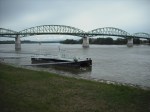
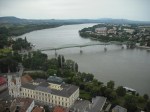
Dear Tom,

Just writing to say that, in Budapest last weekend with some spare time before a conference, and having just learned of Paddy’s passing, I felt it appropriate to make a brief trip out to Esztergom – the town on a bend in the Danube where, on the bridge, A Time of Gifts ends and Between the Woods and the Water commences.

After a winding 90-minute train ride down a single-track line, I emerged at the end of the line, Esztergom, and into a sleepy provincial eastern European town (the fact that it was Sunday lunchtime probably the defining reason for this). After a good 30 minute walk into the town centre, past a very pleasant main square with some almost northern Italian architecture, you suddenly see the mammoth marble basilica overlooking the town on a hill. This is the seat of the Hungarian Catholic Church, and an important place of pilgrimage. Around the basilica are grouped some nice old cobbled streets and religious buildings, while the Danube flows calmly by.

I scrambled up a back way to the basilica, then climbed up onto the cupola which provides an incredible view of the Danube bend and nearby hills (see the attached photos). All the while, I tried to imagine a young and inquisitive countryman with a knapsack doing a similar thing in 1934. What I left until last was walking over the bridge (destroyed in 1944, so it’s sadly not the same structure Paddy tramped over) which now links Slovakia and Hungary. Reading the two books had a considerable effect on me, so this was quite an exciting moment. After a brief meditative pause in the middle, and a few minutes’ ambling on the Slovakian side, I returned over the bridge into Esztergom having toasted Paddy with a small cigar en route.

So a very pleasing day trip overall, with just one slight regret – that I didn’t have the two books with me at the time!

Thanks,

Ed Ricketts

Related article:

Easter 1934 – Paddy reaches the Hungarian border at Esztergom