Category Archives: A Time of Gifts

Link

Capture1A broadcast on France Culture radio featuring Paddy speaking his best French, supported by Artemis Cooper and her father John Julius Norwich. Lovely to hear Paddy speaking and also to brush up some of the old French given that we all know the context. With contributions from others. Click the picture above to visit the site and then press the play icon. The player will open in a new window and can be a little slow to load so just be patient but the quality is fine and worth the wait.

Interesting that with this and the TV interview alongside the brilliant Nicolas Bouvier, the French are running neck and neck with the BBC for airtime about Paddy. Watch Paddy here (he appears around 29 minutes.)

Items from Paddy’s archive

The news about the opening of Paddy’s archive to the public was quite exciting. It may herald some new studies into the life of this gifted but flawed man.

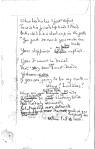
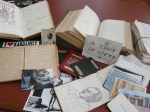
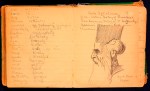
I had a bit of a sneak around the National Library of Scotland website and found the following images which may form the start of the on-line digital archive mentioned in the press release. They include an unpublished poem by John Betjeman written on the back of an envelope.

Related article:

Patrick Leigh Fermor archive now fully available to public at National Library of Scotland

Salmagundi Magazine special feature on Patrick Leigh Fermor

Paddy at BaleniI am grateful to Marc Woodworth for sending me this feature about Paddy posted in Salmagundi Magazine.

It includes excerpts from three essays:

  • Joanna Kavenna on memory and the past in A Time of Gifts
  • George Prochnik on Byzantium and style in Mani
  • Bina Gogineni on exoticism in The Traveller’s Tree

Plus exclusive online contributions from Nick Delbanco, Nick Delbanco, our very own Nick Hunt (Following Fermor in Romania)
and a Micro-Anthology selected by Michael Ondaatje, Thomas de Waal, Michael Gorra, Andrew Eames and photographs of Kövecses by Andrew Hillard.

Download the pdf here … salmagundi magazine

Travellers’ Century: Patrick Leigh Fermor now on YouTube


The event at Waterstones on Thursday with Benedict Allen introducing his 2008 film about Paddy’s life and work was a great success.

Organised by Barnaby Rogerson of Eland Publishing (who specialise in keeping the classics of travel literature in print), we were treated to a few glasses of wine before the film whilst chatting to an eclectic group who included general travel writing buffs, some who knew little about Paddy, and a group of keen PLF enthusiasts. Harry Bucknall, author of Like a Tramp, Like A Pilgrim: On Foot, Across Europe to Rome was in fine form, talking about a possible film project, and I particularly enjoyed meeting Rick Stroud who wrote the other book published this month about the abduction Kidnap in Crete: The True Story of the Abduction of a Nazi General.

Perhaps the highlight was a Q&A session afterwards where Benedict was joined by John Murray who features in the film talking about the challenges of editing Paddy’s work. John had some very interesting things to say about working with Paddy and shared some personal views about his life and relationships.

By strange coincidence I have now been told that the BBC film has now appeared in You Tube so you can all watch and enjoy it!

175 years of the Red Ox Inn, Heidelberg

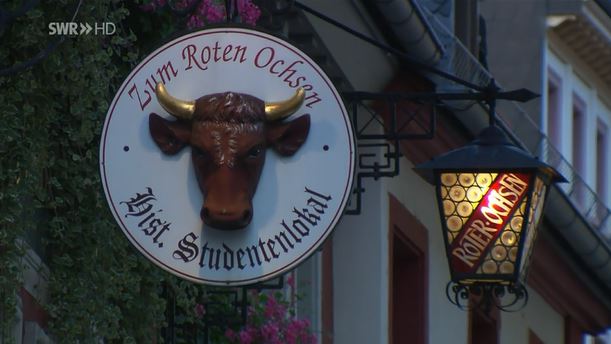
Red Ox

Immortalised by Paddy who stayed here in the winter of 1934, the Red Ox Inn is celebrating 175 years managed by six generations of the same family. They say they are looking forward to the 200th anniversary. It is always worth a visit if you travel to beautiful Heidelberg.

In German, and I should warn you there are scenes of hearty German food and large glasses of beer, but fortunately no flash photography.

This does not appear to play in Firefox. It works in Internet Explorer. Click on the image to play.

Traveller’s Century – Benedict Allen seeking Patrick Leigh Fermor

Benedict Allen

Benedict Allen

Many will be aware of Benedict Allen’s 2008 BBC documentary where he follows Paddy’s journey and eventually gets to meet with Paddy at Kardamyli. It is rarely shown and unavailable on iPlayer. However, there will be a chance for some to watch the programme at Waterstones Piccadilly on Thursday 9th October at 6.30pm.

As part of their “Traveller’s Film Club” series of events, Benedict will introduce the programme after which there will be a screening. Further details of how to book are on this web page.

The Traveller’s Film Club are also showing films on Norman Lewis (September 16) and Wilfred Thesiger (November 13). See the same list.

Thank you to Mark Granelli for pointing this out to me. See some of you there!


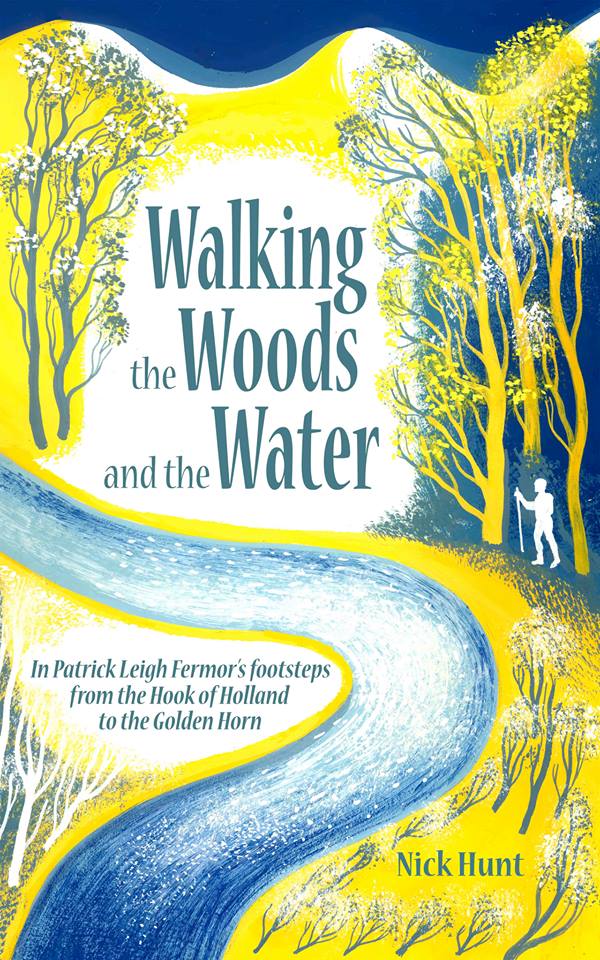
Walking the Woods and the Water – Nick’s book cover revealed

Walking the Woods and the Water

Walking the Woods and the Water

After a lot of labour, a change of publisher and book title, Nick’s book is finally to be published by Nicholas Brealey Publishing in March. Many of you will remember that two years ago Nick walked Paddy’s great trans-European walk, taking about the same time, using only Paddy’s books as a guide, and visiting many of the houses he stayed in en route.

Nick wrote to me saying “The cover has been designed and I’m very pleased to tell you it’s by Ed Kluz, the same artist who did The Broken Road. Looks very different of course, and not (as I was worried it might) overly derivative of the style of Paddy’s books. But a nice continuity.”

It will be interesting to see what you all think about that. As soon as I have further news I will update you. I do know that Nick will be giving some talks to support the publication and I will pass on these details as soon as I have them.

Horace: The Odes, Book One, IX, translated by John Dryden

Following on from the article by Llewelyn Morgan about Horace, I thought it would be good to share Dryden’s translation.

by Carol Rumens

First published in The Guardian, 30 July 2012.

“For this last half-year I have been troubled with the disease (as I may call it) of translation … ” Thus John Dryden begins the preface to his volume, Sylvae, or the Second Part of Poetical Miscellanies (1685). It marks his emergence, relatively late in life, as a translator, containing work by various Greek and Latin authors: Theocritus, Lucretius, Horace, Ovid among them. Despite that “disease”, encompassing a nagging “un-ease” about the fidelity of his method, Dryden enjoyed translating Horace – and it shows. See, for example, the magnificent Ode 29 from Book Three presented by Dryden as his own imitation of “Pindarique Verse”. Its famous eighth stanza (“Happy the man, and happy he alone, / He who can call today his own … “) is treasured by readers still – as poetry and as advice on living. For this week’s poem, however, I’ve picked a smaller jewel: the wonderfully elegant version of Ode Nine, Book One.

Dryden described his method as paraphrase. The original author’s words were not as “strictly followed as his sense”. The sense could be amplified, and even altered. This was a practical and, in some ways, obvious technique. Horace’s word-order, for example, has to be altered to make sense in a non-inflected language. In taking further liberties, the justification is that the translator is himself making a poem. Dryden tried to create a work the author could have produced “if he were living and an Englishman”. He sets the standard for poetry translation as fidelity to the receiving language, and sets a further standard: he is honest with the reader about his strategies.

Horace didn’t think of these verses as Odes. The Renaissance gave them that title. To the author, they were songs, or “carmina”. Ode one/nine is written in Alcaics, a four-lined, largely dactylic strophe named after the Greek poet Alcaeus: it’s the commonest verse-form in the Odes, a flexible form-for-all-seasons. Using iambic tetrameter chiefly, with the rhyme-scheme A B A B C C (C), Dryden expands the quatrain, in the first four stanzas to six lines and in the last two to seven. The bold move works. The statelier English verse occupies its space comfortably. There’s no padding, no rigidity.

Dryden’s poem sometimes generalises, of course. He loses the address to Thaliarchus, master of the feast. He doesn’t mention Mount Soracte or name the trees. In the last stanza, there’s no reference to the girl’s ring. Yet he avoids dull exegesis or moralising. Like Horace, he balances his showing and telling.

Dryden enjoys some subtly brilliant word-play. In the first stanza, the mountains of line one are elevated in the next by “mounts of snow”, a linguistic effect and a snapshot revealing the snow itself as mountainous. There’s a wonderful gravitational pull in the rest of the stanza, from the “labouring woods” (suggesting more tonnage of snow on the trees) to the stream, imagined as a prisoner, fettered, benumbed, “cramp’d to solid ground”. The ensuing indoors scene introduces a contrasting glow and vivacity, with the heaped logs replacing the snow-heaps outside. The mood is merry and defiant, a mixture of Epicurean and stoic. It’s tempting to imagine the Restoration (1660) as Dryden’s political subtext here.

God now comes on stage in a somewhat Jovian manner, playful, not wholly reliable. He will provide, “if ’tis worth His care”, but there’s no knowing what so stormy, windy and capricious a deity might do next (think 17th-century politics again, perhaps?). The scene is set perfectly for that sound, pragmatic advice to seize the moment – “Nor love, nor love’s delights, disdain … ” Dryden works Horace into some sharp-suited epigrams, as in the final couplet of this stanza and the last line of the next (fifth): “The best is but in season best.”

It’s such a cohesive, tight little ship of a poem, yet the tone is relaxed. There is an ease of movement in the argument, so it never seems heavy-handed. All the stanzas work separately, and all work together in forming an overall architecture. There’s a satisfying balance of concrete and abstract. Dryden leaves out some of Horace’s specific details, but compensates with a focus on language.

In the wonderful last stanza, notice how appropriately he picks up the tercet’s rhyme-sounds (“feign/again/ordain”) from the fourth stanza’s couplet about the delights of love (“disdain/gain”). That extra room now allows him to present the courtship drama as a complete narrative-in-miniature. The faint sexual frisson is judged to perfection, and not a word is misplaced. Horace’s brevity is magical, here, but Dryden’s amplification works in another way. He closes with a line of hexameter, straightforward and serious: “These, these are joys the gods for youth ordain.” Do we hear the regretful tone of middle-age? Perhaps, and this may be another reason why Dryden’s English lives. He’s true to his own feelings.

Dryden was a great literary all-rounder. He is “the father of modern criticism” and a glorious prose-stylist. He’s no longer remembered as a playwright, perhaps unfairly. I recently read one of his comedies (An Evening’s Love), dipping my toe for the first time, and found it a highly entertaining piece of Spanish sitcom. But Dryden himself feared he had wasted his energies among “the steaming ordures of the stage”.

In 1685, of course, he was still to produce his great allegorical poems and the brilliant satires such as Mac Flecknoe (1682), and still to tackle his translation masterpiece, Virgil’s Aeneid. The Sylvae represent no less an achievement, showing Dryden in a perhaps unusual light – that of graceful poetic lyricist.

Horace’s original, with an interesting modern American translation and helpful commentary by William Harris, is here.

Horace: The Odes, Book One, IX, translated by John Dryden

Behold yon mountain’s hoary height
Made higher with new mounts of snow:
Again behold the winter’s weight
Oppress the labouring woods below’
And streams with icy fetters bound
Benumbed and cramped to solid ground.

With well-heaped logs dissolve the cold
And feed the genial hearth with fires;
Produce the wine that makes us bold,
And spritely wit and love inspires;
For what hereafter shall betide
God (if ’tis worth His care) provide.

Let Him alone with what He made,
To toss and turn the world below;
At His command the storms invade,
The winds by His commission blow;
Till with a nod He bids them cease
And then the calm returns and all is peace.

Tomorrow and its works defy;
Lay hold upon the present hour,
And snatch the pleasures passing by
To put them out of Fortune’s power;
Nor love nor love’s delights disdain –
Whate’er thou getts’t today, is gain.

Secure those golden early joys
That youth unsoured with sorrow bears,
Ere with’ring time the taste destroys
With sickness and unwieldy years.
For active sports, for pleasing rest.
This is the time to be posesst;
The best is but in season best.

Th’appointed hour of promised bliss,
The pleasing whisper in the dark,
The half-unwilling willing kiss,
The laugh that guides thee to the mark,
When the kind nymph would coyness feign
And hides but to be found again –
These, these are joys the gods for youth ordain.

Related article:

An Ode for the Road

“Now That the Time of Gifts Is Gone”: Poetry In Patrick Leigh Fermor’s Books

The following article was written by Clarissa Aykroyd on her blog, The Stone and the Star. There is something for everyone in Paddy’s books, and here Clarissa discusses his references to poetry.

By Clarissa Aykroyd

First published on The Stone and the Star, 12 August 1013.

In December 1933, a young man named Patrick Leigh Fermor left England to travel on foot across Europe. Alternately sleeping in barns and in stately homes, he travelled from the Hook of Holland to Constantinople (he always calls it Constantinople, although it was Istanbul by then.) He wandered in a leisurely manner through what now seem to be the dreamscapes of Mitteleuropa before World War II. Decades later he wrote about his travels in A Time of Gifts and Between the Woods and the Water. Leigh Fermor died at an advanced age in 2011, but the final book, The Broken Road, is being edited posthumously and will appear later this year.

A great deal has been written and said about Leigh Fermor. He had an incredibly adventurous life which included the capture of a leading German commander in Crete during World War II. With a remarkable personal charm and magnetism, Leigh Fermor seems to have been a sort of cross between Casanova and James Bond.

I have just been re-reading A Time of Gifts and Between the Woods and the Water. It is not so surprising that Leigh Fermor spent decades crafting these books – there really isn’t a word out of place. The prose is like crystalline mosaics or frescos, hovering on the edge of the unbelievable and fairytale-like, but still believable. It’s entirely possible that Leigh Fermor embroidered after the fact, but his tales of mountainscapes, of dream cities and kind eccentrics are so beautiful that I don’t really mind either way. The books certainly conjure up a world that disappeared – Leigh Fermor repeatedly comments on how, particularly with the rich and titled families who gave him hospitality, the people he met disappeared into darkness during the war and only sometimes emerged. It is true that this is also a world which is rather class-ridden and occasionally interspersed with casual racism, not to speak of the terrible looming shadow of Nazism in Germany. But so much of the books’ poignancy comes from the awareness of the awful storm that was to sweep over Europe, leaving so many scars and in many cases total destruction.

I wanted to write a little about the presence of poetry in these books. In some ways this, too, evokes a world that has disappeared or at least altered beyond recognition. A Time of Gifts is named after a line from a poem by Louis MacNeice, ‘Twelfth Night’:

For now that the time of gifts is gone –
O boys that grow, O snows that melt,
O bathos that the years must fill –
Here is dull earth to build upon
Undecorated […]

In A Time of Gifts, Leigh Fermor writes at some length (several pages) about his “private anthology” of poetry that he had memorized and would recite to himself while alone and walking. “The range is fairly predictable,” he says, “and all too revealing of the scope, the enthusiasms and the limitations, examined at the eighteenth milestone, of a particular kind of growing up.” The “private anthology” included Shakespeare as well as bits and pieces of Keats, Tennyson, Browning, Coleridge, Wordsworth, Hopkins, Kipling, Wyatt, Marvell, Carroll and Lear, among others. “No Yeats later than the Ronsard paraphrase and Innisfree and Down by the Salley Gardens; but this belonged more to singing than reciting.” He then mentions that he wasn’t interested in Pound or Eliot but enjoyed Edith Sitwell. From other languages and cultures, he mentions a little Baudelaire and Verlaine, and Romans such as Virgil, Catullus and Horace.

Particularly in Between the Woods and the Water, in Hungary and Romania, poetry and poets dog his footsteps. In Hungary he mentions “the southern parts of the Cuman region celebrated by [Sandor] Petőfi – it is strange how the names of Hungarian poets cropped up the whole time in conversation and books!” He later mentions Ferenc Békássy, who studied at Cambridge and was “a friend of Rupert Brooke and James Strachey and especially Maynard Keynes” – this young poet died in battle in Bukovina in 1915. Later, in Romania, he comes across the oldest poem in Romanian, the traditional epic Mioritza. At the Baths of Hercules, an “ornate and incongruous watering-place” in a wild Romanian valley, he meets a young woman who quotes Kipling’s ‘If’.

All of this struck me, not just because my ears are pricked for poetry, but because it all seemed so much of another time. What young man (or woman) would now set out to travel across Europe with a memorised library of poetry to call upon, let alone all the multitude of cultural references that Leigh Fermor seemed to have at his fingertips even as a teenager? It just wouldn’t happen – even a poetry lover probably wouldn’t have more with them than a poetry app on their smartphone. Then, too, there were so many young poets who were also soldiers and who were destroyed in the wars. It seems to me that what started to be broken in World War I was irretrievably broken (in so many ways) in World War II, and this might include the idea of poetry as a sort of force for salvation.

On a more personal note, re-reading these books made me want to go back to Vienna, no small feat because it’s not one of my favourite cities. They also set up in me a longing to go back to Germany, to Prague, and to travel more extensively in Hungary and Romania particularly. I also had a strange experience while reading A Time of Gifts. Leigh Fermor praises the beauty of the German city of Regensburg, and writes about one of its sons, Albrecht Altdorfer. When he wrote about Altdorfer’s famous painting The Battle of Alexander at Issus, something swept over me – I had almost forgotten that I owned a small copy of it, from the gallery in Munich where it hangs. It is a remarkable painting and I think the feeling I had (and still have) for it ties into my fascination with certain types of fantasy landscapes – the first edition I owned of The Lord of the Rings featured cover art which now looks very Altdorfer-esque to me. Writing about the landscape depicted, Leigh Fermor said:

It was the valley of the Danube in the throes of one of its hundreds of battles. It must have been. But, on this first visit, how could I have realized it? The battle in the painted canyon is fought out under a lurid October sunset and the rival armies, like windswept cornfields bristling with lances and poppied with banners, collide in an autumnal light. Whereas the battlefield on my first encounter was dulled with snow, with all contours muffled and fanfares hushed. (from A Time of Gifts)

Here is Yeats’s The Lake Isle of Innisfree, cited as part of the “personal anthology”, and perhaps also appropriate for its final lines.

THE LAKE ISLE OF INNISFREE (William Butler Yeats)

I will arise and go now, and go to Innisfree,
And a small cabin build there, of clay and wattles made;
Nine bean-rows will I have there, a hive for the honey-bee,
And live alone in the bee-loud glade.

And I shall have some peace there, for peace comes dropping slow,
Dropping from the veils of the morning to where the cricket sings;
There midnight’s all a glimmer, and noon a purple glow,
And evening full of the linnet’s wings.

I will arise and go now, for always night and day
I hear lake water lapping with low sounds by the shore;
While I stand on the roadway, or on the pavements grey,
I hear it in the deep heart’s core.

An Ode for the Road

Llewelyn Morgan describes himself, rightly as “a Classicist, lucky enough to work at Brasenose College, Oxford. I specialise in Roman literature, but I’ve got a persistent side-interest in Afghanistan, particularly the scholars and spies and scholar-spies who visited the country in the nineteenth century.” We all know so much about Paddy’s tale of the Horace Ode with General Kreipe. This piece from Morgan’s blog goes into a little more detail; essential for those of us not to have had a thorough classical education. My thanks to Peter Golden for passing this to me.

By Llewelyn Morgan

First published on Lugubelinus, 15 October 2013

For reasons that will emerge, I’m intrigued by the practice of travelling with a copy of your favourite classical author in your pocket; and I’m struck by the fact that Horace seems to be the most commonly chosen travelling companion. In Horace’s fifth satire, when he describes setting off on a journey with Heliodorus, there’s a theory that Heliodorus is a book (it was the name of the author of a book called The Wonders of Italy, or possibly The Wonders of Medicine) rather than a flesh-and-blood companion, so that’s kind of appropriate for starters.

It isn’t always Horace. The Polish journalist Ryszard Kapuściński did all his foreign reporting accompanied by a gift from his editor, “a thick book with a stiff cover of yellow cloth. On the front, stamped in gold letters, was Herodotus, THE HISTORIES.” Europeans trudging through Afghanistan in the nineteenth century cited chapter and verse on Alexander’s itinerary with such accuracy that I can’t help but suspect they had copies of Quintus Curtius Rufus’ Histories of Alexander the Great secreted somewhere about their persons.

Virgil is another favourite, and with him the unhealthier aspects of this practice come to the fore. Abraham Cowley was the author, among other things, of an epic, The Civil War, which he wrote as the English Civil War unfolded in the 1640s (and which mutates from an epic into a satire as Cowley’s favoured side, the Royalists, lose ground.) According to John Aubrey he “alwaies had a Virgil in his pocket”, and his reverence for the Aeneid is very obvious in The Civil War: he even imitates Virgil’s “half-lines”, lines left unfinished by Virgil at his death (he died before the Aeneid was completely finished), but which Cowley thought were deliberate, and expressive.

But Cowley’s devotion to Virgil didn’t stop at the odd half-line.  Aubrey recounts a story of Cowley using his pocket Virgil to consult the “Virgilian lots” (sortes Vergilianae) with the future Charles II, opening the pages of the Aeneid at random as a way of predicting the future. And predictably enough, Cowley and the prince happen on Dido’s curse of Aeneas at the end of Aeneid 4, where the queen of Carthage prays that Aeneas will see his friends fall before his eyes, make peace on unjust terms, and die before his time: Virgil was telling them what would happen to the prince’s father Charles I.

That is a story with many variants, and it doesn’t always involve Cowley. But we can establish that Cowley had a habit of consulting the sortes Vergilianae. Dr Johnson quotes a letter written by Cowley in which he discusses the prospects for an alliance with the Scots. Cowley is confident of a positive outcome to negotiations: “The Scotch will moderate something of the rigour of their demands; the mutual necessity of an accord is visible; the king is persuaded of it. And to tell the truth (which I take to be an argument above all the rest) Virgil has told me something to that purpose.” Virgil has told meThe text in the pocket has become the intimacy of a direct word in the ear.

Well, Virgil can play with people’s heads: Cowley’s consultation of the Virgil in his pocket is a bit like Jackson Knight’s consultation of a medium (supposedly channelling Virgil himself) when he was writing his Penguin translation of the Aeneid (just in case anyone thought Morrissey’s inclusion in the Penguin Classics was the maddest thing to happen to that series).

Chaps with Horace in their pockets are a more stable bunch all round, I like to think. But if that’s true, it has a lot to do with the focus of Horace’s poetry. His most famous and quoted poems are the Odes, and the concerns of these short lyric poems weren’t the profound mysteries of existence delved by Virgil (a figure further amplified by the strange mythology that built up around him after his death). Horace is all about the demands of this life we’re living, the inevitability of aging and death, the pleasure of the present moment. His genius is to give incomparable expression to simple principles of living. Carpe diem, etc.

As he set off to travel on foot to Constantinople in 1933 Paddy Leigh Fermor packed an Oxford Book of English Verse and, a gift from his mother, “the Loeb Horace, Vol. I”, containing the Epodes and Odes; and as he walked across Europe he memorised his favourite odes. That special relationship with Horace featured in Leigh Fermor’s most famous exploit, when he captured the German General Karl Kreipe, commander on Crete, and had him smuggled out to Cairo. As they climbed Mount Ida, Kreipe muttered the first line of Horace’s ninth ode, Vides ut alta stet niue candidum Soracte, “You see how Mt Soracte stands white with deep snow,” and Leigh Fermor responded with the rest of the poem:

The general’s blue eyes had swiveled away from the mountain top to mine – and when I’d finished, after a long silence, he said: “Ach so, Herr Major!” “Ah, yes, Major!” It was very strange. As though, for a long moment, the war had ceased to exist. We had both drunk at the same fountains long before; and things were different between us for the rest of our time together.

Horace, whom both Germans and British had managed to convince themselves was the perfect encapsulation of their respective gentlemanly codes, established a mutual understanding between these two officers. Between them, for example, they managed to piece together the superb conclusion to the Regulus Ode (3.5), where the Roman general Regulus, heroically insisting on going to meet his death at the hands of the Carthaginians, leaves Rome as nonchalantly as a man heading off for a relaxing weekend at his country house. Continue reading

Patrick Leigh Fermor celebrated author of one of greatest travel books ever written

By Michael Dirda.

First published in the Washington Post, 23 October 2013.

In the annals of armchair adventure, nothing can rival a travel classic by a good-looking, sandy-haired young Englishman — or Englishwoman. If you’re planning ahead for some ideal winter’s reading, you can’t go wrong with any of the following:

  •  A.W. Kinglake’s “Eothen.”
  •  Peter Fleming’s “Brazilian Adventure.”
  •  Freya Stark’s “The Valleys of the Assassins.”
  •  Robert Byron’s “The Road to Oxiana.”
  •  Apsley Cherry-Garrard’s “The Worst Journey in the World.”
  •  Sybille Bedford’s “A Visit to Don Otavio.”
  •  Wilfred Thesiger’s “Arabian Sands.”
  •  Eric Newby’s “A Short Walk in the Hindu Kush.”
  •  Bruce Chatwin’s “In Patagonia.”

All of these are wondrous. Still, the most beautifully written of modern “travel books” — an awkward term — may well be Patrick Leigh Fermor’s “A Time of Gifts” (1977) closely followed by its sequel “Between the Woods and the Water” (1986). These two volumes lyrically memorialize a youthful walk across Europe in 1933-34, starting from the Hook of Holland and passing through Germany and much of Eastern Europe. A never-completed final volume — drafts of which will be published in March (in the US) as “The Broken Road” — would have followed its boyish hero to Constantinople and Mount Athos.

While most of Leigh Fermor’s work is highly personal, his various books — and these include one about the Caribbean, “The Traveller’s Tree” (1950), and two about Greece, “Mani” (1958) and “Roumeli” (1966) — offer only carefully chosen glimpses of his long and astonishing life (he died at age 96 in 2011). Artemis Cooper’s excellent biography, “Patrick Leigh Fermor: An Adventure,” fills in the details, corrects errors and makes clear that Paddy — as he was always known — often conflated incidents or fudged details in his writing, sometimes for reasons of art, sometimes to protect a friend or a woman’s reputation.

When Paddy began his European rambles, he was not quite 19. Up until then he had been an indifferent student, although passionate about reading and gifted with a phenomenal memory. Paddy also possessed, along with good looks, daring and boundless curiosity and a seemingly irresistible charm. He originally expected to doss down in haystacks and barns as he trudged along; in fact, he regularly smiled his way into country houses, consulates and baronial manors — and sometimes into the beds of young women and lonely divorcees. Letters of introduction then eased his way into other homes. As he cheerfully sauntered along, he would belt out each region’s folk songs.

At the end of his journey, Paddy met Princess Balasha Cantacuzene, a scion of one of the great dynasties of Moldavia and Wallachia. She was 16 years his senior, but the two fell in love and the young Englishman passed four idyllic years living on her family estate at Baleni in what was then known as Rumania. During these years he read voraciously — history, reference works, Mallarmé, Apollinaire, Gide, Proust, Tolstoy and much else. To his personal magnetism and general sexiness, the magpielike Paddy soon added a mind filled with poetry and out-of-the-way knowledge.

When Britain declared war on Germany, the stylish young adventurer immediately left Baleni to enlist. He was, at this point, all of 24. But Paddy already knew much of Europe intimately, had made friends everywhere, and could speak French, German, Romanian and Greek. He was a natural for the Intelligence Corps.

Lieutenant, later Major Leigh Fermor spent much of the war behind the lines in Crete, helping to coordinate its resistance to the Germans. Periodically, though, he would be pulled out for R&R in Cairo, where he partied all night, slept in the arms of exotic girlfriends and drank champagne with King Farouk. During one particularly orgiastic revel, the young intelligence officer came up with a plan to kidnap the commanding German general in his area of Crete. It would give a boost to the partisans’ morale. He eventually recruited his admiring friend William Stanley Moss to join him in this crazy exploit.

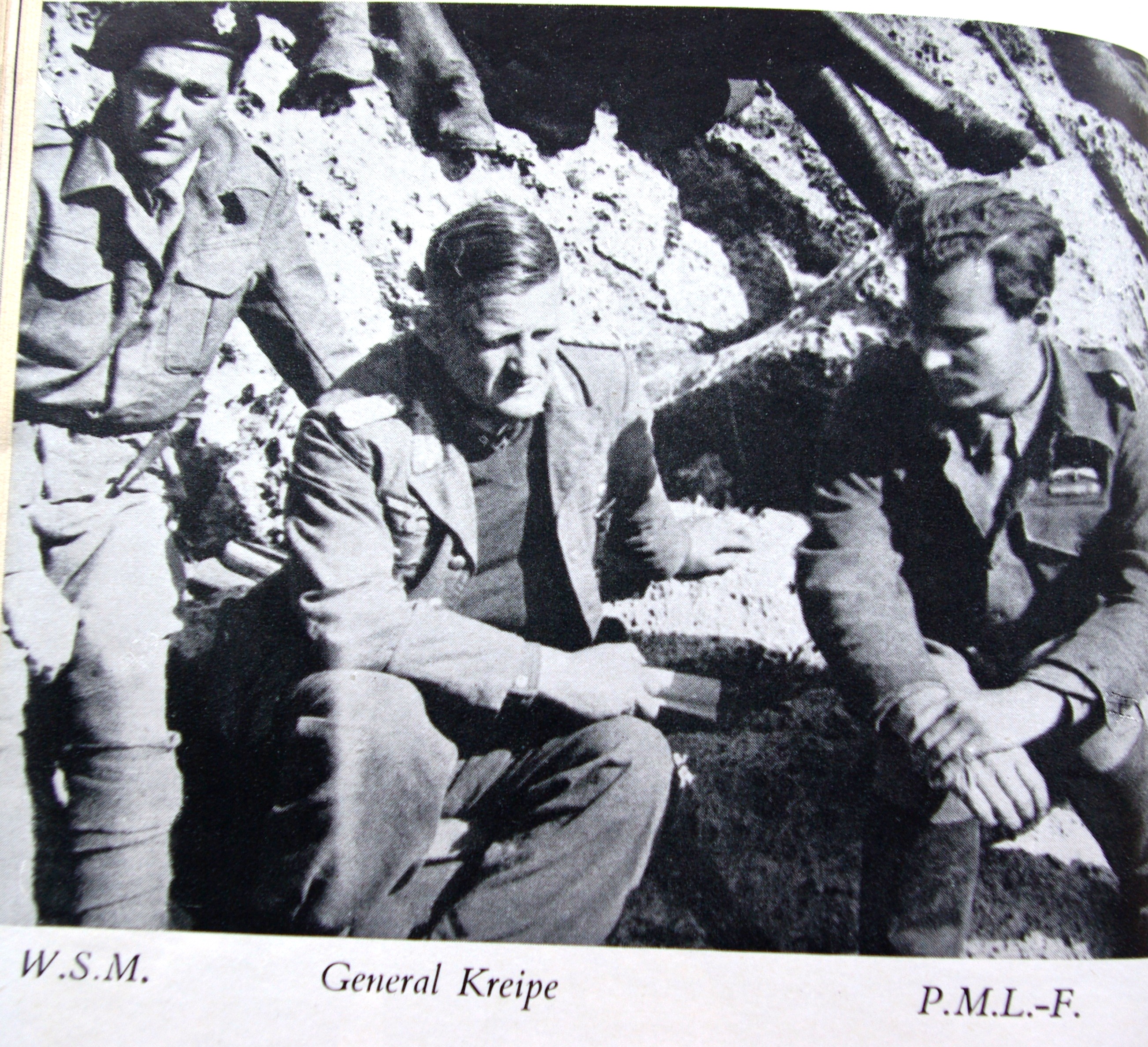
The two actually brought it off. Dressed as German border patrolmen, Paddy and Moss stopped General Heinrich Kreipe’s car, which was immediately surrounded by Cretan guerrillas. For more than two weeks, the ambushers and their victim eluded capture until they were able to rendezvous with their escape boat. In her biography, Cooper provides the most detailed account available of this “hussar stunt,” the highlight of which occurred on a morning when the raiding party was hiding in a cave:

“No one slept well that night, and as dawn broke and the sun illuminated the great snow-streaked hump of Mount Ida, the General murmured a line in Latin: ‘Vides ut alta stet nive candidum Soracte.’ ”

As it happened, this was not only a poem that Paddy had once translated — the line from Horace means, in his schoolboy version, “See Soracte’s mighty peak stands deep in virgin snow” — but one that he knew by heart. Taking up where Kreipe had paused, the youthful British major went on to recite the entire poem.

Cooper then quotes Paddy’s own account of what happened next:

“The General’s blue eyes swivelled away from the mountain-top to mine — and when I’d finished, after a long silence, he said, ‘Ach so, Herr Major!’ It was very strange. ‘Ja, Herr General.’ As though, for a long moment, the war had ceased to exist. We had both drunk at the same fountain long before; and things were different between us for the rest of our time together.”

This whole adventure was later chronicled in W. Stanley Moss’s minor classic “Ill Met By Moonlight.”

After the war, Paddy — now all of 30 — found work at the British Institute in Athens, where his colleagues included the historian of the Crusades Steven Runciman and the translator and novelist Rex Warner. But, despite all his gifts or because of them, Paddy couldn’t hold a 9-to-5 job. He was too free-spirited, too feckless, in some ways, too spoiled. For years he would rely on, sometimes live on, the generosity of rich and aristocratic friends and lovers.

And there were many. When he finally returned to England, Paddy cemented his connections with the aging members of the Brideshead Generation. The second half of Cooper’s biography is packed with the usual names: critic Cyril Connolly, the famous beauty Diana Cooper (the biographer’s grandmother), the Duchess of Devonshire (nee Deborah Mitford), Ann Fleming (wife of Ian), poet John Betjeman and many others. With Joan Rayner, whom he had first met in Cairo, Paddy would settle into a permanent, if extremely open relationship. By the time the two finally married in 1968, they had already bought property in Kardamyli, Greece, and built their ideal house (marble, open air, lots of books, cats), where they would welcome celebrated friends, former Cretan partisans and numerous admirers of Paddy’s books.

Easily distracted and as much a perfectionist as Flaubert, Sir Patrick Leigh Fermor — as he eventually became — always found writing difficult. His descriptions are like tapestries, rich in color and intricate design; his bravura diction often requires a dictionary close at hand; and sometimes his weaker pages are clotted and overwrought. Yet “A Time of Gifts” marvelously evokes an ancient Mitteleuropa now almost wholly vanished. If you’ve never read it, do; and if you have, you’ll certainly want to follow up with this fine biography of its adventurous and romantic author.

Dirda reviews books for The Washington Post every Thursday.

 Artemis Cooper will be at Politics and Prose, 5015 Connecticut Ave NW, at 6 p.m. Nov. 2. Call 202-364-1919.

A quinquereme among abbeys

‘This year marks the millennium of St Coloman’s martyrdom in 1012 and his feast day of October 13th, Kolomani, will be marked with celebrations in Melk’. Above, the abbey at Melk, Wachau Valley, Austria. Photograph: Elfi Kluck/Getty Images

Irish saints and the Abbey of Melk. Surely there is a link to Paddy? Of course he visited here in 1934 and wrote about it at length in A Time of Gifts pp 154-158.

By Alexander O’Hara.

First published in The Irish Times, October 9 2012

The Abbey of Melk sits like a benevolent sleeping giant above the little town of Melk and the Danube. To the east lies the Wachau, one of the most magnificent stretches of river scenery in Europe, and the eastern foothills of the Alps, to the west, Mauthausen and Bavaria.

This Baroque pile, a Benedictine monastery since 1089, is one of the most recognisable attractions in Austria. The Anglo-Irish writer Patrick Leigh Fermor, who died last year, memorably described it as a “quinquereme among abbeys” in his 1977 classic A Time of Gifts, a wistful memoir of his travels by foot through Central Europe on the eve of Hitler’s rise to power in 1933 when he was 18. He captures the awe of approaching Melk in the snow and seeing the Abbey rise up on its limestone bluff above the Danube valley. Most of the tourists who now visit the Abbey church (which, with all the gold, has been memorably likened to being inside a giant rapper’s mouth by AA Gill) – probably take little notice of a side altar and Baroque tomb to the left of the high altar. This is the tomb of St Coloman, an Irish martyr and the first patron saint of Austria. This year marks the millennium of his martyrdom in 1012 and his feast day of October 13th, Kolomani, will be marked with special celebrations in Melk.

How did an Irish man come to be patron saint of Austria? The story begins in the autumn of 1012 when an Irish pilgrim named Colmán (Coloman is the Germanised version of the name) was on his way to Jerusalem following the old Roman road along the Danube towards Vienna. He was on the overland pilgrimage route, an ancient path that followed the course of the Danube valley through Hungary. This had been reopened following the conversion to Christianity of King Stephen of Hungary in 997 and the destruction of the Holy Sepulchre by Caliph Al-Hakim in 1009 had provoked an upsurge in pilgrimage to the Holy Land. Coloman only made it as far as Stockerau, a town 30km to the north west of Vienna. He had unwittingly entered a war zone in what was a borderland known as the Bavarian Eastern March, a strategic frontier wedged between the Magyars or Hungarians to the east and the Moravians to the north. The Babenberg margraves, the rulers of the March, were in the process of extending their control and territory in this colonial land.

Stockerau stood on the borders of the March and was subject to frequent raiding. The locals were in no mood to welcome exotic strangers, and garbed as a pilgrim and speaking Gaelic, Coloman clearly stood out. According to a near-contemporary account, the locals suspected him of being an enemy spy and summarily lynched him from a tree (on dying for the cúpla focal see Frank McNally, An Irishman’s Diary, March 16th, 2012).

The exact circumstances of Coloman’s murder will never be known, but following his death, miracles began to take place – the dead man’s hair and nails continued to grow, the dead tree on which he was hanged began to bloom, and people were healed who came in contact with his body. News of these miracles came to the attention of Margrave Henry I at Melk. One of the powerful Babenberg dynasty who were to rule Austria from 976 to 1246, Henry recognised the power of this new saint and sent his soldiers and clerics to take the body from Stockerau to his residence at Melk which later became the famous monastery we know today.

The Austrian Babenbergs traced their descent to the Franconian Babenbergs whose fortress at Bamberg in Germany gave the dynasty its name. The patron saint of Franconia was (and still is) St Kilian, another Irish man who was martyred in 689, and whose relics lie in the cathedral of Würzburg. It is noteworthy that both Henry I’s father and brother were both buried in the same cathedral where Kilian’s relics were kept. By promoting the new Irish martyr Coloman as a dynastic and regional patron for the region that would become known as Austria, Henry may have hoped to shape a spiritual landscape for this new land that drew on common cultural traditions of Bavaria and Franconia where there was a strong tradition of veneration to Irish missionary and martyr saints such as St Kilian.

The new cult of St Coloman became a vehicle for the Babenberg margraves, which they were keen to latch on to from the beginning in order to cement their new power base in the Eastern March and to bring cohesion to this frontier region. In time, Coloman came to be venerated as the patron saint of the historical core of Austria, Österreich ob und unter der Enns, from 1244 until 1663. Today Coloman is the patron saint for convicts who are hanged, passengers, and livestock as well as being one of the many ironies of history. As an eminent Austrian historian remarked, “It might seem particularly ironic today that the first Patron of Austria had fallen victim to Austrian xenophobia; something which nobody could have foreseen”.

Coloman’s feast day this Saturday (13 October) will be celebrated in Melk, the millennium anniversary of the death of the unfortunate Irish pilgrim who became Austria’s first patron saint.

Visit Saint Coloman’s Wikipedia page.

Patrick Leigh Fermor’s archive acquired by the National Library of Scotland

From a National Library of Scotland press release dated today.

The archive of one of the most important travel writers of the 20th century and a war hero whose exploits were made into a major film has been acquired by the National Library of Scotland (NLS).

Sir Patrick (Paddy) Leigh Fermor, who died last year at the age of 96, is regarded as a central figure in understanding and appreciating mid-20th century culture.

To describe his life as colourful does scant justice to the reality. At the age of 18 he set off to walk from the Hook of Holland to Istanbul , a year long journey described in his books A Time of Gifts and Between the Woods and the Water. The Independent described the former as “rightly considered to be among the most beautiful travel books in the language.”

His war record is equally impressive. After the fall of Crete in 1941, he was sent back to the island to organise guerrilla operations against the occupying Nazis. He spent much of this time disguised as a Cretan shepherd, living in freezing mountains caves.

In 1944 Leigh Fermor organised one of the most daring feats of the war when he kidnapped the commander of the German garrison on Crete . This was made into a film Ill Met by Moonlight in 1956 starring Dirk Bogarde.

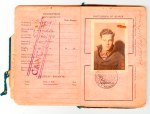
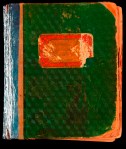
The archive consists of literary manuscripts and typescripts, correspondence with leading figures including the poet Sir John Betjeman, photographs, passports, portrait sketches and personal papers including visitor books and various honours awarded to Leigh Fermor. One of the star items is the only surviving notebook from his youthful trek across Europe .

It offers an unrivalled insight into his life and writings and adds to the wealth of travel literature at NLS. Acquisition of this archive is seen as helping to establish NLS at the forefront of 20th century travel literature research collections

“This is a fantastic collection which will be made available at NLS,” said David McClay, Manuscripts Curator. “We hope it will excite people who know of Paddy and introduce him to a whole new generation of people who may not be aware of his work.”

Its arrival at NLS comes just before a new biography of Leigh Fermor by the British writer and family friend Artemis Cooper is to be published.

Leigh Fermor died before he could complete the third volume in his travel trilogy. Artemis Cooper has worked on the uncompleted manuscript and this third volume – entitled The Broken Road – is expected to be published in 2013. This will all add to the interest in Leigh Fermor’s life and in the NLS archive.

The archive has been bought with a grant from the John R Murray Charitable Trust which assists NLS in the care and promotion of access to the Library’s John Murray Archive. Leigh Fermor was published by the Murray family.

The connection with the Murray publishing house was one of the reasons NLS was chosen by Leigh Fermor’s executors as the home for his archive. He also knew the Library, having donated his wife’s photographic collection to NLS just before he died.

NLS has also taken possession of the personal archive of Leigh Fermor’s close friend Xan Fielding, an author, translator and traveller who also fought in Crete . This has been donated to the Library by Fielding’s family.

Volume Three of Patrick Leigh Fermor’s trilogy to be published in Autumn 2013 and called The Broken Road

We have waited a long time, and now like London buses, or English summer rain, it is all coming at once. Following on from her work on Patrick Leigh Fermor’s biography, An Adventure, to be published in October 2012, Artemis Cooper will pull together Paddy’s work on Volume Three ready for publication in autumn 2013.

The book will have the title The Broken Road. If you Google that you will find a catchy country song by Rascal Flatts. In fact the title has been taken from the sixth volume of Freya Stark’s letters. I am told that everyone concerned with the publication is agreed that it “sets up the right resonances, because although The Broken Road completes the story, the text is taken from more than one unpublished source.”

It is perhaps not well-known that Paddy started to work first on the events of Vol 3. Much of it was written before his defining work on A Time of Gifts and Between the Woods and the Water, the other two volumes in the trilogy.

Artemis Cooper tells me that although “it does not have their high polish, it does provide an extraordinary insight into Paddy the writer, and the interplay of his memory and imagination.” and whilst “it’s not going to sound like ATOG or BWW”, I am sure it will be one of the most anticipated publication events of next year.

Whilst we wait we can sing along ….

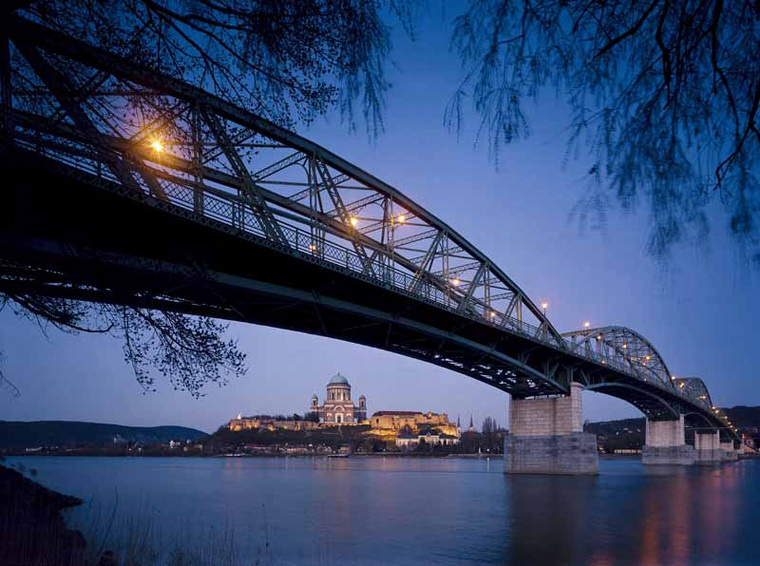
March 2012 – Nick reaches the bridge at Esztergom

Imagine Paddy standing in the middle of this bridge looking at the cathedral

It took Paddy until Easter 1934 to get to this bridge. Nick is moving well now. The bridge at Esztergom was one of my first blog posts back in April 2010!

The bridge linking Slovakia and Hungary, between the towns of Štúrovo and Esztergom, also links A Time of Giftsand Between the Woods and the Water. Here Paddy paused both in his walking and his writing, ‘meditatively poised in no man’s air,’ before crossing into Hungary and the second phase of his journey.

I reached that bridge a week ago (or rather the reconstruction of that bridge — the original was destroyed in 1944), and in a rather unbelievable way came to the very last page of my notebook standing above the Danube … read more

Related article:

Easter 1934 – Paddy reaches the Hungarian border at Esztergom

The remains of a BBC interview with Paddy from 2004

The incompetence or just downright negligence of the BBC in relation to their archive never ceases to amaze. In 2004 when Paddy received his Knighthood he made the ‘Faces of the Week’ page on the BBC website. They also included a snippet of an interview with Paddy where he describes the loss of his rucksack in Munich in 1934. I have asked the BBC if they have a copy of the remainder of this interview (date of interview unknown), but their reply was that they had either lost it or it had been erased.

You can listen to the interview on the BBC page here but you will need RealPlayer (remember that?).

Click here to play the interview straight off.

Colin Thubron recommends reading A Time of Gifts for 2012

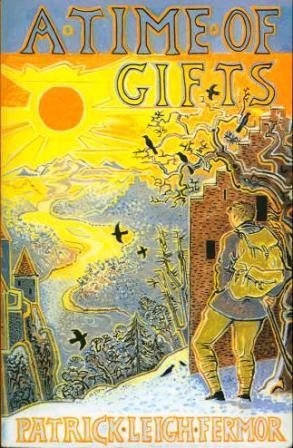
A Time of Gifts, 1977

In the December edition of The Browser, Paddy’s good friend Colin Thubron talks about why A Time of Gifts remains one of this favourite travel books…

This is the first volume of Patrick Leigh Fermor’s journey in 1933-34 from the Hook of Holland, as he called it, to what he insisted on calling Constantinople [Istanbul]. It was to be in three volumes. This one takes him beyond Vienna. The second volume, Between the Woods and the Water, takes him through Hungary to the Balkans. The third volume was going to get him across Romania to Istanbul, but he never wrote it.

Like many people, I love the idea of this young 19-year-old gypsy going off on foot on his own, with just a pound a week, footloose and fancy free, full of delight at the world and fascination at where he’s going. That’s one of the lovely things about the book. It’s beautifully written, very rich prose. It’s model was Norman Douglas – rich in language, vocabulary, scholarship. It’s rather an acquired taste, and may seem old-fashioned to a younger generation.

I love the delight in everything, with all its byways in history or folklore, and the people he meets are so marvellously and generously described. He had such a big heart, a generous spirit. You feel he must have been a delightful companion for anyone to meet on the road. Some people find it a little bit showy-offy, because of all of the stuff he quotes as having by heart – but he did, it’s perfectly true. He had an excellent memory, and into his old age he was a great raconteur.

I know that you knew him quite well. Will you tell us about his character? He died not long ago of course.

Yes, he died [last June]. Well, he was what you would expect. In some ways, he was rather an innocent. He wasn’t an intellectual, but he loved facts and data and history and architecture. He also loved show, and a good story. He was a delightful companion, very funny, and he was a bit original. He would sometimes say something rather fanciful, he had a marvellous imagination. But there was this innocence about him.

It’s as if he was in a time warp, and in rejoining his youth in these two books he was rejoining somebody he still was, in a sense, his sensibility was so young. He hadn’t changed in many ways, he hadn’t been disillusioned. They are very “illusioned” books, if you like. It’s a very wonderful idea to go back to who he was, because he could so easily enter into the spirit of that liberated delight in the world which he kept with him always. He was very frail when he died, but he still kept that with him.

How does travel change a person? It’s a platitude that a physical journey is also an inner journey, but some platitudes are true.

I don’t know really. It’s supposed to broaden the mind. If I look at the travel writers I know and have known, there’s a certain breadth of knowledge. One would hope there’s a breadth of understanding or of sympathy too. Of course, it makes you a sort of amateur. You’re a free agent, you’re the oddball. One can understand why dictators find travellers a threat – you’re not beholden to anyone and you’re doing what you want, which is a marvellous privilege. But what it does to you character-wise, I don’t know.

The title A Time of Gifts comes from a line of poetry by Louis MacNeice …

“For now the time of gifts is gone / O boys that grow, O snows that melt.”

That certainly hints at growth of character.

Yes it does. This was his great extended epiphany, to be suddenly going out travelling. That was the time of gifts for him, when the world opened to him. He was obviously ready for it. He was always on the wrong side of authority in England, and he was expelled from school. He got into a rather posh artist society in London and he was enormously entertaining and fun, and very handsome as a young man. But he hadn’t travelled anywhere. So suddenly to loose yourself on the world was surely his time of gifts.

I love Leigh Fermor’s motto. Solvitur ambulando.

It is solved by walking

£1 a week to Constantinople – Bon Voyage to Nick and Nice Weather for Young Ducks

Paddy does not say if his last night in London before his epic journey was as busy as it was on Wednesday as Nick Hunt gathered with some friends in Shepherd Market to wish him well on his epic journey, but seventy-eight years ago today our hero, and let’s not be ashamed to say it, our hero, Patrick Leigh Fermor celebrated his last night in London as just another under-achieving public schoolboy, setting out to emulate Robert Byron, from this untouched corner of old London, which is now the haunt of hedge fund managers and buccaneering chief executives of junior mining companies; London clay brick Georgian squeezed into some of the highest priced real-estate in the land.

A new endeavour is about to start as Nick sets off on Friday to walk across the New Europe just as it is probably about to undergo the most significant peacetime turmoil since the rise of Nazism in the 1930’s into which Paddy stumbled with only a few links to ‘civilisation’ to accompany him, including his copy of Horace’s Odes.

Frankly I am as envious as I can be. Who could not wish to spend time away from the demands of today’s ever connected world? To endure physical challenges whilst encountering architectural marvels and meeting interesting people, each with a unique story to tell. It could well be the journey of a lifetime and I hope I send Nick off with all your best wishes. He has mine.

The weather today is better than that encountered by Paddy as he set out ….

The weather in London on December 9th 1933 was typical. The sky darkened, the clouds lowered and then it rained hard. A young man walked the cold pavements towards Cliveden Place to collect a rucksack that his friend Mark Ogilvie-Grant had used on a journey to Mount Athos accompanied by Robert Byron. After stopping to buy a stout ash stick, and probably some cigarettes, at the tobacconist on the corner of Sloane Square, the young man collected his new passport – occupation ‘student’ – from the office in Petty France. He cast his eyes up to the ominous clouds and then made his way quickly north across Green Park. Now the rain splashed down as he dashed between the traffic on Piccadilly and entered the house of his landlady, Miss Beatrice Stewart, in Shepherd Market.

A former model who sat for Sickert, and Augustus John, and who is said to be the model for the bronze figure of Peace atop Wellington Arch, Beatrice Stewart’s career was cruelly cut short after she lost a leg in a road accident. She had arranged a lunch for the eighteen year old Patrick Leigh Fermor and two of his friends to wish him bon voyage before the start of what was to become one of the most famous journeys of all time, and certainly the longest gap year in history.

After lunch, Paddy said thank you and goodbye to Miss Stewart, and jumped into a waiting taxi, which drove off through Mayfair, around Trafalgar Square, up Ludgate Hill, and past the Monument towards the Tower of London. It was raining so heavily that all they could see out of the steamed up windows were hordes of umbrellas, some carried by bowler hatted men, as the rain splashed down in the dark. “Nice weather for young ducks.” said the taxi driver as he dropped the small party by the first barbican on Tower Bridge.

The two companions, one a young girl wearing a mackintosh over her head like a coal shifter, stood in the rain to watch Paddy descend the stone steps down to Irongate Wharf. With a final wave, he strode up the gangplank of a Dutch steamer bound for Hook of Holland.

This was the start of Paddy’s journey down the Rhine and along the Danube which he so memorably describes for us in his book A Time of Gifts. This part of the story ends on Easter Sunday 1934 as Paddy stood on the long bridge over the Danube, in no-man’s land, between Czechoslovakia and Hungary at Esztergom, just as the Easter celebrations started in earnest.

A Time of Gifts is almost universally acknowledged as a masterpiece of English literature; Sebastian Faulks is a dissenter, but he would be. Described by some as a travel book, it is essentially the journal of a young man with a superb gift of memory, for languages, and for making friends, written with the benefit of a lifetime of amazing experience and learning, forty years after the events it describes. It is embellished by anecdotes and essential historical background, making it a rounded piece of literature and no mere travelogue. It should be compulsory reading for all seventeen year olds; it is truly inspirational. The sad part is that the very reason for the ending of Paddy’s ‘gap year’ whilst with his lover Balasha Cantacuzene in Romania in September 1939, resulted in the destruction of many of the towns and cities he passed through, and certainly ended the way of life of the peoples of Europe that he describes so well.

I have no doubt that today, were Paddy still with us that he would pause for a while to recall that day, wish Nick all the best, and reflect on the events that followed during his amazing and full life, and the friends and lovers who have gone before him.

Perhaps Sir Patrick Michael Leigh Fermor DSO OBE, who was the Greatest Living Englishman, would pen a short letter to Debo?

The troubled waters of the mind grow still and clear

Paddy in Greece photographed by Joan

Don’t you feel like me that with the passing of Paddy as one of the last of his generation we have clearly entered a new age dominated by uncertainty; a lack of confidence in the values we once held as unquestionably true? These beliefs that bound us (in the West?) together for the latter part of the twentieth century are now unravelling at an ever-increasing pace. As we enter the End Game of the economic crisis, and as the decade of The Forever War rumbles on like the noise of a busy road in the middle distance – there only when we take the trouble to notice – we suffer a dearth of leadership and heroes of substance. Paddy and those of his generation had no such crisis of confidence; they served without question. They sacrificed themselves for the things they believed in, and they provided the leadership, entrepreneurship, creativity, and wisdom that helped rebuild Europe after almost half a century of ethnic and social strife, and destructive war. Maybe they also share some blame for the way things turned out, but who will step up now?

In this considered profile, which prompted my rambling reflection, Paddy’s good friend Colin Thubron assesses his contribution, not as a warrior, but as a writer, and I think for the first time, reveals the torment of Paddy’s troubling writer’s block towards the end of his life.

by Colin Thubron

First published in the New York Review of Books, Volume 58, Number 14

When Patrick Leigh Fermor died in June at the age of ninety-six, it seemed as if an era had come to an end. He was the last of a generation of warrior–travel writers that included the Arabian explorer Wilfred Thesiger, the controversial mystic Laurens van der Post, and the indefatigable Norman Lewis of Naples ‘44. Among these, Leigh Fermor shines with the élan and the effortlessly cultured glow of an apparent golden age. A war hero of polymathic exuberance, brilliant linguistic skills, and an elephantine memory, he was sometimes fancifully compared to Lord Byron or Sir Philip Sydney.

Two pairs of books came to exemplify his achievement. The first pair—Mani (1958) and Roumeli (1966)—celebrated the Greece that held his abiding fascination and where he lived for forty-five years on a once-wild promontory in the Peloponnese. In Mani, especially, he described this backwater region as a world whose way of life had survived in a fierce and enchanted time warp.

The land he depicted is barely recognizable now—tourism, he observed, destroys the object it loves—but it was less the Greece of classical antiquity that beguiled him than the spirit and folk culture of the hinterland: the earthy, demotic Romiosyne that he once contrasted with the Hellenic ideal in a playful balance sheet of the country’s character.

In these, and in later books, the style was the man: robustly imaginative, cultivated without pedantry, unstoppably digressive, forgivably swanky, and filled with infectious learning. The impression—overflowing into elaborate footnotes and flights of learned fantasy—is one of omnivorous delight in the quirks and byways of history, art, language, genealogy, myth, song, superstition, costume, heraldry, and everything else that struck his fancy.

His literary models were Norman Douglas and Robert Byron, but his writing was more vivid than the one, more kindly than the other. Despite the richness of his prose (occasionally slipping into purple) he forged an illusion of intimacy with his readers, as if they were sharing his mind in the moment of writing. But in fact his manuscripts were worked, reworked, and reworked again with such painstaking perfectionism that his publisher (the benign Jock Murray) often had to reset his galley proofs wholesale. The apparently natural flow of words was in reality a densely worked choreography, which came at cost.

Fifteen years ago, swimming in the Ionian Sea beneath his home, where nobody could overhear us, Paddy (as friends and fans called him) suddenly confessed to me the writer’s block that would plague the rest of his life. The expectations of a now-avid public, and his own obsessive perfectionism, were taking their toll, and he could not overleap this cruel impediment.

I remember him strong into old age. He swam every morning, with a sturdy breaststroke far out to sea, the tattoo of a twin-tailed mermaid glistening on his shoulder. He still kept up a striding march in the Taygetus foothills, where he and his wife Joan had designed their own house above the ocean. It was a place of “mad splendor,” he wrote. Its sitting-room library—bookshelves banked nine feet high—opened onto a vista of cypresses and the Messenian Gulf, and was flagged with the greenish stone of Mount Pelion. In the afternoon Paddy would disappear into his study to confront—or escape—the demons of his failed writing, and would emerge to the liberation of ouzo or whiskey, generally to report some arcane piece of research—that the Huns wore stitched field-mouse skins, perhaps—or to share a passage of Ovid. We dined in the monastic half-cloister he had built beside his home, and once we visited the tiny, red-tiled Byzantine chapel where—five years before—he had buried the ashes of Bruce Chatwin.

The conflict between a natural gregariousness and the solitude of writing never quite resolved for him. In a short, intriguing study named A Time to Keep Silence (1953) he recorded his sojourn in three great French monasteries. He described this retreat not as a religious exercise, but as a need for a haven for writing, and the nature of its cleansing—”the troubled waters of the mind grow still and clear”—remains suspended like a question mark in the oeuvre of a man to whom self-revelation seemed indulgence.

The second pair of books, which established Paddy’s primacy among travel writers, must be among the most extraordinary ever written. In 1933, as a youth of eighteen, he left England for a journey that would take a year and a half. As “a thousand glistening umbrellas were tilted over a thousand bowler hats in Piccadilly,” he set out to walk to Constantinople (as he nostalgically called Istanbul). Walking stick in hand, a copy of Horace’s Odes in his rucksack, he pursued a meandering course up the Rhine and down the Danube, across the Great Hungarian Plain, into Romania and through the Balkans to Turkey.

It was almost forty-five years before he published the first part of this journey, and another nine years before the second. A Time of Gifts (1977) and Between the Woods and the Water (1986) represent prodigious feats of memory. They record the rite of passage of a precocious, exuberant young man as he encounters the peoples and languages of a Middle Europe now littered with obsolete names: Bohemia, Transylvania, Wallachia. His story must have become the dream journey of every enterprising and footloose adolescent.

Inevitably the accuracy of Paddy’s memory was questioned, and he was frank about occasional imaginative license and conflation. (His first diary was stolen in Munich, a solitary last one recovered years later in Romania.) Certainly his recall was extraordinary. I remember the first time we met (by chance), when he quoted verbatim from my first book passages that I had myself forgotten. A year before his death we chanted verses from the Rubáiyát of Omar Khayyám together in an antiphonal competition (which he won).

His urge to describe his epic journey more than forty years after its end was a deeply natural one. He was revisiting his youthful persona with the judgment and knowledge of maturity; yet in a sense he had remained unchanged. Despite his sophisticated learning, he retained an almost boyish innocence, as if the troubles of the modern age had bypassed him. In the Peloponnese, where he settled to live in the 1960s, he had remained in thrall to a more ancient, rooted culture than that of the urban West.

The final volume of his proposed trilogy—carrying its author through the Balkans and down the Black Sea coast to Turkey—became his tormenting and elusive project for the next quarter- century, and was never completed. Some near-finished version, however, survives him, and will eventually be published.

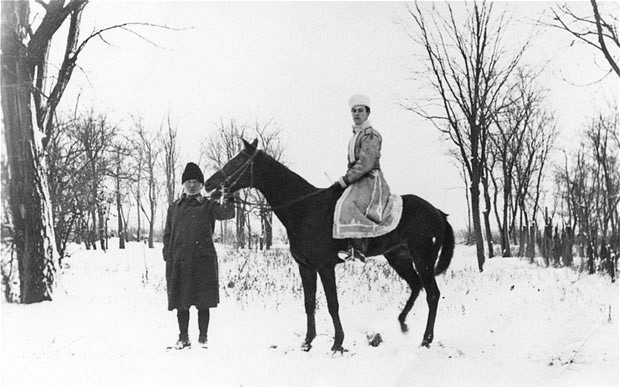
With his youthful trek done, Leigh Fermor’s career took off into near fable. Caught up in Greek unrest, he joined in a triumphal royalist cavalry charge against wilting Venizelist rebels. In Athens he fell in love with the artist Princess Balasha Cantacuzene, twelve years older than him, and lived with her in Moldavia for over two years, before World War II recalled him to London.

As a fluent Greek speaker he was recruited by the Intelligence Corps, and sent as a liaison officer with the Greek army first to Albania and finally to Crete, where he survived the brutal German invasion. For almost two years, while an officer in the Special Operations Executive, he lived disguised as a shepherd in the Cretan mountains, organizing the gathering of intelligence.

Then, in 1944, occurred the exploit that—more than any other—was to burnish him into legend. He and his fellow SOE officer Stanley Moss dreamed up a scheme of harebrained bravado. Dressed in stolen German uniforms, with a party of Cretan guerrillas, they ambushed the car of General Heinrich Kreipe, the German commander of occupied Crete, kidnapped him, and concealed him under the back seat. Moss took the wheel, Paddy donned the general’s cap, and together they drove through twenty-two checkpoints to emerge on the far side of Herakleion and march Kreipe for three weeks over the mountains, to be picked up by motor launch and taken to Egypt.

It was during this hazardous Cretan march, as the dawn broke over Mount Ida, mythical birthplace of Zeus, that the abducted general began to murmur a verse of Horace: Vides ut alta stet nive candidum/Soracte….1 It was an ode that Paddy knew by heart, and he completed the six stanzas to their end. “The general’s blue eyes had swivelled away from the mountain-top to mine,” Paddy later wrote,

—and when I’d finished, after a long silence, he said: “Ach so, Herr Major!” It was very strange. As though, for a long moment, the war had ceased to exist. We had both drunk at the same fountains long before; and things were different between us for the rest of our time together.

This precocious kidnapping was later reimagined in a lackluster movie named Ill Met by Moonlight (1957) with Dirk Bogarde playing Paddy. But there were other exploits too. Paddy had already engineered the defection of the Italian General Angelico Carta from Crete; and he was due to undertake a near-suicidal mission to Colditz when the war ended.

His upbeat account of these events was tempered by regret. He had planned that the abduction of Kreipe be bloodless, but his accompanying Cretan partisans slit the chauffeur’s throat, and rumors of grim German reprisals for the abduction have never quite died down. Above all, Paddy’s accidental shooting of one of his fellow guerrillas may have stained his memory of the whole period.

On June 16 Leigh Fermor was buried back in the English countryside, attended by an Intelligence Corps guard of honor, to lie beside his wife Joan, his dear comrade since 1946. This was, in a sense, fitting. For in certain ways he was exemplary of a wartime Englishness now almost gone, whose more dashing qualities merged seamlessly into the hardy stylishness of Greek leventéa.

To those who knew him, his books are hauntingly redolent of his sensibility. His conversation was irrepressibly warm and inventive far into old age, moving from arcane anecdotes to fanciful wordplay or bursting into polyglot song (sometimes singing the lyrics backward). His friends ranged from Deborah, Duchess of Devonshire—last of the six legendary Mitford sisters (his correspondence with her was published in 20082)—to early acquaintance with a raffish interwar bohemia and his own great predecessor, the travel writer and aesthete Robert Byron, whose borrowed rucksack he bore across Central Europe as a youth.

Almost the last time I met Paddy, he had returned home after an operation for suspected cancer, and I feared he would be depleted, his old zest gone. He was growing deaf, and he suffered from tunnel vision (which he called Simplonitis). For a while, sitting over lunch, he seemed subdued. Then something struck him. He perked up, and said: “You know, there is an apple lying on a table in the hall. It’s been there all weekend. Wouldn’t it be marvelous if it cocked a snook at Newton, and simply took off into the air!”

This was typical of his boyish resilience. In the field of travel he evoked both the youthful wanderer who discovers another world and the avid scholar who melds with it. His prose was too rich and elaborate to be a safe influence on others (although a few have tried); but he brought to the genre not only the distinction of his densely brilliant books, but his innate dignity, ebullient mind, and capacious heart.

  1. 1″See Mount Soracte white with snow….”
  2. 2The correspondence, In Tearing Haste , edited by Charlotte Mosley, was published in the US by New York Review Books (2010), which has also republished the other books by Patrick Leigh Fermor mentioned in this article, as well as The Traveller’s Tree .

Sir Wanderlust – Portrait von Patrick Leigh Fermor

Here are two more articles from Germany supplied to me by Christian Peters from Koln.

Sir Wanderlust vonWolf Reiser, first published in Travellers World

Travellersworld-Sir Wanderlust-1

Die Heimat der Nomaden, first published in Süddeutsche Zeitung

SZ-MANI-REISER


Anthony Lane’s New Yorker article on Fermor is now free to view

Anthony Lane's New Yorker article, May 2006

In trying to make this blog a focal point for all information related to Paddy I have had some problems accessing all on-line material. The one I most sought is the acclaimed May 22, 2006 profile by Anthony Lane which was published in the New Yorker.

This has sat behind their subscriber firewall, tempting us with one-off subscriptions. Now it appears that (possibly marking Paddy’s death?) this is no longer the case. You can now visit their archive, read the article in full on-line, print it or possibly even download it.

There are many profiles of Paddy. This is probably one of the longest and best, and includes interview material with him that many will have not seen before.

Take a trip to the New Yorker website and have a read.

Editor’s Note:  the pdf download appears to be no longer available – click on the article to magnify to read and then drag your cursor to move around the page.

Benedict Allen’s Travellers’ Century on Patrick Leigh Fermor

This is from the television review pages of the Independent covering Benedict Allen’s 2008 ‘Traveller’s Century’ series and the episode that focused on Paddy’s walk ending at the Iron Gates. I have seen this programme and share some of the frustrations of the author, but on balance it was a pretty fair programme given the tight time slot of just one hour.

by Deborah Orr

First published in The Independent 8 August 2008

The bit that delighted us all in this final episode of Travellers’ Century was a clip from another television show. There he was, Patrick Leigh Fermor, the star of the Greek version of This Is Your Life, meeting all the resistance fighters that he had worked with on Crete during the Second World War. And there, unbelievably, and every bit as thrilled to be reunited with Leigh Fermor as all the others, was the German former general Heinrich Kreipe. The two men grinned, hugged and fell into excited conversation, absolutely chuffed to see each other again. That is charm, is it not, the ability to inspire the deep affection of a man you only ever knew because you had spearheaded his humiliating wartime capture, then imprisoned him in a cave? A man, indeed, who was then portrayed in the film of the operation, Ill Met by Moonlight, as a bull-necked, grunting, Nazi ugly, while his nemesis was played by Dirk Bogarde?

I’ve been lucky enough to meet Leigh Fermor – dazzlingly charismatic company in his nineties – on a couple of occasions. So it seemed apposite to gather round the telly with the mutual friends who introduced us, so that we could all watch this film about his life together. Such is the fervour of loyalty that the man inspires, though, that it quickly became apparent that this show, or perhaps any show, would disappoint us. The first heckles came when Benedict Allen described Leigh Fermor as “the accidental superstar of travel writing”, a description we all decided would make him squirm. Concerns over tone were swiftly replaced with outright indignation, when Allen announced that he would be retracing the steps of Leigh Fermor’s first great walk across Europe, which he set off on in 1933, aged 18, in order to judge whether his descriptions had been “accurate”. This idea, again we all agreed with some disgruntlement, was facile beyond belief.

Allen’s idea was perhaps not such a weird one, though. Leigh Fermor’s book detailing the first leg of his journey had been published in 1977, after all, decades after he had made it. The delay had come about because his notes had been stolen in Romania. Again, it is testament to the affection he inspires that the local people who recovered the young Englishmen’s journal hung on to it in the hope that they would one day get the opportunity to return it to him. We all abhorred Allen’s attitude, nevertheless. When he suggested that Leigh Fermor’s two books describing his travels, A Time of Gifts and Between the Woods and the Water, might have been “endlessly worked and reworked, with whole decades of hindsight”, there was a generally mutinous feeling in the room that our man was being seriously impugned.

Allen regained a little trust when he decided, having visited some little-altered spots in Heidelberg, that the writer had indeed told it like it was. But when Allen changed his tune, and started suggesting that the books were weirdly apolitical, and offered too little detail about his own inner life, we sank again into despondency. The purity of Leigh Fermor’s writing comes from his scrupulous observation of what he encountered, and the beauty with which he describes it. He doesn’t bang on about himself. Anyway, on it went, as we nit-picked every assertion. By the time Allen got to interview Leigh Fermor, at his home of very many years in the Peloponnesus, we hated and resented him, and were only too happy to dismiss the interview itself as a dead loss. “And the programme was too long,” we agreed at the end. “If we thought that, what did everyone else think?” Actually “everyone else” would probably have enjoyed the thing a great deal more, not being hampered, like us, by an almost deranged sense of hyper-loyalty.

Scholar in the wilds – a profile of Patrick Leigh Fermor

A comprehensive profile of Patrick Leigh Fermor.

By James Campbell. First published in The Guardian 9 April 2005

As a teenager, Patrick Leigh Fermor walked through Europe to Turkey, sleeping in hayricks and castles. Forty years later he wrote two pioneering books about it; a third is still in progress. He lived in Romania, met his wife in Egypt, and was decorated for his wartime exploits in Crete. Now 90, he continues to work in the house he built in Greece in the 1960s.
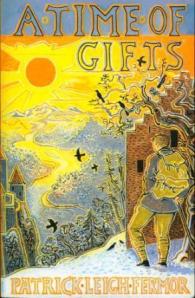
“So here’s the traveller,” a Hungarian hostess greets the teenage Patrick Leigh Fermor as he trudges towards her Danubian country house. The year is 1934 and Leigh Fermor is four months into his walk from the Hook of Holland to Constantinople, undertaken to shake off what he refers to, 70 years on, as “my rather rackety past”. The journey is captured, with erudition and fond detail, in A Time of Gifts (1977) and Between the Woods and the Water (1986). They are unique in several respects, not least that they were written more than 40 years after the events described. Leigh Fermor derived the former title from a couplet by Louis MacNeice, “For now the time of gifts is gone – / O boys that grow, O snows that melt”, which encapsulates the double vision involved in evoking one’s own adolescence from a distance. A concluding volume, which will take the boy to his destination, has long been promised.

Leigh Fermor is not a “travel writer” – like others, he disavows the term – but there is no denying he is a traveller. After Constantinople (as he still insists on calling it, though the name was changed to Istanbul in 1930), he moved to Romania, where he stayed for two years, barely conscious of the inklings of war from beyond the Carpathian mountains. In the 1950s, he explored the then-intractable southern finger of the Peloponnese known as Mani, where he lives, followed by a similar journey in the north of Greece, making his reports, in characteristically exuberant style, in the books Mani (1958) and Roumeli (1966). His stays in French monasteries, where he achieved “a state of peace that is unthought of in the ordinary world”, are recorded in an exquisite book of fewer than 100 pages, A Time to Keep Silence (1957).
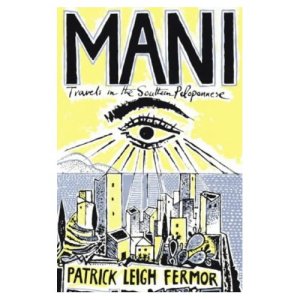
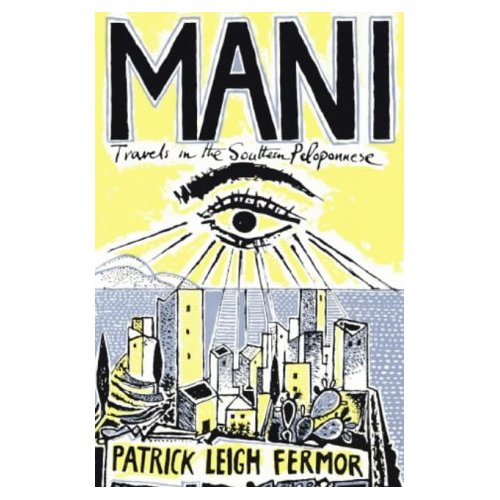
Mani: Travels in the Southern Peloponnese

Mani: Travels in the Southern Peloponnese

He is also a scholar, with a facility for languages so prodigious that he would amuse himself on his footslog by singing German songs backwards and, when those ran out, reciting parts of Keats the same way: “Yawa! Yawa! rof I lliw ylf ot eeht”, etc. “It can be quite effective,” he says. After a lunch of lemon chicken at home in Mani, accompanied by an endlessly replenished carafe of retsina, he entertains his guest with a rendering of “It’s a Long Way to Tipperary” in Hindustani.

In addition, Leigh Fermor is recognisably that figure many writers of the past century have yearned to be, the man of action. When the inklings could no longer be ignored in 1939, he abandoned his Romanian idyll and enlisted in the Irish Guards. A major in Special Operations Executive during the second world war, he was awarded the DSO for heroic actions on German-occupied Crete. Few writers are entitled to include in their Who’s Who entry: “Commanded some minor guerrilla operations.” His publisher, John Murray, whose father, the late “Jock” Murray, edited most of Leigh Fermor’s books, describes him as “almost a Byronic figure. If you met him on a train, before long he would be reciting The Odyssey , or singing Cretan songs. He loves talking, and people are always absorbed by him.”

Known as Paddy to the acquainted and unacquainted alike, Leigh Fermor has turned 90. He is still sturdy, with an all-round handsome appearance. Here is a man who at 69 swam the Hellespont (or Dardanelles), two kilometres wide at its narrowest, in emulation of Byron and Leander, who swam it nightly for the love of Hero. Leigh Fermor swam it under the concerned watch of his wife Joan, who followed in a small boat, and averted her eyes as he narrowly missed being sunk by a liner. An innocent sweetness hovers about his face, which finds a focus in his eyes as he makes a joke or stumbles on a happy recollection. There is a dash of the old soldier, clubbable and courteous, in his approach, his speech punctuated by “Look here …” and “I say …”, and not much of the “rather rackety” figure he claims to have been before he cured his ills by walking. When, relatively late in life, he became a mentor to Bruce Chatwin, the younger writer adopted Leigh Fermor’s motto, solvitur ambulando – it is solved by walking.
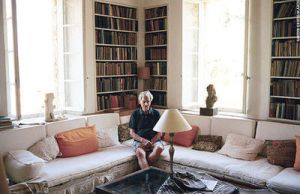
Paddy at home in the Mani

After more than six decades in the country, Leigh Fermor is inextricably tied to Greece. His command of the language extends to several regional dialects. He is an honorary citizen of the Cretan capital Heraklion, and of the village of Kardamili in Mani, and is a proud godfather to children in both places. In the mid-1960s, as if to lay the foundation for a committed life, he built a house that reflects the various aspects of his personality. Perched on a peninsula jutting into the Gulf of Messenia, it overlooks a small uninhabited island, behind which the sun sets nightly. He has described how he and Joan camped in tents nearby as the works progressed, studying Vitruvius and Palladio, but admits that the design was largely the result of improvisation. Ceilings, cornices and fireplaces allude to Levantine and Macedonian architecture. Hard by the commodious living room, an L-shaped arcade, which might have been built centuries ago, provides a link to the other rooms and gives on to an olive grove below. Out of nowhere, cats materialise on chairs and divans, prompting Leigh Fermor to remark on “interior desecrators and natural downholsterers”. The great limestone blocks of the main structure were hewn out of the Taygetus mountains, visible in the background, as the sea is present in the foreground. A weathered zigzag stone staircase leads down to a horseshoe bay. “There was no road here at all when we came. The stone had to be brought up by mule. We got most of the tiles from another part of the Peloponnese, after an earthquake. They were happy to be rid of them – couldn’t understand why we wanted this old stuff. They wanted everything new.” The master mason behind the house was a local craftsman, Niku Kolokatrones, whom Leigh Fermor met by accident while out walking. “I spotted his bag of carpenter’s tools and told him I was looking for somebody to help me build a house. He said, ‘Why not take me? I can do everything.’ And he was absolutely right.”

It was finally fit for habitation in 1968, and the couple “lived very happily here for 30 years”. Joan Leigh Fermor, daughter of the Conservative politician and First Lord of the Admiralty in Ramsay MacDonald’s coalition government, Bolton Eyres Monsell, died in 2003 at 91, after a fall. The couple met in wartime Cairo. She took the photographs for several of his books, including the first, The Traveller’s Tree (1950), an account of a journey through the West Indies, and for Mani and Roumeli – although these pictures have sadly been omitted from later editions.

He was born in London in 1915, to Sir Lewis Leigh Fermor, who became director-general of the Geological Survey in India, and Eileen Ambler, who was partly raised there. His childhood relationship with his parents was “rather strange, because I didn’t really know either of them until I was about three-and-a-half. My mother returned to India after I was born, leaving me with a family in Northamptonshire. I spent a very happy first three years of my life there as a wild-natured boy. I wasn’t ever told not to do anything.” When his mother returned, at the end of the first world war, “my whole background changed. We went to live in London. And she was rather unhappy, because I didn’t really know much about her, or my father or my sister, who had been born four years earlier. They hadn’t seen me since I was a few months old.” He claims he was “more or less tamed after that”, though he has written that his lawless infancy “unfitted me for the faintest shadow of constraint”.
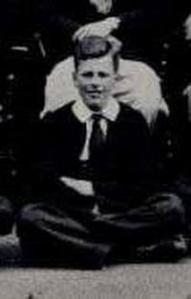
Patrick Leigh Fermor at school, Kings Canterbury

His mother “adored anything to do with the stage” and wrote plays that were never produced. She made friends with Arthur Rackham, who painted a picture inside the front door of their house in Primrose Hill Studios “of Peter Pan in Kensington Gardens, being blown along in a nest with a ragged shirt for a sail”. He wonders if it’s still there. When the time came to think about school, the “wild boy” re-emerged, and he was beaten from one educational establishment to another. “I didn’t mind the beatings, because there was a bravado about that kind of thing.” At one stage, he was sent to a school in Suffolk for disturbed children – or, as he puts it, “where rather naughty children went” – and later to King’s School, Canterbury, the oldest public school in England, where the unruly old boys included Christopher Marlowe. “It was all rather marvellous,” says Leigh Fermor, who casts a rosy light on almost all experience, “but my discipline problems cropped up again. Things like fighting, climbing out at night, losing my books.” Among his contemporaries at King’s was Alan Watts, who later wrote popular books on Zen Buddhism and became a hippie guru. In his autobiography, Watts recalled Paddy “constantly being flogged for his pranks and exploits – in other words, for having a creative imagination”. Watts confirms the familiar tale that Paddy was expelled “for the peccadillo of taking a walk with the daughter of the local greengrocer”. Leigh Fermor recalls: “She was about eight years older than me – totally innocent, but it was a useful pretext for the sack. I think it was very kindly meant. Far better to get the sack for something slightly romantic than for just being a total nuisance.”

Believing that the best place for a nuisance was the army, his parents tried to direct him towards Sandhurst, but his academic failures put paid to that too. The military historian Antony Beevor, who was an officer cadet at Sandhurst, and has known Leigh Fermor for many years, believes he would not have prospered. “I think he may have had a romantic idea of what army life was like, but he would have found the peacetime garrison incredibly stultifying. Army life in the 1930s was very staid. Paddy was too much of a free spirit.”

It was then that Leigh Fermor came up with a scheme “to change scenery”. Envisaging himself as “a medieval pilgrim, an affable tramp with a knapsack and hobnailed boots”, he decided to walk across Europe to Turkey. “It was a new life. Freedom. Something to write about.” To make it even more improbable, he set out in December when, as he states in the opening paragraph of A Time of Gifts, “a thousand glistening umbrellas were tilted over a thousand bowler hats in Piccadilly; the Jermyn Street shops, distorted by stream ing water, had become a submarine arcade.” When his ship docked in Rotterdam, “snow covered everything”. He dossed down wherever he landed, on one occasion outside a pigsty to the sound of “sleepy grunts prompted by dreams, perhaps, or indigestion”.

In addition to his sleeping bag, Leigh Fermor packed the Oxford Book of English Verse and a volume of Horace. An allowance of £4 a month was to be collected along the way. “My general course was up the Rhine and down the Danube. Then to Swabia, and then into Bavaria.” At the time, he had published a few poems (“dreadful stuff”), but was inspired to switch to travel writing by Robert Byron, whose book about a journey to Mount Athos in north-eastern Greece, The Station , had recently been published. “I was keeping copious notes, songs, sketches and so on, but in Munich a disaster happened. I stayed at a Jugendherberge and my rucksack was pinched, with all my notes and drawings.” And then comes the Paddy stroke: “In a way it was rather a blessing, because my rucksack was far too heavy. It had far too many things.” His sleeping bag was lost too -“good riddance, really” – and his money and passport. “The British Consul gave me a fiver – said pay me back some time.”

Leigh Fermor has pursued his literary career haphazardly. His Caribbean book was originally meant to be a series of captions for photographs. Then came his only novel, The Violins of Saint-Jacques (1953), followed by A Time to Keep Silence and Mani , all written in the mid-50s, after which he restricted himself to one public outing per decade. However, the 40-year interlude between the events of his European journey and the writing of the books enhances their appeal. At times, the hero of A Time of Gifts seems like a boy faced with a tapestry on which the entire history and culture of Europe is portrayed, unpicking it thread by thread. Byzantine plainsong; Yiddish syntax; the whereabouts of the coast of Bohemia (it existed, for 13 years); the finer nuances of regional architecture – “the wild scholarly enthusiasms of a brilliant autodidact”, as the writer William Dalrymple says. Theories are worked out, set down and often jettisoned, before another day’s walking begins. No one modulates as energetically from speculations on the origin of Greek place names to the “not always harmful effects of hangovers” as Leigh Fermor does. “If they fall short of the double vision which turns Salisbury Cathedral into Cologne,” he writes of his sore heads, “they invest the scenery with a lustre which is unknown to total abstainers.” When it came to writing about the journey, Leigh Fermor claims that “losing the notebook didn’t really seem to matter. I’d got all the places I’d been to noted down in another little notebook. Early impressions and all that sort of thing would only have been a hindrance.” It is impossible to say where imagination gets the upper hand over memory, and aficionados are adamant it does not matter.

Dalrymple, who as a student set out to follow the route of the First Crusade in emulation of Leigh Fermor, says: “I can’t think of any younger writers who have tried to write like Paddy, who have succeeded in the attempt. Not that I haven’t tried. When I set out on my first long journey in the summer vacation I had just read A Time of Gifts and I tried to write my logbook in faux-Paddy style. The result was disastrous. Just last summer I visited Mani and reread his wonderful book, and found myself again trying to write like him. I should have learned my lesson by now.” Dalrymple feels that the strongest influence of Leigh Fermor on the younger generation of travel writers “has been the persona he creates of the bookish wanderer: the footloose scholar in the wilds, scrambling through the mountains, a knapsack full of good books on his shoulder. You see this filtering through in the writing of Chatwin and Philip Marsden, among others.”

According to Jeremy Lewis, author of a biography of Cyril Connolly, with whom Joan was friendly, “Occasionally, one comes across some unromantic soul who objects to Leigh Fermor on the prosaic ground that he couldn’t possibly remember in such persuasive detail the events of 60 years ago.” Lewis suspects that “quite a lot of it is made up. He’s a tremendous yarn-spinner, and he has that slight chip on the shoulder of someone who hasn’t been to university. Sometimes one gets the feeling that he’s desperate to show he’s not an intellectual hick. He’s quite similar to Chatwin in that way. With Chatwin I find it irritating, but not with Leigh Fermor.” Lewis adds, “There is also a strong boy-scout element about him, which annoys some people, singing round the campfire and so on. I doubt if there was ever anything very rackety about Paddy.”
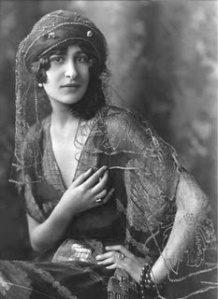
Balasha Cantacuzene

He has been asked many times why the composition of the books was delayed for so long, and has finessed the reply to his characteristic self-effacement: “Laziness and timidity.” He had a shot at writing during his sojourn in Romania in the late 1930s, “but I thought it was no good, so I shoved it aside. And I was right, actually, because when I tried it much later it all began to flow.” His companion in Romania, the first love of his life, was a young painter, Balasha Cantacuzene, whose family was part of an “old-fashioned, French-speaking, Tolstoyan, land-owning world. They were intensely civilised people. I spent the time reading a tremendous amount … when I wasn’t making a hash of writing. I felt rather different at the end of it all, from the kind of person I’d been before.”

After the communist takeover at the end of the war, the Ceausescu government branded the Cantacuzenes “elements of putrid background” and forced them to leave their property. Leigh Fermor made it his mission to rescue them from their new dismal circumstances, eventually succeeding in slipping into the country on a motorcycle and contacting Balasha and her sister. They met for only 48 hours. “We dared risk no more, and during that time I was unable to leave the tiny flat where they were then living, for fear of being seen.” He found that their early thoughts of leaving Romania had lapsed, “partly from feeling it was too late in the day; also, they said that Romania, after all, was where they belonged”.

His war service was spent mainly on Crete. After the British retreat from the island in May 1941, Leigh Fermor was among a small number of officers who remained, helping to organise resistance to the occupation, “living up in the mountains, dressed as a shepherd, with my wireless and so on”. In the spring of 1944, after an onslaught on villages “with fire and sword” by German troops in reprisal for the rash actions of some Cretan guerrillas, Leigh Fermor conceived a plan to kidnap the general responsible for the carnage, and to spirit him off to Cairo. The idea was to make a “symbolic gesture, involving no bloodshed, not even a plane sabotaged or a petrol dump blown up; something which would hit the enemy hard”. Together with a select band of associates, British and Cretan, he succeeded – except that the officer they were after, General Müller, had already left Crete, and they found themselves taking charge of his replacement, a milder figure by all accounts, General Kreipe. After three weeks of trekking through the mountains, they managed to get the captive on board a vessel bound for Egypt.

The events were drawn into a book, Ill Met by Moonlight (1950), by Leigh Fermor’s comrade in the operation, W Stanley Moss, and an inferior film in 1957, with Dirk Bogarde playing Paddy. He is polite about the actor, whom he met, but it is clear that Bogarde’s performance as Major Fermor failed to impress. “I didn’t go to the opening, or anything like that. It was all so much more interesting than they made it seem.” The military historian MRD Foot has referred to the Cretan escapade as “a tremendous jape”, which in Leigh Fermor’s opinion puts it in a “rather frivolous perspective”. Beevor, whose book The Battle for Crete (1991), pays handsome tribute to Leigh Fermor’s actions, feels the description of the kidnapping as a “jape” is unjust. “What was very clever about the Kreipe operation was that it was planned meticulously to give the Cretans a tremendous boost to morale. They needed to do something that would damage the Germans, but was not going to provoke civilian casualties. They were absolutely scrupulous about this.” Certain accounts of the exploit have suggested that it resulted in reprisals against the local pop ulation, but, says Beevor, “they are completely wrong. I’ve been through all the relevant documentation, and there is nothing to suggest that the kidnapping of General Kreipe provoked direct reaction from the Germans. It wasn’t just a jape. When I was researching my book, a member of the Cretan resistance told me, ‘The whole island felt two inches taller’.”

Captor and captive, stuck together in freezing caves (the general had to sleep between Leigh Fermor and Moss, all sharing a single blanket), found a common bond in the Odes of Horace. In a report written at the request of the Imperial War Museum in 1969, published in Artemis Cooper’s anthology of Leigh Fermor’s writings, Words of Mercury (2003), he described what happened: “We were all three lying smoking in silence, when the general, half to himself, slowly said: ‘Vides ut alta stet nive candidum / Soracte …’ [You see how Soracte stands gleaming white with deep snow]. I was in luck. It is the opening line of one of the few Odes of Horace I know by heart. I went on reciting where he had broken off: ‘… Nec iam sustineant onus …’ and so on, through the remaining five stanzas to the end.”
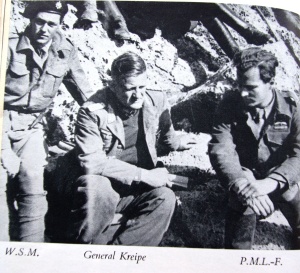
Moss, Kreipe and Paddy

The heroics in eastern Crete had a surprise sequel, which throws into relief the absurdity of war. Some 30 years later, Leigh Fermor was asked to take part in a Greek television programme based on This Is Your Life , in which the subject was to be General Kreipe. “I felt quite certain when I heard about it that it was not on the level, and so I found out General Kreipe’s number and got on the telephone to him. I said, ‘It’s Major Fermor’. He said, ‘Ach, Major Fermor, how are you? It seems we are going to meet again soon.’ I said, ‘So you are coming?’ He said, ‘Yes, of course I’m coming. Tell me, what’s the weather like? Shall I bring a pullover?’ And you know, it was the most terrific success. They were all there.” The exception was Moss, who died in 1965; and it is probably safe to discount the Cretan guerrillas who carried off the general’s chauffeur and slit his throat, much to Leigh Fermor’s displeasure.

He writes in a small studio apart from the main house. Dictionaries, volumes of Proust, books of verse in various languages and back issues of the TLS occupy every surface. Asked if he has a title in mind for the promised last volume of his European trilogy, he looks suddenly pained and answers no. He describes himself as “a very slow writer”. His pages are laboriously revised and readers who revel in his florescent style may be surprised to learn that the finished sentences are pared down from something the author considers “too exaggerated and flowery and overwritten”. Murray says: “It’s rather like a musician: each time he changes a word, he has to go back and change all the other words round about it so that the harmony is right.” Murray recalls “seven versions of A Time of Gifts being submitted to my father. And each one would be written-over, with bubbles containing extra bits. The early manuscripts are like works of art themselves.”

As he is writing, Leigh Fermor thinks of one or two friends “that it might amuse. How would they respond? Where would they sneer?” He refers to his old notebooks for things like dates and place names, but relies on memory for a clearer vision of the walking boy and the snows. “I’ve written quite a large amount. For some reason, I got a sort of scunner against it several years ago. I thought it wasn’t any good. I always think that. But now I think I was wrong. I’m going to pull my socks up and get on with it.”

Patrick Leigh Fermor

Born: February 11, 1915, London.

Education: 1929-33 King’s School, Canterbury.

Married: 1968 Joan Eyres Monsell.

Employment: 1945-46 deputy director British Institute, Athens.

Books: 1950 The Traveller’s Tree; ’53 The Violins of Saint-Jacques; ’57 A Time To Keep Silence; ’58 Mani; ’66 Roumeli; ’77 A Time of Gifts; ’86 Between the Woods and the Water; ’91 Three Letters from the Andes; 2003 Words of Mercury.

Some awards: 1944 DS0; ’47 honorary citizen of Heraklion, Crete; ’58 Duff Cooper Memorial Prize; ’78 WH Smith Award; ’86 Thomas Cook Travel Book Award; ’91 Companion of Literature; 2004 Knighthood.

One year on … the Patrick Leigh Fermor Blog

I am back. Sorry that I have been so quiet for the last few weeks. I don’t have any real explanation. Excuses may range from work commitments through some form of ‘writer’s block’ (where has my muse gone?) to the genuine excuse of being totally absorbed by Miklos Banffy’s first volume of his trilogy – They Were Counted.

This is an exceptionally good book. I will write about it at greater length at some future date, but I do recommend it. He can sometimes get a little bogged down by Hungarian politics, but when he gets going, describing balls, duels, gambling and love, he really does have a very fine style. Paddy wrote the forward to the English translation whilst staying at Chatsworth during Christmas 1998. Much of the story is set in Kolozvar (Cluj) and our old friend the Hotel New York, where Paddy and Angéla went for a cocktail, is frequently mentioned.

We have just had a blog anniversary. The Patrick Leigh Fermor blog started in late March 2010. In that time it has reached almost the very top in any Paddy search you care to mention. There have been over 64,000 visits, 156 postings, 206 comments, and there are now well over 100 subscribers (you can sign up in the top right of the home page so that you receive future posts by email – no spam).

When I started I wondered if there would be any interest in our heroic and talented subject. There were just a few dozen visits in the first month. But visits grew rapidly to a peak of 9,400 in January 2011. We now track at nearly 7,000 visits a month on average so you are not alone in your interest in The Greatest Living Englishman.

I am extremely grateful to all of you who have got in touch with me with messages of support; offers of information; and especially to those who have sent me material to publish. I can assure you that there is much more material (I have over 60 items in various stages of draft) and it will come in a steady stream. To one of you, please be assured I remain your #1.

Finally, let’s not forget why we are here. Paddy is now 96 years of age and, as far as I can tell, in reasonably good health. I am sure we wish him all good health and pray that he is working as fast as he can on that third volume. It is without doubt one of the most eagerly anticipated books of the decade.

Why not visit some of our top posts?

Patrick Leigh Fermor recounts the kidnap of General Kreipe on video

A Meeting between Paddy and George Psychoundakis the “Cretan Runner”

Patrick Leigh Fermor – star of the silver screen?

On the Pontic shores where the snowflakes fall

I knew Patrick Leigh Fermor through his words, and he will know me by mine

Kennt ihr das Land in deutschen Gauen

I guess that many of us enjoy the chapter in A Time of Gifts when the eighteen year old Paddy spent two nights in Stuttgart with two very pretty nineteen year old German girls, Lise and Annie. It was Epiphany, 6th January 1934, and they went to a party where Paddy had to pretend to be Mr Brown, a family friend. He particularly enjoyed singing a song about the Neckar Valley and Swabia. Paddy could not remember all the words but his stunning memory recalled most of them (page 66).

As we approach that time of year I thought we ought to share this delightful song.

Here is a link to the music sung by a German choir. The words are below so that you too can sing along! Let’s hear it now, one two three …. 

  1. Kennt ihr das Land in deutschen Gauen,
    Das schönste dort am Neckarstrand?
    Die grünen Rebenhügel schauen
    Ins Tal von hoher Felsenwand.

Refrain:
Es ist das Land, das mich gebar,
Wo meiner Väter Wiege stand,
Drum sing’ ich heut’ und immerdar:
Das schöne Schwaben ist mein Heimatland! 

2. Kennt ihr das Land in deutschen Gauen,
Mit Wald und Flur so reich bekränzt,
Wo auf den weiten, reichen Auen
Im Sonnenschein die Ähre glänzt?
Es ist das Land, . . . . .

  3. Kennt ihr das Land in deutschen Gauen,
Wo Tann’ und Efeu immer grün,
Wo starke Männer, edle Frauen
In deutscher Kraft und Sitte blühn?
Es ist das Land, . . . . .4. Kennt ihr das Land im deutschen Süden,
So oft bewährt in Kampf und Streit,
Dem zwischen seiner Wälder Frieden
So frisch die deutsche Kraft gedeiht? 

Ja, wackre Deutsche laßt uns sein!
Drauf reichet euch die deutsche Hand;
Denn Schwabenland ist’s nicht allein:
Das ganze Deutschland ist mein Heimatland!

A Traveler’s Tale: On Patrick Leigh Fermor

by Wes Davis

First published in The Nation, December 2010

At a Chelsea-to-Richmond boating party held sometime in the early 1950s, the Duchess of Devonshire, then a beautiful young woman of 30, met a dashing man, some five years her senior, who was dressed as a Roman gladiator and armed with a net and trident. It was a look she thought suited him.

The fancy-dress gladiator was Patrick Leigh Fermor, a former officer in Britain’s Special Operations Executive (SOE), a covert unit that aided resistance movements throughout occupied Europe, and an up-and-coming writer best known at the time for kidnapping a German general during the war. He had crossed paths with the duchess before and remembered her clearly from a regimental ball in 1940, when she was still Deborah Mitford—the youngest of the soon-to-be-famous Mitford sisters. She was then engaged to Andrew Cavendish, a tall naval officer and younger son of the Tenth Duke of Devonshire who had no expectation of inheriting his father’s title until the war took his older brother’s life four years later. Leigh Fermor had watched the couple dance their way through the evening, “utterly rapt, eyes shut, as though in a trance.” Mitford had not noticed him.

But when they met again—as duchess and gladiator—Deborah Devonshire and Patrick Leigh Fermor struck up a friendship that has endured for more than half a century. In Tearing Haste, a collection of their letters newly available in this country, gives the impression that the conversation that started at a boating party so many summers ago has never stopped. Spanning 1954 to 2007, the volume reads like an accidental memoir of a disappearing world stretching from the manor houses of the English aristocracy to the olive groves of Greece, its people and places rendered with a kind of care that’s becoming scarce in our age of helter-skelter communication. At the same time, the book’s title, a phrase deriving from Leigh Fermor’s habit of dashing off messages “with a foot in the stirrup,” captures the vigor and bustle of the lives that nourished the correspondence. I once happened upon the manuscript of a chatty letter Leigh Fermor had written in 1944 to an Englishwoman stationed in Cairo. Amusingly composed and illustrated with a witty hand-drawn cartoon, it closed with Leigh Fermor mentioning offhand that he was in hiding on occupied Crete and that an undercover runner was waiting outside to receive the communication.

In Tearing Haste is engaging from start to finish. There isn’t a dull letter among Charlotte Mosley’s selections. Even her annotations, often incorporating information from the book’s two correspondents, are as surprising as they are informative. One biographical note on the painter Augustus John includes Deborah Devonshire’s recollection of meeting him in London: “He looked me up and down and said, ‘Have you got children?’ ‘Yes.’ Another long look. ‘Did you suckle them?'” More than anything else, the collection is important as an addition to Leigh Fermor’s body of work, both because his letters constitute a larger portion of the volume and because the writing in them harmonizes with the books that established his literary reputation. But let it be said that the Duchess of Devonshire is no slouch either. Her letters, though generally shorter and less frequent than Leigh Fermor’s, share his wit and many of his interests—a fascination with language, for example, or with the byways of English and European history. She puts a charming twist on these topics while adding a few bright threads of her own to the correspondence.

Deborah Devonshire’s books—beginning with The House (1982) and The Estate (1990)—focus largely on the management of Chatsworth, the massive estate in Derbyshire that she and her husband put into charitable trust and opened to the public in 1981. (The house was a stand-in for Mr. Darcy’s Pemberley in a film adaptation of Pride and Prejudice, and throughout the letters Leigh Fermor refers to it as “Dingley Dell,” after Mr. Wardle’s house in The Pickwick Papers.) As a writer, she is best when describing the seasonal rhythms of country life (the arrival of the year’s pullets, say) or assessing the gamut of rural arts (from drystone walling to mushroom gathering) and tilling their linguistic soil. In Counting My Chickens, a collection of notes and essays published in 2001, she remembers leaving Leigh Fermor “stumped” by the meaning of words gleaned from the glossary of a pamphlet about sheep. “One sheep disease,” she recalls, “has regional names of intriguing diversity: Sturfy, bleb, turnstick, paterish, goggles, dunt, and pedro all are gid.” On the same page she can be found rhapsodizing over “the glorious language of the 1662 prayer book, with its messages of mystery and imagination.”

She takes any opportunity to undercut the preconceived notions one might have about a duchess’s likes and dislikes. “I buy most of my clothes at agricultural shows,” she says in Counting My Chickens, “and good stout things they are.” For the playwright Tom Stoppard, who contributed an introduction to the book, this was one of her most characteristic revelations. For me, a close runner-up is her discussion of flower gardening on a grand estate, where she admits, “I prefer vegetables.” Many of her stories turn on a similar blend of unexpected rusticity and unflagging old-school civility. In an essay about the life the Mitfords led for a time on the island of Inchkenneth in the Hebrides, she describes traveling by train in the company of a goat, a whippet and a Labrador back to her sister Nancy’s house in Oxfordshire when the war broke out. “I milked the goat in the first-class waiting room,” she confesses, “which I should not have done, as I only had a third-class ticket.”

For all her modesty, the duchess isn’t embarrassed to mention boldface names that have sailed in and out of her social circle. (They range from Fred Astaire to the Queen Mother, the latter called “Cake” when she appears in the letters.) The humor in one anecdote depends on knowing that John F. Kennedy was intimate enough with the duchess to employ her nickname. This caused some confusion when her uncle Harold Macmillan, then prime minister, found himself involved in a telephone conversation with the American president about matters involving Castro, SEATO and NATO. It took him a moment to switch tracks when Kennedy asked, “And how’s Debo?” (Evelyn Waugh, a friend of hers, might well have written the scene.) In the letters, Kennedy is counted among the “bodies to be worshipped,” and several entries describe the friendship that developed between JFK and the duchess in the years between his inauguration and his death.

Her relationship with Leigh Fermor has many dimensions, its ardor fueled by humor, charisma and delight in a good tale. The revealing joke that runs through In Tearing Haste is that Devonshire is not a reader and that despite her lively correspondence with Leigh Fermor, she can’t manage to read his books. She praises one of his letters not for its vivid language but because it has instructions about which parts to skip. Leigh Fermor takes revenge in another letter, marking a set of passages with notes “don’t skip” and “ditto.” The bit he wants her to see—a foray into history by way of language—might well have been lifted from one of the books that made him famous: “The inhabitants are Koutzovlachs who speak a v. queer Latin dialect akin both to Rumanian and Italian. Some say they are Rumanian nomad shepherds who wandered here centuries ago with their flocks and never found their way home again. Others, more plausibly, say they are the descendants of Roman legionaries, speaking a corrupt camp Latin, stationed here to guard the high passes of the Pindus, miles from anywhere.” Continue reading

Nice weather for young ducks

Patrick Leigh Fermor in Ithaka, 1946, photographed by his wife Joan Leigh Fermor

The weather in London on December 9th 1933 was typical. The sky darkened, the clouds lowered and then it rained hard. A young man walked the cold pavements towards Cliveden Place to collect a rucksack that his friend Mark Ogilvie-Grant had used on a journey to Mount Athos accompanied by Robert Byron. After stopping to buy a stout ash stick, and probably some cigarettes, at the tobacconist on the corner of Sloane Square, the young man collected his new passport – occupation ‘student’ – from the office in Petty France. He cast his eyes up to the ominous clouds and then made his way quickly north across Green Park. Now the rain splashed down as he dashed between the traffic on Piccadilly and entered the house of his landlady, Miss Beatrice Stewart, in Shepherd Market.

A former model who sat for Sickert, and Augustus John, and who is said to be the model for the bronze figure of Peace atop Wellington Arch, Beatrice Stewart’s career was cruelly cut short after she lost a leg in a road accident. She had arranged a lunch for the eighteen year old Patrick Leigh Fermor and two of his friends to wish him bon voyage before the start of what was to become one of the most famous journeys of all time, and certainly the longest gap year in history.

After lunch, Paddy said thank you and goodbye to Miss Stewart, and jumped into a waiting taxi, which drove off through Mayfair, around Trafalgar Square, up Ludgate Hill, and past the Monument towards the Tower of London. It was raining so heavily that all they could see out of the steamed up windows were hordes of umbrellas, some carried by bowler hatted men, as the rain splashed down in the dark. “Nice weather for young ducks.” said the taxi driver as he dropped the small party by the first barbican on Tower Bridge.

The two companions, one a young girl wearing a mackintosh over her head like a coal shifter, stood in the rain to watch Paddy descend the stone steps down to Irongate Wharf. With a final wave, he strode up the gangplank of a Dutch steamer bound for Hook of Holland.

This was the start of Paddy’s journey down the Rhine and along the Danube which he so memorably describes for us in his book A Time of Gifts. This part of the story ends on Easter Sunday 1934 as Paddy stood on the long bridge over the Danube, in no-man’s land, between Czechoslovakia and Hungary at Esztergom, just as the Easter celebrations started in earnest.

A Time of Gifts is almost universally acknowledged as a masterpiece of English literature; Sebastian Faulks is a dissenter, but he would be. Described by some as a travel book, it is essentially the journal of a young man with a superb gift of memory, for languages, and for making friends, written with the benefit of a lifetime of amazing experience and learning, forty years after the events it describes. It is embellished by anecdotes and essential historical background, making it a rounded piece of literature and no mere travelogue. It should be compulsory reading for all seventeen year olds; it is truly inspirational. The sad part is that the very reason for the ending of Paddy’s ‘gap year’ whilst with his lover Balasha Cantacuzene in Romania in September 1939, resulted in the destruction of many of the towns and cities he passed through, and certainly ended the way of life of the peoples of Europe that he describes so well.

I have no doubt that today, aged ninety-five, Paddy will pause for a while to recall that day, reflect on the events that followed during his amazing and full life, and the friends and lovers who have gone before him.

Perhaps Sir Patrick Michael Leigh Fermor DSO OBE, the Greatest Living Englishman, will pen a short letter to Debo?

I knew Patrick Leigh Fermor through his words, and he will know me by mine

I think I am quite privileged to receive so many positive comments about the blog from people I have never met. One thing many agree upon is that Paddy has had a significant impact upon their lives. In some cases reading A Time of Gifts has been life changing, with some literally getting out there on the road and creating their own journey.

One message that really struck a chord was from Thos Henley – after the old abbreviation of Thomas I am told – who was originally from my neck of the woods in Hampshire, England, but who set off on the road two years ago and is now living what I imagine to be a bohemian life somewhere on the left bank of the Seine in Paris. He has even written and recorded some of his own songs, one which includes a reference to Paddy; it is good music and worth listening to. [Edit – I have listened to it a few times now and it really is quite good; have a listen]

Thos’ story is very moving and I asked if he would like to share it with other blog readers. He agreed so over to Thos …

Thos Henley at Paddy's door

“I am a 22 year old musician and a writer from Netley Abbey, Hampshire. Around two years ago I set off the travel France. One of the reasons I did so, was because I had recently discovered Paddy’s work. After this eventful trip all around the country, I settled in Paris, which now acts as my home and I have not been back to England since. In this time I have walked around the largest lakes of Sweden, travelled the expanse of Europe, and released a record in Paris named GOLDEN EUROPE. One of the songs on the record is about my travelling companion on the trip through France. He was my Xan Fielding and in the song I reference Patrick Leigh Fermor. It is called ANOTHER BROTHER and you can find it by clicking here.

Recently, I took a trip with my girlfriend to Greece. We went to Patras and walked to the edge of the Peloponnese. Slowly moving down south we made our way to Kalamata and then Kardamyli. I became good friends with certain locals and on the third day I had a map drawn out for me, with the whereabouts to Paddy’s home.

When I got there, the soles of my shoes had withered away (an overdue happening as I had worn them out for years). I met his house-keeper who spoke a very gentle Greek-English. I was nervous and I could hear Paddy eating his lunch next door and after a few minutes of introducing myself to his assistant I learnt that he was just too old to see anyone. She explained that the emotional toll was too much for the man who had been through it all. Passion carried my persistence but in the end I started to feel like some kind of a stalker and I gave up. Leaving his incredible garden, I heard through an open window, the mumbled low tone of Sir Patrick himself, obviously inquiring about the energetic English boy who had just been at his ocean blue door.

Sitting on the wall that he had made some 20 years or so before my own birth, I began to write him a letter. I explained my story and the fact that in his words I had come to find some sense of freedom in this ever enclosing world in which we all reside. Tears and sweat dripped onto the scribbled words that, no matter how much I tried, would never portray truly what this man meant to me. I wrapped the piece of paper over and around my old Swedish compass. In the letter I had told him I left it for him, as I had no need for it now; it had guided me to his house, where I sat boiling in the Greek sun, and its job, in my eyes, was done.

I swam for hours that day, washing away the heat and the sadness of not meeting ‘my’ Byron. However after reaching my hotel, after the sun had died and the raging fire of the crickets sang in their clicking chorus, I began to see the up side of what I had done. Yes I may not have met the man, but the fact remained that I had been to his home which I wished to visit over my childhood home in England. It was his seas that I wished to swim in over any other ocean in the world and it was his door step where I wrote, what I still hold as the best piece of writing I have done to this day.

This is not an ego talking but personal victory. I can live my life here, in this rainy, grey city of lights, Paris, knowing in myself that Paddy read my words and opened the same compass that I had used for years, its red point quivering on the W. And he would go to sleep that night knowing once more that his life had indeed been the greatest life ever lived and was still just as appreciated as it had always been.

In the end I knew Patrick Leigh Fermor through his words, and he will know me by mine.”

Visit Thos’ MySpace page where there are more photographs, you can find some of his music and videos.

OPRIG GAGINONANUS

Here is something completely ridiculous, a challenge for you all that recalls Paddy’s late night walk through Shepherd Market, London in early October 1992.

In a letter to Debo Devonshire dated 6 November 1992 (see page 293 of In Tearing Haste), Paddy writes to tell her of a strange experience just before he left for a trip to Antibes to collect a French literary prize for A Time of Gifts. Paddy and Joan had dinner with Magouche Fielding (Xan’s second wife). Joan left early and Paddy decided to walk home … “through Shepherd Market – my old haunt when young * – and into Market Mews. I had only gone a few paces when, on a wide black surface on the left side, I saw a strange message in huge letters in White:

‘OPRIG’, it said,

And underneath,

‘GAGINONANUS’

What could it portend? It looked simultaneously insulting, enigmatic and vaguely improper, especially the message below.”

Paddy enclosed a sketch.

Paddy's first sketch - OPRIG

It was only when he stood four square in front that all was revealed – click here to see the picture.

The challenge therefore is for those of you who live in London, or who are visiting this month, to see if you can find GAGINONANUS. There are enough geographic clues, and to add to this Paddy further writes to Debo, “If on leaving your front door, passing the Curzon Cinema, and turning right into the Mews, you’ll [see it].”

Let’s hope that like for Paddy the concertina doors will be ajar so that you can see it just as Paddy did. Perhaps they have been painted over? Do they still exist?

If you find GAGINONANUS then send me a photograph (tsawford[at]btinternet.com) with a brief retelling of your search. Special merit if you can include a cat in the picture!

The prize? Well, the satisfaction of ‘being there and having done it’ and a first edition copy of Words of Mercury for the first person to send a picture.

I shall personally resist the temptation to find it until the end of August. If we have had no responses by then, I shall go on a search myself.

* Paddy had lived at 43 Market Street before he departed on his journey in 1934

Sky Arts at the Notting Hill Travel Bookshop – A Time of Gifts

Sky Arts Book Club takes a look inside The Travel Bookshop in Notting Hill, London and explores the book A Time of Gifts by Patrick Leigh Fermor.

Click the picture to play.