Author Archives: proverbs6to10

Unknown's avatar

About proverbs6to10

Interested in Byzantium and Patrick Leigh Fermor

Patrick Leigh Fermor – the journey continues

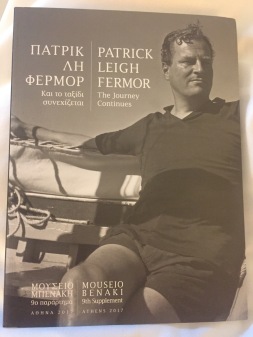
From time to time, the Benaki Museum publishes a supplement to its regular journal, and the 9th Supplement is a masterpiece dedicated to Paddy’s life.

Well bound, and coffee table book sized, there are over twenty new articles exploring a range of topics including Paddy’s intimates and friends, his walks, the Cretan resistance, wider discussions of Greece, Paddy’s writing and of course the house.

The Benaki have assembled a remarkable collection of writers including Hamish Robertson, Cressida Connolly, the Marques de Tamaron, Nick Hunt, John Kitmer, Chris White, Colin Thubron, John Julius Norwich, Adam Sisman, and Roberto Calasso amongst others.

The supplement is available from the Benaki Museum shop for 18 Euros plus worldwide DHL shipping.

Details of the contents are here.

Charmed lives in Greece: Ghika, Craxton, Leigh Fermor at the British Museum

Nikos Hadjikyriakos-Ghika (1906–1994), Study for a poster. Tempera on cardboard, 1948. Benaki Museum – Ghika Gallery, Athens. © Benaki Museum 2018.

The British Musem has at last started to publicise this exhibition which focuses on the friendship of the artists Niko Ghika and John Craxton, and the writer Patrick Leigh Fermor. Their shared love of Greece was fundamental to their work, as they embraced its sights, sounds, colours and people.

Where? The British Museum, Room 5

When? 8 March – 15 July 2018

How Much? It is free!

Nikos Hadjikyriakos-Ghika (1906–1994), John Craxton (1922–2009) and Sir Patrick Leigh Fermor (1915–2011) were significant cultural figures of the 20th century. Leigh Fermor is perhaps the most widely known of the three – largely through his travel writings – and Ghika and Craxton are now recognised as two of the most remarkable artists of this period. The three first met at the end of the Second World War, becoming lifelong friends and spending much of their subsequent lives in Greece. The time they spent together and their close bonds would shape each other’s work for the rest of their lives.

The exhibition brings together their artworks, photographs, letters and personal possessions in the UK for the first time. Highlights include Ghika’s extraordinary painting Mystras and Craxton’s exuberant Still Life with Three Sailors. Also featured is Craxton’s original artwork for the book covers of Leigh Fermor’s travel classics A Time of Gifts and Between the Woods and the Water. Many artworks and objects on display are on loan from the Benaki Museum, to which Ghika donated his house and works, from the Craxton Estate, and from institutions and private collections in the UK and Greece.

The exhibition focuses on four key places – Hydra, Kardamyli, Crete and Corfu – where they lived and spent time together. Hydra is an island where Ghika’s family home became a gathering place for the three friends, and Leigh Fermor built a house with his wife Joan at Kardamyli. Craxton restored a house at Chania on Crete, and Corfu is where Ghika and his second wife Barbara transformed an old building into an idyllic home and garden.

Together, these places chart the story of this remarkable friendship, and how the people and landscapes of Greece were a great influence on their enduring works.

Presentation in Melbourne, Australia: The Cretan Resistance and SOE in WW2

British-based author and historian, regular blog contributor, and co-author of Abducting a General, Chris White, will outline his research into the story of the resistance to German occupation on Crete during WW2, including the experience of the British SOE agents and the famous kidnapping of the German General Kreipe in 1944. The presentation will feature photographs from the time – many rarely seen before – as well as Chris’ own taken as part of his identification of the locations used by the resistance and SOE.

There will be an opportunity afterwards for attendees to meet with Chris to discuss specific villages and areas, and to consider some of the many photographs taken on Crete in WW2 in his collection.

A unique presentation not to be missed.

Where: Mezzanine, Greek Centre, 168 Lonsdale Street, Melbourne
When: 2.00pm start, Saturday, 17th March 2018

As an addendum, happening the week before, is the inaugural Rebeitiko Festival being held at the Melbourne Recital Centre (very prestigious venue). https://www.melbournerecital.com.au/events/2018/rebetiko/

Rebetiko is the music of struggle and resistance. Songs were written in Crete recording the exploits of the Cretan resistance and the kidnapping. It is possible that they include a few songs on that subject. No committal as yet!

Persian princes and twelve cadillacs

Paddy sent this letter to Deborah Devonshire in October 1960, having completed a road trip through the Balkans. Read more of their letters in Dashing for the Post: The Letters of Patrick Leigh Fermor

Darling Debo,

Off we set in Joan’s Sunbeam Rapier, hood down, singing at the wheel, heading from Le Touquet to our old friend Lady Smart’s, spent three days there, then into a deserted dusty summer Paris, so bare that it might have been emptied by a Bedouin raid, and south to Fontainebleau, for a further three days of utmost luxury and pleasure at your old pal Charles de Noailles and Natalie’s house … Then off hot wheel eastwards to Chatillon-sur-Marne, to see the Vix Vase, a huge Greco-Etruscan amphora dug up seven years ago …

Then across the Rhine, through the Black Forest, one night on the shores of Lake Constance surrounded by Germans; south into the Austrian Tyrol, on into Italy at Bolzano, then clean through the Dolomites, hundreds of miles of sheer and dizzy spikes a-gush with streams out of which beautiful trout virtually leap straight on to frying pan, grill and saucepan; north of Venice into Yugoslavia at last; through Slovenia to Lubliana, through Croatia to Zagreb, then east along a billiard table autostrada towards Belgrade. Now, a travel tip for motoring in Yugoslavia: there are only about three petrol pumps the country, and scarcely any motors. We ran out hundreds of miles from one on this autostrada in the heat of the day and settled for hours under an acacia tree … until at last a caravan of twelve Cadillacs drew up and succoured us by siphoning petrol out of their tanks. They were a party of Persian princes with their sloe-eyed princesses on the way from Claridge’s to Teheran. They partook freely of our wine flask, asked us to stay in their palaces (the competition began to look ugly) and then slipped into gear for Iran.

We continued south into wildest Bosnia, where mountains began to rise and minarets to sprout in every village, each alive with Moslem invocations intoned thrice daily. The roads became dust tracks across plains or twisty ledges of rubble little wider than eyebrows along the rims of deep gorges at the bottom of which huge rivers curled and swooped through echoing and forested ravines, with here and there an old Turkish bridge spanning them as thinly and insubstantially as a rainbow. The food became odd and wonderful, stuffed with garlic and paprika and the sunlight and our breath got stronger with every mile. So on to Sarajevo, scene of the Archduke’s murder, and, through range after range of mountains to Dubrovnik on the Dalmatian coast, a terrific medieval walled city full of renaissance palaces and belfries and winding columns and cloisters, and oysters too—huge and wonderful ones. South of this is the old kingdom of Montenegro, now part of Yugoslavia, reached after a three-hour zigzag up a sheer and cloud-topped wall of mountain, looking down on to strange rock fjords caked with water lilies and with pyramid-shaped mountains that hover on mist like the ones in Japanese pictures, and plenty of gliding storks …

Into Greek Macedonia at last, and then by familiar roads to Athens … a colossal road is being built outside, with fifty pneumatic drills, giant steel claws for rubble, hydraulic pumps, steamrollers and blasphemy. One has to talk in bellows. I have now bought some pink wax ear plugs, which makes everything even eerier. I see massed drills a-shudder, rollers a-crunch, and ten tons of broken concrete crashing from suddenly gaping steel claws all only a few yards off, and all in dead silence; lorries hurtle by as soundlessly as minnows. Meanwhile, one’s heart sounds like a steam hammer, and one’s own steps like nail-clad footfalls in a cathedral.

Published in The Paris Review

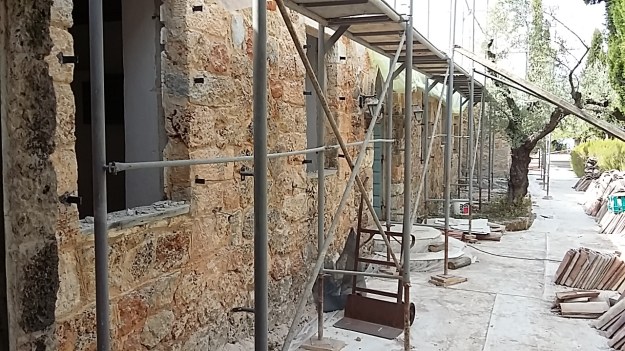
Crisp, clean images of the house at Kalamitsi

Some lovely new images of the house (pre-works) which you may enjoy. From Greek Gastronomy Guide.

Help needed – high resolution photos of John Pendlebury

John Pendlebury at Knossos

Hello all. I have a request from Crystalia Patouli who is writing an article for a magazine in Greek and English. She would like to include some high resolution pictures of John Pendlebury. If you can help please contact Crystalia – cpatouli[at]gmail.com

Thank you.

A forlorn ultimate border of reality

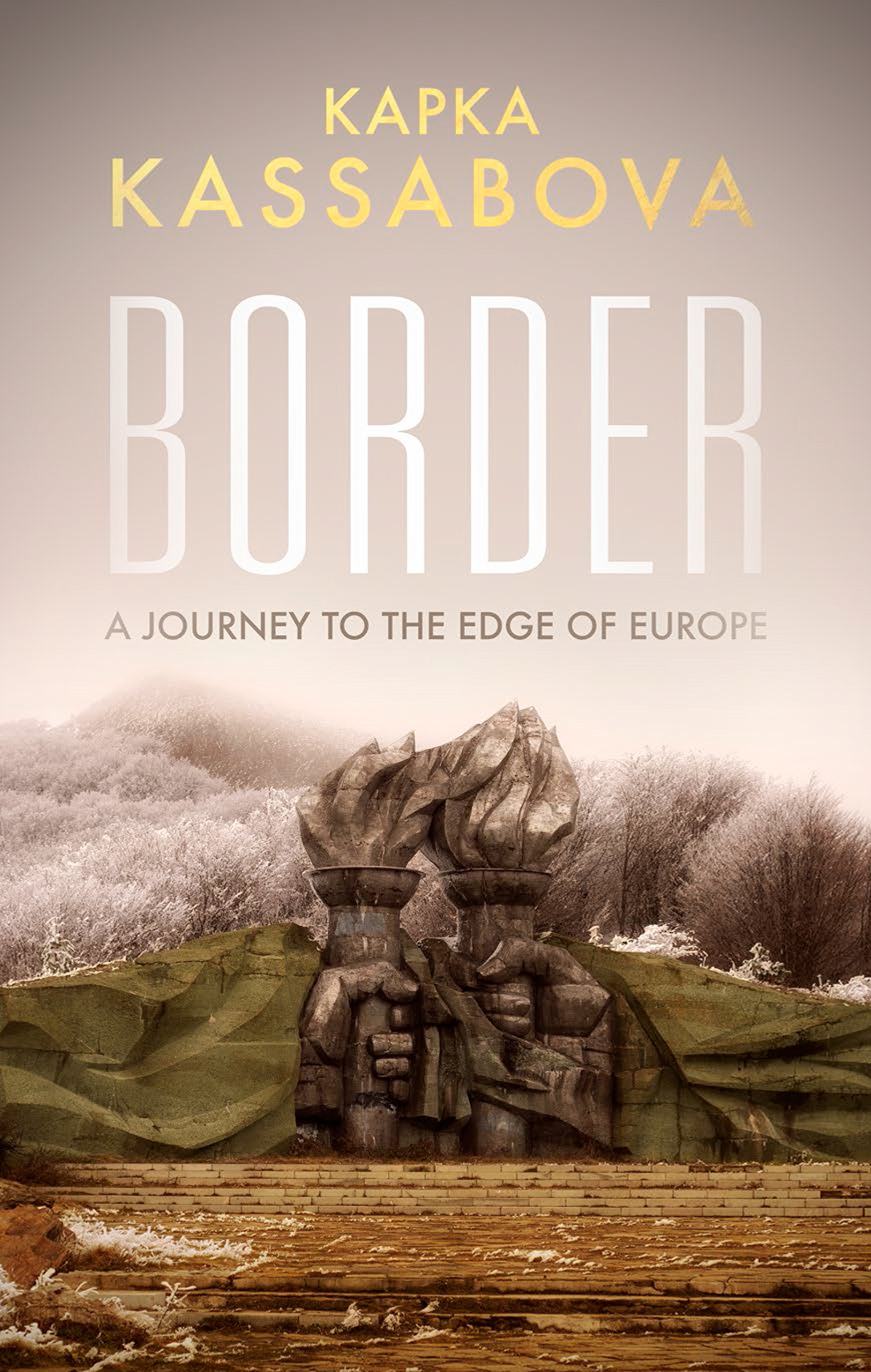
Kapka Kassabova’s Border: A Journey to the Edge of Europe is a timely, powerful story of immigration, friendship and travel.

By Caroline Moorhead

First published in The New Statesman

When Kapka Kassabova was in her late thirties, she decided to return to the place where she had grown up, but had not seen for 25 years: the borderlands of eastern Thrace, where Bulgaria, Greece and Turkey meet. Her parents were Bulgarian scientists who, after a spell in the UK, had settled in New Zealand, where, she writes, the Kiwi speech made “fish” sound like “fush” and “chips” like “chups”, where the stars were rearran­ged and the seasons inverted: an “upside-down world, but then it always is, for the immigrant”. It is again as an immigrant, a wanderer, that Kassabova – who now lives in the Scottish Highlands – went to find the forbidden places of her childhood.

“Forbidden” because her early years were confined by the militarised border that separated the three countries, acting as a cut-off line between the Warsaw Pact states of the Soviet bloc and Nato members, in the Western sphere of influence. Though the end of the Cold War and shared EU membership “softened” the border between Greece and Bulgaria, it was once “deadly”, she says, and it “remains prickly with dread to this day”. This is an exceptional book, a tale of travelling and listening closely, and it brings something altogether new to the mounting literature on the story of modern migration.

Kassabova started her journey on the Black Sea, dropped westwards to the border plains of Thrace, crossed the passes of the Rhodope Mountains, and made her way in a circle back to the sea again. (A better map would have been invaluable.) Everywhere she went she paused, took time to make friends and hear people’s stories, to look at her surroundings and understand them, to meditate on the nature of borders and to remember her own confined childhood, when she first became conscious that, unlike other holidaymakers to the Black Sea, she was not free to leave Bulgaria. A border, she writes, is something that you carry inside you without knowing. Like Freya Stark, who also wandered through remote parts, Kassabova has a gift for relating the past to the present: Herodotus, Atatürk and the Greek gods all accompany her on her travels.

The countryside she describes is wild, remote, sometimes scary, covered in the blackest of forests, where wolves, boar, bears and vipers are to be found, where the villages are inhabited by old people, the young having long since left, and where “entrepreneurs and consumers, desperadoes and smugglers” hold sway. She meets former border guards, traffickers, foresters and lighthouse keepers. Many of them are refugees from earlier migrations, expelled from their homes by conflicts, victims of nationalist feuds that had lain dormant for years, or the children of immigrants, whose love of their homeland is strong but who exist in a permanent sense of limbo, ever poised to flee.

With some of her new friends, she crosses backwards and forwards across the former border, travelling in cars so old it seems unlikely that they can cope with the steep mountain tracks. With others, she just sits and talks. There is Ivo the herbalist, a man with a “heroic” moustache, forced through bankruptcy to settle in what was once his holiday home, who grows aubergines as heavy as hand grenades and makes an ointment that cures everything from psoriasis to alopecia; and the divorced former teacher Ioanna, now a mountain climber, who patrols the forests for poachers, illegal loggers, drug dealers and illegal immigrants as she searches for abandoned treasure; and Mr Karadeniz, whose father was five years old when he threw a stone at a pig requisitioned by Greek soldiers and whose grandmother, fearing reprisals, whisked her son over the border to hide with Bulgarian neighbours.

Into this mix have come today’s refugees, the Syrians, Iraqis and Afghans, struggling to find safe routes to the West, their journeys truncated by new wire fences and hostile officials. “Europe,” one Kurdish woman marooned in a village on the Turkish border tells her sadly, “is where you are not afraid.” She fled with her eight children to prevent them being conscripted to fight Isis; but where she will go now, no one can say. The strength of Kassabova’s book lies in the skill with which she interweaves the narrative of these people into that of the inhabitants of the borderlands, giving the context for their lives in a way that the dozens of current books on the travels and travails of modern refugees seldom do. They enter her journey, and she listens to them, as she listens to everyone. It is an important reminder that refugees are not a separate species, moving inexorably away and towards, but part of a vast, complicated pattern of history.

Everywhere she goes, Kassabova takes stock of her surroundings, the birds and the mountains, the ruined monasteries and caves, the rock formations and waterfalls. Sometimes charmed, sometimes frightened, sometimes haunted by the ghosts that seem to inhabit these lost mountainous lands, she writes about roses, about belly dancing, fire worship and dragons. Her curiosity is limitless.

Patrick Leigh Fermor once wrote about a “forlorn ultimate border of reality beyond which a cloud of legend, rumour and surmise began”. This is Kassabova’s territory. And if, at the end of the book, it is hard to name the many characters she has met, or to recall with precision the places she has visited, she leaves a vivid image of these lands and the people who occupy them. Equally powerful is her own sense of sympathy for the uprooted and dispossessed. “I felt very strongly that within my lifetime, we may all become exiles,” she writes. “That we may all be robbed by devouring daemons disguised as policy and industry, that we may all walk down some road carrying in plastic bags our memories of forests and mountains, clean rivers and village lanes.” At a moment when Hungary has promised to incarcerate all who cross its borders ­illegally, and when asylum-seekers are adrift from one end of the world to the other, Border makes for timely reading.

Buy Border: A Journey to the Edge of Europe

How an idyllic Greek hideaway inspired a British war hero and travel writer

Nikos and Barbara Hadjikyriakos-Ghika with John Craxton, Patrick Leigh Fermor and Joan Fermor, in 1958. Photograph: Benaki Museum – Ghika Gallery, Athens.© Benaki Museum.

By Jamie Doward

First published in The Guardian

24 December 2017

Oh, to have been a fly on the bougainvillea-clad wall as the drinks flowed and the sun sank behind the beautiful house tucked away in a remote part of Greece.

One night a visitor might find Stephen Spender or Louis MacNeice. Another, Lawrence Durrell and John Betjeman.

But always holding court, cigarette in hand, ouzo glass raised, would be Sir Patrick “Paddy” Leigh Fermor, the war hero and travel writer often said to be the inspiration for his friend Ian Fleming’s most famous creation, James Bond.

In the late 1950s, the house Leigh Fermor built with his wife Joan in Kardamyli, a seaside village located in the Mani peninsula, in the southern Peloponnese, became a haven for writers and artists drawn to its owner’s extraordinary charisma and the wild, arid beauty of the surrounding landscape.

It was here that Leigh Fermor, who died in 2011 aged 96, built his close friendship with two men – the Greek artist Nikos Hadjikyriakos-Ghika, who lived on Hydra before moving to Corfu, and the British painter, John Craxton, who lived for a time on Crete. Now the remarkable friendship is to be explored in a new exhibition at the British Museum that will open next spring.

Charmed Lives examines the influence that post-war Greece had on the three men and brings together in the UK for the first time their artworks, photographs, letters and personal possessions. Among the items on display will be Leigh Fermor’s typewriter (which he never managed to master), his binoculars and a Leica camera belonging to Joan, a professional photographer.

Striking paintings of Greek landscapes and local people by both Craxton and Ghika will feature alongside extracts from Leigh Fermor’s many books.

John Craxton’s ‘Still Life with Three Sailors’ reflects his Greek inspirations. Photograph: John Craxton

Sir Michael Llewellyn-Smith, a former British ambassador to Athens, who knew all three men and is one of the exhibition’s curators, conceded many would be drawn by the cult of Leigh Fermor, a polyglot and autodidact once described as “a cross between Indiana Jones, James Bond and Graham Greene.”

“There’s a tremendous fashion for him,” Llewellyn-Smith said. “In a way you’d expect it to diminish over time but the opposite is happening and it’s very difficult to explain. I don’t think it’s fully related to his work. It is for some people but there are others who are attracted by the legend.”

Much of Leigh Fermor’s legend is burnished by his epic walk from the Hook of Holland to Istanbul, made as an 18-year-old, and his heroics during the second world war when, leading a group of Cretan resistance fighters, he captured the German commander General Heinrich Kreipe in one of the most audacious acts in the history of the Special Operations Executive.

While his postwar books such as A Time Of Gifts cemented his legend and led to Leigh Fermor being regarded as one of the great travel writers, it transpires that the real-life 007 also dabbled as an artist and several of his works will be on display in the exhibition. These include six portraits of Cretan resistance fighters painted in 1942. They are the only ones out of around 20 similar paintings to have survived. The majority were destroyed as the Germans advanced.

“Paddy had an extremely acute visual sense and was himself an artist, an amateur,” Llewellyn-Smith said. “When he was walking across Europe, when he was 18 to 20 years old, around Vienna he had virtually no money and so he started drawing portraits of people to get enough to get a crust of bread or more.”

Llewellyn-Smith said the fact that all three men had died only relatively recently –Ghika in 1994, Craxton in 2009 – meant there was much to be gained by producing an exhibition of their lives and friendship now.

“A lot of people who knew them are still around, and therefore for those organising the exhibition, such as myself, it was possible to talk to them and get their memories and anecdotes. This couldn’t have been done if the exhibition had been delayed by many years.”

The organisers say they hope it will offer visitors an opportunity to reflect on Greece’s enduring role as a source of artistic inspiration. It may also offer a subtle reminder that British-Hellenic relations can be about more than that most famous of British Museum attractions, the Parthenon marbles. “This period when these three men got to know each other was a period of artistic and literary collaboration, almost a renaissance between British and Greek artists and writers,” Llewellyn-Smith said. “It didn’t have anything to do with politics and returning sculptures to Greece. That’s a different century.”

It may also offer clues as to why, despite smoking around 80 cigarettes a day, just like Fleming’s Bond, Leigh Fermor managed to live so long. “When he was in the Peloponnese he would go for walks every day in the mountains behind the house and he’d swim for half an hour every morning,” Llewellyn-Smith said.

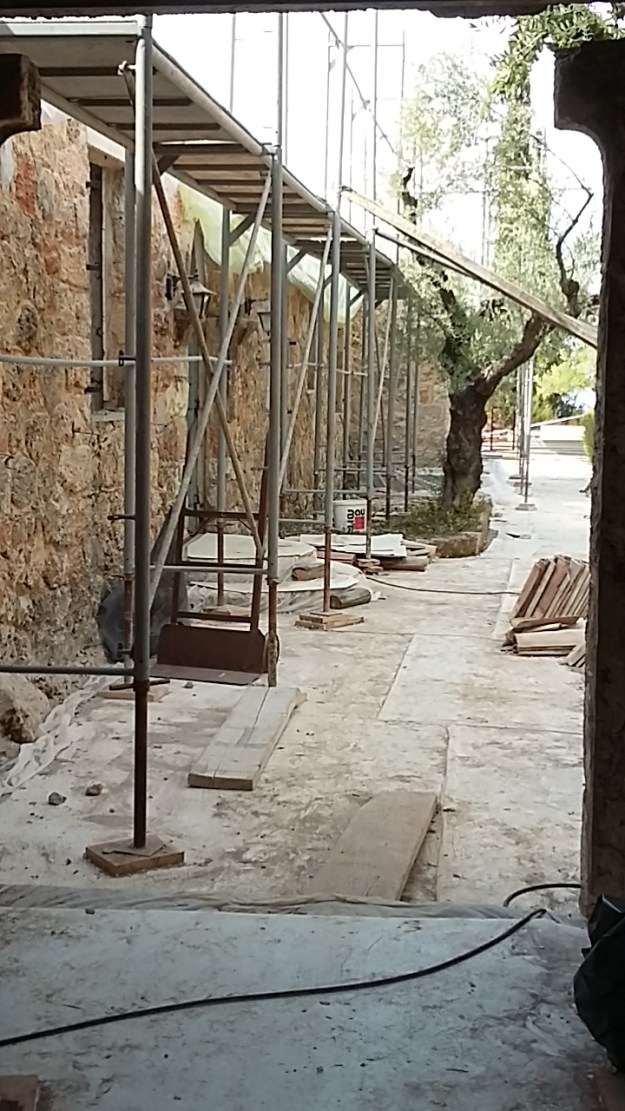
In his will, Leigh Fermor gave the house to the Benaki museum in Athens with instructions for it to be turned into a writers’ retreat. While some of Leigh Fermor’s devoted fanbase have grumbled about the pace of its renovation – which at one stage appeared to have fallen victim to Greece’s economic woes, – there are hopes the exhibition may elicit funds to speed things up.

If so, it would mean that more than half a century on from when Leigh Fermor built his idyll, it will once again help nurture a new generation of artists and writer.

Charmed Lives in Greece the exhibition will run at the British Museum 8 Mar-15 July 2018

Patrick Leigh Fermor and the Pleasures of Places and People

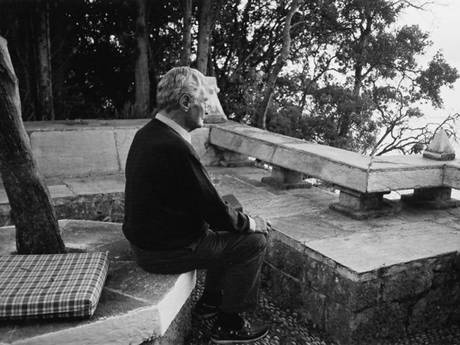
Patrick Leigh Fermor in later life

We are fortunate to have a number of articles by the American writer Ben Downing on the blog. Downing specialises in nineteenth- and twentieth-century British social life and literature. His three part A Visit with Patrick Leigh Fermor can be found here. The following article is his review of Patrick Leigh Fermor: A Life in Letters.

By Ben Downing

First published in the Wall Street Journal

1 December 2017

In a 1958 diary entry, the writer and Bloomsbury Group member Frances Partridge recalled a dinner during which “the conversation turned to present-day pessimism, or cafard. Where can one look to find enthusiasm for living? I could only think of Paddy Leigh Fermor.” Called Paddy by his legion of friends, Patrick Leigh Fermor (1915-2011) struck many as a paragon of zest, a man on whom scarcely a crumb of life’s banquet was wasted. Prodigiously smart, charming, funny and handsome as well, he dazzled most who met him. His social gifts, however, threatened his literary ones: Why struggle to write at a lonely desk when you can swill whiskey on the terrace all night and talk like a Roman candle?

Fortunately, Leigh Fermor did struggle, some of the time. The result is a body of prose—travel books, mostly—radiant with his brilliance and unique experience but also with his exuberance and warmth. Especially in his magnum opus, a three-volume account of walking as a teenager from Holland to Istanbul, his erudition and descriptive skill are balanced by simple likability—never, one feels, has so much riveting detail been so beautifully served up by such an irresistible person.

Leigh Fermor published little during his last decades, but the years since his death have yielded several books by or about him. All rewarding, at least to fans, were Artemis Cooper’s biography, Wes Davis’s account of Leigh Fermor’s most celebrated military exploit (the abduction of a Nazi general on Crete) and Nick Hunt’s book about retracing his route across Europe. The real treat, though, was a book few expected ever to see: the last part of his trilogy, posthumously published as “The Broken Road.” Leigh Fermor’s inability to finish it, despite a quarter-century of fitful labor, was the great frustration and sorrow of his life, yet the manuscript his executors assembled was nearly complete and full of his usual panache.

Nor was that the last of the manna. The publication, in 2008, of Leigh Fermor’s correspondence with Deborah Devonshire (the youngest Mitford sister) had shown his letters to have many of the virtues of his books, including a more casual version of their tumbling, gloriously idiosyncratic style. But the bulk of his letters—untold thousands of them—remained unseen. Then, last year, a selection, edited and introduced by the outstanding biographer Adam Sisman, appeared in Britain. Now available here, it spans 70 of Leigh Fermor’s 96 years. Like his travel books, it amounts largely to a gushing expression of pleasure in art, history, places and people, but it also gives glimpses of his battles with indolence and the toll they took.

Addressed mainly to friends, lovers and Leigh Fermor’s longtime partner, Joan Rayner (whom he married in 1968), the letters are notable for, if nothing else, the variety of their postmarks. Even after he got a place of his own—a house in the Peloponnese that he and Joan built in the early ’60s—Leigh Fermor spent half his life as a wandering guest, and from age 18 to almost 50 he hopped constantly between dwellings, most of them romantic, secluded, and either dirt cheap or free. A 1953 letter contains a typical update: “I am established in a damp and ruined Aragonese fortress on the edge of the Tuscan Maremma, a sort of Zenda, really.”

Though he often sought isolation in order to work, Leigh Fermor’s gregariousness and polyglotism made him a poor hermit. Ensconced in a French monastery in 1948, he wrote that its chatty abbot had befriended him. “Occasionally he lapses into Latin. . . . It is the first time I have ever heard it spoken as a living language, and . . . I flog my brains to construct a sentence, feverishly trying to get the syntax right, usually a question that at last I enunciate with as much nonchalance as I can muster, to keep going the flow of this silvery monologue.”

Odd encounters were routine for Leigh Fermor. In a 1975 letter he describes one three decades in the making. After he accidentally killed a Cretan guerrilla during the war, the man’s hothead nephew, Yorgo, refused to forgive him. Revisiting “old haunts in Crete” in the 1950s, he was warned that Yorgo, a crack shot, planned to assassinate him. Intermediaries pleaded fruitlessly with Yorgo for years after that. Then, out of the blue, Yorgo asked Leigh Fermor to be his infant daughter’s godfather. (“This is the classical and only happy ending to a Cretan blood feud.”) The very next week he flew to Crete for the baptism. At the drunken banquet for 300 that followed, Yorgo hugged him and offered to eliminate “anyone you want got rid of.” “I hastened to say that there was no one, absolutely no one! ”

Not surprisingly, Leigh Fermor’s sex life was robust: With Joan’s consent, he enjoyed flings, affairs and the low delights of the brothel. This activity rarely makes it into his letters, but the exceptions can be piquant. Writing in 1958 from Cameroon, where he was on the set of a John Huston movie, he told a (male) friend: “ Errol Flynn and I . . . sally forth into dark lanes of the town together on guilty excursions that remind me rather of old Greek days with you.” One of the book’s zaniest passages is in a 1961 letter to Huston’s wife, Ricki, with whom Leigh Fermor had been sleeping. “I say,” the passage begins, “what gloomy tidings about the CRABS! Could it be me?” Riffing on pubic lice and their crafty ways, he conjectures that, during a recent romp with an “old pal” in Paris, a force “must have landed” on him “and then lain up, seeing me merely as a stepping stone or a springboard to better things”—to Mrs. Huston, that is. As comic apologies for venereal infection go, the passage is surely a classic.

If high spirits dominate the letters, pain often throbs at their edges. What Leigh Fermor termed “neurotic literary paralysis” led to spells of depression, and the pattern worsened with age. “My reaction to any demand for writing,” he confessed to his long-suffering editor and publisher, Jock Murray, in 1965, “seems to be to dig an enormous bog and flounder in it.” The acute phase began after the publication, in 1986, of the second volume of his trilogy. Istanbul in sight, he hoped his sails would fill with steady wind but instead found himself largely becalmed.

Full of self-deprecation (“I can be a terrible gasbag”) and profuse apology (most often for his slowness as a correspondent), Leigh Fermor’s letters are remarkably free of backbiting, bellyaching and other standard epistolary vices. When referring to the Oxford don Maurice Bowra, he cannot resist the mocking anagram “Eroica Rawbum.” And in 1974 he rants, ever so briefly, about the decline of Greek civilization: “I can’t help feeling there has been a serious break since the times of Theocritus.” That’s about it, though.

However appealing, Leigh Fermor’s sunny disposition somewhat constrains his letters, which lack variety of tone and the kind of frank, piercing comment on human behavior and emotion one looks for in the genre. (An exception is the handful of psychologically astute letters about his troubled mother.) It is this that makes me not quite agree with Adam Sisman’s assertion that the best ones are “as good as any in the language.” What’s more, to fully appreciate Leigh Fermor’s letters you need to be familiar with, or at least curious about, the circles he moved in. If names like Lady Diana Cooper mean nothing and you couldn’t care less about the half-bohemian, half-aristocratic world of footloose Brits in the Mediterranean (dating back to Byron and Shelley), this might not be the book for you.

Then again, it might. For all their beau monde glitter, Leigh Fermor’s letters are touching in a universally appreciable way. Writing to, among others, the widowed Diana Cooper and his former lover Balasha Cantacuzène, a Romanian princess and painter who endured many hardships under communism, he displayed a tender solicitude and eagerness to raise spirits that must have brought both laughter and tears and that are, in the best sense, chivalrous. (When he was knighted in 2004, it seemed appropriate not just to his achievements but his character.)

Most moving of all is to watch Leigh Fermor maintain his gallantry, verve and humor to the end. (He was nearly 95 when he wrote the last letter in Mr. Sisman’s selection.) Having gotten to know him in 2001, I received a few of these late letters. Embellished with drawings of clouds and birds, they seemed at first sight to be written in Linear A, but as I slowly deciphered their scrawl I found jokes, flights of fancy, extravagant mea culpas, deep learning worn lightly as silk. Thanks to Mr. Sisman, readers everywhere can have (minus the furrowed brows and headaches) a similar experience, discovering how this wonderful man made sheets of stationery, like the pages of his incomparable travelogues, glow.

—Mr. Downing is the author of “Queen Bee of Tuscany: The Redoubtable Janet Ross. ”

Sisters Queen Margrethe and Queen Anne-Marie make rare joint appearance at “To Greece with Love” symposium

It looks like the PLF symposium held in Copenhagen was a great success with Royal attendees.

This report from Royal Central.

Her Majesty Queen Margrethe of Denmark and her younger sister, Queen Anne-Marie of Greece made a rare joint appearance together yesterday at the University of Copenhagen for the “To Greece with Love” symposium.

The two-day conference, attended by people from as far away as Texas, USA, was organised around the British travel writer and freedom fighter in Greece, Patrick Leigh Fermor. Their Majesties heard various lectures, including one from Patrick Leigh Fermor’s biographer, Artemis Cooper.

The Queen of Denmark had met Artemis Cooper in 2017 during a lunch in the United Kingdom.

Queen Margrethe, who has reportedly read all of Fermor’s travel books, and Queen Anne-Marie were private guests at the event and were welcomed by Charles Lock, an English professor at the University of Copenhagen upon their arrival.

Patrick Leigh Fermor died in 2011 and was considered as one of Britain’s greatest travel writers during his lifetime. He played a prominent role during the Second World War in the Cretan resistance in Greece.

Queen Anne-Marie (born Princess Anne-Marie of Denmark) is six years younger than Queen Margrethe. They have another sister, Princess Beneditke, who was born in 1944. Anne-Marie was 13 when she first met her future husband, the then Prince Constantine of Greece and Denmark in 1959. Their engagement was announced in July 1964 – just a few months after Constantine had become King of Greece. They married on 18 September 1964 and have five children: Princess Alexia, Crown Prince Pavlos, Prince Nikolaos, Princess Theodora and Prince Philippos.

The family was forced into exile in Greece in the late 1960s when a military junta took over. They first lived in Italy before relocating to England. They were not permitted to return to Greece until 1981 when they were allowed to enter the country for a few hours to attend the funeral of Constantine’s mother, Queen Frederika.

King Constantine, Queen Anne-Marie, their son Prince Nikolaos and his wife, Princess Tatiana now reside in Greece.

Where exactly is Paddy and Balasha’s watermill?

I have been contacted by Pilar Gonzalez, from Spain, seeking more information about the watermill where Paddy stayed with Balasha in 1935.

This May, Pilar and a friend plan to go Greece and they want to find the mill, named Los Limoneros. This apparently is in Lemonodassos in the southeast of Galatas, overlooking Poros.

Pilar would be grateful for any ideas or information about the exact location of the mill. Please get in touch by making a comment or emailing me (see About & Contact page).

Tom

A tour of Paddy and Joan’s house

A Greek video showing the house, Ethan Hawke, local characters, and a cat.

Despatch from the Hellenic infused colonies

My thanks to Brent McCunn for sending me this article which features PLF historian (co-editor of Abducting a General) and supplier of many “then and now” photographs, Chris White, on a trip to Australia.

by Brent McCunn

PLF (Patrick Leigh Fermor), SOE (Special Operations Executive) and Cretan WW2 history is alive and well in Melbourne. One should expect this, after all we are the third largest Greek city.

Recently our visiting ‘Pohm’ (Prisoner of his majesty), Chris White, was introduced to a circle of locals who have an above average interest in the afore mentioned historical proceedings.

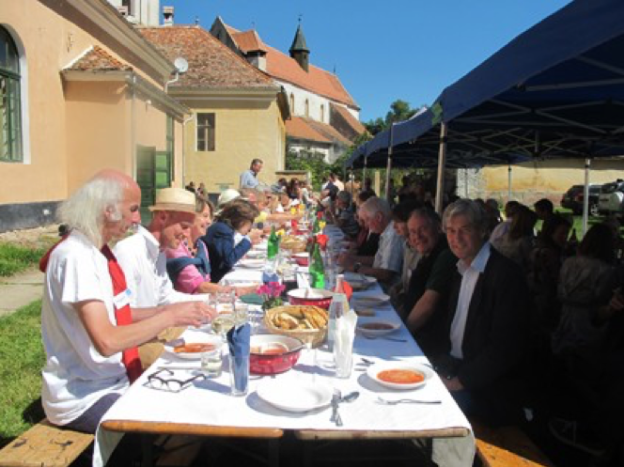
Chris was staying with us (Brent and Elaine McCunn) and after Saturdays bush walks and BBQ, in unseasonable steamy heat, I introduced Chris and his ‘caveman photographs’, to a local historian Jim Claven who, despite being a ten pound Scot from Glasgow, lives in the suburb affectionately known as Oakleighopolis. This moniker is due to the, rather noticeable, ratio of Greek heritage residents, cafes and restaurants – their main mall area is like a downtown portion of an Athens café zone! Jim is a historian and freelance writer and specialises in ANZAC/Hellenic connections. In addition he has lead military history tours to Greece and is currently writing a book about Lemnos and its WW1 ANZAC history. He is a PLF fan, having read his Mani book many years ago and visiting PLF’s home last year along with members of the British Veterans of the Greek Campaign Association.

Following this Mythos lubricated encounter Jim rallied some of the heavier artillery of ANZAC history and the Cretan community, one of whom, a restaurant owner, offered us his establishment as a meeting venue for the Monday night. “Others have to see what you have done Chris’, exclaimed Jim.

After a traffic jammed drive across Melbourne during rush hour we arrived to the suburb of Moonee Ponds, “This is where Dame Edna came from exclaimed an excited Chris White”!

Our restaurant venue, The Philhellene, is recognised as being in the top three Greek eateries in Melbourne and serves a range of regional foods, in particular Cretan cuisine. I had heard about it before, as a friend plays there with his Rebetika band, but due to its location we had not ventured there – traffic you see!! We will revisit!!!!

With such short notice we were pleased to meet the owner John Rerakis, and another restaurant owner, Antonios (Tony) Tsourdalakis – I must mention that Tony (Antonius) is the owner of another of the ‘Top Three’ Greek restaurants – Kritamos in Richmond (Melbourne). Tony is also the secretary of the Melbourne based, ‘Battle of Crete and Greece Commemorative Council’. This Council was formed a few years ago and brings together historians, politicians, veterans descendants, service organization representatives and many representatives from Melbourne’s Greek community organizations. The Council organizes a series of annual events commemorating the Greek and Crete campaign as well as participating in events in Greece and on Crete.

Then we had Jim Claven of course, and Peter Ewer – historian and author of the seminal work, ‘The Forgotten Anzacs” – yes I brought along my copy for a dedication! Our two Cretan/Aussies were key people in the Cretan community committees and have extended family connections to the villages Chris has explored and the events of WW2. John, Jim and Peter are also committee members of the same organization mentioned. I had hoped to have the nephew of Manoli Paterakis – George Paterakis – in attendance, but he was not well at this time. We had only planned for a small group for this introduction.

The food and Cretan red wine started to flow and in between gastronomic groans of pleasure we discussed PLF and ANZAC history, along with our two hosts family connections. Chris was soon holding all the assembled attentions with his slide display. Our hosts recognised some valleys and villages, but not the caves!

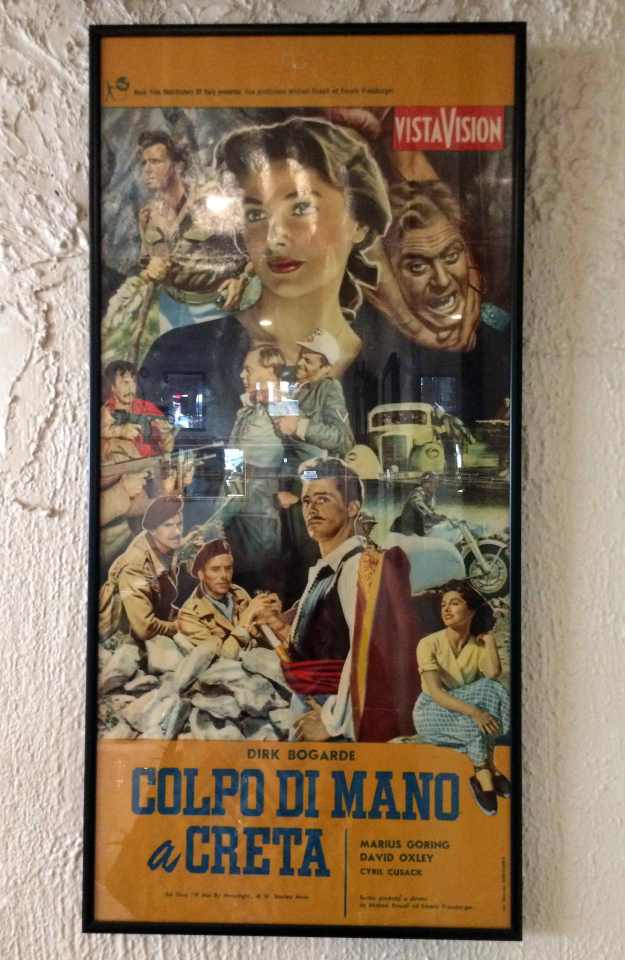
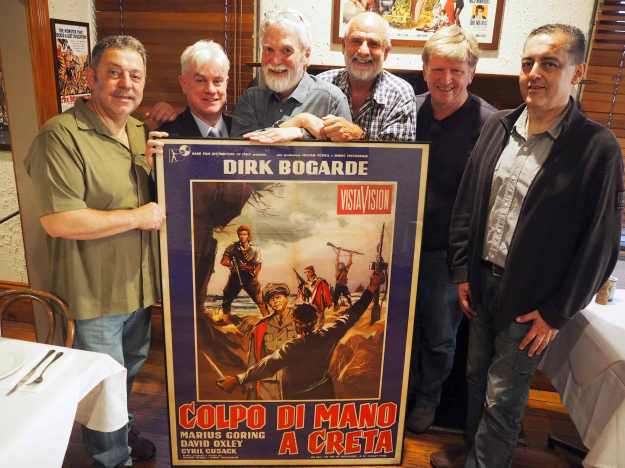
Our host then walked us around the small museum he has created on his restaurant walls. Framed photographs record his family history along with local Melbourne connections. In the dining area we were seated in was part of his extensive collection of movie posters collected by his father who operated a cinema playing English, Greek, Italian and other ethnic background movies. John said he had ‘piles’ of posters stored away, but pride of place here were the Italian posters for ‘Ill Met by Moonlight’!!!

The food continued and desert offered up freshly made Loukoumades, accompanied by home made Halva flavoured ice-cream!! Just when you think a Cretan has finish expanding your stomach out came a small elegant bottle twinned with a neat stack of small shot glasses. Yes it was spirit, but infused with Cretan herbs and honey!!

Brent and Elaine McCunn were paying participants on the inaugural PLF tour in 2016. They are the owners of specialist group tour operator, Passport Travel in Melbourne. In 2018 they are operating a rather unique tour to Greece, which weaves some PLF and ANZAC history into its core structure. The main theme is Rebetika Music. Brent has organised a number of music tours that have concentrated on themes such as, Blues, Reggae, African and Cuban Salsa and has been a fan of Greek Rebetika for many years. Perhaps his long association as an amateur Blues musician assisted with his discovery of the Greek Blues. The tour will be led by Australia’s premier Rebetika musician, Con Calamaris , a friend and near neighbour of Brent. The tour, whilst not designed for a hardened PLF, or military history enthusiast, it will bring these two topics into the itinerary and leave time at the end for those who desire more time to pursue further personal explorations.

There are many examples where the history of PLF conclaves with Australian and New Zealand history. The ANZACs on Crete is obvious. Hydra also casts up other connections.

There is also a strong link to Australian writers and the bohemia movement. From Sidney Nolan to Peter Finch, artists gravitated around the glamorous Australian literary couple, George Johnston and Charmian Clift, on this tiny Aegean island in a time of rebellion, romance and creativity. It was a time of great inspiration and camaraderie as the expat artists drank, argued, dreamed and created. It was here that Johnston wrote his novel, My Brother Jack, and his close friend Cohen penned the musical masterpieces Suzanne, Bird on a Wire and So Long Marianne

The tour is formatted to attract a younger audience and has been hailed by the local Greek community as being attractive to 2nd and 3rd generation descendants. In addition, to those with Greek ancestry, Rebetika also attracts interest from those of other backgrounds. Brent and Elaine’s own son is one such example.

The tour is not a rage trip. It does have a range of ages, all being united with a common musical and historical bond. Passport Travels long established contacts in Greece (we have operated special interest groups for some 25 years to multiple worldwide destinations) have expressed their own delight at seeing something so unique being offered. “We have not seen such a theme ever and it is nice to see something different for Greek tourism, rather than the cliche”, is the comment most relayed.

More details can be obtained via this website link. Questions, via the web page, will get to Brent McCunn. http://www.uniquepassport.com/EnterTitleGreekRebetika.php

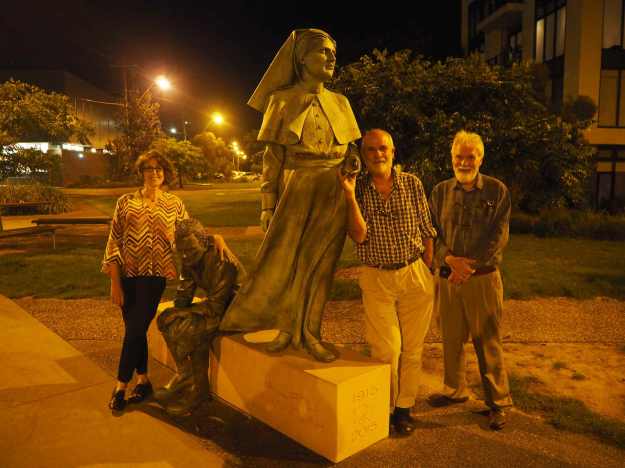
On the return home journey, Jim took Brent, Elaine and Chris to visit the Lemnos Gallipoli Memorial in Albert Park, the first dedicated memorial to the major role of the Greek Island of Lemnos and its nurses, to the Gallipoli campaign of 1915. This memorial was erected with community support in August 2015, the centenary of the arrival of Australia’s nurses on Lemnos. This ANZAC nurse division continued its work in Greece and of course Crete during WW2.

One of two original movie promotional posters from the Italian language edition of ‘Ill Met by Moonlight

Team Crete. From left: John Rerakis: Peter Ewer: Brent McCunn: Chris White: Jim Claven: Tony Tsourdalakis: With 2nd of two original Italian Language release of “Ill Met by Moonlight”.

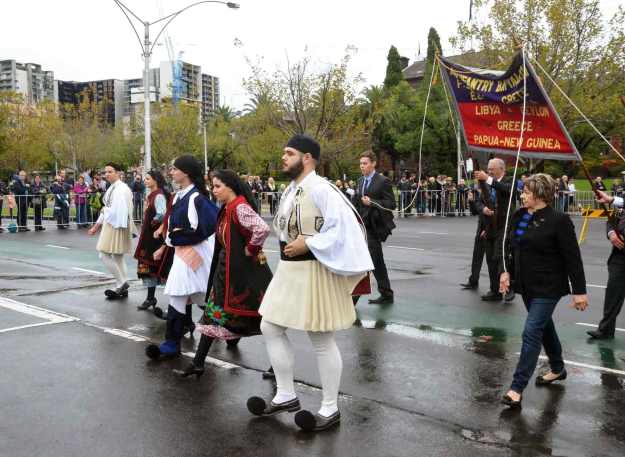
ANZAC Day March

This year other nationalities, in traditional costume marched with surviving diggers and family representatives. This was the first time this happened and is still subject to controversy. Within the organisers (The RSL – Returned Servicemen League) there are those who feel this divergence makes the event a ‘Parade’ rather than a ‘commemorative march’. They also feel that only, those that served, or direct descendants, should march and all be dressed formally as their ancestors would have. The other arena of thought is for the march to be more inclusive of those allies that worked with and for the ANZACs. The debate will continue.

This party marched with an Australian battalion that saw action in Greece.

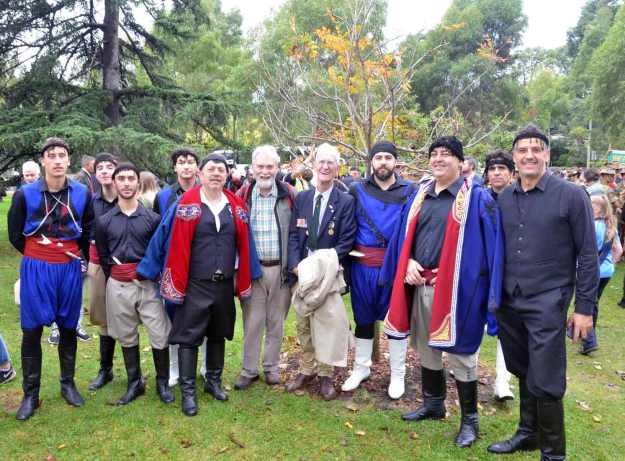
To the left of Brent McCunn is John Rekakis and then 3rd to the right is John Tsourdalakis. To Brent’s immediate right is a New Zealander, Peter Ford, who self published a book about his fathers experiences on Crete, eventual escape with others via a small fishing boat, unexpected meeting with Rommel in his staff car as they came ashore in Nth Africa, and eventual return to British lines.


When John opened up this current restaurant he hung the top image which showed a local ANZAC who knew his family since they arrived. According to John the ANZAC veteran couldn’t understand why he would want a picture of him on his wall. As John said to me, the image says why!

George Pakerakis. Nephew of Manoli Pakerakis at commemorative ‘Battle of Crete’ lunch in May 2017 at Cretan Centre. George recalls PLF coming to his village with his uncle. George, as a teenager ran messages for the local resistance and still carries the scars from being shot by German soldiers.

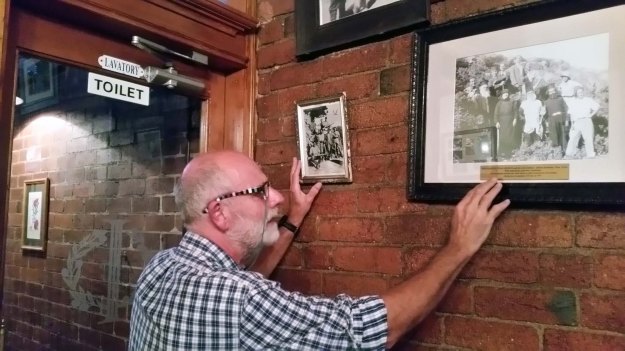
Chris examining an image featuring local; Cretans and priests with a group of New Zealanders and Australians they have sheltered. Taken in front of a stone walled sheep pen of some sort. Chris now has a new photograph to add to his further explorations! Perhaps we will see a copy a, ‘then and now’ gracing these walls in future years.

Lemnos Nurses Memorial

Beachside suburb of Albert Park. The closet parcel of land, local council would allow, to Melbourne passenger ship wharf – Princess Pier. This is where all troop and nurse convoys set sail from in WW1 and WW2. ‘Fitting Spot’ as they say for all Victorian Greek connected campaigners!

Remembering Steven Runciman by Patrick Leigh Fermor

Steven Runciman with his parakeet, photographed by Cecil Beaton c.1923.

Paddy remembers Steven Runciman in this 2001 article from The Spectator

by Patrick Leigh Fermor

First published in The Spectator

13 January 2001

It was on 12 September 1934, in Sofia, that Steven and I first met. He was 31 and I was 19, and I was trudging across Europe, heading for Constantinople. Having a drink in the Bulgaria Hotel, 1 found myself talking to my bar-neighbour, who was the dead spit of Holbein’s Erasmus; he turned out to be Thomas Whittimore, the famous Bostonian expert on Byzantium and the saviour of the St Sophia mosaics. He was in Sofia, he said, as part of a general congress of Byzantinists and art-historians. Two fellow delegates soon joined him, Roger Hinks and Steven Runciman, both of them impeccable in panama hats and white suits of the wonderful Athenian raw silk that used to be spun by Gladys Stewart-Richardson; their bi-coloured shoes were spotlessly blancoed and polished; and they both belonged far more aptly to the deck of an Edith Wharton yacht or to the cypress alley of a palazzo in a novel by Henry James than to this hot little Balkan capital. As I had just been scrambling about the Rhodope mountains and sleeping out on the way to Rila monastery, I must have been even filthier than usual. (Later on Steven often teasingly remarked, ‘You were a very grubby boy.’) Their conversation was dazzlingly erudite and comic and we met several times, and when the end of the conference scattered the delegates, they left for Italy: ‘Just off to stay in a Tuscan villa with one of those beautiful Italian gardens. You know, solid mud all winter and in summer, nothing but dust.’

We bumped into each other now and then in London later on, and after the war Steven was appointed British Council Representative in Athens; the novelist, poet and translator of Euripedes, Rex Warner, was in charge of the British Institute and I was rashly created his deputy director. It was a fascinating time to be in Athens. The war was over and the later troubles had not yet really begun. It was the Athens of the songs of Sophia Vembo and the rebirth of bouzottki; the place was full of Greek and English friends, and there were wonderful parties and newly discovered tavernas every single night. When it was thought that i might be more useful outside the capital. I was sent to lecture all over the mainland and the islands. This involved six months in the remotest places I could find. They were of the greatest possible value for literary purposes later on. But I was far from an ideal deputy director, and when this became plain and departure loomed, not an atom of blame attached to Steven. When we next met I had been nearly a year in the Caribbean and Central America. In London we often met in friends’ houses, and our shared devotion to Greece was always uppermost of both our feelings.

Before the war, the captivating books of Robert Byron were, for many people in England, their first introduction to Byzantium. He was soon caught up by Steven’s perhaps more academical approach, and after the ship carrying Robert Byron to Greece during the war was torpedoed and sunk (by the Scharnhorst, off Stornoway), Steven’s writings remained the unchallenged beacon in this particular field. There seemed to be no aspect of the Byzantine empire — its sovereigns, its Church, its saints and heresies, its wars and disasters and recoveries — that was left unexplored; and when his dazzling books on the Crusades began to appear, the skill of the writing, the vast range of his scholarship — even, here and there, the witty asides and brackets — called the name of Gibbon to many minds. To those of us who were brought up on the romance and glamour of the Crusades, there was something stimulating, salutary, and brand-new in the suggestion that these centuries of war and conquest were, in fact, the last of the barbarian onslaughts on the surviving civilisation of the Roman and now Greek empire and the lands of the cultivated Arab caliphate, Everyone rejoiced at the honours which were heaped on him; we still do, and how fitting it is that a street in Mistra now bears his name? When about 20 years ago I got a literary prize. I was very touched that the generous words spoken at such occasions were uttered by Steven, at his request. I felt that all my earlier sins had been forgiven. He came to stay in the Morea several times.

His generosity was extraordinary. The recent restoration of the tower of the Protaton church on Mount Athos was a gesture of the greatest magnificence and his arrival from the sky, followed by the blessings of the glittering dignitaries conducting the dedication service of the tower, and then Steven’s farewell and departure back into the air, belonged to a sweep of monastic wall-painting of the Cretan or Macedonian school, involving flights of archangels and seraphim and fanfares of long trumpets.

He seemed, somehow, in a curious fashion, to be in touch with the supernatural. He studied arcane matters and he loved telling fortunes with a pack of Tarot cards and — half in joke, or only a quarter, perhaps — he hinted at the mastery of magic powers; his catlike smile and the sudden surprised lift of his eyebrows seemed to underline the suggestion. Perhaps it was just a tease.

A month and a half ago, a Cumberland neighbour and an old friend of his and of mine, Pamela Egremont, drove me across the Solway Firth into Scotland to spend the afternoon at his massive tower, with its many thousands of books, at Elshieshiels in the Scottish Lowlands. He was not very mobile physically, but mentally he was as active as he had ever been, and there was much laughter. My grubby apparition of 66 years earlier was joyfully recalled — it always was — and the three of us talked for hours. Upright in his armchair, he was still, as it were, enclouded in Athonite glory. He told us that he was determined, if he was spared for another three years, to celebrate his 100th birthday by a large and cheerful party in Madame Tussaud’s (that famous waxwork gallery of past celebrities can be hired for such occasions, it seems). He gave us a cheerful wave as we left, and, assisted by his mood as we drove south, we played with the idea of Steven’s warlock privilege of summoning shades from the past to ask them to his centenary festival, and we wondered, could this sorcery be switched to the returning of such supernatural visits? Where would these imaginary journeys carry him? Whom would he choose?

As we motored through the Cumbrian dusk, we imagined him helping to plot the circumference of the dome of St Sophia, before a late supper with the Empress Theodora, or — he had a soft spot for crowned heads — advising Princess Anna about the accuracy of the Alexia& in other scenes, he was shaking his head over the wilder tenets of the Bogomils and persuading a team of iconoclasts to drop their hammers; or calming rebellious prelates at the Council of Ephesus. In yet other scenes, he was reasoning with Bohemond at Antioch; or counselling Richard Coeur de Lion about his policy at Acre; or playing chess with Saladin, in his tent; then, a bit later, rallying Bessarion for accepting the filioque clause at the same time as a cardinal’s hat; consoling the eastern Comnenes for the loss of Trebizond; or, under Mount Taygetus, exchanging syllogisms with Gemistos Plethon as they strolled along the future Runciman Street. Later on still, we imagined him hobnobbing with Phanariot hospodars in the snows beyond the Danube … It was hard to stop.

As we know, Fate arrived too soon and all we can now do is to express our gratitude for the life and the work of the astonishing man we are all assembled to mourn, and, still more, to celebrate. What a shame he can’t see us all, gathered in his honour! Perhaps he can.

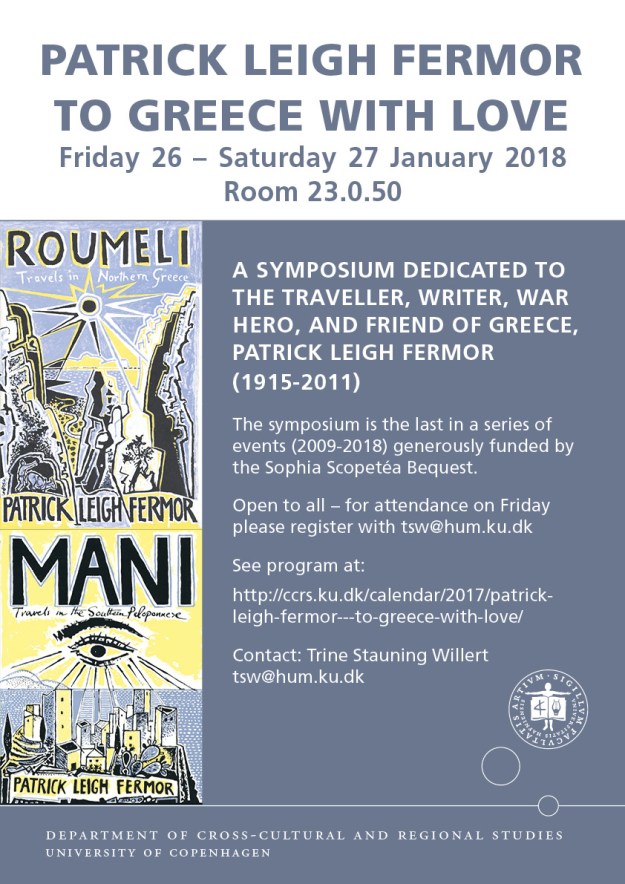
Symposium: Patrick Leigh Fermor – To Greece with Love

The Department of Cross-Cultural and Regional Studies at the University of Copenhagen are holding a two day symposium about Paddy on 26-27 January 2018.

They have an all-start line up in a very interesting programme. Further details including how to register can be found here.

Friday 26 January 14:00 – 19:00

Artemis Cooper (Biographer of Patrick Leigh Fermor)
Road Block: Why Patrick Leigh Fermor’s ‘Time of Gifts’ Trilogy took so long to write

Chris White (Contributor, Abducting a General: the Kreipe Operation and SOE in Crete)
In Paddy’s Footsteps: PLF’s secret war in Crete 1942 – 1944

Panayiotis (Paddy) League (Ethnomusicologist, Harvard University)
Songs of the Cretan Resistance from the James A. Notopoulos Collection
18:00 – 19:00

Musical performance dedicated to Patrick Leigh Fermor and the members of the Cretan resistance.

With Paddy League (violin and Cretan boulgari), Dimitris Rapakousios (Cretan boulgari), Venizelos Leventogiannis (Cretan laouto)

Saturday 27 January 10:00 – 18.00

Myrto Kaouki (Benaki Museum)
The Benaki Museum and the Leigh Fermor House: developments and plans

Poul Joachim Stender (Priest and writer)
Kardamili as a time of gifts

Evita Arapoglou (Curator of Ghika – Craxton – Leigh Fermor: Charmed Lives in Greece)
Patrick Leigh Fermor, Niko Ghika, John Craxton: Friendship in Greek Landscapes

Adam Sisman (Editor of Patrick Leigh Fermor’s correspondence)
Dashing for the Post – Patrick Leigh Fermor as a letter-writer

Charles Lock (Professor of English Literature, University of Copenhagen)
Redeeming the Romaic: Patrick Leigh Fermor and the Idea of Greece

Christopher Bakken (Writer, poet and professor of English, Allegheny College, U.S.A.)
Confessions of a 21st century Philhellene: Writing under the Influence of Patrick Leigh Fermor

A pilgrimage to Kalamitsi

We love to receive your input and proposed articles for the blog. Let’s start 2018 with something from our blog community. Dawn Mitchell sent me this and hopes that you all enjoy it.

In the Spring of 2001, my daughter, my then husband and I drove from Athens down the Peloponnese peninsular. A leisurely journey, visiting Olympus, then remoter sites inspired by PLF’s writings. We arrived at the hotel Kalamitsi in Kardamili on Easter Thursday. Like many before and since, this was a romantic pilgrimage to the spot Paddy, the wanderer, had chosen to put down roots.

It did not disappoint: olives, fruit trees, cypress, orchards running down to the rocks, the glittering sea beyond, enticing views of mountains across the bay. The hotel and the LF house lay on the peninsula beyond the village, in a completely rural area sixteen years ago. (I’ve never been back). The other hotel guests were all Greek, staying for the Greek Easter holiday, which coincided with ours that year.

The purpose of the pilgrimage was not intrude on Paddy,but more to enter the magical world he conjured up. Of course I’d been entranced by the walk across a vanished Germanic world, been warmed under the summer sun of the Hungarian harvest…, but the moment of absolute surrender came with ‘A Time to Keep Silence’. He wrote about the eternal struggle to reconcile spirituality with the human condition, reconciling the deprivations and absurdities of the monastic rule with a reluctant admiration for the sacrifice these extraordinary men had made over the centuries. Standing on a cold winter’s day in St Wandrille, I had marvelled at his perception. (Nowadays, reading his letters, his discomforts and his longing for his lover, give a rather different perspective.) I’d also been inspired by a girlfriend who’d driven alone to Greece with a copy of Roumelli as her travel guide!

Things did not go quite as planned; I’d started a cold en route, which turned into an incapacitating flu and raging temperature the next morning. I was bed bound, so my husband went into the village to look for some medication. In the newsagent he found himself standing next to PLF! Thinking that he lived elsewhere it was quite a shock to see him. He asked my husband what brought us to Kardamili. The latter, quite tongue tied with surprise, simply pointed to the window display where copies of “Mani” were piled up. PLF asked, how did it read nowadays? Not too many purple passages? Weakly my husband said no, not at all; when what he meant to say was how much pleasure the book had given him. Typically British he said nothing-not even remarking on the weather, or wishing a Happy Easter! Before he could regain his composure a young man carrying a heap of newspapers ushered PLF out of the shop. Imagine my chagrin, meeting such a legendary hero: ‘what more?’ I asked. He told me that Paddy had spilled egg down his pullover, that he was accompanied by a very tall young man, nothing more!

However there were more excitements to come: on the Saturday night there was a massive thunderstorm which took out the electricity in the whole region for 24 hours. Disaster, on Sunday, as the Easter lamb was to be roasted. Suddenly the hosts and the guests all came together: three old fashioned spits had been set up in the garden, and everyone worked turning these for several hours. Despite the relentless drizzle and only a single umbrella, the atmosphere was festive. Alcohol and high spirits ensued, and as the party ran into early evening, I realised that we had indeed entered Paddy’s magic world.

Dawn Mitchell
10/12/17

Oral history – erasing Paddy and Billy

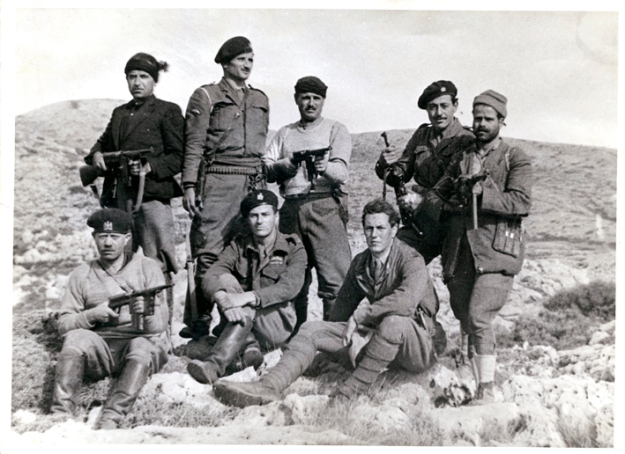
The kidnap gang pose before the action (Courtesy of Estate of William Stanley Moss)

The kidnap gang pose before the action (Courtesy of Estate of William Stanley Moss)

This review of M I Finley’s A World of Odysseus, discusses the hypothesis that oral heroic poetry is not a medium that preserves historical fact, mentioning specifically how the deeds of Paddy, “Billy” Moss, and the others who kidnapped General Kreipe were raised to the level of Cretan heroic oral history, but by 1953, all the names had been forgotten or deliberately erased (the relevant part is highlighted for your convenience).

by Bernard Knox

First published in the New York Review of Books

29 Jun 1979

It is now more than two decades since the Professor of Ancient History at Cambridge (who was then an ex-professor from Rutgers) published a book which in a limpid, hard-hitting prose and with a bare minimum of footnotes attempted to draw “a picture of a society, based on a close reading of the Iliad and Odyssey, supported by study of other societies….” This is how Professor Finley characterizes the book now, in the preface to a revised edition which makes only minor changes in the original text but adds two valuable and stimulating appendices, replying to criticism and bringing the argument up to date. He goes on to claim that “the social institutions and values make up a coherent system” which, however strange to us, is “neither an improbable nor an unfamiliar one in the experience of modern anthropology.” The fact that the later Greeks and the nineteenth-century scholars found it incomprehensible on its own terms he dismisses as “irrelevant” and adds that “it is equally beside the point that the narrative is a collection of fictions from beginning to end.”

The ideas here stated in uncompromising terms were implicit in the work from the start. And at the time of its first publication they were not greeted with enthusiasm by the world of Homeric and Bronze Age scholarship. Far from believing that “the narrative was a collection of fictions,” most scholars of the subject found in the Bronze Age remains excavated on the Homeric sites a confirmation of the historicity of the tale of Troy, at least in its main outlines, and went on to search the text of the poems for objects described that might match the objects discovered. Almost simultaneously with the publication of Finley’s book, the decipherment of the Linear B tablets by Ventris and Chadwick seemed to provide the definitive proof that the Homeric poems preserved historical facts of the thirteenth century BC. Here were clay tablets, inscribed in a form of Greek that bore striking resemblances to the Homeric literary dialect, which contained lists of chariots, corslets, and helmets and such Homeric names as Hektor, Achilleus, Aias, Pandaros, and Orestes. John Chadwick recently took a wry backward look at the euphoria of those early days:

The revelation of the Mycenaean archives fostered wild hopes that one day we might come across, let us say, the muster of ships at Aulis for the expedition against Troy or an operation order for the attack of the Seven against Thebes.1

Finley remained one of what he calls a “heretical minority”; and it soon became apparent that the decipherment of Linear B, far from confirming the thesis that the Homeric poems were a reflection of Mycenaean society, had in fact dealt that thesis a fatal blow. It is hard to think of Homer’s Agamemnon as living in the same world with that wanax of Pylos, whose scribes duly recorded that “Kokalos repaid the following quantity of olive oil to Eumedes: 648 liters; from Ipsewas 38 stirrup-jars.” The bureaucratic inventories of the Bronze Age palaces resemble the detailed records of the Near Eastern civilizations which preceded them and the intricate accounting of the later Ptolemaic papyri, but anything more alien to the mentality of illiterate freebooters such as Achilles and equally illiterate pirates such as Odysseus can hardly be imagined.

The tablets also demonstrated that the precise geographical description of Nestor’s kingdom at Pylos which is offered in Book II of the Iliad bears practically no relation to the Mycenaean facts; the conclusion, that the poet or poets knew little or nothing of western Greece, might already have been surmised from the confused and confusing Homeric descriptions of the hero’s homeland, Ithaca. And meanwhile, quite apart from the tablets, it was becoming steadily clearer to all but the most stubborn that there was very little in the archaeological record which would serve to connect the world of the poems with the Bronze Age.

Finley, in the preface to the new edition, contents himself with a very restrained, “I told you so”; he “cannot resist pointing out that proper concern for social institutions and social history had anticipated what philology and archaeology subsequently found.” In The Mycenaean World, John Chadwick heads his penultimate chapter “Homer the Pseudo-Historian” and concludes it with the sentence: “to look for historical fact in Homer is as vain as to scan the Mycenaean tablets in search of poetry; they belong to two different universes.”

Oral heroic poetry is not a medium that preserves historical fact—as Finley pointed out, with a reference to the Chanson de Roland, which made out of a Basque attack on Charlemagne’s rear-guard an assault by Muslim beys and pashas, all carefully identified by names which are “German, Byzantine, or made-up.” A modern example, from the Second World War and from Greece itself, strengthens his case and gives a fascinating glimpse of epic “history” in the making.

In 1953 the late Professor James Notopoulos was recording oral heroic song in the Sfakia district of western Crete, where illiterate oral bards were still to be found. He asked one of them, who had sung of his own war experience, if he knew a song about the capture of the German general and the bard proceeded to improvise one. The historical facts are well known and quite secure. In April 1944 two British officers, Major Patrick Leigh Fermor and Captain Stanley Moss, parachuted into Crete, made contact with Cretan guerrillas, and kidnapped the German commanding general of the island, one Karl Kreipe.

The general was living in the Villa Ariadne at Knossos, the house Evans had built for himself during the excavations. Every day, at the same time, the general was driven south from the Villa to the neighboring small town of Arkhanes, where his headquarters were located. He came home every night at eight o’clock for dinner. The two British officers, dressed in German uniforms, stopped the car on its way home to Knossos; the Cretan partisans overpowered the chauffeur and the general. The two officers then drove the car through the German roadblocks in Heraklion (the general silent with a knife at his throat) and left the car on the coast road to Rethymo. They then hiked through the mountains to the south coast, made rendezvous with a British submarine, and took General Kreipe to Alexandria and on to Middle East Headquarters in Cairo.

Here, in Notopoulos’s summary, is the heroic song the bard produced:

“An order comes from British and American headquarters in Cairo to capture General Kreipe, dead or alive; the motive is revenge for his cruelty to the Cretans. A Cretan partisan, Lefteris Tambakis (not one of the actual guerrilla band) appears before the English general (Fermor and Moss are combined into one and elevated in rank) and volunteers for the dangerous mission. The general reads the order and the hero accepts the mission for the honor of Cretan arms. The hero goes to Heraklion, where he hears that a beautiful Cretan girl is the secretary of General Kreipe.

“In disguise the partisan proceeds to her house and in her absence reads the [English] general’s order to her mother. When the girl returns he again reads the general’s order. Telling her the honor of Crete depends on her, he catalogues the German cruelties. If she would help in the mission, her name would become immortal in Cretan history. The girl consents and asks for three days time in which to perform her role. To achieve Cretan honor she sacrifices her woman’s honor with General Kreipe in the role of a spy. She gives the hero General Kreipe’s plans for the next day.

“Our hero then goes to Knossos to meet the guerrillas and the English general. ‘Yiassou general,’ he says. ‘I will perform the mission.’ The guerrillas go to Arkhanes to get a long car with which to blockade the road. Our hero, mounted on a horse by the side of the blockading car, awaits the car of Kaiseri (that is what the bard calls Kreipe). The English general orders the pistols to be ready. When Kreipe’s car slows down at the turn he is attacked by the guerrillas. Kreipe is stripped of his uniform (only his cap in the actual event) and begs for mercy for the sake of his children (a stock motif in Cretan poetry).

“After the capture the frantic Germans begin to hunt with dogs (airplanes in the actual event). The guerrillas start on the trek to Mount Ida and by stages the party reaches the district of Sfakia (the home of the singer and his audience; actually the general left the island southwest of Mount Ida). The guards have to protect the general from the mob of enraged Sfakians. Soon the British submarine arrives and takes the general to Egypt. Our bard concludes the poem with a traditional epilogue—that never before in the history of the world has such a deed been done. He then gives his name, his village, his service to his country.”2

So much for epic history. Nine years after the event the British protagonists have been reduced to one nameless general whose part in the operation is secondary and there can hardly be any doubt that if the song is still sung now the British element in the proceedings is practically nonexistent—if indeed it managed to survive at all through the years in which Britain, fighting to retain its hold on Cyprus, became the target of bitter hostility in Greece and especially among the excitable Cretans.

It took the Cretan oral tradition only nine years to promote to the leadership of the heroic enterprise a purely fictitious character of a different nationality. This is a sobering thought when one reflects that there is nothing to connect Agamemnon, Achilles, Priam, and Hector with the fire-blackened layer of thirteenth-century ruins known as Troy VII A (the archaeologists’ candidate for Homer’s city) except a heroic poem which cannot have been fixed in its present form by writing until the late eighth century, at least four illiterate centuries after the destruction.

Finley’s professional interest in the poems lies in their value as a source for knowledge of the Dark Ages (so-called because we know almost nothing about them) which intervene between the destruction of the Mycenaean palaces around 1200 BC and the beginning of a new literacy some time in the late eighth century. If the poems contain no memory of historical events of the Bronze Age and, furthermore, do not reflect the civilization, customs, social relationships, or even the material objects of the Bronze Age, what do they have to tell us? Finley’s answer was (and still is) that the poems preserve, with the anachronisms and misunderstandings inevitable in a fluid oral tradition, the social institutions and values of the early Dark Ages, the tenth and ninth centuries BC. “The choice,” as he poses the question in the new edition, “lies between that period and the poet’s own time, now that the ground beneath a supposed Mycenaean world of Odysseus has been removed by the Linear B tablets, assisted by continuous archaeological excavation and study.”

The “poet’s own time” he takes to be the mid-eighth century (a date with which few will quarrel) and makes the claim that the poems fail to reflect the known social conditions of that period. “The polis (city-state) form of political organization” was “widespread in the Hellenic world by then, at least in embryonic form. Yet neither poem has any trace of a polis in its political sense.” Further, the “Phoenician monopoly of trade” in the Odyssey is a reflection of “the period before 800 BC, for by that date the presence of Greek traders in the Levant is firmly attested.” Finley sees no reason to find in Homer’s picture of the sea-lords of Phaeacia a “reflection of the Greek western colonization movement contemporary with Homer,” as many have done: “Magical ships that powered themselves were not instruments of the westward colonization, nor did magic gardens await the migrants on arrival.”

The epic poets are the guardians, preservers, and renewers of a heroic tradition and though they often admit anachronistic details or misunderstand the use or nature of archaic objects, they maintain intact, so Finley insists, the social context in which the heroes can live their larger life. From that context he constructed a model, to use his own formula, “imperfect, incomplete, untidy, yet tying together the fundamentals of a political and social structure with an appropriate value system in a way that stands up to a comparative analysis.” The most striking and original feature of this presentation (organized in chapters headed: “Wealth and Labor”; “Household, Kin, and Community”; “Morals and Values”) is his discussion of the “institution of gift-exchange.”

No reader of the Odyssey can have failed to be amazed and puzzled by the central role gifts play in the social relationships of the characters. Telemachus at Sparta, a young provincial with very uncertain prospects visiting the splendid court of Menelaus and Helen, is offered a parting gift of horses. He declines, on the grounds that his native island is no place to graze horses, and asks for something else: “Give me something that can be stored up.” Menelaus is delighted with his frankness and gives him a bowl made of silver and gold. There are many such encounters in the Homeric poems and readers seeking some explanation of the generosity and especially of the unashamed claims made on it usually found themselves fobbed off with a discussion of Homeric hospitality and the guest-friend relationship. Finley put it firmly in a familiar anthropological context.

The word “gift” is not to be misconstrued. It may be stated as a flat rule of both primitive and archaic society that no one ever gave anything, whether goods or services or honors, without proper recompense, real or wishful, immediate or years away, to himself or to his kin. The act of giving was, therefore, in an essential sense always the first half of a reciprocal action, the other half of which was a counter-gift.

His persuasive analysis of the working of this form of exchange in the poems was widely accepted; those who objected that it reflected not a society but a “heroic ideal” are given short shrift in the new edition.

The system of gift-giving which Finley identified in the poems was already familiar to anthropologists and sociologists; Marcel Mauss in his Essai sur le don (1925) had analyzed its operation in a wide variety of societies ancient and modern (though not in ancient Greece, to which he made only some half-dozen tangential references in his footnotes). If, as Finley says, “the practice…’does not reflect a society’ but an ‘heroic ideal,’ we are driven to the conclusion that, by a most remarkable intuition, Homer was a predecessor of Marcel Mauss, except that he (or his tradition) invented an institution which nearly three thousand years later Mauss discovered to be a social reality.” Since, he goes on to say, “Tamil heroic poetry of South India reveals a comparable network of gift-giving…,” Homer is not the only “instinctive, premature Marcel Mauss.”

Finley’s arguments from the system’s internal coherence and its recorded existence in real societies are compelling but a lingering doubt may remain. Speaking of the belief in the historical reality of the Trojan War and the Catalogue of Ships firmly held by some scholars who reject his sociological model he asks: “In what respect do they differ from gift-giving in their inherent credibility?” A skeptic might answer: “Not at all. Both the Trojan War and the gift-giving system may be equally unhistorical.” If the epic Muse can forget the palaces, inventories, and geography of Mycenaean Greece, remember the chariots but not how they were used, and fabricate not only a war but the names and personalities of chieftains on both sides, how can we trust her to preserve intact the memory of an intricate social system long since obsolete? Finley’s case would be stronger if the comparative method, to which he so often appeals, could produce a parallel: an oral epic poem which, celebrating heroes of a bygone age, garbles time, place, and material objects but preserves, in recognizable form, a complex system of primitive social institutions.

There is one oral epic which goes far toward meeting these specifications, the Turkish Book of Dede Korkut. The full text has only recently been made available in an English version3 (which may be the reason why Finley, whose mastery of the enormous Homeric literature is demonstrated in his useful critical bibliography, does not seem to be aware of it). The text on which modern editions are based was written in the last quarter of the sixteenth century but there is in existence a summary of the poem which was written down before 1332 and the text contains numerous traces of original versions dating from the tenth century. The book recounts, in a mixture of prose and verse, the deeds of the Oghuz, a tribe which, over many centuries, migrated from lands which are now in the Kazakh, Uzbek, and Turkmen Soviet Socialist Republics to become the ancestors of the Seljuk and Ottoman Turks in western Asia Minor.

In their original home their raiding expeditions were aimed at their neighbors to the north, the shamanistic Kipchaks; the Oghuz were recently converted Muslims (though sometimes pre-Islamic customs remain embedded in the narrative). But the sixteenth-century version retains only occasional reminiscences of the Kipchaks and the geography of the Samarkand area; in it the Oghuz beys now live, hunt, and plunder in western Anatolia, a thousand miles to the west; their infidel enemies “worship a god made from wood” and have churches with monks in them—one of their strongholds is Trebizond, which remained in Byzantine hands until 1461.

The Oghuz nomadic beys are given a nonexistent history; at the same time, the known participation of their descendants in major historical events is utterly ignored. “No reference is made,” say the translators, “to the well-known involvement of the Oghuz in the affairs of the Ghazmanide Dynasty…nor is there any mention whatever of the successive stages by which the Seljuks, of Oghuz origin, conquered Iran and most of Anatolia…during the remainder of the eleventh century.” The action of the epic is, as the translators put it, “mainly fiction” but, as they go on to say, “so well do the legends reflect the pattern of early Oghuz life that they must also be considered documents of cultural and social history.”

One of the institutions of the Oghuz is a spectacular variation of the gift-giving system. Their king, Bayindir Khan, commands the allegiance of the beys, the heroes of the epic; they deliver the booty from their brigand raids to him. Periodically he invites them to sumptuous feasts, at which he “distributes the wealth of the Oghuz, usually in the form of gifts to the beys.” But occasionally the feast was a “plunder banquet.” On these occasions, at the high point of the feast, the Khan would take his wife by the hand and leave; the beys would then help themselves to any of his possessions they fancied. It was, in the story, his failure to invite the Outer Oghuz to a plunder banquet which caused a fratricidal war, the “Götterdämmerung” episode which concludes the saga.

In the years since its first appearance, Finley’s “model” has won wide acceptance; his reconstruction of a Dark Age society from the epic text has even, as he says in his preface, “been the acknowledged starting-point of studies by other historians of society and ideas”—among them J.M. Redfield’s Nature and Culture in the Iliad.4 But Homer is a subject on which no two people can be expected to agree entirely, and it may be objected, without impugning the validity of his main thesis, that Finley pushes too hard against the evidence in his claim that there is no trace in the Odyssey of the “polis in its political sense” and his denial that the wanderings of Odysseus are “a reflection of the Greek western colonization movement contemporary with Homer.”

On the first point he is of course right to rule out the imaginary city of the Phaeacians and also right to deny that the presentation of “walls, docks, temples, and a marketplace” can be treated as “Homer’s recognition of the…rise of the polis.” But the equally imaginary city of Troy in the Iliad does seem to prefigure some features of later social organization—in the procession of the women to the Temple of Athena in Book VI, the debate in the assembly in Book VII, above all in Hector’s devotion to Troy and its people, his sense of his duty to the community. Hector is unique in his loyalty to a larger social unit than the oikos, that extended household which, “together with its lands and goods,” was the basic nucleus of Homeric society.

As for the western wanderings, it is true that there is nothing in the poem “that resembles eighth-century Ischia or Cumae, Syracuse, Leontini or Megara Hyblaea.” There is not very much in Shakespeare’s Tempest which resembles early seventeenth-century Bermuda either, but no one can doubt that the play reflects an age of maritime exploration. The fantastic adventures of Odysseus contain several features which suggest that this part of the poem was originally the saga of a voyage to the East, the voyage of the Argonauts, in fact; why should it have been adapted for a western sea-tale except to please an audience interested, if not in the actual founding of colonies, at any rate in the voyages of exploration which must have preceded their foundation?

These are minor cavils. It is an unmixed pleasure to welcome this new edition of a book which has become a classic in its field, as indispensable to the professional as it is accessible to the general reader, and to look forward to Finley’s further riposte to the criticism which his spirited additions are sure to provoke.

The Pontic Shores to Salisbury Plain, and Rimini by Rudyard Kipling

Salisbury Plain on Tuesday

As my son Patrick and I tramped south this week from Barbury Castle, past Avebury and Stonehenge, and across the great barren openness of Salisbury Plain, we crossed many Roman Roads. From Old Sarum, we mainly followed the old Roman road that connected the early incarnation of Salisbury with Venta Belgarum, modern-day Winchester. It made me think of Kipling’s poem, Rimini, which reminded me of Paddy and those hundreds of thousands of Legionaries tramping to and fro, from Britain and Gaul, to the Pontic Shores. Paddy also quoted the poem in his introduction to the marvellous In the Trail of Odysseus by Marianna Koromila. His introduction is full of longing for the world at the edge of the Black Sea that he discovered in 1934 and which so soon was to disappear forever. Read Paddy’s full introduction in this blog article from October 2010.

“The whole region seemed an enormous and mysterious antechamber to the whole Mediterranean, unbelievably remote and enigmatic, and ever so soon in danger of fading.”

In the Trail of Odysseus is the story of Yiankos Danielopoulis who died in 1987 at the age of 88. As a Black Sea Greek living through the 20th century his life was uprooted time after time, until at last he was able to settle in Mount Hymettos in mainland Greece in the 1950’s. A marvellous story which I highly recommend (only two copies in stock on Amazon).

Back to Rimini. This is my Christmas gift to you all, and a special thank you to all of you who donated once more to help raise money for the homeless and those suffering from combat induced mental illness. If you would still like to make a donation please visit our Just Giving page. Merry Christmas to you all and your families. Thank you for visiting the Paddy blog in 2017. Plenty of good things to come in 2018. By the way, we have now had almost 1.5 million visits to the blog since we started!

Rimini

by Rudyard Kipling

When I left Rome for Lalage’s sake
By the Legions’ Road to Rimini,
She vowed her heart was mine to take
With me and my shield to Rimini—
(Till the Eagles flew from Rimini—)
And I’ve tramped Britain, and I’ve tramped Gaul,
And the Pontic shore where the snow-flakes fall
As white as the neck of Lalage—
(As cold as the heart of Lalage!)
And I’ve lost Britain, and I’ve lost Gaul,
And I’ve lost Rome and, worst of all,
I’ve lost Lalage!

When you go by the Via Aurelia,
As thousands have travelled before,
Remember the Luck of the Soldier
Who never saw Rome any more!
Oh dear was the sweetheart that kissed him
And dear was the mother that bore,
But his shield was picked up in the heather
And he never saw Rome any more!

And he left Rome, etc.

When you go by the Via Aurelia
That runs from the City to Gaul,
Remember the Luck of the Soldier
Who rose to be master of all!
He carried the sword and the buckler,
He mounted his guard on the Wall,
Till the Legions elected him Cæsar,
And he rose to be master of all!

And he left Rome, etc.

It’s twenty-five marches to Narbo,
It’s forty-five more up the Rhone,
And the end may be death in the heather
Or life on an Emperor’s throne.
But whether the Eagles obey us,
Or we go to the Ravens—alone,
I’d sooner be Lalage’s lover
Than sit on an Emperor’s throne!

We’ve all left Rome for Lalage’s sake, etc.

At it again – walking from Avebury to Winchester

Despite my protestations, my son Patrick has drawn me out of retirement again to take on another walk at Christmas, to live like tramps, and to raise money for the homeless.

This year we will walk a modest 60 miles along the Great Stones Way to Salisbury and then back to Winchester. I’m hoping we can complete this in not much more than three days. Perhaps four.

We will be raising money for again for Combat Stress and Shelter. If you would like to donate please visit our Just Giving page where they take all currencies!

Merry Christmas!!

Hanging Out with the Churchills on Aristotle Onassis’s Yacht

A letter excerpted from Patrick Leigh Fermor: A Life in Letters.

By Patrick Leigh Fermor
Published in The Paris Review
December 8, 2017

To Ann Fleming
c/o Niko Ghika
Hydra

18 September 1954

Darling Annie,

Very many apologies indeed from both of us (1) for neither having answered your lovely long letter, full of exactly the sort of thing one wants to hear—it was a masterpiece, and by far the best of any ex-Hydriot so far; and (2) for being such laggards in saying ‘thank you’ for The Dynasts. It really was kind of you to remember it. Joan is now in the thick of the first vol.—the second, which is reprinting, will follow soon, your bookseller says. It arrived just as we were about to run out of books. That green detective one, The Gilded Fly, which vanished so mysteriously, miraculously materialized on the hall table yesterday!

You were missed a great deal by everyone, including the servants, who still talk affectionately of Kyria Anna. Soon after you went, I got a letter from Kisty Hesketh, introducing her brother called Rory McEwen and a pal called Mr Vyner. You probably know the former, v. good looking, and a champion guitar player it seems, and probably very nice. They both seemed wet beyond words to us, without a spark of life or curiosity, and such a total lack of conversation that each subject died after a minute’s existence. We had sixty subjects killed under us in an hour, till at last even Maurice and I were reduced to silence. Joan did her best, but most understandably subsided into a bored scowl after the first few hours.

We heaved a sigh when they vanished after two days that had seemed like a fortnight … Your fortnight, I must say, passed with the speed of a weekend. Joan saw Maurice off in Athens, another sad wrench.

Diana, JJ and Anne finally turned up on the 2nd September. The last two left four days ago and D. is still here. They were not nearly such a handful as we feared, in fact very nice and easy and resourceful, Anne painting away industriously, or wandering off independently with JJ, who gave us lots of splendid guitar playing—always stopping in time & not boring at all. I think they enjoyed it very much. Diana, who is in your old room, seems as happy as she is anywhere now, and is very easy and unfussy, enjoying everything, loos, odd food, garlic, ouzo, retsina, etc., mooching about in the port, darting off to Athens, once to see Susan Mary Patten off a caïque (but she wasn’t there), once to see the Norwiches off, returning both times laden with Embassy whisky and so on, which was gratefully lapped up. We had a very entertaining old Greek friend for last weekend, Tanty Rodocanachi, which was a great success, lots of funny stories and old world gallantry … But Diana’s presence proved a magnet for other yachts, first of all Arturo Lopez in a very sodomitical-looking craft, done up inside like the Brighton Pavilion, a mandarin’s opium den and the alcove of Madame de Pompadour. Chips was on board, le Baron Redé, a horrible French count called Castéja [Lopez-Willshaw’s son-in-law] and a few other people who looked unmitigated hell, but I didn’t quite manage to take them in during our two hours on board. We all felt a bit bumpkin-ish as we clutched our weighty cut-glass whisky goblets and perched on the edge of satin sofas. We were put down at the little restaurant down the hill, to the wonder of the assembled crowds; and the Balkan dark swallowed us up. They were off for the Cyclades and Beirut.

But this was nothing compared to five days ago, when a giant steam yacht (with an aeroplane poised for flight on the stern) belonging to Onassis came throbbing alongside. It was followed by an immense three-masted wonder ship with silk sails, miles of corridor, dozens of Impressionist paintings, baths to every cabin and regiments of stewards, belonging to his brother-in-law, Niarchos. They have made 400 million quid between the two of them, and own, after England, USA and Sweden, the largest merchant fleet in the world, all under Panamanian flags; and all, it seems, acquired in fifteen years. We only saw Niarchos, who is young, rather good looking, very drunk and tousled, not bad really. On board were Lilia Ralli, several blondes, a few of the zombie-men that always surround the immensely rich, Pam Churchill & Winston Jr. Sailing beside it was another three-masted yacht, gigantic by ordinary standards, but by comparison the sort of thing one sees inside bottles in seaside pubs. This was also Niarchos’s, a sort of annexe for overflow, soi-disant, lent to Lord Warwick, though he is plainly some kind of stooge. He looked like a Neapolitan hairdresser run to fat. We did a certain amount of drinking and social chat on the big one (spurning Lord Warwick’s cockleshell) and wandered through labyrinthine corridors gaping at the fittings. I gathered from Pam C. next morning—the focus of all eyes on the quay in pink shorts, gilt sandals and a-clank with gems—that it’s pretty good hell aboard: no sort of connecting link between all the guests, disjointed conversation, heavy banter, sumptuous but straggling meals at all hours, nobody knowing what is a test. Diana, Tanty, and the Norwiches got a lift in this to Athens (D. returning next day), and Joan and I trudged up to fried salt cod and lentils and garlic. We learnt on Diana’s return that the massed blast of our five breaths nearly blew the whole party overboard. There is something colossally depressing about contact with the very rich. What I want to know is: why the hell don’t they have more fun with their money?

Modiano’s Cyprus article was the best I have seen so far. After you left Athens, I accompanied the whole of the demonstration: oaths in front of the Unknown Warrior’s tomb, the burning of the Cyprus sedition proclamation, also of bundles of Union Jacks, cries of ‘Down with the English! Down with the Barbarians!’, then, from the steps of the University, an awful incendiary speech from the Rector that overstated the case so much (he ended with an undying curse and anathema to the English!) that nearly all the sensible Greeks feel ashamed. What a bore it is, and so foolishly unnecessary. Niko G[hika] comes back next week, but may not be able to stay on, as he is a lecturer in Athens. Joan returns sooner than me, so I’m going to keep my teeth into Hydra till the last possible moment. In spite of all the goings on, I’ve managed to keep on scribbling. I hate the idea of another uprooting and would like to stay till winter starts. Thanks again, dearest Annie, for The Dynasts, and do please write another London newsletter! Lots of love from Joan and Diana, also to Ian, and from me. All wish you were here.

Love
Paddy

Excerpted from Patrick Leigh Fermor: A Life in Letters, selected and edited by Adam Sisman © 1940–2010 by the Estate of Patrick Leigh Fermor. Courtesy The New York Review Books.

Patrick Leigh Fermor: A Life in Letters

This review of Adam Sisman’s Patrick Leigh Fermor: A Life in Letters, the US version of Dashing for the Post: The Letters of Patrick Leigh Fermor (New York Review of Books) was published on Barnes and Noble, and worth reading if only for the opening quotation.

In November 1996, a young writer named William Blacker, planning to travel to the wilds of northern Romania, wrote to Patrick Leigh Fermor for advice. Fermor, then in his seventies, replied:

Dear William — if I may make so bold —
I can’t think of anything more exciting than your imminent prospect — and well done starting in winter. (a) You have the whole world to yourself, and (b) inhabitants never take summer visitors seriously. Winter is a sort of Rite of Passage. Do take down any songs or sayings, above all descantice — spells, incantations, invocations, etc. I bet Maramures is full of them. Also, as much wolf and bear lore as possible — and remember, never drink rainwater that has collected in a bear’s footprint, however thirsty.

This jaunty note, now published in Patrick Leigh Fermor: A Life in Letters, edited by Adam Sisman, conveys so much of the “old boy,” as he himself might have put it: the generosity and enthusiasm, the arcane knowledge and irresistible wit. Fermor had by then been traveling and writing for almost six decades, and the letters gathered here span seventy peripatetic years, from 1940 to 2010. By turns gossipy, lyrical, profound, and dazzling, they carry Fermor’s voice so clearly that we seem to hear him speaking as we read. Not that we hear everything. Fermor admits to pruning his correspondence (“lots of things not for strangers’ eyes”), and Sisman has excised the more quotidian passages. Yet no letter seems incomplete. And thanks to Sisman’s astute selection and fine introductory notes, the volume’s gradually darkening mood seems to mirror Fermor’s ultimate journey from youthful exuberance to aged decline.

He began traveling in 1933 at the age of eighteen by walking from England to Constantinople, a trek that took a year and produced a trilogy — A Time of Gifts (1977), Between the Woods and the Water (1986), and The Broken Road (2003) — that remains one of the treasures of English travel writing. Never mind that The Broken Road was unfinished at Fermor’s death in 2011 (procrastination was a lifelong affliction) or that he inserted episodes from the 1980s into his odyssey of the 1930s (an “extremely immoral procedure” charmingly justified in a letter to a Hungarian scholar). Fermor’s true sleight-of-hand is his seemingly effortless ability to conjure up a place or person with astonishing clarity — a hillside at dawn, a garrulous stranger — while simultaneously revealing a world that is centuries deep. The breadth of his scholarship, so airily present and matched only by his curiosity, compresses time. In a 1948 letter to his then-lover Joan Rayner, for example, Fermor writes, “I knew a very old woman in Athens whose father had been alive when a Stylite was living on top of one of the pillars of Olympian Zeus.” (The Stylites being ancient monastic penitents.)

No penitent himself, Fermor occasionally retreated to monasteries to write, and that otherworld is as powerfully evoked in these letters as it was in his short book A Time to Keep Silence, published in 1957. Two masterworks followed: Mani (1958) and Roumeli (1966), which chronicle Fermor’s travels in Greece, the country where he spent most of his life. And where he fought. Operating undercover alongside Cretan partisans during the Nazi occupation, Fermor’s most famous mission was the abduction of General Heinrich Kriepe, with whom Fermor was reunited in 1972 for a Greek TV documentary. “Tremendous singing, and lyre-playing and Cretan dancing,” after the filming, Fermor writes to a comrade’s widow, “all ending up pretty tight, and many tears being shed for old times’ sake…After all, the old boy hadn’t managed to do any harm in Crete before his capture and I always liked him… ”

He likes most people. In Northern Ireland in 1972 he spends a pleasant hour or so drinking with an Irish Republican Army spokesman (“Three dull thuds, two streets away, of exploding bombs”) before returning to “Blighty” for a weekend at Chatsworth, seat of Deborah Cavendish, Duchess of Devonshire. One of the Mitford sisters, “Debo,” was a lifelong friend, (their correspondence was published in 2008), and of her homey palace Fermor writes, “it’s wonderful what forgotten knitting and a couple of seed catalogues will do for a bust of Diocletian.” His world in such moments is English to the core, with a hint of P. G. Wodehouse: all weekend larks and biffing off to the country. Indeed, many of Fermor’s acquaintances could be characters out of Thank You, Jeeves: Gerald Hugh Tyrwhitt-Wilson, fourteenth Baron Berners; Lady Dorothy “Coote” Lygon, daughter of the seventh Earl Beauchamp, and so on. There’s Miss Crowe, a relic of British rule on Corfu, pacing her terrace, ” . . . stick in hand, only slightly stooping, and followed by a rippling wake of old and half-blind dogs.” There’s Lady Wentworth, granddaughter of Lord Byron, sporting “a gigantic and very disheveled auburn wig that looked as though made of strands from her stallions’ tails” and occupying a manor “as untidy as a barn — trunks trussed, and excitingly labelled ‘LD BYRON’S papers . . . in chalk.”

But the writer and the man revealed in these letters is no Bertie Wooster-ish dilettante. Though “never less than two years overdue” finishing a book, Fermor, we learn here, took his craft, if not himself, seriously; in one letter he identifies his literary flaws and in another speculates how screenwriting for a 1958 John Huston film might instill “lessons about concision and dexterity.” And while expert at “high-class cadging” of Italian villas and the like, he detests anything “smart” — the “revolting” Côte d’Azur, for example — and observes, after an evening on an Onassis yacht, that there is “something colossally depressing about contact with the very rich.” Fermor cannot be corralled, either by class or by place. Throughout his life, and throughout these letters, he strays. Into love affairs and across borders, enraptured by the ancient and the natural world — even when mortality looms. “We walked in the fields yesterday where we slid on the hayrick twenty years ago,” he writes in 1975 to Alexander Fielding, a constant friend since wartime. Joan Rayner, his wife and strength, drops dead in 2003 — “no pain, thank heavens, except for survivors” — and Fermor will live eight more years. In a 1948 letter to Joan, he had described waking from sleep “as easily and inevitably as the faint touch of the keel on the sand of the opposite bank.” Across the final page, that image seems to shimmer.

Complete set of A Short History of Byzantium audio for sale

DSC06907There is a very rare opportunity to purchase the hugely enjoyable and authoritative  complete and unabridged audiobook of John Julius Norwich’s “A Short History of Byzantium”, brilliantly narrated by John McDonough. From its beginnings in A.D. 330, this audiobook provides listeners with a spirited, gripping, and original account of a great lost civilization and its magnificent artistic heritage. The audiobook consists of 16 cassettes in very good condition offering 23.5 hours listening time. I have listened to them and they are all in excellent order. This was a library copy, but clearly barely ever issued or played. If you love Byzantine history you will enjoy this.

The best way to preserve the audio is to convert to a MP3 format on your PC or Mac and retain it in your iTunes or similar to listen from iTunes etc. It is a very simple process. You can purchase converters for very modest cost on Amazon – see here.

I have searched around and not found this audio format anywhere else. This is very rare.

If you are interested in purchasing, please email me tsawford[at]btinternet.com with your best offer. It will be possible to post this to international locations with cost to be confirmed. Payment by PayPal.

DSC06909

DSC06910

Nick Hunt weathers the storms of Europe

Where the Wild Winds Are: Walking Europe’s Winds from the Pennines to Provence by Nick Hunt

It’s good to see that people are still enjoying Nick Hunt’s book and finding a resonance with recent weather events. An article from The Spectator.

By Kathleen Jamie

First published in The Spectator

Irma, the storm that recently caused such damage in the Caribbean, was the ninth named tropical storm of the 2017 season, hence the initial I. You can while away a fascinating time on Wikipedia, learning how storms area named, when and why and by whom. There is, of course, a committee: the hurricane committee of the World Meteorological Organization. A list of names chosen by them operates on a six-year cycle. Since feminist protests in the 1970s, male names are also included. Later this year the tropical Atlantic region may be threatened by a storm called Sean. As in Connery. And as the season closes, Whitney. Quite a party. Next year we might meet Patty, which sounds more like the touch of an annoying breeze. Non-meteorologists have also taken to naming storms. In 2011 the great gale that hit Scotland was dubbed Hurricane Bawbag, not a name that features on any officially sanctioned list.

All of this is a digression, although one that exposes how the skew of our times and media means we in the UK now know more about seasonal tropical hurricanes than we do about the named winds of old Europe, which have shaped our cultures, architecture, and even our personalities and mental health. Perhaps we are too confined to cars to be wholly wind-aware. Indeed, until I opened Nick Hunt’s book, I hadn’t known there is a named wind in England: the Helm of Cumbria.

Read more here.

Buy Where the Wild Winds Are: Walking Europe’s Winds from the Pennines to Provence
By Nick Hunt
Nicholas Brearley Publishing 258pp

‘My darling wretch, you are as nearly perfect as can be’

It’s a long time since we had a Daily Mail article on here to raise the tone, so I thought I’d correct that (!!!) and the lack of features about Simon Fenwick’s book about Joan.

Which rather lucky woman managed to catch and keep hold of Patrick Leigh Fermor, the dashing travel writer who, while in Crete during World War II, famously managed to kidnap a Nazi general and was awarded an OBE for his heroism?
It was a woman called Joan. Not the most exotic of first names, but Joan Eyres Monsell, born in 1912, the daughter of Sir Bolton and Lady Eyres Monsell of Dumbleton Hall, Worcestershire, was not only stunningly pretty — ‘a beautiful ideal, with the perfect bathing dress, the most lovely face, the most elaborate evening dress’, as one suitor described her — she also stood out from the upper-class beauties of her day in that she supplemented her mean rich father’s allowance by earning her living.

She, like Leigh Fermor, was a roaming spirit, and the two beautiful people were, this book shows us, made for each other.

Read more here.

Buy Joan: The Remarkable Life of Joan Leigh Fermor by Simon Fenwick

Work in progress at Kalimitsi

My thanks to John Burkitt for sending in these photographs. I have only just got round to opening his email.

He reports:

some photos attached of work on the house taken in late September/early October……from the sea off Kalimitsi beach and from paths going past the house. looked reasonably busy.

The must-see art museums of Athens

23-hamish-bowles-guide-to-art-in-athens-greeceVogue’s Hamish Bowles visits the Must-See art museums of Athens.

This year I sandwiched a blissful break on a remote Greek island in between trips to Athens—a city that, although beleaguered by the country’s economic travails, remains a hotbed of creative activity and cultural excitement.

As ever, it is the pluperfect place in which to explore millennia of creative achievement. My first stop was the National Archaeological Museum of Athens and its embarrassment of treasures, along with the Acropolis Museum (with a surprising and stirring exhibition, “εmotions”). I also explored the fascinating Byzantine and Christian Museum for the first time—and found it to be still further testament to Greece’s many layerings of cultural influences.

Hidden away in the basement galleries, I might almost have missed the Techni Group exhibition, a tribute to the centenary of the group show of artists led by Nikolaos Lytras and his friends (among whom I particularly admired the work of Pavlos Mathiopoulos, Konstantinos Parthenis, and Lykourgos Kogevinas) that established modernism in Greece under the patronage of the visionary prime minister Eleftherios Venizelos. Thank goodness I managed to see it, because the work of the artists—evoking by turns the fashionable swagger portraits of Boldini and Sargent, the theatrical drama of Bakst, and the charm of the plein air painters of late-19th-century France—comes together as a powerful statement for a new national identity through art.

Onward to the Benaki Museum—one of my favorite museums not only in Athens but in the world. After my first visit a decade or so ago, I was so inspired by its beautifully displayed collections of vernacular Greek costumes (among many other treasures that span the millennia) that I raced to Paris to tell John Galliano about it. He sent a posse from his design team to research—and subsequently based one of his eponymous collections on the pieces (think: stiff wool dirndl skirts and rich embroideries). The museum has recently expanded its displays, so there are even more treasures to admire in its intimate rooms, and on this latest visit I was also lucky to catch the exhibition “Ghika, Craxton, Leigh Fermor: Charmed Lives in Greece,” which is centered around the friendship of the artists John Craxton and Nikos Hadjikyriakos-Ghika, whose spiky, highly colored works exemplify mid-century style, and the brilliant travel writer Patrick Leigh Fermor, who met one another in the 1940s after the war and were drawn together not least by their love of Greece.

The show, elegantly curated by Evita Arapoglou, Sir Michael Llewellyn-Smith, Ian Collins, and Ioanna Moraiti (and in collaboration with the Leventis Gallery and the Craxton Estate), brings together not only their work but also images of the remarkable houses that they created: Nikos and Barbara Hadjikyriakos-Ghika’s Baroque colonial finca on Corfu and Neoclassical mansion on Hydra; the ineffably stylish stone house that Patrick and Joan Leigh Fermor built above the craggy coastline of Kardamyli in their beloved Mani region of mainland Greece; and Craxton’s modest fisherman’s house on the Venetian harbor of Chania in Crete. Video—along with still images of these enduringly inspiring places and interviews with friends of the late artists—brought their worlds of fecund imagination brilliantly to life and created a moving tribute.

Thence to the truly astonishing Stavros Niarchos Foundation Cultural Center, the inspiring new home to the Greek National Opera and the National Library of Greece. Difficult as it is to imagine without the photographic evidence, the original site was apparently grim—a flat expanse of wasteland and concrete latterly used as parking for several of the stadiums built for the 2004 Athens Olympics and hemmed in by motorways that blocked the view of the Bay of Phalerum and the sea beyond. With a flourish of his pen and a giant bound of his imagination, master architect Renzo Piano envisaged the plot as a verdantly planted hill rising in a gentle slope the length of the site, and at its 33-meter peak it now soars far above the choking Athenian traffic below and offers heart-stopping views not only of the Aegean waters but a panorama of the city itself, along with its famed hills and the Parthenon. Beneath the slope, Piano placed the National Library of Greece and a sprawling, soaring cultural complex of performance and concert, dance, and operatic rehearsal spaces to house the Greek National Opera. (The ensemble that Piano has planned is meant to evoke the cultural meeting place of an ancient Greek agora.) The heart of the opera house is the 1,400-seat Stavros Niarchos Hall. The theater’s cherrywood and its scarlet fabrics evoke a classic 19th-century theater, but its state-of-the-art acoustics and Platinum LEED rating, along with Susumu Shingu’s mobile (which rises before performances much like the Swarovski Sputnik chandeliers at Manhattan’s Metropolitan Opera), place it firmly in the 21st century.

Social spaces and terraces on the upper floors, meanwhile, provide breathtaking panoramic views of the sprawling city itself and of the newly created park, the work of landscape architect Deborah Nevins, whose spectacular plantings of Mediterranean cypress, olive, almond, and pomegranate trees and stalwart maquis vegetation—including the sage, laurel, and rosemary that give the Greek islands and mainland landscapes their unique fragrance—have created a throbbing green heart in the city. I cannot wait to see a performance here.

Read the full article and look at the lovely images here.

Floral tourism: on the trail of Transylvania’s elusive crocus

Robin Lane Fox on Nemesis on an evening ride in the Carpathians, Romania © Harriet Rix

Robin Lane Fox on Nemesis on an evening ride in the Carpathians, Romania © Harriet Rix

In idyllic east European sunshine, I have been focusing on a crocus. It is not a purple or yellow-flowered hybrid, one of those Dutch fatties that city dwellers admire in spring. It is a lilac-flowered wild beauty, at home in Transylvania. Even in Romania, few realise the rare charm of its autumn flowers. It avoids main roads and towns, so I have had to ride to find it.

By Robin Lane Fox
First published in The Financial Times 17 October 2017

I recommend this sort of floral tourism. Mine was aimed at crocus banaticus, the iris-flowered crocus which has three big outer petals. I first discovered its distinctive beauty in the Bulletin of the Alpine Garden Society, that seminal influence on the prose-style of the great travel writer Norman Lewis, as he once told me in his sitting room in Essex. About 40 years later, the same crocus was discovered in the same bulletin by Harriet Rix in Devon, my indomitable companion on our ride last year into the high floral meadows of Kyrgyzstan. While we put brave faces on the mountain storms, we discovered a shared love of this crocus and pledged in mares’ milk to find it in its Romanian home. She, not I, realised that it overlaps there with Patrick Leigh Fermor’s Between The Woods and The Water, the immortal tale of his walk from London to Istanbul. In summer 1934, the 19-year-old Leigh Fermor trod above our crocus, dormant in the Transylvanian grass, while he eloped with high-spirited Angéla, one of those “times when hours are more precious than diamonds”. Between the woods and the meadows we might find gems which flowered in their wake.

The crocus is named “banaticus” from early finds in the Banat, territory that became a bitter triangular contest between Hungary, Yugoslavia and Romania, until the Treaty of Versailles divided it between the latter two in 1919. The most recent reports of the flower are further east, so we began our hunt in the Transylvanian villages founded by German-speaking Saxons. In the 12th century, the offer of land and a tax-free life lured thousands of Saxons to migrate from the area of modern Luxembourg and settle in Transylvania. They strengthened the land’s defences and vitalised its crafts and crops, terracing the hillsides and growing apples and productive vines. Between 1980 and 1990, many migrated in reverse. They were sold by Ceausescu, no friend of village life, to the Kohl government in Germany who saw them as loyal voters. Before Ceausescu’s fall, up to 250,000 Saxons returned to take up German citizenship, leaving only a rump to maintain churches, crafts and houses.

The base-camps for our adventures were Saxon houses restored since 1995 by the celebrated Mihai Eminescu trust. Its rentable properties range from double-fronted village houses to two fine manors at Richis and Malancrav with tempting libraries and rooms for up to nine guests.

We began in the Saxon heartland of Viscri whose fortified church gives a special sense of orderly Saxon life. Social ranks and the sexes were segregated in the congregation. Unmarried young men were sent up to the gallery from where they could look down on the plaited hair and hollow black headdresses of the unmarried Saxon girls. Only outside the church was contact possible, on a grassy circle that served as a dance floor. Inside, painted panels show sunflowers and lilies of the valley, “ladders to heaven” in German tradition, among roses and reflexed lilies. I thought of the red roses and “tiger lilies” that Leigh Fermor’s beloved Angéla pushed into his buttonhole at the train station as they took their sad farewell. Of crocus banaticus, there was no sign.

Crocus banaticus growing wild in the fields above Zalanpatak © Harriet Rix

Crocus banaticus growing wild in the fields above Zalanpatak © Harriet Rix

Evidence soon emerged. The main churches of the Saxon villages are Lutheran and in Brasov’s Black Cathedral, their choirs were to assemble and mark the 500th anniversary of the Reformation. As a noted soprano, Harriet was invited to join them and help with the higher notes. As a spectator with no religion, I was tagged with a wristband and allowed to watch from a front seat. While the choirs rehearsed, I researched the flower stalls of Brasov market and found two bunches of crocus banaticus on a flower-lady’s stall. She had no idea where they had been growing.

After Luther’s setting of Psalm 118, it was time to find out. Tagged by evangelicals, I set off for Copsa Mare where I met my Nemesis and fell in love. Nemesis is a 10-year-old Dutch warmblood mare, 17 hands 3, with a Czech passport. She is stabled nightly beside the tall dark Romulus who was once a gallop-on star in the film Prince Caspian. James and Rachel de Candole offer trips for up to four riders on their beautifully schooled horses, with picnics and overnight stays. Nemesis carried me smoothly past gardens of zinnias, cosmos and calendulas, flowers that I often recommend to readers here. White-flowered wild asters, another favourite, marked our ascent into beechwoods of exceptional beauty but as they also contain wild bears, we had to travel noisily. In Britain it is 12 years since I last halloaed legally for fox hounds. In Transylvania I have been halloaing to keep bears away.

In the crocus’s absence, nearby back gardens offered a big surprise instead — crops of exotic tuberose. An expert grower, Elisabeth, showed us the last tall stems of her crop before she sheltered their roots under winter covers. Tuberose is native to Mexico but it won favour with Maria Theresa, the Habsburg sovereign, and travelled east to the scent-loving Romanians. In rich acid soil, village growers water the plants that departing Saxons left in their care. They will either be gold or earth, they told Elisabeth, but she learnt the golden touch. Of the Banat crocus, however, she knew nothing.

In eastern Transylvania sightings of it are reported near villages of Hungarians, so we headed for a final hunt in Korospatak. There, horses are offered by Count Kalnoky, descendant of a great medieval line, but a sign saying “Shagya Club” marks his driveway, and at first we took it in an English sense. We reversed in haste, not realising it refers to crosses between Arab and thoroughbred horses. After an hour’s climb on brisk brown Rudi, I finally sighted our prey, lilac-blue crocus banaticus flowering leaflessly beneath beech trees.

The further we rode, the more it multiplied, always in damp semi-shade, never in open meadows. In the valley of Zalanpatak we found even thicker masses, including a rare white form, seldom in stock in any bulb-grower’s list. Spreading on the hillsides, were these crocuses natural escapees from gardens? Surely not: they have lived here for millennia, untroubled by Romans, Tatars and Turks who sacked the villages beyond.

In her superb book Peacemakers, Margaret Macmillan describes how the Banat, a “bucolic backwater”, was split between Romania and Yugoslavia in 1919. She warns that it may yet prove contentious territory. In antiquity, Philip, father of Alexander, won a great victory on what was called the Crocus Field in northern Greece. If fighting breaks out in the Banat, I now know my role. Mounted on Nemesis, I will guard the priceless crocuses in its hills.

A word about boots


My Zamberlan 309 New Trail Lite GTX Walking Boots after walking 140 miles from Winchester to Exeter, October 2017

For those of us who walk, selecting good boots is probably the most difficult decision that we make. Whilst all other kit is binary – it either works or it doesn’t, like a stove or a waterproof – we never know about our boots until we have actually tried them in anger on an actual walk. Even then they may seem fine for the first few miles, or for a day walk. But how will they hold up to many days over varied terrain?

The choice is so very personal. Do we have wide feet, or balletically narrow? Are the toes on our right foot longer than those on the left? What about those seemingly large ankle bones that always rub? Of course we may also need to select boots for differing conditions such as the ability to take crampons.

I have struggled most of my life to find the right boots. The DMS boots issued to me in the Army were killers. The “improved’ version, the Combat High, was only marginally better. I had some fair success with a stout pair of Meindl boots which were much better suited to mountain walking than long trails. I used them on my 2013 walk to Santiago de Compostela, but I suffered various pains and blisters after a while. Eventually things settled, feet hardened and I wore them again (after a period in sandals and socks!!).

After the Camino, I searched for a replacement, seeking something lightweight and unsuccessfully tried some Scarpa boots which just didn’t size up correctly and caused problems after some miles, and another expensive pair of newer Meindl’s which again were not right and I gave them away.

Both my daughters successfully achieved Gold Duke of Edinburgh Awards and as they got older and their feet stopped growing I gave them each a pair of Zamberlan boots. My eldest still has hers. Ten or more years on and after many, many miles, they have never given her any reason to complain. I thought maybe I should try Zamberlan next, but they are difficult to find. Last year I invested in a pair of Zamberlan 309 New Trail Lite GTX Walking Boots from Uttings Outdoors which is where I had bought the boots for my daughters. Since then I have walked over 500 miles in them, often day after day, carrying weight, and have never suffered from any pain or blisters. My lifelong search is over! Having said that, selecting good socks is also very important, but don’t worry I shan’t be showing you pictures of mine.

I thought that I would share this with you, as many of you will be walkers, and may experience the same problems that I have had. These boots are Italian and are therefore made on a small last. I am normally a size UK 11-11.5 (with narrow-ish feet) but I bought a size “Euro 48 – UK 12.75”. Size charts (and conversion charts) vary enormously so in essence I bought a pair at least one full size larger than normal. They are made from one piece of leather which means no seams to rub you, and the Gore-Tex lining works very well keeping my feet dry. Zamberlan make many other styles of boots (and Uttings appear to have the best range in the UK), but for support, comfort, and confidence, I cannot recommend my boots too much. So, if you are thinking about buying a new pair of boots consider these. But remember, we are all different, and what works for one may not work for another.

It would be great if you could join the debate and comment, telling us about your boot experiences!

The Benaki comes out fighting – progress at Paddy’s house

In late September the Benaki museum carried out an extraordinary publicity drive in London in an attempt to counter the ongoing criticism of its tenure of the house and progress with renovations. On 26 September I attended an event at the Hellenic Centre which was, I am told, similar in content to an exclusive evening held the night before at the Traveller’s Club.

by Tom Sawford

After an extraordinary period of silence, like an old boxer absorbing the body-blows of criticism for many rounds, the Benaki came out with all guns blazing in an attempt to explain how things were now really moving with the house project. No less than two of Her Majesty’s former Ambassadors to the Hellenic Republic were on the five person panel to ensure that we agreed it must be so.

To make sure we were in the right mood, we were first treated to the Benaki promotional video which portrays the museum as one of the most important cultural institutions in Greece, and indeed it certainly has a fine collection and many responsibilities including looking after the house of Nikos Ghika, which must be where Paddy and Joan got the idea in the first place. I encourage you to watch it here.

Irini Geroulanou, a member of the Executive Board of the Benaki, explained the details of the bequest and ran us through the events that have taken place since Paddy’s death six years ago. We do have to appreciate the serious financial circumstances that have existed in Greece and some of the tortuously slow bureaucratic steps that needed to be taken to secure permission to work on the house. Key events were the 2015 business plan for the house produced by AEA Consulting which outlined how the Benaki could make it self-funding, and the 2016 donation by the Stavros Niarchos Foundation which at last made money available to commence the works.

Ms Geroulanou went on to show glimpses of plans but, curiously, only a very few photographs of work on the house. The intention is to create five independent “units” including a work area and en-suite facilities to foster privacy, focus and creativity. A Common area will be centred on the “world’s room”. Winter will be a maintenance period; in the spring there will follow two months of academic residence; there will be two periods in the late spring and early autumn for “Honorary fellows” to use the house as the writers’ retreat that Paddy foresaw; in the summer, three months will be set-aside for holiday rentals, this forming the main part of the annual income. The house will become known as The Patrick and Joan Leigh Fermor Centre, and the Benaki plans to start a charity in the UK to create a dedicated endowment fund.

This was all very encouraging. But, as I say there were very few pictures showing actual progress at the house. Apparently the roof is being replaced but workers were reluctant to be photographed. The museum would do itself a lot of favours if it were to publish regular updates, with a few photographs on the House section of its website.

Ms Geroulanou also made time to counter the criticism made against the Benaki. She was passionate and very detailed in her rebuttal – countering the reports that had apparently appeared in newspapers (so not this blog then!) that donations had been turned down – giving us a detailed breakdown of all three or so donations which seemed to add up to the value of a good night out at a taverna in Kardamyli. There were other mentions of criticisms on “websites and blogs” (OK – guilty) which seemed to have struck hard at the Benaki, leading to “an unpleasant climate of suspicion”. I stand by the criticism I made a year ago about a lack of care of many of the smaller items in the house, but that is all now in the past.

It is encouraging to report that things are now happening. It is also good to know that the Benaki is a distinctly reputable and experienced organisation, and now with the funding it has, Paddy and Joan’s vision may be achieved within 18 months or so. I look forward to updating you on progress, as I also look forward to the Benaki sharing plans, reports, updates and photographs on its website so that the nasty “unpleasant climate of suspicion” does not return.

PS – apologies for the delay in posting this update. I have been working very hard, and away for a time on a personal pilgrimage on foot from Winchester to Exeter via Salisbury, Wells and Glastonbury. I encourage others to go! I can supply my route information.

The Violins of Saint-Jacques Is a Lush Portrait of a Lost World

Click to purchase

It’s not often that we get to see anything about Paddy’s one and only novel so I thought that you might like to see this recent review by Joe Blessing. Why not take some time to take a look at some of the interesting stuff on the blog about The Violins of Saint-Jacques?

“A ball is almost a short lifetime in itself… the ball goes on and on and the incidents stand out in retrospect like a life’s milestones against a flux of time whose miniature years are measured out in dance tunes.”—Berthe de Rennes

Most parties sadly cannot live up to those words, but the tragic Mardi Gras ball in The Violins of Saint-Jacques, spoken by protagonist Berthe de Rennes, truly contains multitudes. The extravagant soiree acts as a glittering prism, reflecting all facets of the culture and curiosities of the fictional Caribbean island of Saint-Jacques (modeled on Martinique) before the island’s daunting volcano erupts and erases the island forever.

The Violins of Saint-Jacques is a slim novel of beguiling contradictions. Though taking place largely over the course of one night, it still feels broad in scope, as the reverberations of that night ring out across the length of a well-traveled life. Another contradiction is that the accomplished novel, first published in 1953 and now reissued by New York Review Books, is the only work of fiction produced in a long life of writing by Patrick Leigh Fermor. Fermor, who died in 2011, lived larger than life in a manner rarely practiced anymore. Compared by some to his friend Ian Fleming’s most famous creation, James Bond, his wartime kidnapping of a German general on Crete was so adventuresome that the great British directors Powell and Pressburger made a film of it, Ill Met By Moonlight (1957) starring Dirk Bogarde as Fermor.

But Fermor is best remembered for an even more youthful endeavor, his 1933 journey by foot across an entire continent, from Belgium to Constantinople, which he began when he was just 18 and documented decades later in a trilogy of modern classics of travel writing, beginning with A Time of Gifts in 1977. His literary reputation rests largely on those books, which both channel his youthful exuberance and also overlay it with a lifetime of erudition, allowing him to expertly pick apart the varying threads of culture he found interwoven as he traversed Europe. Readers of those books will find that the same excellent eye for detail and deep curiosity about local customs in The Violins of Saint-Jacques, which gives a truly staggering amount of cultural detail in just 140 pages.

A brief frame story set on an Aegean island (the area where Fermor lived most of his life) finds a Fermor-like Englishman meeting the mysterious but well-loved Berthe de Rennes in her twilight years. When her painting of Saint-Jacques catches his eye, he entices her to tell its story, the story of her wondrously happy childhood on the colonial outpost, and the fateful Mardi Gras night in 1902 when it all was lost.

Berthe moved from France to Saint-Jacques after losing her parents as a teen, taken in by her distant cousin, the Count de Serindan, and his family. Berthe is soon a cherished member of the family and a confidant of the witty Count. The Count is the kind of splendid character little seen outside of books, a patriarch who uses his wealth and power solely for the pleasure and amusement of those around him. On occasions like Mardi Gras, this largesse extends to the entire island and he spares no expense in hosting lavish parties the entire population looks forward to.

Berthe begins her narration on the day preceding such a ball, leading the reader through the elaborate preparations and the fierce anticipation felt by the young Serindans, especially Berthe’s closest companion, Josephine. A ball might seem a flimsy subject to some, but Fermor’s accomplishment is to see in the ball an embodiment of the island’s society and to organically provide details that cohere into a surprisingly complex portrait. Fermor gives readers the provenance of the songs played, the steps of dances, the length of the swizzle sticks, the scents of the floral decorations, the ingredients of certain drinks, and perhaps most fun, the colors and creatures on the elaborate costumes the black islanders wear as they dance through the streets.

Nor does Fermor withhold human detail, expertly sketching the prejudices and tensions between the proudly Royalist and conservative Creole aristocracy and the new governor just arrived from France with modern ideas. Berthe must leave the party when she learns her beloved Josephine is eloping with the governor’s rakish (and already married) son, leading her to a ship off the island’s coast that saves her from, but allows her to witness, the biblical destruction that wipes the site of her happy childhood off the map.

The Violins of Saint-Jacques is so engrossing and brief that its flaws are easily overlooked. Fermor’s portrayal of any colonial life as idyllic might prove offensive to some, although he takes pains to distinguish the relatively peaceful race relations on Saint-Jacques from the brutal regimes on other nearby islands. The novel has a rather 19th century, predetermined approach to character and never takes the time to delve into any complex interiority or psychology. However, this approach is perhaps fitting in a story that’s not about human agency, but rather about the futility of it in the face of inhuman, impossibly powerful forces.

Fermor was an excellent student of culture, but his own wartime experiences gave him no illusions about their fragility. Despite all readers knowing the eruption is coming (it’s on the back of the book and heavily foreshadowed), it’s still a shock at how brutally and completely it destroys everything that Fermor has just taken such care in describing. The Violins of Saint-Jacques is a charming portrait of a lost world and a potent reminder of just how quickly a culture can disappear.