Tag Archives: SOE

Remembering Lord Jellicoe by Patrick Leigh Fermor

In February 2007, following the death of his friend, Paddy wrote about George Jellicoe in the Spectator magazine.

George Jellicoe, who died last week, was an early member of David Stirling’s SAS, and soon became commander of the Special Boat Service. We first met in pitch darkness soon after midnight on 24 June 1942 in a cove off southern Crete, both of us in rubber boats, one of them taking off Jellicoe and his comrades — most of them French — back to Mersa Matruh, the other landing me on the island for a SOE mission. We exchanged shadowy greetings. On landing, I soon learnt from the Cretans of the success of their long, strung-out series of raids, and the number of enemy aircraft and the stockpiles of ammunition and fuel they had destroyed.

When George and I met by daylight a year and a half later in Cairo, I was struck immediately by the tonic effect of his presence, his initiative and his inflexible determination, and his knack of command. Also, his humour and buoyant spirits. We became great friends. He had a gift for getting on with his own soldiers and sailors and, most importantly, with our Greek allies. Among many operations, he worked several times with General Christodoulos Tsigantis — the ‘General Gigantes’ of Lawrence Durrell’s Alexandria Quartet — the dashing, original and very effective commander of the Sacred Brigade, mostly enlisted from guerrillas who had escaped from occupied Greece and which he led brilliantly from Cairo to Rimini. Many years later, Tsigantis told a friend that George was the bravest man he had ever met.

When the tail end of the German army was retreating from north Athens, George — well in advance of the advance mission — was already pedalling into the city centre on a borrowed bicycle. As we know, the same energy and flair carried him through his successful spell as a diplomat, and to great heights in postwar politics.

Tidcombe Manor, in the Wiltshire downs, was a delightful retreat from his manifold duties, which were here replaced by swimming, riding, reading and music, and the company of friends, in which he was wonderfully abetted by his wife Philippa. George meanwhile had painlessly developed from a young centurion to an active senator and then to a retired paladin, and evenings there were marked by lively talk and much laughter, a spirited combination of punctilio and bohemia.

George often returned to Greece, where his name is revered. Below the window of the house in the southern Peloponnese, where these lines are being hastily written, a favourite promontory juts into the sea, affectionately known as ‘Jellicoe’s leap’.

You can read more about Lord Jellicoe on the Royal Society website.

The Kreipe pennants – the story of their rediscovery by Billy Moss’ daughter

The pennants from General Kreipe’s car

Discovering the full details behind a particular story or event is often tricky with clarifications, enhancements, or downright contradictions emerging sometimes many years after the event. Fortunately we have not had to wait so long for some further detail to be added to the story I ran last year about what happened to the pennants on General Kreipe’s car at the time of the kidnap, and their subsequent discovery many years later.

‘Billy’ Moss’ daughter Gabriella Bullock read Artemis Cooper’s account of how the pennants were found after so many years in a trunk in Paddy’s house at Kardamyli. Gabriella then wrote to me to ask me to pass on the full story behind their (very fortunate) re-discovery in Ireland some years before and how they were passed by her mother (Sophie Moss née Tarnowksa) to her. It sounds like we are very lucky to have them at all.

Gabriella’s account starts during a recent visit to Crete …

In Rethymnon we met the delightful people who run the Folklore Museum. This is where the pennants from the General’s car are now housed, in accordance with PLF’s wishes. We found that they were very interested in the story of how the pennants were randomly and luckily rediscovered, and this leads me to think that the story definitely has a place on your website

In the early 1950s my family lived in Co. Cork, Ireland, but moved back (supposedly temporarily) to London in 1954. My parents intended to return, and left many of their possessions in the safe-keeping of various Irish friends or in store. My father never did go back to Ireland; indeed, in 1957, eight years before his death in 1965, my father also left England never to return. As things turned out, however, it was also many years before my mother went back, and all that had been left in storage was lost.

A number of years after my father’s death my mother bought a cottage near Cork, and thereafter divided her time between London and Ireland. I was staying with her at the cottage one summer in the late 1970s when a friend of hers announced that she had a trunk belonging to us which she wanted to return; it had been sitting in their attic since the 50’s.

A battered tin trunk duly arrived with my father’s name, rank and regiment painted on the outside in white. My elder sister has it now and it is, without doubt, the one described in the first chapter of our father’s book A War of Shadows, even down to the grains of sand:

“an old letter, a scrap of notepaper smeared with the sweat of one’s hip-pocket, the rain-spattered pages of a diary, an operational report written in the bloodlessly forbidding vocabulary of a headquarters’ clerk – these relics, discovered in a tin trunk which still creaks with grains of sand when you open the lid…”.

My mother opened and unpacked it, and said to me, “I think you’d better have these”. Amongst the things inside it were my father’s original diary, already entitled Ill Met by Moonlight, in remarkably good condition and perfectly legible, and the two German pennants.

It was a heart-stopping moment. My mother gave these things to me, and I gratefully and unthinkingly received them. I was in my mid-twenties then. The diary I still have. As for the pennants, they were much prized, and adorned a wall in my house for nearly 15 years.

But one day about 17 or 18 years ago, when I was re-reading IMBM, it dawned on me for the first time that in fact since it was Paddy who had taken them as trophies from the General’s car, they were rightfully his. So I gave them to him. This was in the early 90’s. Paddy was completely astonished, and moved, to see them again, so unexpectedly, after 50 years! He was awfully pleased, and after his death they were donated to the Folklore Museum in Rethymno, in accordance with his wishes.

And now they are back in Crete, which is absolutely as it should be.

With best wishes,

Gabriella Bullock

Further reading:

The Kreipe pennants

Articles about the kidnap in the Ill Met by Moonlight category

Reg Everson and his powdered egg breakfast for General Kreipe on Mount Ida

At Paddy’s funeral last year, I stayed afterwards for a drink with a small group at the hotel  which used to be the Dumbleton estate manor house, originally home to Joan’s family. A man from Wales introduced himself as Vince Tustin. I recognised the name as I had been in touch with Vince by email in the preceding weeks on the subject of his father-in-law who was in the SOE.

‘Reg Everson, my father-in-law, spent three years on Crete and much of that time he worked closely with Paddy as a radio operator.’ said Vince.

His wife then joined us and after a while she said ‘I asked my mum and dad why I was called Patricia. It was an unusual name for a girl in Wales at the time. And my dad told me I was named Patricia after his good friend Patrick Leigh Fermor. They had served together in Crete.’

Such was the impression that Paddy made on people. It is a lovely story in itself, and perhaps serves a reminder on this first anniversary of his death, that Paddy affected the lives of  many, in different ways, as a man as well as a writer.

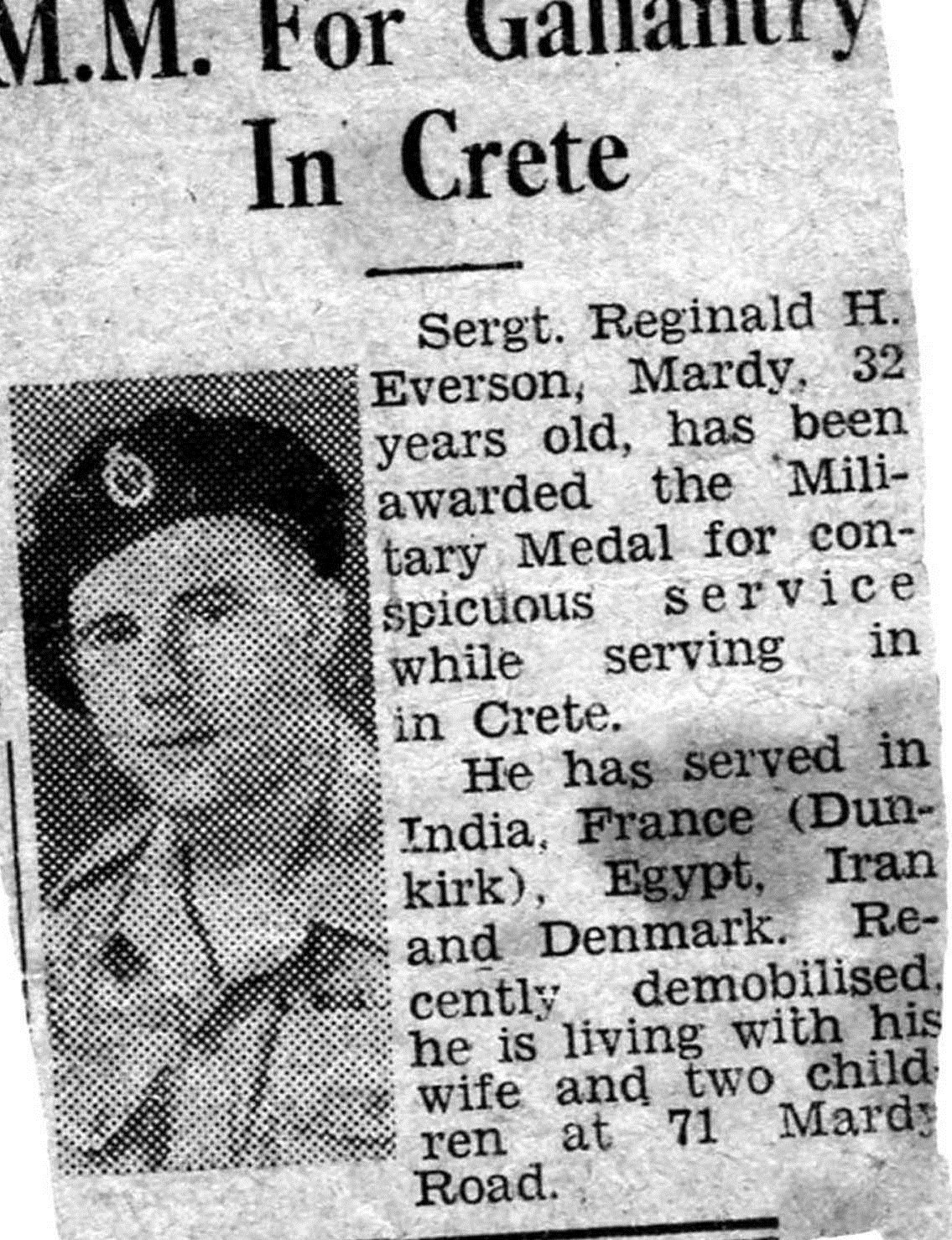
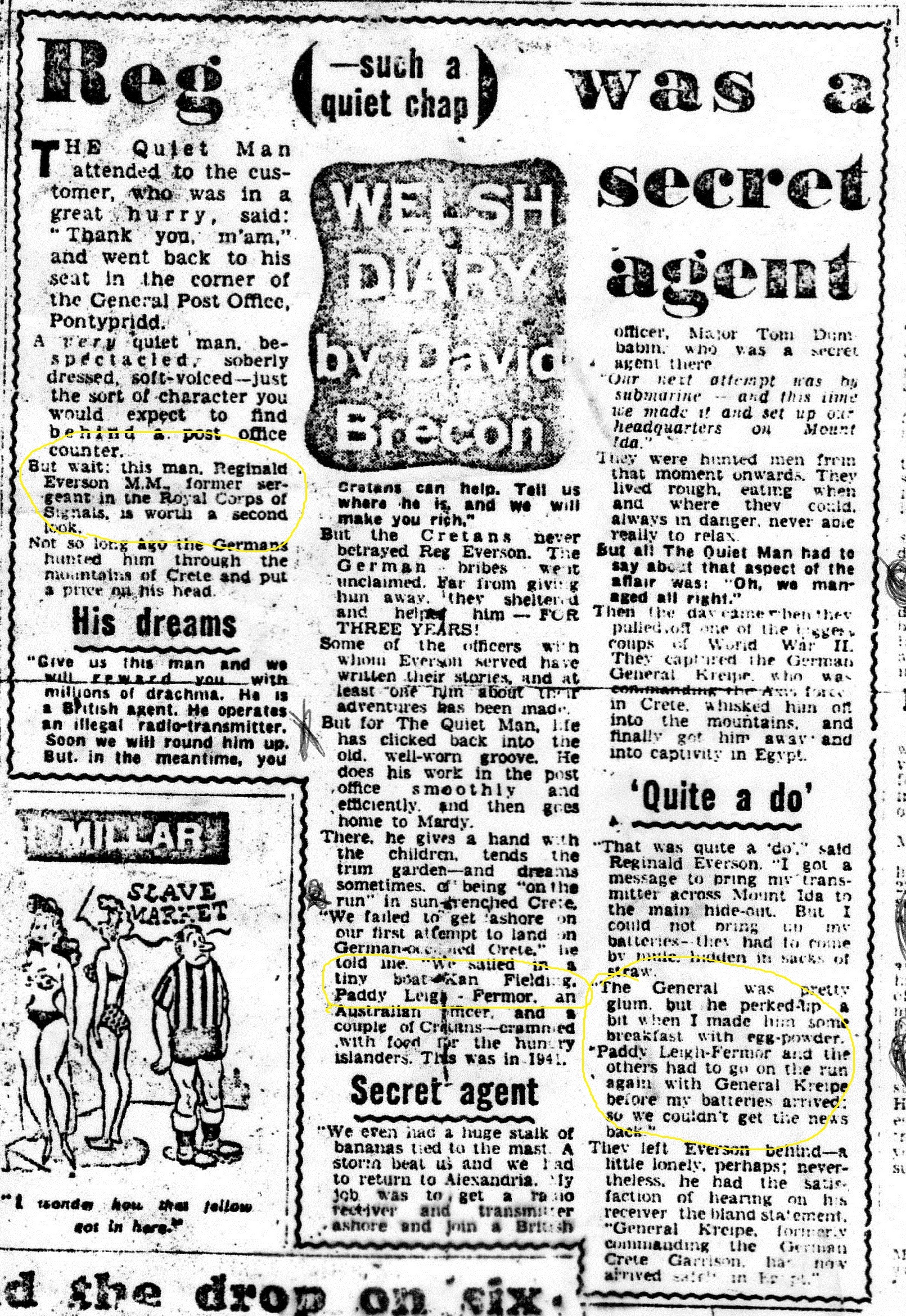
Vince told me that in the 1950’s Reg was interviewed by a local reporter.

I am sure that Reg didn’t want it to sound as if he was alone [on Crete]. He was a quiet mild mannered gentleman, and was in the Royal Signals from 1931 to 1946 and like so many servicemen lied about his age to get in, he was only 15 when he enlisted. For the three years he was on Crete his wife didn’t hear from him. His commanding officer was the only contact she had. People in the village even thought Reg had left her!

It wasn’t until I wrote a piece in the local paper that people understood where he had been because he didn’t speak about it. In the newspaper cutting from the 50s Reg talks about his involvement in the kidnap of General Kreipe and how he cheered up the General by making him some powdered egg for breakfast on Mount Ida.

We have his forged Cretan papers here, also a leaflet that was dropped by the Germans. He was awarded the Military Medal and Africa Star among other medals. He was also presented with a solid silver medal for bravery from the Maharaja of India.

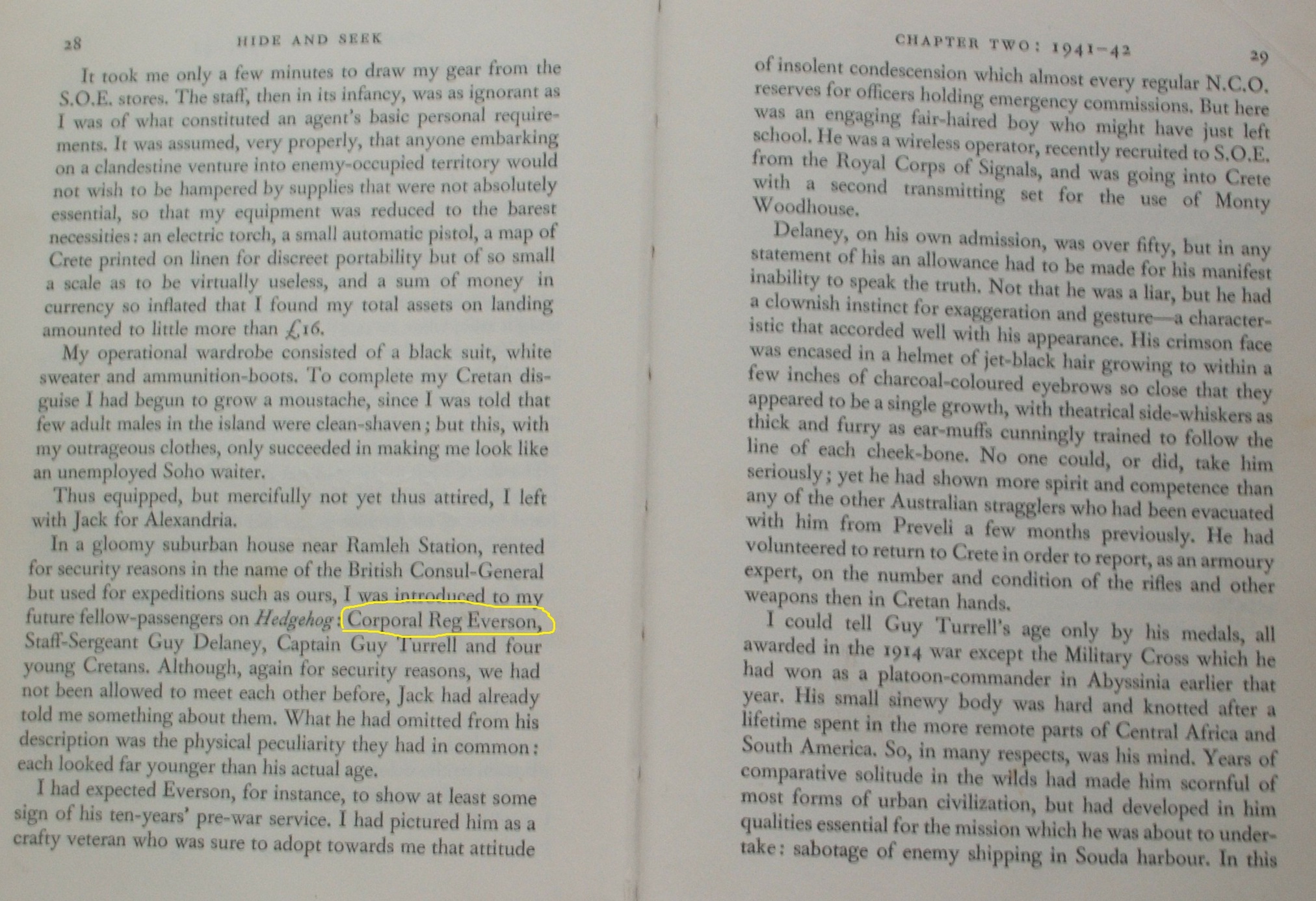
Reg Everson deployed to Crete with Xan Fielding, and Xan refers to this in his account of his time in Crete “Hide and Seek”.


In the newspaper interview Reg describes how he was summoned with his radio to Mount Ida to join the kidnap gang, but he had to wait for his heavy radio batteries to arrive so he made himself useful and he made breakfast for the General on Mount Ida …

“The General was pretty glum, but he perked-up a bit when I made him some breakfast with egg powder. Paddy Leigh Fermor and the others had to go on the run again with General Kreipe before my batteries arrived: so we couldn’t get the news [of the successful kidnap] back.”

Whilst we often hear the stories of the officers in SOE, we should not forget that they were supported by a large team including signallers such as Reg Everson who were especially brave. They risked being located by the Germans who were constantly trying to find the source of their signals to destroy the radios, and capture the highly skilled and valuable operators.

Patrick Leigh Fermor: We May Just Forget to Die, an essay by Margot Demopoulos

This is the probably most significant full length profile of Paddy that has appeared since his death. It is by Margot Demopoulos a writer who lives and writes in Los Angeles. Her fiction has appeared in The Briar Cliff Review, Mondo Greco, The Athenian, and other publications.

The interesting aspect of this profile is an extensive exploration of the events surrounding the Kreipe kidnap with particular attention to the contentious subject of post-operation reprisal by the Germans.

The subject line appeared in an earlier blog post from June 2011 where I highlighted Diana Gilliland Wright’s correspondence with Paddy.

On to the profile ….

“Englischer Student . . . zu Fuss nach Konstantinopel…” eighteen-year-old Patrick Leigh Fermor told the kindly woman sewing by the fire that snowy night at Heidelberg’s Red Ox. He sat at a nearby table, recording the day’s events in a notebook, hunting for German words in a dictionary, consulting maps for the next leg of the journey, “thawing and tingling, with wine, bread, and cheese handy,” as melting snow pooled around his boots.

“Konstantinopel?” Frau Spengler said. “Oh Weh! ” O woe! So far!

Far indeed, especially in the snowdrifts of mid-winter, but there he was — undaunted, spirits high, finally setting out on his own path — nearly two months into his journey to cross Europe on foot, with Constantinople the terminus. Nearly forty-five years later, he would publish the story of that journey in A Time of Gifts. Read More ….

Access the pdf of the article here.

London Gazette Moss MC and Fermor DSO announcement

Billy Moss and Patrick Leigh Fermor

A copy of the Supplement to the London Gazette dated 13 July 1944, which announces the award of the Distinguished Service Order to Captain (temporary Major) Leigh Fermor and the Military Cross to Lieutenant (temporary Captain) Stanley Moss.

You can find the pdf here Moss MC and PLF DSO announcement (once open scroll down) or an online link here.

Patrick Leigh Fermor’s complete SOE file now on-line

I am very pleased to be able to present the complete SOE file of Patrick Leigh Fermor which was released to the public in August 2011 by the National Archive at Kew. My thanks go to Steven Kippax who is an SOE historian for gathering this information.

Click on the image to go to the new page which is in the Photographs section.

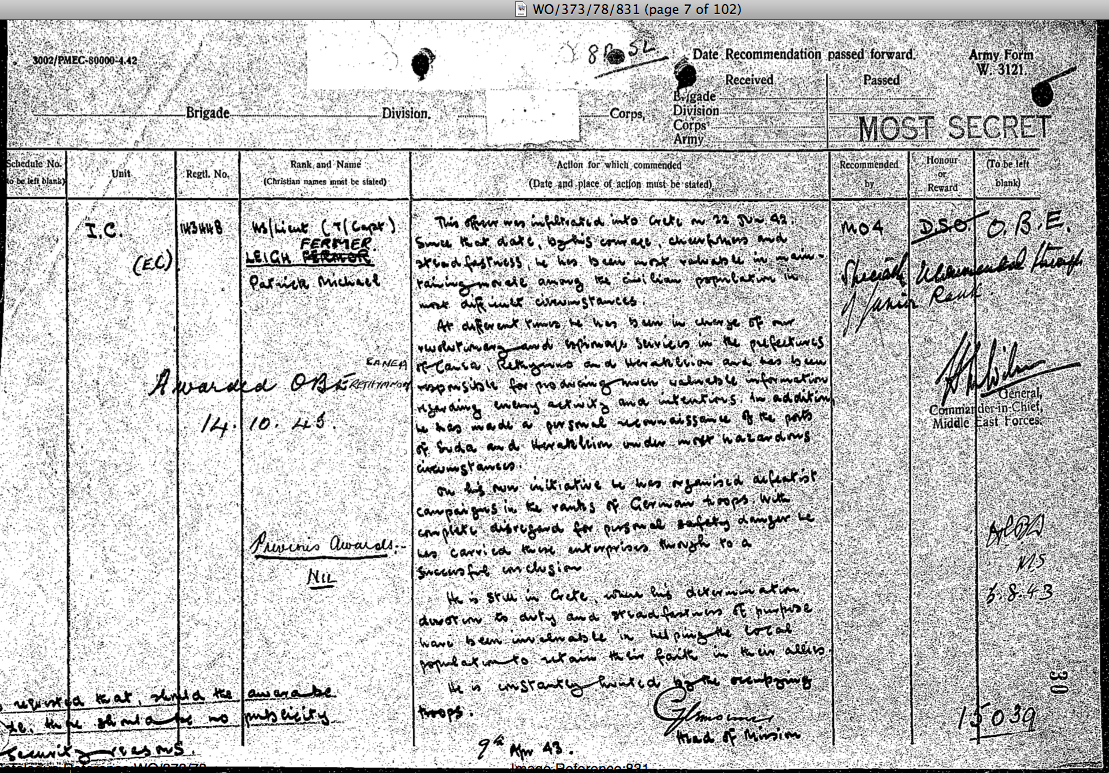
“He is consistently hunted by the occupying troops” – The commendation for Paddy’s OBE

It is clear the original intention was to award Paddy a DSO, but that was struck out in favour of an OBE. Paddy was later awarded the DSO for his part in the Kreipe abduction. Interestingly they had difficulties with his surname … Fermor is crossed out and replaced by Fermer!

The commendation reads:

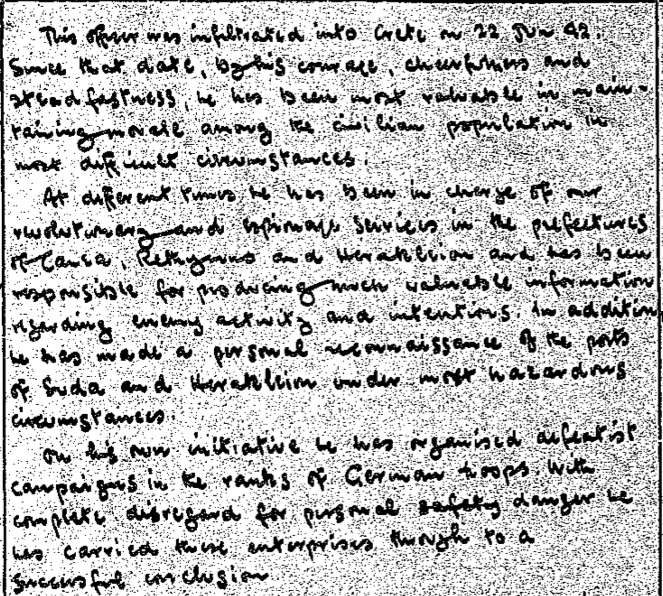
This officer infiltrated into Crete on 22 Jun 42. Since that date, by his courage, cheerfulness and steadfastness, he has been most valuable in maintaining morale among the civilian population in most difficult circumstances.

At different times he has been in charge of our revolutionary and espionage services in the prefectures of Canea, Rethymnon and Heraklion and has been responsible for providing much valuable information regarding enemy activity and intentions. In addition he has made a personal reconnaissance of the ports of Suda and Heraklion under most hazardous circumstances.

On his own initiative he has organised defeatist campaigns in the ranks of German troops. With complete disregard for personal safety … he has carried these enterprises through to a successful conclusion.

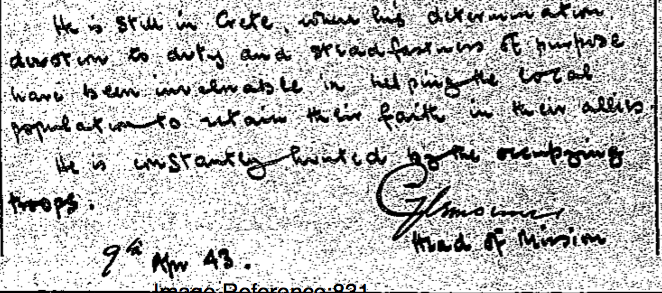
He is still in Crete, where his determination, devotion to duty, and steadfastness of purpose have been invaluable in helping the local population to sustain their faith in their allies.

He is consistently hunted by the occupying troops.

Signed by Head of Mission 9 Apr 43.

(requested that should the award be made there should be no publicity for security reasons.)

The source for this is the Kew public records office. This is not in Paddy’s SOE file.


How to Kidnap a General – a review of Ill Met by Moonlight

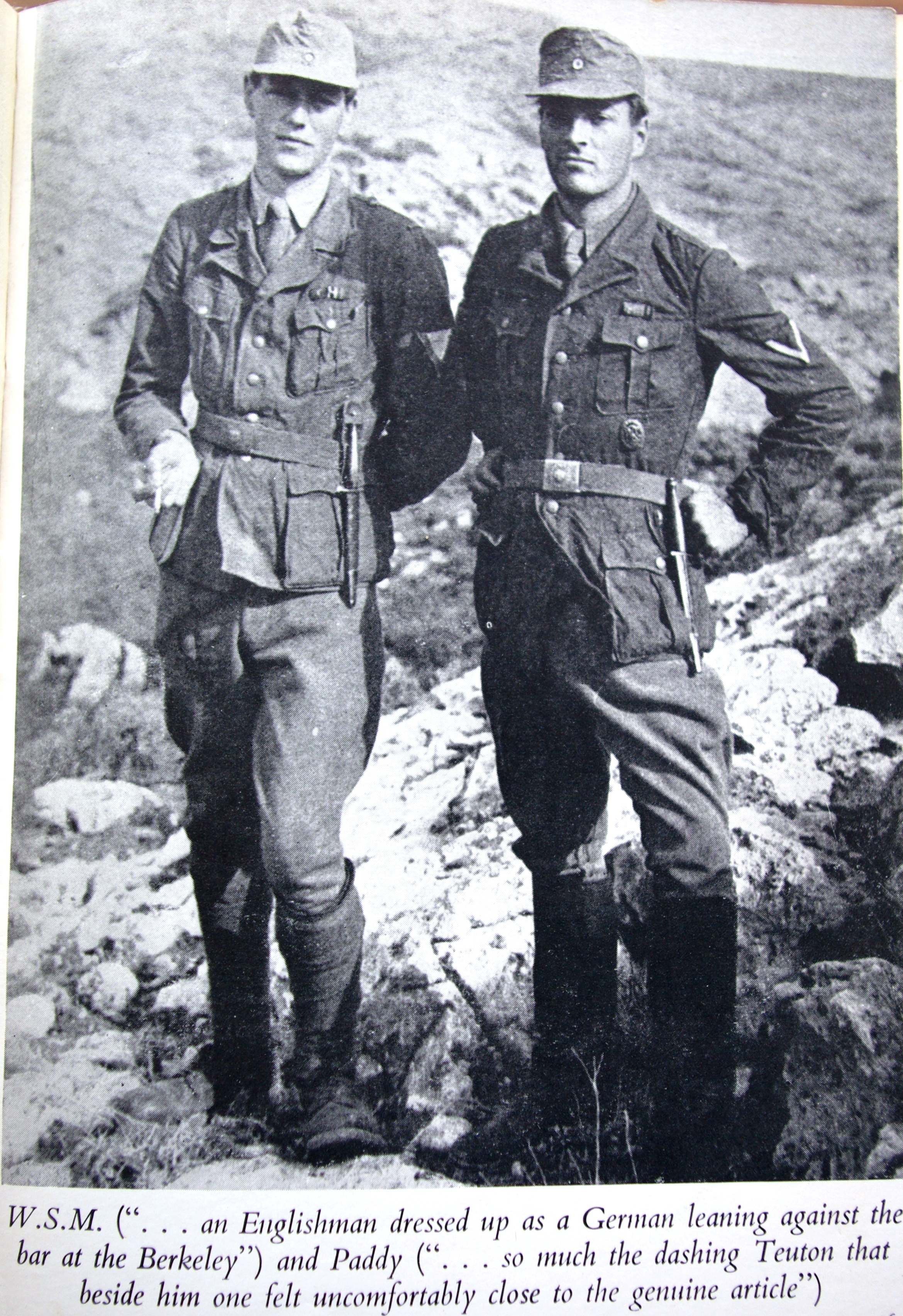
Patrick Leigh Fermor and Moss

Patrick Leigh Fermor and Moss in German Uniform Prior to the Abduction of General Kriepe

“There was a rush . . . our torches illuminated the interior of the car — the bewildered face of the General, the chauffeur’s terrified eyes . . . [The] chauffeur was reaching for his automatic, so I hit him across the head with my kosh [blackjack] . . . and George . . . dumped him on the road. I jumped in behind the steering-wheel, and . . . saw Paddy and Manoli dragging the General out of the opposite door. The old man was struggling with fury . . . shouting every curse under the sun . . . [We bundled] him into the back seat [and he] kept imploring, ‘Where is my hat? Where is my hat?’ The hat, of course, was on Paddy’s head.”

First published in Time magazine 4 September 1950

Why a German general’s hat should be on a British officer’s head is pretty much the gist of III Met by Moonlight. For as the staff car, driven by Author Moss, moved along the road in northern Crete, sentries at no less than 22 German traffic-control posts smartly saluted the behatted “general”‘ and waved the car on. They had no inkling that prostrate on the floor in the back seat lay the real general, with guns pointed at his head. Twenty days later, on May 16, 1944, kidnaped Major General Karl Kreipe was handed over to British authorities in Cairo, putting finis to what Harold Nicolson has called “one of the best adventure stories that I have read.”*

Behind the Lines. The scheme of raiding German-held Crete and trotting off with the divisional commander was the brain child of youthful Major Patrick Leigh-Fermor and Captain W. Stanley Moss, who had achieved the schoolboy dream of becoming secret agents. At their base in Cairo, they shared a villa and sampled the fleshpots of Egypt. It was in a nightclub that they first hatched the plot that was to land their party from a motor launch on the south coast of Crete.

The two Britons could depend on help from guerrillas and from intelligence corpsmen hidden in the hills. One British agent, a Cretan, actually lived next door to General Kreipe’s Villa Ariadne, near the north coast. Through him, Moss and Leigh-Fermor learned the general’s daily routine to a nicety—off to headquarters by car at 9 a.m., back in the evening any time after 8 or 8:30 p.m., depending on how many rubbers of bridge he stayed to play.

Slowly, painstakingly, the two agents planned a night ambush. Hidden guerrillas lay at vantage points on the road to the villa, a buzzer and torch flashes relayed warnings of the general’s approach to the waiting kidnapers, who were in German uniforms.

After the snatch, the general (who quickly became resigned and quite amiable) was marched from cave to cave half the length of Crete, while the furious Germans fruitlessly finecombed the island. By the time a Royal Navy motor launch nosed in to a southwest beach and took off both captive and captors, Moss and Leigh-Fermor knew that they had achieved their principal aim—to astound the enemy and make him the laughingstock of the local population.

Author Moss wrote his story in the mid-’40s, but the British War Office refused to let it appear then. Today, having reached the elderly age of 29, Moss is a bit abashed by the “22-year-old exuberance (almost bumptiousness) with which it was written.” Bumptious or not, it is one of the most melodramatic and audacious stories of the war.

*And notably more successful than another daring plan hatched in Cairo. In November 1941, British commandos under 24-year-old Lieut. Colonel Geoffrey Keyes made their way 200 miles behind Axis lines in an attempt to capture or assassinate Nazi General Erwin Rommel. At night, with cork-blackened faces, Keyes and his commandos achieved complete surprise, wrecked Rommel’s HQ with grenades. But Keyes was killed and Rommel was untouched: he had gone to a birthday party.

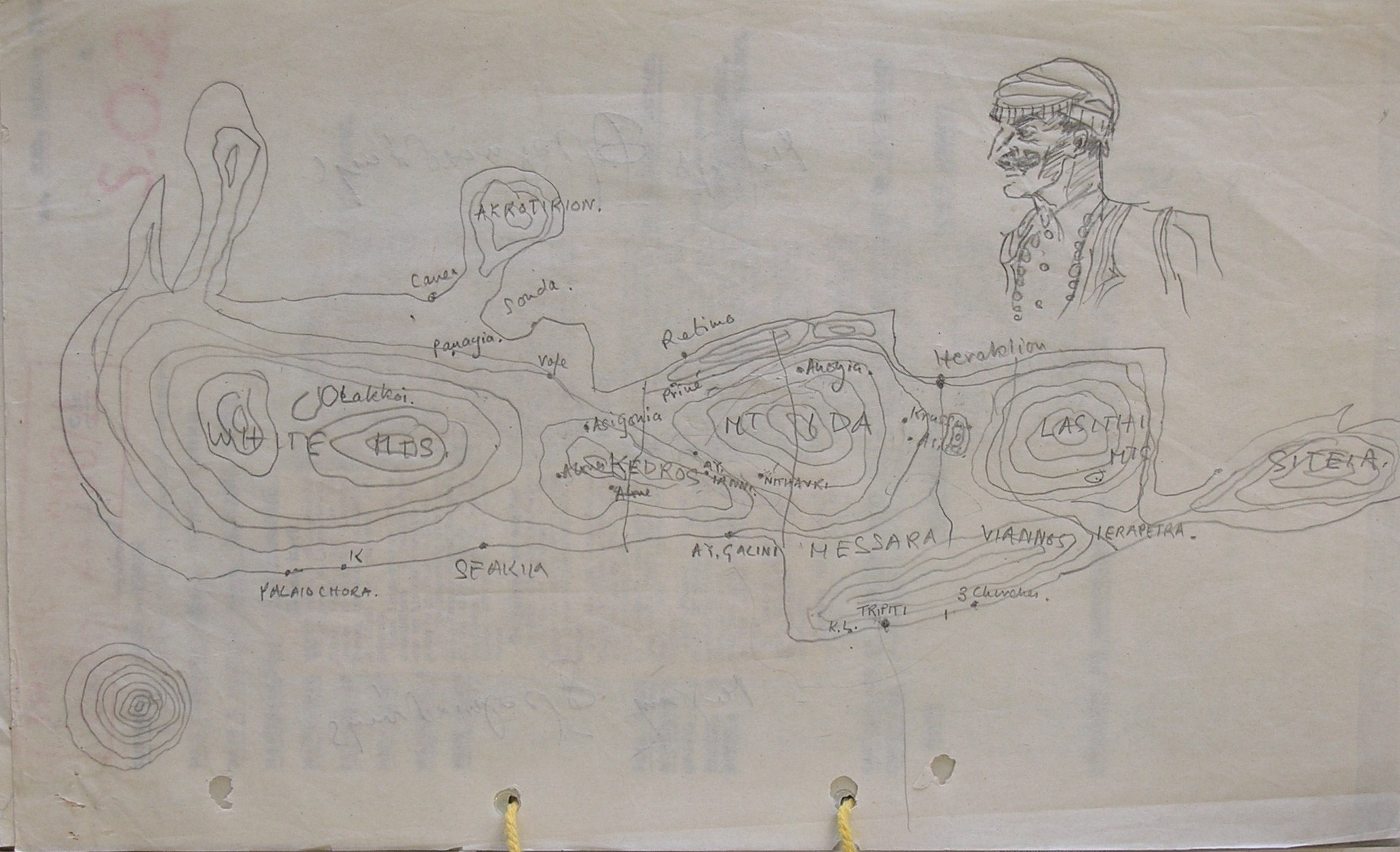
A map of Crete as drawn by Paddy on operations in Crete

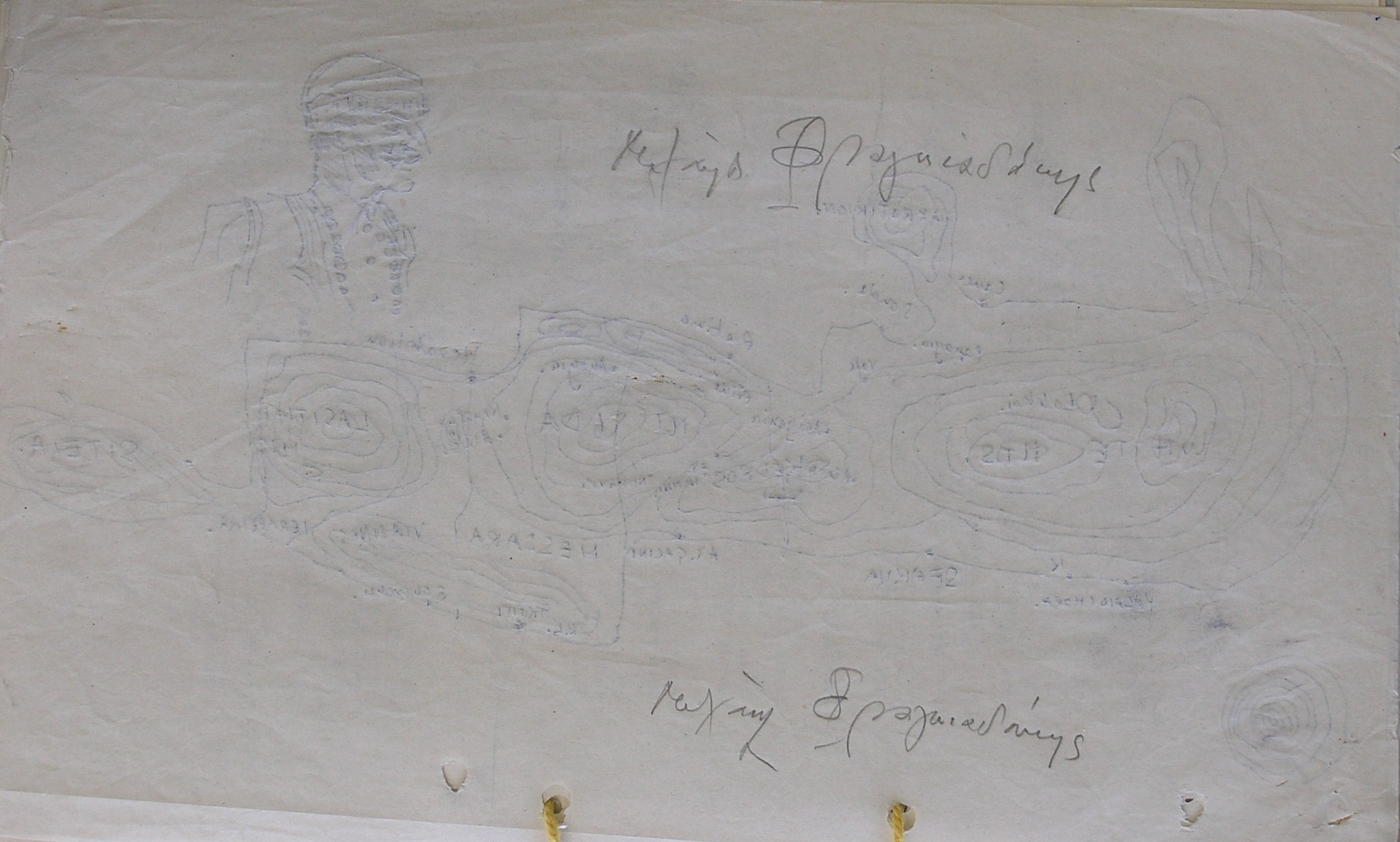
This map was  hand drawn by Paddy, probably whilst on operations in Crete 1943-44, including, perhaps, a self-portrait. The map is from Paddy’s SOE file.

The reverse of the map …

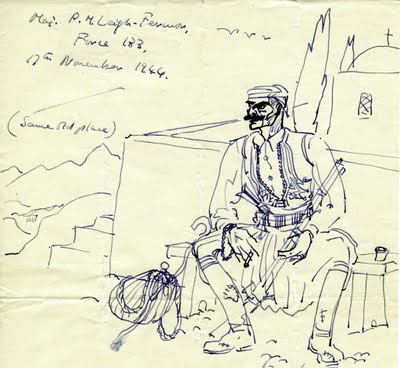
The drawing is typical of Paddy’s style. Compare it with this sketch sent to us by John Stathatos, about which John tells us:

This delightful sketch of himself in Cretan dress was penned at the top of a letter to my mother dated 17th November, 1944; as he explains, “I have been lost again in a forest of whiskers for about three weeks, and my old mountain chums are down in the plains now, looking incredibly wild and shaggy”.

"I have been lost again in a forest of whiskers for about three weeks, and my old mountain chums are down in the plains now, looking incredibly wild and shaggy"

Related article:

Traveller’s Rest by John Stathatos

The oral heroic poetry of the Kreipe kidnap

I have extracted this from a fairly long book review about Professor M I Finley’s 1978 revised edition of his book The World of Odysseus. It has a fascinating section about an oral heroic song from Crete that is about Paddy and the Kreipe abduction, and how it had evolved in just the few years since the end of the war.

From Triumph of a Heretic by Bernard Knox, first published in the NYRB 29 June 1978.

It is now more than two decades since the Professor of Ancient History at Cambridge (who was then an ex-professor from Rutgers) published a book which in a limpid, hard-hitting prose and with a bare minimum of footnotes attempted to draw “a picture of a society, based on a close reading of the Iliad and Odyssey, supported by study of other societies….” This is how Professor Finley characterizes the book now, in the preface to a revised edition which makes only minor changes in the original text but adds two valuable and stimulating appendices, replying to criticism and bringing the argument up to date. He goes on to claim that “the social institutions and values make up a coherent system” which, however strange to us, is “neither an improbable nor an unfamiliar one in the experience of modern anthropology.” The fact that the later Greeks and the nineteenth-century scholars found it incomprehensible on its own terms he dismisses as “irrelevant” and adds that “it is equally beside the point that the narrative is a collection of fictions from beginning to end.” ….

… Oral heroic poetry is not a medium that preserves historical fact—as Finley pointed out, with a reference to the Chanson de Roland, which made out of a Basque attack on Charlemagne’s rear-guard an assault by Muslim beys and pashas, all carefully identified by names which are “German, Byzantine, or made-up.” A modern example, from the Second World War and from Greece itself, strengthens his case and gives a fascinating glimpse of epic “history” in the making.

In 1953 the late Professor James Notopoulos was recording oral heroic song in the Sfakia district of western Crete, where illiterate oral bards were still to be found. He asked one of them, who had sung of his own war experience, if he knew a song about the capture of the German general and the bard proceeded to improvise one. The historical facts are well known and quite secure. In April 1944 two British officers, Major Patrick Leigh Fermor and Captain Stanley Moss, parachuted into Crete, made contact with Cretan guerrillas, and kidnapped the German commanding general of the island, one Karl Kreipe.

The general was living in the Villa Ariadne at Knossos, the house Evans had built for himself during the excavations. Every day, at the same time, the general was driven south from the Villa to the neighboring small town of Arkhanes, where his headquarters were located. He came home every night at eight o’clock for dinner. The two British officers, dressed in German uniforms, stopped the car on its way home to Knossos; the Cretan partisans overpowered the chauffeur and the general. The two officers then drove the car through the German roadblocks in Heraklion (the general silent with a knife at his throat) and left the car on the coast road to Rethymo. They then hiked through the mountains to the south coast, made rendezvous with a British submarine, and took General Kreipe to Alexandria and on to Middle East Headquarters in Cairo.

Here, in Notopoulos’s summary, is the heroic song the bard produced:

“An order comes from British and American headquarters in Cairo to capture General Kreipe, dead or alive; the motive is revenge for his cruelty to the Cretans. A Cretan partisan, Lefteris Tambakis (not one of the actual guerrilla band) appears before the English general (Fermor and Moss are combined into one and elevated in rank) and volunteers for the dangerous mission. The general reads the order and the hero accepts the mission for the honor of Cretan arms. The hero goes to Heraklion, where he hears that a beautiful Cretan girl is the secretary of General Kreipe.

“In disguise the partisan proceeds to her house and in her absence reads the [English] general’s order to her mother. When the girl returns he again reads the general’s order. Telling her the honor of Crete depends on her, he catalogues the German cruelties. If she would help in the mission, her name would become immortal in Cretan history. The girl consents and asks for three days time in which to perform her role. To achieve Cretan honor she sacrifices her woman’s honor with General Kreipe in the role of a spy. She gives the hero General Kreipe’s plans for the next day.

“Our hero then goes to Knossos to meet the guerrillas and the English general. ‘Yiassou general,’ he says. ‘I will perform the mission.’ The guerrillas go to Arkhanes to get a long car with which to blockade the road. Our hero, mounted on a horse by the side of the blockading car, awaits the car of Kaiseri (that is what the bard calls Kreipe). The English general orders the pistols to be ready. When Kreipe’s car slows down at the turn he is attacked by the guerrillas. Kreipe is stripped of his uniform (only his cap in the actual event) and begs for mercy for the sake of his children (a stock motif in Cretan poetry).

“After the capture the frantic Germans begin to hunt with dogs (airplanes in the actual event). The guerrillas start on the trek to Mount Ida and by stages the party reaches the district of Sfakia (the home of the singer and his audience; actually the general left the island southwest of Mount Ida). The guards have to protect the general from the mob of enraged Sfakians. Soon the British submarine arrives and takes the general to Egypt. Our bard concludes the poem with a traditional epilogue—that never before in the history of the world has such a deed been done. He then gives his name, his village, his service to his country.”

So much for epic history. Nine years after the event the British protagonists have been reduced to one nameless general whose part in the operation is secondary and there can hardly be any doubt that if the song is still sung now the British element in the proceedings is practically nonexistent—if indeed it managed to survive at all through the years in which Britain, fighting to retain its hold on Cyprus, became the target of bitter hostility in Greece and especially among the excitable Cretans.

It took the Cretan oral tradition only nine years to promote to the leadership of the heroic enterprise a purely fictitious character of a different nationality. This is a sobering thought when one reflects that there is nothing to connect Agamemnon, Achilles, Priam, and Hector with the fire-blackened layer of thirteenth-century ruins known as Troy VII A (the archaeologists’ candidate for Homer’s city) except a heroic poem which cannot have been fixed in its present form by writing until the late eighth century, at least four illiterate centuries after the destruction.

To read the full article click here.

SOE’s correspondence to Paddy trashing the draft of Ill Met By Moonlight

“We have had the opportunity of reading this through and I must confess it seems to me the most unutterable trash. Literary criticism is, however, not within our province of officiality. Apart from that there are quite a number of points which it is undesirable to see published … and I very much doubt if descriptions such as that of General Gubbins acting as a horse in a sham bullfight would be sanctioned by those concerned.” Thus starts a correspondence from the War Office to Paddy on the subject of a draft of Stanley Moss’ book.

In April 1945 the War Office were in receipt of a draft Moss’ book Ill Met by Moonlight. Paddy’s recently released SOE file shows that not only were they sensitive to the security aspects of the book, but these Staff Officers thought very little of its literary style.

It appears that Moss had given Paddy ‘full powers’ to deal with the publication of the book. This seems to have dragged Paddy into some degree of trouble.

In a letter dated 29 March 1945 an officer says “LEIGH-FERMOR does not submit willingly to discipline, and I think, requires firm handling.”

The correspondence is quite amusing “Good taste and discretion are hardly attributes of the writer as illustrated by his description of one of his lady friends as an “over-sexed mongoose”. It is clear that the final version was quite severely edited, but some of the missing parts are quoted at length by Staff Officers who clearly had too much time on their hands .. or were they merely jealous that they had missed out on all the fun in Cairo?

Paddy himself in a covering letter to Colonel Talbot Rice with the submission of the draft for clearance says; “It is not a very good book – too much is made of too little” But he did think it would “sell like blazes”.

ugugukg

A reconstruction of the Kreipe abduction in Crete

I believe this is something of a regular event in Crete. The story of the Kreipe abduction and then a ‘reenactment’ of the abduction on the actual spot it took place. The action starts at 2 minutes 20 seconds!

Don’t forget we have a whole section on these events and video as well:

Paddy talks about the abduction

General Kreipe, Paddy and the abduction gang on Greek TV 1972

more stories related to Ill Met by Moonlight 

Related article:

The Kreipe pennants 

The troubled waters of the mind grow still and clear

Paddy in Greece photographed by Joan

Don’t you feel like me that with the passing of Paddy as one of the last of his generation we have clearly entered a new age dominated by uncertainty; a lack of confidence in the values we once held as unquestionably true? These beliefs that bound us (in the West?) together for the latter part of the twentieth century are now unravelling at an ever-increasing pace. As we enter the End Game of the economic crisis, and as the decade of The Forever War rumbles on like the noise of a busy road in the middle distance – there only when we take the trouble to notice – we suffer a dearth of leadership and heroes of substance. Paddy and those of his generation had no such crisis of confidence; they served without question. They sacrificed themselves for the things they believed in, and they provided the leadership, entrepreneurship, creativity, and wisdom that helped rebuild Europe after almost half a century of ethnic and social strife, and destructive war. Maybe they also share some blame for the way things turned out, but who will step up now?

In this considered profile, which prompted my rambling reflection, Paddy’s good friend Colin Thubron assesses his contribution, not as a warrior, but as a writer, and I think for the first time, reveals the torment of Paddy’s troubling writer’s block towards the end of his life.

by Colin Thubron

First published in the New York Review of Books, Volume 58, Number 14

When Patrick Leigh Fermor died in June at the age of ninety-six, it seemed as if an era had come to an end. He was the last of a generation of warrior–travel writers that included the Arabian explorer Wilfred Thesiger, the controversial mystic Laurens van der Post, and the indefatigable Norman Lewis of Naples ‘44. Among these, Leigh Fermor shines with the élan and the effortlessly cultured glow of an apparent golden age. A war hero of polymathic exuberance, brilliant linguistic skills, and an elephantine memory, he was sometimes fancifully compared to Lord Byron or Sir Philip Sydney.

Two pairs of books came to exemplify his achievement. The first pair—Mani (1958) and Roumeli (1966)—celebrated the Greece that held his abiding fascination and where he lived for forty-five years on a once-wild promontory in the Peloponnese. In Mani, especially, he described this backwater region as a world whose way of life had survived in a fierce and enchanted time warp.

The land he depicted is barely recognizable now—tourism, he observed, destroys the object it loves—but it was less the Greece of classical antiquity that beguiled him than the spirit and folk culture of the hinterland: the earthy, demotic Romiosyne that he once contrasted with the Hellenic ideal in a playful balance sheet of the country’s character.

In these, and in later books, the style was the man: robustly imaginative, cultivated without pedantry, unstoppably digressive, forgivably swanky, and filled with infectious learning. The impression—overflowing into elaborate footnotes and flights of learned fantasy—is one of omnivorous delight in the quirks and byways of history, art, language, genealogy, myth, song, superstition, costume, heraldry, and everything else that struck his fancy.

His literary models were Norman Douglas and Robert Byron, but his writing was more vivid than the one, more kindly than the other. Despite the richness of his prose (occasionally slipping into purple) he forged an illusion of intimacy with his readers, as if they were sharing his mind in the moment of writing. But in fact his manuscripts were worked, reworked, and reworked again with such painstaking perfectionism that his publisher (the benign Jock Murray) often had to reset his galley proofs wholesale. The apparently natural flow of words was in reality a densely worked choreography, which came at cost.

Fifteen years ago, swimming in the Ionian Sea beneath his home, where nobody could overhear us, Paddy (as friends and fans called him) suddenly confessed to me the writer’s block that would plague the rest of his life. The expectations of a now-avid public, and his own obsessive perfectionism, were taking their toll, and he could not overleap this cruel impediment.

I remember him strong into old age. He swam every morning, with a sturdy breaststroke far out to sea, the tattoo of a twin-tailed mermaid glistening on his shoulder. He still kept up a striding march in the Taygetus foothills, where he and his wife Joan had designed their own house above the ocean. It was a place of “mad splendor,” he wrote. Its sitting-room library—bookshelves banked nine feet high—opened onto a vista of cypresses and the Messenian Gulf, and was flagged with the greenish stone of Mount Pelion. In the afternoon Paddy would disappear into his study to confront—or escape—the demons of his failed writing, and would emerge to the liberation of ouzo or whiskey, generally to report some arcane piece of research—that the Huns wore stitched field-mouse skins, perhaps—or to share a passage of Ovid. We dined in the monastic half-cloister he had built beside his home, and once we visited the tiny, red-tiled Byzantine chapel where—five years before—he had buried the ashes of Bruce Chatwin.

The conflict between a natural gregariousness and the solitude of writing never quite resolved for him. In a short, intriguing study named A Time to Keep Silence (1953) he recorded his sojourn in three great French monasteries. He described this retreat not as a religious exercise, but as a need for a haven for writing, and the nature of its cleansing—”the troubled waters of the mind grow still and clear”—remains suspended like a question mark in the oeuvre of a man to whom self-revelation seemed indulgence.

The second pair of books, which established Paddy’s primacy among travel writers, must be among the most extraordinary ever written. In 1933, as a youth of eighteen, he left England for a journey that would take a year and a half. As “a thousand glistening umbrellas were tilted over a thousand bowler hats in Piccadilly,” he set out to walk to Constantinople (as he nostalgically called Istanbul). Walking stick in hand, a copy of Horace’s Odes in his rucksack, he pursued a meandering course up the Rhine and down the Danube, across the Great Hungarian Plain, into Romania and through the Balkans to Turkey.

It was almost forty-five years before he published the first part of this journey, and another nine years before the second. A Time of Gifts (1977) and Between the Woods and the Water (1986) represent prodigious feats of memory. They record the rite of passage of a precocious, exuberant young man as he encounters the peoples and languages of a Middle Europe now littered with obsolete names: Bohemia, Transylvania, Wallachia. His story must have become the dream journey of every enterprising and footloose adolescent.

Inevitably the accuracy of Paddy’s memory was questioned, and he was frank about occasional imaginative license and conflation. (His first diary was stolen in Munich, a solitary last one recovered years later in Romania.) Certainly his recall was extraordinary. I remember the first time we met (by chance), when he quoted verbatim from my first book passages that I had myself forgotten. A year before his death we chanted verses from the Rubáiyát of Omar Khayyám together in an antiphonal competition (which he won).

His urge to describe his epic journey more than forty years after its end was a deeply natural one. He was revisiting his youthful persona with the judgment and knowledge of maturity; yet in a sense he had remained unchanged. Despite his sophisticated learning, he retained an almost boyish innocence, as if the troubles of the modern age had bypassed him. In the Peloponnese, where he settled to live in the 1960s, he had remained in thrall to a more ancient, rooted culture than that of the urban West.

The final volume of his proposed trilogy—carrying its author through the Balkans and down the Black Sea coast to Turkey—became his tormenting and elusive project for the next quarter- century, and was never completed. Some near-finished version, however, survives him, and will eventually be published.

With his youthful trek done, Leigh Fermor’s career took off into near fable. Caught up in Greek unrest, he joined in a triumphal royalist cavalry charge against wilting Venizelist rebels. In Athens he fell in love with the artist Princess Balasha Cantacuzene, twelve years older than him, and lived with her in Moldavia for over two years, before World War II recalled him to London.

As a fluent Greek speaker he was recruited by the Intelligence Corps, and sent as a liaison officer with the Greek army first to Albania and finally to Crete, where he survived the brutal German invasion. For almost two years, while an officer in the Special Operations Executive, he lived disguised as a shepherd in the Cretan mountains, organizing the gathering of intelligence.

Then, in 1944, occurred the exploit that—more than any other—was to burnish him into legend. He and his fellow SOE officer Stanley Moss dreamed up a scheme of harebrained bravado. Dressed in stolen German uniforms, with a party of Cretan guerrillas, they ambushed the car of General Heinrich Kreipe, the German commander of occupied Crete, kidnapped him, and concealed him under the back seat. Moss took the wheel, Paddy donned the general’s cap, and together they drove through twenty-two checkpoints to emerge on the far side of Herakleion and march Kreipe for three weeks over the mountains, to be picked up by motor launch and taken to Egypt.

It was during this hazardous Cretan march, as the dawn broke over Mount Ida, mythical birthplace of Zeus, that the abducted general began to murmur a verse of Horace: Vides ut alta stet nive candidum/Soracte….1 It was an ode that Paddy knew by heart, and he completed the six stanzas to their end. “The general’s blue eyes had swivelled away from the mountain-top to mine,” Paddy later wrote,

—and when I’d finished, after a long silence, he said: “Ach so, Herr Major!” It was very strange. As though, for a long moment, the war had ceased to exist. We had both drunk at the same fountains long before; and things were different between us for the rest of our time together.

This precocious kidnapping was later reimagined in a lackluster movie named Ill Met by Moonlight (1957) with Dirk Bogarde playing Paddy. But there were other exploits too. Paddy had already engineered the defection of the Italian General Angelico Carta from Crete; and he was due to undertake a near-suicidal mission to Colditz when the war ended.

His upbeat account of these events was tempered by regret. He had planned that the abduction of Kreipe be bloodless, but his accompanying Cretan partisans slit the chauffeur’s throat, and rumors of grim German reprisals for the abduction have never quite died down. Above all, Paddy’s accidental shooting of one of his fellow guerrillas may have stained his memory of the whole period.

On June 16 Leigh Fermor was buried back in the English countryside, attended by an Intelligence Corps guard of honor, to lie beside his wife Joan, his dear comrade since 1946. This was, in a sense, fitting. For in certain ways he was exemplary of a wartime Englishness now almost gone, whose more dashing qualities merged seamlessly into the hardy stylishness of Greek leventéa.

To those who knew him, his books are hauntingly redolent of his sensibility. His conversation was irrepressibly warm and inventive far into old age, moving from arcane anecdotes to fanciful wordplay or bursting into polyglot song (sometimes singing the lyrics backward). His friends ranged from Deborah, Duchess of Devonshire—last of the six legendary Mitford sisters (his correspondence with her was published in 20082)—to early acquaintance with a raffish interwar bohemia and his own great predecessor, the travel writer and aesthete Robert Byron, whose borrowed rucksack he bore across Central Europe as a youth.

Almost the last time I met Paddy, he had returned home after an operation for suspected cancer, and I feared he would be depleted, his old zest gone. He was growing deaf, and he suffered from tunnel vision (which he called Simplonitis). For a while, sitting over lunch, he seemed subdued. Then something struck him. He perked up, and said: “You know, there is an apple lying on a table in the hall. It’s been there all weekend. Wouldn’t it be marvelous if it cocked a snook at Newton, and simply took off into the air!”

This was typical of his boyish resilience. In the field of travel he evoked both the youthful wanderer who discovers another world and the avid scholar who melds with it. His prose was too rich and elaborate to be a safe influence on others (although a few have tried); but he brought to the genre not only the distinction of his densely brilliant books, but his innate dignity, ebullient mind, and capacious heart.

  1. 1″See Mount Soracte white with snow….”
  2. 2The correspondence, In Tearing Haste , edited by Charlotte Mosley, was published in the US by New York Review Books (2010), which has also republished the other books by Patrick Leigh Fermor mentioned in this article, as well as The Traveller’s Tree .

The Kreipe pennants

The Kreipe pennants - Copyright Artemis Cooper 2011

The pennants from General Kreipe's car

What happened to the flags on General Kreipe’s car when Paddy abandoned it and joined the main abduction gang? Well here is the story. I am very grateful to Artemis Cooper for submitting this. I hesitate to say that this is a world exclusive, but it probably is! These have not been seen in public since the car drove through the heavily garrisoned town of Heraklion with the General in April 1944.

As I’m sure you know, just before abandoning the General’s car on the night of the abduction of Gen Kreipe, Paddy and George Tyrakis ripped off the two metal pennants that stood proudly on the bonnet. One might argue that, combined with Billy’s confident driving, it was those pennants that had let the car pass unchallenged through 22 German checkpoints! Since Billy had driven the car the pennants were given to him; and after his death, Billy’s daughters – Gabriella Bullock and Isabella Cole – felt that Paddy should have them. Paddy held onto them for many years, very much under wraps. I think the main reason he kept them hidden was because he had always felt so wretched about the death of Alfred Fenske, the General’s chauffeur.

They were kept in a tin trunk in his study, and very few people knew they were there. He showed them to me only once. The reason for that was so that I should be aware that after his death, they were to go to the Rethymnon Museum of History and Folklore. This had been arranged in the 1990s, with the encouragement of Niko Kokonas.

In August the flags were given to the Rethymnon Museum, according to Paddy’s instructions.

I have a photo of the flags. They stand about 15″ high, the triangular pennant sticking out about 12″. The first is painted red, white and black in horizontal lines, like the German flag. The other shows the gold Nazi eagle with outspread wings perched on a wreath, embroidered onto a piece of grey fabric which is then mounted onto the metal pennant.

I hope this is a real joy to all the Ill Met by Moonlight fans out there.

This article and photograph copyright Artemis Cooper 2011

Ill Met by Moonlight film review

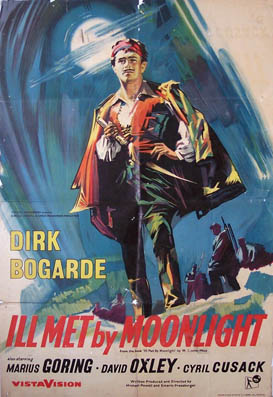
Ill Met by Moonlight movie poster

For a decade and a half, the partnership of Michael Powell and Emeric Pressburger illuminated the cinema with an array of extraordinary films. But the massive reputation the team garnered during and immediately after World War II – The Life and Death of Colonel Blimp, A Canterbury Tale, I Know Where I’m Going!, A Matter of Life and Death, Black Narcissus, and The Red Shoes in just five years! went into steep decline in the Fifties. There were no Archers films at all between The Tales of Hoffmann (’51) and Oh… Rosalinda!! (’55), and both of those were disastrous failures, critically and financially. Perhaps to cover themselves in the ultraconservative British film industry, Powell and Pressburger finished their partnership with two conventional war adventure movies – rattling good yarns that, alas, were widely perceived as rattling just a bit too much.

First published in Film Comment 13th March 1995 v 31:n2. p37(4)

The Battle of the River Plate (’56) was a box-office success and had a royal premiere, but it now looks like the corniest of the Archers movies. An account of Britain’s first major naval victory of WWII, it does have the great virtue of showing actual ships maneuvering about in an actual ocean instead of models in a tank – Powell’s main pleasure in directing the movie, one imagines. But this is exasperatingly offset by far too many shots of actors on studio bridgehead sets being doused with water as they strike poses in front of a cyclorama. The local color Powell provides is a bit sticky, too, given that Uruguay, where the German battleship Graf Spee was forced to seek shelter before being tricked into self-destructing, was and still is a nation notorious for its concealment of Nazis. Peter Finch, as the captain of the Graf Spee, manages an impressive performance, but none of the other actors in a lively cast Anthony Quayle, John Gregson, Patrick Macnee, Anthony Newley, Christopher Lee, John Schlesinger in a bit as a German sailor – has much chance to create a real person. The Germans are all decent fellows, really, whilst the characterization of the Brits is entirely on the level of good-show-chaps caricature.

Powell seemed rather attached to this movie in later years, but had no love at all for the very last Archers film, Ill Met By Moonlight (’57). “I felt imprisoned by the facts,” he was wont to complain; and there were problems with the script Pressburger provided. Ian Christie’s book about Powell, Arrows of Desire, goes so far as to refuse to list the film as a collaboration at all, his filmography (reproduced, incomplete and inaccurate as it is, in Powell’s memoirs) giving Powell’s name alone as writer, producer, and director. Dissension between Powell and Pressburger coincided with antagonism from the Rank Organisation, which refused them money for color. Once the film was finished, so were the Archers.

After Ill Met By Moonlight, then, the deluge. It would be foolish to suggest that the film – miserably renamed Night Ambush for U.S. release and cut by 11 minutes – is anywhere near the level of the team’s masterworks. Even so, it’s more interesting than legend suggests. The (true) story, set in occupied Crete in 1943, concerns the kidnapping of a German general (Marius Goring) by Cretan partisans led by a British officer, Patrick Leigh Fermor (Dirk Bogarde). Film buffs will recall that the real Leigh Fermor was one of the scriptwriters of John Huston’s The Roots of Heaven (also the author of some bestselling travel books). Then again, the film seems to ask, who exactly is the “real” Patrick Leigh Fermor – or the real anyone? Taking its title from a play concerned with dreams and disguises, magic and power, Ill Met By Moonlight is all about questions of identity.

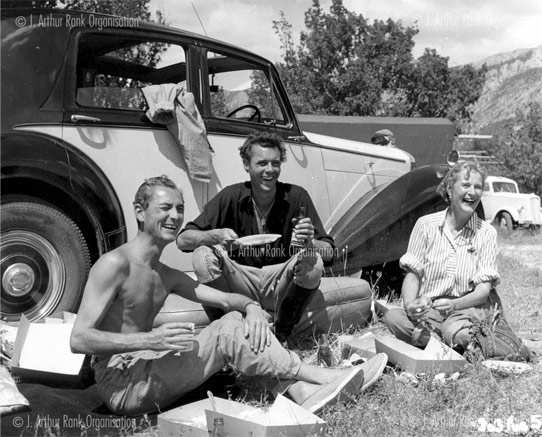
Xan and Daphne Fielding with Dirk Bogarde on the set of Ill Met by Moonlight

Under the credits, we see Dirk Bogarde in uniform; then, unexpectedly, we see him in the flamboyant outfit of a Cretan hill-bandit. A title informs us that Major Leigh Fermor was also known by the Greek code-name “Philidem.” In other words, there are two of him (at least), and on one level the adventure the film is about to unfold reflects a conflict in his personality. It’s a conflict shared, unknowingly, by his Nazi opposite number, the fierce, arrogant General Kreipe (an unlikely “proud Titania,” but it’s true that he “with a monster is in love” – the monster of Nazism). Kreipe’s human side is so rigorously repressed by the demands of war and “glory” that he is genuinely unaware of it; ironically, this humanness, which constitutes the true manhood of this Teuton warrior, is revealed by a boy (equivalent to Shakespeare’s Indian Prince?) – who, in turn, is the most grownup person in the movie.

Ill Met by Moonlight movie poster - Bogarde as Paddy the flamboyant Cretan

If “Philidem” appears under the credits, caped and open-shirted, a romantic dream-figure out of an operetta or a storybook, he is first seen in the film proper as a coarser, more down-to-earth version of the same thing – an ordinary Cretan peasant in a shabby suit, waiting for a bus. When he makes contact with the Resistance, his personality fragments further. To some, he is the mystical Philidem, Pimpernel of the Hellenes and righter of wrongs. To others he is “Major Paddy,” the happy-go-lucky Englishman of popular movie myth conducting war as if it were a branch of amateur theatricals, a gentleman adventurer relying on breeding to get him through and making fun of the whole business. To Bill Moss (David Oxley), the newly arrived junior officer sent to assist him, he is the cool, fast-thinking professional soldier. And to himself? In his quietly passionate defense of Cretan life and culture, he seems someone else again: a scholar and aesthete outraged by the barbarism and folly of war, and by the moronic arrogance shown by his captive toward the Cretan people.

Whatever his persona, Leigh Fermor is a chameleon who never seems to change very radically in himself. Perhaps because he has this quality of seeming all things to all men – and being those things – he remains unfazed by the monolithic might of the German military machine. Fluent in Greek, he can also speak German like a German and is easily able to assume another disguise, that of a faceless Nazi officer. Although he and Moss make fun of themselves – “If only I had a monocle!” muses Moss when Leigh Fermor tells him he “looks like an Englishman dressed like a German, leaning against the Ritz bar” – they are able to effect the kidnapping with an ease that seems appropriately Puckish. General Kreipe is ignominiously thrust onto the floor of his own limousine, gagged, and sat upon by a couple of the peasants he so despises. Kreipe’s rage is compounded by his firm conviction that he has been snatched by “amateurs” – a belief Leigh Fermor and Moss slyly make no objection to, knowing how it will gnaw at his already shaky Master Race self-confidence.

Soon, partisans and captive are up in the hills, where they stay for most of the movie (though the biggest of the film’s mountaineering set-pieces, a nocturnal descent through fog, was filmed on elaborately stylized studio sets). Once there, Kreipe determines to leave a trail for following German troops to pick up on – his cap, buttons from his uniform, even a couple of medals from his impressive display of such baubles never realizing that each emblem of his authority is no sooner dropped than it is retrieved by the vigilant Moss.

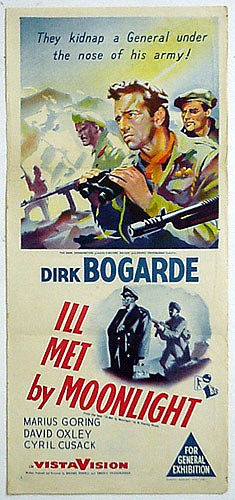
Rare Ill Met by Moonlight movie poster

Among Major Paddy’s partisans is a young war orphan, Nico, who has, while shinning up and down the mountains, much occasion to complain of his need of a pair of boots. Nico knows that the cost of a new pair will always be far beyond him; Kreipe, who has been friendly enough toward him in a rather patronizing way, seizes on this need by showing the boy his own impressive footwear and offering a gold coin with which to buy an identical pair. A German gold coin, he stresses, not one of the sovereigns Leigh Fermor keeps a supply of; it is, in fact, a coin the General is known to keep as a good-luck charm. Nico is impressed by the General’s largesse. But, of course, the Nazi requires a quid pro quo. All Nico has to do, when he goes down the mountain, is tell the searching German patrols where the General is, using the coin as a bona fides. But Kreipe has misjudged the boy (indeed, he can be said to have misjudged the whole of the human race): it never occurs to him that the boy will not do what he says. What Nico actually does is simply point the patrols in the wrong direction, leading them into an ambush; the magic gold coin is lucky for the Greeks, not the Germans. This makes the escape from Crete of the Britishers and their ill-met prisoner the easiest part of their long journey.

Once aboard a British ship, and naked of the symbols of military power, the General seems a new person – not such a bright man, not such a strong man, but also not such a bad man, either. He is visibly moved by the return of his possessions, especially the gold coin: despite his genuine pleasure in Nico’s company, Kreipe had assumed that the boy, like every non-German, is someone who can be bought and sold, and that “friendship” had been merely his gift, and not a privilege from which he might derive spiritual benefit rather than tactical advantage. The very simplicity of Nico’s ruse in deflecting rescue was the, final humiliation, the last stage in General Kreipe’s lengthy symbolic disrobing – which is precisely why his possessions can now be given back to him. If he started this modern midsummer night’s dream as imperious as Oberon, he ends it as foolish as the donkey-headed Nick Bottom. But then, Bottom the simple weaver is always better-liked by everyone than the unearthly and tyrannical monarch of Shakespeare’s enchanted forest.

And from his elaborate humiliation, the stiff-necked German learns a good deal about himself and about humanity. His curt acknowledgment at film’s end that he has been kidnapped not by amateurs but by professionals is also his acknowledgment of his own fallibility and that of the creed he has so proudly espoused. And so he regains a measure of dignity, along with those tokens of an identity he no longer needs. Nico himself get his new pair of boots after all (they belong to Leigh Fermor, who is barefoot in his final exchange with his prisoner), but, by a sad irony, is about to change identity as well: he will wait out the rest of the war far away from Crete in the distant England of which he has heard much but knows nothing. But at least he has a friend – a real friend, now – in General Kreipe, who has learned that the respect of an uneducated boy is worth more than a medal from the Fuhrer. “Gentles, do not reprehend / If you pardon, we shall mend.”

And Patrick Leigh Fermor, aka Major Paddy, aka Philidem – and, if you stretch your imagination just a smidge, aka Robin Goodfellow? – what of him? In the film’s closing moments, he is far from being self-assured intellectual or dashing amateur adventurer or legendary outlaw of the hills. He’s just a tired man who wants to go home and rest up. “How do you feel?” asks Moss. “Flat” is the reply. “You look flat!” says Moss. “I know how I’d like to look …” murmurs Leigh-Fermor wistfully. Moss knows what he’s going to say, and joins in the litany: “Like an Englishman dressed like an Englishman – and leaning against the Ritz bar!” It’s easy to imagine them ordering drinks at that renowned watering-hole with all the suavity required by this little fantasy. Still, the film’s last images of Crete receding in the distance, until all we can see is the sea, suggests that maybe Major Paddy’s heart is really back in those hills in the “fair and fertile” land that has become as much a Powellian landscape of the mind for us as the studio-built Himalayan convent of Black Narcissus or the monochrome Heaven of A Matter of Life and Death. And, as we depart both Crete and this film, we may reflect that being “dressed like an Englishman and leaning against the Ritz bar” would, for Patrick Leigh Fermor constitute yet another disguise. After all, he was Irish.

… now watch the movie trailer.

Ill Met by Moonlight

Related articles:

Patrick Leigh Fermor recounts the kidnap of General Kreipe on video

General’s long trip home

Paddy’s mugshots from his SOE file

Soon I hope to be able to bring you more information from Paddy’s SOE file which is at the National Archive in Kew, courtesy of Steven Kippax who is an SOE historian and researcher .

Here is a taster. The man himself looking pretty dashing but uncompromising for his official SOE mugshot!

Xan Fielding Obituary

I am reposting this obituary to Xan Fielding at this time as he was Paddy’s very good friend, the one to whom Paddy wrote his open letters at the start of A Time of Gifts and Between the Woods and the Water. Those who have found this site for the first time might wish to read about his friend. At the end is a special tribute written by Paddy.   I believe this to be the only on-line copy and it now includes newly discovered photographs.

==============================================================

After much searching I can bring you what I believe to be the only on-line obituary to Xan Fielding which I have retyped from the Daily Telegraph Second Book of Obituaries: Heroes and Adventurers. This includes a special tribute from Paddy to one of his closest friends.

First published in the Daily Telegraph 20 August 1991

Xan Fielding, the author, translator, journalist and adventurous traveller, who has died in Paris aged 72, lived a charmed life as a Special Operations Executive agent in Crete, France and the Far East during the Second World War.

Short, dark, athletic and a brilliant linguist, he was God’s gift to operations in rugged mountainous regions and wherever his languages were needed.

Major Fielding was awarded the DSO in September 1942, “for going into a town”, as he said later with a typical modesty.
He had a boyish, slightly rebellious spirit which he shared with many of his contemporaries in SOE. His self-confessed, or self-proclaimed, amateurishness certainly belied a tough professionalism, great resourcefulness and bravery in action. Fielding was the sort of man one would be happy to go into the jungle with.

While still in his early twenties he was responsible for clandestine and subversive activities in large areas of enemy-occupied Crete. He survived numerous encounters with German forces, only to be rumbled by the Gestapo in France towards the end of hostilities in Europe.

Even then his luck held. Locked in a death cell at Digne in 1944, he was “sprung” in an audacious move by Christine Granville (nee Krystyna Skarbeck) whose SOE exploits matched his.

Alexander Wallace Fielding was born at Ootacamund, India, on November 26 1918. His family had long links with the Raj and his father was a major in the 50th Sikhs.

Xan’s mother died at his birth and he was largely brought up at Nice, where his grandmother’s family had considerable property. Fluent in French, he subsequently became a proficient classicist at Charterhouse and then studied briefly at Bonn, Munich and Freiberg Universities in Germany. He saw what was happening in that country and was so shocked at the attitude of the Chamberlain government that he came close to joining the Communist party.

At the end of the 1930s Fielding – who had recently been sacked as a sub-editor on the Cyprus Times and was by now unsuccessfully running a bar – found himself a misfit in the Mediterranean colony. Colonial officials abhorred his refusal to adopt their disdainful description of Cypriots as “Cyps”. That he was also reasonably fluent in Greek rendered him suspect to district commissioners, who could not speak the language of the people they administered.

At the outbreak of the Second World War, haunted by the thought that he might find himself trapped in Cyprus for the duration, he fled to Greece and found asylum on St Nicholas, an island owned by the anthropologist, Francis Turville Petre. Fielding dreaded not so much the battlefield as joining the conventional officers’ mess. But eventually news of the fall of France, the Dunkirk evacuation and the Battle of Britain induced a “stab of guilt”.

He returned to the colony and was commissioned into the Cyprus Regiment, which appealed to him on account of its perverse refusal to have any regimental pride.

On hearing in Cairo that Cretans had taken up arms against the Germans, he yearned, as he wrote later, to help lead “this concerted uprising of the technically non-combatant”.

When Crete fell, Fielding was interviewed in Egypt by SOE. He was asked: “Have you any personal objection to committing murder?” His response being deemed acceptable, Fielding was put ashore in Crete with a load of weapons and explosives by Cdr “Crap” Miers, VC, skipper of the submarine Torbay.

Fielding, who had adopted the style and dress of a Greek highland peasant, was accompanied by a First World War veteran, who was inseparable from his solar topee and unrecognisable as the village schoolmaster he was supposed to impersonate.

Fortunately it was not long before he teamed up with the far more kindred spirit of Patrick Leigh Fermor. Sporting a royal blue waistcoat, lined with scarlet shot silk and embroidered with black arabesques – and singing folk songs in several languages – “Paddy” Leigh Fermor enlivened their meetings in desolate mountain hideouts.

Fielding understood the need for reliable intelligence and communications, and he daringly set up his headquarters near Crete’s northern coastal road in the proximity of German units. He experienced, as he put it, a childish excitement in “brushing shoulders with the Wehrmacht” in the corridors of the town hall when calling on the mayor of Crete’s capital, Canea. And he found it entertaining to attend parties given for the Germans by Cretan associates feigning fraternisation.

Operationally, Crete had become a massive transit camp to reinforce the Afrika Korps. Among his intelligence successes Fielding signalled the timetable of transports taking off from the airfield at Maleme, enabling the RAF to intercept them.

After six months he was picked up by a Greek submarine and given a breather in Cairo. This gave him a chance to niggle about the inaccuracy of RAF air drops.

As a result Fielding was invited to observe, from the front turret of a Wellington, a drop arranged for Leigh Fermor high up in the White Mountains. Considerably shaken by the experience – not least the anti-aircraft fire- he returned to the island by Greek submarine at the end of 1942 and never complained again.

Following the Crete mission, he parachuted into the south of France in the summer of 1944. Bearing papers announcing him as Armand Pont-Leve, a young clerk in the Electric Company of Nimes – but codenamed “Cathedrale” – Fielding was received by Francis Cammaerts (alias “Roger”) and also by Christine Granville.

Fielding found them an “imposing pair”. Still in uniform, he felt “rather like a novice in the presence of a prior and prioress”. The canister containing his civilian clothes, with poison pill sewn into the jacket, was missing and he felt something of a freak in the baggy Charlie Chaplin trouserings produced by “Roger”.

Shortly afterwards he was in the Cammaert’s car when it was stopped at a road block near Digne. Questions revealed that SOE staff in Algiers had failed to stamp a current date on his otherwise impeccable papers. Worse Fielding had split a large sum of French money between “Roger” and himself, and the enemy twigged that the notes were all in the same series.

Christine Granville was not with them and news of their arrests reached her on the Italian border. Earlier she had been arrested, but had managed to convince her German interrogators that she was a local peasant girl.

She arrived at Digne prison and passed herself off as “Roger’s” wife – and, for good measure, as a niece of Gen Montgomery. She persuaded an Alsatian named Albert Schenck, a liaison officer between the French prefecture and the German Siercherheitsdienst, to co-operate by reminding him that the Allies had already landed on the Riviera.

Schenck put Christine on to a Belgian, Max Waem, who agreed to help, though his price was two million francs. SOE in Algiers dropped the money in. As a result Fielding and “Roger” were led out of prison. Believing themselves on the way to be shot, they were astonished to be welcomed by Christine who was waiting with a car.

Fielding was awarded the Croix de Guerre in France in 1944. Before the war in Europe ended, he returned to Crete; he was one of the first into liberated Athens.

During the war Fielding would often pass through Cairo, which became a sort of SOE headquarters for the Mediterranean and Middle East, and meet up with kindred spirits such as David Smiley, “Billy” McLean (qv), Peter Kemp (qv) and Alan Hare. In 1945 they decided the place to be was the Far East. As Fielding put it: “I was at a loose end and wanted to see what was going on out there.”

He spent some months in Cambodia, with a Japanese driver fighting the Vietminh. Then came as six-month stint with the Special Intelligence Service in Germany, and an appointment as United Nations observer in the Balkans.

Peacetime, though, brought disillusionment and a disturbing sense of misgiving. But in 1948 an encounter with the Marchioness of Bath at what she described as an “hilarious lunch” predestined the course of much of the rest of his life. She had recently taken up photography in place of painting; he was planning a book on Crete. The upshot was that Daphne Bath accompanied his return to the White Mountains to illustrate the book. They married in 1953.

Xan and Daphne Fielding with Dirk Bogarde on the set of Ill Met by Moonlight

Soon there was another and more welcome distraction. Michael Powell was filming Ill Met by Moonlight – the story of Paddy Leigh Fermor’s wartime abduction of Gen Kreipe, the German commander in Crete – and Fielding was hired as technical adviser. Dirk Bogarde played Leigh Fermor and Fielding lent him his Cretan guerrilla’s cloak and coached him in the part.

Patrick Leigh Fermor writes: After an early essay at painting, Xan Fielding wandered to Greece and the islands, added Greek to his list of languages and acquired a lasting attachment to the Greeks.

His life took on an adventurous and peripatetic turn. Early in 1942 he was landed in plain clothes and by submarine in German-occupied Crete. Germany was in full advance on all fronts and Crete was a strongly galvanised Luftwaffe base for the Desert War. The mountains were full of stray British and Commonwealth soldiers who had broken out of PoW camps or been left behind after the Battle, a mortal danger to the Cretans who hid and fed them.

Gathering and evacuating them from remote caves was among Xan’s first tasks. Establishing a network of agents and signalling information back to Cairo came next followed by parachute drops to the growing guerrilla bands and the e organisation of sabotage, and propaganda while maintaining liaison with the island Resistance leaders.

Light and fine-boned when suitably cloaked and daggered, Xan could be taken for a Cretan. With his determination, humour and intuitive sympathy and his quick mastery of dialect and songs, he made countless friends, and worked there precariously for two years.

In 1944, the war moving west, he was dropped in the Vercors region to the French maquis. He returned to Crete for a final two months before the liberation, then headed for Cambodia on further SOE missions and spent some time on the Tibet border before returning to the West Bank in Greece.

Xan commanded a mixed Allied unit supervising the 1946 elections, and during prolonged leave in Rhodes, his friend Lawrence Durrell – who was press officer there – insisted on printing a set of Fielding’s poems, which make one wish he had written many more. Chafing at Oxford life as a demobilised undergraduate, he worked for a spell with the Beaverbrook Press and found it even less congenial.

These years were perplexed by tangled Dickensian lawsuits in Nice: family property had been unrecoverably misappropriated in the occupation. During that harassing time he wrote Hide and Seek, an exciting account of his experiences in Crete.

Soon after he married Daphne Bath, and they travelled all over the island (of Crete) for his long book The Stronghold, a combination of travel and history.

They first settled in Portugal. Then a long sojourn in the Kasbah of Tangier – perhaps inspired by the film Pepe le Moko – gave rise to his book Corsair Country, the history of the pirates of the Barbary Coast.

Near Uzez in Languedoc, their next long halt, his excellent French suggested translation as a profession and he put more than 30 books into English, including many by Larteguy and Chevalier, and Malrauz’s Les Noyers d’Altenborg [Ed: and perhaps better known Planet of the Apes and Bridge on the River Kwai]

After a friendly separation from Daphne he married Agnes (“Magouche”) Phillips, daughter of Adml John II Magruder, of the United States Navy. They were extremely happy.

Xan and Magouche took root in the Serriana de Ronda, which looks across Adalusian ilex-woods to the Atlas. There he edited the correspondence of his friend and neighbour, Gerald Brennan, with Ralph Partridge, and continued his translations.

Xan’s own book, The Money Spinner, about the Monaco casino – the hazards of gambling had always fascinated him – came out in 1977. Later, Winds of the World gave free rein to his interest in atmospheric commotions and their mythology.

In the winter of 1990 One Man and his Time appeared; it described the life, and the Asian, Ethiopian and Arabian travels, of his old friend “Billy” McLean (qv), the wartime commander of the SOE mission in Albania.

At almost the same time Xan was smitten by cancer and he and Magouche moved to Paris for therapy. Though fatally stricken for the last eight months, he was suddenly, three months ago, granted a reprise which exactly coincided with the ceremonies for the 50th anniversary of the Battle of Crete and the Resistance.

At a special parade of the Greek navy at Souda, he and six Allied officers were decorated with the commemorative medal of the Resistance, and for 10 days he visited scores of mountain friends from 50 years before. His return was everywhere greeted with feasting and songs.

Xan Fielding was a gifted, many-sided, courageous and romantic figure, deeply committed to this friends, civilised and bohemian at the same time, with a thoughtful style leavened by spontaneous gaiety and a dash of recklessness. He was altogether outstanding.

August 20 1991

Audible

Patrick Leigh Fermor … This is Your (Ill Met by Moonlight) Greek Life

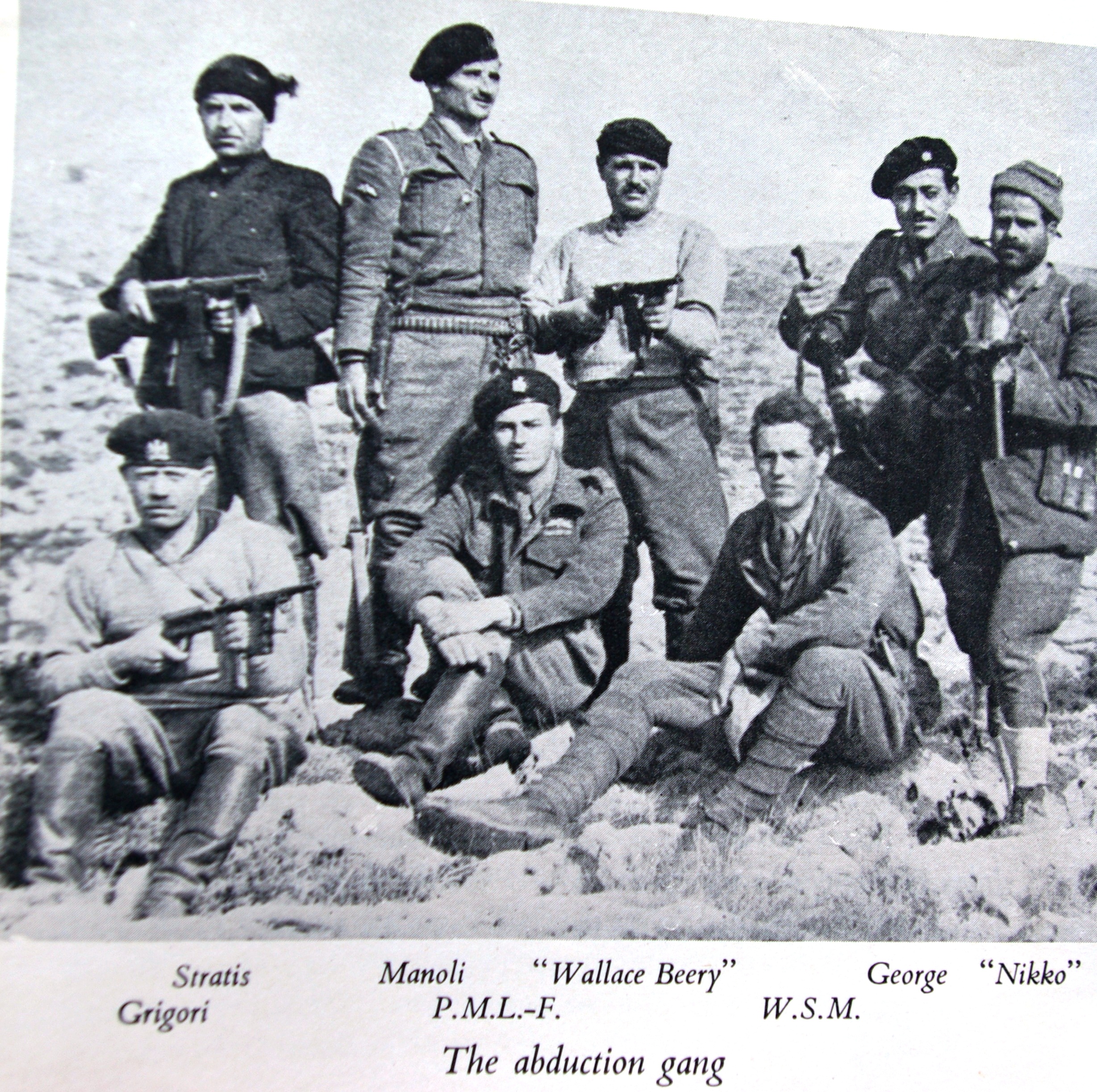
The abduction gang - PLF centre Moss to his left

This is a wonderful find brought to us by Blog reader Erik Bruns.

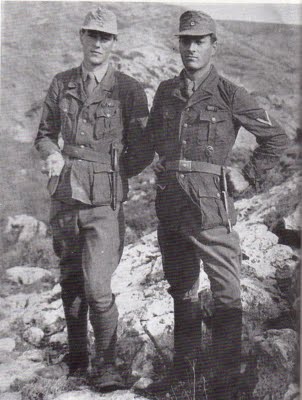
Many will remember the TV show This is Your Life. Greek television had their own version, and in 1972 it was Paddy’s turn to be embarrassed and surprised by meeting again people that he had come across in his life. His surprise and clear delight at meeting with the ‘Abduction Gang’ of Cretan Andartes is clear. The ‘senior’ partisans, Manoli and George (see picture left) are the first two guests, and they seem barely changed.

The highlight must be when the presenter introduces a slightly frail General Heinrich Kreipe. Paddy is delighted to see him again, and immediately starts to talk to the General in German saying how good it is to see him after all these years.

I am amused as one of the Cretans takes the General’s arm to help him sit down; maybe he did the same before on that road to the Villa Ariadne, but was perhaps a little less gentle on that occasion!

There follows what is one of television’s most wonderful scenes as Paddy acts as translator answering the presenter in Greek and then switching back to German to speak to the General.

Take fifteen minutes of your life to watch Paddy, and all these great men, as they share their experiences of an event which took place thirty years before, with great animation and clear joy.

I have a feeling that there was a pretty good party afterwards with plenty of Ouzo and Retsina!

BBC Obituary: Sir Patrick Leigh Fermor

Billy Moss and Paddy Leigh Fermor

Sir Patrick Leigh Fermor, who has died aged 96, was both a man of action and an intellectual.

From the BBC news website.

His exploits during WWII, when he led a group of British officers and Greek guerrillas which captured the German military commander of Crete, has become the stuff of legend.

After the war, through a series of colourful yet scholarly books, including A Time of Gifts and Mani: Travels in the Southern Peloponnese, he re-invented himself as perhaps the finest travel writer of his generation.

Patrick Michael Leigh Fermor – known in early life as Michael and later to his many friends as Paddy – was born in London on 11 February 1915.

His father, Sir Lewis Leigh Fermor, was a distinguished geologist and Fellow of The Royal Society who spent much of his career in India.

With his parents often abroad, Leigh Fermor enjoyed a carefree childhood, often with foster-parents on a farm in Northamptonshire.

European odyssey

After a brief, unhappy, sojourn “among the snake-belts and the bat-oil of a horrible preparatory school”, he progressed to King’s School, Canterbury, where one house-master dubbed him “a dangerous mixture of sophistication and recklessness”.

“Sacked”, as he put it, from King’s following a teenage dalliance with the daughter of a town greengrocer, he read voraciously – Latin, Greek, Shakespeare, history – for the Sandhurst Military Academy entrance examination.

But deciding that the life of a peacetime soldier was not for him, Leigh Fermor determined, aged just 17, to walk across Europe from the Hook of Holland to Constantinople (now Istanbul).

So, on 8 December 1933, a month after Adolf Hitler came to power in Germany, he set off from London with just a small rucksack containing a few clothes, the Oxford Book of English Verse and a volume of Horace’s odes for company.

On just a pound a week he was to cross the continent, tramp-like, wandering through town, village and city, across mountains and beside rivers, sleeping in doss-houses and castles and, above all, writing.

This journey, which he chronicled much later in life in A Time of Gifts (1977) and Between the Woods & the Water (1986), brought him face-to-face with the last blossoming of a now vanished Europe.

It was a world of gypsies, isolated farming communities whose ways had changed little since the Thirty Years’ War, faded Austro-Hungarian aristocracy and Mitteleuropean Jewish communities now lost to World War Two, the Holocaust, and the Cold War.

Wartime intelligence officer

Erudition shone from every page, whether describing duelling in Heidelberg where “those dashing scars were school ties that could never be taken off” or the Carpathian mountains, with its “fiendish monocled horsemen, queens in lonely towers, toppling ranges, deep forests, plains full of half-wild horses… mad noblemen and rioting jacqueries”.

After reaching Constantinople he travelled extensively in the Greek archipelago, celebrating his 21st birthday in a Russian monastery on Mount Athos and witnessing a civil war before returning to Britain.

At the outbreak of World War Two Patrick Leigh Fermor – the scion of an Anglo-Irish family – enlisted in the Irish Guards.

With his intimate knowledge of south-eastern Europe and first-class linguistic skills, he soon found himself serving as the Intelligence Corps’ liaison officer to Greek Headquarters in Albania.

After fighting against the German forces then sweeping through Greece and the Balkans, he was posted to occupied Crete in 1942. There, for two-and-a-half years, he organised resistance to the 22,000 German troops occupying the island.

Disguised as a shepherd, he directed an operation to capture the island’s military commander, Major General Karl Kreipe.

After snatching the general and hijacking his staff car, Leigh Fermor and his British and Cretan comrades drove through the capital city, Heraklion, successfully negotiating 14 checkpoints on route.

As Major Leigh Fermor and his colleague, Major Stanley ‘Billy’ Moss, were dressed as German corporals, capture would have meant certain death. After three weeks hiding in the hills, they finally accompanied their precious cargo by boat to Cairo.

Rich prose style

This daring escapade, for which he was awarded the Distinguished Service Order, was immortalised by Moss in his 1950 book Ill Met By Moonlight. Dirk Bogarde played Leigh Fermor in the successful big screen adaptation.

After the war Leigh Fermor worked briefly as deputy director of the British Institute in Athens before resuming his travels.

His first book, The Traveller’s Tree (1950), is an account of journeying in the Caribbean, the “ultimate purpose” of which, as set out in the book’s preface, was “to retransmit to the reader whatever interest and enjoyment we encountered. In a word, to give pleasure”.

This he did, through vivid descriptions of the languorous beauty of island life, the linguistic Tower of Babel bequeathed by colonialism and the continuing legacy of the slave trade. Architecture, history, culture, all were essential themes to Leigh Fermor, as central to his first work as to his last.

In 1953 he published a novel, The Violins of St Jacques. A fantasy set in the decadent world of early 20th Century Martinique, the book’s florid and luxurious romanticism proved a radical departure for its author.

But it was Greece, both ancient and modern, to which Leigh Fermor often looked for inspiration. Works like Mani (1958) and Roumeli (1966) explored the complex and colourful sweep of Hellenistic culture.

Together with the account of his transeuropean walk, they represent a formidable body of work.

Though he latterly lived in Crete, rarely visiting his homeland, Patrick Leigh Fermor was an archetypal Englishman.

The recipient of many awards and prizes – including a knighthood, the freedom of four Greek cities and as a Chevalier of France’s Order of Arts and Letters – he was praised throughout the world as a thrilling writer, a real-life hero and a genteel observer of the human condition.

A Traveler’s Tale: On Patrick Leigh Fermor

by Wes Davis

First published in The Nation, December 2010

At a Chelsea-to-Richmond boating party held sometime in the early 1950s, the Duchess of Devonshire, then a beautiful young woman of 30, met a dashing man, some five years her senior, who was dressed as a Roman gladiator and armed with a net and trident. It was a look she thought suited him.

The fancy-dress gladiator was Patrick Leigh Fermor, a former officer in Britain’s Special Operations Executive (SOE), a covert unit that aided resistance movements throughout occupied Europe, and an up-and-coming writer best known at the time for kidnapping a German general during the war. He had crossed paths with the duchess before and remembered her clearly from a regimental ball in 1940, when she was still Deborah Mitford—the youngest of the soon-to-be-famous Mitford sisters. She was then engaged to Andrew Cavendish, a tall naval officer and younger son of the Tenth Duke of Devonshire who had no expectation of inheriting his father’s title until the war took his older brother’s life four years later. Leigh Fermor had watched the couple dance their way through the evening, “utterly rapt, eyes shut, as though in a trance.” Mitford had not noticed him.

But when they met again—as duchess and gladiator—Deborah Devonshire and Patrick Leigh Fermor struck up a friendship that has endured for more than half a century. In Tearing Haste, a collection of their letters newly available in this country, gives the impression that the conversation that started at a boating party so many summers ago has never stopped. Spanning 1954 to 2007, the volume reads like an accidental memoir of a disappearing world stretching from the manor houses of the English aristocracy to the olive groves of Greece, its people and places rendered with a kind of care that’s becoming scarce in our age of helter-skelter communication. At the same time, the book’s title, a phrase deriving from Leigh Fermor’s habit of dashing off messages “with a foot in the stirrup,” captures the vigor and bustle of the lives that nourished the correspondence. I once happened upon the manuscript of a chatty letter Leigh Fermor had written in 1944 to an Englishwoman stationed in Cairo. Amusingly composed and illustrated with a witty hand-drawn cartoon, it closed with Leigh Fermor mentioning offhand that he was in hiding on occupied Crete and that an undercover runner was waiting outside to receive the communication.

In Tearing Haste is engaging from start to finish. There isn’t a dull letter among Charlotte Mosley’s selections. Even her annotations, often incorporating information from the book’s two correspondents, are as surprising as they are informative. One biographical note on the painter Augustus John includes Deborah Devonshire’s recollection of meeting him in London: “He looked me up and down and said, ‘Have you got children?’ ‘Yes.’ Another long look. ‘Did you suckle them?'” More than anything else, the collection is important as an addition to Leigh Fermor’s body of work, both because his letters constitute a larger portion of the volume and because the writing in them harmonizes with the books that established his literary reputation. But let it be said that the Duchess of Devonshire is no slouch either. Her letters, though generally shorter and less frequent than Leigh Fermor’s, share his wit and many of his interests—a fascination with language, for example, or with the byways of English and European history. She puts a charming twist on these topics while adding a few bright threads of her own to the correspondence.

Deborah Devonshire’s books—beginning with The House (1982) and The Estate (1990)—focus largely on the management of Chatsworth, the massive estate in Derbyshire that she and her husband put into charitable trust and opened to the public in 1981. (The house was a stand-in for Mr. Darcy’s Pemberley in a film adaptation of Pride and Prejudice, and throughout the letters Leigh Fermor refers to it as “Dingley Dell,” after Mr. Wardle’s house in The Pickwick Papers.) As a writer, she is best when describing the seasonal rhythms of country life (the arrival of the year’s pullets, say) or assessing the gamut of rural arts (from drystone walling to mushroom gathering) and tilling their linguistic soil. In Counting My Chickens, a collection of notes and essays published in 2001, she remembers leaving Leigh Fermor “stumped” by the meaning of words gleaned from the glossary of a pamphlet about sheep. “One sheep disease,” she recalls, “has regional names of intriguing diversity: Sturfy, bleb, turnstick, paterish, goggles, dunt, and pedro all are gid.” On the same page she can be found rhapsodizing over “the glorious language of the 1662 prayer book, with its messages of mystery and imagination.”

She takes any opportunity to undercut the preconceived notions one might have about a duchess’s likes and dislikes. “I buy most of my clothes at agricultural shows,” she says in Counting My Chickens, “and good stout things they are.” For the playwright Tom Stoppard, who contributed an introduction to the book, this was one of her most characteristic revelations. For me, a close runner-up is her discussion of flower gardening on a grand estate, where she admits, “I prefer vegetables.” Many of her stories turn on a similar blend of unexpected rusticity and unflagging old-school civility. In an essay about the life the Mitfords led for a time on the island of Inchkenneth in the Hebrides, she describes traveling by train in the company of a goat, a whippet and a Labrador back to her sister Nancy’s house in Oxfordshire when the war broke out. “I milked the goat in the first-class waiting room,” she confesses, “which I should not have done, as I only had a third-class ticket.”

For all her modesty, the duchess isn’t embarrassed to mention boldface names that have sailed in and out of her social circle. (They range from Fred Astaire to the Queen Mother, the latter called “Cake” when she appears in the letters.) The humor in one anecdote depends on knowing that John F. Kennedy was intimate enough with the duchess to employ her nickname. This caused some confusion when her uncle Harold Macmillan, then prime minister, found himself involved in a telephone conversation with the American president about matters involving Castro, SEATO and NATO. It took him a moment to switch tracks when Kennedy asked, “And how’s Debo?” (Evelyn Waugh, a friend of hers, might well have written the scene.) In the letters, Kennedy is counted among the “bodies to be worshipped,” and several entries describe the friendship that developed between JFK and the duchess in the years between his inauguration and his death.

Her relationship with Leigh Fermor has many dimensions, its ardor fueled by humor, charisma and delight in a good tale. The revealing joke that runs through In Tearing Haste is that Devonshire is not a reader and that despite her lively correspondence with Leigh Fermor, she can’t manage to read his books. She praises one of his letters not for its vivid language but because it has instructions about which parts to skip. Leigh Fermor takes revenge in another letter, marking a set of passages with notes “don’t skip” and “ditto.” The bit he wants her to see—a foray into history by way of language—might well have been lifted from one of the books that made him famous: “The inhabitants are Koutzovlachs who speak a v. queer Latin dialect akin both to Rumanian and Italian. Some say they are Rumanian nomad shepherds who wandered here centuries ago with their flocks and never found their way home again. Others, more plausibly, say they are the descendants of Roman legionaries, speaking a corrupt camp Latin, stationed here to guard the high passes of the Pindus, miles from anywhere.” Continue reading

Meine Suche nach Patrick Leigh Fermor

This title from a book by the German author Michael Obert hits the spot for me. Like Michael I am also engaged in a ‘search’ for Paddy and I know from your comments and emails that many of you are finding your own ways to follow in Paddy’s footsteps and to understand and enjoy his works.

Following the publication of the Wolfgang Büscher video just a few days ago, I was contacted by Christian from Koln (Cologne) saying how pleased he was to see the video and at the same time sending me a couple of other articles from German newspapers and magazines. Christian made the point that in recent years there have been many features and articles published in Germany about Paddy, including Michael Obert’s book which provides the title to this article. Chatwins Guru und ich: Meine Suche nach Patrick Leigh Fermor by Michael Obert is available from Amazon.

I have pdfs of two more articles and those of you who followed the blog in its early days may remember that I have previously featured a further article by Wieland Freund. Therefore, perhaps for the first time in one place, a collection of German (and Swiss) material about Paddy.

Der letzte Byzantiner by Wolfgang Büscher, first published in Die Zeit 24 May 2006

Wolfgang Büscher discussing A Time of Gifts video

Mit der Feder im Rucksack durch die Welt by Georg Sütterlin, first published in Der Bund 30 Aug 2005

Besuch beim Haudegen des Peloponnes by Wieland Freund first published in Welt Online 8 July 2007

A Meeting between Paddy and George Psychoundakis the “Cretan Runner”


George Psychoundakis in 2004(?)

A bond deeper than blood. The friendship forged in wartime Crete between Patrick Leigh Fermor and shepherd George Psychoundakis was commemorated in George’s memoir about the Resistance, The Cretan Runner. With the book republished, it was time to meet again.

by Allison Pearson

First published in The Daily Telegraph, Saturday 13th June 1998

Two old men sitting at a table talking about the war. A Cretan and an Englishman. A voluble eye-popping tenor and a growly teddy-bear bass. “Remember the sick doctor we disguised as an old woman and carried for miles to get help?” “Yes, and remember when you dressed up as a general and kidnapped a real one!”

They interrupt each other. They sigh for the dead. They laugh for dear life, knowing exactly how much it can cost. Although one of the men speaks only Greek, I think I can detect a rhythm to their reminiscing: the Cretan talks everything up and the Englishman plays it right back down again. The sudden memory of one “bad Greek” acts on the Cretan’s weathered face like a drawstring, pulling it taut to a scowling walnut. But the Englishman, all silky diplomacy, jumps in and offers a more optimistic assessment of the fiend in question: “I think he just lost his head a bit.”

Later, when the Cretan mentions the Englishman’s name in the course of what sounds like a pretty fulsome tribute, his friend stops translating for me altogether. What did he say? “He was more than kind about me.” Yes, but what did he say? “Oh, I couldn’t possibly repeat it.”

The bashful Briton is Patrick “Paddy” Leigh Fermor, traveller, scholar- gypsy, war hero and writer of genius. His fiery friend is George Psychoundakis, author of The Cretan Runner, an extraordinary account of the anti- Nazi Resistance on the island, which was translated by Leigh Fermor and is now republished.
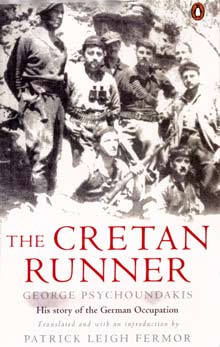
The Cretan Runner

There have been other memoirs of wartime Crete, such as Xan Fielding’s Hide and Seek and Ill Met by Moonlight, W Stanley Moss’s record of the kidnapping of General Kreipe (later made into a movie, with Dirk Bogarde assigned to fill Leigh Fermor’s dashing boots). But those were visitors’ books. George’s story, as Leigh Fermor points out in the introduction, is unique. It is no longer the locals who are colourful aliens, but the Allied officers and their wireless operators – good sorts and good sports in the main but, none the less, foreigners with some very dodgy customs. “A most peculiar man,” George says of one buffer. “He had pyjamas and a washbasin.”

Even more baffling for the Cretans, who think Nature is a place where you go and shoot things, the buffer turned out to be an amateur botanist and geologist: “He was not only in love with different kinds of weeds but with stones as well.”

Paddy and I have been sitting in the front room of George’s small vine-clad house, outside Khania in western Crete, for more than two hours now. At least one of us is reeling under the bombardment of Cretan hospitality. Celestial cheese tarts made by Sofia, George’s wife, have given way to nuts, glistening sweetmeats and, as if that weren’t enough, shots of tsikoudia, a spirit so lethal it feels less like drinking a liquid than sipping scalded air. After three of these, I am not entirely sure whether the spools on my tape recorder are going round: after four, I don’t care.

George – one eye sleepy, the other coal black with embers of mischief – is joking about whether he should have given lessons in sheep stealing (a local speciality) to one of the wireless operators. “So when he got back to Scotland he could have organised sheep rustling.” Paddy pretends, unconvincingly, to be shocked.

Through the window behind them, you can see the White Mountains – a range so towering and snowy, even on this May day, that it is hard to tell where rock stops and cloud begins. More than half a century ago, those slopes were Paddy and George’s stamping-ground. “George’s life was dangerous and absolutely exhausting,” explains Paddy. But George is having none of it: “I felt as if I were flying. Running all the way from the top of the White Mountains to Mount Ida. So light and easy – just like drinking a cup of coffee.”

George has difficulty walking now – at 78 he leans on a stick as gnarled as himself – but his mind can leap from memory to memory, as if he were still flying. I ask George what he thought the British had learnt from the Cretans and vice versa. “What they learnt, because there was very little to eat, was to drink a lot and to dance and to shoot for joy in the air. We saw how much they loved our country and it made us love it still more. The fact that they loved Crete so much gave us even greater courage.”

The first time George Psychoundakis met Patrick Leigh Fermor he thought he was very tall. The young Cretan had just crawled on all fours through thick bushes into the heap of boulders where the officer was hiding. In fact, the Englishman was not especially lofty (a touch over 5ft 9in, according to his passport). It was the Greek who was tiny. “As fine-boned as an Indian,” recalls Leigh Fermor. “Lithe and agile and full of nervous energy.”

Anyway, height didn’t matter much back then. It was the July of 1942 in occupied Crete and the stature of men was not measured in inches, rather in a bewildering range of abilities. These included: keeping cool when a member of the Gestapo approaches your mule while it is carrying a combustible load of wheat and wireless; keeping warm in a cave-bed with a canopy of stalactites; and finding the courage to tuck into a dinner of local produce – grass cooked with snails. “We took the grass blade by blade, picked off the broken shells and ate it with much laughter,” recalls George.

Psychoundakis was a runner for the Resistance – a vertical postman, he delivered messages and equipment at barely credible speed. On a map, Crete doesn’t look too daunting – a sirloin steak beaten to a succulent sliver by a butcher. But it rises so sharply into such broken-toothed cragginess that it is pointless to measure it in miles: the islanders calculate distances in the time taken to smoke cigarettes. George’s wartime business was mainly conducted at eagle-height, or as he felt his way down the vertebrae of his homeland towards some hiding place where even goats didn’t dare.

He was 21 years old when he first met the 27-year-old Leigh Fermor. George addressed Paddy as Michali (all the Allied soldiers had Greek nicknames) or sometimes Mr Michali in half-amused respect (irreverence being the key to the Psychoundakis psyche). Paddy, meanwhile, code- named George either the Clown or the Changeling, for his cockeyed wit, his impish insubordination and a magical ability to spirit himself out of trouble.

Patrick Paddy Leigh Fermor and Billy Moss

The two men were not just worlds apart: a glance at their biographies suggests you would need to hire a time machine to bring them together. Born in Asi Gonia, a village with a long history of giving invaders a hard time (asi is Arabic for uncommandable), George lived the kind of peasant life that had not changed for centuries. His family slept together in a single room with a beaten earth floor. After a scratchy education at the local primary school, he followed his father on to the mountains as a shepherd. By the time German parachutes blotted out the sky in May 1941, he had visited only two of Crete’s towns and had never seen the capital, Heraklion.

By contrast, Leigh Fermor was born into a smart Anglo-Irish family and educated at prep school and King’s, Canterbury. [Just like someone else we know] By 1939, he had walked across every country between London and Constantinople – a stroll commemorated in his two dazzling volumes, A Time of Gifts and Between the Woods and the Water – and also appeared to have drunk in most of their national literatures.

Scrape through what Leigh Fermor called his “Fauntleroy veneer”, though, and you find a rougher grain. With his parents abroad for the first four years of his life, Paddy was entrusted to the family of a small farmer and, left uncultivated, he ran wild. The experience, he later wrote, “unfitted me for the faintest shadow of constraint”. His behaviour at a flurry of schools led to his being sent to two psychiatrists, although it is unlikely that either rivalled Paddy’s clinical diagnosis of himself as “a very naughty boy”. He was finally expelled from King’s for crimes that included “trying to be funny” and holding the hand of a greengrocer’s daughter. His housemaster’s report noted: “He is a dangrous mixture of sophistication and recklessness, which makes one anxious about his influence on other boys.”

Almost 70 years later, I find it hard to improve on that verdict, save to replace the word dangerous with delightful. As it turned out, his influence on other boys was all to the good, and the most remarkable boy of all was George Psychoundakis.

While Paddy was in Kent writing “bad and imitative verse” and lapping up ancient Greek because it was a passport to a world of heroes, George was scavenging books from the village priest and the doctor, and occupying the long woolly hours by the sheepfold composing patriotic poems and beady skits on local life. (An early effort entitled Ode to an Inkspot on a Schoolmistress’s Skirt sounds distinctly Paddy-like in its high- flown cheekiness).

Although George’s father, Nicolas, was illiterate, he could recite by heart the whole of the Erotocritos, the 17th-century Cretan epic poem that comprises 10,000 lines of rhyming couplets. And the rhythm lodged in the son’s head and on his tongue: poetry to these people was not the object of solemn study but a spur to the spinning of legends and the cue for a bloody good song.
George Psychoundakis during the Resistance

Which is to say that when the ragged and practically barefoot Cretan wriggled into the hiding-place of the Englishman in 1942, they had more in common than an enemy. George spoke only one perfect sentence of English – “I steal grapes every day” – but Paddy soon extended his repertoire. On long marches to the coast to meet supply vessels or during the dark hours awaiting a parachute drop, the Britons taught the Greeks folk-songs and the Greeks taught them mantinadas – waspish local couplets with a sting in the tail.

On their first trek together, Paddy recalls how George recited a poem he had written on the unambitious theme of The Second World War So Far. “It covered the invasion of Poland, the fall of France, the German invasion of Greece and Rommel’s final advance. It lasted more than two hours and finished on a note of triumphant optimism and presage of vengeance, which he emphasised by borrowing my pistol and firing it into the sky with the remark that we would soon be eating the cuckolds alive.”

Leigh Fermor, meanwhile, attempted to satisfy Psychoundakis’s ravenous curiosity about the world. What was Churchill like? Why do the Scots wear kilts? How about astronomy, religion, trains? How many sheep does the average Englishman own?

The task of the British Special Operations Executive in Crete was to assist the local Resistance. Having spent centuries in revolt against the Venetians and the Turks, the islanders didn’t actually need much encouragement. During the airborne invasion in 1941, when many young Cretans were away on active service, descending parachutists were met by old men, women and children – by anyone, in fact, who could point upwards and shoot. “Aim for the legs and you’ll get them in the heart,” ran the local wisdom. Four thousand Germans died. Those who survived took swift revenge. Reprisals, read one Wehrmacht memo, “must be carried through with exemplary terror”. Between May and September of that year, 1,135 Cretans were executed.

The Cretan Runner begins with the invasion. “Out of the sky the winged devils of Hitler were falling everywhere … the aeroplanes came and went like bees in a bee-garden.” One grounded plane is set upon by furious locals till it resembles “a bit of bread thrown on to an ant-hill”. From the opening pages, you get a pungent impression of the Psychoundakis style – a vertiginous mix of the epic and the demotic, the Homeric and the homely. Of the enemy, George writes: “They reached to our very bowels and provoked a storm in the soul of the race like the hiss of a poisonous snake about to strike.” No British account of the battle of Crete could contain a sentence like that. Too purple. Too embarrassing, frankly. But it feels utterly true to George and the hot-blooded rhetoric of his race.

Perhaps the greatest surprise of a book that documents the burning of villages, the casual slaughter of comrades and a life of mesmerising danger is how often it makes you smile. No stranger to hardship anyway, George embraces discomfort as though it were a shy friend with a lot to offer. We see George at the end of a knackering three-day trek using pieces of wood to mime someone hobbling. We hear him enthusing over yet another dank hiding-place as though he were writing for some actionable travel brochure: “The cave was perfect. We collected our drinking and washing water from stalactites. We arranged luxurious couches for ourselves from the branches of various shrubs that were better than the softest mattress!”

Best of all, there is George richly enjoying his British friends, not least their congenital inability to walk over the rocky landscape. (In one incident, Leigh Fermor threw himself pluckily at a high stone wall in emulation of local bravado, only to fall off backwards: the Cretans in the party walked around the side of the wall, shaking their heads and laughing.)

SOE officer Ralph Stockbridge (centre, in the spectacles) with some of his comrades in Crete

“It was plain that George was enraptured with the excitement of our secret life,” says Paddy. The same could be said of all of them, I think. As a boy Leigh Fermor confessed to being guilty of “a bookish attempt to coerce life into a closer resemblance to literature”. In this case, the literature was Greek. The Cretans, for their part, seemed all too willing to live up to the legends the Englishmen had imbibed at school. Most battles look romantic only in retrospect, if then: Crete was different. It seems to have struck its leading men as touched with an air of romance, even as the drama was unfolding. As they approached by boat on a moonless night, the first the soldiers knew of the island was perfume, the scent of wild thyme that wafts miles out to sea.

Once on shore, they changed into local costume – breeches, black bandanas, embroidered waistcoats and spiffy jackboots. There were lessons in how to curl their new moustaches. They were an extraordinary bunch – poets, archaeologists, free spirits thirsty for adventure. SOE chose them because they had some knowledge of ancient Greek. But, as Leigh Fermor explains, since Greek was no longer compulsory at school, those who opted for it had already marked themselves out as “a perverse and eccentric minority”.

I cannot get enough of the photographs of the Resistance taken through those years in the mountains. Remember, these are snapshots captured at a time when to have a likeness of yourself in existence was itself a threat to that existence. There is the legendary Xan “Aleko” Fielding, looking uncannily like the young Hemingway. Gimlet-eyed and bare- chested, he regards the lens with Olympian amusement. And there is Yanni Tsangarakis, one of the bravest and most trusted guides, slightly woebegone behind a Zebedee moustache, and the redoubtable Manoli Paterakis, whose unforgettable profile suggests he may have been the love-child of Montgomery of Alamein and a peregrine falcon. [I think he’s trying to say he was nasally overendowed]

Looking at the smiley countenance of Tom Dunbabin – a fellow of All Souls in peacetime – you can see why he inspired such love; ditto the gaunt saintly faces of Aleko Kokonas, the schoolmaster of Yerakari, and his wife, Kyria Maria. And then, of course, there are Paddy and George: the first as debonair and unfeasibly handsome as Errol Flynn casting about for a galleon to capture; the second apparently auditioning for the role of Puck.

In Louis de Bernieres’s novel Captain Corelli’s Mandolin, set in wartime Cephalonia, there is a posh Englishman who lives in a cave and comes out declaiming ancient Greek. He is a bit of a joke. And, to be sure, there is something potentially laughable about the Boy’s Own aspect of all this dressing up and blowing stuff up. What redeems it from absurdity, what transforms it into real rather than fantastical heroism, is the nagging presence of death, which circled above these lives like a hawk. There was nothing comic-book about Anton Zoidakis, captured by German soldiers, tied to their vehicle and dragged along the road until his face and his life were wiped away. And even George’s account of merry scrapes is pulled up short when 20 Gestapo visit Asi Gonia: “They said I was wanted for interrogation and if didn’t go to Retimo before January 17 they would set fire to the whole village.”

Three of George’s fellow runners were executed, two after what the Wehrmacht would probably have considered exemplary torture. In his superb book Crete: The Battle and the Resistance, Antony Beevor points out that the penalty for a shepherd caught whistling to warn of the approach of a German patrol was death.

War had transformed George Psychoundakis’s life. In February 1943, it enabled the former shepherd boy to travel abroad for the first time. He was spirited off to SOE headquarters in Egypt, where he was knocked sideways by wonders, not least the grass in the Gezira gardens: “Fat, short grass like green velvet carpet.” As for the zoo, “I could almost have deemed that I was in the middle of paradise”. The most misguided character in the whole of The Cretan Runner is the soldier who advised George not to climb up the Pyramids because it was “very tiring and tricky”. A short hop later, the Cretan runner got out his stiletto and “cut my name and fatherland” into a stone at the top.
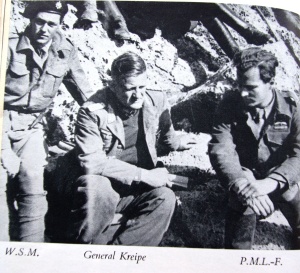
Moss, Kreipe and Paddy

On the day the war was over, a “high-spirited Mr Leigh Fermor” bought a dubious Mr Psychoundakis a lot of drinks. “If I drink all that I’ll be drunk,” protested George. “But my child, what is drink meant for? It’s no use for anything else,” replied Paddy.

Soon after, in a school where a whole village was gathered together, George recited a heart-stopping poem he had written on the lovely village of Yerakari, now destroyed, where once “white houses lay like doves asleep along the sill of heaven”. He had survived, but for a while it was hard to see what for.

Fortune, who had smiled on George in a time of insane adversity, appeared to doze off once the shooting stopped. Because of missing documents and in spite of his British Empire Medal (awarded in 1945), he was arrested as a deserter and imprisoned for several months. One can scarcely imagine the wound inflicted on his pride. Over three days, that great shaggy helmet of hair all fell out. Subsequently, he had to do two more years of fighting in the civil war. Returning at last to Asi Gonia, George found all the sheep stolen and his family in gruesome poverty. The Changeling had run out of magic.

George took a job as a navvy working on a road. At night, he sheltered once more in a cave and by the light of an oil lamp began to fill notebook after notebook with a furious, cramped hand. “I think he undertook this task as a kind of exorcism of the gloom of his circumstances, ” says Paddy. When they met up again in 1951, George gave his friend the completed work: Pictures of Our Life During the Occupation. Better known as The Cretan Runner.

Leigh Fermor, now living on the Greek mainland, took the precious grime-covered manuscript home to translate. George, meanwhile, was working to help his old friend, too. In 1943, with a German patrol approaching, Paddy, who was checking what he thought was an empty rifle, accidentally shot Yanni Tzangarakis in the leg. He died soon afterwards, but not before absolving his friend of all blame. Paddy was devastated: imagine killing the proud son of a country for which you were willing to lay down your own life.

This wretchedness was deepened by foolish rumours that eventually led to a vendetta being declared by some of Yanni’s relatives. This was only laid to rest after years of delicate negotiation by George, who found a very Cretan solution to the Englishman’s impasse: Paddy Leigh Fermor became godfather to Yanni’s great-niece. In Greek society, this bond is deeper than blood.

Two old men sitting at a table talking about the war. A Cretan and an Englishman. “We’d better censor that, George, it’s libellous,” says Paddy, trying to sound stern. As usual, he fails.

George goes off into the bedroom and comes back with a rifle. It is nearly as tall as he is, and its working parts are in similarly creaky order. As George poses with the gun, the photographer asks him to smile. George scowls and spits out a guttural retort. “Oh dear, oh dear,” says Paddy, shaking his head and laughing. What did George just say? “He said he won’t smile because he’s killing Germans.”

At the front of A Time of Gifts, Leigh Fermor quotes from Louis MacNeice’s great poem:

For now the time of gifts is gone
O boys that grow,
O snows that melt,
O bathos that the years must fill.

Since the war, both men have found satisfactions. Leigh Fermor, though unfairly saddled with the label of travel writer, has become one of the greatest exponents of English prose.

Psychoundakis, meanwhile, has translated both the Odyssey and the Iliad into Cretan and been honoured by the Academy of Athens. Still, I can’t help wondering whether the time since their great adventure had been an anti-climax.

“To some extent all our lives were in those years,” admits Paddy. “Of course, one went on to do interesting things, but … ” George has come up now and stretches out his fingertips to reach the shoulders of his friend, the tall Englishman. “Ah, George says to tell you that those years up in the mountains were the best years of his life. He’ll never forget it. Never. And that’s why he wanted to commemorate our days together.”

Just as we are getting ready to leave, George gives Paddy a photograph. It is of George himself and Xan Fielding, taken somewhere in the mountains. You can just make them out. The emulsion is breaking up and great snowy specks of it are blizzarding them into oblivion. Yet looking back at the Cretan resisters, we see only a thrilling clarity. Their existence was both mortally serious and a great wheeze – perhaps a definition of the best kind of life you can hope to lead.

Years after the war ended, George Psychoundakis sang for his friend Patrick Leigh Fermor a mantinada. This is what it said:
With patience first and patience last, and doggedness all through,
A man can think the wildest thoughts and make them all come true.

Related articles:

The obituary of George Psychoundakis aka The Cretan Runner

General’s long trip home

Related category:

Ill Met by Moonlight

New sites: SOE in the Balkans and the Levant

Many visitors to the blog are interested not so much in Paddy per se or his writing, but the activities of the Allied forces and the SOE in the Balkans and Eastern Mediterranean in World War Two.

This new website that I have stumbled across is devoted to these activities in the Balkans and the Levant which is Paddy’s sphere of operations. A quick glance however fails to turn up anything on Paddy, a big mistake, which I am sure will soon be corrected! However, it does appear to be a very useful archive for people conducting research into this theatre of operations.

If you have a particular specialised interest in the SOE then I would recommend joining the Yahoo Group Special Operations Executive which is updated daily with some fascinating and very detailed information. It would be a great starting point for research.


Crete: Island of Heroes

“The courage of the Cretan facing the firing squad is legendary … When executions were to take place I would leave my desk and walk out onto the balcony to watch their moment of death. Nowhere else have I witnessed such love of freedom and defiance for death as I did on Crete.” So said General Alexander Andre, the German Commander of the Occupation Forces on Crete.

This video features pictures from the film 11th Day and includes some pictures of Paddy, including a new one to me at least of himself and Moss with the kidnap gang.

It is said that the Germans had never encountered the extent of civilian resistance that they encountered on Crete.

Retribution was swift. The German High Command wanted to break the spirit of the populace and do it quickly. In this they failed and failed miserably. In retaliation for the losses they incurred, the Nazis spread punishment, terror and death on the innocent civilians of the island. More than two thousand Cretans were executed during the first month alone and twenty five thousand more later.

Even in the face of certain death while standing in line to be executed, Cretans did not beg for their lives. This shocked the German troops. Kurt Student, the German Paratrooper Commander who planned the invasion, said of the Cretans, I have never seen such a defiance of death. General Alexander Andre, the German Commander of the Occupation Forces was amazed and said: “The courage of the Cretan facing the firing squad is legendary. Cretans turn into mythical figures. They are so proud of their moment of death that one can hardly fail to admire their courage. When executions were to take place I would leave my desk and walk out onto the balcony to watch their moment of death. Nowhere else have I witnessed such love of freedom and defiance for death as I did on Crete.”

Related article:

Patrick Leigh Fermor recounts the kidnap of General Kreipe on video

Crete: 11th Day Movie with Paddy

General’s long trip home

Related category:

Ill Met by Moonlight
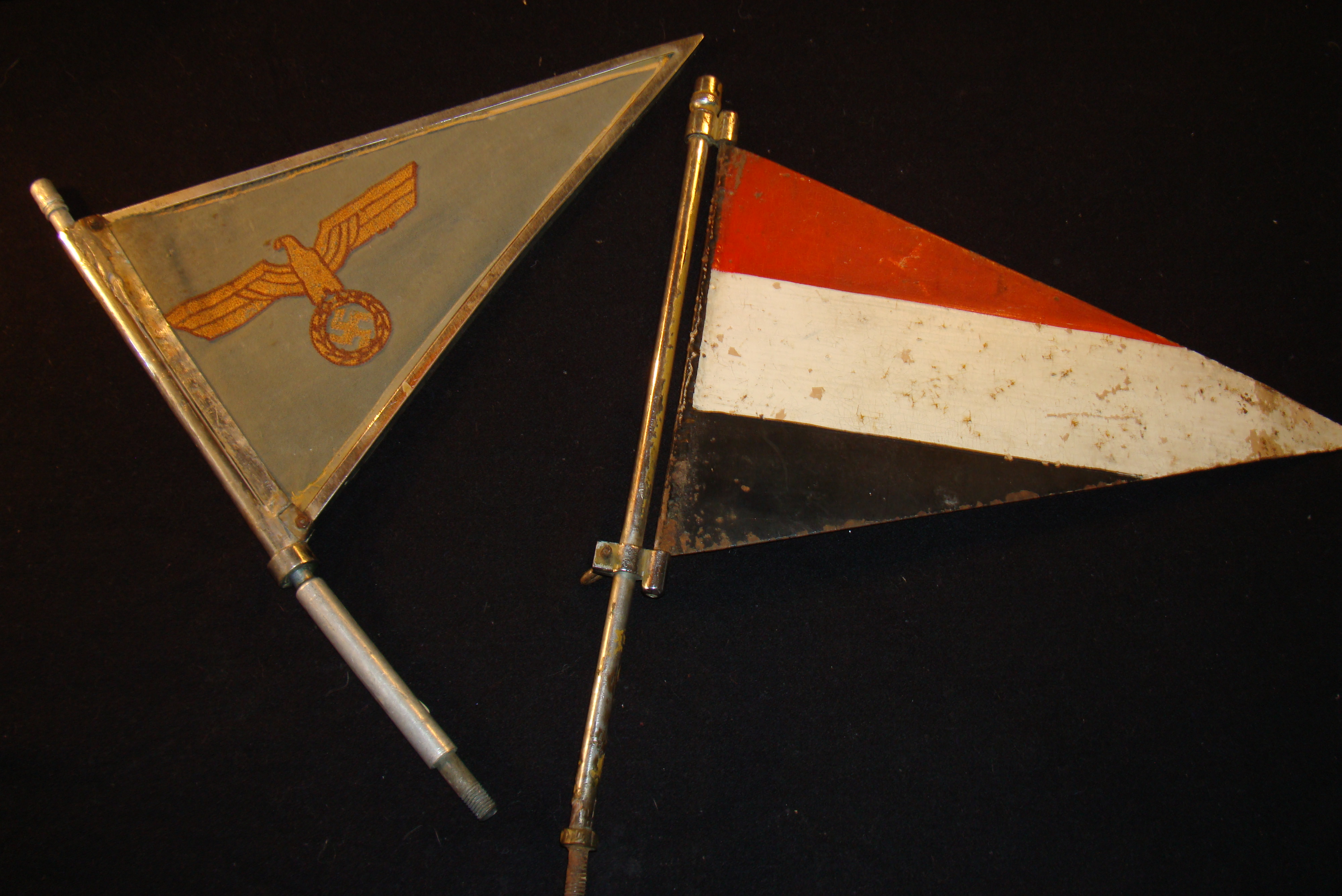
Why modesty is something to boast about

There have been many articles in the press these last two weeks about the service of women in the SOE prompted by the death at the age of 89 of Eileen Nearne who served as an agent in France with SOE, was captured, tortured by the Gestapo but survived the horrors of Ravensbrück concentration camp. This article by the excellent Christopher Howse who writes for the Telegraph is thought provoking; the sentiments reflect the way that Paddy and many of his colleagues have lived their lives.

Eileen Nearne: Why modesty is something to boast about

Christopher Howse wonders what happened to a generation of heroes like Eileen Nearne

First published in the Telegraph 15 Sep 2010

Eileen Nearne during WW2: a real-life Charlotte Gray; Photo: SWNS/ Rex

The astonishing life of Eileen Nearne, parachuted as an SOE officer into wartime France, horribly treated by the Gestapo and surviving Ravensbrück concentration camp by a rare providence, is one of those tales at which we can only marvel as they are recounted week by week in our Obituaries column.

But one cannot help wondering about her 65 years since the war. This heroine lived quietly, as such people do. Her sister helped her adjust to peacetime life. She trained as a nurse and ended up living in Torquay. She didn’t boast. She was no celebrity. “I liked the work,” she remarked modestly of her life-or-death undercover career. “After the war, I missed it.”

Modesty is a virtue generally noticed only in retrospect. That generation of war heroes who have been the glory of the Obituaries page since the 1980s, when Hugh Montgomery-Massingberd invented the modern narrative version of the art, spent decades of ordinariness after their exploits. They did not speak of them.

And here, there has been a most encouraging change in the past generation. In the 1960s and 1970s, the old major with the gammy leg and the whisky and water in the saloon bar was, shamefully, a figure of fun. The Angry Young Men of the 1950s gave way to the Sixties silliness that thought war would end if its most selfless survivors were mocked and shunned.

That has changed. Veterans at the Cenotaph are now regarded not as old buffers or worse, but as representatives of an unsentimental courage that stood between Britain and barbarism.

We can take these men and women seriously partly because they did not take themselves seriously. All those men nicknamed Jumbo or Buffy, sporting moustaches and a fine disrespect for bureaucracy, stormed machine-gun nests, swam rivers under fire, rescued comrades from burning tanks, disregarded their own wounds, and then came back home to Weybridge or Ormskirk for 30 years in the motor business or film distribution.

Who, the unanswerable question remains, will enliven the Obituaries page in half a century? Forgotten celebrities from the television jungle, or Big Brother? Surely not. For this new generation, celebrity skips the intermediate step of achievement. It is better to appear on television for a trivially shameful act than not to appear there at all. Today, celebrity is an enemy of promise. It is the end of the road at the cliff’s edge. Those who find fame now will in future be forgotten for attainments better not remembered.

That is not to rule out eccentricity among the preceding generation of heroes. Eccentricity does not stand as an obstacle to achievement. Take Sir Hugh Rankin, 3rd Bt. He was to become the oldest surviving member of the 1st Royal Dragoon Guards in the Sinn Fein Campaign of 1920–22 (by which time he was already broadsword champion of the British Army). But in the meantime, he had put in a year or two as a sheep-shearer in Western Australia and served as the British representative to the first all-European Muslim Congress at Geneva in 1937, before turning to Non-Theistic Theravada Buddhism in 1944, the year before he joined the Scottish Communist Party.

This did not interfere with his position as Hereditary Piper of the Clan Maclaine, nor with his multitude of recreations, such as hunting, riding bicycles to the tops of mountains, and becoming, in his own words, the only person to have crawled, alongside his wife, “under dwarf fir forest for the last mile of the most northerly known section of any Roman road in Europe, terminating opposite the end of Kirriemuir Golf Course”.

That would be something worth putting on Twitter – except, of course, that Sir Hugh wouldn’t have wanted to.

Related article:

The Telegraph obituary of Eileen Nearne

Charlotte Gray revealed: The truth behind the British heroine who died forgotten and the scars of her secret war which drove her to become a hermit

Colonel David Smiley: Blues officer and MC recipient

The Times’ Obituary of David Smiley. Times’ content is now subscription only so no link I am afraid. Paddy was a friend and wrote the foreward to Smiley’s book Albanian Assignment.

First published in The Times January 2009.

When Lieutenant David Smiley was ordered to Palestine with the 1st Cavalry Division in January 1940 his immediate concern was how to dispose of his private aeroplane, two racehorses and Bentley. The next five years were to bring him more exacting problems, but he completed the war as a three-times decorated lieutenant-colonel.

The Life Guards and Smiley’s regiment, the Royal Horse Guards (The Blues), each provided two squadrons to make up the 1st Household Cavalry Regiment (HCR), which, together with two other horsed cavalry regiments already in Palestine and several mobilised Yeomanry regiments, provided the 1st Cavalry Division with the capability to relieve an infantry division in Palestine for service in the Western Desert. Smiley found Palestine interesting but, seeking more active duty, he volunteered to join No 52 (Middle East) Commando under training at Geneifa, Egypt, in November 1940. Continue reading

Colonel David Smiley

We have come across David Smiley before. He was one of the occupants of Tara, worked with “Billy” McLean in Albania, and it seems he rearmed and led Japanese troops against the Vietminh. There cannot be many British officers who have led Japanese soldiers! Paddy was a friend and wrote the foreward to Smiley’s 1984 book, Albanian Assignment. One has to wonder, when reading the stories of these amazing characters, whether the British could ever find such people again. I hope so.

First published in the Telegraph 9 Jan 2009.

Special forces and intelligence officer renowned for cloak-and-dagger operations behind enemy lines on many fronts.

Colonel David Smiley, who died on January 9 aged 92, was one of the most celebrated cloak-and-dagger agents of the Second World War, serving behind enemy lines in Albania, Greece, Abyssinia and Japanese-controlled eastern Thailand.

After the war he organised secret operations against the Russians and their allies in Albania and Poland, among other places. Later, as Britain’s era of domination in the Arabian peninsula drew to a close, he commanded the Sultan of Oman’s armed forces in a highly successful counter-insurgency.

After his assignment in Oman, he organised – with the British intelligence service, MI6 – royalist guerrilla resistance against a Soviet-backed Nasserite regime in Yemen. Smiley’s efforts helped force the eventual withdrawal of the Egyptians and their Soviet mentors, paved the way for the emergence of a less anti-Western Yemeni government, and confirmed his reputation as one of Britain’s leading post-war military Arabists.

In more conventional style, while commanding the Royal Horse Guards (the Blues), Smiley rode alongside the Queen as commander of her escort at the Coronation in 1953.

During the Second World War he was parachuted four times behind enemy lines. On one occasion he was obliged to escape from Albania in a rowing boat. On another mission, in Japanese-controlled eastern Thailand, he was stretchered for three days through the jungle with severe burns after a booby-trap meant for a senior Japanese officer exploded prematurely.

Though a regular soldier, Smiley was frequently seconded to MI6. As an assistant military attaché in Poland after the war, when the Soviet-controlled Communists were tightening their grip, he was beaten up and expelled as a spy, after an operation he was running had incriminated a member of the politburo.

After that he headed the British side of a secret Anglo-American venture to subvert the newly-installed Communist regime in Albania led by the ruthless Enver Hoxha. But Kim Philby, who was secretly working for the Russians, was the liaison between the British and Americans; almost all the 100 or so agents dropped by parachute or landed by boat were betrayed, and nearly all were tortured and shot. This failure haunted Smiley for the rest of his life.

Smiley’s exploits led some to suggest that he was, along with several other candidates, a model for James Bond. It was also widely mooted that John le Carré, albeit unconsciously, had taken the name of his hero from the real-life Smiley.

David Smiley with el Hassan and bodyguard in Yemen

Born on April 11 1916, David de Crespigny Smiley was the youngest son of Major Sir John Smiley, 2nd Bt, and Valerie, youngest daughter of Sir Claude Champion de Crespigny, 4th Bt, a noted jockey, balloonist, all-round sportsman and adventurer, also famed for his feats of derring-do.

After the Pangbourne Nautical College, where he excelled in sport, David went to Sandhurst in 1934. He served in the Blues from 1936 to 1939, based mainly at Windsor, leading the life of a debonair man-about-town, owning a Bentley and a Whitney Straight aircraft. Before the outbreak of war, he won seven races under National Hunt rules. In his first point-to-point with the Garth Hunt, he crashed into a tree, suffering serious injuries. Over the years Smiley was to break more than 80 bones, mainly as a result of sport; on two occasions he broke his skull, once in a steeplechase and once when he dived at night into an almost-empty swimming pool in Thailand.

After the war, he held the record for the most falls in one season on the Cresta Run in St Moritz; bizarrely, he represented Kenya (where he owned a farm) in the Commonwealth Winter Games of 1960.

After war broke out, the Blues sailed for Palestine, where one of Smiley’s first jobs, as a lieutenant, was to shoot his troop of 40 horses when it became clear they were of no use in modern combat. His introduction to warfare was against Vichy French forces in Syria. For his nocturnal reconnaissance work in ruins near Palmyra he was mentioned in despatches.

Later in 1940 Smiley joined the Somaliland Camel Corps, arriving at Berbera the very day it was decided to evacuate British Somaliland. Returning in frustration to Egypt, he persuaded General Wavell, a family friend, to recommend him for the newly-formed commandos, in which he became a company commander with the rank of captain. Sneaking from Sudan into Abyssinia, Smiley operated for the first of many times behind enemy (in this case Italian) lines.

In 1941 he returned to his regiment to command a squadron of armoured vehicles being sent from Palestine to raise the siege of Habbaniya, 60 miles west of Baghdad in Iraq, where the king and regent had been overthrown in a pro-German coup led by Rashid Ali. Under Colonel John Glubb, he led a charge alongside Bedouin levies in full cry (they were known to Smiley as “Glubb’s girls”, because of their long black locks). After helping to capture Baghdad, Smiley’s squadron was sent to Mosul with the task, among other things, of capturing the German ambassador, who escaped.

His squadron then moved east, to capture the Persian capital, Tehran, followed by “two weeks’ celebration with plenty of vodka, caviar and women”. After a spell in Palestine, Smiley led a Blues squadron of dummy tanks into the Western Desert pretending first to be British Crusaders and then, on a further foray, American General Grants, which were repeatedly attacked by Stukas. When Rommel broke through, they withdrew to Cairo. Three months later Smiley commanded a squadron of armoured cars at the battle of El Alamein – his last bout of conventional warfare.

After training at a school for secret agents in Haifa and taking a parachuting course with his friend David Stirling and his Special Air Service (SAS) near the Suez Canal, Smiley joined the Special Operations Executive (SOE), the organisation set up at Churchill’s instigation to “set Europe ablaze” by helping local partisans sabotage the Nazis’ infrastructure. He was parachuted with his life-long friend Neil (Billy) McLean into the mountains of Albania, then occupied by the Italians (and later by the Germans). For eight months he organised the fractious partisans in a series of ambushes and acts of sabotage (bridge demolition, sometimes by climbing under them at night while German troops were patrolling above, became a Smiley trademark). He was awarded an immediate MC. In early 1944 he was again parachuted into Albania, with McLean and Julian (later Lord) Amery, to liaise with the royalist guerrillas loyal to King Zog.

Colonel David Smiley, front 3rd right and band of Albanian fighters

Colonel David Smiley (left) in Albania

After leaving Albania, where his activities brought Smiley a Bar to his MC, he was transferred to the Siamese section of SOE, known in the Far East as Force 136, where he liaised with guerrillas operating against the Japanese who ruled the country through a proxy government. It was then that he was injured by the premature explosion of a booby-trap meant for a Japanese officer.

After recovering in Government House in Calcutta, where he consorted with both Nehru and Gandhi, he was parachuted behind enemy lines into eastern Siam, shortly before the dropping of the atomic bombs and the surrender of Japan, whereupon he organised the liberation of several prisoner-of-war camps, including the one on which the film The Bridge on the River Kwai was based. Though only a major, he personally took the surrender of the 22nd Division of the Imperial Japanese Army.

On Lord Mountbatten’s orders, Smiley re-armed a Japanese company and led them against the Communists of the fledgling Vietminh (who later became the Vietcong) in French Indo-China. Among other exploits, he freed 120 French women and children who had been taken hostage by the Communists. The only British officer in an area the size of Wales, he then took the surrender of Vientiane, Laos’s capital, from another Japanese general. For his activities in Siam and Indo-China Smiley was awarded a military OBE.

He later ruefully noted that, at that time, the Vietminh were backed by the American OSS (the CIA’s forerunner); Smiley was wary of what he considered to be America’s naïve enthusiasm for proclaimed democrats and its hostility to the British and French empires.

After his early post-war exploits in Poland and then his efforts to roll back communism in Albania were betrayed by Philby, Smiley returned to more conventional duties in Germany and thence to command his regiment, the Blues, at Windsor.

In 1955 he was appointed military attaché in Sweden, from where he made surveillance trips with his young family along the Russian border with Finland and Norway. But the pinnacle of Smiley’s post-war career was his three-year tenure as commander of the Sultan of Muscat and Oman’s armed forces during a civil war which threatened to bring down one of Britain’s more reactionary allies in the Gulf.

By now in his early forties, Smiley ran a gruelling counter-insurgency which gradually drove the guerrillas back from the scorching plains into their mountain retreat, the 10,000ft high Jebel Akhdar, which had never been successfully assaulted. With two squadrons of the SAS under his command, Smiley planned and led a classic dawn attack on the mountain fastness, finally crushing the enemy.

After leaving Oman in 1961, Smiley was offered the command of the SAS, but chose to retire from the British Army and file occasional reports for Raymond Postgate’s Good Food Guide.

He was not able to relax for long. Within two years he had been persuaded to help bolster royalist forces in Yemen. Liaising with King Faisal of Saudi Arabia and MI6, who arranged for former SAS and other mercenaries to accompany him, Smiley made 13 trips to Yemen between 1963 and 1968.

Often disguised as a local, Smiley travelled on foot or by donkey for weeks at a time across Arabia’s most rugged terrain. He won the admiration of his colleagues, both Arab and British, for his toughness, bluntness, and shrewdness as an adviser. King Faisal, whom Smiley greatly admired, personally expressed his appreciation.

After ending his Arabian career, Smiley moved to Spain, where, for 19 years, he grew olives, carobs and almonds, and continued to advise Albania’s surviving anti-Communists, by now all in exile, before returning to live in Somerset and then Earl’s Court.

To Smiley’s delight, he was welcomed back to Albania in 1990, as the Communist regime, which had sentenced him to death in absentia, began to collapse. He forged a friendship with the country’s first post-Communist leader, Sali Berisha.

Smiley was appointed LVO, and Knight Commander of the Order of the Sword in Sweden and Grand Cordon of the Order of Skanderbeg in Albania.

In 1947 he married Moyra, daughter of Lord Francis Scott KCMG, DSO, the 6th Duke of Buccleuch’s youngest son. He is survived by his wife, two sons, a stepson and a stepdaughter.

Related articles:

One Man’s Great Game: Lieutenant Colonel “Billy” McLean

Sophie Moss Obituary from Daily Telegraph

Related category:

Other SOE Obituaries

General’s long trip home


Patrick Leigh Fermor and Moss

Patrick Leigh Fermor and Moss in German Uniform Prior to the Abduction of General Kriepe

Something interesting to add to the Ill Met by Moonlight story.

First published in the Daily Mail 19 July 2007

By Charles Legge

Question: The book Ill Met by Moonlight tells the story of the kidnapping of German General Kreipe. What became of him after he was taken to Cairo?

In January 1944, Cairo East section of the British Special Operations Executive (SOE) hatched a daring plot to kidnap the commander of the 22nd InfantryDivision based on Crete, General-Leutnant Friedrich-Wilhelm Muller.

The plot was led by Major Patrick Leigh Fermor, along with his second-in-command, Captain W. Stanley Moss (later author of Ill Met by Moonlight, a book made into a film of the same name), and two Greek SOE agents, all of whom arrived by sea.

General Major Kreipe succeeded Muller on March 1, 1944, but SOE elected to continue with the kidnap mission. Joining with Cretan partisans, the SOE agents studied Kreipe’s daily work habits and his travel route from his quarters at Knossos to the divisional headquarters at Ano Arkhanais.

Saying goodbye to General Kreipe

On the evening of April 26, 1944, Major Leigh Fermor and Captain Moss, dressed as German military policemen, stopped Kreipe’s staff car on a hairpin turn under the guise of a routine traffic control point. After pulling the General out of the car and throwing him into the back seat, the agents drove him to an isolated spot, where he was taken on a gruelling cross-country trek over the mountains to the southern shore of the island.

On May 14, 1944, the SOE agents and their captive German general were picked up by a British motor launch off a desolate beach near Rodakino and spirited away to Mersa Matruh, Egypt. Leigh Fermor and Moss both received the Distinguished Service Order for the operation.

Kreipe was taken to London for interrogation before being transferred to prisoner-of-war camp near Calgary in Canada. He was later returned to the UK and imprisoned at Island Farm, Special Camp 11 near Bridgend. He was twice treated for diabetes at hospital Camp 99 at Shugborough Park in Staffordshire.

On October 10, 1947, he was transferred from Camp 99 to Hamburg via Southampton aboard the El Nil. Kreipe was honourably discharged from the military in 1947 and retired to Hanover.

Kreipe flanked by surviving andartes while talking to Paddy on Greek TV

On May 7, 1972, the abduction team (minus Moss, who had died tragically in 1965) held a reunion in Greece at which Kreipe was also present. During the banquet, Leigh Fermor, in fluent Greek and German, said: ‘After 28 years, General, we apologise to you for what happened and hope you have no hard feelings.’ The white-haired general, sitting with his wife, nodded and said, ‘None; otherwise I would not be here.’ Later Kreipe and his captors appeared on the Greek This Is Your Life programme. When asked how he was treated by his abductors, Kreipe said firmly, ‘Ritterlich’ chivalrously.’ Kreipe died in Hanover in 1976 at the age of 81, Patrick ‘Paddy’ Leigh Fermor was knighted in 2004.

Related article:

Ill Met by Moonlight movie trailer

Related categories:

Ill Met by Moonlight – photographs from the book by William Stanley Moss
Ill Met by Moonlight

Xan Fielding’s Obituary from The Times

The following obituary of Xan Fielding was sent to me by blog correspondent Yvonne Carts-Powell to whom I am very grateful. It is from The Times and dated August 21, 1991. Times content is now subscription only so there is no point in putting up a link.

Xan Fielding, DSO, wartime secret agent and author, died in Paris on August 19 aged 72. He was born in India on November 26, 1918.

In his temperament, talents and physical courage Xan Fielding was well equipped to have made a mark in many spheres of life. Crete in the aftermath of the German invasion in May 1941 provided a theatre in which his individuality was able to blossom. Guerrilla warfare was particularly congenial to one of his character. He cherished the amateur’s view of war which saw it as a clash between the prowess of individuals and not as a contest between technologies backed by armaments industries and reserves of manpower. In addition to an innate romanticism, he possessed in abundance the classical Greek quality of arete (that excellence in thought and performance so often imperfectly translated as “virtue” in school texts) and revelled to the point of exultation in the exercise of his own initiative. Yet at the same time, through his mastery of the language and his psychological insight, he extended a discerning admiration to the often contrary and ferocious Cretan andarte groups which his efforts were designed, at least in part, to serve.

Regimental soldiering was anathema to him and the sharpest barbs of his wit were always reserved for the staff. But his exploits went far beyond being of mere nuisance value to the allied cause. In two remarkable years following the fall of Crete the efforts of Fielding and that other like-minded spirit, Patrick Leigh Fermor, built up a guerrilla network in the occupied island, facilitated the escape of many Australian and New Zealand soldiers who had remained in hiding and, most important, built up an intelligence network which provided invaluable information to the allies in North Africa on the movement of Axis materiel through this most important staging post.

Alas for the hopes of these romantics, who would have loved to have fulfilled the dream of the guerrillas and to have led an avenging descent out of the mountains to drive the German invader into the sea, such a moment was never to come. After the allied decision to invade Sicily and pursue the Italian option Crete was left to wither on the vine as a fruit to be plucked when a convenient moment should arrive. Guerrilla operations there were relegated to a sideshow and Fielding felt there was nothing more he could usefully do. More drama awaited him. Transferred to the Western European theatre, he was parachuted into France, captured by the Gestapo and escaped execution only thanks to the courage and resourcefulness of the ill-starred Christine Granville, to whom he later dedicated his book Hide and Seek (1954).

Alexander Wallace Fielding was born at Ootcamund, India, into a military family which had given long service in the subcontinent. His father was a major in the 50th Sikhs. After the death of his mother he was brought up in the South of France where her family had property and thus acquired fluent French. Sent to school in England at Charterhouse, he added the classics to his linguistic and cultural arsenal and acquired a profound knowledge of German through later studies at Bonn, Munich and Freiburg universities. This German sojourn gave him a thorough understanding of the nature of the Nazi threat to civilised values at a time when the British government under Chamberlain was temporising on the road to disaster. In a spirit of more than mild disillusionment Fielding wandered about Europe eventually gravitating to Cyprus. There after a short and unsuccessful flirtation with journalism on the Cyprus Times he ran a bar with not appreciably greater success. He simply could not comprehend the inability and unwillingness of his colonial compatriots to understand the island they administered while the automatic disdain which was extended to the governed populace was utterly odious to him. None of these attitudes endeared him to his British contemporaries and consequently made him a less than popular mine host in a colonial ethos. His determination to master Greek also made him an object of suspicion to the authorities, most of whom had neither the wit nor inclination to come to terms with the language. When war broke out Fielding went briefly to Greece, dreading the thought of being drafted into the forces in Cyprus and being forced to live by the dictates of the mess and the parade ground. But after Dunkirk, when Britain stood alone, this course came to seem a somewhat dishonourable one and he returned to Cyprus where he found a not totally uncongenial berth in army intelligence. Even this provided a somewhat circumscribed field for the exercise of his talents and it was not until after the German invasion of Crete that he was able to come into his own when he volunteered for service with the Special Operations Executive (SOE).

Put ashore on Crete from a submarine with a load of explosives and weapons, Fielding quickly linked up with local resistance leaders and adopted the protective camouflage of a Greek peasant. Nowhere in occupied Europe was resistance organised so quickly and effectively as it was in Crete. Clandestine operations took shape almost in the very chaos of evacuation. Fielding was lucky to team up with that other great linguist, philhellene and guerrilla leader, Patrick Leigh Fermor, and the mental kinship between the two men, who complemented each other in spite of their different temperaments, was instrumental in putting Cretan resistance operations on a sane and sound footing. Fielding realised at the outset that the task must be limited to building up an intelligence network and developing his guerrilla force with an eye to its use in the future, rather than wasting it in futile heroics which would certainly have drawn down ferocious reprisals on the unprotected civilian population. With great boldness he established an HQ not far from Crete’s northern coast from which he often sortied forth with impunity in his persona as a local to the town of Canea to visit the mayor who was astonished at the audacity with which the resistance leader virtually brushed shoulders with Wehrmacht officers on these calls.

With the battle for North Africa in full swing Crete had become a major staging post for the supply of Rommel’s forces and the intelligence Fielding was able to pass to the allies was invaluable. One of his most resounding successes was to be able to signal the precise air movements at Maleme airfield, thus enabling the RAF to intercept German supply aircraft on their way to the North African littoral.

After a spell in Egypt to rest and recuperate Fielding returned to Crete in 1942. In this second period one of his most remarkable feats was to engineer, in November 1943, a pact between the two main groups of andarte, the communist-led EAM-ELAS and the EOK, the national organisation of Crete.

But as the dream of liberating Crete faded Fielding felt more and more frustrated and early in 1944 he volunteered to join the French operations of SOE. Soon after being parachuted into the south of France, however, he and a French officer and another agent were stopped at a road block at Digne where minor discrepancies in papers, which had otherwise been forged with scrupulous care, led to their arrest and imprisonment by the Gestapo. Totally resigned to being shot, they were in fact rescued by the nerve and feminine guile of the SOE courier “Pauline”, Christine Granville, formerly a Polish countess. “Pauline” who had already been arrested herself but escaped after convincing her captors that she was a French peasant girl arrived at the prison at Digne and through a mixture of bribery and by telling the agents’ captors that the Americans had already landed on the French riviera, secured their release three hours before they were due to have been shot. Indeed Fielding was convinced that he was being marched from the prison to have precisely that sentence carried out on him and was astonished when he was, instead, bundled into “Pauline’s” car and driven off.

Fielding, who had already been awarded the DSO was given the Croix de Guerre by the French later in 1944 and did subsequently return briefly to Crete. But in the meantime Leigh Fermor had carried out his legendary abduction of the German general Kreipe later filmed as Ill Met By Moonlight, starring Dirk Bogarde as Leigh Fermor and with no decisive further action in prospect the atmosphere there was something of an anti-climax for Fielding. He was sent briefly to the Far East by SOE but here, too, the war was coming to an end. After witnessing the winding down of operations in Indo-China Fielding made a journey to Tibet on his own account.

After the war he wrote a number of books. Besides his account of SOE’s Cretan operations he published The Stronghold which combined the experience of his days as a kapetan of the resistance with a scholarly knowledge and love of the island, its history and culture, all of which shone through in his account. Among his other books were Corsair Country, an account of a journey overland along the Barbary coast from Tangier to Tripoli, and The Money Spinner, an elegantly constructed history of the Monte Carlo casino. At one time Fielding’s linguistic abilities gave him a useful income as a translator and he was also a technical adviser on Ill Met By Moonlight. He had, in spite of illness, been able, recently, to attend Greek celebrations of the 50th anniversary of the battle for Crete, and was among allied officers awarded the the commemorative medal of the resistance on that occasion.

He was twice married, first, in 1953, to Daphne Bath, nee Vivian. The marriage was dissolved and he married, secondly, in 1978, Agnes (“Magouche”) Phillips, daughter of Admiral John H. Magruder of the US navy.

Related post:

Xan Fielding Obituary (from The Telegraph)

Related category:

Obituaries

Paddy’s Friends

One Man’s Great Game: Lieutenant Colonel “Billy” McLean

When you get involved with the life and times of Patrick Leigh Fermor, you find all sorts of possible avenues to explore. One group I am trying to bring together on the blog are the occupants of Tara in Cairo during the war. Given my interest in the Balkans, Albania in particular, I followed the route of “Billy” McLean and the British Military Missions to Yugoslavia and Albania which were manned by SOE men. Billy was an occupant of Tara and Xan Fielding wrote his biography. Of course Paddy was there as well.

In the course of my investigations I have read, in the last few weeks, the book Eastern Approaches by Fitzroy MacLean who as a very young Brigadier was personally chosen by Churchill to lead the mission to Tito’s partisans, and Billy McLean’s biography – One Man in His Time. Both books are interesting and I will review them if I have time. I have to say I was a little disappointed in Xan’s writing style, but it is workmanlike and is probably an accurate portrayal.

Billy McLean’s life is absolutely fascinating. He was a real adventurer and never stopped his adventures or travel until he died in 1986. I have dug out his obituary from the Daily Telegraph Second Book of Obituaries – Heroes and Adventurers, and as I did before with Xan Fielding’s obit, I have retyped it word for word as I cannot find an online version.

Go on, explore your own Paddy related avenue, and maybe write to me and we can publish for others to hear about!

First published in the Daily Telegraph, 20 November 1986.

Lieutenant Colonel “Billy” McLean, who has died aged 67, spent 40 years playing his own version of the Great Game. Like some latter-day knight errant, he travelled tirelessly in the Muslim world, working always against the encroaching influence of the Soviet Union, while at the same time seeking adventure among tribal peoples.
McLean’s unusual life often had elements of intrigue that no one else could unravel. “What is Billy really up to?” was a question that would be asked at the bar of White’s Club as he set off on another trip to Jordan or Iran, Morocco or the Yemen.

In McLean’s character there were shades of Buchan and Lawrence and Thesiger. All seemed to coalesce in the Yemen, where from five years, from 1962, McLean helped the royalists under Iman al-Badr to resist President Nassar’s attempts to take over the country. He made numerous reconnaissances in the Yemen desert and many arduous journeys, by camel and on foot, to the royalist forces in their remote mountain strongholds.

It was entirely due to McLean that Britain never followed America in recognising Nassar’s, and the Soviet Union’s, puppet republican government in the Yemen; and it was he who persuaded the Saudis to increase their aid to the Iman’s forces. Thanks also to McLean, the royalists received Western mercenary support and arms from the RAF. Largely as a result of McLean’s efforts, North Yemen did not become one of Nassar’s fiefdoms and did not join its neighbour South Yemen (Aden) in the Communist camp.

Neil Loudon Desmond McLean was born on November 28 1918, a direct descendent of “Gillean of the Battle-Axe”, known in Argyll in the 13th century.

After Eton and Sandhurst (where he rode several winners in point-to-points), McLean was commissioned into the Royal Scots Greys and sent to Palestine [prior to the war] in 1939.

At the end of the following year he went to occupied Abyssinia [Ed: Ethiopia] where he proved himself an outstanding guerrilla leader, as part of Orde Wingate’s Gideon Force. He led a force of Eritrean and Abyssinian irregulars – known as “McLean’s Foot” – against the Italians near Gondar.

His burgeoning career as an irregular soldier continued in Special Operations Executive; in 1943 he led a five man military mission to Albania, to co-ordinate resistance to the Axis powers. Peter Kemp (qv) described his first meeting with McLean when he parachuted into Albania to join the mission: “Approaching up the hill with long, easy strides came a tall figure in jodhpurs and a wide crimson cummerbund, a young man with long fair hair brushed back from a broad forehead and wearing a major’s crown on the shoulder straps of his open-necked army shirt.”

With one break, McLean remained in Albania until the German retreat from that country and inspired those under him with his military skill and courage. He was promoted to lieutenant-colonel at the age of 24.

His contacts with the Albanian communist leader Enver Hoxha turned sour when the left-wing elements of SOE favoured the partisans at the expense of the Zogist faction led by Abas Kupi, which McLean supported against charges of collaboration with the Germans.

In 1945 he volunteered for SOE duties in the Far East, where he became military adviser in Kashgar, Chinese Turkistan. Here he learnt the ways of the Turkis, Uzbeks, Kazaks, Tajiks and Tartars, who were under threat of domination by the Soviet Union, and travelled extensively in Asia. McLean’s fascination and sympathy with Muslim minorities and tribal peoples would continue for the rest of his life. He devoted much of his time to the cause of the Pathans and the Kurds, as well as the royalist Yemenis.

After the war he sought election to Parliament, twice unsuccessfully for the Preston South constituency, in 1950 and 1951. He became Conservative MP for Inverness in 1954, and held the seat until the 1964 general election.
As a Highlander himself, McLean was able to identify with the Celtic character of his constituents. But they could not be expected to appreciate the reasons for his long absences on the Middle East.

While he was an MP, and afterwards, McLean was, as described by a colleague, “a sort of unpaid under-secretary for the Foreign Office”. His political contacts in the Muslim world were probably unique among Westerners, in particular his relationship with King Saud during the Yemen war and his personal friendship with King Hussein over many years. In the mid-1960’s he was involved in an unsuccessful attempt to “spring” a revolutionary leader from jail in Algeria [Ed: using a yacht and accompanied by King Leka of the Albanians who fancied coming along for the ride. The attempt was foiled by the CIA who wanted the ‘kudos’ of freeing the man, which they did some months later].
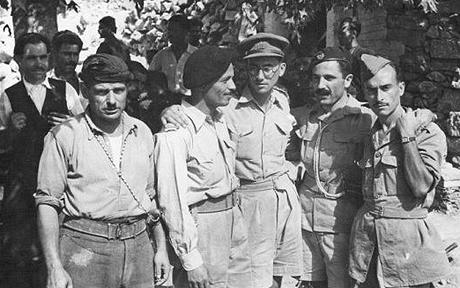
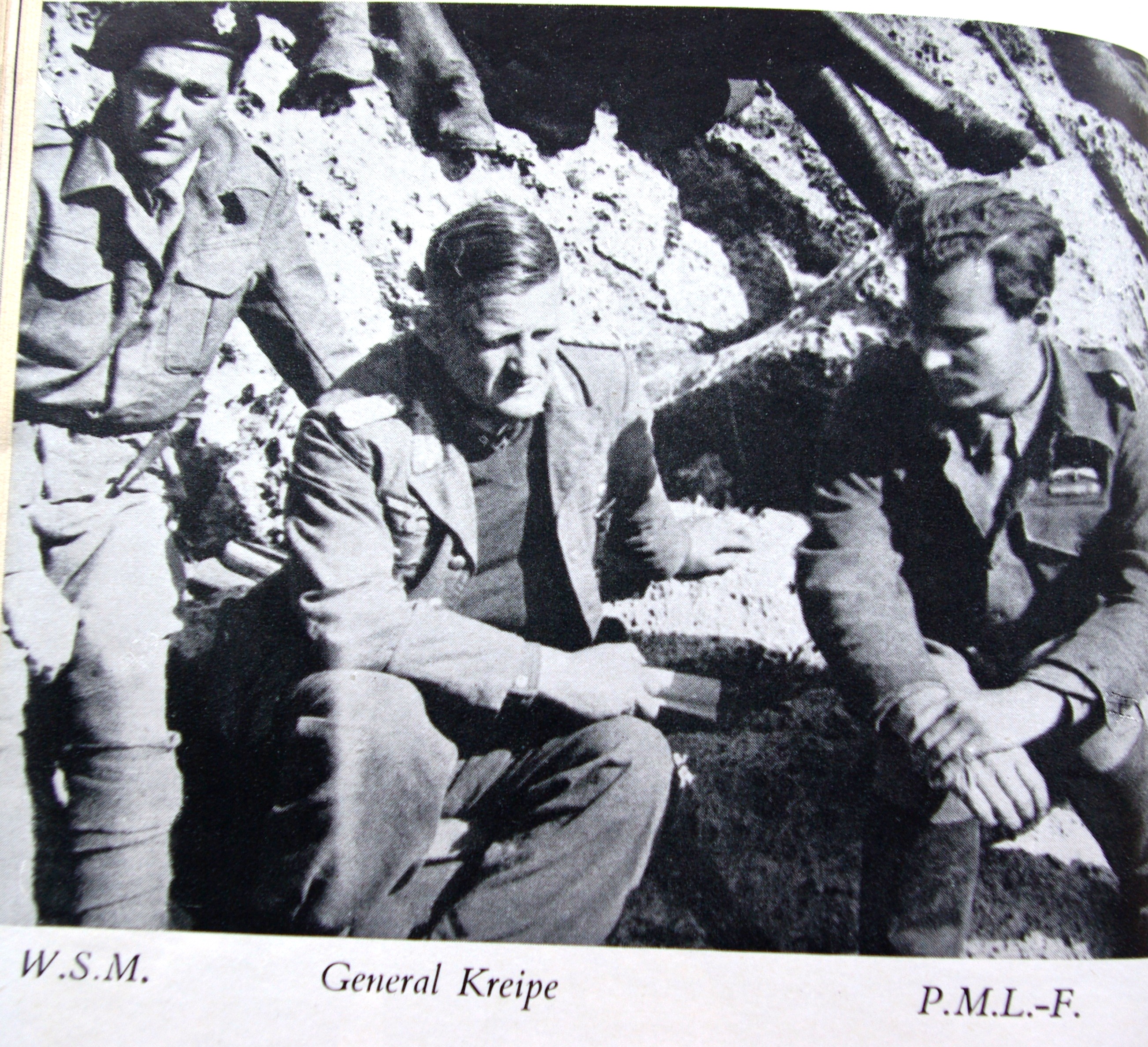
McLean was always passionate in defence of British interests, as he saw them, which did not always accord with the Government’s view. In his later years, still pursuing those interests he visited Somalia, Iran, Western Sahara, the Pakistan-Afghanistan border, China, Israel, Turkey and Jordan.

In 1979 Harold Macmillan wrote to McLean: “You are one of those people whose services to our dear country are known only to a few.”

By his many friends and admirers he will be remembered as possibly the last of the paladins. While his role may not always have been appreciated in Britain, his independence and total integrity were recognised n all the countries where his influence was felt.

Alongside his flair for guerrilla fighting, he had a passion for secret enterprises, deep-laid schemes, and political complexities. He combined acute political understanding with military gifts ideally suited to irregular warfare.

His comrade-in-arms in Albania and the Yemen, David Smiley, has written of McLean: “His charming character seemed languid and nonchalant to the point of idleness, but underneath this façade he was unusually brave, physically tough and extremely intelligent, with a quick, active and unconventional mind.”

His wisdom, sense of humour, human curiosity and kindness endeared him to a wide circle of contemporary friends and younger people, who saw his values as ones they could respect without sentimentality or danger of being considered old-fashioned. He revelled in argument and banter, and was always interested in the opinions of the younger generation.

McLean was both a keen shot and underwater fisherman: one of his great pleasures was to spear moray eels off the coast of Majorca. He was very partial to Middle Eastern and Chinese cooking.

He married, in 1949, Daska Kennedy (neé Ivanovic), who supported, sustained and understood him during his unconventional life.

Related article:

Xan Fielding Obituary