Tag Archives: Patrick Leigh Fermor

The romance of the past: that’s what drives the traveller’s impossible quest

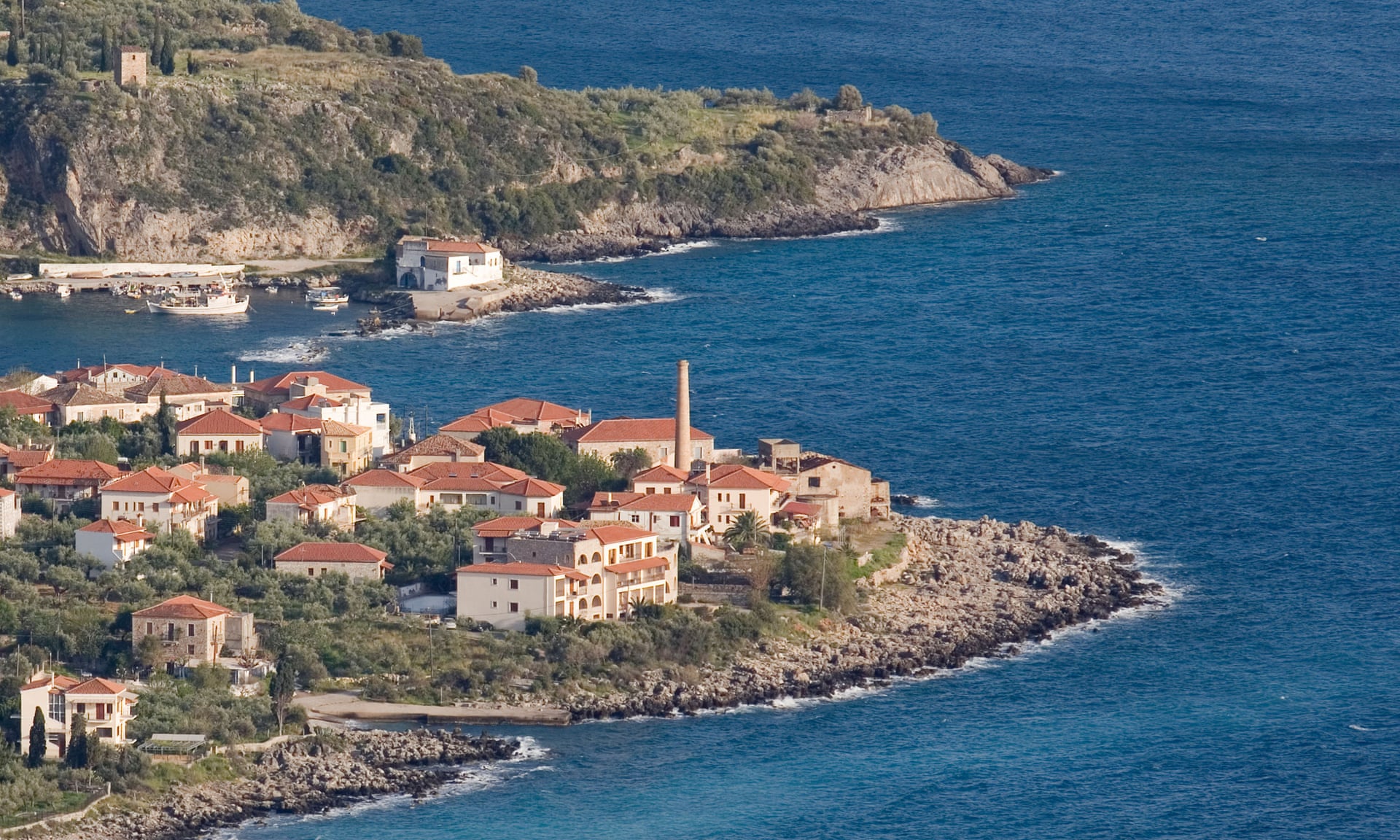
‘Kardamyli now makes most of its money from tourism. It wasn’t as immune to tourism as Leigh Fermor imagined or wanted it to be.’ Photograph: Alamy Stock Photo

Writing in 1958 about the little Greek town that was eventually to become his home, the travel writer Patrick Leigh Fermor was satisfied to note that the Guide Bleu gave it only half a line. “It is better so,” Leigh Fermor wrote. “It is too inaccessible and there is too little to do there, fortunately, for it ever to be seriously endangered by tourism.”

By Ian Jack

First published in the Guardian

His next paragraph describes the town in early evening when, waiting for a freshly caught fish to cook on a grill, he and a few fishermen sit under a mulberry tree outside a taverna and watch the sun sink over the mountains. Caiques – the wooden working boats of the Mediterranean – rock gently “with each sigh of the green transparent water … tethered a few yards above their shadows on the pebbly bottom”. One of Leigh Fermor’s typically exact (and perhaps exacting) images follows when he describes the sea lapping over a flat rock “with just enough impetus to net the surface with a frail white reticulation of foam which slid softly away and dissolved while a new one formed”.

Some of these things still exist. The Mediterranean is clear and green and blue, and on a calm day it will rise and fall against the rocks as Leigh Fermor describes. The sun goes down as he depicts it. There is even a caique or two; and, of course, tavernas – more tavernas than ever. But in most other ways the township of Kardamyli in the Peloponnese is utterly changed. Charter flights land at the little airport in the regional capital, Kalamata, and from there a twisting, expensively engineered road takes taxis, hire cars and air-conditioned coaches over the mountains to a resort that has nice hotels, trinket shops and olive-oil boutiques, as well as pretty restaurants with tea-lights on their tables that look down on the sea. The usual story: Kardamyli now makes most of its money from tourism. It wasn’t as immune to tourism as Leigh Fermor imagined or wanted it to be, and the writer himself is partly to blame.

The tumbledown factory loomed on the shore, a picturesque ruin in brick and concrete where fig trees grew. First, he published an account of his travels in the southern Peloponnese, the peninsula known as the Mani, which was then not much visited, and invested it with the beauty and mystery of a place and people that the 20th century had passed by. Then, six years later, in 1964, he bought a plot of land there – in a bay to the south of Kardamyli – and built a beautiful villa that he lived in almost to the last day of his life, in June 2011. Today his books are available in at least three languages in the local bookshop. People go there because of him – to experience similar sights and sensations to those he saw and felt, even though they understand this can never be completely accomplished, the world having moved on.

But was it ever quite as he described it in the first place? Leigh Fermor’s view of the Mani was essentially romantic: there are few better describers of landscape, but it’s a landscape with omissions. His first sight of Kardamyli is of an enchanting, castellated hamlet at the sea’s edge, where towers, turrets and cupolas rise above houses built of golden stone. “It was unlike any village I had seen in Greece,” Leigh Fermor writes in a page-long depiction that somehow ignores the village’s tallest manmade attribute: the factory chimney of the old olive-oil works. This is difficult to miss. Look down on Kardamyli from almost any vantage point and there it stands, its bricks pale against a background of blue sea and rather more noticeable than the towers and the turrets lying further inland among the cypresses and the olive groves.

The towers date from the age of banditry, feuding clans and resistance to the Ottoman empire. The chimney has cleaner and more peaceable origins. This month I lived next door to it for 10 days in a fine little hotel, and swam morning and afternoon from a ladder bolted to the rocks. The tumbledown factory loomed on the shore behind, a picturesque ruin in brick and concrete where fig trees grew and rusting pipes sprang from the wall at odd angles. A high fence surrounded it, with warnings to keep out.

Olive oil had once been made here – not virgin, cold-pressed or estate bottled, but the roughest kind, which goes into soap. Some accounts online suggest it was owned by the Palmolive company (and when I read this I understood, for the first time, how that familiar name had come about); others say a local family were the proprietors. It used olives – and the residues left from edible oil production – from as far away as Crete, shipped to a concrete pier nearby whose size was inexplicable unless you knew its original purpose. It was said to have employed 150 workers, with steam machinery that, as well as operating its crushers, had the spare capacity to supply the village with its first electricity. Opened in 1932, it closed in either 1958 or 1975 – local memories differed – when new techniques of oil production made it redundant. Since then, a dispute among the site’s three or four owners had prevented demolition or development.

I liked the chimney; three stepped rings of brick, progressively larger in diameter, gave its top a decorative flourish. But then, I’ve always been fascinated by factory chimneys of all kinds, for reasons that I’ve never really examined, the most important probably being that I spent some of my childhood among them: the great smoking verticals of the Lancashire plain, formerly beloved of geography textbooks as the illustrations to the chapter on the textile industry. To find them situated outside what might be considered their natural homelands – the old industrial towns of northern Europe and North America – is always a surprise. They look solitary, like isolated monuments to a faraway and not properly understood revolution. One still standing on the coast of Argyll marks the site of a Victorian factory that made acetic acid from the oak and birch wood. Another on the Ionian island of Paxos served the same kind of mill as Kardamyli’s.

Smoke was most probably still drifting from the Kardamyli chimney when Leigh Fermor reached here in the mid-1950s, but he can hardly be blamed for omitting it from his picture. Like many travellers in our age, he had a distaste for modernity. (He hated radios, for instance, and was relieved that the Mani had so few of them. “Rabid wirelesses should be hunted out and muzzled or shot down like mad dogs.”) He travelled to reach some agreeable form of the past, which has been a motive for the holidaymaker since the days of the Grand Tour.

On an afternoon last week in Kardamyli, I climbed up the ladder from the sea to find three or four men inside the factory fence inspecting the ruins. One wore a pith helmet and carried a theodolite. Another unpacked a drone from its box and directed its flight to the chimney, which it hovered above rather threateningly. It looked as though change was in the offing. I’d known of the chimney for less than a week – and, really, what was it to me? But already I felt a slight alarm that it too might pass, just like the fishermen who watched the sunset with Leigh Fermor from underneath a mulberry tree.

Event 3 October 2018: More Dashing – Further Letters of Patrick Leigh Fermor

Adam Sisman will be speaking about his new book on Wednesday 3rd October at 7.15pm at The Hellenic Centre, 16-18 Paddington Street, London W1U 5AS.

If you would like to attend, please email info@patrickleighfermorsociety.org

Admission is free but non-members are asked to make a £10 contribution towards the expenses of the evening or to join the Society, which entitles members to free attendance at all events. The new book will be for sale at a special launch price.

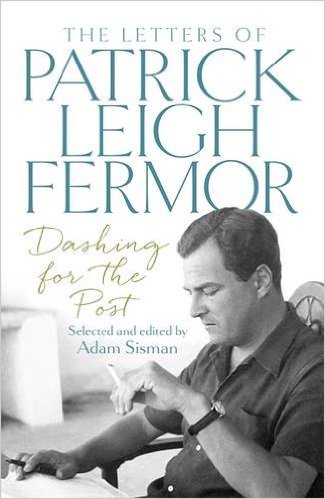
More Dashing: Further Letters of Patrick Leigh Fermor is the follow-up of Dashing for the Post: Selected Letters of Patrick Leigh Fermor (2016) which received terrific reviews including:

‘Here is a veritable feast for fans of Paddy Leigh Fermor…. Sisman has done a tremendous job selecting and editing this treasure-trove of letters’ The Spectator

‘Adam Sisman has done an excellent job of selecting and editing these letters, almost any one of which would have been a joy to receive’ Times Literary Supplement

‘Oh joy! … No other contemporary writer could have given us so much to relish and we’re fortunate that Adam Sisman has distilled such a treat from so much rich material…. The wit, the humour, and the dazzling intelligence make this, for me, the most unputdownable book of the year’ Country Life

Paddy the Great, king of Greece

From the April 2018 edition of The Oldie magazine, a remarkable podcast interview with the late John Julius Norwich to celebrate the Charmed Lives in Greece retrospective exhibition at the British Museum. John Julius recalls the special life and tremendous spirit of his friend Patrick Leigh Fermor, the man whom John Julius credits with opening up the Byzantine world to him – the subject of his first book on the subject Byzantium: The Early Centuries.

John Julius talks about Paddy’s incredible intellectual curiosity and lightness of touch: ‘All the time you were aware of being in touch with perhaps the most extraordinary man you’d ever met.’

Listen to the interview here.

John Julius Norwich – 1929-2018

Barry Cryer and John Julius Norwich at an Oldie lunch in 2017

Very sad news over the weekend to hear of the death of John Julius Norwich, writer, diplomat, broadcaster, father of Artemis Copper (Paddy’s biographer), and friend of Paddy and Joan. Thank you to AJ for sending me this link to his final article for the Oldie magazine. Like John Julius, it was Paddy that led me to my interest in Byzantium, although my Byzantine output is nothing like the wonderful three volume history of Byzantium that John Julius wrote.

First published in The Oldie, 1 June 2018.

By John Julius Norwich.

A new show at the British Museum – about three great lovers of Greece – takes me right back to the 1950s. The English painter Johnny Craxton (1922-2009) was a joy – the only dinner guest we ever had who came on his motorbike and left his leathers in the hall. He always came on his own; we were all intrigued by the idea of his long-term boyfriend, whom we never met. I think Johnny saw Greece as a larger Crete – just as Neville Chamberlain was always said to see Europe as a larger Birmingham. Johnny loved Crete with passion.

The Athenian painter Nikos Ghika (1906-1994) provided me with my first breath of Greece in the summer of 1954, when we went to stay with him in his lovely old house on the island of Hydra.

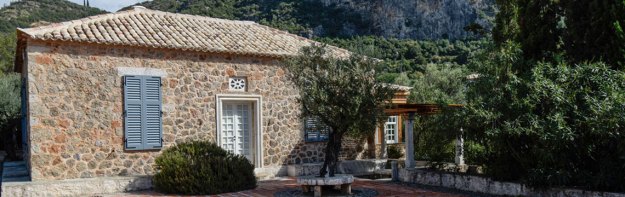
Also staying there were Paddy and Joan Leigh Fermor. Ghika later designed the serpentine pebble mosaic floors at Kardamyli – the Leigh Fermors’ enchanting house in the Mani. It was Paddy that I knew best of the three. Our friendship lasted from the 1950s until his death in 2011 at the age of 96.

In the spring of 1955, when we were living in Yugoslavia – I was working at the British Embassy – a letter arrived from my mother. She had been offered a caique for a fortnight’s sail among the isles of Greece. Paddy and Joan Leigh Fermor were coming; could we come, too? At the end of August, we drove down from Belgrade to Athens, and boarded the Eros at Piraeus.

It was my first time in the Aegean, and my best. Paddy lived and breathed his beloved Greece – fluent in its language, encyclopaedic in his knowledge of its history, people and literature. And nobody has ever carried his learning more lightly.

As we sailed from island to island – and, in those days, there were almost no tourists, and I can’t describe what a difference that made – he talked about Greece, Greek beliefs and traditions, about Byron and the Greek War of Independence, about those monstrously magnificent Greek heroes – men such as Mavromichalis and Kolokotronis, whose names roll so satisfactorily across the tongue – and about the Greek Orthodox Church and its quarrels with the West over words such as ‘filioque’ and ‘homoousion’, his talk taking in all the mystery and magic of the Byzantine world. Twenty years later, I was to write a history of Byzantium myself; but I doubt whether, had it not been for that fortnight on the Eros, I should ever have done so.

One day we were in a taverna on Santorini. Britain and Greece were then at the height of the Cyprus dispute and Paddy was, of course, firmly on the Greek side. Suddenly a member of the party at the next table, hearing us speaking English and being slightly drunk, launched into a stream of anti-British invective. We pretended not to notice. Then, suddenly, he and his companions burst into song.

‘Quick,’ whispered Paddy. ‘National anthem – everybody up.’

We leapt to our feet while he, naturally knowing all the words, sang them at the top of his voice. The mood of the other table changed immediately; and they were still more impressed when he continued with all the following verses – solo by now, since no one else knew them. Abject apologies followed: the ouzo went round once more, and we all departed friends.

It was characteristic of Paddy that, when he and Joan decided to build themselves a house in Greece, they chose the remotest corner: Kardamyli, at the far end of the Mani, the second of the three peninsulas that form the southern coast of the Peloponnese. And oh, how they loved it.

Paddy basically designed it himself. I remember him saying, while the building was in progress, ‘I want it to be part of outdoors, so that, if a chicken were found wandering through the library, no one would be a bit surprised.’

By November 1969, with its vast supply of bookcases, a huge desk and plenty of room to pace over a stone floor, the ‘powerhouse for prose’, as Paddy liked to call it, was ready at last. The two books describing his teenage walk across Europe, A Time of Gifts and Between the Woods and the Water, were both written there, together with hundreds of letters, articles and the jeux d’esprit which he so loved, and of which he was such a master. But those dread enemies procrastination and distraction were always hovering behind him, tempting him away. And as we shall see, they were to get him in the end.

Kardamyli was a huge success. It became the epicentre of Paddy’s world. For the first time, at 54, he had a home of his own. He continued to travel around Europe to see his innumerable friends, but it was here, I feel quite sure, that he was happiest. Outside Europe he was seldom tempted to roam. Except, surprisingly, for the Caribbean. A year or two after the war, he and Joan were persuaded by their old friend (and mine) Costa Achillopoulos to accompany him on a longish tour of the islands.

The result was Paddy’s first book, The Traveller’s Tree, which was published in 1950, and also his second, The Violins of Saint-Jacques, an exquisite little novella which was his only venture into fiction.

The islands fascinated him. His chapter on voodoo is a masterpiece. And then, when he got to Barbados, what did he find? A tablet in the churchyard of St John’s, carved with Doric columns and the cross of Constantine, reading: ‘Here lyeth ye body of Ferdinando Palaeologus, descended from ye Imperial lyne of ye last Christian Emperor of Greece. Churchwarden of this parish 1655-1656. Vestryman twentye years. Died Oct 3. 1679.’

Later, Paddy discovered that Ferdinando’s son Theodore had returned to England and had settled in Stepney, where he left a posthumous daughter baptised with the typically 17th-century name of Godscall Palaeologus.

She may have married, and had countless children; but, for the time being, this little girl in Stepney remains the last authentic descendant of the Palaeologi, the last imperial family of Byzantium.

Of course Paddy was a superb linguist; but I have never known anyone who enjoyed his languages so intensely. He loved on-the-spot translations: ‘To be or not to be’ in German, for example – occasionally recited backwards – or D’Ye Ken John Peel in Italian, which my daughter Artemis (his biographer) and I sang at his memorial service:

Conosce Gian Peel, con sua giacca tanta grigia?

Conosce Gian Peel, prima cosa la mattina,

Conosce Gian Peel, quand’ è lontano, è lontano,

Con suoi cani e suo corno la mattina.

And then there were the letters –letters that could have been written by no one else. Reading them, written at such terrific speed that sometimes they grow faint because the fountain pen can’t deliver the ink fast enough, one marvels at Paddy’s facility and fluency. And yet, when he was writing a book for publication, every sentence was a battleground. When, in July 1988, Sotheby’s sold the autograph manuscript of A Time of Gifts, it was described in the catalogue as follows:

‘c.450 pages, the majority written on rectos only, some on both sides, the first chapter on lined foolscap sheets, some cartridge paper, others lined, heavily revised and corrected, revised passages frequently written on separate sheets and pasted or clipped over the original, corrections or elucidations often in red ink, foreign or difficult words printed in the margin, many sheets with encouraging notes to the typist, often stapled or stitched with coloured thread into gatherings, generally of ten pages.’

I have an idea – I hate to have to say it and desperately hope I’m wrong – that Paddy’s last years were not as happy as the rest of his life had been. He missed Joan desperately after she died in 2003, he was getting old and he gradually had to face up to the fact that he would never complete the third volume of the story of that glorious European journey in his early youth. He produced bits and pieces for it by the dozen, but something always prevented him from organising them, connecting them and making them into a single coherent document. It was, I suppose, a kind of writer’s block.

He would seize on anything – letters, articles, translations, those ingenious word games he so loved – rather than face one of two facts: the first, that he must finish the job; the second – far worse – that he couldn’t. Eventually he knew that the second was the truth. When he came to London, people would say breezily, ‘How’s Volume III coming on?’, little realising that they were driving a dagger through his heart.

Volume III is not entirely lost. The Broken Road, compiled by Colin Thubron and Artemis, breathes Paddy through and through. And anyway, he has left us so much more to revel in.

As a travel writer, he was surely in a class by himself. But he was much more than a travel writer; he was the most extraordinary literary – and social – phenomenon I have ever known, and I am proud to have been his friend.

Until I have reached Constantinople

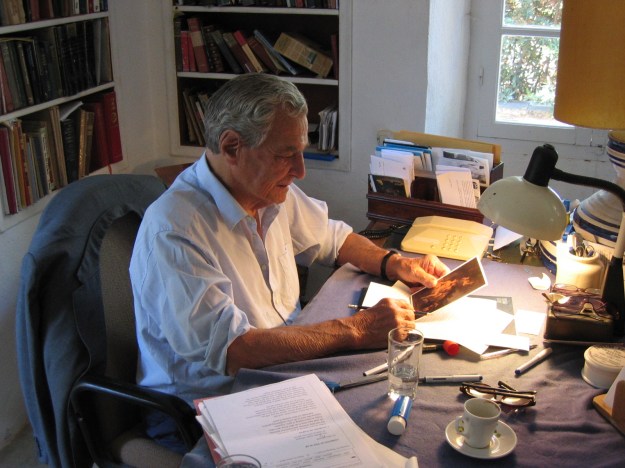
Patrick Leigh Fermor working at his home studio on 3 October 2004, then aged 89. Kardamyli. by Sean Deany Copyright 2012

In the catalogue to the exhibition Charmed Lives in Greece: Ghika, Craxton, Leigh Fermor (at the British Museum until July 15), Michael Llewellyn-Smith writes that, in his later years, Patrick Leigh Fermor “had an all-purpose excuse to send to pesterers”. The note read: “It was very kind of you to write. The trouble is that I am having to work to a strict deadline for the completion of my new book. This makes me a poor correspondent until I have finished it and have reached Constantinople – I am not sure when this will be”.

By James Campbell

First Published in The Times Literary Supplement 12 April 2018

The warning to inquisitive readers, colour-supplement journalists, adventurous holidaymakers and others was despatched from Kardamyli in Mani, in the Southern Peloponnese, from the house which Fermor had built himself, with local labour and expertise, in the mid-1960s. It was where he had completed the first two parts of his account of the “great trudge” across ­Central Europe in the 1930s, projected to end, in a long-anticipated third volume, in “Constantinople”. The book itself had become something of a pest, and he failed to complete it before his death in 2011, aged ninety-six. His wife Joan had died there eight years earlier.

I knew nothing of this when I posted a letter to Kardamyli in the autumn of 2003. I was not a Fermor devotee (there were many, though nothing like the numbers that exist today) and had read scarcely anything he had written. It was not my idea to seek him out, but that of my editor at the Guardian Saturday Review, for which I was at the time a contracted writer. The regular task was a literary profile, of a good length – 4,000 words – and of a certain seriousness. Starting from a position of ignorance didn’t bother me. I liked “finding out”, and enjoyed the homework.

Suggestions from Farringdon Road came by telephone, later email, and were always to the point. “How about Patrick Leigh Fermor?” That was it. No address, no telephone number, no deadline. The rest was up to me, but I was free to go where I liked and when I liked. I had fulfilled many commissions in this way, and had discovered something: it works better when you contact the intended subject yourself to make arrangements, rather than going through the publisher’s press office. The people there do necessary work, but with their more valued (and venerable) charges there is a protective instinct, and a need to control the show.

Fermor was definitely a protected species. His ninetieth birthday was approaching. His publisher John Murray was desperate for him to reach Constantinople. The journey, which had taken place in the 1930s, had been given elegant shape in two books written forty and fifty years after the events described: A Time of Gifts (1977) and Between the Woods and the Water (1986). The final volume, endlessly, pestiferously, inquired about, was said to be inching forwards. Both my editor and I made approaches to the publicity department; both received vague promises of representation. In the end, both were urged to think about volume 3, like everybody else.

I decided to take the direct route. But how to find him? I tried some acquaintances who might know his address. None did. Someone suggested Elizabeth Chatwin, widow of Bruce, Continue reading

Easter 1934 Paddy arrives at the Danube read by Siân Phillips

An Easter treat for you. Siân Phillips reads from page 277 of A Time of Gifts (paperback) as Paddy arrives at the Danube, spots Esztergom, has his passport stamped by border guards, and lingers ‘in the middle of the bridge, meditatively poised in no man’s air.’

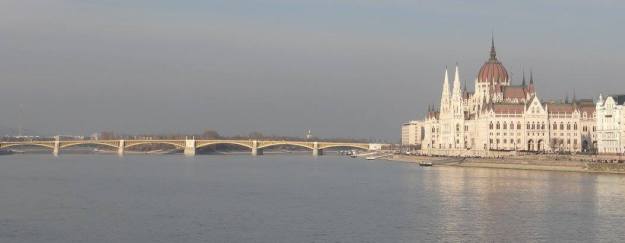
‘The air was full of hints and signs. There was a flicker and a swishing along the river like the breezy snip-snap of barbers’ scissors before they swoop and slice. It was the skimming and twirling of newly arrived swifts. A curve in the stream was re-arranging the landscape as I advanced, revealing some of the roofs of Esztergom and turning the Basilica to a new angle as though it were on a pivot. The rolling wooded range of the Bakony Forest had advanced north from the heart of Transdanubia, and the corresponding promontory on the northern shore – the last low foothills of the Marra mountains, whose other extremity subsides in the north eastern tip of Hungary – jutted into the water under the little town of Parkan. Reaching for each other, the two headlands coerced the rambling flood yet once more into a narrower and swifter flow and then spanned the ruffie with an iron bridge. Spidery at first, the structure grew more solid as the distance dwindled. (Twenty miles east of this bridge, the Danube reaches a most important point in its career: wheeling round the ultimate headland of the Balcony Forest and heading due south for the first time on its journey, it strings itself through Budapest like a thread through a bead and drops across the map of Europe plumb for a hundred and eighty miles, cutting Hungary clean in half. Then, reinforced by the Drava, it turns east again, invades Yugoslavia, swallows up the Sava under the battlements of Belgrade, and sweeps on imperturbably to storm the Iron Gates.)

In an hour, I had climbed the cliff-path into the main street of Parkan. A little later my passport was stamped at the frontier post at the Czechoslovakian end of the bridge. The red, white and green barrier of the frontier post at the far end marked the beginning of Hungary. I lingered in the middle of the bridge, meditatively poised in no man’s air.’

(Extract from A Time of Gifts by Patrick Leigh Fermor, with thanks to John Murray Publishers.)

Who were Ghika, Craxton and Leigh Fermor?

A lovely video produced by the British Museum to accompany the exhibition Charmed lives in Greece: Ghika, Craxton, Leigh Fermor. Narrated by the exhibition curators. Discover more about their extraordinary friendship, creativity and life spent living together in Greece.

Charmed lives in Greece: Ghika, Craxton, Leigh Fermor
8 March – 15 July 2018
http://www.britishmuseum.org/charmedlives

Supported by the A. G. Leventis Foundation and organised with the A. G. Leventis Gallery. In collaboration with the Benaki Museum and Craxton Estate.

Charmed lives in Greece: Ghika, Craxton, Leigh Fermor at the British Museum

Nikos Hadjikyriakos-Ghika (1906–1994), Study for a poster. Tempera on cardboard, 1948. Benaki Museum – Ghika Gallery, Athens. © Benaki Museum 2018.

The British Musem has at last started to publicise this exhibition which focuses on the friendship of the artists Niko Ghika and John Craxton, and the writer Patrick Leigh Fermor. Their shared love of Greece was fundamental to their work, as they embraced its sights, sounds, colours and people.

Where? The British Museum, Room 5

When? 8 March – 15 July 2018

How Much? It is free!

Nikos Hadjikyriakos-Ghika (1906–1994), John Craxton (1922–2009) and Sir Patrick Leigh Fermor (1915–2011) were significant cultural figures of the 20th century. Leigh Fermor is perhaps the most widely known of the three – largely through his travel writings – and Ghika and Craxton are now recognised as two of the most remarkable artists of this period. The three first met at the end of the Second World War, becoming lifelong friends and spending much of their subsequent lives in Greece. The time they spent together and their close bonds would shape each other’s work for the rest of their lives.

The exhibition brings together their artworks, photographs, letters and personal possessions in the UK for the first time. Highlights include Ghika’s extraordinary painting Mystras and Craxton’s exuberant Still Life with Three Sailors. Also featured is Craxton’s original artwork for the book covers of Leigh Fermor’s travel classics A Time of Gifts and Between the Woods and the Water. Many artworks and objects on display are on loan from the Benaki Museum, to which Ghika donated his house and works, from the Craxton Estate, and from institutions and private collections in the UK and Greece.

The exhibition focuses on four key places – Hydra, Kardamyli, Crete and Corfu – where they lived and spent time together. Hydra is an island where Ghika’s family home became a gathering place for the three friends, and Leigh Fermor built a house with his wife Joan at Kardamyli. Craxton restored a house at Chania on Crete, and Corfu is where Ghika and his second wife Barbara transformed an old building into an idyllic home and garden.

Together, these places chart the story of this remarkable friendship, and how the people and landscapes of Greece were a great influence on their enduring works.

How an idyllic Greek hideaway inspired a British war hero and travel writer

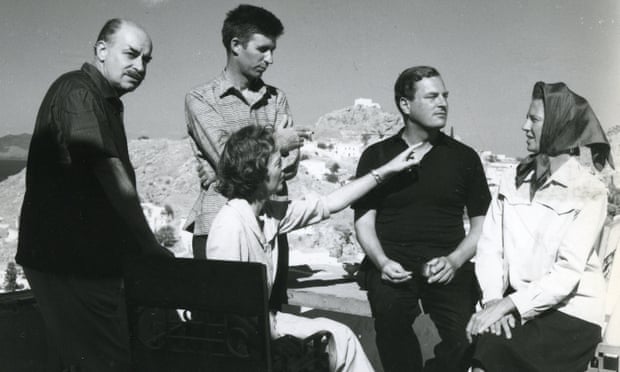
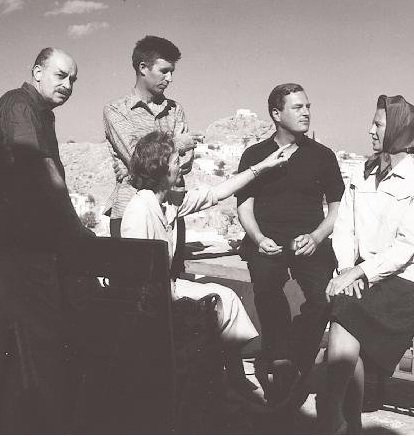
Nikos and Barbara Hadjikyriakos-Ghika with John Craxton, Patrick Leigh Fermor and Joan Fermor, in 1958. Photograph: Benaki Museum – Ghika Gallery, Athens.© Benaki Museum.

By Jamie Doward

First published in The Guardian

24 December 2017

Oh, to have been a fly on the bougainvillea-clad wall as the drinks flowed and the sun sank behind the beautiful house tucked away in a remote part of Greece.

One night a visitor might find Stephen Spender or Louis MacNeice. Another, Lawrence Durrell and John Betjeman.

But always holding court, cigarette in hand, ouzo glass raised, would be Sir Patrick “Paddy” Leigh Fermor, the war hero and travel writer often said to be the inspiration for his friend Ian Fleming’s most famous creation, James Bond.

In the late 1950s, the house Leigh Fermor built with his wife Joan in Kardamyli, a seaside village located in the Mani peninsula, in the southern Peloponnese, became a haven for writers and artists drawn to its owner’s extraordinary charisma and the wild, arid beauty of the surrounding landscape.

It was here that Leigh Fermor, who died in 2011 aged 96, built his close friendship with two men – the Greek artist Nikos Hadjikyriakos-Ghika, who lived on Hydra before moving to Corfu, and the British painter, John Craxton, who lived for a time on Crete. Now the remarkable friendship is to be explored in a new exhibition at the British Museum that will open next spring.

Charmed Lives examines the influence that post-war Greece had on the three men and brings together in the UK for the first time their artworks, photographs, letters and personal possessions. Among the items on display will be Leigh Fermor’s typewriter (which he never managed to master), his binoculars and a Leica camera belonging to Joan, a professional photographer.

Striking paintings of Greek landscapes and local people by both Craxton and Ghika will feature alongside extracts from Leigh Fermor’s many books.

John Craxton’s ‘Still Life with Three Sailors’ reflects his Greek inspirations. Photograph: John Craxton

Sir Michael Llewellyn-Smith, a former British ambassador to Athens, who knew all three men and is one of the exhibition’s curators, conceded many would be drawn by the cult of Leigh Fermor, a polyglot and autodidact once described as “a cross between Indiana Jones, James Bond and Graham Greene.”

“There’s a tremendous fashion for him,” Llewellyn-Smith said. “In a way you’d expect it to diminish over time but the opposite is happening and it’s very difficult to explain. I don’t think it’s fully related to his work. It is for some people but there are others who are attracted by the legend.”

Much of Leigh Fermor’s legend is burnished by his epic walk from the Hook of Holland to Istanbul, made as an 18-year-old, and his heroics during the second world war when, leading a group of Cretan resistance fighters, he captured the German commander General Heinrich Kreipe in one of the most audacious acts in the history of the Special Operations Executive.

While his postwar books such as A Time Of Gifts cemented his legend and led to Leigh Fermor being regarded as one of the great travel writers, it transpires that the real-life 007 also dabbled as an artist and several of his works will be on display in the exhibition. These include six portraits of Cretan resistance fighters painted in 1942. They are the only ones out of around 20 similar paintings to have survived. The majority were destroyed as the Germans advanced.

“Paddy had an extremely acute visual sense and was himself an artist, an amateur,” Llewellyn-Smith said. “When he was walking across Europe, when he was 18 to 20 years old, around Vienna he had virtually no money and so he started drawing portraits of people to get enough to get a crust of bread or more.”

Llewellyn-Smith said the fact that all three men had died only relatively recently –Ghika in 1994, Craxton in 2009 – meant there was much to be gained by producing an exhibition of their lives and friendship now.

“A lot of people who knew them are still around, and therefore for those organising the exhibition, such as myself, it was possible to talk to them and get their memories and anecdotes. This couldn’t have been done if the exhibition had been delayed by many years.”

The organisers say they hope it will offer visitors an opportunity to reflect on Greece’s enduring role as a source of artistic inspiration. It may also offer a subtle reminder that British-Hellenic relations can be about more than that most famous of British Museum attractions, the Parthenon marbles. “This period when these three men got to know each other was a period of artistic and literary collaboration, almost a renaissance between British and Greek artists and writers,” Llewellyn-Smith said. “It didn’t have anything to do with politics and returning sculptures to Greece. That’s a different century.”

It may also offer clues as to why, despite smoking around 80 cigarettes a day, just like Fleming’s Bond, Leigh Fermor managed to live so long. “When he was in the Peloponnese he would go for walks every day in the mountains behind the house and he’d swim for half an hour every morning,” Llewellyn-Smith said.

In his will, Leigh Fermor gave the house to the Benaki museum in Athens with instructions for it to be turned into a writers’ retreat. While some of Leigh Fermor’s devoted fanbase have grumbled about the pace of its renovation – which at one stage appeared to have fallen victim to Greece’s economic woes, – there are hopes the exhibition may elicit funds to speed things up.

If so, it would mean that more than half a century on from when Leigh Fermor built his idyll, it will once again help nurture a new generation of artists and writer.

Charmed Lives in Greece the exhibition will run at the British Museum 8 Mar-15 July 2018

Oral history – erasing Paddy and Billy

The kidnap gang pose before the action (Courtesy of Estate of William Stanley Moss)

The kidnap gang pose before the action (Courtesy of Estate of William Stanley Moss)

This review of M I Finley’s A World of Odysseus, discusses the hypothesis that oral heroic poetry is not a medium that preserves historical fact, mentioning specifically how the deeds of Paddy, “Billy” Moss, and the others who kidnapped General Kreipe were raised to the level of Cretan heroic oral history, but by 1953, all the names had been forgotten or deliberately erased (the relevant part is highlighted for your convenience).

by Bernard Knox

First published in the New York Review of Books

29 Jun 1979

It is now more than two decades since the Professor of Ancient History at Cambridge (who was then an ex-professor from Rutgers) published a book which in a limpid, hard-hitting prose and with a bare minimum of footnotes attempted to draw “a picture of a society, based on a close reading of the Iliad and Odyssey, supported by study of other societies….” This is how Professor Finley characterizes the book now, in the preface to a revised edition which makes only minor changes in the original text but adds two valuable and stimulating appendices, replying to criticism and bringing the argument up to date. He goes on to claim that “the social institutions and values make up a coherent system” which, however strange to us, is “neither an improbable nor an unfamiliar one in the experience of modern anthropology.” The fact that the later Greeks and the nineteenth-century scholars found it incomprehensible on its own terms he dismisses as “irrelevant” and adds that “it is equally beside the point that the narrative is a collection of fictions from beginning to end.”

The ideas here stated in uncompromising terms were implicit in the work from the start. And at the time of its first publication they were not greeted with enthusiasm by the world of Homeric and Bronze Age scholarship. Far from believing that “the narrative was a collection of fictions,” most scholars of the subject found in the Bronze Age remains excavated on the Homeric sites a confirmation of the historicity of the tale of Troy, at least in its main outlines, and went on to search the text of the poems for objects described that might match the objects discovered. Almost simultaneously with the publication of Finley’s book, the decipherment of the Linear B tablets by Ventris and Chadwick seemed to provide the definitive proof that the Homeric poems preserved historical facts of the thirteenth century BC. Here were clay tablets, inscribed in a form of Greek that bore striking resemblances to the Homeric literary dialect, which contained lists of chariots, corslets, and helmets and such Homeric names as Hektor, Achilleus, Aias, Pandaros, and Orestes. John Chadwick recently took a wry backward look at the euphoria of those early days:

The revelation of the Mycenaean archives fostered wild hopes that one day we might come across, let us say, the muster of ships at Aulis for the expedition against Troy or an operation order for the attack of the Seven against Thebes.1

Finley remained one of what he calls a “heretical minority”; and it soon became apparent that the decipherment of Linear B, far from confirming the thesis that the Homeric poems were a reflection of Mycenaean society, had in fact dealt that thesis a fatal blow. It is hard to think of Homer’s Agamemnon as living in the same world with that wanax of Pylos, whose scribes duly recorded that “Kokalos repaid the following quantity of olive oil to Eumedes: 648 liters; from Ipsewas 38 stirrup-jars.” The bureaucratic inventories of the Bronze Age palaces resemble the detailed records of the Near Eastern civilizations which preceded them and the intricate accounting of the later Ptolemaic papyri, but anything more alien to the mentality of illiterate freebooters such as Achilles and equally illiterate pirates such as Odysseus can hardly be imagined.

The tablets also demonstrated that the precise geographical description of Nestor’s kingdom at Pylos which is offered in Book II of the Iliad bears practically no relation to the Mycenaean facts; the conclusion, that the poet or poets knew little or nothing of western Greece, might already have been surmised from the confused and confusing Homeric descriptions of the hero’s homeland, Ithaca. And meanwhile, quite apart from the tablets, it was becoming steadily clearer to all but the most stubborn that there was very little in the archaeological record which would serve to connect the world of the poems with the Bronze Age.

Finley, in the preface to the new edition, contents himself with a very restrained, “I told you so”; he “cannot resist pointing out that proper concern for social institutions and social history had anticipated what philology and archaeology subsequently found.” In The Mycenaean World, John Chadwick heads his penultimate chapter “Homer the Pseudo-Historian” and concludes it with the sentence: “to look for historical fact in Homer is as vain as to scan the Mycenaean tablets in search of poetry; they belong to two different universes.”

Oral heroic poetry is not a medium that preserves historical fact—as Finley pointed out, with a reference to the Chanson de Roland, which made out of a Basque attack on Charlemagne’s rear-guard an assault by Muslim beys and pashas, all carefully identified by names which are “German, Byzantine, or made-up.” A modern example, from the Second World War and from Greece itself, strengthens his case and gives a fascinating glimpse of epic “history” in the making.

In 1953 the late Professor James Notopoulos was recording oral heroic song in the Sfakia district of western Crete, where illiterate oral bards were still to be found. He asked one of them, who had sung of his own war experience, if he knew a song about the capture of the German general and the bard proceeded to improvise one. The historical facts are well known and quite secure. In April 1944 two British officers, Major Patrick Leigh Fermor and Captain Stanley Moss, parachuted into Crete, made contact with Cretan guerrillas, and kidnapped the German commanding general of the island, one Karl Kreipe.

The general was living in the Villa Ariadne at Knossos, the house Evans had built for himself during the excavations. Every day, at the same time, the general was driven south from the Villa to the neighboring small town of Arkhanes, where his headquarters were located. He came home every night at eight o’clock for dinner. The two British officers, dressed in German uniforms, stopped the car on its way home to Knossos; the Cretan partisans overpowered the chauffeur and the general. The two officers then drove the car through the German roadblocks in Heraklion (the general silent with a knife at his throat) and left the car on the coast road to Rethymo. They then hiked through the mountains to the south coast, made rendezvous with a British submarine, and took General Kreipe to Alexandria and on to Middle East Headquarters in Cairo.

Here, in Notopoulos’s summary, is the heroic song the bard produced:

“An order comes from British and American headquarters in Cairo to capture General Kreipe, dead or alive; the motive is revenge for his cruelty to the Cretans. A Cretan partisan, Lefteris Tambakis (not one of the actual guerrilla band) appears before the English general (Fermor and Moss are combined into one and elevated in rank) and volunteers for the dangerous mission. The general reads the order and the hero accepts the mission for the honor of Cretan arms. The hero goes to Heraklion, where he hears that a beautiful Cretan girl is the secretary of General Kreipe.

“In disguise the partisan proceeds to her house and in her absence reads the [English] general’s order to her mother. When the girl returns he again reads the general’s order. Telling her the honor of Crete depends on her, he catalogues the German cruelties. If she would help in the mission, her name would become immortal in Cretan history. The girl consents and asks for three days time in which to perform her role. To achieve Cretan honor she sacrifices her woman’s honor with General Kreipe in the role of a spy. She gives the hero General Kreipe’s plans for the next day.

“Our hero then goes to Knossos to meet the guerrillas and the English general. ‘Yiassou general,’ he says. ‘I will perform the mission.’ The guerrillas go to Arkhanes to get a long car with which to blockade the road. Our hero, mounted on a horse by the side of the blockading car, awaits the car of Kaiseri (that is what the bard calls Kreipe). The English general orders the pistols to be ready. When Kreipe’s car slows down at the turn he is attacked by the guerrillas. Kreipe is stripped of his uniform (only his cap in the actual event) and begs for mercy for the sake of his children (a stock motif in Cretan poetry).

“After the capture the frantic Germans begin to hunt with dogs (airplanes in the actual event). The guerrillas start on the trek to Mount Ida and by stages the party reaches the district of Sfakia (the home of the singer and his audience; actually the general left the island southwest of Mount Ida). The guards have to protect the general from the mob of enraged Sfakians. Soon the British submarine arrives and takes the general to Egypt. Our bard concludes the poem with a traditional epilogue—that never before in the history of the world has such a deed been done. He then gives his name, his village, his service to his country.”2

So much for epic history. Nine years after the event the British protagonists have been reduced to one nameless general whose part in the operation is secondary and there can hardly be any doubt that if the song is still sung now the British element in the proceedings is practically nonexistent—if indeed it managed to survive at all through the years in which Britain, fighting to retain its hold on Cyprus, became the target of bitter hostility in Greece and especially among the excitable Cretans.

It took the Cretan oral tradition only nine years to promote to the leadership of the heroic enterprise a purely fictitious character of a different nationality. This is a sobering thought when one reflects that there is nothing to connect Agamemnon, Achilles, Priam, and Hector with the fire-blackened layer of thirteenth-century ruins known as Troy VII A (the archaeologists’ candidate for Homer’s city) except a heroic poem which cannot have been fixed in its present form by writing until the late eighth century, at least four illiterate centuries after the destruction.

Finley’s professional interest in the poems lies in their value as a source for knowledge of the Dark Ages (so-called because we know almost nothing about them) which intervene between the destruction of the Mycenaean palaces around 1200 BC and the beginning of a new literacy some time in the late eighth century. If the poems contain no memory of historical events of the Bronze Age and, furthermore, do not reflect the civilization, customs, social relationships, or even the material objects of the Bronze Age, what do they have to tell us? Finley’s answer was (and still is) that the poems preserve, with the anachronisms and misunderstandings inevitable in a fluid oral tradition, the social institutions and values of the early Dark Ages, the tenth and ninth centuries BC. “The choice,” as he poses the question in the new edition, “lies between that period and the poet’s own time, now that the ground beneath a supposed Mycenaean world of Odysseus has been removed by the Linear B tablets, assisted by continuous archaeological excavation and study.”

The “poet’s own time” he takes to be the mid-eighth century (a date with which few will quarrel) and makes the claim that the poems fail to reflect the known social conditions of that period. “The polis (city-state) form of political organization” was “widespread in the Hellenic world by then, at least in embryonic form. Yet neither poem has any trace of a polis in its political sense.” Further, the “Phoenician monopoly of trade” in the Odyssey is a reflection of “the period before 800 BC, for by that date the presence of Greek traders in the Levant is firmly attested.” Finley sees no reason to find in Homer’s picture of the sea-lords of Phaeacia a “reflection of the Greek western colonization movement contemporary with Homer,” as many have done: “Magical ships that powered themselves were not instruments of the westward colonization, nor did magic gardens await the migrants on arrival.”

The epic poets are the guardians, preservers, and renewers of a heroic tradition and though they often admit anachronistic details or misunderstand the use or nature of archaic objects, they maintain intact, so Finley insists, the social context in which the heroes can live their larger life. From that context he constructed a model, to use his own formula, “imperfect, incomplete, untidy, yet tying together the fundamentals of a political and social structure with an appropriate value system in a way that stands up to a comparative analysis.” The most striking and original feature of this presentation (organized in chapters headed: “Wealth and Labor”; “Household, Kin, and Community”; “Morals and Values”) is his discussion of the “institution of gift-exchange.”

No reader of the Odyssey can have failed to be amazed and puzzled by the central role gifts play in the social relationships of the characters. Telemachus at Sparta, a young provincial with very uncertain prospects visiting the splendid court of Menelaus and Helen, is offered a parting gift of horses. He declines, on the grounds that his native island is no place to graze horses, and asks for something else: “Give me something that can be stored up.” Menelaus is delighted with his frankness and gives him a bowl made of silver and gold. There are many such encounters in the Homeric poems and readers seeking some explanation of the generosity and especially of the unashamed claims made on it usually found themselves fobbed off with a discussion of Homeric hospitality and the guest-friend relationship. Finley put it firmly in a familiar anthropological context.

The word “gift” is not to be misconstrued. It may be stated as a flat rule of both primitive and archaic society that no one ever gave anything, whether goods or services or honors, without proper recompense, real or wishful, immediate or years away, to himself or to his kin. The act of giving was, therefore, in an essential sense always the first half of a reciprocal action, the other half of which was a counter-gift.

His persuasive analysis of the working of this form of exchange in the poems was widely accepted; those who objected that it reflected not a society but a “heroic ideal” are given short shrift in the new edition.

The system of gift-giving which Finley identified in the poems was already familiar to anthropologists and sociologists; Marcel Mauss in his Essai sur le don (1925) had analyzed its operation in a wide variety of societies ancient and modern (though not in ancient Greece, to which he made only some half-dozen tangential references in his footnotes). If, as Finley says, “the practice…’does not reflect a society’ but an ‘heroic ideal,’ we are driven to the conclusion that, by a most remarkable intuition, Homer was a predecessor of Marcel Mauss, except that he (or his tradition) invented an institution which nearly three thousand years later Mauss discovered to be a social reality.” Since, he goes on to say, “Tamil heroic poetry of South India reveals a comparable network of gift-giving…,” Homer is not the only “instinctive, premature Marcel Mauss.”

Finley’s arguments from the system’s internal coherence and its recorded existence in real societies are compelling but a lingering doubt may remain. Speaking of the belief in the historical reality of the Trojan War and the Catalogue of Ships firmly held by some scholars who reject his sociological model he asks: “In what respect do they differ from gift-giving in their inherent credibility?” A skeptic might answer: “Not at all. Both the Trojan War and the gift-giving system may be equally unhistorical.” If the epic Muse can forget the palaces, inventories, and geography of Mycenaean Greece, remember the chariots but not how they were used, and fabricate not only a war but the names and personalities of chieftains on both sides, how can we trust her to preserve intact the memory of an intricate social system long since obsolete? Finley’s case would be stronger if the comparative method, to which he so often appeals, could produce a parallel: an oral epic poem which, celebrating heroes of a bygone age, garbles time, place, and material objects but preserves, in recognizable form, a complex system of primitive social institutions.

There is one oral epic which goes far toward meeting these specifications, the Turkish Book of Dede Korkut. The full text has only recently been made available in an English version3 (which may be the reason why Finley, whose mastery of the enormous Homeric literature is demonstrated in his useful critical bibliography, does not seem to be aware of it). The text on which modern editions are based was written in the last quarter of the sixteenth century but there is in existence a summary of the poem which was written down before 1332 and the text contains numerous traces of original versions dating from the tenth century. The book recounts, in a mixture of prose and verse, the deeds of the Oghuz, a tribe which, over many centuries, migrated from lands which are now in the Kazakh, Uzbek, and Turkmen Soviet Socialist Republics to become the ancestors of the Seljuk and Ottoman Turks in western Asia Minor.

In their original home their raiding expeditions were aimed at their neighbors to the north, the shamanistic Kipchaks; the Oghuz were recently converted Muslims (though sometimes pre-Islamic customs remain embedded in the narrative). But the sixteenth-century version retains only occasional reminiscences of the Kipchaks and the geography of the Samarkand area; in it the Oghuz beys now live, hunt, and plunder in western Anatolia, a thousand miles to the west; their infidel enemies “worship a god made from wood” and have churches with monks in them—one of their strongholds is Trebizond, which remained in Byzantine hands until 1461.

The Oghuz nomadic beys are given a nonexistent history; at the same time, the known participation of their descendants in major historical events is utterly ignored. “No reference is made,” say the translators, “to the well-known involvement of the Oghuz in the affairs of the Ghazmanide Dynasty…nor is there any mention whatever of the successive stages by which the Seljuks, of Oghuz origin, conquered Iran and most of Anatolia…during the remainder of the eleventh century.” The action of the epic is, as the translators put it, “mainly fiction” but, as they go on to say, “so well do the legends reflect the pattern of early Oghuz life that they must also be considered documents of cultural and social history.”

One of the institutions of the Oghuz is a spectacular variation of the gift-giving system. Their king, Bayindir Khan, commands the allegiance of the beys, the heroes of the epic; they deliver the booty from their brigand raids to him. Periodically he invites them to sumptuous feasts, at which he “distributes the wealth of the Oghuz, usually in the form of gifts to the beys.” But occasionally the feast was a “plunder banquet.” On these occasions, at the high point of the feast, the Khan would take his wife by the hand and leave; the beys would then help themselves to any of his possessions they fancied. It was, in the story, his failure to invite the Outer Oghuz to a plunder banquet which caused a fratricidal war, the “Götterdämmerung” episode which concludes the saga.

In the years since its first appearance, Finley’s “model” has won wide acceptance; his reconstruction of a Dark Age society from the epic text has even, as he says in his preface, “been the acknowledged starting-point of studies by other historians of society and ideas”—among them J.M. Redfield’s Nature and Culture in the Iliad.4 But Homer is a subject on which no two people can be expected to agree entirely, and it may be objected, without impugning the validity of his main thesis, that Finley pushes too hard against the evidence in his claim that there is no trace in the Odyssey of the “polis in its political sense” and his denial that the wanderings of Odysseus are “a reflection of the Greek western colonization movement contemporary with Homer.”

On the first point he is of course right to rule out the imaginary city of the Phaeacians and also right to deny that the presentation of “walls, docks, temples, and a marketplace” can be treated as “Homer’s recognition of the…rise of the polis.” But the equally imaginary city of Troy in the Iliad does seem to prefigure some features of later social organization—in the procession of the women to the Temple of Athena in Book VI, the debate in the assembly in Book VII, above all in Hector’s devotion to Troy and its people, his sense of his duty to the community. Hector is unique in his loyalty to a larger social unit than the oikos, that extended household which, “together with its lands and goods,” was the basic nucleus of Homeric society.

As for the western wanderings, it is true that there is nothing in the poem “that resembles eighth-century Ischia or Cumae, Syracuse, Leontini or Megara Hyblaea.” There is not very much in Shakespeare’s Tempest which resembles early seventeenth-century Bermuda either, but no one can doubt that the play reflects an age of maritime exploration. The fantastic adventures of Odysseus contain several features which suggest that this part of the poem was originally the saga of a voyage to the East, the voyage of the Argonauts, in fact; why should it have been adapted for a western sea-tale except to please an audience interested, if not in the actual founding of colonies, at any rate in the voyages of exploration which must have preceded their foundation?

These are minor cavils. It is an unmixed pleasure to welcome this new edition of a book which has become a classic in its field, as indispensable to the professional as it is accessible to the general reader, and to look forward to Finley’s further riposte to the criticism which his spirited additions are sure to provoke.

Hanging Out with the Churchills on Aristotle Onassis’s Yacht

A letter excerpted from Patrick Leigh Fermor: A Life in Letters.

By Patrick Leigh Fermor
Published in The Paris Review
December 8, 2017

To Ann Fleming
c/o Niko Ghika
Hydra

18 September 1954

Darling Annie,

Very many apologies indeed from both of us (1) for neither having answered your lovely long letter, full of exactly the sort of thing one wants to hear—it was a masterpiece, and by far the best of any ex-Hydriot so far; and (2) for being such laggards in saying ‘thank you’ for The Dynasts. It really was kind of you to remember it. Joan is now in the thick of the first vol.—the second, which is reprinting, will follow soon, your bookseller says. It arrived just as we were about to run out of books. That green detective one, The Gilded Fly, which vanished so mysteriously, miraculously materialized on the hall table yesterday!

You were missed a great deal by everyone, including the servants, who still talk affectionately of Kyria Anna. Soon after you went, I got a letter from Kisty Hesketh, introducing her brother called Rory McEwen and a pal called Mr Vyner. You probably know the former, v. good looking, and a champion guitar player it seems, and probably very nice. They both seemed wet beyond words to us, without a spark of life or curiosity, and such a total lack of conversation that each subject died after a minute’s existence. We had sixty subjects killed under us in an hour, till at last even Maurice and I were reduced to silence. Joan did her best, but most understandably subsided into a bored scowl after the first few hours.

We heaved a sigh when they vanished after two days that had seemed like a fortnight … Your fortnight, I must say, passed with the speed of a weekend. Joan saw Maurice off in Athens, another sad wrench.

Diana, JJ and Anne finally turned up on the 2nd September. The last two left four days ago and D. is still here. They were not nearly such a handful as we feared, in fact very nice and easy and resourceful, Anne painting away industriously, or wandering off independently with JJ, who gave us lots of splendid guitar playing—always stopping in time & not boring at all. I think they enjoyed it very much. Diana, who is in your old room, seems as happy as she is anywhere now, and is very easy and unfussy, enjoying everything, loos, odd food, garlic, ouzo, retsina, etc., mooching about in the port, darting off to Athens, once to see Susan Mary Patten off a caïque (but she wasn’t there), once to see the Norwiches off, returning both times laden with Embassy whisky and so on, which was gratefully lapped up. We had a very entertaining old Greek friend for last weekend, Tanty Rodocanachi, which was a great success, lots of funny stories and old world gallantry … But Diana’s presence proved a magnet for other yachts, first of all Arturo Lopez in a very sodomitical-looking craft, done up inside like the Brighton Pavilion, a mandarin’s opium den and the alcove of Madame de Pompadour. Chips was on board, le Baron Redé, a horrible French count called Castéja [Lopez-Willshaw’s son-in-law] and a few other people who looked unmitigated hell, but I didn’t quite manage to take them in during our two hours on board. We all felt a bit bumpkin-ish as we clutched our weighty cut-glass whisky goblets and perched on the edge of satin sofas. We were put down at the little restaurant down the hill, to the wonder of the assembled crowds; and the Balkan dark swallowed us up. They were off for the Cyclades and Beirut.

But this was nothing compared to five days ago, when a giant steam yacht (with an aeroplane poised for flight on the stern) belonging to Onassis came throbbing alongside. It was followed by an immense three-masted wonder ship with silk sails, miles of corridor, dozens of Impressionist paintings, baths to every cabin and regiments of stewards, belonging to his brother-in-law, Niarchos. They have made 400 million quid between the two of them, and own, after England, USA and Sweden, the largest merchant fleet in the world, all under Panamanian flags; and all, it seems, acquired in fifteen years. We only saw Niarchos, who is young, rather good looking, very drunk and tousled, not bad really. On board were Lilia Ralli, several blondes, a few of the zombie-men that always surround the immensely rich, Pam Churchill & Winston Jr. Sailing beside it was another three-masted yacht, gigantic by ordinary standards, but by comparison the sort of thing one sees inside bottles in seaside pubs. This was also Niarchos’s, a sort of annexe for overflow, soi-disant, lent to Lord Warwick, though he is plainly some kind of stooge. He looked like a Neapolitan hairdresser run to fat. We did a certain amount of drinking and social chat on the big one (spurning Lord Warwick’s cockleshell) and wandered through labyrinthine corridors gaping at the fittings. I gathered from Pam C. next morning—the focus of all eyes on the quay in pink shorts, gilt sandals and a-clank with gems—that it’s pretty good hell aboard: no sort of connecting link between all the guests, disjointed conversation, heavy banter, sumptuous but straggling meals at all hours, nobody knowing what is a test. Diana, Tanty, and the Norwiches got a lift in this to Athens (D. returning next day), and Joan and I trudged up to fried salt cod and lentils and garlic. We learnt on Diana’s return that the massed blast of our five breaths nearly blew the whole party overboard. There is something colossally depressing about contact with the very rich. What I want to know is: why the hell don’t they have more fun with their money?

Modiano’s Cyprus article was the best I have seen so far. After you left Athens, I accompanied the whole of the demonstration: oaths in front of the Unknown Warrior’s tomb, the burning of the Cyprus sedition proclamation, also of bundles of Union Jacks, cries of ‘Down with the English! Down with the Barbarians!’, then, from the steps of the University, an awful incendiary speech from the Rector that overstated the case so much (he ended with an undying curse and anathema to the English!) that nearly all the sensible Greeks feel ashamed. What a bore it is, and so foolishly unnecessary. Niko G[hika] comes back next week, but may not be able to stay on, as he is a lecturer in Athens. Joan returns sooner than me, so I’m going to keep my teeth into Hydra till the last possible moment. In spite of all the goings on, I’ve managed to keep on scribbling. I hate the idea of another uprooting and would like to stay till winter starts. Thanks again, dearest Annie, for The Dynasts, and do please write another London newsletter! Lots of love from Joan and Diana, also to Ian, and from me. All wish you were here.

Love
Paddy

Excerpted from Patrick Leigh Fermor: A Life in Letters, selected and edited by Adam Sisman © 1940–2010 by the Estate of Patrick Leigh Fermor. Courtesy The New York Review Books.

Patrick Leigh Fermor: A Life in Letters

This review of Adam Sisman’s Patrick Leigh Fermor: A Life in Letters, the US version of Dashing for the Post: The Letters of Patrick Leigh Fermor (New York Review of Books) was published on Barnes and Noble, and worth reading if only for the opening quotation.
In November 1996, a young writer named William Blacker, planning to travel to the wilds of northern Romania, wrote to Patrick Leigh Fermor for advice. Fermor, then in his seventies, replied:

Dear William — if I may make so bold —
I can’t think of anything more exciting than your imminent prospect — and well done starting in winter. (a) You have the whole world to yourself, and (b) inhabitants never take summer visitors seriously. Winter is a sort of Rite of Passage. Do take down any songs or sayings, above all descantice — spells, incantations, invocations, etc. I bet Maramures is full of them. Also, as much wolf and bear lore as possible — and remember, never drink rainwater that has collected in a bear’s footprint, however thirsty.

This jaunty note, now published in Patrick Leigh Fermor: A Life in Letters, edited by Adam Sisman, conveys so much of the “old boy,” as he himself might have put it: the generosity and enthusiasm, the arcane knowledge and irresistible wit. Fermor had by then been traveling and writing for almost six decades, and the letters gathered here span seventy peripatetic years, from 1940 to 2010. By turns gossipy, lyrical, profound, and dazzling, they carry Fermor’s voice so clearly that we seem to hear him speaking as we read. Not that we hear everything. Fermor admits to pruning his correspondence (“lots of things not for strangers’ eyes”), and Sisman has excised the more quotidian passages. Yet no letter seems incomplete. And thanks to Sisman’s astute selection and fine introductory notes, the volume’s gradually darkening mood seems to mirror Fermor’s ultimate journey from youthful exuberance to aged decline.

He began traveling in 1933 at the age of eighteen by walking from England to Constantinople, a trek that took a year and produced a trilogy — A Time of Gifts (1977), Between the Woods and the Water (1986), and The Broken Road (2003) — that remains one of the treasures of English travel writing. Never mind that The Broken Road was unfinished at Fermor’s death in 2011 (procrastination was a lifelong affliction) or that he inserted episodes from the 1980s into his odyssey of the 1930s (an “extremely immoral procedure” charmingly justified in a letter to a Hungarian scholar). Fermor’s true sleight-of-hand is his seemingly effortless ability to conjure up a place or person with astonishing clarity — a hillside at dawn, a garrulous stranger — while simultaneously revealing a world that is centuries deep. The breadth of his scholarship, so airily present and matched only by his curiosity, compresses time. In a 1948 letter to his then-lover Joan Rayner, for example, Fermor writes, “I knew a very old woman in Athens whose father had been alive when a Stylite was living on top of one of the pillars of Olympian Zeus.” (The Stylites being ancient monastic penitents.)

No penitent himself, Fermor occasionally retreated to monasteries to write, and that otherworld is as powerfully evoked in these letters as it was in his short book A Time to Keep Silence, published in 1957. Two masterworks followed: Mani (1958) and Roumeli (1966), which chronicle Fermor’s travels in Greece, the country where he spent most of his life. And where he fought. Operating undercover alongside Cretan partisans during the Nazi occupation, Fermor’s most famous mission was the abduction of General Heinrich Kriepe, with whom Fermor was reunited in 1972 for a Greek TV documentary. “Tremendous singing, and lyre-playing and Cretan dancing,” after the filming, Fermor writes to a comrade’s widow, “all ending up pretty tight, and many tears being shed for old times’ sake…After all, the old boy hadn’t managed to do any harm in Crete before his capture and I always liked him… ”

He likes most people. In Northern Ireland in 1972 he spends a pleasant hour or so drinking with an Irish Republican Army spokesman (“Three dull thuds, two streets away, of exploding bombs”) before returning to “Blighty” for a weekend at Chatsworth, seat of Deborah Cavendish, Duchess of Devonshire. One of the Mitford sisters, “Debo,” was a lifelong friend, (their correspondence was published in 2008), and of her homey palace Fermor writes, “it’s wonderful what forgotten knitting and a couple of seed catalogues will do for a bust of Diocletian.” His world in such moments is English to the core, with a hint of P. G. Wodehouse: all weekend larks and biffing off to the country. Indeed, many of Fermor’s acquaintances could be characters out of Thank You, Jeeves: Gerald Hugh Tyrwhitt-Wilson, fourteenth Baron Berners; Lady Dorothy “Coote” Lygon, daughter of the seventh Earl Beauchamp, and so on. There’s Miss Crowe, a relic of British rule on Corfu, pacing her terrace, ” . . . stick in hand, only slightly stooping, and followed by a rippling wake of old and half-blind dogs.” There’s Lady Wentworth, granddaughter of Lord Byron, sporting “a gigantic and very disheveled auburn wig that looked as though made of strands from her stallions’ tails” and occupying a manor “as untidy as a barn — trunks trussed, and excitingly labelled ‘LD BYRON’S papers . . . in chalk.”

But the writer and the man revealed in these letters is no Bertie Wooster-ish dilettante. Though “never less than two years overdue” finishing a book, Fermor, we learn here, took his craft, if not himself, seriously; in one letter he identifies his literary flaws and in another speculates how screenwriting for a 1958 John Huston film might instill “lessons about concision and dexterity.” And while expert at “high-class cadging” of Italian villas and the like, he detests anything “smart” — the “revolting” Côte d’Azur, for example — and observes, after an evening on an Onassis yacht, that there is “something colossally depressing about contact with the very rich.” Fermor cannot be corralled, either by class or by place. Throughout his life, and throughout these letters, he strays. Into love affairs and across borders, enraptured by the ancient and the natural world — even when mortality looms. “We walked in the fields yesterday where we slid on the hayrick twenty years ago,” he writes in 1975 to Alexander Fielding, a constant friend since wartime. Joan Rayner, his wife and strength, drops dead in 2003 — “no pain, thank heavens, except for survivors” — and Fermor will live eight more years. In a 1948 letter to Joan, he had described waking from sleep “as easily and inevitably as the faint touch of the keel on the sand of the opposite bank.” Across the final page, that image seems to shimmer.

The Benaki comes out fighting – progress at Paddy’s house

In late September the Benaki museum carried out an extraordinary publicity drive in London in an attempt to counter the ongoing criticism of its tenure of the house and progress with renovations. On 26 September I attended an event at the Hellenic Centre which was, I am told, similar in content to an exclusive evening held the night before at the Traveller’s Club.

by Tom Sawford

After an extraordinary period of silence, like an old boxer absorbing the body-blows of criticism for many rounds, the Benaki came out with all guns blazing in an attempt to explain how things were now really moving with the house project. No less than two of Her Majesty’s former Ambassadors to the Hellenic Republic were on the five person panel to ensure that we agreed it must be so.

To make sure we were in the right mood, we were first treated to the Benaki promotional video which portrays the museum as one of the most important cultural institutions in Greece, and indeed it certainly has a fine collection and many responsibilities including looking after the house of Nikos Ghika, which must be where Paddy and Joan got the idea in the first place. I encourage you to watch it here.

Irini Geroulanou, a member of the Executive Board of the Benaki, explained the details of the bequest and ran us through the events that have taken place since Paddy’s death six years ago. We do have to appreciate the serious financial circumstances that have existed in Greece and some of the tortuously slow bureaucratic steps that needed to be taken to secure permission to work on the house. Key events were the 2015 business plan for the house produced by AEA Consulting which outlined how the Benaki could make it self-funding, and the 2016 donation by the Stavros Niarchos Foundation which at last made money available to commence the works.

Ms Geroulanou went on to show glimpses of plans but, curiously, only a very few photographs of work on the house. The intention is to create five independent “units” including a work area and en-suite facilities to foster privacy, focus and creativity. A Common area will be centred on the “world’s room”. Winter will be a maintenance period; in the spring there will follow two months of academic residence; there will be two periods in the late spring and early autumn for “Honorary fellows” to use the house as the writers’ retreat that Paddy foresaw; in the summer, three months will be set-aside for holiday rentals, this forming the main part of the annual income. The house will become known as The Patrick and Joan Leigh Fermor Centre, and the Benaki plans to start a charity in the UK to create a dedicated endowment fund.

This was all very encouraging. But, as I say there were very few pictures showing actual progress at the house. Apparently the roof is being replaced but workers were reluctant to be photographed. The museum would do itself a lot of favours if it were to publish regular updates, with a few photographs on the House section of its website.

Ms Geroulanou also made time to counter the criticism made against the Benaki. She was passionate and very detailed in her rebuttal – countering the reports that had apparently appeared in newspapers (so not this blog then!) that donations had been turned down – giving us a detailed breakdown of all three or so donations which seemed to add up to the value of a good night out at a taverna in Kardamyli. There were other mentions of criticisms on “websites and blogs” (OK – guilty) which seemed to have struck hard at the Benaki, leading to “an unpleasant climate of suspicion”. I stand by the criticism I made a year ago about a lack of care of many of the smaller items in the house, but that is all now in the past.

It is encouraging to report that things are now happening. It is also good to know that the Benaki is a distinctly reputable and experienced organisation, and now with the funding it has, Paddy and Joan’s vision may be achieved within 18 months or so. I look forward to updating you on progress, as I also look forward to the Benaki sharing plans, reports, updates and photographs on its website so that the nasty “unpleasant climate of suspicion” does not return.

PS – apologies for the delay in posting this update. I have been working very hard, and away for a time on a personal pilgrimage on foot from Winchester to Exeter via Salisbury, Wells and Glastonbury. I encourage others to go! I can supply my route information.

A Friendship Hymn to Life in Greece

From the left: Nikos Hadjikyriakos-Ghikas, John Craxton, Barbara Hutchinson-Ghika, Patrick Leigh Fermor, Joan Leigh Fermor, 1958

Especially for those who are Greek or read Greek an article from Protagon about the Craxton, Ghika, Fermor exhibition, but worth a view by all as there are some fine Ghika pictures and new photos of the friends. If you do not read Greek and wish to find out what has been written, I have a Google Translate version for you here.

First published in Protagon 7 June 2017

Γκίκας, Κράξτον, Λι Φέρμορ: Μια φιλία ύμνος της ζωής στην Ελλάδα
Mία ανασκόπηση της ζωής και του έργου τριών σημαντικών προσωπικοτήτων της Τέχνης και των Γραμμάτων του 20ού αιώνα παρουσιάζεται στο Μουσείο Μπενάκη. Η έκθεση διερευνά τη φιλία που ένωσε τους Νίκο Χατζηκυριάκο-Γκίκα, Τζον Κράξτον και Πάτρικ Λι Φέρμορ, και την αγάπη τους για την Ελλάδα.

Η έκθεση «Γκίκας, Craxton, Leigh Fermor: η γοητεία της ζωής στην Ελλάδα» που παρουσιάζεται εφέτος στο Μουσείο Μπενάκη αντανακλά τις μαγευτικές εξερευνήσεις των τριών μεγάλων δημιουργών στην Ελλάδα του περασμένου αιώνα. Πρόκειται για ένα αφιέρωμα στη ζωή και το έργο τους αλλά και στη φιλία που τους συνέδεσε για σχεδόν 50 χρόνια καθώς και στον «διάλογο» που ανέπτυξαν μεταξύ τους.

Read More here ….

From Google Translate.

Gikas, Cracton, Li Fermor: A Friendship Hymn to Life in Greece

A review of the life and work of three important personalities of Art and Literature of the 20th Century is presented at the Benaki Museum. The exhibition explores the friendship that brought together Nikos Chatzikyriakos-Ghika, John Krasson and Patrick Li Fermore, and their love for Greece

The exhibition “Gikas, Craxton, Leigh Fermor: The Charm of Life in Greece” presented this year at the Benaki Museum reflects the magical explorations of the three great artists in Greece of the past century. It is a tribute to their life and work, but also to the friendship that has been associated with them for almost 50 years, as well as the “dialogue” they have developed among themselves.

It was organized by the Leventis Art Gallery in collaboration with the Benaki Museum and Craxton Estate and was first presented in Nicosia for the first time in the Leventis Art Gallery. It is now going to Athens and the year will be transferred to the British Museum of London (March – July 2018).

The tribute includes paintings and watercolors by Ch. Ghika and Cracton, and texts by Livermore, many of which come from unpublished material found by curators of the exhibition in personal records or in the archive of the author in the National Library of Scotland.

In addition, letters, pages of visitors’ books, notes, sketches, publications and dedications, as well as many rare photographs from the life of the three creators, revealing their love for Greece, history, myth, countryside and Greek Lifestyle, while reflecting their fascinating quests, their interactions and devotion to the joy of life.

The early years
The works come from the Benaki Museum Gallery, the Craxton Estate in London, the Leventis Art Gallery in Nicosia and many private collections, libraries and museums in Greece and abroad.

The first section of the report refers to the first years of their acquaintance with the events and the atmosphere of the era, which would then have an interdependent influence on their creativity.

The three artists met for the first time in the years 1945 and 1946. Nikos Chatzikyriakos-Ghikas met John Krasson and Patrick Livermore in London. Shortly thereafter, the two last met in Athens, and between the three, as well as between the two of them, Barbara Ghika and Joan Lee Fermor, a friendship was developed with a common reference point, the love of all of them for Greece. This friendship was going to prove highly resistant, since it would last for about fifty years.

Places of inspiration and happiness

The next sections of the exhibition revolve around the four places – Hydra, Kardamili, Chania and Corfu – that have been stamped over their work and friendship.

Hydra. There was an important chapter in the life of the three friends, but also a pole of attraction for Greeks and foreigners, intellectuals and artists. For Ghika he was the home of his childhood and later his refuge, his place of inspiration. For Livermore, “a source of happiness”, as he said, a retreat for the writing of his book “Mani” and for Craxton, a place of creation shortly before discovering his own paradise in Crete.

Chania. In 1947 Krassont visited Crete for the first time. One year later he returns and draws paintings on Cretan shepherds. The place and the people charm him and so in 1960 he decides to follow his dream and live in Chania, “in my beloved city, on my favorite island”. The house above the Venetian harbor became its main place of work. Many of his most famous paintings, with typical figures, scenes from everyday life, as well as landscapes of Cretan land, are created there.

Kardamyli. It is the place where Li Fermore will discover their own haven of paradise in the Peloponnese. Attracted by the nature of the area, his friend, Ghika, draws landscapes of Kardamili and creates works for decorating the house. Here Paddy, as he was his affectionate, will dedicate himself to the writing: “At last I could walk through the olive trees for hours, forming phrases and dissolve them in pieces again,” he writes.

Corfu. An old olive press at Sinias, Corfu, will be the new meeting and creation place for the three friends in the seventies. There, Ghika and Barbara’s wife will create a new “idyllic setting”, a welcoming “shelter of unique atmosphere and charm” that will inspire all three artists.

Leading the charmed life in Greece

Patrick Leigh Fermor and his wife Joan on the veranda of their home in Kardamyli, in 1967.

This article from Ekathimerini focuses on the new exhibition “Ghika – Craxton – Leigh Fermor: Charmed Lives in Greece” which opened recently at the Benaki Museum in Athens. It runs to 10 September so if you are in the city do drop by. Never fear, if you can’t make a trip to Athens, the exhibition moves to the British Museum in the Spring and we will update you all.

by Margarita Pournara

First published in Ekathimerini 14 June 2017.

I have often asked myself how an exhibition ultimately affects its audience. What kind of trace does it leave on the collective memory? The answer, I find, is that it depends on the show’s content and the circumstances under which it takes place. In these troubled times, so laden with insecurity and silent resignation, the exhibition that opened at Athens’s Benaki Museum on June 6 on a great friendship is like balsam to the soul.

“Ghika – Craxton – Leigh Fermor: Charmed Lives in Greece” is like a piece of precise needlework using the threads of history to take the audience back to 1945, when Greek painter Nikos Hadjikyriakos-Ghika first met British writer Patrick Leigh Fermor and painter John Craxton. The three became firm friends and over the ensuing 50 years drew inspiration from the Greek landscape, their readings on the country and the virtues of life here, leaving behind enduring impressions in their art and writings. The lives of the three became entwined in four different parts of the country, which is the exhibition’s departure point.

From the Ghika family home on the ridge of a hill on the Saronic island of Hydra, where the friendship was first cemented, to Paddy’s haven in Kardamyli in the southern Peloponnese, Craxton’s house with its unexpected view over the port of Hania on Crete and an old olive mill in Corfu that Ghika transformed into a home after his Hydra property was destroyed by fire, their relationship was defined by an almost constant and highly creative toing and froing between the personal paradises each man had created for himself.

“Each of these houses was a small universe that embodied their love for Greece, its countryside and the warmth of its people. Beyond these three and the wives of Ghika and Fermor, these homes were enjoyed by many others, Greeks and Britons and other guests, who came from abroad to get their own taste of the charms of life here,” says one of the exhibition’s four curators, Evita Arapoglou. Paintings, photographs, letters and drawings illustrate this 50-year journey.

How did the three men meet? It was shortly after World War II had ended and Greece was making an effort to promote its culture, literature and art abroad, with the help of the British Council and its offshoot, at the time, the British Institute.

Athens happened to be home to a group of Greek and British intellectuals – among them Lawrence Durrell, Steven Runciman, Rex Warner, as well as Giorgos Seferis, Giorgos Katsimbalis and Ghika – who helped spearhead the golden age of cooperation between the two countries, organizing soirees and exhibitions. One of the many things the Britons had in common was their attraction to the Greek people and countryside.

Nikos Hadjikyriakos-Ghika’s ‘Pines and Blue Chair in the Afternoon,’ oil on canvas, from 1979.

Ghika, who spent most of his adult life in France, also lived in London for a few years during this period. Fermor already knew Greece very well and Craxton, who was a close friend of Joan Leigh Fermor, was hooked from his first visit to the country.

The house on Hydra, which held a lot of childhood memories for Ghika but needed extensive renovations, was a revelation to the Fermors, who spent around two years there in the mid-1950s and which is where Patrick wrote the bulk of his book on Mani. Craxton was also a familiar figure there, where he would paint views of the small Saronic island. Ghika and his wife Barbara were indeed the perfect hosts.

When the house was destroyed by fire in the early 1960s, Ghika couldn’t bear to set foot on the island, so it fell to Craxton to go and see what could be salvaged from the ashes. That fire marked the end of the first chapter of three men’s friendship, which was rekindled when the Fermors moved to Kardamyli and Craxton to Hania. Toward the end of the decade, the Ghikas built their house in Corfu.

The wonderful exhibition at the Benaki is all about serendipity in another respect too, as the idea emerged from the meeting of four people with deep knowledge and admiration for the three friends. Arapoglou is the curator of the Greek collection at the Leventis Gallery in Nicosia and is an expert on Ghika, as well as having known Fermor and Craxton personally. Former British ambassador to Athens, historian and writer Sir Michael Llewellyn-Smith knew Fermor and the archive he left behind very well, while Ian Collins wrote a monograph on Craxton, with whom he was friends. The fourth curator of the Athens show is Ioanna Moraiti, the Benaki’s archive director, and she was instrumental in helping the other three pool their knowledge and expertise.

When they were first brought together in 2014 thanks to Edmee Leventis, it became clear that the subject of Ghika, Fermor and Craxton’s close friendship and their relationship with Greece would make a wonderful theme for an exhibition. The project was funded by the Leventis Foundation and the show was first held at the Leventis Gallery in spring. After Athens, the exhibition will be shown at the British Museum.

The friends

A painter, sculptor, engraver, writer and academic, Nikos Hadjikyriakos-Ghika (1906-94) was the eldest of the three. He moved to Paris at the age of 17 to study art and soon developed a large intellectual and artistic circle of friends and acquaintances. While he was influenced by the trends and movements in Europe, like architect Dimitris Pikionis, his contemporary, Ghika also became increasingly interested in Greek folk art and tradition. He emerged as one of the greatest figures of the Thirties Generation and Hydra played a huge role in his work. Barbara was his second wife.

Patrick Leigh Fermor (1915-2011) was a restless scholar with a love of adventure. He discovered Greece while crossing Europe on foot at the age of 18. He returned in World War II, where he became a hero of the resistance and the mastermind behind the kidnapping of German General Heinrich Kreipe. He moved to Athens after the war, before the house in Kardamyli was built. He is the author of several wonderful books, including “Mani: Travels in the Southern Peloponnese,” “Roumeli” and his three books about his journey across Europe, among others. His wife Joan was a photographer.

John Craxton in his studio in Crete in 1983

John Craxton (1922-2009) was the youngest of the bunch, a free spirit with a definite wanderlust. He found his ideal haven in Greece, and Crete in particular, where he was impressed by the people and their way of life. During his time there, he was regarded as one of Hania’s most recognizable personalities.

The exhibition is accompanied by a bilingual book with texts by the curators and an abundance of photographic material pertaining to the three friends’ lives.

“Ghika – Craxton – Leigh Fermor: Charmed Lives in Greece” runs through September 10 at the Benaki Museum’s main building (1 Koumbari & Vassilissis Sofias, tel 210.367.1000).

A funeral at Melk

The abbey at Melk

The abbey at Melk

Paddy described it as a “quinquireme amongst abbeys”. It is a benevolent sleeping giant above the little town of Melk and the Danube. To the east lies the Wachau, one of the most magnificent stretches of river scenery in Europe, and the eastern foothills of the Alps, to the west, Mauthausen and Bavaria. The huge and imposing Abbey at Melk continues to fascinate.

By Roslyn Jolly

First published in The Saturday Paper

This sure is a quiet town.” I’m almost whispering, unwilling to have my voice ring out in the silent streets. “Where is everybody?” It’s about seven in the evening, and as we climb the zigzag pathways to the great church on the hill, there is scarcely another soul around.

We’re going to a funeral. My friend saw the notice pinned unobtrusively to a post in the hotel bar: There will be a service at the abbey tonight for one of the monks, who has died suddenly, before his time. A popular man, a local favourite, highly regarded, sadly missed, the notice says. The community is invited to pay its respects.

We are not of the community, but we are curious, so through the dark streets and up the stone staircases we go. I haven’t yet connected the desertion of the town with the funeral at the abbey. As we approach the elegant arched entrance to the monastery precinct, we see fire engines crowding the forecourt. My friend interprets the scene better, and more quickly, than I do. I’m thinking, “A fire at the abbey? During a monk’s funeral? How very Umberto Eco.” But my friend has lived long enough in Austria to understand that not a Gothic but a civic explanation is required.

The people of Melk and all the parishes of the surrounding Wachau district have turned out in force, in uniform, through whatever structure of collective identity they can call upon, to mark the passing of their brother. Every club, team, order, guild, society, brotherhood, sisterhood, Bund, Verein and Gesellschaft is here. Not just represented here, but actually here, in body, en masse. Every fireman, policeman and Boy Scout wears his uniform; every teacher, nurse and union official is badged. The farmers are here, and so are the municipal councillors from nearby villages. Their gleaming trucks, cars and engines, freshly washed and highly polished, identify the various communities, trades and professions to which these people are clearly proud to belong.


This is the guard of honour outside the church. We walk through it. At the church door, uniformed officials keep watch. I would have turned away, but my friend is unabashed. His six years’ residence in Vienna probably helps. “We’re here for Brother A—’s funeral,” he says confidently, I forget whether in English or in German. The young man in his uniform scrutinises us for a second or two, then opens the door and gestures for us to proceed.

Inside there is colour, gold, incense, music, faces, voices, more gold. The Stiftskirche is a baroque jewellery box, glorious in candlelight, vibrant with song and incantation. There is only standing room. The service is already under way and, of course, being neither Austrian nor Catholic, I understand very little of what is being said or done, but experience the funeral as a dance of feeling between priests and townspeople. A modestly draped coffin is the focus for the energies of community expressed in music and liturgy, which, soaring, match the visual splendour of the scene.

Tomorrow we will come back, and we will see the abbey as the guidebooks and the travel writers promise it. We will see the palatial exterior, painted in sunny Schönbrunn yellow. We will see the beautiful rococo courtyard, with its palms and fountains, and think of it as a prettier Versailles. We will see the famous library with its ancient books, and peer into the pastel-coloured whorl of the shell-like spiral staircase. We will stand on the terrace and gaze at the lovely view of the Danube Valley. We will do all that a visitor to Melk is supposed to do, and it will be wonderful, but it will not be like this.

Patrick Leigh Fermor, in A Time of Gifts, called Melk Abbey the “high noon” of Europe, the highest point of the “high baroque style”. The prose he used to describe it is sunshiny and light-saturated. He even makes noon at Melk his hour of epiphany as well as his key metaphor: “Meridian glory surrounded us as a clock in the town struck twelve.” But I’ve fallen for Melk Abbey at night – not at midnight, the Gothic hour when romance writers find dark mysteries in conventual spaces, but at a civil hour, between seven and eight in the evening, when the river cruisers have gone back to their ships and the people of the town may come out, after work and an early dinner, to interact with the real working life of the monastic order that has existed here for more than a thousand years.

The funeral ends and we file out with the hundreds of mourners to watch the coffin carried to a vehicle that will take it to a burial ground beyond the monastery walls. My friend is troubled by the seeming severity of this custom. “But he would have served here his whole life,” he says. “Why can’t he be buried here too? It’s as if, at his death, he’s being expelled from the religious community.”

We puzzle over this and can’t really do anything with it. It feels harsh. The coffin looks very solitary as it waits to be conveyed through the gates into the darkness beyond. After the uplifted atmosphere in the church, the mood in the forecourt has become sombre, almost austere. All stand in silence, many with heads bowed. We – my friend and I – watch our unknown brother set out for the undiscovered country.

After the coffin has left, the firemen return to their trucks, the policemen to their cars. The Boy Scouts form lines and leave under the supervision of their troop leaders. We depart through the same archway by which we entered. At first we’re part of a throng, but the crowds quickly melt away. No one walks the same path as we do, the path that leads down stone stairs and through narrow alleys to the main street, where the hotels and restaurants are.

Melk will glow tomorrow in autumnal sunshine and we will see all that should be seen by a visitor to this beautiful mediaeval town. But tonight we’ve seen something different. We have interloped. We have slipped through the net that keeps tourists within the spaces designed for them. We’ve found our way to the secret life of a town. Just for an hour, we have gone to the other side.

Patrick Leigh Fermor addresses the Special Forces Club on its 40th anniversary

Opening paragraph Special Forces Club 40th anniversary dinner

Opening paragraph Special Forces Club 40th anniversary dinner

My thanks to Gaz Wild who discovered this gem in the PLF archive of the National Library of Scotland last year. There are two versions, one a pdf of Paddy’s original with many handwritten corrections, and a tidied up draft made after his death. It would have been written in 1985 for the 40th Anniversary Dinner of the Special Forces Club, and is referred to in a letter of Paddy’s to Rudi Fischer dated 10 November 1985, which appears in Dashing for the Post page 393, para 2. Paddy remembers especially John Pendlebury, Mike Cumberlege, and Manoli Paterakis.

A special treat for the holiday period. I hope that you enjoy it.

19850000-plf_address_sf_club_40th_anniversary

19850000-plf_address_sf_club_40th_anniversary-tidied

Event: The Cretan Legacy

The kidnap gang pose before the action (Courtesy of Estate of William Stanley Moss)

The kidnap gang pose before the action (Courtesy of Estate of William Stanley Moss)

Our good friend, ex-Coldstream Guards officer, sometime Pilgrim, and author of In the Dolphin’s Wake and Like a Tramp, Like a Pilgrim, Harry Bucknall has been busy over the summer arranging a very special event be held at Waterstones Piccadilly on Wednesday 26th October at 7pm. The Cretan Legacy, a panel discussion, will examine the SOE abduction of General Heinrich Kreipe carried out by Paddy Leigh Fermor, Billy Moss and men of the Greek Andantes on Crete in 1943.

The panel, chaired by former Irish Guards Officer and SAS Squadron Commander, James Lowther-Pinkerton, will include Alan Ogden, SOE expert and author of Sons of Odysseus; Chris White, contributing author to Abducting a General; Rick Stroud, author of Kidnap in Crete and Dr Klaus Schmider, military historian, senior lecturer at the Dept of War Studies, RMA Sandhurst and Wehrmacht expert. With audience questions, the panel will discuss whether “this Hussar Stunt” – as Kreipe referred to his capture – was worth the undertaking in both the short and long term and assess its achievement, legacy and place in the annals of military history, endeavour and folklore.

No doubt there will be wine and a chance to chat to friends old and new so do come along if you can to Waterstones Piccadilly on Wednesday 26th October at 7pm. All you have to do is reserve a £5 ticket in store or by emailing Piccadilly@waterstones.com

Following Michalis in Mycenae

13694300_10105313766032178_664315251_oSoon I will be travelling to the Mani and will make my first visit to Paddy’s house, something that is rather belated, but an experience that I am looking forward too very much. My friend Ryan Eyre from Seattle has been on a long trip to Europe this summer. Not long after he stayed with me here in Winchester, he travelled to Greece and found himself in historic Mycenae. What he discovered was a virtually moribund tourist industry, and an interesting story about Patrick Leigh Fermor.

By Ryan Eyre

On a recent visit to Mycenae, the Oreia Eleni Hotel seemed the obvious place to stay. The Oreia Eleni, also known as La Belle Helene and the House of Schliemann, is a simple hotel but rich with historical associations. Heinrich Schliemann lived in the building during his excavation work at Mycenae in the 1870s and a generation or more later it was converted into a hotel. Agamemnon Dassis is the current proprietor and is the third-generation of his family to run it. He lives in a house next door with his wife and young daughter. A youthful looking man in his late 40s, Agamemnon is an energetic and quite attentive host.

Mycenae is one of the most visited archaeological sites in Greece but Greece’s economic woes have definitely affected business in the modern village half a mile below the citadel. The number of tourists has declined in recent years and most people who currently visit Mycenae do so as a day-trip and pass through the village without stopping. The owners of the almost empty shops, restaurants and hotels in Mycenae sit rather forlornly, waiting for customers who largely never appear.

I was the only guest at the Oraia Eleni during my two-night stay and Agamemnon told me that I was in fact the first guest they had had in three weeks. This was in July. As a guest, I benefited from being able to talk to Agamemnon at length.

The second day of my stay he showed me the small museum that is on the ground floor of the building. Agamemnon’s father photocopied famous people’s signatures from the guestbook and they are displayed in note-card size form behind glass. He pointed out the signatures of Agatha Christie (I was staying in the same room she supposedly did), Virginia Woolf, Stephen Spender, Carl Jung, Jean-Paul Sartre, Alec Guinness, Charlton Heston and J.K. Rowling (among others) and provided some anecdotal information about each visit. I was interested to note that Albert Speer, Heinrich Himmler, Joseph Goebbels and Herman Goering all passed through in the 1930s (it was unclear whether they visited separately or together).

Up to that point Patrick Leigh Fermor’s association with the hotel hadn’t crossed my mind. Thinking about it for a moment it seemed obvious he must have stayed here. I asked Agamemnon whether Leigh Fermor’s signature could be found anywhere on the display. “Oh, yes, I forgot to mention him”, Agamemnon said before pointing out PLF’s name scrawled in his own and dated from 1960.

“He came here many times over the years. He came in the 1950s, and in the 1960s and many times afterwards I remember when I was a young man he telephoned and asked me whether I was George. I said no, I am his son. Who is this? This was in Greek but I could tell from the accent that it was a foreigner. He said, tell George that Michalis from Kardamyli called. I was a little confused. Later I met him. As I said, he came here a number of times. I also visited him in Kardamyli. One time when his wife was in England he came and stayed for a week. He was a great man, a very great man. I last saw him in 1998. When I came back here in 2007 after some years living abroad I did not contact him before he died. I regret this.”

I didn’t immediately tell Agamemnon my own story about meeting Patrick Leigh Fermor in Kardamyli in 2009. That evening at the dinner table and after drinking an ouzo and some wine, I asked him to sit with me because I wanted to tell him something. I began to recount my last trip to Greece when I had gone to the Mani to try to meet the author, who was then 94 years old.

“You met him in the end?” Agamemnon asked before I could go on much further. I told him I had written PLF a brief letter that I had dropped off at his house and ended up being invited to lunch the next day, where I spent several hours drinking, eating and talking with the great man.

I acknowledged I was extremely lucky. Agamemnon agreed and opened up more. He told me about how Paddy would come to Mycenae and disappear for the entire day, only returning at night. Paddy didn’t tell people he was a famous writer; Agamemnon only discovered this on his own.

Paddy was pretty self-deprecating and didn’t take himself so seriously. He was happy to talk to all sorts of people and showed genuine curiosity in their lives. “He had this constant curiosity about people and the world. That’s why he lived so long,” Agamemnon remarked.

He told me about various friends of Paddy’s who have stayed at the Oraia Eleni and that the Patrick Leigh Fermor Society had also passed through in the last two years.

Moving into more salacious territory, he then told me that he was going to tell me something about Paddy that most people haven’t heard. He didn’t have the heart to tell the members of the PLF Society when they visited. Agamemnon asked me to keep it off the record so I can’t fully disclose what I heard. What I will say is that it was an anecdote that I have very reason to believe is true and confirms that well into his 70s Paddy was sexually active with women who were not his wife and were considerably younger than himself. Agamemnon and I agreed that Paddy’s mixture of looks, charm and erudition was remarkable. “He really had the mentality of a teenager,” Agamemnon added.

Drinking wine and hearing these stories as the only guest in an atmospheric place gave me the thrilling feeling of luck and leventia, or feeling of lightness, that Paddy would refer to in connection with Greece. It was an evening that reminded me why I travel.

Stavros Niarchos Foundation to Fully Repair and Restore Patrick Leigh Fermor’s House

Patrick Leigh Fermor working at his home studio on 3 October 2004, then aged 89. Kardamyli. by Sean Deany Copyright 2012

Patrick Leigh Fermor working at his home studio on 3 October 2004, then aged 89. Kardamyli. by Sean Deany Copyright 2012

At last some very good news about the house at Kardamyli. The Benaki museum has made the following announcement in a press release as follows.

The Stavros Niarchos Foundation has approved a grant to the Benaki Museum to fully cover the repair and restoration works as well as the cost of the necessary equipment for the Patrick and Joan Leigh Fermor House in Kardamyli. This unique property will soon start operating as a centre for hosting notable figures from the intellectual and artistic worlds as well as a centre for educational activities in collaboration with Institutions in Greece and abroad.

The donation of Patrick and Joan Leigh Fermor

For many years Patrick and his wife Joan Leigh Fermor lived in Kardamyli in Messenian Mani, in the house which was designed by the architect Nikos Hadjimichalis in close collaboration with the Leigh Fermors.

In 1996, Patrick and Joan Leigh Fermor bequeathed their home in Kardamyli to the Benaki Museum, while still in life, with the intention that ownership of the house would be transferred to the Museum after their deaths. The option of donating the property to the Benaki Museum was suggested by their close friend Tzannis Tzannetakis. The bequest was accepted unreservedly by the Benaki Museum, particularly given Leigh Fermor’s close relationship with the Museum’s founder Antonis Benakis and his daughter Irini Kalliga.

According to the donation contract, the property must be used to foster the success of the Benaki Museum’s work, based on the decisions of its Board of Trustees. In addition, it may be used to host researchers seeking a quiet and welcoming place to work, while there is also provision for the option of renting the property for three months every year in order to secure its operating costs. Taking into consideration the donor’s personality and standing, the Museum added certain categories of guests such as writers, poets, artists and so on.

The Museum acquired full ownership of the property after the donor’s death, in the autumn of 2011. After receiving the gift, a study on its future use was initiated, and in parallel, a preliminary study on the repair and restoration of the property’s buildings was undertaken in collaboration with architects Andreas Kourkoulas and Maria Kokkinou and a budget was also drafted for the project. The Stavros Niarchos Foundation, in response to the Museum’s initial request for funding for the repairs and the acquis ition of the neces s ary equipment for the operation of the hous e, commissioned—and funded—a feasibility study, which was conducted by AEA Consulting, a firm specializing in the organization and management of cultural institutions. This study, which was based on the Benaki Museum’s proposal for the future operation of the house, led to a number of changes, mainly in regard to the financial planning respecting the sustainability of the project.

The Stavros Niarchos Foundation announced the approval of the Benaki Museum’s request to fully cover the repair works and the restoration of the Patrick and Joan Leigh Fermor House as well as its equipment, so that it can start operating as soon as possible.

The Benaki Museum’s Board of Trustees would like to once again thank the Stavros Niarchos Foundation for its continued and very generous support, and the inclusion of this project in its arts and culture grants. The unique location of the Leigh Fermor House, its distinctive architectural form and the luminance bestowed upon it by the author himself, in conjunction with the Benaki Museum’s supervision and the support of the Stavros Niarchos Foundation, guarantee the creation of an exceptional centre which will gain a high place among the many similar centers in Europe and the United States.

The property

The property is located in the Kalamitsi area on the outskirts of Kardamyli, in Messenia, and has a total area of about nine stremmata, a little over two acres. It is, by general consensus, one of the most beautiful properties in Greece. Its direct contact with the sea—narrow stone steps lead to a small pebble beach just below the estate—the low, discreet, stone buildings and the Mediterranean garden that goes down to the water, comprise an ideal environment for focus and the creative process.

In short, a sojourn in this place is a great gift that Greece can offer to notable figures from the intellectual and artistic worlds.

The vision

The creation of a centre in Greece (working title: The Patrick and Joan Leigh Fermor Centre), the operation of which, will commence in stages and planning of the following years will be based on evaluation of its activity.
The operations of the Patrick and Joan Leigh Fermor Centre will include:

– hosting of young writers and scholars for work and research purposes,
organization of higher-educational activities in collaboration with Universities and Institutions in Greece and abroad,
– honorary hosting of notable representatives from the fields of literature, the arts and other fields,
– organization of educational and cultural events for the general public and residents of Kardamyli,
– scheduled tours of the property, focusing on the donors, the history of the house and its use by the Benaki Museum,
– short term honorary hosting of benefactors and major supporters of the Benaki Museum.

As per a decision by the Museum’s Board of Trustees an international committee is to be set up, which will form and advise on the operation program of the Centre. The advisory committee will be unpaid, it will monitor the project underway and it will make recommendations regarding the selection of guests.

The Benaki Museum’s legal, financial and other services (including departments such as Educational Programs, Sponsorship and European Programs, Public Relations and Communication, and Conservation among others) will support and assist the project taking place at the Leigh Fermor House.

The Benaki Museum is aiming for the creation of an endowment based on third-party donations, which will be able to cover operating expenditure of the Centre and allow the proposed educational activities to evolve and grow.

Brief history – Up to date
– the archival material found in the house has been delivered to the executors of the will, in order for it to be handed over to the National Archives of the United Kingdom, as stipulated in the will,
– the staff selected by Leigh Fermor himself have been retained to ensure the ongoing care of the buildings and surrounding area are on a daily basis,
– the property has been insured,
– cataloguing of the library has progressed,
– detailed photography of the house and the recording of the household effects have been carried out,

– artworks and valuable books have been transferred to the facilities at the Benaki Museum in Athens for conservation and safekeeping, until completion of the requisite repairs,
– detailed mapping of the property has been completed as has the architectural and electromechanical study for repair of the buildings and maintenance of the gardens, with the principle of maintaining all those elements that render the property so unique (study team: Maria Kokkinou-Andreas Kourkoulas, Pantelis Argyros, Dimitris Pastras, Helli Pangalou),
– the process of legalizing buildings on the estate has been completed,
– the feasibility study by AEA Consulting on the future use, operation and viability of the house has been completed with funding from the Stavros Niarchos Foundation,
– two successive disinsectisations have been carried out for the protection of the house and
household effects, and in particular the wooden elements of the house such as the ceilings of the rooms, furniture, and so on,
– one bank account has been set up in Greece and one especially activated in the United Kingdom, in order to facilitate donations,
– discussions with Greek and foreign educational institutions regarding collaboration in the future operation of the Patrick and Joan Leigh Fermor Centre have been initiated,
– an implementation study for the repair work is in progress,
– a book in honor of Patrick Leigh Fermor, dedicated to his life and work, is in preparation and will be completed in 2016, and another publication about the house will follow,
– finally, a short—for the time being—presentation of the Leigh Fermor House has been uploaded onto the Benaki Museum website. A separate website for the house is currently in preparation, where detailed information about the project’s progress, the operation of the house, and scheduled events and guided tours will be posted. These presentations will also provide all the necessary details for donations to the endowment for the future operation of the Centre,
– from the day the Leigh Fermor residence came into the ownership of the Benaki Museum, the Museum has organized and/or coordinated a particularly large number of visits. During many of these visits, individuals working with the Museum have informed the guests about the house’s prospects and future programs. Revenue from visitor tickets is used exclusively for the needs of the house.

From now on:

– The commencement of the repair work is entirely contingent on the issue of the permit. It is anticipated that work will be completed in about 12 to 18 months from its commencement. Until such time as the preparation of the house for the repair work begins, the organized visits, upon arrangement with the Museum, will continue. (www.benaki.gr)
– The Benaki Museum is in the process of creating an endowment for the collection of donations, which will ensure that the operational expenditure of the Centre is covered and that the proposed educational activities will continue to evolve and grow.
– With the dual objective of informing the public of developments and the collection of donations, the Benaki Museum is planning a series of detailed presentations on the progress of the project and its future operation.
– More specifically, it is organizing a detailed presentation in early November 2016 in London, where there is a keen, ongoing interest in the author and the Kardamyli House, while in the interim, similar presentations are planned for Athens and Kardamyli.

For information about the Leigh Fermor House please contact Irini Geroulanou or Myrto Kaouki at the Benaki Museum, on the following numbers: 210 3671010 and 210 3671090, or by email: plfproject@benaki.gr

Download the full press release here.

Who was Stavros Niarchos?

What is the Stavros Niarchos Foundation?

Paddy’s Irishness

Paddy by Mark Gerson, bromide print, February 1954 (National Portrait Gallery)

Paddy by Mark Gerson, bromide print, February 1954 (National Portrait Gallery)

This gets better as you read it. I wasn’t going to publish it but I thought you might like the second half at least 🙂

By Michael Duggan

First published in the Irish Examiner 7 June 2016.

Patrick Leigh Fermor died five years ago this month, aged 96, and though he claimed to be part Irish, he was a man of the world, who walked from the Hook of Holland to Istanbul in his teens, and who later became a great travel writer.

British soldier and travel writer, Patrick Leigh Fermor, on April 25, 1966. Pictures: Evening Standard/Hulton Archive/Getty Images
ON the third of May, 1810, Lord Byron jumped into the waters of the Hellespont and swam the tumultuous four miles separating Asia from Europe.

In Greek mythology, Leander used to swim across this same stretch of water every night to visit his lover, Hero, who would light a lamp to guide his way.

Byron claimed that swimming the Hellespont was his greatest achievement. 174 years later, another English writer, Patrick Leigh Fermor — also, like Byron, revered by many Greeks for his part in a war of liberation — repeated the feat. Leigh Fermor, however, was 69 when he did it. Byron was 22.

The Hellespont swim, with its mix of literature, adventure, travel, bravery, eccentricity and romance, is an apt metaphor for Leigh Fermor’s life. ‘Paddy’, who died five years ago this month, at the age of 96, seemed to embody the lot.

And he claimed Irishness, too.

Leigh Fermor was born in London in 1915. His father was in Calcutta, where he worked in the Indian civil service. His mother, Aeileen, had planned to follow him, with Paddy and Paddy’s older sister, but the sinking of the Lusitania frightened her that both her children might die at once.

Paddy was packed off to a small terraced house in Northamptonshire. He was loved by his foster parents, and allowed to roam free around the town and countryside with their other children.

In June, 1919, his mother and sister returned from India and Paddy was whisked back to London. He did not adapt well to school. His education was a series of disasters and recoveries, experiments and ignominious expulsions.

After a time living it up with the fast set in London, Paddy decided to walk every mile from the Hook of Holland to the Gates of Constantinople.

Aged 18, this is more or less what he did. He disembarked in Rotterdam on December 8, 1933 and reached Istanbul on New Year’s Day, 1935.

By then, he had mingled with bargemen, peasants, nobles and gypsies, made countless friends, learned songs and languages, had love affairs, slept rough, slept in castles, and savoured a culture on the eve of extinction.

During the Second World War, he led a party of English commandos and local guerrillas, who, disguising themselves as German soldiers, kidnapped the general in command of Crete and smuggled him off the island.

After the war, he began to write, while continuing to indulge his eclectic tastes for travel, wild parties, seedy nightclubs and monastic retreats.

He eventually settled in Greece. where he was loved, with his wife, Joan, and became a legend among travel writers.

Patrick with Joan Rayner, after their wedding at Caxton Hall, Westminster, London, January 17, 1968. Picture: Evening Standard/Hulton Archive/Getty Images
The centrepiece of his achievement was a trilogy of books about his epic trek across Europe.

To get a flavour, new readers might try the opening pages of Between the Woods and the Water. The author is crossing the bridge at Esztergom, entering Hungary for the first time.

He attends the Holy Saturday ceremony at the cathedral. He is in the company of a local grandee, who “carried his scimitar slung nonchalantly in the crook of his arm” and who polished his rimless monocle with a silk bandana.

The passage concludes with the words “I kept wondering if all Hungary could be like this.” The first-time reader is left wondering whether all of Patrick Leigh Fermor could be like this. The books sometimes feel like a never-ending purple passage.

But this is not to say that everything they have to offer is there glittering on the surface. In A Time of Gifts, there is a charming vignette in a little tobacconist’s shop in Goch. Paddy picks up a ‘stocknagel’, a curved, aluminium plaque about an inch long.

On it is a view of the town and its name, and he tacks it onto his walking stick.

Then, with no preamble, the camera angle widens out to show a town hung with Nazi flags.

We hear “the crunch of measured footfalls” as Stormtroopers march into the square. It is the restraint of the writing that deepens the sick feeling in the reader’s stomach.

Intriguingly, Paddy liked to claim he was descended from Counts of the Holy Roman Empire, who came to Austria from Sligo.

Paddy could recite ‘The Dead at Clomacnoise’ (in translation) and perhaps did so during a handful of flying visits to Ireland in the 1950s and 1960s, partying hard at Luggala House or Lismore Castle, or making friends with Patrick Kavanagh and Sean O’Faolain in Dublin pubs.

He once provoked a massive brawl at the Kildare Hunt Ball, and was rescued from a true pounding by Ricki Huston, a beautiful Italian-American dancer, John Huston’s fourth wife and Paddy’s lover not long afterwards.

And yet, a note of caution about Paddy’s Irish roots is sounded by his biographer, Artemis Cooper, who also co-edited The Broken Road, the final, posthumously published instalment of the trilogy.

“I’m not a great believer in his Irish roots,” she told me.

“His mother, who was a compulsive fantasist, liked to think that her family was related to the Viscount Taaffes, of Ballymote. Her father was apparently born in County Cork.

“But she was never what you might call a reliable witness.”

“She was an extraordinary person, though. Imaginative, impulsive, impossible — just the way the Irish are supposed to be, come to think of it. She was also one of those sad women, who grew up at the turn of the last century, who never found an outlet for their talents and energies, nor the right man, come to that. All she had was Paddy, and she didn’t get much of him.”

Patrick Leigh Fermor: An Adventure, by Artemis Cooper
Paddy never tried to get to the bottom of his Irish ancestry, afraid, no doubt, of disturbing the bloom that had grown on history and his past, a recurring trait.

“His memory was extraordinary,” Artemis notes, “but it lay dangerously close to his imagination and it was a very porous border.”

But she is in no doubt about how exceptional a man he was: “The thing that inspired me most about him was his responsiveness to people, whoever they were.

“I had known him all my life. When I wrote the book, I was in my fifties and he in his nineties.

“He didn’t have to impress or charm me, and he never set out to do so. But he was so curious, so responsive.

“Every time I mentioned a book I thought he might like he, he made a note of it.

“Every time I told a joke, he roared with laughter. Every time I told a story, he sat forward, eager to hear how it was going to turn out.

“That wasn’t me, it was him. He made me feel funnier, better-read and more intelligent than I ever could be, and he did that to everyone,” she says.

A bugler from his former regiment, the Irish Guards, delivered the ‘Last Post’ at Paddy’s funeral five years ago.

It marked the passing of an extraordinary man: soldier, writer, adventurer, charmer.

We may not see his like again.

Meeting Paddy at the 40th anniversary of the Battle of Crete

sutherlandJeanne Nutt and Iain Sutherland began their careers as professional diplomats in Moscow when Stalin was still alive. Although both had studied the language, literature and history they arrived in Moscow separately. Three decades later they would leave the city together, after three ageing leaders had died in a row and just as things were about to change for ever with Gorbachev’s perestroika.

By then, Jeanne’s career was long over. When she and Iain had married in 1955, she had been obliged, under rules not finally abolished until 1972, to resign. From then on her fate had been to pack and follow her husband wherever his career took him. She continued to take a lively and intelligent interest in the people and the politics of the places where she and her husband lived, and where they witnessed some of the turning points of the Cold War.

In her book From Moscow to Cuba and Beyond, A Diplomatic Memoir of the Cold War, she gave a flavour of the sometimes bizarre life diplomats led in those distant days.

The Sutherlands served in Cuba, Washington, Yugoslavia, Indonesia and Athens, where Iain was ambassador, and this is where they met Paddy. Her book focuses on their three tours of duty in Russia. The highlight of their first stint in Moscow was the death of Stalin in March 1953. That morning their maid arrived in their apartment shattered by grief. She made an inedible breakfast, broke down in tears, and fled. The old woman who guarded the front door was sobbing into her shawl. The following day the ambassador, the splendidly named Sir Alvary Gascoigne, went with his staff to pay their respects to Stalin as he lay in state in Moscow’s Hall of Columns. The ambassador insisted that all should wear top hats, wholly unsuitable headgear when the thermometer stood at -20C, and the diplomats were ushered past the coffin so fast that one of them missed Stalin altogether.

This account is taken from her diary of the events around the 40th Anniversary of the Battle of Crete.

Thursday, 21 May 1981

Lord and Lady Caccia arrived to take part in the Crete activities, this being the 40th anniversary of the battle. The Olympic (airlines) strike threatened to leave us without transport to Chania so we were all – the Australian and New Zealand delegations, Paddy Leigh Fermor and ourselves – given seats in the Minister (Averoff’s) plane which took off from Tatoi about 6. We arrived about 7.30 in Chania and poured into the already crowded Porto Veneziano Hotel. There were obviously too many, even of the British Delegation, to have a quiet taverna dinner altogether so we collected our party and Paddy and Johnny Craxton and had a fish meal at the taverna near the hotel.

The ceremonies of the next few days seemed never-ending as we toiled round with over 100 veterans, three Ministers of Defence and Mitsotakis, Scottish pipers, Australian buglers and Greek military bands. It was tiring, interesting and at times particularly moving, as in Galetas which was in the centre of the battle, and Souda Bay where the Australians broke into singing God Save the Queen as the anthems were played.

Sunday, 24 May 1981

The ceremony of the laying of the plaque dedicated to the members of the resistance in Crete who lost their lives, was delayed yet again and finally unveiled at 7.30 p.m. There were short speeches by Averoff and Iain and by Paddy Leigh Fermor at greater length after much agonising. (The story about the glass of water at the British Council lecture was true, he told me. When the attendant topped it up with more water it became cloudy and revealed to all that he was keeping up his courage with ouzo!)

Monday, 25 May 1981

The party set off from Heraklion for Mount Ida and the village of Anoya to meet Paddy Leigh Fermor’s resistance friends for a lunch in the mountains and to hear stories of how the men folk were shot and the village burned in reprisal for the acts of sabotage perpetrated by the SOE fighters. We collected the mayor and Dilys Powell in the Rolls and took it up the rough road to Psiloriti near the Cave of Zeus. Here the air was fresh and crisp, and together with the veterans of the underground resistance, we sipped raki and ate local cheese outside and then went inside for crisp hot lamb and more local wine; all this accompanied by playing of the lyre (lira) and singing by Paddy and his companions.

The climax was the ‘simple taverna party’ in the evening outside town for the veterans. It was given by Kefaloyannis, the large burly moustachioed Cretan (whom at the lunch I had taken to be a former shepherd and not a hotel owner), in his 600 bed hotel. Twenty or thirty of us were wined and dined, given champagne, serenaded by the hotel singers (more Filaden, Filaden), watched dancing and plate throwing and finally our host’s firing bullets through his hotel windows. Paddy told me the story of Kefaloyannis, who had abducted a young Cretan girl in the 1950s, the daughter of a Venizelos supporter and therefore a declared enemy, as K was a Royalist. When the island was on the brink of civil war over it he came down from the mountains, gave himself up and went to prison. Later they were married, but this did not last and he is now married to the sober black-dressed lady who was sitting on Iain’s right. Sitting opposite me was Paddy’s god-daughter whose father was shot, trying to escape from the village of Anoya, after sheltering Paddy several times during the war.

Home at 2 a.m.

Extracted from Jeanne Sutherland’s diaries and her book, From Moscow to Cuba and Beyond, A Diplomatic Memoir of the Cold War. Published by The Radcliffe Press in 2010 (p 276-277).

Accounts of audacious abduction of Nazi General Heinrich Kreipe now in Greek

Coincidence always plays a special role, particularly in times of war. One example is the abduction of German General Heinrich Kreipe in occupied Crete in World War II by Patrick Leigh Fermor, Stanley Moss and their Cretan comrades: Kreipe had not been their initial target. Two chronicles of what is probably the most famous kidnapping of WWII are now available in Greek, the first Fermor’s own “Abducting a General” and the second Moss’s “Ill Met By Moonlight,” telling the tale of the fascinating adventure as experienced by the two protagonists (both by Metaixmio publications and translated by Myrsini Gana).

By Elias Maglinis

First published in Ekathemarini

Who was Fermor’s original target? The despised General Friedrich-Wilhelm Muller, commander of the Nazi forces in Iraklio and responsible for the massacres at Viannos. Yet even the idea of the abduction was a matter of coincidence: Following Italy’s capitulation to the Allies in September 1943, the Italian commanders on Crete, and particularly General Angelico Carta, became aware of the danger they were in. Carta asked for a private meeting with Fermor to discuss the terms of his surrender to the British and, more importantly, his escape from the Greek island.

Indeed, Fermor and Carta came to an agreement and, according to plan, the Italian general was spirited away by boat from a remote part of the island to North Africa, together with Fermor who briefly accompanied him. In Cairo, Fermor came up with the idea that they could orchestrate something similar with Muller – though this time without the occupier’s acquiescence. Fermor thought of the plan after the Allies had made it clear that they had no intention of landing on Crete; he believed the scheme would provide a much-needed boost to the Cretans’ morale and ridicule the Germans to boot.

Fermor presented his plan to his superiors, got the green light (though not without some reservations), formed his team and was promoted to the rank of major. After his return to Crete in early 1944, the scheme was put into action, but a chance occurrence nearly scuppered the entire operation: Muller was being transferred to Hania. Instead of calling the whole thing off, Fermor and Moss simply chose a different target: Muller’s replacement in Iraklio, Kreipe. No one knew much about the German general other than that he had just arrived from the Russian front.

Working with Cretan resistance fighters Manolis Paterakis, Giorgos Tyrakis, Stratis Saviolakis, Michalis Akoumianakis, Ilias Athanasakis, Antonis Zoidakis, Mitsos Tzatzas, Grigorios Chnarakis, Nikolaos Komis, Antonios Papaleonidas and Pavlos Zografistos, Fermor and Moss embarked on their ambitious, audacious plan. As Artemis Cooper writes in her comprehensive biography “Patrick Leigh Fermor: An Adventure,” the two Britons were shocked by what they were about to do, excited and terrified at the same time.

The chronicle of the kidnapping reads like a novel, full of moments of uncertainty and unexpected humor, plenty of drama (such as the death of Kreipe’s driver) but also humanity (how Fermor and Kreipe developed what could almost be described as a friendship in the rugged conditions of Mount Psiloritis).

The abduction was carried out at Knossos on April 26, 1944. The team managed to reach the southern coast of Crete and escape to Egypt on May 14 after a monumental trek filled with danger, deprivation and bold achievements. German retribution was swift and brutal, and many today question the wisdom of the plan. After the war, however, Fermor was informed that when news of Kreipe’s abduction reached the German barracks in Iraklio, many a soldier popped open a beer and celebrated: Kreipe had not been a popular commander.

Ultramarathon on the kidnapping trail

Stanley Moss’s “Ill Met By Moonlight” brought fame to the achievements of the small band of resistance fighters. It became a best-seller in the UK and was made into a film in 1957, with Dirk Bogarde in the role of Fermor. More ethnographic than historical, the book is the romantic narrative of a man who experienced the events firsthand. The publication includes maps of the area and a wealth of photographic material.

Patrick Leigh Fermor’s “Abducting a General” tells the tale of those events through the eyes of the great British writer. The two friends had agreed that Moss, who kept a journal throughout the course of the operation, would be first to tell the tale, so Fermor didn’t write his book until 1965. It includes war reports Fermor sent from Crete, as well as a recent guide by Chris and Peter White with all the information needed to follow the abduction trail.

This chapter of World War II history remains so popular that the British company ECR Sport Limited this year is organizing an ultramarathon on Crete along the route, dubbed the KreipeRun 2016. On May 20 and 21, 250 runners will cover the same 154 kilometers as Fermor and his band in a maximum time of 30 hours.

Among The True Elect – A meeting with Paddy

Maj A T Casdagli RAOC

Maj A T Casdagli RAOC

On 1 June 1941 Major A. T. Casdagli was captured in Crete  and taken to Germany where he was held in various prisoner of war camps. There, in spite of risk of confiscation and reprisal, he kept a secret diary. His daughter, Alexis Penny, has for the first time brought together his story in a book entitled Prouder Than Ever, illustrated with Major Casdagli’s photographs, embroideries, prison memorabilia and documents, all of which he carefully preserved, as if he knew that one day his story would be published.

Alexis Penny runs a blog and I thought you might enjoy sharing her account of meeting Paddy in 1987.

by Alexis Penny Casdagli

First published on Alexis Penny’s blog

I had the honour of meeting Patrick Leigh Fermor in 1987 and was thrilled when, at that meeting, he launched into a vivid and detailed account of the famous abduction of the German General Kreipe during the night of 26 April 1944 on the Greek island of Crete. The circumstances that led to my being among those privileged few present are, I think, almost as extraordinary as Paddy’s telling of the story itself.

In September 1964, aged sixteen, I was travelling with my mother on a boat from Venice to Piraeus. I was to spend almost a year in Athens on my own before going to the Central School of Speech and Drama to train as an actress. Our boat stopped for half a day in Corfu. Although it was lashing with rain, my mother and I disembarked to explore the town. We didn’t get very far. A storm broke and we rushed into the nearest place to shelter, a cavernous, darkly lit, antiquated café, which didn’t feel Greek at all. It overlooked a large patch of ground, turning in the downpour to chocolate-coloured mud. Apart from a stocky man sitting pensively at the top of a table facing the door, who didn’t look Greek at all, we were quite alone. I noticed the man, while we warmed up, occasionally look at us. This wasn’t unusual. My mother, Wendy, a Captain in the Special Operations Executive in Cairo during the war, was still very beautiful with glorious red hair.

Suddenly, the door swung open and in ran two men, muffled like gangsters against the weather. They greeted the man at the table, who now ordered lot of drinks, and sat down and all three chatted loudly. Because of the deluge outside, we couldn’t quite hear their conversation, but it was definitely in English. Then a brandy arrived at our table for my mother and an invitation to join them. One of the men looked just like the actor, Albert Finney, whom I really admired and who, like my father, A T Casdagli, was born in Salford. We went over and soon learnt our host was Lawrence Durrell, the patch of mud a cricket pitch, the café Italian, and
the man who looked like Albert Finney was Albert Finney and the third man was the film director, Karel Reisz.

When Durrell discovered I was going to live in Athens for some months on my own, he told me I had to meet an artist called Maro Stathatos, neé Vatimbella. He scribbled her address and her telephone number on a cigarette packet and assured me – and my mother- that she’d make sure I’d meet ‘all the right people’ and that I would adore her. He was right on both counts and, in spite of the great age difference, Maro and I became firm friends.

I left Athens the following summer and, although we corresponded, I did not see Maro again for over two decades. In 1987, she travelled to London to stay with her son, John Stathatos, the poet and photographer. By this time, she was in a wheelchair and, I believe, about to be diagnosed with some kind of dementia. John decided to throw a party in her honour. Only her most cherished English friends were to be invited, probably a dozen of us, and among them would be Paddy, who happened to be in London.

The party was held in the top room of John’s house in North London, under the slant of its roof. I don’t know how John managed to get Maro and wheelchair up there but there she was, exquisitely dressed and looking radiant, her eyes sparkling.

In the opening lines of his poem about Maro, A Portrait of Theodora, Durrell
perfectly describes her look:

‘I recall her by a freckle of gold
In the pupil of one eye, an odd
Strawberry gold…’

Before long Paddy arrived. He was everything that is said about him, charming, debonair and a wonderful raconteur. Maro and he were thrilled to see each other again. Together they set the party to a different rhythm, of other times full of a wildness and gaiety that only sheer intelligence and a shared past can bring about.
It was delightful to see them sparring, reminiscing and teasing each other. Then Maro said,
‘Paddy, do tell us the story of the General, and how you kidnapped him! It’s a marvellous story and you tell it so well.’

Paddy looked rather embarrassed.

‘Oh no, Maro. It happened so long ago and everyone knows what happened anyway.’

‘No,’ said Maro quite firmly, ‘you must tell it.’

There was something in her voice that made him look up and, in that split second, something flashed between them. Maro was definitely demanding of Paddy not to refuse her in front of her guests. I also believe, in this moment, these friends for so many decades both realised this was the last time they’d ever meet, which was correct. Maro died two years later. But there was something else that does not go easily into words. Durrell’s poem about Maro ends,

‘Now only my experience recognizes her
Too late, among the other great survivors
Of the city’s rage, and places her among
The champions of love – among the true elect!’

If Maro was ‘among the true elect’ then, of course, Paddy was too. She was reminding him of that and inviting him to do something special with her and for her, something we would all remember, something to kick death down the stairs, something that without her asking it of him, he could not or would not be willing to do.

There was a pause. Paddy looked down into his glass. I held my breath. I thought he was going to refuse her. Then he said, ‘Well…’ and he was off. He gave the story a hell of a spin. Maro shed her years and looked just like she looks in the photograph below. She sat in her wheelchair as if it was a joke and belonged to someone else. She kept feeding Paddy with questions, prompting, cajoling him to go faster, to go back to collect a detail, to go slower so we guests could visualise the scene for ourselves. She was our Queen and Paddy was her gallant and we the guests knew, with adamantine certainty, that we were witnessing – no – that we were part of an extraordinary evening. And when Paddy finished speaking, we guests, as if one, got up to leave. We paid our respects to dear Maro and thanked Paddy again his wonderful re-telling of that powerful, historic affair and left. It was, as you guess, quite unforgettable.

Maro, Paddy and Eve (3)

Maro, Paddy and Eve Willis at the Royal Yacht Club, Alexandria, November 1941, Photograph by David Smiley, courtesy of the Imperial War Museum (Private Collection)

Something else gives that evening, in recollection, a special and even more poignant resonance. Only after my mother’s death in 1999 did I learn from several of her closest friends that she and Paddy had had an affair in Cairo, before she met my father. And an affair is just what it was, apparently – just one of those things – but no less delicious for that! I don’t know if my father knew but I wish I had and had been able to tell Paddy I was Wendy’s daughter. O, the slender threads that bind us!

I don’t think my father, A T Casdagli, ever met Paddy, but I can’t be sure, and, in the absence of documented material either one way or another, it is, perhaps, permissible to speculate it’s highly likely that they did – and if they did not meet, then they should have done! Surely, they could have easily met at Shepheard’s Hotel or the Gezira Sporting Club in Cairo or brushed
shoulders in Athens at the GB – the Grande Bretagne Hotel – or, perhaps, even better, sat down together in a simple kafeneon in a village square somewhere in their beloved Greece.

It is impossible that Paddy living in Tara, the now legendary villa on Gezira Island in Cairo, did not know the name Casdagli. The magnificent Villa Casdagli, sadly torched by rioters on 1 February 2013, was a well-known Cairo landmark, and the Casdagli family, who lived there, were extremely wealthy and influential.

Although Paddy needs no introducing here, my father does. Alexis Theodore Casdagli was born in Salford, Greater Manchester on 10 April 1906 to Theodore Emmanuel Casdagli and Catherina Casdagli, née Ralli. After being educated at Stanmore Park Preparatory School and Harrow, he joined the family business, Emmanuel Casdagli & Sons with offices in Manchester and Cairo. On 23 September 1939, in Cairo, Casdagli was commissioned into the Royal Army Ordnance Corps. In April 1940, he was posted to Palestine and in November, sent to Crete.

On 1 June 1941, he was captured in Sphakia when the Battle of Crete was lost and spent the
next four years in various prisoner of war camps in Germany. From the moment of his capture
until his reunion with his family in April 1945, he kept a secret diary, now published as Prouder
Than Ever by Cylix Press. Whilst in prison, Casdagli was taught to speak Greek properly
by a Cretan General, Solon Kaffatos, wrongly imprisoned by the Germans, and a lifelong
friendship grew up between them. It was with threads from General Kaffatos’ pyjamas that
Casdagli embroidered the inner panel of this map of Crete. The khaki threads come from
Casdagli’s shirt and the white threads from German parachute silk, found in the island after
the landing. I think Paddy would have loved it.

Casdagli, A T, Prouder Than Ever, compiled Alexis Penny Casdagli (London, Cylix Press, 2014)

The Kreipe kidnap from the Victor comic 1973

Victor coverIn 1973, the Victor comic, well-known to all boys of a certain age, published the story of the kidnap in their usual style. The British, brave and clever fighting against the odds. The Germans, cunning and morally bankrupt.

I have been able to obtain a copy of the Victor from October 6th 1973. Read and download the pdfs and enjoy! Page 1 and Page 2.


Dashing for the Post

dashing for postJohn Murray continues to offer us new insights into Paddy’s life and times. They will publish a collection of letters penned by Paddy on 6 October 2016.

The collection entitled Dashing for the Post was announced on 11th February on what would have been Leigh Fermor’s 101st birthday.

John Murray says the letters will exhibit many of his “endearing characteristics”, including “his zest for life, his unending curiosity, his keen sense of place, his lyrical descriptive powers, his love of words, his fluency in a remarkable range of languages, his boyish exuberance, and his sense of fun”.

Many of the letters are written to friends and family, but the collection also includes correspondence with Ian Fleming, Nancy Mitford, Lawrence Durrell, Diana Cooper and Deborah Devonshire.

Exclusive material will be taken from the National Library of Scotland, as well as letters drawn from private collections in the UK and abroad.

Adam Sisman, the book’s editor, is an honorary fellow of the University of St Andrews and a fellow of the Royal Society of Literature.

Dashing for the Post will be published in hardback and e-book on 6th October 2016. John Murray publisher Roland Philipps bought world rights from the Leigh Fermor estate.

Philipps said: “Paddy Leigh Fermor was one of the greatest prose stylists of the twentieth century. His letters have his hallmark high spirits, marvellous humour, magpie-like mind for the telling fact, erudition, linguistic mastery and sheer brilliance. Eight years ago In Tearing Haste (John Murray) Paddy’s letters to and from the Duchess of Devonshire, was a major bestseller. Dashing for the Post has his full range of correspondents, and is even more of a joy than that first book.”

You can pre-order Dashing for the Post: The Letters of Patrick Leigh Fermor by clicking here.

Happy Birthday Paddy!

Paddy1On this day in 1915 Patrick Leigh Fermor was born in London to Sir Lewis Leigh Fermor and Muriel Ambler. Happy Birthday Paddy!!

To celebrate, why not read this account by Artemis Cooper about the Weedon Bec area of Northamptonshire where Paddy was brought up?

Paddy’s Childhood Home: the Weedon Bec Route in Northamptonshire

Reg Everson and his powdered egg breakfast for General Kreipe on Mount Ida

From time to time I plan to re-publish some of the best blog posts as we have over 700 posts on here and many get lost. This first re-post was inspired by my attendance last night at the presentation by Dr Roderick Bailey – Hazardous Operations: British SOE Agents in Nazi Occupied Greece – which was both informative and entertaining. The story of Reg Everson and powdered egg was first published on 10 June 2012 …

At Paddy’s funeral last year, I stayed afterwards for a drink with a small group at the hotel  which used to be the Dumbleton estate manor house, originally home to Joan’s family. A man from Wales introduced himself as Vince Tustin. I recognised the name as I had been in touch with Vince by email in the preceding weeks on the subject of his father-in-law who was in the SOE.

‘Reg Everson, my father-in-law, spent three years on Crete and much of that time he worked closely with Paddy as a radio operator.’ said Vince.

His wife then joined us and after a while she said ‘I asked my mum and dad why I was called Patricia. It was an unusual name for a girl in Wales at the time. And my dad told me I was named Patricia after his good friend Patrick Leigh Fermor. They had served together in Crete.’

Such was the impression that Paddy made on people. It is a lovely story in itself, and perhaps serves a reminder on this first anniversary of his death, that Paddy affected the lives of  many, in different ways, as a man as well as a writer.

Vince told me that in the 1950’s Reg was interviewed by a local reporter.

I am sure that Reg didn’t want it to sound as if he was alone [on Crete]. He was a quiet mild mannered gentleman, and was in the Royal Signals from 1931 to 1946 and like so many servicemen lied about his age to get in, he was only 15 when he enlisted. For the three years he was on Crete his wife didn’t hear from him. His commanding officer was the only contact she had. People in the village even thought Reg had left her!

It wasn’t until I wrote a piece in the local paper that people understood where he had been because he didn’t speak about it. In the newspaper cutting from the 50s Reg talks about his involvement in the kidnap of General Kreipe and how he cheered up the General by making him some powdered egg for breakfast on Mount Ida.

We have his forged Cretan papers here, also a leaflet that was dropped by the Germans. He was awarded the Military Medal and Africa Star among other medals. He was also presented with a solid silver medal for bravery from the Maharaja of India.

Reg Everson deployed to Crete with Xan Fielding, and Xan refers to this in his account of his time in Crete “Hide and Seek”.


In the newspaper interview Reg describes how he was summoned with his radio to Mount Ida to join the kidnap gang, but he had to wait for his heavy radio batteries to arrive so he made himself useful and he made breakfast for the General on Mount Ida …

“The General was pretty glum, but he perked-up a bit when I made him some breakfast with egg powder. Paddy Leigh Fermor and the others had to go on the run again with General Kreipe before my batteries arrived: so we couldn’t get the news [of the successful kidnap] back.”

Whilst we often hear the stories of the officers in SOE, we should not forget that they were supported by a large team including signallers such as Reg Everson who were especially brave. They risked being located by the Germans who were constantly trying to find the source of their signals to destroy the radios, and capture the highly skilled and valuable operators.

Paddy’s World – Transcript of John Julius Norwich’s talk for the PLF Society

Many blog readers and members of the PLF Society were privileged to her John Julius Norwich give a very personal account of his memories of Paddy at the Hellenic Centre in London on 10 November. My account of the evening is here

I am very lucky to be able to present the full transcript of the talk. Didn’t I say we had some good stuff coming up? Enjoy this 🙂

On 22 February 1951 my mother wrote to me: “Just off for my jaunt to Passy sur Eure to spoon with P. Leigh Fermor. Shy. Fluster.” At that time she had only just met Paddy and hardly knew him, and she would have been – as indeed she confessed she was – extremely nervous. But all was well. The next letter read:

Well, the gallivanting was a red letter. It took me a good two hours cross-country by Pontoise and Mantes. Strange little village house in which he lives – the loan of a Lady Smart – was warm and welcoming and I really felt myself back in the pond I was raised in. Fascinating conversation with a male man who delights in one. Paddy was superb. Cultured, funny, telling wonderful sagas, zealous. We had a charming filthy little lunch over the stove of sardines, Pernod and vin ordinaire and afterwards we walked for two hours over low wooded downs in sparkling sun, talking ten to the dozen about people, grievances and enthusiasms

That was the beginning. My parents saw quite a lot of Paddy and Joan – whom my mother thought looked just like Joan of Arc, except that Joan of Arc didn’t wear sun-glasses – in the next year or two. I was at Oxford at the time, and I remember seeing them once or twice during vacations, and being invariably knocked sideways – as everyone was – by the sheer brilliance of Paddy, and the glorious fun of him. Every time he walked into a room it was as if the sun had come out; never have I laughed more uncontrollably round a luncheon or dinner table, and as for his erudition, never have I met anyone who knew so much about everything under the sun, yet wore his learning so lightly. There seemed to be no language he could not speak, or indeed sing songs or recite poetry in: French, German, Italian, Spanish, Greek and Rumanian for a start, but there were probably several others as well.

Then, in the summer of 1955, a wonderful thing happened. By then I had joined the Foreign Service. My first wife Anne and I were by that time living in Belgrade, where I was Third Secretary at the British Embassy. Another letter arrived from my mother. She had been lent a Greek caïque by the ship-owner Stavros Niarchos for a fortnight’s sail through the isles of Greece. Paddy and Joan were coming; could we come too? As far as we were concerned, it was a question of “can a duck swim?” At the end of August we drove down from Belgrade – which in those days had no airport – to Athens, and thence to the Piraeus, where we boarded the Eros.

It was my first time in the Aegean, and Paddy gave it a whole new dimension. It was the first time I had seen him, as it were, on his home ground, and it was wonderful. He lived and breathed his beloved Greece – fluent in its language, encyclopaedic in his knowledge of its history, its customs and its literature. But nobody – and that was the wonder and joy of him and – I know I’ve said this before – nobody has ever carried his learning more lightly. His conversation was consistently dazzling. As we sailed from island to island – and in those days there were virtually no tourists, and I can’t begin to tell you what a difference that made – he talked about Greece, about Greek history, about Greek beliefs and traditions, about Byron and the Greek War of Independence, with those monstrously magnificent Greek heroes – men like Mavromichalis and Kolokotronis whose names roll so satisfactorily across the tongue – and about the Greek Orthodox Church and its quarrels with the west over more of those words, like filioque and ͑ομοούσιον; but his talk roamed far wider than that, taking in the whole eastern Mediterranean and, in particular, Byzantium.

Now in England Byzantium has always had a terrible press. The great nineteenth-century historian W.E.H. Lecky wrote that it constituted, “without a single exception, the most thoroughly base and despicable form that civilisation has yet assumed…. There has been no other enduring civilisation, he claimed, “so absolutely destitute of all the forms and elements of greatness”. He went on,

Its vices were the vices of men who had ceased to be brave without learning to be virtuous…. Slaves, and willing slaves, in both their actions and their thoughts, immersed in sensuality and in the most frivolous pleasures, the people only emerged from their listlessness when some theological subtlety, or some chivalry in the chariot races, stimulated them to frantic riots…. The history of the Empire is a monotonous story of the intrigues of priests, eunuchs and women, of poisonings, of conspiracies, of uniform ingratitude, of perpetual fratricides.

Strong words indeed – although to modern ears that last sentence makes Byzantine history sound not so much monotonous as distinctly entertaining. But that long campaign of denigration continued well into the twentieth century. It was only in the time of which I’m speaking – the fifties – that the writings of people like Robert Byron, David Talbot Rice and Steven Runciman, together with the new-found ease, speed and relative comfort of travel in the Levant, made the glorious heritage of the Byzantine Empire at last generally accessible. Now, thank heaven, the Empire has come into its own again, and is seen as a worthy successor to the two mighty civilisations which it followed and so beautifully combined, the Greek and the Roman.

The trouble was, for most of us, that we knew so little about it. Those old attitudes died hard. During my five years at Eton, the entire subject was the victim of what seemed to be a conspiracy of silence. I can’t honestly remember Byzantium being once mentioned, far less studied; and so complete was my ignorance that I should have been hard put to define it even in general terms till I went to Oxford. And, for heaven’s sake, why? After all, it was not even the successor, it was that same old Roman Empire of Augustus and Tiberius and Claudius and the rest, which continued to exist in its new capital of Constantinople for another one thousand, one hundred and twenty-three years before it was finally captured by the Ottoman Turks on that fateful day, Tuesday 29 May 1453, after one of the most heroic sieges in all history. It was Paddy and Paddy alone who revealed to me its mystery and its magic, although he also recommended to me, among much else, that I should read an extraordinary book by Robert Byron, The Byzantine Achievement, which that most precocious author wrote when he was twenty-five. I read it with utter fascination, and ended up completely captivated. When I got home I devoured every book I could find on the subject, and the following year Anne and I drove to Istanbul for a week. Twenty years later I was to write a History of Byzantium myself – three volumes of it, which were necessary if I was to cover more than a millennium; but I very much doubt whether, had it not been for that fortnight on the Eros, those three volumes would ever have been written.

One evening, I remember, Paddy was talking about a poor fisherman at Kardamyli – this was long before he went to live there – a friend of his called Strati Mourtzinos, who, he told us, might just possibly have been the last heir to the imperial throne of Byzantium. Suddenly his imagination took over, and he built a magnificent castle in the air. It seemed, by some miracle, that the Turks had restored Constantinople to Greece. Byzantium was reborn and Strati Mourtzinos was formally crowned as its Emperor. Paddy was later to work up the idea further in his first book about Greece, Mani:

Bells clanged; semantra hammered and cannon thundered as the Emperor stepped ashore. Then, with a sudden reek of naphtha, Greek fire roared, saluting in a hundred blood-red parabolas from the warships’ brazen beaks….. In the packed square of Constantine, a Serbian furrier fell from a rooftop. An astrologer from Ctesiphon, a Spanish coppersmith and a money-lender from the Persian Gulf were trampled to death; a Bactrian lancer fainted and, as we proceeded round the Triple Delphic Serpent of the Hippodrome, the voices of the Blues and Greens, for once in concord, lifted a long howl of applause. The imperial horses neighed in their stables, the hunting cheetahs strained yelping at their silver chains. Mechanical gold lions roared in the throne room, gold birds on the jewelled branches of artificial trees set up a tinkling and a twitter. The general hysteria penetrated the public jail: in dark cells, monophysites and bogomils and iconoclasts rattled their fetters across the dungeon bars. High on his Corinthian capital, a capering stylite, immobile for three decades, hammered his calabash with a wooden spoon….

Would you like a bit more? All right: Continue reading

Patrick Leigh Fermor’s Rhineland Christmas

This may just be a little late but I guess it is still “seasonal”. I have been recovering from the long walk (raised over £3,600 so thank to all who pitched in) and then my very own time in Germany up to Christmas with my youngest daughter Harriet followed by an English Christmas. All very hectic. I have promised myself a calmer 2016, with hopefully more time for the blog. Thank you for your continued readership, kind thoughts and ideas. A very Happy New Year to you and those you love.

Tom

Paddy spent Christmas, 1933, in Coblenz/Koblenz a German town on the Rhine. From A Time Of Gifts:

Coblenz is on a slant. Every street tilted and I was always looking across towers and chimney-pots and down on the two corridors of mountain that conducted the streams to their meeting. It was a buoyant place under a clear sky, everything in the air whispered that the plains were far behind and the sunlight sent a flicker and a flash of reflections glancing up from the snow; and two more invisible lines had been crossed and important ones: the accent had changed and wine cellars had taken the place of beer-halls. Instead of those grey mastodontic mug, wine-glasses glittered on the oak. (It was under a vista of old casks in a Weinstube that I settled with my diary till bedtime.) The plain bowls of these wine-glasses were poised on slender glass stalks, or on diminishing pagodas of little globes, and both kinds of stem were coloured: a deep green for Mosel and, for Rhenish, a brown smoky gold that was almost amber. When horny hands lifted them, each flashed forth its coloured message in the lamplight. It is impossible, drinking by the glass in those charmingly named inns and wine-cellars, not to drink too much. Deceptively and treacherously, those innocent-looking goblets hold nearly half a bottle and simply by sipping one could explore the two great rivers below and the Danube and all Swabia, and Franconia too by proxy, and the vales of Imhof and the faraway slopes of Würzburg journeying in time from year to year, with draughts as cool as a deep well, limpidly varying from dark gold to pale silver and smelling of glades and meadows and flowers. Gothic inscriptions still flaunted across the walls, but they were harmless here, and free of the gloom imposed by those boisterous and pace-forcing black-letter hortations in the beer-halls of the north. And the style was better: less emphatic, more lucid and laconic; and both consoling and profound in content; or so it seemed as the hours passed. Glaub, was wahr ist, enjoined a message across an antlered wall, Lieb was rar ist; Trink, was klar ist. [“Believe what is true; love what is rare; drink what is clear.”] I only realized as I stumbled to bed how pliantly I had obeyed.

It was the shortest day of the year and signs of the seasons were becoming hourly more marked. Every other person in the streets was heading for home with a tall and newly felled fir-sapling across his shoulder, and it was under a mesh of Christmas decorations that I was sucked into the Liebfrauenkirche next day. The romanesque nave was packed and an anthem of great choral splendour rose from the gothic choir stalls, while the cauliflowering incense followed the plainsong across the slopes of the sunbeams. A Dominican in horn-rimmed spectacles delivered a vigorous sermon. A number of Brownshirts — I’d forgotten all about them for the moment — was scattered among the congregation, with eyes lowered and their caps in their hands. They looked rather odd. The should have been out in the forest, dancing round Odin and Thor, or Loki, perhaps.

Paddy imaginatively and sensually explores local landscapes by drinking its wine. Notice too the glorious description of the Catholic church in Coblenz at Christmastime.  That beautiful old church, the Liebefrauenkirche, was destroyed in the Second World War.