Tag Archives: Between the Woods and the Water

A pilgrimage to Esztergom

I am not the only one who takes the opportunity to visit some of the places mentioned by Paddy in his books when travelling. Here is a nice note I received recently from Ed Ricketts …

Dear Tom,

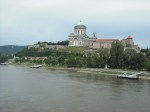
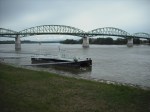
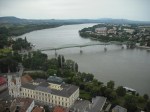
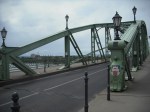
Just writing to say that, in Budapest last weekend with some spare time before a conference, and having just learned of Paddy’s passing, I felt it appropriate to make a brief trip out to Esztergom – the town on a bend in the Danube where, on the bridge, A Time of Gifts ends and Between the Woods and the Water commences.

After a winding 90-minute train ride down a single-track line, I emerged at the end of the line, Esztergom, and into a sleepy provincial eastern European town (the fact that it was Sunday lunchtime probably the defining reason for this). After a good 30 minute walk into the town centre, past a very pleasant main square with some almost northern Italian architecture, you suddenly see the mammoth marble basilica overlooking the town on a hill. This is the seat of the Hungarian Catholic Church, and an important place of pilgrimage. Around the basilica are grouped some nice old cobbled streets and religious buildings, while the Danube flows calmly by.

I scrambled up a back way to the basilica, then climbed up onto the cupola which provides an incredible view of the Danube bend and nearby hills (see the attached photos). All the while, I tried to imagine a young and inquisitive countryman with a knapsack doing a similar thing in 1934. What I left until last was walking over the bridge (destroyed in 1944, so it’s sadly not the same structure Paddy tramped over) which now links Slovakia and Hungary. Reading the two books had a considerable effect on me, so this was quite an exciting moment. After a brief meditative pause in the middle, and a few minutes’ ambling on the Slovakian side, I returned over the bridge into Esztergom having toasted Paddy with a small cigar en route.

So a very pleasing day trip overall, with just one slight regret – that I didn’t have the two books with me at the time!

Thanks,

Ed Ricketts

Related article:

Easter 1934 – Paddy reaches the Hungarian border at Esztergom 

Honoring Patrick Leigh Fermor: Review Essay

This is quite an excellent essay that focuses on Paddy’s writing more than many other profiles.

Paddy in 1966

by Willard Manus

Reading Patrick Leigh Fermor today is both an exhilarating and depressing experience, exhilarating because of the depth and brilliance of his prose, depressing because the Greece he portrays so memorably has been hammered to dust by the march of time. Fermor, who was knighted in 2003, is best known in Greece and in his native Britain, where he was born nine decades ago to Sir Lewis Leigh Fermor, director of the Geological Society in India, and Eileen Ambler, who was partly raised there. His first book, The Traveller’s Tree, published in 1950, dealt with the journey he made through the Caribbean islands in 1947-48. The book won the Heinemann Foundation Prize for Literature, and established him as a writer of note.

His next two books, 1952’s A Time to Keep Silence, which described his stay in various European monasteries (where he discovered in himself “a capacity for solitude”), and 1956’s The Violins of Saint-Jacque, a novel, are interesting but minor works. His literary and political importance is linked to the two books on Greece he published a decade later—Mani: Travels in the Southern Peloponnese and Roumeli: Travels in Northern Greece. Established his reputation as the pre-eminent non-native writer on 20th century Greece.

Fermor’s first experience of the country dated back to 1933, when as a rebellious and untamed 19-year-old, he dropped out of Sandhurst and set out on a walking tour of Europe with Constantinople as his ultimate destination was Constantinople. Envisioning himself as “a medieval pilgrim, an affable tramp with a knapsack and hobnailed boots,” he embarked, in mid-winter, on a journey that eventually spanned three years and took him through the Netherlands, Germany, Austria, Hungary, Rumania and, eventually, Greece. 2

Remarkably, Fermor did not write about his picaresque adventures in pre-war Europe until many years later. “So when A Time of Gifts appeared in 1977 and Beneath the Winds and the Water in 1986, the life of the mid-thirties that he described had been utterly destroyed,” his biographer Artemis Cooper has noted, “and much of the land he had walked over was in the grip of communism for years. Yet his memory recreated this world with an astonishing freshness and immediacy, and recaptured the young man he was then: full of curiosity, optimism and joy in the vibrant diversity of the world.”  The concluding volume of Fermor’s trilogy is scheduled for publication (by John Murray Ltd.) in early 2007.

Fermor made it to Constantinople on New Year’s Day, 1935, and then crossed south into Greece. He spent time in a monastery on Mt. Athos, got caught up later in a Royalist vs. Republican battle in Macedonia, arriving finally in Athens, where he met the great love of his life, the Romanian Balasha Cantacuzene. They went to Poros and lived together in an old water mill, where he wrote and she painted. When the money ran out they retreated to her decaying family home in Baldeni, Moldavia.

Fermor described the house in an essay published in Words of Mercury, “Most of a large estate had been lopped away in the agrarian reform. There was little cash about, people were paid in kind by a sort of sharing system, so, in a way, were the owners; and, on the spot, there was enough to go around. Elderly pensioners hovered in the middle distance and an ancient staff would come into being at moments of need. . . .

“There was one crone there who knew how to cast spells and break them by incantations; another, by magic, could deliver whole villages from rats. After sheep-shearing, a claca, fifty girls and crones, bristling with distaffs would gather in a barn to spin; hilarious days with a lot of food, drink, singing and story-telling.

“Snow reached the windowsills and lasted till spring. There were cloudy rides under a sky full of rooks; otherwise, it was an indoors life of painting, writing, reading, talk and lamp-lit evenings with Mallarme, Apollinaire, Proust and Gide handy; there was Les Enfants Terribles and Le Grand Meaulnes and L’ Aiglon read aloud; all these were early debarbarizing steps in beguiling and unknown territory.”

Fermor was not quite the barbarian he fancied himself. Despite having rejected higher education, he was already something of a polymath, an autodidact. Not only was he conversant in five European languages (only Hungarian stumped him), he was knowledgeable about art, history, architecture, geography, sociology, religion, fashion, etymology, cartography, heraldry and many other subjects, all of which he had absorbed through voracious reading.

The importance of books in his life was discussed in a piece he wrote for The Pleasure of Reading (ed. Antonia Fraser, Bloomsbury, 1992). “When the miracle of literacy happened at last, it turned an unlettered brute into a book-ridden lunatic,” he confessed. “Till it was light enough to read, furious dawn-watches ushered in days flat on hearth-rugs or grass, in ricks or up trees, which ended in stifling torch lit hours under bedclothes.”‘

Among his favorite writers were Dickens, Thackeray (Vanity Fair, anyway), the Sitwells, Norman Douglas, Aldous Huxley and Evelyn Waugh, not to speak of Kipling and Houseman; Baudelaire and Ronsard in French; Horace and Virgil in Latin; Holderlin, Rilke and Stefan George in German.

“The young learn as quick as mynahs, at an age, luckily, when everything sticks,” he continued. What also stuck were “reams of Shakespeare, border ballads, passages of Donne, Raleigh, Wyatt and Marvel . . . two Latin hymns, remnants of spasmodic religious mania . . swatches from Homer, two or three epitaphs of Simonides, and two four-line moon-poems of Sappho.”

Fermor’s list also includes “the eleventh edition of the Encyclopedia Britannica … a battery of atlases, concordances, dictionaries, Loeb classics, Pleiades editions, Oxford companions, Cambridge histories, anthologies and books on birds, beasts, plants and stars.”

When Britain declared war in 1939, Fermor immediately went home to join up, leaving Balasha behind in Romania. He first enlisted in the Irish Guards, but because of his fluent command of Greek he was commissioned into the Intelligence Corps, serving at first as liaison officer to the Greek army fighting the Italians inAlbania. After Greece fell, Fermor was sent to Crete where he took part in the battle against the German airborne invasion. He remained on the island after the German triumph; disguised now as a Cretan shepherd, with a big handlebar moustache and a dagger in his belt, the tall, slim, Fermor cut a swashbuckling figure as he roamed the mountains to help organize the resistance movement.

It was there, in Crete’s high, wild country, that he recalled in Words of Mercury that…

“devotion to the Greek mountains and their population took root. . . . We lived in goat-folds and abandoned conical cheese-makers’ huts and above all, in the myriad caverns that mercilessly riddle the island’s stiff spine. Some were too shallow to keep out the snow, others could house a Cyclops and all his flocks. Here, at ibex- and eagle-height, we settled with our small retinues. Enemy searches kept us on the move and it was in a hundred of these eyries that we got to know an older Crete and an older Greece than anyone dreams of in the plains. Under the dripping stalactites we sprawled and sat cross-legged, our eyes red with smoke, on the branches that padded the cave’s floor and spooned our suppers out of a communal tin plate: beans, lentils, cooked snails and herbs, accompanied by that twice-baked herdsman’s bread that must be soaked in water or goat’s milk before it is eaten. Toasting goat’s cheese sizzled on the points of long daggers and oil dewed our whiskers. These sessions were often cheered by flasks of raki, occasionally distilled from mulberries, sent by the guardian village below. On lucky nights, calabashes of powerful amber-colored wine loosened all our tongues. Over the shoulders of each figure was a bristly white cloak stiff as bark, with the sleeves hanging loose like penguins’ wings; the hoods raised against the wind gave the bearded and mustachioed faces a look of Cistercians turned bandit. Someone would be smashing shells with his pistol-butt and offering peeled walnuts in a horny palm; another sliced tobacco on the stock of a rifle; for hours we forgot the war with talk and singing and stories; laughter echoed along the minotaurish warrens.”

In 1944 Fermor took part in a bold and perilous mission that later became the subject of a best-selling book, Ill Met by Moonlight by W. Stanley Moss, a fellow intelligence officer. 5 The British plan was to kidnap the German army’s chief of staff, General Muller, who had become notorious and hated for his brutal treatment of both Cretan partisans and civilians. When Muller was called away, the new target was his replacement: General Heinrich Kreipe, a professional soldier arriving straight from service on the Russian front.

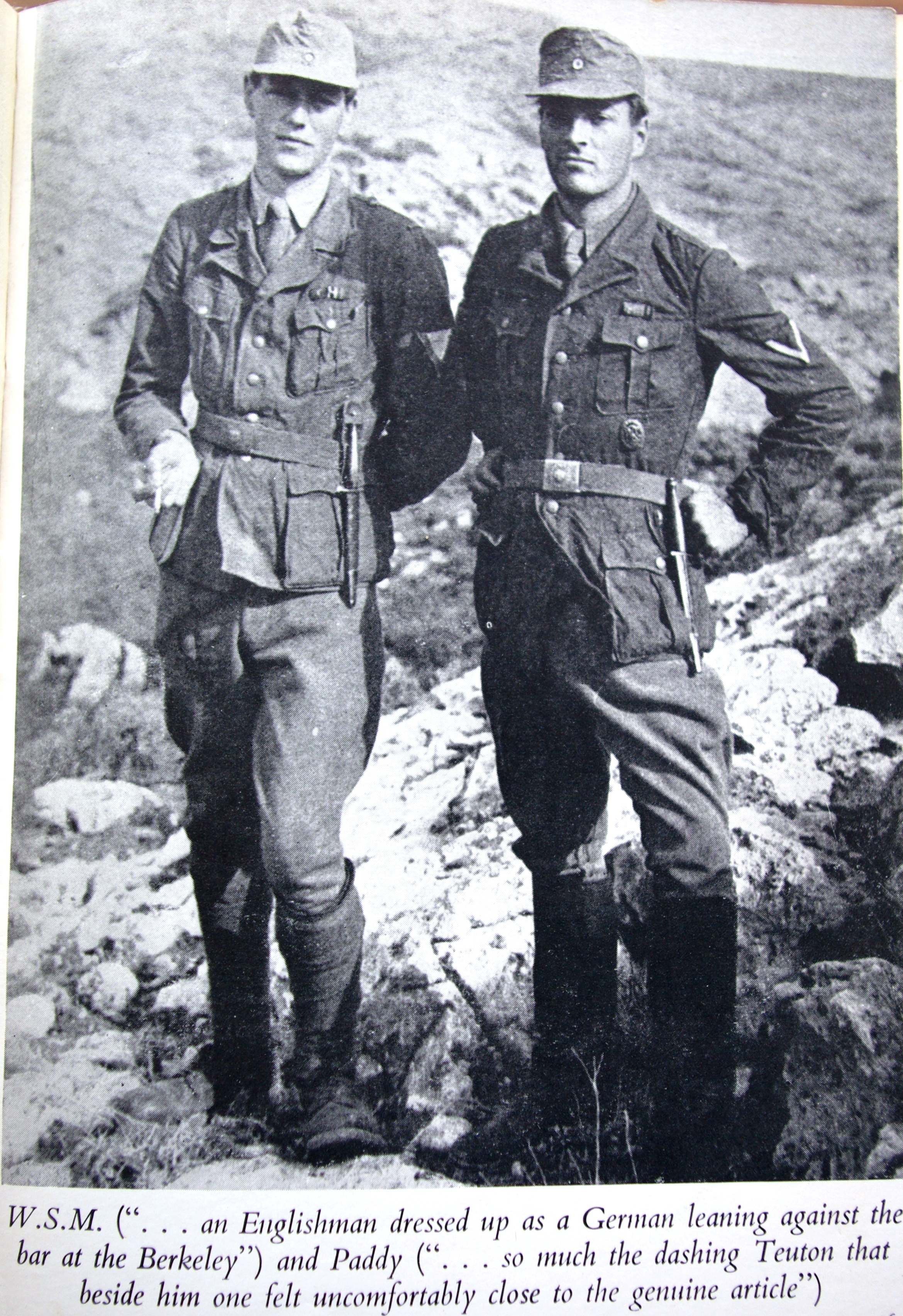
Fermor and his team, which included Moss, Sandy Rendel (former political correspondent for the Sunday Times), the Cretan partisan Niki Akoumianakis and a dozen other andartes, had to radically alter their original plan. Fermor and Moss agreed to disguise themselves as German military policemen. That meant Fermor had to part with his Cretan moustache Without it, he looked so much the stiff-necked Teuton that Moss kidded him about being on the wrong side. They decided to promote themselves to corporal’s rank and decorate themselves with a few (stolen) ribbons.

Taking up positions outside the isolated Villa Ariadne—the headquarters for the German army had been built above Heraklion before the war by the archaeologist Sir Arthur Evans—Fermor and Moss flagged the general’s car down at 9.30 pm.

“Is dies das general’s wagon?” he asked.

“Ja, ja,” came the muffled answer from inside.

With that assurance, key members of the band attacked from all sides, tearing at the doors of the car. The beam of a flashlight showed the startled face of the general and the chauffeur reaching for his automatic. There was the thud of a bludgeon; the chauffeur keeled over and was dragged out of sight.

The general, who offered no resistance, was brought to Anogia, the largest village on Crete, located on the northern slopes of Mt. Ida. “Famous for its independent spirit, its idiosyncrasy of dress and accent, it had always been a great hideout of ours,” said Fermor in an account written in 1969  for the Imperial War Museum.

Fermor related that a note had been left in the general’s car stating that he was safe and “would be treated with the respect due to his rank,” and that the kidnap had been carried out by British officers and Greek nationals serving as soldiers in the forces of His Hellenic Majesty. “The point  was to give the Germans no excuse for carnage and reprisals in the Knossos area.”

The next day, however, a single-winged Feiseler-Storck reconnaissance plane circled above Anovia and dropped a steady snowfall of leaflets. “To all Cretans,” the message read, “last night the German General Kreipe was abducted by bandits. He is being concealed in the Cretan mountains and his whereabouts cannot be unknown to the inhabitants. If the General isn’t returned within three days, all rebel villages in the Heraklion district will be razed to the ground and the severest reprisals exacted on the civilian population.”

The general was not, of course, returned to the Germans; he was smuggled off the island and delivered by submarine to British army headquarters in Egypt, and the Germans exacted their promised revenge. Fermor deals with this in circumspect fashion in his official report, asserting that “most untrue to form, there had been little violence, few arrests, no shooting on the part of the Germans.”

Fermor’s statement is disputed by Dr. Michael E. Paradise, a Midwest-based Greek-American whose father and two brothers were members of the British intelligence group on Crete. Though in his teens, Michael himself was often used as a courier. “Attacking in the darkness of one night,” he wrote in the April 10, 1997 edition of The Greek American (a now-defunct, New York-based newspaper), “the Germans proceeded to destroy several villages with the utmost brutality and ferocity. I was witness of the destruction of one of the villages, Ano Meros, on Mt. Kendros in Amari.”

The kidnapping of Gen. Kreipe, Paradise asserted, “contributed to the unnecessary death of hundreds of men, who were hunted down like wild animals in the streets of their villages, then, while some were injured and still alive, they were burnt in the houses of the villages, and buried in them when the dynamiting of the houses followed.”

Most Cretans, though, have not held a grudge against Fermor and his gung-ho confederates. As one veteran Cretan commando said at the time of Kreipe’s abduction, “So they’ll burn down all the houses one day. And what then? My house was burnt down four times by the Turks. Let the Germans burn it down for a fifth time! And they killed scores of my family, scores of them, my child, yet here I am! We’re at war and war has all of these things. You can’t make a wedding feast without meat.”

After the war—and his brief Caribbean sojourn—Fermor realized that his love of Greece had tied himself forever to the country’s fortunes. He lived for a time on Evia, then Ithaca and Hydra (in the house of the painter, Niko Ghika). Soon after he began his travels in the far corners of the Greek mainland which led to the publication of his two masterpieces, Mani and Rozemeli. Accompanied by the photographer (and his wife-to-be) Joan Rayner (daughter of the Conservative politician and First Lord of the Admiralty in Ramsay MacDonald’s coalition government, Belton Eyres Monsell), whom he had met in wartime Cairo, Fermor set off with this goal in mind: “To situate and describe present-day Greece of the mountains and islands in relationship to their habitat and history.”

Mani is the southernmost part of Greece, an isolated, mountainous and forbidding peninsula known for its stark, sun-blistered landscape and warlike, feuding inhabitants. Despite having been warned not to attempt to penetrate into The Deep Mani— “the Maniatis are dangerous”—”they are Jews”—”they fear and hate foreigners”—”they live on salted starfish”—Fermor and Rayner defiantly set out on foot and mule, bus and caique, in search of an authentic Greek world.

What they found and reported on was a revelation to one and all. The Mani was a strange, combative place, to be sure—most people lived in pyrgi, stone towers that were more fortress than domicile—but it was fantastical at the same time, rich in history and bravery (no part of Greece played a more conspicuous and valuable part in the War of Independence). With its code of honor and hospitality, its love of freedom, the Mani was also pulsing with life, colorful in speech, custom, ritual and superstition.

The book that came out of this expedition into the heart and soul of the Mani became an instant classic. Fermor’s prose and Rayner’s photographs (sadly dropped from subsequent editions) won plaudits from critics and readers alike. The British artist (and longtime Greek resident) Polly Hope has said, “Mani was one of the books that brought me to Greece. When my husband and I first read it we knew instantly that this was the world we wanted to go to. It told of magic and fury and history and people and landscape. Completely breathtaking. We read it and reread it and read it again until our heads were full of towers and feuds, cucumbers like slices of ancient pillars, and ouzo. Donkeys and heat. And the dark sea that because of the extraordinary Greek light stands up vertically as far as the horizon. We had to go. And immediately. “We did, and remained, though not in Mani. Still all these years later it is the book that tells about Greece as it is. It is still right and as clear and informative as that first reading. Although tourism has spread its ugly veil over most of Greece the people are still there, the feuds and cucumbers, the vertical sea and broiling sun.”

Similar praise was bestowed on Roumeli when it was published eight years later. Fermor and Rayner’s portrait of the northeast corner of Greece, including Messolonghi, where Lord Byron (one of Fermor’s heroes) fought and died for Greece, is as vivid and compelling as anything in Mani. Whether writing about the sarakatsans, the nomadic shepherds—”self-appointed Ishmaels”—who inhabited the mountaintops, speaking in a  secret tongue; or the origins of the local Karayiozi puppet shows; or the Meteora monasteries; or the “stone-age banquet” (celebrating an arranged marriage) to which they were invited, Fermor’s prose shines and shimmers like beaten gold.

Historian John J. Norwich believes that Fermor “writes English as well as anyone alive.” 7 He also praised ‘the preternatural copiousness” of Fermor’s two books. Jan Morris seconded the statement, adding that Fermor was “beyond cavil, the greatest living travel writer.” In November, 2004 the British Guild of Travel Writers concurred, bestowing on Fermor its Lifetime Achievement Award.

Fermor won another important prize in 2004: the second Gennadius Trustees’ Award for his support of things Greek. At the ceremony in Athens,  the previous recipient of the award, writer/translator Edmund Keeley, said, “I look upon Mr. Fermor as one of my first mentors, a man of letters who taught me, perhaps more than any other Philhellene, the best way to write about the second country we have both come to love and to  celebrate in our work.”

After lauding Fermor for his “imaginative projection of Greece,” Keeley offered a specific example of the kind of “special insight” that Fermor  brings to his writing about Greece. “A scene in his superb book on the Mani . . . not only captures the essence of Greek hedonism . . . but  demonstrates his easy and subtle understanding of the Greek sensibility.”

The scene took place in “the glaring white town” of Kalamata where the Feast of St. John the Baptist was being celebrated. Fermor, his wife Joan, and their friend the writer Xan Fielding sat down to eat their dinner set out at the water’s edge on flagstones “that flung back the heat like a casserole with the lid off.”

Suddenly they decided to pick up their iron table, neatly laid out, and set it down a few yards out to sea, followed by their three chairs, then by the three of them sitting down with the cool water up to their waists. Quite sensible, the only slightly odd thing about this was that all three were fully dressed. Yet the really significant moment, the epiphany, came when the waiter arrived on the quay, gazed in surprise at the space they’d left empty on the burning flagstones, and then (quoting Fermor) “observing us with a quickly masked flicker of pleasure,” stepped without further hesitation into the sea and “advanced with a butler’s gravity” to put down their meal before them, three broiled fish, “piping hot, and with their golden brown scales sparkling.”

As Keeley pointed out, “It is Fermor’s seeing both that flicker of pleasure and the quick masking of it that says so much, more even than his report that others on the quay sent their seaborne fellow diners can after measuring can of retsina, and a dozen boats gathered around to help them consume the complimentary wine, and a mandolin arrived . . . to accompany rebetika songs in praise of the liberated life. Only those who have often taken apart and savored a broiled tsipoura or fangri . fresh from the sea and amply bathed in an olive-oil-and-lemon sauce would recognize why no representative Greek citizen given to pleasure would think of disturbing, except in a celebratory way, any table holding such a succulent, earthy gift from the Gods. And only a writer with Fermor’s precise vision and brilliant skill in expression would choose to show our hedonistic waiter appropriately masking his pleasure and assuming the gravity of a butler as he entered the sea on his mission to deliver the gods’ gift.”

It is, alas, harder and harder to find such raffish scenes in 21stcentury, tourist-choked, EU-regimented Greece. Even Fermor, in a recent essay, had to admit that much of what he first encountered and experienced in Greece has disappeared. “Progress has altered the face and character of the country,” he commented. And as for tourism, “it destroys the object of its love.” 10

That said, Fermor still continues to write about Greece. In his 90s, living alone in the pyrgos he built in the Outer Mani—Joan died in 2000, of injuries suffered in a fall—he toils away on the final book of his Hook of Holland to Constantinople trilogy, the one that deals with his first years in Greece, working from notebooks, maps and memory. In a way Fermor is a chronicler of a bygone age, a rememberer of things past. The Greece he reveres may have died, but he battles with the last strength in him to keep its spirit alive.

Notes

1. ‘Only two of Fermor’s books are in print in the United States: A Time of Gifts and Between the Woods and the Water. They are New York Review of Books Classics. In the UK, most of Fermor’s books are published in hardbound and paperback by John Murray Ltd., but Penguin has published a few of his titles as paper reprints. The following are his major publications. Mani: Travels in the Southern Peloponnese. Photos by Joan Eyres (London: Murray, 1958); Translation of George Pyschounadkis, The Cretan Runner: His story of the Germany Occupation. (London: J. Murray, 1978, c1955); Roumeli: Travels in Northern Greece (London & NY; Penguin, 1983, c1966); Introduction to Kostas Chatzepateras, Greece 1940-41 Eyewinessed (Anixi Attikis {Greece}: Efstathiadis Group, 1995); Text with Stephen Spender of Ghika: Paintings, Drawings, Sculpture (London: Lund Humpries, 1964); A Time of Gifts; On Foot to Constantinople, from the Hook of Holland to the Middle Danube (NY: New York Review of BooKs, 2005).

2. Quotations is from a review from “Scholar in the Woods,” a review by James Campbell in The Guardian, April 8, 2005.

3. ‘James Campbell, Words of Mercury.

4. A11 quotes regarding Fermor’s reading tastes are taken from his essay in
the anthology The Pleasures of Reading edited by Antonia Fraser, Bloomsbury,
1992.

5. ‘The details of the kidnapping are taken from Ill Met by Moonlight (London:
Harrap, 1950). In the movie of the same name released in 1958, Fermor is
played by Dirk Bogarde.

6. Letter to the author sent in 2004.

7. Copy written for the dusk jacket of the paperback edition of Between the Woods and the Water.

8. Ibid.

9. This and subsequent Keeley citations are from a 2004 letter to the author. Date?

10. See Fermor’s essay in A Time of Gifts.

Travel writing: Lost art in search of a lost world

Few authors have been able to equal Patrick Leigh Fermor’s ability to dissolve into the places described in his books.

Editorial, first published in The Guardian 18 June 2011

“I hate the French cookery, and abominate garlick,” Tobias Smollett told his readers 245 years ago, with a snooty disregard for foreigners that runs through too much travel writing today. Describing distant places fairly, curiously and entertainingly has never been easy. Few authors, in any century, have been able to equal Patrick Leigh Fermor’s liquid ability to dissolve into the places described in his books, so that he seemed to be less reporting on than living in them. His death this month, at 96, with the third of his great trilogy of prewar European exploration still unpublished, is a moment to ask what travel writing can still achieve.

Leigh Fermor was lucky, in that he walked through an archaic and aristocratic eastern Europe soon to be obliterated by the second world war. His two greatest books, A Time of Gifts and Between the Woods and the Water, take readers into a time and place that can never exist again, and that, as much as his pitch-perfect writing, is why they are among those few books worth reading many times.

Few of today’s writers have this advantage. They must describe a world in which it is easier to communicate, and travel, than ever before. No teenager setting off from Tower Bridge now would find themselves amid ballgowns, hunting parties and lonely mountaintop shepherds. Facebook and text messaging have brought Bucharest and Birmingham closer. Describing difference has been made harder.

Leigh Fermor was one of the last of the great travel writers whose experience spanned the previous century. A varied assortment, mostly men, wrote books that still stand as classics today: among them Eric Newby, Norman Lewis and Wilfred Thesiger. Jan Morris, still writing, deserves to be among them. Two decades ago, a fresh crop of authors revived the art but then fell victim to their own celebrity, Bruce Chatwin and Paul Theroux included.

Where does travel writing stand now? There are fewer famous authors and fewer sales. Some of the best books involve almost no travel at all: Roger Deakin’s account of wild swimming in Britain, Waterlog, or Neil Ansell’s lovely Deep Country, about the birds and landscape of mid-Wales. William Dalrymple remains an explorer in the classical sense: in From the Holy Mountain he shows Byzantium is not quite destroyed. William Blacker’s Along the Enchanted Way, about eight years living in rural Romania, is the closest modern writing has come to Leigh-Fermor, and not only because the Gypsy and Saxon life he shares is almost gone.

Always, the attraction is the slow pace. There is no need for hurry, no requirement for horror, just immersion in a place and time that is different, even when it is not far from our own.

The Phoenix Land: The Memoirs of Count Miklós Bánffy

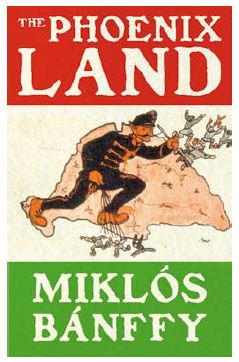
A reminder that Arcadia Books will be republishing Count Miklós Bánffy’s memoirs “The Phoenix Land” in June 2011. The book is already available for pre-order in bookshops such as Waterstones in the UK. and of course on Amazon. Arcadia first published this in 2004 and you can read a Spectator review here.

Bánffy’s memoirs were translated from the Hungarian by his daughter Katalin Bánffy-Jelen and Patrick Thursfield,winners of the Oxford Weidenfeld Translation Prize. Paddy once more offers a foreward. The blurb describes the book as follows:

“The thousand year-old year-old kingdom of Hungary, which formed the major part of the Austro-Hungarian Empire until the last Habsburg fled in 1918, was finally dismembered by the Western Allies by the terms of the peace treaties which followed the First World War. Phoenix-like the Hungarian people survived the horrors of war, the disappointment of the first socialist republic, the disillusion of the brief but terrifying communist rule of Béla Kun, and the bitterness of seeing their beloved country dismembered by the Treaty of Trianon. This is the world that Miklós Bánffy describes in The Phoenix Land.”

I contacted Gary Pulsifer at Arcadia for some further background and to ask him to explain more about why Bánffy is one of their authors. He sent me this, including a little vignette about Paddy and the writing of his introduction:

Tom, two reasons, one general, one specific. The first is that Arcadia specialises in translated fiction. The second is the story and this is it:

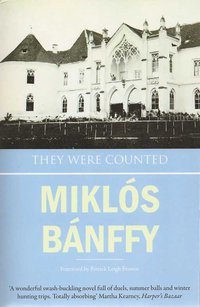
When I worked at Peter Owen Publishers I was invited to Tangier by the Hon David Herbert, one of Peter’s authors. He took my partner and me to lunch with his neighbour Patrick Thursfield, who as you know is the Bánffy co-translator. After lunch Patrick gave me the manuscript of THEY WERE COUNTED, which I read while I was on holiday, and was hooked. I tried to persuade Peter Owen to publish the trilogy, but no go, so when I started Arcadia in 1996 volume one was one of our early titles. I became quite close to Patrick, stayed with him in Tangier and saw a lot of him in London and he even once came along to the Frankfurt book fair. He was overjoyed when THEY WERE DIVIDED won the Weidenfeld Translation Prize (this happened at an awards ceremony in Oxford, when Umberto Eco presented the prize).

A funny aside is that Paddy’s forward was written in longhand and he came into our tiny offices to have Daniela de Groote, now our associate publisher, word-process it. Daniela, who is Chilean, hadn’t been in the UK all that long – she had been studying for a PhD here prior to working at Arcadia – and she had some difficulties in understanding Paddy’s upper crust accent as he dictated the foreword. Daniela was also catching a plane to Santiago that afternoon and the whole thing was a little much for her. So much so that I had to leave the office until they were finished . . .

Anthony Lane’s New Yorker article on Fermor is now free to view

Anthony Lane's New Yorker article, May 2006

In trying to make this blog a focal point for all information related to Paddy I have had some problems accessing all on-line material. The one I most sought is the acclaimed May 22, 2006 profile by Anthony Lane which was published in the New Yorker.

This has sat behind their subscriber firewall, tempting us with one-off subscriptions. Now it appears that (possibly marking Paddy’s death?) this is no longer the case. You can now visit their archive, read the article in full on-line, print it or possibly even download it.

There are many profiles of Paddy. This is probably one of the longest and best, and includes interview material with him that many will have not seen before.

Take a trip to the New Yorker website and have a read.

Editor’s Note:  the pdf download appears to be no longer available – click on the article to magnify to read and then drag your cursor to move around the page.

Benedict Allen’s Travellers’ Century on Patrick Leigh Fermor

This is from the television review pages of the Independent covering Benedict Allen’s 2008 ‘Traveller’s Century’ series and the episode that focused on Paddy’s walk ending at the Iron Gates. I have seen this programme and share some of the frustrations of the author, but on balance it was a pretty fair programme given the tight time slot of just one hour.

by Deborah Orr

First published in The Independent 8 August 2008

The bit that delighted us all in this final episode of Travellers’ Century was a clip from another television show. There he was, Patrick Leigh Fermor, the star of the Greek version of This Is Your Life, meeting all the resistance fighters that he had worked with on Crete during the Second World War. And there, unbelievably, and every bit as thrilled to be reunited with Leigh Fermor as all the others, was the German former general Heinrich Kreipe. The two men grinned, hugged and fell into excited conversation, absolutely chuffed to see each other again. That is charm, is it not, the ability to inspire the deep affection of a man you only ever knew because you had spearheaded his humiliating wartime capture, then imprisoned him in a cave? A man, indeed, who was then portrayed in the film of the operation, Ill Met by Moonlight, as a bull-necked, grunting, Nazi ugly, while his nemesis was played by Dirk Bogarde?

I’ve been lucky enough to meet Leigh Fermor – dazzlingly charismatic company in his nineties – on a couple of occasions. So it seemed apposite to gather round the telly with the mutual friends who introduced us, so that we could all watch this film about his life together. Such is the fervour of loyalty that the man inspires, though, that it quickly became apparent that this show, or perhaps any show, would disappoint us. The first heckles came when Benedict Allen described Leigh Fermor as “the accidental superstar of travel writing”, a description we all decided would make him squirm. Concerns over tone were swiftly replaced with outright indignation, when Allen announced that he would be retracing the steps of Leigh Fermor’s first great walk across Europe, which he set off on in 1933, aged 18, in order to judge whether his descriptions had been “accurate”. This idea, again we all agreed with some disgruntlement, was facile beyond belief.

Allen’s idea was perhaps not such a weird one, though. Leigh Fermor’s book detailing the first leg of his journey had been published in 1977, after all, decades after he had made it. The delay had come about because his notes had been stolen in Romania. Again, it is testament to the affection he inspires that the local people who recovered the young Englishmen’s journal hung on to it in the hope that they would one day get the opportunity to return it to him. We all abhorred Allen’s attitude, nevertheless. When he suggested that Leigh Fermor’s two books describing his travels, A Time of Gifts and Between the Woods and the Water, might have been “endlessly worked and reworked, with whole decades of hindsight”, there was a generally mutinous feeling in the room that our man was being seriously impugned.

Allen regained a little trust when he decided, having visited some little-altered spots in Heidelberg, that the writer had indeed told it like it was. But when Allen changed his tune, and started suggesting that the books were weirdly apolitical, and offered too little detail about his own inner life, we sank again into despondency. The purity of Leigh Fermor’s writing comes from his scrupulous observation of what he encountered, and the beauty with which he describes it. He doesn’t bang on about himself. Anyway, on it went, as we nit-picked every assertion. By the time Allen got to interview Leigh Fermor, at his home of very many years in the Peloponnesus, we hated and resented him, and were only too happy to dismiss the interview itself as a dead loss. “And the programme was too long,” we agreed at the end. “If we thought that, what did everyone else think?” Actually “everyone else” would probably have enjoyed the thing a great deal more, not being hampered, like us, by an almost deranged sense of hyper-loyalty.

Tales of a literary traveller: Sir Patrick Leigh Fermor

I have been amiss and I should have published this earlier. I was contacted by John Stathatos who is a Greek photographer and knows Paddy. He emailed me back in January which was during my ‘down time’ on the blog.
Dear Tom,
While chasing up references to Costa, I discovered that the Robin Hanbury-Tenison piece on your site (“The Friendly Isles: in the Footsteps of Patrick Leigh Fermor“) is actually based on an earlier and more wide-ranging article entitled “Tales of a Literary Traveller”, first published in the Geographical magazine in 2004. You can find the earlier one here: Why this should be available on a site called CBS MoneyWatch is entirely beyond me, but that’s the Internet for you…
All the best,
John

Tales of a literary traveller: Sir Patrick Leigh Fermor DSO, OBE is widely considered to be our greatest living travel writer, and was knighted earlier this year for, as he put it, just writing a few books. Robin Hanbury-Tenison, who has known ‘Paddy’ for 50 years, explains why the great man’s writing is as powerful and important today as it has ever been

First published in the Geographical August 2004

by  Robin Hanbury-Tenison

Robin Hanbury-Tenison

Patrick Leigh Fermor is a unique mixture of hero, historian, traveller and writer: the last and the greatest of a generation whose like we won’t see again. Bringing the landscape alive as no other writer can, he uses his profound and eclectic understanding of cultures and peoples, their origins and current place in the world, to paint vivid pictures–nobody has illuminated the geography of Europe better through literature. Everything is grist to his mill; nothing is ever banal. He expects much of his readers and we’re kept on our toes, constantly reaching for the dictionary or Brewer’s. In return for these achievements, he was finally knighted this year at the age of 88. He had modestly refused this honour previously on the grounds that all he had done was “write a few books”.

I first met Paddy (as he has always been known) in Athens in 1954 when I was a callow 18-year-old travelling through Greece. I remember sitting at a cafe in Metaxas Square while waves of witty erudition washed back and forth between him and my older travelling companion, and being humbled into awed silence. Paddy has always appeared larger than life, both in his personality and in his relatively rare and carefully honed writing. We corresponded from time to time over the years and eventually met again when he and his wife Joan had my wife and me to lunch at their house in Greece, where we were made to feel instantly at home.

Since Joan’s death, Paddy has spent more time in England, which gives us all more opportunity to see him. In May this year, a dinner was held for him by the Travellers Club, at which he was presented with a specially commissioned map of the route that he followed through Europe during the early 1930s and that he later wrote about so vividly. He spoke at the dinner and, now 89, held us all spellbound with some classic tales. One of the club waitresses was from Sofia and, to her delight and the amazement of all around, he launched into apparently fluent Bulgarian as she served him.

The bare details of his life, too, delight and amaze. The son of Sir Lewis Leigh Ferrnor, the director of the Geological Survey of India, Paddy was sacked at 17 from King’s School, Canterbury (for the terrible crime of “holding hands with the greengrocer’s daughter”), and spent the next 18 months walking to Constantinople, a journey that he wrote about with apparent total recall some 40 years later in A Time of Gifts, the first volume of a trilogy. It was followed by Between the Woods and the Water. We still await the final volume.

In the Second World War, Paddy served with the Special Operations Executive–the precursor of the SAS–and, because he spoke Greek, was parachuted into Crete behind enemy lines to help organise resistance against the Germans. In April 1944, having already spent more than a year living there, he pulled off one of the most dramatic exploits of the war.

Dressed as Feldpolizei corporals, Paddy and Captain Billy Moss–who subsequently wrote the book on which the film Ill Met by Moonlight was based–stopped the car in which General Heinrich Kreipe, the recently arrived commander of the German occupation forces, was being driven by his chauffeur. The driver was removed and handed over to members of the Cretan Resistance, while Paddy put on the general’s hat and proceeded to drive on through 22 control posts. The car was then abandoned, and the two soldiers marched their prisoner through that night and the next day to a cave high in the mountains.

In order to avoid reprisals against the Cretans, leaflets were to be dropped all over Crete, containing a message that the BBC also broadcast: that the general was safe, and would be treated with the respect due his rank; that the operation had been carried out by British officers; and that they were all on their way to Cairo by submarine. Two days later, they woke among some rocks near the summit of Mount Ida, just as dawn was breaking. Half to himself, General Kreipe recited in Latin the opening line of a Horace ode. As Paddy subsequently described in his report to the Imperial War Museum: “He was in luck. It is the opening line of one of the few odes of Horace I know by heart–Ad Thaliarchum, I.ix” and he went on to recite the remaining five stanzas. “The general’s blue eyes swivelled away from the mountain-top to mine–and when I’d finished, after a long silence, he said: ‘Ach so, Herr Major!’ It was very strange. ‘Ja, Herr General.’ As though, for a long moment, the war had ceased to exist. We had both drunk at the same fountains long before; and things were different between us for the rest of our time together.”

After the war, Paddy spent six months travelling through the Caribbean with Joan Eyres-Monsell–the woman who, 20 years later, was to become his wife–and Costa, the great Greek photographer. The result was his first book, The Traveller’s Tree, which brought the Caribbean to the notice of post-war Britain. Back then, the many islands they visited were thoroughly run down. The great buildings–of church, state and planters’ wealth–were mostly ruined and rotten. In the depressed economic climate immediately following the war, the future looked bleak; indeed, ‘King Sugar’ was about to die, this time as a victim of sugar beet and the macropolitics being played out between the USA and Europe.

Yet Paddy still managed to reveal the archipelago’s romance and magic, and The Traveller’s Tree was hailed as a masterpiece and won the Heinemann Prize. Paddy’s portrayal of the islands could be said to have jump-started the tourism industry upon which the Caribbean has since largely depended.

It was the Caribbean, too, that provided the backdrop to Paddy’s only novel, The Violins of Saint-Jacques, which brings alive the glamour and the passions of the planters in their heyday. This tale of a rich island being destroyed by a volcanic eruption in the middle of a splendid planters’ ball is based on the true story of the annihilation in 1902 of St-Pierre, the old capital of Martinique. There, 26,000 people died instantly in the New World’s Pompeii. The sole survivor was the town drunk, who was incarcerated in a cell below ground. He spent the rest of his life as an exhibit in Barnum and Bailey’s Circus.

Paddy eventually returned to Greece, where, during the 1960s, he built a wonderful house above a private cove near the fishing village of Kardamili in the southern Peloponnese. There, in a large room that John Betjeman, an early visitor, called “one of the rooms in the world”, he and Joan entertained a string of artists and writers with copious quantities of retsina, and Paddy wrote.

His greatest book, Mani, was about a journey through that little-known and, at the time, archaic region; the book has been in print ever since. Paddy travelled simply, staying with fishermen and farmers, which enabled him to capture the essence of the region, as this extract reveals:

Beyond the bars of my window the towers descended, their walls blazoned with diagonals of light and shade; and, through a wide gap, castellated villages were poised above the sea on coils of terraces. Through another gap our host’s second daughter, wide hatted and perched on the back of a wooden sledge and grasping three reins, was sliding round a threshing floor behind a horse, a mule and a cow–the first cow I had seen in the Mani–all of them linked in a triple yoke. On a bank above this busy stone disc, the rest of the family were flinging wooden shovelfuls of wheat in the air for the grain to fall on outstretched coloured blankets while the husks drifted away. Others shook large sieves. The sun which climbed behind them outlined this group with a rim of gold and each time a winnower sent up his great fan, for long seconds the floating chaff embowered him in a golden mist.

Almost every page has its own literary tour de force, often with intimidating displays of learning and research mixed with fantasy, imagination and acute descriptions of the scene itself. In his next book, Roumeli, about the minority communities of northern Greece, Paddy becomes fascinated by the last true nomads of the region, the Sarakatsans. His description of their wanderings is, for me, the best sort of literary geography lesson, and has even more geopolitical relevance now than when he wrote it:

The sudden cage of frontiers which sprang up after the Balkan Wars failed to confine them and they fanned out in autumn all over southern Albania and across the lower marches of Serbia as far as Montenegro and Herzogovina and Bosnia and into Bulgaria to the foothills of the Great Balkan. Those who thought of the Rhodope mountains as their home–the very ones, indeed, in the highlands that loom above the Thracian plains–were particularly bold in the extent of their winter wanderings. Not only did they strike northwards, like those I saw by the Black Sea, but, before the Hebrus river became an inviolable barrier, their caravans reached Constantinople and up went their wigwams under the walls of Theodosius. Others settled along the shores of the Sea of Marmara and spread over the rich green hills of the Dardanelles. Many crossed the Hellespont to pitch camp on the plain of Troy. Bold nomads would continue to the meadows of Bythinia and winter among the poplar trees or push on into Cappadocia and scatter their flocks across the volcanic wildernesses round the rock monasteries of Urgub. The boldest even reached Iconium, the home of Jellalludin and the metropolis of the whirling dervishes. They never looked on these enormous journeys as expatriation: until the deracination of the 1920s, much of Asia Minor was part of the Greek world; and even beyond its confines there were ancient Greek colonies.

Those attempting today to sort out the chaos in what was, for a while, southern Yugoslavia could learn a lot from reading Paddy’s books.

One of the main criticisms of Paddy’s writing is that there simply isn’t enough of it. But very few 20th-century writers, with perhaps the exception of Graham Greene, have managed to be prolific while maintaining consistent quality of this kind. The relatively small number of books (much boosted by the release of the paperback of Words of Mercury this mouth) is the work, to quote Anthony Sattin in the Sunday Times, of “one of the greatest travel writers of all time”, a heartfelt wanderer truly involved in mankind.

New editions of both Mani and Roumeli will be published by John Murray near the end of this year. A Time of Gifts and Between the Woods and the Water were reissued by John Murray in March. Words of Mercury is out now in paperback.

Early inspiration: Following Paddy around the Caribbean

Though Patrick Leigh Fermor’s most famous works recount his European travels, it was the Caribbean that inspired his first book. Fifty years later, Robin Hanbury-Tenison and his wife retraced Paddy’s steps:

We hired horses and rode, as Paddy did, between tall forest giants, listening to the jungle buzz and background twitterings. Suddenly, a beautiful, melodious note rang out. This was followed after o moment by three more notes of startling clarity and sweetness and the theme, a bit like the opening bars of Beethoven’s Fifth, was repeated every few minutes. It was a rufous-throated solitaire, which Leigh Fermor describes as making “a noise so melancholy that it seemed the perfect emanation of these sad and beautiful forests. It haunts the high woods of Dominica and nowhere else in the world.”

How does everything about a place change in 50 years, and yet the place itself remain the same? It is because of that unique mixture of cultures that is the Caribbean–and no-one has captured and evoked the extraordinary differences between the islands better than Paddy did in The Traveller’s Tree. Ash says: “Each island is a distinct and idiosyncratic entity, a civilisation, or the reverse, fortuitous in its origins and empirical in its development. “And then again, quoting an old Jamaican: “We’re always going somewhere. But we never get there.”

Patrick Leigh Fermor, however, not only travelled but also arrived. And those of us who read his dispatches home–those calm, intelligent tales of lives lived elsewhere–are in his debt.

The Phoenix Land: The Memoirs of Count Miklós Bánffy

I am just ten tantalising pages away from the end of Miklós Bánffy’s Transylvanian Trilogy (They Were Counted, They Were Found Wanting and They Were Divided) published by Arcadia books. If I have time I will write a short review very soon.The books are lively, and Bánffy writes so well about love, life, and politics in Transylvania and Hungary in the ten years leading up to the start of World War One, an event which was to tear apart the lives of so many, and which ended the comfortable existence of Hungarian aristocracy in Transylvania.

The story will almost certainly end in tragedy and sadness but that does not deflect from from what Patrick Leigh Fermor describes in his foreward to the Trilogy as a story that is “beyond question, dramatic.”.

One cannot read these books without wanting to know more about the author whom Paddy characterises as “such a deeply civilised man.”

The good news is that very soon we shall be able to do so once more when Arcadia Books re-publish Bánffy’s memoirs “The Phoenix Land”. Due for publication on 23 June 2011 the book is already available for pre-order in bookshops such as Waterstones in the UK. Arcadia first published this in 2004 and you can read a Spectator review here.

Bánffy’s memoirs were once again translated from the Hungarian by his daughter Katalin Bánffy-Jelen and Patrick Thursfield,winners of the Oxford Weidenfeld Translation Prize. Paddy once more offers a foreward. The blurb describes the book as follows:

The thousand year-old year-old kingdom of Hungary, which formed the major part of the Austro-Hungarian Empire until the last Habsburg fled in 1918, was finally dismembered by the Western Allies by the terms of the peace treaties which followed the First World War. Phoenix-like the Hungarian people survived the horrors of war, the disappointment of the first socialist republic, the disillusion of the brief but terrifying communist rule of Béla Kun, and the bitterness of seeing their beloved country dismembered by the Treaty of Trianon. This is the world that Miklós Bánffy describes in The Phoenix Land.

In preparing this post I contacted Gary Pulsifer at Arcadia for some further background and to ask him to explain more about why Bánffy is one of their authors. He sent me this, including a little vignette about Paddy and his introduction:

Tom, two reasons, one general, one specific.  The first is that Arcadia specialises in translated fiction. The second is the story and this is it:

When I worked at Peter Owen Publishers I was invited to Tangier by the Hon David Herbert, one of Peter’s authors.  He took my partner and me to lunch with his neighbour Patrick Thursfield, who as you know is the Bánffy co-translator.  After lunch Patrick gave me the manuscript of THEY WERE COUNTED, which I read while I was on holiday, and was hooked.  I tried to persuade Peter Owen to publish the trilogy, but no go, so when I started Arcadia in 1996 volume one was one of our early titles.  I became quite close to Patrick, stayed with him in Tangier and saw a lot of him in London and he even once came along to the Frankfurt book fair.  He was overjoyed when THEY WERE DIVIDED won the Weidenfeld Translation Prize (this happened at an awards ceremony in Oxford, when Umberto Eco presented the prize).

A funny aside is that Paddy’s forward was written in longhand and he came into our tiny offices to have Daniela de Groote, now our associate publisher, word-process it.  Daniela, who is Chilean, hadn’t been in the UK all that long – she had been studying for a PhD here prior to working at Arcadia – and she had some difficulties in understanding Paddy’s upper crust accent as he dictated the foreword.  Daniela was also catching a plane to Santiago that afternoon and the whole thing was a little much for her.  So much so that I had to leave the office until they were finished . . .

You may enjoy browsing the current Arcadia 2011 catalogue which is here as a pdf.

Arcadia_2011

Related articles:

Paddy’s Introduction to the Transylvanian Trilogy by Miklos Banffy

If food be the music of love … Bánffy’s lover in Cluj (Kolozsvár)

The English in Hungary – for St George’s Day

From the blog of Greg Dorey, the UK Ambassador to Hungary. The  Ambassador takes us through many of the English associated with Hungary including our very own Patrick Leigh Fermor. You can download the PowerPoint including the notes here.

UK Ambassador to Hungary – England

Yesterday afternoon I participated as Patron in the 2011 BBC Entertainment and English Speaking Union (ESU) Public Speaking Awards in Hungary. Along with the Ministry of National Resources and Magyar Telekom, the event was also supported by the British Council, Oxford University Press and the Robert Burns International Foundation. It’s the first time the BBC have organised this event here, but it was such a success that they plan to repeat it in the future. The standard of English spoken by the young Hungarian participants was tremendous and the winner and runner up who go on to the ESU International Public Speaking Awards in London in May will be excellent representatives of their country.

And then it was off to the British Chamber of Commerce in Hungary’s (BCCH) third annual commemoration of St George’s Day – a week early because otherwise the concurrence with Easter would mean no one came! Having spoken about St George for the past two years I had exhausted my knowledge of him – so spoke instead of some of the famous Englishmen and Englishwomen with connections with Hungary (Edward the Exile, Sir Philip Sidney, Julia Pardoe, Patrick Leigh Fermor etc). For anyone interested, an edited version of my presentation is available on the Embassy website. The event was used to advance the cause of Corporate Social Responsibility. The BCCH Chairman Gergely Mikola has instituted a new annual St George’s Award to recognise examples of ethical business and together we presented the first such prize to Tibor Hejj of Proactive Management Consulting, whose firm helps prepare disabled people for the workplace.

Related category for more articles:

Between the Woods and the Water

Home truths on abroad – where now for travel writing?

William Dalrymple recalls an encounter with Paddy in the Mani in 2008, discusses the impact of Bruce Chatwin, and asks where next for travel writing.

First published in The Guardian, 19 Sep 2009

William Dalrymple

What is to become of travel writing now that the world is smaller? Who are the successors to Chatwin, Lewis and Thesiger? William Dalrymple names a new generation of stars and sees a sparkling future for the genre – one less to do with posturing and heroic adventures than an intimate knowledge of people and places

Last year, on a visit to the Mani in the Peloponnese, I went to visit the headland where Bruce Chatwin had asked for his ashes to be scattered.

The hillside chapel where Chatwin’s widow, Elizabeth, brought his urn lies in rocky fields near the village of Exchori, high above the bay of Kardamyli. It has a domed, red-tiled roof and round arcaded windows built from stone the colour of haloumi cheese. Inside are faded and flaking Byzantine frescoes of mounted warrior saints, lances held aloft.

The sun was sinking over the Taygetus, and there was a warm smell of wild rosemary and cypress resin in the air. It was, I thought, a perfect place for anyone to rest at the end of their travels.

My companion for the visit was Chatwin’s great friend and sometime mentor, Patrick Leigh Fermor, who was Chatwin’s only real rival as the greatest prose stylist of modern travel writing. Leigh Fermor’s two sublime masterpieces, A Time to Keep Silence and A Time of Gifts, are among the most beautifully written books of travel of any period, and it was really he who created the persona of the bookish wanderer, later adopted by Chatwin: the footloose scholar in the wilds, scrambling through remote mountains, a knapsack full of good books on his shoulder.

Bruce Chatwin, 1940-1989

Inevitably, it was a melancholy visit. Not only were we there to honour the memory of the dead friend who had introduced us, but Leigh Fermor himself was not in great shape. At dinner that night, it was clear that the great writer and war hero, now in his mid-90s, was in very poor health. Over dinner we talked about how travel writing seemed to have faded from view since its great moment of acclaim in the late 1970s and 80s, when both Leigh Fermor and Chatwin had made their names and their reputations. It wasn’t just that publishers were not as receptive as they had once been to the genre, nor that the big bookshops had contracted their literary travel writing sections from prominent shelves at the front to little annexes at the back, usually lost under a great phalanx of Lonely Planet guidebooks. More seriously, and certainly more irreversibly, most of the great travel writers were either dead or dying.

Wilfred Thesiger (1909-2003), who was in many ways the last of the great Victorian explorers, produced no less than four exemplary books in his final decade. More remarkable still, Norman Lewis was heading for his centenary when he published The Happy Ant-Heap in 1998, a characteristically bleak collection of pieces about trips to places so obscure, so uncomfortable and often so horrible, that they would tax anyone, never mind a man in his early 90s who should by rights have been shuffling around in carpet slippers, not planning trips to visit the smoked ancestral corpses of the highlands of Irian Jaya, or the torture chambers of Nicaragua, or any other of the grisly diversions Lewis settles on to bring “some stimulation and variety” to his old age.

One typical adventure of the nonagenarian Lewis took place on a trip to Kos. On reading a story in the local paper about a police investigation into rumours that “women on the small island of Anirini were disposing of unwanted husbands by throwing them down dry wells”, he merrily set off on a boat with three sponge fishermen and a prostitute they had picked up on the Piraeus waterfront (“they spent the crossing sleeping, eating and making love – the last on a strict rota”) in search of this barren island populated by homicidal widows. Before long Lewis, then aged 92, had hopped ashore, rented a room from one of the chief suspects, and was soon cheerfully peering down well-heads in search of rotting cadavers. Continue reading

If food be the music of love … Bánffy’s lover in Cluj (Kolozsvár)

I am currently reading two books. The first is a little known series that Paddy contributed to in 1962 about which I will say more very soon. The second is volume two of Bánffy’s trilogy. I am convinced of the semi-autobiographical nature of these books and I have become obsessed with trying to find the house in Cluj of the married woman, Adrienne, who becomes the lover of the hero Balint.

There are many clues, including street names, but Bánffy has been able to mix fact and fiction, and what is more, many of the street names have been changed from the traditional Hungarian to new Romanian names since 1918. I was discussing this with one of my work colleagues in Cluj, Boglarka Ronai, and I happened to say that I was convinced that Bánffy also had a lover in Cluj, and that Adrienne’s house in the story may have been based on this woman’s house.

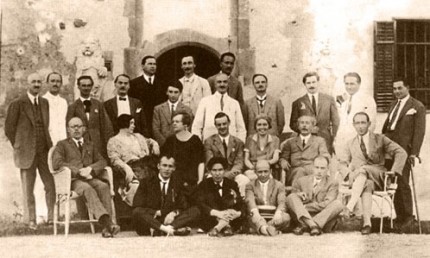
We are not sure about the house part, but Bánffy did indeed have a long-term lover in Cluj, and Boglarka sent me the following article about her: Baroness Elemér Bornemissza née Karola Szilvássy. Quite bizarrely it is about a cookbook that she wrote. What is interesting is how the writer of the article positions the contributors to the cookbook within the context of the decline of the Hungarian nobility of Transylvania, and in some cases this had tragic endings. It was into this world that Paddy walked in 1934 as he enjoyed his long summer in Hungary and then Transylvania. I have not had the time to cross-check, but Paddy may well have met some of the characters mentioned in the article and written about them in “Between the Woods and the Water“. Many of those mentioned in the article were writers and members of a Hungarian-Transylvanian writer’s group, the Erdélyi Helikon. In the picture below I believe Count Miklós Bánffy can be seen second right sitting on the chairs.

Photo made at the second Erdélyi Helikon meeting at Marosvécs in 1927 (Banffy seated second from right?)

Here is the article by Iván Bächer from the Hungarian Quarterly. If ayone knows any more about the story or the people involved please get in touch with me:  tsawford[at]btinternet.com

The Taste of Old Transylvania

Baroness Elemér Bornemissza: Kipróbált receptek (Proven Recipes). Edited and with an Introduction by Ildikó Marosi. Csíkszereda–Budapest, Pallas—Akadémia Könyvkiadó, 1998, 153 pp.

A friend of mine brought a heartrending cookery book from Transylvania. At first sight the slim little volume looked ordinary enough; I expected some amusing oddity when I picked it up and read the name of the author—Baroness Elemér Bornemissza née Karola Szilvássy—and the title: Proven Recipes.

The cover showed a copperplate print of Marosvécs in the last century—I was able to identify it by the four sturdy corner towers. This Renaissance building on the site of the Roman castrum was, until recently, in the possession of the Kemény family—the descendants of János Kemény (1607–1662), Prince of Transylvania, who had fought the Turks and had been abandoned by the Habsburgs and Montecuccoli.

When I read the first recipe, I still thought I would be treated to a bit of “blue-blooded” diversion. Who in their right mind could take a recipe of Goose-liver paté à la Salzburg seriously, which requires three whole goose livers, of which two have to be soaked in lukewarm milk overnight, then fried with onions and white bread rolls previously also soaked in milk, then pounded in a mortar, pressed through a sieve, mixed with finely sliced truffles which had been soaked in sugared wine, then with more wine added, with cloves and pepper, and the whole mixture finely layered with the third goose liver, which had been fried, cut into thin slices, and then the whole thing finished in a hot oven.

Who would have time for all that today?

It was only when I read the foreword of more than thirty pages and then went through the recipes that my heart suddenly sank. Every single recipe permeated the air with transcience and death. What I held in my hand was the frozen, fossilized evidence of a social class, a culture and a world, which have been obliterated from the face of the Earth.

This class was the Hungarian aristocracy of Transylvania, which, as well as distinguishing itself in the culinary arts, maintained an extremely rich Hungarian tradition, culture and literature.

As Ildikó Marosi’s Introduction reveals, the book is the first publication of a hand-written cookery book. Besides being a fascinating document, an original collection of recipes found among the estate of János Kemény, the last titled resident of Marosvécs, it is invaluable also because in the case of most of the recipes the author also names the source: when and where the baroness had learned the secrets of preparing the dish concerned. And if we use Ildikó Marosi’s guide to keep track of the sources, then the book will, indeed, make heartrending reading.

Let’s get a foretaste of the names of people who cooked for Hungarian writers, poets and editors in Transylvania between the two world wars.

The author of the cookery book was Baroness Bornemissza née Karola Szil-vássy, daughter of the landowner Béla Szilvássy and Baroness Antónia Wass.

Karola’s character was captured in two novels by two twentieth-century Transylvanian writers of aristocratic blood, Count Miklós Bánffy (1874–1950) and Baron János Kemény (1903–1971).

Ever since her youth, Karola was a stunningly beautiful, unbridled and proud woman with a passion for fine food as well as for interesting, eccentric and talented people. She liked to have excitement around her, and when there were no scandals at hand, she personally intervened to remedy the situation. For many years, Karola had a housekeeper, who had been a convicted murderer’s lover, and whom she took into her house along with the hanged man’s child. Accompanied by one of her friends, herself a baroness, Karola travelled to South Africa—on rail, by boat and on a donkey—to erect a tombstone for her cousin, Albert Wass, who had died there while fighting for the Boers.

This extraordinary woman had a difficult time to find herself a husband; eventually she married Baron Elemér Borne- missza, but the marriage was a failure, and their only child died, so they lived separately, with Karola receiving a handsome allowance from her husband.

Between the two world wars, Karola made herself the heart and soul of the Kemény Zsigmond Society of Marosvásárhely, the publishing house Erdélyi Szépmives Céh, and the magazine Erdélyi Helikon. (Erdély is the Hungarian name of Transylvania.)

The society, which bore the name of the Kemény family’s greatest son, the novelist and liberal thinker Zsigmond Kemény, was formed after the writer’s death in 1876, and functioned until 1944. It acquired a unique role after Transylvania’s annexation by Romania in 1918, organizing and rallying the Hungarian writers and maintaining links with the mother country.

Erdélyi Szépmíves Céh was the most prestigious book publisher in interwar Transylvania, and Erdélyi Helikon, the magazine started by János Kemény, was published by them.

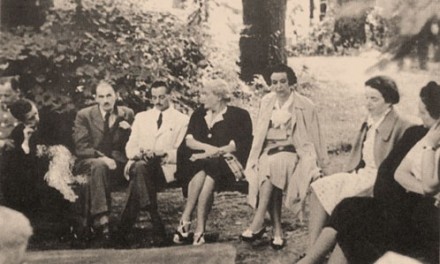
The writers who were associated with the publisher and the magazine—Károly Kós, Aladár Kuncz, Károly Molter, Jenoý Dsida, Benoý Karácsony and many others—annually gathered in János Kemény’s château in Marosvécs. On these occasions, Karola’s attendance could always be taken for granted, and all the memoirs name her as the spirit of the company. (below Karola is fourth from right)

In the castle park (Marosvécs?) 1942 From left to right: István Asztalos, László Szabédi, Albert Wass, Karola Bornemissza, Elemérné Szilvássy, Gizella Kemény, Berenice Kemény, Jánosné Kemény

In this way, Karola, the compiler of our cookery book, was at the centre of Transylvanian literary life, and her kitchen produced, from “proven recipes”, the fine food enjoyed by the writers and editors. Continue reading

One year on … the Patrick Leigh Fermor Blog

I am back. Sorry that I have been so quiet for the last few weeks. I don’t have any real explanation. Excuses may range from work commitments through some form of ‘writer’s block’ (where has my muse gone?) to the genuine excuse of being totally absorbed by Miklos Banffy’s first volume of his trilogy – They Were Counted.

This is an exceptionally good book. I will write about it at greater length at some future date, but I do recommend it. He can sometimes get a little bogged down by Hungarian politics, but when he gets going, describing balls, duels, gambling and love, he really does have a very fine style. Paddy wrote the forward to the English translation whilst staying at Chatsworth during Christmas 1998. Much of the story is set in Kolozvar (Cluj) and our old friend the Hotel New York, where Paddy and Angéla went for a cocktail, is frequently mentioned.

We have just had a blog anniversary. The Patrick Leigh Fermor blog started in late March 2010. In that time it has reached almost the very top in any Paddy search you care to mention. There have been over 64,000 visits, 156 postings, 206 comments, and there are now well over 100 subscribers (you can sign up in the top right of the home page so that you receive future posts by email – no spam).

When I started I wondered if there would be any interest in our heroic and talented subject. There were just a few dozen visits in the first month. But visits grew rapidly to a peak of 9,400 in January 2011. We now track at nearly 7,000 visits a month on average so you are not alone in your interest in The Greatest Living Englishman.

I am extremely grateful to all of you who have got in touch with me with messages of support; offers of information; and especially to those who have sent me material to publish. I can assure you that there is much more material (I have over 60 items in various stages of draft) and it will come in a steady stream. To one of you, please be assured I remain your #1.

Finally, let’s not forget why we are here. Paddy is now 96 years of age and, as far as I can tell, in reasonably good health. I am sure we wish him all good health and pray that he is working as fast as he can on that third volume. It is without doubt one of the most eagerly anticipated books of the decade.

Why not visit some of our top posts?

Patrick Leigh Fermor recounts the kidnap of General Kreipe on video

A Meeting between Paddy and George Psychoundakis the “Cretan Runner”

Patrick Leigh Fermor – star of the silver screen?

On the Pontic shores where the snowflakes fall

I knew Patrick Leigh Fermor through his words, and he will know me by mine

Images of Cluj by Alin Niculescu

There is one respect in which I have a definite advantage over Paddy in terms of the places he visited. I have been lucky enough to get to know well the city of Cluj-Napoca due to my regular visits. Paddy had but one night there with Angéla, but it was one of one of love and passion!

Last week I visited Bucharest for the first time. If this had been my first introduction to Romania I doubt that I would have been keen to return. To be fair it was literally a flying visit, and I did not make it right into the centre, however, it cannot compare with the genuine attractions of Cluj: its compact size; the Baroque architecture; the lively bars and restaurants in the old centre; the intimate cultural life; and its position in a valley surrounded by gently rolling hills. I have also made some good friends in this capital of Transylvania.

I have often written about Cluj, but to many of you the city probably remains a mystery. To help you get more of a feel for a place that I have come to feel strongly about, I wanted to showcase the work of  Alin Niculescu, a professional cameraman from Cluj. He has made a number of short films about the city, highlighting it over the seasons. They are just a few minutes long and if you are curious to know more about the city, they will give you a feel for its size, architecture, and position. In some scenes he also captures the relaxed and friendly mood of its citizens.

This first film is entitled Snowy Night at Cluj. This is broadly how the city looks at the moment.

Snowy Night at Cluj Full HD from Alin Niculescu on Vimeo.

This second movie shows a panorama over the city in the summer.

Cluj-Napoca from Alin Niculescu on Vimeo.

You can see more of Alin’s work on his website here

Related category:

Articles about Cluj and Transylvania

Prince Charles in Transylvania

By William Blacker.
First published in the Financial Times 27 August 2010.

When in early 1990 I first went to Transylvania, leaving behind the bright lights of western Europe and adjusting my eyes to the more sober tones of its eastern reaches, I could hardly believe that such a place still existed. In deep winter I crossed the northern Carpathian Mountains and came down, through misty forests and snow-covered roads, into the Middle Ages – or something astonishingly like it. Horses or oxen pulling sleighs occupied the roads, and cows and geese wandered freely. The villagers were dressed in smocks, sheepskin coats and fur hats, and had rough leather strapped to their feet, with woollen cloth wrapped around their calves held in place by thongs; footwear truly from another age, as worn by peasants depicted in ­medieval illustrated manuscripts.

I was just a few hours east of Vienna, but crossing the border into Romania was a journey back in time. I settled there, and for more than 10 years I was fortunate enough to be able to live a rural life that previously I had known only through the pages of a Hardy or Tolstoy novel.

I was astonished by the visual purity of the new environment in which I found myself. It was a country still commercially chaste, and innocent of the garish trappings of the capitalist world. There was no advertising, no neon lights, no plastic, no brash petrol stations (just a few simple pumps), very few cars – and all of the same make – that chugged and jolted over rough roads marked by the occasional rusting road sign. There were horses pulling carts, with foals trotting along beside them, outnumbering motor vehicles by 50 to one. In the villages, the houses were either of wood with carved and fretted verandas, or of brick or stone and lime-washed in soft blues, greens and ochres. All around there were huge and echoing forests, hay meadows so filled with flowers that they seemed to be part of some endless garden, and almost always, in the background, loomed the glittering Carpathian Mountains.

It was a land vividly described by Patrick Leigh Fermor in one of the great travel books of the 20th century, Between the Woods and the Water, and by Gregor Von Rezzori, whose beautiful autobiography The Snows of Yesteryear is set in Moldavia and Transylvania, and captures in dream-like prose this dream-like world. The landscape still has this ethereal quality; it stretches for miles in every direction, all unfenced just as in England in the 18th century before the land enclosures. There is nothing else like it left in Europe.

On my early journeys through this antique land, travelling was not always straightforward. There were almost no restaurants, shops, hotels, or guest houses. When walking over the hills, often guided by the steeples of village churches, I had to rely upon the kindness of strangers. Sometimes I might share a room with snoozing lambs, and discover a hen and her chicks under my bed. At other times I slept in hay barns, and my supper was milked directly from the udder of a goat that had wandered into a smoky cottage kitchen.

Now, however, life is a bit easier. There are comfortable hotels in the medieval town of Sighisoara, and excellent pensions in the beautiful Saxon villages of Viscri, Malancrav and Cund (at the end of a spectacular, winding road leading north from the town of Dumbraveni), or in the ethnically Hungarian Zabola, and Miclosoara. These villages provide locally-grown food, and sometimes, as at Cund and Zabola, of the highest quality.

Prince Charles and companions at the medieval village of Viscri, Transylvania
The Prince (left) visiting the village of Viscri

English travellers might be surprised to discover that some of these guesthouses are owned by HRH the Prince of Wales. Prince Charles first visited Transylvania in 1998, saw the wild beauty of the country, and came under a similar spell to that which captivated Leigh Fermor and others before him. He realised that this pristine central European landscape of forests, hay meadows and historic villages, until then barely touched by the brute hand of the modern world, was of international importance, and must somehow be preserved. Since then he has done much to draw attention to the predicament of what the ecologist Dr Andrew Jones calls “the last truly medieval landscape in Europe”.

Through such charities as the Mihai Eminescu Trust, the International Network for Traditional Building, Architecture and Urbanism (Intbau) and the Transylvania Trust, the prince has helped in saving hundreds of houses all over Romania, and in training multitudes of villagers in traditional building techniques. It is hoped that by preserving the villages and the countryside around them, and by encouraging traditional craftsmanship and small-scale farming, the economies of the villages can recover and thrive.

As part of this approach Prince Charles has bought several endangered properties in Transylvania and turned them into comfortable guesthouses. The buildings are restored using traditional materials, with lime renders and locally-produced hand-made bricks and terracotta tiles. One of them, which the prince has owned for some years, is in the village of Viscri. The latest purchase is in the remote village of Zalánpatak in the ethnically Hungarian part of Transylvania, and opens to paying guests next month. I recently paid a visit.

Prince Charles’s guesthouse in Zalánpatak, Transylvania
Prince Charles’s guesthouse in Zalánpatak, Transylvania opens next month

As I drove further and further from civilisation, the road became narrower, rougher and leafier, and I seriously began to wonder whether I was on the right track. But then, at last, a tiny village appeared, by the side of which ran a sparkling brook shaded by tall poplars. The Prince’s house, with its simple wooden verandah and outbuildings also of wood, or lime-washed in blue, is by no means grand, but the serenity of the view from the verandah on that still summer’s evening was about as perfect as one could hope to find. It was somewhere that one can describe, without wildly exaggerating, as a heavenly place.

With his guesthouses the prince hopes to persuade discerning travellers to come to admire the old village architecture; to walk or ride from one village to another through the breathtaking but only half-tamed countryside of meadows, wooded hills, and trickling streams; to see evidence of wolves and bears, and all the other wildlife that survives here in abundance, but which in other parts of Europe is either extinct or on the edge of extinction; and to understand why Romania is such a special country.

But, in spite of Prince Charles’s influence on conservation in Romania, most parts of the historic landscape of Transylvania are being devastated by a rash of uncontrolled modern development, which worsens by the year, and is now reaching a critical point.

Many might have thought that Romania’s rural architecture had been “saved” when the communist dictator, Nicolae Ceausescu, was executed on Christmas Day 1989, and that his deranged plan to bulldoze the villages and move their inhabitants into purpose-built blocks had been put to rest. But in reality it was only after Ceausescu’s death that the real destruction of the villages began.

Now, in the construction free-for-all of modern Romania, the country’s historic architecture is being rubbed out at a frightening pace, and the sad irony is that its destruction is being made greatly worse by European Union money pouring into the country in the form of agricultural subsidies. Those receiving these grants (often vast sums by local standards) are demolishing their old village houses and using the money to replace them with hideous and incongruous modern buildings, painted in garish orange, luminous yellow or vivid purple, often with windows of mirrored glass and stainless steel railings. It is a kitsch that is infecting the whole country. Even as I write, in a beautiful village that has until now escaped the ravages of the modern world, I can hear the demolition of a huge oak-beamed and terracotta-tiled barn in order to make way for someone’s dream villa. The 18th-century house next to it is apparently soon to follow. It is like living in southern Ireland in the 1960s, when rows of proud Georgian houses were demolished to make way for modern developments. It is almost beyond belief that the Romanian government can allow villages like those in the Saxon area of Transylvania, or in Oltenia near Campulung Muscetel, which are as picturesque as the hill towns of Tuscany or England’s Cotswold villages, to be destroyed in this way. The country’s tourist industry is bound to suffer as a result.

The modern world and EU money are doing Ceausescu’s architectural destruction for him. And, because only richer farmers are eligible for EU grants, the subsidies are squeezing out the smaller, self-sufficient farmers whose harmless methods of caring for the land naturally preserve the biodiversity of the region, and its historic appearance. Botanists will tell you that once the unique medieval wildflower meadows are gone, which now exist only in Romania, they can never be recreated.

So the message is this: Romania is a deeply fascinating country, but if you want to see and feel something of this fascination, go there soon. If the Romanian government and the EU do not speedily put their heads together to do something quickly and seriously to protect what remains of the country’s all too fragile beauty, within a few years there will be little left to see: the fascination will be gone, and the spell broken.

William Blacker’s book about his life in a rural Transylvanian village is ‘Along the Enchanted Way’ (John Murray)

…………………………………………..

Details

Prince Charles’s guesthouse at Zalánpatak opens next month, with five double rooms costing £86 including breakfast. His other guesthouse, at Viscri, has already accepted occasional guests, but opens fully from spring 2011, with three doubles available at the same price. All profits go to building conservation work in the area. For details of both see www.transylvaniancastle.com. The closest airport in Romania is Cluj-Napoca, which has direct flights from the UK, France, Italy, Spain and Germany

A Traveler’s Tale: On Patrick Leigh Fermor

by Wes Davis

First published in The Nation, December 2010

At a Chelsea-to-Richmond boating party held sometime in the early 1950s, the Duchess of Devonshire, then a beautiful young woman of 30, met a dashing man, some five years her senior, who was dressed as a Roman gladiator and armed with a net and trident. It was a look she thought suited him.

The fancy-dress gladiator was Patrick Leigh Fermor, a former officer in Britain’s Special Operations Executive (SOE), a covert unit that aided resistance movements throughout occupied Europe, and an up-and-coming writer best known at the time for kidnapping a German general during the war. He had crossed paths with the duchess before and remembered her clearly from a regimental ball in 1940, when she was still Deborah Mitford—the youngest of the soon-to-be-famous Mitford sisters. She was then engaged to Andrew Cavendish, a tall naval officer and younger son of the Tenth Duke of Devonshire who had no expectation of inheriting his father’s title until the war took his older brother’s life four years later. Leigh Fermor had watched the couple dance their way through the evening, “utterly rapt, eyes shut, as though in a trance.” Mitford had not noticed him.

But when they met again—as duchess and gladiator—Deborah Devonshire and Patrick Leigh Fermor struck up a friendship that has endured for more than half a century. In Tearing Haste, a collection of their letters newly available in this country, gives the impression that the conversation that started at a boating party so many summers ago has never stopped. Spanning 1954 to 2007, the volume reads like an accidental memoir of a disappearing world stretching from the manor houses of the English aristocracy to the olive groves of Greece, its people and places rendered with a kind of care that’s becoming scarce in our age of helter-skelter communication. At the same time, the book’s title, a phrase deriving from Leigh Fermor’s habit of dashing off messages “with a foot in the stirrup,” captures the vigor and bustle of the lives that nourished the correspondence. I once happened upon the manuscript of a chatty letter Leigh Fermor had written in 1944 to an Englishwoman stationed in Cairo. Amusingly composed and illustrated with a witty hand-drawn cartoon, it closed with Leigh Fermor mentioning offhand that he was in hiding on occupied Crete and that an undercover runner was waiting outside to receive the communication.

In Tearing Haste is engaging from start to finish. There isn’t a dull letter among Charlotte Mosley’s selections. Even her annotations, often incorporating information from the book’s two correspondents, are as surprising as they are informative. One biographical note on the painter Augustus John includes Deborah Devonshire’s recollection of meeting him in London: “He looked me up and down and said, ‘Have you got children?’ ‘Yes.’ Another long look. ‘Did you suckle them?'” More than anything else, the collection is important as an addition to Leigh Fermor’s body of work, both because his letters constitute a larger portion of the volume and because the writing in them harmonizes with the books that established his literary reputation. But let it be said that the Duchess of Devonshire is no slouch either. Her letters, though generally shorter and less frequent than Leigh Fermor’s, share his wit and many of his interests—a fascination with language, for example, or with the byways of English and European history. She puts a charming twist on these topics while adding a few bright threads of her own to the correspondence.

Deborah Devonshire’s books—beginning with The House (1982) and The Estate (1990)—focus largely on the management of Chatsworth, the massive estate in Derbyshire that she and her husband put into charitable trust and opened to the public in 1981. (The house was a stand-in for Mr. Darcy’s Pemberley in a film adaptation of Pride and Prejudice, and throughout the letters Leigh Fermor refers to it as “Dingley Dell,” after Mr. Wardle’s house in The Pickwick Papers.) As a writer, she is best when describing the seasonal rhythms of country life (the arrival of the year’s pullets, say) or assessing the gamut of rural arts (from drystone walling to mushroom gathering) and tilling their linguistic soil. In Counting My Chickens, a collection of notes and essays published in 2001, she remembers leaving Leigh Fermor “stumped” by the meaning of words gleaned from the glossary of a pamphlet about sheep. “One sheep disease,” she recalls, “has regional names of intriguing diversity: Sturfy, bleb, turnstick, paterish, goggles, dunt, and pedro all are gid.” On the same page she can be found rhapsodizing over “the glorious language of the 1662 prayer book, with its messages of mystery and imagination.”

She takes any opportunity to undercut the preconceived notions one might have about a duchess’s likes and dislikes. “I buy most of my clothes at agricultural shows,” she says in Counting My Chickens, “and good stout things they are.” For the playwright Tom Stoppard, who contributed an introduction to the book, this was one of her most characteristic revelations. For me, a close runner-up is her discussion of flower gardening on a grand estate, where she admits, “I prefer vegetables.” Many of her stories turn on a similar blend of unexpected rusticity and unflagging old-school civility. In an essay about the life the Mitfords led for a time on the island of Inchkenneth in the Hebrides, she describes traveling by train in the company of a goat, a whippet and a Labrador back to her sister Nancy’s house in Oxfordshire when the war broke out. “I milked the goat in the first-class waiting room,” she confesses, “which I should not have done, as I only had a third-class ticket.”

For all her modesty, the duchess isn’t embarrassed to mention boldface names that have sailed in and out of her social circle. (They range from Fred Astaire to the Queen Mother, the latter called “Cake” when she appears in the letters.) The humor in one anecdote depends on knowing that John F. Kennedy was intimate enough with the duchess to employ her nickname. This caused some confusion when her uncle Harold Macmillan, then prime minister, found himself involved in a telephone conversation with the American president about matters involving Castro, SEATO and NATO. It took him a moment to switch tracks when Kennedy asked, “And how’s Debo?” (Evelyn Waugh, a friend of hers, might well have written the scene.) In the letters, Kennedy is counted among the “bodies to be worshipped,” and several entries describe the friendship that developed between JFK and the duchess in the years between his inauguration and his death.

Her relationship with Leigh Fermor has many dimensions, its ardor fueled by humor, charisma and delight in a good tale. The revealing joke that runs through In Tearing Haste is that Devonshire is not a reader and that despite her lively correspondence with Leigh Fermor, she can’t manage to read his books. She praises one of his letters not for its vivid language but because it has instructions about which parts to skip. Leigh Fermor takes revenge in another letter, marking a set of passages with notes “don’t skip” and “ditto.” The bit he wants her to see—a foray into history by way of language—might well have been lifted from one of the books that made him famous: “The inhabitants are Koutzovlachs who speak a v. queer Latin dialect akin both to Rumanian and Italian. Some say they are Rumanian nomad shepherds who wandered here centuries ago with their flocks and never found their way home again. Others, more plausibly, say they are the descendants of Roman legionaries, speaking a corrupt camp Latin, stationed here to guard the high passes of the Pindus, miles from anywhere.” Continue reading

Patrick Leigh Fermor: The man who walked


Patrick Leigh Fermor was a major in the Paras during the Second World War

This profile by William Dalrymple is perhaps the most well known of all the on-line pieces about Paddy. I have so far been reluctant to add it to the blog, but as my blog is meant to be a ‘one-stop shop’ for all things Leigh Fermor I have decided its time has come.


By William Dalrymple

First published in the Telegraph 06 Sep 2008

At 18 he left home to walk the length of Europe; at 25, as an SOE agent, he kidnapped the German commander of Crete; now at 93, Patrick Leigh Fermor, arguably the greatest living travel writer, is publishing the nearest he may come to an autobiography – and finally learning to type. William Dalrymple meets him at home in Greece

‘You’ve got to bellow a bit,’ Sir Patrick Leigh Fermor said, inclining his face in my direction, and cupping his ear. ‘He’s become an economist? Well, thank God for that. I thought you said he’d become a Communist.’

He took a swig of retsina and returned to his lemon chicken.

‘I’m deaf,’ he continued. ‘That’s the awful truth. That’s why I’m leaning towards you in this rather eerie fashion. I do have a hearing aid, but when I go swimming I always forget about it until I’m two strokes out, and then it starts singing at me. I get out and suck it, and with luck all is well. But both of them have gone now, and that’s one reason why I am off to London next week. Glasses, too. Running out of those very quickly. Occasionally, the one that is lost is found, but their numbers slowly diminish…’

He trailed off. ‘The amount that can go wrong at this age – you’ve no idea. This year I’ve acquired something called tunnel vision. Very odd, and sometimes quite interesting. When I look at someone I can see four eyes, one of them huge and stuck to the side of the mouth. Everyone starts looking a bit like a Picasso painting.’

He paused and considered for a moment, as if confronted by the condition for the first time. ‘And, to be honest, my memory is not in very good shape either. Anything like a date or a proper name just takes wing, and quite often never comes back. Winston Churchill – couldn’t remember his name last week.

‘Even swimming is a bit of a trial now,’ he continued, ‘thanks to this bloody clock thing they’ve put in me – what d’they call it? A pacemaker. It doesn’t mind the swimming. But it doesn’t like the steps on the way down. Terrific nuisance.’

We were sitting eating supper in the moonlight in the arcaded L-shaped cloister that forms the core of Leigh Fermor’s beautiful house in Mani in southern Greece. Since the death of his beloved wife Joan in 2003, Leigh Fermor, known to everyone as Leigh Fermor, has lived here alone in his own Elysium with only an ever-growing clowder of darting, mewing, paw-licking cats for company. He is cooked for and looked after by his housekeeper, Elpida, the daughter of the inn-keeper who was his original landlord when he came to Mani for the first time in 1962.

It is the most perfect writer’s house imaginable, designed and partially built by Leigh Fermor himself in an old olive grove overlooking a secluded Mediterranean bay. It is easy to see why, despite growing visibly frailer, he would never want to leave. Buttressed by the old retaining walls of the olive terraces, the whitewashed rooms are cool and airy and lined with books; old copies of the Times Literary Supplement and the New York Review of Books lie scattered around on tables between Attic vases, Indian sculptures and bottles of local ouzo.

A study filled with reference books and old photographs lies across a shady courtyard. There are cicadas grinding in the cypresses, and a wonderful view of the peaks of the Taygetus falling down to the blue waters of the Aegean, which are so clear it is said that in some places you can still see the wrecks of Ottoman galleys lying on the seabed far below.

There is a warm smell of wild rosemary and cypress resin in the air; and from below comes the crash of the sea on the pebbles of the foreshore. Yet there is something unmistakably melancholy in the air: a great traveller even partially immobilised is as sad a sight as an artist with failing vision or a composer grown hard of hearing.

I had driven down from Athens that morning, through slopes of olives charred and blackened by last year’s forest fires. I arrived at Kardamyli late in the evening. Although the area is now almost metropolitan in feel compared to what it was when Leigh Fermor moved here in the 1960s (at that time he had to move the honey-coloured Taygetus stone for his house to its site by mule as there was no road) it still feels wonderfully remote and almost untouched by the modern world.

When Leigh Fermor first arrived in Mani in 1962 he was known principally as a dashing commando. At the age of 25, as a young agent of Special Operations Executive (SOE), he had kidnapped the German commander in Crete, General Kreipe, and returned home to a Distinguished Service Order and movie version of his exploits, Ill Met by Moonlight (1957) with Dirk Bogarde playing him as a handsome black-shirted guerrilla.

It was in this house that Leigh Fermor made the startling transformation – unique in his generation – from war hero to literary genius. To meet, Leigh Fermor may still have the speech patterns and formal manners of a British officer of a previous generation; but on the page he is a soaring prose virtuoso with hardly a single living equal.

It was here in the isolation and beauty of Kardamyli that Leigh Fermor developed his sublime prose style, and here that he wrote most of the books that have made him widely regarded as the world’s greatest travel writer, as well as arguably our finest living prose-poet. While his densely literary and cadent prose style is beyond imitation, his books have become sacred texts for several generations of British writers of non-fiction, including Bruce Chatwin, Colin Thubron, Philip Marsden, Nicholas Crane and Rory Stewart, all of whom have been inspired by the persona he created of the bookish wanderer: the footloose scholar in the wilds, scrambling through remote mountains, a knapsack full of books on his shoulder.

As Anthony Lane put it in the New Yorker, Leigh Fermor ‘was, and remains, an Englishman, with so much living to his credit that the lives conducted by the rest of us seem barely sentient – pinched and paltry things, laughably provincial in their scope… We fret about our kids’ Sats, whereas this man, when he was barely more than a kid himself, walked from Rotterdam to Istanbul. In his sixties he swam the Hellespont, in homage to Lord Byron – his hero, and to some extent his template. In between he has joined a cavalry charge, observed a voodoo ceremony in Haiti, and plunged into a love affair with a princess. He has feasted atop a moonlit tower, with wine and roast lamb hauled up by rope. He has dwelt soundlessly among Trappist monks.’

For myself, it was the reading of his travel books while at Cambridge that inspired me to attempt to follow in his footsteps. With a paperback of Leigh Fermor’s in my backpack, I set off to Jerusalem following the route of the Crusaders during my first summer vacation. Meeting my hero for the first time at Bruce Chatwin’s house, just before the publication of my first book in 1989, was the nearest thing I have had to a formal graduation ceremony as a writer, the moment when you suddenly feel that maybe you really have passed out of your novitiate.

Foremost among Leigh Fermor’s books are his two glorious Greek travelogues, Mani and Roumeli; an exquisite short study of monasticism, A Time to Keep Silence; and most celebrated of all, an account of his journey in the early 1930s, travelling on foot, sleeping in hayricks and castles ‘like a tramp, a pilgrim, or a wandering scholar’, from Holland to Constantinople. On and off for nearly 70 years Fermor has been working on a trilogy about this epic walk. The first volume – and many would say his masterpiece – A Time of Gifts was finally published in 1977. The second, Between the Woods and the Water, followed nine years later. Since then, 22 years have passed with no sign of volume three, the book that should take us to the gates of Byzantium.

Leigh Fermor is now 93 and his fans are getting anxious. But travel writers have longer professional life expectancies than most – Norman Lewis, for example, produced four books between his 88th birthday and his death five years later – so we should not give up hope. Indeed, on a low table when Leigh Fermor showed me into his study, lay an 8in-high pile of manuscript, some of it ring-bound, and some in folders, on which was scribbled in red felt-tip: Vol 3.

In the meantime, Fermor fans have a small savoury to keep them going until the final course is served. This week John Murray is bringing out In Tearing Haste, a volume of letters between Leigh Fermor and the last surviving member of the Mitford sisterhood: Debo Devonshire, his close friend for nearly half a century. The letters are the nearest thing Leigh Fermor may ever get to writing an autobiography, faithfully chronicling his movements since the mid-1950s with the same detailed, painterly, highly written style that he uses in his travelogues.

Though inevitably slighter than his more polished work, the book includes wonderful accounts of some of his most celebrated adventures, such as his disastrous visit to Somerset Maugham at Cap Ferrat. Here he describes the elderly Maugham’s face as ‘so discoloured and green that it looks as though he has been rotting in the Bastille, or chained to a bench of a galley, or inside an iron mask for half a century’.

Having committed the faux-pas of appearing to draw attention to Maugham’s stammer at dinner, Leigh Fermor, who had initially been invited to stay for a week, was approached by his host at the end of the evening who offered him ‘a hand as cold as a toad, with the words “W-w-well I’ll s-s-say g-good-b-b-bye now in c-case I’m not up b-by the t-time y-you l-leave.”?’

It emerged that Leigh Fermor’s proof of the book had yet to reach the Peloponnese, so after supper I produced my own copy. He frowned: there had been a disagreement between the authors and their publisher over the cover produced by the artist John Craxton, who has illustrated all Leigh Fermor’s book since the 1950s, and the book was now covered with something more sketchy, and clearly not at all to Leigh Fermor’s liking. ‘Debo and I complained,’ he said, holding the book almost to the end of his nose and peering disapprovingly at the illustration, ‘but they kept on about business trends or some such jargon. What was it now? Market forces, that’s it. Well I never…’

As he flicked through the proof, I asked if the rumours were true: that after a lifetime of writing in longhand, he was now finally learning to type, the quicker to finish the third volume of his masterpiece.

‘Well, not exactly,’ he replied. ‘At the moment I seem to be collecting typewriters. I’ve got four now. People keep giving me their old ones. But it is true, I am planning to take typing lessons in Evesham this September.’ He paused, before adding, ‘In truth, I am absolutely longing to get down to it, before my sight gets any worse.’
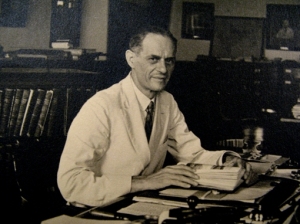
Patrick Leigh Fermor was born in London in 1915 to Sir Lewis Leigh Fermor, the director general of the Geological Survey of India, and the ‘sophisticated and wild’ Eileen Ambler. His mother was a bohemian and highly literate woman, who loved reading to her children and encouraging them to learn poetry by heart. She had been brought up in the wilds of Bihar, as a result of which Leigh Fermor can still sing, It’s a Long Way to Tipperary in Hindi. ‘Although I was brought up in England,’ he remembered, ‘India was a presence in the household, like voices in the next room.’

Almost immediately Leigh Fermor was deserted by his parents. It was the war, and they had to return to India; given the threat of U-boats, it was decided to leave the young Leigh Fermor in England so that someone would survive if the ship were torpedoed. The boy was sent to a farm in Northamptonshire where he was allowed to run free. ‘I think it formed me, you know,’ he said. ‘Made me restless and curious. I was constantly climbing trees and hayricks.’

When his mother and sister returned to collect him three and half years later, he ran away from these ‘beautiful strangers’. In retrospect, Leigh Fermor thinks the experience of ‘those marvellously lawless years unfitted me for the faintest shadow of constraint’, something that marked the rest of his career, especially at school, where he was expelled from a variety of establishments until finding happiness at ‘a co-educational and very advanced school for difficult children’.

After that school was closed down due to a series of ‘vaguely guessed at improprieties’, Leigh Fermor moved on to the King’s School Canterbury. He liked the fact it was founded during the reign of Justinian ‘when fragments of Thor and Odin had barely stopped smouldering in the Kentish woods’; but his teachers were less sure about their new pupil: ‘He is a dangerous mixture of sophistication and recklessness,’ his housemaster wrote, shortly before expelling him. Unqualified to join Sandhurst, the direction in which his family had been pushing him, he attended crammers in London where he began to write poetry and to read voraciously.
Patrick Leigh Fermor at school, Kings' Canterbury

One of the books he chanced across was The Station, Robert Byron’s newly published book about his travels through the monasteries of Mount Athos. A subsequent meeting with Byron in a ‘blurred and saxophone-haunted nightclub’ made Leigh Fermor, aged 18, ache to follow in the author’s footsteps and visit ‘serpent-haunted dragon-green Byzantium’. He had also read George Orwell’s Down and Out in Paris and London, published in 1933. With nothing to keep him in Britain he set off, having first borrowed a knapsack that had accompanied Byron to Athos, aiming to walk to that living fragment of Byzantium while living as cheaply as Orwell: ‘I loved the idea of roughing it.’

On the wet afternoon of December 9, 1933, the year that Hitler came to power, as ‘a thousand glistening umbrellas were tilted over a thousand bowler hats’, Leigh Fermor left London, boarding a Dutch steamer at Irongate Wharf. His rucksack contained pencils, drawing pads, notebooks, The Oxford Book of English Verse and a volume of Horace. He would not lay eyes on Britain again until January 1937, when he returned ‘for better or for worse, utterly changed by my travels’.

‘I thought I’d keep a diary and turn it into a book, which of course is what I did,’ he said. ‘Except I am still writing that book more than 70 years later.’ It was not just that the journey gave Leigh Fermor the subject for his lifework, it ‘broadened my mind, taught me history, literature and languages. It opened everything up: the world, civilisation and Europe. It also gave me a capacity for solitude and a sense of purpose. It taught me to read and to look at things. It was a great education. I didn’t go to university, I went travelling instead.’

The journey also led him to meeting one of the two great loves of his life, a beautiful Byzantine princess named Balasha Cantacuzene. Leigh Fermor met Balasha in Athens, to which he walked after finally reaching Athos in early 1937. She was 12 years older than him, and had just separated from her husband, a Spanish diplomat. ‘She was 32, and I was 20. We met at just the right time and fell into each other’s arms. It was instant, we clicked immediately. We went off together and lived in a watermill in the Peloponnese for five months. I was writing, she was painting. It was heavenly.’
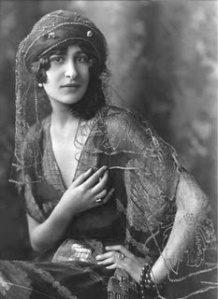
Balasha Cantacuzene

From there the couple moved back to Balasha’s rambling country estate in the dales of Moldavia, where they moved in with Balasha’s sister. Leigh Fermor has written that the two sisters were ‘good, beautiful, courageous, gifted, imaginative, immersed in literature and the arts, kind, funny, unconventional; everybody loved them and so did I.’

For Leigh Fermor, this was one of the happiest periods of his life. For two years he lived there, savouring the last remnants of a world that was just about to disappear: ‘Her family was part of an old-fashioned, French-speaking, Tolstoyan, land-owning world: country-dwelling noblesse of the sort described by Turgenev. They were intensely civilised people. The house was an old manor house, not grand, but delightful and full of pictures and books.

There was a butler who was always a bit tight, and no electricity, so we read with lamps and wicks. I spent the time reading my way through the whole of French literature and playing chess – when I wasn’t making a hash of writing this book.’ He paused, then added, ‘Of course I wanted to marry her, but she said, “Don’t be ridiculous – I’m much older than you.”?’

Both the romance and the world in which it was set were ended for ever by the war. ‘We were aware that war clouds were looming, but didn’t realise how serious it was. We were out on a picnic, some of us on horseback and some in open carriages, when someone shouted across the fields that the Germans had gone into Poland. I made the decision at once: if war had broken out I had to join the Army. I thought it would be over in six months.’

In the event, Leigh Fermor did not lay eyes on Balasha again for a quarter of a century. With the end of the war came the Iron Curtain, and Balasha could no more get out of Romania than Leigh Fermor could get in. When he eventually managed to find a way to get in as a journalist, he found Balasha living in poverty in a Bucharest garret, surviving by teaching English, French and painting. ‘We sat up and scarcely went to bed for 48 hours, laughing the whole time: “Do you remember?” By this time I was with Joan. Balasha took it all in such a philosophical and charming way. She was an extraordinary person.’

It emerged that the Cantacuzenes had been branded ‘elements of putrid background’ and Balasha’s lands had been confiscated soon after the end of the war. She had lost everything. The day Ceausescu’s commissar turned up she and her sister had been given quarter of an hour to pack. The house had subsequently been turned into a lunatic asylum. In Leigh Fermor’s account of the reunion, he wrote how he ‘found them in their attic.

In spite of the interval, the fine looks of my friends, the thoughtful clear glance and the humour were all intact; it was as though we had parted a few months ago, instead of 26 years… [But] early thoughts of leaving Romania lapsed in the end, and they resisted the idea partly from feeling it was too late in the day; secretly, perhaps they also shrank from being a burden to anyone. One by one the same dread illness carried them away.’

The same war that destroyed Leigh Fermor’s great love affair also made his name as a man of action. From Moldavia he returned to Britain and enlisted in the Irish Guards. As a fluent Greek speaker he was soon singled out for intelligence work, and was sent first to Albania and then to Greece as a liaison officer working with the Greek army. After the fall of Greece he found his way to Crete just in time to fight in vain against the Nazi invasion. From there he was evacuated to Alexandria where he set up house with several other young intelligence agents and a refugee Polish countess, Sophie Tarnowska, who moved in with her few possessions: ‘a bathing costume, an evening gown, a uniform and two pet mongooses’.

Before long Leigh Fermor was sent back into Crete to work with the Cretan resistance. He and an odd collection of recently enlisted Greek-speaking classical scholars and archaeologists were parachuted into the occupied island disguised as shepherds and established a troglodyte existence under the stalactites of mountain caves, commanded by a Fellow of All Souls. The port from which Leigh Fermor set off was captured by Rommel’s advancing Afrika Korps the day after he left. ‘It was a low moment in the war: the Germans seemed to be advancing in triumph in all directions.’ It was partly for this reason that Leigh Fermor’s bosses gave permission for his wild scheme to raise morale: kidnapping the German commander of the island.
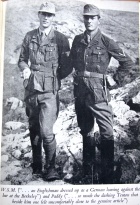
Patrick Leigh Fermor and Moss

Patrick Leigh Fermor and Moss in German Uniform Prior to the Abduction of General Kriepe

In Leigh Fermor’s own account of the abduction of General Kreipe, the climax comes not as the general’s staff car is stopped at night by a British SOE partly dressed in stolen German uniforms, nor as the Cretan partisans help smuggle the general into the highlands and hence to a waiting British submarine; but instead as ‘a brilliant dawn was breaking over the crest of Mount Ida’.

‘We were all three lying smoking in silence, when the general, half to himself, slowly said, “Vides ut alta stet nive candidum Soracte”. It was the opening of one of the few Horace odes I knew by heart. I went on reciting where he had broken off… The general’s blue eyes swivelled away from the mountain top to mine – and when I’d finished, after a long silence, he said: “Ach so, Herr Major!” It was very strange. “Ja, Herr General.” As though for a moment, the war had ceased to exist. We had both drunk at the same fountains long before; and things were different between us for the rest of our time together.’

It is an archetypal Leigh Fermor anecdote: fabulously erudite and romantic, and just a little showy. For his greatest virtues as a writer are also his greatest vices: his incantational love of great waterfalls of words, combined with the wild scholarly enthusiasms of a brilliant autodidact. On the rare occasions he gets it wrong, Leigh Fermor has been responsible for some of the most brightly coloured purple passages in travel literature. But at his best he is sublime, unbeatable.

Back in Egypt, Leigh Fermor met his future wife, and the companion for the second half of his life. Joan Eyres Monsell was then working for the intelligence department as a cipher clerk. ‘She had a house near the Ibn Tulun mosque, and was very go-ahead,’ Leigh Fermor remembers. ‘She was a nurse when the war broke out, and had lived in Spain and Algiers before Cairo. We met at a party and hit it off very quickly.’

When the war was over, Joan and Leigh Fermor remained in Greece, wandering the country and initially finding work in the British Council, whose Athens office was then run by the other great British philhellene of that generation, Sir Steven Runciman. But as ever, Leigh Fermor’s wanderlust soon got the better of him, and before long he had resigned. In 1949 they caught a ship to the Caribbean, a trip that resulted in two books: a travelogue, The Traveller’s Tree, and a fine novel, The Violins of St Jacques. Both were written partially in Trappist monasteries, an experience that Leigh Fermor turned into his third and most tightly written book, A Time to Keep Silence.

It was in the early 1960s that Leigh Fermor married Joan and settled down with her in Kardamyli, to continue his life of writing travel books, interspersed with weekly book reviews for Cyril Connolly’s Sunday Times book pages. It is this more settled phase of life that is so well captured in the new book of letters between Leigh Fermor and Deborah Devonshire. There are lovely descriptions of Leigh Fermor and Joan finding the bay at Kardamyli; the struggles to finish A Time of Gifts; Leigh Fermor’s surprise and pleasure at its rapturous reception; and the slow writing of its sequel.

The final 50 pages of the book have a more melancholy tone, as their friends begin to die, one by one: the English ones often of cancer, the Cretans, more dramatically, falling from precipices, and the like. Finally come the deaths of both Debo’s husband, Andrew, and of Joan Leigh Fermor: ‘The cats miss Joan bitterly,’ Leigh Fermor writes at the end of the book. ‘They are not the only ones… I keep thinking of things I must remember to tell Joan at lunch, knowing they could make her laugh. Letters addressed to her still arrive from distant parts, but even they are dying out now, and increasingly it’s only subscriptions to be renewed.’

Leigh Fermor enjoys a two-hour siesta after lunch – ‘Egyptian PT’ as he calls it. But on my last day in Kardamyli he emerged at 4pm, smiling from ear to ear. ‘Didn’t sleep a wink,’ he said. ‘Got quite carried away reading the book. I was rather dreading it, but was pleasantly surprised.’ He held up the proof approvingly. ‘Some passages are really awfully good.’
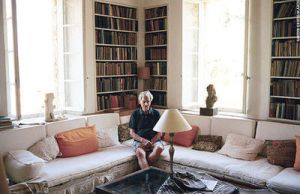
Paddy at home in the Mani

After our lunch we went up the mountain beside the house to see the Byzantine chapel around which the ashes of his friend Bruce Chatwin had been scattered. The chapel was very small – only a little larger than a big garden shed. It had a domed red-tiled roof and round arcaded windows. It lay in the rocky fields near the village of Exchori, high above Kardamyli, and was built from stone the colour of halloumi cheese.

The sun was slowly sinking over the hills at the end of a hot day; from the higher slopes, the tinkle of goat bells cut through the drowsy background whirr of cicadas as shepherd children led their flocks back for the night. It is perfect, beautiful, a peaceful place for anyone to end their days, and as we headed back I asked Leigh Fermor whether he would like to be buried there, too.

‘Oh no,’ he replied instantly. ‘Joan is in Dumbleton. I’d rather like to end up there.’

It’s a characteristic of so many of the greatest English travellers that they come back home in the end. TE Lawrence, for example, finally recognised ‘that I could not sincerely take on the Arab skin’, and the same is true of Leigh Fermor. For all his years in Greece, he remains almost the archetypal Englishman, in its best possible form: ‘My heart is in both,’ he said as we headed downhill. ‘England is not a foreign country to me.’ He paused and looked down over the Aegean, glinting now like broken glass far below us: ‘I do love both countries,’ he said as we headed on home. ‘I really do.’

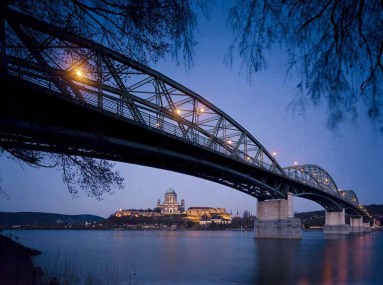
A Winter Afternoon in Cluj

Between the Woods and the Water

I am very fortunate to be able to visit Cluj quite often. We all know a little about the city from Paddy’s visit here during his brief love affair with Angéla in the summer of 1934. Today I find myself here again after a busy week in my company office. It is a cold overcast day, and the low cloud seems to make the sounds of the city travel a long way; the squeals of children playing, dogs barking and the famous Cluj crows cawing as they weave their way between the apartment blocks and the spires and domes of Cluj’s many churches.

Romania is not a country that many people visit on holiday, and Cluj is almost certainly not on many lists. I fail to understand why this is. You only have to visit the (open to public) Facebook page of Visit Romania and look at some of the incredible photographs to see that this country has varied and stunning scenery, and enough history on offer, from the Roman site at Parolissum, the artistic beauty of the painted monasteries of Bukovina or the wooden churches of Maramureş, and the castle of Hunyadi that Paddy visited during his walk south in the area of the Retezat on towards the Danube and the end of his journey as described in Between the Woods and the Water.

At its heart Cluj has wonderful Baroque architecture which dates from its heyday under the Austro-Hungarian Empire. Many of these buildings have fading, crumbling facades. The absence of western chain stores means that the streets are not despoiled by those so familiar signs. I may be wrong, but this general absence of branded outlets means that many Romanians (but to be fair probably only those that can afford it) still have a very individual sense of style.

The statue of Matthias Corvinus

When one wanders just a few yards from the main roads in Cluj one enters a maze of smaller streets, many cobbled, with a myriad of bars, cafes and restaurants which all offer excellent value. Today I walked from the newly restored and very splendid statue of King Matthias Corvinus, past St Michael’s Church, towards Corvinus’ house. It is only a one minute walk. Paddy and Angéla stayed somewhere in those back streets within the sound of the bells of the church; quite where we shall probably never know. I too heard them ringing this evening as I walked to dinner.

Cluj is a very sociable place, possibly because there are something like 100,000 plus students here (an incredible number but that is what I have been told). It is also somewhere that makes you feel quite safe. I am sure it has its moments, but I have never encountered any problems and one feels safer here than in many places in England, particularly late at night.

What started out as just a short article about Cluj today, seems to have ended up as copy for the Romanian Tourist Board, and that is fine. In these difficult financial times, Romania offers a tremendous holiday alternative, and it remains low cost. So when making your plans for 2011 you could do worse than visiting this country, and possibly walking in some of Paddy’s footsteps. Romania could also do with the income. I call that a win win outcome.

Related articles:

Angéla, Paddy, István and Tom in Cluj-Napoca

Angéla and Paddy’s visit to Cluj-Napoca with pdf describing his visit

Links:

Facebook – Visit Romania


Meine Suche nach Patrick Leigh Fermor

This title from a book by the German author Michael Obert hits the spot for me. Like Michael I am also engaged in a ‘search’ for Paddy and I know from your comments and emails that many of you are finding your own ways to follow in Paddy’s footsteps and to understand and enjoy his works.

Following the publication of the Wolfgang Büscher video just a few days ago, I was contacted by Christian from Koln (Cologne) saying how pleased he was to see the video and at the same time sending me a couple of other articles from German newspapers and magazines. Christian made the point that in recent years there have been many features and articles published in Germany about Paddy, including Michael Obert’s book which provides the title to this article. Chatwins Guru und ich: Meine Suche nach Patrick Leigh Fermor by Michael Obert is available from Amazon.

I have pdfs of two more articles and those of you who followed the blog in its early days may remember that I have previously featured a further article by Wieland Freund. Therefore, perhaps for the first time in one place, a collection of German (and Swiss) material about Paddy.

Der letzte Byzantiner by Wolfgang Büscher, first published in Die Zeit 24 May 2006

Wolfgang Büscher discussing A Time of Gifts video

Mit der Feder im Rucksack durch die Welt by Georg Sütterlin, first published in Der Bund 30 Aug 2005

Besuch beim Haudegen des Peloponnes by Wieland Freund first published in Welt Online 8 July 2007

Wandering scholar and war hero: the traveller’s tale

By Peter Terzian

November 27, 2005

On the telephone from his home in Greece, Patrick Leigh Fermor describes what he does as “travel writing” but adds “I hate the phrase.” Indeed, calling him a travel writer is a little like calling Proust a gossip columnist. Rather, Leigh Fermor is a great writer whose subject is travel.

In “A Time of Gifts” (1977) and “Between the Woods and the Water” (1986), he narrated two-thirds of what he calls his “great journey” – an 18-month walk he took across Europe in the years before World War II. (New York Review Books has just reprinted both volumes.). Readers have been waiting for the concluding book ever since, and some interviewers write that he is “pained” when the subject arises. But in the first few minutes of our conversation, Leigh Fermor, now 90 (“Unbelievable!” he says; “I never thought I would attain this dignified age”), volunteers that he is currently working on the journey’s end. “At the moment, I’m going down the Black Sea coast, the Bulgarian coast, halfway down it.” He is, he says, “the opposite of a Deadline Dick,” and a rigorous self-editor. “I cut like anything, because I’m inclined to overwrite a bit.”

Leigh Fermor “got the sack from school early,” he says, “because I was sort of useless. I was rather undisciplined.” At “18 and 3/4,” he pulled on a pair of hobnailed boots, packed a rucksack with some clothes, an “Oxford Book of English Verse” and a volume of Horace (both soon lost), and crossed the English Channel by ship to the Hook of Holland.

From there, on foot, he followed the Rhine through Germany and into Austria, where he met the Danube. After a detour to Prague, he resumed the river’s course through Slovakia and Hungary. His youth and openness brought him into contact with peasants, students, rich country gentlefolk and fellow vagabonds.

Almost without exception, Leigh Fermor describes the men and women he encountered as hospitable and generous, amused at his adventure and happy to provide him with conversation, lodging and bundles of food for the road. In a cafe in Stuttgart, Germany, Lise and Annie, two flirtatious students, picked him up for a weekend of parties and dancing. In a town on the banks of the Danube, over bottles of  Langenlois wine, a polymath mapped for him, on the back of a newspaper, the tribal wanderings of Huns, Visigoths and Vandals. (“This was the way to be taught history!” Leigh Fermor writes.) In Slovakia, he stayed with Baron Pips Schey, who introduced him to Proust’s work. As they sat up late in armchairs and walked through the spring countryside, the older man unraveled “an entire mythology” of fin-de-siècle Central Europe.

Walking alone, the teenage Leigh Fermor passed the time by reciting poetry. In “A Time of Gifts,” he details his memorized “private anthology”: “a great deal of Shakespeare … most of Keats’ odes; the usual pieces of Tennyson, Browning and Coleridge,” Kipling, “some improper stretches of Chaucer,” mastered chiefly for popularity purposes at school, Carroll and Lear and “The Rubaiyat of Omar Khayyam.” The list continues, through French, Greek and Latin, for three pages. (When he exhausted his repertoire, he declaimed verse backwards.) “I think people are absolutely wrong not making children learn things by heart at school,” he says. “Because if they learn it at a very young age, it’s with them for life.”

In “Between the Woods and the Water,” Leigh Fermor tramps through Mitteleuropa. It was “a season of great delight,” he writes, in which he hopscotched, via a series of introductions, among the castles of learned aristocrats. He rode horseback through Hungary and hiked the mountains of Romania (where he met a family of shepherds, gold-panning Gypsies, a rabbi at a logging camp and a nest of enormous eagles). The book leaves the 19-year-old at the Iron Gates gorge, between the Carpathian and Balkan mountains.

Much of the books’ appeal lies in Leigh Fermor’s exuberant, witty voice. He shares his delight in every piece of historical knowledge uncovered, every medieval castle stumbled upon, every alien language heard. At one point, he reflects on 16th century German painting  (“The severe Bürgermeister’s features of the Holy Child have the ferocity, sometimes, of a snake-strangling infant Hercules”). Elsewhere, he attempts to locate “the coast of Bohemia,” a setting in Shakespeare’s “The Winter’s Tale” long thought mythical.

During his trip, Leigh Fermor took plentiful, detailed notes and transcribed conversations. “I scribbled away like mad every night,” he tells me. Why did he wait 40 years before writing about his walking tour? “It’s a mystery,” he says; “I think it’s possibly I was putting it down for the right time, like putting down a wine to drink.” After the journey came a romance with a young painter – “a bit older than me, terribly nice” – and two idyllic years in Moldavia at her family’s “very tumbledown old country house, full of books. … I did a tremendous amount of reading there, more than writing.” When the war broke out, he says, “I didn’t realize it would take so long a time, and I left all my notes there like an idiot.” After the war, the Communist regime forced the family out of their home. Each member was allowed to bring one suitcase, and one of them thought to salvage Leigh Fermor’s diary. It took, in all, 26 years for him to be reunited with his notebook.

He visited Greece after his great walk, and his connection to the country deepened during World War II, when he was stationed on the island of Crete as a member of the British Special Operations Executive. The organization assisted the Cretan resistance after the Germans occupied the island, and Leigh Fermor spent much of his time hiding in remote caves dressed as a shepherd. In 1944, he led the kidnapping of the commanding German general, spiriting him off to Egypt by submarine. In “A Time of Gifts,” he recalls the moment when his captive began to recite a Horatian ode, and Leigh Fermor chimed in to complete it. “For a long moment, the war had ceased to exist.”

He feels so strongly about his time on the island that when asked whether he feels he’s achieved all he wants out of life, he replies quickly, “I should have written more about Crete.” His second in command, William Stanley Moss, published a book about the escapade, “Ill Met by Moonlight,” in 1950. (Dirk Bogarde played Leigh Fermor in the 1957 Michael Powell-Emeric Pressberger film based on the book.) “It would be rather old hat if I did it again,” Leigh Fermor says. “But there are lots of Cretans that I’d have liked to mention because they were so extraordinary.”

He wrote about other regions of Greece in “Mani” (1958) and “Roumeli” (1966), to be reissued by New York Review Books in May. (He has published three other books about his travels: “The Traveller’s Tree: A Journey Through the Caribbean Islands,” in 1950; “A Time to Keep Silence,” about his sojourns at two French monasteries, in 1957; and “Three Letters From the Andes,” in 1991.)

Leigh Fermor has spent the past four decades living in the southern Peloponnese, in the house that he designed with his wife, Joan, an architectural photographer, who died two years ago. They built their home using limestone blocks carved out of a nearby mountain range, hiring a local mason they met “purely by chance in the road. … He was a wonderfully inventive chap. He said to me, ‘For seven generations we’ve all been master masons, and we’ve all played the violin.'”

Together, Leigh Fermor and Joan had a life of “undiluted happiness,” he says. “We had the same ideas. She was highly literate, very charming and amusing, and a marvelous companion.” They traveled to the Far East and throughout Europe, “but mainly we lived here, and we’ve got thousands of books, so one’s got everything one needs here, and the sea handy to jump into.”

He takes great pleasure in describing the art-filled main room and the gardens, with “a descending staircase of olive groves with a lot of cypresses scattered among them” and “shady places where you can sit and write and read.” He is a consummate host to the many friends who come to Greece. “Do you know, we’ve been here for about 38 years. I went through the visitor’s book last week and counted up – spread over this period of time – 1,220 people have stayed under the roof.” I express astonishment. “I don’t know … It sounds like a milling mob, but it’s never that way.”

Shelves of reference books line Leigh Fermor’s dining room. He paraphrases T.S. Eliot, who told a mutual friend that “you must have books of reference handy for mealtimes, because that’s where questions crop up about history or literature, and these problems, one always thinks one will write them down and remember them after, but one doesn’t.” He lists the titles of some of his favorites: the “Encyclopedia Britannica,” “Lempriere’s Classical Dictionary,” “the ‘Oxford Companions to Literature’ in various countries, and art, religion and so on,” and “the thing that’s absolutely invaluable, ‘Chambers International Biographical Dictionary’ … It’s tip-top.”

Leigh Fermor laments that his “great traveling days I suppose are going downhill a bit,” in the same breath that he mentions recent trips taken to France, Spain and Morocco. (He also lives a quarter of the year in England.) I ask him if he’s traveled much in America. “No! I’ve spent a fortnight only. It’s most extraordinary. I’ve always meant to do it. And that fortnight was a very curious one, because I was invited there by the Pan-Cretan Association of America, and they all live in Long Island. So I went there and I saw really nothing but Greeks!”

On the Pontic shores where the snowflakes fall

I think this is a rare treat, even for those of us who have read much of Paddy’s work. This introduction to In the Trail of Odysseus by Marianna Koromila is full of longing for the world at the edge of the Black Sea that he discovered in 1934 and which so soon was to disappear forever.
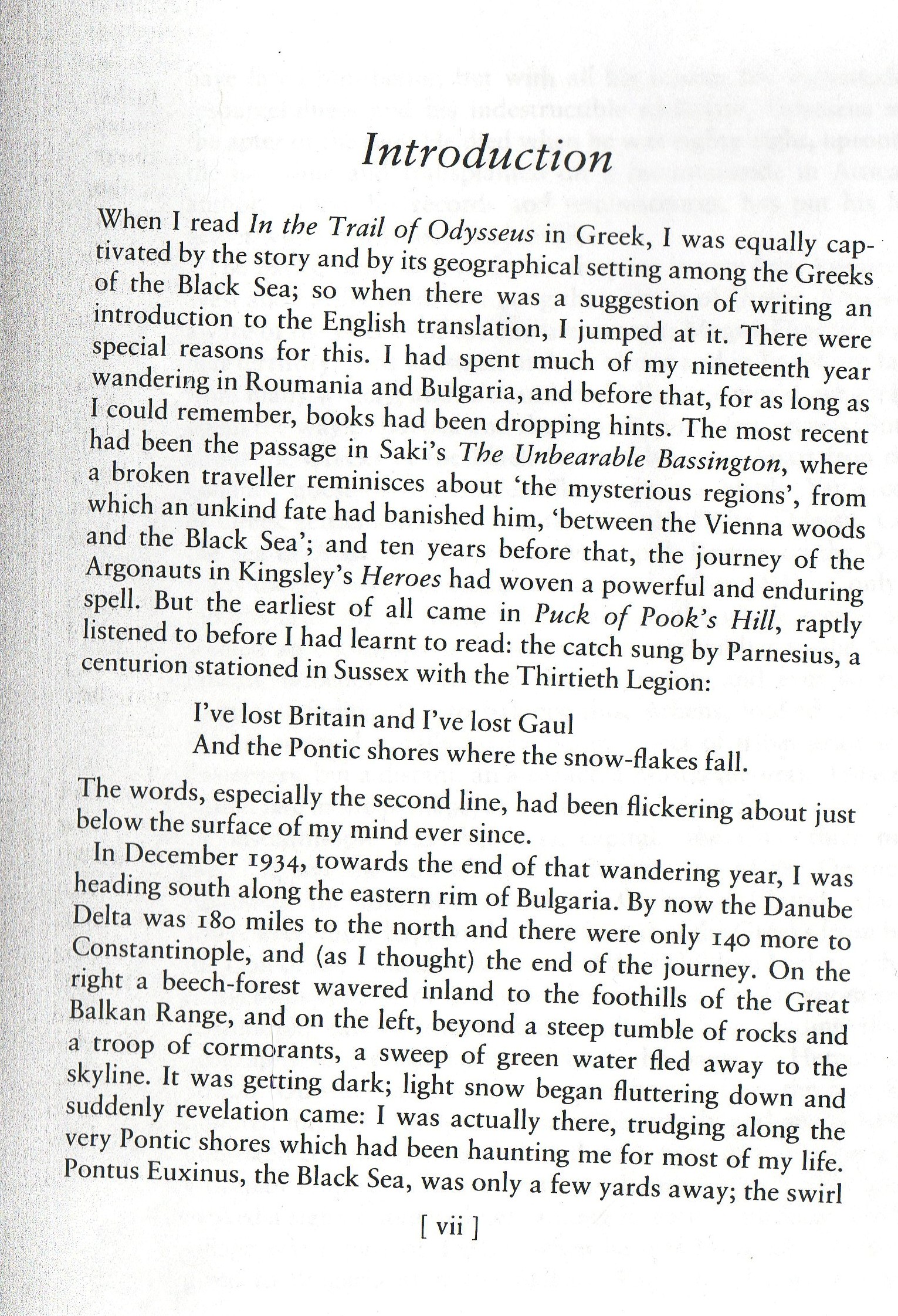
“The whole region seemed an enormous and mysterious antechamber to the whole Mediterranean, unbelievably remote and enigmatic, and ever so soon in danger of fading.”

It is the story of Yiankos Danielopoulis who died in 1987 at the age of 88. As a Black Sea Greek living through the 20th century his life was uprooted time after time, until at last he was able to settle in Mount Hymettos in mainland Greece in the 1950’s.

I have been sent some scanned copies of Paddy’s introduction, by blog corespondent James, to the English translation to the book which I hope you will enjoy and inspire you to purchase the last few copies of the book from Amazon!

To help you further, here is a short synopsis by John Colvin Body which appears to have been published in the Daily Telegraph in 1994.

“In the Trail of Odysseus by Marianna Koromila tr by Nigel Clive Michael Russell, L14.95 this modern-day “Odysseus” is Yiankos Danielopoulos, one of 12 Thracian children born in Vasiliko, a whitewashed Greek village of the Ottoman Empire in 1899, and dying in Attica 88 years later. His life has been compiled by Marianna Koromila from a privately printed family record that she acquired from his daughter. It reflects the turmoil of that region in the 20th century. Born under the Empire, Yiankos lived in Bulgaria, Romania, Russia, Turkey and Greece, surviving two nationalities, seven homes and 13 professions, all imposed by “the gale of the world”. Bulgarian violence, Bolshevik revolution, civil war and Communist take-over were his Eumenides. As a child, he “listened to the rattle of the pebbles as they were washed up by the waves”; saw woods, vineyards, wheat fields and boats unloading below his window on return from fishing. The Thracian traders and shipowners, with relations in all the Black Sea ports, he described as the seagulls which followed the fish. In winter, wolves descended from the mountains, threatening the village. “Union is strength,” said Yiankos’s father when the horses drove them off.

The Great Powers then changed lines on maps. Vasiliko came under the Bulgars, and life became untenable. Yiankos and his brothers moved to Constanza in Romania and opened a grocer’s shop. An admiral’s wife fell in love with one of the brothers. The shop received the navy’s warrant. Funds accumulated. Bulgaria then invaded and the family fled to Galatz (also in Romania) with their assets – 50 cases of macaroni. Yiankos dealt profitably in foreign exchange; money was made. But Galatz became an impossible place, what with bombing and Cossacks shooting holes in wine-cases and drowning in the alcoholic flood. The Danielopouloses escaped to Russia, packed like sardines in a stinking refugee train. Life in their new Russian home, Berdiansk, was lucrative until the Bolshevik and Anarchist massacres began, when the family escaped to Novorosisk in 1917, where the Russian fleet had scuttled. They steered clear of politics, which preserved them, but chaos came. The family escaped by tug back to Constanza, having profitably run cafe, shop and currency exchange in the middle of a revolution. Back in Romania, they enjoyed “party-time” – the annees folles of the 1920s – until the Crash of 1929. Thanks to family unity, they picked themselves up again, flourishing even during the German occupation of 1940.

But later, in 1950, when Soviet theft and odious oppression became intolerable, Yiankos, his wife and daughters left for Greece. They arrived in Mount Hymettos penniless, but went on to farm pistachio, orange, lemon and tangerine trees, cows, hens and vegetables. Yiankos had survived once more. Nigel Clive’s sparkling translation of Koromilos’s book is richly enhanced by Patrick Leigh Fermor’s introduction to that legendary world of the day-before-yesterday.”


Buy In the Trail of Odysseus at Amazon.

Page 1


Pages 2-3


Page 4


Related article:

The mystery of The Black Sea Cave


Friends of England – Cultural and Political Sympathies on the Eve of the War

This is a fairly academic article about the views of Hungarians towards Britain prior to the Second World War. I thought this worth of publishing on the blog as it rhymes with a lot of what Paddy tells us in Between the Woods and the Water, and he of course gets a mention.

First published in the Hungarian Quarterly.

In a Hungary on the threshold of war, committed to Hitler’s side, “Pro-English: by 1939, at the latest by 1940, this adjective would encompass many things: liberal, democratic, humanist, pro-Jewish, even Catholic on occcasion, anti-Nazi in every case.”1 Those who sympathized with the English had other characteristics in common, such as a respect for tradition and disdain for demagoguery of all kinds. Between the wars, sympathy for England was palpable especially in the aristocracy, in the upper middle classes and amongst the educated. Sympathy for English traits and behaviour offers an explanation, as does what was felt for Shakespeare, English literature and English culture in general.

There was also a remote historical parallel, occasionally stressed by the post-1919 counter-revolutionary regime: the near contemporaneity of Hungary’s Golden Bull (1222), the East European document resembling England’s Magna Carta (1215), the crown as an institution, and the role of the aristocracy. Needless to say, scant heed was paid to such matters in England by politicians or public opinion. They were curious at most. Hungary was a small and distant country. However, in Hungary this sympathy was deep and widespread, showing itself, among others, in the reception given to some contemporary English fiction, such as the novels of Somerset Maugham and Aldous Huxley, which enjoyed an extraordinary popularity here at the end of the thirties. The reasons were not purely literary, though. Sándor Hunyadi, a writer, wondered why in an article, and many readers wrote in to say they were fond of Maugham because they liked the English. Not the writer, or his works, but the English. In Hunyadi’s words: “Surely a good many British passports could be issued to people who are not British subjects, perhaps they cannot even speak English but, deep down inside, they sympathize with the English.”2 This sympathy is all the more noteworthy since, by the end of the thirties, the economic and military might of Nazi Germany had made its mark abroad, and the openly fascist Arrow Cross had made its presence felt in Hungarian politics. Against this, Great Britain was seen as the paradigm of parliamentary democracy, liberal and masonic ideals, and the City of London was believed to embody the power of partially Jewish capital. Centuries old institutions, along with British traditions, stood for the past, for all that which was said not to be modern or “of our time.”

Nevertheless, numerous intellectuals and politicia Continue reading

Angéla and Paddy’s visit to Cluj-Napoca

Balasha Cantacuzene

In response to requests from many of the citizens of Cluj who inhabit the pages of I Love Cluj on Facebook, I have scanned the pages which recount the story of Paddy and Angéla’s 1934 visit to Cluj in full.

This is taken from “Between the Woods and the Water”, the second volume of Patrick Leigh Fermor’s journey from London to Constantinople which commenced in December 1933 and ended with his arrival in Constantinople on New Year’s Day 1935. His time in Romania captures the beauty of the landscape, and the friendliness of the people be they aristocrat or peasant. It describes a time that would be lost forever due to the Second World War, which Paddy later described in an article for the Daily Telegraph as “Travels in a Land before Darkness Fell”.

His own extended sojourn in Romania was at Belani in Moldavia with the first love of his life, a young painter and Byzantine princess, Balasha Cantacuzene, whose family Paddy describes as part of an “old-fashioned, French-speaking, Tolstoyan, land-owning world. They were intensely civilised people.”

You can find pdfs of the story of the Cluj visit as follows (Cluj part starts page 143 but 142 gives you an introduction):

p142, p143, p144, p145, p146, p147 ………………. enjoy!

Related article:

Angéla, Paddy, István and Tom in Cluj-Napoca

Related category:

‘Between the Woods and the Water’

Angéla, Paddy, István and Tom in Cluj-Napoca


Matthias Corvin’s house Cluj-Napoca

If the lifespan of a crow can be up to thirty years, it is conceivable that the grandparents of the present day crows of Cluj observed Patrick Leigh Fermor and Angéla on their clandestine assignation to the city in 1934 when they were chauffeured by the understanding István. Their journey was a secret, but maybe the crows saw all and have passed on to their offspring the story of the young Englishman and the unhappily married Hungarian woman who was as ‘nimble as an ibex’.


As the sun set this evening I emerged from a restaurant near the Orthodox Cathedral to the sight and sound of thousands of crows flying westward at rooftop level, weaving in and out of the spires of the Cluj National Theatre. It was as if they were on some raid; they were in the stream, in squadrons of one hundred or more. I could neither see where they had come from, nor where they were going to, but this lasted for more than ten minutes and somehow it made me think of Paddy and Angéla.

The statue of Matthias Corvin dominates the square. St Michael’s church behind.

Cluj is today a fast growing city. The centre is dominated by crumbling Austro-Hungarian Baroque buildings. One can see that in 1934, before the darkness came that engulfed Europe and Romania, the pink and yellow painted walls would have been bright and welcoming to the small party that crept into town that warm August day.

Never missing an opportunity I have followed some of Paddy’s descriptions of his short stay in the city found in ‘Between the Woods and the Water’. He said that he and Angéla took a room near the house of Matthias Corvin who is a hero to both the Hungarians and the Romanians of Transylvania. This part of the old town has substantial houses and I wonder where in those cobbled streets, near the museum, they awoke, entwined, in their ‘handsome vaulted room’ to the sound of ‘recriprocally schismatic bells’. The bells would have sounded from the Gothic Saint Michael’s church in the Matthias Corvin square. His statue, which Paddy describes as magnificent, dominates the open space.

The New York/Continental Hotel

It was in a corner of this square that last night I set out on a search for the New York hotel, where the three of them had such fun and enjoyed an amazing cocktail, only surpassed, so István said, by the one called ‘Flying’ in the Vier Jahrszeiten bar in Munich. I was hoping that the secret of the cocktail had been passed down from generation to generation of barmen, but it was not to be. The hotel which is now named the Continental is closed, and the windows covered in posters proclaiming the Iron Maiden concert that took place last month to celebrate the success of the local football team, CFR-Cluj, in winning the Romanian league. It is a sad sight, but the building is nonetheless very grand with a turret on the corner facing the square and the Bánffy palace, which is now an art museum and next to the Melody nightclub with it’s huge neon sign, in the opposite corner.

So I did not get to sit in the seat of Patrick Leigh Fermor, nor drink his cocktail,  but instead walked in good company to my favourite bar in Cluj – Insomnia – and drank Ursus beer, whilst explaining to my Romanian friends Daniela and Vlad, why Patrick Leigh Fermor is the Greatest Living Englishman.

Blue River, Black Sea: A Journey Along the Danube Into the Heart of the New Europe

The following is a piece by Dimiter Kenarov from The Nation which contrasts the journey of Paddy along the banks of the Danube with the more recent account of Andrew Eames, recounted in Blue River, Black Sea. It is clear that if we were to try to follow the foosteps of Paddy that much has changed – I guess that much we knew – but that also the pace of change means that if we are to encounter the last feeble remnants of that post-Austro-Hungarian world, we had better move very fast. This is worth the read.

From Black to Black, a review of Blue River, Black Sea: A Journey Along the Danube Into the Heart of the New Europe
By Andrew Eames.

Every day, at three in the afternoon, I make a trip down the Danube. To travel from Germany’s Black Forest to Romania’s Black Sea takes a matter of minutes, so I try to enjoy myself as much as possible. I sink into a cushy armchair, rev up the stereo and embark on an epic voyage. “Information on the water levels of the Danube River, in centimeters,” the familiar voice on Horizont, the Bulgarian National Radio, announces with the deepest solemnity before reading out the relevant hydrographical values, first in Bulgarian and then in Russian and French. Vienna: 310 (+3); Mohács: 415 (+7); Novi Sad: 162 (-13); Vidin: 380 (+40); Giurgiu: 220 (0).

The captains of river vessels can easily map a course on the Internet, but the daily radio bulletin has remained a fixture in my life. For many years, listening to the fluctuations in the water levels of the Danube was the closest I could get to traveling abroad. Regensburg, Passau, Linz, Vienna: these names mesmerized me. Even places like Bratislava and Budapest, comrades in arms against the decadent West, had the ring of myth to a boy growing up in Bulgaria. Remembering his childhood in the Bulgarian river port of Ruschuk (now Ruse), Elias Canetti wrote, “There, the rest of the world was known as ‘Europe,’ and if someone sailed up the Danube to Vienna, people said he was going to Europe.” If people in Canetti’s immediate circle, at the beginning of the twentieth century, still had the occasional opportunity to waltz up to the palaces of the Habsburgs and back, however, the “Europe” I imagined in the 1980s existed only in a galaxy far, far away. To travel up the river as a tourist during the cold war required visas, special permissions, bureaucratic ballast. To swim across it, a negligible distance of a few hundred meters, was to risk both drowning and the bullets of border guards. For nearly fifty years the Danube was a demolished bridge, a liquid roadblock. The wall may have been in Berlin, but the truly impassable one was an invisible dam on the Danube, somewhere between Vienna and Bratislava.

The Danube—or Ister, as the ancient Greeks called it—is a natural highway of nearly 3,000 kilometers. “The greatest of all the rivers which we know,” declared Herodotus. “A path for the spirit to follow,” wrote Hölderlin, following the footfalls of the Greeks in his hymn “The Ister.” Human tribes traveled west against the current, colonizing the core of the continent, gradually shaping it. Before the Americas, there was Europe. The Romans made a few feeble attempts to bring traffic under control by turning the river into the fortified frontier, or limes, of their empire, but without much success. South of the Danube civilization cowered; in the north, the barbarians bided their time.

There is probably no other geographical element of Europe that has absorbed more political weather than the Danube. Unlike the Russian Volga and the Franco-German Rhine, it has served many masters, as a shield or a spear. In 1683, by the walls of Vienna, John III Sobieski and Charles of Lorraine routed the armies of Kara Mustafa, marking the beginning of the end of the Ottoman Empire. Not long thereafter, in 1704, the Duke of Marlborough and Prince Eugene of Savoy vanquished the Franco-Bavarian alliance at the Battle of Blenheim, an important event in the War of the Spanish Succession. Near the river town of Ulm, Napoleon forced the Austrians to surrender with barely a fight. And Hitler’s Drang nach Osten—yearning for the East—had a strong Danubian stink. “Do not forget,” the elderly Heinrich Heine wrote to the young Karl Marx, “the difference between water and a river is that the latter has a memory, a past, a history.”

It has taken twenty years of European integration for the memories of the cold war to seep away. Quietly meandering across ten countries—Germany, Austria, Slovakia, Hungary, Croatia, Serbia, Bulgaria, Romania, Moldova and Ukraine—and running softly past more than fifty-five towns and cities, including four capitals, the Danube is once again a major route for trade and tourism, diluting national and political borders and linking numerous shoreline communities into a single organism. The Rhine-Main-Danube Canal, completed in 1992, allows ships to navigate passage from the North Sea to the Black, chugging through the heart of the continent. The river’s delta, with its sprawling network of lagoons and marshes, is a Unesco World Heritage Site and an important bird sanctuary—with its own environmental problems, of course. Today, to sail along the Danube is to see the new face of Europe, old as it is. And, luckily for me perhaps, the daily radio bulletins on Horizont are no longer my only means of travel.

Traveling the Danube became a fad in 1829. That was the year two Englishmen, John Andrews and Joseph Pritchard, founded the First Danube Steamship Company, which lured scores of elated pleasure seekers. “A motley crowd on board, such perhaps as never met together on the deck of a steam-boat before,” wrote the Irish journalist and literary editor Michael Quin about one of those early voyages. Standing among Austrians, Moldavians, Jews, Hungarian nobles and Tyrolean emigrants, he traveled in style down the river from Pest (Budapest) to the Ottoman town of Ruschuk. It was a thrilling but perilous undertaking. Unlike the well-trodden path of the Grand Tour, with its picturesque Parisian streetscapes and Florentine galleries, the Danube offered a wilder ride for people with money and a taste for adventure. Although its waters flowed across half the continent, knowledge of the river was scarce and scattered, especially when it came to portions under Ottoman control. Europe was split in two long before the cold war, and the Danube was the main gateway into its eastern, darker territories. The course of “civilization” had gradually reversed directions.

William Beattie, another of those early steamboat passengers, portrayed that division with typical Victorian bigotry. East of Budapest, he wrote in his 1844 travelogue The Danube, the tourist “feels as if he were taking farewell of civilization, and entering upon a vast primeval desert, where man is still a semi-barbarian; and where the arts by which he converts to his use the natural products of the earth are still in their infancy, or wholly unknown.” As far as Beattie was concerned, Eastern Europe might as well have been an island in the middle of the Pacific. Quin was similarly dismayed by the seemingly crude ways of life he encountered but a little bit more optimistic in his vision of the future. He praised “the miracles of the age of steam” and then blithely prophesied, “Those countries, which have hitherto seemed scarcely to belong to Europe, will be rapidly brought within the pale of civilization…and new combinations…will be created, which may give birth to important changes in the distribution of political power on the continent.” He was right, of course: steam did alter the political landscape of Eastern Europe. (Could it be that James Watt was personally responsible for the fall of the Ottoman Empire and the whole contemporary history of the continent?) However, Quin’s journey down the Danube was also a reassertion of his cultural identity and his sunny view about technological progress. As the historian Larry Wolff pointed out in his seminal work Inventing Eastern Europe, “It was Western Europe that invented Eastern Europe as its complementary other half.” And the Danube was the road most inventors took.

So many writers have traveled the Danube that their tributary ink, if channeled into a single stream, would turn the water black. From the Italian naturalist and geographer Luigi Ferdinando Marsigli, who professed to have mastered “the anatomy of the river” and then published in 1726 his magisterial six-volume Opus Danubiale, to the contemporary Hungarian writer Péter Esterházy, with his playful travelogue The Glance of Countess Hahn-Hahn (Down the Danube), published in 1991, the outflow of words has been endless. To look for the authentic Danube would be futile, for nobody can describe the same river twice. “It is I who will say what the Danube is,” Esterházy’s protagonist, the Traveler, insists, as so many others before him have: Germans and Austrians, Hungarians and Russians, as well as the odd Serbian, Romanian and Bulgarian. For some reason, however, it was the British and a few American explorers, outsiders with ever-roving empirical eyes and an insatiable appetite for the foreign, who frequently attempted to distill the Danube’s essence. Some, like Quin and Beattie, were deeply prejudiced against the world they were about to encounter. Others, like the American painter Francis Davis Millet, who paddled downriver in a canoe in 1891, wrote about the local people and their environs with sympathy and understanding. Then there were those who transcended the ranks of mere travelers to join the great writers.

Patrick Leigh Fermor is the best of the lot. In the winter of 1933, at 18, he set out on foot from Rotterdam toward Istanbul—or Constantinople, as his romantic imagination insisted. With just a rucksack on his back and two books in hand—The Oxford Book of English Verse and the poems of Horace—he traversed the better part of the pre-war continent “like a tramp or a pilgrim or a wandering scholar.” His trek along the Danube made up only one leg of his amazing odyssey, but it was the most remarkable one. Poring over his maps and trying to decide whether to head for sunny Venice or press farther east, he writes, “Just in time, the windings of the Middle and the Lower Danube began to reassert their claims and the Carpathians and the Great Hungarian Plain and the Balkan ranges and all these mysterious regions which lay between the Vienna Woods and the Black Sea brought their rival magnetisms into play. Was I really about to trudge through this almost mythical territory?” Continue reading

Where in the world have you come across Patrick Leigh Fermor?

Between the Woods and the Water

I have just returned from Montenegro where I had a holiday with my family. It is a place that is not at the top of the list for most people I guess, but it does attract many Serbians and Russians, particularly to its spectacular coast.

We were attracted because it was different, has spectacular scenery dominated by huge mountains, is relatively unknown, and it also enabled us to visit some very famous Serbian Orthodox monasteries as my wife and I are also very interested in Byzantium and its art (see MyByzantine blog).

On our first night, as I casually flicked through the books left in our villa by the owner and previous visitors, I was surprised to come across a paperback copy of Between the Woods and the Water. It had been read and was in good condition. This gave me the excuse to encourage Kim to read it as she happened to be coming to the end of A Time of Gifts which she was enjoying.

It made me think that many of you who read the blog may have come across Paddy’s work in unusual circumstances, and in faraway places. It would be interesting to hear more; why not paste a comment below or email me (tsawford[at]btinternet.com)? Let’s see who has the most interesting tale to tell!

Meeting Patrick Leigh Fermor in the Mani

Recently we have been musing in some posts about following Paddy’s route. For many of his fans this is perhaps a dream, but nevertheless, something many would like to make real. Topping that of course is meeting Paddy himself. In this piece, New Zealand author Maggie Rainey-Smith unexpectedly meets Paddy on a trip to Kardamyli on Greece’s Mani Peninsula, where Paddy has lived since the 1960’s. Some of you may have read it but I think it is such a nice article that it is worth re-visiting.

First published in the New Zealand Herald 15 June 2008

 
The village of Kardamyli is on the west coast of the Mani Peninsula, one of the more traditional and conservative areas of Greece.Recently, I spent two months in Greece chasing the muse, searching for clues, looking for inspiration.

The Mani Peninsula region is famous for the Maniots and their resistance of the Ottoman occupation. It is isolated by the Taygetus mountain range and enclosed by the Aegean and Ionian seas.

The Ottomans failed to infiltrate, but I have to advise that the English have. As I shopped for my Twinings tea and sat outside a cafe in the village of Kardamyli, using the free internet, I lamented the globalisation of this once-remote peninsula.

I wished, for just a moment, that I was back in time when to be a strange woman alone in this small village may have attracted disapproving stares.

In the local bookshop was the very book I’d been looking for: Mani – Travels in the Southern Peloponnese, by Patrick Leigh Fermor. On my terrace overlooking the sea, I opened the book and found myself mesmerised by the most exquisite, evocative travel writing I have ever read. Not only that, I discovered that Fermor is a resident of Kardamyli.

The owner of the bookshop was unimpressed when I asked where Sir Patrick lived, and his lips remained sealed, his expression disapproving. Fermor is almost a saint in Greece.

He was a resistance fighter in Crete during World War II; his exploits were the subject of a film starring Dirk Bogarde (my father was in Crete, but a more modest hero at Maleme, the point where the island was finally lost to the Germans).

At the local cafe, where I made use of the technology, the owner (who looks like a Maniot right out of Fermor’s book, with her blanket of black ringlets and beautiful olive eyes), told me Paddy (as the locals call him) would celebrate his Name Day that very week and that he always opens his home to the locals on that day.

By then, and after one week’s residence, I considered myself a local, and everyone agreed with me.

So with joyous disbelief at my good fortune, on Thursday, November 8, I joined the local villagers at Sir Patrick’s Name Day celebration at his majestic and yet still homely yellow stone house overlooking the Messinian Gulf.

By 10.30am the service in his private chapel was over and we were seated in his lounge – books lining the walls from floor to ceiling: Nancy Mitford, Henry James, James Joyce – eating olives, meatballs, feta and drinking local wine.

On a person’s Name Day you are required to take a gift, and all I had with me was a copy of my first novel About Turns, which I gave to Paddy. He signed my copy of his own book with a personal inscription and a small drawing. We talked about Crete and my dad and his book on the Mani. I gushed, he charmed.

Then the singing began and Paddy was surrounded by adoring local women who toasted him with traditional Name Day songs.

At the end of the singing, Paddy stood and pretended to fire a pistol into the air (an old tradition where real pistols were once used). He is of English and Irish descent. Although his name is Patrick, his Greek Name Day is the day of Michali. Michael is the name he assumed while fighting for the Greek resistance.

With me was an American Orthodox nun who worked in Moscow and a Danish man of the cloth who was studying Byzantine churches. We were Paddy’s “non-local” guests and pinched ourselves to check we weren’t imagining our good fortune.

When it was time to leave, another Michael (Michali), a neighbour of Paddy’s, invited us to his home. We walked through an olive grove up the hill along the coast to another beautiful stone home.

Our new host sold Paddy the land and helped him build his house in 1964. We were feted with fresh coffee and cakes and listened to Michali’s son, who told us that when he decided to leave Kardamyli some years ago to travel, Paddy told him: “You can’t leave.”

And when he returned years later, Paddy told him: “You know we are very fortunate, we live in Kardamyli. We are fortunate – we have the mountains. We are fortunate – we have good food. We are fortunate – we have clean air to breathe. We are fortunate – we have the beautiful sea to swim in.”

“Yes, Paddy, the mountains, the food, the air and the sea,” said the young man, nodding in agreement.

And then Paddy said to him: “And for all these reasons and more, we may just forget to die.”

Sir Patrick Leigh Fermor is 92 years old, he was wearing a double-breasted navy suit when I met him, had a full head of wavy grey-black hair and was still a handsome, charming man with just a slight deafness in one ear.

He spoke with a classical English accent which rather surprised me, considering the years he has spent in Greece.

He is still writing. If you’ve never heard of him, or never read his books, now is the time to start.

By Maggie Rainey-Smith

A Long Walk Starts (and Ends) With a Step

I was just taking another look at Matt Gross’ Frugal Travel section of the New York Times and discovered that after writing the piece I published on 13 June he left the NYT. I wonder if he was so inspired by Paddy’s travels that he decided to take off and cover the whole route? Perhaps not. Here is his signing off piece from his NYT Blog.

By MATT GROSS

This weekend’s Travel section cover story — “Frugal Europe, On Foot” — is my last as the paper’s Frugal Traveler columnist. After four years of roaming the world on a budget, from Alabama and Albania to Uruguay and Urumqi, I’m taking a rest, and handing over the illustrious mantle to a new shoestringer, who’ll appear in this space next month.

But for my final feature, I wanted an adventure that would challenge me — physically, psychologically, culturally, linguistically, technologically, logistically and, of course, financially. Maybe a sailing adventure? Done that. A lengthy train journey? Done. A trek into the mountains? Done — on foot and on horseback. I’ve gone round the world, across America and grandly circled Europe, so what was left to be done?

The answer came in the form of Patrick Leigh Fermor, the 95-year-old war hero who’s known as Britain’s greatest living travel writer. His books “A Time of Gifts” and “Between the Woods and the Water” chronicle his nearly penniless journey, in 1933 and 1934, from Rotterdam to Istanbul — on foot. And when I looked at the route he took through the remains of the Austro-Hungarian Empire, I realized I had an adventure in the making: a two-week walking tour that would take me from Vienna through Slovakia to Budapest.

Throughout 180 miles, I dealt with three official languages (German, Slovak, Hungarian) and some unofficial ones (Italian, English, French, Hebrew). I used maps both paper and electronic. I took inspiration from literature: not just Mr. Leigh Fermor’s books but also “The Unnamed,” by Joshua Ferris, “The Road,” by Cormac McCarthy, “The Places in Between,” by Rory Stewart, and “The Long Walk,” by Stephen King (writing as Richard Bachman). I found great bars and restaurants via Twitter and Foursquare — and through common, random luck. I walked till my ankles screamed, and sang to myself during long hours alone.

And when I met new people — as I did just about everywhere — I was amazed, again and again, at their spontaneous generosity, their willingness to feed, shelter and befriend a mysterious stranger attempting to do what few sane travelers would even contemplate.

In other words, I don’t expect you, my readers, to follow precisely in my blistered footsteps, but I hope this story — and all the Frugal Traveler articles I’ve written — will inspire you to set off on your own crazy adventures, confident in the knowledge that no matter how little money you have, the world will, if you embrace it fully, take very good care of you indeed.

Are you inspired? I know I am. It would be a nice idea if perhaps next year we could get a bunch of people together and walk some of the route. On the other hand perhaps it is best to do as Paddy did and make a solo attempt. If anyone has ideas on this get in touch with me tsawford[at]btinternet.com or post a comment below.

Related article:

Walking Paddy’s Route in Mitelleuropa: Frugal Europe, on Foot

Walking Paddy’s Route in Mitelleuropa: Frugal Europe, on Foot

It’s time to be honest now: who amongst the regular readers of this blog, or even those that stumble across us because they have read ‘A Time of Gifts’ or ‘Between the Woods and the Water’, has not thought about following Paddy’s 1930’s route? For myself it is a definite goal. It is an ambition; probably a passion. I had come across the following article but have been inspired to re-produce it by Blog reader Matt who says he first got into Paddy’s work when stationed in Baghdad:

Tom, The New York Times travel writer, Matt Gross, just did an article on PLF. He walked the Vienna to Budapest stretch recently … I first read PLF while stationed in Baghdad four years ago and revisit him often. Living in Heidelberg, I’ve been able to visit some of the places he mentioned specifically and have recommended A Time For Gifts to many of my fellow Americans living here or travelling to Europe. As I’m in the process of moving back to the States, it will be a few years before I’m able to pick up the thread of his travels. I’m not sure if you’re in contact with PLF, but pass him the respects of this Yankee officer. Matt

Frugal Europe, on Foot

First published in the New York Times,  May 23, 2010

The article is written by New York Times’ Frugal Traveler columnist Matt Gross who attempted to follow in the footsteps of Patrick Leigh Fermor. Like all good stories it begins ….

ONCE upon a time, a young man went for a walk. It was December 1933, and an 18-year-old Englishman named Patrick Leigh Fermor put on a pair of hobnail boots and a secondhand greatcoat, gathered up his rucksack and left London on a ship bound for Rotterdam, where he planned to travel 1,400 miles to Istanbul [Ed: Constantinople!] — on foot. He had virtually no money; at best, he’d arrive in, say, Munich to find his mother had sent him £5. But what he did have was an outgoing nature, a sense of adventure, an affinity for languages and a broad network of friends of friends.

 “If I lived on bread and cheese and apples,” he later wrote, “jogging along on fifty pounds a year like Lord Durham with a few noughts knocked off, there would even be some cash left over for papers and pencils and an occasional mug of beer. A new life! Freedom! Something to write about!”

 Something to write about indeed! The books he produced from the yearlong journey — “A Time of Gifts” and “Between the Woods and the Water” — are gorgeously rendered classics that have led many to call Mr. Leigh Fermor, now 95, Britain’s greatest living travel writer. But to my mind, he’s always had another title: the original Frugal Traveler — the embodiment of that idea that, though a wanderer may be penniless, he doesn’t have to suffer.

 And Mr. Leigh Fermor never suffered, thanks to the miracle of human generosity. Peasants gave him baskets of eggs and swigs of raspberry schnapps. Small-town mayors found him beds. The lingering nobility of Europe put him up in their castles, invited him to balls and lent him their horses. When Mr. Leigh Fermor did sleep rough — in hayricks and barns or on the banks of his beloved Danube — he did it by choice, not because (or not merely because) poverty required it. He knew, even at 18, that the world is an experience to be savored in all its multifarious incarnations.

Matt Gross' route

Could a young person (is 35 still young?) with strong legs and little money find the same spirit of hospitality that Mr. Leigh Fermor encountered some 76 years ago? At the end of March, I set out to find the answer. With only two weeks free, my plan was to walk from Vienna to Budapest, a 180-mile route that would connect the old poles of the Austro-Hungarian Empire and track Mr. Leigh Fermor’s trail as closely as possible, taking me along the Danube to Bratislava, the Slovakian capital, and across the plains of Slovakia south to Hungary — through three countries whose languages, cultures and histories could not be more different, or more intertwined.

It was tempting, the day I arrived in Vienna, to just walk east from the airport, but I couldn’t completely skip the Austrian capital, where Mr. Leigh Fermor had spent three weeks among the “crooked lanes” and “facades of broken pediment and tiered shutter.” And so I followed his lead, going into the imperial crypt, where the grandest members of the Hapsburg family lay entombed in elaborate sarcophagi, and into the museums, although I shied away from the most famous in favor of oddities like the International Esperanto Museum. And I luxuriated in storied places like Cafe Alt Wien and Cafe Bendl.

But after two nights in Vienna, I was restless. So I crossed the Danube, put on my 45-pound pack and took off down the Donauradweg, a well-kept biking trail that runs from the river’s source to its mouth at the Black Sea. To my right, the Danube, more green than blue, sparkled in the cool sunlight, and I encountered fishermen tending their rods, elderly sunbathers, nordic hikers poling along and cyclists speeding in both directions.

This first day, I figured, I’d take it easy and do only 15 miles. Ideally, I’d need to hit 18 miles a day — about six hours of walking — to reach my goal. It seemed reasonable, especially with the terrain so uniformly flat. The path, sometimes dirt, sometimes paved, would often stretch so far and straight that I couldn’t imagine I’d ever reach the end, and then I’d finally hit a slight turn and face the same thing: an art-school lesson in perspective, complete with the first low foothills of the Carpathians at the vanishing point — and a scampering rabbit to remind me this was no still life.

Even with such straightforward terrain, there were snags. An attempted shortcut through a fuel depot left me with minor scratches and an extra three miles. But such mistakes have a way of turning out for the best. Had I stayed on the trail, I would have never crossed paths, two hours later, at the edge of Donau-Auen National Park, with Jean-Marc and Marie, newlywed French cyclists who stopped to say hello when they saw a lone hiker in the middle of nowhere. They were taking an extended honeymoon: a two-year bicycle journey from their home in Paris — to Japan!

“Do you know where you’re staying tonight?” I asked. They didn’t. I told them to meet me at Orth an der Donau, a small Austrian town a couple of miles farther down the Danube, where I had arranged for a place to stay via CouchSurfing.org. Maybe, I said, my host could find them somewhere to pitch their tent.

THE host, Roland Hauser, whom we met in front of Orth’s impressive castle, did better than that. He invited them home to his dreamland of soft beds and hot showers. Roland, 26, had traveled from California to Southeast Asia to New Zealand, and his German-accented English was peppered with words like “sí” and “bueno.” That evening, we cooked spaghetti Bolognese, nibbled Südtirolean ham and drank big bottles of beer. I went to sleep marveling at our extraordinary, Fermorian luck.

In the morning, after coffee, I threw out my underwear. This was a strategy to lighten my load — bring old undies and get rid of them day by day. Frankly, I should have done that with everything, as the pack was needlessly heavy. Along with two weeks’ worth of shirts, I had an ultralight down jacket, a waterproof shell and rain pants. A tent and sleeping bag. One pair of jeans and lightweight canvas shoes to change into at day’s end; nothing worse than walking 20 miles and spending the evening in the same clothes. And I packed Mr. Leigh Fermor’s books and Claudio Magris’s “Danube,” which I never had time to read. And my computer and camera gear — work necessities, alas.

When I set off, I was wearing my typical walking outfit: khaki pants by a company in Portland, Ore., called Nau; waterproof running sneakers by Lafuma; good socks (as important as good shoes); and a long-sleeved cotton shirt.

The walk began well. My feet were tender, but the flatness of the Marchfelddamm, a high berm that doubled as biking path and flood deterrent, ensured that I wasn’t struggling. This was the heart of the Donau-Auen National Park: forests of thin trees broken by occasional streams flowing to the Danube. At first, I appreciated the play of light on the water and between the trunks, but hour after plodding hour of unchanging scenery soon became mind-numbing, and I simply marched, putting one foot in front of the other and watching for kilometer markers. It would be 13 miles before I could stop for lunch, and another 10 before I reached my day’s goal: Bratislava.

But there’s a funny thing about long walks. With patience, all those steps add up, and by 2 p.m., I’d crossed a bridge over the Danube and settled into a cafe in the stately town of Hainburg, where an open-faced baguette pizza and glass of beer gave me the courage to face the miles ahead. And soon I found myself trudging along the shoulder of the small highway with cars flying past — and missing the monotonous near-silence of the forest.

Not far off, I could see Bratislava’s hilltop castle — in Mr. Leigh Fermor’s era, a burned-out wreck worked by prostitutes but in the 1950s rebuilt as a stately white-and-red palace — and it teased me with its apparent nearness. Still, I had far to go, past a derelict border post, and through three miles of snaking bike paths, before I crossed the Danube again and was in the heart of Bratislava’s old town, all cobblestones and tile roofs and sidewalk cafes.

After checking into the Hotel Kyjev — a 1970s tower turned budget boutique — I checked myself out: I wasn’t sore, out of breath or even tired. I did have blisters on my feet, but they were easily treated: puncture, drain, clean, bandage. My ankles, however, were terribly swollen, the peroneal tendons in particular, a result (I think) of how my body mechanics had altered with the weight on my back. I popped some ibuprofren, took a shower, then hobbled outside for dinner.

It was the Friday during Passover, and like any wandering Jew, I wanted a Sabbath meal. And thanks to Chabad, the Hasidic Jewish outreach organization, I got one, at the home of the transplanted American rabbi Baruch Myers. He was only too willing to share his food (cucumber salad, gefilte fish), his friendship and his family, including a battalion of adorable children who cheerily walked me through the Passover story.

It wasn’t just this heartfelt welcome that got to me; it was the very existence of a Jewish community in Bratislava. Back in his day, Mr. Leigh Fermor wrote, the Jews “were numerous enough to give a pronounced character to the town.” No longer. The Holocaust had reduced the Jewish population to, in Rabbi Myers’s estimate, 1,000 people. There was a synagogue, a few kosher restaurants, a Jewish museum and even a pension, but few visitors today would see in Bratislava a Jewish-inflected city.

On Saturday, partly inspired by the rabbi and partly because of my feet, I rested and contemplated the future. I had walked 40 miles so far, and if my ankles were any indication, there was no way I’d make the remaining 140. Unless … If I took a train a short way — say, 15 miles northeast — I could certainly walk another 10 miles. I’d be breaking my rules, but those rules were arbitrary. Continue reading

Profile of Patrick Leigh Fermor by Max Hastings

A personal view by Max Hastings who thinks that Paddy’s best book is Mani.

First published in the Daily Telegraph 12:01AM GMT 04 Jan 2004

Not long after the Second World War, an English couple chanced upon a remote taverna in the mountains of Greece. As they ate their simple lunch the proprietor, perceiving their nationality, remarked: “We had another English couple here once, before the war. They stayed for weeks. They were so beautiful and so in love. And every night they dressed for dinner!”

It was this last foible that had plainly captivated him, and indeed conjured for his listeners an enchanting vision of young lovers in “the full soup and fish”, as P G Wodehouse would have said, in this lonely Greek inn. All became clear when the innkeeper added: “His name was Lefemor.”

This was, of course, the inimitable Paddy (he has never been known as anything else), though the innkeeper was wrong about the nationality of his other guest – she was in truth a Romanian princess, Balasha Cantacuzene, with whom he enjoyed a romantic idyll through the last few years before the war.

Legend has it that “Lefemor’s” distraught family ordered him home, finally cabling the fare when he pleaded poverty to explain his inability to return. He merely used the money to protract the affair.

Like many stories told both by and about Sir Patrick Leigh Fermor – as he became this week at the age of 88 – this one may be a trifle fanciful, owing as much to soaring imagination as to historical fact. No matter. It is the sort of story about Paddy which ought to be true.

He richly deserves his honour not only for what he has written – some of the finest travel books of all time – but for what he has been. In prose, as I heard one of his oldest friends put it recently, “he possesses an extraordinary gift for expressing beauty in words”.

He has fulfilled the dream of so many upper-class Englishmen of his generation, to live, love, play the hero, sage and wit with a lightness of touch which, translated into the milieu of the kitchen, would produce a souffle of genius.

He was the son of Sir Lewis Leigh Fermor, a geologist who travelled widely and made his reputation in India. “His tall, straight figure might often be seen dancing in Calcutta,” the DNB observes playfully. Paddy’s somewhat erratic schooling terminated at King’s Canterbury, from which he was sacked for some misdemeanour – “holding hands with the greengrocer’s daughter” is his own version, which will serve as well as any other.

Rejecting parental plans for Sandhurst and the Army, in December 1933 at the age of 18 he set out instead to walk to Constantinople, with very little money but some rather grand letters of introduction. The consequence was that for the next 18 months, he was wafted from schloss to schloss across old Europe, plunging his insatiable social, cultural, intellectual and linguistic curiosity into a river of happy encounters.

These he has described in the two volumes, A Time of Gifts (1977) and Between the Woods and the Water (1986). A third instalment of the journey has been long in preparation, but it is unlikely that anyone except his publisher expects it to get finished.

He has always been a slow writer, each of the eight books in his modest output requiring long and painful labour. His dilatoriness has been reinforced, perhaps, by indifference to money. Though he has never had any, somehow God or friends have eagerly provided. He has practised a superior brand of Micawberism, founded upon the belief that something or somebody would turn up, which in his case it always has.

When war came in 1939 he left Baleni, the wonderful Romanian mansion where he had been living with his princess, to join the Irish Guards. Instead, however, he was commissioned into the Intelligence Corps as a Greek speaker. He spent the winter of 1940 as a liaison officer with the Greek Army.

Affectionately sceptical friends say that Paddy’s linguistic fluency is a trifle exaggerated. Sixty years ago an Englishman who heard him gassing away nineteen to the dozen said to a neighbouring Greek woman: “Is he as fluent as he sounds?” She replied: “No. He is simply making a wonderful noise.” This is a little unjust, and of course he has indeed become a master of the Greek language after living in the Peloponnese for so long. He possesses a gift for communicating with his fellow man of any nationality, class or condition, without need for anything as vulgar as a phrasebook. Continue reading

Walking towards Byzantium

A Review of Artemis Cooper’s “Words of Mercury” by William Dalrymple published in the Guardian.

First published in the Guardian 13 December 2003

William Dalrymple relishes Words of Mercury, a selection from the work of Patrick Leigh Fermor, Britain’s greatest living travel writer.

Skill with the sword usually precludes much competence with the pen. For all that Sir Philip Sidney could write sequences of Petrarchan sonnets as well as lead buccaneering raids on the Spanish Netherlands, or Siegfried Sassoon write his anti-war memoirs while also winning the Military Cross, bookishness and military machismo are rarely found roosting together (after all, it’s no secret, as the old joke goes, that military intelligence is a contradiction in terms).

The great exception to this rule in our own time is Patrick Leigh Fermor. For though he is one of our finest prose stylists and – since the death this summer of his only possible rival, Norman Lewis – without question our greatest living travel writer, he was also responsible for one of the most audacious special operations coups of the second world war.

Leigh Fermor’s own account of the abduction of General Kreipe, the German commander of the Nazi occupation forces in Crete, is published for the first time in Artemis Cooper’s wonderful new anthology of Leigh Fermor’s work, Words of Mercury. The story is a famous one, and in the film version, entitled Ill Met by Moonlight, Paddy was played by the dashing Dirk Bogarde. But in Leigh Fermor’s own account, the climax comes not as the general’s staff car is stopped at night by a British SOE party dressed in stolen German uniforms, nor as the Cretan partisans help smuggle the general into the Cretan highlands and thence to a waiting British submarine; but instead as “a brilliant dawn was breaking over the crest of Mount Ida”: “We were all three lying smoking in silence, when the General, half to himself, slowly said: ‘ Vides ut alta stet nive candidum Socrate’. It was the opening lines of one of the few Horace odes I knew by heart. I went on reciting where he had broken off … The General’s blue eyes swivelled away from the mountain-top to mine – and when I’d finished, after a long silence, he said: ‘Ach so, Herr Major!’ It was very strange. ‘Ja, Herr General.’ As though for a moment, the war had ceased to exist. We had both drunk at the same fountains long before; and things were different between us for the rest of our time together.”

It is an archetypal Leigh Fermor anecdote: beautifully written, fabulously romantic and just a little showy. For Leigh Fermor’s greatest virtues as a writer are also his greatest vices: his incantational love of great waterfalls of words, combined with the wild, scholarly enthusiasms of a brilliant autodidact. On the rare occasions he gets it wrong, Paddy has been responsible for some of the most highly coloured purple passages in travel literature. But at his best he is sublime, unbeatable.

For as well as being a war hero, one of the world’s great long-distance walkers, and as tough a traveller as you could find, Leigh Fermor has always been a writer of great intelligence, sensitivity and profundity. Here he is, for example, describing a French Cistercian monastery, where he says he discovered “the capacity for solitude and the recollectedness and clarity of spirit that accompany the silent monastic life. For in the seclusion of a cell – an existence whose quietness is only varied by the silent meals, the solemnity of ritual and long solitary walks in the woods – the troubled waters of the mind grow still and clear, and much that is hidden away and all that clouds it floats to the surface and can be skimmed away; and after a time one reaches a state of peace that is unthought of in the ordinary world.”

Words of Mercury is a cornucopia, full of the rarest gems, but it is also a rather odd book: part collected journalism, part greatest hits anthology, with a few other surprising odds and ends thrown in, such as a memoir about the eccentric Scottish genealogist Sir Ian Moncrieffe of that Ilk. This tells of Moncrieffe’s huge pleasure in discovering that he was directly descended from “The Blood Countess, Elizabeth Bathory, Monster of Csejthe [who] was convicted in 1610 of the slow murder – in order that their blood might magically preserve her beauty – of more than six hundred girls.” In a similar mood, there is also a letter from Paddy to the editor’s grandmother, Lady Diana Cooper, and a footnote directing the reader towards the “strongly recommended” work of the military historian Antony Beevor, who just happens to be the editor’s husband (though in fairness, it appears that this warm endorsement comes from Leigh Fermor rather than Cooper).
-Read More!>