Dear Mr Murray

David McClay is the former curator of the John Murray archive located at the National Library of Scotland which includes Paddy’s papers which were donated to the archive by Paddy in his will. This book may be of general interest to some of you.

by Rosemary Hill

First published in the London Review of Books

Some things in the relations between authors and publishers never change. Dear Mr Murray: Letters to a Gentleman Publisher, edited by David McClay, a collection of letters written to six generations of the Murray family, is full of familiar complaints. Jane Austen was ‘very much disappointed … by the delays of the printers’. Maria Rundell, author of A New System of Domestic Cookery (1805), was furious about misprints in the second edition, including an unfortunate mistake in a recipe for rice pudding. Byron objected to cuts in his work, as did David Livingstone, who also took exception to the ‘absolutely abominable’ illustrations of his Missionary Travels and Researches in South Africa, in particular the scene of his own encounter with a lion: ‘Everyone … will die with laughing … It’s like a dray horse.’ On the other side of the editorial desk successive John Murrays had their own difficulties. Rundell’s editor, Murray II, told his wife that ‘her conceit surpasses anything.’ Whitwell Elwin, the reader to whom Murray III sent the manuscript of On the Origin of Species, wrote back that, despite ‘the very high opinion’ he had of Darwin, he felt the book lacked substance. There was no proof of the argument. It would be better, he thought, to concentrate on one species, such as pigeons: ‘Everybody is interested in pigeons.’ Fortunately for Murray’s reputation, Whitwell was overruled.

Murray I began life as John McMurray in Edinburgh in 1737. On a friend’s advice he dropped the ‘wild Highland Mac’ when he came to London, setting up business in Fleet Street in 1768, at a time when publishers, booksellers, journalists and printers were often the same people. It was the age of Grub Street, of Boswell and Johnson, coffee houses, clay pipes and gallons of port. In 1812 Murray II moved the firm to Albemarle Street in the more respectable West End, where it remained until the seventh John Murray sold up in 2002. Here Murray’s built a list that included some of the best and most popular authors of their day, from Byron and Walter Scott to Patrick Leigh-Fermor and Freya Stark. It was Murray’s reputation for solid, conservative values that led both the geologist Charles Lyell and then Darwin to publish their potentially disruptive theories under its aegis. No. 50 Albemarle Street became famous for the great writers who passed through its door and notorious for its drawing-room fireplace in which Murray II burned Byron’s memoirs. Byron had wanted him to publish them but they were destroyed in deference to the family’s feelings about what David McClay refers to laconically as the ‘many ups and downs’ of Byron’s career.

McClay is an exasperating editor, vague about dates and details. The book is arranged thematically so that authors often feature in more than one section, but without an index it is hard to follow them. While he makes no claim to have done more than pick a few cherries from a vast archive, he seems unsure who they are for and the book is neither serious history nor stocking-filler. The reader who needs to be told that Alexander Pope was ‘an early 18th-century poet’ cannot be expected to know who ‘dear old Panizzi’ is in the same letter. His is one of many un-glossed names, some of them important. The ‘Owen’ referred to by Joseph Hooker in a letter to Murray III about Samuel Wilberforce’s hostile review of Origin of Species is Richard Owen, the palaeontologist who coined the word ‘dinosaur’, and who disagreed with Darwin about the transmutation of species. Hooker’s suggestion that Wilberforce, who is too often cast as merely a bigoted reactionary, had been ‘made a tool of’ by Owen for his rival evolutionary theory, is therefore significant. It is also interesting that the article, which sparked widespread controversy and led several months later to the famous debate on evolution between Wilberforce and Thomas Huxley at the Oxford Museum, appeared in the Quarterly Review, which was published by Murray’s. The editor was John Gibson Lockhart, but we aren’t told why he chose to commission what was guaranteed to be a savage review.

The Quarterly was founded by Murray II in 1809 when publishers’ operations in the last Georgian decades, if they were not as multifarious as in the first John Murray’s day, still extended beyond books. Archibald Constable, Walter Scott’s Scottish publisher, was also the publisher of the Whig Edinburgh Review, edited by Francis Jeffrey with the frequent assistance of Sydney Smith. The Quarterly was intended as a Tory rival and enjoyed Scott’s close co-operation. After an erratic start, its middlebrow conservatism built a large and loyal readership. The correspondence suggests, however, that as with books, a lot of time was spent on complaints: a subscriber cancelling because the titles chosen for review were so ‘utterly destitute of interest’, or a furious James Hogg in Edinburgh alleging Anglocentric bias in a review of Scott’s second novel, Guy Mannering: ‘How I do despise your London critics.’ Murray II sent a reply that was even-handedly disparaging of reviewer, author and complainant: ‘Our article is not good, & our praise is by no means adequate, but I suspect that you very greatly overrate the novel.’

In the days of anonymous reviewing editorial standards of impartiality were often compromised. Scott’s authorship of the Waverley novels was an open secret in the literary world but in 1816 Murray co-published his collected Tales of My Landlord, which carried no claim to be ‘by the author of Waverley’. Murray was sure it was ‘either by Walter Scott or the devil’, but Scott assured him it wasn’t and ingeniously suggested he should prove the point by reviewing it himself. He did and found he didn’t like it much: ‘unusually artificial; neither hero nor heroine excites interest of any sort.’ The piece concluded with a hefty hint that the author was his brother, Thomas Scott. The subterfuge worked and Murray was convinced, ‘to within an inch of [his] life’, that it was true.

The 19th century was Murray’s heyday, culminating in a selection of The Letters of Queen Victoria, which appeared in 1907, after the many exasperating delays and alterations attendant on all royal publications. As the editor A.C. Benson wrote to Murray in the course of a letter threatening to resign, ‘Royalty have no conception how much trouble they give.’ With the new century the correspondence changed in various ways. Telegrams began to appear, film rights became a consideration and so did commercial sponsorship. NBC paid $1000 for a radio adaptation of Beau Geste to be broadcast in the Campbell Soup Hour and Murray VI got his Oxford friend John Betjeman’s poems published by promising his uncle, who was then at the helm, that he would underwrite them with his own shares in Bovril. ‘I do appreciate the charity,’ Betjeman wrote when the book appeared, ‘for I can only call it that.’ In fact it was an instance of the benign self-interest that makes a far-sighted publisher succeed. As poet laureate Betjeman was worth his weight in Bovril.

Over its long life John Murray produced not only new books, but whole new genres. The famous red Murray’s handbooks were the original foreign guidebooks, a model for Baedeker. Samuel Smiles’s Self-Help of 1859 has had many successors. But this somewhat haphazard collection, intended as a tribute, has more the air of an obituary, and a lacklustre one at that.

Buy Dear Mr Murray: Letters to a Gentleman Publisher

Edit 19 Nov – it has been brought to my attention that David McClay is the former curator of the John Murray Archive. More positive reviews of Dear Mr Murray may be found in the Scottish Review of Books and a 5 star review in the Telegraph.

CORRESPONDENCE COURSE

https://www.telegraph.co.uk/books/what-to-read/darwins-pigeons-inventing-self-help-book-john-murray-letters/

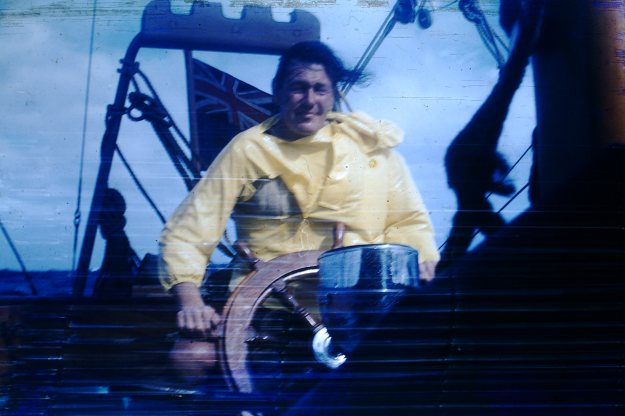
Billy Moss at the wheel of the Crusader, part way to Rarotonga, 1959

William “Billy” Stanley Moss, at the wheel of the Crusader, part way to Rarotonga, 1959

One of the great pleasures of running this blog is that I often receive contacts from people in all corners of the world on topics related to Paddy and his friends. Sometimes this can lead to putting people in touch who have lost contact, or being able to upload some interesting content for you all to enjoy.

In early October I was boarding a plane to Spain to walk a short leg of the Camino Frances from Leon to Santiago de Compostela, when I received an email from John Ewing. We have never met but he was trying to reach Billy Moss’ daughter, Gabriella Bullock, to pass on some items from a trans-Pacific journey completed by Billy in 1959. They have never met, and Gabriella was unaware that this information existed.

Hi Tom,
My name is John Ewing, I sailed with Billy Moss across the South Pacific in 1959. I have quite a lot of information and some photographs of the trip and Bill, which I would like to share with his family. It is likely that your society would have contact details for his very proud daughter Gabriella, I would appreciate your forwarding this email to her so that we may communicate by email.

I was able to put them in touch and I am grateful to John for sharing this photograph of Billy at the wheel of the yacht Crusader, on the way to Rarotonga, the most populous island of the Cook Islands. How wonderful is this?!

Please don’t hesitate to get in touch if you have something to share with the blog community of over 1,000 readers. See About and Contact for details.

Danube Institute video Noble Encounters

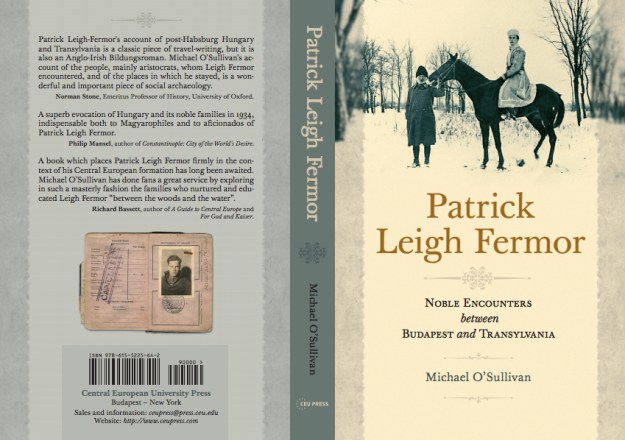
Many of you will have had a lot of enjoyment reading Michael O’Sullivan’s excellent book Patrick Leigh Fermor: Noble Encounters between Budapest and Transylvania which was published in the summer.

Michael gave an excellent presentation at the Transylvanian Book Festival back in September. In anticipation of the London launch next week of Patrick Leigh Fermor: Noble Encounters between Budapest and Transylvania, you may wish to dip in and out of this video by the Danube Institute featuring Michael and Dr. Tamas Barcsay (great-nephew of Miklos Banffy) talking about Paddy’s time in Hungary and the people he met there.

Find out more about the book and its background here.

You can purchase the book by clicking this link Patrick Leigh Fermor: Noble Encounters between Budapest and Transylvania.

When our King went forth on pilgrimage

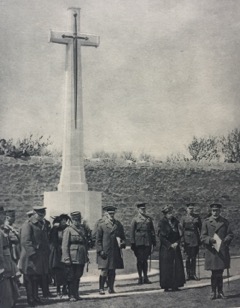
King George V address at Terlincthun

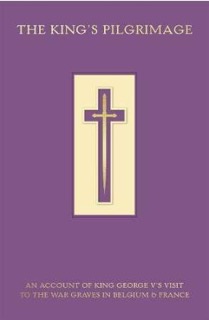
“It was our King’s wish that he should go as a private pilgrim, with no trappings of state nor pomp of ceremony, … to visit the tombs … of his comrades who gave up their lives in the Great War,” so began my Great Grandfather, the Australian War Correspondent, Sir Frank Fox, in the opening lines of his endearing 1922 book, The King’s Pilgrimage, about a simple three day journey by train to the War Cemeteries of France and Belgium in May 1922 by George V, the King Emperor; a man of great humility, modesty and wisdom.

by Dr Charles Goodson-Wickes DL

About ten million combatants lost their lives in the First War, but it is the concentrated nature of the ‘14-‘18 conflict combined with the horrors of trench warfare, losses on a scale never experienced before and its wide reporting through the novel media of film that mean its effects are still felt to this day.

Despite the fact that nearly double this dreadful figure were to be killed in the Second World War twenty years later, a far larger war conducted on many more fronts, it was as a result of the First War and remains to this day, commanders primary concern to minimize losses because of the negative and damning consequence such news and figures would have on morale at home and hence political will to see an operation through to its rightful end.

There is no one alive in this country today from that generation who so readily gave their lives in the Great War for our freedom today. It was a marker that would set the precedents for the Second World War and the principles of liberty by which we stand today. But, we cannot possibly comprehend the enormous sense of grief that cast its shadow across Europe for a lifetime. It was in recognition of this great collective sorrow that the King undertook his humble pilgrimage, following his State Visit to Belgium in 1922. It may seem strange that it took nearly four years to make a journey of such importance, but the numbers of dead were on such a scale that it took time to agree the manner and locations in which they were to be honoured; again the first time that the nature and manner of burial was to play a significant role in war, largely due to the work of Sir Fabian Ware, one time editor of The Morning Post which latterly became The Daily Telegraph, whose lobbying led to the establishment by royal charter of the Imperial War Graves Commission, now the Commonwealth War Graves Comission. By 1922, construction of the War Cemeteries was advanced enough to enable the King to pay his respects and see progress for himself.

Frank Fox, an experienced and tenacious journalist, had been reporting from battle fronts since the Boer War where he wrote of the controversy that created the Australian folk hero, Harry “Breaker” Morant; much of his work was for The Morning Post and it was his friendship with Ware that secured the invitation to accompany the monarch on this unique visit to the former Western Front. Fox was well qualified for this most sensitive of assignments, having been involved in many aspects of the Great War from its very outset when he was attached to the Belgian Army as The Morning Post’s War Correspondent when the Germans invaded Belgium in August 1914. For three months he reported the gallant Belgian resistance that culminated in the vital defensive action fought at the Battle of the Yser, which prevented the Channel Ports being overrun. On return, shocked by the atrocities meted out to the civilian population by German soldiers, he sought a Commission – at a relatively advanced age – and was sent to France as an officer in the Royal Field Artillery. In 1916, Fox was blown up in the quagmire of the Somme, taking him a year to recover from appalling wounds that left him almost totally deaf, with a shattered left arm and stump of a right foot. After convalescence, during which he worked for MI7 (Military Propaganda), he wangled his way back to France to serve on Field Marshal Haig’s staff in his GHQ at Montreuil-sur-Mer, where he assisted in the planning of the final offensive against the Germans.

It was in this nonchalant manner that my Great Grandfather, the Australian war correspondent, Sir Frank Fox, described in his diary, the appalling wounds he received in the quagmire of the Somme in 1916. It has yet to be explained what a 42-year old Artillery Officer was doing at the very apex of the Front Line.

“I was blown up in front of Le Sars by a salvo of shells. I refused to die on the battlefield. The gallant stretcher bearers got me in. I spent the next year in hospital.”

It was the King’s express wish that the nature of the Pilgrimage be low key, with the minimum of fuss, entourage or the usual pomp and ceremony that were the natural accompaniment to an official visit by the Sovereign; further the journey was undertaken in the workman like order of khaki service dress, then the equivalent of combat clothing worn by soldiers in the field today; the King keen to be seen and identified in the uniform that his soldiers had fought and died in. It was very much a working visit, void of the formality, scarlet and gold of the previous few days in Belgium.

On 11th May, the King left Brussels on board a special train that would be his home and transport for the three day journey, accompanied by a small party of five that included Field Marshal the Earl Haig, Sir Fabian Ware, Sir Frederick Ponsonby (Keeper of the Privy Purse), Colonel Clive Wigram (Equerry) and Major Seymour (Assistant Equerry). Later, he would be joined by Queen Mary and Admiral the Earl Beatty and at various points by representatives from countries of the Empire who played a vital role in the victory, Rudyard Kipling who was literary advisor to the Imperial War Graves Commission and had lost his only son, Jack, in 1917, while serving with the Irish Guards.

The port of Zeebrugge, was the first stop, where His Majesty was briefed on the daring raid to block the harbour by the Royal Navy in early 1918. After, it was to the Cemetery at Tyne Cot on the Passchendaele marshes, a name synonymous with appalling casualties and the largest British Military Cemetery in the world, at that time the place was a building site, home to gangs of veterans preparing the ground, masons, architects and all manner of site labourers and gardeners drawn from the local populace. Yet, wherever the King went, despite his wishes to the contrary, crowds of well-wishers gathered, singing the National Anthem, children bearing posies of flowers, gifts of thanks and messages of condolence. It was the spontaneity of incidents such as this that make this pilgrimage such a unique royal journey, like no other, and for George V, it must have been a most moving, touching and humbling experience.

At each cemetery, welcomed by local dignitaries, the King would dutifully inspect graves and a wreath would be laid before moving on. At Menin Gate, Ypres, he examined plans for the memorial to those who have no known grave; Vlamertinghe, Hop Store, Brandhoek followed until Lijssenthoek, the last cemetery in Belgian.

Arriving on French soil, the King was met with considerable ceremony at Notre Dame de Lorette – guards of honour, colour parties and much of the French General Staff, led by the grand old Marshal Foch.

‘“I have come”, said the King as he took Marshal Foch by the hand, “to lay a wreath in homage on the tombs of the French heroes who have fallen for their country,”’ Fox wrote and, after the two minute silence, noted how the King, and those around him was deeply moved at the sight of ‘row after row” of French gravestones and the loss of “a complete generation … in defence of their country.” Later, the King, turned to Foch, in animated conversation with his old friend, Haig who he had endured so much with and asked, “Always good friends, yes?” The old Marshal grasped Haig’s hand in response and replied fervently, “Toujours, toujours” (Always, always). At which point, the King too joined in placing his hand over theirs.

Queen Mary would join the entourage outside Boulogne at the final cemetery, Terlincthun, overlooking the English Channel, where 4,378 Commonwealth War Dead, including service personnel from Canada, Australia, New Zealand, New Foundland, the West Indies and South Africa are laid to rest. The Royal Party was greeted by a large delegation of French military and civil officialdom, whom the King officially thanked for their donation of land as burial grounds, support in construction of the cemeteries and sympathy for the great sacrifice made for French liberty.

In his moving speech before leaving on board ship with an escort of French destroyers to cross the English Channel, the King described the War Cemeteries as “potent advocates of peace upon earth” that would in time he prayed “serve to draw all peoples together in sanity and self-control”. In the words of Field Marshal the Lord Bramall, The King’s Pilgrimage marks the full stop to the Great War and its message of hope, succinctly summed up in George V’s closing words will ensure that as long as the graves stand, not one life lost in that war will have been in vain. (1509)

The Event

Dr Charles Goodson-Wickes invites you to the re-launch of this book at Sarum College, 19 The Close, Salisbury SP1 2EE on Monday 5th November 2018. His his Great Grandfather, Sir Frank Fox OBE, British War Correspondent was attached to the Royal Party and wrote this account of the events.

RSVP flora@medarc-limited.co.uk

Drinks 6.30 – 8.30pm
7pm In conversation with Harry Bucknall
NOTE: FOR SECURITY REASONS, PLEASE REPLY BY 30th OCTOBER – I am sure this can be waived a little, but please RVSP asp.

Purchasing the Book

If you can’t make the event you can still purchase the book at Amazon: The King’s Pilgrimage: An Account of King George V’s Visit to the War Graves in Belgium and France

Notes

“The King’s Pilgrimage” by Sir Frank Fox, OBE, first written in 1922, is republished with the blessing of the Commonwealth War Graves Commission to mark the Centenary of the 1918 Armistice by his Great Grandson, Literary Executor and Wiltshire resident, Dr. Charles Goodson- Wickes.

Dr. Charles Goodson-Wickes, served in The Life Guards in British Army of the Rhine, Northern Ireland and Cyprus. In 1991, while Member of Parliament for Wimbledon, he re-enlisted in the Army as a Lieutenant Colonel to participate in Gulf War 1 for the Liberation of Kuwait. Dr Goodson-Wickes, who lives in Bulford, was a driving force behind the reintroduction of the bustard to Wiltshire, is a Deputy Lieutenant for Greater London and the last sitting Member of Parliament to have seen active service.

At 6.30pm on Monday 5th November, Dr. Goodson-Wickes will talk about The King’s Pilgrimage, at Sarum College, The Close, Salisbury. To attend please email flora@medarc-limited.co.uk

The King’s Pilgrimage is available from amazon.co.uk & sirfrankfox.com


The King’s Pilgrimage and event in Salisbury 5 November

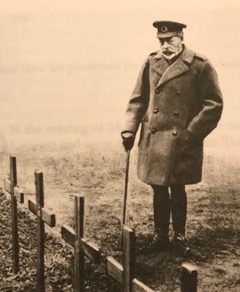
King George V at Etaples Cemetery

King George V at Etaples Cemetery

Whilst I have been away for the last few weeks on my own pilgrimage (again!!) to Santiago de Compostela, my good friend Harry Bucknall sent me some information about the republication of a book about a personal pilgrimage of King George V in 1922. It is now almost lost to the sands of time that our King, George V, went on pilgrimage to pay homage at the graves of the million or so war dead who not only gave their lives for our freedom but whose loss would scar a generation with grief.

This humble journey, recorded by the great war journalist, Sir Frank Fox, was written up in a little known but touching, moving and delightful book, The King’s Pilgrimage, which has been beautifully and faithfully reproduced by Fox’s Great Grandson, Charles Goodson-Wickes especially to mark the centenary of the Armistice in 1918.

“In the course of my pilgrimage, I have many times asked myself whether there can be more potent advocates of peace … than the massed multitude of silent witnesses to the desolation of war.” King George V, France 1922

This is a special book, and one as a former soldiers, Harry and I believe, every household should own … lest we forget.

The Event

Dr Charles Goodson-Wickes invites you to the re-launch of this book at Sarum College, 19 The Close, Salisbury SP1 2EE on Monday 5th November 2018. His his Great Grandfather, Sir Frank Fox OBE, British War Correspondent was attached to the Royal Party and wrote this account of the events.

RSVP flora@medarc-limited.co.uk

Drinks 6.30 – 8.30pm
7pm In conversation with Harry Bucknall
NOTE: FOR SECURITY REASONS, PLEASE REPLY BY 30th OCTOBER – I am sure this can be waived a little, but please RVSP asp.

About the Author

Sir Frank Fox (1874-1960) was an Australian born Journalist, Soldier, Author and Campaigner who lived in Britain from 1909 and wrote over 33 books.

Having warned on public platform and in the press of an impending war, he was appointed to the Morning Post and sent as their war correspondent to the Balkans. He was then attached to the Belgian Army and recorded the German invasion of 1914 in The Agony of Belgium. After being wounded, Fox served on Haig’s staff, which he wrote revealingly about in GHQ – both books recently republished.

Motivated by the atrocities he witnessed in Belgium, Fox was commissioned into the British Army at the age of 41. Appointed an O.B.E. (Military) and Mentioned in Dispatches, he was knighted by King George V in 1926.

Purchasing the Book

If you can’t make the event you can still purchase the book at Amazon: The King’s Pilgrimage: An Account of King George V’s Visit to the War Graves in Belgium and France

“Marks the full stop to the Great War. It is a very special book”
Field Marshal the Lord Bramall

“No better way to commemorate the Centenary of the Armistice than this account of King George V’s homage to the Fallen”
The Rt Hon the Lord Astor, Former Defence Minister
and grandson of Field Marshal Earl Haig

Patrick Leigh Fermor and the monks of the west

An excellent article from the Catholic Herald by Michael Duggan; “religious references” in his work (and life). I hope that you enjoy this.

Seventy years ago, in September 1948, the English author Patrick Leigh Fermor decamped from the nightspots of Paris to the Benedictine monastery ‎of Saint Wandrille de Fontanelle near Rouen. His purpose was to work on a draft of what would become The Traveller’s Tree, an account of his voyages in the Caribbean. A Time of Gifts and Between the Woods and the Water, the books recounting part of an epic pre-war walk across Europe as an eighteen-year-old that would secure Leigh Fermor’s lasting fame, were still decades away.

As his letters published last year show, ‘Paddy’ had a penchant for high living, forever drawn to the “soft hiss of the soda syphon”. His ingenious, entirely euphemistic descriptions of sex are a bawdy hoot. He once provoked a massive punch-up at the Kildare Hunt Ball and was only rescued from a true pounding by Ricki Huston, a beautiful Italian-American dancer, John Huston’s fourth wife and, not long after the near-riot in Ireland, Paddy’s lover.

His publisher, Jock Murray, once half-jokingly suggested a boarding house in Aberdeen as the ideal place for Paddy to knuckle down and finish a much-delayed volume. Even so, a monastery steeped in the ascetic rigour of the Western tradition seems like an extreme measure for a man who had just been staying at the Hotel Louisiane, around the corner from the Café Flore and the Deux Magots. Moreover, Leigh Fermor wasn’t a Catholic (though it is somewhat more complicated than that, as we shall see).

After his death in 2011, the First Things website published a touching, fulsome appreciation of Patrick Leigh Fermor written by the Orthodox theologian David Bentley Hart: touching because the news of the passing of a very elderly man whom he did not know seemed to have left Hart discombobulated and bereft; and fulsome because Hart believes (as do I) that here was a writer whose prose “has few credible rivals in modern English letters”.

Toward the middle of this article, Hart makes a brief reference to the place of religion in the life of Patrick Leigh Fermor. He mentions the twentieth birthday spent at the Russian monastery of St Panteleimon on Mount Athos and praises Leigh Fermor’s book Roumeli for “some of the most illuminating writing on Orthodox monasticism in English”. But he also notes that even close friends seemed uncertain whether Paddy actually had any particular religious convictions at all.

As it happens, the matter of Patrick Leigh Fermor and religion need not rest where David Bentley Hart leaves it. Artemis Cooper’s fine 2012 biography contains an intriguing clue to her subject’s religious feelings. Though he never actually converted from the Anglicanism of his childhood, it appears that Paddy identified himself as “R.C.” on official forms right up to the end of the Second World War, when he was thirty years old. After that, his religious feelings, which at times during his childhood took the form of what Paddy called a religious mania, seemed to subside.

However, while the mania may have lapsed, the historical allure of Christendom never seemed to fade for him. The famous trilogy about his trek across Europe (the final instalment, The Broken Road, was published posthumously in 2014) is studded with episodes and incidents redolent of the continent’s historic Christian culture. Disembarking in Rotterdam in the dead of night in December 1933, at the beginning of his epic adventure, the first person Leigh Fermor saw was Erasmus, in the form of a snow-covered statue outside the fifteenth-century Laurenskerk. Not long after, he spent a night discussing, among other things, the correct pronunciation of Erasmic Latin with a couple of German students in the house of the widow of a Classics professor in Cologne. His account of arriving in Hungary on Holy Saturday 1934, crossing the bridge at Esztergom just in time to be swept up into the ceremony at the great cathedral, is unforgettable.

Leigh Fermor’s literary heroes included the French Catholic novelist, J-K Huysmans, who sparked his interest in monasticism, and St Basil of Caesarea in whom Paddy seemed to find something he craved: a fusion of Christian and classical humanism, such that “the polished Greek sentences are sprinkled with classical allusions one would expect more readily in the writings of a fifteenth-century humanist than in those of a Doctor of the Church living in the reign of Julian”. In Basil’s letters, there was “a mood of humanity and simplicity, (…) an absence of bigotry that seems to blow like a soft wind from those groves of olive and tamarind and lentisk; gently ruffling the surface of the mind and then leaving it quiet and still.”

Religion was also, of course, an indissoluble part of the Greece he loved and celebrated. According to Artemis Cooper, Paddy liked to think that he could still detect a sort of eternal, cultural Europe, untouched behind the cities and factories, where life was dictated by the rounds of the seasons and the feasts of the Church. He liked to claim descent from Counts of the Holy Roman Empire who had originally journeyed to Austria from Ireland; and he lamented the desolation caused by the Reformation, seeing the ruined abbeys of England as “the peaks of a vanished Atlantis drowned four centuries deep.”

Leigh Fermor did write one book on an overtly religious theme: a slim volume entitled A Time to Keep Silence, which records his sojourns in Saint Wandrille and two other French monasteries – Solesmes and La Grande Trappe – along with a trip to see the enigmatic, abandoned rock monasteries of Cappadocia.

Perhaps the most memorable feature of this book, first published in 1957, is the depiction of an outsider, a self-proclaimed homme moyen sensuel, adapting to the austerity of life in a western monastery. The monks Leigh Fermor had known previously, in wartime Crete where he served as a British army intelligence officer fighting alongside the resistance, were holy men who were nonetheless prone to “pouring out raki, cracking walnuts, singing mountain songs, stripping and assembling pistols, cross-questioning me interminably about Churchill, and snoring under olive trees while the sun’s beams fell perpendicularly on the Libyan Sea”.

And he did also have some brief encounters with the monks of western Europe when walking his way across Europe. As recounted in A Time of Gifts, when he made his way to the workhouse in Düsseldorf in search of a place to stay, a bearded Franciscan in clogs led him to the dormitory. There he had a night disturbed by the snores, groans, sighs and shouts of the other inmates. (“Lying in wait in the rafters all the nightmares of the Rhineland descended on the sleepers.”) The next day, the monks on duty supplied him and his companions, who were set to work on cutting logs, with axes and saws, coffee and black bread.

Later, at the great abbey of Melk in Austria, a young, learned, amusing Benedictine, speaking beautiful French, showed him around, proving to be the “ideal cicerone” for the splendours beyond the gatehouse. Further up the Danube, at the Abbey of Göttweig, he is introduced to an Irish monk “of immense age and great charm”, who “could have sat for a picture of St Jerome”.

Come 1948, his encounter with monasticism was defined, at first, by an initial descent into “unspeakable ‎loneliness”, “overwhelming gloom and acidie”, a sensation of “circumabient and impending death”. But then comes his re-emergence, still within the monastic walls, into a life of “light, dreamless and perfect sleep”, lasting five hours and coming to an end “with no harder shock than that of a boat’s keel grounding on a lake shore”; of awakenings “full of energy and limpid freshness”; and of days of “absolute vitality and god-like freedom”. (Later on, leaving the monastery, and returning to the kind of world announced by Cinzano advertisements seen from a train window, would induce a painful process of adaptation in reverse.)

Leigh Fermor was full of admiration and respect for the role that the monks of the West had played in history, for the centuries in which they were the only guardians of things he loved: literature, the classics, scholarship and the humanities. He also found that the company of the small number of living monks‎ he was permitted to speak with was like the company of any civilised, well-educated Frenchmen “with all the balance, erudition and wit that one expected, the only difference being a gentleness, a lack of haste, and a calmness which is common to the whole community”.

More profoundly, he also came to appreciate the role of monasteries in what is sometimes called the economy of salvation. It was their belief in the necessity and efficacy of prayer – “a principle so utterly remote from every tendency of modern secular thought” – that explains the sacrifices these men made. Vows embracing poverty, chastity and obedience were destined to smite “all fetters that chained them to the world, to free them for action, for the worship of God and the practice of prayer; for the pursuit, in short, of sanctity.”

Leigh Fermor smiled at the fact that the monastic habitat should prove “favourable to ambitions so glaringly opposed”: his ambition, on the one hand, to get a book finished and his publisher off his back, and, on the other hand, the ambitions of the monks. These men, he found, could still embark on those “hazardous mystical journeys of the soul” which culminate in “blinding moments of union with the Godhead”, the very inkling of which, “since Donne, Quarley, Herbert, Vaughan and Traherne wrote their poems, has drained away from life in England”.

In the Introduction to A Time to Keep Silence, Paddy grappled briefly with the question of what his experiences inside the monastery walls might ultimately signify. He wrote that he was profoundly affected by the places he described. Though unsure about what his feelings amounted to, he was convinced that they were “deeper than mere interest and curiosity, and more important than the pleasure an historian or an aesthete finds in ancient buildings and liturgy”. In monasteries, he found “a state of peace that is unthought of in the ordinary world”. Describing himself as no stranger to “recalcitrance or scepticism or plain incapacity for belief”, he implies nevertheless that he had been the beneficiary of a “supernatural windfall”.

In the end, Paddy never fully cashed in this windfall. A Time to Keep Silence was published in 1957, but there were to be no more books on an exclusively religious theme. His life (a quite extraordinary one, in ways I have barely touched on here) was filled with many different interests, pleasures and friendships, some of which would have thrown up serious obstacles to any burgeoning Catholicism.

He had an open relationship with his wife, Joan Rayner, who was also a committed atheist. While he stayed on in Rome to witness (and “swoon” at) the coronation of Pope John XXIII in 1958, his primary reason for being in the Eternal City in the first place was to conduct an affair with a young divorcee. Three pages of A Time to Keep Silence are devoted to the conflicts and mysteries of chastity.

I am speculating, of course, but perhaps Leigh Fermor’s temperament – that old, latent religious mania – sometimes led him back towards the threshold of belief, only for his appetites to lead him away again, down the path of least resistance, garlanded with pleasures, adored by friends and lovers, and adoring them in return.

Many of us know some version of this dilemma. We need a strong motive to turn our backs on the worldly delights which converged on Patrick Leigh Fermor like iron filings on a magnet, in favour of the less certain rewards that emanate from spiritual dread and spiritual joy. As Artemis Cooper has pointed out to me, Paddy (unlike, say, Evelyn Waugh or Graham Greene) “could live without answers to the big questions: what am I doing here, why is there evil in the world, what has God got to do with it. These big themes didn’t preoccupy him much.”

To those who’ve read the books and letters, this observation has the ring of truth. But could it be that Patrick Leigh Fermor was able to live a life seemingly unpreoccupied by God because of the knowledge that he had acquired at first-hand in places like Saint Wandrille and La Grande Trappe?

This was the knowledge that, all the while, in those monasteries scattered across the West, which he called “silent factories of prayer”, there were other civilized, well-educated gentlemen just like him who had succeeded in abandoning everything. And that they had done so in order to help their fellow-men, and themselves, to meet something he had intuited himself during those brief pockets of time spent in monastic cells, woods and cloisters, something which he and most of us push to the back of our minds for most of the time, and to which he gave a name: “the terrifying problem of eternity”.

The romance of the past: that’s what drives the traveller’s impossible quest

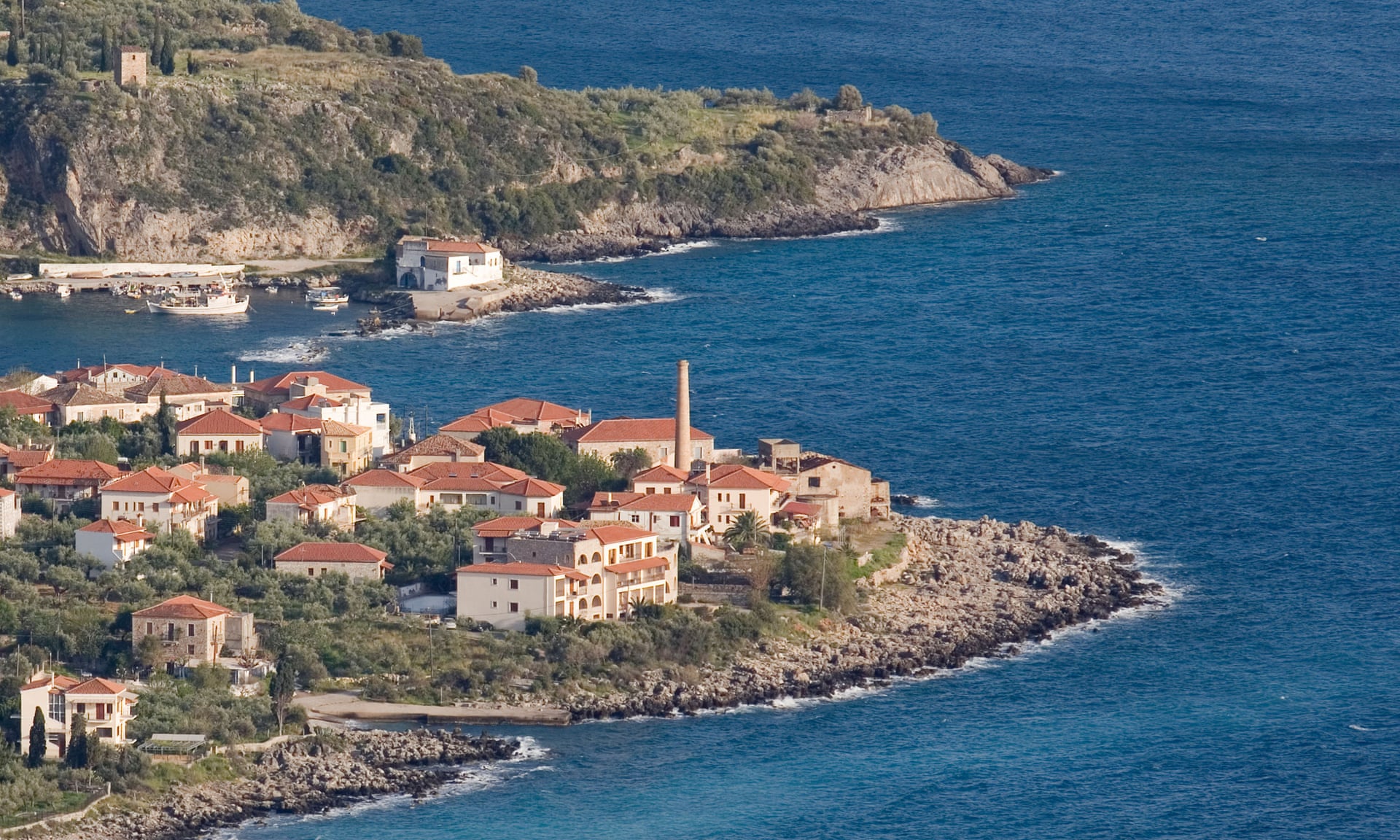
‘Kardamyli now makes most of its money from tourism. It wasn’t as immune to tourism as Leigh Fermor imagined or wanted it to be.’ Photograph: Alamy Stock Photo

Writing in 1958 about the little Greek town that was eventually to become his home, the travel writer Patrick Leigh Fermor was satisfied to note that the Guide Bleu gave it only half a line. “It is better so,” Leigh Fermor wrote. “It is too inaccessible and there is too little to do there, fortunately, for it ever to be seriously endangered by tourism.”

By Ian Jack

First published in the Guardian

His next paragraph describes the town in early evening when, waiting for a freshly caught fish to cook on a grill, he and a few fishermen sit under a mulberry tree outside a taverna and watch the sun sink over the mountains. Caiques – the wooden working boats of the Mediterranean – rock gently “with each sigh of the green transparent water … tethered a few yards above their shadows on the pebbly bottom”. One of Leigh Fermor’s typically exact (and perhaps exacting) images follows when he describes the sea lapping over a flat rock “with just enough impetus to net the surface with a frail white reticulation of foam which slid softly away and dissolved while a new one formed”.

Some of these things still exist. The Mediterranean is clear and green and blue, and on a calm day it will rise and fall against the rocks as Leigh Fermor describes. The sun goes down as he depicts it. There is even a caique or two; and, of course, tavernas – more tavernas than ever. But in most other ways the township of Kardamyli in the Peloponnese is utterly changed. Charter flights land at the little airport in the regional capital, Kalamata, and from there a twisting, expensively engineered road takes taxis, hire cars and air-conditioned coaches over the mountains to a resort that has nice hotels, trinket shops and olive-oil boutiques, as well as pretty restaurants with tea-lights on their tables that look down on the sea. The usual story: Kardamyli now makes most of its money from tourism. It wasn’t as immune to tourism as Leigh Fermor imagined or wanted it to be, and the writer himself is partly to blame.

The tumbledown factory loomed on the shore, a picturesque ruin in brick and concrete where fig trees grew. First, he published an account of his travels in the southern Peloponnese, the peninsula known as the Mani, which was then not much visited, and invested it with the beauty and mystery of a place and people that the 20th century had passed by. Then, six years later, in 1964, he bought a plot of land there – in a bay to the south of Kardamyli – and built a beautiful villa that he lived in almost to the last day of his life, in June 2011. Today his books are available in at least three languages in the local bookshop. People go there because of him – to experience similar sights and sensations to those he saw and felt, even though they understand this can never be completely accomplished, the world having moved on.

But was it ever quite as he described it in the first place? Leigh Fermor’s view of the Mani was essentially romantic: there are few better describers of landscape, but it’s a landscape with omissions. His first sight of Kardamyli is of an enchanting, castellated hamlet at the sea’s edge, where towers, turrets and cupolas rise above houses built of golden stone. “It was unlike any village I had seen in Greece,” Leigh Fermor writes in a page-long depiction that somehow ignores the village’s tallest manmade attribute: the factory chimney of the old olive-oil works. This is difficult to miss. Look down on Kardamyli from almost any vantage point and there it stands, its bricks pale against a background of blue sea and rather more noticeable than the towers and the turrets lying further inland among the cypresses and the olive groves.

The towers date from the age of banditry, feuding clans and resistance to the Ottoman empire. The chimney has cleaner and more peaceable origins. This month I lived next door to it for 10 days in a fine little hotel, and swam morning and afternoon from a ladder bolted to the rocks. The tumbledown factory loomed on the shore behind, a picturesque ruin in brick and concrete where fig trees grew and rusting pipes sprang from the wall at odd angles. A high fence surrounded it, with warnings to keep out.

Olive oil had once been made here – not virgin, cold-pressed or estate bottled, but the roughest kind, which goes into soap. Some accounts online suggest it was owned by the Palmolive company (and when I read this I understood, for the first time, how that familiar name had come about); others say a local family were the proprietors. It used olives – and the residues left from edible oil production – from as far away as Crete, shipped to a concrete pier nearby whose size was inexplicable unless you knew its original purpose. It was said to have employed 150 workers, with steam machinery that, as well as operating its crushers, had the spare capacity to supply the village with its first electricity. Opened in 1932, it closed in either 1958 or 1975 – local memories differed – when new techniques of oil production made it redundant. Since then, a dispute among the site’s three or four owners had prevented demolition or development.

I liked the chimney; three stepped rings of brick, progressively larger in diameter, gave its top a decorative flourish. But then, I’ve always been fascinated by factory chimneys of all kinds, for reasons that I’ve never really examined, the most important probably being that I spent some of my childhood among them: the great smoking verticals of the Lancashire plain, formerly beloved of geography textbooks as the illustrations to the chapter on the textile industry. To find them situated outside what might be considered their natural homelands – the old industrial towns of northern Europe and North America – is always a surprise. They look solitary, like isolated monuments to a faraway and not properly understood revolution. One still standing on the coast of Argyll marks the site of a Victorian factory that made acetic acid from the oak and birch wood. Another on the Ionian island of Paxos served the same kind of mill as Kardamyli’s.

Smoke was most probably still drifting from the Kardamyli chimney when Leigh Fermor reached here in the mid-1950s, but he can hardly be blamed for omitting it from his picture. Like many travellers in our age, he had a distaste for modernity. (He hated radios, for instance, and was relieved that the Mani had so few of them. “Rabid wirelesses should be hunted out and muzzled or shot down like mad dogs.”) He travelled to reach some agreeable form of the past, which has been a motive for the holidaymaker since the days of the Grand Tour.

On an afternoon last week in Kardamyli, I climbed up the ladder from the sea to find three or four men inside the factory fence inspecting the ruins. One wore a pith helmet and carried a theodolite. Another unpacked a drone from its box and directed its flight to the chimney, which it hovered above rather threateningly. It looked as though change was in the offing. I’d known of the chimney for less than a week – and, really, what was it to me? But already I felt a slight alarm that it too might pass, just like the fishermen who watched the sunset with Leigh Fermor from underneath a mulberry tree.

Sir David Attenborough – A Poetic Eye: John Craxton on Cranborne Chase and Crete

Dorset County Museum’s art exhibition A Poetic Eye: John Craxton on Cranborne Chase and Crete was officially opened by Sir David Attenborough and Hilary Spurling OBE on the 27th March 2015. Many of us were able to see this either at the museum or when it moved to Salisbury.

This video includes an explanation by Sir David Attenborough on why he loves the work of John Craxton. Sir David has been a lifelong fan of Craxton’s work.

John Craxton (1922-2009) was one of the most interesting and individual British artists of the 20th century. His life story, starting with wanderings on Cranborne Chase, was as colourful as his later pictures of the light, life and landscapes of Greece, and illustrations for Paddy’s books..

This exhibition at Dorset County Museum in Dorchester charted Craxton’s journey from Cranborne to Crete, from early paintings of dark and menaced war-time landscapes to joyful scenes painted under bright Cretan skies.

Event 3 October 2018: More Dashing – Further Letters of Patrick Leigh Fermor

Adam Sisman will be speaking about his new book on Wednesday 3rd October at 7.15pm at The Hellenic Centre, 16-18 Paddington Street, London W1U 5AS.

If you would like to attend, please email info@patrickleighfermorsociety.org

Admission is free but non-members are asked to make a £10 contribution towards the expenses of the evening or to join the Society, which entitles members to free attendance at all events. The new book will be for sale at a special launch price.

More Dashing: Further Letters of Patrick Leigh Fermor is the follow-up of Dashing for the Post: Selected Letters of Patrick Leigh Fermor (2016) which received terrific reviews including:

‘Here is a veritable feast for fans of Paddy Leigh Fermor…. Sisman has done a tremendous job selecting and editing this treasure-trove of letters’ The Spectator

‘Adam Sisman has done an excellent job of selecting and editing these letters, almost any one of which would have been a joy to receive’ Times Literary Supplement

‘Oh joy! … No other contemporary writer could have given us so much to relish and we’re fortunate that Adam Sisman has distilled such a treat from so much rich material…. The wit, the humour, and the dazzling intelligence make this, for me, the most unputdownable book of the year’ Country Life

A Review of Noble Encounters between Budapest and Transylvania

From the July 2018 edition of the Hungarian Review. Gordon McKecknie reviews the recently published Patrick Leigh Fermor: Noble Encounters between Budapest and Transylvania by Michael O’Sullivan. “… he has (…) also given us, through personal and often tragic histories, poignant insights into the enormous social changes that Hungary underwent in the middle years of the twentieth century.”

In December 1933, Patrick Leigh Fermor, then 18, set out from Hook of Holland to walk to Constantinople. It was the first year of Nazi power in Germany, and the last days of the old romantic era there and in the former Habsburg realms of Mitteleuropa, an era that had not quite been swept away by the First World War. Of course, the Second World War – and, for many of the countries that Paddy travelled through, the subsequent dark years of Communism – did sweep the old order away. Since then the landscapes that Paddy tramped through, and the populations he met, have undergone the further, and not-always benign, influence of the ubiquitous automobile, instant global communications, hordes of tourists, a camera in every pocket, the spread of English as the modern lingua franca, and cheap clothing made in distant sweatshops. The old aristocratic way of life that Patrick Leigh Fermor, also known PLF to his numerous friends, saw in its dying days, and nowhere more clearly than in Hungary and Transylvania, vanished not long after his “Great Trudge”.

PLF’s first volume describing his journey – A Time of Gifts – was published in 1977. It became an instant classic among travel books. In painterly and sometimes almost absurdly lyrical language, A Time of Gifts told of his travels through the winter landscapes of the Netherlands, Germany, Austria and Czechoslovakia, and took him as far as the bridge across the Danube at Esztergom on Holy Saturday 1934, at the beginning of a magical spring and summer spent in Hungary and Transylvania. We had to wait until 1986 for Between the Woods and the Water recounting those Hungarian days. The third volume of the trilogy, The Broken Road, was pulled together from Paddy’s notes by Artemis Cooper (his biographer) and Colin Thubron (a fellow travel writer) after PLF’s death in 2011 at the age of 96. It appeared in 2013.

As PLF wrote in his introduction to Between the Woods and the Water, he had set out “meaning to mix only with chance acquaintances, but almost imperceptibly by the time I got to Hungary and Transylvania I found myself having a much easier time of it than I had expected or planned: ambling along on borrowed horses, drifting from one country house to another, often staying for weeks under patient and perhaps long-suffering but always hospitable roofs”.

Sometimes in his books, PLF tells us what became of the people he met on his 1930s walk across Europe. Fritz Spengel, son of the proprietors of the almost medieval Red Ox in Heidelberg “was killed in Norway (where the first battalion of my own regiment at the time was heavily engaged) and buried at Trondheim in 1940, six years after we met”. The Jewish, Proust-reading Baron Fülöp (Pips) von Schey de Koromla left his country house in Slovakia “when things began to go wrong in Austria and Czechoslovakia”, settled at Ascona on Lake Maggiore, and died in 1957 in Normandy at the home of his daughter, Alix, who had married into the French branch of the Rothschild family. But now, for a more comprehensive view, we have Patrick Leigh Fermor: Noble Encounters between Budapest and Transylvania.

In his very enjoyable book, Michael O’Sullivan follows PLF from the moment he was standing on that Danube bridge, with a letter of introduction to the mayor of Esztergom in his pocket, to Budapest, across the Alföld (the Great Hungarian Plain) and the Bánát region, and into Transylvania. On this part of his journey PLF was the guest of the aristocracy of the land. Continue reading

Anna Sándor de Kénos – BBC’s Last Word

Anna Sándor de Kénos

BBC Radio 4’s Last Word, obituary programme, speaks to Dr Michael O’Sullivan, author of Patrick Leigh Fermor: Noble Encounters between Budapest and Transylvania, about the life of the late Anna Sándor de Kenos.

Go to position 22 minutes 10 seconds here for the start of the piece (may not be available outside of UK – sorry!).

Leave thy home, O youth, and seek out alien shores . . . Robert Macfarlane reads Petronius

One of the first things Patrick Leigh Fermor is given in A Time of Gifts is a book: the first volume of the Loeb edition of Horace. His mother (‘she was an enormous reader’) bought it for him as a farewell present, and on its flyleaf she wrote the prose translation of an exquisite short poem by Petronius, which could hardly have been more appropriate as a valediction to her son, or indeed to anyone setting out on a voyage into adulthood:

Leave thy home, O youth, and seek out alien shores . . . Yield not to misfortune: the far-off Danube shall know thee, the cold North-wind and the untroubled kingdom of Canopus and the men who gaze on the new birth of Phoebus or upon his setting

The journey of A Time of Gifts is set going by the gift of a book—and it is a book that has in turn set going many journeys. The edition of A Time of Gifts that Don gave me that day in Cambridge had as its cover a beautiful painting by John Craxton, commissioned specially for the book, and clearly alluding to Petronius’s poem. It shows a young man standing on snowy high ground, puttees on his ankles and a walking stick in his right hand, looking eastwards to where the sun is rising orange over icy mountains, from which runs a mighty river. Black crows fly stark against white trees: there is a sense of huge possibility to the day ahead and to the land beyond.

Extract from The Gifts of Reading , Robert Macfarlane. First published in Slightly Foxed Quarterly. Continue reading

A Great Adventure

‘When I first read A Time of Gifts I felt it in my feet. It spoke to my soles. It rang with what in German is called Sehnsucht: a yearning or wistful longing for the unknown and the mysterious. It made me want to stand up and march out – to walk into an adventure.’ Robert Macfarlane

Andrew Merrills finds himself betwixt the woods and the water in this charming piece from Slightly Foxed Issue 38.

by Andrew Merrils

Few people living at the time would have regarded the early Thirties as a golden age, nor has posterity been kind to the period that W. H. Auden described as ‘a low, dishonest decade’. In 1933, the Japanese invaded Manchuria, Hitler became Chancellor of the Reich, and the first stirrings of the Spanish Civil War were felt in Catalonia. While hindsight bathes 1914 in the gentle summer glow of a prelapsarian world, the early Thirties seem autumnal and telescope all too easily into the bitter winter that was to follow. But for one man at least, the cold months of 1933–4 provided a still moment in time, which he would remember with fondness for the rest of his life.

In late December 1933, Patrick Leigh Fermor set out on foot for Constantinople (as he anachronistically termed it). Recently expelled from school for the unpardonable crime of holding hands with a local girl, and insufficiently inspired by the prospect of Sandhurst and a career of peacetime soldiering, the 19-year-old decided to head east on foot. His backpack was evidently stuffed to the brim, with a greatcoat, jerseys, shirts (including white linen ones for dressy occasions), puttees, nailed boots, a selection of stationery, a copy of The Oxford Book of English Verse and the first volume of the Loeb Horace. The clothing was soon lost but was replaced as he headed east by many generous donations from hosts and chance acquaintances. The literary ture was a more permanent part of his baggage; though he lost his Oxford volume, this was complemented by a vast corpus of writing in English, French and Latin that he had committed to memory. A little over a year later, the young traveller arrived at the Golden Horn.

Writing the account of the journey would take much longer. The first of three projected volumes, A Time of Gifts, was published in 1977, when the author was 62; the second, Between the Woods and the Water, which traces the journey from the Hungarian frontier (where the first leaves off) to the Iron Gates in Romania, came in 1982. The third book remained unfinished at the time of the author’s death in 2011.

Between the long adventure itself and its eventual publication, Patrick Leigh Fermor had led an improbably rich and full life. He was famous for his wartime heroism in occupied Crete, where he lived as a shepherd among the resistance fighters in the mountains and masterminded the daring abduction of the German garrison commander. These actions were commemorated in the memoir Ill Met by Moonlight by his colleague Sandy [sic] Moss, and his own role was played by Dirk Bogarde in the 1957 Powell and Pressburger film of the same title. In the decades that followed, Leigh Fermor produced some of the finest travel writing in English. His published books included a seminal study of the Caribbean in The Traveller’s Tree, a reflection on the monastic life in A Time to Keep Silence, and two remarkable books on Greece, Mani and Roumeli.

Much has been written about him since his death, and each of his books has its own admirers. But for those new to his writing, there is no better place to start than with A Time of Gifts and Between the Woods and the Water, as an introduction both to the young man on the brink of a great adventure, and the mature writer at the height of his powers. While both shine through in these two books, it is the former who strikes the reader most forcibly. Almost immediately, we are confronted with the extraordinary personality of the young man who wanders across their pages, and it is easy to imagine how this spirit must have charmed and delighted those with whom he came into contact.

His was a well-populated road, from the two German girls in Stuttgart who swept the young ‘Mr Brown’ into an exhilarating tumble of drinking, singing and Christmas parties, to the lugubrious Frisian in Vienna who shared his poverty and some ingenious schemes for generating money before disappearing into the murky world of saccharine-smuggling on the Middle Danube. And these are some of his less remarkable social successes. By the time he reached Mitteleuropa proper, Leigh Fermor had become the darling of the fading imperial aristocracy. We read of raucous games of bicycle polo on the lawns of castles, of horses borrowed for a few days’ ride across the Great Hungarian Plain, and a seemingly endless succession of benevolent Anglophiles who welcomed the dusty young traveller with food, alcohol and the free run of their libraries.

Even if we sometimes feel a tinge of envy at the ease with which the young Patrick drifted into this travellers’ inheritance, it is hard to begrudge him it: the same easy charms that won over the inhabitants of central Europe in the 1930s can still delight a reader eighty years later.

Leigh Fermor has always been loved for the richness of his prose, and both books do full justice to the deep romantic undercurrents of the rivers along which he was travelling. Yet even in his most purple passages, he has a peculiarly literary sensitivity; he writes, not as a traveller in uncharted lands, but as one who is acutely aware of the many writers who have come before him. Nor is this simply the prerogative of the adult writer, usurping the fresh observations of youth with his own literary stylizations. The wide-eyed observer at centre stage also views the world through the lens of his reading. Take this account of Wachau in A Time of Gifts:

Melk was the threshold of this unspeakably beautiful valley. As we have seen by now, castles beyond counting had been looming along the river. They were perched on dizzier spurs here, more dramatic in decay and more mysteriously cobwebbed with fable. The towered headlands dropped sheer, the liquid arcs flowed round them in semicircles. From ruins further from the shore the land sloped more gently, and vineyards and orchards descended in layers to the tree-reflecting banks. The river streamed past wooded islands and when I gazed either way, the seeming water-staircase climbed into the distance. Its associations with the Niebelungenlied are close, but later mythology haunts it. If any landscape is the meeting place of chivalrous romance and fairy tales, it is this. The stream winds into distances where Camelot or Avalon might lie, the woods suggest mythical fauna, the songs of Minnesingers and the sound of horns just out of earshot.

If anyone was attuned to the mythic properties of Old Europe it was the knight errant of 1934. Leigh Fermor gazed at the unfolding landscape with a romantic longing inflamed by a short life stuffed with literature and history. When he passed through the Low Countries, he looked through Bruegel’s eyes; his view of Vienna was a palimpsest of Ottoman armies and Habsburg emperors, against which the complex realities of the mid-1930s were not always visible to him. And when not prompted into reverie by the landscapes around him, he turned inward to the rich body of literature that he had committed to memory. The list of these works is among the most famous passages of Leigh Fermor’s writing. I won’t cite it in full here, since it runs to several pages, but it includes (among many other things) Shakespeare, Spenser, Keats, ‘an abundance of A. E. Housman’, the Sitwells, Norman Douglas and Evelyn Waugh, ‘large quantities of Villon’, and a respectable body of Virgil, Horace, Catullus and Lucan.If a love of literature brightened the colours of Leigh Fermor’s world, it also created a deeper yearning, and this is perhaps his most appealing trait, at least to me. Time and again, he writes of the fervour with which he engaged in spirited conversation with his learned hosts or plunged himself into their well-furnished libraries. Here, he gulped great draughts of European history, poring over details of Germanic folklore or piecing together the complex literary heritage of the world through which he was passing, and which was soon to be lost forever. In recounting these moments, his prose reaches its sublime best, as when he talks about the libraries of Prague:

Where, in this half-recollected maze, do the reviving memories of the libraries belong? To the Old University, perhaps, one of the most ancient and famous in Europe, founded by the great King Charles IV in 1384. I’m not sure. But I drive wedge-shaped salients into oblivion nevertheless and follow them through the recoiling mists with enfilading perspectives of books until bay after bay coheres. Each of them is tiered with burnished leather bindings and gold and scarlet gleam on the spines of hazel and chestnut and pale vellum. Globes space out the chessboard floors. There are glass-topped homes for incunables. Triangular lecterns display graduals and antiphonals and Books of Hours and coloured scenes encrust the capitals on the buckled parchment; block-notes and lozenges climb and fall on four-letter Georgian staves where Carolingian uncials and blackletter spell out the responses. The concerted spin of a score of barley-sugar pillars uphold elliptic galleries where brass combines with polished oak, and obelisks and pineapples alternate on the balustrades.

The conceit which underscores this passage – the image of memory as a library – is a key theme throughout both books. Not only does this recall the prodigious literary memory of the young man, it also reminds us of the act of memory that went into the composition of the books themselves. While A Time of Gifts and Between the Woods and the Water do an exquisite job in representing the world through the eyes of a 19-year-old, the reader never forgets the mature writer who acts as mediator and amanuensis. For the successful travel writer, war hero and beloved raconteur who wrote these books, these are stories of a half-remembered youth as well as a half-forgotten Europe.‘For now the time of gifts is gone’ runs the line from Louis MacNeice that provides Leigh Fermor’s first title, and it is this faint melancholy which makes both books so powerful. These are the memories of a lifetime, and in writing them down, in revisiting the notebooks and the maps that had lain untouched for years, the writer creates them anew. Nowhere is this more apparent than in the conclusion to the most intimate episode of the sequence. For a giddy chapter, the traveller had careered around Transylvania in a car with his close friend István, and with Angéla, something of a kindred spirit. The reader is caught up in the breathless pleasure of the episode, which climaxes in a manic motor chase with a west-bound train, but which deflates as the companions consider their parting:

The reader may think that I am lingering too long over these pages. I think so too, and I know why: when we reached our destination in an hour or two, we would have come full cycle. It wasn’t only an architectural world, but the whole sequence of these enchanted Transylvanian months that would come to a stop. I was about to turn south, away from all my friends, and the dactylic ring of Magyar would die away. Then there was István; I would miss him bitterly; and the loss of Angéla – who is little more than a darting luminous phantom in these pages – would be a break I could hardly bear to think of; and I can’t help putting off the moment for a paragraph or two.

Everyone has their favourite sections of these extraordinary books, whether they are drinking songs in snow-bound Germany, the majestic descriptions of pre-war Vienna, or the madcap charabanc rides through Transylvania. Mine comes at the beginning of the narrative. The account of the Groote Kirk in Rotterdam isn’t as succulent as some of the richer morsels later on – the young traveller had only just entered the continent, and both he and his older self were keen to get on. But it captures the themes of the book perfectly:

Filled with dim early morning light, the concavity of grey masonry and whitewash joined in pointed arches high overhead and the floor diminished along the nave in a chessboard of black and white flagstones. So compellingly did the vision tally with a score of half-forgotten Dutch pictures that my mind’s eye instantaneously furnished the void with those seventeenth century groups which should have been sitting or strolling there: burghers with pointed corn-coloured beards – and impious spaniels that refused to stay outside – conferring gravely with their wives and children, still as chessmen, in black broadcloth and identical honeycomb ruffs under the tremendous hatchmented pillars. Except for this church, the beautiful city was to be bombed to fragments a few years later. I would have lingered, had I known.

‘I would have lingered, had I known’: these are books for readers, for poets and for travellers. But most of all, they’re books for lingerers.

Book now for Transylvanian Book Festival 2018

Following the success of the first two festivals, Lucy Abel Smith has taken the plunge again and has organised a third event for this year. It will take place as usual in and around Richis, a village in the Saxon lands of Transylvania, during the period 13-16 September.

The Transylvanian Book Festival was set up by Lucy Abel Smith in 2013 to promote the literature and landscape of Transylvania. It could not have been envisaged that over the space of 5 years, the success of the festival would lead to a second and, now in 2018, a third edition.

This year, Lucy is especially keen to attract visitors from Romania and Hungary. There is a particular focus on the “Romania 100” events and there are special ticket prices for citizens of Romania and Hungary.

Unlike other book festivals, the Transylvanian Book Festival does not seek to collect the big names on random subjects, but to draw together those who have written or researched subjects relevant to Romania and the UK. It is important it takes place in the country and is about the country.

In 2018, some of the subjects are Louise XIV and a rebel prince; The Sublime Porte and the Transylvanian Princes; Queen Marie of Romania; Architecture in Romania between the wars; Patrick Leigh Fermor: Noble Encounters Between Budapest and Transylvania; The Vagabond and the Princess (the story of PLF’s affair with Princess Balasha Cantacuzino); Dracula – an international perspective; as well as music, poetry and film.

The Festival provides a relaxed venue for writers, musicians and academics to meet with audiences which are mainly English speaking, and takes place in Richis, once a Saxon village, which has a large hall and stage. Richis is surrounded by similar beautiful villages offering accommodation amid the foothills of the Carpathians. The Festival brings much needed income into these communities.

The excursions are led by locals and meals are produced locally from the Priest House by Tony Timmerman and her team. Tony is a trustee of Pro Richis – the village charitable trust to which all profits from the festival are given. Literary Festivals have a record in being re-generative and we hope that the festival, as well as building international friendships, will help bolster local Transylvanian tourism.

Discover more about the Festival at the Festival website or contact Lucy Abel Smith: lucy[at]realityandbeyond.co.uk

Paddy the Great, king of Greece

From the April 2018 edition of The Oldie magazine, a remarkable podcast interview with the late John Julius Norwich to celebrate the Charmed Lives in Greece retrospective exhibition at the British Museum. John Julius recalls the special life and tremendous spirit of his friend Patrick Leigh Fermor, the man whom John Julius credits with opening up the Byzantine world to him – the subject of his first book on the subject Byzantium: The Early Centuries.

John Julius talks about Paddy’s incredible intellectual curiosity and lightness of touch: ‘All the time you were aware of being in touch with perhaps the most extraordinary man you’d ever met.’

Listen to the interview here.

Anna Sándor de Kénos, friend of Patrick Leigh Fermor – obituary

I have been able to find a copy of the obituary for Anna Sándor de Kénos and hope that you find it interesting reading.

Anna Sándor de Kénos, who has died aged 97, knew Patrick Leigh Fermor in Transylvania when he made his now legendary journey on foot, beginning in 1933, which took him from the Hook of Holland to Constantinople.

They met in July 1934 when he was travelling through Transylvania and Anna Sándor de Kénos was staying with some of her aristocratic neighbours.

This was the period immediately before Communism annihilated the almost feudal way of life of these ancient Transylvanian noble families which Leigh Fermor recorded in Between the Woods and the Water.

Anna Sándor de Kénos was close to the Csernovits family, one of whom, Xenia, became Leigh Fermor’s lover in 1934 and whom he later immortalised as Angela when the book appeared in 1986. She was also close to one of the book’s most enigmatic characters, Elemér von Klobusiczky, who features under the pseudonym Istvan.

Just over a decade later, on the bitterly cold early morning of March 3 1949, the majority of the Transylvanian aristocracy, including the Sándor de Kénos family, were arrested and taken away to internal deportation, Anna among them.

Like many Hungarians she fled Budapest in November 1956 when the Hungarian Uprising was still raging, settling first in New York. She spent the rest of her life helping many of her fellow dispossessed and impoverished aristocrats to settle in the United States. These included members of the Almásy family, one of whom was depicted in the film The English Patient (1996).

Her munificence extended to all Hungarians. However, it was with those still trapped under the repressive Ceausescu regime in her native Transylvania that Anna Sándor de Kénos’s real sympathy lay.

Though tiny in physical stature she earned the nickname “the titaness of Transylvania” for her fearless disregard for officialdom. This extended even to the intimidating Communist apparatchiks in Ceausescu’s Romania, which she revisited regularly from the mid-1960s.

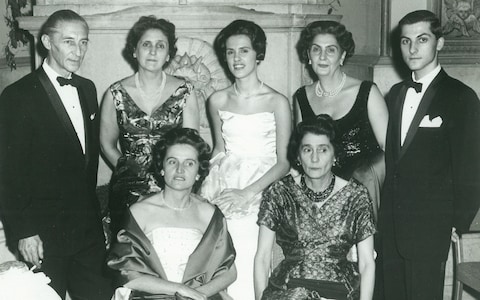
Anna Sándor de Kénos, seated front left, with other members of the Transylvanian nobility in exile at the Plaza Hotel, New York, 1960

Anna Sándor de Kénos, seated front left, with other members of the Transylvanian nobility in exile at the Plaza Hotel, New York, 1960

Another favourite target was officious airport check-in clerks. Once, at Sarasota Airport, Florida, in the mid-1960s when checking in for a connecting flight that would eventually take her onward to Budapest, and laden down with massive overweight baggage containing clothes and food for the poor of Transylvania, she was ordered to pay a substantial overweight baggage charge.

Her response was to point to a lady on her left hand side and declare in a strong Hungarian accent: “Sir, as you can see, I weigh a mere 44 kilos, the lady on my left I reckon about 144, why don’t we split the difference in our combined weights, or perhaps you would rather have me take her with me and make her into a delicious Goulash for my poor people in Transylvania.” The charge was immediately dismissed.

At the age of 92 Anna Sándor de Kénos applied to a US bank for a 30-year mortgage of $100,000. Three years earlier she had walked the excruciatingly long route of the Csíksomlyó pilgrimage to a Marian shrine in central Transylvania, a journey that would have challenged pilgrims half her age.

It was an 
unusual undertaking because the pilgrimage is the highlight of the Catholic calendar in Transylvania and she was a devoted Calvinist. She told a friend that she did it because “anything that was banned under Communism must be good for the soul”.

Anna Sándor de Kénos, known as Annuska, was born on March 21 1921 in Deva, the capital of Hunedoara County, which had been ceded from Hungary to Romania by the 1920 Treaty of Trianon.

The scion of a 16th-century Transylvanian noble family who were long characterised by unflinching determination and optimism in the face of adversity, she was one of two daughters born to Béla Sándor de Kénos and his wife Etelka (née Buda de Galacz), who were then living on the family estate near Deva.

The family’s circumstances were, like so many other “class enemies”, greatly reduced from quite comfortable to an indigent state under Communism in Romania. Though deprived of all the privileges that would have come to one of her class, Anna Sándor de Kénos was never resentful of her reduced situation.

She worked in New York for the renowned cosmetics company created by her fellow Hungarian Ernö László, whose client list included the Duchess of Windsor, Greta Garbo, Ava Gardner and Jacqueline Kennedy, before giving it up to work as a theatre nurse.

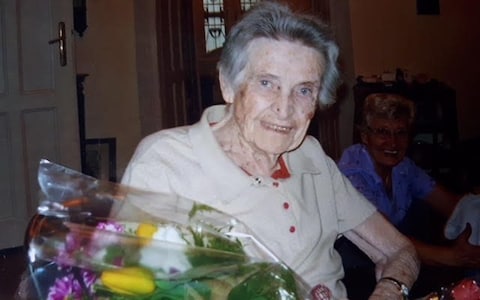
Anna Sándor de Kénos in Budapest on her 90th birthday

Anna Sándor de Kénos in Budapest on her 90th birthday

She spent much of her life in Sarasota, keeping open house for Hungarian émigrés. On occasion she had as many as 50 guests for dinner. The only rule was that guests should make a donation for her charitable interests in Transylvania. After the collapse of Communism in 1989 she spent part of the year between Budapest and her native Deva.

Although Anna Sándor de Kénos never married, her name was linked for many years to a Transylvanian nobleman who also never married.

With the death of Anna Sándor de Kénos, the last living link to the Transylvania and Hungary of Patrick Leigh Fermor’s Between the Woods and the Water has gone. She is survived by her nephew, Daniel Lészay de Lésza.

Anna Sándor de Kénos, born March 21 1921, died May 18 2018

The last of the Noble Encounters

Anna Sándor de Kénos in 1960

Michael O’Sullivan, the author of the recently published Patrick Leigh Fermor: Noble Encounters between Budapest and Transylvania writes to inform us:

It is with great sadness I write to inform the PLF blog readers that the last woman who knew Paddy in Transylvania in 1934 has died at the aged of 97. Anna Sándor de Kenós was thirteen when she met Paddy at the Csernovits mansion in Zam. She was from an ancient Transylvanian noble family and the doyen of the Hungarian ex patriot community in the United States where she moved after the 1956 Uprising against Soviet rule in Hungary.

An obituary was published in the Telegraph but it has some access restrictions.

My apologies to you all for the radio silence over the last few weeks. It was due to some personal reasons, and I now hope that all will get back on track with the blog!

John Julius Norwich – 1929-2018

Barry Cryer and John Julius Norwich at an Oldie lunch in 2017

Very sad news over the weekend to hear of the death of John Julius Norwich, writer, diplomat, broadcaster, father of Artemis Copper (Paddy’s biographer), and friend of Paddy and Joan. Thank you to AJ for sending me this link to his final article for the Oldie magazine. Like John Julius, it was Paddy that led me to my interest in Byzantium, although my Byzantine output is nothing like the wonderful three volume history of Byzantium that John Julius wrote.

First published in The Oldie, 1 June 2018.

By John Julius Norwich.

A new show at the British Museum – about three great lovers of Greece – takes me right back to the 1950s. The English painter Johnny Craxton (1922-2009) was a joy – the only dinner guest we ever had who came on his motorbike and left his leathers in the hall. He always came on his own; we were all intrigued by the idea of his long-term boyfriend, whom we never met. I think Johnny saw Greece as a larger Crete – just as Neville Chamberlain was always said to see Europe as a larger Birmingham. Johnny loved Crete with passion.

The Athenian painter Nikos Ghika (1906-1994) provided me with my first breath of Greece in the summer of 1954, when we went to stay with him in his lovely old house on the island of Hydra.

Also staying there were Paddy and Joan Leigh Fermor. Ghika later designed the serpentine pebble mosaic floors at Kardamyli – the Leigh Fermors’ enchanting house in the Mani. It was Paddy that I knew best of the three. Our friendship lasted from the 1950s until his death in 2011 at the age of 96.

In the spring of 1955, when we were living in Yugoslavia – I was working at the British Embassy – a letter arrived from my mother. She had been offered a caique for a fortnight’s sail among the isles of Greece. Paddy and Joan Leigh Fermor were coming; could we come, too? At the end of August, we drove down from Belgrade to Athens, and boarded the Eros at Piraeus.

It was my first time in the Aegean, and my best. Paddy lived and breathed his beloved Greece – fluent in its language, encyclopaedic in his knowledge of its history, people and literature. And nobody has ever carried his learning more lightly.

As we sailed from island to island – and, in those days, there were almost no tourists, and I can’t describe what a difference that made – he talked about Greece, Greek beliefs and traditions, about Byron and the Greek War of Independence, about those monstrously magnificent Greek heroes – men such as Mavromichalis and Kolokotronis, whose names roll so satisfactorily across the tongue – and about the Greek Orthodox Church and its quarrels with the West over words such as ‘filioque’ and ‘homoousion’, his talk taking in all the mystery and magic of the Byzantine world. Twenty years later, I was to write a history of Byzantium myself; but I doubt whether, had it not been for that fortnight on the Eros, I should ever have done so.

One day we were in a taverna on Santorini. Britain and Greece were then at the height of the Cyprus dispute and Paddy was, of course, firmly on the Greek side. Suddenly a member of the party at the next table, hearing us speaking English and being slightly drunk, launched into a stream of anti-British invective. We pretended not to notice. Then, suddenly, he and his companions burst into song.

‘Quick,’ whispered Paddy. ‘National anthem – everybody up.’

We leapt to our feet while he, naturally knowing all the words, sang them at the top of his voice. The mood of the other table changed immediately; and they were still more impressed when he continued with all the following verses – solo by now, since no one else knew them. Abject apologies followed: the ouzo went round once more, and we all departed friends.

It was characteristic of Paddy that, when he and Joan decided to build themselves a house in Greece, they chose the remotest corner: Kardamyli, at the far end of the Mani, the second of the three peninsulas that form the southern coast of the Peloponnese. And oh, how they loved it.

Paddy basically designed it himself. I remember him saying, while the building was in progress, ‘I want it to be part of outdoors, so that, if a chicken were found wandering through the library, no one would be a bit surprised.’

By November 1969, with its vast supply of bookcases, a huge desk and plenty of room to pace over a stone floor, the ‘powerhouse for prose’, as Paddy liked to call it, was ready at last. The two books describing his teenage walk across Europe, A Time of Gifts and Between the Woods and the Water, were both written there, together with hundreds of letters, articles and the jeux d’esprit which he so loved, and of which he was such a master. But those dread enemies procrastination and distraction were always hovering behind him, tempting him away. And as we shall see, they were to get him in the end.

Kardamyli was a huge success. It became the epicentre of Paddy’s world. For the first time, at 54, he had a home of his own. He continued to travel around Europe to see his innumerable friends, but it was here, I feel quite sure, that he was happiest. Outside Europe he was seldom tempted to roam. Except, surprisingly, for the Caribbean. A year or two after the war, he and Joan were persuaded by their old friend (and mine) Costa Achillopoulos to accompany him on a longish tour of the islands.

The result was Paddy’s first book, The Traveller’s Tree, which was published in 1950, and also his second, The Violins of Saint-Jacques, an exquisite little novella which was his only venture into fiction.

The islands fascinated him. His chapter on voodoo is a masterpiece. And then, when he got to Barbados, what did he find? A tablet in the churchyard of St John’s, carved with Doric columns and the cross of Constantine, reading: ‘Here lyeth ye body of Ferdinando Palaeologus, descended from ye Imperial lyne of ye last Christian Emperor of Greece. Churchwarden of this parish 1655-1656. Vestryman twentye years. Died Oct 3. 1679.’

Later, Paddy discovered that Ferdinando’s son Theodore had returned to England and had settled in Stepney, where he left a posthumous daughter baptised with the typically 17th-century name of Godscall Palaeologus.

She may have married, and had countless children; but, for the time being, this little girl in Stepney remains the last authentic descendant of the Palaeologi, the last imperial family of Byzantium.

Of course Paddy was a superb linguist; but I have never known anyone who enjoyed his languages so intensely. He loved on-the-spot translations: ‘To be or not to be’ in German, for example – occasionally recited backwards – or D’Ye Ken John Peel in Italian, which my daughter Artemis (his biographer) and I sang at his memorial service:

Conosce Gian Peel, con sua giacca tanta grigia?

Conosce Gian Peel, prima cosa la mattina,

Conosce Gian Peel, quand’ è lontano, è lontano,

Con suoi cani e suo corno la mattina.

And then there were the letters –letters that could have been written by no one else. Reading them, written at such terrific speed that sometimes they grow faint because the fountain pen can’t deliver the ink fast enough, one marvels at Paddy’s facility and fluency. And yet, when he was writing a book for publication, every sentence was a battleground. When, in July 1988, Sotheby’s sold the autograph manuscript of A Time of Gifts, it was described in the catalogue as follows:

‘c.450 pages, the majority written on rectos only, some on both sides, the first chapter on lined foolscap sheets, some cartridge paper, others lined, heavily revised and corrected, revised passages frequently written on separate sheets and pasted or clipped over the original, corrections or elucidations often in red ink, foreign or difficult words printed in the margin, many sheets with encouraging notes to the typist, often stapled or stitched with coloured thread into gatherings, generally of ten pages.’

I have an idea – I hate to have to say it and desperately hope I’m wrong – that Paddy’s last years were not as happy as the rest of his life had been. He missed Joan desperately after she died in 2003, he was getting old and he gradually had to face up to the fact that he would never complete the third volume of the story of that glorious European journey in his early youth. He produced bits and pieces for it by the dozen, but something always prevented him from organising them, connecting them and making them into a single coherent document. It was, I suppose, a kind of writer’s block.

He would seize on anything – letters, articles, translations, those ingenious word games he so loved – rather than face one of two facts: the first, that he must finish the job; the second – far worse – that he couldn’t. Eventually he knew that the second was the truth. When he came to London, people would say breezily, ‘How’s Volume III coming on?’, little realising that they were driving a dagger through his heart.

Volume III is not entirely lost. The Broken Road, compiled by Colin Thubron and Artemis, breathes Paddy through and through. And anyway, he has left us so much more to revel in.

As a travel writer, he was surely in a class by himself. But he was much more than a travel writer; he was the most extraordinary literary – and social – phenomenon I have ever known, and I am proud to have been his friend.

Noble Encounters between Budapest and Transylvania

In March 1934 a young man stood midway on a bridge over the Danube which connected Czechoslovakia and Hungary. He was taking stock of a world which, ten years hence, like the very bridge he stood on, would no longer exist. Patrick Leigh Fermor had left London the year before, at the age of eighteen, to walk from the Hook of Holland to Constantinople to complete a journey which would later become the source for some of the best travel writing in the English language. As he stood on the Mária Valéria bridge, facing the ancient Hungarian city of Esztergom, he had no idea that he would one day become the chronicler of a form of social life which was soon to be extinguished by the vicissitudes of war and by the repression which so often went hand in glove with Communism…

Noble Encounters takes a different perspective on Paddy’s 1934 journey, meticulously recreating Paddy’s time spent among the Hungarian nobility. It is the culmination of many years of work and research by author Michael O’Sullivan. He has had access to the private papers and correspondence of many of Leigh Fermor’s hosts, has used extensive interviews with surviving members of these old noble families, delved into the Communist Secret Police archives, and even met the last woman alive who knew Patrick Leigh Fermor in Transylvania in 1934.

O’Sullivan reveals the identity of the interesting characters from BTWW, interviewing several of their descendants and meticulously recreating Leigh Fermor’s time spent among the Hungarian nobility. Paddy’s recollections of his 1934 contacts are at once a proof of a lifelong attraction for the aristocracy, and a confirmation of his passionate love of history and understanding of the region. Rich with photos and other rare documents on places and persons both from the 1930s and today, Noble Encounters offers a compelling social and political history of the period and the area. Described by Professor Norman Stone as “a major work of Hungarian social archaeology,” this book provides a portrait of Hungary and Transylvania on the brink of momentous change.

The book will be officially launched at an invitation only party on 25 May in the house in Budapest where Paddy stayed in 1934, hosted by Gloria von Berg the daughter Paddy’s Budapest host, Baron Tibor von berg. Attending will be a representative of every Hungarian and Transylvanian noble family PLF stayed with as he went castle hopping across the old Magyar lands. They all want to gather to honour the man who was witness to a way of life, and of an entire class, soon to be part of a vanished world a mere ten years after he stayed with them. O’Sullivan has even managed to find Paddy’s signature in the von Berg’s guest book from 1934 when he was signing himself ‘Michael Leigh-Fermor’ – an amazing survival from the Nazi and Soviet occupations of Budapest. Petroc Trelawny will be MC for the evening and the book will be launched by Prince Mark Odescalchi whose ancestor, Princess Eugenie Odescalchi, Paddy met in 1934.

Michael O'Sullivan

Michael O’Sullivan

Michael O’Sullivan is an English Literature graduate of Trinity College Dublin where his postgraduate work was on the poet W.H. Auden. He curated the first major international symposium and exhibition on Auden in the Künstlerhaus Vienna in 1984. He was Vienna correspondent of the London Independent and later worked on both the Foreign and Parliamentary desks of Ireland’s national broadcasting service RTE. He is the author of bestselling biographies of Mary Robinson, Ireland’s first woman president and later UN High Commissioner for Human Rights. He has also written biographies of the founding father of the modern Irish state, Sean Lemass and of the playwright Brendan Behan. His association with Hungary began in 1982 when he became a frequent visitor to Budapest and when he met many of the old Hungarian noble families who met Patrick Leigh Fermor in 1934 and were then banished from their native land under Communism. O’Sullivan will be talking about his book at its public launch at the Danube Institute (Budapest) on 7 June (details here), and at the 2018 Transylvanian Book Festival

The book is published by CEU Press. It will be available soon on Amazon etc; I will endeavour to keep you updated. Here is a link to the pdf of the full book cover. PLF BOOK COVER FINAL EDITION

Until I have reached Constantinople

Patrick Leigh Fermor working at his home studio on 3 October 2004, then aged 89. Kardamyli. by Sean Deany Copyright 2012

In the catalogue to the exhibition Charmed Lives in Greece: Ghika, Craxton, Leigh Fermor (at the British Museum until July 15), Michael Llewellyn-Smith writes that, in his later years, Patrick Leigh Fermor “had an all-purpose excuse to send to pesterers”. The note read: “It was very kind of you to write. The trouble is that I am having to work to a strict deadline for the completion of my new book. This makes me a poor correspondent until I have finished it and have reached Constantinople – I am not sure when this will be”.

By James Campbell

First Published in The Times Literary Supplement 12 April 2018

The warning to inquisitive readers, colour-supplement journalists, adventurous holidaymakers and others was despatched from Kardamyli in Mani, in the Southern Peloponnese, from the house which Fermor had built himself, with local labour and expertise, in the mid-1960s. It was where he had completed the first two parts of his account of the “great trudge” across ­Central Europe in the 1930s, projected to end, in a long-anticipated third volume, in “Constantinople”. The book itself had become something of a pest, and he failed to complete it before his death in 2011, aged ninety-six. His wife Joan had died there eight years earlier.

I knew nothing of this when I posted a letter to Kardamyli in the autumn of 2003. I was not a Fermor devotee (there were many, though nothing like the numbers that exist today) and had read scarcely anything he had written. It was not my idea to seek him out, but that of my editor at the Guardian Saturday Review, for which I was at the time a contracted writer. The regular task was a literary profile, of a good length – 4,000 words – and of a certain seriousness. Starting from a position of ignorance didn’t bother me. I liked “finding out”, and enjoyed the homework.

Suggestions from Farringdon Road came by telephone, later email, and were always to the point. “How about Patrick Leigh Fermor?” That was it. No address, no telephone number, no deadline. The rest was up to me, but I was free to go where I liked and when I liked. I had fulfilled many commissions in this way, and had discovered something: it works better when you contact the intended subject yourself to make arrangements, rather than going through the publisher’s press office. The people there do necessary work, but with their more valued (and venerable) charges there is a protective instinct, and a need to control the show.

Fermor was definitely a protected species. His ninetieth birthday was approaching. His publisher John Murray was desperate for him to reach Constantinople. The journey, which had taken place in the 1930s, had been given elegant shape in two books written forty and fifty years after the events described: A Time of Gifts (1977) and Between the Woods and the Water (1986). The final volume, endlessly, pestiferously, inquired about, was said to be inching forwards. Both my editor and I made approaches to the publicity department; both received vague promises of representation. In the end, both were urged to think about volume 3, like everybody else.

I decided to take the direct route. But how to find him? I tried some acquaintances who might know his address. None did. Someone suggested Elizabeth Chatwin, widow of Bruce, Continue reading

The Vagabond and the Princess – book update

Many of you have asked for details about the book. I have been able to obtain a flyer which still talks about publication in May. The book may be available to order at Foyles, but is not yet listed on Amazon. When it is more widely available I shall update you again!

The description of the book from the Benefactum marketing flyer is as follows:

Invention, passion, war and exile are but some of the elements in this revealing new insight into Paddy Leigh Fermor’s many Romanian journeys. Starting with the ‘great trudge’ on foot through Romania in 1934 and ending in 1990 with his assignment for The Daily Telegraph following the fall of Ceausescu, The Vagabond and The Princess by Alan Ogden unravels the tapestry of fact and fiction woven by Paddy and reveals in detail the touching story of the love affair between the youthful writer and Balaşa Cantacuzino, a beautiful Romanian Princess. After a poignant parting on the eve of the Second World War, they were reunited some twenty-five years later and remained in close touch until her death. Paddy had been the great love of her life. Alan Ogden brings great insight into this enduring and touching relationship as well putting into context the glamorous lost world of pre-WW2 Romania.

Event: The Vagabond and The Princess

Princess Balasha Cantacuzène by Lafayette, 9 June 1920

After his ‘great trudge’ on foot through Romania in 1934, Paddy returned there the following year but this time not alone.

In Alan Ogden’s new book, The Vagabond and The Princess, he tells the touching story of the love affair between the youthful writer and Balaşa Cantacuzino, a beautiful Romanian Princess. Inseparable for the next four years, they parted on the eve of the Second World War when Paddy determined to join up. Some twenty-five years later they were reunited in very different circumstances and remained in close touch until her death in 1976.

Alan Ogden will be signing copies of his book. Entry is free but non PLFS member attendees are invited to make a donation; booking essential

When? 14 May 2018
Time? 7.15 pm
Location? The Hellenic Centre, 16-18 Paddington Street, Marylebone, London W1U 5AS

If you would like to attend, please email info@patrickleighfermorsociety.org.

Faraway Greek fun in the third largest Greek city

It appears that the most fun is to be had in Melbourne these days. A report by Brent McCunn of some highlights of the recent Greek Week which included talks about Paddy and his Cretan links. Be like Brent; send in your thoughts and articles (no matter how obscure) to share with fellow Paddy enthusiasts in our community.

by Brent McCunn.

Further despatches from the Hellenic outpost of Melbourne-iniki!

What a week of Greek! I remind readers that Melbourne is the third largest Greek city! Our Grecian week started with the inaugural Rebetiko Music Festival at the Melbourne Recital Centre, a prestigious venue!

After recovery, Friday night offered a performance of Cretan music from the visiting Xylouris brothers from Crete. Saturday afternoon saw a lecture by Chris White at the Greek Culture Centre in Melbourne – the topic being, ‘The Resistance of Grete’ during WW2 and in particular the history of Patrick Leigh Fermor, Billy Moss and the SOE. Of particular interest to the audience were the unique collection of ‘then and now photographs’, collated, researched and photographed by Chris White and his brother.

At this point it is important to illustrate the global reach of the PLF Blog. As a result of this correspondent’s earlier post (to this blog), advertising the above lecture, Melbourne subscribers did indeed turn up!

Chris enthralled all with his unique collection of images and has been invited back to present again to a wider audience drawn together by the cultural centres head of lectures – watch this space! I, Brent McCunn then presented details related to the main books on the Subject – Ill Met by Moonlight and Abducting a General – and how to purchase copies.

We then attended the Messines Community’s Greek Independence dinner and dance (Once they found about the lecture it was compulsory for us to attend this event – how Greek!) – Messines is the region where Paddy and Joan’s house was located. Whilst at the Messiness dinner your correspondent spent quite a few minutes on Google maps, with locals, being shown the family village and its relationship to Kardamyli!

One for the road in Greece means an impromptu music session at a local Greek restaurant! Katerina Douka, a well known Rebetiko singer from Thessaloniki, who appeared at the Rebetiko festival with her band, was still in town and gathered some local musicians and presented an enthralling session of northern Greek music. Food, wine and beer flowed of course.

Chris’s lecture became a feature story (by Jim Clavens) in the local Greek newspaper which is published in both English and Greek. A main thrust was to seek out decedents of the villages featured in the Kreipe kidnap and SOE operations. They have been asked to make contact and add their histories.

Your Philhellene correspondent in Melbourne,

Brent (alpopolous) McCunn from Passport Travel.

The ANZAC Cretan theme continues in Melbourne in the month of April with a lecture by Professor Peter Monteath. Entry is free.

When: 19 April 2018 at 19:00
Where: The Ithacan Philanthropic Society, Level 2, 329 Elizabeth Street
Synopsis: In the Second World War many thousands of ANZAC’s were sent to mainland Greece and then Crete in the hope of preventing German invasion and occupation – but to no avail. After the Battle of Crete hundreds of ANZAC’s were stranded on the island and spent weeks, months and even years trying to get off it.

This presentation looks at the experiences of those ANZAC’s who found themselves trapped, but who also discovered the extraordinary hospitality of Cretans, who offered the ANZAC’s shelter even when they themselves were enduring great hardship and danger.

Beyond that, the presentation looks at the collaborative efforts made to evacuate these ‘stragglers’ from the island, and how those efforts evolved into a series of ‘special operations’ to resist a brutal German regime of occupation. The person who occupies the centre of attention here is the Tasmanian Tom Dunbabin, an important and influential figure in the resistance in Crete through to the last weeks of the war.

Peter Monteath was born in Brisbane and educated in Queensland and in Germany. He has taught previously at The University of Queensland, Griffith University, Deakin University, The University of Western Australia and The University of Adelaide. He has also been Adjunct Professor at The University of St. Louis Missouri and the Technical University of Berlin, where he was an Alexander von Humboldt Fellow. At Flinders University he is Professor of Modern European history. His research interests span modern European and Australian history. His latest book, Escape Artist: The Incredible Second World War of Johnny Peck (New South 2017), is about an Australian who spent time in Greece and Crete in World War II.


Easter 1934 Paddy arrives at the Danube read by Siân Phillips

An Easter treat for you. Siân Phillips reads from page 277 of A Time of Gifts (paperback) as Paddy arrives at the Danube, spots Esztergom, has his passport stamped by border guards, and lingers ‘in the middle of the bridge, meditatively poised in no man’s air.’

‘The air was full of hints and signs. There was a flicker and a swishing along the river like the breezy snip-snap of barbers’ scissors before they swoop and slice. It was the skimming and twirling of newly arrived swifts. A curve in the stream was re-arranging the landscape as I advanced, revealing some of the roofs of Esztergom and turning the Basilica to a new angle as though it were on a pivot. The rolling wooded range of the Bakony Forest had advanced north from the heart of Transdanubia, and the corresponding promontory on the northern shore – the last low foothills of the Marra mountains, whose other extremity subsides in the north eastern tip of Hungary – jutted into the water under the little town of Parkan. Reaching for each other, the two headlands coerced the rambling flood yet once more into a narrower and swifter flow and then spanned the ruffie with an iron bridge. Spidery at first, the structure grew more solid as the distance dwindled. (Twenty miles east of this bridge, the Danube reaches a most important point in its career: wheeling round the ultimate headland of the Balcony Forest and heading due south for the first time on its journey, it strings itself through Budapest like a thread through a bead and drops across the map of Europe plumb for a hundred and eighty miles, cutting Hungary clean in half. Then, reinforced by the Drava, it turns east again, invades Yugoslavia, swallows up the Sava under the battlements of Belgrade, and sweeps on imperturbably to storm the Iron Gates.)

In an hour, I had climbed the cliff-path into the main street of Parkan. A little later my passport was stamped at the frontier post at the Czechoslovakian end of the bridge. The red, white and green barrier of the frontier post at the far end marked the beginning of Hungary. I lingered in the middle of the bridge, meditatively poised in no man’s air.’

(Extract from A Time of Gifts by Patrick Leigh Fermor, with thanks to John Murray Publishers.)

A happy Easter

We here at the Paddy blog would like to wish you and your family a happy and peaceful Easter. This year I would like to share with you the beautiful voice of Nektaria Karantzi, a Greek singer of traditional Byzantine and Orthodox chant. Paddy was an admirer of Byzantium and I am sure also loved the music

Fine out more about Nektaria, her concerts and more video on her Facebook page.

Don’t forget to switch on the volume!

Who were Ghika, Craxton and Leigh Fermor?

A lovely video produced by the British Museum to accompany the exhibition Charmed lives in Greece: Ghika, Craxton, Leigh Fermor. Narrated by the exhibition curators. Discover more about their extraordinary friendship, creativity and life spent living together in Greece.

Charmed lives in Greece: Ghika, Craxton, Leigh Fermor
8 March – 15 July 2018
http://www.britishmuseum.org/charmedlives

Supported by the A. G. Leventis Foundation and organised with the A. G. Leventis Gallery. In collaboration with the Benaki Museum and Craxton Estate.

Benaki Museum and Aria Hotels announce alliance for the Patrick and Joan Leigh Fermor House

The Benaki Museum and Aria Hotels have announced an alliance for the Patrick and Joan Leigh Fermor House, situated in Kardamyli, Southeast Peloponnese, Greece.

In 1996 Sir Patrick and Joan Leigh Fermor bequeathed their home to the Benaki Museum with the express wish that the house would host intellectuals and scholars who wanted to work or study in an inspiring setting. The Leigh Fermors also granted the museum the right to rent the property for a period of three months per year, in order to cover the running costs of the house. Under the alliance the museum will ensure the preservation of the house and its contents, and enable members of the public to have access to the property, while hospitality services will be provided by Aria Hotels, a hotel and villas company that specializes in the provision of authentic retreats in restored, historic Greek properties.

In the 1960s Leigh Fermor and his wife Joan chose to spend the rest of their lives in Greece and to build their home, lavishing much love and attention on it, in the idyllic coastal town of Kardamyli. At present, repair works at the buildings and the garden are underway so that the original character of the property is meticulously preserved.

The Benaki Museum-Aria Hotels partnership will be launched in 2020. Aria Hotels has pledged that it will undertake operation of the property during the rental period with particular sensitivity to its unique legacy, offering guests a rare residential experience in an environment of immense charm and character. The Benaki Museum’s collaboration with Aria Hotels for the Patrick and Joan Leigh Fermor House will extend over the three-month rental period every year, in accordance with the terms of the bequest.

Aria Hotels is a family-owned boutique hotel and villas company that offers holidaymakers authentic Greek hospitality and the ultimate in simple, effortless charm. The company has several hotels and villas, all in exceptional destinations: Crete (Chania, Heraklion and Lassithi), Cyclades (Kimolos, Serifos, Milos, Santorini) and Epirus (Metsovo & Zagori). They are chosen to appeal to the discerning traveller looking for a secret hideaway in Greece. Each hotel has been selected for its architectural merit, and its contribution to the preservation of local heritage. Outstanding quality in service and accommodation are the core of the Aria Hotels experience.

The Transylvanian Book Festival 2018

Following the success of the first two festivals, Lucy Abel Smith has taken the plunge again and has organised a third event for this year. It will take place as usual in and around Richis, a village in the Saxon lands of Transylvania, during the period 13-16 September.

The Transylvanian Book Festival was set up by Lucy Abel Smith in 2013 to promote the literature and landscape of Transylvania. It could not have been envisaged that over the space of 5 years, the success of the festival would lead to a second and, now in 2018, a third edition.

The idea is not to collect the big names on random subjects, as many other festivals, but to draw together those who have written or researched subjects relevant to Romania and the UK. It is important it takes place in the country and is about the country.

In 2018, some of the subjects are Louise XIV and a rebel prince; The Sublime Porte and the Transylvanian Princes; Queen Marie of Romania; Architecture in Romania between the wars; Patrick Leigh Fermor: Noble Encounters Between Budapest and Transylvania; The Vagabond and the Princess (the story of PLF’s affair with Princess Balasha Cantacuzino); Dracula – an international perspective; as well as music, poetry and film.

The Festival provides a relaxed venue for writers, musicians and academics to meet with audiences which are mainly English speaking, and takes place in Richis, once a Saxon village, which has a large hall and stage. Richis is surrounded by similar beautiful villages offering accommodation amid the foothills of the Carpathians. The Festival brings much needed income into these communities.

The excursions are led by locals and meals are produced locally from the Priest House by Tony Timmerman and her team. Tony is a trustee of Pro Richis – the village charitable trust to which all profits from the festival are given. Literary Festivals have a record in being re-generative and we hope that the festival, as well as building international friendships, will help bolster local Transylvanian tourism.

Discover more about the Festival at the Festival website or contact Lucy Abel Smith: lucy[at]realityandbeyond.co.uk

Lament from Epirus

Some readers may be interested in this forthcoming book by Grammy-winning producer Christopher C King, about the oldest fold music tradition in Europe, music that Paddy almost certainly would have come across in his travels across northern Greece.

Described as being in the tradition of Patrick Leigh Fermor and Geoff Dyer, Christopher King discovers a powerful and ancient folk music tradition.

In a dark record shop in Istanbul, King uncovered some of the strangest and most hypnotic sounds he had ever heard. The 78s seemed to tap into a primal well of emotion inaccessible to contemporary music. The songs, King learned, were from Epirus, an area straddling southern Albania and northwestern Greece and boasting a folk tradition extending back to the pre-Homeric era. Lament from Epirus is an unforgettable journey into a musical obsession which follows a genre back to the roots of song itself. As King hunts for traces of two long-lost virtuosos, he tells the story of the Roma people who pioneered Epirotic folk music and whose descendants continue the tradition today. His journey becomes an investigation into song and dance’s role as a means of spiritual healing and what this may reveal about music’s original purpose.

The book is due for release in May and can be pre-ordered on Amazon. Lament from Epirus: An Odyssey Into Europe’s Oldest Surviving Folk Music

Patrick Leigh Fermor – the journey continues

From time to time, the Benaki Museum publishes a supplement to its regular journal, and the 9th Supplement is a masterpiece dedicated to Paddy’s life.

Well bound, and coffee table book sized, there are over twenty new articles exploring a range of topics including Paddy’s intimates and friends, his walks, the Cretan resistance, wider discussions of Greece, Paddy’s writing and of course the house.

The Benaki have assembled a remarkable collection of writers including Hamish Robertson, Cressida Connolly, the Marques de Tamaron, Nick Hunt, John Kitmer, Chris White, Colin Thubron, John Julius Norwich, Adam Sisman, and Roberto Calasso amongst others.

The supplement is available from the Benaki Museum shop for 18 Euros plus worldwide DHL shipping.

Details of the contents are here.