Category Archives: Uncategorized

Normal service to resume

Hola to you all. I have returned safe, if not entirely sound, from my six week journey to Santiago and Finisterre. A truly wonderful experience full of discovery, adventure, friendship, and a lot of soul searching. At some point I may write about it, but in the meantime there is plenty of catching up to do on Paddy, the Broken Road and the successful Transylvanian Book Festival.

I will try to resume normal service as soon as I can.

Meanwhile, if you are thinking of taking any one of the many pilgrim routes to Santiago de Compostela, all I can say is go, travel light, and travel slow. There were people out there from 10 to 91 years.

Approaching Villamayor de Monjardin just after sunrise

Approaching Villamayor de Monjardin just after sunrise

Buen Camino

santiago sign Dear readers, I am now departing the UK for St Jean Pied de Port in south-west France which will be the starting point for my pilgrimage to Santiago de Compostela, a journey of around 800km. I think this will take me around six weeks as I also plan to walk a further 100km to Finisterre.

As timing goes it is not great from the Paddy blog perspective as it occurs just at the time the wonderful Broken Road is published (I have a preview copy and can assure you that you will enjoy it!), However, from a personal perspective this is the time to go on such a journey.

Whilst I am away I have a stand-in editor who will try to work on the blog if time permits. I can’t promise anything except that I look forward to getting everything up to date upon my return.

If you would like to get in touch whilst I am away please note a change in contact details: email paddybloguk[at]gmail.com

I wish you all health and happiness, and that you get a copy of The Broken Road as soon as you can.

Buen Camino!

Tom

Ode to recovery by Harry Eyres

A review by Sarah Bakewell of Harry Eyres’s new take on Horace which may well have amused Paddy.

First published in the Financial Times 13 June 2103

Knowledge of classical literature can bring people together or drive them apart; it can be socially exclusive, inspire feats of one-upmanship, or turn enemies into friends. Sometimes it can do all this at once, as when the author and Special Operations Executive officer Patrick Leigh Fermor led the captured German general Heinrich Kreipe through the Cretan mountains in 1944. Looking at the snow-covered peaks, Kreipe murmured lines from Horace, in Latin: Vides ut alta stet nive candidum/ Soracte … (“Do you see how Soracte stands white with deep snow?”). Leigh Fermor took up the ode where he left off, suavely reciting it to the end. United by their classical education, he and his captive shared a “moment” before going back to the business of war.

If this story is still touching, it is mainly because of the beauty and humanity of the “Soracte” ode itself. Horace gives us a mountain snowstorm, only to move immediately indoors where he and a friend are about to throw a log on the fire and uncork some simple local wine: “A mellow four-year-old riserva,” as Harry Eyres translates it here, “Just the Sabine vino, not a fancy cru.” Being both poet and wine writer, Eyres has a taste for Horace’s wine as well as an ear for the vigorous Latin with which it is evoked. In Horace and Me, he blends these with memoir to create a paean to Horace and a polemic for the wise life, and for classical literature in general.

He makes Horace very appealing: a paunchy, sociable man, who esteemed friendship more highly than lust, and honest lust more highly than love. He suffered much early turmoil, born in 65BC as the son of a freed slave in southern Italy, then studying in Rome and Athens. After Julius Caesar’s assassination in 44BC, he ran into trouble by fighting for Brutus’s army, and was punished by having his family property confiscated. He worked as a scribe, then found a powerful patron who bought him a rural haven in the Sabine hills near Rome. By his death in 8BC, Horace was secure in the certainty that his poetry would last longer than bronze.

Eyres read Horace at school but only later learnt to value his “middle-aged” wisdom: his praise of moderation, equanimity, the simple life, the joys of the passing moment, and the ability to enjoy what one has rather than always reaching for more. Eyres finds Horace’s writing “like a dip in an ice-cold stream, clarifying, not enflaming”, and recommends it as an antidote to modern bustle and a form of therapy.

It is the therapeutic memoir strand of the book that lets it down somewhat, including the passages of travelogue in Greece and Italy. Eyres promises a grand narrative arc: “This is a story of how I came back to Horace – and came back to myself at the same time.” Yet it is only vaguely fulfilled, and many episodes are bland, and tenuously connected with Horace. When, at last, something really dramatic happens, and Eyres takes an ill-fated trip to Cuba to meet a “flame-haired poetess” who does not show up, leaving him disoriented and playing Schubert “on huge white Russian pianos left stranded in obscure museums and hotel lobbies”, we are hurried past the story as if there were nothing to see. The scene dissolves in a puff of plurals. (How many huge white pianos?)

But Eyres’s take on Horace is enlightening, and best of all he provides his own witty, exuberantly updated translations of the verses. Roman carriages become SUVs, a perfumed youth becomes a boy drenched in Pour Homme, and a long-forgotten Roman uprising is transplanted to Basra. This keeps Horace surprising and fresh. It sends the reader to the original – not for a more conventional translation but for a long sip of the Latin, which Eyres makes clear we cannot do without, whether we can spout it magnificently on a Cretan mountain or not.

Sarah Bakewell is author of ‘How to Live: A Life of Montaigne in One Question and Twenty Attempts at an Answer’ (Vintage)

Every Invented Paradise Soon Turns Into Hell

Taki Theodoracopulos has gained a special place in the hearts of British Sunday newspaper readers over the last forty years or so with his gossip columns which mostly concerned his own exploits. More recently he has attracted the ire of your favourite blog readers for his pomposity, his vanity, name-dropping, and his blatant errors in what was some sort of valedictory article soon after Paddy’s death. The debate following my publication of Better a Hero Than a Celebrity got pretty heated; see Getting it Right. But we can’t ignore him, and here he is back again with a further recycling of his only Paddy anecdote, name dropping on the way. Utterly shameless.

by Taki Theodoracopulos

First published in his eponymous magazine, Taki’s Magazine, 22 March 2013.

He was a member of a charmed circle of Hellene and Philhellene intellectuals just before and after World War II, experiencing modern Greece and seeing it as a place rich in beauty and a stimulus to artistic creation. Patrick Leigh Fermor, whose biography by Artemis Cooper I just put away almost in tears—like a magical night with a girl of one’s dreams, I didn’t want it to end, but end it did—was a second Byron in Greek eyes. I found the book unputdownable, as they say in Boise, Idaho, especially the rich descriptions of rambunctious jaunts in tavernas and places where I had spent my youth.

There is always a feeling of imminent loss where Greece is concerned, an anxiety of what is in store, and no one captured it better than the Nobel Prize winner George Seferis—a close friend of Patrick Leigh Fermor’s—when he wrote:

And yet we knew that by the following dawn

nothing would be left to us, neither the woman drinking sleep at our side

nor the memory that we were once men.

This mood of apprehension, foreboding, and fear of oblivion is very, very Greek. Every invented paradise soon turns into hell, starting with Homer, Aeschylus, Sophocles, and Euripides. After all, we Greeks invented the “T” word.

The second Greek poet to win the Nobel Prize was Odysseus Elytis, ten years or so after George Seferis. Elytis’s brother was the non-playing captain of the Greek Davis Cup team, and he and I didn’t exactly get along. His name was Alepoudelis—“little fox” in Greek, Elytis being a pseudonym, and he was always trying to buy a used car from me for peanuts. I loathed that petty little man who had not named me in the singles against Spain back in 1964 because I had gone out all night with a queer bullfighter and his entourage. (I was hoping to meet Ava Gardner, a friend of the gay caballero.) Yet when I asked the little fox for an intro to the Nobel Prize winner for literature, he uncharacteristically gave me a glowing one. I met Elytis in Kolonaki, the chic residential section of Athens where we both lived.

At Café Byzantium, the first question I posed was the usual boring and unimaginative question that hacks ask of those whose work they know little about: “What does winning the Nobel mean to you?”

“I’m getting more pussy,” came his answer. I thought it so great I grabbed his hand and kissed it. (The one-sentence interview appeared in a Greek newspaper with glowing letters to the editor following.) We then proceeded to drink ouzo and chat up the girls.

But back to Paddy and his circle of friends. The leading players were the painter Niko Ghika, George Seferis (the “Colossus of Maroussi,” as Henry Miller immortalized him), George Katsimbalis, and our hero Paddy. I only met Ghika and Paddy once—in 1978 or ’79—under unfortunate circumstances. Ghika is Jacob Rothschild’s father-in-law, and his paintings throughout his life have been fresh and clean and pure and naked of all pretense. I was lying at anchor in Corfu on Gianni Agnelli’s boat when my host asked me to go up at the Rothschild villa and ask them down to lunch. Back then it was the only way to communicate, unless the Rothschilds understood Morse code.

I went and ran into a strict nanny-like woman sunning herself on the terrace, asked her if Jacob Rothschild was there and was told he was out, so I left a message that the Agnellis were expecting them for lunch in the bay below. The nanny was not best pleased. In fact she was downright rude, but I don’t do rude from foreigners in my own country, so perhaps I was a tiny bit rude also. (“Listen you old hag, just give them the bloody message.”) Then the Ghikas and the Rothschilds arrived, me never having met any of them before. And they looked rather peeved. The nanny turned out to be Dame Peggy Ashcroft, who had stayed behind.

The atmosphere did not improve after Agnelli asked me to do the introductions—a strange request, as I had not met Paddy or Ghika before. I got them right, of course, but then introduced Jacob’s wife as his mother and his mother as his wife. Had it not been for Paddy’s brilliance (he recited poems and sang and told nonstop stories), the lunch would have been a disaster. Afterwards the Rothschild woman went to the Spectator’s editor, called me scum, and asked that he fire me. She did not get her wish, as well she should not have, because it was a totally honest mistake on my part. Both women were rather plain, and I didn’t know them from Adam, so there.

I started this column with the intention of explaining Paddy’s Greece and why he loved my country so. I got sidestepped with trivia, although Nat Rothschild still laughs at my Corfu story. As publisher John Murray wrote on the dust jacket, “No one wore their learning so playfully,” which in today’s ghastly world of untalented people who hold themselves in high esteem is such a welcome relief from the pompous and self-important. Greece is olive groves and hills covered in pine and myrtle, thorns and cypress trees standing at attention before gray-green mountains that turn yellowish as the sun sets. Henry Miller waxed lyrically on the Greek light. He maintained that the Greek “lived amidst brutal clarities which tormented and maddened the spirit…urging him to war.”

No longer. The EU suits have turned the Greek into an effete, cowardly nonentity who plays along. Achilles is now Antonis, as in Samaras, the prime minister who has sold out the country. While 400 years of Turkish occupation did not snuff out the flame of Greek passion, the Brussels scum have. Goodbye Hellas, hello Belgium.

Related articles:

Better a Hero Than a Celebrity

Getting it right and that Taki article

Thank you

I want to say thank you on behalf of my daughter Harriet, and myself, for the response to my appeal for assistance regarding her internship in Germany. There was a large and very helpful response. Some were able to provide direct assistance, others just wanted to pass on their best wishes.

As you read this, Harriet and I should be driving to Munich, via a stop at the Red Ox in Heidelberg, to set her up in her new apartment for a twelve month  internship with Siemens, which is a great result. She will be working on organising the Siemens contribution to the technology fair CeBit in Hannover for 2014, and getting to travel all over Germany as part of her role. Thank you!

One who got in touch also runs a blog which is pretty niche but very interesting. Paul Daniels has recently started a blog which provides English translations of opposition journalism in the Weimar Republic. Some of this literature has probably remained unavailable for a long time. Paul’s work deserves a look, and for some, it could provide a valuable source of new research material.

You can find Paul’s blog here: Die Weltbühne in English Translation.

Before Midnight, Telegraph review “a brave and blistering triumph”

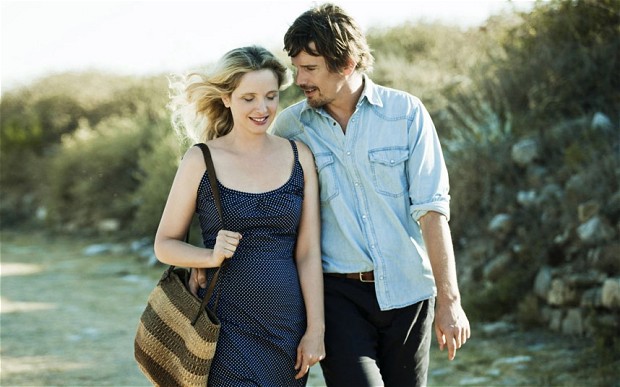
Julie Delpy as Celine and Ethan Hawke as Jesse in Before Midnight

Julie Delpy as Celine and Ethan Hawke as Jesse in Before Midnight

Before Midnight, the third film in Richard Linklater’s Before Sunset series, finds Julie Delpy and Ethan Hawke at their blistering, bickering best, in and around Paddy’s house.

by Tim Robey

From the Telegraph, first published 20 June 2013.

The last time we saw Celine (Julie Delpy) and Jesse (Ethan Hawke) together on screen, they were shooting the breeze in Paris, in Richard Linklater’s Before Sunset (2004), a sequel to his gorgeous Viennese brief encounter, Before Sunrise (1995). A plane was missed, but a vital connection was re-established, and Linklater had faith in this pair’s future, handing them one of the best, most romantic endings in the history of the movies.

Nine years later, the couple are living out the consequences of that decision, for good and bad, in Before Midnight. They’ve settled down in Paris, as the unmarried parents of twin girls, whose bobbing blonde locks could hardly fail to gladden the heart. We catch up with the family on holiday in the Peloponnese, where Jesse, fully established as a novelist, pitches ideas to friends, and Celine, an environmental activist whose latest wind-farm project has just been vetoed, ponders a potentially stressful career change.

The first half of the movie is mainly sweetness and Mediterranean light – there’s Greek salad at the dinner table, and bumper ensemble chats about what lasts in life and what doesn’t. Linklater has always been a garrulous sort of filmmaker, never one to cut short his characters’ windier musings, but in this early phase of the film he makes us ever so slightly nervous we’re in for a mid-level Woody Allen-style travelogue, with a yoghurty side dish of seasoned philosophising.

We needn’t worry; these hints of complacency are all grist to the eventual mill. Right from the start, there are rumblings of the things that have worked out less well for the lovers. Leaving his first wife for Celine meant Jesse more or less abandoned Hank, his son from that marriage, who’s now in his early teens and based in Chicago. Though Hank has joined Celine and Jesse for part of their trip, their adieu at Kalamata airport, where the film starts, is a typically poignant one for Jesse, since it involves sending his son, as Celine puts it, “back behind enemy lines”. Jesse sacrificed a lot to move to Europe, and quick-tempered Celine picks up, with nuclear sensitivity, on his yearning to be a better dad, along with all the resentments and retaliatory demands this might entail.

Hawke and Delpy, who are both credited on the script too, have never found co-stars to bounce off more nimbly or bring out richer nuances in their acting. As in the earlier films, all the best sequences here are long, snaking duologues – the difference being that Celine and Jesse now know each other inside out, and exactly which buttons to push. As a gift from friends, they get a night to themselves, and the movie’s tone shifts at the key moment when they’ve walked to a local village and the sun sets, as if inviting the real sequel to begin. There’s a long and brilliant scene in a hotel room, plotted like great theatre, in which foreplay gets interrupted by mild irritation, sarcasm becomes a full-on domestic row, and soon we’re at Defcon 1.
Related Articles

Where we might have expected a gentle or rueful coda, we get a battle of the sexes as blistering as the best of Tracy/Hepburn, and infinitely more frank. The pair take turns to be witheringly funny about each’s others foibles, delusions, and vast deficiencies, which only billow when this sort of combat draws them out. In a breath, Hawke can be magnificently caustic – just wait for his quip about Celine’s “agony in the trenches of the Sorbonne” – and a clumsy stirrer of the hornet’s nest. Delpy is a mistress of the half-joke with a whole artillery of grievances at her fingertips, and the emotional capacity to fire them all at once. The way men and women can trample on each other’s dreams, even without intent, is a brave subject for this movie to unpick, given the wispy, tender optimism of those dreams when Celine and Jesse last met, and indeed first met. Each film asks whether this generation’s most durable movie couple will make it – only now, they’re asking the same question of themselves.

Crossing red lines and other clichés

Today I have had to ban two long term blog readers from posting comments on the blog as they had repeatedly posted offensive and potentially libellous comments even after they had been asked privately to cease.

The comment facility is open to all. It is sometimes a source of useful information; fellow readers help each other out with something or other; and at times it can be a forum for animated debate. There are occasions when fellow readers will argue passionately about some minor fact, and often come close to blows, but on nearly all occasions people know where to draw the line. All good knock-about fun. In the case of these two individuals they forgot the rules and did not play nicely with the other children.

I am able to see all comments and will not tolerate any behaviour that is these days called ‘inappropriate’ ie just plain bad. You can debate as much and as hard as you like, but I will not tolerate any comments that are racist, homophobic, insulting or libellous. These are red lines and I will apply a zero tolerance policy. If you are asked by me or another reader to desist, remove a comment, or apologise then please take stock, think about it, and act in a way that respects others, and also very importantly respects Paddy’s memory.

If anyone has any issue with what I have said, or wishes to seek further clarification please contact me through any of the usual channels including the comment facility.

Tom

Can you help? Internship in Germany or Austria needed

I am making a pretty unusual request to you all today. My daughter Harriet is studying Business and German at Bath University and is nearing the end of her second year. She is meant to spend her third year living and working in Germany or Austria on an internship. The idea is to give her some solid business experience, improve her German, and to find a suitable subject during her internship to use towards her dissertation which should be on the topic of managing change.

The competition is tough and whilst she has a number of applications in the pipeline I thought that I would appeal to you, my good readers, to see if you can help in any way.

The basic requirement is for a paid internship, ideally with an international focus, for around 12 months starting from July/August 2013. Harriet is keen on a position in either marketing or HR. She has worked in Germany before, speaks fluent German,  and is a very reliable and enthusiastic worker.

If you can help, or know anyone who can, I would be most grateful. Her German CV can be found here.

Please get in touch with Harriet via the details in her CV or myself via tsawford[at]btinternet.com

The life of the most extraordinary man to play Test cricket

Bob Crisp in 1935 at Cardiff, where South Africa were playing a match against Glamorgan. Photograph: Fox Photos/Getty Images

This article was sent to me by Charles Hennah, and I am sharing it with you for three reasons. The first his the life of Bob Crisp is pretty extraordinary and worth a read; as the generation who fought the war die-off we read less and less every day about these brave men. Second, Paddy gets a mention, but I doubt that they were very close even though they appear to have been virtual neighbours in the Mani. Finally, Crisp’s life was a mix of fact and fiction;he had this in common with Paddy.

From Kilimanjaro to war escapades, via Fleet Street and a wild century, the remarkable story of Major Robert Crisp, D.S.O, M.C.

by Andy Bull.

First published in the Guardian 5 March 2013.

“Not that it matters, but most of what follows is true.” That fine line is the first in William Goldman’s Oscar-winning script for Butch Cassidy and the Sundance Kid. Screenwriters enjoy a little more licence than journalists, but sometimes we play a little fast and loose too. “My concern with accuracy,” as Hunter S Thompson put it when someone pointed out to him that Richard Nixon didn’t actually sell used cars with cracked blocks, “is on a higher level than nickels and dimes”. The spirit of the story can be as important as the facts of the matter. It hasn’t been possible to check every detail in this article. But, for what it is worth, most of this is true too, one way or another.

Let’s start with the certainties. We can be sure of these few things, because they were set down in the Wisden Almanack: Bob Crisp played nine Tests for South Africa, the first of them in the summer of 1935, and the last of them in the spring of 1939, 77 years ago last week.

Crisp was a fast bowler, who had the knack of making the ball bounce steeply and, when the weather suited, swing both ways. His 20 Test match wickets cost 37 runs each. The best of them were the five for 99 he took against England at Old Trafford, including Wally Hammond, clean bowled when well-set on 29. Admirable but unremarkable figures those. A few more: Crisp took 276 first class wickets at under 20 runs each, twice took four wickets in four balls, and once took nine for 64 for Western Province against Natal. Impressive as those numbers are, they still seem scant justification for the description of Crisp Wisden gives in his obituary: “One of the most extraordinary men ever to play Test cricket.” But then, as the big yellow book puts it, “statistics are absurd for such a man.”

Wisden is right, the traditional measures aren’t much use. A few other numbers, the kind even Wisden’s statisticians don’t tally, may help make his case. The first would be two, which was the number of times Crisp climbed Mount Kilimanjaro. The next would be three, which is both the number of books he wrote, and the number of occasions on which he was busted down in rank and then re-promoted while he was serving in the British Army. Then there are six, which is the total number of tanks he had shot out or blown up underneath him while serving in North Africa, and 29, which is the number of days in which all those tanks were lost; 24 is the number of years he lived after being diagnosed with terminal cancer. And finally, most appropriately for a cricketer, comes 100, which is, well …

In 1992 Crisp, then 81, was in Australia to watch the 1992 World Cup. One of his two sons, Jonathan, had flown him there as a treat. At the MCG, Jonathan bumped into the old England wicketkeeper Godfrey Evans, who he knew through Evans’s work as a PR for Ladbrokes. “Godfrey said to me, ‘Your father is here? Oh God, I’ve got to meet him, he’s my hero,” Jonathan Crisp says. “I said ‘Come off it Godfrey, you were a proper cricketer, how can he be your hero?'” Evans replied that Bob Crisp was the first man make a 100 on tour. “I said ‘What? How can he be? Plenty of people have made 100s.’ And Godfrey said, “No, no, not runs, women, 100 women.”

Perhaps unsurprisingly, Jonathan Crisp and his brother were estranged from their father for a long time. Bob, too footloose for family life, abandoned them when they were still young.

In the mid-1950s Bob’s wife, the boys’ mother, won on the football pools. It was timely; Bob had just resigned in a fit of pique from his job on the Daily Express, who had told him he couldn’t run a scurrilous story about corruption in greyhound racing. Bob took her winnings and spent them all on a mink farm in Suffolk. “He did that, and did it so badly that my mother had to take it over and turn it into a successful business,” Jonathan says. “He ran off and got a job as a leader writer for the East Anglian Daily Times, a job which allowed him to live in the style he was accustomed to.”

Later, when Bob was 56, he ran further still, all the way to Greece. “He had some friends there who he could live with.” Jonathan says. “Or rather, live off.” When Jonathan found his father again, years later, Bob was living alone in a goat hut on the Mani peninsula. He had no running water, and no lavatory. But he did have a cravat, and a clipping from a biography of Field Marshal Alexander which read “the greatest Hun-killer I ever knew was Major Bob Crisp”. The page had been laminated, and Bob Crisp took great glee in handing it over to any Germans he met in the village. “He thought that sort of thing was funny.”

When Jonathan flew to Greece to meet his father, he found him at the head of table in Lela’s Taverna. “There were 10 women around him. And it was clear he was bedding all of them. He was 70 at the time.” Jonathan says that the lamentations of the local women became a familiar refrain: “You must help me, I am in love with your father.” Some of them were in their mid-20s. Some of them were in their mid-50s. It didn’t make any difference. Bob wasn’t the settling sort.

Lela’s was made famous by Patrick Leigh Fermor, who lived in that part of Greece at the same time. The two men, both writers and raconteurs, were friends and rivals. It would have given Crisp enormous satisfaction to read this story by Guardian journalist Kevin Rushby. When Rushby arrived in the village of Kardamyli last year, the locals had little recollection of Leigh Fermor (or, indeed, of another famous travel writer who had passed through, Bruce Chatwin), but could not stop talking about Bob. “What about Sir Patrick Leigh Fermor? You must know about him.” asked Rushby. “The old man shook his head. ‘No, I don’t think so. There was a writer called Robert. Now he was famous – cured himself of cancer by walking around Crete. He was very famous.’ [He] leaned back and shouted in Greek to his wife in the kitchen. She came through, cloth in hand. ‘Robert Crisp,’ she said, smiling. ‘What a wonderful man! So handsome!'”

Jonathan was too close to his mother to be that blind to his father’s faults, and too appreciative of his father to let those faults obscure his feats. “He was a remarkable and extraordinary man,” he says. “An absolute charmer. And an absolute shit.” The drinking, womanising, and gambling, Jonathan points out, “can seem heroic or can seem awful. It depends which side of the coin you were on.”

Not everyone had such a balanced view. As George Macdonald Fraser puts it in Flashman: “In England you can’t be a hero and bad. There’s practically a law against it.” One of Jonathan’s most vivid early memories is sitting down with a copy of the Eagle comic, only to open it up and find there was a story about his father in it, an illustrated account of his exploits in the war. “It was very odd, but he was that kind of man.” He and his brother, who are working on a book about their father’s life, are still trying to unravel the strands of his life, to sort, where they can, fact from fiction.

They think it is true, for instance, that just before Bob Crisp was called up for the South African team for the first time, for the tour to England, he climbed Kilimanjaro. The story goes just as he was coming down through foothills, he bumped into a friend of his and said: “It’s fantastic up there, have you ever been up?” He hadn’t. So Crisp turned right around and they climbed it again, together. Just below the summit, the friend fell and broke his leg, so Crisp picked him up, carried him up to the top, and then carried him all the way down again.

They know it isn’t true that, as the elderly Greek man reckoned, Crisp cured his cancer by walking around Crete. He was diagnosed when he was 60, and told it was terminal. “He had always wanted to walk around Crete with a donkey, so when he was told how ill he was he thought ‘fuck it’ and set off,” Jonathan says. Bob paid his way by selling the story to the Sunday Express. “When he came back he decided to row a boat around Corfu. But the boat sank.”

What cured Crisp’s cancer, it seems, was an experimental drug, an early form of chemotherapy, which he was given by the Greek doctors. He was told to apply it to his body, but instead he drank it. “It was so disgusting that he mixed it with a bottle of retsina and drank that instead.” There was a time, shortly after, when he was flown to England and the USA by various consultant oncologists, who were trying to find out whether he had found some miracle cure in the combination of this unknown chemical and rotgut alcohol.

That was his second death. The first was 30 years earlier. That was in the Libyan desert, the day after he discovered, while listening to the BBC’s 9 o’clock news on his tank’s wireless set, that he was to be awarded the Distinguished Service Order for conspicuous gallantry. Shell shrapnel hit his head. As he lay crumpled at the foot of his turret, Crisp felt “beyond a shadow of a doubt, that I was going to die. The darkness I was sinking in to was the darkness of the grave. Strangest of all, I didn’t care a damn. As I went out into eternal darkness the last thought I had was … death is easy.” He survived, thanks only, he was told by the gynaecologist who performed emergency surgery on him, “to the good thick bit of skull” that the metal hit.

So far as anyone can be, Bob Crisp was an honest memoirist. As his son says “like most biographers, while they appear to be critical of themselves they very rarely appear in a light that is totally unflattering”. He does write with startling honesty about his mistaken assault on an English tank. He accidentally killed its gunner, “a young lad, red hair, fair skin, freckled face. As they pulled him out, the head rolled side-ways and two, wide-open, empty eyes looked straight into mine. In that moment I touched the rock-bottom of experience.” The war moved so fast, though, that he scarcely had time to dwell on what he had done. More cheerfully, Crisp also admits that he once caught crabs after pinching another officer’s pair of silk pyjamas to sleep in (and foolishly tried to cure himself by dousing his genitals in high-octane petrol).

The early months of Crisp’s war were spent carousing in Alexandria, singing and dancing for his dinner (typically escalope Viennoise and a bottle of white wine) in the local cabaret clubs. He seduced a local showgirl, Vera, who he had to leave behind when he was sent to Greece. He writes so tenderly of their relationship that he almost persuades the reader he really was in love. Until he describes their final kiss: “I knew that I would always think of that last, innocent contact – and that if I ever missed her it would help me to remember how her breath always smelled, just a little bit, of garlic.”

Greece was little more than a rout, one long retreat from the border with Yugoslavia back to the bottom tip of the country. Along the way Crisp had three tanks blown up underneath him, hijacked a New Zealand officers’ Mess lorry, and shot down a low-flying German Heinkel bomber with a burst from his machine gun while it was in the middle of a strafing run. The beating he took seemed to fuel his thirst for action. He found it at the battle to lift the German siege of Tobruk, where he fought continuously for 14 days, on an average of 90 minutes sleep a night. He won his DSO at Sidi Rezegh, where he led his tank in a single-handed charge across an airfield that temporarily checked an advance of 70 German Panzers.

Crisp later told the cricket writer David Frith that his courage was a “reaction to the shame he felt at being afraid”. But his modesty concealed a darker truth, as he once confessed to Jonathan. To his shame, Crisp admitted to his son that he actually “loved the war. He enjoyed it. He thought it was fantastic”.

MacDonald Fraser, who also served in North Africa, writes brilliantly about men like Bob Crisp. They epitomise, Fraser says, “this myth called bravery, which is half panic, half lunacy”. After the attack on Sidi Rezegh, Crisp seemed to catch a fever for fighting. The next day, stranded on foot, he commandeered a signals tank whose crew had “never even fired their gun before”, let alone been in battle. Crisp hauled their officer out of his turret, and with a cry of “Driver advance! Gunner, get that bloody cannon loaded!” led them in a surprise attack on a group of German anti-tank guns. Afterwards the driver was so shell-shocked by this startling turn of events that he started running around in small circles with a wild look on his face. The poor chap hadn’t the faintest idea where he was or what he was doing.” Crisp cured him with a “tremendous kick up the backside”.

Jonathan Crisp says he has it on “very good authority from a lot of different people” that his father was recommended for the Victoria Cross, but Field Marshal Montgomery refused to allow it because Crisp was so ill-disciplined. He was demoted three times. But then he was also mentioned in despatches four times. Crisp was awarded the Military Cross instead. He was presented with it by King George VI, who asked him if his cricket career would be affected by the wound. “No sire,” Crisp replied. “I was only hit in the head.”

In fact Crisp was too injured to play cricket again. After the war he went back into journalism, and, almost a footnote in his life this, founded Drum, the radical South African magazine for the township communities. He fell out with his fellow editors there. “Like a lot of rogues,” Jonathan says. “He was very charming and entertaining until things started to go wrong.” So he came back to Britain to work on Fleet Street, and fell back in to his old friendships with two fellow rakes, Denis Compton and Keith Miller.

Having survived the war, and cancer, Bob Crisp finally died in his sleep, at home, in 1994. When Jonathan found his father’s body in the morning, there was a copy of the Sporting Life in his lap. The only thing Bob Crisp left in the world was a £20 bet on the favourite in that year’s Grand National. “It lost,” says Jonathan. “Of course.”

There is a line in Big Fish, Tim Burton’s movie about how we can never really know the lives of our parents, which goes: “In telling the story of my father’s life, it’s impossible to separate the fact from the fiction, the man from the myth. The best I can do is to tell it the way he told me. It doesn’t always make sense and most of it never happened … but that’s what kind of story this is.” Well, Jonathan Crisp knows that most of his father’s story really did happen. And if there are a few exaggerations and fabrications along the way, well, the story is truer for their inclusion. “One of the most extraordinary men ever to play Test cricket,” says Wisden. If there’s someone out there who tops him, I’d like to hear their tale.

The Patrick Leigh Fermor blog – 2012 in review

A bit late but as I said I had to take a break; I was all blogged out. The WordPress.com stats helper monkeys prepared a 2012 annual report for the blog. What it does not say is that we have passed the 500,000 mark for visits. Thank you for reading the blog, and to so many of you for being active by making comments, sending emails, and coming up with great ideas!

Here’s an excerpt:

About 55,000 tourists visit Liechtenstein every year. This blog was viewed about 240,000 times in 2012. If it were Liechtenstein, it would take about 4 years for that many people to see it. Your blog had more visits than a small country in Europe!

Click here to see the complete report.

Peace be with you and those you love

This has been another fascinating year in the life of the Paddy Leigh Fermor blog and I have enjoyed every moment. There have been many highlights. Artemis Cooper’s wonderful biography exceeded expectations, and for 2013 we have the news that Vol Three will be published and is to be called the Broken Road.

I think the dominant theme for the first few months of next year will be the house at Kardamyli. There is a groundswell of opinion about doing something to ensure that the fabric of the house is not only maintained, but that real progress can be made towards Paddy’s dream of a writers retreat. The Benaki is facing cutback after cutback. It seems to me that we will all have to help in some way or another.

But that is for another time. Now is the time to reflect on the year that has passed and the year ahead. Also to celebrate, if that is your faith, the birth of Christ. We all love Paddy’s words but I doubt that many would disagree that the introduction to Saint John’s Gospel in the King James Bible is perhaps the most beautiful in the whole of the English language.

Peace be with you and those you love this Christmas time.

In the beginning was the Word, and the Word was with God, and the Word was God.

The same was in the beginning with God.

All things were made by him; and without him was not any thing made that was made.

In him was life; and the life was the light of men.

And the light shineth in darkness; and the darkness comprehended it not.

There was a man sent from God, whose name was John.

The same came for a witness, to bear witness of the Light, that all men through him might believe.

He was not that Light, but was sent to bear witness of that Light.

That was the true Light, which lighteth every man that cometh into the world.

He was in the world, and the world was made by him, and the world knew him not.

He came unto his own, and his own received him not.

But as many as received him, to them gave he power to become the sons of God, even to them that believe on his name:

Which were born, not of blood, nor of the will of the flesh, nor of the will of man, but of God.

And the Word was made flesh, and dwelt among us, (and we beheld his glory, the glory as of the only begotten of the Father,) full of grace and truth.

Subscribing to the Patrick Leigh Fermor blog is free!

Don’t miss out on any of the blog posts about Paddy, his life and friends, the biography or of course the long awaited ‘Vol 3’ which will be published in 2013 and will be called The Broken Road.

All you have to do is press the ‘Sign me up!’ button in the top right corner, and join over 600 others subscribers. You will then receive an email notification for every new article. No spam just Paddy stuff.


On the Coast of Terra Fermoor

The second of Bowra’s so-called poems which is about Paddy’s relationship with Joan. The full explanation can be found in the preceding article – here.

The first ‘poem’ – The Wounded Gigolo – has started some very interesting debate in the comments section. Why not join in that debate here, and also discuss On the Coast of Terra Fermoor in the comment section at the end of this article?

A link to the section of Henry Hardy’s website where he has buried the poems with some accompanying footnotes is here.

On the Coast of Terra Fermoor

On the coast of Terra Fermoor, when the wind is on the lea,
And the paddy-fields are sprouting round a morning cup of tea,
Sits a lovely girl a-dreaming, and she never thinks of me.
No, she never thinks of me
At her morning cup of tea,
Lovely girl with moon-struck eyes,
Juno fallen from the skies,
At the paddy-fields she looks
Musing on Tibetan books,
On the Coast of Terra Fermoor high above the Cretan Sea.

Melting rainbows dance around her – what a tale she has to tell,
How Carmichael, the Archangel, caught her in the asphodel,
And coquetting choirs of Cherubs loudly sang the first Joel,
Loudly sang the first Joel
To their Blessed Damozel.
Ah, she’s doomed to wane and wilt
Underneath her load of guilt;
She will never, never say
What the Cherubs sang that day,
When the Wise Men came to greet her and a star from heaven fell.

Ah, her memory is troubled by a stirring of dead bones,
Bodies that a poisoned poppy froze into a heap of stones;
When the midnight voices call her, how she mews and mopes and moans.
Oh the stirring of the bones
And their rumble-tumble tones,
How they rattle in her ears
Over the exhausted years;
Lovely bones she used to know
Where the tall pink pansies blow
And her heart is sad because she never saw the risen Jones.

Cruel gods will tease and taunt her: she must always ask for more,
Have her battlecock and beat it, slam the open shuttledore,
Till the Rayners17 cease from reigning in the stews of Singapore.
She will always ask for more,
Waiting for her Minotaur;
Peering through the murky maze
For the sudden stroke that slays,
Till some spirit made of fire
Burns her up in his desire
And her sighs and smiles go floating skyward to the starry shore.

10 June 1950

The Wounded Gigolo

Here is something interesting, new, possibly amusing, but probably more than a little controversial. The Oxford scholar, poet, wit and acquaintance of the Leigh Fermors , Sir Cecil Maurice Bowra, wrote two poems (in 1950) that poked fun at Paddy’s relationships with Balasha Cantacuzene and Joan Leigh Fermor. It appears that Paddy objected to these and prevented their publication in the 2005 poetry collection New Bats in Old Belfries, or Some Loose Tiles. Paddy apparently refers to them in his correspondence with the Duchess of Devonshire. Now that Paddy is no longer with us, it would appear that Henry Hardy (also known as Robert Dugdale) has decided to make them public.

The poems appear to be buried within Hardy’s website which he maintains on the subject of Isaiah Berlin. This poem, The Wounded Gigolo, is in pretty poor taste (all round) but in particular in relation to Balasha; far from spurning Paddy she delighted in their relationship but they were separated first by the war, and then by communism. She knew that their relationship would not be rekindled after the war and she apparently was pleased that Paddy had found happiness with Joan.

Hardy explains himself thus:

When New Bats in Old Belfries was published in 2005, two poems had to be omitted from the book which stated at the time “because their subject was still alive, and unwilling to give his approval for their inclusion in his lifetime.” It can now be revealed that Bowra’s target in the excised poems was Patrick (‘Paddy’) Leigh Fermor, writer and traveller – and Cretan war hero as a result of his activities while serving in the Special Operations Executive (SOE) during the Second World War. Leigh Fermor, born on 11 February 1915, died on 10 June 2011, aged 96.

In an extended correspondence with one of the editors of Bowra’s poems, Paddy showed that he was much put out by the poems about himself, especially ‘The Wounded Gigolo’, which he felt was ‘a bit cracked’. He vacillated about the other poem, but in the end voted against, no doubt partly influenced by the opinion of his late wife Joan, who ‘thought that all the people mentioned in the collection would have been cut to the quick, however much they put on non-spoilsport faces’. When James Morwood of Wadham College visited him later in his Greek home – to ask about his friendship with Bowra on behalf of Leslie Mitchell, Bowra’s biographer – he found Paddy was still smarting.

To Hardy, Leigh Fermor wrote: ‘Could Maurice’s shade ponder all this now, I think I might emerge as more of a saviour than a spoilsport.’ [Edit: I think Paddy was probably right and I publish here for our usual completeness]

My thanks to Mark Granelli and Margaret Campbell for getting in touch about this. Here is the first poem:

The Wounded Gigolo

O Balasha Cantacuzène,
Hear the war-cry of the Gael!
In his last fierce fight he’s losin’;
He will fight, but he will fail.
Cruelly his lady spurned him,
Struck him when he asked for more,
Flung him down the stairs and turned him
Bag and baggage from the door.
Oh unhappy gigolo
Told to pack his traps and go;
He may mope and he may mow,
Echo only answers ‘No’.

Hasten, every loyal Cretan,
To your wounded master’s aid;
He will not admit he’s beaten
While there’s money to be made.
Stalwart heroes stand beside him,
Captain Moss and Major Xan,
Knowing that, whate’er betide him,
He is still their perfect man.
Oh the hero gigolo,
Bleeding from a mortal blow,
He’s been cut off from the dough,
And he murmurs ‘Woe, woe, woe!’

What avail him now the dances
Which he led on Ida’s peak?
No more like a ram he prances;
Gone the bums he used to tweak.
Let him pick and scratch his scrotum,
Wave his cock and shake his balls –
She will never turn to note ’em,
Never listen to his calls.
Oh the jigging gigolo,
Plying his fantastic toe –
Like a wounded buffalo,
He can only belch and blow.

What avails the apt quotation,
What the knowledge of the arts,
What the lore of every nation
Learned from many unpaid tarts?
Ah, his mistress will not listen,
Floating vaguely to the moon;
Vainly do his molars glisten
When he tries to break her swoon.
Oh the learned gigolo,
What was there he didn’t know?
Now there’s nothing left to show
To the girl he dazzled so.

Yet remains his greatest glory,
His proud prowess in the bed.
Never tool renowned in story
Had so fine a lustihead.
Can he not be up and at her?
Strike the target? Ring the bell?
Ah, to her it doesn’t matter;
Nothing can restore the spell.
Oh the potent gigolo,
He could make the semen flow!
Though the cock may crow and crow,
He must pack his traps and go.

17 April 1950

So Nick has decided to take the quick way home, but shares some thoughts with us as he prepares.

nickhuntscrutiny's avatarAfter the Woods and the Water

Although I have no religious beliefs, this walk has been a pilgrimage of sorts – or, at least, has taken on many attributes of one. Atheists can have pilgrimages too, and mine has involved physical hardship, and occasionally mental hardship, the retracing of a once-trodden route, and the process of arriving at a destination of deep importance. On the way I’ve experienced wonder, and genuine moments of transcendence, to which the hardship has obviously been essential. On several occasions I have felt the presence of Patrick Leigh Fermor – not in a looming, ghostly sense, but in the absolute certain knowledge that he had been in the exact same place, or looking at the exact same thing, as I was eight decades later. These were not places mentioned in his books, and the certainty I felt bordered, at times, on the uncanny. In this, and many other senses, the journey has been…

View original post 458 more words

Boris welcomes you to London and the XXX Olympiad

Today after due British ceremonial scepticism, cynicism, and complaints about special Olympic traffic lanes, we in the United Kingdom are starting to feel the excitement of the imminent official start of the London Olympics.

Your favourite blog is caught up in the excitement and will be cheering on Team GB and all those who show true sportsmanship.

For those of you who may be coming to watch we have been able to gain special access to the Mayor of London, the renowned classics scholar and consumer of all things Patrick Leigh Fermor, Boris Johnson, to bring you this exclusive welcome.

Let the Games begin!

Patrick Leigh Fermor Airport?

Here is an interesting suggestion passed to me by Danish blog reader Hans Christian Bogstad who is living in Belgium at the moment.

Dear Tom

You may be unaware but Crete is slowly building a new airport at Kastelli, which will eventually (2015 or later) replace the old  Heraklion airport currently in use. Kastelli is, of course, one of the sites where SBS units successfully carried out raids on German aircraft in 1942 and 1943 (Operation Albumen – I don’t think Paddy was involved personally).

In Greece it is the habit to name airports after national heroes. My personal initiative is to suggest to you and to the world at large that the new airport be named the Patrick Leigh Fermor Airport.

Is there any more distinguished hero to give his name to the new Cretan airport than Paddy? Even the much less deserving creator of 007 had an airport named after him in Jamaica.

It may help that Paddy already was an honorary citizen of Heraklion, and that he probably had a multitude of Greek friends, some in high places.

Clearly there is a distinct possibility that the Cretans already have a name in mind, but there is no harm in asking. Would any Greek (speaking) readers wish to take this on and make some approaches?

Hans Christian Bogstad


To guidebook or not to guidebook

I just received this message from Andrew Bostock who authored the Bradt guide to the Peloponnese. It seems he is heading off there now. Paddy appears to have had some views on guidebooks; what are yours?

There are people who always seem to be fated to end up in their eventual career; children whose endless games of doctors and nurses or Lego translate into later careers in medicine or engineering. I used to think that I didn’t fit into this category, but now I’m not so sure.

In a week’s time I head out to the Peloponnese, the southern mainland of Greece, to complete the research to the second edition of my guide to the area, due to be published in early 2013 by the award-winning publishers Bradt. The first edition was written whilst I lived in the area, and whilst my daughter, who was born in Kalamata, grew up. Now I’m heading back for six weeks to show her where she comes from, and to introduce her one-year-old brother (middle name Telemachus) to the country.

How I ended up doing this seems to be due to huge smatterings of good luck and coincidence; but thinking about it there was an element of fate involved. This was mainly due to my mum, who instilled in me an early love of Greek mythology and history. It was also on her shelves that I first found the books of Paddy Leigh Fermor. I must have been about 14 at the time, and I devoured them. This quickly led to backpacking trips round Greece, sleeping in olive groves and abandoned tower houses, and eventually working there as a teacher, tour guide and writer.

Fate continued to intervene and my small family ended up living in a house on the headland above Kalamitsi bay, where Paddy had built his beautiful Greek house. In truth I had never really wanted to meet him, expectations are too easily let down, but in the end it seemed inevitable. He turned out to be just as affable, engaging and generous as the books would lead you to think.

He wasn’t really that keen on the idea of a guidebook to the Peloponnese, and I do see his point; but it was his books that guided me there. I think that if people are to travel, then a least they should travel with knowledge and understanding.

I’m pretty proud of my book, and hope to spend the next few weeks making it even better.

Andrew Bostock

07961 061 052 (cell)
Twitter: @andybostock
Website

A Very Long Walk

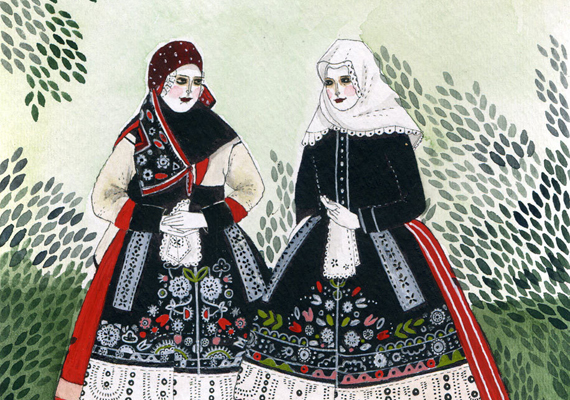
A whimsical tribute to Paddy by Kate Fitt from the Etsy Blog.

Read it here.

Alan Watts on Paddy’s schooldays

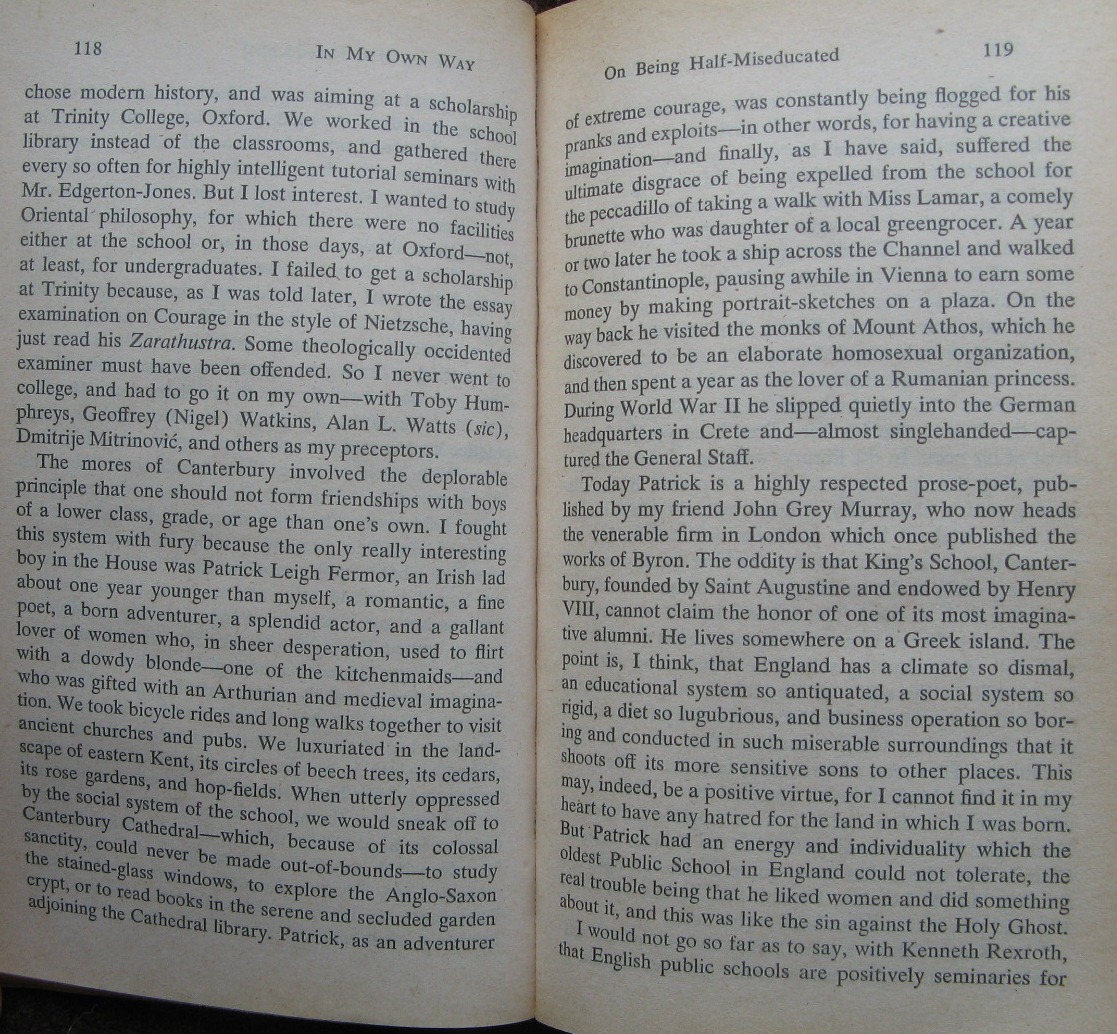
I am very grateful to Jasper Winn (author of Paddle: A long way around Ireland) for sending me this scan from Alan Watt’s autobiography In My Own Way in which he refers to his time at King’s with Paddy in the 1930’s.

Tom, hi,

You have possibly already seen this contemporary account of the young Paddy at school. Alan Watts – self-styled mystic, very credible explainer of eastern religion, and 60s guru to a swathe of Californians and beyond – was a fellow pupil. His – Watts’ – extensive writings tend to be accurate in detail and observation, though creative in colour and tone, and perhaps in any conclusions drawn. Still one of the few people who wrote about Paddy from first hand knowledge at such an early point in his life.

I hope that the high def photo of the relevant pages from Watts’ autobiography In My Own Way makes for legible reading.

Best,

Jasper

‘Europe is already falling apart’

Antony Beevor

‘I feel uneasy at the way historians are consulted as if history is going to repeat itself. It never does,’ says Antony Beevor Photo: ANDREW CROWLEY

‘Antony Beevor, chronicler of European history, has chilling warnings about the current rise in militant nationalism.’

by Elizabeth Grice

First published in The Telegraph, 28 May 2012.

Clearly the conversation that Elizabeth Grice had with Antony Beevor was a little more complelling than the article she has written, but in the context of his relationship with Paddy (and of course Artemis Cooper), and the state of Europe which, has at its epicentre Paddy’s beloved Greece, I thought I would share this with you.

Antony Beevor, chronicler of European history, has chilling warnings about the current rise in militant nationalism.

Nothing I’ve heard from politicians or economists on the world crisis has shivered my spine like an hour spent with the gentle‑mannered historian Antony Beevor, whose mighty new book on the Second World War is making him the pundit of the moment. He does not mean to be alarmist, and that is why the soft warnings in his sunlit garden are chilling.

Of course the rise of the Right in Europe is not the same as the rise of the Right in the Thirties, he soothes. But isn’t it terrifying the way the Greeks are portraying the Germans as Nazis in their popular press, with Angela Merkel in Nazi uniform? There are “far too many jibes” about a Fourth Reich. The weedlike eruption of extremist parties makes him “uneasy” – and if Beevor is uneasy, it probably means the rest of us should be scared witless.

“The great European dream was to diminish militant nationalism,” he says. “We would all be happy Europeans together. But we are going to see the old monster of militant nationalism being awoken when people realise how little control their politicians have. We are already seeing political disintegration in Europe.”

It’s fascinating the way serious historians are being treated as quasi-prophets for the economically bewildered. Tomorrow, Beevor is due to lecture to the Ministry of Foreign Affairs in the Hague on the Second World War and the current euro crisis and he says he is having to change his script daily “as more and more terrifying news comes in”.

“I feel slightly uneasy at the way historians are consulted as if history is going to repeat itself,” he says. “It never does. It is misleading and dangerous to make sweeping parallels with the Second World War. Politicians like Blair and Bush liked to sound Churchillian or Rooseveltian at times of crisis, but the comparisons of Saddam Hussein to Hitler were preposterous. Eden compared Nasser to Hitler and that led us into the Suez disaster.

“It is this compulsion to look backwards at a time of crisis because one’s got no idea of what lies ahead. There is a notion of security that somehow it must resemble the past. It’s never going to. Just because we muddled through in the past doesn’t mean we can automatically muddle through in the future.”

The only similarity between now and the late Thirties, he says unconsolingly, is that the public have not been told the truth about how desperate the situation is because no politician, then or now, dares to spell it out. “One must remember that Churchill was derided and scorned when he warned of the dangers of German rearmament. He could only come to power once war had started. That, I think, is rather alarming.”

Everything is rather alarming seen through the Beevor long lens. There is even drama in his person. He has a lot of silvery hair and leaping black eyebrows. Though his speech is a torrent of pure Queen’s English fluency, in occasional silences he picks at his fingers. Perhaps he is suppressing anxiety.

If so, it can’t be on account of his sales figures. The military historian – of whom it is always joyfully recorded that at Winchester he failed history and English A-level – has sold more than five million books. His most acclaimed, Stalingrad, won the Samuel Johnson prize for non-fiction, the Wolfson history prize and the Hawthornden prize, all in one week in 1999. With the money, he bought a house in Kent that friends like to nickname Schloss Stalingrad or Dunstalingrad. Here, in a pastoral retreat surrounded by sheep and alpacas, he and his wife, Artemis Cooper, do most of their writing. Her biography of Patrick Leigh Fermor comes out in the autumn.

After his non-compliance in formal education, Beevor joined the Army in 1965 and served with the 11th Hussars. On a posting to Wales, he was so bored that he began a semi-autobiographical novel that made him rethink his motives for being a soldier. They were all wrong: he realised he had a big chip on his shoulder about proving himself physically, a legacy of having been bullied as a child. From the age of four to seven he had walked with an armpit crutch, with one leg strapped up behind his back, because of a degenerative disease of the hip.

John Keegan, whose ground-breaking book Face of Battle revolutionised the chronicling of war, had taught him military history at Sandhurst. Once Beevor got into his considerable stride as a writer (he is from a long line of female authors), he found Keegan’s way of looking at history from the bottom up rather than the top down fitted with his own ideas of conveying the fear, chaos and horror of war from a soldier’s perspective. A soldier himself, he already understood the psychology of war.

“I’m not saying every military historian should have been a former soldier – that was the problem in the past – but some military experience is useful, if only to understand that armies are emotional organisations, not the cold mechanical institutions so often portrayed.”

Beevor’s skill is in making big historical events resonate with people through the detail of human experience gleaned from letters, interview transcripts and diaries. “I am not someone who believes I am going to find a historical scoop,” he says. “What I find satisfying is lots of good low-grade material [in Stalingrad’s cellars, lice are seen leaving the dead body of a German to take up residence in one that was still warm], which helps to build the mosaic through detail. I just love the days when you come out of the archives with half a dozen excellent descriptions or poignant accounts of personal experiences.”

Interest in the Second World War was flat when Beevor started his four-year project on Stalingrad. The book was expected to sell 6,000 copies, but flew off the shelves. Berlin: the Downfall 1945, six years later, was another triumph. The resurgence of interest in history was a phenomenon he could never have predicted. “People’s interest in the past had changed. My timing was lucky. Timing is a big percentage in life, in love or anything else.”

Beevor claims there is nothing he likes better than to start a book with an idea and then to realise he was completely wrong. He has no time for historians who are simply out to prove a thesis. Much historical fiction makes him grind his teeth, especially where words and thoughts are put into the minds of real historical characters, as in the Booker prize-winning Wolf Hall by Hilary Mantel. “We are part of an age where there is virtually no distinction between fact and fiction. The failure to distinguish between historical truth and the imagination of the novelist is a danger area. I am not attacking the quality of Mantel’s fiction but I would have preferred it if she had not called the character Thomas Cromwell. My wife does not agree with me. She thinks I am being far too pedantic.”

He was dragged by his daughter, Nella, 22, to see the film of Dan Brown’s novel The Da Vinci Code (“an absolute load of tripe”) on the basis that it was so bad he might find it amusing. On leaving, Beevor heard a man say to his girlfriend: “That really makes you think.”

“So depressing,” he slumps. “I didn’t know whether to laugh or cry. It is frankly grotesque that nearly 50 per cent of the population was persuaded that Mary Magdalene had a child by Jesus and the bloodline continued.” As for Tom Cruise in the 2008 film Valkyrie: “Most people seeing it would have thought it was an accurate account of the July bomb plot, when it was absolute rubbish. Sorry, but the interests of the entertainment industry and the interests of history are fundamentally incompatible.”

He admits to panic that he would drown in the sea of material for his latest book, The Second World War. Copying across information from the archives into skeleton chapters, he would find that he had 110 pages of notes for a single chapter. And yet there is one more massive Beevor analysis of the conflict still to come – about the Battle of the Bulge in the winter of 1944 – before he starts an epic life of Napoleon, followed perhaps by a novel set in 1917‑45. He is 65, and at his present rate of production, that will take him well into his seventies. “I can’t envisage stopping writing,” he says. “My dear father-in-law, John Julius Norwich, is still writing at 82. My God, it really keeps the marbles jangling.”

Antony Beevor’s ‘The Second World War’ is available to order from Telegraph Books for £20 plus £1.25 p&p. Call 0844 871 1515 or visit books.telegraph.co.uk. He will be at the Telegraph Hay Festival at 7pm on June 9; http://www.hayfestival.com

Nick has finally reached the end of the “Between the Woods and the Water” road. He is now in uncharted territory. We wish him well.

nickhuntscrutiny's avatarAfter the Woods and the Water

A week ago I met the Danube again, for the fourth time on my journey – flowing between Romania and Serbia, dividing Middle Europe from the Balkans.

Here, in the the riverside town of Orșova, is the point where Between the Woods and the Water ends. Since Paddy sailed from here, however, on a steamer bound for Vidin, Bulgaria, the town and the landscape around it have undergone apocalyptic change. Between 1972 and 1984, the communist governments of Romania and Yugoslavia constructed two vast hydroelectric dams across the legendary Iron Gates, turning one of the river’s wildest and remotest stretches into an enormous reservoir. The valley was flooded for hundreds of miles, displacing many thousands of people from villages along both banks, completely submerging Orșova’s old centre and wiping the island of Ada Kaleh – an ancient Turkish enclave oddly left behind when the Ottomans withdrew – out of…

View original post 457 more words

Nick has arrived in my favourite land and if the gods are with us we may meet in Cluj on Monday.

nickhuntscrutiny's avatarAfter the Woods and the Water

Looking back, the landscapes of my journey are reduced to pure colour. Austria was  frozen white, Slovakia scorched ochre brown, the Hungarian Plain the yellow of rushes and the blue of a cloudless sky. Two weeks walk across the border, and Romania has flooded my mind as the green of unfolding leaves, the explosive white  of blossom, and the dense, mysterious blue of the distant Carpathian Mountains. Water suddenly fills the land – in puddles, leaves and village wells, in swollen rivers, and falling from the sky. Following the Mureș River into Transylvania, through villages of red-tiled roofs and houses peeling to reveal walls of crumbling wattle and daub, filling my bottle with buckets from wells and my hip-flask with powerful homemade țuică, I feel like I’ve entered a land of enormous natural wealth. Away from the highways – made perilous by Turkish truck-drivers racing for the border –…

View original post 817 more words

New book about Paddy published in Greece

I have no further details but this was highlighted on the PLF group on Facebook. Those of you who read Greek may be able to provide more background.

Criss-crossing Europe – this time from Istanbul to Edinburgh!

It is envy time again. I was recently contacted by Owen Martel who made a long walk across Europe last year. His was a slightly different journey to Paddy’s and to our current venturer, Nick Hunt, but nevertheless it must have been exciting. Unfortunately Owen did not hear about Paddy until he was half-way through his journey, and he only read ATOG and BTWW upon completion of his walk.

Dear Tom,

From March to December 2011, I was on foot from Istanbul to Edinburgh; and at one point, while I was laid up with badly damaged feet at a mountain hut in Austria, a fellow traveler showed me the book she was reading and urged me to find it in the original English when my journey was over. Upon settling for three months in Glasgow this past winter, I accordingly tracked down at the public library and read “A Time of Gifts” and “Between the Woods and the Water,” alternately laughing and shaking my head in bewilderment at the all-too-familiar and bafflingly different experiences Patrick Leigh Fermor recounts. While my own route was quite different from his – certainly nothing like the retracing that, I have just learned from your site, Nick Hunt embarked upon almost exactly as I was finishing my own odyssey – the spirit of the thing was highly in keeping, and if you have any interest in this latter-day echo, I’ve posted various aspects of the trip on my blog at Walk Across Europe.

Thank you for running the Patrick Leigh Fermor blog, and for helping to keep this particular sense of possibility alive and well.

Owen Martel

For our Australian readers: Event – Remembering a great Philhellene, 4 April

Paddy, remembering a great Philhellene, Patrick Leigh Fermor (1915-2011) a talk by Anastasia Anastasiadis will take place as part of the 30th Greek Festival of Sydney

‘Paddy’ arrived in Greece in 1935 — after walking from Holland to Constantinople — and promptly got involved in resisting an attempted coup. As a British liaison officer during World War II, he led the group which kidnapped General Kreipe. In later years Paddy and his wife had a house in Kardamyli (Mani). His acclaimed travel books include two on Greece: Mani and Roumeli.

The talk will take place on Wednesday 4 April at 7:00 pm at the Greek Orthodox Community Club, 206-210 Lakemba Street, Lakemba. Entry is free but for further information contact (02) 9750 0440 or email – greekfestival2@goc.com.au. The talk will be conducted in Greek.

From Neoskosmos.com

An interesting drawing (not) by Paddy

In a recent sale by auctioneer Dominic Winter, there were a number of lots sold from Paddy’s estate. The full list with sale prices can be found at this link. This drawing appears to have sold for £200.

The sale included pictures and books, and one drawing (originally thought to be) by Paddy of a woman, perhaps past her prime, looking forlornly into a mirror and maybe seeing her younger self, or has she been stood up and sees her younger rival staring back at her out of the mirror?

Described as …

489 *  Fermor (Patrick Leigh, 1915-2011). Room interior with seated female figure, pen and ink on paper, some correction fluid, unsigned, 35 x 50 cm (13.75 x 19.75 inches)

It is unsigned but does include some Greek lettering which I can’t make out. Perhaps one of you can help? See comments below about the origin of this drawing!

A combination of prefab, garage and potting shed

It is not Prince Charles alone who has opinions about architecture. From the King’s School website archive …

Patrick Leigh Fermor had been a boy in The Grange. Although his school career ended abruptly and prematurely, he always retained great affection for the place and in particular for the buildings.

In 1977 the School was planning to build two new houses in the Precincts: Luxmoore and Mitchinson’s. Leigh Fermor wrote to the Headmaster Peter Pilkington expressing his disappointment with what was envisaged in the Mint Yard: “The first impression made by this side of the project is of a combination of prefab, garage and potting shed…. What would William of Sens have thought? And Harry Austin?”

His response was not merely negative, however. Ten pages of ‘Notes on the Projected New Houses at the King’s School, Canterbury’ included several illustrations of possible alternatives in a variety of architectural styles. Despite his intervention, the School went ahead with the scheme.

Thirty years later, Sir Patrick returned to King’s to open the New Grange on the St Augustine’s site.

Geoffrey Household and meetings with Paddy

From the travel writer Stephen J. Bodio’s blog – he was in correspondence for a long time with the thriller writer Geoffrey Household (his Rogue Male is brilliant!), and Geoffrey did mention some meetings with Paddy. Stephen writes ….

Sadly, I never corresponded with Patrick Leigh Fermor, but I did for many years with the adventurous old “suspense” story writer Geoffrey Household (as so many perceptive critics wrote, he was so much more than that, including a naturalist, a regionalist, and a chronicler of the same old lost Europe that Leigh Fermor also celebrated). Some of his best works are still or at least recently in print, though they were written from the thirties into the eighties: Rogue Male, in which an English big game hunter with a secret stalks a Hitler figure until he becomes the prey; 1965’s Dance of the Dwarfs, a cryptozoological novel with several twists; and the one I read first, 1960’s Watcher in the Shadows, still another tale of being stalked. Household’s knowledge of nature and animals gave him an intuition and sympathy for prey that many writers of such novels lacked.*

I will write about Geoffrey’s own work, but that must wait. Suffice to say that in the winter of 86-87, having been recently widowed, I wrote to him asking if he had known PLF, whose Woods & Water I had just finished. I figured with his background– among other things, he had lived in Bucharest and Greece for many years before the war, and been in British Intelligence– he might have. I just wanted to do something new– walk across Europe, perhaps?

Geoffrey wrote back with enthusiasm; we had written to each other for some time, and I think he was worried for me. Of course, he HAD known “Paddy” during the war.

Read more here with images of the letters.

Go forth, open the mind and just walk

By Christopher Caldwell

First published in the Financial Times, 30 December 2011

Resolving to take more walks in the new year might sound like promising to take more naps – choosing idleness over work. But a lot of clever people don’t see it that way. One of the better books I read in 2011 was Marcher: Une philosophie (The philosophy of walking), by Frédéric Gros, a Parisian professor and an editor of the papers of Michel Foucault. Mr Gros asks why so many of our most productive writers and philosophers – Rousseau, Kant, Rimbaud, Robert Louis Stevenson, Nietzsche, Jack Kerouac – have also been indefatigable walkers.

The short answer is that those mothers who advise that “a good, brisk walk will clear your head!” are right. When you walk, you leave certain of the burdens of daily life behind, but you pick up others. Walking shows certain commonsensical-looking things to be unfounded and certain improbable-looking things to be true. That is what writers of genius do.

Read more ….