Author Archives: proverbs6to10

Unknown's avatar

About proverbs6to10

Interested in Byzantium and Patrick Leigh Fermor

2014 Stavros Niarchos Foundation Lecture at Yale University: “Patrick Leigh Fermor In Greece”

Artemis Cooper presenting the 2014 Stavros Niarchos Foundation lecture

Artemis Cooper presenting the 2014 Stavros Niarchos Foundation lecture

Artemis Cooper giving the 2014 Stavros Niarchos Foundation Lecture at Yale University.

A video is available on YouTube here or via the embed below. The blurb introduces things as follows:

Patrick Leigh Fermor’s first travels in Greece took place before the outbreak of the Second World War, and he already spoke fluent Greek by the time he was parachuted into occupied Crete in 1942 to help the Cretan Resistance, which in May 1944 resulted in the abduction of a German general. Leigh Fermor settled in Greece in the 1960s, and lived there until his death in 2011. His books Roumeli: Travels in Northern Greece and Mani: Travels in the Southern Peloponnese are two of the best travel books in the English language. The talk is about his life and friends in Greece, and how much the country meant to him.

Mark Granelli brought this video to my attention and had this to say:

It is quite fascinating, and includes a beautiful extract from ‘Mani’ where Paddy is accompanied by dolphins on a ferry trip.

It focuses a lot on Paddy’s time in Crete.

The Q&A at the end turns up some personal information about Paddy and also references Olivia Manning and Fitzroy Maclean.

The slow adventure – in the footsteps of German film-maker Werner Herzog

Jasper Winn

Jasper Winn

Adventurer, horseman, musician and walker, Jasper Winn will soon be striding in the footsteps of German film-maker Werner Herzog who walked a 500 mile route from Munich to Paris exactly forty years ago, starting in November 1974.

Herzog had heard that German film critic Lotte Eisner was ill and might die; she had championed his career from early on when his films challenged the notion of what films were for and how they were made; he decided that by making a pilgrimage on foot to her bedside he would stop her dying. He kept a private journal of his three week trudge. This was published some years later as the slim volume, Vom Gehen Im Eis/Of Walking In Ice. Jasper came across the book, in translation, when researching long walks and pilgrimages more than a decade ago, and it made an impression on him. He describes the writing as “stark, recounts only the images that he sees, and what he directly feels. It’s both beautiful and unsettling.” His trip was difficult – average 24 miles a day non-stop and he carried little to make him comfortable or weather proof. He left in cold and patchy snow and over the coming weeks it rained, snowed, froze and blew. At night he broke into holiday homes, barns or anywhere he could find shelter. There were occasional nights in inns.

Jasper Winn, the author of Paddle: A long way around Ireland, will be updating us on this recreation of the journey on his website, Slow Adventure. If you would like to keep up with him please subscribe to his posts here.

Good luck Jasper!

Canadian Review of Walking the Woods and the Water by Nick Hunt

A positive review for Nick’s book in the Canadian online journal Macleans.

By

First Published in Macleans 1 November 2014.

In December 1933, an 18-year-old Englishman by the name of Patrick “Paddy” Leigh Fermor set off to walk the width of Europe, from Rotterdam to Istanbul. He packed little more than some clothes, several letters of introduction and the Oxford Book of English Verse—to live “like a tramp, a pilgrim, or a wandering scholar.” It was a time before the horrors of fascism and Soviet-style Communism had taken hold, and much of Eastern Europe was still semi-feudal. (While he spent many nights in barns and shepherds’ huts, Paddy also enjoyed the hospitality of castle-dwelling counts and barons.) The accounts of his adventures, the lyrical memoir A Time of Gifts, and its sequel, Between the Woods and the Water—both elaborate love letters to a pre-war Europe—won him international acclaim.

Hunt was also 18 when he discovered Paddy’s travelogues and, before he’d finished reading them, “knew with absolute certainty that one day [he] would follow in [Paddy’s] footsteps, retracing his route through Holland, Germany, Austria, Slovakia, Hungary, Romania, Bulgaria and Turkey, in search of whatever was left of wildness and adventure.” And so he did. In December 2011, Hunt left his own London home and, for the next 221 days and 4,000 km, undertook his own pilgrimage: “Beyond buying roadmaps and putting out calls for accommodation, I deliberately did no research into where I was going,” Hunt writes of his preparations. “Paddy’s books, eight decades out of date, would be my only travel guide. With his experience underlying my own, I would see what remained of hospitality, kindness to strangers, freedom, . . . the mysterious, the unknown, the deeper currents of myth and story I believed—or longed to believe—still flowed beneath Europe’s surface.”

On an oft-perilous trip riddled with obstacles not seen in Paddy’s time—hydroelectric dams, industrial wastelands and multi-lane highways—and despite injuries that sometimes laid him up for weeks, Hunt prevailed. “In every country of my walk,” he writes, “I encountered kindness and generosity that Paddy would have recognized.”

Is is when recounting that generosity— from the strangers who invite him into their homes, to the colourful characters who, over beer, fruit brandy or tea, reveal their grievances, prejudices and aspirations—that Hunt’s writing shines brightest. And while his descriptions of landscapes can occasionally feel as plodding as his pace of travel, some are downright breathtaking. Atop the Balkan mountain range in Bulgaria, he writes, “Here and there, the green skin that covered the mountain had pulled away, as if tugged back by giant fingers, and jumbled rock burst out like sausage meat.”

Overall, Hunt makes an enormously appealing narrator and guide on the road less travelled: curious, sharp-eyed, insightful and intrepid—not unlike his predecessor, who died at the age of 96, just six months before Hunt began his trip. Sadly for Hunt, it was before he could send the letter he planned to write “to tell him I was on my way.”

Salmagundi Magazine special feature on Patrick Leigh Fermor

Paddy at BaleniI am grateful to Marc Woodworth for sending me this feature about Paddy posted in Salmagundi Magazine.

It includes excerpts from three essays:

  • Joanna Kavenna on memory and the past in A Time of Gifts
  • George Prochnik on Byzantium and style in Mani
  • Bina Gogineni on exoticism in The Traveller’s Tree

Plus exclusive online contributions from Nick Delbanco, Nick Delbanco, our very own Nick Hunt (Following Fermor in Romania)
and a Micro-Anthology selected by Michael Ondaatje, Thomas de Waal, Michael Gorra, Andrew Eames and photographs of Kövecses by Andrew Hillard.

Download the pdf here … salmagundi magazine

The Mitford files: Exploring the extraordinary lives of six sisters

Surely more forests have been felled in the name of the Mitford girls than any other family circle in history, and the death recently of 94-year-old Deborah, the youngest and longest-lived, prompts a consideration of the sisters’ contribution to the world of letters – as both authors and subjects.

By Mark McGinness.

First published in The National, 2 October 2014.

Between 1904 and 1920, Lord and Lady Redesdale produced a son, Tom, and six daughters – Nancy, the novelist and Francophile; Pam, a horsewoman, farmer and cook; Diana, a fascist beauty; Unity, a besotted Nazi; Jessica (“Decca”), an American communist and writer; and Deborah (“Debo”), the Duchess of Devonshire. They were six variations of the same face and voice with an obsessive dedication to a person or cause. Nancy’s love for Gaston Palewski, Unity’s for Hitler and Diana’s for the English fascist Oswald Mosley, blighted their lives – although none of them would ever admit it. Jessica’s dedication to communism and Deborah’s to her home, Chatsworth House, were just as strong but cast no shadows.

Four of the sisters – Nancy, Diana, Jessica and Deborah – took to print. Memoirs from the last three of them (and more than 40 books among them); novels and historical biographies from Nancy; biographies and reviews from Diana; and exposés from Jessica, the Queen of Muckrakers. Three volumes of Nancy’s letters have been published (one, her correspondence with Evelyn Waugh), 700 pages of letters from Jessica, and Deborah’s 54 years of brilliant badinage with the travel writer Patrick Leigh Fermor, In Tearing Haste. There are also the 843 pages of correspondence between all six sisters, covering 77 years.

These tomes join four previous biographies of Nancy (by Harold Acton, Selina Hastings, Laura Thompson and Lisa Hilton); two of Diana (by Jan Dalley and Anne de Courcy); three of Unity (the most comprehensive – and controversial – by David Pryce-Jones); one of Pamela, the quietest and, according to John Betjeman, “the most rural of them all”; and two of all six sisters: The House of Mitford by Diana’s son, Jonathan Guinness and his daughter Catherine; and Mary Lovell’s quite definitive The Mitford Girls. There was even a musical of the same name in 1981. Deborah’s daughter, Sophia Murphy, also produced The Mitford Family Album. Biographies of Deborah are certain, like her beloved chickens, to be hatched before long.

Why the fascination? The lives of the Mitford sisters have riveted, and repelled, Anglophiles, romantics and readers since the 1930s. Diana Mitford once wrote, “I must admit ‘the Mitfords’ would madden ME if I didn’t chance to be one.” Their hold on the public imagination, through their loves and marriages, their politics and opinions, their friendships and sense of fun, can be attributed to a mixture of aristocratic eccentricity, romance, rebellion, devotion, betrayal, estrangement, tragedy and loss; and through it all, a uniquely irrepressible wit. This absolute self-possession and determination to treat the gravest aspects of life as a lark are what make the Mitfords such an enduring study.

The Mitfords: Letters between Six Sisters (2008), superbly edited by Diana’s daughter-in-law, Charlotte Mosley, presents the sisters at their vivid best, bouncing off each other, revealing a distinctive, instantly recognisable style that shines through each one’s letters. The lives of the Mitford girls seem as remote today as the Bennett sisters. The latter were fictional and the Mitfords have become so, too.

It is almost impossible for many to separate the family from their fictional equivalents. The books that made them so, and grew into what Jessica dubbed the Mitford Industry, were Nancy’s The Pursuit of Love (1945) and Love in a Cold Climate (1949), which become classics, still in print today, creating cult figures of her already notorious family.

The intensely autobiographical nature of Nancy’s fiction might suggest a lack of creative imagination, but the real-life models she was so brilliantly able to draw on – with some, but not much, embellishment – made it all the more fascinating for appearing to be true. Published in December 1945, The Pursuit of Love, a hilarious, high-spirited and sweepingly romantic tale came at just the right time to a country exhausted and numb after six years of war.

That spirit and the ingredients of love, childhood and the eccentricities of the English aristocracy in the guise of the Radlett family make it still so eminently readable today. Nancy trumped her success with Love in a Cold Climate four years later, again drawing on life with the Radletts, but focusing on their neighbours.

Half a century passed between Nancy’s first novel, Highland Fling (1931), and Debo’s first book. Eldest green-eyed Nancy never recovered from not being an only child and was relentless in her teasing. She called Debo “Nine” – her apparent mental age – and claimed she had to point to the words on a page to read. Debo played on this, claiming never to read; rather like Favre (as they called their father), who apparently only ever read one book, White Fang, which he found so good there was no need to read another.

Debo was certainly a late developer but would write almost as many books as Nancy, and proved herself as gifted, original and funny as her supposedly cleverer sisters. Most of them reflected her life’s work, Chatsworth House, the seat of the Cavendishes for 16 generations since 1549, the 175-room caramel-coloured pile, known as “the Palace on the Peak” in Derbyshire, which in 1959, she and her husband, Andrew, the 11th Duke of Devonshire, occupied (with their son and two daughters) and set about to rescue. Debo was arguably the greatest chatelaine of the 20th century.

In 1980, at the age of 60, she produced Chatsworth: The House (1980); then in 1990, The Estate: A View from Chatsworth. The Treasures of Chatsworth and The Farmyard at Chatsworth were published in 1991 and, in 1999, The Garden at Chatsworth. Two years later a bestselling collection of home thoughts and reviews, Counting My Chickens (2001), appeared. She was a hen breeder and chicken lover for more than 80 years.

The Chatsworth Cookery Book ­appeared in 2003. Debo’s hairdresser thought she had a nerve as she had not cooked since 1945. But she was better than two of her sisters. Nancy, looking after her father during the war, threw an egg into a pot of water and was appalled when “a sinister sort of octopus grew out of it”. So she threw in two more – the whole week’s ration – and the same thing happened. She then gave up. Jessica was no more adept. Her recipe for roast goose reads: “Take a goose and roast till done.”

In 2005, Round About Chatsworth was published, featuring the 35,000 acres that surround the house – plumb full of houses and architectural curiosities: bridges and byres, mills and a mortuary, turrets, towers and troughs, forests, fountains and follies – brimming with Devonshire knowledge and Mitford dash.

Writing about Chatsworth was the most natural thing in the world for Deborah and so it read. She listed her occupation in Who’s Who as “housewife” and would refer to Chatsworth as “the dump”. As Alan Bennett said in his introduction to the second collection of her journalism, Home to Roost … And Other Peckings (2009), a bestseller like her predecessor, “Deborah Devonshire is not someone to whom one can say ‘joking apart …’: with her it’s of the essence, even at the most serious and saddest of moments.”

And in a long life, she had her tragedies and her trials. She lost three children at birth and like many a duke, her husband had affairs. He was also an alcoholic and a gambler but gave these up so their last two decades were warm and companionable.

“Happiness is very rare and totally overrated,” Deborah would say. “Contentment is completely different and Chatsworth has made me content … I am the most easily pleased of the sisters.”

By December 2005, sisterless and widowed (her last sister, Diana, died in 2003 and the Duke the following year), Debo left Chatsworth to her son, the 12th duke, and his wife, moving nearby to the Old Vicarage at Edensor. She called it the Old Vic and soon made it her own. She continued to contribute to The Spectator as a columnist and reviewer. Her views were sturdily conservative – Crown and countryside, the social order and stiff upper lip, good manners, loyalty and friendship, but always expressed with originality and humour.

Then, at the age of 90 and by then almost blind, she published her memoirs, Wait for Me!, perhaps the most reliable and rational account of life as a Mitford sister, recalling the stumpy-legged infant trying to catch up to her five big sisters. Indifferent to their politics, her love for her sisters was unwavering. Debo had been the Redesdales’ last chance for another son. Mabel the parlourmaid recalled, “I knew it was a girl by the look on his lordship’s face.” Yet, unlike her tearaway sisters she loved life at home with Muv and Favre and became her father’s favourite. Apart from preserving Chatsworth and protecting the legacy of her sisters, the Duchess of Devonshire championed, through her writing and her patronages, traditional values and the importance of country life; proving in the end, to be the grandest and most remarkable of that remarkable brood.

Mark McGinness is a freelance writer and reviewer based in Dubai.

The Traveller’s Film Club – Wilfred Thesiger

Wilfred ThesigerFollowing on from the successful showing of the film about Paddy, the next Traveller’s Film Club event will be held on Thursday 13 November hosted by the middle‐east scholar and writer, Peter Clark, who will present original footage and two documentaries about the legendary desert explorer Sir Wilfred Thesiger and his return to Oman.

It will take place as usual on the lower ground floor of Waterstones Piccadilly from 6.30pm. There is an excellent travel bookshop and café on the same floor. The film screening will commence at 7pm, after which you will have the opportunity to chat over a glass of wine. No charge, no reservations, first come, first served. Further details here.

Related article:

Obituary: Sir Wilfred Thesiger

Ghika – Fermor – Craxton: 3 places, 3 creators

From the left: Nikos Hadjikyriakos-Ghikas, John Craxton, Barbara Hutchinson-Ghika, Patrick Leigh Fermor, Lydia Aous, 1958

Our favourite museum, the Benki, is presenting an exhibition dedicated to three creators, whose lives were bonded through common places: Hydra, Kardamyli, Corfu. Three houses-refuges, which became a source of artistic inspiration, and housed a friendship that lasted over 40 years.

Sir Patrick Leigh-Fermor, English travel writer, built his house in Kardamyli of Mani, a house that was later bequeathed to the Benaki Museum. There, he hosted since the 1960’s the painters N. H. Ghika and John Craxton, among other friends, whose works decorated the place.

Earlier, main feature for all three of them was Ghika’s manor in Hydra, “a perfect prose-factory” as it was called by Fermor, who lived there for two years, writing most of his book “Mani”.

John Craxton as well, was attracted by the landscape of Hydra and painted a series of them. His valuable help the days that folowed the fire at Ghika’s house in Hydra, in 1961, is described at their extensive correspondence. In one of these letters Craxton is suggesting to Niko and Barbara Ghika that perhaps it is about time to move on to other places. Indeed, the Corfu house was going to replace the void and become a new place of meeting and creation.

Letters, manuscripts, editions and photos are the main theme of the exhibition, accompanied by drawings by N. H. Ghika and John Craxton. Works of the above painters coming from the Fermor house in Kardamyli form a separate section at the exhibition which runs from 17 October 2014 to 10 January 2015. Further details here.

Why you should never meet your heroes

Would you have been disappointed if you had met Paddy?

By Philip Sidney

First published in The Spectator 14 October 2014

As we become steadily accustomed to life in the Age of Celebrity, it’s become a truth that, as Mark Mason put it in the Speccie last month, ‘meeting your heroes is almost always a bad idea’. Reading the letters page in the London Review of Books, it seems that this advice extends to visiting any place associated with your heroes. Last summer Max Long, an undergraduate at Magdalen College, Oxford, arrived at Patrick Leigh Fermor’s old house at Kardamyli in Greece, hoping to pay homage to one of his heroes (see The House is Not Always Empty). His visit, he reports, was unideal:

‘To the hairy, shirtless, sandalled old man who occupied Paddy’s studio as though he owned the place, and who refused entry on a sweaty August morning to a travelling student, despite his pleadings (and tears): you ruined a young man’s pilgrimage.’

It’s hard not to sympathise, particularly given the hospitality with which Fermor was himself received on his travels. But this kind of disenchantment isn’t exclusive to unsceptical youth. Jeremy Clarke laments the speed at which authors’ auras disperse:

‘Nothing lingers. When they’re gone, they’re gone. Even with a commemorative plaque on the wall, one is left only with a sense of vertigo at how easily all vestiges of even the recent past are obliterated and we move on.’

Both Long and Clarke are part of a rich tradition of disappointed pilgrims which began in the late 19th century, the joint result of improved transport networks and the growth of a mass audience for literature. In those days it was possible to be rebuffed by the great men themselves, as were the rather impatient tourists that called on Thomas Hardy in 1903:

‘[…] I have given mortal offence to some by not seeing them in the morning at any hour. I send down a message that they must come after 4 o’ clock, & they seem to go off in dudgeon.’

After any famous writer goes their own long journey, the difficulties of preserving their home for would-be pilgrims become more fraught: whether a literary shrine is tended or neglected, there will always be enthusiasts claiming that their idol has not been treated appropriately. As Simon Goldhill observes in Scott’s Buttocks, Freud’s Couch, Brontë’s Grave, Charlotte Brontë would have been horrified had she seen her stockings on public display at Haworth Parsonage, but in the 21st century they’re a precious link – however creepy – to a great talent now gone.

What options remain, then, for the would-be literary pilgrim? Continue to travel hopefully, sifting the let-downs for a trace of longed-for genius loci? Or stay at home, cherishing places in the imagination? Nick Hunt’s book, Walking the Woods and the Water: In Patrick Leigh Fermor’s footsteps from the Hook of Holland to the Golden Horn, provides a possible answer. His journey across Europe in the footsteps of Patrick Leigh Fermor shares the landscapes through which his hero moved (not to mention the physical strains incidental to thousand-mile walks), while also conscious of the changes that have reshaped the continent in the intervening 80 years. However fervently we revere our literary pin-ups, we must remain conscious, and as far as possible accepting, of the things that stand between us and them: be they an accumulation of years, a glass vitrine, or hirsute jobsworths in shorts.

Philip Sidney is a writer and academic, specialising in travel, literature and travel literature

Abducting a General: Crossing Europe and kidnapping a German general

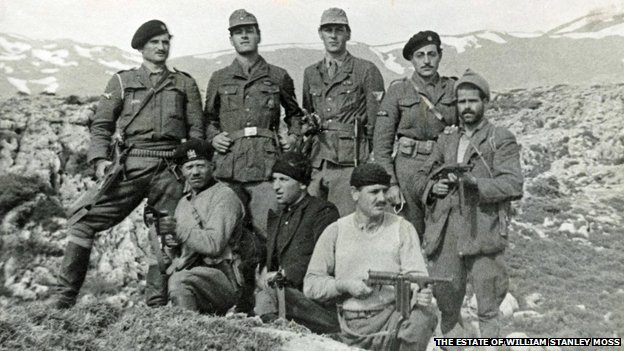
The abduction party, 28 April 1944 (Leigh Fermor standing second from left in German uniform)

The abduction party, 28 April 1944 (Leigh Fermor standing second from left in German uniform)

A very rare profile of Paddy by the BBC. Barely anything is available on the BBC about one our greatest Englishmen. Since his death the amount has increased with an obituary and the serialisation of Artemis Cooper’s biography. This review is welcome.

From BBC News Magazine

By Andy Walker

Abducting a General: The Kreipe Operation and Soe in Crete is a new account of the kidnap of a German general in WW2 from occupied Crete and sheds light on one of the 20th Century’s most interesting men.

“One man in his time plays many parts,” wrote Shakespeare in As You Like it. If that is any measure, then the late Sir Patrick Leigh Fermor blew it into a cocked hat.

A decorated war hero, brilliant conversationalist, historian, Hollywood scriptwriter, perhaps the finest travel writer of his generation – the list of the achievements of Paddy, he was never called Patrick, goes on and on.

And now, three years after his death at the age of 96, Leigh Fermor’s own account of the audacious wartime exploit, capturing General Heinrich Kreipe, the commander of a division on the island of Crete, evading his pursuers and getting him to Cairo, has been published, further gilding his glittering reputation.

The book, Abducting A General, recounts the incident with typical Fermor erudition and flair.

He recalls how he and his colleague W Stanley “Billy” Moss dressed as German corporals, flagged down the general’s car on an isolated road. Their Cretan comrades helped them overwhelm the driver and, with Fermor wearing the general’s braided cap in the front of the staff car, they negotiated 22 German checkpoints with their quarry out of sight in the back.

Then, he writes: “A mood of riotous jubilation broke out in the car; once more we were all talking, laughing, gesticulating and finally singing at the tops of our voices, and offering each other cigarettes, including the general.”

On the journey to a rendezvous with a British submarine the party traversed the island’s highest point, Mount Ida, where Fermor and the general traded some lines of Latin from Horace.

It was, he explained later, “as if the war had come to an end, because we had drunk of the same fountains. Everything was very different afterwards”.

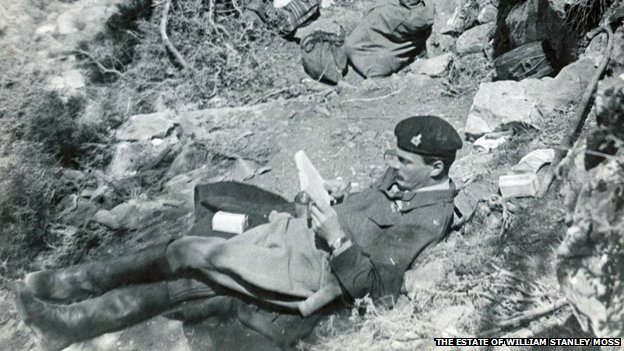
Leigh Fermor at the hideout at Kastamonitza, 20 April 1944

Leigh Fermor at the hideout at Kastamonitza, 20 April 1944


Fermor was awarded the Distinguished Service Order, while Moss, who penned his own account of the incident, Ill Met By Moonlight, later to be made into a movie starring Dirk Bogarde, was given the Military Cross.

But this was but one achievement by the man once described as “a cross between Indiana Jones, Graham Greene and James Bond”.

At just 18, the wild and wilful son of distant parents, Fermor had been “sacked” from a series of schools before being taken in by the bright and bookish denizens of bohemian London. He started a journey.

“Hopeless, idle, easily distracted, unemployable,” as his biographer and friend Artemis Cooper puts it, Fermor resolved to travel on foot from the Hook of Holland to Istanbul living on just £5 a month – part wandering scholar, part tramp, in order to reboot his life.

His journey, chronicled between 1977 and last year in three books – A Time of Gifts, Between the Woods and the Water and The Broken Road – is a poetic and romanticised evocation of a Europe as much of the mind as of reality, one which was swept away by WW2 and the upheavals which came in its wake.

Through Holland he wandered, then followed the Rhine through German cities like Cologne, where “salients of carved eagles and lions and swans swung from convoluted iron brackets along a maze of lanes,” and Coblenz, remarking that “the accent had changed and wine cellars had taken the place of beer-halls”.

This was a Germany in the first year of the Nazi regime with people giving the “Heil Hitler!” greeting “as though the place were full of slightly sinister boy scouts”. In the midst of this, though, Fermor’s descriptions are lyrical, cultural, rarely political.

His charm eased his passage. One day he might sleep in a barn, the next in the palace of former Austro-Hungarian nobility, playing polo on bicycles in the grounds.

And later in the journey he fell in love with a Romanian princess, Balasha Cantacuzene, tagged along in a royalist cavalry formation deployed against an abortive Greek revolution in 1935 and visited the monasteries of Mount Athos.

This six-year “ultimate gap-year”, as the writer Benedict Allen has called it, ended with the outbreak of war in 1939, Fermor’s facility with languages (speaking four fluently with a working knowledge of many more), plus a tried and tested self-sufficiency, meant that he was an ideal candidate for special operations.

After the war he stayed on in Greece, worked for the British Council and met his muse, Joan Rayner, who was Wendy to his Peter Pan, as Cooper puts it.

An intellectual counter to the polymath Fermor, she was there when, aged 69, he swam the Hellespont in imitation of his idol Lord Byron. The couple married in 1968.

She was the unseen presence in works like The Traveller’s Tree, an account of a journey through the geography, history and customs of the Caribbean Islands, and two books about Greece, Mani and Roumeli.

He was in his 60s when A Time of Gifts was published, followed 11 years later by Between the Woods and the Water – writing, rewriting and revising so slowly as to drive his publisher Jock Murray to distraction.

“I think life always got in the way,” says Cooper. “He felt so unsure of himself in so many ways. He was willing to sponge off friends or live pretty rough, really, until he could get it right.

“It’s very odd, a kind of real psychological problem.”

But Fermor was not shackled to travel writing. He became an elegant translator, wrote a proto-magical realist novel, The Violins of Saint-Jacques, and even tried his hand at scriptwriting, co-writing The Roots of Heaven, a Hollywood feature directed by John Huston and starring Errol Flynn.

“Everybody else detested Errol Flynn,” recalls the writer and historian John Julius Norwich. “But Paddy thought he was terrific. And he and Paddy had tremendous drinking bouts together. They were on the same wavelength.”

And Fermor became a much sought-after raconteur, famously holding court on his visits to London.

Kidnap in Crete: The True Story of the Abduction of a Nazi General is available for pre-order or purchase. Click on the highlighted text.

Abducting a General: The Kreipe Operation and Soe in Crete by Patrick Leigh Fermor is available to purchase. Click on the highlighted text.

Map of Crete as drawn by Paddy on operations

This map was hand drawn by Paddy, probably whilst on operations in Crete 1943-44, including a self-portrait. The map is from Paddy’s SOE file. First published on this blog in 2011, I am republishing it as part of a series of unique materials on the blog to tie in with the 70th anniversary year of the kidnap and the recent publication of Paddy’s own account. Click on the pictures to zoom.

The reverse of the map …

The drawing is typical of Paddy’s style. Compare it with this sketch sent to us by John Stathatos, about which John tells us:

This delightful sketch of himself in Cretan dress was penned at the top of a letter to my mother dated 17th November, 1944; as he explains, “I have been lost again in a forest of whiskers for about three weeks, and my old mountain chums are down in the plains now, looking incredibly wild and shaggy”.

“I have been lost again in a forest of whiskers for about three weeks, and my old mountain chums are down in the plains now, looking incredibly wild and shaggy”

Related article:

Traveller’s Rest by John Stathatos

Duchess of Devonshire on meeting JFK

Another video from the delightful series of interviews with Debo. She recalls times with Jack Kennedy and his funeral. She was at the White House during the Cuban missile crisis and could not understand all the talk of “missuls”; she thought they were some kind of thrush.

Click on the picture to play and briefly endure the annoying advertisement before the main event (sound again low gain).

Capture

Travellers’ Century: Patrick Leigh Fermor now on YouTube


The event at Waterstones on Thursday with Benedict Allen introducing his 2008 film about Paddy’s life and work was a great success.

Organised by Barnaby Rogerson of Eland Publishing (who specialise in keeping the classics of travel literature in print), we were treated to a few glasses of wine before the film whilst chatting to an eclectic group who included general travel writing buffs, some who knew little about Paddy, and a group of keen PLF enthusiasts. Harry Bucknall, author of Like a Tramp, Like A Pilgrim: On Foot, Across Europe to Rome was in fine form, talking about a possible film project, and I particularly enjoyed meeting Rick Stroud who wrote the other book published this month about the abduction Kidnap in Crete: The True Story of the Abduction of a Nazi General.

Perhaps the highlight was a Q&A session afterwards where Benedict was joined by John Murray who features in the film talking about the challenges of editing Paddy’s work. John had some very interesting things to say about working with Paddy and shared some personal views about his life and relationships.

By strange coincidence I have now been told that the BBC film has now appeared in You Tube so you can all watch and enjoy it!

William Dalrymple and Artemis Cooper discuss Abducting a General on BBC’s today programme

Capture1

Justin Webb introduces this package on BBC Radio Four’s Today programme on Thursday 9 October 2014. Sir Patrick Leigh Fermor was one of the world’s great travel writers. In the grand old tradition he was a scholar and a war hero and a general all-round high achiever. Top of his achievements was the capture of a German general on Crete – and today for the first time his account of that capture is published. Travel Writer and historian William Dalrymple and biographer Artemis Cooper discuss.

You can listen to the programme on BBC iPlayer for a further four weeks if the BBC let you listen in your country. Click here to find the webpage for Thursday then slide the cursor to 02.23 to start the interview which lasts about six minutes. I had problems using it with Firefox. OK with IE.

Abducting a General: The Kreipe Operation and Soe in Crete by Patrick Leigh Fermor is available to purchase. Click on the highlighted text.

Reminder for tonight – Traveller’s Century: Benedict Allen seeking Patrick Leigh Fermor

A reminder that Benedict Allen will be introducing his 2008 BBC documentary where he travels Paddy’s footsteps, tonight at Waterstones Piccadilly at 6.30pm.

There may be free tickets left. Call the shop on 0207 851 2400

More derring dos and don’ts from Paddy Leigh Fermor

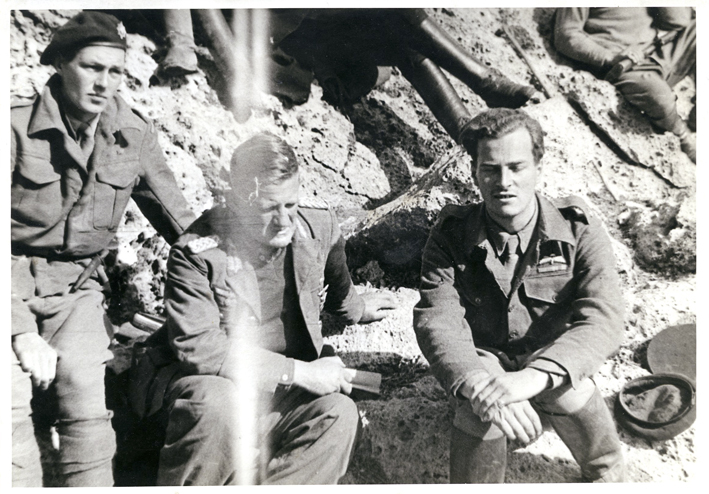
With General Kreipe

Billy Moss (L) and Paddy (R) With General Kreipe

Justin Marozzi gives us a review of Abducting a General, by Patrick Leigh Fermor, and Kidnap in Crete, by Rick Stroud. An exhilarating account of Paddy’s hair-raising kidnapping of a Nazi general that was ultimately of dubious strategic value.

By Justin Marozzi.

First published in The Spectator, 4 October 2014.

Recent years have seen the slim but splendid Patrick Leigh Fermor oeuvre swell considerably. In 2008 came In Tearing Haste, an entertaining collection of letters to and from Deborah Devonshire, followed last year by The Broken Road, the posthumously sparkling and long-awaited completion of the ‘Great Trudge’ trilogy, which finally delivered the 18-year-old Paddy from the Hook of Holland to Constantinople. Now comes another volume, setting out in full for the first time one of the great moments in a life heavily laced with glamour and incident.

It takes some chutzpah to kidnap a German general — and serious presence of mind to get away with it. Paddy, the Special Operations Executive commander of a group of 11 Cretan andartes, or guerrilla fighters, together with his second-in-command Captain William Stanley Moss, had excessive stores of both. At 9.30 p.m. on the night of 26 April 1944, the Anglo-Cretan desperadoes intercepted the car carrying General Heinrich Kreipe, commander of the 22nd Luftlande Division.

Paddy then impersonated the general as the Moss-chauffeured car drove on through 22 German checkpoints, the hair-raising prelude to an 18-day Nazi manhunt described in exhilarating detail in both of these books. The moment one morning when the Englishman overheard the captured general reciting an ode by Horace is already famous. The autodidact and show-off couldn’t help jumping in and finishing the stanza:

The general’s blue eyes swivelled away from the mountain-top to mine, and when I’d finished, after a long silence, he said: ‘Ach so, Herr Major!’ It was very strange. ‘Ja, Herr General.’ As though, for a long moment, the war had ceased to exist. We had both drunk at the same fountains long before; and things were different between us for the rest of our time together.

After many terrifying moments, some shattering climbs and descents and no shortage of near misses, Kreipe was finally spirited away onto a British ship headed for Cairo and the swashbuckling operation was over.

If the immediate success of the kidnapping is in no doubt, what of the much more vexed question which haunted its mastermind for years: was it worth it? The point of it all had been to inflict a major blow on enemy morale. Extensive steps were taken to ensure there were no Cretan reprisals by making it appear an exclusively British mission — but to no avail. The Germans, 75,000 strong on Crete, already had a viciously enforced policy of reprisals on the island, taking 50 Cretan lives for every one of their own soldiers killed. General Friedrich-Wilhelm Müller, Kreipe’s predecessor and the original target of the operation, was nicknamed ‘The Butcher of Crete’ after committing a number of such atrocities.

With Kreipe kidnapped, Müller was sent back to Crete pour décourager les autres and on 13 August gave the order to raze the village of Anogia, long a centre of resistance. In a characteristically methodical operation that lasted from 13 August to 5 September, 117 people were killed and 940 houses destroyed, together with vineyards, cheese mills, wine presses and olive groves. Other villages in the Amari valley received the same treatment, with hundreds more civilians slaughtered.

Roderick Bailey, the SOE historian who has written the introduction to Paddy’s account, argues that the kidnapping operation had ‘no strategic or tactical value’. A senior British staff officer in Cairo had opposed it from the start, arguing that ‘the only contribution to the war effort would be a fillip to Cretan morale, but … the price would certainly be heavy in Cretan lives’. Kreipe himself called it a Husarestück, a Hussar stunt. More recently, Kimonas Zografakis, who sheltered the kidnappers, described Paddy as ‘neither a great Philhellene nor a new Lord Byron… he was a classic agent who served the interests of Britain’, causing ‘terrible suffering’. This last comment looks unduly harsh and certainly does not square with the lifelong friendships Paddy forged with his Cretan brothers-in-arms, nor with the deep affection most Greeks had for him.

Abducting a General, unlike Stanley Moss’s Ill Met by Moonlight, is the work of a mature man, anxious to pay proper tribute to the Cretans who were the backbone of the resistance and ran by far the greatest risks. His SOE reports, which run to 90 pages here, provide gripping cinematic portraits of Leigh Fermor the soldier.

Warrior, writer, lady-killer, Paddy was also a boulevardier who loved his threads. Page three finds him rhapsodising about his Cretan mountain shepherd disguise:

Breeches, high black boots, a twisted mulberry silk sash with an ivory-hilted dagger in a long silver scabbard, black shirt, blue embroidered waistcoat and tight black-fringed turban…

and that’s without mentioning the flamboyant moustache, homespun goat’s hair cloak, stick, bandolier and gun. Enough to frighten any Nazi general.

Click here to buy Abducting a General: The Kreipe Operation and SOE in Crete

Click here to buy Kidnap in Crete: The True Story of the Abduction of a Nazi General

Justin Marozzi’s latest book is Baghdad: City of Peace, City of Blood.

The Dowager Duchess of Devonshire laid to rest

The Duchess of Devonshire funeral at Chatsworth House Photo: EDDIE MULHOLLAND

The Duchess of Devonshire funeral at Chatsworth House Photo: EDDIE MULHOLLAND

The Prince of Wales and the Duchess of Cornwall, who were close friends of the Dowager Duchess, walked the entire route behind the hearse carrying her coffin The Dowager Duchess of Devonshire has begun her final journey from Chatsworth House to the parish church where she is to be buried.

By Gordon Rayner

First published in the Telegraph 2 October 2014

More than 600 staff from the Chatsworth estate have been give the day off work so they can line the two-mile route that the cortège is taking to St Peter’s Church in the village of Edensor.

The Prince of Wales and the Duchess of Cornwall, who were close friends of the Dowager Duchess, were among the mourners, and walked the entire route behind the hearse carrying her coffin.

The estate staff lining the route fell in behind as the hearse passed, with more than 500 chairs set up for them at the church so they could watch the funeral on a giant screen showing the service from inside the church, which only holds 200.

Halfway through the service the sound of Elvis Presley singing How Great Thou Art filled the parish church.

The Dowager Duchess was a huge Elvis fan and owned a collection of Elvis memorabilia.

The Dowager Duchess, who died on September 24 at the age of 94, was the last of the Mitford sisters, the most celebrated and controversial family in pre-war high society.

It was her head for business that transformed Chatsworth from a crumbling stately home into one of the country’s most popular tourist attractions and the model for virtually ever other stately home in the country.

She was buried in the church’s graveyard next to her late husband, the 11th Duke of Devonshire, who died in 2004. His gravestone has been removed for the Dowager Duchess’s name to be added.

The plot is next to the grave of Kathleen Kennedy, sister of John F Kennedy, who was married to the 11th Duke’s brother.

In accordance with the Dowager Duchess’s wishes, the estate staff lining the route of the cortège wore their work uniforms, with butchers turning out in aprons, gardeners in their green sweatshirts and tour guides in their crested blazers. All wore either a black tie or black armband.

As the staff gathered at their muster points to be briefed on their positions, they swapped stories and memories of the Dowager Duchess, who was known as “Debo”.

Paul Neale, 59, the head butcher at the Chatsworth Farm Shop, said: “We have turned out in our uniforms because it is what the Duchess wanted and it is the highest compliment we can pay her because she started the retail side of Chatsworth.

“She was a lovely lady, very much involved in the business and we would see her three or four times a week coming to look round the shop.

“She used to stop and talk to everyone. I’m so proud to have known her and to have worked for her for 18 years.”

The Dowager Duchess knew the names of virtually all of the 620 staff standing to attention along the route, from the 92 catering staff to the 40 gardeners, the 20 tenant farmers and the three gamekeepers.

Alan Hodson, 66, one of the 63 tourist guides among the mourners, said: “Today is a celebration of a wonderful lady.

“She used to speak to absolutely everyone, she had fabulous social skills, she would always admire people’s children or their dogs and you would see her holding the door open for visitors who probably had no idea who she was.”

The Dowager Duchess’s son, the 12th Duke, followed immediately behind the hearse with his wife and his sister Lady Emma Tennant. The Prince of Wales and the Duchess of Cornwall walked immediately behind them.

The Duchess of Cornwall’s former husband Andrew Parker Bowles was also among the mourners.

As the cortège progressed along its route, accompanied by the steady monotone beat of a single bell at the church, the numbers walking behind the coffin grew to hundreds and then well over a thousand as the staff and members of the public joined it.

The Dowager Duchess’s wicker coffin, ringed with flowers, was carried into the church by pall bearers including Stephen Reid, head gamekeeper, and Andre Birkett, manager of the Farm Shop.

The Dowager Duchess’s retired former butler, Henry Coleman, carried a cushion bearing her insignia of the Dame Commander of the Victorian Order.

The funeral service, conducted by Canon David Perkins, included music by Bach, Brahms, Handel and Grieg, and the hymns Holy! Holy! Holy! and We Plough The Fields And Scatter.

The readings included the poem Lament Of The Irish Emigrant by Helen Selina, Lady Dufferin, and a passage from Ecclesiastes Ch.3 v 1-22.

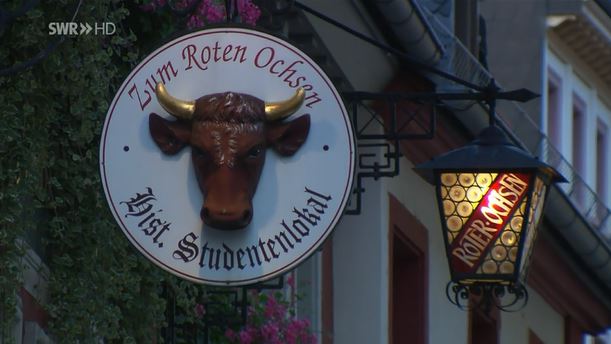
175 years of the Red Ox Inn, Heidelberg

Red Ox

Immortalised by Paddy who stayed here in the winter of 1934, the Red Ox Inn is celebrating 175 years managed by six generations of the same family. They say they are looking forward to the 200th anniversary. It is always worth a visit if you travel to beautiful Heidelberg.

In German, and I should warn you there are scenes of hearty German food and large glasses of beer, but fortunately no flash photography.

This does not appear to play in Firefox. It works in Internet Explorer. Click on the image to play.

Funeral service of Deborah, Dowager Duchess of Devonshire

The funeral service for Deborah, Dowager Duchess of Devonshire will be held at 12 noon at St Peter’s Church, Edensor, DE45 1PH on Thursday 2 October 2014.

Everyone is welcome to attend. There will be refreshments at Chatsworth after the service.

No memorial service will be held, as were her express instructions. Donations in her memory to the Addington Fund and/or Helen’s Trust will be much appreciated.

Full details here.

The house is not always empty …

It appears that some lucky people have been allowed to stay in the house at Kalamitsi. Who are they and did they pay? From a lovely new blog by Max Long.

Eventually I did find a room, and wallowed in the privilege of having a bed, a balcony overlooking the mountains, a table to write on. On my first night I had considered, in utter disappointment and desperation, going to Paddy Leigh Fermor’s house just a few kilometers south from the main village, to find some comfort by camping there. As I was to find out two days later, it was a very good thing I didn’t.

A few years ago, a Guardian journalist came to Kardamyli with similar intentions. He swum to Paddy’s house from the harbour, and I decided that it would be a nice idea to do the same. Following the footsteps of a footstep-follower.

I am not a confident swimmer, and have barely swum out a few tentative strokes in all the beaches I’ve been to so far, so it was quite a mental struggle for me to embark on what was to be a half hour swim along the rocks to the little pebble beach with a flight of stone steps leading up to the house. When I got there, there was a couple on the beach, but they spoke little English and could not confirm that this was Paddy’s house, so I walked up the steps anyhow, and soon the pebble mosaics on the floor, the large house of stone and painted grey-blue French windows, the seating area looking over the bay, confirmed that I was indeed at the right place.

However, it was with utter horror that I saw the freshly trimmed garden plants and trees, the recently used hosepipe… the open windows, the sound of plates watering the mouths of lunchers… the exposed breasts sunning themselves in the corner. I scuttled away, undetected but nevertheless thoroughly embarrassed. I later made for the front door. I could hear voices, evidence of clear use. I felt for a moment I might have traveled back in time to a former splendor of the wonderful house. All the reports by journalists and bloggers online had been of a desolate, abandoned home. I inquired at the front door. Yes, this was his house. No, I couldn’t visit. I walked away, burning with disappointment, but also with curiosity. The house is now in the hands of the Benaki museum, and my understanding is that it will be converted into a writer’s retreat or museum of its own. Who were these people who had the privilege to enjoy the place in the meantime?

(I visited the house again on my last morning and it was only after a lot of pleading that a disgruntled, shirtless, hairy and sandalled old gentleman allowed me a brief – less than two minute – look at the place. None of the moments of contemplation I had hoped for. The insistence with which he refused to allow me to access the house, and the simplicity of my request, made me think he could only be an extraordinarily cruel man. Sitting in Paddy’s study surrounded by books, he refused to give me either his name or any inkling of the Benaki’s future plans. I left, once again, in a rage.)

Full article here.

Another correspondent in an email to me this week coroborates the fact that people seem to be staying at or using the house …

I too was in Kardamyli in August.  I too walked around the outside of the house and up the steps from the beach.  I didn’t want to trespass, but when I realised there were people living there I decided to knock at the gate and ask them what was happening to the house.  Two twenty -something year old Greek girls in bikinis were there, and obviously staying there.  They wouldn’t let us visit.  I’ve no idea who they were.  My first reaction was that Paddy and Joan would surely be upset that their wishes are clearly not being respected.  On the other hand, perhaps it is good that someone is there because there are clearly a lot of Paddy pilgrims, and sooner or later there will be someone with less honorouble intentions, who enters the house and takes something away with them.
I can only assume they were local girls and that his old housekeeper or someone local must have an eye on who is there.  The place is obviously in need of urgent attention.
Mark

Duchess of Devonshire on her sisters and meeting Hitler

Debo was always confident in front of the camera and here she talks about some of the extraordinary events in her life. She was the girl who within a few short months danced with the young JFK and then had tea with Hitler. They don’t make ’em like this anymore.

The video has a low level of sound. Perhaps best to listen with headphones after the irritating advert.

Click on the picture to play.

Capture

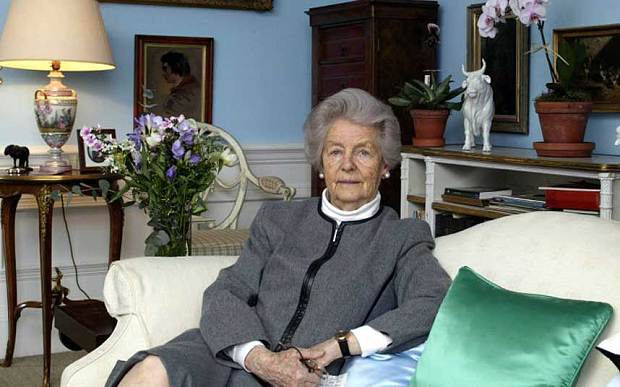
Dowager Duchess of Devonshire – obituary

The Duchess at Chatsworth in 2005 Photo: REX

The Duchess at Chatsworth in 2005 Photo: REX

The Dowager Duchess of Devonshire was the devoted chataleine of Chatsworth and the last of the Mitford sisters.

First published in the Telegraph 24 September 2014

The Dowager Duchess of Devonshire, who has died aged 94, was the youngest and last of the celebrated Mitford sisters, and the chatelaine of Chatsworth, the “Palace of the Peak” in Derbyshire, which from the 1950s onwards she made into both a glorious public spectacle and, really for the first time, a consummately stylish private home.

She was born Deborah Vivien Freeman-Mitford on March 31 1920, the sixth daughter of the eccentric 2nd Lord Redesdale, well-known to readers of Nancy Mitford’s novels as “Uncle Matthew”. “Debo” (as she was always known) was repeatedly assured throughout her childhood by her eldest sister Nancy that “everybody cried when you were born” on account of her being yet another girl.

Debo took refuge in quaintly odd pursuits. Another sister, Jessica (“Decca”) Mitford, described her spending “silent hours in the chicken house learning to do an exact imitation of the look of pained concentration that comes over a hen’s face when it is laying an egg, and each morning she methodically checked over and listed in a notebook the stillbirths reported in the vital statistics columns of The Times”.

As the youngest in a family of seven, Debo was constantly and mercilessly teased, despite the bellowing championship of her father. She was passionately fond of the country and country pursuits, and did not suffer from the brilliant, restless boredom so well-documented by her sisters. None of the girls was sent to school, as their father thought education for girls unnecessary; a succession of governesses was employed, one of whom, Miss Pratt, had her charges playing Racing Demon daily from 9am until lunchtime.

As a girl Debo was a fine skater, and was invited to join the British junior team; but the idea was vetoed by her mother. As an adolescent she witnessed several scandals surrounding her sisters — Diana’s divorce and remarriage, Jessica’s elopement, Unity’s involvement with Hitler — as well as the disintegration of her parents’ marriage.

She was famous for having chanted as a child, in moments of distress: “One day he’ll come along, the Duke I love.” When she married Lord Andrew Cavendish in 1941, however, he was a mere second son. Debo wrote to her sister, Diana Mosley, then in Holloway prison: “I expect we shall be terrificly [sic] poor but think how nice to have as many dear dogs and things as one likes without anyone to say they must get off the furniture.”

Debo remained surrounded by dogs for the rest of her life. In The House: A Portrait of Chatsworth (1982), the delightful and bestselling book she wrote, in between doing a lot of sums to illustrate that 365 ordinary-sized residences could fit into The House, with its 7,873 panes of glass and 53 lavatories, the Duchess took care to inform the reader: “It’s a terrible place to house-train a puppy.”

In 1944 Andrew’s elder brother was killed in action, and in 1950 the 10th Duke unexpectedly died. The Devonshires were left with 80 per cent death duties which took 17 years to settle. In 1959 they moved to Chatsworth, uninhabited since before the war.

When she had first seen the house after the war she had thought it “sad, dark, cold and dirty. It wasn’t like a house at all, but more like a barracks.” It had not been redecorated for decades, and during the war had been home to a girls’ boarding school.

But Debo embraced her role of chatelaine gaily, as she set about redecorating the house. “Debo has become the sort of English duchess who doesn’t feel the cold,” reported Nancy, disconsolately.

The Duchess was both beautiful and deceptively literate, although exceptionally modest. Lucian Freud painted her when she was 34, and Debo used to delight in the story of how an old woman was heard remarking, as she stood before the painting: “That’s the Dowager Duchess. It was taken the year before she died.” When the painting was completed, Freud allowed the Duke and Duchess to see it at his studio. “Someone else was already there,” she later recalled. “Andrew looked long at the picture until the other man asked, ‘Who is that?’ ‘It’s my wife.’ ‘Well, thank God it’s not mine’.”

She also sat for Annigoni, to whom she found herself apologising for her face: “I know it’s not the sort you like.” The artist replied, not very graciously: “Oh well, it doesn’t matter, it’s not your fault.”

The Duchess kept aloof from her family’s literary and political pursuits. She visited her Fascist sister Diana in prison, and her Communist sister Decca in California, keeping a light touch with both.

After visiting Decca and doing the rounds of her Communist friends, Debo sent Decca a photograph of herself and her husband, dressed in their ducal robes for a coronation, garlanded with orders, chains and jewels, staring stonily ahead. Beneath the photo she wrote: “Andrew and me being active.”

Nancy used to address letters to her sister “Nine, Duchess of Devonshire”, her contention being that Debo never developed beyond the mental age of nine. Certainly the Duchess always maintained that she never read books and that her favourite reading matter was the British goatkeepers’ monthly journal, Fancy Fowl magazine and Beatrix Potter.

The epigraph in her book The House is taken from Hobbes, who was tutor to the 2nd and 3rd Dukes of Devonshire: “Reading is a pernicious habit. It destroys all originality of sentiment.”

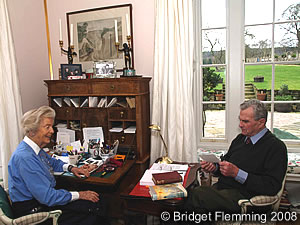
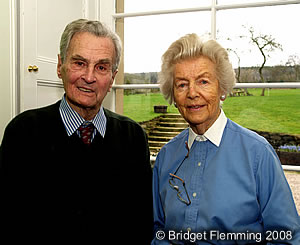
Debo and Paddy 2008

Debo and Paddy 2008

Paddy and Debo 2008

Paddy and Debo 2008

Chatsworth, however, was always filled with literati, and Patrick Leigh Fermor, a great friend, was determined that Debo was a closet reader, who sneaked books the way alcoholics sneak whisky. As a writer, she was a natural storyteller with a knack for the telling phrase and a delight in human eccentricities.

Certainly The House is a wonderfully rich and beautifully written work. It is organised around a Handbook of Chatsworth written in 1844 in the form of a letter from the “Bachelor Duke” (the 6th) to his sister and is full of very funny accounts of the foibles of earlier dukes and duchesses. Among other stories, it chronicles the war waged against woodworm by the wife of the 9th Duke (the former Lady Evelyn Fitzmaurice). Believing concussion to be the answer, the formidable beldame kept a little hammer in her bag to bang the furniture where they lurked.

The Duchess showed acute commercial flair in raising money for the Chatsworth estate, making a nonsense of her sister Nancy’s generalisation in Noblesse Oblige that aristocrats are no good at making money. She presided over the bread, cake, jam and chutney industries which grew up to feed the farm shop, which was described by the late Hugh Massingberd in The Daily Telegraph as “every greedy child’s idea of what a shop should be”.

Although the house had been open to the public ever since it was built, it was not until 1947 that the revenue from visitors went towards its upkeep. In 1973 the Duchess set up the Farmyard at Chatsworth, “to explain to the children that food is produced by farmers who also look after the land and that the two functions are inextricably mixed”. A little boy from Sheffield watched the milking, then told the Duchess: “It’s the most disgusting thing I’ve ever seen in my life. I’ll never drink milk again.”

Visitors to Chatsworth are able to buy items such as souvenirs, books, porcelain, knitwear, while the Farm Shop sells estate produce. A mail order business was established, along with cafés, restaurants and a commercial catering business.

Chatsworth Carpenters was an especially successful venture. The Duchess, in her gardener’s apron, was for many years a familiar sight at the Chelsea Flower Show, where she was to be seen busily selling furniture fit for a stately home to the owners of small town gardens.

The 11th Duke once observed: “My wife is far more important to Chatsworth than I am.” He added: “She is on the bossy side, of course; but I’ve always liked that in a woman.” She dealt heroically with her husband’s philandering nature and his weakness for alcohol, and the marriage was a happy one.

Despite living in a house overflowing with masterpieces by such artists as Rembrandt, Veronese, Murillo, Poussin and Reynolds, the Duchess always maintained that Beatrix Potter was her favourite artist, and Miss Potter’s enchanted world may indeed be the key to appreciating the genius loci of Chatsworth.

The Duchess was an ardent conservationist of vernacular architecture and was president of the Derbyshire Historic Buildings Trust. She also chaired the Tarmac Construction Group and the Rare Breeds Survival Trust.

Her devotion to making Chatsworth a viable financial concern was well rewarded in 1981 when a charitable trust, capitalised by the sale of certain treasures, was established to preserve The House for posterity.

In 2001 the Duchess published Counting My Chickens… and other home thoughts, a collection of sharply observed musings on Chatsworth, gardening, poultry, dry stone walling, bottled water, the United States, Ireland, the Today programme, the Turner Prize and other topics. On the modern fashion for hiring business consultants, she wryly observed: “He arrives from London, first class on the train… Most probably he has never been this far north, so the geography and the ways of the locals have to be explained, all taking his valuable time. After a suitable pause of a few weeks (he is very busy being consulted) a beautiful book arrives, telling you what you spent the day telling him.”

After her husband’s death in 2004 she published a poignant tribute in Memories of Andrew Devonshire (2007). Other publications included In Tearing Haste: Letters between Deborah Devonshire and Patrick Leigh Fermor (2008); Home to Roost … and Other Peckings (2009), a collection of occasional writings; and Wait for Me!… Memoirs of the Youngest Mitford Sister (2010). She was also a contributor to The Spectator and The Daily Telegraph. Her last book, All in One Basket, which brought together two earlier volumes of occasional writings, was published in 2011.

The Duchess claimed to buy most of her clothes at agricultural shows, adding: “After agricultural shows, Marks & Spencer is the place to go shopping, and then Paris. Nothing in between seems to be much good.”

Her dislikes included magpies; women who want to join men’s clubs; hotel coat-hangers; and drivers who slow down to go over cattle grids. She regretted the passing of brogues, the custom of mourning, telegrams, the 1662 Prayer Book, pinafores for little boys and Elvis Presley (“the greatest entertainer ever to walk on a stage”).

In 2003 she published The Chatsworth Cookery Book, introducing it with the words: “I haven’t cooked since the war.”

Debo Devonshire was appointed DCVO in 1999.

She is survived by her son Stoker, the 12th Duke of Devonshire, and by two daughters.

Dowager Duchess of Devonshire, born March 31 1920, died September 24 2014.

Related articles:

Listen to the 2010 BBC Radio 4 interview on Woman’s Hour here.

Never Marry a Mitford

The Duchess of Devonshire talks about Patrick Leigh Fermor

Our archive of articles about or including Debo

Paddy’s great friend Debo Devonshire, last of the Mitford sisters, has died

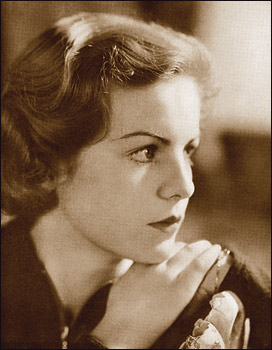
A young and beautiful Debo

A young and beautiful Debo

Deborah, or Debo as she was known to her friends, the Dowager Duchess of Devonshire, and the last surviving Mitford sister, has died aged 94. This announcement from the BBC news website. She was the last of Paddy’s friends from his younger days left alive. It is the end of an era.

Her son, the Duke of Devonshire, announced the death in a statement from Chatsworth House, her stately home.

The Mitford sisters fascinated – and sometimes scandalised – British society in the 1940s.

Unity was a friend of Hitler, Diana, the second wife of British fascist leader Sir Oswald Mosley, and Jessica a left-wing polemicist.

Deborah was more focused on her home life. Listen to the 2010 BBC Radio 4 interview on Woman’s Hour here.

Nicknamed the “housewife duchess”, she made Chatsworth one of the most successful and profitable stately homes in England after marrying Andrew Cavendish in 1941.

But along with her siblings, during her lifetime she moved in the same circles as Sir Winston Churchill, John F Kennedy and Evelyn Waugh.

She also accompanied her sister Unity to tea with Hitler in 1937, was painted by Lucian Freud, and amassed a collection of Elvis Presley memorabilia.

The statement from her son said: “It is with great sadness that I have to inform you that Deborah, Dowager Duchess of Devonshire, has passed away peacefully this morning.”
Deborah Deborah was the youngest Mitford sister

It added that an announcement about funeral arrangements would be made shortly.

Born Deborah Vivien Freeman-Mitford on 31 March 1920, the duchess was the sixth daughter of the 2nd Baron Redesdale.

The Mitfords’ childhood at their family home in the Oxfordshire village of Swinbrook was immortalised in her sister Nancy’s novels, The Pursuit of Love and Love in a Cold Climate.

Her parents made a poor job of hiding their disappointment that Deborah had not been born a boy, leaving Thomas their only son.

The Mitfords’ father disapproved of educating girls, famously insisting that hockey would make their ankles fat, and Deborah spent her formative years skating and hunting.

Her sister Unity’s infatuation with Hitler saw the young Deborah invited to tea with the German dictator, although the visit made little impression on her.

“If you sat in a room with Churchill,” she later recalled, “you were aware of this tremendous charisma. Kennedy had it too. But Hitler didn’t – not to me anyway.”

At Chatsworth, the Duchess took on a major role in running the house and its garden, which have been used in a number of film and TV productions.

In July 2002, the duchess and her husband spoke out against the government’s proposed ban on fox hunting.

Made a dame in 1999, she became the Dowager Duchess of Devonshire in 2004 after her husband died and their son inherited his title.

She wrote a book about her life, Wait for Me: Memoirs of the Youngest Mitford Sister, which was published in 2010.

Related articles:

Never Marry a Mitford

The Duchess of Devonshire talks about Patrick Leigh Fermor

Our archive of articles about or including Debo

A Place in the Sun – The very slow progress toward a permanent retreat

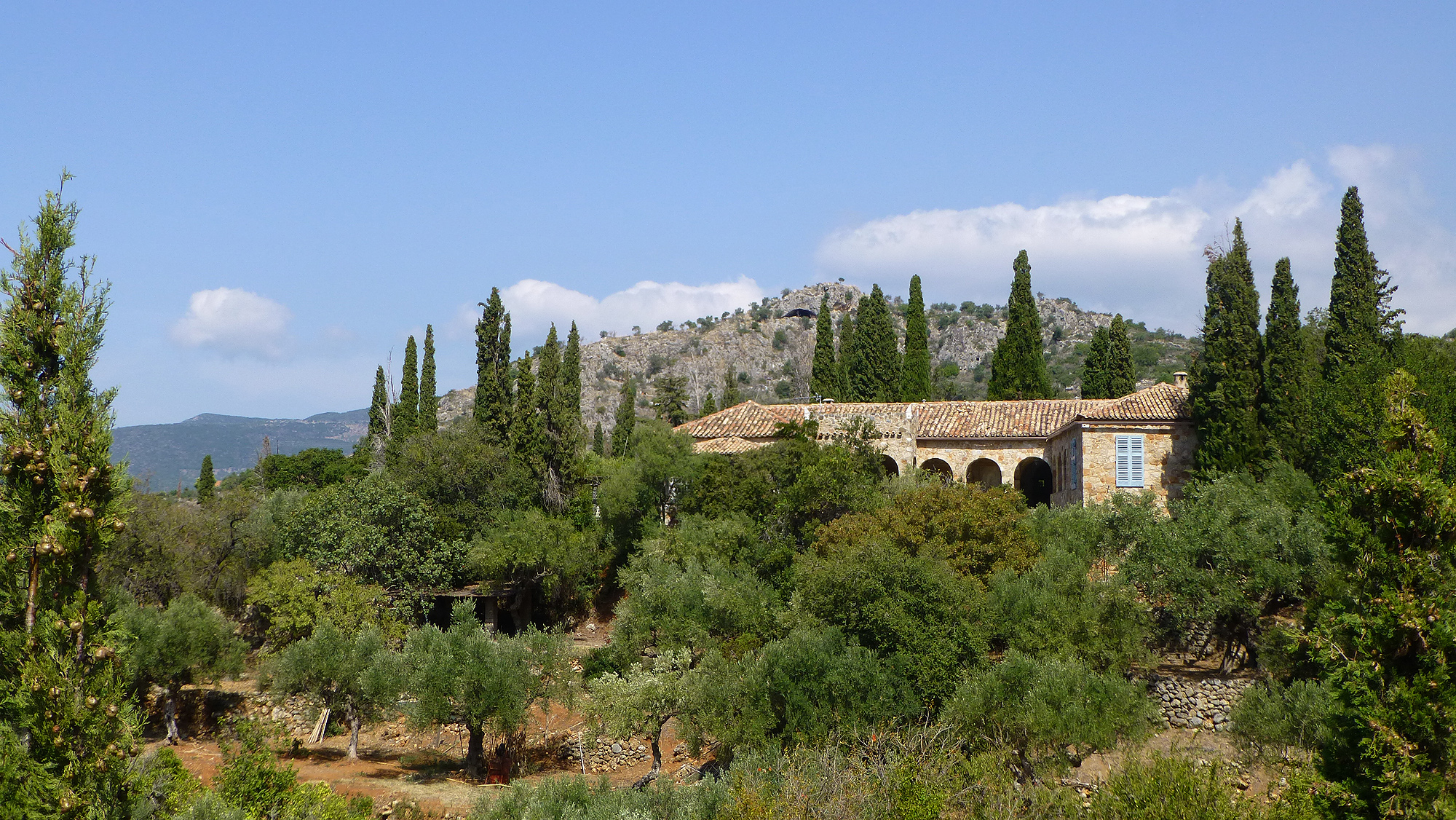
The house in Kalamitsi, September 2104 (John Chapman)

The house in Kalamitsi, September 2104 (John Chapman)

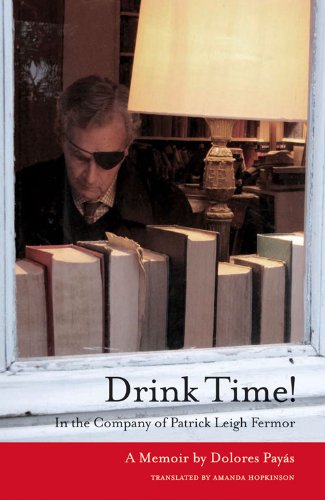
It appears it is the time for discussion about Paddy’s house at Kalamitsi to recommence. I was surprised when the article about his English home did not provoke any comments about the house in Greece which moulders away as the Benaki continues to drag its feet and struggle with its finances. The whole affair is a bit of a mess. It has been three years since the house was handed over to the Greeks but they appear to have done absolutely nothing with it. A house needs care. A house by the sea, even the Mediterranean, requires even more care. As Dolores Payas comments in her lovely book, Drink Time!, which I reviewed at the weekend, the house needs an awful lot of work and now the bill can only be higher.

Regular blog correspondent John Chapman who spends a lot of time in the area sent me this update at the weekend:

I sauntered down to the house at Kalamitsi. Absolutely no change since I last had a look around a fair few years ago. Still a bit of a mess. A cat mewled from within, so therefore someone feeds it and tends the garden. I could have leapt over the back wall into the garden, but decided against it. No-one I’ve talked to can make out what the Benaki are actually doing, or planning to do. The idea of a writers’ retreat is fine and dandy, but someone is building another vast edifice above the bay and the sound of a pile driver wouldn’t be too conducive to creativity!

And recently this article was published in the Weekly Standard.

By Dominic Green

First published in the Weekly Standard, 29 September 2014

Under the peak of Mount Taygetus, the wooded Vyros Gorge tumbles into the Gulf of Messinia at the small port of Kardamyli. Around the headland is a blue cove and the hamlet of Kalamitsi. A flock of low, white houses, their pantiled roofs the color of burnt orange, huddle under stripes of gray-green olive trees. A stony track declines sharply from the road. Then, as stones turn to sand, a narrow path forks uphill along the flank of a promontory. From the house at its summit, the olive terraces slide seawards towards a cliff.The Mani, a rocky peninsula hanging from the southern coast of the Peloponnese, is often compared to the Highlands of Scotland. The landscape is mountainous and mottled with scrub. The people are insular and excel at the arts of feud and hospitality. Their homes are crenellated with towers and battlements, fortifications against the Franks, the Turks, and the neighbors. The exterior of this particular house is a thick-walled cross between a farmhouse and a fortress. A door of medieval solidity stands sentry at the gatehouse; a metal grille permits parley with strangers.

Passing the gatehouse, however, the lines soften and the stone curves. On the left, a Moorish colonnade marches to the sea, past a file of bedrooms and a dozing cat, the last arch framing a blue half-circle. Along the central axis are more bedrooms. In one, a weathered tweed jacket and a pair of walking boots wait in the closet; on the lavatory wall is a sun-paled genealogy of the kings and queens of England.

The right wing is a single oblong, a library-cum-sitting room. Bookcases are cut into stone recesses. A table dressed in Cycladic swirls of green and white marble carries enough booze to float a battleship or an English house party. At the shaded eastern end of the room is a cushioned divan; at the western end, a wooden, windowed balcony of Balkan provenance floats over the azure sea like the cabin of a pirate captain.

The mantelpiece is jammed with photographs, souvenirs, and scraps of paper with friends’ phone numbers. On the Cycladic table, the host’s favorites, Famous Grouse and Stolichnaya, wait among half-empty evocations of the British Empire: Rose’s Lime Juice Cordial, Angostura bitters, a Greek variant of tonic water. But the bubbles in the tonic have long evanesced into the lemony Greek air: The host, the legendary soldier, traveler, and author Patrick Leigh Fermor, died in 2011; his partner, Joan Eyres Monsell, predeceased him in 2003. Their house is empty but for the cat, the orphan of Joan’s once-plural brood. The Leigh Fermors’ housekeeper, El-pi-da Bel-o-yan-nis, tends their home like a shrine. Outside, the gardener, Christos, clips and prunes beneath a straw hat.

The British are famous for removing ancient monuments from Greece, not for donating modern ones. The Leigh Fermors bequeathed their house to the Benaki Museum of Athens as a retreat for writers. But its future is not written in stone.

Sir Patrick Leigh Fermor, OBE, DSO—known to friends, retainers, and a global army of readers as Paddy—was the last living contender for the kingdom of literature’s Habsburg crest, the double-headed crown of man of letters and man of action. A conscientiously Byronic inheritor of the British romance with Greece, Leigh Fermor was a warrior-writer in the line of Philip Sidney and T. E. Lawrence. He was also one of the great stylists of 20th-century English prose.

Leigh Fermor’s writing, like his biography, is one of the last monuments of the imperial age, when the British were not merely worldly, but global. His tone is a late outcrop of Bloomsbury—delicate, languid, melodious, precise—but purged of provinciality. His clauses flow with a French rhythm, the décadence of Second Empire Paris, and are studded with a cosmopolitan glitter of linguistic borrowings and historical speculations. Leigh Fermor was a travel writer in the sense that Pepys was a diarist. Every turn of his road evokes reflections on history, art, religion, and language. Investigations of folk songs, dances, and cheeses lead to anecdotal hunts for a pair of slippers that might once have shod Lord Byron, or a fisherman who might be the lineal descendant of the last emperor of Byzantium.

Always the language rises to the occasion, be it scenic, romantic, antiquarian, or philological. Always the present is excavated to reveal the fragments of memory. No philhellene has written better on Greece than Leigh Fermor in Mani (1980) and Roumeli (1973). Few have eulogized lost youth and interwar Europe more elegantly than Leigh Fermor in A Time of Gifts (1977) and Between the Woods and the Water (1986), the record of his walk, aged 18, from the Hook of Holland to the Iron Gates of the Danube. A posthumous and incomplete third volume, The Broken Road (2014), carries the narrative into Greece through shepherds’ huts, urban mansions, and fishermen’s caves.

Leigh Fermor wrote his “great trudge” trilogy at Kalamitsi, in his writing studio and on collapsible tables in his garden. He also hosted several shelves-worth of scholars, artists, and travelers, including George Seferis and John Betjeman, the poets laureate of Greece and Britain. The house, its contents, and the books that were written here are the complete works of a unique sensibility and a museum of a literary era. If the house were in Britain, the National Trust would already have restored it. There would be a ticket booth in the gatehouse, a shop selling organic figs and artisanal olives, and perhaps a tea room as well. But the Benaki is a private museum. Along with many properties in Athens, it is akin to a penurious Getty or an expansive Stewart Gardner. The Leigh Fermors left no endowment. The Benaki did not create one in the three decades between the bequest and Leigh Fermor’s death. It did, however, fund its expansion with a bank loan of €15 million (around $20 million). In 2008, the Greek economy collapsed, and so did the Benaki’s finances.

Beyond the colonnade, the July sun flattens the sea into a two-dimensional blue wall. An island, necklaced with ruined walls and vegetation, floats in the bay like a green brick. From the cliff, a staircase snakes down the rock to a small beach. “Paddy used to swim around the island and back,” Elpida explains proudly and unprompted. She exhales in mourning.

Outside, the crickets clatter, a maraca orchestra so loud and constant that it becomes unheard. The fringes of the house abound in shaded spots for between 1 and 20 people: solitary nooks for contemplation and reading, sociable niches for sitting and dining. It is a home to be shared—when not struggling scrupulously at his writing studio, Leigh Fermor was a relentless entertainer—but it is empty of life. The stones, saturated in a human presence as strong and invisible as the crepitations of the crickets, are silent, crepuscular.

In September 2011, the Benaki commissioned plans for the restoration of the house, costing an estimated $800,000, and catalogued its library and papers. They fumigated and stored the most important items in Athens, including that poignant testimonial to sedentary toil, a first edition of Betjeman’s High and Low (1966), inscribed by the “pile-ridden poet.” The Benaki also signed a five-year memorandum of understanding with the Seeger Center for Hellenic Studies at Princeton for planning lectures on Paddy-related topics. Meanwhile, the publication of both The Broken Road and a biography by Artemis Cooper revealed a vast reservoir of affection. In Britain, a committee of Paddy’s friends offered to create a charity to raise funds for the restoration.

And then nothing happened.

Part of the garden wall fell down, and visitors trickled in through the breach. In Britain, the natives grew restless. A Guardian journalist climbed the cliff stairs and peered through the locked windows. The Daily Telegraph described the house as “sad and neglected,” its shutters “rotting and falling off their hinges.” Artemis Cooper, a lifelong visitor, responded that the Benaki was doing its best, but Greece was amid “economic catastrophe.” The plans had not been abandoned, and the house, always a little ramshackle, was not neglected. Guests had stayed there, and Richard Linklater had filmed parts of Before Midnight (2013), with Julie Delpy and Ethan Hawke, there.

Tom Sawford runs an unaffiliated website for Paddy’s admirers. The talkbacks describe books moldering in an outhouse. There are offers of money and help, sympathy for the Benaki’s problems, and allegations of mismanagement. Sawford believes that if the museum had accepted the British group’s offer, the house would be “up and running” by now, its future secure: “Instead, the Byzantine structure of the Benaki has resulted in the house being left to rot.”

The Benaki’s English website places 16 individuals in the “front ranks of its benefactors” for giving “considerable property” to the museum. Patrick Leigh Fermor is not on the list. The museum has launched a global fund-raising campaign. On the website, donors can choose among 10 projects. Patrick Leigh Fermor’s house is not among them.

Irini Geroulanou is the deputy director of the Benaki. She returns my phone call immediately, puts me in touch with Elpida, and volunteers her own cell phone number, just in case. The Benaki, she says, has “finalized” its restoration plans and engaged a local firm of builders. There has been “positive” but “not final” interest from universities and foundations in Britain and America, and from the British Council and other foreign institutions in Athens.

“We plan to have five writers in the winter months, when Kardamyli is quiet,” Irini explains, “so they can keep each other company.” At other times, two “famous writers” will have the run of the place; presumably, the Benaki will check whether they are on speaking terms. There will be events for the villagers and an annual or biennial symposium, featuring “prominent artists and academics.”

All this is a thorough and conscientious reflection of Leigh Fermor’s wishes. But the “first and basic problem” remains: “the funding of the restoration.” The house is cooled only by its walls and the breeze. The wiring is erratic, a museum piece from the first age of electrification. The plumbing is functional, but explosive. The window frames and roof need replacing. The bedrooms are spartan: a bed, a table, a sink in a closet, and shelves of books. Writers would enjoy living and working in these hermit cells—the literary traces are an inspiration—but who else would want to squat among the ruins of someone else’s life? The electrics contravene EU regulations, and strangers keep climbing the garden wall.

Recently, Elpida Beloyannis un-locked the medieval door and found a young Englishman asleep in the gatehouse. He was resting before walking from Kalamitsi to England, in a pedestrian tribute to his idol. Paddy’s books have this effect on people.

Patrick Leigh Fermor lies in a Worcestershire churchyard, like a knight returned from the Crusades. But his readers, a pagan cult drawn to the gods of literature and the English ideal, come to Kalamitsi. They telephone Elpida at home, asking politely for access. They wish only to pay tribute, to inhale the atmosphere. They seek no material souvenirs here, or at the subsidiary shrine, the chapel in the hills above the village, where Leigh Fermor scattered some of Bruce Chatwin’s ashes.

Unfortunately, there are uninvited visitors, too. Snoopers are drawn by the barbaric talisman of celebrity, especially since the Benaki advertised the house by renting it for Before Midnight. The place is architecturally and historically unique, but the Benaki refuses to install a resident caretaker. Though the Benaki’s long-term commitment cannot be doubted, the house’s isolation and emptiness are tempting fate. Sooner or later, there may be damage: by the elements, by admirers, by looters. Byron’s slippers survived; Leigh Fermor’s books and boots may not.
If the Benaki opened the house to visitors, ticket sales might support a resident caretaker. If Paddy Leigh Fermor’s readers could donate to an online fund, the house could be repaired. If writers or interns lived there while the Benaki finds donors, the house would be guarded and its new life could begin.

“We are all quite optimistic that things will go as planned,” Irini Geroulanou says from Athens. “The PLF House will be open again to the public and used in the way that PLF desired and stated in his will.”

At Kalamitsi, the crickets rattle among the olives. Patrick Leigh Fermor’s legacy is caught in the aspic of its significance and the stagnant Greek economy. A secure posterity, or an avoidable scandal? In an example of life imitating art, I bump into Julie Delpy on returning to my hotel. “You’ve been there?” she asks. “The house is so beautiful. It’s my favorite place in the world.”

Dominic Green is the author of The Double Life of Doctor Lopez and Three Empires on the Nile.

Drink Time! by Dolores Payás

Drink timeOne of the privileges of running this blog is that from time to time I get to meet some of Paddy’s friends and relations. At the relaunch of Billy Moss’ War of Shadows in May, I was introduced to Dolores Payás who was Paddy’s official translator into Spanish. She and her publisher told me that she had a book coming out in the summer called Drink Time!: In the Company of Patrick Leigh Fermor: a Memoir which was an account of her time staying with Paddy at Kardamyli over the last two years of his life.

Before I went away on holiday to France a copy of the book arrived in the post and I took it with me and it turned out to be a great choice for holiday reading. It is a short book at 111 pages but always entertaining.

Dolores stayed with Paddy for extended periods on a number of occasions in the two years before his death. She was given Joans’s room which appeared to remain a highway for the numerous cats that continued to live in and around the house. They were often alone with only Elpida for company as she prepared meals and looked after the house. At other times Paddy still hosted dinner parties which were always lively and went on into the early hours. He was as ever the kind host:

He was grateful for whatever gifts life brought to his door, whether in the way of quality conversation, a tasty meal, books, the sun that rose every morning, and the sea roaring at his feet. Life was generous to him and he responded in kind, offering the world his own universe by way of exchange.

Whatever they were doing there were two times of the day when Paddy would interrupt proceedings and announce it was drink time, and promptly move into the living room and help himself to a large drink be it vodka or gin. These times gave some pattern to the day and we are told that Paddy looked forward to them enormously. His capacity for drink appears to have remained undiminished even to the end.

Dolores and Paddy became close friends and she delights in offering us a very intimate portrait of the man. For true Paddy fans this book will be a very welcome addition to our bookshelves. Unlike the biography which lacked the personal touch, this book is quite intimate, and about two people, both of them deaf, enjoying time together even on the occasion of a strict telling off by Paddy’s Greek doctor. We get quite close to Paddy and Dolores is able to reveal something of his character and some of his more personal thoughts as he came towards the end of his life. If you want to understand more about Paddy the man, not the writer or bon viveur, you will enjoy Drink Time!

Drink Time!: In the Company of Patrick Leigh Fermor: a Memoir by Dolores Payás (translated by Amanda Hopkinson)

I’m speechless!

Dumbleton from Miles 1

Miles Fenton who is Paddy’s nephew has commented about the house and is not happy with what has been done to it.

What have they done to the interior? Gutted it? I’m speechless!
And, as for the short back and sides to the exterior, all charm savagely removed.
So sad.

He sent me some pictures of how things used to be on the outside.

Dumbleton from Miles 2

Paddy’s house at Dumbleton up for sale again

Paddy's former home in Dumbleton

Paddy’s former home in Dumbleton

The Mill House at Dumbleton which was home to Paddy and Joan in the UK is up for sale again.

Set in idyllic countryside, the house was sold by his estate following his death in 2011, and is back on the market for £1.8m. It looks to have been extensively refurbished. Interestingly the guide price last time was £2.5m.

Some details here.

Hellraisers with deadly intent: the hard-living war heroes who captured a Nazi general

Patrick Leigh Fermor, left, met Heinrich Kreipe, his former captive, at a reunion in Greece in 1972 which included the famous Greek TV show

Patrick Leigh Fermor, left, met Heinrich Kreipe, his former captive, at a reunion in Greece in 1972 which included the famous Greek TV show

We are about to hit the season for new books about Paddy and associated book news and plugs here on the blog. There are two books about the Kreipe kidnap due out this autumn. Paddy’s own account Abducting a General: The Kreipe Operation and Soe in Crete will follow on 9 October, but first on the grid is Kidnap in Crete: The True Story of the Abduction of a Nazi General by Rick Stroud (Bloomsbury) which is published on Thursday 11 September. The introduction to this Telegraph article gives us a dramatic start: ‘Backed by local guerrillas, Patrick Leigh Fermor and William Stanley Moss led an audacious operation in wartime Crete that is celebrated in a new book’. I am sure we will be buying both! Some interesting new photographs to go with this article.

By Rick Stroud

First published in the Telegraph 7 September 2014

One evening, just before Christmas in 1943, three ex-public schoolboys sat naked in a steamy bathroom in Cairo discussing how to capture a German general from outside his headquarters on the island of Crete. They were agents of the Special Operations Executive (Force 133, Middle East).

In the hot bathwater was Xan Smiley, the son of a baronet, busy drawing maps in the condensation on the tiles. Perched on the edge of the bath were a handsome, name-dropping buccaneer, Patrick Leigh Fermor, known as Paddy, and a tall, “devilishly languid” young Coldstream Guards officer called William “Billy” Stanley Moss. Smiley was lecturing them on the mechanics of an armed ambush, about which he knew a great deal.

The bathroom was in a grand house that Moss had rented and christened Tara, after the ancient castle of the kings of Ireland. Tara came with a cook and several servants, including a butler called Abbas. At its centre was a vast ballroom, with floor-to-ceiling windows, two huge crystal chandeliers and a sprung parquet dance floor.

When Moss moved in with Pixie, his alsatian puppy, he began to look for kindred spirits to join him. He soon recruited a Polish refugee, the Countess Zofia Roza Maria Jadwiga Elzbieta Katarzyna Aniela Tarnowska, or Sophie, who Moss nicknamed “Kitten”. She arrived with a swimming costume, a uniform and two pet mongooses. Other Tara residents included two Force 133 agents operating in Albania: Lieutenant Colonel “Billy” McLean, a doyen of White’s club, and Xan Fielding, traveller, linguist and sometime bar-owner.

Smiley described the days spent at Tara as the happiest time of his life. “I loved it. I really loved it. We were all such good friends.”

Sophie remembered that whenever an agent left for the field, “there would be a big party and a car would call and those who were going to be parachuted into enemy territory left just like that, without a goodbye, without anything. We never allowed ourselves to be anxious. We believed that to be anxious was to accept the possibility of something dreadful happening to them.”

A few weeks after the bathroom conference, a German Junkers Ju 52 flew over the bright-blue Mediterranean towards Crete. On board was Major General Heinrich Kreipe, the newly appointed second in command of the island. The plane landed, Kreipe climbed from the aircraft and a soft breeze wafted the smell of thyme across the field. He was unaware that he had entered a trap that would soon spring shut, ruining his career, destroying his reputation and nearly costing him his life.

Meanwhile in Cairo, the New Year was seen in at Tara with high-octane revelry. The house was the hottest social spot in the city; its guests included diplomats, war correspondents and royalty.

Paddy on the roof of Tara in Cairo

Paddy on the roof of Tara in Cairo

Moss wrote in his diary about “the night we had the bullfight . . . the night we broke 19 windows”. The bullfight in the ballroom ended with a blazing sofa being hurled through a window and a Polish officer was encouraged to shoot out the lights. For their Christmas lunch, Leigh Fermor cooked turkey stuffed with Benzedrine tablets. Sophie remembered that, in Poland, they had made liqueurs by adding soft fruit to vodka. She tried to recreate this with prunes and raw alcohol. After 48 hours, someone tried the cocktail and collapsed. Sophie complained that he should have waited for three weeks before drinking it.

Early in January, Paddy Leigh Fermor got clearance to carry out his plan to kidnap a Nazi general; Billy was to be his second in command and they were joined by two Cretan guerrillas, Manolis Paterakis, Leigh Fermor’s right-hand man, and George Tyrakis. The equipment list read like something out of an adventure comic and included pistols, bombs, coshes, commando daggers, knuckle-dusters, knock-out drops and suicide pills.

Moss remembered sitting around a small red lacquer table at the Tara farewell party, faces lit by four tall candles, drinking and singing, as they waited to leave on the first leg of the adventure. Just before sunrise, Billy McLean appeared, a shy, nearly naked figure. He presented them with the complete works of Shakespeare and The Oxford Book of English Verse, which he thought had brought him luck in Albania; he hoped that the books would work the same magic for his friends.

When they flew over the rendezvous, Leigh Fermor jumped first, and was greeted by a party of guerrillas and an SOE agent, Sandy Rendel. Suddenly the weather closed in and clouds hid the ground, making it impossible to drop the others – they arrived by motor launch nearly two months later.

They were met on the beach by what Moss thought was a group of pantomime pirates. One, filthy, unshaven and dressed in rags, shook his hand, saying: “Hello Billy. You don’t know me. Paddy will be along in a minute.” It was Rendel. Leigh Fermor wore clothes that included a bolero, a maroon cummerbund that held an ivory-handled pistol and a dagger. He told Moss: “I like the locals to think of me as a sort o’ duke.”

The next fortnight was spent in planning and wild living. Moss found that “wine takes the place of one’s morning cup of tea and one often drinks a liberal quantity before brushing one’s teeth”.

The original target had been Lieutenant General Friedrich-Wilhelm Müller – “the Butcher of Crete” – but he had been transferred and his place taken by Kreipe. With the help of the Cretan underground intelligence, the kidnappers devised a plan to capture the general on his way home from his headquarters.

On the night of April 26 1944, Leigh Fermor and Moss, disguised as military policemen, flagged down the general’s car. As it stopped, the doors were torn open, 11 guerrillas leapt out of ditches along the sides of the road, and 90 seconds later, Kreipe was on his way towards Heraklion, handcuffed on the floor in the back of the Opel. Moss drove fast, bluffing the car through 22 German roadblocks, after which it was abandoned with a note saying that the abduction was a British commando initiative and that no Cretans were involved. Leigh Fermor hoped that this would stop any reprisals. Sometime that night, the guerrillas killed Kreipe’s driver.

It took nearly three weeks to get Kreipe to the rendezvous beach on the south coast. The kidnappers climbed Mount Ida, trudging above the snow line, over the summit and across some of the most rugged terrain in Europe. The general was dressed in the uniform he had put on for a quiet day at the office. Thousands of German soldiers surrounded the mountain, cutting off escape routes and access to the beaches. For several days, radio contact was lost with Cairo. When it was re-established, Leigh Fermor sent a signal that ended with the words “situation ugly”.

Sometimes the kidnap team passed within yards of enemy patrols, while in the distance they heard the thud of explosives as German engineers blew up villages. Throughout the journey, the kidnappers were led and protected by the guerrillas, who had risked their lives and those of their families to help the group escape. Kreipe was astonished at the loyalty and friendship shown towards the British. One guerrilla explained that “it is because the British are fighting for our freedom, while you Germans have deprived us of it in a barbarous way”.

Leigh Fermor and Moss developed a love-hate relationship with their captive. At one point, Kreipe looked at the snow-covered mountains and quoted from Horace; “Vides ut alta . . .” Leigh Fermor knew the ode and completed it, thinking that, for an instant, the war had ceased to exist and finding a strange bond with the general. Kreipe spent a lot of time complaining that he was not well, causing Moss to lose his temper and shout at him to be quiet. He later wrote in his diary: “I could have killed him.”

On May 14, they reached the only rendezvous beach not occupied by German patrols. Near midnight, they heard the noise of a motor launch, but when they tried to flash the recognition signal “Sugar Baker”, Leigh Fermor and Moss realised that they did not know the Morse for Baker. They were saved by Dennis Ciclitira, another SOE agent who had been ordered to return to Cairo. He appeared, grabbed the torch and, shouting “bloody fools”, flashed the code.

By midnight, Kreipe and his kidnappers were at sea, heading for Egypt and eating lobster sandwiches. The general told his captors: “It’s all very well, but this hussar stunt of yours has ruined my career.”

Back in Cairo, Leigh Fermor and Moss went straight to Tara, where they were given a hero’s welcome. News of the kidnap flashed around the world and quickly became a sensation. Newspapers carried pictures of the gneral, his arm in a sling, chatting to a group of senior British officers. Leigh Fermor was decorated with a Distinguished Service Order and Moss won a Military Cross. Kreipe was taken to London and interrogated. The interviewing officer described him as “rather unimportant and unimaginative”. He spent the rest of the war in Canada and was released in 1947.

In 1945, Moss married Sophie and, in 1950, published his account of the kidnap. Kreipe sued him for defamation of character, and won an injunction stopping the book’s publication in Germany. For the rest of his life, Leigh Fermor agonised over two things: the death of Kreipe’s driver and whether the “hussar stunt” had brought reprisals on to the heads of his friends, the heroic people of Crete.

Kidnap in Crete: The True Story of the Abduction of a Nazi General is available for pre-order or purchase. Click on the highlighted text.
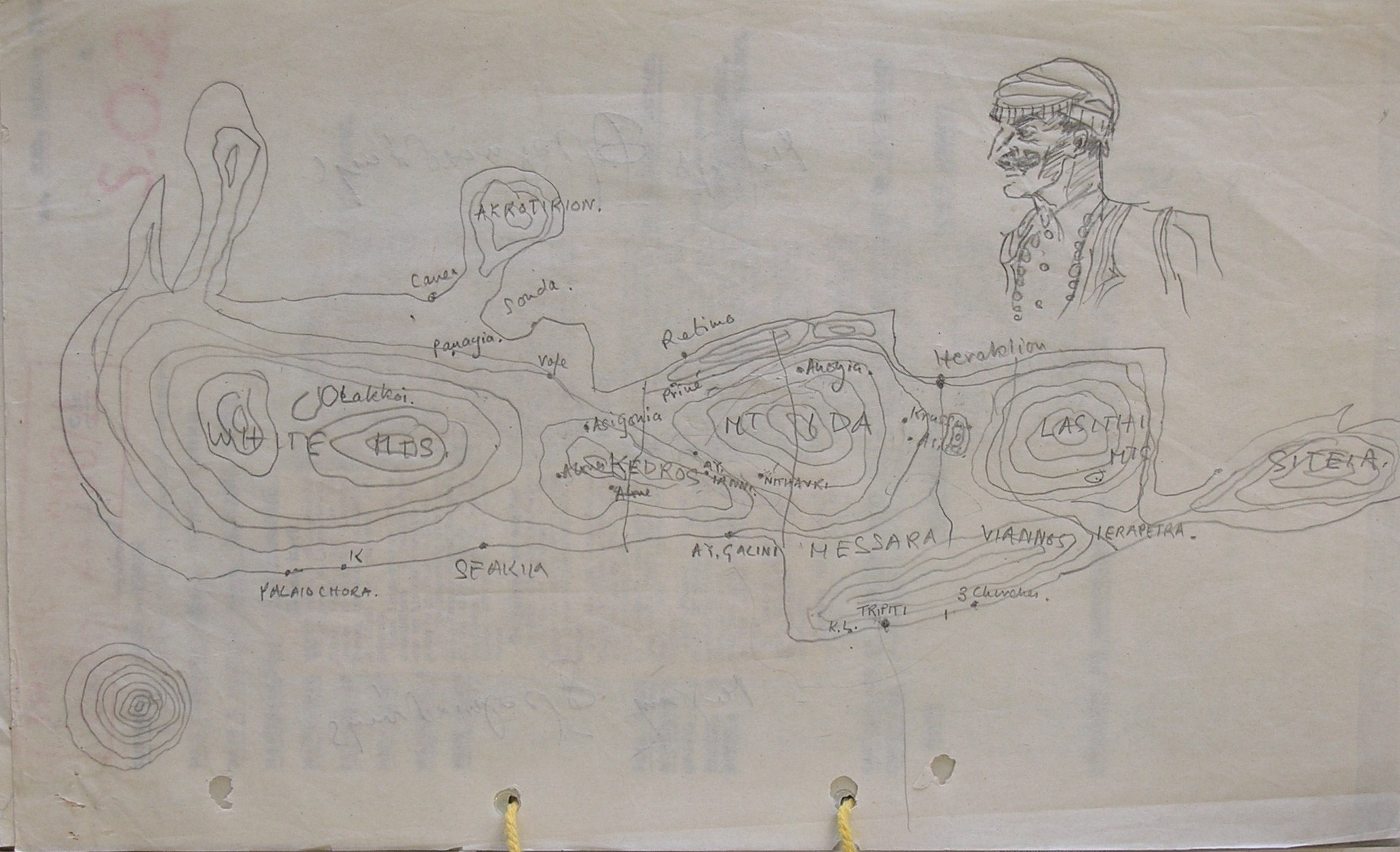
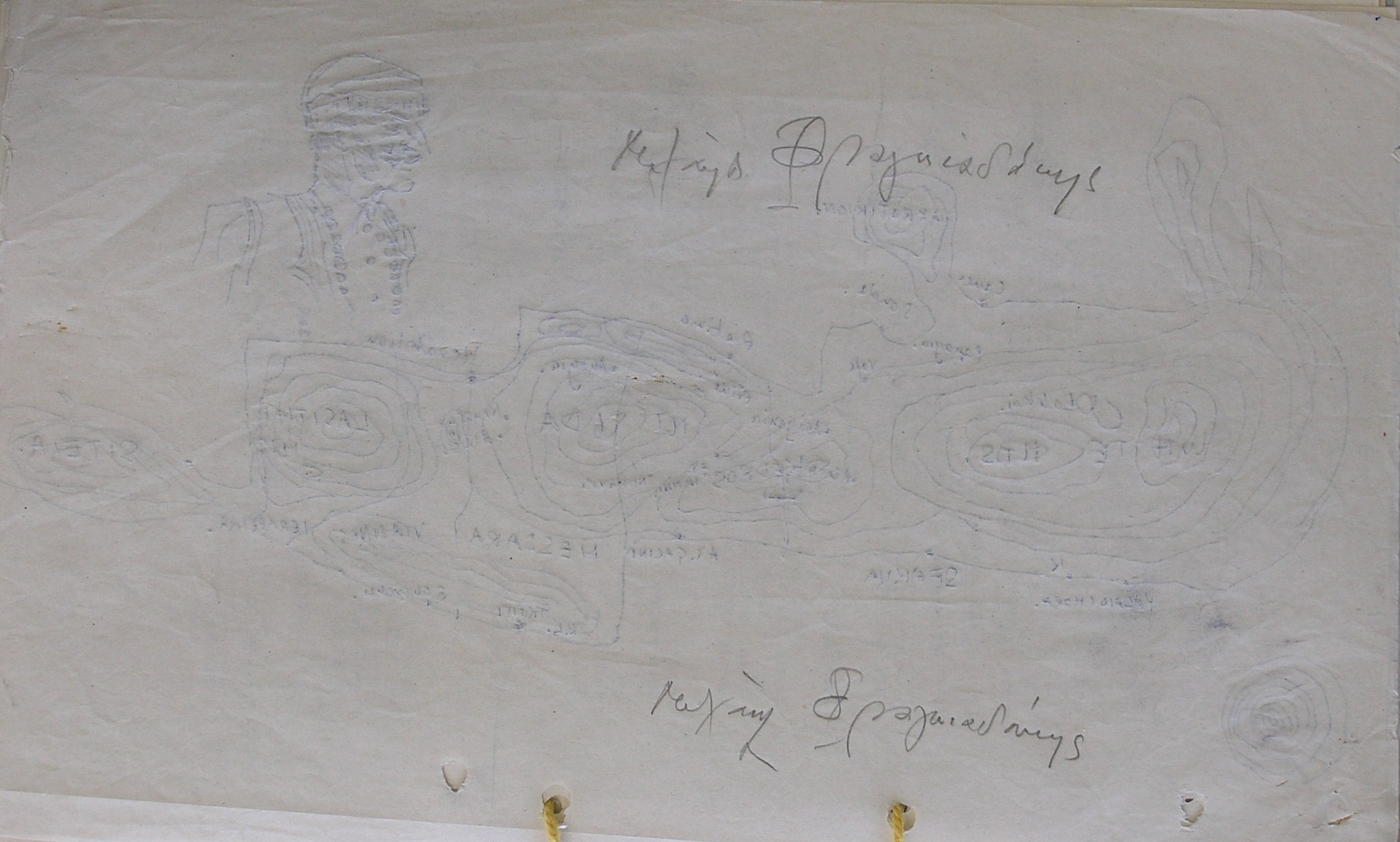
Abducting a General: The Kreipe Operation and Soe in Crete is available for pre-order or purchase. Click on the highlighted text.
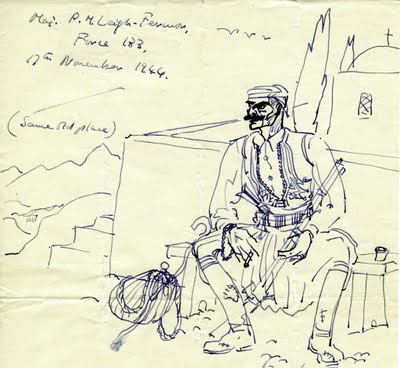
Traveller’s Century – Benedict Allen seeking Patrick Leigh Fermor

Benedict Allen

Benedict Allen

Many will be aware of Benedict Allen’s 2008 BBC documentary where he follows Paddy’s journey and eventually gets to meet with Paddy at Kardamyli. It is rarely shown and unavailable on iPlayer. However, there will be a chance for some to watch the programme at Waterstones Piccadilly on Thursday 9th October at 6.30pm.

As part of their “Traveller’s Film Club” series of events, Benedict will introduce the programme after which there will be a screening. Further details of how to book are on this web page.

The Traveller’s Film Club are also showing films on Norman Lewis (September 16) and Wilfred Thesiger (November 13). See the same list.

Thank you to Mark Granelli for pointing this out to me. See some of you there!


Two in one – Nick Hunt and Dolores Payas in Bristol 4 September

Nick Hunt, author of Walking the Woods and the Water is talking with Dolores Payas on the work of Patrick Leigh Fermor at Stanfords Bristol on 4th Sept at 6.30pm.

This is a great chance for those who live in the depths of the west of England to hear Nick talk about his walk to Dolores who has written a lovely volume about her time with Paddy at his house in Kardamyli. I will be reviewing her book, Drink Time, in September.

Tickets are nicely priced at £3.00 including a glass of wine. Too good to miss!

Details here.

Two books on the Kreipe kidnap published this autumn

It appears that we are to be blessed with two books about the kidnap this autumn. Decisions, decisions!

A Bookseller press release states:

Bloomsbury has signed world rights to an account of the kidnapping of a Nazi general involving writer Patrick Leigh Fermor, written by Rick Stroud.

The book, Kidnap in Crete, recounts the kidnapping of General Kreipe by Leigh Fermor and the Special Operations Executive in 1944, using eyewitness accounts to illustrate the context of the operation and the work of the Cretan resistance.

Stroud said: “When writing Kidnap in Crete I wanted to tell the story from all sides. I found a rich source of material in Leigh Fermor’s own account of the kidnap and in the papers now held in his archive at the National Library of Scotland. However, it was when collecting eyewitness accounts that the strands began to come together to create a clear and complete picture of events.”

The book will be published on 11th September, 2014, a month before John Murray releases Abducting a General, Leigh Fermor’s own account of the kidnaping, which has been previously unpublished. It will be released on 23rd October.