Yearly Archives: 2011

The last of a magical breed

From Judy Stove who writes for The New Criterion.

“Readers may like to know that there is an excellent article by David Mason about PLF in The New Criterion, September 2011.  Unfortunately the online version is for subscribers only or by purchase.

Mason, as a young man, and his then wife visited PLF and Joan at Kardamyli.  He tried to impress with quoting Waugh and Anthony Powell, only to find that PLF and Xan Fielding actually knew these people…A funny and poignant memorial, one of the better PLF tributes going around.”

David Mason’s article begins thus:

The death of Sir Patrick Leigh Fermor on June 10 at age ninety-six has been mourned in virtually every major newspaper in the English-speaking world. He has been celebrated as the last of a magic breed, the Byronic hero, a man of action who was also one of our most vigorous writers. The fuss would have surprised Paddy, who never assumed his contributions were admired and became nonplussed when anyone heaped praise on his head. The long-refused knighthood he finally allowed to be conferred upon him in 2004 did nothing to elevate him above Greek shepherds or the myriad visitors to his villa in the southern Peloponnese. Paddy was youthful and convivial to the end, with an attractive and genuine interest in the world outside himself. People couldn’t get enough of him.

Yet his readers had to learn patience as the books arrived from his pen at a snail’s pace—he didn’t learn how to use a typewriter until in his nineties …

If you are a subscriber you can read the article here. If not go to the same link and you can access this one article for $3.00.

Robin Gibb and The Soldiers launch the 2011 Royal British Legion Poppy Appeal

Buy your poppy, and wear it with pride.


… and buy the song to donate to this most worthwhile of causes. Remember that the only year a British serviceman has not died on operations since 1945 was, ironically, the year of 1969 when we were asked to keep the peace in Northern Ireland and were welcomed by the Catholic populace.

Joanna Lumley’s Greek Odyssey – tonight in Crete

Apologies for a second post so soon but it appears that in tonight’s episode Joanna will visit Crete and according to the blurb ‘… in the high remote mountains she spends time with the shepherds who played a key role fighting the Nazi occupation alongside British SOE Agent, Patrick Leigh Fermor – whose exploits became the basis for the film Ill Met by Moonlight.’ Don’t expect too much accuracy but I am sure that there will be oodles of gushing admiration for Paddy. 

Apparently ‘… Crete is also the birth place of Zeus and the home of raki, a local firewater that fuels traditional festivities.’ Enjoy but only available in the UK … and I am currently in Romania. 😦

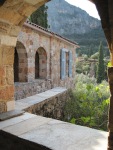
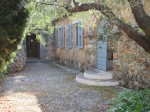
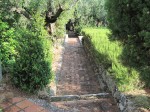
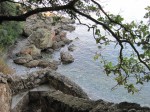
Intimate portraits from Kardamyli by Miles Fenton

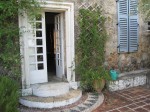
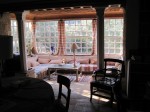
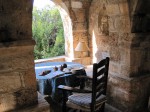
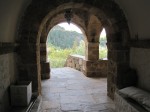
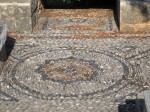
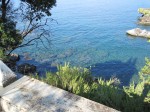
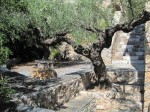
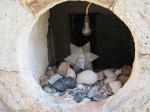
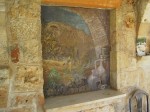
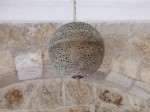
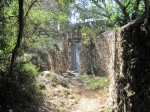
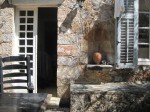
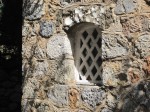
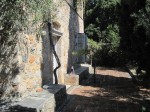
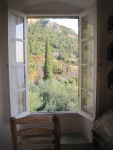
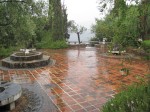
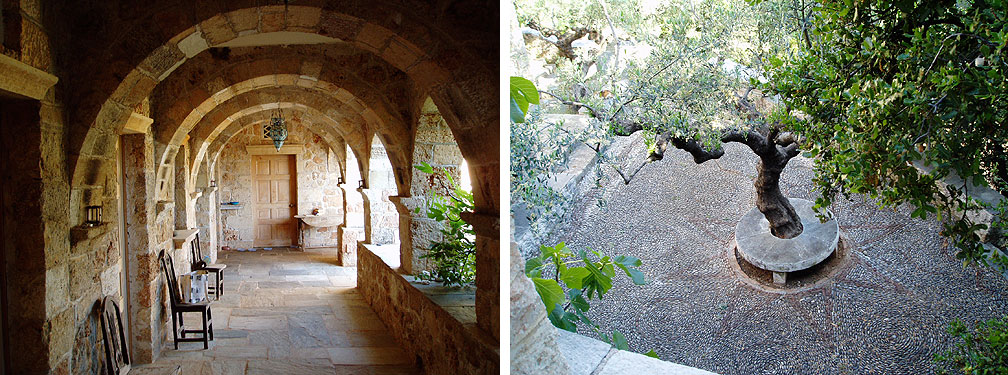
Some delightful images of intimate corners of Paddy and Joan’s house in Kardamyli by Paddy’s nephew, Miles Fenton. These pictures were taken in 2009.

As you put some lovely photos of my uncle’s house in Kardamyli I thought you might like to see, and perhaps post, some of my photos of his house on your site.

These are, apart from the usual views, vignettes showing some of the more unique and charming architectural details.

Click an image to increase its size and to start the gallery.

Joanna Lumley’s Greek Odyssey

Let’s have a nice interlude from Crete and the Kreipe abduction and follow the ever lovely, and not too intellectually taxing Joanna Lumley as she experiences an ‘Odyssey’ through and across Greece, the country that Paddy loved so much. She may come out with blinding glimpses of the obvious – about Byron “he was one of our greatest poets” and “his mind was full of poetry” – but when she meets an old man who was the only survivor of a Turkish massacre her tears are as genuine as can be. She is a British National Treasure and she is in one of the most beautiful countries in the world.

You can catch up with the whole series here on ITV Player.

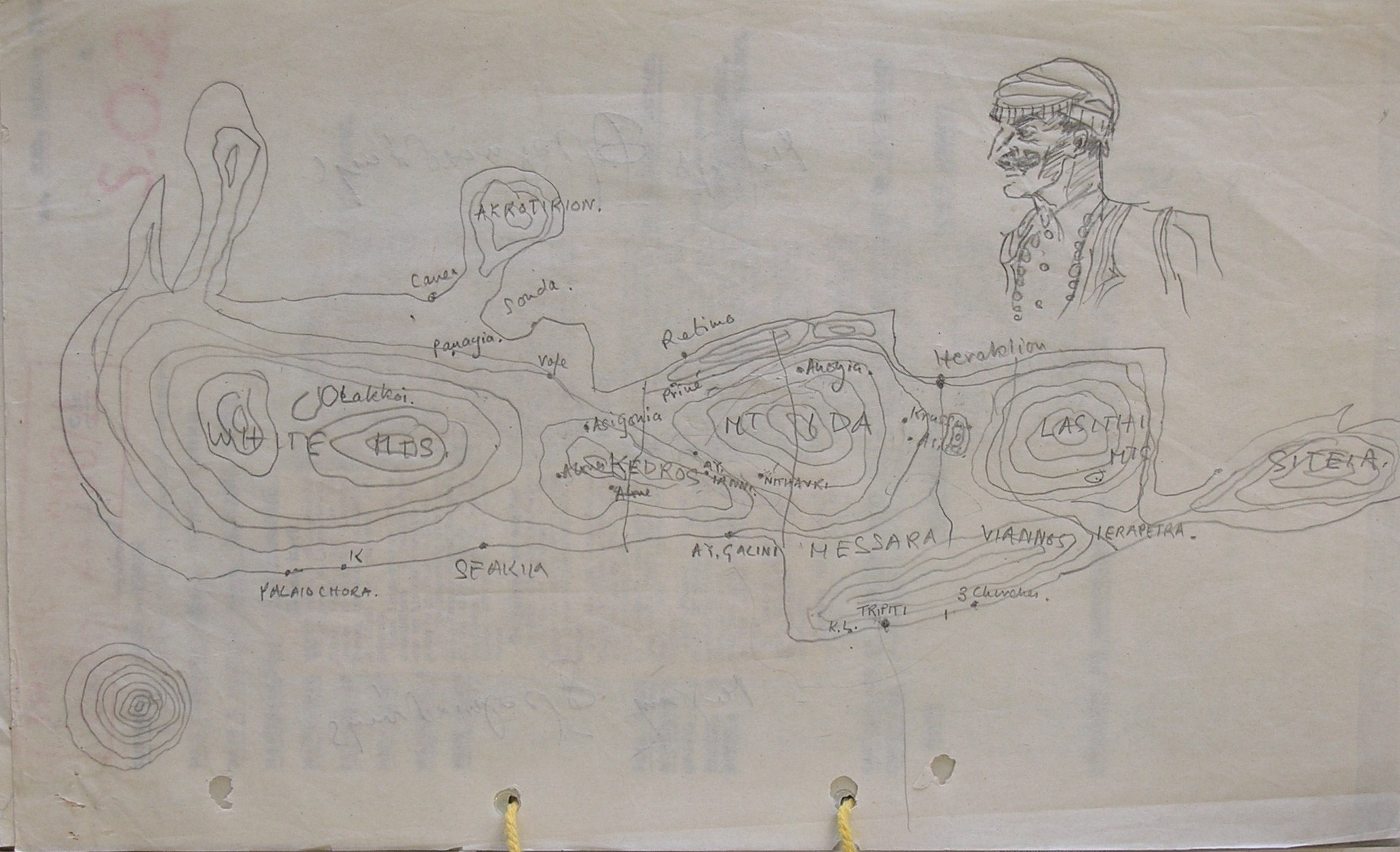
A map of Crete as drawn by Paddy on operations in Crete

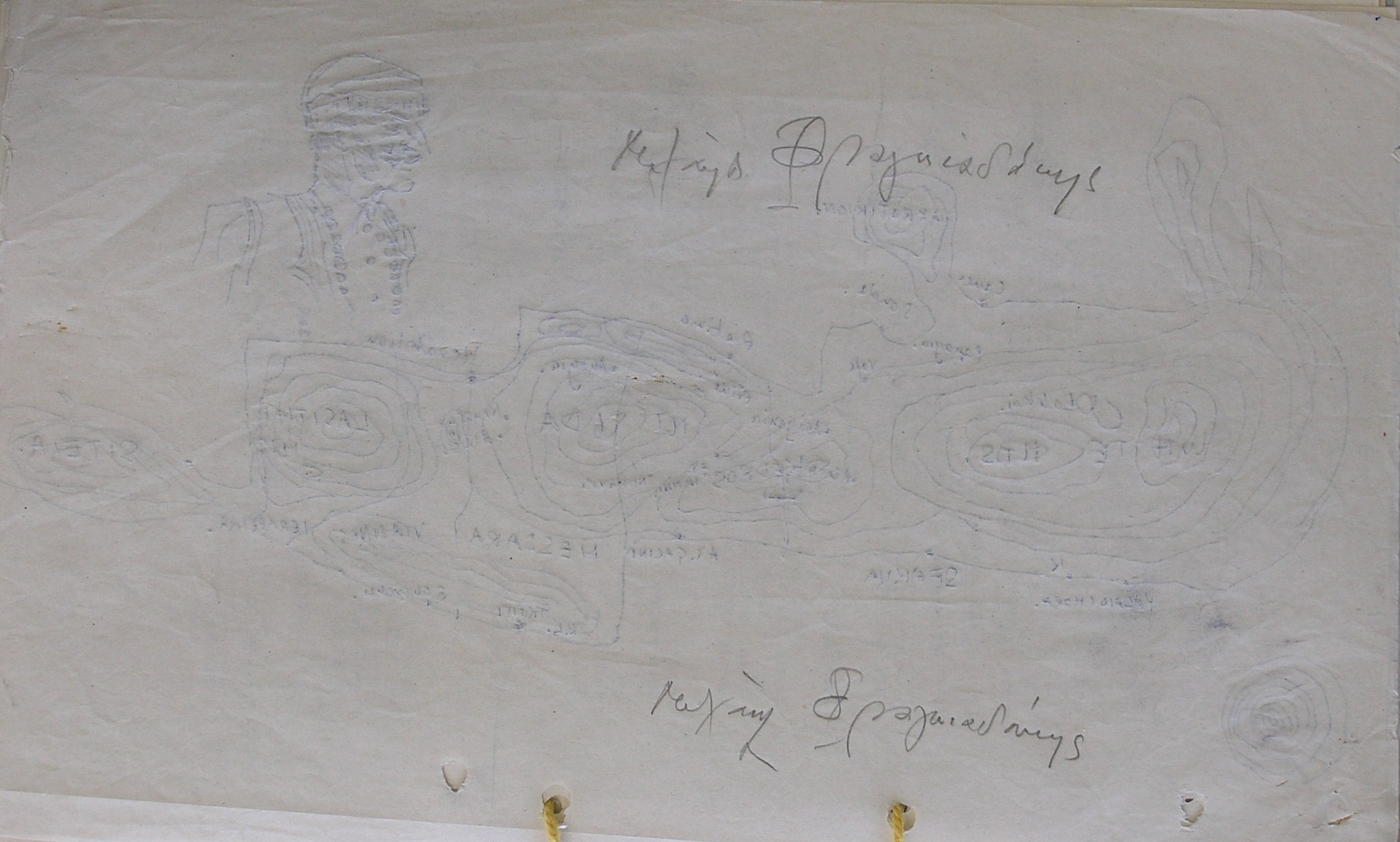
This map was  hand drawn by Paddy, probably whilst on operations in Crete 1943-44, including, perhaps, a self-portrait. The map is from Paddy’s SOE file.

The reverse of the map …

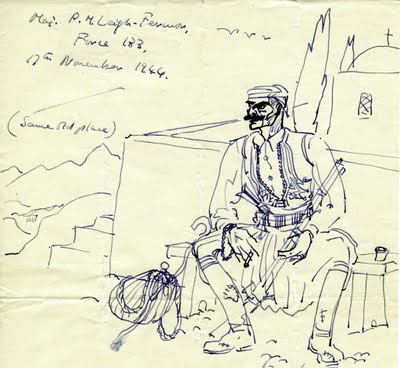
The drawing is typical of Paddy’s style. Compare it with this sketch sent to us by John Stathatos, about which John tells us:

This delightful sketch of himself in Cretan dress was penned at the top of a letter to my mother dated 17th November, 1944; as he explains, “I have been lost again in a forest of whiskers for about three weeks, and my old mountain chums are down in the plains now, looking incredibly wild and shaggy”.

"I have been lost again in a forest of whiskers for about three weeks, and my old mountain chums are down in the plains now, looking incredibly wild and shaggy"

Related article:

Traveller’s Rest by John Stathatos

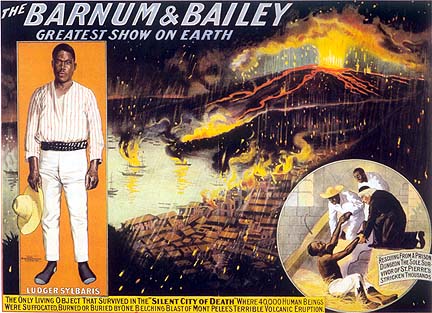
The only survivor of the devastating volcanic eruption of Mount Pelée

The ex-convict, Louis-Auguste Cyparis (aka Ludger Sylbaris), as billed as the last survivor of St. Pierre on this Barnum and Bailey Poster

A nice short piece by Simon Winchester, which, if true, adds something to our knowledge around Paddy’s story in The Violins of Saint Jacques.

The Violins of St Jacques, Patrick Leigh Fermor. 

I think this may be my favourite book in the world. I was asked to write the preface for the Oxford University paperback edition. It’s about the eruption of Mt Pelée in 1902 on Martinique. It sent this thing, a glowing cloud, a nuée ardente, ash and lava and hot air rolling down the hillside. It completely devastated the town of St-Pierre and there was one survivor out of a population of 30,000. It was the worst volcanic disaster of the century, until the tsunami of 2005. Before that it was Krakatoa in 1883 when 40,000 people died, but most of those died from the tsunamis that followed the eruption.

Tsunamis were detected all around the world after that eruption.

Anyway, there was a ball being held in St-Pierre that night and, of course, everyone at the ball died, but the way it’s written is that he supposed all the guests survived and the party continued under the water. Fishermen say that a few miles out to sea when they are waiting for the fish they fancy they can hear music under the water.

Who was the survivor?

Louis-Auguste Cyparis. He was in prison and that’s what saved him, the only window was a narrow grating in the door. He was bad guy. A very violent man. I think he’d killed someone in a drunken fight. He went on to be a celebrity with Barnum and Bailey’s Circus. I love all Patrick Leigh Fermor’s books, but this is his sweetest.

From The Browser

The Wikipedia page devoted to  Louis-Auguste Cyparis

Read more from the blog about The Violins of Saint Jacques

The oral heroic poetry of the Kreipe kidnap

I have extracted this from a fairly long book review about Professor M I Finley’s 1978 revised edition of his book The World of Odysseus. It has a fascinating section about an oral heroic song from Crete that is about Paddy and the Kreipe abduction, and how it had evolved in just the few years since the end of the war.

From Triumph of a Heretic by Bernard Knox, first published in the NYRB 29 June 1978.

It is now more than two decades since the Professor of Ancient History at Cambridge (who was then an ex-professor from Rutgers) published a book which in a limpid, hard-hitting prose and with a bare minimum of footnotes attempted to draw “a picture of a society, based on a close reading of the Iliad and Odyssey, supported by study of other societies….” This is how Professor Finley characterizes the book now, in the preface to a revised edition which makes only minor changes in the original text but adds two valuable and stimulating appendices, replying to criticism and bringing the argument up to date. He goes on to claim that “the social institutions and values make up a coherent system” which, however strange to us, is “neither an improbable nor an unfamiliar one in the experience of modern anthropology.” The fact that the later Greeks and the nineteenth-century scholars found it incomprehensible on its own terms he dismisses as “irrelevant” and adds that “it is equally beside the point that the narrative is a collection of fictions from beginning to end.” ….

… Oral heroic poetry is not a medium that preserves historical fact—as Finley pointed out, with a reference to the Chanson de Roland, which made out of a Basque attack on Charlemagne’s rear-guard an assault by Muslim beys and pashas, all carefully identified by names which are “German, Byzantine, or made-up.” A modern example, from the Second World War and from Greece itself, strengthens his case and gives a fascinating glimpse of epic “history” in the making.

In 1953 the late Professor James Notopoulos was recording oral heroic song in the Sfakia district of western Crete, where illiterate oral bards were still to be found. He asked one of them, who had sung of his own war experience, if he knew a song about the capture of the German general and the bard proceeded to improvise one. The historical facts are well known and quite secure. In April 1944 two British officers, Major Patrick Leigh Fermor and Captain Stanley Moss, parachuted into Crete, made contact with Cretan guerrillas, and kidnapped the German commanding general of the island, one Karl Kreipe.

The general was living in the Villa Ariadne at Knossos, the house Evans had built for himself during the excavations. Every day, at the same time, the general was driven south from the Villa to the neighboring small town of Arkhanes, where his headquarters were located. He came home every night at eight o’clock for dinner. The two British officers, dressed in German uniforms, stopped the car on its way home to Knossos; the Cretan partisans overpowered the chauffeur and the general. The two officers then drove the car through the German roadblocks in Heraklion (the general silent with a knife at his throat) and left the car on the coast road to Rethymo. They then hiked through the mountains to the south coast, made rendezvous with a British submarine, and took General Kreipe to Alexandria and on to Middle East Headquarters in Cairo.

Here, in Notopoulos’s summary, is the heroic song the bard produced:

“An order comes from British and American headquarters in Cairo to capture General Kreipe, dead or alive; the motive is revenge for his cruelty to the Cretans. A Cretan partisan, Lefteris Tambakis (not one of the actual guerrilla band) appears before the English general (Fermor and Moss are combined into one and elevated in rank) and volunteers for the dangerous mission. The general reads the order and the hero accepts the mission for the honor of Cretan arms. The hero goes to Heraklion, where he hears that a beautiful Cretan girl is the secretary of General Kreipe.

“In disguise the partisan proceeds to her house and in her absence reads the [English] general’s order to her mother. When the girl returns he again reads the general’s order. Telling her the honor of Crete depends on her, he catalogues the German cruelties. If she would help in the mission, her name would become immortal in Cretan history. The girl consents and asks for three days time in which to perform her role. To achieve Cretan honor she sacrifices her woman’s honor with General Kreipe in the role of a spy. She gives the hero General Kreipe’s plans for the next day.

“Our hero then goes to Knossos to meet the guerrillas and the English general. ‘Yiassou general,’ he says. ‘I will perform the mission.’ The guerrillas go to Arkhanes to get a long car with which to blockade the road. Our hero, mounted on a horse by the side of the blockading car, awaits the car of Kaiseri (that is what the bard calls Kreipe). The English general orders the pistols to be ready. When Kreipe’s car slows down at the turn he is attacked by the guerrillas. Kreipe is stripped of his uniform (only his cap in the actual event) and begs for mercy for the sake of his children (a stock motif in Cretan poetry).

“After the capture the frantic Germans begin to hunt with dogs (airplanes in the actual event). The guerrillas start on the trek to Mount Ida and by stages the party reaches the district of Sfakia (the home of the singer and his audience; actually the general left the island southwest of Mount Ida). The guards have to protect the general from the mob of enraged Sfakians. Soon the British submarine arrives and takes the general to Egypt. Our bard concludes the poem with a traditional epilogue—that never before in the history of the world has such a deed been done. He then gives his name, his village, his service to his country.”

So much for epic history. Nine years after the event the British protagonists have been reduced to one nameless general whose part in the operation is secondary and there can hardly be any doubt that if the song is still sung now the British element in the proceedings is practically nonexistent—if indeed it managed to survive at all through the years in which Britain, fighting to retain its hold on Cyprus, became the target of bitter hostility in Greece and especially among the excitable Cretans.

It took the Cretan oral tradition only nine years to promote to the leadership of the heroic enterprise a purely fictitious character of a different nationality. This is a sobering thought when one reflects that there is nothing to connect Agamemnon, Achilles, Priam, and Hector with the fire-blackened layer of thirteenth-century ruins known as Troy VII A (the archaeologists’ candidate for Homer’s city) except a heroic poem which cannot have been fixed in its present form by writing until the late eighth century, at least four illiterate centuries after the destruction.

To read the full article click here.

Charles Moore on Paddy

‘The intellect of man,’ Yeats famously wrote, ‘is forced to choose between perfection of the life, or of the work.’ Patrick Leigh Fermor, who has just died aged 96, managed to refuse this choice and achieve both.

He was what is now called a role model — a war hero, an intrepid traveller, a witty guest, a man with whom women fell in love, a Byronic romantic without Byron’s unkindness — but he was also a writer with the most exacting standards and unique imagination. His highly wrought prose was not affected: it expressed his delight in and minute attention to life and art, places and people — the stranger the better; and it inspired that delight in others.

All the letters I have from him overflow with enthusiasms. There is a silly idea for a cartoon he has sketched out in which a spherical man and a thin one with a hawk on his wrist stand outside a castle gate, staring disconsolately at a castle gate on which is pinned the notice ‘No Hawkers, No Circulars’. There is a poem called Message to Skopje:

Your claim to the name “Macedonia”

Could scarcely be flimsier or phonier

If you want an old name

For your state, what a shame

Not to bring back the real one, Paeonia.

He writes about ‘marvellous girls in tricornes’ hunting in France, and to recommend (he was always generous in advancing the careers of others) a self-taught village boy who has translated the whole of Homer into ‘wonderful Cretan rhyming couplets, taking just about the same time over it as Pope in his villa at Twickenham’.

Paddy was the best companion. Once, when he was already well into his seventies, we had him to dinner in London. As he was reciting a comic poem, his chair leg snapped. we were horrified that our furniture might have done for him, but Paddy managed an athletic parachute roll and ended up in the corner of the room with his back against the wall, laughing like a boy.

From the Spectator

Hunting Hitler’s Henchmen on National Geographic tonight at 7.00 pm

This programme showing tonight covers the story of Paddy and Moss and the brave Cretans who captured General Kreipe. However, it comes with an ‘accuracy warning’. It appears that the makers approached Tim Todd and fellow experts but in the end Tim did not work with them as it appeared that the makers wished to stray from some of the facts. However, for those who know little enough about this, it may be no worse than the Powell-Pressburger movie. I have no idea if 7.00 pm means UK time or some other GMT + or – time.

You can find out more on the National Geographic website. The blurb describes it as follows:

Their bravery has inspired countless films but, until now, the real story of some of Britain’s greatest war heroes has remained in the shadows.

Hunting Hitler’s Henchmen is a film about some of Britain’s bravest military. With ex-special forces soldiers as guides, venture beyond the movies to meet the snatch squads: commandos sent behind enemy lines to take out Hitler’s most-feared generals.

They slipped into Nazi-led Libya to kill the infamous Desert Fox, General Erwin Rommel, and succeeded in snatching General Heinrich Kreipe from under the noses of 15,000 soldiers.

Risking their lives to disrupt the Nazi war machine, these are the heroes who inspired Hollywood: incredible men sent to eliminate Hitler’s top brass.

A sign from the gods

John Craxton was the first choice illustrator for many of Paddy’s books. An exceptionally talented artist, he died in 2009 aged 87 years. You can read his obituary here.

In this article from the Spectator first published in 2004, Andrew Lambirth talks to John Craxton about the recreation of his designs for Ravel’s Daphnis and Chloe choreographed by Frederick Ashton.

John Craxton (born 1922) is a painter who has spent much of his life in Greece. Growing up in an intensely musical family in Hampstead (his father was the first pianist to play Debussy in England, his sister was a celebrated oboist), he was aware from a very early age of the infinite and magical connections between sound and the visual image. His subsequent work as a painter has all the structure one expects of a great composer: his are paintings which sing of their substance.

Elisha Willis as Chloë and Iain Mackay as Daphnis; photo: Bill Cooper

Craxton first went to Greece in 1946, staying on Poros, an island renowned for its ravishing charm (Lawrence Durrell called it ‘the happiest place I have ever known’). In 1951, Craxton shared digs with Patrick Leigh Fermor. Apparently, Leigh Fermor’s preferred regimen was to taverna-crawl by day and write by night. Craxton, ever the sociable, found painting by night difficult because of the lack of proper lighting. A big picture was on the go, but progress was somewhat hesitant. Then came a telegram from England.

Craxton already knew Frederick Ashton slightly, so the suggestion that he design a ballet for him was not completely unlikely, though it was unexpected. Suddenly the artist had to decide: stay in Greece and work on his picture, or up sticks and go back to London. The seductive Mediterranean or the ration books of old England? Uncertain what to do, Craxton went to see an old friend who happened to be ill in bed at the time, fiddled with his radio and tuned in to — Ravel. It was Daphnis and Chloe, the very music of Ashton’s ballet.

A sign like that (no doubt from the gods themselves) cannot be ignored. Craxton returned to London, and in a very few months designed the decor for Ashton’s ballet. Craxton made only one stipulation, that the costumes be modern dress, not ancient Greek, an idea that Ashton was open to. That was in 1951. The principal dancers were Margot Fonteyn and Michael Somes. Daphnis and Chloe was a notable success, and it has remained in the Covent Garden repertoire ever since, revived from time to time with new input from Craxton. Now it is being staged again. The main problem for the designer was that nearly all his designs, sets and costumes had been done away with, in one of those senseless purges which from time to time disfigure great institutions.

Only two costumes survived this petty holocaust — the ones which Margot Fonteyn had herself given to the Opera House’s archive. Nor were there drawings from which the originals might be recreated, for many of them had come about through the combined efforts of Craxton, Ashton and Fonteyn. Time was short, and the three not only shared a common artistic aim, but also understood how the project might be realised. Costumes could even be improvised from a bolt of cloth, if necessary. For that original production, Craxton painted all the scenery by hand himself. To recreate it in 2004, he had to rely on his memory, a few photographs and the album cover of a Decca long-playing record of the ballet. Rather amazingly, Craxton has triumphantly summoned forth once more his enchanted island setting, with cave-mouth, vine pergola, barren rocks and fig and olive trees. I visited him at the Royal Opera House production workshops in Bow Industrial Park in east London. There he was putting the finishing touches to some olive trees, which he was painting on their sides.

He recalled his original task, more than half a century ago. ‘I was very lucky at that time in Clement Glock, the woman who ran the paint department, who was a very good scene-painter, and rather a sophisticated person altogether. She had worked with Sutherland, Piper and Derain and people like that. Her idea was to get the painter to do his own scenery as much as possible, so that it actually looked as if he’d painted it rather than it being an imitation of his style. So that’s what I did, working with enormous brushes on 60-ft lengths in the paint room at Covent Garden.’ (The paint frame by which vast flats can be readily manipulated was done away with in the recent ROH makeover.)

Craxton explains the ballet’s plot, which features pirates, a near-rape and the intervention of Pan. ‘There are two stories really — the original story by Longus (about 2nd- or 3rd-century AD) which the ballet is based on, and the version that Diaghilev and Ravel came up with in 1912. The whole thing is very Arcadian — like a Pompeian Barbara Cartland novel. It’s really a pastoral romance in which two young people, a girl and boy, awaken to sexual desire and fall in love.’ Craxton used a late Greek story to convey what he knew about contemporary Greece. He enjoyed the challenge of it. ‘What I wanted to avoid was a lack of unity between the decor and the dancers. I wanted them to be the same scale, which was much easier to achieve if I was painting the scenery myself and not having my drawings blown up by others.’

This was Craxton’s first ballet, but the painting of scenery was relatively straightforward for an easel painter. He was, however, a novice costume designer, having no idea how to make a dress, and to begin with he was forced to rely on the wardrobe department. Requesting an absolutely classical lady’s dress, he was presented with a 1938 short cocktail dress, as he describes it, ‘off the shoulder, pleated — dreadful. I went to see what had been done with Margot and Freddie and I was practically in tears. I didn’t know what to do or what to say. Margot was brilliantly clever and sensed the terrible state I was in with worry and disappointment and said, “I don’t think this is really what John wants at all.” So she got the material together and started to bunch it up and designed a costume with a tight bodice and loose skirt. Only Margot could have done that. We found a material called stockingette, which hung very well and dyed very well.

‘What I tried to do was make a group of harmonic colours for the shepherdesses, so the colours relate together like a chord, leaving me freedom to have the temptress in Schiaparelli pink, and Chloe in yellow. When I first did the costumes I put Chloe in yellow, but because the lighting was so primitive then, her dress came out rather beige. There was a girl in the row of shepherdesses who was dressed in pink. Her dress shone out so brightly that Margot said, “I’m having that dress.” But for this new production I’ve put Chloe in yellow as I wanted from the beginning. A simple naive girl wouldn’t be wearing pink, but primrose yellow.’

The current decor is almost identical to the original production, though slightly more complicated. ‘In 1951, the decor was very much simpler. It had one big backcloth in the first scene, and the tails, which are those flats on either side of the stage, were just plain blue material. There was no time to do anything to them. It was all an incredible rush, but that’s showbiz. It was only for a later production that Freddie said, “What about making some tails with rocks and trees,” and that’s roughly what you see today.’

Now the rocks in scene two have been redesigned and painted porphyry red to make them more menacing, and there’s a new drop curtain. The pirates are all dressed in black as Cretans. The ballet really looks like one of Craxton’s own paintings come to life — ‘It was the only honest way I could do it. I couldn’t have done a pastiche of ancient Greece — it’s not me. It was one of the first Mediterranean ballets, based on my own experiences in Poros and Crete.’ For this reason, Craxton’s sets have an authenticity which is as compelling as it is beguiling.

Related article:

Paddy’s Illustrator – John Craxton Telegraph Obituary

Getting it right and that Taki article

I have to admit that there have been times over the last two years, when, running two blogs, I have either clearly been wrong to publish something, or I have posted an article that has created significant controversy and I subsequently wished I had not done so.

Life is always easy if one takes the uncontroversial path. I dare not mention the post I had in mind a year or so ago with the working title “Patrick Leigh Fermor: the Court Jester?” which was sparked by an interesting series of conversations and impressions I gained from reading ‘In Tearing Haste’. Whilst remaining an ardent admirer of Paddy, it would be wrong to say that he was a saint and beyond criticism. Few of us are.

Which brings me neatly to Taki, and the article that I posted last week entitled ‘Better a Hero Than a Celebrity’. Clearly Taki believes that he himself is beloved by all and can say and write what he wishes without fear of recrimination. He has a very old and a very thick skin. The article has sparked some significant debate in the comment section and I think it is worth bringing this to the attention of a wider audience for it sheds some light on Taki’s character and addresses some of the inaccuracies that I warn of in the introduction.

However, I stand by my response to the first comment which was as follows. Taki Theodoracopulos has had a place in European society over the last fifty years or so. Some may not like him, but clearly he has a role in commenting on the lives and loves of celebrities, which today appears to be of greater importance than the state of European banks and the future of the Euro; it is very big business. In fact Taki was one of the first ‘gossip columnists’. Whatever the inaccuracies of his article it meets the criteria of this blog. It is about Paddy and does possibly bring some new perspectives. This blog is fundamentally an archive of all on-line material about Paddy, and therefore the article stays.

I think it would be useful to all to highlight the points discussed in the Comments section, particularly the major error Taki made in stating that Paddy had killed Albert Fenske, the driver of General Kreipe’s car. Paddy had nothing to do with his death which was against orders and not at all part of the plan. Additionally the story about Paddy witnessing the death of the last German commanding General of Crete is pure fiction; it just did not happen like that.

So what is the moral of this tale? Yes, I would like it to be all sweetness and light, but you can’t please all the people all of the time. Let’s keep up the debate and remember I am more than willing to take in and publish articles that you have found or have written yourself.

Here are the comments up to this evening …..

From Chris Lawson:

“Known to the cognoscenti as Taki Takealotofcokeupthenose, Theodoracopulos is a man for whom the word “snob” might have been invented. Note the casual dropping of Agnelli’s name into his piece and Taki’s snide comments on Dirk Bogarde. It is NOT true that Paddy killed the driver of Kreipe’s car. Apart from the story of the execution of Kreipe’s successor (Name, details of crimes? Doesn’t mean Kreipe’s predecessor?), this brings nothing new to the saga of Paddy’s life. I would respectfully request that you remove the piece.”

My reply:

“No Chris – I don’t do censorship. Your comment can stand as a beacon to my error in posting it. However, Taki has a place in society over the last 50 years and this blog is a repository about Paddy. It stays.”

Chris Lawson responds:

“Fine by me. Of course it was not an error posting it and I agree entirely and whole-heartedly about what you say about censorship. Yes, Taki certainly has a place in the cultural pantheon de nos jours, and my thoughts are just the latest in a stream of negative comments directed at the former inmate of H.M. prisons. Whatever else one has to say about the gent, he is certainly one of life’s great survivors.”

Tim Todd (who runs the Il Met by Moonlight site and is an expert on the operation) interjected:

“That Taki could be so fundamentally wrong about the death of Albert Fenske, Kreipe’s driver, tells me much about the appropriately named Taki.

I believe that Fenske’s death, at the hands of two of his Cretan andartes and contrary to instructions, caused Paddy no end of personal grief, perhaps second only to the accidental shooting of his Cretan friend. I once listened to Paddy talk about this latter incident when, in the mountains after a cadet’s exercise, he failed to check his rifle before cleaning it when it was returned to him. I have to tell you he was still mortified by the whole business and sixty odd years on he was still visibly upset by it. Tom our webmaster and I, know from the best of sources that Fenske’s death was much regretted by Paddy. My own feeling is that but for that we might have seen Paddy’s own account of the abduction published.

I am thoroughly disappointed that anyone claiming to know the man would dare suggest Fenske died at Paddy’s hand. Paddy, perhaps the most honourable man I have ever met, would though have accepted responsibility for anything that may have happened under his command. He was that sort of man.

It is perhaps as well that Tom has published Taki’s piece for it provides an opportunity to compare the two and set the record straight.

I am pleased to say that, through Annette Windgass, Fenske’s family have recently been made aware of Paddy’s great sadness of that particular outcome of the operation.”

 Chris Lawson gave us some more about the story of the General’s death:

“On the General who succeeded Kreipe, and two predecessors

The Commandant of Crete, appointed on 1 May 1944 after Kreipe’s kidnapping, was Generalleutnant Helmut Friebe, Commander of the LXIV Armeekorps. He was captured by the Americans in May 1945 and released in 1947.

Two former commanders of Crete were tried and executed in Athens on 20 May 1947, the anniversary of the German invasion of Crete. One was the bloodsoaked Friedrich-Wilhelm Mueller, who was to have been the original target for the kidnapping until he was replaced by Kreipe. Mueller had a reputation for brutality and numerous atrocities were committed under his regime.

The other was General Bruno Bauer, a paratroop officer, who was appointed in 1942, replacing General Alexander Andrae. Bauer had gained the reputation of being hard and fair, and the “most humane commander” of Crete. Antony Beevor describes him as truly unfortunate, as he was executed for crimes “committed under another general”. Three years later the Association of Former German Paratroopers requested that his remains be returned to Crete. George Psychoundakis, resistance fighter and author of the Cretan Runner (already much-mentioned by Tom), reburied his remains.

Taki’s fourth paragraph is a complete fantasy.”

George joined the argument:

“The only readable part of Taki’s remembrance (sic ) is the last sentence, horrible in its clarity and even worse that it is written by someone whose trotters are deep in that particular trough.

His comments however, are an excellent example of the sponger’s wiles. The mildly mocking comment by Agnelli, humbly repeated to establish the writer’s honesty, while at the same time making it clear that the writer enjoys the same societal position.

Then the personal revelations as told uniquely to Taki, and no other. Who is to say it did not happen? Taki’s favourite method of asserting inside knowledge always has been to quote the ‘ confidences ‘ of dead people.

The lustrously depicted tale of an unrepentant Nazi Officer going blithely to his death comes straight out of ‘Boys Own ‘.

Next we have the gay bitchiness in his description of PLF’s relationship with his wife. Once again the vampire straddles an innocent’s grave seeking the lifeblood of fame by association.

Chris Lawson ( thank you ) marshalled all the necessary facts to give the lie to Taki’s comments. He was probably as irked by them as I was.”

Tim Todd concludes it all: 

“Inaccurate accounts of historical events, for personal vanity, or a film-makers preference for ‘a story’ over fact, infuriate me. This is especially so when such accounts may subsequently become part of history for those without inquiring minds. Last week saw the release of a new video by National Geographic half of which was about the abduction of Kreipe. It is appallingly bad and inaccuracies abound. I am so glad that some colleagues of mine and I, who know a thing or two (but not all) about the abduction, rejected the film makers request to assist them for it has turned out every bit as bad as we feared. Having read some of Paddy’s comments about Ill Met By Moonlight, I can imagine what he might of thought of the latest misrepresentation.”

… and you say ….??

The Carpathian Snail

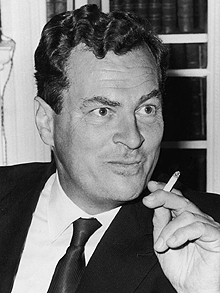
Patrick Leigh Fermor...British soldier and travel writer Patrick Leigh Fermor, 25th April 1966.

Paddy Leigh Fermor (obituary) was a man of many dimensions. He had an unquenchable curiosity about people and culture; when he met remote groups, be they Saxons in Transylvania, Vlachs in northern Greece or gypsies in Hungary, he would not just learn their language and song but remember it for the rest of his life. At Paddy’s last birthday party in London, William Blacker quoted two lines of a Romanian ballad in a speech about him; at the age of 96 Paddy sang the song in its entirety. There seemed no occasion at which he could not enliven the party by an adroit performance, or reminisce in half a dozen European languages.

by Patrick Reade.

First published in The Independent, 14 June 2011

For me it always involved a meal: the conversation would come to a point when there would an extraordinary outpouring of remembered verse or prose. He sang “Do you ken John Peel” in Italian once over tea in Dumbleton to entertain us – the verses were far more numerous than I had realised. And Peter Quennell told me many years ago of how Paddy pulled out of his memory an entire landscape of Cretan folk songs as they walked in the Abruzzi. He was known in Greece for his spontaneous ability to respond instantly to another table’s rhyming couplets – mandinathes, a feature of traditional party entertainment in which tables would compete for wit and content in the couplets.

His ear for language never failed him and he was interested in etymology, linguistics and semantics till the very end, correcting my own misattribution of medical terminology from Latin to Greek and then reciting in Ancient Greek the moment in Homer’s Iliad when Troy fell to the Greeks. He loved laughter, too, and in the Dean’s Close at Canterbury I heard him performing an entertaining parody of a John Betjeman poem in the garden where Thomas à Beckett’s assassins escaped. He had just been awarded an honorary degree by Kent University in the Cathedral and we were having tea with Jock Murray, his publisher.

He was the most generous person in spirit and in kind – he must have entertained thousands in his home in the Mani in southern Greece over many years – the names tumble out of the Dictionary of British Biography: academics, politicians and myriad writers, journalists and scholars, all ate at his table. He and his wife Joan were also extremely generous where they saw need and gave with an open hand.

Until last year he swam daily from his house, and swam across the Hellespont at the age of 70 – an astonishing feat, dodging the great liners from the Black Sea and coping with the current and the cold water and the Russian submarines beneath the surface.

On 1 June this year, 10 days before his death, he gave a small lunch party in the cool, stone-arched loggia of his home in Messenia and in the course of conversation we discussed our favourite 16th century pieces of poetry; he declaimed Sir Thomas Wyatt’s entire poem “They flee from me that sometime did me seek”.

For many he will be remembered for his correspondence as much as for his books – because by any reckoning he was a fabulous letter writer and responded to almost all who communicated with him until last year. From my first remembered encounter with him in 1961 when he pressed 12 shillings into my hand, until 50 years later, when he raised his wine glass to absent friends over lunch on the anniversary of Joan’s death, I can say that no other person I have encountered has shown such an embrace of laughter, learning, language and life as this towering genius of word and action. The great memorial will be his writing and a great excitement is that the third part of his trilogy about crossing Europe is due soon – I have seen it, and many have waited years for this crafted reminiscence so long in gestation, about which Paddy in self-mockery called himself “The Carpathian Snail”.

Event – Patrick Leigh Fermor: An Appreciation by Alexander Maitland, FRGS

A series of afternoon talks based on the Society’s Collections from 2.30-4.00 pm. This series of Collections-specific, monthly afternoon talks, given by speakers who have used the Collections to inspire their writing, travel or personal researches, intended to kindle interest from members and non-members alike in using our rich resources for their own projects.

Tickets: free to RGS-IBG members and educational users. Non-members: £5 payable in advance. Venue: Education Centre, Lowther Lodge.

Pre-booking required: Telephone: 020 7591 3044 Email: showcase@rgs.org

When: Mon 31 October 14:30 – 16:00 London

Where: Education Centre, Royal Geographical Society (with IBG) 1 Kensington Gore London SW7 2AR (map). Exhibition Road entrance.

More details here.

There are approximately 60 tickets left … see you there!

SOE’s correspondence to Paddy trashing the draft of Ill Met By Moonlight

“We have had the opportunity of reading this through and I must confess it seems to me the most unutterable trash. Literary criticism is, however, not within our province of officiality. Apart from that there are quite a number of points which it is undesirable to see published … and I very much doubt if descriptions such as that of General Gubbins acting as a horse in a sham bullfight would be sanctioned by those concerned.” Thus starts a correspondence from the War Office to Paddy on the subject of a draft of Stanley Moss’ book.

In April 1945 the War Office were in receipt of a draft Moss’ book Ill Met by Moonlight. Paddy’s recently released SOE file shows that not only were they sensitive to the security aspects of the book, but these Staff Officers thought very little of its literary style.

It appears that Moss had given Paddy ‘full powers’ to deal with the publication of the book. This seems to have dragged Paddy into some degree of trouble.

In a letter dated 29 March 1945 an officer says “LEIGH-FERMOR does not submit willingly to discipline, and I think, requires firm handling.”

The correspondence is quite amusing “Good taste and discretion are hardly attributes of the writer as illustrated by his description of one of his lady friends as an “over-sexed mongoose”. It is clear that the final version was quite severely edited, but some of the missing parts are quoted at length by Staff Officers who clearly had too much time on their hands .. or were they merely jealous that they had missed out on all the fun in Cairo?

Paddy himself in a covering letter to Colonel Talbot Rice with the submission of the draft for clearance says; “It is not a very good book – too much is made of too little” But he did think it would “sell like blazes”.

ugugukg

Better a Hero Than a Celebrity

Taki Theodoracopulos

Always a modest man, Taki Theodoracopulos, the great playboy and socialite, is someone who knows everybody, and it is no surprise that he too met Paddy as he recounts in this piece from his online Taki Magazine which humbly describes itself as being about ‘Cocktails, Countesses and Mental Caviar’! I am not sure if Taki gets the irony in the title 🙂 Beware some glaring errors.

First published in Taki Magazine 4 July 2011

I first met Sir Patrick Leigh Fermor in the summer of 1977 in Corfu. I was onboard Gianni Agnelli’s boat, and the charismatic Fiat chairman asked me to go ashore and bring “a very smart Englishman whose ancient Greek is much better than yours.” I knew “Paddy,” as everyone called him, by sight, because among us Greeks he was on a par with our ancient heroes. Leigh Fermor was not only famous for his books on Greece—Mani and Roumeli—he was renowned for his incredible heroics in a guerrilla operation in Crete in May 1944. Having spent two years disguised as a Cretan shepherd in the island’s rough mountains harassing German troops, Paddy dressed as a German police officer and stopped a car carrying General Karl Kreipe, the island commander. Having killed the general’s chauffeur, Leigh Fermor proceeded to wear the general’s hat and managed to bluff his way through Heraklion and 22 subsequent checkpoints. Kreipe was stuffed under the backseat while Leigh Fermor’s bat man and three hefty Greek rebels sat on him. For three weeks the group managed to evade frantic German search parties, finally marching the general over Mount Ida, the mythical post-birth hiding ground of Zeus.

“Heroics aside, Leigh Fermor was often compared to Lord Byron for being both a man of action and learning.”

One moonlit night high up, Fermor was guarding the general when Kreipe, gazing up at the snowy peak, recited the first line of Horace’s ode, Vides ut alta stet nive candidum…—“ You see how [Mount] Soracte stands out white with deep snow.…” Leigh Fermor then continued the poem in perfect Latin until the end. The two men stared at each other, realizing, as Paddy later wrote, that they had “drunk at the same fountain.” The German and the Englishman then made a pact. Kreipe gave his word as an officer that he would not try and escape; in return, Leigh Fermor never turned Kreipe over to the firing squad.

What follows came straight from Paddy to me in Corfu. Six months after Kreipe’s kidnapping, Leigh Fermor landed yet again on the island to celebrate its liberation. He was taken behind Heraklion’s main square, where the general who succeeded Kreipe was about to be shot. Paddy was aghast because the German was cool as ice and when Paddy introduced himself, the condemned said: “Ah, Leigh Fermor, you were lucky. Kreipe was an intellectual, a softie; I would have killed you on the spot.” When Paddy asked him if there was anything he could do for him, the German asked for one last cigarette, thanked him, smoked it while inhaling rather deeply, then said goodbye and went off and got shot ramrod-straight.

Heroics aside, Leigh Fermor was often compared to Lord Byron for being both a man of action and learning. His very good friend, Robert Byron (no relation), was a travel writer who greatly influenced Paddy, whose most celebrated book, A Time of Gifts, told the story of his walk across Europe from Rotterdam to Constantinople at age 18. Leigh Fermor continued writing travel books, and they stood out for rendering the past visible, for their evocation of youthful exuberance, and for the joy one felt reading them. He was a very good-looking man, an Anglo-Irishman whose adventures in Crete were made into a film back in 1957, Ill Met by Moonlight. The irony was that he was played by Dirk Bogarde, an outrageous homosexual whose greatest talent was spreading terrible rumors about others.

Leigh Fermor was 96 when he died but lived vigorously until the end. Three years ago his correspondence with the last surviving Mitford Girl, Deborah, dowager Duchess of Devonshire, was published to great acclaim. What a cast of characters in that book. Norman Douglas—another great influence—Steven Runciman, Osbert Lancaster, Cyril Connolly, Bruce Chatwin, and many others rich and famous and literate. Paddy was a hell of a ladies’ man, although he married only once—to Joan Rayner, who was his close and understanding companion until her death in 2003. The word ‘understanding’ is key. He also wrote the script for John Huston’s The Roots of Heaven, a vastly underrated film in which Errol Flynn made a comeback by playing a has-been of sorts, a character Flynn repeated successfully to the end.

One of Leigh Fermor’s great regrets was that while cleaning his weapon in the mountains of Crete it accidentally went off and killed his trusted guide. He told George Seferis, Greece’s first Nobel Prize winner for Literature, that this death was probably his life’s lowest point.

Leigh Fermor and his wife designed and built a beautiful but very simple house in Kardamyli, deep in the Peloponnese and overlooking the sea, and they lived there for most of his adult life. I was lucky to have met him, and now that I am of a certain age I realize how much better it must have been to have lived during heroic times—no matter whose side one was on—than today’s empty, horrible celebrity culture. Paddy, Rest in Peace.

The next stop After The Traveller’s Tree was ….

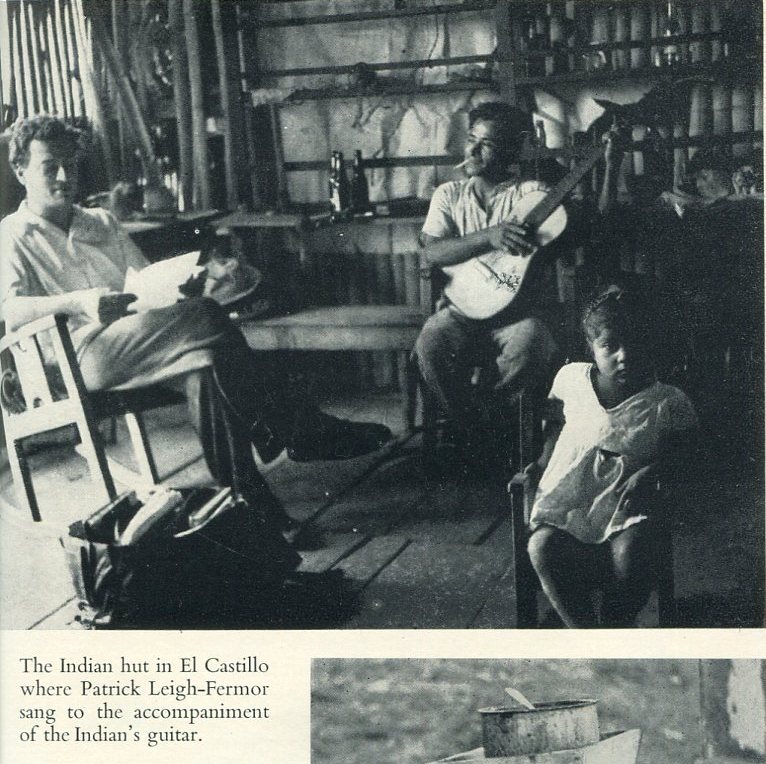
…. an Indian hut in El Castillo (Nicaragua?) where Paddy sang to the accompaniment of an Indian playing his guitar. What on earth did he sing? 

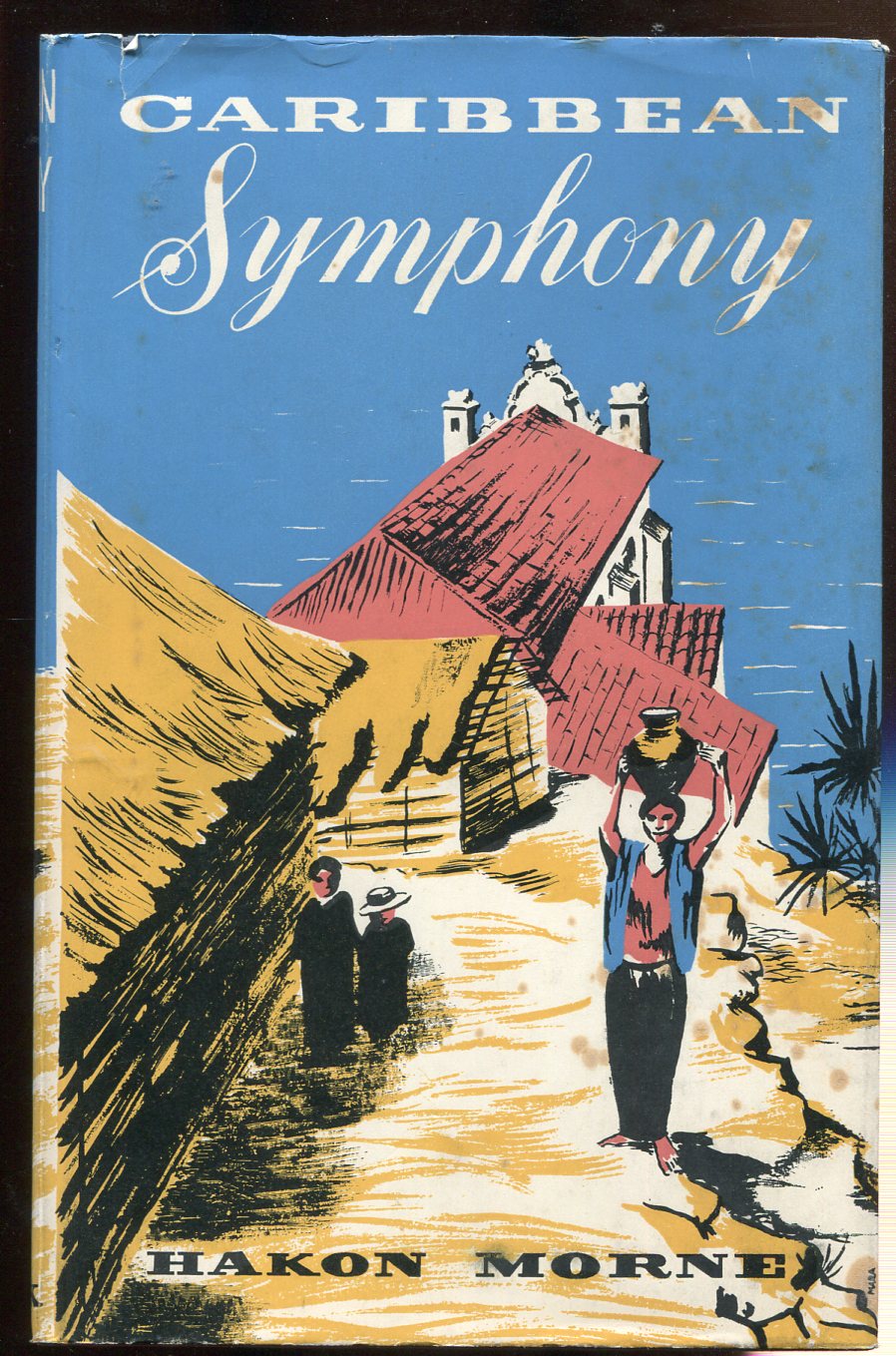
I am grateful to Phyllis Willis for being a better mole than me and finding Hakon Morne’s book translated into English as “Caribbean Symphony”. She has purchased a copy but was clever enough to get a couple of scans whilst she waits for her book to arrive. I am delighted to be able to share these with you now.

A few copies of the book are still available on Amazon.co.uk

The Eagle Has Two Faces: Journeys through Byzantine Europe

Alexander Billinis is an American with Greek parents and he is a very keen fan of Paddy’s writing. He has travelled and worked all over the Balkans and now lives with his family in Serbia, writing about the region, in particular the trials and tribulations of the Greeks. This review offers a very positive assessment of Alex’s latest book which is available from Amazon and all good booksellers

First published in Cape Cod Today.

Author Alexander Billinis’s subtitle to his book is, “Journeys through Byzantine Europe,” which he modestly describes as a “travelogue.”  Billinis, an international banker, traveler, and writer-journalist, has essentially written a romance with the Balkans. His love of the diverse Balkan peoples and of their history is evident with every paragraph.

The “Eagle” of his title is the two-headed Byzantine eagle, reflecting an empire, with Constantinople as its capital, that  looked eastward to Asia Minor and westward to the Balkans and Europe. The Byzantine Empire was the most advanced in the world, spreading knowledge and culture and prosperity until 1453, when Constantinople was ravaged by the Ottoman Turks and the whole empire thrown into its own dark ages for 500 cruel years.

It was not until the early 20th Century that the last of these lands, including Northern Greece, where my own parents were born, was freed from Ottoman rule. This left what are now the Balkan states 500 years behind the progress of the rest of Europe. Billinis’s travels take him and his wife through Greece and Bulgaria, Romania, Thrace, the region of Macedonia, to Serbia, the northern region of which fell under the Austro-Hungarian Empire rather than the Ottoman. Billinis’s father is from Hydra, an island near Athens, and his wife from northern Serbia. Their combined knowledge and impressions of the region give the book its unique flavor.

The book is liberally sprinkled with photographs reflecting the rich, different architectures of the various cultures that live in and have passed through the region. I’ve occasionally referred to the Balkans as “the dark region” of Europe because that area has been so eclipsed by Ottoman oppression that very little is known about its history and its own Christian empires compared with the rest of Europe. Billinis’s book sheds light on the darkness and brings the area and its people to life.

The book even addresses the Pontian Greeks of Russia and Greek-speaking enclaves that still exist in Italy.

For me, the book has been a Balkan primer and an enchanting read. It is essential reading if you want to round out your European history with 150 concise, but full, pages about Europe’s least known region written by one who has actually traveled its paths and tipped a glass of tsipouro with its people.

After The Traveller’s Tree … what was the next stop?

I have received a very interesting email from Bo Nensén  in Sweden. He recounts a story from the work of the prolific Swedish travel writer  Håkan Mörne, about Joan and Paddy travelling onwards to mainland South America after their travels in the Antilles. I think this is something that we know little about. It raises the question of how do we find out more about this episode in their travels? Take a look at Bo’s message and let’s see if we can find out more together.

[Edit: something this morning reminded me that Paddy once wrote about speaking Greek in South America – was it in Roumeli, Mani or even Three Letters? This may give us a clue. … Further edit – found it: the start of Chapter 3 of Roumeli when in Panama City]

Tom,

Like many others I was also delighted to find your PLF blog. I must have missed it when I made a search for PLF last year but in any case I then noted the existence of “In tearing haste” and ordered it even if I haven’t read it until two months ago when I first learned about his death.

I first discovered PLF when I in a Swedish English language book-club found “Between the Woods and the Water” in early 1988. Soon I ordered “A Time of Gifts” as well. Later in the 90’s I read the books again in correct order. Later I also ordered “Mani” and “Roumeli” but never really got to read them in full. Still earlier I even bought “A Time to Keep Silence” but it remains unread. In the later part of the 90’s I discovered through the Internet “Three Letters from the Andes”. A year before, 1996, when following my son to a shop for second-hand comics when investigating the shelfs for ordinary books I to my surprise found a Swedish translation of “The Traveller’s Tree” from 1954! Price 2:- SEK, i.e. approx. 20 p! This of course only covers the Antilles and as far as I know he has not written anything about the part of the travel through Central America(?)

I had no idea about his visit to the mainland until I happened to read a book by a Finland-Swedish travel writer by the name Håkan Mörne (1900-1961). In one of his books he describes how he on a ship on Lago de Nicaragua meets Joan and Patrick (and Costa) and how they travel together to the Atlantic coast. This part comprises 30-40 pages and there is even a picture of PLF when singing(!) Mexican songs.

Are you aware of this book? I don’t know if anything by Håkan Mörne is translated into English. The version I’ve got is called, in translation, “Volcanoes and Bananas” but there is a previous, somewhat longer edition titled “TheGilded Poverty” (which I’m now about to order from an antiquarian bookshop.

Yours

Bo Nensén, Örnsköldsvik, Sweden

Related category:

The Traveller’s Tree 

Subscribe to the Patrick Leigh Fermor blog and keep up with all the posts

You might like to know that on Sunday last we passed the 200,000 visit mark for the blog which is quite a milestone! 🙂 🙂

But the reason for this post is to remind you that you can subscribe to the Patrick Leigh Fermor blog and never miss a post. It is so easy with one click sign-up. No spam just each article delivered to your email inbox.

There is a lot to come with many articles in-line. Over the next year we can expect a lot of news about Artemis Cooper’s forthcoming biography and no doubt some updates on a publication date for Volume Three.

Just click on the subscribe button and join over 240 other readers …

A reconstruction of the Kreipe abduction in Crete

I believe this is something of a regular event in Crete. The story of the Kreipe abduction and then a ‘reenactment’ of the abduction on the actual spot it took place. The action starts at 2 minutes 20 seconds!

Don’t forget we have a whole section on these events and video as well:

Paddy talks about the abduction

General Kreipe, Paddy and the abduction gang on Greek TV 1972

more stories related to Ill Met by Moonlight 

Related article:

The Kreipe pennants 

Parish Notice – Travels With Paddy: The Blog Discussion Forum to close

The discussion Forum I created about a year ago has not been a total success. It has had very little use so I am going to allow it to expire on 27 September. There is plenty of comment and discussion in the comment section of the blog so I shall leave it at that for the moment.

The final gift of Patrick Leigh Fermor

We’d met him for the first time a few years ago at the memorial service for Earl Jellicoe in Athens, in his nineties but still handsome and charming. “You must come to our simple home”, he had said.

By Lauren O’Hara

First Published in Cyprus Mail 25 September 2011

I’d noted the “our” for I’d been told that although his beloved wife Joan had died in 2003, her room untouched and undisturbed.

It’s true the house nestling into the cliffs and olive groves just beyond Kardimyli has a simplicity, but as we gathered last week to raise a glass to the life of Patrick Leigh Fermor and his legacy for the future, with its arched walkways and pebbled courtyards, it was one of the most beautiful houses I had seen in Greece.

A place to find hidden stone benches, or cushioned window seats, to curl up with books: a place at which to reflect, as the cragged mountains of the Mani deepen to red and each angle on the Aegean provides another view.

We never made it there while he lived, so it felt strangely intrusive to wander at will through rooms still alive with his life, now he was dead.

The shepherd sacks from Crete, the stacks of hardbacks, the black and white photos of the many visitors who had sat on the same sofas. It was as if he has just popped down to Lela’s tavern for a gin and would be back soon.

So it is a relief to know that the house has been left in his will in the secure hands of the Benaki Foundation, to be used not as a place of pilgrimage, although there are many who would happily make that journey, but as a ‘study centre’.

One can’t help but wish that everything will remain unaltered, for it feels perfect as it is. A monument in our madcap e-world to another way of living: a world of books and blotters, of conversation and contemplation.

Of desks with inkwells and the time to handwrite notes laden with stories and sketches.

Around the garden as the sun dipped and the moon rose, people formed and reformed into casual groups: academics and locals, tradesmen and scholars.

It was as if the place itself had absorbed the personalities of its owners, still able to offer warm hospitality to all even though they had gone.

Nancy Mitford apparently once wrote to Evelyn Waugh that “Paddy” was “wasting his excellent language on Greek peasants.”

But as I listened to the conversations drifting into the night air, I thought that is exactly what she had misunderstood.

He may have come from a privileged background, but why he is so loved here in Greece – why he is so loved by so many people everywhere – is that he knew, like all great writers, including his close friend Bruce Chatwin, whose ashes are scattered nearby, that class is no owner of wisdom.

A Time of Gifts indeed…

Related articles:

John Chapman’s photos of Paddy’s house 

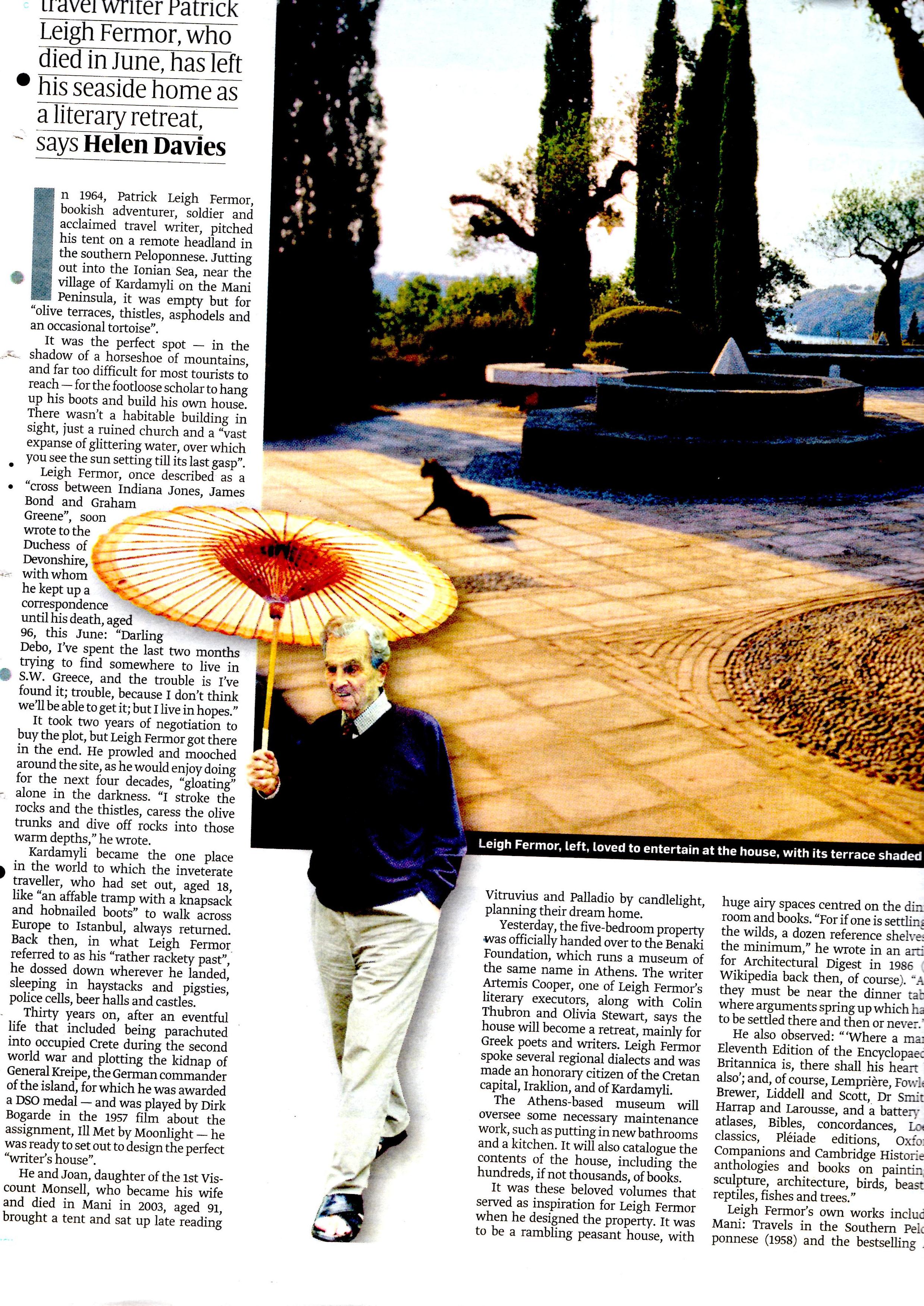
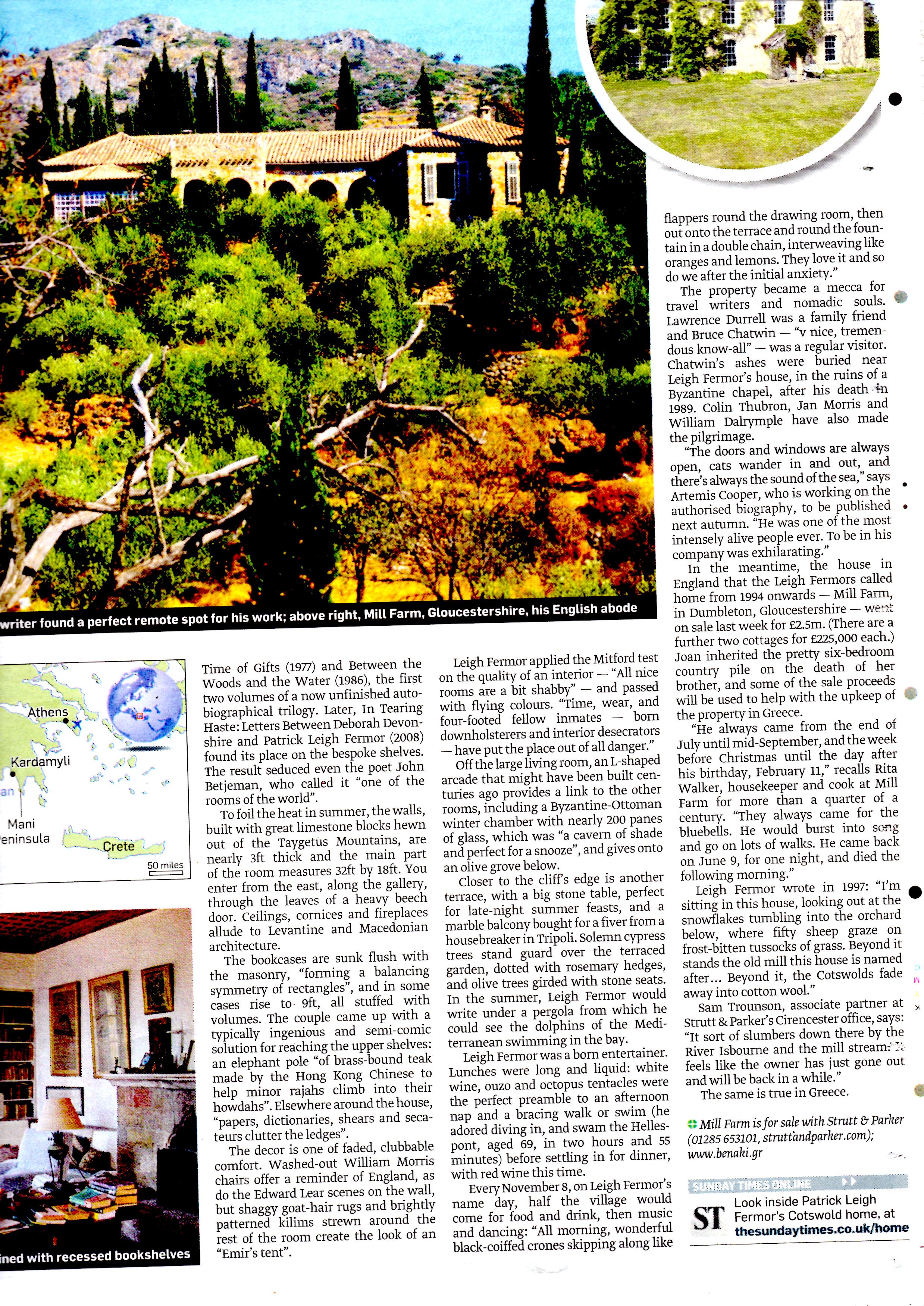
Paddy’s Gloucestershire home for sale for £2.5m

John Chapman’s photos of Paddy’s house

A little nugget from a friend of John Chapman (of Mani Guide fame) about the handover of Paddy’s house to the Benaki. This prompted me to ‘reveal’ John’s excellent series of photographs of Paddy  and his house taken during a visit on 2005.

Hi John,

Two days ago we went to Patrick’s evening with the Benakeion Institute taking over ceremony so to speak and a kind of farewell for Paddy..The President of the institute gave a lovely speech in Greek, well thought and with very high appreciation for Fermor’s personality and character and his love for Greece..He regarded him as much more of ”kardamyliotis than British man” because he ”lived here longer and loved this place a lot”.

In any case I had a couple of British friends with me and we all enjoyed it.

To see more of the photographs click here (and scroll down a a bit).

Main Mani Guide site here.

Related article:

Mani: A Guide and History

The places in between by Paul Theroux

There are those who believe that technology has hijacked the whole of the visitable earth, snatched it away, miniaturised and simplified it, making travel so accessible on a flickering computer screen that there is no need to go anywhere except to your room. In a related way, the travel book is believed to have been not just diminished but made irrelevant by the same technology. Since we know everything – the information is easily dialled up – and the world has been so thoroughly winnowed by travellers, what is the use of a travel book? Where on earth would you go to remark each anxious toil, each eager strife, or watch the busy scenes of crowded life? Surely it has all been written.

by Paul Theroux

First published in the Financial Times, 27 May 2011

This isn’t a new conjecture. In 1972, in a blasé magazine piece of postmodernism, entitled “Project for a Trip to China”, the American writer Susan Sontag sat in her New York apartment ruminating on China. Sontag was that singular pedant, a theorist of travel rather than a traveller. She concluded her piece: “Perhaps I will write the book about my trip to China before I go.”

To such complacent and lazy minds, here is a suggestion. Try Mecca. After prudently having himself circumcised, learning to speak fluent Arabic, dressing as an Afghan dervish and calling himself Mirza Abdullah, the British explorer Sir Richard Burton travelled to the holy city of Mecca, a deeply curious unbeliever among devout pilgrims. This was in 1853. He published his account of this trip in three volumes several years later, his Personal Narrative of a Pilgrimage to Al-Madinah and Meccah. The last non-Muslim to do this and to write about it was Arthur John Wavell, of the distinguished British military family. An army veteran, and farmer in Mombasa, Kenya, Wavell developed an interest in Islam. In order to know more, he disguised himself as a Swahili-speaking Zanzibari, made the pilgrimage and wrote about it in A Modern Pilgrim in Mecca (1912). Wavell took the trip in the winter of 1908-1909, more than a century ago. No unbeliever has done it since. Now there’s a challenge for a technology-smug couch potato who prates that the travel book is over. Of course, this daring trip is not easy. It is, perhaps, not a journey for a gap-year student wishing to make his or her mark as a travel writer but it is a book I would want to read.

Nor has anyone, to my knowledge, gone in the footsteps of Apsley Cherry-Garrard. In the Antarctic winter of 1912-1913, “Cherry” sledged with two other men to observe the rookery of the emperor penguins and to remove some eggs. The six-week journey, pulling the heavy sledges themselves through the ice, was made in pitch darkness and temperatures of minus 79F. The men returned, delirious, starved and near death. How about that for a book?

A few years ago the journalist Tim Butcher attempted to retrace Henry Morton Stanley’s 1877 trip down the Congo River. He made a brave try but he failed. The river is as dangerous as ever, and though there are many friendly Congolese, the hostile ones are better armed than in Stanley’s time and more rapacious. Stanley spent three years on his epic journey – the first traverse and mapping of the continent’s mid-section. Butcher’s Blood River (2007) is a worthy book but it is not Stanley’s Through the Dark Continent (1878). The challenge remains, though God help the traveller who attempts it.

A modern version of Heinrich Harrer’s Seven Years in Tibet (1953) – he was there from 1944 to 1951 – has not been written either and, given the inflexibility, the disingenuousness and iron fist of the Chinese occupation, it would be fascinating. Harrer escaped from a British prisoner of war camp in India to make his trip. In the same spirit, the Italian Felice Benuzzi fled a British internment camp in Kenya to climb Mount Kenya – he did so, through the bamboo groves and the snow, with two fellow PoWs, and they descended to the camp to turn themselves in. He wrote an account of it, a book translated as No Picnic on Mount Kenya (1952). Kenya is full of prisoners and refugees in camps; none of them, so far, has duplicated Benuzzi’s gallant feat.

The people who wonder where the travel book is going should consider where it has been. In the course of compiling my Tao of Travel: Enlightenments from Lives on the Road, I have spent the past two years running to my nearest university library, taking out a dozen travel books at a time, reading them, making notes, extracting and typing out the best passages, then returning the books a week later and borrowing a dozen more.

After the first 300 books I was not entirely sure what a travel book is meant to be. Some are heroic jaunts, such as Benuzzi’s; some are ordeals or death marches – Cherry-Garrard’s The Worst Journey in the World (1922), or Geoffrey Moorhouse’s The Fearful Void (1974), the story of travelling for four months in the Sahara, mainly on foot; and some, such as Laurens van der Post’s Venture to the Interior (1952), are merely pretending to be ordeals. Others are best read in pairs, the same trip by fellow travellers and writers, such as Graham Greene’s dark Journey without Maps (1936) and, two years later, his cousin Barbara Greene’s Too Late to Turn Back – her cheerful account of the same trek through Liberia; or Dr Johnson’s Journey to the Western Isles of Scotland (1775), with Boswell’s Journal of a Tour to the Hebrides (1785). Some travel books are reminiscences written long after the fact, such as the wonderful two-volume retelling by Patrick Leigh Fermor of his walking through Europe before the war, A Time of Gifts (1977) and Between the Woods and the Water (1986).

There are too many categories to list – pilgrimages, both religious and secular; quests for peace of mind or love or a great meal; a search for the perfect wine and food pairing, or the jolliest spa experience. Many – perhaps most – are autobiographical but selectively so. Having a bad time on a trip is helpful. “Literature is made out of the misfortunes of others,” VS Pritchett once wrote. “A large number of travel books fail because of the monotonous good luck of their authors.”

There is a false and snobbish notion that the high watermark of travel writing occurred in the 1930s, with the work of Evelyn Waugh, Graham Greene, Peter Fleming, Robert Byron, Freya Stark and Rebecca West. Certainly in this period there flourished intrepid travellers with great prose styles but style was the important element, and the writers of this time sought to prove their own singularity by placing themselves in stark relief against a landscape that was primitive, or dangerous, or laughable, but in any case emphatically foreign. To my mind, the great travellers of that period and a bit earlier were the field anthropologists Bronislaw Malinowski in New Guinea, Margaret Mead in Samoa, Alfred Métraux in Easter Island, and Claude Lévi-Strauss in the hinterland of Brazil.

In my opinion, the best of travel, and of travel writing – ancient or modern – is a species of trespass combined with true discovery, the wanderer surprised and bringing back news of the outer world. It helps to be Captain Cook, or HM Stanley, or Knud Rasmussen in Arctic Greenland, with their pioneering journeys of discovery. But there are modest and just as readable more recent accounts of travel that evoke a sense of place, such as Carlo Levi’s Christ Stopped at Eboli (1945), Peter Matthiessen’s The Snow Leopard (1978), about Nepal and Jonathan Raban’s Bad Land (1996), on Montana.

When I arrived in Africa in the early 1960s, I realised how defective or insufficient the models were – Hemingway posturing and babbling in kitchen Swahili in The Green Hills of Africa (1943), or van der Post making a meal of a simple trip in Nyasaland (where I happened to live). Nothing had prepared me for the weather – it was colder than I had imagined in the Shire Highlands, where villagers went about in woolly jumpers; much hotter than I’d ever been in the far south of the Lower River, a district of bare breasts.

Though I read travel books in Africa, it did not occur to write one. I was struck by Dervla Murphy in Full Tilt (1965), travelling alone, a woman, riding a bike from Europe to India. She was a humble traveller, staying on the ground, making friends. Then there was VS Naipaul’s Area of Darkness (1964), a travel book with a theme – two themes really, the sentimental return to the motherland, the disappointment in the motherland. Naipaul’s book contained convincing dialogue. As a novelist, he was able to bring landscape to life. These were features I had valued in Mark Twain’s and Jack London’s journeys, the novelist’s art applied to travel. This suggested that I might write such a book myself, and that was the origin of my Great Railway Bazaar, which I wrote in 1974.

My travels in Europe and Africa began in 1963, almost 50 years ago. The world was quite different then and so was the travel book – some of them described the Sphinx and the Taj Mahal. In the 1980s and 1990s there was a profusion of travel books. These days, the bookstore browser is likely to yawn, seeing a shelf of them.

So where are we now? Of course, many would-be travel writers are plodding in the footsteps of those who have gone before and repeating or correcting the impressions. An irritating tendency of those books, and of travel pieces in general, is the use of the present tense: “I am on a bus in Bhutan and the woman next to me is smoking a cigar … ” There is a new frivolity in travel books, there is mock-drama, there is obvious embroidering, there is the frivolous quest as a theme. Such books do not interest me at all.

I have a love for reading about a really difficult trip, even better an ordeal. Such books, written with skill and appropriate detail, will always find a public, because they combine travel with problem solving and endurance, and that I suppose is the human condition. These people are suffering for us.

Not long ago, a Nigerian man was intercepted fleeing Libya, where he had been employed as a mechanic in the oil industry. His town was under siege, bombs falling, bullets flying. Prevented from going to Italy, he was being repatriated to Nigeria. He protested, saying, “Send me back to Libya – I would rather go there than home to Nigeria.”

This makes me wonder what Nigeria is like and provokes me to travel there. Around the same time, 1,000 people died in a rural village in Ivory Coast; this was a small news item in the western press, though when one person is injured in Jerusalem it’s on the front page as an outrage. I’d like to know why this is so. The fact that there are far fewer foreign correspondents makes the traveller more necessary as a witness and a reporter.

The world is not as small as Google Earth depicts it. I think of the Lower River district in Malawi, the hinterland of Angola, the unwritten-about north of Burma and its border with Nagaland. Nearer home, the urban areas of Europe and the United States. I do not know of a book that recounts the daily life in a ghetto in, say, Chicago; the secret life of a slum, or for that matter, the anthropology of Muslims on a depressed “sink estate” in the British Midlands.

The world is full of jolly places but these do not interest me at all. I hate vacations and luxurious hotels are no fun to read about. I want to read about the miserable, or difficult, or inhospitable places; the forbidden cities and the back roads: as long as they exist the travel book will have value.

‘The Tao of Travel’ by Paul Theroux is published by Hamish Hamilton

British Philhellene author, Patrick Leigh Fermor, donates Kardamyli home to Benaki

Late author, Patrick Leigh Fermor, has chosen Benaki Museum to donate his home in Kardamily. The donation was made through Giannis Tzanetakis, while the author was still alive and his home became the property of Benaki Museum after the death of the great British Philhellene on June 10th 2011.

Last Saturday, in honor of Patrick Leigh Fermor, Benaki Museum held an event at the late author’s home in Kalamitsi, Kardamyli, gathering acquaintances and friends from Greece and the UK, among them, UK Ambassador, Dr. David Landsman, Director of the British Council, Richard Walker, the executors of his will and his biographer.

Patrick Leigh Fermor lived for many years in Mani, in his home that he personally built, based on Nikos Chatdjimichalis designs.

His relationship with Benaki Museum dated years back; he kept contact with Antonis Benakis and Irini Kalliga later, while he maintained close friendly relations with the Institute’s director, Angelos Delivorias. Several years ago, it was decided by the donor and the museum, that his home would be used for the purpose of hosting researchers, poets and writers, visiting Greece to work for a few months. At the same time, for specified time periods, Benaki Museum will have the option to rent the author’s home, to obtain funds for maintenance and hosting. In the coming months, once recording procedures for the library and archives are complete, and all necessary maintenance activities are performed, the Administrative Committee of Benaki Museum will be announcing how the building will operate.

Source: ANA – MPA

Lawrence Durrell and Patrick Leigh Fermor – Bitter Lemons

I am republishing something that was first on the blog back in May 2010 following a request by Lynne Sanders.

In Bitter Lemons, the writer Lawrence Durrell describes a visit from Patrick Leigh Fermor –

“In that warm light the faces of my friends lived and glowed….Freya Stark…Sir Harry Luke…Patrick Leigh Fermor and the Corn Godess, who always arrive when I am on an island, unannounced and whose luggage has always been left at the airport (‘But we’ve brought the wine-the most important thing’).” [pp102-3]

“Last night the sound of the front door closing upon breathless chuckles and secretive ranting, then the voice of Patrick Leigh Fermor: ‘Any old clothes?’ in Greek. Appeared with his arm round the shoulders of Michaelis who had shown him the way up the rocky path in darkness. ‘Joan is winded, holed below the Plimsoll line. I’ve left her resting half way up. Send out a seneschal with a taper, or a sedan if you have one.’ It is as joyous a reunion as ever we had on Rhodes.

“After a splendid dinner by the fire he starts singing, songs of Crete, Athens, Macedonia. When I go out to refill the ouzo bottle at the little tavern across the way I find the street completely filled with people listening in utter silence and darkness. Everyone seems struck dumb. ‘What is it?’ I say, catching sight of Frangos. ‘Never have I heard of Englishmen singing Greek songs like this!’ Their reverent amazement is touching; it is as if they want to embrace Paddy wherever he goes.” (pp 104-5)

Related article:

Lawrence Durrell and Patrick Leigh Fermor by Thos Henley

My unrelenting vice

Bora Cosic

Bora Cosic

Bora Cosic on reading books no one else reads. Sometimes one feels a little like this about Paddy’s work; so few people you meet have actually read him. Thanks to Chris Lawson for bringing this to my attention. I think we can all enjoy this.

I remember a scene related to me by a poet of the Belgrade surrealist circle, Dusan Matic. In 1941 he took part in the Montenegro guerrilla revolt, and while the fighters-to-be were cleaning their guns around him, the poet sat on a nearby terrace, smoking and reading Nietzsche. He was annoyed by the many soldiers who came to light their cigarette on his, he told me, he didn’t have the nerves to support the smoking habits of an entire people’s liberation struggle. So he returned to his room in Belgrade during the unpleasant period of occupation, with its many dangers. When I think about it now, I don’t believe that Matic distanced himself from war because of this smoker episode, but rather because the masses of soldiers had interrupted him while reading.

It was quite a long time ago that Valéry Larbaud wrote about his observations of reading as a vice practiced with impunity. For myself, I know that this prolonged staring into a book interferes with the production routines in my family, the manufacture of everyday life – the admission of one who engages in the vice Larbaud describes. Personally I require many hours of reading, because I usually read tremendously thick books, and also notably boring ones; I am always convinced that at the core of an abstruse sentence lies the magnificence of a discovery just waiting to be made. And so I remain true to the pre-Socratic philosophers, Musil and Lacan.

But I am not alone. I have read books that no one else has read, says Paul Valéry. Books from technical disciplines, these interest me. Balzac systematically read dictionaries, not specific entries but from start to finish, as if following a narrative. How many interesting things there are to read, which at first glance might seem irrelevant and meaningless. One woman expected Erasmus to write something that would help her husband get a grip on himself, Roland Barthes relates. Or as Claudio Magris mentions, Montecuccoli wrote his aphorisms on the art of war in a Stettin prison, during his hiatus from the Thirty Years War. Were I a poet, I would dedicate the most beautiful poem to roux soup, admits Bela Hamvas. “A Meditation Upon a Broomstick” is the title of an essay by Swift. I would give everything to find out what a German wrote about a lemon peel, as Rousseau says, what Erasmus wrote to bring a neurotic man to reason, or Montecuccoli’s “Art of War”.

Reading has only recently become a silent act. Two hundred years ago everyone read aloud. This was dictated by church ritual, in which one, or better said everyone, had to listen to the “holy” text. In the first cathedrals entire choruses of believers spoke aloud this reading material that they viewed as godly. This muttering was further practiced by those few people on earth who at the time were, by some miracle, able to read, as if everyone one of them fulfilled the role of today’s speakers and leaders. Then some anonymous Copernicus of reading came along, who brought the entire practice inside by following his text “in his mind”. Thus the letter-for-letter literalness of ecclesial or school reading was lost. Because what goes through my head when I do the work of reading is not necessarily the same as what someone else wrote.

One readily discovers this when undertaking a fresh reading of something that was once familiar. Not only do I rediscover what I had forgotten, but also I realise that “there” in the text I had read long ago there is nothing of what I expected to find! This is the valuable reading of a text, which the reader has created within himself by grinding up a mass of foreign material in his mill and transforming it into something different through unexpected combinations. Read again, many incidences that remained in one’s mind from before play out in a different way entirely.

We carry within the texts that fall into our hands. There are philosophers who believe: the things that we find in books are those that we have brought to them. Borges said that – his protagonist writes an already existing book all over again, convinced that only the repeat exists, not the original. In Musil’s novel, by the way, there is a strange librarian, who guards thousands of books without every having opened even one of them. But still he knows everything about them, because we apparently sometimes also read when we are not reading. As it is, libraries make normal people anxious, seeming like overload, regardless how orderly the catalogues may be. I therefore do understand those who flee from reading as if it were the plague. Everyone has a right to their individual fears. Canetti finds a way out of this in a novel about books by causing the library to burn down. However, after every barbarian plundering there will always be someone who reads the few remaining recognisable characters lying in the ashes.

So my daily ploughing through the pages continues, my unrelenting vice. There are many people guilty of making me this way. My grandmother, first and foremost, who already taught me to read and write at age four. (As we see, there are two phenomena that run parallel to one another; writing is a form of reading, and reading means writing.) I immediately pounced on everything legible, attentively deciphering the labels on the kitchen containers for salt, coffee and sugar, on the advertising pamphlets in the boxes of soap, on the chocolate wrappers, the dates on the wall calendar, the words on the enamel sign indicating where the basement or bathroom was. I studied the receipts my mother brought back from shopping; there were all kinds of letters and entire words on the inside of Papa’s hat, on the edge of Mama’s scarf, on the seam of my T-shirt. And then the signboards, the scenery on the streets of the city where my life began!

Today I think that these very things, the linguistic imprint of daily human existence, were my first reading material, long before Karl May and Tom Sawyer. And then after I had read Dostoevsky and Proust for the first time there was still an immense amount of room for the global vices of all-purpose books, handbooks, guides, what we call “technical literature” but which also includes a lot of unscientific, fantastical and almost crazy things. Since my youth I have tended to seize upon this odd reading material. In a used book shop in Belgrade the bookseller always set aside these kinds of things for me: about the migration of birds, the unusual meteorological phenomena in the Alps, the form of address in official letters, and beekeeping. Even before that, in Slovenia, where both my grandfathers come from, I derived particular pleasure from reading a little book on home remedies, raising children, on “world events”, regulations about male and female servants in the kingdom, “eternal calendars”, spelling books for schools, and etiquette tips for the village and the city.

What kinds of crazy publications came out in Russia after the October Revolution! We needed a whole series of new handbooks in paperback: for the Soviet locksmith, the Soviet lathe operator, the Soviet electrician, wrote Trotsky. These included, among other things, explanations of how to drink less, get into fewer fights, play less card games, how to keep from hitting your wife and children, how to do the washing, open the window and sweep the room.

Out of all of these, I must admit that as a child I was most drawn to a cardboard book, which actually only consisted of book covers; there was no content because the covers alone were sufficient to advertise a chocolate factory. There were the little papers that were rolled around medicine bottles, that one stuck into boxes of sweets – this all was great fun to me at an age when I did not yet understand the meaning of individual words. And so this old Egyptian tradition – as applied to the production of modern medicines and confections – had a belated impact on a child’s consciousness by teaching him that books are not only found in books but many other places.

This idea was revisited by the Pop Art artists and even our avant-garde artists of the Slovenian group OHO. What a motley collection of poetic messages they packaged into bigger and smaller boxes, believing that this would allow them to participate in the production of reading. Once I bought an iron book, which told the history of many iron objects, but its cover was actually made of tin. A magazine published in former Yugoslavia had a plastic binding, made from the same material used to produce raincoats. I read my fill at various times, not only of printed texts, I was also a careful reader of book covers, bindings, and what is printed on the dust jacket. I would say that one finds an entire culture of the written word in abbreviated form, if one only looks at the narrow column printed on the inner flap of the book jacket, where there is a description as succinct as a dictionary entry telling what the book is about. If all the books in the world were to disappear, (as in “Fahrenheit 451”) and only the book covers remained, perhaps one could reconstruct human thought in this way.

Thus early on I learned that the greatest driving force behind mankind’s culture of the written word unremittingly leads to the exceptional, irregular and astonishing – from which Dadaism and all of Surrealist literature has sprung. Where the reading of apparently incomprehensible texts originates, as early on in Mannerism, then in the crazy dialogues of Lewis Carroll, Edward Lear and Ionesco. Those wonderful fantasies before death in “Krapp’s Last Tape” by Samuel Beckett. As if people might be able to near their end in a surreal manner that nevertheless seems normal. When the eye doctor bids me to read aloud a single letter on the wall of his office, do I stand before the end of all reading?

The Serbian and Croatian author and essayist Bora Cosic (1932) lives in Berlin and Rovinj. His is the author of some 30 novels, volumes of collected stories and essays, including his acclaimed novel “My Family’s Role in the World Revolution” (1969). He is one of the last authors to describe his native language as Serbo-Croatian in a rejection of nationalist literature. In 2002 he was awarded the Leipzig Book Prize for European Understanding.

The article originally appeared in the Neue Zürcher Zeitung on July 30, 2011.

Paddy’s Gloucestershire home for sale for £2.5m

I am trying to obtain a better copy, but here is a scan from today’s Sunday Times property section, of an article about the sale of Paddy and Joan’s house in Dumbleton.

It does in in fact focus on his house in Kardamyli (which it correctly says is going to the Benaki) but it is trying to highlight, as these sections do, that the house in Dumbelton is for sale for £2,500,000. Property particulars from Right Move and a full brochure on the Strutt & Parker website.
My favourite travel book, by the world’s greatest travel writers

Paul Theroux, William Dalrymple, Kari Herbert, Colin Thubron and many more writers tell us about the travel book that most influenced their own life and work. Others that one could say are slightly less well-known, and very pleased to be placed into the pantheon of “world’s greatest travel writers” – Mr Jasper Winn 🙂 – are included.

I was very pleased to see two of Eric Newby’s books chosen; no surprises that they were A Short Walk in the Hindu Kush and my absolute favourite, Love and War in the Apennines.

William Blacker chose all of Paddy’s books, including Between the Woods and the Water. Yesterday he sent me an email pointing out some deficiencies in the way the Guardian had edited his submission – Now, what did he really expact from the Grauniad? – , including the quotation from Kim at the end. William’s original submission can now be revealed in all its full and original glory …

It was not just the books of Patrick Leigh Fermor – notably Between the Woods and the Water about Rumania – which inspired me, but also the man. He was the quintessential free spirit. He didn’t bother with university, but at the age of 18 set off into the blue, on foot, across Europe , simply hoping for the best. His journey lasted five years. On the way he picked up a bewildering multitude of European languages, which led on to extraordinary wartime adventures, and then to a series of breath-taking books, which are peerless, and among the great masterpieces of twentieth century literature. The resounding success he made of his special brand of non-conformity should fill all would-be wanderers and fellow free spirits with hope. Read about his life, read his books, and if you are not similarly inspired and exhilarated by Leigh Fermor’s example then, as Kim said, ‘Run home to your mother’s lap, and be safe’.

William emphasises, for those who might miss it, “that I wrote, very deliberately, ‘great masterpieces of twentieth century literature’ and not  ‘great masterpieces of twentieth century TRAVEL literature’ !”

The list of choices can be found in this article in the Guardian.