Tag Archives: Patrick Leigh Fermor

Patrick Leigh Fermor in Greece – a talk by Artemis Cooper

Paddy’s biographer and good friend, Artemis Cooper, will talk about his life in Greece at the Gannadius Library in Athens at 7.00 pm on 24 May 2012. 

Full details of the event can be found here.

Biographer Artemis Cooper, who is preparing a biography of Patrick Leigh Fermor, will trace his life, experiences, and legacy in Greece from his early travels to the end of his life, on 10 June 2011. She will talk about what drew Patrick Leigh Fermor to Greece in the first place; his ‘participation’ in the Venizelist rebellion of 1935; his early travels in Thrace and Macedonia, and first encounters with the Sarakatsani; his experiences in the war on the Albanian front and Crete, as well as the post-war explorations of Greece that produced Mani and Roumeli. She will also touch on the Cyprus years; his friendship with George Seferis, George Katsimbalis, and Nicos Hadjikyriacos Ghika; how he and his wife came to settle in Kardamyli, and built their house with the architect Nicos Hadjimichalis; how the Greek translation of Mani was undertaken by Tzannis Tzannatakis, while he was in exile in Kythera under the Junta of the Colonels. She will also reflect on his position in the village of Kardamyli and how he is seen in Greece today.

PS – I have been told that there will be a webcast available after the event. I will post the details when I have them.

Transylvanian hay-day – An afternoon’s diversion on the way to Constantinople, 78 years ago.

Between the Woods and the Water

As Nick Hunt is currently in the vicinity of the Hungarian-Romanian border on his walk in Paddy’s footsteps to Constantinople, I thought that it might be an appropriate time to publish this extract. It is one of the most memorable pieces of Paddy’s writing. What a way to spend a hot summer’s afternoon!

by Patrick Leigh Fermor

First published in The Spectator in 1986. This version 18 June 2011.

One day when we were invited to luncheon by some neighbours, István said, ‘Let’s take the horse’ and we followed a roundabout uphill track to look at a remaining piece of forest. ‘Plenty of common oak, thank God,’ he said, turning back in the saddle as we climbed a path through the slanting sunbeams, ‘you can use it for everything.’ The next most plentiful was Turkey oak, very good firewood when dry, also for stable floors and barrel staves. Beech came next, ‘it leaves scarcely any embers’; then yoke elm and common elm, ‘useful for furniture and coffins’. There was plenty of ash, too — handy for tools, axe-helves, hammers, sickles, scythes, spades and hay rakes. Except for a few by the brooks, there were no poplars up there but plenty by the Maros: useless, though, except for troughs and wooden spoons and the like. Gypsies made these. They settled in the garden and courtyard of the kastély with their wives and their children and whittled away until they had finished. ‘There is no money involved,’ István said. ‘We’re supposed to go halves, but, if it’s an honest tribe, we’re lucky to get a third. We do better with some Rumanians from out-of-the-way villages in the mountains, very poor and primitive chaps, but very honest.’

In a clearing we exchanged greetings with a white-haired shepherd leaning on a staff with a steel hook. The heavily embroidered homespun cloak flung across his shoulders and reaching to the ground was a brilliant green. His flock tore at the grass among the tree-stumps all round him. Then a path led steeply downhill through hazel woods with old shells and acorns crunching under the horses’ hooves.

It was a boiling hot day. On the way back from a cheerful feast, we went down to the river to look at some wheat. Overcome by the sight of the cool and limpid flood, we unsaddled in a shady field about the size of a paddock, took off all our clothes, climbed down through the reeds and watercress and dived in. Swimming downstream with lazy breaststroke or merely drifting in the shade of the poplars and the willows, we talked and laughed about our recent fellow guests. The water was dappled with leafy shade near the bank and scattered with thistle-down, and a heron made off down a vista of shadows. Fleets of moorhens doubled their speed and burst noisily out of the river, and wheat, maize and tiers of vineyard were gliding past us when all at once we heard some singing. Two girls were reaping the end of a narrow strip of barley; going by the colours of their skirts and their embroidered tops, braid sashes and kerchiefs, they had come for the harvest from a valley some way off. They stopped as we swam into their ken, and, when we drew level, burst out laughing. Apparently the river was less of a covering than we had thought. They were about 19 or 20, with sunburnt and rosy cheeks and thick dark plaits, and not at all shy. One of them shouted something, and we stopped and trod water in mid-Maros. István interpreted. ‘They say we ought to be ashamed of ourselves,’ he said, ‘and they threaten to find our clothes and run off with them.’

Then he shouted back, ‘You mustn’t be unkind to strangers! You look out, or we’ll come and catch you.’

‘You wouldn’t dare,’ came the answer. ‘Not like that, naked as frogs.’

What are these for?’ István pointed to the branches by the shore. ‘We could be as smartly dressed as Adam.’

‘You’d never catch us! What about your tender white feet in the stubble? Anyway, you’re too respectable. Look at your hair, going bald in front.’

‘It’s not!’ István shouted back.

‘And that young one,’ cried the second girl, ‘he wouldn’t dare.’

István’s blue eye was alight as he translated the last bit. Then without exchanging another word we struck out for the shore as fast as crocodiles and, tearing at poplar twigs and clumps of willow-herb, bounded up the bank. Gathering armfuls of sheaves, the girls ran into the next field, then halted at the illusory bastion of a hay-rick and waved their sickles in mock defiance. The leafy disguise and our mincing gait as we danced across the stubble unloosed more hilarity. They dropped their sickles when we were almost on them and showered us with the sheaves; then ran to the back of the rick. But, one-armed though we were, we caught them there and all four collapsed in a turmoil of hay and barley and laughter.

‘Herrgott!’ I heard István suddenly exclaim — much later on, and a few yards round the curve of the rick — smiting his brow with his hand. ‘Oh God! The bishop! The Gräfin! They’re coming to dinner, and look at the sun!’

It was well down the sky and evening was gathering. The ricks and the poplars and the serried rows of sheaves and haycocks were laying bars of shadow over the mown field and a party of birds was flying home across the forest. István’s hay-entangled hair was comically at variance with his look of consternation and we all laughed. Extracting strands of hay and the clinging barley, we tidied Safta and Ileana’s plaits, disordered by all this rough and tumble, and set off hand in hand with them for the river, István and I on tiptoe. ‘Poor feet,’ they murmured. After goodbyes we dived in and started the long swim back, turning many times to wave and call to those marvellous girls and they waved and answered until they were out of earshot and then, after a bend in the river, out of sight as well.

This piece first appeared in The Spectator in 1986; it forms part of Between the Woods and the Water (John Murray, £8.99). © Patrick Leigh Fermor, 1986.

Sir Patrick Leigh Fermor and The Folio Society

Paddy and George Psychoundakis the “Cretan Runner”

From the Folio Society website.

Ten years ago, The Folio Society decided to publish a book by William Stanley Moss, entitled Ill Met by Moonlight. It told the story of a daring war-time adventure in Crete, in which Moss and Patrick Leigh Fermor, two young SOE officers, kidnapped a German general, spirited him away across the mountains and into captivity. The book was based on the detailed diary kept (entirely against the rules) by Moss, and its undeniably romantic aspects were highlighted when, in 1957, a film was made starring Dirk Bogarde as the dashing Leigh Fermor.

When we planned the book, it occurred to us that Patrick Leigh Fermor, known to his friends as Paddy, had never contributed any kind of comment on it in writing. We assumed there was a good reason for this – a certain delicacy perhaps, since, at the time of the operation, he was already embedded in Crete in a cave under Mount Ida, with the role of facilitating Commando raids on the island, and was dependent on the friendship and loyalty of the local partisans. But we wrote to him anyway and asked if he would contribute an introduction.

He rang up from his home in Greece. It was indeed, he said charmingly, ‘delicate’ and for various reasons he’d always felt the less said the better. We parted genially, my suggesting that we might ask Michael Foot, historian of the Special Operations Executive and an old friend of his, to do it instead. This we did. A week later, Paddy telephoned again. He’d been thinking about it, and he felt that there were things he would like to say: the coup had, in his view, been diminished by being reduced to the level of a ‘tremendous jape’ and he hoped to restore the balance by providing something of the context for the enterprise. He did not wish to interfere with Michael’s introduction, but would contribute a short Afterword, describing his own experience. It would be 500 to 1,000 words. It eventually emerged at 6,500 words, all of which had to be wrested from him in hand to hand combat, so anxious was he that nothing could be misinterpreted. Michael Foot, in the meantime, was triumphant to be able to tell Paddy that General Kreipe (who was not the intended victim of the kidnap, as that gentleman had been moved on) was so unpopular that, when they heard he had been snatched, his officers broke open the champagne.

Most Folio books have their unexpected rewards, but this one had more than most. Through it we met Billy Moss’s daughters who showed us photograph albums and the original diary; Sophie, their Polish mother, a formidably attractive SOE operative who had been based, with Moss and Leigh Fermor, at Tara, the Cairo House; Michael (M R D) Foot, whose own experiences as prisoner of war were at least as hair-raising as the exploits he went on to chronicle; and of course Paddy himself – courageous, witty, modest, famously attractive and – both with this book and The Cretan Runner – a good friend to The Folio Society. We will miss him.

Related article:

A Meeting between Paddy and George Psychoundakis the “Cretan Runner”

London Gazette Moss MC and Fermor DSO announcement

Billy Moss and Patrick Leigh Fermor

A copy of the Supplement to the London Gazette dated 13 July 1944, which announces the award of the Distinguished Service Order to Captain (temporary Major) Leigh Fermor and the Military Cross to Lieutenant (temporary Captain) Stanley Moss.

You can find the pdf here Moss MC and PLF DSO announcement (once open scroll down) or an online link here.

Patrick Leigh Fermor’s 1998 interview with Amalia Negreponte

Amalia Negreponte

I was alerted to this interview by Mark Granelli. As ever we have to be cautious about things that may have got lost in translation but I was a little suspicious about this interview as Paddy appears to go further out on a limb than recorded elsewhere. You will understand what I mean when you read it. Is she being totally honest? 

My reply to Mark was …

Mark – thanks for being such a good sleuth! I will put it up but I am slightly suspicious of this one. Paddy appears more political than I have ever read before. Maybe he opened up to her because she is very pretty, if a little thin.

But without further ado let’s go to the interview which can be found online at Amalia Negreponte’s website on 20 July 2011 ….

War hero, great hellenist, major British author, scholar and soldier, who played a prominent role behind the lines in the Cretan resistance during World War II (kidnapped German general, heading Nazi troops invading Greece). He was widely regarded as “Britain’s greatest living travel writer”, with books including his classic “A Time of Gifts” (1977).  A BBC journalist once described him as “a cross between Indiana Jones, James Bond and Graham Greene”

Patrick Leigh Fermor’s interview to Amalia Negreponti, published in my book:“Hellenists: Greece does not wound them” (LIVANIS publishing company, 1998), pre-published in “TA NEA” in 1998

Born: In England. First traveled to Greece: When he was 19 years old, in 1935, during his tour of Europe. Main bibliography: “Mani”, “Roumeli”, “The Violins of Saint-Jacques”, “Between the Woods and the Water’, “A Time of Gifts”. Lived most of his life after World War II: In Mani (Kardamyli); frequently travelling to England, where he recently passed away, 40 days ago. He will be remembered by all- and certainly by us Greeks- with gratitude, admiration, love.

Five images. A man dressed in a British Army uniform, alone, on a snowy mountain – he is in Albania, in 1941. He speaks fluent Greek. The Greek soldiers endearingly call him “The Englishman”. Whenever he can, he talks of poetry and literature. Second image, the same manly uniformed figure, next to Giorgos Seferis, in Cairo. He has just arrived, right after the tragic Battle of Crete. His sorrow is vividly reflected on his face. Third flash. Haifa, 1942. The officer, the blackboard and the class of uniformed men. It is one of the war lessons the officer with the penetrating gaze gives to the Allies.

Crete, 1944:While the British commando takes off the German Army uniform he has deceptively worn, his five Cretan companions and a British officer hold a German officer captive. He is General Heinrich Kreipe – the commander of the German Occupying Forces in Crete – recently kidnapped by the men. On peaceful nights, the captive and the English officer-kidnapper talk of Homer and the great tragedians.

Last image: Mani, 1998, in a small cottage. The man sets aside, just for a moment, his writing – the bookcase is full of his highly acclaimed books. His eyes sparkle. “Greece was in danger. She was suffering. I did what anyone else would have done. Nothing more, nothing less”. Without any need for introductions, he is Paddy. Michael. Filedem. Patrick Leigh Fermor.

Ramrod-straight, soft-spoken, keeping his youthful impetuousness intact. “Dear God! It was nothing!”, he says every once in a while, with extreme modesty and reserve, as soon as he is reminded of his legendary status and heroic activity. He talks of his books with the excitement of a small child.

Whenever he talks of the historical battles – always playing the leading role – he fought in Greece during World War II, he never uses the pronoun “I”. It is always “we”; whether he talks of British soldiers and fellow officers – he keeps mentioning Christopher “Monty” Woodhouse, Xan Fielding, John Pendlebury, the archaeologist-hellenist who died, fighting heroically, during the Battle of Crete – his Cretan companions – George Psychoundakis, Manolis Paterakis, George Tyrakis – or the whole of Greece.

We meet Patrick Leigh Fermor in mid-July at his home, in Kardamyli, Mani, where he permanently lives during the last few decades with his wife, in a cottage he built by himself. The 83-year-old Anglo-Irish Fermor, having fought for Greece throughout his life, throughout her difficult moments with vigour, self-sacrifice and passion that transcends heroism; awarded with all the possible military distinctions for his actions in battle; highly valued throughout the world for his books – they are considered “masterpieces” by the most severe European and American critics – and living a reclusive life, exclusively dealing with what he has been dreaming of since he was a child: book writing.

At the moment, he is fervently preparing the story of his adventures during the entire war. His achievements are known through official documents (Foreign Office), as well as his companions’ and historians’ memoirs. He, however, has remained silent until now.

“Since I was a child, I was determined to become a writer; that’s for sure”, Patrick Leigh Fermor – Paddy, to his friends – remembers. “For that reason – to collect experiences and meet different people and things – and since I wasn’t particularly good at school, I set out, when I was 18 years old, on a journey to Constantinople, a journey that would mark and determine my life”.

The journey lasted a whole year and included the whole of Europe. Alone and moneyless, Fermor sailed from England to the Netherlands and went on, through a snowy landscape, to Germany. He followed the course of the Rhine upstream and turned eastwards, towards the Danube. He crossed the borders to Austria and Czechoslovakia. He borrowed a horse in Hungary, crossed Transylvania, Romania and Bulgaria, over the Balkan mountain range and reached the Black Sea coast: Varna, Nesembar and Burgas; then, across the borders of Turkey, towards Edirne. On January 1, 1935, he reached Constantinople.

At the monasteries

His next stop was Greece. “My love for her was unconditional”. He lived in monasteries of Mount Athos, in Thrace and Macedonia, in Peloponnese and Athens. The few words of ancient Greek he had learnt at school turned, almost magically, to fluent modern Greek and Greece got an eternal hold on him. “And then, around 1936, I returned to England.

The months away from Greece seemed intolerable. That’s why when, in 1941, I joined the Intelligence Corps, I asked to be transferred to Greece, fighting at the time against Italy in Albania. It so happened”. And Patrick Leigh Fermor became an integral part of the Albanian Epic. And, right after that, of the Cretan Resistance. From 1941 until the bloody Battle of Crete, Fermor was there, in the first line, along the Cretan warriors who considered him “more Cretan than the Cretans”, he says with pride. “Where can I begin?

The long night marches, the growth of the Resistance form village to village, from mountain top to plain? Waiting for boats in secluded coves, waiting for drops of ammunition in plateaus, visiting intelligence gathering networks in cities, sending commandos on sabotage missions, escaping German raids, on the mountains, the eagle nests and the crags we used to live… Since the first Axis invasion of Greece, we English felt that we were allies of the only nation left to fight darkness and tyranny.

The rest of the world remained neutral, defeated “in peace” or, worse still, had joined the enemy – through alliances and treaties. When the war came to Crete, the solitary allies – Greece and England – fought hand in hand. And then came 1942. In horror and despair. England was being devastated by heavy bombardments, the Germans were marching at full speed towards Stalingrad, Erwin Rommel’s tanks and canons were hammering our lines in the desert, pushing us back towards our last line of defence, El Alamein; and the USA had not entered the war yet.

My men and I, driven out of Crete after the Battle of Crete on May 20, 1941, crushed and shattered, had escaped towards the Middle East. First Alexandria and Cairo. And then Haifa, near Palestine, where I taught allied officers in a war college. What did I teach? The essentials. Secret landings, sabotage, using enemy arms and ammunition, parachute drops, commando raids, evasion tactics, setting mobile radio stations – everything.

My heart and thought, however, were with Crete, suffering more than ever. Villages were being burnt. Thousands of Cretans were being taken captive. Inhuman tortures and mass executions were on the agenda every single day. But the Cretans had not given up. They were continuing the Resistance, in any possible way, with vigour and stoicism. But not only that. They were also helping, risking their lives and the lives of their own people, the English allies who had been trapped in the highland villages and mountains of Crete. They were taking care of them as if they had been their own children.

It was a great honour. We became and still are the children of the Greek people. I am grateful for that – to be part of such a brave and noble kind of people was the greatest honour for me. We were strangers who came to Greece from afar to take part in the battle, to fight, to shed our blood on your mountains. We, however, risked – of our own accord – our lives, whereas the Greeks who helped us at the time of our greatest weakness did not only risk their lives, but also the lives of their families and the destruction of their villages, their motherland. Therefore, let’s not talk of our own sacrifices…”. “I could no longer resist staying away from Crete – I longed to return there”.

Thus, on July 24, 1942, at midnight, he returned from the Middle East to Crete by fishing boat, assigned a special mission in Central Crete. “Hard times. We were cut off from Africa and any supply shipments, whereas the Germans ravaged Crete, killing and torturing civilians whenever the Resistance struck a blow against them. The only good thing for our Crete out of that period, until 1944, was that we were not affected by the Civil War raging in mainland Greece – we were not aware of it”. At the beginning of 1944, Filedem – who lived on the mountains of Crete, organizing the Resistance disguised as a Cretan shepherd – is ordered to return to Alexandria. “I didn’t want to leave”. However, he couldn’t help it. No matter how reluctant he was, Fermor finally left.

He returned a few months later as the leader of a highly important mission for Crete in particular and Greece in general: the kidnap of the German military governor of Crete. Unfortunately, the target, General Friedrich-Wilhelm Müller, was replaced by General Heinrich Kreipe just before he arrived.

“On February 4, 1944, I was parachuted into Lasithi, Crete. The rest of the team – Stanley Moss, Manolis Paterakis and George Tyrakis – couldn’t follow due to bad weather. During the next two months, they kept trying to join me, but it was impossible. Finally, on April 4, they arrived in Soutsouro by sea. We immediately started hatching the general’s kidnap plan.”

The kidnap

Fermor finally came up with an idea – dressed as a German soldier, he stopped the general’s car on his way home at what was supposed to be a routine check point; the rest of the team took care of the driver and drove the car and the general away – met with success.

Hunted by German patrols, the team moved across the mountains and villages of Crete “in order to evacuate our captive safely, making sure that no reprisals were taken against the civilian population”. Whenever he got off the car, Fermor was met with murderous stares and open enmity by the Cretans due to the German Army uniform he was wearing.

“I realized then what it meant to be a German. I felt lucky not to be one. Upon arriving in Sphachta, where my friend father Giannis Skoulas lived, his wife came out of their house and stared at me in disgust. Full of joy, I tried to embrace her. Get away! She screamed. It’s me, Michalis, I said. No point… It took some time for her to recognize me and get over the repulsion the German Army uniform was causing her”.

The outcome of the mission? General Heinrich Kreipe was sent to Cairo, safe and sound. “We treated him with respect, honour and care! After all, he was our captive”.

Fermor met Kreipe decades later – to discuss World War II. The atmosphere was genial… “He was well-versed in poetry, Latin and ancient Greek – I realized it when we kidnapped him. We had drunk from the same fountains, we had sprouted out of the same roots, well before the war started – and that changed things”. Even the usual reprisals were avoided.

Fermor left a letter to the Germans when he abandoned the general’s car: “Gentlemen, your Commander was taken captive by a British Battle Force under our command (editor’s note: Fermor and Moss). When you read this, the General will be in Cairo. We want to point out that the operation was conducted without any kind of help from the Cretans… Any reprisals against the local population would be unjustifiable and unfair. Auf baldiges Wiedersehen! (editor’s note: the two signatures). PS: We are sorry to leave the car”.

Fermor (his code names during the war were Michalis or Filedem), who was idolized by the Cretans because he constantly put his life at risk for Greece, seems to have been left alone, a symbol of an era of heroes. He transcends the meaning of the term hellenist; he is a philhellene, with all the idealism and struggle the term includes.

He reacts when I ask him whether Greece wounded him. “Of course not! How could she? I devoted my life to Greece; to justice. My success is my greatest satisfaction. I’m hurt when I see people attacking Greece – usually unjustly. I’m hurt when I see strangers treat her contemptuously and scornfully. I’m hurt when they ignore, use and distort history to strike a blow – for example, when they support FYROM.

The Turks

“I don’t want to hear anything more about “bad feelings” of the Greeks towards the Turks. For God’s sake! The Turks seized and illegally occupy Northern Cyprus – it’s a well-known fact. Fewer and fewer Greek are living in Constantinople anymore – as a direct result of the rioting, looting, extermination, murder, coercion and general pogrom they suffer.

Europe should never forget what Greece has offered and act accordingly. I’m not talking of ancient Greece; I’m talking of modern Greece – World War II Greece. Greece prevented the whole of Europe from collapsing when the sky blackened.

They should all remember what Greece stands for. Because ideas change, people die and monuments collapse with the passing of time.

What can’t be destroyed, however, is the spirit of the Greek people – it includes all virtues, it inspires, it shines – just like the light that shines on the Greek mountains: your mountains. Our mountains”.

“In 1941, those of us who survived the Battle of Greece fled to the Middle East. First Alexandria and then Cairo. Right there on the bank of the Nile and the city of Alexander the Great, I had the chance to meet and befriend Giorgos Seferis, who had also taken refuge there. His hard features betrayed an anxiety and a sorrow that transcended our everyday stress about the outcome of the war. In the Middle East during that critical phase of the war when everything seemed lost, Giorgos Seferis was giving his personal battle: in politics and letters – poetry”.

Seferis wrote the poem “Days of June 1941” when Fermor arrived in the Middle East, right after the Battle of Crete.

“The new moon came out over Alexandria with the old moon in her arms while we were walking towards the Gate of the Sun in the heart’s darkness–three friends”.

“There are times when I feel I’m still there”, says Fermor. “Feeling the sorrow for my dead companions and the lost battle, seeing that man with the dark eyes driving away the clouds with his words.

Just words. Words of an educated and scholarly man who had experienced the horror of broken bodies and the pain of loss”.

Fermor takes out an old photograph, depicting the poet and him. Both men are thoughtful. With heavy gazes. “We didn’t stay together long”, Fermor recalls, “I was always on the run – missions and training… “You have to reckon how to move. It’s not enough to feel, to think, to move”, he used to say – exactly the way he wrote.

He was always reserved and cautious. He didn’t talk much; you never got tired of listening to him. Modest and discreet. I respected him at the time. I loved him as a poet later. He was educated and had a breadth of knowledge transcending the borders of nations and civilizations.

Giorgos Seferis recorded our experiences with accuracy and sensitivity. Yes, we had come from all around the world, as he says in the poem “Last Stop”, “from Araby, Egypt, Palestine and Syria”. Although he was very reserved, he never got detached. You could see the accumulated strength inside him”.

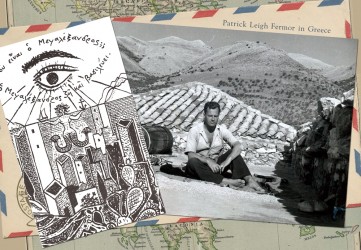
An interesting drawing (not) by Paddy

In a recent sale by auctioneer Dominic Winter, there were a number of lots sold from Paddy’s estate. The full list with sale prices can be found at this link. This drawing appears to have sold for £200.

The sale included pictures and books, and one drawing (originally thought to be) by Paddy of a woman, perhaps past her prime, looking forlornly into a mirror and maybe seeing her younger self, or has she been stood up and sees her younger rival staring back at her out of the mirror?

Described as …

489 *  Fermor (Patrick Leigh, 1915-2011). Room interior with seated female figure, pen and ink on paper, some correction fluid, unsigned, 35 x 50 cm (13.75 x 19.75 inches)

It is unsigned but does include some Greek lettering which I can’t make out. Perhaps one of you can help? See comments below about the origin of this drawing!

Patrick Leigh Fermor The Art of Travel broadcast c.1990-1992

A recording of a BBC Radio 4 programme entitled “The Art of Travel” (broadcast c.1990-1992) in which Annette Kobrak interviewed PLF for about 26 minutes concerning his early life and his journey to Constantinople. There is some good discussion about his travels after Between the Woods and the Water, about Bulgaria and into Constantinople.

I am indebted to David Turner for taking the time to convert this to digital and very successfully too – the sound quality is excellent!

You can listen online or download (press the downwards pointing arrow on the right hand side menu bar of the player).

I have updated the Video and Audio page with the programme. Don’t forget to visit to find more interviews with Paddy.

A combination of prefab, garage and potting shed

It is not Prince Charles alone who has opinions about architecture. From the King’s School website archive …

Patrick Leigh Fermor had been a boy in The Grange. Although his school career ended abruptly and prematurely, he always retained great affection for the place and in particular for the buildings.

In 1977 the School was planning to build two new houses in the Precincts: Luxmoore and Mitchinson’s. Leigh Fermor wrote to the Headmaster Peter Pilkington expressing his disappointment with what was envisaged in the Mint Yard: “The first impression made by this side of the project is of a combination of prefab, garage and potting shed…. What would William of Sens have thought? And Harry Austin?”

His response was not merely negative, however. Ten pages of ‘Notes on the Projected New Houses at the King’s School, Canterbury’ included several illustrations of possible alternatives in a variety of architectural styles. Despite his intervention, the School went ahead with the scheme.

Thirty years later, Sir Patrick returned to King’s to open the New Grange on the St Augustine’s site.

Albanian Assignment

David Smiley (left) in Albania with "Billy" McLean

In his Introduction to David Smiley’s Albanian Assignment, Paddy describes Smiley as ‘Lieutenant Jekyll’ and ‘Captain Hyde’, variously at home with his Regiment, the Royal Horse Guards, amongst a “squadron of sabres and scarlet plumes” but also in the “caves, chasms, scorpions and fleas, random rifle-fire and ricochets, explosions, (and) the oaths of muleteers” in Albania or the Arabian peninsula. His life was truly one of excitement and adventure, but one which he was happy to end growing almonds and olives in Southern Spain.

We know little about Albania – it remains Europe’s poorest country and is still almost totally ignored by the media – and perhaps even less about the events there during World War Two. In two important books, Smiley’s Albanian Assignment and Xan Fielding’s biography of Smiley’s colleague “Billy” McLean’ we learn much about what was not so much a war against the invading Italian’s and Germans, but a political war focused on preparations for a civil war between the Nationalist and Royalist factions on the one hand, and Enver Hoxha’s Communists on the other. I enjoyed following Smiley’s route, on the map in the book, through the mountains, including time spent on the beautiful Lake Ohrid. He spent some of his time criss-crossing my own route through Albania along the Via Egnatia which I walked in 2009.

Smiley’s style is very much like I imagine his soldiering would have been; clear and to the point. We don’t have lingering descriptions of the beautiful Albanian landscape but straight to the point analysis of the motives of the participants, and the events that took place during his two SOE missions to Albania between April 1943 and October 1944. He was a man of action, never happier than when ‘blowing something up’.

The situation between the partisan (Communist) resistance and the Royalists was so complex that the mission became intensely political, with McLean and the future British government minister Julian Amery trying to keep the Albanians from fighting each other and instead killing Germans. Smiley was sent off with small cetas of Royalist Albanians and some very brave British NCOs to kill as many Germans as he could and to blow up as many bridges as he could to delay the German withdrawal, with a fair degree of success. But the politics were never far away and once whilst Smiley was setting an ambush against the Germans, they were counter ambushed by Communist partisans.

Albanian Assignment is not a long book. It is easy to read and full of interesting and exciting episodes. It is one of the many amazing stories about the bravery of SOE officers and soldiers punctuated by explosions, forced marches, long and boring tribal meetings, and brave acts, but ultimately the book is dominated by betrayal: of the SOE men on the ground and the people of Albania by Hoxha’s partisans, and those communist officers in the SOE HQ in Bari who would have seen Smiley and McLean handed over to Hoxha for humiliating treatment at best, or being shot at worst. The figure of Kim Philby also appears. After the war, Smiley worked with MI6 to train and insert Albanian nationalists into Albania in order to provoke an insurrection against the fragile Communist regime. Many of the Albanian patriots were shot as they landed on the beaches, just a few managing to escape into Greece. It was Philby who passed on the details of the operation to the Russians who in turn informed Hoxha.

Colonel David Smiley, front 3rd right and band of Albanian fighters

Our by now familiar cast from Tara in Cairo also make an appearance as Smiley joined McLean by living there when not on operations. Paddy not only writes the introduction but Smiley also mentions Paddy’s wartime activities on a couple of occasions. Smiley  continued with a regular military career after the war, ultimately commanding his Regiment, but also carrying on his irregular activities with MI6 and fighting insurgents on the Arabian Peninsula which he describes in the book Arabian Assignment.

David Smiley died in 2009 after a long and eventful life. You can read his Telegraph obituary here. Many of his colleagues had successful post-war careers. “Billy” McLean entered politics and was also engaged in irregular warfare in Arabia. Julian Amery was a leading Conservative politician, and Alan Hare (who was forced to eat his trusty mule during the deprivations of the harsh winter of 1943/44) became chairman of the Financial Times. Many of the communist leadership ended up being purged over the years, with a large number ending up either being shot or committing suicide. Enver Hoxha himself died in 1985 after leading Albania into total isolation and poverty.

Albanian Assignment is available on Amazon and occasional copies may pop-up on eBay.

Related articles:

 Colonel David Smiley: Blues officer and MC recipient – Times obituary

 Colonel David Smiley – Telegraph obituary

 One Man’s Great Game: Lieutenant Colonel “Billy” McLean

 Alan Hare MC – Obituary from The Independent

Geoffrey Household and meetings with Paddy

From the travel writer Stephen J. Bodio’s blog – he was in correspondence for a long time with the thriller writer Geoffrey Household (his Rogue Male is brilliant!), and Geoffrey did mention some meetings with Paddy. Stephen writes ….

Sadly, I never corresponded with Patrick Leigh Fermor, but I did for many years with the adventurous old “suspense” story writer Geoffrey Household (as so many perceptive critics wrote, he was so much more than that, including a naturalist, a regionalist, and a chronicler of the same old lost Europe that Leigh Fermor also celebrated). Some of his best works are still or at least recently in print, though they were written from the thirties into the eighties: Rogue Male, in which an English big game hunter with a secret stalks a Hitler figure until he becomes the prey; 1965’s Dance of the Dwarfs, a cryptozoological novel with several twists; and the one I read first, 1960’s Watcher in the Shadows, still another tale of being stalked. Household’s knowledge of nature and animals gave him an intuition and sympathy for prey that many writers of such novels lacked.*

I will write about Geoffrey’s own work, but that must wait. Suffice to say that in the winter of 86-87, having been recently widowed, I wrote to him asking if he had known PLF, whose Woods & Water I had just finished. I figured with his background– among other things, he had lived in Bucharest and Greece for many years before the war, and been in British Intelligence– he might have. I just wanted to do something new– walk across Europe, perhaps?

Geoffrey wrote back with enthusiasm; we had written to each other for some time, and I think he was worried for me. Of course, he HAD known “Paddy” during the war.

Read more here with images of the letters.

The remains of a BBC interview with Paddy from 2004

The incompetence or just downright negligence of the BBC in relation to their archive never ceases to amaze. In 2004 when Paddy received his Knighthood he made the ‘Faces of the Week’ page on the BBC website. They also included a snippet of an interview with Paddy where he describes the loss of his rucksack in Munich in 1934. I have asked the BBC if they have a copy of the remainder of this interview (date of interview unknown), but their reply was that they had either lost it or it had been erased.

You can listen to the interview on the BBC page here but you will need RealPlayer (remember that?).

Click here to play the interview straight off.

An obituary of the artist Adrian Daintrey

I am grateful to John Stewart who sent this to me. Adrian Daintrey was a great fried of Diana Cooper and produced a portrait of Paddy in Cretan costume. I cannot find an image of that online. If anyone has one please do forward it.

Adrian Daintrey obit

Daintrey’s Wikipedia page.

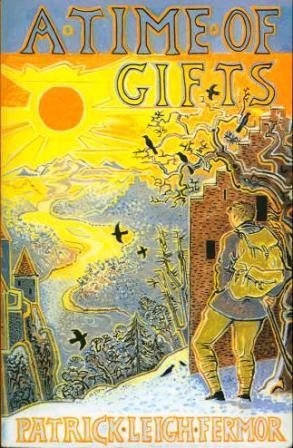
Colin Thubron recommends reading A Time of Gifts for 2012

A Time of Gifts, 1977

In the December edition of The Browser, Paddy’s good friend Colin Thubron talks about why A Time of Gifts remains one of this favourite travel books…

This is the first volume of Patrick Leigh Fermor’s journey in 1933-34 from the Hook of Holland, as he called it, to what he insisted on calling Constantinople [Istanbul]. It was to be in three volumes. This one takes him beyond Vienna. The second volume, Between the Woods and the Water, takes him through Hungary to the Balkans. The third volume was going to get him across Romania to Istanbul, but he never wrote it.

Like many people, I love the idea of this young 19-year-old gypsy going off on foot on his own, with just a pound a week, footloose and fancy free, full of delight at the world and fascination at where he’s going. That’s one of the lovely things about the book. It’s beautifully written, very rich prose. It’s model was Norman Douglas – rich in language, vocabulary, scholarship. It’s rather an acquired taste, and may seem old-fashioned to a younger generation.

I love the delight in everything, with all its byways in history or folklore, and the people he meets are so marvellously and generously described. He had such a big heart, a generous spirit. You feel he must have been a delightful companion for anyone to meet on the road. Some people find it a little bit showy-offy, because of all of the stuff he quotes as having by heart – but he did, it’s perfectly true. He had an excellent memory, and into his old age he was a great raconteur.

I know that you knew him quite well. Will you tell us about his character? He died not long ago of course.

Yes, he died [last June]. Well, he was what you would expect. In some ways, he was rather an innocent. He wasn’t an intellectual, but he loved facts and data and history and architecture. He also loved show, and a good story. He was a delightful companion, very funny, and he was a bit original. He would sometimes say something rather fanciful, he had a marvellous imagination. But there was this innocence about him.

It’s as if he was in a time warp, and in rejoining his youth in these two books he was rejoining somebody he still was, in a sense, his sensibility was so young. He hadn’t changed in many ways, he hadn’t been disillusioned. They are very “illusioned” books, if you like. It’s a very wonderful idea to go back to who he was, because he could so easily enter into the spirit of that liberated delight in the world which he kept with him always. He was very frail when he died, but he still kept that with him.

How does travel change a person? It’s a platitude that a physical journey is also an inner journey, but some platitudes are true.

I don’t know really. It’s supposed to broaden the mind. If I look at the travel writers I know and have known, there’s a certain breadth of knowledge. One would hope there’s a breadth of understanding or of sympathy too. Of course, it makes you a sort of amateur. You’re a free agent, you’re the oddball. One can understand why dictators find travellers a threat – you’re not beholden to anyone and you’re doing what you want, which is a marvellous privilege. But what it does to you character-wise, I don’t know.

The title A Time of Gifts comes from a line of poetry by Louis MacNeice …

“For now the time of gifts is gone / O boys that grow, O snows that melt.”

That certainly hints at growth of character.

Yes it does. This was his great extended epiphany, to be suddenly going out travelling. That was the time of gifts for him, when the world opened to him. He was obviously ready for it. He was always on the wrong side of authority in England, and he was expelled from school. He got into a rather posh artist society in London and he was enormously entertaining and fun, and very handsome as a young man. But he hadn’t travelled anywhere. So suddenly to loose yourself on the world was surely his time of gifts.

I love Leigh Fermor’s motto. Solvitur ambulando.

It is solved by walking

Chatwin and Paddy: In the Footsteps of Bruce Chatwin

The link between Bruce Chatwin and Paddy is very strong. They were good friends and Chatwin’s writing has often been compared favourabley with Paddy’s. When Chatwin stayed at Kadamyli he and Paddy often went for long afternoon walks in the Taygetos. This BBC Four programme about Bruce Chatwin’s life includes some significant sections with Paddy:

1. Talking about Bruce generally – programme 2 at around 2 minute 20 seconds.

2. Walking with Bruce’s brother and the scattering of the ashes near Kardamyli – programme 2 at around56 minutes 50 seconds.


My thanks to Thos Henley for sending this to me.

Related article:

Bruce Chatwin’s Journey to Mount Athos

£1 a week Hook of Holland to Constantinople: Where is Nick?

Since his departure on 9 December we have heard little from Nick Hunt. He did post a short piece describing his departure from Hook of Holland on his blog, but since then silence.

However, it appears that Nick is making good progress and on 28 December he was in Bingen near the end of the Rhine. It was here that Paddy celebrated Christmas 1933 staying with an innkeeper and his ‘pretty daughters, who were aged from five to fifteen …’ (A Time of Gifts p53 in the John Murray paperback). This is pretty good progress seeing as Paddy had earlier taken a trip on a Rhine barge.

Skip over to Nick’s blog to read about one of his first walking days in Holland.

Stop Press! – open the comments section of this article below to read a further update from Nick as he tells us a little more about his walk down the Rhine. He is now at Heidelberg .. the Red Ox beckons (ATOG p 56 if you are keeping up!).

A Year of Memory: the top ten posts on the Patrick Leigh Fermor blog

As the year comes to a close it is time to reflect upon what has passed and to look forward to 2012. I make no predictions for the coming year. There are some things which are almost certain such as the continuing Euro crisis and the much anticipated publication of Artemis Cooper’s authorised biography about Paddy, but forecasts tend to be overtaken by events and are quickly forgotten.

What we can do is to look back on this year in the life and times of Patrick Leigh Fermor. The major event of course was Paddy’s death on 10 June at the age of ninety-six. A sad event for his family and close friends, but also for those of us who admired him for his writing and the life he lived. As the year closed it was time to celebrate his life at his Memorial Service held on 15 December in London.

As I hoped the blog has become a significant source of material about his life including rarely seen video. There have been over 228,000 visits over the last year and you have made it a much more interactive experience by using the comment facility to exchange information, provide your own memories of Paddy, and to express your admiration for him. At the time of his death I opened a page where you could express your thoughts about Paddy which has run to over 120 comments.

Paddy would probably have been somewhat bemused by the whole idea of the blog, but perhaps even more so by the interaction we now have with social networking sites with nearly 4,500 visitors finding the site from Facebook, and 850 via Twitter.

To conclude the year, and as the 365th post on the blog, let us take a look at some of the most popular articles over the last twelve months. Perhaps I can make one promise to you all which is that there is much more to come on the blog in 2012 which includes a lot of material submitted by you the readers of the blog.

The Funeral Service of Patrick Leigh Fermor, 16 June 2011 

Paddy’s funeral service was held on a typical English summer’s day at his home in Dumbleton. He returned to England just one day before his death and is buried beside his beloved Joan.

Obituary from The Independent by Paddy Leigh Fermor’s biographer Artemis Cooper 

Perhaps the definitive obituary.

Patrick Leigh Fermor … This is Your (Ill Met by Moonlight) Greek Life 

The amazing video from the Greek TV programme which reunited the participants of the Ill Met by Moonlight kidnap including Paddy, many of the Andartes, and General Kreipe and his wife.

Anthony Lane’s New Yorker article on Fermor is now free to view 

One of the most comprehensive profiles of Paddy which is now freely available to all. (the pdf download appears to be no longer available – click on the article to magnify to read and then drag your cursor to move around the page)

Intimate portraits from Kardamyli by Miles Fenton 

A series of personal photographs sent to me by Miles Fenton who is Paddy’s nephew and who now lives in Canada where he works as an artist.

Patrick Leigh Fermor recounts the kidnap of General Kreipe on video 

The ever popular video where Paddy talks in some detail about the Kreipe kidnap. (press play on Battle of Crete 7).

Colonel David Smiley 

David Smiley was a fellow occupant of Tara in Cairo with Paddy and Billy Moss et al who continued his military career with some distinction after the war and even led Japanese soldiers in a charge against VietMinh rebels!

Paddy’s eye for detail: Ian Fleming, Bondage, James Bond and Pol Roger 

It is probably the James Bond/Ian Fleming association which maintains the popularity of this article.

If food be the music of love … Bánffy’s lover in Cluj (Kolozsvár) 

No list of popular posts can be complete without the compelling combination of my passions for Paddy, Romania, Miklós Bánffy, and Cluj.

Patrick Leigh Fermor Memorial Order of Service 

The order of service from the joyful occasion that was Paddy’s Memorial Service.

Finally I would like to thank so many of you for your encouragement and support during 2011, and wish you all a very Happy New Year!

Tom Sawford

John Murray – “Patrick Leigh Fermor’s final volume will be published”

It is interesting that twice in one week we have a story about the publication of Vol 3. Is this the result of the commencement of the long, slow cranking up of the marketing machine, or one story leading to another as journalists follow each other’s tails in a quiet week for news? What we do now appear to know is that John Murray are now officially commenting so there is some real substance to the old rumours. Let’s not forget that we have Artemis Cooper’s biography to look forward to this time next year.

by Alison Flood

First published in guardian.co.uk, Tuesday 20 December 2011

Patrick Leigh Fermor’s final volume will be published Long-awaited conclusion to revered account of walk across Europe set to come out in 2013

Readers stranded on the edge of Bulgaria since 1986 by the travel writing great Patrick Leigh Fermor are set to be rewarded at last with the third and final volume chronicling the late author’s European odyssey.

Leigh Fermor, who died in June aged 96, was the author of what his biographer Artemis Cooper described as “two of the greatest travel books of the 20th century”, A Time of Gifts and Between the Woods and the Water. They trace his journey on foot from the Hook of Holland to Istanbul at the age of “18 and three-quarters”, how he travelled “south-east through the snow into Germany, then up the Rhine and eastwards down the Danube … in Hungary I borrowed a horse, then plunged into Transylvania; from Romania, on into Bulgaria”, with the second volume, published in 1986, ending as he was about to cross the Danube from Romania into Bulgaria.

Leigh Fermor always promised a final volume, announcing in 2007 that he had even bought a typewriter and was learning to type in order to complete it. “I’m going to finish that book,” he said. “I’m going home and I’m going to work really hard.”

His publisher John Murray has now announced that it will publish the final volume in 2013, drawing from Leigh Fermor’s diary at the time and an early draft of the book he wrote in the 1960s.

“His devoted readership have been stuck midstream, as it were, for over 20 years. A painstaking perfectionist, Leigh Fermor never did finish the final volume though he was working on it up to his death in June 2011,” said Cooper, whose biography of the author will be published in September 2012. “Based on the original diary he kept at the time and an early draft of the book written in the 1960s, this book takes up the story, and carries the reader to Constantinople and beyond.”

Roland Philipps, managing director of John Murray, called it “a treat to be back, immersed once again in this great pre-war walk across Europe”. It is “wonderful for his many admirers that this book will be published,” added Murray.

Why the lowly shepherd is the one who gets to hear the angels

Remembering honourable lives helps us understand the birth we celebrate on Christmas Day.

by Charles Moore

First published in The Telegraph 24 December 2011.

Tomorrow we celebrate the most important birth in human history, so forgive me for writing about a funeral and a memorial service.

Both occurred in this Christmas season. The memorial service, in St James’s, Piccadilly, was for Sir Patrick Leigh Fermor. Paddy, as all his friends knew him, was a man of unique distinction and unique charm. He won the DSO in the Second World War for his part in the celebrated kidnap (filmed with Dirk Bogarde in Ill Met by Moonlight) of the German General Kreipe in occupied Crete. He became famous as a writer. His best-known books, A Time of Gifts and Between the Woods and the Water, describe his slow walk from the Hook of Holland to Constantinople, begun in December 1933 (he spent Christmas that year in Bingen, in newly Nazi Germany) and not completed until January 1, 1935. His prose, at once romantic and scholarly, ornate and exact, could have no successful imitators, but it has tens of thousands of fans.

In his life as well as his writing, Leigh Fermor was, though he would have disliked the phrase, a role model – brave, handsome, witty, multi-lingual, widely and deeply read, a gifted singer, reciter and drinking companion, a traveller in exotic places, a man who gave delight. When he died, aged 96, this newspaper’s obituary described him as “one of the few genuine Renaissance figures produced by Britain in the 20th century”.

The funeral, the week after Paddy’s service, was for Tony Woodall. Tony was a woodman and neighbour of ours in Sussex. Unusually for a rural family in the South East, the Woodalls are Catholics (I am told there was an Irish grandmother in the case). Every Sunday at our Catholic church, Tony would pull a surplice over his open-neck shirt and frayed working trousers and serve, his huge hands carefully placing the chalice and the patten on the altar. He would ring the little altar bells with a shake as strong as that of a dog with a rabbit. At the intercessions, where people are invited to propose further prayers, it was most commonly Tony who did so. He tended to ask us to pray for people who might not be automatically popular, such as Myra Hindley. His compassion was radical, and universal. He never stopped working. He dropped dead outdoors a couple of weeks ago, aged 79.

Tony Woodall was not known beyond his small corner of rural England, but, like Paddy, he commanded people’s love. The church where he served fits only 120 people, but 200 came to the funeral and many had to stand outside. It fell to me to help flank the hearse as it arrived, trying (and failing) to hold up a candle without it blowing out. I had to pick my way to my place through wild-haired countrymen wielding chainsaws. As Tony’s wicker coffin was lifted up and carried into the church, the saws, by way of tribute, roared into synchronised action.

Both men’s services did justice to the person commemorated. In the case of Paddy Leigh Fermor, there were readings in four languages. Robin Lane Fox read Horace’s Ode 1.9. These were the lines which Paddy heard his prisoner General Kreipe reciting to himself as they watched the cold dawn break over Mount Ida in May 1944 (“See how resplendent in deep snow Soracte stands…”): Paddy knew the Latin words and completed the recitation, forming a bond between enemies. William Blacker chanted a Romanian ballad. Then John Julius Norwich and his daughter Artemis Cooper led us in one of Paddy’s specialities – his own translations of English songs into comically unsuitable foreign tongues. “Do ye ken John Peel, with his coat so grey?” became “Conosce Gian’ Peel, con sua giacca tanta griggia?”

The gospel was from Luke 12: “…take no thought for your life, what ye shall eat; neither for the body, what ye shall put on. The life is more than meat, and the body more than raiment.”

At Tony’s funeral, the gospel was Matthew’s account of the Beatitudes, the list of those who are blest for their meekness or mercy, poverty of spirit or purity of heart. Of them Jesus says: “Ye are the salt of the earth.”

Tony’s son John spoke to us. He remembered the night of the Great Storm of 1987, when he was 10 years old. At two in the morning, Tony came into his bedroom, grasping a chainsaw. “I’m going out,” he told him, “to saw up these trees that are falling and blocking the way. If the roof blows off, come and get me.” A tree fell on his arms that night, but he kept on sawing.

John recalled his father’s goodness, which included caring for his permanently sick wife. “Crikey,” he said, “if only more people were like Dad, I reckon the world would be a hell of a better place. Pardon my language.”

We more than pardoned it, of course. “Thank you for coming,” he said, “You are all honourable men and women.” Whether we were or we weren’t, we felt a renewed confidence that the old-fashioned word had meaning: it was shown in the life of the dead man.

The Romanian ballad recited at Paddy’s memorial service is called the Mioritza. It concerns a shepherd about to be murdered by rivals. He instructs his ewe-lamb, who has the gift of speech, to tell others no word of his death. She must tell them only that “I married tonight a king’s daughter”: “At my wedding, tell/ how a star fell,/ that the sun and the moon were holding our crown,/ how the guests at the feast/were maples and firs”.

At Tony’s funeral, when John had spoken, he moved from the lectern. Just as he was about to rejoin the congregation, he stopped by his father’s coffin. “That evening,” he said, “I stood at the spot where Dad had died. The moon was up, and I saw a firework. But then I realised it wasn’t a firework, because there was no noise. It was a meteorite. I thought: ‘That was Dad.’ ” He went back to his place.

Paddy Leigh Fermor wrote that he loved the Romanian ballad because “its magic lies in its linking together of directness and the tragic sense, its capture of the isolated feeling that surrounds shepherds and the forlorn exaltation that haunts their steep grazings and forests”.

After a life well lived, we can all look back on it with that directness, especially when we attend services such as these. As if from those “steep grazings”, we can see the life laid out, shining plain. We may forget that, for the people who lived it, it often did not seem plain at all. As we sang at Tony’s funeral: “Through many dangers, toils and snares,/ I have already come.” The achievement of something grandly simple is an endlessly complicated process, a lifelong work of trial and error.

Anyway, as I said at the beginning, tomorrow marks a birth, not a death. Another Telegraph obituary, this one of the 7th Earl of Yarborough, related how, at his village carol service, he read the lesson about the shepherds deserting their flocks to see the baby in Bethlehem. “I’d just like to say,” he told the startled congregation, “that if these men had been my shepherds, I’d have sacked them.” One must be glad that the earl was not present 2,000 years ago. The shepherds were the best people to receive the message of the angel. With their linking of “directness and the tragic sense”, they understood what the strange birth would mean.

Visionaries Who Changed Our World

This review is apparently about ‘the minds we will miss’ and actually it is pretty good. It starts with a picture of the recently departed Peter Hitchens. I am not sure about – “They opened doors, blazed trails, and left us all too soon.” – the left us too soon part is perhaps not something we can truly say about Paddy but the sentiment is well understood. It also has a link directly to the blog.

Patrick Leigh Fermor

Ulf Andersen / Getty Images from Newsweek.

Travel Writer, 96

He was a rare blend, penning some of the most memorable travel books of the 20th century and capturing a Nazi commander in Crete. Leigh Fermor related his adventures—watching a voodoo ceremony in Haiti, living with Trappist monks—in dazzling prose with a deep pathos for every place he visited.

Final volume from Patrick Leigh Fermor

The latest snippet about Vol 3 from The Bookseller.

John Murray is to publish a posthumous book by travel writer Patrick Leigh Fermor, who died in June [Edit – the article says July – good research!!].

by Benedicte Page

First published in The Bookseller, 16 December 2011

The book will complete the story of the journey Leigh Fermor made on foot from the Hook of Holland to Constantinople at the age of 18, as told in his previous works A Time of Gifts and Between the Woods and the Water. The currently untitled volume will be published in September 2013.

Artemis Cooper, whose biography of Leigh Fermor will be published in September 2012, said: “By the end of the second volume, he was about to cross the Danube from Romania and plunge into Bulgaria; and his devoted readership have been stuck midstream, as it were, for over 20 years. A painstaking perfectionist, Leigh Fermor never did finish the final volume though he was working on it up to his death in June 2011.”

Based on the original diary he kept at the time and an early draft of the book written in the 1960s, this book takes up the story, and carries the reader to Constantinople and beyond.

John Murray m.d. Roland Philipps said: “I was told of the existence of a manuscript on the day that Sir Patrick died in June of this year, and read it shortly afterwards. It is a treat to be back, immersed once again in this great pre-War walk across Europe and wonderful for his many admirers that this book will be published.”

The publisher describes Leigh Fermor as “one of the outstanding prose stylists of modern time”.

Patrick Leigh Fermor Memorial Order of Service

The memorial service that took place on 15 December at Saint James’s, Piccadilly was a moving tribute to Paddy, whilst at the same time being a tremendous celebration of his life, and the music, poetry and people that he loved. The order of service is here for you to see.

If there has to be a highlight it was John Julius Norwich and his daughter Artemis Cooper singing versions of D’Ye Ken John Peel and Widdecombe Fair translated into Italian by Paddy. After this Lord Norwich gave a lively and affectionate Address about his good friend of over fifty years.

Artemis has to be congratulated for organising such a successful memorial service which gave a nod to Paddy’s boyhood by including the excellent Crypt Choir of King’s School Canterbury.

There was a final message to us all from Paddy himself:

“Love to all and kindness to all friends, and thank you all for a life of great happiness” – Patrick Leigh Fermor

Let’s celebrate a full life, and one well lived

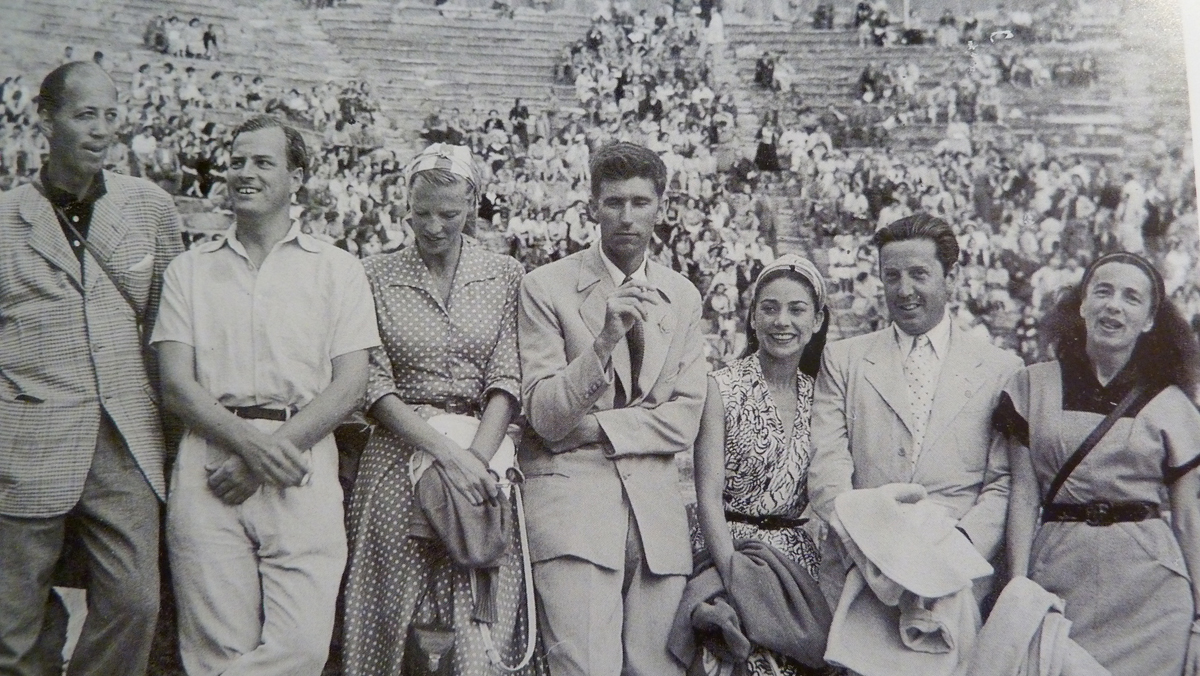
From left: Tom Fisher, Paddy, Joan , John Craxton, Margot Fonteyn, Frederick Ashton and Ruth Page. Photo: Costas Achillopoulos in Ian Collins’ book on the life of John Craxton

Today we can celebrate the memory of Patrick Leigh Fermor, whether we attend his memorial service in London, or are just able to take a moment to reflect on all he gave to his family, his many friends, to us his admiring readers, and of course his service to his country and to Greece.

I thought the best way to mark this day on the blog is to feature this fine photograph sent to me by John Chapman. It is from Ian Collin’s book about the life and work of John Craxton, the artist who illustrated most of Paddy’s book covers.

John tells me that Craxton “met Joan in wartime London years before he met Paddy, but became enamoured of Greece and for a large part of his life lived in Chania, Crete. It was both an escape from dull northern climes and a chance to express his sexuality.”

Craxton designed the sets for Daphnis & Chloe at the Royal Opera House in 1951 where the lead ballerina at the time was Margot Fonteyn. According to rumour they had an affair, and in the summer of 1951 they cruised together around the Meditterranean. Paddy was their guide to Greece, and it was at this time that this delightful photograph was taken which shows Paddy looking very happy, with good friends, and his much loved Joan.

The photograph shows Tom Fisher (a New York attorney and husband of Ruth Page) Paddy, Joan, John Craxton, Margot Fonteyn, Frederick Ashton and Ruth Page (choreographer). It was taken in the theatre at Epidavros, and is attributed to Costas Achillopoulos.

The It girl and the war hero

A young and beautiful Debo

What the trigger-happy, book-hating Duchess of Devonshire said to Patrick Leigh Fermor

Kate McLoughlin

From The Times Literary Supplement November 26, 2008

Deborah, Dowager Duchess of Devonshire – known as Debo – was the youngest of those prototype It girls, the Mitford sisters; in faint and possibly euphemistic praise, the editor of this book of letters, her niece-by-marriage Charlotte Mosley, also describes her as “the most well-adjusted”. In this collection of letters, Debo comes across as jolly, plain-spoken and, where animals are concerned, murderous, her gun having taken her “from Sussex to Devon, from Anglesey to Norfolk and home via Northumberland”. Debo tends Chatsworth (the Devonshires’ stately home in Derbyshire), which she endearingly refers to as “the dump”, and engages in country pursuits. When asked by President Kennedy what she does all day, she admits she is “stumped”. A disarmingly simple soul – “I now prefer horse shows to lovers & I’ve never liked drink” – the Duchess is at her best on varieties of gooseberry and rare breeds of cattle. A running joke in this correspondence is her anti-intellectualism in general and antipathy to reading in particular. Invited to a literary lunch in Leamington Spa, she plans to tell her audience, “BOOKS how I hate them – as an avid non-reader it is awful to have added to their number”. The reader of her letters may be forgiven a wry smile.

The recipient of the Devonshire dispatches is Patrick Leigh Fermor (known as “Paddy” and occasionally “Whack”): war hero, author of travel books such as The Traveller’s Tree (1950), Mani (1958), A Time of Gifts (1977) and Between the Woods and the Water (1986), and the recipient of many honours, including a knighthood for services to literature and Anglo-Greek relations. During the Second World War, he was posted to Crete to support the local Resistance and led the successful abduction of the German commander on the island, an exploit that earned him the DSO and was later filmed as Ill Met By Moonlight (1957). Fermor attends the making of the movie and is enchanted when Dirk Bogarde portrays him as “a mixture of Garth and Superman, shooting Germans clean through the breast from a dentist’s chair, strangling sentries in an offhand manner”. From his letters, Fermor emerges as charming and whimsical, with a delightfully childlike imagination offsetting an annoyingly schoolboyish sense of humour. Still entranced by what he calls in A Time of Gifts “the glamour of fairy stories”, he hears the sea roar “like angry lions at feeding-time”, sees hills crowned with “tea-cosies of mist”, watches blackbirds mass “as if someone had rashly opened a pie”. In the best of his travel writings, Fermor combines a similar sense of wonder with local colour, an eye for ridiculousness (including his own) and vivid description in rangy sentences remarkable for their buoyancy. There is little of this soaring prose here: although some lengthy descriptions of travel are included, Fermor is reduced to telling his reluctant reader which passages she may skip.

Fermor and the then Deborah Mitford first met at a regimental ball in 1940. They bumped into each other at parties from time to time over the next decade but the first letter in this collection is a six-liner dated March 21, 1954, from Debo, now married to Andrew Cavendish, eleventh Duke of Devonshire, to Paddy saying that she hopes he will come and stay with them at Lismore, their house in Wexford. This sets the tone for the correspondence to follow: invitations are extended and accepted, thank-you notes are then sent. Too intermittent, the letters are unsatisfying records of festivities long finished. Although Charlotte Mosley claims to have excised plans for meetings, reports on health, grumbles about the weather and the slowness of the posts, the weeding out has not been thorough enough.

Another of Mosley’s claims in support of the correspondence is that the participants are indifferent to politics. It is difficult to decide whether this indifference is another instance of charming whimsicality or just unforgivable negligence. The exchange of letters is too sporadic to allow for political themes to be developed at length, but politics are not entirely absent. Andrew Cavendish was Harold Macmillan’s nephew-by-marriage and served in his government, later becoming an early member of the Social Democratic Party.

In 1958, with Macmillan a year into office, Debo “talks secrets with the PM” and finds it “most jolly and educational”. Much later, John Major “exudes goodness”, Tony Blair is “the wretched little Prime Minister”, Cherie “frightful”, and John Prescott “looks like a bare-knuckle fighter . . . from the East End”. This animosity may have been partly caused by the hunting ban, brought into force by the New Labour government in 2005, and the slaughter of livestock following the outbreak of foot-and-mouth disease. In their strongest expression of political feelings, Paddy calls the passing of the anti-hunt bill “a day of mourning” and Debo describes the cull as “truly ghoul”.

These references apart, the correspondence is largely devoted to the dramatis personae of high society, mostly long-gone minor aristocrats about whom Mosley provides rather more information than necessary in her footnotes. The Queen Mother, whom Debo calls “Cake”, having been lastingly impressed by her enthusiasm at a wedding when the cake was cut, puts in a few appearances, memorably crying “Oh God” and making a dash for the Royal Box when the conductor unexpectedly strikes up “God Save the Queen” at an opera gala. Princess Diana visits Chatsworth and Debo is stuck for what to give her to eat “as she prefers the fridge to the table, I’m told”. In other sly thrusts, Jackie Kennedy’s face “is put together in a very wild way” and Somerset Maugham’s is “so discoloured and green that it looks as though he has been rotting in the Bastille”.

Old age arrives suddenly for the correspondents – the long gaps between the letters mask the passing of time – but they sound the same as ever, still playing with the same phrases (“I freely admit” is one of Debo’s, much repeated by family and friends), the nicknames (Nancy Mitford is “the Old French authoress” and “the Ancient Dame of France”), the in-jokes (Debo’s supposed illiteracy), still “v v excited” about things or finding them “frightfully good”. Their lack of self-pity as they age is impressive and appealing; there are jokes about failing eyesight and “Dr. Oblivion” but, even though they have reached the stage in life when Paddy is constantly writing obituaries, they maintain good cheer. Twenty-first-century life fails to disconcert them. “There are marvellous entertainments called car-boot sales”, writes Debo. “You can buy a Rembrandt for a few quid in any old field. So why not sell a few?”

Did they love each other? Debo is “funny, touching, ravishing and enslaving”, Paddy tells mutual friends. In a letter of 1957 he rebukes her: “I wish you didn’t love everyone else more than me – it wouldn’t matter if I didn’t rather love you, as I suppose I do, otherwise I wouldn’t feel so selfish and possessive [. . . .] I do adore you”. His adoration is clear in his letters, which outnumber Debo’s: he chides her for not writing often enough, he delights over her average prose, he sends her long travelogues that she replies to with short letters about gooseberries. But her fondness and admiration for him are also evident, and a photograph in the volume of them aged ninety-three and eighty-eight shows a pair close together but not touching: a couple of old friends.

In one of her letters to Paddy, Debo marvels that the University of Texas has paid $10,000 for her sister’s papers: “They’ve got all Evie [Waugh]’s stuff, & Osbert [Sitwell]’s, & letters saying things like ‘Arriving on the 2.14 on Saturday so much looking forward to seeing you’ are put under glass and revered”. Similar feelings are induced by In Tearing Haste. The volume diminishes its subjects by preserving their off-the-cuff remarks and, in Fermor’s case, prose that does nothing to suggest that his finest writing is spectacular. It is good to know that the two are corresponding still, but it might be for the best to save their last letters for their own private pleasure.

£1 a week to Constantinople – Bon Voyage to Nick and Nice Weather for Young Ducks

Paddy does not say if his last night in London before his epic journey was as busy as it was on Wednesday as Nick Hunt gathered with some friends in Shepherd Market to wish him well on his epic journey, but seventy-eight years ago today our hero, and let’s not be ashamed to say it, our hero, Patrick Leigh Fermor celebrated his last night in London as just another under-achieving public schoolboy, setting out to emulate Robert Byron, from this untouched corner of old London, which is now the haunt of hedge fund managers and buccaneering chief executives of junior mining companies; London clay brick Georgian squeezed into some of the highest priced real-estate in the land.

A new endeavour is about to start as Nick sets off on Friday to walk across the New Europe just as it is probably about to undergo the most significant peacetime turmoil since the rise of Nazism in the 1930’s into which Paddy stumbled with only a few links to ‘civilisation’ to accompany him, including his copy of Horace’s Odes.

Frankly I am as envious as I can be. Who could not wish to spend time away from the demands of today’s ever connected world? To endure physical challenges whilst encountering architectural marvels and meeting interesting people, each with a unique story to tell. It could well be the journey of a lifetime and I hope I send Nick off with all your best wishes. He has mine.

The weather today is better than that encountered by Paddy as he set out ….

The weather in London on December 9th 1933 was typical. The sky darkened, the clouds lowered and then it rained hard. A young man walked the cold pavements towards Cliveden Place to collect a rucksack that his friend Mark Ogilvie-Grant had used on a journey to Mount Athos accompanied by Robert Byron. After stopping to buy a stout ash stick, and probably some cigarettes, at the tobacconist on the corner of Sloane Square, the young man collected his new passport – occupation ‘student’ – from the office in Petty France. He cast his eyes up to the ominous clouds and then made his way quickly north across Green Park. Now the rain splashed down as he dashed between the traffic on Piccadilly and entered the house of his landlady, Miss Beatrice Stewart, in Shepherd Market.

A former model who sat for Sickert, and Augustus John, and who is said to be the model for the bronze figure of Peace atop Wellington Arch, Beatrice Stewart’s career was cruelly cut short after she lost a leg in a road accident. She had arranged a lunch for the eighteen year old Patrick Leigh Fermor and two of his friends to wish him bon voyage before the start of what was to become one of the most famous journeys of all time, and certainly the longest gap year in history.

After lunch, Paddy said thank you and goodbye to Miss Stewart, and jumped into a waiting taxi, which drove off through Mayfair, around Trafalgar Square, up Ludgate Hill, and past the Monument towards the Tower of London. It was raining so heavily that all they could see out of the steamed up windows were hordes of umbrellas, some carried by bowler hatted men, as the rain splashed down in the dark. “Nice weather for young ducks.” said the taxi driver as he dropped the small party by the first barbican on Tower Bridge.

The two companions, one a young girl wearing a mackintosh over her head like a coal shifter, stood in the rain to watch Paddy descend the stone steps down to Irongate Wharf. With a final wave, he strode up the gangplank of a Dutch steamer bound for Hook of Holland.

This was the start of Paddy’s journey down the Rhine and along the Danube which he so memorably describes for us in his book A Time of Gifts. This part of the story ends on Easter Sunday 1934 as Paddy stood on the long bridge over the Danube, in no-man’s land, between Czechoslovakia and Hungary at Esztergom, just as the Easter celebrations started in earnest.

A Time of Gifts is almost universally acknowledged as a masterpiece of English literature; Sebastian Faulks is a dissenter, but he would be. Described by some as a travel book, it is essentially the journal of a young man with a superb gift of memory, for languages, and for making friends, written with the benefit of a lifetime of amazing experience and learning, forty years after the events it describes. It is embellished by anecdotes and essential historical background, making it a rounded piece of literature and no mere travelogue. It should be compulsory reading for all seventeen year olds; it is truly inspirational. The sad part is that the very reason for the ending of Paddy’s ‘gap year’ whilst with his lover Balasha Cantacuzene in Romania in September 1939, resulted in the destruction of many of the towns and cities he passed through, and certainly ended the way of life of the peoples of Europe that he describes so well.

I have no doubt that today, were Paddy still with us that he would pause for a while to recall that day, wish Nick all the best, and reflect on the events that followed during his amazing and full life, and the friends and lovers who have gone before him.

Perhaps Sir Patrick Michael Leigh Fermor DSO OBE, who was the Greatest Living Englishman, would pen a short letter to Debo?

Snail’s pace to Byzantium: journey of a lifetime

This is a combination of profile and review of Words of Mercury. An interesting piece.

by Ann Elder

First Published in Athens News, 9 Jan 2004

“I HATE the word travel-writer,” London-born, Mani-based Patrick Leigh Fermor told a British journalist in 1995. Under the title Words of Mercury, a selection of his writings was published by John Murray this autumn. The excerpts from half a dozen of his books, some articles and reviews show clearly why he must flinch from being slotted anywhere confining.

As his followers know, he writes with an enchanted pen. Any topic he takes up becomes something ‘rich and strange’. He has a story-teller’s knack of compelling interest, like the Ancient Mariner mesmerizing listeners with his glittering eye. And he has a particular flair for catching the heightened receptivity and visceral thrill felt at new encounters, what Cavafy wished the traveler in his poem Ithaka:

Pray that your journey may be long,
that many may those summer mornings be
when with what pleasure, what untold delight
you enter harbours never seen before.”
(Kimon Friar translation)

Not least, Leigh Fermor wins readers’ allegiance by creating the sense of affinity with an engaging personality, uncensorious, untinged by chauvinism, reveling in life, akin in spirit to A E Housman, onetime professor of Latin at Cambridge, in his lines:

Could man be drunk forever
With liquor, love or fights
Lief should I rouse at mornings
And lief lie down at nights.

Edited by Artemis Cooper, a writer (Cairo in Wartime) and wife of historian Antony Beevor (Crete: The Battle and the Resistance), the book has five parts: travel, Greece, people, books and flotsam (finishing with a poem on Christmas maybe better forgotten). Cooper gives brief introductions to each piece and starts off with a succinct biography.

As an 18-year-old living on a pound a week in a flat off Picadilly in 1933, Leigh Fermor spent more time partying than buckling down to write. As fate had it, he had read The Station: Athos: Treasures and Men by the irreverent young Robert Byron in 1928. The ‘great and misunderstood spirit of Byzantium’ had greatly impressed him.

“About lamp-lighting time at the end of a wet November day, I was peering morosely at the dog-eared pages on my writing table,” he related later. “A plan unfolded – to set out across Europe like a tramp – a pilgrim or a palmer, an errant scholar, a broken knight.”

“The chief destination was never in a moment’s doubt. The levitating skyline of Constantinople pricked its sheaves of thin cylinders and its hemispheres out of the sea-mist; beyond it hovered Mount Athos; and the Greek archipelago.”

In excess of his wildest dreams, he found material to write about. All was grist to his mill, but his mill ground slowly. His writing proved to require long gestation. He became fanatical about polishing his product, and research, the more obscure, the more it seemed to appeal to him, like the origins of the Sarakatsans or the Laz-speaking Greeks of Trebizond. The first book about his venture, A Time of Gifts, came out in 1977, over 40 years later, and the second, Between the Woods and the Water about “those mysterious regions between the Vienna Woods and the Black Sea” as Saki put it – in 1986. In France they called him “l’escargot (the snail) of the Carpathes.”

Real life and events also delayed his writing. The trek took him about a year. He reached his goal on New Year’s Eve, 1934, after ending his traverse of Bulgaria with a splash, falling into the Black Sea on a cold December evening. He came to the coast some 150 miles north of the Bosphorus. “An old man was smoking a narghileh on the doorstep of a hut beside a little boat beached among the rushes – a Tartar fisherman, the only human being I saw all day,” he  wrote over 20 years later in an article in the May 1965 Holiday Magazine.

Darkness fell. “I lost my footing on a ledge and skidded – waist-deep into a pool. Jarred and shaken, with a gash on my forehead and a torn thumb, I climbed out, shuddering with cold. At the bottom of the pool, about two fathoms down, my torch was sending a yellow shaft through sea anemones and a flickering concourse of fish.”

Crawling round the rocks, he came to a veritable Cyclop’s cave sheltering a dozen Greek fishermen and Bulgarian goatherds with their 50 goats and cheese-making apparatus, eating lentils by a thornbush fire. The young wayfarer was soon dried and warm, tossing back slivovitz and eating fresh fried mackerel.

Leigh Fermor is in his element in the climax of this thoroughly Homeric episode, when one of the Greeks, Costa, turns out to be an unsung Nijinsky, his dancing invested with a ‘tragic and doomed aura.’ He performed the stunt  with which Greek cruise ships like to wind up their Greek night shows: dancing with a table between the teeth.

“On a rock, lifted there to clear the floor, the low, round, heavy table was perched. Revolving past it, Costa leaned forward: suddenly the table levitated itself into the air, sailed past us, and pivoted at right angles to Costa’s head in a series of wide loops, the edge clamped firmly in his mouth and held here only by his teeth. The dancer whirled like a dervish, till the flying table melted into a disc, finally returned to its rock, glasses, cutlery, lentil pot and cigarette burning on the edge of a plate undisturbed.”

Time in Greece he dates from his 20th birthday, February 11, 1935, when he arrived at Mt Athos as ‘snowflakes were falling fast’ and ‘in deep snow, trudged from monastery to monastery.’ In Athens later, he frequented the  Romanian embassy, meeting descendants of Phanariot hospodars, Ypsilantes, Ghikas and Cantacuzenes. As with Greece, he fell in love with Balasha Cantacuzene whose forebear, Emperor John Vl, invited the Seljuk Turks to  Europe (and is recalled sorrowfully in a Cavafy poem for having coloured glass not jewels in his coronation crown).

After time writing and painting in an old mill among the lemon groves overlooking Poros, they went to her decaying family estate in Moldavia. Published in 1961 was a perfectly pitched account of a picnic in sunlit  countryside by open carriage and on horseback on September 2, 1939, the last day of peace. “It had been a happy day, as we had hoped, and it had to last us a long time, for the next day’s news scattered the little society for ever.”

Utterly desolating is the Daily Telegraph weekend magazine article of May 1990 on his first breaking through the Iron Curtain in 1965. He found the Cantecuzene sisters in a Bucharest attic eking out a communist state pension  teaching. The gracious old houses he had stayed in among flowery meadows and nightingale-filled woods were psychiatric hospitals, their owners dead.

Leigh Fermor seems happiest gilding the past, writing to ‘the brave music of a distant drum,’ as old Khayyan put it, not dwelling on ‘bitter furies of complexity’ or ‘that gong-tormented sea’ of Yeats’s “Byzantium” which he refers to at the outset in Time of Gifts. The days of his youth were the days of his glory and he evokes them with zest, if no doubt some selective memory. He admits he is beset with ‘retrogressive hankerings,’ but these add to the richness of the embroidered prose dazzling his readers, to twist Yeats a bit. And sometimes he might be shoulder-to-shoulder with the poet:

Of all Arabia’s lovers I alone
Nor dazzled by the embroidery, nor lost
In the confusion of its night-dark folds,
Can hear the armed man speak.

His review of Edmund Keeley’s Cavafy’s Alexandria in a 1977  Times Literary Supplement (TLS) shows him at his serious best. He recalls “the blacked-out, jolly, rather wicked wartime port” he knew as a young British World War Two agent, then is off with Cavafy into the Judaeo-Hellenic Franco-Levantine city “old in sin, steeped in history, warrened with intrigue.”

He notes the depths of irony and dark humour in the notion of citizens aghast with consternation when the barbarians fail to invade them on cue. He ponders “the jagged Ithaka at the long Odyssey’s end; the imminent Ephialtes ready to sell the Thermopylae of the spirit.” He goes on: “Issued without preamble from an atmosphere of earthly delights these warnings sound as harsh, for a moment, as the words of Mercury after the songs of Apollo at the end of ‘Love’s Labour’s Lost.'”

Leigh Fermor is a mild Mercury though. In a review of Oxford classicist CM Bowra’s Primitive Song in a 1962 Spectator he commends him for eschewing ‘a softer technique, swaying to the seductions of every coincidence  and historical chance-shot.’ He himself tends to yield to the tempting vistas of ‘alluring byways.’

The selections from his writings on Greece include a report he wrote for London’s Imperial War Museum archives in 1969 on how the German commander General Heinrich Kreipe was abducted by a Cretan-British force he led in April 1944. While still controversial, the coup makes a cracking good story.

At Anoyeia where captors and captive rested, villagers were ‘convulsed by incredulity, then excitement and finally by triumphant hilarity. We could hear running feet in the streets, shouts and laughter. “Just think, we’ve stolen their General!”‘

Heading south round Psiloritis – Mt Ida of antiquity, over 2,200 metres high and snow-covered till late May – the getaways were to meet a British vessel on the coast to spirit them to Egypt. After a night in a shepherd’s hut sharing  one blanket, “a brilliant dawn was breaking over the crest of Mt Ida which we had been struggling across for two days. We were lying smoking in silence, when the General, half to himself, slowly said (in Latin): ‘See, how it stands, one pile of snow’. I was in luck. It is the opening line of one of the few odes of Horace I know by heart. I went on reciting where he had broken off (likewise in Latin);

‘neath the pressure yield
Its groaning woods; the torrents flow
With clear sharp ice is all congealed.
Heap high the logs, and melt the cold,
Good Thaliarch; draw the wine we ask,
That mellower vintage, four-year-old,
From out the cellar’d Sabine cask.

(Conington’s translation)

The stanzas are much-loved, ‘a picturesque Christmas card,’ say scholars. They evoke the perfect ambience in which to peruse the book. Those unfamiliar with Leigh Fermor will surely have appetites whetted for more. Those who know him and have his books around will dash for them to locate the extracts, then hotly debate the choices, such as the punning Achitectural Notes from a 1994 Spectator: “If you squinch, aisle screen,” and “Put those Saxon  here Norman,” and “Overhung? Per apse, when dais done.”

The author has covered himself. “Pure nonsense is as rare among the arts as an equatorial snowdrop”, he wrote in a review of George Seferis’s Illustrated Verses for Small Children in a 1977  TLS.

Reminder! Patrick Leigh Fermor: An Appreciation by Alexander Maitland, FRGS

The lecture postponed from October will be given by Alexander Maitland and takes place on Monday 12 December starting at 2.30 pm.

Tickets: free to RGS-IBG members and educational users. Non-members: £5 payable in advance. Venue: Education Centre, Lowther Lodge.

Pre-booking required: Telephone: 020 7591 3044 Email: showcase@rgs.org

When: Mon 31 October 14:30 – 16:00 London

Where: Education Centre, Royal Geographical Society (with IBG) 1 Kensington Gore London SW7 2AR (map). Exhibition Road entrance.

More details here.

Christmas reading as recommended by Paddy – James Knox’s biography of Robert Byron

In 2003 Paddy recommended James Knox’s biography of Robert Byron in the Spectator’s Christmas book selection. It is still available from Amazon. Maybe some of you will add it to your letter to Santa for this year.

by Patrick Leigh Fermor

James Knox’s biography of Robert Byron (John Murray) is a book we have been waiting years for, and it surpasses all expectations.

Outside strictly academic circles, in the early 20th century Byzantium was little known in England, but after the Great War things began to change. In the 1920s and ’30s, there was Steven Runciman at Cambridge and, at Oxford, Robert Byron. His was the Brideshead generation. How they managed between corks popping all day and parties all night to do more than hunt for Victorian china fruit in the afternoon remains a mystery.

In the heart of this chaos, fervent extra-curricular study was at work. Abstruse historical byways were trailed and notebooks were filled up. Byzantium was the goal, and soon, in his early twenties, Robert Byron, with several of his friends, set out on corroborative journeys, and on return published his findings. Europe in the Looking Glass — a sort of pan-European Three Men in a Boat — was soon to be followed by the brilliant Byzantine Achievement. The magic of Byron’s name opened every door in the Greek world, and The Station, a monumental and marvellous description of Mount Athos, remains unsurpassed. The Birth of Western Painting — an analysis and history of the earliest Byzantine inklings to the last of El Greco — is a defence and an assault. Classical Greece and the Renaissance both get it in the neck; so do Western Christianity and the Crusades, especially the Fourth. Some of his Quixotic giants turned out to be windmills, but much good was done and Byzantium emerged in glory. Youthful flair and high sophistication marked all his writings, and recondite knowledge was leavened by the surprising bonus of a hilarious narrative gift.

There’s a connecting chain running through all his travels: India, Afghanistan, Persia, Tibet, Russia; then he would bury himself in Savernake Forest for a winter of writing and hunting, setting out eastward again in spring. We are lucky to have James Knox to set down the details of this dynamic and many-sided figure, with his energies and angers and his unorthodox passions and his laughter.

In 1941 Byron was heading east again by the northern detour when a U-boat torpedoed his ship. He was 36. We can never know how many brilliant sequels to The Road to Oxiana were sunk off Stornoway.

Patrick Leigh Fermor’s complete SOE file now on-line

I am very pleased to be able to present the complete SOE file of Patrick Leigh Fermor which was released to the public in August 2011 by the National Archive at Kew. My thanks go to Steven Kippax who is an SOE historian for gathering this information.

Click on the image to go to the new page which is in the Photographs section.

Sir Patrick Leigh Fermor – Memorial Service

A reminder that Paddy’s Memorial Service will be held at St James’s Church, Picacadilly at 11.00 am on Thursday 15 December 2011.

You are advised to arrive early. Map.

Obituary Nikos Hadjikyriakos-Ghikas (Nikos Ghika)

From the left: Nikos Hadjikyriakos-Ghikas, John Craxton, Barbara Hutchinson-Ghika, Patrick Leigh Fermor, Lydia Aous, 1958

by John Craxton

First published in The Independent Wednesday, 7 September 1994

Nikos Hadjikyriakos-Ghikas (Nikos Ghika), artist: born Athens 26 February 1906; Hon RA 1986; married 1961 Barbara Warner (nee Hutchinson; died 1989); died Athens 3 September 1994.

It was in 1945 that Peter Watson, the owner and art editor of Horizon magazine, asked me to look at some photographs of paintings by a Greek artist which had just arrived through the post. I remember well our enthusiasm for their freshness, clarity and strength. Their subject was inspired by houses in Hydra, the geometry of which was full of Mediterranean light. The style was a revitalised Cubism. It was at once decided to reproduce the paintings in Horizon.

That autumn I met the painter himself – Nikos Ghika – on his first visit to London. I found an immediate rapport with him, talking to this seemingly most English of Greeks, elegantly dressed, serious, charming, approachable. Like so many of my fellow artists then I had a deep desire to go south to the Mediterranean. Greece was very much on my mind. To find a sympathetic artist who would welcome me in his native country gave me added impetus. I mention this first meeting with Ghika, for it is quite typical of how European painters are often cross-pollinated by chance encounters.

Next year, in May 1946, it was my good luck to find myself in Athens. There began a friendship with Ghika which lasted till his stoic death 48 years later.

Ghika was always aware of the importance of influences, both unexpected and those discovered by intent. These happen all the time in the arts, in music especially. In 1922 Ghika determined at the early age of 16 that he would go to Paris to continue his studies as a painter. He was already a mature student, raised in a cultivated European Athenian society, and was gifted with languages. A year later he was exhibiting in the Salon des Independants. His first one-man show was held in 1927 and presented by Maurice Raynal. These years were a wonderfully fertile period for a young painter. Ghika enjoyed a close friendship with most of the leading painters and poets of the time, especially Jean Arp and Jean Helion, with whom he had a joint exhibition in 1934. On this occasion, Ghika showed paintings and some stunning bas-reliefs which reveal how rapidly his artistry had developed.

Back in Athens later in 1934 he began to plan the publication of The Third Eye, a Greek-language monthly review of arts and letters, in which Ghika and his friends published the works of avant- garde painters and sculptors, such as Paul Klee and Wassily Kandinsky, and of writers not previously translated into Greek, among whom were Matila Ghyka, Alfred Jarry (Ubu-Roi) and James Joyce (Ulysses). Ghika himself was represented by his essays on ‘Elements of a Language of Plastic Art’, ‘Introduction to Harmonic Tracings’, and ‘Introduction to the Law of Numbers in Art and Technique’. The seeds of the modern movement had reached Greece, but were broadcast on very rocky terrain.

Once returned to his homeland, Ghika discovered that his rejuvenated philosophy of Cubism already had deep roots in medieval Greek painting: reversed perspectives, dismissal of the horizon line, economical use of colour and colour used emotionally rather than descriptively. These aesthetics are to be found in Byzantine art, for example in the mosaic of the city of Nazareth; in the church of Karye Tzami in Constantinople. What was dismissed in the 19th century as primitive, was now accepted as an escape from the tyranny of photographic representation. Painters were now free to find joy in transformation instead of being restricted by imitation. This was the freedom that Ghika reintroduced to his native country.

From his earliest years Ghika was an outstanding example of what a serious artist must be in order to survive. He was born with a naturally searching mind, the essential equipment of a creative artist. Furthermore, he was intelligent, human, and knowledgeable, inquisitive, learned, and daring. He possessed, too, a towering dignity and an aristocratic presence. Fortunately, he could also be mockingly witty, satirical, and full of fun. How else could he have translated so sympathetically Edward Lear’s ‘Yonghy-Bonghy- Bo’ into Greek?

Night ceremony

Ghika was in his element designing for the ballet and the theatre. He was an architect of originality, an illustrator of books, a superb etcher. He created some of the most lovely and inventive sculpture, much of it inspired by ancient themes. He animated whatever materials came into his beautiful hands. Deep down he was a classicist at heart; form and content always in happy union. There is no mistaking his style; he made no paintings that lacked underlying form and all of them respected the scale and dimensions of his canvases.

Into his sometimes hidden geometries he poured his poetry of light and darkness, infusing colour into his forms with unmatched confidence, inventiveness, and authority. Always hand in hand with imagination, he let the spirit of poetry invade the labyrinthine city and moonlit walls. Here were landscapes radiant and full of joy as well as of enigma and mystery, so rare these days when so much art is paper- thin.

Ghika was a lesson to all young artists for he drew endlessly, helped by an astonishing visual memory. I have never seen a drawing by him that was not searchingly elegant or clearly structural and informative. A recent book of his caricatures is my constant delight. His last years, despite the gnawing loss of his wife Barbara whom he mourned privately, and his failing eyesight, were borne with true stoicism. Fortunately, an Indian summer of recognition in his own land was a solace to him. This final period saw the publication of many superbly produced books on him and by him, among them Ghika: Drawings, by Evita Arapoglou (1992), and Ghika, by Jean-Francois Bonhomme (1993).

It is to the credit of the English that the first retrospective exhibition of his painting was held at the British Council in Athens in 1946, that he had six one-man exhibitions in London from 1953 onwards, and a major retrospective at the Whitechapel in 1968. He was elected an Honorary Royal Academician in 1986.

Like all great artists, Nico Ghika was an inspirer. He would rebuke all who claimed painting to be easy. Those whose way of painting seems to declare ‘I can do that, too’, would do well to gaze on Ghika’s art and recognise his individuality.

Related article:

Paddy’s Illustrator – John Craxton Telegraph Obituary