Tag Archives: Crete

A reconstruction of the Kreipe abduction in Crete

I believe this is something of a regular event in Crete. The story of the Kreipe abduction and then a ‘reenactment’ of the abduction on the actual spot it took place. The action starts at 2 minutes 20 seconds!

Don’t forget we have a whole section on these events and video as well:

Paddy talks about the abduction

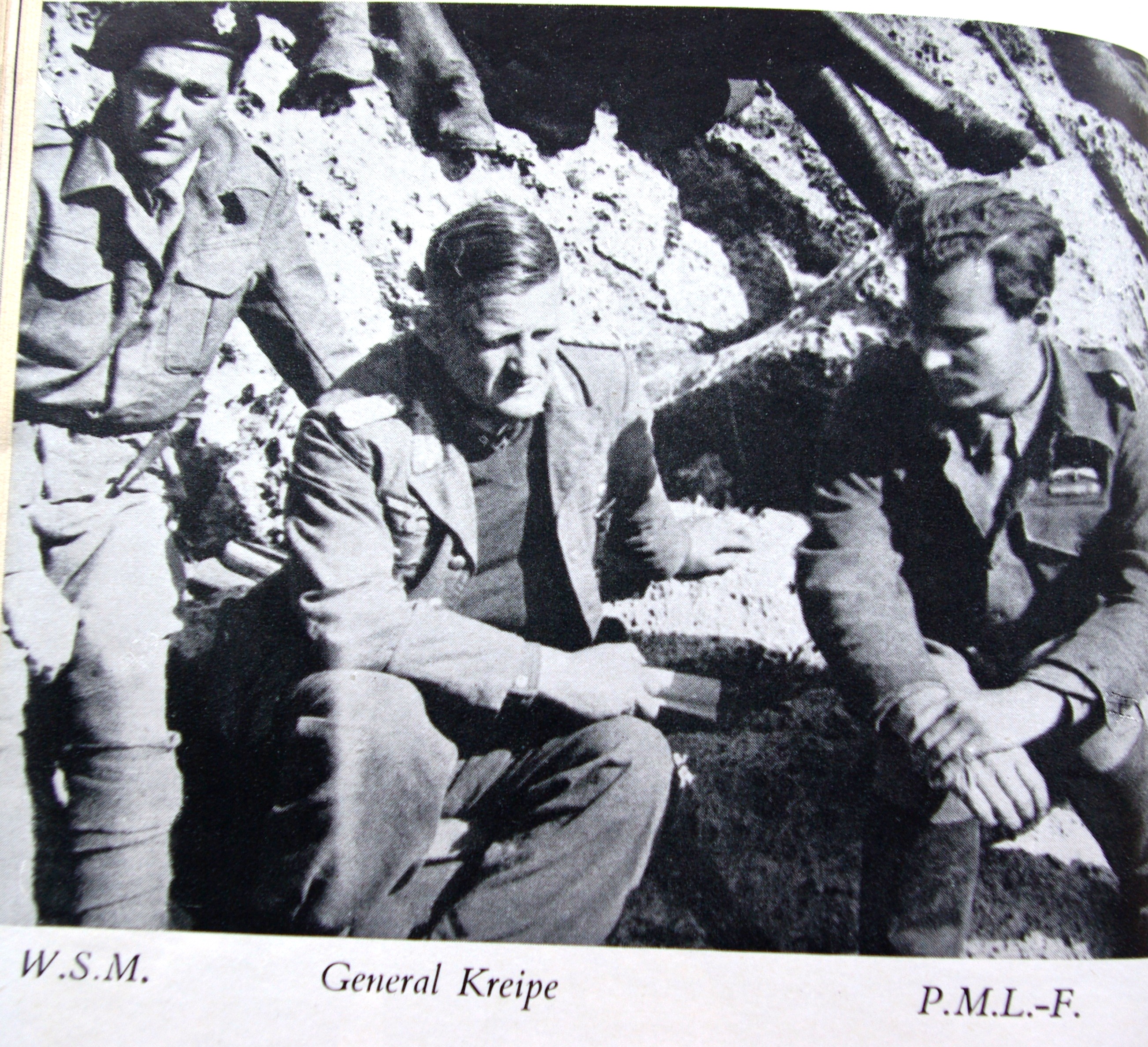
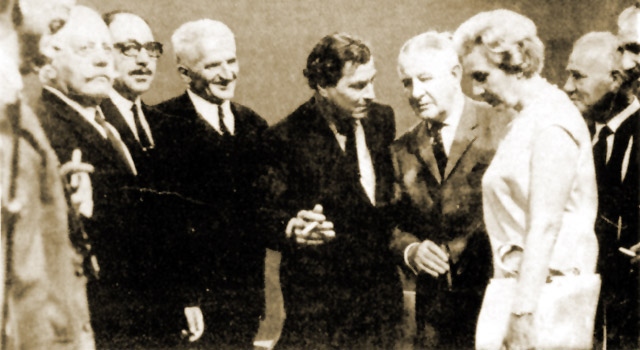
General Kreipe, Paddy and the abduction gang on Greek TV 1972

more stories related to Ill Met by Moonlight 

Related article:

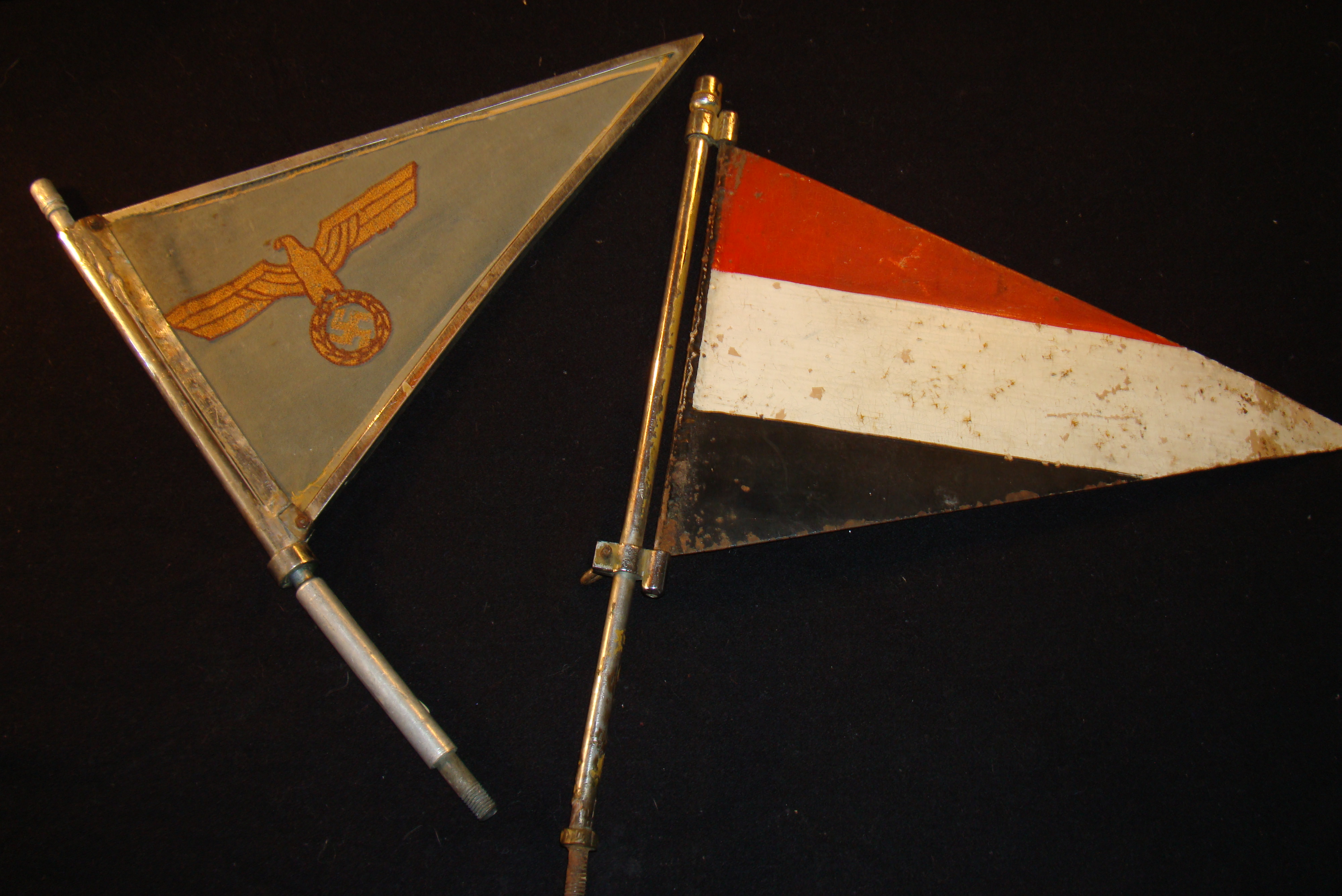
The Kreipe pennants 

The troubled waters of the mind grow still and clear

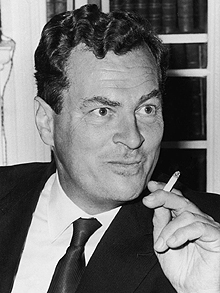
Paddy in Greece photographed by Joan

Don’t you feel like me that with the passing of Paddy as one of the last of his generation we have clearly entered a new age dominated by uncertainty; a lack of confidence in the values we once held as unquestionably true? These beliefs that bound us (in the West?) together for the latter part of the twentieth century are now unravelling at an ever-increasing pace. As we enter the End Game of the economic crisis, and as the decade of The Forever War rumbles on like the noise of a busy road in the middle distance – there only when we take the trouble to notice – we suffer a dearth of leadership and heroes of substance. Paddy and those of his generation had no such crisis of confidence; they served without question. They sacrificed themselves for the things they believed in, and they provided the leadership, entrepreneurship, creativity, and wisdom that helped rebuild Europe after almost half a century of ethnic and social strife, and destructive war. Maybe they also share some blame for the way things turned out, but who will step up now?

In this considered profile, which prompted my rambling reflection, Paddy’s good friend Colin Thubron assesses his contribution, not as a warrior, but as a writer, and I think for the first time, reveals the torment of Paddy’s troubling writer’s block towards the end of his life.

by Colin Thubron

First published in the New York Review of Books, Volume 58, Number 14

When Patrick Leigh Fermor died in June at the age of ninety-six, it seemed as if an era had come to an end. He was the last of a generation of warrior–travel writers that included the Arabian explorer Wilfred Thesiger, the controversial mystic Laurens van der Post, and the indefatigable Norman Lewis of Naples ‘44. Among these, Leigh Fermor shines with the élan and the effortlessly cultured glow of an apparent golden age. A war hero of polymathic exuberance, brilliant linguistic skills, and an elephantine memory, he was sometimes fancifully compared to Lord Byron or Sir Philip Sydney.

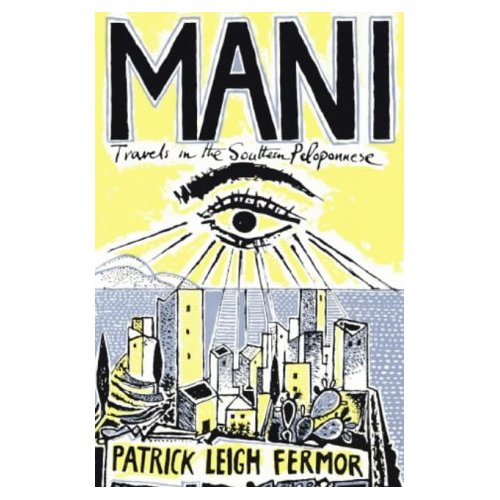
Two pairs of books came to exemplify his achievement. The first pair—Mani (1958) and Roumeli (1966)—celebrated the Greece that held his abiding fascination and where he lived for forty-five years on a once-wild promontory in the Peloponnese. In Mani, especially, he described this backwater region as a world whose way of life had survived in a fierce and enchanted time warp.

The land he depicted is barely recognizable now—tourism, he observed, destroys the object it loves—but it was less the Greece of classical antiquity that beguiled him than the spirit and folk culture of the hinterland: the earthy, demotic Romiosyne that he once contrasted with the Hellenic ideal in a playful balance sheet of the country’s character.

In these, and in later books, the style was the man: robustly imaginative, cultivated without pedantry, unstoppably digressive, forgivably swanky, and filled with infectious learning. The impression—overflowing into elaborate footnotes and flights of learned fantasy—is one of omnivorous delight in the quirks and byways of history, art, language, genealogy, myth, song, superstition, costume, heraldry, and everything else that struck his fancy.

His literary models were Norman Douglas and Robert Byron, but his writing was more vivid than the one, more kindly than the other. Despite the richness of his prose (occasionally slipping into purple) he forged an illusion of intimacy with his readers, as if they were sharing his mind in the moment of writing. But in fact his manuscripts were worked, reworked, and reworked again with such painstaking perfectionism that his publisher (the benign Jock Murray) often had to reset his galley proofs wholesale. The apparently natural flow of words was in reality a densely worked choreography, which came at cost.

Fifteen years ago, swimming in the Ionian Sea beneath his home, where nobody could overhear us, Paddy (as friends and fans called him) suddenly confessed to me the writer’s block that would plague the rest of his life. The expectations of a now-avid public, and his own obsessive perfectionism, were taking their toll, and he could not overleap this cruel impediment.

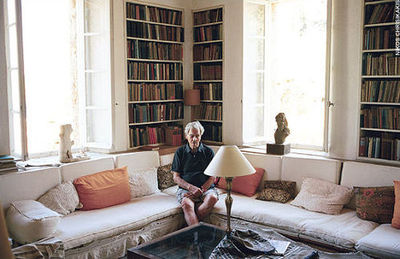
I remember him strong into old age. He swam every morning, with a sturdy breaststroke far out to sea, the tattoo of a twin-tailed mermaid glistening on his shoulder. He still kept up a striding march in the Taygetus foothills, where he and his wife Joan had designed their own house above the ocean. It was a place of “mad splendor,” he wrote. Its sitting-room library—bookshelves banked nine feet high—opened onto a vista of cypresses and the Messenian Gulf, and was flagged with the greenish stone of Mount Pelion. In the afternoon Paddy would disappear into his study to confront—or escape—the demons of his failed writing, and would emerge to the liberation of ouzo or whiskey, generally to report some arcane piece of research—that the Huns wore stitched field-mouse skins, perhaps—or to share a passage of Ovid. We dined in the monastic half-cloister he had built beside his home, and once we visited the tiny, red-tiled Byzantine chapel where—five years before—he had buried the ashes of Bruce Chatwin.

The conflict between a natural gregariousness and the solitude of writing never quite resolved for him. In a short, intriguing study named A Time to Keep Silence (1953) he recorded his sojourn in three great French monasteries. He described this retreat not as a religious exercise, but as a need for a haven for writing, and the nature of its cleansing—”the troubled waters of the mind grow still and clear”—remains suspended like a question mark in the oeuvre of a man to whom self-revelation seemed indulgence.

The second pair of books, which established Paddy’s primacy among travel writers, must be among the most extraordinary ever written. In 1933, as a youth of eighteen, he left England for a journey that would take a year and a half. As “a thousand glistening umbrellas were tilted over a thousand bowler hats in Piccadilly,” he set out to walk to Constantinople (as he nostalgically called Istanbul). Walking stick in hand, a copy of Horace’s Odes in his rucksack, he pursued a meandering course up the Rhine and down the Danube, across the Great Hungarian Plain, into Romania and through the Balkans to Turkey.

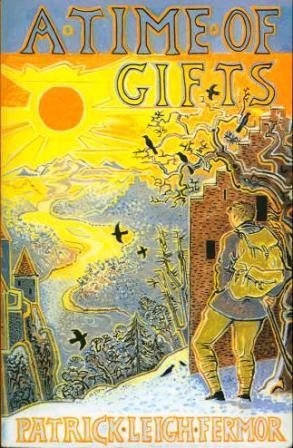
It was almost forty-five years before he published the first part of this journey, and another nine years before the second. A Time of Gifts (1977) and Between the Woods and the Water (1986) represent prodigious feats of memory. They record the rite of passage of a precocious, exuberant young man as he encounters the peoples and languages of a Middle Europe now littered with obsolete names: Bohemia, Transylvania, Wallachia. His story must have become the dream journey of every enterprising and footloose adolescent.

Inevitably the accuracy of Paddy’s memory was questioned, and he was frank about occasional imaginative license and conflation. (His first diary was stolen in Munich, a solitary last one recovered years later in Romania.) Certainly his recall was extraordinary. I remember the first time we met (by chance), when he quoted verbatim from my first book passages that I had myself forgotten. A year before his death we chanted verses from the Rubáiyát of Omar Khayyám together in an antiphonal competition (which he won).

His urge to describe his epic journey more than forty years after its end was a deeply natural one. He was revisiting his youthful persona with the judgment and knowledge of maturity; yet in a sense he had remained unchanged. Despite his sophisticated learning, he retained an almost boyish innocence, as if the troubles of the modern age had bypassed him. In the Peloponnese, where he settled to live in the 1960s, he had remained in thrall to a more ancient, rooted culture than that of the urban West.

The final volume of his proposed trilogy—carrying its author through the Balkans and down the Black Sea coast to Turkey—became his tormenting and elusive project for the next quarter- century, and was never completed. Some near-finished version, however, survives him, and will eventually be published.

With his youthful trek done, Leigh Fermor’s career took off into near fable. Caught up in Greek unrest, he joined in a triumphal royalist cavalry charge against wilting Venizelist rebels. In Athens he fell in love with the artist Princess Balasha Cantacuzene, twelve years older than him, and lived with her in Moldavia for over two years, before World War II recalled him to London.

As a fluent Greek speaker he was recruited by the Intelligence Corps, and sent as a liaison officer with the Greek army first to Albania and finally to Crete, where he survived the brutal German invasion. For almost two years, while an officer in the Special Operations Executive, he lived disguised as a shepherd in the Cretan mountains, organizing the gathering of intelligence.

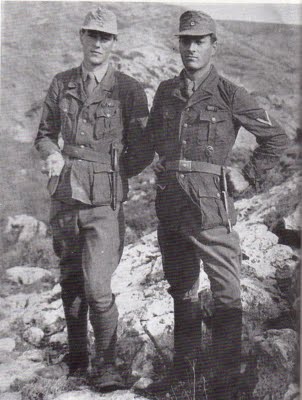
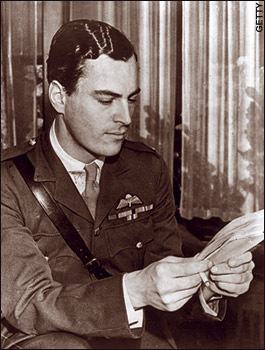
Then, in 1944, occurred the exploit that—more than any other—was to burnish him into legend. He and his fellow SOE officer Stanley Moss dreamed up a scheme of harebrained bravado. Dressed in stolen German uniforms, with a party of Cretan guerrillas, they ambushed the car of General Heinrich Kreipe, the German commander of occupied Crete, kidnapped him, and concealed him under the back seat. Moss took the wheel, Paddy donned the general’s cap, and together they drove through twenty-two checkpoints to emerge on the far side of Herakleion and march Kreipe for three weeks over the mountains, to be picked up by motor launch and taken to Egypt.

It was during this hazardous Cretan march, as the dawn broke over Mount Ida, mythical birthplace of Zeus, that the abducted general began to murmur a verse of Horace: Vides ut alta stet nive candidum/Soracte….1 It was an ode that Paddy knew by heart, and he completed the six stanzas to their end. “The general’s blue eyes had swivelled away from the mountain-top to mine,” Paddy later wrote,

—and when I’d finished, after a long silence, he said: “Ach so, Herr Major!” It was very strange. As though, for a long moment, the war had ceased to exist. We had both drunk at the same fountains long before; and things were different between us for the rest of our time together.

This precocious kidnapping was later reimagined in a lackluster movie named Ill Met by Moonlight (1957) with Dirk Bogarde playing Paddy. But there were other exploits too. Paddy had already engineered the defection of the Italian General Angelico Carta from Crete; and he was due to undertake a near-suicidal mission to Colditz when the war ended.

His upbeat account of these events was tempered by regret. He had planned that the abduction of Kreipe be bloodless, but his accompanying Cretan partisans slit the chauffeur’s throat, and rumors of grim German reprisals for the abduction have never quite died down. Above all, Paddy’s accidental shooting of one of his fellow guerrillas may have stained his memory of the whole period.

On June 16 Leigh Fermor was buried back in the English countryside, attended by an Intelligence Corps guard of honor, to lie beside his wife Joan, his dear comrade since 1946. This was, in a sense, fitting. For in certain ways he was exemplary of a wartime Englishness now almost gone, whose more dashing qualities merged seamlessly into the hardy stylishness of Greek leventéa.

To those who knew him, his books are hauntingly redolent of his sensibility. His conversation was irrepressibly warm and inventive far into old age, moving from arcane anecdotes to fanciful wordplay or bursting into polyglot song (sometimes singing the lyrics backward). His friends ranged from Deborah, Duchess of Devonshire—last of the six legendary Mitford sisters (his correspondence with her was published in 20082)—to early acquaintance with a raffish interwar bohemia and his own great predecessor, the travel writer and aesthete Robert Byron, whose borrowed rucksack he bore across Central Europe as a youth.

Almost the last time I met Paddy, he had returned home after an operation for suspected cancer, and I feared he would be depleted, his old zest gone. He was growing deaf, and he suffered from tunnel vision (which he called Simplonitis). For a while, sitting over lunch, he seemed subdued. Then something struck him. He perked up, and said: “You know, there is an apple lying on a table in the hall. It’s been there all weekend. Wouldn’t it be marvelous if it cocked a snook at Newton, and simply took off into the air!”

This was typical of his boyish resilience. In the field of travel he evoked both the youthful wanderer who discovers another world and the avid scholar who melds with it. His prose was too rich and elaborate to be a safe influence on others (although a few have tried); but he brought to the genre not only the distinction of his densely brilliant books, but his innate dignity, ebullient mind, and capacious heart.

  1. 1″See Mount Soracte white with snow….”
  2. 2The correspondence, In Tearing Haste , edited by Charlotte Mosley, was published in the US by New York Review Books (2010), which has also republished the other books by Patrick Leigh Fermor mentioned in this article, as well as The Traveller’s Tree .

The Kreipe pennants

The Kreipe pennants - Copyright Artemis Cooper 2011

The pennants from General Kreipe's car

What happened to the flags on General Kreipe’s car when Paddy abandoned it and joined the main abduction gang? Well here is the story. I am very grateful to Artemis Cooper for submitting this. I hesitate to say that this is a world exclusive, but it probably is! These have not been seen in public since the car drove through the heavily garrisoned town of Heraklion with the General in April 1944.

As I’m sure you know, just before abandoning the General’s car on the night of the abduction of Gen Kreipe, Paddy and George Tyrakis ripped off the two metal pennants that stood proudly on the bonnet. One might argue that, combined with Billy’s confident driving, it was those pennants that had let the car pass unchallenged through 22 German checkpoints! Since Billy had driven the car the pennants were given to him; and after his death, Billy’s daughters – Gabriella Bullock and Isabella Cole – felt that Paddy should have them. Paddy held onto them for many years, very much under wraps. I think the main reason he kept them hidden was because he had always felt so wretched about the death of Alfred Fenske, the General’s chauffeur.

They were kept in a tin trunk in his study, and very few people knew they were there. He showed them to me only once. The reason for that was so that I should be aware that after his death, they were to go to the Rethymnon Museum of History and Folklore. This had been arranged in the 1990s, with the encouragement of Niko Kokonas.

In August the flags were given to the Rethymnon Museum, according to Paddy’s instructions.

I have a photo of the flags. They stand about 15″ high, the triangular pennant sticking out about 12″. The first is painted red, white and black in horizontal lines, like the German flag. The other shows the gold Nazi eagle with outspread wings perched on a wreath, embroidered onto a piece of grey fabric which is then mounted onto the metal pennant.

I hope this is a real joy to all the Ill Met by Moonlight fans out there.

This article and photograph copyright Artemis Cooper 2011

The magnetic John Pendlebury

Archaeology’s first modern hero was dazzling in life and heroically defiant in death. Paddy wrote the foreward to the 2007 book – The Rash Adventurer: A Life of John Pendlebury by Imogen Grundon.

J. D. S. Pendlebury, excavator of Amarna, Curator at Knossos, he of the glass eye and the swordstick, who died defending Crete from German invasion in 1941, is archaeology’s first modern hero: brilliant, magnetic and self-aware. In The Rash Adventurer, Imogen Grundon gives us the substance behind his dazzling brief career. John Pendlebury evidently possessed an extraordinary determination to overcome obstacles, demonstrated after he had lost an eye as the result of a childhood accident. In spite of this handicap, his Cambridge years included a blue in athletics and a first class in the tripos. Grundon reveals his early interests in archaeology, and the enormous workload he undertook soon after leaving university. His career included excavation both at Akhenaten’s capital of Amarna and at Sir Arthur Evans’s site at Knossos, as Pendlebury moved from one to the other with the seasons of work. By the age of twenty-five he occupied a unique position in Mediterranean archaeology, holding simultaneously the posts of Curator at Knossos and Director of Excavations at Tell el-Amarna.

by Jane Jakeman

First published in the Times Literary Supplement, 17 October 2007.

The relationship between Egypt and Crete was of particular interest to him, and his Aegyptiaca: A catalogue of Egyptian objects in the Aegean area is still an important resource. At Amarna, the historical background was still very unclear when Pendlebury became Director in 1930, and he was able to extract a possible chronology and a history of that remarkable city. There was a wide gulf between Bronze Age archaeologists and Egyptologists, and Pendlebury had to endure much criticism in Egyptological circles, particularly over his theories concerning the invasion of Egypt by the “sea peoples”, whose leadership he ascribed to Agamemnon. It was not uncommon at the time to look for relationships between mythology and archaeology, but this approach evidently appealed to Pendlebury’s love of Homeric story. It was also a romantic perspective, and from it he viewed his beloved modern Cretans, sometimes presiding over dinner wearing a Cretan cloak and striding through the mountains to meet kapetanoi, the old brigand leaders.

He clearly relished his swashbuckling self-image, but Grundon shows him capable too of subtle and complex achievements. At Knossos, he skilfully negotiated a difficult relationship with Evans, whose colourful reconstructions Pendlebury sometimes disagreed with, in spite of his own imaginative streak. He was in fact working in a new archaeological era: the age of the great individual “dig” patrons was passing, in favour of a more modern system where the locals were no longer regarded as mere workmen, and foreign governments were recognized as significant entities. Pendlebury showed himself well able to manage this transition and he was realistic in matters of archaeological politics and finance, very aware of the importance of finding subscribers to the Egypt Exploration Society, and new sources of funding. Grundon is good on the complications of organizational funding and personalities, academic intrigues and quarrels.

At the outbreak of the Second World War, Pendlebury returned to Britain, enlisted in Military Intelligence and was drafted into Military Intelligence (Research). He went back to Crete in 1940 as a British Army captain, in order to organize resistance to invasion in the mountain regions. He was “adopted”, to use Grundon’s appropriate word, by the highly secretive “D” section of MI6, whose task was to train agents, conceal supplies for sabotage, and handle anti-German propaganda. There is no doubt that he loved the atmosphere of mystery and intrigue, as also the adventure of rallying his kapetanoi.

Pendlebury’s part in the Battle for Crete was, however, tragically short-lived: in 1941, he was wounded, then captured, propped up against a wall and shot. Again, Grundon has followed these events very carefully, presenting as much evidence as can now be garnered – although her wider picture of the background to the invasion of Crete is too kind to General Bernard Freyberg, the New Zealander in command of Allied forces on Crete. Antony Beevor’s Crete: The Battle and the Resistance brings out clearly the later Lord Freyberg’s disastrous support for seaborne invasion, and the obstinate misinterpretation of “Ultra” intelligence, which contributed to the loss of the island to the Germans. The downfall of Crete was horribly unnecessary. So was Pendlebury’s death, a tragic waste, except perhaps that his premature decease itself took on an iconic quality. His image has remained unencumbered by the aura of his snobbish wife and untarnished by entanglement in post-war politics.

The Rash Adventurer is a thorough and authoritative biography, based on detailed research, which gives us at every point the facts underpinning the myth of the man. As well as reaching deep in archives and libraries, Imogen Grundon seems to have interviewed almost every survivor in the field. There is one story she omits, however, perhaps because none of her elderly interlocutors cared to repeat it – the story passed down among Egyptologists, that, as he faced the firing squad, John Pendlebury’s last words were “Fuck you!”.

Rare video of Pendlebury excavating in Egypt as well as showing off his athletic prowess.

Audible

Ill Met by Moonlight film review

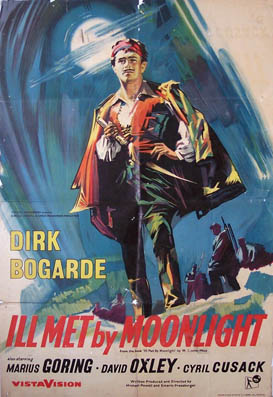
Ill Met by Moonlight movie poster

For a decade and a half, the partnership of Michael Powell and Emeric Pressburger illuminated the cinema with an array of extraordinary films. But the massive reputation the team garnered during and immediately after World War II – The Life and Death of Colonel Blimp, A Canterbury Tale, I Know Where I’m Going!, A Matter of Life and Death, Black Narcissus, and The Red Shoes in just five years! went into steep decline in the Fifties. There were no Archers films at all between The Tales of Hoffmann (’51) and Oh… Rosalinda!! (’55), and both of those were disastrous failures, critically and financially. Perhaps to cover themselves in the ultraconservative British film industry, Powell and Pressburger finished their partnership with two conventional war adventure movies – rattling good yarns that, alas, were widely perceived as rattling just a bit too much.

First published in Film Comment 13th March 1995 v 31:n2. p37(4)

The Battle of the River Plate (’56) was a box-office success and had a royal premiere, but it now looks like the corniest of the Archers movies. An account of Britain’s first major naval victory of WWII, it does have the great virtue of showing actual ships maneuvering about in an actual ocean instead of models in a tank – Powell’s main pleasure in directing the movie, one imagines. But this is exasperatingly offset by far too many shots of actors on studio bridgehead sets being doused with water as they strike poses in front of a cyclorama. The local color Powell provides is a bit sticky, too, given that Uruguay, where the German battleship Graf Spee was forced to seek shelter before being tricked into self-destructing, was and still is a nation notorious for its concealment of Nazis. Peter Finch, as the captain of the Graf Spee, manages an impressive performance, but none of the other actors in a lively cast Anthony Quayle, John Gregson, Patrick Macnee, Anthony Newley, Christopher Lee, John Schlesinger in a bit as a German sailor – has much chance to create a real person. The Germans are all decent fellows, really, whilst the characterization of the Brits is entirely on the level of good-show-chaps caricature.

Powell seemed rather attached to this movie in later years, but had no love at all for the very last Archers film, Ill Met By Moonlight (’57). “I felt imprisoned by the facts,” he was wont to complain; and there were problems with the script Pressburger provided. Ian Christie’s book about Powell, Arrows of Desire, goes so far as to refuse to list the film as a collaboration at all, his filmography (reproduced, incomplete and inaccurate as it is, in Powell’s memoirs) giving Powell’s name alone as writer, producer, and director. Dissension between Powell and Pressburger coincided with antagonism from the Rank Organisation, which refused them money for color. Once the film was finished, so were the Archers.

After Ill Met By Moonlight, then, the deluge. It would be foolish to suggest that the film – miserably renamed Night Ambush for U.S. release and cut by 11 minutes – is anywhere near the level of the team’s masterworks. Even so, it’s more interesting than legend suggests. The (true) story, set in occupied Crete in 1943, concerns the kidnapping of a German general (Marius Goring) by Cretan partisans led by a British officer, Patrick Leigh Fermor (Dirk Bogarde). Film buffs will recall that the real Leigh Fermor was one of the scriptwriters of John Huston’s The Roots of Heaven (also the author of some bestselling travel books). Then again, the film seems to ask, who exactly is the “real” Patrick Leigh Fermor – or the real anyone? Taking its title from a play concerned with dreams and disguises, magic and power, Ill Met By Moonlight is all about questions of identity.

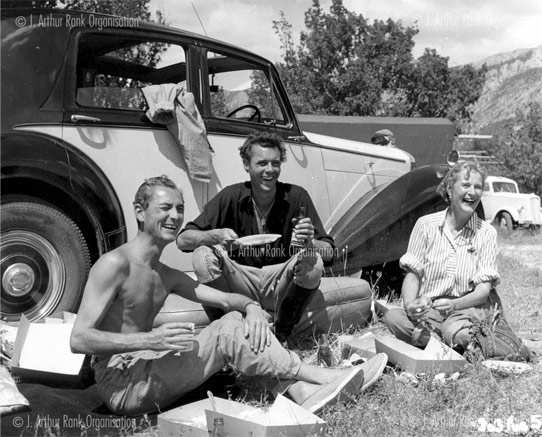
Xan and Daphne Fielding with Dirk Bogarde on the set of Ill Met by Moonlight

Under the credits, we see Dirk Bogarde in uniform; then, unexpectedly, we see him in the flamboyant outfit of a Cretan hill-bandit. A title informs us that Major Leigh Fermor was also known by the Greek code-name “Philidem.” In other words, there are two of him (at least), and on one level the adventure the film is about to unfold reflects a conflict in his personality. It’s a conflict shared, unknowingly, by his Nazi opposite number, the fierce, arrogant General Kreipe (an unlikely “proud Titania,” but it’s true that he “with a monster is in love” – the monster of Nazism). Kreipe’s human side is so rigorously repressed by the demands of war and “glory” that he is genuinely unaware of it; ironically, this humanness, which constitutes the true manhood of this Teuton warrior, is revealed by a boy (equivalent to Shakespeare’s Indian Prince?) – who, in turn, is the most grownup person in the movie.

Ill Met by Moonlight movie poster - Bogarde as Paddy the flamboyant Cretan

If “Philidem” appears under the credits, caped and open-shirted, a romantic dream-figure out of an operetta or a storybook, he is first seen in the film proper as a coarser, more down-to-earth version of the same thing – an ordinary Cretan peasant in a shabby suit, waiting for a bus. When he makes contact with the Resistance, his personality fragments further. To some, he is the mystical Philidem, Pimpernel of the Hellenes and righter of wrongs. To others he is “Major Paddy,” the happy-go-lucky Englishman of popular movie myth conducting war as if it were a branch of amateur theatricals, a gentleman adventurer relying on breeding to get him through and making fun of the whole business. To Bill Moss (David Oxley), the newly arrived junior officer sent to assist him, he is the cool, fast-thinking professional soldier. And to himself? In his quietly passionate defense of Cretan life and culture, he seems someone else again: a scholar and aesthete outraged by the barbarism and folly of war, and by the moronic arrogance shown by his captive toward the Cretan people.

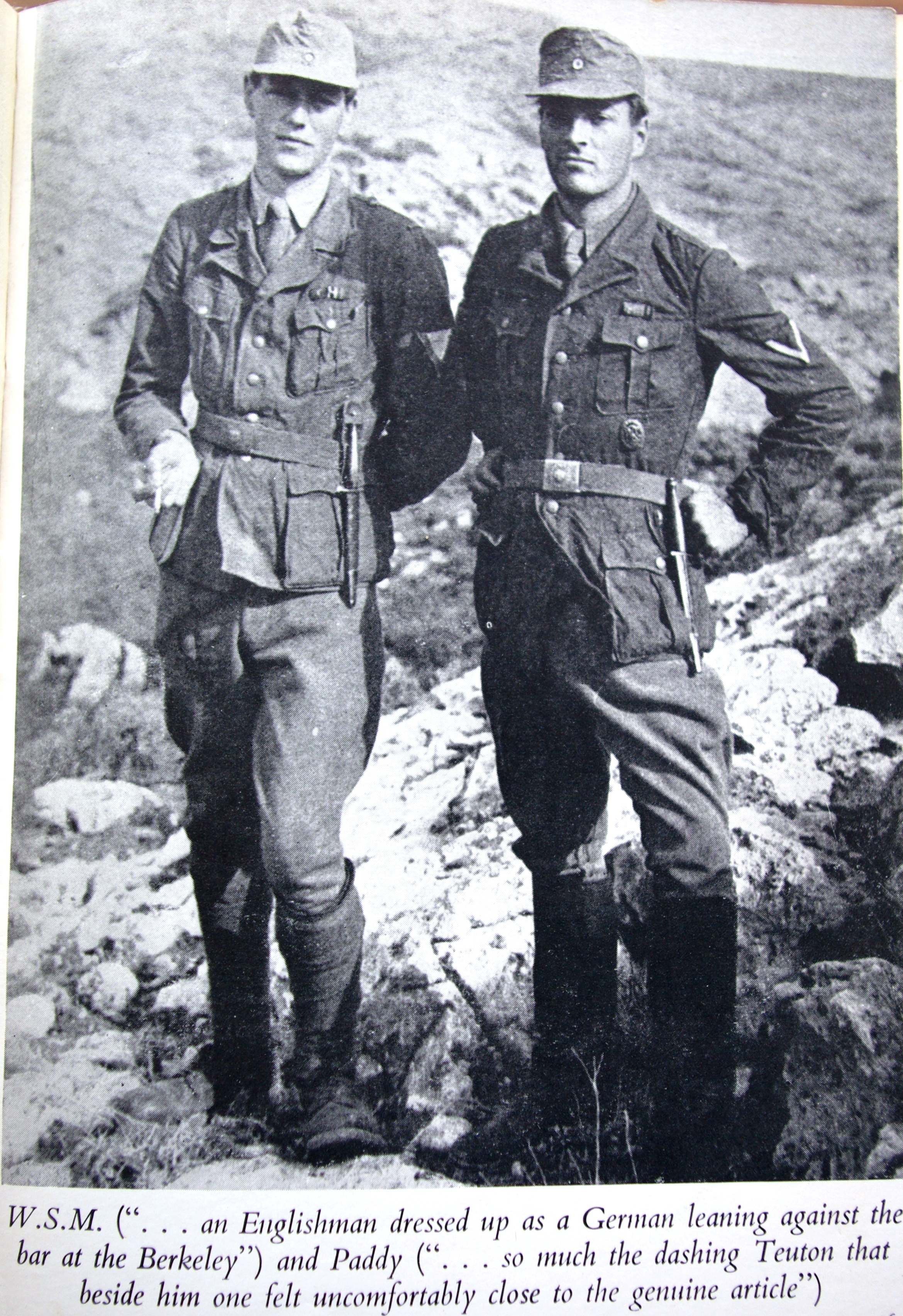
Whatever his persona, Leigh Fermor is a chameleon who never seems to change very radically in himself. Perhaps because he has this quality of seeming all things to all men – and being those things – he remains unfazed by the monolithic might of the German military machine. Fluent in Greek, he can also speak German like a German and is easily able to assume another disguise, that of a faceless Nazi officer. Although he and Moss make fun of themselves – “If only I had a monocle!” muses Moss when Leigh Fermor tells him he “looks like an Englishman dressed like a German, leaning against the Ritz bar” – they are able to effect the kidnapping with an ease that seems appropriately Puckish. General Kreipe is ignominiously thrust onto the floor of his own limousine, gagged, and sat upon by a couple of the peasants he so despises. Kreipe’s rage is compounded by his firm conviction that he has been snatched by “amateurs” – a belief Leigh Fermor and Moss slyly make no objection to, knowing how it will gnaw at his already shaky Master Race self-confidence.

Soon, partisans and captive are up in the hills, where they stay for most of the movie (though the biggest of the film’s mountaineering set-pieces, a nocturnal descent through fog, was filmed on elaborately stylized studio sets). Once there, Kreipe determines to leave a trail for following German troops to pick up on – his cap, buttons from his uniform, even a couple of medals from his impressive display of such baubles never realizing that each emblem of his authority is no sooner dropped than it is retrieved by the vigilant Moss.

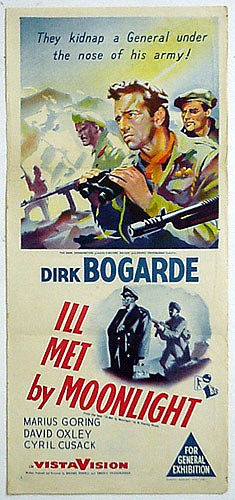
Rare Ill Met by Moonlight movie poster

Among Major Paddy’s partisans is a young war orphan, Nico, who has, while shinning up and down the mountains, much occasion to complain of his need of a pair of boots. Nico knows that the cost of a new pair will always be far beyond him; Kreipe, who has been friendly enough toward him in a rather patronizing way, seizes on this need by showing the boy his own impressive footwear and offering a gold coin with which to buy an identical pair. A German gold coin, he stresses, not one of the sovereigns Leigh Fermor keeps a supply of; it is, in fact, a coin the General is known to keep as a good-luck charm. Nico is impressed by the General’s largesse. But, of course, the Nazi requires a quid pro quo. All Nico has to do, when he goes down the mountain, is tell the searching German patrols where the General is, using the coin as a bona fides. But Kreipe has misjudged the boy (indeed, he can be said to have misjudged the whole of the human race): it never occurs to him that the boy will not do what he says. What Nico actually does is simply point the patrols in the wrong direction, leading them into an ambush; the magic gold coin is lucky for the Greeks, not the Germans. This makes the escape from Crete of the Britishers and their ill-met prisoner the easiest part of their long journey.

Once aboard a British ship, and naked of the symbols of military power, the General seems a new person – not such a bright man, not such a strong man, but also not such a bad man, either. He is visibly moved by the return of his possessions, especially the gold coin: despite his genuine pleasure in Nico’s company, Kreipe had assumed that the boy, like every non-German, is someone who can be bought and sold, and that “friendship” had been merely his gift, and not a privilege from which he might derive spiritual benefit rather than tactical advantage. The very simplicity of Nico’s ruse in deflecting rescue was the, final humiliation, the last stage in General Kreipe’s lengthy symbolic disrobing – which is precisely why his possessions can now be given back to him. If he started this modern midsummer night’s dream as imperious as Oberon, he ends it as foolish as the donkey-headed Nick Bottom. But then, Bottom the simple weaver is always better-liked by everyone than the unearthly and tyrannical monarch of Shakespeare’s enchanted forest.

And from his elaborate humiliation, the stiff-necked German learns a good deal about himself and about humanity. His curt acknowledgment at film’s end that he has been kidnapped not by amateurs but by professionals is also his acknowledgment of his own fallibility and that of the creed he has so proudly espoused. And so he regains a measure of dignity, along with those tokens of an identity he no longer needs. Nico himself get his new pair of boots after all (they belong to Leigh Fermor, who is barefoot in his final exchange with his prisoner), but, by a sad irony, is about to change identity as well: he will wait out the rest of the war far away from Crete in the distant England of which he has heard much but knows nothing. But at least he has a friend – a real friend, now – in General Kreipe, who has learned that the respect of an uneducated boy is worth more than a medal from the Fuhrer. “Gentles, do not reprehend / If you pardon, we shall mend.”

And Patrick Leigh Fermor, aka Major Paddy, aka Philidem – and, if you stretch your imagination just a smidge, aka Robin Goodfellow? – what of him? In the film’s closing moments, he is far from being self-assured intellectual or dashing amateur adventurer or legendary outlaw of the hills. He’s just a tired man who wants to go home and rest up. “How do you feel?” asks Moss. “Flat” is the reply. “You look flat!” says Moss. “I know how I’d like to look …” murmurs Leigh-Fermor wistfully. Moss knows what he’s going to say, and joins in the litany: “Like an Englishman dressed like an Englishman – and leaning against the Ritz bar!” It’s easy to imagine them ordering drinks at that renowned watering-hole with all the suavity required by this little fantasy. Still, the film’s last images of Crete receding in the distance, until all we can see is the sea, suggests that maybe Major Paddy’s heart is really back in those hills in the “fair and fertile” land that has become as much a Powellian landscape of the mind for us as the studio-built Himalayan convent of Black Narcissus or the monochrome Heaven of A Matter of Life and Death. And, as we depart both Crete and this film, we may reflect that being “dressed like an Englishman and leaning against the Ritz bar” would, for Patrick Leigh Fermor constitute yet another disguise. After all, he was Irish.

… now watch the movie trailer.

Ill Met by Moonlight

Related articles:

Patrick Leigh Fermor recounts the kidnap of General Kreipe on video

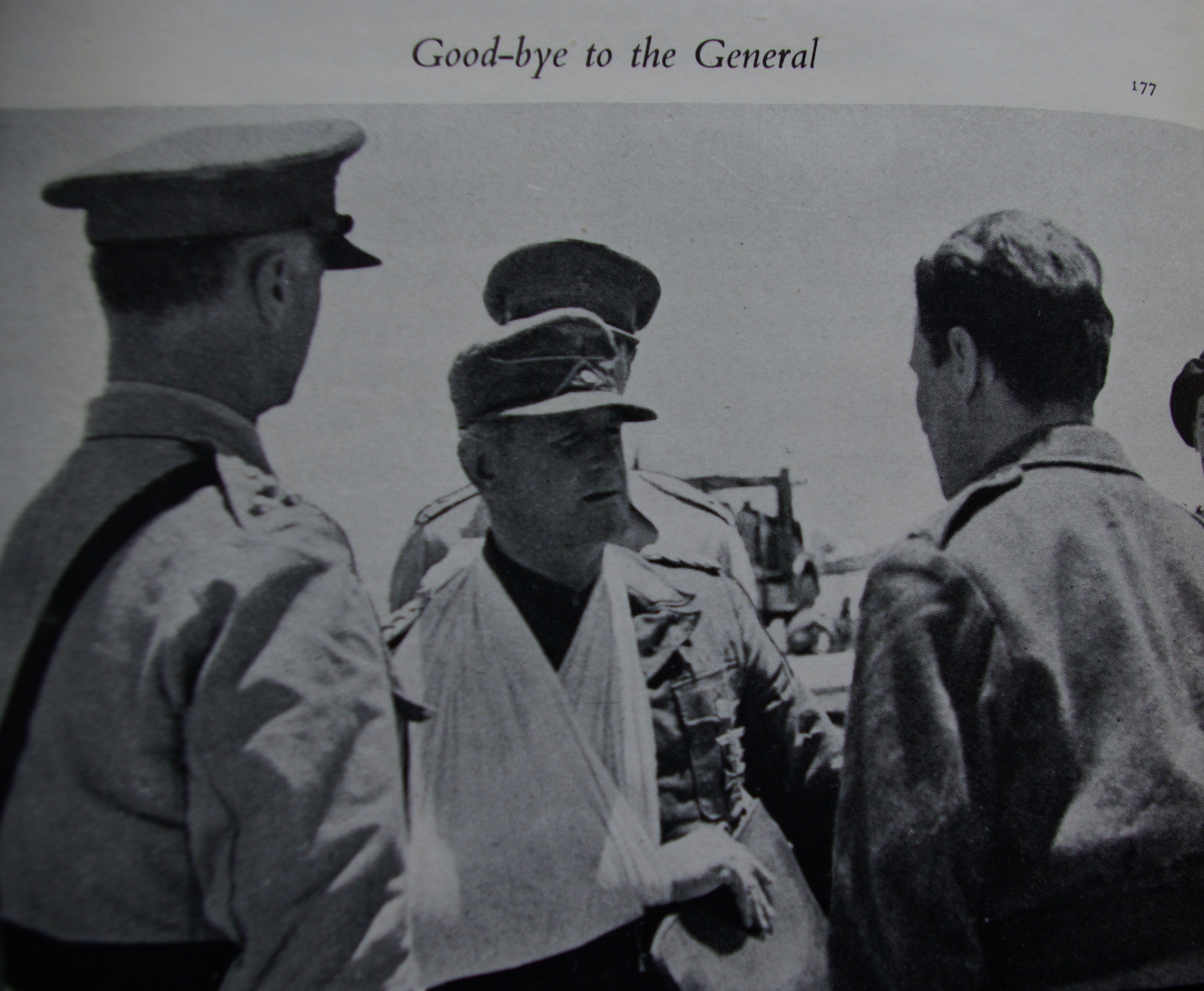
General’s long trip home

Was Paddy the inspiration for the hero of Guns of Navarone?

The following was posted as a comment in Your Paddy Thoughts by Robert Seibert. He asks an interesting question so I thought I would elevate it from deep in a comments page to the main blog site to see if it provokes some debate.

I wonder if there is any connection between PLF’s WW2 deeds and the fictional work “Guns of Navarone”, Alistair MacLean’s 1957 novel and the 1961 film starring Gregory Peck as Capt. Keith Mallory leading a team to destroy German guns on “Navarone”-said to be the real island of Leros. In the movie Mallory is described as the “world’s greatest mountain climber” and “speaks Greek like a Greek and German like a German”-but was chosen mainly because he has survived for a year and a half as a guerrilla with the Cretan resistance. The parallels with Paddy’s exploits seem obvious. Of course “Ill Met by Moonlight” was published in 1950 and the film version in 1957-accounts of the actual Gen. Kreipe abduction. Would be interested in hearing others thoughts about this.

Over to you dear readers …

Honoring Patrick Leigh Fermor: Review Essay

This is quite an excellent essay that focuses on Paddy’s writing more than many other profiles.

Paddy in 1966

by Willard Manus

Reading Patrick Leigh Fermor today is both an exhilarating and depressing experience, exhilarating because of the depth and brilliance of his prose, depressing because the Greece he portrays so memorably has been hammered to dust by the march of time. Fermor, who was knighted in 2003, is best known in Greece and in his native Britain, where he was born nine decades ago to Sir Lewis Leigh Fermor, director of the Geological Society in India, and Eileen Ambler, who was partly raised there. His first book, The Traveller’s Tree, published in 1950, dealt with the journey he made through the Caribbean islands in 1947-48. The book won the Heinemann Foundation Prize for Literature, and established him as a writer of note.

His next two books, 1952’s A Time to Keep Silence, which described his stay in various European monasteries (where he discovered in himself “a capacity for solitude”), and 1956’s The Violins of Saint-Jacque, a novel, are interesting but minor works. His literary and political importance is linked to the two books on Greece he published a decade later—Mani: Travels in the Southern Peloponnese and Roumeli: Travels in Northern Greece. Established his reputation as the pre-eminent non-native writer on 20th century Greece.

Fermor’s first experience of the country dated back to 1933, when as a rebellious and untamed 19-year-old, he dropped out of Sandhurst and set out on a walking tour of Europe with Constantinople as his ultimate destination was Constantinople. Envisioning himself as “a medieval pilgrim, an affable tramp with a knapsack and hobnailed boots,” he embarked, in mid-winter, on a journey that eventually spanned three years and took him through the Netherlands, Germany, Austria, Hungary, Rumania and, eventually, Greece. 2

Remarkably, Fermor did not write about his picaresque adventures in pre-war Europe until many years later. “So when A Time of Gifts appeared in 1977 and Beneath the Winds and the Water in 1986, the life of the mid-thirties that he described had been utterly destroyed,” his biographer Artemis Cooper has noted, “and much of the land he had walked over was in the grip of communism for years. Yet his memory recreated this world with an astonishing freshness and immediacy, and recaptured the young man he was then: full of curiosity, optimism and joy in the vibrant diversity of the world.”  The concluding volume of Fermor’s trilogy is scheduled for publication (by John Murray Ltd.) in early 2007.

Fermor made it to Constantinople on New Year’s Day, 1935, and then crossed south into Greece. He spent time in a monastery on Mt. Athos, got caught up later in a Royalist vs. Republican battle in Macedonia, arriving finally in Athens, where he met the great love of his life, the Romanian Balasha Cantacuzene. They went to Poros and lived together in an old water mill, where he wrote and she painted. When the money ran out they retreated to her decaying family home in Baldeni, Moldavia.

Fermor described the house in an essay published in Words of Mercury, “Most of a large estate had been lopped away in the agrarian reform. There was little cash about, people were paid in kind by a sort of sharing system, so, in a way, were the owners; and, on the spot, there was enough to go around. Elderly pensioners hovered in the middle distance and an ancient staff would come into being at moments of need. . . .

“There was one crone there who knew how to cast spells and break them by incantations; another, by magic, could deliver whole villages from rats. After sheep-shearing, a claca, fifty girls and crones, bristling with distaffs would gather in a barn to spin; hilarious days with a lot of food, drink, singing and story-telling.

“Snow reached the windowsills and lasted till spring. There were cloudy rides under a sky full of rooks; otherwise, it was an indoors life of painting, writing, reading, talk and lamp-lit evenings with Mallarme, Apollinaire, Proust and Gide handy; there was Les Enfants Terribles and Le Grand Meaulnes and L’ Aiglon read aloud; all these were early debarbarizing steps in beguiling and unknown territory.”

Fermor was not quite the barbarian he fancied himself. Despite having rejected higher education, he was already something of a polymath, an autodidact. Not only was he conversant in five European languages (only Hungarian stumped him), he was knowledgeable about art, history, architecture, geography, sociology, religion, fashion, etymology, cartography, heraldry and many other subjects, all of which he had absorbed through voracious reading.

The importance of books in his life was discussed in a piece he wrote for The Pleasure of Reading (ed. Antonia Fraser, Bloomsbury, 1992). “When the miracle of literacy happened at last, it turned an unlettered brute into a book-ridden lunatic,” he confessed. “Till it was light enough to read, furious dawn-watches ushered in days flat on hearth-rugs or grass, in ricks or up trees, which ended in stifling torch lit hours under bedclothes.”‘

Among his favorite writers were Dickens, Thackeray (Vanity Fair, anyway), the Sitwells, Norman Douglas, Aldous Huxley and Evelyn Waugh, not to speak of Kipling and Houseman; Baudelaire and Ronsard in French; Horace and Virgil in Latin; Holderlin, Rilke and Stefan George in German.

“The young learn as quick as mynahs, at an age, luckily, when everything sticks,” he continued. What also stuck were “reams of Shakespeare, border ballads, passages of Donne, Raleigh, Wyatt and Marvel . . . two Latin hymns, remnants of spasmodic religious mania . . swatches from Homer, two or three epitaphs of Simonides, and two four-line moon-poems of Sappho.”

Fermor’s list also includes “the eleventh edition of the Encyclopedia Britannica … a battery of atlases, concordances, dictionaries, Loeb classics, Pleiades editions, Oxford companions, Cambridge histories, anthologies and books on birds, beasts, plants and stars.”

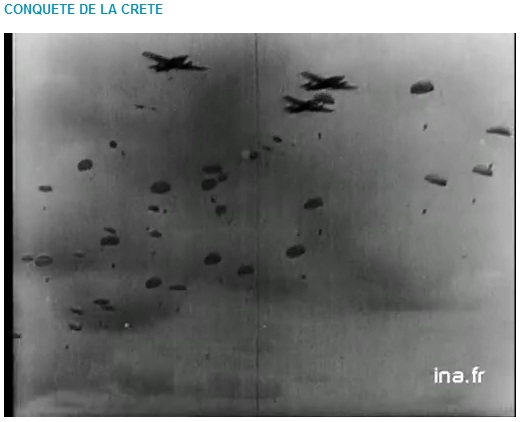
When Britain declared war in 1939, Fermor immediately went home to join up, leaving Balasha behind in Romania. He first enlisted in the Irish Guards, but because of his fluent command of Greek he was commissioned into the Intelligence Corps, serving at first as liaison officer to the Greek army fighting the Italians inAlbania. After Greece fell, Fermor was sent to Crete where he took part in the battle against the German airborne invasion. He remained on the island after the German triumph; disguised now as a Cretan shepherd, with a big handlebar moustache and a dagger in his belt, the tall, slim, Fermor cut a swashbuckling figure as he roamed the mountains to help organize the resistance movement.

It was there, in Crete’s high, wild country, that he recalled in Words of Mercury that…

“devotion to the Greek mountains and their population took root. . . . We lived in goat-folds and abandoned conical cheese-makers’ huts and above all, in the myriad caverns that mercilessly riddle the island’s stiff spine. Some were too shallow to keep out the snow, others could house a Cyclops and all his flocks. Here, at ibex- and eagle-height, we settled with our small retinues. Enemy searches kept us on the move and it was in a hundred of these eyries that we got to know an older Crete and an older Greece than anyone dreams of in the plains. Under the dripping stalactites we sprawled and sat cross-legged, our eyes red with smoke, on the branches that padded the cave’s floor and spooned our suppers out of a communal tin plate: beans, lentils, cooked snails and herbs, accompanied by that twice-baked herdsman’s bread that must be soaked in water or goat’s milk before it is eaten. Toasting goat’s cheese sizzled on the points of long daggers and oil dewed our whiskers. These sessions were often cheered by flasks of raki, occasionally distilled from mulberries, sent by the guardian village below. On lucky nights, calabashes of powerful amber-colored wine loosened all our tongues. Over the shoulders of each figure was a bristly white cloak stiff as bark, with the sleeves hanging loose like penguins’ wings; the hoods raised against the wind gave the bearded and mustachioed faces a look of Cistercians turned bandit. Someone would be smashing shells with his pistol-butt and offering peeled walnuts in a horny palm; another sliced tobacco on the stock of a rifle; for hours we forgot the war with talk and singing and stories; laughter echoed along the minotaurish warrens.”

In 1944 Fermor took part in a bold and perilous mission that later became the subject of a best-selling book, Ill Met by Moonlight by W. Stanley Moss, a fellow intelligence officer. 5 The British plan was to kidnap the German army’s chief of staff, General Muller, who had become notorious and hated for his brutal treatment of both Cretan partisans and civilians. When Muller was called away, the new target was his replacement: General Heinrich Kreipe, a professional soldier arriving straight from service on the Russian front.

Fermor and his team, which included Moss, Sandy Rendel (former political correspondent for the Sunday Times), the Cretan partisan Niki Akoumianakis and a dozen other andartes, had to radically alter their original plan. Fermor and Moss agreed to disguise themselves as German military policemen. That meant Fermor had to part with his Cretan moustache Without it, he looked so much the stiff-necked Teuton that Moss kidded him about being on the wrong side. They decided to promote themselves to corporal’s rank and decorate themselves with a few (stolen) ribbons.

Taking up positions outside the isolated Villa Ariadne—the headquarters for the German army had been built above Heraklion before the war by the archaeologist Sir Arthur Evans—Fermor and Moss flagged the general’s car down at 9.30 pm.

“Is dies das general’s wagon?” he asked.

“Ja, ja,” came the muffled answer from inside.

With that assurance, key members of the band attacked from all sides, tearing at the doors of the car. The beam of a flashlight showed the startled face of the general and the chauffeur reaching for his automatic. There was the thud of a bludgeon; the chauffeur keeled over and was dragged out of sight.

The general, who offered no resistance, was brought to Anogia, the largest village on Crete, located on the northern slopes of Mt. Ida. “Famous for its independent spirit, its idiosyncrasy of dress and accent, it had always been a great hideout of ours,” said Fermor in an account written in 1969  for the Imperial War Museum.

Fermor related that a note had been left in the general’s car stating that he was safe and “would be treated with the respect due to his rank,” and that the kidnap had been carried out by British officers and Greek nationals serving as soldiers in the forces of His Hellenic Majesty. “The point  was to give the Germans no excuse for carnage and reprisals in the Knossos area.”

The next day, however, a single-winged Feiseler-Storck reconnaissance plane circled above Anovia and dropped a steady snowfall of leaflets. “To all Cretans,” the message read, “last night the German General Kreipe was abducted by bandits. He is being concealed in the Cretan mountains and his whereabouts cannot be unknown to the inhabitants. If the General isn’t returned within three days, all rebel villages in the Heraklion district will be razed to the ground and the severest reprisals exacted on the civilian population.”

The general was not, of course, returned to the Germans; he was smuggled off the island and delivered by submarine to British army headquarters in Egypt, and the Germans exacted their promised revenge. Fermor deals with this in circumspect fashion in his official report, asserting that “most untrue to form, there had been little violence, few arrests, no shooting on the part of the Germans.”

Fermor’s statement is disputed by Dr. Michael E. Paradise, a Midwest-based Greek-American whose father and two brothers were members of the British intelligence group on Crete. Though in his teens, Michael himself was often used as a courier. “Attacking in the darkness of one night,” he wrote in the April 10, 1997 edition of The Greek American (a now-defunct, New York-based newspaper), “the Germans proceeded to destroy several villages with the utmost brutality and ferocity. I was witness of the destruction of one of the villages, Ano Meros, on Mt. Kendros in Amari.”

The kidnapping of Gen. Kreipe, Paradise asserted, “contributed to the unnecessary death of hundreds of men, who were hunted down like wild animals in the streets of their villages, then, while some were injured and still alive, they were burnt in the houses of the villages, and buried in them when the dynamiting of the houses followed.”

Most Cretans, though, have not held a grudge against Fermor and his gung-ho confederates. As one veteran Cretan commando said at the time of Kreipe’s abduction, “So they’ll burn down all the houses one day. And what then? My house was burnt down four times by the Turks. Let the Germans burn it down for a fifth time! And they killed scores of my family, scores of them, my child, yet here I am! We’re at war and war has all of these things. You can’t make a wedding feast without meat.”

After the war—and his brief Caribbean sojourn—Fermor realized that his love of Greece had tied himself forever to the country’s fortunes. He lived for a time on Evia, then Ithaca and Hydra (in the house of the painter, Niko Ghika). Soon after he began his travels in the far corners of the Greek mainland which led to the publication of his two masterpieces, Mani and Rozemeli. Accompanied by the photographer (and his wife-to-be) Joan Rayner (daughter of the Conservative politician and First Lord of the Admiralty in Ramsay MacDonald’s coalition government, Belton Eyres Monsell), whom he had met in wartime Cairo, Fermor set off with this goal in mind: “To situate and describe present-day Greece of the mountains and islands in relationship to their habitat and history.”

Mani is the southernmost part of Greece, an isolated, mountainous and forbidding peninsula known for its stark, sun-blistered landscape and warlike, feuding inhabitants. Despite having been warned not to attempt to penetrate into The Deep Mani— “the Maniatis are dangerous”—”they are Jews”—”they fear and hate foreigners”—”they live on salted starfish”—Fermor and Rayner defiantly set out on foot and mule, bus and caique, in search of an authentic Greek world.

What they found and reported on was a revelation to one and all. The Mani was a strange, combative place, to be sure—most people lived in pyrgi, stone towers that were more fortress than domicile—but it was fantastical at the same time, rich in history and bravery (no part of Greece played a more conspicuous and valuable part in the War of Independence). With its code of honor and hospitality, its love of freedom, the Mani was also pulsing with life, colorful in speech, custom, ritual and superstition.

The book that came out of this expedition into the heart and soul of the Mani became an instant classic. Fermor’s prose and Rayner’s photographs (sadly dropped from subsequent editions) won plaudits from critics and readers alike. The British artist (and longtime Greek resident) Polly Hope has said, “Mani was one of the books that brought me to Greece. When my husband and I first read it we knew instantly that this was the world we wanted to go to. It told of magic and fury and history and people and landscape. Completely breathtaking. We read it and reread it and read it again until our heads were full of towers and feuds, cucumbers like slices of ancient pillars, and ouzo. Donkeys and heat. And the dark sea that because of the extraordinary Greek light stands up vertically as far as the horizon. We had to go. And immediately. “We did, and remained, though not in Mani. Still all these years later it is the book that tells about Greece as it is. It is still right and as clear and informative as that first reading. Although tourism has spread its ugly veil over most of Greece the people are still there, the feuds and cucumbers, the vertical sea and broiling sun.”

Similar praise was bestowed on Roumeli when it was published eight years later. Fermor and Rayner’s portrait of the northeast corner of Greece, including Messolonghi, where Lord Byron (one of Fermor’s heroes) fought and died for Greece, is as vivid and compelling as anything in Mani. Whether writing about the sarakatsans, the nomadic shepherds—”self-appointed Ishmaels”—who inhabited the mountaintops, speaking in a  secret tongue; or the origins of the local Karayiozi puppet shows; or the Meteora monasteries; or the “stone-age banquet” (celebrating an arranged marriage) to which they were invited, Fermor’s prose shines and shimmers like beaten gold.

Historian John J. Norwich believes that Fermor “writes English as well as anyone alive.” 7 He also praised ‘the preternatural copiousness” of Fermor’s two books. Jan Morris seconded the statement, adding that Fermor was “beyond cavil, the greatest living travel writer.” In November, 2004 the British Guild of Travel Writers concurred, bestowing on Fermor its Lifetime Achievement Award.

Fermor won another important prize in 2004: the second Gennadius Trustees’ Award for his support of things Greek. At the ceremony in Athens,  the previous recipient of the award, writer/translator Edmund Keeley, said, “I look upon Mr. Fermor as one of my first mentors, a man of letters who taught me, perhaps more than any other Philhellene, the best way to write about the second country we have both come to love and to  celebrate in our work.”

After lauding Fermor for his “imaginative projection of Greece,” Keeley offered a specific example of the kind of “special insight” that Fermor  brings to his writing about Greece. “A scene in his superb book on the Mani . . . not only captures the essence of Greek hedonism . . . but  demonstrates his easy and subtle understanding of the Greek sensibility.”

The scene took place in “the glaring white town” of Kalamata where the Feast of St. John the Baptist was being celebrated. Fermor, his wife Joan, and their friend the writer Xan Fielding sat down to eat their dinner set out at the water’s edge on flagstones “that flung back the heat like a casserole with the lid off.”

Suddenly they decided to pick up their iron table, neatly laid out, and set it down a few yards out to sea, followed by their three chairs, then by the three of them sitting down with the cool water up to their waists. Quite sensible, the only slightly odd thing about this was that all three were fully dressed. Yet the really significant moment, the epiphany, came when the waiter arrived on the quay, gazed in surprise at the space they’d left empty on the burning flagstones, and then (quoting Fermor) “observing us with a quickly masked flicker of pleasure,” stepped without further hesitation into the sea and “advanced with a butler’s gravity” to put down their meal before them, three broiled fish, “piping hot, and with their golden brown scales sparkling.”

As Keeley pointed out, “It is Fermor’s seeing both that flicker of pleasure and the quick masking of it that says so much, more even than his report that others on the quay sent their seaborne fellow diners can after measuring can of retsina, and a dozen boats gathered around to help them consume the complimentary wine, and a mandolin arrived . . . to accompany rebetika songs in praise of the liberated life. Only those who have often taken apart and savored a broiled tsipoura or fangri . fresh from the sea and amply bathed in an olive-oil-and-lemon sauce would recognize why no representative Greek citizen given to pleasure would think of disturbing, except in a celebratory way, any table holding such a succulent, earthy gift from the Gods. And only a writer with Fermor’s precise vision and brilliant skill in expression would choose to show our hedonistic waiter appropriately masking his pleasure and assuming the gravity of a butler as he entered the sea on his mission to deliver the gods’ gift.”

It is, alas, harder and harder to find such raffish scenes in 21stcentury, tourist-choked, EU-regimented Greece. Even Fermor, in a recent essay, had to admit that much of what he first encountered and experienced in Greece has disappeared. “Progress has altered the face and character of the country,” he commented. And as for tourism, “it destroys the object of its love.” 10

That said, Fermor still continues to write about Greece. In his 90s, living alone in the pyrgos he built in the Outer Mani—Joan died in 2000, of injuries suffered in a fall—he toils away on the final book of his Hook of Holland to Constantinople trilogy, the one that deals with his first years in Greece, working from notebooks, maps and memory. In a way Fermor is a chronicler of a bygone age, a rememberer of things past. The Greece he reveres may have died, but he battles with the last strength in him to keep its spirit alive.

Notes

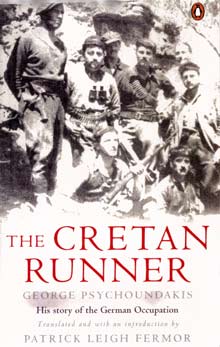
1. ‘Only two of Fermor’s books are in print in the United States: A Time of Gifts and Between the Woods and the Water. They are New York Review of Books Classics. In the UK, most of Fermor’s books are published in hardbound and paperback by John Murray Ltd., but Penguin has published a few of his titles as paper reprints. The following are his major publications. Mani: Travels in the Southern Peloponnese. Photos by Joan Eyres (London: Murray, 1958); Translation of George Pyschounadkis, The Cretan Runner: His story of the Germany Occupation. (London: J. Murray, 1978, c1955); Roumeli: Travels in Northern Greece (London & NY; Penguin, 1983, c1966); Introduction to Kostas Chatzepateras, Greece 1940-41 Eyewinessed (Anixi Attikis {Greece}: Efstathiadis Group, 1995); Text with Stephen Spender of Ghika: Paintings, Drawings, Sculpture (London: Lund Humpries, 1964); A Time of Gifts; On Foot to Constantinople, from the Hook of Holland to the Middle Danube (NY: New York Review of BooKs, 2005).

2. Quotations is from a review from “Scholar in the Woods,” a review by James Campbell in The Guardian, April 8, 2005.

3. ‘James Campbell, Words of Mercury.

4. A11 quotes regarding Fermor’s reading tastes are taken from his essay in
the anthology The Pleasures of Reading edited by Antonia Fraser, Bloomsbury,
1992.

5. ‘The details of the kidnapping are taken from Ill Met by Moonlight (London:
Harrap, 1950). In the movie of the same name released in 1958, Fermor is
played by Dirk Bogarde.

6. Letter to the author sent in 2004.

7. Copy written for the dusk jacket of the paperback edition of Between the Woods and the Water.

8. Ibid.

9. This and subsequent Keeley citations are from a 2004 letter to the author. Date?

10. See Fermor’s essay in A Time of Gifts.

Xan Fielding Obituary

I am reposting this obituary to Xan Fielding at this time as he was Paddy’s very good friend, the one to whom Paddy wrote his open letters at the start of A Time of Gifts and Between the Woods and the Water. Those who have found this site for the first time might wish to read about his friend. At the end is a special tribute written by Paddy.   I believe this to be the only on-line copy and it now includes newly discovered photographs.

==============================================================

After much searching I can bring you what I believe to be the only on-line obituary to Xan Fielding which I have retyped from the Daily Telegraph Second Book of Obituaries: Heroes and Adventurers. This includes a special tribute from Paddy to one of his closest friends.

First published in the Daily Telegraph 20 August 1991

Xan Fielding, the author, translator, journalist and adventurous traveller, who has died in Paris aged 72, lived a charmed life as a Special Operations Executive agent in Crete, France and the Far East during the Second World War.

Short, dark, athletic and a brilliant linguist, he was God’s gift to operations in rugged mountainous regions and wherever his languages were needed.

Major Fielding was awarded the DSO in September 1942, “for going into a town”, as he said later with a typical modesty.
He had a boyish, slightly rebellious spirit which he shared with many of his contemporaries in SOE. His self-confessed, or self-proclaimed, amateurishness certainly belied a tough professionalism, great resourcefulness and bravery in action. Fielding was the sort of man one would be happy to go into the jungle with.

While still in his early twenties he was responsible for clandestine and subversive activities in large areas of enemy-occupied Crete. He survived numerous encounters with German forces, only to be rumbled by the Gestapo in France towards the end of hostilities in Europe.

Even then his luck held. Locked in a death cell at Digne in 1944, he was “sprung” in an audacious move by Christine Granville (nee Krystyna Skarbeck) whose SOE exploits matched his.

Alexander Wallace Fielding was born at Ootacamund, India, on November 26 1918. His family had long links with the Raj and his father was a major in the 50th Sikhs.

Xan’s mother died at his birth and he was largely brought up at Nice, where his grandmother’s family had considerable property. Fluent in French, he subsequently became a proficient classicist at Charterhouse and then studied briefly at Bonn, Munich and Freiberg Universities in Germany. He saw what was happening in that country and was so shocked at the attitude of the Chamberlain government that he came close to joining the Communist party.

At the end of the 1930s Fielding – who had recently been sacked as a sub-editor on the Cyprus Times and was by now unsuccessfully running a bar – found himself a misfit in the Mediterranean colony. Colonial officials abhorred his refusal to adopt their disdainful description of Cypriots as “Cyps”. That he was also reasonably fluent in Greek rendered him suspect to district commissioners, who could not speak the language of the people they administered.

At the outbreak of the Second World War, haunted by the thought that he might find himself trapped in Cyprus for the duration, he fled to Greece and found asylum on St Nicholas, an island owned by the anthropologist, Francis Turville Petre. Fielding dreaded not so much the battlefield as joining the conventional officers’ mess. But eventually news of the fall of France, the Dunkirk evacuation and the Battle of Britain induced a “stab of guilt”.

He returned to the colony and was commissioned into the Cyprus Regiment, which appealed to him on account of its perverse refusal to have any regimental pride.

On hearing in Cairo that Cretans had taken up arms against the Germans, he yearned, as he wrote later, to help lead “this concerted uprising of the technically non-combatant”.

When Crete fell, Fielding was interviewed in Egypt by SOE. He was asked: “Have you any personal objection to committing murder?” His response being deemed acceptable, Fielding was put ashore in Crete with a load of weapons and explosives by Cdr “Crap” Miers, VC, skipper of the submarine Torbay.

Fielding, who had adopted the style and dress of a Greek highland peasant, was accompanied by a First World War veteran, who was inseparable from his solar topee and unrecognisable as the village schoolmaster he was supposed to impersonate.

Fortunately it was not long before he teamed up with the far more kindred spirit of Patrick Leigh Fermor. Sporting a royal blue waistcoat, lined with scarlet shot silk and embroidered with black arabesques – and singing folk songs in several languages – “Paddy” Leigh Fermor enlivened their meetings in desolate mountain hideouts.

Fielding understood the need for reliable intelligence and communications, and he daringly set up his headquarters near Crete’s northern coastal road in the proximity of German units. He experienced, as he put it, a childish excitement in “brushing shoulders with the Wehrmacht” in the corridors of the town hall when calling on the mayor of Crete’s capital, Canea. And he found it entertaining to attend parties given for the Germans by Cretan associates feigning fraternisation.

Operationally, Crete had become a massive transit camp to reinforce the Afrika Korps. Among his intelligence successes Fielding signalled the timetable of transports taking off from the airfield at Maleme, enabling the RAF to intercept them.

After six months he was picked up by a Greek submarine and given a breather in Cairo. This gave him a chance to niggle about the inaccuracy of RAF air drops.

As a result Fielding was invited to observe, from the front turret of a Wellington, a drop arranged for Leigh Fermor high up in the White Mountains. Considerably shaken by the experience – not least the anti-aircraft fire- he returned to the island by Greek submarine at the end of 1942 and never complained again.

Following the Crete mission, he parachuted into the south of France in the summer of 1944. Bearing papers announcing him as Armand Pont-Leve, a young clerk in the Electric Company of Nimes – but codenamed “Cathedrale” – Fielding was received by Francis Cammaerts (alias “Roger”) and also by Christine Granville.

Fielding found them an “imposing pair”. Still in uniform, he felt “rather like a novice in the presence of a prior and prioress”. The canister containing his civilian clothes, with poison pill sewn into the jacket, was missing and he felt something of a freak in the baggy Charlie Chaplin trouserings produced by “Roger”.

Shortly afterwards he was in the Cammaert’s car when it was stopped at a road block near Digne. Questions revealed that SOE staff in Algiers had failed to stamp a current date on his otherwise impeccable papers. Worse Fielding had split a large sum of French money between “Roger” and himself, and the enemy twigged that the notes were all in the same series.

Christine Granville was not with them and news of their arrests reached her on the Italian border. Earlier she had been arrested, but had managed to convince her German interrogators that she was a local peasant girl.

She arrived at Digne prison and passed herself off as “Roger’s” wife – and, for good measure, as a niece of Gen Montgomery. She persuaded an Alsatian named Albert Schenck, a liaison officer between the French prefecture and the German Siercherheitsdienst, to co-operate by reminding him that the Allies had already landed on the Riviera.

Schenck put Christine on to a Belgian, Max Waem, who agreed to help, though his price was two million francs. SOE in Algiers dropped the money in. As a result Fielding and “Roger” were led out of prison. Believing themselves on the way to be shot, they were astonished to be welcomed by Christine who was waiting with a car.

Fielding was awarded the Croix de Guerre in France in 1944. Before the war in Europe ended, he returned to Crete; he was one of the first into liberated Athens.

During the war Fielding would often pass through Cairo, which became a sort of SOE headquarters for the Mediterranean and Middle East, and meet up with kindred spirits such as David Smiley, “Billy” McLean (qv), Peter Kemp (qv) and Alan Hare. In 1945 they decided the place to be was the Far East. As Fielding put it: “I was at a loose end and wanted to see what was going on out there.”

He spent some months in Cambodia, with a Japanese driver fighting the Vietminh. Then came as six-month stint with the Special Intelligence Service in Germany, and an appointment as United Nations observer in the Balkans.

Peacetime, though, brought disillusionment and a disturbing sense of misgiving. But in 1948 an encounter with the Marchioness of Bath at what she described as an “hilarious lunch” predestined the course of much of the rest of his life. She had recently taken up photography in place of painting; he was planning a book on Crete. The upshot was that Daphne Bath accompanied his return to the White Mountains to illustrate the book. They married in 1953.

Xan and Daphne Fielding with Dirk Bogarde on the set of Ill Met by Moonlight

Soon there was another and more welcome distraction. Michael Powell was filming Ill Met by Moonlight – the story of Paddy Leigh Fermor’s wartime abduction of Gen Kreipe, the German commander in Crete – and Fielding was hired as technical adviser. Dirk Bogarde played Leigh Fermor and Fielding lent him his Cretan guerrilla’s cloak and coached him in the part.

Patrick Leigh Fermor writes: After an early essay at painting, Xan Fielding wandered to Greece and the islands, added Greek to his list of languages and acquired a lasting attachment to the Greeks.

His life took on an adventurous and peripatetic turn. Early in 1942 he was landed in plain clothes and by submarine in German-occupied Crete. Germany was in full advance on all fronts and Crete was a strongly galvanised Luftwaffe base for the Desert War. The mountains were full of stray British and Commonwealth soldiers who had broken out of PoW camps or been left behind after the Battle, a mortal danger to the Cretans who hid and fed them.

Gathering and evacuating them from remote caves was among Xan’s first tasks. Establishing a network of agents and signalling information back to Cairo came next followed by parachute drops to the growing guerrilla bands and the e organisation of sabotage, and propaganda while maintaining liaison with the island Resistance leaders.

Light and fine-boned when suitably cloaked and daggered, Xan could be taken for a Cretan. With his determination, humour and intuitive sympathy and his quick mastery of dialect and songs, he made countless friends, and worked there precariously for two years.

In 1944, the war moving west, he was dropped in the Vercors region to the French maquis. He returned to Crete for a final two months before the liberation, then headed for Cambodia on further SOE missions and spent some time on the Tibet border before returning to the West Bank in Greece.

Xan commanded a mixed Allied unit supervising the 1946 elections, and during prolonged leave in Rhodes, his friend Lawrence Durrell – who was press officer there – insisted on printing a set of Fielding’s poems, which make one wish he had written many more. Chafing at Oxford life as a demobilised undergraduate, he worked for a spell with the Beaverbrook Press and found it even less congenial.

These years were perplexed by tangled Dickensian lawsuits in Nice: family property had been unrecoverably misappropriated in the occupation. During that harassing time he wrote Hide and Seek, an exciting account of his experiences in Crete.

Soon after he married Daphne Bath, and they travelled all over the island (of Crete) for his long book The Stronghold, a combination of travel and history.

They first settled in Portugal. Then a long sojourn in the Kasbah of Tangier – perhaps inspired by the film Pepe le Moko – gave rise to his book Corsair Country, the history of the pirates of the Barbary Coast.

Near Uzez in Languedoc, their next long halt, his excellent French suggested translation as a profession and he put more than 30 books into English, including many by Larteguy and Chevalier, and Malrauz’s Les Noyers d’Altenborg [Ed: and perhaps better known Planet of the Apes and Bridge on the River Kwai]

After a friendly separation from Daphne he married Agnes (“Magouche”) Phillips, daughter of Adml John II Magruder, of the United States Navy. They were extremely happy.

Xan and Magouche took root in the Serriana de Ronda, which looks across Adalusian ilex-woods to the Atlas. There he edited the correspondence of his friend and neighbour, Gerald Brennan, with Ralph Partridge, and continued his translations.

Xan’s own book, The Money Spinner, about the Monaco casino – the hazards of gambling had always fascinated him – came out in 1977. Later, Winds of the World gave free rein to his interest in atmospheric commotions and their mythology.

In the winter of 1990 One Man and his Time appeared; it described the life, and the Asian, Ethiopian and Arabian travels, of his old friend “Billy” McLean (qv), the wartime commander of the SOE mission in Albania.

At almost the same time Xan was smitten by cancer and he and Magouche moved to Paris for therapy. Though fatally stricken for the last eight months, he was suddenly, three months ago, granted a reprise which exactly coincided with the ceremonies for the 50th anniversary of the Battle of Crete and the Resistance.

At a special parade of the Greek navy at Souda, he and six Allied officers were decorated with the commemorative medal of the Resistance, and for 10 days he visited scores of mountain friends from 50 years before. His return was everywhere greeted with feasting and songs.

Xan Fielding was a gifted, many-sided, courageous and romantic figure, deeply committed to this friends, civilised and bohemian at the same time, with a thoughtful style leavened by spontaneous gaiety and a dash of recklessness. He was altogether outstanding.

August 20 1991

Audible

Patrick Leigh Fermor … This is Your (Ill Met by Moonlight) Greek Life

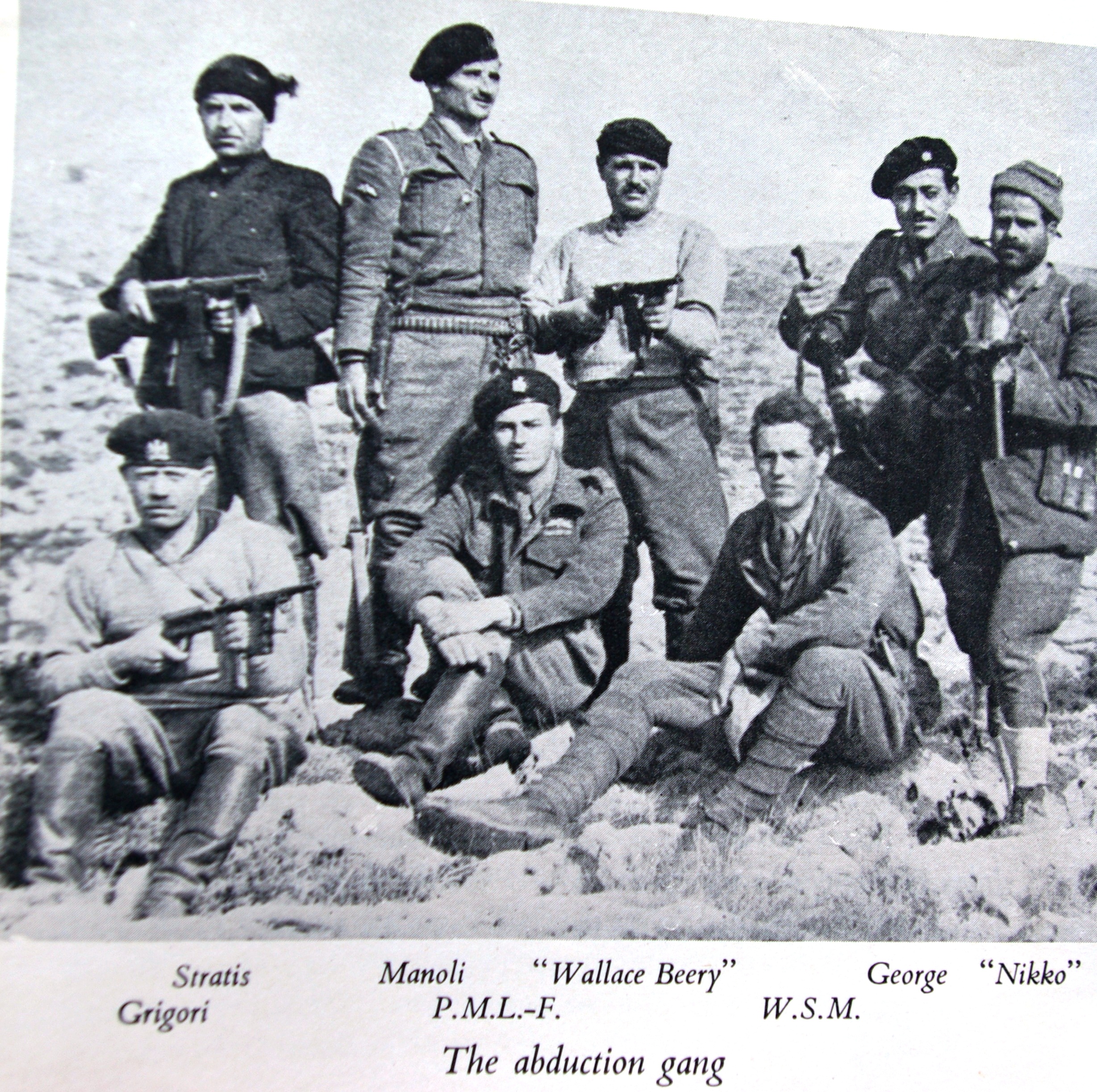
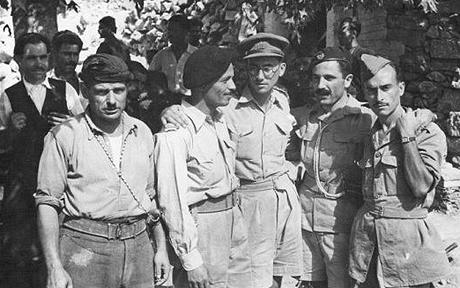
The abduction gang - PLF centre Moss to his left

This is a wonderful find brought to us by Blog reader Erik Bruns.

Many will remember the TV show This is Your Life. Greek television had their own version, and in 1972 it was Paddy’s turn to be embarrassed and surprised by meeting again people that he had come across in his life. His surprise and clear delight at meeting with the ‘Abduction Gang’ of Cretan Andartes is clear. The ‘senior’ partisans, Manoli and George (see picture left) are the first two guests, and they seem barely changed.

The highlight must be when the presenter introduces a slightly frail General Heinrich Kreipe. Paddy is delighted to see him again, and immediately starts to talk to the General in German saying how good it is to see him after all these years.

I am amused as one of the Cretans takes the General’s arm to help him sit down; maybe he did the same before on that road to the Villa Ariadne, but was perhaps a little less gentle on that occasion!

There follows what is one of television’s most wonderful scenes as Paddy acts as translator answering the presenter in Greek and then switching back to German to speak to the General.

Take fifteen minutes of your life to watch Paddy, and all these great men, as they share their experiences of an event which took place thirty years before, with great animation and clear joy.

I have a feeling that there was a pretty good party afterwards with plenty of Ouzo and Retsina!

Tales of a literary traveller: Sir Patrick Leigh Fermor

I have been amiss and I should have published this earlier. I was contacted by John Stathatos who is a Greek photographer and knows Paddy. He emailed me back in January which was during my ‘down time’ on the blog.
Dear Tom,
While chasing up references to Costa, I discovered that the Robin Hanbury-Tenison piece on your site (“The Friendly Isles: in the Footsteps of Patrick Leigh Fermor“) is actually based on an earlier and more wide-ranging article entitled “Tales of a Literary Traveller”, first published in the Geographical magazine in 2004. You can find the earlier one here: Why this should be available on a site called CBS MoneyWatch is entirely beyond me, but that’s the Internet for you…
All the best,
John

Tales of a literary traveller: Sir Patrick Leigh Fermor DSO, OBE is widely considered to be our greatest living travel writer, and was knighted earlier this year for, as he put it, just writing a few books. Robin Hanbury-Tenison, who has known ‘Paddy’ for 50 years, explains why the great man’s writing is as powerful and important today as it has ever been

First published in the Geographical August 2004

by  Robin Hanbury-Tenison

Robin Hanbury-Tenison

Patrick Leigh Fermor is a unique mixture of hero, historian, traveller and writer: the last and the greatest of a generation whose like we won’t see again. Bringing the landscape alive as no other writer can, he uses his profound and eclectic understanding of cultures and peoples, their origins and current place in the world, to paint vivid pictures–nobody has illuminated the geography of Europe better through literature. Everything is grist to his mill; nothing is ever banal. He expects much of his readers and we’re kept on our toes, constantly reaching for the dictionary or Brewer’s. In return for these achievements, he was finally knighted this year at the age of 88. He had modestly refused this honour previously on the grounds that all he had done was “write a few books”.

I first met Paddy (as he has always been known) in Athens in 1954 when I was a callow 18-year-old travelling through Greece. I remember sitting at a cafe in Metaxas Square while waves of witty erudition washed back and forth between him and my older travelling companion, and being humbled into awed silence. Paddy has always appeared larger than life, both in his personality and in his relatively rare and carefully honed writing. We corresponded from time to time over the years and eventually met again when he and his wife Joan had my wife and me to lunch at their house in Greece, where we were made to feel instantly at home.

Since Joan’s death, Paddy has spent more time in England, which gives us all more opportunity to see him. In May this year, a dinner was held for him by the Travellers Club, at which he was presented with a specially commissioned map of the route that he followed through Europe during the early 1930s and that he later wrote about so vividly. He spoke at the dinner and, now 89, held us all spellbound with some classic tales. One of the club waitresses was from Sofia and, to her delight and the amazement of all around, he launched into apparently fluent Bulgarian as she served him.

The bare details of his life, too, delight and amaze. The son of Sir Lewis Leigh Ferrnor, the director of the Geological Survey of India, Paddy was sacked at 17 from King’s School, Canterbury (for the terrible crime of “holding hands with the greengrocer’s daughter”), and spent the next 18 months walking to Constantinople, a journey that he wrote about with apparent total recall some 40 years later in A Time of Gifts, the first volume of a trilogy. It was followed by Between the Woods and the Water. We still await the final volume.

In the Second World War, Paddy served with the Special Operations Executive–the precursor of the SAS–and, because he spoke Greek, was parachuted into Crete behind enemy lines to help organise resistance against the Germans. In April 1944, having already spent more than a year living there, he pulled off one of the most dramatic exploits of the war.

Dressed as Feldpolizei corporals, Paddy and Captain Billy Moss–who subsequently wrote the book on which the film Ill Met by Moonlight was based–stopped the car in which General Heinrich Kreipe, the recently arrived commander of the German occupation forces, was being driven by his chauffeur. The driver was removed and handed over to members of the Cretan Resistance, while Paddy put on the general’s hat and proceeded to drive on through 22 control posts. The car was then abandoned, and the two soldiers marched their prisoner through that night and the next day to a cave high in the mountains.

In order to avoid reprisals against the Cretans, leaflets were to be dropped all over Crete, containing a message that the BBC also broadcast: that the general was safe, and would be treated with the respect due his rank; that the operation had been carried out by British officers; and that they were all on their way to Cairo by submarine. Two days later, they woke among some rocks near the summit of Mount Ida, just as dawn was breaking. Half to himself, General Kreipe recited in Latin the opening line of a Horace ode. As Paddy subsequently described in his report to the Imperial War Museum: “He was in luck. It is the opening line of one of the few odes of Horace I know by heart–Ad Thaliarchum, I.ix” and he went on to recite the remaining five stanzas. “The general’s blue eyes swivelled away from the mountain-top to mine–and when I’d finished, after a long silence, he said: ‘Ach so, Herr Major!’ It was very strange. ‘Ja, Herr General.’ As though, for a long moment, the war had ceased to exist. We had both drunk at the same fountains long before; and things were different between us for the rest of our time together.”

After the war, Paddy spent six months travelling through the Caribbean with Joan Eyres-Monsell–the woman who, 20 years later, was to become his wife–and Costa, the great Greek photographer. The result was his first book, The Traveller’s Tree, which brought the Caribbean to the notice of post-war Britain. Back then, the many islands they visited were thoroughly run down. The great buildings–of church, state and planters’ wealth–were mostly ruined and rotten. In the depressed economic climate immediately following the war, the future looked bleak; indeed, ‘King Sugar’ was about to die, this time as a victim of sugar beet and the macropolitics being played out between the USA and Europe.

Yet Paddy still managed to reveal the archipelago’s romance and magic, and The Traveller’s Tree was hailed as a masterpiece and won the Heinemann Prize. Paddy’s portrayal of the islands could be said to have jump-started the tourism industry upon which the Caribbean has since largely depended.

It was the Caribbean, too, that provided the backdrop to Paddy’s only novel, The Violins of Saint-Jacques, which brings alive the glamour and the passions of the planters in their heyday. This tale of a rich island being destroyed by a volcanic eruption in the middle of a splendid planters’ ball is based on the true story of the annihilation in 1902 of St-Pierre, the old capital of Martinique. There, 26,000 people died instantly in the New World’s Pompeii. The sole survivor was the town drunk, who was incarcerated in a cell below ground. He spent the rest of his life as an exhibit in Barnum and Bailey’s Circus.

Paddy eventually returned to Greece, where, during the 1960s, he built a wonderful house above a private cove near the fishing village of Kardamili in the southern Peloponnese. There, in a large room that John Betjeman, an early visitor, called “one of the rooms in the world”, he and Joan entertained a string of artists and writers with copious quantities of retsina, and Paddy wrote.

His greatest book, Mani, was about a journey through that little-known and, at the time, archaic region; the book has been in print ever since. Paddy travelled simply, staying with fishermen and farmers, which enabled him to capture the essence of the region, as this extract reveals:

Beyond the bars of my window the towers descended, their walls blazoned with diagonals of light and shade; and, through a wide gap, castellated villages were poised above the sea on coils of terraces. Through another gap our host’s second daughter, wide hatted and perched on the back of a wooden sledge and grasping three reins, was sliding round a threshing floor behind a horse, a mule and a cow–the first cow I had seen in the Mani–all of them linked in a triple yoke. On a bank above this busy stone disc, the rest of the family were flinging wooden shovelfuls of wheat in the air for the grain to fall on outstretched coloured blankets while the husks drifted away. Others shook large sieves. The sun which climbed behind them outlined this group with a rim of gold and each time a winnower sent up his great fan, for long seconds the floating chaff embowered him in a golden mist.

Almost every page has its own literary tour de force, often with intimidating displays of learning and research mixed with fantasy, imagination and acute descriptions of the scene itself. In his next book, Roumeli, about the minority communities of northern Greece, Paddy becomes fascinated by the last true nomads of the region, the Sarakatsans. His description of their wanderings is, for me, the best sort of literary geography lesson, and has even more geopolitical relevance now than when he wrote it:

The sudden cage of frontiers which sprang up after the Balkan Wars failed to confine them and they fanned out in autumn all over southern Albania and across the lower marches of Serbia as far as Montenegro and Herzogovina and Bosnia and into Bulgaria to the foothills of the Great Balkan. Those who thought of the Rhodope mountains as their home–the very ones, indeed, in the highlands that loom above the Thracian plains–were particularly bold in the extent of their winter wanderings. Not only did they strike northwards, like those I saw by the Black Sea, but, before the Hebrus river became an inviolable barrier, their caravans reached Constantinople and up went their wigwams under the walls of Theodosius. Others settled along the shores of the Sea of Marmara and spread over the rich green hills of the Dardanelles. Many crossed the Hellespont to pitch camp on the plain of Troy. Bold nomads would continue to the meadows of Bythinia and winter among the poplar trees or push on into Cappadocia and scatter their flocks across the volcanic wildernesses round the rock monasteries of Urgub. The boldest even reached Iconium, the home of Jellalludin and the metropolis of the whirling dervishes. They never looked on these enormous journeys as expatriation: until the deracination of the 1920s, much of Asia Minor was part of the Greek world; and even beyond its confines there were ancient Greek colonies.

Those attempting today to sort out the chaos in what was, for a while, southern Yugoslavia could learn a lot from reading Paddy’s books.

One of the main criticisms of Paddy’s writing is that there simply isn’t enough of it. But very few 20th-century writers, with perhaps the exception of Graham Greene, have managed to be prolific while maintaining consistent quality of this kind. The relatively small number of books (much boosted by the release of the paperback of Words of Mercury this mouth) is the work, to quote Anthony Sattin in the Sunday Times, of “one of the greatest travel writers of all time”, a heartfelt wanderer truly involved in mankind.

New editions of both Mani and Roumeli will be published by John Murray near the end of this year. A Time of Gifts and Between the Woods and the Water were reissued by John Murray in March. Words of Mercury is out now in paperback.

Early inspiration: Following Paddy around the Caribbean

Though Patrick Leigh Fermor’s most famous works recount his European travels, it was the Caribbean that inspired his first book. Fifty years later, Robin Hanbury-Tenison and his wife retraced Paddy’s steps:

We hired horses and rode, as Paddy did, between tall forest giants, listening to the jungle buzz and background twitterings. Suddenly, a beautiful, melodious note rang out. This was followed after o moment by three more notes of startling clarity and sweetness and the theme, a bit like the opening bars of Beethoven’s Fifth, was repeated every few minutes. It was a rufous-throated solitaire, which Leigh Fermor describes as making “a noise so melancholy that it seemed the perfect emanation of these sad and beautiful forests. It haunts the high woods of Dominica and nowhere else in the world.”

How does everything about a place change in 50 years, and yet the place itself remain the same? It is because of that unique mixture of cultures that is the Caribbean–and no-one has captured and evoked the extraordinary differences between the islands better than Paddy did in The Traveller’s Tree. Ash says: “Each island is a distinct and idiosyncratic entity, a civilisation, or the reverse, fortuitous in its origins and empirical in its development. “And then again, quoting an old Jamaican: “We’re always going somewhere. But we never get there.”

Patrick Leigh Fermor, however, not only travelled but also arrived. And those of us who read his dispatches home–those calm, intelligent tales of lives lived elsewhere–are in his debt.

Obituary: Captain Charles Upham, who twice won the Victoria Cross

Captain Charles Upham VC & Bar

Only three men have ever won double VCs, and the other two were medical officers: Col A Martin-Leake, who received the decoration in the Boer War and the First World War; and Capt N G Chavasse, who was killed in France in 1917. Chavasse’s family was related to Upham’s. Upham won his first VC in the Battle of Crete in 1941, the 70th anniversary of which has just passed. Paddy of course fought in the battle, and then continued the fight on the island with SOE.

First published in the Telegraph November 23 1994

For all his remarkable exploits on the battlefield, Upham was a shy and modest man, embarrassed when asked about the actions he had been decorated for. “The military honours bestowed on me,” he said, “are the property of the men of my unit.”

In a television interview in 1983 he said he would have been happier not to have been awarded a VC at all, as it made people expect too much of him. “I don’t want to be treated differently from any other bastard,” he insisted.

When King George VI was conferring Upham’s second VC he asked Maj-Gen Sir Howard Kippenberger, his commanding officer: “Does he deserve it?”

“In my respectful opinion, Sir,” replied Kippenberger, “Upham won this VC several times over.”

A great-great nephew of William Hazlitt, and the son of a British lawyer who practised in New Zealand, Charles Hazlitt Upham was born in Christchurch on Sept 21 1908.

Upham was educated at the Waihi Preparatory School, Christ’s College and Canterbury Agricultural College, which he represented at rugby and rowing.

He then spent six years as a farm manager, musterer and shepherd, before becoming a government valuer in 1937.

In 1939 he volunteered for the 2nd New Zealand Expeditionary Force as a private in the 20th Battalion and became a sergeant in the first echelon advance party. Commissioned in 1940, he went on to serve in Greece, Crete and the Western Desert.

Upham won his first VC on Crete in May 1941, commanding a platoon in the battle for Maleme airfield. During the course of an advance of 3,000 yards his platoon was held up three times. Carrying a bag of grenades (his favourite weapon), Upham first attacked a German machine-gun nest, killing eight paratroopers, then destroyed another which had been set up in a house. Finally he crawled to within 15 yards of a Bofors anti-aircraft gun before knocking it out.

When the advance had been completed he helped carry a wounded man to safety in full view of the enemy, and then ran half a mile under fire to save a company from being cut off. Two Germans who tried to stop him were killed.

The next day Upham was wounded in the shoulder by a mortar burst and hit in the foot by a bullet. Undeterred, he continued fighting and, with his arm in a sling, hobbled about in the open to draw enemy fire and enable their gun positions to be spotted.

With his unwounded arm he propped his rifle in the fork of a tree and killed two approaching Germans; the second was so close that he fell on the muzzle of Upham’s rifle.

During the retreat from Crete, Upham succumbed to dysentery and could not eat properly. The effect of this and his wounds made him look like a walking skeleton, his commanding officer noted. Nevertheless he found the strength to climb the side of a 600 ft deep ravine and use a Bren gun on a group of advancing Germans.

At a range of 500 yards he killed 22 out of 50. His subsequent VC citation recorded that he had “performed a series of remarkable exploits, showing outstanding leadership, tactical skill and utter indifference to danger”. Even under the hottest fire, Upham never wore a steel helmet, explaining that he could never find one to fit him.

His second VC was earned on July 15 1942, when the New Zealanders were concluding a desperate defence of the Ruweisat ridge in the 1st Battle of Alamein. Upham ran forward through a position swept by machine-gun fire and lobbed grenades into a truck full of German soldiers.

When it became urgently necessary to take information to advance units which had become separated, Upham took a Jeep on which a captured German machine-gun was mounted and drove it through the enemy position.

At one point the vehicle became bogged down in the sand, so Upham coolly ordered some nearby Italian soldiers to push it free. Though they were somewhat surprised to be given an order by one of the enemy, Upham’s expression left them in no doubt that he should be obeyed.

By now Upham had been wounded, but not badly enough to prevent him leading an attack on an enemy strong-point, all the occupants of which were then bayoneted. He was shot in the elbow, and his arm was broken. The New Zealanders were surrounded and outnumbered, but Upham carried on directing fire until he was wounded in the legs and could no longer walk.

Taken prisoner, he proved such a difficult customer that in 1944 he was confined in Colditz Castle, where he remained for the rest of the war. His comments on Germans were always sulphurous.

For his actions at Ruweisat he was awarded a Bar to his VC. His citation noted that “his complete indifference to danger and his personal bravery have become a byword in the whole of the New Zealand Expeditionary Force”.

After his release from Colditz in 1945 Upham went to England and inquired about the whereabouts of one Mary (“Molly”) McTamney, from Dunedin. Told that she was a Red Cross nurse in Germany, he was prepared, for her sake, to return to that detested country. In the event she came to England, where they were married in June 1945.

Back in New Zealand, Upham resisted invitations to take up politics. In appreciation of his heroism the sum of £10,000 was raised to buy him a farm. He appreciated the tribute, but declined the money, which was used to endow the Charles Upham Scholarship Fund to send sons of ex-servicemen to university.

Fiercely determined to avoid all publicity, Upham at first refused to return to Britain for a victory parade in 1946, and only acceded at the request of New Zealand’s Prime Minister.

Four years later he resisted even the Prime Minister’s persuasion that he should go to Greece to attend the opening of a memorial for the Australians and New Zealanders who had died there – although he eventually went at Kippenberger’s request.

In 1946, Upham bought a farm at Rafa Downs, some 100 miles north of Christchurch beneath the Kaikoura Mountains, where he had worked before the war. There he found the anonymity he desired.

In 1962, he was persuaded to denounce the British government’s attempt to enter the Common Market: “Britain will gradually be pulled down and down,” Upham admonished, “and the whole English way of life will be in danger.” He reiterated the point in 1971: “Your politicians have made money their god, but what they are buying is disaster.”

He added: “They’ll cheat you yet, those Germans.”

Upham and his wife had three daughters, including twins.

Battle of Crete: Sinking of HMS Gloucester remembered 70 years on

Emotional memories of the loss of HMS Gloucester 70 years ago, with the loss of 700 hands. Taking part in the Battle for Crete, she was sunk on the 22nd May 1941 by Ju.87s and Ju.88s.

Watch here on the BBC website.

Six-inch gunned "Town" class cruiser HMS Gloucester

Crete, Greece: Ghostly soldiers on the Battle of Crete anniversary

The Commonwealth War Cemetery at Souda Bay in Crete where the main anniversary commemorations will take place

It was sunny but cold, last month in Crete – what the locals call “ilios me dontia”, sun with teeth. I sat on the beach at Sfakia on the south coast of the island. Around me a toddler played among the stones while taverna owners were applying final licks of paint in preparation for the new tourist season.

My late father sat on the same beach in May 1941. Around him there was chaos and despair. Evelyn Waugh, who was there too, later captured the scene in the novel Officers and Gentlemen: “The ghosts of an army teemed everywhere. Some were quite apathetic, too weary to eat; others were smashing their rifles on the stones, taking a fierce relish in this symbolic farewell to their arms.”

This tiny harbour is the finish to the story of the Battle of Crete, which started 70 years ago on Friday, May 20 — a significant anniversary that will be commemorated across the island. There are few veterans left now, but strands of the narrative may still be picked up among the rocks and wild flowers of the beautiful western end of Crete.

I had long meant to do this journey, to discover what my father – and thousands of others – went through. He himself hadn’t been the best source as he wouldn’t say much about it. And then he died, with the story largely untold.
Related Articles

To help me uncover it, I enlisted the services of a Briton who has been a resident of Crete for 25 years and offers guided tours of the key sites. For Tim Powell, tourist guide, musician and lover of all things Cretan, the Battle of Crete was characterised by the heroic resistance of the civilian population. “This ‘insurgency’ led to a declaration that for every German soldier killed, 10 Cretans would be executed — which of course did nothing to stop them,” he said.

He started the story at the end, the Commonwealth War Cemetery at Souda Bay where the main anniversary commemorations will take place. The 1,500 headstones memorialise some colourful characters, none more vivid than John Pendlebury, an archaeologist with a glass eye who was operating in Crete as a secret agent when he was killed on May 22 1941.

The battle and its aftermath of guerrilla resistance threw up a cast of such chaps — suave British secret agents, brave Cretan warriors, even a monocle-wearing German aristocrat — whose deeds are recorded in some compelling accounts. Ill Met by Moonlight, for example, recounts the kidnap of the German General Heinrich Kreipe in 1944, masterminded by the secret agent (and future travel writer) Patrick Leigh Fermor.

But the Crete campaign also included many ordinary soldiers and civilians whose names and actions remain unrecorded and for whom the experience was far from glamorous. One of them was my father, a lance sergeant in the Northumberland Hussars, who was evacuated to Crete from Athens towards the end of April 1941 after mainland Greece fell to the Nazis.

He dug in with a force of about 21,000 combat-ready British, Australian, New Zealand and Cretan soldiers to defend the island. The Germans launched their attack on May 20 in wave after wave of paratroop drops by parachute and glider. What followed was a series of military blunders on both sides in which the Allies managed to snatch defeat from the jaws of victory.

The key fighting took place around the airfield at Maleme, and Hill 107 above it, to the west of Chania. Since 1974 Hill 107 has been the site of the German War Cemetery on Crete, the last resting place of 4,465 soldiers of whom nearly 2,000 were killed on that first day.

Many fell not to soldiers but to civilians. “The Germans had never seen something like this in Europe,” explained George Bikoyiannakis, the owner of the Café Plateia in the village of Galatas near Chania, the site of fierce fighting. “These people were fighting with farming tools. Even broomsticks. They would tie kitchen knives to them and use them as spears.”

George runs a little museum next to the church that commemorates the heroic efforts of locals and New Zealanders to defend the village. The Kiwis are remembered in the name of a street, Neozilandon Polemiston, which means “Road of the New Zealand Warriors”. Down a narrow alley, a garden gate has been fashioned from an old piece of British Matilda tank.

The civilian resistance — by women and priests and as well as men young and old — offended the Nazis’ sense of how war should be waged and their commander, General Kurt Student, ordered reprisals to be carried out “with exemplary terror”. The sites of these massacres are marked by monuments across the island, some of them displaying the skulls and bones of victims behind glass.

At Alikianos a marble column and canopy bear witness to one of the bravest feats of the Battle of Crete, in which 850 lads of the locally recruited 8th Greek Regiment held out for a week against German onslaught. More than 200 villagers, ranging in age from 14 to 80, were subsequently shot in reprisal.

“The Germans were surprised because the women didn’t turn away,” said Powell. “They watched their husbands and sons being executed.” The significance of the action at Alikianos is that it bought the Allies time to organise the evacuation of Crete. On May 27, realising the island was lost, the Allied commander, Major General Bernard Freyberg, ordered his forces to retreat south across the Levka Ori, the mountains that form the snowy spine of Crete, to an embarkation point on the southern coast.

My father and his fellow Geordies abandoned the ground they held around Chania and joined the exodus. The route they took, with little or no food, in rotting boots, under frequent attack from Stuka dive bombers, was nicknamed the Via Dolorosa. Today you can drive it in your little Nissan or Peugeot hire car.

In 1941 it was a dirt track that ended in the five-mile-long Imbros Gorge. A Stuka was shot down as it came in for the attack here. Its propeller is one of the prize exhibits in the war museum at Askifou, which lies on the Via Dolorosa. Walking the gorge myself, I tried to imagine the Stuka screech my father once remarked on, but all I could hear was goat bells.

His reward for reaching Sfakia, where Royal Navy ships evacuated 16,000 men over four nights, was to be told there was no room for him. He would have to stay behind and wait to be captured. All told, 5,000 Allied troops didn’t make it off Crete. None of those left behind was above the rank of lieutenant colonel.

One eyewitness talked of the “damnable and disgraceful scramble for priority, a claim to the privilege of escape based on rank and seniority”. Evelyn Waugh thought it a shameful episode. My father didn’t mention it.

After sitting on the beach at Sfakia I sat down for lunch at one of those spruced-up tavernas and ordered a plate of gigantes, butterbeans in tomato sauce. Then I remembered that butterbeans were my father’s favourite thing to eat. He would have appreciated a plateful as he sat twiddling his thumbs just a few feet away, waiting to be captured.

He spent the next four years, from the ages of 20 to 24, in various POW camps in Germany, but he took it all on the chin. The only bit I can remember him grumbling about was having to march the 50 miles back over the mountains, along the Via Dolorosa, after being taken prisoner. He said he could have done without that.

By Nigel Richardson – First published in The Telegraph

Related articles:

A Meeting between Paddy and George Psychoundakis the “Cretan Runner”

Ride of the Valkyries: The Vichy perspective on the German invasion of Crete

Patrick Leigh Fermor recounts the kidnap of General Kreipe on video

Crete: 11th Day Movie with Paddy

Scholar in the wilds – a profile of Patrick Leigh Fermor

A comprehensive profile of Patrick Leigh Fermor.

By James Campbell. First published in The Guardian 9 April 2005

As a teenager, Patrick Leigh Fermor walked through Europe to Turkey, sleeping in hayricks and castles. Forty years later he wrote two pioneering books about it; a third is still in progress. He lived in Romania, met his wife in Egypt, and was decorated for his wartime exploits in Crete. Now 90, he continues to work in the house he built in Greece in the 1960s.

“So here’s the traveller,” a Hungarian hostess greets the teenage Patrick Leigh Fermor as he trudges towards her Danubian country house. The year is 1934 and Leigh Fermor is four months into his walk from the Hook of Holland to Constantinople, undertaken to shake off what he refers to, 70 years on, as “my rather rackety past”. The journey is captured, with erudition and fond detail, in A Time of Gifts (1977) and Between the Woods and the Water (1986). They are unique in several respects, not least that they were written more than 40 years after the events described. Leigh Fermor derived the former title from a couplet by Louis MacNeice, “For now the time of gifts is gone – / O boys that grow, O snows that melt”, which encapsulates the double vision involved in evoking one’s own adolescence from a distance. A concluding volume, which will take the boy to his destination, has long been promised.

Leigh Fermor is not a “travel writer” – like others, he disavows the term – but there is no denying he is a traveller. After Constantinople (as he still insists on calling it, though the name was changed to Istanbul in 1930), he moved to Romania, where he stayed for two years, barely conscious of the inklings of war from beyond the Carpathian mountains. In the 1950s, he explored the then-intractable southern finger of the Peloponnese known as Mani, where he lives, followed by a similar journey in the north of Greece, making his reports, in characteristically exuberant style, in the books Mani (1958) and Roumeli (1966). His stays in French monasteries, where he achieved “a state of peace that is unthought of in the ordinary world”, are recorded in an exquisite book of fewer than 100 pages, A Time to Keep Silence (1957).

Mani: Travels in the Southern Peloponnese

Mani: Travels in the Southern Peloponnese

He is also a scholar, with a facility for languages so prodigious that he would amuse himself on his footslog by singing German songs backwards and, when those ran out, reciting parts of Keats the same way: “Yawa! Yawa! rof I lliw ylf ot eeht”, etc. “It can be quite effective,” he says. After a lunch of lemon chicken at home in Mani, accompanied by an endlessly replenished carafe of retsina, he entertains his guest with a rendering of “It’s a Long Way to Tipperary” in Hindustani.

In addition, Leigh Fermor is recognisably that figure many writers of the past century have yearned to be, the man of action. When the inklings could no longer be ignored in 1939, he abandoned his Romanian idyll and enlisted in the Irish Guards. A major in Special Operations Executive during the second world war, he was awarded the DSO for heroic actions on German-occupied Crete. Few writers are entitled to include in their Who’s Who entry: “Commanded some minor guerrilla operations.” His publisher, John Murray, whose father, the late “Jock” Murray, edited most of Leigh Fermor’s books, describes him as “almost a Byronic figure. If you met him on a train, before long he would be reciting The Odyssey , or singing Cretan songs. He loves talking, and people are always absorbed by him.”

Known as Paddy to the acquainted and unacquainted alike, Leigh Fermor has turned 90. He is still sturdy, with an all-round handsome appearance. Here is a man who at 69 swam the Hellespont (or Dardanelles), two kilometres wide at its narrowest, in emulation of Byron and Leander, who swam it nightly for the love of Hero. Leigh Fermor swam it under the concerned watch of his wife Joan, who followed in a small boat, and averted her eyes as he narrowly missed being sunk by a liner. An innocent sweetness hovers about his face, which finds a focus in his eyes as he makes a joke or stumbles on a happy recollection. There is a dash of the old soldier, clubbable and courteous, in his approach, his speech punctuated by “Look here …” and “I say …”, and not much of the “rather rackety” figure he claims to have been before he cured his ills by walking. When, relatively late in life, he became a mentor to Bruce Chatwin, the younger writer adopted Leigh Fermor’s motto, solvitur ambulando – it is solved by walking.

Paddy at home in the Mani

After more than six decades in the country, Leigh Fermor is inextricably tied to Greece. His command of the language extends to several regional dialects. He is an honorary citizen of the Cretan capital Heraklion, and of the village of Kardamili in Mani, and is a proud godfather to children in both places. In the mid-1960s, as if to lay the foundation for a committed life, he built a house that reflects the various aspects of his personality. Perched on a peninsula jutting into the Gulf of Messenia, it overlooks a small uninhabited island, behind which the sun sets nightly. He has described how he and Joan camped in tents nearby as the works progressed, studying Vitruvius and Palladio, but admits that the design was largely the result of improvisation. Ceilings, cornices and fireplaces allude to Levantine and Macedonian architecture. Hard by the commodious living room, an L-shaped arcade, which might have been built centuries ago, provides a link to the other rooms and gives on to an olive grove below. Out of nowhere, cats materialise on chairs and divans, prompting Leigh Fermor to remark on “interior desecrators and natural downholsterers”. The great limestone blocks of the main structure were hewn out of the Taygetus mountains, visible in the background, as the sea is present in the foreground. A weathered zigzag stone staircase leads down to a horseshoe bay. “There was no road here at all when we came. The stone had to be brought up by mule. We got most of the tiles from another part of the Peloponnese, after an earthquake. They were happy to be rid of them – couldn’t understand why we wanted this old stuff. They wanted everything new.” The master mason behind the house was a local craftsman, Niku Kolokatrones, whom Leigh Fermor met by accident while out walking. “I spotted his bag of carpenter’s tools and told him I was looking for somebody to help me build a house. He said, ‘Why not take me? I can do everything.’ And he was absolutely right.”

It was finally fit for habitation in 1968, and the couple “lived very happily here for 30 years”. Joan Leigh Fermor, daughter of the Conservative politician and First Lord of the Admiralty in Ramsay MacDonald’s coalition government, Bolton Eyres Monsell, died in 2003 at 91, after a fall. The couple met in wartime Cairo. She took the photographs for several of his books, including the first, The Traveller’s Tree (1950), an account of a journey through the West Indies, and for Mani and Roumeli – although these pictures have sadly been omitted from later editions.

He was born in London in 1915, to Sir Lewis Leigh Fermor, who became director-general of the Geological Survey in India, and Eileen Ambler, who was partly raised there. His childhood relationship with his parents was “rather strange, because I didn’t really know either of them until I was about three-and-a-half. My mother returned to India after I was born, leaving me with a family in Northamptonshire. I spent a very happy first three years of my life there as a wild-natured boy. I wasn’t ever told not to do anything.” When his mother returned, at the end of the first world war, “my whole background changed. We went to live in London. And she was rather unhappy, because I didn’t really know much about her, or my father or my sister, who had been born four years earlier. They hadn’t seen me since I was a few months old.” He claims he was “more or less tamed after that”, though he has written that his lawless infancy “unfitted me for the faintest shadow of constraint”.

Patrick Leigh Fermor at school, Kings Canterbury

His mother “adored anything to do with the stage” and wrote plays that were never produced. She made friends with Arthur Rackham, who painted a picture inside the front door of their house in Primrose Hill Studios “of Peter Pan in Kensington Gardens, being blown along in a nest with a ragged shirt for a sail”. He wonders if it’s still there. When the time came to think about school, the “wild boy” re-emerged, and he was beaten from one educational establishment to another. “I didn’t mind the beatings, because there was a bravado about that kind of thing.” At one stage, he was sent to a school in Suffolk for disturbed children – or, as he puts it, “where rather naughty children went” – and later to King’s School, Canterbury, the oldest public school in England, where the unruly old boys included Christopher Marlowe. “It was all rather marvellous,” says Leigh Fermor, who casts a rosy light on almost all experience, “but my discipline problems cropped up again. Things like fighting, climbing out at night, losing my books.” Among his contemporaries at King’s was Alan Watts, who later wrote popular books on Zen Buddhism and became a hippie guru. In his autobiography, Watts recalled Paddy “constantly being flogged for his pranks and exploits – in other words, for having a creative imagination”. Watts confirms the familiar tale that Paddy was expelled “for the peccadillo of taking a walk with the daughter of the local greengrocer”. Leigh Fermor recalls: “She was about eight years older than me – totally innocent, but it was a useful pretext for the sack. I think it was very kindly meant. Far better to get the sack for something slightly romantic than for just being a total nuisance.”

Believing that the best place for a nuisance was the army, his parents tried to direct him towards Sandhurst, but his academic failures put paid to that too. The military historian Antony Beevor, who was an officer cadet at Sandhurst, and has known Leigh Fermor for many years, believes he would not have prospered. “I think he may have had a romantic idea of what army life was like, but he would have found the peacetime garrison incredibly stultifying. Army life in the 1930s was very staid. Paddy was too much of a free spirit.”

It was then that Leigh Fermor came up with a scheme “to change scenery”. Envisaging himself as “a medieval pilgrim, an affable tramp with a knapsack and hobnailed boots”, he decided to walk across Europe to Turkey. “It was a new life. Freedom. Something to write about.” To make it even more improbable, he set out in December when, as he states in the opening paragraph of A Time of Gifts, “a thousand glistening umbrellas were tilted over a thousand bowler hats in Piccadilly; the Jermyn Street shops, distorted by stream ing water, had become a submarine arcade.” When his ship docked in Rotterdam, “snow covered everything”. He dossed down wherever he landed, on one occasion outside a pigsty to the sound of “sleepy grunts prompted by dreams, perhaps, or indigestion”.

In addition to his sleeping bag, Leigh Fermor packed the Oxford Book of English Verse and a volume of Horace. An allowance of £4 a month was to be collected along the way. “My general course was up the Rhine and down the Danube. Then to Swabia, and then into Bavaria.” At the time, he had published a few poems (“dreadful stuff”), but was inspired to switch to travel writing by Robert Byron, whose book about a journey to Mount Athos in north-eastern Greece, The Station , had recently been published. “I was keeping copious notes, songs, sketches and so on, but in Munich a disaster happened. I stayed at a Jugendherberge and my rucksack was pinched, with all my notes and drawings.” And then comes the Paddy stroke: “In a way it was rather a blessing, because my rucksack was far too heavy. It had far too many things.” His sleeping bag was lost too -“good riddance, really” – and his money and passport. “The British Consul gave me a fiver – said pay me back some time.”

Leigh Fermor has pursued his literary career haphazardly. His Caribbean book was originally meant to be a series of captions for photographs. Then came his only novel, The Violins of Saint-Jacques (1953), followed by A Time to Keep Silence and Mani , all written in the mid-50s, after which he restricted himself to one public outing per decade. However, the 40-year interlude between the events of his European journey and the writing of the books enhances their appeal. At times, the hero of A Time of Gifts seems like a boy faced with a tapestry on which the entire history and culture of Europe is portrayed, unpicking it thread by thread. Byzantine plainsong; Yiddish syntax; the whereabouts of the coast of Bohemia (it existed, for 13 years); the finer nuances of regional architecture – “the wild scholarly enthusiasms of a brilliant autodidact”, as the writer William Dalrymple says. Theories are worked out, set down and often jettisoned, before another day’s walking begins. No one modulates as energetically from speculations on the origin of Greek place names to the “not always harmful effects of hangovers” as Leigh Fermor does. “If they fall short of the double vision which turns Salisbury Cathedral into Cologne,” he writes of his sore heads, “they invest the scenery with a lustre which is unknown to total abstainers.” When it came to writing about the journey, Leigh Fermor claims that “losing the notebook didn’t really seem to matter. I’d got all the places I’d been to noted down in another little notebook. Early impressions and all that sort of thing would only have been a hindrance.” It is impossible to say where imagination gets the upper hand over memory, and aficionados are adamant it does not matter.

Dalrymple, who as a student set out to follow the route of the First Crusade in emulation of Leigh Fermor, says: “I can’t think of any younger writers who have tried to write like Paddy, who have succeeded in the attempt. Not that I haven’t tried. When I set out on my first long journey in the summer vacation I had just read A Time of Gifts and I tried to write my logbook in faux-Paddy style. The result was disastrous. Just last summer I visited Mani and reread his wonderful book, and found myself again trying to write like him. I should have learned my lesson by now.” Dalrymple feels that the strongest influence of Leigh Fermor on the younger generation of travel writers “has been the persona he creates of the bookish wanderer: the footloose scholar in the wilds, scrambling through the mountains, a knapsack full of good books on his shoulder. You see this filtering through in the writing of Chatwin and Philip Marsden, among others.”

According to Jeremy Lewis, author of a biography of Cyril Connolly, with whom Joan was friendly, “Occasionally, one comes across some unromantic soul who objects to Leigh Fermor on the prosaic ground that he couldn’t possibly remember in such persuasive detail the events of 60 years ago.” Lewis suspects that “quite a lot of it is made up. He’s a tremendous yarn-spinner, and he has that slight chip on the shoulder of someone who hasn’t been to university. Sometimes one gets the feeling that he’s desperate to show he’s not an intellectual hick. He’s quite similar to Chatwin in that way. With Chatwin I find it irritating, but not with Leigh Fermor.” Lewis adds, “There is also a strong boy-scout element about him, which annoys some people, singing round the campfire and so on. I doubt if there was ever anything very rackety about Paddy.”

Balasha Cantacuzene

He has been asked many times why the composition of the books was delayed for so long, and has finessed the reply to his characteristic self-effacement: “Laziness and timidity.” He had a shot at writing during his sojourn in Romania in the late 1930s, “but I thought it was no good, so I shoved it aside. And I was right, actually, because when I tried it much later it all began to flow.” His companion in Romania, the first love of his life, was a young painter, Balasha Cantacuzene, whose family was part of an “old-fashioned, French-speaking, Tolstoyan, land-owning world. They were intensely civilised people. I spent the time reading a tremendous amount … when I wasn’t making a hash of writing. I felt rather different at the end of it all, from the kind of person I’d been before.”

After the communist takeover at the end of the war, the Ceausescu government branded the Cantacuzenes “elements of putrid background” and forced them to leave their property. Leigh Fermor made it his mission to rescue them from their new dismal circumstances, eventually succeeding in slipping into the country on a motorcycle and contacting Balasha and her sister. They met for only 48 hours. “We dared risk no more, and during that time I was unable to leave the tiny flat where they were then living, for fear of being seen.” He found that their early thoughts of leaving Romania had lapsed, “partly from feeling it was too late in the day; also, they said that Romania, after all, was where they belonged”.

His war service was spent mainly on Crete. After the British retreat from the island in May 1941, Leigh Fermor was among a small number of officers who remained, helping to organise resistance to the occupation, “living up in the mountains, dressed as a shepherd, with my wireless and so on”. In the spring of 1944, after an onslaught on villages “with fire and sword” by German troops in reprisal for the rash actions of some Cretan guerrillas, Leigh Fermor conceived a plan to kidnap the general responsible for the carnage, and to spirit him off to Cairo. The idea was to make a “symbolic gesture, involving no bloodshed, not even a plane sabotaged or a petrol dump blown up; something which would hit the enemy hard”. Together with a select band of associates, British and Cretan, he succeeded – except that the officer they were after, General Müller, had already left Crete, and they found themselves taking charge of his replacement, a milder figure by all accounts, General Kreipe. After three weeks of trekking through the mountains, they managed to get the captive on board a vessel bound for Egypt.

The events were drawn into a book, Ill Met by Moonlight (1950), by Leigh Fermor’s comrade in the operation, W Stanley Moss, and an inferior film in 1957, with Dirk Bogarde playing Paddy. He is polite about the actor, whom he met, but it is clear that Bogarde’s performance as Major Fermor failed to impress. “I didn’t go to the opening, or anything like that. It was all so much more interesting than they made it seem.” The military historian MRD Foot has referred to the Cretan escapade as “a tremendous jape”, which in Leigh Fermor’s opinion puts it in a “rather frivolous perspective”. Beevor, whose book The Battle for Crete (1991), pays handsome tribute to Leigh Fermor’s actions, feels the description of the kidnapping as a “jape” is unjust. “What was very clever about the Kreipe operation was that it was planned meticulously to give the Cretans a tremendous boost to morale. They needed to do something that would damage the Germans, but was not going to provoke civilian casualties. They were absolutely scrupulous about this.” Certain accounts of the exploit have suggested that it resulted in reprisals against the local pop ulation, but, says Beevor, “they are completely wrong. I’ve been through all the relevant documentation, and there is nothing to suggest that the kidnapping of General Kreipe provoked direct reaction from the Germans. It wasn’t just a jape. When I was researching my book, a member of the Cretan resistance told me, ‘The whole island felt two inches taller’.”

Captor and captive, stuck together in freezing caves (the general had to sleep between Leigh Fermor and Moss, all sharing a single blanket), found a common bond in the Odes of Horace. In a report written at the request of the Imperial War Museum in 1969, published in Artemis Cooper’s anthology of Leigh Fermor’s writings, Words of Mercury (2003), he described what happened: “We were all three lying smoking in silence, when the general, half to himself, slowly said: ‘Vides ut alta stet nive candidum / Soracte …’ [You see how Soracte stands gleaming white with deep snow]. I was in luck. It is the opening line of one of the few Odes of Horace I know by heart. I went on reciting where he had broken off: ‘… Nec iam sustineant onus …’ and so on, through the remaining five stanzas to the end.”

Moss, Kreipe and Paddy

The heroics in eastern Crete had a surprise sequel, which throws into relief the absurdity of war. Some 30 years later, Leigh Fermor was asked to take part in a Greek television programme based on This Is Your Life , in which the subject was to be General Kreipe. “I felt quite certain when I heard about it that it was not on the level, and so I found out General Kreipe’s number and got on the telephone to him. I said, ‘It’s Major Fermor’. He said, ‘Ach, Major Fermor, how are you? It seems we are going to meet again soon.’ I said, ‘So you are coming?’ He said, ‘Yes, of course I’m coming. Tell me, what’s the weather like? Shall I bring a pullover?’ And you know, it was the most terrific success. They were all there.” The exception was Moss, who died in 1965; and it is probably safe to discount the Cretan guerrillas who carried off the general’s chauffeur and slit his throat, much to Leigh Fermor’s displeasure.

He writes in a small studio apart from the main house. Dictionaries, volumes of Proust, books of verse in various languages and back issues of the TLS occupy every surface. Asked if he has a title in mind for the promised last volume of his European trilogy, he looks suddenly pained and answers no. He describes himself as “a very slow writer”. His pages are laboriously revised and readers who revel in his florescent style may be surprised to learn that the finished sentences are pared down from something the author considers “too exaggerated and flowery and overwritten”. Murray says: “It’s rather like a musician: each time he changes a word, he has to go back and change all the other words round about it so that the harmony is right.” Murray recalls “seven versions of A Time of Gifts being submitted to my father. And each one would be written-over, with bubbles containing extra bits. The early manuscripts are like works of art themselves.”

As he is writing, Leigh Fermor thinks of one or two friends “that it might amuse. How would they respond? Where would they sneer?” He refers to his old notebooks for things like dates and place names, but relies on memory for a clearer vision of the walking boy and the snows. “I’ve written quite a large amount. For some reason, I got a sort of scunner against it several years ago. I thought it wasn’t any good. I always think that. But now I think I was wrong. I’m going to pull my socks up and get on with it.”

Patrick Leigh Fermor

Born: February 11, 1915, London.

Education: 1929-33 King’s School, Canterbury.

Married: 1968 Joan Eyres Monsell.

Employment: 1945-46 deputy director British Institute, Athens.

Books: 1950 The Traveller’s Tree; ’53 The Violins of Saint-Jacques; ’57 A Time To Keep Silence; ’58 Mani; ’66 Roumeli; ’77 A Time of Gifts; ’86 Between the Woods and the Water; ’91 Three Letters from the Andes; 2003 Words of Mercury.

Some awards: 1944 DS0; ’47 honorary citizen of Heraklion, Crete; ’58 Duff Cooper Memorial Prize; ’78 WH Smith Award; ’86 Thomas Cook Travel Book Award; ’91 Companion of Literature; 2004 Knighthood.

One year on … the Patrick Leigh Fermor Blog

I am back. Sorry that I have been so quiet for the last few weeks. I don’t have any real explanation. Excuses may range from work commitments through some form of ‘writer’s block’ (where has my muse gone?) to the genuine excuse of being totally absorbed by Miklos Banffy’s first volume of his trilogy – They Were Counted.

This is an exceptionally good book. I will write about it at greater length at some future date, but I do recommend it. He can sometimes get a little bogged down by Hungarian politics, but when he gets going, describing balls, duels, gambling and love, he really does have a very fine style. Paddy wrote the forward to the English translation whilst staying at Chatsworth during Christmas 1998. Much of the story is set in Kolozvar (Cluj) and our old friend the Hotel New York, where Paddy and Angéla went for a cocktail, is frequently mentioned.

We have just had a blog anniversary. The Patrick Leigh Fermor blog started in late March 2010. In that time it has reached almost the very top in any Paddy search you care to mention. There have been over 64,000 visits, 156 postings, 206 comments, and there are now well over 100 subscribers (you can sign up in the top right of the home page so that you receive future posts by email – no spam).

When I started I wondered if there would be any interest in our heroic and talented subject. There were just a few dozen visits in the first month. But visits grew rapidly to a peak of 9,400 in January 2011. We now track at nearly 7,000 visits a month on average so you are not alone in your interest in The Greatest Living Englishman.

I am extremely grateful to all of you who have got in touch with me with messages of support; offers of information; and especially to those who have sent me material to publish. I can assure you that there is much more material (I have over 60 items in various stages of draft) and it will come in a steady stream. To one of you, please be assured I remain your #1.

Finally, let’s not forget why we are here. Paddy is now 96 years of age and, as far as I can tell, in reasonably good health. I am sure we wish him all good health and pray that he is working as fast as he can on that third volume. It is without doubt one of the most eagerly anticipated books of the decade.

Why not visit some of our top posts?

Patrick Leigh Fermor recounts the kidnap of General Kreipe on video

A Meeting between Paddy and George Psychoundakis the “Cretan Runner”

Patrick Leigh Fermor – star of the silver screen?

On the Pontic shores where the snowflakes fall

I knew Patrick Leigh Fermor through his words, and he will know me by mine

Lawrence Durrell and Patrick Leigh Fermor by Thos Henley

Some of you may recall an article I published by a young wandering minstrel, Thos Henley, about his visit to Paddy’s house (see here). Thos is a hard-working and aspiring musician who seems to have a happy life, perhaps somewhere on the Left Bank in Paris, entertaining the Parisians with his music and DJ talents. Recently Thos has completed a piece for the blog which contain excerpts about Lawrence Durrell and his meetings with Paddy.

by Thos Henley

These are all excerpts concerning Paddy from the book “Lawrence Durrell: A Biography” by Ian MacNiven about the life of Durrell the writer best known for his travel books and the infamous and epic romantic “Alexandrian Quartet”

After Lawrence Durrell is welcomed into Walter Smart’s social circle in Cairo he meets Paddy for the first time:

“Under tree in the Smarts’ garden in 1942 Larry met Patrick Leigh Fermor, and officer with the SOE who as a youth had walked from Holland to Romania, and the two talked far into the night.”

Now in living in Alexandria, Lawrence or Larry Durrell, who had recently published his first major novel ‘The Black Book’; would often have to travel into Cairo where he once again met up with Paddy and Xan:

“Closer to Larry’s old flat in Zamalek, Xan Fielding, transformed into an agent with the SOE, now camped intermittently at ‘Tara’, a mansion on Sharia Abou el Feda at the north end of Gezira Island. Patrick Leigh Fermor and William Stanley Moss had established Tara as the unofficial Cairo rest house of the SOE. Xan and Paddy had spent many months together ‘in caves and goat-folds’ on occupied Crete, and Xan had told Paddy about The Black Book and had regaled him with anecdotes about Larry  in Athens…

The men of Tara passed most of their time incognito in Crete, Greece, France or elsewhere, but when they hit Tara it was with months of back pay and a great deal of pent-up exuberance to spend. For a few weeks at least they could forget the German reprisals on Crete, the civil war that was shaping up in Greece, or the coming conflict between Tito’s Partisans and the royalists in Yugoslavia. Tara had many bedrooms, a grand ballroom with a parquet floor, and a piano borrowed from the Egyptian Officers’ Club. The resident spirit was the young Countess Sophie Tarnowska, separated from her husband. Among Larry’s familiars who were often found there were Ines Walter, remembered by Moss as ‘enormously décolletée, happy in the role of a Hungarian peasant’, and Alexis Ladas, ‘singing Phillidem’ and recovering from and appendectomy. Against heavy competition, Tara was arguably the site of the wildest parties held in the wartime Cairo. At one of these, Countess Tarnowska’s Polish friends shot out all the light-bulbs; at others, everything from gold balls to sofas were thrown from the windows; once King Farouk appeared with a case of champagne. Such happenings became almost the norm in wartime Egypt.

Paradoxically, Tara was also a place where some of the best literary conversation in Cairo was available. Paddy had been translating Villon, and the books that he and moss were later to take along on their seemingly suicidal but successful mission to kidnap General Kreipe, the Divisional Commander of Crete, indicate the range of their interests: Cellini, Donne, Sir Thomas Browne, Tolstoy, Marco Polo, Les Fleurs du Mal, Alice in Wonderland, Shakespeare.”

We catch up with Paddy and moss later on as Larry soaks up and contemplates the city of Alexandria, the two men are in Crete (McNiven also mentions Xan Fieldings capture and the help he received from the Polish SOE agent, Krystyna Skarbek):

“While Larry was experiencing the little death of Alexandria, his friend Paddy Leigh Fermor, together with William Stanley Moss, were confronting real death on Crete. Paddy had been parachuted into Crete on 4 February 1944, and Moss had followed him two months later. With the help of several bans of andartes, Cretan guerilla fighters, they kidnapped General Kriepe, the commander of the Germain garrison, and kept him hidden on the island for eighteen days while the entire German Force frantically combed the island. Finally a rendezvous was made with a fast patrol boat sent from Egypt. Then shortly after the Normandy invasion Xan Fielding was dropped into southern France, where he was captured by the Gestapo. He was due to be shot, but was rescued through the courage of a woman accomplice.”

After the war, Larry wrote an account of his pre-war life on Corfu and then found himself indulged in the two best years of his life in the idyllic and reforming island of Rhodes:

“In the late Summer of 1946 several old friends showed up for a week of rollicking days of exploration and nights of talk and song around the baobab tree. Xan Fielding, Paddy Leigh Fermor and ‘the Corn Goddess’, as Larry called Paddy’s wife Joan Eyres Monsell, burst upon the scene. During that ‘first miraculous summer’ after the war, Paddy had read Prospero’s Cell on Corfu, and the trio had resolved the visit Larry. For Larry it was and orgy of talk about books: “We sat up in my churchyard till three every morning reading aloud,’ until the Mufti rattled his shutters in protest. Paddy had a vast repertoire of songs in at least five languages and Larry pronounced him ‘quite the most enchanting maniac I’ve ever met’. With full daylight they would plunge into the turquoise sea, pack some food and wine, and set off. Larry took them one day to the ruins of Cameirus, where ‘wine-sprung curiousity’ sent them into the vast network of the ancient plumbing, ‘crawling on hands and knees through the bat-infested warren of underground water-conduits’, to emerge covered with cobwebs and droppings. At one point they came upon a sacrificial stone, and nothing would suffice but a re-enactment of an ancient ritual, with Paddy as the subject for a circumcision, Xan brandishing a large knife in one hand while extending the victim’s member with the forefinger and thumb of the other , Larry the officiating prest, and Joan recording the scene on film. The climactic point at Cameirus came when Xan, inexplicably naked, leapt a couple of wards from a wall to the top of a column, which rocked sickeningly for some moments while the others froze. The column steadied and Xan posed, ‘like a flying stylite’. Never had they all felt so immortal, so invincible.”

Paddy is non-existent in the book except for a few dedications in Larry’s books to him and Xan until 1953 when Larry is teaching English and living in the villa Bellapix on Cyprus, a period that would be remembered in his masterpiece ‘Bitter Lemons’:

“Larry seemed to embrace interruptions. Paddy Leigh Fermor came to stay with him for a week in mid-November, and they went on long rambles across hills where the seasonal rains had brought out the greyish leaves of the asphodels, the bright splashes of crocuses and celandines. Back at Bellapix, they celebrated the predictable riotous evenings. Once they went through Paddy’s vast repertoire of Greek songs far into the night, the lane outside the house filled with quiet neighbours, among them the usually boisterous Frangos, who told Larry, “Never have I heard Englishmen singing Greek songs like this!’”

Related article:

I knew Patrick Leigh Fermor through his words, and he will know me by mine

Lawrence Durrell and Patrick Leigh Fermor

Patrick Leigh Fermor: The man who walked


Patrick Leigh Fermor was a major in the Paras during the Second World War

This profile by William Dalrymple is perhaps the most well known of all the on-line pieces about Paddy. I have so far been reluctant to add it to the blog, but as my blog is meant to be a ‘one-stop shop’ for all things Leigh Fermor I have decided its time has come.


By William Dalrymple

First published in the Telegraph 06 Sep 2008

At 18 he left home to walk the length of Europe; at 25, as an SOE agent, he kidnapped the German commander of Crete; now at 93, Patrick Leigh Fermor, arguably the greatest living travel writer, is publishing the nearest he may come to an autobiography – and finally learning to type. William Dalrymple meets him at home in Greece

‘You’ve got to bellow a bit,’ Sir Patrick Leigh Fermor said, inclining his face in my direction, and cupping his ear. ‘He’s become an economist? Well, thank God for that. I thought you said he’d become a Communist.’

He took a swig of retsina and returned to his lemon chicken.

‘I’m deaf,’ he continued. ‘That’s the awful truth. That’s why I’m leaning towards you in this rather eerie fashion. I do have a hearing aid, but when I go swimming I always forget about it until I’m two strokes out, and then it starts singing at me. I get out and suck it, and with luck all is well. But both of them have gone now, and that’s one reason why I am off to London next week. Glasses, too. Running out of those very quickly. Occasionally, the one that is lost is found, but their numbers slowly diminish…’

He trailed off. ‘The amount that can go wrong at this age – you’ve no idea. This year I’ve acquired something called tunnel vision. Very odd, and sometimes quite interesting. When I look at someone I can see four eyes, one of them huge and stuck to the side of the mouth. Everyone starts looking a bit like a Picasso painting.’

He paused and considered for a moment, as if confronted by the condition for the first time. ‘And, to be honest, my memory is not in very good shape either. Anything like a date or a proper name just takes wing, and quite often never comes back. Winston Churchill – couldn’t remember his name last week.

‘Even swimming is a bit of a trial now,’ he continued, ‘thanks to this bloody clock thing they’ve put in me – what d’they call it? A pacemaker. It doesn’t mind the swimming. But it doesn’t like the steps on the way down. Terrific nuisance.’

We were sitting eating supper in the moonlight in the arcaded L-shaped cloister that forms the core of Leigh Fermor’s beautiful house in Mani in southern Greece. Since the death of his beloved wife Joan in 2003, Leigh Fermor, known to everyone as Leigh Fermor, has lived here alone in his own Elysium with only an ever-growing clowder of darting, mewing, paw-licking cats for company. He is cooked for and looked after by his housekeeper, Elpida, the daughter of the inn-keeper who was his original landlord when he came to Mani for the first time in 1962.

It is the most perfect writer’s house imaginable, designed and partially built by Leigh Fermor himself in an old olive grove overlooking a secluded Mediterranean bay. It is easy to see why, despite growing visibly frailer, he would never want to leave. Buttressed by the old retaining walls of the olive terraces, the whitewashed rooms are cool and airy and lined with books; old copies of the Times Literary Supplement and the New York Review of Books lie scattered around on tables between Attic vases, Indian sculptures and bottles of local ouzo.

A study filled with reference books and old photographs lies across a shady courtyard. There are cicadas grinding in the cypresses, and a wonderful view of the peaks of the Taygetus falling down to the blue waters of the Aegean, which are so clear it is said that in some places you can still see the wrecks of Ottoman galleys lying on the seabed far below.

There is a warm smell of wild rosemary and cypress resin in the air; and from below comes the crash of the sea on the pebbles of the foreshore. Yet there is something unmistakably melancholy in the air: a great traveller even partially immobilised is as sad a sight as an artist with failing vision or a composer grown hard of hearing.

I had driven down from Athens that morning, through slopes of olives charred and blackened by last year’s forest fires. I arrived at Kardamyli late in the evening. Although the area is now almost metropolitan in feel compared to what it was when Leigh Fermor moved here in the 1960s (at that time he had to move the honey-coloured Taygetus stone for his house to its site by mule as there was no road) it still feels wonderfully remote and almost untouched by the modern world.

When Leigh Fermor first arrived in Mani in 1962 he was known principally as a dashing commando. At the age of 25, as a young agent of Special Operations Executive (SOE), he had kidnapped the German commander in Crete, General Kreipe, and returned home to a Distinguished Service Order and movie version of his exploits, Ill Met by Moonlight (1957) with Dirk Bogarde playing him as a handsome black-shirted guerrilla.

It was in this house that Leigh Fermor made the startling transformation – unique in his generation – from war hero to literary genius. To meet, Leigh Fermor may still have the speech patterns and formal manners of a British officer of a previous generation; but on the page he is a soaring prose virtuoso with hardly a single living equal.

It was here in the isolation and beauty of Kardamyli that Leigh Fermor developed his sublime prose style, and here that he wrote most of the books that have made him widely regarded as the world’s greatest travel writer, as well as arguably our finest living prose-poet. While his densely literary and cadent prose style is beyond imitation, his books have become sacred texts for several generations of British writers of non-fiction, including Bruce Chatwin, Colin Thubron, Philip Marsden, Nicholas Crane and Rory Stewart, all of whom have been inspired by the persona he created of the bookish wanderer: the footloose scholar in the wilds, scrambling through remote mountains, a knapsack full of books on his shoulder.

As Anthony Lane put it in the New Yorker, Leigh Fermor ‘was, and remains, an Englishman, with so much living to his credit that the lives conducted by the rest of us seem barely sentient – pinched and paltry things, laughably provincial in their scope… We fret about our kids’ Sats, whereas this man, when he was barely more than a kid himself, walked from Rotterdam to Istanbul. In his sixties he swam the Hellespont, in homage to Lord Byron – his hero, and to some extent his template. In between he has joined a cavalry charge, observed a voodoo ceremony in Haiti, and plunged into a love affair with a princess. He has feasted atop a moonlit tower, with wine and roast lamb hauled up by rope. He has dwelt soundlessly among Trappist monks.’

For myself, it was the reading of his travel books while at Cambridge that inspired me to attempt to follow in his footsteps. With a paperback of Leigh Fermor’s in my backpack, I set off to Jerusalem following the route of the Crusaders during my first summer vacation. Meeting my hero for the first time at Bruce Chatwin’s house, just before the publication of my first book in 1989, was the nearest thing I have had to a formal graduation ceremony as a writer, the moment when you suddenly feel that maybe you really have passed out of your novitiate.

Foremost among Leigh Fermor’s books are his two glorious Greek travelogues, Mani and Roumeli; an exquisite short study of monasticism, A Time to Keep Silence; and most celebrated of all, an account of his journey in the early 1930s, travelling on foot, sleeping in hayricks and castles ‘like a tramp, a pilgrim, or a wandering scholar’, from Holland to Constantinople. On and off for nearly 70 years Fermor has been working on a trilogy about this epic walk. The first volume – and many would say his masterpiece – A Time of Gifts was finally published in 1977. The second, Between the Woods and the Water, followed nine years later. Since then, 22 years have passed with no sign of volume three, the book that should take us to the gates of Byzantium.

Leigh Fermor is now 93 and his fans are getting anxious. But travel writers have longer professional life expectancies than most – Norman Lewis, for example, produced four books between his 88th birthday and his death five years later – so we should not give up hope. Indeed, on a low table when Leigh Fermor showed me into his study, lay an 8in-high pile of manuscript, some of it ring-bound, and some in folders, on which was scribbled in red felt-tip: Vol 3.

In the meantime, Fermor fans have a small savoury to keep them going until the final course is served. This week John Murray is bringing out In Tearing Haste, a volume of letters between Leigh Fermor and the last surviving member of the Mitford sisterhood: Debo Devonshire, his close friend for nearly half a century. The letters are the nearest thing Leigh Fermor may ever get to writing an autobiography, faithfully chronicling his movements since the mid-1950s with the same detailed, painterly, highly written style that he uses in his travelogues.

Though inevitably slighter than his more polished work, the book includes wonderful accounts of some of his most celebrated adventures, such as his disastrous visit to Somerset Maugham at Cap Ferrat. Here he describes the elderly Maugham’s face as ‘so discoloured and green that it looks as though he has been rotting in the Bastille, or chained to a bench of a galley, or inside an iron mask for half a century’.

Having committed the faux-pas of appearing to draw attention to Maugham’s stammer at dinner, Leigh Fermor, who had initially been invited to stay for a week, was approached by his host at the end of the evening who offered him ‘a hand as cold as a toad, with the words “W-w-well I’ll s-s-say g-good-b-b-bye now in c-case I’m not up b-by the t-time y-you l-leave.”?’

It emerged that Leigh Fermor’s proof of the book had yet to reach the Peloponnese, so after supper I produced my own copy. He frowned: there had been a disagreement between the authors and their publisher over the cover produced by the artist John Craxton, who has illustrated all Leigh Fermor’s book since the 1950s, and the book was now covered with something more sketchy, and clearly not at all to Leigh Fermor’s liking. ‘Debo and I complained,’ he said, holding the book almost to the end of his nose and peering disapprovingly at the illustration, ‘but they kept on about business trends or some such jargon. What was it now? Market forces, that’s it. Well I never…’

As he flicked through the proof, I asked if the rumours were true: that after a lifetime of writing in longhand, he was now finally learning to type, the quicker to finish the third volume of his masterpiece.

‘Well, not exactly,’ he replied. ‘At the moment I seem to be collecting typewriters. I’ve got four now. People keep giving me their old ones. But it is true, I am planning to take typing lessons in Evesham this September.’ He paused, before adding, ‘In truth, I am absolutely longing to get down to it, before my sight gets any worse.’
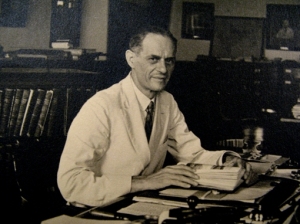
Patrick Leigh Fermor was born in London in 1915 to Sir Lewis Leigh Fermor, the director general of the Geological Survey of India, and the ‘sophisticated and wild’ Eileen Ambler. His mother was a bohemian and highly literate woman, who loved reading to her children and encouraging them to learn poetry by heart. She had been brought up in the wilds of Bihar, as a result of which Leigh Fermor can still sing, It’s a Long Way to Tipperary in Hindi. ‘Although I was brought up in England,’ he remembered, ‘India was a presence in the household, like voices in the next room.’

Almost immediately Leigh Fermor was deserted by his parents. It was the war, and they had to return to India; given the threat of U-boats, it was decided to leave the young Leigh Fermor in England so that someone would survive if the ship were torpedoed. The boy was sent to a farm in Northamptonshire where he was allowed to run free. ‘I think it formed me, you know,’ he said. ‘Made me restless and curious. I was constantly climbing trees and hayricks.’

When his mother and sister returned to collect him three and half years later, he ran away from these ‘beautiful strangers’. In retrospect, Leigh Fermor thinks the experience of ‘those marvellously lawless years unfitted me for the faintest shadow of constraint’, something that marked the rest of his career, especially at school, where he was expelled from a variety of establishments until finding happiness at ‘a co-educational and very advanced school for difficult children’.

After that school was closed down due to a series of ‘vaguely guessed at improprieties’, Leigh Fermor moved on to the King’s School Canterbury. He liked the fact it was founded during the reign of Justinian ‘when fragments of Thor and Odin had barely stopped smouldering in the Kentish woods’; but his teachers were less sure about their new pupil: ‘He is a dangerous mixture of sophistication and recklessness,’ his housemaster wrote, shortly before expelling him. Unqualified to join Sandhurst, the direction in which his family had been pushing him, he attended crammers in London where he began to write poetry and to read voraciously.
Patrick Leigh Fermor at school, Kings' Canterbury

One of the books he chanced across was The Station, Robert Byron’s newly published book about his travels through the monasteries of Mount Athos. A subsequent meeting with Byron in a ‘blurred and saxophone-haunted nightclub’ made Leigh Fermor, aged 18, ache to follow in the author’s footsteps and visit ‘serpent-haunted dragon-green Byzantium’. He had also read George Orwell’s Down and Out in Paris and London, published in 1933. With nothing to keep him in Britain he set off, having first borrowed a knapsack that had accompanied Byron to Athos, aiming to walk to that living fragment of Byzantium while living as cheaply as Orwell: ‘I loved the idea of roughing it.’

On the wet afternoon of December 9, 1933, the year that Hitler came to power, as ‘a thousand glistening umbrellas were tilted over a thousand bowler hats’, Leigh Fermor left London, boarding a Dutch steamer at Irongate Wharf. His rucksack contained pencils, drawing pads, notebooks, The Oxford Book of English Verse and a volume of Horace. He would not lay eyes on Britain again until January 1937, when he returned ‘for better or for worse, utterly changed by my travels’.

‘I thought I’d keep a diary and turn it into a book, which of course is what I did,’ he said. ‘Except I am still writing that book more than 70 years later.’ It was not just that the journey gave Leigh Fermor the subject for his lifework, it ‘broadened my mind, taught me history, literature and languages. It opened everything up: the world, civilisation and Europe. It also gave me a capacity for solitude and a sense of purpose. It taught me to read and to look at things. It was a great education. I didn’t go to university, I went travelling instead.’

The journey also led him to meeting one of the two great loves of his life, a beautiful Byzantine princess named Balasha Cantacuzene. Leigh Fermor met Balasha in Athens, to which he walked after finally reaching Athos in early 1937. She was 12 years older than him, and had just separated from her husband, a Spanish diplomat. ‘She was 32, and I was 20. We met at just the right time and fell into each other’s arms. It was instant, we clicked immediately. We went off together and lived in a watermill in the Peloponnese for five months. I was writing, she was painting. It was heavenly.’
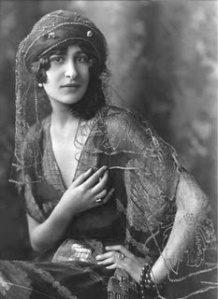
Balasha Cantacuzene

From there the couple moved back to Balasha’s rambling country estate in the dales of Moldavia, where they moved in with Balasha’s sister. Leigh Fermor has written that the two sisters were ‘good, beautiful, courageous, gifted, imaginative, immersed in literature and the arts, kind, funny, unconventional; everybody loved them and so did I.’

For Leigh Fermor, this was one of the happiest periods of his life. For two years he lived there, savouring the last remnants of a world that was just about to disappear: ‘Her family was part of an old-fashioned, French-speaking, Tolstoyan, land-owning world: country-dwelling noblesse of the sort described by Turgenev. They were intensely civilised people. The house was an old manor house, not grand, but delightful and full of pictures and books.

There was a butler who was always a bit tight, and no electricity, so we read with lamps and wicks. I spent the time reading my way through the whole of French literature and playing chess – when I wasn’t making a hash of writing this book.’ He paused, then added, ‘Of course I wanted to marry her, but she said, “Don’t be ridiculous – I’m much older than you.”?’

Both the romance and the world in which it was set were ended for ever by the war. ‘We were aware that war clouds were looming, but didn’t realise how serious it was. We were out on a picnic, some of us on horseback and some in open carriages, when someone shouted across the fields that the Germans had gone into Poland. I made the decision at once: if war had broken out I had to join the Army. I thought it would be over in six months.’

In the event, Leigh Fermor did not lay eyes on Balasha again for a quarter of a century. With the end of the war came the Iron Curtain, and Balasha could no more get out of Romania than Leigh Fermor could get in. When he eventually managed to find a way to get in as a journalist, he found Balasha living in poverty in a Bucharest garret, surviving by teaching English, French and painting. ‘We sat up and scarcely went to bed for 48 hours, laughing the whole time: “Do you remember?” By this time I was with Joan. Balasha took it all in such a philosophical and charming way. She was an extraordinary person.’

It emerged that the Cantacuzenes had been branded ‘elements of putrid background’ and Balasha’s lands had been confiscated soon after the end of the war. She had lost everything. The day Ceausescu’s commissar turned up she and her sister had been given quarter of an hour to pack. The house had subsequently been turned into a lunatic asylum. In Leigh Fermor’s account of the reunion, he wrote how he ‘found them in their attic.

In spite of the interval, the fine looks of my friends, the thoughtful clear glance and the humour were all intact; it was as though we had parted a few months ago, instead of 26 years… [But] early thoughts of leaving Romania lapsed in the end, and they resisted the idea partly from feeling it was too late in the day; secretly, perhaps they also shrank from being a burden to anyone. One by one the same dread illness carried them away.’

The same war that destroyed Leigh Fermor’s great love affair also made his name as a man of action. From Moldavia he returned to Britain and enlisted in the Irish Guards. As a fluent Greek speaker he was soon singled out for intelligence work, and was sent first to Albania and then to Greece as a liaison officer working with the Greek army. After the fall of Greece he found his way to Crete just in time to fight in vain against the Nazi invasion. From there he was evacuated to Alexandria where he set up house with several other young intelligence agents and a refugee Polish countess, Sophie Tarnowska, who moved in with her few possessions: ‘a bathing costume, an evening gown, a uniform and two pet mongooses’.

Before long Leigh Fermor was sent back into Crete to work with the Cretan resistance. He and an odd collection of recently enlisted Greek-speaking classical scholars and archaeologists were parachuted into the occupied island disguised as shepherds and established a troglodyte existence under the stalactites of mountain caves, commanded by a Fellow of All Souls. The port from which Leigh Fermor set off was captured by Rommel’s advancing Afrika Korps the day after he left. ‘It was a low moment in the war: the Germans seemed to be advancing in triumph in all directions.’ It was partly for this reason that Leigh Fermor’s bosses gave permission for his wild scheme to raise morale: kidnapping the German commander of the island.
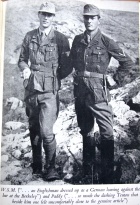
Patrick Leigh Fermor and Moss

Patrick Leigh Fermor and Moss in German Uniform Prior to the Abduction of General Kriepe

In Leigh Fermor’s own account of the abduction of General Kreipe, the climax comes not as the general’s staff car is stopped at night by a British SOE partly dressed in stolen German uniforms, nor as the Cretan partisans help smuggle the general into the highlands and hence to a waiting British submarine; but instead as ‘a brilliant dawn was breaking over the crest of Mount Ida’.

‘We were all three lying smoking in silence, when the general, half to himself, slowly said, “Vides ut alta stet nive candidum Soracte”. It was the opening of one of the few Horace odes I knew by heart. I went on reciting where he had broken off… The general’s blue eyes swivelled away from the mountain top to mine – and when I’d finished, after a long silence, he said: “Ach so, Herr Major!” It was very strange. “Ja, Herr General.” As though for a moment, the war had ceased to exist. We had both drunk at the same fountains long before; and things were different between us for the rest of our time together.’

It is an archetypal Leigh Fermor anecdote: fabulously erudite and romantic, and just a little showy. For his greatest virtues as a writer are also his greatest vices: his incantational love of great waterfalls of words, combined with the wild scholarly enthusiasms of a brilliant autodidact. On the rare occasions he gets it wrong, Leigh Fermor has been responsible for some of the most brightly coloured purple passages in travel literature. But at his best he is sublime, unbeatable.

Back in Egypt, Leigh Fermor met his future wife, and the companion for the second half of his life. Joan Eyres Monsell was then working for the intelligence department as a cipher clerk. ‘She had a house near the Ibn Tulun mosque, and was very go-ahead,’ Leigh Fermor remembers. ‘She was a nurse when the war broke out, and had lived in Spain and Algiers before Cairo. We met at a party and hit it off very quickly.’

When the war was over, Joan and Leigh Fermor remained in Greece, wandering the country and initially finding work in the British Council, whose Athens office was then run by the other great British philhellene of that generation, Sir Steven Runciman. But as ever, Leigh Fermor’s wanderlust soon got the better of him, and before long he had resigned. In 1949 they caught a ship to the Caribbean, a trip that resulted in two books: a travelogue, The Traveller’s Tree, and a fine novel, The Violins of St Jacques. Both were written partially in Trappist monasteries, an experience that Leigh Fermor turned into his third and most tightly written book, A Time to Keep Silence.

It was in the early 1960s that Leigh Fermor married Joan and settled down with her in Kardamyli, to continue his life of writing travel books, interspersed with weekly book reviews for Cyril Connolly’s Sunday Times book pages. It is this more settled phase of life that is so well captured in the new book of letters between Leigh Fermor and Deborah Devonshire. There are lovely descriptions of Leigh Fermor and Joan finding the bay at Kardamyli; the struggles to finish A Time of Gifts; Leigh Fermor’s surprise and pleasure at its rapturous reception; and the slow writing of its sequel.

The final 50 pages of the book have a more melancholy tone, as their friends begin to die, one by one: the English ones often of cancer, the Cretans, more dramatically, falling from precipices, and the like. Finally come the deaths of both Debo’s husband, Andrew, and of Joan Leigh Fermor: ‘The cats miss Joan bitterly,’ Leigh Fermor writes at the end of the book. ‘They are not the only ones… I keep thinking of things I must remember to tell Joan at lunch, knowing they could make her laugh. Letters addressed to her still arrive from distant parts, but even they are dying out now, and increasingly it’s only subscriptions to be renewed.’

Leigh Fermor enjoys a two-hour siesta after lunch – ‘Egyptian PT’ as he calls it. But on my last day in Kardamyli he emerged at 4pm, smiling from ear to ear. ‘Didn’t sleep a wink,’ he said. ‘Got quite carried away reading the book. I was rather dreading it, but was pleasantly surprised.’ He held up the proof approvingly. ‘Some passages are really awfully good.’
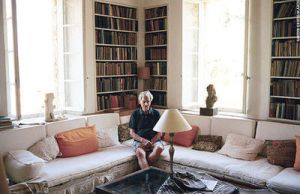
Paddy at home in the Mani

After our lunch we went up the mountain beside the house to see the Byzantine chapel around which the ashes of his friend Bruce Chatwin had been scattered. The chapel was very small – only a little larger than a big garden shed. It had a domed red-tiled roof and round arcaded windows. It lay in the rocky fields near the village of Exchori, high above Kardamyli, and was built from stone the colour of halloumi cheese.

The sun was slowly sinking over the hills at the end of a hot day; from the higher slopes, the tinkle of goat bells cut through the drowsy background whirr of cicadas as shepherd children led their flocks back for the night. It is perfect, beautiful, a peaceful place for anyone to end their days, and as we headed back I asked Leigh Fermor whether he would like to be buried there, too.

‘Oh no,’ he replied instantly. ‘Joan is in Dumbleton. I’d rather like to end up there.’

It’s a characteristic of so many of the greatest English travellers that they come back home in the end. TE Lawrence, for example, finally recognised ‘that I could not sincerely take on the Arab skin’, and the same is true of Leigh Fermor. For all his years in Greece, he remains almost the archetypal Englishman, in its best possible form: ‘My heart is in both,’ he said as we headed downhill. ‘England is not a foreign country to me.’ He paused and looked down over the Aegean, glinting now like broken glass far below us: ‘I do love both countries,’ he said as we headed on home. ‘I really do.’

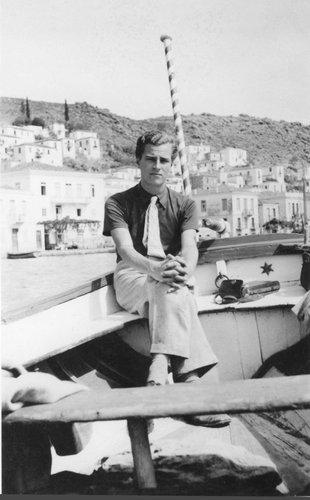
Meine Suche nach Patrick Leigh Fermor

This title from a book by the German author Michael Obert hits the spot for me. Like Michael I am also engaged in a ‘search’ for Paddy and I know from your comments and emails that many of you are finding your own ways to follow in Paddy’s footsteps and to understand and enjoy his works.

Following the publication of the Wolfgang Büscher video just a few days ago, I was contacted by Christian from Koln (Cologne) saying how pleased he was to see the video and at the same time sending me a couple of other articles from German newspapers and magazines. Christian made the point that in recent years there have been many features and articles published in Germany about Paddy, including Michael Obert’s book which provides the title to this article. Chatwins Guru und ich: Meine Suche nach Patrick Leigh Fermor by Michael Obert is available from Amazon.

I have pdfs of two more articles and those of you who followed the blog in its early days may remember that I have previously featured a further article by Wieland Freund. Therefore, perhaps for the first time in one place, a collection of German (and Swiss) material about Paddy.

Der letzte Byzantiner by Wolfgang Büscher, first published in Die Zeit 24 May 2006

Wolfgang Büscher discussing A Time of Gifts video

Mit der Feder im Rucksack durch die Welt by Georg Sütterlin, first published in Der Bund 30 Aug 2005

Besuch beim Haudegen des Peloponnes by Wieland Freund first published in Welt Online 8 July 2007

Wandering scholar and war hero: the traveller’s tale

By Peter Terzian

November 27, 2005

On the telephone from his home in Greece, Patrick Leigh Fermor describes what he does as “travel writing” but adds “I hate the phrase.” Indeed, calling him a travel writer is a little like calling Proust a gossip columnist. Rather, Leigh Fermor is a great writer whose subject is travel.

In “A Time of Gifts” (1977) and “Between the Woods and the Water” (1986), he narrated two-thirds of what he calls his “great journey” – an 18-month walk he took across Europe in the years before World War II. (New York Review Books has just reprinted both volumes.). Readers have been waiting for the concluding book ever since, and some interviewers write that he is “pained” when the subject arises. But in the first few minutes of our conversation, Leigh Fermor, now 90 (“Unbelievable!” he says; “I never thought I would attain this dignified age”), volunteers that he is currently working on the journey’s end. “At the moment, I’m going down the Black Sea coast, the Bulgarian coast, halfway down it.” He is, he says, “the opposite of a Deadline Dick,” and a rigorous self-editor. “I cut like anything, because I’m inclined to overwrite a bit.”

Leigh Fermor “got the sack from school early,” he says, “because I was sort of useless. I was rather undisciplined.” At “18 and 3/4,” he pulled on a pair of hobnailed boots, packed a rucksack with some clothes, an “Oxford Book of English Verse” and a volume of Horace (both soon lost), and crossed the English Channel by ship to the Hook of Holland.

From there, on foot, he followed the Rhine through Germany and into Austria, where he met the Danube. After a detour to Prague, he resumed the river’s course through Slovakia and Hungary. His youth and openness brought him into contact with peasants, students, rich country gentlefolk and fellow vagabonds.

Almost without exception, Leigh Fermor describes the men and women he encountered as hospitable and generous, amused at his adventure and happy to provide him with conversation, lodging and bundles of food for the road. In a cafe in Stuttgart, Germany, Lise and Annie, two flirtatious students, picked him up for a weekend of parties and dancing. In a town on the banks of the Danube, over bottles of  Langenlois wine, a polymath mapped for him, on the back of a newspaper, the tribal wanderings of Huns, Visigoths and Vandals. (“This was the way to be taught history!” Leigh Fermor writes.) In Slovakia, he stayed with Baron Pips Schey, who introduced him to Proust’s work. As they sat up late in armchairs and walked through the spring countryside, the older man unraveled “an entire mythology” of fin-de-siècle Central Europe.

Walking alone, the teenage Leigh Fermor passed the time by reciting poetry. In “A Time of Gifts,” he details his memorized “private anthology”: “a great deal of Shakespeare … most of Keats’ odes; the usual pieces of Tennyson, Browning and Coleridge,” Kipling, “some improper stretches of Chaucer,” mastered chiefly for popularity purposes at school, Carroll and Lear and “The Rubaiyat of Omar Khayyam.” The list continues, through French, Greek and Latin, for three pages. (When he exhausted his repertoire, he declaimed verse backwards.) “I think people are absolutely wrong not making children learn things by heart at school,” he says. “Because if they learn it at a very young age, it’s with them for life.”

In “Between the Woods and the Water,” Leigh Fermor tramps through Mitteleuropa. It was “a season of great delight,” he writes, in which he hopscotched, via a series of introductions, among the castles of learned aristocrats. He rode horseback through Hungary and hiked the mountains of Romania (where he met a family of shepherds, gold-panning Gypsies, a rabbi at a logging camp and a nest of enormous eagles). The book leaves the 19-year-old at the Iron Gates gorge, between the Carpathian and Balkan mountains.

Much of the books’ appeal lies in Leigh Fermor’s exuberant, witty voice. He shares his delight in every piece of historical knowledge uncovered, every medieval castle stumbled upon, every alien language heard. At one point, he reflects on 16th century German painting  (“The severe Bürgermeister’s features of the Holy Child have the ferocity, sometimes, of a snake-strangling infant Hercules”). Elsewhere, he attempts to locate “the coast of Bohemia,” a setting in Shakespeare’s “The Winter’s Tale” long thought mythical.

During his trip, Leigh Fermor took plentiful, detailed notes and transcribed conversations. “I scribbled away like mad every night,” he tells me. Why did he wait 40 years before writing about his walking tour? “It’s a mystery,” he says; “I think it’s possibly I was putting it down for the right time, like putting down a wine to drink.” After the journey came a romance with a young painter – “a bit older than me, terribly nice” – and two idyllic years in Moldavia at her family’s “very tumbledown old country house, full of books. … I did a tremendous amount of reading there, more than writing.” When the war broke out, he says, “I didn’t realize it would take so long a time, and I left all my notes there like an idiot.” After the war, the Communist regime forced the family out of their home. Each member was allowed to bring one suitcase, and one of them thought to salvage Leigh Fermor’s diary. It took, in all, 26 years for him to be reunited with his notebook.

He visited Greece after his great walk, and his connection to the country deepened during World War II, when he was stationed on the island of Crete as a member of the British Special Operations Executive. The organization assisted the Cretan resistance after the Germans occupied the island, and Leigh Fermor spent much of his time hiding in remote caves dressed as a shepherd. In 1944, he led the kidnapping of the commanding German general, spiriting him off to Egypt by submarine. In “A Time of Gifts,” he recalls the moment when his captive began to recite a Horatian ode, and Leigh Fermor chimed in to complete it. “For a long moment, the war had ceased to exist.”

He feels so strongly about his time on the island that when asked whether he feels he’s achieved all he wants out of life, he replies quickly, “I should have written more about Crete.” His second in command, William Stanley Moss, published a book about the escapade, “Ill Met by Moonlight,” in 1950. (Dirk Bogarde played Leigh Fermor in the 1957 Michael Powell-Emeric Pressberger film based on the book.) “It would be rather old hat if I did it again,” Leigh Fermor says. “But there are lots of Cretans that I’d have liked to mention because they were so extraordinary.”

He wrote about other regions of Greece in “Mani” (1958) and “Roumeli” (1966), to be reissued by New York Review Books in May. (He has published three other books about his travels: “The Traveller’s Tree: A Journey Through the Caribbean Islands,” in 1950; “A Time to Keep Silence,” about his sojourns at two French monasteries, in 1957; and “Three Letters From the Andes,” in 1991.)

Leigh Fermor has spent the past four decades living in the southern Peloponnese, in the house that he designed with his wife, Joan, an architectural photographer, who died two years ago. They built their home using limestone blocks carved out of a nearby mountain range, hiring a local mason they met “purely by chance in the road. … He was a wonderfully inventive chap. He said to me, ‘For seven generations we’ve all been master masons, and we’ve all played the violin.'”

Together, Leigh Fermor and Joan had a life of “undiluted happiness,” he says. “We had the same ideas. She was highly literate, very charming and amusing, and a marvelous companion.” They traveled to the Far East and throughout Europe, “but mainly we lived here, and we’ve got thousands of books, so one’s got everything one needs here, and the sea handy to jump into.”

He takes great pleasure in describing the art-filled main room and the gardens, with “a descending staircase of olive groves with a lot of cypresses scattered among them” and “shady places where you can sit and write and read.” He is a consummate host to the many friends who come to Greece. “Do you know, we’ve been here for about 38 years. I went through the visitor’s book last week and counted up – spread over this period of time – 1,220 people have stayed under the roof.” I express astonishment. “I don’t know … It sounds like a milling mob, but it’s never that way.”

Shelves of reference books line Leigh Fermor’s dining room. He paraphrases T.S. Eliot, who told a mutual friend that “you must have books of reference handy for mealtimes, because that’s where questions crop up about history or literature, and these problems, one always thinks one will write them down and remember them after, but one doesn’t.” He lists the titles of some of his favorites: the “Encyclopedia Britannica,” “Lempriere’s Classical Dictionary,” “the ‘Oxford Companions to Literature’ in various countries, and art, religion and so on,” and “the thing that’s absolutely invaluable, ‘Chambers International Biographical Dictionary’ … It’s tip-top.”

Leigh Fermor laments that his “great traveling days I suppose are going downhill a bit,” in the same breath that he mentions recent trips taken to France, Spain and Morocco. (He also lives a quarter of the year in England.) I ask him if he’s traveled much in America. “No! I’ve spent a fortnight only. It’s most extraordinary. I’ve always meant to do it. And that fortnight was a very curious one, because I was invited there by the Pan-Cretan Association of America, and they all live in Long Island. So I went there and I saw really nothing but Greeks!”

A Meeting between Paddy and George Psychoundakis the “Cretan Runner”


George Psychoundakis in 2004(?)

A bond deeper than blood. The friendship forged in wartime Crete between Patrick Leigh Fermor and shepherd George Psychoundakis was commemorated in George’s memoir about the Resistance, The Cretan Runner. With the book republished, it was time to meet again.

by Allison Pearson

First published in The Daily Telegraph, Saturday 13th June 1998

Two old men sitting at a table talking about the war. A Cretan and an Englishman. A voluble eye-popping tenor and a growly teddy-bear bass. “Remember the sick doctor we disguised as an old woman and carried for miles to get help?” “Yes, and remember when you dressed up as a general and kidnapped a real one!”

They interrupt each other. They sigh for the dead. They laugh for dear life, knowing exactly how much it can cost. Although one of the men speaks only Greek, I think I can detect a rhythm to their reminiscing: the Cretan talks everything up and the Englishman plays it right back down again. The sudden memory of one “bad Greek” acts on the Cretan’s weathered face like a drawstring, pulling it taut to a scowling walnut. But the Englishman, all silky diplomacy, jumps in and offers a more optimistic assessment of the fiend in question: “I think he just lost his head a bit.”

Later, when the Cretan mentions the Englishman’s name in the course of what sounds like a pretty fulsome tribute, his friend stops translating for me altogether. What did he say? “He was more than kind about me.” Yes, but what did he say? “Oh, I couldn’t possibly repeat it.”

The bashful Briton is Patrick “Paddy” Leigh Fermor, traveller, scholar- gypsy, war hero and writer of genius. His fiery friend is George Psychoundakis, author of The Cretan Runner, an extraordinary account of the anti- Nazi Resistance on the island, which was translated by Leigh Fermor and is now republished.

The Cretan Runner

There have been other memoirs of wartime Crete, such as Xan Fielding’s Hide and Seek and Ill Met by Moonlight, W Stanley Moss’s record of the kidnapping of General Kreipe (later made into a movie, with Dirk Bogarde assigned to fill Leigh Fermor’s dashing boots). But those were visitors’ books. George’s story, as Leigh Fermor points out in the introduction, is unique. It is no longer the locals who are colourful aliens, but the Allied officers and their wireless operators – good sorts and good sports in the main but, none the less, foreigners with some very dodgy customs. “A most peculiar man,” George says of one buffer. “He had pyjamas and a washbasin.”

Even more baffling for the Cretans, who think Nature is a place where you go and shoot things, the buffer turned out to be an amateur botanist and geologist: “He was not only in love with different kinds of weeds but with stones as well.”

Paddy and I have been sitting in the front room of George’s small vine-clad house, outside Khania in western Crete, for more than two hours now. At least one of us is reeling under the bombardment of Cretan hospitality. Celestial cheese tarts made by Sofia, George’s wife, have given way to nuts, glistening sweetmeats and, as if that weren’t enough, shots of tsikoudia, a spirit so lethal it feels less like drinking a liquid than sipping scalded air. After three of these, I am not entirely sure whether the spools on my tape recorder are going round: after four, I don’t care.

George – one eye sleepy, the other coal black with embers of mischief – is joking about whether he should have given lessons in sheep stealing (a local speciality) to one of the wireless operators. “So when he got back to Scotland he could have organised sheep rustling.” Paddy pretends, unconvincingly, to be shocked.

Through the window behind them, you can see the White Mountains – a range so towering and snowy, even on this May day, that it is hard to tell where rock stops and cloud begins. More than half a century ago, those slopes were Paddy and George’s stamping-ground. “George’s life was dangerous and absolutely exhausting,” explains Paddy. But George is having none of it: “I felt as if I were flying. Running all the way from the top of the White Mountains to Mount Ida. So light and easy – just like drinking a cup of coffee.”

George has difficulty walking now – at 78 he leans on a stick as gnarled as himself – but his mind can leap from memory to memory, as if he were still flying. I ask George what he thought the British had learnt from the Cretans and vice versa. “What they learnt, because there was very little to eat, was to drink a lot and to dance and to shoot for joy in the air. We saw how much they loved our country and it made us love it still more. The fact that they loved Crete so much gave us even greater courage.”

The first time George Psychoundakis met Patrick Leigh Fermor he thought he was very tall. The young Cretan had just crawled on all fours through thick bushes into the heap of boulders where the officer was hiding. In fact, the Englishman was not especially lofty (a touch over 5ft 9in, according to his passport). It was the Greek who was tiny. “As fine-boned as an Indian,” recalls Leigh Fermor. “Lithe and agile and full of nervous energy.”

Anyway, height didn’t matter much back then. It was the July of 1942 in occupied Crete and the stature of men was not measured in inches, rather in a bewildering range of abilities. These included: keeping cool when a member of the Gestapo approaches your mule while it is carrying a combustible load of wheat and wireless; keeping warm in a cave-bed with a canopy of stalactites; and finding the courage to tuck into a dinner of local produce – grass cooked with snails. “We took the grass blade by blade, picked off the broken shells and ate it with much laughter,” recalls George.

Psychoundakis was a runner for the Resistance – a vertical postman, he delivered messages and equipment at barely credible speed. On a map, Crete doesn’t look too daunting – a sirloin steak beaten to a succulent sliver by a butcher. But it rises so sharply into such broken-toothed cragginess that it is pointless to measure it in miles: the islanders calculate distances in the time taken to smoke cigarettes. George’s wartime business was mainly conducted at eagle-height, or as he felt his way down the vertebrae of his homeland towards some hiding place where even goats didn’t dare.

He was 21 years old when he first met the 27-year-old Leigh Fermor. George addressed Paddy as Michali (all the Allied soldiers had Greek nicknames) or sometimes Mr Michali in half-amused respect (irreverence being the key to the Psychoundakis psyche). Paddy, meanwhile, code- named George either the Clown or the Changeling, for his cockeyed wit, his impish insubordination and a magical ability to spirit himself out of trouble.

Patrick Paddy Leigh Fermor and Billy Moss

The two men were not just worlds apart: a glance at their biographies suggests you would need to hire a time machine to bring them together. Born in Asi Gonia, a village with a long history of giving invaders a hard time (asi is Arabic for uncommandable), George lived the kind of peasant life that had not changed for centuries. His family slept together in a single room with a beaten earth floor. After a scratchy education at the local primary school, he followed his father on to the mountains as a shepherd. By the time German parachutes blotted out the sky in May 1941, he had visited only two of Crete’s towns and had never seen the capital, Heraklion.

By contrast, Leigh Fermor was born into a smart Anglo-Irish family and educated at prep school and King’s, Canterbury. [Just like someone else we know] By 1939, he had walked across every country between London and Constantinople – a stroll commemorated in his two dazzling volumes, A Time of Gifts and Between the Woods and the Water – and also appeared to have drunk in most of their national literatures.

Scrape through what Leigh Fermor called his “Fauntleroy veneer”, though, and you find a rougher grain. With his parents abroad for the first four years of his life, Paddy was entrusted to the family of a small farmer and, left uncultivated, he ran wild. The experience, he later wrote, “unfitted me for the faintest shadow of constraint”. His behaviour at a flurry of schools led to his being sent to two psychiatrists, although it is unlikely that either rivalled Paddy’s clinical diagnosis of himself as “a very naughty boy”. He was finally expelled from King’s for crimes that included “trying to be funny” and holding the hand of a greengrocer’s daughter. His housemaster’s report noted: “He is a dangrous mixture of sophistication and recklessness, which makes one anxious about his influence on other boys.”

Almost 70 years later, I find it hard to improve on that verdict, save to replace the word dangerous with delightful. As it turned out, his influence on other boys was all to the good, and the most remarkable boy of all was George Psychoundakis.

While Paddy was in Kent writing “bad and imitative verse” and lapping up ancient Greek because it was a passport to a world of heroes, George was scavenging books from the village priest and the doctor, and occupying the long woolly hours by the sheepfold composing patriotic poems and beady skits on local life. (An early effort entitled Ode to an Inkspot on a Schoolmistress’s Skirt sounds distinctly Paddy-like in its high- flown cheekiness).

Although George’s father, Nicolas, was illiterate, he could recite by heart the whole of the Erotocritos, the 17th-century Cretan epic poem that comprises 10,000 lines of rhyming couplets. And the rhythm lodged in the son’s head and on his tongue: poetry to these people was not the object of solemn study but a spur to the spinning of legends and the cue for a bloody good song.

George Psychoundakis during the Resistance

Which is to say that when the ragged and practically barefoot Cretan wriggled into the hiding-place of the Englishman in 1942, they had more in common than an enemy. George spoke only one perfect sentence of English – “I steal grapes every day” – but Paddy soon extended his repertoire. On long marches to the coast to meet supply vessels or during the dark hours awaiting a parachute drop, the Britons taught the Greeks folk-songs and the Greeks taught them mantinadas – waspish local couplets with a sting in the tail.

On their first trek together, Paddy recalls how George recited a poem he had written on the unambitious theme of The Second World War So Far. “It covered the invasion of Poland, the fall of France, the German invasion of Greece and Rommel’s final advance. It lasted more than two hours and finished on a note of triumphant optimism and presage of vengeance, which he emphasised by borrowing my pistol and firing it into the sky with the remark that we would soon be eating the cuckolds alive.”

Leigh Fermor, meanwhile, attempted to satisfy Psychoundakis’s ravenous curiosity about the world. What was Churchill like? Why do the Scots wear kilts? How about astronomy, religion, trains? How many sheep does the average Englishman own?

The task of the British Special Operations Executive in Crete was to assist the local Resistance. Having spent centuries in revolt against the Venetians and the Turks, the islanders didn’t actually need much encouragement. During the airborne invasion in 1941, when many young Cretans were away on active service, descending parachutists were met by old men, women and children – by anyone, in fact, who could point upwards and shoot. “Aim for the legs and you’ll get them in the heart,” ran the local wisdom. Four thousand Germans died. Those who survived took swift revenge. Reprisals, read one Wehrmacht memo, “must be carried through with exemplary terror”. Between May and September of that year, 1,135 Cretans were executed.

The Cretan Runner begins with the invasion. “Out of the sky the winged devils of Hitler were falling everywhere … the aeroplanes came and went like bees in a bee-garden.” One grounded plane is set upon by furious locals till it resembles “a bit of bread thrown on to an ant-hill”. From the opening pages, you get a pungent impression of the Psychoundakis style – a vertiginous mix of the epic and the demotic, the Homeric and the homely. Of the enemy, George writes: “They reached to our very bowels and provoked a storm in the soul of the race like the hiss of a poisonous snake about to strike.” No British account of the battle of Crete could contain a sentence like that. Too purple. Too embarrassing, frankly. But it feels utterly true to George and the hot-blooded rhetoric of his race.

Perhaps the greatest surprise of a book that documents the burning of villages, the casual slaughter of comrades and a life of mesmerising danger is how often it makes you smile. No stranger to hardship anyway, George embraces discomfort as though it were a shy friend with a lot to offer. We see George at the end of a knackering three-day trek using pieces of wood to mime someone hobbling. We hear him enthusing over yet another dank hiding-place as though he were writing for some actionable travel brochure: “The cave was perfect. We collected our drinking and washing water from stalactites. We arranged luxurious couches for ourselves from the branches of various shrubs that were better than the softest mattress!”

Best of all, there is George richly enjoying his British friends, not least their congenital inability to walk over the rocky landscape. (In one incident, Leigh Fermor threw himself pluckily at a high stone wall in emulation of local bravado, only to fall off backwards: the Cretans in the party walked around the side of the wall, shaking their heads and laughing.)

SOE officer Ralph Stockbridge (centre, in the spectacles) with some of his comrades in Crete

“It was plain that George was enraptured with the excitement of our secret life,” says Paddy. The same could be said of all of them, I think. As a boy Leigh Fermor confessed to being guilty of “a bookish attempt to coerce life into a closer resemblance to literature”. In this case, the literature was Greek. The Cretans, for their part, seemed all too willing to live up to the legends the Englishmen had imbibed at school. Most battles look romantic only in retrospect, if then: Crete was different. It seems to have struck its leading men as touched with an air of romance, even as the drama was unfolding. As they approached by boat on a moonless night, the first the soldiers knew of the island was perfume, the scent of wild thyme that wafts miles out to sea.

Once on shore, they changed into local costume – breeches, black bandanas, embroidered waistcoats and spiffy jackboots. There were lessons in how to curl their new moustaches. They were an extraordinary bunch – poets, archaeologists, free spirits thirsty for adventure. SOE chose them because they had some knowledge of ancient Greek. But, as Leigh Fermor explains, since Greek was no longer compulsory at school, those who opted for it had already marked themselves out as “a perverse and eccentric minority”.

I cannot get enough of the photographs of the Resistance taken through those years in the mountains. Remember, these are snapshots captured at a time when to have a likeness of yourself in existence was itself a threat to that existence. There is the legendary Xan “Aleko” Fielding, looking uncannily like the young Hemingway. Gimlet-eyed and bare- chested, he regards the lens with Olympian amusement. And there is Yanni Tsangarakis, one of the bravest and most trusted guides, slightly woebegone behind a Zebedee moustache, and the redoubtable Manoli Paterakis, whose unforgettable profile suggests he may have been the love-child of Montgomery of Alamein and a peregrine falcon. [I think he’s trying to say he was nasally overendowed]

Looking at the smiley countenance of Tom Dunbabin – a fellow of All Souls in peacetime – you can see why he inspired such love; ditto the gaunt saintly faces of Aleko Kokonas, the schoolmaster of Yerakari, and his wife, Kyria Maria. And then, of course, there are Paddy and George: the first as debonair and unfeasibly handsome as Errol Flynn casting about for a galleon to capture; the second apparently auditioning for the role of Puck.

In Louis de Bernieres’s novel Captain Corelli’s Mandolin, set in wartime Cephalonia, there is a posh Englishman who lives in a cave and comes out declaiming ancient Greek. He is a bit of a joke. And, to be sure, there is something potentially laughable about the Boy’s Own aspect of all this dressing up and blowing stuff up. What redeems it from absurdity, what transforms it into real rather than fantastical heroism, is the nagging presence of death, which circled above these lives like a hawk. There was nothing comic-book about Anton Zoidakis, captured by German soldiers, tied to their vehicle and dragged along the road until his face and his life were wiped away. And even George’s account of merry scrapes is pulled up short when 20 Gestapo visit Asi Gonia: “They said I was wanted for interrogation and if didn’t go to Retimo before January 17 they would set fire to the whole village.”

Three of George’s fellow runners were executed, two after what the Wehrmacht would probably have considered exemplary torture. In his superb book Crete: The Battle and the Resistance, Antony Beevor points out that the penalty for a shepherd caught whistling to warn of the approach of a German patrol was death.

War had transformed George Psychoundakis’s life. In February 1943, it enabled the former shepherd boy to travel abroad for the first time. He was spirited off to SOE headquarters in Egypt, where he was knocked sideways by wonders, not least the grass in the Gezira gardens: “Fat, short grass like green velvet carpet.” As for the zoo, “I could almost have deemed that I was in the middle of paradise”. The most misguided character in the whole of The Cretan Runner is the soldier who advised George not to climb up the Pyramids because it was “very tiring and tricky”. A short hop later, the Cretan runner got out his stiletto and “cut my name and fatherland” into a stone at the top.

Moss, Kreipe and Paddy

On the day the war was over, a “high-spirited Mr Leigh Fermor” bought a dubious Mr Psychoundakis a lot of drinks. “If I drink all that I’ll be drunk,” protested George. “But my child, what is drink meant for? It’s no use for anything else,” replied Paddy.

Soon after, in a school where a whole village was gathered together, George recited a heart-stopping poem he had written on the lovely village of Yerakari, now destroyed, where once “white houses lay like doves asleep along the sill of heaven”. He had survived, but for a while it was hard to see what for.

Fortune, who had smiled on George in a time of insane adversity, appeared to doze off once the shooting stopped. Because of missing documents and in spite of his British Empire Medal (awarded in 1945), he was arrested as a deserter and imprisoned for several months. One can scarcely imagine the wound inflicted on his pride. Over three days, that great shaggy helmet of hair all fell out. Subsequently, he had to do two more years of fighting in the civil war. Returning at last to Asi Gonia, George found all the sheep stolen and his family in gruesome poverty. The Changeling had run out of magic.

George took a job as a navvy working on a road. At night, he sheltered once more in a cave and by the light of an oil lamp began to fill notebook after notebook with a furious, cramped hand. “I think he undertook this task as a kind of exorcism of the gloom of his circumstances, ” says Paddy. When they met up again in 1951, George gave his friend the completed work: Pictures of Our Life During the Occupation. Better known as The Cretan Runner.

Leigh Fermor, now living on the Greek mainland, took the precious grime-covered manuscript home to translate. George, meanwhile, was working to help his old friend, too. In 1943, with a German patrol approaching, Paddy, who was checking what he thought was an empty rifle, accidentally shot Yanni Tzangarakis in the leg. He died soon afterwards, but not before absolving his friend of all blame. Paddy was devastated: imagine killing the proud son of a country for which you were willing to lay down your own life.

This wretchedness was deepened by foolish rumours that eventually led to a vendetta being declared by some of Yanni’s relatives. This was only laid to rest after years of delicate negotiation by George, who found a very Cretan solution to the Englishman’s impasse: Paddy Leigh Fermor became godfather to Yanni’s great-niece. In Greek society, this bond is deeper than blood.

Two old men sitting at a table talking about the war. A Cretan and an Englishman. “We’d better censor that, George, it’s libellous,” says Paddy, trying to sound stern. As usual, he fails.

George goes off into the bedroom and comes back with a rifle. It is nearly as tall as he is, and its working parts are in similarly creaky order. As George poses with the gun, the photographer asks him to smile. George scowls and spits out a guttural retort. “Oh dear, oh dear,” says Paddy, shaking his head and laughing. What did George just say? “He said he won’t smile because he’s killing Germans.”

At the front of A Time of Gifts, Leigh Fermor quotes from Louis MacNeice’s great poem:

For now the time of gifts is gone
O boys that grow,
O snows that melt,
O bathos that the years must fill.

Since the war, both men have found satisfactions. Leigh Fermor, though unfairly saddled with the label of travel writer, has become one of the greatest exponents of English prose.

Psychoundakis, meanwhile, has translated both the Odyssey and the Iliad into Cretan and been honoured by the Academy of Athens. Still, I can’t help wondering whether the time since their great adventure had been an anti-climax.

“To some extent all our lives were in those years,” admits Paddy. “Of course, one went on to do interesting things, but … ” George has come up now and stretches out his fingertips to reach the shoulders of his friend, the tall Englishman. “Ah, George says to tell you that those years up in the mountains were the best years of his life. He’ll never forget it. Never. And that’s why he wanted to commemorate our days together.”

Just as we are getting ready to leave, George gives Paddy a photograph. It is of George himself and Xan Fielding, taken somewhere in the mountains. You can just make them out. The emulsion is breaking up and great snowy specks of it are blizzarding them into oblivion. Yet looking back at the Cretan resisters, we see only a thrilling clarity. Their existence was both mortally serious and a great wheeze – perhaps a definition of the best kind of life you can hope to lead.

Years after the war ended, George Psychoundakis sang for his friend Patrick Leigh Fermor a mantinada. This is what it said:
With patience first and patience last, and doggedness all through,
A man can think the wildest thoughts and make them all come true.

Related articles:

The obituary of George Psychoundakis aka The Cretan Runner

General’s long trip home

Related category:

Ill Met by Moonlight

Crete: Island of Heroes

“The courage of the Cretan facing the firing squad is legendary … When executions were to take place I would leave my desk and walk out onto the balcony to watch their moment of death. Nowhere else have I witnessed such love of freedom and defiance for death as I did on Crete.” So said General Alexander Andre, the German Commander of the Occupation Forces on Crete.

This video features pictures from the film 11th Day and includes some pictures of Paddy, including a new one to me at least of himself and Moss with the kidnap gang.

It is said that the Germans had never encountered the extent of civilian resistance that they encountered on Crete.

Retribution was swift. The German High Command wanted to break the spirit of the populace and do it quickly. In this they failed and failed miserably. In retaliation for the losses they incurred, the Nazis spread punishment, terror and death on the innocent civilians of the island. More than two thousand Cretans were executed during the first month alone and twenty five thousand more later.

Even in the face of certain death while standing in line to be executed, Cretans did not beg for their lives. This shocked the German troops. Kurt Student, the German Paratrooper Commander who planned the invasion, said of the Cretans, I have never seen such a defiance of death. General Alexander Andre, the German Commander of the Occupation Forces was amazed and said: “The courage of the Cretan facing the firing squad is legendary. Cretans turn into mythical figures. They are so proud of their moment of death that one can hardly fail to admire their courage. When executions were to take place I would leave my desk and walk out onto the balcony to watch their moment of death. Nowhere else have I witnessed such love of freedom and defiance for death as I did on Crete.”

Related article:

Patrick Leigh Fermor recounts the kidnap of General Kreipe on video

Crete: 11th Day Movie with Paddy

General’s long trip home

Related category:

Ill Met by Moonlight

Ride of the Valkyries: The Vichy perspective on the German invasion of Crete

This is a very interesting perspective of the Nazi invasion of Crete sent to me by Marion Worsley. It is a German propaganda movie made by French Vichy government on what is called “The liberation of Crete from the occupying British Forces.” It is narrated by a Vichy collaborator. He seems to think they all did very well. However, the casualty rate amongst the German paratroops was around 50 per cent; many killed by Cretan peasants as they descended or landed. It was enough to persuade Hitler that such airborne operations should not be repeated.

For Churchill the initial surprise achieved was sufficient to persuade him that the British should create airborne forces which led eventually to the creation of the Parachute Regiment – the Red Devils.

The film starts with the musical accompaniment of  The Ride of the Valkyries. Was this what inspired Francis Ford Coppola for his Kilgore, Air Cavalry scene in Apocalypse Now?

Click the picture to play.

General’s long trip home


Patrick Leigh Fermor and Moss

Patrick Leigh Fermor and Moss in German Uniform Prior to the Abduction of General Kriepe

Something interesting to add to the Ill Met by Moonlight story.

First published in the Daily Mail 19 July 2007

By Charles Legge

Question: The book Ill Met by Moonlight tells the story of the kidnapping of German General Kreipe. What became of him after he was taken to Cairo?

In January 1944, Cairo East section of the British Special Operations Executive (SOE) hatched a daring plot to kidnap the commander of the 22nd InfantryDivision based on Crete, General-Leutnant Friedrich-Wilhelm Muller.

The plot was led by Major Patrick Leigh Fermor, along with his second-in-command, Captain W. Stanley Moss (later author of Ill Met by Moonlight, a book made into a film of the same name), and two Greek SOE agents, all of whom arrived by sea.

General Major Kreipe succeeded Muller on March 1, 1944, but SOE elected to continue with the kidnap mission. Joining with Cretan partisans, the SOE agents studied Kreipe’s daily work habits and his travel route from his quarters at Knossos to the divisional headquarters at Ano Arkhanais.

Saying goodbye to General Kreipe

On the evening of April 26, 1944, Major Leigh Fermor and Captain Moss, dressed as German military policemen, stopped Kreipe’s staff car on a hairpin turn under the guise of a routine traffic control point. After pulling the General out of the car and throwing him into the back seat, the agents drove him to an isolated spot, where he was taken on a gruelling cross-country trek over the mountains to the southern shore of the island.

On May 14, 1944, the SOE agents and their captive German general were picked up by a British motor launch off a desolate beach near Rodakino and spirited away to Mersa Matruh, Egypt. Leigh Fermor and Moss both received the Distinguished Service Order for the operation.

Kreipe was taken to London for interrogation before being transferred to prisoner-of-war camp near Calgary in Canada. He was later returned to the UK and imprisoned at Island Farm, Special Camp 11 near Bridgend. He was twice treated for diabetes at hospital Camp 99 at Shugborough Park in Staffordshire.

On October 10, 1947, he was transferred from Camp 99 to Hamburg via Southampton aboard the El Nil. Kreipe was honourably discharged from the military in 1947 and retired to Hanover.

Kreipe flanked by surviving andartes while talking to Paddy on Greek TV

On May 7, 1972, the abduction team (minus Moss, who had died tragically in 1965) held a reunion in Greece at which Kreipe was also present. During the banquet, Leigh Fermor, in fluent Greek and German, said: ‘After 28 years, General, we apologise to you for what happened and hope you have no hard feelings.’ The white-haired general, sitting with his wife, nodded and said, ‘None; otherwise I would not be here.’ Later Kreipe and his captors appeared on the Greek This Is Your Life programme. When asked how he was treated by his abductors, Kreipe said firmly, ‘Ritterlich’ chivalrously.’ Kreipe died in Hanover in 1976 at the age of 81, Patrick ‘Paddy’ Leigh Fermor was knighted in 2004.
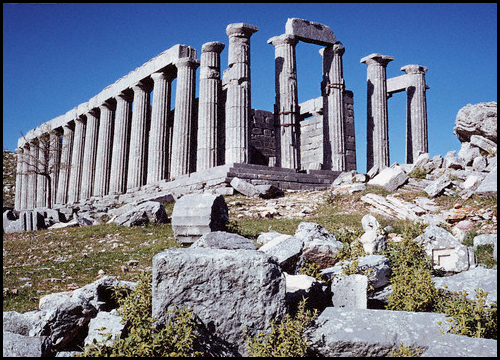
Related article:

Ill Met by Moonlight movie trailer

Related categories:

Ill Met by Moonlight – photographs from the book by William Stanley Moss

Ill Met by Moonlight

Where d’you get them bird-like ways recruit Leigh-Fermor?

I am currently reading my first edition of A War of Shadows, William Stanley Moss’ sequel to Ill Met by Moonlight. It covers Moss’ wartime activities from the point after he and Paddy arrived back in Cairo with the captured General Kreipe.

Moss returned to Crete to attempt a repeat of the first escapade but was frustrated in this by much increased levels of security and constant betrayal by the Communist ELAS andartes. He was then posted to (Greek) Macedonia and finally to the Far East where he saw out the war.

Paddy was unable to accompany Moss to Crete as he had been brought down with a very severe attack of rheumatic fever after the rigours of the Kreipe kidnap, and the harsh conditions they experienced whilst on the run. As we know Paddy did recover and returned to Crete. It is perhaps a little ironic that whilst Paddy was described as being somewhat less physically strong, it is Paddy who has outlived virtually all of his contemporaries and, as far as we know, still swims even to this day.

There is one little piece that amused me and I would like to share it with you. Whilst Moss was waiting upon his expected return to Crete after the failure of his second kidnap mission (he never made it back, being sent to Macedonia instead), he joined Paddy in Beirut where he was convalescing at the home of the commander of the British legation. Moss and Paddy were sitting on a patio enjoying whisky and soda, recounting stories and Moss relates the following (p 68):

Though a little thin in the face, Paddy looked surprisingly well; and it was only when he walked that one could have guessed that he had just recovered from so dangerous an illness. “But I manage to crack along,” he said, “—like some strange bird.”

We laughed at the recollection of an incident at the Guards’ Depot during the early days of the war, when Paddy had been a recruit in the Irish Guards. “Recruit Leigh-Fermor!” the drill sergeant had bawled across the parade ground. ”Why’re you walkin’ about like some strange bird? Where d’you get them bird-like ways? Put ‘im in the book, Corporal Driscoll. For walkin’ about like some strange birrrd!”

Having been on the wrong end of Guards sergeant-major’s humorous put-downs I can sympathise! Perhaps my fondest memory is of an Irish Guards Sergeant-Major ordering us to get sorted out before an orienteering event at Sandhurst: “Get into your t’ree groups … A, B, C, and D!”

Reisen nach Arkadien

Apart from the obvious interest in Paddy from Britain, and some from North America, it is the Germans who seem to have taken Paddy’s work to heart. Maybe it is due to the fact that a major part of Paddy’s 1934 journey was through Germany? This combined with his part in the kidnap of General Kreipe in Crete seems to hold their interest in him. Here is a recent piece about Mani from the Hamburger Abenblatt

Der britische Autor Patrick Leigh Fermor ist ein begnadeter Reiseschriftsteller, der wie kein zweiter die Eindrücke seiner Reisen nach Griechenland unmittelbar und atmosphärisch beschrieben hat. Längere Zeit verbrachte er als britischer Agent auf Kreta während des Zweiten Weltkriegs. Anfang der 50er Jahre kam Fermor auf die Halbinsel Mani auf der Peleponnes. Damals eine einsame Landschaft ohne Touristen, in der das mythische Griechenland und orientalische Byzanz lebendig scheinen.

Beim Dörlemann Verlag sind bereits zwei Bände mit seinen berühmten Wanderungen erschienen. Neu ist nun sein Buch “Mani – Reisen auf der südlichen Peleponnes”. Nie habe ich eine so wild-schöne Geschichte des Johannes-Festes gelesen wie hier:

“Die freudige Festtagsstimmung und die wahnwitzige Temperatur ließen die Luft vibrieren. Die Steinplatten am Wasser, wo ich mich mit Joan und Xan Fielding zum Essen niederließ, strahlten die Hitze ab wie ein Bratentopf, wenn man den Deckel abnimmt. Einer plötzlichen, stillschweigenden Eingebung folgend, wateten wir voll bekleidet ins Meer hinaus und trugen den eisernen Tisch ein paar Schritt weit ins Wasser, dann holten wir drei Stühle, auf denen wir, bis zur Taille im kühlen Naß, um den hübsch gedeckten Tisch Platz nahmen, der jetzt, wie von Zauberhand getragen, eine Handbreit über den Fluten zu schweben schien. Als der Kellner einen Augenblick später auftauchte, starrte er verblüfft auf den leeren Fleck am Kai; als er uns dann entdeckte, kam er, das amüsierte Aufflackern seiner Miene sofort wieder unter Kontrolle, ohne Zögern ins Wasser, näherte sich, selbst bis zur Taille eingetaucht, würdevoll wie ein Butler und verkündete nur lakonisch: ‘Dinnertime’.”

Fermor ist ganz der griechischen Welt verfallen und findet, die griechische Sprache inzwischen meisterlich beherrschend, Zugang zu den Menschen. In seinen Büchern verbindet er gekonnt persönliche Eindrücke und Ausflüge mit den geschichtlichen Zeugnissen, die diese bedeutsame Landschaft in Überfülle bereit hält.

Patrick Leigh Fermor Mani. Reisen auf der südlichen Peloponnes. Deutsch von Manfred und Gabriele Allié. Dörlemann Verlag. 24,90 Euro

In “Aufgeblättert” stellen im Wechsel Rainer Moritz, Annemarie Stoltenberg (NDR) und Wilfried Weber (Buchhandlung Felix Jud) Bücher vor.

(for a faintly humorous translation from Google translate copy and past the above into here )

Xan Fielding’s Obituary from The Times

The following obituary of Xan Fielding was sent to me by blog correspondent Yvonne Carts-Powell to whom I am very grateful. It is from The Times and dated August 21, 1991. Times content is now subscription only so there is no point in putting up a link.

Xan Fielding, DSO, wartime secret agent and author, died in Paris on August 19 aged 72. He was born in India on November 26, 1918.

In his temperament, talents and physical courage Xan Fielding was well equipped to have made a mark in many spheres of life. Crete in the aftermath of the German invasion in May 1941 provided a theatre in which his individuality was able to blossom. Guerrilla warfare was particularly congenial to one of his character. He cherished the amateur’s view of war which saw it as a clash between the prowess of individuals and not as a contest between technologies backed by armaments industries and reserves of manpower. In addition to an innate romanticism, he possessed in abundance the classical Greek quality of arete (that excellence in thought and performance so often imperfectly translated as “virtue” in school texts) and revelled to the point of exultation in the exercise of his own initiative. Yet at the same time, through his mastery of the language and his psychological insight, he extended a discerning admiration to the often contrary and ferocious Cretan andarte groups which his efforts were designed, at least in part, to serve.

Regimental soldiering was anathema to him and the sharpest barbs of his wit were always reserved for the staff. But his exploits went far beyond being of mere nuisance value to the allied cause. In two remarkable years following the fall of Crete the efforts of Fielding and that other like-minded spirit, Patrick Leigh Fermor, built up a guerrilla network in the occupied island, facilitated the escape of many Australian and New Zealand soldiers who had remained in hiding and, most important, built up an intelligence network which provided invaluable information to the allies in North Africa on the movement of Axis materiel through this most important staging post.

Alas for the hopes of these romantics, who would have loved to have fulfilled the dream of the guerrillas and to have led an avenging descent out of the mountains to drive the German invader into the sea, such a moment was never to come. After the allied decision to invade Sicily and pursue the Italian option Crete was left to wither on the vine as a fruit to be plucked when a convenient moment should arrive. Guerrilla operations there were relegated to a sideshow and Fielding felt there was nothing more he could usefully do. More drama awaited him. Transferred to the Western European theatre, he was parachuted into France, captured by the Gestapo and escaped execution only thanks to the courage and resourcefulness of the ill-starred Christine Granville, to whom he later dedicated his book Hide and Seek (1954).

Alexander Wallace Fielding was born at Ootcamund, India, into a military family which had given long service in the subcontinent. His father was a major in the 50th Sikhs. After the death of his mother he was brought up in the South of France where her family had property and thus acquired fluent French. Sent to school in England at Charterhouse, he added the classics to his linguistic and cultural arsenal and acquired a profound knowledge of German through later studies at Bonn, Munich and Freiburg universities. This German sojourn gave him a thorough understanding of the nature of the Nazi threat to civilised values at a time when the British government under Chamberlain was temporising on the road to disaster. In a spirit of more than mild disillusionment Fielding wandered about Europe eventually gravitating to Cyprus. There after a short and unsuccessful flirtation with journalism on the Cyprus Times he ran a bar with not appreciably greater success. He simply could not comprehend the inability and unwillingness of his colonial compatriots to understand the island they administered while the automatic disdain which was extended to the governed populace was utterly odious to him. None of these attitudes endeared him to his British contemporaries and consequently made him a less than popular mine host in a colonial ethos. His determination to master Greek also made him an object of suspicion to the authorities, most of whom had neither the wit nor inclination to come to terms with the language. When war broke out Fielding went briefly to Greece, dreading the thought of being drafted into the forces in Cyprus and being forced to live by the dictates of the mess and the parade ground. But after Dunkirk, when Britain stood alone, this course came to seem a somewhat dishonourable one and he returned to Cyprus where he found a not totally uncongenial berth in army intelligence. Even this provided a somewhat circumscribed field for the exercise of his talents and it was not until after the German invasion of Crete that he was able to come into his own when he volunteered for service with the Special Operations Executive (SOE).

Put ashore on Crete from a submarine with a load of explosives and weapons, Fielding quickly linked up with local resistance leaders and adopted the protective camouflage of a Greek peasant. Nowhere in occupied Europe was resistance organised so quickly and effectively as it was in Crete. Clandestine operations took shape almost in the very chaos of evacuation. Fielding was lucky to team up with that other great linguist, philhellene and guerrilla leader, Patrick Leigh Fermor, and the mental kinship between the two men, who complemented each other in spite of their different temperaments, was instrumental in putting Cretan resistance operations on a sane and sound footing. Fielding realised at the outset that the task must be limited to building up an intelligence network and developing his guerrilla force with an eye to its use in the future, rather than wasting it in futile heroics which would certainly have drawn down ferocious reprisals on the unprotected civilian population. With great boldness he established an HQ not far from Crete’s northern coast from which he often sortied forth with impunity in his persona as a local to the town of Canea to visit the mayor who was astonished at the audacity with which the resistance leader virtually brushed shoulders with Wehrmacht officers on these calls.

With the battle for North Africa in full swing Crete had become a major staging post for the supply of Rommel’s forces and the intelligence Fielding was able to pass to the allies was invaluable. One of his most resounding successes was to be able to signal the precise air movements at Maleme airfield, thus enabling the RAF to intercept German supply aircraft on their way to the North African littoral.

After a spell in Egypt to rest and recuperate Fielding returned to Crete in 1942. In this second period one of his most remarkable feats was to engineer, in November 1943, a pact between the two main groups of andarte, the communist-led EAM-ELAS and the EOK, the national organisation of Crete.

But as the dream of liberating Crete faded Fielding felt more and more frustrated and early in 1944 he volunteered to join the French operations of SOE. Soon after being parachuted into the south of France, however, he and a French officer and another agent were stopped at a road block at Digne where minor discrepancies in papers, which had otherwise been forged with scrupulous care, led to their arrest and imprisonment by the Gestapo. Totally resigned to being shot, they were in fact rescued by the nerve and feminine guile of the SOE courier “Pauline”, Christine Granville, formerly a Polish countess. “Pauline” who had already been arrested herself but escaped after convincing her captors that she was a French peasant girl arrived at the prison at Digne and through a mixture of bribery and by telling the agents’ captors that the Americans had already landed on the French riviera, secured their release three hours before they were due to have been shot. Indeed Fielding was convinced that he was being marched from the prison to have precisely that sentence carried out on him and was astonished when he was, instead, bundled into “Pauline’s” car and driven off.

Fielding, who had already been awarded the DSO was given the Croix de Guerre by the French later in 1944 and did subsequently return briefly to Crete. But in the meantime Leigh Fermor had carried out his legendary abduction of the German general Kreipe later filmed as Ill Met By Moonlight, starring Dirk Bogarde as Leigh Fermor and with no decisive further action in prospect the atmosphere there was something of an anti-climax for Fielding. He was sent briefly to the Far East by SOE but here, too, the war was coming to an end. After witnessing the winding down of operations in Indo-China Fielding made a journey to Tibet on his own account.

After the war he wrote a number of books. Besides his account of SOE’s Cretan operations he published The Stronghold which combined the experience of his days as a kapetan of the resistance with a scholarly knowledge and love of the island, its history and culture, all of which shone through in his account. Among his other books were Corsair Country, an account of a journey overland along the Barbary coast from Tangier to Tripoli, and The Money Spinner, an elegantly constructed history of the Monte Carlo casino. At one time Fielding’s linguistic abilities gave him a useful income as a translator and he was also a technical adviser on Ill Met By Moonlight. He had, in spite of illness, been able, recently, to attend Greek celebrations of the 50th anniversary of the battle for Crete, and was among allied officers awarded the the commemorative medal of the resistance on that occasion.

He was twice married, first, in 1953, to Daphne Bath, nee Vivian. The marriage was dissolved and he married, secondly, in 1978, Agnes (“Magouche”) Phillips, daughter of Admiral John H. Magruder of the US navy.

Related post:

Xan Fielding Obituary (from The Telegraph)

Related category:

Obituaries

Paddy’s Friends

Meeting Patrick Leigh Fermor in the Mani

Recently we have been musing in some posts about following Paddy’s route. For many of his fans this is perhaps a dream, but nevertheless, something many would like to make real. Topping that of course is meeting Paddy himself. In this piece, New Zealand author Maggie Rainey-Smith unexpectedly meets Paddy on a trip to Kardamyli on Greece’s Mani Peninsula, where Paddy has lived since the 1960’s. Some of you may have read it but I think it is such a nice article that it is worth re-visiting.

First published in the New Zealand Herald 15 June 2008

 
The village of Kardamyli is on the west coast of the Mani Peninsula, one of the more traditional and conservative areas of Greece.Recently, I spent two months in Greece chasing the muse, searching for clues, looking for inspiration.

The Mani Peninsula region is famous for the Maniots and their resistance of the Ottoman occupation. It is isolated by the Taygetus mountain range and enclosed by the Aegean and Ionian seas.

The Ottomans failed to infiltrate, but I have to advise that the English have. As I shopped for my Twinings tea and sat outside a cafe in the village of Kardamyli, using the free internet, I lamented the globalisation of this once-remote peninsula.

I wished, for just a moment, that I was back in time when to be a strange woman alone in this small village may have attracted disapproving stares.

In the local bookshop was the very book I’d been looking for: Mani – Travels in the Southern Peloponnese, by Patrick Leigh Fermor. On my terrace overlooking the sea, I opened the book and found myself mesmerised by the most exquisite, evocative travel writing I have ever read. Not only that, I discovered that Fermor is a resident of Kardamyli.

The owner of the bookshop was unimpressed when I asked where Sir Patrick lived, and his lips remained sealed, his expression disapproving. Fermor is almost a saint in Greece.

He was a resistance fighter in Crete during World War II; his exploits were the subject of a film starring Dirk Bogarde (my father was in Crete, but a more modest hero at Maleme, the point where the island was finally lost to the Germans).

At the local cafe, where I made use of the technology, the owner (who looks like a Maniot right out of Fermor’s book, with her blanket of black ringlets and beautiful olive eyes), told me Paddy (as the locals call him) would celebrate his Name Day that very week and that he always opens his home to the locals on that day.

By then, and after one week’s residence, I considered myself a local, and everyone agreed with me.

So with joyous disbelief at my good fortune, on Thursday, November 8, I joined the local villagers at Sir Patrick’s Name Day celebration at his majestic and yet still homely yellow stone house overlooking the Messinian Gulf.

By 10.30am the service in his private chapel was over and we were seated in his lounge – books lining the walls from floor to ceiling: Nancy Mitford, Henry James, James Joyce – eating olives, meatballs, feta and drinking local wine.

On a person’s Name Day you are required to take a gift, and all I had with me was a copy of my first novel About Turns, which I gave to Paddy. He signed my copy of his own book with a personal inscription and a small drawing. We talked about Crete and my dad and his book on the Mani. I gushed, he charmed.

Then the singing began and Paddy was surrounded by adoring local women who toasted him with traditional Name Day songs.

At the end of the singing, Paddy stood and pretended to fire a pistol into the air (an old tradition where real pistols were once used). He is of English and Irish descent. Although his name is Patrick, his Greek Name Day is the day of Michali. Michael is the name he assumed while fighting for the Greek resistance.

With me was an American Orthodox nun who worked in Moscow and a Danish man of the cloth who was studying Byzantine churches. We were Paddy’s “non-local” guests and pinched ourselves to check we weren’t imagining our good fortune.

When it was time to leave, another Michael (Michali), a neighbour of Paddy’s, invited us to his home. We walked through an olive grove up the hill along the coast to another beautiful stone home.

Our new host sold Paddy the land and helped him build his house in 1964. We were feted with fresh coffee and cakes and listened to Michali’s son, who told us that when he decided to leave Kardamyli some years ago to travel, Paddy told him: “You can’t leave.”

And when he returned years later, Paddy told him: “You know we are very fortunate, we live in Kardamyli. We are fortunate – we have the mountains. We are fortunate – we have good food. We are fortunate – we have clean air to breathe. We are fortunate – we have the beautiful sea to swim in.”

“Yes, Paddy, the mountains, the food, the air and the sea,” said the young man, nodding in agreement.

And then Paddy said to him: “And for all these reasons and more, we may just forget to die.”

Sir Patrick Leigh Fermor is 92 years old, he was wearing a double-breasted navy suit when I met him, had a full head of wavy grey-black hair and was still a handsome, charming man with just a slight deafness in one ear.

He spoke with a classical English accent which rather surprised me, considering the years he has spent in Greece.

He is still writing. If you’ve never heard of him, or never read his books, now is the time to start.

By Maggie Rainey-Smith

Major Stanley Beckinsale obituary

First published in the Telegraph: 12:03AM BST 06 Sep 2004

Major Stanley Beckinsale, who has died aged 84, was a founder member of the para-naval section of the Special Operations Executive (Middle East) and was awarded an MC for evacuating several hundred Allied soldiers from enemy-held Crete.

In May 1941, the Anglo-Anzac forces in Crete were narrowly but decisively defeated by General Student’s airborne force. The para-naval section of SOE Middle East, part of Force 133, based in Cairo, was given the task of putting agents on the island to organise the retrieval of British and Commonwealth servicemen who had taken refuge in the mountains.

 The operation was run from Alexandria by Commander Francis Pool, RNR, a rotund figure known as “Skipper”. He was landed by submarine to make contact with the Cretans who were assisting the fugitives, often at great risk to themselves, and travelled between them on the back of a donkey, dodging the German patrols en route.

A few troops were rescued in this way, but it was considered too great a risk for submarines – and a rusty old trawler from Haifa was chosen for the job. After being fitted with a captured Italian 20mm Breda gun in the stern and six Lewis guns mounted at various points, the vessel was named Hedgehog, and Beckinsale was made second-in-command.

On his first trip to the south coast of Crete, Beckinsale ran into a Force 10 gale. Hedgehog had several tons of concrete fore and aft as ballast, and the former fish-hold was loaded with captured Italian rifles and Army boots for the guerrillas. New Year’s Eve 1942 was spent pumping the bilges and throwing the deck cargo overboard; but on the evening of the fourth day, the crew could see the Cretan mountains looming in the distance and smell the wild thyme on the wind.

The inlet chosen for the landing was little more than a cleft in the rocks with a small beach, well away from the German garrisons. When the signal flashed from the shore, they came in and moored by the light of a full moon. Their agent, Tom Dumbabin, a Fellow of All Souls, emerged from the shadows to report that he had managed to collect 150 Allied soldiers and a Greek Orthodox priest.

They lay up the next day, loaded their passengers and slipped anchor at dusk in order to begin the return trip to Alexandria. But the following morning, the lookout heard the engine of an approaching plane, and they quickly altered course. The deck was strewn with passengers, and Beckinsale hastily covered them all with blankets and ran to his Lewis gun. The Italian Arado circled several times before turning away, apparently satisfied that the ship was a coaster on German business.

Stanley Eustace Beckinsale was born in London on March 9 1920. He went to grammar school at Belvedere, Kent, and then to Reading University, where he read Agriculture and rowed in the VIII. The outbreak of war interrupted his studies and, in 1939, he was commissioned into the 1st Battalion Royal Tank Regiment before being recruited by SOE.

Beckinsale joined Saad, the first para-naval ship in the Red Sea, as an engineer in 1940. The schooner carried a crew of four, and was the only one with a draught shallow enough to carry it over the minefields. After the fall of Massawa, Eritrea, his unit was given the task of cleaning up the Italian garrisons on the islands guarding the entrance. He and his comrades negotiated the surrender of more than 2,000 Italian troops manning the batteries on five separate islands.

In 1942, in a further three operations, Hedgehog landed at Crete, where Beckinsale and his comrades rescued more than 100 additional people who were trapped on the island. The trawler was also instrumental in putting ashore a number of British agents, including Patrick Leigh Fermor (who later kidnapped General Kreipe, the commander of the island’s garrison) and George Jellicoe, of the Special Boat Section, who was on his way to sabotage planes at Heraklion airfield.

On Beckinsale’s last trip to south Crete, Hedgehog docked at Mersa Matruh, escaping just a few hours before Rommel’s Panzers arrived on their way to El Alamein. He later made long-distance reconnaissance trips in his 26ft caique Constantinos, some of which covered 1,000 miles and kept him at sea for more than a month. He was awarded the MC and was also mentioned in dispatches for capturing several Italian schooners.

In 1945 the para-naval section was disbanded. Beckinsale was posted back to England for a spell before spending a year with the Central Commission, Food and Agriculture, in the North Rhine Province of Germany. After being demobilised in the rank of major, he farmed in Oxfordshire for 22 years.

Beckinsale subsequently settled in a village in Wiltshire, where he went into partnership with Tom Thain, a former fellow member of the SOE. Together they formed Dentiststone Restoration, a company specialising in restoring stonework, tracery and statuary; among their clients were Wells and Winchester Cathedrals, Romsey Abbey and the Brighton Pavilion.

He retired in 1990. An avid reader, he particularly enjoyed the study of English history and mediaeval architecture.

Stanley Beckinsale died on August 17. He married first, in 1946, Joyce Bolt, who predeceased him. He married secondly, in 1970, Mary Hackett (née Collins); she survives him with a son and a daughter from his first marriage and a daughter from his second.

Reluctant hero finally accepts his knighthood

I have edited this slightly to remove non-Paddy related stuff. something to add to the archive.

By Nigel Reynolds

First Published in the Telegraph : 12:01AM GMT 31 Dec 2003

Patrick Leigh Fermor, the veteran travel writer, philhellene, scholar and soldier, has finally accepted a knighthood, saying that it would have been “rude” to turn the honour down for a second time.

Leigh Fermor, 88, who lives in Greece where he is treated as a national hero, refused a knighthood in 1991.

 He said at his home in the Peloponnese last night: “I turned it down then because I didn’t think that I deserved it.

“I’d written a few books, that’s all.”

He was among a list of 300 prominent figures from the arts and entertainment world to have declined honours since the Second World War which was disclosed in a leaked Cabinet Office document shortly before Christmas.

The author, hailed by many critics as Britain’s best travel writer, receives his honour for services to literature and to British-Greek relations in the diplomatic and overseas list.

The Cabinet Office refused to discuss his change of heart…

… Leigh Fermor, whose wife, Joan, a photographer, died in the summer aged 91, first sprang to fame working for the SOE organising guerrilla operations in wartime Crete.

In a celebrated episode, for which he was awarded the DSO, he and a friend, disguised as German soldiers, kidnapped Gen Kreipe, the island’s garrison commander. For three weeks they evaded German search parties and Kreipe was eventually taken off Crete by motorboat.

The exploit was turned into the film Ill Met By Moonlight in 1956, with Dirk Bogarde cast as Leigh Fermor.

Until the war, Leigh Fermor had been rootless. After school, at the age of 18 he spent a year walking from Holland to Istanbul and then he roamed the Balkans.

After the war, he built himself a house and settled in the Peloponnese living off his writing, principally about his travels and Greek culture, history and folklore. His best-known books are The Mani, written in 1958, and Roumeli (1966).

The Travellers Club, C R Cockerell and a Tale of Two Foxes

It should come as no surprise to learn that Paddy is a member of the London gentleman’s club The Travellers Club. The following was sent to me by Blog reader and correspondent James who had scanned it from a copy of “More Tales from the Travellers” which seems to be almost impossible to get hold of in print. I have typed it out exactly as it is printed in the book. It is a speech that Paddy gave to members at an event to celebrate sixty years of membership of the Travellers in 2004. I do hope that you enjoy this wonderful ‘tail’.

In the Library of the Travellers Club

Sixty years is a long time to belong to any institution, let alone one as venerable and distinguished as The Travellers. Sometime, looking back, the lapse of time seems far less, and at others (especially if one dabbles in history at all, as I do now and then) it seems to reach very far back, almost out of sight.

My War-time brother-in-arms, Xan Fielding, and I were put up for the Club when we were in our twenties. Arthur E.E. Reade, our sponsor, was rather older, and a member of long standing when the candidature was set in motion on 1942. We were all three at the time SOE captains dressed up as shepherds, deep in ash and lice, huddling cross-legged over the embers and under the stalactites of a cave in German-occupied Crete. Arthur sealed the envelope putting us up. Obviously it would take some time before it could be handed to the next caique or submarine, longer still to reach Pall Mall. To the south of us, on the other side of the Mediterranean, Rommel was hastening on to El Alamein. Our candidature might take a while.

We asked Arthur what the ‘E.E.’ stood for in his name on the back of the envelope, and he said ‘Essex Edgeworth’. Was this anything to do with Maria Edgeworth, the pre-Jane Austen, Anglo-Irish novelist, we asked, the author of Castle Rackrent? We had just about heard about her.

‘Yes,’ Arthur replied. ‘She was a sort of great-great-aunt.’ This we learned, made him a relative of her uncle, the Abbé Edgeworth de Firmont, the Jesuit son of a convert kinsman who had settled in France and, during the Revolution, became chaplain and confessor to Louis XVI. He accompanied the king to the guillotine where he was reputed to have said, just before the blade fell, ‘Fils de Saint-Louis, montez au ciel!’ He then hastened down the steps and dashed away through the Jacobin crowd.

We also learned that the Club later on was very much the background of those dilettanti who ventured farther east then Venice and Florence in Regency times; particularly the ones who pushed on to Constantinople where, under the auspices of our fellow-member Sir Charles Barry, the amazing British Embassy – damaged by a bomb only a few months ago – was soon to be built. It was of course Barry who designed the premises that surround us at this very moment. Many of these travellers would have hobnobbed with the Ambassador there, Sir Stratford Canning – the ‘Great Elchi’ of Kingslake’s Eothen – who first took up has task at the age of twenty-four and held it all through the Napoleonic Wars, steering Turkey away from hostilities with Russia in order to foil Napoleon’s advances in the north-east.

Canning’s world was the Levant of janissaries and mamelukes, a region wonderfully handled, in those times, by Nelson and by Sir William Sidney Smith of Acre, and by Canning himself. The only communication from London during Canning’s long tour of duty was a very un-urgent and very unimportant enquiry from Wellington’s brother Lord Wellesley, about some antiquarian manuscripts he had vaguely heard about in the archives of the Grand Seraglio. What an example to us all …

Another member born in the same year as Byron and, like him, a sort of Apollo – as one sees by the portrait painted later in Rome by Ingres – was the architect Charles Robert Cockerell. He was the great-nephew of Pepys, and after exploring Italy and Sicily, he had set off from Constantinople into Asia Minor, heading for Troad and Smyrna, and then crossed the Ægean to continue his researches in the Morea. How little the Napoleonic Wars seems to hamper archaeological research!

In 1811 Cockerell and three scholarly companions discovered – or rather re-discovered – the lonely and wonderful Temple of Apollo Epicurius at Bassæ, built here by Ictinus to celebrate the end of the plague in the same decade that he put the Parthenon together. The temple at Bassæ combined Doric and Ionic columns and, for the first time, launched the Corinthian styles into the architecture of the world. (I say ‘rediscovered’ because halfway through the eighteenth century the French traveller Bochon had barely set eyes on Bassæ when he was murdered by bandits, who thought the brass buttons on his coat were gold.) A generation later the English party, more soberly dressed, gazed at the temple in wonder. There it stood almost complete in its vast and lonely Arcadian glen, one of the wildest and most haunted regions of the Peloponnese. They were struck dumb.

Temple of Apollo Epicurius at Bassæ

We know the rest of the story: the rescue and reassembly of the frieze that had run round the cella of the temple; the long pourparlers with the Vizir of Tripolitza; the bargaining, the transport of the slabs in a British ship to Zakynthos – Zante, that is – in the newly acquired Ionian Islands; their arrival in England and their final erection on the British Museum, where they were second only to Lord Elgin’s Athenian loot.

The Travellers Club was founded three years after Waterloo and very soon up went Cockerell’s casts of the never-ending conflict that rages just above our heads.

Arriving back to be demobbed at the end of our war, I made a bee-line for Pall Mall. (Xan Fielding and I were members now – Arthur Reade’s letter, three years in transit, had worked.) I dashed upstairs, barely touching Talleyrand’s ramp, and into the Library, to gaze up at the battling Amazons and Greeks and Lapiths and centaurs that girdle this marvellous room. It was a great moment.

I was back in Greece soon afterwards, a peripatetic deputy-director of the British Institute improvising lectures to patriot warriors all over the country, largely about Dante Gabriel Rossetti and the Pre-Raphaelite Brotherhood – and I’m not sure how gripping the whiskered guerrillas found them. Accompanied by Joan, whom I had married, and by Xan Fielding who was still in the Army, we set off in his jeep and drove from Tripoli to Andritsaina into the fierce Arcadian mountains and on to Phigaleia and – at last! – to Bassæ. We trudged the last few miles along goat tracks, reached the austere and silent temple after dark, and dossed down among the pillars. The early sunbeams over Mount Elaios lit up not only the wonderful columns, but also a young fox sitting in the middle of them. He gave us a long pensive look, the trotted off in search of somewhere less crowded.

Back in the Library here, much later, I was led to Davis Watkin’s Life of C. R. Cockerell and settled with it in a corner (where the centaurs seemed to be getting the upper hand) and it fell open on the page where Cockerell and his friends were inspecting the ruins: ‘One day when they were scrambling about amongst the great fallen columns.’ I read. ‘a fox that had made its home deep down amongst the stones, disturbed by the unusual noise, got up and ran away’. I nearly jumped out of my skin. ‘In the light that streamed into its momentarily emptied lair, they discovered a glint of marble, then the first slab of what turned out to be the felled bas-relief – then another and another, and yet another, until the whole wonderful cincture was resurrected and linked together.’

Our fox must have been a descendent of theirs, the great-great-great-great-great-great – in fact, the hundred-and-fortieth great-grand cub of the one that jumped out of its hole on that momentous day a century and a half before. After all, it was only two thousand, three hundred and seventy-odd years since Ictinus and his fifth-century BC team, having finished their task, piled the spirit-levels and hammers and chisels into the panniers of the baggage-train, shut their dividers, coiled their measuring ropes, brushed off the chips and poured a last libation to Apollo and , perhaps, another down their throats – before following our track across the glen; and we were unshakeably convinced that a small fox, ancestor to all the others, must have watched them out of sight.

PATRICK LEIGH FERMOR

The above is the text of a talk given by the author at a Library Dinner in 2004 to celebrate his sixtieth year of membership.

The original scanned pages in pdf format, of which there are three, are here: One, Two, Three