Tag Archives: Artemis Cooper

An Adventure

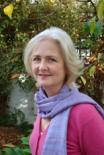
Artemis Cooper

Word has reached me that the biography of Paddy by Artemis Cooper is now completed and is going through the final editorial stages. The much anticipated book will be published by John Murray and is likely to hit the bookshops in October.

Artemis is Paddy’s literary executor and a good friend. Her father, the historian John Julius Norwich being a friend of Paddy’s for many years. She has had exclusive access to Paddy’s archive and will be able to fill in many of the gaps in his life story, including more details about the last stage of his 1934 journey through Bulgaria, Romania, and Thrace to Constantinople. We are all hopeful that her next project will be the completion of ‘Volume Three’, the book that Paddy was unable to complete despite attempts over many years.

I hope to bring you more news about the biography, which will be called ‘An Adventure’, in the coming months.

To pre-order or purchase your copy click here.

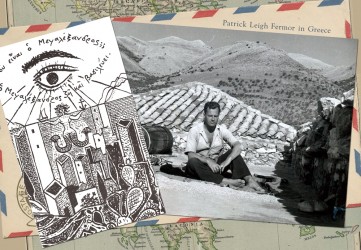
Patrick Leigh Fermor in Greece – a talk by Artemis Cooper

Paddy’s biographer and good friend, Artemis Cooper, will talk about his life in Greece at the Gannadius Library in Athens at 7.00 pm on 24 May 2012. 

Full details of the event can be found here.

Biographer Artemis Cooper, who is preparing a biography of Patrick Leigh Fermor, will trace his life, experiences, and legacy in Greece from his early travels to the end of his life, on 10 June 2011. She will talk about what drew Patrick Leigh Fermor to Greece in the first place; his ‘participation’ in the Venizelist rebellion of 1935; his early travels in Thrace and Macedonia, and first encounters with the Sarakatsani; his experiences in the war on the Albanian front and Crete, as well as the post-war explorations of Greece that produced Mani and Roumeli. She will also touch on the Cyprus years; his friendship with George Seferis, George Katsimbalis, and Nicos Hadjikyriacos Ghika; how he and his wife came to settle in Kardamyli, and built their house with the architect Nicos Hadjimichalis; how the Greek translation of Mani was undertaken by Tzannis Tzannatakis, while he was in exile in Kythera under the Junta of the Colonels. She will also reflect on his position in the village of Kardamyli and how he is seen in Greece today.

PS – I have been told that there will be a webcast available after the event. I will post the details when I have them.

A Year of Memory: the top ten posts on the Patrick Leigh Fermor blog

As the year comes to a close it is time to reflect upon what has passed and to look forward to 2012. I make no predictions for the coming year. There are some things which are almost certain such as the continuing Euro crisis and the much anticipated publication of Artemis Cooper’s authorised biography about Paddy, but forecasts tend to be overtaken by events and are quickly forgotten.

What we can do is to look back on this year in the life and times of Patrick Leigh Fermor. The major event of course was Paddy’s death on 10 June at the age of ninety-six. A sad event for his family and close friends, but also for those of us who admired him for his writing and the life he lived. As the year closed it was time to celebrate his life at his Memorial Service held on 15 December in London.

As I hoped the blog has become a significant source of material about his life including rarely seen video. There have been over 228,000 visits over the last year and you have made it a much more interactive experience by using the comment facility to exchange information, provide your own memories of Paddy, and to express your admiration for him. At the time of his death I opened a page where you could express your thoughts about Paddy which has run to over 120 comments.

Paddy would probably have been somewhat bemused by the whole idea of the blog, but perhaps even more so by the interaction we now have with social networking sites with nearly 4,500 visitors finding the site from Facebook, and 850 via Twitter.

To conclude the year, and as the 365th post on the blog, let us take a look at some of the most popular articles over the last twelve months. Perhaps I can make one promise to you all which is that there is much more to come on the blog in 2012 which includes a lot of material submitted by you the readers of the blog.

The Funeral Service of Patrick Leigh Fermor, 16 June 2011 

Paddy’s funeral service was held on a typical English summer’s day at his home in Dumbleton. He returned to England just one day before his death and is buried beside his beloved Joan.

Obituary from The Independent by Paddy Leigh Fermor’s biographer Artemis Cooper 

Perhaps the definitive obituary.

Patrick Leigh Fermor … This is Your (Ill Met by Moonlight) Greek Life 

The amazing video from the Greek TV programme which reunited the participants of the Ill Met by Moonlight kidnap including Paddy, many of the Andartes, and General Kreipe and his wife.

Anthony Lane’s New Yorker article on Fermor is now free to view 

One of the most comprehensive profiles of Paddy which is now freely available to all. (the pdf download appears to be no longer available – click on the article to magnify to read and then drag your cursor to move around the page)

Intimate portraits from Kardamyli by Miles Fenton 

A series of personal photographs sent to me by Miles Fenton who is Paddy’s nephew and who now lives in Canada where he works as an artist.

Patrick Leigh Fermor recounts the kidnap of General Kreipe on video 

The ever popular video where Paddy talks in some detail about the Kreipe kidnap. (press play on Battle of Crete 7).

Colonel David Smiley 

David Smiley was a fellow occupant of Tara in Cairo with Paddy and Billy Moss et al who continued his military career with some distinction after the war and even led Japanese soldiers in a charge against VietMinh rebels!

Paddy’s eye for detail: Ian Fleming, Bondage, James Bond and Pol Roger 

It is probably the James Bond/Ian Fleming association which maintains the popularity of this article.

If food be the music of love … Bánffy’s lover in Cluj (Kolozsvár) 

No list of popular posts can be complete without the compelling combination of my passions for Paddy, Romania, Miklós Bánffy, and Cluj.

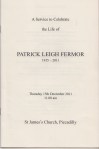
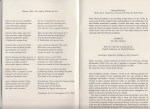
Patrick Leigh Fermor Memorial Order of Service 

The order of service from the joyful occasion that was Paddy’s Memorial Service.

Finally I would like to thank so many of you for your encouragement and support during 2011, and wish you all a very Happy New Year!

Tom Sawford

John Murray – “Patrick Leigh Fermor’s final volume will be published”

It is interesting that twice in one week we have a story about the publication of Vol 3. Is this the result of the commencement of the long, slow cranking up of the marketing machine, or one story leading to another as journalists follow each other’s tails in a quiet week for news? What we do now appear to know is that John Murray are now officially commenting so there is some real substance to the old rumours. Let’s not forget that we have Artemis Cooper’s biography to look forward to this time next year.

by Alison Flood

First published in guardian.co.uk, Tuesday 20 December 2011

Patrick Leigh Fermor’s final volume will be published Long-awaited conclusion to revered account of walk across Europe set to come out in 2013

Readers stranded on the edge of Bulgaria since 1986 by the travel writing great Patrick Leigh Fermor are set to be rewarded at last with the third and final volume chronicling the late author’s European odyssey.

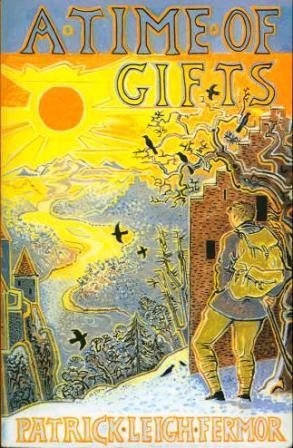
Leigh Fermor, who died in June aged 96, was the author of what his biographer Artemis Cooper described as “two of the greatest travel books of the 20th century”, A Time of Gifts and Between the Woods and the Water. They trace his journey on foot from the Hook of Holland to Istanbul at the age of “18 and three-quarters”, how he travelled “south-east through the snow into Germany, then up the Rhine and eastwards down the Danube … in Hungary I borrowed a horse, then plunged into Transylvania; from Romania, on into Bulgaria”, with the second volume, published in 1986, ending as he was about to cross the Danube from Romania into Bulgaria.

Leigh Fermor always promised a final volume, announcing in 2007 that he had even bought a typewriter and was learning to type in order to complete it. “I’m going to finish that book,” he said. “I’m going home and I’m going to work really hard.”

His publisher John Murray has now announced that it will publish the final volume in 2013, drawing from Leigh Fermor’s diary at the time and an early draft of the book he wrote in the 1960s.

“His devoted readership have been stuck midstream, as it were, for over 20 years. A painstaking perfectionist, Leigh Fermor never did finish the final volume though he was working on it up to his death in June 2011,” said Cooper, whose biography of the author will be published in September 2012. “Based on the original diary he kept at the time and an early draft of the book written in the 1960s, this book takes up the story, and carries the reader to Constantinople and beyond.”

Roland Philipps, managing director of John Murray, called it “a treat to be back, immersed once again in this great pre-war walk across Europe”. It is “wonderful for his many admirers that this book will be published,” added Murray.

Why the lowly shepherd is the one who gets to hear the angels

Remembering honourable lives helps us understand the birth we celebrate on Christmas Day.

by Charles Moore

First published in The Telegraph 24 December 2011.

Tomorrow we celebrate the most important birth in human history, so forgive me for writing about a funeral and a memorial service.

Both occurred in this Christmas season. The memorial service, in St James’s, Piccadilly, was for Sir Patrick Leigh Fermor. Paddy, as all his friends knew him, was a man of unique distinction and unique charm. He won the DSO in the Second World War for his part in the celebrated kidnap (filmed with Dirk Bogarde in Ill Met by Moonlight) of the German General Kreipe in occupied Crete. He became famous as a writer. His best-known books, A Time of Gifts and Between the Woods and the Water, describe his slow walk from the Hook of Holland to Constantinople, begun in December 1933 (he spent Christmas that year in Bingen, in newly Nazi Germany) and not completed until January 1, 1935. His prose, at once romantic and scholarly, ornate and exact, could have no successful imitators, but it has tens of thousands of fans.

In his life as well as his writing, Leigh Fermor was, though he would have disliked the phrase, a role model – brave, handsome, witty, multi-lingual, widely and deeply read, a gifted singer, reciter and drinking companion, a traveller in exotic places, a man who gave delight. When he died, aged 96, this newspaper’s obituary described him as “one of the few genuine Renaissance figures produced by Britain in the 20th century”.

The funeral, the week after Paddy’s service, was for Tony Woodall. Tony was a woodman and neighbour of ours in Sussex. Unusually for a rural family in the South East, the Woodalls are Catholics (I am told there was an Irish grandmother in the case). Every Sunday at our Catholic church, Tony would pull a surplice over his open-neck shirt and frayed working trousers and serve, his huge hands carefully placing the chalice and the patten on the altar. He would ring the little altar bells with a shake as strong as that of a dog with a rabbit. At the intercessions, where people are invited to propose further prayers, it was most commonly Tony who did so. He tended to ask us to pray for people who might not be automatically popular, such as Myra Hindley. His compassion was radical, and universal. He never stopped working. He dropped dead outdoors a couple of weeks ago, aged 79.

Tony Woodall was not known beyond his small corner of rural England, but, like Paddy, he commanded people’s love. The church where he served fits only 120 people, but 200 came to the funeral and many had to stand outside. It fell to me to help flank the hearse as it arrived, trying (and failing) to hold up a candle without it blowing out. I had to pick my way to my place through wild-haired countrymen wielding chainsaws. As Tony’s wicker coffin was lifted up and carried into the church, the saws, by way of tribute, roared into synchronised action.

Both men’s services did justice to the person commemorated. In the case of Paddy Leigh Fermor, there were readings in four languages. Robin Lane Fox read Horace’s Ode 1.9. These were the lines which Paddy heard his prisoner General Kreipe reciting to himself as they watched the cold dawn break over Mount Ida in May 1944 (“See how resplendent in deep snow Soracte stands…”): Paddy knew the Latin words and completed the recitation, forming a bond between enemies. William Blacker chanted a Romanian ballad. Then John Julius Norwich and his daughter Artemis Cooper led us in one of Paddy’s specialities – his own translations of English songs into comically unsuitable foreign tongues. “Do ye ken John Peel, with his coat so grey?” became “Conosce Gian’ Peel, con sua giacca tanta griggia?”

The gospel was from Luke 12: “…take no thought for your life, what ye shall eat; neither for the body, what ye shall put on. The life is more than meat, and the body more than raiment.”

At Tony’s funeral, the gospel was Matthew’s account of the Beatitudes, the list of those who are blest for their meekness or mercy, poverty of spirit or purity of heart. Of them Jesus says: “Ye are the salt of the earth.”

Tony’s son John spoke to us. He remembered the night of the Great Storm of 1987, when he was 10 years old. At two in the morning, Tony came into his bedroom, grasping a chainsaw. “I’m going out,” he told him, “to saw up these trees that are falling and blocking the way. If the roof blows off, come and get me.” A tree fell on his arms that night, but he kept on sawing.

John recalled his father’s goodness, which included caring for his permanently sick wife. “Crikey,” he said, “if only more people were like Dad, I reckon the world would be a hell of a better place. Pardon my language.”

We more than pardoned it, of course. “Thank you for coming,” he said, “You are all honourable men and women.” Whether we were or we weren’t, we felt a renewed confidence that the old-fashioned word had meaning: it was shown in the life of the dead man.

The Romanian ballad recited at Paddy’s memorial service is called the Mioritza. It concerns a shepherd about to be murdered by rivals. He instructs his ewe-lamb, who has the gift of speech, to tell others no word of his death. She must tell them only that “I married tonight a king’s daughter”: “At my wedding, tell/ how a star fell,/ that the sun and the moon were holding our crown,/ how the guests at the feast/were maples and firs”.

At Tony’s funeral, when John had spoken, he moved from the lectern. Just as he was about to rejoin the congregation, he stopped by his father’s coffin. “That evening,” he said, “I stood at the spot where Dad had died. The moon was up, and I saw a firework. But then I realised it wasn’t a firework, because there was no noise. It was a meteorite. I thought: ‘That was Dad.’ ” He went back to his place.

Paddy Leigh Fermor wrote that he loved the Romanian ballad because “its magic lies in its linking together of directness and the tragic sense, its capture of the isolated feeling that surrounds shepherds and the forlorn exaltation that haunts their steep grazings and forests”.

After a life well lived, we can all look back on it with that directness, especially when we attend services such as these. As if from those “steep grazings”, we can see the life laid out, shining plain. We may forget that, for the people who lived it, it often did not seem plain at all. As we sang at Tony’s funeral: “Through many dangers, toils and snares,/ I have already come.” The achievement of something grandly simple is an endlessly complicated process, a lifelong work of trial and error.

Anyway, as I said at the beginning, tomorrow marks a birth, not a death. Another Telegraph obituary, this one of the 7th Earl of Yarborough, related how, at his village carol service, he read the lesson about the shepherds deserting their flocks to see the baby in Bethlehem. “I’d just like to say,” he told the startled congregation, “that if these men had been my shepherds, I’d have sacked them.” One must be glad that the earl was not present 2,000 years ago. The shepherds were the best people to receive the message of the angel. With their linking of “directness and the tragic sense”, they understood what the strange birth would mean.

Final volume from Patrick Leigh Fermor

The latest snippet about Vol 3 from The Bookseller.

John Murray is to publish a posthumous book by travel writer Patrick Leigh Fermor, who died in June [Edit – the article says July – good research!!].

by Benedicte Page

First published in The Bookseller, 16 December 2011

The book will complete the story of the journey Leigh Fermor made on foot from the Hook of Holland to Constantinople at the age of 18, as told in his previous works A Time of Gifts and Between the Woods and the Water. The currently untitled volume will be published in September 2013.

Artemis Cooper, whose biography of Leigh Fermor will be published in September 2012, said: “By the end of the second volume, he was about to cross the Danube from Romania and plunge into Bulgaria; and his devoted readership have been stuck midstream, as it were, for over 20 years. A painstaking perfectionist, Leigh Fermor never did finish the final volume though he was working on it up to his death in June 2011.”

Based on the original diary he kept at the time and an early draft of the book written in the 1960s, this book takes up the story, and carries the reader to Constantinople and beyond.

John Murray m.d. Roland Philipps said: “I was told of the existence of a manuscript on the day that Sir Patrick died in June of this year, and read it shortly afterwards. It is a treat to be back, immersed once again in this great pre-War walk across Europe and wonderful for his many admirers that this book will be published.”

The publisher describes Leigh Fermor as “one of the outstanding prose stylists of modern time”.

Patrick Leigh Fermor Memorial Order of Service

The memorial service that took place on 15 December at Saint James’s, Piccadilly was a moving tribute to Paddy, whilst at the same time being a tremendous celebration of his life, and the music, poetry and people that he loved. The order of service is here for you to see.

If there has to be a highlight it was John Julius Norwich and his daughter Artemis Cooper singing versions of D’Ye Ken John Peel and Widdecombe Fair translated into Italian by Paddy. After this Lord Norwich gave a lively and affectionate Address about his good friend of over fifty years.

Artemis has to be congratulated for organising such a successful memorial service which gave a nod to Paddy’s boyhood by including the excellent Crypt Choir of King’s School Canterbury.

There was a final message to us all from Paddy himself:

“Love to all and kindness to all friends, and thank you all for a life of great happiness” – Patrick Leigh Fermor

Snail’s pace to Byzantium: journey of a lifetime

This is a combination of profile and review of Words of Mercury. An interesting piece.

by Ann Elder

First Published in Athens News, 9 Jan 2004

“I HATE the word travel-writer,” London-born, Mani-based Patrick Leigh Fermor told a British journalist in 1995. Under the title Words of Mercury, a selection of his writings was published by John Murray this autumn. The excerpts from half a dozen of his books, some articles and reviews show clearly why he must flinch from being slotted anywhere confining.

As his followers know, he writes with an enchanted pen. Any topic he takes up becomes something ‘rich and strange’. He has a story-teller’s knack of compelling interest, like the Ancient Mariner mesmerizing listeners with his glittering eye. And he has a particular flair for catching the heightened receptivity and visceral thrill felt at new encounters, what Cavafy wished the traveler in his poem Ithaka:

Pray that your journey may be long,
that many may those summer mornings be
when with what pleasure, what untold delight
you enter harbours never seen before.”
(Kimon Friar translation)

Not least, Leigh Fermor wins readers’ allegiance by creating the sense of affinity with an engaging personality, uncensorious, untinged by chauvinism, reveling in life, akin in spirit to A E Housman, onetime professor of Latin at Cambridge, in his lines:

Could man be drunk forever
With liquor, love or fights
Lief should I rouse at mornings
And lief lie down at nights.

Edited by Artemis Cooper, a writer (Cairo in Wartime) and wife of historian Antony Beevor (Crete: The Battle and the Resistance), the book has five parts: travel, Greece, people, books and flotsam (finishing with a poem on Christmas maybe better forgotten). Cooper gives brief introductions to each piece and starts off with a succinct biography.

As an 18-year-old living on a pound a week in a flat off Picadilly in 1933, Leigh Fermor spent more time partying than buckling down to write. As fate had it, he had read The Station: Athos: Treasures and Men by the irreverent young Robert Byron in 1928. The ‘great and misunderstood spirit of Byzantium’ had greatly impressed him.

“About lamp-lighting time at the end of a wet November day, I was peering morosely at the dog-eared pages on my writing table,” he related later. “A plan unfolded – to set out across Europe like a tramp – a pilgrim or a palmer, an errant scholar, a broken knight.”

“The chief destination was never in a moment’s doubt. The levitating skyline of Constantinople pricked its sheaves of thin cylinders and its hemispheres out of the sea-mist; beyond it hovered Mount Athos; and the Greek archipelago.”

In excess of his wildest dreams, he found material to write about. All was grist to his mill, but his mill ground slowly. His writing proved to require long gestation. He became fanatical about polishing his product, and research, the more obscure, the more it seemed to appeal to him, like the origins of the Sarakatsans or the Laz-speaking Greeks of Trebizond. The first book about his venture, A Time of Gifts, came out in 1977, over 40 years later, and the second, Between the Woods and the Water about “those mysterious regions between the Vienna Woods and the Black Sea” as Saki put it – in 1986. In France they called him “l’escargot (the snail) of the Carpathes.”

Real life and events also delayed his writing. The trek took him about a year. He reached his goal on New Year’s Eve, 1934, after ending his traverse of Bulgaria with a splash, falling into the Black Sea on a cold December evening. He came to the coast some 150 miles north of the Bosphorus. “An old man was smoking a narghileh on the doorstep of a hut beside a little boat beached among the rushes – a Tartar fisherman, the only human being I saw all day,” he  wrote over 20 years later in an article in the May 1965 Holiday Magazine.

Darkness fell. “I lost my footing on a ledge and skidded – waist-deep into a pool. Jarred and shaken, with a gash on my forehead and a torn thumb, I climbed out, shuddering with cold. At the bottom of the pool, about two fathoms down, my torch was sending a yellow shaft through sea anemones and a flickering concourse of fish.”

Crawling round the rocks, he came to a veritable Cyclop’s cave sheltering a dozen Greek fishermen and Bulgarian goatherds with their 50 goats and cheese-making apparatus, eating lentils by a thornbush fire. The young wayfarer was soon dried and warm, tossing back slivovitz and eating fresh fried mackerel.

Leigh Fermor is in his element in the climax of this thoroughly Homeric episode, when one of the Greeks, Costa, turns out to be an unsung Nijinsky, his dancing invested with a ‘tragic and doomed aura.’ He performed the stunt  with which Greek cruise ships like to wind up their Greek night shows: dancing with a table between the teeth.

“On a rock, lifted there to clear the floor, the low, round, heavy table was perched. Revolving past it, Costa leaned forward: suddenly the table levitated itself into the air, sailed past us, and pivoted at right angles to Costa’s head in a series of wide loops, the edge clamped firmly in his mouth and held here only by his teeth. The dancer whirled like a dervish, till the flying table melted into a disc, finally returned to its rock, glasses, cutlery, lentil pot and cigarette burning on the edge of a plate undisturbed.”

Time in Greece he dates from his 20th birthday, February 11, 1935, when he arrived at Mt Athos as ‘snowflakes were falling fast’ and ‘in deep snow, trudged from monastery to monastery.’ In Athens later, he frequented the  Romanian embassy, meeting descendants of Phanariot hospodars, Ypsilantes, Ghikas and Cantacuzenes. As with Greece, he fell in love with Balasha Cantacuzene whose forebear, Emperor John Vl, invited the Seljuk Turks to  Europe (and is recalled sorrowfully in a Cavafy poem for having coloured glass not jewels in his coronation crown).

After time writing and painting in an old mill among the lemon groves overlooking Poros, they went to her decaying family estate in Moldavia. Published in 1961 was a perfectly pitched account of a picnic in sunlit  countryside by open carriage and on horseback on September 2, 1939, the last day of peace. “It had been a happy day, as we had hoped, and it had to last us a long time, for the next day’s news scattered the little society for ever.”

Utterly desolating is the Daily Telegraph weekend magazine article of May 1990 on his first breaking through the Iron Curtain in 1965. He found the Cantecuzene sisters in a Bucharest attic eking out a communist state pension  teaching. The gracious old houses he had stayed in among flowery meadows and nightingale-filled woods were psychiatric hospitals, their owners dead.

Leigh Fermor seems happiest gilding the past, writing to ‘the brave music of a distant drum,’ as old Khayyan put it, not dwelling on ‘bitter furies of complexity’ or ‘that gong-tormented sea’ of Yeats’s “Byzantium” which he refers to at the outset in Time of Gifts. The days of his youth were the days of his glory and he evokes them with zest, if no doubt some selective memory. He admits he is beset with ‘retrogressive hankerings,’ but these add to the richness of the embroidered prose dazzling his readers, to twist Yeats a bit. And sometimes he might be shoulder-to-shoulder with the poet:

Of all Arabia’s lovers I alone
Nor dazzled by the embroidery, nor lost
In the confusion of its night-dark folds,
Can hear the armed man speak.

His review of Edmund Keeley’s Cavafy’s Alexandria in a 1977  Times Literary Supplement (TLS) shows him at his serious best. He recalls “the blacked-out, jolly, rather wicked wartime port” he knew as a young British World War Two agent, then is off with Cavafy into the Judaeo-Hellenic Franco-Levantine city “old in sin, steeped in history, warrened with intrigue.”

He notes the depths of irony and dark humour in the notion of citizens aghast with consternation when the barbarians fail to invade them on cue. He ponders “the jagged Ithaka at the long Odyssey’s end; the imminent Ephialtes ready to sell the Thermopylae of the spirit.” He goes on: “Issued without preamble from an atmosphere of earthly delights these warnings sound as harsh, for a moment, as the words of Mercury after the songs of Apollo at the end of ‘Love’s Labour’s Lost.'”

Leigh Fermor is a mild Mercury though. In a review of Oxford classicist CM Bowra’s Primitive Song in a 1962 Spectator he commends him for eschewing ‘a softer technique, swaying to the seductions of every coincidence  and historical chance-shot.’ He himself tends to yield to the tempting vistas of ‘alluring byways.’

The selections from his writings on Greece include a report he wrote for London’s Imperial War Museum archives in 1969 on how the German commander General Heinrich Kreipe was abducted by a Cretan-British force he led in April 1944. While still controversial, the coup makes a cracking good story.

At Anoyeia where captors and captive rested, villagers were ‘convulsed by incredulity, then excitement and finally by triumphant hilarity. We could hear running feet in the streets, shouts and laughter. “Just think, we’ve stolen their General!”‘

Heading south round Psiloritis – Mt Ida of antiquity, over 2,200 metres high and snow-covered till late May – the getaways were to meet a British vessel on the coast to spirit them to Egypt. After a night in a shepherd’s hut sharing  one blanket, “a brilliant dawn was breaking over the crest of Mt Ida which we had been struggling across for two days. We were lying smoking in silence, when the General, half to himself, slowly said (in Latin): ‘See, how it stands, one pile of snow’. I was in luck. It is the opening line of one of the few odes of Horace I know by heart. I went on reciting where he had broken off (likewise in Latin);

‘neath the pressure yield
Its groaning woods; the torrents flow
With clear sharp ice is all congealed.
Heap high the logs, and melt the cold,
Good Thaliarch; draw the wine we ask,
That mellower vintage, four-year-old,
From out the cellar’d Sabine cask.

(Conington’s translation)

The stanzas are much-loved, ‘a picturesque Christmas card,’ say scholars. They evoke the perfect ambience in which to peruse the book. Those unfamiliar with Leigh Fermor will surely have appetites whetted for more. Those who know him and have his books around will dash for them to locate the extracts, then hotly debate the choices, such as the punning Achitectural Notes from a 1994 Spectator: “If you squinch, aisle screen,” and “Put those Saxon  here Norman,” and “Overhung? Per apse, when dais done.”

The author has covered himself. “Pure nonsense is as rare among the arts as an equatorial snowdrop”, he wrote in a review of George Seferis’s Illustrated Verses for Small Children in a 1977  TLS.

The Kreipe pennants

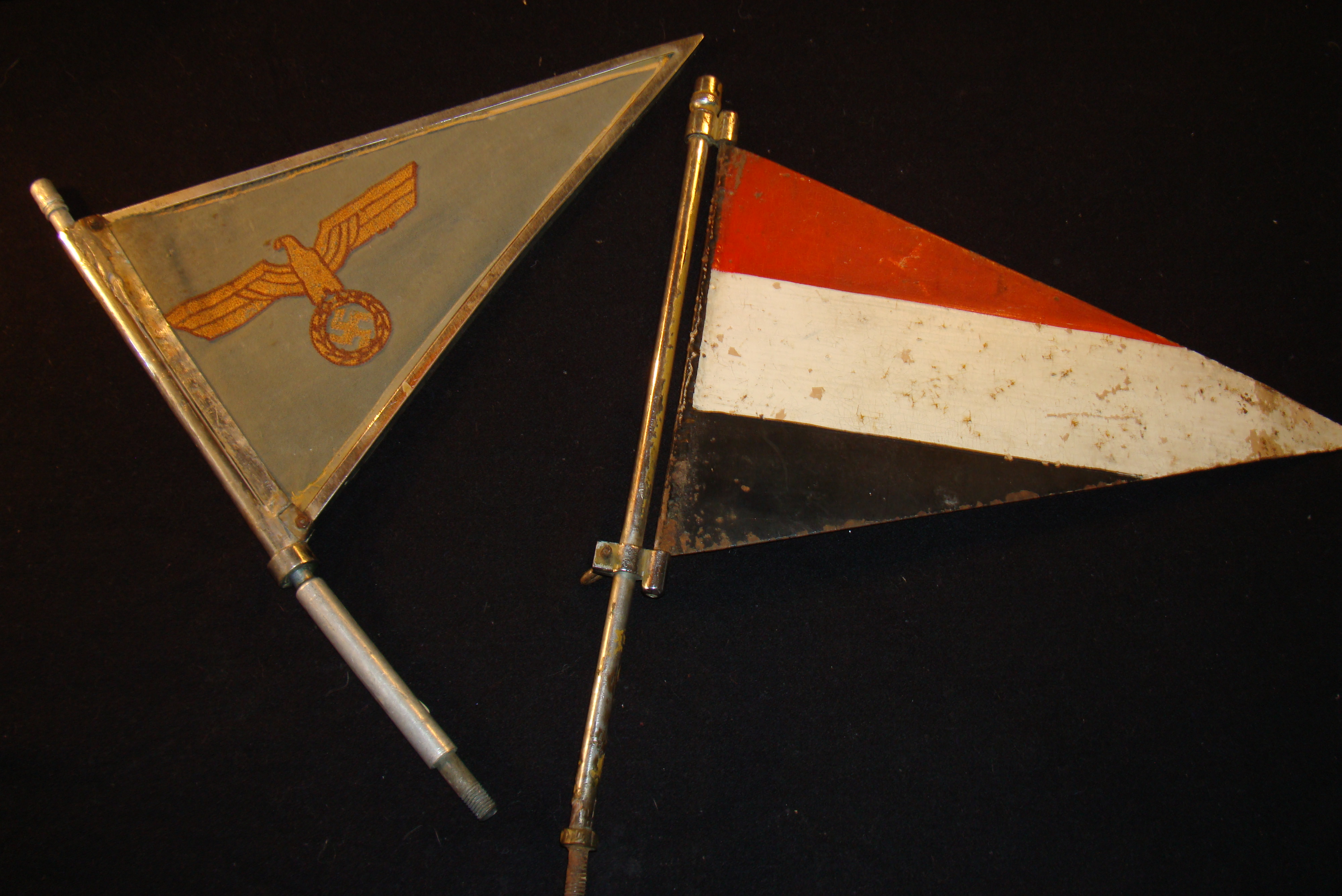
The Kreipe pennants - Copyright Artemis Cooper 2011

The pennants from General Kreipe's car

What happened to the flags on General Kreipe’s car when Paddy abandoned it and joined the main abduction gang? Well here is the story. I am very grateful to Artemis Cooper for submitting this. I hesitate to say that this is a world exclusive, but it probably is! These have not been seen in public since the car drove through the heavily garrisoned town of Heraklion with the General in April 1944.

As I’m sure you know, just before abandoning the General’s car on the night of the abduction of Gen Kreipe, Paddy and George Tyrakis ripped off the two metal pennants that stood proudly on the bonnet. One might argue that, combined with Billy’s confident driving, it was those pennants that had let the car pass unchallenged through 22 German checkpoints! Since Billy had driven the car the pennants were given to him; and after his death, Billy’s daughters – Gabriella Bullock and Isabella Cole – felt that Paddy should have them. Paddy held onto them for many years, very much under wraps. I think the main reason he kept them hidden was because he had always felt so wretched about the death of Alfred Fenske, the General’s chauffeur.

They were kept in a tin trunk in his study, and very few people knew they were there. He showed them to me only once. The reason for that was so that I should be aware that after his death, they were to go to the Rethymnon Museum of History and Folklore. This had been arranged in the 1990s, with the encouragement of Niko Kokonas.

In August the flags were given to the Rethymnon Museum, according to Paddy’s instructions.

I have a photo of the flags. They stand about 15″ high, the triangular pennant sticking out about 12″. The first is painted red, white and black in horizontal lines, like the German flag. The other shows the gold Nazi eagle with outspread wings perched on a wreath, embroidered onto a piece of grey fabric which is then mounted onto the metal pennant.

I hope this is a real joy to all the Ill Met by Moonlight fans out there.

This article and photograph copyright Artemis Cooper 2011

Greeks in Hungary: A history in two acts

I thought this would be of general interest. I don’t recall Paddy encountering any Greeks in Hungary but he did come across Greek fishermen from the Greek diaspora when walking along the Bulgarian Black Sea coast in late 1934. That encounter was related in Words of Mercury and includes the Mystery of the Black Sea Cave.

by Alexander Billinnis

First published in The Hellenic Voice, 22 June 2011.

The Greek presence in Hungary is one of the oldest in Greece’s modern diaspora. It is, further, one of the most interesting, because as a tragic accident of war and politics, it received a new lease on life, a second chapter of sorts. The Greeks’ odyssey in Hungary is a tale of two diasporas and the efforts of current Greeks to unite the two acts into a common play.

Act I: The First Diaspora

After swallowing up the Balkans, the Turks shattered the Hungarian army at the Battle of Mohacs, and the Turks controlled most of Hungary, and up to the gates of Vienna in Austria, for more than 150 years. On the heels of the Turks’ second, failed siege of Vienna in 1683, the Austrians, at the head of a multinational European force, began the taskof evicting the Turks from Central Europe. When the guns fell silent, in 1717, the Austrians and Hungarians needed to rebuild their realm devastated by war, and many Ottoman Christians, primarilySerbs but also Greeks and Vlachs, responded eagerly.

Greek merchants quickly established themselves in major Hungarian cities, such as Buda, Pest, Szentendre, Miskolc and Tokaj. They were heavilyinvolved in the overland trade with the Ottoman Empire, but they also worked as agriculturalists and vintners. There is some evidence that winemakers from Macedonia first cultivated Hungary’s prized Tokaj wine. The Greek merchants were heavily involved in the coffee trade, and some of the oldest Budapest coffeehouses have Greek origins. As an avid coffee drinker, this makes me particularly proud.

The Greeks’ natural appetite for commerce, their large commercial network in the Ottoman Empire and their growing colonies throughout the Austrian (later Austro-Hungarian Empire) brought a great deal of wealth to the small but financially and politically powerful community. The Greek community supported schools, charitable institutions and of course church organizations. Initially the Greek students studied at the Serbian school, but by 1785 they established their own, which operated continuously until 1900. The Greeks and Vlachs established a church community separate from other Orthodox nationalities (though still subject to the Serbian Patriarchate), and their cathedral, built in 1809, continues (as the Hungarian Orthodox Church) to serve a largely Hungarian Orthodox community, often Balkan in origin. Other Greek Orthodox churches grace several Hungarian cities, including Tokaj, Eger and Miskolc.

The Greeks’ very success fostered an increasing assimilation. Greeks left the merchant class, became naturalized Hungarians, and in some cases nobility. Events in Hungary followed a similar pattern to those in Vienna and other key Austrian commercial centers. Lacking the critical mass of population that the Serbs had in southern Hungary (which later became the Serbian province of Vojvodina, where my family and I currently live), the Greeks became Hungarians, though some did keep the Orthodox religion of their ancestors, and vestiges of their culture.

Act II: The Second Diaspora

Just as the First Greek Hungarian diaspora faded into assimilation and history, events in Greece stirred up another wave of Greeks into Hungary. Many of these immigrants came from the same mountains as the first diaspora, but they were not merchants, but refugees – guerillas, villagers and intellectuals of the communist movement in the Greek Civil War. Many were children, many came involuntarily. Their connections with Greece were severed by the hard frontiers of the Cold War, but they did not forget Greece or their traditions.

In the “Greek” village of Beloiannisz (Beloyiannis), which I visited, or in small communities in Budapest, Miskolc, Pecs and Kesckemet, the Greeks kept their language and culture alive. In the communist period the Church played little role as a guardian of faith and identity, in contrast with the first Greek diaspora in Hungary, or Greek diasporas in the Americas or Australia. In the post-communist era, the role of the Church has reemerged.

Other virtues we associate with the diaspora, hard work and study, also marked this post Civil War diaspora. Greeks excelled in academia and professions well out of proportion to the small size of their community. All of the Greeks I met, including the second generation born in Hungary, spoke Greek with a precise fluency.

A fair percentage of the Greek Hungarian community repatriated to Greece, particularly in the 1980s, but the community by that time was quite well established in Hungary. The Hungarian government recognized Greeks as a distinct minority and cofunded cultural and educational activities. This support enables a diverse educational and cultural agenda, including an elementary school, weekly cultural performances and a growing literature about the community. When I arrived at the cultural center, I was welcomed as a fellow diaspora Greek, and loaded down with books on the community.

Closure

I spent an hour talking to Professor Nikosz Fokasz (Nikos Fokas), an eminent Hungarian sociologist and one of the Greek community’s leading intellectuals. Son of a Paris-educated Cephalonian architect and a mother from a village in Evritania, Professor Fokas is an urbane academic at home in university circles throughout Europe and North America. He considers thispostwar Diaspora to be the keepers and the descendents of the first diaspora. After all, both generally descended from the same Macedonian and Epirote mountains, a “diaspora of the Mountains,” as he calls it. Many Hungarians are now rediscovering their Greek roots, with the active help of this newer Greek diaspora.

Professor Fokas noted, with a particular pride, that Baron Simon Sina, a Greek Hungarian, financed Budapest’s most iconic Danube bridge, Lanc Hid (Chain Bridge), as well as a large part of the Hungarian Academy of Sciences, another signature Budapest building. Honoring him, Greek Hungarians have been instrumental in establishing the “Sina Award,” bestowed upon a member of the Hungarian business community for outstanding support of the arts and sciences. Fostering awareness of Hungary’s Greek and Orthodox elements in its history has been a key contribution of this new diaspora, and in so doing, it has honored, and in some cases, literally resurrected, the first diaspora.

As always when I travel among diaspora Greeks, I felt a common bond with the Greek Hungarians in spite of our very different histories. There was that love of Greece, somehow less jaded, than that of Greeks in Greece. There is also a very clear consciousness among Greeks in Hungary that the history of Hellenism and Orthodoxy is a long one in their country, and that custody of this tradition is an important role, which they assume with pride. It is a pertinent lesson for our community in America.

Alexander Billinis is a Greek American writer living in Serbia. He previously worked in international banking in the US, Britain and Greece. His book, “The Eagle has Two Faces: Journeys through Byzantine Europe,” will be released later this year. 

Related articles:

On the Pontic shores where the snowflakes fall

The mystery of The Black Sea Cave

Leigh Fermor’s hidden letters to see the light

It has been 15 years in the making but at last Artemis Cooper’s official biography of Sir Patrick Leigh Fermor has got a publication date. Cooper was first contracted to write an account of the life of her friend, the great travel writer, back in the Nineties but Leigh Fermor had requested that it was not to be published until after his death, which came last Friday at the grand age of 96.  Cooper, wife of historian Antony Beevor and daughter of John Julius Norwich, is now expecting the book to come out late next year with John Murray, also Sir Paddy’s publisher. The delay is believed to be down to a number of private letters — possibly to his late wife, Joan Leigh Fermor— which he did not want to be in the public sphere while he was still alive. Sir Patrick was in his eighties when the book was commissioned and friends confess that they did not expect such a long wait. As a young man he walked across Europe and swam the Bosphorus. He lived for many years in the Peloponnese. Recently, his correspondence with the Duchess of Devonshire, edited by Charlotte Mosley, was published.Cooper, administrator of the Duff Cooper literary prize in memory of her grandfather, is still holding back the exciting details of the book. “It’s not finished yet,” she tells me, dodging questions about the content. “We’ll do it in time for Christmas next year.” Leigh Fermor’s funeral will be held on Thursday in the village of Dumbleton in Gloucestershire, where Joan is buried.

From the Londoner’s Diary in The Evening Standard, 14 June 2011

A review by Paddy of Artemis Cooper’s book Cairo in the War

Artemis Cooper’s introductions and accompanying text to Duff and Diana Cooper’s published letters, A Durable Fire (1983), and to Lady Diana’s Scrapbook (1987), had a strong dash of her grandmother’s humour and lightness of touch; but only a most clairvoyant critic could have predicted Cairo in the War, 1939–1945. Her account, though it sticks punctiliously to fact, is as hard to put down as good fiction . The research is wide, detailed and scrupulous. She lays hold of the military background – the dramas unfolding just off-stage, but threatening to break out of the wings at any moment – with a soldierly grasp; and she seems to have talked at length with all the surviving dramatis personae.

By Patrick Leigh Fermor

First published in The Times Literary Supplement 1 September 1989 (republished online 15 June 2011)

Unleavened by personalities, military history can be heavy on the hand, and politics too, once the urgency has gone. The author’s skill redeems them both. As for the complex country and people on whom the war had impinged, she has segregated the strands with great discernment – the Copts, the Arabs, the Mamelukes, the Ottomans, all the sects and enclaves of the Mediterranean and the Levant, the Helleno-Judaeo-Ptolemaic nexus of Alexandria, the fellahin and the effendis and the nationalists, the rivalries of the Western European powers, with their local allegiances and clients and phobias, and, above all, the reigning Albanian dynasty and the predominating British presence and tutelage.

The author is particularly helpful and fair about the tensions between the last (in the persons of the young King Farouk and the proconsular Ambassador, Sir Miles Lampson), which culminated with British tanks all round the Palace, near-abdication and an enforced change of government: the German advance in the desert was the raison d’état. The enemy was held and driven back; certain froideurs remained at the top; but, astonishingly, the surface of the luxurious, dazzling and hospitable social life was hardly ruffled. At times this resembled the Duchess of Richmond’s ball before Waterloo, at others the Congress of Vienna: “The Kings sit down to dinner and the Queens stand up to dance . . .”. The pool at the Gezira Sporting Club sluiced hangovers away, the willow smacked the leather, polo-balls whizzed there all afternoon, and roulette-balls plopped at the Mohammed Ali after dark. There were enticing restaurants and enterprising night-clubs, party followed party and bedtime often coincided with the first muezzin’s call from the minaret of Ibn Tulun. Guilt about rationed London bit sharp now and then, but for those on short leave from the Desert, not deep.

Among the missions and staffs and the permanent officials, intrigue and gossip were as intense as in Mrs Hauksbee’s Simla. The author is eerily well informed about Groppi’s Horse and the Short-Range Shepherd’s Group and, a fortiori, about GHQ at Grey Pillars and SOE at Rustam Buildings (particularly the latter) and all the cross-currents, promotion-mania and the clashes – eg, “Bolo” Keble and Fitzroy Maclean – the political schisms of Southern Europe and their repercussions in Egypt. The pages on spies and counterespionage and raiding forces are one of the most impressive parts of the book.

The author is perceptive about the frustrations and amusements of all ranks of the assorted armies. There were shaming moments, but on balance it seems that arrogant behaviour towards the Egyptians may have been more frequent among the commissioned than the other ranks. In the case of a pasha who was insulted beyond endurance by a very drunk officer, nemesis was brisk and condign. The oblivious offender was inveigled to the pasha’s house. Most would have kept quiet, Artemis Cooper observes, but he was soon telling everyone, “You’ll never guess what happened to me last night — dashed unpleasant. I got buggered by six Nubians.”

In spite of the strains on high, the diplomatic world, the military, the cosmopolitan, the purely decorative and the intellectual interwove to a surprising degree, and lasting friendships were formed. The contribution of Greeks such as Seferis, and transplanted Greece-addicts like Lawrence Durrell and Robin Fedden, were important here. Poets and writers teemed, and Personal Landscape, the Nilotic equivalent of Horizon, was impressive. The author unfolds the catalogue of personalities with humour and understanding, though she is unduly dismissive of Sir Charles Johnston: cf his sonnet “The Lock”, and his Pushkin translations. The only omissions I can spot are Elizabeth David, the painter Adrian Daintrey and the writer-painter Richard Wyndham. Perhaps she should have included an eccentric cavalryman called Colonel Wintle, who got into hot water for taking a surrendered Italian general to luncheon, in full uniform, at the Turf Club.

The book ends with the calamitous post-war aftermath. Like the abstruse anecdotes, the range and choice of the photographs will promote sighs of delighted recognition and occasional ground teeth, and it is hard to think, on finishing, how this demanding book could have been handled better, more lucidly or more entertainingly.

Related articles:

Sophie Moss Obituary from Daily Telegraph

One Man’s Great Game: Lieutenant Colonel “Billy” McLean

Lawrence Durrell and Patrick Leigh Fermor by Thos Henley

Serving is honour enough

From Matthew Bell’s Diary.

First published in the Independent on Sunday, 12 June 2011.

Patrick Leigh Fermor, author of two of the most poetic travel books ever written, chose to die at home in Worcestershire on Friday, after seeing the world. He was, according to his biographer Artemis Cooper, desperate to come home one last time to see his friends. Since the death of his wife in 2003, Sir Patrick had been living in Kardamyli, his house in the Mani, southern Greece. I can reveal that fans will be able to visit the house, as he has left it to the Benaki Museum in Greece. His death at the age of 96 cast a shadow over the 25th wedding celebrations of Cooper to her husband, the historian Antony Beevor, who held a party in London on Wednesday. Other friends of the writer included Debo, Duchess of Devonshire, whose book of correspondence with Paddy, In Tearing Haste, was a hit in 2008. The good news is that Paddy had nearly finished editing the third and last volume of his travelogue, which follows the wonderful A Time of Gifts and Between the Woods and the Water. This will cover the year 1935, in which he walked from the Iron Gates, on the Danube, through Bulgaria, Romania and Greece to Constantinople. The pressure is now on for Cooper to finish her biography too. “I have written too many words,” she tells me, “though some parts aren’t written at all.”

Obituary from The Independent by Paddy Leigh Fermor’s biographer Artemis Cooper

Leigh Fermor will be remembered as someone who lived and talked as well as he wrote

Sir Patrick Leigh Fermor: Soldier, scholar and celebrated travel writer hailed as the best of his time.

By Artemis Cooper

First published in The Independent Saturday, 11 June 2011.

In Greece just after the Second World War, Patrick Leigh Fermor was on a lecture tour for the British Council.

The lecture was supposed to be on British culture, but he had been persuaded to talk about his wartime exploits on Crete. Leigh Fermor took sips from a large glass as he spoke and when it was nearly finished, he topped it up from a carafe of water. The liquid turned instantly cloudy: he had added water to a nearly empty tumbler of neat ouzo.

A roar of appreciation went up from the audience at this impromptu display of leventeia. A quality prized in Greece, leventeia indicates high spirits, humour, quickness of mind and action, charm, generosity, the love of living dangerously and a readiness for anything. Sir Patrick Michael Leigh Fermor had leventeia in spades.

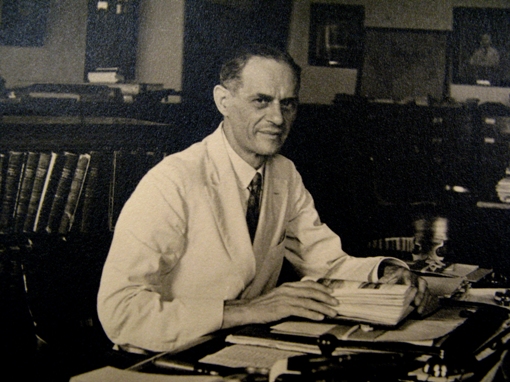
Sir Lewis Leigh Fermor

He was born in 1915, the second child and only son of Lewis Leigh Fermor and his wife, Aileen Taaffe Ambler. The family were based in Calcutta, where Lewis Fermor worked for the Geological Survey of India. Aileen went to England for the birth, but did not dare bring Leigh Fermor back to India as the First World War intensified. She entrusted her baby to the Martins, a couple she scarcely knew in the village of Road Weedon, Northamptonshire, and for the next four years “Paddy-Mike” was adored, indulged and allowed to run wild. When his mother and sister Vanessa came back to collect him in 1919, it was the end of an infant idyll that had, he admitted, “unfitted me for the faintest shadow of constraint.”

Leigh Fermor saw little of his father but was devoted to his flamboyant mother, who wrote plays, played the piano and loved reading aloud. He learnt to read late but devoured the works of Sir Walter Scott before he was 10, awaking an addiction for history, heraldry and adventure. Yet he was not a success academically, perpetually in trouble, and expelled from almost every school he attended.

The King’s School, Canterbury, might have been the exception, but he was often in trouble, and the final straw came when he was caught holding hands with the greengrocer’s daughter. His last report complained that he was a “dangerous mixture of sophistication and recklessness”, and a bad influence on the other boys.

His parents felt a career in the army was the only hope, but he gravitated to Bohemian London and a raffish group who introduced him to nightclubs, strong drink and modern poetry, and encouraged his ambition to be a writer – but he had nothing to write about. He was drifting in a fog of disappointment when the solution came: he would embark on a walk across Europe from the Hook of Holland to Constantinople.

He was 18 when he set off in 1932. With an allowance of £5 a month he slept in hostels, sheep-folds, monasteries, barns, people’s sofas, and for a few luxurious months in castles and country houses in Hungary and Transylvania. He reached Constantinople on New Year’s Day, 1935. He spent his 20th birthday on Mount Athos, and a month later took part in a Greek royalist cavalry charge against Venizelist rebels across the River Struma on a borrowed horse. He then made his way to Athens, where he met Princess Balasha Cantacuzène.

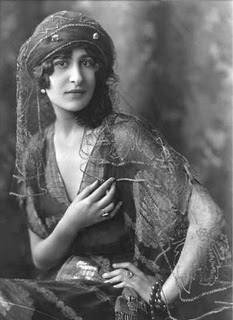
Balasha Cantacuzene

A Romanian painter with dark, exotic looks, Balasha was eight years older and recently divorced. That summer they lived in a watermill opposite the island of Poros, and in autumn they retreated to Balasha’s family home in Romania. Baleni, in the Cantacuzene estates in Moldavia, was his refuge for three years. Here he made the first attempt to write up his notes from his trans-European journey. He did not like the results, but he did earn money by translating Constantine Rodocanachis’s Ulysse fils d’Ulysse which as Forever Ulysses became a bestseller in America. When war was declared, Leigh Fermor decided to go home. “The farewells next day,” he wrote, “were like marching orders out of paradise.”

He had hoped to join the Irish Guards, but took the commission offered by the Intelligence Corps which gave him the opportunity to return to Greece. As a British Liaison Officer he followed the Greek army’s early successes against the Italians on the Albanian border in late 1940. When the Germans invaded the following April, the British and Greek forces retreated southwards. Leigh Fermor escaped by caique to Crete, where he took part in the battle in May 1941 against German paratroopers; when the battle was lost he was evacuated to Egypt. He was sent back to occupied Crete in June 1942, as one of a handful of SOE officers who were helping the Cretan Resistance.

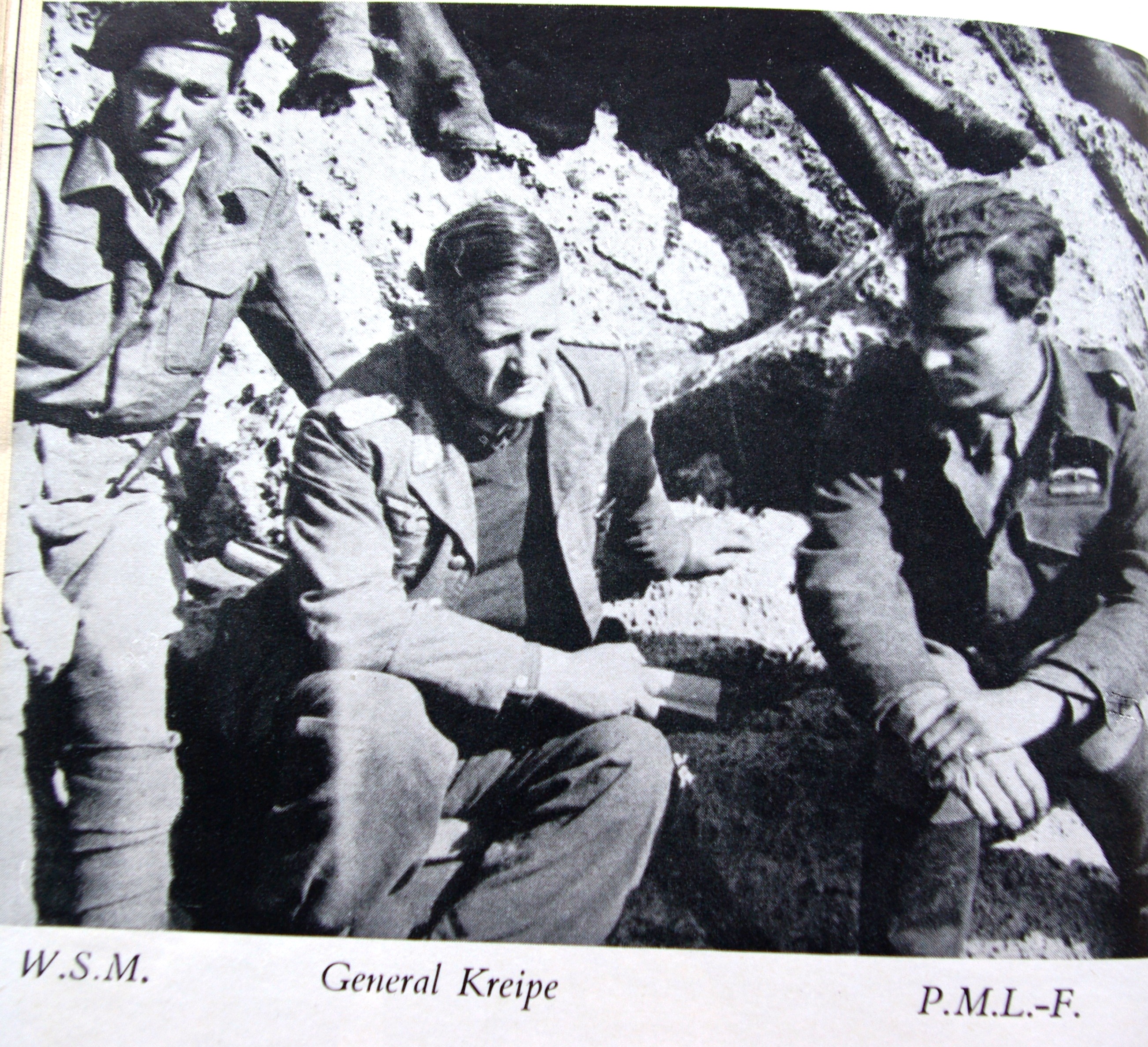
After the Italian surrender in August 1943 he was contacted by the Italian general Angelo Carta. Rather than co-operate with the Germans, Carta wanted to leave Crete. Leigh Fermor saw him safely to Egypt – a mission which sparked the idea of kidnapping a German general. Promoted to major, he returned from Cairo to Crete in February 1944. With his second-in-command, Capt William Stanley Moss, and a hand-picked team of resistance fighters, the ambush took place on 26 April, when General Heinrich Kreipe, commander of the Sebastopol Division, was pulled out of his car on his way to his villa.

Moss, Kreipe and Paddy

The hardest part was not so much the capture but the getaway. The wireless broke down, German troops flooded the south coast, from where they had planned to rendezvous with a Royal Navy launch, and the General hurt his shoulder in a fall. The party spent two weeks in caves and sheepfolds in the White Mountains, making their way over the snowy ridges of Mount Ida to a more secluded evacuation point. German patrols kept up the pressure, and leaflets were dropped warning that anyone who gave aid and succour to the kidnappers could expect the most severe punishment. No one gave them away.

The success of the operation and the discomfiture of the occupiers gave the Cretans a tremendous boost: as one of them put it, “the horn-wearers won’t dare look us in the eye!” William Stanley Moss’s diary was made into a book, Ill Met by Moonlight (and later a film with Dirk Bogarde.) Leigh Fermor was awarded the DSO and remains a hero on Crete. But he never published an account of his own experiences on the island.

After the war, he became assistant director of the British Institute in Athens. A colleague recalled the songs and laughter emerging from his office, which was a magnet for Cretans looking for a job. His boss sent him on a lecture tour to get him out of the way, which proved a success and took him all round Greece. This was the first of many journeys taken with Joan Rayner, a tall, blonde intellectual he had first met in Cairo. Daughter of the first Viscount Monsell, who had been First Lord of the Admiralty in the 1930s, she was widely travelled and a talented photographer.

In October 1949, the couple set off for the French Antilles. Leigh Fermor had been commissioned to write captions for a book of photographs by his friend A Costa, but this developed into his first full-length book, The Traveller’s Tree (1950). The reviews were generous in their praise and he was earmarked as a writer to watch.

He was now free to concentrate on Greece. Over the next few years he and Joan travelled all over the mainland and the archipelago, by boat and bus and mule and on foot, exploring a country that was still remote outside the main towns and where customs and traditions were observed as they had been for centuries.

Spells of travel would be broken by long stints of writing, translation and journalism. In 1953 came two small books. A series of articles on monasteries, written for the Cornhill Magazine, were collected in A Time to Keep Silence, while his only novel, The Violins of Saint Jacques, grew out of a chapter he was supposed to have written for a book called Memorable Balls. He translated the wartime memoirs of his friend George Psychoundakis, which appeared in 1955 as The Cretan Runner, and wrote for The Spectator and The Sunday Times.

Beyond an insatiable thirst for travel, wine and books, Leigh Fermor and Joan lived a frugal life. She had a small private income, and by living abroad for most of the year they avoided tax. Friends helped by lending houses where he could write; among the most important was a house in Normandy owned by Amy Smart, the Egyptian wife of the diplomat Sir Walter Smart, and that of the painter Nico Ghika on the island of Hydra. When they were in England, Joan would retire to her family home at Dumbleton in Worcestershire while Leigh Fermor headed for the bright lights.

His friends scooped him up into a round of celebrations and reunions and house parties, where Leigh Fermor revelled in company. Among them were brothers-in-arms like Xan Fielding and George Jellicoe, celebrated hostesses such as Annie Fleming, Deborah Devonshire and Diana Cooper, and writers and poets such as John Betjeman, Robin Fedden, Philip Toynbee, and later, Bruce Chatwin.

Writing, on the other hand, was hard and solitary. Though many of his set-piece descriptions were written at a gallop and barely changed, other passages involved months of work. He was acutely attuned to internal rhythms; the alteration of one word would set up a ripple effect demanding whole chapters to be rewritten. His friend and publisher, Jock Murray, was often in despair as every set of proofs came back covered in crossings-out and addenda.

It was not until 1958 that Murray published Mani, Leigh Fermor’s first book on Greece. It shows the southern Peloponnese as it was before tourism – a land of rocks and dazzling light, blood feuds and deep superstition, where people still told tales of their struggles against the Turks and pirates. Its companion volume, Roumeli covers his travels from Macedonia to the Gulf of Corinth.

Leigh Fermor and Joan were keen to settle in Greece, and they were always on the look-out for the perfect patch of land. They found it in 1963, in the Mani, a little promontory near the village of Kardamyli, south of Kalamata. Surrounded by olive groves, it looked out to sea and had its own rocky beach. With the help of a local stonemason, Leigh Fermor and Joan set about building the house. The result was the perfect monastery-built-for-two, at the heart of which was a library described by John Betjeman as “one of the rooms of the world”.

A Time of Gifts, 1977

Leigh Fermor at last had a permanent home, all his books in one place and uninterrupted solitude. His next subject was the one he had waited half a lifetime to write – the story of his great walk to Constantinople. “Shanks’s Europe”, as he called it, was worth the wait. A Time of Gifts appeared in 1977, and Between the Woods and the Water, the second volume in a proposed trilogy, in 1986. Together they present a snapshot of old Europe just before the joint cataclysms of war and Communism swept them away for ever. Every paragraph reflects the loss of a way of life still linked to its soil and its history, while celebrating the joy and enthusiasm of a young man discovering the riches of a continent. The reviews hailed him as the best travel writer of his time – and reader reviews on Amazon show him being rediscovered.

Unfortunately, the clamour for him to finish the last volume ushered in an ice age of writer’s block. In 1988 and 1990 he revisited his old haunts in Bulgaria and Romania, hoping to kick-start the creative process. Shocked by the all-obliterating change, he found his own memories fading. In an effort to get him over it Jock Murray commissioned another book about a journey to Peru, which appeared as Three Letters from the Andes (1991). He wrote articles, introductions, obituaries, reviews, and even translated a story by PG Wodehouse into Greek – but the pen-paralysis persisted. The two people he most relied on for moral support died: Murray in 1993, and his wife Joan 10 years later. Leigh Fermor was knighted on his 90th birthday, but his eyesight was beginning to deteriorate. He carried on writing in longhand for as long as he could, but the final volume of his trilogy remains unfinished.

He will be remembered by his friends as someone who lived and talked as well as he wrote, whose leventeia was irrepressible, his conversation unforgettable. He could launch into a monologue that turned into a one-man show, a verbal rollercoaster that ranged from the Pyrenees to the Carpathians or chased mythical beasts through primeval forests, tribal customs, Guatemalan bus tickets, German heraldry and Napoleonic uniforms – leaving the company breathless with laughter and exhilaration.

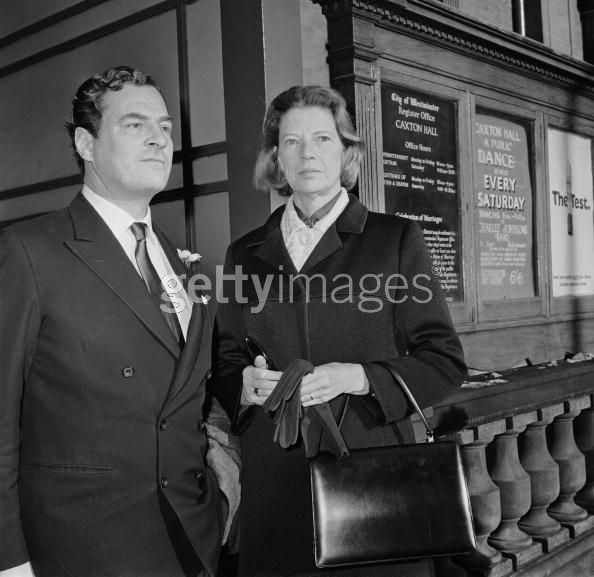
British soldier and travel writer Patrick Leigh Fermor with Joan Rayner after their wedding at Caxton Hall, Westminster, London, 17th January 1968. (Photo by Evening Standard/Hulton Archive/Getty Images)

Patrick Michael Leigh Fermor, writer and soldier: born London 11 February 1915; OBE (military) 1943; DSO 1944; Kt 2004; married 1968 Hon Joan Eyres-Monsell (died 2003); died 10 June 2011.

Travel writer Patrick Leigh Fermor dies

A news article from Channel Four news which has quite a few quotes from Artemis Cooper. It appears that they may have spoken to her today.

Click the image to read.

Pre-ordering Artemis Cooper’s biography of Patrick Leigh Fermor

Artemis Cooper

Just a quick note to regular readers and those who search for this book – there are many Google searches for this proposed biography.

It came to my attention that a book called Biography of Patrick Leigh Fermor by Artemis Cooper and Antony Beevor is due to be published by Penguin in September 2011. At least that is what it says on Amazon and a number of on-line book sites.

I contacted Amelia Fainey who is Publicity Director for Penguin books as my belief was that the agreement (and if I recall correctly actually mentioned in In Tearing Haste) is that the book will be published after Paddy’s death.

Amelia responded thus:

Hello

I’m afraid we don’t have a date scheduled for this yet – possibly 2013 – certainly not this September!

A

So, if you were hoping for a book this autumn you will have to wait …. at least two years, and I suspect a lot longer than that.

Related article:

A biography of Paddy by Artemis Cooper?
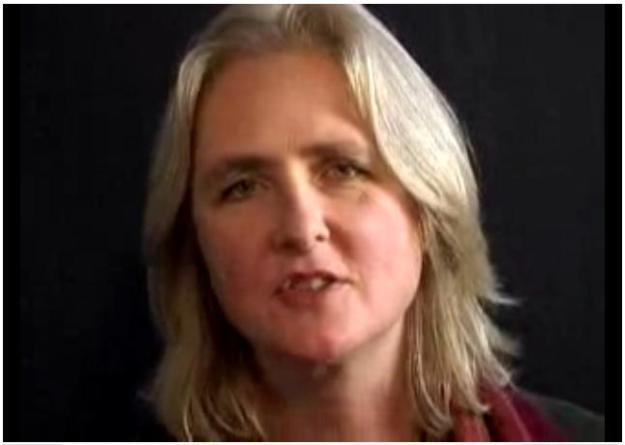
Artemis Cooper talks about Words of Mercury

Artemis Cooper talks about Words of Mercury

Short and to the point, a little video snippet of Artemis Cooper talking about her work on Words of Mercury.

Click the picture to play!

Artemis Cooper and Words of Mercury

Walking towards Byzantium

A Review of Artemis Cooper’s “Words of Mercury” by William Dalrymple published in the Guardian.

First published in the Guardian 13 December 2003

William Dalrymple relishes Words of Mercury, a selection from the work of Patrick Leigh Fermor, Britain’s greatest living travel writer.

Skill with the sword usually precludes much competence with the pen. For all that Sir Philip Sidney could write sequences of Petrarchan sonnets as well as lead buccaneering raids on the Spanish Netherlands, or Siegfried Sassoon write his anti-war memoirs while also winning the Military Cross, bookishness and military machismo are rarely found roosting together (after all, it’s no secret, as the old joke goes, that military intelligence is a contradiction in terms).

The great exception to this rule in our own time is Patrick Leigh Fermor. For though he is one of our finest prose stylists and – since the death this summer of his only possible rival, Norman Lewis – without question our greatest living travel writer, he was also responsible for one of the most audacious special operations coups of the second world war.

Leigh Fermor’s own account of the abduction of General Kreipe, the German commander of the Nazi occupation forces in Crete, is published for the first time in Artemis Cooper’s wonderful new anthology of Leigh Fermor’s work, Words of Mercury. The story is a famous one, and in the film version, entitled Ill Met by Moonlight, Paddy was played by the dashing Dirk Bogarde. But in Leigh Fermor’s own account, the climax comes not as the general’s staff car is stopped at night by a British SOE party dressed in stolen German uniforms, nor as the Cretan partisans help smuggle the general into the Cretan highlands and thence to a waiting British submarine; but instead as “a brilliant dawn was breaking over the crest of Mount Ida”: “We were all three lying smoking in silence, when the General, half to himself, slowly said: ‘ Vides ut alta stet nive candidum Socrate’. It was the opening lines of one of the few Horace odes I knew by heart. I went on reciting where he had broken off … The General’s blue eyes swivelled away from the mountain-top to mine – and when I’d finished, after a long silence, he said: ‘Ach so, Herr Major!’ It was very strange. ‘Ja, Herr General.’ As though for a moment, the war had ceased to exist. We had both drunk at the same fountains long before; and things were different between us for the rest of our time together.”

It is an archetypal Leigh Fermor anecdote: beautifully written, fabulously romantic and just a little showy. For Leigh Fermor’s greatest virtues as a writer are also his greatest vices: his incantational love of great waterfalls of words, combined with the wild, scholarly enthusiasms of a brilliant autodidact. On the rare occasions he gets it wrong, Paddy has been responsible for some of the most highly coloured purple passages in travel literature. But at his best he is sublime, unbeatable.

For as well as being a war hero, one of the world’s great long-distance walkers, and as tough a traveller as you could find, Leigh Fermor has always been a writer of great intelligence, sensitivity and profundity. Here he is, for example, describing a French Cistercian monastery, where he says he discovered “the capacity for solitude and the recollectedness and clarity of spirit that accompany the silent monastic life. For in the seclusion of a cell – an existence whose quietness is only varied by the silent meals, the solemnity of ritual and long solitary walks in the woods – the troubled waters of the mind grow still and clear, and much that is hidden away and all that clouds it floats to the surface and can be skimmed away; and after a time one reaches a state of peace that is unthought of in the ordinary world.”

Words of Mercury is a cornucopia, full of the rarest gems, but it is also a rather odd book: part collected journalism, part greatest hits anthology, with a few other surprising odds and ends thrown in, such as a memoir about the eccentric Scottish genealogist Sir Ian Moncrieffe of that Ilk. This tells of Moncrieffe’s huge pleasure in discovering that he was directly descended from “The Blood Countess, Elizabeth Bathory, Monster of Csejthe [who] was convicted in 1610 of the slow murder – in order that their blood might magically preserve her beauty – of more than six hundred girls.” In a similar mood, there is also a letter from Paddy to the editor’s grandmother, Lady Diana Cooper, and a footnote directing the reader towards the “strongly recommended” work of the military historian Antony Beevor, who just happens to be the editor’s husband (though in fairness, it appears that this warm endorsement comes from Leigh Fermor rather than Cooper).
-Read More!>

Literary legend learning to type at 92

An old interview for our archive. First published in The Guardian Friday 2 March 2007 18.12 GMT

By Helena Smith in Athens

Patrick Leigh Fermor in 2005 - Photograph: Eamonn McCabe

In a rare public appearance, the revered travel writer Patrick Leigh Fermor has revealed that he is only now – aged 92 – learning to type, in order to finish the trilogy that has been at the centre of his writing life for more than 30 years.

Leigh Fermor usually avoids the spotlight these days, to concentrate on his work, but this week made an exception as Greece, his adopted home, awarded him its highest honour, Commander of the Order of the Phoenix

Leigh Fermor, widely acknowledged as Britain’s greatest living travel writer, was unexpectedly told of the award in a letter from the office of Greece’s president last month. “I have no idea why they are doing this but I am deeply honoured and moved,” he told the Guardian after receiving the medal at a lavish ceremony in Athens.

“I think they’ve enjoyed reading my books and heard I was an eager participant, who got in the thick of things during the war,” said the author, who is also known for pulling off one of the greatest coups in Nazi-occupied Europe, orchestrating the capture of General Kreipe, the military commander on Crete – a feat immortalised by the book and film Ill Met by Moonlight.

Friends say Leigh Fermor, who has chronicled Greece for more than 60 years, is these days acutely aware of the passage of time and put aside precious writing time to make the trip from his home in the Mani on the southern Peloponnese. When he was handed the prestigious Travel Writers’ Guild award in 2004, he dispatched his biographer Artemis Cooper to pick up the gong.

Since the second half of the 80s, he has being toiling to complete the third volume of a trilogy depicting his extraordinary journey on foot from Rotterdam to Istanbul at the age of 18.

His painstaking perfectionism means his output has not been prolific. He wrote the first volume of the trilogy, A Time of Gifts – widely considered his greatest work – nearly four decades after the odyssey in 1977. The second, Between the Woods and the Water, was released in 1986. Ever since, fans have been desperate to read the third.

Like many of his generation, the acclaimed soldier-scholar has always written in longhand – delivering his masterpieces to his publisher in great flourishes of scrawl. It’s a process that has been widely blamed for the long gestation periods.

But help is at hand. Paddy, as he is known to his friends, has finally decided that with his handwriting degenerating into unreadability, it is time to type. This year he invested in a 1951 Olivetti (“I wouldn’t get a computer,”) and is currently working his way around the machine’s keyboard, according to friends.

“I’m going to finish that book,” he said. “I’m going home and I’m going to work really hard.”

Visit to the veteran of the Peloponnese by Wieland Freund (from Welt Online)

A 2007 interview with Paddy by Welt Online. The Germans have almost the same fascination for Paddy as we do. Afterall his first adventures took place in Germany (A Time of Gifts) and his part in the kidnap of General Kreipe has a particular fascination. 

He also confirms that “Volume Three” is being written – translated by Google – Oh yes, “he says in the rich sunshine,” I will write this book. There is to end on Mount Athos. From there, I have notes for every day. 

So here is the Google translated version. The original in German for the purists and the linguists is the next article below. 

Stop Press! I have had an offer to translate this properly and when I receive it I will replace the trash from Google. In the meantime, my apologies and enjoy trying to make sense of it!

Resistance fighters, hikers, travel writer Patrick Leigh Fermor went to Istanbul as a young man, kidnapped in 1944 in Crete an army general and now lives in Mani. There he kept on the typewriter by Bruce Chatwin. 

Since the sixties, the home of Patrick Leigh Fermor: the Mani peninsula in the Greek Peloponnese. 

That there could be his house did not think you would have to climb into a closet or throw himself into a rabbit hole in order to achieve it – this idea comes with the darkness and returns, turned back into the Enchanted. 

The way to Patrick Leigh Fermor, the Herodotus of the 20th century, leads, it seems, to the edge of the world and then one step beyond. The shimmering leaves of the olive grove, the giant lemon and the red, Greek past of heavy earth might as well be the props of a dream. 

“Paddy” came first in 1952 by Mani 

We keep a vigilant group of cypress trees and follow the overgrown path until a sky-blue gate. Do I need a spell, so it opens and appears Fermor, the travel writer, war hero, the legend? Knocking at least seems too little. 

With 92 years, Patrick Leigh Fermor of immortality as close as it is today even comes close. His way of fame is just off the beaten track to have the world, behind firmly closed doors or in such places as the taciturn Mani. 

Paddy, like not telling the familiar without reverence, came here in 1952 for the first time. How the Spartans and the Byzantines, who fled from Slavs and Turks, and of which he knows everything, he climbed the passes of the up to two and a half meters Taygetos, the Mani, the middle finger of the Peloponnesian hand, centuries made for a natural fortress.
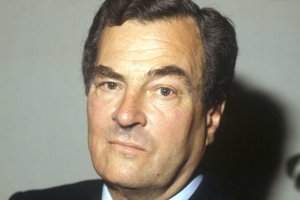
Patrick Leigh Fermor in Berlin

The knocking does not answer 

The back of the slopes wrinkly rich almost to the bay. Bruce Chatwin, who came to Paddy as a “guru to worship” or how to overthrow a king, saw eagles soar over the house of Leigh Fermor. Twenty years later, Paddy Chatwin ashes buried – next to a crumbling Byzantine church not far from here. The Mani is famous for its action songs. 

Southward, on the faded, twinkling towers over the tiny villages, run, it means that a chasm into Hades. Leigh Fermor found it flooded. “Phosphorgefiedert,” he wrote, dip it into the cold depths and swim “through the heart as a huge sapphire. 

We knock in vain to dare us to elaborate the cobbled courtyard and whisper with the housekeeper. It leads us through the garden open arcades, which might as well bend over a cloister. 

Leigh Fermor is tattooed like a sailor 

Leigh Fermor has written so many monasteries in Europe, in towers of “solid ivory, and if anyone here was an escapist, The doors to the rooms, however, the numerous tables, which depends on the sound of glasses and laughter as a smoke curtain, speak a different language. 

Leigh Fermor speaks many. Photographs show it once hung over bursting with charm and zest for life, sometimes almost professorial, and again obviously as a sailor and tattooed. 

We wait under the coffered ceiling of the spacious, wonderfully cluttered living room, from which the English poet John Betjeman once wrote that it was “one of the rooms of the world.” On one wall hang paintings by Nicolas Ghika and John Craxton, leaning on a shelf worn, faded volumes of the great English stylist. On the floor there is a band “Sherlock Holmes”. “Enchanting easy, right?” 

The family left behind her son with strangers 

This could be Merlin: a jumble the gray, wavy hair, sharp features and eons of age in the eyes. Leigh Fermor carries the threadbare sweater a garret of scholars and the trousers of an artist in his studio. 

He is of overwhelming kindness, perfectly shaped “upper class”. In the sunlit bay he called almost everyone who comes to the question, “marvelous”: writers, painters, musicians. “They all knew.” – “I am,” he says mildly, “that old.” 

“For at least one of us children would remain alive, if a submarine sank the ship,” Paddy was in the care of a small family back in England. 

1933 – the first trip to Istanbul 

“I ran,” he says, “shouting and screaming across the yard. I never learned discipline. I was a difficult student. “-” Lazy? “-” Disobedience. “Even a psychiatrist who also treated Virginia Woolf was consulted. Paddy still flew from the school. He had kept up with the daughter of the greengrocer’s hands. 

The autumn of 1933 found him in a room not far from trouble blowing from London’s Shepherd Market, where he should have been cramming so that at least the military school would take him. 

Instead, he took a verse of George Herbert at his word: My way is free, free to the horizon, / Much like the wind. “In December 1933 he embarked for Holland. From there, he wanted to walk into a “green dragon”, Byzantium, which he never called Istanbul. 

On the trip report, the fans are waiting until today 

He is famous for getting lost in the widely spread European history, which he knows like no other. In Mani, one of his best books, the “opposite of a travel guide,” as he says, there is a footnote, the sheer joy of the strangest here, “and there crafty peoples’ lists of Greece: the Melevi Dervishes of” Tower the winds “, the fire dancers from Mavroleki, the hiking quack Eurytaniens. With the gypsies, whom he met in 1934 in the highlands of the Carpathians, said Patrick Leigh Fermor Latin. 

Paddy arrived on New Year’s Day of 1935 in Constantinople, and had better things to do than to write about his trip. He is one of the great English stylists working, slowly, life itself seems always in your way. 

It was not until 1977 “was published, the time of the gifts,” which describes his journey from Hoek van Holland to the middle Danube, nine long years later, “between forests and water”, which leads to the Iron Gate. The third book, the description of the phenomenon must last up to Constantinople, is still expected with such longing that leave a few words from the mouth of Paddy’s heave a sigh British press today. 

Where Chatwin’s old typewriter? 

When Sir Patrick, as he was allowed to call since 2004, was awarded in March in Athens the “Order of the Phoenix,” he told his casual way that he, because his handwriting was always bad, just learn to touch type. 

Oh yes, “he says in the rich sunshine,” I will write this book. There is to end on Mount Athos. From there, I have notes for every day. “We are walking through the garden, the Gulf of Messinia in a dozen colors of light blue. On the burnt grass stretches herself a hangover: “His great-grandmother one day was just there.” 

The studio is housed in an outbuilding. In an iron chest, which bears the inscription of “Traveller’s Club” that tape, books are stacked on the wall a faded French hunting scene. Somewhere there must be also Chatwin old typewriter, a 51er Olivetti. But where? Where? 

Soldier, he was happy because “was always something going on” 

On Mount Athos celebrated his 20th Birthday, then went to Athens, as he later went to Paris and Rome. With a Romanian princess, he lived in an old water mill in the Peloponnese, and followed her to finally Balení, the seat of her family in northern Romania. 

Russia and the horrors of communism were suddenly within reach. “Many of your friends were communists at that time.” – “I did not speak up,” he says. “ “I was so apolitical.” 

In Balení reached him of the war. He, which six years earlier at the Shepherd Market has become clear, “how little I was good for soldiers in peace time,” volunteered. The departure was hasty. “Not even my notebook I took with me. We were so naive. In a few months ago we believed us again. “It took decades. “Were you like a soldier?” – “In a way, yes. “ There was always something going on. ” 

In 1944, he kidnapped a German general 

Books are also in the bathroom and somewhere between them is a plaque commemorating the Battle of Crete. When she was lost, went back Leigh Fermor as major of the Special Operations Executive to Crete. One and a half years he lived disguised as a shepherd in a cave – “wrapped in white cloth from goat and horribly dirty” – and organized the Cretan resistance against the German occupiers. 

The rest is legend, one of the most daring commando raid of the Second World War. One night in April 1944, a large Opel on the road to Knossos, Paddy in a stolen German uniforms on the way. A scuffle and then, at the roadblocks, again and again the cry of “General car. 

For days wandered Leigh Fermor, the people and kidnapped the German General Kreipe through the mountains until they reached the coast, and finally Libya (Egypt). On the difficult journey Kreipe murmurs once verses of Horace. Leigh Fermor is one. „Ach so, Herr Major“,  

About the death, he never speaks 

Paddy has never really written about it. “Ill Met by Moonlight,” the book that tells this story in full, comes from Bill Stanley Moss, his former deputy, and was filmed with Dirk Bogarde as Leigh Fermor. 

When it first appeared in 1950, just came Paddy’s first book, “The Traveller’s Tree,” a description of his travels in the Caribbean out. DThen he was – in the UK, famous in Greece “He embodied an idea of the Renaissance,” writes Cooper, Artemis, “a man of action, which is just as much a scholar.” 

Cooper, the friend and daughter of a friend is writing Paddy’s biography, when he, as he says, “is just gone.” “But now that you mention it: We never really talk about it.” 

The stones for the house came with the donkey 

For lunch there are lemon chicken, tzatziki and Retsina. We sit on chairs Andalusian, a Venetian table at the foot of a guillotined by the passage of time Roman Sibyl. Leigh Fermor has picked up in Rome on the way, he collects nothing. 

He tells the story of Niko Kolokotronis, the Mauerermeister that the contract was to build his house, because six generations were Kolokotronis wall masters, and played all the violin. That was the beginning of the sixties. In the bay there was no electricity, donkeys brought the stones, and Paddy and his wife Joan were living in tents, until the house was finally finished. 

“I scribble in the studio in front of me,” reads a letter from the most beautiful, vibrant with life days in the bay.”Through the window I can see Joan, their army cats invites you to dinner; mass meows to rise, and their tails make waves like the sea.” 

A picture of his wife Joan (cats) in her hand 

Leigh Fermor demands a picture of the mantel, Joan in the forties, which he portrayed with a pencil. “Come on!” She called from a boat, as Paddy, like his hero, Lord Byron swam the Hellespont. “It took three hours.” 

Joan died in June 2003 here.”She was,” he says, his drawing in hand, “in truth much more beautiful. 

Original article here.

Besuch beim Haudegen des Peloponnes Von Wieland Freund (Welt Online)

Widerstandskämpfer, Wanderer, Reiseschriftsteller: Patrick Leigh Fermor ging als junger Mann nach Istanbul, entführte 1944 auf Kreta einen Wehrmachtsgeneral und lebt heute auf Mani. Dort bewahrt er die Schreibmaschine von Bruce Chatwin auf.

Dass es sein Haus gar nicht geben könnte, dass man in einen Schrank steigen oder sich in einen Kaninchenbau stürzen müsste, um es zu erreichen – dieser Gedanke kommt mit der felszerklüfteten Dunkelheit und kehrt tags, ins Verwunschene gewendet, zurück.

Der Weg zu Patrick Leigh Fermor, dem Herodot des 20.Jahrhunderts, führt, scheint’s, an den Rand der Welt und dann noch einen Schritt darüber hinaus. Die flirrenden Blätter des Olivenhains, die riesenhaften Zitronen und die rote, von Vergangenheit schwere griechische Erde könnten ebenso gut die Requisiten eines Traums sein.

“Paddy” kam erstmals 1952 nach Mani
Wir halten auf eine Gruppe wachsamer Zypressen zu und folgen dem zugewachsenen Pfad bis vor eine himmelblaue Pforte. Braucht es einen Zauberspruch, damit sie sich öffnet und Fermor, der Reiseschriftsteller, der Kriegsheld, die Legende erscheint? Klopfen jedenfalls scheint zuwenig.

Mit 92 Jahren ist Patrick Leigh Fermor der Unsterblichkeit so nahe, wie man ihr heute noch nahe kommt. Seine Art Ruhm ist nur abseits des Weltenrummels zu haben, hinter fest verschlossenen Türen oder an so verschwiegenen Orten wie der Mani.

Paddy, wie die Vertrauten nicht ohne Ehrfurcht sagen, kam 1952 zum ersten Mal her. Wie die Spartaner und Byzantiner, die vor Slawen und Osmanen flohen und von denen er alles weiß, erklomm er die Pässe des bis zu zweieinhalbtausend Meter hohen Taygetos, der die Mani, den Mittelfinger der peloponnesischen Hand, Jahrhunderte lang zu einer natürlichen Festung machte.

Read more here!

I say, old chap, that’s my favourite Horatian ode too! By Justin Cartwright

A review of Words of Mercury by Patrick Leigh Fermor, ed Artemis Cooper first published in the Independent

Sunday, 2 November 2003

The overwhelming impression this book left on me was of a lost world of aesthetic public schoolboys, powerful newspaper editors, friendly ambassadors, and an unspoken understanding of what it meant to be upper- middle-class and English. What it meant was easy access to embassies and aristocratic houses around Europe, bicycle polo in Hungary, and the possibility that the next shepherd you met would be an Etonian Special Operations officer, speaking classical Greek. Here you will find the term “middle class” applied in a pejorative sense, rather than in the current usage which has such a wide catchment. That John Murray, the publishers of this book and upper-middle-class publishers par excellence, are no longer family-owned, perhaps confirms that this world has passed. And with it a love of language and literary decoration.

To quote Jan Morris, Paddy Leigh Fermor is beyond doubt the greatest of living travel writers, although the term “travel writing” barely does justice to the beauty, the lustrousness and sensuality of his writing. Take this, for example, speaking of how Greek temples once looked before they were stark ruins: “But the reality of the ruins, re-cohering in cobalt and blood-red, studded with metal, gaudy with idols, shiny with spilt honey and blood and reeking with sacrificial smoke, will have replaced the tinted ivory artefacts that had stolen their place and the void between the cutting of the flutes on the columns and the laying of the tramlines begins to fill up with people and events.”

There are about 40 short pieces divided into headings: Travels, Greece, People, Books and Flotsam. Many of these pieces are from Leigh Fermor’s great books, Mani, Roumeli and A Time of Gifts. (In 55 years he has only written eight books.) Others are from scattered newspaper pieces and obituaries. All the major phases of his life are represented here: the wandering schoolboy heading for Istanbul, the two years just before the war he spent in Romania with a doomed aristocratic family after meeting the daughter of the family in Athens (the woman Artemis Cooper describes as the love of his life), the extraordinary exploits in war-time Special Operations in Crete, where he captured the German General, Heinrich Kreipe, and his post-war exploration of Greece, particularly Mani where he has lived for 40 years in a house he built with his wife Joan, who died recently. Their story will be told by Artemis Cooper in a biography to be published after his death.

Read more!

A biography of Paddy by Artemis Cooper?

There are some tough jobs around, but few could be tougher than writing a biography of Patrick Leigh Fermor. However, according to the acknowledgements section of “In Tearing Haste” by Charlotte Mosley, Artemis Cooper is apparently doing so; ‘… to Artemis Cooper, who is preparing a biography of Paddy’. Artemis of course edited “Words of Mercury” (2003).

Given that we have been waiting twenty four years for “Vol 3” what are the chances of Artemis’ biography being published before that volume? Not great I would have thought. But what a challenge to write about the life of one of the greatest writers of the twentieth century. I wish her the best of luck!