Catch up with the Slow Adventure

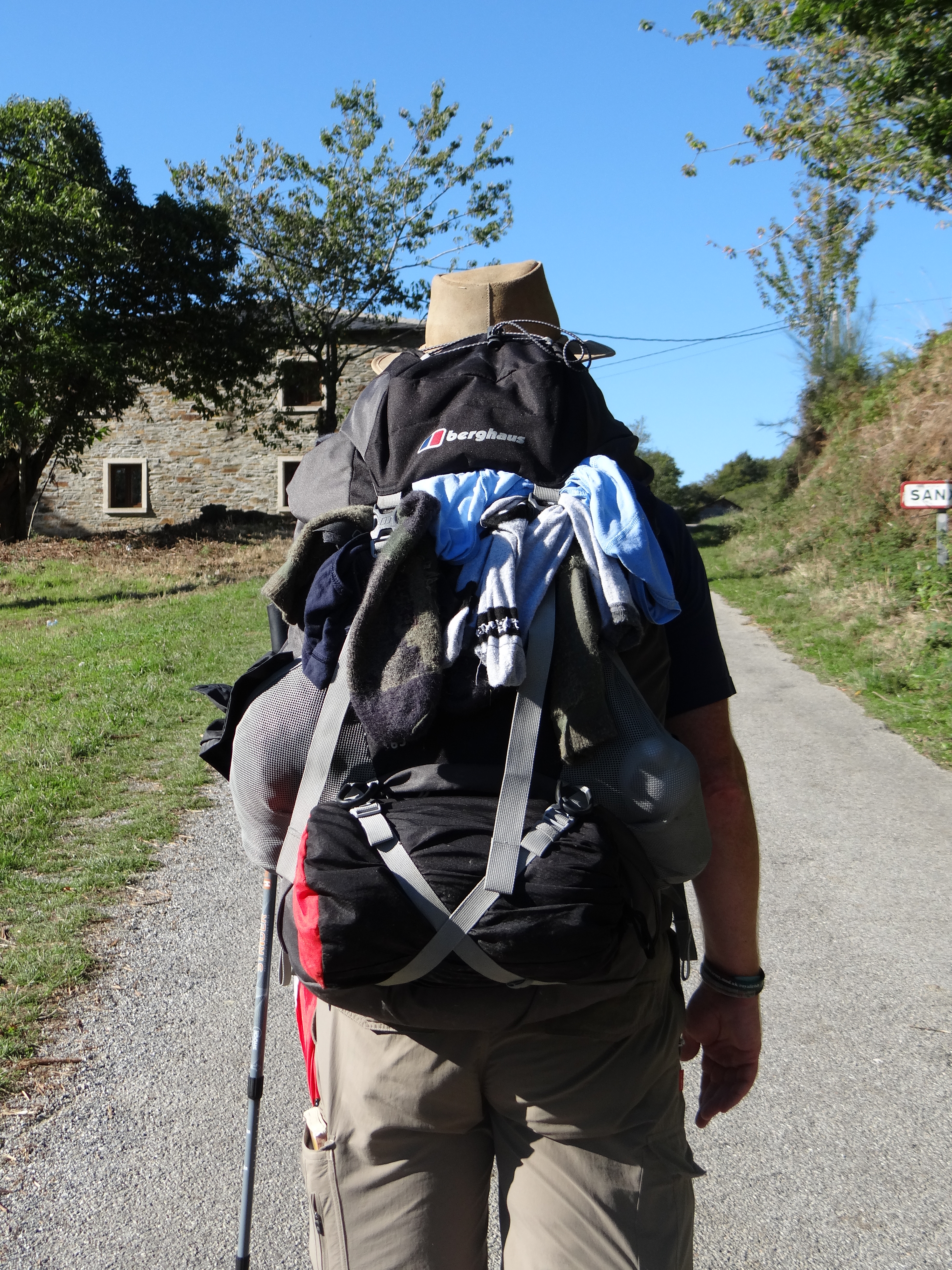
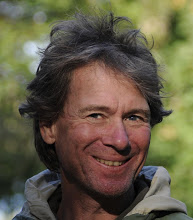
Don’t forget to drop in now and then to catch up with Jasper Winn on his slow adventure from Munich to Paris in the footsteps of Werner Herzog. I have been enjoying Jasper’s short posts which are always insightful. He has crossed the Rhine, the Moselle and the picturesque but economic backwater of the Vosges. Clearly enjoying being in France he now faces mostly flat country in his last weeks walking to Paris, but as today’s post says, this brings it’s own challenges. Here is a little taster:

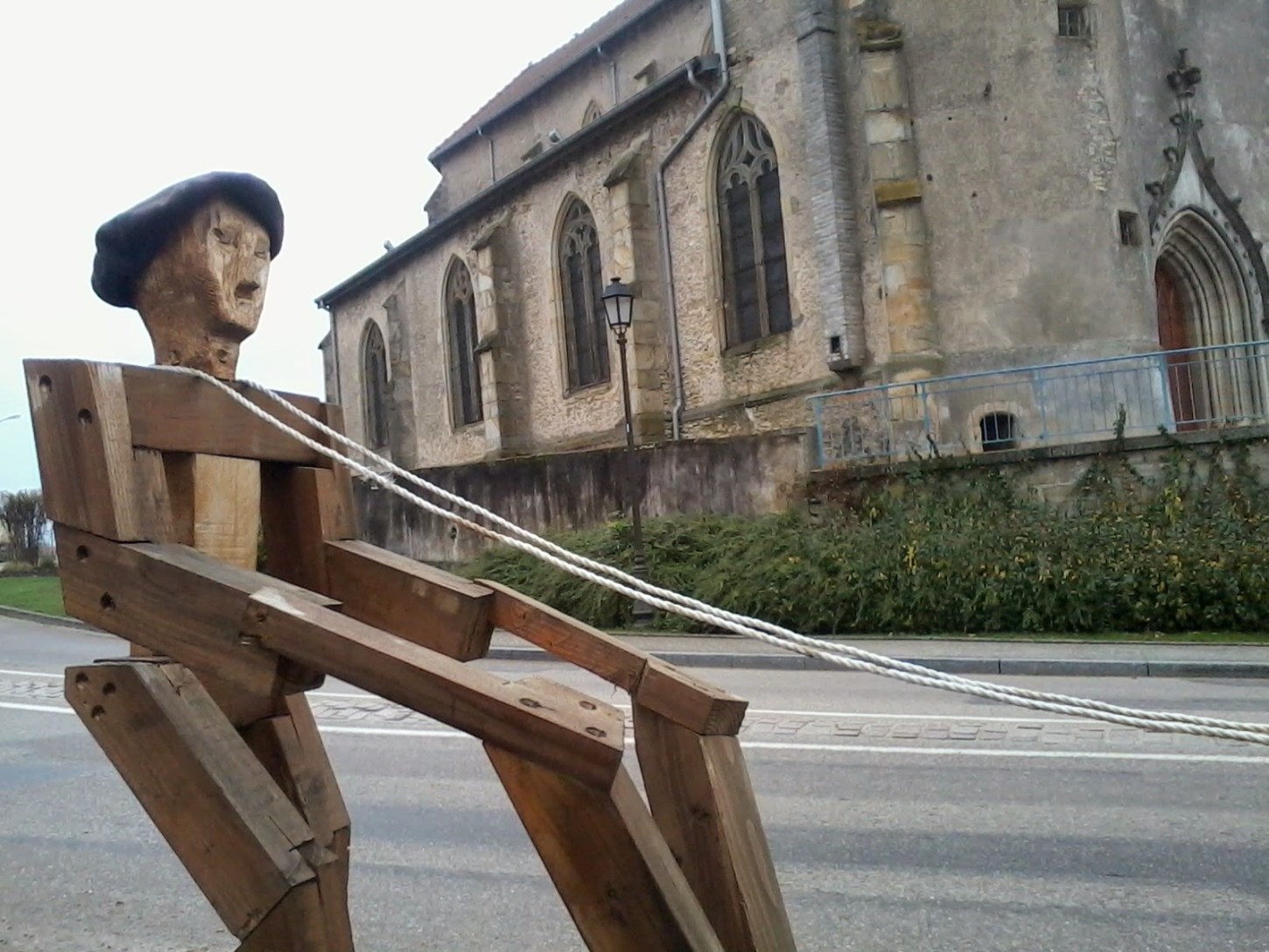
Always hard to avoid looking just a bit wooden in selfies. I’ve just crossed the Moselle at Thaon, so am across and out of the mountains that rise high on both sides of the Rhine valley, and with neither the snow nor storms that Herzog battled. The land being flatter brings it’s own challenges. Long slogs, little shelter, busy agriculture and so less hidden woods or derelict barns to sleep in, and speeding traffic on narrow twisting roads. And rural France is a struggle for many locals too – unemployment; so gambling, drinking, suicide. Symptomatic is the small number of village bars and cafes still open. I found just three still trading in over a hundred kms of walking and passing through tens of small villages. Now, in Thaon, I’ve found a joy. Bar Le Cosy. Good coffee. Wifi – hence another post. An armchair and friendly hostess and clients. It’s rather smart and chic and I may look a tad out of place

Read more ….

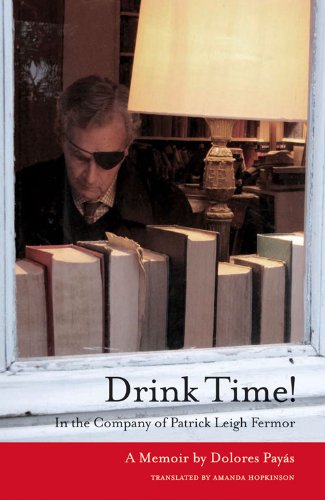
Drink Time! Dolores Payas on BBC Radio 4’s Midweek at 0900 26 November

Just a short notice to say that Dolores will be on Libby Purves’ BBC Radio 4 Midweek show at 0900 today. I presume talking about her time with Paddy in his last few years and her delightful book Drink Time.

More details here.

Thank you to my spy in Jedburgh for spotting this one.

Buy Drink Time!: In the Company of Patrick Leigh Fermor: a Memoir by Dolores Payás (translated by Amanda Hopkinson)

Angéla’s fate

In this extract from a longer work on Patrick Leigh Fermor and Budapest, Michael O’Sullivan looks at the fate of one of Paddy’s girlfriends in Budapest under communism and also solves the riddle of a postcard Paddy received about his stolen rucksack. The extract is part of a book Michael is working on called Between the Counts and the Comrades which looks at the fate of some of the old Hungarian noble families under communism.

Michael tells me that he has “… traced many of the descendants of the families he stayed with in Hungary especially his first port of call here which was with Baron and Baroness von Berg at Uri Utca. He tried to get access to the house on his last visit to Budapest and there is a rather sad photograph of him at the closed door.”

The best dreams of an ancient lineage are often had on beds of straw. This is the thought that engages me as I stand outside the house in Budapest where Patrick Leigh Fermor’s ex-girlfriend strangled her flatmate in 1969. This end of Budapest’s Pannonia Street is more chipped and faded in appearance than the more prosperous commercial stretch further south which is guarded by the elegant facade of the Vigzinhaus – the city’s Comedy Theatre. This neighbourhood of the XIII district called the Újlipótváros or New Leopoldstown was still a very new part of the city when Leigh Fermor first came to Budapest in 1934. It soon established itself as home to the literary and artistic set and also formed part of the residential area favoured by some of Budapest’s Jewish community. Today, according to recent census information, some of the capital’s Jewish community is again reestablishing itself here. Standing outside 48 Pannonia Street, I imagine it has changed very little since Xenia Cszernovits moved here in 1957, soon after the revolution which tried to end Soviet rule in Hungary. I am trying also to imagine how this woman of distinguished lineage, born into a family of landed gentry in 1909, coped with the ‘class enemy’ status imposed on her by Communism and how she coped too with being sent to work as a labourer in a textile factory.

Xenia Csernovits de Mácsa et Kisoroszi was a ravishing dark-haired beauty. She was the daughter of a Transylvanian land owner from Zam, Mihály Czernovits. The family was of grand Serbian origin. Xenia married Gábor Betegh de Csíktusnád, scion of an old Transylvanian noble family, while still in her early twenties but at the time she met Leigh Fermor in 1934 the marriage was going through a turbulent phase. It later appears to have settled down again because they had a daughter two years after Xenia’s tryst with Leigh Fermor.

Xenia’s niece by marriage, Stefania Betegh, doubts that the [Paddy’s] affair with Xenia ever happened. She has no particular reason to defend Xenia’s honour. She is not, after all, a blood relative. There is also the issue of the confused manner in which Leigh Fermor attempts to disguise, and yet not disguise, Xenia’s identity in Between the Woods and the Water. At one point in the narrative he gives her full name, the location of her family house at Zam and enough detail for us to know exactly who she is. Then he disguises her as ‘Angela’ and even adds a footnote about the need to ‘alter names’ having already made her one of the most identifiable characters in the book. She seems not to have been bothered by this and when, in her seventy sixth year, she read a translation of the book in Hungarian by her relative, Miklos Vajda, she wrote to Leigh Fermor to say how much she had enjoyed it.

Leigh Fermor’s attraction for women and his success as a seducer are well known. The balance of probability, in the seduction stakes, most likely rests with his success with Xenia. It was one of the last happy periods of her life. Miklos Vajda, recalls her as a free spirit and ‘a woman with something of the exotic gypsy in her looks and nature’. Men found her irresistible and the regular absence of her husband on business trips enabled her to have frequent liaisons with various male admirers, amongst whom Leigh Fermor is the best known.

Once Hungary had become a postwar Soviet satellite state, her life was altered in a way that was unimaginable in 1934. As a ‘class enemy’, she was sent to do menial work as a house painter and later in a textile factory in Budapest. She ended her days in a squalid little basement flat which she moved to after she strangled her former flatmate in a fit of rage in Pannonia Street on 20 December 1969. Such was her popularity with her neighbours that many of them testified in court to the justification of her actions, claiming that the victim was an unbearable woman, thus leading to a reduced charge of manslaughter.

There has been much talk in Budapest recently about the publication of the final installment of Leigh Fermor’s account of his walk from the Hook of Holland to Constantinople. In the third volume The Broken Road he moves onward through Rumania and it is his favourable view of the old enemy that has irritated some amongst his admirers in Hungary. Presenting the Rumanian nobility as better read and more cosmopolitan than their Hungarian neighbours has not endeared him to some of the descendants of his former hosts. ‘No good deed goes unpunished’ is how one of them put it, at a recent event to mark the anniversary of the 1956 Revolution. But despite this he is remembered with great affection in Budapest where his friend, writer and translator, Rudi Fischer, now in his 90s, still lives.

Meeting him one can see how Leigh Fermor admired him and came to rely on his extraordinary knowledge of Hungarian history and culture. Fischer recently solved a Leigh Fermor conundrum when he admitted authorship of a hoax postcard addressed to Paddy from Kirchstetten, W.H. Auden’s Austrian retreat. In it he claimed that it was his grandfather, ‘Alois Schoissbauer’, who stole Paddy’s rucksack containing his money, passport and travel journal, from a Munich hostel in 1934. To add veracity to the hoax Fischer claimed that the author of the postcard later inherited the rucksack and that it was stolen again by ‘an Australian hippie’ as he travelled across Asia to Peshawar. He signed it ‘Dr Franz Xavier Hinterwalder, Professor of Farsi and Pashtoo, Firdausi School of Oriental Languges, Kirchstetten Lower Austria. The card was written after a bibulous lunch at the Traveller’s Club in Pall Mall. Paddy enjoyed it enough to copy it to Debo Devonshire.

There are plans in Budapest to raise a plaque in the city to mark Patrick Leigh Fermor’s 1934 visit and plans too for a commemorative lecture about his time in the city.

Items from Paddy’s archive

The news about the opening of Paddy’s archive to the public was quite exciting. It may herald some new studies into the life of this gifted but flawed man.

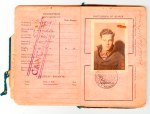
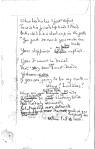
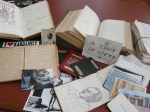
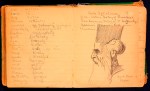
I had a bit of a sneak around the National Library of Scotland website and found the following images which may form the start of the on-line digital archive mentioned in the press release. They include an unpublished poem by John Betjeman written on the back of an envelope.

Related article:

Patrick Leigh Fermor archive now fully available to public at National Library of Scotland

As I will walk out one December morning

DSC01639Many thousands visit this blog every month, and have done since I started it all in 2010. I know that you all enjoy different sections and themes. The Paddy blog is, and will remain, free at the point of reading, but I do want to ask you for something quite important at this time.

Homelessness is a terrible scourge, and between 10-13 December I will walk from Winchester Cathedral to Bath Abbey to visit my daughter and to raise money in support of the UK charity for the homeless, Shelter.

Below I tell you why I want to do this at this time, and how you can donate. This applies to anyone whatever your location in the world, as long as you have a debit card, credit card or PayPal account.

I have set myself a modest target which I want to smash, so please give as much as you can via my Just Giving site here, to help the homeless at this Christmas time. Please give.

Tom

For all sorts of reasons, people in our great country, men and women, and sometimes entire families, end up without a home, have no bed of their own, without warmth, and don’t get to eat simple, wholesome food.

All of you reading this have these things and more: a job; friends and family to share your happy times with; money; and perhaps more than this, a future.

We have all passed these people in our towns and cities, perhaps feeling guilty that we have not given them a pound. But also maybe thinking that if we did they would only spend it on booze. You may be right.

The charity Shelter aims at long term solutions for homeless people, giving them chances not just for a roof over their head, but also to help them make a future. To get a job and to rebuild their lives.

I have a friend who lives on the streets around my train station in Winchester. He is called Paul. He is an ex-soldier, and served his country well, but for reasons that I don’t understand he now has problems with alcohol and lives on the streets. He is about my own age.

I met Paul in May and wrote about him, contrasting his life with someone more privileged, also a brave soldier, in this poem.

It would be good to help Paul and others like him at this time of year when the nights are painfully long, and damp and cold.

My daughter Harriet finishes her term at Bath University on 14 December and for some time I have wanted to walk to Bath. So at this Christmas-tide I am going to do that. It is not so far, only about 60 miles but I will probably end up walking further. I thought that maybe I could combine my walk with raising money for the work of Shelter.

I will have some modern clothing and kit and will try to keep as dry and warm as I can. But I will live outside under meagre cover, with a simple shelter and may experience some of the cold and damp that is the daily lot of people like Paul.

This walk will not change anything, but it may help some good people who have fallen on hard times and who are really just like you and me. The people who we so often turn away from and walk on by. My walk may however make a small difference.

It will soon be Christmas and we will spend an awful lot of money on ephemeral things. Please consider giving some of what you may spend to help the work of Shelter with homeless people in this country; give some of your hard earned cash to the cause which I am supporting.

Thank you from me. And thank you from Paul.

You can donate now very easily on my Just Giving page. Please help.

Patrick Leigh Fermor archive now fully available to public at National Library of Scotland

General archive itemsAfter a year of intensive work, Paddy’s archive is now available to the public at the National Library of Scotland. The inventory is 81 pages long and the list of Paddy’s correspondents is well over 1,000, with many many famous names including Gore Vidal, Truman Capote, Iris Murdoch, Lawrence Durrell, Bruce Chatwin, Cyril Connolly, the Duchess of Devonshire, Prince Charles and Paddy’s publisher John Murray. Future goals include digitising the most important material and to run some exhibitions.

The NLS have today issued a press release as follows:

The archive of one of the most charismatic characters of the last century, Sir Patrick Leigh Fermor, is fully available to the public from today (Tuesday, November 18) after being catalogued by the National Library of Scotland.

Sir Patrick, who was universally known as Paddy, was the finest travel writer of his generation and has been described as “a cross between Indiana Jones, Graham Greene and James Bond.” He was a decorated war hero, adventurer, scholar and Hollywood scriptwriter who could count princes and paupers among his friends.

The archive, which arrived at the National Library in 2012, is vast, occupying some 16 metres of shelving. Its contents offer a journey through the 20th century in the company of some of its key figures.

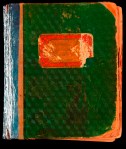
The inventory alone runs to 81 pages and lists extensive correspondence from fans, friends and associates; literary manuscripts, often with numerous annotations and revisions; diaries; notebooks, passports; sketches; photographs; articles and research papers. One of the star items is the only surviving notebook from his youthful trek across Europe which began in 1933 and provided the source material for his most famous books A Time of Gifts, Between the Woods and the Water and The Broken Road.

Sir Patrick died in 2011 at the age of 96 and is regarded as a central figure in 20th century cultural life. That is reflected in the archive which includes correspondence from many famous names including Gore Vidal, Truman Capote, Iris Murdoch, Lawrence Durrell, Bruce Chatwin, Cyril Connolly, the Duchess of Devonshire, Prince Charles and Sir Patrick’s publisher John Murray. One of the many unexpected items to be found in the archive is what appears to be an unpublished handwritten Sir John Betjeman poem, literally written on the back of an envelope.

Cataloguing the archive has taken a year and it has revealed a much larger number of correspondents than were expected – over 1000 – along with thousands more photographs.

“It is a history of the colourful life of a celebrated writer,” said Graham Stewart, the curator who worked on the cataloguing project. “He was undoubtedly a superstar of his day and his books have, if anything, grown in popularity over the years. There has already been a lot of interest in the archive and we expect this to increase now among Leigh Fermor fans and people interested in the 20th century more generally.”

The Library is working on digitising major elements of the archive which will be made available through its website. Plans are also being considered for staging exhibitions and displays of the material to reach as wide an audience as possible.

A major element of the archive is Sir Patrick’s war years which saw him organise guerrilla operations in Crete against the occupying Nazis. He spent much of this time disguised as a Cretan shepherd, living in freezing mountains caves.

In 1944 he organised one of the most daring feats of the war when he led the team that kidnapped the commander of the German garrison on Crete. This was made into a film Ill Met by Moonlight in 1957 starring Dirk Bogarde and the story was told by Sir Patrick in the recently published memoir Abducting a General.

“You get a real sense of how dangerous this work was when you come across letters that were smuggled from Cairo into Crete and carried miles across mountains, sewn into people’s clothes,” said Graham. “It’s an archive that holds many surprises and is likely to produce many more discoveries once it really starts to be used.”

The archive was presented to the National Library by the John R Murray Charitable Trust which also supported the cataloguing work. Sir Patrick’s books were published by the Murray family.


The imaginary Istanbul in Patrick Leigh Fermor’s literary odyssey

An interesting discussion about Paddy’s perspective of Turkey, the Ottomans and his Constantinople with reference to his trilogy of the Great Trudge.

By Charles Sabatos

First published in The Daily Sabah, 25 August 2014

In December 1933, Patrick Leigh Fermor, 18, set off from London with the goal of crossing Europe on foot from the Netherlands to Istanbul, which he reached at the end of the following year. Decades later, he retold this youthful adventure in “A Time of Gifts” (1977) and “Between the Woods and the Water” (1986), the first two parts of a planned trilogy that made him one of the most acclaimed British travel writers of the 20th century. Yet the second book left off at the Romanian-Bulgarian border, with the tantalizing phrase “To Be Concluded,” and for almost 40 years, his readers awaited the final volume, which he left unfinished when he died at age 96 in 2011.

The conclusion of Fermor’s trilogy was finally published in 2013, posthumously edited by his friend Artemis Cooper, but as its title “The Broken Road” suggests, the account abruptly ends on the Bulgarian coast just north of Turkey. Fermor’s impressions of Istanbul were relegated to an anticlimactic few pages of notes from his original travel diary. Cooper (also the author of the definitive biography “Patrick Leigh Fermor,” 2012) suggests in her introduction that Fermor’s disappointment hindered him from describing the city: “he recounts nothing of the leftover Byzantine glories of the old capital. . . and little of its Ottoman splendor.” Instead, his journey ends with a detailed account of his visit to Mount Athos, where he went after spending less than two weeks in Turkey. Having spent the last decades of his life living in Greece, Fermor saw the fading capital of the Orient (which he always referred to as “Constantinople”) as a place whose Western heritage had irretrievably disappeared. Yet he had already discovered an imagined Istanbul before even reaching the Golden Horn, in scenes across Central Europe and the Balkans that foreshadow his imagined destination.

In “A Time of Gifts,” which takes Fermor across Germany, the Netherlands, Austria and Czechoslovakia, he first encounters the Turks in Vienna. There, the museums hold relics of the 1683 siege that he describes in typically dizzying detail, including “scimitars, khanjars, yatagans, lances, bucklers, drums … the turbans of janissaries, a pasha’s tent, cannon and flags and horsetail banners with their bright brass crescents…” The destiny of Haghia Sophia is reflected in his fantasy of an Ottoman siege of London: “What if the Turks had taken Vienna, as they nearly did, and advanced westward? … Might St. Paul’s, only half rebuilt, have ended with minarets instead of its two bell-towers and a different emblem twinkling on the dome?” For most of “Between the Woods and the Water,”

Fermor is crossing territory formerly ruled not just by the Austrians but by the Ottomans, and references to the Turks reveal their legacy across the region. At the end of the second book, Fermor visits the island of Ada-Kaleh on the Danube in Romania, whose Turkish inhabitants were culturally, linguistically, and physically exotic: “Something about the line of brow, the swoop of nose and the jut of the ears made them indefinably different from any of the people I had seen on my journey so far.” At a time when the fez, the veil and the Ottoman script had already been banned in the Turkish Republic, Fermor felt the island to be “the refuge of an otherwise extinct species long ago swept away,” and their antiquated dialect is his first exposure to the Turkish language: “astonishing strings of agglutinated syllables with a follow-through of identical vowels and dimly reminiscent of Magyar … immovably lodged in its ancient mould, like a long-marooned English community still talking the language of Chaucer.” This little settlement outside of time and space symbolizes the destiny of the Ottoman Empire: “They had conquered most of Asi, and North Africa to the Pillars of Hercules, enslaved half Christendom and battered on the gates of Vienna; victories long eclipsed, but commemorated here and there by a minaret left in their lost possessions like a spear stuck in the ground.” At the beginning of “The Broken Road,” crossing into Bulgaria, Fermor truly feels that he has reached the Orient, where “clues to the recent centuries under the Ottoman Turks lay thick and plentiful on every side.” In Karlovo, he sees another group of Turks, whose “wild and uncouth look” prompts further historical reflections echoing those he had in Vienna: “It seems, at moments, something of a fluke that St. Peter’s and Notre Dame and Westminster Abbey are not today three celebrated mosques, kindred fanes to Haghia Sophia in Constantinople.”

Nonetheless, he recognizes “charm and grace” in Turkish architecture: “The Ottoman Empire has joined the eastern Roman Empire which it destroyed; but a posthumous and perhaps deceptive glow of charm and elegance pervades its mementoes.” The most evocative of these mementoes may be the abandoned mosque he discovers on a moonlit night in the Bulgarian mountains (illustrated on the cover of the British edition of “The Broken Road.”) Fermor’s trilogy, which has been translated into a number of European languages, deserves a readership in Turkish as well, for its poetic language and cultural insights. Although he held Orientalist views typical in some ways for an Englishman of his generation, and his lifelong love of Greek culture influenced his indifference to that of the Turks, his imaginary “Constantinople” was shaped not just by his classical education, but by the local people he met on his journey, as well as books by authors like Mor Jokai and Panait Istrati (both of whom describe the Ottoman influence in the Balkans.) Through these experiences, he absorbed the Central and Eastern European image of the Turks, a mix of fact and fiction, history and myth, tied not to colonial conquest, but to local folklore and its traditions of suffering and survival.

Paddy’s wall hanging from the castle of Passerano

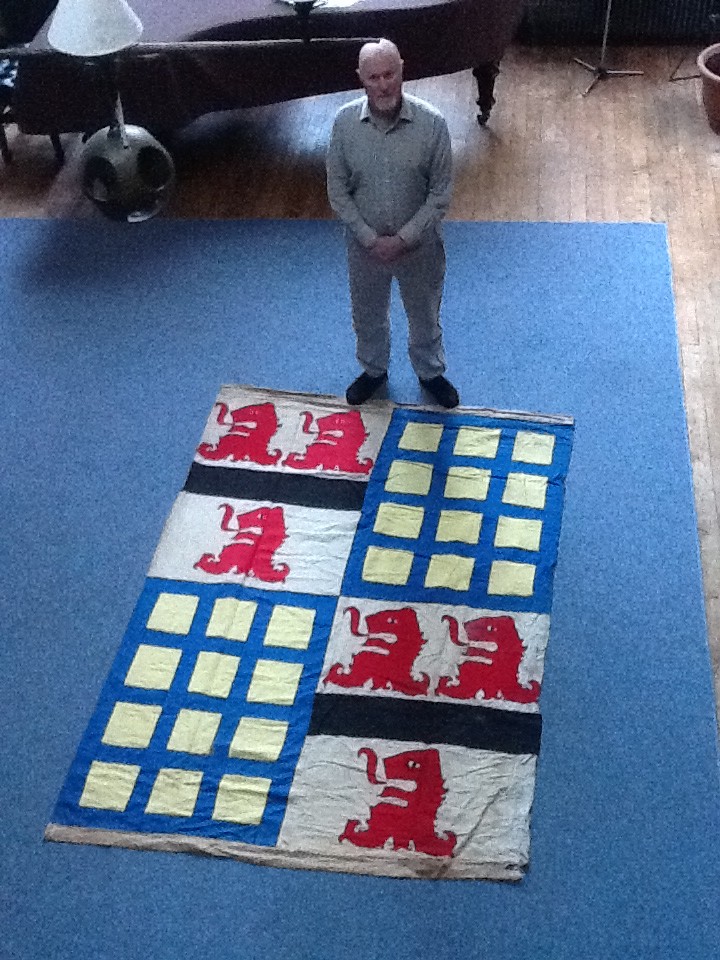
Hanging made for Paddy when living in the empty castle of Passerano in 1958-9:

This picture was sent to me by Artemis Cooper some time ago. I hope that you enjoy looking at it and relating it to the part of her biography where Paddy moons around in Italy searching for love and as ever trying unsuccessfully to write.

Artemis writes:

I have just taken possession of this, thanks to Richard Riley who appears with it in the photo – he has had it in his basement, Paddy left it there years ago. Richard agreed to let me take it, and thought it a great idea that it be sold in aid of the house at Kardamyli. The hanging was made for Paddy when he was living in the empty castle of Passerano in 1958-9: he had it made by the local nuns! I thought it might be the centrepiece of a collection of Paddy memorabilia (yet to be collected) that we could sell when we come to do a charity event for the house.

James Bond’s secret: he’s Jamaican

Ian Fleming on the beach near Goldeneye Photo: Getty

A review of Goldeneye: Where Bond was Born, by Matthew Parker. This biography of Bond’s creator reveals an Ian Fleming who was cruel, vain and racist.

By Lewis Jones

First published in The Spectator, 9 August 2014

Ian Fleming’s first visit to Jamaica was pure James Bond. In 1943, as assistant to the Director of Naval Intelligence, he flew from Miami to Kingston to attend an Anglo-American naval conference and to investigate the rumour that Axel Wenner-Gren, a rich Swede and supposed Nazi, had built a secret submarine base at Hog Island, near Nassau. He was accompanied by his old friend Ivar Bryce, who was also in intelligence, and who put him up at a house his wife had recently bought. As they left the island, Fleming told Bryce, ‘When we have won this blasted war, I am going to live in Jamaica… swim in the sea and write books.’

Three years later he duly bought 14 acres in the parish of St Mary on the north coast, with a beach and a coral reef, for £2,000 and spent the same again on building a primitive house, which he called Goldeneye. With no glass in the windows and no hot water to begin with, it was essentially a large room with some small back bedrooms and a kitchen with a stove and a sink. Bryce, who had found him the site, called the house ‘a masterpiece of striking ugliness’, but Patrick Leigh Fermor approved of its ‘enormous quadrilaterals’, which ‘framed a prospect of sea and cloud and sky’.

Fleming had negotiated two months’ annual holiday from his job as foreign news manager at the Sunday Times, and invariably spent it at Goldeneye, where his library included the 1947 edition of Field Guide to Birds of the West Indies by James Bond. In 1952 — when he also married and became a father — he wrote Casino Royale, in which James Bond’s cover at the Royale-les-Eaux casino is a ‘Jamaican plantocrat’. He wrote a Bond story there every winter until his death in 1964, aged 56.

Parker sketches the history of the island, beginning with its idyllic millennia under the Taínos, who called it Hamaika, ‘land of wood and streams’, and were wiped out within two generations of the arrival of Christopher Columbus in 1494, leaving behind them only a few ‘heartbreakingly relaxed’ words — barbecue, hammock, canoe. Fleming’s favourite period was naturally that of the English privateers of the 17th century, as he simply adored pirates. He gave Bond various ‘piratical’ attributes — the scar on his cheek, for example — and several women admired his own ‘slightly piratical’ broken nose. The plot of Live and Let Die turns on the discovery of Sir Henry Morgan’s treasure trove.‘What I endeavour to aim at,’ explained Fleming in his essay How to Write a Thriller, ‘is a certain disciplined exoticism.’ In Goldeneye Matthew Parker makes a convincing case that Fleming’s exoticism is essentially Jamaican, and that the island is crucial to a proper understanding of the man and his work. Three of the novels — Live and Let Die, Dr No and The Man with the Golden Gun — are mainly set there, and over the years Fleming became ‘soaked’ in its atmosphere, a ‘cocktail of luxury, melancholy, imperialism, fantasy, sensuality, danger and violence’.

Fleming shared his historical preferences with Noël Coward, who built two houses nearby, and with whom he had an unlikely but close friendship. They both loved the Royal Navy, and were nostalgic for the Empire; when Gandhi was assassinated in 1948, Coward wrote in his diary that it was ‘a bloody good thing, but far too late’, and after Suez the Edens recuperated at Goldeneye. Fleming and Coward both loathed the arrival of the tourism they had helped pioneer. And — unlike Fleming’s wife Ann (née Charteris), who on her visits to Goldeneye before her divorce from Esmond Rothermere used to pretend to stay with Coward — they both disliked intellectuals.

One of Ann’s intellectuals was Peter Quennell, who was apparently known as ‘Lady Rothermere’s Fan’, and was an occasional guest at Goldeneye. Quennell noted that Coward treated Fleming ‘as if he were a distinguished member of the opposite sex’ and that Fleming, most untypically, ‘seemed positively to enjoy being teased or even ridiculed’. Nor did he appear to mind when Coward lightly fictionalised his affair with Ann in the novel Pomp and Circumstance. Coward later turned down the role of Dr No in the film with a telegram reading ‘No… No… No… No!’

Fleming obviously had much more in common with Commander Bond, not least his forceful heterosexuality: ‘I loved being whipped by you,’ Ann wrote to him in 1947, after a rendezvous in Dublin. Author and hero both swam like fish, and drank like them too, mainly spirits. Quennell recorded that at Goldeneye the Commander — Fleming retained his wartime rank — ‘tended to drink in the American way’, with plenty of vodka martinis or ‘very brown whisky sodas’ before dinner, but nothing with it, so Quennell would be forced to ask for something, to his host’s annoyance.

And then there was the smoking: ‘Bond lit his 70th cigarette of the day.’ Both commanders had a weekly order of 300 from Morlands of Grosvenor Street. As early as 1949 Fleming began to experience a tightening of the chest he called the Iron Crab, and in 1956 he cut down to 50 a day, but he kept at it. When he married Ann he wrote to her brother Hugo, who disliked him, tactfully promising never to hurt her except with a slipper — but he did. In the last photograph of them together at Goldeneye, Fleming, who had been told by doctors to stop smoking and drinking, is holding his sinister cigarette holder in one hand and reaching for what looks like a very brown drink with another, while his wife stares into the camera, her ‘anguish’, as the caption notes, ‘clearly visible’.

Parker argues that Fleming and Bond were both pretty unlikeable, but that this made them more interesting. Besides his cruelty and vanity, Fleming was by today’s standards a racist. He loved Jamaicans but was also wary of them, always taking to Goldeneye his Browning .25 from the war, ‘for defence against the Blackamoors’. He was patronising about their ‘childish faults’ and ‘simple lusts and desires’, and didn’t take Independence seriously. Less heinously, he was also something of a snob. Sean Connery, who quite liked him, thought him ‘a real snob’, but in his review of Dr No Paul Johnson cleverly out-snobbed him, dismissing his snobbery as ‘very second-rate… not even the snobbery of a proper snob’.

Parker thinks Robinson Crusoe was written by Robert Louis Stevenson, and is a bit muddled about English titles, but his book makes an entertaining addendum to Andrew Lycett’s definitive 1995 biography.

Buy Goldeneye: Where Bond was Born: Ian Fleming’s Jamaica by Matthew Parker

Robert Macfarlane on The Old Ways

Old WaysThe author of The Old Ways discusses some of the problems for any walker-writer such as how to spring surprises along the way, and how not to give your reader blisters.

by Robert Macfarlane

First published in the Guardian Book Club, 1 August 2014

“All I know is that at the very early stage of a book’s development”, wrote Vladimir Nabokov, “I get this urge to gather bits of straw and fluff, and eat pebbles.” Like Nabokov, I’m a pebble-eater and a straw-gatherer: my books begin as gleaned images, fragment-phrases and half-thoughts, scribbled on to file-cards or jotted in journals.

Tracking back to the earliest entries for what became The Old Ways: A Journey on Foot, from 2006, I find hundreds of these “pebbles”. Some are barely recognisable (“Dew ponds, ash frails, thin trails”), and others plain weird (“sunset as spillage; junk light of dusk”). Huh? Some mark the start of paths that never got followed: “Go see the bronze dragons in the Forbidden City; take Schiller along.” Why? Others now seem like fingerposts pointing in the right direction: “Dreamtracks and trespass; rites of way and rights of way.” “Each path to be told as a story, each story a path, leave cairns in the language as you go.”

That last line is pretty much The Old Ways: A Journey on Foot in miniature, though it would take another five years and 1,000 miles on foot for it to grow into a book. In that time I followed many different paths: Neolithic tracks on the chalk of southern England, pilgrim trails to a holy mountain in the winter Himalayas, a branch-line of the Camino in Spain, a tidal path into a mirror-world off the Essex coast and routes through the disputed territories of the occupied West Bank.

Because paths are places of encounter and company, I met scores of other walkers as I went: botanists, activists, archaeologists, poets, mapmakers – and everyday folk out with their dogs, taking a break. One early reviewer noted: “Macfarlane doesn’t seem to meet any dickheads.” Well I did meet them, several of them – but I didn’t find them interesting enough to write about. I had plenty to say as it was: songlines and pilgrimage, ghosts and memory, trespass and access, birdsong and light, the shimmer of detail … The book became an exploration of how paths run through people as well as places, and how landscape shapes – scapes – us both in the moment and in memory.

Walking is a repetitive activity. You put one damn foot after the other – and that’s what makes the walk. It’s often tiring and it’s sometimes boring. This poses a primary problem for any walker-writer: how to spring surprise along the way, how not to give your reader blisters. I wanted style to solve that problem. So I set out to devise a form that enacted its subject: to make a patterned book of path-crossings, full of echoes and back-glances, doubles and shadows. A book of many ways, then, through which readers might pick different routes. I also tried to leave those cairns as I went: guiding alignments of image, word and incident that only became visible at certain places along the journey.

I became obsessed with prose rhythm (Nabokov’s influence again). At one point I wanted to write each chapter with a different base-rhythm, a poetic foot (iamb, trochee, dactyl) that would tap its tempo through it. That ambition defeated me in the end (surely for the good) though I continued to scribble scansion marks above my sentences, revising some of them dozens of times to get the rhythms right on the ear. One chapter describes sailing old open boats along the sea-roads around the Outer Hebrides. Rhythm was crucial here to represent the sea’s own measures: the rolling whale-back swells that lofted us towards Sula Sgeir, 40 miles out into the north Atlantic; and the unforgettable experience of being in mid-Minch at the turn of tide: billions of tonnes of water pausing, trembling, unsure of their obligations – before starting the long slop back north.

“It’s hard to create a path on your own”, I note early on, and The Old Ways: A Journey on Foot accompanies other writers and artists as it goes, both dead (Edward Thomas, Nan Shepherd, Patrick Leigh Fermor) and alive (Ian Stephen, Raja Shehadeh, Steve Dilworth). The best contemporary non-fiction seems to me as formally intricate and experimental as any fiction, and among the books I kept close to hand while writing were the essays of John Jeremiah Sullivan, Rebecca Solnit and David Foster Wallace, the reportage of Katherine Boo, John McPhee and William T Vollmann, and the travelogues of Barry Lopez, William Dalrymple and Iain Sinclair. When energy was ebbing, I turned to the dark glitter of John Banville, or the baroque visions of Cormac McCarthy.

The book has lived some strange afterlives since it was published two years ago, and its paths have led me in unexpected directions and to fresh collaborations. One of the best things about being a writer is hearing from readers: a reminder that the artefact over which you privately labour for years goes into the world and – if you’re lucky – finds its way into the imaginations of others. Not all of these communications are kindly. “Robert Macfarlane, you are a charisma-free zone,” declared someone recently. But then a day or two later someone else got generously in touch: “Your writing gives me an erection of the heart!” I guess you can’t please all of the people all of the time.

Buy the book: The Old Ways: A Journey on Foot

Preserving the best of Romania: Charlie Ottley and Jessica Douglas-Home on Pro TV

Capture

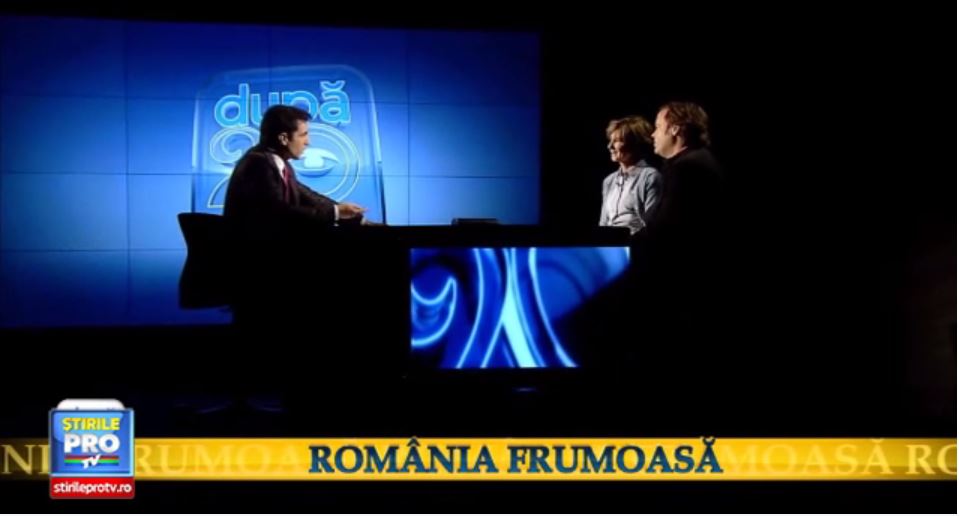
Watch this inspiring interview with Charlie Ottley, presenter of the Wild Carpathia series, and Jessica Douglas-Home, President of The Mihai Eminescu Trust, to find out why Romania’s heritage, natural landscape and areas of wilderness are so special and need protecting.

An interview on Romanian TV in English where Charlie and Jessica discuss the importance of preserving Romania’s wilderness and cultural heritage.

In one generation all the forests of Romania may be gone.

Watch the interview here

Jessica Douglas-Home la ProTV from Mihai Eminescu Trust on Vimeo.

EYE on the prize

A new award aims to support and promote an artist or film-maker whose work unites art and film. EYE, the Dutch film museum and the Patrick & Joan Leigh Fermor (PJLF) Arts Fund have launched the EYE Prize. The annual £25,000 prize is aimed at supporting and promoting the artist or film-maker whose work unites art and film, and demonstrates quality of thought, imagination and artistic excellence.

From Screen Daily

Sandra den Hamer, CEO of EYE, commented: “With the undeniable intimate relationship between the moving image and contemporary arts, it is about time for a prize for work which brings these two art forms together. EYE is delighted that the PJLF Arts Fund has made the creation of this new prize possible, and, with our additional commitment to stage an exhibition every four years of the three previous years’ EYE Prize winners, EYE will cement its position as a leading and international institution for film and art.”

The jury for the inaugural 2015 prize will be chaired by den Hamer and also includes director Chantal Akerman, chief curator for media and performance art at MoMA Stuart Comer, director Isaac Julien, cultural entrepreneur Martijn Sanders, producer/screenwriter and PJLF Arts Fund trustee Olivia Stewart, and director Béla Tarr.

An international advisory board will make the selection of nominated candidates to present to the jury. The winner will be announced in late January and will be presented at the annual EYE Gala on April 2, 2015, coinciding with EYE’s third anniversary.

The advisory board is headed up by Jaap Guldemond of EYE and also consists of Solange Farkas (director and curator of Associação Cultural Videobrasil), Gyula Gazdag (artistic director of the Sundance Filmmakers Lab), film historian Marc Glöde, Sunjung Kim (curator and professor at the Korea National University of Arts) and Andrea Lissoni (curator, film and international art, Tate Modern).

Established in 2011, the PJLF Arts Fund aims to help artists, writers, film-makers and musicians.

2014 Stavros Niarchos Foundation Lecture at Yale University: “Patrick Leigh Fermor In Greece”

Artemis Cooper presenting the 2014 Stavros Niarchos Foundation lecture

Artemis Cooper presenting the 2014 Stavros Niarchos Foundation lecture

Artemis Cooper giving the 2014 Stavros Niarchos Foundation Lecture at Yale University.

A video is available on YouTube here or via the embed below. The blurb introduces things as follows:

Patrick Leigh Fermor’s first travels in Greece took place before the outbreak of the Second World War, and he already spoke fluent Greek by the time he was parachuted into occupied Crete in 1942 to help the Cretan Resistance, which in May 1944 resulted in the abduction of a German general. Leigh Fermor settled in Greece in the 1960s, and lived there until his death in 2011. His books Roumeli: Travels in Northern Greece and Mani: Travels in the Southern Peloponnese are two of the best travel books in the English language. The talk is about his life and friends in Greece, and how much the country meant to him.

Mark Granelli brought this video to my attention and had this to say:

It is quite fascinating, and includes a beautiful extract from ‘Mani’ where Paddy is accompanied by dolphins on a ferry trip.

It focuses a lot on Paddy’s time in Crete.

The Q&A at the end turns up some personal information about Paddy and also references Olivia Manning and Fitzroy Maclean.

The slow adventure – in the footsteps of German film-maker Werner Herzog

Jasper Winn

Jasper Winn

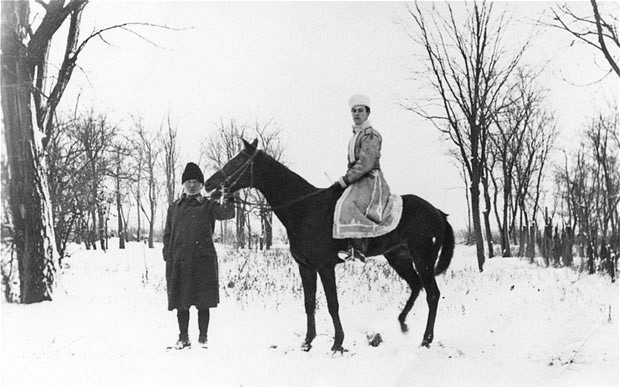
Adventurer, horseman, musician and walker, Jasper Winn will soon be striding in the footsteps of German film-maker Werner Herzog who walked a 500 mile route from Munich to Paris exactly forty years ago, starting in November 1974.

Herzog had heard that German film critic Lotte Eisner was ill and might die; she had championed his career from early on when his films challenged the notion of what films were for and how they were made; he decided that by making a pilgrimage on foot to her bedside he would stop her dying. He kept a private journal of his three week trudge. This was published some years later as the slim volume, Vom Gehen Im Eis/Of Walking In Ice. Jasper came across the book, in translation, when researching long walks and pilgrimages more than a decade ago, and it made an impression on him. He describes the writing as “stark, recounts only the images that he sees, and what he directly feels. It’s both beautiful and unsettling.” His trip was difficult – average 24 miles a day non-stop and he carried little to make him comfortable or weather proof. He left in cold and patchy snow and over the coming weeks it rained, snowed, froze and blew. At night he broke into holiday homes, barns or anywhere he could find shelter. There were occasional nights in inns.

Jasper Winn, the author of Paddle: A long way around Ireland, will be updating us on this recreation of the journey on his website, Slow Adventure. If you would like to keep up with him please subscribe to his posts here.

Good luck Jasper!

Canadian Review of Walking the Woods and the Water by Nick Hunt

A positive review for Nick’s book in the Canadian online journal Macleans.

By

First Published in Macleans 1 November 2014.

In December 1933, an 18-year-old Englishman by the name of Patrick “Paddy” Leigh Fermor set off to walk the width of Europe, from Rotterdam to Istanbul. He packed little more than some clothes, several letters of introduction and the Oxford Book of English Verse—to live “like a tramp, a pilgrim, or a wandering scholar.” It was a time before the horrors of fascism and Soviet-style Communism had taken hold, and much of Eastern Europe was still semi-feudal. (While he spent many nights in barns and shepherds’ huts, Paddy also enjoyed the hospitality of castle-dwelling counts and barons.) The accounts of his adventures, the lyrical memoir A Time of Gifts, and its sequel, Between the Woods and the Water—both elaborate love letters to a pre-war Europe—won him international acclaim.

Hunt was also 18 when he discovered Paddy’s travelogues and, before he’d finished reading them, “knew with absolute certainty that one day [he] would follow in [Paddy’s] footsteps, retracing his route through Holland, Germany, Austria, Slovakia, Hungary, Romania, Bulgaria and Turkey, in search of whatever was left of wildness and adventure.” And so he did. In December 2011, Hunt left his own London home and, for the next 221 days and 4,000 km, undertook his own pilgrimage: “Beyond buying roadmaps and putting out calls for accommodation, I deliberately did no research into where I was going,” Hunt writes of his preparations. “Paddy’s books, eight decades out of date, would be my only travel guide. With his experience underlying my own, I would see what remained of hospitality, kindness to strangers, freedom, . . . the mysterious, the unknown, the deeper currents of myth and story I believed—or longed to believe—still flowed beneath Europe’s surface.”

On an oft-perilous trip riddled with obstacles not seen in Paddy’s time—hydroelectric dams, industrial wastelands and multi-lane highways—and despite injuries that sometimes laid him up for weeks, Hunt prevailed. “In every country of my walk,” he writes, “I encountered kindness and generosity that Paddy would have recognized.”

Is is when recounting that generosity— from the strangers who invite him into their homes, to the colourful characters who, over beer, fruit brandy or tea, reveal their grievances, prejudices and aspirations—that Hunt’s writing shines brightest. And while his descriptions of landscapes can occasionally feel as plodding as his pace of travel, some are downright breathtaking. Atop the Balkan mountain range in Bulgaria, he writes, “Here and there, the green skin that covered the mountain had pulled away, as if tugged back by giant fingers, and jumbled rock burst out like sausage meat.”

Overall, Hunt makes an enormously appealing narrator and guide on the road less travelled: curious, sharp-eyed, insightful and intrepid—not unlike his predecessor, who died at the age of 96, just six months before Hunt began his trip. Sadly for Hunt, it was before he could send the letter he planned to write “to tell him I was on my way.”

Salmagundi Magazine special feature on Patrick Leigh Fermor

Paddy at BaleniI am grateful to Marc Woodworth for sending me this feature about Paddy posted in Salmagundi Magazine.

It includes excerpts from three essays:

  • Joanna Kavenna on memory and the past in A Time of Gifts
  • George Prochnik on Byzantium and style in Mani
  • Bina Gogineni on exoticism in The Traveller’s Tree

Plus exclusive online contributions from Nick Delbanco, Nick Delbanco, our very own Nick Hunt (Following Fermor in Romania)
and a Micro-Anthology selected by Michael Ondaatje, Thomas de Waal, Michael Gorra, Andrew Eames and photographs of Kövecses by Andrew Hillard.

Download the pdf here … salmagundi magazine

The Mitford files: Exploring the extraordinary lives of six sisters

Surely more forests have been felled in the name of the Mitford girls than any other family circle in history, and the death recently of 94-year-old Deborah, the youngest and longest-lived, prompts a consideration of the sisters’ contribution to the world of letters – as both authors and subjects.

By Mark McGinness.

First published in The National, 2 October 2014.

Between 1904 and 1920, Lord and Lady Redesdale produced a son, Tom, and six daughters – Nancy, the novelist and Francophile; Pam, a horsewoman, farmer and cook; Diana, a fascist beauty; Unity, a besotted Nazi; Jessica (“Decca”), an American communist and writer; and Deborah (“Debo”), the Duchess of Devonshire. They were six variations of the same face and voice with an obsessive dedication to a person or cause. Nancy’s love for Gaston Palewski, Unity’s for Hitler and Diana’s for the English fascist Oswald Mosley, blighted their lives – although none of them would ever admit it. Jessica’s dedication to communism and Deborah’s to her home, Chatsworth House, were just as strong but cast no shadows.

Four of the sisters – Nancy, Diana, Jessica and Deborah – took to print. Memoirs from the last three of them (and more than 40 books among them); novels and historical biographies from Nancy; biographies and reviews from Diana; and exposés from Jessica, the Queen of Muckrakers. Three volumes of Nancy’s letters have been published (one, her correspondence with Evelyn Waugh), 700 pages of letters from Jessica, and Deborah’s 54 years of brilliant badinage with the travel writer Patrick Leigh Fermor, In Tearing Haste. There are also the 843 pages of correspondence between all six sisters, covering 77 years.

These tomes join four previous biographies of Nancy (by Harold Acton, Selina Hastings, Laura Thompson and Lisa Hilton); two of Diana (by Jan Dalley and Anne de Courcy); three of Unity (the most comprehensive – and controversial – by David Pryce-Jones); one of Pamela, the quietest and, according to John Betjeman, “the most rural of them all”; and two of all six sisters: The House of Mitford by Diana’s son, Jonathan Guinness and his daughter Catherine; and Mary Lovell’s quite definitive The Mitford Girls. There was even a musical of the same name in 1981. Deborah’s daughter, Sophia Murphy, also produced The Mitford Family Album. Biographies of Deborah are certain, like her beloved chickens, to be hatched before long.

Why the fascination? The lives of the Mitford sisters have riveted, and repelled, Anglophiles, romantics and readers since the 1930s. Diana Mitford once wrote, “I must admit ‘the Mitfords’ would madden ME if I didn’t chance to be one.” Their hold on the public imagination, through their loves and marriages, their politics and opinions, their friendships and sense of fun, can be attributed to a mixture of aristocratic eccentricity, romance, rebellion, devotion, betrayal, estrangement, tragedy and loss; and through it all, a uniquely irrepressible wit. This absolute self-possession and determination to treat the gravest aspects of life as a lark are what make the Mitfords such an enduring study.

The Mitfords: Letters between Six Sisters (2008), superbly edited by Diana’s daughter-in-law, Charlotte Mosley, presents the sisters at their vivid best, bouncing off each other, revealing a distinctive, instantly recognisable style that shines through each one’s letters. The lives of the Mitford girls seem as remote today as the Bennett sisters. The latter were fictional and the Mitfords have become so, too.

It is almost impossible for many to separate the family from their fictional equivalents. The books that made them so, and grew into what Jessica dubbed the Mitford Industry, were Nancy’s The Pursuit of Love (1945) and Love in a Cold Climate (1949), which become classics, still in print today, creating cult figures of her already notorious family.

The intensely autobiographical nature of Nancy’s fiction might suggest a lack of creative imagination, but the real-life models she was so brilliantly able to draw on – with some, but not much, embellishment – made it all the more fascinating for appearing to be true. Published in December 1945, The Pursuit of Love, a hilarious, high-spirited and sweepingly romantic tale came at just the right time to a country exhausted and numb after six years of war.

That spirit and the ingredients of love, childhood and the eccentricities of the English aristocracy in the guise of the Radlett family make it still so eminently readable today. Nancy trumped her success with Love in a Cold Climate four years later, again drawing on life with the Radletts, but focusing on their neighbours.

Half a century passed between Nancy’s first novel, Highland Fling (1931), and Debo’s first book. Eldest green-eyed Nancy never recovered from not being an only child and was relentless in her teasing. She called Debo “Nine” – her apparent mental age – and claimed she had to point to the words on a page to read. Debo played on this, claiming never to read; rather like Favre (as they called their father), who apparently only ever read one book, White Fang, which he found so good there was no need to read another.

Debo was certainly a late developer but would write almost as many books as Nancy, and proved herself as gifted, original and funny as her supposedly cleverer sisters. Most of them reflected her life’s work, Chatsworth House, the seat of the Cavendishes for 16 generations since 1549, the 175-room caramel-coloured pile, known as “the Palace on the Peak” in Derbyshire, which in 1959, she and her husband, Andrew, the 11th Duke of Devonshire, occupied (with their son and two daughters) and set about to rescue. Debo was arguably the greatest chatelaine of the 20th century.

In 1980, at the age of 60, she produced Chatsworth: The House (1980); then in 1990, The Estate: A View from Chatsworth. The Treasures of Chatsworth and The Farmyard at Chatsworth were published in 1991 and, in 1999, The Garden at Chatsworth. Two years later a bestselling collection of home thoughts and reviews, Counting My Chickens (2001), appeared. She was a hen breeder and chicken lover for more than 80 years.

The Chatsworth Cookery Book ­appeared in 2003. Debo’s hairdresser thought she had a nerve as she had not cooked since 1945. But she was better than two of her sisters. Nancy, looking after her father during the war, threw an egg into a pot of water and was appalled when “a sinister sort of octopus grew out of it”. So she threw in two more – the whole week’s ration – and the same thing happened. She then gave up. Jessica was no more adept. Her recipe for roast goose reads: “Take a goose and roast till done.”

In 2005, Round About Chatsworth was published, featuring the 35,000 acres that surround the house – plumb full of houses and architectural curiosities: bridges and byres, mills and a mortuary, turrets, towers and troughs, forests, fountains and follies – brimming with Devonshire knowledge and Mitford dash.

Writing about Chatsworth was the most natural thing in the world for Deborah and so it read. She listed her occupation in Who’s Who as “housewife” and would refer to Chatsworth as “the dump”. As Alan Bennett said in his introduction to the second collection of her journalism, Home to Roost … And Other Peckings (2009), a bestseller like her predecessor, “Deborah Devonshire is not someone to whom one can say ‘joking apart …’: with her it’s of the essence, even at the most serious and saddest of moments.”

And in a long life, she had her tragedies and her trials. She lost three children at birth and like many a duke, her husband had affairs. He was also an alcoholic and a gambler but gave these up so their last two decades were warm and companionable.

“Happiness is very rare and totally overrated,” Deborah would say. “Contentment is completely different and Chatsworth has made me content … I am the most easily pleased of the sisters.”

By December 2005, sisterless and widowed (her last sister, Diana, died in 2003 and the Duke the following year), Debo left Chatsworth to her son, the 12th duke, and his wife, moving nearby to the Old Vicarage at Edensor. She called it the Old Vic and soon made it her own. She continued to contribute to The Spectator as a columnist and reviewer. Her views were sturdily conservative – Crown and countryside, the social order and stiff upper lip, good manners, loyalty and friendship, but always expressed with originality and humour.

Then, at the age of 90 and by then almost blind, she published her memoirs, Wait for Me!, perhaps the most reliable and rational account of life as a Mitford sister, recalling the stumpy-legged infant trying to catch up to her five big sisters. Indifferent to their politics, her love for her sisters was unwavering. Debo had been the Redesdales’ last chance for another son. Mabel the parlourmaid recalled, “I knew it was a girl by the look on his lordship’s face.” Yet, unlike her tearaway sisters she loved life at home with Muv and Favre and became her father’s favourite. Apart from preserving Chatsworth and protecting the legacy of her sisters, the Duchess of Devonshire championed, through her writing and her patronages, traditional values and the importance of country life; proving in the end, to be the grandest and most remarkable of that remarkable brood.

Mark McGinness is a freelance writer and reviewer based in Dubai.

The Traveller’s Film Club – Wilfred Thesiger

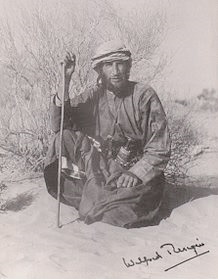
Wilfred ThesigerFollowing on from the successful showing of the film about Paddy, the next Traveller’s Film Club event will be held on Thursday 13 November hosted by the middle‐east scholar and writer, Peter Clark, who will present original footage and two documentaries about the legendary desert explorer Sir Wilfred Thesiger and his return to Oman.

It will take place as usual on the lower ground floor of Waterstones Piccadilly from 6.30pm. There is an excellent travel bookshop and café on the same floor. The film screening will commence at 7pm, after which you will have the opportunity to chat over a glass of wine. No charge, no reservations, first come, first served. Further details here.

Related article:

Obituary: Sir Wilfred Thesiger

Ghika – Fermor – Craxton: 3 places, 3 creators

From the left: Nikos Hadjikyriakos-Ghikas, John Craxton, Barbara Hutchinson-Ghika, Patrick Leigh Fermor, Lydia Aous, 1958

Our favourite museum, the Benki, is presenting an exhibition dedicated to three creators, whose lives were bonded through common places: Hydra, Kardamyli, Corfu. Three houses-refuges, which became a source of artistic inspiration, and housed a friendship that lasted over 40 years.

Sir Patrick Leigh-Fermor, English travel writer, built his house in Kardamyli of Mani, a house that was later bequeathed to the Benaki Museum. There, he hosted since the 1960’s the painters N. H. Ghika and John Craxton, among other friends, whose works decorated the place.

Earlier, main feature for all three of them was Ghika’s manor in Hydra, “a perfect prose-factory” as it was called by Fermor, who lived there for two years, writing most of his book “Mani”.

John Craxton as well, was attracted by the landscape of Hydra and painted a series of them. His valuable help the days that folowed the fire at Ghika’s house in Hydra, in 1961, is described at their extensive correspondence. In one of these letters Craxton is suggesting to Niko and Barbara Ghika that perhaps it is about time to move on to other places. Indeed, the Corfu house was going to replace the void and become a new place of meeting and creation.

Letters, manuscripts, editions and photos are the main theme of the exhibition, accompanied by drawings by N. H. Ghika and John Craxton. Works of the above painters coming from the Fermor house in Kardamyli form a separate section at the exhibition which runs from 17 October 2014 to 10 January 2015. Further details here.

Why you should never meet your heroes

Would you have been disappointed if you had met Paddy?

By Philip Sidney

First published in The Spectator 14 October 2014

As we become steadily accustomed to life in the Age of Celebrity, it’s become a truth that, as Mark Mason put it in the Speccie last month, ‘meeting your heroes is almost always a bad idea’. Reading the letters page in the London Review of Books, it seems that this advice extends to visiting any place associated with your heroes. Last summer Max Long, an undergraduate at Magdalen College, Oxford, arrived at Patrick Leigh Fermor’s old house at Kardamyli in Greece, hoping to pay homage to one of his heroes (see The House is Not Always Empty). His visit, he reports, was unideal:

‘To the hairy, shirtless, sandalled old man who occupied Paddy’s studio as though he owned the place, and who refused entry on a sweaty August morning to a travelling student, despite his pleadings (and tears): you ruined a young man’s pilgrimage.’

It’s hard not to sympathise, particularly given the hospitality with which Fermor was himself received on his travels. But this kind of disenchantment isn’t exclusive to unsceptical youth. Jeremy Clarke laments the speed at which authors’ auras disperse:

‘Nothing lingers. When they’re gone, they’re gone. Even with a commemorative plaque on the wall, one is left only with a sense of vertigo at how easily all vestiges of even the recent past are obliterated and we move on.’

Both Long and Clarke are part of a rich tradition of disappointed pilgrims which began in the late 19th century, the joint result of improved transport networks and the growth of a mass audience for literature. In those days it was possible to be rebuffed by the great men themselves, as were the rather impatient tourists that called on Thomas Hardy in 1903:

‘[…] I have given mortal offence to some by not seeing them in the morning at any hour. I send down a message that they must come after 4 o’ clock, & they seem to go off in dudgeon.’

After any famous writer goes their own long journey, the difficulties of preserving their home for would-be pilgrims become more fraught: whether a literary shrine is tended or neglected, there will always be enthusiasts claiming that their idol has not been treated appropriately. As Simon Goldhill observes in Scott’s Buttocks, Freud’s Couch, Brontë’s Grave, Charlotte Brontë would have been horrified had she seen her stockings on public display at Haworth Parsonage, but in the 21st century they’re a precious link – however creepy – to a great talent now gone.

What options remain, then, for the would-be literary pilgrim? Continue to travel hopefully, sifting the let-downs for a trace of longed-for genius loci? Or stay at home, cherishing places in the imagination? Nick Hunt’s book, Walking the Woods and the Water: In Patrick Leigh Fermor’s footsteps from the Hook of Holland to the Golden Horn, provides a possible answer. His journey across Europe in the footsteps of Patrick Leigh Fermor shares the landscapes through which his hero moved (not to mention the physical strains incidental to thousand-mile walks), while also conscious of the changes that have reshaped the continent in the intervening 80 years. However fervently we revere our literary pin-ups, we must remain conscious, and as far as possible accepting, of the things that stand between us and them: be they an accumulation of years, a glass vitrine, or hirsute jobsworths in shorts.
Philip Sidney is a writer and academic, specialising in travel, literature and travel literature

Abducting a General: Crossing Europe and kidnapping a German general

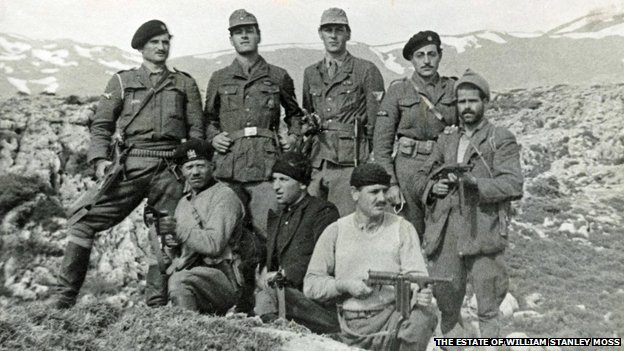
The abduction party, 28 April 1944 (Leigh Fermor standing second from left in German uniform)

The abduction party, 28 April 1944 (Leigh Fermor standing second from left in German uniform)

A very rare profile of Paddy by the BBC. Barely anything is available on the BBC about one our greatest Englishmen. Since his death the amount has increased with an obituary and the serialisation of Artemis Cooper’s biography. This review is welcome.

From BBC News Magazine

By Andy Walker

Abducting a General: The Kreipe Operation and Soe in Crete is a new account of the kidnap of a German general in WW2 from occupied Crete and sheds light on one of the 20th Century’s most interesting men.
“One man in his time plays many parts,” wrote Shakespeare in As You Like it. If that is any measure, then the late Sir Patrick Leigh Fermor blew it into a cocked hat.

A decorated war hero, brilliant conversationalist, historian, Hollywood scriptwriter, perhaps the finest travel writer of his generation – the list of the achievements of Paddy, he was never called Patrick, goes on and on.

And now, three years after his death at the age of 96, Leigh Fermor’s own account of the audacious wartime exploit, capturing General Heinrich Kreipe, the commander of a division on the island of Crete, evading his pursuers and getting him to Cairo, has been published, further gilding his glittering reputation.

The book, Abducting A General, recounts the incident with typical Fermor erudition and flair.

He recalls how he and his colleague W Stanley “Billy” Moss dressed as German corporals, flagged down the general’s car on an isolated road. Their Cretan comrades helped them overwhelm the driver and, with Fermor wearing the general’s braided cap in the front of the staff car, they negotiated 22 German checkpoints with their quarry out of sight in the back.

Then, he writes: “A mood of riotous jubilation broke out in the car; once more we were all talking, laughing, gesticulating and finally singing at the tops of our voices, and offering each other cigarettes, including the general.”

On the journey to a rendezvous with a British submarine the party traversed the island’s highest point, Mount Ida, where Fermor and the general traded some lines of Latin from Horace.

It was, he explained later, “as if the war had come to an end, because we had drunk of the same fountains. Everything was very different afterwards”.

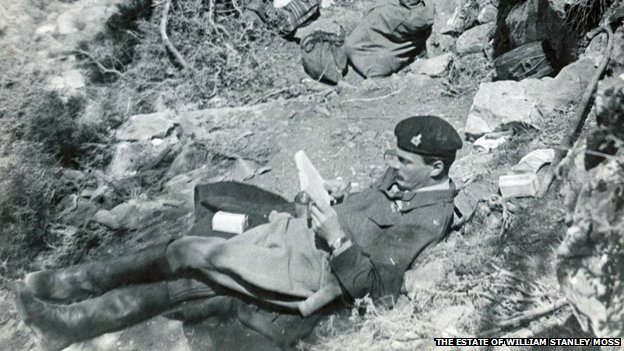
Leigh Fermor at the hideout at Kastamonitza, 20 April 1944

Leigh Fermor at the hideout at Kastamonitza, 20 April 1944


Fermor was awarded the Distinguished Service Order, while Moss, who penned his own account of the incident, Ill Met By Moonlight, later to be made into a movie starring Dirk Bogarde, was given the Military Cross.

But this was but one achievement by the man once described as “a cross between Indiana Jones, Graham Greene and James Bond”.

At just 18, the wild and wilful son of distant parents, Fermor had been “sacked” from a series of schools before being taken in by the bright and bookish denizens of bohemian London. He started a journey.

“Hopeless, idle, easily distracted, unemployable,” as his biographer and friend Artemis Cooper puts it, Fermor resolved to travel on foot from the Hook of Holland to Istanbul living on just £5 a month – part wandering scholar, part tramp, in order to reboot his life.

His journey, chronicled between 1977 and last year in three books – A Time of Gifts, Between the Woods and the Water and The Broken Road – is a poetic and romanticised evocation of a Europe as much of the mind as of reality, one which was swept away by WW2 and the upheavals which came in its wake.

Through Holland he wandered, then followed the Rhine through German cities like Cologne, where “salients of carved eagles and lions and swans swung from convoluted iron brackets along a maze of lanes,” and Coblenz, remarking that “the accent had changed and wine cellars had taken the place of beer-halls”.

This was a Germany in the first year of the Nazi regime with people giving the “Heil Hitler!” greeting “as though the place were full of slightly sinister boy scouts”. In the midst of this, though, Fermor’s descriptions are lyrical, cultural, rarely political.

His charm eased his passage. One day he might sleep in a barn, the next in the palace of former Austro-Hungarian nobility, playing polo on bicycles in the grounds.

And later in the journey he fell in love with a Romanian princess, Balasha Cantacuzene, tagged along in a royalist cavalry formation deployed against an abortive Greek revolution in 1935 and visited the monasteries of Mount Athos.

This six-year “ultimate gap-year”, as the writer Benedict Allen has called it, ended with the outbreak of war in 1939, Fermor’s facility with languages (speaking four fluently with a working knowledge of many more), plus a tried and tested self-sufficiency, meant that he was an ideal candidate for special operations.

After the war he stayed on in Greece, worked for the British Council and met his muse, Joan Rayner, who was Wendy to his Peter Pan, as Cooper puts it.

An intellectual counter to the polymath Fermor, she was there when, aged 69, he swam the Hellespont in imitation of his idol Lord Byron. The couple married in 1968.

She was the unseen presence in works like The Traveller’s Tree, an account of a journey through the geography, history and customs of the Caribbean Islands, and two books about Greece, Mani and Roumeli.

He was in his 60s when A Time of Gifts was published, followed 11 years later by Between the Woods and the Water – writing, rewriting and revising so slowly as to drive his publisher Jock Murray to distraction.

“I think life always got in the way,” says Cooper. “He felt so unsure of himself in so many ways. He was willing to sponge off friends or live pretty rough, really, until he could get it right.

“It’s very odd, a kind of real psychological problem.”

But Fermor was not shackled to travel writing. He became an elegant translator, wrote a proto-magical realist novel, The Violins of Saint-Jacques, and even tried his hand at scriptwriting, co-writing The Roots of Heaven, a Hollywood feature directed by John Huston and starring Errol Flynn.

“Everybody else detested Errol Flynn,” recalls the writer and historian John Julius Norwich. “But Paddy thought he was terrific. And he and Paddy had tremendous drinking bouts together. They were on the same wavelength.”

And Fermor became a much sought-after raconteur, famously holding court on his visits to London.

Kidnap in Crete: The True Story of the Abduction of a Nazi General is available for pre-order or purchase. Click on the highlighted text.
Abducting a General: The Kreipe Operation and Soe in Crete by Patrick Leigh Fermor is available to purchase. Click on the highlighted text.
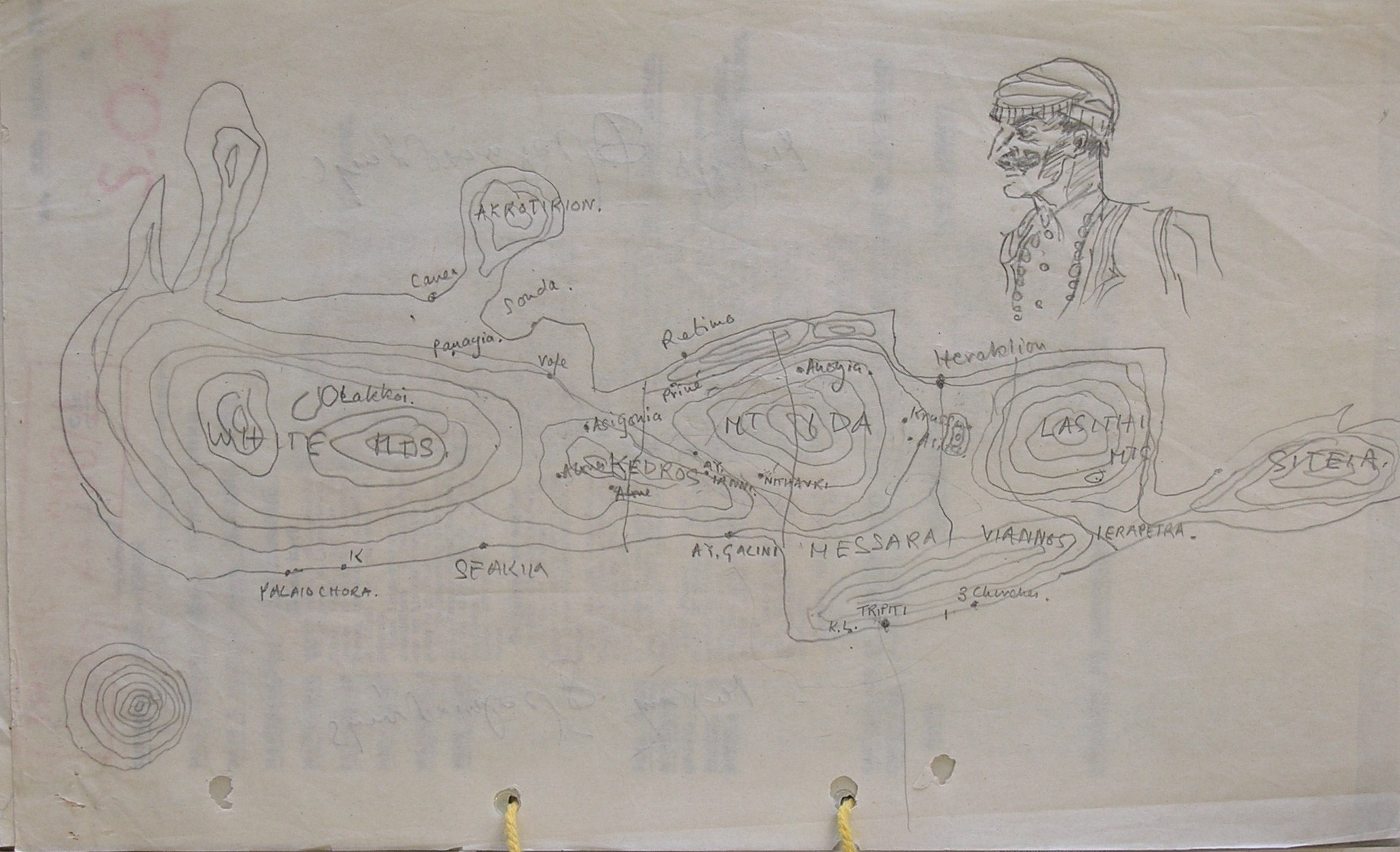
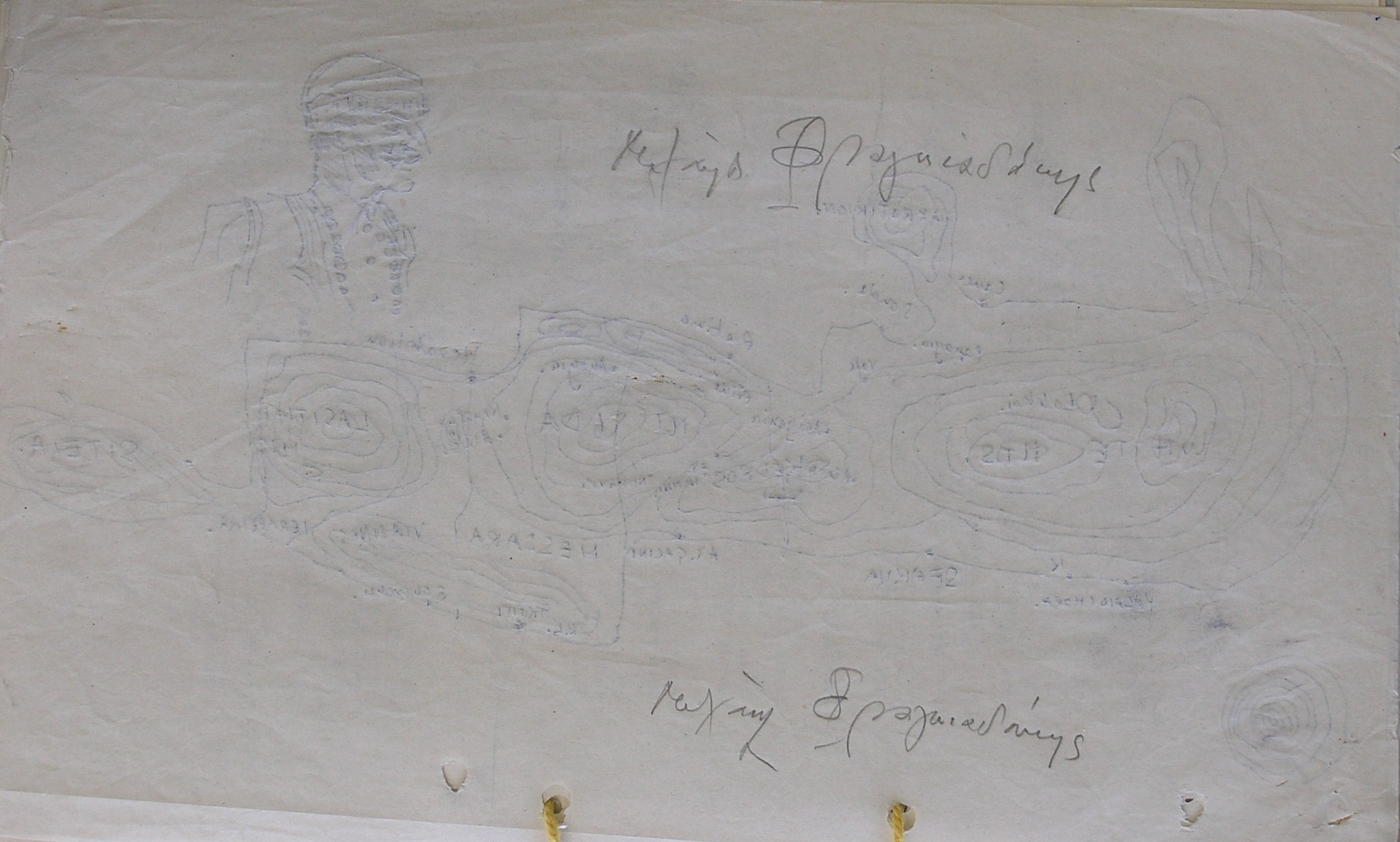
Map of Crete as drawn by Paddy on operations

This map was hand drawn by Paddy, probably whilst on operations in Crete 1943-44, including a self-portrait. The map is from Paddy’s SOE file. First published on this blog in 2011, I am republishing it as part of a series of unique materials on the blog to tie in with the 70th anniversary year of the kidnap and the recent publication of Paddy’s own account. Click on the pictures to zoom.

The reverse of the map …

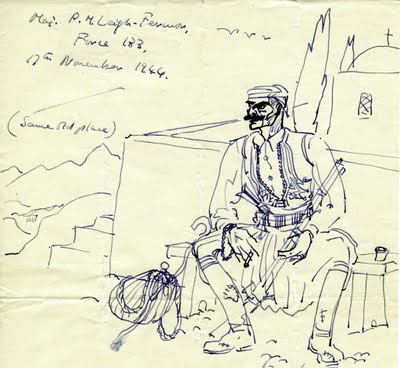
The drawing is typical of Paddy’s style. Compare it with this sketch sent to us by John Stathatos, about which John tells us:

This delightful sketch of himself in Cretan dress was penned at the top of a letter to my mother dated 17th November, 1944; as he explains, “I have been lost again in a forest of whiskers for about three weeks, and my old mountain chums are down in the plains now, looking incredibly wild and shaggy”.

“I have been lost again in a forest of whiskers for about three weeks, and my old mountain chums are down in the plains now, looking incredibly wild and shaggy”

Related article:

Traveller’s Rest by John Stathatos

Duchess of Devonshire on meeting JFK

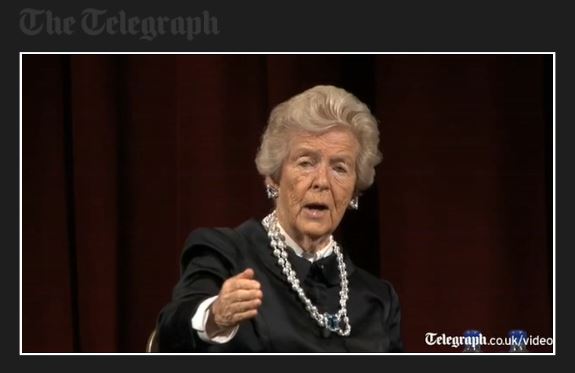
Another video from the delightful series of interviews with Debo. She recalls times with Jack Kennedy and his funeral. She was at the White House during the Cuban missile crisis and could not understand all the talk of “missuls”; she thought they were some kind of thrush.

Click on the picture to play and briefly endure the annoying advertisement before the main event (sound again low gain).

Capture

Travellers’ Century: Patrick Leigh Fermor now on YouTube


The event at Waterstones on Thursday with Benedict Allen introducing his 2008 film about Paddy’s life and work was a great success.

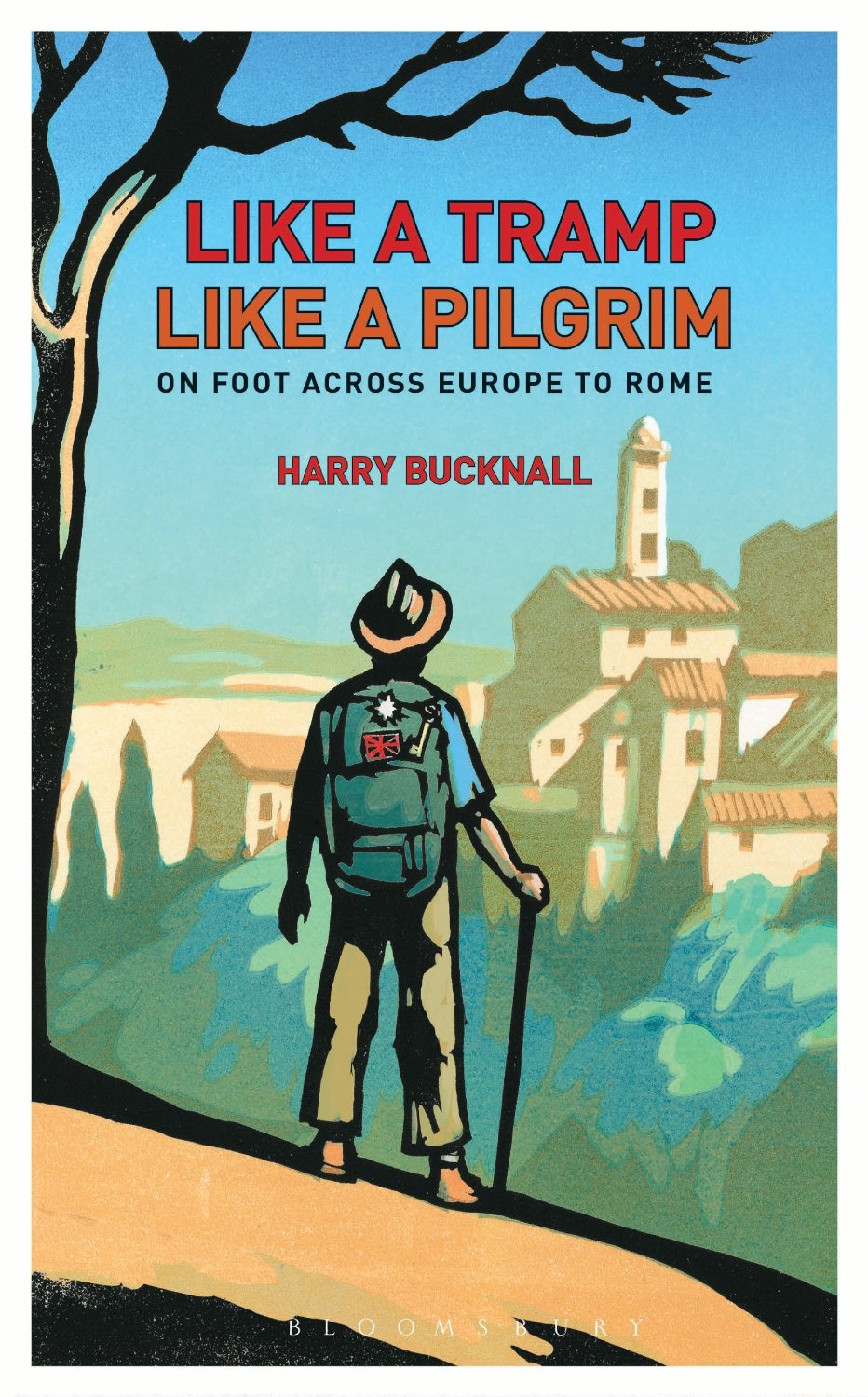
Organised by Barnaby Rogerson of Eland Publishing (who specialise in keeping the classics of travel literature in print), we were treated to a few glasses of wine before the film whilst chatting to an eclectic group who included general travel writing buffs, some who knew little about Paddy, and a group of keen PLF enthusiasts. Harry Bucknall, author of Like a Tramp, Like A Pilgrim: On Foot, Across Europe to Rome was in fine form, talking about a possible film project, and I particularly enjoyed meeting Rick Stroud who wrote the other book published this month about the abduction Kidnap in Crete: The True Story of the Abduction of a Nazi General.

Perhaps the highlight was a Q&A session afterwards where Benedict was joined by John Murray who features in the film talking about the challenges of editing Paddy’s work. John had some very interesting things to say about working with Paddy and shared some personal views about his life and relationships.

By strange coincidence I have now been told that the BBC film has now appeared in You Tube so you can all watch and enjoy it!

William Dalrymple and Artemis Cooper discuss Abducting a General on BBC’s today programme

Capture1

Justin Webb introduces this package on BBC Radio Four’s Today programme on Thursday 9 October 2014. Sir Patrick Leigh Fermor was one of the world’s great travel writers. In the grand old tradition he was a scholar and a war hero and a general all-round high achiever. Top of his achievements was the capture of a German general on Crete – and today for the first time his account of that capture is published. Travel Writer and historian William Dalrymple and biographer Artemis Cooper discuss.

You can listen to the programme on BBC iPlayer for a further four weeks if the BBC let you listen in your country. Click here to find the webpage for Thursday then slide the cursor to 02.23 to start the interview which lasts about six minutes. I had problems using it with Firefox. OK with IE.

Abducting a General: The Kreipe Operation and Soe in Crete by Patrick Leigh Fermor is available to purchase. Click on the highlighted text.
Reminder for tonight – Traveller’s Century: Benedict Allen seeking Patrick Leigh Fermor

A reminder that Benedict Allen will be introducing his 2008 BBC documentary where he travels Paddy’s footsteps, tonight at Waterstones Piccadilly at 6.30pm.

There may be free tickets left. Call the shop on 0207 851 2400

More derring dos and don’ts from Paddy Leigh Fermor

With General Kreipe

Billy Moss (L) and Paddy (R) With General Kreipe

Justin Marozzi gives us a review of Abducting a General, by Patrick Leigh Fermor, and Kidnap in Crete, by Rick Stroud. An exhilarating account of Paddy’s hair-raising kidnapping of a Nazi general that was ultimately of dubious strategic value.

By Justin Marozzi.

First published in The Spectator, 4 October 2014.

Recent years have seen the slim but splendid Patrick Leigh Fermor oeuvre swell considerably. In 2008 came In Tearing Haste, an entertaining collection of letters to and from Deborah Devonshire, followed last year by The Broken Road, the posthumously sparkling and long-awaited completion of the ‘Great Trudge’ trilogy, which finally delivered the 18-year-old Paddy from the Hook of Holland to Constantinople. Now comes another volume, setting out in full for the first time one of the great moments in a life heavily laced with glamour and incident.

It takes some chutzpah to kidnap a German general — and serious presence of mind to get away with it. Paddy, the Special Operations Executive commander of a group of 11 Cretan andartes, or guerrilla fighters, together with his second-in-command Captain William Stanley Moss, had excessive stores of both. At 9.30 p.m. on the night of 26 April 1944, the Anglo-Cretan desperadoes intercepted the car carrying General Heinrich Kreipe, commander of the 22nd Luftlande Division.

Paddy then impersonated the general as the Moss-chauffeured car drove on through 22 German checkpoints, the hair-raising prelude to an 18-day Nazi manhunt described in exhilarating detail in both of these books. The moment one morning when the Englishman overheard the captured general reciting an ode by Horace is already famous. The autodidact and show-off couldn’t help jumping in and finishing the stanza:

The general’s blue eyes swivelled away from the mountain-top to mine, and when I’d finished, after a long silence, he said: ‘Ach so, Herr Major!’ It was very strange. ‘Ja, Herr General.’ As though, for a long moment, the war had ceased to exist. We had both drunk at the same fountains long before; and things were different between us for the rest of our time together.

After many terrifying moments, some shattering climbs and descents and no shortage of near misses, Kreipe was finally spirited away onto a British ship headed for Cairo and the swashbuckling operation was over.

If the immediate success of the kidnapping is in no doubt, what of the much more vexed question which haunted its mastermind for years: was it worth it? The point of it all had been to inflict a major blow on enemy morale. Extensive steps were taken to ensure there were no Cretan reprisals by making it appear an exclusively British mission — but to no avail. The Germans, 75,000 strong on Crete, already had a viciously enforced policy of reprisals on the island, taking 50 Cretan lives for every one of their own soldiers killed. General Friedrich-Wilhelm Müller, Kreipe’s predecessor and the original target of the operation, was nicknamed ‘The Butcher of Crete’ after committing a number of such atrocities.

With Kreipe kidnapped, Müller was sent back to Crete pour décourager les autres and on 13 August gave the order to raze the village of Anogia, long a centre of resistance. In a characteristically methodical operation that lasted from 13 August to 5 September, 117 people were killed and 940 houses destroyed, together with vineyards, cheese mills, wine presses and olive groves. Other villages in the Amari valley received the same treatment, with hundreds more civilians slaughtered.

Roderick Bailey, the SOE historian who has written the introduction to Paddy’s account, argues that the kidnapping operation had ‘no strategic or tactical value’. A senior British staff officer in Cairo had opposed it from the start, arguing that ‘the only contribution to the war effort would be a fillip to Cretan morale, but … the price would certainly be heavy in Cretan lives’. Kreipe himself called it a Husarestück, a Hussar stunt. More recently, Kimonas Zografakis, who sheltered the kidnappers, described Paddy as ‘neither a great Philhellene nor a new Lord Byron… he was a classic agent who served the interests of Britain’, causing ‘terrible suffering’. This last comment looks unduly harsh and certainly does not square with the lifelong friendships Paddy forged with his Cretan brothers-in-arms, nor with the deep affection most Greeks had for him.

Abducting a General, unlike Stanley Moss’s Ill Met by Moonlight, is the work of a mature man, anxious to pay proper tribute to the Cretans who were the backbone of the resistance and ran by far the greatest risks. His SOE reports, which run to 90 pages here, provide gripping cinematic portraits of Leigh Fermor the soldier.

Warrior, writer, lady-killer, Paddy was also a boulevardier who loved his threads. Page three finds him rhapsodising about his Cretan mountain shepherd disguise:

Breeches, high black boots, a twisted mulberry silk sash with an ivory-hilted dagger in a long silver scabbard, black shirt, blue embroidered waistcoat and tight black-fringed turban…

and that’s without mentioning the flamboyant moustache, homespun goat’s hair cloak, stick, bandolier and gun. Enough to frighten any Nazi general.

Click here to buy Abducting a General: The Kreipe Operation and SOE in Crete

Click here to buy Kidnap in Crete: The True Story of the Abduction of a Nazi General

Justin Marozzi’s latest book is Baghdad: City of Peace, City of Blood.

The Dowager Duchess of Devonshire laid to rest

The Duchess of Devonshire funeral at Chatsworth House Photo: EDDIE MULHOLLAND

The Duchess of Devonshire funeral at Chatsworth House Photo: EDDIE MULHOLLAND

The Prince of Wales and the Duchess of Cornwall, who were close friends of the Dowager Duchess, walked the entire route behind the hearse carrying her coffin The Dowager Duchess of Devonshire has begun her final journey from Chatsworth House to the parish church where she is to be buried.

By Gordon Rayner

First published in the Telegraph 2 October 2014

More than 600 staff from the Chatsworth estate have been give the day off work so they can line the two-mile route that the cortège is taking to St Peter’s Church in the village of Edensor.

The Prince of Wales and the Duchess of Cornwall, who were close friends of the Dowager Duchess, were among the mourners, and walked the entire route behind the hearse carrying her coffin.

The estate staff lining the route fell in behind as the hearse passed, with more than 500 chairs set up for them at the church so they could watch the funeral on a giant screen showing the service from inside the church, which only holds 200.

Halfway through the service the sound of Elvis Presley singing How Great Thou Art filled the parish church.

The Dowager Duchess was a huge Elvis fan and owned a collection of Elvis memorabilia.

The Dowager Duchess, who died on September 24 at the age of 94, was the last of the Mitford sisters, the most celebrated and controversial family in pre-war high society.

It was her head for business that transformed Chatsworth from a crumbling stately home into one of the country’s most popular tourist attractions and the model for virtually ever other stately home in the country.

She was buried in the church’s graveyard next to her late husband, the 11th Duke of Devonshire, who died in 2004. His gravestone has been removed for the Dowager Duchess’s name to be added.

The plot is next to the grave of Kathleen Kennedy, sister of John F Kennedy, who was married to the 11th Duke’s brother.

In accordance with the Dowager Duchess’s wishes, the estate staff lining the route of the cortège wore their work uniforms, with butchers turning out in aprons, gardeners in their green sweatshirts and tour guides in their crested blazers. All wore either a black tie or black armband.

As the staff gathered at their muster points to be briefed on their positions, they swapped stories and memories of the Dowager Duchess, who was known as “Debo”.

Paul Neale, 59, the head butcher at the Chatsworth Farm Shop, said: “We have turned out in our uniforms because it is what the Duchess wanted and it is the highest compliment we can pay her because she started the retail side of Chatsworth.

“She was a lovely lady, very much involved in the business and we would see her three or four times a week coming to look round the shop.

“She used to stop and talk to everyone. I’m so proud to have known her and to have worked for her for 18 years.”

The Dowager Duchess knew the names of virtually all of the 620 staff standing to attention along the route, from the 92 catering staff to the 40 gardeners, the 20 tenant farmers and the three gamekeepers.

Alan Hodson, 66, one of the 63 tourist guides among the mourners, said: “Today is a celebration of a wonderful lady.

“She used to speak to absolutely everyone, she had fabulous social skills, she would always admire people’s children or their dogs and you would see her holding the door open for visitors who probably had no idea who she was.”

The Dowager Duchess’s son, the 12th Duke, followed immediately behind the hearse with his wife and his sister Lady Emma Tennant. The Prince of Wales and the Duchess of Cornwall walked immediately behind them.

The Duchess of Cornwall’s former husband Andrew Parker Bowles was also among the mourners.

As the cortège progressed along its route, accompanied by the steady monotone beat of a single bell at the church, the numbers walking behind the coffin grew to hundreds and then well over a thousand as the staff and members of the public joined it.

The Dowager Duchess’s wicker coffin, ringed with flowers, was carried into the church by pall bearers including Stephen Reid, head gamekeeper, and Andre Birkett, manager of the Farm Shop.

The Dowager Duchess’s retired former butler, Henry Coleman, carried a cushion bearing her insignia of the Dame Commander of the Victorian Order.

The funeral service, conducted by Canon David Perkins, included music by Bach, Brahms, Handel and Grieg, and the hymns Holy! Holy! Holy! and We Plough The Fields And Scatter.

The readings included the poem Lament Of The Irish Emigrant by Helen Selina, Lady Dufferin, and a passage from Ecclesiastes Ch.3 v 1-22.

175 years of the Red Ox Inn, Heidelberg

Red Ox

Immortalised by Paddy who stayed here in the winter of 1934, the Red Ox Inn is celebrating 175 years managed by six generations of the same family. They say they are looking forward to the 200th anniversary. It is always worth a visit if you travel to beautiful Heidelberg.

In German, and I should warn you there are scenes of hearty German food and large glasses of beer, but fortunately no flash photography.

This does not appear to play in Firefox. It works in Internet Explorer. Click on the image to play.

Funeral service of Deborah, Dowager Duchess of Devonshire

The funeral service for Deborah, Dowager Duchess of Devonshire will be held at 12 noon at St Peter’s Church, Edensor, DE45 1PH on Thursday 2 October 2014.

Everyone is welcome to attend. There will be refreshments at Chatsworth after the service.

No memorial service will be held, as were her express instructions. Donations in her memory to the Addington Fund and/or Helen’s Trust will be much appreciated.

Full details here.