Category Archives: Paddy's Writing

Slightly Foxed by Roumeli

There are many keen Paddy bloodhounds out there who send me articles and information about Paddy that I would never find. One such is Hector Parra from Santiago in Chile who has sent me a number of interesting pieces, and this is the latest from London based ‘Slightly Foxed‘ which describes itself as:

“… a rather unusual book review. Friendly and unstuffy, with 96 pages of lively  recommendations for books of lasting interest – books that have stood the test of time and have left their mark on the people who write about them. An eclectic mix, covering all the main categories of fiction and non-fiction. Our contributors are an eclectic bunch too. Some of them you’ll have heard of, some not, all write thoughtfully, elegantly and entertainingly.”

You can give the review a try by clicking here. They also have a bookshop which looks like just the place to spend an hour or so browsing.

On the website they have re-published an article by Tim Mackintosh Smith about Paddy’s Roumeli: Travels in Northern Greece from issue no. 2 of Slightly Foxed (published June 2004) …

by  Tim Mackintosh Smith 

The only time I have been to Greece as it appears on the modern map was when I was barely out of short trousers. I went with that indispensable aid to travel, an aunt, and with the idea that I knew quite a lot about the place. My aorists and iota subscripts, however, were useless; that crucial moment for quoting Simonides on the dead Spartans never turned up. Even the sights were an anticlimax – bones of buildings, hordes of charabancs; the glory that was.

Sex had not yet reared its head, so I didn’t have that distraction. But I remember two other excitements. One was retsina, in unsuitable quantities, the other an experience in Athens when I wandered off alone. There was a demonstration; something, I imagine, to do with collapsing Colonels. It sucked me in and swept me along – bewildered at first, trying to catch hold of something familiar, then encouraged by smiles and guiding hands – until I fell in step, into the rhythm, and ended up chanting with the best of them. When the procession dispersed, having gone nowhere in particular, I was lost, thrilled and intoxicated.

Roumeli had the same effect when I first read it a dozen or so years later; it still does, reading it again another couple of decades on. One is drawn in and immediately disorientated. Who is the outlandish figure in a hairy kilt and hobnailed Ali Baba boots who takes us into the first chapter? A Sarakatsán nomad, apparently . . . The appendix on these people gleefully offers sixteen conflicting derivations for the name. Casting around for the familiar, I plumped for ‘Saracen’, for many features of Sarakatsán life rang bells: the poetry about Turkkilling, for example; the public exposition of bloodied nuptial bed linen; the censing of mothers after birth with nasty-smelling smoke. There were more, and all may be found in the bottom corner of Arabia where I live. But what about the wearing of clothes back to front as a sign of mourning? I had come across that, too – in an account of fourteenth-century Luristan. It was all a long way from the Parthenon.

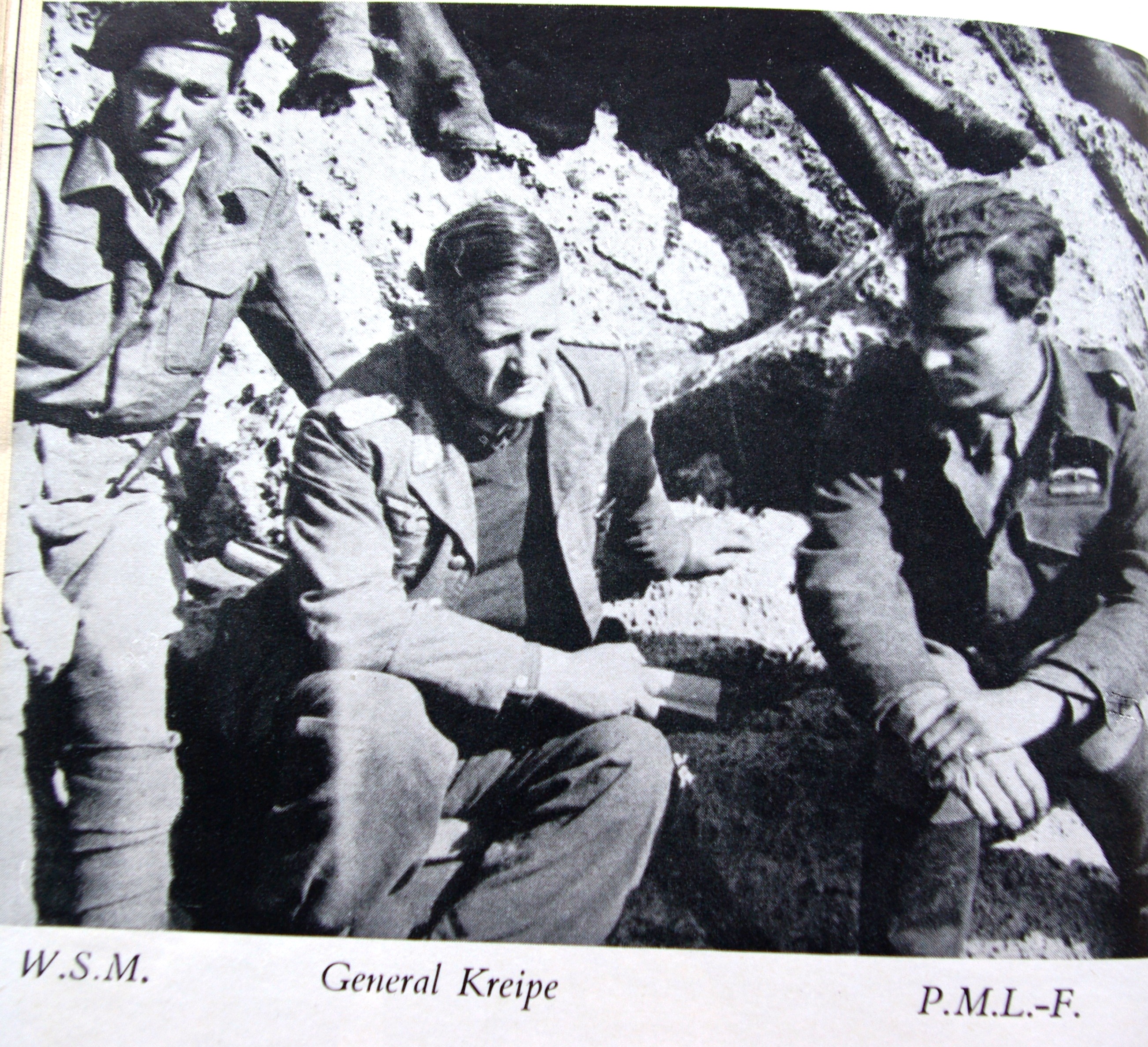
In fact it is, as Patrick Leigh Fermor admits, off all the standard maps. So too is Leigh Fermor. In 1933, aged 18, he set out to walk from the Hook of Holland to Constantinople (a journey which remains in a sense unfinished, for the third volume of his account of it has yet to appear). During the Second World War he took part in covert operations in Albania and in Crete, where he planned and carried out his celebrated abduction of the German General Kreipe.

He has written on places and subjects as various as the Caribbean and monastic life in Normandy. But Greece is his passion, and for nearly forty years he has lived there on the Mani, the middle prong of the Peloponnese.

Mani, his brilliant wanderings on that peninsula, deliberately involved the reader in ‘the luxury of long digression’. Digressions presuppose progression; in Roumeli – Mani ’s successor, which rambles Greece north of the Gulf of Corinth – there is none. The book visits the hills of Thrace, the monasteries of the Meteora, the cafés of Athens, the scene of Byron’s death at Missolonghi and the parched ravines of Aetolia. But these visits form no greater journey. They are disconnected probings into unknown corners, an odd-and-end odyssey, and the result is a collection of essays, a mézé of red herrings.

There is a ‘main theme’, we are told in the Introduction; but that theme, Leigh Fermor confesses, is ‘a private theory of my own’. The theory – ‘The Helleno-Romaic Dilemma’ – suggests, at some length, that the Greek psyche is a zone of perpetual conflict between the glory that had been Athens and the sorrow that was Byzantium (we can probably now add a third antagonist, the bore that is Europe). All late-night, third-bottle stuff, and hardly the normal matter of A-to-B travel books. But the delight of it all is that, via these disjointed jaunts around the mainland interspersed with mini-cruises in the glittering archipelago of Leigh Fermor’s mind, we get to know a lot about Greece.

The mind, like the land, never fails to surprise – with ideas, and with anecdotes. The one about getting thrashed at billiards by Byron’s ancient great-granddaughter and the subsequent hunt for the poet’s slippers has been deservedly anthologized. But there are more private memories as well, wartime scenes sharpened by danger, polished by moonlight, tempered by time. He recalls an earlier battle too ‘(which I had watched from an empty stork’s nest in the top of an elm)’. I envy him those nonchalant brackets and, even more, that surreal vantage-point. It is also one he adopts when writing, some mental equivalent of the stork’s nest that enables him to see things through to their illogical conclusion: ‘It was a wonder, I thought, as we rocked along under that burning-glass of a sky, that the curling tobacco leaves didn’t catch fire and smoke themselves there and then.’

The Greeks certainly had a word for Patrick Leigh Fermor: idiosyncratic. (Although there is, as it happens, a precedent for the tobacco conceit. The fifteenth-century Persian traveller Abd al-Razzaq noted that, as a result of the intense heat in Oman, the chase became a matter of perfect ease, ‘for the desert was filled with roasted gazelles’.) If idiosyncrasy cannot by definition be imitated, it can certainly inspire. It was another traveller, Freya Stark – whose publisher was also John Murray – who lured me to Arabia over twenty years ago, but it was Patrick Leigh Fermor who led me to write about it. He will keep me writing, and always envious. The works of Freya and the other great twentieth-century travel writers may capture genius loci; in Roumeli and its companions there is something more, unconnected with place – genius libri.

The one thing I envy Leigh Fermor more than any other is his sounds: the sound of names (‘names to make the hair stand on end’; Learish names – where is the Akhond of Swat beside Polycarp of Trikke and Stagoi?); the rhythm of lists; above all, non-verbal sound. In his final chapter, ‘Sounds of the Greek World’, all three come gloriously together in an aural gazetteer of the land he knows inside out and loves to distraction. It goes not from A to B but from A to Ω, dissolving along the way into poetry. It is impossible not to fall into the rhythm and emerge intoxicated.

It is also hard, now, not to wonder what remains of Roumeli: whether the Meteorite monks still cling to their rock pinnacles and the Kravarites of Aetolia remember the old beggars’ jargon; whether the Sarakatsáns, who led us into this unexpected landscape, still live between their summer and winter pastures. Transhumant, tented nomads in the EC? Perhaps only ghosts are left, and this book.

The Times Literary Supplement: Patrick Leigh Fermor

First published in The Times Literary Supplement, 6 July 2011

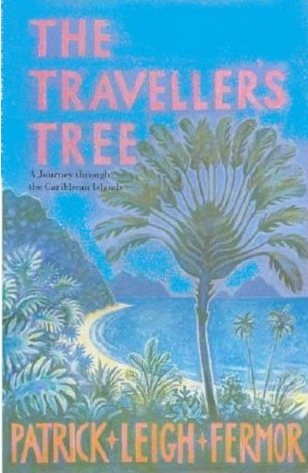
There was a time in the early 1950s when, upon arrival in the TLS office of a book about cannibalism or Voodoo, the editor would drop it in an envelope and say, “This is one for Paddy”. Patrick Leigh Fermor, who died last month at the age of ninety-six, is now best known for his connection to Greece and his youthful trek across Central Europe in the direction of Constantinople (as he insisted on calling it). But in his first book, The Traveller’s Tree, an account of a journey by schooner through the Caribbean islands published in 1950, he was in pursuit of “the whole phenomenon of Afro-American religion”. Before long, the TLS was commissioning the former mountain guerrilla fighter and Intelligence Corps Liaison Officer to write on related matters. He could open a review of a book on Haiti in 1953 by telling readers that “The bibliography of Voodoo – or Voudoun, as some purists insist, with little basis, on spelling it – mounts impressively”. A discussion of cannibalism in the correspondence columns of the TLS was just the sort of thing to elicit a contribution from Fermor: “Apropos of the recent letters about the ethical and culinary aspects of cannibalism, may I quote from a book I wrote years ago . . .”.

There followed a list of the gustatory advantages of various folk, according to the palates of the Caribs who “invaded the Caribbean chain, eating all the male Arawaks they could lay hands on and marrying their widows”. The book he wished to quote from was, of course, The Traveller’s Tree (it was by now 1980), which included this pre-Columbian version of a restaurant review:

“French people were considered delicious, and by far the best of the Europeans, and next came the English. The Dutch were dull and rather tasteless, while the Spanish were so stringy and full of gristle as to be practically uneatable.”

In later years, Paddy – as he was known to friend, reader and stranger alike – wrote for this paper on various topics, including Crete, scene of his wartime adventure. In the common run of Grub Street, there are many people one could call on to evaluate an anthology of nonsense – but Poiémate me Zographies se Mikra Paidia, which Paddy reviewed in 1977, was nonsense in modern Greek. In December 1979, he contributed a clamorous, ringing poem on the subject of Christmas:

What franker frankincense, frankly, can rank
in scents with fawn-born dawning
Weak we in Christmas week, lifetime a shriek-
ing streak – lend length and strengthen!
Poultice the harm away, charm the short
solstice day! Send strength and lengthen!

Among other curiosities we found on rooting through the archive was this plea from May 1968: “Patrick Leigh Fermor, author, traveller: biographical information, letters, personal reminiscences for biography”. The requester was J. Marder, writing from Athens. What became of it, and him? An authorized biography by Artemis Cooper is expected to appear at the end of next year.

We have received this “personal reminiscence” from a correspondent:

“In 2005, I was commissioned by a newspaper to write a profile of Patrick Leigh Fermor. A preliminary meeting took place at the West London home of Magouche Fielding, widow of Xan, PLF’s comrade-in-arms, but my editor insisted that no piece about Fermor could appear without a first-hand account of the house which he designed and helped build in the mid-1960s in Mani, at the southernmost tip of the Peloponnese. So it was that, after an overnight stay in Athens and a five-hour drive to the village of Kardamyli, I rang Paddy from a seaside pension.

“‘Good Lord. You’re here already!’ he exclaimed, though all proper warning had been issued. ‘Look here. Come to supper straight away. It’ll be a rotten supper. But come to supper straight away.’ Desiring nothing more than an ouzo followed by a soft pillow, I had the presence of mind to resist. Paddy was understanding. ‘Look here. Come to lunch tomorrow. It’ll be a much better lunch.’ Suppers and lunches, it transpired, were prepared by different maids.

“At about one the following day I set off for the two-kilometre walk from Kardamyli, with directions from a villager. ‘As the road bends to the left, you take the footpath to the right. Go through the olive grove, and arrive at Mr Fermor’s door.’ What could be simpler? There was indeed a bend in the road and a footpath to the right. But there was also another, closer to the bend, up ahead. Then another. After involuntary exploration of hitherto uncharted olive groves and what seemed a sizeable stretch of the Mediterranean coast, I squelched into Paddy’s house from the shore, to find him seated on the sofa reading the TLS. ‘Good Lord. I think you’re the only creature, apart from a goat, who has come in that way. We must have a drink straight away.’ The last was among his favourite phrases.

“Lunch lasted some six hours. (Lemon chicken, with litres of retsina or red Lamia.) Songs in various languages were sung, including a rendering of ‘It’s a Long Way to Tipperary’ in Hindustani. Lost lines of poems were sought. An anecdote about my lately deceased father and his claim to have seen salmon leaping in a narrow Perthshire stream, confirmed only after his death, threw Paddy into a search for the perfect epithet: ‘The corroborating salmon. The justifying salmon. The proving salmon’. Well into the evening, I prepared to leave. ‘Look here. Come to lunch on Sunday’ (this was Friday). I said I would on be on my way back to Athens. He was startled. ‘Good Lord. You’re leaving already? Then come to supper tomorrow.’ I did so, after an all-day hike in the Tagetos mountains which rear up behind the house that Paddy built, as the Gulf of Messenia opens before it. This time, I arrived punctually, to be admitted by the allegedly rotten cook (in fact supper tasted very good). She directed me to Paddy’s study in a separate building in the garden. I knocked before entering, to find him at his desk, alone in Mani on a late March evening, dressed in Jermyn Street shirt, pullover and grey flannels, reading a Loeb Horace. Towers of manuscripts could not obscure him. Among them, perhaps, was a draft of the third and concluding part of his epic walk from the Hook of Holland to Constantinople – the first, though not the last, heroic adventure of Patrick Leigh Fermor.”

The grandest family in publishing

Jock Murray in 1983 (Mercer photography)

A review of a book about Paddy’s publishing house – John Murray. They have quite a line-up of authors, including Jane Austen, Byron, Darwin, Freya Stark and John Betjeman, as well as Paddy.

Jeremy Lewis reviews The Seven Lives of John Murray: the Story of a Publishing Dynasty, 1768-2002 by Humphrey Carpenter

First published in The Telegraph 5 July 2008.

When I started out in publishing 40 years ago, most of the famous firms were fiercely independent, and were housed in elegant if often dilapidated Georgian houses in Bloomsbury, Soho or Covent Garden.

Some, such as André Deutsch or Hamish Hamilton, were run by their founding fathers; others were still family firms, of which Collins was the most muscular, and John Murray the grandest and most upper class.

Murray was famed as the publisher of Byron, Darwin and, more recently, John Betjeman, Kenneth Clark, Osbert Lancaster and Patrick Leigh Fermor; and it had the inestimable advantage of being housed at 50 Albemarle Street, a treasure trove crammed with Byronic memorabilia, marble busts and gold-framed portraits of eminent authors.

Six years ago, the firm was swallowed up by a giant conglomerate and it now operates from a tower block on the Euston Road; Humphrey Carpenter’s history of the firm, completed by other hands after his death in 2005, is an evocation of a vanished age.

Like many of the best-known publishing houses, Murray has strong Scottish connections – reflected most recently in the decision to sell its archives to the National Library of Scotland.

A former Marine from Edinburgh, John McMurray bought a bookselling business in Fleet Street in 1768, dropped the “Mc” in response to an outbreak of Scottophobia, and inaugurated the dynasty that ended with John Murray VII.

As Carpenter observes, “Bookselling and publishing do not necessarily involve the intellect or the imagination; the story of the Murrays is not chiefly about the life of the mind.”

John Murray I’s adage that “if you are able to entertain the ladies your business is done” remains as pertinent as ever, and although Byron berated John Murray II for being “shuffling” and “time-serving”, the family manifested all those qualities traditionally associated with publishers, in that, as Carpenter says, they were both “cautious and adventurous”, and “conservative and innovative at the same time”.

John Murray II was a much more respectable figure than his rakish father. He moved west to Albemarle Street, published Jane Austen’s Emma, rejected a clergyman’s Observations on Diarrhoea, and is best remembered for his turbulent relations with Lord Byron.

He worried about publishing Byron’s more risqué verses, but more often than not the businessman prevailed, and “my sordid propensities got the better of me”.

After the poet’s death, Murray masterminded the burning of his memoirs: he hadn’t read them, but was worried that they might contain references to anal intercourse and incest with his half-sister. Carpenter suggests that putting a match to them enabled Murray to cross the great gulf that separated the tradesman from the gentleman.

Succeeding Murrays liked to think that the memoirs had somehow survived, peering into cupboards and under floorboards in the hope of finding them.

During the 19th century, Murray published On the Origin of Species and travel books by, among others, Isabella Bird and David Livingstone. Fiction received short shrift, but as the firm became ever more established, with royal and aristocratic memoirs looming large, Humphrey Carpenter’s eyes began to glaze over and he found himself writing imaginative accounts of life in Albemarle Street; these have been retained as appendices to a book that is lively enough in its own right and has no need for fictional embellishments.

The revival of the firm in the last century was thanks to the bow-tied, bustling “Jock” Murray, who persuaded his cautious seniors to take on the best-selling Story of San Michele, put up his own money (100 shares in Bovril) to secure the rights to publish Betjeman’s Continual Dew, nudged Freya Stark into print, spotted the potential in Parkinson’s Law, and modestly declared that his “main claim to fame is that I am the only publisher who has typeset in the nude”.

No mention is made of the great diarist James Lees-Milne: a contemporary of Jock at Eton and Magdalen who came to the firm late in his career, he regarded Albemarle Street as his spiritual home, and wrote entertainingly about it.

John Murray VII sold the firm partly because he felt it was increasingly difficult for independent firms to survive, and partly because he didn’t want his sons to have to take up the burden of the family firm.

The Daily Telegraph suggested at the time that “there are fears that its identity could disappear”, and the John Murray of today is less “carriage trade” than it was, and indistinguishable from any other firm of publishers.

Spare And Sublime: A Monastery’s Spell Of ‘Silence’

Last summer I was struck by a severe case of wanderlust. I wanted urgently to be on my own in the woods, away from the radiating concrete and steel of New York in July. So I packed my bags and set out to the coast of Maine.

By Adam Haslett

First published on National Public Radio, 10 February 2011

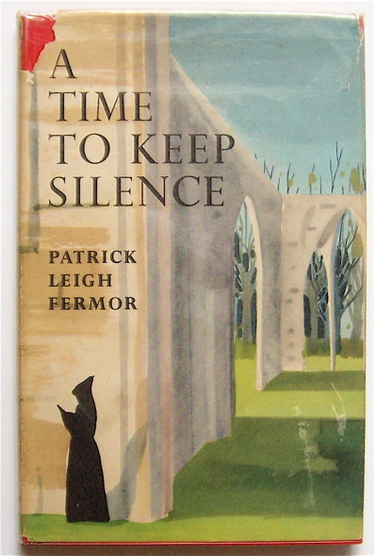
On the way, I stopped to see a friend, and when he heard the purpose of my trip — to step outside the daily round of distraction and obligation — he pulled a book off his shelf and suggested I might want to take it along for the journey. It was called A Time to Keep Silence by Patrick Leigh Fermor, and I quickly fell under its spell.

At a mere 95 pages, it is a short read, yet nothing about it makes you want to rush. In the mid-1950s, Fermor, an English travel writer who as a young man once walked from Holland to Turkey, became interested in the life of monks. He decided to visit several Benedictine and Cistercian monasteries in France. A Time to Keep Silence is the record of those visits and it accomplishes something that few books do: It replicates in style and rhythm the very experience that it seeks to describe. The writing is spare, exactingly precise, and then occasionally quite beautiful, just as the life of the monks we hear about are pared down, highly concentrated, and every now and then sublime. In short, it’s a book about the contemplative life that delivers the reader into a contemplation of his or her own.

When he first arrives at the Abbey of St. Wandrille de Fontanelle, Fermor is shown to his visitor’s cell. He writes, “a mood of depression and of unspeakable loneliness suddenly felled me like a hammer-stroke.” He is used to the world of entertainment and distraction, as most of us are, but all that has now ceased and there is nowhere for his nervous energy to go.

But after a few days amidst the silent rituals of the monastery, his mood changes. “There were no automatic drains, such as conversation at meals, small talk, catching trains, or the hundred anxious trivialities that poison everyday life.” Soon, “dreamless nights came to an end with no harder shock than that of a boat’s keel grounding on a lake shore.”

To read that beautiful, restful sentence is to experience a small piece of the restfulness Fermor himself found. When we say that a book transports us, this is what we mean. The music of the words themselves sing us into a different world.

I had my own time to keep silence in the woods in Maine last summer. I was lucky enough to have Fermor’s book along with me. We can’t all be monks, and most of us wouldn’t want to be, but the genius of excellent writing is that we can know something of what that other life is.

You can also listen to Adam reading the above here.

An eye for detail and the memory of the Hotel New York in Cluj

There is often a debate about Paddy’s ability to recall so much of his journey with accuracy so long after the event and often without his precious notebooks. Benedict Allen put him to the test at the Red Ox Inn in Heidelberg and the Romanian spa resort of Baia Herculene: Paddy passed that test with flying colours.

During one of my recent trips to Cluj I was able to enter the famous Hotel New York (now the Continental) during a small exhibition as part of the Transylvanian Film Festival. Immediately I reached for my copy of Between the Woods and the Water and turned to page 144 …

“An hotel at the end of the main square, called the New York – a great meeting place in the winter season – drew my companions like a magnet. István said the barman had invented an amazing cocktail – only surpassed by the one called ‘Flying’ in the Vier Jahreszeiten bar in Munich – which would be criminal to miss. He stalked in, waved the all clear from the top of some steps, and we settled in a strategic corner while the demon-barman went mad with his shaker. There was nobody else in the bar; it was getting late and the muffled lilt of the waltz from Die Fledermaus hinted that everyone was in the dining room. We sipped with misgiving and delight among a Regency neo-Roman décor of cream and ox-blood and gilding: Corinthian capitals spread their acanthus leaves and trophies of quivers, and hunting horns, lyres and violins were caught up with festoons between the pilasters.”

… and given the costume display, this next paragraph came to life for me as Angéla tries to disguise herself with a scarf Paddy and István suggested it might be better to turn into someone else:

“King Carol, Greta Garbo, Horthy, .. Groucho Marx … Queen Marie, and Charlie Chaplin; Laurel and Hardy, perhaps; one of the two; she would have to choose, but she insisted on both.”

Related article:

Angéla, Paddy, István and Tom in Cluj-Napoca

Review – The Traveller’s Tree: A Journey through the Caribbean Islands

The Traveller's Tree

Patrick Leigh Fermor, by turns youthful adventurer, linguist, classicist, and war hero, was the quintessential “gifted amateur” when he set out with two companions, in the late 1940s, to journey through the long island chain of the West Indies.

By Don Ryan

He was the ideal traveler, inquisitive, humorous, interested in everything. His budget, and curiosity for the lives of the Creole, disposed him to live among them, but introductions from home afforded him also time among the governors and administrators in colonial manor houses. His sense of history runs deep; he encountered 450-year-old cultures which he calls young. He reminds us how everything is connected by time’s threads and sinews.

Fermor was observant of architecture and of fashion and influence. He knew how to notate music and sings us overheard melodies and recites the latest Calypsos. He shows immense empathy for the Negroes and gives a long and sympathetic description of Haitian Voodoo – but is skeptical about Jamaican Rastafari. His ear for language heard the connections with West Africa.

This is a complete and evocative a description of a culture, of an archipelago of cultures, as I have ever read. But a word of caution: if you are planning a trip to the Caribbean, this is not a guidebook to take. This is to read if you will never be able to go. – Don Ryan

Geographically, the Caribbean archipelago is easy to split up into component groups….

No such brisk summing-up can be formulated for the inhabitants of these islands: the ghostly Ciboneys, the dead Arawaks and the dying Caribs; the Spaniards, the English, the French, the Dutch, the Danes and the Americans; the Corsicans, the Jews, the Hindus, the Moslems, the Azorians, the Syrians and the Chinese, and the all-obliterating Negro population deriving from scores of kingdoms on the seaboard and hinterland of West Africa. Each island is a distinct and idiosyncratic entity, a civilization, or the reverse, fortuitous in its origins and empirical in its development. There is no rule that holds good beyond the shores of each one unless the prevalence of oddity, the unvarying need to make exceptions to any known rule, can be considered a unifying principle. The presence of religious eccentrics like the Kingston Pocomaniacs and the adepts of Voodoo in Haiti and the survival of stranded ethnological rock-pools like the Poor Whites in the Islands of the Saints or the semi-independent hospodarate of the Maroons of the Jamaican mountains – all this, and the abundance and variety of superstitions and sorceries and songs, of religious and political allegiances, and the crystallization of deracination and disruption into a new and unwieldy system, almost, of tribal law – all this excludes any possibility of generalization.

The skipper heaved the sloop’s bowsprit round and pointed it at the fading silhouette of St Eustatius. The wind was piercingly cold, and as the ship leapt forward, we dug out a half-empty bottle and lowered comforting stalactites of whisky down our throats. Night fell, and the rain stopped. The heads of the Negroes, who had all taken refuge under a tarpaulin like some tremendous recumbent group of statuary before its unveiling, began to appear again round the edge. The two nearest to us were talking to each other in an incomprehensible language that was neither pidgin English nor Creole. Many of the words sounded like Spanish, but the flow of the language was suddenly thickened by noises that were guttural and uncouth. Seeing that I was listening, one of them whispered, |Papia poco poco bo tende?’ and their voices dropped. But I understood, with excitement, that they were talking Papiamento, that almost mythical compound of Spanish, Portuguese, Dutch, French, English and African dialects evolved by the slaves of Curacao and the Dutch islands of the Southern Caribbean.

Related category:

More posts about The Traveller’s Tree


Sir Wanderlust – Portrait von Patrick Leigh Fermor

Here are two more articles from Germany supplied to me by Christian Peters from Koln.

Sir Wanderlust vonWolf Reiser, first published in Travellers World

Travellersworld-Sir Wanderlust-1

Die Heimat der Nomaden, first published in Süddeutsche Zeitung

SZ-MANI-REISER


A review by Paddy of Artemis Cooper’s book Cairo in the War

Artemis Cooper’s introductions and accompanying text to Duff and Diana Cooper’s published letters, A Durable Fire (1983), and to Lady Diana’s Scrapbook (1987), had a strong dash of her grandmother’s humour and lightness of touch; but only a most clairvoyant critic could have predicted Cairo in the War, 1939–1945. Her account, though it sticks punctiliously to fact, is as hard to put down as good fiction . The research is wide, detailed and scrupulous. She lays hold of the military background – the dramas unfolding just off-stage, but threatening to break out of the wings at any moment – with a soldierly grasp; and she seems to have talked at length with all the surviving dramatis personae.

By Patrick Leigh Fermor

First published in The Times Literary Supplement 1 September 1989 (republished online 15 June 2011)

Unleavened by personalities, military history can be heavy on the hand, and politics too, once the urgency has gone. The author’s skill redeems them both. As for the complex country and people on whom the war had impinged, she has segregated the strands with great discernment – the Copts, the Arabs, the Mamelukes, the Ottomans, all the sects and enclaves of the Mediterranean and the Levant, the Helleno-Judaeo-Ptolemaic nexus of Alexandria, the fellahin and the effendis and the nationalists, the rivalries of the Western European powers, with their local allegiances and clients and phobias, and, above all, the reigning Albanian dynasty and the predominating British presence and tutelage.

The author is particularly helpful and fair about the tensions between the last (in the persons of the young King Farouk and the proconsular Ambassador, Sir Miles Lampson), which culminated with British tanks all round the Palace, near-abdication and an enforced change of government: the German advance in the desert was the raison d’état. The enemy was held and driven back; certain froideurs remained at the top; but, astonishingly, the surface of the luxurious, dazzling and hospitable social life was hardly ruffled. At times this resembled the Duchess of Richmond’s ball before Waterloo, at others the Congress of Vienna: “The Kings sit down to dinner and the Queens stand up to dance . . .”. The pool at the Gezira Sporting Club sluiced hangovers away, the willow smacked the leather, polo-balls whizzed there all afternoon, and roulette-balls plopped at the Mohammed Ali after dark. There were enticing restaurants and enterprising night-clubs, party followed party and bedtime often coincided with the first muezzin’s call from the minaret of Ibn Tulun. Guilt about rationed London bit sharp now and then, but for those on short leave from the Desert, not deep.

Among the missions and staffs and the permanent officials, intrigue and gossip were as intense as in Mrs Hauksbee’s Simla. The author is eerily well informed about Groppi’s Horse and the Short-Range Shepherd’s Group and, a fortiori, about GHQ at Grey Pillars and SOE at Rustam Buildings (particularly the latter) and all the cross-currents, promotion-mania and the clashes – eg, “Bolo” Keble and Fitzroy Maclean – the political schisms of Southern Europe and their repercussions in Egypt. The pages on spies and counterespionage and raiding forces are one of the most impressive parts of the book.

The author is perceptive about the frustrations and amusements of all ranks of the assorted armies. There were shaming moments, but on balance it seems that arrogant behaviour towards the Egyptians may have been more frequent among the commissioned than the other ranks. In the case of a pasha who was insulted beyond endurance by a very drunk officer, nemesis was brisk and condign. The oblivious offender was inveigled to the pasha’s house. Most would have kept quiet, Artemis Cooper observes, but he was soon telling everyone, “You’ll never guess what happened to me last night — dashed unpleasant. I got buggered by six Nubians.”

In spite of the strains on high, the diplomatic world, the military, the cosmopolitan, the purely decorative and the intellectual interwove to a surprising degree, and lasting friendships were formed. The contribution of Greeks such as Seferis, and transplanted Greece-addicts like Lawrence Durrell and Robin Fedden, were important here. Poets and writers teemed, and Personal Landscape, the Nilotic equivalent of Horizon, was impressive. The author unfolds the catalogue of personalities with humour and understanding, though she is unduly dismissive of Sir Charles Johnston: cf his sonnet “The Lock”, and his Pushkin translations. The only omissions I can spot are Elizabeth David, the painter Adrian Daintrey and the writer-painter Richard Wyndham. Perhaps she should have included an eccentric cavalryman called Colonel Wintle, who got into hot water for taking a surrendered Italian general to luncheon, in full uniform, at the Turf Club.

The book ends with the calamitous post-war aftermath. Like the abstruse anecdotes, the range and choice of the photographs will promote sighs of delighted recognition and occasional ground teeth, and it is hard to think, on finishing, how this demanding book could have been handled better, more lucidly or more entertainingly.

Related articles:

Sophie Moss Obituary from Daily Telegraph

One Man’s Great Game: Lieutenant Colonel “Billy” McLean

Lawrence Durrell and Patrick Leigh Fermor by Thos Henley

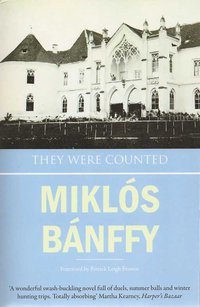
The Phoenix Land: The Memoirs of Count Miklós Bánffy

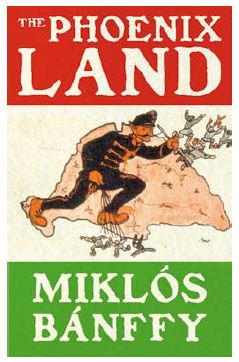
A reminder that Arcadia Books will be republishing Count Miklós Bánffy’s memoirs “The Phoenix Land” in June 2011. The book is already available for pre-order in bookshops such as Waterstones in the UK. and of course on Amazon. Arcadia first published this in 2004 and you can read a Spectator review here.

Bánffy’s memoirs were translated from the Hungarian by his daughter Katalin Bánffy-Jelen and Patrick Thursfield,winners of the Oxford Weidenfeld Translation Prize. Paddy once more offers a foreward. The blurb describes the book as follows:

“The thousand year-old year-old kingdom of Hungary, which formed the major part of the Austro-Hungarian Empire until the last Habsburg fled in 1918, was finally dismembered by the Western Allies by the terms of the peace treaties which followed the First World War. Phoenix-like the Hungarian people survived the horrors of war, the disappointment of the first socialist republic, the disillusion of the brief but terrifying communist rule of Béla Kun, and the bitterness of seeing their beloved country dismembered by the Treaty of Trianon. This is the world that Miklós Bánffy describes in The Phoenix Land.”

I contacted Gary Pulsifer at Arcadia for some further background and to ask him to explain more about why Bánffy is one of their authors. He sent me this, including a little vignette about Paddy and the writing of his introduction:

Tom, two reasons, one general, one specific. The first is that Arcadia specialises in translated fiction. The second is the story and this is it:

When I worked at Peter Owen Publishers I was invited to Tangier by the Hon David Herbert, one of Peter’s authors. He took my partner and me to lunch with his neighbour Patrick Thursfield, who as you know is the Bánffy co-translator. After lunch Patrick gave me the manuscript of THEY WERE COUNTED, which I read while I was on holiday, and was hooked. I tried to persuade Peter Owen to publish the trilogy, but no go, so when I started Arcadia in 1996 volume one was one of our early titles. I became quite close to Patrick, stayed with him in Tangier and saw a lot of him in London and he even once came along to the Frankfurt book fair. He was overjoyed when THEY WERE DIVIDED won the Weidenfeld Translation Prize (this happened at an awards ceremony in Oxford, when Umberto Eco presented the prize).

A funny aside is that Paddy’s forward was written in longhand and he came into our tiny offices to have Daniela de Groote, now our associate publisher, word-process it. Daniela, who is Chilean, hadn’t been in the UK all that long – she had been studying for a PhD here prior to working at Arcadia – and she had some difficulties in understanding Paddy’s upper crust accent as he dictated the foreword. Daniela was also catching a plane to Santiago that afternoon and the whole thing was a little much for her. So much so that I had to leave the office until they were finished . . .

Xan Fielding Obituary

I am reposting this obituary to Xan Fielding at this time as he was Paddy’s very good friend, the one to whom Paddy wrote his open letters at the start of A Time of Gifts and Between the Woods and the Water. Those who have found this site for the first time might wish to read about his friend. At the end is a special tribute written by Paddy.   I believe this to be the only on-line copy and it now includes newly discovered photographs.

==============================================================

After much searching I can bring you what I believe to be the only on-line obituary to Xan Fielding which I have retyped from the Daily Telegraph Second Book of Obituaries: Heroes and Adventurers. This includes a special tribute from Paddy to one of his closest friends.

First published in the Daily Telegraph 20 August 1991

Xan Fielding, the author, translator, journalist and adventurous traveller, who has died in Paris aged 72, lived a charmed life as a Special Operations Executive agent in Crete, France and the Far East during the Second World War.

Short, dark, athletic and a brilliant linguist, he was God’s gift to operations in rugged mountainous regions and wherever his languages were needed.

Major Fielding was awarded the DSO in September 1942, “for going into a town”, as he said later with a typical modesty.
He had a boyish, slightly rebellious spirit which he shared with many of his contemporaries in SOE. His self-confessed, or self-proclaimed, amateurishness certainly belied a tough professionalism, great resourcefulness and bravery in action. Fielding was the sort of man one would be happy to go into the jungle with.

While still in his early twenties he was responsible for clandestine and subversive activities in large areas of enemy-occupied Crete. He survived numerous encounters with German forces, only to be rumbled by the Gestapo in France towards the end of hostilities in Europe.

Even then his luck held. Locked in a death cell at Digne in 1944, he was “sprung” in an audacious move by Christine Granville (nee Krystyna Skarbeck) whose SOE exploits matched his.

Alexander Wallace Fielding was born at Ootacamund, India, on November 26 1918. His family had long links with the Raj and his father was a major in the 50th Sikhs.

Xan’s mother died at his birth and he was largely brought up at Nice, where his grandmother’s family had considerable property. Fluent in French, he subsequently became a proficient classicist at Charterhouse and then studied briefly at Bonn, Munich and Freiberg Universities in Germany. He saw what was happening in that country and was so shocked at the attitude of the Chamberlain government that he came close to joining the Communist party.

At the end of the 1930s Fielding – who had recently been sacked as a sub-editor on the Cyprus Times and was by now unsuccessfully running a bar – found himself a misfit in the Mediterranean colony. Colonial officials abhorred his refusal to adopt their disdainful description of Cypriots as “Cyps”. That he was also reasonably fluent in Greek rendered him suspect to district commissioners, who could not speak the language of the people they administered.

At the outbreak of the Second World War, haunted by the thought that he might find himself trapped in Cyprus for the duration, he fled to Greece and found asylum on St Nicholas, an island owned by the anthropologist, Francis Turville Petre. Fielding dreaded not so much the battlefield as joining the conventional officers’ mess. But eventually news of the fall of France, the Dunkirk evacuation and the Battle of Britain induced a “stab of guilt”.

He returned to the colony and was commissioned into the Cyprus Regiment, which appealed to him on account of its perverse refusal to have any regimental pride.

On hearing in Cairo that Cretans had taken up arms against the Germans, he yearned, as he wrote later, to help lead “this concerted uprising of the technically non-combatant”.

When Crete fell, Fielding was interviewed in Egypt by SOE. He was asked: “Have you any personal objection to committing murder?” His response being deemed acceptable, Fielding was put ashore in Crete with a load of weapons and explosives by Cdr “Crap” Miers, VC, skipper of the submarine Torbay.

Fielding, who had adopted the style and dress of a Greek highland peasant, was accompanied by a First World War veteran, who was inseparable from his solar topee and unrecognisable as the village schoolmaster he was supposed to impersonate.

Fortunately it was not long before he teamed up with the far more kindred spirit of Patrick Leigh Fermor. Sporting a royal blue waistcoat, lined with scarlet shot silk and embroidered with black arabesques – and singing folk songs in several languages – “Paddy” Leigh Fermor enlivened their meetings in desolate mountain hideouts.

Fielding understood the need for reliable intelligence and communications, and he daringly set up his headquarters near Crete’s northern coastal road in the proximity of German units. He experienced, as he put it, a childish excitement in “brushing shoulders with the Wehrmacht” in the corridors of the town hall when calling on the mayor of Crete’s capital, Canea. And he found it entertaining to attend parties given for the Germans by Cretan associates feigning fraternisation.

Operationally, Crete had become a massive transit camp to reinforce the Afrika Korps. Among his intelligence successes Fielding signalled the timetable of transports taking off from the airfield at Maleme, enabling the RAF to intercept them.

After six months he was picked up by a Greek submarine and given a breather in Cairo. This gave him a chance to niggle about the inaccuracy of RAF air drops.

As a result Fielding was invited to observe, from the front turret of a Wellington, a drop arranged for Leigh Fermor high up in the White Mountains. Considerably shaken by the experience – not least the anti-aircraft fire- he returned to the island by Greek submarine at the end of 1942 and never complained again.

Following the Crete mission, he parachuted into the south of France in the summer of 1944. Bearing papers announcing him as Armand Pont-Leve, a young clerk in the Electric Company of Nimes – but codenamed “Cathedrale” – Fielding was received by Francis Cammaerts (alias “Roger”) and also by Christine Granville.

Fielding found them an “imposing pair”. Still in uniform, he felt “rather like a novice in the presence of a prior and prioress”. The canister containing his civilian clothes, with poison pill sewn into the jacket, was missing and he felt something of a freak in the baggy Charlie Chaplin trouserings produced by “Roger”.

Shortly afterwards he was in the Cammaert’s car when it was stopped at a road block near Digne. Questions revealed that SOE staff in Algiers had failed to stamp a current date on his otherwise impeccable papers. Worse Fielding had split a large sum of French money between “Roger” and himself, and the enemy twigged that the notes were all in the same series.

Christine Granville was not with them and news of their arrests reached her on the Italian border. Earlier she had been arrested, but had managed to convince her German interrogators that she was a local peasant girl.

She arrived at Digne prison and passed herself off as “Roger’s” wife – and, for good measure, as a niece of Gen Montgomery. She persuaded an Alsatian named Albert Schenck, a liaison officer between the French prefecture and the German Siercherheitsdienst, to co-operate by reminding him that the Allies had already landed on the Riviera.

Schenck put Christine on to a Belgian, Max Waem, who agreed to help, though his price was two million francs. SOE in Algiers dropped the money in. As a result Fielding and “Roger” were led out of prison. Believing themselves on the way to be shot, they were astonished to be welcomed by Christine who was waiting with a car.

Fielding was awarded the Croix de Guerre in France in 1944. Before the war in Europe ended, he returned to Crete; he was one of the first into liberated Athens.

During the war Fielding would often pass through Cairo, which became a sort of SOE headquarters for the Mediterranean and Middle East, and meet up with kindred spirits such as David Smiley, “Billy” McLean (qv), Peter Kemp (qv) and Alan Hare. In 1945 they decided the place to be was the Far East. As Fielding put it: “I was at a loose end and wanted to see what was going on out there.”

He spent some months in Cambodia, with a Japanese driver fighting the Vietminh. Then came as six-month stint with the Special Intelligence Service in Germany, and an appointment as United Nations observer in the Balkans.

Peacetime, though, brought disillusionment and a disturbing sense of misgiving. But in 1948 an encounter with the Marchioness of Bath at what she described as an “hilarious lunch” predestined the course of much of the rest of his life. She had recently taken up photography in place of painting; he was planning a book on Crete. The upshot was that Daphne Bath accompanied his return to the White Mountains to illustrate the book. They married in 1953.

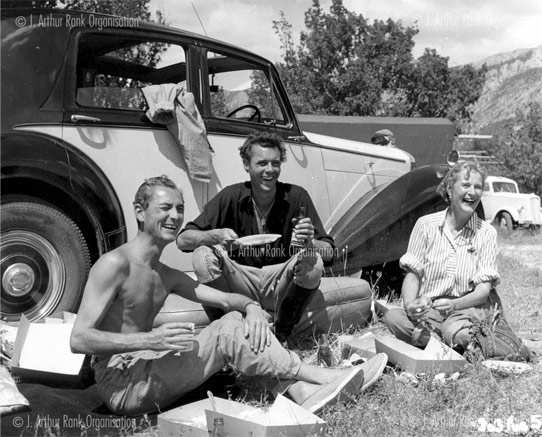
Xan and Daphne Fielding with Dirk Bogarde on the set of Ill Met by Moonlight

Soon there was another and more welcome distraction. Michael Powell was filming Ill Met by Moonlight – the story of Paddy Leigh Fermor’s wartime abduction of Gen Kreipe, the German commander in Crete – and Fielding was hired as technical adviser. Dirk Bogarde played Leigh Fermor and Fielding lent him his Cretan guerrilla’s cloak and coached him in the part.

Patrick Leigh Fermor writes: After an early essay at painting, Xan Fielding wandered to Greece and the islands, added Greek to his list of languages and acquired a lasting attachment to the Greeks.

His life took on an adventurous and peripatetic turn. Early in 1942 he was landed in plain clothes and by submarine in German-occupied Crete. Germany was in full advance on all fronts and Crete was a strongly galvanised Luftwaffe base for the Desert War. The mountains were full of stray British and Commonwealth soldiers who had broken out of PoW camps or been left behind after the Battle, a mortal danger to the Cretans who hid and fed them.

Gathering and evacuating them from remote caves was among Xan’s first tasks. Establishing a network of agents and signalling information back to Cairo came next followed by parachute drops to the growing guerrilla bands and the e organisation of sabotage, and propaganda while maintaining liaison with the island Resistance leaders.

Light and fine-boned when suitably cloaked and daggered, Xan could be taken for a Cretan. With his determination, humour and intuitive sympathy and his quick mastery of dialect and songs, he made countless friends, and worked there precariously for two years.

In 1944, the war moving west, he was dropped in the Vercors region to the French maquis. He returned to Crete for a final two months before the liberation, then headed for Cambodia on further SOE missions and spent some time on the Tibet border before returning to the West Bank in Greece.

Xan commanded a mixed Allied unit supervising the 1946 elections, and during prolonged leave in Rhodes, his friend Lawrence Durrell – who was press officer there – insisted on printing a set of Fielding’s poems, which make one wish he had written many more. Chafing at Oxford life as a demobilised undergraduate, he worked for a spell with the Beaverbrook Press and found it even less congenial.

These years were perplexed by tangled Dickensian lawsuits in Nice: family property had been unrecoverably misappropriated in the occupation. During that harassing time he wrote Hide and Seek, an exciting account of his experiences in Crete.

Soon after he married Daphne Bath, and they travelled all over the island (of Crete) for his long book The Stronghold, a combination of travel and history.

They first settled in Portugal. Then a long sojourn in the Kasbah of Tangier – perhaps inspired by the film Pepe le Moko – gave rise to his book Corsair Country, the history of the pirates of the Barbary Coast.

Near Uzez in Languedoc, their next long halt, his excellent French suggested translation as a profession and he put more than 30 books into English, including many by Larteguy and Chevalier, and Malrauz’s Les Noyers d’Altenborg [Ed: and perhaps better known Planet of the Apes and Bridge on the River Kwai]

After a friendly separation from Daphne he married Agnes (“Magouche”) Phillips, daughter of Adml John II Magruder, of the United States Navy. They were extremely happy.

Xan and Magouche took root in the Serriana de Ronda, which looks across Adalusian ilex-woods to the Atlas. There he edited the correspondence of his friend and neighbour, Gerald Brennan, with Ralph Partridge, and continued his translations.

Xan’s own book, The Money Spinner, about the Monaco casino – the hazards of gambling had always fascinated him – came out in 1977. Later, Winds of the World gave free rein to his interest in atmospheric commotions and their mythology.

In the winter of 1990 One Man and his Time appeared; it described the life, and the Asian, Ethiopian and Arabian travels, of his old friend “Billy” McLean (qv), the wartime commander of the SOE mission in Albania.

At almost the same time Xan was smitten by cancer and he and Magouche moved to Paris for therapy. Though fatally stricken for the last eight months, he was suddenly, three months ago, granted a reprise which exactly coincided with the ceremonies for the 50th anniversary of the Battle of Crete and the Resistance.

At a special parade of the Greek navy at Souda, he and six Allied officers were decorated with the commemorative medal of the Resistance, and for 10 days he visited scores of mountain friends from 50 years before. His return was everywhere greeted with feasting and songs.

Xan Fielding was a gifted, many-sided, courageous and romantic figure, deeply committed to this friends, civilised and bohemian at the same time, with a thoughtful style leavened by spontaneous gaiety and a dash of recklessness. He was altogether outstanding.

August 20 1991

Audible

Anthony Lane’s New Yorker article on Fermor is now free to view

Anthony Lane's New Yorker article, May 2006

In trying to make this blog a focal point for all information related to Paddy I have had some problems accessing all on-line material. The one I most sought is the acclaimed May 22, 2006 profile by Anthony Lane which was published in the New Yorker.

This has sat behind their subscriber firewall, tempting us with one-off subscriptions. Now it appears that (possibly marking Paddy’s death?) this is no longer the case. You can now visit their archive, read the article in full on-line, print it or possibly even download it.

There are many profiles of Paddy. This is probably one of the longest and best, and includes interview material with him that many will have not seen before.

Take a trip to the New Yorker website and have a read.

Editor’s Note:  the pdf download appears to be no longer available – click on the article to magnify to read and then drag your cursor to move around the page.

Benedict Allen’s Travellers’ Century on Patrick Leigh Fermor

This is from the television review pages of the Independent covering Benedict Allen’s 2008 ‘Traveller’s Century’ series and the episode that focused on Paddy’s walk ending at the Iron Gates. I have seen this programme and share some of the frustrations of the author, but on balance it was a pretty fair programme given the tight time slot of just one hour.

by Deborah Orr

First published in The Independent 8 August 2008

The bit that delighted us all in this final episode of Travellers’ Century was a clip from another television show. There he was, Patrick Leigh Fermor, the star of the Greek version of This Is Your Life, meeting all the resistance fighters that he had worked with on Crete during the Second World War. And there, unbelievably, and every bit as thrilled to be reunited with Leigh Fermor as all the others, was the German former general Heinrich Kreipe. The two men grinned, hugged and fell into excited conversation, absolutely chuffed to see each other again. That is charm, is it not, the ability to inspire the deep affection of a man you only ever knew because you had spearheaded his humiliating wartime capture, then imprisoned him in a cave? A man, indeed, who was then portrayed in the film of the operation, Ill Met by Moonlight, as a bull-necked, grunting, Nazi ugly, while his nemesis was played by Dirk Bogarde?

I’ve been lucky enough to meet Leigh Fermor – dazzlingly charismatic company in his nineties – on a couple of occasions. So it seemed apposite to gather round the telly with the mutual friends who introduced us, so that we could all watch this film about his life together. Such is the fervour of loyalty that the man inspires, though, that it quickly became apparent that this show, or perhaps any show, would disappoint us. The first heckles came when Benedict Allen described Leigh Fermor as “the accidental superstar of travel writing”, a description we all decided would make him squirm. Concerns over tone were swiftly replaced with outright indignation, when Allen announced that he would be retracing the steps of Leigh Fermor’s first great walk across Europe, which he set off on in 1933, aged 18, in order to judge whether his descriptions had been “accurate”. This idea, again we all agreed with some disgruntlement, was facile beyond belief.

Allen’s idea was perhaps not such a weird one, though. Leigh Fermor’s book detailing the first leg of his journey had been published in 1977, after all, decades after he had made it. The delay had come about because his notes had been stolen in Romania. Again, it is testament to the affection he inspires that the local people who recovered the young Englishmen’s journal hung on to it in the hope that they would one day get the opportunity to return it to him. We all abhorred Allen’s attitude, nevertheless. When he suggested that Leigh Fermor’s two books describing his travels, A Time of Gifts and Between the Woods and the Water, might have been “endlessly worked and reworked, with whole decades of hindsight”, there was a generally mutinous feeling in the room that our man was being seriously impugned.

Allen regained a little trust when he decided, having visited some little-altered spots in Heidelberg, that the writer had indeed told it like it was. But when Allen changed his tune, and started suggesting that the books were weirdly apolitical, and offered too little detail about his own inner life, we sank again into despondency. The purity of Leigh Fermor’s writing comes from his scrupulous observation of what he encountered, and the beauty with which he describes it. He doesn’t bang on about himself. Anyway, on it went, as we nit-picked every assertion. By the time Allen got to interview Leigh Fermor, at his home of very many years in the Peloponnesus, we hated and resented him, and were only too happy to dismiss the interview itself as a dead loss. “And the programme was too long,” we agreed at the end. “If we thought that, what did everyone else think?” Actually “everyone else” would probably have enjoyed the thing a great deal more, not being hampered, like us, by an almost deranged sense of hyper-loyalty.

Ox Travels: Meetings with Remarkable Travel Writers

Read some great travel stories by some of the best travel writers, including Paddy’s account of the Black Sea cave, and help Oxfam projects at the same time. Introduction by Michael Palin.

As the Oxfam website says ….

“OxTravels is our fantastic new compilation of short travel stories, produced in collaboration with Profile Books and Hay Festival.

When Britain’s most lively, critical and thought-provoking travel writers are asked to recall a significant encounter – one that has enriched them as a writer – the result is a book that will broaden everyone’s horizons. In the words of Michael Palin, who introduces the book, “It’s impossible to read their contributions without wanting to go and get the rucksack out.”

OxTravels has a stellar line-up of contributors. Featuring stories from Paul Theroux, Patrick Leigh-Fermor, Colin Thubron, Dervla Murphy, Chris Stewart, Victoria Hislop, William Dalrymple and thirty other leading travel writers.

Its RRP is £9.99, but Oxfam shops have a special price of £8.99! All the writers have donated their royalties to Oxfam and all proceeds go towards funding Oxfam’s work fighting poverty and suffering around the world. Ox-Tales, OxTravels’ predecessor, raised more than £130,000 for our work!

For a review of Ox Travels click here.

Related article:

The mystery of the Black Sea cave 

Pre-ordering Artemis Cooper’s biography of Patrick Leigh Fermor

Artemis Cooper

Just a quick note to regular readers and those who search for this book – there are many Google searches for this proposed biography.

It came to my attention that a book called Biography of Patrick Leigh Fermor by Artemis Cooper and Antony Beevor is due to be published by Penguin in September 2011. At least that is what it says on Amazon and a number of on-line book sites.

I contacted Amelia Fainey who is Publicity Director for Penguin books as my belief was that the agreement (and if I recall correctly actually mentioned in In Tearing Haste) is that the book will be published after Paddy’s death.

Amelia responded thus:

Hello

I’m afraid we don’t have a date scheduled for this yet – possibly 2013 – certainly not this September!

A

So, if you were hoping for a book this autumn you will have to wait …. at least two years, and I suspect a lot longer than that.

Related article:

A biography of Paddy by Artemis Cooper?
Artemis Cooper talks about Words of Mercury

Obituary: Jock Murray

Jock Murray in 1983 (Mercer photography)

by Patrick Leigh Fermor

First published in The Independent 24 July 1993

John Arnaud Robin Grey (Jock Murray), publisher: born 23 September 1908; MBE 1945, CBE 1975; Senior Director, John Murray 1968-93; married 1939 Diana James (two sons, two daughters); died London 22 July 1993.

JOCK MURRAY took such trouble about his authors, and in so many ways, and so unobtrusively, that perhaps they – or we , for I am one of them – were inclined to take it for granted, writes Patrick Leigh Fermor. But not quite: other publishers at home or abroad – not that I know much about them as I have only had one – would remind us now and then of our luck and our spoiled and privileged estate. This was because of Jock’s passionate interest in the work of his authors, his great kindness, and his gift for friendship. Nobody, in the Doctor Johnson sense, kept his friendships in a state of better repair.

It is hard to think of a more apt setting for him than No 50 Albemarle Street, with its beautiful rooms, and portraits and books and cases of mementoes, and its mixture of archaic style and informality, of activity and unhurried leisure. The traditions of Byron’s friendship with Jock Murray’s ancestor played a great part in the life of No 50, and the poet’s spirit seems to pervade those rooms. Looking through typescript, then galleys then page proofs there with Jock was a great delight. Especially when they were tossed aside to make room for tea or sherry or whisky and soda, and Osbert Lancaster on the way back from drawing his daily caricature would wander in full of marvellous gossip; or Kenneth Clark with an armful of illustrations or John Betjeman with news of a new Early English discovery in some remote Fenland parish – could they talk about it with John Piper? (Betjeman and Jock shared an expert knowledge of campanology.)

Cannon Lodge, halfway between Hampstead Heath and a slender steeple, with its Keats’-eye view of all London, had a similar uncontemporary charm. At the end of a day of last- minute corrections, under one of the tall trees, or by a blazing fire, any of the above might come to dinner, or Freya Strak fresh from Asia Minor, Ruth Jhabvala from Rajasthan or Dervla Murphy from the Andes and, very often, Jock and Diana’s favourite neighbour, Peggy Ashcroft.

Jock and Diana came several times to Greece and it was a great surprise to discover that Jock was an accomplished tree surgeon: one glance at an ailing growth would send him shinning up into the branches and putting things most knowledgeably to right with saw, twine, bast and tar.

Five weeks ago we were talking about the ravages of time that we noticed in ourselves and he said, halfway between a sigh and a laugh, ‘Yes. Old age is not for sissies.’ He confronted his own with great Stoicism, and leaves us all diminished.

The Phoenix Land: The Memoirs of Count Miklós Bánffy

I am just ten tantalising pages away from the end of Miklós Bánffy’s Transylvanian Trilogy (They Were Counted, They Were Found Wanting and They Were Divided) published by Arcadia books. If I have time I will write a short review very soon.The books are lively, and Bánffy writes so well about love, life, and politics in Transylvania and Hungary in the ten years leading up to the start of World War One, an event which was to tear apart the lives of so many, and which ended the comfortable existence of Hungarian aristocracy in Transylvania.

The story will almost certainly end in tragedy and sadness but that does not deflect from from what Patrick Leigh Fermor describes in his foreward to the Trilogy as a story that is “beyond question, dramatic.”.

One cannot read these books without wanting to know more about the author whom Paddy characterises as “such a deeply civilised man.”

The good news is that very soon we shall be able to do so once more when Arcadia Books re-publish Bánffy’s memoirs “The Phoenix Land”. Due for publication on 23 June 2011 the book is already available for pre-order in bookshops such as Waterstones in the UK. Arcadia first published this in 2004 and you can read a Spectator review here.

Bánffy’s memoirs were once again translated from the Hungarian by his daughter Katalin Bánffy-Jelen and Patrick Thursfield,winners of the Oxford Weidenfeld Translation Prize. Paddy once more offers a foreward. The blurb describes the book as follows:

The thousand year-old year-old kingdom of Hungary, which formed the major part of the Austro-Hungarian Empire until the last Habsburg fled in 1918, was finally dismembered by the Western Allies by the terms of the peace treaties which followed the First World War. Phoenix-like the Hungarian people survived the horrors of war, the disappointment of the first socialist republic, the disillusion of the brief but terrifying communist rule of Béla Kun, and the bitterness of seeing their beloved country dismembered by the Treaty of Trianon. This is the world that Miklós Bánffy describes in The Phoenix Land.

In preparing this post I contacted Gary Pulsifer at Arcadia for some further background and to ask him to explain more about why Bánffy is one of their authors. He sent me this, including a little vignette about Paddy and his introduction:

Tom, two reasons, one general, one specific.  The first is that Arcadia specialises in translated fiction. The second is the story and this is it:

When I worked at Peter Owen Publishers I was invited to Tangier by the Hon David Herbert, one of Peter’s authors.  He took my partner and me to lunch with his neighbour Patrick Thursfield, who as you know is the Bánffy co-translator.  After lunch Patrick gave me the manuscript of THEY WERE COUNTED, which I read while I was on holiday, and was hooked.  I tried to persuade Peter Owen to publish the trilogy, but no go, so when I started Arcadia in 1996 volume one was one of our early titles.  I became quite close to Patrick, stayed with him in Tangier and saw a lot of him in London and he even once came along to the Frankfurt book fair.  He was overjoyed when THEY WERE DIVIDED won the Weidenfeld Translation Prize (this happened at an awards ceremony in Oxford, when Umberto Eco presented the prize).

A funny aside is that Paddy’s forward was written in longhand and he came into our tiny offices to have Daniela de Groote, now our associate publisher, word-process it.  Daniela, who is Chilean, hadn’t been in the UK all that long – she had been studying for a PhD here prior to working at Arcadia – and she had some difficulties in understanding Paddy’s upper crust accent as he dictated the foreword.  Daniela was also catching a plane to Santiago that afternoon and the whole thing was a little much for her.  So much so that I had to leave the office until they were finished . . .

You may enjoy browsing the current Arcadia 2011 catalogue which is here as a pdf.

Arcadia_2011

Related articles:

Paddy’s Introduction to the Transylvanian Trilogy by Miklos Banffy

If food be the music of love … Bánffy’s lover in Cluj (Kolozsvár)

Scholar in the wilds – a profile of Patrick Leigh Fermor

A comprehensive profile of Patrick Leigh Fermor.

By James Campbell. First published in The Guardian 9 April 2005

As a teenager, Patrick Leigh Fermor walked through Europe to Turkey, sleeping in hayricks and castles. Forty years later he wrote two pioneering books about it; a third is still in progress. He lived in Romania, met his wife in Egypt, and was decorated for his wartime exploits in Crete. Now 90, he continues to work in the house he built in Greece in the 1960s.
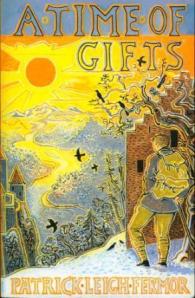
“So here’s the traveller,” a Hungarian hostess greets the teenage Patrick Leigh Fermor as he trudges towards her Danubian country house. The year is 1934 and Leigh Fermor is four months into his walk from the Hook of Holland to Constantinople, undertaken to shake off what he refers to, 70 years on, as “my rather rackety past”. The journey is captured, with erudition and fond detail, in A Time of Gifts (1977) and Between the Woods and the Water (1986). They are unique in several respects, not least that they were written more than 40 years after the events described. Leigh Fermor derived the former title from a couplet by Louis MacNeice, “For now the time of gifts is gone – / O boys that grow, O snows that melt”, which encapsulates the double vision involved in evoking one’s own adolescence from a distance. A concluding volume, which will take the boy to his destination, has long been promised.

Leigh Fermor is not a “travel writer” – like others, he disavows the term – but there is no denying he is a traveller. After Constantinople (as he still insists on calling it, though the name was changed to Istanbul in 1930), he moved to Romania, where he stayed for two years, barely conscious of the inklings of war from beyond the Carpathian mountains. In the 1950s, he explored the then-intractable southern finger of the Peloponnese known as Mani, where he lives, followed by a similar journey in the north of Greece, making his reports, in characteristically exuberant style, in the books Mani (1958) and Roumeli (1966). His stays in French monasteries, where he achieved “a state of peace that is unthought of in the ordinary world”, are recorded in an exquisite book of fewer than 100 pages, A Time to Keep Silence (1957).
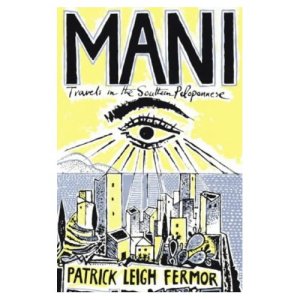
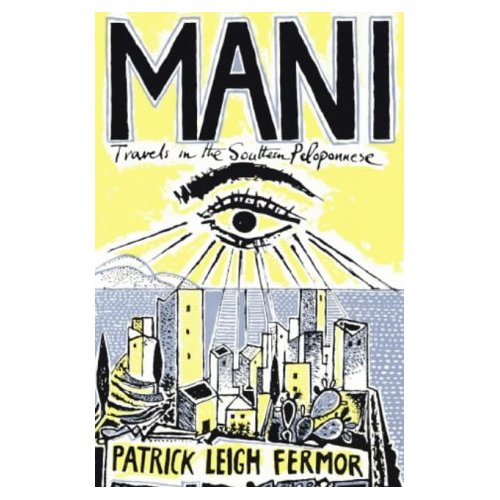
Mani: Travels in the Southern Peloponnese

Mani: Travels in the Southern Peloponnese

He is also a scholar, with a facility for languages so prodigious that he would amuse himself on his footslog by singing German songs backwards and, when those ran out, reciting parts of Keats the same way: “Yawa! Yawa! rof I lliw ylf ot eeht”, etc. “It can be quite effective,” he says. After a lunch of lemon chicken at home in Mani, accompanied by an endlessly replenished carafe of retsina, he entertains his guest with a rendering of “It’s a Long Way to Tipperary” in Hindustani.

In addition, Leigh Fermor is recognisably that figure many writers of the past century have yearned to be, the man of action. When the inklings could no longer be ignored in 1939, he abandoned his Romanian idyll and enlisted in the Irish Guards. A major in Special Operations Executive during the second world war, he was awarded the DSO for heroic actions on German-occupied Crete. Few writers are entitled to include in their Who’s Who entry: “Commanded some minor guerrilla operations.” His publisher, John Murray, whose father, the late “Jock” Murray, edited most of Leigh Fermor’s books, describes him as “almost a Byronic figure. If you met him on a train, before long he would be reciting The Odyssey , or singing Cretan songs. He loves talking, and people are always absorbed by him.”

Known as Paddy to the acquainted and unacquainted alike, Leigh Fermor has turned 90. He is still sturdy, with an all-round handsome appearance. Here is a man who at 69 swam the Hellespont (or Dardanelles), two kilometres wide at its narrowest, in emulation of Byron and Leander, who swam it nightly for the love of Hero. Leigh Fermor swam it under the concerned watch of his wife Joan, who followed in a small boat, and averted her eyes as he narrowly missed being sunk by a liner. An innocent sweetness hovers about his face, which finds a focus in his eyes as he makes a joke or stumbles on a happy recollection. There is a dash of the old soldier, clubbable and courteous, in his approach, his speech punctuated by “Look here …” and “I say …”, and not much of the “rather rackety” figure he claims to have been before he cured his ills by walking. When, relatively late in life, he became a mentor to Bruce Chatwin, the younger writer adopted Leigh Fermor’s motto, solvitur ambulando – it is solved by walking.
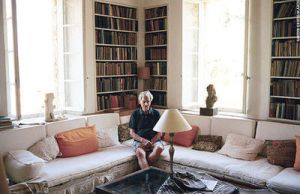
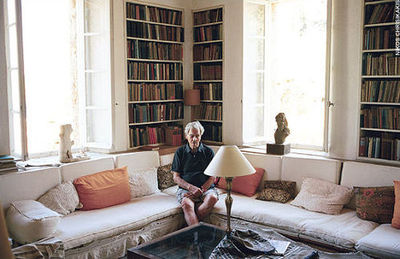
Paddy at home in the Mani

After more than six decades in the country, Leigh Fermor is inextricably tied to Greece. His command of the language extends to several regional dialects. He is an honorary citizen of the Cretan capital Heraklion, and of the village of Kardamili in Mani, and is a proud godfather to children in both places. In the mid-1960s, as if to lay the foundation for a committed life, he built a house that reflects the various aspects of his personality. Perched on a peninsula jutting into the Gulf of Messenia, it overlooks a small uninhabited island, behind which the sun sets nightly. He has described how he and Joan camped in tents nearby as the works progressed, studying Vitruvius and Palladio, but admits that the design was largely the result of improvisation. Ceilings, cornices and fireplaces allude to Levantine and Macedonian architecture. Hard by the commodious living room, an L-shaped arcade, which might have been built centuries ago, provides a link to the other rooms and gives on to an olive grove below. Out of nowhere, cats materialise on chairs and divans, prompting Leigh Fermor to remark on “interior desecrators and natural downholsterers”. The great limestone blocks of the main structure were hewn out of the Taygetus mountains, visible in the background, as the sea is present in the foreground. A weathered zigzag stone staircase leads down to a horseshoe bay. “There was no road here at all when we came. The stone had to be brought up by mule. We got most of the tiles from another part of the Peloponnese, after an earthquake. They were happy to be rid of them – couldn’t understand why we wanted this old stuff. They wanted everything new.” The master mason behind the house was a local craftsman, Niku Kolokatrones, whom Leigh Fermor met by accident while out walking. “I spotted his bag of carpenter’s tools and told him I was looking for somebody to help me build a house. He said, ‘Why not take me? I can do everything.’ And he was absolutely right.”

It was finally fit for habitation in 1968, and the couple “lived very happily here for 30 years”. Joan Leigh Fermor, daughter of the Conservative politician and First Lord of the Admiralty in Ramsay MacDonald’s coalition government, Bolton Eyres Monsell, died in 2003 at 91, after a fall. The couple met in wartime Cairo. She took the photographs for several of his books, including the first, The Traveller’s Tree (1950), an account of a journey through the West Indies, and for Mani and Roumeli – although these pictures have sadly been omitted from later editions.

He was born in London in 1915, to Sir Lewis Leigh Fermor, who became director-general of the Geological Survey in India, and Eileen Ambler, who was partly raised there. His childhood relationship with his parents was “rather strange, because I didn’t really know either of them until I was about three-and-a-half. My mother returned to India after I was born, leaving me with a family in Northamptonshire. I spent a very happy first three years of my life there as a wild-natured boy. I wasn’t ever told not to do anything.” When his mother returned, at the end of the first world war, “my whole background changed. We went to live in London. And she was rather unhappy, because I didn’t really know much about her, or my father or my sister, who had been born four years earlier. They hadn’t seen me since I was a few months old.” He claims he was “more or less tamed after that”, though he has written that his lawless infancy “unfitted me for the faintest shadow of constraint”.
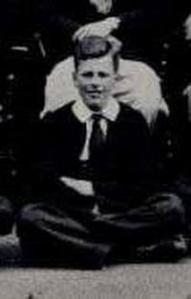
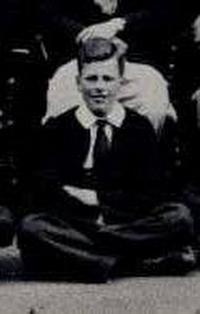
Patrick Leigh Fermor at school, Kings Canterbury

His mother “adored anything to do with the stage” and wrote plays that were never produced. She made friends with Arthur Rackham, who painted a picture inside the front door of their house in Primrose Hill Studios “of Peter Pan in Kensington Gardens, being blown along in a nest with a ragged shirt for a sail”. He wonders if it’s still there. When the time came to think about school, the “wild boy” re-emerged, and he was beaten from one educational establishment to another. “I didn’t mind the beatings, because there was a bravado about that kind of thing.” At one stage, he was sent to a school in Suffolk for disturbed children – or, as he puts it, “where rather naughty children went” – and later to King’s School, Canterbury, the oldest public school in England, where the unruly old boys included Christopher Marlowe. “It was all rather marvellous,” says Leigh Fermor, who casts a rosy light on almost all experience, “but my discipline problems cropped up again. Things like fighting, climbing out at night, losing my books.” Among his contemporaries at King’s was Alan Watts, who later wrote popular books on Zen Buddhism and became a hippie guru. In his autobiography, Watts recalled Paddy “constantly being flogged for his pranks and exploits – in other words, for having a creative imagination”. Watts confirms the familiar tale that Paddy was expelled “for the peccadillo of taking a walk with the daughter of the local greengrocer”. Leigh Fermor recalls: “She was about eight years older than me – totally innocent, but it was a useful pretext for the sack. I think it was very kindly meant. Far better to get the sack for something slightly romantic than for just being a total nuisance.”

Believing that the best place for a nuisance was the army, his parents tried to direct him towards Sandhurst, but his academic failures put paid to that too. The military historian Antony Beevor, who was an officer cadet at Sandhurst, and has known Leigh Fermor for many years, believes he would not have prospered. “I think he may have had a romantic idea of what army life was like, but he would have found the peacetime garrison incredibly stultifying. Army life in the 1930s was very staid. Paddy was too much of a free spirit.”

It was then that Leigh Fermor came up with a scheme “to change scenery”. Envisaging himself as “a medieval pilgrim, an affable tramp with a knapsack and hobnailed boots”, he decided to walk across Europe to Turkey. “It was a new life. Freedom. Something to write about.” To make it even more improbable, he set out in December when, as he states in the opening paragraph of A Time of Gifts, “a thousand glistening umbrellas were tilted over a thousand bowler hats in Piccadilly; the Jermyn Street shops, distorted by stream ing water, had become a submarine arcade.” When his ship docked in Rotterdam, “snow covered everything”. He dossed down wherever he landed, on one occasion outside a pigsty to the sound of “sleepy grunts prompted by dreams, perhaps, or indigestion”.

In addition to his sleeping bag, Leigh Fermor packed the Oxford Book of English Verse and a volume of Horace. An allowance of £4 a month was to be collected along the way. “My general course was up the Rhine and down the Danube. Then to Swabia, and then into Bavaria.” At the time, he had published a few poems (“dreadful stuff”), but was inspired to switch to travel writing by Robert Byron, whose book about a journey to Mount Athos in north-eastern Greece, The Station , had recently been published. “I was keeping copious notes, songs, sketches and so on, but in Munich a disaster happened. I stayed at a Jugendherberge and my rucksack was pinched, with all my notes and drawings.” And then comes the Paddy stroke: “In a way it was rather a blessing, because my rucksack was far too heavy. It had far too many things.” His sleeping bag was lost too -“good riddance, really” – and his money and passport. “The British Consul gave me a fiver – said pay me back some time.”

Leigh Fermor has pursued his literary career haphazardly. His Caribbean book was originally meant to be a series of captions for photographs. Then came his only novel, The Violins of Saint-Jacques (1953), followed by A Time to Keep Silence and Mani , all written in the mid-50s, after which he restricted himself to one public outing per decade. However, the 40-year interlude between the events of his European journey and the writing of the books enhances their appeal. At times, the hero of A Time of Gifts seems like a boy faced with a tapestry on which the entire history and culture of Europe is portrayed, unpicking it thread by thread. Byzantine plainsong; Yiddish syntax; the whereabouts of the coast of Bohemia (it existed, for 13 years); the finer nuances of regional architecture – “the wild scholarly enthusiasms of a brilliant autodidact”, as the writer William Dalrymple says. Theories are worked out, set down and often jettisoned, before another day’s walking begins. No one modulates as energetically from speculations on the origin of Greek place names to the “not always harmful effects of hangovers” as Leigh Fermor does. “If they fall short of the double vision which turns Salisbury Cathedral into Cologne,” he writes of his sore heads, “they invest the scenery with a lustre which is unknown to total abstainers.” When it came to writing about the journey, Leigh Fermor claims that “losing the notebook didn’t really seem to matter. I’d got all the places I’d been to noted down in another little notebook. Early impressions and all that sort of thing would only have been a hindrance.” It is impossible to say where imagination gets the upper hand over memory, and aficionados are adamant it does not matter.

Dalrymple, who as a student set out to follow the route of the First Crusade in emulation of Leigh Fermor, says: “I can’t think of any younger writers who have tried to write like Paddy, who have succeeded in the attempt. Not that I haven’t tried. When I set out on my first long journey in the summer vacation I had just read A Time of Gifts and I tried to write my logbook in faux-Paddy style. The result was disastrous. Just last summer I visited Mani and reread his wonderful book, and found myself again trying to write like him. I should have learned my lesson by now.” Dalrymple feels that the strongest influence of Leigh Fermor on the younger generation of travel writers “has been the persona he creates of the bookish wanderer: the footloose scholar in the wilds, scrambling through the mountains, a knapsack full of good books on his shoulder. You see this filtering through in the writing of Chatwin and Philip Marsden, among others.”

According to Jeremy Lewis, author of a biography of Cyril Connolly, with whom Joan was friendly, “Occasionally, one comes across some unromantic soul who objects to Leigh Fermor on the prosaic ground that he couldn’t possibly remember in such persuasive detail the events of 60 years ago.” Lewis suspects that “quite a lot of it is made up. He’s a tremendous yarn-spinner, and he has that slight chip on the shoulder of someone who hasn’t been to university. Sometimes one gets the feeling that he’s desperate to show he’s not an intellectual hick. He’s quite similar to Chatwin in that way. With Chatwin I find it irritating, but not with Leigh Fermor.” Lewis adds, “There is also a strong boy-scout element about him, which annoys some people, singing round the campfire and so on. I doubt if there was ever anything very rackety about Paddy.”
Balasha Cantacuzene

He has been asked many times why the composition of the books was delayed for so long, and has finessed the reply to his characteristic self-effacement: “Laziness and timidity.” He had a shot at writing during his sojourn in Romania in the late 1930s, “but I thought it was no good, so I shoved it aside. And I was right, actually, because when I tried it much later it all began to flow.” His companion in Romania, the first love of his life, was a young painter, Balasha Cantacuzene, whose family was part of an “old-fashioned, French-speaking, Tolstoyan, land-owning world. They were intensely civilised people. I spent the time reading a tremendous amount … when I wasn’t making a hash of writing. I felt rather different at the end of it all, from the kind of person I’d been before.”

After the communist takeover at the end of the war, the Ceausescu government branded the Cantacuzenes “elements of putrid background” and forced them to leave their property. Leigh Fermor made it his mission to rescue them from their new dismal circumstances, eventually succeeding in slipping into the country on a motorcycle and contacting Balasha and her sister. They met for only 48 hours. “We dared risk no more, and during that time I was unable to leave the tiny flat where they were then living, for fear of being seen.” He found that their early thoughts of leaving Romania had lapsed, “partly from feeling it was too late in the day; also, they said that Romania, after all, was where they belonged”.

His war service was spent mainly on Crete. After the British retreat from the island in May 1941, Leigh Fermor was among a small number of officers who remained, helping to organise resistance to the occupation, “living up in the mountains, dressed as a shepherd, with my wireless and so on”. In the spring of 1944, after an onslaught on villages “with fire and sword” by German troops in reprisal for the rash actions of some Cretan guerrillas, Leigh Fermor conceived a plan to kidnap the general responsible for the carnage, and to spirit him off to Cairo. The idea was to make a “symbolic gesture, involving no bloodshed, not even a plane sabotaged or a petrol dump blown up; something which would hit the enemy hard”. Together with a select band of associates, British and Cretan, he succeeded – except that the officer they were after, General Müller, had already left Crete, and they found themselves taking charge of his replacement, a milder figure by all accounts, General Kreipe. After three weeks of trekking through the mountains, they managed to get the captive on board a vessel bound for Egypt.

The events were drawn into a book, Ill Met by Moonlight (1950), by Leigh Fermor’s comrade in the operation, W Stanley Moss, and an inferior film in 1957, with Dirk Bogarde playing Paddy. He is polite about the actor, whom he met, but it is clear that Bogarde’s performance as Major Fermor failed to impress. “I didn’t go to the opening, or anything like that. It was all so much more interesting than they made it seem.” The military historian MRD Foot has referred to the Cretan escapade as “a tremendous jape”, which in Leigh Fermor’s opinion puts it in a “rather frivolous perspective”. Beevor, whose book The Battle for Crete (1991), pays handsome tribute to Leigh Fermor’s actions, feels the description of the kidnapping as a “jape” is unjust. “What was very clever about the Kreipe operation was that it was planned meticulously to give the Cretans a tremendous boost to morale. They needed to do something that would damage the Germans, but was not going to provoke civilian casualties. They were absolutely scrupulous about this.” Certain accounts of the exploit have suggested that it resulted in reprisals against the local pop ulation, but, says Beevor, “they are completely wrong. I’ve been through all the relevant documentation, and there is nothing to suggest that the kidnapping of General Kreipe provoked direct reaction from the Germans. It wasn’t just a jape. When I was researching my book, a member of the Cretan resistance told me, ‘The whole island felt two inches taller’.”

Captor and captive, stuck together in freezing caves (the general had to sleep between Leigh Fermor and Moss, all sharing a single blanket), found a common bond in the Odes of Horace. In a report written at the request of the Imperial War Museum in 1969, published in Artemis Cooper’s anthology of Leigh Fermor’s writings, Words of Mercury (2003), he described what happened: “We were all three lying smoking in silence, when the general, half to himself, slowly said: ‘Vides ut alta stet nive candidum / Soracte …’ [You see how Soracte stands gleaming white with deep snow]. I was in luck. It is the opening line of one of the few Odes of Horace I know by heart. I went on reciting where he had broken off: ‘… Nec iam sustineant onus …’ and so on, through the remaining five stanzas to the end.”
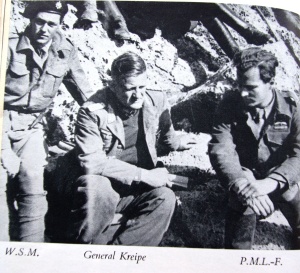
Moss, Kreipe and Paddy

The heroics in eastern Crete had a surprise sequel, which throws into relief the absurdity of war. Some 30 years later, Leigh Fermor was asked to take part in a Greek television programme based on This Is Your Life , in which the subject was to be General Kreipe. “I felt quite certain when I heard about it that it was not on the level, and so I found out General Kreipe’s number and got on the telephone to him. I said, ‘It’s Major Fermor’. He said, ‘Ach, Major Fermor, how are you? It seems we are going to meet again soon.’ I said, ‘So you are coming?’ He said, ‘Yes, of course I’m coming. Tell me, what’s the weather like? Shall I bring a pullover?’ And you know, it was the most terrific success. They were all there.” The exception was Moss, who died in 1965; and it is probably safe to discount the Cretan guerrillas who carried off the general’s chauffeur and slit his throat, much to Leigh Fermor’s displeasure.

He writes in a small studio apart from the main house. Dictionaries, volumes of Proust, books of verse in various languages and back issues of the TLS occupy every surface. Asked if he has a title in mind for the promised last volume of his European trilogy, he looks suddenly pained and answers no. He describes himself as “a very slow writer”. His pages are laboriously revised and readers who revel in his florescent style may be surprised to learn that the finished sentences are pared down from something the author considers “too exaggerated and flowery and overwritten”. Murray says: “It’s rather like a musician: each time he changes a word, he has to go back and change all the other words round about it so that the harmony is right.” Murray recalls “seven versions of A Time of Gifts being submitted to my father. And each one would be written-over, with bubbles containing extra bits. The early manuscripts are like works of art themselves.”

As he is writing, Leigh Fermor thinks of one or two friends “that it might amuse. How would they respond? Where would they sneer?” He refers to his old notebooks for things like dates and place names, but relies on memory for a clearer vision of the walking boy and the snows. “I’ve written quite a large amount. For some reason, I got a sort of scunner against it several years ago. I thought it wasn’t any good. I always think that. But now I think I was wrong. I’m going to pull my socks up and get on with it.”

Patrick Leigh Fermor

Born: February 11, 1915, London.

Education: 1929-33 King’s School, Canterbury.

Married: 1968 Joan Eyres Monsell.

Employment: 1945-46 deputy director British Institute, Athens.

Books: 1950 The Traveller’s Tree; ’53 The Violins of Saint-Jacques; ’57 A Time To Keep Silence; ’58 Mani; ’66 Roumeli; ’77 A Time of Gifts; ’86 Between the Woods and the Water; ’91 Three Letters from the Andes; 2003 Words of Mercury.

Some awards: 1944 DS0; ’47 honorary citizen of Heraklion, Crete; ’58 Duff Cooper Memorial Prize; ’78 WH Smith Award; ’86 Thomas Cook Travel Book Award; ’91 Companion of Literature; 2004 Knighthood.

The English in Hungary – for St George’s Day

From the blog of Greg Dorey, the UK Ambassador to Hungary. The  Ambassador takes us through many of the English associated with Hungary including our very own Patrick Leigh Fermor. You can download the PowerPoint including the notes here.

UK Ambassador to Hungary – England

Yesterday afternoon I participated as Patron in the 2011 BBC Entertainment and English Speaking Union (ESU) Public Speaking Awards in Hungary. Along with the Ministry of National Resources and Magyar Telekom, the event was also supported by the British Council, Oxford University Press and the Robert Burns International Foundation. It’s the first time the BBC have organised this event here, but it was such a success that they plan to repeat it in the future. The standard of English spoken by the young Hungarian participants was tremendous and the winner and runner up who go on to the ESU International Public Speaking Awards in London in May will be excellent representatives of their country.

And then it was off to the British Chamber of Commerce in Hungary’s (BCCH) third annual commemoration of St George’s Day – a week early because otherwise the concurrence with Easter would mean no one came! Having spoken about St George for the past two years I had exhausted my knowledge of him – so spoke instead of some of the famous Englishmen and Englishwomen with connections with Hungary (Edward the Exile, Sir Philip Sidney, Julia Pardoe, Patrick Leigh Fermor etc). For anyone interested, an edited version of my presentation is available on the Embassy website. The event was used to advance the cause of Corporate Social Responsibility. The BCCH Chairman Gergely Mikola has instituted a new annual St George’s Award to recognise examples of ethical business and together we presented the first such prize to Tibor Hejj of Proactive Management Consulting, whose firm helps prepare disabled people for the workplace.

Related category for more articles:
Between the Woods and the Water

The Duchess of Devonshire talks about Patrick Leigh Fermor

The Dowager Duchess of Devonshire, the youngest of the legendary Mitford sisters reminisces about her life and her correspondence with the charismatic Sir Patrick Leigh Fermor, considered to be the finest English travel writer of his generation. An evening filled with wit, eccentric characters, and a celebration of courage and friendship. Charlotte Mosley, her niece and editor, joins the Dowager Duchess in conversation.

This was filmed on November 10 2010 at the Frick Collection in New York to mark the US publication of In Tearing Haste and her new memoire, Wait for Me

Paddy is mentioned at the start and she discusses her friendship with him from minute 35

Adjusting to quiet – A Time to Keep Silence

Many of you will know that I was recently in the Holy Land on a Pilgrimage. Seven days following in the footsteps of Christ from the synagogue at Capernaum to the Via Dolorosa had a significant impression. I learned, not for the first time, that it takes time to adjust to new surroundings and experiences, and to fully appreciate them for what they are, for what they offer. Paddy experienced this too when he visited the Abbey of St Wandrille de Fontanelle of the Benedictine order near Rouen. He wrote about this experience in the wonderfully concise “A Time to Keep Silence” published in 1957.

This article by Debra Bendis briefly compares her recent experience with that of Paddy.

Adjusting to quiet

First published Apr 14, 2011 in the Christian Century by Debra Bendis

While on retreat recently, I picked up Patrick Leigh Fermor’s A Time to Keep Silence. I was making my own transition from noisy life and noisy mind to four days of retreat when I came upon Fermor’s description of his retreat at a French monastery in the ’50s.

My adjustment process isn’t as difficult as Fermor’s. For one thing, I’m retreating close to home (and not close to Paris, as is Fermor); for another, I don’t find myself having to emerge from a “monsoon” caused by a drinking habit. (I sneak away from the monastery to find good coffee, but I have yet to sneak in a flask of Calvados.) In part because of his ignorance of monastic life and then his sudden immersion into it, Fermor’s is a humorous but accurate account of the transition.

Here’s Fermor after his first four days at the Abbey of St. Wandrile de Fontanelle:

My first feelings in the monastery changed: I lost the sensation of circumambient and impending death, of being by mistake locked up in a catacomb. . . .The mood of dereliction persisted some time, a feeling of loneliness and flatness that always accompanies the transition from urban excess to a life of rustic solitude. . . .the desire for talk, movement and nervous expression that I had transported from Paris found, in this silent place, no response or foil, evoked no single echo; after miserably gesticulating for a while in a vacuum, it languished and finally died for lack of any stimulus or nourishment.

Fermor ended up thriving at the monastery and focusing on the book he had hoped to write. He compares his coming with his going and says the departure was “ten times worse.”

Related articles:

Posts from the ‘A Time to Keep Silence’ Category 

If food be the music of love … Bánffy’s lover in Cluj (Kolozsvár)

I am currently reading two books. The first is a little known series that Paddy contributed to in 1962 about which I will say more very soon. The second is volume two of Bánffy’s trilogy. I am convinced of the semi-autobiographical nature of these books and I have become obsessed with trying to find the house in Cluj of the married woman, Adrienne, who becomes the lover of the hero Balint.

There are many clues, including street names, but Bánffy has been able to mix fact and fiction, and what is more, many of the street names have been changed from the traditional Hungarian to new Romanian names since 1918. I was discussing this with one of my work colleagues in Cluj, Boglarka Ronai, and I happened to say that I was convinced that Bánffy also had a lover in Cluj, and that Adrienne’s house in the story may have been based on this woman’s house.

We are not sure about the house part, but Bánffy did indeed have a long-term lover in Cluj, and Boglarka sent me the following article about her: Baroness Elemér Bornemissza née Karola Szilvássy. Quite bizarrely it is about a cookbook that she wrote. What is interesting is how the writer of the article positions the contributors to the cookbook within the context of the decline of the Hungarian nobility of Transylvania, and in some cases this had tragic endings. It was into this world that Paddy walked in 1934 as he enjoyed his long summer in Hungary and then Transylvania. I have not had the time to cross-check, but Paddy may well have met some of the characters mentioned in the article and written about them in “Between the Woods and the Water“. Many of those mentioned in the article were writers and members of a Hungarian-Transylvanian writer’s group, the Erdélyi Helikon. In the picture below I believe Count Miklós Bánffy can be seen second right sitting on the chairs.

Photo made at the second Erdélyi Helikon meeting at Marosvécs in 1927 (Banffy seated second from right?)

Here is the article by Iván Bächer from the Hungarian Quarterly. If ayone knows any more about the story or the people involved please get in touch with me:  tsawford[at]btinternet.com

The Taste of Old Transylvania

Baroness Elemér Bornemissza: Kipróbált receptek (Proven Recipes). Edited and with an Introduction by Ildikó Marosi. Csíkszereda–Budapest, Pallas—Akadémia Könyvkiadó, 1998, 153 pp.

A friend of mine brought a heartrending cookery book from Transylvania. At first sight the slim little volume looked ordinary enough; I expected some amusing oddity when I picked it up and read the name of the author—Baroness Elemér Bornemissza née Karola Szilvássy—and the title: Proven Recipes.

The cover showed a copperplate print of Marosvécs in the last century—I was able to identify it by the four sturdy corner towers. This Renaissance building on the site of the Roman castrum was, until recently, in the possession of the Kemény family—the descendants of János Kemény (1607–1662), Prince of Transylvania, who had fought the Turks and had been abandoned by the Habsburgs and Montecuccoli.

When I read the first recipe, I still thought I would be treated to a bit of “blue-blooded” diversion. Who in their right mind could take a recipe of Goose-liver paté à la Salzburg seriously, which requires three whole goose livers, of which two have to be soaked in lukewarm milk overnight, then fried with onions and white bread rolls previously also soaked in milk, then pounded in a mortar, pressed through a sieve, mixed with finely sliced truffles which had been soaked in sugared wine, then with more wine added, with cloves and pepper, and the whole mixture finely layered with the third goose liver, which had been fried, cut into thin slices, and then the whole thing finished in a hot oven.

Who would have time for all that today?

It was only when I read the foreword of more than thirty pages and then went through the recipes that my heart suddenly sank. Every single recipe permeated the air with transcience and death. What I held in my hand was the frozen, fossilized evidence of a social class, a culture and a world, which have been obliterated from the face of the Earth.

This class was the Hungarian aristocracy of Transylvania, which, as well as distinguishing itself in the culinary arts, maintained an extremely rich Hungarian tradition, culture and literature.

As Ildikó Marosi’s Introduction reveals, the book is the first publication of a hand-written cookery book. Besides being a fascinating document, an original collection of recipes found among the estate of János Kemény, the last titled resident of Marosvécs, it is invaluable also because in the case of most of the recipes the author also names the source: when and where the baroness had learned the secrets of preparing the dish concerned. And if we use Ildikó Marosi’s guide to keep track of the sources, then the book will, indeed, make heartrending reading.

Let’s get a foretaste of the names of people who cooked for Hungarian writers, poets and editors in Transylvania between the two world wars.

The author of the cookery book was Baroness Bornemissza née Karola Szil-vássy, daughter of the landowner Béla Szilvássy and Baroness Antónia Wass.

Karola’s character was captured in two novels by two twentieth-century Transylvanian writers of aristocratic blood, Count Miklós Bánffy (1874–1950) and Baron János Kemény (1903–1971).

Ever since her youth, Karola was a stunningly beautiful, unbridled and proud woman with a passion for fine food as well as for interesting, eccentric and talented people. She liked to have excitement around her, and when there were no scandals at hand, she personally intervened to remedy the situation. For many years, Karola had a housekeeper, who had been a convicted murderer’s lover, and whom she took into her house along with the hanged man’s child. Accompanied by one of her friends, herself a baroness, Karola travelled to South Africa—on rail, by boat and on a donkey—to erect a tombstone for her cousin, Albert Wass, who had died there while fighting for the Boers.

This extraordinary woman had a difficult time to find herself a husband; eventually she married Baron Elemér Borne- missza, but the marriage was a failure, and their only child died, so they lived separately, with Karola receiving a handsome allowance from her husband.

Between the two world wars, Karola made herself the heart and soul of the Kemény Zsigmond Society of Marosvásárhely, the publishing house Erdélyi Szépmives Céh, and the magazine Erdélyi Helikon. (Erdély is the Hungarian name of Transylvania.)

The society, which bore the name of the Kemény family’s greatest son, the novelist and liberal thinker Zsigmond Kemény, was formed after the writer’s death in 1876, and functioned until 1944. It acquired a unique role after Transylvania’s annexation by Romania in 1918, organizing and rallying the Hungarian writers and maintaining links with the mother country.

Erdélyi Szépmíves Céh was the most prestigious book publisher in interwar Transylvania, and Erdélyi Helikon, the magazine started by János Kemény, was published by them.

The writers who were associated with the publisher and the magazine—Károly Kós, Aladár Kuncz, Károly Molter, Jenoý Dsida, Benoý Karácsony and many others—annually gathered in János Kemény’s château in Marosvécs. On these occasions, Karola’s attendance could always be taken for granted, and all the memoirs name her as the spirit of the company. (below Karola is fourth from right)

In the castle park (Marosvécs?) 1942 From left to right: István Asztalos, László Szabédi, Albert Wass, Karola Bornemissza, Elemérné Szilvássy, Gizella Kemény, Berenice Kemény, Jánosné Kemény

In this way, Karola, the compiler of our cookery book, was at the centre of Transylvanian literary life, and her kitchen produced, from “proven recipes”, the fine food enjoyed by the writers and editors. Continue reading

One year on … the Patrick Leigh Fermor Blog

I am back. Sorry that I have been so quiet for the last few weeks. I don’t have any real explanation. Excuses may range from work commitments through some form of ‘writer’s block’ (where has my muse gone?) to the genuine excuse of being totally absorbed by Miklos Banffy’s first volume of his trilogy – They Were Counted.

This is an exceptionally good book. I will write about it at greater length at some future date, but I do recommend it. He can sometimes get a little bogged down by Hungarian politics, but when he gets going, describing balls, duels, gambling and love, he really does have a very fine style. Paddy wrote the forward to the English translation whilst staying at Chatsworth during Christmas 1998. Much of the story is set in Kolozvar (Cluj) and our old friend the Hotel New York, where Paddy and Angéla went for a cocktail, is frequently mentioned.

We have just had a blog anniversary. The Patrick Leigh Fermor blog started in late March 2010. In that time it has reached almost the very top in any Paddy search you care to mention. There have been over 64,000 visits, 156 postings, 206 comments, and there are now well over 100 subscribers (you can sign up in the top right of the home page so that you receive future posts by email – no spam).

When I started I wondered if there would be any interest in our heroic and talented subject. There were just a few dozen visits in the first month. But visits grew rapidly to a peak of 9,400 in January 2011. We now track at nearly 7,000 visits a month on average so you are not alone in your interest in The Greatest Living Englishman.

I am extremely grateful to all of you who have got in touch with me with messages of support; offers of information; and especially to those who have sent me material to publish. I can assure you that there is much more material (I have over 60 items in various stages of draft) and it will come in a steady stream. To one of you, please be assured I remain your #1.

Finally, let’s not forget why we are here. Paddy is now 96 years of age and, as far as I can tell, in reasonably good health. I am sure we wish him all good health and pray that he is working as fast as he can on that third volume. It is without doubt one of the most eagerly anticipated books of the decade.

Why not visit some of our top posts?

Patrick Leigh Fermor recounts the kidnap of General Kreipe on video

A Meeting between Paddy and George Psychoundakis the “Cretan Runner”

Patrick Leigh Fermor – star of the silver screen?

On the Pontic shores where the snowflakes fall

I knew Patrick Leigh Fermor through his words, and he will know me by mine

Old days, new dawn in the Caribbean

We get to read very little about Paddy’s first book The Traveller’s Tree which was published in 1950. This is a fairly comprehensive review by Katherine Powers.

First published in the Boston Globe 6 February 2011

It’s impossible for me to put into words how much I would not like to take a winter vacation in the Caribbean. I have never had to, but do have fixed ideas of what it would entail, namely: air travel, the company of people in pastel clothing and not enough of it, and an oppressive, even dictatorial atmosphere of relaxation and fun. It would be different, of course, if I had interesting, well-to-do acquaintances with welcoming houses living on those islands and was traveling in the company of a couple of entertaining friends — and it was no later than 1950. Yes, I could bear that; and, indeed, just that very state of affairs may be found in Patrick Leigh Fermor’s richly detailed and ebullient “The Traveller’s Tree: A Journey through the Caribbean Islands,’’ first published in 1950 and now reissued (New York Review Books Classics, paperback, $19.95).

Fermor, born in London in 1915, is now best known for his accounts of walking from Rotterdam to Istanbul in the 1930s in “A Time of Gifts’’ (1977) and “Between the Woods and the Water’’ (1986). At the time of his trip to the Antilles in 1947, however, he was famous for his exploits in occupied Crete during the war, most especially his kidnapping of the German commander, General Kreipe.

“The Traveller’s Tree’’ was Fermor’s first book and, as Joshua Jelly-Schapiro notes in his excellent introduction, it is very much of its time, “brimming with the gratitude for life particular to a European generation that had just buried half its members.’’ Further, it is “suffused with the wondering spirit of an engagé asking after what will become of these New World islands which are passing from Old Europe’s imperial shadow.’’

It is clear to Fermor that American consumerism is going to be a powerful force in the region, signaled most aggressively by “the Coca-Cola plague.’’ (“It becomes the air you breathe, a way of life, an entire civilization — the Coca-Cola age, yoke-fellow of the age of the Atomic Bomb.’’) But, if Fermor is not happy with evidence of an Americanized future, he is also disparaging of certain manifestations of a colonial past, especially British ones. The middle-class British way of life in the Barbados reflects, he says, “the social and intellectual values and prejudices of a Golf Club in Outer London . . . which are not England’s most interesting or precious contributions to world civilization.’’

What he really likes and describes with infectious elation is the riot of diversity and exotic fusion that these islands have individually acquired from their vicissitudinary histories. Hurricanes, earthquakes, and volcanic eruptions of the past have left their furious marks, while side narratives of European history appear everywhere, written in frantic and fantastical hands. In Barbados he finds a ragged community made up of the descendants of the duke of Monmouth’s followers deported from England in the 17th century, and still “in the same humble plight as when they were first herded ashore.’’ In Jamaica he spends a pleasant time with the Maroons still living in the mountains where their ancestors, run-away slaves, had formed their own kingdom, finally acknowledged in a treaty with George II. He likes the way many women in the French Antilles wear costumes that hark back to 18th-century France, and he likes the cathedral in Guadeloupe constructed (he says) out of Meccano (the British equivalent of Erector Set).

He arrives in Haiti and grows exultant: “The sides of the road pullulated with country people chattering, drinking rum, playing cards and throwing dice under the trees. The air was thick with dust, and ringing with incomprehensible and deafening Créole. I felt I might like Haiti.’’ He does, for the most part, paying long and elaborate attention to voodoo and other island cults. His descriptions of what he witnesses are rich, spirited, and filled with curious detail. He attends a cockfight and describes the birds’ handlers filling their mouths with water and pressing “the birds to their lips, sucking and soaking the feathers so that they should cling to the body and afford no hold for the enemy.’’ As it happens, he and his friends find they cannot take the blood and gore and slink away.

Throughout the book he traces each island’s history. Race is a continuing preoccupation for Fermor and, it must be said that by today’s standards, his unabashed laying down of opinion on the racial characteristics of peoples from different parts of Africa and with the various kinds and degrees of black and white mixtures is unseemly. On the other hand, that is the world of the late 1940s, and he is positively reticent in these matters when compared with Lafcadio Hearn, who visited some of the same islands 60 years earlier. But, there again, we really cannot criticize people for writing as our age would have it. Both travelers, in fact, find the varieties of race and racial mixtures part of the exhilarating vividness and dash that so distinguished the islands from Europe.

I don’t know why it has taken me so long to become smitten with Hearn, but it has finally happened. Born in 1850 in Greece, he grew up in Ireland and moved to the United States when he was a young man. After that he had a strange career, impossible to summarize except to say he became a writer, traveled a lot, lived in Cincinnati, Louisiana, Martinique, and, finally, Japan, where he died. The Library of America has devoted a huge volume to his writings ($40) and that is where I turned after polishing off Fermor, specifically to Hearn’s “Two Years in the French West Indies.’’

The years in question were in the late 1880s and his prose, gorgeous and bounteous, reflects the period’s fascination with the exotic — and the macabre. The pages he devotes to the treacherous viper, the fer-de-lance, aroused an exquisite horror in me such as I have not felt since I was a child. His description of St. Pierre, Martinique, “the quaintest, queerest, and the prettiest withal, among West Indian cities,’’ is especially transfixing as the place was completely destroyed by the eruption of Mount Pelée 15 years after he wrote those words. “Is the great volcano dead?’’ he asks, answering “Nobody knows.’’ Except we do, safe in our snowbound fastness, happier than ever that we’re staying at home with this wonderful book.

Katherine A. Powers lives in Cambridge. She can be reached by e-mail at pow3@verizon.net.

Related Category:

The Traveller’s Tree – read more articles here

Paddy visits the wonder that is Ohrid

I suppose it is a good thing to aim to be objective in life. It shows wisdom and maturity, and an ability to balance all the arguments. For me however, all objectivity vanishes when I think of Ohrid! The setting of this beautiful city on the edge of the vast and wondrous eponymous lake is simply stunning.

Although he does not state it specifically, I believe Paddy visited Ohrid and its environs when on a motor tour from France to Greece with Joan in her Sunbeam Rapier in 1960. He tells the story to Debo in a letter dated 23/24 October 1960 (see page 67 of In Tearing Haste). Paddy describes visiting “Serbian Macedonia and wonderful lakes with frescoed Byzantine monasteries on the shores … (which) held us up for days.” There is little doubt in my mind that he is referring to Ohrid, and having been there myself I can understand why; it is a wonder that he ever left!

It is said that Ohrid, Macedonia, once had 365 churches although there are now only around twenty-five which remain open. Its name means City of Light and it has over 220 days of sunshine each year. The town creeps up the hillside surrounding a central esplanade and harbour dominated by the statue of St Clement, who was the student of Saint Cyril and his brother Methodius. They were the authors of the Cyrillic alphabet (approx 864 AD) which was created by the Byzantines to bring the Slavic nations into the Orthodox Church rather than let them fall under the influence of Rome during the early days of the schism between the two churches.

Ohrid is full of Byzantine history. The influence of the Empire can be seen everywhere from the statues to the fortress but principally in the churches and the ancient Basilica. The original church of St Clement was destroyed by the Ottomans who built a mosque on the site which has a clear view of the Lake. Clement’s relics were secretly moved by the Christian citizens of Ohrid to the smaller and less important Church of St Mary Psychosostria. Over time this church became known as the Church of St Clement, but the confusion is now ended as in 2000 the Macedonian authorities rebuilt the Church of St Clement on the original site. His relics have been moved back there to rest in peace. The site includes the remains of original Baptistry, and there are many mosaics all in very good condition.

The Church of St Mary is a wonder. Built in 1295 by the deputy Progon Zgur who was a relative of the Emperor Andronicus II Paleologus, it has twenty-nine scenes from the life of the Virgin around the walls. These frescoes are in generally excellent condition with little of the wear or defacement one often finds elsewhere. The reason for this is that most of the frescoes were obliterated by soot from candles. They were cleaned and restored only since 1960. The have to be seen to be understood. The ‘keeper’ of the frescoes is an amazing Macedonian lady with long black hair, with braided pigtails; the church and the frescoes are her passion, probably the centre of her life. She has produced a long book and the frescoes were the subject of her PhD. She says that the fresco of the Virgin that dominates the Apse is painted from lapis lazuli originating in Afghanistan. That one fresco would have cost something in the order of one kilogramme of gold (at today’s prices that is roughly $56,000).

Opposite the Church is the national Icon museum of Macedonia with over forty masterpieces. All this within just a few yards of each other!

If you ever get the chance to visit you will find all this and more. You will also meet friendly people, find good quality low-cost accommodation, and a wealth of Byzantine architecture and art. This CNN video shows many of the places I have written about and I know you will like it. If you do ever visit Ohrid, please contact my friend Katerina Vasileska who runs a tourist business in Ohrid called Lost in Ohrid. She will be happy to arrange good accommodation, local tours, and generally be of assistance during your visit.

Finally, don’t forget that for the intrepid there is an opportunity to walk through Albania to Ohrid in May of 2011 with the Via Egnatia Foundation. See my recent post Walking back to Byzantium along the Via Egnatia where you can find out more and how to register your interest.

Click to play … there is a 30 second ad before the Ohrid movie starts.

Numbered and bound copies of A Time To Keep Silence

I received the following note from Phil Holden, who resides in Athens, pointing out that A Time to Keep Silence was in fact first published in a numbered limited edition in 1953. I hope Phil does not mind me posting this letter.

Dear Tom,
I have been enjoying your blog about Paddy Leigh Fermor very much – thanks for the effort you have put into it. One point – in your list of Paddy’s books, you have A Time To Keep Silence listed as being published in 1957. That was the John Murray publication. However 500 copies were published in 1953 by the Queen Anne Press. Paddy signed the first 50 of these, which had been numbered and bound in dark blue leather. The other 450 were numbered but bound in cloth and were unsigned. It is a significant book in that the 500 copies represent the only time a numbered limitation took place with any of Paddy’s books and the first fifty of those, which he signed, are the only books he ever signed in a limited printed run (that is, not individual copies or at book signings and launches).
Keep up the good work, best wishes from Athens, Greece.
Phil Holden

He’s the top

The following review of Words of Mercury was first published in The Spectator. It is unusual as it was written by the Marques de Tamaron who was the Spanish Ambassador in London in 1999-2004. He and his wife stayed with Debo  at Chatsworth in November 2000 (see p 322 In Tearing Haste). The Marques is clearly a fan!

by  Santiago Tamaron

First published in The Spectator Oct 4, 2003

The perfect anthology, like the perfect hors d’oeuvre, should turn us into gluttons. The many small dishes add up to a balanced and nourishing meal, but they are so exquisite that they whet one’s appetite for more. And the anthology should also include unexpected delicacies, things that even the literary gourmet had not heard about.

This book fulfils both requirements but also a third, more difficult one: it presents a complete portrait of the author. The compiler, Artemis Cooper, writes an introduction which is a model of informative brevity, but also succeeds – with her selection of essays and book chapters, plus an unpublished letter and a dazzlingly original poem, under the headings of Travels’, ‘Greece’, ‘People’, ‘Books’ and ‘Flotsam’ and with a few explanatory words now and then – in capturing the essence of Patrick Leigh Fermor, the man as well as the literary oeuvre. If there was ever a writer of whom it can be said that le style c’est l’homme, it is he. And the essence of Paddy (as the compiler and many others call him) is not his superb English or his arcane erudition, but his obvious and contagious enjoyment of everything he writes about.

Of course, if he enjoys the sights and sounds and smells of the landscapes he travels through, and the words he hears and reads in a dozen languages or two, if he admires the stones and paintings, the plants and trees and the strangely shaped clouds and mountains in the Balkans or the Danubian basin or the Himalayas, if he cares and makes you care about Mozarabic liturgy (in Latin only, naturally, and only in Toledo), or about Phanariot genealogy or Bulgarian shepherd dances or the punctilio of Cretan blood-feuds, it is because all these wonders are not dry-as-dust erudition for Paddy, they are perfectly alive, in his memory and, through his magical language, in our minds.

It is not that he refuses reality and the unprecedented scale of the destruction brought upon civilisation by the bestiality of the 20th century. He knows and indeed he tells us that the island of Ada Kaleh in the Danube, with its melancholy and beautiful remnant of Ottoman life, was flooded by the Iron Gates dam built in 1971. He knows that the happy Transylvanian country house of his friend Tibor (‘jolly, baronial, rubicund, Jager-hatted and plumed, an ex-Horse Gunner’) had been turned by the communists into a lunatic asylum. Even sadder, when he returned to Baleni, the house in Moldavia belonging to his friend Balasha Cantacuzene and her sister, where he lived during the months before the start of the second world war (the most poignant memory in this book is the perfect early autumn mushroom-gathering picnic on the last day of peace), he found that ‘the house had completely vanished. Some industrial buildings, already abandoned, had taken its place, and the trees had been cut down long ago.’ The author is fully aware that many of the things he loves have been destroyed, but I think that he also realises that the joy and pain and privilege of a writer is to save the memories and thereby the physical beauty of past glories, and this he does supremely well and with an immense joie de vivre.

Two months ago he told friends that he had read in the morning Othello, which had depressed him so much that in the afternoon he had read A Midsummer Might’s Dream, which had greatly gladdened him. Clearly Shakespeare, like so many other muses and marvels, is no museum piece for Paddy but part of his daily life. That is why he is truly cultured and never pedantic.

He is a generous writer. I have never found an ounce of spite or envy in his books, or sarcasm in his occasional irony (‘the agglutinative harshness of the Turks, laced with genteel diaereses, sounded like drinking out of a foeman’s skull with a raised little finger’). He genuinely likes and understands Greeks and Turks, Magyars and Rumanians, Germans, Austrians and Jews, even enemies in times of war like General Kreipe whom he abducted in Crete. There is not a dull character in the vast gallery in these pages where barons, bandits and beggars abound, where scholars and poets are colourful and ladies are beautiful (although the latter circumstance is usually left untold, for Paddy is most un-Byronic in his reticence about his own loves).

Some years ago, a group of friends gathered to celebrate Paddy’s birthday. John Julius Norwich wrote and sang a new version of ‘You’re the Top’ in his honour:

You’re the million volts of the thunderbolts of Zeus, /You’re Leda’s swan, you’re the square upon the hypotenuse! …/And you’ll fill and thrill our hearts until we drop: /So from Bath to Burma, Fermor, you’re the top!

Most readers of Words of Mercury will, I think, agree with this assessment.

The Marques de Tamaron is the Spanish Ambassador in London.

Images of Cluj by Alin Niculescu

There is one respect in which I have a definite advantage over Paddy in terms of the places he visited. I have been lucky enough to get to know well the city of Cluj-Napoca due to my regular visits. Paddy had but one night there with Angéla, but it was one of one of love and passion!

Last week I visited Bucharest for the first time. If this had been my first introduction to Romania I doubt that I would have been keen to return. To be fair it was literally a flying visit, and I did not make it right into the centre, however, it cannot compare with the genuine attractions of Cluj: its compact size; the Baroque architecture; the lively bars and restaurants in the old centre; the intimate cultural life; and its position in a valley surrounded by gently rolling hills. I have also made some good friends in this capital of Transylvania.

I have often written about Cluj, but to many of you the city probably remains a mystery. To help you get more of a feel for a place that I have come to feel strongly about, I wanted to showcase the work of  Alin Niculescu, a professional cameraman from Cluj. He has made a number of short films about the city, highlighting it over the seasons. They are just a few minutes long and if you are curious to know more about the city, they will give you a feel for its size, architecture, and position. In some scenes he also captures the relaxed and friendly mood of its citizens.

This first film is entitled Snowy Night at Cluj. This is broadly how the city looks at the moment.

Snowy Night at Cluj Full HD from Alin Niculescu on Vimeo.

This second movie shows a panorama over the city in the summer.

Cluj-Napoca from Alin Niculescu on Vimeo.

You can see more of Alin’s work on his website here

Related category:

Articles about Cluj and Transylvania

Paddy Reviews “Along the Enchanted Way: A Romanian Story “

Paddy reviews  William Blacker’s book about his eight years living in rural Romania and is so inspired he let’s himself go “sends (my) thoughts winging back to earlier Moldavian scenes – to ghostly hospodars with their nearly mythical princesses in tall branched crowns, trooping around the walls of fortress-monasteries in frescoed processions.”

First published in the Sunday Telegraph 30 August 2009

Along the Enchanted Way: A Romanian Story

By William Blacker

‘Transylvania, the Banat of Temesvar, the Tatra mountains, Bukovina, Moravia, Bohemia, Wallachia, Moldavia, Bessarabia, the Carpathian range, the Maramures …’ these were the place-names in East Europe where William Blacker, a young, civilised and erudite traveller, hoped to settle and take root. The last of the names (pronounced Maramooresh) is a precipitous and ravishing Romanian region, where Blacker made his life-determining plunge into Europe, immediately after the fall of the Berlin Wall in 1989.

The moment it fell, he headed for Dresden and then Prague, then further east still; he was in search of an older and wilder Europe. Soon he was hobnobbing with the descendants of Saxon families, brought there eight centuries earlier by Bela of Hungary to guard his eastern frontier from the Tartars, a transplanting which had changed everything. Seven western medieval cities had sprung up, monasteries and churches had followed, and the whole apparatus of the Middle Ages had come into being in the Carpathians.

An elderly Saxon couple took Blacker under their wing on sight, so did many others. The story teems with odd characters. One of them is an engaging, dissolute descendant of a Hungarian family who is the father of two fascinatingly beautiful girls, with a Romanian gipsy mother, with both of whom in succession William fell in love. Apart from their spirits and fine looks, these girls brought with them the whole geist of the gipsy world – its dialects, its manifold skills, its amazing singing and dancing and magic and, of course, as a tribe, its challenging knack of being forever at odds with the civic authorities. The wandering of their ancestors had brought the gipsies all the way from north-west India, through Persia and Egypt and the Levant, and scattered them over the West.

It was not just the Saxons and the gipsies that fascinated the new arrival. The Romanian influence proved equally strong. With the Magyar language to the west and Slavonic to the north and the south, and the Black Sea to the east, the Romanians speak the only Latin language in Eastern Europe, and they are proud of this linguistic heirloom. In AD 103 Trajan led his legions over his great Danube bridge, defeated King Decebalus and added the Dacian kingdom to the Roman Empire and the bas-relief of his victory was sent spiralling above his Forum in Rome and stands there still.

Romania is an extraordinary country. I remember it with great clarity, when I was 19, trudging from Holland to the Bosporus, those unending beech forests where the brooks fell from ledge to ledge, gathered in pools, or tumbled in waterfalls, where one could sleep in clearings among hollowed tree-trunks or ‘swing wells’ and scores of lambs, and be woken up by an old shepherd blowing down a bronze horn three yards long, a half-muffled and half- echo sound, like the trumpets of Tibetan shepherds. It was a world of icicles, birds calling, hayricks and scythes.

Perhaps to balance the complexities of his two love affairs, Blacker threw himself into raising funds for the upkeep and repair of the ancient buildings he had settled among. Like his friends, he was outfitted in rough white homespun and the padded and cross- gartered cowhide moccasins – opinci – which the upland shepherds wear all year.

William, who grew up on the South Downs and the north country and Ireland, brings all the skills of his unfettered upbringing to bear on Romania – horse-breaking, tree felling, haymaking and rick building – which, with a passion for the classics and literature and history, seem to have been a perfect run-in to this strange chapter of his life.

The rigours of snow covered the whole of his first winter. It was a time of rugging up soon after the early sunset and diving straight under the blankets and into The Brothers Karamazov and Anna Karenina by lamplight; in a later season the day would end with rowdy evenings at the Krcma – drinking tavern – of amazing dancing and song. I wonder if some of the evenings revolved, as in my young days, around a klaka of a hundred crones in a barn, all with spindles and distaffs and an endless gift for storytelling? One had to look out for the prints of wolves and bears on the way home.

This is a wild and captivating story, ending in great thanks to his neighbours in Maramures and Sighisoara – we are spared Vlad the Impaler – and also to his parents, who gave him such free reign in childhood. William Blacker has written a book close to this reviewer’s heart, and sends thoughts winging back to earlier Moldavian scenes – to ghostly hospodars with their nearly mythical princesses in tall branched crowns, trooping around the walls of fortress-monasteries in frescoed processions. With a change of pace these are followed by the author and his swarm of friends in a cantering troop of near-Lippizaners through the autumn beech woods. Nowadays it looks as though he might branch out much further south – down, down into Italy where, historically speaking, his nearest apposite neighbour might be Lars Porsenna of Clusium.

Voyages around a genius

At some point, when I get truly organised, it is my intention to create a section on the blog for all the book reviews I can find that relate to Paddy’s work. Until that time I beg your indulgence for yet another review of Words of Mercury. However, this has two strong claims to your time and attention. Firstly it is short, and secondly it is a delightful read!

ByRoger Hutchinson

First published in LivingScotsman.com 15 November 2003

If you or I were to take a hike in December down a deserted Black Sea coastline in Bulgaria, miss our way after dark, fall into a deep, cold pool and lose our torch and boots, we would certainly drown on the spot or die shortly afterwards from exposure.

When Patrick Leigh Fermor does exactly the same thing he crawls out alive and is adopted within the hour by half-a-dozen Greek fishermen who dry him, clothe him, sit him beside a bonfire, feed him slivovitz and mackerel, play bouzoukis, sing songs and perform antic dances through the night. Some travel writers are born or made; others have it wished upon them.

Leigh Fermor is undoubtedly the greatest travel writer to have emerged from the 1980s genre-boom. Comparisons with the likes of Bruce Chatwin, Colin Thubron, William Dalrymple, Jan Morris and even the mythical avatar of them all, Robert Byron, are fruitless – Leigh Fermor out-travels them, out-scholars them and out-writes them by a country mile.

He writes English, in fact, as well as anybody else alive and a great deal better than most. Leigh Fermor’s prose style is a wonderful thing. He was born with an uncanny facility for languages and the ability to pick up a local demotic – any local demotic – almost on contact. His deployment of his native language is consequently blessed with a huge and exotic vocabulary, instinctively flawless grammar and what he usefully describes – while attributing the advice to Auberon Herbert – as “the importance of keeping a proper balance between words of Anglo-Saxon and Latin root … a Latin preponderance endangered one’s themes and sent them ballooning away in abstract drifts … that could only be rescued by tethering them to the ground and reality with short Anglo-Saxon pegs.”

This hardworking, heavenly English has been set loose in half a dozen books on the most suitable of themes: the life and times of Patrick Leigh Fermor. Since he set off to walk from the Hook of Holland to Constantinople in 1933 at the age of 18, Leigh Fermor has led so adventurous an existence that without evidence to the contrary we would be tempted to dismiss it as fantasy.

But the evidence is there. He really did stay in fairytale castles and sleep with glamorous mittel-Europeans. He really did parachute into occupied Crete, swagger around with banditti and kidnap a German general. He really did explore the West Indies, climb the Andes and the Himalayas, write books in monasteries, follow the rainbow and return always to his adopted homeland of Greece. He is impossibly, infuriatingly, irresistibly romantic.

He has written sparingly. There has been almost a decade between each of his last four books. As the last pair of those – A Time of Gifts and Between the Woods and the Water – were the first two volumes of a trilogy recalling that magnificent pre-war hike to the Bosphorus, we and his publishers have been on tenterhooks since 1986, prayerfully beseeching Leigh Fermor to tear himself away from Mani and escort us to old Stamboul.

The publishers, John Murray, have meantime sated our hunger, firstly with a collection of letters home from the Andes and now with Words of Mercury, a short anthology, edited by Artemis Cooper, which is best described as a Patrick Leigh Fermor primer. About half of the entries are filched from his earlier books. The rest are reprinted magazine articles, doodles and a glorious gift of a letter to Artemis’s grandmother, Lady Diana Cooper.

It will do to be going on with. Those of us who know almost by heart the Delphinia episode and the story of how he found Lord Byron’s slippers really have no objection to reading them again. Those who don’t, should. And the journalistic miscellenia, which include pieces on the building of his fabled house on the southern tip of the Peloponnese, Cavafy, and Iain Moncreiffe (of that Ilk) are more than valuable. But most tantalising of all, provocative to the point of cruelty, is the fact that Words of Mercury contains a couple of essays that point alluringly towards the last stage of his 1930s perambulation.

We left him meandering towards Turkey at the end of Between the Woods and the Water. We know he eventually got there. According to a 1965 article in Holiday magazine, which Cooper reprints, the journey involved that wintry escapade with Black Sea fishermen. “Laughing and out of breath,” Leigh Fermor recalls, “Costa collapsed with mock melodrama. The raki travelled round the cave in a hubbub of laughter and the flames threw a beltane chiaroscuro over hilarious masks. Another bottle was miraculously discovered …”

Yes, Patrick – open it. Do

Related article:

The mystery of The Black Sea Cave

Related category:

Words of Mercury

Prince Charles in Transylvania

By William Blacker.
First published in the Financial Times 27 August 2010.

When in early 1990 I first went to Transylvania, leaving behind the bright lights of western Europe and adjusting my eyes to the more sober tones of its eastern reaches, I could hardly believe that such a place still existed. In deep winter I crossed the northern Carpathian Mountains and came down, through misty forests and snow-covered roads, into the Middle Ages – or something astonishingly like it. Horses or oxen pulling sleighs occupied the roads, and cows and geese wandered freely. The villagers were dressed in smocks, sheepskin coats and fur hats, and had rough leather strapped to their feet, with woollen cloth wrapped around their calves held in place by thongs; footwear truly from another age, as worn by peasants depicted in ­medieval illustrated manuscripts.

I was just a few hours east of Vienna, but crossing the border into Romania was a journey back in time. I settled there, and for more than 10 years I was fortunate enough to be able to live a rural life that previously I had known only through the pages of a Hardy or Tolstoy novel.

I was astonished by the visual purity of the new environment in which I found myself. It was a country still commercially chaste, and innocent of the garish trappings of the capitalist world. There was no advertising, no neon lights, no plastic, no brash petrol stations (just a few simple pumps), very few cars – and all of the same make – that chugged and jolted over rough roads marked by the occasional rusting road sign. There were horses pulling carts, with foals trotting along beside them, outnumbering motor vehicles by 50 to one. In the villages, the houses were either of wood with carved and fretted verandas, or of brick or stone and lime-washed in soft blues, greens and ochres. All around there were huge and echoing forests, hay meadows so filled with flowers that they seemed to be part of some endless garden, and almost always, in the background, loomed the glittering Carpathian Mountains.

It was a land vividly described by Patrick Leigh Fermor in one of the great travel books of the 20th century, Between the Woods and the Water, and by Gregor Von Rezzori, whose beautiful autobiography The Snows of Yesteryear is set in Moldavia and Transylvania, and captures in dream-like prose this dream-like world. The landscape still has this ethereal quality; it stretches for miles in every direction, all unfenced just as in England in the 18th century before the land enclosures. There is nothing else like it left in Europe.

On my early journeys through this antique land, travelling was not always straightforward. There were almost no restaurants, shops, hotels, or guest houses. When walking over the hills, often guided by the steeples of village churches, I had to rely upon the kindness of strangers. Sometimes I might share a room with snoozing lambs, and discover a hen and her chicks under my bed. At other times I slept in hay barns, and my supper was milked directly from the udder of a goat that had wandered into a smoky cottage kitchen.

Now, however, life is a bit easier. There are comfortable hotels in the medieval town of Sighisoara, and excellent pensions in the beautiful Saxon villages of Viscri, Malancrav and Cund (at the end of a spectacular, winding road leading north from the town of Dumbraveni), or in the ethnically Hungarian Zabola, and Miclosoara. These villages provide locally-grown food, and sometimes, as at Cund and Zabola, of the highest quality.

Prince Charles and companions at the medieval village of Viscri, Transylvania
The Prince (left) visiting the village of Viscri

English travellers might be surprised to discover that some of these guesthouses are owned by HRH the Prince of Wales. Prince Charles first visited Transylvania in 1998, saw the wild beauty of the country, and came under a similar spell to that which captivated Leigh Fermor and others before him. He realised that this pristine central European landscape of forests, hay meadows and historic villages, until then barely touched by the brute hand of the modern world, was of international importance, and must somehow be preserved. Since then he has done much to draw attention to the predicament of what the ecologist Dr Andrew Jones calls “the last truly medieval landscape in Europe”.

Through such charities as the Mihai Eminescu Trust, the International Network for Traditional Building, Architecture and Urbanism (Intbau) and the Transylvania Trust, the prince has helped in saving hundreds of houses all over Romania, and in training multitudes of villagers in traditional building techniques. It is hoped that by preserving the villages and the countryside around them, and by encouraging traditional craftsmanship and small-scale farming, the economies of the villages can recover and thrive.

As part of this approach Prince Charles has bought several endangered properties in Transylvania and turned them into comfortable guesthouses. The buildings are restored using traditional materials, with lime renders and locally-produced hand-made bricks and terracotta tiles. One of them, which the prince has owned for some years, is in the village of Viscri. The latest purchase is in the remote village of Zalánpatak in the ethnically Hungarian part of Transylvania, and opens to paying guests next month. I recently paid a visit.

Prince Charles’s guesthouse in Zalánpatak, Transylvania
Prince Charles’s guesthouse in Zalánpatak, Transylvania opens next month

As I drove further and further from civilisation, the road became narrower, rougher and leafier, and I seriously began to wonder whether I was on the right track. But then, at last, a tiny village appeared, by the side of which ran a sparkling brook shaded by tall poplars. The Prince’s house, with its simple wooden verandah and outbuildings also of wood, or lime-washed in blue, is by no means grand, but the serenity of the view from the verandah on that still summer’s evening was about as perfect as one could hope to find. It was somewhere that one can describe, without wildly exaggerating, as a heavenly place.

With his guesthouses the prince hopes to persuade discerning travellers to come to admire the old village architecture; to walk or ride from one village to another through the breathtaking but only half-tamed countryside of meadows, wooded hills, and trickling streams; to see evidence of wolves and bears, and all the other wildlife that survives here in abundance, but which in other parts of Europe is either extinct or on the edge of extinction; and to understand why Romania is such a special country.

But, in spite of Prince Charles’s influence on conservation in Romania, most parts of the historic landscape of Transylvania are being devastated by a rash of uncontrolled modern development, which worsens by the year, and is now reaching a critical point.

Many might have thought that Romania’s rural architecture had been “saved” when the communist dictator, Nicolae Ceausescu, was executed on Christmas Day 1989, and that his deranged plan to bulldoze the villages and move their inhabitants into purpose-built blocks had been put to rest. But in reality it was only after Ceausescu’s death that the real destruction of the villages began.

Now, in the construction free-for-all of modern Romania, the country’s historic architecture is being rubbed out at a frightening pace, and the sad irony is that its destruction is being made greatly worse by European Union money pouring into the country in the form of agricultural subsidies. Those receiving these grants (often vast sums by local standards) are demolishing their old village houses and using the money to replace them with hideous and incongruous modern buildings, painted in garish orange, luminous yellow or vivid purple, often with windows of mirrored glass and stainless steel railings. It is a kitsch that is infecting the whole country. Even as I write, in a beautiful village that has until now escaped the ravages of the modern world, I can hear the demolition of a huge oak-beamed and terracotta-tiled barn in order to make way for someone’s dream villa. The 18th-century house next to it is apparently soon to follow. It is like living in southern Ireland in the 1960s, when rows of proud Georgian houses were demolished to make way for modern developments. It is almost beyond belief that the Romanian government can allow villages like those in the Saxon area of Transylvania, or in Oltenia near Campulung Muscetel, which are as picturesque as the hill towns of Tuscany or England’s Cotswold villages, to be destroyed in this way. The country’s tourist industry is bound to suffer as a result.

The modern world and EU money are doing Ceausescu’s architectural destruction for him. And, because only richer farmers are eligible for EU grants, the subsidies are squeezing out the smaller, self-sufficient farmers whose harmless methods of caring for the land naturally preserve the biodiversity of the region, and its historic appearance. Botanists will tell you that once the unique medieval wildflower meadows are gone, which now exist only in Romania, they can never be recreated.

So the message is this: Romania is a deeply fascinating country, but if you want to see and feel something of this fascination, go there soon. If the Romanian government and the EU do not speedily put their heads together to do something quickly and seriously to protect what remains of the country’s all too fragile beauty, within a few years there will be little left to see: the fascination will be gone, and the spell broken.

William Blacker’s book about his life in a rural Transylvanian village is ‘Along the Enchanted Way’ (John Murray)

…………………………………………..

Details

Prince Charles’s guesthouse at Zalánpatak opens next month, with five double rooms costing £86 including breakfast. His other guesthouse, at Viscri, has already accepted occasional guests, but opens fully from spring 2011, with three doubles available at the same price. All profits go to building conservation work in the area. For details of both see www.transylvaniancastle.com. The closest airport in Romania is Cluj-Napoca, which has direct flights from the UK, France, Italy, Spain and Germany