Category Archives: In Paddy’s Footsteps

Remote places and landscapes in Greece – Walks in the footsteps of Patrick Leigh Fermor: Part 7

Back to Crete for the seventh walk in Christian Peter’s series.

7.     From Sougia to Agia Roumeli – Crete

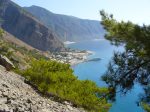
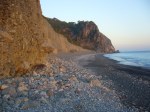
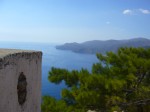
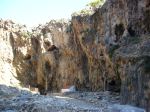
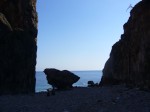
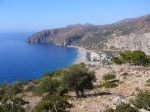
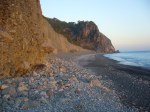
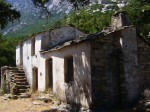
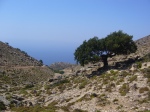
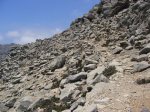
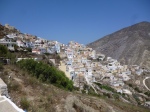
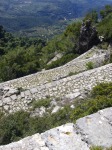
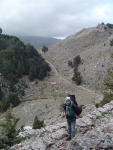
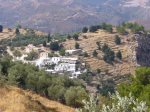
a.       One of the wildest and most difficult walks on Crete is the one along the coastline  between Sougia and Agia Roumeli. But it is rewarding as it offers not only a great variety of natural beauties, but also access to the Gorge of Tripiti which as “a clandestine landing point for the whole of the area” played a major role during the occupation. In his book “The Stronghold” Xan Fielding describes it  as “a needle-narrow opening in the littoral  ramparts, which travelers until recently believed to be inaccessible  except by sea” (p. 55). The Tripiti gorge marks the border between the provinces of Selino and Sfakiá and offers insights into the “highland labyrinth” above Koustogerako which during WW II “was probably the only habitable area in the whole of Crete  which could have sheltered in safety such a vast clandestine concourse as ours had been (Xan Fielding; Hide and Seek, p. 167).

Remote places and landscapes in Greece – Walks in the footsteps of Patrick Leigh Fermor: Part 6

The sixth of Christian Peter’s walks.

6.     From Christos Raches to Manganitis  – Ikaría

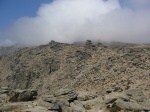
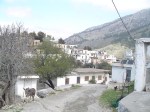
This unknown, but astonishing walk starts in the mountain village of Xristos Raches in Western Ikaria. The day long walk first heads towards the high plateau of Ammoudia from where you follow a steep, but paved kalderimi into the fishermen´s village of Manganitis.  As Ikaría even today does not have too much tourism, walking on the island still feels like the expedition into the everyday island life of former times .

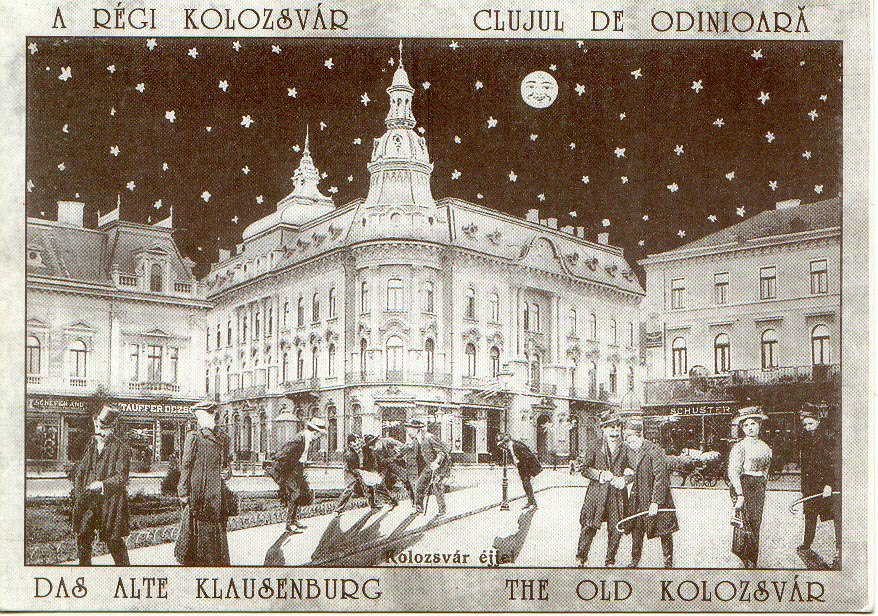
A postcard from Cluj

The Hotel New York in the 1920's

The Hotel New York in the early part of the 20th Century

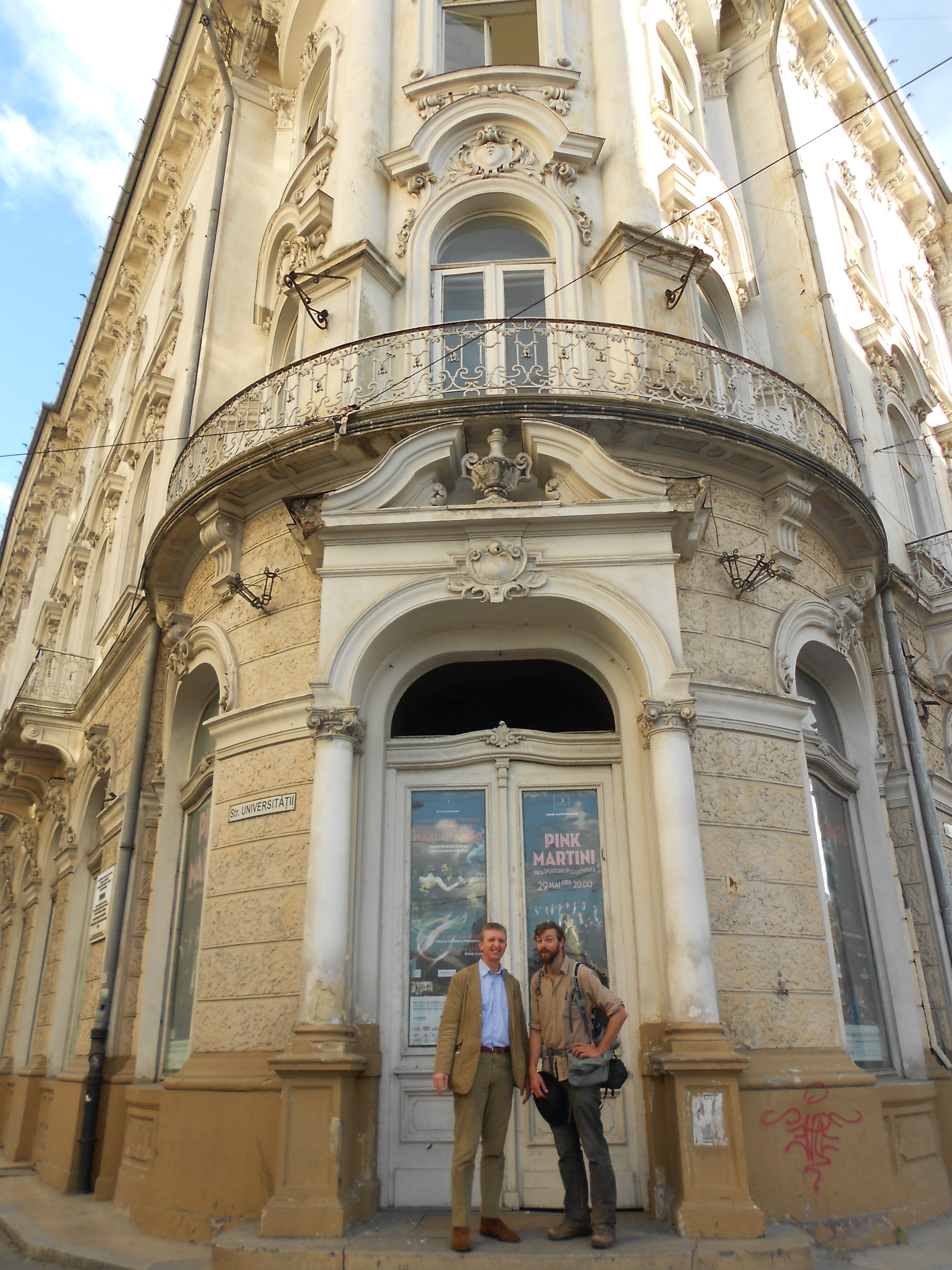
Thank you to my friend and colleague in Cluj, Stefi Timofte, for finding this picture for me. Of course it shows the Hotel New York (now the sad and decaying Continental) that Paddy visited with Angéla and István in the summer of 1934.

This story has been debunked in Artemis’ biography but I am not entirely convinced by the explanation in her book. Paddy says he got the details from a book in German, but the level of detail (see my story about the internal decor) implies that this book had very good photographs in colour or Paddy at least visited during one of his later visits to Romania.

For me, Paddy’s description of the romance of those days on the road, and the nighttime trysts with Angéla can never be diminished.

Related articles:

An eye for detail and the memory of the Hotel New York in Cluj

Angéla, Paddy, István and Tom in Cluj-Napoca

£1 a week – Rendezvous in Cluj

Remote places and landscapes in Greece – Walks in the footsteps of Patrick Leigh Fermor: Part 5

The fifth of Christian Peter’s walks. I hope that you are enjoying this; the scenery is stunning.

5. Amorgos/Cyclades

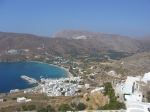
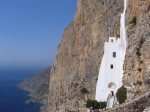
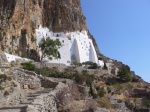
a. The longest hike on the Cycladic island of Armogos is also the most beautiful. The old connection between the main island villages of Chora in the Island centre and Aigiáli in the North is a one day walk on old, partly paved paths with fantastic bird eye views upon the whole island. Along the way lies the monastery of Chozoviótissa which is among the most important monasteries of the Aegean Sea.

House in Wales

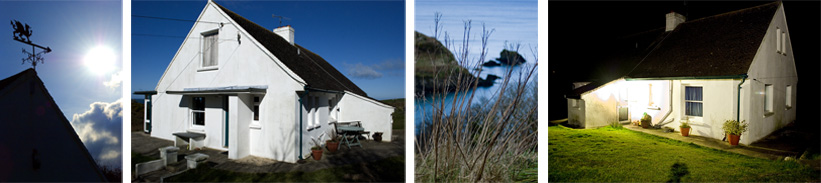
Cliff Cottage - Fforest Farm - Newport

Cliff Cottage – Fforest Farm – Newport

There is so much to discover about Paddy and Joan’s life. The detectives are always at work, and I thought I would share with you this note I received from Alun Davies, an ex-Army man like myself who somehow has become the Honarary Consul in Wales for Hungary. How do these things happen? 🙂 Please share with us your memories or investigations. You can always contact me at tsawford [at] btinternet.com and I promise to reply, ever so slowly!

Dear Tom – here is a small piece of the jigsaw of Paddy’s life which you might enjoy. Each summer we go down to West Wales as a family and stay at Newport in Pembrokeshire. When I read In Tearing Haste I noticed a reference to Newport and asked Artemis if she knew more.

The long and short of it is that I have located the cottage in which Paddy and Joan stayed in the summer of 1961. This was not exactly difficult as on page 83 of ITH he gives the address as Cliff Cottage, Fforest Farm. In fact I know Fforest Farm but the property is now called Fforest Cottage.

I spoke to Joanna Ward who now owns the cottage – picture attached – who told me that her father had bought the property in 1963 from Rex Warner’s wife after he had died.

The footnote on page 84 of ITH says:

PLF had borrowed the house from Barbra Ghika (1911-1989), nee Hutchinson, who married the painter Nikos Ghika in 1961. She was married previously to Victor, 3rd Baron Rothschild 1933-46 and to Rex Warner, writer, painter and translator of Greek tragedies, in 1949.

I am wondering if Charlotte Mosley was right in thinking that the house was borrowed from Barbra when it seems to have been owned by Rex Warner and his later wife. Given Rex’s background in Greek classics, and the fact that he was the director of the British Institute in Athens after the war, Paddy must have known him well.

I realise this is not necessarily of great interest – but as I know that area well I found it interesting to follow up the lead.

Best wishes

Alun

Remote places and landscapes in Greece – Walks in the footsteps of Patrick Leigh Fermor: Part 4

The fourth of Christian Peter’s walks.

4.   Sfakián Monopatia – The old connection between Asi Gonia and Anopoli  – Sfakiá/Crete

How often did Paddy, Xan Fielding and George Psychoundakis walk the old Monopati from Asi Goni via Askifou to the Sfakian mountain villages of Anopoli and Agios Ioannis? Did that connection play a major role during the Cretan resistance?

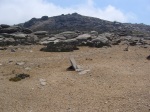
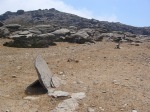
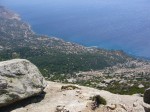
The mountain region of Sfakiá is the heartland of what Xan Fielding called The stronghold.  Here, in the Highlands of the White Mountains, Crete until today remained as pure and unspoiled as it always was. The walk starts in the birthplace of the Cretan Runner, George Psychoundakis, then reaches the hamlet of Goni in the Askifou-Plateau and continues via to Kali Lakki to Anopoli. Next to Anopoli, on the ridge of the Aradena Gorge, lies the ruined village of Aradena, where in 1947 a vendetta broke out and made its inhabitants leave. Aradena is as well the imaginary village, where Ioanna Karystiani’s novel Suit in the earth (Greek title: Koustoumi sto choma) might take place. Karystiani’s family is originally from Askifou. Following the bridge over the gorge, the walker continues to Agios Ioannis, Crete`s highest mountain village. A little bit underneath of Agios Ioannis you can find a place called Sellouda, which for me is the most impressive place in entire Crete. With the Levka Ori in your back you stand thousand meters high above the sea spotting Africa on the horizon. Although the cliffs seem impossible to pass through you can easily follow a stone paved Kalderimi through steepest terrain which leads you almost thousand meters difference in altitude down to the church of Agios Pavlos on the beach. From there you can continue your two days trek to Agia Roumeli.

This slideshow requires JavaScript.

Books about the region:

Xan Fielding (1954): Hide and Seek. Secker and Warburg.

Xan Fielding (1955): The Stronghold: An account of the four seasons in the White Mountains of Crete. Secker and Warburg.

Ioanna Karystiani (2000): Suit in the earth (German title: Schattenhochzeit)

Loraine Wilson (2002): Crete. The White mountains. A walking and Trekking guide. Cicerone

Peter Trudgill (2008): In Sfakiá. Passing time in the Wilds of Crete. Lycabettus Press.

On Foot to the Golden Horn: A Walk to Istanbul

Jason Goodwin, author of On Foot to the Golden Horn

Whilst at the launch party for An Adventure, I met Jason Goodwin who, when just a little younger, walked in 1990 with two friends from Gdansk to Istanbul. Jason subsequently wrote On Foot to the Golden Horn: A Walk to Istanbul as a record of their adventures. It is an enjoyable read, but there is just not enough about Istanbul!

Of course before setting out on the journey, Jason sought Paddy’s blessing, as so many young writers have done over the years …

We met him for the first time in early 1990, just before we set out to walk from Poland to Istanbul. My aunt Judy asked him over for a drink. Impeccably dressed – touch of the dandy, old school, Guards… Shabby chic was not his style.

We told him our plan, to start walking from Gdansk. There was a cargo ship that made the passage to Gdansk from the Thames each fortnight, and offered berths.  From the Baltic to Czestechowa, then Cracow, over Slovakia into Hungary…. It was a wonderful moment to start out across the lost lands of eastern Europe. Paddy had known them so well before the curtain dropped, and we would be among the first to go in again, to see how this disjointed Europe might re-unite. To see what and who was on the Other Side.

‘What a marvellous idea!’ he exclaimed, as if – well. As if we were the very first people ever to think of it.

On Foot to the Golden Horn: A Walk to Istanbul won the John Llewellyn Rhys/Mail on Sunday Prize in 1993, and is now available in a Kindle edition. Jason’s review of Patrick Leigh Fermor: An Adventure was published in Country Life and you can read it here.

Remote places and landscapes in Greece – Walks in the footsteps of Patrick Leigh Fermor: Part 3

The Third of Christian Peter’s walks.

3.   The village of Olymbos in the North of Karpathos

There is no village like Olymbos in the entire Agean Sea. I don`t know if Paddy ever visited the Dodekanese Island of Karpathos and the vilalge of Olymbos. If not he missed an important impression.  A village without bakery due to the fact that the Olymbites still use their old ovens in the gardens, a village where the women still wear their old costumes, a village where byzantine traditions (Songs, easter Tuesday) are still alive.

The old Monopati from Spoa to Olymbos is one of the most impressive walks I have ever made on Greek islands. It is partly paved, especially the last part leading into the village of Olympos is fantastic. If you want to understand what life was like in this remote village in former times, you need to get there by walking the old path.

Transylvanian Book Festival Facebook page

FB pageThe new year has started off with a lot of activity for the team behind the very first Transylvanian Book Festival which will take place between 5-9 September 2013. The location is a great attraction, and those beautiful villages of the Saxon Lands in the Carpathian Mountains offer a unique location. More news coming soon.

The team hope that as many of you as possible can join themthere, but in the meantime, come on over and join the Transylvanian Book Festival page, by ‘Liking’ it on Facebook so you can keep up with the news and join in yourself.

Read more about the Festival here.

An Encounter with Patrick Leigh Fermor

Patrick Leigh Fermor working at his home studio on 3 October 2004, then aged 89. Kardamyli. by Sean Deany Copyright 2012

Patrick Leigh Fermor working at his home studio on 3 October 2004, then aged 89. Kardamyli. by Sean Deany Copyright 2012

I was alerted to this article when its author, Sean Deany, posted some very nice comments on the blog. Thinking that this was one to share (there are some lovely pictures) I asked Sean if I could post on the blog. He very kindly said yes. Sean tells me he is off on a 1,700 km walk from Arles to Santiago de Compostela in 6 weeks time; so if you see an Aussie pilgrim reading A Time of Gifts wish him g’day.

by Sean Deany

In early 2001 restless and tired of my uneventful life I had the ambition to take a long walk and think things over. Hearing my complaints a good friend suggested to me that I should read Patrick Leigh Fermor’s two books “A Time of Gifts” and “Between the Woods and the Water”. Who? Was my reply. A bit surprised of my ignorance, he later supplied me with a tattered copy of the first book which would become a huge inspiration behind my travel ambitions. A few weeks later I discovered a near new copy of the second in the series of a planned trilogy. Then I had a great idea! I would write to Penguin Australia and naively ask them to forward my hand written letter to the author seeking his advice for my proposed walking tour across Europe.

This could have been the end to the matter. However and quite unexpectedly some weeks later a tiny envelope from Greece arrived into my post box. Inside it contained a two page hand scrawled response to my request  from the author himself Patrick Leigh Fermor. Common sense explained that I should not merely follow the same route he had taken all those years ago, since the world had changed to that of his youth when in hob nail boots he tramped across 1930s Europe. There and then he was really heading into the unknown! Instead he advised I should nonetheless traverse Europe, but perhaps begin in Portugal, Spain or France and head towards Eastern Europe by way of Poland and the Baltic States, before entering into Russia. From there I should swing down into the Crimea before plunging into the Caucasus. From there I could logically enter Turkey via Trebizond, following Xenophon’s Anabasis in reverse – all Greek to me –  before heading westwards to along the Turkish coastline! These were places he had always wanted to travel to, but now time was catching up on him and he doubted it would be possible. My head was by this time spinning in excitement with conflicting ideas into where and indeed when I should go.

Click here to read more …..

Remote places and landscapes in Greece – Walks in the footsteps of Patrick Leigh Fermor: Part 2

The second of Christian Peter’s walks.

2.    The old Kalderimi to the village of Altomirá – Exo Mani

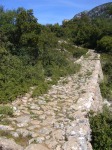
a.    I have often been thinking which way Paddy and Joan might have taken when they first walked over the Taygetos Mountains into the Mani in summer 1952.  Starting in Anavriti they probably headed towards Pighadia and Altomirá. That means they must have come down the fantastic Kalderimi from Altomirá to Kambos. For me this is even today the most impressive way to reach the Mani.

Remote places and landscapes in Greece – Walks in the footsteps of Patrick Leigh Fermor: Part 1

Paddy is quite popular in Germany, there being a lot of interest in his work about Greece, and of course A Time of Gifts is set mostly in Germany. His is also famous for the Kreipe kidnap. We have many fellow blog readers from Germany, but one of the longest is Christian Peters who lives in Koln but has a passion for Greece. He sent me a series of short articles about walks in a variety of locations in Greece, with accompanying photographs. If you are thinking of what to do for your holidays in 2013, I hope that Christian’s articles which I will publish over a period of weeks will help to inspire you. Of course some are in the footsteps of Paddy. Over to Christian for an introduction …..

When I traveled in Greece this summer (2012), the consequences of the crisis were capable everywhere. The decrease in this year’s incoming tourism might create the need for a bit of stimulation. 🙂  And the remote places and landscapes, Paddy talks about in the introduction of his Mani-Book, are still there. They probably changed a lot during the last sixty years, but are still worth to be visited.

If you are interested I would send you a couple of ideas (8-10 walks and places with short texts and two or three photos each) of remote walks, places and landscapes in Greece I have been traveling during the last years. The places and walks are partly related to Paddy and his life, but there will be some, which I only assume, he would have liked.

1.    Walk one – Kalderimi in Western Crete – Selino

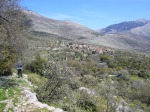
a.    Koustogerako, the village of the Paterakis Family in the Selino Eparchía of Western Crete, played a major role in the Cretan resistance during WWII. On the 29th of September 1943 it was completely burnt down by the Germans. Paddy visited the village a couple of times because Manoli Paterakis, one of the Kreipe abductors, was a close friend of him. Today, one of the most fascinating Kalderimi-Walks in Western Crete leaves the Omalos Plateau from Agii Theodori to the west, then descends into the Irini Gorge (Faragi Agia Irinis) until it reaches the main road heading towards Sougia between the villages of Moni and Livadas. From there it is only about an hour ascent up to Koustogerako.

The First Transylvanian Book Festival: 5th – 9th September 2013

The UNESCO World Heritage fortified church in Viscri

The UNESCO World Heritage fortified church in Viscri

If you enjoy literary festivals, want the opportunity to meet authors like William Blacker, and discover the romanticism and beauty of the Saxon lands of Transylvania whilst discussing the work of Patrick Leigh Fermor, then the place to be in September next year is the very first Transylvanian book festival which will be held during the period 5-9 september 2013.

Planning is well advanced. The event is being arranged by Lucy Abel-Smith who is an expert on Romania and has a house in the area. Her sister-in-law Caroline Knox is  assisting and has run the successful Boswell Literary Festival in Ayrshire for many years.

This will be your chance to join an exciting venture at its very beginning, in what I can assure you is one of the most beautiful places, full of history, romance and mystery right in the heart of Transylvania.

The list of authors who have agreed to speak is growing and includes William Blacker, whose acclaimed Along the Enchanted Way, has seen him hailed as heir to Patrick Leigh Fermor; Jessica Douglas-Home, author of Once Upon Another Time, will talk about the past under Ceausescu and her present work as chair of the Mihai Eminescu Trust, of which the Prince of Wales is Patron. Professor Roy Foster Oxford University and Historian expert on Bram Stoker and his influence on Literature; Michael Jacobs author of Robber of Memories.; and Artemis Cooper have been approached. Other talks will include writers from Romania’s strong literary tradition and will include those from the Romanian, Saxon and Hungarian communities whose work is internationally recognised.

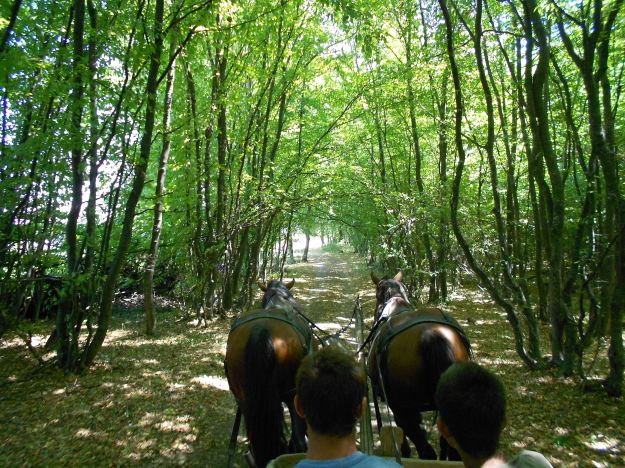
Other talks will focus on the gypsies, the wolves, the wonderful wild flowers, life in the Saxon villages, Count Banffy’s epic ‘They Were Counted’ and inevitably the late Paddy Leigh Fermor. There will be organised walks, the opportunity for horse and cart rides in the beech woods, and the chance to take in some of Transylvania’s wonderful fortified churches

Accommodation will be in three villages in the heart of Saxon Transylvania: Copsa Mare, Richis and Biertan. All have fine churches and picturesque village houses that run as B&Bs. Minibuses will be on hand to transfer guests to picnics, visits and dinners. The costs are currently being finalised. Flights are not included but there are easy connections from Cluj, Turgu-Mures or slightly further afield, Bucharest. There will be a daily rate of entrance fees to the readings and picnics.

Please contact me – tsawford[at]btinternet.com – if you are interested in attending or would like to be on the circulation for more information. The organisers are also looking for sponsors either in cash or kind so please indicate if you or your company can help; all sponsors will be fully acknowledged in the programme and on promotional material, websites and in PR, and given complimentary tickets to events.

DSCN0559

In the forest above Viscri

A Pilgrimage Through Paddy’s London

Rake’s progress: Leigh Fermor set out from his rooms in Shepherd Market for Constantinople in 1933

And we’re off. This is the Patrick Leigh Fermor Tribute Walk, a bit of a Magical Mayfair Mystery Tour or even, as I prefer, a Paddy Pilgrimage: a literary procession in honour of the late warrior-writer through the London he knew during the course of an enviably long and dazzlingly adventurous life.

By Justin Marozzi.

First published in Standpoint Magazine, December 2012.

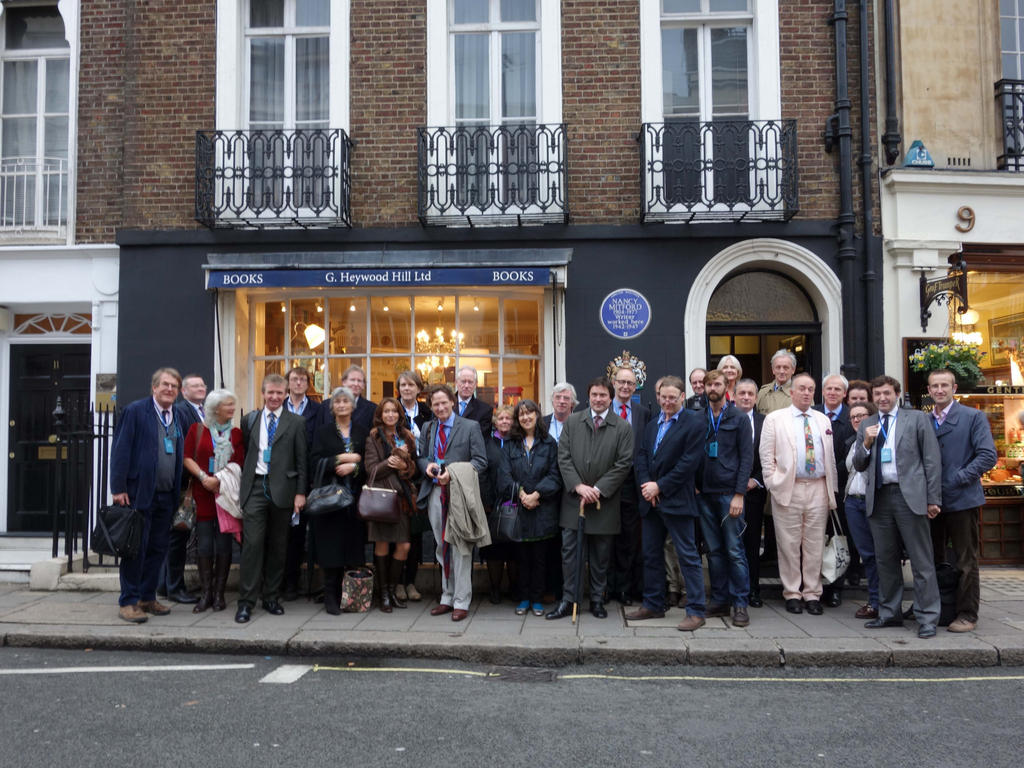
We have gathered at Heywood Hill, the venerable Curzon Street bookshop where Paddy, as he was always known to friends and fans, had an account for decades. The pilgrims are a caravan of travel writers and publishers, friends, acolytes, devotees and disciples, for such is the admiration—shading into unadulterated hero worship in some quarters—for a man considered one of the great prose stylists of the 20th century. Our group includes the travel writers Colin Thubron, Sara Wheeler, Anthony Sattin, Jason Elliot and Robert Macfarlane, the writers and historians Jason Goodwin and Fergus Fleming, publishers Roland Philipps and Barnaby Rogerson (in a tangerine linen suit), Mark Amory of the Spectator, an exuberant throng expertly marshalled by Paddy’s biographer Artemis Cooper.

It is not surprising that a man who wrote like an angel, fought like a knight and had beautiful women swooning at his feet for most of his adult life should attract such a following and such affection. Few men can claim to have walked across a continent, fallen in love with a princess, kidnapped a German general, joined a Greek cavalry charge and written a string of masterpieces.

“Patrick Leigh Fermor, the man, could have sprung from the pages of Cervantes or Homer, and we revere him at Heywood Hill for his courage, style and beautiful manners,” says Nicky Dunne, chairman of the bookshop, who dreamt up this expedition.

Paddy lived above the shop briefly in 1947 with Joan, his future wife. In 1965, horrified to have discovered how Communism had destroyed so many of his friends in the Europe he had walked across in 1933-34—”disaster overtook them all”—he set up an account at Heywood Hill for the great love of his youth, the Byzantine princess and artist Balasha Cantacuzene. “He couldn’t do much but he could make sure that at least she was never without good books,” says Cooper.

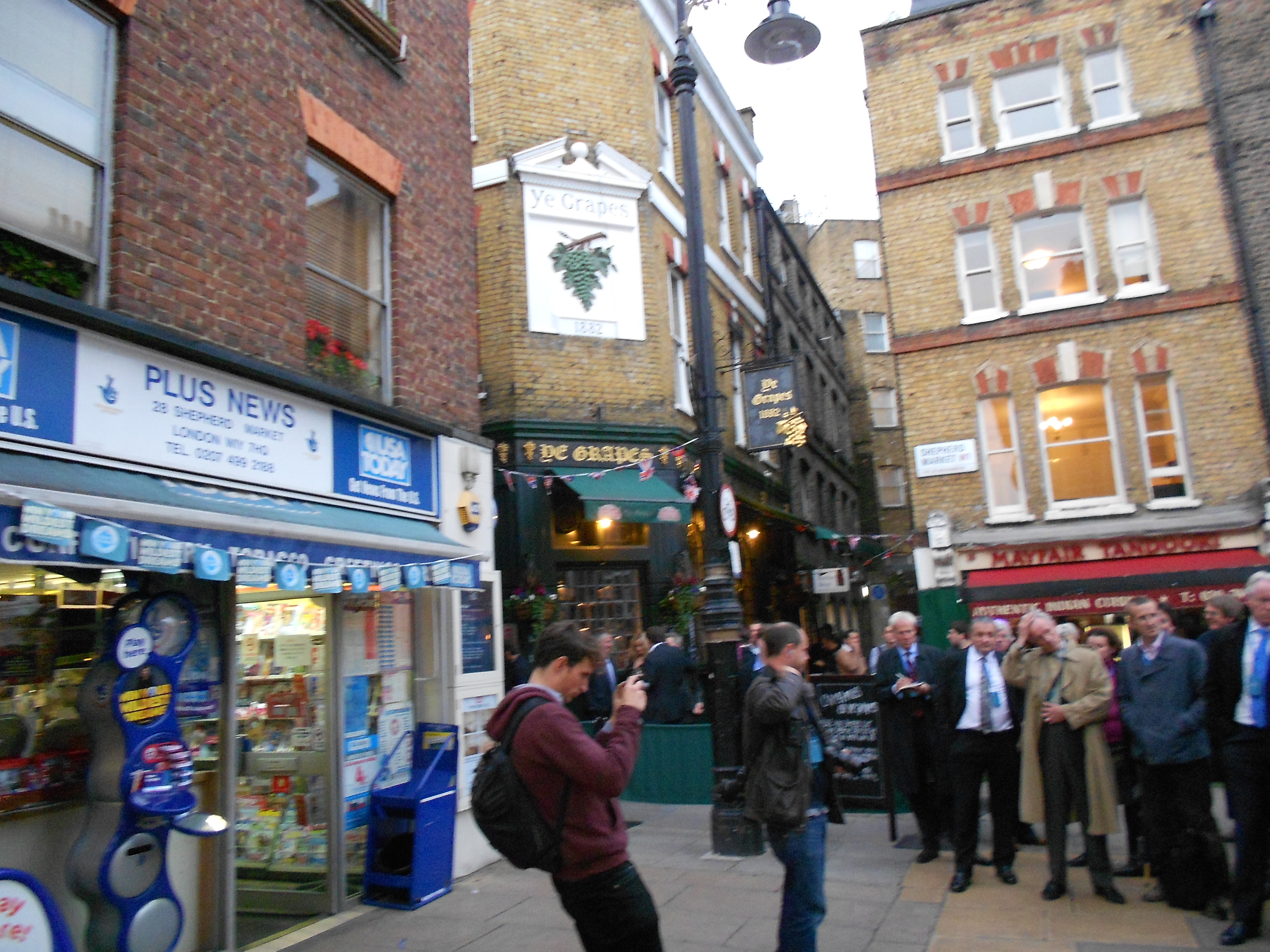
Our unruly, traffic-blocking gaggle spills out onto Curzon Street to the astonishment of passers-by—30 men and women sporting bright blue earpieces is a curious sight—and ducks into Shepherd Market to our next stop, 28 Market Street: four square windows above the “PLUS NEWS” newsagent. Having been kicked out of almost every school he had attended, Paddy washed up here as a restless 18-year-old with literary longings and a diminutive allowance. His long-suffering landlady, assaulted by endless revelry, was Miss Beatrice Stewart, an artist’s model who had sat for Sargent and Augustus John and was later immortalised in bronze as the Angel of Peace in Adrian Jones’s Quadriga of War on the Wellington Arch at Hyde Park Corner. “I can never pass the top of Constitution Hill without thinking of her and gazing up at the winged and wreath-bearing goddess sailing across the sky,” Paddy wrote in a typical flight of fancy.

“This is where the great walk began,” Cooper explains. “He’s lurching between high spirits and utter despair, filled with self-loathing, going to endless parties, ‘drowning hangovers like kittens’. His father wants him to get a job but Paddy thinks a career is life imprisonment. He’s uninstitutionalisable. All he wants to do is write.”

Hightailing it out of this Rake’s Progress, Paddy walked from the Hook of Holland through Nazi Germany to Constantinople. It took him over a year from 1933-34, much of it spent “in a coma of happiness” recounted decades later in the spellbinding prose of A Time of Gifts (1977) and Between the Woods and the Water (1986). Our little saunter is less than a mile in more than an hour. Yet what we may lack in schloss-hopping mileage and accumulated time, we make up for in rowdiness and delight. This could be a lesser-known ecclesiastical ritual of the Eastern Church, the Adoration of the Paddy. And we all know it will end, as it should, with wine.

We head towards Berkeley Square on roads slick with rain. “Paddy was my earliest model of a travel writer: brave, curious, cultivated and a marvellously gifted stylist,” says Thubron, president of the Royal Society of Literature. “It’s strange to be walking commemoratively through a world that’s not usually associated with him—not the Greece or Eastern Europe which all his readers know, but the London—still pouring rain—from which he set out 80 years ago.”
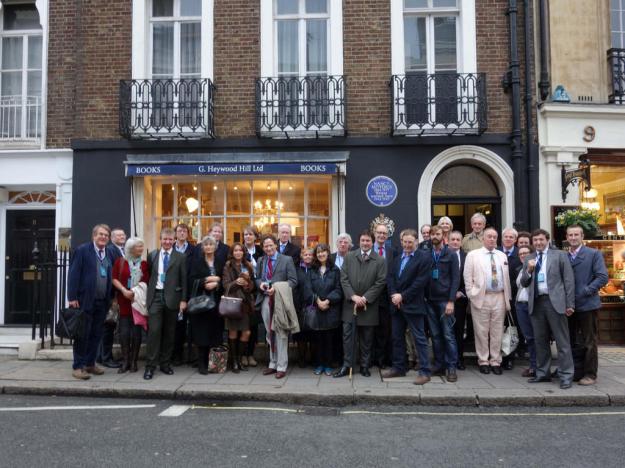
Friends and admirers of Patrick Leigh Fermor outside Heywood Hill, his favourite bookshop, in London’s Shepherd Market

Friends of Patrick Leigh Fermor outside Heywood Hill, his favourite bookshop, in London’s Shepherd Market

Here we are a stone’s throw from The Running Horse pub on Davies Street, from where Paddy briefly and rather successfully sold silk stockings as an impecunious teenager. Invited to share his tips with his fellow salesmen one evening, he popped a stocking onto his hand and described its properties as though it were a condom. He was fired on the spot. “That was the last sales job he ever had,” says Cooper. One night in the summer of 1940, when the London skyline was thick with smoke and flames, Paddy entered Berkeley Square from Piccadilly. “The blaze of an explosion had revealed two sides of that sentimental quadrangle in a disordered wreckage of wood and stone,” he wrote. “Only one thing remained standing. Perched three stories high on a tottering pinnacle of rubble was a white marble privy, glowing shyly in this unaccustomed radiance.”

We beetle along to Lansdowne Row, where Cooper describes a literary catastrophe on neighbouring Stratton Street, once home to the Baroness d’Erlanger, a rich and eccentric artist: “I think she had a bit of a crush on him.” Everyone did. In 1937 or 1938, Paddy left two trunks here full of papers connected with his trans-Europe tramp—every letter, diary and early draft. The Baroness moved home, put Paddy’s trunks into storage at the Harrods Depository, only for Harrods to sell them off years later because Paddy had forgotten to pay the storage charge. He had lost everything. There is a collective writerly wince. “Paddy said the pain used to ache ‘like an old wound in wet weather’, but I think it was the best thing that ever happened to him,” says Cooper. “It sort of set him free, allowing him to remember with advantage.”

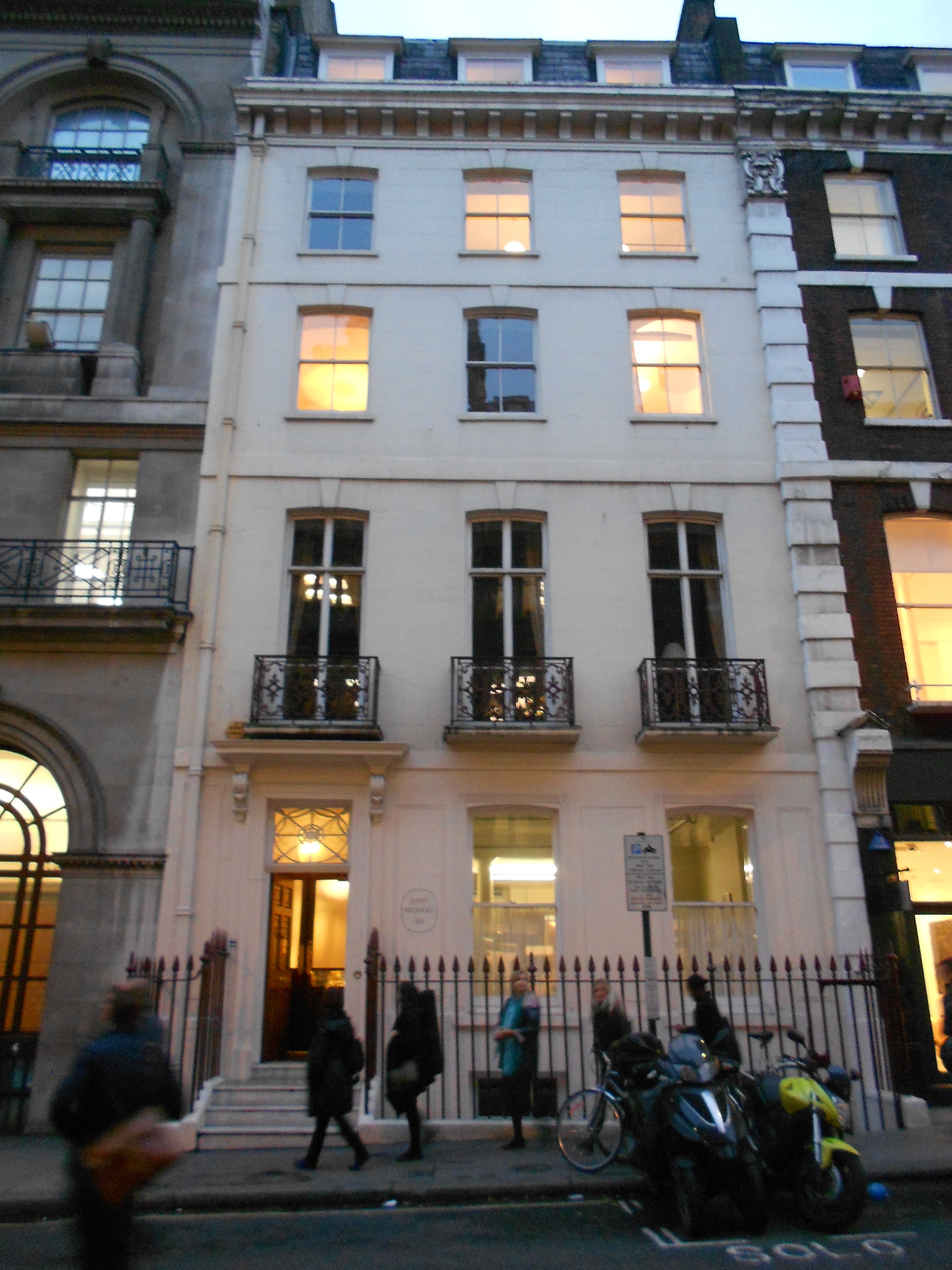
To 50 Albemarle Street, former HQ for John Murray publishers, a powerhouse of British writers from Byron, Darwin and Disraeli to Walter Scott, Conan Doyle and Paddy. “Jock Murray was the best publisher and editor Paddy could have hoped for,” says Cooper. “In the days before agents he was also Paddy’s banker, therapist, PR consultant, book-finder and poste restante.”

Picking up the pace now like horses heading home—drinks at the Travellers Club await—we stride magnificently down Jermyn Street. One imagines Paddy, sartorially something of a peacock, thoroughly at home here.

“Oh God, absolutely!” Cooper says, laughing. “Hats from Lock, shoes from Lobb, Savile Row suits. He loved all these shops. Paddy adored clothes. In all his books the costumes of men and women are described in extraordinary detail. I’ve walked along Jermyn Street with him, striding along with his cane with that lovely flick upwards before putting it down. If you didn’t know, you’d think he’d never left the Home Counties.”

Into the final furlong and past the Cavendish Hotel, an unlovely blend of underground car-park and drive-through fast-food forecourt. “Here he met the tail end of the Bright Young Things, a decade after all those parties that had scandalised society.” Alistair Graham, Jennifer Fry, Eddie Gathorne-Hardy, Mark Ogilvie-Grant . . . and Elizabeth Pelly, to whom Paddy lost his virginity.

“They’re a revelation to him. Godlike and irresistible. Suddenly he feels he’s met kindred spirits.” He didn’t meet Evelyn Waugh at the Cavendish because Waugh was banned. Mrs Rosa Lewis, the owner, did not find her portrayal as Mrs Crump in Vile Bodies amusing. “If I get my ‘ands on that Mr Woo-agh,” she told Paddy, “I’ll cut ‘is winkle orff!”

Through St James’s Square and we’re almost trotting into Pall Mall, from where it is a hop, skip and jump up the 11 steps into the Travellers Club, whose bar Paddy did more than most to prop up—together with those of White’s, Pratt’s, the Beefsteak and the Special Forces Club—during 66 years as a member. In 1950, the Club Secretary reported to the House Committee that the nomadically careless Paddy owed “over £100 for storage, if by-law 6 were to be strictly enforced”.

There is an inescapable whiff of glamour and adventure at the launch party. A light sprinkling of aristocracy, a smattering of bohemian scruff, the sparkle of beautiful women, sumptuously suited grandees, suggestions of espionage, the straight-backed swagger of military top brass.

Paddy was a prodigious drinker. He once wrote of retsina: “One of its secrets is drinking it with unstinted abundance. It seems to have an alliance with the air in the promotion of well-being. Many people think that it bestows the gift of bodily health as well; a belief I accept at once without further scrutiny.”

The evening dissolves into high spirits, laughter and torrents of wine. The hommage is complete.

Related articles:

Patrick Leigh Fermor’s ‘magical’ tour

Marathon man – Justin Marozzi interviews Paddy and drinks quite a lot of retsina.

Paddy’s childhood home: The Weedon Bec route near Northampton

The travel writer Patrick Leigh Fermor enjoyed a blissful childhood of ‘barns, ricks and teazles’. His biographer, Artemis Cooper, strolls through the landscape of his adventures.

By Suzi Feay

First published in the Financial Times, 27 October 2012.

“I made the decision very early on that I was not going to walk in Paddy’s footsteps,” says Artemis Cooper, biographer of travel writer, raconteur, war hero and all-round charmer Patrick Leigh Fermor. Just as well, as his youthful exploit of going “on foot to Constantinople”, as detailed in his book A Time of Gifts, is probably his most famous achievement. That’s if you don’t count kidnapping a German general and force-marching him round Mount Ida, Crete, during the second world war, an adventure retold in the movie Ill Met By Moonlight in which PLF was played by Dirk Bogarde. This must be one of the few cases where a film star was eclipsed by his subject. Leigh Fermor continues to enchant from beyond the grave.

Certainly his biographer is smitten. “I’ve known him all my life,” she says of her old family friend, still apt to talk about him in the present tense (he died last year, aged 96). We have met in the Northamptonshire village of Weedon Bec, where Paddy spent his infancy. In her book, Patrick Leigh Fermor: An Adventure, Cooper describes these idyllic years during the first world war, when he lived with “Mummy Martin”, “Daddy Martin” and their children, adored though unrelated. Why he was there is a mystery; he was reunited with his own mother aged four, but was never to feel strongly attached.

By St Peter & St Paul’s Church in Weedon, the main road passes under the Grand Union canal. We climb some steps to the towpath, where a barge puffs out atmospheric smoke. Although this is a lovely spot to begin our walk, there is no mention of the canal in any of his writings about his childhood. Little Paddy-Mike, as he was known, was clearly not allowed to go near it.

We set off, the first of many brightly coloured barges chugging past us, and glimpse a tiny water vole. Cooper tells me about PLF’s legendary vitality. “His energy was amazing. We went to stay with him in Greece and went for a walk. He was in his seventies and we [she and husband Anthony Beevor] were in our thirties and quite fit and it was hard to keep up with him. He was making a point, but still … ”
One thing I gleaned from her book was that Leigh Fermor hated going to sleep. Why was that? “Because it wasn’t living,” Cooper replies. “He felt you had to get the most out of life, every minute of it.” There are amusing tales of a Christmas turkey stuffed with Benzedrine as he whooped it up in wartime Cairo.

At the second bridge over the canal we ascend to the High Street, where the Martins lived at number 42. After some puzzling, we finally discover the house, formerly divided into two tall, thin dwellings. The date “1849” is visible under the porch. Nearby is The Wheatsheaf, behind whose vanished gates Paddy-Mike would play. This would have been a busy little town, but in A Time of Gifts he speaks of a rural childhood of “barns, ricks and teazles, clouded with spinneys and the undulation of ridge and furrow”.

The Grand Union Canal between Dodford and Weedon Bec

We nip into the Heart of England pub opposite, and I ask Cooper what it was like to talk to this legendary conversationalist. “He just made you feel so great,” she beams. “I’d never read Hardy’s The Dynasts. ‘OH, my dear, what a TREAT you have in store, I think I have a copy here, you can take it with you to bed tonight. WHAT, you’ve never read The Bridge-Builders by Kipling? It won’t take a second – I tell you what, after lunch I’m going to have a nap, you can read it then.’ That enthusiasm, never making you feel stupid or under-read. One of his oldest friends said, ‘if only Paddy came in pill form and you could take him whenever you felt depressed.’ That’s how he left you feeling. Even in his nineties.”

We rejoin the canal path as it makes a series of lazy wiggles, talking about Leigh Fermor’s mother (“an awful snob and a name-dropper”) and wife (“If it hadn’t been for Joan, I think he might just have been a charming sponger”). We leave the canal at the next humpbacked bridge and turn west, following a quiet road with a view over tranquil fields. “Now can’t you just imagine the young Paddy, roaming around here playing Robin Hood? Always the romantic.”

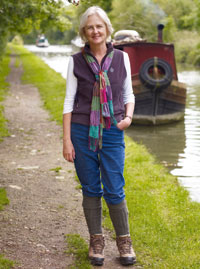
Artemis Cooper togged up!

By the stream running by the path, Cooper takes a photo of a purple flower to identify later. Over the fields lies the village of Dodford, where Leigh Fermor and his mother lived when he was slightly older. At the village green, we turn right past a red telephone box, then left at a set of gates. Cooper has an Edwardian photograph of Vicarage Cottage, his former home, and is eager to find it. Now called Quiet Ways, and somewhat enlarged, it is instantly recognisable; and opposite is the Swan, or “Dirty Duck”, now a private home.

We ascend a footpath and walk through the churchyard of St Mary the Virgin to the A45, which we cross at a place called Four Views. From there, we take a diagonal path across the fields, eventually meeting the Nene Way. A sharp left turn returns us in the direction of Lower Weedon. The soil in the fields is a rich red, the landscape gentle, undramatic, yet quietly beautiful. Our conversation takes a sombre turn as the sky darkens.“The gods gave him great gifts. To be handsome, intelligent, a gifted linguist with a wonderful body … And it doesn’t stop there: to have all that and be charming, a great conversationalist, to be the person everyone loves being with. But with great gifts the gods also make you pay a price. He had periods of depression, and times where he felt that he hadn’t written enough, that he’d wasted his life.”

At Upper Weedon a sharp right turn takes us south, then we turn left on to Farthingstone Road to ascend Weedon Hill, supposedly the site of Boudicca’s last stand. “Well, it’s one of the possible locations. Perhaps the least likely,” Cooper concedes. Leigh Fermor, a magical embroiderer of legend himself, I’m sure would have begged to differ.

Patrick Leigh Fermor’s ‘magical’ tour

Friends of Patrick Leigh Fermor outside Heywood Hill, his favourite bookshop, in London’s Shepherd Market

To celebrate the publication of Artemis Cooper’s biography of travel writer Patrick Leigh Fermor, Today presenter James Naughtie joined a party led by Artemis Cooper to walk past some of Patrick Leigh Fermor’s London haunts. As you may see from the photograph, the participants included Colin Thubron, Cherie Lunghi, Justin Marozzi, Robert Macfarlane, and Gabriella Bullock who is “Billy” Moss’ daughter.

Starting at Paddy’s favourite bookshop (and temporary post-war residence) Heywood Hill, we first braved the traffic in Curzon Street to cross into Shepherd Market where curious drinkers at The Grapes watched as we gazed in awe at 28 Shepherd Market, the place from where Paddy set out on his walk on 8 December 1933. It may have been bombed in the war as the building is a replacement with the enticing Plus News newsagent on the ground floor.

We weaved our way in the dusk to Berkeley Square which Paddy passed through one night during the blitz and later noted ‘only one thing remained standing, three storeys high, stood a white marble privvy’. The journey to Stratton Street was quick and this is where Paddy left two trunks containing most of his documents from the walk which were eventually deposited by the keeper into Harrod’s Depository; Paddy could not pay the large accumulated storage fee and when he did return the trunks and their contents had been sold and dispersed. Artemis observed that perhaps it was a good thing as he had to rely upon his mind and was perhaps ‘set free’.

50 Albemarle Street, the entrance to publisher John Murray

Our touristic snake trailed into Albemarle Street and we passed John Murray’s at number 50, crossed Piccadilly to the entrance of The Ritz where Paddy often stayed, but once had great difficulty entering when in training at the Guards’ Depot as he was dressed in the uniform of a private soldier, the Ritz being for officers only.

Paddy went to riotous and notorious parties at The Cavendish hotel in Duke Street, St James’ with many of the “bright young things” which did not include Evelyn Waugh as he had offended the owner, Mrs Lewis who said of him ‘When I see that Mr Waugh I’m going to cut his winkle orf’. Mrs Lewis indulged Paddy and others of somewhat straightened means and let them build up virtually unlimited credit. She knew that they would be unable to pay, but it was small beer to some of her more wealthy clients who did not check their bills too closely and ended up paying for Paddy’s extravagancies.

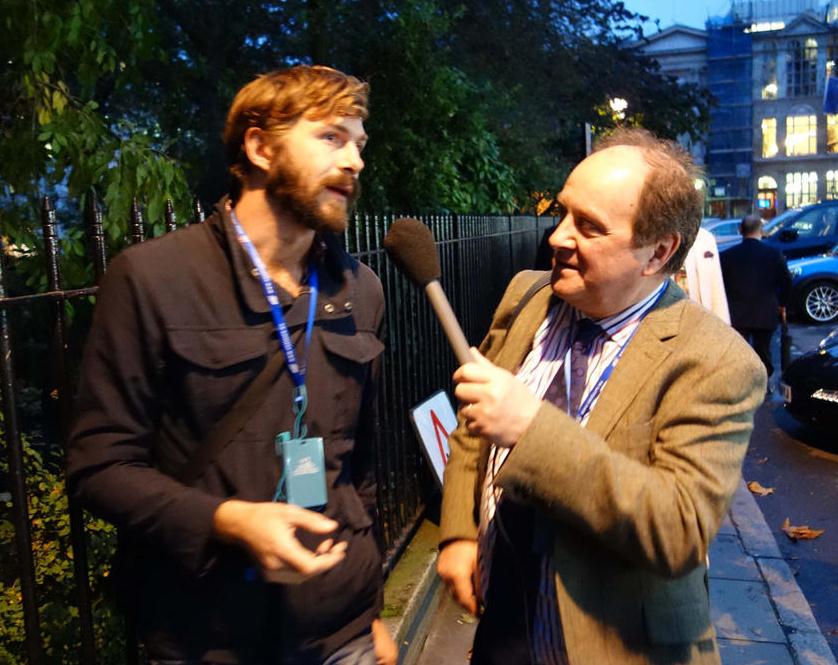
Throughout the walk we were accompanied by James Naughtie from Radio 4’s Today programme. He recorded the package below and left early as you would expect from someone who has to get up at about 3.30 am when presenting the programme. Naughtie grabbed some time with Nick Hunt who walked Paddy’s route from Hook of Holland to Constantinople just this year. He promised to make Nick a star. Let’s hope so.

Nick Hunt being interviewed by James Naughtie

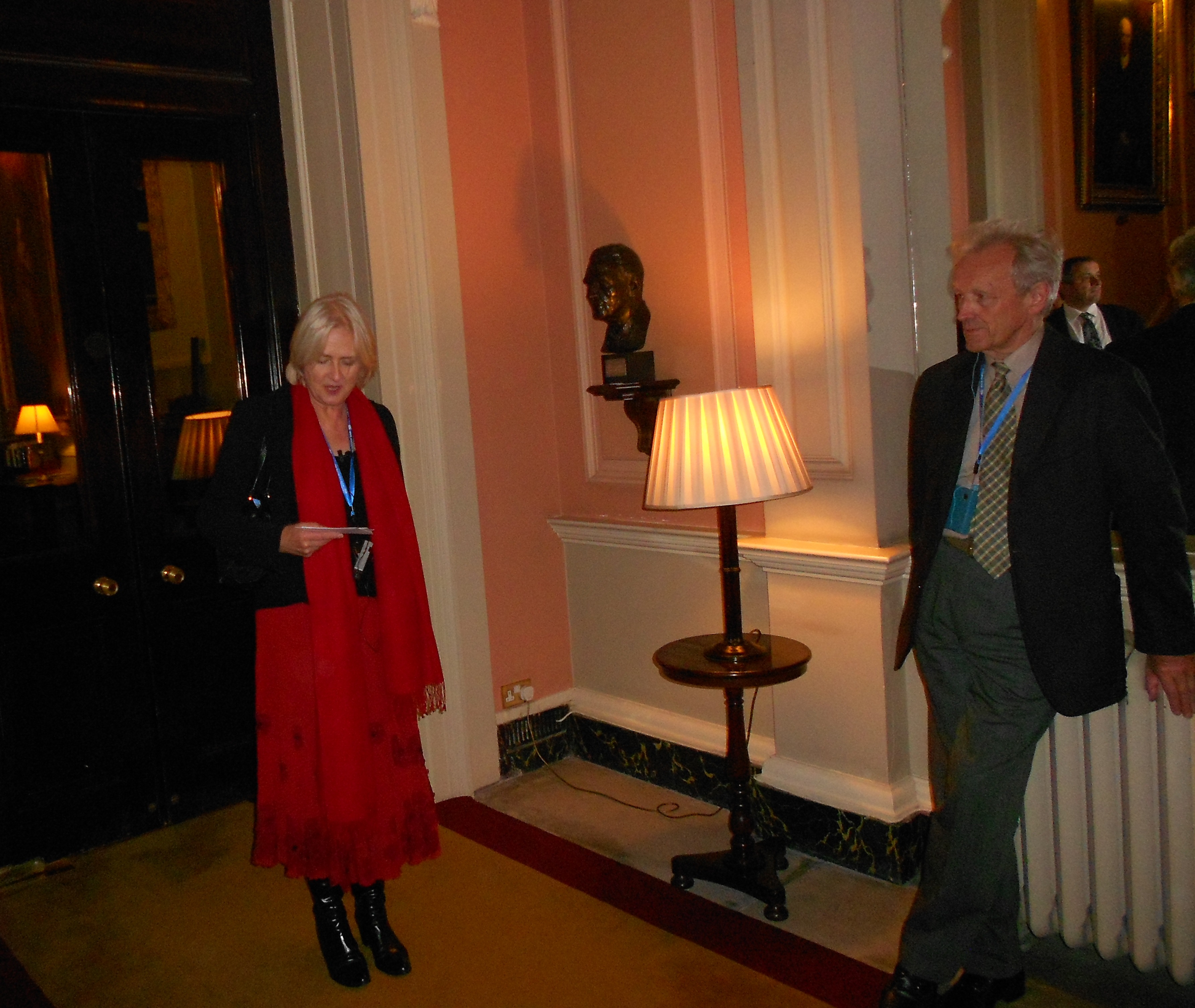
This tour through Paddy’s Mayfair was a pre-cursor to the official launch of Patrick Leigh Fermor: An Adventure at Paddy’s old club, The Travellers. Artemis got a very well deserved round of applause for the biography, and she spent most of the evening busy signing books; dozens must have been sold. Ian Hislop made a sartorially unkempt appearance near the end (how did he get in without a tie?), and I think I saw Bank of England Governor, Sir Mervyn King pop in and do his bit for the consumer economy.

Artemis and Colin Thubron in the lobby of the Travellers Club with bust of Paddy


Patrick Leigh Fermor: An Adventure will also be the BBC Radio 4 Book of the Week from 19th November onwards.

You can buy Patrick Leigh Fermor: An Adventure here.

Don’t forget to visit Artemis Cooper’s Facebook page for further information.

The ultimate pilgrimage to Paddy’s house in the Mani?

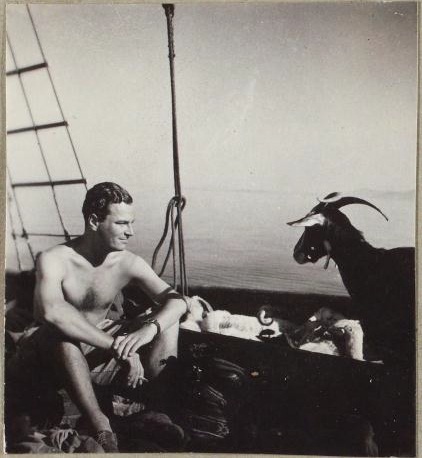
Paddy with Goat! Photo by Joan Leigh Fermor, from the Trustees of the National Library of Scotland

If you wanted to make a trip to see Paddy’s house at Kardamyli and to visit the wider Mani this may be the one for you. In the company of Paddy’s biographer, Artemis Cooper, this six-day tour will take in Mistra, Monemvasia, and Paddy’s house in Kardamyli, as well as other sites in the Mani.

This tour has been arranged by Art Tours (sponsors of the Royal Geographic Society event about Paddy 24 Oct) and is designed to celebrate Paddy’s life, whilst exploring the dazzling, rocky region he loved best in Greece, and where he and Joan lived for over forty years.

It is a celebration of his life and travels and is planned to run from 7-12 May 2013. Artemis will bring a unique insight into Paddy’s life and personality, and to cover the wider history of the region she will be joined by art historian James McDonaugh.

If you would like to know more please download this pdf or contact Edward Gates at Art Tours Ltd on +44 (0)207 449 9707 or by email edward[at]arttoursltd.com

£1 a week – Nick to talk about his journey, Saturday 1 September in London

After a short period of adjustment to ‘normal life’, and, I dare say, some personal reflection, Nick has contacted us to say thank you for the support you gave to him and to announce that he will be giving a talk about his walk on 1 September.

Dear everyone,

Thanks so much for all your support before and during my walk to Istanbul. Knowing that people were following me, reading and enjoying my blog, made a lot of difference on the rocky, rainy days.

I hope you all got your postcards. Some of you are also due a handmade book, and/ or a CD of audio recordings from the journey. I will get round to these as soon as possible — be patient, they will come!

I’ll be starting work on the book very soon. It will hopefully be published next year — you can sign up for updates on my blog, if you want to be kept informed.

For anyone in London, I’m giving a talk about the journey at the Globetrotters Club, who also funded me. It’s on Saturday September 1st, around 3.00pm, here:

Church of Scotland Church Hall,
Crown Court,
London, WC2B 5EZ

I think it’s £5 or £6 on the door, but they normally have an enormous array of free biscuits. Come if you can.

Thanks again for all your support!

Nick

Here is a useful map!

A PLF Pilgrimage to the Abbey of St Wandrille

Ed Ricketts has been travelling again and taking the opportunity to follow in the Paddy’s footsteps, this time at the Abbey of St Wandrille where Paddy spent much time writing, and described in A Time to Keep Silence. Ed has sent some pictures for us to enjoy.

If you have your own stories about Paddy related journey’s please send them to me. See About & Contact for details.

Dear Tom,

Hope you are well. Good to hear the news on the Artemis Cooper biog – should make for good Christmas reading!

If it’s of any interest to you, just to say that I was on a brief cycle tour of Normandy last week and passed by (well, it was intentional) the Abbey of St Wandrille, memorably described of course at the start of ‘A Time to Keep Silence’. As you can see from the attached photos, it was a glorious day with the surrounding countryside looking extremely green and in bloom.

I made a quick tour of the Abbey buildings, and slightly regret that I didn’t have more time to ask if it was known which ‘cell’ was PLF’s, or indeed if the connection is still remembered in any way today (no evidence of this from the gift shop). I would recommend a visit some time, it can be enjoyably combined with Rouen and the riverside abbey of Jumieges, a few kilometres to the south. A series of ferries also cross the Seine at various points nearby, which is somehow also quite a Leigh Fermorian experience. Finally, a paperback copy of ATTKS can easily be carried on a bike! (you just about make this out in one of the photos).

I think, from now on, I might try to follow a principle of ‘visiting one place PLF wrote about per year’ – there are worse ways of spending your time.

Cheers and keep up the good work,

Ed Ricketts

Related Articles:

A pilgrimage to Esztergom

An eye for detail and the memory of the Hotel New York in Cluj

Eight articles related to A Time to Keep Silence

£1 a week – Nick has arrived in Constantinople!

He left England on a warm and balmy December 8 2011, and has today, 17 July 2012, arrived in the hot and bustling melting pot of Istanbul as we in England endure the foulest, accursed summer weather.

Nick’s boots, which he had just had repaired by a Romanian cobbler in Turda when I met up with him in Cluj in May, have finally collapsed, and it appears that his emotions are about to undertake a twisting, heaving, never experienced before maelstrom of sweet contradictions as he comes to terms with the conclusion of so much commitment, planning, and effort.

Link to here to read his immediate thoughts and follow him in the coming days as he tries to come to terms with his next steps.

As we discussed in Cluj, he could not see how after reaching his goal he could just jump on to the next plane home; and why would he want to? He faces the ‘plan your journey’ congestion of the Olympics and rain, and floods, and worst of all … normality.

Paddy would have been very proud of him; I am sure of that. And we all are.

Well done Nick!!!!

£1 a week – (not so) Sunny Beach

Last Saturday I was listening to From Our Own Correspondent on BBC Radio 4. One of the packages was from Croatia and concerned the tug of war between environmentalists and business people about controlling and ‘improving’ yet another stretch of the Danube. It reminded me so much of the Persenbeug Prediction in A Time of Gifts. The forecast of the taming of the Danube which now appears to be entering its final round on the Croat-Serbian border.

In his latest dispatch from his epic walk to Istanbul entitled Summer Metropolis, Nick Hunt encounters more uncontrolled development and taming of nature along the Black Sea coast of Bulgaria and reflects on how many of us perhaps fail to find the happiness and fun that we seek in our modern world ….

I wandered inadvertently into an all-inclusive resort. Everyone apart from me was wearing coloured plastic wristbands to demonstrate their allegiance to a particular package deal, like some form of indentured servitude. The broiled bodies on the beach didn’t look particularly happy – in fact most of them had the frowns and down-turned mouths of deep dissatisfaction, as if they didn’t quite know why they’d come here or what they were meant to be doing.

His latest article is very good (Nick’s writing seems to be improving with every piece) and shows just how much things have changed since Paddy walked along that same Bulgarian coastline, encountering Greek fishermen in 1934.

Read Summer Metropolis here.

£1 a week – Rendezvous in Cluj

My visits to Cluj are always a pleasure, notwithstanding the need to get up at five o’clock in the morning to catch an early Wizz Air flight. However, as I prepared for my last visit, there was an extra dimension to my anticipation.

If you have been following Nick Hunt’s journey on his blog and the occasional updates here, you will know that he arrived in Romania in early April and was making good but steady progress in the Mures valley visiting some of the houses that Paddy had stayed in, including Istvan’s kastely. As I prepared for my visit it became clear that there was a chance that Nick and I might meet up in Cluj as he, like Paddy, had decided to complete the ‘Transylvanian Loop’ by motor; getting lifts from people he had met or just hitch-hiking.

As the last week of April arrived Nick was staying at the house of a Romanian philanthropist in Turgu Mures. We corresponded and Nick told me that he would be getting a lift to Cluj on the Monday, the day of my arrival. I was able to arrange some accommodation for him through a colleague at work and suggested that we meet at the Hotel Continental (aka the New York) in the main square in Cluj after I had finished work.

This, therefore, is how we managed to meet after five months and, for Nick, over 1,300 miles of walking. He arrived at the Continental looking slightly bemused, carrying his quite small rucksack, sporting a well-developed beard, and wearing the most battered pair of walking boots I have seen for a long time (they are his original pair and a recently ‘serviced’ by a cobbler in Turgu Mures). Despite our pleading the security guard at the locked hotel would not let us in, and any thought of having a cocktail diminished.

Later we had a few beers and some food whilst talking about his journey. He is clearly enjoying it all and making daily discoveries. Whilst he is following Paddy’s route, and this provides an inspiration and an anchor, it is clearly very much his own expedition which he will tell in his own words in the book which will be published by Arcadia, possibly in 2013. Whilst Nick has as yet no definitive structure for the book he is making comprehensive notes every day and being very careful to guard his notebooks!  From what he told me I think it will be enjoyable, and having read some of the longer pieces on his blog it will be well written and easy to read.

I asked Nick if he was missing home. Only his girlfriend, he replied, and they keep in regular contact via email. Perhaps the biggest difference between his journey and that of Paddy is the ability to keep in touch using modern communications including the essential mobile phone. A striking comment that Nick made was that whilst the first part of the journey through Germany was to a degree well planned, the further east he has gone he has had to make arrangements for accommodation as he has gone along bringing a higher degree of spontaneity. “It is as if there are dark places on the map ahead of me that gradually illuminate the further I proceed, becoming brighter and more defined as each day passes.”

Nick is now somewhere in the heart of the Carpathians on his way to Baie Herculaneum and the Danube. We joked that he must take care to avoid the bears and wolves in the mountains and he promised he would keep a good look out. In two to three months his journey will end and I asked him how he will return home. He answered, after a long pause, that he does not know, but he is sure that he cannot just jump on a plane and return to London in one day, even mentioning the possibility of walking around the Black Sea. There was a certain wistfulness in his eyes as he answered, and it struck me that this may be the hardest part of the journey; giving it up and returning to what we call reality.

Related article:

An eye for detail and the memory of the Hotel New York in Cluj

£1 a week – Surprisingly easy to Hungarian padded hands

Nick Hunt by the Danube

Nick Hunt by the Danube

Nick has been making quite an impact with the local press in Austria and Hungary. In a recent piece on his blog entitled “Surprisingly easy to Hungarian padded hands” you can find links to some interesting articles and an explanation of that title.

Urgent! Can we help Nick locate Istvan’s kastely?

I know I could open BTTW but I might still find that I don’t know the answer so I thought in this electronic age the best thing would be to go viral with the question Can we Help Nick Find Istvan’s Kastely?

I received this note from Nick just an hour or so ago …

Tom

Thanks so much for your support with reposting some of my articles. I’m glad people seem to be finding them interesting. I’ve got one question about the Romanian leg of the journey — do you have any idea where Istvan’s kastely was? It’s somewhere east of Zam, near the river Mures, but there’s nothing more specific than that. I’ve had a lot of help on the other kastelys from someone called Ileana who works for this organisation – http://monumenteuitate.blogspot.com/ – involved in restoring and preserving historic buildings in Romania. She contacted me having found my blog somehow, and is really helpful. I’m not sure if she has any more clues about the location of Istvan’s place.
Hope all is well with you. Have you been travelling recently? Best wishes from Budapest… and soon from the Great Hungarian Plain.
Nick
Any clues or answers please email me or add a comment. I am sure we will crack this so thank you in advance!

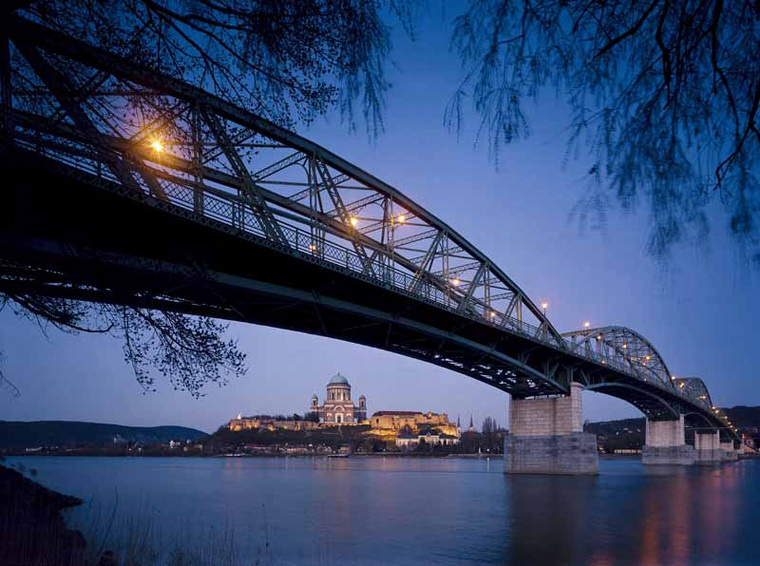
March 2012 – Nick reaches the bridge at Esztergom

Imagine Paddy standing in the middle of this bridge looking at the cathedral

It took Paddy until Easter 1934 to get to this bridge. Nick is moving well now. The bridge at Esztergom was one of my first blog posts back in April 2010!

The bridge linking Slovakia and Hungary, between the towns of Štúrovo and Esztergom, also links A Time of Giftsand Between the Woods and the Water. Here Paddy paused both in his walking and his writing, ‘meditatively poised in no man’s air,’ before crossing into Hungary and the second phase of his journey.

I reached that bridge a week ago (or rather the reconstruction of that bridge — the original was destroyed in 1944), and in a rather unbelievable way came to the very last page of my notebook standing above the Danube … read more

Related article:

Easter 1934 – Paddy reaches the Hungarian border at Esztergom

£1 a week – “The greatest happiness I could know”

The good news is that Nick is alive and well and enjoying the snow in Austria which reminds us of Paddy’s adventures. Read his latest piece on After the Woods and the Water.

With certain exceptions I could not agree more with his closing words …

But walking, I think, brings adventure closer. And in this winter, walking alone through a snow-covered landscape still seems like the greatest happiness I could know.

I am sure Paddy would have concurred.

Hobbled in Ulm

The rigours of the road are taking their toll on Nick. He makes an interesting point that we never hear about Paddy encountering such issues (and rarely are these things mentioned in the SOE stories we read). Whilst we may be a little ‘softer’ these days, I suspect that similar injuries may have been encountered but perhaps were not considered important enough to mention. To me all this is fascinating and I like to know about the strains, and the aches, and the blisters!

nickhuntscrutiny's avatarAfter the Woods and the Water

For the past two weeks I’ve been laid up in Ulm, on the outskirts of Bavaria, suffering from Achilles tendon strain. It dates from the sudden steep hills of Baden, when I pigheadedly continued walking despite a nagging pain in my ankle, which increased in jolts and jumps until I was practically hobbling. Luckily I found refuge with exceptionally lovely people who didn’t mind me sitting around  rubbing ice on my feet all day, necking ibuprofen, growing my beard and generally feeling sorry for myself.

It’s been an anxious, frustrating time, but at last I’ve reached the point of no pain, and I’m setting out again tomorrow. The German healthcare system is amazing — I’ve been given free ultrasound therapy and acupuncture, and have been fitted with an ankle support and custom-made insoles for my boots. The most important thing, of course, was simply resting up. And it taught me a lesson…

View original post 213 more words

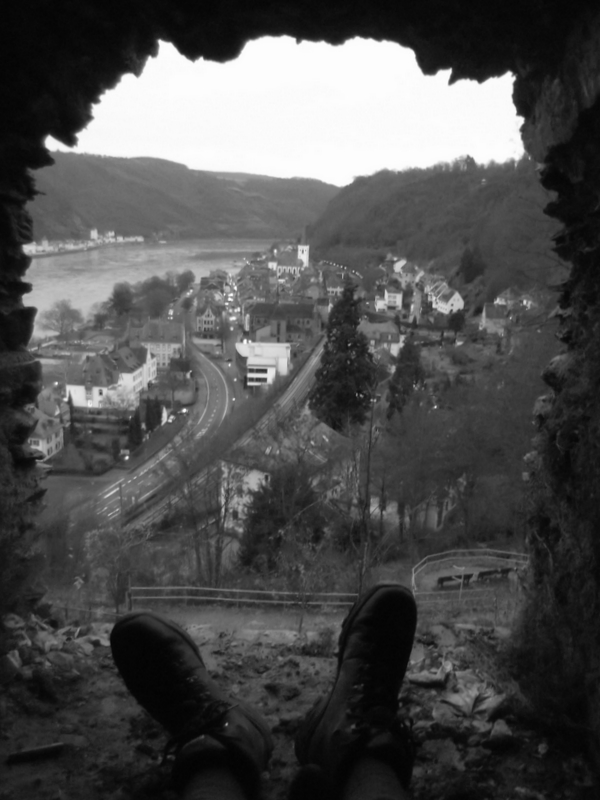
Above the Rhine

Schloss Burg Rheinfels, above the town of St. Goar on the Rhine

There are a couple of updates from Nick on his After the Woods and the Water blog including some snippets about sleeping rough in some ruined Rhine castles.

He has been experiencing unseasonably warm weather. Whilst this is a good thing I do feel that he needs a few days of snow and ice to really experience how it can be whilst outside in Germany at this time of year. I have happy memories of sleeping in hay barns as a soldier in West Germany, cocooned by the hay which prevented my water bottle from freezing solid in the up to minus 10 degree temperatures! I also remember some wonderful views when the sun shone brightly on the snow covered ground making visibility in the daytime almost unbearable, whilst by night the reflected moonlight was a God-send when on night patrol without the benefit of today’s night vision aids.

£1 a week Hook of Holland to Constantinople: Where is Nick?

Since his departure on 9 December we have heard little from Nick Hunt. He did post a short piece describing his departure from Hook of Holland on his blog, but since then silence.

However, it appears that Nick is making good progress and on 28 December he was in Bingen near the end of the Rhine. It was here that Paddy celebrated Christmas 1933 staying with an innkeeper and his ‘pretty daughters, who were aged from five to fifteen …’ (A Time of Gifts p53 in the John Murray paperback). This is pretty good progress seeing as Paddy had earlier taken a trip on a Rhine barge.

Skip over to Nick’s blog to read about one of his first walking days in Holland.

Stop Press! – open the comments section of this article below to read a further update from Nick as he tells us a little more about his walk down the Rhine. He is now at Heidelberg .. the Red Ox beckons (ATOG p 56 if you are keeping up!).

£1 a week to Constantinople – Bon Voyage to Nick and Nice Weather for Young Ducks

Paddy does not say if his last night in London before his epic journey was as busy as it was on Wednesday as Nick Hunt gathered with some friends in Shepherd Market to wish him well on his epic journey, but seventy-eight years ago today our hero, and let’s not be ashamed to say it, our hero, Patrick Leigh Fermor celebrated his last night in London as just another under-achieving public schoolboy, setting out to emulate Robert Byron, from this untouched corner of old London, which is now the haunt of hedge fund managers and buccaneering chief executives of junior mining companies; London clay brick Georgian squeezed into some of the highest priced real-estate in the land.

A new endeavour is about to start as Nick sets off on Friday to walk across the New Europe just as it is probably about to undergo the most significant peacetime turmoil since the rise of Nazism in the 1930’s into which Paddy stumbled with only a few links to ‘civilisation’ to accompany him, including his copy of Horace’s Odes.

Frankly I am as envious as I can be. Who could not wish to spend time away from the demands of today’s ever connected world? To endure physical challenges whilst encountering architectural marvels and meeting interesting people, each with a unique story to tell. It could well be the journey of a lifetime and I hope I send Nick off with all your best wishes. He has mine.

The weather today is better than that encountered by Paddy as he set out ….

The weather in London on December 9th 1933 was typical. The sky darkened, the clouds lowered and then it rained hard. A young man walked the cold pavements towards Cliveden Place to collect a rucksack that his friend Mark Ogilvie-Grant had used on a journey to Mount Athos accompanied by Robert Byron. After stopping to buy a stout ash stick, and probably some cigarettes, at the tobacconist on the corner of Sloane Square, the young man collected his new passport – occupation ‘student’ – from the office in Petty France. He cast his eyes up to the ominous clouds and then made his way quickly north across Green Park. Now the rain splashed down as he dashed between the traffic on Piccadilly and entered the house of his landlady, Miss Beatrice Stewart, in Shepherd Market.

A former model who sat for Sickert, and Augustus John, and who is said to be the model for the bronze figure of Peace atop Wellington Arch, Beatrice Stewart’s career was cruelly cut short after she lost a leg in a road accident. She had arranged a lunch for the eighteen year old Patrick Leigh Fermor and two of his friends to wish him bon voyage before the start of what was to become one of the most famous journeys of all time, and certainly the longest gap year in history.

After lunch, Paddy said thank you and goodbye to Miss Stewart, and jumped into a waiting taxi, which drove off through Mayfair, around Trafalgar Square, up Ludgate Hill, and past the Monument towards the Tower of London. It was raining so heavily that all they could see out of the steamed up windows were hordes of umbrellas, some carried by bowler hatted men, as the rain splashed down in the dark. “Nice weather for young ducks.” said the taxi driver as he dropped the small party by the first barbican on Tower Bridge.

The two companions, one a young girl wearing a mackintosh over her head like a coal shifter, stood in the rain to watch Paddy descend the stone steps down to Irongate Wharf. With a final wave, he strode up the gangplank of a Dutch steamer bound for Hook of Holland.

This was the start of Paddy’s journey down the Rhine and along the Danube which he so memorably describes for us in his book A Time of Gifts. This part of the story ends on Easter Sunday 1934 as Paddy stood on the long bridge over the Danube, in no-man’s land, between Czechoslovakia and Hungary at Esztergom, just as the Easter celebrations started in earnest.

A Time of Gifts is almost universally acknowledged as a masterpiece of English literature; Sebastian Faulks is a dissenter, but he would be. Described by some as a travel book, it is essentially the journal of a young man with a superb gift of memory, for languages, and for making friends, written with the benefit of a lifetime of amazing experience and learning, forty years after the events it describes. It is embellished by anecdotes and essential historical background, making it a rounded piece of literature and no mere travelogue. It should be compulsory reading for all seventeen year olds; it is truly inspirational. The sad part is that the very reason for the ending of Paddy’s ‘gap year’ whilst with his lover Balasha Cantacuzene in Romania in September 1939, resulted in the destruction of many of the towns and cities he passed through, and certainly ended the way of life of the peoples of Europe that he describes so well.

I have no doubt that today, were Paddy still with us that he would pause for a while to recall that day, wish Nick all the best, and reflect on the events that followed during his amazing and full life, and the friends and lovers who have gone before him.

Perhaps Sir Patrick Michael Leigh Fermor DSO OBE, who was the Greatest Living Englishman, would pen a short letter to Debo?