Author Archives: proverbs6to10

Unknown's avatar

About proverbs6to10

Interested in Byzantium and Patrick Leigh Fermor

Armenia, Nicolas Bouvier and Paddy

This post is dedicated to Elizabeth who will enjoy listening to the French. My on-off hiatus on the blog continues due to personal circumstances but I had to write this short update before I depart to walk across Armenia. I was inspired to travel there by reading Nicolas Bouvier’s wonderful book, The Way of the World. Paddy buffs will know that he wrote the introduction to the English version.

Bouvier’s work describes his journey with his artist friend Thierry Vernet in a Fiat Topolino (like a 2CV)  from Geneva to Afghanistan in the 1953-54. It is a journey that would be impossible today. The book is beautifully written and such fun to read. He spent a lot of time writing about the Armenian community in north-western Iran which got me thinking about going to Armenia, and here I am going to Armenia.

I always like to make some spurious link to weave a bit of a yarn, and here I have it. Bouvier writes book including Armenians; Paddy writes introduction to said book; I travel to Armenia; and blog corespondent Mark Opstad (a long time ago) sends me a link to a French TV programme that includes Bouvier and Paddy. The latter speaking wonderful French but as ever struggling with technology; this time the microphone. Paddy suddenly appears around 29:10 (maybe he got stuck into the bar in the green room?) and proceeds to tell his story, but struggles to keep the microphone near his mouth. Note the “third hand” at 34:38 trying to keep it in the right position. At 47:00 Paddy inevitably ends up singing a Greek song.

Enjoy the video. As ever there is much more to come on the blog and I thank all of you who have got in touch with me. I just don’t have the time to keep up at the moment, but each and every one will receive a reply in due course.

Nicolas BOUVIER, Jacques LACARRIERE, Michel LE BRIS, Patrick LEIGH-FERMOR from Etonnants Voyageurs on Vimeo.

Ill Met by Goonlight – just 5 days left!!

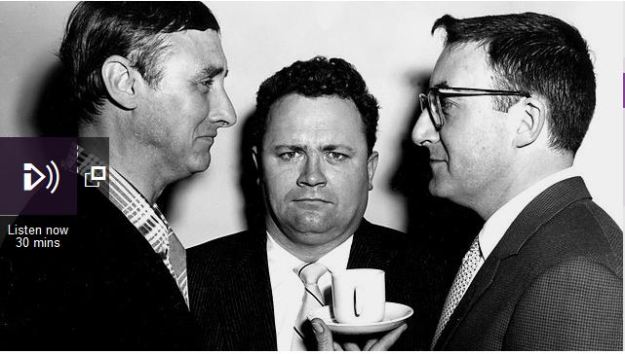
GoonsThe Goons as our heroes Paddy and Billy. Neddie Seagoon is sent to capture the German general who commands the island of Crete. Stars Spike Milligan. From March 1957.

Thanks to Tim Todd for pointing this one out. Just 5 days left to listen on BBC iPlayer for those who can get access (country specific).

Click the picture or here to go to the BBC iPlayer site.

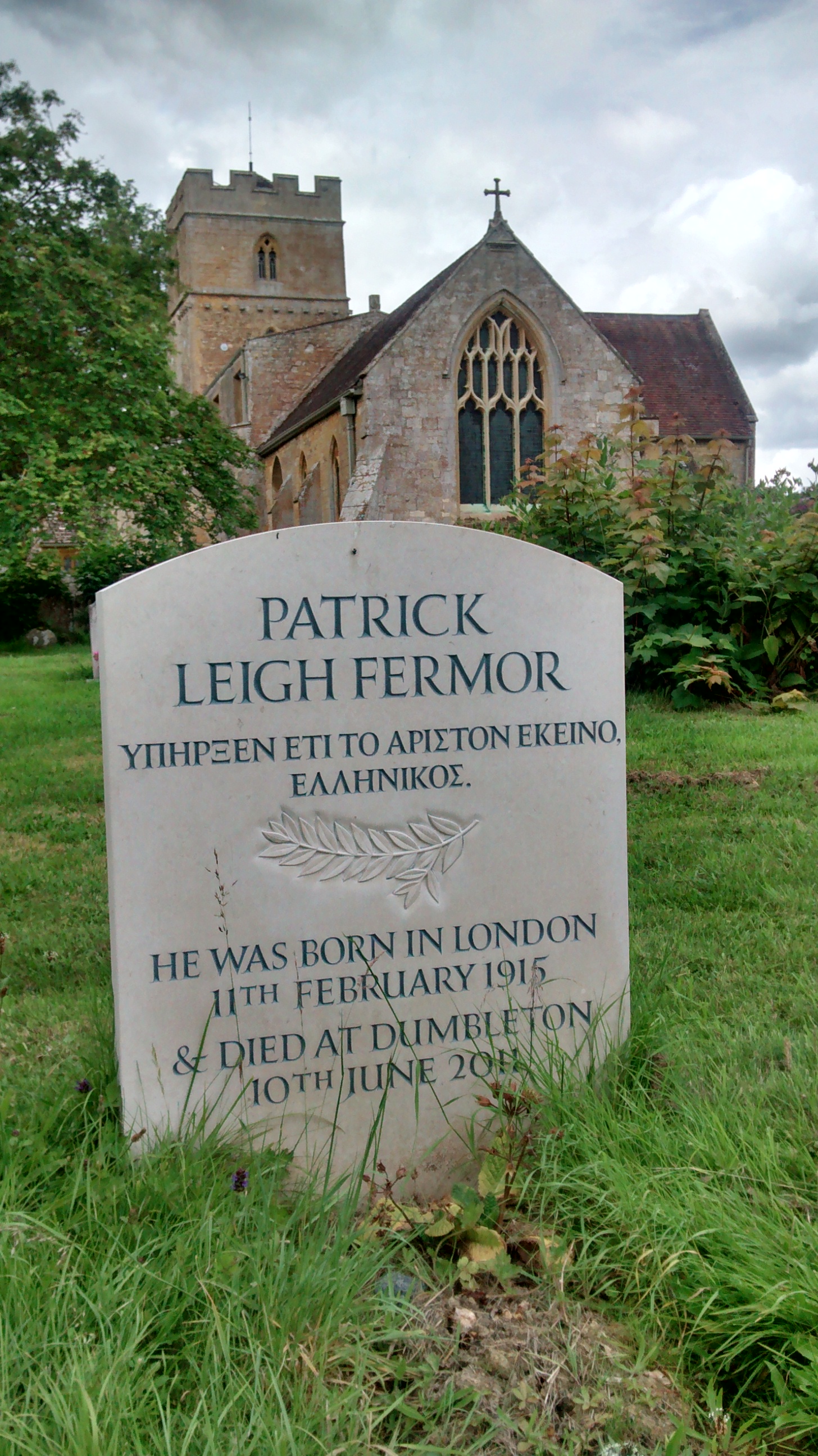
Visiting Paddy’s grave

image

We were in Stratford-upon-Avon at the weekend to watch two brilliant performances of Shakespeare’s Henry IV parts I and II, and on the way home we paused to visit Paddy’s grave. It was a lovely day and as ever a beautiful and peaceful setting. Do visit if you can; Dumbleton is just 5 minutes off the A46.

Relaunch of A War of Shadows by Billy Moss

A War of Shadows

A War of Shadows

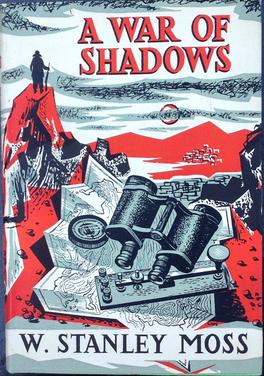
In 1952 Billy Moss published his second volume of war memoirs, focusing on his activities after the Kreipe kidnap which he had described so vividly in Ill Met by Moonlight.War of Shadows has recently been republished by Bene Factum and I was honoured to have been invited to the recent launch party at the RAF Club.

A War of Shadows

It is a darker book than Ill Met. It starts with a discourse on death in its many forms, variety of impacts, and importance. Billy is in reflective mood as he describes the last year of his war, during which time he engaged in ambushes in Crete with his Russians whilst Paddy was recuperating from his illness in Cairo. There were even plans made to repeat the kidnap with the replacement General!

From Crete, Billy is deployed to Macedonia where he encounters a more cynical form of resistance. As the war in Europe passed on towards the shrinking Germanic core, Billy volunteered for SOE operations in the Far East and was parachuted into Siam, where he saw out the dog days of the war, occasionally listening to test matches on the BBC World Service.

The launch of the book represents a significant triumph for his family, especially his daughters. There is a view that Billy’s part in the Kreipe kidnap has been played down over time with more attention on Paddy’s role. It is important therefore to Billy’s memory that his role is recognised and that people know that after the kidnap Billy continued to engage in fierce operations against the Germans and Japanese, showing tactical skill and great bravery.

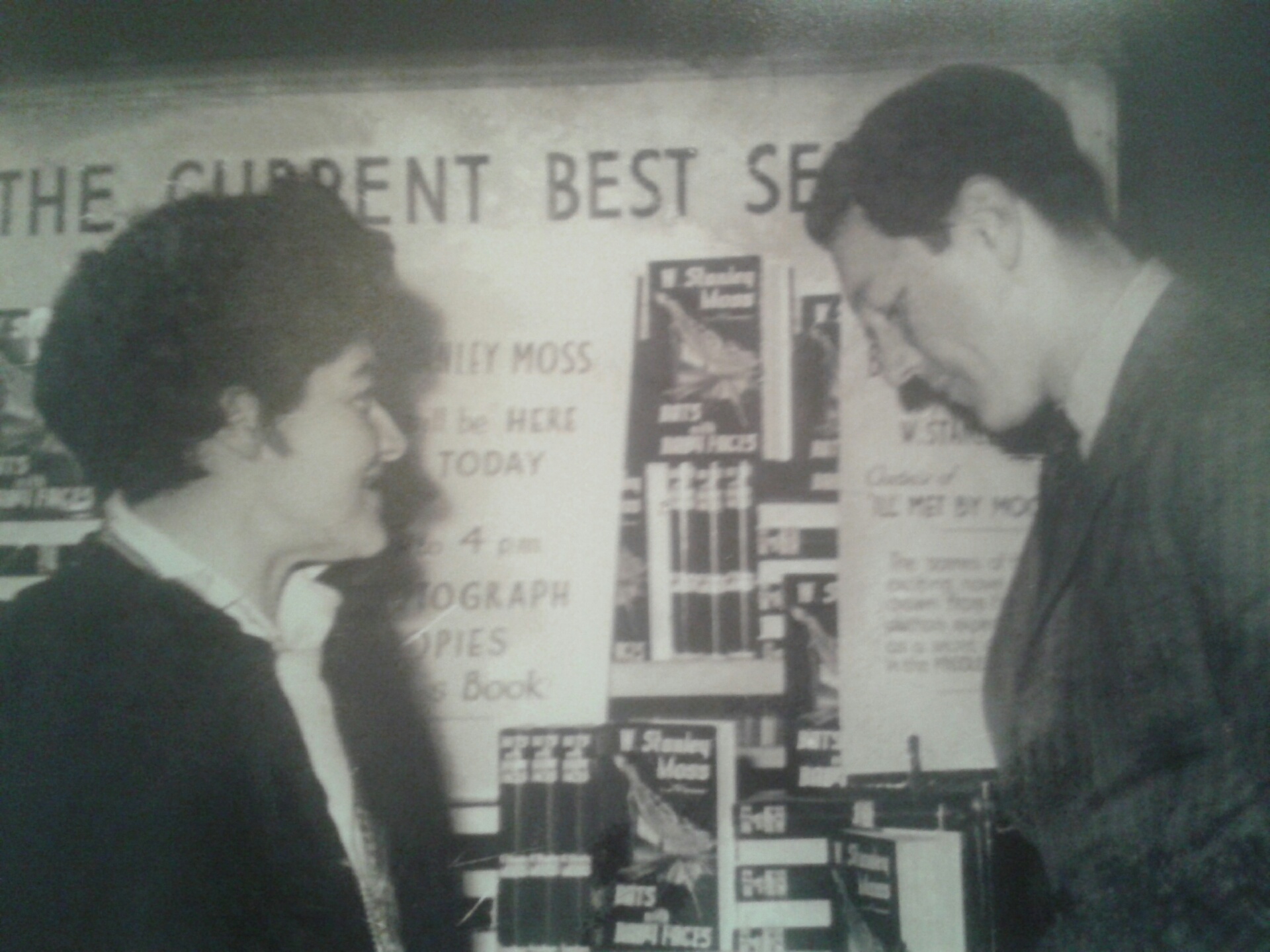
Billy Moss at a book signing in the early 1950's

Billy Moss at a book signing in the early 1950’s

I read A War of Shadows

a couple of years ago (I managed to find a first edition) and it is a very enjoyable read, offering us more detail on the Crete operations and an interesting perspective on the way the war ‘wound down’. The new paperback edition has a delightfully personal introduction by Billy’s daughter Gabriella, and closes with an end-piece by acclaimed SOE writer Alan Ogden which is to all intents and purposes a short biography of Billy. So if you want to know more about this extraordinary man you should buy a copy of the new edition of A War of Shadows

.

Liely Bullock at the recent relaunch of A War of Shadows

The recent relaunch of A War of Shadows

Billy’s whole family are very much involved in preserving his memory. Proceeds from the book will go to support various charitable activities on Crete. At the launch, Billy’s granddaughter gave a wonderful speech honouring his memory. She wore a beautiful jacket of silver thread depicting Mongol horsemen at the charge with bows taut; this jacket belonged to her grandmother Sophie, the woman who dominated that vibrant community of heroes and free thinkers in Cairo that was Tara. The jacket was hand-made in Cairo from cloth that Sophie bought in the souk. The text of the speech follows.

You can purchase War of Shadows in all good book stores but if pressed for time click here to buy from Amazon. A War of Shadows

Thank you Anthony, on behalf of all my family, for your kind words – and for all you have done: this evening celebrates the first reprint of A War of Shadows since 1952, and I want to take this opportunity to say how enormously we appreciate your unstinting dedication in bringing this book back into the light.
For us it is a very special occasion, and I want to thank all of you for coming this evening – my family welcomes you all.

We have just returned from Crete where, 3 weeks ago, we commemorated together the 70th anniversary of the Special Operation Executive’s abduction of the German General Kreipe – the only successful such kidnap of the war – carried out by Paddy Leigh Fermor and Billy, with the help and support of a great swathe of the Cretan population. It was Billy’s diary, written in the field, which became the book, and then the film, Ill Met by Moonlight. Paddy and Billy spirited the General by boat to the Middle East.

From this point – or rather, from the point of his treasured friendship with Paddy – A War of Shadows takes up the story of the rest of Billy’s SOE war : in Crete for a second time, then Macedonia and the Far East. It is a candid observation of the times, places, personalities and politics. It liberally mixes humour with stark reality. Never melodramatic, it is at times a sobering and thoughtful book on what it actually means to be a soldier, dealing with death. At times it is also a very personal account : the answers to many questions lie within its pages.

Billy’s life, from the moment he was born, was extraordinary in so many ways but it was tragically short. He died in 1965. We his family carry him within us always, but it seemed that, as the decades passed, he would largely be forgotten by the world at large.

It is impossible to describe what it was to find, in Alan Ogden, Billy’s ultimate champion. Alan had already written about Billy and other SOE agents in his books Sons of Odysseus and Tigers Burning Bright. My parents first met Alan at the Special Forces Club in January last year, and it was he who absolutely insisted that Billy’s story should be told, and so he introduced them to his publisher, Anthony Weldon!

Alan threw himself into writing a short biography of Billy which is now published as the Afterword to A War of Shadows. ALAN, we are just so grateful for everything you have so generously done for Billy’s memory.

There are myriad ways in which we have felt support, and we owe a debt of gratitude to all of you whom we have gathered here tonight.

There are so many strands, and some of you have very particular links to my grandparents. ONE of you was a baby in wartime Cairo : SIMON, your mother was a marvellous and lifelong friend to them both. ONE of you is the son of their fellow Tara inmate, and named after another Tara inmate : XAN, your father was ever the dearest of friends. ONE of you, as a girl, knew them – and even knew Pixie the Alsatian – when they were living in Ireland in the 1950s : MERCEDES, you have vivid memories of Billy having to rescue you when Pixie had you pinned against a wall.

As I mentioned, we have just visited Crete. Some of us had been before, and for some of us it was the first time. It is hard to find words to express the experience, or our heartfelt gratitude towards the people there, or to say how much we are moved by their generosity of spirit.

There is also the most extraordinary of Cretan links: during the operation known in Crete as the Damasta Sabotage, one brave man was hit by an enemy shell full in the belly, and it seemed he could not possibly survive ; but survive he did – all this is described in A War of Shadows; and tonight one of his twelve grandchildren is here – a research biologist at Glasgow University – our dear EMMANOUELA.

So on behalf of Billy and all his family, we thank all of you for coming to share this evening with us. Let’s raise our glasses in Cretan fashion: Eviva!

Jan Morris – Travels Round My House

Jan Morris and members of the 1953 Everest team

Jan Morris and members of the 1953 Everest team

Jan Morris knows a good story when she sees one, and she is one too. A gravestone under the stairs; a posthumous book written and printed; over 60 books – history, biography and novels under her belt; Jan Morris has lived and written as a man, as a woman, and believes one day she may transcend both conditions. In this BBC Radio 3 Sunday Feature we hear Jan interviewed and can listen to readings from her books.

As the 60th anniversary of Hillary and Tenzing’s conquering of Everest approaches, writer and critic Anthony Sattin visits the Welsh home of Jan Morris and gets an exclusive peek into the scrap books and mementoes from that great Imperial adventure – part of the sketches and the relics of a lifetime’s travel.

Morris recalls the scoop that made her reputation; joining the successful Everest expedition of 1953, and, against extraordinary odds, reporting the successful ascent back to The Times of London, in code, and in perfect timing – the news reached London to be announced on the morning of the Coronation.

To ferry the news back to London she employed two runners who actually ran all the way from her wind-battered tent at the foot of Everest, 180 miles to Kathmandu and back; avoiding the clutches of Daily Mail journalists, eager to steal the story.

A committed Welsh Nationalist Republican – though not actively involved in burning things down or blowing them up – Morris tells of early years in Wales, hobnobbing with more active nationalists, and of her infatuation with things as diverse as Manhattan and her recently deceased cat Ibsen. She also discusses the ‘ten confused years’ during which she undertook gender reassignment, and the approach of mortality – hence the gravestone under the stairs.

Fellow writers Pico Iyer and Sara Wheeler, both talk of the inspiration she has provided over the years.

And for Jan, the last word, “It was all in aid of fun”.

Presenter: Anthony Sattin
Reader: Eleanor Bron
Producer: Sara Jane Hall

Listen to the programme by clicking on the picture below of Mount Everest.

Capture

Relaunch of Ill Met by Moonlight website to mark 70th anniversary

Capture

Ironically I was away in Munich when Tim Todd posted this comment on the Your Paddy Thoughts page. It has been 70 years since the kidnap and there are a number of events and publications associated with it. Both of Billy Moss’ books are being republished (more to follow), and, as has been already mentioned on here, a version of Paddy’s own account is due later this year.

Tim Todd is probably the leading authority on the kidnap and the route used during the evasion phase. He works very closely with Chris White on this project which never seems to be short of new aspects or details to investigate. The Ill Met by Moonlight website is very well worth visiting. Here is Tim’s update about his reworked site and a cautionary tale about retracing the route.

Well, today, Saturday 26th April 2014, is the 70th anniversary of the abduction of General Kreipe by Paddy, Billy and their Cretan colleagues.

To mark the occasion may I draw attention to my relaunched website and in particular to a transcription of Paddy’s own short report on the abduction. It is the first of a number of his reports that will be appearing on the illmetbymoonlight.info website now that I am free of another commitment that had taken up a lot of time.This report, one of nine by Paddy, can be found here.

Interest in his Cretan adventures remains as great as ever and I have just heard back from one party who did the full route in the last few weeks, from Dermati to Rodakino in a remarkable 7 days and three hours – and pushed himself to the point of exhaustion in the process. Aspiring route followers should not, under any circumstances, consider this a realistic target though as the parties concerned were not your average walkers by a long way. The report came back accompanied by a warning about map accuracy, not the first, and the recommendation is always to seek local guidance for the more remote locations and not to rely on GPS coordinates.

Nick Hunt on BBC Radio 4’s Saturday Live

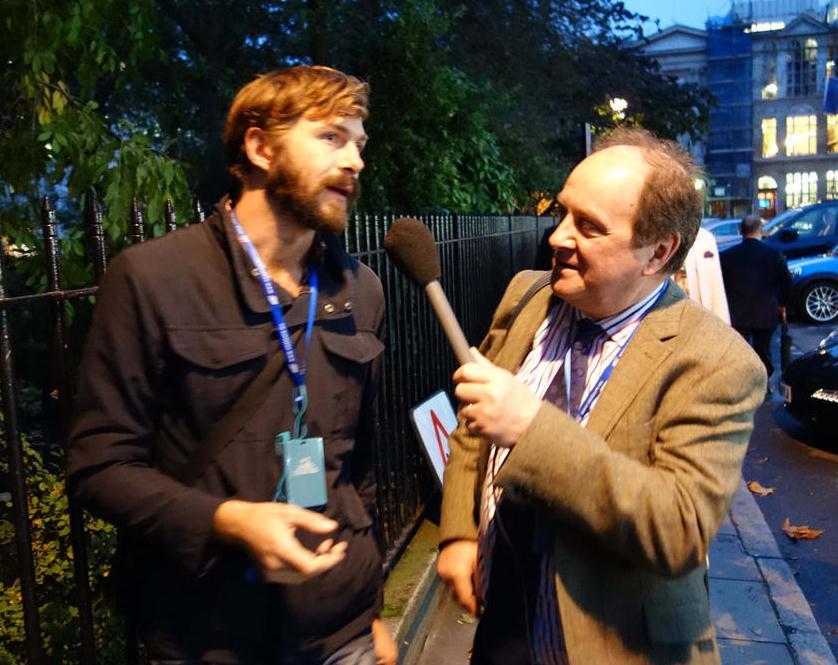
Nick Hunt and James Naughtie

Nick Hunt after his walk with James Naughtie

Many of you will now be reading Nick Hunt’s fine new book, Walking the Woods and the Water. As is usual Nick is hard at work promoting the book in a number of ways and this Saturday, 3 May, will find him on the quirky BBC Radio 4 programme Saturday Live from 9.00 am. 

He will be joined by the acerbic food critic Jay Rayner who has managed to achieve the nickname Acid Rayner due to his sour demeanor – [Edit – listening to the show Mr Rayner comes over as a pretty friendly type].

I am sure Nick and Jay will get down to discussing the quality of food on such a long journey. If you have read the book it is no surprise to say that it was extremely variable.

We wish Nick well with this excellent opportunity to let more people know about his journey and wonderful book. Brief programme details are available here.

Travel Writing Giants – Remembering Peter Matthiessen and Patrick Leigh Fermor

Peter Matthiessen

Peter Matthiessen

BBC Radio Four rarely disappoints. At least not over the course of a few hours where there will be enough variety and quality for everyone. On Good Friday the Point of View programme was given over to William Dalrymple William who celebrated the writing of Peter Matthiessen who died this month. Dalrymple compares him with another of his favourite travel writers, Patrick Leigh Fermor. “Both were footloose scholars who left their studies and libraries to walk in the wild places of the world, erudite and bookish wanderers, scrambling through remote mountains, notebooks in hand, rucksacks full of good books on their shoulders.”

Listen here on BBC iPlayer. The programme begins after about 30 seconds. If you are in a location where this is not possible, the text is below.

Happy Easter to all of you.

Tom

William Dalrymple pays tribute to two fellow travel writers – Peter Matthiessen, who died recently, and Patrick Leigh Fermor.

The great American writer Peter Matthiessen died earlier this month at his home in Sagaponak, New York, after a prolonged struggle with leukaemia. He was 86.

Matthiessen was one of my great literary heroes, a wonderfully versatile and profoundly truthful writer whose sentences oozed integrity and an austere clarity of thought and spirit. His writing drew on his richly restless and enviably courageous life, which was as remarkable an artefact as anything he actually wrote. He remains the only author to win the National Book Award for both fiction and non-fiction.

Matthiessen, a craggily handsome man, with clear blue eyes and a face that seemed to have been sculpted out of basalt, was at different times a naturalist-explorer and a deep sea fishermen, a pioneering environmentalist and editor, an artist and activist defending the rights of migrant labourers and Native Americans, as well as a CIA agent who underwent a strange metamorphosis into literary shaman and Buddhist sage. He lived and travelled in a variety of wild landscapes (rainforests, oceans, mountains, deserts and swamps) around the globe, and he set his books in these remote places – the Peruvian Andes and the jungles of New Guinea, Tierra del Fuego and the Tibetan Plateau, the Serengeti and the Bering Straits.

He is perhaps best known for a single great masterpiece, The Snow Leopard, a jewel of a book and one of the great travelogues of our time. The book tells the story of a long journey on foot to the Crystal Mountain in the Himalayas to study the wild blue sheep and to catch a glimpse of the rare and almost mythical snow leopard. But for Matthiessen, a Zen Buddhist recovering from the recent death of his wife, it was more of an inner journey of recovery and resignation than some zoological field trip.

In many ways, Matthiessen resembles Patrick Leigh Fermor, another lyrical writer who travelled widely and lived richly, setting his books across the globe. Like Matthiessen, Paddy – as everyone knew him- lived an enviable life. In his teens he walked from the Hook of Holland to Constantinople, while in his sixties he swam the Hellespont, in homage to Lord Byron who swam it in 1810. In between, he joined possibly the last cavalry charge in European history, participated in a Haitian voodoo ceremony, and pursued a passionate affair with a Byzantine princess. He was car-bombed in Greece, knifed in Bulgaria and pursued by German troops after being parachuted into occupied Crete where he kidnapped the Nazi commander.

Paddy and Peter were very different men of very different generations. Matthiessen was a blue-blooded New Yorker, descended from Friesian whalers, and grew up on post-war Fifth Avenue overlooking Central Park, in the same building as George Plimpton, with whom he later co-founded the Paris Review. The American 1960s marked him forever. He experimented with psychedelia, especially LSD, became an anti-Vietnam activist and his friends were the great New York writers of that era – Kurt Vonnegut, EL Doctorow and William Styron. Leigh Fermor, by contrast, had the speech patterns, polished brogues and formal manners of a pre-war British officer, and his conversation was peppered with the likes of “ripping”, “topping”, “I say!”, “frightful rot” and so on. His friends tended to be Brits of a similar background and era – Noel Coward, Dirk Bogarde, Diana Cooper, the Mitfords and later, Bruce Chatwin.
Nepal Himalayas Matthiessen describes the Nepal Himalayas in lyrical terms

It is also true that these two great descriptive writers wrote very dissimilar prose. Matthiessen’s writing had a spare and austere simplicity, yet was as beautiful and craggy as his wonderfully weather-beaten face. Here he is waking up in the Nepal Himalaya: “A luminous mountain morning. Mist and fire smoke, sun shafts and dark ravines: a peak off Annapurna poises on soft clouds… Pine, rhododendron, barberry and purple gentians. Down mountain fields, a path of stones flows like mercury in the sunlight; even the huts have roofs of silver slates.”

In contrast, Paddy’s books, with what Lawrence Durrell called their “truffled style and dense plumage”, were sometimes “madly, intoxicatingly over-written”. Yet at his best he was a soaring prose virtuoso with hardly an equal in modern English letters. For many of us his descriptions of walking through midwinter 1930s Germany have the status of sacred texts: “Sometimes the landscapes move further back in time,” he writes in the Winterreise chapter of his masterpiece, A Time of Gifts. “Pictures from illuminated manuscripts take shape; they become scenes which Books of Hours enclosed in the O of Orate, fratres. The snow falls; it is Carolingian weather… Then the rooks fell silent; the light dwindled over the grey fields; and life ebbed with a shudder like a soul leaving the body.”

Yet these two very different writers had so much in common. Both were footloose scholars who left their studies and libraries to walk in the wild places of the world, erudite and bookish wanderers, scrambling through remote mountains, notebooks in hand, rucksacks full of good books on their shoulders. Both were writers of great sensitivity and erudition, yet both were also men of action who became intelligence agents – Leigh Fermor in wartime Crete, while Matthiessen worked for the CIA in post-war Paris spying on American expatriate communists suspected of KGB links.

Both men moved easily from the world of the flesh to the world of the spirit and back. They understood what Paddy described in A Time to Keep Silence as “the capacity for solitude that accompanies the silent monastic life”.

The same was true of Matthiessen, who while the lively centre of many a mescaline-fuelled literary party in his youth, ended his day as a Roshi, or Zen Master. “Zen is really just a reminder to stay alive and be awake,” he said in one of his last interviews. “Zen is about appreciating your life in this moment. If you are truly aware for five minutes a day, then you are doing pretty well. We are beset by both future and the past, and there is no reality apart from the here and now.”

The world of literary travel writing, usually associated with the drumbeat of hooves across some distant steppe, has recently begun echoing instead with the slow tread of the undertaker’s muffled footfall. Within the last few years or so, Wilfred Thesiger, Norman Lewis, Ryszard Kapuscinski and Eric Newby have all – like Peter and Paddy – gone on their last journey. But for me, Leigh Fermor and Matthiessen remain, along with Bruce Chatwin, the greatest of them all.

On my last visit to see Paddy at the villa he built in Kardamyli, deep in the Greek Mani, I went with him to see the Byzantine chapel around which Chatwin had had his ashes scattered. The chapel was very small with a domed, red-tiled roof and round arcaded windows. It was a perfect place for anyone to end their days, and as we headed back I asked Paddy whether he would like to be buried there too.
Continue reading the main story

“Oh no,” he replied instantly. “My wife, Joan, is buried in Gloucestershire. I’d like to end up there. England is not a foreign country to me.” The same was true of Matthiessen who in the end found peace in Sagaponak, where he set up a Zen meditation centre at the back of his estate.

It’s a characteristic of many of the greatest travellers that they come back home in the end. TE Lawrence, another wandering writer turned intelligence agent, was the same. In Seven Pillars of Wisdom he wrote about what is I think a surprisingly common dilemma, and one I certainly recognise in my own life – that of the traveller who moves abroad, embraces another culture, immerses himself in it, and then finds that he has been changed forever by the experience and cannot ever fully return.

I had dropped one form and not taken on the other,” wrote Lawrence, “the inevitable fate of the man who could see things through the veils at once of two customs, two educations, two environments.” Matthiessen could not have put it better.

A Point of View is broadcast on Friday on Radio 4 at 20:50 BST and repeated on Sunday at 08:50 BST. Catch up on BBC iPlayer


Baron Pips von Schey

Originally posted as a comment on the Your Paddy Thoughts page, I thought this too good to be left buried deep in that page. My thanks to Brian Human who posted it here.

One of the most significant of the characters that inhabit Paddy’s pre-war world is Baron Philipps (Pips) von Schey. Paddy’s stay with Pips at the Schey country house at Kovecses enlivens the later pages of A Time of Gifts. This episode gets an unexpected reference in Edmund de Waal’s sparkling biography The Hare with Amber Eyes (p. 177 of the illustrated edition, Chatto & Windus, 2010) due to an important family connection.

In 1899 Baroness Emmy Schey von Koromla married de Waal’s great grandfather, banker Viktor von Ephrussi. Pips was her younger brother and Kovecses becomes a recurring presence in the lives of the Ephrussi family.

In The Hare Kovecses is described as ‘a very large and very plain eighteenth century house (“a large square box such as children draw”…) set in a flat landscape of fields with belts of willows, birch forests and streams. A great river, the Vah, swept past, forming one of the boundaries of the estate…There was a swimming lake with fretted Moorish changing huts, lots of stables and lots of dogs.’ Trains stopped ‘at the tiny halt on the estate.’ The Hare includes several pictures of Kovecses.

Pips is pictured in a pen-and-ink drawing playing Wagner at the piano. He had been educated by tutors and had ‘a wide circle of friends in the arts and the theatre, is a man around town in several capitals and is impeccably dressed…’. A further sign of his high profile: ‘Pips appears as the protagonist of a highly successful novel of the time by the German Jewish novelist Jakob Wassermann…Our aesthetic hero is a pal of archdukes…He is erudite about incunabula and Renaissance art…’. Kovecses became a retreat for the Ephrussi family, a refuge from the banking hothouse of Vienna for games, music and plays, for swimming, walking riding and shooting in the years before 1914.

With the advent of war, ‘Uncle Pips is called up, handsome in his uniform with its astrakhan collar, to fight against his French and English cousins’. In 1915 he ‘is serving as an imperial liaison officer with the German high command in Berlin, where he is instrumental in helping Rilke get a desk job away from the Front.’ Wartime shortages beset the Ephrussies in Vienna and in 1916 they go to ‘…Kovecses for the whole long holiday. This means that at least they can eat properly. There is roast hare, game pies and plum dumplings…’. By August 1918, ‘There are only two old man to tend the gardens and the roses on the long veranda are unkempt’ at Kovecse.

After the war Pips maintains his friendship with Rilke and gives his niece, Elizabeth, de Waal’s grandmother, an introduction to the poet. She sends him her poems and they correspond, though they never meet.

By the early 1930s and with the ascendancy of fascism and anti Semitism life became increasing difficult for the Ephrussies. In 1934 (the year of Paddy’s visit) ‘Viktor and Emmy holiday together at Kovecses, but since the death of her parents it is a strangely diminished place, with only a couple of horses in the stables and fewer gamekeepers and no great weekend shoots any more…The swimming lake has been let go. Its edges are susurrating reeds.’ Following the Anschluss in 1938 Viktor and Emmy flee Vienna for the relative safety of Kovecses. ‘In the summer of 1938 Kovecses looks much the same as it has done, a jumble of grand and informal…[but] The roses are more unkempt…The house is much emptier.’ The safety is only relative: ‘The borders are under review and Czechoslovakia is fissile. And Kovecses is just too close to danger.’ Germany occupied the Sudetenland; Emmy died at Kovecses on 12th October 1938 and was buried in the churchyard of the nearby hamlet. In early March Viktor got permission to leave for Britain, where he died in 1945.

The war and its aftermath wreaked their havoc on Kovecses and the Schey family, though happily Pips survived and Paddy records that he died in Normandy in 1957.

I have found that you can read The Hare with Amber Eyes on-line here.

‘The Ariadne Objective:’ Spooks, Germans and the battle for Crete

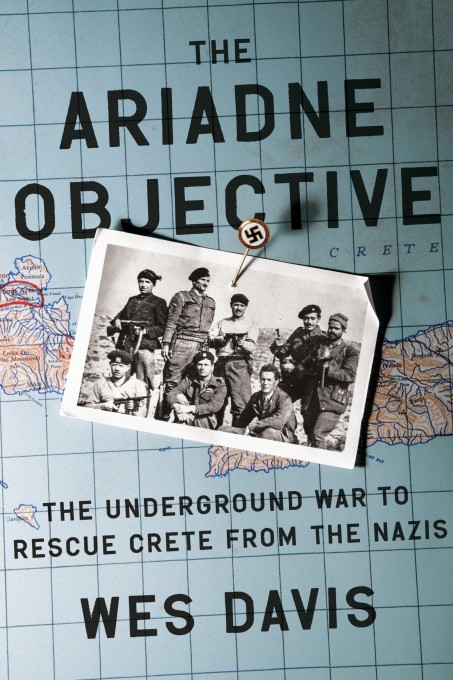
Ariadne-jacket-453x680A review of Wes Davis’ recently published book by Alexander Clapp.

First published in Ekathimerini.com 8 March 2014

On May 27, 1941, days after the first airborne invasion in history, the German army hoisted a Nazi flag atop an abandoned mosque in Hania, western Crete. The gesture was poignant. Crete – which had overthrown three centuries of Turkish rule just three decades prior – was again under the heel of an occupying power.

The Cretans were unshaken. The island’s peasantry armed itself with muskets and daggers and took to the crags and caves of the White Mountains. The campaign of sabotage that followed – an echo of repeated revolts against the Ottomans, Venetians and Arabs – marked the first mass civilian resistance to Nazi rule in Europe. “We had encountered for the first time an enemy that was prepared to fight to the bitter end,” marveled a German lieutenant.

Wes Davis’s “The Ariadne Objective” (Crown, 2013) traces the British intelligence service’s collaboration with this hardscrabble fifth column. The plans to wrest Crete from Nazi control formed part of a larger wartime strategy to “set Europe ablaze” through the Special Operations Executive (SOE), “Churchill’s secret army.” In Crete the stakes were particularly high. Cretan restlessness proved crucial to delaying Hitler’s march to the East. As the war in North Africa came to a close, the island was to become a strategic linchpin to the European theater. By 1943, the British naval command looked to Crete as a promising base from which to retake the Aegean and the Continent at large.

“The Ariadne Objective” distills existing accounts of the Cretan conflict – W. Stanley Moss’s “Ill Met by Moonlight,” George Psychoundakis’s “The Cretan Runner,” Antony Beevor’s “Crete” – into a thrilling, highly readable narrative. The book benefits from a remarkable group of protagonists. Just as the Greeks of 1821 attracted a spirited cast of Western philhellenes, so too did the Cretan resistance become a curious meeting ground for a platoon of Anglophone scholars. Most were Classicists who had scraped together the rudimentary basics of Modern Greek. Many – N.G.L. Hammond, Thomas Dunbabin – went on to hold distinguished academic posts after the war; others – Evelyn Waugh, Lawrence Durrell, Patrick Leigh Fermor – were to become the literary giants of their generation. “It was the obsolete choice of Greek at school which had really deposited us on the limestone,” recalled Leigh Fermor.

Davis weaves in and out of these figures’ fascinating back-stories. The book narrates Leigh Fermor and Xan Fielding’s respective hikes across Europe in vivid detail; the one-eyed Cambridge archaeologist John Pendlebury provides an excursion into the British excavations at Knossos; a chapter on life in wartime Cairo – including a detour into the rowdy antics of the “Tara villa” inhabitants – acts as a kind of comic relief from the grittiness of the Cretan front.

Sporting shepherds’ crooks and cork-dyed mustaches, these British guerrilla leaders spent months sleeping in caves, organizing resistance bands and smuggling supplies to the beleaguered islanders. Over time their efforts paid off. In the words of a German commander on Crete, the Nazis made the mistake of “regarding a quite substantial partisan movement as nothing more than a few gangs of cattle thieves.”

This thinking was not entirely unfounded. Some Cretans chose to collaborate with the Germans against their countrymen. Those who did resist were internecine and uncertain of their objectives. The available weaponry was hopelessly antiquated. “Stand still, Turk, while I reload” was still the threat of choice among the elderly fighters.

But if the Germans underestimated the determination of this ragtag uprising, so too did they misunderstand its means. In order to deny the Germans any legitimate right to bring reprisals against the local population, the British SOE commanders concentrated the Cretans’ efforts on disrupting Nazi supply lines, provoking discord between Axis commanders and draining the occupiers’ morale through a carefully crafted propaganda campaign. “We want not so much to kill Germans as to terrify and bamboozle them,” advised SOE resistance leader Tom Dunbabin. The smuggling of Italian commander Angelo Carta from Crete to Cairo in 1943 was one such bloodless blow to the enemy’s morale. It was also the dry run for a more devastating attack on German confidence – a ruse that forms the theatrical climax of the “The Ariadne Objective.”

On April 26, 1944 Patrick Leigh Fermor, W. Stanley Moss and a team of Cretan partisans abducted the German commander of Crete, General Heinrich Kreipe, from his headquarters at the Villa Ariadne in Iraklio. Passing through 22 enemy checkpoints, the team worked their way to the southern coast of Crete, sheltering in caves by day and evading German search parties by night. By May 15 Kreipe was in Alexandria; two weeks later he was a prisoner of war in Canada.

“The galvanizing effect of the mission could still be felt in the tense months that followed the end of the war,” writes Davis. “As the rest of Greece plunged into civil unrest – pitting factions of Communist partisans against each other and against various stripes of nationalists – Crete remained relatively calm.”

An intriguingly highbrow current runs through the book’s otherwise soldierly narrative. Greece was not merely a shared strategic prize for German battalions and British spies; it was also an intellectual middle ground for two competing nationalisms, each of which claimed the cultural mantle of the Classical world as its own. Evidence of this mutual enthrallment to antiquity resurfaces throughout “The Ariadne Objective.” The German invasion of Crete is code-named “Mercury.” The British cruisers stationed in the Eastern Mediterranean are named the Orion and the Dido. Shipping out to the front line, Pendlebury reads Edward Gibbon’s “Decline and Fall” for a crash course in military strategy. Following their conquest of Crete, the Germans import their archaeologists to tend to the island’s historical sites. The diary entry of a German commander flying out of Crete: “just as Daedalus had done so many centuries ago.” “Minotaurs, bull-men, nymphs of Ariadne, kings of Minos, and German generals – a splendid cocktail!” writes Moss after abducting Heinrich Kreipe.

The most arresting example comes a few days following the general’s capture. In a well-cited incident on the slopes of Mount Ida, Kreipe quietly quotes the opening lines of Horace’s “Soracte” ode. Taking up where the general had paused, Leigh Fermor, Kreipe’s captor, recites the rest of the poem’s 24 lines.

“It was a reminder that the war itself was the aberration, interrupting something far more important and lasting. The moment of connection he and the general had just shared had sprung from a deep-running current of literature, art, and civility,” notes Davis.

The incident – like much of the clash in Crete – represents a strange last flowering of the world of the 19th-century imperialist scholar. “The Ariadne Objective” examines that story ably and admirably. This is necessary reading for anyone interested in Greece in the Second World War.

Go east – the people get nicer, even if their dogs get nastier

Artemis Cooper’s review of Nick Hunt’s ‘Walking the Woods and the Water’. Hunt retraces the footsteps of Patrick Leigh Fermor across the suburban wastelands of Holland to the woods of Transylvania.

by Artemis Cooper

First published in The Spectator 10 April 2014.

When Nick Hunt first read Patrick Leigh Fermor’s account of his youthful trudge across Europe in A Time of Gifts and Between the Woods and the Water, he knew ‘with absolute certainty’ that one day he would make that journey himself. When I embarked on Patrick Leigh Fermor’s biography, I made an equally firm resolve that I wouldn’t walk a step of it. Paddy’s books had left me with a vision of a timeless Europe suspended somewhere between memory and imagination, and I didn’t want that vision distorted by layers of personal impressions.

But to Hunt the books posed a question. Eighty years on, was there anything left of the ‘gifts’ Paddy had enjoyed in prewar Europe? Was there still room enough for wildness, freedom and spontaneous hospitality? In this moving and profoundly honest book, the answer is ‘yes’.

Hunt was in his late twenties when he set out from London, and he got off to a bad start. In Holland and Germany he was obliged to walk for miles on tarmac, under motorways and across industrial and suburban wastelands. He had done no prior training — after all Paddy hadn’t, and what was more natural than walking? The result was tendonitis so severe that he was laid up for a week in Ulm, cursing his stupidity and looked after by a couple called Dierk and Dora.

He found that the kindness of strangers — who included musicians, caretakers, house-painters and Buddhist soap-makers —  was an ever recurring miracle. And like the grandees Paddy met, Hunt’s benefactors contacted their friends and relatives, urging them to help the traveller too. He found these guardian angels online, through the Couch Surfing network. Their website is designed to weed out loonies, but it still requires a high level of trust — a trust that was never misplaced. His hosts gave him food and drink, took him to the pub, lent him their laptops — and not once did he feel uncomfortable or threatened by them. At the same time, Hunt was more willing than Paddy to brave the elements. He often slept in the open, twice in sub-zero temperatures; and he became expert at ‘castle-squatting’ — finding snug holes in ancient walls.

As he walked on, the industrial sprawl gave way to landscapes that Paddy would have recognised. Hunt is often haunted by the ‘unimaginable inhumanity that lay between his walk and mine’, but at the same time many things remained startlingly similar. Swapping cigarettes is still a great ice-breaker; the sheepskin coats and cross-gartered moccasins were gone, but in a bar one morning Hunt could see that all the men there had known each other since childhood, and worked in adjoining
fields. Hungary still mourned the loss of Transylvania like an amputation, and still hated the Romanians. Just like Paddy, Hunt was told that the moment he entered Romania he would be attacked by bears, gypsies, wolves and thieves. But as the author observes, people became nicer as he travelled eastwards, although their dogs got nastier.

Hunt is not Paddy, and never pretends to be. Baroque architecture and princely lineage leave him cold, and he never plunges into historical speculation or conjures fantasies out of thin air. But one of the most moving passages in the book tells of his meeting with Ileana Teleki, the great-granddaughter of Count Jeno Teleki, one of Paddy’s hosts in Transylvania. With her, he visits a number of the country houses described in Between the Woods; but now they are gutted, abandoned or used to shelter those who would never recover from the experience of being a Romanian orphan: ‘Traumatised children,’ writes Hunt, ‘housed in the ruins of a traumatised culture.’

The reader familiar with Paddy’s oeuvre will find that something of him has rubbed off on Hunt, which is hardly surprising: he took no other books on the journey, and he feels intimately connected to his predecessor. So in walking through the wooded Pilis Hills, or in watching for changes in physiognomy as he crosses from one territory to another, he is — consciously or unsconsciously — paying homage to Paddy by absorbing his way of looking at things.

At the same time, I’ve learnt so much from the vivid way Hunt describes the physiological effects of trudging on for month after month. Sometimes it brings a sense of unlimited freedom, sometimes joy, sometimes an extraordinary, dreamlike dislocation, always accompanied by a dazzling sharpness of hearing and vision. I see now how that youthful walk informed so much of Paddy’s style. Before embarking on his journey, Hunt was going to write to Paddy. The letter was never written, and by the time he set off, Paddy was dead. How touched and fascinated he would have been to read this book.

Walking the Woods and the Water by Nick Hunt

Nicholas Brearley, pp.336, £10.99, ISBN: 9781857886177

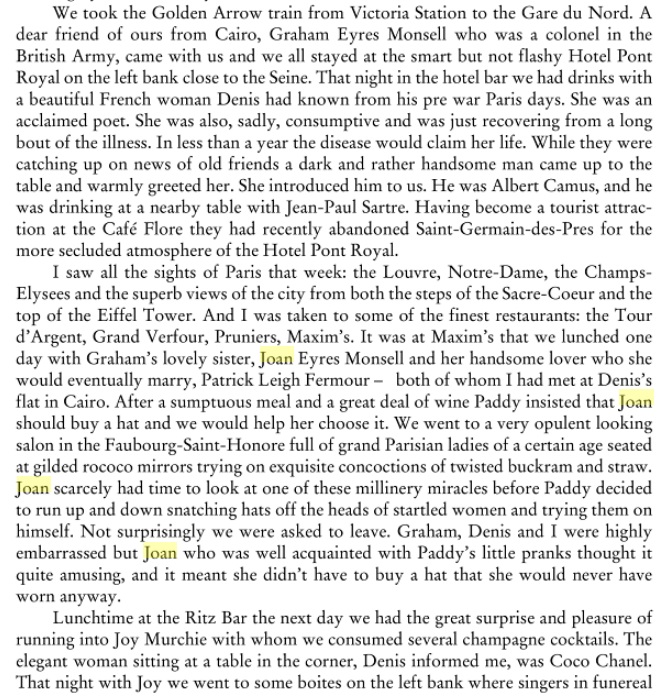
Paddy’s attempt at buying a hat for Joan

It often takes me quite a while to post items that have been very kindly sent to me by some of our many readers. This is just one such example and I have to apologize as I have lost the details of whoever sent it to me. Suffice to say that the content on here is often the result of your hard work in finding items and sending them to me so please do keep it up and I will always acknowledge your contribution. This is unique example of being unable to do that. If you sent me the original link and are reading this please step forward! PS – the mystery contributor has been found. Thank you Rob MacGregor!

Below is an extract from Neville Phillip’s 2008 biography The Stage Struck Me! in which he mentions an amusing episode involving Paddy at the shops! Can you imagine him shopping?

You can actually read the whole book online via Google Books where we are told:

“The Stage Struck Me!” is a funny, informative and sometimes sad account of the life of a jobbing actor and writer in the 1940s and 1950s, full of anecdotes about the famous, the infamous, the charming and the downright loopy people he met along the way. After joining the South African Army and serving as a gunner in the coastal artillery, Neville Phillips was transferred to the entertainment unit where he spent four years doing shows for the Allied troops in North Africa and Italy. In 1946 he was demobbed to London and it was here that Neville Phillips met and got to know some truly remarkable people, as well as writing West End reviews, pantomime, cabaret, and a musical starring Pat Kirkwood. “The Stage Struck Me!” is a fascinating and sometimes poignant account of times, places and people that played such an important part in a young aspiring actor’s life.

buying a hat for Joan

Read the extract in pdf format here.

A Walk Through Time

young paddyIn the winter of 1933, an 18-year-old named Patrick Leigh Fermor set out from the Hook of Holland to cross Europe on foot. His goal was Istanbul, which he bookishly insisted on calling Constantinople. He had little more in his rucksack than a volume of Horace and a few blank notebooks. He also had a bad reputation: The masters who expelled him from school — for a flirtation with a local girl — saw only “a dangerous mixture of sophistication and recklessness.” He spent the next year charming his way through a doomed prewar landscape of landed aristocrats, feudal peasants and benevolent monks, sleeping alternately in schlosses and hayricks. It was a journey that would become legendary, not so much for the extraordinary things he saw and recorded as for his prose — an utterly unique, hybrid vehicle that combines youthful exuberance with a dense, dauntingly erudite display of verbal artifice. Unlike most authors of travel literature (a rattlebag genre that doesn’t really do him justice) Leigh Fermor does not confine his role to that of camera obscura. He builds dense whorls of wordplay to echo the carvings in an old church door; he slips into baroque historical fantasias, scattering a shrapnel of words like “gabions,” “hydromel,” “eyot” and “swingle­trees” at the unsuspecting reader. In between salvos, there are moments of ferocious humor and quiet, lyrical beauty.

By Robert F. Worth

First published in the New York Times, 7 March 2014

In part, this richness is a measure of the extraordinary gap between the experience and its narration. Leigh Fermor did not begin writing the first book about his journey, “A Time of Gifts,” until the 1970s. In the intervening decades, he had written several other books, becoming a fiercely learned autodidact and adventurer. His exploits during and after World War II — when he helped to kidnap the Nazi commandant in Crete and deliver him to a waiting British submarine — are said to have helped inspire his friend Ian Fleming, the author of the James Bond novels. As a result, the travel narratives are a kind of palimpsest in which his younger and older selves exist in counterpoint. He initially considered naming the first book “Parallax,” to reflect this split perspective.

Few books have been as keenly or lengthily anticipated as the third and final volume of Leigh Fermor’s youthful travels. (A second installment, “Between the Woods and the Water,” was published in 1986.) It never appeared; burdened by writer’s block and frailty, Leigh Fermor was still working on it when he died in 2011 at age 96. But he did leave a manuscript. His biographer, Artemis Cooper, and the British travel writer Colin Thubron chose to tidy it up and publish it as “The Broken Road,” a reference to the abrupt narrative halt before the author reaches Istanbul.

“The Broken Road” narrates Leigh Fermor’s travels in Bulgaria, Romania and Greece, a more tribal and violent world than Northern Europe. It does not always have the gemlike polish of the first two volumes. But it is an unforgettable book, full of strange encounters with a prewar Balkan cast of counts, prostitutes, peasants, priests and castrati. The greatest pleasure of all, as usual, is Leigh Fermor’s own infectious, Rabelaisian hunger for knowledge of almost every kind. His memory seems eidetic; his eyes miss nothing. He seems to carry within himself a whole troupe of sharp-eyed geographers, art historians, ethnologists and multilingual poets. For anyone who has tried to document a journey, reading him is a humbling and thoroughly inspiring experience.

“The Broken Road” is also full of his signature verbal architecture: The Orthodox bishops “in copes as stiff and brilliant as beetles’ wings, and the higher clergy, coiffed with globular gold mitres the size of pumpkins and glistening with gems, leaned on croziers topped with twin coiling snakes.” Or the Virgilian evocation of a passing flock of storks in the Balkan mountains, which goes on for pages: “All at once we were under a high shifting roof of wings, a flotilla that was thickening into an armada, until our ears were full of the sound of rustling and rushing with a flutter now and then when a bird changed position in a slow wingbeat or two, and of the strange massed creaking, as of many delicate hinges, of a myriad slender joints. They benighted the air.”

In some respects this book is even more satisfying than its predecessors because it is less guarded; the narrator emerges as an angrier, more troubled and more persuasive character. One of my few quarrels with “A Time of Gifts” is the dogged high-mindedness of Leigh Fermor’s youthful self. Where is the lust? Where is the rage? This man is 18 years old, for God’s sake. He never gives way to the curse-spitting xenophobia that overcomes most travelers (certainly me) at some point in their journeys. He runs into plenty of jams, and meets plenty of pretty young girls; but there is something a little too noble about him, too much of the innocent abroad.

This time things are different, and the young man seems to break free of his older narrator. At one point, lying on the damp earthen floor of a Bulgarian peasant’s hut, he gives way to revulsion at the “noisily hibernating rustics swathed all over this stifling hellhole.” He is overcome by self-hatred and yearns for the comfort and status of his school-bound peers. Elsewhere, he meets a spirited Bulgarian girl named Nadejda and falls in love with her; their romance, though apparently unconsummated, reeks of the adolescent emotional frailty that seemed absent in the earlier books.

One of the most vivid passages in “The Broken Road” takes place in Bucharest, where young Paddy (as all his friends called him) checks into what he takes for a modest hotel, the Savoy-Ritz, giving his bags to a baffled patronne. He returns late that night and discovers that it is not a hotel but a brothel. The laughing madam ushers him into the kitchen, where four attractive young prostitutes are eating a late supper: “I was given a chair and a glass of wine, and the girls on either side cut off bits of chicken breast and offered them on their forks with friendly solicitude.” The women, charmed by his youth and innocence, feed and fuss over him for several days, telling him stories about their clients and themselves, though he remains discreetly silent about whether he got anything for free.

“The Broken Road” ends in midsentence, and the editors have chosen to follow it with excerpts from the diary Leigh Fermor wrote in early 1935, mostly at Mt. Athos in Greece. These are fascinating precisely because they are so ordinary: Suddenly we see how lucky we are that Leigh Fermor chose to wait four decades before starting. Young men have strong legs and eyes, but it is the older narrator, with his multilayered perspective, who knows how to turn memory into art.

History also played a role. “The Broken Road” is strewn with ominous, proleptic hints about the future that only we — and the older narrator — are privy to. In “A Time of Gifts,” the Nazis were a constant presence, crass and often ludicrous, waiting to inherit Europe. In this book, it is both the Soviet boot and the Balkan breakup that lurk throughout, as young Paddy listens to his Bulgarian and Romanian friends spew hatred of one another. But he also evokes a quiet, starlit world where countless eccentricities of folk art and culture bloomed in isolated villages and persisted for centuries, untouched by the glare of television and the Internet. Much of this is gone now. We can be grateful he was there to record it.

THE BROKEN ROAD

From the Iron Gates to Mount Athos

By Patrick Leigh Fermor

Edited by Colin Thubron and Artemis Cooper

362 pp. New York Review Books. $30.

Transylvania Diary

Bran Castle — but don’t mention Dracula

A gentle and humorous review of the very first Transylvanian Book Festival.

By Thomas W. Hodgkinson

First published in The Spectator 21 September 2013

Ehe-Gefängnis. The word, strictly speaking (which is how one should always speak), means ‘marriage prison’, and refers to an austere cell maintained in some of the magnificent fortified Saxon churches of central Transylvania. When a local couple decided to divorce, they were first locked in this narrow room for several weeks. There was only one bed: single. There was one chair, one plate, one knife, one fork, one cup. The result was that within a few days, the couple would realise they didn’t actually need a divorce after all — not because they wanted to escape the hell of enforced proximity, but because they had fallen in love again.

I’m here in the pastoral heart of Romania, attending the first ever Transylvanian Book Festival: a three-day extravaganza of talks, tours and readings, featuring bitter poets, wry novelists and rueful academics, and all of them what you might call professionally interesting. This sets the conversational bar pretty high over lunch, I can tell you. For one thing, since arriving in Romania, I’ve learnt that you should never, under any circumstances, mention Dracula. I mention him once, but I think I get away with it. Then up steps Professor Roy Foster, warily, wearily perhaps, to speak of the unspeakable. And of course he turns it around, delivering a vampirically mesmerising talk, showing how Bram Stoker’s masterpiece is ultimately all about Ireland. And transgressive sex.

Along with war, one of the great narrative themes (laying aside, for a moment, transgressive sex) has always been the return from war, and returning home generally. The Odyssey and other stories about the Greeks returning from Troy, collectively known as nostoi, set the tone. Our word ‘nostalgia’, referring to a painful desire to return, can extend to the pain felt when you get home and find it isn’t what it used to be. Nostalgia is also a theme of this festival. The villages where we’re staying — Richis, Biertan, Copsa Mare — were built by Saxons in alien Romania in the 12th century, and sustained until 1990. Lured by the promise of a better life, many modern Saxons then moved to Germany. They called it ‘going home’, though often their new lives were in concrete blocks, while their derelict farms fell apart. Now, with the help of the Mihai Eminescu Trust, and in co-operation with the Saxons who remain, these old buildings are being restored. I had an idea of writing a spoof travel book, detailing my ten years spent living among the people of Chiswick. Or possibly even ‘amongst’ them, which always sounds like a more profound level of integration. But what I’ve seen here is curing me of the conceit.

A night on the tiles with William Blacker. His book Along The Enchanted Way, about his years living ‘amongst’ the people of northern Romania, also describes his passionate relationship with a gypsy beauty named Marishka. After midnight, we enter a bar in Richis, which is packed with gypsies, including brooding boys and a girl with what I can only call a bluge (my invented word for a cleavage that defies gravity). The place falls silent as we come in. Should I lose the straw hat? William has a discreet word with the barman, who slips on a CD of gypsy music, and soon the dance floor is all movement: clicking fingers and smacked thighs. I tap my foot dexterously to one side. Wine, then beer: oh dear. Beer, then tzuika (the local brandy): eureka!

My fiancée and I have the occasional argument, shall we say. Anya, who languishes in London while I whoop it up in Richis, is Russian, and her deadpan manner can be disconcerting. I asked her recently what kind of man she found attractive. ‘Clowns,’ she replied. While I’m here, lawyers push the sale of our flat in Chiswick, which is the size of an Ehe-Gefängnis. We’re after something bigger, within striking distance of central London. Hold your sides, if they hurt from laughing.

But I mustn’t complain about property prices, with so much of interest going on around me. Artemis Cooper speaking about Paddy Leigh Fermor; Jessica Douglas- Home on the Mihai Eminescu Trust, which she runs; young Nick Hunt reading from his forthcoming book about following in Leigh Fermor’s footsteps; and all presided over by the seraphic Lucy Abel Smith, mistress of ceremonies. This has been, quite simply, the best and most inspiring literary festival I’ve ever attended. But more even than the readings, what has made it special has been the beauty of the countryside, the warmth of the locals, and — dare I say it? — the incredible cheapness of Romanian beer, which in a bar sets you back about 50p a bottle. All of which has persuaded me I’ve no choice really but to move to Romania. Now I just have to tell Anya.

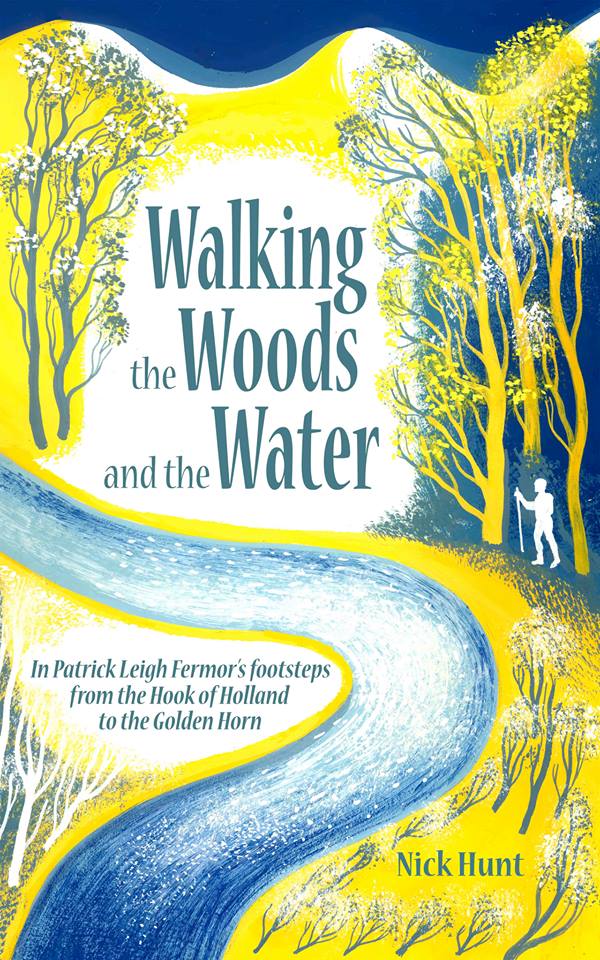
Publication day for Walking the Woods and the Water by Nick Hunt

Walking the Woods and the Water

Walking the Woods and the Water

Today marks a very important day for Nick Hunt as it is the publication day of his wonderful first book, Walking the Woods and the Water which describes his 2011-2012 journey walking in Paddy’s footsteps from the Hook of Holland to Istanbul.

Many of you will be familiar with the background and even supported Nick financially by donating to his crowd funding site which I publicised here under the title of “£1 a Week”. Since then we have been able to keep up with Nick following his return as he sought a new publisher and gave some thoughtful and entertaining public lectures.

I am sure Nick will now be in greater demand as this book is a gem. As I wrote a few weeks ago this is no simple homage to Paddy. It is a unique work of one man’s often very painful journey over eight months. The story is inhabited by interesting characters and is at times a very intimate work. We get very close to Nick and his thoughts during that long walk.

As a walker myself, one of the things missing from ATOG and BTWW was any mention of the pains of walking (we get some hint in The Broken Road when a hobnail from his boot puts Paddy in a lot of pain in Bulgaria). Whilst Paddy may have been lucky, it would be very surprising if he had not experienced some discomfort, and even fear, during his journey. Nick brings all this alive with gritty descriptions.

Nick does draw parallels with Paddy’s writing for his aim was to see what had changed during the last 80 turbulent years in Europe. Whilst his conclusion is that much has changed, there is also much that has not, in particular the attitudes and prejudices of the people he encounters.

I hope that there will be many positive reviews which will help Nick to achieve good sales, and it is not my intention to write a review as such. All I can say is that the book is a very enjoyable read; a wonderful read. It offers a major contribution to travel writing and it will inspire many of those that read the book to set out on journeys of their own, especially to Central and Eastern Europe.

If you enjoy reading my blog, and want to make a link with Paddy and his adventures, I ask you to buy a copy of Walking the Woods and the Water today. Unfortunately the book is only available in paperback, but I guarantee that you will enjoy it. If you don’t please contact me or make a comment, and I will surely post your comments here.

And it you doubt me, read what some others have said:

‘Nick Hunt has written a glorious book, rich with insight and wit, about walking his way both across and into contemporary Europe. He set out as an homage to Patrick Leigh Fermor’s legendary tramp across Europe in the early 1930s, but his journey became – of course – an epic adventure in its own right. A book about gifts, modernity, endurance and landscape, it represents a fine addition to the literature of the leg.’Robert Macfarlane, author of The Wild Places and The Old Ways: A Journey on Foot

This moving and profoundly honest book sometimes brings a sense of unlimited freedom, sometimes joy, sometimes an extraordinary, dream-like dislocation: always accompanied by a dazzling sharpness of hearing and vision. I see now how that youthful walk informed so much of Paddy s style. Before setting out Hunt was going to write to Paddy. The letter was never written, and by the time he set off, Paddy was dead. How touched and fascinated he would have been to read this book. –Artemis Cooper, author of Patrick Leigh Fermor: An Adventure and co-editor The Broken Road

‘Vivid and hard-won’ Giles Foden inConde Nast Traveller

‘Delightful, balanced and extremely well-written…an impressive and timely effort. A worthy literary tribute to the classic of British travel writing.’ –Vitali Vitaliev, author of Passport to Enclavia

‘A most enjoyable read and a worthy tribute to the originals’ –Caroline Sanderson, The Bookseller

‘Walking in the footsteps of Patrick Leigh Fermor from Rotterdam to Constantinople, Nick Hunt found that, 78 years later, everything and nothing has changed–Daily Telegraph interview with author

Walking the Woods and the Water is published by Nicholas Brealey (336pp), is available in paperback only and is ready to order from Amazon. Walking the Woods and the Water: In Patrick Leigh Fermor’s footsteps from the Hook of Holland to the Golden Horn

Patrick Fermor, aventurero del siglo XX

Spanish an adventureA review of An Adventure in Spanish from La Aventurade la Historia.

Viajó a pie por toda Europa, organizó la resistencia cretense en la Segunda Guerra Mundial, secuestró a un general alemán y escribió espléndidas obras relatando sus viajes. Dos libros recuerdan su increíble periplo vital

A los 18 años Paddy Fermor decidió abandonar su renqueante trayectoria estudiantil y atravesar Europa a pie. Salió de Londres, cogió un barco hacia Rotterdam y desde allí caminó hasta Constantinopla. Entre 1933 y 1934 cruzó el viejo continente durmiendo en cobertizos, habitaciones prestadas y tabernas. También se hospedó en castillos y casas señoriales. Su alegría innata, combinada con unos exquisitos modales le abrieron todas las puertas, y su infinita curiosidad atrajo todo tipo de compañías.

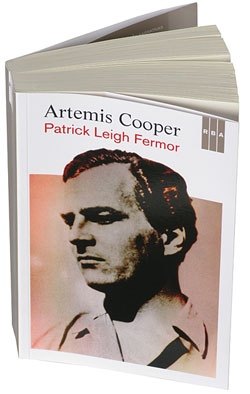
Patrick Leigh Fermor Nació en Inglaterra en 1915 y falleció en el mismo lugar en 2011. El margen vital de su dilatada existencia le permitió atravesar medio mundo y escribir brillantes libros de viajes. Recientemente se ha publicado en castellano su biografía (Patrick Leigh Fermor, RBA, 2013), a cargo de Artemis Cooper, y un pequeño texto escrito por su traductora, Dolores Payás (Drinking Time!, Acantilado 2013), que enriquece el relato de su vida con las charlas que mantuvo con él pocos meses antes de su muerte.

Read the full review here.

A new book by Patrick Leigh Fermor- Abducting a General – to be published in October

'Billy' Moss and Paddy Leigh Fermor

‘Billy’ Moss and Paddy Leigh Fermor

I have just learned that we can look forward to a new book by Paddy relating the events of the Kreipe kidnap. Based upon his own account called Abducting a General, the book is due to be published by John Murray in October 2014. A pity it misses the precise date of the 70th anniversary, but welcome nonetheless.

We will be blessed with a lot of new material about the abduction and its key players this year. We have already had the new book by Wes Davis, The Ariadne Objective, which contains a lot of new material after painstaking research, and ‘Billy’ Moss’ account of his time in SOE after the exploits on Crete, A War of Shadows, is also due for republication in April.

The John Murray website tells us this:

A daring behind-enemy-lines mission from the author of A Time of Gifts and The Broken Road.

One of the greatest feats in Patrick Leigh Fermor’s remarkable life was the kidnapping of General Kreipe, the German commander in Crete, on 26 April 1944. He and Captain Billy Moss hatched a daring plan to abduct the general, while ensuring that no reprisals were taken against the Cretan population. Dressed as German military police, they stopped and took control of Kreipe’s car, drove through twenty-two German checkpoints, then succeeded in hiding from the German army before finally being picked up on a beach in the south of the island and transported to safety in Egypt on 14 May.

Abducting a General is Leigh Fermor’s own account of the kidnap, published for the first time. Written in his inimitable prose, and introduced by acclaimed SOE historian Professor Roderick Bailey, it is a glorious first-hand account of one of the great adventures of the Second World War. Also included in this book are Leigh Fermor’s intelligence reports, sent from caves deep within Crete yet still retaining his remarkable prose skills, which bring the immediacy of SOE operations vividly alive, as well as the peril which the SOE and Resistance were operating under; and a guide to the journey that Kreipe was taken on from the abandonment of his car to the embarkation site so that the modern visitor can relive this extraordinary event.

The publication date for Abducting a General is set for 9 October.

The Ariadne Objective: The Underground War to Rescue Crete from the Nazis

Ariadne-jacket-453x680Recently I returned from a business trip to Cluj, the loveliest city in Romania, to find a parcel on my desk. It was a copy of The Ariadne Objective, a new book by Wes Davis about the resistance and SOE operations in Crete. It is added to my pile of books that I will read throughout the course of the year.Hugh and Gabriella Bullock (‘Billy’ Moss’ daughter) provided information to Wes about Billy and his wife Sophie Tarnowska. Hugh believes that this book makes ‘a different study of the people concerned’.

You can buy the book on Amazon. The Ariadne Objective: The Underground War to Rescue Crete from the Nazis

The blurb says this ….

The incredible true story of the WWII spies, including Patrick Leigh Fermor and John Pendlebury, who fought to save Crete and block Hitler’s march to the East.

In the bleakest years of WWII, when it appeared that nothing could slow the German army, Hitler set his sights on the Mediterranean island of Crete, the ideal staging ground for German domination of the Middle East. But German command had not counted on the eccentric band of British intelligence officers who would stand in their way, conducting audacious sabotage operations in the very shadow of the Nazi occupation force.

The Ariadne Objective tells the remarkable story of the secret war on Crete from the perspective of these amateur soldiers – scholars, archaeologists, writers – who found themselves serving as spies in Crete because, as one of them put it, they had made “the obsolete choice of Greek at school”: John Pendlebury, a swashbuckling archaeologist with a glass eye and a swordstick, who had been legendary archeologist Arthur Evans’s assistant at Knossos before the war; Patrick Leigh Fermor, a Byronic figure and future travel-writing luminary who, as a teenager in the early 1930s, walked across Europe, a continent already beginning to feel the effects of Hitler’s rise to power; Xan Fielding, a writer who would later produce the English translations of books like Bridge on the River Kwai and Planet of the Apes; and Sandy Rendel, a future Times of London reporter, who prided himself on a disguise that left him looking more ragged and fierce than the Cretan mountaineers he fought alongside.

Infiltrated into occupied Crete, these British gentleman spies teamed with Cretan partisans to carry out a cunning plan to disrupt Nazi maneuvers, culminating in a daring, high-risk plot to abduct the island’s German commander. In this thrilling untold story of World War II, Wes Davis offers a brilliant portrait of a group of legends in the making, against the backdrop of one of the war’s most exotic locales.

Bringing Bond to book

bondWe continue our series of articles looking at the work of Ian Fleming who was a friend of Paddy. Fleming was influenced by Paddy’s exploits and he used the Traveller’s Tree in particular as a source for Live and Let Die.

By Matthew Woodcock

This article first appeared in the print edition of The Spectator magazine, dated 14 December 2013

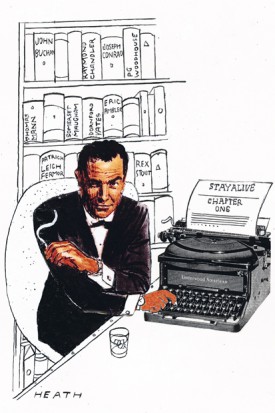
There is one last James Bond book from the late 1950s that remains unpublished. We will not find the typescript lurking in the archives, nor hidden amongst the papers held by Ian Fleming’s estate, for this book is not about James Bond but written by Bond himself. It is from Fleming’s 1959 novel Goldfinger that we learn that 007 spends his hours on night duty at the Secret Service compiling a manual on unarmed combat called Stay Alive!, containing the best that had been written on the subject by his peers in intelligence agencies around the world. Bond is more industrious in the field than at the typewriter and no more is heard about this great unfinished work once his thoughts drift back to his previous assignment and time spent enjoying the company of the ill-fated Jill Masterson.

It should come as no surprise that Fleming’s hero has writerly pretensions. Yet again, Bond and his creator have interests or characteristics in common, along with their shared dash of Scottish ancestry and background in naval intelligence, and a similar penchant for custom-made Morlands cigarettes. During his twenties, Fleming read widely in French and German literature — Thomas Mann’s The Magic Mountain was a particular favourite — and he subscribed to all the avant garde literary magazines of the day. He experimented briefly with poetry, collected first editions for a while, and launched the Book Collector magazine. Ultimately, through his friend and later editor, the poet and novelist William Plomer, he entered the literary world of postwar London, met T.S. Eliot and befriended Edith Sitwell. But to what extent did these kind of literary and bibliographic interests shape or influence Fleming’s work when he began writing the Bond books?

Bond too is, of course, a man of books. Fleming took the name of his hero from the spine of a trusted ornithological guide to the West Indies. And the seemingly effortless, spontaneous genesis of the first Bond novel, Casino Royale, published in 1953, drew as much upon the author’s reading of Dornford Yates, John Buchan and ‘Sapper’ (creator of Bulldog Drummond) as it did on his wartime experiences.

The clubland stalwarts were formative influences on Fleming, but they are — at best — literature spelt with a very small ‘l’. Bond himself has bookish impulses: the book-lined sitting-room glimpsed briefly in Moonraker is a valuable resource, used in preparations for forthcoming missions, furnishing him in this instance with a volume on card-sharping by John Scarne. Researching details of voodoo rites in Live and Let Die, Bond consults The Traveller’s Tree by Fleming’s friend Patrick Leigh Fermor. Appropriately enough, 007 also likes a good thriller and purchases the latest Raymond Chandler at the close of Goldfinger, and in On Her Majesty’s Secret Service displays a ready familiarity with the Nero Wolfe series, written by the equally well-read Rex Stout. It turns out that M too knows of Wolfe. En route to Istanbul in From Russia with Love, Bond enjoys a literary busman’s holiday by reading Eric Ambler’s The Mask of Dimitrios.

One might pause to consider just how do spies respond to fictional rehearsals of their trade? Did 007 snort in derision at Ambler’s accidental hero — himself a crime writer — or nod in recognition at his frustrations and disillusionment? Would he compare the quality of Ambler’s villains with those that he himself routinely faced in the field? Fleming’s villains themselves also appreciate a good book. At the start of From Russia with Love we discover that SMERSH’s chief executioner, Red Grant, likes to unwind by reading P.G. Wodehouse, and no one in the organisation would dare question such a choice.

Literary references and analogies frequently run through Bond’s mind: an allusion to Paradise Lost appears in the short story ‘Risico’, where he is disguised, naturally, as a writer; a line from Ralph Waldo Emerson strikes him in Diamonds are Forever, when he realises that he is sharing a ship with two of the Spangled Mob’s henchmen; he even attempts composing a haiku in You Only Live Twice.

None of the above, read in context, would have found a receptive audience with the likes of Eliot and Sitwell, or indeed among the literary pals of Fleming’s wife Ann. Fleming’s at times uneasy proximity to such circles never influenced the Bond books’ plot or structure, nor determined his initial choice of genre, but it did shape the author’s conception of the ‘literary’ and his recognition of how appreciation of ‘fine’ writing and the ‘right’ kind of books might be used for rhetorical effect, to engender the desired impression of his central character. The literary references in the Bond books are comparable to the furnishing of technical details about cars, dining, drinks, gambling and the like that the author employs to ground his fantastic plots in a recognisable reality — what Kingsley Amis identified as ‘the Fleming effect’. They help to build up Bond’s characterisation in deft, if brief, brushstrokes.

It could be suggested that the spy thriller itself — certainly after Somerset Maugham’s 1928 Ashenden — became the perfect genre with which to explore so many of the anxieties about identity and its representation to which the modernist greats gave expression. Like Eliot’s Prufrock, Bond and his peers are for-ever preparing ‘a face to meet the faces’ that they meet, always working with that lurking uncertainty as to whether they are the hero or the anti-hero of their own life’s narrative. Joseph Conrad had earlier delved into similar territory in his thriller The Secret Agent.

Had Fleming lived to tell of 007’s eventual retirement from the Secret Service we would undoubtedly have witnessed Bond swap his Walther for a pen and become a writer, thus following the career path of previous agents turned authors, W. Somerset Maugham, Graham Greene, John le Carré, Stella Rimington and, of course, Fleming himself. He might even have completed Stay Alive!

Related article:

Paddy’s eye for detail: Ian Fleming, Bondage, James Bond and Pol Roger

The Long Journey of Patrick Leigh Fermor

fermor.broken road.jacket.inddA very nice and well balanced review from across The Pond. Slate magazine has provided some good quality material for this blog in the past. I don’t have the time myself to get stuck into it, but for some of you it may be worth signing up for their newsletters. I still don’t get that cover they chose for the US edition.

By Jenny Hendrix

First published in The Slate Book Review 3 March 2014.

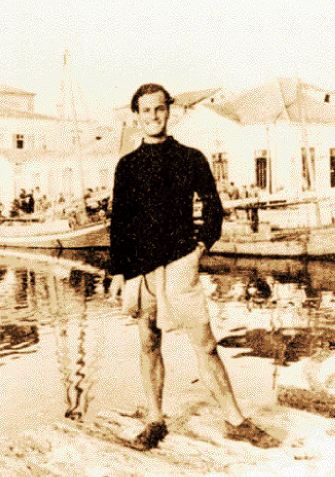
Patrick Leigh Fermor, one of travel literature’s most colorful, beguiling pedestrians, famously decided to walk across Europe when he was 18. Why not? He’d failed out of every school he’d gone to, after all, had given up on joining the army, and was living a somewhat-too-dissipated life in London among the aging remnant of the Bright Young Things. So, in the winter of 1933, equipped with a rucksack, walking stick, military greatcoat, puttees, and the Oxford Book of English Verse, he hopped on a boat to Rotterdam, Netherlands, pointing his hobnailed boots in the direction of what he’d always call Constantinople (not Istanbul), where he’d arrive in just over a year.

Eighty years later, we finally have the complete account of that trip. But it was a long road getting there—a kind of parallel journey. In 1962, Holiday magazine asked Fermor to write an article on “The Pleasures of Walking,” which he took as a chance to revisit the “Great Trudge” of his youth. He managed to cover the first two-thirds of the trip in a mere 70 pages, but the conclusion ballooned into a book of its own. Fermor wanted to call it Parallax, to underline the dual vantage of adolescence and middle age. His long-suffering publisher suggested A Youthful Journey instead. As it happened, it became neither as, busy building a house in the Peloponnese, Fermor abandoned the project altogether. By the time he took it up again, 10 or so years later on, he’d decided to start from the beginning again and write not one book but three. A Time of Gifts, which covers his walk from Holland to the middle Danube, was published in 1977. Between the Woods and the Water followed nine years later, taking him as far as the Iron Gates separating the Balkan and Carpathian mountains and ending with the words “TO BE CONCLUDED.” With the posthumous publication of The Broken Road: From the Iron Gates to Mount Athos, it kind of is.

The Broken Road is something of a stand-in for the long, long awaited third volume that Fermor planned to write. Assembled by his biographer Artemis Cooper and British writer Colin Thubron, it’s basically the manuscript of A Youthful Journey polished up a bit, though Cooper and Thubron claim that “scarcely a phrase” in it is theirs. Why Fermor couldn’t complete the trilogy himself is unclear. He was, by all accounts, a slow writer, working and reworking each sentence so diligently that a friend, according to Cooper, once accused him of “Penelope-izing”—unraveling the day’s work every night like Odysseus’s wife. But by the time he died, in 2011 at the age of 96—a real feat for someone who, by his own accounting, smoked 80 cigarettes a day for most of his life—“Volume III” had been in the works for more than half a century. Perhaps in his later years, as Cooper suggests in her biography Patrick Leigh Fermor: An Adventure, the author may have felt that “the whole subject was beginning to feel stale, barren, written out, and he feared he no longer had the strength to bring it back to life.”

Fermor’s torment may also have been a case of writerly perfectionism gone awry, as The Broken Road will seem, by most standards, plenty alive. Fermor’s deeply layered narrative, as before, intersperses fetishistically beautiful descriptions with historical tidbits, personal asides, and fanciful imaginings. He remains endlessly fascinated by local costume, folklore, genealogy, songs, and the doings of monks and muezzins, bouncing happily from peasant village to aristocratic schloss, from student digs on the Black Sea to Romanian country villa. He meets a girl (“half captured Circassian princess, half Byronic heroine”), stomps grapes, smokes hash, witnesses a celebratory riot in a Bulgarian café when it’s announced that someone’s murdered the Yugoslavian king, downs countless glasses of raki and slivo, investigates the Hasidim, theorizes on the breeding of mermaids, and sings German songs backwards to entertain a Bulgarian maid. Arriving in Bucharest, he accidentally checks into a brothel, thinking it’s a hotel, to the great entertainment of all, then charms his way into Romanian high society—opera, heaps of caviar, an excess of brandy—and passes out on the floor of an artist’s flat. He reads The Brothers Karamazov and Don Juan, and somehow always manages to find a bed for the night, usually a free one.

Still, this is a different Europe than that of the first two books—one toward which Fermor seems more ambivalent than the Mitteleuropean splendor he’s passed. Out of the old Holy Roman Empire and the familiar shadow of Western Christendom, he’d entered the strange oriental world of the Balkans—a region so recently free of the Ottoman yoke that it remained steeped in both Turkish culture and oppression’s palpable effects. There are fewer castles and a great many more huts. There’s more racial hatred too—Jewish/Romanian, Romanian/Bulgarian, Bulgarian/everyone but Russians—a legacy of the region’s violent past. Of course, Fermor’s zestful catalogue of certain Balkan cruelties—like the blinding, by Basil the Bulgar-Slayer, of a thousand-man army, leaving one of every hundred soldiers an eye “so that the rest might grope their way home to the czar” —reveal that, for a 19-year-old at least, bloodthirstiness was part of the region’s romance.

Fermor takes obvious delight in language, picking up words as one might souvenirs: In Romania, for instance, “the best word I had ever heard for irretrievable gloom: zbucium, pronounced zboochoum, a desperate spondee of utter dejection, those Moldowallachian blues.” The Broken Road positively drips with exotic names, ethnic designations, and obscure vocabularies. A dog is “passant, sejant then couchant,” and beekeepers go about “their Georgic business…mobled in muslin, calm-browed comb-setters and swarm-handlers of the scattered thorps.” Thorps! Fermor’s linguistic revelry also results in descriptive passages that verge on the purple, with images layered one over the other in a positive conflagration of sense: “Cauliflowers sailing overhead, towing their shadows twisted and bent by the ravines, like ships’ anchors, across the whale-shaped undulations, or hovering in the high mountain passes as lightly as ostrich feathers, or sliding along the horizons in pampas plumes. The setting sun turned each of these into the tail of a giant retriever.” The passage, in case there’s any doubt, describes clouds.

Actually though, hard as it is to believe, A Broken Road is a great deal less “written” than the previous two books—it was essentially a draft, unspangled with the oodles of adjectives that customarily embellish Fermor’s Byzantine prose. A representative description of a building from Volume I, by comparison, displays his gifts at full polish: “From the massed upward thrust of its buttresses to the stickle-back ridge of its high-pitched roof it was spiked with a forest of perpendiculars. Up the corner of the transepts, stairs in fretted polygonal cylinders spiralled and counter-spiralled, and flying buttresses enmeshed the whole fabric in a radiating web of slants.” This sort of thing might seem a bit steroidal to some, but the verbal fireworks go a long way toward recapturing the rapturous enthusiasm with which the young Fermor seems to have shone. “I was unboreable, like an unsinkable battleship,” the author reflects in The Broken Road. “My mouth was as unexactingly agape as the seal’s to the flung bloater. … I might, judging by my response to phenomena for most of these thousands of miles, have been a serious drug addict.” The tumultuous rush of his prose mimics the drug-like thrill that reality had for him then, and this—getting the reader as high on his words as he was on life—was what Fermor saw as his greatest challenge, 30 years on. The Broken Road tends more toward introspection than euphoria at times, frankly discussing the periodic bouts of depression that were euphoria’s flip side and Fermor’s doubt in his memories. “Were the domes tiled or were they sheeted in steel or lead –or both, as I boldly set down a moment ago? Or is it the intervening years that have tiled and leaded and metalled them so arbitrarily?”

Often the older writer admits to recalling little or nothing about a particular time, and often he confesses to being “almost irresistibly tempted to slip in one or two balloons from a later date.” One such “balloon” intrudes during Fermor’s walk south along the Black Sea coast from Varna, Bulgaria. The unknown coastline had proved rockier and less passable than anticipated, the night was dark, and both he and his flashlight had just fallen into a pool, the latter irretrievably. Bleeding from his forehead, Fermor found himself, as he writes, “sliding, crawling on all fours, climbing up ledges draped with popping and slippery ribbons of bladderwrack,” and close to despair. Rounding a cliff, he stumbles at last into a cave, where he finds a group of shepherds and fisherman cozied up for the night with a campfire and a bunch of goats. What follows is one of the most exhilarating set pieces to be found in travel writing anywhere: Having been fed, dried, and liquored up, Fermor joins his hosts in a night of ribald fun, in which a fisherman performs a rebtiko, an ancient dance that’s like a history of the Balkans writ small: “All the artifice, the passion for complexity, the hair-splitting, the sophistication, the dejection, the sudden renaissances, the flaunting challenge, the resignation, the feeling of the enemy closing in, the abandonment by all who should have been friends, the ineluctability of the approaching doom and the determination to perish, when the time came, with style,” Fermor writes, is sublimated in movement, offering “consolation and an anodyne in individual calamity.” It’s a thrilling insight in a linguistic whirl of a scene.

It also, apparently, never happened. As Cooper reports, the scene is more or less a conflation of a night Fermor spent in a fisherman’s hut on the Black Sea and an evening lost along the coast of Mount Athos, in Greece, some weeks later. It’s reputedly not the only incidence of this sort of thing: According to Cooper, a vaunted trip on horseback across Hungary seems not to have happened either. Fermor told her he feared “the reader might be getting bored of me just plodding along” and so put himself on a horse. Such fictional accents, Cooper gently suggests, were part of Fermor’s “making a novel of his life”: He didn’t invent, per se, but created “new memories” shaded by imagination. A more convincing explanation is that by the time Fermor sat down to write about the walk, not only was it 30 years in the past, but he had lost all of his journals from the time—the first stolen, the rest left unclaimed in storage after the war—and had just memories, real or not, for reference.

The distance between living and writing is responsible too for the shadow European history cast over Fermor as he sat down to write his Trudge books. Fermor was in Germany in December 1933: Hitler was in power, and the rise of nationalism was apparent in the streets, where heil-ing stormtroopers would “become performing seals for a second … as though the place were full of slightly sinister boy scouts.” In Vienna, in February 1934, he arrived in the middle of the riots between the country’s anti-communist militia and Social Democrats, the beginning of a political shift that would culminate in the Anschluss some years on. But the young Fermor, having little interest in politics, didn’t notice at all. “I wasn’t a political observer,” he yells at a Bulgarian friend who’s rebuked him for wanting to visit the hated Romania. “Races, language, what people were like, that was what I was after: churches, songs, books, what they wore and ate and looked like, what the hell!” If the young Fermor, busy with parties, drinking, smoking, sex (only delicately implied of course—he’s British), failed to foresee the consequences of Nazism’s rise, the older one certainly does. “I am maddened,” he wrote in 1963, “by not having seen, written, looked, heard.”

And so despite the author’s obvious attempts to preserve, somewhat, the innocence of his youthful self, the books are haunted by the knowledge of what was about to transpire—the fact that, as Fermor writes in The Broken Road, “Nearly all the people in this book, as it turned out, were attached to trails of powder which were already invisibly burning, to explode during the next decade and a half, in unhappy endings.” His accounts of the colorful ways of gypsies and Jews in particular can’t help but have a foreboding, even elegiac tang, no matter how they are written, and the same is true, in The Broken Road, of the landscape itself. Returning to Bulgaria and Rumania in 1990, Cooper reports, Fermor was “utterly crushed,” refusing even to talk about what he had seen: not just poverty and hunger, but picturesque villages replaced by concrete farm-workers blocks, Bulgaria’s Turkish culture completely gone, hulking Soviet towers rising from what had once been pristine wilderness.

It is no surprise then that Fermor, toward the end of his life, despaired of recapturing the innocent joy with which he’d crossed this vanished landscape and eventually gave up trying. A Youthful Journey ends quite abruptly—in midsentence, in fact—a few days before the journey reached its ultimate goal. For whatever reason, Fermor failed to take many notes at all in Constantinople. The few he did make are included here, to represent, I guess, the “broken road” of the title: “Slept till six o’clock in the evening, then, waking up, thought it was only the dawn, having overslept twelve hours, so turned over and slept again till Jan 2nd morning,” he writes of the day he arrived. Eleven days later, he was in Greece, where The Broken Road concludes, with a coda of sorts to the official account: Fermor’s perambulation through the Orthodox monasteries of Mount Athos. (As a side note, this monastic peninsula, unlike most of the places Fermor visited, seems largely unchanged. It remains, among other things, forbidden to females of all species, with the notable exception of cats.)

The text of this part comes from Fermor’s so-called Green Diary, the sole survivor of the heap of near-talismanic journals he carted about on his walk. This one he left in Romania with his first great love, the Princess Balasha Cantacuzène, who, despite years under fascism and behind the Iron Curtain, took care of it, returning it to Fermor during a secret visit in 1965. It’s a useful document, if only for the purpose of comparing the unfiltered prose of Fermor’s teenage years with the polished, many-fretted sentences that he’d produce later on. The episode of walking along the cliffs and falling into the sea, recast so brilliantly some 150-pages back as a microcosm of Balkan life, appears here just another night really, drinking with some woodsmen in a hut. One gets the feeling that Fermor would have objected to the diary’s inclusion, but in a way it’s a perfectly appropriate end. Here, lonely, tired, and somewhat fed up with the “unilluminated literalness” of Balkan life, the boy first encounters a country that he would come to love above all. Two years later, after a charmed period of rest in Romania and Greece, he’d join the intelligence services and serve in Crete as a liaison to the native partisans, eventually masterminding a hussar-ish plan to kidnap the Nazi general in charge of the occupying forces and transporting him, by mule, over the mountains, and then to Cairo by boat. He would write two books on Greece and settle permanently there in 1964 with his wife Joan, in a small fishing village in the Peloponnese. There, as a mature perfectionist fighting a losing battle against his exuberantly prolix younger self, he’d try to write what would eventually become The Broken Road. In some ways, though, the 20-year-old Paddy we leave at Mount Athos would end up outliving him.

Loving it! Walking the Woods and the Water by Nick Hunt

woodsI have been lucky enough to receive a copy of Nick Hunt’s soon to be published book which follows Paddy’s journey all the way to Constantinople. Coming out under the title Walking the Woods and the Water, it will be published on 20 March.

There will be time to offer a more in-depth review but I have to tell you that I am absolutely loving it and have done from the introduction which is a lot shorter than Paddy’s; no letter to Xan, not even to me!

The basic premise of Nick’s walk was to see if the prediction by Paddy’s Polymath had come true. What had happened over the last 70 years? Has it all changed since Paddy’s day? What remains? As Nick calls it the Persenbeug Prediction is this:

‘Everything is going to vanish! They talk of building power-dams across the Danube and I tremble whenever I think of it! They’ll make the wildest river in Europe as tame as a municipal waterworks. All those fish from the east, they would never come back. Never, never, never!’

I am not going to spoil anything but what I can say is that Nick offers us a very entertaining narrative of his journey; a very personal account which exposes a lot more about Nick’s character than Paddy ever really let us into. It is not an homage to Paddy. It is in no way just a simple update of Paddy’s experiences. It is a fresh and very modern account of a momentous journey, one that will stand in its own right.

We do get to understand a lot about what has changed, but also there is much that remains. It is a story of fascinating characters, interspersed with lovely vignettes, and insights into our wonderfully diverse continent. A sign in a bar, in a town, on the way to Budapest informed us that the town has been variously colonised by “Scythians, Celts, Romans, Avars, Magyars, Turks, Serbs and Artists”; that’s what it is all about!

There was one particular story about his experience at the former kastely of Baron Pips von Schey – Kovecses-Strkovec – in what is now Slovakia that brought tears to my eyes. Indeed, as I detect with Paddy, after Nick crosses the border into Slovakia, the east, everything changes. He is more animated. There is much more to discover. It is all different, and Nick writes about it beautifully.

I am now with Nick as he is about to start his journey into the Retezat mountains in Romania, a hazardous journey which will lead Nick to Baile Herculane, the Roman spa town close to the Danube. As he prepares to step out he tells us:

‘It was like taking a breath before plunging underwater. I was deliriously alone.’

Nick will be accompanied by Artemis Cooper at the official launch of his book which will be on Thursday 3rd April, at the London Review Bookshop in Bloomsbury. You can find out more here.

The book is available in paperback only and is ready for pre-order from Amazon. Walking the Woods and the Water: In Patrick Leigh Fermor’s footsteps from the Hook of Holland to the Golden Horn

Finally, a celebrity memoir worth reading

The 18-year-old Anjelica Huston, directed by her father, makes her screen début in A Walk with Love and Death as the 14th-century French aristocrat Claudia, fleeing the savagery of the Jacquerie

Angelica Huston recounts her interesting childhood, often beautifully, in A Story Lately Told.

By Lewis Jones.

First published in The Spectator, 4 January 2014.

Unlike many celebrity memoirs, Anjelica Huston’s is worth reading. In her Prologue she writes that as a child she modeled herself on Morticia Addams, and where a lesser celebrity memoirist would go on to say that she eventually played Morticia in a film of The Addams Family, Huston is generous enough not to labour the point. Instead of the usual ghosted drivel, she offers — as she does in her acting — a quirky charm and a reckless honesty. Her story is an interesting one, and is generally well written, sometimes even beautifully so.

Her father was the great film director John Huston. Her mother ‘Ricki’, an ex-ballerina and his fourth wife, taught her to shine her own shoes and iron her shirts: ‘Mum said you had to be able to do these things in case you grew up to be poor and couldn’t have servants.’ Her childhood was spent mainly at St Clerans, the estate her father bought in Co. Galway, which she evokes with an artist’s eye — its drawing- room, for instance, ‘pale gold, gray, pink, and turquoise’, with an 18th-century French chandelier, a Tang horse, and a ‘large, incandescent’ Monet ‘Water Lily’, which he had won gambling at Deauville.

‘Dad’ was often away — in 1951, when Anjelica was born, he was making The African Queen — but was still the dominant presence. She remembers him as ‘taller and stronger and with a more beautiful voice than anybody’ and, as she noticed over breakfast in his bedroom, ‘extremely well endowed’. His eyes were brown and intelligent, ‘like monkeys’ eyes’, but ‘when he got angry, they would turn red’. He sounds rather like Noah Cross, the evil patriarch he played in Chinatown.

He had ‘a firm regard for artists, athletes, the titled, the very rich, and the very talented’, so guests at St Clerans included Guinnesses, John Steinbeck, Peter O’Toole and Marlon Brando, as well as such girlfriends of Huston’s as Min Hogg and Edna O’Brien, who told Anjelica, ‘Your father is a terrible man, a cruel, dangerous man.’ Her mother had affairs with Patrick Leigh Fermor and John Julius Norwich, by whom she had a daughter.

Huston was joint master of the legendary Galway Blazers, and Anjelica used to hunt with them sidesaddle. A favourite horse was Victoria, ‘a liver chestnut Arab Connemara cross’, who ‘if a stone wall was too high to clear’, would ‘jump on top of it and then off, like a rabbit’.

Ireland was something of an idyll, but was ended by the family’s move to London, where Anjelica was educated at the Lycée (which she hated, and which does not seem to have helped her French — she thinks ‘onion’ translates as onion), Holland Park. She smoked banana peel on Hampstead Heath, and shoplifted from Biba, for which she later apologised to Barbara Hulanicki, who said she knew all about it and it had been a great advertisement for her shop (which may explain why it went bust). She modelled for Vogue, and understudied Marianne Faithfull as Ophelia; and then when she was 17 her mother was killed in a car crash, and her life turned to ashes.

She moved to New York, where after ‘a rather tranquil liaison’ with ‘a doll-faced Vietnamese called Duc’ she fell into the clutches of Bob Richardson, the photographer, who was much older and psychotic, and they lived for a while in the Chelsea Hotel, which ‘smelled of bad luck’.

A second volume, Watch Me, covering her life in Hollywood, is to be published next year. A Story Lately Told augurs well.

A Story Lately Told: Coming of Age in Ireland, London and New York Anjelica Huston

Simon & Schuster, pp.254, £16.99, ISBN: 9780857207425

Patrick Leigh Fermor: journey’s end book cover

plfhome2_0A short article from the Creative Review about the book covers for Paddy’s work.  A must read as it is full of beautiful pictures of Craxton book covers. Best seen on on a big computer screen.

by Mark Sinclair

The final part of Patrick Leigh Fermor’s triology documenting his walk across Europe in the 1930s was published in September. Its cover by Ed Kluz, shown left, fulfilled an interesting brief – to offer something new but to keep in mind the tradition of Fermor’s illustrated covers, designed since the 1950s by the late John Craxton…

Read the article on the CR blogsite here.

Last leg of a joyous, erudite journey

Paddy by Patrick Kidd

Paddy by Patrick Kidd

‘The Broken Road’ is brimful of the author’s characteristic exuberance, charm and erudition, with all his stylish and inimitable prose flourishes in place.

By Patricia Craig.

First published in The Irish Times, 26 October 2013.

Towards the end of her admirable biography of Patrick Leigh Fermor, from 2012, Artemis Cooper relates an anecdote. After the stupendous success of the first two-thirds of his proposed trilogy – A Time of Gifts (1977) and Between the Woods and the Water (1986) – expectations were high for the final section. But something of a writer’s block had overtaken the author. Despite encouragement from every source – friends, wife, publisher, his eager readers – he found himself unable to complete the undertaking.

Then, after spending weeks in his study engrossed in some form of composition, he emerged one day clutching a sheaf of paper. “I knew it could be done!” he exclaimed to his overjoyed wife. But, alas, he went on, “I knew PG Wodehouse would translate into Greek.”

But all was not lost. The history of The Broken Road is complicated. It completes the story begun when the author, aged 18, in 1934, embarked on a tremendous journey. His aim, which he fulfilled, was to walk from the Hook of Holland to Constantinople. Years later, when Patrick Leigh Fermor sat down to make another journey backwards in time, he conceived the project as a three-volume account of his travels across Europe during those heady years of the mid 1930s. What resulted was an extraordinary feat of recollection and evocation, which placed the author among the outstanding travel writers of the 20th century. But it stopped short at the Iron Gates in Romania (the ending of volume two).

As the painstaking editors of The Broken Road recount, however, Leigh Fermor had actually written the current text as far back as the early 1960s. It, or a version of it, was lost, retrieved, abandoned, reclaimed and subjected to intermittent revision. Indeed, the author was still working on it until a few months before his death, in 2011, at 96 (PG Wodehouse notwithstanding). And, the editors say, “there is scarcely a phrase here, let alone a sentence, that is not his.”

If Leigh Fermor never brought the manuscript to a state that caused him to rejoice, it is nevertheless hard to see what there was about it that engendered so much angst. It is brimful of the author’s characteristic exuberance, charm and erudition, with all his stylish and inimitable prose flourishes in place.

The final part of The Broken Road is rather different, though, as it consists of entries from Leigh Fermor’s only surviving diary (January-February 1935), which he kept while going from monastery to monastery on Mount Athos. Immediacy rather than retrospection is the keynote here. No felicitous reflections imposed over the rough jottings, but rather a sense of the young traveller sitting down in one of his whitewashed cells each evening to write up the day’s events, the different types of monks encountered (“a surprisingly cultivated man”; “a funny little creature with a hump, very small, his frock discarded for chopping wood”), the scenery reminiscent of the Garden of Gethsemane, the hazardous walks up rocky paths through melting snow, the cypresses and orange trees and tranquil Aegean Sea.

We have the diaries and, in the middle of chapter seven, we have a short autobiographical interlude – “My childhood was spent in London, in my mother’s very exciting company” – sparked off by two letters, one from his mother and one from his father in India, which he collected from a post office on the way to Varna. Otherwise, The Broken Road is a scintillating continuation of the prodigious walk that took the young Leigh Fermor right into the heart of magically different prewar Europe and beyond, through places “teeming with history and with natural wonders”. Eleven dolphins leaping and gambolling in a bay; a wild boar in an autumn forest; black-cloaked and hooded herdsmen of a nomadic Balkan tribe. The “strange, rather sad, rather beguiling spell [that] haunted the cobbled lanes of this twinkling, twilight little town of Mesembria”.

Leigh Fermor had some considerable assets to aid him on his journey. He had a knack of falling on his feet, of getting out of scrapes and overcoming setbacks. He had high spirits, hardihood and luck on his side. Whether in the streets of some unfamiliar town or halfway up a bleak mountain with darkness closing in, he rarely failed to encounter kindness and hospitality. His gift for languages enabled him to communicate even with rough Bulgarian shepherds or Greek fishermen in a cave on the Black Sea coast.

It was a time of contrasts, all of which he took in his stride: if he’s not immersed in the social life of Bucharest (for example), living it up while staying in a diplomat’s flat (after an inadvertent sojourn in a brothel), he is sleeping under the sky or in rough-and-ready peasant accommodation.

He is, by turns, gregarious – drinking, singing and dancing half the night – and of a solitary, introspective bent. The first was of inestimable benefit to him along the road, while the second came into play once he’d started retracing his own footsteps, recalling with gusto the pungency of the past, conjuring up bygone scenes, moods, crucial encounters, histories, classical comparisons, lights and shades, exotic experiences, flights of fancy, all replete with the exhilaration of travel, of setting out. From the moment he stepped ashore on the snow-covered soil of the Netherlands, back in 1934, he was in his element.

Now, although The Broken Road peters out in the middle of a sentence, his journey is complete, his worldly task accomplished, with the whole undertaking “as thick in marvels as Aladdin’s cave”.

Ada Kaleh and the mosque controversy

An very interesting piece by Dr Dorel Bondoc, expert on Archaeology from Oltenia Museum, Craiova, Romania, about the history and archaeology of the submerged island in the middle of the Danube. It refutes Paddy’s claim in BTTW that the mosque was moved.

by Dr Dorel Bondoc

Published on the Alexis Project website.

At the beginning of the 15th century, the island was occupied by Turks, who understood its remarkable strategical importance for the development of the river trade on the Danube, after the exit from Kazan region. In 1718, as a result of the treaty from Passarowitz (Pojarevat), the northern Serbia, Banat and Oltenia became possessions of the Austrians, as was also the case of Ada-Kaleh island which then bore the name New Orsova.

The Austrians built a strong fortification of “Vauban” type on the island. In 1739, after the treaty from Belgrad, Austria returned Serbia and Oltenia to Turkey. As a result the island was occupied again by Turks, who gave it the name Ada-Kaleh, which may be translated as “the island of the fortress.” The toponym can also be found in the documents of that time as: Ada Kale, Ada Cale, Adakaleh, Ada Kaleh or Adacale.

Read more here.

Related article:

Ada Kaleh: the lost island of the Danube

Walking the Woods and the Water – Nick’s book cover revealed

Walking the Woods and the Water

Walking the Woods and the Water

After a lot of labour, a change of publisher and book title, Nick’s book is finally to be published by Nicholas Brealey Publishing in March. Many of you will remember that two years ago Nick walked Paddy’s great trans-European walk, taking about the same time, using only Paddy’s books as a guide, and visiting many of the houses he stayed in en route.

Nick wrote to me saying “The cover has been designed and I’m very pleased to tell you it’s by Ed Kluz, the same artist who did The Broken Road. Looks very different of course, and not (as I was worried it might) overly derivative of the style of Paddy’s books. But a nice continuity.”

It will be interesting to see what you all think about that. As soon as I have further news I will update you. I do know that Nick will be giving some talks to support the publication and I will pass on these details as soon as I have them.

A World of Private Mystery: John Craxton, Fitzwilliam Museum, Cambridge

For a few months in wartime London two 19-year-old artist friends shared a studio in the St John’s Wood area. Equal in talent and ambition, and equally patronised by wealthy aesthetes and some of the most fashionable painters and intellectuals of the day, they were toasted as the gilded future of English painting. One may fairly be said to have fulfilled the prediction – he was Lucian Freud. The other was John Craxton who, though he lived to be almost as venerable as his friend, and always retained a core of devoted admirers, is known hardly at all by the public at large today. The present retrospective show of 60 paintings and drawings by Craxton at the Fitzwilliam Museum in Cambridge offers an opportunity to mull over the vagaries of artistic reputation.

“There are moments when the London-born artist achieves a state close to ecstasy”

by Robin Blake.

First published in the Financial Times, 29 December 2013.

Vagary is a word that sorts well with Craxton’s career. His early London-based wartime work is a compendium of influences from four luminaries at whose feet the teenage Craxton sat: Graham Sutherland, Ben Nicholson, John Piper and Henry Moore. From Sutherland, who invited Craxton to Pembrokeshire in south Wales, came a line in quasi-surreal zoomorphic landscape, with some rather striking results; from Nicholson (channelling Picasso) a diluted form of cubism; and from Moore and Piper a group of drawings that mix fluent inked outlines and hatched shading with patches of atmospheric watercolour and gouache. Other early drawings have a Dürer-like touch with the Conté pencil, or else a fixation on a Samuel Palmer-esque “poet” dreaming in a rural landscape. Many of these works from the early and mid-1940s are extremely accomplished, showing just why they attracted attention; but seen in retrospect they are clearly apprentice work.

As the war ended, Craxton escaped from dingy, rubble-strewn London for Pembroke and the Scilly Isles (off southwest England), destinations that became a prelude to Greece, the land and climate of which he already dreamt. He finally reached the Aegean in 1946, and went on to Crete the following year, where he eventually established a life-long base. However, he was often restless, travelling to elsewhere in Greece and the Mediterranean. He returned from time to time to London where Freud and Francis Bacon were established, in their different ways, as stay-at-home painters of anxious, existential interiors. Craxton, on the other hand, was filling his paintings with light-filled Aegean landscapes and figures that danced and leapt, or lounged and slept, but were universally outlined in luminous colour. His subjects were Dionysian goats and youthful goatherds, taverna sailors and sirtaki dancers, mountain gorges and islands across the sea. His rejection of the label “neo-romantic” was about the prefix: he acknowledged that he was a romantic.

Craxton’s compositional signature, from his early years to much of the mature painting, is a preoccupation with the binary division of the canvas, and the balance of left and right, whereby the eye switches back and forth between two contrasting sides, or is impelled towards a central feature of interest such as a twisted tree. This kind of repetitive balancing can look compulsive and a touch academic, yet it is expressive of Craxton’s own nature, and this is also part of the key to the decline of his reputation.

Craxton lacked Freud’s near monomania for painting, for shrinking the world into the narrow space of a studio. Preferring the art of living, he spent much of his time in bars and tavernas, in conversation with a wide range of friends, and on journeys and excursions. So the compositional balances in his work – sun/moon, light/dark, mountain/cave – echo the balance he sought in his life, which was a perfectly sane objective, even though it resulted in a degree of creative vacillation, for which he coined the term “procraxtonation”. Incidentally he shared both the attitude and the indecision with another of Greece’s English residents, his friend Patrick Leigh Fermor, and Craxton’s highly characteristic cover illustrations for Fermor’s books have probably since become his most widely seen works.

The inevitably thin catalogue of paintings that resulted from procraxtonation was not improved by bad reviews back in Britain, where the market for Craxton’s work chiefly lay. He had a solo show at the Whitechapel Gallery in January 1967, a bitterly cold month in the middle of a period when artistic London was distracted between Pop art and Abstract Expressionism. Unsurprisingly Craxton’s sun-filled modernist pastoral, tinged with Aegean mythology, was treated as a complacent, expatriate irrelevance. The golden boy had fallen headlong out of fashion, and he felt deeply discouraged.

We can see these works less sourly now. True, some seem patterned and formulaic, and they are a touch emotionally passive even as they celebrate the blazing passion for life that the Greeks call kefi. But in diverse and accepting times, there is plenty to be said for such positive and gently life-enhancing visions, while there are a few paintings in which Craxton transcends himself, and even achieves a state close to ecstasy. One of these is “Landscape with the Elements”, the cartoon for a tapestry commissioned in 1973 by Stirling University. It is in its own right an astounding success as a painting: a sumptuous, all-embracing canvas as grand and dazzling as a Turner or a Monet. Now owned by the Scottish National Gallery of Modern Art, this vibrant dialogue of night and day gorgeously affirms young John Craxton’s flight from the grey ashes and black smuts of austerity Britain, and his refusal, in spirit, ever to come back.

Until April 21. Find out more at the Fitzwilliam Museum website.

Patrick Leigh Fermor blog – 2013 in review

As usual the WordPress.com stats helper monkeys prepared a 2013 annual report for your favourite blog. WordPress is the blogging engine that I use. There were nearly 250,000 visits to the site in 2013, pushing the total since I started in March 2010 to over 760,000 visits. Please click through to read the summary.

I wish you all a very Happy New Year and hope that you come back often to visit in 2014. As usual I have an enormous backlog of material and will get around to posting it. Some of the material has been sent in by readers (you know who you are) and I promise that I will get it online one day! Life is so busy.

Tom

Here’s an excerpt:

The Louvre Museum has 8.5 million visitors per year. This blog was viewed about 250,000 times in 2013. If it were an exhibit at the Louvre Museum, it would take about 11 days for that many people to see it.

Click here to see the complete report.

Ignore the xenophobic hysteria and welcome our EU neighbours

Villagers in Clinceni, Romania cover a field with what they claim is the world's biggest ever flag

Villagers in Clinceni, Romania cover a field with what they claim is the world’s biggest ever flag

Britain is in the Orwellian middle not of a Two-Minute Hate, but a Two-Year Hate.

By Boyd Tonkin.

First published in the Independent, 27 December 2013.

This may surprise alarmed observers in Sofia and Bucharest – or even in Westminster. But one of the best-loved British books of 2013 takes the form of a fervent and heartfelt tribute to the peoples of Bulgaria and Romania. War hero, writer and traveller Patrick Leigh Fermor died in 2011 before he could publish the third volume of memoirs about his “Great Trudge” though Europe in the mid-1930s. The Broken Road, which appeared posthumously in the autumn, takes the young literary vagabond from the “Iron Gates” on the Danube across both countries to the Black Sea coast.

Everywhere he walks, Leigh Fermor relishes the landscapes and the languages. He admires the culture and the customs. Above all, he comes to love the people of the Balkan peaks and plains: always hospitable and welcoming, forever willing even in the poorest backwater to greet this penniless young Englishman with unstinting generosity, feed him, shelter him and send him on his way with blessings – and with lunch.

Now, what would happen to a late-teenage Bulgarian or Romanian, without lodging, employment or any ready cash, who started to walk, say, from Dover to Glasgow in the spring of 2014? On the evidence of British public life just now, the result would not be a glorious trek across a land of smiles, fondly remembered from a ripe old age.

The Economist magazine has already issued its number-crunched fiat in their favour. Still, this column may count as an early squeak in the almost inaudible chorus of welcome for visitors or migrants to the UK from Bulgaria and Romania. More than a few of us belong to the open-hearted country of Paddy Leigh Fermor rather than the tight little island of Godfrey Bloom. If you wish to, fellow EU citizens, I hope that you will come. Should you choose, quite legitimately, to seek work here, then I hope that you prosper for as long as you stay. And most of all, I hope against hope that our morally bankrupt political class and ruthlessly cynical media will one day start to address the underlying reasons for home-grown fears: the living-standards crisis, deep-seated job insecurity, yawning chasms in wealth and opportunity, the greed and arrogance of a pampered “super-class”, and a chronic lack of decent homes for non-millionaires. Instead, they have set out on yet another sordid scapegoat hunt. Patrick Leigh Fermor Patrick Leigh Fermor

The grievances are genuine. But the actual culprits have got clean away. A useful watchword for 2014 might run: lay the blame where it belongs. August Bebel, a wise German social democrat at the turn of the 20th century, popularised the idea that “anti-Semitism is the socialism of fools”. A century on, the quarry may have changed, but not the toxic rhetoric, nor the squalid logic of victimisation. As all the 28 million people in the so-called “A2” accession countries of the EU must understand, this lather of dread has been whipped into a perfect storm by the confluence of cannily inflammatory media and the blind funk of a shaky governing party. As a result, if you’re looking for fraudulent crystal-ball predictions, outrageously deceitful hucksterism and a brisk trade in ideological scrap and junk, there’s no need to visit some mythical gypsy encampment. You can find all that and more via any visit to Westminster, TV studios and newsrooms – plus a detour, of course, to the Ukip HQ.

Crashing rollers of anti-immigrant vitriol break day after day, loud as an end-of-year storm surge, and just as implacable. Anyone who resists this tide – who says without any niggling proviso that all legal incomers from European Union member states, as from -everywhere else, presumptively deserve trust, goodwill, courtesy and fair dealing – may feel just now like the enemy within. The tone of paranoia, suspicion and targeted hatred has made British political discourse through

2013 resemble propaganda-fuelled dictatorships such as – well, let’s start with Nicolae Ceausescu’s Romania and Todor Zhivkov’s Bulgaria. As regards the citizens of those states, Britain is in the Orwellian middle not of a Two-Minute Hate, but a Two-Year Hate.

Plenty of the worried who fear this as-yet-phantom army of immigrants will have spent Christmas paying lip service at least to the festival’s religious roots. Presumably – and this, I’m afraid, is a rhetorical device shamelessly nicked from the works of Charles Dickens – their edition of the Bible fails to include the exhortation from Deuteronomy that insists “Love ye therefore the stranger, for ye were strangers in the land of Egypt”, the lines from Matthew’s gospel that run “For I was hungry, and ye gave me meat: I was thirsty, and ye gave me drink: I was a stranger, and ye took me in”, still less the advice of the Letter to the Hebrews: “Be not forgetful to entertain strangers, for thereby some have entertained angels unawares”. A few weeks ago, Nigel Farage commented: “We need a much more muscular defence of our Judaeo-Christian heritage.” To which one might reply: precisely.

Sentimental? Impractical? Airy-fairy? No more so that than the speculative pseudo-statistics that bedevil this “debate”. As to the likely numbers involved, absolute confusion reigns. An even-handed House of Commons briefing paper recently noted that the Foreign Office’s own inquiry into probable figures (commissioned from the National Institute of Economic and Social Research) had concluded that “it is not possible to predict the scale of future migration from Bulgaria and Romania to the UK numerically”. The Commons paper, by the way, also shows why the often-quoted Migration Watch prediction of circa 50,000 net arrivals per annum from Bulgaria and Romania is skewed. The numbers rest on an untested forward projection from events after the 2004 EU entry of Poland and its neighbours (the so-called “A8” countries) on to a wholly different set of circumstances.

Among the factors that suggest “low levels of migration”, the Commons researchers cite the obvious fact that “all remaining transitional controls will expire in all EU countries at the same time”. Among factors that may pull the numbers upwards are “high unemployment rates … in those EU countries that have so far been the preferred destinations for A2 nationals”, mainly Italy and Spain. In short, we don’t yet know. Maybe the invading wave will be crested by some of the estimated 14,000 doctors and 50,000 nurses who have left Romania since it joined the EU in 2007. If so, then our steam-driven pundits should on principle refuse treatment when their apoplectic xenophobia lands them in A&E.

Even if the feared influx of low-skill job-seekers does occur, and does put pressure on underfunded services in certain areas, then public figures still have a choice to make. Some of the windier press invective that craven politicians have done nothing to deflate – especially against Roma people – pretty much amounts to incitement to racial violence.

Whoever wins the dismal numbers game in 2014, a failure to condemn that sort of hate speech opens the door to further barbarism in political life.

We have been here, many times, before. Back in 1517, Londoners rioted on “Evil May Day” against foreign workers. According to legend, the mob was calmed by the then under-sheriff of London, Sir Thomas More. About 75 years later, the event was dramatised in a multi-authored play about the life of More – the kind of stage “biopic” common in the Elizabethan theatre. In the second act, when he faces down the racist rioters of London, the play’s language suddenly leaps into life. More’s great speech makes the case against anti-immigrant agitation with a moral force that still sings out today.

“Grant them removed,” says More about the detested foreigners. “Imagine that you see the wretched strangers,/ Their babies at their backs and their poor luggage,/ Plodding to the ports and costs for transportation.” “What had you got?” he asks the mob. “I’ll tell you. You had taught/ How insolence and strong hand should prevail.” In other words, mob rule – of the kind that, these days, tries to smash international treaties and tear up EU agreements. And what if the lawless migrant-bashers had to move abroad themselves, “to anywhere that not adheres to England”? In exile, “Would you be pleased/ To find a nation of such barbarous temper,/ That, breaking out in hideous violence,/ Would not afford you an abode on earth?” Just put yourselves in the foreigner’s shoes, More counsels: “What would you think/ To be thus used? This is the strangers’ case;/ And this your mountainish inhumanity.”

There used to be almost as much heated argument around the authorship of this passage (in a script known as “Hand D”) as about the imminent levels of migration from “A2” states. Now, a kind of scholarly consensus prevails. That scene was most probably written by William Shakespeare. Across the political mountains of inhumanity, let’s hope that the latest torrent, or quite possibly, trickle of “strangers” can locate and enjoy Shakespeare’s country.

Culture aside, a well-sourced report released this week by the Centre for Economic and Business Research argues that Britain will over the coming years overtake Germany as the strongest economy in Europe. And which ace do we hold up our sleeve as the Old Continent grows even older, less productive and more state-dependent? Why, “positive demographics with continuing immigration”. On which note, we should wish even the frostiest of Europhobes Chestita Nova Godina and Un An Nou Fericit!

Horace: The Odes, Book One, IX, translated by John Dryden

Following on from the article by Llewelyn Morgan about Horace, I thought it would be good to share Dryden’s translation.

by Carol Rumens

First published in The Guardian, 30 July 2012.

“For this last half-year I have been troubled with the disease (as I may call it) of translation … ” Thus John Dryden begins the preface to his volume, Sylvae, or the Second Part of Poetical Miscellanies (1685). It marks his emergence, relatively late in life, as a translator, containing work by various Greek and Latin authors: Theocritus, Lucretius, Horace, Ovid among them. Despite that “disease”, encompassing a nagging “un-ease” about the fidelity of his method, Dryden enjoyed translating Horace – and it shows. See, for example, the magnificent Ode 29 from Book Three presented by Dryden as his own imitation of “Pindarique Verse”. Its famous eighth stanza (“Happy the man, and happy he alone, / He who can call today his own … “) is treasured by readers still – as poetry and as advice on living. For this week’s poem, however, I’ve picked a smaller jewel: the wonderfully elegant version of Ode Nine, Book One.

Dryden described his method as paraphrase. The original author’s words were not as “strictly followed as his sense”. The sense could be amplified, and even altered. This was a practical and, in some ways, obvious technique. Horace’s word-order, for example, has to be altered to make sense in a non-inflected language. In taking further liberties, the justification is that the translator is himself making a poem. Dryden tried to create a work the author could have produced “if he were living and an Englishman”. He sets the standard for poetry translation as fidelity to the receiving language, and sets a further standard: he is honest with the reader about his strategies.

Horace didn’t think of these verses as Odes. The Renaissance gave them that title. To the author, they were songs, or “carmina”. Ode one/nine is written in Alcaics, a four-lined, largely dactylic strophe named after the Greek poet Alcaeus: it’s the commonest verse-form in the Odes, a flexible form-for-all-seasons. Using iambic tetrameter chiefly, with the rhyme-scheme A B A B C C (C), Dryden expands the quatrain, in the first four stanzas to six lines and in the last two to seven. The bold move works. The statelier English verse occupies its space comfortably. There’s no padding, no rigidity.

Dryden’s poem sometimes generalises, of course. He loses the address to Thaliarchus, master of the feast. He doesn’t mention Mount Soracte or name the trees. In the last stanza, there’s no reference to the girl’s ring. Yet he avoids dull exegesis or moralising. Like Horace, he balances his showing and telling.

Dryden enjoys some subtly brilliant word-play. In the first stanza, the mountains of line one are elevated in the next by “mounts of snow”, a linguistic effect and a snapshot revealing the snow itself as mountainous. There’s a wonderful gravitational pull in the rest of the stanza, from the “labouring woods” (suggesting more tonnage of snow on the trees) to the stream, imagined as a prisoner, fettered, benumbed, “cramp’d to solid ground”. The ensuing indoors scene introduces a contrasting glow and vivacity, with the heaped logs replacing the snow-heaps outside. The mood is merry and defiant, a mixture of Epicurean and stoic. It’s tempting to imagine the Restoration (1660) as Dryden’s political subtext here.

God now comes on stage in a somewhat Jovian manner, playful, not wholly reliable. He will provide, “if ’tis worth His care”, but there’s no knowing what so stormy, windy and capricious a deity might do next (think 17th-century politics again, perhaps?). The scene is set perfectly for that sound, pragmatic advice to seize the moment – “Nor love, nor love’s delights, disdain … ” Dryden works Horace into some sharp-suited epigrams, as in the final couplet of this stanza and the last line of the next (fifth): “The best is but in season best.”

It’s such a cohesive, tight little ship of a poem, yet the tone is relaxed. There is an ease of movement in the argument, so it never seems heavy-handed. All the stanzas work separately, and all work together in forming an overall architecture. There’s a satisfying balance of concrete and abstract. Dryden leaves out some of Horace’s specific details, but compensates with a focus on language.

In the wonderful last stanza, notice how appropriately he picks up the tercet’s rhyme-sounds (“feign/again/ordain”) from the fourth stanza’s couplet about the delights of love (“disdain/gain”). That extra room now allows him to present the courtship drama as a complete narrative-in-miniature. The faint sexual frisson is judged to perfection, and not a word is misplaced. Horace’s brevity is magical, here, but Dryden’s amplification works in another way. He closes with a line of hexameter, straightforward and serious: “These, these are joys the gods for youth ordain.” Do we hear the regretful tone of middle-age? Perhaps, and this may be another reason why Dryden’s English lives. He’s true to his own feelings.

Dryden was a great literary all-rounder. He is “the father of modern criticism” and a glorious prose-stylist. He’s no longer remembered as a playwright, perhaps unfairly. I recently read one of his comedies (An Evening’s Love), dipping my toe for the first time, and found it a highly entertaining piece of Spanish sitcom. But Dryden himself feared he had wasted his energies among “the steaming ordures of the stage”.

In 1685, of course, he was still to produce his great allegorical poems and the brilliant satires such as Mac Flecknoe (1682), and still to tackle his translation masterpiece, Virgil’s Aeneid. The Sylvae represent no less an achievement, showing Dryden in a perhaps unusual light – that of graceful poetic lyricist.

Horace’s original, with an interesting modern American translation and helpful commentary by William Harris, is here.

Horace: The Odes, Book One, IX, translated by John Dryden

Behold yon mountain’s hoary height
Made higher with new mounts of snow:
Again behold the winter’s weight
Oppress the labouring woods below’
And streams with icy fetters bound
Benumbed and cramped to solid ground.

With well-heaped logs dissolve the cold
And feed the genial hearth with fires;
Produce the wine that makes us bold,
And spritely wit and love inspires;
For what hereafter shall betide
God (if ’tis worth His care) provide.

Let Him alone with what He made,
To toss and turn the world below;
At His command the storms invade,
The winds by His commission blow;
Till with a nod He bids them cease
And then the calm returns and all is peace.

Tomorrow and its works defy;
Lay hold upon the present hour,
And snatch the pleasures passing by
To put them out of Fortune’s power;
Nor love nor love’s delights disdain –
Whate’er thou getts’t today, is gain.

Secure those golden early joys
That youth unsoured with sorrow bears,
Ere with’ring time the taste destroys
With sickness and unwieldy years.
For active sports, for pleasing rest.
This is the time to be posesst;
The best is but in season best.

Th’appointed hour of promised bliss,
The pleasing whisper in the dark,
The half-unwilling willing kiss,
The laugh that guides thee to the mark,
When the kind nymph would coyness feign
And hides but to be found again –
These, these are joys the gods for youth ordain.

Related article:

An Ode for the Road