
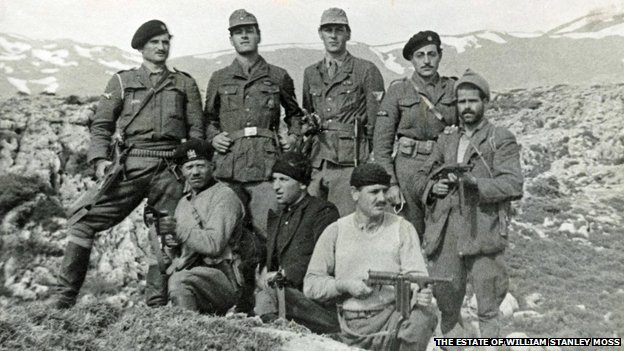
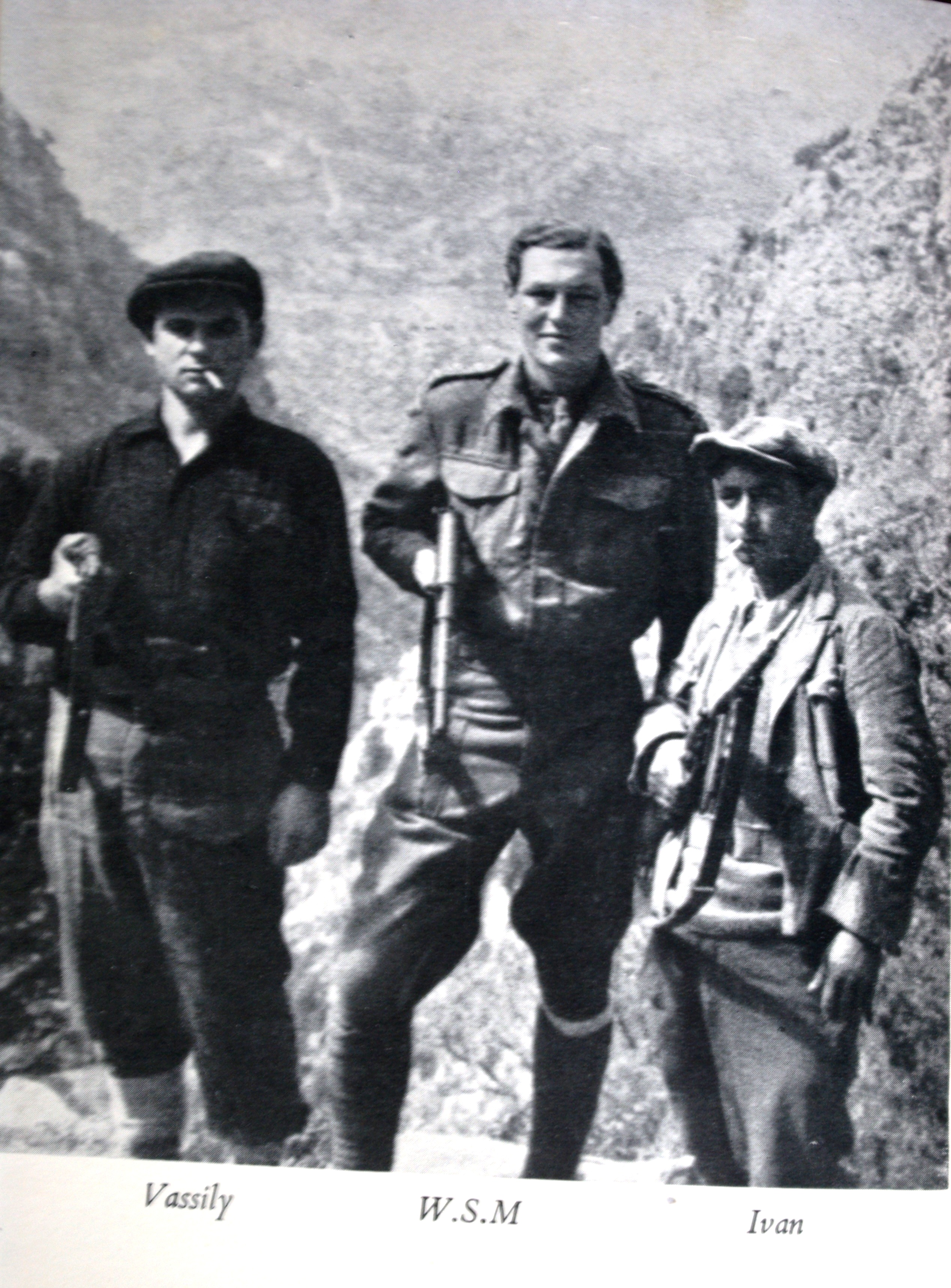
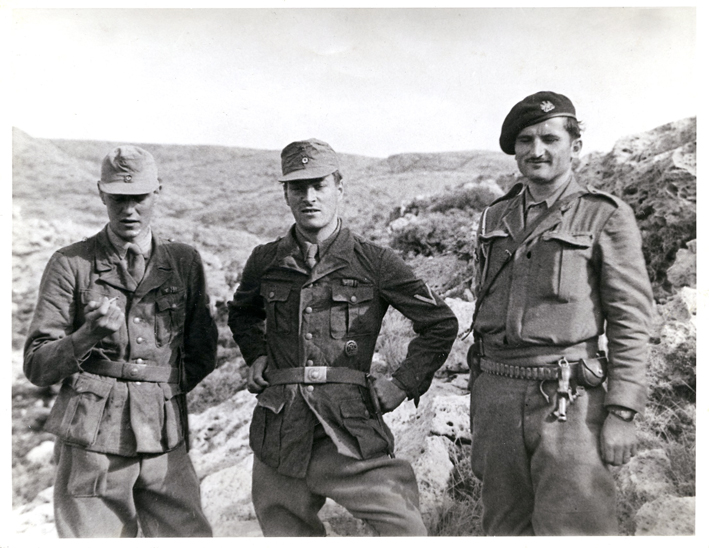
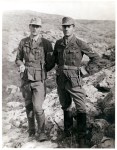
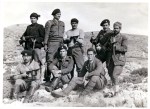
Patrick Leigh Fermor, center, with members of the team that abducted General Heinrich Kreipe: George Tyrakis, W. Stanley Moss, Manoli Paterakis, and Antoni Papaleonidas.
It has been said of Ulysses that, were Dublin ever obliterated, the city could be substantially rebuilt by consulting its pages. Along these lines, if all Europe were, God forbid, laid waste tomorrow, one might do worse than attempt to recreate it, or at least to preserve some sense of its historical splendor and variety, by immersing oneself in the travel books of Patrick Leigh Fermor.
by Ben Downing.
This text originally appeared in issue 165 of The Paris Review, Spring 2003.
Patrick who? Although popular both in his native England, where his books are available in Penguin paperback, and in many other countries—he has been translated into any number of languages—Leigh Fermor (who died in 2011) is known to only a devout few in this country, where, scandalously, his work is not distributed. I myself came to him three years ago, when a friend pressed me to seek out A Time of Gifts (1977) and Between the Woods and the Water (1986), the first two volumes of a projected trilogy about his teenage walk across Europe in the early thirties. By chance, that very week I stumbled across a used copy of A Time of Gifts. I began reading straightaway, but after a few pages stopped and rubbed my eyes in disbelief. It couldn’t be this good. The narrative was captivating, the erudition vast, the comedy by turns light and uproarious, and the prose strikingly individual—at once exquisite and offhand, sweeping yet intimate, with a cadence all its own. Perhaps even more startling was the thickness of detail, and the way in which imagination infallibly brought these million specificities to life. In the book’s three hundred or so pages, scarcely a paragraph was less than spirited, cornucopian, and virtuosic.
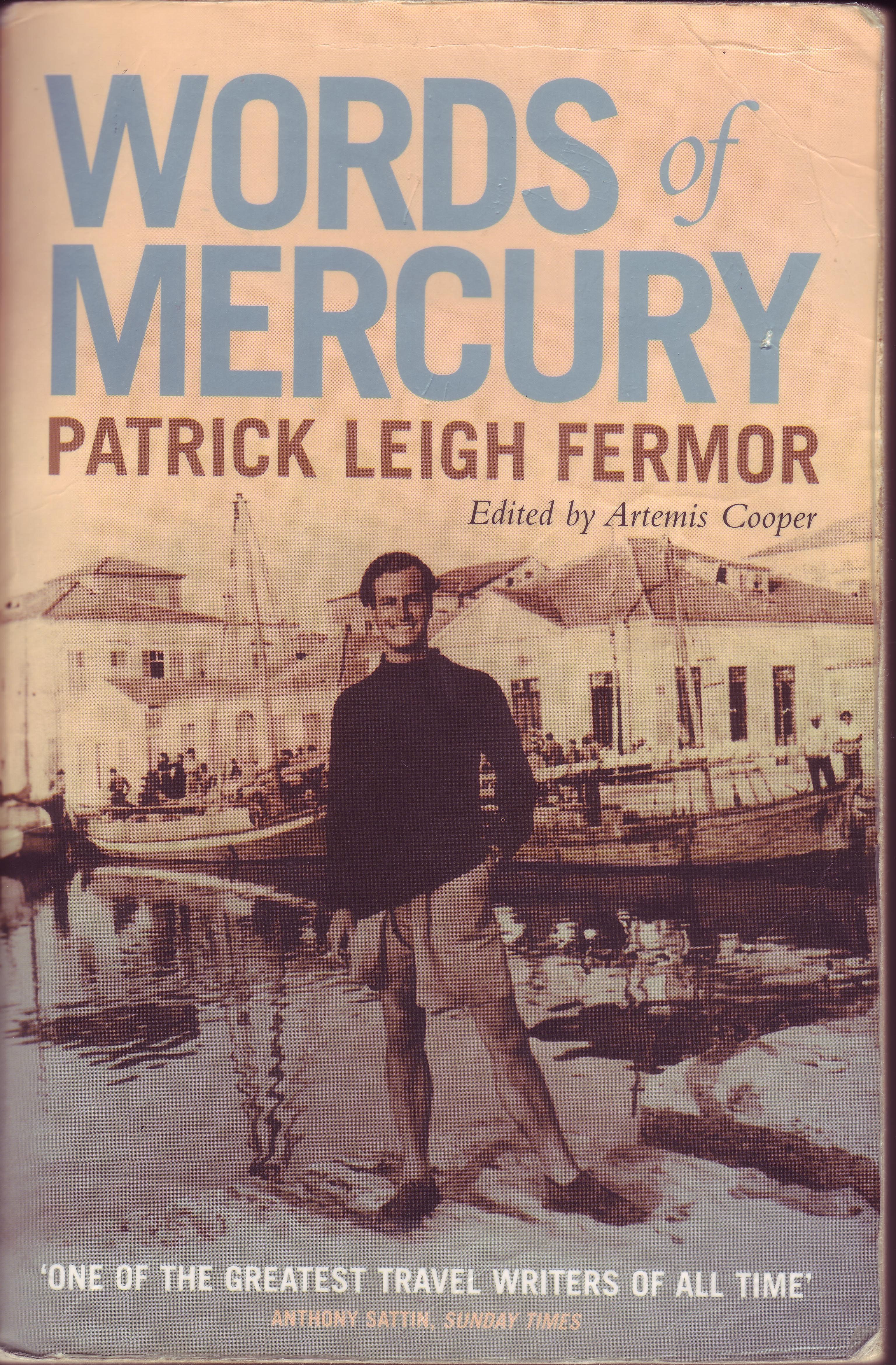
I am not given to idolizing writers or reading them entire, but this was a special case. Before long I had tracked down, whenever possible in their beautiful John Murray hardback editions, not only Between the Woods and the Water (which sees Leigh Fermor as far as the Iron Gates of the Danube) but also his remaining work—two travel books about Greece, one each about the Caribbean and Peru, a slim volume on monasteries, and a novella. Having devoured these, I started trying to find out more about Leigh Fermor himself. Piecing together information from his books and other sources, I came up with the following.
A clever but unruly student, Leigh Fermor was expelled from a series of schools and at sixteen dropped out altogether. After a period in London halfheartedly cramming for Sandhurst and (far more eagerly) partying with the last of the Bright Young People, he set out in December 1933 on his journey to Istanbul, which took him over a year. At this point the picture grew vague; there was some improbable story about his tagging along with a Greek royalist army as it quashed a rebellion, another about his falling in love with a Romanian princess.
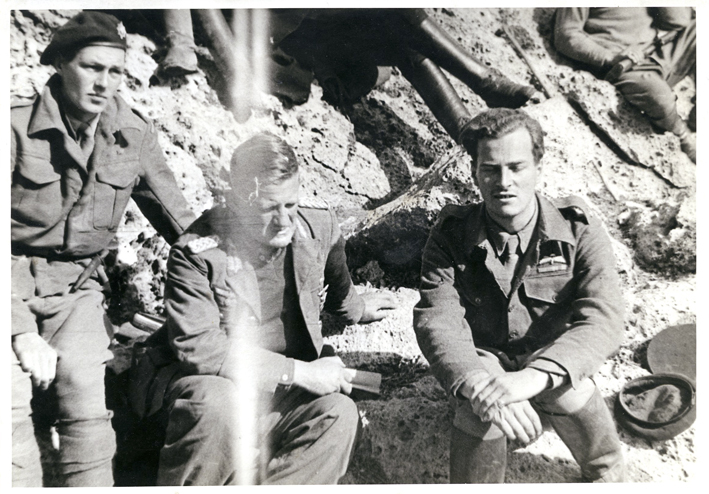
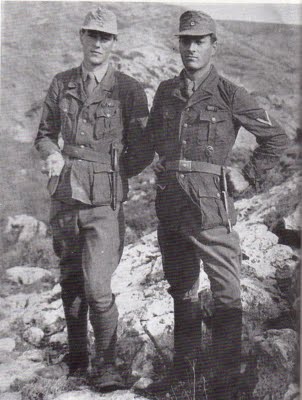
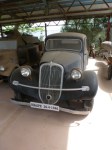
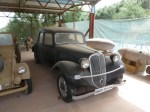
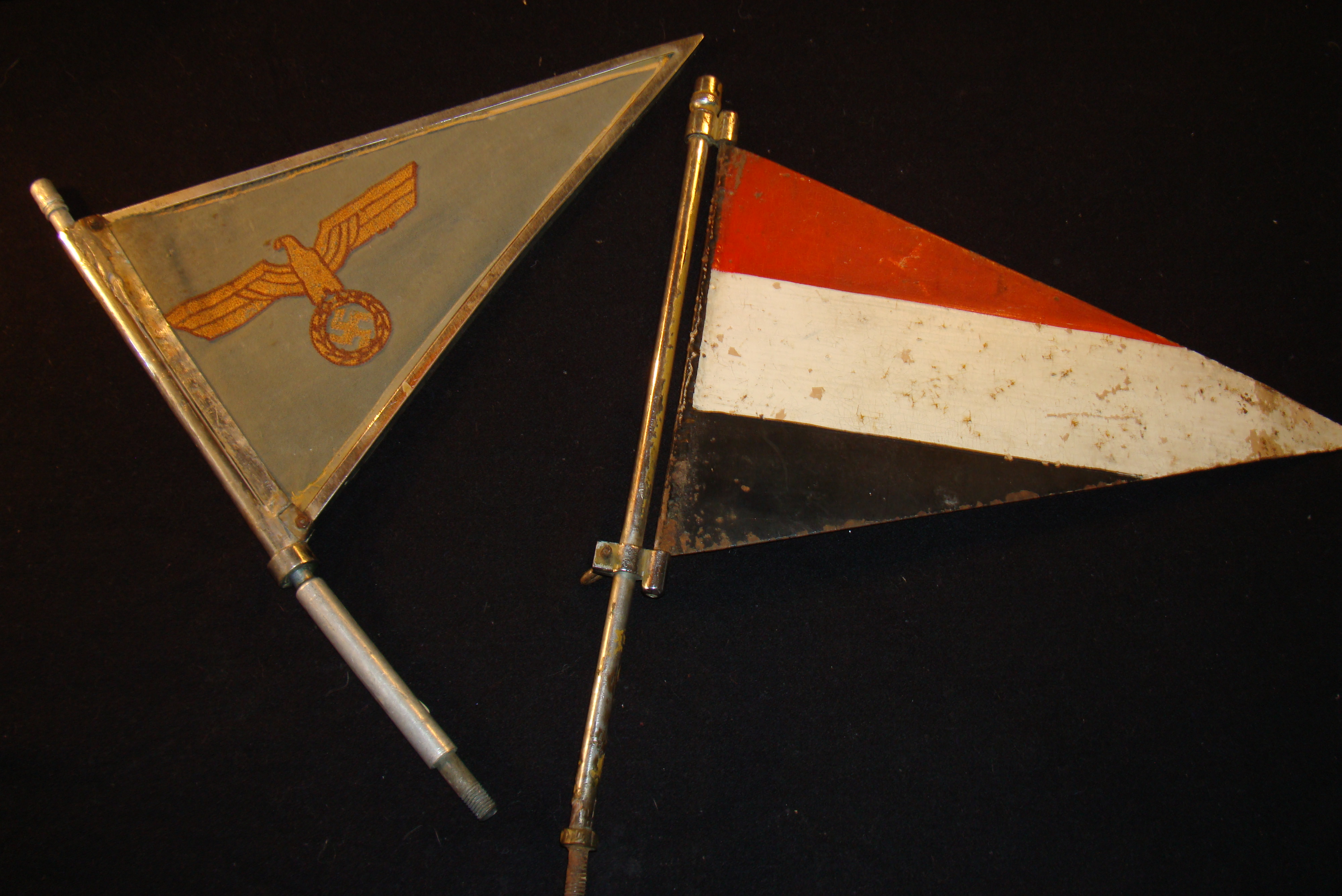
The war years were somewhat clearer. Leigh Fermor enlisted with the Irish Guards; was commissioned in the Intelligence Corps; was sent as a liaison officer to the Greeks fighting the Italians in Albania; took part in the Battle of Crete; and escaped to Cairo in the general retreat. Having joined SOE (Special Operations Executive), he became one of a handful of officers secretly landed back on Crete, where, dressed as a shepherd, he lived in mountain caves and organized the guerilla resistance. His military career peaked in April 1944 when he led one of the most daring operations of the war. Disguised in Nazi uniform, Leigh Fermor and W. Stanley Moss, along with seven Cretan fighters, hijacked a car carrying General Heinrich Kreipe, commander of a division then occupying Crete. After bluffing their way—with Leigh Fermor impersonating Kreipe—past more than twenty checkpoints, they made for the mountains with their captive and spent three harried weeks dodging the thousands of troops sent to catch them, until finally a British boat slipped in to pick them up and take them to Cairo. For his role in the abduction Leigh Fermor was awarded the DSO.
After this the picture blurred again. I gathered that in the late forties and fifties Leigh Fermor had traveled at length in the Caribbean, Central America, and Greece; that he had hobnobbed—and often developed close friendships—with everyone from Diana Cooper to George Seferis; and that eventually he and his wife, Joan, had built a house in the Mani, a remote corner of the Peloponnese, where, reportedly, they still lived. But no more.
Even so, it had become clear to me that Leigh Fermor was not only among the outstanding writers of our time but one of its most remarkable characters, a perfect hybrid of the man of action and the man of letters. Equally comfortable with princes and peasants, in caves or châteaux, he had amassed an unsurpassedly rich experience of places and people. “Quite the most enchanting maniac I’ve ever met,” pronounced Lawrence Durrell, and nearly everyone who’d crossed paths with him had, it seemed, come away similarly dazzled. Also inspired, as witness this entry of 1958 from the Bloomsbury diarist Frances Partridge: “This evening over dinner the conversation turned to present-day pessimism, or cafard. Where can one look to find enthusiasm for living? I could only think of Paddy Leigh Fermor.”
Armed with this outline, I proceeded to write for The New Criterion a longish essay about Leigh Fermor, focusing mostly on his books. About two months later, in March 2001, I received a letter from him. An English friend of his had brought my essay to his attention. His response, infinitely gracious, concluded by exhorting me to drop in for “a proper feast” if ever I were in the area. That was all the invitation I needed. With typical American forwardness, I promptly called him and asked whether next month I and my wife, Michele, a fellow fan, might come and hang about for a few days, I perhaps interviewing him a bit. Whatever alarm he felt at the prospect of our invasion was muffled by good manners. He apologized for being unable to put us up—his sole guest room would be occupied that week—but said he could arrange accommodation at a nearby hotel, and that we would, of course, take all our meals with him and Joan.
Within hours I had booked our tickets.
* * *
Driving west from Athens, we crossed the Isthmus of Corinth onto the Peloponnese and spent the first night in the handsome seaside town of Nauplia. The next day we pushed on, marveling at the unaccustomed verdure—our previous visits to Greece had been in summer, when the heat turns everything brown—and at the profusion of flowers and blossoming Judas trees. After passing Sparta, we headed up into the Taygetus range, then down to Kalamata (of olive fame), where we swung south along the coast, and so to the village outside which Leigh Fermor lives, and which he has asked me not to name. Our Pisgah sight of the village was to be, our guidebook rather sternly declared, memorable: “Anyone who approaches it from these heights and is not moved by its combination of tiny islands, indented coastline, stone houses, and rugged hills, has the soul of a peanut.” Whatever the condition of our souls, they apparently are not leguminous, for we found the view every bit as sublime as advertised.
On arrival at the hotel, we discovered waiting for us at the front desk a welcome card that Leigh Fermor—to whom I shall, for the sake of brevity and informality, henceforth refer as Paddy—had dropped off earlier in the day. When I called him, he asked us to come round for dinner.
Shortly after dark, a rough dirt track brought us to the house. The front gate standing ajar, we entered and followed a lamplit cobbled path to an open door, which gave upon an L-shaped arcade. The sea could be heard heaving just below. As there was still no sign of life, we called out. A few seconds later, from one end of the arcade, Paddy and Joan emerged, greeted us warmly, ushered us into an immense book-lined living-cum-dining room where a fire crackled, and swiftly plied us with ouzo. (Their alcohol regimen, we soon discovered, dictates obligatory ouzo or vodka before dinner and red wine or retsina during; lunch is the same, minus the vodka option.)
Although immediately convivial, the Leigh Fermors had had a trying day. There had been some sort of plumbing trouble, which resulted in workmen ripping open part of the terrace. The dust kicked up by the jackhammers had irritated one of Paddy’s eyes, so that it now teared incessantly—and, as he pointed out, adopting a mock-plummy tone, “The other one weeps in sympathy.” Encouraged by his levity in distress, I reminded him of the light verse that he and his old friend John Julius Norwich had concocted together, which I had recently read in the first of Norwich’s delightful Christmas Crackers miscellanies. Over lunch, writes Norwich, he and Paddy “talked about how all Englishmen hated being seen to cry. Then and there we improvised a sonnet… The odd-numbered lines are mine, the even his.” The sonnet runs as follows:
When Arnold mopped the English eye for good
And arid cheeks by ne’er a tear were furrowed,
When each Rugbeian from the Romans borrowed
The art of ‘must’ and ‘can’ from ‘would’ or ‘should’;
When to young England Cato’s courage stood
Firm o’er the isle where Saxon sows had farrowed,
And where Epicurean pathways narrowed
Into the Stoic porch of hardihood;
Drought was thy portion, Albion! Great revival!
With handkerchief at last divorced from cane,
When hardened bums bespoke our isle’s survival
And all the softness mounted to the brain.
Now tears are dried—but Arnold’s shade still searches
Through the groves of golden rods and silver birches.
Although Paddy laughed at recollection of the poem—“A bit feeble here and there, as it was done very fast”—he was clearly in agony. We suggested bandaging his eye, and once some tape and gauze were found Michele and I rigged up a patch of sorts. To find oneself, a few minutes after meeting one’s esteemed host, clumsily dressing his eye—this represents a curious and not unawkward turn of events. The fact that Joan already had (for reasons more serious than dust) a patch of her own added a weird hint of piracy. To our relief, Paddy again buoyed up the situation by hailing his wife as Long Joan Silver, who in turn joked, “But where’s my parrot?” Continue reading →

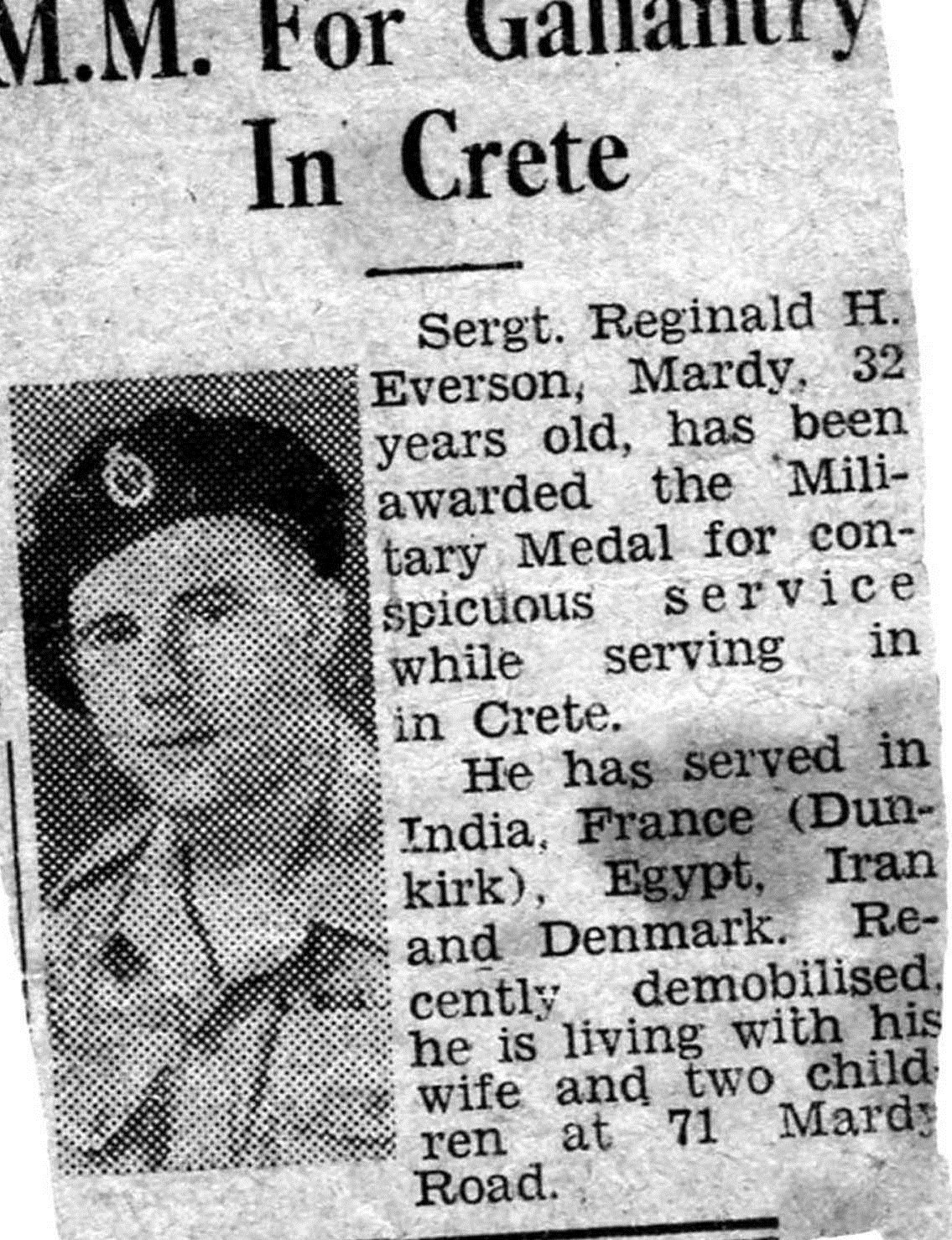
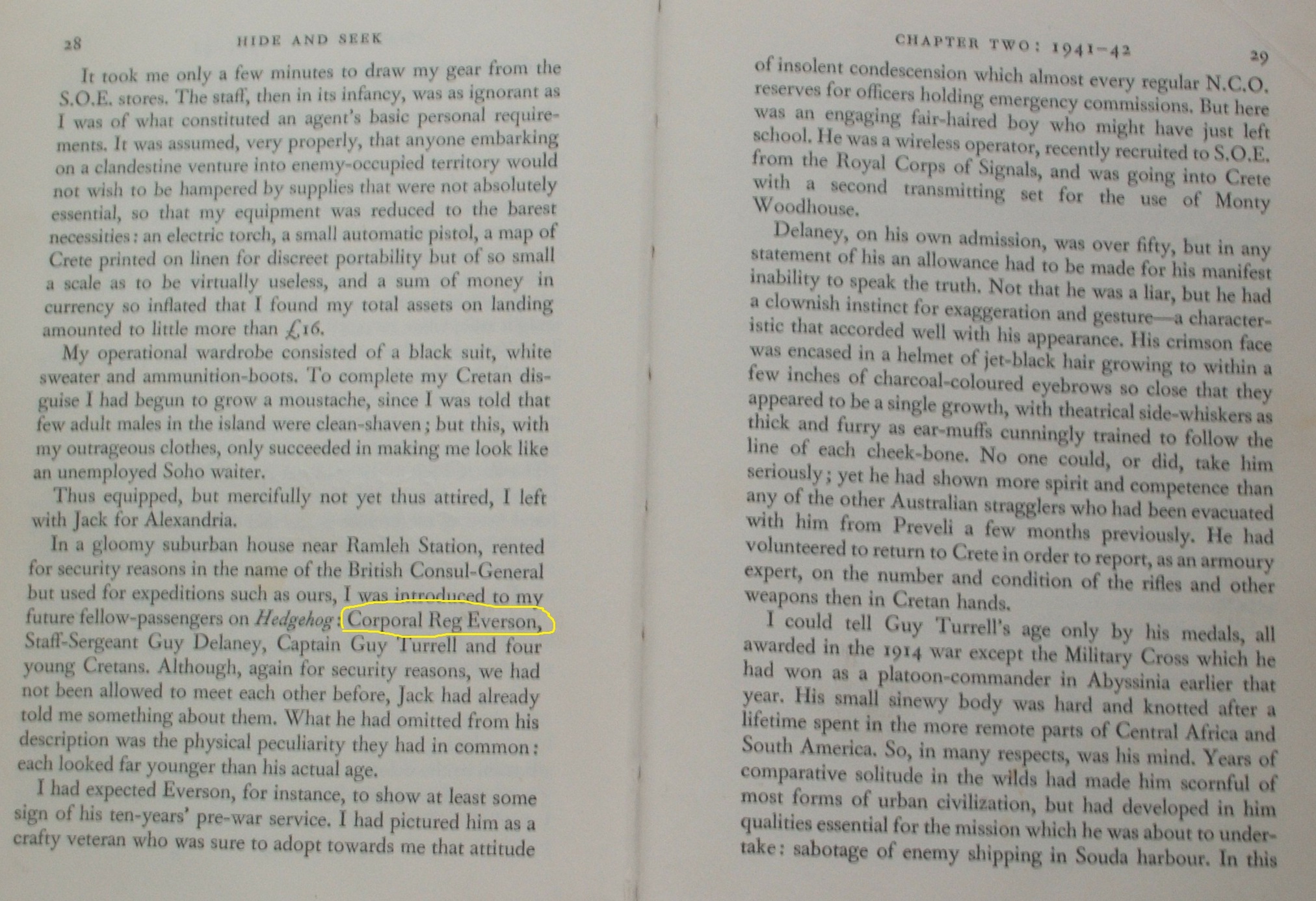
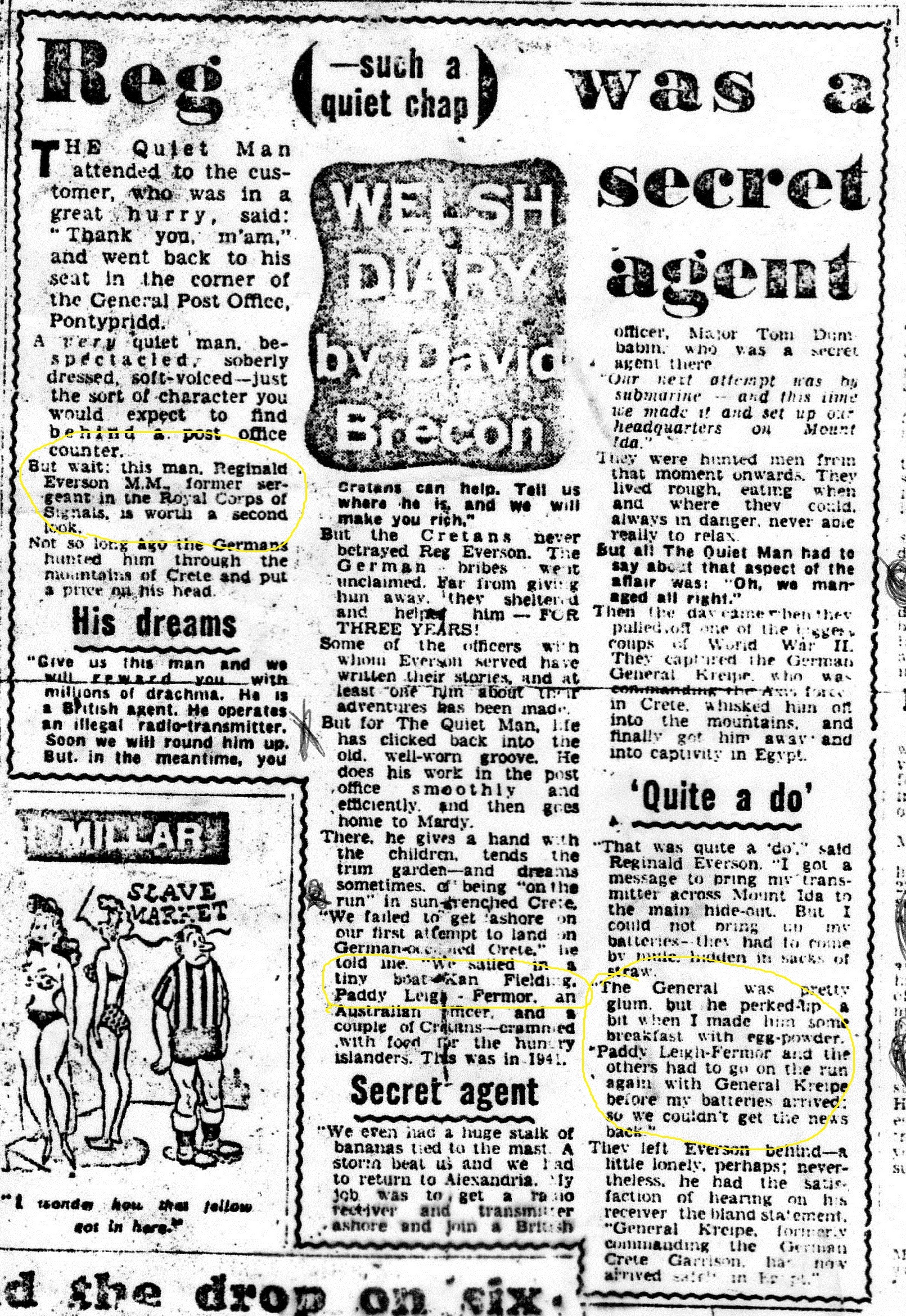
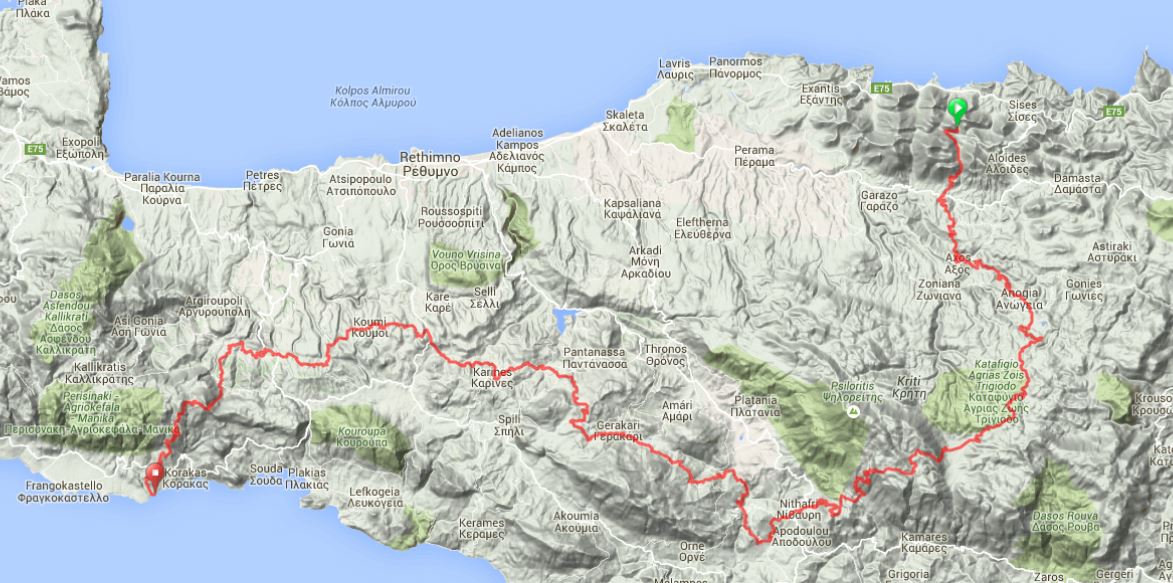

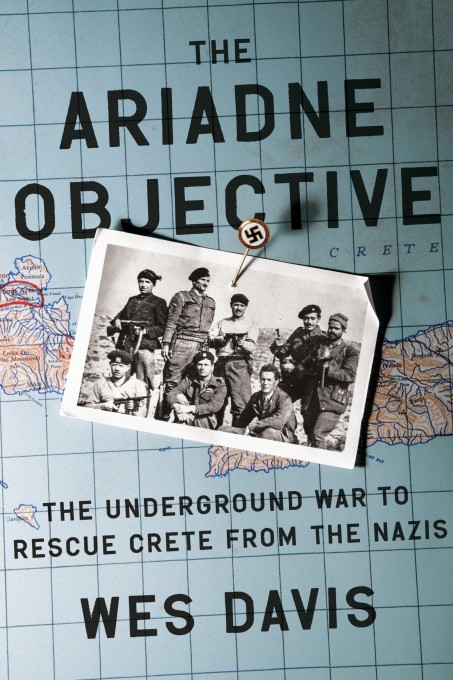
 is a new account of the kidnap of a German general in WW2 from occupied Crete and sheds light on one of the 20th Century’s most interesting men.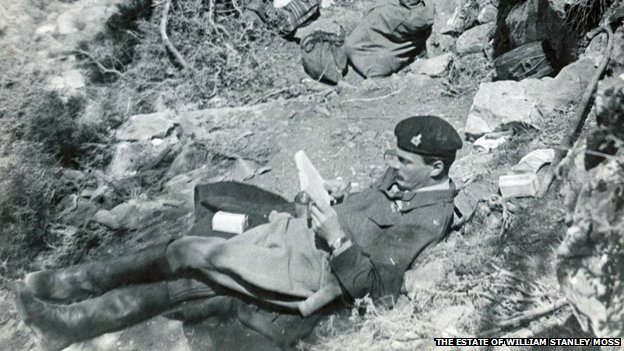
 is available for pre-order or purchase. Click on the highlighted text.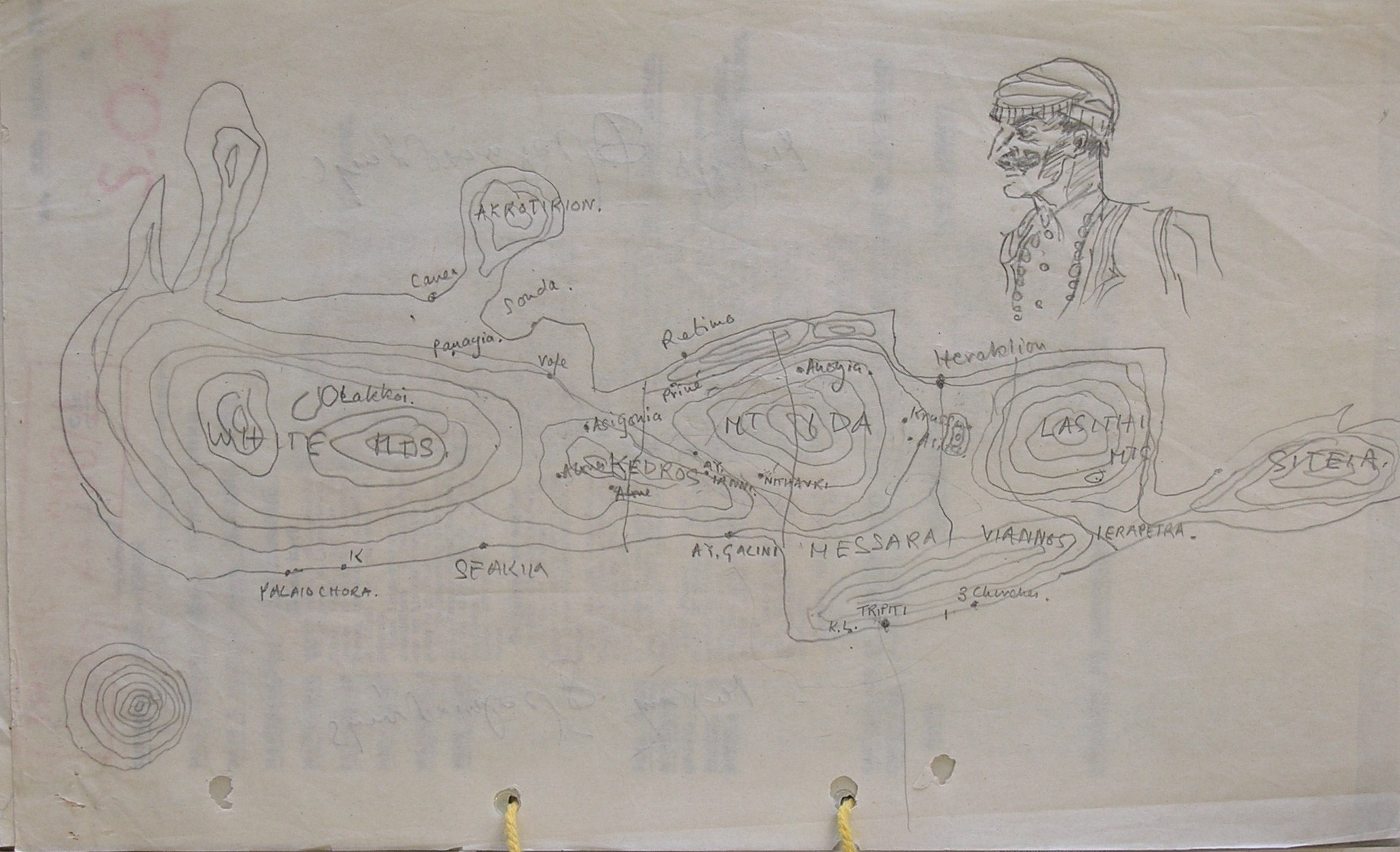








 Patrick Leigh Fermor