A Visit with Patrick Leigh Fermor, Part 2

Paddy. on Ithaca, 1946 by Joan Leigh Fermor

Part 2 of Ben Downing’s meeting with Paddy in 2001 at Kardamyli.  Read Part 1 here.

by Ben Downing.

This text originally appeared in issue 165 of The Paris Review, Spring 2003.

Already familiar as I was with the main events of Paddy’s military career, I asked him to fill in the gaps. What had he done while in Cairo?

“My first leave from Crete, after many months in the mountains, was at the time of the Italian surrender in September 1943. I had managed, by devious means, to persuade the Italian general commanding the Siena Division to escape from the island with some of his staff, and I accompanied them. When they’d been handed over in Cairo, I found myself quartered in rather gloomy billets known as Hangover Hall. There I became great friends with Bill Stanley Moss, on leave from the Third Battalion of the Coldstream Guards, and later my companion on the Kreipe expedition. Couldn’t we find more congenial quarters? Almost at once Billy found a positive mansion on Gezira Island, which we shared with a beautiful Polish countess called Sophie Tarnowska—she and Billy were married later on—her Alsatian, two mongooses, and a handful of close SOE friends, also on leave.

“Tara (as we named the house) was an immediate triumph. With its ballroom and a piano borrowed from the Egyptian Officers’ Club, and funded by our vast accumulations of back pay, it became famous—or notorious—for the noisiest and most hilarious parties in wartime Cairo. At one of these, fired by the tinkle of a dropped glass, everyone began throwing their glasses through the windows until not a pane was left.

“It was to Tara that we returned after the Kreipe expedition. But the rigors of a year and a half of Cretan cave life, it seems, suddenly struck me with an acute rheumatic infection of the joints, akin to paralysis. After two months in a Cairo hospital—where King Farouk once kindly sent me a magnum of champagne—I was sent to convalesce in Lebanon. I stayed at the British summer embassy at Aley, above Beirut, with Lady Spears, who was the well-known American writer Mary Borden, and her husband, Sir Edward Spears, our ambassador there. We had all met in Cairo, which at that time was one of the most fascinating gathering points in the world.

“But I was itching to get back to Crete. By the time I managed to return, in October 1944, the entire German force had withdrawn to a small perimeter in the west of the island. The outcome was a foregone conclusion, and the Germans made only occasional sorties. With their imminent surrender in view, it wasn’t ‘worth the bones of a single Pomeranian grenadier,’ as Frederick the Great said—or of a single mountaineer or Allied soldier, for that matter.

“I went back to Cairo for a last Tara Christmas. But Tara was dissolving, and in March 1945 I was sent to England, where I joined a rapidly-put-together unit called the Special Allied Airborne Reconnaissance Force—inevitably SAARF—for an odd emergency. There was a fear that during the ‘Eclipse Period’—the predictable days, that is, between the faster momentum of the Allied advance and the final surrender of the German army—the Germans might carry prominent Allied prisoners of war off to some Tyrolean redoubt and use them as hostages or bargaining counters; and it was hoped that SAARF would be able to prevent this. Its members all had SOE and parachute experience in enemy territory. The plan was that, at the right moment in Eclipse Period, each team of three—in some cases, two teams together—would take off from an airstrip at the Sunningdale golf course, in Surrey, and drop near its allotted prison camp in Germany. Dressed in tattered POW uniforms, we would lie up in the woods, spy out the land, slip into POW working parties, get inside the camp, and then contact the senior British officer and open W/T communications with the spearhead of our advancing troops; these would then drop arms and supplies and give air cover while the garrison was overpowered or the commandant bluffed, until Allied troops arrived.

“I found myself paired with Henry Coombe-Tenant, a major in the Welsh Guards, a brilliant pianist and a member of the Athenaeum who after the war became a Benedictine monk at Downside. Our commandant was Brigadier Nicholls, nicknamed ‘Crasher’; he was impermeable as a bison. The target we were destined for was the dread Oflag IV C at Colditz, where several Prominenten were prisoners, including the king’s cousin, Lord Harewood, and relations of Churchill and Field Marshal Alexander. The castle was deep in Saxony, and there was, of course, no resistance or SOE intelligence about it—nothing but aerial photographs to go on. We desperately needed more local detail.

“At this point I heard that an old friend, Miles Reid of the Phantom Reconnaissance Force, captured in Greece during the 1941 retreat, had been exchanged on health grounds, and precisely from Colditz; so I got leave to break security in the hopes of information, and dashed to see him at his home near Haslemere. When I told him of the Colditz scheme, he exploded. Had we heard nothing of the total impregnability of the fortress, of the thoroughness and rigor of the Appells, the checks and counterchecks, the scrutinies and roll calls? As for ‘working parties,’ since the inmates were all officers, these didn’t exist. There was absolutely no hope of the plan succeeding, and we would all be goners. Continue reading

The words of Mercury are harsh after the songs of Apollo: Meeting Patrick Leigh Fermor

Ryan Eyre lives in Seattle, and took a journey to Kardamyli to meet Paddy in 2009. He has written this article for the Journal of the Book Club of Washington, and has asked to publish it here as well. Ryan tells us, as many others have done, about Paddy’s remarkable memory, which he utilised to the full to write A Time of Gifts and Between the Woods and the Water. I have seen evidence of this myself. On a recent visit to Cluj I was able to enter the public rooms of the fabled Hotel New York (Continental) clutching a copy of BTWW and marvelled at the accuracy of Paddy’s description of its decor … but the cocktail bar was closed!

Update: I met Ryan last month (5 June 2013) in London and was able to show him the site of the original John Murray publishing house at 50 Albemarle Street. Ryan was on a holiday from his post in the Republic of Georgia where he is teaching English. He reminded me of this article which was posted in the week following Paddy’s death. It may have got lost in all the high frequency posting at that time, so I promised him that I would give you all another chance to read his account.

Meeting Patrick Leigh Fermor

by Ryan Eyre

On a February evening in 2009 I alighted from a bus in the village of Kardamyli, in the Mani region of southern Greece. I had arrived at this remote corner of the Peloponnese with one purpose: to meet the celebrated English author Patrick Leigh Fermor, one of the great prose stylists of the 20th century and arguably far less well known than he should be. Now in his nineties, Paddy (as he is known by his friends) still divides his time between England and his adopted home of Greece, where he lives in a house he designed himself in the 1960’s on a headland just south of Kardamyli. Patrick Leigh Fermor (PLF) has had an extraordinarily full and remarkable life.  For the sake of some background for those unfamiliar with him I provide a brief biographical sketch:

Born in 1915 and educated at the King’s School in Canterbury until he was expelled at the age of sixteen, he was preparing for the entrance examinations for Sandhurst when a sudden inspiration came over him. He decided to walk across Europe, with the final destination point as Constantinople, living, in his words, “like a tramp or a wandering scholar.” It was December 1933 and he was eighteen years old. He set out almost at once, catching a tramp steamer from London to Rotterdam and beginning his walk from there, passing through the Netherlands, Germany, Austria, Czechoslovakia, Hungary, Romania, Bulgaria and European Turkey before arriving in Constantinople on New Year’s Day, 1935. His experiences on his thirteen-month peregrination later provided the material for his two most celebrated books A Time of Gifts and Between the Woods and the Water, which were first published in 1977 and 1986, respectively.  These two volumes recount the first two-thirds of his amazing journey by foot from the Hook of Holland to the Golden Horn. Richly descriptive and full of historical and literary allusions they provide a portrait of a pre war Europe long since vanished.  Apart from the extremely high standard of prose and the author’s obvious enthusiasm for history, literature and art, perhaps the most appealing aspect of his account of this remarkable journey is that it was completed on foot. It has been said that the human mind can only properly absorb its surroundings at a walking pace.   The gradual transitions of landscape, language and culture were carefully observed by PLF because of the patient, unhurried approach that he took; a faster form of travel would have failed to capture nearly as much of the richness and complexity of the lands he passed through.

After completing this walking journey, he spent the next couple of years in Greece and Romania. He was romantically involved with the Romanian princess Balasha Cantacuzene, living with her on her estate in Moldavia until the outbreak of the Second World War in 1939, at which point he returned to Britain to enlist in the army. During the war he served with distinction in Greece, both during the German invasion of 1941 and afterwards during the occupation.  As a SOE (Special Operations Executive) agent he helped coordinate the resistance movement on Crete. The highpoint of his war was the celebrated kidnapping of the commanding German general Heinrich Kreipe on Crete in 1944, which he and a fellow British officer devised and accomplished with a band of Cretan partisans, abducting the luckless general from his car outside of Iraklion and spiriting him away into the mountains and eventually Egypt. After the war and in the company of his wife, the late Joan Eyres-Monsell, he travelled all over Greece, exploring the most remote rural areas on foot or mule, and developing a deep appreciation of the folk customs, dialects and traditions that have in the last half century largely vanished (see his books Mani and Roumeli).  His travels and books have never been limited to Greece, though:  his first book The Traveller’s Tree (first published in 1950) was written after an extensive journey around the West Indies in the late 1940’s.  Possibly his best book (according to New Yorker columnist Anthony Lane), A Time to Keep Silence, explores the nature and meaning of silence as he experienced it living in various French monasteries.  Whatever topic PLF has written about, his natural enthusiasm, curiosity and exquisite writing make it compelling reading.

Several years before I had been travelling in Romania and by chance a fellow American in the hostel had shown me a copy of Between the Woods and the Water, in which PLF recounted travelling through the same area in the 1934. Intrigued when I returned to Seattle several months later, I had checked A Time of Gifts out from the library and was instantly enthralled by it. The subject matter, the style and the sensibilites were immediately appealing. I can state unequivocally that PLF’s writing had a powerful influence on me. He seems almost the embodiment of an ideal-the literary man of action. Highly erudite but also a man of the world, unapologetically articulate and learned but with enough graciousness and charm to avoid being a pedant, equally comfortable with the humble as well as the high born. I’m not the only one who views him this way – Bruce Chatwin, Colin Thubron and William Dalrymple have all cited PLF as a major influence on their writing and lives. From PLF I developed a deeper appreciation of art and literature, and renewed an interest in history-particularly European. Because of him I also became a better traveller– by slowing down, more closely observing my surroundings and immersing myself in the history of a place before I visited.

I became determined I had to meet this man. I knew he was old and in declining health so time was of the essence. In January of 2009 I was in England visiting relatives and went to his literary agent’s offices in London hoping to get a formal letter of introduction. I only spoke to a secretary, who passed on an email address to which I wrote but predictably from which I heard no reply. My cousin said “The only way to meet the blighter is to show up where he lives-I’m sure you’ll be able to meet him.” I decided to take his advice and hope for the best.

Thus a month later I arrived in Kardamyli with a mixture of excitement and trepidation, after having travelled over land and water from Portugal all the way to Greece. I had done my homework: I knew his former housekeeper (a woman named Lela) ran a taverna with some rooms in the town-that seemed the obvious place to stay.  Before my arrival I had telephoned and had spoken to her son Giorgios (Lela spoke no English).  In the winter the taverna was closed, Giorgios explained, but they would make an exception for me and at a reduced rate. Giorgios, a moustachioed and world- weary but courteous man in his fifties met me when I got off the bus, and after introductions were made, he walked me to Lela’s a few blocks away. It was a simple two story building by the sea, with a restaurant on the ground floor and a few rooms upstairs looking directly out on the sea. Lela appeared from the kitchen, in her seventies but still sprightly, with a craggy and quintessentially Greek face. After showing me to my room she and Giorgios disappeared quickly, leaving me as the only guest. Strolling out from Lela’s along the water onto a jetty and looking up towards one of the clearest starlit skies I had ever seen, with the only sound coming from the waves crashing against the rocks, I understood immediately why Patrick Leigh Fermor had decided to settle here years before.

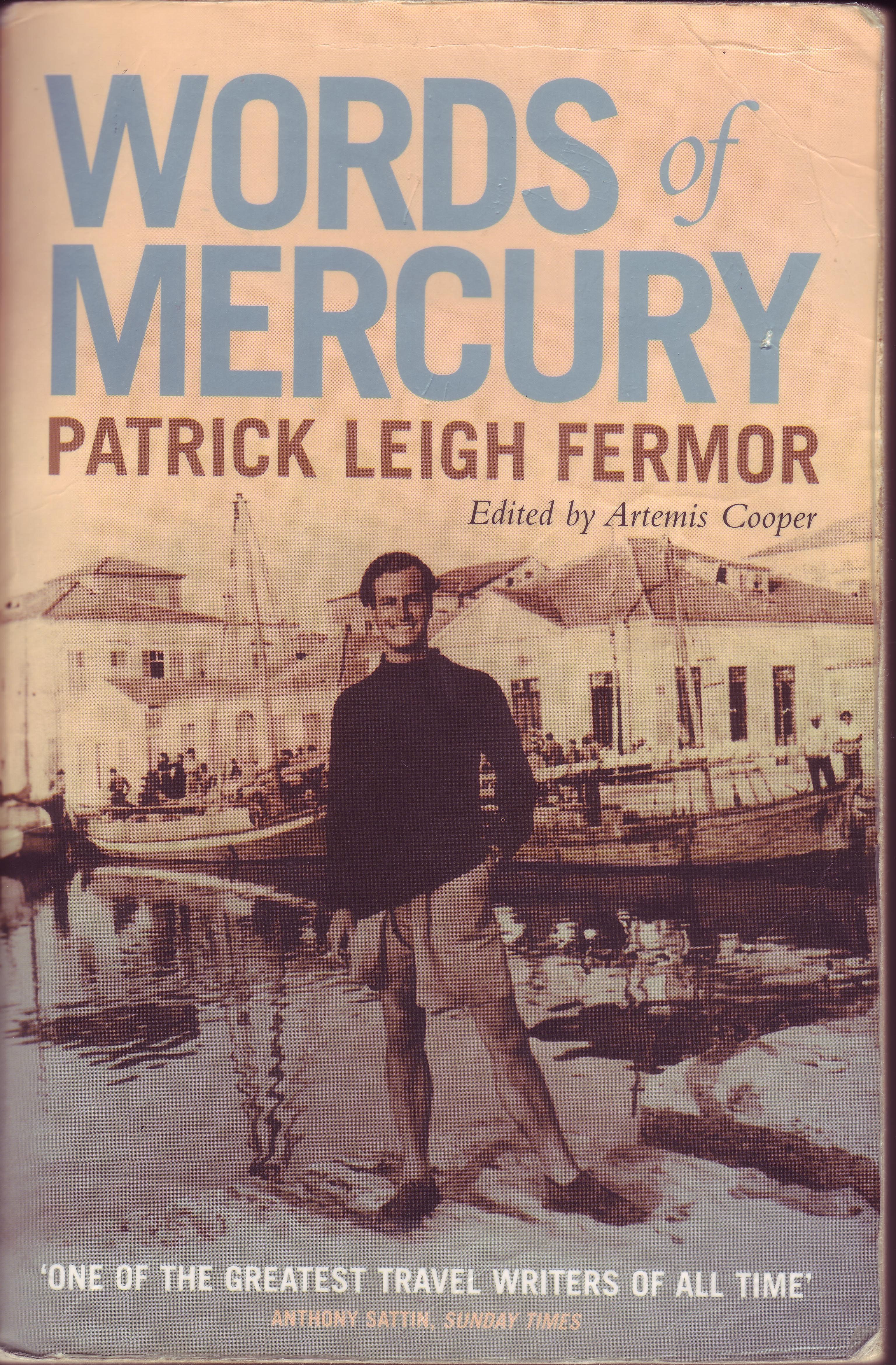
The next morning I awoke early and walked along the road going south from Kardamyli. A Greek man out in his garden saw me and gestured for me to come inside. Without asking any questions he sat me down in his kitchen and served me coffee; this was exactly the type of hospitality towards strangers that PLF had described in his books on Greece.  Somewhat timorously I broached the subject of Patrick Leigh Fermor (known as Michalis by the locals) and asked where he might be found. He gesticulated southwards, saying in broken English that PLF lived a short way down the road, in the next cove known as Kalamitsi. I thanked him for the coffee and continued walking. I had with me an anthology of PLF’s work titled The Words of Mercury, which included an article he had written on how he had designed his house in Greece.  He described it as resembling a faded Byzantine monastery, with a view framed by cypress trees overlooking a cove with a small island offshore. Down a path and through an olive grove there was a house that closely resembled this description; in fact, it had to be his residence as it looked far older than any other house in the vicinity.

Emboldened by this discovery I walked back into town, just as the villagers were exiting the church service on a Sunday morning. Approaching Lela, I tentatively mentioned PLF’s name and pointed to The Words of Mercury, with a photograph of PLF in the 1940’s on the cover.  She gave Giorgios soon appeared and I explained that I had come to Kardamyli to hopefully meet PLF, and handed him a note of appreciation that I entreated to pass along. Giorgios told me that PLF was in England at the moment, but would be back by Tuesday and would gladly give him the note once he saw him.  So my timing had been providential!  Now I simply had to wait.  I spent the next couple of days either reading (finishing War and Peace to be exact) or going on long walks exploring the myriad of small coves and hills. The Mani is very quiet in winter and felt refreshingly unexplored. Each evening I would go to the kafeneon to sit with the local men as they chatted and watched football on the television. Giorgios would be there every evening and he was quite friendly and talkative to me.  Every evening I would tactfully bring up the subject of whether or not he had seen PLF. Each time he responded he hadn’t yet.  One evening as I was returning to Lela’s she insisted on cooking me a meal in the kitchen, sitting me down in a table in the restaurant and plying me generous portions of pork, potatoes and vegetables. On a table in the corner was a pile of black and white photographs; examining them more closely I saw they were informal snapshots of Lela and her family from the 1960’s with a younger looking Patrick Leigh Fermor in a number of the them. Seeing these candid photographs gave my purpose a lot more immediacy.

Taking the bus one day into Kalamata (the nearest city-some 20 miles away) I fell into conversation with a local woman about my age. I explained that I had come all the way here to hopefully meet PLF.  She raised her head backwards and clicked her tongue, the universal Hellenic gesture for disapproval. “The Patrick Leigh Fermor is very old man, many people, journalists come here to meet him, they have to book appointment…it’s not so easy to see him.”  Discouraging words and with each passing day I realized that Giorgios was probably protecting PLF’s privacy…it was perfectly understandable but I made up my mind to take a more direct approach. I wrote another, longer letter of appreciation (I wrote about eight drafts before I was satisfied) and screwed enough courage up to go to what I was almost sure was PLF’s house to give it to whomever answered the door.  Just as I was about to knock an Englishman in his forties opened the door and walked out to the driveway. He introduced himself as Hamish Robinson and confirmed that PLF did indeed live there. Hamish added PLF wasn’t very well at the moment but he would gladly pass on the note of appreciation and went back inside. I decided to walk south several miles to the next village called Stoupa. I had done everything realistically possible to meet PLF and if I wasn’t able to at this point I accepted that it just wasn’t to be. Walking along the coastal road with its stupendous views of the Messenian Gulf to the west and the snow-capped Taygetus Mountains to the east, I felt fortunate and privileged to be there at all.

Returning to Kardamyli later that afternoon in a state of calm resignation, my interlocutrix from the bus the previous day came running down the road. “Ryan, where you been? We been looking for you all day. Patrick Leigh Fermor wanted to have a drink with you but we couldn’t find you.”  Patrick Leigh Fermor wanted to have a drink with me? Suddenly a car pulled up. It was Hamish. “We were looking for you earlier today –come round for lunch at 1:00 tomorrow,” and then drove off. I couldn’t believe my luck…all the persistence had paid off…I was actually going to have an audience with Patrick Leigh Fermor after all — it was more than I could have asked.

Paddy on his 94th birthday (February 11, 2009)

The appointed hour couldn’t come fast enough and it was in state of mild disbelief that I found myself being admitted into PLF’s house by his housekeeper and into the sitting room (which doubled as a dining room), with prodigious book shelves on three sides.  I found myself standing in front of a distinguished, slightly frail looking man wearing a blazer and a tie. It was Patrick Leigh Fermor.  Shaking my hand, he briefly mistook me for somebody else before apologizing with, “I’ve got this blasted tunnel vision and I can’t see that well…so you’re the young man…so glad to meet you.”  His hearing and his eyesight were poor and I had to speak loudly to be heard. Hamish Robinson was there as well (his presence helped facilitate conversation) and for the next two and a half hours the words flowed, abetted no doubt by the several vodka and tonics that were consumed as well as the generous glasses of retsina that accompanied lunch. Conversation ranged from Lord Byron (PLF: “I didn’t care for him much when I was younger but now I adore him”), the Greek Orthodox Easter service, and the fate of King Harald Hardrada at the Battle of Stamford Bridge in 1066-to name a few of the topics discussed. When I told him I had visited Romania several years before he asked me, “Did you go by foot?”  Unfortunately, of course I had to answer no.  He also asked me questions about Seattle (“Where does the name come from?”). He had only visited the United States once -when he was invited by a Cretan-American association in New York as an honoured guest to commemorate the anniversary of The Battle of Crete.

PLF’s short-term memory was a bit faulty at times, he would forget the course of the conversation a bit but if I asked him about something from decades past or a literary reference he could recall it with instant clarity. For example, I showed him my copy of   The Words of Mercury and asked him the significance of the title.  “It’s from Love’s Labour’s Lost. You know that in the last act there’s a play within the play that’s performed for the amusement of the King of Navarre and the Princess of France. At the end of it they receive news that the King of France has died and the Princess and her entourage must leave. The last line of the play is ‘The words of Mercury are harsh after the songs of Apollo’. It’s rather a strange play.”

Surprisingly he seemed a little fussier and more self-deprecating than I would have thought. When I quoted from his writings a couple of times he responded, “That’s a bit fruity” or, “What absolute drivel.” I mentioned that I had tried to contact his literary agent in London but without success. His reply: “Oh do you know, I’ve never met him either.”  Time passed quickly and after the meal was finished we walked onto the terrace of his house, overlooking the sea. I thanked him for the invitation.  He replied, “If you’re ever in these parts again, do come round.”   And then he retired for his customary afternoon nap, “Egyptian PT,” in his words.  Hamish showed me the adjacent building where Paddy does his writing, giving me a recent photograph of him taken on his 94th birthday as a memento, and then with good-byes and sincere thanks, I gracefully made my exit. I felt a mixture of elation –having the extraordinary privilege of actually being a guest of the celebrated author in his home — and a bit of melancholy in seeing him in his twilight years.  It was surely the only occasion I would meet him, and there was so much more I wanted to ask that would never be said. I also suppose, perhaps there was the realization that for all this accomplishments and marvelous writing he was  still human after all.

The next day I left Kardamyli. Spending even a week in the Mani gives Patrick Leigh Fermor’s life and work so much more immediacy. When I read a passage in Mani describing the view looking out towards the Messenian Gulf with “dragon headed capes in the distance,” I know exactly what this looks like because I have seen this view myself. That means almost as much as having met the man, and both memories will last for the rest of my life.

Related article:

Images of Iasi

£1 a week – Nick’s talk at Up Down and Across

Some audio for you to enjoy from Nick Hunt’s recent talk at Up Down and Across.

He says on his blog:

My talk was a rambling exploration of Europe’s invisible pathways, its not-so-invisible motorways, ancient borders, modern-day myths and the multiple layers of story that lie beneath every walker’s boots. Unfortunately my digital recorder died after 20 minutes, but I went on to talk about dogs, dragons, devils, pilgrimage, the meaning of arrival and other obsessions of mine. All these things, and more, will work their way into my book. So stay with me. The story is coming, layer over layer.

Listen here…

Up Down and Across part 1

Up Down and Across part 2

Up Down and Across part 3

Perkins and Pendlebury in Crete, and a hunt for Xan Fielding’s grave

It’s holiday time and some of your fellow readers have been setting off in the footsteps fairly early this year. We had the excellent report from Paddy’s Italian Fans; the report from Kardamyli by our on the spot reporter John Chapman, and now a postcard from Julian Aburrow who visited Crete with his wife back in May; he sent us some pictures of the graves of Perkins and Pendlebury.

Julian was quite anxious to know whether Xan Fielding was buried on Crete, and as time ran out and his departure from the island loomed we asked Artemis Cooper if she had any better idea.

Dear Tom,
As you say, Xan died Paris and was cremated there. At some point after that Magouche, Paddy and Joan took his ashes into the White Mountains, and scattered them to the winds. Among Paddy’s photos now in the National Library of Scotland there is a photo which I think must have been taken at the time: in the foreground are a few beautiful red flowers (cut flowers that is, but not in a bouquet), a branch gnarled and bleached by the weather, and a great sweep of mountains beyond. If I go and see Magouche again, I will ask her to tell me in more detail. [Edit – of course Magouche passed away on 2 June 2013 just after Artemis wrote this note: see this article]

Artemis

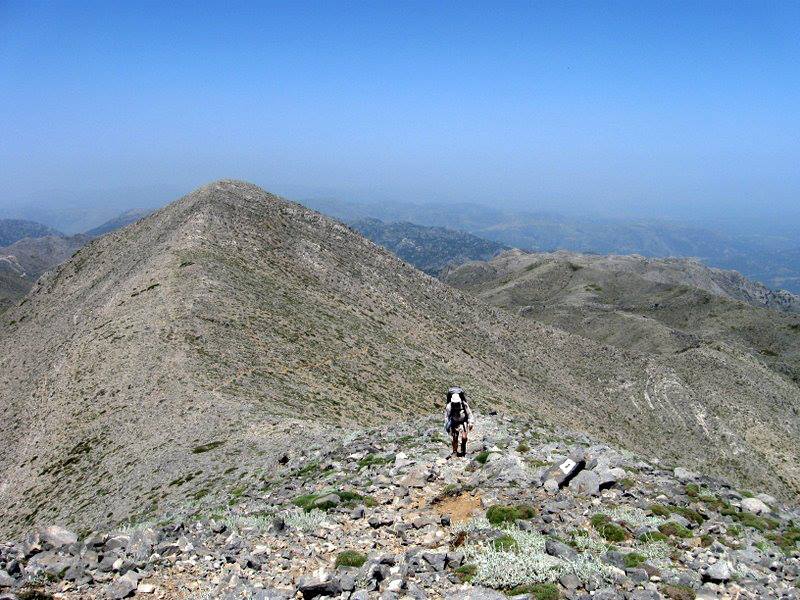
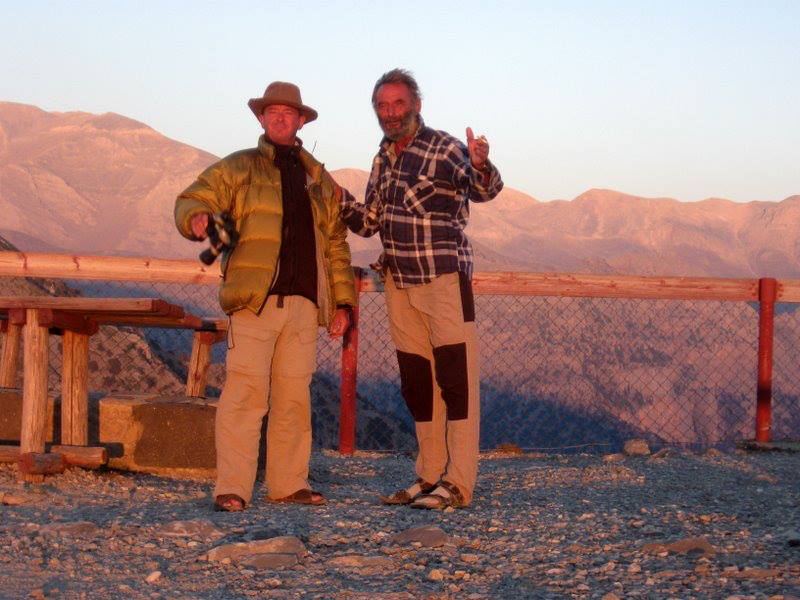
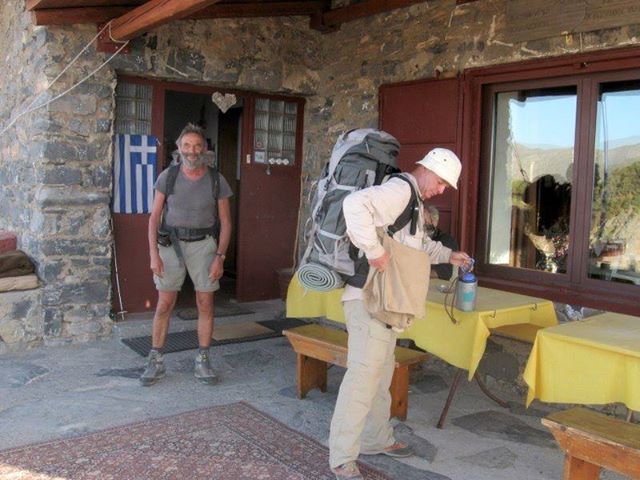
In the meantime a regular correspondent to the blog, Paul George (who is one of those unfortunate souls who is an ex-pat and lives in Crete – you have our sympathies Paul 🙂 ), got in touch with some pictures of his recent walk into the White Mountains to the area where Xan’s ashes were scattered. It is a harsh and bleak landscape; it makes you think of the toughness of men who lived and fought here during the war.

The mountain hut is Kallergi at @ 1700 mtrs….this is the location that Xan Fielding’s ashes were scattered… The photograph taken in the mountain is of me trekking up Melindaou…… Xan Fielding, PLF et al…..would have know and walked in this area.

Trekking up Melindaou

Trekking up Melindaou

Kallergi hut near the location that Xan's ashes were scattered

Kallergi hut near the location that Xan’s ashes were scattered

Kallergi hut @ 1700 m

Kallergi hut @ 1700 m

Staff Serjeant Dudley Churchill Perkins

Left behind on Crete after the evacuation and subsequently captured. He then escaped and lived on his wits, with help from the locals, until 1942. When he was finally evacuated and rejoined his group, he found that he no longer fitted in and transferred to a different group. He returned to Crete where he was met by Xan Fielding.
More info here: http://www.my-crete-site.co.uk/vasili.htm. Vasili, The Lion of Crete by Murray Elliott is a very good read.

Captain John Devitt Stringfellow Pendlebury

Instrumental in organising early resistance, mentioning his name was a key to getting help from the Cretans, who thought very highly indeed of him. He is still known on Crete today: when we went to Knossos a few years ago, someone tried to sell us a guide book. When
I showed him my copy of ‘The Palace of Minos, Knossos’ by JDSP, he said ‘Blebbery, still the best’. Blebbery being the closest pronunciation that they can manage.
Imogen Grundon’s book The Rash Adventurer is a great read. Also, he knew Dilys Powell, Humfrey Payne et al and was highly influential in both Egyptian and Greek archaeology. I admire him very much.
Hope this is of interest and look forward to yet more posts on the blog.
Best wishes

Julian Aburrow

Related article:

Read more about John Pendlebury here: The magnetic John Pendlebury

Audible

A Visit with Patrick Leigh Fermor, Part 1

Patrick Leigh Fermor, center, with members of the team that abducted General Heinrich Kreipe: George Tyrakis, W. Stanley Moss, Manoli Paterakis, and Antoni Papaleonidas.

It has been said of Ulysses that, were Dublin ever obliterated, the city could be substantially rebuilt by consulting its pages. Along these lines, if all Europe were, God forbid, laid waste tomorrow, one might do worse than attempt to recreate it, or at least to preserve some sense of its historical splendor and variety, by immersing oneself in the travel books of Patrick Leigh Fermor.

by Ben Downing.

This text originally appeared in issue 165 of The Paris Review, Spring 2003.

Patrick who? Although popular both in his native England, where his books are available in Penguin paperback, and in many other countries—he has been translated into any number of languages—Leigh Fermor (who died in 2011) is known to only a devout few in this country, where, scandalously, his work is not distributed. I myself came to him three years ago, when a friend pressed me to seek out A Time of Gifts (1977) and Between the Woods and the Water (1986), the first two volumes of a projected trilogy about his teenage walk across Europe in the early thirties. By chance, that very week I stumbled across a used copy of A Time of Gifts. I began reading straightaway, but after a few pages stopped and rubbed my eyes in disbelief. It couldn’t be this good. The narrative was captivating, the erudition vast, the comedy by turns light and uproarious, and the prose strikingly individual—at once exquisite and offhand, sweeping yet intimate, with a cadence all its own. Perhaps even more startling was the thickness of detail, and the way in which imagination infallibly brought these million specificities to life. In the book’s three hundred or so pages, scarcely a paragraph was less than spirited, cornucopian, and virtuosic.

I am not given to idolizing writers or reading them entire, but this was a special case. Before long I had tracked down, whenever possible in their beautiful John Murray hardback editions, not only Between the Woods and the Water (which sees Leigh Fermor as far as the Iron Gates of the Danube) but also his remaining work—two travel books about Greece, one each about the Caribbean and Peru, a slim volume on monasteries, and a novella. Having devoured these, I started trying to find out more about Leigh Fermor himself. Piecing together information from his books and other sources, I came up with the following.

A clever but unruly student, Leigh Fermor was expelled from a series of schools and at sixteen dropped out altogether. After a period in London halfheartedly cramming for Sandhurst and (far more eagerly) partying with the last of the Bright Young People, he set out in December 1933 on his journey to Istanbul, which took him over a year. At this point the picture grew vague; there was some improbable story about his tagging along with a Greek royalist army as it quashed a rebellion, another about his falling in love with a Romanian princess.

The war years were somewhat clearer. Leigh Fermor enlisted with the Irish Guards; was commissioned in the Intelligence Corps; was sent as a liaison officer to the Greeks fighting the Italians in Albania; took part in the Battle of Crete; and escaped to Cairo in the general retreat. Having joined SOE (Special Operations Executive), he became one of a handful of officers secretly landed back on Crete, where, dressed as a shepherd, he lived in mountain caves and organized the guerilla resistance. His military career peaked in April 1944 when he led one of the most daring operations of the war. Disguised in Nazi uniform, Leigh Fermor and W. Stanley Moss, along with seven Cretan fighters, hijacked a car carrying General Heinrich Kreipe, commander of a division then occupying Crete. After bluffing their way—with Leigh Fermor impersonating Kreipe—past more than twenty checkpoints, they made for the mountains with their captive and spent three harried weeks dodging the thousands of troops sent to catch them, until finally a British boat slipped in to pick them up and take them to Cairo. For his role in the abduction Leigh Fermor was awarded the DSO.

After this the picture blurred again. I gathered that in the late forties and fifties Leigh Fermor had traveled at length in the Caribbean, Central America, and Greece; that he had hobnobbed—and often developed close friendships—with everyone from Diana Cooper to George Seferis; and that eventually he and his wife, Joan, had built a house in the Mani, a remote corner of the Peloponnese, where, reportedly, they still lived. But no more.

Even so, it had become clear to me that Leigh Fermor was not only among the outstanding writers of our time but one of its most remarkable characters, a perfect hybrid of the man of action and the man of letters. Equally comfortable with princes and peasants, in caves or châteaux, he had amassed an unsurpassedly rich experience of places and people. “Quite the most enchanting maniac I’ve ever met,” pronounced Lawrence Durrell, and nearly everyone who’d crossed paths with him had, it seemed, come away similarly dazzled. Also inspired, as witness this entry of 1958 from the Bloomsbury diarist Frances Partridge: “This evening over dinner the conversation turned to present-day pessimism, or cafard. Where can one look to find enthusiasm for living? I could only think of Paddy Leigh Fermor.”

Armed with this outline, I proceeded to write for The New Criterion a longish essay about Leigh Fermor, focusing mostly on his books. About two months later, in March 2001, I received a letter from him. An English friend of his had brought my essay to his attention. His response, infinitely gracious, concluded by exhorting me to drop in for “a proper feast” if ever I were in the area. That was all the invitation I needed. With typical American forwardness, I promptly called him and asked whether next month I and my wife, Michele, a fellow fan, might come and hang about for a few days, I perhaps interviewing him a bit. Whatever alarm he felt at the prospect of our invasion was muffled by good manners. He apologized for being unable to put us up—his sole guest room would be occupied that week—but said he could arrange accommodation at a nearby hotel, and that we would, of course, take all our meals with him and Joan.

Within hours I had booked our tickets.

* * *

Driving west from Athens, we crossed the Isthmus of Corinth onto the Peloponnese and spent the first night in the handsome seaside town of Nauplia. The next day we pushed on, marveling at the unaccustomed verdure—our previous visits to Greece had been in summer, when the heat turns everything brown—and at the profusion of flowers and blossoming Judas trees. After passing Sparta, we headed up into the Taygetus range, then down to Kalamata (of olive fame), where we swung south along the coast, and so to the village outside which Leigh Fermor lives, and which he has asked me not to name. Our Pisgah sight of the village was to be, our guidebook rather sternly declared, memorable: “Anyone who approaches it from these heights and is not moved by its combination of tiny islands, indented coastline, stone houses, and rugged hills, has the soul of a peanut.” Whatever the condition of our souls, they apparently are not leguminous, for we found the view every bit as sublime as advertised.

On arrival at the hotel, we discovered waiting for us at the front desk a welcome card that Leigh Fermor—to whom I shall, for the sake of brevity and informality, henceforth refer as Paddy—had dropped off earlier in the day. When I called him, he asked us to come round for dinner.

Shortly after dark, a rough dirt track brought us to the house. The front gate standing ajar, we entered and followed a lamplit cobbled path to an open door, which gave upon an L-shaped arcade. The sea could be heard heaving just below. As there was still no sign of life, we called out. A few seconds later, from one end of the arcade, Paddy and Joan emerged, greeted us warmly, ushered us into an immense book-lined living-cum-dining room where a fire crackled, and swiftly plied us with ouzo. (Their alcohol regimen, we soon discovered, dictates obligatory ouzo or vodka before dinner and red wine or retsina during; lunch is the same, minus the vodka option.)

Although immediately convivial, the Leigh Fermors had had a trying day. There had been some sort of plumbing trouble, which resulted in workmen ripping open part of the terrace. The dust kicked up by the jackhammers had irritated one of Paddy’s eyes, so that it now teared incessantly—and, as he pointed out, adopting a mock-plummy tone, “The other one weeps in sympathy.” Encouraged by his levity in distress, I reminded him of the light verse that he and his old friend John Julius Norwich had concocted together, which I had recently read in the first of Norwich’s delightful Christmas Crackers miscellanies. Over lunch, writes Norwich, he and Paddy “talked about how all Englishmen hated being seen to cry. Then and there we improvised a sonnet… The odd-numbered lines are mine, the even his.” The sonnet runs as follows:

 When Arnold mopped the English eye for good

And arid cheeks by ne’er a tear were furrowed,

When each Rugbeian from the Romans borrowed

The art of ‘must’ and ‘can’ from ‘would’ or ‘should’;

When to young England Cato’s courage stood

Firm o’er the isle where Saxon sows had farrowed,

And where Epicurean pathways narrowed

Into the Stoic porch of hardihood;

Drought was thy portion, Albion! Great revival!

With handkerchief at last divorced from cane,

When hardened bums bespoke our isle’s survival

And all the softness mounted to the brain.

Now tears are dried—but Arnold’s shade still searches

Through the groves of golden rods and silver birches.

Although Paddy laughed at recollection of the poem—“A bit feeble here and there, as it was done very fast”—he was clearly in agony. We suggested bandaging his eye, and once some tape and gauze were found Michele and I rigged up a patch of sorts. To find oneself, a few minutes after meeting one’s esteemed host, clumsily dressing his eye—this represents a curious and not unawkward turn of events. The fact that Joan already had (for reasons more serious than dust) a patch of her own added a weird hint of piracy. To our relief, Paddy again buoyed up the situation by hailing his wife as Long Joan Silver, who in turn joked, “But where’s my parrot?” Continue reading

Thank you

I want to say thank you on behalf of my daughter Harriet, and myself, for the response to my appeal for assistance regarding her internship in Germany. There was a large and very helpful response. Some were able to provide direct assistance, others just wanted to pass on their best wishes.

As you read this, Harriet and I should be driving to Munich, via a stop at the Red Ox in Heidelberg, to set her up in her new apartment for a twelve month  internship with Siemens, which is a great result. She will be working on organising the Siemens contribution to the technology fair CeBit in Hannover for 2014, and getting to travel all over Germany as part of her role. Thank you!

One who got in touch also runs a blog which is pretty niche but very interesting. Paul Daniels has recently started a blog which provides English translations of opposition journalism in the Weimar Republic. Some of this literature has probably remained unavailable for a long time. Paul’s work deserves a look, and for some, it could provide a valuable source of new research material.

You can find Paul’s blog here: Die Weltbühne in English Translation.

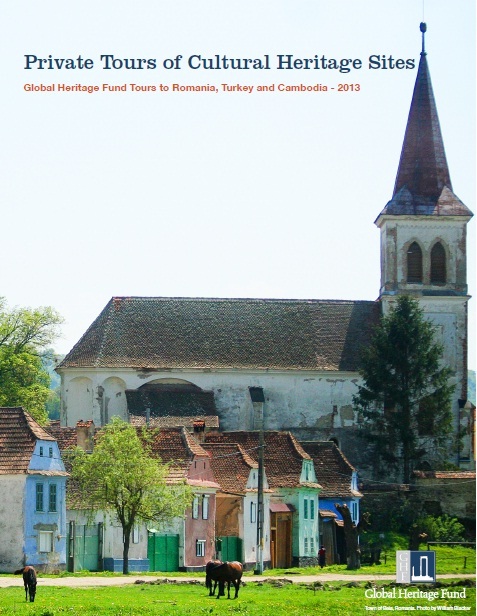
Travel along the enchanted way with William Blacker

GHF TourJoin William Blacker, author of Along the Enchanted Way, and Global Heritage Fund (GHF) for a visit to the villages of Saxon Transylvania. Scattered along the valleys and hills of the southern range of the Carpathian Mountains in Romania,the villages represent a unique and diverse landscape of Romanian, Saxon, and Gypsy cultural heritage.

The nearly 100 villages and their patterns of settlement, which date from the 12th century, are among the last vestiges of European mediaeval planning and culture. This vast cultural landscape exhibits an uncommon equilibrium between villages, fields, meadows, forests, and mountains. Now under threat, GHF, William Blacker and the Romanian heritage organization Monumentum, are working to save this vanishing landscape.

This tour running from 9th-12th September follows on from the Transylvanian Book Festival, 5th – 9th of September. See the Festival website for further details.

The GHF flyer here has some more information about this and 2013 tours to Turkey and Cambodia as well.

For further information please contact:

Brian Curran

Global Heritage Fund

9th Floor 1 Knightsbridge Green

London SW1X 7QA

bcurran[at]globalheritagefund.org

t +44 (0) 787-648-1847

http://www.globalheritagefund.org

Magouche Fielding talks about living with Arshile Gorky

This video is taken from the Tate Modern website featuring their retrospective of Gorky in 2010. Magouche talks about her life with Gorky whilst rolling her cigarettes!

At the time of this video she was aged 89. She appears worldly but not world-weary. This is from a 2003 New Yorker review by Peter Scheldahl.

“Then, in February, 1941, he met the lovely, brilliant nineteen-year-old Agnes Magruder.  She was the adventurous daughter of a Navy captain – she worked as a secretary for a Chinese Communist organization – and her modest social elevation tickled Gorky’s vanity. Upset by the match, the Magruders provided scant support, but the growing Gorky family spent summers at their country home in Virginia, where Gorky, working outdoors, made several series of astonishing drawings not so much from as inside nature: botanical and insect forms quivering with itchy vitality while participating in an august formal order. Mougouch was self-sacrificing. “Dear Joking Jesus how wonderful it will be when he has a studio really his own,” she wrote to her confidante, the collector and artist Jeanne Reynal. She put Gorky first for as long as her sanity could bear it.”

Link to Tate Modern site here.

Related article:

Magouche Fielding – Arshile and Agnes Gorky: Master and Muse

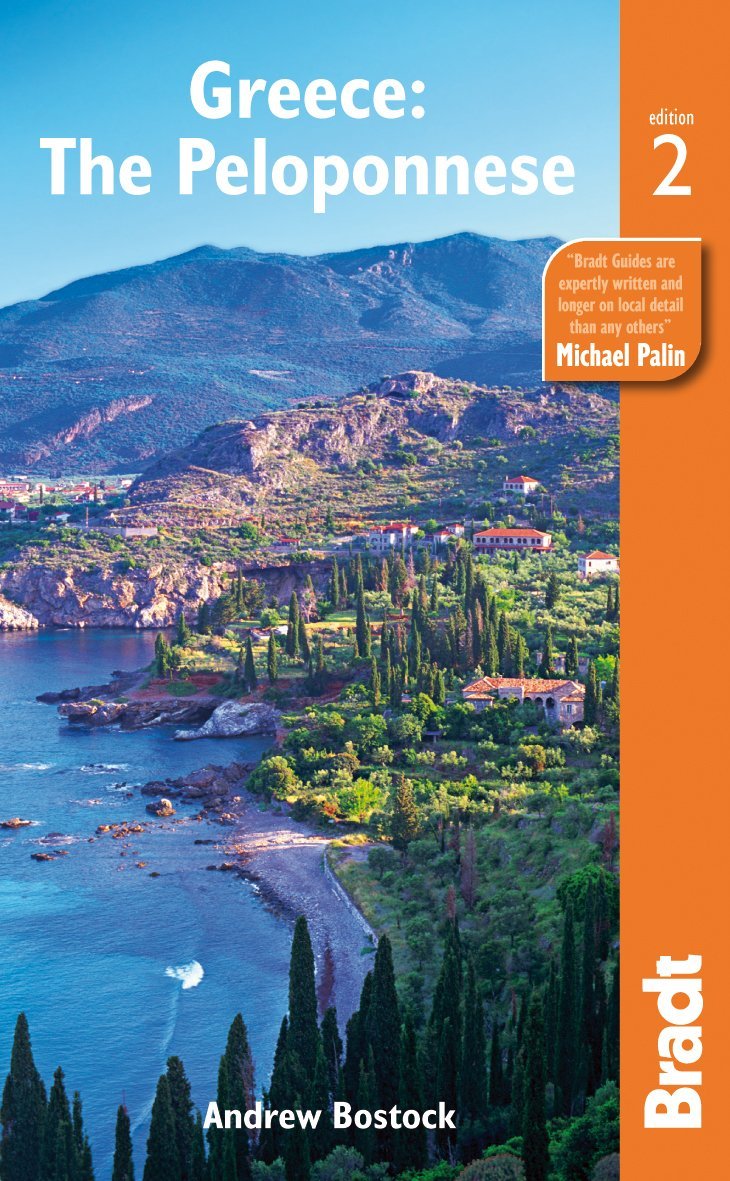
Bradt Travel Guides’ revised version of Greece:The Peloponnese by Andrew Bostock

Bradt Guide to the Peloponnese by Andrew Bostock

Bradt Guide to the Peloponnese by Andrew Bostock

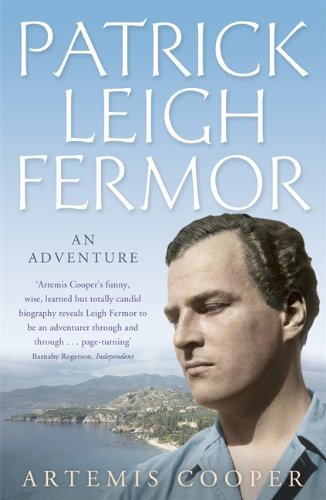
Continuing the Peloponnese travel theme it would be remiss of me not to mention that the nice people at Bradt have let Andrew Bostock update his excellent guide to the Peloponnese just in time for your 2013 excursion. And rather like the paperback of An Adventure it shows a certain house. I think that Andy may have had some influence on this choice of cover!

Andy also gets in touch with me quite often, and it was he, working in close collaboration with that other Karmayli expert, John Chapman, who first picked up on the filming of the movie Before Midnight at Paddy’s house. Andy has lived in the area with his family so he is no fly-by-night travel guide author. I have a copy. I know the Peloponnese pretty well having holidayed there on three occasions. There is a lot to see and it is by no means all about the Mani, or Paddy. There is so much more. If you would like to get in touch directly with Andy about travel to the area his details are here.

Andrew Bostock: +44 7961 061 052 (cell)
Twitter: @andybostock

You can buy Greece: The Peloponnese (Bradt Travel Guides) at this link, and the blurb tells us this:

The Peloponnese contains a huge diversity of landscape, everything from the classic image of Greece – white sand beaches and sleepy white-washed villages through to the ancient sites of Olympia and Mycenae, Byzantine churches and medieval fortresses; towering mountains for hiking and skiing, olive groves which produce the finest fruit, and mountains covered in flowers.

In recent months Greece has undergone a well-publicized economic meltdown. However cheaper prices and the expense of long-haul tourism has actually led to an increase in visitor numbers. The government is keen to invest in tourism as a way to reinvigorate the country. Specific examples of this are the new year-round flights from Athens to Kalamata and a major new international spa / golf resort in Messinia.

Greece is no longer an ‘easy’ travel destination and there as been an increase in the trend towards independent travel, away from package tourism. The new edition reflects this with reviews of the plentiful new accommodation, details of independent tours and activities as well as excellent coverage of off-the-beaten-track sites and attractions.

Greek expert, Andrew Bostock leads travellers to hidden villages, sophisticated towns, and to other top attractions – one of Europe’s most spectacular train journeys and the tower houses of the famed Mani. He explores the lesser-known sites and attractions, including details of places not covered anywhere else. The guide is packed with information on agritourism spots, eco-conscious boutique hotels, camping under the stars, rustic tavernas and locally grown produce. Traditionally the tourist season in Greece is the summer, but this is fast changing, with savvy travelers discovering the wild flowers of spring, the joys of the olive harvest in late autumn, and skiing opportunities during the winter. Bird life and marine life are also a huge attraction for visitors to the Peloponnese. The guide also focuses on the colourful life of the traditional ‘paneyiri’ and those who still embrace the Greek spirit of ‘philoxenia’.

Related article:

The movie Before Midnight, featuring a certain house in a starring role

Before Midnight, Telegraph review “a brave and blistering triumph”

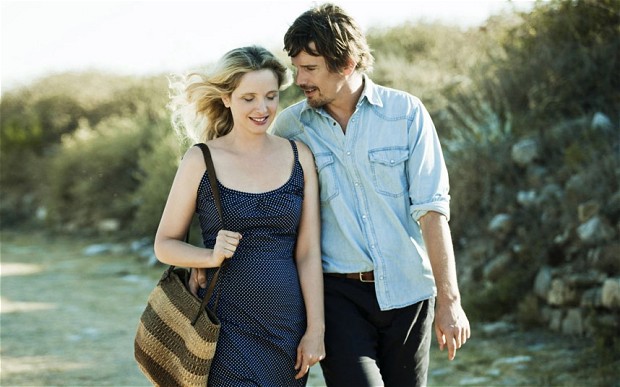
Julie Delpy as Celine and Ethan Hawke as Jesse in Before Midnight

Julie Delpy as Celine and Ethan Hawke as Jesse in Before Midnight

Before Midnight, the third film in Richard Linklater’s Before Sunset series, finds Julie Delpy and Ethan Hawke at their blistering, bickering best, in and around Paddy’s house.

by Tim Robey

From the Telegraph, first published 20 June 2013.

The last time we saw Celine (Julie Delpy) and Jesse (Ethan Hawke) together on screen, they were shooting the breeze in Paris, in Richard Linklater’s Before Sunset (2004), a sequel to his gorgeous Viennese brief encounter, Before Sunrise (1995). A plane was missed, but a vital connection was re-established, and Linklater had faith in this pair’s future, handing them one of the best, most romantic endings in the history of the movies.

Nine years later, the couple are living out the consequences of that decision, for good and bad, in Before Midnight. They’ve settled down in Paris, as the unmarried parents of twin girls, whose bobbing blonde locks could hardly fail to gladden the heart. We catch up with the family on holiday in the Peloponnese, where Jesse, fully established as a novelist, pitches ideas to friends, and Celine, an environmental activist whose latest wind-farm project has just been vetoed, ponders a potentially stressful career change.

The first half of the movie is mainly sweetness and Mediterranean light – there’s Greek salad at the dinner table, and bumper ensemble chats about what lasts in life and what doesn’t. Linklater has always been a garrulous sort of filmmaker, never one to cut short his characters’ windier musings, but in this early phase of the film he makes us ever so slightly nervous we’re in for a mid-level Woody Allen-style travelogue, with a yoghurty side dish of seasoned philosophising.

We needn’t worry; these hints of complacency are all grist to the eventual mill. Right from the start, there are rumblings of the things that have worked out less well for the lovers. Leaving his first wife for Celine meant Jesse more or less abandoned Hank, his son from that marriage, who’s now in his early teens and based in Chicago. Though Hank has joined Celine and Jesse for part of their trip, their adieu at Kalamata airport, where the film starts, is a typically poignant one for Jesse, since it involves sending his son, as Celine puts it, “back behind enemy lines”. Jesse sacrificed a lot to move to Europe, and quick-tempered Celine picks up, with nuclear sensitivity, on his yearning to be a better dad, along with all the resentments and retaliatory demands this might entail.

Hawke and Delpy, who are both credited on the script too, have never found co-stars to bounce off more nimbly or bring out richer nuances in their acting. As in the earlier films, all the best sequences here are long, snaking duologues – the difference being that Celine and Jesse now know each other inside out, and exactly which buttons to push. As a gift from friends, they get a night to themselves, and the movie’s tone shifts at the key moment when they’ve walked to a local village and the sun sets, as if inviting the real sequel to begin. There’s a long and brilliant scene in a hotel room, plotted like great theatre, in which foreplay gets interrupted by mild irritation, sarcasm becomes a full-on domestic row, and soon we’re at Defcon 1.
Related Articles

Where we might have expected a gentle or rueful coda, we get a battle of the sexes as blistering as the best of Tracy/Hepburn, and infinitely more frank. The pair take turns to be witheringly funny about each’s others foibles, delusions, and vast deficiencies, which only billow when this sort of combat draws them out. In a breath, Hawke can be magnificently caustic – just wait for his quip about Celine’s “agony in the trenches of the Sorbonne” – and a clumsy stirrer of the hornet’s nest. Delpy is a mistress of the half-joke with a whole artillery of grievances at her fingertips, and the emotional capacity to fire them all at once. The way men and women can trample on each other’s dreams, even without intent, is a brave subject for this movie to unpick, given the wispy, tender optimism of those dreams when Celine and Jesse last met, and indeed first met. Each film asks whether this generation’s most durable movie couple will make it – only now, they’re asking the same question of themselves.

Paddy on the South Bank Show – the last remaining feature

I often receive questions about Paddy’s appearance on the South Bank Show in 1989. There is a lot of material freely available these days, but this one remains elusive.

Today I put the question or challenge out to you all: how can we find a copy of this show so that we can all enjoy it (and legally!)?

It is Season 12, Episode 14, aired on the UK’s ITV network in 1989, and Melvyn Bragg was the host.

All suggestions very welcome.

John Chapman’s April visit to Kardamyli

As many of you may know, John Chapman, the author of Mani Guide,  not only provides us with excellent pictures (here) and comments, he also a regular correspondent to the blog and contributes articles which I am always happy to share with you. Here is his most recent note to me. Clearly the man has too much time on his hands. Lucky him!

I spent the whole of April 2013 in Mani. A welcome change from that never-ending British winter. I was perched in an isolated house high above the Messenian Gulf with views over Kalamata and the distant Arcadian mountains. Often just accompanied by the tinkle of goat bells and hum of bees, and the loud meows of the two feral cats who adopted me.

Kardamili was 15 minutes drive away. I didn’t revisit Paddy’s villa, but I did talk to a number of locals, and foreigners who’d known him and the house. Prof. David Mason – Poet Laureate of Colorado, no less, was over with a group of extremely keen, bright eyed and bushy tailed students. Dave had lived in Kardamili in the ‘70s and had lived rough, with his first wife, in a small hut just above Paddy’s villa. He was soon invited for lunch by Paddy and Joan and remained a close friend and correspondent with them until Paddy’s death. I’d met Dave in Oxford some few years ago and it was great to see him again over dinner, with other locals and his students, overlooking the harbour at Kardamili.

David’s book, ‘News from the Village’ (Red Hen Press. 2010. ISBN 1597094714.) is highly recommended as a portrait of an American’s love affair with Greece and Kardamili in particular. He’d shown his students the hut he’d lived in, and they’d all swam off the same rocks as Paddy had. Frankly the Med’ in April is damned cold, and I certainly didn’t emulate them, but as one of them commented, ‘we’re tough in Colorado!’

Things were quiet in Kardamili. The Greek Easter was exceptionally late, early May. And I therefore had time to sit over a frappé or two with various friends. No-one was certain what was going to happen with Paddy’s house. Though towards the end of the month I heard, unverifiable of course, that a rich Englishman was going to restore the house, live in it for three  months of the year, and let the Benaki Foundation use it  for the remaining 9 months. We’ll see.

One myth I wanted to enquire about was Paddy’s linguistic skills. He certainly could speak Greek fluently, but some have claimed he spoke it like a native. I’ve seen TV footage of him speaking Greek and frankly his accent struck me as being very posh English. I asked someone from the Troupakis family, who knew him well, who confirmed my suspicions. Paddy had perfect Greek, but a marked English accent.

He was also an appalling driver. One of the Dimitreas family (Paddy’s Mourtzinos family) had once lovingly repainted their boat, only to have Paddy reverse ineptly into it. It seems it was a toss of the coin as to who drove the car. Joan was allegedly just as bad a driver!

Another oddity is that when Paddy signed a copy of his book about the Mani he would often draw a sketch of the coast near his house. This was reasonably accurate and certainly evocative. But he invariably added in about four or five seagulls. Very odd as they are a rarity in the Mani, and I’ve never seen more than one solitary seagull flapping over the bay in the more than twenty years I’ve been visiting the area.

Catch up with more of John’s contributions and photos by clicking here.

If you would like to send something to me to share with your fellow Friends of Paddy you can find out how in the About section.

The work of Max Milligan – Hello Romania

Last week I attended the premiere of Wild Carpathia 2 at BAFTA in Piccadilly in aid of the European Nature Trust. There was a good crowd and we rubbed shoulders with Crown Princess Margarita of Romania, Mrs Maria Grapini, Romanian Minister for Tourism, four times Olympic Gold medal-winning canoeist, Ivan Patzaichin, and Romanian folksinger, Grigore Lese. The drinks sponsors appeared to be the Corcova winery from the south-west corner of Romania, and I am delighted to say that they took their duties very seriously, for the enjoyment of all!

But the highlight for me was Grigore Lese playing and singing, very emotionally and powerfully, to a backdrop of some great images of Romania by the Scottish photographer Max Milligan who is working on his next book about Romania in 2014. See Romania a Portrait on Facebook.

There are some really wonderful videos on Milligan’s website showing him at work in Romania, probably one of the last places on earth where you can experience such unique landscape and wildlife, plus see amazing architecture and meet remarkably friendly people, and do this more or less on your own without crowds of tourists. The Romanian tourist ministry has a lot of work to do, but of course at the moment it is good for those of us who want a quieter and more authentic experience .

You can enjoy more of Milligans’s videos  here.

The first Wild Carpathia movie is found here.

Please visit the European Nature Trust website to find out more about their work preserving the wild spaces of Scotland and Romania and maybe get involved.

Magouche Fielding – Times Obituary and funeral

From The Times obituary section:

Magouche, died at home on 2nd June 2013. Funeral at 1pm, 13th June with refreshments after at St Mary’s, Paddington Green, London W2 1LG.

Times link

Wartime escapades by Patrick Leigh Fermor

The Times Literary Supplement describes this as “The last Renaissance man’s account – until now available only in Greek – of how German bombs wrecked his boat but not his spirit”. Enjoy.

Translated by Adrian Bartlett.

First published in The Times Literary Supplement, 5 June 2013.

Since 1976 my family has been to a small town in the eastern Peloponnese nearly every year. Early on we heard, from the local bus driver and others, how the Germans had sunk an escaping Englishman’s boat in the local harbour in 1941. The Englishman in question was Patrick Leigh Fermor. Later we made friends with Stratis Kounias, a man from the town, a distinguished academic who also returned there every summer. Stratis had embarked on writing a wartime history of the area and on hearing that we knew “Paddy” he asked for an introduction. Leigh Fermor agreed to write an account of the event. I am quite sure he had written and talked about it many times before – some of the phrases are repeated in the biography by Artemis Cooper (reviewed in the TLS, November 16, 2012); but this time he recounted it in Greek for the benefit of Stratis Kounias, although Stratis speaks perfect English. The following is my translation.– Adrian Bartlett

And now over to Paddy …

A BRIEF ACCOUNT OF MY ESCAPE

I had arrived in Greece as a lieutenant in the Intelligence Corps in November 1940. We were a branch of the Allied Military Mission. After Christmas we drove to Albania and were based at Koritsa as liaison officers to the 80th regiment led by Lieutenant-General [Georgios] Tsolakoglou.

I went along the whole front – Pogradec, Krystallopigi, Argirocastro, Tepeleniou, Leskovik, Ioannina and so on. I stayed two months there and after the German invasion I was asked to come down to Athens with the personnel intelligence unit, under the regiment commander Peter Smith-Dorrien (son of General Sir Horace Smith-Dorrien who fought in the First World War).

After the slow retreat from Perdika, Ptolemaida and so on we were for a time as if in the pass at Thermopylae, but eventually got to barracks in Athens. With the rapid advance of the Germans, Field Marshal Maitland-Wilson gave the order to prepare a second escape route from Greece, if a somewhat unorthodox one.

The Greek authorities had requisitioned for us a lovely sailing caïque. She was called Ayia Barbara, anchored at Sounion and belonging to Paulo Mela. She had a renowned captain in Michaelis Mistho from the Demon of Sparta. Apart from myself and P. Smith-Dorrien there was a wireless-operating sergeant, a very nice corporal who I think was called Costas Varthis, and six soldiers.

Our orders were to take possession of the caïque and proceed to a meeting with Field Marshal Wilson at Mili, on the east coast of the Peloponnese. We left Sounion on the afternoon of the April 24, 1941, the sergeant and I having previously destroyed our truck by pushing it into a gully at Sounion. We went past Hydra and moored off the island of Dokos.

In the morning there were many enemy aircraft, the thud of bombing, and trails of smoke in the direction of Nauplion. Later we heard they had set on fire the English ship the Ulster Prince; many British were either killed or captured. We waited till late afternoon to weigh anchor and it was night when we moored at the quay at Mili. It was very crowded there, hundreds of trucks and Greek and British soldiers in retreat. I called out repeatedly the name of the motorcyclist, Matthew, who was to wait for me there and take me to the Field Marshal, whom I finally found.

He had come from Athens with Prince Peter who was liaison officer to our mission, Field Marshal Wilson having come in another car. Also there was the government Deputy President, Vice-Admiral Sakellariou. These were going to Crete in a Sunderland aircraft. Our own aim in our present circumstances was to work our way south along the coast of the Peloponnese, to help other British and Greek military stragglers who wanted to get to Crete and had missed a ship.

Admiral Baillie-Grohman and Brigadier General Galloway joined the Ayia Barbara, and also some more men. We weighed anchor and headed south. After half an hour we pulled alongside an English battle cruiser, the HMS Bahram [Edit: Should HMS Bahram read HMS Barham which was lost at sea on the 25th November 1941?], which took all these men on board. We, with our original company from Sounion, P. Smith-Dorrien, Lieutenant Philip Scott, consul to Field Marshal Wilson, and six soldiers stayed on the Ayia Barbara and we set off at 1.30 am. Smith-Dorrien appointed Philip Scott responsible for the British personnel and me for the Greeks as I knew Greek fairly well, having travelled a lot around Greece before the war.

On the way we had some engine trouble, a blade of the propeller broke which compelled us to reach shore before sunrise. Our intention had been to head for Ieraka and hide the caïque, but in the morning of April 27, at 5.30, we arrived at Leonidion and moored at the quay in Plaka.

We hid the radio under some olive trees, took our weapons, had some breakfast. Our orders were to let no one board the caïqe during the day. Soon we would be taking up our headquarters in Crete.

At 1.30 pm a reconnaissance Fiesler-Stork plane flew over, at 2 another came and dropped four aerial torpedoes on the beach and did little damage, and then came some bursts of machine gun fire. At 2.15 they dropped another bomb close to the quay and at 2.30 a depth charge fell beside the Ayia Barbara, breaching her below decks and sinking her, with just half the mast showing above water. Luckily our boat had saved some important documents.

From then until 7pm the bombardment and dive bombing didn’t stop. One of the bombs fell close to us and wounded Captain Michaelis in the leg and damaged the radio, but to our surprise we repaired it enough to take with us, but not sufficiently to send our news to headquarters.

Some local people appeared, with bread, eggs, one or two chickens, wine and so on, and showed us much kindness, although it had been a terrible day.

P. Smith-Dorrien and I tried to buy one of the other small caïques in the harbour, but all had been damaged in the bombardment and were not fit for sea. We tried mules but failed again. We hoped to find a caïque further south. We passed the night there, in two convenient caves at the end of the beach. We went very early into Leonidion for provisions. The enemy were firing all around, but stopped at midday. I tried to salvage some things from the sunken caïque but without success. At 7 pm the Leonidion police brought and placed at our disposal a boat from a nearby village. It belonged to Panayioti Nikos Moschoviti, or Tsana, from Poulithra. The crew was the son of Nikos and another four of his relations. We agreed that they would take us to Kyparissia. Whether or not we could find a way to make progress, we had taken a decision to go for it, come what may. The local people were very keen to help us. We all boarded the boat, twenty-three of us together with the six crew, packed in like sardines, and we set off south under oar. Meanwhile the Greek crew of the Ayia Barbara set off to their respective homes while we stayed with Captain Michaelis, without whom we would have perished, Smith-Dorrien said.

The crew rowed for about six hours and at 5.30 am on April 29 we arrived at Kyparissia, coming to a dry river bed, 3–4 kilometres from the village. P. Smith-Dorrien and I tried to buy a caïque and in the evening we found one: Ayio Nikolao, 40 tons, which belonged to Pericles Meneksi, for 300,000 drachmas. After a moment we heard that the Germans had reached the village, and as luck would have it, eleven New Zealanders arrived by rowing from Porto Heli.

Many British troops had arrived in Kalamata by road in trucks and armoured vehicles. Many went to Crete on the Greek warships which were there, the others who stayed put up a fierce resistance to the advancing Germans, making an assault with bayonets, and many died or were taken prisoner. This year they are erecting a memorial in Kalamata in their honour.

The eleven New Zealanders were in a bad state of fatigue; we took them into our company and all left together at 9 pm. On April 30, we arrived at Velanidion and all had a day on the beach to recover. At 9 pm we tried to set off to Crete but the engine wouldn’t go into forward drive and broke down. P. Smith-Dorrien, Captain Michaelis and I made the steep climb to the high village, hoping to find someone to mend the engine or to find another caïque, without any success.

Meanwhile we learnt that the Germans had reached Monemvasia, Neapoli and Kalamata. The New Zealanders wanted to put to sea immediately but Smith-Dorrien forbade it. Then five more New Zealanders arrived and an Australian. A good mechanic from Velanidion, Nikolaos Kostakos, a relation of Captain Michaelis, patched up the damaged engine after many hours. We also found three Cretan soldiers who were trying to find a way to get home so we took these too. At 9 pm we set off for Cape Spatha on the north of Crete with the mechanic, N. Kostakos.

On May 2 we had extremely strong headwinds and violent storms. We were losing oil and a bearing was overheating; the engine died. We did the unthinkable and turned back with an improvised rig for the sails and got to Antikythera at 12. Smith-Dorrien, Captain Michaelis and I went to the village of Potamos and found there a very large caïque, the Despina, which belonged to Captain Nikolaos Manika from Chios and it was agreed that he would take us to Crete in exchange for 45,000 drachmas. He took all of us, leaving the following night, another four Australians having arrived there by various means. We now had 150 men, British and Greek, of all ranks. There was another caïque there which went to Crete with us. N. Kostakos stayed with the Ayio Nikolao in order to take care of the repairs and then take it on to Crete.

We weighed our anchors at 10.30 pm on May the 3rd and arrived on the 4th, mooring at Kastelli Kissamou at 5.30 am, where we organized a wonderful feast in a taverna. We were all quite ravenous, and then found a truck to take us to Chania.

P. Smith-Dorrien wrote warmly of Philip Scott and with much praise for Captain Michaelis Mistho, who later played a role in the secret transport of caïques in the Middle East, and I met him later in the war. Also we had the finest impressions of Corporal Costas Varthis and the wireless operators, always willing and with good humour in difficult moments. Lastly we felt grateful to all the Greeks who took care of us and helped us warm-heartedly in difficult times.

After sixteen days the war came to Crete in one part or another. A few months later Philip Scott was killed in battle in a western invasion, and Smith-Dorrien was killed towards the end of the war by a bomb falling on the King David Hotel in Jerusalem.

***

These notes are based on my own recollections, much helped by the account written by P. Smith-Dorrien on our eventual arrival at Chania in Crete. Following the death of Philip Scott, his father Sir Samuel Scott collected his letters and published them as a small book. One letter describes our flight and it is around this that I have written. About the night we left Leonidion he writes: “We all got into the boat, eleven English, six Greeks and the others that stayed on after the loss of the Ayia Barbara. The Greeks rowed for six hours with hardly a break. They were absolutely wonderful. We covered 15 miles and arrived at a fishing village further south”.

On our turning back after our first attempt to reach Crete, he writes:

“The caïque travelled badly and the mainsail was torn.”

He was about 20 years old, I was 26 and Smith-Dorrien between 30 and 40.

I love Leonidion and the whole of Tsakonia.

Patrick Leigh Fermor
Kardamili, August 2, 1995

Remembering Patrick Leigh Fermor 1915-2011

Today is the second anniversary of Paddy’s death and we miss him as much as ever. As we have seen with yesterday’s announcement of the death of Magouche Fielding, his generation of friends still with us is becoming smaller, but I know from the many comments that you make that Paddy, and his generation still have the ability to inspire us to read, to travel, and to experience new things in life.

I am sure that he would have enjoyed reading Artemis Cooper’s biography, if perhaps feeling somewhat embarrassed about certain revelations, but smiling at so many of the memories from his long and full life. No doubt he would have been eagerly awaiting the final installment of the story of his 1934 European adventure, The Broken Road, which is due out this September.

Here are a few pictures from my archive of Paddy and friends. May he, and all his friends, rest in peace.

This slideshow requires JavaScript.

Magouche Fielding – Arshile and Agnes Gorky: Master and Muse

Arshile Gorky and Magouche or Mougouch

Arshile Gorky and Magouche or Mougouch

I have received word of the death of Xan Fielding’s wife, Agnes “Magouche” Fielding. She had apparently been ill for some time and I am informed that she died on 2 June 2013. We know little about Magouche who was married to Paddy’s very dear friend Xan until his death in Paris in 1991. This article tells us much more and is by her step daughter, the art historian and writer, Hayden Herrera.

First published in Vogue and reformatted for Vogue.com December 2009.

The painter Arshile Gorky’s relationship with his wife, “Mougouch,” was passionate, turbulent—and misunderstood.

I grew up surrounded by the paintings of Arshile Gorky, one of the greatest American artists of the twentieth century and the subject of a current retrospective at the Philadelphia Museum of Art. The paintings belonged to my stepmother, Agnes (nicknamed Mougouch), and they gave me hints not only about Gorky but about who Mougouch was and had been in the past. Full of searing colors, peculiarly animate shapes, and energy-driven lines, they moved me in ways I did not understand. Since then, I have looked and looked at Gorky’s work. I even wrote a biography of Gorky in order to try to figure out why he painted the way he did. Still, his work remains a mystery. That was the way he wanted it.

The specter of Gorky came into my life in the summer of 1948, when my father, a painter named John C. Phillips, met Agnes Gorky at a party in New York City. The host took my father aside and said, “Be nice to Mougouch. Her husband, Arshile Gorky, just died.” My father was happy to comply, for Mougouch was a beautiful and vibrant 27-year-old with long brown hair, a sensuous mouth, and large eyes that held a hint of mischief. Her responsiveness and her blend of boldness and femininity made her a magnet to men.

In the months that followed their meeting, my father and Mougouch fell in love. In December, together with her two young daughters, Maro and Natasha, they sailed for Naples and finally settled in France. My older sister and I learned about our father’s new family from photographs he sent us at our boarding school. During summers on Cape Cod we came to know our stepmother and our new sisters, who called our father “Daddy.” Compared with our previous stepmother, Mougouch was astonishing in her affection and her sense of fun. She called us “darling,” and I was entranced by her swift, graceful walk and her melodious voice.

When to my delight my father returned with his family to the United States and bought a house on Beacon Hill in Boston, my mother, who lived in Mexico, sent me to live with them. Mougouch was so motherly that when my baby sisters Antonia and Susannah were christened at Boston’s Trinity Church, I decided to be christened with them so that she could be my godmother. Our house in Boston was full of Gorky’s art books and, even better, his art. His presence was alive there, for Gorky remained a powerful figure in Mougouch’s world. Ten-year-old Maro, who herself became a painter, talked about her father incessantly, holding on to the image of his genius. She insisted that with his Armenian background, he was a much more compelling figure than my proper Bostonian father. We would try to decode Gorky’s imagery. Some works had almost cartoon-like lines that nearly coalesced into recognizable creatures. In one, we definitely discovered Bugs Bunny.

Mougouch was born Agnes Magruder in 1921, the eldest daughter of a naval officer and a mother who was descended from the renowned neoclassical sculptor Harriet Hosmer. Agnes’s childhood was full of travel—school in Washington, D.C., then the Hague, Virginia, and finally Boston, where she was sent to live with her dying grandmother and where she fell in love with painting. “My mission,” she explains, “was to cheer up my grandfather and his gloomy house overlooking the Charles River.” Her mother thought college unnecessary, so Agnes finished school in Switzerland. When her father was posted to Shanghai in 1940, she was so rebellious—she spent the night with a young diplomat and broadcast her fascination with Chinese Communism—that her parents packed her off to college, after all, in Iowa City. From there, she took a bus to Manhattan and enrolled at the Art Students League, only to quit for a typing job at a magazine called China Today. What she remembers about this period was her extreme loneliness. Every day on the way to work she said hello to the man behind the newsstand just to have a human exchange.

In February 1941, Willem de Kooning and his future wife, Elaine Fried, told Agnes that she ought to meet de Kooning’s great friend Arshile Gorky. Elaine described Gorky as a “terrible show-off who sings and dances and makes everyone dance in a circle waving a handkerchief.” A few days later Gorky stopped by de Kooning’s studio and said he wished he had a strong American girlfriend like Elaine. Elaine persuaded him to come with them to a party where they would introduce him to a nice blonde American girl. At the party, Agnes remembers, she sat on a bench between de Kooning and “a man with a mustache who was very quiet and rather pokey.” She was still waiting for the exotic stranger to appear when most of the guests had departed. On her way out, the man with the mustache stopped her and said in his accented English, ” ‘Miss Maguiger?’ And I said, ‘Oh, Gorky!’ ” He had expected a blonde, and she had expected an extrovert. They went to a coffee shop, and Gorky asked her so many questions that she finally emptied her handbag onto the table to give him a picture of her identity.

The following evening he took her to an Armenian restaurant. Soon they saw each other daily, and he gave her the name Mougouch, which he said meant “little mighty one.” When Gorky identified the welts on her stomach as bedbug bites, he moved her to a new apartment, whose skylight he scrubbed so thoroughly that the putty collapsed and rain poured in. The upshot was that she moved into his studio on Union Square.

That summer Gorky was to have an exhibition at the San Francisco Museum of Art. He and Mougouch drove across the country with Gorky’s good friend the sculptor Isamu Noguchi. When he and Noguchi argued about clouds, in which Gorky was absolutely certain he saw peasant women, Mougouch sided with Noguchi, and Gorky was furious. Crossing a bridge over the Mississippi, he became so angry that he ordered Noguchi to stop the car. He was going to walk back to New York. “I went after him,” Mougouch recalls. “He almost threw me into the Mississippi River!”

Upon their arrival in Los Angeles, Gorky was in a pique because the hotel was too expensive. Exhausted, Mougouch went to bed. Noguchi came in to say good night, and Gorky, in a fit of jealousy, burst into the room and dumped a bagful of lawn clippings on top of her. Mougouch insists that “there was not a murmur of electricity between me and Isamu,” but the critic Katharine Kuh suspected “a flirtation on Noguchi’s part.” In fact, both Mougouch and Noguchi were extremely seductive. Mougouch was brought up to be amusing and articulate and to make whomever she talked to happy. Gorky, reared in the Armenian province of Van in Ottoman Turkey, was highly puritanical. He did not understand that for Mougouch, flirtation was simply part of good manners. To this day, as a great-grandmother, she is an irrepressible flirt with men, women, children, and animals.

In September Mougouch and Gorky were married in Virginia City, Nevada, scandalizing her patrician family. She was 20. Gorky, who lied about his age, was probably about 41. They bought a curtain ring at Woolworth’s, found a justice of the peace, and said their vows. After drinking champagne in a bar, they camped in the Sierra Nevada in a double sleeping bag. During these early years, Mougouch and Gorky struggled to make ends meet. She worked for United China Relief, and Gorky made a few sales and did some teaching. He had not had a New York show in years, and his reputation was at a low ebb. Mougouch tells me that even Noguchi had warned her not to marry Gorky, because he was “stuck in a rut” and kept scraping and repainting the same canvas.

With the captivating Mougouch at his side, Gorky’s circle of friends expanded. Over the years, Léger, Mondrian, and Miró all had occasion to visit. The couple met Surrealists Roberto Matta, Yves Tanguy, and André Masson, who had come to the United States to escape the war. At a dinner specially organized for them to meet the Surrealist poet André Breton, Mougouch served as translator, and the friendship took off. She remembers dancing down the street with Gorky because Breton had promised to visit the studio. Later, she was apprehensive: “What does one give a poet for dinner?” The menu—artichokes, pilaf, and Brie cheese—was a success, and Breton was full of admiration for Gorky’s paintings.

The breakthrough in Gorky’s work came in the summer of 1943, when Mougouch’s mother invited him, Mougouch, and their infant daughter, Maro, to stay at her farm in Virginia. Being in the country surrounded by family was a catalyst for Gorky. “Gorky came back one day with this rather complicated drawing and said, ‘Will anybody understand this? Do you think I’m mad?’ ” Mougouch told him his drawing was marvelous and to go back into the fields to make more. “This summer was the real release of Gorky,” Mougouch wrote to an aunt. He had created a world of his own, a world so immersed in nature that he could look in and out at the same time.

Mougouch had a deep understanding of Gorky’s work and was also a brilliant facilitator of his career, charming potential dealers and cooking delicious meals for museum curators. But during their second Virginia summer, her letters to her best friend, Jeanne Reynal, expressed a feeling of aimlessness. For a woman of Mougouch’s intelligence and energy, cooking, cleaning, and looking after her baby was not enough. She wished she could be a writer, and her letters indicate that she might have excelled in that field. She set up her typewriter in a cabin, wishing “to lay an egg myself and when I get up and look, nothing there…humiliating.” In another letter, she rationalized: “…o well hell there is time and there are more important fishes to fry, how to live and propagate gorkys, paintings and infants though I know it would be better if I did more I don’t so there.” Jeanne told Mougouch to look at Maro and at the transformation in Gorky’s work. “You have had a part in this. These things are not to be sniffed at.” (Mougouch did produce another Gorky—Natasha, born in 1945.)

Thanks to the dramatic change in Gorky’s painting, the dealer Julien Levy took him on and gave him a show in 1945. Then came the first of a series of disasters that made Gorky’s last years a calvary. On January 16, 1946, his studio at their house in Connecticut burned down, and many of his paintings were lost. Early in March, disaster struck again. Gorky underwent a colostomy for rectal cancer. He became, Mougouch recalls, “totally paranoid …a tree cut down.” No matter how hard she tried to convince him that his “rearranged body” did not disgust her, he himself, a fiercely fastidious man, was revolted. He sometimes burst out in violence. The miseries that plagued Gorky seemed to rekindle the horrors of his childhood—his experience of the Armenian genocide in 1915 and, four years later, the trauma of his mother dying of starvation in his arms. Mougouch wrote to Jeanne, “Gorky has to do some drawing or he & I will die.”

Soon, “working like a mad man—a happy one,” as Mougouch wrote, Gorky was drawing as though it were a race against mortality. But his total focus on work was distancing. “More and more our marriage was just about my engagement with Gorky’s painting,” she recalls. “But I loved him.” She wrote him letters of encouragement when she took her daughters away for the summer: “Everything that comes from your beautiful hand seems touched with magic that sings in my chest.” Gorky wrote back, “…when you return I want my harvest too [sic] be very big and good…. You are with me my darling without you I could not go on working.”

When Mougouch returned, she was thrilled with Gorky’s “harvest.” Gorky, however, was depleted and unable to work. He talked of suicide. Ever the optimist, Mougouch tried to lift his spirits. At a party for her twenty-seventh birthday, in June 1948, she remembers “whirling around with a lunatic pleasure,” dancing by herself in the vegetable garden. But Gorky’s depression was invasive. “He was wrapped in silence all those last months.” In mid-June she had had enough. She left the house and spent two days with Matta, who, over the years, had made many attempts to seduce her. “I felt a new strength. I felt that somebody had loved me and I could go on forever.”

Gorky found out about the affair but for a while said nothing. Another disaster swiftly followed. Gorky’s neck was broken in a car accident. His right arm was temporarily paralyzed, and he thought he would never be able to paint again. Mougouch did what she could to alleviate his misery, but, she recalls, after the accident “everything just collapsed.” One night in a rage, Gorky broke furniture and tore up drawings Matta had given them. Mougouch tried to soothe him, but he pushed her away, and she fell down the stairs. Later that night, she told him that she loved him and would not leave him. The next day, Gorky’s doctor told her that Gorky was dangerous. He insisted that she take her daughters to her mother’s in Virginia. On the morning of July 21, Gorky called Mougouch and said he was going to commit suicide in order to “free her and free himself.” She said she would come back to him, but it was too late. Having left ropes dangling from various trees and rafters, Gorky hanged himself in a shed. He left a note written in chalk on the box he’d stood on and kicked away: “Goodbye my loveds.”

After Gorky’s death, Mougouch stayed in the city with Jeanne. Matta’s love, she says, “held me up.” In August she went to Maine, and Matta joined her. On their way back, they stopped at my father’s house on Cape Cod. My father was out, but when he returned he discovered Mougouch—with whom he had flirted at the party they’d met at just the month before—dancing with Matta. In the following months, he and Matta vied for Mougouch’s love. Mougouch went to Marcel Duchamp for advice, and he told her that the responsibility of a wife and two children would be too much for Matta. He said, “I think you should go somewhere with the children and paint or write.” Mougouch wept as she saw Matta off on his flight to Chile to see his family.

She and my father were married at the Closerie des Lilas in Paris in 1949. For Mougouch this was a marriage of equals—she was not in my father’s thrall. She kept the myth of Gorky alive and shepherded his legacy, finding dealers to handle his work and encouraging museums to show and buy it. Though the shadow of Gorky’s suicide hung over her life, she was the perfect artist’s widow, just as she had tried to be an ideal artist’s wife. Since then, her life has been rich in friendships with artists, writers, and filmmakers. She is admired as a dazzling hostess, witty, elegant, and subtle. Restless always, she left my father after ten years and eventually married the writer Xan Fielding, with whom she seemed content. While he was dying of cancer, they lived in Paris on the Rue de Rivoli. I remember with various sisters following Mougouch down the Paris street and trying to imitate her proud, sensuous, and graceful stride. I did not love her any less after she was no longer my stepmother. Over the years, I have learned from her how to cook, decorate a house, dress, talk, walk, and look at paintings.

Today, Gorky is seen as a bridge between the School of Paris and Abstract Expressionism, a movement that took off just at the moment when he died. As her best friend put it all those years ago, Mougouch played a part in this artistic transformation. When the Gorky retrospective opened in Philadelphia in October, Mougouch could not be there, but the coming together of so many magnificent Gorky paintings and drawings is testimony to her triumph as well.

Find out more about Arshile Gorky on his Wikipedia page.

Related article:

Xan Fielding obituary

Transylvanian Book Festival – so much better than Hay; are you joining us?

Lit fest authors

Arrangements for the Transylvanian Book Festival are proceeding apace. This will be a truly wonderful event and I want to encourage as many of you as possible to come along during 5-9 September. Look at it as a holiday in itself, spending five days in the most beautiful setting, a region lost to time, that reflects the history, culture, and architecture of one of the last untouched Medieval landscapes in Europe. A chance to talk to the authors and like-minded folk in a calm and relaxed atmosphere.

The line-up of authors is growing all the time. More details can be found on the website here.

The following have confirmed:

  • Artemis Cooper: An Adventure, the biography of Paddy Leigh Fermor
  • Professor Roy Foster: Bram Stoker, Ireland and Dracula
  • Jessica Douglas Home: Once Upon Another Time
  • William Blacker: Along the Enchanted Way
  • Michael Jacobs: Robber of Memories but will talk on Starkie or von Rezzori
  • Caroline Juler: Author of the Blue Guide to Romania
  • Jaap Scholten: Comrade Baron
  • Nick Hunt: After the Woods and the Water
  • Andrea Rost: on the biography of Hans Schaas
  • Sarah Dootz: Her autobiography
  • Countess Elizabeth Jelen Salnikoff: talking about her grandfather Miklos Banffy
  • Others to follow

You can make a reservation and book online here.

Unlike other book festivals this will be a relatively small and intimate affair. The authors will be living in the same villages and mixing with all those attending in a relaxed atmosphere. All food is included and we can expect some magnificent meals and picnics under the warm Transylvanian sun, with just the sounds of horse drawn carts, cows going to and from the fields, geese and ducks filing along the dusty roads, and our own animated conversation in English, Romanian, German and Hungarian as we reflect on the day’s events.

In addition there will be excursions included into the woods and countryside surrounding Richis so we can all get close to the land which is one of Prince Charles’ favourite spots. There is a lot included for the money which does not happen at other similar festivals.

If you want to know more please get in touch with me. I am happy to advise on travel options, flights into the country, car hire, and possible extensions to your visit so that you can visit some of Romania’s other wonders, many of which are just 1-2 hours away from Richis. There are already plans for extensions to turn your visit into a longer stay if you wish.

Romania is a very safe country for travellers with a good infrastructure. If you hear things from others that put you off, like the state of the roads, or are deterred by its very mysteriousness, please be assured that none of this is remotely true, nor should it be a barrier to you having a great time.

Don’t forget to visit our Facebook page. I am looking forward to seeing as many of you there as possible. Perhaps this medley of images may tempt you to come along by making your booking here 🙂 Some of these you may have seen before; many others are new. I promise!

This slideshow requires JavaScript.

Patrick Leigh Fermor: An Adventure – paperback publication

Patrick Leigh Fermor: An Adventure paperback cover

Patrick Leigh Fermor: An Adventure paperback cover

For those of you who could not stretch to buying the hardback, or who now want to shower your friends with copies of Artemis Cooper’s fine biography, the time is almost upon us when you can purchase the paperback, just in time for summer holiday reading.

It is apparently due for release on 27 June 2013, but as ever is available for pre-order. You can order the paperback version of  Patrick Leigh Fermor: An Adventure here.

As you can see it has a distinctly different cover with the famous view of the house at Kardamyli, whilst still showing our hero at the peak of his powers.

Remote places and landscapes in Greece – Walks in the footsteps of Patrick Leigh Fermor: Part 10

The last of Christian Peter’s walks. In my view you can’t go wrong if your walk involves visiting a monastery. I would like to thank Christian for all the work he put into this series. I am sure that he would welcome your feedback and comments in the Comments section below.

10  . Patmos

One of the most impressive and intense places in Greece for me is the atrium of the Monastery Agios Ioannis o Theologos in Patmos . The Monastery of St. John the Divine is a fortified Orthodox monastery dominating the highest part of the Chora of the island. It was and continues to be one of the most important monasteries in Greece.  Its interior is like a  muli-leveled building complex with  interior courtyards, colonnades and narrow corridors. From time to time Paddy used to live in monasteries for a while. In the introduction of his monastery-book “A Time to Keep Silence“ (1957) he describes longer visits to Wandrille de Fontanelle, La Grande Trappe and the monasteries of Cappadocia, but also mentions that he has visited all the important monasteries of the Greek word. You can about his visits to Mount Athos and monasteries of Meteora, and I am pretty sure he has been to Patmos.

Preserving Transylvania’s Heritage

You will recall that I recently brought to your notice the efforts of the Global Heritage Fund as it seeks to raise money for the building of a new brick kiln in the Carpathian mountains of Transylvania. This is a totally wonderful area. The landscape is beautiful; the fauna, including wolves, lynx, and brown bear, whilst still numerous is in danger; the cultural heritage is unique – German Saxons, Sekler Hungarians, Romanians and Roma living side by side; but there is little money to ensure that this region, that marked the border between medieval Christendom and the empire of the Ottomans is preserved, as corruption and neglect permits its steady decline.

There are now less than two weeks left for the Global Heritage Fund, in conjunction with the author of Along the Enchanted Way,  William Blacker, to raise the $20,000 that they need to build a new brick kiln in the traditional style, so they they can continue to restore the decaying houses and preserve this environment.

As a lover of Transylvania, I ask you to consider giving a few dollars towards this worthy campaign which will not only preserve the buildings in the traditional way, but also provide employment for local people so that they can continue to live in the area, and ensure a future for them all. To those who siad before that they would rather give towards Paddy’s house, I think I should say that whilst that is a worthy position, it is perhaps best to deal with what we have today, and there is talk of a solution for the house which may not require any further giving.

All funds will go to the project on the ground in Romania and I ask you to consider giving generously to the project by visiting the crowdfunding site here.

Some of my own personal images of the villages may inspire you further …

This slideshow requires JavaScript.

Summer reading – The Transylvanian Trilogy by Miklós Bánffy

New BanffyMore Miklós Bánffy propaganda to make you go out and buy these fantastic books! They have recently been republished by Everyman’s Library.

You can buy them here. They were counted.The Transylvania Trilogy. Vol 1.

And of course, Elisabeth Jelen Salnikoff,  the elder granddaughter of Miklós Banffy will be speaking about her grandfather, his life and work at the exciting Transylvanian Book Festival 5-9 September; see you there!

by Julian Glover

First published in The Guardian , 5 August 2011

A few years ago a friend sent me three very large paperback novels – a trilogy about Hungary before the first world war – which he said I should read.

The Writing on the Wall, as the books are known (better than “the Transylvanian Trilogy”, the inadequate English alternative), did not look promising. Their covers were relatively austere and their author was a dead Hungarian aristocrat of whom I then knew nothing. They sat ignored until, by chance, I took the first of them to Spain one summer and, having nothing else to read, opened it.

Since then their author, Miklós Bánffy, has never been far from my mind. The elegiac wisdom of his writing makes him one of those people whose life you wish could have ended in something other than calamity. His three great novels, which are really one and should be read as such, are significant and addictive works. Word of their excellence is spread largely by private recommendation. I know no one who, having begun them, has not charged through to the end.

The three books – They Were Counted, They Were Found Wanting and They Were Divided – are at one level a sort of Austro-Hungarian Trollope, with sleigh rides in place of fox hunts and the Budapest parliament instead of the House of Commons. So far, so dull, you might think – except that Bánffy was a great storyteller (his factual account, in his book The Phoenix Land, of the 1916 coronation of the last Hungarian monarch is spellbinding), and wrote as a member of a class and the citizen of a country that had both been brought to ruin.

Bánffy published his books in Hungarian between 1934 and 1940. By then, the pre-first world war aristocratic tradition he describes was dead; or at least the political part of it, for the trappings lingered on – not least at Bánffy’s own great family castle of Bonchida, by then in Romania and destined to be partly destroyed by the Germans in 1944.

Bánffy died in 1950, his papers burned, his books out of print. One of the connected delights of this trilogy is that his daughter was one of the joint translators, and Bonchida (thinly disguised as Denestornya in the novels) is being brought back from a roofless ruin.

That will not return to us the Hungary of which it was once a part, and only a third of which remained in Hungarian hands after the 1920 Treaty of Trianon (an ill-deserved robbery). As Bánffy describes, some of this disaster was his fellow citizens’ fault – the product of their incestuous politics, their semi-subservience to the emperor in Vienna, and above all the closed nature of Hungarian society, which did not know how to deal with the continent beyond its borders. That remains true today: there is something mysterious about Hungary, and not only because of its isolated language.

If I have made these sound sour books, or purely political ones, then I have misled you. More than anything, they are human, and beautiful, and descriptive, and rooted in a land and its natural environment that are both gone forever and less far away than we might think. “The radiant afternoon sunlight of early September was so brilliant that it still seemed like summer,” the trilogy begins. This summer I urge you to read on …

Related articles:

Read more about Miklós Bánffy on the blog by clicking this link.

Paddy’s Italian fans in the footsteps of Fermor and Moss

In the snow on top of Mount Ida

In the snow on top of Mount Ida

Some of Paddy’s fans from Italy recently struck out on an adventure in Crete to follow in the steps of Paddy and ‘Billy’ Moss and the rest of the abduction gang. They were on the route at the same time as Tim Todd and Chris White who, as regular readers will know, engage in some seriously detailed work on the route and the events of April 1944. However, the two groups did not manage to meet up in Crete, but did keep in touch with each other via the comments section of the blog!

Spiro Coutsoucos was leading the Italian group and passed me this short text explaining their motivation and a little about the journey which you can enjoy from the photographs that they sent me. The image of the crossing of Mount Ida is reminiscent of Moss’ own black and white image.

Most of us discovered Fermor (and the Peloponnese as well) thanks to “Mani”, which was the one and only book of Paddy’s translated into Italian until a few years ago. We are all good travelers and hikers and we love travel literature. Some members of the group were in Kardamili and hiked in Mani in spring 2009. We became more familiar on reading Paddy’s biography. After searching in vain for the abduction story among his other books we discovered Stanley Moss’s “Ill Met By Moonlight”. The next step was the exciting discovery of Tim Todd’s website.  And one day with Maria Cristina, who is our spring trek organizer we said… why not? Last winter we organized a meeting in Milan on the abduction story to propose the itinerary. A number of Italian fans of Fermor joined the meeting, some traveling considerable distances.

The next step was getting in touch with Cretan mountain guides to check the itinerary and locations.

We started hiking from Drossia, through Enagron, Axos, up to Anogia, Mount Ida, and down to Fourfouras, Petrochori, Ano Meros, Vrises, Ierakari. We then left Paddy’s way because we could not miss Moni Preveli. We rejoined Paddy’s footsteps again on Peristeres beach. Throughout the trek we enjoyed very pleasant weather, some very nice meetings with people related to Kreipe abduction, a huge amount of raki.  The whole team was very enthusiastic about our quest.

This slideshow requires JavaScript.

Wild Carpathia 2 Exclusive Screening at BAFTA

Those of you who enjoyed the movie Wild Carpathia, may like to know that the European Nature Trust is hosting an exclusive screening of the sequel, Wild Carpathia 2, at BAFTA in London’s Piccadilly on 5 June 2013.

The evening will include a drinks and canape reception before the screening, and further drinks afterwards.

You can order tickets here. I shall see you on the night!

Enjoy this taster.

You can watch the whole of the first film by clicking here.

Remote places and landscapes in Greece – Walks in the footsteps of Patrick Leigh Fermor: Part 9

The ninth of Christian Peter’s walks and still in the Dodecanese.

9.     Astypalaia /Dodecanese

Situated between the Cyclades and the Dodecanese the “forgotten” island of Astypalaia  is even today calm and traditional.  Having the form of a butterfly a small band of land of only 200 meters separates the island into two sections: Exo Nisi and Mesa Nisi.  A day-long hike over the entire island starting in Chora ( Exo Nisi) brings you to the remote, almost abandoned village of Exo Vathy (Mesa Nisi). Only a few people live here leading a very simple and traditional island life as fisherman and farmer. One old couple runs a tavern.

Count Robert de la Rochefoucauld: Veteran of the SOE

Count Robert de la Rochefoucauld

Count Robert de la Rochefoucauld

A wonderful obituary of this brave and colourful figure who probably did not know Paddy, but was in the SOE, and whose story is well worth reading anyway. For some reason it is no longer available on the Telegraph website where it was published on 29 June 2012.  You can read a pdf of it here. The version below is written by Phil Davison and was published in the Independent on 21 June 2012. Thank you to Mark Granelli for bringing this to my attention.

Descended from an ancient French noble family, Count Robert de la Rochefoucauld was one of the last surviving French agents of Britain’s Special Operations Executive (SOE), the secret organisation set up by Winston Churchill to aid anti-Nazi resistance fighters. There are now believed to be only two surviving French agents of the SOE, which Churchill ordered to “set Europe ablaze” through sabotage.

While General Charles de Gaulle organised his Free French Forces (FFL) from his London base, some Frenchmen were hand-picked and trained by the SOE before being sent back to their occupied country to provide money, equipment and training to the local maquis. De la Rochefoucauld was recruited by Captain Eric Piquet-Wicks, who was in charge of the SOE’s RF Section of French nationals based at 1 Dorset Square, London. They worked in parallel with, though not always in agreement with, the more famous F Section run by the legendary spymaster Maurice Buckmaster. The SOE would later be dubbed “the Ministry of Ungentlemanly Warfare”.

De la Rochefoucauld received parachute, sabotage and commando training at secret locations in England and Scotland, including “silent killing” techniques taught by the renowned duo Fairbairn and Sykes – designers of the famous commando knife – at Arisaig, Inverness-shire, before being parachuted back into his homeland.

Dropped into France twice by the RAF, captured twice by the Nazis and once sentenced to death by firing squad, he survived by using the unarmed combat skills taught to him in the Scottish Highlands. He killed one German guard by strangling him, donned his uniform and shot two more guards to escape. He attacked an electric power plant at Avallon in the Morvan mountain massif of Burgundy, but perhaps his greatest feat, in the spring of 1944, was blowing up France’s biggest munitions factory, at Saint-Médard near Bordeaux, occupied by the Nazis and crucial to their war effort.

Count Robert Jean-Marie de la Rochefoucauld was born in Paris in 1923 into one of France’s oldest aristocratic families with records dating back to the 10th century. The family controlled most of what is now the Charente department, based in the magnificent Château de la Rochefoucauld on the river Tardoire, where a branch of the family still lives. On his maternal side, Robert was descended from the old de Wendel family. He was 16 when the Nazis stormed into France in May 1940.

Young Robert was living underground in Paris when he was tipped off by a sympathetic post office worker that someone had denounced him to the Gestapo as a “dangerous terrorist”. Deciding to join de Gaulle in London, he hooked up with the Resistance, who helped him cross the border into Spain in late 1942 along with two British RAF pilots shot down over France.

The three were apprehended by Franco’s police and interned for two months in the infamous Miranda de Ebro camp for foreign prisoners which had been used by Franco’s forces as a concentration camp for Republicans during the Civil War. De la Rochefoucauld was lucky to have been with the British airmen: Britain’s ambassador to Spain sprang all three of them and arranged an RAF flight to London.

Once there, de la Rochefaucould met de Gaulle at the latter’s headquarters in Carlton Gardens but, partly thanks to his two airmen friends, found himself recruited by the SOE. Churchill had asked his Minister of Economic Warfare, Hugh Dalton, to set up the clandestine SOE, partly to resist any German invasion of Britain and partly to support resistance groups in Europe. When de la Rochefoucauld told de Gaulle that the British SOE wanted to recruit him, the latter reportedly replied: “Even allied with the devil, it’s for France. Allez-y.”

Kept in the dark as to what his missions would be, De la Rochefoucauld was trained in unarmed combat at Arisaig, and later at RAF Ringway near Manchester (parachute training, including jumps from as low as 400 feet) and finally at the SOE’s “finishing school” on Lord Montagu’s estate around Beaulieu in the New Forest. Those who didn’t quite cut it were sent to the “cooler,” Inverlair Lodge in Scotland, where they were quarantined, albeit in comfort, so that they couldn’t reveal SOE missions. (Inverlair later became the inspiration for the backdrop to the 1960s television series The Prisoner starring Patrick McGoohan.)

After first parachuting into the Morvan region and destroying the Avallon plant, de la Rochefoucauld was caught by the Nazis and condemned to death, but escaped. He reached Calais, where a pro-Resistance fishing boat got him to a British submarine and back to England. After parachuting back again to the Bordeaux region, he led local maquis fighters in blowing up the sprawling Saint-Médard munitions plant 12 miles outside Bordeaux. The noise, at 7.30pm on 20 May 1944, was heard for tens of miles around and gave a major boost to the Resistance with D-Day in the air.

De la Rochefoucauld then linked up with the famous résistant known as Aristide – real name Roger Landes, a bilingual British citizen (Independent obituary, 12 August 2008) – but was again arrested by the Gestapo and thrown into the Fort du Hâ in Bordeaux, a fortress built by Charles VII in the 16th century. He considered two options, one of them to take the cyanide”L-Tablet” hidden in the heel of his shoe, which would kill him within 15 seconds. But he took the second option, faked an epileptic fit, strangled his guard and shot dead two others before fleeing.

After the war, de la Rochefoucauld trained French commandos in Indochina and for their assault on the Suez Canal in 1956. On retirement from the military, he set up a transport business in Senegal and ran a plantation in Venezuela to import bananas to Europe. He also served from 1966-96 as the popular mayor of Ouzouer-sur-Trézée in north-central France, where he died.

Robert de la Rochefoucauld published his memoirs in 2002, titled La Liberté c’est mon plaisir. His awards included Chevalier de la Légion d’Honneur, Croix de Guerre, Médaille de la Résistance and Britain’s Distinguished Service Order (DSO).

Count Robert de la Rochefoucauld is survived by his wife Bernadette (née de Marcieu de Gontaut-Biron), his son Count Jean de la Rochefoucauld and three daughters, Astrid, Constance and Hortense.

Count Robert de la Rochefoucauld, wartime SOE agent: born Paris 16 September 1923; married Bernadette de Marcieu de Gontaut-Biron (one son, three daughters); died Ouzouer-sur-Trézée, France 8 May 2012.

Help Build a Kiln in Transylvania

Malancrav, near Sighisoara, Romania

Malancrav, near Sighisoara, Romania

Global Heritage Fund UK and the Anglo-Romanian Trust for Traditional Architecture (chaired by William Blacker) have begun a project to protect and restore the cultural landscape of the Saxon villages of Transylvania.  The beautiful buildings are in desperate need of repair using only the traditional materials from the new kiln, and local people are in need of jobs. To address this, Global Heritage Fund is raising money to build a traditional brick and tile making kiln. Run by a Romanian expert, this kiln will directly employ locals and provide much-needed materials for the on-going work of restoration and conservation of the early vernacular buildings.

A crowd-funding site has been established to raise $20,000, of which they have raised almost $5,000,  and I support the attempt. If you would like to know more, and to donate, please visit the crowdfunding page here.

Remote places and landscapes in Greece – Walks in the footsteps of Patrick Leigh Fermor: Part 8

The eighth of Christian Peter’s walks.

8.     The “Italian Road” from Pothia to Vathi – Kalymnos

Paddy must have widely been travelling the Dodecanese, as he was so obsessed by pebbelstone mosaics. The islands of the Dodecanese offer a great variety of fantastic pebblestone mosaics. Nearly every old church has one  and the Kalymnian capital of  Pothia has one of the largest and most beautiful. Recently Kalymnos became a world class destination for rock climbers, but there are a number of wonderful walks on the island, too. The best known one is the walk on the old Italian Road (Italikós drómos) from the vibrant city of Pothia into the fertile valley of Vathys. Those who really want to follow Paddy’s footsteps  should visit Kalymnos for Easter celebrations. What you will find to happen in the streets of and on the mountains around  Pothia on those days is really Paddy-like: The local people like to celecrate the holy days with dynamite, this is why during those days people tend to call their island the “Aegean Afghanistan”.

The movie Before Midnight, featuring a certain house in a starring role

If you never get the chance to visit Paddy and Joan’s house in Karadmyli, it looks like you can have an extended viewing if you go to see the movie Before Midnight.

Related articles:

Before Sunset sequel, Before Midnight movie shooting in Greece at Paddy’s House

Intimate portraits from Kardamyli by Miles Fenton

£1 a week – Up Down and Across

Nick Hunt will be giving a talk about his epic walk in Paddy’s footsteps from Hook of Holland to Istanbul at London’s Westminster Reference Library on 11 May, and will be joined by other adventurers in an evening of talks, performances and art about walking.

Find out more on Nick’s blog, After the Woods and the Water here.

Nick Hunt outside the Hotel New York (Continental), Cluj

Nick Hunt outside the Hotel New York (Continental), Cluj