Category Archives: Between the Woods and the Water

Prince Charles in Transylvania

By William Blacker.
First published in the Financial Times 27 August 2010.

When in early 1990 I first went to Transylvania, leaving behind the bright lights of western Europe and adjusting my eyes to the more sober tones of its eastern reaches, I could hardly believe that such a place still existed. In deep winter I crossed the northern Carpathian Mountains and came down, through misty forests and snow-covered roads, into the Middle Ages – or something astonishingly like it. Horses or oxen pulling sleighs occupied the roads, and cows and geese wandered freely. The villagers were dressed in smocks, sheepskin coats and fur hats, and had rough leather strapped to their feet, with woollen cloth wrapped around their calves held in place by thongs; footwear truly from another age, as worn by peasants depicted in ­medieval illustrated manuscripts.

I was just a few hours east of Vienna, but crossing the border into Romania was a journey back in time. I settled there, and for more than 10 years I was fortunate enough to be able to live a rural life that previously I had known only through the pages of a Hardy or Tolstoy novel.

I was astonished by the visual purity of the new environment in which I found myself. It was a country still commercially chaste, and innocent of the garish trappings of the capitalist world. There was no advertising, no neon lights, no plastic, no brash petrol stations (just a few simple pumps), very few cars – and all of the same make – that chugged and jolted over rough roads marked by the occasional rusting road sign. There were horses pulling carts, with foals trotting along beside them, outnumbering motor vehicles by 50 to one. In the villages, the houses were either of wood with carved and fretted verandas, or of brick or stone and lime-washed in soft blues, greens and ochres. All around there were huge and echoing forests, hay meadows so filled with flowers that they seemed to be part of some endless garden, and almost always, in the background, loomed the glittering Carpathian Mountains.

It was a land vividly described by Patrick Leigh Fermor in one of the great travel books of the 20th century, Between the Woods and the Water, and by Gregor Von Rezzori, whose beautiful autobiography The Snows of Yesteryear is set in Moldavia and Transylvania, and captures in dream-like prose this dream-like world. The landscape still has this ethereal quality; it stretches for miles in every direction, all unfenced just as in England in the 18th century before the land enclosures. There is nothing else like it left in Europe.

On my early journeys through this antique land, travelling was not always straightforward. There were almost no restaurants, shops, hotels, or guest houses. When walking over the hills, often guided by the steeples of village churches, I had to rely upon the kindness of strangers. Sometimes I might share a room with snoozing lambs, and discover a hen and her chicks under my bed. At other times I slept in hay barns, and my supper was milked directly from the udder of a goat that had wandered into a smoky cottage kitchen.

Now, however, life is a bit easier. There are comfortable hotels in the medieval town of Sighisoara, and excellent pensions in the beautiful Saxon villages of Viscri, Malancrav and Cund (at the end of a spectacular, winding road leading north from the town of Dumbraveni), or in the ethnically Hungarian Zabola, and Miclosoara. These villages provide locally-grown food, and sometimes, as at Cund and Zabola, of the highest quality.

Prince Charles and companions at the medieval village of Viscri, Transylvania
The Prince (left) visiting the village of Viscri

English travellers might be surprised to discover that some of these guesthouses are owned by HRH the Prince of Wales. Prince Charles first visited Transylvania in 1998, saw the wild beauty of the country, and came under a similar spell to that which captivated Leigh Fermor and others before him. He realised that this pristine central European landscape of forests, hay meadows and historic villages, until then barely touched by the brute hand of the modern world, was of international importance, and must somehow be preserved. Since then he has done much to draw attention to the predicament of what the ecologist Dr Andrew Jones calls “the last truly medieval landscape in Europe”.

Through such charities as the Mihai Eminescu Trust, the International Network for Traditional Building, Architecture and Urbanism (Intbau) and the Transylvania Trust, the prince has helped in saving hundreds of houses all over Romania, and in training multitudes of villagers in traditional building techniques. It is hoped that by preserving the villages and the countryside around them, and by encouraging traditional craftsmanship and small-scale farming, the economies of the villages can recover and thrive.

As part of this approach Prince Charles has bought several endangered properties in Transylvania and turned them into comfortable guesthouses. The buildings are restored using traditional materials, with lime renders and locally-produced hand-made bricks and terracotta tiles. One of them, which the prince has owned for some years, is in the village of Viscri. The latest purchase is in the remote village of Zalánpatak in the ethnically Hungarian part of Transylvania, and opens to paying guests next month. I recently paid a visit.

Prince Charles’s guesthouse in Zalánpatak, Transylvania
Prince Charles’s guesthouse in Zalánpatak, Transylvania opens next month

As I drove further and further from civilisation, the road became narrower, rougher and leafier, and I seriously began to wonder whether I was on the right track. But then, at last, a tiny village appeared, by the side of which ran a sparkling brook shaded by tall poplars. The Prince’s house, with its simple wooden verandah and outbuildings also of wood, or lime-washed in blue, is by no means grand, but the serenity of the view from the verandah on that still summer’s evening was about as perfect as one could hope to find. It was somewhere that one can describe, without wildly exaggerating, as a heavenly place.

With his guesthouses the prince hopes to persuade discerning travellers to come to admire the old village architecture; to walk or ride from one village to another through the breathtaking but only half-tamed countryside of meadows, wooded hills, and trickling streams; to see evidence of wolves and bears, and all the other wildlife that survives here in abundance, but which in other parts of Europe is either extinct or on the edge of extinction; and to understand why Romania is such a special country.

But, in spite of Prince Charles’s influence on conservation in Romania, most parts of the historic landscape of Transylvania are being devastated by a rash of uncontrolled modern development, which worsens by the year, and is now reaching a critical point.

Many might have thought that Romania’s rural architecture had been “saved” when the communist dictator, Nicolae Ceausescu, was executed on Christmas Day 1989, and that his deranged plan to bulldoze the villages and move their inhabitants into purpose-built blocks had been put to rest. But in reality it was only after Ceausescu’s death that the real destruction of the villages began.

Now, in the construction free-for-all of modern Romania, the country’s historic architecture is being rubbed out at a frightening pace, and the sad irony is that its destruction is being made greatly worse by European Union money pouring into the country in the form of agricultural subsidies. Those receiving these grants (often vast sums by local standards) are demolishing their old village houses and using the money to replace them with hideous and incongruous modern buildings, painted in garish orange, luminous yellow or vivid purple, often with windows of mirrored glass and stainless steel railings. It is a kitsch that is infecting the whole country. Even as I write, in a beautiful village that has until now escaped the ravages of the modern world, I can hear the demolition of a huge oak-beamed and terracotta-tiled barn in order to make way for someone’s dream villa. The 18th-century house next to it is apparently soon to follow. It is like living in southern Ireland in the 1960s, when rows of proud Georgian houses were demolished to make way for modern developments. It is almost beyond belief that the Romanian government can allow villages like those in the Saxon area of Transylvania, or in Oltenia near Campulung Muscetel, which are as picturesque as the hill towns of Tuscany or England’s Cotswold villages, to be destroyed in this way. The country’s tourist industry is bound to suffer as a result.

The modern world and EU money are doing Ceausescu’s architectural destruction for him. And, because only richer farmers are eligible for EU grants, the subsidies are squeezing out the smaller, self-sufficient farmers whose harmless methods of caring for the land naturally preserve the biodiversity of the region, and its historic appearance. Botanists will tell you that once the unique medieval wildflower meadows are gone, which now exist only in Romania, they can never be recreated.

So the message is this: Romania is a deeply fascinating country, but if you want to see and feel something of this fascination, go there soon. If the Romanian government and the EU do not speedily put their heads together to do something quickly and seriously to protect what remains of the country’s all too fragile beauty, within a few years there will be little left to see: the fascination will be gone, and the spell broken.

William Blacker’s book about his life in a rural Transylvanian village is ‘Along the Enchanted Way’ (John Murray)

…………………………………………..

Details

Prince Charles’s guesthouse at Zalánpatak opens next month, with five double rooms costing £86 including breakfast. His other guesthouse, at Viscri, has already accepted occasional guests, but opens fully from spring 2011, with three doubles available at the same price. All profits go to building conservation work in the area. For details of both see www.transylvaniancastle.com. The closest airport in Romania is Cluj-Napoca, which has direct flights from the UK, France, Italy, Spain and Germany

A Traveler’s Tale: On Patrick Leigh Fermor

by Wes Davis

First published in The Nation, December 2010

At a Chelsea-to-Richmond boating party held sometime in the early 1950s, the Duchess of Devonshire, then a beautiful young woman of 30, met a dashing man, some five years her senior, who was dressed as a Roman gladiator and armed with a net and trident. It was a look she thought suited him.

The fancy-dress gladiator was Patrick Leigh Fermor, a former officer in Britain’s Special Operations Executive (SOE), a covert unit that aided resistance movements throughout occupied Europe, and an up-and-coming writer best known at the time for kidnapping a German general during the war. He had crossed paths with the duchess before and remembered her clearly from a regimental ball in 1940, when she was still Deborah Mitford—the youngest of the soon-to-be-famous Mitford sisters. She was then engaged to Andrew Cavendish, a tall naval officer and younger son of the Tenth Duke of Devonshire who had no expectation of inheriting his father’s title until the war took his older brother’s life four years later. Leigh Fermor had watched the couple dance their way through the evening, “utterly rapt, eyes shut, as though in a trance.” Mitford had not noticed him.

But when they met again—as duchess and gladiator—Deborah Devonshire and Patrick Leigh Fermor struck up a friendship that has endured for more than half a century. In Tearing Haste, a collection of their letters newly available in this country, gives the impression that the conversation that started at a boating party so many summers ago has never stopped. Spanning 1954 to 2007, the volume reads like an accidental memoir of a disappearing world stretching from the manor houses of the English aristocracy to the olive groves of Greece, its people and places rendered with a kind of care that’s becoming scarce in our age of helter-skelter communication. At the same time, the book’s title, a phrase deriving from Leigh Fermor’s habit of dashing off messages “with a foot in the stirrup,” captures the vigor and bustle of the lives that nourished the correspondence. I once happened upon the manuscript of a chatty letter Leigh Fermor had written in 1944 to an Englishwoman stationed in Cairo. Amusingly composed and illustrated with a witty hand-drawn cartoon, it closed with Leigh Fermor mentioning offhand that he was in hiding on occupied Crete and that an undercover runner was waiting outside to receive the communication.

In Tearing Haste is engaging from start to finish. There isn’t a dull letter among Charlotte Mosley’s selections. Even her annotations, often incorporating information from the book’s two correspondents, are as surprising as they are informative. One biographical note on the painter Augustus John includes Deborah Devonshire’s recollection of meeting him in London: “He looked me up and down and said, ‘Have you got children?’ ‘Yes.’ Another long look. ‘Did you suckle them?'” More than anything else, the collection is important as an addition to Leigh Fermor’s body of work, both because his letters constitute a larger portion of the volume and because the writing in them harmonizes with the books that established his literary reputation. But let it be said that the Duchess of Devonshire is no slouch either. Her letters, though generally shorter and less frequent than Leigh Fermor’s, share his wit and many of his interests—a fascination with language, for example, or with the byways of English and European history. She puts a charming twist on these topics while adding a few bright threads of her own to the correspondence.

Deborah Devonshire’s books—beginning with The House (1982) and The Estate (1990)—focus largely on the management of Chatsworth, the massive estate in Derbyshire that she and her husband put into charitable trust and opened to the public in 1981. (The house was a stand-in for Mr. Darcy’s Pemberley in a film adaptation of Pride and Prejudice, and throughout the letters Leigh Fermor refers to it as “Dingley Dell,” after Mr. Wardle’s house in The Pickwick Papers.) As a writer, she is best when describing the seasonal rhythms of country life (the arrival of the year’s pullets, say) or assessing the gamut of rural arts (from drystone walling to mushroom gathering) and tilling their linguistic soil. In Counting My Chickens, a collection of notes and essays published in 2001, she remembers leaving Leigh Fermor “stumped” by the meaning of words gleaned from the glossary of a pamphlet about sheep. “One sheep disease,” she recalls, “has regional names of intriguing diversity: Sturfy, bleb, turnstick, paterish, goggles, dunt, and pedro all are gid.” On the same page she can be found rhapsodizing over “the glorious language of the 1662 prayer book, with its messages of mystery and imagination.”

She takes any opportunity to undercut the preconceived notions one might have about a duchess’s likes and dislikes. “I buy most of my clothes at agricultural shows,” she says in Counting My Chickens, “and good stout things they are.” For the playwright Tom Stoppard, who contributed an introduction to the book, this was one of her most characteristic revelations. For me, a close runner-up is her discussion of flower gardening on a grand estate, where she admits, “I prefer vegetables.” Many of her stories turn on a similar blend of unexpected rusticity and unflagging old-school civility. In an essay about the life the Mitfords led for a time on the island of Inchkenneth in the Hebrides, she describes traveling by train in the company of a goat, a whippet and a Labrador back to her sister Nancy’s house in Oxfordshire when the war broke out. “I milked the goat in the first-class waiting room,” she confesses, “which I should not have done, as I only had a third-class ticket.”

For all her modesty, the duchess isn’t embarrassed to mention boldface names that have sailed in and out of her social circle. (They range from Fred Astaire to the Queen Mother, the latter called “Cake” when she appears in the letters.) The humor in one anecdote depends on knowing that John F. Kennedy was intimate enough with the duchess to employ her nickname. This caused some confusion when her uncle Harold Macmillan, then prime minister, found himself involved in a telephone conversation with the American president about matters involving Castro, SEATO and NATO. It took him a moment to switch tracks when Kennedy asked, “And how’s Debo?” (Evelyn Waugh, a friend of hers, might well have written the scene.) In the letters, Kennedy is counted among the “bodies to be worshipped,” and several entries describe the friendship that developed between JFK and the duchess in the years between his inauguration and his death.

Her relationship with Leigh Fermor has many dimensions, its ardor fueled by humor, charisma and delight in a good tale. The revealing joke that runs through In Tearing Haste is that Devonshire is not a reader and that despite her lively correspondence with Leigh Fermor, she can’t manage to read his books. She praises one of his letters not for its vivid language but because it has instructions about which parts to skip. Leigh Fermor takes revenge in another letter, marking a set of passages with notes “don’t skip” and “ditto.” The bit he wants her to see—a foray into history by way of language—might well have been lifted from one of the books that made him famous: “The inhabitants are Koutzovlachs who speak a v. queer Latin dialect akin both to Rumanian and Italian. Some say they are Rumanian nomad shepherds who wandered here centuries ago with their flocks and never found their way home again. Others, more plausibly, say they are the descendants of Roman legionaries, speaking a corrupt camp Latin, stationed here to guard the high passes of the Pindus, miles from anywhere.” Continue reading

The Crows of Cluj

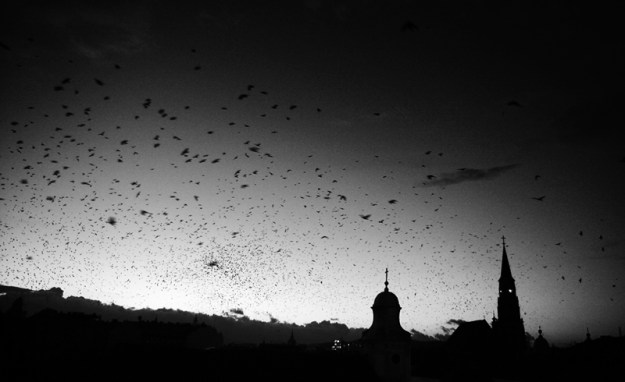
It may seem strange but Crows are some of my favourite birds and never before have I seen so many as when in Cluj.

I first wrote about them during a visit to the city back in September 2010. There were thousands of them, flying in their squadrons in two streams. They took many minutes to fly past and I wondered from whence they had come and where they were flying to. During my last visit I was told that they spend their days at the city rubbish dump and fly back into the city in the evening. So the mystery was solved, and indeed confirmed by others in the pictures below.

This morning we had some crows in our garden and I thought of those Cluj crows once more. To my delight I found some photographs  after a Google search and thought I would share them with you.

The poetry of Ted Hughes is also amongst my favourites. His 1970 collection Crow includes a number of dark poems where the crow is often portrayed as a dark protagonist. In 1985 Hughes explained his inspiration for Crow:

“Crow grew out of an invitation by Leonard Baskin to make a book with him simply about crows. He wanted an occasion to add more crows to all the crows that flock through his sculpture, drawings, and engravings in their various transformations. As the protagonist of a book, a crow would become symbolic in any author’s hands. And a symbolic crow lives a legendary life. That is how Crow took off.”

You can listen to Ted Hughes’ wonderfully soft Yorkshire voice as he reads from Crow in this You Tube video.

The copyright of the photographer’s below is acknowledged.

Crows over Cluj-Napoca by Dragos Ludusan

Crows across Cluj by theophilus_austin

A Winter Afternoon in Cluj

Between the Woods and the Water

I am very fortunate to be able to visit Cluj quite often. We all know a little about the city from Paddy’s visit here during his brief love affair with Angéla in the summer of 1934. Today I find myself here again after a busy week in my company office. It is a cold overcast day, and the low cloud seems to make the sounds of the city travel a long way; the squeals of children playing, dogs barking and the famous Cluj crows cawing as they weave their way between the apartment blocks and the spires and domes of Cluj’s many churches.

Romania is not a country that many people visit on holiday, and Cluj is almost certainly not on many lists. I fail to understand why this is. You only have to visit the (open to public) Facebook page of Visit Romania and look at some of the incredible photographs to see that this country has varied and stunning scenery, and enough history on offer, from the Roman site at Parolissum, the artistic beauty of the painted monasteries of Bukovina or the wooden churches of Maramureş, and the castle of Hunyadi that Paddy visited during his walk south in the area of the Retezat on towards the Danube and the end of his journey as described in Between the Woods and the Water.

At its heart Cluj has wonderful Baroque architecture which dates from its heyday under the Austro-Hungarian Empire. Many of these buildings have fading, crumbling facades. The absence of western chain stores means that the streets are not despoiled by those so familiar signs. I may be wrong, but this general absence of branded outlets means that many Romanians (but to be fair probably only those that can afford it) still have a very individual sense of style.

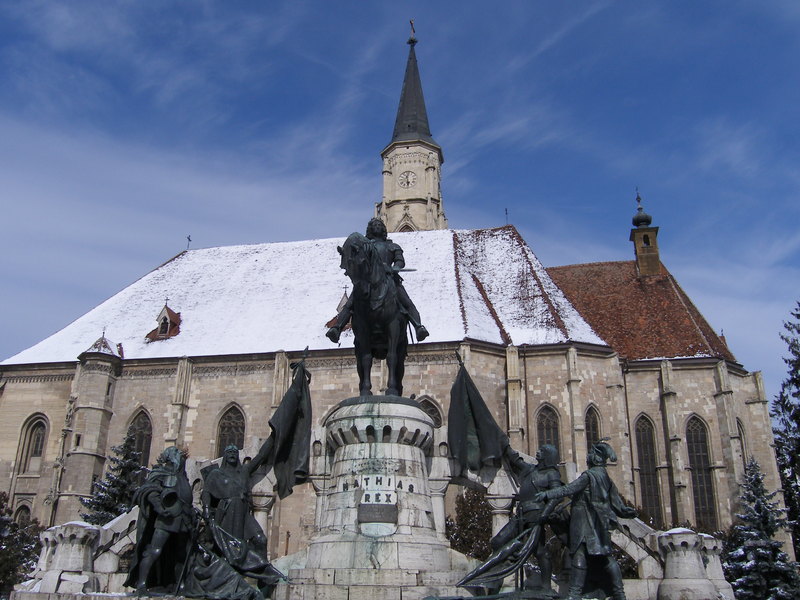
The statue of Matthias Corvinus

When one wanders just a few yards from the main roads in Cluj one enters a maze of smaller streets, many cobbled, with a myriad of bars, cafes and restaurants which all offer excellent value. Today I walked from the newly restored and very splendid statue of King Matthias Corvinus, past St Michael’s Church, towards Corvinus’ house. It is only a one minute walk. Paddy and Angéla stayed somewhere in those back streets within the sound of the bells of the church; quite where we shall probably never know. I too heard them ringing this evening as I walked to dinner.

Cluj is a very sociable place, possibly because there are something like 100,000 plus students here (an incredible number but that is what I have been told). It is also somewhere that makes you feel quite safe. I am sure it has its moments, but I have never encountered any problems and one feels safer here than in many places in England, particularly late at night.

What started out as just a short article about Cluj today, seems to have ended up as copy for the Romanian Tourist Board, and that is fine. In these difficult financial times, Romania offers a tremendous holiday alternative, and it remains low cost. So when making your plans for 2011 you could do worse than visiting this country, and possibly walking in some of Paddy’s footsteps. Romania could also do with the income. I call that a win win outcome.

Related articles:

Angéla, Paddy, István and Tom in Cluj-Napoca

Angéla and Paddy’s visit to Cluj-Napoca with pdf describing his visit

Links:

Facebook – Visit Romania


The forgotten Saxon world that is part of Europe’s modern heritage

The careful conservation of pre-industrial villages in Transylvania is Europe at its best, guarding the relics of its diversity

by Simon Jenkins

First published in The Guardian Thursday 1 October 2009

Between the collapse of the Ceausescu regime in December 1989 and the spring of 1990, half a million indigenous so-called “Saxons” fled Romania for West Germany. It was the most astonishing, and little reported, ethnic migration in modern Europe. In the seven towns and 250 villages of Saxon Land in southern Transylvania, no less than 90% of the German-speaking population packed its bags and committed eight centuries of history to memory. They drove west to a country few of them knew, enticed by the notorious “return to the fatherland” speech of the German politician, Hans-Dietrich Genscher.

The exodus left behind a deserted landscape the size of Wales, hundreds of square miles of rolling beech woods, bears, lush pastures and wild flowers, once home to the Dracula legend. Across it are dotted medieval grid-planned villages, with Lutheran churches, schools, dignified houses, barns and smallholdings, their customs and exclusivity reminiscent of the Pennsylvania Dutch. For 800 years since being invited by the Magyar kings to form a bulwark against the infidel, the Transylvania Saxons guarded their Germanic tradition. They spoke a High German said to be similar to ancient Luxembourgish. They embraced the Reformation and resisted Ceausescu’s concrete communism. All this ended abruptly in 1990.

While the people have almost all gone, the villages remain, colonised mostly by Romania’sbooming Gypsies. It is estimated that as many as a million may now occupy this part of Transylvania, possibly rendering it one day the only majority-Gypsy province. The result is the most exciting and daunting cultural challenge in Europe.

The village of Archita is lost in a Carpathian valley near the 17th-century town of Sighisoara, whose medieval walls and nine towers lie at the heart of Dracula country. The village’s fortified church stands like a castle in its midst, encircled by not one but two high walls, with musket holes and archers’ galleries intact. It was built to protect the citizens against Tartar raids and still has its ham loft with hooks numbered for each house, an insurance against sudden siege. The interior displays its galleries, Protestant pulpit and baroque canopy. The churchyard is overgrown with unpicked plum and apple trees. From the rickety church tower the geometrical village plan reaches out into the surrounding woods. Wide streets and lime-washed, two-storeyed houses reflect the equal plots allotted to each Saxon family in the middle ages. Records show continuous family tenure from the 13th century to 1990. Just three Saxons remain.

The 18th-century town hall and school of Archita have fallen into dereliction. Since the families employed few servants there are no poor houses or suburbs. There is no water or sewerage and no tarmac roads. The village well and a few desultory horses and carts are attended by attractive Gypsy youths.

To the new inhabitants of these villages, the vanished Saxons represent an alien culture. But their ghosts flit round buildings that in most cases are unaltered since being converted from wood to stone in the 17th century. They are like the hill-station residences of British India, holding its genius loci in absentia.Ghosts linger too in the countryside round about, ironically preserved by Ceausescu’s order forbidding development beyond the confines of existing settlement. This yielded one of the most effective green policies in Europe, protecting miles of meadow and forest, now vulnerable to exploitation. The roads are already littered with loggers carting away loads of walnut, beech and oak.

Unesco has designated some of the Saxon churches as world heritage sites, as has the Romanian government, but not the villages. With no money for repairs and no enforcement, such designation carries little weight. There is thus a race to save the most endangered pre-industrial landscape in Europe from poverty-stricken newcomers understandably eager for modernity. One day these villages will be as treasured as those of the Cotswolds, Provence or Umbria, but until then they must pass through the valley of the shadow of possible death.

The response of the outside world to Saxon Land’s plight is uncertain. Money is seeping back. Some departed families have returned, some unhappy in exile, some as so-called “summer Saxons”, holidaying in their former homeland and hoping to capitalise on rising property prices.

I encountered one dedicated young German, Sebastian Bethge, in the dramatic hill village of Apold, labouring alone to restore the church interior with money raised in Berlin and elsewhere. A visiting pastor had just held a Lutheran service for a congregation of nine – four Romanians, three Hungarians and two Germans.

The EU is bringing infrastructure to some villages, even as it devastates their markets for milk and hops. Unesco has its designations. The Transylvania Trust has restored the castle home of the novelist, Miklos Banffy, whose Transylvanian Trilogy is so evocative of this region’s other, Hungarian, past. Britain’s Prince of Wales has bought and restored two Saxon village houses. But most international effort goes on hands-clean “awareness-raising”, on drawing up lists, holding conferences and restoring an occasional showcase palace. The most impressive venture is the London-based Mihai Eminescu Trust (Met), chiefly supported by the American Packard foundation. Its “whole village” concept is tailored to Saxon Land, yielding more than 600 projects in the past decade. A leading citizen is engaged in each village to glean what locals – now mostly Romanians and Gypsies – would like restored if money and expertise were available.

This is exemplary conservation practice. Work is carried out by local contractors, with some 130 craftsmen trained to restore Lutheran and Orthodox churches, schools, houses and barns. Nothing is too small, from patched barn roofs and re-plastered street facades to empty properties converted to guesthouses. Plastic bus shelters and concrete bridges have been replaced in wood.

A truly minimalist venture had a Gypsy in the village of Floresti asking for, and getting, a tiled roof over an appalling hovel shared with his wife, two horses and a mountain of manure. Virtually next door is a restored Evangelical church, its sun-bathed interior one of the most serene of any church I know.

In the 13th-century village of Viscri, the Met has undertaken 160 restorations led by its local leader, Caroline Fernolend, winning it the EU’s premier conservation award. Sewers were installed and a new kiln built to supply handmade tiles, operated by a local craftsman. The trust is even reinstating apple orchards and relaying a local narrow-gauge railway.

No such conservation can work against the grain of local consent or in the absence of local skills. Imported from outside, it will stir resentment and obstruction. The root cause of the Saxons’ exodus was starvation of the modern benefits of civilisation. These cannot be denied their successors.

Yet the conservation of town and village cultures across the sweep of Europe proves that ancient and modern can co-exist to the advantage of both. Such is the disregard of the past by other world continents that these survivors will one day be respected, valued and celebrated.

The Transylvanian Saxons ranked with the Mennonite Amish, the Patagonia Welsh and the Volga Germans among the dislocated tribes of Europe. They lasted a phenomenal eight centuries, leaving intact monuments of a culture distinct and yet integral to European history. If modern European union cannot guard such relics of its diversity it is not worth the name.

On the Pontic shores where the snowflakes fall

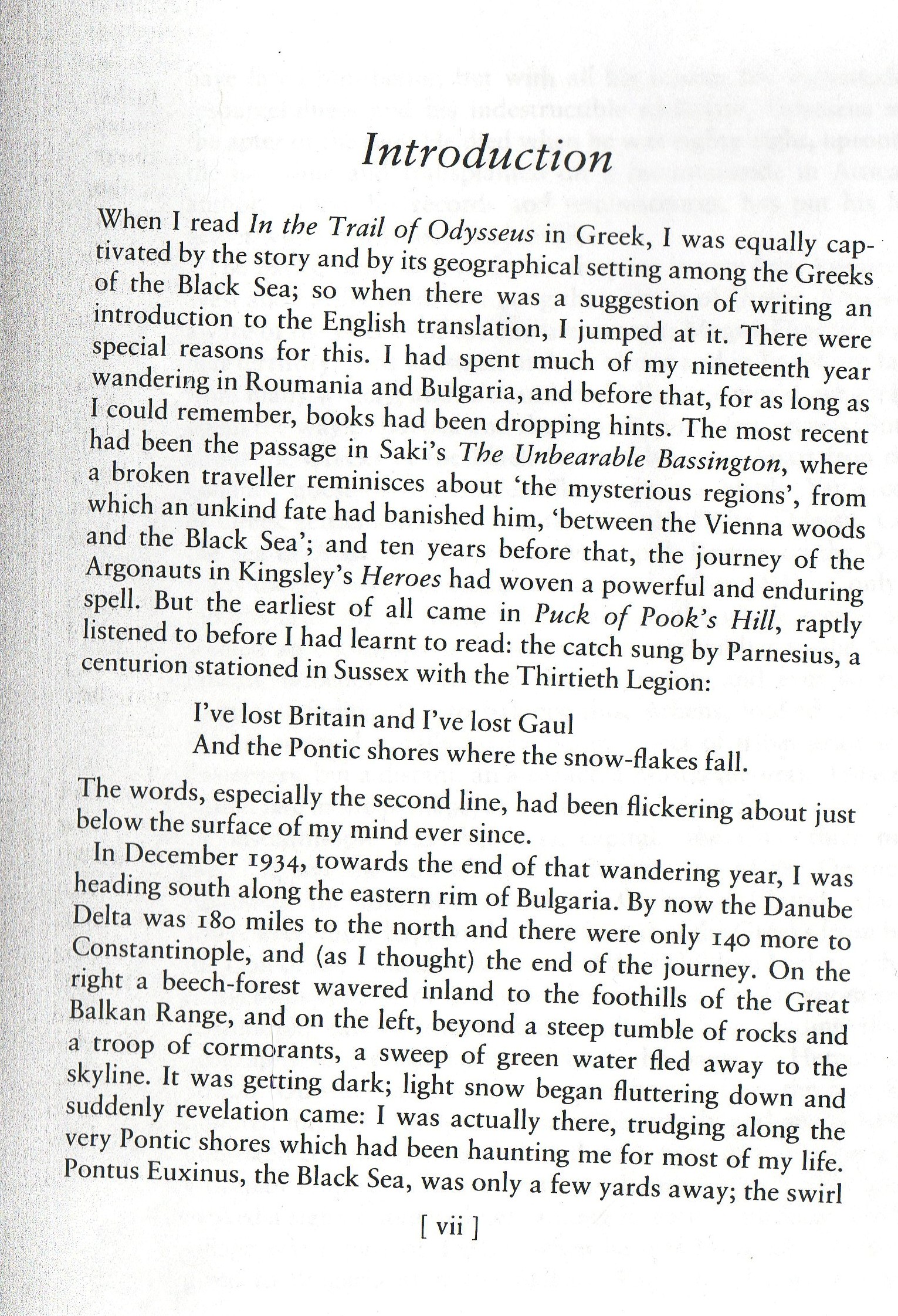
I think this is a rare treat, even for those of us who have read much of Paddy’s work. This introduction to In the Trail of Odysseus by Marianna Koromila is full of longing for the world at the edge of the Black Sea that he discovered in 1934 and which so soon was to disappear forever.

“The whole region seemed an enormous and mysterious antechamber to the whole Mediterranean, unbelievably remote and enigmatic, and ever so soon in danger of fading.”

It is the story of Yiankos Danielopoulis who died in 1987 at the age of 88. As a Black Sea Greek living through the 20th century his life was uprooted time after time, until at last he was able to settle in Mount Hymettos in mainland Greece in the 1950’s.

I have been sent some scanned copies of Paddy’s introduction, by blog corespondent James, to the English translation to the book which I hope you will enjoy and inspire you to purchase the last few copies of the book from Amazon!

To help you further, here is a short synopsis by John Colvin Body which appears to have been published in the Daily Telegraph in 1994.

“In the Trail of Odysseus by Marianna Koromila tr by Nigel Clive Michael Russell, L14.95 this modern-day “Odysseus” is Yiankos Danielopoulos, one of 12 Thracian children born in Vasiliko, a whitewashed Greek village of the Ottoman Empire in 1899, and dying in Attica 88 years later. His life has been compiled by Marianna Koromila from a privately printed family record that she acquired from his daughter. It reflects the turmoil of that region in the 20th century. Born under the Empire, Yiankos lived in Bulgaria, Romania, Russia, Turkey and Greece, surviving two nationalities, seven homes and 13 professions, all imposed by “the gale of the world”. Bulgarian violence, Bolshevik revolution, civil war and Communist take-over were his Eumenides. As a child, he “listened to the rattle of the pebbles as they were washed up by the waves”; saw woods, vineyards, wheat fields and boats unloading below his window on return from fishing. The Thracian traders and shipowners, with relations in all the Black Sea ports, he described as the seagulls which followed the fish. In winter, wolves descended from the mountains, threatening the village. “Union is strength,” said Yiankos’s father when the horses drove them off.

The Great Powers then changed lines on maps. Vasiliko came under the Bulgars, and life became untenable. Yiankos and his brothers moved to Constanza in Romania and opened a grocer’s shop. An admiral’s wife fell in love with one of the brothers. The shop received the navy’s warrant. Funds accumulated. Bulgaria then invaded and the family fled to Galatz (also in Romania) with their assets – 50 cases of macaroni. Yiankos dealt profitably in foreign exchange; money was made. But Galatz became an impossible place, what with bombing and Cossacks shooting holes in wine-cases and drowning in the alcoholic flood. The Danielopouloses escaped to Russia, packed like sardines in a stinking refugee train. Life in their new Russian home, Berdiansk, was lucrative until the Bolshevik and Anarchist massacres began, when the family escaped to Novorosisk in 1917, where the Russian fleet had scuttled. They steered clear of politics, which preserved them, but chaos came. The family escaped by tug back to Constanza, having profitably run cafe, shop and currency exchange in the middle of a revolution. Back in Romania, they enjoyed “party-time” – the annees folles of the 1920s – until the Crash of 1929. Thanks to family unity, they picked themselves up again, flourishing even during the German occupation of 1940.

But later, in 1950, when Soviet theft and odious oppression became intolerable, Yiankos, his wife and daughters left for Greece. They arrived in Mount Hymettos penniless, but went on to farm pistachio, orange, lemon and tangerine trees, cows, hens and vegetables. Yiankos had survived once more. Nigel Clive’s sparkling translation of Koromilos’s book is richly enhanced by Patrick Leigh Fermor’s introduction to that legendary world of the day-before-yesterday.”


Buy In the Trail of Odysseus at Amazon.

Page 1


Pages 2-3


Page 4


Related article:

The mystery of The Black Sea Cave


Friends of England – Cultural and Political Sympathies on the Eve of the War

This is a fairly academic article about the views of Hungarians towards Britain prior to the Second World War. I thought this worth of publishing on the blog as it rhymes with a lot of what Paddy tells us in Between the Woods and the Water, and he of course gets a mention.

First published in the Hungarian Quarterly.

In a Hungary on the threshold of war, committed to Hitler’s side, “Pro-English: by 1939, at the latest by 1940, this adjective would encompass many things: liberal, democratic, humanist, pro-Jewish, even Catholic on occcasion, anti-Nazi in every case.”1 Those who sympathized with the English had other characteristics in common, such as a respect for tradition and disdain for demagoguery of all kinds. Between the wars, sympathy for England was palpable especially in the aristocracy, in the upper middle classes and amongst the educated. Sympathy for English traits and behaviour offers an explanation, as does what was felt for Shakespeare, English literature and English culture in general.

There was also a remote historical parallel, occasionally stressed by the post-1919 counter-revolutionary regime: the near contemporaneity of Hungary’s Golden Bull (1222), the East European document resembling England’s Magna Carta (1215), the crown as an institution, and the role of the aristocracy. Needless to say, scant heed was paid to such matters in England by politicians or public opinion. They were curious at most. Hungary was a small and distant country. However, in Hungary this sympathy was deep and widespread, showing itself, among others, in the reception given to some contemporary English fiction, such as the novels of Somerset Maugham and Aldous Huxley, which enjoyed an extraordinary popularity here at the end of the thirties. The reasons were not purely literary, though. Sándor Hunyadi, a writer, wondered why in an article, and many readers wrote in to say they were fond of Maugham because they liked the English. Not the writer, or his works, but the English. In Hunyadi’s words: “Surely a good many British passports could be issued to people who are not British subjects, perhaps they cannot even speak English but, deep down inside, they sympathize with the English.”2 This sympathy is all the more noteworthy since, by the end of the thirties, the economic and military might of Nazi Germany had made its mark abroad, and the openly fascist Arrow Cross had made its presence felt in Hungarian politics. Against this, Great Britain was seen as the paradigm of parliamentary democracy, liberal and masonic ideals, and the City of London was believed to embody the power of partially Jewish capital. Centuries old institutions, along with British traditions, stood for the past, for all that which was said not to be modern or “of our time.”

Nevertheless, numerous intellectuals and politicia Continue reading

Angéla and Paddy’s visit to Cluj-Napoca

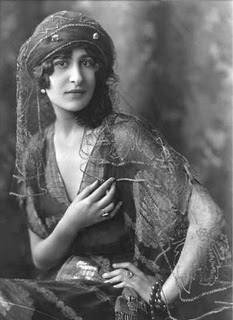
Balasha Cantacuzene

In response to requests from many of the citizens of Cluj who inhabit the pages of I Love Cluj on Facebook, I have scanned the pages which recount the story of Paddy and Angéla’s 1934 visit to Cluj in full.

This is taken from “Between the Woods and the Water”, the second volume of Patrick Leigh Fermor’s journey from London to Constantinople which commenced in December 1933 and ended with his arrival in Constantinople on New Year’s Day 1935. His time in Romania captures the beauty of the landscape, and the friendliness of the people be they aristocrat or peasant. It describes a time that would be lost forever due to the Second World War, which Paddy later described in an article for the Daily Telegraph as “Travels in a Land before Darkness Fell”.

His own extended sojourn in Romania was at Belani in Moldavia with the first love of his life, a young painter and Byzantine princess, Balasha Cantacuzene, whose family Paddy describes as part of an “old-fashioned, French-speaking, Tolstoyan, land-owning world. They were intensely civilised people.”

You can find pdfs of the story of the Cluj visit as follows (Cluj part starts page 143 but 142 gives you an introduction):

p142, p143, p144, p145, p146, p147 ………………. enjoy!

Related article:

Angéla, Paddy, István and Tom in Cluj-Napoca

Related category:

‘Between the Woods and the Water’

Angéla, Paddy, István and Tom in Cluj-Napoca


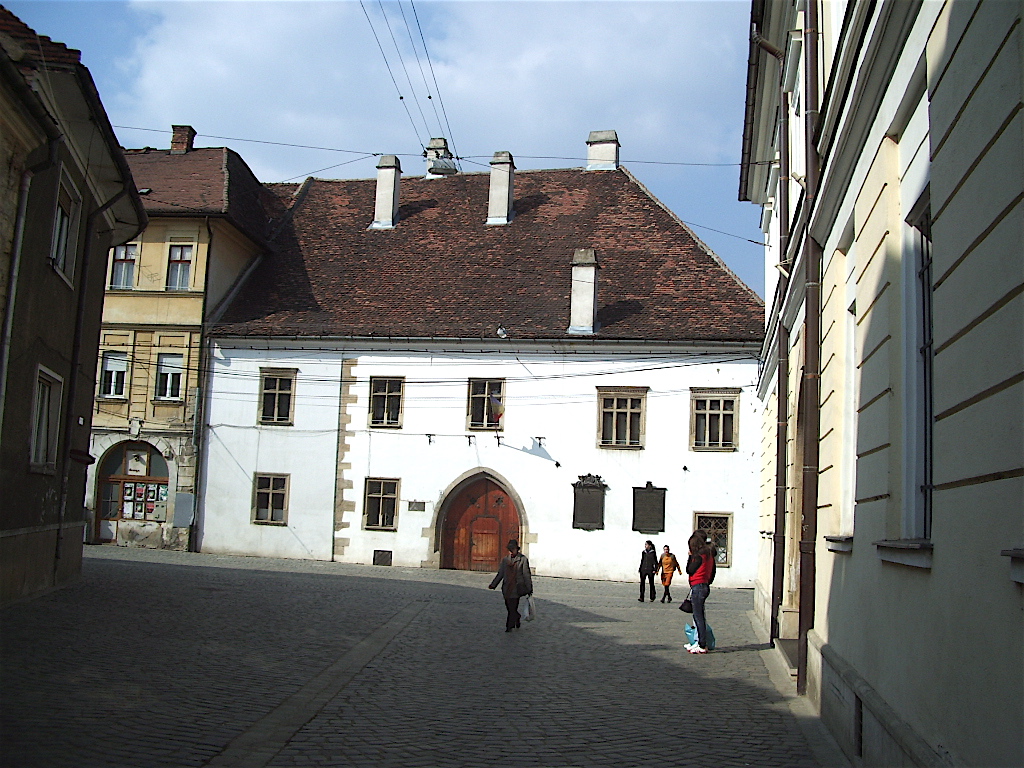
Matthias Corvin’s house Cluj-Napoca

If the lifespan of a crow can be up to thirty years, it is conceivable that the grandparents of the present day crows of Cluj observed Patrick Leigh Fermor and Angéla on their clandestine assignation to the city in 1934 when they were chauffeured by the understanding István. Their journey was a secret, but maybe the crows saw all and have passed on to their offspring the story of the young Englishman and the unhappily married Hungarian woman who was as ‘nimble as an ibex’.


As the sun set this evening I emerged from a restaurant near the Orthodox Cathedral to the sight and sound of thousands of crows flying westward at rooftop level, weaving in and out of the spires of the Cluj National Theatre. It was as if they were on some raid; they were in the stream, in squadrons of one hundred or more. I could neither see where they had come from, nor where they were going to, but this lasted for more than ten minutes and somehow it made me think of Paddy and Angéla.

The statue of Matthias Corvin dominates the square. St Michael’s church behind.

Cluj is today a fast growing city. The centre is dominated by crumbling Austro-Hungarian Baroque buildings. One can see that in 1934, before the darkness came that engulfed Europe and Romania, the pink and yellow painted walls would have been bright and welcoming to the small party that crept into town that warm August day.

Never missing an opportunity I have followed some of Paddy’s descriptions of his short stay in the city found in ‘Between the Woods and the Water’. He said that he and Angéla took a room near the house of Matthias Corvin who is a hero to both the Hungarians and the Romanians of Transylvania. This part of the old town has substantial houses and I wonder where in those cobbled streets, near the museum, they awoke, entwined, in their ‘handsome vaulted room’ to the sound of ‘recriprocally schismatic bells’. The bells would have sounded from the Gothic Saint Michael’s church in the Matthias Corvin square. His statue, which Paddy describes as magnificent, dominates the open space.

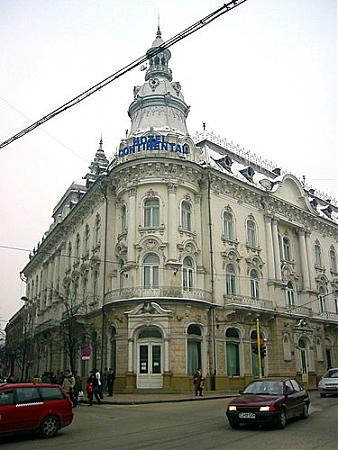
The New York/Continental Hotel

It was in a corner of this square that last night I set out on a search for the New York hotel, where the three of them had such fun and enjoyed an amazing cocktail, only surpassed, so István said, by the one called ‘Flying’ in the Vier Jahrszeiten bar in Munich. I was hoping that the secret of the cocktail had been passed down from generation to generation of barmen, but it was not to be. The hotel which is now named the Continental is closed, and the windows covered in posters proclaiming the Iron Maiden concert that took place last month to celebrate the success of the local football team, CFR-Cluj, in winning the Romanian league. It is a sad sight, but the building is nonetheless very grand with a turret on the corner facing the square and the Bánffy palace, which is now an art museum and next to the Melody nightclub with it’s huge neon sign, in the opposite corner.

So I did not get to sit in the seat of Patrick Leigh Fermor, nor drink his cocktail,  but instead walked in good company to my favourite bar in Cluj – Insomnia – and drank Ursus beer, whilst explaining to my Romanian friends Daniela and Vlad, why Patrick Leigh Fermor is the Greatest Living Englishman.

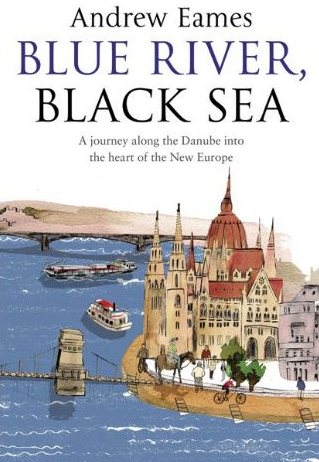
Blue River, Black Sea: A Journey Along the Danube Into the Heart of the New Europe

The following is a piece by Dimiter Kenarov from The Nation which contrasts the journey of Paddy along the banks of the Danube with the more recent account of Andrew Eames, recounted in Blue River, Black Sea. It is clear that if we were to try to follow the foosteps of Paddy that much has changed – I guess that much we knew – but that also the pace of change means that if we are to encounter the last feeble remnants of that post-Austro-Hungarian world, we had better move very fast. This is worth the read.

From Black to Black, a review of Blue River, Black Sea: A Journey Along the Danube Into the Heart of the New Europe
By Andrew Eames.

Every day, at three in the afternoon, I make a trip down the Danube. To travel from Germany’s Black Forest to Romania’s Black Sea takes a matter of minutes, so I try to enjoy myself as much as possible. I sink into a cushy armchair, rev up the stereo and embark on an epic voyage. “Information on the water levels of the Danube River, in centimeters,” the familiar voice on Horizont, the Bulgarian National Radio, announces with the deepest solemnity before reading out the relevant hydrographical values, first in Bulgarian and then in Russian and French. Vienna: 310 (+3); Mohács: 415 (+7); Novi Sad: 162 (-13); Vidin: 380 (+40); Giurgiu: 220 (0).

The captains of river vessels can easily map a course on the Internet, but the daily radio bulletin has remained a fixture in my life. For many years, listening to the fluctuations in the water levels of the Danube was the closest I could get to traveling abroad. Regensburg, Passau, Linz, Vienna: these names mesmerized me. Even places like Bratislava and Budapest, comrades in arms against the decadent West, had the ring of myth to a boy growing up in Bulgaria. Remembering his childhood in the Bulgarian river port of Ruschuk (now Ruse), Elias Canetti wrote, “There, the rest of the world was known as ‘Europe,’ and if someone sailed up the Danube to Vienna, people said he was going to Europe.” If people in Canetti’s immediate circle, at the beginning of the twentieth century, still had the occasional opportunity to waltz up to the palaces of the Habsburgs and back, however, the “Europe” I imagined in the 1980s existed only in a galaxy far, far away. To travel up the river as a tourist during the cold war required visas, special permissions, bureaucratic ballast. To swim across it, a negligible distance of a few hundred meters, was to risk both drowning and the bullets of border guards. For nearly fifty years the Danube was a demolished bridge, a liquid roadblock. The wall may have been in Berlin, but the truly impassable one was an invisible dam on the Danube, somewhere between Vienna and Bratislava.

The Danube—or Ister, as the ancient Greeks called it—is a natural highway of nearly 3,000 kilometers. “The greatest of all the rivers which we know,” declared Herodotus. “A path for the spirit to follow,” wrote Hölderlin, following the footfalls of the Greeks in his hymn “The Ister.” Human tribes traveled west against the current, colonizing the core of the continent, gradually shaping it. Before the Americas, there was Europe. The Romans made a few feeble attempts to bring traffic under control by turning the river into the fortified frontier, or limes, of their empire, but without much success. South of the Danube civilization cowered; in the north, the barbarians bided their time.

There is probably no other geographical element of Europe that has absorbed more political weather than the Danube. Unlike the Russian Volga and the Franco-German Rhine, it has served many masters, as a shield or a spear. In 1683, by the walls of Vienna, John III Sobieski and Charles of Lorraine routed the armies of Kara Mustafa, marking the beginning of the end of the Ottoman Empire. Not long thereafter, in 1704, the Duke of Marlborough and Prince Eugene of Savoy vanquished the Franco-Bavarian alliance at the Battle of Blenheim, an important event in the War of the Spanish Succession. Near the river town of Ulm, Napoleon forced the Austrians to surrender with barely a fight. And Hitler’s Drang nach Osten—yearning for the East—had a strong Danubian stink. “Do not forget,” the elderly Heinrich Heine wrote to the young Karl Marx, “the difference between water and a river is that the latter has a memory, a past, a history.”

It has taken twenty years of European integration for the memories of the cold war to seep away. Quietly meandering across ten countries—Germany, Austria, Slovakia, Hungary, Croatia, Serbia, Bulgaria, Romania, Moldova and Ukraine—and running softly past more than fifty-five towns and cities, including four capitals, the Danube is once again a major route for trade and tourism, diluting national and political borders and linking numerous shoreline communities into a single organism. The Rhine-Main-Danube Canal, completed in 1992, allows ships to navigate passage from the North Sea to the Black, chugging through the heart of the continent. The river’s delta, with its sprawling network of lagoons and marshes, is a Unesco World Heritage Site and an important bird sanctuary—with its own environmental problems, of course. Today, to sail along the Danube is to see the new face of Europe, old as it is. And, luckily for me perhaps, the daily radio bulletins on Horizont are no longer my only means of travel.

Traveling the Danube became a fad in 1829. That was the year two Englishmen, John Andrews and Joseph Pritchard, founded the First Danube Steamship Company, which lured scores of elated pleasure seekers. “A motley crowd on board, such perhaps as never met together on the deck of a steam-boat before,” wrote the Irish journalist and literary editor Michael Quin about one of those early voyages. Standing among Austrians, Moldavians, Jews, Hungarian nobles and Tyrolean emigrants, he traveled in style down the river from Pest (Budapest) to the Ottoman town of Ruschuk. It was a thrilling but perilous undertaking. Unlike the well-trodden path of the Grand Tour, with its picturesque Parisian streetscapes and Florentine galleries, the Danube offered a wilder ride for people with money and a taste for adventure. Although its waters flowed across half the continent, knowledge of the river was scarce and scattered, especially when it came to portions under Ottoman control. Europe was split in two long before the cold war, and the Danube was the main gateway into its eastern, darker territories. The course of “civilization” had gradually reversed directions.

William Beattie, another of those early steamboat passengers, portrayed that division with typical Victorian bigotry. East of Budapest, he wrote in his 1844 travelogue The Danube, the tourist “feels as if he were taking farewell of civilization, and entering upon a vast primeval desert, where man is still a semi-barbarian; and where the arts by which he converts to his use the natural products of the earth are still in their infancy, or wholly unknown.” As far as Beattie was concerned, Eastern Europe might as well have been an island in the middle of the Pacific. Quin was similarly dismayed by the seemingly crude ways of life he encountered but a little bit more optimistic in his vision of the future. He praised “the miracles of the age of steam” and then blithely prophesied, “Those countries, which have hitherto seemed scarcely to belong to Europe, will be rapidly brought within the pale of civilization…and new combinations…will be created, which may give birth to important changes in the distribution of political power on the continent.” He was right, of course: steam did alter the political landscape of Eastern Europe. (Could it be that James Watt was personally responsible for the fall of the Ottoman Empire and the whole contemporary history of the continent?) However, Quin’s journey down the Danube was also a reassertion of his cultural identity and his sunny view about technological progress. As the historian Larry Wolff pointed out in his seminal work Inventing Eastern Europe, “It was Western Europe that invented Eastern Europe as its complementary other half.” And the Danube was the road most inventors took.

So many writers have traveled the Danube that their tributary ink, if channeled into a single stream, would turn the water black. From the Italian naturalist and geographer Luigi Ferdinando Marsigli, who professed to have mastered “the anatomy of the river” and then published in 1726 his magisterial six-volume Opus Danubiale, to the contemporary Hungarian writer Péter Esterházy, with his playful travelogue The Glance of Countess Hahn-Hahn (Down the Danube), published in 1991, the outflow of words has been endless. To look for the authentic Danube would be futile, for nobody can describe the same river twice. “It is I who will say what the Danube is,” Esterházy’s protagonist, the Traveler, insists, as so many others before him have: Germans and Austrians, Hungarians and Russians, as well as the odd Serbian, Romanian and Bulgarian. For some reason, however, it was the British and a few American explorers, outsiders with ever-roving empirical eyes and an insatiable appetite for the foreign, who frequently attempted to distill the Danube’s essence. Some, like Quin and Beattie, were deeply prejudiced against the world they were about to encounter. Others, like the American painter Francis Davis Millet, who paddled downriver in a canoe in 1891, wrote about the local people and their environs with sympathy and understanding. Then there were those who transcended the ranks of mere travelers to join the great writers.

Patrick Leigh Fermor is the best of the lot. In the winter of 1933, at 18, he set out on foot from Rotterdam toward Istanbul—or Constantinople, as his romantic imagination insisted. With just a rucksack on his back and two books in hand—The Oxford Book of English Verse and the poems of Horace—he traversed the better part of the pre-war continent “like a tramp or a pilgrim or a wandering scholar.” His trek along the Danube made up only one leg of his amazing odyssey, but it was the most remarkable one. Poring over his maps and trying to decide whether to head for sunny Venice or press farther east, he writes, “Just in time, the windings of the Middle and the Lower Danube began to reassert their claims and the Carpathians and the Great Hungarian Plain and the Balkan ranges and all these mysterious regions which lay between the Vienna Woods and the Black Sea brought their rival magnetisms into play. Was I really about to trudge through this almost mythical territory?” Continue reading

Walking Paddy’s Route in Mitelleuropa: Frugal Europe, on Foot

It’s time to be honest now: who amongst the regular readers of this blog, or even those that stumble across us because they have read ‘A Time of Gifts’ or ‘Between the Woods and the Water’, has not thought about following Paddy’s 1930’s route? For myself it is a definite goal. It is an ambition; probably a passion. I had come across the following article but have been inspired to re-produce it by Blog reader Matt who says he first got into Paddy’s work when stationed in Baghdad:

Tom, The New York Times travel writer, Matt Gross, just did an article on PLF. He walked the Vienna to Budapest stretch recently … I first read PLF while stationed in Baghdad four years ago and revisit him often. Living in Heidelberg, I’ve been able to visit some of the places he mentioned specifically and have recommended A Time For Gifts to many of my fellow Americans living here or travelling to Europe. As I’m in the process of moving back to the States, it will be a few years before I’m able to pick up the thread of his travels. I’m not sure if you’re in contact with PLF, but pass him the respects of this Yankee officer. Matt

Frugal Europe, on Foot

First published in the New York Times,  May 23, 2010

The article is written by New York Times’ Frugal Traveler columnist Matt Gross who attempted to follow in the footsteps of Patrick Leigh Fermor. Like all good stories it begins ….

ONCE upon a time, a young man went for a walk. It was December 1933, and an 18-year-old Englishman named Patrick Leigh Fermor put on a pair of hobnail boots and a secondhand greatcoat, gathered up his rucksack and left London on a ship bound for Rotterdam, where he planned to travel 1,400 miles to Istanbul [Ed: Constantinople!] — on foot. He had virtually no money; at best, he’d arrive in, say, Munich to find his mother had sent him £5. But what he did have was an outgoing nature, a sense of adventure, an affinity for languages and a broad network of friends of friends.

 “If I lived on bread and cheese and apples,” he later wrote, “jogging along on fifty pounds a year like Lord Durham with a few noughts knocked off, there would even be some cash left over for papers and pencils and an occasional mug of beer. A new life! Freedom! Something to write about!”

 Something to write about indeed! The books he produced from the yearlong journey — “A Time of Gifts” and “Between the Woods and the Water” — are gorgeously rendered classics that have led many to call Mr. Leigh Fermor, now 95, Britain’s greatest living travel writer. But to my mind, he’s always had another title: the original Frugal Traveler — the embodiment of that idea that, though a wanderer may be penniless, he doesn’t have to suffer.

 And Mr. Leigh Fermor never suffered, thanks to the miracle of human generosity. Peasants gave him baskets of eggs and swigs of raspberry schnapps. Small-town mayors found him beds. The lingering nobility of Europe put him up in their castles, invited him to balls and lent him their horses. When Mr. Leigh Fermor did sleep rough — in hayricks and barns or on the banks of his beloved Danube — he did it by choice, not because (or not merely because) poverty required it. He knew, even at 18, that the world is an experience to be savored in all its multifarious incarnations.
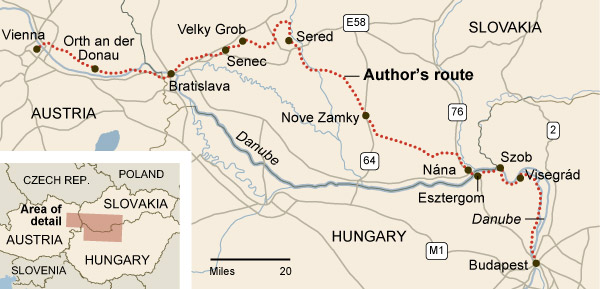
Matt Gross' route

Could a young person (is 35 still young?) with strong legs and little money find the same spirit of hospitality that Mr. Leigh Fermor encountered some 76 years ago? At the end of March, I set out to find the answer. With only two weeks free, my plan was to walk from Vienna to Budapest, a 180-mile route that would connect the old poles of the Austro-Hungarian Empire and track Mr. Leigh Fermor’s trail as closely as possible, taking me along the Danube to Bratislava, the Slovakian capital, and across the plains of Slovakia south to Hungary — through three countries whose languages, cultures and histories could not be more different, or more intertwined.

It was tempting, the day I arrived in Vienna, to just walk east from the airport, but I couldn’t completely skip the Austrian capital, where Mr. Leigh Fermor had spent three weeks among the “crooked lanes” and “facades of broken pediment and tiered shutter.” And so I followed his lead, going into the imperial crypt, where the grandest members of the Hapsburg family lay entombed in elaborate sarcophagi, and into the museums, although I shied away from the most famous in favor of oddities like the International Esperanto Museum. And I luxuriated in storied places like Cafe Alt Wien and Cafe Bendl.

But after two nights in Vienna, I was restless. So I crossed the Danube, put on my 45-pound pack and took off down the Donauradweg, a well-kept biking trail that runs from the river’s source to its mouth at the Black Sea. To my right, the Danube, more green than blue, sparkled in the cool sunlight, and I encountered fishermen tending their rods, elderly sunbathers, nordic hikers poling along and cyclists speeding in both directions.

This first day, I figured, I’d take it easy and do only 15 miles. Ideally, I’d need to hit 18 miles a day — about six hours of walking — to reach my goal. It seemed reasonable, especially with the terrain so uniformly flat. The path, sometimes dirt, sometimes paved, would often stretch so far and straight that I couldn’t imagine I’d ever reach the end, and then I’d finally hit a slight turn and face the same thing: an art-school lesson in perspective, complete with the first low foothills of the Carpathians at the vanishing point — and a scampering rabbit to remind me this was no still life.

Even with such straightforward terrain, there were snags. An attempted shortcut through a fuel depot left me with minor scratches and an extra three miles. But such mistakes have a way of turning out for the best. Had I stayed on the trail, I would have never crossed paths, two hours later, at the edge of Donau-Auen National Park, with Jean-Marc and Marie, newlywed French cyclists who stopped to say hello when they saw a lone hiker in the middle of nowhere. They were taking an extended honeymoon: a two-year bicycle journey from their home in Paris — to Japan!

“Do you know where you’re staying tonight?” I asked. They didn’t. I told them to meet me at Orth an der Donau, a small Austrian town a couple of miles farther down the Danube, where I had arranged for a place to stay via CouchSurfing.org. Maybe, I said, my host could find them somewhere to pitch their tent.

THE host, Roland Hauser, whom we met in front of Orth’s impressive castle, did better than that. He invited them home to his dreamland of soft beds and hot showers. Roland, 26, had traveled from California to Southeast Asia to New Zealand, and his German-accented English was peppered with words like “sí” and “bueno.” That evening, we cooked spaghetti Bolognese, nibbled Südtirolean ham and drank big bottles of beer. I went to sleep marveling at our extraordinary, Fermorian luck.

In the morning, after coffee, I threw out my underwear. This was a strategy to lighten my load — bring old undies and get rid of them day by day. Frankly, I should have done that with everything, as the pack was needlessly heavy. Along with two weeks’ worth of shirts, I had an ultralight down jacket, a waterproof shell and rain pants. A tent and sleeping bag. One pair of jeans and lightweight canvas shoes to change into at day’s end; nothing worse than walking 20 miles and spending the evening in the same clothes. And I packed Mr. Leigh Fermor’s books and Claudio Magris’s “Danube,” which I never had time to read. And my computer and camera gear — work necessities, alas.

When I set off, I was wearing my typical walking outfit: khaki pants by a company in Portland, Ore., called Nau; waterproof running sneakers by Lafuma; good socks (as important as good shoes); and a long-sleeved cotton shirt.

The walk began well. My feet were tender, but the flatness of the Marchfelddamm, a high berm that doubled as biking path and flood deterrent, ensured that I wasn’t struggling. This was the heart of the Donau-Auen National Park: forests of thin trees broken by occasional streams flowing to the Danube. At first, I appreciated the play of light on the water and between the trunks, but hour after plodding hour of unchanging scenery soon became mind-numbing, and I simply marched, putting one foot in front of the other and watching for kilometer markers. It would be 13 miles before I could stop for lunch, and another 10 before I reached my day’s goal: Bratislava.

But there’s a funny thing about long walks. With patience, all those steps add up, and by 2 p.m., I’d crossed a bridge over the Danube and settled into a cafe in the stately town of Hainburg, where an open-faced baguette pizza and glass of beer gave me the courage to face the miles ahead. And soon I found myself trudging along the shoulder of the small highway with cars flying past — and missing the monotonous near-silence of the forest.

Not far off, I could see Bratislava’s hilltop castle — in Mr. Leigh Fermor’s era, a burned-out wreck worked by prostitutes but in the 1950s rebuilt as a stately white-and-red palace — and it teased me with its apparent nearness. Still, I had far to go, past a derelict border post, and through three miles of snaking bike paths, before I crossed the Danube again and was in the heart of Bratislava’s old town, all cobblestones and tile roofs and sidewalk cafes.

After checking into the Hotel Kyjev — a 1970s tower turned budget boutique — I checked myself out: I wasn’t sore, out of breath or even tired. I did have blisters on my feet, but they were easily treated: puncture, drain, clean, bandage. My ankles, however, were terribly swollen, the peroneal tendons in particular, a result (I think) of how my body mechanics had altered with the weight on my back. I popped some ibuprofren, took a shower, then hobbled outside for dinner.

It was the Friday during Passover, and like any wandering Jew, I wanted a Sabbath meal. And thanks to Chabad, the Hasidic Jewish outreach organization, I got one, at the home of the transplanted American rabbi Baruch Myers. He was only too willing to share his food (cucumber salad, gefilte fish), his friendship and his family, including a battalion of adorable children who cheerily walked me through the Passover story.

It wasn’t just this heartfelt welcome that got to me; it was the very existence of a Jewish community in Bratislava. Back in his day, Mr. Leigh Fermor wrote, the Jews “were numerous enough to give a pronounced character to the town.” No longer. The Holocaust had reduced the Jewish population to, in Rabbi Myers’s estimate, 1,000 people. There was a synagogue, a few kosher restaurants, a Jewish museum and even a pension, but few visitors today would see in Bratislava a Jewish-inflected city.

On Saturday, partly inspired by the rabbi and partly because of my feet, I rested and contemplated the future. I had walked 40 miles so far, and if my ankles were any indication, there was no way I’d make the remaining 140. Unless … If I took a train a short way — say, 15 miles northeast — I could certainly walk another 10 miles. I’d be breaking my rules, but those rules were arbitrary. Continue reading

Philhellene’s progress: The writing of Patrick Leigh Fermor

As you know I trawl the net for Paddy related material to create the best online source of information about PLF and his friends and associates. Some of you may have come across this essay that attempts to analyse Paddy’s style and his literary achievement. In my view it is just one of many that emphasise how great the man is and how unequalled is his prose.

First published in New Criterion, Jan, 2001 by Ben Downing

I have carried the soldier’s musket, the traveler’s stick, the pilgrim’s staff. –Chateaubriand (what a great quote for Paddy!)

The captive must have been exhausted and afraid, but when, on the fourth day of his grueling forced march across Crete, he saw dawn break behind Mount Ida, the sight was so beautiful that it brought to his lips the opening of Horace’s Ode I.ix: “Vides ut alta stet nive candidum/ Soracte,”(1) he murmured. Then, just as he trailed off, one of his captors came in to take the poem over, reciting the rest of its six stanzas. At this, the captive’s startled eyes slanted down from the peak to meet those of his enemy, and, after a long thoughtful silence, he pronounced, “Ach so, Herr Major.” For the captive was a German soldier–the commander of the island’s garrison, no less. General Karl Kreipe (to give him his name) had been abducted on April 26, 1944 by a band of Greek guerrillas led by two English commandos. Over the next three weeks, the kidnappers picked their way across Crete, eluding the thousands of Nazi troops who hunted them, until eventually they were met by a British boat and whisked to Cairo, where Kreipe was handed over and the two commandos promptly awarded the D.S.O. One of these men was W. Stanley Moss, who in 1950 published a riveting account of the escapade, Ill-Met by Moonlight, later filmed by Michael Powell. The other was a certain Patrick Leigh Fermor. Disguised as a shepherd and (like Zeus in his Cretan boyhood) living largely in caves, he had spent much of the previous two years on the island organizing the resistance. Leigh Fermor it was who finished the quotation.

But where had he, who’d never completed high school, learned Horace so well? Had Kreipe asked him this, Leigh Fermor could have answered, savoring the irony, that he’d committed the odes to memory during his teenage Wanderjahr a decade earlier, when, just after Hitler’s rise to power, he’d walked clear across Germany (among other countries) with a volume of Horace for his vade mecum, often reciting the poems to himself as he tramped. About that experience he’d not yet written a public word, and would not do so for many more years. Similarly he held off recounting his aubade with Kreipe. At last, however, in the 1970s, he broached the subjects of his continental traverse and, in an aside to that account, of his fleeting bond with Kreipe. Some things are best waited for: the book in which Leigh Fermor set these matters down, A Time of Gifts (1977), along with its sequel, Between the Woods and the Water (1986), represent not only the capstone of his career but, in my opinion, the finest travel books in the language and a pinnacle of modern English prose, resplendent as Soracte or Ida in deep snow.

The deplorable fact that most Americans, even well-read ones, have never even heard, as I also had not until recently, of a figure who in Britain (to say nothing of Greece, where he lives to this day) is revered and beloved as war hero, author, and bon vivant; who is, in Jan Morris’s words, “beyond cavil the greatest of living travel writers”; and who, in those of the historian John Julius Norwich, “writes English as well as anyone alive”–all this spurs me to correct our oversight of the sublime, the peerless Patrick Leigh Fermor.

His turbulent early life is recounted in the introduction to A Time of Gifts. Shortly after his birth in 1915, his mother and sister went to join his father in India, while he was left behind “so that one of us might survive if the ship were sunk by a submarine.” For four years he was billeted with a Northamptonshire farming family, an experience that proved “the opposite of the ordeal Kipling describes in Baa Baa Black Sheep.” A halcyon period, this, but the taste for boisterous freedom he acquired in the fields made for trouble later on: “Those marvelously lawless years, it seems, had unfitted me for the faintest shadow of constraint.” Especially intolerable to him were academic strictures of any kind, and there ensued a long series of dust-ups and expulsions, hilariously related. At ten he was sent to “a school for difficult children,” among which misfits he lists

the millionaire’s nephew who chased motorcars along country lanes with a stick, the admiral’s pretty and slightly kleptomaniac daughter, the pursuivant’s son with nightmares and an infectious inherited passion for heraldry, the backward, the somnambulists … and, finally, the small bad hats like me who were merely very naughty. Continue reading

The Long Walk – song about Patrick Leigh Fermor

A personal tribute to PLF from a fan. A song about Paddy’s long walk to Constantinople in “A Time of Gifts” and “Between the Woods and the Water”.