From The Times obituary section:
Magouche, died at home on 2nd June 2013. Funeral at 1pm, 13th June with refreshments after at St Mary’s, Paddington Green, London W2 1LG.
Times link

From The Times obituary section:
Magouche, died at home on 2nd June 2013. Funeral at 1pm, 13th June with refreshments after at St Mary’s, Paddington Green, London W2 1LG.
Times link

Arshile Gorky and Magouche or Mougouch
I have received word of the death of Xan Fielding’s wife, Agnes “Magouche” Fielding. She had apparently been ill for some time and I am informed that she died on 2 June 2013. We know little about Magouche who was married to Paddy’s very dear friend Xan until his death in Paris in 1991. This article tells us much more and is by her step daughter, the art historian and writer, Hayden Herrera.
First published in Vogue and reformatted for Vogue.com December 2009.
The painter Arshile Gorky’s relationship with his wife, “Mougouch,” was passionate, turbulent—and misunderstood.
I grew up surrounded by the paintings of Arshile Gorky, one of the greatest American artists of the twentieth century and the subject of a current retrospective at the Philadelphia Museum of Art. The paintings belonged to my stepmother, Agnes (nicknamed Mougouch), and they gave me hints not only about Gorky but about who Mougouch was and had been in the past. Full of searing colors, peculiarly animate shapes, and energy-driven lines, they moved me in ways I did not understand. Since then, I have looked and looked at Gorky’s work. I even wrote a biography of Gorky in order to try to figure out why he painted the way he did. Still, his work remains a mystery. That was the way he wanted it.
The specter of Gorky came into my life in the summer of 1948, when my father, a painter named John C. Phillips, met Agnes Gorky at a party in New York City. The host took my father aside and said, “Be nice to Mougouch. Her husband, Arshile Gorky, just died.” My father was happy to comply, for Mougouch was a beautiful and vibrant 27-year-old with long brown hair, a sensuous mouth, and large eyes that held a hint of mischief. Her responsiveness and her blend of boldness and femininity made her a magnet to men.
In the months that followed their meeting, my father and Mougouch fell in love. In December, together with her two young daughters, Maro and Natasha, they sailed for Naples and finally settled in France. My older sister and I learned about our father’s new family from photographs he sent us at our boarding school. During summers on Cape Cod we came to know our stepmother and our new sisters, who called our father “Daddy.” Compared with our previous stepmother, Mougouch was astonishing in her affection and her sense of fun. She called us “darling,” and I was entranced by her swift, graceful walk and her melodious voice.
When to my delight my father returned with his family to the United States and bought a house on Beacon Hill in Boston, my mother, who lived in Mexico, sent me to live with them. Mougouch was so motherly that when my baby sisters Antonia and Susannah were christened at Boston’s Trinity Church, I decided to be christened with them so that she could be my godmother. Our house in Boston was full of Gorky’s art books and, even better, his art. His presence was alive there, for Gorky remained a powerful figure in Mougouch’s world. Ten-year-old Maro, who herself became a painter, talked about her father incessantly, holding on to the image of his genius. She insisted that with his Armenian background, he was a much more compelling figure than my proper Bostonian father. We would try to decode Gorky’s imagery. Some works had almost cartoon-like lines that nearly coalesced into recognizable creatures. In one, we definitely discovered Bugs Bunny.
Mougouch was born Agnes Magruder in 1921, the eldest daughter of a naval officer and a mother who was descended from the renowned neoclassical sculptor Harriet Hosmer. Agnes’s childhood was full of travel—school in Washington, D.C., then the Hague, Virginia, and finally Boston, where she was sent to live with her dying grandmother and where she fell in love with painting. “My mission,” she explains, “was to cheer up my grandfather and his gloomy house overlooking the Charles River.” Her mother thought college unnecessary, so Agnes finished school in Switzerland. When her father was posted to Shanghai in 1940, she was so rebellious—she spent the night with a young diplomat and broadcast her fascination with Chinese Communism—that her parents packed her off to college, after all, in Iowa City. From there, she took a bus to Manhattan and enrolled at the Art Students League, only to quit for a typing job at a magazine called China Today. What she remembers about this period was her extreme loneliness. Every day on the way to work she said hello to the man behind the newsstand just to have a human exchange.
In February 1941, Willem de Kooning and his future wife, Elaine Fried, told Agnes that she ought to meet de Kooning’s great friend Arshile Gorky. Elaine described Gorky as a “terrible show-off who sings and dances and makes everyone dance in a circle waving a handkerchief.” A few days later Gorky stopped by de Kooning’s studio and said he wished he had a strong American girlfriend like Elaine. Elaine persuaded him to come with them to a party where they would introduce him to a nice blonde American girl. At the party, Agnes remembers, she sat on a bench between de Kooning and “a man with a mustache who was very quiet and rather pokey.” She was still waiting for the exotic stranger to appear when most of the guests had departed. On her way out, the man with the mustache stopped her and said in his accented English, ” ‘Miss Maguiger?’ And I said, ‘Oh, Gorky!’ ” He had expected a blonde, and she had expected an extrovert. They went to a coffee shop, and Gorky asked her so many questions that she finally emptied her handbag onto the table to give him a picture of her identity.
The following evening he took her to an Armenian restaurant. Soon they saw each other daily, and he gave her the name Mougouch, which he said meant “little mighty one.” When Gorky identified the welts on her stomach as bedbug bites, he moved her to a new apartment, whose skylight he scrubbed so thoroughly that the putty collapsed and rain poured in. The upshot was that she moved into his studio on Union Square.
That summer Gorky was to have an exhibition at the San Francisco Museum of Art. He and Mougouch drove across the country with Gorky’s good friend the sculptor Isamu Noguchi. When he and Noguchi argued about clouds, in which Gorky was absolutely certain he saw peasant women, Mougouch sided with Noguchi, and Gorky was furious. Crossing a bridge over the Mississippi, he became so angry that he ordered Noguchi to stop the car. He was going to walk back to New York. “I went after him,” Mougouch recalls. “He almost threw me into the Mississippi River!”
Upon their arrival in Los Angeles, Gorky was in a pique because the hotel was too expensive. Exhausted, Mougouch went to bed. Noguchi came in to say good night, and Gorky, in a fit of jealousy, burst into the room and dumped a bagful of lawn clippings on top of her. Mougouch insists that “there was not a murmur of electricity between me and Isamu,” but the critic Katharine Kuh suspected “a flirtation on Noguchi’s part.” In fact, both Mougouch and Noguchi were extremely seductive. Mougouch was brought up to be amusing and articulate and to make whomever she talked to happy. Gorky, reared in the Armenian province of Van in Ottoman Turkey, was highly puritanical. He did not understand that for Mougouch, flirtation was simply part of good manners. To this day, as a great-grandmother, she is an irrepressible flirt with men, women, children, and animals.
In September Mougouch and Gorky were married in Virginia City, Nevada, scandalizing her patrician family. She was 20. Gorky, who lied about his age, was probably about 41. They bought a curtain ring at Woolworth’s, found a justice of the peace, and said their vows. After drinking champagne in a bar, they camped in the Sierra Nevada in a double sleeping bag. During these early years, Mougouch and Gorky struggled to make ends meet. She worked for United China Relief, and Gorky made a few sales and did some teaching. He had not had a New York show in years, and his reputation was at a low ebb. Mougouch tells me that even Noguchi had warned her not to marry Gorky, because he was “stuck in a rut” and kept scraping and repainting the same canvas.
With the captivating Mougouch at his side, Gorky’s circle of friends expanded. Over the years, Léger, Mondrian, and Miró all had occasion to visit. The couple met Surrealists Roberto Matta, Yves Tanguy, and André Masson, who had come to the United States to escape the war. At a dinner specially organized for them to meet the Surrealist poet André Breton, Mougouch served as translator, and the friendship took off. She remembers dancing down the street with Gorky because Breton had promised to visit the studio. Later, she was apprehensive: “What does one give a poet for dinner?” The menu—artichokes, pilaf, and Brie cheese—was a success, and Breton was full of admiration for Gorky’s paintings.
The breakthrough in Gorky’s work came in the summer of 1943, when Mougouch’s mother invited him, Mougouch, and their infant daughter, Maro, to stay at her farm in Virginia. Being in the country surrounded by family was a catalyst for Gorky. “Gorky came back one day with this rather complicated drawing and said, ‘Will anybody understand this? Do you think I’m mad?’ ” Mougouch told him his drawing was marvelous and to go back into the fields to make more. “This summer was the real release of Gorky,” Mougouch wrote to an aunt. He had created a world of his own, a world so immersed in nature that he could look in and out at the same time.
Mougouch had a deep understanding of Gorky’s work and was also a brilliant facilitator of his career, charming potential dealers and cooking delicious meals for museum curators. But during their second Virginia summer, her letters to her best friend, Jeanne Reynal, expressed a feeling of aimlessness. For a woman of Mougouch’s intelligence and energy, cooking, cleaning, and looking after her baby was not enough. She wished she could be a writer, and her letters indicate that she might have excelled in that field. She set up her typewriter in a cabin, wishing “to lay an egg myself and when I get up and look, nothing there…humiliating.” In another letter, she rationalized: “…o well hell there is time and there are more important fishes to fry, how to live and propagate gorkys, paintings and infants though I know it would be better if I did more I don’t so there.” Jeanne told Mougouch to look at Maro and at the transformation in Gorky’s work. “You have had a part in this. These things are not to be sniffed at.” (Mougouch did produce another Gorky—Natasha, born in 1945.)
Thanks to the dramatic change in Gorky’s painting, the dealer Julien Levy took him on and gave him a show in 1945. Then came the first of a series of disasters that made Gorky’s last years a calvary. On January 16, 1946, his studio at their house in Connecticut burned down, and many of his paintings were lost. Early in March, disaster struck again. Gorky underwent a colostomy for rectal cancer. He became, Mougouch recalls, “totally paranoid …a tree cut down.” No matter how hard she tried to convince him that his “rearranged body” did not disgust her, he himself, a fiercely fastidious man, was revolted. He sometimes burst out in violence. The miseries that plagued Gorky seemed to rekindle the horrors of his childhood—his experience of the Armenian genocide in 1915 and, four years later, the trauma of his mother dying of starvation in his arms. Mougouch wrote to Jeanne, “Gorky has to do some drawing or he & I will die.”
Soon, “working like a mad man—a happy one,” as Mougouch wrote, Gorky was drawing as though it were a race against mortality. But his total focus on work was distancing. “More and more our marriage was just about my engagement with Gorky’s painting,” she recalls. “But I loved him.” She wrote him letters of encouragement when she took her daughters away for the summer: “Everything that comes from your beautiful hand seems touched with magic that sings in my chest.” Gorky wrote back, “…when you return I want my harvest too [sic] be very big and good…. You are with me my darling without you I could not go on working.”
When Mougouch returned, she was thrilled with Gorky’s “harvest.” Gorky, however, was depleted and unable to work. He talked of suicide. Ever the optimist, Mougouch tried to lift his spirits. At a party for her twenty-seventh birthday, in June 1948, she remembers “whirling around with a lunatic pleasure,” dancing by herself in the vegetable garden. But Gorky’s depression was invasive. “He was wrapped in silence all those last months.” In mid-June she had had enough. She left the house and spent two days with Matta, who, over the years, had made many attempts to seduce her. “I felt a new strength. I felt that somebody had loved me and I could go on forever.”
Gorky found out about the affair but for a while said nothing. Another disaster swiftly followed. Gorky’s neck was broken in a car accident. His right arm was temporarily paralyzed, and he thought he would never be able to paint again. Mougouch did what she could to alleviate his misery, but, she recalls, after the accident “everything just collapsed.” One night in a rage, Gorky broke furniture and tore up drawings Matta had given them. Mougouch tried to soothe him, but he pushed her away, and she fell down the stairs. Later that night, she told him that she loved him and would not leave him. The next day, Gorky’s doctor told her that Gorky was dangerous. He insisted that she take her daughters to her mother’s in Virginia. On the morning of July 21, Gorky called Mougouch and said he was going to commit suicide in order to “free her and free himself.” She said she would come back to him, but it was too late. Having left ropes dangling from various trees and rafters, Gorky hanged himself in a shed. He left a note written in chalk on the box he’d stood on and kicked away: “Goodbye my loveds.”
After Gorky’s death, Mougouch stayed in the city with Jeanne. Matta’s love, she says, “held me up.” In August she went to Maine, and Matta joined her. On their way back, they stopped at my father’s house on Cape Cod. My father was out, but when he returned he discovered Mougouch—with whom he had flirted at the party they’d met at just the month before—dancing with Matta. In the following months, he and Matta vied for Mougouch’s love. Mougouch went to Marcel Duchamp for advice, and he told her that the responsibility of a wife and two children would be too much for Matta. He said, “I think you should go somewhere with the children and paint or write.” Mougouch wept as she saw Matta off on his flight to Chile to see his family.
She and my father were married at the Closerie des Lilas in Paris in 1949. For Mougouch this was a marriage of equals—she was not in my father’s thrall. She kept the myth of Gorky alive and shepherded his legacy, finding dealers to handle his work and encouraging museums to show and buy it. Though the shadow of Gorky’s suicide hung over her life, she was the perfect artist’s widow, just as she had tried to be an ideal artist’s wife. Since then, her life has been rich in friendships with artists, writers, and filmmakers. She is admired as a dazzling hostess, witty, elegant, and subtle. Restless always, she left my father after ten years and eventually married the writer Xan Fielding, with whom she seemed content. While he was dying of cancer, they lived in Paris on the Rue de Rivoli. I remember with various sisters following Mougouch down the Paris street and trying to imitate her proud, sensuous, and graceful stride. I did not love her any less after she was no longer my stepmother. Over the years, I have learned from her how to cook, decorate a house, dress, talk, walk, and look at paintings.
Today, Gorky is seen as a bridge between the School of Paris and Abstract Expressionism, a movement that took off just at the moment when he died. As her best friend put it all those years ago, Mougouch played a part in this artistic transformation. When the Gorky retrospective opened in Philadelphia in October, Mougouch could not be there, but the coming together of so many magnificent Gorky paintings and drawings is testimony to her triumph as well.
Find out more about Arshile Gorky on his Wikipedia page.
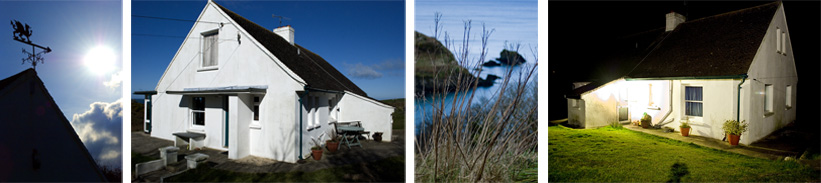
Cliff Cottage – Fforest Farm – Newport
There is so much to discover about Paddy and Joan’s life. The detectives are always at work, and I thought I would share with you this note I received from Alun Davies, an ex-Army man like myself who somehow has become the Honarary Consul in Wales for Hungary. How do these things happen? 🙂 Please share with us your memories or investigations. You can always contact me at tsawford [at] btinternet.com and I promise to reply, ever so slowly!
Dear Tom – here is a small piece of the jigsaw of Paddy’s life which you might enjoy. Each summer we go down to West Wales as a family and stay at Newport in Pembrokeshire. When I read In Tearing Haste I noticed a reference to Newport and asked Artemis if she knew more.
The long and short of it is that I have located the cottage in which Paddy and Joan stayed in the summer of 1961. This was not exactly difficult as on page 83 of ITH he gives the address as Cliff Cottage, Fforest Farm. In fact I know Fforest Farm but the property is now called Fforest Cottage.
I spoke to Joanna Ward who now owns the cottage – picture attached – who told me that her father had bought the property in 1963 from Rex Warner’s wife after he had died.
The footnote on page 84 of ITH says:
PLF had borrowed the house from Barbra Ghika (1911-1989), nee Hutchinson, who married the painter Nikos Ghika in 1961. She was married previously to Victor, 3rd Baron Rothschild 1933-46 and to Rex Warner, writer, painter and translator of Greek tragedies, in 1949.
I am wondering if Charlotte Mosley was right in thinking that the house was borrowed from Barbra when it seems to have been owned by Rex Warner and his later wife. Given Rex’s background in Greek classics, and the fact that he was the director of the British Institute in Athens after the war, Paddy must have known him well.
I realise this is not necessarily of great interest – but as I know that area well I found it interesting to follow up the lead.
Best wishes
Alun
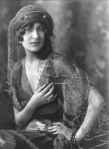
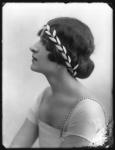
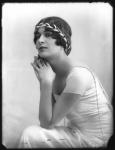
Just as I thought I could take a break from working on some blog posts – I have had to take a break for a while – I received an email from eagle eyed Ian Dunkin who thinks the Balasha picture I just posted may actually be of her sister Helene.
I leave the debate to you but it is a good excuse to put up a slide show of some pictures of the two beauties.


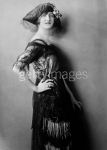
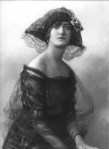
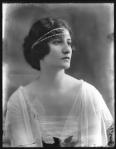

Obviously not new in the recent sense of the word, but one I had not seen before.
Unfortunately it has the Getty Images watermark, but one is able to see clearly how beautiful she was. It was taken in the 1920’s.
Thank you to Chris Lawson for directing me to this.
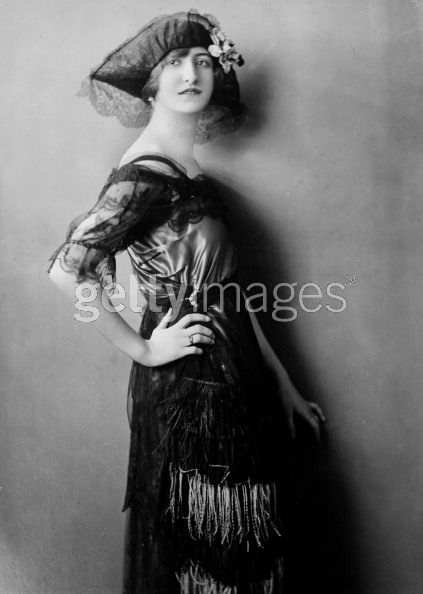
Balasha Cantacuzene
Artemis Cooper reflects on Patrick Leigh Fermor’s flexible approach to historical fact.
By Artemis Cooper
First published in History Today Volume: 62 Issue: 12 2012
Patrick Leigh Fermor could not look at a landscape without wondering who had been there before him and how they had shaped what he saw. This was the springboard for all his travel books. Yet alongside this curiosity about the past ran a more imaginative impulse. Some writers might have tried to curb it, especially when tackling historical passages. Not Paddy, who had great faith in what he called ‘letting it rip,’ which added such zest to his prose. Yet when he came to write about his own history, as an undercover agent in occupied Crete between 1942 and 1945, scruples seemed to stifle even his irrepressible style.
While he cared passionately about getting facts and details right, he rarely set foot in an archive. Most of his ‘mugging up’ came out of encyclopedias, books and conversations. He found the legends surrounding a person or an event every bit as interesting as the truth. Even an old chestnut, like the story of Richard I’s minstrel Blondel singing outside every fortress in the hope of hearing his master’s voice, was worth retelling. ‘[The story] is almost too good to be true’, wrote Paddy in A Time of Gifts (1977), ‘but on the spot, it is impossible to doubt it.’
He pursues the story in a long footnote. Richard was handed over to the Holy Roman Emperor Henry VI by his captor, Leopold of Austria, in 1193. In his place Leopold took a hostage, one Hugh de Morville – possibly the same de Morville who, with three other knights, had murdered Thomas Becket in Canterbury two decades before. ‘Some authorities think the two Morvilles are the same,’ wrote Paddy. ‘I do hope they are right.’
While prepared to concede that they might be wrong, the appearance of a historical figure in an unexpected place produced a charge in Paddy that set his imagination racing. Take the headstone of ‘Ferdinando Palaeologus, descended from ye Imperial lyne of ye last Christian Emperor of Greece’, which Paddy found in a graveyard in Barbados. He traces a direct line from Ferdinando back to the Emperor Constantine, who fell defending the walls of Constantinople in 1453. For the genealogy to hold, all depended on whether or not Constantine’s son Thomas had a son called John. Paddy admits that this figure is ‘shadowy’. Even if he had been told that his thesis was false, as has now been proved, I doubt whether it would have stopped him telling the story.
As well as anecdotal history, he could conjure up a great sweep of time. In A Time of Gifts a character called the Polymath describes the barbarian invasions of the fifth century and the sack of Rome. Paddy did not expect anyone to take it seriously, yet it is still a tour de force which sends the reader skimming over continents, to watch events unfold at exhilarating speed.
Friends urged him to write about his experiences in occupied Crete, especially the abduction of General Kreipe in April-May 1944, one of the most celebrated exploits of the war. He was reluctant because anything by Patrick Leigh Fermor about Crete would be translated and published on the island and, since this was bound to offend or displease someone, he preferred to remain silent. Then, in 1966, he was commissioned to write a 2,000-word article on kidnapping Kreipe, which grew into a typescript of 84,000 words called Abducting a General. Until then the story had only been told in Ill Met By Moonlight, the 1950 bestseller by William Stanley Moss.
Paddy’s account tells how, still wearing the German uniform in which he kidnapped the general, he enters the village of Aoyeia. As he walked up the main street, doors and windows slammed shut while the men in the café turned their backs on him. The cry went up: ‘Our in-laws are here! The black crows are in the wheat!’ When he approached the priest’s wife she was terrified. ‘It’s me, Pappadia,’ he whispered, ‘It’s me, Mihali!’ (he was always Mihali in Greece). ‘Mihali? I don’t know any Mihali!’ she cried. It took her a moment longer to recognise him, by the gap between his front teeth.
History must be objective, but Paddy found it impossible to be objective about the Cretans. He could never forget how they had guided, fed and protected him during the German occupation, at such risk to themselves. The pages he devotes to their courage and endurance, their love of song and poetry, may make one smile; but we can only respect his devotion to the the people whose hardships he shared and whom he counted among his closest friends.

Patrick Leigh Fermor by Nikos Ghika
A retrospective first published in Kathimerini 20 December 2006 about Paddy and Joan’s very good friend, the reknowned artist Nikos Ghikas.
By Alexandra Koroxenidis – Kathimerini English Edition
Retrospective exhibition on the work of Nikos Hadzikyriakos-Ghikas shows the unity in his work
If one was to name the one element that pervades the work of the distinguished Greek painter Nikos Hadzikyriakos-Ghikas (1906-1994) throughout its course, it would probably be light. Much has been written about the Cubist-inspired aspect of his work, yet the luminosity and the radiance of Mediterranean light is what will mostly strike the visitor to “Nikos Hadzikyriakos-Ghikas: The Apollonian – The Dionysian,” a large retrospective exhibition of the artist’s work which is curated by his friend art historian Dora Iliopoulou-Rogan and is being held at the Pireos annex of the Benaki Museum on the occasion of the centenary anniversary of the artist’s birth.
For an artist who perhaps more than anything else painted the Greek landscape – its essence and not its surface – this is perhaps to be expected. “Ghikas seeks light and the truth,” Henry Miller – one of the artist’s friends – wrote in his novel “The Colossus of Maroussi.” As an artist of the so-called “Thirties Generation,” Ghikas revealed the essence of “Greekness,” the archetypal notions that were believed to pervade the entire civilization of Greece. Harmony and light were two of them.
Light and its reflection are among the elements that, according to the exhibition’s curator, link the Apollonian and the Dionysiac aspects of the artist’s work, the tectonic, geometric paintings and the more expressionistic, free compositions of labyrinthine, swirling shapes.
“When they say that in my painting I have many different periods, I answer what Ingres said when he was told the same thing. ‘I have sir, many paintbrushes,’” Ghikas once said. Accordingly, instead of examining the work of Ghikas in terms of distinctive stylistic traits which lead from one to the next, Rogan examines the work of Ghikas as an undivided whole, as both Apollonian and Dionysiac, intellectual and emotional at the same time, as equally contained as it is extroverted.
This is a new approach to the work of Ghikas which the exhibition’s curator presents in a voluminous book (of the same title as the exhibition) published by Livanis. A well-designed publication (the book helps counterbalance the effect of a dense yet slightly disorderly exhibition), it is a thorough, fully illustrated book that includes earlier published texts on Ghikas’s work, essays by Kimon Friar, Henry Miller, Christian Zervos and Patrick Leigh Fermor among them. It also unfolds the work of Ghikas across different media: Painting is the focus, yet sculpture, photography and the artist’s work for theater and costume design help show what Rogan has called Huomo universalis, an artist whose work was too broad in scope to fit into a single category and an intellectual – he was also professor of freehand drawing at the National Technical University – who wrote about the art and culture of different civilizations.
Ghikas was as equally deft in line as he was in color. In the exhibition, an entire section presents just a fragment of the hundreds of drawings that Ghikas made. Among them a series of sensual nudes. There are also studies that Ghikas made for set and costume design and drawings that are the artist’s visual memoirs of his travels around the world.
Ghikas was one of the few truly cosmopolitan Greek artists, a man who not only traveled the world but who was part of an international artistic milieu from early on. The only son of Alexandros Hadzikyriakos, an officer in the Greek Royal Navy, he was educated in Paris (this included his final school years) where, at the age of 21, he had his first solo exhibition prefaced by the well-known critic Maurice Raynal. Ghikas’s involvement in the artistic and intellectual elite of Paris in the interwar period (he was friends with Henri Laurens, Fernard Leger, Georges Braque and Henri Matisse and became associated with Le Corbusier, Hans Arp and many others), helped to bring many intellectuals into contact with Greek art and culture. It was largely thanks to Ghikas that the 4th International Congress on Modern Architecture (CIAM IV) was held in Athens instead of Moscow in 1933.
In the mid-1930s Ghikas moved to Greece. Together with Dimitris Pikionis, Socratis Karantinos, Spyros Papaloukas and Stratis Doukas, he published the seminal review “To Trito Mati,” a journal on art and culture that resembled the French “Cahiers d’Art.”
During that period, Ghikas worked intensively in Hydra, the island of his family home (which was later destroyed in a fire), and became inspired by its landscape, light and architecture. In later years, Corfu, where Ghikas and his second wife Barbara Warner had a summer home, also inspired the artist.
None of those landscapes are identifiable. They are semi-abstract renditions that capture a mood and atmosphere, structure and light rather than any realistic description. In many paintings, the Greek landscape is combined with subjects taken from mythology.
Among Ghikas’s broad range of interests, poetry was one of the most pronounced. In the late 1930s, he began the illustration of Nikos Kazantzakis’s “Odyssey.” Twenty years later, in 1958, these illustrations were included in the US edition of “The Odyssey” which was translated by Ghikas’s friend Kimon Friar. Ghikas also illustrated C.P. Cavafy’s poems and Nikos Gatsos’s “Amorgos.”
The work of Ghikas is filled with the tranquility and harmony of the Mediterranean, the resonance of Greek art and history. Ghikas appreciated everything that was Greek but was also deeply curious and sensitive to other, non-Western cultures. He had the open-mindedness of a cosmopolitan, refined man and was one of the few Greek artists to have been recognized internationally.
In 1987, the same year that he was elected honorary member of the Royal Academy of Arts in London, Ghikas donated his work and home on Kriezotou Street in Kolonaki to the Benaki Museum. Held as an expression of appreciation on the part of the Benaki to Ghikas, the retrospective exhibition is also a tribute to one of the most esteemed modern Greek artists.
“Nikos Hadzikyriakos-Ghikas: The Apollonian – The Dionysian,” at the Pireos annex of the Benaki Museum (138 Pireos & Andronikou, 210.345.3111) through January 15.
Nikos Hadzikyriakos-Ghikas Wikipedia page
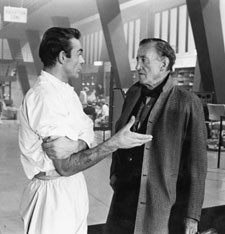
Sean Connery and Ian Fleming
Perhaps unsurprisingly one of the most popular blog posts was something I added a couple of years ago – Paddy’s eye for detail: Ian Fleming, Bondage, James Bond and Pol Roger. With the launch of the new Bond movie plus the popularity of A Fifty Shades of Grey (you should see the search terms that lead people to your favourite blog!) it seems timely to do as I promised, and publish the complete article by Geoffrey Wheatcroft which is about Ian Fleming, a close friend of Paddy and Joan.
by Geoffrey Wheatcroft
First published in the New York Review of Books, 14 August 2008.
Fifty years ago, a fictional spy who had gradually become famous suddenly became notorious. Dr. No was the sixth of the books that had been appearing since 1953 when Ian Fleming, a restless, cynical English newspaperman, published Casino Royale, and with the words “The scent and smoke and sweat of a casino are nauseating at three in the morning,” James Bond first appeared. Fewer than five thousand copies were initially printed, but sales rose with each book, Bond entered the national consciousness, and his adventures began to travel, notably to America. Then in 1958 academic and journalistic critics began to look hard at this phenomenon, and did not like what they saw.
First came Bernard Bergonzi, with “The Case of Mr Fleming.” Apart from finding the sex distasteful—male brutality and female submission, or what Bond himself called “the sweet tang of rape”—he lamented Fleming’s “vulgarity and display” and his love of luxury goods. This was true enough, as anyone knows who has read the books, or who visits the fascinating show about Fleming and Bond at the Imperial War Museum in London on which For Your Eyes Only, Ben Macintyre’s enjoyable new book of the same name, is based. Fleming pioneered brand-name-dropping, and we can see a letter he received from Floris of Jermyn Street, enclosing a bottle of that elegant emporium’s lime essence in return for a puff in Dr. No.
Then the Manchester Guardian (as it still just was) editorially deplored the decline in taste expressed by the “advertising agency world” of the books, which echoed Bergonzi unkindly contrasting Bond with “the perfectly self-assured gentlemanly life” of his obvious predecessors, the Clubland Heroes. That was the title of Richard Usborne’s book, published in the same year as Casino Royale, about the novels of John Buchan, Dornford Yates, and “Sapper,” and those earlier heroes would not, Bergonzi sniffed, have tolerated club servants talking like something out of a New Yorker ad (“If I may suggest, Sir, the Dom Perignon ‘46”). Fleming responded genially to the Guardian with “a squeak from the butterfly before any more big wheels roll down on it,” but he was dismayed by a more ferocious assault, from Paul Johnson in the New Statesman. Under a headline which almost entered the language, “Sex, Snobbery and Sadism,” Johnson denounced Dr. No as “without doubt, the nastiest book I have ever read,” combining schoolboy sex fantasies with suburban “snob-cravings.”
Not that these fusillades did much material damage. Half a dozen more books were to come before Fleming died in 1964, and there was a handy endorsement when John Kennedy revealed his enthusiasm for 007. Author and president met, even discussing harebrained schemes for disposing of Dr. Castro rather than Dr. No (but is it really true that Kennedy and Lee Harvey Oswald were both reading Bond books the night before the assassination in Dallas?). Then Bond went through the financial stratosphere when the film adaptations began in 1962, since when there have been—well, Simon Winder, in The Man Who Saved Britain, his entertainingly idiosyncratic book about Bond and “Bondage,” gives a list before breaking off, “…I’m sorry: I just can’t go on it’s all so terrible. They’re roughly the same, come out at irregular intervals and tend to have the word Die in the title.”
After Fleming’s death came the pastiche novels: Devil May Care by Sebastian Faulks “writing as Ian Fleming” is the twenty-second in a line that began in 1968 with Colonel Sun by Kingsley Amis—and here is a curiosity in itself. Great writers are often parodied by lesser talents, but Fleming must be the only thriller-writer to be mimicked by a Booker Prize winner, and now by another well-known literary novelist. This might have puzzled Fleming, whose ambiguous attitude toward what he shrugged off as his “kiss kiss bang bang” books has already been chronicled in biographies by John Pearson and Andrew Lycett. His life casts only a little light on the real world of espionage, but is more revealing as a rather bleak story of malaise and decline, personal and national.
For all the snobbery of which Fleming was accused, his grandfather Robert Fleming was born in a humble home in Victorian Dundee, started off as a thirteen-year-old clerk for £5 a year, and worked his way up, founding his own bank and accumulating a fortune, a house in Grosvenor Square (where the unlovely American embassy now stands), and an estate in Oxfordshire. His son Valentine became an MP and fathered four sons. The elder two were Peter and Ian, born in May 1908: Faulks’s Devil May Care was launched on the centenary itself, when a blonde in a red jumpsuit whisked the first copies to an awaiting warship (Fleming might have been half amused, while wondering whether his beloved Royal Navy had nothing better to do than host publicity stunts).
In 1917, Valentine was killed on the Western Front. Ian’s life was clouded by that memory, and he was overshadowed by Peter at Eton. Ian didn’t follow his brother to Oxford, being sent instead to Sandhurst military academy. Quite forgetting the wisdom of the Duke of Cambridge (Queen Victoria’s cousin, and commander in chief for most of her reign, visited Sandhurst at a time when there was a high incidence of venereal infection among the officer-cadets, and told them with avuncular sternness, “I understand that some of you young gentlemen have been putting yours where I wouldn’t put my walking stick”), he contracted gonorrhea in one of the first of many escapades, and was removed by his horrified mother.
After flunking out of the army, Fleming flunked out of journalism and stockbroking as well, and was in his thirties when he was rescued by the war. He worked in the Admiralty intelligence department for Rear Admiral John Godfrey, the model for Bond’s boss “M,” became a commander, the rank he gave Bond, and followed from afar the missions of Special Operations Executive in occupied Europe. It’s not hard to see an element of compensation when this desk-bound sailor came to write about derring-do he had never personally experienced. The only time Fleming literally saw action was in August 1942 when he was in a destroyer observing the Dieppe raid. Instigated by the absurd Lord Louis Mountbatten, one of Churchill’s worst appointments, that disastrous enterprise saw one thousand of six thousand men killed in a day for no discernible purpose, a shambles which might have sown the first seeds of doubt in Fleming’s mind about England’s greatness.
After the war he found a comfortable newspaper job, and resumed his liaison with Ann Rothermere, a famous London hostess. Fleming’s one child, Caspar, was born five months after they married in 1952, following her divorce from her second husband. Not that marriage cramped Fleming’s style. Amis thought that Bond was an “amalgam of what many men would like to be,” which may have said more about him than many men. The real-life Fleming showed little of the chivalry toward women with which he occasionally invests his hero. At best he was Philip Larkin’s Englishman, “too selfish, withdrawn/And easily bored to love,” at worst a heartless philanderer; as Rosamond Lehmann (a novelist of a very different kind) astutely put it, “The trouble with Ian is that he gets off with women because he cannot get on with them.”
He got on with Ann on and off, as it were, in a curious relationship. Torture is conspicuous in the books, and an early Dr. No paperback cover (the kind of thing we don’t see much in bookstores now) shows a girl with very little on dangling from manacled wrists while a vast black man stands over her to inflict horrible pain. But then Fleming knew whereof he wrote, warning Ann in one letter to ready herself for more of her own punishment and “be prepared to drink your cocktails standing for a few days.”
Then again, he might have been settling the score. Returning to the small house on the Dover coast he’d been lent by Noël Coward, Fleming heard laughter from the sitting room, which fell silent when he entered, and he realized that Ann and her friends had been guffawing over passages from galleys of Casino Royale. He never cared for Ann’s salon of writers and artists and one can almost see why. One of her friendships at least bequeathed an unforgettable legacy: amid the memorabilia—Ian’s old typewriter, or a cable from Clay Felker asking for a piece on Russian spying for Esquire—a visitor to the show is stopped in his tracks by Lucian Freud’s haunting small portrait of Ann.
And one more of the circle was Cyril Connolly (even if, come to think of it, Ann was exactly the woman he had in mind with his lethal coining “smartistic”). In 1963, Connolly published a parody of Fleming in the London Magazine. “M” has conceived an illicit passion for 007, who is told to get himself done up in drag, go to a nightclub, and entice a kinky visiting KGB general, who turns out to be “M” himself in disguise (“I’m sorry, James,” he says forlornly at the unmasking. “It was the only way I could get you,” at which Bond’s “long rangy body flared out above his black silk panties,” before he cuts his boss short: “I thought fellows like you shot themselves…. Have you got a gun—sir—?”).
This spoof was entitled “Bond Strikes Camp,” and that was the mot juste. There is sometimes a perceptible arch self-consciousness in the original books, but everything since has been one big camp meeting, the movies most obviously, but also the knockoffs. Not surprisingly, Faulks’s Devil May Care is better written than Fleming’s books. If Johnson exaggerated when he said that Fleming had “no literary skill,” so does John Bayley in claiming that “Fleming wrote so well…almost as well as Raymond Chandler.” The quality of writing in popular novels is as varied as in literary fiction, and while Fleming didn’t write as badly as Jeffrey Archer he really didn’t as well as Chandler. His prose style, such as it is, was acquired during his brief sojourn at Reuters: who-what, short sentences, a minimum of adjectives and adverbs, all of which Faulks carefully copies.
While Devil May Care is short on sex and sadism, it does begin with one unfortunate having his tongue torn out; but then Faulks’s own tongue is a little too obviously in his cheek. We get Gorner, an impossibly horrible villain, a brutal enforcer called Chagrin (nice touch), a glamorous heroine with whom James is far too diffident—and a distinctly autumnal flavor. The book is set in 1967, when Fleming not only didn’t write it but could not have written it, and 007, as he admits, is showing his age. Now and again the writing flags. Bond has been in Tehran a few days when he lunches alone on caviar and martinis, before spreading out “some maps he had bought from the hotel shop…. The country was between Turkey to the west and Afghanistan to the east. Its southern frontier was the Persian Gulf, its northern limit the Caspian Sea.” Well, yes.
There are a few other lapses which it would be tedious to list, including a tennis match that is not only implausible in itself but whose scoring goes awry. We all make mistakes, including the originator. After Fleming published On Her Majesty’s Secret Service, that worldly sophisticate was mortified to receive a magisterial rebuke from his friend Patrick Leigh Fermor: Ian surely knew that Pol Roger is the only champagne never sold in half bottles.
2.
When Philip Larkin grumbled once about the “spy rubbish” he resented having to read (along with “science-fiction rubbish, Negro-homosexual rubbish, or dope-taking nervous-breakdown rubbish”),* Fleming must have been what he had in mind, but there is more than one type of espionage novel. The Bond books can be called many things, but not grown-up, whereas a long and distinguished line of adult spy fiction runs from Conrad’s The Secret Agent (published the year before Fleming was born) by way of Somerset Maugham’s Ashenden books to Graham Greene, Eric Ambler, Nigel Dennis, John Le Carré, and Robert Harris, with the Americans Alan Furst and Joseph Kanon latterly carrying on the tradition.
For one thing, real-life espionage is a far grimmer business than 007’s make-believe kissing and banging. W.C. Heinz, who died recently, was one of the great American sportswriters of his age, but he first made his name as a war correspondent, and in particular with one piece from the Battle of the Bulge. Written with a harsh realism that would be unlikely today, “The Morning They Shot the Spies” describes three German soldiers who had been ordered to dress in American uniform and drive a jeep behind Allied lines, where they were soon apprehended and faced the same fate, tethered and blindfolded, as many such. (A sombre footnote in our story belongs to Erskine Childers, author of that still-readable spy yarn The Riddle of the Sands; during the savage Irish Civil War in 1922, years after his book was published, he became, as far as I know, the only thriller-writer to be himself shot by firing squad.)
From 1940, numerous often hopelessly inept agents were parachuted into England where they were caught, and usually executed, although they had a choice. They could accept a patriotic death or, as Tony Soprano would say, they could be flipped. Not a few chose discretion over valor and became double agents, radioing back carefully controlled disinformation (making sure to sound like themselves: Faulks mentions the “fist” or personal quirks by which a particular radio operator’s transmissions could be recognized). By any such standards, the story of one double agent was astounding, not to say utterly improbable, as it is told in Ben Macintyre’s Agent Zigzag and Nicholas Booth’s ZigZag. Both books are well researched and well written; Macintyre’s is masterly.
Born in a Durham mining village in 1914, Eddie Chapman enlisted in the Coldstream Guards, but he soon discovered Soho, girls, and gambling, was discharged for going AWOL, and turned to petty crime, less petty when he graduated to gelignite and safecracking. He also entered the pre-war London equivalent of Damon Runyon’s Broadway, a demimonde of gangsters, journalists, and showbiz: stranger-than-fiction begins when he really did rub shoulders with Noël Coward, Marlene Dietrich, and, in a still more preposterous coincidence, a young man in the film business called Terence Young. Many years later, Young would direct the first Bond movie.
On the lam from a bank robbery in 1939, Chapman took a girl to Jersey, where he was caught and imprisoned, with dramatic consequences when France fell in June 1940, and the Channel Islands were occupied by the Wehrmacht. Highly intelligent, a natural linguist, and thoroughly amoral, Chapman now offered his services to the Germans as a spy. “The life of a secret agent is dangerous enough, but the life of a double agent is infinitely more precarious,” said Sir John Cecil Masterman, Oxford don and intelligence officer; “a single slip can send him crashing to destruction.” Chapman’s iron nerve never slipped. He was inducted into the Abwehr, the intelligence service of the German high command, and in December 1942 (when both books begin with a prologue), carrying a radio, a Colt revolver, and a cyanide pill, he was dropped into a field in Cambridgeshire.
He had long been awaited. The greatest single British contribution to the defeat of the Third Reich, and possibly the greatest British achievement of the past century, is known to us as Bletchley, the unprepossessing country house halfway between Oxford and Cambridge, where an eccentric team of mathematicians, musicians, and classicists broke what the Germans had with good reason believed to be the unbreakable codes of their Enigma machines, and in the process pretty well invented modern computing: the huge creaking and whirring “bombes” of Bletchley, running over endless patterns and permutations, were the forebears of your laptop. Fleming was peripherally concerned with this operation, which is the setting for one of the best recent thrillers, Robert Harris’s Enigma. In its film version a very attentive viewer can catch a fleeting cameo performance as an RAF officer by one of the movie’s backers, Sir Mick Jagger—and we did get some satisfaction from what was done at Bletchley, enjoying the incalculable advantage of reading German radio traffic.
One intercepted Abwehr message said, “Your friend Bobby the Pig grows fatter every day. He is gorging now like a king, roars like a lion and shits like an elephant. Fritz.” The lady cipher clerks were shocked by this vulgarity, but those to whom it was funneled upward added it to their file about the latest agent who would be arriving soon, although this time the information was unneeded. Chapman immediately gave himself up and volunteered to serve his own country, as he had—perhaps and maybe—always intended to do. He was code-named “Agent Zigzag” by one of his handlers (who must have had an unconscious instinct for book titles), and was debriefed at length by such unconventional officers as Tommy “Tar” Robertson, Robin “Tin Eye” Stephens, and the scientist and intrepid dismantler of unexploded bombs, Victor, Lord Rothschild: that scion of the most famous of banking dynasties now listened while Zigzag cheerfully taught him how to rob a bank.
His handlers took to this “most absorbing person,” as one of them called Chapman: “Reckless and impetuous, moody and sentimental, he becomes on acquaintance an extraordinarily likeable character,” and his work of deception soon began. One of his tasks for the Abwehr had been to sabotage an aircraft factory near London, and an explosion was duly faked, with a story planted in the Daily Express for added realism. Still more astonishingly, Zigzag then returned to occupied Europe, where he rejoined the Abwehr in Norway, and became the only British citizen ever awarded the Iron Cross. Eddie’s subsequent reward from his own country after the war was more practical, a character reference describing him as “one of the bravest men who served in the last war,” which regularly kept him out of prison.
What distinguishes the Bond books, apart from the floggings and the Floris, is the simple moral world they inhabit. James, “M,” and Felix Leiter, 007’s likeable Texan buddy, are Good; Drax, Goldfinger, and Rosa Klebb are Bad, with no shades between. When a double agent does appear, she soon gets her comeuppance. By contrast, the adult spy books from Conrad on are set in a misty marshland of compromised loyalty, personal ambiguity, betrayal, and failure. A decade after the arrival of Bond, virile and uncomplicated, The Spy Who Came in from the Cold marked a drastic change of mood with the gray, mousy cuckold George Smiley; if Le Carré had written the Bond books, Leiter would be working for the KGB as well as the CIA.
Which is why, as Tod Hoffman says in The Spy Within, his book about a CIA employee who spied for the Chinese, the spy-hunter does not assume that everyone is a spy, only that anyone might be. People spy from a variety of motives—greed, ideological commitment, or atavistic ties—which raises delicate problems in a country like the United States, with so many hyphenated citizens harboring potential mixed loyalties. Humphrey Bogart’s one truly nasty film is Across the Pacific, made in a hurry just after Pearl Harbor. The villain is a Japanese-American, the “all-American boy,” as he calls himself, who turns out to be spying for the land of his forefathers; the movie could be seen as a justification for the shameful internment of the Nisei by the Roosevelt administration. More recently, Mossad raised more awkward questions when they suborned the American intelligence analyst Jonathan Pollard by appealing to his Jewish loyalty.
When the CIA realized in 1982 that there was a foreign agent working inside American intelligence, they didn’t at first guess that he was one of their own. Larry Wu-Tai Chin had originally been recruited by the US Army during the Korean War as a translator, but then moved to the Foreign Broadcast Information Service run by the CIA. He stayed with the agency for more than thirty years, all the time passing documents to the Chinese. His inducement wasn’t just ties of blood: Chin was paid handsomely enough to spend as he pleased not only on women (he was a “lecherous old scumbag” according to one colleague) and gambling but on real estate in the slums of Baltimore. Not for the first time, the fine minds of an intelligence service quite failed to notice how an employee was living way beyond his salary, and the mystery about the Chin case is not how he was finally rumbled, leading to prison, where he committed suicide in 1986, but how he went undetected for so long.
How much damage he did is hard to assess, but then so is whether most spying does any good. Sir Henry Tizard was president of Magdalen College, Oxford, a scientist as well as a public servant, and a true patriot, who may be said without exaggeration to have helped save his country and civilization: without his work in ensuring that radar was installed around the coastline by 1940, the Battle of Britain might have been lost. Ten years later, at the height of the panic over “atomic spies,” Tizard used to tell colleagues that there were no nuclear secrets. He meant that there was little the Soviets had learned through espionage that could not have been gleaned by less melodramatic means, with competent Russian physicists studying the published American scientific journals.
There might have been an element of donnish exaggeration in that, and obviously signal intelligence of the Bletchley kind is of the highest value in wartime. But a great deal of espionage is solipsistic or circular, shadows chasing shadows, spies spying on spies spying on other spies like the endlessly receding image in facing mirrors. That is something the better spy writers convey, and so intermittently does Fleming. His books also have a political and social content of sorts. While Bond likes to complain about “the cheap self-assertiveness of young labor since the war” and the “buyer’s market of the welfare state,” he is conscious as well of declining British power and prestige, and resents the way that he and his country are patronized by the Americans.
In Devil May Care, Faulks’s Bond voices one or two of his traditional views—the French intelligence services are riddled with Communists—but he also encounters a new complication in the Anglo-American relationship. Gorner is trying to precipitate a nuclear war that will destroy London, and gloats to Bond that “the Americans saved your bacon twice, but your failure to support their crazed adventure in Vietnam has made them angry with you. They will not be so generous on this occasion.”
In the original books Bond recognizes national weakness, or is made to by such foreigners as Tiger Tanaka, head of Japanese intelligence. Bond replies a little morosely that even if the country had been “bled pretty thin by a couple of world wars” and further demoralized by welfare, “we still climb Everest and beat plenty of the world at sports.” Everest had been climbed the day before the Coronation, in the year Bond first appeared, with Sir Winston Churchill back at Downing Street to greet the young queen and inaugurate “a new Elizabethan age.” And yet only three years later, as Tanaka sarcastically observes, the attempt to arrest decline had led to Suez, and “one of the most pitiful bungles in the history of the world.” A bungle and a folly, it would become moreover a byword for late-imperial arrogance, although it might be remembered that Nasser’s initial action had been condemned not only by Sir Anthony Eden’s Tory government but by the Labour opposition and its new leader, Hugh Gaitskell (who was also Ann Fleming’s lover; England can sometimes seem a small country). And most painful of all was the way that Washington pulled the rug from under their supposed British friends.
After the debacle, a chastened and ailing Eden flew to recuperate at Goldeneye, Fleming’s house in Jamaica where the books were written each winter. He soon resigned the premiership, ostensibly because of ill health, although he lived until his eightieth year—a contrast to his Jamaican host. Skeptics have sometimes wondered how Bond managed to shoot straight, play cards and golf so well, or fornicate at all, in view of the superhuman quantities of alcohol he consumed. Fleming indeed drank a bottle of gin a day and smoked several packs, which helped explain why he died at only fifty-six; and the story grew still more melancholy.
Although Ann survived him until her death from cancer in 1981, her heart had already been broken by something worse than Ian’s death, giving the story a bitter conclusion. Their son Caspar was attractive and amusing, as I still remember, but despairing and doomed. He was sacked from Eton (like Bond, although in Caspar’s case because he had a pistol in his room), dropped out of Oxford, and took to drugs (never a good idea for an acute manic-depressive). In 1975, at the age of twenty-three, Ian Fleming’s only child, heir to the Bond millions, ended his life with a deliberate overdose.
* Author’s note:
Larkin’s words may sound more than characteristically dyspeptic, but they were written in a generous and altruistic letter to Charles Monteith of Faber, trying to persuade him, though without success, to take on Barbara Pym and her “ordinary sane novels about ordinary sane people doing ordinary sane things” (August 15, 1965)
Paddy’s eye for detail: Ian Fleming, Bondage, James Bond and Pol Roger
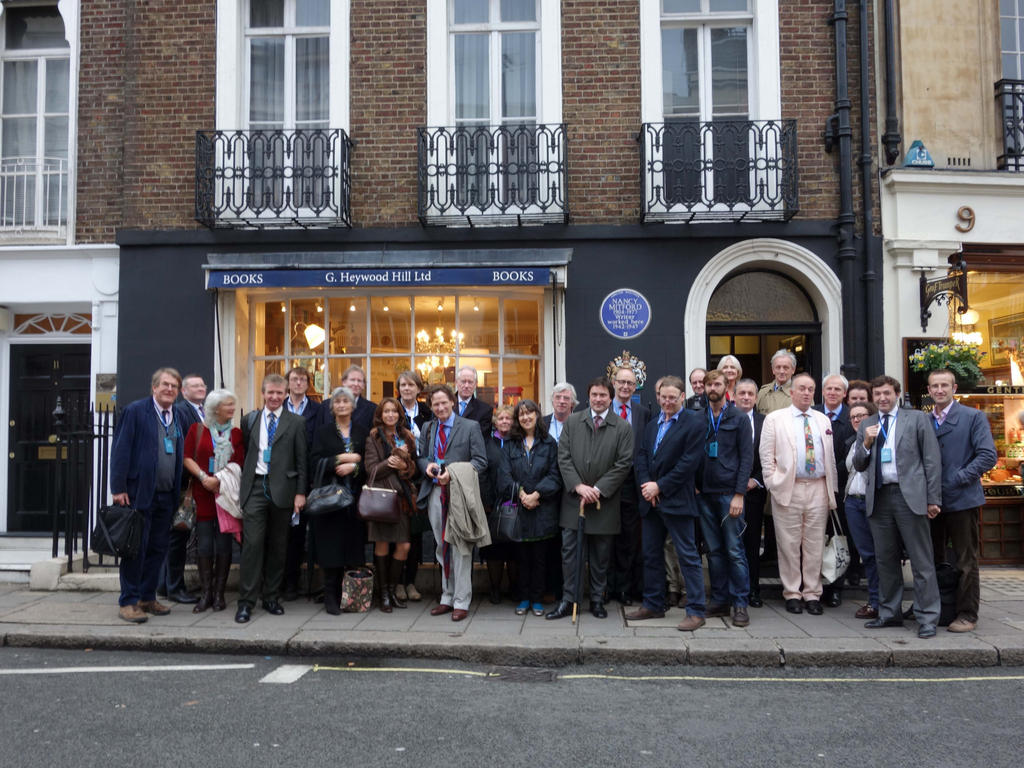
Friends of Patrick Leigh Fermor outside Heywood Hill, his favourite bookshop, in London’s Shepherd Market
To celebrate the publication of Artemis Cooper’s biography of travel writer Patrick Leigh Fermor, Today presenter James Naughtie joined a party led by Artemis Cooper to walk past some of Patrick Leigh Fermor’s London haunts. As you may see from the photograph, the participants included Colin Thubron, Cherie Lunghi, Justin Marozzi, Robert Macfarlane, and Gabriella Bullock who is “Billy” Moss’ daughter.
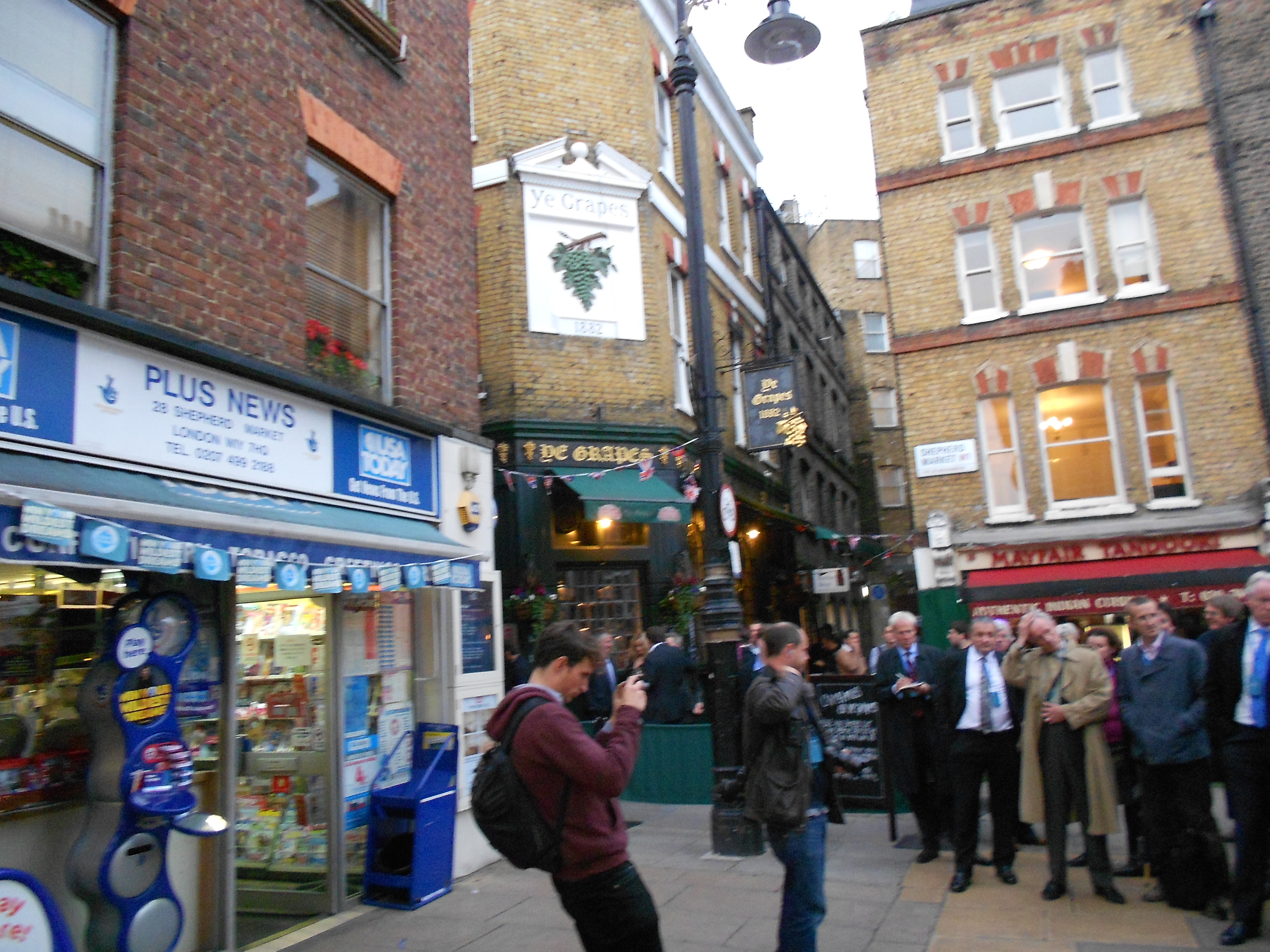 Starting at Paddy’s favourite bookshop (and temporary post-war residence) Heywood Hill, we first braved the traffic in Curzon Street to cross into Shepherd Market where curious drinkers at The Grapes watched as we gazed in awe at 28 Shepherd Market, the place from where Paddy set out on his walk on 8 December 1933. It may have been bombed in the war as the building is a replacement with the enticing Plus News newsagent on the ground floor.
We weaved our way in the dusk to Berkeley Square which Paddy passed through one night during the blitz and later noted ‘only one thing remained standing, three storeys high, stood a white marble privvy’. The journey to Stratton Street was quick and this is where Paddy left two trunks containing most of his documents from the walk which were eventually deposited by the keeper into Harrod’s Depository; Paddy could not pay the large accumulated storage fee and when he did return the trunks and their contents had been sold and dispersed. Artemis observed that perhaps it was a good thing as he had to rely upon his mind and was perhaps ‘set free’.
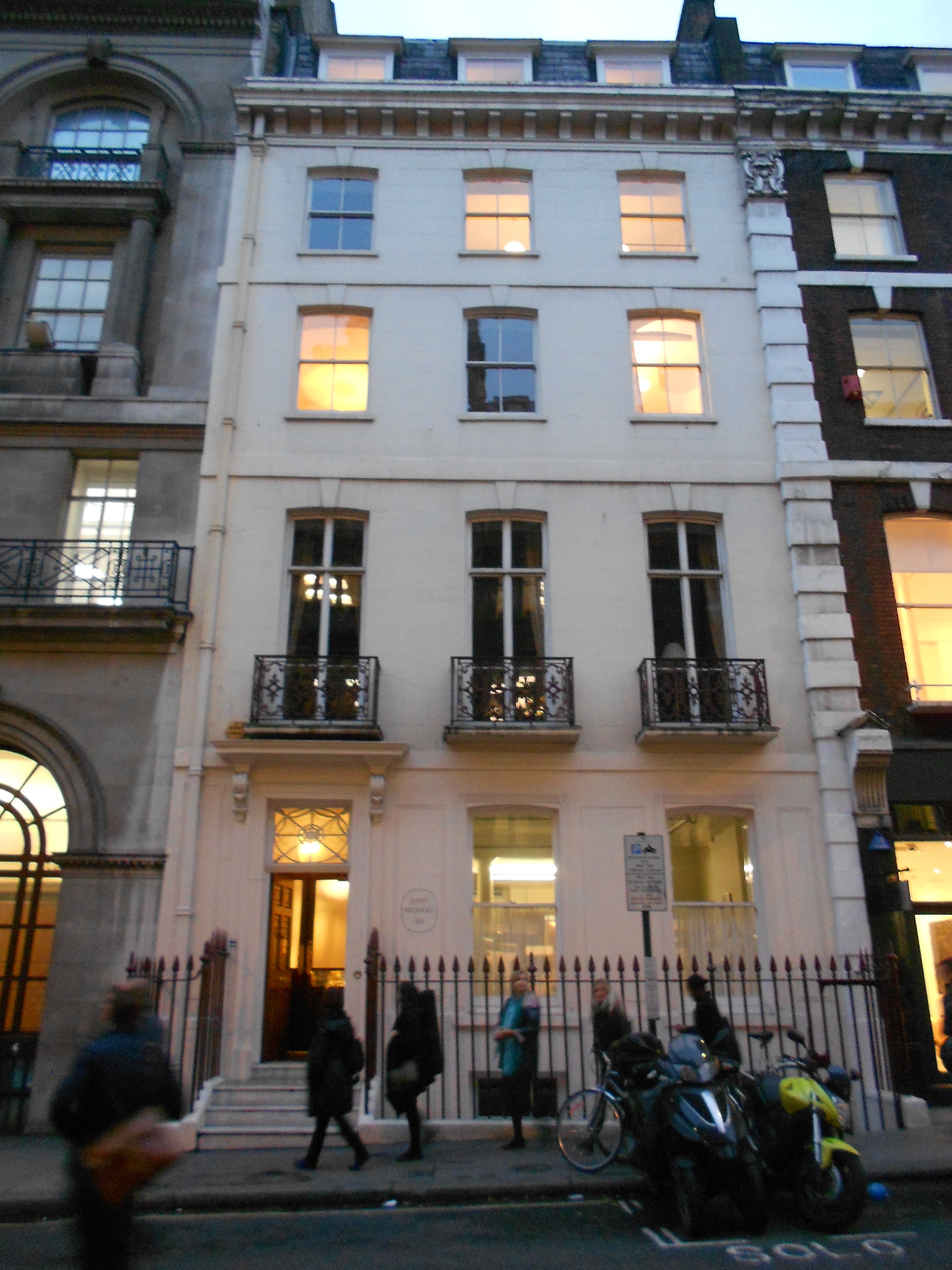
50 Albemarle Street, the entrance to publisher John Murray
Our touristic snake trailed into Albemarle Street and we passed John Murray’s at number 50, crossed Piccadilly to the entrance of The Ritz where Paddy often stayed, but once had great difficulty entering when in training at the Guards’ Depot as he was dressed in the uniform of a private soldier, the Ritz being for officers only.
Paddy went to riotous and notorious parties at The Cavendish hotel in Duke Street, St James’ with many of the “bright young things” which did not include Evelyn Waugh as he had offended the owner, Mrs Lewis who said of him ‘When I see that Mr Waugh I’m going to cut his winkle orf’. Mrs Lewis indulged Paddy and others of somewhat straightened means and let them build up virtually unlimited credit. She knew that they would be unable to pay, but it was small beer to some of her more wealthy clients who did not check their bills too closely and ended up paying for Paddy’s extravagancies.
Throughout the walk we were accompanied by James Naughtie from Radio 4’s Today programme. He recorded the package below and left early as you would expect from someone who has to get up at about 3.30 am when presenting the programme. Naughtie grabbed some time with Nick Hunt who walked Paddy’s route from Hook of Holland to Constantinople just this year. He promised to make Nick a star. Let’s hope so.
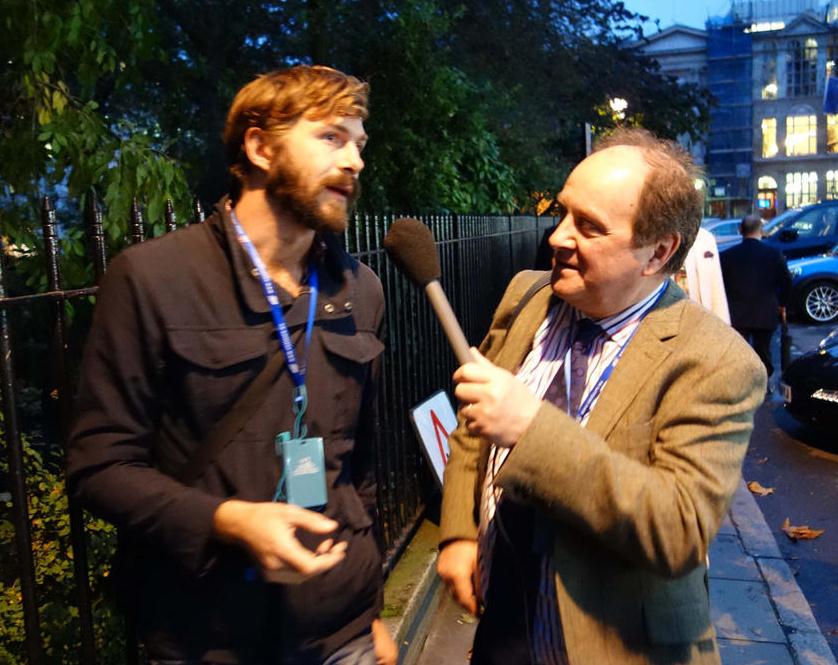
Nick Hunt being interviewed by James Naughtie
This tour through Paddy’s Mayfair was a pre-cursor to the official launch of Patrick Leigh Fermor: An Adventure at Paddy’s old club, The Travellers. Artemis got a very well deserved round of applause for the biography, and she spent most of the evening busy signing books; dozens must have been sold. Ian Hislop made a sartorially unkempt appearance near the end (how did he get in without a tie?), and I think I saw Bank of England Governor, Sir Mervyn King pop in and do his bit for the consumer economy.
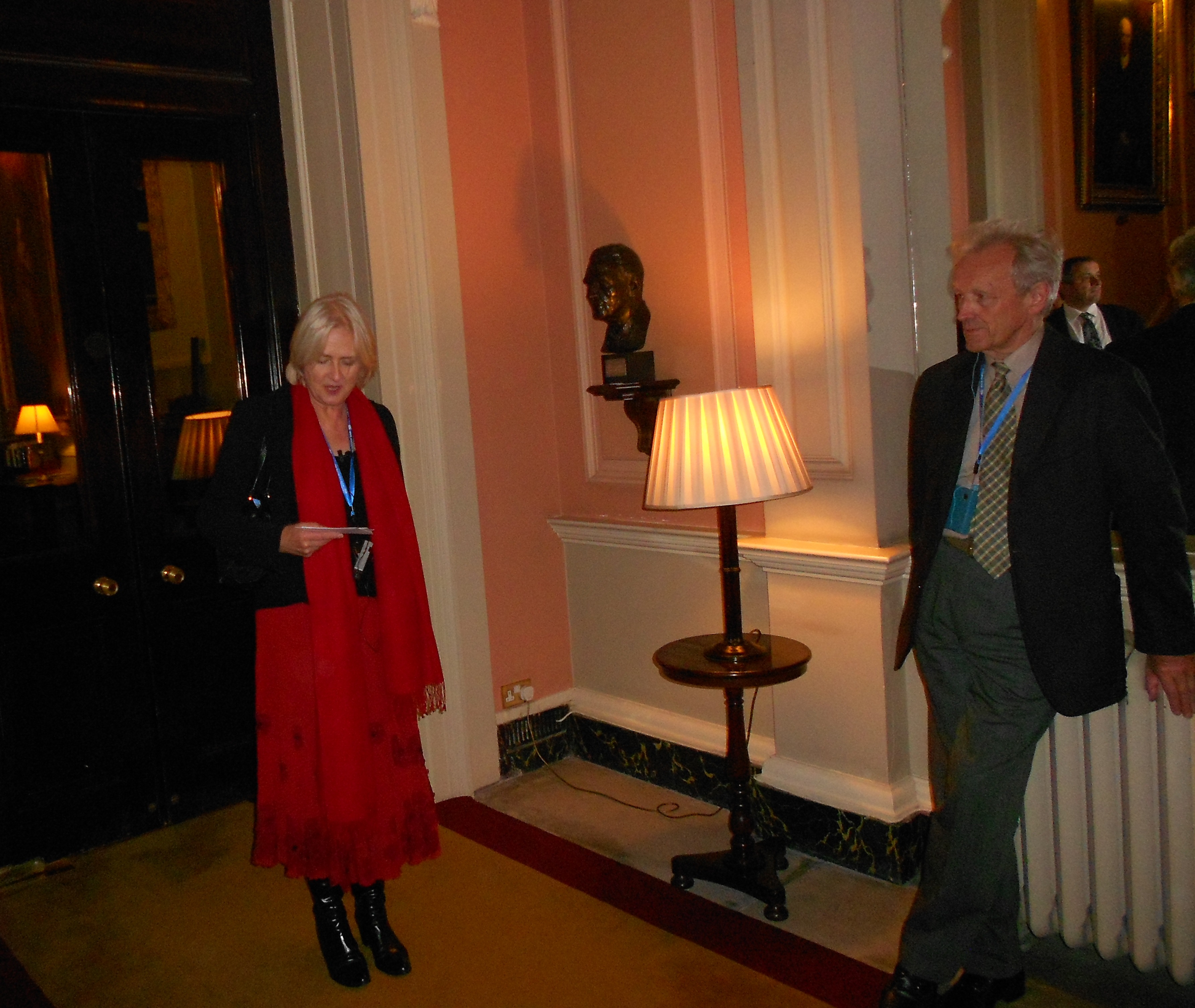
Artemis and Colin Thubron in the lobby of the Travellers Club with bust of Paddy
Patrick Leigh Fermor: An Adventure will also be the BBC Radio 4 Book of the Week from 19th November onwards.
You can buy Patrick Leigh Fermor: An Adventure here.
Don’t forget to visit Artemis Cooper’s Facebook page for further information.

Patrick Leigh Fermor with Billy Moss in Crete, April 1944, wearing German uniforms Photo: Estate of William Stanley Moss, by permission
The Telegraph ran an extract from the biography over the weekend. It was the Kreipe kidnap again!
In an extract from her life of the travel writer and war hero Patrick Leigh Fermor, Artemis Cooper chronicles a daring kidnap in wartime Crete.
First published in the Daily Telegraph 29 September 2102.
After months of training in clandestine warfare in Palestine, Paddy Leigh Fermor joined the handful of SOE officers in occupied Crete who were working with the Cretan resistance in June 1942. His big chance came in the autumn of the following year when he formulated a plan to kidnap a German general: not just any general but the hated Gen Friedrich-Wilhelm Müller, responsible for the butchery of the Viannos villages in September 1943. Supposing Müller were kidnapped and whisked off the island? At a time when Greece was beginning to feel like a backwater as the war pushed up through Italy, an operation of this kind would generate a lot of noise and publicity: it would make the Germans look remarkably foolish, and give a terrific boost to Cretan morale.
Despite questions being asked about the mission because of the risks it posed to Cretan lives, the plan went ahead on January 6 1944. A car came to pick up Paddy and his number two, Billy Moss, a young Coldstreamer who had had a spell guarding Rudolf Hess, in the early hours of the morning, and drove them to Heliopolis where they met the rest of the party.
They flew to an airstrip east of Benghazi, where they spent two miserable weeks in sodden tents waiting for the weather to clear. Since it refused to oblige, they were flown to Bari, hoping for better flying conditions there. On February 4 they took off from Brindisi for Crete, aiming for the Omalo plateau, a tiny, shallow bowl in the jagged, snow-covered peaks in the mountains south of Neapolis. For the pilot, the zone was so restricted that the team could not be dropped in a “stick” formation – he would have to circle and come in again four times, dropping each man off individually.
Snow and loose cloud swirled around the open bomb-bay, and far below they could see the dropping zone marked by three pinpricks of light formed by three signal fires. Paddy was the first to jump. Welcoming Cretan hands hauled him to his feet, and then all eyes turned again to the snow-streaked sky. Paddy gave the all-clear with a torch to signal his safe arrival, but the clouds were thickening and the pilot could no longer see the signal fires: he was forced to turn back.
The bad weather continued. Paddy spent the next seven weeks in a cave with Sandy Rendel, the SOE officer in charge of the Lasithi area. But in late March came news that threw the whole mission into question. The intended victim, Gen Müller, had been posted to Chania as commander of Fortress Crete. SOE Cairo was informed, but decided to go ahead with the operation anyway. After all, the aim was to boost Cretan morale and damage German confidence; from this standpoint, one general was as good as another. Continue reading
A delightful drawing by Paddy of John Craxton who was the illustrator of all of Paddy’s books from A Time to Keep Silence onwards. It was sent to me by Artemis Cooper who says ‘It’s a very good likeness of JC’.
Paddy’s writing is rather faint but he has written:
‘Johnny is always painting goats browsing on olive branches, which lays the country bare…’

Defense de Craxtonner by Patrick Leigh Fermor
Remembering John Craxton – an influential art giant and a lover of life
In February 2007, following the death of his friend, Paddy wrote about George Jellicoe in the Spectator magazine.
George Jellicoe, who died last week, was an early member of David Stirling’s SAS, and soon became commander of the Special Boat Service. We first met in pitch darkness soon after midnight on 24 June 1942 in a cove off southern Crete, both of us in rubber boats, one of them taking off Jellicoe and his comrades — most of them French — back to Mersa Matruh, the other landing me on the island for a SOE mission. We exchanged shadowy greetings. On landing, I soon learnt from the Cretans of the success of their long, strung-out series of raids, and the number of enemy aircraft and the stockpiles of ammunition and fuel they had destroyed.
When George and I met by daylight a year and a half later in Cairo, I was struck immediately by the tonic effect of his presence, his initiative and his inflexible determination, and his knack of command. Also, his humour and buoyant spirits. We became great friends. He had a gift for getting on with his own soldiers and sailors and, most importantly, with our Greek allies. Among many operations, he worked several times with General Christodoulos Tsigantis — the ‘General Gigantes’ of Lawrence Durrell’s Alexandria Quartet — the dashing, original and very effective commander of the Sacred Brigade, mostly enlisted from guerrillas who had escaped from occupied Greece and which he led brilliantly from Cairo to Rimini. Many years later, Tsigantis told a friend that George was the bravest man he had ever met.
When the tail end of the German army was retreating from north Athens, George — well in advance of the advance mission — was already pedalling into the city centre on a borrowed bicycle. As we know, the same energy and flair carried him through his successful spell as a diplomat, and to great heights in postwar politics.
Tidcombe Manor, in the Wiltshire downs, was a delightful retreat from his manifold duties, which were here replaced by swimming, riding, reading and music, and the company of friends, in which he was wonderfully abetted by his wife Philippa. George meanwhile had painlessly developed from a young centurion to an active senator and then to a retired paladin, and evenings there were marked by lively talk and much laughter, a spirited combination of punctilio and bohemia.
George often returned to Greece, where his name is revered. Below the window of the house in the southern Peloponnese, where these lines are being hastily written, a favourite promontory juts into the sea, affectionately known as ‘Jellicoe’s leap’.
You can read more about Lord Jellicoe on the Royal Society website.

Jan Morris Photo: Mike Segar
This article by Toby Clements appeared in the Sunday Telegraph on 16 September 2012. Jan Morris who was both a friend and admirer of Paddy talks about her last book which will only be published after her death.
Authors usually see literary festivals as a chance to sell a few copies of their books, but Jan Morris, now 86, is at Scotland’s Wigtown Book Festival, sponsored by the Telegraph, to discuss an unusual project: her book which will be published posthumously, provisionally titled Allegorisings, though she is not sure if the word exists.
“I decided not to write another proper book after Trieste and the Meaning of Nowhere [her superb 2001 evocation of the Adriatic city] because it was the book in which I think I found my true voice, and I don’t think I’ll ever write a better one.”
But what is Allegorisings going to be about? Can we anticipate any dark revelations?
“No amazing revelations. It is a little book, about everything from childhood to whistling to the exclamation mark. It stems from a conviction that’s been growing in me for quite a while, that nothing is what it seems, and that everything has one or multiple meanings.”
If it didn’t first require the author’s death, it would sound like a treat, and it will take the number of Morris’s books up to 40, almost half of which are travel-related. She is adamant they are not to be called travel books, since they do not tell a reader where to go and what to see, but are rather “travel literature”, since they describe not a city – be it Venice, New York or Oxford – but her reaction to that city, or in the case of her first book, Coast to Coast, published in 1956, a whole country, the United States. She has also written a book about Wales.
But by the mid-Fifties, long before Morris underwent sex reassignment surgery in 1972, she was famous as James Morris, who brought news from Nepal that Edmund Hillary and Tenzing Norgay had climbed Mount Everest. Morris’s adventures on the mountain, including the coded message sent from an Indian army base and the perilous descent of the mountain, are brilliantly described in Coronation Everest (so called because the news reached London on the day before Queen Elizabeth’s coronation in 1953).
By a quirk of fate, Morris’s trip to Wigtown next month will take her through the Lake District, and her return journey to North Wales, where she has lived for 60 years, coincides with the memorial service for Michael Westmacott, the mountaineer who was with Morris on that hair-raising descent in 1953, who died in June. There are only two of the original party left: Morris and the New Zealander George Lowe.
This newsgathering brilliance meant Morris was considered likely to become influential and he was awarded a Commonwealth Fellowship scholarship, which allowed him to study International Relations at Chicago for a year. He did not enjoy the course and took the car (which came with the scholarship) and drove around America, “falling in love with it”. His first book came from this, but what changed his life, and made him the writer she has since become, was Venice, published in 1960. It followed his second visit to the city, which he first saw in 1945, when he was sent by his commanding officer to help run the requisitioned motorboats in Venice.
“The city was half-empty and had a curious melancholy that I found immensely attractive. It is what keeps me coming back to certain places, like Trieste, places on the end of one thing and the beginning of another.”
This interest in melancholy and decline led Morris to start a history of the decline of the British Empire, which grew into the Pax Britannia trilogy, research for which took her all over the world – to India, for example, where she found beauty in the crumbling bungalows of long lost imperial administrators.
It was while Morris was writing these three – in the late Sixties and the Seventies – that James became Jan, and the confusions and contradictions are vividly described in Conundrum (1974) and, later, Pleasures of a Tangled Life (1989) in which she describes the legal and emotional complications that arose from her sex change, including the necessary divorce of her wife. Morris bats aside any further questions on it.
“I don’t want to talk about that,” she says. Yet it remains a fascinating situation: Morris and her ex-wife, Elizabeth, had five children together and stayed with one another after the sex change and divorce and have entered into a civil partnership. Today they live together in North Wales, where Morris has become an advocate of Welsh independence.
She has since said that the best way to get to know a place is, borrowing from Psalms, to “grin like a dog and run about the city”, and I wonder if she has applied the same technique to her own life. There has been a delightful randomness, with one thing leading to another. Perhaps it is the open-eyed manner in which Morris approaches her life that allows these chances to blossom into something more meaningful.
* Jan Morris will appear at the Wigtown Book Festival on October 3 2012 at 6pm
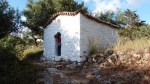
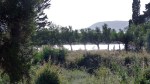
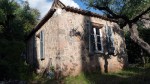
John Chapman is a regular contributor of material to the blog – you are all welcome to do so at any time; see Contact. Most notably John’s photographs of a visit to Kardamyli to meet Paddy in 2005 have been very popular with you all.
A while back he sent me some more photographs with some comments about the state of the villa at Kardamyli, and John’s personal thoughts about one of Paddy’s friends who died in May 2012.
Hi Tom
In May this year I made a return trip to Kardamili and Mani. I hadn’t been there for four years and this was just a week long catch up. Mani is still as effortlessly beautiful and tantalisingly fascinating as ever. One location I always visit is the church of St. Nicholas in Chora, where Paddy scattered Bruce Chatwin’s ashes in 1989. Still a remarkably special place.
At Paddy’s Memorial service in December I’d been sitting quietly in a pew as I could recognise some of the great and good but was not expecting anyone I knew to be there. I was suddenly clapped on the shoulder by a firm hand and an American accent bellowed ‘Well how you doing buddy?’ It was my old friend and correspondent Jon van Leuven. We had started writing to one another some 12 years earlier as we both were fascinated by the conundrum of the location of the Frankish castle of Grand Magne and various other puzzles in Mani’s medieval history. We’d since met on a number of occasions exploring cave churches near Langada and getting hideously lost in the Sangias Mountains in Mesa Mani.
With Jon was another Englishman, we were introduced but, I apologise, I’m useless with names. He had been attempting to catalogue Paddy’s books and papers. I asked if he knew what the Benaki Foundation intended to do with the house at Kalamitsi. “I’ve no idea”, was the reply,”…and I doubt if they do either”.
After the service Jon and I said our farewells. Jon was a long time friend of Paddy’s. He long had a house at the hamlet of Gournitsa (a Slavic name, lit. ‘the place above’) though nowadays often referred to as Agia Sofia, after the pepper-pot domed church which perches over Kardamili. The house itself had few comforts, Jon was adamant that he wasn’t go to pay any ‘damned taxes’ for electricity. But it was comfortable and clinging to the cliff top edge of the Viros Gorge it was a precious eyrie where Jon would stay from June to September, although his family and home were now in Gothenburg, Sweden.
I told Jon I was going to Mani and he asked me to give his house a quick look to see if all was OK. I replied I would. He emailed me on the 8 April.
‘Glad to hear you can get get up to Gour and give the hacienda a glance. Also in town I hope you hear what’s going on at Paddy’s villa these days – if you know Elpida the housekeeper she’d know better than anybody’.
I don’t know Elpida and anyway by the time I got to his Hacienda in Gournitsa I’d been given the sad news that Jon had died of complications of leukaemia. I’d known he was ill but had presumed he was indestructible. He could certainly outpace me on expeditions in Mani and was at least ten years my senior – I guess in his early seventies. On the 17 April he’d sent me his last of hundreds of emails. I might just publish them sometime…I’d asked if he’d ever met Bruce Chatwin, I was reading Chatwin’s letters.
The email was entitled ‘Drip Feeding’
“Hi John,
Just a note between hospital visits…but thanks for your epistles as ever. No, I never met Chatwin, but I once met Elizabeth at Paddy’s, and of course again in London in Dec tho she didn’t recognize me (nor I her but for Olivia’s tipoff)…Now I am taking a long pause from the airwaves to suck my thumb and medicine.
Best, Jon”
He died on the 2 May 2012
Jon was very wary of telling much about Paddy, he was a very private man and felt that there were too many people trying to grab a bit of Paddy’s aura. I was undoubtedly one of them in his judgement, so I didn’t pry and he didn’t tell., and frankly we had enough Mani stuff to keep us going for years. I did learn that Jon had first met Paddy as he was interested in ancient shrines to Artemis in the area, and had hoped (vainly) that Paddy could assist his researches. Jon helped Paddy construct the bookshelves in ‘that room’. He located picnics he had shared with Paddy and Joan, and, on very rare occasions, entrusted me with Paddy’s opinions on other ‘travel writers’. On one occasion when I briefly met Paddy striding towards Lela’s Taverna I mentioned Jon was a friend of mine. Paddy beamed and confirmed he was a very old and trusted friend, but Joan was very ill at the time and Paddy hurried on.
One evening this May we wandered down to Kalamitsi. It’s still filling up with more villas and concrete but somehow manages to remain beautiful. And on the cliffs stretching along the road to Proastio high above Kalamitsi more excrescences of domestic concrete demonstrated more concern for their owners’ views of the Gulf of Messenia than those below looking up. I delight in a domed church on a promontory (and Kardamili has three), but hate to imagine John Betjeman’s reaction to these lumpen edifices.
However Paddy’s villa is still a discrete surprise when you do chance upon it. The north wall of the garden has fallen down and we could have wandered the gardens, but resisted, though we’d been before and had had Paddy as a guide. A peer through the small window in the gates of the villa show that someone is tending the garden. Though there is a sad lack of flasks of retsina in the vestibule. The ‘Private Property’ sign has gone, maybe from neglect. Above the gateway there is a small stone hut. It was unlocked, so we guiltily crept in. A broken armchair, an old bed and some damp volumes which had obviously over spilt from the villa were on some shelves and in boxes. Hungarian Studies magazines, a history of Canterbury Cathedral, and a few gems. An offprint from a dictionary. In pencil at the top ‘In great appreciation Christmas 1958, New Year 1959 Eric Partridge.’ Naturally they were left there.
In the village no one I talked to had very much more knowledge of what was going to happen to the house than I did. And as one said – the Benaki are not as rich as they may appear. The house needs a fair bit of repair. After all it is, now, over fifty years old and shutters are beginning to disintegrate. If they want a librarian who’s soon to retire to look after the place, well, I might just volunteer.
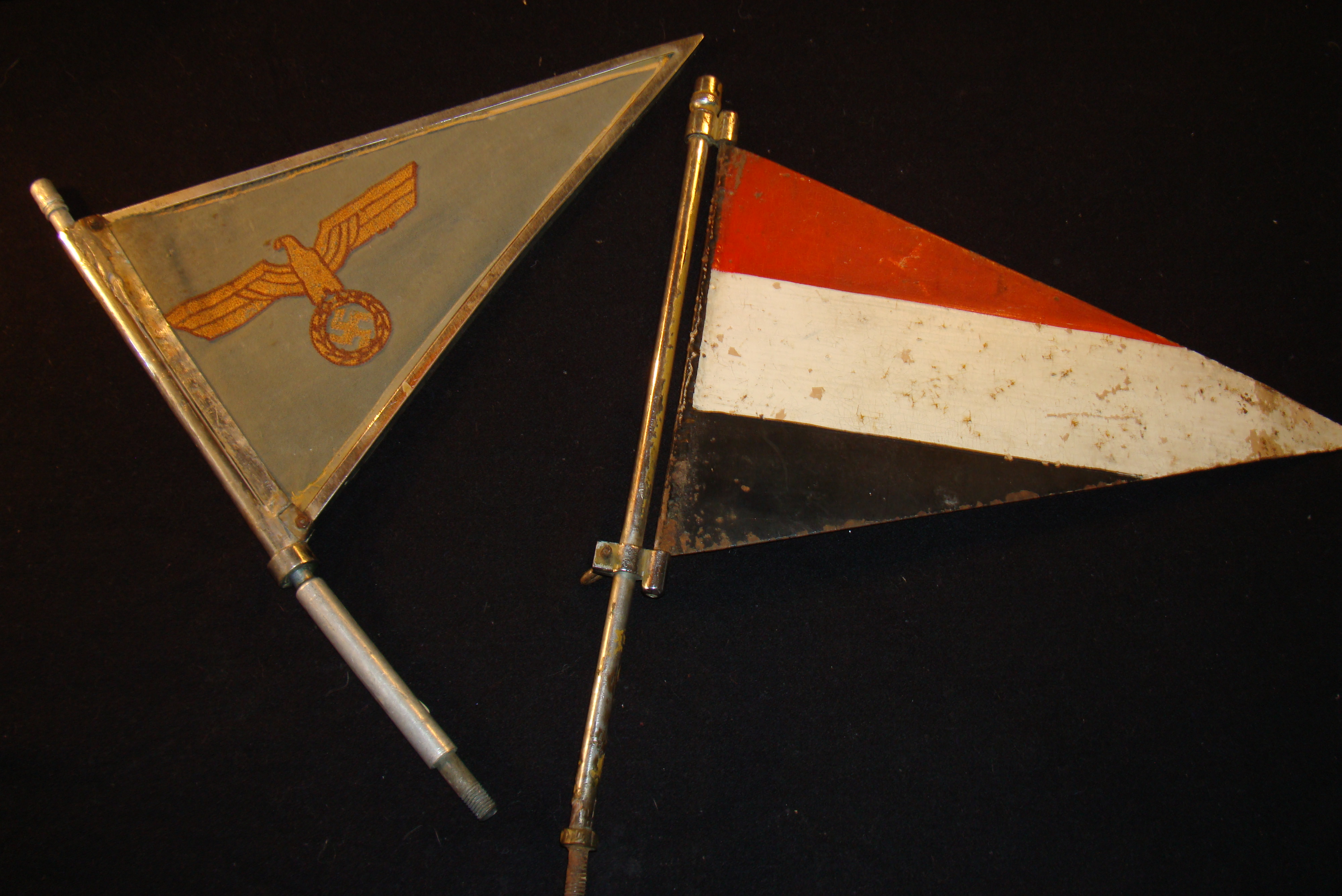
The pennants from General Kreipe’s car
Discovering the full details behind a particular story or event is often tricky with clarifications, enhancements, or downright contradictions emerging sometimes many years after the event. Fortunately we have not had to wait so long for some further detail to be added to the story I ran last year about what happened to the pennants on General Kreipe’s car at the time of the kidnap, and their subsequent discovery many years later.
‘Billy’ Moss’ daughter Gabriella Bullock read Artemis Cooper’s account of how the pennants were found after so many years in a trunk in Paddy’s house at Kardamyli. Gabriella then wrote to me to ask me to pass on the full story behind their (very fortunate) re-discovery in Ireland some years before and how they were passed by her mother (Sophie Moss née Tarnowksa) to her. It sounds like we are very lucky to have them at all.
Gabriella’s account starts during a recent visit to Crete …
In Rethymnon we met the delightful people who run the Folklore Museum. This is where the pennants from the General’s car are now housed, in accordance with PLF’s wishes. We found that they were very interested in the story of how the pennants were randomly and luckily rediscovered, and this leads me to think that the story definitely has a place on your website
In the early 1950s my family lived in Co. Cork, Ireland, but moved back (supposedly temporarily) to London in 1954. My parents intended to return, and left many of their possessions in the safe-keeping of various Irish friends or in store. My father never did go back to Ireland; indeed, in 1957, eight years before his death in 1965, my father also left England never to return. As things turned out, however, it was also many years before my mother went back, and all that had been left in storage was lost.
A number of years after my father’s death my mother bought a cottage near Cork, and thereafter divided her time between London and Ireland. I was staying with her at the cottage one summer in the late 1970s when a friend of hers announced that she had a trunk belonging to us which she wanted to return; it had been sitting in their attic since the 50’s.
A battered tin trunk duly arrived with my father’s name, rank and regiment painted on the outside in white. My elder sister has it now and it is, without doubt, the one described in the first chapter of our father’s book A War of Shadows, even down to the grains of sand:
“an old letter, a scrap of notepaper smeared with the sweat of one’s hip-pocket, the rain-spattered pages of a diary, an operational report written in the bloodlessly forbidding vocabulary of a headquarters’ clerk – these relics, discovered in a tin trunk which still creaks with grains of sand when you open the lid…”.
My mother opened and unpacked it, and said to me, “I think you’d better have these”. Amongst the things inside it were my father’s original diary, already entitled Ill Met by Moonlight, in remarkably good condition and perfectly legible, and the two German pennants.
It was a heart-stopping moment. My mother gave these things to me, and I gratefully and unthinkingly received them. I was in my mid-twenties then. The diary I still have. As for the pennants, they were much prized, and adorned a wall in my house for nearly 15 years.
But one day about 17 or 18 years ago, when I was re-reading IMBM, it dawned on me for the first time that in fact since it was Paddy who had taken them as trophies from the General’s car, they were rightfully his. So I gave them to him. This was in the early 90’s. Paddy was completely astonished, and moved, to see them again, so unexpectedly, after 50 years! He was awfully pleased, and after his death they were donated to the Folklore Museum in Rethymno, in accordance with his wishes.
And now they are back in Crete, which is absolutely as it should be.
With best wishes,
Gabriella Bullock
Articles about the kidnap in the Ill Met by Moonlight category
It may not be quite time for a summer holiday, but next week a trip to Lismore, in Co Waterford, will at least enable visitors to travel the world vicariously. From Thursday until tomorrow week, Immrama, the annual festival of travel writing, will be celebrating its 10th birthday with a mix of talks, panel discussions, workshops, walks, children’s events and the launch of an anthology of essays by travel writers who have participated in the first decade of the festival.
Among the guest speakers will be Colin Thubron, who will talk about his experiences in China; Tony Wheeler, a founder of the Lonely Planet guidebook series; and Mary Russell, who has travelled extensively in Syria and hopes to provide some insights into the crisis there.
The main event on Friday, at 8pm in the Courthouse Theatre, will be a panel discussion on the legacy and influence of the travel writer Patrick Leigh Fermor, with a line-up consisting of Thubron, Wheeler, Jan Morris and Artemis Cooper, who is writing a biography of Leigh Fermor.
Click here for the programme.
The Lawrence Durrell Society are holding a centenary conference in London during the period 13-16 June 2012. There will be a session focused on Paddy and his relationship with Durrell on Saturday 16 June. The programme for the morning is: 9.00 AM – 10.30 AM :: Parallel Session :: VIIa (Large Common Room) :: Chaired by Pamela Francis (Northwestern State University, Louisiana). Martha Klironomos (San Francisco State University), “Travel Practices, Writing, & Photography: Comparing the Works of Patrick Leigh Fermor and Lawrence Durrell.” Marc Woodworth (Skidmore College), “Fiding Kovecses: An Open Letter to Patrick Leigh Fermor.” Dan Popescu (Partium Christian University, Romania), “‘In Clashing Hues’: Images of the Gypsies in Patrick Leigh Fermor’s Between the Woods & the Water.”

John Craxton by Ian Collins
Eleven years ago in London, at the crowded wake for Southwold-linked artist Prunella Clough, I found myself squashed against a figure of legend. This was John Craxton.
by Ian Collins
First published in EADT24, 17 June 2011
At 21 he had been the great – brilliant, handsome, life-and-soul-of-the-party – hope of war-time British art. But he had always wanted out.
Surveying the flowing white hair, wild moustache and glintful eye in this image of an elderly Cretan chieftain, who even sported a shepherd’s stick and woven rucksack, I said: “Good grief! I thought you were…in Greece.”
Actually, I had somehow imagined him ascended to another kind of Arcadia presaged in his joyful paintings and the ballet sets he designed for lover Margot Fonteyn. Rumour had it that Craxton had long since vanished into a Greek idyll. But he came and went, mostly below the radar of an art world he had good reason to scorn.
We went off to the French pub in Soho where he had drunk since 1941, and then to a meal in Chinatown. And so began almost a decade of making merry.
Like many another art writer, I begged to write his biography (while secretly keeping notes from our first meeting). He refused. Hating a slim book from 1948, he had spurned intrusion and hack analysis ever after. Why ruin a friendship?
He changed his mind following a brush with death and my 2005 Making Waves account of artists in Southwold for which he had been a key informant.
We then worked happily together on the picture-led book he wanted, to be published for his 90th birthday, in October 2012. He said I could write the full biography once he was “out of the way”.

John Craxton: Self Portrait 1943
Alas, John died 18 months ago and I am his art executor. The book published this week is his first memorial.
We have just had four launches in London – a preview at Christie’s, and then receptions around exhibitions in Tate Britain, Mayfair’s Osborne Samuel gallery and Heywood Hill’s Bookshop in Curzon Street. The shows go on.
Being charming, John had a charmed collection of friends. One was Sir David Attenborough – whom I asked to speak at his memorial service and on the Radio 4 Last Words programme (an early call since he was off to Australia that afternoon).
He introduces my book (our meetings plotted between his trips to Africa and the North Pole) and this week presented a Craxton profile on BBC2’s The Culture Show.
So: why our obsession with John Craxton? Well, he painted pleasure and lived it, too. He had a matchless love of life.
He had great luck always, and the first was with his musical, Bohemian parents. They raised six children and numerous waifs and strays in a chaotic haven next to Lord’s cricket ground.
The future novelist Elizabeth Jane Howard, sharing a tutor with John at one point and now living in Bungay, says: “They were happy and, like pollen, some of this rubbed off on anyone who came in contact with them.”

Margot Fonteyn and John Craxton, Greece 1951.
One school chum’s father was Eric Kennington, and John was part of the party lent a Walberswick house in the summer of 1937 as a token of thanks for the sculptor’s fine memorial to artist Arthur Dacres Rendall in the churchyard.
John Craxton book cover.John Craxton book cover.
Seventy years later John could recall with perfect clarity the reasons for their delight in Southwold’s painted rood screen.
Another school pal’s dad took him to Paris to see Picasso’s newly-painted Guernica and then, early in the war, a lodger introduced him both to patron Peter Watson and a mercurial young painter called Lucian Freud (fresh from the Cedric Morris and Lett Haines East Anglian School of Painting and Drawing in Dedham).
For more than two years Peter Watson funded their studios in a St John’s Wood maisonette. The close friends became fantastically inventive draughtsmen.
John’s dashing eldest brother was a test pilot for Spitfires, and during the war John and Lucian stayed in the Fens with the family of Joan Bayon, one of brother Tim’s girlfriends.
Along nearby dykes John spied the gnarled and twisted forms of pollarded willows, which he then depicted both as tormented monsters and hiding places for lost boys.
Joan’s father was a scientist who received parcels of beastly corpses for post mortem. The two young artists worked on portraits of the contents – John’s ravishing images like those of a latter-day Durer.
From Cambridgeshire he wrote to his friend and patroness E.Q. Nicholson: “The willow trees are nice & amazing but I would prefer an olive tree growing out of a Greek ruin…”
Spotted at the Leicester Galleries – one of the few in London to stay open during the war – John was invited to produce pen-and-ink and lithographic decorations for what became a celebrated book.

John Craxton: Pastoral to P.W.
Visionary Poems and Passages or The Poet’s Eye, an anthology chosen by Geoffrey Grigson, was published by Cowell’s of Suffolk in 1944. John worked on the plates to the very last minute in the Ipswich printshop.
That landed him with the label of a Neo-Romantic artist, recreating the world in his own anxious image. But there was nothing Neo about him: here was the complete individual and original.
Mentored by Graham Sutherland and John Piper, his influences moved from Samuel Palmer and William Blake to Miro and Picasso. He finally met the latter in Paris in 1946 – the year of his liberation.
At a dinner party in Zurich (where Peter Watson had got him an exhibition), he met Lady Norton, wife of the British Ambassador in Athens, who was seeking provisions abroad in a borrowed bomber.
They bonded at once and the return flight carried an extra passenger. The not-quite-stowaway never looked back.
After travels all over the Aegean (and extended stays on Poros and Hydra), he settled in an ancient Venetian house in Crete, on the harbour at Hania, in 1960.
Returning to London for regular, sporadic and then rare exhibitions (also bringing his Greek pictures to life in set and costume designs for Daphnis and Chloe, a 1951 ballet by Suffolk’s Frederick Ashton starring the beloved Margot), he was really ever after an Englishman abroad.

John Craxton: Two Greek Dancers, 1951.
Even if produced in his North London bolt-hole, his scintillating linear paintings celebrated a southern paradise – of cats, goats, drinking and dancing and sleeping sailors, light, heat, colour, rocky landscape and the survival of mythology in everyday existence. For these blissful works he drew on both a revitalised Cubism and Byzantine mosaics.
Sour critics who found his mature art too sunny, decorative, playful and altogether too gay suggested the envy of people left off the guestlist for a life-long party.
An enforced break from Greece during the dictatorship of the Colonels brought African wanderings. A 1970 image of an old lion at a Kenyan watering hole was bought by singer Peter Pears, Benjamin Britten’s partner. It now hangs in a ground-floor study at The Red House in Aldeburgh, which the composer of the opera Death in Venice used when he could no longer climb the stairs to his former workroom.
In fact, Pears had been buying Craxtons since 1950, amassing portraits of Greek dancers and shepherds, as well as haunted war-time landscapes.
Looking at these works it is easy to see why the artist wanted to escape from cold, grey, conflicted and constricted England – as is the sense of exhilarated freedom later conveyed to those he left behind.
Ian’s John Craxton book, introduced by Sir David and with 240 images, is published by Lund Humphries and is available at Amazon.
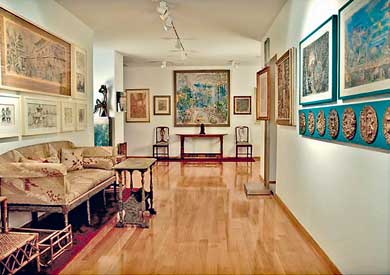 The upcoming opening of a one-of-a-kind museum has been billed as unexpectedly good news, a ray of light with regard to local cultural affairs hard hit by the ongoing crisis. The sixth annex of the Benaki Museum and former residence of prominent modern Greek artist Nikos Hadjikyriakos-Ghika, is scheduled to open its doors to the public in early April. Located at 3 Kriezotou Street in Athens, close to Syntagma Square, it will showcase the Ghika Gallery as well as the Interwar and 1930s Museum. The building was donated to the Benaki Museum by the artist himself.
by Spyros Yannaras
First published in ekathimerini.com
The new Benaki wing, developed thanks to the persistent efforts of the museum’s director Angelos Delivorrias, offers a panorama of leading examples of modern Greek culture, beginning in the 1920s and continuing up to the 1970s.
The museum will be inaugurated on Monday, April 2, while the following day will be dedicated to the numerous donors who have contributed to its development with a guided tour of the premises.
Meanwhile, news of the opening has been greeted with relief, given that only recently the Benaki Museum had launched an appeal with local visual arts fans to contribute to its financing by suggesting a new program for sponsorships and attracting new members.
On the Kriezotou building’s top floor, visitors can take a look at Hadjikyriakos-Ghika’s fully restored atelier, complete with his library and brushes. The artist’s unaltered living quarters, including the living room, dining room and his office, are situated on the fourth floor, where his triptych piece, “Kifissia,” is also on display. Furniture and personal items have also been restored, creating the feeling of a lived-in space. The third floor is divided into two areas: The first section includes the artist’s art gallery and the last section of the Interwar Museum, which also takes up the first and second floors. The final touches on the second and third floor are set to take a work-in-progress form in the presence of the audience.
The ground floor, which is also divided into sections, is home to the Litsa Papaspirou Hall, a restored interwar residence showcasing 17th-and 18th-century furniture as well as works by various European artists.
The Ghika Gallery is expected to change the city’s cultural landscape.
Obituary Nikos Hadjikyriakos-Ghikas (Nikos Ghika)
British Philhellene author, Patrick Leigh Fermor, donates Kardamyli home to Benaki
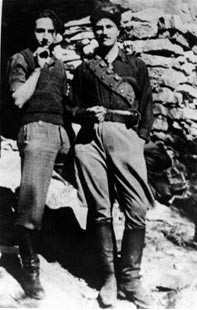
Paddy and George Psychoundakis the “Cretan Runner”
From the Folio Society website.
Ten years ago, The Folio Society decided to publish a book by William Stanley Moss, entitled Ill Met by Moonlight. It told the story of a daring war-time adventure in Crete, in which Moss and Patrick Leigh Fermor, two young SOE officers, kidnapped a German general, spirited him away across the mountains and into captivity. The book was based on the detailed diary kept (entirely against the rules) by Moss, and its undeniably romantic aspects were highlighted when, in 1957, a film was made starring Dirk Bogarde as the dashing Leigh Fermor.
When we planned the book, it occurred to us that Patrick Leigh Fermor, known to his friends as Paddy, had never contributed any kind of comment on it in writing. We assumed there was a good reason for this – a certain delicacy perhaps, since, at the time of the operation, he was already embedded in Crete in a cave under Mount Ida, with the role of facilitating Commando raids on the island, and was dependent on the friendship and loyalty of the local partisans. But we wrote to him anyway and asked if he would contribute an introduction.
He rang up from his home in Greece. It was indeed, he said charmingly, ‘delicate’ and for various reasons he’d always felt the less said the better. We parted genially, my suggesting that we might ask Michael Foot, historian of the Special Operations Executive and an old friend of his, to do it instead. This we did. A week later, Paddy telephoned again. He’d been thinking about it, and he felt that there were things he would like to say: the coup had, in his view, been diminished by being reduced to the level of a ‘tremendous jape’ and he hoped to restore the balance by providing something of the context for the enterprise. He did not wish to interfere with Michael’s introduction, but would contribute a short Afterword, describing his own experience. It would be 500 to 1,000 words. It eventually emerged at 6,500 words, all of which had to be wrested from him in hand to hand combat, so anxious was he that nothing could be misinterpreted. Michael Foot, in the meantime, was triumphant to be able to tell Paddy that General Kreipe (who was not the intended victim of the kidnap, as that gentleman had been moved on) was so unpopular that, when they heard he had been snatched, his officers broke open the champagne.
Most Folio books have their unexpected rewards, but this one had more than most. Through it we met Billy Moss’s daughters who showed us photograph albums and the original diary; Sophie, their Polish mother, a formidably attractive SOE operative who had been based, with Moss and Leigh Fermor, at Tara, the Cairo House; Michael (M R D) Foot, whose own experiences as prisoner of war were at least as hair-raising as the exploits he went on to chronicle; and of course Paddy himself – courageous, witty, modest, famously attractive and – both with this book and The Cretan Runner – a good friend to The Folio Society. We will miss him.
A Meeting between Paddy and George Psychoundakis the “Cretan Runner”
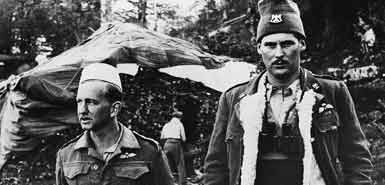
David Smiley (left) in Albania with "Billy" McLean
In his Introduction to David Smiley’s Albanian Assignment, Paddy describes Smiley as ‘Lieutenant Jekyll’ and ‘Captain Hyde’, variously at home with his Regiment, the Royal Horse Guards, amongst a “squadron of sabres and scarlet plumes” but also in the “caves, chasms, scorpions and fleas, random rifle-fire and ricochets, explosions, (and) the oaths of muleteers” in Albania or the Arabian peninsula. His life was truly one of excitement and adventure, but one which he was happy to end growing almonds and olives in Southern Spain.
We know little about Albania – it remains Europe’s poorest country and is still almost totally ignored by the media – and perhaps even less about the events there during World War Two. In two important books, Smiley’s Albanian Assignment and Xan Fielding’s biography of Smiley’s colleague “Billy” McLean’ we learn much about what was not so much a war against the invading Italian’s and Germans, but a political war focused on preparations for a civil war between the Nationalist and Royalist factions on the one hand, and Enver Hoxha’s Communists on the other. I enjoyed following Smiley’s route, on the map in the book, through the mountains, including time spent on the beautiful Lake Ohrid. He spent some of his time criss-crossing my own route through Albania along the Via Egnatia which I walked in 2009.
Smiley’s style is very much like I imagine his soldiering would have been; clear and to the point. We don’t have lingering descriptions of the beautiful Albanian landscape but straight to the point analysis of the motives of the participants, and the events that took place during his two SOE missions to Albania between April 1943 and October 1944. He was a man of action, never happier than when ‘blowing something up’.
The situation between the partisan (Communist) resistance and the Royalists was so complex that the mission became intensely political, with McLean and the future British government minister Julian Amery trying to keep the Albanians from fighting each other and instead killing Germans. Smiley was sent off with small cetas of Royalist Albanians and some very brave British NCOs to kill as many Germans as he could and to blow up as many bridges as he could to delay the German withdrawal, with a fair degree of success. But the politics were never far away and once whilst Smiley was setting an ambush against the Germans, they were counter ambushed by Communist partisans.
Albanian Assignment is not a long book. It is easy to read and full of interesting and exciting episodes. It is one of the many amazing stories about the bravery of SOE officers and soldiers punctuated by explosions, forced marches, long and boring tribal meetings, and brave acts, but ultimately the book is dominated by betrayal: of the SOE men on the ground and the people of Albania by Hoxha’s partisans, and those communist officers in the SOE HQ in Bari who would have seen Smiley and McLean handed over to Hoxha for humiliating treatment at best, or being shot at worst. The figure of Kim Philby also appears. After the war, Smiley worked with MI6 to train and insert Albanian nationalists into Albania in order to provoke an insurrection against the fragile Communist regime. Many of the Albanian patriots were shot as they landed on the beaches, just a few managing to escape into Greece. It was Philby who passed on the details of the operation to the Russians who in turn informed Hoxha.
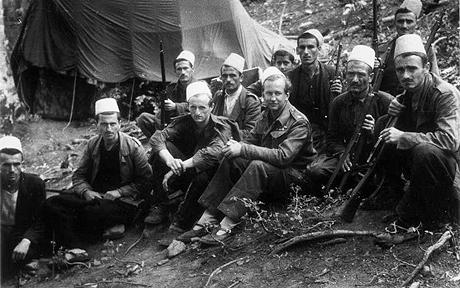
Colonel David Smiley, front 3rd right and band of Albanian fighters
Our by now familiar cast from Tara in Cairo also make an appearance as Smiley joined McLean by living there when not on operations. Paddy not only writes the introduction but Smiley also mentions Paddy’s wartime activities on a couple of occasions. Smiley continued with a regular military career after the war, ultimately commanding his Regiment, but also carrying on his irregular activities with MI6 and fighting insurgents on the Arabian Peninsula which he describes in the book Arabian Assignment.
David Smiley died in 2009 after a long and eventful life. You can read his Telegraph obituary here. Many of his colleagues had successful post-war careers. “Billy” McLean entered politics and was also engaged in irregular warfare in Arabia. Julian Amery was a leading Conservative politician, and Alan Hare (who was forced to eat his trusty mule during the deprivations of the harsh winter of 1943/44) became chairman of the Financial Times. Many of the communist leadership ended up being purged over the years, with a large number ending up either being shot or committing suicide. Enver Hoxha himself died in 1985 after leading Albania into total isolation and poverty.
Albanian Assignment is available on Amazon and occasional copies may pop-up on eBay.
Colonel David Smiley: Blues officer and MC recipient – Times obituary
Colonel David Smiley – Telegraph obituary
As the year comes to a close it is time to reflect upon what has passed and to look forward to 2012. I make no predictions for the coming year. There are some things which are almost certain such as the continuing Euro crisis and the much anticipated publication of Artemis Cooper’s authorised biography about Paddy, but forecasts tend to be overtaken by events and are quickly forgotten.
What we can do is to look back on this year in the life and times of Patrick Leigh Fermor. The major event of course was Paddy’s death on 10 June at the age of ninety-six. A sad event for his family and close friends, but also for those of us who admired him for his writing and the life he lived. As the year closed it was time to celebrate his life at his Memorial Service held on 15 December in London.
As I hoped the blog has become a significant source of material about his life including rarely seen video. There have been over 228,000 visits over the last year and you have made it a much more interactive experience by using the comment facility to exchange information, provide your own memories of Paddy, and to express your admiration for him. At the time of his death I opened a page where you could express your thoughts about Paddy which has run to over 120 comments.
Paddy would probably have been somewhat bemused by the whole idea of the blog, but perhaps even more so by the interaction we now have with social networking sites with nearly 4,500 visitors finding the site from Facebook, and 850 via Twitter.
To conclude the year, and as the 365th post on the blog, let us take a look at some of the most popular articles over the last twelve months. Perhaps I can make one promise to you all which is that there is much more to come on the blog in 2012 which includes a lot of material submitted by you the readers of the blog.
The Funeral Service of Patrick Leigh Fermor, 16 June 2011
Paddy’s funeral service was held on a typical English summer’s day at his home in Dumbleton. He returned to England just one day before his death and is buried beside his beloved Joan.
Obituary from The Independent by Paddy Leigh Fermor’s biographer Artemis Cooper
Perhaps the definitive obituary.
Patrick Leigh Fermor … This is Your (Ill Met by Moonlight) Greek Life
The amazing video from the Greek TV programme which reunited the participants of the Ill Met by Moonlight kidnap including Paddy, many of the Andartes, and General Kreipe and his wife.
Anthony Lane’s New Yorker article on Fermor is now free to view
One of the most comprehensive profiles of Paddy which is now freely available to all. (the pdf download appears to be no longer available – click on the article to magnify to read and then drag your cursor to move around the page)
Intimate portraits from Kardamyli by Miles Fenton
A series of personal photographs sent to me by Miles Fenton who is Paddy’s nephew and who now lives in Canada where he works as an artist.
Patrick Leigh Fermor recounts the kidnap of General Kreipe on video
The ever popular video where Paddy talks in some detail about the Kreipe kidnap. (press play on Battle of Crete 7).
David Smiley was a fellow occupant of Tara in Cairo with Paddy and Billy Moss et al who continued his military career with some distinction after the war and even led Japanese soldiers in a charge against VietMinh rebels!
Paddy’s eye for detail: Ian Fleming, Bondage, James Bond and Pol Roger
It is probably the James Bond/Ian Fleming association which maintains the popularity of this article.
If food be the music of love … Bánffy’s lover in Cluj (Kolozsvár)
No list of popular posts can be complete without the compelling combination of my passions for Paddy, Romania, Miklós Bánffy, and Cluj.
Patrick Leigh Fermor Memorial Order of Service
The order of service from the joyful occasion that was Paddy’s Memorial Service.
Finally I would like to thank so many of you for your encouragement and support during 2011, and wish you all a very Happy New Year!
Tom Sawford
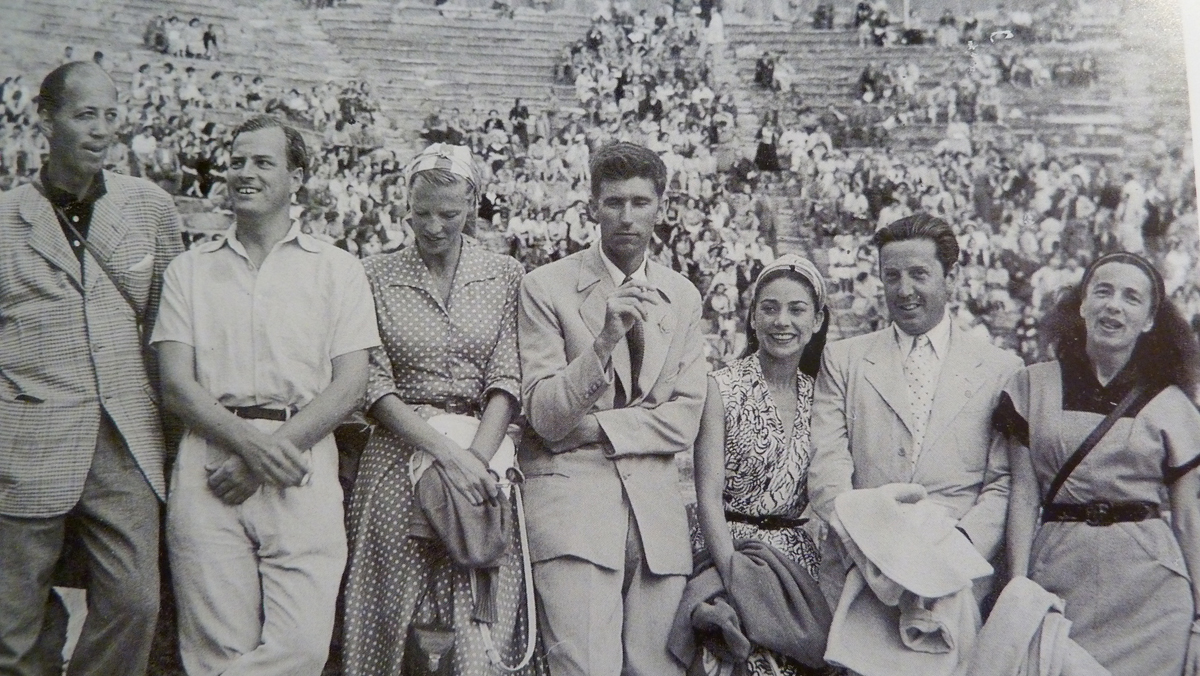
From left: Tom Fisher, Paddy, Joan , John Craxton, Margot Fonteyn, Frederick Ashton and Ruth Page. Photo: Costas Achillopoulos in Ian Collins’ book on the life of John Craxton
Today we can celebrate the memory of Patrick Leigh Fermor, whether we attend his memorial service in London, or are just able to take a moment to reflect on all he gave to his family, his many friends, to us his admiring readers, and of course his service to his country and to Greece.
I thought the best way to mark this day on the blog is to feature this fine photograph sent to me by John Chapman. It is from Ian Collin’s book about the life and work of John Craxton, the artist who illustrated most of Paddy’s book covers.
John tells me that Craxton “met Joan in wartime London years before he met Paddy, but became enamoured of Greece and for a large part of his life lived in Chania, Crete. It was both an escape from dull northern climes and a chance to express his sexuality.”
Craxton designed the sets for Daphnis & Chloe at the Royal Opera House in 1951 where the lead ballerina at the time was Margot Fonteyn. According to rumour they had an affair, and in the summer of 1951 they cruised together around the Meditterranean. Paddy was their guide to Greece, and it was at this time that this delightful photograph was taken which shows Paddy looking very happy, with good friends, and his much loved Joan.
The photograph shows Tom Fisher (a New York attorney and husband of Ruth Page) Paddy, Joan, John Craxton, Margot Fonteyn, Frederick Ashton and Ruth Page (choreographer). It was taken in the theatre at Epidavros, and is attributed to Costas Achillopoulos.
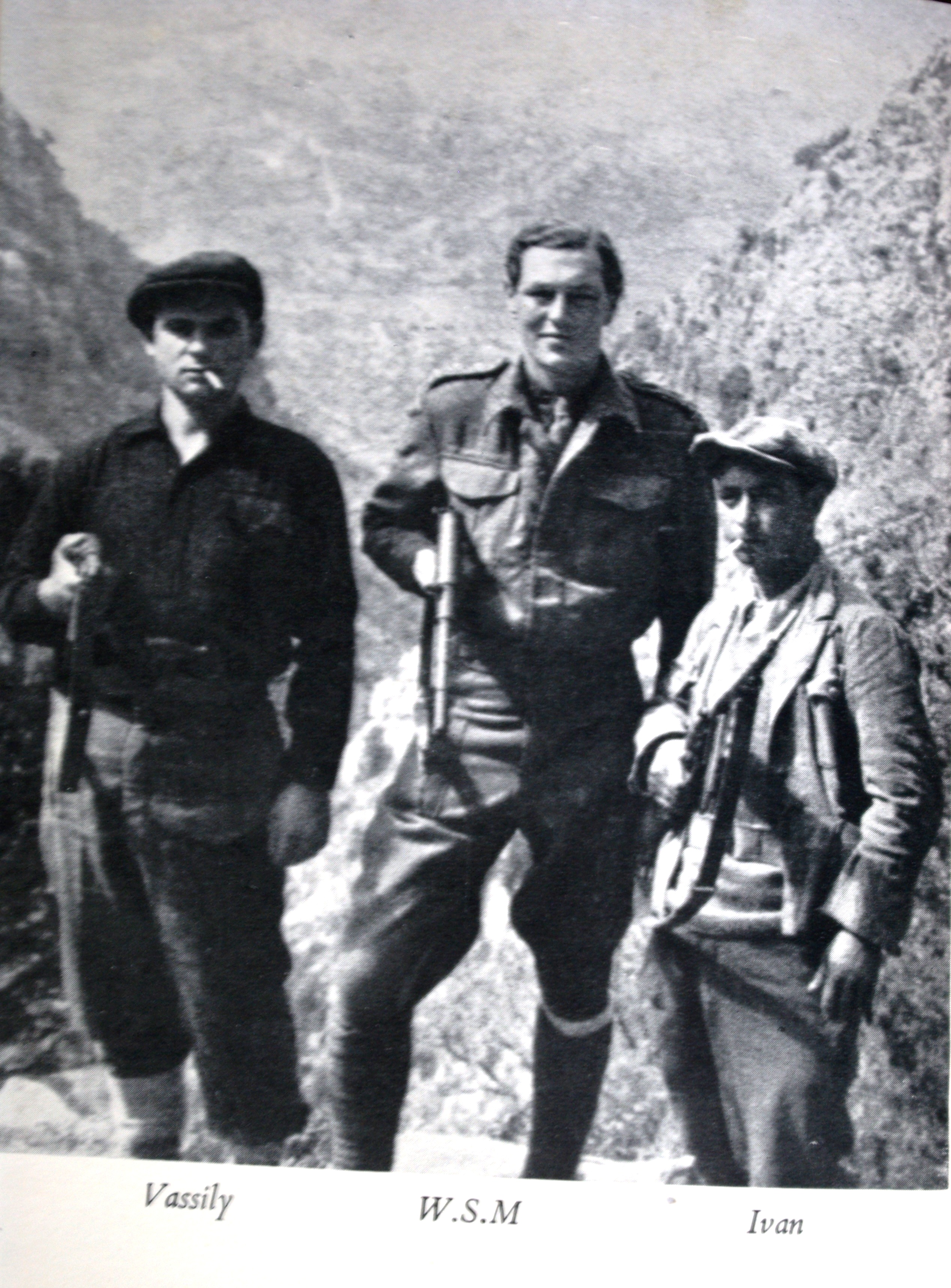
"Billy" Moss with his Russians
There appears to be no surviving obituary for Billy Moss (if anybody can find one please contact me). His Wikipedia page has to serve as a substitute.
Ivan William “Billy” Stanley Moss MC (1921–1965), was a British army officer in World War II, and later a successful writer, broadcaster, journalist and traveller. He served with the Coldstream Guards and the Special Operations Executive (SOE). He was a best-selling author in the 1950s, based both on his novels and books about his wartime service. He featured events of his SOE years in Ill Met by Moonlight: The Abduction of General Kreipe (1950), which was adapted as a British film released under the main title in 1957. Moss travelled around the world and went to Antarctica to meet the Commonwealth Trans-Antarctic Expedition.
He was known as William Stanley Moss, or I. W. S. Moss, or W. Stanley Moss, or plain Bill or Billy Moss – but never as “Stanley Moss”. Stanley was the surname of a female forebear. All family members (including Billy and his two daughters) were given this name, which was considered part of the surname, though not hyphenated. Much like “Leigh Fermor”.
Early life and education
William Stanley Moss, (called Bill or Billy) was born in Yokohama, Japan. His mother was a White Russian émigrée, and his father, an English businessman. The family survived the 1923 Great Kantō earthquake. Moss attended Charterhouse in England (1934–39).
Soldier
In the autumn of 1939, Moss, aged 18, had just left Charterhouse and was living in a log cabin on the Latvian coast. By the outbreak of war, he reached Stockholm, and succeeded in crossing the North Sea to England in a yacht. After full training at Caterham, he was commissioned as an ensign into the Coldstream Guards. He served on King’s Guard at the Court of St. James’s punctuated by bouts of Churchillian duty at Chequers.
Posted to reinforce the 3rd Battalion, the Coldstream, after the losses at Tobruk, Moss fought with Montgomery’s Eighth Army chasing Rommel across North Africa to Alamein and finished up the campaign in Chianti and Pantellaria. He returned to Cairo, where he was recruited into Force 133 of the Special Operations Executive (SOE).
Tara, Cairo
In 1943 in Cairo, Moss moved in to a spacious villa, with a great ballroom with parquet floors, which four or five people might share. Moss chose to live in the villa rather than the SOE hostel, “Hangover Hall”. He moved in alone at first, then bought his Alsatian puppy, Pixie; Xan Fielding, who had worked in Crete, joined him. Next was Countess Zofia (Sophie) Tarnowska, forced to leave Poland in 1939 by the German invasion, followed by Arnold Breene of SOE HQ. Finally Patrick Leigh Fermor, an SOE officer who had spent the previous nine months in Crete, joined the household. The villa’s new inhabitants called it Tara, after the legendary home of the High Kings of Ireland.
Sophie Tarnowska and two other women had been asked to share the house with the SOE agents, but only she went through with it, after the men pleaded with her not to let them down. Estranged from her husband, she moved in with her few possessions (a bathing costume, an evening gown, a uniform and two pet mongooses). She protected her reputation while living in the all-male household by the invention of an entirely fictitious chaperone, “Madame Khayatt”, who suffered from “distressingly poor health” and was always indisposed when visitors asked after her. The group were later joined by SOE agents Billy McLean, David Smiley returning from Albania, and Rowland Winn, also active in Albania.
Tara became the centre of high-spirited entertaining of diplomats, officers, writers, lecturers, war correspondents and Coptic and Levantine party-goers. The residents adopted nicknames: “Princess Dneiper-Petrovsk” (Countess Sophie Tarnowska), “Sir Eustace Rapier” (Lt-Col. Neil (Billy) McLean), “the Marquis of Whipstock” (Col David Smiley LVO OBE MC), “the Hon, Rupert Sabretache” (Rowland Winn MC), “Lord Hughe Devildrive” (Major Xan Fielding DSO), “Lord Pintpot” (Arnold Breene), “Lord Rakehell” (Lt-Col Patrick Leigh-Fermor DSO) and “Mr Jack Jargon” (Capt W. Stanley Moss MC). By the winter of 1944, the Tara household had to leave their battered villa and move into a flat. Their landlord secured their eviction on the grounds that the villa had not been let to “Princess Dneiper-Petrovsk” et al., as stated on the villa’s name plate.
Abduction of General Kreipe
Moss is best remembered for the capture of General Heinrich Kreipe on Crete and abduction of him to Egypt, in April and May 1944. He and Leigh Fermor led a team of Cretan Andartes, part of the Greek resistance.
Moss and Leigh Fermor thought of the Kreipe abduction one evening in the Club Royale de Chasse et de Pêche (Royal Hunting and Fishing Club) and planned it during the winter of 1943. On the last evening before Moss and Leigh Fermor set off, Smiley presented Moss with the Oxford Book of English Verse – his companion from Albania – for good luck.[2] McLean gave him a complete Shakespeare dedicated, “To Bill, with best of luck for Guernsey, Bill”.
Promoted to the rank of Captain, at age 22 Moss set off with Leigh Fermor, age 29, to Crete in 1944. Leigh Fermor landed by parachute. Moss, unable to jump due to cloud cover, followed several weeks later, landing by boat on the south coast where he joined Leigh Fermor, Andartes and other support. Walking north, they passed through Skinias, Kastamonitsa and Haraso. Just south of Skalani, they prepared for the abduction. Throughout the operation, as they travelled across Crete, they were hidden and supported by the Resistance and the local population.
Moss and Leigh Fermor, disguised as German soldiers, stopped the General’s car. With the help of their team, the driver was bundled out and the General and car seized. With Leigh Fermor impersonating the General, and Moss his driver, and with the General bundled in the back, secured by their Cretan team, Moss drove the General’s car for an hour and a half through 22 controlled road blocks in Heraklion. Leigh Fermor took the car on, as Moss walked with the general south into the mountains to Anogeia and up towards Psiloritis. Reunited, the entire abduction team took the general on over the summit of Psiloritis before descending, aiming for the coast. Driven west by German forces cutting off escape to the south, they travelled to Gerakari and on to Patsos. From here, they walked on through Fotinos and Vilandredo before striking south, finally to escape by ship.
After the war, a member of Kreipe’s staff reported that, on hearing the news of the kidnapping, an uneasy silence in the officers’ mess in Heraklion was followed by someone saying, “Well gentlemen, I think this calls for champagne all round.”
Post-war correspondence explains that Kreipe was disliked by his soldiers because, amongst other things, he objected to the stopping of his own vehicle for checking in compliance with his commands concerning troops’ reviewing approved travel orders. This tension between the General and his troops, in part, explains the reluctance of sentries to stop the General’s car as Moss drove it through Heraklion.
Moss was recommended for and received the Immediate Award of the Military Cross: “For outstanding courage and audacity.”
The episode was immortalised in his best-selling book Ill Met by Moonlight (1950). It was adapted into a film of the same name, directed and produced by Michael Powell and released in 1957. It featured Dirk Bogarde as Patrick Leigh Fermor and David Oxley as Moss.
The abduction is commemorated near Archanes and at Patsos.
Damasta Sabotage
Returning to Crete in August 1944, Moss led a resistance group consisting of eight Cretans and six escaped Russian soldiers in launching an ambush on German forces, intent on attacking Anogeia, on the main road connecting Rethymno and Heraklion. They chose an ambush site by a bridge in the Damastos location, one kilometre west of the village of Damasta. After the team destroyed various passing vehicles, among which was a lorry carrying military mail to Chania, the German force targeting Anogia finally appeared. It consisted of a track of infantrymen backed up by an armoured car. Moss and his group attacked the troops, Moss destroying the armoured car by dropping a grenade into the hatch. In total, 40 to 50 Germans and one Russian partisan were killed in the clash that followed. The operation is described in full in Moss’s book A War of Shadows (1952) and commemorated at Damasta. Moss’s exploits in Crete are recorded in the Historical Museum of Crete.
Macedonia and the Far East
After being promoted to Major, Moss served in Macedonia. Toward the end of the War, he served in the Far East, also described in A War of Shadows.
Marriage and family
In Cairo in 1945, Moss married Countess Zofia Tarnowska, his former housemate. She was the granddaughter of Count Stanislaw Tarnowski (1837–1917) and a direct descendant of Catherine the Great of Russia.
They had three children: Christine Isabelle Mercedes, Sebastian (who died in infancy) and Gabriella Zofia. Initially living in London, they moved to Riverstown House, County Cork in Ireland. They later returned to London. They separated in 1957.
Writer and Traveller
Moss achieved success as an author with three novels, as well as his two books based on his wartime adventures. In addition, he travelled to Germany and wrote an investigation of post-war Germany, studying what happened to gold accumulated by the Nazis: Gold Is Where You Hide It: What Happened to the Reichsbank Treasure? (1956).
Disappearance of Reichsbank and Abwehr Reserves
Between 1952 and 1954, Moss joined up with his friend and former SOE agent, Andrzej Kowerski, (who adopted his cover name, Andrew Kennedy, after the war), in order to unravel a mystery of the final days of the Third Reich. In April and May 1945, the entire remaining reserves of the Reichsbank – gold (730 bars), cash (6 large sacks), and precious stones and metals such as platinum (25 sealed boxes) – were dispatched by Walther Funk from Berlin under armed escort to be buried on the Klausenhof Mountain at Einsiedel in Bavaria, where the final German resistance was to be concentrated. Similarly the Abwehr cash reserves of hundreds of thousands of dollars where hidden nearby in Garmisch-Partenkirchen. Shortly after the American forces overran the area, the reserves and money disappeared.
Moss and Kennedy travelled back and forth across Germany and into Switzerland and corresponded with fugitives in Argentina, to research what had happened. They talked to many witnesses before finally establishing what had become of the treasure. What Moss and Kennedy uncovered, and the conclusions they reached on the various people responsible for the disappearances, have not been disputed to this day. The disappearance of Major Martin Borg, the US Military Governor of Garmisch-Partenkirchen at the time, has not been explained.[22] (And? who and what?)
Later, Moss and Kennedy went on to uncover the consequences of Heinrich Himmler’s order of 28 October 1939, which confirmed the Lebensborn programme. They researched what had become of the children born as a result of the order.
Antarctica
He continued to travel extensively first to New Zealand from where, on 14 February 1958, he flew in a Globemaster aircraft (with one engine cutting out six hours from his destination) to Scott Base at McMurdo Sound, Antarctica to report on the arrival of the first Antarctic crossing achieved by the Commonwealth Trans-Antarctic Expedition in 1957-8 led by Vivian Fuchs and Edmund Hillary. Months later, he returned to New Zealand in the icebreaker, The Glacier.
Sailing the Pacific
Taking to sea from New Zealand again, he sailed with Warwick Davies, John Ewing, Rex Hill and Bill Endean in Endeans’s 47 ft Alden-rigged Malabar ketch, the Crusader,[23] through the islands of the Pacific via Tahiti, Pitcairn Islands, Easter Island and the Galapagos Islands to Panama, eventually landing at Nassau, Bahamas in December 1959.
Jamaica
He moved on to Kingston, Jamaica, where he settled. He died on 9 August 1965, aged 44.
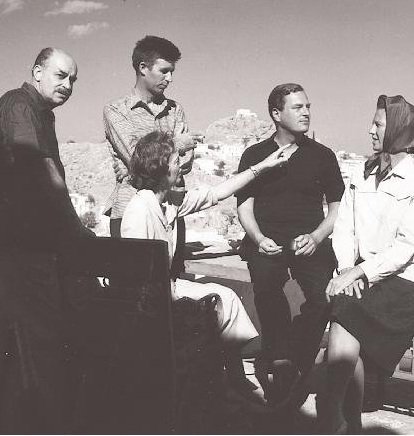
From the left: Nikos Hadjikyriakos-Ghikas, John Craxton, Barbara Hutchinson-Ghika, Patrick Leigh Fermor, Lydia Aous, 1958
by John Craxton
First published in The Independent Wednesday, 7 September 1994
Nikos Hadjikyriakos-Ghikas (Nikos Ghika), artist: born Athens 26 February 1906; Hon RA 1986; married 1961 Barbara Warner (nee Hutchinson; died 1989); died Athens 3 September 1994.
It was in 1945 that Peter Watson, the owner and art editor of Horizon magazine, asked me to look at some photographs of paintings by a Greek artist which had just arrived through the post. I remember well our enthusiasm for their freshness, clarity and strength. Their subject was inspired by houses in Hydra, the geometry of which was full of Mediterranean light. The style was a revitalised Cubism. It was at once decided to reproduce the paintings in Horizon.
That autumn I met the painter himself – Nikos Ghika – on his first visit to London. I found an immediate rapport with him, talking to this seemingly most English of Greeks, elegantly dressed, serious, charming, approachable. Like so many of my fellow artists then I had a deep desire to go south to the Mediterranean. Greece was very much on my mind. To find a sympathetic artist who would welcome me in his native country gave me added impetus. I mention this first meeting with Ghika, for it is quite typical of how European painters are often cross-pollinated by chance encounters.
Next year, in May 1946, it was my good luck to find myself in Athens. There began a friendship with Ghika which lasted till his stoic death 48 years later.
Ghika was always aware of the importance of influences, both unexpected and those discovered by intent. These happen all the time in the arts, in music especially. In 1922 Ghika determined at the early age of 16 that he would go to Paris to continue his studies as a painter. He was already a mature student, raised in a cultivated European Athenian society, and was gifted with languages. A year later he was exhibiting in the Salon des Independants. His first one-man show was held in 1927 and presented by Maurice Raynal. These years were a wonderfully fertile period for a young painter. Ghika enjoyed a close friendship with most of the leading painters and poets of the time, especially Jean Arp and Jean Helion, with whom he had a joint exhibition in 1934. On this occasion, Ghika showed paintings and some stunning bas-reliefs which reveal how rapidly his artistry had developed.
Back in Athens later in 1934 he began to plan the publication of The Third Eye, a Greek-language monthly review of arts and letters, in which Ghika and his friends published the works of avant- garde painters and sculptors, such as Paul Klee and Wassily Kandinsky, and of writers not previously translated into Greek, among whom were Matila Ghyka, Alfred Jarry (Ubu-Roi) and James Joyce (Ulysses). Ghika himself was represented by his essays on ‘Elements of a Language of Plastic Art’, ‘Introduction to Harmonic Tracings’, and ‘Introduction to the Law of Numbers in Art and Technique’. The seeds of the modern movement had reached Greece, but were broadcast on very rocky terrain.
Once returned to his homeland, Ghika discovered that his rejuvenated philosophy of Cubism already had deep roots in medieval Greek painting: reversed perspectives, dismissal of the horizon line, economical use of colour and colour used emotionally rather than descriptively. These aesthetics are to be found in Byzantine art, for example in the mosaic of the city of Nazareth; in the church of Karye Tzami in Constantinople. What was dismissed in the 19th century as primitive, was now accepted as an escape from the tyranny of photographic representation. Painters were now free to find joy in transformation instead of being restricted by imitation. This was the freedom that Ghika reintroduced to his native country.
From his earliest years Ghika was an outstanding example of what a serious artist must be in order to survive. He was born with a naturally searching mind, the essential equipment of a creative artist. Furthermore, he was intelligent, human, and knowledgeable, inquisitive, learned, and daring. He possessed, too, a towering dignity and an aristocratic presence. Fortunately, he could also be mockingly witty, satirical, and full of fun. How else could he have translated so sympathetically Edward Lear’s ‘Yonghy-Bonghy- Bo’ into Greek?
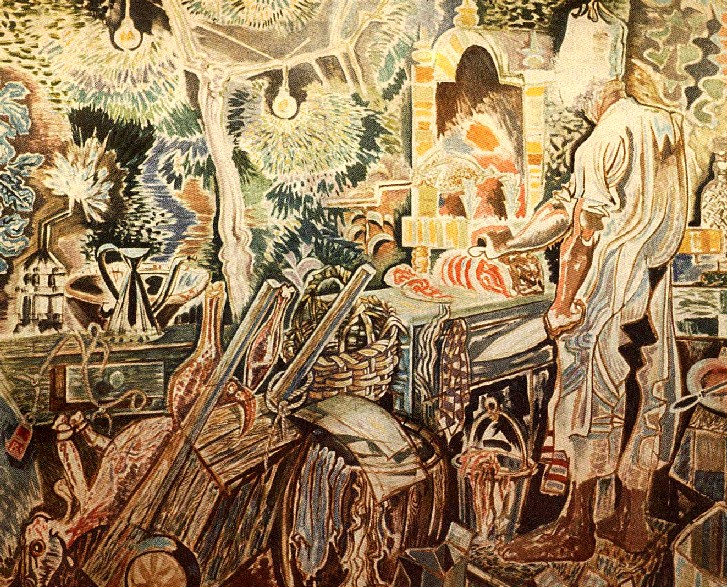
Night ceremony
Ghika was in his element designing for the ballet and the theatre. He was an architect of originality, an illustrator of books, a superb etcher. He created some of the most lovely and inventive sculpture, much of it inspired by ancient themes. He animated whatever materials came into his beautiful hands. Deep down he was a classicist at heart; form and content always in happy union. There is no mistaking his style; he made no paintings that lacked underlying form and all of them respected the scale and dimensions of his canvases.
Into his sometimes hidden geometries he poured his poetry of light and darkness, infusing colour into his forms with unmatched confidence, inventiveness, and authority. Always hand in hand with imagination, he let the spirit of poetry invade the labyrinthine city and moonlit walls. Here were landscapes radiant and full of joy as well as of enigma and mystery, so rare these days when so much art is paper- thin.
Ghika was a lesson to all young artists for he drew endlessly, helped by an astonishing visual memory. I have never seen a drawing by him that was not searchingly elegant or clearly structural and informative. A recent book of his caricatures is my constant delight. His last years, despite the gnawing loss of his wife Barbara whom he mourned privately, and his failing eyesight, were borne with true stoicism. Fortunately, an Indian summer of recognition in his own land was a solace to him. This final period saw the publication of many superbly produced books on him and by him, among them Ghika: Drawings, by Evita Arapoglou (1992), and Ghika, by Jean-Francois Bonhomme (1993).
It is to the credit of the English that the first retrospective exhibition of his painting was held at the British Council in Athens in 1946, that he had six one-man exhibitions in London from 1953 onwards, and a major retrospective at the Whitechapel in 1968. He was elected an Honorary Royal Academician in 1986.
Like all great artists, Nico Ghika was an inspirer. He would rebuke all who claimed painting to be easy. Those whose way of painting seems to declare ‘I can do that, too’, would do well to gaze on Ghika’s art and recognise his individuality.

Of the old estate of the Cantacuzino’s, all that remains is a tomb—and even that has been left to the elements—“The memorial has value, but the monument isn’t part of our database,” maintains the Director of Culture.
Chris Bartholomew got in touch with me, all the way from Salt Lake City, to pass on his translation of an article he found in a Romanian newspaper about the family tomb of Balasha Cantacuzene, who was Paddy’s lover before the war.
Thank you so much for your Patrick Leigh Fermor Blog. I have been a daily reader for about a year now, and have a difficult time thinking of life without my connection to this community you have brought together.
Last night I came across three newspaper articles about Baleni, Romania where Paddy spent time with Balasa Cantacuzino (the romanian spelling of Cantacuzene). The newspaper is Viata Libera, I believe from the city of Galati.
I’ve translated one article about the family tomb in Baleni, and thought it might be of interest to you and your readers as it provides excellent details about this mostly unpublished chapter of Paddy’s life.
Regards,
Chris
Salt Lake City, Utah
by Cristna S. Carp
First published in Viata Libera 17 March 2009
Generations of Cantacuzinos, the famous Byzantine noble family who contributed crowned heads to Romanian principalities, sleep forever in the locality of Baleni, almost forgotten.
Of the manor house and their vast estate in the former Covurlui County, all that remains is a tomb, left crumbling and surrounded by decrepitude.
The Last Male Descendant
Stories of princes and princesses always have happy endings. This only happens in fairy tales.
In reality, the princesses buried at Baleni are crying and sobbing, and Leon [Balasa & Elena’s father], the final Cantacuzino male descendant from the south of Moldova, is turning in his grave. Artifact hunters have even broken into the tomb through the roof.
But not even recent historical times have been among the most favorable. The last inhabitants of the manor, the daughters of Leon, Balasa and Elena, as well as Constantin Donici, the husband of the latter, were deported by the Communists to Pucioasa. Of the descendants of the Cantacuzinos of Baleni, it seems that no one is left alive.
The Transformation of a Library
One night in March of 1949, the fate of the owners and of the estate was sealed. The solid and imposing manor was doomed to dust.
An existing remnant of a reddish wall vaguely reminds us of the one time benefactors of the local communities, of country celebrations filled with good friends, and the many hunting expeditions. This is where in 1927 Nicolae Iorga, after a conference in Galati, came to admire the “splendid library, with artistic and rare editions.” This is also where Prince Sutu once dropped in, in his personal airplane.
The precious library from Baleni, consisting of books in English, French, Russian, Greek, German and Romanian, was scattered in all directions, beginning on the night of its masters’ eviction. Some volumes came to an end burning in the bottom of a decommissioned root cellar, others were thrown into a nearby river.
As not to muddy themselves during the early months of spring, activists used the books, gathered by the Cantacuzinos from the ends of the earth, to pave their walkways. Peasants fashioned shoes out of the luxurious covers of the books. Only a few hundred have found their way to the ‘V.A. Urechia” library, deposited by the Party or from other donations.
Ten Souls
Constructed, most likely, at the beginning of the 20th Century, the tomb situated in the old village cemetery, is “crammed” between graves whose ordinary souls also ask for the right to rest in peace. The funerary monument includes a chapel, constructed above the tomb. The crypt is open to anyone who would like to light a candle above the heads of these ten souls.
The first of the resting places belongs to the brother of Leon. Next are buried the paternal grandmother and the parents of Leon. His father, Prince George Matei, died in Egypt, but was brought to Baleni, where he was given a very ceremonious funeral.
Ana Vacarescu [Balasa’s mother] faded from life in 1923, followed that same year by her husband, Leon Cantacuzino. Balasa died in 1976, in Pucioasa. Elena brought her to Baleni and a few years later, also had the privilege of placing the incinerated remains of her dead husband in the crypt.
In her turn, Elena was placed, in 1983, in her final resting place, by her former students. The final person buried in the Cantacuzino tomb is Georghe Farcas, a descendant of the noble estate. As the founders of the new village church, the Cantacuzino descendants are often mentioned, but only during religious services.
“The Memorial is Proposed for Designation”
The county cultural representative, councilman Marius Mitrof, told us that, concerning the value of the funeral monument, all circumstances point to the memorial receiving historical designation. A precedent exists, in the tomb of the Serfioti Family, from Filesti, and of the Crissovelon family, from Ghidigeni, found on the list of historical monuments. However, specialists still must take into account other parameters, such as its architectural value and the conditions of the construction.
The former mayor, professor Nicolae Nita, admits, not without regret, that the princes, who might bring recognition to the village, are unjustly forgotten. Not even the current mayor, Lica Oprea, knows how this civic treasure might be given recognition without financial help from the county counsel.
A first step would be, as Marius told us, to solicit historical designation for the tomb, from the Directorate of Culture. “We do not have this funeral monument in our database, but it follows for us to visit the site to collect information and to hold public discussion with the local administration,” he also said.
On the other hand, even with an official place in the register of historical monuments, the tomb in Baleni has no guarantee that it will remain intact. Neither is it assured that, if the manor, once visited by Nicolae Iorga, had survived the Communists, it would have been maintained and promoted any better by our contemporaries. Here as well, sadly, we have precedents. Proof that our mentality must also be changed.
The troubled waters of the mind grow still and clear by Colin Thubron

John Craxton was the first choice illustrator for many of Paddy’s books. An exceptionally talented artist, he died in 2009 aged 87 years. You can read his obituary here.
In this article from the Spectator first published in 2004, Andrew Lambirth talks to John Craxton about the recreation of his designs for Ravel’s Daphnis and Chloe choreographed by Frederick Ashton.
John Craxton (born 1922) is a painter who has spent much of his life in Greece. Growing up in an intensely musical family in Hampstead (his father was the first pianist to play Debussy in England, his sister was a celebrated oboist), he was aware from a very early age of the infinite and magical connections between sound and the visual image. His subsequent work as a painter has all the structure one expects of a great composer: his are paintings which sing of their substance.

Elisha Willis as Chloë and Iain Mackay as Daphnis; photo: Bill Cooper
Craxton first went to Greece in 1946, staying on Poros, an island renowned for its ravishing charm (Lawrence Durrell called it ‘the happiest place I have ever known’). In 1951, Craxton shared digs with Patrick Leigh Fermor. Apparently, Leigh Fermor’s preferred regimen was to taverna-crawl by day and write by night. Craxton, ever the sociable, found painting by night difficult because of the lack of proper lighting. A big picture was on the go, but progress was somewhat hesitant. Then came a telegram from England.
Craxton already knew Frederick Ashton slightly, so the suggestion that he design a ballet for him was not completely unlikely, though it was unexpected. Suddenly the artist had to decide: stay in Greece and work on his picture, or up sticks and go back to London. The seductive Mediterranean or the ration books of old England? Uncertain what to do, Craxton went to see an old friend who happened to be ill in bed at the time, fiddled with his radio and tuned in to — Ravel. It was Daphnis and Chloe, the very music of Ashton’s ballet.
A sign like that (no doubt from the gods themselves) cannot be ignored. Craxton returned to London, and in a very few months designed the decor for Ashton’s ballet. Craxton made only one stipulation, that the costumes be modern dress, not ancient Greek, an idea that Ashton was open to. That was in 1951. The principal dancers were Margot Fonteyn and Michael Somes. Daphnis and Chloe was a notable success, and it has remained in the Covent Garden repertoire ever since, revived from time to time with new input from Craxton. Now it is being staged again. The main problem for the designer was that nearly all his designs, sets and costumes had been done away with, in one of those senseless purges which from time to time disfigure great institutions.
Only two costumes survived this petty holocaust — the ones which Margot Fonteyn had herself given to the Opera House’s archive. Nor were there drawings from which the originals might be recreated, for many of them had come about through the combined efforts of Craxton, Ashton and Fonteyn. Time was short, and the three not only shared a common artistic aim, but also understood how the project might be realised. Costumes could even be improvised from a bolt of cloth, if necessary. For that original production, Craxton painted all the scenery by hand himself. To recreate it in 2004, he had to rely on his memory, a few photographs and the album cover of a Decca long-playing record of the ballet. Rather amazingly, Craxton has triumphantly summoned forth once more his enchanted island setting, with cave-mouth, vine pergola, barren rocks and fig and olive trees. I visited him at the Royal Opera House production workshops in Bow Industrial Park in east London. There he was putting the finishing touches to some olive trees, which he was painting on their sides.
 He recalled his original task, more than half a century ago. ‘I was very lucky at that time in Clement Glock, the woman who ran the paint department, who was a very good scene-painter, and rather a sophisticated person altogether. She had worked with Sutherland, Piper and Derain and people like that. Her idea was to get the painter to do his own scenery as much as possible, so that it actually looked as if he’d painted it rather than it being an imitation of his style. So that’s what I did, working with enormous brushes on 60-ft lengths in the paint room at Covent Garden.’ (The paint frame by which vast flats can be readily manipulated was done away with in the recent ROH makeover.)
Craxton explains the ballet’s plot, which features pirates, a near-rape and the intervention of Pan. ‘There are two stories really — the original story by Longus (about 2nd- or 3rd-century AD) which the ballet is based on, and the version that Diaghilev and Ravel came up with in 1912. The whole thing is very Arcadian — like a Pompeian Barbara Cartland novel. It’s really a pastoral romance in which two young people, a girl and boy, awaken to sexual desire and fall in love.’ Craxton used a late Greek story to convey what he knew about contemporary Greece. He enjoyed the challenge of it. ‘What I wanted to avoid was a lack of unity between the decor and the dancers. I wanted them to be the same scale, which was much easier to achieve if I was painting the scenery myself and not having my drawings blown up by others.’
This was Craxton’s first ballet, but the painting of scenery was relatively straightforward for an easel painter. He was, however, a novice costume designer, having no idea how to make a dress, and to begin with he was forced to rely on the wardrobe department. Requesting an absolutely classical lady’s dress, he was presented with a 1938 short cocktail dress, as he describes it, ‘off the shoulder, pleated — dreadful. I went to see what had been done with Margot and Freddie and I was practically in tears. I didn’t know what to do or what to say. Margot was brilliantly clever and sensed the terrible state I was in with worry and disappointment and said, “I don’t think this is really what John wants at all.” So she got the material together and started to bunch it up and designed a costume with a tight bodice and loose skirt. Only Margot could have done that. We found a material called stockingette, which hung very well and dyed very well.
 ‘What I tried to do was make a group of harmonic colours for the shepherdesses, so the colours relate together like a chord, leaving me freedom to have the temptress in Schiaparelli pink, and Chloe in yellow. When I first did the costumes I put Chloe in yellow, but because the lighting was so primitive then, her dress came out rather beige. There was a girl in the row of shepherdesses who was dressed in pink. Her dress shone out so brightly that Margot said, “I’m having that dress.” But for this new production I’ve put Chloe in yellow as I wanted from the beginning. A simple naive girl wouldn’t be wearing pink, but primrose yellow.’
The current decor is almost identical to the original production, though slightly more complicated. ‘In 1951, the decor was very much simpler. It had one big backcloth in the first scene, and the tails, which are those flats on either side of the stage, were just plain blue material. There was no time to do anything to them. It was all an incredible rush, but that’s showbiz. It was only for a later production that Freddie said, “What about making some tails with rocks and trees,” and that’s roughly what you see today.’
Now the rocks in scene two have been redesigned and painted porphyry red to make them more menacing, and there’s a new drop curtain. The pirates are all dressed in black as Cretans. The ballet really looks like one of Craxton’s own paintings come to life — ‘It was the only honest way I could do it. I couldn’t have done a pastiche of ancient Greece — it’s not me. It was one of the first Mediterranean ballets, based on my own experiences in Poros and Crete.’ For this reason, Craxton’s sets have an authenticity which is as compelling as it is beguiling.
Paul Theroux, William Dalrymple, Kari Herbert, Colin Thubron and many more writers tell us about the travel book that most influenced their own life and work. Others that one could say are slightly less well-known, and very pleased to be placed into the pantheon of “world’s greatest travel writers” – Mr Jasper Winn 🙂 – are included.
I was very pleased to see two of Eric Newby’s books chosen; no surprises that they were A Short Walk in the Hindu Kush and my absolute favourite, Love and War in the Apennines.
William Blacker chose all of Paddy’s books, including Between the Woods and the Water. Yesterday he sent me an email pointing out some deficiencies in the way the Guardian had edited his submission – Now, what did he really expact from the Grauniad? – , including the quotation from Kim at the end. William’s original submission can now be revealed in all its full and original glory …
It was not just the books of Patrick Leigh Fermor – notably Between the Woods and the Water about Rumania – which inspired me, but also the man. He was the quintessential free spirit. He didn’t bother with university, but at the age of 18 set off into the blue, on foot, across Europe , simply hoping for the best. His journey lasted five years. On the way he picked up a bewildering multitude of European languages, which led on to extraordinary wartime adventures, and then to a series of breath-taking books, which are peerless, and among the great masterpieces of twentieth century literature. The resounding success he made of his special brand of non-conformity should fill all would-be wanderers and fellow free spirits with hope. Read about his life, read his books, and if you are not similarly inspired and exhilarated by Leigh Fermor’s example then, as Kim said, ‘Run home to your mother’s lap, and be safe’.
William emphasises, for those who might miss it, “that I wrote, very deliberately, ‘great masterpieces of twentieth century literature’ and not ‘great masterpieces of twentieth century TRAVEL literature’ !”
The list of choices can be found in this article in the Guardian.
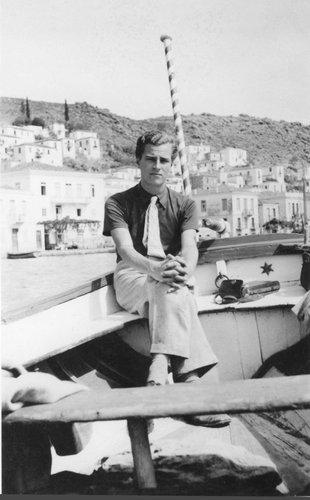
Paddy in Greece photographed by Joan
Don’t you feel like me that with the passing of Paddy as one of the last of his generation we have clearly entered a new age dominated by uncertainty; a lack of confidence in the values we once held as unquestionably true? These beliefs that bound us (in the West?) together for the latter part of the twentieth century are now unravelling at an ever-increasing pace. As we enter the End Game of the economic crisis, and as the decade of The Forever War rumbles on like the noise of a busy road in the middle distance – there only when we take the trouble to notice – we suffer a dearth of leadership and heroes of substance. Paddy and those of his generation had no such crisis of confidence; they served without question. They sacrificed themselves for the things they believed in, and they provided the leadership, entrepreneurship, creativity, and wisdom that helped rebuild Europe after almost half a century of ethnic and social strife, and destructive war. Maybe they also share some blame for the way things turned out, but who will step up now?
In this considered profile, which prompted my rambling reflection, Paddy’s good friend Colin Thubron assesses his contribution, not as a warrior, but as a writer, and I think for the first time, reveals the torment of Paddy’s troubling writer’s block towards the end of his life.
by Colin Thubron
First published in the New York Review of Books, Volume 58, Number 14
When Patrick Leigh Fermor died in June at the age of ninety-six, it seemed as if an era had come to an end. He was the last of a generation of warrior–travel writers that included the Arabian explorer Wilfred Thesiger, the controversial mystic Laurens van der Post, and the indefatigable Norman Lewis of Naples ‘44. Among these, Leigh Fermor shines with the élan and the effortlessly cultured glow of an apparent golden age. A war hero of polymathic exuberance, brilliant linguistic skills, and an elephantine memory, he was sometimes fancifully compared to Lord Byron or Sir Philip Sydney.
Two pairs of books came to exemplify his achievement. The first pair—Mani (1958) and Roumeli (1966)—celebrated the Greece that held his abiding fascination and where he lived for forty-five years on a once-wild promontory in the Peloponnese. In Mani, especially, he described this backwater region as a world whose way of life had survived in a fierce and enchanted time warp.
The land he depicted is barely recognizable now—tourism, he observed, destroys the object it loves—but it was less the Greece of classical antiquity that beguiled him than the spirit and folk culture of the hinterland: the earthy, demotic Romiosyne that he once contrasted with the Hellenic ideal in a playful balance sheet of the country’s character.
In these, and in later books, the style was the man: robustly imaginative, cultivated without pedantry, unstoppably digressive, forgivably swanky, and filled with infectious learning. The impression—overflowing into elaborate footnotes and flights of learned fantasy—is one of omnivorous delight in the quirks and byways of history, art, language, genealogy, myth, song, superstition, costume, heraldry, and everything else that struck his fancy.
His literary models were Norman Douglas and Robert Byron, but his writing was more vivid than the one, more kindly than the other. Despite the richness of his prose (occasionally slipping into purple) he forged an illusion of intimacy with his readers, as if they were sharing his mind in the moment of writing. But in fact his manuscripts were worked, reworked, and reworked again with such painstaking perfectionism that his publisher (the benign Jock Murray) often had to reset his galley proofs wholesale. The apparently natural flow of words was in reality a densely worked choreography, which came at cost.
Fifteen years ago, swimming in the Ionian Sea beneath his home, where nobody could overhear us, Paddy (as friends and fans called him) suddenly confessed to me the writer’s block that would plague the rest of his life. The expectations of a now-avid public, and his own obsessive perfectionism, were taking their toll, and he could not overleap this cruel impediment.
I remember him strong into old age. He swam every morning, with a sturdy breaststroke far out to sea, the tattoo of a twin-tailed mermaid glistening on his shoulder. He still kept up a striding march in the Taygetus foothills, where he and his wife Joan had designed their own house above the ocean. It was a place of “mad splendor,” he wrote. Its sitting-room library—bookshelves banked nine feet high—opened onto a vista of cypresses and the Messenian Gulf, and was flagged with the greenish stone of Mount Pelion. In the afternoon Paddy would disappear into his study to confront—or escape—the demons of his failed writing, and would emerge to the liberation of ouzo or whiskey, generally to report some arcane piece of research—that the Huns wore stitched field-mouse skins, perhaps—or to share a passage of Ovid. We dined in the monastic half-cloister he had built beside his home, and once we visited the tiny, red-tiled Byzantine chapel where—five years before—he had buried the ashes of Bruce Chatwin.
The conflict between a natural gregariousness and the solitude of writing never quite resolved for him. In a short, intriguing study named A Time to Keep Silence (1953) he recorded his sojourn in three great French monasteries. He described this retreat not as a religious exercise, but as a need for a haven for writing, and the nature of its cleansing—”the troubled waters of the mind grow still and clear”—remains suspended like a question mark in the oeuvre of a man to whom self-revelation seemed indulgence.
The second pair of books, which established Paddy’s primacy among travel writers, must be among the most extraordinary ever written. In 1933, as a youth of eighteen, he left England for a journey that would take a year and a half. As “a thousand glistening umbrellas were tilted over a thousand bowler hats in Piccadilly,” he set out to walk to Constantinople (as he nostalgically called Istanbul). Walking stick in hand, a copy of Horace’s Odes in his rucksack, he pursued a meandering course up the Rhine and down the Danube, across the Great Hungarian Plain, into Romania and through the Balkans to Turkey.
It was almost forty-five years before he published the first part of this journey, and another nine years before the second. A Time of Gifts (1977) and Between the Woods and the Water (1986) represent prodigious feats of memory. They record the rite of passage of a precocious, exuberant young man as he encounters the peoples and languages of a Middle Europe now littered with obsolete names: Bohemia, Transylvania, Wallachia. His story must have become the dream journey of every enterprising and footloose adolescent.
Inevitably the accuracy of Paddy’s memory was questioned, and he was frank about occasional imaginative license and conflation. (His first diary was stolen in Munich, a solitary last one recovered years later in Romania.) Certainly his recall was extraordinary. I remember the first time we met (by chance), when he quoted verbatim from my first book passages that I had myself forgotten. A year before his death we chanted verses from the Rubáiyát of Omar Khayyám together in an antiphonal competition (which he won).
His urge to describe his epic journey more than forty years after its end was a deeply natural one. He was revisiting his youthful persona with the judgment and knowledge of maturity; yet in a sense he had remained unchanged. Despite his sophisticated learning, he retained an almost boyish innocence, as if the troubles of the modern age had bypassed him. In the Peloponnese, where he settled to live in the 1960s, he had remained in thrall to a more ancient, rooted culture than that of the urban West.
The final volume of his proposed trilogy—carrying its author through the Balkans and down the Black Sea coast to Turkey—became his tormenting and elusive project for the next quarter- century, and was never completed. Some near-finished version, however, survives him, and will eventually be published.
With his youthful trek done, Leigh Fermor’s career took off into near fable. Caught up in Greek unrest, he joined in a triumphal royalist cavalry charge against wilting Venizelist rebels. In Athens he fell in love with the artist Princess Balasha Cantacuzene, twelve years older than him, and lived with her in Moldavia for over two years, before World War II recalled him to London.
As a fluent Greek speaker he was recruited by the Intelligence Corps, and sent as a liaison officer with the Greek army first to Albania and finally to Crete, where he survived the brutal German invasion. For almost two years, while an officer in the Special Operations Executive, he lived disguised as a shepherd in the Cretan mountains, organizing the gathering of intelligence.
Then, in 1944, occurred the exploit that—more than any other—was to burnish him into legend. He and his fellow SOE officer Stanley Moss dreamed up a scheme of harebrained bravado. Dressed in stolen German uniforms, with a party of Cretan guerrillas, they ambushed the car of General Heinrich Kreipe, the German commander of occupied Crete, kidnapped him, and concealed him under the back seat. Moss took the wheel, Paddy donned the general’s cap, and together they drove through twenty-two checkpoints to emerge on the far side of Herakleion and march Kreipe for three weeks over the mountains, to be picked up by motor launch and taken to Egypt.
It was during this hazardous Cretan march, as the dawn broke over Mount Ida, mythical birthplace of Zeus, that the abducted general began to murmur a verse of Horace: Vides ut alta stet nive candidum/Soracte….1 It was an ode that Paddy knew by heart, and he completed the six stanzas to their end. “The general’s blue eyes had swivelled away from the mountain-top to mine,” Paddy later wrote,
—and when I’d finished, after a long silence, he said: “Ach so, Herr Major!” It was very strange. As though, for a long moment, the war had ceased to exist. We had both drunk at the same fountains long before; and things were different between us for the rest of our time together.
This precocious kidnapping was later reimagined in a lackluster movie named Ill Met by Moonlight (1957) with Dirk Bogarde playing Paddy. But there were other exploits too. Paddy had already engineered the defection of the Italian General Angelico Carta from Crete; and he was due to undertake a near-suicidal mission to Colditz when the war ended.
His upbeat account of these events was tempered by regret. He had planned that the abduction of Kreipe be bloodless, but his accompanying Cretan partisans slit the chauffeur’s throat, and rumors of grim German reprisals for the abduction have never quite died down. Above all, Paddy’s accidental shooting of one of his fellow guerrillas may have stained his memory of the whole period.
On June 16 Leigh Fermor was buried back in the English countryside, attended by an Intelligence Corps guard of honor, to lie beside his wife Joan, his dear comrade since 1946. This was, in a sense, fitting. For in certain ways he was exemplary of a wartime Englishness now almost gone, whose more dashing qualities merged seamlessly into the hardy stylishness of Greek leventéa.
To those who knew him, his books are hauntingly redolent of his sensibility. His conversation was irrepressibly warm and inventive far into old age, moving from arcane anecdotes to fanciful wordplay or bursting into polyglot song (sometimes singing the lyrics backward). His friends ranged from Deborah, Duchess of Devonshire—last of the six legendary Mitford sisters (his correspondence with her was published in 20082)—to early acquaintance with a raffish interwar bohemia and his own great predecessor, the travel writer and aesthete Robert Byron, whose borrowed rucksack he bore across Central Europe as a youth.
Almost the last time I met Paddy, he had returned home after an operation for suspected cancer, and I feared he would be depleted, his old zest gone. He was growing deaf, and he suffered from tunnel vision (which he called Simplonitis). For a while, sitting over lunch, he seemed subdued. Then something struck him. He perked up, and said: “You know, there is an apple lying on a table in the hall. It’s been there all weekend. Wouldn’t it be marvelous if it cocked a snook at Newton, and simply took off into the air!”
This was typical of his boyish resilience. In the field of travel he evoked both the youthful wanderer who discovers another world and the avid scholar who melds with it. His prose was too rich and elaborate to be a safe influence on others (although a few have tried); but he brought to the genre not only the distinction of his densely brilliant books, but his innate dignity, ebullient mind, and capacious heart.
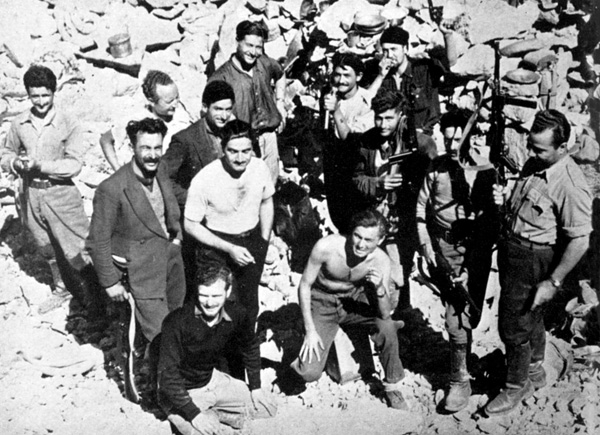


 Patrick Leigh Fermor