Author Archives: proverbs6to10

Unknown's avatar

About proverbs6to10

Interested in Byzantium and Patrick Leigh Fermor

Jan Morris review of Nick Hunt’s Where the Wild Winds Are

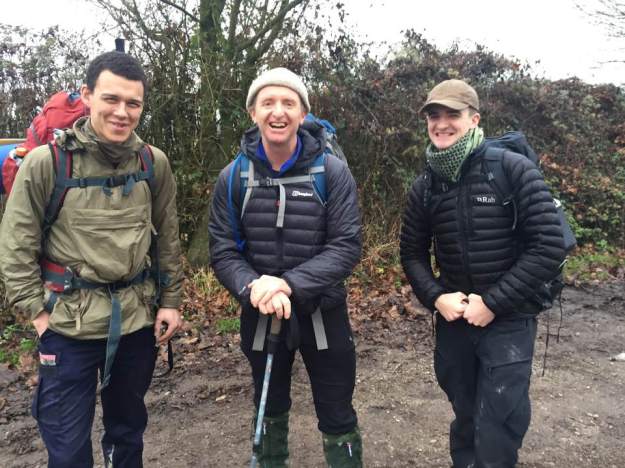
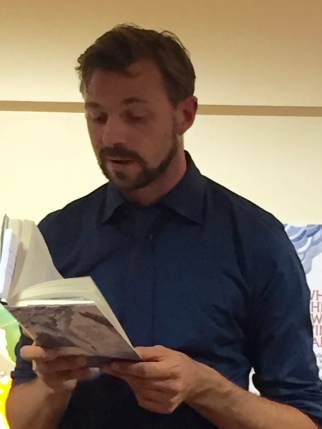
Nick Hunt reads from his new book at the launch at Stanford’s bookshop, London on 6 September 2017

Jan Morris’ review of Nick’s new book, Where the Wild Winds Are: Walking Europe’s Winds from the Pennines to ProvenceFirst published in The Literary Review. She is effusive in her praise, concluding …

Hunt’s own summing-up of the whole venture expresses it better than I can, anyway. He says that he and his senses have been washed, scoured, scrubbed, frozen, heated, pummelled, pounded, downcast, uplifted and animated by the Winds.

And so, in a way, have mine, by reading his book.

This extraordinary work is a prime example of that contemporary genre, the ex-travel book. Travel writing as such being a bit obsolete now, since so many readers have been everywhere, the form has evolved into something more interpretative or philosophical. Where the Wild Winds Are: Walking Europe’s Winds from the Pennines to Provence is a work of this sort – a thoughtful (and perhaps rather too protracted) relation of a journey on foot across half of Europe – and it contains much admirable descriptive writing of the old sort. It is also, however, something far more interesting than most such enterprises: it describes an expedition into the Winds!

The Winds? Yes, four European winds, sometimes with a capital W, sometimes not, into which, one by one, Nick Hunt goes. He wants to experience and explore them all. Each is rich in history, myth, folklore, superstition and effect. Many of us have travelled across Europe, but as far as I know nobody has hitherto so deliberately explored the kingdoms of the great winds. Scientists, geographers, glider pilots, artists, poets and theologians have investigated and commemorated them, but travel writers never before. Hunt immerses himself in those Windlands and manages to give his readers a blast, a sigh, a shiver of each.

He chooses four named winds out of dozens, four being a geographical sort of number. His first and smallest wind, one I have never heard of before, blows across a northwestern corner of England. It is called Helm, and its headquarters, it seems, is a desolate plateau called Cross Fell in a particularly uninviting stretch of the Pennines. Helm is the only named wind blowing across Britain. It sounds perfectly awful and its reputation is frightful: it howled for fifteen days in 1843, it demolished a castle tower once, everybody complains about its psychological and temperamental effects and for centuries the countryside it rules was plagued by vendettas, pillagings, rapes, cattle-rustlings and murders. Hunt relates an awful curse that a 16th-century archbishop cast upon the place: it ran to more than a thousand words and finally declared that the souls of the local miscreants should be condemned to the deepest pit of hell, their bodies to be torn apart by dogs, swine and wild beasts.

Of course Hunt does not blame Helm for all this, but the wind does seem to have a baleful influence upon people, even now. He never experienced it for himself, diligently though he tried, tramping the high fells in search of it and miserably camping out, but his description of the experience is sufficiently vivid. It seems to me that the whole of Helmland is blown through with scoundrels and demons.

Less baleful, thank goodness, seems the influence of Foehn, which the novelist Hermann Hesse once described as the south announcing news of spring to the snowbound north. It is a warm wind (katabatic, Hunt helpfully explains, meaning that it blows downslope, not anabatically), and although it is said to cause migraines and depressions, it is also associated with clear skies and warmth. It sounds an ambiguous sort of wind. Our author starts his walk through its realm in Zurich in late March. He hopes to catch the wind doing what Hesse said it did, and he gives us some classic travel-book stuff on the way (‘flocks of sheep clanged their bells in a satisfyingly Alpine way’). When he gets to Liechtenstein he finds an entire exhibition devoted to Foehn. ‘We say’, announce its curators fondly, ‘that Foehn is the Oldest Man of Liechtenstein.’ This lively exhibition seems to reveal a different sort of attitude to the wind from anything Helm inspires in the bitter Pennines – more considerate, more affectionate perhaps. As Hunt walks on, though, he finds that while his front is growing warmer, his back is getting cold, and I take that to demonstrate that Foehn is a two-faced sort of wind.

It apparently is responsible for an illness of its own – Föhnkrankheit (‘Foehn-sickness’). Citizens complain of wind-induced depressions, anxieties and headaches. Farm animals grow fretful when Foehn blows and schoolchildren become uncontrollable. Hunt saw for himself a horse ‘excitedly’ performing ‘a small dance in its field’, and took this to mean that Foehn was on its way. When he told one elderly citizen that he was hoping to experience the wind for himself, the old boy scowled, tapped out his pipe on his trouser leg and simply said schlecht (‘bad’).

When our author did at last encounter Foehn in person, as it were, sure enough it was an ambiguous fulfilment. The energy of its gusts was evidently thrilling: ‘Now that I had found the wind, I had to follow it.’ But with Foehn, he says, came a powerful sensation: ‘Melodrama was everywhere: in the lake, the trees, the grass, the birds, the mountains, the sky, the light.’ He was, he says, ‘worn ragged from the struggle … I had come a long way to find the wind, but now for the first time … I had the strong sensation of wanting it to stop.’

Ah, but Hunt’s fourth wind (I will get to the third one later) is the Mistral, and we all know that one. The very name whispers holiday, art and the warm south. Van Gogh, Hunt tells us, painted his Summer Evening specifically because the Mistral was blowing through the Midi that day. ‘Aren’t we seeking intensity of thought’, Van Gogh asked a friend, ‘rather than tranquillity of touch?’ Intensity is evidently a hallmark of the Mistral. Both the French and the Spanish have warships named after it. Van Gogh himself, of course, eventually went mad.

Hunt knew all about the Mistral when he began his exploratory walk at Valence, where the wind is popularly supposed to start, and he had no difficulty in finding it for himself. It hit him in the face the moment he went out, and all around him, he tells us, passers-by ‘walked at forty-five-degree stoops, their hair-styles heading south’. Was this indeed the Mistral? he asked one of them. The reply was definitive: ‘Oui … This is the place with the most wind in France.’

He need not have asked. Throughout his stay in Provence, the Mistral was boisterously and proudly with him, and everyone talked about it. It used to be called ‘the idiot wind’, he learned. In the town of Orange in 2004 it blew for sixteen days without stopping, and it regularly blows there for one in three days throughout the year. ‘It makes us nervous – angry, even. Yes, it makes us angry! He enjoys this! He likes the passion! Me, I hate it.’ It had lately changed its blowing patterns, some said, while others suggested that in the law courts judges sentence more leniently if the Mistral is blowing hard.

One connecting theme of Hunt’s book is the subject of madness and its supposed links with particular winds. Van Gogh spent a year at Arles in Provence and painted two hundred pictures there – scenes all distinguished, Hunt suggests, by ‘the restlessness of the air’. Van Gogh himself called the Mistral merciless and wicked, but he loved the clear light of it, and it was not in Mistral country but in northern France where in the end he shot himself.
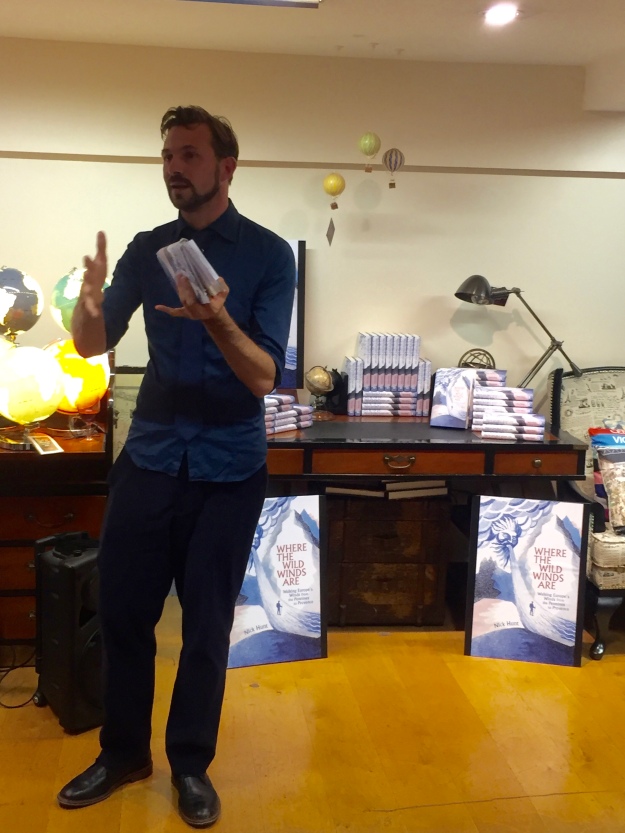
Nick Hunt reads from his new book at the launch at Stanford’s bookshop, London on 6 September 2017

I have left to the end Hunt’s second Wind, the Bora, because it is the one I have personally experienced, and because it seems to me the one most dramatically associated with a particular city. The Bora is a terrific climactic phenomenon that periodically storms down the mountainous coastline of the Adriatic and bursts through gaps in the highlands to fall upon places on the coast. Hunt calls it the ‘enfant terrible of the Adriatic’, and at its worst it can reach hurricane strength.

The Bora is intimately associated with Trieste, a city of tangled nationality, mingled fortunes and pungent character. I have known the place myself for seventy years and have written about it often, but until Hunt’s book reached me I had never heard of the Bora Museum, which is in a back street near the docks and contains 150 bottled winds from the four corners of the world.
Trieste and the Bora have become almost synonymous and they are proud of each other.

Everyone in the city has tales to tell of the wild and boisterous Bora, its rolling over of trams, its stripping of roofs and all its extravagant goings-on – such a contrast from the sometimes melancholy suggestiveness of the city itself. The Bora is fundamental to the self-image of Trieste. There is a street named in honour of it, artists repeatedly celebrate it, you can buy comic postcards of it and local historians like to claim that a nearby battle fought under its influence in AD 394 led directly to the fall of the Roman Empire. I forget exactly why.

I can myself testify that the Bora has the usual deleterious wind effects, including odd sensations of desolation or enervation. Nevertheless, after finishing this fascinating work, it seemed to me that the Bora is the happiest and jolliest of all Hunt’s Winds, the only one, perhaps, with a sense of humour.

Where the Wild Winds Are is full to the brim with learning, entertainment, description, scientific fact and conjectural fiction. It is travel writing in excelsis, and if I have judged it to be too long, that is perhaps because I have had enough of the genre itself. Hunt’s own summing-up of the whole venture expresses it better than I can, anyway. He says that he and his senses have been washed, scoured, scrubbed, frozen, heated, pummelled, pounded, downcast, uplifted and animated by the Winds.

And so, in a way, have mine, by reading his book.

Buy Where the Wild Winds Are: Walking Europe’s Winds from the Pennines to Provence
By Nick Hunt
Nicholas Brearley Publishing 258pp

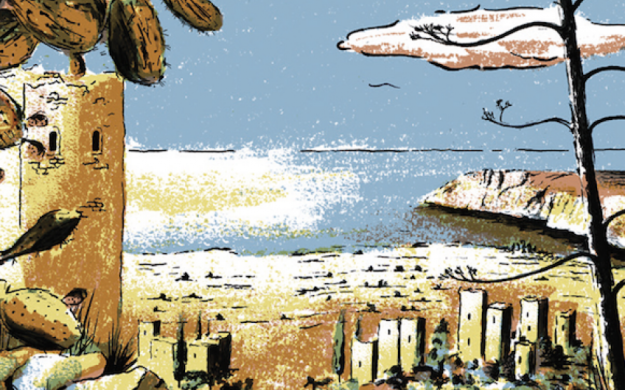
Postcard from . . . Bulgaria

Illustration by Matthew Cook

Illustration by Matthew Cook

In a cramped office at Bulgaria’s Rila Monastery, a black-robed monk is swiping my passport. Set in a wooded valley 70 miles south of the capital Sofia, Rila is the country’s largest and oldest Orthodox Christian monastery, and a source of intense pride for Bulgarians. Travel writer Patrick Leigh Fermor stayed here in 1934 and found a place of “clattering hooves and constant arrivals and departures . . . like that of a castle in the Middle Ages.”

by Tom Allan

First published in the Financial Times

Today the clatter of hooves has been replaced by the rumbling tyres of tour buses and the monastery’s humbug-striped pillars and copper domes are one of Bulgaria’s major tourist attractions. One thing hasn’t changed: the monks still offer accommodation — there are 38 rooms available to pilgrims and non-believers alike. Stay the night and you can explore once the day trippers have departed.

The monastery was founded in the 10th century by the followers of St Ivan of Rila, a hermit who lived in a nearby mountain cave. Its library holds an important collection of medieval manuscripts and there are exceptional wood carvings, including the Cross of Rafail, which took 12 years of surgical chiselling to make, by which time its creator had lost his sight.

The surroundings are special too. The forested slopes that encircle the quadrangle are now a nature reserve with a network of hiking trails. After checking in to my room (basic but comfortable and en suite), I clump out over the cobbles and head for the summit of Dodov Vrah, a 2,597-metre peak that towers over the valley. The path ascends through a beech forest alive with cuckoos and drumming woodpeckers, eventually reaching an open landscape of tussocks, wild violets and creeping juniper bushes. This is halfway; I continue up past the tumbledown remains of shepherds’ huts to reach the snow drifts on the ridge.

From the summit I look north to the crags around the Seven Rila Lakes, then peer down to spot the red-tiled roof of the monastery, 1,500 metres below. The knee-jarring descent leaves me avoiding stairs for a week, but the river in the valley bottom provides a welcome ice bath for my feet.

No food is provided for guests, so I head to a nearby restaurant for a delicious meal of grilled local trout. A sign informs overnight visitors to return before the gates are locked at 8pm, so I gulp down my wine and rush back before curfew. With characteristic Bulgarian punctuality, the doors eventually swing shut at 9pm. Electric lights clunk on around the cloisters and the looming mountains turn a shade darker. Without the clamour of visitors’ voices, other sounds are amplified: the tinkle of the fountains, the screaming of the swifts wheeling around the courtyard, the gargled miaow of one of the monastery cats.

Church bells wake me early the next morning. I step out on to the creaking wooden veranda; overnight rain has drenched the cobbles and mist clings to the forested mountainsides. Apart from a group of doves purring and sipping from a puddle, the quadrangle is still. Inside the church, the monks have begun the morning service. They stand facing the ornate gold-plated iconostasis, a screen inlaid with icons that separates the main nave from the sanctuary, the holiest part of the church. Every so often, a robed figure appears through a door in the screen, vigorously distributing incense from a hanging censer.

After the service I speak to a monk in the reservations office, Hierodeacon Nektarii. In a soft, musical voice he tells me how he came to the monastery as a novice 10 years ago. There are just eight monks at Rila now, he says — in the 19th century there were 200. When the monastery became a national museum in 1961, the remaining monks were all moved out. “People asked: what kind of monastery has no monks? And a few years later a few of us were allowed to return.”

The gargantuan cooking utensils and 1,000-loaf bread oven displayed in the museum date from Rila’s 19th-century heyday. “On feast days the monastery attracted thousands of pilgrims,” Nektarii explains, “and we would feed them all”. Today’s operations are comparatively modest and Nektarii bakes the communion bread himself — still in a traditional ornamental mould “but we use a modern oven now”.

I pack my bags as the quadrangle begins to bustle with tourists again. As I head out past the tour groups and souvenir stands, I think about Nektarii’s description of the 19th-century monastery — a place of feasts, thronging with pilgrims — and of Leigh Fermor’s description of the carnival buzz of Rila. I feel a pang for the loss of that world but I won’t quickly forget the peace of Rila at dawn.

Details: Twin rooms at Rila Monastery cost from 50 levs (£22) and can be booked in person at the reservations office in the monastery or by phone (+359 07054 2208). For more general tourism information, see bulgariatravel.org

Benaki report on progress with Paddy’s house

Although there are no new updates on the Benaki website, there does appear to be progress. Some readers have been in touch to report that work appears to have started, and indeed, the house has been closed to visitors to permit the work to commence.

On 26 September, the museum will report to interested parties in London at an invitation only event. I’ll try to update you immediately afterwards on progress.

Painting Paddy’s Greece

Gerolimenas by Katyuli Lloyd (Source: Oldie magazine Aug 2017)

Some readers have advised me that there is an article in this month’s Oldie magazine by Katyuli Lloyd about her meeting with Paddy, and her work on the illustrations for Folio editions of Mani and Roumeli.

An example of her work is above and I’m pretty sure that’s Gerolimenas on the Mani, a place where I stayed on holiday last year.

You can access the article here online by subscription or if in the UK you ocan probably buy the magazine from your local newsagent.

Where the wild winds are

Where the Wild Winds Are: Walking Europe’s Winds from the Pennines to Provence by Nick Hunt

If some of you are wondering what is happening with Nick Hunt’s new book, I can offer you some very good news.

First, it exists! I have a copy in proof form with a delightful new cover (see picture). Second, launch events are planned for September; I will update you where I can. Finally, Where the Wild Winds Are: Walking Europe’s Winds from the Pennines to Provence, is available for pre-order from Amazon.

I am currently with Nick battling the only named English wind, the Helm, as he struggles to find shelter in a bothy on the Pennine Way. Wind walking could be the next big thing.

Bicycle polo: did Paddy know he was playing an Olympic sport?

Thanks to Richard Augood who sent me this interesting little article from BBC News. Cycle polo was a demonstration sport at the 1908 London Olympics with Ireland winning the gold, beating Germany.

Many haven’t heard of bike polo but a surge in numbers could soon change that.
Bike polo players in Birmingham gather for their weekly game and have attracted the attention of many newcomers.
Major bike polo competitions are held across Europe and attracts large crowds.
An Olympic sport at the beginning of the last century, bike polo players back then competed on grass, rather than on today’s clay courts.
What do today’s players think of the sport?

Follow this link to watch a short video!

Read more on Wikipedia.

A recent visit to Paddy’s house

An update on the house from blog reader Nigel, who was recently in Kardamyli with his wife and visited Paddy and Joan’s house.

I still greatly enjoy your e-mails. Keep them coming.
Just a brief note to say that my wife and I were in Kardamyli as usual in May this year and went to visit Paddy and Joan’s house.
We have walked past for years, including when he lived there, and always wanted to see it.
The house is of course stunning as indeed are the gardens.
The Benaki museum will make it into a wonderful centre I am sure but it was good to visit before the changes start whilst it is still as he left it and retains the atmosphere of his time.
We were shown round by Elpida Beloyianni who is in charge of the restoration and was charming and most hospitable.
I just thought that you would be interested to know that all of Paddy and Joan’s effect have now been moved to Athens and the house is empty. Restoration can now start!
The exception is the amazing table in the main room, which I’m sure you know. It is too heavy to move.

There will be a huge amount to do to upgrade the house for its future role. I commented on the lovely but ruined wooden windows and Elpida said that all they needed in the past was painting now and then but Paddy never bothered!

A Friendship Hymn to Life in Greece

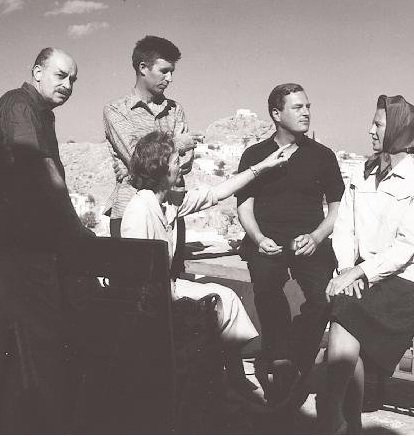
From the left: Nikos Hadjikyriakos-Ghikas, John Craxton, Barbara Hutchinson-Ghika, Patrick Leigh Fermor, Joan Leigh Fermor, 1958

Especially for those who are Greek or read Greek an article from Protagon about the Craxton, Ghika, Fermor exhibition, but worth a view by all as there are some fine Ghika pictures and new photos of the friends. If you do not read Greek and wish to find out what has been written, I have a Google Translate version for you here.

First published in Protagon 7 June 2017

Γκίκας, Κράξτον, Λι Φέρμορ: Μια φιλία ύμνος της ζωής στην Ελλάδα
Mία ανασκόπηση της ζωής και του έργου τριών σημαντικών προσωπικοτήτων της Τέχνης και των Γραμμάτων του 20ού αιώνα παρουσιάζεται στο Μουσείο Μπενάκη. Η έκθεση διερευνά τη φιλία που ένωσε τους Νίκο Χατζηκυριάκο-Γκίκα, Τζον Κράξτον και Πάτρικ Λι Φέρμορ, και την αγάπη τους για την Ελλάδα.

Η έκθεση «Γκίκας, Craxton, Leigh Fermor: η γοητεία της ζωής στην Ελλάδα» που παρουσιάζεται εφέτος στο Μουσείο Μπενάκη αντανακλά τις μαγευτικές εξερευνήσεις των τριών μεγάλων δημιουργών στην Ελλάδα του περασμένου αιώνα. Πρόκειται για ένα αφιέρωμα στη ζωή και το έργο τους αλλά και στη φιλία που τους συνέδεσε για σχεδόν 50 χρόνια καθώς και στον «διάλογο» που ανέπτυξαν μεταξύ τους.

Read More here ….

From Google Translate.

Gikas, Cracton, Li Fermor: A Friendship Hymn to Life in Greece

A review of the life and work of three important personalities of Art and Literature of the 20th Century is presented at the Benaki Museum. The exhibition explores the friendship that brought together Nikos Chatzikyriakos-Ghika, John Krasson and Patrick Li Fermore, and their love for Greece

The exhibition “Gikas, Craxton, Leigh Fermor: The Charm of Life in Greece” presented this year at the Benaki Museum reflects the magical explorations of the three great artists in Greece of the past century. It is a tribute to their life and work, but also to the friendship that has been associated with them for almost 50 years, as well as the “dialogue” they have developed among themselves.

It was organized by the Leventis Art Gallery in collaboration with the Benaki Museum and Craxton Estate and was first presented in Nicosia for the first time in the Leventis Art Gallery. It is now going to Athens and the year will be transferred to the British Museum of London (March – July 2018).

The tribute includes paintings and watercolors by Ch. Ghika and Cracton, and texts by Livermore, many of which come from unpublished material found by curators of the exhibition in personal records or in the archive of the author in the National Library of Scotland.

In addition, letters, pages of visitors’ books, notes, sketches, publications and dedications, as well as many rare photographs from the life of the three creators, revealing their love for Greece, history, myth, countryside and Greek Lifestyle, while reflecting their fascinating quests, their interactions and devotion to the joy of life.

The early years
The works come from the Benaki Museum Gallery, the Craxton Estate in London, the Leventis Art Gallery in Nicosia and many private collections, libraries and museums in Greece and abroad.

The first section of the report refers to the first years of their acquaintance with the events and the atmosphere of the era, which would then have an interdependent influence on their creativity.

The three artists met for the first time in the years 1945 and 1946. Nikos Chatzikyriakos-Ghikas met John Krasson and Patrick Livermore in London. Shortly thereafter, the two last met in Athens, and between the three, as well as between the two of them, Barbara Ghika and Joan Lee Fermor, a friendship was developed with a common reference point, the love of all of them for Greece. This friendship was going to prove highly resistant, since it would last for about fifty years.

Places of inspiration and happiness

The next sections of the exhibition revolve around the four places – Hydra, Kardamili, Chania and Corfu – that have been stamped over their work and friendship.

Hydra. There was an important chapter in the life of the three friends, but also a pole of attraction for Greeks and foreigners, intellectuals and artists. For Ghika he was the home of his childhood and later his refuge, his place of inspiration. For Livermore, “a source of happiness”, as he said, a retreat for the writing of his book “Mani” and for Craxton, a place of creation shortly before discovering his own paradise in Crete.

Chania. In 1947 Krassont visited Crete for the first time. One year later he returns and draws paintings on Cretan shepherds. The place and the people charm him and so in 1960 he decides to follow his dream and live in Chania, “in my beloved city, on my favorite island”. The house above the Venetian harbor became its main place of work. Many of his most famous paintings, with typical figures, scenes from everyday life, as well as landscapes of Cretan land, are created there.

Kardamyli. It is the place where Li Fermore will discover their own haven of paradise in the Peloponnese. Attracted by the nature of the area, his friend, Ghika, draws landscapes of Kardamili and creates works for decorating the house. Here Paddy, as he was his affectionate, will dedicate himself to the writing: “At last I could walk through the olive trees for hours, forming phrases and dissolve them in pieces again,” he writes.

Corfu. An old olive press at Sinias, Corfu, will be the new meeting and creation place for the three friends in the seventies. There, Ghika and Barbara’s wife will create a new “idyllic setting”, a welcoming “shelter of unique atmosphere and charm” that will inspire all three artists.

Leading the charmed life in Greece

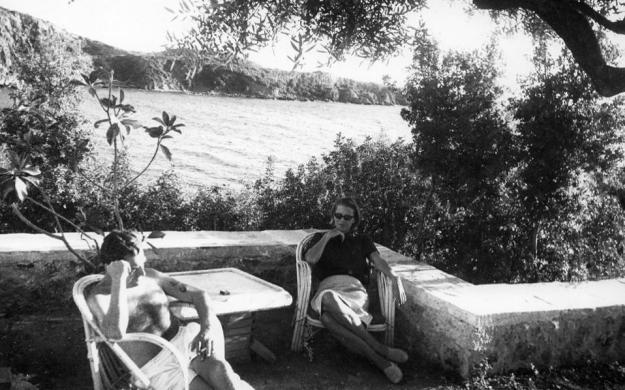
Patrick Leigh Fermor and his wife Joan on the veranda of their home in Kardamyli, in 1967.

This article from Ekathimerini focuses on the new exhibition “Ghika – Craxton – Leigh Fermor: Charmed Lives in Greece” which opened recently at the Benaki Museum in Athens. It runs to 10 September so if you are in the city do drop by. Never fear, if you can’t make a trip to Athens, the exhibition moves to the British Museum in the Spring and we will update you all.

by Margarita Pournara

First published in Ekathimerini 14 June 2017.

I have often asked myself how an exhibition ultimately affects its audience. What kind of trace does it leave on the collective memory? The answer, I find, is that it depends on the show’s content and the circumstances under which it takes place. In these troubled times, so laden with insecurity and silent resignation, the exhibition that opened at Athens’s Benaki Museum on June 6 on a great friendship is like balsam to the soul.

“Ghika – Craxton – Leigh Fermor: Charmed Lives in Greece” is like a piece of precise needlework using the threads of history to take the audience back to 1945, when Greek painter Nikos Hadjikyriakos-Ghika first met British writer Patrick Leigh Fermor and painter John Craxton. The three became firm friends and over the ensuing 50 years drew inspiration from the Greek landscape, their readings on the country and the virtues of life here, leaving behind enduring impressions in their art and writings. The lives of the three became entwined in four different parts of the country, which is the exhibition’s departure point.

From the Ghika family home on the ridge of a hill on the Saronic island of Hydra, where the friendship was first cemented, to Paddy’s haven in Kardamyli in the southern Peloponnese, Craxton’s house with its unexpected view over the port of Hania on Crete and an old olive mill in Corfu that Ghika transformed into a home after his Hydra property was destroyed by fire, their relationship was defined by an almost constant and highly creative toing and froing between the personal paradises each man had created for himself.

“Each of these houses was a small universe that embodied their love for Greece, its countryside and the warmth of its people. Beyond these three and the wives of Ghika and Fermor, these homes were enjoyed by many others, Greeks and Britons and other guests, who came from abroad to get their own taste of the charms of life here,” says one of the exhibition’s four curators, Evita Arapoglou. Paintings, photographs, letters and drawings illustrate this 50-year journey.

How did the three men meet? It was shortly after World War II had ended and Greece was making an effort to promote its culture, literature and art abroad, with the help of the British Council and its offshoot, at the time, the British Institute.

Athens happened to be home to a group of Greek and British intellectuals – among them Lawrence Durrell, Steven Runciman, Rex Warner, as well as Giorgos Seferis, Giorgos Katsimbalis and Ghika – who helped spearhead the golden age of cooperation between the two countries, organizing soirees and exhibitions. One of the many things the Britons had in common was their attraction to the Greek people and countryside.

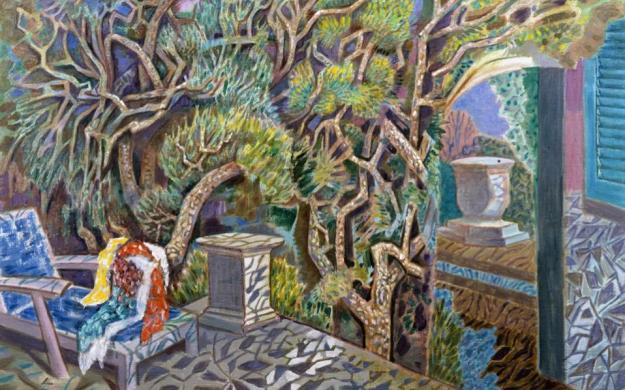
Nikos Hadjikyriakos-Ghika’s ‘Pines and Blue Chair in the Afternoon,’ oil on canvas, from 1979.

Ghika, who spent most of his adult life in France, also lived in London for a few years during this period. Fermor already knew Greece very well and Craxton, who was a close friend of Joan Leigh Fermor, was hooked from his first visit to the country.

The house on Hydra, which held a lot of childhood memories for Ghika but needed extensive renovations, was a revelation to the Fermors, who spent around two years there in the mid-1950s and which is where Patrick wrote the bulk of his book on Mani. Craxton was also a familiar figure there, where he would paint views of the small Saronic island. Ghika and his wife Barbara were indeed the perfect hosts.

When the house was destroyed by fire in the early 1960s, Ghika couldn’t bear to set foot on the island, so it fell to Craxton to go and see what could be salvaged from the ashes. That fire marked the end of the first chapter of three men’s friendship, which was rekindled when the Fermors moved to Kardamyli and Craxton to Hania. Toward the end of the decade, the Ghikas built their house in Corfu.

The wonderful exhibition at the Benaki is all about serendipity in another respect too, as the idea emerged from the meeting of four people with deep knowledge and admiration for the three friends. Arapoglou is the curator of the Greek collection at the Leventis Gallery in Nicosia and is an expert on Ghika, as well as having known Fermor and Craxton personally. Former British ambassador to Athens, historian and writer Sir Michael Llewellyn-Smith knew Fermor and the archive he left behind very well, while Ian Collins wrote a monograph on Craxton, with whom he was friends. The fourth curator of the Athens show is Ioanna Moraiti, the Benaki’s archive director, and she was instrumental in helping the other three pool their knowledge and expertise.

When they were first brought together in 2014 thanks to Edmee Leventis, it became clear that the subject of Ghika, Fermor and Craxton’s close friendship and their relationship with Greece would make a wonderful theme for an exhibition. The project was funded by the Leventis Foundation and the show was first held at the Leventis Gallery in spring. After Athens, the exhibition will be shown at the British Museum.

The friends

A painter, sculptor, engraver, writer and academic, Nikos Hadjikyriakos-Ghika (1906-94) was the eldest of the three. He moved to Paris at the age of 17 to study art and soon developed a large intellectual and artistic circle of friends and acquaintances. While he was influenced by the trends and movements in Europe, like architect Dimitris Pikionis, his contemporary, Ghika also became increasingly interested in Greek folk art and tradition. He emerged as one of the greatest figures of the Thirties Generation and Hydra played a huge role in his work. Barbara was his second wife.

Patrick Leigh Fermor (1915-2011) was a restless scholar with a love of adventure. He discovered Greece while crossing Europe on foot at the age of 18. He returned in World War II, where he became a hero of the resistance and the mastermind behind the kidnapping of German General Heinrich Kreipe. He moved to Athens after the war, before the house in Kardamyli was built. He is the author of several wonderful books, including “Mani: Travels in the Southern Peloponnese,” “Roumeli” and his three books about his journey across Europe, among others. His wife Joan was a photographer.

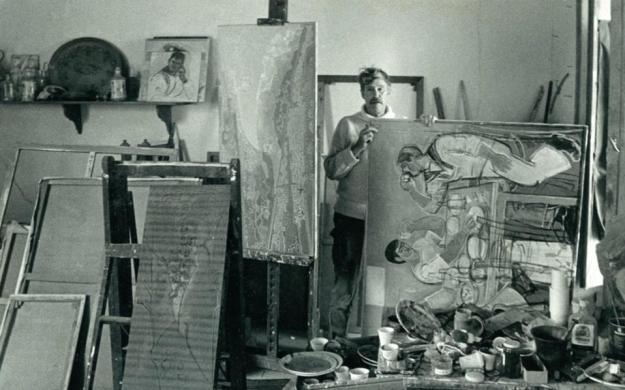
John Craxton in his studio in Crete in 1983

John Craxton (1922-2009) was the youngest of the bunch, a free spirit with a definite wanderlust. He found his ideal haven in Greece, and Crete in particular, where he was impressed by the people and their way of life. During his time there, he was regarded as one of Hania’s most recognizable personalities.

The exhibition is accompanied by a bilingual book with texts by the curators and an abundance of photographic material pertaining to the three friends’ lives.

“Ghika – Craxton – Leigh Fermor: Charmed Lives in Greece” runs through September 10 at the Benaki Museum’s main building (1 Koumbari & Vassilissis Sofias, tel 210.367.1000).

John Pendlebury and the Battle of Crete – Paddy’s speech

John Pendlebury at Knossos

John Pendlebury at Knossos

The following is the text of a speech given by Patrick Leigh Fermor at Knossos, Crete, on 21 May as part of the commemoration of the 60th anniversary of the Battle of Crete.

by Patrick Leigh Fermor

First published in The Spectator 20 October 2001

John Pendlebury is an almost mythical figure now, and, in some ways, he always was. Everyone connected with ancient or modern Greece, and not only his fellow archaeologists, knew all about him. He was born in 1904. In addition to his classical triumphs at Winchester and Cambridge, a dazzling athletic fame had sprung up. He broke a 50-year record at the high jump by clearing the equivalent of his own height of six feet and flew over hurdles with the speed of a cheetah. His classical passion was humanised by a strong romantic bent; he revelled in novels about knights and castles and tournaments. And all suspicion of being a reclusive highbrow was scattered by his love of jokes and his enjoyment of conviviality. A strong vein of humour leavened all.

The British School of Archaeology was his Athens anchor and wide learning, flair and imagination led him to many finds. He dug for several Egyptian seasons at Tel-elAmarna, but Crete became his dominating haunt. He was on excellent but independent terms with Sir Arthur Evans but, when he was away from Knossos and the Villa Ariadne, he was constantly on the move. He got to know the island inside out. No peak was too high or canyon too deep for him to claw his way up or down. He spent days above the clouds and walked over 1,000 miles in a single archaeological season. His companions were shepherds and mountain villagers. His brand of toughness and style and humour was exactly right for these indestructible men. He knew all their dialects and rhyming couplets. Micky Akoumianakis, the son of Sir Arthur’s overseer, told me he could drink everyone under the table and then stride across three mountain ranges without turning a hair.

This is the moment to slip in a word about Nicholas Hammond, the brilliant scholar and archaeologist turned soldier, and a very old friend of Pendlebury’s, whose involvement in the run-in to the battle and whose adventures in the caique Dolphin deserve an entire saga of their own. (It is he who should be writing about Pendlebury, not me, But he was 94 this year and died, lucid to the end, in April. Just before he died, he wrote to me saying, ‘I’m sure you’ll do him proud’; so I must do my best.)

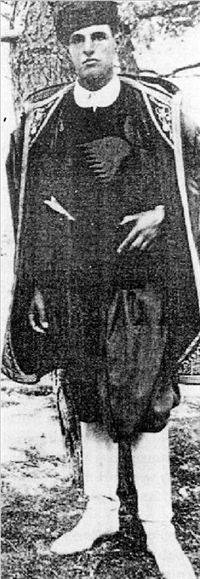
Pendlebury in Cretan dress

Pendlebury in Cretan dress

Pendlebury’s knowledge of the island was unique, and when, in the end, he managed to convince the sluggish military authorities, he was sent to England, trained as a cavalryman at Weedon, commissioned as a captain in a branch of military intelligence and then sent back to Crete as the British vice-consul in Heraklion. It was typical that he referred to his military role as ‘trailing the puissant pike’, like Pistol in lienly V. He didn’t mind that his consular cover story in Heraklion fooled nobody. But his mountain life changed gear: he presciently saw that the Cretan veterans of the old wars against the Turks would be vital to the eventual defence of the island. These regional kapetanios, natural chiefs — like Satanas, Bandouvas and Petrakogiorgis, and many more with their sweeping moustaches and high boots — had many virtues and some, perhaps, a few faults, but they were all born leaders. They were all brave, they passionately loved their country and they recognised the same qualities in Pendlebury. They trusted his judgment when he began to organise a system of defence, arranging supply lines, pinpointing wells and springs, preparing rocks to encumber possible enemy landing places, storing sabotage gear, seeking out coves and inlets for smuggling arms and men, and permanently badgering the Cairo authorities for arms and ammunition.

When the Italians invaded Greece from Albania and were flung back by the Greek counter-attacks, the probable sequel became clear at once: Germany would come to the rescue of her halted ally. The whole Wehrmacht was available and so was Germany’s vast Luftwaffe. The implications were plain. Pendlebury and the Cretans made guerrilla strikes on Kasos, the Dodecanesian island 25 miles from the eastermost cape, and there was a far-flung caique operation on Castellorizo. off the south coast of Turkey_ Like all Crete, Pendlebury lamented the absence of the 5th Cretan division, which had covered itself with glory in Albania, only to be left behind on the mainland. With them, and the 10,000 rifles Pendlebury longed for, he felt that the island could be held forever. But, to his exasperation, the arms only came in driblets. Even so, there was hope.

If the worst happened, Pendlebury was determined to stay and fight on with the guerrillas until Crete was free. His stronghold would have been the Nidha plateau, high on the slopes of Mount Ida. It was grazed by thousands of sheep, inaccessible by roads, riddled with caves — Zeus was born in one of them — and it could only be reached through the key village of Krousonas (the stronghold of Pendlebtny’s friend, Kapetan Satanas) and the great resistance village of Anoyia (the eyrie of Kapetans Stephanoyianni Dramoudanis and Mihali Xylouris). During all this time, the knowledge that the rest of Europe was either conquered or neutral and that England and Greece were the only two countries still fighting was a great bond.

We must skip fast over the German invasion of Greece. Most of the British forces, which had been taken from the battle in the Libyan desert to help the Greeks, got away from the mainland with the Royal Navy’s help and the island was suddenly milling with soldiers who had made it to Crete. I was one. I was sent from Canea to Heraklion as a junior intelligence dogsbody at Brigadier Chappel’s headquarters in a cave between the town and the aerodrome.

The daily bombings were systematic and sinister. Obviously, something was going to happen. It must have been during a lull in this racket that I saw Pendlebury for the first and only time. One man stood out from all the others that came to the cave,’ I wrote later on. I was enormously impressed by that splendid figure, with a rifle slung like a Cretan mountaineer’s, a cartridge belt round his middle, and armed with a leather-covered swordstick.

One of his eyes, lost as a child, had been replaced by a glass one. I heard later that, when out of his office, he used to leave it on his table to show that he would be back soon. He had come to see the Brigadier to find out how he and his friends could best contribute, and his presence, with his alternating seriousness and laughter, spread a feeling of optimism and spirit. It shed light in the dark cave and made everything seem possible. When he got up to go, someone (Hope-Morley?) said, `Do show us your swordstick!’ He smiled obligingly, drew it with comic drama and flashed it round with a twist of the wrist. Then he slotted it back and climbed up into the sunlight with a cheery wave. I can’t remember a word he said, but one could understand why everyone trusted, revered and loved him.

We all know a lot about the battle: the heavy bombing every day, followed at last by the drone of hundreds of planes coming in over the sea in a darkening cloud, and the procession of troop-carriers flying so low over the ground they seemed almost at eye-level, suddenly shedding a manycoloured stream of parachutes. When the roar of our guns broke out many invaders were caught in the olive branches and many were killed as they fell; others dropped so close to headquarters that they were picked off at once.

Heraklion is a great walled Venetian city. The enemy forced an entry through the Canea Gate, and after fierce fighting they were driven out by the British and Greeks with very heavy losses. This was the first astonishing appearance of Cretan civilians, armed only with odds and ends — old men long retired and boys below military age, even women here and there — suddenly fighting by our side, all over the island. In Heraklion the swastika flag, which had briefly been run up over the harbour, was torn down again. The wall was manned by Greek and British riflemen, successful counter-attacks were launched and, apart from this one break-in, the town and the aerodrome remained firmly in our hands until the end.

After leaving the cave, Pendlebury and Satanas headed for the Kapetan’s high village of Krousonas by different routes. They hoped to launch flank attacks on the steadily growing throng of dropped parachutists west of Heraklion. He got out of the car with a Cretan comrade and climbed a spur to look down on the German position. They were closer than he thought and opened fire. Pendlebury and his friend fired back. Here the fog of battle begins to cloud things. Pendlebury and a Greek platoon were still exchanging fire with the Germans when a new wave of Stukas came over and Pendlebury was wounded in the chest. He was carried into a cottage, which belonged to one of his followers, George Drossoulakis, who was fighting elsewhere and was killed that same day. But his wife Aristeia took him in and he was laid on a bed. The place was overrun with Germans; nevertheless, one of them, who was a doctor, cleaned and bandaged the wound. Another came in later and gave him an injection. He was chivalrously treated. The next morning he told the women of the house to leave him. They refused and were later led away as prisoners. A field gun was set up just outside . . and a fresh party of parachutists was soon in the house. Here was an English soldier dressed in a Greek shirt and with no identification. A neighbour’s wife saw them take him out and prop him against the wall. Three times they shouted a question at him, which she couldn’t understand. Three times he answered ‘No’. They ordered him to stand to attention and then opened fire. He fell dead, shot through the head and the body.

The battle raged on. Heraklion stood firm and we had similar tidings from the Australians and Greeks defending Rethymnon. After the lines of communication had been cut, we had no glimmer of the turn things were taking at Maleme over in the west. We thought we had won. The news became still more bitter later on, when we learnt that enemy casualties had been so heavy that for a time they had considered abandoning the campaign.

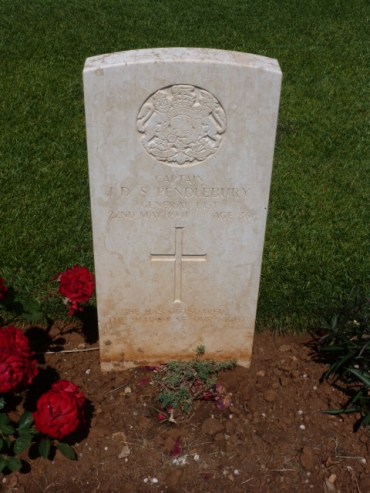
Much later we learnt what happened to Pendlebury. At first his body was buried near the spot where he fell. Later, the Germans moved him to half a mile outside the Canea Gate beside the Rethymnon road. I remember bicycling past his grave the following year dressed as a cattle-dealer. It was marked with a wooden cross with his name on it, followed by liritischer Hauptmann’ . There was a bunch of flowers, and new ones were put there every day until the enemy shifted the grave to somewhere less central. (He now lies in the British war cemetery at Souda Bay.) Meanwhile legends were springing up. For the Cretans, it was the loss of an ally and a friend with a status close to that of Ares or Apollo For the enemy, he was a baleful and sinister figure, a darker T. E. Lawrence, and perhaps he was still lurking in the dreaded mountains. Many bodies were exhumed until a skull with a glass eye was dug up and sent to Berlin — or so they said. According to island gossip, Hitler had been unable to sleep at night for fear of this terrible incubus, and kept the trophy on his desk. To the SOE officers who were sent to Crete to help the Resistance, he was an inspiration. His memory turned all his old companions into immediate allies. We were among friends. Pendebury — Pedeboor Pembury — however it was pronounced, eyes kindled at the sound.

John Pendlebury

John Pendlebury

We must go back to 28 May 1941, seven days after Pendlebtuy’s death and the night of the evacuation. The British troops were lining up to board the ships that were to carry us to Egypt. I was interpreter. Everyone felt downhearted at leaving the Greek friends who had fought beside us for the last eight days. The battered and silent town smelt of burning, explosions, smoke and fresh decay All at once, an old Cretan materialised out of the shadows. He was a short, resolute man, obviously a distinguished kapetan, with a clear and cheerful glance, a white beard clipped under the chin like a Minoan and a rifle-butt embossed with wrought-silver plaques. He said he would like to talk to the ‘General’. The Brigadier was a tall man and an excellent commander, tanned by a lifetime’s soldiering in India. The kapetan reached up and put his hand on the Brigadier’s shoulder and said, ‘My child,’ — paidi triou’ in Greek — ‘we know you are leaving tonight; but you will soon be back. We will carry on the fight till you return. But we have only a few guns. Leave them all you can spare.’ The Brigadier was deeply moved. Orders were given for the arms and a Black Watch lieutenant led away the kapetan and his retinue. As we made our farewells, he said, in a kind but serious voice, ‘May God go with you, and come back soon.’ Meanwhile, escorting destroyers from HMS Orion and HMS Dido were stealing towards the mole.

It was only later, looking at photographs, that the old man was identified as Pendlebury’s friend, Kapetan Satanas. He died the next year, after handing his gun to a descendant, saying, ‘Don’t dishonour it.’

Looking back, he represents the innermost spirit of Crete. Ever since, the two men have seemed to symbolise the brotherhood-in-arms that brought our two countries so close together and made us feel that this season of desolation would somehow, against all the odds, end in victory and the freedom they were all fighting for.

Adventures for Harriet – A literary hike along Paddy’s route in memory of Harriet Clarke

As those who correspond with me know, I can be very slow to follow-up on the messages and suggestions that so many of you send me, but on the whole I do tend to catch-up eventually. Jennie Harrison Bunning, who is in charge of Marketing and Publicity at the always brilliant Slightly Foxed – a quarterly magazine for book-lovers who don’t feel entirely at home in the here-today-and-gone-tomorrow world of overnight publishing sensations and over-hyped new books – got in touch just one month ago to tell me about a great cause that they are supporting, and as it is Paddy (and Nick Hunt) related, I’m happy to bring it to your attention, and to ask for your support.

Jennie wrote:

Dear Tom

Congratulations on your very good website pertaining to all things PLF! It’s a brilliant tribute, and filled with really useful and interesting content.

I’m writing to let you know about an upcoming Paddy-related adventure that I hope you’ll find of interest. On 1 May 2017 Katy Macmillan-Scott is embarking on a 600-mile journey by foot across Europe, in memory of her best friend Harriet Clarke and to raise awareness for Never Too Young, Bowel Cancer UK’s campaign for the under 50s. Her route will follow the first leg of Paddy’s 1933 journey, from the Hook of Holland to Budapest.

We all very much enjoyed Nick Hunt’s book about his experience of walking in Paddy’s footsteps and I believe Katy has been in touch with Nick who’s been encouraging. It’s the same trip but will perhaps be rather different through the eyes of a ‘lady adventurer’, as such! You can find out more about her walk here: https://www.adventuresforharriet.co.uk/

At Slightly Foxed we’re going to be supporting Katy by donating proceeds from book sales, and by sharing news of her journey through our news and social media channels. She’s an incredibly inspiring young woman and has already almost doubled her fund-raising goal of £1000, which is brilliant.

Just to give you a quick overview of what we’re doing.

· We’re donating 10% of the sale price of all books listed on our online shop here: https://foxedquarterly.com/products/adventures-for-harriet-a-literary-hike-from-rotterdam-to-istanbul/

· On Friday 24 March we ran this full-length article on A Time of Gifts in our newsletter to subscribers

· While Katy is away (1 – 20 May) we’re going to be sharing a daily extract from A Time of Gifts and other books, interspersed with Katy’s diary entries, original archive images and photos from her trip, on our blog and through social media channels.

· We’ll be using the tag #adventuresforharriet and #literaryadventure (among others) and will start to post fairly regularly from now on. Our Instagram and Twitter handles are @FoxedQuarterly and we’re on Facebook here: https://www.facebook.com/FoxedQuarterly/

Would there be an opportunity in an upcoming newsletter for you to share news of Katy’s adventure with your subscribers? And might you be able to share news in any other way, or temporarily encourage sales of the books though our channels to raise more money? We’d be happy to supply Andrew Merrills’s article for you to use.

It would be wonderful if we could coordinate efforts to help raise awareness of Katy’s walk, and bring a new generation of readers to the great PLF at the same time.

I hope to hear from you soon.

With all good wishes

Jennie

Clearly the issue of cancer is one that offers a challenge to us all, but the fact that Harriet could die from bowel cancer at the very young age of just 32 is a great tragedy. Read more on Katy’s website or donate directly via her Just Giving site here. I hope to keep you updated over the coming weeks.

Where Travel Writing is Now

A thought provoking piece for the Easter holidays from Barnaby Rogerson, founder of the wonderful Eland books. May I wish you all, wherever you are, a very happy and peaceful Easter (remember Paddy had arrived for the great Easter celebrations at Esztergom on the Danube).

By Barnaby Rogerson

First published in Errant Magazine 18 September 2015

I don’t just read all the new travel books I can get hold of, I collect whole library editions as well. Aside from their texts, they summon up a once devoted and attentive readership: Those lovely cloth-and-gilt-titled Everyman hardbacks are scented with craftsmanship and muscular Christian decency. The bashed-up magenta paperbacks produced by Penguin just before the war were part of a mission that made democratic socialism possible, while I imagine the blue-cloth hardbacks of Jonathan Cape’s traveller’s library, being read by the more thoughtful members of a colonial clubhouse in the 20s. From my own youth the massed volumes of the rival Picador, Penguin Travel Library and Century lists sit prolific on my shelves.

I acquire them to aid my work (which is to dig out lost classics of travel literature and add them to the Eland list) but there is also something more obsessive going on. The libraries allow me to watch how the ‘immortality’ of authorship ebbs away, how tastes evolve and how that which was so ‘needed and now’ to one generation, becomes so much recyclable garbage to the next. But like inspiring pin-pricks in the night sky, there are still travel books that keep shining, and have kept generation after generation of readers enthralled.

And, like it or lump it, we seem to be passing through a crunch point in travel writing at the moment, the long-term effects of which we do not understand. The revival of travel writing so brilliantly led by Bruce Chatwin in the 1980s, and aided and abetted by Redmond O’Hanlon, Colin Thubron, Bill Bryson, Eric Newby, Norman Lewis and Dervla Murphy, is coming to a close. The role of the professional travel writer will soon be at an end. You only have to look at how some of the most promising contemporary travel writers have adapted, to feel which way the wind blows. William Dalrymple, three books into a career as the darling of his generation, switched very successfully to history, just as the three very talented travel-writing Jasons of my acquaintance (J. Webster on Spain, J. Goodwin on Byzantium, and J. Elliot on Afghanistan/Iran) have all headed for fictional waters, as most recently, has Tim Mackintosh-Smith. There are still some stalwarts – Sarah Wheeler, Ian Thomson, Tim Parks, Philip Marsden, Hugh Thomson, Antony Sattin and Jeremy Seal – at the top of their game, delivering works that combine energy with a lifetime of experience. But in private conversation there is an acknowledgement that the advances from publishers are slipping away. It is a common joke that their agents dont reveal to them their sales figures because it would only discourage them from writing the next book. And as a corollary of this, as a basic rule of thumb, in the last decade the publishing advances have slipped from something near £50,000 for a top writer (an admirable sounding sum until you divide it by three years of travel and work) to a period when ‘fifteen is the new fifty’, which has now seeped down towards six. But travel writers are by nature adaptable, and are used to bolstering income by acting as tour guides, lecturers and jobbing journalists. Certainly the slow collapse in sales has not yet had any effect on the quality or the range of travel writing, though it is intriguing to reflect that the joint winners (Robert Macfarlane and Kathleen Jamie) of last year’s annual travel-writing prize, the Stanford-Dolman, are both fulltime academics, supported by a university salary.

Where have the readers gone? The easy answer is that they have gone travelling to see for themselves. There’s also been a gradual increase in translated fiction (a process entirely on the side of the angels) which has diminished the travel writers former role as cultural interpreter. And if they were alive today, it is not difficult to see that such prolific travel-writers of the past as Sacheverell Sitwell would surely be on television, conducting Michael-Pallin-style whirl-wind tours or architectural investigations à la Dan Cruikshank.

And there are other concerns. Over the last fifteen years, almost exactly mirroring the advance in the use of the internet, there has been an incremental collapse in the guide-book market by ten per cent, year on year. In their heyday, the big publishing outfits like Rough Guides, Dorling Kindersley, the AA and Lonely Planet (supplemented by smaller fry like Cadogan, Blue Guides, Hedonist, Footprint and Bradt) launched dozens of new books a year and a fleet of updated texts and foreign translations. Collectively they acted as a forcing house for talent, employing, training and feeding new writers, editors and travellers and producing a rich spin-off of travel magazines, maps, dictionaries, pocket histories, guides to world music, food and travel writing. Now this industry is virtually silent, like some old cotton mill in Bradford.

This experience is also reflected in the coverage of the broadsheet papers — The Sunday Times, Telegraph, Guardian and Independent — who even ten years ago were commissioning independent writers and photographers on a weekly basis, not to mention the half a dozen intelligent glossy magazines. Now their travel pages are dominated by churnalism (the re-writing of press releases), celebrity interviews, list-making and readers advice and ‘trip-advisor’ experience columns. The lyrical, investigative literary travel piece is not being published. On my last trip with Britain’s great post-war photographer, Don McCullin, we found ourselves stuck in southern Algeria. There I was able to have a long series of interviews with him which revealed just how important these papers had been to the careers of Bruce Chatwin, Eric Newby and Norman Lewis. He had worked with them all and watched their ideas incubate on the road.

So it looks like very slim pickings in the years ahead. But is this necessarily a bad thing? There has always been something determinedly quirky, if not down-right awkward, about a great travel writer. If I was given a vast lottery foundation by the Ministry of Books to fill this gap, could I be sure of nurturing a new generation of talent with the careful distribution of travel bursaries, salaries and decent advances? Go figure, or ask the Churchill Foundation how many of their grant-receivers have come good. I have also recently begun to notice how many of the travel writers were self-taught, if not actual autodidacts. Bruce Chatwin left university before they sacked him, Paddy Leigh Fermor learned most of his history in the bedroom and in the arms of his various lovers, Colin Thubron side-stepped university in order to try to make films. Dervla Murphy’s youth was locked in a caring relationship with her dependent, bedridden mother whilst Norman Lewis avoided college and spent his youth repairing crashed racing cars (picking them up cheap from grieving wealthy parents) and setting up a Leica-camera dealership.

I also like to tease myself about what sort of typescripts I would not like to be sent to read by an aspiring writer. I certainly wouldn’t be interested in reading a story about a couple of middle-aged men having a career break (so there goes Eric Newby’s A Short Walk in the Hindu Kush), nor about a middle-aged woman’s first bycyling trip abroad (there goes Dervla Murphy’s Full Tilt) and I most certainly wouldn’t look forward to reading about two bored young Swiss youths escaping their bourgeois parents by setting off on a road trip (there goes Nicolas Bouvier’s The Way of the World).

So what’s the trick? There is no formula, though you need a lot of skills. You have to get people talking and remember the flow of words. You have to be able to live for the moment and yet remember the scent and the touch of it on paper. You have to wish to learn through travelling and through the truth of chance encounters rather than through interview appointments, library-life and web searches. You also have to possess that sliver of ice near the heart of any writer, that ruthless search for story coupled with brutal honesty and the ability to ditch the dull from your pages. You have to be good company yet also inspiring on the page. You have to ‘catch the moment on the wing.’

Barnaby Rogerson has written a Biography of the Prophet Muhammad; a History of North Africa; an account of the early Caliphate, The Heirs of the Prophet; and the story of the battle for the Mediterranean from 1415-1580, The Last Crusaders. He has most recently edited a collection of sacred numerological traditions of the world, Rogerson’s Book of Numbers; co-edited a collection of the contemporary travel writing Ox-Tales for the charity Oxfam; edited a collection of the travel literature of Marrakech the Red City; a collection of contemporary travel encounters with Islam, Meetings with Remarkable Muslims; a collection of English Orientalist verse, Desert Air; and a collection of the poetry of place of London. Previous to this, he had written half-a-dozen guidebooks to the historical monuments of the Maghreb and the Mediterranean, including Morocco, Tunisia, Istanbul and Cyprus and created the text for Don McCullins photographic study of Roman North Africa, Southern Frontiers. Barnaby is on the advisory board of Critical Muslim, the editorial board of Middle East in London and is a Fellow of the Royal Asiatic Society and the Royal Geographical Society. He has been elected a Fellow of the Society of Antiquaries and an honorary member of The Travellers Club. He is also a book reviewer and journalist. Visit him at BarnabyRogerson.com.

His day job is running Eland, a publishing house that specializes in keeping classic travel books in print. To find out more about the over 100 classics in their catalogue, please visit http://www.travelbooks.co.uk.

Exo Mani hiking map 2017 revised edition available now

Our friends at the mapping and publishing company Anavasi have released a revised 2017 version of their 1:20,000 scale hiking map of the Exo Mani, which includes details of Paddy’s house at Kalamitsi. Just in time for your spring walking break or summer holiday planning.

Anavasi say this about the area:

Mani is the middle and southernmost peninsula of the Peloponnese and is split between Laconia and Messinia. Exo Mani is the name of the northwestern part, which belongs to the prefecture of Messinia. Exo Mani preserves a treasure trove of Byzantine and post-Byzantine churches and castles in breathtaking landscapes.The new map covers the entire Exo Mani, the are formerly covered by the three older maps “Verga-Kampos”, “Kardamyli-Stoupa” and “Agios Nikolaos-Trachila. ” The area has wonderful cobbled paths ideal for walking all year round.

Anavasi was created in 1997 by people with deep knowledge of the Greek countryside. They offer the traveler, the hiker and the researcher the best mapping material in terms of quality and reliability for Greece. The current catalogue numbers more than 100 titles in a variety of scales (from country scale maps, to maps of very small areas). The hiking maps are their flagship products and already cover most of the mountainous areas and many islands.

The company says “Our maps are cherished by hikers and “hip” travellers for the richness and accuracy of their data, but also for a variety of information provided in the form of comments or text for paths or sightseeing areas on the back side of the map.”

You can buy the Exo Mani map for 7 Euro here, and you may enjoy exploring the rest of their products from the homepage.

Where the Wild Winds Are: Walking Europe’s Winds from the Pennines to Provence

Our friend Nick Hunt has a publication date for his long-awaited new book Where the Wild Winds Are: Walking Europe’s Winds from the Pennines to Provence in which Nick sets off on an unlikely quest: to follow four of Europe’s winds across the continent.

His wind-walks begin on Cross Fell, the highest point of the Pennines, as he chases the roaring Helm – the only named wind in Britain. In southern Europe he follows the Bora – a bitter northerly that blows from Trieste through Slovenia and down the Croatian coast. His hunt for the ‘snow-eating’ Foehn becomes a meandering journey of exhilaration and despair through the Alpine valleys of Switzerland, and his final walk traces an ancient pilgrims’ path in the south of France on the trail of the Mistral – the ‘wind of madness’ which animated and tormented Vincent Van Gogh.

These are journeys into wild wind, but also into wild landscapes and the people who inhabit them – a cast of meteorologists, storm chasers, mountain men, eccentric wind enthusiasts, sailors and shepherds. Soon Nick finds himself borne along by the very forces he is pursuing, through rain, blizzards, howling gales, and back through time itself. For, where the wild winds are, there are also myths and legends, history and hearsay, science and superstition – and occasionally remote mountain cabins packed with pickles, cured meats and homemade alcohol.

Where the Wild Winds Are is a beautiful, unconventional travelogue that makes the invisible visible. Due out on 7 September 2017, pre-order Where the Wild Winds Are: Walking Europe’s Winds from the Pennines to Provence here.

The Travellers’ Film Club season continues on the 5th April with Man of Aran

Eland books, who run The Travellers’ Film Club, have said that the season continues on the 5th April with Man of Aran, Robert J. Flaherty’s masterpiece of the drama of noble simplicity. It documents the heroic life of a traditional family from one of the Aran isles, the cliff-girt archipelago off the west coast of Ireland. 18 months in the making, and first screened in April 1934, it was acclaimed ‘as a film that will influence directors all over the world’. Eland hope to have the film historian, Mark Le Fanu in the audience to answer questions.

The Club meets in the basement Travel Bookshop of Waterstones (where there is a café) from 6pm. Screenings in the meeting room start around 6.30pm, prefaced by a brief introduction with the opportunity for questions afterwards. These events are free, but please email to reserve a place events.piccadilly@waterstones.com

The Chiddingstone Castle literary festival

The festival season is rapidly approaching, and as a Kentish Man, I was interested in this one. Held in a very beautiful setting, the second Chiddingstone Castle literary festival runs over the first May bank holiday weekend, from Sunday, April 30 to Tuesday, May 2, with 22 authors appearing over three days.

The line-up is headed by Terry Waite. Joining him will be Artemis Cooper and Adam Sisman, discussing the life and writings of travel writer Patrick Leigh Fermor, and Radio 4 presenter of Saturday Live, Rev Richard Coles will give a reflective account of life as a parish priest and broadcaster.

Further details can be found here.

A funeral at Melk

The abbey at Melk

The abbey at Melk

Paddy described it as a “quinquireme amongst abbeys”. It is a benevolent sleeping giant above the little town of Melk and the Danube. To the east lies the Wachau, one of the most magnificent stretches of river scenery in Europe, and the eastern foothills of the Alps, to the west, Mauthausen and Bavaria. The huge and imposing Abbey at Melk continues to fascinate.

By Roslyn Jolly

First published in The Saturday Paper

This sure is a quiet town.” I’m almost whispering, unwilling to have my voice ring out in the silent streets. “Where is everybody?” It’s about seven in the evening, and as we climb the zigzag pathways to the great church on the hill, there is scarcely another soul around.

We’re going to a funeral. My friend saw the notice pinned unobtrusively to a post in the hotel bar: There will be a service at the abbey tonight for one of the monks, who has died suddenly, before his time. A popular man, a local favourite, highly regarded, sadly missed, the notice says. The community is invited to pay its respects.

We are not of the community, but we are curious, so through the dark streets and up the stone staircases we go. I haven’t yet connected the desertion of the town with the funeral at the abbey. As we approach the elegant arched entrance to the monastery precinct, we see fire engines crowding the forecourt. My friend interprets the scene better, and more quickly, than I do. I’m thinking, “A fire at the abbey? During a monk’s funeral? How very Umberto Eco.” But my friend has lived long enough in Austria to understand that not a Gothic but a civic explanation is required.

The people of Melk and all the parishes of the surrounding Wachau district have turned out in force, in uniform, through whatever structure of collective identity they can call upon, to mark the passing of their brother. Every club, team, order, guild, society, brotherhood, sisterhood, Bund, Verein and Gesellschaft is here. Not just represented here, but actually here, in body, en masse. Every fireman, policeman and Boy Scout wears his uniform; every teacher, nurse and union official is badged. The farmers are here, and so are the municipal councillors from nearby villages. Their gleaming trucks, cars and engines, freshly washed and highly polished, identify the various communities, trades and professions to which these people are clearly proud to belong.


This is the guard of honour outside the church. We walk through it. At the church door, uniformed officials keep watch. I would have turned away, but my friend is unabashed. His six years’ residence in Vienna probably helps. “We’re here for Brother A—’s funeral,” he says confidently, I forget whether in English or in German. The young man in his uniform scrutinises us for a second or two, then opens the door and gestures for us to proceed.

Inside there is colour, gold, incense, music, faces, voices, more gold. The Stiftskirche is a baroque jewellery box, glorious in candlelight, vibrant with song and incantation. There is only standing room. The service is already under way and, of course, being neither Austrian nor Catholic, I understand very little of what is being said or done, but experience the funeral as a dance of feeling between priests and townspeople. A modestly draped coffin is the focus for the energies of community expressed in music and liturgy, which, soaring, match the visual splendour of the scene.

Tomorrow we will come back, and we will see the abbey as the guidebooks and the travel writers promise it. We will see the palatial exterior, painted in sunny Schönbrunn yellow. We will see the beautiful rococo courtyard, with its palms and fountains, and think of it as a prettier Versailles. We will see the famous library with its ancient books, and peer into the pastel-coloured whorl of the shell-like spiral staircase. We will stand on the terrace and gaze at the lovely view of the Danube Valley. We will do all that a visitor to Melk is supposed to do, and it will be wonderful, but it will not be like this.

Patrick Leigh Fermor, in A Time of Gifts, called Melk Abbey the “high noon” of Europe, the highest point of the “high baroque style”. The prose he used to describe it is sunshiny and light-saturated. He even makes noon at Melk his hour of epiphany as well as his key metaphor: “Meridian glory surrounded us as a clock in the town struck twelve.” But I’ve fallen for Melk Abbey at night – not at midnight, the Gothic hour when romance writers find dark mysteries in conventual spaces, but at a civil hour, between seven and eight in the evening, when the river cruisers have gone back to their ships and the people of the town may come out, after work and an early dinner, to interact with the real working life of the monastic order that has existed here for more than a thousand years.

The funeral ends and we file out with the hundreds of mourners to watch the coffin carried to a vehicle that will take it to a burial ground beyond the monastery walls. My friend is troubled by the seeming severity of this custom. “But he would have served here his whole life,” he says. “Why can’t he be buried here too? It’s as if, at his death, he’s being expelled from the religious community.”

We puzzle over this and can’t really do anything with it. It feels harsh. The coffin looks very solitary as it waits to be conveyed through the gates into the darkness beyond. After the uplifted atmosphere in the church, the mood in the forecourt has become sombre, almost austere. All stand in silence, many with heads bowed. We – my friend and I – watch our unknown brother set out for the undiscovered country.

After the coffin has left, the firemen return to their trucks, the policemen to their cars. The Boy Scouts form lines and leave under the supervision of their troop leaders. We depart through the same archway by which we entered. At first we’re part of a throng, but the crowds quickly melt away. No one walks the same path as we do, the path that leads down stone stairs and through narrow alleys to the main street, where the hotels and restaurants are.

Melk will glow tomorrow in autumnal sunshine and we will see all that should be seen by a visitor to this beautiful mediaeval town. But tonight we’ve seen something different. We have interloped. We have slipped through the net that keeps tourists within the spaces designed for them. We’ve found our way to the secret life of a town. Just for an hour, we have gone to the other side.

The gravitational pull of a unique personality

Patrick Leigh Fermor, left, met Heinrich Kreipe, his former captive, at a reunion in Greece in 1972 which included the famous Greek TV show

Patrick Leigh Fermor, left, met Heinrich Kreipe, his former captive, at a reunion in Greece in 1972 which included the famous Greek TV show

We all discovered Paddy by different routes, but if one follows the thread of certain ideas, one can often find it leads to Patrick Leigh Fermor. My own journey started with my interest in Byzantine history; the link with Constantinople and Steven Runciman being my link. It was therefore a great joy to hear from a former colleague with whom I had lost touch some years ago. Chris Wares has discovered Paddy through his interest in the work of Antony Beevor, and after finding this blog he wrote to me explaining his own Paddy journey. He has agreed to me publishing it here. How did you first encounter Paddy? Maybe you can tell us in the comments section.

by Chris Wares

Unlike probably everyone reading this I have yet to actually read any of Patrick Leigh Fermor’s books. In fact I’m ashamed to say that a year ago I hadn’t even heard of the man. But over the past twelve months I have found myself being inexorably drawn towards the man and his books. Unknowingly at first and then, after what I can only describe as a sort of literary epiphany, I realised that I was in the gravitational pull of a unique personality, a name that kept turning everywhere I looked. Gradually I came to terms with the realisation that I would be compelled to read his books.

I am sure everyone has their own story on how they became acquainted with PLF but, as I stand on the precipice of opening one of his books for the first time, I thought I would describe how I arrived at this point.

It all began about a year ago when I read Crete: The Battle and the Resistance by Antony Beevor. Beevor is one of my favourite authors and so, while not being especially interested in the war in Crete, I was confident that my investment would be rewarded. Amongst the broad sweep of battle Beevor describes the tale of a British SOE soldier who possessed a larger than life character. A man who captures a German general from under their noses and then marches him across the mountains with half the German army on his tail. It was a scintillating story but the name of the hero didn’t particularly register in my mind.

A few weeks later I read Natural Born Heroes: The Lost Secrets of Strength and Endurance by another of my favourite authors, Christopher McDougall. McDougall’s stories of long distance runners provide great inspiration for those that are needing motivation to get down to the business of training for a marathon. In the book McDougall writes of ancient Greek demigods who had discovered the secrets of endurance running. Switching to the twentieth century, he describes in reverential tones the superhuman endurance of a British soldier called Paddy who possessed the same qualities. It’s the same guy.

OK. So it’s a good tale and worth retelling but surely this was just coincidence. Sure, it’s a great yarn about the Battle of Crete and it also works as a modern day fable about god-like feats of endurance. But this was just one of those things right? The sort of tale anyone writing about Crete includes.

Then several months later I booked a romantic weekend in Brasov, Transylvania, for my wife’s birthday. A rare opportunity for us to get away without the kids and visit somewhere slightly off the beaten track. To get to know the place better I decided to do my homework and read up on Romania. These days, tied down by kids and mortgages, my wanderlust is largely restricted to armchair adventures. Travel books and histories providing an enjoyable way of vicariously travel the world.

I picked up Anthony Eales Blue River, Black Sea, a light and enjoyable read recounting his journey by bicycle and boat from the source of the Danube down to the Black Sea. Eales opens by describing how he decided to emulate the journey some guy called Patrick Leigh Fermor made in the 1930s down the Danube who also happened to kidnap a German general in Crete…. Hang on a minute? Kidnapped a German general in Crete? This can’t be the same bloke can it?

It’s at that point I turn to Google. Who was this guy? A good story can be a matter of circumstance; a combination of events that a person can just be caught up in. But appearing heroic in two separate dramas suggests a character that possesses something special. A man who “drank from a different fountain” as some might say.

I quickly found myself getting up to speed on the basics – SOE, renowned travel writer, author of three books about walking across Europe in the 1930s, the last of which was edited by Colin Thubron and Artemis Cooper. This was sounding good. I like Colin Thubron. And Artemis Cooper? That’s a name that rings a bell? Of course! – she co-wrote Paris After the Liberation: 1944 – 1949 with Beevor (which I also just read).

Another Google search and I realise that Beevor and Cooper are married and obviously share an admiration for PLF. And – just to reinforce the impression that everything was in some way joined up and connected to the man – it turns out that Cooper is the daughter of John Julius Norwich whose A History of Venice I read in August. I was beginning to get the feeling that Patrick Leigh Fermor was something special. I was in the orbit of something that deserved further investigation.

My armchair exploration of Romania continued through the Autumn and it soon felt as if all roads led to Patrick Leigh Fermor. The author Nick Thorpe talks about him in The Danube: A Journey Upriver from the Black Sea to the Black Forest while travelling along the Danube in the opposite direction to Eales. Nick Hunt follows in his footsteps in Walking the Woods and the Water: In Patrick Leigh Fermor’s Footsteps from the Hook of Holland to the Golden Horn. William Blacker quotes him extensively in Along the Enchanted Way: A Story of Love and Life in Romania (which incidentally is one of the loveliest books I have read in a long time) and Dervla Murphy contrasts 1990s Romania with his descriptions of the 1930s in Transylvania and Beyond. Georgina Harding quotes him in In Another Europe: A Journey to Romania. At times it felt as if everyone who had ever visited Romania in the past 40 years had read his books.
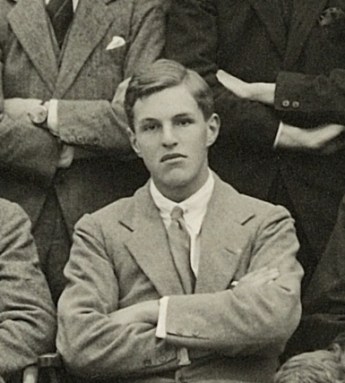
With his writing venerated by so many, the signs were clear that I needed to read him for myself. Here was someone who is not only considered one of the best travel writers ever but someone whose books inspired so much else that I read and enjoyed. My curiosity piqued I enthusiastically went on a bookstore spending spree and purchased all three books of the trilogy as well as his biography.

The books have sat patiently on my bedside table for some time now, but the moment of turning that first page is fast approaching. Logically the trilogy should form part of my Romanian literary journey but I have purposely set them aside and held back until the moment is right. The books may be the finalé to my Romanian odyssey but I feel as if they may also be first steps of an entirely new journey.

It’s rare to have such a sense of anticipation ahead of reading a new book. Such a build up runs the risk of the reality failing to live up to the expectation and I am nervous that perhaps I may not find his books as exquisite as I have come to imagine them to be. But on the other hand I am reassured with the knowledge that I am following in the footsteps of many others.

And now to turn that first page and follow path that is well trodden; one which all of those who are reading this will have already travelled….

John Pendlebury details from Winchester College War Cloister memorial site

Pendlebury at Winchester College 1923

Pendlebury at Winchester College 1923

Pendlebury’s biography taken from the Winchester College War Cloister memorial website to mark the 76th anniversary of his death

He was the only son of Herbert Stringfellow Pendlebury FRCS, a consulting surgeon at St. George’s Hospital and then of the Royal Waterloo Hospital in London. John Pendlebury’s mother was Lilian Dorothea, the daughter of Sir Thomas Lane Devitt, 1st Baronet, and Chairman of Lloyd’s Register of Shipping. However, she died in 1921, and in 1925 Herbert Pendlebury married Mabel Webb, daughter of Mr. Richard Webb of Wanganui, New Zealand.

John Pendlebury was successful at school: he won the Leslie Hunter Prize, was Head of House, in Senior Division, Sixth Book, and gained an Exhibition for Classics at Pembroke, Cambridge (his father’s college). All this was despite the loss of an eye: “One of his eyes, lost as a child, had been replaced by a glass one. I heard later that, when out of his office, he used to leave it on his table to show that he would be back soon.”

At Winchester, he won the high jump (twice) and the hurdles. In his third year at Cambridge he won the high jump at Fenner’s and also against Oxford. In 1927 he leaped to fame with a jump of six feet at Queen’s Club, breaking the record set by M J Brooks over 50 years before. He also represented England that year. He then won a Scholarship at Pembroke College and a First in the Classical Tripos, Part II with special distinction in Archaeology. Later that year he went to the British School of Archaeology at Athens. That year he married Hilda White, daughter of Edmund White, of Caldy, Wirral.

He quickly gained an international reputation as an archaeologist and donated some of his finds to the College, where they are still held in the Treasury. In 1932 he was appointed Neil Lecturer at Pembroke, and a Fellow of the Royal Society of Antiquaries and a Fellow of the Royal Society. That year he and his wife had a son, David John Stringfellow Pendlebury (D 1945-1950), and later a daughter.

He excavated in Macedonia, at Tel el Amarna (where he was Director from 1930 to 1936), at Knossos in Crete (where he was Curator 1930-35), and at Mount Dicte (also in Crete). His publications included “Aegyptiaca” (1930), “Handbook to the Palace of Minos” and “Tel el Amarna” (1935), and “The Archaeology of Crete” (1939). Pendlebury discovered many ancient sites in Crete, an island which he knew better than any other Englishman. “He was on excellent but independent terms with Sir Arthur Evans but, when he was away from Knossos and the Villa Ariadne, he was constantly on the move. He got to know the island inside out. No peak was too high or canyon too deep for him to claw his way up or down. He spent days above the clouds and walked over a thousand miles in a single archaeological season. His companions were shepherds and mountain villagers. His brand of toughness and style and humour was exactly right for these indestructible men. He knew all their dialects and rhyming couplets. Micky Akoumianakis, the son of Sir Arthur’s overseer, told me he could drink everyone under the table and then stride across three mountain ranges without turning a hair.” (Speech delivered by Sir Patrick Leigh Fermor on the 60th Anniversary of the Battle of Crete – reprinted in The Spectator 20th October 2001).

During the war he served as an officer in the Intellegence Corps. Commissioned into the cavalry, he was transferred in May 1940 to MI(R), the forerunner to the Special Operations Executive. SOE was formed in July 1940 and Pendlebury worked for the organisation for the rest of his life.

The British were expecting Greece to be attacked by Italy in the near future and assembled a group of Greek supporters to help with resistence in the event of being over-run. Pendlebury was one of these. The Greek nationals were however suspicious of the mission and its motives and refused to allow some of the party into the country, although Pendlebury was known and trusted and was allowed in. In November 1940, 50 Commando was sent to Crete to garrison the strategic harbour of Suda Bay. This freed up Greek troops to move to the Italian front. They arrived on November 26th, only to find that their orders had been changed and that they were to move to Heraklion. There Pendlebury met them, fixing up good billets for them in a school, a tobacco factory, and barrack buildings on the airfield. With 50 Commando, Pendlebury became involved in operations against Axis targets in the surrounding waters: “Pendlebury and the Cretans made guerrilla strikes on Kasos, the Dodecanesian island twenty-five miles from the easternmost cape, and there was a far-flung caique operation on Castellorizo, off the south coast of Turkey.” (Leigh Fermor).

In April 1941, the Germans intervened in Greece to support their faltering Italian allies. Greece was soon over-run and most of the Commonwealth troops who had fought there ended up in Crete. It was obvious that the Germans would attack the island next. Pendlebury slipped across to Kasos again to try to find out from his spies there exactly when the Germans would launch their operation. This would have been valuable intelligence, since although, through Enigma intercepts, the Allied commander, Major General Bernard Freyburg (2nd New Zealand Expeditionary Force, in command of the Allies on the island, knew the date and time already, he could not use the information for fear of giving away its source. However, it was too late. As Pendlebury reached Heraklion on May 21st 1941, the invasion was already under way. Ultimately, the German landings at Heraklion and Rethymnon were unsuccessful, disastrously so, and at Heraklion the Cretans played a huge role in the success of the defence: “Heraklion is a great walled Venetian city. The enemy forced an entry through the Canea Gate, and after fierce fighting they were driven out by the British and Greeks with very heavy losses. This was the first astonishing appearance of Cretan civilians, armed only with odds and ends – old men long retired and boys below military age, even women here and there – suddenly fighting by our side, all over the island. In Heraklion the swastika flag, which had briefly been run up over the harbour, was torn down again. The wall was manned by Greek and British riflemen, successful counter-attacks were launched and, apart from this one break-in, the town and the aerodrome remained firmly in our hands until the end… The battle raged on. Heraklion stood firm and we had similar tidings from the Australians and Greeks defending Rethymnon. After the lines of communication had been cut, we had no glimmer of the turn things were taking in Maleme over in the west. We thought we had won. The news became still more bitter later on, when we learnt that the enemy casualties had been so heavy that for a long time they had considered abandoning the campaign.” (Leigh Fermor).

Pendlebury visted the British headquarters at Heraklion where Leigh Fermor met him for the only time: “It must have been during a lull in this racket that I saw Pendlebury for the first and only time. ‘One man stood out from all the others that came to the cave,’ I wrote later on. I was enormously impressed by that splendid figure, with a rifle slung like a Cretan mountaineer’s, a cartridge belt round his middle, and armed with a leather-covered sword-stick… He had come to see the Brigadier to find out how he and his friends could best contribute, and his presence, with his alternating seriousness and laughter, spread a feeling of optimism and spirit. It shed light in the dark cave and made everything seem possible. When he got up to go, someone said, ‘Do show us your sword-stick!’ He smiled obligingly, drew it with comic drama and flashed it round with a twist of the wrist. Then he slotted it back and climbed up into the sunlight with a cheery wave. I can’t remember a word he said, but one could understand why everyone trusted, revered and loved him.

After leaving the cave, Pendlebury and Satanas headed for the Kapetan’s high village of Krousonas by different routes. They hoped to launch flank attacks on the steadily growing throng of dropped parachutists west of Heraklion. He got out of the car with a Cretan comrade and climbed a spur to look down on the German position. They were closer than he thought and opened fire. Pendlebury and his friend fired back.

Here the fog of battle begins to cloud things. Pendlebury and a Greek platoon were still exchanging fire with the Germans when a new wave of Stukas came over and Pendlebury was wounded in the chest. He was carried into a cottage, which belonged to one of his followers, George Drossoulakis, who was fighting elsewhere and was killed that same day. But his wife Aristeia took him in and he was laid on a bed.” (Leigh Fermor).

The Germans then occupied the area, Kaminia, near Heraklion. “The place was overrun with Germans; nevertheless, one of them, who was a doctor, cleaned and bandaged the wound. Another came in later and gave him an injection. He was chivalrously treated. The next morning he told the women of the house to leave him. They refused and were later led away as prisoners. A field gun was set up just outside… and a fresh party of parachutists was soon in the house.” (Leigh Fermor).

The arrival of the second group of Germans signalled the end for Pendlebury. “Here was an English soldier dressed in a Greek shirt and with no identification. A neighbour’s wife saw them take him out and prop him against the wall. Three times they shouted a question at him, which she couldn’t understand. Three times he answered ‘No’. They ordered him to stand to attention and then opened fire. He fell dead, shot through the head and the body.”

His fate was uncertain for many years and was only properly established decades later. “Much later we learnt what happened to Pendlebury. At first his body was buried near the spot where he fell. Later, the Germans moved him to half a mile outside the Canea Gate beside the Rethymnon road. I remember bicycling past his grave the following year dressed as a cattle-dealer. It was marked with a wooden cross with his name on it, followed by ‘Britischer Hauptmann’. There was a bunch of flowers, and new ones were put there every day until the enemy shifted the grave to somewhere less central…

John Pendlebury's grave CWGC in Souda Bay

John Pendlebury’s grave CWGC in Souda Bay

Meanwhile legends were springing up. For the Cretans, it was the loss of an ally and a friend with a status close to that of Ares or Apollo. For the enemy, he was a baleful and sinister figure, a darker T.E. Lawrence, and perhaps he was still lurking in the dreaded mountains. Many bodies were exhumed until a skull with a glass eye was dug up and sent to Berlin – or so they said. According to island gossip, Hitler had been unable to sleep at night for fear of this terrible incubus, and kept the trophy on his desk. To the SOE officers who were sent to Crete to help the Resistance, he was an inspiration. His memory turned all his old companions into immediate allies. We were among friends. Pendebury – Pedeboor – Pembury – however it was pronounced, eyes kindled at the sound.”

The official family announcement of Pendlebury’s death in The Times, on June 2nd 1942, ended with words taken from Horace (Odes I.24): “quis desiderio sit pudor aut modus tam cari capitis.” [What restraint or limit to grief should there be for a man so beloved?]

Pendlebury was eventually buried in grave 10.E.13 of the Suda Bay War Cemetery, Crete. The inscription on his tombstone reads: “He has outsoared the shadow of our Night”, a quotation from Adonais: “An Elegy on the Death of John Keats”, by Percy Bysshe Shelley.

Twelfth Night by Louis MacNeice

Louis MacNeice

Louis MacNeice

We all know the line “For now the time of gifts is gone” but are we familiar with the full poem? Louis MacNeice wrote Twelfth Night shortly after the end of World War 2. It is one of a group in which MacNeice records the loosening of the social bonds that bound British citizens, and the armed forces in particular, during the war.

Twelfth Night by Louis MacNeice

Snow-happy hicks of a boy’s world –
O crunch of bull’s-eyes in the mouth,
O crunch of frost beneath the foot –
If time would only remain furled
In white, and thaw were not for certain
And snow would but stay put, stay put!

When the pillar-box wore a white bonnet –
O harmony of roof and hedge,
O parity of sight and thought –
And each flake had your number on it
And lives were round for not a number
But equalled nought, but equalled nought!

But now the sphinx must change her shape –
O track that reappears through slush,
O broken riddle, burst grenade –
And lives must be pulled out like tape
To measure something not themselves,
Things not given but made, but made.

For now the time of gifts is gone –
O boys that grow, O snows that melt,
O bathos that the years must fill –
Here is dull earth to build upon
Undecorated; we have reached
Twelfth Night or what you will … you will.

A Happy New Year to you all

Teddy, Tom, and Patrick on the South Downs Way fundraising in December 2016

Teddy, Tom, and Patrick on the South Downs Way fundraising in December 2016

Thank you for reading the blog in 2016 and for engaging in lively debates via the comments section. The most controversial issue is the state and status of Paddy’s house, but we end the year with some hope that the Benaki will be able to make some progress as seen by their recent press release.

Please do keep sending me material. I probably say this every year, but I have a good backlog of items, many of which have been kindly donated by some of you. Forgive me if I don’t get round to publishing them immediately, or even quickly; it can often take me an hour or more for the more complex posts and time as you know is short and precious. My goal is to have everything up on the site one day. There is plenty of good material to come in 2017 and I wish you all a very Happy New Year.

The Like a Tramp 2016 Just Giving site will close in a few days. So far we have raised over £7,000 for homeless and mental health charirites. The most recent 2016 tramp has had donations of over £1,850. It would only take a few more donations to take us over the magic £2,000 mark. If you would like to donate in any currency, please follow this link.

Patrick Leigh Fermor addresses the Special Forces Club on its 40th anniversary

Opening paragraph Special Forces Club 40th anniversary dinner

Opening paragraph Special Forces Club 40th anniversary dinner

My thanks to Gaz Wild who discovered this gem in the PLF archive of the National Library of Scotland last year. There are two versions, one a pdf of Paddy’s original with many handwritten corrections, and a tidied up draft made after his death. It would have been written in 1985 for the 40th Anniversary Dinner of the Special Forces Club, and is referred to in a letter of Paddy’s to Rudi Fischer dated 10 November 1985, which appears in Dashing for the Post page 393, para 2. Paddy remembers especially John Pendlebury, Mike Cumberlege, and Manoli Paterakis.

A special treat for the holiday period. I hope that you enjoy it.

19850000-plf_address_sf_club_40th_anniversary

19850000-plf_address_sf_club_40th_anniversary-tidied

Kennt ihr das Land in deutschen Gauen

One of my favourite posts from 2011. I thought I would share this one more time at this Christmas time. A Merry Christmas to you all and I wish you a peaceful 2017. Thank you for supporting the blog during the course of another year. Please keep sending in your contributions and comments; they keep it lively …

I guess that many of us enjoy the chapter in A Time of Gifts when the eighteen year old Paddy spent two nights in Stuttgart with two very pretty nineteen year old German girls, Lise and Annie. It was Epiphany, 6th January 1934, and they went to a party where Paddy had to pretend to be Mr Brown, a family friend. He particularly enjoyed singing a song about the Neckar Valley and Swabia. Paddy could not remember all the words but his stunning memory recalled most of them (page 66).

As we approach that time of year I thought we ought to share this delightful song.

Here is a link to the music sung by a German choir (it should download the file to your computer which is harmless and does still work). The words are below so that you too can sing along! Let’s hear it now, one two three ….

  1. Kennt ihr das Land in deutschen Gauen,
    Das schönste dort am Neckarstrand?
    Die grünen Rebenhügel schauen
    Ins Tal von hoher Felsenwand.

Refrain:
Es ist das Land, das mich gebar,
Wo meiner Väter Wiege stand,
Drum sing’ ich heut’ und immerdar:
Das schöne Schwaben ist mein Heimatland!

2. Kennt ihr das Land in deutschen Gauen,
Mit Wald und Flur so reich bekränzt,
Wo auf den weiten, reichen Auen
Im Sonnenschein die Ähre glänzt?
Es ist das Land, . . . . .

3. Kennt ihr das Land in deutschen Gauen,
Wo Tann’ und Efeu immer grün,
Wo starke Männer, edle Frauen
In deutscher Kraft und Sitte blühn?
Es ist das Land, . . . . .4. Kennt ihr das Land im deutschen Süden,
So oft bewährt in Kampf und Streit,
Dem zwischen seiner Wälder Frieden
So frisch die deutsche Kraft gedeiht? Ja, wackre Deutsche laßt uns sein!
Drauf reichet euch die deutsche Hand;
Denn Schwabenland ist’s nicht allein:
Das ganze Deutschland ist mein Heimatland!

Like a Tramp 2016 raises £1,500

Patrick, Teddy and Tom

Patrick, Teddy and Tom after a cold night in Exton church. A rare glimpse of the sun and blue sky which didn’t last.

Thank you to all who donated to Shelter and Combat Stress. Donations breached the £1,500 mark so we are very pleased. Fog and mist spoiled any views for the three and a half days we tramped along the South Downs Way which was a disappointment, but on the whole the weather was pretty kind; cold but no rain. As ever we walked like tramps seeking charitable shelter. We slept in churches and were offered drier accommodation near Midhurst which was a blessing.

If you would like to make a donation to help the homeless and veterans suffering from PTSD this Christmas, the Just Giving page remains open.

A Merry Christmas to you all.

Tom

https://www.justgiving.com/teams/likeatramp2016

A lifelong search for erotic, alcoholic, intellectual and courageous diversion

Paddy at Baleni, Romania 1938

Paddy at Baleni, Romania 1938

Alerted to this by blog correspondent Brent McCunn, he asks “How can one, considering age, standing, and a lower consumption of booze incorporate this quote into ones mission statement? …he was on a lifelong search for erotic, alcoholic, intellectual and courageous diversion..

By Harry Mount

First published in the Literary Review

Anthony Powell said that John Betjeman had ‘a whim of iron’. To judge by these compulsive letters, Patrick Leigh Fermor had a pleasure-loving streak of purest titanium. From the first letter, written in 1940, soon after he joined the Irish Guards, until the last in 2010, sent when he was ninety-four, he was on a lifelong search for erotic, alcoholic, intellectual and courageous diversion. One moment he’s in Crete, meeting the partisans who helped him kidnap the Nazi general Heinrich Kreipe, his most dashing escapade. The next he’s at Chatsworth, sitting next to Camilla Parker Bowles – ‘immensely nice, non-show-off, full of charm and very funny’.

In between, it’s back to the Mani peninsula and the enchanting seaside home he and his wife, Joan, built in the mid-1960s. It was only there, in Greece, and then, in his fifties, that Leigh Fermor had a real adult home and reined in the wanderlust – and the lust. Until then, he’d continued the manic travels that began with his walk as a teenager across Europe in the 1930s. In the letters we follow him as he flits from borrowed Italian castello to French abbey to Irish castle, taking the edge off his ‘high-level cadging’ by making jokes about it. In 1949, he wrote to Joan: ‘Darling, look out for some hospitable Duca or Marchesa with a vast castle, and try and get off with him, so that he could have us both to stay.’

Leigh Fermor was less in search of luxury than entertainment. A 1954 letter to Ann Fleming skewers the super-rich aboard Stavros Niarchos’s gin palace: ‘it’s pretty good hell aboard: no sort of connecting link between all the guests, disjointed conversation, heavy banter, sumptuous but straggling meals at all hours … Why the hell don’t they have more fun with their money?’ After each of his gilded weekends, there arrives the perfectly weighted and amusing thank-you letter for the relevant duchess or Schloss-proprietor. For those in search of the model of the perfect bread-and-butter letter, look no further.

Reading these letters is like gobbling down a tray of exotically filled chocolates, with no horrible orange creams to put you off. What prevents Leigh Fermor’s eternal pleasure hunt from getting a bit sickly are two things: the undeniable bravery – and seriousness – of his war record, and his intellect. Unlike most playboys, he was an addicted reader of high-minded obscurities, among them John of Ruusbroec, a 14th-century Flemish mystic, and St Angela of Foligno, a 13th-century founder of a religious order. Hardly light holiday reading. His literary gifts were considerable and are on display in a pitch-perfect Betjeman pastiche from 1954, reprinted here: ‘Beadles and bell ropes! Pulpits and pews! … And patum peperium under the yews!’ Moreover, Leigh Fermor’s appetite for socialising extended beyond dukes and Cretan war heroes. In a coffee house in Macedonia, his interest in other people and countries is so great that he recognises all the languages being spoken: Greek, Pontian, Turkish, Bulgarian, Romanian, Ladino, Russian, Georgian and Gheg, an Albanian dialect.

Unlike most writers – a narcissistic bunch, largely – Leigh Fermor had a longing to amuse. His letters are illustrated with little drawings of maps, castles and his half-built Mani house. The letters explain what propelled this desire: ‘whorish anxieties about being liked’. Underneath the titanium, pleasure-seeking exterior and the intellect lay melancholy, sparked by the failure to complete books on time – or at all, in the case of the third volume of his self-styled ‘Great Trudge’ memoir of his 1930s walk. Ever self-aware, he refers to himself as ‘L’Escargot des Carpathes’, a nickname first coined by Le Monde. He acknowledges, too, the inevitable ‘inaccuracies of memory’, which meant that journeys that had taken place half a century earlier were sexed up in his travel writing.

He is also aware of the selfishness of the affairs he conducted with the knowledge of his future wife, Joan, even as she subsidised him from her private income. The letters to his mistresses include grippingly salacious, easily decoded euphemisms. When he thinks he might have given crabs to Ricki Huston, wife of the film director John, he writes of ‘the beginnings of troop-movements in the fork’. And here’s an entry for the 1959 Bad Sex Award: ‘Woke up at midday, longing for ping-pong, and sentimentally stroked the handle of your cast-down bat.’

You get the impression that, after he was kicked out of King’s, Canterbury for holding hands with a greengrocer’s daughter, Leigh Fermor never really grew up; that he started walking across Europe, aged eighteen, and never properly stopped. References to his mother – ‘so terrifying and destructive … so full of odd delusions and manias’ – might explain why.

Adam Sisman is a model editor. He is prepared to admit faults in his subject, not least the baroque style of Leigh Fermor’s books, ‘which can seem convoluted and overworked’. Not so the letters, aimed more precisely at amusing rather than dazzling their recipients, albeit with the odd bit of purple prose – ‘Their horses are caparisoned to the fetlocks.’

Leigh Fermor was charm personified. It isn’t evanescent British charm, as described by Anthony Blanche in Brideshead Revisited: ‘Charm is the great English blight. It does not exist outside these damp islands. It spots and kills anything it touches. It kills love; it kills art.’ Leigh Fermor’s charm was of a healthier, more worthwhile variety, because underneath lay intellect and, ultimately, love and art.

Buy Dashing for the Post: The Letters of Patrick Leigh Fermor

Like a Tramp 2016

Completing my first walk to Bath in 2014

Completing my first walk to Bath in 2014

Hello to all Blog readers!

Thank you to so many of you for sponsoring me in the past as I have walked across southern England raising money for charity. This year, despite promising myself that I would retire from international competitive charity fundraising, I am off again.

This year (17-20 Dec) I will walk 70 miles along the South Downs Way with my son Patrick and his friend Teddy Chabo. We will walk as before, as tramps, sleeping rough and seeking charity and shelter along the way to continue our fund raising for Combat Stress and Shelter. Our goal is to continue to raise awareness of the need for support to veterans with mental health and PTSD issues, and the homelessness that can often come with it. These are two very worthy charities, and at this Christmas-tide, I am asking you once more, and for the last time, to make a small donation to help these causes.

Please visit our fundraising page linked below, and perhaps split any donation that you may make between the two charities, or give as you please.

To donate please click here to go to our Just Giving page.

Thank you from the three of us, and for all those who will be helped by your generosity and kindness.

A merry Christmas and a happy 2017 to you all.

With warm regards.

Tom Sawford

To donate please click here to go to our Just Giving page.

Benaki update on Paddy’s house

The Benaki museum have provided an update on Paddy’s house. You can visit the webpage on their website. The highlights are as follows:

– the Benaki Museum has applied for the necessary permits to the Greek State (Structuring Service – Municipality of Kalamata) and is waiting for their issuing so that the works can start.

– the informative event planned for November 2016 in London has been rescheduled for early 2017, so that the availability of the speakers of the event is confirmed. The final dates of the event will be announced soon.

– discussions with educational institutions regarding collaboration in the future operation of The Patrick and Joan Leigh Fermor Centre are progressing.

– a book in honor of Patrick Leigh Fermor, dedicated to his life and work, is in preparation and will be completed within the first semester of 2017. Another publication on the house in Kardamyli is also scheduled to be published soon.

The scope of the repair works:

According to the study and the proposal of the future and considering that the PLF house can provide ideal accommodation for up to 5 people/couples at a time, minor building interventions will be carried out without altering the form of the house. More specifically, the 5 guestrooms will each include a bedroom, an independent workplace and bathroom. (Basic kitchen equipment will be provided in the guesthouses located outside the main house). This setting ensures that all guests will be offered a large separate living space, perfect for isolation and uninterrupted concentration. Moreover, common spaces will be used as places of assembly and not as workplaces. All spaces created – apart from the basement, which may be considered the least privileged – will include large openings, a view and plenty of light and ventilation.

Apart from the fireplaces in some of the rooms, the house hasn’t had any other form of heating up till now. A heating and cooling system will be installed underground or through the roof, in order to keep the façades intact. The plans also include the full replacement of the electrical, plumbing and sewerage system, as well as the repair of the bathrooms and kitchen. Furthermore, repair and partial replacement of the roofs as well as reconstruction of the hencoop are also planned.

Along with the construction works, the garden shall be thoroughly cleaned, properly pruned and any damaged plants will be replaced. The current form of the garden will not be altered. Members of the Mediterranean Garden Society, who have visited the house, have expressed their interest in helping with the works in the garden.

Visit the Benaki website here.


A Ghika rock painting at Kardamyli?

image001I was sent this picture by email from Jeffrey Cox. I don’t recall seeing it during my recent visit. Does anyone else know anything about it? Is it some mythical character?

Greetings Tom.

I read your notes on your recent tour of Paddy’s house near Kardamyli.

Last April my wife and I also arranged a private tour of the house through Elpida. I had been alerted to a portrait painted by Paddy’s friend Nikos Hadjikriakos-Ghika on a rock exposed in the wall just inside Paddy’s front door. Here it is. To my mind it’s an amazing work – quite 3 dimensional.

Last weekend Britain based travel writer Dominic Green did a piece for our National broadsheet (The Weekend Australian) entitled “On the trail of Patrick Leigh Fermor” – plenty on Nikos but no mention of this portrait. Are you aware of it? Regards, Jeffrey Cox

Behind the scenes at the Benaki

dsc07322The debate about the state and status of the house at Kalamitsi continues. Despite asking for input I have heard nothing from the Benaki. However, I received a very nice email from Michael Torrens who wishes to offer a different perspective to my own in the article below, and is critical of my stance and that of others who appear to lack patience with the Benaki or who may, in his opinion, have got their facts wrong. We shall see how things turn out. I disagree with some of his comments e.g. the state of security during the visit. I remain dismayed that the Benaki cannot respond officially.

I was reviewing some recent articles and was reminded that in June 2016, Dominic Green wrote a similar report to mine which I published here.

Following my article some suggested that we should write an email in Greek to the Benaki to seek a response and to ask for reassurance that items will be removed and the house properly secured. If you would like to draft something for me (and that you could all send to the Benaki) to send in Greek please get in touch. See how in the About and Contact page.

Michael’s email went like this:

Dear Tom,

I must first congratulate you on your blog. It is, de facto, the most important and widely read vehicle for communication between those who appreciate Paddy and wish to have a finger on the pulse of developments. It must be a lot of work for you but it is irreplaceable.

However that makes accuracy all the more important. That is why I respectfully ask you to read through the attached document and publish it on the site.

As I intimate, I have been concerned at the degree of misinformation and the level of dissatisfaction, which I decided to investigate in my own way, totally independently. I know a lot more than I can state, but it is essential to be diplomatic and let some things evolve in their own time. I may be able to answer any personal questions of yours as long as I do not overstep my confidentiality agreements.

It is really very important over the next months to repair the damage and set up an atmosphere of trust and reconciliation so that fundraising for the functional stage of the Centre can get started efficiently.

That is why I hope you will be objective and supportive even though the document may appear mildly critical even of you. It is supposed to reset the balance.

Thanks for your time,

Regards,

Michael

By Michael Torrens

I visited the Kardamyli house this summer with a group from the Patrick Leigh Fermor Society. The condition of the property was surely the same as when Tom Sawford went but my conclusion was rather different to that which he communicated recently. Certainly major refurbishment is indicated but my impression was that there is no urgent structural work necessary to protect the place until the whole integrated renovation project starts. Therefore replacing (e.g.) broken shutters separately would be an inefficient use of funds.

I, too, have been interested by what is now called the PLF Project and aware of certain differences of opinion. Rather than contribute my own unsubstantiated view I decided to discover what problem, if any, actually existed. I was fortunate (as a resident of Athens traveling frequently to London) to be able to initiate personal, face to face, ongoing discussions with both the staff at the Benaki museum and also the trustees of the Patrick Leigh Fermor Society. All have welcomed me and been exceptionally cooperative for which I wish to express my thanks. I would also like to thank John Kittmer, the British Ambassador, for meeting me and giving his advice.

The only problem that I have been able to identify is a profound general lack of trust and confidence, associated with inadequate information, distortion of information and false conclusions.

Perhaps I am in a good position to be objective about the situation and so I venture these comments.

  • Anyone familiar with the combination of raising a huge sum of money and performing renovations of old buildings (I once worked in an ecclesiastical architect’s office) will know that it takes time. A long time.
  • The renovation project is now fully planned and funded. I consider that the achievements of the Benaki up to the present, bearing in mind the current economic climate, are little short of miraculous.
  • I have been privileged to see the formal AEA feasibility study, architect’s drawings and business plans and consider, within the limits of my experience, that everyone should be reassured that the project will be managed at an international level and stop moaning.
  • Benaki has had a security policy in place, especially when there were more than ten visitors; the fact that someone did not see it is perhaps how it should be. Items of more significant value have already been removed. Perfect security would require no access at all. Those concerned about danger this winter should know that all the contents are now in the process of being packed for storage and/or restoration during the building work.
  • It has been suggested to the Benaki that information should be provided more frequently. I would also suggest that anyone who feels the need to criticize such information because they believe they know better should just keep quiet and await results. I have been privileged to learn a lot of confidential information, for example on the proposed management structure. Please be patient, all will be revealed when appropriate.

Paddy had many personal discussions with the Benaki on his vision for the future of Kardamyli. The property was finally left to the Museum at the start of the financial crisis without any form of endowment. It is necessary to re-emphasize that the Benaki museum has the total legal and financial responsibility. I hope that everyone can be persuaded to help this project and create a favorable climate for fundraising when the Patrick and Joan Leigh Fermor Centre opens and needs additional funding for running costs in a couple of years’ time. I have examined the relevant documents and collected as much objective information as I can. I am satisfied that the Benaki have proceeded exactly according to the wording of the deed of gift. Those who are not satisfied with the speed of response should spend more time appraising the practical difficulties.

The making public of a private opinion may be said to be justified by the concept of freedom of speech. However it is, in the age of blogs and the Internet, also a form of journalism. I would like to suggest that the quality of journalism depends most particularly on the veracity of the source material. What was it Alexander Pope said about ‘a little learning’?

Important! Venue change – Routes of the Heart: Lucy Abel Smith’s Transylvania

Please refer to yesterday’s post here.

The RCI London have had to make a venue change to John Sandoe Bookshop as below. I’m not sure if you still need to get free tickets via Eventbrite link , but this says Sold Out. Don’t let that worry you: just turn up on the night. NB – the timing at the new location is earlier – 1830 start. The Eventbrite site still gives the old start time.

John Sandoe bookshop location here.

Dear All,
This is to inform you that, due to completely unforeseen circumstances, the “Routes of the Heart: Lucy Abel Smith’s Transylvania” event, scheduled for 22 November at 7pm, has been cancelled. The event is to be staged at John Sandoe Bookshop, 10 Backlands Terrace, London SW3 2SR on the same day 22nd November, between 6.30pm and 8.30pm.
We apologise for any inconvenience and look forward to welcoming you to all our future events.

Best wishes,

RCI London