Tag Archives: Patrick Leigh Fermor

Fermor the Magnificent

Moss, Kreipe and Paddy

By Jeremy Bernstein

First published in the Los Angeles Times. January 18, 1998

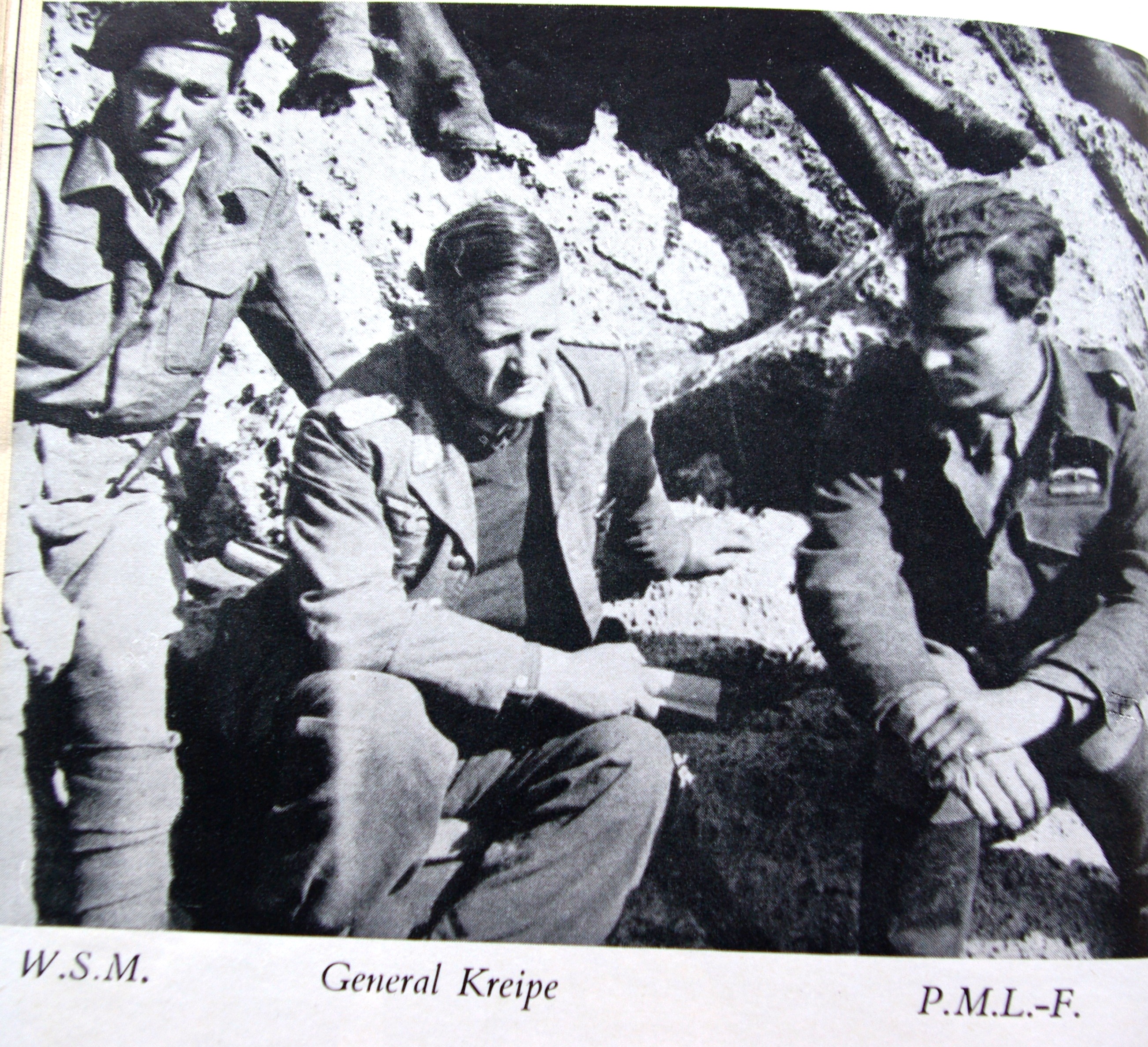
Here is the scene: The time is late April of 1944. The place is near the summit of Mt. Ida, the highest mountain on Crete. There is still snow. Gathered are five Cretans, fully mustached and heavily armed. Three other men wear German uniforms. This is deceptive: Two of them are British officers (commandos). The third, however, is something else. If you are very familiar with German military uniforms, you will see from pictures of the group that he is a general. In these photographs he is not looking at the camera. He does not smile. It is little wonder. His name is Karl Kreipe. He was, until he was kidnapped two days before, the commanding general of the German occupation forces on Crete. He was due to be promoted to lieutenant general yesterday. German patrols are looking for him.

As dawn breaks over Mt. Ida, he murmurs to himself:

Vides ut alta stet nive candidum Soracte
(“Do you not see how Soracte is shining”)….

Then, surprisingly, one of the British officers continues,

nec jam sustineant onus
Silvae laborantes, geluque
Flumina constiterint acuto

(“beneath a heavy covering of snow, and how
The laboring trees can no longer hold up their burden,
And how the rivers are frozen by the sharp cold?”).

(Translation of the Latin was provided by Professor W.C. Dowling of Rutgers University.)

The officer continues through the next five stanzas to the end of Horace’s Soracte ode. Many years later, he wrote, “The general’s blue eyes had swiveled away from the mountaintop to my own — and when I’d finished, after a long silence, he said: ‘Ach so, Herr Major!’ It was very strange as though, for a long moment, the war had ceased to exist. We had both drunk from the same fountains long before, and things were different between us for the rest of our time together.”

Readers of this anecdote may divide into two groups: both, in my view, equally fortunate. A few of you will recognize this scene as one of the mosaic tiles out of which Patrick Leigh Fermor’s (the British major was he) magnificent travel book “A Time of Gifts” was composed. (Readers intrigued by this passing anecdote who want to know more about what was one of the most daring exploits of World War II will enjoy reading “Ill Met by Moonlight” by W. Stanley Moss — he was the other British officer — George G. Harrap & Co.: London, 1950, as well as “Crete: The Battle and the Resistance” by Antony Beevor, Penguin Books: New York, 1991. Both books have photographs.) You are fortunate readers because you have discovered this marvelous author. But those of you who have not discovered him are also fortunate: When you do, you will have in front of you hours of enormous pleasure and satisfaction. I should confess that, until a few years ago, I had never heard of Fermor either. But in the fall of 1993, I went on a bicycle trip around Crete. Looking for something to read, I found “A Time of Gifts” in a local bookstore. I glanced through the first few pages and decided there and then that I would try to read everything the man ever wrote.

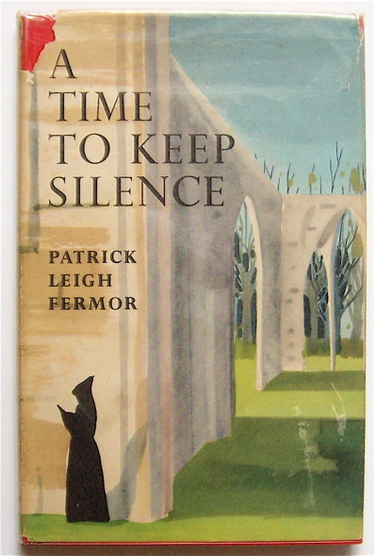
While all of Fermor’s books (there are not that many, only half a dozen or so by my count) are autobiographical, he has never written an autobiography. Nor, as far as I can determine, has anyone written his biography. The best one can do is to snatch fragments from his own books and from books written by people who came across him in passing. Constructing a person’s life this way, especially the life of a man like Fermor, is like trying to cross a rapidly flowing stream by hopping from rock to rock. There are lacunae for which I simply cannot account. What, for example, was he doing living in a vast Romanian country house near the Russian border for about two years just before the war? And later, how did he come to spend an almost equal amount of time in the Caribbean: an experience that resulted in the first of his travel books, “The Traveller’s Tree”? Moreover, why was that book actually written in two monasteries in France where Fermor was a resident visitor? This experience resulted in a gem of a short book, “A Time to Keep Silence,” which, he informs us, began as letters written from the monasteries to the woman who was to become his wife. We are told nothing more about her, not even her name. Why, I don’t know. But here, at least, are a few of the steppingstones in his life.

Fermor, whom friends apparently call “Paddy,” was born on Feb. 11, 1915, in London. As he wrote in an introductory letter to Xan Fielding (one of his fellow clandestine officers on Crete who was responsible for the west of the island, while Fermor was responsible for the east) in “A Time of Gifts”: “In the second year of World War I, soon after I was born, my mother and sister sailed away to India (where my father was a servant of the Indian Government) he directed the Geological Survey of India, and I was left behind so that one of us might survive if the ship were sunk by a submarine.” Fermor was deposited with a country family which “left a memory of complete and unalloyed bliss.” But, he continued, “when my mother and sister got back at last, I rushed several fields away and fought off their advances in gruff Northhamptonshire tones; and they understood they had a small savage on their hands, and not a friendly one.” Taken in hand, he was sent to a series of schools, all of which “ended in uniform catastrophe.” He explained: “Harmless in appearance, more presentable by now and of refreshingly unconstricted address, I would earn excellent opinions at first. But as soon as early influences began to tell, these short-lived virtues must have seemed a cruel Fauntleroy veneer, cynically assumed to mask the Charles Addams fiend that lurked beneath: It coloured with an even darker tinct the sum of misdeeds which soon began heaping up. When I catch a glimpse of similar children today, I am transfixed with fellow-feelings, and with dread.”

By this time, his mother and father had separated, and in locus parentis he was sent to two psychiatrists, one of whom he later found out had treated Virginia Woolf. This was followed by a stay at a cramming institution where he prepared himself for the examination to get into a public school, in this case, King’s School, Canterbury. His tenure at King’s School was abruptly terminated when he was discovered holding hands with the daughter of a local green grocer ” in the back-shop on upturned apple baskets.” He notes that his house master’s penultimate report remarked that he had made “some attempts at improvement but more to avoid detection. He is a dangerous mixture of sophistication and recklessness which makes one anxious about his influence on other boys.”

While this is not necessarily an ideal recommendation for getting into a university, it does nicely for the army, Fermor’s next goal. Somehow he managed to winkle a decent letter to Sandhurst, the British West Point. The only obstacle was obtaining what was known as the school certificate (which I suppose was something like a GED), a high school degree for people who did not actually finish high school. To this end, he was sent at the age of 17 to London to live and work with a tutor. All went well, and he managed to pass the London certificate. But then the scheme came unglued. He lost interest in the army. He began to write poetry and to hang out with a Bohemian group of “Bright Young People” of whom he was the youngest. Then at 18, he had a perfectly lunar idea. He would walk (walk!) from Holland to Istanbul. As he wrote to Fielding: “I would travel on foot, sleep in hayricks in the summer, shelter in barns when it was raining or snowing and only consort with peasants and tramps. If I lived on bread and cheese and apples, jogging along on fifty pounds a year supplied by his father and supplemented by a £15 loan from the father of a school friend … there would even be some cash left over for paper and pencils and an occasional mug of beer. A new life! Freedom! Something to write about!” Something to write about, indeed — except that it would happen 40 years later! The first volume of the triptych describing this incredible 18-month journey, “A Time of Gifts,” appeared in 1977; the second, “Between the Woods and the Water” in 1986; we still await the third.

What makes a great writer? I find this as difficult to characterize as trying to characterize what makes a woman beautiful. In both cases, it is something we feel in our guts. One thing, it seems to me, that great writers have in common is an obsessive love of language: words, words, words. In Fermor’s case, it was a love for all languages. When he left England in 1933 for his walk, Fermor had, it appears, schoolboy French and some Latin and classical Greek. By the time he enlisted in the Irish guards in 1939, the Latin had turned into Romanian and the classical Greek into modern Greek of sufficient fluency so that he could pass for a Cretan shepherd during the three years that he was in the resistance. In addition, he had acquired enough German so that after Gen. Kreipe was abducted, he could pass for a German soldier when they drove the general’s car, with him in it, past the sentries who were guarding the complex in which he lived.

But that is not all. Everywhere he went he absorbed languages. Here is a passage from “Between the Woods and the Water,” in which Fermor has come upon a strange enclave of Orthodox Jewish woodcutters high in the Carpathian Mountains in Transylvania. He was as taken in by them as he was taken in by nearly everyone he encountered. They were curious about him and he about them, although they were initially wary of such an odd visitor. Then, he wrote, “everything took a different turn when scripture cropped up. The book in front of the Rabbi was the Torah, or part of it, printed in dense Hebrew black-letter that was irresistible to someone with a passion for alphabets; especially these particular letters, with their aura of magic. Laboriously I could phonetically decipher the sounds of some of the simpler words, without a glimmer of their meanings, of course, and this sign of interest gave pleasure. I showed them some of the words I had copied down in Bratislava Fermor kept diaries and this one miraculously reappeared after the war, sent by the people with whom he had left it on the continent from shops and Jewish newspapers in cafes, and the meanings, which I had forgotten, made them laugh; those biblical symbols recommended a stall for repairing umbrellas, or ‘Daniel Kisch, Koscher Wuerst und Salami.’ How did the Song of Miriam sound in the original and the Song of Deborah; David’s lament for Absolom; and the rose of Sharon and the lily of the valley? The moment it became clear, through my clumsy translations into German, which passage I was trying to convey, the Rabbi at once began to recite, often accompanied by his sons. Our eyes were alight; it was like a marvelous game. Next came the rivers of Babylon, and the harps hanging on willows: This they uttered in unfaltering unison, and when they came to ‘If I forget thee, O Jerusalem,’ the moment was extremely solemn. In the back of my diary are a few lines in Hebrew, utterly indecipherable to me; and underneath them are the phonetic sounds I took down from his recitation of them.”

And Fermor continues: “By this time the otherworldly Rabbi and his sons and I were excited. Enthusiasm ran high. These passages, so famous in England, were doubly charged with meaning for them, and their emotion was infectious. They seemed astonished — touched too — that their tribal poetry enjoyed such glory and affection in the outside world; utterly cut off, I think they had no inkling of this. A feeling of great warmth and delight had sprung up and the Rabbi kept polishing his glasses, not for use, but out of enjoyment and nervous energy, and his brother surveyed us with benevolent amusement. It got dark while we sat at the table, and when he took off the glass chimney to light the paraffin lamp, three pairs of spectacles flashed. If it had been Friday night, the Rabbi said, they would have asked me to light it; he explained about the shabbas goy. This was the Sabbath-gentile whom well-off Jews — ‘not like us’ — employed in their houses to light fires and lamps and tie and untie knots or perform the many tasks the Law forbids on the Seventh Day. I said I was sorry it was only Thursday (the Sabbath begins at sunset on Friday) as I could have made myself useful for a change. We said good night with laughter.” Considering the kind of world war he would fight (after his tour of duty in Crete, Fermor joined an airborne reconnaissance force that considered rescuing prisoners from a concentration camp just before the war ended), he knew, as well as anybody, what the fate of these woodcutters must have been. Part of the beauty of his writing is that here, and elsewhere, he allows us to fill in this blank for ourselves. We read these books knowing, as he does, that the world he is describing no longer exists. There is no need for him to tell us.

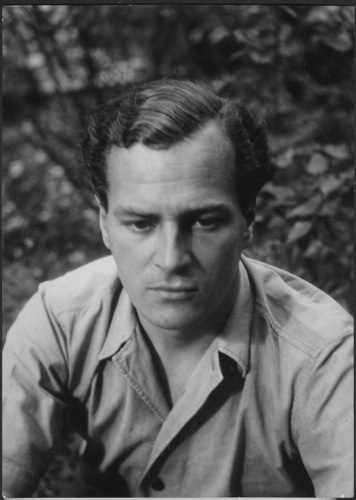
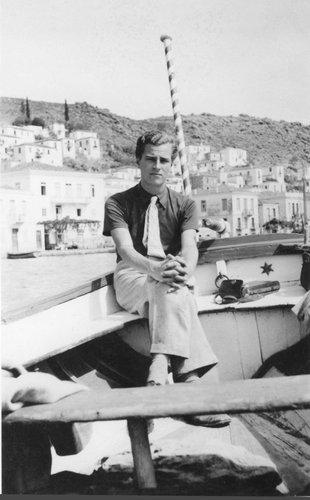
As Fermor wrote in his letter to Fielding, his original intention had been to walk across Europe, sleeping in hayricks and barns. It didn’t quite work out that way: He often slept in castles and mansions and, sometimes, instead of walking, he rode horses and fast motor cars or sailed on barges. It is clear that he was, and is, a man of extraordinary charm. A photograph of him taken in 1943 in Crete would pass for the photograph of a film star. His army contemporaries describe him as being Byronic. I am not sure what that means, except that at one point he seems to have swum the Hellespont. On his walk he made friends with nearly everyone he met. Some were Central European nobility with wonderful castles and libraries that he haunted. There were Gypsies and shepherds. There was a family of Czech acrobats he encountered in Vienna when he was trying to supplement his pound-a-week allowance with sketches in pencil. He couldn’t sell them a sketch, but they ended up giving him an autographed picture of themselves, which he kept as a remembrance. All of this is described in a language that is so rich and precise that, after reading a few pages, one shakes one’s head in wonder. (Reading Nabokov has the same effect on me.) If you are a writer, you either want to rush to your laptop or jump out of a window.

After his sojourns in the Caribbean and France, Fermor chose Greece as his permanent home. He lives, it says on the jackets of his books, in a house he designed and built himself. He has written two wonderful books about Greece, “Mani” and “Roumeli.” He ends “Roumeli” with a prose poem based on Greek place names. Here is a small part of it:

Chalcis is the flurry of the tide, Naxos the boxwood click of a rosary muffled by a nun’s skirt; Ossa is a giant’s tread, Pelion the beat of centaurs’ hoofs through glades of chestnut, Tempe a susurrus of plane trees, and Rhodes a flutter of moths.

Santorini zigzags to the sky at dawn like a lark singing but dies at sunset with the Dies Irae. Komotini is a muezzin’s call, Patmos the faraway trumpets of the Apocalypse.

The Dodacenese is a sea-song by twelve sponge-fishers, Antikythera a mermaid forsaken; Skopelos, a lobster’s and Poros, a mock-turtle’s song, Aegina a tambourine.

The Sporades are the sea’s whispers through olive trees.

And Patrick Leigh Fermor is a treasure and delight.

Sir Patrick Leigh Fermor – Memorial Service

Paddy’s Memorial Service will be held in London, at 11am on Thursday 15 December, at St James’s Piccadilly. I will update you as soon as more information is available.

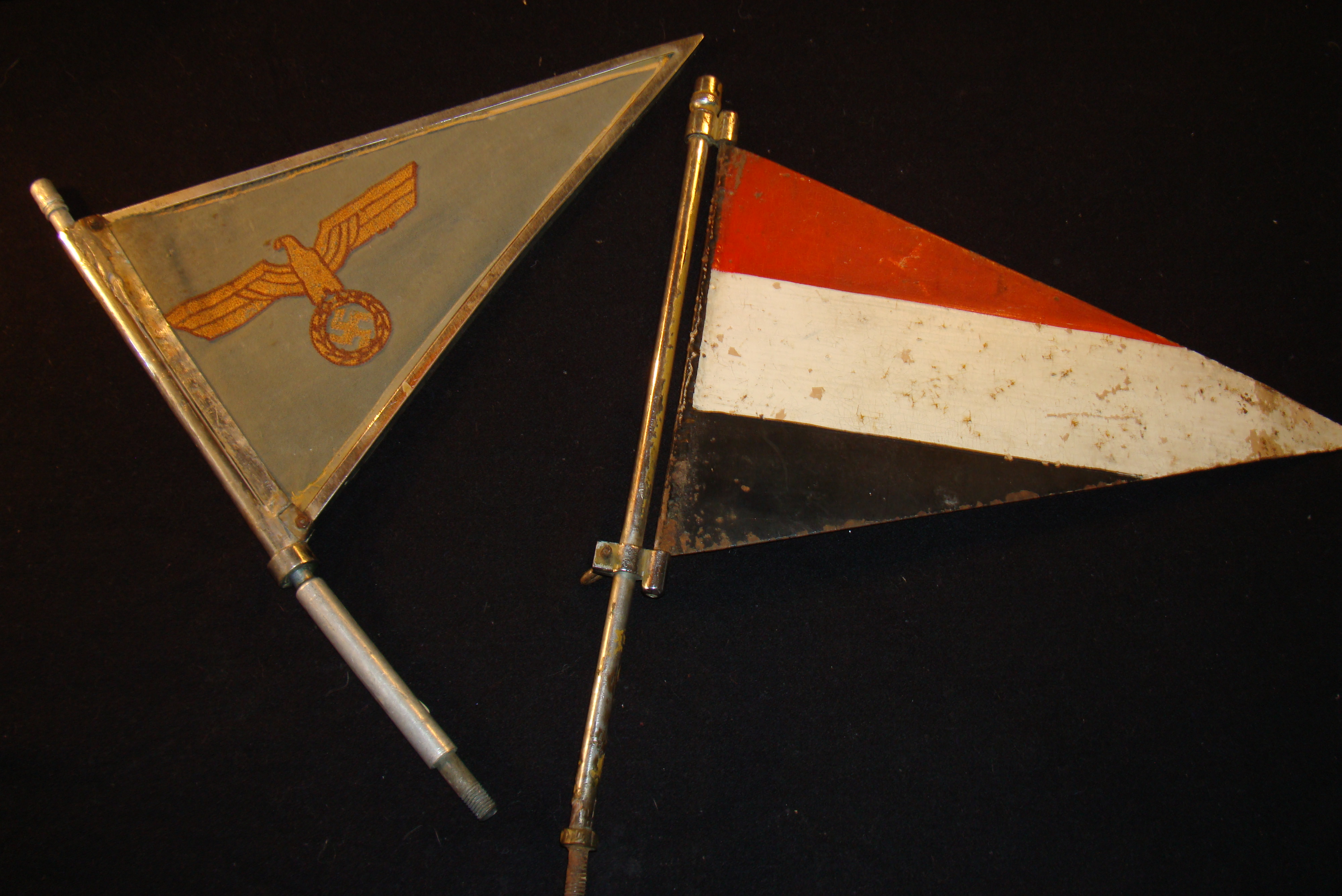
The Kreipe pennants

The Kreipe pennants - Copyright Artemis Cooper 2011

The pennants from General Kreipe's car

What happened to the flags on General Kreipe’s car when Paddy abandoned it and joined the main abduction gang? Well here is the story. I am very grateful to Artemis Cooper for submitting this. I hesitate to say that this is a world exclusive, but it probably is! These have not been seen in public since the car drove through the heavily garrisoned town of Heraklion with the General in April 1944.

As I’m sure you know, just before abandoning the General’s car on the night of the abduction of Gen Kreipe, Paddy and George Tyrakis ripped off the two metal pennants that stood proudly on the bonnet. One might argue that, combined with Billy’s confident driving, it was those pennants that had let the car pass unchallenged through 22 German checkpoints! Since Billy had driven the car the pennants were given to him; and after his death, Billy’s daughters – Gabriella Bullock and Isabella Cole – felt that Paddy should have them. Paddy held onto them for many years, very much under wraps. I think the main reason he kept them hidden was because he had always felt so wretched about the death of Alfred Fenske, the General’s chauffeur.

They were kept in a tin trunk in his study, and very few people knew they were there. He showed them to me only once. The reason for that was so that I should be aware that after his death, they were to go to the Rethymnon Museum of History and Folklore. This had been arranged in the 1990s, with the encouragement of Niko Kokonas.

In August the flags were given to the Rethymnon Museum, according to Paddy’s instructions.

I have a photo of the flags. They stand about 15″ high, the triangular pennant sticking out about 12″. The first is painted red, white and black in horizontal lines, like the German flag. The other shows the gold Nazi eagle with outspread wings perched on a wreath, embroidered onto a piece of grey fabric which is then mounted onto the metal pennant.

I hope this is a real joy to all the Ill Met by Moonlight fans out there.

This article and photograph copyright Artemis Cooper 2011

William Dalrymple – The essence of a landscape

The author of “Nine Lives” discusses his friendship with Paddy Leigh Fermor, and the boom-and-bust cycle of travel literature.

Related article:

Patrick Leigh Fermor: The man who walked

Ill Met by Moonlight on BBC iPlayer until 5 September

Just a quick post. It appears that the Dirk Bogarde movie is on BBC iPlayer for those of you who can access it until 5 September.

Click here to access the site.

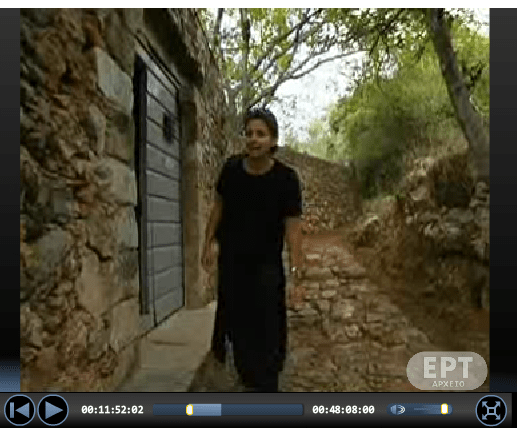
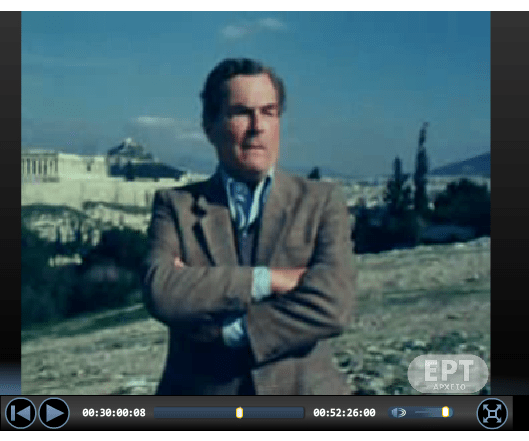
Journalist Maya Tsokli interviews Paddy

As part of the show “TRAVEL IN GREECE” the journalist Maya Tsokli discovers the area of ​​Kardamyli, and walks down a lane to a light blue door ….

A very good quality TV interview with Paddy brought to my attention by Thos Henley.

Πάτρικ Λι Φέρμορ:«Πατρίδα είναι εκεί που έχει κανείς τα βιβλία του»

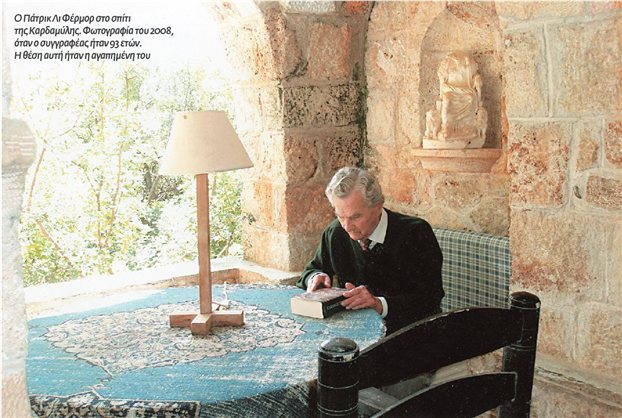
Paddy contemplating a fine read

It roughly translates as “Patrick Leigh Fermor – Homeland is where one’s books are” and it is about “Unknown details of life, action and work of British writer of travel literature, as recounted specific ‘Tribune’ reporter Joy Kiosse”. You can enjoy in the Greek or if appalling at it like me use Google Translate. It is quite a good article. I like the first paragraph ….

In mythology, heroes were not immortal, and some are in today’s life. The memory but Patrick Leigh Fermor, Paddy’s, like shouting his friends, the Sun-Michael for Mani and the Cretans, will remain immortal. Written with a broad humanitarian education, self-taught, untamed, hero, kind and generous friend peculiar humor, fearless and bold, persistent traveler with an insatiable thirst to discover the world, polyglot and general man with deep knowledge of the classics and history, the Fermor took all these elements to the end of his life.

by Joy Kiosse

First published in Tovima on 2 July 2011.

Από την Πέμπτη 16 Ιουνίου ο σερ Πάτρικ Λι Φέρμοραναπαύεται στο μικρό κοιμητήριο που βρίσκεται στον περίβολο του ναού του Αγίου Πέτρου στο Ντάμπλτον της Αγγλίας, δίπλα στο μνήμα της συζύγου του Τζόαν. Είναι μια ήσυχη πράσινη πλαγιά περιτριγυρισμένη από ψηλά δέντρα.

Στη μυθολογία οι ήρωες δεν ήταν αθάνατοι- και κάπως είναι και στη σημερινή ζωή. Η μνήμη όμως του Πάτρικ Λι Φέρμορ, του Πάντι, όπως τον φώναζαν οι φίλοι του, του κυρ-Μιχάλη για τους Μανιάτες και τους Κρητικούς, θα μείνει αθάνατη. Συγγραφέας με πλατιά ανθρωπιστική μόρφωση, αυτοδίδακτος, ατίθασος, ήρωας, καλός και γενναιόδωρος φίλος με ιδιότυπο χιούμορ, άφοβος και παράτολμος, επίμονος ταξιδιώτης με ακόρεστη δίψα για να γνωρίσει τον κόσμο, πολύγλωσσος και γενικότερα άνθρωπος με βαθιά γνώση των κλασικών και της Ιστορίας, ο Φέρμορ κράτησε όλα αυτά τα στοιχεία ως το τέλος της ζωής του.

Ακόμη, είχε το χάρισμα να σαγηνεύει τους συνομιλητές του και ήταν εξαιρετικά αγαπητός σε όλες τις παρέες. Την τελευταία ημέρα του στην Καρδαμύλη, το μεσημέρι στο τραπέζι απήγγειλε με τη βραχνή πια φωνή του ένα μεγάλο ποίημα του Γουίτιερ. Ναι, είχε μνήμη! Οχι όμως μηχανική. Ακούγοντάς τον να απαγγέλλει και ταυτόχρονα να υποδύεται τον ήρωα του ποιήματος είχες τη βεβαιότητα ότι γνώριζε σε βάθος το νόημα κάθε στίχου, κάθε φράσης, κάθε λέξης.

Στο νοσοκομείο της Αθήνας την πρώτη φορά βαφτιστήρια και φίλοι από την Κρήτη και τη Μάνη βρέθηκαν δίπλα του, λες και είχαν ειδοποιηθεί με σήματα μορς. Ανάμεσά τους υπήρχε μια αυθόρμητη σχέση αγάπης και σεβασμού- όπως και εκείνος αγάπησε και σεβάστηκε την Ελλάδα. Ναι, το σπάνιο στοιχείο αυτής της σχέσης του με την Ελλάδα ήταν ο σεβασμός που έδειξε στον τόπο.

Μετά την πρώτη επέμβαση επέστρεψε στην Καρδαμύλη, ελπίζοντας ότι είχε ξεπεράσει για κάμποσο καιρό το πρόβλημα της υγείας του και ότι θα πρόφταινε να τελειώσει το βιβλίο του. Τρεις εβδομάδες αργότερα, την ημέρα που ο δήμαρχος της Καρδαμύλης θα του έδινε το χρυσό κλειδί της πόλης, χρειάστηκε να επιστρέψει εσπευσμένα στο νοσοκομείο. Και ύστερα από μια δεύτερη επέμβαση πήρε την απόφαση να γυρίσει στην Αγγλία, γνωρίζοντας πως δεν θα επέστρεφε ποτέ πια. Το ταξίδι είχε τελειώσει.

Ο Πάντι τιμήθηκε στη ζωή του όσο λίγοι συγγραφείς ή ακόμη και ήρωες. Την πρώτη φορά που θέλησαν να του απονείμουν τον τίτλο του ιππότη (ΟΒΕ), αρνήθηκε, λέγοντας ότι δεν τον άξιζε. Τελικά έγινε σερ το 2004, «κα θώς δεν θα ήταν… ευγενικό να αρνηθεί δεύτερη φορά». Πάντως ποτέ δεν ακούστηκε κάποιος να τον αποκαλεί «σερ». Ολοι τον φώναζαν Πάντι και στην Καρδαμύλη και στην Κρήτη «κυρ Μιχάλη»- ήταν το ψευδώνυμό του στα βουνά της Κρήτης και το δεύτερο χριστιανικό του όνομα, που κανείς δεν το ήξερε, παρ΄ όλα αυτά όμως οι Ελληνες το γιόρταζαν.

Διακρίσεις, διπλώματα- όσα δεν πήρε στα μαθητικά του χρόνια-, ασημένιες πλακέτες και πάλι διακρίσεις υπάρχουν στη Μάνη, περισσότερο ως έργα τέχνης, καδράκια σπαρμένα στα διάφορα δωμάτια. «Κυρ Μιχάλη, πρέπει να πιείτε αυτό το φάρμακο», «Κυρ Μιχάλη,έξω περιμένει ο τάδε, να έρθει;», «Κυρ Μιχάλη,ήρθε η βαφτιστικιά σου η Αγγλία»… Και ο κυρ Μιχάλης έγνεφε καταφατικά.

Του άρεσε να έχει κόσμο όταν δεν ήταν σκυμμένος στα χαρτιά του. Κατά βάθος του άρεσε και το «κυρ-Μιχάλης», καθώς στο πίσω μέρος του μυαλού του υπήρχαν πάντα η Κρήτη και οι συναγωνιστές του. Βαριά άρρωστος στο νοσοκομείο, τις νύχτες έβλεπε πως ήταν στη σπηλιά στα Ανώγεια και έτρεχε στο μπαλκόνι να το σκάσει, και άλλοτε πως τον κυνηγούσαν και έτρεχε για να μην τον πιάσουν.

Υπό τους ήχους μιας γκάιντας

Εκείνη την Πέμπτη ο καιρός ήταν χαρούμενος στη μικρή πολίχνη του Ντάμπλτον. Ο ήλιος μπαινόβγαινε στα σύννεφα πάνω από την εκκλησία όπου συγκεντρώθηκαν φίλοι και συγγενείς και παλιοί συμπολεμιστές του. Οταν έφθασε η σορός σκεπασμένη με τη βρετανική σημαία, ο ιερέας βρισκόταν στην άκρη του φράχτη περιμένοντας να δώσει την τελευταία ευχή. Μετά προχώρησαν μαζί στην εκκλησία, όπου στην πόρτα περίμεναν να αποδώσουν τιμές βετεράνοι της Ιρλανδικής Φρουράς. Μέσα στον ναό η τελετή ήταν σύντομη, χωρίς λόγους.

Η σοπράνο Σάρα Γκάμπριελ τραγούδησε ασυνόδευτη ένα απόσπασμα από τον «Ντον Τζιοβάνι» του Μότσαρτ, το εκκλησίασμα έψαλε δύο ύμνους, διαβάστηκαν δύο σύντομα αποσπάσματα από την «Κήπο του Κύρου» του σερ Τόμας Μπράουν και από το «Απόκρυφο Βιβλίο» του Πρωτευαγγελιστή, και το εκκλησίασμα ακολούθησε τη σορό στον περίβολο της εκκλησίας υπό τους ήχους μιας γκάιντας. Κοντά στο μνήμα ένας μουσικός της Ιρλανδικής Φρουράς σάλπισε το σιωπητήριο. Αυτό ήταν. Η σημαία διπλώθηκε, η σορός κατέβηκε, ενώ την έραιναν ροδοπέταλα και μια χούφτα χώμα που ήρθε από την Ελλάδα. Μετά σιωπή.

Δίπλα στο μαξιλαράκι με τα παράσημα- ανάμεσά τους ξεχωρίζει ο ελληνικός Φοίνικας- βρίσκονταν τα στεφάνια. Εκείνο από την Ελληνική Πρεσβεία στο Λονδίνο (άλλωστε ο πρέσβης κ. Α. Σάντης παρέστη στην κηδεία), ένα δάφνινο από το Μουσείο Μπενάκη με την ευχή «στο καλό Πάντι», ένα από τον αρχηγό του Γενικού Επιτελείου Στρατού της Ελλάδος, ένα από τους Βυρωνιστές, άλλα από την οικογένεια του συναγωνιστή και φίλου του λόρδου Τζέλικο, από την Αδελφότητα των Ελλήνων Βετεράνων, από το Βritish Council της Αθήνας, από βαφτισιμιές… και πολλά μικρά μπουκέτα αγριολούλουδα από φίλους.

Καρδαμύλη, «το σπίτι του»

Τους τελευταίους μήνες της ζωής του ο Πάτρικ Λι Φέρμορ τούς πέρασε στην Καρδαμύλη της Μάνης. Εκεί ήταν «το σπίτι του». Οταν τον ρωτούσαν οι δημοσιογράφοι ποια από τις δύο χώρες θεωρούσε πατρίδα του, ποιο από τα δύο σπίτια ένιωθε περισσότερο δικό του, εκείνο της Αγγλίας με τον παλιό μύλο, το ρυάκι και τα πανύψηλα δένδρα ή το άλλο, της Μάνης, «Πατρίδα είναι εκεί που έχει κανείς τα βιβλία του» απαντούσε. Και η αλήθεια είναι ότι τα βιβλία του Ντάμπλτον δεν μπορούν να συγκριθούν με τις βιβλιοθήκες της Καρδαμύλης. Εφέτος, στις αρχές του χρόνου, ο Πάτρικ Λι Φέρμορ επέστρεψε στην Καρδαμύλη, όπου προσπάθησε απελπισμένα να τελειώσει τον τρίτο τόμο της τριλογίας του. Πρόκειται για το τελευταίο μέρος του οδοιπορικού ενός 18άρη που ξεκίνησε από την Ολλανδία για να διασχίσει με τα πόδια όλη την Ευρώπη, ως την Κωνσταντινούπολη. Οι πρώτοι δύο τόμοι που εκδόθηκαν με τις αναμνήσεις αυτής της περιπέτειας, «Α time of Gifts» (1977) και «From the Woods to the Water» (1986) – έχουν μεταφραστεί στα ελληνικά-, γνώρισαν μεγάλη επιτυχία.

Σε αυτό το ταξίδι ο Φέρμορ μόλις που πρόλαβε να γνωρίσει έναν κόσμο ο οποίος, με τον Β΄ Παγκόσμιο Πόλεμο, θα χανόταν για πάντα. Ενα συστατικό γράμμα σε κάποιον ευγενή στη Γερμανία άνοιξε τη μία μετά την άλλη τις πόρτες των αρχοντικών και των κάστρων της Μεσευρώπης με τις πολύτιμες συλλογές έργων τέχνης και τις παλιές βιβλιοθήκες. Λίγα χρόνια αργότερα, μετά τον Πόλεμο, τίποτε από αυτά δεν υπήρχε. Ολα είχαν χαθεί, μαζί και ο τρόπος ζωής των φεουδαρχών αρχόντων και του αγροτικού πληθυσμού. Οι βομβαρδισμοί και το σοβιετικό καθεστώς έσβησαν έναν ολόκληρο κόσμο από τον χάρτη της Οικουμένης.

Οι Βρετανοί είχαν από καιρό ανακηρύξει τον Πάτρικ Λι Φέρμορ τον μεγαλύτερο ταξιδιωτικό συγγραφέα τους- ίσως τον κορυφαίο σε ολόκληρο τον κόσμο. Ο Φέρμορ δεν ήταν όμως μόνο ένας εξαιρετικός ταξιδιωτικός συγγραφέας. Οι περιγραφές του δεν περιορίζονταν στη διαδρομή. Τον ενδιέφερε η φύση, αλλά και ο άνθρωπος, οι ιστορίες που έλεγαν οι πέτρες και τα κτίσματα. Τον σαγήνευαν οι μικρές αφηγήσεις που άκουγε στα καφενεία. Τον βοηθούσαν να καταλάβει τους ανθρώπους και να κατανοήσει ό,τι κράτησαν από τον πολιτισμό τους. Σε αυτό τον βοήθησε πολύ και η ευκολία του στην εκμάθηση ξένων γλωσσών. Ακόμη και πρόσφατα διόρθωνε εκφράσεις και λέξεις συνομιλητών του στα ρουμανικά. Και εκείνοι δεν πίστευαν στα αφτιά τους…

ΓΙΑΤΙ ΔΕΝ ΕΠΕΣΤΡΕΨΕ ΣΤΗΝ ΚΡΗΤΗ – Η ΑΠΟΚΑΛΥΠΤΙΚΗ ΒΙΟΓΡΑΦΙΑ

Ο Πάτρικ Λι Φέρμορ καταγόταν από προνομιούχο οικογένεια.Ο πατέρας του,ο σερ Λούις,ήταν διευθυντής του Γεωλογικού Ινστιτούτου στην Ινδία,με αποτέλεσμα αυτός και η γυναίκα του να κρατηθούν για ένα πολύ μεγάλο διάστημα μακριά από τον γιο τους.Παιδάκι τον εμπιστεύθηκαν σε μια αγροτική οικογένεια και μεγάλωσε ελεύθερος στη φύση.Σε αυτή την ελευθερία οφείλεται ίσως ο ατίθασος χαρακτήρας του,αλλά και μια περίεργη,αυστηρή πειθαρχία,προσαρμοσμένη όμως στους δικούς του όρους.

Οταν,μετά τον Α΄ Παγκόσμιο Πόλεμο, μαζεύτηκε η οικογένεια,στο σπίτι γινόταν πολλή κουβέντα για πουλιά,για λουλούδια και για τόπους μακρινούς.Η μητέρα του,θέλοντας να του ανοίξει τους ορίζοντες- αφού το ένα μετά το άλλο τα σχολεία τον έδιωχναν-,του διάβαζε ποίηση και κλασικούς.Η οικογένεια τον προόριζε για στρατιωτικό.Γι΄ αυτό και εκείνος αποφάσισε να φύγει για την Ευρώπη.Χωρίς χρήματα,χωρίς χρονικούς περιορισμούς,σχεδόν χωρίς πρόγραμμα.Στο σακίδιό του είχε την κλασική ανθολογία ποίησης των εκδόσεων Οξφόρδης,τις Ωδές του Οράτιου,ίσως και κάποιο έργο του Σαίξπηρ.

Για να κρατά συντροφιά στον εαυτό του, όσο περπατούσε απήγγελε ποίηση,με αποτέλεσμα να τη μάθει απέξω,ενώ επαναλάμβανε όσα πρόφταινε να αρπάξει από τη γλώσσα κάθε τόπου από τον οποίο περνούσε.Κοιμόταν σε καπηλειά και αχυρώνες με την ίδια άνεση που έμενε σε πύργους και άκουγε τις ιστορίες των ανθρώπων που συναντούσε αναζητώντας τις ρίζες και τους μύθους των τόπων τους.Για να κερδίζει κάποια χρήματα έκανε ό,τι δουλειά έβρισκε- ενώ σχεδίαζε και προσωπογραφίες.Κάποια στιγμή έφθασε στον προορισμό: την Πρωτοχρονιά του 1935 τη γιόρτασε στην Κωνσταντινούπολη.Αλλά κάπου κατά τη διάρκεια του ταξιδιού οι σημειώσεις είχαν χαθεί.

Εφυγε από την Κωνσταντινούπολη με ένα ακόμη συστατικό γράμμα στην τσέπη.Αυτή τη φορά ήταν από τον έλληνα πρόξενο προς τον Πέτρο Σταθάτο στο Μόδι της Μακεδονίας.Υστερα από έναν σταθμό στο Αγιον Ορος,προχώρησε στο Μόδι.Η ατμόσφαιρα ενός ελληνικού σπιτιού και η αρχοντιά του οικοδεσπότη τού άνοιξαν τις πόρτες της Ελλάδας.Με ένα άλογο τριγύρισε στη Μακεδονία.Πλησίασε τους Σαρακατσάνους- για τους οποίους και έγραψε-,ώσπου κατέληξε στη Θεσσαλονίκη,όπου βρέθηκε στη μέση μιας σύρραξης ανάμεσα σε βασιλικούς και βενιζελικούς.Καθώς οι Σταθάτοι ήταν βασιλικοί και το άλογο ήταν δικό τους,προσχώρησε- πού αλλού;- στο στρατόπεδο των βασιλικών.Πάντως ο Φέρμορ δεν ήταν πολιτικοποιημένος.Αλλά ακόμη και αν ήταν,το έκρυβε τόσο καλά,ώστε κανείς δεν μπορούσε να τον τοποθετήσει σε «στρατόπεδο».

Το περιστατικό που τον σημάδεψε

Για τη ζωή και τις περιπέτειές του έχουν γραφτεί πολλά και έχουν ειπωθεί περισσότερα.Για την ιστορία της Κρήτης ο ίδιος έχει μιλήσει πολύ λίγο,ενώ δεν έχει γράψει τίποτε.Επρεπε να βρίσκεται παρέα με πάρα πολύ στενούς φίλους και να έχουν πιει πολύ κρασί για να πιάσει τη διήγηση.Και πάλι όμως,έκανε την ιστορία του ελαφριά,σχεδόν διασκεδαστική και εξωπραγματική.

Υπάρχει ένα τραγικό περιστατικό σε αυτή την ιστορία,που χάραξε τη ζωή του Φέρμορ και για το οποίο ο ίδιος δεν μίλησε ποτέ,ενώ ούτε ο υπαρχηγός του,στρατηγός Στάνλεϊ Μός,το αναφέρει στο βιβλίο του «Ιll met by moonlight» («Κακό συναπάντημα στο φεγγρόφωτο»),που είναι αφιερωμένο στην απαγωγή του στρατηγού Κράιπε.Το έψαξε η βιογράφος του Αρτεμις Κούπερ στα αρχεία του υπουργείου Πολέμου.

Στη Μάνη ο Φέρμορ διάβαζε και ξαναδιάβαζε το χοντρό ντοσιέ με τα χειρόγραφα και τις δακτυλογραφημένες σελίδες που ήταν γεμάτα διορθώσεις με τα τρεμουλιαστά και όπως πάντα δυσανάγνωστα γράμματά του.Ο τόμος είχε σχεδόν τελειώσει.Ηθελε ίσως κάποιο «χτένισμα» και υπολογιζόταν να κυκλοφορήσει πριν από τα Χριστούγεννα του 2011. Την επιμέλεια είχε η Αρτεμις Κούπερ,η οποία είχε επιμεληθεί και την έκδοση του «Words of mercury» το 2003.

Οι Βρετανοί έχουν από καιρό ανακηρύξει τον Πάτρικ Λι Φέρμορ τον μεγαλύτερο ταξιδιωτικό συγγραφέα τους- ίσως τον κορυφαίο στον κόσμο.Ο Φέρμορ δεν ήταν όμως μόνο ένας εξαιρετικός ταξιδιωτικός συγγραφέας.Οι περιγραφές του δεν περιορίζονταν στη διαδρομή.Τον ενδιέφερε η φύση,αλλά και ο άνθρωπος,οι ιστορίες που έλεγαν οι πέτρες και τα κτίσματα.Τον σαγήνευαν οι μικρές αφηγήσεις που άκουγε στα καφενεία.Τον βοηθούσαν να καταλάβει τους ανθρώπους και να κατανοήσει ό,τι κράτησαν από τον πολιτισμό τους.Σε αυτό τον βοήθησε πολύ και η ευκολία του στην εκμάθηση ξένων γλωσσών.Ακόμη και πρόσφατα διόρθωνε εκφράσεις και λέξεις συνομιλητών του στα ρουμανικά.Και εκείνοι δεν πίστευαν στα αφτιά τους…

The Traveller’s Tree: A Journey Through the Caribbean Islands

Before he was a writer, Patrick Leigh Fermor was merely a war hero, having earned his first fame from deep-cover exploits with the Greek Resistance. During World War II he hid in the rugged mountains of Crete, leading cat-and-mouse strikes against the German occupiers—experience that surely served him well a couple years later when, as he describes in his account of postwar travels in the Caribbean, The Traveller’s Tree, he ventured once again into hostile territory: the Dunghill in Kingston, Jamaica. This rickety slum, the “refuge of all the robbers and footpads and murderers of Jamaica,” was also the stronghold of the “passionately anti-white” Rastafari. Despite being warned that even police officers and black Jamaicans scarcely dared enter their compound, he strolls in with only feigned ignorance for armor. “I was just going for a walk,” he explains when accosted. “What are the Rastafari?”

by Timothy Farrington

First published in Book Forum

Before long, the droopy-lidded devotees of Jah are not only answering his question in detail but also “hospitably” rolling him a joint “unwieldy as an ice-cream cone.” Here already in Leigh Fermor’s first book, originally published in 1950, is the winning mix of nerve, curiosity, and cheer, so charming to readers and other cultists, that marks his two-part masterpiece, A Time of Gifts (1977) and Between the Woods and the Water (1986), an account of a rather longer walk, from Holland to Turkey. But unlike those volumes, The Traveller’s Tree, which skips along the Antillean island chain from Trinidad to Cuba, was written within only a year or two of the trip it records. Leigh Fermor’s European trek, on the other hand, had four decades to mellow and ramify in memory before he wrote about it. For all its remarkable vivacity, that later work doesn’t preserve the sort of small irritations that give some passages here a cranky (and often very funny) edge, complementing his usual lyricism. He notes that “hotel cooking in [Trinidad] is so appalling that a stretcher may profitably be ordered at the same time as dinner,” complains of the “thuggish vegetation” that blankets the southerly islands, and, on realizing that he has been the victim of a friendly prank, emits a “H’m” of pique.

The pranksters are three black waitresses—not a coincidence in a book that unavoidably centers on racial tension. Leigh Fermor revels in genealogy and loves explaining why who ended up where, historically speaking; elsewhere, he focuses on the “ethnological rock-pools of Europe,” peripheral groups whose racial history, rightly or wrongly, often feels slightly academic. But here, in presenting a “report on the birth pangs of our postwar world,” as Joshua Jelly-Schapiro puts it in his introduction, Leigh Fermor confronts again and again the raw wounds of incipient decolonization. A chance meeting with a Guadeloupean woman sets the tone: “You’re white and we’re black,” she shouts. “What of it?”

He worries at that question throughout with an open-mindedness unusual for his class and era (notwithstanding the use of terms, such as childish and primitive, that have long since been struck from the anthropological lexicon). He doesn’t just condemn segregation, he seems actually to feed on cultural miscegenation. The “blood-curdling gentility” of white Barbados looks all the more pathetic when juxtaposed with his portrait of “startlingly cosmopolitan” and “fantastically carefree” Trinidad—itself a mere appetizer compared with his thirty-eight-page treatment of Haitian voodoo (a certain slackness of narrative is one of the flaws he had yet to iron out). It supplements diligent fieldwork—he counts seventy distinct voodoo spirits—with library digging, Leigh Fermor being a man so book-drunk that he compares the delicate task of harvesting hearts of palm to the “handling of a codex.” In fact, he seems to stop at every library and graveyard in the islands, grateful for these rare outcroppings of history in the “recent world of the Antilles.”

Some people travel to blot home, or the past, from their minds. Not Leigh Fermor, who always keeps one compass leg fixed in his intellectual home—literary Europe. The book closes with words from his seatmate on the return trip, an emigrant Greek, and opens by describing his trip as an Odyssey. Sixty years and seven books later, that almost seems like an understatement. After all, Odysseus left home only once.

Patrick Leigh Fermor remembered by Colin Thubron

When I was asked to select a passage from his work that encapsulated the spirit of Paddy Leigh Fermor, who died last Friday, a crowd of images leapt to mind, from his encounter with the grotesque burghers of Munich in A Time of Gifts to the eerie vespers of A Time to Keep Silence, to the gongs of Byzantium and the gambolling of dolphins in Mani.

By Colin Thubron

First published in The Spectator, 18 June 2011

Almost any page of his work glitters with the ebullience and precision of his style, and its almost choreographic way with sentences. And his writing was the ideal instrument for his omnivorous love of things: his encyclopaedic delight in history, genealogy, heraldry, costume, the quirks and byways of folklore and language.

This was a man who seemed to embody panache. From boyhood he was a renegade. The housemaster at his public school, from which he was predictably sacked, called him ‘a dangerous mixture of sophistication and recklessness’. In his youth he walked across Europe in the first year of Hitler’s coming to power, and during the war lived for over two years in the Cretan mountains disguised as a shepherd before famously abducting the German military commander of Crete. Later, during the Greek civil war he joined a royalist cavalry charge, and at the age of 70, in emulation of Lord Byron, he swam the Hellespont — with his wife in a boat behind him — sitting on her hands (he wrote) in order not to wring them.

I believe he was erudite rather than intellectual — he embraced and celebrated experience more than he analysed it, and his descriptions even of obscure history and customs were lit up by a playful vitality. He wrote, of course, at a time when the world seemed less accessible than now and when to plunge into the Taygetus mountains of the southern Peloponnese, for instance, was a more remote experience than an Andean trek today. In this he seems the product of an earlier age, as he does in his wide learning, his immersion in his chosen subject, and his eschewing of the psychological.

Always there was this zestful inventiveness and cultivated pleasure in fantasy — not whimsical fantasy, but rather the product of a full-blooded imagination. Almost the last time I saw him, he had returned from hospital after an operation for suspected cancer. I was worried that I’d find him depleted and his old flare gone. At first he was indeed a little subdued, eating lunch. Then suddenly he perked up and said: ‘You know, there is an apple lying on a table in the hall. It’s been there all weekend… Wouldn’t it be marvellous if it cocked a snook at Newton, and simply took off into the air!’

Then I knew he was himself again.

He had few disciples. It was hard to emulate such writing, and rather dangerous. He was a master of that rich and sculptured style: but I think nobody else was. What he gave to travel writing was less a specific following than his unique personal stature: as near as we are likely to come to a Renaissance man. He bestowed on the genre his innate dignity, his literary brilliance, his polymathic mind, and his generous heart.

Sebastian Faulks on Patrick Leigh Fermor “He’s a bit of an old windbag”

There was a period last year when Sebastian Faulks was seemingly never out of the newspapers what with Birdsong coming to the stage and other activities. I found this little piece in the Independent

He is hailed as one of the greatest travel writers of the 20th century, but Patrick Leigh Fermor is not up to much, says Sebastian Faulks. The bestselling author of Birdsong tells me that despite several attempts he has never been able to get through Leigh Fermor’s seminal book, A Time of Gifts, saying “He’s a bit of an old windbag isn’t he?” Faulks was on garrulous form at the Hatchards’ authors party last week, turning his sights on Joan Bakewell too. “Why’s she gone and written a novel? Everyone thinks they can do one now.” Next up, Debo Devonshire: “Why has she written another book? They can’t be short of money can they?” Watch out!

I have to admit that I have actually made my way through two of Faulk’s novels: Charlotte Gray which was dull and Birdsong which is populated by unattractive characters and in the end becomes completely boring and fantastical. Never again!


Erudiete avonturier leefde zijn eigen boeken

The leading Dutch newspaper NRC Handelsblad has published a short article to mark Paddy’s death written by Bruno Braak. Yours truly was interviewed for this and apparently I said ” He was so much more than a travel author”, says Tom Sawford, who made a website about Leigh Fermor. “Paddy expected a lot of knowledge from his readers. He wrote in-depth about history and parts in Latin, French or German untranslated”.

The title translates as “Erudite adventurer lived his own books”.

A Greek video – Celebrating Sir Patrick Michael Leigh Fermor (1915-2011)

A Greek video commemorating Paddy, as well as colleagues and friends. Stirring music and great images. (PS – this will work as it is on You Tube 🙂 )

The magnetic John Pendlebury

Archaeology’s first modern hero was dazzling in life and heroically defiant in death. Paddy wrote the foreward to the 2007 book – The Rash Adventurer: A Life of John Pendlebury by Imogen Grundon.

J. D. S. Pendlebury, excavator of Amarna, Curator at Knossos, he of the glass eye and the swordstick, who died defending Crete from German invasion in 1941, is archaeology’s first modern hero: brilliant, magnetic and self-aware. In The Rash Adventurer, Imogen Grundon gives us the substance behind his dazzling brief career. John Pendlebury evidently possessed an extraordinary determination to overcome obstacles, demonstrated after he had lost an eye as the result of a childhood accident. In spite of this handicap, his Cambridge years included a blue in athletics and a first class in the tripos. Grundon reveals his early interests in archaeology, and the enormous workload he undertook soon after leaving university. His career included excavation both at Akhenaten’s capital of Amarna and at Sir Arthur Evans’s site at Knossos, as Pendlebury moved from one to the other with the seasons of work. By the age of twenty-five he occupied a unique position in Mediterranean archaeology, holding simultaneously the posts of Curator at Knossos and Director of Excavations at Tell el-Amarna.

by Jane Jakeman

First published in the Times Literary Supplement, 17 October 2007.

The relationship between Egypt and Crete was of particular interest to him, and his Aegyptiaca: A catalogue of Egyptian objects in the Aegean area is still an important resource. At Amarna, the historical background was still very unclear when Pendlebury became Director in 1930, and he was able to extract a possible chronology and a history of that remarkable city. There was a wide gulf between Bronze Age archaeologists and Egyptologists, and Pendlebury had to endure much criticism in Egyptological circles, particularly over his theories concerning the invasion of Egypt by the “sea peoples”, whose leadership he ascribed to Agamemnon. It was not uncommon at the time to look for relationships between mythology and archaeology, but this approach evidently appealed to Pendlebury’s love of Homeric story. It was also a romantic perspective, and from it he viewed his beloved modern Cretans, sometimes presiding over dinner wearing a Cretan cloak and striding through the mountains to meet kapetanoi, the old brigand leaders.

He clearly relished his swashbuckling self-image, but Grundon shows him capable too of subtle and complex achievements. At Knossos, he skilfully negotiated a difficult relationship with Evans, whose colourful reconstructions Pendlebury sometimes disagreed with, in spite of his own imaginative streak. He was in fact working in a new archaeological era: the age of the great individual “dig” patrons was passing, in favour of a more modern system where the locals were no longer regarded as mere workmen, and foreign governments were recognized as significant entities. Pendlebury showed himself well able to manage this transition and he was realistic in matters of archaeological politics and finance, very aware of the importance of finding subscribers to the Egypt Exploration Society, and new sources of funding. Grundon is good on the complications of organizational funding and personalities, academic intrigues and quarrels.

At the outbreak of the Second World War, Pendlebury returned to Britain, enlisted in Military Intelligence and was drafted into Military Intelligence (Research). He went back to Crete in 1940 as a British Army captain, in order to organize resistance to invasion in the mountain regions. He was “adopted”, to use Grundon’s appropriate word, by the highly secretive “D” section of MI6, whose task was to train agents, conceal supplies for sabotage, and handle anti-German propaganda. There is no doubt that he loved the atmosphere of mystery and intrigue, as also the adventure of rallying his kapetanoi.

Pendlebury’s part in the Battle for Crete was, however, tragically short-lived: in 1941, he was wounded, then captured, propped up against a wall and shot. Again, Grundon has followed these events very carefully, presenting as much evidence as can now be garnered – although her wider picture of the background to the invasion of Crete is too kind to General Bernard Freyberg, the New Zealander in command of Allied forces on Crete. Antony Beevor’s Crete: The Battle and the Resistance brings out clearly the later Lord Freyberg’s disastrous support for seaborne invasion, and the obstinate misinterpretation of “Ultra” intelligence, which contributed to the loss of the island to the Germans. The downfall of Crete was horribly unnecessary. So was Pendlebury’s death, a tragic waste, except perhaps that his premature decease itself took on an iconic quality. His image has remained unencumbered by the aura of his snobbish wife and untarnished by entanglement in post-war politics.

The Rash Adventurer is a thorough and authoritative biography, based on detailed research, which gives us at every point the facts underpinning the myth of the man. As well as reaching deep in archives and libraries, Imogen Grundon seems to have interviewed almost every survivor in the field. There is one story she omits, however, perhaps because none of her elderly interlocutors cared to repeat it – the story passed down among Egyptologists, that, as he faced the firing squad, John Pendlebury’s last words were “Fuck you!”.

Rare video of Pendlebury excavating in Egypt as well as showing off his athletic prowess.

Audible

Greeks in Hungary: A history in two acts

I thought this would be of general interest. I don’t recall Paddy encountering any Greeks in Hungary but he did come across Greek fishermen from the Greek diaspora when walking along the Bulgarian Black Sea coast in late 1934. That encounter was related in Words of Mercury and includes the Mystery of the Black Sea Cave.

by Alexander Billinnis

First published in The Hellenic Voice, 22 June 2011.

The Greek presence in Hungary is one of the oldest in Greece’s modern diaspora. It is, further, one of the most interesting, because as a tragic accident of war and politics, it received a new lease on life, a second chapter of sorts. The Greeks’ odyssey in Hungary is a tale of two diasporas and the efforts of current Greeks to unite the two acts into a common play.

Act I: The First Diaspora

After swallowing up the Balkans, the Turks shattered the Hungarian army at the Battle of Mohacs, and the Turks controlled most of Hungary, and up to the gates of Vienna in Austria, for more than 150 years. On the heels of the Turks’ second, failed siege of Vienna in 1683, the Austrians, at the head of a multinational European force, began the taskof evicting the Turks from Central Europe. When the guns fell silent, in 1717, the Austrians and Hungarians needed to rebuild their realm devastated by war, and many Ottoman Christians, primarilySerbs but also Greeks and Vlachs, responded eagerly.

Greek merchants quickly established themselves in major Hungarian cities, such as Buda, Pest, Szentendre, Miskolc and Tokaj. They were heavilyinvolved in the overland trade with the Ottoman Empire, but they also worked as agriculturalists and vintners. There is some evidence that winemakers from Macedonia first cultivated Hungary’s prized Tokaj wine. The Greek merchants were heavily involved in the coffee trade, and some of the oldest Budapest coffeehouses have Greek origins. As an avid coffee drinker, this makes me particularly proud.

The Greeks’ natural appetite for commerce, their large commercial network in the Ottoman Empire and their growing colonies throughout the Austrian (later Austro-Hungarian Empire) brought a great deal of wealth to the small but financially and politically powerful community. The Greek community supported schools, charitable institutions and of course church organizations. Initially the Greek students studied at the Serbian school, but by 1785 they established their own, which operated continuously until 1900. The Greeks and Vlachs established a church community separate from other Orthodox nationalities (though still subject to the Serbian Patriarchate), and their cathedral, built in 1809, continues (as the Hungarian Orthodox Church) to serve a largely Hungarian Orthodox community, often Balkan in origin. Other Greek Orthodox churches grace several Hungarian cities, including Tokaj, Eger and Miskolc.

The Greeks’ very success fostered an increasing assimilation. Greeks left the merchant class, became naturalized Hungarians, and in some cases nobility. Events in Hungary followed a similar pattern to those in Vienna and other key Austrian commercial centers. Lacking the critical mass of population that the Serbs had in southern Hungary (which later became the Serbian province of Vojvodina, where my family and I currently live), the Greeks became Hungarians, though some did keep the Orthodox religion of their ancestors, and vestiges of their culture.

Act II: The Second Diaspora

Just as the First Greek Hungarian diaspora faded into assimilation and history, events in Greece stirred up another wave of Greeks into Hungary. Many of these immigrants came from the same mountains as the first diaspora, but they were not merchants, but refugees – guerillas, villagers and intellectuals of the communist movement in the Greek Civil War. Many were children, many came involuntarily. Their connections with Greece were severed by the hard frontiers of the Cold War, but they did not forget Greece or their traditions.

In the “Greek” village of Beloiannisz (Beloyiannis), which I visited, or in small communities in Budapest, Miskolc, Pecs and Kesckemet, the Greeks kept their language and culture alive. In the communist period the Church played little role as a guardian of faith and identity, in contrast with the first Greek diaspora in Hungary, or Greek diasporas in the Americas or Australia. In the post-communist era, the role of the Church has reemerged.

Other virtues we associate with the diaspora, hard work and study, also marked this post Civil War diaspora. Greeks excelled in academia and professions well out of proportion to the small size of their community. All of the Greeks I met, including the second generation born in Hungary, spoke Greek with a precise fluency.

A fair percentage of the Greek Hungarian community repatriated to Greece, particularly in the 1980s, but the community by that time was quite well established in Hungary. The Hungarian government recognized Greeks as a distinct minority and cofunded cultural and educational activities. This support enables a diverse educational and cultural agenda, including an elementary school, weekly cultural performances and a growing literature about the community. When I arrived at the cultural center, I was welcomed as a fellow diaspora Greek, and loaded down with books on the community.

Closure

I spent an hour talking to Professor Nikosz Fokasz (Nikos Fokas), an eminent Hungarian sociologist and one of the Greek community’s leading intellectuals. Son of a Paris-educated Cephalonian architect and a mother from a village in Evritania, Professor Fokas is an urbane academic at home in university circles throughout Europe and North America. He considers thispostwar Diaspora to be the keepers and the descendents of the first diaspora. After all, both generally descended from the same Macedonian and Epirote mountains, a “diaspora of the Mountains,” as he calls it. Many Hungarians are now rediscovering their Greek roots, with the active help of this newer Greek diaspora.

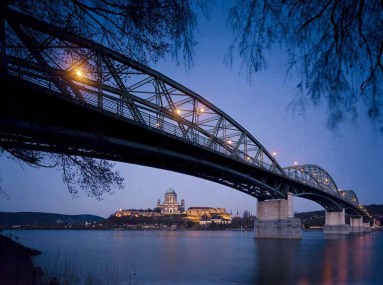
Professor Fokas noted, with a particular pride, that Baron Simon Sina, a Greek Hungarian, financed Budapest’s most iconic Danube bridge, Lanc Hid (Chain Bridge), as well as a large part of the Hungarian Academy of Sciences, another signature Budapest building. Honoring him, Greek Hungarians have been instrumental in establishing the “Sina Award,” bestowed upon a member of the Hungarian business community for outstanding support of the arts and sciences. Fostering awareness of Hungary’s Greek and Orthodox elements in its history has been a key contribution of this new diaspora, and in so doing, it has honored, and in some cases, literally resurrected, the first diaspora.

As always when I travel among diaspora Greeks, I felt a common bond with the Greek Hungarians in spite of our very different histories. There was that love of Greece, somehow less jaded, than that of Greeks in Greece. There is also a very clear consciousness among Greeks in Hungary that the history of Hellenism and Orthodoxy is a long one in their country, and that custody of this tradition is an important role, which they assume with pride. It is a pertinent lesson for our community in America.

Alexander Billinis is a Greek American writer living in Serbia. He previously worked in international banking in the US, Britain and Greece. His book, “The Eagle has Two Faces: Journeys through Byzantine Europe,” will be released later this year. 

Related articles:

On the Pontic shores where the snowflakes fall

The mystery of The Black Sea Cave

Ill Met by Moonlight film review

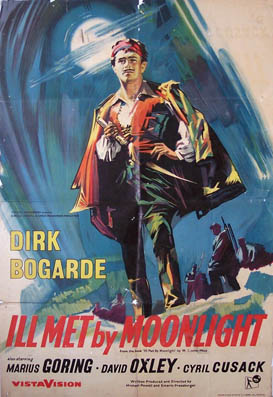
Ill Met by Moonlight movie poster

For a decade and a half, the partnership of Michael Powell and Emeric Pressburger illuminated the cinema with an array of extraordinary films. But the massive reputation the team garnered during and immediately after World War II – The Life and Death of Colonel Blimp, A Canterbury Tale, I Know Where I’m Going!, A Matter of Life and Death, Black Narcissus, and The Red Shoes in just five years! went into steep decline in the Fifties. There were no Archers films at all between The Tales of Hoffmann (’51) and Oh… Rosalinda!! (’55), and both of those were disastrous failures, critically and financially. Perhaps to cover themselves in the ultraconservative British film industry, Powell and Pressburger finished their partnership with two conventional war adventure movies – rattling good yarns that, alas, were widely perceived as rattling just a bit too much.

First published in Film Comment 13th March 1995 v 31:n2. p37(4)

The Battle of the River Plate (’56) was a box-office success and had a royal premiere, but it now looks like the corniest of the Archers movies. An account of Britain’s first major naval victory of WWII, it does have the great virtue of showing actual ships maneuvering about in an actual ocean instead of models in a tank – Powell’s main pleasure in directing the movie, one imagines. But this is exasperatingly offset by far too many shots of actors on studio bridgehead sets being doused with water as they strike poses in front of a cyclorama. The local color Powell provides is a bit sticky, too, given that Uruguay, where the German battleship Graf Spee was forced to seek shelter before being tricked into self-destructing, was and still is a nation notorious for its concealment of Nazis. Peter Finch, as the captain of the Graf Spee, manages an impressive performance, but none of the other actors in a lively cast Anthony Quayle, John Gregson, Patrick Macnee, Anthony Newley, Christopher Lee, John Schlesinger in a bit as a German sailor – has much chance to create a real person. The Germans are all decent fellows, really, whilst the characterization of the Brits is entirely on the level of good-show-chaps caricature.

Powell seemed rather attached to this movie in later years, but had no love at all for the very last Archers film, Ill Met By Moonlight (’57). “I felt imprisoned by the facts,” he was wont to complain; and there were problems with the script Pressburger provided. Ian Christie’s book about Powell, Arrows of Desire, goes so far as to refuse to list the film as a collaboration at all, his filmography (reproduced, incomplete and inaccurate as it is, in Powell’s memoirs) giving Powell’s name alone as writer, producer, and director. Dissension between Powell and Pressburger coincided with antagonism from the Rank Organisation, which refused them money for color. Once the film was finished, so were the Archers.

After Ill Met By Moonlight, then, the deluge. It would be foolish to suggest that the film – miserably renamed Night Ambush for U.S. release and cut by 11 minutes – is anywhere near the level of the team’s masterworks. Even so, it’s more interesting than legend suggests. The (true) story, set in occupied Crete in 1943, concerns the kidnapping of a German general (Marius Goring) by Cretan partisans led by a British officer, Patrick Leigh Fermor (Dirk Bogarde). Film buffs will recall that the real Leigh Fermor was one of the scriptwriters of John Huston’s The Roots of Heaven (also the author of some bestselling travel books). Then again, the film seems to ask, who exactly is the “real” Patrick Leigh Fermor – or the real anyone? Taking its title from a play concerned with dreams and disguises, magic and power, Ill Met By Moonlight is all about questions of identity.

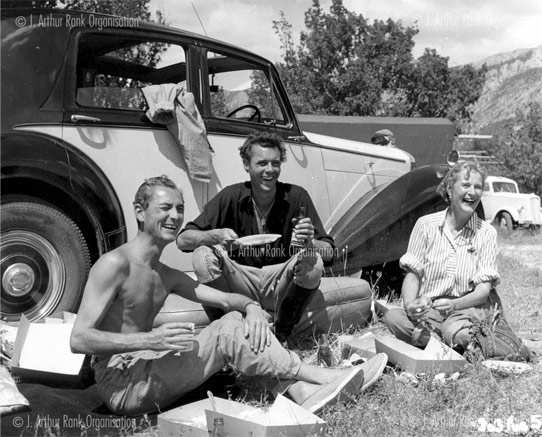
Xan and Daphne Fielding with Dirk Bogarde on the set of Ill Met by Moonlight

Under the credits, we see Dirk Bogarde in uniform; then, unexpectedly, we see him in the flamboyant outfit of a Cretan hill-bandit. A title informs us that Major Leigh Fermor was also known by the Greek code-name “Philidem.” In other words, there are two of him (at least), and on one level the adventure the film is about to unfold reflects a conflict in his personality. It’s a conflict shared, unknowingly, by his Nazi opposite number, the fierce, arrogant General Kreipe (an unlikely “proud Titania,” but it’s true that he “with a monster is in love” – the monster of Nazism). Kreipe’s human side is so rigorously repressed by the demands of war and “glory” that he is genuinely unaware of it; ironically, this humanness, which constitutes the true manhood of this Teuton warrior, is revealed by a boy (equivalent to Shakespeare’s Indian Prince?) – who, in turn, is the most grownup person in the movie.

Ill Met by Moonlight movie poster - Bogarde as Paddy the flamboyant Cretan

If “Philidem” appears under the credits, caped and open-shirted, a romantic dream-figure out of an operetta or a storybook, he is first seen in the film proper as a coarser, more down-to-earth version of the same thing – an ordinary Cretan peasant in a shabby suit, waiting for a bus. When he makes contact with the Resistance, his personality fragments further. To some, he is the mystical Philidem, Pimpernel of the Hellenes and righter of wrongs. To others he is “Major Paddy,” the happy-go-lucky Englishman of popular movie myth conducting war as if it were a branch of amateur theatricals, a gentleman adventurer relying on breeding to get him through and making fun of the whole business. To Bill Moss (David Oxley), the newly arrived junior officer sent to assist him, he is the cool, fast-thinking professional soldier. And to himself? In his quietly passionate defense of Cretan life and culture, he seems someone else again: a scholar and aesthete outraged by the barbarism and folly of war, and by the moronic arrogance shown by his captive toward the Cretan people.

Whatever his persona, Leigh Fermor is a chameleon who never seems to change very radically in himself. Perhaps because he has this quality of seeming all things to all men – and being those things – he remains unfazed by the monolithic might of the German military machine. Fluent in Greek, he can also speak German like a German and is easily able to assume another disguise, that of a faceless Nazi officer. Although he and Moss make fun of themselves – “If only I had a monocle!” muses Moss when Leigh Fermor tells him he “looks like an Englishman dressed like a German, leaning against the Ritz bar” – they are able to effect the kidnapping with an ease that seems appropriately Puckish. General Kreipe is ignominiously thrust onto the floor of his own limousine, gagged, and sat upon by a couple of the peasants he so despises. Kreipe’s rage is compounded by his firm conviction that he has been snatched by “amateurs” – a belief Leigh Fermor and Moss slyly make no objection to, knowing how it will gnaw at his already shaky Master Race self-confidence.

Soon, partisans and captive are up in the hills, where they stay for most of the movie (though the biggest of the film’s mountaineering set-pieces, a nocturnal descent through fog, was filmed on elaborately stylized studio sets). Once there, Kreipe determines to leave a trail for following German troops to pick up on – his cap, buttons from his uniform, even a couple of medals from his impressive display of such baubles never realizing that each emblem of his authority is no sooner dropped than it is retrieved by the vigilant Moss.

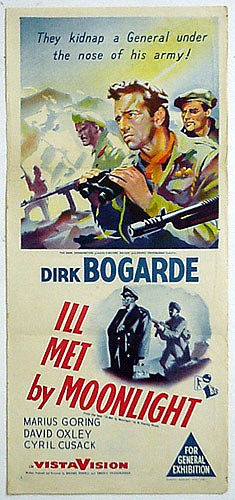
Rare Ill Met by Moonlight movie poster

Among Major Paddy’s partisans is a young war orphan, Nico, who has, while shinning up and down the mountains, much occasion to complain of his need of a pair of boots. Nico knows that the cost of a new pair will always be far beyond him; Kreipe, who has been friendly enough toward him in a rather patronizing way, seizes on this need by showing the boy his own impressive footwear and offering a gold coin with which to buy an identical pair. A German gold coin, he stresses, not one of the sovereigns Leigh Fermor keeps a supply of; it is, in fact, a coin the General is known to keep as a good-luck charm. Nico is impressed by the General’s largesse. But, of course, the Nazi requires a quid pro quo. All Nico has to do, when he goes down the mountain, is tell the searching German patrols where the General is, using the coin as a bona fides. But Kreipe has misjudged the boy (indeed, he can be said to have misjudged the whole of the human race): it never occurs to him that the boy will not do what he says. What Nico actually does is simply point the patrols in the wrong direction, leading them into an ambush; the magic gold coin is lucky for the Greeks, not the Germans. This makes the escape from Crete of the Britishers and their ill-met prisoner the easiest part of their long journey.

Once aboard a British ship, and naked of the symbols of military power, the General seems a new person – not such a bright man, not such a strong man, but also not such a bad man, either. He is visibly moved by the return of his possessions, especially the gold coin: despite his genuine pleasure in Nico’s company, Kreipe had assumed that the boy, like every non-German, is someone who can be bought and sold, and that “friendship” had been merely his gift, and not a privilege from which he might derive spiritual benefit rather than tactical advantage. The very simplicity of Nico’s ruse in deflecting rescue was the, final humiliation, the last stage in General Kreipe’s lengthy symbolic disrobing – which is precisely why his possessions can now be given back to him. If he started this modern midsummer night’s dream as imperious as Oberon, he ends it as foolish as the donkey-headed Nick Bottom. But then, Bottom the simple weaver is always better-liked by everyone than the unearthly and tyrannical monarch of Shakespeare’s enchanted forest.

And from his elaborate humiliation, the stiff-necked German learns a good deal about himself and about humanity. His curt acknowledgment at film’s end that he has been kidnapped not by amateurs but by professionals is also his acknowledgment of his own fallibility and that of the creed he has so proudly espoused. And so he regains a measure of dignity, along with those tokens of an identity he no longer needs. Nico himself get his new pair of boots after all (they belong to Leigh Fermor, who is barefoot in his final exchange with his prisoner), but, by a sad irony, is about to change identity as well: he will wait out the rest of the war far away from Crete in the distant England of which he has heard much but knows nothing. But at least he has a friend – a real friend, now – in General Kreipe, who has learned that the respect of an uneducated boy is worth more than a medal from the Fuhrer. “Gentles, do not reprehend / If you pardon, we shall mend.”

And Patrick Leigh Fermor, aka Major Paddy, aka Philidem – and, if you stretch your imagination just a smidge, aka Robin Goodfellow? – what of him? In the film’s closing moments, he is far from being self-assured intellectual or dashing amateur adventurer or legendary outlaw of the hills. He’s just a tired man who wants to go home and rest up. “How do you feel?” asks Moss. “Flat” is the reply. “You look flat!” says Moss. “I know how I’d like to look …” murmurs Leigh-Fermor wistfully. Moss knows what he’s going to say, and joins in the litany: “Like an Englishman dressed like an Englishman – and leaning against the Ritz bar!” It’s easy to imagine them ordering drinks at that renowned watering-hole with all the suavity required by this little fantasy. Still, the film’s last images of Crete receding in the distance, until all we can see is the sea, suggests that maybe Major Paddy’s heart is really back in those hills in the “fair and fertile” land that has become as much a Powellian landscape of the mind for us as the studio-built Himalayan convent of Black Narcissus or the monochrome Heaven of A Matter of Life and Death. And, as we depart both Crete and this film, we may reflect that being “dressed like an Englishman and leaning against the Ritz bar” would, for Patrick Leigh Fermor constitute yet another disguise. After all, he was Irish.

… now watch the movie trailer.

Ill Met by Moonlight

Related articles:

Patrick Leigh Fermor recounts the kidnap of General Kreipe on video

General’s long trip home

George Katsimbalis documentary Part 2 – Paddy sings about Greek debt!

The second clip of Paddy in a Greek TV documentary about his friend George Katsimbalis. Towards the end of this excerpt Paddy is chanting a 1935 Greek song about the 1932 Greek debt crisis; how appropriate.

My thanks again to Nicolas Paissios for sending me this and the two previous clips.

Click the image to play.

Gone for a walk in Greece

“YOU had better look out if you are going up to Anavriti.” The familiar words sound wonderful when spoken aloud in this cavernous, haunted and as yet sunless gorge. I repeat them, savouring their powerful energy.

Suddenly, I picture the streets of “roasting Sparta” and the Greek barber who, encouraged by his colourful customers, issued the warning as he clipped the dusty hair of a man now regarded as one of the world’s finest travel writers.

The barber’s words subsequently provided the opening salvo of what many believe is the best book in English about Greece.

by Ian Robert Smith

First published in The Australian 30 July 2011

Published in 1958, Patrick Leigh Fermor’s Mani: Travels in the Southern Peloponnese is a dense, erudite and hugely entertaining account of the author’s peregrinations in a region that, at the time, was remote, untamed and singularly archaic. Mani is also, more broadly, an affectionate portrait of a rural Greece where centuries-old customs were fast disappearing — “hammered to powder . . . between the butt of a Coca-Cola bottle and the Iron Curtain” — and for which today’s traveller hunts in vain.

I, too, am going up to Anavriti. And like Leigh Fermor when he came this way with his partner (later wife) Joan in the mid-1950s, I intend to use the village, perched on a spur of the Taygetos range, as a stepping stone into the Mani.

A battered copy of Leigh Fermor’s book resides in the top flap of my rucksack, both talisman and inspiration. Handily within reach in the side pocket is the Anavasi map of the region. Its bundled contours, crossed by the black-dotted lines of footpaths, reflect the momentous regions that await overhead.

Rich in myth and history, the Taygetos dominates the Spartan plain over which it looms like an impenetrable barrier. The northern foothills rise in the wilds of Arcadia. They shoot upwards into a vast, serrated ridge that culminates in the peak of Mt Profitis Ilias — at 2407m, the highest point in the Peloponnese — before dropping away through the Mani Peninsula.

Foothills clad in oak, hornbeam and black pine and daubed with villages buttress the eastern slopes. But the west is wild. Ancient gorges provide means of egress into this planetary world.

Some say this gorge is where the ancient Spartans left unwanted children to die. The rumble of plunging water resounds along its length.

In a large cave, a frescoed chapel, painted ox-blood red, crouches among icons and vases of the white Madonna lilies that grow wild on the slopes. Climbing further, past a sudden and terrifying drop, a curious sound wafts towards me; incoherent initially, it develops into an ethereal chanting that, echoing off the cliffs, sounds strange and beautiful in this wilderness. Bewilderment turns to rapt appreciation as I recognise the monks at Faneromeni Monastery, high above, conducting a Sunday morning service.

Beyond the monastery and a couple of antique threshing floors, Anavriti appears. Dwarfed by the glittering and snow-streaked Taygetos, several belfries and a cluster of stone houses adorn a hillside plumed with walnut, plane and cherry trees.

Not so long ago Anavriti had a thriving tanning and leather-goods industry and a population of several thousand. Nowadays, like most mountain villages in Greece, it is barely inhabited.

I amble along the main street, seeking wide balconies reached “by boxed-in staircases on wooden stilts”. In one such edifice, Leigh Fermor and Joan spent the night. Something similar faces a solitary taverna. Light-headed at finding myself in Anavriti at last, I lunch on spaghetti with rooster and abundant rose wine and, as a jovial crowd materialises, observe clouds thickening around the mountaintops. The taverna owner shrugs when I inquire what they portend, then asks, unhelpfully, whether I have a raincoat, before advising: “Go towards the good.”

This I attempt, only to become drenched, then unpleasantly steamed when the sun reappears, conjuring wondrous aromas from the glistening earth. The experience is chastening and, toiling upwards through fir forest, I conclude that following in the footsteps of literary legends can be tricky. Writing in Mani, Leigh Fermor gives fair warning.

“Feet became cannonballs,” he recounts, “loads turned to lead, hearts pounded, hands slipped on the handles of sticks and rivers of sweat streamed over burning faces and trickled into our mouths like brine.” I arrive, similarly challenged, at the author’s “unattractively alpine wall of mineral”.

It is the flank of Spanakaki Peak and also a crossroads. Intent on the Mani, Leigh Fermor bypassed Profitis Ilias and headed off to the right. Determined to tackle the summit, I veer left, up over a spur with a derelict sheepfold and across a meadow that, as thunder rumbles and rain buckets down, tilts vertically to the watershed. I reach this, hand-over-foot, but discover the view of the Messenian Gulf beyond obscured by thick mist breaking over the ridge.

Visibility shrinks to nothing as I’m engulfed, precipitating a tedious descent, followed by a forced march to the EOS refuge, where I meet a group from Athens who provide food, wine and spirited conversation. Occasionally the talk turns to Greece’s economic troubles and, predictably, as these are young people from the capital, nearly everyone has a sobering tale. They are related simply, without rancour and often with humour; but beneath the levity, disappointment and uncertainty are palpable.

The evening proves unexpectedly affecting and our farewells the next day, when I renew my assault on the summit, are heartfelt. I ascend through meadows thick with ferns, thyme and wildflowers, which give way to barren, stratified limestone, before an opening leads over the watershed. It might well be a door into another world.

Jagged pinnacles roll away to the north. Westward, rumpled slopes sundered by ravines plunge to the shores of the Messenian gulf. Silence reigns. Nothing moves except the clouds rolling across the peaks. I climb through them, tentatively over scree, on to a desolate platform scattered with stone huts and a roofless chapel dedicated to the prophet Elijah and crammed with icons, melted candles and votive offerings left by midsummer devotees.

The moment evokes a heady elation, tempered by disbelief that I am here, alone, atop the Peloponnese. Finally the sight of Kardamyli, fathoms below, reminds me it is time to catch up with Leigh Fermor. A headlong descent begins. Nightfall finds me in the Viros gorge. It is the ancient route to the coast: a massive, 14km-long canyon enclosed by fir-tufted cliffs and paved with boulders worn smooth by winter torrents, and not particularly restful.

Escaping next morning to Exochori, I locate a small chapel with a battered turret astride cicada-haunted olive terraces looking out to sea. In this lovely place, appropriate for a man who wrote so beautifully, the ashes of author Bruce Chatwin are scattered. I pause to pay my respects.

Kardamyli appears, its blond towers jutting above the sea. A cobbled path curls below the ancient acropolis. Nearby, adjacent to the reputed tombs of Castor and Pollux, I fall into conversation with a friendly English couple. Inevitably the name of Leigh Fermor comes up. We are speaking of the blood feuds in Mani when the woman says abruptly: “We’ve heard the funeral is on Thursday.”

Seeing my uncomprehending look, she adds, “You didn’t know? Paddy died last week.”

It was the day before I set out, ostensibly in his footsteps. The news fills me with sadness coupled with bewilderment at the workings of providence. I enter Kardamyli in a valedictory mood, passing through an arched gateway into a dusty square flanked by byzantine towers and a church.

In Mani, Leigh Fermor writes that Kardamyli was “unlike any village I had seen in Greece”. He and Joan loved it so much that they returned several years later and built a house in an olive grove.

Kardamyli remains laid-back and relatively unspoilt, with a long pebble beach, pretty stone houses, a small fishing harbour and friendly people. It is popular with trekkers who tackle the hinterland trails. But my walking days are over for now and my stay is marked by restlessness and an odd nostalgia. Each morning I swim to the wooded islet with the fortified wall and ruined chapel, a few hundred metres offshore. I scribble in cafes, drink with other travellers and dine out every night, once at Lelas, the waterfront taverna owned by the woman who was Leigh Fermor’s original housekeeper. Everyone, it seems, has a Paddy story to tell.

One morning, a strange impulse takes me. Just outside town, a path leaves the road and winds downhill through olive groves throbbing with cicadas. It continues, away from recent development higher up the slope, into a wilderness of trees and yellow grain fields where I pass a whitewashed chapel and, just beyond, a long stone wall, above which a mottled tile roof protrudes. Finally I come to a beach.

It lies just over the rocks, a hermetic cove enfolded by cliffs. A shiver sweeps through me when I realise: this is the place. Pushing through a wooden gate marked Private, I climb a stone staircase that zigzags up to a sprawling garden. Olive trees bestride ancient terraces.

The aromas of rosemary and cypress mingle in the hot, pulsating air. Paths of pebble mosaic thread between judiciously placed tables and benches of slate and a rambling house, built of golden stone, empty now, yet with the accumulations of a long and abundant life in place. An air of recent abandonment prevails. Leigh Fermor died in England.

Standing on the clifftop, beside one of those tables where so many delightful moments must have unfolded, I gaze out past the island to the distant peninsula, a smudge on the horizon. An age passes before I tear myself away.

Patrick Leigh Fermor’s Mani: Travels in the Southern Peloponnese was first published in 1958. The acclaimed war hero and travel writer died on June 10, aged 96.

An excerpt from A Time To Keep Silence by Patrick Leigh Fermor

With curiosity and misgiving I walked up hill from the Rouen-Yvetot road towards the Abbey of St. Wandrille. I had spent an abominable night in Rouen in a small hotel near the station where a procession of nightmares had been punctuated by the noise of trains arriving and leaving with a crashing and whistling and an escape of steam and smoke which, after a week’s noctambulism in Paris, turned my night into a period of acute and apparently interminable agony. Even the misty windings of the lower Seine, the fat green fields and Indian files of poplars, among which the bus had travelled next morning, could not dispel my mood of sluggishness and depression; and now, climbing the hot road through the late summer woods, I wondered if my project had not better be abandoned.

By Patrick Leigh Fermor

Use the Print Friendly facility. Print Friendly and PDF

… What I dreaded almost more than success was an immediate failure. If there was no room at the Abbey, or if for some other reason the monks could not receive me, I should have to return to Paris and readjust my plans for the next few weeks. I was arriving unknown and unannounced, a citizen of the heretic island across the Channel, without even the excuse that I wished to go into retreat; I was, in fact, in search of somewhere quiet and cheap to stay while I continued to work on a book that I was writing. A friend in Paris had told me that St. Wandrille was one of the oldest and most beautiful Benedictine Abbeys in France; and I had made my plans and set out . . .

It was Sunday, and the gatehouse was full of visitors who, just emerged from Mass, were buying pictures, medals, rosaries and assorted bondieuserie. A harassed monk in horn-rimmed glasses was answering innumerable questions; and a quarter of an hour had gone by before I managed, with considerable trepidation, to explain my proposal. He listened sympathetically, and asked me to return after he had spoken to the Abbot. When at last his black-robed figure reappeared across the garden, I saw that he was smiling. Seizing my heavy bag, “The most reverend Father Abbot can receive you,” he announced, “and wishes you welcome.”

A few moments later a door had shut out the noise of the Sunday visitors and a silent maze of white staircases and passages swallowed us up. The monk opened a door and said, “Here is your cell.” It was a high seventeenth-century room with a comfortable bed, a prie-dieu, a writing-table, a tapestry chair, a green adjustable reading-lamp, and a rather disturbing crucifix on the whitewashed stone walls. The window looked out over a grassy courtyard, in which a small fountain played, over the grey flank of the monastery buildings and the wall that screened the Abbey from the half-timbered houses of the village. A vista of forest flowed away beyond. In the middle of the writing table stood a large inkwell, a tray full of pens and a pad into which new blotting paper had just been fitted. I had only time to unpack my clothes and papers and books before a great bell began ringing and the monk, who was the guest-master, returned to lead me to the refectory for the midday meal. As we walked, the buildings changed in period from the architecture of the eighteenth and seventeenth centuries to Gothic; and we halted at length by the piscina in an ogival cloister of the utmost beauty, outside a great carved door where several other visitors had also been assembled. The guest-master shepherded us into the refectory in which the Abbot, a tall, white-haired, patrician figure with a black skull-cap and a gold pectoral cross on a green cord, was waiting to receive us. To each of the guests he spoke a few words; and some, sinking upon one knee, kissed the great emerald on his right hand. To me he addressed a polite formula in English that had obviously been acquired at some remote period from a governess. A novice advanced with a silver ewer and a basin; the Abbot poured a little water over our hands, a towel was offered, and our welcome, according to Benedictine custom, was complete.

The singing of grace continued for several minutes; and, when we sat down, I found myself between two visiting priests, their birettas folded flat beside their plates on the long guest-table in the middle of the refectory, just below the Abbot’s dais. Down the walls of this immense hall the tables of the monks were ranged in two unbroken lines, and behind them a row of Romanesque pilasters with interlocking Norman arches formed a shallow arcade. The place had an aura of immense antiquity. Grey stone walls soared to a Gothic timber roof, and, above the Abbot’s table, a giant crucifix was suspended. As the monks tucked their napkins into their collars with a simultaneous and uniform gesture, an unearthly voice began to speak in Latin from the shadows overhead and, peering towards it, I caught sight, at the far end of the refectory, of a pillared bay twenty feet up which projected like a martin’s nest, accessible only by some hidden stairway. This hanging pulpit framed the head and shoulders of a monk, reading from a desk by the light of a lamp which hollowed a glowing alcove out of the penumbra. Loudspeakers relayed his sing-song voice. Meanwhile, the guest-master and a host of aproned monks waited at the tables, putting tureens of vegetable soup before us and dropping into our plates two boiled eggs, which were followed by a dish of potatoes and lentils, then by an endive salad, and finally by discs of camembert, to be eaten with excellent bread from the Abbey bakery. Every now and then a monk left his place, and knelt for a few minutes before the Abbot’s table. At a sign from the Abbot, he would rise, make a deep bow, and withdraw. . . . Inspired probably by Victorian oleographs of monastic life, I had expected a prodigious flow of red wine. The metal jugs on our tables contained, alas, only water.

The recitation had now changed from Latin to French, delivered in the same sepulchral, and, to me, largely unintelligible, monotone. A few proper names emerged — Louis Phillipe, Dupanloup, Lacordaire, Guizot, Thiers, Gambetta, Montalembert — and it was clear that we were listening to a chapter of French nineteenth-century history. This stilted manner of treating a lay text sounded absurd at first and oddly sanctimonious; its original object, I discovered, had been both to act as a curb on histrionic vanity and to minimise the difficulties of the unlearned reader in the days of St. Benedict. Throughout the entire meal no other word was spoken. The tables were cleared, and the monks, their eyes downcast, sat with their hands crossed beneath their scapulars. The Abbot thereupon gave a sharp tap with a little mallet; the reader, abandoning his text, bowed so low over the balustrade that it seemed that he would fall out and then intoned the words Tu autem Domine misercre nobis ; all rose, and bowing to a rectangular position with their hands crossed on their knees, chanted a long thanksgiving. Straightening, they turned and bowed to the Abbot and, still chanting, moved slowly out of the refectory in double file around two sides of the cloisters, into the church and up the central aisle. Here each pair of monks genuflected, inclined their heads one to another, and made their way to opposite stalls. The chanting continued for about eight minutes, then the entry was gravely reversed. As they reached the cloisters, the files of black figures broke up and dispersed throughout the Abbey.

Back in my cell, I sat down before the new blotter and pens and sheets of clean foolscap. I had asked for quiet and solitude and peace, and here it was; all I had to do now was to write. But an hour passed, and nothing happened. It began to rain over the woods outside, and a mood of depression and of unspeakable loneliness suddenly felled me like a hammer-stroke. On the inner side of my door, the printed “Rules for the Guests’ Wing” contained a mass of cheerless information. The monks’ day, I learned, began at 4 a.m., with the offices of Matins and Lauds, followed by periods for private masses and reading and meditation. A guest’s day began at 8:15 with the office of Prime and breakfast in silence. At 10 the Conventual High Mass was sandwiched between Tierce and Sext. Luncheon at 1. Nones and Vespers at 5 p.m. Supper at 7:30, then, at 8:30, Compline and to bed in silence at 9. All meals, the rules pointed out, were eaten in silence: one was enjoined to take one’s “recreation” apart, and only to speak to the monks with the Abbot’s permission; not to make a noise walking about the Abbey; not to smoke in the cloisters; to talk in a low voice, and rigorously to observe the periods of silence. They struck me as impossibly forbidding. So much silence and sobriety! The place assumed the character of an enormous tomb, a necropolis of which I was the only living inhabitant.

The first bell was already ringing for Vespers, and I went down to the cloisters and watched the monks assemble in silence for their processional entrance. They had put on, over their habits and scapulars, black cowls: flowing gowns with hoods into which those of their ordinary habits fitted, and so voluminous that the wearers appeared to glide rather than walk. Their hands were invisibly joined, like those of mandarins, in the folds of their sleeves, and the stooped faces, deep in the tunnel of their pointed hoods, were almost completely hidden. A wonderful garb for anonymity! They were exact echoes of Mrs. Radcliffe’s villainous monastics and of the miscreants of Protestant anti-popish literature. Yet they looked not so much sinister as desperately sad. Only in the refectory and the church was I able to see their faces; and, as I sat at Vespers watching them, now cowled, now uncovered, according to the progress of the liturgy, they appeared preternaturally pale, some of them nearly green. The bone-structure of their faces lay nearly always close beneath the surface. But, though a deep hollow often accentuated the shadow under the cheekbone, their faces were virtually without a wrinkle, and it was this creaseless haggardness that made their faces so distinct from any others. How different, I thought, from the fierce, whiskered, brigand-faces of the Greek monks of Athos or the Meteora, whose eyes smoulder and flash and twinkle under brows that are always tied up in knots of rage or laughter or concentration or suddenly relaxed into bland, Olympian benevolence. The gulf between the cenobites of Rome and those of Byzantium was often in my mind. A cowled figure would flit past in silence, and all at once, with a smile, I would remember Fathers Dionysios and Gabriel, Brothers Theophylaktos, Christ and Polycarp, my bearded, long-haired, cylinder-hatted, war-time hosts and protectors in Crete, pouring out raki, cracking walnuts, singing mountain songs, stripping and assembling pistols, cross-questioning me interminably about Churchill, and snoring under olive trees while the sun’s beams fell perpendicularly on the Libyan Sea. . . . But here, in the Abbey’s boreal shadows, there was never a smile or a frown. No seismic shock of hilarity or anger or fear could ever, I felt, have disturbed the tranquil geography of those monastic features. Their eyelids were always downcast; and, if now and then they were raised, no treacherous glint appeared, nothing but a sedulously cultivated calmness, withdrawal and mansuetude and occasionally an expression of remote and burnt-out melancholy. The muted light in the church suspended a filament between us, reproducing the exact atmosphere of an early seventeenth-century Spanish studio in which — tonsured, waxen, austere and exsanguinous — were bowed in prayer the models of Zurbarán and El Greco. Not for nothing had these painters followed so closely after St. Theresa and St. John of the Cross, and so faithfully portrayed the external stigmata of monastic obedience, prayer, meditation, mortification and mystical experiment — the traces left by the soul’s dark night, by the scaling of heavenly mountains and the exploration of interior mansions. As the monks dispersed after Vespers and, a few hours later, after Compline, I had a sensation of the temperature of life falling to zero, the blood running every second thinner and slower as if the heart might in the end imperceptibly stop beating. These men really lived as if each day were their last, at peace with the world, shriven, fortified by the sacraments, ready at any moment to cease upon the midnight with no pain. Death, when it came, would be the easiest of change-overs. The silence, the appearance, the complexion and the gait of ghosts they had already; the final step would be only a matter of detail. “And then,” I continued to myself, “when the golden gates swing open with an angelic fanfare, what happens then? Won’t these quiet people feel lost among streets paved with beryl and sardonyx and jacinth? After so many years of retirement, they would surely prefer eternal twilight and a cypress or two. . . .” The Abbey was now fast asleep but it seemed ridiculously early — about the moment when friends in Paris (whom I suddenly and acutely missed) were still uncertain where to dine. Having finished a flask of Calvados, which I had bought in Rouen, I sat at my desk in a condition of overwhelming gloom and accidie. As I looked round the white box of my cell, I suffered what Pascal declared to be the cause of all human evils.

Excerpted from A Time To Keep Silence by Patrick Leigh Fermor Copyright 1957, 1982 by Patrick Leigh Fermor. Originally posted on National Public Radio and excerpted by permission of the New York Review of Books.

Use the Print Friendly facility. Print Friendly and PDF

Paddy’s mugshots from his SOE file

Soon I hope to be able to bring you more information from Paddy’s SOE file which is at the National Archive in Kew, courtesy of Steven Kippax who is an SOE historian and researcher .

Here is a taster. The man himself looking pretty dashing but uncompromising for his official SOE mugshot!

A Prince of the Road by Colin Thubron

This is a major essay about Paddy by his good friend Colin Thubron. Perhaps worth printing and reading at your leisure.

Use the Print Friendly facility. Print Friendly and PDF

by Colin Thubron

First published in the New York Review of Books, January 17 2008.

To suggest that Patrick Leigh Fermor is the greatest travel writer alive is to omit a great deal. In Britain and Greece he is a near legend, celebrated not only for his books but for his wartime exploits as a guerrilla leader in occupied Crete, where his abduction of a German general has passed into folklore. He is, perhaps, the last of a breed of writer-travelers whose reputation has an aura of genuine action and courage.

The qualities suited to the travel writer’s trade have always been contradictory. The mental (and physical) robustness necessary for ambitious travel often excludes the sensitivity to record it, and vice versa. So there are travelers who write, and writers who travel—and they rarely converge in the same person.

In Leigh Fermor, they do. The richness of his prose, his polymathic exuberance, and his cultural allusiveness render him less immediately accessible than some of his contemporaries, such as Peter Fleming or Norman Lewis. But his six travel books—one for each decade of his adult life—have secured him a readership drawn to a voice that is omnivorous in its tastes and curiosity, learned without condescension, cultivated but never effete, curiously innocent, occasionally swanky, infectiously joyous. If he is less known in the United States than he is in Britain, it is because Leigh Fermor is deeply European.

His reputation rests, above all, on two pairs of books—about his youthful walk across pre-war Europe, published in 1977 and 1986—and about Greece, published in 1958 and 1966. But then there is A Time to Keep Silence. In the oeuvre of a traveler whose books are full of worldly curiosity, this short reflection on the monastic life sits like a troubled question mark. First published in Britain in 1953, it now appears in the US for the first time. In less than a hundred pages it records the author’s stay in the ancient French monasteries of St. Wandrille, Solesmes, and La Grande Trappe, with a brief excursion to the deserted Byzantine chapels of Cappadocian Turkey.

Yet there are readers for whom A Time to Keep Silence is Leigh Fermor’s finest—if most uncharacteristically elusive—book. In her introduction, the religious historian (and ex-nun) Karen Armstrong writes:

The monks’ monotonous way of life has been deliberately designed to protect them from the distractions of, and the lust for, novelty: they do the same things day after day; they dress alike and shun individuality and personal style. They keep almost perpetual silence….

Nothing could be more antipathetic to everything that Leigh Fermor’s books project and embrace. His persona as a writer brims with “individuality and personal style.” So, of course, does his prose. He is famously gregarious, and a dazzling raconteur. For a traveler so tough, his books are rich in pleasures: in leisure, in wine, in company. History and landscape bring a visceral exhilaration.

In 1952, aged thirty-seven, Leigh Fermor arrived at the Benedictine abbey of St. Wandrille de Fontenelle, near Rouen, in quest not of religious retreat but of somewhere cheap and quiet in which to write his first book, on the Caribbean. The regimen of the monastery—the bloodless gloom of Vespers, the sepulchral mealtime recitations while the monks ate in silence—filled him at first with revulsion:

As I sat at Vespers watching them, now cowled, now uncovered, according to the progress of the liturgy, they appeared preternaturally pale, some of them nearly green. The bone-structure of their faces lay nearly always close beneath the surface. But, though a deep hollow often accentuated the shadow under the cheekbone, their faces were virtually without a wrinkle, and it was this creaseless haggardness that made their faces so distinct from any others. How different, I thought, from the fierce, whiskered, brigand-faces of the Greek monks of Athos or the Meteora, whose eyes smoulder and flash and twinkle under brows that are always tied up in knots of rage or laughter or concentration or suddenly relaxed into bland, Olympian benevolence.

There is no doubt about where Leigh Fermor’s sympathies lay. As for writing, he retired to his cell on the first day in the quiet, and picked up his pen:

But an hour passed, and nothing happened. It began to rain over the woods outside, and a mood of depression and of unspeakable loneliness suddenly felled me like a hammer-stroke.

For three or four days, little changed. He was prey to insomnia and a flat depression. Then he started to sleep. He slept until a few meals and church services a day were his only lucid moments. Then the pattern changed again. His lassitude dwindled away and was succeeded by a “limpid freshness.” He now slept only five hours in twenty-four. It was as if a profound tiredness, rooted in the outside world with its demands on nervous libido and instant response, had overswept him, then receded in this quietude to release a flood of unimpeded energy. “Even the major causes of guilt and anxiety had slid away.”

From the monastery’s library—a magnificent repository of the sacred and secular—he was able to borrow even those heretical books placed on the index or locked in the depository (named the Enfer) as destructive of monastic calm. And as he grew to know them, the monks became, to his charitable and indulgent mind, almost uniformly attractive.

Moving on, he was delayed only two weeks by the abbey of Solesmes, guardian of early Church music, before he reached the great Cistercian monastery of La Grande Trappe in southern Normandy. Among this grimly disciplined and silent order, the cycle that Leigh Fermor had experienced in St. Wandrille—the same tension between tenderness and revulsion—repeated itself more gently. Here the Benedictine dedication to the efficacy of prayer was reinforced by a notion of ferocious penance:

A Trappist monk rises at one or two in the morning according to the season. Seven hours of his day are spent in church, singing the offices, kneeling or standing in silent meditation, often in the dark…. There are no cells. All, from the Abbot downwards, sleep in cubicles in a dormitory on palliasses of straw stretched out on bare planks. Heating does not exist…. A special deaf and dumb language for cases of necessity has been evolved and codified, and the entire lifetime of a lay-brother, who does not participate in the singing of the offices, may pass without the uttering of a word beyond the confessional or his spiritual consultations with the Abbot. A monk on the point of death is removed from his infirmary bed and laid across a bed of straw which is scattered over a cross of ashes. There, after the last ghostly comforts in the presence of the assembled monks, he expires. His body is exposed for a while in the church. No coffin is used at his burial; his face is covered by his hood, and he is lowered into his grave with his habit folded about him.

A Time to Keep Silence evolved, sometimes word for word, from the letters written to Leigh Fermor’s future wife from these brief sojourns in monastic cells. They are touched by the unease of the doubter or atheist (he is never specific) who has intruded into the midst of pious conviction, and by his subsequent gratitude for the monks’ discretion which allowed him to escape any awkward challenge.

But for all the revolution in his feelings—and his brief excursions into the nature of prayer or temptation—it is less the inner journey than Leigh Fermor’s descriptions of monastic life that linger in the memory. He is a master of externals. The somber glamour of ritual and the drama of architecture rise naturally to his pen. In Roumeli, his book on northern Greece, he celebrates the pinnacle monasteries of Meteora with a gusto more immediate to him than the arcane inner lives of the sober monks of Normandy. His brief chapter on the rock chapels of Cappadocia, with which A Time to Keep Silence ends, relaxes into descriptive ease as it portrays a hermit city redolent of the dawn of monastic Christendom, whose human inhabitants have long gone.

Leigh Fermor’s sumptuous and sometimes complicated style has won him many admirers, barely one successful imitator, and a handful of disgruntled critics. When he writes that the quietude of St. Wandrille and his limited contact with the monks “compelled me again and again to seek my parallels in painting,” it sounds less like a limitation than a joyful release. The memory of Old Masters is never far away. In the muted light by which they worship, the monks evoke the canvases of Zurbarán and El Greco. The towering pinnacles of Solesmes remind him of the Rhenish castles of Gustave Doré and Victor Hugo. The wintry landscapes around La Trappe blend with those of Breughel and Bosch.

Sound itself turns visual. Leigh Fermor, in an act of nostalgic remembrance, conjures the ruined English abbeys lifting up their broken arches and emptied rose-windows “as though some tremendous Gregorian chant had been interrupted hundreds of years ago to hang there petrified at its climax ever since”; and the complex chanting of the conventual High Mass elicits an image of the Gregorian notation—with its comet tails and arabesques—printed in the monks’ missals.

These stylistic flourishes would be woeful in lesser hands. But with Leigh Fermor they rarely fail. His early models include Alexander William Kinglake and Norman Douglas, but most potent perhaps was the influence of his precocious near-contemporary, Robert Byron, who died at sea in 1941, and who in The Road to Oxiana, an account of travel in Persia and Afghanistan, interleaved humorous vignettes with some of the most precise and beautiful architectural descriptions in the language. Continue reading

Paddy’s interview on “Private Passions” on BBC iPlayer until midday 7 August

You can listen to the programme for the next seven days ie until midday Sunday 7 August via BBC iPlayer (assuming you can receive where you are).


To listen click here.


Related article:

Paddy interviewed on “Private Passions” for his 90th birthday in 2005

The Violins of Saint-Jacques – Malcolm Williamson opera review

Malcolm Williamson turned Paddy’s 1953 novella, The Violins of Saint-Jacques, into an opera. Here is a snippet from The Musical Times review  Vol. 108, No. 1487, Jan., 1967.

Related article:

Los violines de Patrick Leigh Fermor

George Katsimbalis documentary Part 1 – by the Acropolis and at the bar

Paddy in a Greek TV documentary about his friend George Katsimbalis. Paddy visits a bar and sings a French song.

My thanks again to Nicolas Paissios for sending me this – and there is one more to come 🙂

Click the image to play.

Remembering Patrick Leigh Fermor, travel inspiration

This article is from the Lonely Planet site. It is pretty standard fare, but stands out for its last line …. “The excellent https://patrickleighfermor.wordpress.com is highly recommended.” How could I possibly disagree?!!

by Tom Hall, Lonely Planet author

‘My spirits, already high, steadily rose as I walked. I could scarcely believe I was really there; alone, that is, on the move, advancing into Europe, surrounded by all this emptiness and change, with a thousand wonders waiting.’
From A Time of Gifts

It remains one of the finest adventures: Patrick Leigh Fermor, eighteen, restless and craving adventure, hops on a steamer in the shadow of Tower Bridge and, upon arrival at Hook of Holland, sets out for Constantinople on foot. It is 1933. His journey takes him through old Europe, a continent fast falling into war and never to be the same again.

Leigh Fermor’s account of what he called ‘Shanks’ Europe’ is told – though not in full – in the books he is best remembered for, A Time of Gifts (1977) and Between The Woods And The Water (1985). Remarkably, the author wrote them decades after the events described, years which honed his prose but retained the sense of wonder at discovering new lands, languages and cultures, soon to be altered forever.

Read more ….

Repeat of Paddy’s interview on “Private Passions” Sunday 31 July

The quality of our own link to BBC Radio Three’s Private Passions with Paddy is not the best, but still quite acceptable. However, there is now a chance to hear a repeat of the programme this coming Sunday 31 July at midday BST on BBC Radio 3.

You can find details of the programme here. You should be able to hear on FM and digital radio; possibly satellite TV and of course over the internet if the BBC permits from your location. Thanks to Phyllis Willis for spotting this one. The programme blurb goes as follows:

Sir Patrick Leigh Fermor, travel writer and war hero, died in June at the age of 96. In 2005 he recorded an edition of Private Passions, in which he talked about the music he loved. This is another chance to hear that conversation with Michael Berkeley.

Patrick Leigh Fermor was born in London in 1915, the son of a distinguished geologist. He was brought up in England after his parents left for India, and attended The Kings School, Canterbury, from which he was expelled for holding hands with a local greengrocer’s daughter. At the age of 18 he set off to walk across Europe to Constantinople (now Istanbul), a journey which later inspired his two finest travel books, ‘A Time of Gifts’ (1977) and ‘Between the Woods and the Water’ (1986). After further travels in the Balkans, he fought in Crete and mainland Greece during World War II. His exploits with the Greek Resistance in Crete inspired his fellow-officer Captain Bill Stanley Moss’s book ‘Ill Met by Moonlight’, later adapted as a film, with Dirk Bogarde playing Leigh Fermor. He published his first travel book in 1950, and became widely regarded as Britain’s greatest living travel writer. He divided his time between his beloved Greece and Worcestershire, and was knighted in 2004.

Patrick Leigh Fermor loved music of all kinds, from Greek folksongs to Irving Berlin. His eclectic selection for Private Passions includes an extract from Mozart’s Don Giovanni and the finale of the Sinfonia concertante K364 for violin and viola; part of Schubert’s ‘Trout’ Quintet; part of the Tenebrae Responsories by Victoria; Debussy’s Gigues (from Images); Britten’s arrangement of The Salley Gardens, and Michael Berkeley’s own Variations on Greek Folk Songs for solo viola, inspired by Leigh Fermor’s own celebrated vocal renditions.

Related article:

Paddy interviewed on “Private Passions” for his 90th birthday in 2005

Paddy talks about his home in Kardamyli and the Mani

I doubt this has ever been seen outside of Greece. This video of Paddy is taken from a Greek TV documentary from 1999. We see scenes of Paddy working over his manuscripts, views of the library, dining room and the garden. He talks of his home and the Mani.

I am truly indebted to Nicolas Paissios for sending me this – and there is more to come 🙂


 Click the image to play. Let it run for a while and you will be taken on a journey to Paddy’s house.

Was Paddy the inspiration for the hero of Guns of Navarone?

The following was posted as a comment in Your Paddy Thoughts by Robert Seibert. He asks an interesting question so I thought I would elevate it from deep in a comments page to the main blog site to see if it provokes some debate.

I wonder if there is any connection between PLF’s WW2 deeds and the fictional work “Guns of Navarone”, Alistair MacLean’s 1957 novel and the 1961 film starring Gregory Peck as Capt. Keith Mallory leading a team to destroy German guns on “Navarone”-said to be the real island of Leros. In the movie Mallory is described as the “world’s greatest mountain climber” and “speaks Greek like a Greek and German like a German”-but was chosen mainly because he has survived for a year and a half as a guerrilla with the Cretan resistance. The parallels with Paddy’s exploits seem obvious. Of course “Ill Met by Moonlight” was published in 1950 and the film version in 1957-accounts of the actual Gen. Kreipe abduction. Would be interested in hearing others thoughts about this.

Over to you dear readers …

A pilgrimage to Esztergom

I am not the only one who takes the opportunity to visit some of the places mentioned by Paddy in his books when travelling. Here is a nice note I received recently from Ed Ricketts …
Dear Tom,

Just writing to say that, in Budapest last weekend with some spare time before a conference, and having just learned of Paddy’s passing, I felt it appropriate to make a brief trip out to Esztergom – the town on a bend in the Danube where, on the bridge, A Time of Gifts ends and Between the Woods and the Water commences.

After a winding 90-minute train ride down a single-track line, I emerged at the end of the line, Esztergom, and into a sleepy provincial eastern European town (the fact that it was Sunday lunchtime probably the defining reason for this). After a good 30 minute walk into the town centre, past a very pleasant main square with some almost northern Italian architecture, you suddenly see the mammoth marble basilica overlooking the town on a hill. This is the seat of the Hungarian Catholic Church, and an important place of pilgrimage. Around the basilica are grouped some nice old cobbled streets and religious buildings, while the Danube flows calmly by.

I scrambled up a back way to the basilica, then climbed up onto the cupola which provides an incredible view of the Danube bend and nearby hills (see the attached photos). All the while, I tried to imagine a young and inquisitive countryman with a knapsack doing a similar thing in 1934. What I left until last was walking over the bridge (destroyed in 1944, so it’s sadly not the same structure Paddy tramped over) which now links Slovakia and Hungary. Reading the two books had a considerable effect on me, so this was quite an exciting moment. After a brief meditative pause in the middle, and a few minutes’ ambling on the Slovakian side, I returned over the bridge into Esztergom having toasted Paddy with a small cigar en route.

So a very pleasing day trip overall, with just one slight regret – that I didn’t have the two books with me at the time!

Thanks,

Ed Ricketts

Related article:

Easter 1934 – Paddy reaches the Hungarian border at Esztergom 

Slightly Foxed by Roumeli

There are many keen Paddy bloodhounds out there who send me articles and information about Paddy that I would never find. One such is Hector Parra from Santiago in Chile who has sent me a number of interesting pieces, and this is the latest from London based ‘Slightly Foxed‘ which describes itself as:

“… a rather unusual book review. Friendly and unstuffy, with 96 pages of lively  recommendations for books of lasting interest – books that have stood the test of time and have left their mark on the people who write about them. An eclectic mix, covering all the main categories of fiction and non-fiction. Our contributors are an eclectic bunch too. Some of them you’ll have heard of, some not, all write thoughtfully, elegantly and entertainingly.”

You can give the review a try by clicking here. They also have a bookshop which looks like just the place to spend an hour or so browsing.

On the website they have re-published an article by Tim Mackintosh Smith about Paddy’s Roumeli: Travels in Northern Greece from issue no. 2 of Slightly Foxed (published June 2004) …

by  Tim Mackintosh Smith 

The only time I have been to Greece as it appears on the modern map was when I was barely out of short trousers. I went with that indispensable aid to travel, an aunt, and with the idea that I knew quite a lot about the place. My aorists and iota subscripts, however, were useless; that crucial moment for quoting Simonides on the dead Spartans never turned up. Even the sights were an anticlimax – bones of buildings, hordes of charabancs; the glory that was.

Sex had not yet reared its head, so I didn’t have that distraction. But I remember two other excitements. One was retsina, in unsuitable quantities, the other an experience in Athens when I wandered off alone. There was a demonstration; something, I imagine, to do with collapsing Colonels. It sucked me in and swept me along – bewildered at first, trying to catch hold of something familiar, then encouraged by smiles and guiding hands – until I fell in step, into the rhythm, and ended up chanting with the best of them. When the procession dispersed, having gone nowhere in particular, I was lost, thrilled and intoxicated.

Roumeli had the same effect when I first read it a dozen or so years later; it still does, reading it again another couple of decades on. One is drawn in and immediately disorientated. Who is the outlandish figure in a hairy kilt and hobnailed Ali Baba boots who takes us into the first chapter? A Sarakatsán nomad, apparently . . . The appendix on these people gleefully offers sixteen conflicting derivations for the name. Casting around for the familiar, I plumped for ‘Saracen’, for many features of Sarakatsán life rang bells: the poetry about Turkkilling, for example; the public exposition of bloodied nuptial bed linen; the censing of mothers after birth with nasty-smelling smoke. There were more, and all may be found in the bottom corner of Arabia where I live. But what about the wearing of clothes back to front as a sign of mourning? I had come across that, too – in an account of fourteenth-century Luristan. It was all a long way from the Parthenon.

In fact it is, as Patrick Leigh Fermor admits, off all the standard maps. So too is Leigh Fermor. In 1933, aged 18, he set out to walk from the Hook of Holland to Constantinople (a journey which remains in a sense unfinished, for the third volume of his account of it has yet to appear). During the Second World War he took part in covert operations in Albania and in Crete, where he planned and carried out his celebrated abduction of the German General Kreipe.

He has written on places and subjects as various as the Caribbean and monastic life in Normandy. But Greece is his passion, and for nearly forty years he has lived there on the Mani, the middle prong of the Peloponnese.

Mani, his brilliant wanderings on that peninsula, deliberately involved the reader in ‘the luxury of long digression’. Digressions presuppose progression; in Roumeli – Mani ’s successor, which rambles Greece north of the Gulf of Corinth – there is none. The book visits the hills of Thrace, the monasteries of the Meteora, the cafés of Athens, the scene of Byron’s death at Missolonghi and the parched ravines of Aetolia. But these visits form no greater journey. They are disconnected probings into unknown corners, an odd-and-end odyssey, and the result is a collection of essays, a mézé of red herrings.

There is a ‘main theme’, we are told in the Introduction; but that theme, Leigh Fermor confesses, is ‘a private theory of my own’. The theory – ‘The Helleno-Romaic Dilemma’ – suggests, at some length, that the Greek psyche is a zone of perpetual conflict between the glory that had been Athens and the sorrow that was Byzantium (we can probably now add a third antagonist, the bore that is Europe). All late-night, third-bottle stuff, and hardly the normal matter of A-to-B travel books. But the delight of it all is that, via these disjointed jaunts around the mainland interspersed with mini-cruises in the glittering archipelago of Leigh Fermor’s mind, we get to know a lot about Greece.

The mind, like the land, never fails to surprise – with ideas, and with anecdotes. The one about getting thrashed at billiards by Byron’s ancient great-granddaughter and the subsequent hunt for the poet’s slippers has been deservedly anthologized. But there are more private memories as well, wartime scenes sharpened by danger, polished by moonlight, tempered by time. He recalls an earlier battle too ‘(which I had watched from an empty stork’s nest in the top of an elm)’. I envy him those nonchalant brackets and, even more, that surreal vantage-point. It is also one he adopts when writing, some mental equivalent of the stork’s nest that enables him to see things through to their illogical conclusion: ‘It was a wonder, I thought, as we rocked along under that burning-glass of a sky, that the curling tobacco leaves didn’t catch fire and smoke themselves there and then.’

The Greeks certainly had a word for Patrick Leigh Fermor: idiosyncratic. (Although there is, as it happens, a precedent for the tobacco conceit. The fifteenth-century Persian traveller Abd al-Razzaq noted that, as a result of the intense heat in Oman, the chase became a matter of perfect ease, ‘for the desert was filled with roasted gazelles’.) If idiosyncrasy cannot by definition be imitated, it can certainly inspire. It was another traveller, Freya Stark – whose publisher was also John Murray – who lured me to Arabia over twenty years ago, but it was Patrick Leigh Fermor who led me to write about it. He will keep me writing, and always envious. The works of Freya and the other great twentieth-century travel writers may capture genius loci; in Roumeli and its companions there is something more, unconnected with place – genius libri.

The one thing I envy Leigh Fermor more than any other is his sounds: the sound of names (‘names to make the hair stand on end’; Learish names – where is the Akhond of Swat beside Polycarp of Trikke and Stagoi?); the rhythm of lists; above all, non-verbal sound. In his final chapter, ‘Sounds of the Greek World’, all three come gloriously together in an aural gazetteer of the land he knows inside out and loves to distraction. It goes not from A to B but from A to Ω, dissolving along the way into poetry. It is impossible not to fall into the rhythm and emerge intoxicated.

It is also hard, now, not to wonder what remains of Roumeli: whether the Meteorite monks still cling to their rock pinnacles and the Kravarites of Aetolia remember the old beggars’ jargon; whether the Sarakatsáns, who led us into this unexpected landscape, still live between their summer and winter pastures. Transhumant, tented nomads in the EC? Perhaps only ghosts are left, and this book.

The Times Literary Supplement: Patrick Leigh Fermor

First published in The Times Literary Supplement, 6 July 2011

There was a time in the early 1950s when, upon arrival in the TLS office of a book about cannibalism or Voodoo, the editor would drop it in an envelope and say, “This is one for Paddy”. Patrick Leigh Fermor, who died last month at the age of ninety-six, is now best known for his connection to Greece and his youthful trek across Central Europe in the direction of Constantinople (as he insisted on calling it). But in his first book, The Traveller’s Tree, an account of a journey by schooner through the Caribbean islands published in 1950, he was in pursuit of “the whole phenomenon of Afro-American religion”. Before long, the TLS was commissioning the former mountain guerrilla fighter and Intelligence Corps Liaison Officer to write on related matters. He could open a review of a book on Haiti in 1953 by telling readers that “The bibliography of Voodoo – or Voudoun, as some purists insist, with little basis, on spelling it – mounts impressively”. A discussion of cannibalism in the correspondence columns of the TLS was just the sort of thing to elicit a contribution from Fermor: “Apropos of the recent letters about the ethical and culinary aspects of cannibalism, may I quote from a book I wrote years ago . . .”.

There followed a list of the gustatory advantages of various folk, according to the palates of the Caribs who “invaded the Caribbean chain, eating all the male Arawaks they could lay hands on and marrying their widows”. The book he wished to quote from was, of course, The Traveller’s Tree (it was by now 1980), which included this pre-Columbian version of a restaurant review:

“French people were considered delicious, and by far the best of the Europeans, and next came the English. The Dutch were dull and rather tasteless, while the Spanish were so stringy and full of gristle as to be practically uneatable.”

In later years, Paddy – as he was known to friend, reader and stranger alike – wrote for this paper on various topics, including Crete, scene of his wartime adventure. In the common run of Grub Street, there are many people one could call on to evaluate an anthology of nonsense – but Poiémate me Zographies se Mikra Paidia, which Paddy reviewed in 1977, was nonsense in modern Greek. In December 1979, he contributed a clamorous, ringing poem on the subject of Christmas:

What franker frankincense, frankly, can rank
in scents with fawn-born dawning
Weak we in Christmas week, lifetime a shriek-
ing streak – lend length and strengthen!
Poultice the harm away, charm the short
solstice day! Send strength and lengthen!

Among other curiosities we found on rooting through the archive was this plea from May 1968: “Patrick Leigh Fermor, author, traveller: biographical information, letters, personal reminiscences for biography”. The requester was J. Marder, writing from Athens. What became of it, and him? An authorized biography by Artemis Cooper is expected to appear at the end of next year.

We have received this “personal reminiscence” from a correspondent:

“In 2005, I was commissioned by a newspaper to write a profile of Patrick Leigh Fermor. A preliminary meeting took place at the West London home of Magouche Fielding, widow of Xan, PLF’s comrade-in-arms, but my editor insisted that no piece about Fermor could appear without a first-hand account of the house which he designed and helped build in the mid-1960s in Mani, at the southernmost tip of the Peloponnese. So it was that, after an overnight stay in Athens and a five-hour drive to the village of Kardamyli, I rang Paddy from a seaside pension.

“‘Good Lord. You’re here already!’ he exclaimed, though all proper warning had been issued. ‘Look here. Come to supper straight away. It’ll be a rotten supper. But come to supper straight away.’ Desiring nothing more than an ouzo followed by a soft pillow, I had the presence of mind to resist. Paddy was understanding. ‘Look here. Come to lunch tomorrow. It’ll be a much better lunch.’ Suppers and lunches, it transpired, were prepared by different maids.

“At about one the following day I set off for the two-kilometre walk from Kardamyli, with directions from a villager. ‘As the road bends to the left, you take the footpath to the right. Go through the olive grove, and arrive at Mr Fermor’s door.’ What could be simpler? There was indeed a bend in the road and a footpath to the right. But there was also another, closer to the bend, up ahead. Then another. After involuntary exploration of hitherto uncharted olive groves and what seemed a sizeable stretch of the Mediterranean coast, I squelched into Paddy’s house from the shore, to find him seated on the sofa reading the TLS. ‘Good Lord. I think you’re the only creature, apart from a goat, who has come in that way. We must have a drink straight away.’ The last was among his favourite phrases.

“Lunch lasted some six hours. (Lemon chicken, with litres of retsina or red Lamia.) Songs in various languages were sung, including a rendering of ‘It’s a Long Way to Tipperary’ in Hindustani. Lost lines of poems were sought. An anecdote about my lately deceased father and his claim to have seen salmon leaping in a narrow Perthshire stream, confirmed only after his death, threw Paddy into a search for the perfect epithet: ‘The corroborating salmon. The justifying salmon. The proving salmon’. Well into the evening, I prepared to leave. ‘Look here. Come to lunch on Sunday’ (this was Friday). I said I would on be on my way back to Athens. He was startled. ‘Good Lord. You’re leaving already? Then come to supper tomorrow.’ I did so, after an all-day hike in the Tagetos mountains which rear up behind the house that Paddy built, as the Gulf of Messenia opens before it. This time, I arrived punctually, to be admitted by the allegedly rotten cook (in fact supper tasted very good). She directed me to Paddy’s study in a separate building in the garden. I knocked before entering, to find him at his desk, alone in Mani on a late March evening, dressed in Jermyn Street shirt, pullover and grey flannels, reading a Loeb Horace. Towers of manuscripts could not obscure him. Among them, perhaps, was a draft of the third and concluding part of his epic walk from the Hook of Holland to Constantinople – the first, though not the last, heroic adventure of Patrick Leigh Fermor.”