Tag Archives: Major General Heinrich Kreipe

More derring dos and don’ts from Paddy Leigh Fermor

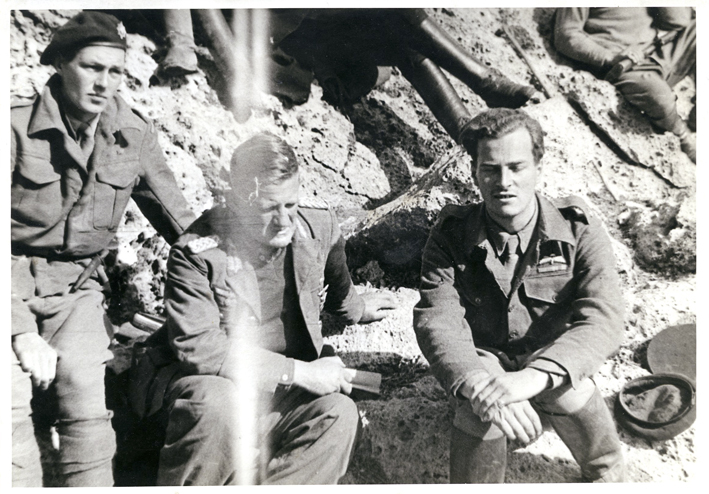
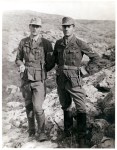
With General Kreipe

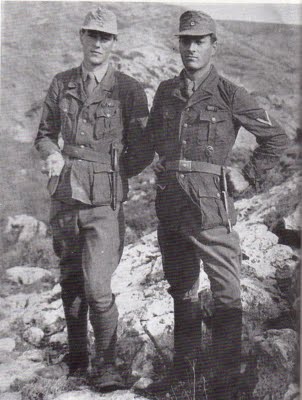
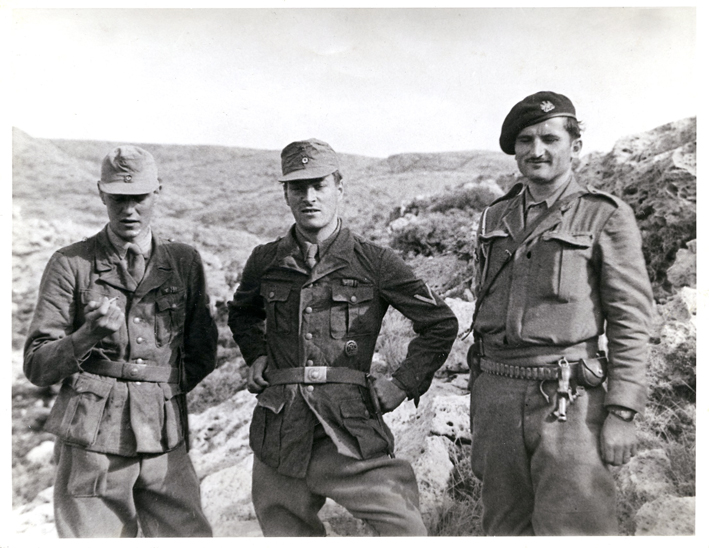
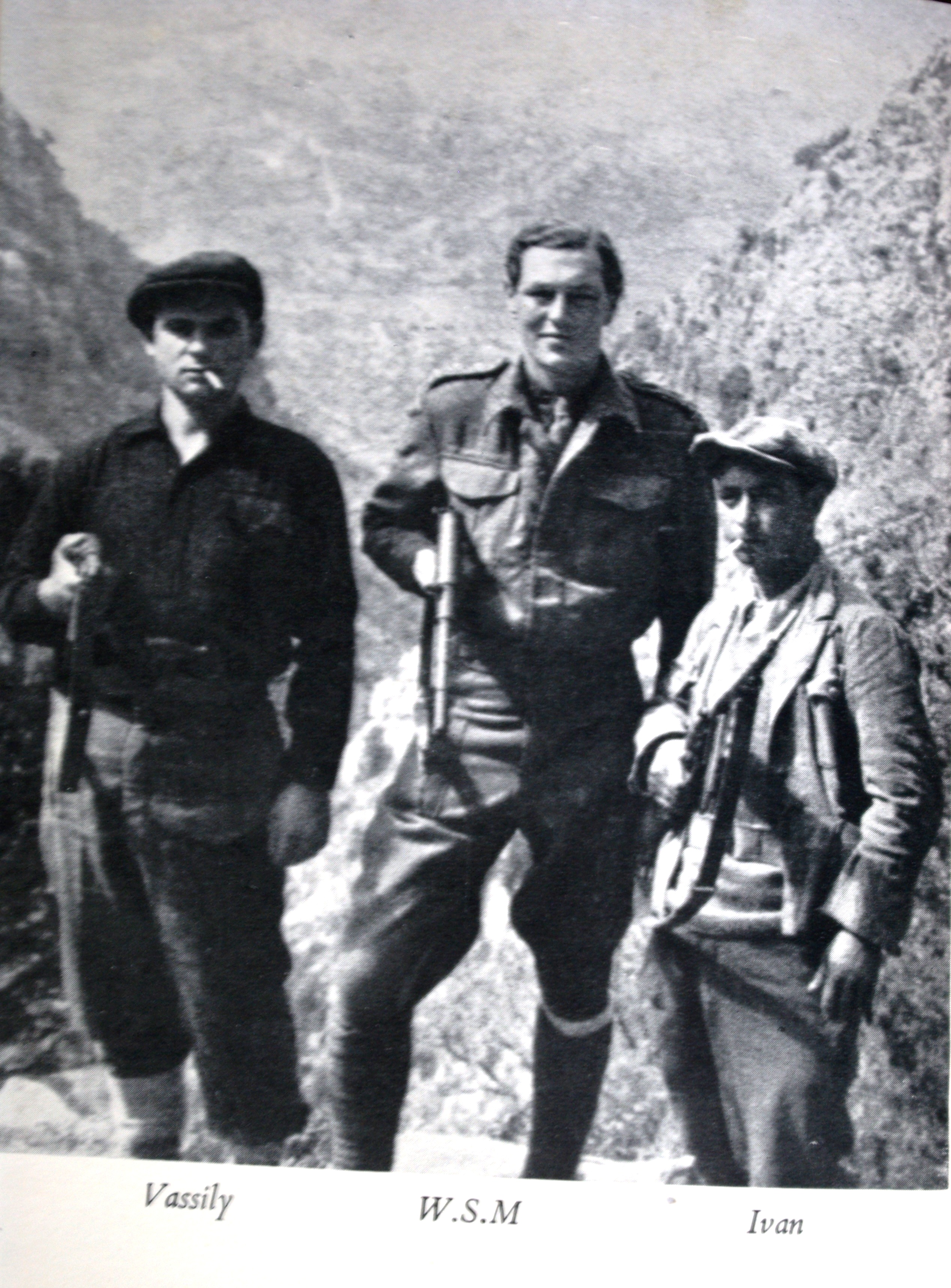
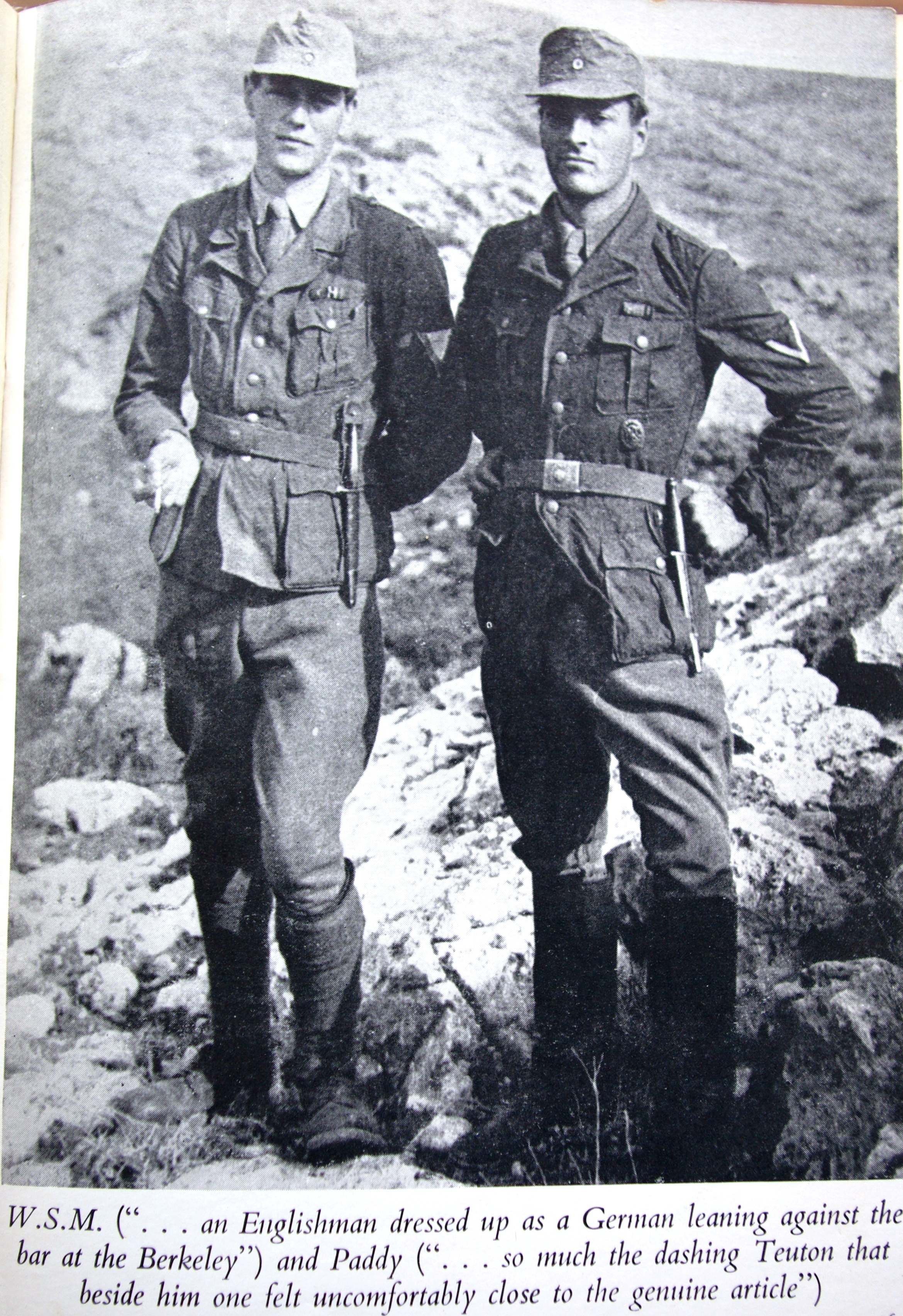
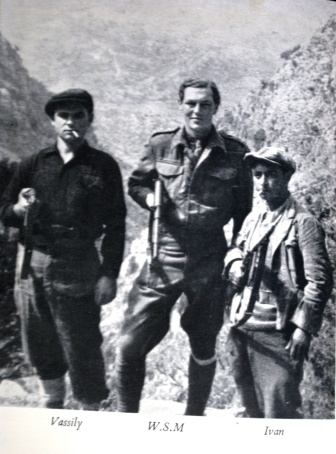
Billy Moss (L) and Paddy (R) With General Kreipe

Justin Marozzi gives us a review of Abducting a General, by Patrick Leigh Fermor, and Kidnap in Crete, by Rick Stroud. An exhilarating account of Paddy’s hair-raising kidnapping of a Nazi general that was ultimately of dubious strategic value.

By Justin Marozzi.

First published in The Spectator, 4 October 2014.

Recent years have seen the slim but splendid Patrick Leigh Fermor oeuvre swell considerably. In 2008 came In Tearing Haste, an entertaining collection of letters to and from Deborah Devonshire, followed last year by The Broken Road, the posthumously sparkling and long-awaited completion of the ‘Great Trudge’ trilogy, which finally delivered the 18-year-old Paddy from the Hook of Holland to Constantinople. Now comes another volume, setting out in full for the first time one of the great moments in a life heavily laced with glamour and incident.

It takes some chutzpah to kidnap a German general — and serious presence of mind to get away with it. Paddy, the Special Operations Executive commander of a group of 11 Cretan andartes, or guerrilla fighters, together with his second-in-command Captain William Stanley Moss, had excessive stores of both. At 9.30 p.m. on the night of 26 April 1944, the Anglo-Cretan desperadoes intercepted the car carrying General Heinrich Kreipe, commander of the 22nd Luftlande Division.

Paddy then impersonated the general as the Moss-chauffeured car drove on through 22 German checkpoints, the hair-raising prelude to an 18-day Nazi manhunt described in exhilarating detail in both of these books. The moment one morning when the Englishman overheard the captured general reciting an ode by Horace is already famous. The autodidact and show-off couldn’t help jumping in and finishing the stanza:

The general’s blue eyes swivelled away from the mountain-top to mine, and when I’d finished, after a long silence, he said: ‘Ach so, Herr Major!’ It was very strange. ‘Ja, Herr General.’ As though, for a long moment, the war had ceased to exist. We had both drunk at the same fountains long before; and things were different between us for the rest of our time together.

After many terrifying moments, some shattering climbs and descents and no shortage of near misses, Kreipe was finally spirited away onto a British ship headed for Cairo and the swashbuckling operation was over.

If the immediate success of the kidnapping is in no doubt, what of the much more vexed question which haunted its mastermind for years: was it worth it? The point of it all had been to inflict a major blow on enemy morale. Extensive steps were taken to ensure there were no Cretan reprisals by making it appear an exclusively British mission — but to no avail. The Germans, 75,000 strong on Crete, already had a viciously enforced policy of reprisals on the island, taking 50 Cretan lives for every one of their own soldiers killed. General Friedrich-Wilhelm Müller, Kreipe’s predecessor and the original target of the operation, was nicknamed ‘The Butcher of Crete’ after committing a number of such atrocities.

With Kreipe kidnapped, Müller was sent back to Crete pour décourager les autres and on 13 August gave the order to raze the village of Anogia, long a centre of resistance. In a characteristically methodical operation that lasted from 13 August to 5 September, 117 people were killed and 940 houses destroyed, together with vineyards, cheese mills, wine presses and olive groves. Other villages in the Amari valley received the same treatment, with hundreds more civilians slaughtered.

Roderick Bailey, the SOE historian who has written the introduction to Paddy’s account, argues that the kidnapping operation had ‘no strategic or tactical value’. A senior British staff officer in Cairo had opposed it from the start, arguing that ‘the only contribution to the war effort would be a fillip to Cretan morale, but … the price would certainly be heavy in Cretan lives’. Kreipe himself called it a Husarestück, a Hussar stunt. More recently, Kimonas Zografakis, who sheltered the kidnappers, described Paddy as ‘neither a great Philhellene nor a new Lord Byron… he was a classic agent who served the interests of Britain’, causing ‘terrible suffering’. This last comment looks unduly harsh and certainly does not square with the lifelong friendships Paddy forged with his Cretan brothers-in-arms, nor with the deep affection most Greeks had for him.

Abducting a General, unlike Stanley Moss’s Ill Met by Moonlight, is the work of a mature man, anxious to pay proper tribute to the Cretans who were the backbone of the resistance and ran by far the greatest risks. His SOE reports, which run to 90 pages here, provide gripping cinematic portraits of Leigh Fermor the soldier.

Warrior, writer, lady-killer, Paddy was also a boulevardier who loved his threads. Page three finds him rhapsodising about his Cretan mountain shepherd disguise:

Breeches, high black boots, a twisted mulberry silk sash with an ivory-hilted dagger in a long silver scabbard, black shirt, blue embroidered waistcoat and tight black-fringed turban…

and that’s without mentioning the flamboyant moustache, homespun goat’s hair cloak, stick, bandolier and gun. Enough to frighten any Nazi general.

Click here to buy Abducting a General: The Kreipe Operation and SOE in Crete

Click here to buy Kidnap in Crete: The True Story of the Abduction of a Nazi General

Justin Marozzi’s latest book is Baghdad: City of Peace, City of Blood.

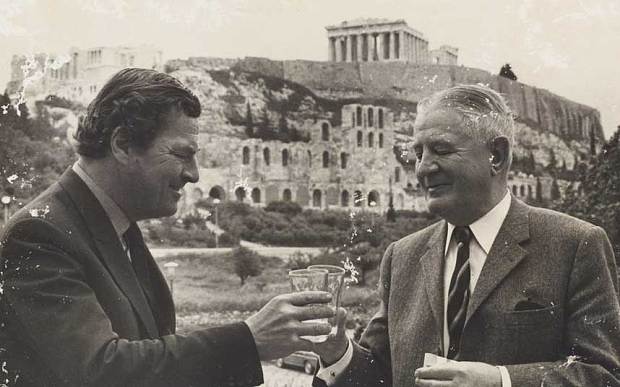
Hellraisers with deadly intent: the hard-living war heroes who captured a Nazi general

Patrick Leigh Fermor, left, met Heinrich Kreipe, his former captive, at a reunion in Greece in 1972 which included the famous Greek TV show

Patrick Leigh Fermor, left, met Heinrich Kreipe, his former captive, at a reunion in Greece in 1972 which included the famous Greek TV show

We are about to hit the season for new books about Paddy and associated book news and plugs here on the blog. There are two books about the Kreipe kidnap due out this autumn. Paddy’s own account Abducting a General: The Kreipe Operation and Soe in Crete will follow on 9 October, but first on the grid is Kidnap in Crete: The True Story of the Abduction of a Nazi General by Rick Stroud (Bloomsbury) which is published on Thursday 11 September. The introduction to this Telegraph article gives us a dramatic start: ‘Backed by local guerrillas, Patrick Leigh Fermor and William Stanley Moss led an audacious operation in wartime Crete that is celebrated in a new book’. I am sure we will be buying both! Some interesting new photographs to go with this article.

By Rick Stroud

First published in the Telegraph 7 September 2014

One evening, just before Christmas in 1943, three ex-public schoolboys sat naked in a steamy bathroom in Cairo discussing how to capture a German general from outside his headquarters on the island of Crete. They were agents of the Special Operations Executive (Force 133, Middle East).

In the hot bathwater was Xan Smiley, the son of a baronet, busy drawing maps in the condensation on the tiles. Perched on the edge of the bath were a handsome, name-dropping buccaneer, Patrick Leigh Fermor, known as Paddy, and a tall, “devilishly languid” young Coldstream Guards officer called William “Billy” Stanley Moss. Smiley was lecturing them on the mechanics of an armed ambush, about which he knew a great deal.

The bathroom was in a grand house that Moss had rented and christened Tara, after the ancient castle of the kings of Ireland. Tara came with a cook and several servants, including a butler called Abbas. At its centre was a vast ballroom, with floor-to-ceiling windows, two huge crystal chandeliers and a sprung parquet dance floor.

When Moss moved in with Pixie, his alsatian puppy, he began to look for kindred spirits to join him. He soon recruited a Polish refugee, the Countess Zofia Roza Maria Jadwiga Elzbieta Katarzyna Aniela Tarnowska, or Sophie, who Moss nicknamed “Kitten”. She arrived with a swimming costume, a uniform and two pet mongooses. Other Tara residents included two Force 133 agents operating in Albania: Lieutenant Colonel “Billy” McLean, a doyen of White’s club, and Xan Fielding, traveller, linguist and sometime bar-owner.

Smiley described the days spent at Tara as the happiest time of his life. “I loved it. I really loved it. We were all such good friends.”

Sophie remembered that whenever an agent left for the field, “there would be a big party and a car would call and those who were going to be parachuted into enemy territory left just like that, without a goodbye, without anything. We never allowed ourselves to be anxious. We believed that to be anxious was to accept the possibility of something dreadful happening to them.”

A few weeks after the bathroom conference, a German Junkers Ju 52 flew over the bright-blue Mediterranean towards Crete. On board was Major General Heinrich Kreipe, the newly appointed second in command of the island. The plane landed, Kreipe climbed from the aircraft and a soft breeze wafted the smell of thyme across the field. He was unaware that he had entered a trap that would soon spring shut, ruining his career, destroying his reputation and nearly costing him his life.

Meanwhile in Cairo, the New Year was seen in at Tara with high-octane revelry. The house was the hottest social spot in the city; its guests included diplomats, war correspondents and royalty.

Paddy on the roof of Tara in Cairo

Paddy on the roof of Tara in Cairo

Moss wrote in his diary about “the night we had the bullfight . . . the night we broke 19 windows”. The bullfight in the ballroom ended with a blazing sofa being hurled through a window and a Polish officer was encouraged to shoot out the lights. For their Christmas lunch, Leigh Fermor cooked turkey stuffed with Benzedrine tablets. Sophie remembered that, in Poland, they had made liqueurs by adding soft fruit to vodka. She tried to recreate this with prunes and raw alcohol. After 48 hours, someone tried the cocktail and collapsed. Sophie complained that he should have waited for three weeks before drinking it.

Early in January, Paddy Leigh Fermor got clearance to carry out his plan to kidnap a Nazi general; Billy was to be his second in command and they were joined by two Cretan guerrillas, Manolis Paterakis, Leigh Fermor’s right-hand man, and George Tyrakis. The equipment list read like something out of an adventure comic and included pistols, bombs, coshes, commando daggers, knuckle-dusters, knock-out drops and suicide pills.

Moss remembered sitting around a small red lacquer table at the Tara farewell party, faces lit by four tall candles, drinking and singing, as they waited to leave on the first leg of the adventure. Just before sunrise, Billy McLean appeared, a shy, nearly naked figure. He presented them with the complete works of Shakespeare and The Oxford Book of English Verse, which he thought had brought him luck in Albania; he hoped that the books would work the same magic for his friends.

When they flew over the rendezvous, Leigh Fermor jumped first, and was greeted by a party of guerrillas and an SOE agent, Sandy Rendel. Suddenly the weather closed in and clouds hid the ground, making it impossible to drop the others – they arrived by motor launch nearly two months later.

They were met on the beach by what Moss thought was a group of pantomime pirates. One, filthy, unshaven and dressed in rags, shook his hand, saying: “Hello Billy. You don’t know me. Paddy will be along in a minute.” It was Rendel. Leigh Fermor wore clothes that included a bolero, a maroon cummerbund that held an ivory-handled pistol and a dagger. He told Moss: “I like the locals to think of me as a sort o’ duke.”

The next fortnight was spent in planning and wild living. Moss found that “wine takes the place of one’s morning cup of tea and one often drinks a liberal quantity before brushing one’s teeth”.

The original target had been Lieutenant General Friedrich-Wilhelm Müller – “the Butcher of Crete” – but he had been transferred and his place taken by Kreipe. With the help of the Cretan underground intelligence, the kidnappers devised a plan to capture the general on his way home from his headquarters.

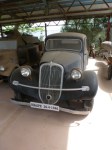
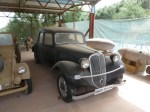
On the night of April 26 1944, Leigh Fermor and Moss, disguised as military policemen, flagged down the general’s car. As it stopped, the doors were torn open, 11 guerrillas leapt out of ditches along the sides of the road, and 90 seconds later, Kreipe was on his way towards Heraklion, handcuffed on the floor in the back of the Opel. Moss drove fast, bluffing the car through 22 German roadblocks, after which it was abandoned with a note saying that the abduction was a British commando initiative and that no Cretans were involved. Leigh Fermor hoped that this would stop any reprisals. Sometime that night, the guerrillas killed Kreipe’s driver.

It took nearly three weeks to get Kreipe to the rendezvous beach on the south coast. The kidnappers climbed Mount Ida, trudging above the snow line, over the summit and across some of the most rugged terrain in Europe. The general was dressed in the uniform he had put on for a quiet day at the office. Thousands of German soldiers surrounded the mountain, cutting off escape routes and access to the beaches. For several days, radio contact was lost with Cairo. When it was re-established, Leigh Fermor sent a signal that ended with the words “situation ugly”.

Sometimes the kidnap team passed within yards of enemy patrols, while in the distance they heard the thud of explosives as German engineers blew up villages. Throughout the journey, the kidnappers were led and protected by the guerrillas, who had risked their lives and those of their families to help the group escape. Kreipe was astonished at the loyalty and friendship shown towards the British. One guerrilla explained that “it is because the British are fighting for our freedom, while you Germans have deprived us of it in a barbarous way”.

Leigh Fermor and Moss developed a love-hate relationship with their captive. At one point, Kreipe looked at the snow-covered mountains and quoted from Horace; “Vides ut alta . . .” Leigh Fermor knew the ode and completed it, thinking that, for an instant, the war had ceased to exist and finding a strange bond with the general. Kreipe spent a lot of time complaining that he was not well, causing Moss to lose his temper and shout at him to be quiet. He later wrote in his diary: “I could have killed him.”

On May 14, they reached the only rendezvous beach not occupied by German patrols. Near midnight, they heard the noise of a motor launch, but when they tried to flash the recognition signal “Sugar Baker”, Leigh Fermor and Moss realised that they did not know the Morse for Baker. They were saved by Dennis Ciclitira, another SOE agent who had been ordered to return to Cairo. He appeared, grabbed the torch and, shouting “bloody fools”, flashed the code.

By midnight, Kreipe and his kidnappers were at sea, heading for Egypt and eating lobster sandwiches. The general told his captors: “It’s all very well, but this hussar stunt of yours has ruined my career.”

Back in Cairo, Leigh Fermor and Moss went straight to Tara, where they were given a hero’s welcome. News of the kidnap flashed around the world and quickly became a sensation. Newspapers carried pictures of the gneral, his arm in a sling, chatting to a group of senior British officers. Leigh Fermor was decorated with a Distinguished Service Order and Moss won a Military Cross. Kreipe was taken to London and interrogated. The interviewing officer described him as “rather unimportant and unimaginative”. He spent the rest of the war in Canada and was released in 1947.

In 1945, Moss married Sophie and, in 1950, published his account of the kidnap. Kreipe sued him for defamation of character, and won an injunction stopping the book’s publication in Germany. For the rest of his life, Leigh Fermor agonised over two things: the death of Kreipe’s driver and whether the “hussar stunt” had brought reprisals on to the heads of his friends, the heroic people of Crete.

Kidnap in Crete: The True Story of the Abduction of a Nazi General is available for pre-order or purchase. Click on the highlighted text.

Abducting a General: The Kreipe Operation and Soe in Crete is available for pre-order or purchase. Click on the highlighted text.

Two books on the Kreipe kidnap published this autumn

It appears that we are to be blessed with two books about the kidnap this autumn. Decisions, decisions!

A Bookseller press release states:

Bloomsbury has signed world rights to an account of the kidnapping of a Nazi general involving writer Patrick Leigh Fermor, written by Rick Stroud.

The book, Kidnap in Crete, recounts the kidnapping of General Kreipe by Leigh Fermor and the Special Operations Executive in 1944, using eyewitness accounts to illustrate the context of the operation and the work of the Cretan resistance.

Stroud said: “When writing Kidnap in Crete I wanted to tell the story from all sides. I found a rich source of material in Leigh Fermor’s own account of the kidnap and in the papers now held in his archive at the National Library of Scotland. However, it was when collecting eyewitness accounts that the strands began to come together to create a clear and complete picture of events.”

The book will be published on 11th September, 2014, a month before John Murray releases Abducting a General, Leigh Fermor’s own account of the kidnaping, which has been previously unpublished. It will be released on 23rd October.

Relaunch of Ill Met by Moonlight website to mark 70th anniversary

Capture

Ironically I was away in Munich when Tim Todd posted this comment on the Your Paddy Thoughts page. It has been 70 years since the kidnap and there are a number of events and publications associated with it. Both of Billy Moss’ books are being republished (more to follow), and, as has been already mentioned on here, a version of Paddy’s own account is due later this year.

Tim Todd is probably the leading authority on the kidnap and the route used during the evasion phase. He works very closely with Chris White on this project which never seems to be short of new aspects or details to investigate. The Ill Met by Moonlight website is very well worth visiting. Here is Tim’s update about his reworked site and a cautionary tale about retracing the route.

Well, today, Saturday 26th April 2014, is the 70th anniversary of the abduction of General Kreipe by Paddy, Billy and their Cretan colleagues.

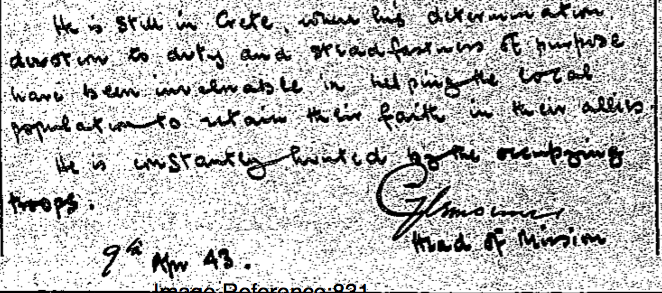
To mark the occasion may I draw attention to my relaunched website and in particular to a transcription of Paddy’s own short report on the abduction. It is the first of a number of his reports that will be appearing on the illmetbymoonlight.info website now that I am free of another commitment that had taken up a lot of time.This report, one of nine by Paddy, can be found here.

Interest in his Cretan adventures remains as great as ever and I have just heard back from one party who did the full route in the last few weeks, from Dermati to Rodakino in a remarkable 7 days and three hours – and pushed himself to the point of exhaustion in the process. Aspiring route followers should not, under any circumstances, consider this a realistic target though as the parties concerned were not your average walkers by a long way. The report came back accompanied by a warning about map accuracy, not the first, and the recommendation is always to seek local guidance for the more remote locations and not to rely on GPS coordinates.

‘The Ariadne Objective:’ Spooks, Germans and the battle for Crete

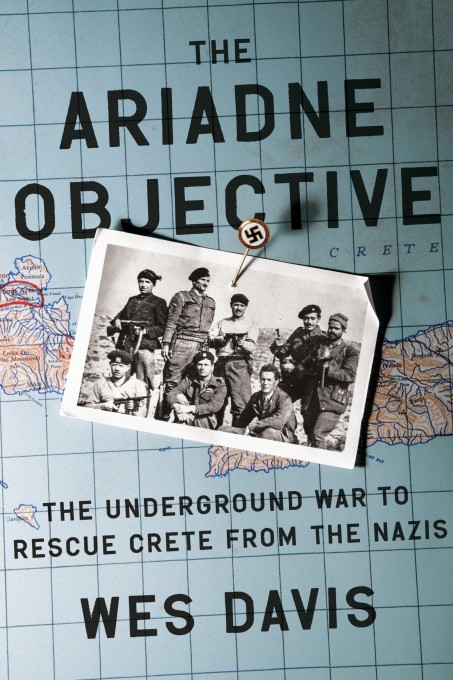
Ariadne-jacket-453x680A review of Wes Davis’ recently published book by Alexander Clapp.

First published in Ekathimerini.com 8 March 2014

On May 27, 1941, days after the first airborne invasion in history, the German army hoisted a Nazi flag atop an abandoned mosque in Hania, western Crete. The gesture was poignant. Crete – which had overthrown three centuries of Turkish rule just three decades prior – was again under the heel of an occupying power.

The Cretans were unshaken. The island’s peasantry armed itself with muskets and daggers and took to the crags and caves of the White Mountains. The campaign of sabotage that followed – an echo of repeated revolts against the Ottomans, Venetians and Arabs – marked the first mass civilian resistance to Nazi rule in Europe. “We had encountered for the first time an enemy that was prepared to fight to the bitter end,” marveled a German lieutenant.

Wes Davis’s “The Ariadne Objective” (Crown, 2013) traces the British intelligence service’s collaboration with this hardscrabble fifth column. The plans to wrest Crete from Nazi control formed part of a larger wartime strategy to “set Europe ablaze” through the Special Operations Executive (SOE), “Churchill’s secret army.” In Crete the stakes were particularly high. Cretan restlessness proved crucial to delaying Hitler’s march to the East. As the war in North Africa came to a close, the island was to become a strategic linchpin to the European theater. By 1943, the British naval command looked to Crete as a promising base from which to retake the Aegean and the Continent at large.

“The Ariadne Objective” distills existing accounts of the Cretan conflict – W. Stanley Moss’s “Ill Met by Moonlight,” George Psychoundakis’s “The Cretan Runner,” Antony Beevor’s “Crete” – into a thrilling, highly readable narrative. The book benefits from a remarkable group of protagonists. Just as the Greeks of 1821 attracted a spirited cast of Western philhellenes, so too did the Cretan resistance become a curious meeting ground for a platoon of Anglophone scholars. Most were Classicists who had scraped together the rudimentary basics of Modern Greek. Many – N.G.L. Hammond, Thomas Dunbabin – went on to hold distinguished academic posts after the war; others – Evelyn Waugh, Lawrence Durrell, Patrick Leigh Fermor – were to become the literary giants of their generation. “It was the obsolete choice of Greek at school which had really deposited us on the limestone,” recalled Leigh Fermor.

Davis weaves in and out of these figures’ fascinating back-stories. The book narrates Leigh Fermor and Xan Fielding’s respective hikes across Europe in vivid detail; the one-eyed Cambridge archaeologist John Pendlebury provides an excursion into the British excavations at Knossos; a chapter on life in wartime Cairo – including a detour into the rowdy antics of the “Tara villa” inhabitants – acts as a kind of comic relief from the grittiness of the Cretan front.

Sporting shepherds’ crooks and cork-dyed mustaches, these British guerrilla leaders spent months sleeping in caves, organizing resistance bands and smuggling supplies to the beleaguered islanders. Over time their efforts paid off. In the words of a German commander on Crete, the Nazis made the mistake of “regarding a quite substantial partisan movement as nothing more than a few gangs of cattle thieves.”

This thinking was not entirely unfounded. Some Cretans chose to collaborate with the Germans against their countrymen. Those who did resist were internecine and uncertain of their objectives. The available weaponry was hopelessly antiquated. “Stand still, Turk, while I reload” was still the threat of choice among the elderly fighters.

But if the Germans underestimated the determination of this ragtag uprising, so too did they misunderstand its means. In order to deny the Germans any legitimate right to bring reprisals against the local population, the British SOE commanders concentrated the Cretans’ efforts on disrupting Nazi supply lines, provoking discord between Axis commanders and draining the occupiers’ morale through a carefully crafted propaganda campaign. “We want not so much to kill Germans as to terrify and bamboozle them,” advised SOE resistance leader Tom Dunbabin. The smuggling of Italian commander Angelo Carta from Crete to Cairo in 1943 was one such bloodless blow to the enemy’s morale. It was also the dry run for a more devastating attack on German confidence – a ruse that forms the theatrical climax of the “The Ariadne Objective.”

On April 26, 1944 Patrick Leigh Fermor, W. Stanley Moss and a team of Cretan partisans abducted the German commander of Crete, General Heinrich Kreipe, from his headquarters at the Villa Ariadne in Iraklio. Passing through 22 enemy checkpoints, the team worked their way to the southern coast of Crete, sheltering in caves by day and evading German search parties by night. By May 15 Kreipe was in Alexandria; two weeks later he was a prisoner of war in Canada.

“The galvanizing effect of the mission could still be felt in the tense months that followed the end of the war,” writes Davis. “As the rest of Greece plunged into civil unrest – pitting factions of Communist partisans against each other and against various stripes of nationalists – Crete remained relatively calm.”

An intriguingly highbrow current runs through the book’s otherwise soldierly narrative. Greece was not merely a shared strategic prize for German battalions and British spies; it was also an intellectual middle ground for two competing nationalisms, each of which claimed the cultural mantle of the Classical world as its own. Evidence of this mutual enthrallment to antiquity resurfaces throughout “The Ariadne Objective.” The German invasion of Crete is code-named “Mercury.” The British cruisers stationed in the Eastern Mediterranean are named the Orion and the Dido. Shipping out to the front line, Pendlebury reads Edward Gibbon’s “Decline and Fall” for a crash course in military strategy. Following their conquest of Crete, the Germans import their archaeologists to tend to the island’s historical sites. The diary entry of a German commander flying out of Crete: “just as Daedalus had done so many centuries ago.” “Minotaurs, bull-men, nymphs of Ariadne, kings of Minos, and German generals – a splendid cocktail!” writes Moss after abducting Heinrich Kreipe.

The most arresting example comes a few days following the general’s capture. In a well-cited incident on the slopes of Mount Ida, Kreipe quietly quotes the opening lines of Horace’s “Soracte” ode. Taking up where the general had paused, Leigh Fermor, Kreipe’s captor, recites the rest of the poem’s 24 lines.

“It was a reminder that the war itself was the aberration, interrupting something far more important and lasting. The moment of connection he and the general had just shared had sprung from a deep-running current of literature, art, and civility,” notes Davis.

The incident – like much of the clash in Crete – represents a strange last flowering of the world of the 19th-century imperialist scholar. “The Ariadne Objective” examines that story ably and admirably. This is necessary reading for anyone interested in Greece in the Second World War.

A new book by Patrick Leigh Fermor- Abducting a General – to be published in October

'Billy' Moss and Paddy Leigh Fermor

‘Billy’ Moss and Paddy Leigh Fermor

I have just learned that we can look forward to a new book by Paddy relating the events of the Kreipe kidnap. Based upon his own account called Abducting a General, the book is due to be published by John Murray in October 2014. A pity it misses the precise date of the 70th anniversary, but welcome nonetheless.

We will be blessed with a lot of new material about the abduction and its key players this year. We have already had the new book by Wes Davis, The Ariadne Objective, which contains a lot of new material after painstaking research, and ‘Billy’ Moss’ account of his time in SOE after the exploits on Crete, A War of Shadows, is also due for republication in April.

The John Murray website tells us this:

A daring behind-enemy-lines mission from the author of A Time of Gifts and The Broken Road.

One of the greatest feats in Patrick Leigh Fermor’s remarkable life was the kidnapping of General Kreipe, the German commander in Crete, on 26 April 1944. He and Captain Billy Moss hatched a daring plan to abduct the general, while ensuring that no reprisals were taken against the Cretan population. Dressed as German military police, they stopped and took control of Kreipe’s car, drove through twenty-two German checkpoints, then succeeded in hiding from the German army before finally being picked up on a beach in the south of the island and transported to safety in Egypt on 14 May.

Abducting a General is Leigh Fermor’s own account of the kidnap, published for the first time. Written in his inimitable prose, and introduced by acclaimed SOE historian Professor Roderick Bailey, it is a glorious first-hand account of one of the great adventures of the Second World War. Also included in this book are Leigh Fermor’s intelligence reports, sent from caves deep within Crete yet still retaining his remarkable prose skills, which bring the immediacy of SOE operations vividly alive, as well as the peril which the SOE and Resistance were operating under; and a guide to the journey that Kreipe was taken on from the abandonment of his car to the embarkation site so that the modern visitor can relive this extraordinary event.

The publication date for Abducting a General is set for 9 October.

An Ode for the Road

Llewelyn Morgan describes himself, rightly as “a Classicist, lucky enough to work at Brasenose College, Oxford. I specialise in Roman literature, but I’ve got a persistent side-interest in Afghanistan, particularly the scholars and spies and scholar-spies who visited the country in the nineteenth century.” We all know so much about Paddy’s tale of the Horace Ode with General Kreipe. This piece from Morgan’s blog goes into a little more detail; essential for those of us not to have had a thorough classical education. My thanks to Peter Golden for passing this to me.

By Llewelyn Morgan

First published on Lugubelinus, 15 October 2013

For reasons that will emerge, I’m intrigued by the practice of travelling with a copy of your favourite classical author in your pocket; and I’m struck by the fact that Horace seems to be the most commonly chosen travelling companion. In Horace’s fifth satire, when he describes setting off on a journey with Heliodorus, there’s a theory that Heliodorus is a book (it was the name of the author of a book called The Wonders of Italy, or possibly The Wonders of Medicine) rather than a flesh-and-blood companion, so that’s kind of appropriate for starters.

It isn’t always Horace. The Polish journalist Ryszard Kapuściński did all his foreign reporting accompanied by a gift from his editor, “a thick book with a stiff cover of yellow cloth. On the front, stamped in gold letters, was Herodotus, THE HISTORIES.” Europeans trudging through Afghanistan in the nineteenth century cited chapter and verse on Alexander’s itinerary with such accuracy that I can’t help but suspect they had copies of Quintus Curtius Rufus’ Histories of Alexander the Great secreted somewhere about their persons.

Virgil is another favourite, and with him the unhealthier aspects of this practice come to the fore. Abraham Cowley was the author, among other things, of an epic, The Civil War, which he wrote as the English Civil War unfolded in the 1640s (and which mutates from an epic into a satire as Cowley’s favoured side, the Royalists, lose ground.) According to John Aubrey he “alwaies had a Virgil in his pocket”, and his reverence for the Aeneid is very obvious in The Civil War: he even imitates Virgil’s “half-lines”, lines left unfinished by Virgil at his death (he died before the Aeneid was completely finished), but which Cowley thought were deliberate, and expressive.

But Cowley’s devotion to Virgil didn’t stop at the odd half-line.  Aubrey recounts a story of Cowley using his pocket Virgil to consult the “Virgilian lots” (sortes Vergilianae) with the future Charles II, opening the pages of the Aeneid at random as a way of predicting the future. And predictably enough, Cowley and the prince happen on Dido’s curse of Aeneas at the end of Aeneid 4, where the queen of Carthage prays that Aeneas will see his friends fall before his eyes, make peace on unjust terms, and die before his time: Virgil was telling them what would happen to the prince’s father Charles I.

That is a story with many variants, and it doesn’t always involve Cowley. But we can establish that Cowley had a habit of consulting the sortes Vergilianae. Dr Johnson quotes a letter written by Cowley in which he discusses the prospects for an alliance with the Scots. Cowley is confident of a positive outcome to negotiations: “The Scotch will moderate something of the rigour of their demands; the mutual necessity of an accord is visible; the king is persuaded of it. And to tell the truth (which I take to be an argument above all the rest) Virgil has told me something to that purpose.” Virgil has told meThe text in the pocket has become the intimacy of a direct word in the ear.

Well, Virgil can play with people’s heads: Cowley’s consultation of the Virgil in his pocket is a bit like Jackson Knight’s consultation of a medium (supposedly channelling Virgil himself) when he was writing his Penguin translation of the Aeneid (just in case anyone thought Morrissey’s inclusion in the Penguin Classics was the maddest thing to happen to that series).

Chaps with Horace in their pockets are a more stable bunch all round, I like to think. But if that’s true, it has a lot to do with the focus of Horace’s poetry. His most famous and quoted poems are the Odes, and the concerns of these short lyric poems weren’t the profound mysteries of existence delved by Virgil (a figure further amplified by the strange mythology that built up around him after his death). Horace is all about the demands of this life we’re living, the inevitability of aging and death, the pleasure of the present moment. His genius is to give incomparable expression to simple principles of living. Carpe diem, etc.

As he set off to travel on foot to Constantinople in 1933 Paddy Leigh Fermor packed an Oxford Book of English Verse and, a gift from his mother, “the Loeb Horace, Vol. I”, containing the Epodes and Odes; and as he walked across Europe he memorised his favourite odes. That special relationship with Horace featured in Leigh Fermor’s most famous exploit, when he captured the German General Karl Kreipe, commander on Crete, and had him smuggled out to Cairo. As they climbed Mount Ida, Kreipe muttered the first line of Horace’s ninth ode, Vides ut alta stet niue candidum Soracte, “You see how Mt Soracte stands white with deep snow,” and Leigh Fermor responded with the rest of the poem:

The general’s blue eyes had swiveled away from the mountain top to mine – and when I’d finished, after a long silence, he said: “Ach so, Herr Major!” “Ah, yes, Major!” It was very strange. As though, for a long moment, the war had ceased to exist. We had both drunk at the same fountains long before; and things were different between us for the rest of our time together.

Horace, whom both Germans and British had managed to convince themselves was the perfect encapsulation of their respective gentlemanly codes, established a mutual understanding between these two officers. Between them, for example, they managed to piece together the superb conclusion to the Regulus Ode (3.5), where the Roman general Regulus, heroically insisting on going to meet his death at the hands of the Carthaginians, leaves Rome as nonchalantly as a man heading off for a relaxing weekend at his country house. Continue reading

Rotterdam to Istanbul by foot

Patrick Leigh Fermor, 85, hasn’t quite finished the story of the epic walk he made at 18. He tells James Owen why. An old article I found in The Telegraph.

By James Owen.

First published in The Telegraph, 19 Feb 2000.

For an insular race, the English write surprisingly well about foreign places, and none better than Patrick Leigh Fermor. It was his intoxicating prose that first prompted me to travel and he occupies a prominent niche in my private pantheon of gods. But it is a quarter past three on a cold winter’s afternoon and, nice as is his doorstep is, my hero is late.

Patrick Leigh Fermor: resembles an amused sparrowhawk, alert and energetic
Then he comes scrambling out of a taxi and ushers me into his kitchen. “Really,” he says, “I’m awfully sorry. Will you have a drink?”

Age is bowing him a little now, but although he was 85 on Friday, Leigh Fermor still looks remarkably hale and, with his iron-grey hair and unlined face, could pass for a man 20 years younger, or even Trevor Howard in his prime. “Yes,” he says, “a cup of tea, that’s the thing”, and we begin to talk about his contemporary Sir Wilfred Thesiger, whom he remembers seeing stride down Piccadilly in hat and gloves “like a stern, immaculately attired eagle”.

Leigh Fermor himself resembles more an amused sparrowhawk, alert and energetic, his startled eyebrows a clue to the exuberant personality revealed in his books, most notably in the unfinished trilogy of his year-long walk from Rotterdam to Istanbul in 1934, when he was 18 and continental Europe was on the cusp of cataclysmic change.

It was a journey of physical adventure and cultural awakening, recalled in distinctive prose. His baroque and meticulously polished style, informed by a romantic eye, has brought him a host of admirers – yet there are those who doubt that he could remember such detail half a century on and accuse him of private myth-making. So, I ask him, do travel writers improve on truth for the sake of art?

“I say,” he declares, his vocabulary that of the schoolboy yarn, “that’s rather a difficult question. I think one does improve on things; it’s irresistible sometimes. After all, one is telling a story. I am a bit worried that I’ve got a slightly ‘disinfectant’ memory, as if some goblin had washed out the gloomy parts and let the luminous ones survive. But, overall, I don’t think I’ve sinned too heinously.”

Still, if you wanted to create the perfect fictional travel writer, you would be hard pressed to devise a better life story than Leigh Fermor’s. He was born of Anglo-Irish stock, his father a naturalist whose discoveries included a worm with eight hairs on its back and a particular formation of snowflake; his mother was a red-headed, cigarette-smoking, fur-boot-wearing playwright.

After his parents divorced, young Paddy’s education was sporadic. A spell at a progressive establishment where pupils and staff alike dispensed with clothes was followed by King’s School, Canterbury, from which he was expelled at 16 for holding hands with a greengrocer’s daughter. Dispatched to London, he lodged with Beatrice Stewart, the model for the figure of Peace at Hyde Park Corner, before planning his great trek across Europe.

Having reached his goal – what he insists on calling “Constantinople” – Leigh Fermor visited for the first time the country with which he would become most associated, Greece, spending his 20th birthday in a snowbound monastery on Mount Athos. He then found himself caught up in an anti-royalist revolt and, with customary dash, attached himself to a cavalry regiment. The campaign brought him novel challenges.

“I’d heard about swimming horses across rivers,” he recalls, “so I thought I’d give it a go. It was the most extraordinary thing – the water comes up to your waist, and the horse’s head sticks out like a chessman.” A little later, Leigh Fermor’s comrades were ordered to draw sabres for what must have been one of the last cavalry charges in Europe.

Fittingly for a philhellene, Leigh Fermor is a latterday Byron, a man of action as well as of letters, and long before he made a reputation as a writer, he was celebrated for one of the most daring missions of the Second World War. Having organised guerrilla operations in occupied Crete for two years, in 1944 he and a friend, disguised as German soldiers, kidnapped the island’s garrison commander, General Kreipe, and successfully bluffed their way through two dozen checkpoints in his official car.

For three weeks, they evaded German search parties, then marched the general over the top of Mount Ida, birthplace of Zeus. As the general gazed up at the snowy peak, he began to recite the first line of an ode by Horace; Leigh Fermor immediately continued the poem to its end, and the two men realised that they had “drunk at the same fountains” before the war. Kreipe was eventually taken off Crete by motorboat, Leigh Fermor awarded the DSO, and the whole exploit filmed as Ill Met By Moonlight in 1956, with Dirk Bogarde improbably cast as the burly commando.

The incident cemented Leigh Fermor’s standing on Crete (where he soon found himself with 27 godchildren), and his experiences there confirmed his love of the Greeks themselves. After the war, Greece became his adopted home and he built a house deep in the Peloponnese, close to the sea, where he likes to bathe (at the age of almost 70 he swam the four miles across the Hellespont). Now he and his wife spend most of their time in Greece, which has inspired perhaps his two most original books, Mani (1958) and Roumeli (1966), distillations respectively of the history, folklore and culture of the far south and north of a country that has since vanished forever.

“I think Greece has changed, on the whole, for the good,” he says, “but tourism has spoilt it more than the Greeks themselves realise. Yet I still like the Greeks and one’s always grateful to countries where one is happy.”

He now intends to stay close to home, “tinkering with one’s work”. He much prefers research to the painful business of writing and re-writing; his prose usually goes through four or five drafts before he deems it to have passed muster. I ask him if he thinks he has written enough. “No!” he says sharply. “I’ve been far too slow, mucking about, wasting time. Of course, I ought to have written a great deal more.

“Sometimes it does rip ahead. The first time it happened to me I was in the deserted monastery of Sant’ Antonio, outside Rome, where I was toiling on The Traveller’s Tree [his book about the Caribbean]. I started after dinner and went on for what I thought was two or three hours, whipping away, when I noticed something funny about the light. Then the birds began to sing all around the monastery. I’d been writing from dinner time to dawn.”

There are two more books that he would like to write, he says. The first is an account of the Resistance movement on Crete, which he feels duty-bound to record. The other is his current project, and will come as welcome relief to those addicts of Leigh Fermor who have been waiting 15 years since the last instalment of his walk – Between the Woods and the Water – to see if he reaches Constantinople.

“It’s been very desultory and jerky,” he confesses, “but I’ve got to finish what I’m working on, the third step of that journey. I’m not sure now if this is a good title, but I’d thought of calling it ‘Parallax’, which means looking at the same thing from a different angle – the time when all this happened and now, when one is old Methuselah scribbling away.

“At my immense age, when I look back, I think: ‘Thank God I didn’t let every opportunity slip by.’ ” Good grief, I say, what did you fail to cram in? But Patrick Leigh Fermor just smiles good-naturedly, as if to say: “Yes, well, now that’s another story.”

A Visit with Patrick Leigh Fermor, Part 3

Paddy in uniform

Part 3 of Ben Downing’s meeting with Paddy in 2001 at Kardamyli.  Read Part 1 here and Part 2 here.

by Ben Downing.

This text originally appeared in issue 165 of The Paris Review, Spring 2003.

There was an incident dating from this vagabond period—from 1956, to be exact—that I was keen to ask Paddy about. Some weeks earlier I had come across, in a sort of anthology of classic put-downs, an anecdote about a contretemps between Paddy and Somerset Maugham. When I asked Paddy about it, he ferreted out a photcopy of a letter he had written at the time to a friend of everyone concerned, Deborah Devonshire, in which he describes what happened. It begins by telling how, after a week in the Alps with director Michael Powell’s team shooting Ill Met by Moonlight (Moss’s account of the Kreipe abduction), Paddy—who is, incidentally, played by Dirk Bogarde in the movie—had settled down to write in a friendly curé’s garden. The letter proceeds as follows:

Before I’d set out, Annie [Fleming, wife of novelist Ian] told me that “Willy” had asked her to stay and to bring anyone she liked (so why not me) and when she got to the Villa Mauresque she rang up, announced the O.K., and collected me in a borrowed car.

Lunch went swimmingly: Annie, Mr Maugham, his friend Alan Searle, and me. So well that, when we got up, Maugham—looking rather like a friendly Gladstone bag—said that he hoped I would stay and go on with my writing, and showed me a charming room. So all prospects glowed when we assembled on the terrace before dinner. The only other guests were a Mr and Mrs Frere; he was Mr Maugham’s publisher at Heinemann and she was Edgar Wallace’s daughter. Making conversation over marvellously strong drinks, I asked her if her husband was anything to do with someone I knew with the same name. She said she wasn’t sure: what did he do? I said,

“He’s a herald.”

“What sort of a herald?”

“Oh, you know, works in the College of Arms—he’s Rougedragon Pursuivant, or something like that.”

“How interesting.”

“Well, he’s an exception to Diana Cooper’s generalization.”

“Oh, what is that?”

“She says it’s generally believed that all heralds stutter.”

“How do you mean?”

“You know, stammer, have an impediment in their speech.” After this I rambled on about Diana’s splendid generalizations. “She says it’s well known that all Quakers are colourblind, and she remembers that, when she was a girl, Liberal M.P.s never travelled anywhere without an aneroid barometer. And so on.”

More dry Martinis were handed round, swallowed, and replaced. During a lull in the talk, Mr Maugham said:

“T-today is the F-feast of the As-sumption of the B-blessed Virgin M-Mary, and n-none of the g-gardeners have d-done a s-stroke of w-work.”I was fascinated by the mention of this religious feast and broke in with:“

The Feast of the Assumption! You know that huge picture in the Louvre, I think by Correggio, with the Blessed Virgin whirling into the sky as though shot out of a gun through a dozen rings of cloud, and scores of seraphim and cherubim? I’ll never forget the reaction of Robin Fedden—he had a charming stammer, and he exclaimed, ‘That’s what I c-call an unw-warrantable as-sumption!’” Soon after we were bidden indoors for a delicious dinner. After the guests had left and we were enjoying a nightcap, Mr Maugham got up, shuffled across the Aubusson, and with a limp handshake said—I won’t indicate the stutters any more—“Well, I will say goodnight now and perhaps I should say goodbye too, as I expect that I will be in bed tomorrow when you leave,” then ambled off.

The odd thing is that, until that moment, neither Annie, Alan, nor I had been aware of anything being wrong. For a minute or two we were genuinely puzzled, until Alan rather tentatively said, “Do you think it might have anything to do with the stammering?” and we all saw the light. Much wine had passed our lips. Annie was in fits of laughter and Alan joined her, but I felt very upset. After all, our host had been extremely kind and welcoming. But could he really have thought it had been on purpose? Of course I knew all about the youthful agonies caused by the impediment. In Of Human Bondage—an early, partly autobiographical book, and perhaps his best—he turns the stutter into actual physical lameness. My predicament, helped by several Martinis, was a classic instance of Freudian Error, exactly like the case of the woman warned against making any tactless remarks about noses, when an unknown visitor with an enormous one was expected to tea. The moment the guest sat down, she asked, “Would you like one lump of sugar or two in your nose?”

Annie helped me pack next morning. I put my suitcase on the bed and piled everything in, but when I closed it, a corner of the sheet—a beautiful Irish linen one with “W.S.M.” embroidered on it—got stuck in the zipper, and when I headed for the door it tore from top to bottom with a noise like a hundred calico shirts being rent. There was nothing for it but to slope off with some of the tatters hanging out. Annie was in raptures of hilarity at this final touch. (She is totally incapable of leaving a comic story unembellished.) I found, with her help, sanctuary in a hotel about a mile away, where she turned up when she could, like a prison visitor, to bring news; the story had spread along the coast and caused lively interest. Diana, who was staying with Daisy Fellowes, drove over with Hamish [St. Clair Erskine] and loyally pitched into my late host (“I’ve never heard such rot”) and I was invited back for a sort of reconciliation and forgiveness feast. I was very pleased about this; after all, it was entirely my fault, due to strong drink, and I’d rather be thought a soak than a monster. We were anxiously and studiously polite, but it would obviously never come right …

It was encouraging to hear, later on, that Cyril [Connolly] had once been made to leave the house for picking and eating the last avocado off a tree on the terrace. But I learnt, later still, that this was only a consoling rumour. He was scolded, but allowed to stay on.

Another episode that I’d recently heard about—but didn’t know the details of—was Paddy’s involvement with a John Huston film, The Roots of Heaven (1958). I asked him to tell me about it:

“I was staying in a Benedictine abbey in Normandy (the same one mentioned before) when one morning a monk called me to the telephone, and it was John Huston. I knew him a bit from non-film circles and liked him. He told me that he liked my stuff and that he wanted me to write the script for a film of a novel by Romain Gary called The Roots of Heaven, which is about a fierce campaign in the African forests to save elephants from annihilation by ivory traders. It was to be a Twentieth Century Fox affair, with Darryl Zanuck as producer and Errol Flynn, Trevor Howard, and Juliette Gréco among the stars. ‘I’m directing it,’ said John, ‘and we’re shooting in Africa.’ I told him I knew nothing about films. He said this didn’t matter, and described the plan for half an hour before saying, ‘I think I’d better hang up now, as I’m calling from Tokyo.’ Continue reading

A Visit with Patrick Leigh Fermor, Part 2

Paddy. on Ithaca, 1946 by Joan Leigh Fermor

Part 2 of Ben Downing’s meeting with Paddy in 2001 at Kardamyli.  Read Part 1 here.

by Ben Downing.

This text originally appeared in issue 165 of The Paris Review, Spring 2003.

Already familiar as I was with the main events of Paddy’s military career, I asked him to fill in the gaps. What had he done while in Cairo?

“My first leave from Crete, after many months in the mountains, was at the time of the Italian surrender in September 1943. I had managed, by devious means, to persuade the Italian general commanding the Siena Division to escape from the island with some of his staff, and I accompanied them. When they’d been handed over in Cairo, I found myself quartered in rather gloomy billets known as Hangover Hall. There I became great friends with Bill Stanley Moss, on leave from the Third Battalion of the Coldstream Guards, and later my companion on the Kreipe expedition. Couldn’t we find more congenial quarters? Almost at once Billy found a positive mansion on Gezira Island, which we shared with a beautiful Polish countess called Sophie Tarnowska—she and Billy were married later on—her Alsatian, two mongooses, and a handful of close SOE friends, also on leave.

“Tara (as we named the house) was an immediate triumph. With its ballroom and a piano borrowed from the Egyptian Officers’ Club, and funded by our vast accumulations of back pay, it became famous—or notorious—for the noisiest and most hilarious parties in wartime Cairo. At one of these, fired by the tinkle of a dropped glass, everyone began throwing their glasses through the windows until not a pane was left.

“It was to Tara that we returned after the Kreipe expedition. But the rigors of a year and a half of Cretan cave life, it seems, suddenly struck me with an acute rheumatic infection of the joints, akin to paralysis. After two months in a Cairo hospital—where King Farouk once kindly sent me a magnum of champagne—I was sent to convalesce in Lebanon. I stayed at the British summer embassy at Aley, above Beirut, with Lady Spears, who was the well-known American writer Mary Borden, and her husband, Sir Edward Spears, our ambassador there. We had all met in Cairo, which at that time was one of the most fascinating gathering points in the world.

“But I was itching to get back to Crete. By the time I managed to return, in October 1944, the entire German force had withdrawn to a small perimeter in the west of the island. The outcome was a foregone conclusion, and the Germans made only occasional sorties. With their imminent surrender in view, it wasn’t ‘worth the bones of a single Pomeranian grenadier,’ as Frederick the Great said—or of a single mountaineer or Allied soldier, for that matter.

“I went back to Cairo for a last Tara Christmas. But Tara was dissolving, and in March 1945 I was sent to England, where I joined a rapidly-put-together unit called the Special Allied Airborne Reconnaissance Force—inevitably SAARF—for an odd emergency. There was a fear that during the ‘Eclipse Period’—the predictable days, that is, between the faster momentum of the Allied advance and the final surrender of the German army—the Germans might carry prominent Allied prisoners of war off to some Tyrolean redoubt and use them as hostages or bargaining counters; and it was hoped that SAARF would be able to prevent this. Its members all had SOE and parachute experience in enemy territory. The plan was that, at the right moment in Eclipse Period, each team of three—in some cases, two teams together—would take off from an airstrip at the Sunningdale golf course, in Surrey, and drop near its allotted prison camp in Germany. Dressed in tattered POW uniforms, we would lie up in the woods, spy out the land, slip into POW working parties, get inside the camp, and then contact the senior British officer and open W/T communications with the spearhead of our advancing troops; these would then drop arms and supplies and give air cover while the garrison was overpowered or the commandant bluffed, until Allied troops arrived.

“I found myself paired with Henry Coombe-Tenant, a major in the Welsh Guards, a brilliant pianist and a member of the Athenaeum who after the war became a Benedictine monk at Downside. Our commandant was Brigadier Nicholls, nicknamed ‘Crasher’; he was impermeable as a bison. The target we were destined for was the dread Oflag IV C at Colditz, where several Prominenten were prisoners, including the king’s cousin, Lord Harewood, and relations of Churchill and Field Marshal Alexander. The castle was deep in Saxony, and there was, of course, no resistance or SOE intelligence about it—nothing but aerial photographs to go on. We desperately needed more local detail.

“At this point I heard that an old friend, Miles Reid of the Phantom Reconnaissance Force, captured in Greece during the 1941 retreat, had been exchanged on health grounds, and precisely from Colditz; so I got leave to break security in the hopes of information, and dashed to see him at his home near Haslemere. When I told him of the Colditz scheme, he exploded. Had we heard nothing of the total impregnability of the fortress, of the thoroughness and rigor of the Appells, the checks and counterchecks, the scrutinies and roll calls? As for ‘working parties,’ since the inmates were all officers, these didn’t exist. There was absolutely no hope of the plan succeeding, and we would all be goners. Continue reading

The words of Mercury are harsh after the songs of Apollo: Meeting Patrick Leigh Fermor

Ryan Eyre lives in Seattle, and took a journey to Kardamyli to meet Paddy in 2009. He has written this article for the Journal of the Book Club of Washington, and has asked to publish it here as well. Ryan tells us, as many others have done, about Paddy’s remarkable memory, which he utilised to the full to write A Time of Gifts and Between the Woods and the Water. I have seen evidence of this myself. On a recent visit to Cluj I was able to enter the public rooms of the fabled Hotel New York (Continental) clutching a copy of BTWW and marvelled at the accuracy of Paddy’s description of its decor … but the cocktail bar was closed!

Update: I met Ryan last month (5 June 2013) in London and was able to show him the site of the original John Murray publishing house at 50 Albemarle Street. Ryan was on a holiday from his post in the Republic of Georgia where he is teaching English. He reminded me of this article which was posted in the week following Paddy’s death. It may have got lost in all the high frequency posting at that time, so I promised him that I would give you all another chance to read his account.

Meeting Patrick Leigh Fermor

by Ryan Eyre

On a February evening in 2009 I alighted from a bus in the village of Kardamyli, in the Mani region of southern Greece. I had arrived at this remote corner of the Peloponnese with one purpose: to meet the celebrated English author Patrick Leigh Fermor, one of the great prose stylists of the 20th century and arguably far less well known than he should be. Now in his nineties, Paddy (as he is known by his friends) still divides his time between England and his adopted home of Greece, where he lives in a house he designed himself in the 1960’s on a headland just south of Kardamyli. Patrick Leigh Fermor (PLF) has had an extraordinarily full and remarkable life.  For the sake of some background for those unfamiliar with him I provide a brief biographical sketch:

Born in 1915 and educated at the King’s School in Canterbury until he was expelled at the age of sixteen, he was preparing for the entrance examinations for Sandhurst when a sudden inspiration came over him. He decided to walk across Europe, with the final destination point as Constantinople, living, in his words, “like a tramp or a wandering scholar.” It was December 1933 and he was eighteen years old. He set out almost at once, catching a tramp steamer from London to Rotterdam and beginning his walk from there, passing through the Netherlands, Germany, Austria, Czechoslovakia, Hungary, Romania, Bulgaria and European Turkey before arriving in Constantinople on New Year’s Day, 1935. His experiences on his thirteen-month peregrination later provided the material for his two most celebrated books A Time of Gifts and Between the Woods and the Water, which were first published in 1977 and 1986, respectively.  These two volumes recount the first two-thirds of his amazing journey by foot from the Hook of Holland to the Golden Horn. Richly descriptive and full of historical and literary allusions they provide a portrait of a pre war Europe long since vanished.  Apart from the extremely high standard of prose and the author’s obvious enthusiasm for history, literature and art, perhaps the most appealing aspect of his account of this remarkable journey is that it was completed on foot. It has been said that the human mind can only properly absorb its surroundings at a walking pace.   The gradual transitions of landscape, language and culture were carefully observed by PLF because of the patient, unhurried approach that he took; a faster form of travel would have failed to capture nearly as much of the richness and complexity of the lands he passed through.

After completing this walking journey, he spent the next couple of years in Greece and Romania. He was romantically involved with the Romanian princess Balasha Cantacuzene, living with her on her estate in Moldavia until the outbreak of the Second World War in 1939, at which point he returned to Britain to enlist in the army. During the war he served with distinction in Greece, both during the German invasion of 1941 and afterwards during the occupation.  As a SOE (Special Operations Executive) agent he helped coordinate the resistance movement on Crete. The highpoint of his war was the celebrated kidnapping of the commanding German general Heinrich Kreipe on Crete in 1944, which he and a fellow British officer devised and accomplished with a band of Cretan partisans, abducting the luckless general from his car outside of Iraklion and spiriting him away into the mountains and eventually Egypt. After the war and in the company of his wife, the late Joan Eyres-Monsell, he travelled all over Greece, exploring the most remote rural areas on foot or mule, and developing a deep appreciation of the folk customs, dialects and traditions that have in the last half century largely vanished (see his books Mani and Roumeli).  His travels and books have never been limited to Greece, though:  his first book The Traveller’s Tree (first published in 1950) was written after an extensive journey around the West Indies in the late 1940’s.  Possibly his best book (according to New Yorker columnist Anthony Lane), A Time to Keep Silence, explores the nature and meaning of silence as he experienced it living in various French monasteries.  Whatever topic PLF has written about, his natural enthusiasm, curiosity and exquisite writing make it compelling reading.

Several years before I had been travelling in Romania and by chance a fellow American in the hostel had shown me a copy of Between the Woods and the Water, in which PLF recounted travelling through the same area in the 1934. Intrigued when I returned to Seattle several months later, I had checked A Time of Gifts out from the library and was instantly enthralled by it. The subject matter, the style and the sensibilites were immediately appealing. I can state unequivocally that PLF’s writing had a powerful influence on me. He seems almost the embodiment of an ideal-the literary man of action. Highly erudite but also a man of the world, unapologetically articulate and learned but with enough graciousness and charm to avoid being a pedant, equally comfortable with the humble as well as the high born. I’m not the only one who views him this way – Bruce Chatwin, Colin Thubron and William Dalrymple have all cited PLF as a major influence on their writing and lives. From PLF I developed a deeper appreciation of art and literature, and renewed an interest in history-particularly European. Because of him I also became a better traveller– by slowing down, more closely observing my surroundings and immersing myself in the history of a place before I visited.

I became determined I had to meet this man. I knew he was old and in declining health so time was of the essence. In January of 2009 I was in England visiting relatives and went to his literary agent’s offices in London hoping to get a formal letter of introduction. I only spoke to a secretary, who passed on an email address to which I wrote but predictably from which I heard no reply. My cousin said “The only way to meet the blighter is to show up where he lives-I’m sure you’ll be able to meet him.” I decided to take his advice and hope for the best.

Thus a month later I arrived in Kardamyli with a mixture of excitement and trepidation, after having travelled over land and water from Portugal all the way to Greece. I had done my homework: I knew his former housekeeper (a woman named Lela) ran a taverna with some rooms in the town-that seemed the obvious place to stay.  Before my arrival I had telephoned and had spoken to her son Giorgios (Lela spoke no English).  In the winter the taverna was closed, Giorgios explained, but they would make an exception for me and at a reduced rate. Giorgios, a moustachioed and world- weary but courteous man in his fifties met me when I got off the bus, and after introductions were made, he walked me to Lela’s a few blocks away. It was a simple two story building by the sea, with a restaurant on the ground floor and a few rooms upstairs looking directly out on the sea. Lela appeared from the kitchen, in her seventies but still sprightly, with a craggy and quintessentially Greek face. After showing me to my room she and Giorgios disappeared quickly, leaving me as the only guest. Strolling out from Lela’s along the water onto a jetty and looking up towards one of the clearest starlit skies I had ever seen, with the only sound coming from the waves crashing against the rocks, I understood immediately why Patrick Leigh Fermor had decided to settle here years before.

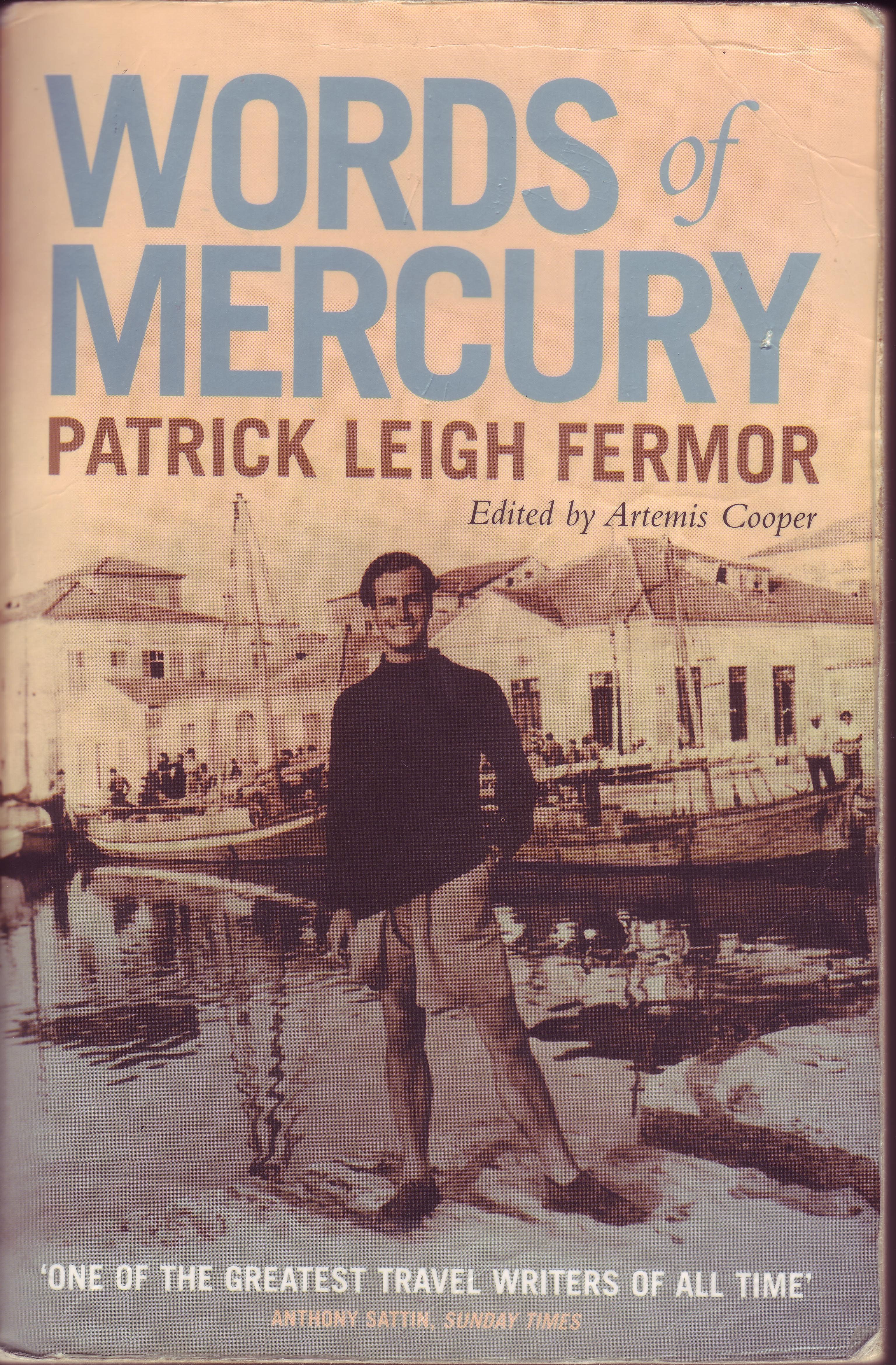
The next morning I awoke early and walked along the road going south from Kardamyli. A Greek man out in his garden saw me and gestured for me to come inside. Without asking any questions he sat me down in his kitchen and served me coffee; this was exactly the type of hospitality towards strangers that PLF had described in his books on Greece.  Somewhat timorously I broached the subject of Patrick Leigh Fermor (known as Michalis by the locals) and asked where he might be found. He gesticulated southwards, saying in broken English that PLF lived a short way down the road, in the next cove known as Kalamitsi. I thanked him for the coffee and continued walking. I had with me an anthology of PLF’s work titled The Words of Mercury, which included an article he had written on how he had designed his house in Greece.  He described it as resembling a faded Byzantine monastery, with a view framed by cypress trees overlooking a cove with a small island offshore. Down a path and through an olive grove there was a house that closely resembled this description; in fact, it had to be his residence as it looked far older than any other house in the vicinity.

Emboldened by this discovery I walked back into town, just as the villagers were exiting the church service on a Sunday morning. Approaching Lela, I tentatively mentioned PLF’s name and pointed to The Words of Mercury, with a photograph of PLF in the 1940’s on the cover.  She gave Giorgios soon appeared and I explained that I had come to Kardamyli to hopefully meet PLF, and handed him a note of appreciation that I entreated to pass along. Giorgios told me that PLF was in England at the moment, but would be back by Tuesday and would gladly give him the note once he saw him.  So my timing had been providential!  Now I simply had to wait.  I spent the next couple of days either reading (finishing War and Peace to be exact) or going on long walks exploring the myriad of small coves and hills. The Mani is very quiet in winter and felt refreshingly unexplored. Each evening I would go to the kafeneon to sit with the local men as they chatted and watched football on the television. Giorgios would be there every evening and he was quite friendly and talkative to me.  Every evening I would tactfully bring up the subject of whether or not he had seen PLF. Each time he responded he hadn’t yet.  One evening as I was returning to Lela’s she insisted on cooking me a meal in the kitchen, sitting me down in a table in the restaurant and plying me generous portions of pork, potatoes and vegetables. On a table in the corner was a pile of black and white photographs; examining them more closely I saw they were informal snapshots of Lela and her family from the 1960’s with a younger looking Patrick Leigh Fermor in a number of the them. Seeing these candid photographs gave my purpose a lot more immediacy.

Taking the bus one day into Kalamata (the nearest city-some 20 miles away) I fell into conversation with a local woman about my age. I explained that I had come all the way here to hopefully meet PLF.  She raised her head backwards and clicked her tongue, the universal Hellenic gesture for disapproval. “The Patrick Leigh Fermor is very old man, many people, journalists come here to meet him, they have to book appointment…it’s not so easy to see him.”  Discouraging words and with each passing day I realized that Giorgios was probably protecting PLF’s privacy…it was perfectly understandable but I made up my mind to take a more direct approach. I wrote another, longer letter of appreciation (I wrote about eight drafts before I was satisfied) and screwed enough courage up to go to what I was almost sure was PLF’s house to give it to whomever answered the door.  Just as I was about to knock an Englishman in his forties opened the door and walked out to the driveway. He introduced himself as Hamish Robinson and confirmed that PLF did indeed live there. Hamish added PLF wasn’t very well at the moment but he would gladly pass on the note of appreciation and went back inside. I decided to walk south several miles to the next village called Stoupa. I had done everything realistically possible to meet PLF and if I wasn’t able to at this point I accepted that it just wasn’t to be. Walking along the coastal road with its stupendous views of the Messenian Gulf to the west and the snow-capped Taygetus Mountains to the east, I felt fortunate and privileged to be there at all.

Returning to Kardamyli later that afternoon in a state of calm resignation, my interlocutrix from the bus the previous day came running down the road. “Ryan, where you been? We been looking for you all day. Patrick Leigh Fermor wanted to have a drink with you but we couldn’t find you.”  Patrick Leigh Fermor wanted to have a drink with me? Suddenly a car pulled up. It was Hamish. “We were looking for you earlier today –come round for lunch at 1:00 tomorrow,” and then drove off. I couldn’t believe my luck…all the persistence had paid off…I was actually going to have an audience with Patrick Leigh Fermor after all — it was more than I could have asked.

Paddy on his 94th birthday (February 11, 2009)

The appointed hour couldn’t come fast enough and it was in state of mild disbelief that I found myself being admitted into PLF’s house by his housekeeper and into the sitting room (which doubled as a dining room), with prodigious book shelves on three sides.  I found myself standing in front of a distinguished, slightly frail looking man wearing a blazer and a tie. It was Patrick Leigh Fermor.  Shaking my hand, he briefly mistook me for somebody else before apologizing with, “I’ve got this blasted tunnel vision and I can’t see that well…so you’re the young man…so glad to meet you.”  His hearing and his eyesight were poor and I had to speak loudly to be heard. Hamish Robinson was there as well (his presence helped facilitate conversation) and for the next two and a half hours the words flowed, abetted no doubt by the several vodka and tonics that were consumed as well as the generous glasses of retsina that accompanied lunch. Conversation ranged from Lord Byron (PLF: “I didn’t care for him much when I was younger but now I adore him”), the Greek Orthodox Easter service, and the fate of King Harald Hardrada at the Battle of Stamford Bridge in 1066-to name a few of the topics discussed. When I told him I had visited Romania several years before he asked me, “Did you go by foot?”  Unfortunately, of course I had to answer no.  He also asked me questions about Seattle (“Where does the name come from?”). He had only visited the United States once -when he was invited by a Cretan-American association in New York as an honoured guest to commemorate the anniversary of The Battle of Crete.

PLF’s short-term memory was a bit faulty at times, he would forget the course of the conversation a bit but if I asked him about something from decades past or a literary reference he could recall it with instant clarity. For example, I showed him my copy of   The Words of Mercury and asked him the significance of the title.  “It’s from Love’s Labour’s Lost. You know that in the last act there’s a play within the play that’s performed for the amusement of the King of Navarre and the Princess of France. At the end of it they receive news that the King of France has died and the Princess and her entourage must leave. The last line of the play is ‘The words of Mercury are harsh after the songs of Apollo’. It’s rather a strange play.”

Surprisingly he seemed a little fussier and more self-deprecating than I would have thought. When I quoted from his writings a couple of times he responded, “That’s a bit fruity” or, “What absolute drivel.” I mentioned that I had tried to contact his literary agent in London but without success. His reply: “Oh do you know, I’ve never met him either.”  Time passed quickly and after the meal was finished we walked onto the terrace of his house, overlooking the sea. I thanked him for the invitation.  He replied, “If you’re ever in these parts again, do come round.”   And then he retired for his customary afternoon nap, “Egyptian PT,” in his words.  Hamish showed me the adjacent building where Paddy does his writing, giving me a recent photograph of him taken on his 94th birthday as a memento, and then with good-byes and sincere thanks, I gracefully made my exit. I felt a mixture of elation –having the extraordinary privilege of actually being a guest of the celebrated author in his home — and a bit of melancholy in seeing him in his twilight years.  It was surely the only occasion I would meet him, and there was so much more I wanted to ask that would never be said. I also suppose, perhaps there was the realization that for all this accomplishments and marvelous writing he was  still human after all.

The next day I left Kardamyli. Spending even a week in the Mani gives Patrick Leigh Fermor’s life and work so much more immediacy. When I read a passage in Mani describing the view looking out towards the Messenian Gulf with “dragon headed capes in the distance,” I know exactly what this looks like because I have seen this view myself. That means almost as much as having met the man, and both memories will last for the rest of my life.

Related article:

Images of Iasi

A Visit with Patrick Leigh Fermor, Part 1

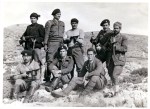
Patrick Leigh Fermor, center, with members of the team that abducted General Heinrich Kreipe: George Tyrakis, W. Stanley Moss, Manoli Paterakis, and Antoni Papaleonidas.

It has been said of Ulysses that, were Dublin ever obliterated, the city could be substantially rebuilt by consulting its pages. Along these lines, if all Europe were, God forbid, laid waste tomorrow, one might do worse than attempt to recreate it, or at least to preserve some sense of its historical splendor and variety, by immersing oneself in the travel books of Patrick Leigh Fermor.

by Ben Downing.

This text originally appeared in issue 165 of The Paris Review, Spring 2003.

Patrick who? Although popular both in his native England, where his books are available in Penguin paperback, and in many other countries—he has been translated into any number of languages—Leigh Fermor (who died in 2011) is known to only a devout few in this country, where, scandalously, his work is not distributed. I myself came to him three years ago, when a friend pressed me to seek out A Time of Gifts (1977) and Between the Woods and the Water (1986), the first two volumes of a projected trilogy about his teenage walk across Europe in the early thirties. By chance, that very week I stumbled across a used copy of A Time of Gifts. I began reading straightaway, but after a few pages stopped and rubbed my eyes in disbelief. It couldn’t be this good. The narrative was captivating, the erudition vast, the comedy by turns light and uproarious, and the prose strikingly individual—at once exquisite and offhand, sweeping yet intimate, with a cadence all its own. Perhaps even more startling was the thickness of detail, and the way in which imagination infallibly brought these million specificities to life. In the book’s three hundred or so pages, scarcely a paragraph was less than spirited, cornucopian, and virtuosic.

I am not given to idolizing writers or reading them entire, but this was a special case. Before long I had tracked down, whenever possible in their beautiful John Murray hardback editions, not only Between the Woods and the Water (which sees Leigh Fermor as far as the Iron Gates of the Danube) but also his remaining work—two travel books about Greece, one each about the Caribbean and Peru, a slim volume on monasteries, and a novella. Having devoured these, I started trying to find out more about Leigh Fermor himself. Piecing together information from his books and other sources, I came up with the following.

A clever but unruly student, Leigh Fermor was expelled from a series of schools and at sixteen dropped out altogether. After a period in London halfheartedly cramming for Sandhurst and (far more eagerly) partying with the last of the Bright Young People, he set out in December 1933 on his journey to Istanbul, which took him over a year. At this point the picture grew vague; there was some improbable story about his tagging along with a Greek royalist army as it quashed a rebellion, another about his falling in love with a Romanian princess.

The war years were somewhat clearer. Leigh Fermor enlisted with the Irish Guards; was commissioned in the Intelligence Corps; was sent as a liaison officer to the Greeks fighting the Italians in Albania; took part in the Battle of Crete; and escaped to Cairo in the general retreat. Having joined SOE (Special Operations Executive), he became one of a handful of officers secretly landed back on Crete, where, dressed as a shepherd, he lived in mountain caves and organized the guerilla resistance. His military career peaked in April 1944 when he led one of the most daring operations of the war. Disguised in Nazi uniform, Leigh Fermor and W. Stanley Moss, along with seven Cretan fighters, hijacked a car carrying General Heinrich Kreipe, commander of a division then occupying Crete. After bluffing their way—with Leigh Fermor impersonating Kreipe—past more than twenty checkpoints, they made for the mountains with their captive and spent three harried weeks dodging the thousands of troops sent to catch them, until finally a British boat slipped in to pick them up and take them to Cairo. For his role in the abduction Leigh Fermor was awarded the DSO.

After this the picture blurred again. I gathered that in the late forties and fifties Leigh Fermor had traveled at length in the Caribbean, Central America, and Greece; that he had hobnobbed—and often developed close friendships—with everyone from Diana Cooper to George Seferis; and that eventually he and his wife, Joan, had built a house in the Mani, a remote corner of the Peloponnese, where, reportedly, they still lived. But no more.

Even so, it had become clear to me that Leigh Fermor was not only among the outstanding writers of our time but one of its most remarkable characters, a perfect hybrid of the man of action and the man of letters. Equally comfortable with princes and peasants, in caves or châteaux, he had amassed an unsurpassedly rich experience of places and people. “Quite the most enchanting maniac I’ve ever met,” pronounced Lawrence Durrell, and nearly everyone who’d crossed paths with him had, it seemed, come away similarly dazzled. Also inspired, as witness this entry of 1958 from the Bloomsbury diarist Frances Partridge: “This evening over dinner the conversation turned to present-day pessimism, or cafard. Where can one look to find enthusiasm for living? I could only think of Paddy Leigh Fermor.”

Armed with this outline, I proceeded to write for The New Criterion a longish essay about Leigh Fermor, focusing mostly on his books. About two months later, in March 2001, I received a letter from him. An English friend of his had brought my essay to his attention. His response, infinitely gracious, concluded by exhorting me to drop in for “a proper feast” if ever I were in the area. That was all the invitation I needed. With typical American forwardness, I promptly called him and asked whether next month I and my wife, Michele, a fellow fan, might come and hang about for a few days, I perhaps interviewing him a bit. Whatever alarm he felt at the prospect of our invasion was muffled by good manners. He apologized for being unable to put us up—his sole guest room would be occupied that week—but said he could arrange accommodation at a nearby hotel, and that we would, of course, take all our meals with him and Joan.

Within hours I had booked our tickets.

* * *

Driving west from Athens, we crossed the Isthmus of Corinth onto the Peloponnese and spent the first night in the handsome seaside town of Nauplia. The next day we pushed on, marveling at the unaccustomed verdure—our previous visits to Greece had been in summer, when the heat turns everything brown—and at the profusion of flowers and blossoming Judas trees. After passing Sparta, we headed up into the Taygetus range, then down to Kalamata (of olive fame), where we swung south along the coast, and so to the village outside which Leigh Fermor lives, and which he has asked me not to name. Our Pisgah sight of the village was to be, our guidebook rather sternly declared, memorable: “Anyone who approaches it from these heights and is not moved by its combination of tiny islands, indented coastline, stone houses, and rugged hills, has the soul of a peanut.” Whatever the condition of our souls, they apparently are not leguminous, for we found the view every bit as sublime as advertised.

On arrival at the hotel, we discovered waiting for us at the front desk a welcome card that Leigh Fermor—to whom I shall, for the sake of brevity and informality, henceforth refer as Paddy—had dropped off earlier in the day. When I called him, he asked us to come round for dinner.

Shortly after dark, a rough dirt track brought us to the house. The front gate standing ajar, we entered and followed a lamplit cobbled path to an open door, which gave upon an L-shaped arcade. The sea could be heard heaving just below. As there was still no sign of life, we called out. A few seconds later, from one end of the arcade, Paddy and Joan emerged, greeted us warmly, ushered us into an immense book-lined living-cum-dining room where a fire crackled, and swiftly plied us with ouzo. (Their alcohol regimen, we soon discovered, dictates obligatory ouzo or vodka before dinner and red wine or retsina during; lunch is the same, minus the vodka option.)

Although immediately convivial, the Leigh Fermors had had a trying day. There had been some sort of plumbing trouble, which resulted in workmen ripping open part of the terrace. The dust kicked up by the jackhammers had irritated one of Paddy’s eyes, so that it now teared incessantly—and, as he pointed out, adopting a mock-plummy tone, “The other one weeps in sympathy.” Encouraged by his levity in distress, I reminded him of the light verse that he and his old friend John Julius Norwich had concocted together, which I had recently read in the first of Norwich’s delightful Christmas Crackers miscellanies. Over lunch, writes Norwich, he and Paddy “talked about how all Englishmen hated being seen to cry. Then and there we improvised a sonnet… The odd-numbered lines are mine, the even his.” The sonnet runs as follows:

 When Arnold mopped the English eye for good

And arid cheeks by ne’er a tear were furrowed,

When each Rugbeian from the Romans borrowed

The art of ‘must’ and ‘can’ from ‘would’ or ‘should’;

When to young England Cato’s courage stood

Firm o’er the isle where Saxon sows had farrowed,

And where Epicurean pathways narrowed

Into the Stoic porch of hardihood;

Drought was thy portion, Albion! Great revival!

With handkerchief at last divorced from cane,

When hardened bums bespoke our isle’s survival

And all the softness mounted to the brain.

Now tears are dried—but Arnold’s shade still searches

Through the groves of golden rods and silver birches.

Although Paddy laughed at recollection of the poem—“A bit feeble here and there, as it was done very fast”—he was clearly in agony. We suggested bandaging his eye, and once some tape and gauze were found Michele and I rigged up a patch of sorts. To find oneself, a few minutes after meeting one’s esteemed host, clumsily dressing his eye—this represents a curious and not unawkward turn of events. The fact that Joan already had (for reasons more serious than dust) a patch of her own added a weird hint of piracy. To our relief, Paddy again buoyed up the situation by hailing his wife as Long Joan Silver, who in turn joked, “But where’s my parrot?” Continue reading

Paddy’s Italian fans in the footsteps of Fermor and Moss

In the snow on top of Mount Ida

In the snow on top of Mount Ida

Some of Paddy’s fans from Italy recently struck out on an adventure in Crete to follow in the steps of Paddy and ‘Billy’ Moss and the rest of the abduction gang. They were on the route at the same time as Tim Todd and Chris White who, as regular readers will know, engage in some seriously detailed work on the route and the events of April 1944. However, the two groups did not manage to meet up in Crete, but did keep in touch with each other via the comments section of the blog!

Spiro Coutsoucos was leading the Italian group and passed me this short text explaining their motivation and a little about the journey which you can enjoy from the photographs that they sent me. The image of the crossing of Mount Ida is reminiscent of Moss’ own black and white image.

Most of us discovered Fermor (and the Peloponnese as well) thanks to “Mani”, which was the one and only book of Paddy’s translated into Italian until a few years ago. We are all good travelers and hikers and we love travel literature. Some members of the group were in Kardamili and hiked in Mani in spring 2009. We became more familiar on reading Paddy’s biography. After searching in vain for the abduction story among his other books we discovered Stanley Moss’s “Ill Met By Moonlight”. The next step was the exciting discovery of Tim Todd’s website.  And one day with Maria Cristina, who is our spring trek organizer we said… why not? Last winter we organized a meeting in Milan on the abduction story to propose the itinerary. A number of Italian fans of Fermor joined the meeting, some traveling considerable distances.

The next step was getting in touch with Cretan mountain guides to check the itinerary and locations.

We started hiking from Drossia, through Enagron, Axos, up to Anogia, Mount Ida, and down to Fourfouras, Petrochori, Ano Meros, Vrises, Ierakari. We then left Paddy’s way because we could not miss Moni Preveli. We rejoined Paddy’s footsteps again on Peristeres beach. Throughout the trek we enjoyed very pleasant weather, some very nice meetings with people related to Kreipe abduction, a huge amount of raki.  The whole team was very enthusiastic about our quest.

This slideshow requires JavaScript.

Dashing hero – champion sponger

Ooops! I have a feeling Mr Peter Lewis will not be on the Cooper-Beevor Christmas card list.

By Peter Lewis

First published in the Mail Online, 25 October 2012

When he died last year at the age of 96, Sir Patrick Leigh Fermor, DSO, OBE, inspired long and admiring obituaries. They described him as an intrepid traveller, war hero and ‘the greatest travel writer of his generation’.

All this is borne out in this admiring biography by Artemis Cooper, granddaughter of Lady Diana Cooper, who knew ‘Paddy’ since her childhood. So Artemis’s knowledge and access to his papers, letters, and many friends is unrivalled.

There is one disadvantage to being so close to your subject – a certain blindness to their shortcomings. Fermor was known above all for a charm that most people found irresistible. It allowed him to get away with selfish and unfeeling behaviour that wouldn’t have been liked in ordinary mortals.

And Sir Patrick was certainly no ordinary mortal. He decided when he was 18 to walk across pre-war Europe, from the Hook of Holland to Constantinople, as a tramp with only £1 a week to live on.

Later, as an SOE (Special Operations Executive) officer during the war in Crete, he carried out another audacious plan: to kidnap and deport General Kreipe of the German occupying army. This escapade is the highlight of the book.

After ambushing Kreipe’s car, Paddy – wearing German uniform – and his SOE partner Billy Moss, drove through Heraklion, the German headquarters, clearing checkpoint after checkpoint with the General pinned down in the back of the car. Paddy even issued curt orders to the sentries in excellent German.

After some grim hungry days and nights crossing the mountains with the entire German garrison searching for them, they were taken off in a boat to Alexandria. By then General Kreipe and Paddy were almost friends, having discovered a mutual love of the Latin odes of Horace.

Paddy won his DSO for his part in the plot, which was written about by Billy Moss in his book Ill Met By Moonlight. His account was subsequently filmed, with Dirk Bogarde playing Paddy.

Yet Paddy’s start in life was inauspicious. He hardly saw his father, who was an archaeologist working in India. His mother fostered him out for his first four years then despatched him to prep schools that he hated.

Wild by nature, Paddy was nothing but trouble – expelled from school after school and failing every exam. He wound up at 18 as an incorrigible drunk and party-goer.

Then he turned his back on all that to tramp diagonally across Europe and write about its gypsies, remote towns, forgotten villages and colourful peasant customs – indulging his insatiable curiosity for foreign languages, history and architecture. He had few advantages but youthful ones: great looks and physical fitness (like a Greek God, said an admiring Freya Stark); a natural ebullience and eagerness to learn; a quick ear for languages; and an amazing memory for detail.

Wherever he went, women and men – whether peasants or aristocrats – took to him and offered him hospitality. One introduction led to another.

He sometimes slept rough in stables and barns but this was interspersed, we now learn, with sojourns in the castles and country houses of the eccentric, amusing, minor nobility of Bavaria, Hungary, Bulgaria and Rumania (as Cooper spells it).

It was a very superior form of tramping. And at the end of it, he was swept off by a Rumanian princess who took him to live with her in her manor house. Most of his hosts had splendid libraries that he ransacked for knowledge of local history and customs, on which he became a living encyclopaedia. He also had a great capacity for carousing, whether with peasants or princes, talking all night and singing songs in many languages.

Cooper chronicles many a riotous evening among Greeks and Cretans with near-unpronounceable names, until they dissolve into an indistinguishable blur.

The trouble is there is just too much of Paddy’s charm and charmed life, and they begin to wear thin after the halfway point.

Delightful company as he no doubt was, he made a wide range of upper-class friends in England and abroad, in whose houses he was welcomed. In short he was a champion sponger. There are also awkward questions that are not satisfactorily answered, such as an ugly incident in Crete when he accidentally shot dead one of his partisans by easing the bolt of a rifle that had – unbeknown to him – a round up the barrel.

He made profound apologies to the man’s family, which unsurprisingly they did not accept. No trained rifle handler would fail to notice a cartridge in the breech nor test the gun’s action other than by aiming at the sky.

Also, the 1944 kidnapping of Kreipe led to savage German reprisals on Cretan villages, which were razed to the ground. In fact it served no strategic purpose other than to raise morale.

Paddy was welcomed back to Crete as a hero (though not by the family of the man he shot) but one wonders how happy he was about his jape in retrospect. It may be why he never published his version of the story.

There is also his cavalier attitude to money. He was always borrowing it, even from the adoring office girls of the British Consul in Athens – and not often paying it back. Chronically short of finance for his incessant travels, he never stooped to earning any, except for the occasional magazine article.

For years he was financed by the love of his life, Joan Rayner – a photographer he met in Cairo in 1944. She fell hopelessly in love with him, and they travelled together in Greece and the Caribbean, and shared her homes in London and Athens.

She was the ideal travelling companion, his best listener, who tolerated his late-night binges and even his affairs with other women. She was seen to give him money, saying: ‘That should be enough to get a girl.’ But he would not marry Joan, though she plainly wanted it. He  preferred what he called ‘intermittent concubinage’ with vague ideas of marriage, ‘which we talk of and then forget’.

They finally wed in 1968, 24 years after they met, ‘because it seemed idiotic not to’. By then they (or rather she) had bought land in a Greek bay and had built a fine house to settle in. Joan, it seems to me, is the real hero of this book.

The biggest and perhaps unanswerable question that nags throughout is: why did Paddy not get on with the writing, given his power with words? He had an ideally patient publisher, Jock Murray, who made him advance after advance on promised manuscripts, which Paddy spent on yet another journey or party.

When his books on Greece did appear, he got rave reviews and won prizes. Yet the magnum opus, the account of his youthful walk to Constantinople, remained unwritten for decades. The first part, A Time Of Gifts, was finished in 1977, followed by part two in 1986, more than 40 and 50 years respectively after the journey they described.

I have to admit that, dipping into them again, I would never guess that a man of almost 60 was describing his experiences at 19. And the last words of the epic were ‘To Be Concluded’. It never was.

Cooper’s biography, though enjoyable and spirited, is essentially a flawed book about a flawed character.

Many writers have remorselessly neglected or exploited others in their compulsion to write. Fermor did so while producing surprisingly little. What there was, however, was worth it.

Sunday Times review of Patrick Leigh Fermor: An Adventure

I was sent this review by good friend Chris Hammond.

Click this link to open the pdf.

A man so charming he won over his hostage

Charles Moore reviews ‘Patrick Leigh Fermor: an Adventure’ by Artemis Cooper (John Murray) 

By Charles Moore

First published in the Daily Telegraph 08 October 2012.

The single most famous story about Patrick Leigh Fermor is his kidnap of the German General Kreipe in occupied Crete in 1944. The fugitive party of two British officers and three Cretans spent an uncomfortable night on the slopes of Mount Ida. As the dawn broke, and lit the mountain, Leigh Fermor heard the General muttering the first line of Horace’s Ode to Thaliarchus: “See, Soracte’s mighty peak stands deep in virgin snow.” Leigh Fermor recognised the Latin, and quoted the rest of the poem. As he later put it, “…for a long moment, the war had ceased to exist. We had both drunk at the same fountains long before; and things were different between us for the rest of our time together.”

This moment of ancient, shared civilisation overcoming a terrible present is a great theme. It is the subject, for example, of Jean Renoir’s film La Grande Illusion, in which a French and a German officer on opposite sides in the First World War feel that they share what really matters.

Leigh Fermor’s long life (he died last year aged 96) was full of dash, variety and colour. He wrote beautifully, and entranced beautiful women. He was physically brave, and travelled widely, intrepidly and observantly. He was, in a self-taught way, learned, and a superb linguist. He could sing, dance, compose impromptu poetry and make everyone laugh. He and his wife Joan built a house in Greece of such character and interest that John Betjeman called it “a book in itself”. He was a war hero and, like Byron, a model for many aspiring writers greedy to combine art and life, rather than choosing between one and the other. I knew Paddy a bit myself, and I have never met a man with more charm, by which I mean the ability to create in his interlocutor the feeling of pleasure and possibility. But was it all a grande illusion, a wonderful holiday from reality?

Artemis Cooper was a family friend of Leigh Fermor, and loved him dearly. This excellent, well-sourced book is sympathetic to him. But she is aware of how he could be painted differently, and states the case. Was he, for example, a show-off and a sponger (he was chronically short of money and depended heavily on Joan’s private income)? Was he, as Somerset Maugham put it, “a middle-class gigolo for upper-class women”? Was he, both in life and art, a sort of Peter Pan, shying away from anything grown-up (such as fatherhood), always looking for a Wendy so that he could go on having smiling, heartless fun? He was once asked to contribute to a book about great parties in history with the astonishing title of Memorable Balls: does the phrase fit the life of Patrick Leigh Fermor?

There are certainly moments when it feels like it. The information that Joan used to give him cash so that he could visit prostitutes is one. So – though there is artistic reason for it – is his tendency to present the product of his imagination as fact. Some even argue that the famous kidnap was a piece of useless swagger – what Kreipe called a “hussar-stunt” – which ensured that the Cretans, in reprisal, were treated even more bestially by the Germans.

One cannot ignore these criticisms, and Leigh Fermor felt them himself. Like many delightful, gregarious companions, he doubted whether he deserved to be loved. But, in Artemis Cooper’s convincing reading, he wins in the end.

First, he wins as a friend. He was always grateful to people who helped him (not a well-known characteristic of most writers). He thanked them beautifully, and he did what he could to help them in return. He was famously hospitable, and his life was cluttered by efforts to advance the careers of others, particularly impecunious Greeks. As an editor, I quite often asked Paddy to write things. Most commissions would be refused or – he was famous for this – arrive incredibly late, but whenever I asked him to contribute a memoir of a friend who had just died, he did it with great speed and generosity.

Second, he wins as a writer. Not everyone likes what Lawrence Durrell called (in praise) his “truffled style”, but, unlike so much “fine writing”, it is saved by its energy and wit, its close attention to detail, and its astonishing virtuosity.

I think the friendships and the art went together. Leigh Fermor was profoundly sensitive to human character, particularly in its oddities. His interest in peasants, or monks, or petty gentry, cut off from industrialisation, his fascination with their traditions and customs, their languages and dialects (the more obscure the better) was a human interest, not an academic one. He loved them, and he wanted to rescue and decorate their story.

His most famous books, A Time of Gifts and Between the Woods and the Water, describe his journey on foot, which began in 1933, from the Hook of Holland to Constantinople. They capture, with painterly vividness, what he saw and whom he met. And because those scenes and people were almost obliterated by the Second World War and then by communism, by writing about them afterwards, he gave them the eternal status of literature rather than mere memoir.

In the early Seventies, Greek television did a sort of This is Your Life, in which Leigh Fermor was reunited with his Cretan companions and with General Kreipe himself. How had Paddy treated him, journalists asked the general. “Ritterlich. Wie ein Ritter,” Kreipe replied – “Chivalrously. Like a knight.” Possibly such virtues are dead, but if so, we are the poorer. In life and in literature, Patrick Leigh Fermor proved that chivalry was not all illusion.

Related article:

Patrick Leigh Fermor … This is Your (Ill Met by Moonlight) Greek Life

Patrick Leigh Fermor: extract from the new biography

Patrick Leigh Fermor with Billy Moss in Crete, April 1944, wearing German uniforms Photo: Estate of William Stanley Moss, by permission

The Telegraph ran an extract from the biography over the weekend. It was the Kreipe kidnap again!

In an extract from her life of the travel writer and war hero Patrick Leigh Fermor, Artemis Cooper chronicles a daring kidnap in wartime Crete.

First published in the Daily Telegraph 29 September 2102.

After months of training in clandestine warfare in Palestine, Paddy Leigh Fermor joined the handful of SOE officers in occupied Crete who were working with the Cretan resistance in June 1942. His big chance came in the autumn of the following year when he formulated a plan to kidnap a German general: not just any general but the hated Gen Friedrich-Wilhelm Müller, responsible for the butchery of the Viannos villages in September 1943. Supposing Müller were kidnapped and whisked off the island? At a time when Greece was beginning to feel like a backwater as the war pushed up through Italy, an operation of this kind would generate a lot of noise and publicity: it would make the Germans look remarkably foolish, and give a terrific boost to Cretan morale.

Despite questions being asked about the mission because of the risks it posed to Cretan lives, the plan went ahead on January 6 1944. A car came to pick up Paddy and his number two, Billy Moss, a young Coldstreamer who had had a spell guarding Rudolf Hess, in the early hours of the morning, and drove them to Heliopolis where they met the rest of the party.

They flew to an airstrip east of Benghazi, where they spent two miserable weeks in sodden tents waiting for the weather to clear. Since it refused to oblige, they were flown to Bari, hoping for better flying conditions there. On February 4 they took off from Brindisi for Crete, aiming for the Omalo plateau, a tiny, shallow bowl in the jagged, snow-covered peaks in the mountains south of Neapolis. For the pilot, the zone was so restricted that the team could not be dropped in a “stick” formation – he would have to circle and come in again four times, dropping each man off individually.

Snow and loose cloud swirled around the open bomb-bay, and far below they could see the dropping zone marked by three pinpricks of light formed by three signal fires. Paddy was the first to jump. Welcoming Cretan hands hauled him to his feet, and then all eyes turned again to the snow-streaked sky. Paddy gave the all-clear with a torch to signal his safe arrival, but the clouds were thickening and the pilot could no longer see the signal fires: he was forced to turn back.

The bad weather continued. Paddy spent the next seven weeks in a cave with Sandy Rendel, the SOE officer in charge of the Lasithi area. But in late March came news that threw the whole mission into question. The intended victim, Gen Müller, had been posted to Chania as commander of Fortress Crete. SOE Cairo was informed, but decided to go ahead with the operation anyway. After all, the aim was to boost Cretan morale and damage German confidence; from this standpoint, one general was as good as another. Continue reading

Rory Cooper at Souda Bay and Chania

The pictures below were sent in by Rory Cooper who is a regular correspondent to the blog.

Hello Tom,

Am in Crete at the moment and have just come back from a visit to the CWGC in Souda Bay where John Pendlebury is buried. Here are a couple of photos as well as one of Gen. Kreipe from the Maritime Museum in Chania.

I have acquired a copy of the Erotokritos and will attempt a translation, although I have few illusions about making sense of 17th century Cretan dialect.

All the best,

Rory

The Kreipe pennants – the story of their rediscovery by Billy Moss’ daughter

The pennants from General Kreipe’s car

Discovering the full details behind a particular story or event is often tricky with clarifications, enhancements, or downright contradictions emerging sometimes many years after the event. Fortunately we have not had to wait so long for some further detail to be added to the story I ran last year about what happened to the pennants on General Kreipe’s car at the time of the kidnap, and their subsequent discovery many years later.

‘Billy’ Moss’ daughter Gabriella Bullock read Artemis Cooper’s account of how the pennants were found after so many years in a trunk in Paddy’s house at Kardamyli. Gabriella then wrote to me to ask me to pass on the full story behind their (very fortunate) re-discovery in Ireland some years before and how they were passed by her mother (Sophie Moss née Tarnowksa) to her. It sounds like we are very lucky to have them at all.

Gabriella’s account starts during a recent visit to Crete …

In Rethymnon we met the delightful people who run the Folklore Museum. This is where the pennants from the General’s car are now housed, in accordance with PLF’s wishes. We found that they were very interested in the story of how the pennants were randomly and luckily rediscovered, and this leads me to think that the story definitely has a place on your website

In the early 1950s my family lived in Co. Cork, Ireland, but moved back (supposedly temporarily) to London in 1954. My parents intended to return, and left many of their possessions in the safe-keeping of various Irish friends or in store. My father never did go back to Ireland; indeed, in 1957, eight years before his death in 1965, my father also left England never to return. As things turned out, however, it was also many years before my mother went back, and all that had been left in storage was lost.

A number of years after my father’s death my mother bought a cottage near Cork, and thereafter divided her time between London and Ireland. I was staying with her at the cottage one summer in the late 1970s when a friend of hers announced that she had a trunk belonging to us which she wanted to return; it had been sitting in their attic since the 50’s.

A battered tin trunk duly arrived with my father’s name, rank and regiment painted on the outside in white. My elder sister has it now and it is, without doubt, the one described in the first chapter of our father’s book A War of Shadows, even down to the grains of sand:

“an old letter, a scrap of notepaper smeared with the sweat of one’s hip-pocket, the rain-spattered pages of a diary, an operational report written in the bloodlessly forbidding vocabulary of a headquarters’ clerk – these relics, discovered in a tin trunk which still creaks with grains of sand when you open the lid…”.

My mother opened and unpacked it, and said to me, “I think you’d better have these”. Amongst the things inside it were my father’s original diary, already entitled Ill Met by Moonlight, in remarkably good condition and perfectly legible, and the two German pennants.

It was a heart-stopping moment. My mother gave these things to me, and I gratefully and unthinkingly received them. I was in my mid-twenties then. The diary I still have. As for the pennants, they were much prized, and adorned a wall in my house for nearly 15 years.

But one day about 17 or 18 years ago, when I was re-reading IMBM, it dawned on me for the first time that in fact since it was Paddy who had taken them as trophies from the General’s car, they were rightfully his. So I gave them to him. This was in the early 90’s. Paddy was completely astonished, and moved, to see them again, so unexpectedly, after 50 years! He was awfully pleased, and after his death they were donated to the Folklore Museum in Rethymno, in accordance with his wishes.

And now they are back in Crete, which is absolutely as it should be.

With best wishes,

Gabriella Bullock

Further reading:

The Kreipe pennants

Articles about the kidnap in the Ill Met by Moonlight category

Previously unpublished images from the Kreipe kidnap

William Stanley Moss, PLF, and Manoli pose for photos before the kindap of General Kreipe

Paddy and ‘Billy’ Moss in a cave

I am very grateful to John Stathatos who sent these pictures from his family’s Cretan archive. The first with Manoli is one that I don’t think we have seen before in this setting.

I’m sending you a little present for the blog – scans of four original photographic prints of the Kreipe operation which I’ve dug out of the family archives.

The prints are on glossy photographic paper, and must have been produced by the British army press and propaganda section in Cairo very shortly after Paddy’s return. They were given a narrow white border, and all four have very slightly different dimensions, ranging from 185×143 mm for the vertical one to 147×199 mm for the group photo. They are in remarkably good shape considering their age, showing no evident deterioration beyond a very slight yellowing.

Note: certain of these images are kindly shown here by permission of John Stathatos. Please ask if you wish to reproduce.

Other pictures provided by John:

A map of Crete as drawn by Paddy on operations in Crete

Traveller’s Rest

New – Full length interviews with Kreipe and Paddy

We have all seen the famous 1972 video of Nico Mastorakis’ TV show “This is Your Life” which brought Kreipe and his old enemies together before the cameras. If you have not seen it you can find it here.

In this newly discovered video Nico Mastorakis presents a documentary about the whole kidnap event, and includes full length and exclusive interviews with Paddy and General Kreipe. The General even says that “next year I will spend my holiday in Crete.” I wonder if he ever did?

There is much more about the kidnap in the Video and Audio section. Take a visit now.


Reg Everson and his powdered egg breakfast for General Kreipe on Mount Ida

At Paddy’s funeral last year, I stayed afterwards for a drink with a small group at the hotel  which used to be the Dumbleton estate manor house, originally home to Joan’s family. A man from Wales introduced himself as Vince Tustin. I recognised the name as I had been in touch with Vince by email in the preceding weeks on the subject of his father-in-law who was in the SOE.

‘Reg Everson, my father-in-law, spent three years on Crete and much of that time he worked closely with Paddy as a radio operator.’ said Vince.

His wife then joined us and after a while she said ‘I asked my mum and dad why I was called Patricia. It was an unusual name for a girl in Wales at the time. And my dad told me I was named Patricia after his good friend Patrick Leigh Fermor. They had served together in Crete.’

Such was the impression that Paddy made on people. It is a lovely story in itself, and perhaps serves a reminder on this first anniversary of his death, that Paddy affected the lives of  many, in different ways, as a man as well as a writer.

Vince told me that in the 1950’s Reg was interviewed by a local reporter.

I am sure that Reg didn’t want it to sound as if he was alone [on Crete]. He was a quiet mild mannered gentleman, and was in the Royal Signals from 1931 to 1946 and like so many servicemen lied about his age to get in, he was only 15 when he enlisted. For the three years he was on Crete his wife didn’t hear from him. His commanding officer was the only contact she had. People in the village even thought Reg had left her!

It wasn’t until I wrote a piece in the local paper that people understood where he had been because he didn’t speak about it. In the newspaper cutting from the 50s Reg talks about his involvement in the kidnap of General Kreipe and how he cheered up the General by making him some powdered egg for breakfast on Mount Ida.

We have his forged Cretan papers here, also a leaflet that was dropped by the Germans. He was awarded the Military Medal and Africa Star among other medals. He was also presented with a solid silver medal for bravery from the Maharaja of India.

Reg Everson deployed to Crete with Xan Fielding, and Xan refers to this in his account of his time in Crete “Hide and Seek”.


In the newspaper interview Reg describes how he was summoned with his radio to Mount Ida to join the kidnap gang, but he had to wait for his heavy radio batteries to arrive so he made himself useful and he made breakfast for the General on Mount Ida …

“The General was pretty glum, but he perked-up a bit when I made him some breakfast with egg powder. Paddy Leigh Fermor and the others had to go on the run again with General Kreipe before my batteries arrived: so we couldn’t get the news [of the successful kidnap] back.”

Whilst we often hear the stories of the officers in SOE, we should not forget that they were supported by a large team including signallers such as Reg Everson who were especially brave. They risked being located by the Germans who were constantly trying to find the source of their signals to destroy the radios, and capture the highly skilled and valuable operators.

Patrick Leigh Fermor: We May Just Forget to Die, an essay by Margot Demopoulos

This is the probably most significant full length profile of Paddy that has appeared since his death. It is by Margot Demopoulos a writer who lives and writes in Los Angeles. Her fiction has appeared in The Briar Cliff Review, Mondo Greco, The Athenian, and other publications.

The interesting aspect of this profile is an extensive exploration of the events surrounding the Kreipe kidnap with particular attention to the contentious subject of post-operation reprisal by the Germans.

The subject line appeared in an earlier blog post from June 2011 where I highlighted Diana Gilliland Wright’s correspondence with Paddy.

On to the profile ….

“Englischer Student . . . zu Fuss nach Konstantinopel…” eighteen-year-old Patrick Leigh Fermor told the kindly woman sewing by the fire that snowy night at Heidelberg’s Red Ox. He sat at a nearby table, recording the day’s events in a notebook, hunting for German words in a dictionary, consulting maps for the next leg of the journey, “thawing and tingling, with wine, bread, and cheese handy,” as melting snow pooled around his boots.

“Konstantinopel?” Frau Spengler said. “Oh Weh! ” O woe! So far!

Far indeed, especially in the snowdrifts of mid-winter, but there he was — undaunted, spirits high, finally setting out on his own path — nearly two months into his journey to cross Europe on foot, with Constantinople the terminus. Nearly forty-five years later, he would publish the story of that journey in A Time of Gifts. Read More ….

Access the pdf of the article here.

London Gazette Moss MC and Fermor DSO announcement

Billy Moss and Patrick Leigh Fermor

A copy of the Supplement to the London Gazette dated 13 July 1944, which announces the award of the Distinguished Service Order to Captain (temporary Major) Leigh Fermor and the Military Cross to Lieutenant (temporary Captain) Stanley Moss.

You can find the pdf here Moss MC and PLF DSO announcement (once open scroll down) or an online link here.

A Year of Memory: the top ten posts on the Patrick Leigh Fermor blog

As the year comes to a close it is time to reflect upon what has passed and to look forward to 2012. I make no predictions for the coming year. There are some things which are almost certain such as the continuing Euro crisis and the much anticipated publication of Artemis Cooper’s authorised biography about Paddy, but forecasts tend to be overtaken by events and are quickly forgotten.

What we can do is to look back on this year in the life and times of Patrick Leigh Fermor. The major event of course was Paddy’s death on 10 June at the age of ninety-six. A sad event for his family and close friends, but also for those of us who admired him for his writing and the life he lived. As the year closed it was time to celebrate his life at his Memorial Service held on 15 December in London.

As I hoped the blog has become a significant source of material about his life including rarely seen video. There have been over 228,000 visits over the last year and you have made it a much more interactive experience by using the comment facility to exchange information, provide your own memories of Paddy, and to express your admiration for him. At the time of his death I opened a page where you could express your thoughts about Paddy which has run to over 120 comments.

Paddy would probably have been somewhat bemused by the whole idea of the blog, but perhaps even more so by the interaction we now have with social networking sites with nearly 4,500 visitors finding the site from Facebook, and 850 via Twitter.

To conclude the year, and as the 365th post on the blog, let us take a look at some of the most popular articles over the last twelve months. Perhaps I can make one promise to you all which is that there is much more to come on the blog in 2012 which includes a lot of material submitted by you the readers of the blog.

The Funeral Service of Patrick Leigh Fermor, 16 June 2011 

Paddy’s funeral service was held on a typical English summer’s day at his home in Dumbleton. He returned to England just one day before his death and is buried beside his beloved Joan.

Obituary from The Independent by Paddy Leigh Fermor’s biographer Artemis Cooper 

Perhaps the definitive obituary.

Patrick Leigh Fermor … This is Your (Ill Met by Moonlight) Greek Life 

The amazing video from the Greek TV programme which reunited the participants of the Ill Met by Moonlight kidnap including Paddy, many of the Andartes, and General Kreipe and his wife.

Anthony Lane’s New Yorker article on Fermor is now free to view 

One of the most comprehensive profiles of Paddy which is now freely available to all. (the pdf download appears to be no longer available – click on the article to magnify to read and then drag your cursor to move around the page)

Intimate portraits from Kardamyli by Miles Fenton 

A series of personal photographs sent to me by Miles Fenton who is Paddy’s nephew and who now lives in Canada where he works as an artist.

Patrick Leigh Fermor recounts the kidnap of General Kreipe on video 

The ever popular video where Paddy talks in some detail about the Kreipe kidnap. (press play on Battle of Crete 7).

Colonel David Smiley 

David Smiley was a fellow occupant of Tara in Cairo with Paddy and Billy Moss et al who continued his military career with some distinction after the war and even led Japanese soldiers in a charge against VietMinh rebels!

Paddy’s eye for detail: Ian Fleming, Bondage, James Bond and Pol Roger 

It is probably the James Bond/Ian Fleming association which maintains the popularity of this article.

If food be the music of love … Bánffy’s lover in Cluj (Kolozsvár) 

No list of popular posts can be complete without the compelling combination of my passions for Paddy, Romania, Miklós Bánffy, and Cluj.

Patrick Leigh Fermor Memorial Order of Service 

The order of service from the joyful occasion that was Paddy’s Memorial Service.

Finally I would like to thank so many of you for your encouragement and support during 2011, and wish you all a very Happy New Year!

Tom Sawford

Visionaries Who Changed Our World

This review is apparently about ‘the minds we will miss’ and actually it is pretty good. It starts with a picture of the recently departed Peter Hitchens. I am not sure about – “They opened doors, blazed trails, and left us all too soon.” – the left us too soon part is perhaps not something we can truly say about Paddy but the sentiment is well understood. It also has a link directly to the blog.

Patrick Leigh Fermor

Ulf Andersen / Getty Images from Newsweek.

Travel Writer, 96

He was a rare blend, penning some of the most memorable travel books of the 20th century and capturing a Nazi commander in Crete. Leigh Fermor related his adventures—watching a voodoo ceremony in Haiti, living with Trappist monks—in dazzling prose with a deep pathos for every place he visited.

Snail’s pace to Byzantium: journey of a lifetime

This is a combination of profile and review of Words of Mercury. An interesting piece.

by Ann Elder

First Published in Athens News, 9 Jan 2004

“I HATE the word travel-writer,” London-born, Mani-based Patrick Leigh Fermor told a British journalist in 1995. Under the title Words of Mercury, a selection of his writings was published by John Murray this autumn. The excerpts from half a dozen of his books, some articles and reviews show clearly why he must flinch from being slotted anywhere confining.

As his followers know, he writes with an enchanted pen. Any topic he takes up becomes something ‘rich and strange’. He has a story-teller’s knack of compelling interest, like the Ancient Mariner mesmerizing listeners with his glittering eye. And he has a particular flair for catching the heightened receptivity and visceral thrill felt at new encounters, what Cavafy wished the traveler in his poem Ithaka:

Pray that your journey may be long,
that many may those summer mornings be
when with what pleasure, what untold delight
you enter harbours never seen before.”
(Kimon Friar translation)

Not least, Leigh Fermor wins readers’ allegiance by creating the sense of affinity with an engaging personality, uncensorious, untinged by chauvinism, reveling in life, akin in spirit to A E Housman, onetime professor of Latin at Cambridge, in his lines:

Could man be drunk forever
With liquor, love or fights
Lief should I rouse at mornings
And lief lie down at nights.

Edited by Artemis Cooper, a writer (Cairo in Wartime) and wife of historian Antony Beevor (Crete: The Battle and the Resistance), the book has five parts: travel, Greece, people, books and flotsam (finishing with a poem on Christmas maybe better forgotten). Cooper gives brief introductions to each piece and starts off with a succinct biography.

As an 18-year-old living on a pound a week in a flat off Picadilly in 1933, Leigh Fermor spent more time partying than buckling down to write. As fate had it, he had read The Station: Athos: Treasures and Men by the irreverent young Robert Byron in 1928. The ‘great and misunderstood spirit of Byzantium’ had greatly impressed him.

“About lamp-lighting time at the end of a wet November day, I was peering morosely at the dog-eared pages on my writing table,” he related later. “A plan unfolded – to set out across Europe like a tramp – a pilgrim or a palmer, an errant scholar, a broken knight.”

“The chief destination was never in a moment’s doubt. The levitating skyline of Constantinople pricked its sheaves of thin cylinders and its hemispheres out of the sea-mist; beyond it hovered Mount Athos; and the Greek archipelago.”

In excess of his wildest dreams, he found material to write about. All was grist to his mill, but his mill ground slowly. His writing proved to require long gestation. He became fanatical about polishing his product, and research, the more obscure, the more it seemed to appeal to him, like the origins of the Sarakatsans or the Laz-speaking Greeks of Trebizond. The first book about his venture, A Time of Gifts, came out in 1977, over 40 years later, and the second, Between the Woods and the Water about “those mysterious regions between the Vienna Woods and the Black Sea” as Saki put it – in 1986. In France they called him “l’escargot (the snail) of the Carpathes.”

Real life and events also delayed his writing. The trek took him about a year. He reached his goal on New Year’s Eve, 1934, after ending his traverse of Bulgaria with a splash, falling into the Black Sea on a cold December evening. He came to the coast some 150 miles north of the Bosphorus. “An old man was smoking a narghileh on the doorstep of a hut beside a little boat beached among the rushes – a Tartar fisherman, the only human being I saw all day,” he  wrote over 20 years later in an article in the May 1965 Holiday Magazine.

Darkness fell. “I lost my footing on a ledge and skidded – waist-deep into a pool. Jarred and shaken, with a gash on my forehead and a torn thumb, I climbed out, shuddering with cold. At the bottom of the pool, about two fathoms down, my torch was sending a yellow shaft through sea anemones and a flickering concourse of fish.”

Crawling round the rocks, he came to a veritable Cyclop’s cave sheltering a dozen Greek fishermen and Bulgarian goatherds with their 50 goats and cheese-making apparatus, eating lentils by a thornbush fire. The young wayfarer was soon dried and warm, tossing back slivovitz and eating fresh fried mackerel.

Leigh Fermor is in his element in the climax of this thoroughly Homeric episode, when one of the Greeks, Costa, turns out to be an unsung Nijinsky, his dancing invested with a ‘tragic and doomed aura.’ He performed the stunt  with which Greek cruise ships like to wind up their Greek night shows: dancing with a table between the teeth.

“On a rock, lifted there to clear the floor, the low, round, heavy table was perched. Revolving past it, Costa leaned forward: suddenly the table levitated itself into the air, sailed past us, and pivoted at right angles to Costa’s head in a series of wide loops, the edge clamped firmly in his mouth and held here only by his teeth. The dancer whirled like a dervish, till the flying table melted into a disc, finally returned to its rock, glasses, cutlery, lentil pot and cigarette burning on the edge of a plate undisturbed.”

Time in Greece he dates from his 20th birthday, February 11, 1935, when he arrived at Mt Athos as ‘snowflakes were falling fast’ and ‘in deep snow, trudged from monastery to monastery.’ In Athens later, he frequented the  Romanian embassy, meeting descendants of Phanariot hospodars, Ypsilantes, Ghikas and Cantacuzenes. As with Greece, he fell in love with Balasha Cantacuzene whose forebear, Emperor John Vl, invited the Seljuk Turks to  Europe (and is recalled sorrowfully in a Cavafy poem for having coloured glass not jewels in his coronation crown).

After time writing and painting in an old mill among the lemon groves overlooking Poros, they went to her decaying family estate in Moldavia. Published in 1961 was a perfectly pitched account of a picnic in sunlit  countryside by open carriage and on horseback on September 2, 1939, the last day of peace. “It had been a happy day, as we had hoped, and it had to last us a long time, for the next day’s news scattered the little society for ever.”

Utterly desolating is the Daily Telegraph weekend magazine article of May 1990 on his first breaking through the Iron Curtain in 1965. He found the Cantecuzene sisters in a Bucharest attic eking out a communist state pension  teaching. The gracious old houses he had stayed in among flowery meadows and nightingale-filled woods were psychiatric hospitals, their owners dead.

Leigh Fermor seems happiest gilding the past, writing to ‘the brave music of a distant drum,’ as old Khayyan put it, not dwelling on ‘bitter furies of complexity’ or ‘that gong-tormented sea’ of Yeats’s “Byzantium” which he refers to at the outset in Time of Gifts. The days of his youth were the days of his glory and he evokes them with zest, if no doubt some selective memory. He admits he is beset with ‘retrogressive hankerings,’ but these add to the richness of the embroidered prose dazzling his readers, to twist Yeats a bit. And sometimes he might be shoulder-to-shoulder with the poet:

Of all Arabia’s lovers I alone
Nor dazzled by the embroidery, nor lost
In the confusion of its night-dark folds,
Can hear the armed man speak.

His review of Edmund Keeley’s Cavafy’s Alexandria in a 1977  Times Literary Supplement (TLS) shows him at his serious best. He recalls “the blacked-out, jolly, rather wicked wartime port” he knew as a young British World War Two agent, then is off with Cavafy into the Judaeo-Hellenic Franco-Levantine city “old in sin, steeped in history, warrened with intrigue.”

He notes the depths of irony and dark humour in the notion of citizens aghast with consternation when the barbarians fail to invade them on cue. He ponders “the jagged Ithaka at the long Odyssey’s end; the imminent Ephialtes ready to sell the Thermopylae of the spirit.” He goes on: “Issued without preamble from an atmosphere of earthly delights these warnings sound as harsh, for a moment, as the words of Mercury after the songs of Apollo at the end of ‘Love’s Labour’s Lost.'”

Leigh Fermor is a mild Mercury though. In a review of Oxford classicist CM Bowra’s Primitive Song in a 1962 Spectator he commends him for eschewing ‘a softer technique, swaying to the seductions of every coincidence  and historical chance-shot.’ He himself tends to yield to the tempting vistas of ‘alluring byways.’

The selections from his writings on Greece include a report he wrote for London’s Imperial War Museum archives in 1969 on how the German commander General Heinrich Kreipe was abducted by a Cretan-British force he led in April 1944. While still controversial, the coup makes a cracking good story.

At Anoyeia where captors and captive rested, villagers were ‘convulsed by incredulity, then excitement and finally by triumphant hilarity. We could hear running feet in the streets, shouts and laughter. “Just think, we’ve stolen their General!”‘

Heading south round Psiloritis – Mt Ida of antiquity, over 2,200 metres high and snow-covered till late May – the getaways were to meet a British vessel on the coast to spirit them to Egypt. After a night in a shepherd’s hut sharing  one blanket, “a brilliant dawn was breaking over the crest of Mt Ida which we had been struggling across for two days. We were lying smoking in silence, when the General, half to himself, slowly said (in Latin): ‘See, how it stands, one pile of snow’. I was in luck. It is the opening line of one of the few odes of Horace I know by heart. I went on reciting where he had broken off (likewise in Latin);

‘neath the pressure yield
Its groaning woods; the torrents flow
With clear sharp ice is all congealed.
Heap high the logs, and melt the cold,
Good Thaliarch; draw the wine we ask,
That mellower vintage, four-year-old,
From out the cellar’d Sabine cask.

(Conington’s translation)

The stanzas are much-loved, ‘a picturesque Christmas card,’ say scholars. They evoke the perfect ambience in which to peruse the book. Those unfamiliar with Leigh Fermor will surely have appetites whetted for more. Those who know him and have his books around will dash for them to locate the extracts, then hotly debate the choices, such as the punning Achitectural Notes from a 1994 Spectator: “If you squinch, aisle screen,” and “Put those Saxon  here Norman,” and “Overhung? Per apse, when dais done.”

The author has covered himself. “Pure nonsense is as rare among the arts as an equatorial snowdrop”, he wrote in a review of George Seferis’s Illustrated Verses for Small Children in a 1977  TLS.

William Stanley Moss

"Billy" Moss with his Russians

There appears to be no surviving obituary for Billy Moss (if anybody can find one please contact me). His Wikipedia page has to serve as a substitute.

Ivan William “Billy” Stanley Moss MC (1921–1965), was a British army officer in World War II, and later a successful writer, broadcaster, journalist and traveller. He served with the Coldstream Guards and the Special Operations Executive (SOE). He was a best-selling author in the 1950s, based both on his novels and books about his wartime service. He featured events of his SOE years in Ill Met by Moonlight: The Abduction of General Kreipe (1950), which was adapted as a British film released under the main title in 1957. Moss travelled around the world and went to Antarctica to meet the Commonwealth Trans-Antarctic Expedition.

He was known as William Stanley Moss, or I. W. S. Moss, or W. Stanley Moss, or plain Bill or Billy Moss – but never as “Stanley Moss”.  Stanley was the surname of a female forebear.  All family members (including Billy and his two daughters) were given this name, which was considered part of the surname, though not hyphenated.  Much like “Leigh Fermor”.

Early life and education

William Stanley Moss, (called Bill or Billy) was born in Yokohama, Japan. His mother was a White Russian émigrée, and his father, an English businessman. The family survived the 1923 Great Kantō earthquake. Moss attended Charterhouse in England (1934–39).

Soldier

In the autumn of 1939, Moss, aged 18, had just left Charterhouse and was living in a log cabin on the Latvian coast. By the outbreak of war, he reached Stockholm, and succeeded in crossing the North Sea to England in a yacht. After full training at Caterham, he was commissioned as an ensign into the Coldstream Guards. He served on King’s Guard at the Court of St. James’s punctuated by bouts of Churchillian duty at Chequers.

Posted to reinforce the 3rd Battalion, the Coldstream, after the losses at Tobruk, Moss fought with Montgomery’s Eighth Army chasing Rommel across North Africa to Alamein and finished up the campaign in Chianti and Pantellaria. He returned to Cairo, where he was recruited into Force 133 of the Special Operations Executive (SOE).

Tara, Cairo

In 1943 in Cairo, Moss moved in to a spacious villa, with a great ballroom with parquet floors, which four or five people might share. Moss chose to live in the villa rather than the SOE hostel, “Hangover Hall”. He moved in alone at first, then bought his Alsatian puppy, Pixie; Xan Fielding, who had worked in Crete, joined him. Next was Countess Zofia (Sophie) Tarnowska, forced to leave Poland in 1939 by the German invasion, followed by Arnold Breene of SOE HQ. Finally Patrick Leigh Fermor, an SOE officer who had spent the previous nine months in Crete, joined the household. The villa’s new inhabitants called it Tara, after the legendary home of the High Kings of Ireland.

Sophie Tarnowska and two other women had been asked to share the house with the SOE agents, but only she went through with it, after the men pleaded with her not to let them down. Estranged from her husband, she moved in with her few possessions (a bathing costume, an evening gown, a uniform and two pet mongooses). She protected her reputation while living in the all-male household by the invention of an entirely fictitious chaperone, “Madame Khayatt”, who suffered from “distressingly poor health” and was always indisposed when visitors asked after her. The group were later joined by SOE agents Billy McLean, David Smiley returning from Albania, and Rowland Winn, also active in Albania.

Tara became the centre of high-spirited entertaining of diplomats, officers, writers, lecturers, war correspondents and Coptic and Levantine party-goers. The residents adopted nicknames: “Princess Dneiper-Petrovsk” (Countess Sophie Tarnowska), “Sir Eustace Rapier” (Lt-Col. Neil (Billy) McLean), “the Marquis of Whipstock” (Col David Smiley LVO OBE MC), “the Hon, Rupert Sabretache” (Rowland Winn MC), “Lord Hughe Devildrive” (Major Xan Fielding DSO), “Lord Pintpot” (Arnold Breene), “Lord Rakehell” (Lt-Col Patrick Leigh-Fermor DSO) and “Mr Jack Jargon” (Capt W. Stanley Moss MC). By the winter of 1944, the Tara household had to leave their battered villa and move into a flat. Their landlord secured their eviction on the grounds that the villa had not been let to “Princess Dneiper-Petrovsk” et al., as stated on the villa’s name plate.

Abduction of General Kreipe

Moss is best remembered for the capture of General Heinrich Kreipe on Crete and abduction of him to Egypt, in April and May 1944. He and Leigh Fermor led a team of Cretan Andartes, part of the Greek resistance.

Moss and Leigh Fermor thought of the Kreipe abduction one evening in the Club Royale de Chasse et de Pêche (Royal Hunting and Fishing Club) and planned it during the winter of 1943. On the last evening before Moss and Leigh Fermor set off, Smiley presented Moss with the Oxford Book of English Verse – his companion from Albania – for good luck.[2] McLean gave him a complete Shakespeare dedicated, “To Bill, with best of luck for Guernsey, Bill”.

Promoted to the rank of Captain, at age 22 Moss set off with Leigh Fermor, age 29, to Crete in 1944. Leigh Fermor landed by parachute. Moss, unable to jump due to cloud cover, followed several weeks later, landing by boat on the south coast where he joined Leigh Fermor, Andartes and other support. Walking north, they passed through Skinias, Kastamonitsa and Haraso. Just south of Skalani, they prepared for the abduction. Throughout the operation, as they travelled across Crete, they were hidden and supported by the Resistance and the local population.

Moss and Leigh Fermor, disguised as German soldiers, stopped the General’s car. With the help of their team, the driver was bundled out and the General and car seized. With Leigh Fermor impersonating the General, and Moss his driver, and with the General bundled in the back, secured by their Cretan team, Moss drove the General’s car for an hour and a half through 22 controlled road blocks in Heraklion. Leigh Fermor took the car on, as Moss walked with the general south into the mountains to Anogeia and up towards Psiloritis. Reunited, the entire abduction team took the general on over the summit of Psiloritis before descending, aiming for the coast. Driven west by German forces cutting off escape to the south, they travelled to Gerakari and on to Patsos. From here, they walked on through Fotinos and Vilandredo before striking south, finally to escape by ship.

After the war, a member of Kreipe’s staff reported that, on hearing the news of the kidnapping, an uneasy silence in the officers’ mess in Heraklion was followed by someone saying, “Well gentlemen, I think this calls for champagne all round.”

Post-war correspondence explains that Kreipe was disliked by his soldiers because, amongst other things, he objected to the stopping of his own vehicle for checking in compliance with his commands concerning troops’ reviewing approved travel orders. This tension between the General and his troops, in part, explains the reluctance of sentries to stop the General’s car as Moss drove it through Heraklion.

Moss was recommended for and received the Immediate Award of the Military Cross: “For outstanding courage and audacity.”

The episode was immortalised in his best-selling book Ill Met by Moonlight (1950). It was adapted into a film of the same name, directed and produced by Michael Powell and released in 1957. It featured Dirk Bogarde as Patrick Leigh Fermor and David Oxley as Moss.

The abduction is commemorated near Archanes and at Patsos.

Damasta Sabotage

Returning to Crete in August 1944, Moss led a resistance group consisting of eight Cretans and six escaped Russian soldiers in launching an ambush on German forces, intent on attacking Anogeia, on the main road connecting Rethymno and Heraklion. They chose an ambush site by a bridge in the Damastos location, one kilometre west of the village of Damasta. After the team destroyed various passing vehicles, among which was a lorry carrying military mail to Chania, the German force targeting Anogia finally appeared. It consisted of a track of infantrymen backed up by an armoured car. Moss and his group attacked the troops, Moss destroying the armoured car by dropping a grenade into the hatch. In total, 40 to 50 Germans and one Russian partisan were killed in the clash that followed. The operation is described in full in Moss’s book A War of Shadows (1952) and commemorated at Damasta. Moss’s exploits in Crete are recorded in the Historical Museum of Crete.

Macedonia and the Far East

After being promoted to Major, Moss served in Macedonia. Toward the end of the War, he served in the Far East, also described in A War of Shadows.

Marriage and family

In Cairo in 1945, Moss married Countess Zofia Tarnowska, his former housemate.  She was the granddaughter of Count Stanislaw Tarnowski (1837–1917) and a direct descendant of Catherine the Great of Russia.

They had three children: Christine Isabelle Mercedes, Sebastian (who died in infancy) and Gabriella Zofia. Initially living in London, they moved to Riverstown House, County Cork in Ireland. They later returned to London. They separated in 1957.

Writer and Traveller

Moss achieved success as an author with three novels, as well as his two books based on his wartime adventures. In addition, he travelled to Germany and wrote an investigation of post-war Germany, studying what happened to gold accumulated by the Nazis: Gold Is Where You Hide It: What Happened to the Reichsbank Treasure? (1956).

Disappearance of Reichsbank and Abwehr Reserves

Between 1952 and 1954, Moss joined up with his friend and former SOE agent, Andrzej Kowerski, (who adopted his cover name, Andrew Kennedy, after the war), in order to unravel a mystery of the final days of the Third Reich. In April and May 1945, the entire remaining reserves of the Reichsbank – gold (730 bars), cash (6 large sacks), and precious stones and metals such as platinum (25 sealed boxes) – were dispatched by Walther Funk from Berlin under armed escort to be buried on the Klausenhof Mountain at Einsiedel in Bavaria, where the final German resistance was to be concentrated. Similarly the Abwehr cash reserves of hundreds of thousands of dollars where hidden nearby in Garmisch-Partenkirchen. Shortly after the American forces overran the area, the reserves and money disappeared.

Moss and Kennedy travelled back and forth across Germany and into Switzerland and corresponded with fugitives in Argentina, to research what had happened. They talked to many witnesses before finally establishing what had become of the treasure. What Moss and Kennedy uncovered, and the conclusions they reached on the various people responsible for the disappearances, have not been disputed to this day. The disappearance of Major Martin Borg, the US Military Governor of Garmisch-Partenkirchen at the time, has not been explained.[22] (And? who and what?)

Later, Moss and Kennedy went on to uncover the consequences of Heinrich Himmler’s order of 28 October 1939, which confirmed the Lebensborn programme. They researched what had become of the children born as a result of the order.

Antarctica

He continued to travel extensively first to New Zealand from where, on 14 February 1958, he flew in a Globemaster aircraft (with one engine cutting out six hours from his destination) to Scott Base at McMurdo Sound, Antarctica to report on the arrival of the first Antarctic crossing achieved by the Commonwealth Trans-Antarctic Expedition in 1957-8 led by Vivian Fuchs and Edmund Hillary. Months later, he returned to New Zealand in the icebreaker, The Glacier.

Sailing the Pacific

Taking to sea from New Zealand again, he sailed with Warwick Davies, John Ewing, Rex Hill and Bill Endean in Endeans’s 47 ft Alden-rigged Malabar ketch, the Crusader,[23] through the islands of the Pacific via Tahiti, Pitcairn Islands, Easter Island and the Galapagos Islands to Panama, eventually landing at Nassau, Bahamas in December 1959.
Jamaica

He moved on to Kingston, Jamaica, where he settled. He died on 9 August 1965, aged 44.

“He is consistently hunted by the occupying troops” – The commendation for Paddy’s OBE

It is clear the original intention was to award Paddy a DSO, but that was struck out in favour of an OBE. Paddy was later awarded the DSO for his part in the Kreipe abduction. Interestingly they had difficulties with his surname … Fermor is crossed out and replaced by Fermer!
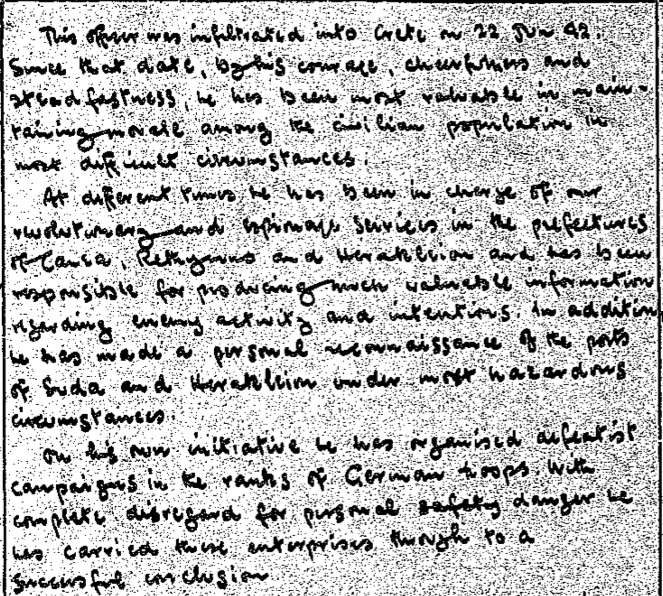
The commendation reads:

This officer infiltrated into Crete on 22 Jun 42. Since that date, by his courage, cheerfulness and steadfastness, he has been most valuable in maintaining morale among the civilian population in most difficult circumstances.

At different times he has been in charge of our revolutionary and espionage services in the prefectures of Canea, Rethymnon and Heraklion and has been responsible for providing much valuable information regarding enemy activity and intentions. In addition he has made a personal reconnaissance of the ports of Suda and Heraklion under most hazardous circumstances.

On his own initiative he has organised defeatist campaigns in the ranks of German troops. With complete disregard for personal safety … he has carried these enterprises through to a successful conclusion.

He is still in Crete, where his determination, devotion to duty, and steadfastness of purpose have been invaluable in helping the local population to sustain their faith in their allies.

He is consistently hunted by the occupying troops.

Signed by Head of Mission 9 Apr 43.

(requested that should the award be made there should be no publicity for security reasons.)

The source for this is the Kew public records office. This is not in Paddy’s SOE file.


How to Kidnap a General – a review of Ill Met by Moonlight

Patrick Leigh Fermor and Moss

Patrick Leigh Fermor and Moss in German Uniform Prior to the Abduction of General Kriepe

“There was a rush . . . our torches illuminated the interior of the car — the bewildered face of the General, the chauffeur’s terrified eyes . . . [The] chauffeur was reaching for his automatic, so I hit him across the head with my kosh [blackjack] . . . and George . . . dumped him on the road. I jumped in behind the steering-wheel, and . . . saw Paddy and Manoli dragging the General out of the opposite door. The old man was struggling with fury . . . shouting every curse under the sun . . . [We bundled] him into the back seat [and he] kept imploring, ‘Where is my hat? Where is my hat?’ The hat, of course, was on Paddy’s head.”

First published in Time magazine 4 September 1950

Why a German general’s hat should be on a British officer’s head is pretty much the gist of III Met by Moonlight. For as the staff car, driven by Author Moss, moved along the road in northern Crete, sentries at no less than 22 German traffic-control posts smartly saluted the behatted “general”‘ and waved the car on. They had no inkling that prostrate on the floor in the back seat lay the real general, with guns pointed at his head. Twenty days later, on May 16, 1944, kidnaped Major General Karl Kreipe was handed over to British authorities in Cairo, putting finis to what Harold Nicolson has called “one of the best adventure stories that I have read.”*

Behind the Lines. The scheme of raiding German-held Crete and trotting off with the divisional commander was the brain child of youthful Major Patrick Leigh-Fermor and Captain W. Stanley Moss, who had achieved the schoolboy dream of becoming secret agents. At their base in Cairo, they shared a villa and sampled the fleshpots of Egypt. It was in a nightclub that they first hatched the plot that was to land their party from a motor launch on the south coast of Crete.

The two Britons could depend on help from guerrillas and from intelligence corpsmen hidden in the hills. One British agent, a Cretan, actually lived next door to General Kreipe’s Villa Ariadne, near the north coast. Through him, Moss and Leigh-Fermor learned the general’s daily routine to a nicety—off to headquarters by car at 9 a.m., back in the evening any time after 8 or 8:30 p.m., depending on how many rubbers of bridge he stayed to play.

Slowly, painstakingly, the two agents planned a night ambush. Hidden guerrillas lay at vantage points on the road to the villa, a buzzer and torch flashes relayed warnings of the general’s approach to the waiting kidnapers, who were in German uniforms.

After the snatch, the general (who quickly became resigned and quite amiable) was marched from cave to cave half the length of Crete, while the furious Germans fruitlessly finecombed the island. By the time a Royal Navy motor launch nosed in to a southwest beach and took off both captive and captors, Moss and Leigh-Fermor knew that they had achieved their principal aim—to astound the enemy and make him the laughingstock of the local population.

Author Moss wrote his story in the mid-’40s, but the British War Office refused to let it appear then. Today, having reached the elderly age of 29, Moss is a bit abashed by the “22-year-old exuberance (almost bumptiousness) with which it was written.” Bumptious or not, it is one of the most melodramatic and audacious stories of the war.

*And notably more successful than another daring plan hatched in Cairo. In November 1941, British commandos under 24-year-old Lieut. Colonel Geoffrey Keyes made their way 200 miles behind Axis lines in an attempt to capture or assassinate Nazi General Erwin Rommel. At night, with cork-blackened faces, Keyes and his commandos achieved complete surprise, wrecked Rommel’s HQ with grenades. But Keyes was killed and Rommel was untouched: he had gone to a birthday party.