Lest we forget – The Band Played Waltzing Matilda

Last week as I drove back from my work in Sussex I stopped to buy some petrol. In the shop my attention was drawn to the picture in the local newspaper showing the funeral of a young local soldier who had recently died in an IED explosion in Afghanistan. Being away for so long I may have missed the news of his death, but I thought perhaps maybe I have just stopped noticing.

At 11.00 am GMT this morning we will observe a silence and remember all British and Commonwealth soldiers who have died in wars since 1914, but also those of our allies and those whom we fought against, particularly in the Great War. It is too easy to forget. Remembrance not only honours the fallen but it may, just may, make us think a little longer about “starting all over again.”

This song is by Scottish folk singer Eric Bogle and is about the struggles and fears of Australian soldiers who fought against Turkish troops and were wounded and killed in the Battle of Gallipoli in World War I. Mixed with pictures from Gallipoli are pictures of past and present Canadian troops because this song and powerful slideshow was played during a Remembrance Day assembly at a Canadian public school to remind those young people that whilst the scale of the slaughter is now thankfully much less, war is always with us, and those in our military risk their lives every day serving us. It is an extremely moving song.

Mapping a Life, and Finishing a Long Trip

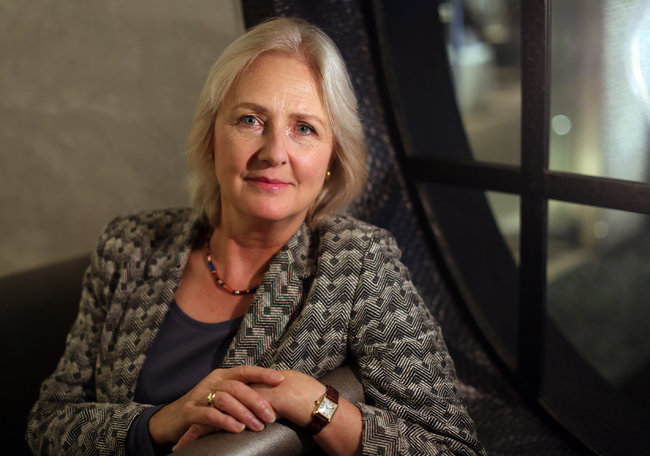
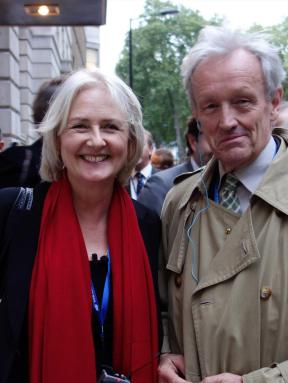
Artemis Cooper

Artemis Cooper

How Artemis Cooper Wrote Patrick Leigh Fermor’s Biography

by William Grimes.

First published in the New York Times, November 8, 2013.

Great storytellers can be terrible interview subjects. Patrick Leigh Fermor, the British travel writer, was one of them. Artemis Cooper, the author of “Patrick Leigh Fermor: An Adventure,” recently published by New York Review Books, found out the hard way.

Leigh Fermor’s classic two-volume account of his yearlong walk across Europe in the early 1930s, “A Time of Gifts” and “Between the Woods and the Water,” disgorged a cornucopia of colorful characters, historical curiosities ancient and modern, reflections on geography and national psychology, and sparkling dialogue.

To a biographer, Leigh Fermor presented a series of tantalizing incarnations: the wayward child expelled from one boarding school after another; the footloose traveler across a darkening Europe; the wartime undercover agent in Crete, where he engineered the kidnapping of the island’s Nazi commander; and the celebrated travel writer, ranked by many critics among the greatest of the 20th century.

No wonder that Ms. Cooper headed into her assignment believing that she had taken on, as she put it in a recent interview, “one of the jammiest jobs in English biography.”

Not exactly. Leigh Fermor, who died at 96 in 2011, lived up to his reputation as a talker, but he turned out to be a maddeningly reticent and evasive one. On regular trips to his house in the Greek seaside village of Kardamyli, Ms. Cooper posed questions. Leigh Fermor ducked and weaved, charmingly.

“Paddy was not telling me anything he wouldn’t tell any journalist,” Ms. Cooper said. “He hated talking about himself. He hid behind this dazzling conversation, and I wasn’t getting anywhere.”

A breakthrough came when Ms. Cooper, 60, who has written books on wartime Cairo and the food writer Elizabeth David, volunteered to help Leigh Fermor organize his study. He would sit at his desk, pretending to be hard at work but dying to be distracted. Ms. Cooper would drop comments as she sifted through manuscripts and letters, causing Leigh Fermor’s ears to prick. Conversations ensued.

“It was no longer an interview,” Ms. Cooper said. “Tidying the room was a fig leaf. That is how I began to get pieces of the story.”

One piece was the unexpected discovery of an early version of that cross-Europe trek, which allowed Ms. Cooper and the travel writer Colin Thubron to bring the narrative to completion after Leigh Fermor’s death. “The Broken Road,” which picks up where “Between the Woods and the Water” ends, with its narrator still 500 miles from the city he always called Constantinople, was published in Britain in September. New York Review Books, which has made a cottage industry of reissuing Leigh Fermor’s work, plans to publish it in March.

Even after the ice was broken, Leigh Fermor still threw up obstacles and obfuscated. Ms. Cooper quickly learned that any woman he described as “a terrific friend” was almost certainly a lover. There were many. In a relaxed mood, he would spin enticing yarns, only to pull up short and plead with Ms. Cooper not to use the material. Of course not, she assured him.

The writer Artemis Cooper said: “It’s a terrible thing being a biographer. One is such a rat.”

Connecting the dots and filling in the outlines, Ms. Cooper executed a detailed portrait that Christopher Benfey, in The New York Times Book Review, described as “affectionately intimate, informative and forgiving.”

It could hardly help being intimate. Leigh Fermor had popped in and out of Ms. Cooper’s family orbit ever since she was a child. He knew her grandparents, Lady Diana Cooper and Duff Cooper, and her father, the writer and television producer John Julius Norwich.

Leigh Fermor made a deep impression on Ms. Cooper, she said, when she visited her grandmother on the Greek island of Spetses during a school holiday. She was 17. Leigh Fermor, revered by the local residents for his wartime exploits, loomed a Zorba-like figure, always in the thick of things whenever a bottle of ouzo appeared, and the dancing started on the beach. This was the man whom the travel writer Robert Macfarlane, reviewing Ms. Cooper’s book in The Guardian, called “a mixture of Peter Pan, Forrest Gump, James Bond and Thomas Browne.”

Ms. Cooper was entranced. “I developed a schoolgirl crush from which I’ve never really recovered,” she recalled.

Initially, her husband, the historian Antony Beevor, proposed that he write Leigh Fermor’s biography, but when other projects got in the way, the task fell to Ms. Cooper. She quailed.

“I was daunted by the books and his reputation as a great prose stylist,” she said. “There were those great chunks of history. I thought, ‘Oh, God, I can hardly put Moldavia and Walachia on a map.’ I thought I’d have to know as much history as he did. But it turned out to be not so difficult.”

In 2008, at the offices of John Murray, Leigh Fermor’s lifelong publisher, Ms. Cooper came across three black ring binders containing a typescript with the title “A Youthful Journey,” the basis for “The Broken Road.” It was Leigh Fermor’s overenthusiastic response to a 1962 assignment from Holiday magazine, which had commissioned him to write 2,000 words on the pleasures of walking.

Leigh Fermor responded with 84 pages describing his trip across Europe, getting as far as the Romanian port of Orsova. Then, in a long burst, he generated a small book’s worth of prose on the final third of his journey.

With “A Youthful Journey” in hand, thanks to Ms. Cooper, Leigh Fermor regained a sense of purpose. Although nearly blind and deaf, and clearly at the end of his very long life, he began working on the manuscript. Ms. Cooper and Mr. Thubron finished the job.

“All the energy was there, and all the words,” said Mr. Thubron, who did the bulk of the editing. The manuscript was written in the stage that Leigh Fermor called “letting it rip,” and that Ms. Cooper calls “the first whoosh.”

“It is raw compared to the polished gems of the first two volumes,” she said. “But Paddy never said at any point, ‘This is not working, I don’t want this to come out.’ He knew that it would be published. Maybe it made it easier to leave the world, knowing that it would appear, and that we would tidy it up. “

The Dust of Uruzgan

This is the time of year when we particularly remember those who gave their lives in wars past and present. Our understanding of the first and second world wars in particular has been enhanced by the contributions of the well-known war poets. More recent wars have really failed to produce the same work, but recently I have discovered the songs of Fred Smith an Australian folk singer and diplomat (yes, slightly contradictory) who as a civilian appears to really ‘get’ what it means to be a soldier fighting the modern insurgent war, this forsaken war, in Afghanistan.

His work is powerful, witty, ironic, gritty and realistic, whilst being entertaining. This is a man who understands this war from his time serving as a civilian adviser in the Afghan province of Uruzgan in 2009-2010. He has produced an album called Dust of Uruzgan which covers the whole gambit of the soldier’s life: fighting; reflection; boredom; missing beer, home and loved ones; being a brother in arms; loving the action; death; and “swaffelen“.

The title song to his album is about the death of Aussie Private Benjamin Ranaudo as told from the perspective of his mate who set off the IED. Sounds morbid but it ain’t and you can almost feel that Afghan dust in your hair, your eyes and your boots.

Fred’s album, the Dust of Uruzgan can be found on Amazon. It is great. If you are an ex-serviceman you will want to own this.

His website is here.

This version of Fred’s performance includes a full explanation of all the TLA’s that is the daily vocabulary of the modern day soldier.

The Last Hurrah

Sound the trumpets. Let rip the Byzantine chorus of clattering bells and gongs, the thunder of cannons, drums and flashing Greek fire. Raid cellars and let champagne corks fly. Eighty years after Patrick Leigh Fermor’s epic trudge across Europe, 20 years after the death of his long-suffering publisher Jock Murray, ten years after the passing of his wife Joan, and two years after his own death, the elusive third volume that so tormented him is published at last. The travel trilogy is complete. It is, as John Murray reminds us, the literary event of the year. But for those who admire Paddy’s densely beautiful prose, can this awkward, unformed orphan live up to its billing?

By Justin Marrozi

First published in The Spectator, 7 September 2013.

There is no need to rehearse the extraordinary genesis and gestation of its predecessors, A Time of Gifts, published in 1977, the small matter of four decades after the walk, and Between the Woods and the Water (1986), both classics of 20th-century travel writing. ‘To be concluded,’ were the final words of the second volume. Ever since, silence.

Fans of Paddy wondered what was happening in his sunlit writing-room in Kardamyli in the southern Peloponnese. ‘When might the final volume see the light of day?’, I asked him there in 2006. He was 91, and the question was unfair. It was ‘all a bit grim,’ he said. Writing was ‘rather difficult’.No wonder. He was suffering from tunnel vision, was unable to type, disliked dictation and had no assistant. Strangely, the early draft of this last leg of the walk, which he started to write in 1962 and was still editing a few months before his death, predated the first two books.

How to reconcile the parallel journeys of an 18-year-old walking from the Hook of Holland to Constantinople (never Istanbul) in 1933 and the later literary travels of a much older man setting this great walk to prose? This was always the challenge — and a prodigious test of memory, for the notebooks had been lost. In the end it proved too much for him. It is odd to think that a man who reached the grand old age of 96 was outlived by the great walk of his youth.

The Broken Road finds Paddy, last seen at the Iron Gates on the Romanian Danube, tramping south east across the Bulgarian plains. Reassuringly dazzling set pieces abound. There are dreamy days exploring monasteries and forests with the frowning beauty Nadjeda, ‘a ravishing hybrid vision, half captured Circassian princess, half Byronic heroine’. And a charming cameo of the black dog that trots beside Paddy in the Great Balkan mountains, barking furiously at an enormous full moon (dog-lovers will appreciate the diminutive black quadruped adorning the handsome cover, designed by Ed Kluz in the style of John Craxton’s artwork for Paddy’s earlier books).

With Constantinople finally in reach to the south after almost a year on the road, Paddy suddenly embarks instead on a great northerly loop into Romania. After slogging up mountains and sleeping in swineherds’ huts and forest clearings, sophisticated, high-society Bucharest has him agog. He throws himself into it con brio, with ‘the zest of a barbarian padding wild-eyed with longing for luxury and corruption through the palaces and fountained courtyards of Diocletian, or of a Parthian in Antioch’. This is, after all, a man who proclaimed himself unboreable during the trans-Europe pilgrimage. ‘My mouth was as unexactingly agape as the seal’s to the flung bloater.’

This is vintage — and nascent — Paddy. Here is the fascination with foreign languages, folklore, history, genealogy, sartorial styles and, of course, pretty girls. Costumes of hook-nosed crones, dishevelled army officers, rain-soused shepherds, raki-soaked fishermen and buttoned-up diplomats are painted in technicolour splendour. Bishops and archimandrites officiate in copes ‘as stiff and brilliant as beetles’ wings’. The constitutional objection to almost all things Turkish is undimmed. Paddy reads his first Dostoevsky in these pages and takes his first steps into Greece, a country that would help define him in subsequent decades, not least after kidnapping a German general on Crete in 1944 and making his home in the Peloponnese in the 1960s.

The facility for procuring a bed for the night was always remarkable. ‘How often I ended up under some friendly roof scot free!’, writes the Anglo-Irish charmer, who seduced aristocrats, platonically and otherwise, the length and breadth of Europe.

Overshadowing all these pictures of pastoral happiness is the spectre of the forthcoming war and the knowledge that the Iron Curtain would separate him — and at the time of writing already had — from dear friends, many of whom were later annihilated.

Paddy was not given to much personal reflection and introspection in his books. It is an unexpected pleasure to find rather more of the man in The Broken Road. Perhaps later polishing would have culled these unusually revealing sections. There are frank passages on the black depressions that would recur during his life. The on-the-page wrestling with memory, confronting the distressing blanks that inevitably surge up from distant decades, exposes the tortured inner workings of the creative process. How is it, he wonders, that memory can obscure the most important aspects of a life-changing encounter but preserve crystalline irrelevances: ‘Daysprings veiled and epiphanies in plain clothes.’

The journey ends not in Constantinople but in mid-sentence. Hence The Broken Road. Bizarrely. Paddy never managed to write up the longed-for object of his pilgrimage. Did it not live up to expectations? The final section, altogether different in tone, is the unworked diary from 1935, rich in innocence and intellectual discovery among the monasteries of Mount Athos.

How fitting, for a man so young at heart, with such a boundless appetite for life, that his last published words should be those of a wide-eyed 20-year-old, embarking on what will be a lifelong love affair with Greece. His editors, Colin Thubron and Artemis Cooper, have put this book to bed with skill and sensitivity. Friends and fans, acolytes, devotees and disciples can all rest easy. It was worth the wait.

The Broken Road: retracing the steps of a wild adventure

Walking in the footsteps of Patrick Leigh Fermor from Rotterdam to Constantinople, Nick Hunt found that, 78 years later, everything and nothing has changed.

Interview by Adrian Bridge

First published in the Telegraph, 12 Sep 2013

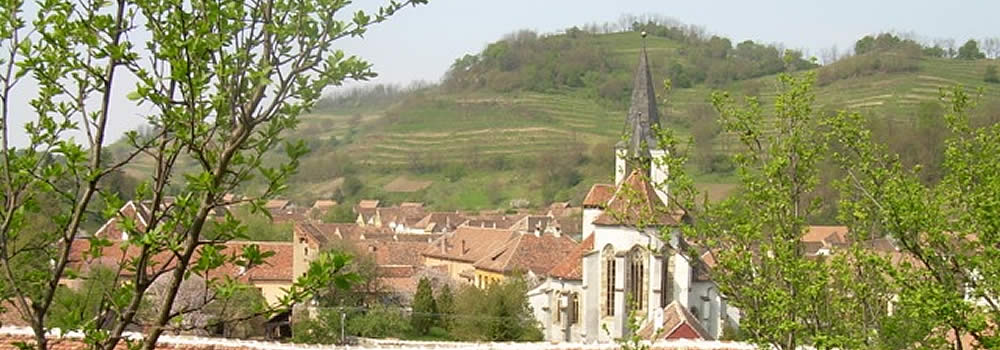
Walking through the continent, Nick saw the scenic beauty of Transylvania

This month the last volume was published of Patrick Leigh Fermor’s epic walk from Rotterdam to Constantinople, a journey he undertook in 1933/34. But how much has changed since Leigh Fermor’s day? Nick Hunt, a modern-day adventurer, is in a good position to say because he has recently retraced Leigh Fermor’s footsteps. This is what he found:

Why did you want to undertake this journey?

I was given A Time of Gifts when I was 18, the same age as Leigh Fermor when he set off on his journey. He was describing exactly what I wanted to do, which was to go out and have adventures and explore the world. I decided I’d do that journey one day: and 12 years later, at the age of 30, I did.

What was it about the route itself that appealed?

The books conveyed a great sense of freedom and wildness, mystery and wonder. The Europe of those books is a very magical place and I wanted to see if that magic still existed. These days we assume that Europe has become homogenised and dull; that it is a very tame continent. People go away to the other side of the world – that’s what I did as well – seeking this wonder out there somewhere, and I really wanted to see whether it is still possible to find it in Europe.

And is it?

Yes. I was amazed by how quickly things changed across borders: borders that are unmanned and unguarded. The most amazing crossing was at the border between Austria and Slovakia, when immediately everything was different: people smelled different, looked different; roads were different and buildings were different. For 50 years this was the crossroads between East and West, and it is still the place where you move between the Germanic and Slavic worlds.

Paddy’s first passport photo

How long did it take you and what did it cost?

I set off on December 9, 2011 – exactly 78 years to the day after Leigh Fermor did – but whereas it took him 13 months, I completed the walk in seven. I gave myself a budget of £50 a week – the equivalent of the £1 a week Paddy allowed himself back in 1933. In total I walked some 2,500 miles through eight countries: Holland, Germany, Austria, Slovakia, Hungary, Romania, Bulgaria and Turkey.

So initially you were walking in the winter?

I wanted to walk through Germany and Bavaria in snow – that seemed to be the truest manifestation of that kind of fairy tale. Walking on dry snow is quite pleasant, and you don’t get too hot and sweaty. Of course it got dark early and night times were hard.

Were people you met aware of the Leigh Fermor books and still interested in them?

Before I left I was shocked to discover how well known he was. People from all over the world wrote to offer support and encouragement. Many said they had dreamed of doing something similar: there was a lot of vicarious enthusiasm for what I was doing. Once I was on the road, people were very curious about this account of their village written by an English writer who came through it nearly 80 years ago. One of the things I enjoyed most was showing people the passage in the book where their village was mentioned and reading it aloud.

What did you find that chimed most with Leigh Fermor’s account?

There was a lot more continuity with Paddy’s journey than I expected, especially in terms of how kind and generous people were. There was also continuity in the landscape. Even in Germany, walking along the Rhine is still quite special. There may be a big road running alongside it now, but it is still possible to see this older, wilder Europe.

The Rhine

I was also amazed by how little people’s prejudices had changed, especially in the east. Some of the things Slovaks were saying about Hungarians, Hungarians about everyone, Romanians about Hungarians, Romanians about Bulgarians – it could have been cut and pasted from the pages of the books. People have long memories.

Were you, like Paddy, entertained by counts?

No, but I did experience extraordinary hospitality. For the early part of my journey I stayed on people’s couches (arranged through the couch-surfing website). I was constantly amazed at people’s generosity, and the farther east I went the friendlier they became: in the latter stages of the journey it became common for people to say, “I’ve got friends in the next village, I’ll give them a call,” so I started staying with friends of friends rather than booking.

I had a tent with me, and once the weather turned warmer I began to camp out. Towards the end I struggled to spend my £50 a week: transport was covered, I hardly ever had to pay for accommodation; it was just food and occasional chocolate treats.

What was most different from what Leigh Fermor experienced?

Right away you see the impact of the war, especially in Holland and Germany. Rotterdam was flattened – one of many cities whose medieval hearts had been wiped out and turned into corporate, commercial hubs full of the same shops you can see in London.

Rotterdam

Farther along the route the hydroelectric dams on the Danube summed up for me the process of industrialisation that has tamed so many of the wilder parts of the continent’s rivers. Also, although I didn’t stay with a count, I did meet one of the descendants of one of the families that hosted Paddy. Their country home, once a place of dinners and dances, had been nationalised after the war and turned into a psychiatric hospital. That spoke volumes.

What were your favourite parts of the journey?

Walking through Transylvania and the Carpathian Mountains: the culture was warm and generous and I loved the fact that people still have time for old-fashioned courtesies. I was amazed at how little impact Ceausescu’s attempts to remodel that society had. It was in the Carpathians, too, that I felt completely alone. I was quite high, above the snow line, and not altogether sure about what I was doing. In terms of the adventure, that was pretty wonderful. Earlier on in the journey I had fantasised about the baths of Budapest: they didn’t disappoint.

And the not-so-good bits?

I didn’t enjoy trekking through miles of suburbs. Or walking on tarmac. In the southern German city of Ulm I had to stop for three weeks because of an Achilles tendon injury. On the plus side, I discovered the wonder of the German health service, but it was frustrating. Getting attacked by stray dogs in Romania was pretty hairy – as was coming face to face with a wild boar.

I can’t say I liked the “Sunny Beach” in Bulgaria between Varna and Burgas. Paddy described this stretch of coastline as one of the most delightful – offering solitude and peace, space and silence. Today it is just a long strip of concrete: one hotel after another.

Is walking the best way to go?

Absolutely. When you walk you are exposed to everything. You feel everything – the weather, you absorb all the atmosphere of the place around you – and you notice things that in a car would just be a blur. That said, much of the route I took was not pretty.

Paddy on horseback in Moldova

My advice to anyone doing a trip of this kind would be to try to find interest in everything you see. When I was in Budapest and said I was heading for the Great Hungarian Plain I was told to prepare for the 10 most boring days of my life. It is true the plain is no longer the wild place that Paddy described. But I found it quite extraordinary just having this space and silence, huge empty horizons, dust and heat. It felt a bit like walking through a desert. I’d advise avoiding tarmac (even walking through leaves and mud is preferable). And I’d advise taking a very good pair of boots.

What was the most important thing you learnt from your walk?

That the woods are not full of axe murderers and that people are generally quite kind and helpful and hospitable. That was heart-warming, and that was what I had wanted to believe. I also learnt how to slow down. At the beginning I got frustrated at how slowly I was travelling. It took a while to shake off the mentality of having to get somewhere quickly and to realise that I wasn’t trying to get anywhere in a hurry: that the destination was much less important than the getting there.

Are we going to have to wait 80 years for a full account of your walk to appear in print?

No. The book will be out next spring.

* ‘Walking the Woods and the Water: in Patrick Leigh Fermor’s footsteps from the Hook of Holland to the Golden Horn’ by Nick Hunt (Nicholas Brealey Publishing) is due out in spring 2014.

Patrick Leigh Fermor celebrated author of one of greatest travel books ever written

By Michael Dirda.

First published in the Washington Post, 23 October 2013.

In the annals of armchair adventure, nothing can rival a travel classic by a good-looking, sandy-haired young Englishman — or Englishwoman. If you’re planning ahead for some ideal winter’s reading, you can’t go wrong with any of the following:

  •  A.W. Kinglake’s “Eothen.”
  •  Peter Fleming’s “Brazilian Adventure.”
  •  Freya Stark’s “The Valleys of the Assassins.”
  •  Robert Byron’s “The Road to Oxiana.”
  •  Apsley Cherry-Garrard’s “The Worst Journey in the World.”
  •  Sybille Bedford’s “A Visit to Don Otavio.”
  •  Wilfred Thesiger’s “Arabian Sands.”
  •  Eric Newby’s “A Short Walk in the Hindu Kush.”
  •  Bruce Chatwin’s “In Patagonia.”

All of these are wondrous. Still, the most beautifully written of modern “travel books” — an awkward term — may well be Patrick Leigh Fermor’s “A Time of Gifts” (1977) closely followed by its sequel “Between the Woods and the Water” (1986). These two volumes lyrically memorialize a youthful walk across Europe in 1933-34, starting from the Hook of Holland and passing through Germany and much of Eastern Europe. A never-completed final volume — drafts of which will be published in March (in the US) as “The Broken Road” — would have followed its boyish hero to Constantinople and Mount Athos.

While most of Leigh Fermor’s work is highly personal, his various books — and these include one about the Caribbean, “The Traveller’s Tree” (1950), and two about Greece, “Mani” (1958) and “Roumeli” (1966) — offer only carefully chosen glimpses of his long and astonishing life (he died at age 96 in 2011). Artemis Cooper’s excellent biography, “Patrick Leigh Fermor: An Adventure,” fills in the details, corrects errors and makes clear that Paddy — as he was always known — often conflated incidents or fudged details in his writing, sometimes for reasons of art, sometimes to protect a friend or a woman’s reputation.

When Paddy began his European rambles, he was not quite 19. Up until then he had been an indifferent student, although passionate about reading and gifted with a phenomenal memory. Paddy also possessed, along with good looks, daring and boundless curiosity and a seemingly irresistible charm. He originally expected to doss down in haystacks and barns as he trudged along; in fact, he regularly smiled his way into country houses, consulates and baronial manors — and sometimes into the beds of young women and lonely divorcees. Letters of introduction then eased his way into other homes. As he cheerfully sauntered along, he would belt out each region’s folk songs.

At the end of his journey, Paddy met Princess Balasha Cantacuzene, a scion of one of the great dynasties of Moldavia and Wallachia. She was 16 years his senior, but the two fell in love and the young Englishman passed four idyllic years living on her family estate at Baleni in what was then known as Rumania. During these years he read voraciously — history, reference works, Mallarmé, Apollinaire, Gide, Proust, Tolstoy and much else. To his personal magnetism and general sexiness, the magpielike Paddy soon added a mind filled with poetry and out-of-the-way knowledge.

When Britain declared war on Germany, the stylish young adventurer immediately left Baleni to enlist. He was, at this point, all of 24. But Paddy already knew much of Europe intimately, had made friends everywhere, and could speak French, German, Romanian and Greek. He was a natural for the Intelligence Corps.

Lieutenant, later Major Leigh Fermor spent much of the war behind the lines in Crete, helping to coordinate its resistance to the Germans. Periodically, though, he would be pulled out for R&R in Cairo, where he partied all night, slept in the arms of exotic girlfriends and drank champagne with King Farouk. During one particularly orgiastic revel, the young intelligence officer came up with a plan to kidnap the commanding German general in his area of Crete. It would give a boost to the partisans’ morale. He eventually recruited his admiring friend William Stanley Moss to join him in this crazy exploit.

The two actually brought it off. Dressed as German border patrolmen, Paddy and Moss stopped General Heinrich Kreipe’s car, which was immediately surrounded by Cretan guerrillas. For more than two weeks, the ambushers and their victim eluded capture until they were able to rendezvous with their escape boat. In her biography, Cooper provides the most detailed account available of this “hussar stunt,” the highlight of which occurred on a morning when the raiding party was hiding in a cave:

“No one slept well that night, and as dawn broke and the sun illuminated the great snow-streaked hump of Mount Ida, the General murmured a line in Latin: ‘Vides ut alta stet nive candidum Soracte.’ ”

As it happened, this was not only a poem that Paddy had once translated — the line from Horace means, in his schoolboy version, “See Soracte’s mighty peak stands deep in virgin snow” — but one that he knew by heart. Taking up where Kreipe had paused, the youthful British major went on to recite the entire poem.

Cooper then quotes Paddy’s own account of what happened next:

“The General’s blue eyes swivelled away from the mountain-top to mine — and when I’d finished, after a long silence, he said, ‘Ach so, Herr Major!’ It was very strange. ‘Ja, Herr General.’ As though, for a long moment, the war had ceased to exist. We had both drunk at the same fountain long before; and things were different between us for the rest of our time together.”

This whole adventure was later chronicled in W. Stanley Moss’s minor classic “Ill Met By Moonlight.”

After the war, Paddy — now all of 30 — found work at the British Institute in Athens, where his colleagues included the historian of the Crusades Steven Runciman and the translator and novelist Rex Warner. But, despite all his gifts or because of them, Paddy couldn’t hold a 9-to-5 job. He was too free-spirited, too feckless, in some ways, too spoiled. For years he would rely on, sometimes live on, the generosity of rich and aristocratic friends and lovers.

And there were many. When he finally returned to England, Paddy cemented his connections with the aging members of the Brideshead Generation. The second half of Cooper’s biography is packed with the usual names: critic Cyril Connolly, the famous beauty Diana Cooper (the biographer’s grandmother), the Duchess of Devonshire (nee Deborah Mitford), Ann Fleming (wife of Ian), poet John Betjeman and many others. With Joan Rayner, whom he had first met in Cairo, Paddy would settle into a permanent, if extremely open relationship. By the time the two finally married in 1968, they had already bought property in Kardamyli, Greece, and built their ideal house (marble, open air, lots of books, cats), where they would welcome celebrated friends, former Cretan partisans and numerous admirers of Paddy’s books.

Easily distracted and as much a perfectionist as Flaubert, Sir Patrick Leigh Fermor — as he eventually became — always found writing difficult. His descriptions are like tapestries, rich in color and intricate design; his bravura diction often requires a dictionary close at hand; and sometimes his weaker pages are clotted and overwrought. Yet “A Time of Gifts” marvelously evokes an ancient Mitteleuropa now almost wholly vanished. If you’ve never read it, do; and if you have, you’ll certainly want to follow up with this fine biography of its adventurous and romantic author.

Dirda reviews books for The Washington Post every Thursday.

 Artemis Cooper will be at Politics and Prose, 5015 Connecticut Ave NW, at 6 p.m. Nov. 2. Call 202-364-1919.

Normal service to resume

Hola to you all. I have returned safe, if not entirely sound, from my six week journey to Santiago and Finisterre. A truly wonderful experience full of discovery, adventure, friendship, and a lot of soul searching. At some point I may write about it, but in the meantime there is plenty of catching up to do on Paddy, the Broken Road and the successful Transylvanian Book Festival.

I will try to resume normal service as soon as I can.

Meanwhile, if you are thinking of taking any one of the many pilgrim routes to Santiago de Compostela, all I can say is go, travel light, and travel slow. There were people out there from 10 to 91 years.

Approaching Villamayor de Monjardin just after sunrise

Approaching Villamayor de Monjardin just after sunrise

Rotterdam to Istanbul by foot

Patrick Leigh Fermor, 85, hasn’t quite finished the story of the epic walk he made at 18. He tells James Owen why. An old article I found in The Telegraph.

By James Owen.

First published in The Telegraph, 19 Feb 2000.

For an insular race, the English write surprisingly well about foreign places, and none better than Patrick Leigh Fermor. It was his intoxicating prose that first prompted me to travel and he occupies a prominent niche in my private pantheon of gods. But it is a quarter past three on a cold winter’s afternoon and, nice as is his doorstep is, my hero is late.

Patrick Leigh Fermor: resembles an amused sparrowhawk, alert and energetic
Then he comes scrambling out of a taxi and ushers me into his kitchen. “Really,” he says, “I’m awfully sorry. Will you have a drink?”

Age is bowing him a little now, but although he was 85 on Friday, Leigh Fermor still looks remarkably hale and, with his iron-grey hair and unlined face, could pass for a man 20 years younger, or even Trevor Howard in his prime. “Yes,” he says, “a cup of tea, that’s the thing”, and we begin to talk about his contemporary Sir Wilfred Thesiger, whom he remembers seeing stride down Piccadilly in hat and gloves “like a stern, immaculately attired eagle”.

Leigh Fermor himself resembles more an amused sparrowhawk, alert and energetic, his startled eyebrows a clue to the exuberant personality revealed in his books, most notably in the unfinished trilogy of his year-long walk from Rotterdam to Istanbul in 1934, when he was 18 and continental Europe was on the cusp of cataclysmic change.

It was a journey of physical adventure and cultural awakening, recalled in distinctive prose. His baroque and meticulously polished style, informed by a romantic eye, has brought him a host of admirers – yet there are those who doubt that he could remember such detail half a century on and accuse him of private myth-making. So, I ask him, do travel writers improve on truth for the sake of art?

“I say,” he declares, his vocabulary that of the schoolboy yarn, “that’s rather a difficult question. I think one does improve on things; it’s irresistible sometimes. After all, one is telling a story. I am a bit worried that I’ve got a slightly ‘disinfectant’ memory, as if some goblin had washed out the gloomy parts and let the luminous ones survive. But, overall, I don’t think I’ve sinned too heinously.”

Still, if you wanted to create the perfect fictional travel writer, you would be hard pressed to devise a better life story than Leigh Fermor’s. He was born of Anglo-Irish stock, his father a naturalist whose discoveries included a worm with eight hairs on its back and a particular formation of snowflake; his mother was a red-headed, cigarette-smoking, fur-boot-wearing playwright.

After his parents divorced, young Paddy’s education was sporadic. A spell at a progressive establishment where pupils and staff alike dispensed with clothes was followed by King’s School, Canterbury, from which he was expelled at 16 for holding hands with a greengrocer’s daughter. Dispatched to London, he lodged with Beatrice Stewart, the model for the figure of Peace at Hyde Park Corner, before planning his great trek across Europe.

Having reached his goal – what he insists on calling “Constantinople” – Leigh Fermor visited for the first time the country with which he would become most associated, Greece, spending his 20th birthday in a snowbound monastery on Mount Athos. He then found himself caught up in an anti-royalist revolt and, with customary dash, attached himself to a cavalry regiment. The campaign brought him novel challenges.

“I’d heard about swimming horses across rivers,” he recalls, “so I thought I’d give it a go. It was the most extraordinary thing – the water comes up to your waist, and the horse’s head sticks out like a chessman.” A little later, Leigh Fermor’s comrades were ordered to draw sabres for what must have been one of the last cavalry charges in Europe.

Fittingly for a philhellene, Leigh Fermor is a latterday Byron, a man of action as well as of letters, and long before he made a reputation as a writer, he was celebrated for one of the most daring missions of the Second World War. Having organised guerrilla operations in occupied Crete for two years, in 1944 he and a friend, disguised as German soldiers, kidnapped the island’s garrison commander, General Kreipe, and successfully bluffed their way through two dozen checkpoints in his official car.

For three weeks, they evaded German search parties, then marched the general over the top of Mount Ida, birthplace of Zeus. As the general gazed up at the snowy peak, he began to recite the first line of an ode by Horace; Leigh Fermor immediately continued the poem to its end, and the two men realised that they had “drunk at the same fountains” before the war. Kreipe was eventually taken off Crete by motorboat, Leigh Fermor awarded the DSO, and the whole exploit filmed as Ill Met By Moonlight in 1956, with Dirk Bogarde improbably cast as the burly commando.

The incident cemented Leigh Fermor’s standing on Crete (where he soon found himself with 27 godchildren), and his experiences there confirmed his love of the Greeks themselves. After the war, Greece became his adopted home and he built a house deep in the Peloponnese, close to the sea, where he likes to bathe (at the age of almost 70 he swam the four miles across the Hellespont). Now he and his wife spend most of their time in Greece, which has inspired perhaps his two most original books, Mani (1958) and Roumeli (1966), distillations respectively of the history, folklore and culture of the far south and north of a country that has since vanished forever.

“I think Greece has changed, on the whole, for the good,” he says, “but tourism has spoilt it more than the Greeks themselves realise. Yet I still like the Greeks and one’s always grateful to countries where one is happy.”

He now intends to stay close to home, “tinkering with one’s work”. He much prefers research to the painful business of writing and re-writing; his prose usually goes through four or five drafts before he deems it to have passed muster. I ask him if he thinks he has written enough. “No!” he says sharply. “I’ve been far too slow, mucking about, wasting time. Of course, I ought to have written a great deal more.

“Sometimes it does rip ahead. The first time it happened to me I was in the deserted monastery of Sant’ Antonio, outside Rome, where I was toiling on The Traveller’s Tree [his book about the Caribbean]. I started after dinner and went on for what I thought was two or three hours, whipping away, when I noticed something funny about the light. Then the birds began to sing all around the monastery. I’d been writing from dinner time to dawn.”

There are two more books that he would like to write, he says. The first is an account of the Resistance movement on Crete, which he feels duty-bound to record. The other is his current project, and will come as welcome relief to those addicts of Leigh Fermor who have been waiting 15 years since the last instalment of his walk – Between the Woods and the Water – to see if he reaches Constantinople.

“It’s been very desultory and jerky,” he confesses, “but I’ve got to finish what I’m working on, the third step of that journey. I’m not sure now if this is a good title, but I’d thought of calling it ‘Parallax’, which means looking at the same thing from a different angle – the time when all this happened and now, when one is old Methuselah scribbling away.

“At my immense age, when I look back, I think: ‘Thank God I didn’t let every opportunity slip by.’ ” Good grief, I say, what did you fail to cram in? But Patrick Leigh Fermor just smiles good-naturedly, as if to say: “Yes, well, now that’s another story.”

Buen Camino

santiago sign Dear readers, I am now departing the UK for St Jean Pied de Port in south-west France which will be the starting point for my pilgrimage to Santiago de Compostela, a journey of around 800km. I think this will take me around six weeks as I also plan to walk a further 100km to Finisterre.

As timing goes it is not great from the Paddy blog perspective as it occurs just at the time the wonderful Broken Road is published (I have a preview copy and can assure you that you will enjoy it!), However, from a personal perspective this is the time to go on such a journey.

Whilst I am away I have a stand-in editor who will try to work on the blog if time permits. I can’t promise anything except that I look forward to getting everything up to date upon my return.

If you would like to get in touch whilst I am away please note a change in contact details: email paddybloguk[at]gmail.com

I wish you all health and happiness, and that you get a copy of The Broken Road as soon as you can.

Buen Camino!

Tom

The Stronghold and Hide and Seek – selling fast!

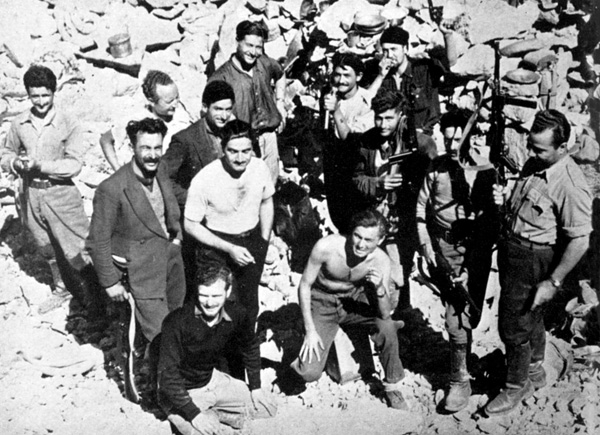
Xan Fielding in Crete

Xan Fielding (front centre) in Crete

Xan Fielding’s books about his time in SOE and wartime Crete have been republished by Paul Dry Books and are now available from Amazon and are selling fast.

Hide and Seek: The Story of a War-Time Agent
is available for order now at £9.95 on Amazon – through the link above.

The Stronghold: The Four Seasons in the White Mountains of Crete
is also available for order now at £9.95 on Amazon – through the link above.

These books are very difficult to get hold of and The Stronghold in particular is quite rare and sells for between £200-£500 on eBay.

Paul Dry Books link is here.

Don’t forget that you can also pre-order the third volume of Paddy’s trilogy,The Broken Road: From the Iron Gates to Mount Athos

Patrick Leigh Fermor: his final journey

Artemis Cooper and Colin Thubron on PLF walkColin Thubron introduces an exclusive extract from Patrick Leigh Fermor’s ‘The Broken Road’, the concluding part of his account of his teenage walk across Europe.

By Colin Thubron with Patrick Leigh Fermor

First published in the Telegraph 1 September 2013.

Patrick Leigh Fermor never quite completed the long-awaited third volume of his youthful journey across Europe. He was 18 when he set out to walk from Holland to Turkey in 1933, but the first two magnificent books recording this epic – A Time of Gifts and Between the Woods and the Water were published only in 1977 and 1986 respectively. The second ended with the implacable words “To be Concluded”, and for years expectations ran high that a final book would follow, carrying its hero from the Iron Gates, on the Romanian-Bulgarian border, to Constantinople.

But for Paddy (as friends and fans called him) a long ice age set in: a writer’s block that dogged him for the rest of his life. On completion of the second volume he was already in his seventies, and the pressure of expectation, the demands of his highly wrought style and his own perfectionism were overwhelming.

Yet ironically a near-complete draft of the third volume – written in pen on stiff sheets of paper – had been lying for years on a shelf in his study, in three black ring binders, all but forgotten. It had been composed following a request from Holiday magazine in 1962 that he record his whole trek in a 5,000-word essay. Paddy abandoned this essay when it reached the Iron Gates, but then launched into a full-scale retrieval of his trek’s last stretch: a work he eventually gave the stopgap title of A Youthful Journey. Then this, in turn, was abandoned, with the realisation that he must start all over again, and describe his walk from its beginning.

The initial two volumes were written virtually from memory: a prodigious feat of recall coupled with a rich imagination. His first diary of the journey was stolen in a Munich youth hostel in 1934. His later diaries went missing during the Second World War. But a final one, covering the last stretch of his trek, was preserved by his first great love, the Romanian princess Balasha Cantacuzène, who hurled it into her suitcase in the few minutes allowed her by communist officials when she was ejected from her estate in 1949.
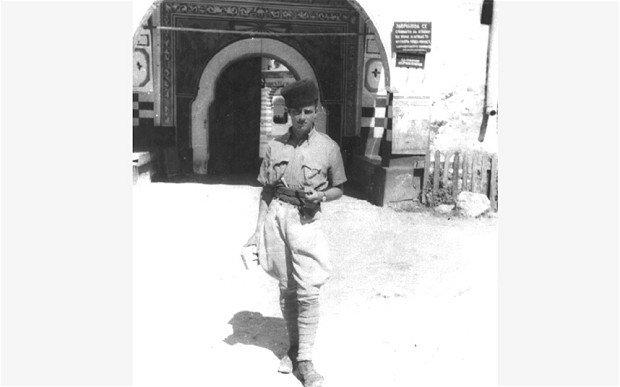
Patrick Leigh Fermor at the Rila monastery, Bulgaria, autumn 1934

Patrick Leigh Fermor at the Rila monastery, Bulgaria, autumn 1934

Yet this diary, recovered from Balasha in Romania during a clandestine visit by Paddy in 1965, did nothing to cure his writer’s block.

Perhaps its callow text conflicted with the more mature writing of A Youthful Journey; or perhaps the factual discrepancies in the two versions troubled him. Only in 2008, when already in his nineties, did he seriously begin, painfully and intermittently, to revise the Great Trudge, as he called it. But by now he was suffering from tunnel vision, and his stamina was failing. He died in 2011 at the age of 96, still working on the narrative in a fragile hand.

So it fell to two of his three literary executors, his biographer Artemis Cooper and myself, to prepare the text for publication.

A Youthful Journey was largely written between 1963 and 1964, in prolix bursts of enthusiasm, and its grammar, punctuation and even its style were far from what Paddy considered finished. In our revision we laboured to preserve his inimitable style, while clarifying and refining the text in a process as close as we could get to his exacting practice. There is not a sentence that is not his.

But The Broken Road is our own title. It acknowledges not only that Paddy never, in the end, continued his written journey to Constantinople – it stops 50 miles short of the Turkish frontier – but also that this is not the exuberantly polished volume that he would have most desired. Yet it includes passages perhaps as fine as any he wrote. Its editing was aided by our sense of Paddy’s previous work, of course, by our knowledge of the man himself, and by his few hints and tentative suggestions. And here his journey must rest.
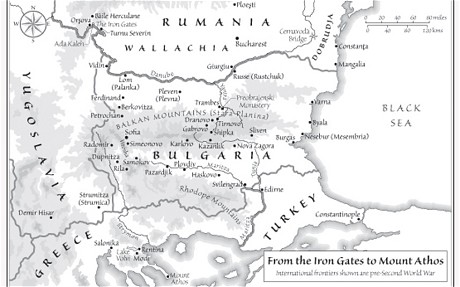
Map accompanying The Broken Road

Map accompanying The Broken Road

Extracts from Patrick Leigh Fermor’s ‘The Broken Road’

“The party went with a bhang”

The lights of Tirnovo were beginning to twinkle in every window, the sun had set, and the prospect of my St Jerome-like hermitage loomed rather bleakly, especially compared to the gleaming interior of the grocer’s: the barrels of anchovies, the hanging flitches, the lamplight refracting a battery of bottles, the dried figs impaled on skewers of bamboo, the kegs and crates and jars and the pyramids of wares from Germany and Austria, the scarlet bacon slicer with its flashing disc of blade, the huge cheeses and the cubistic mounds of halva. It glowed like Aladdin’s cave.

But the shop was empty. A boy of about my own age who had been sitting reading a book on the doorstep got up and followed me in. Where was I from? Whither bound?

Cheerful alacrity and a friendly glance accompanied these questions. We were soon perched on the edge of barrels, clinking slivo glasses and exchanging autobiographies. Gatcho was the grocer’s son, and he was looking after the shop while his father was at some ex-officers’ anniversary celebration, a reunion of old comrades from the Balkan wars.

This particular season, once more, seemed to be crowded with holidays and parties and religious feasts, which kept us up late and beset the mornings with headaches. Gatcho demonstrated a way of finding out if the next day was going to be a feast day, by a method about as reliable as predicting a stranger’s arrival by tea leaves. He found my sheepskin kalpack among the heaped-up chattels on my bed. He pounced on it with glee, crying, “Let’s see whether tomorrow is a prazdnik” – a feast – then lifted it above his head and flung it on the floor, which it struck with a dull thud. His brows knitted with vexation. He repeated it several times. If the hat hit the boards fair and square, he explained, it would give a loud report like the explosion of a paper bag. “There we are,” he said. “All’s well. Prazdnik tomorrow.” And so it was.

In the small hours of one of these celebrations, we found ourselves with half a dozen of the blades of Tirnovo in a hut on the outskirts of the town, smoking hashish. The dried and powdered leaves were packed into the tube of a cigarette paper from which deft fingers had laboriously prodded the tobacco. Lit, and then solemnly passed from hand to hand until the clouds of smoke enveloped us with a sweetish vegetable reek, it brought on a faint dizziness and a gregarious onslaught of helpless laughter.

Bulgaria, it appeared, was one of the richest natural hashish gardens in the world. Cannabis indica thrives in embarrassing abundance. Its cultivation, which is scarcely necessary, and its smoking, my companions explained between puffs, were strictly forbidden: “Mnogo zabraneno. Ha! Ha! Ha!” But the ban seemed about as effective as legislation against cow parsley or nettles. I longed for the opportunity to say “the party went with a bhang!” The lack of opportunity to say so, however, didn’t stop me saying it, and dissolving in transports of hilarity at my own wit.

“A soul in hell”

The following days were raining off and on the whole time, soaking the lowlands and an ever-thickening crop of villages. I stuck to the main road, watching occasional cars pass, and, more temptingly, buses, with PYCCE plastered across the front – Russe, the Bulgarian name for [the city of] Rustchuk. On one of these drizzly stretches, I fell in with a fellow wayfarer heading north like me, a young barber from Pazardjik called Ivancho, threadbare and urban and with a face like a hare’s. Where was I from? Anglitchanin? Tchudesno! – “Wonderful!” This revelation was followed by a burst of talk that needed no answer. It was uttered at such speed that I could scarcely understand a word – at the same time eager, confidential and ear­piercing, and without the faintest trace of punctuation, accompanied by many gestures and with a fixed smile and those hare’s eyes projecting and rolling, as though loose in their sockets.

It continued for mile after mile till my head began to swim and ache. I tried to detach myself and draw on inner resources, merely muttering Da or Nè when a pause occurred. But these were not always the right answers and my companion would begin again, catching me by the elbow and prodding me with his forefinger with redoubled urgency and a crablike veer of his fast and tripping gait that always edged me across the road and nearly into the field, till I darted round the other side and into the middle again, only to be seized once more and harangued off the road on the other side with the same smiling urgency and with eyes peering mesmerically so that it seemed impossible to deflect them. Sometimes he was walking backwards in front, almost dancing along the road in reverse, the unstaunchable flow gushing unbroken from his smiling and gabbling lips. Once I turned round in a circle and he danced briskly round in a wider circle still talking faster and faster.

I tried to counter-attack by resolutely bawling Stormy Weather, but it was too slow. He dived in between the bars, so I shifted to The Lincolnshire Poacher, Lillibulero, On a Friday Morn When we Set Sail, and Maurice Chevalier’s Valentine, over and over again. My head was splitting and I sighed for the tomb and the silence of eternity. People had often teased me for gasbag tendencies, especially when a bit drunk. If only they could see this retribution!

There was only one hope. Ivancho belonged to some kind of pan-Bulgarian barbers’ guild – he had showed me a dog-eared card with a snapshot glued to it – and in two nearby villages that we had passed before I realised how it worked, he had entered a barber’s shop, displayed his card and emerged with a handful of leva. In the next village we came to, I took discreetly to my heels and ran full tilt along the road. Looking back, I saw him emerge, catch sight of my diminishing figure, and set off in pursuit. But I had a good start and the distance widened. I pounded on like a stag with a lightening heart and finally, when the road stretched bare behind me, slowed down, free at last. But a few minutes later a northward-bound car slowed down and Ivancho, with a forefinger wagging in playful admonition, leapt from the running-board.

There was nothing for it. All the evening, and all through dinner, the torment continued till at last I lurched to bed, but not to sleep for any time. Fortunately, though, owing to lack of room, different roofs were sheltering us. After a few nightmare-ridden hours, I got up in the dark, paid, and slipped out before breakfast, and away. But I had not gone a furlong before a waiting shadow detached itself from a tree. A cheerful voice, refreshed by sleep, wished me good morning, and a friendly hand fluttered to my shoulder. Day broke slowly.

Stunned and battered, I saw my chance early in the afternoon. We were sheltering from the rain, drinking Russian tea an inch deep in sugar in the kretchma of a large village. A battered bus was drawn up outside, and the driver-­conductor was drinking with some cronies at another table. I left the table with the excuse of the lavatory, and, outside, made a pleading gesture towards the conductor through the glass top of a door. He joined me, and I haltingly explained my case. He had heard and seen the social amenities rattling about my table; perhaps he could tell from my eyes that he was talking to a soul in hell.

Back in the main room I made the treacherous suggestion to Ivancho that we should take the bus to Rustchuk and get out of the rain: I would pay for the journey. Would he please buy the tickets, I said, handing over the money, as my Bulgarian was so bad? He assented eagerly and volubly. There was a hitch at the bus door: he insisted I should get in first. We struggled and the driver shouted impatiently. I managed to shove him in and the driver pulled the lever that slammed the door, and moved off. I could see Ivancho gesticulating and shouting but all in vain. He shot me a harrowing glance from his hare-eyes, I waved, and the rain swallowed them up. In a few minutes, I took a side-path through a field of damp sunflowers. Taking no chances, I followed a wide loop far from the dangers of the main road. The guilt implanted by Ivancho’s reproachful glance almost managed to mar the ensuing feelings of relief and liberation, but not quite. Not even the bitter wind from the east, as steady as an express train, could do that.
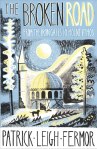
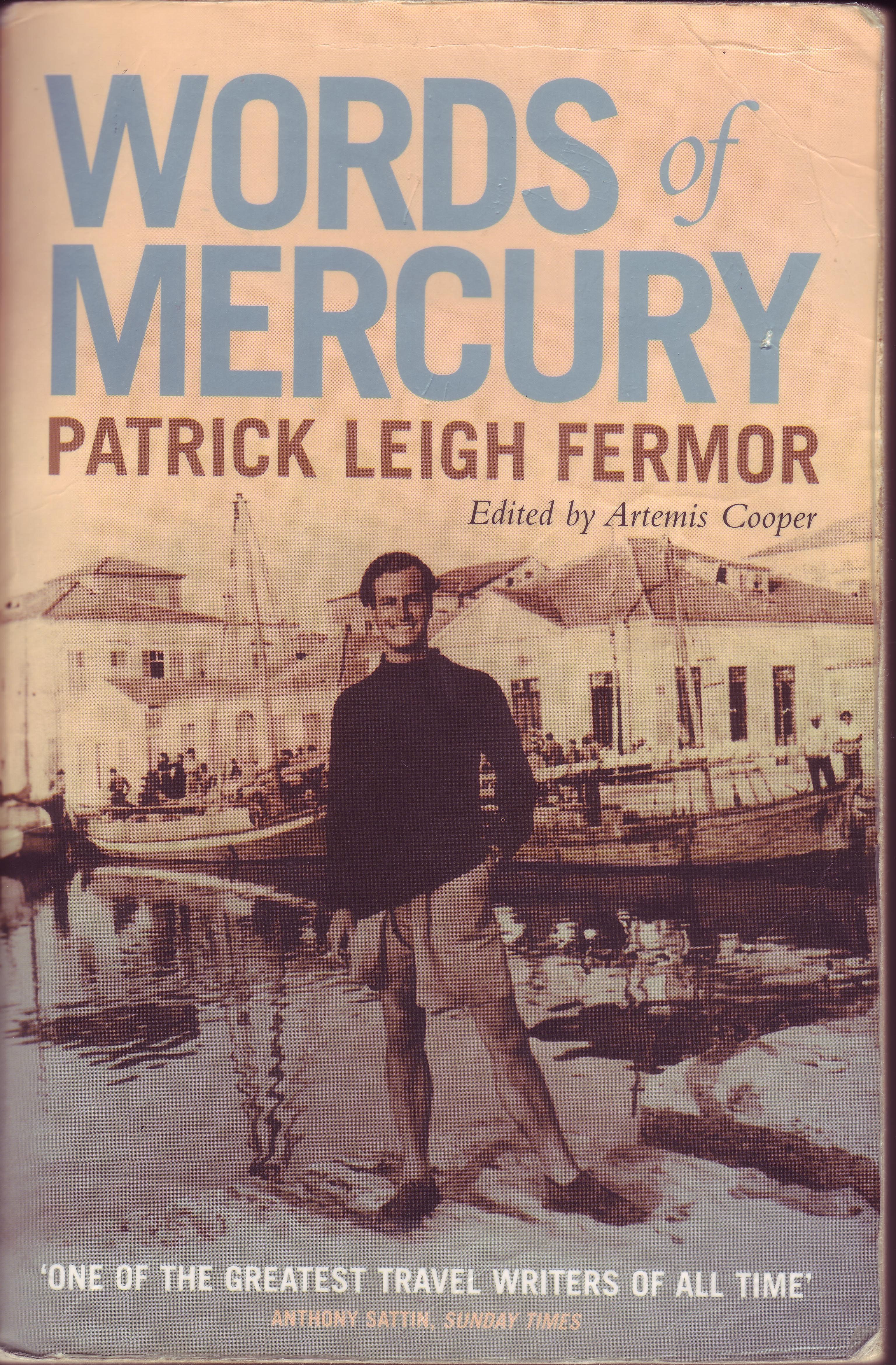
The Broken Road book cover


The Broken Road book cover
The book is available to pre-order from Amazon, just click here The Broken Road: From the Iron Gates to Mount Athos

Artemis Cooper on Patrick Leigh Fermor’s ‘Broken Road’ at King’s Place Festival

Artemis will be discussing The Broken Road at the King’s Place Festival in London’s King’s Cross on 15 September 2013.

The blurb fails to mention that Colin Thubron jointly edited Paddy’s manuscript with Artemis.

Booking detals can be found here.

The book is available to pre-order from Amazon, just click here The Broken Road: From the Iron Gates to Mount Athos

Preview copy of The Broken Road

The Broken Road book cover

The Broken Road book cover

Not only did I have a lovely meal last night with friends, and awoke to a beautiful English summer’s morning, but my preview copy of The Broken Road was delivered this morning. It looks as beautiful as you would expect and I was pleased to see that Colin Thubron is given “lead billing” as editor; Colin has sometimes been overlooked but this is very much a joint project with Artemis Cooper.

I am looking forward to reading it in my lunch break today!!

The book is available to pre-order from Amazon, just click here The Broken Road: From the Iron Gates to Mount Athos

Transylvanian Book Festival final programme and bookings

Richis banner
The programme for the very first Transylvanian book festival has been finalised. The event will run in the old Saxon villages of Richis, Biertan and Copsa Mare in the beautiful Carpathian mountains of Romania from 5-9 September. The festival programme includes lunches and dinner and some great excursions. How Paddy would have enjoyed the talk and the company!

There is still time to book your place by visiting http://www.transylvanianbookfestival.co.uk/ or contacting the organiser, Lucy Abel-Smith direct on +44 1285 750 358/888 or email: lucy[at]realityandbeyond.co.uk

The line-up is varied with a range of talks, discussions and music.

  • Michael Jacobs.  Memories of Transylvania and other writers.
  • Jessica Douglas Home Once Upon Another Time. The threatened destruction of Transylvanian villages.
  • Tony Scotland A Journey through Eastern Europe before Christmas 1989
  • Nick Hunt Walking the Woods and the Water
  • Michael Jacobs will be in conversation with Beatrice Rezzori Monti della Corte and William Blacker.
  • Professor Roy Foster “Transylvania Is Not England”: Bram Stoker and the location of Dracula
  • Hans Schaas and Sara Dootz in conversation with Caroline Fernolend and Andrea Rost about life in the Saxon Villages before the early 1990s.
  • William Blacker Along the Enchanted Way.
  • An evening of the poetry of Stephen Watts and Claudiu Komartin.
  • The Medias Choir singing some music from the Siebenbürgen and from Georg Meyndt, (1852-1903) from Richis.
  • A recital of music by Enescu and Bartók by Carina Raducanu,  Eugen Dumitrescu with violinist Ioana Voicu.
  • Countess Salnikoff will talk about her grandfather, Miklós Bánffy whose trilogy the Writing on the Wall must rank amongst the greatest works of 20th century literature. In conversation with publisher of Arcadia Books, Gary Pulsifer.
  • Jaap Scholten reads from Comrade Baron, and then in conversation with some of those with first hand experience of the early fifties in Communist Romania.
  • Artemis Cooper will talk about the subject of her recent biography, Paddy Leigh Fermor, whose writings of pre-war Transylvania, in Between the Woods and the Water influenced many of this festival’s authors.

Chryssa Ninolaki – part of the Greek resistance on Crete

Chryssa Ninolaki, centre, with Stephen Verney, left, and her brother, Tassos.

By Tony Knight

First published in The Guardian, Monday 3 October 2011

My friend Chryssa Ninolaki, who has died aged 80, played a courageous part in the struggle for freedom in Crete. She was a true ambassador for her native island, which she loved.

At the beginning of the second world war, when Chryssa was a pupil at the French school in Chania, her family moved to her grandfather’s farm near the monastery of Chrysopigi on the outskirts of the city, to escape the bombing. After the fall of the island in 1941, Chryssa and her family were part of the Greek resistance and supported the work of the Special Operations Executive agents who operated in the White Mountains, Xan Fielding, Patrick Leigh Fermor and Stephen Verney among them.

Chryssa and her family spent the war living next to a German garrison. Her parents and her brother, Tassos, carried out acts of defiance at great risk. On one occasion, they moved a cache of arms buried in the orchard just hours before the property was searched. They became part of an underground network assisting, sheltering and hiding British and Commonwealth soldiers for escape attempts on the island’s south coast. “We are crazy people: we act first and never mind the consequences,” Chryssa once told me.

After the war, Chryssa started to work for holiday companies, first the Travel Club of Upminster and then Simply Crete. She was a very different type of travel representative, freely sharing her beloved Crete with many British visitors. For the 50th anniversary, Chryssa took visitors on her celebrated Battle of Crete tours. A close friend reflected the feelings of many when she said: “For me, Chryssa was Crete. She brought so much joy to so many Brits.” Chryssa is survived by her sister, Helen.

A Visit with Patrick Leigh Fermor, Part 3

Paddy in uniform

Part 3 of Ben Downing’s meeting with Paddy in 2001 at Kardamyli.  Read Part 1 here and Part 2 here.

by Ben Downing.

This text originally appeared in issue 165 of The Paris Review, Spring 2003.

There was an incident dating from this vagabond period—from 1956, to be exact—that I was keen to ask Paddy about. Some weeks earlier I had come across, in a sort of anthology of classic put-downs, an anecdote about a contretemps between Paddy and Somerset Maugham. When I asked Paddy about it, he ferreted out a photcopy of a letter he had written at the time to a friend of everyone concerned, Deborah Devonshire, in which he describes what happened. It begins by telling how, after a week in the Alps with director Michael Powell’s team shooting Ill Met by Moonlight (Moss’s account of the Kreipe abduction), Paddy—who is, incidentally, played by Dirk Bogarde in the movie—had settled down to write in a friendly curé’s garden. The letter proceeds as follows:

Before I’d set out, Annie [Fleming, wife of novelist Ian] told me that “Willy” had asked her to stay and to bring anyone she liked (so why not me) and when she got to the Villa Mauresque she rang up, announced the O.K., and collected me in a borrowed car.

Lunch went swimmingly: Annie, Mr Maugham, his friend Alan Searle, and me. So well that, when we got up, Maugham—looking rather like a friendly Gladstone bag—said that he hoped I would stay and go on with my writing, and showed me a charming room. So all prospects glowed when we assembled on the terrace before dinner. The only other guests were a Mr and Mrs Frere; he was Mr Maugham’s publisher at Heinemann and she was Edgar Wallace’s daughter. Making conversation over marvellously strong drinks, I asked her if her husband was anything to do with someone I knew with the same name. She said she wasn’t sure: what did he do? I said,

“He’s a herald.”

“What sort of a herald?”

“Oh, you know, works in the College of Arms—he’s Rougedragon Pursuivant, or something like that.”

“How interesting.”

“Well, he’s an exception to Diana Cooper’s generalization.”

“Oh, what is that?”

“She says it’s generally believed that all heralds stutter.”

“How do you mean?”

“You know, stammer, have an impediment in their speech.” After this I rambled on about Diana’s splendid generalizations. “She says it’s well known that all Quakers are colourblind, and she remembers that, when she was a girl, Liberal M.P.s never travelled anywhere without an aneroid barometer. And so on.”

More dry Martinis were handed round, swallowed, and replaced. During a lull in the talk, Mr Maugham said:

“T-today is the F-feast of the As-sumption of the B-blessed Virgin M-Mary, and n-none of the g-gardeners have d-done a s-stroke of w-work.”I was fascinated by the mention of this religious feast and broke in with:“

The Feast of the Assumption! You know that huge picture in the Louvre, I think by Correggio, with the Blessed Virgin whirling into the sky as though shot out of a gun through a dozen rings of cloud, and scores of seraphim and cherubim? I’ll never forget the reaction of Robin Fedden—he had a charming stammer, and he exclaimed, ‘That’s what I c-call an unw-warrantable as-sumption!’” Soon after we were bidden indoors for a delicious dinner. After the guests had left and we were enjoying a nightcap, Mr Maugham got up, shuffled across the Aubusson, and with a limp handshake said—I won’t indicate the stutters any more—“Well, I will say goodnight now and perhaps I should say goodbye too, as I expect that I will be in bed tomorrow when you leave,” then ambled off.

The odd thing is that, until that moment, neither Annie, Alan, nor I had been aware of anything being wrong. For a minute or two we were genuinely puzzled, until Alan rather tentatively said, “Do you think it might have anything to do with the stammering?” and we all saw the light. Much wine had passed our lips. Annie was in fits of laughter and Alan joined her, but I felt very upset. After all, our host had been extremely kind and welcoming. But could he really have thought it had been on purpose? Of course I knew all about the youthful agonies caused by the impediment. In Of Human Bondage—an early, partly autobiographical book, and perhaps his best—he turns the stutter into actual physical lameness. My predicament, helped by several Martinis, was a classic instance of Freudian Error, exactly like the case of the woman warned against making any tactless remarks about noses, when an unknown visitor with an enormous one was expected to tea. The moment the guest sat down, she asked, “Would you like one lump of sugar or two in your nose?”

Annie helped me pack next morning. I put my suitcase on the bed and piled everything in, but when I closed it, a corner of the sheet—a beautiful Irish linen one with “W.S.M.” embroidered on it—got stuck in the zipper, and when I headed for the door it tore from top to bottom with a noise like a hundred calico shirts being rent. There was nothing for it but to slope off with some of the tatters hanging out. Annie was in raptures of hilarity at this final touch. (She is totally incapable of leaving a comic story unembellished.) I found, with her help, sanctuary in a hotel about a mile away, where she turned up when she could, like a prison visitor, to bring news; the story had spread along the coast and caused lively interest. Diana, who was staying with Daisy Fellowes, drove over with Hamish [St. Clair Erskine] and loyally pitched into my late host (“I’ve never heard such rot”) and I was invited back for a sort of reconciliation and forgiveness feast. I was very pleased about this; after all, it was entirely my fault, due to strong drink, and I’d rather be thought a soak than a monster. We were anxiously and studiously polite, but it would obviously never come right …

It was encouraging to hear, later on, that Cyril [Connolly] had once been made to leave the house for picking and eating the last avocado off a tree on the terrace. But I learnt, later still, that this was only a consoling rumour. He was scolded, but allowed to stay on.

Another episode that I’d recently heard about—but didn’t know the details of—was Paddy’s involvement with a John Huston film, The Roots of Heaven (1958). I asked him to tell me about it:

“I was staying in a Benedictine abbey in Normandy (the same one mentioned before) when one morning a monk called me to the telephone, and it was John Huston. I knew him a bit from non-film circles and liked him. He told me that he liked my stuff and that he wanted me to write the script for a film of a novel by Romain Gary called The Roots of Heaven, which is about a fierce campaign in the African forests to save elephants from annihilation by ivory traders. It was to be a Twentieth Century Fox affair, with Darryl Zanuck as producer and Errol Flynn, Trevor Howard, and Juliette Gréco among the stars. ‘I’m directing it,’ said John, ‘and we’re shooting in Africa.’ I told him I knew nothing about films. He said this didn’t matter, and described the plan for half an hour before saying, ‘I think I’d better hang up now, as I’m calling from Tokyo.’ Continue reading →

Ode to recovery by Harry Eyres

A review by Sarah Bakewell of Harry Eyres’s new take on Horace which may well have amused Paddy.

First published in the Financial Times 13 June 2103

Knowledge of classical literature can bring people together or drive them apart; it can be socially exclusive, inspire feats of one-upmanship, or turn enemies into friends. Sometimes it can do all this at once, as when the author and Special Operations Executive officer Patrick Leigh Fermor led the captured German general Heinrich Kreipe through the Cretan mountains in 1944. Looking at the snow-covered peaks, Kreipe murmured lines from Horace, in Latin: Vides ut alta stet nive candidum/ Soracte … (“Do you see how Soracte stands white with deep snow?”). Leigh Fermor took up the ode where he left off, suavely reciting it to the end. United by their classical education, he and his captive shared a “moment” before going back to the business of war.

If this story is still touching, it is mainly because of the beauty and humanity of the “Soracte” ode itself. Horace gives us a mountain snowstorm, only to move immediately indoors where he and a friend are about to throw a log on the fire and uncork some simple local wine: “A mellow four-year-old riserva,” as Harry Eyres translates it here, “Just the Sabine vino, not a fancy cru.” Being both poet and wine writer, Eyres has a taste for Horace’s wine as well as an ear for the vigorous Latin with which it is evoked. In Horace and Me, he blends these with memoir to create a paean to Horace and a polemic for the wise life, and for classical literature in general.

He makes Horace very appealing: a paunchy, sociable man, who esteemed friendship more highly than lust, and honest lust more highly than love. He suffered much early turmoil, born in 65BC as the son of a freed slave in southern Italy, then studying in Rome and Athens. After Julius Caesar’s assassination in 44BC, he ran into trouble by fighting for Brutus’s army, and was punished by having his family property confiscated. He worked as a scribe, then found a powerful patron who bought him a rural haven in the Sabine hills near Rome. By his death in 8BC, Horace was secure in the certainty that his poetry would last longer than bronze.

Eyres read Horace at school but only later learnt to value his “middle-aged” wisdom: his praise of moderation, equanimity, the simple life, the joys of the passing moment, and the ability to enjoy what one has rather than always reaching for more. Eyres finds Horace’s writing “like a dip in an ice-cold stream, clarifying, not enflaming”, and recommends it as an antidote to modern bustle and a form of therapy.

It is the therapeutic memoir strand of the book that lets it down somewhat, including the passages of travelogue in Greece and Italy. Eyres promises a grand narrative arc: “This is a story of how I came back to Horace – and came back to myself at the same time.” Yet it is only vaguely fulfilled, and many episodes are bland, and tenuously connected with Horace. When, at last, something really dramatic happens, and Eyres takes an ill-fated trip to Cuba to meet a “flame-haired poetess” who does not show up, leaving him disoriented and playing Schubert “on huge white Russian pianos left stranded in obscure museums and hotel lobbies”, we are hurried past the story as if there were nothing to see. The scene dissolves in a puff of plurals. (How many huge white pianos?)

But Eyres’s take on Horace is enlightening, and best of all he provides his own witty, exuberantly updated translations of the verses. Roman carriages become SUVs, a perfumed youth becomes a boy drenched in Pour Homme, and a long-forgotten Roman uprising is transplanted to Basra. This keeps Horace surprising and fresh. It sends the reader to the original – not for a more conventional translation but for a long sip of the Latin, which Eyres makes clear we cannot do without, whether we can spout it magnificently on a Cretan mountain or not.

Sarah Bakewell is author of ‘How to Live: A Life of Montaigne in One Question and Twenty Attempts at an Answer’ (Vintage)

Every Invented Paradise Soon Turns Into Hell

Taki Theodoracopulos has gained a special place in the hearts of British Sunday newspaper readers over the last forty years or so with his gossip columns which mostly concerned his own exploits. More recently he has attracted the ire of your favourite blog readers for his pomposity, his vanity, name-dropping, and his blatant errors in what was some sort of valedictory article soon after Paddy’s death. The debate following my publication of Better a Hero Than a Celebrity got pretty heated; see Getting it Right. But we can’t ignore him, and here he is back again with a further recycling of his only Paddy anecdote, name dropping on the way. Utterly shameless.

by Taki Theodoracopulos

First published in his eponymous magazine, Taki’s Magazine, 22 March 2013.

He was a member of a charmed circle of Hellene and Philhellene intellectuals just before and after World War II, experiencing modern Greece and seeing it as a place rich in beauty and a stimulus to artistic creation. Patrick Leigh Fermor, whose biography by Artemis Cooper I just put away almost in tears—like a magical night with a girl of one’s dreams, I didn’t want it to end, but end it did—was a second Byron in Greek eyes. I found the book unputdownable, as they say in Boise, Idaho, especially the rich descriptions of rambunctious jaunts in tavernas and places where I had spent my youth.

There is always a feeling of imminent loss where Greece is concerned, an anxiety of what is in store, and no one captured it better than the Nobel Prize winner George Seferis—a close friend of Patrick Leigh Fermor’s—when he wrote:

And yet we knew that by the following dawn

nothing would be left to us, neither the woman drinking sleep at our side

nor the memory that we were once men.

This mood of apprehension, foreboding, and fear of oblivion is very, very Greek. Every invented paradise soon turns into hell, starting with Homer, Aeschylus, Sophocles, and Euripides. After all, we Greeks invented the “T” word.

The second Greek poet to win the Nobel Prize was Odysseus Elytis, ten years or so after George Seferis. Elytis’s brother was the non-playing captain of the Greek Davis Cup team, and he and I didn’t exactly get along. His name was Alepoudelis—“little fox” in Greek, Elytis being a pseudonym, and he was always trying to buy a used car from me for peanuts. I loathed that petty little man who had not named me in the singles against Spain back in 1964 because I had gone out all night with a queer bullfighter and his entourage. (I was hoping to meet Ava Gardner, a friend of the gay caballero.) Yet when I asked the little fox for an intro to the Nobel Prize winner for literature, he uncharacteristically gave me a glowing one. I met Elytis in Kolonaki, the chic residential section of Athens where we both lived.

At Café Byzantium, the first question I posed was the usual boring and unimaginative question that hacks ask of those whose work they know little about: “What does winning the Nobel mean to you?”

“I’m getting more pussy,” came his answer. I thought it so great I grabbed his hand and kissed it. (The one-sentence interview appeared in a Greek newspaper with glowing letters to the editor following.) We then proceeded to drink ouzo and chat up the girls.

But back to Paddy and his circle of friends. The leading players were the painter Niko Ghika, George Seferis (the “Colossus of Maroussi,” as Henry Miller immortalized him), George Katsimbalis, and our hero Paddy. I only met Ghika and Paddy once—in 1978 or ’79—under unfortunate circumstances. Ghika is Jacob Rothschild’s father-in-law, and his paintings throughout his life have been fresh and clean and pure and naked of all pretense. I was lying at anchor in Corfu on Gianni Agnelli’s boat when my host asked me to go up at the Rothschild villa and ask them down to lunch. Back then it was the only way to communicate, unless the Rothschilds understood Morse code.

I went and ran into a strict nanny-like woman sunning herself on the terrace, asked her if Jacob Rothschild was there and was told he was out, so I left a message that the Agnellis were expecting them for lunch in the bay below. The nanny was not best pleased. In fact she was downright rude, but I don’t do rude from foreigners in my own country, so perhaps I was a tiny bit rude also. (“Listen you old hag, just give them the bloody message.”) Then the Ghikas and the Rothschilds arrived, me never having met any of them before. And they looked rather peeved. The nanny turned out to be Dame Peggy Ashcroft, who had stayed behind.

The atmosphere did not improve after Agnelli asked me to do the introductions—a strange request, as I had not met Paddy or Ghika before. I got them right, of course, but then introduced Jacob’s wife as his mother and his mother as his wife. Had it not been for Paddy’s brilliance (he recited poems and sang and told nonstop stories), the lunch would have been a disaster. Afterwards the Rothschild woman went to the Spectator’s editor, called me scum, and asked that he fire me. She did not get her wish, as well she should not have, because it was a totally honest mistake on my part. Both women were rather plain, and I didn’t know them from Adam, so there.

I started this column with the intention of explaining Paddy’s Greece and why he loved my country so. I got sidestepped with trivia, although Nat Rothschild still laughs at my Corfu story. As publisher John Murray wrote on the dust jacket, “No one wore their learning so playfully,” which in today’s ghastly world of untalented people who hold themselves in high esteem is such a welcome relief from the pompous and self-important. Greece is olive groves and hills covered in pine and myrtle, thorns and cypress trees standing at attention before gray-green mountains that turn yellowish as the sun sets. Henry Miller waxed lyrically on the Greek light. He maintained that the Greek “lived amidst brutal clarities which tormented and maddened the spirit…urging him to war.”

No longer. The EU suits have turned the Greek into an effete, cowardly nonentity who plays along. Achilles is now Antonis, as in Samaras, the prime minister who has sold out the country. While 400 years of Turkish occupation did not snuff out the flame of Greek passion, the Brussels scum have. Goodbye Hellas, hello Belgium.

Related articles:

Better a Hero Than a Celebrity

Getting it right and that Taki article

A Visit with Patrick Leigh Fermor, Part 2

Paddy. on Ithaca, 1946 by Joan Leigh Fermor

Part 2 of Ben Downing’s meeting with Paddy in 2001 at Kardamyli.  Read Part 1 here.

by Ben Downing.

This text originally appeared in issue 165 of The Paris Review, Spring 2003.

Already familiar as I was with the main events of Paddy’s military career, I asked him to fill in the gaps. What had he done while in Cairo?

“My first leave from Crete, after many months in the mountains, was at the time of the Italian surrender in September 1943. I had managed, by devious means, to persuade the Italian general commanding the Siena Division to escape from the island with some of his staff, and I accompanied them. When they’d been handed over in Cairo, I found myself quartered in rather gloomy billets known as Hangover Hall. There I became great friends with Bill Stanley Moss, on leave from the Third Battalion of the Coldstream Guards, and later my companion on the Kreipe expedition. Couldn’t we find more congenial quarters? Almost at once Billy found a positive mansion on Gezira Island, which we shared with a beautiful Polish countess called Sophie Tarnowska—she and Billy were married later on—her Alsatian, two mongooses, and a handful of close SOE friends, also on leave.

“Tara (as we named the house) was an immediate triumph. With its ballroom and a piano borrowed from the Egyptian Officers’ Club, and funded by our vast accumulations of back pay, it became famous—or notorious—for the noisiest and most hilarious parties in wartime Cairo. At one of these, fired by the tinkle of a dropped glass, everyone began throwing their glasses through the windows until not a pane was left.

“It was to Tara that we returned after the Kreipe expedition. But the rigors of a year and a half of Cretan cave life, it seems, suddenly struck me with an acute rheumatic infection of the joints, akin to paralysis. After two months in a Cairo hospital—where King Farouk once kindly sent me a magnum of champagne—I was sent to convalesce in Lebanon. I stayed at the British summer embassy at Aley, above Beirut, with Lady Spears, who was the well-known American writer Mary Borden, and her husband, Sir Edward Spears, our ambassador there. We had all met in Cairo, which at that time was one of the most fascinating gathering points in the world.

“But I was itching to get back to Crete. By the time I managed to return, in October 1944, the entire German force had withdrawn to a small perimeter in the west of the island. The outcome was a foregone conclusion, and the Germans made only occasional sorties. With their imminent surrender in view, it wasn’t ‘worth the bones of a single Pomeranian grenadier,’ as Frederick the Great said—or of a single mountaineer or Allied soldier, for that matter.

“I went back to Cairo for a last Tara Christmas. But Tara was dissolving, and in March 1945 I was sent to England, where I joined a rapidly-put-together unit called the Special Allied Airborne Reconnaissance Force—inevitably SAARF—for an odd emergency. There was a fear that during the ‘Eclipse Period’—the predictable days, that is, between the faster momentum of the Allied advance and the final surrender of the German army—the Germans might carry prominent Allied prisoners of war off to some Tyrolean redoubt and use them as hostages or bargaining counters; and it was hoped that SAARF would be able to prevent this. Its members all had SOE and parachute experience in enemy territory. The plan was that, at the right moment in Eclipse Period, each team of three—in some cases, two teams together—would take off from an airstrip at the Sunningdale golf course, in Surrey, and drop near its allotted prison camp in Germany. Dressed in tattered POW uniforms, we would lie up in the woods, spy out the land, slip into POW working parties, get inside the camp, and then contact the senior British officer and open W/T communications with the spearhead of our advancing troops; these would then drop arms and supplies and give air cover while the garrison was overpowered or the commandant bluffed, until Allied troops arrived.

“I found myself paired with Henry Coombe-Tenant, a major in the Welsh Guards, a brilliant pianist and a member of the Athenaeum who after the war became a Benedictine monk at Downside. Our commandant was Brigadier Nicholls, nicknamed ‘Crasher’; he was impermeable as a bison. The target we were destined for was the dread Oflag IV C at Colditz, where several Prominenten were prisoners, including the king’s cousin, Lord Harewood, and relations of Churchill and Field Marshal Alexander. The castle was deep in Saxony, and there was, of course, no resistance or SOE intelligence about it—nothing but aerial photographs to go on. We desperately needed more local detail.

“At this point I heard that an old friend, Miles Reid of the Phantom Reconnaissance Force, captured in Greece during the 1941 retreat, had been exchanged on health grounds, and precisely from Colditz; so I got leave to break security in the hopes of information, and dashed to see him at his home near Haslemere. When I told him of the Colditz scheme, he exploded. Had we heard nothing of the total impregnability of the fortress, of the thoroughness and rigor of the Appells, the checks and counterchecks, the scrutinies and roll calls? As for ‘working parties,’ since the inmates were all officers, these didn’t exist. There was absolutely no hope of the plan succeeding, and we would all be goners. Continue reading →

The words of Mercury are harsh after the songs of Apollo: Meeting Patrick Leigh Fermor

Ryan Eyre lives in Seattle, and took a journey to Kardamyli to meet Paddy in 2009. He has written this article for the Journal of the Book Club of Washington, and has asked to publish it here as well. Ryan tells us, as many others have done, about Paddy’s remarkable memory, which he utilised to the full to write A Time of Gifts and Between the Woods and the Water. I have seen evidence of this myself. On a recent visit to Cluj I was able to enter the public rooms of the fabled Hotel New York (Continental) clutching a copy of BTWW and marvelled at the accuracy of Paddy’s description of its decor … but the cocktail bar was closed!

Update: I met Ryan last month (5 June 2013) in London and was able to show him the site of the original John Murray publishing house at 50 Albemarle Street. Ryan was on a holiday from his post in the Republic of Georgia where he is teaching English. He reminded me of this article which was posted in the week following Paddy’s death. It may have got lost in all the high frequency posting at that time, so I promised him that I would give you all another chance to read his account.

Meeting Patrick Leigh Fermor

by Ryan Eyre

On a February evening in 2009 I alighted from a bus in the village of Kardamyli, in the Mani region of southern Greece. I had arrived at this remote corner of the Peloponnese with one purpose: to meet the celebrated English author Patrick Leigh Fermor, one of the great prose stylists of the 20th century and arguably far less well known than he should be. Now in his nineties, Paddy (as he is known by his friends) still divides his time between England and his adopted home of Greece, where he lives in a house he designed himself in the 1960’s on a headland just south of Kardamyli. Patrick Leigh Fermor (PLF) has had an extraordinarily full and remarkable life.  For the sake of some background for those unfamiliar with him I provide a brief biographical sketch:

Born in 1915 and educated at the King’s School in Canterbury until he was expelled at the age of sixteen, he was preparing for the entrance examinations for Sandhurst when a sudden inspiration came over him. He decided to walk across Europe, with the final destination point as Constantinople, living, in his words, “like a tramp or a wandering scholar.” It was December 1933 and he was eighteen years old. He set out almost at once, catching a tramp steamer from London to Rotterdam and beginning his walk from there, passing through the Netherlands, Germany, Austria, Czechoslovakia, Hungary, Romania, Bulgaria and European Turkey before arriving in Constantinople on New Year’s Day, 1935. His experiences on his thirteen-month peregrination later provided the material for his two most celebrated books:  A Time of Gifts and Between the Woods and the Water, which were first published in 1977 and 1986, respectively.  These two volumes recount the first two-thirds of his amazing journey by foot from the Hook of Holland to the Golden Horn. Richly descriptive and full of historical and literary allusions they provide a portrait of a pre war Europe long since vanished.  Apart from the extremely high standard of prose and the author’s obvious enthusiasm for history, literature and art, perhaps the most appealing aspect of his account of this remarkable journey is that it was completed on foot. It has been said that the human mind can only properly absorb its surroundings at a walking pace.   The gradual transitions of landscape, language and culture were carefully observed by PLF because of the patient, unhurried approach that he took; a faster form of travel would have failed to capture nearly as much of the richness and complexity of the lands he passed through.

After completing this walking journey, he spent the next couple of years in Greece and Romania. He was romantically involved with the Romanian princess Balasha Cantacuzene, living with her on her estate in Moldavia until the outbreak of the Second World War in 1939, at which point he returned to Britain to enlist in the army. During the war he served with distinction in Greece, both during the German invasion of 1941 and afterwards during the occupation.  As a SOE (Special Operations Executive) agent he helped coordinate the resistance movement on Crete. The highpoint of his war was the celebrated kidnapping of the commanding German general Heinrich Kreipe on Crete in 1944, which he and a fellow British officer devised and accomplished with a band of Cretan partisans, abducting the luckless general from his car outside of Iraklion and spiriting him away into the mountains and eventually Egypt. After the war and in the company of his wife, the late Joan Eyres-Monsell, he travelled all over Greece, exploring the most remote rural areas on foot or mule, and developing a deep appreciation of the folk customs, dialects and traditions that have in the last half century largely vanished (see his books Mani and Roumeli).  His travels and books have never been limited to Greece, though:  his first book The Traveller’s Tree (first published in 1950) was written after an extensive journey around the West Indies in the late 1940’s.  Possibly his best book (according to New Yorker columnist Anthony Lane), A Time to Keep Silence, explores the nature and meaning of silence as he experienced it living in various French monasteries.  Whatever topic PLF has written about, his natural enthusiasm, curiosity and exquisite writing make it compelling reading.

Several years before I had been travelling in Romania and by chance a fellow American in the hostel had shown me a copy of Between the Woods and the Water, in which PLF recounted travelling through the same area in the 1934. Intrigued when I returned to Seattle several months later, I had checked A Time of Gifts out from the library and was instantly enthralled by it. The subject matter, the style and the sensibilites were immediately appealing. I can state unequivocally that PLF’s writing had a powerful influence on me. He seems almost the embodiment of an ideal-the literary man of action. Highly erudite but also a man of the world, unapologetically articulate and learned but with enough graciousness and charm to avoid being a pedant, equally comfortable with the humble as well as the high born. I’m not the only one who views him this way – Bruce Chatwin, Colin Thubron and William Dalrymple have all cited PLF as a major influence on their writing and lives. From PLF I developed a deeper appreciation of art and literature, and renewed an interest in history-particularly European. Because of him I also became a better traveller– by slowing down, more closely observing my surroundings and immersing myself in the history of a place before I visited.

I became determined I had to meet this man. I knew he was old and in declining health so time was of the essence. In January of 2009 I was in England visiting relatives and went to his literary agent’s offices in London hoping to get a formal letter of introduction. I only spoke to a secretary, who passed on an email address to which I wrote but predictably from which I heard no reply. My cousin said “The only way to meet the blighter is to show up where he lives-I’m sure you’ll be able to meet him.” I decided to take his advice and hope for the best.

Thus a month later I arrived in Kardamyli with a mixture of excitement and trepidation, after having travelled over land and water from Portugal all the way to Greece. I had done my homework: I knew his former housekeeper (a woman named Lela) ran a taverna with some rooms in the town-that seemed the obvious place to stay.  Before my arrival I had telephoned and had spoken to her son Giorgios (Lela spoke no English).  In the winter the taverna was closed, Giorgios explained, but they would make an exception for me and at a reduced rate. Giorgios, a moustachioed and world- weary but courteous man in his fifties met me when I got off the bus, and after introductions were made, he walked me to Lela’s a few blocks away. It was a simple two story building by the sea, with a restaurant on the ground floor and a few rooms upstairs looking directly out on the sea. Lela appeared from the kitchen, in her seventies but still sprightly, with a craggy and quintessentially Greek face. After showing me to my room she and Giorgios disappeared quickly, leaving me as the only guest. Strolling out from Lela’s along the water onto a jetty and looking up towards one of the clearest starlit skies I had ever seen, with the only sound coming from the waves crashing against the rocks, I understood immediately why Patrick Leigh Fermor had decided to settle here years before.

The next morning I awoke early and walked along the road going south from Kardamyli. A Greek man out in his garden saw me and gestured for me to come inside. Without asking any questions he sat me down in his kitchen and served me coffee; this was exactly the type of hospitality towards strangers that PLF had described in his books on Greece.  Somewhat timorously I broached the subject of Patrick Leigh Fermor (known as Michalis by the locals) and asked where he might be found. He gesticulated southwards, saying in broken English that PLF lived a short way down the road, in the next cove known as Kalamitsi. I thanked him for the coffee and continued walking. I had with me an anthology of PLF’s work titled The Words of Mercury, which included an article he had written on how he had designed his house in Greece.  He described it as resembling a faded Byzantine monastery, with a view framed by cypress trees overlooking a cove with a small island offshore. Down a path and through an olive grove there was a house that closely resembled this description; in fact, it had to be his residence as it looked far older than any other house in the vicinity.

Emboldened by this discovery I walked back into town, just as the villagers were exiting the church service on a Sunday morning. Approaching Lela, I tentatively mentioned PLF’s name and pointed to The Words of Mercury, with a photograph of PLF in the 1940’s on the cover.  She gave Giorgios soon appeared and I explained that I had come to Kardamyli to hopefully meet PLF, and handed him a note of appreciation that I entreated to pass along. Giorgios told me that PLF was in England at the moment, but would be back by Tuesday and would gladly give him the note once he saw him.  So my timing had been providential!  Now I simply had to wait.  I spent the next couple of days either reading (finishing War and Peace to be exact) or going on long walks exploring the myriad of small coves and hills. The Mani is very quiet in winter and felt refreshingly unexplored. Each evening I would go to the kafeneon to sit with the local men as they chatted and watched football on the television. Giorgios would be there every evening and he was quite friendly and talkative to me.  Every evening I would tactfully bring up the subject of whether or not he had seen PLF. Each time he responded he hadn’t yet.  One evening as I was returning to Lela’s she insisted on cooking me a meal in the kitchen, sitting me down in a table in the restaurant and plying me generous portions of pork, potatoes and vegetables. On a table in the corner was a pile of black and white photographs; examining them more closely I saw they were informal snapshots of Lela and her family from the 1960’s with a younger looking Patrick Leigh Fermor in a number of the them. Seeing these candid photographs gave my purpose a lot more immediacy.

Taking the bus one day into Kalamata (the nearest city-some 20 miles away) I fell into conversation with a local woman about my age. I explained that I had come all the way here to hopefully meet PLF.  She raised her head backwards and clicked her tongue, the universal Hellenic gesture for disapproval. “The Patrick Leigh Fermor is very old man, many people, journalists come here to meet him, they have to book appointment…it’s not so easy to see him.”  Discouraging words and with each passing day I realized that Giorgios was probably protecting PLF’s privacy…it was perfectly understandable but I made up my mind to take a more direct approach. I wrote another, longer letter of appreciation (I wrote about eight drafts before I was satisfied) and screwed enough courage up to go to what I was almost sure was PLF’s house to give it to whomever answered the door.  Just as I was about to knock an Englishman in his forties opened the door and walked out to the driveway. He introduced himself as Hamish Robinson and confirmed that PLF did indeed live there. Hamish added PLF wasn’t very well at the moment but he would gladly pass on the note of appreciation and went back inside. I decided to walk south several miles to the next village called Stoupa. I had done everything realistically possible to meet PLF and if I wasn’t able to at this point I accepted that it just wasn’t to be. Walking along the coastal road with its stupendous views of the Messenian Gulf to the west and the snow-capped Taygetus Mountains to the east, I felt fortunate and privileged to be there at all.

Returning to Kardamyli later that afternoon in a state of calm resignation, my interlocutrix from the bus the previous day came running down the road. “Ryan, where you been? We been looking for you all day. Patrick Leigh Fermor wanted to have a drink with you but we couldn’t find you.”  Patrick Leigh Fermor wanted to have a drink with me? Suddenly a car pulled up. It was Hamish. “We were looking for you earlier today –come round for lunch at 1:00 tomorrow,” and then drove off. I couldn’t believe my luck…all the persistence had paid off…I was actually going to have an audience with Patrick Leigh Fermor after all — it was more than I could have asked.

Paddy on his 94th birthday (February 11, 2009)

The appointed hour couldn’t come fast enough and it was in state of mild disbelief that I found myself being admitted into PLF’s house by his housekeeper and into the sitting room (which doubled as a dining room), with prodigious book shelves on three sides.  I found myself standing in front of a distinguished, slightly frail looking man wearing a blazer and a tie. It was Patrick Leigh Fermor.  Shaking my hand, he briefly mistook me for somebody else before apologizing with, “I’ve got this blasted tunnel vision and I can’t see that well…so you’re the young man…so glad to meet you.”  His hearing and his eyesight were poor and I had to speak loudly to be heard. Hamish Robinson was there as well (his presence helped facilitate conversation) and for the next two and a half hours the words flowed, abetted no doubt by the several vodka and tonics that were consumed as well as the generous glasses of retsina that accompanied lunch. Conversation ranged from Lord Byron (PLF: “I didn’t care for him much when I was younger but now I adore him”), the Greek Orthodox Easter service, and the fate of King Harald Hardrada at the Battle of Stamford Bridge in 1066-to name a few of the topics discussed. When I told him I had visited Romania several years before he asked me, “Did you go by foot?”  Unfortunately, of course I had to answer no.  He also asked me questions about Seattle (“Where does the name come from?”). He had only visited the United States once -when he was invited by a Cretan-American association in New York as an honoured guest to commemorate the anniversary of The Battle of Crete.

PLF’s short-term memory was a bit faulty at times, he would forget the course of the conversation a bit but if I asked him about something from decades past or a literary reference he could recall it with instant clarity. For example, I showed him my copy of   The Words of Mercury and asked him the significance of the title.  “It’s from Love’s Labour’s Lost. You know that in the last act there’s a play within the play that’s performed for the amusement of the King of Navarre and the Princess of France. At the end of it they receive news that the King of France has died and the Princess and her entourage must leave. The last line of the play is ‘The words of Mercury are harsh after the songs of Apollo’. It’s rather a strange play.”

Surprisingly he seemed a little fussier and more self-deprecating than I would have thought. When I quoted from his writings a couple of times he responded, “That’s a bit fruity” or, “What absolute drivel.” I mentioned that I had tried to contact his literary agent in London but without success. His reply: “Oh do you know, I’ve never met him either.”  Time passed quickly and after the meal was finished we walked onto the terrace of his house, overlooking the sea. I thanked him for the invitation.  He replied, “If you’re ever in these parts again, do come round.”   And then he retired for his customary afternoon nap, “Egyptian PT,” in his words.  Hamish showed me the adjacent building where Paddy does his writing, giving me a recent photograph of him taken on his 94th birthday as a memento, and then with good-byes and sincere thanks, I gracefully made my exit. I felt a mixture of elation –having the extraordinary privilege of actually being a guest of the celebrated author in his home — and a bit of melancholy in seeing him in his twilight years.  It was surely the only occasion I would meet him, and there was so much more I wanted to ask that would never be said. I also suppose, perhaps there was the realization that for all this accomplishments and marvelous writing he was  still human after all.

The next day I left Kardamyli. Spending even a week in the Mani gives Patrick Leigh Fermor’s life and work so much more immediacy. When I read a passage in Mani describing the view looking out towards the Messenian Gulf with “dragon headed capes in the distance,” I know exactly what this looks like because I have seen this view myself. That means almost as much as having met the man, and both memories will last for the rest of my life.

Related article:

Images of Iasi

£1 a week – Nick’s talk at Up Down and Across

Some audio for you to enjoy from Nick Hunt’s recent talk at Up Down and Across.

He says on his blog:

My talk was a rambling exploration of Europe’s invisible pathways, its not-so-invisible motorways, ancient borders, modern-day myths and the multiple layers of story that lie beneath every walker’s boots. Unfortunately my digital recorder died after 20 minutes, but I went on to talk about dogs, dragons, devils, pilgrimage, the meaning of arrival and other obsessions of mine. All these things, and more, will work their way into my book. So stay with me. The story is coming, layer over layer.

Listen here…

Up Down and Across part 1

Up Down and Across part 2

Up Down and Across part 3

Perkins and Pendlebury in Crete, and a hunt for Xan Fielding’s grave

It’s holiday time and some of your fellow readers have been setting off in the footsteps fairly early this year. We had the excellent report from Paddy’s Italian Fans; the report from Kardamyli by our on the spot reporter John Chapman, and now a postcard from Julian Aburrow who visited Crete with his wife back in May; he sent us some pictures of the graves of Perkins and Pendlebury.

Julian was quite anxious to know whether Xan Fielding was buried on Crete, and as time ran out and his departure from the island loomed we asked Artemis Cooper if she had any better idea.

Dear Tom,
As you say, Xan died Paris and was cremated there. At some point after that Magouche, Paddy and Joan took his ashes into the White Mountains, and scattered them to the winds. Among Paddy’s photos now in the National Library of Scotland there is a photo which I think must have been taken at the time: in the foreground are a few beautiful red flowers (cut flowers that is, but not in a bouquet), a branch gnarled and bleached by the weather, and a great sweep of mountains beyond. If I go and see Magouche again, I will ask her to tell me in more detail. [Edit – of course Magouche passed away on 2 June 2013 just after Artemis wrote this note: see this article]

Artemis

In the meantime a regular correspondent to the blog, Paul George (who is one of those unfortunate souls who is an ex-pat and lives in Crete – you have our sympathies Paul 🙂 ), got in touch with some pictures of his recent walk into the White Mountains to the area where Xan’s ashes were scattered. It is a harsh and bleak landscape; it makes you think of the toughness of men who lived and fought here during the war.

The mountain hut is Kallergi at @ 1700 mtrs….this is the location that Xan Fielding’s ashes were scattered… The photograph taken in the mountain is of me trekking up Melindaou…… Xan Fielding, PLF et al…..would have know and walked in this area.

Trekking up Melindaou

Trekking up Melindaou

Kallergi hut near the location that Xan's ashes were scattered

Kallergi hut near the location that Xan’s ashes were scattered

Kallergi hut @ 1700 m

Kallergi hut @ 1700 m

Staff Serjeant Dudley Churchill Perkins

Left behind on Crete after the evacuation and subsequently captured. He then escaped and lived on his wits, with help from the locals, until 1942. When he was finally evacuated and rejoined his group, he found that he no longer fitted in and transferred to a different group. He returned to Crete where he was met by Xan Fielding.
More info here: http://www.my-crete-site.co.uk/vasili.htm. Vasili, The Lion of Crete by Murray Elliott is a very good read.

Captain John Devitt Stringfellow Pendlebury

Instrumental in organising early resistance, mentioning his name was a key to getting help from the Cretans, who thought very highly indeed of him. He is still known on Crete today: when we went to Knossos a few years ago, someone tried to sell us a guide book. When
I showed him my copy of ‘The Palace of Minos, Knossos’ by JDSP, he said ‘Blebbery, still the best’. Blebbery being the closest pronunciation that they can manage.
Imogen Grundon’s book The Rash Adventurer is a great read. Also, he knew Dilys Powell, Humfrey Payne et al and was highly influential in both Egyptian and Greek archaeology. I admire him very much.
Hope this is of interest and look forward to yet more posts on the blog.
Best wishes

Julian Aburrow

Related article:

Read more about John Pendlebury here: The magnetic John Pendlebury

Audible

A Visit with Patrick Leigh Fermor, Part 1

Patrick Leigh Fermor, center, with members of the team that abducted General Heinrich Kreipe: George Tyrakis, W. Stanley Moss, Manoli Paterakis, and Antoni Papaleonidas.

It has been said of Ulysses that, were Dublin ever obliterated, the city could be substantially rebuilt by consulting its pages. Along these lines, if all Europe were, God forbid, laid waste tomorrow, one might do worse than attempt to recreate it, or at least to preserve some sense of its historical splendor and variety, by immersing oneself in the travel books of Patrick Leigh Fermor.

by Ben Downing.

This text originally appeared in issue 165 of The Paris Review, Spring 2003.

Patrick who? Although popular both in his native England, where his books are available in Penguin paperback, and in many other countries—he has been translated into any number of languages—Leigh Fermor (who died in 2011) is known to only a devout few in this country, where, scandalously, his work is not distributed. I myself came to him three years ago, when a friend pressed me to seek out A Time of Gifts (1977) and Between the Woods and the Water (1986), the first two volumes of a projected trilogy about his teenage walk across Europe in the early thirties. By chance, that very week I stumbled across a used copy of A Time of Gifts. I began reading straightaway, but after a few pages stopped and rubbed my eyes in disbelief. It couldn’t be this good. The narrative was captivating, the erudition vast, the comedy by turns light and uproarious, and the prose strikingly individual—at once exquisite and offhand, sweeping yet intimate, with a cadence all its own. Perhaps even more startling was the thickness of detail, and the way in which imagination infallibly brought these million specificities to life. In the book’s three hundred or so pages, scarcely a paragraph was less than spirited, cornucopian, and virtuosic.

I am not given to idolizing writers or reading them entire, but this was a special case. Before long I had tracked down, whenever possible in their beautiful John Murray hardback editions, not only Between the Woods and the Water (which sees Leigh Fermor as far as the Iron Gates of the Danube) but also his remaining work—two travel books about Greece, one each about the Caribbean and Peru, a slim volume on monasteries, and a novella. Having devoured these, I started trying to find out more about Leigh Fermor himself. Piecing together information from his books and other sources, I came up with the following.

A clever but unruly student, Leigh Fermor was expelled from a series of schools and at sixteen dropped out altogether. After a period in London halfheartedly cramming for Sandhurst and (far more eagerly) partying with the last of the Bright Young People, he set out in December 1933 on his journey to Istanbul, which took him over a year. At this point the picture grew vague; there was some improbable story about his tagging along with a Greek royalist army as it quashed a rebellion, another about his falling in love with a Romanian princess.

The war years were somewhat clearer. Leigh Fermor enlisted with the Irish Guards; was commissioned in the Intelligence Corps; was sent as a liaison officer to the Greeks fighting the Italians in Albania; took part in the Battle of Crete; and escaped to Cairo in the general retreat. Having joined SOE (Special Operations Executive), he became one of a handful of officers secretly landed back on Crete, where, dressed as a shepherd, he lived in mountain caves and organized the guerilla resistance. His military career peaked in April 1944 when he led one of the most daring operations of the war. Disguised in Nazi uniform, Leigh Fermor and W. Stanley Moss, along with seven Cretan fighters, hijacked a car carrying General Heinrich Kreipe, commander of a division then occupying Crete. After bluffing their way—with Leigh Fermor impersonating Kreipe—past more than twenty checkpoints, they made for the mountains with their captive and spent three harried weeks dodging the thousands of troops sent to catch them, until finally a British boat slipped in to pick them up and take them to Cairo. For his role in the abduction Leigh Fermor was awarded the DSO.

After this the picture blurred again. I gathered that in the late forties and fifties Leigh Fermor had traveled at length in the Caribbean, Central America, and Greece; that he had hobnobbed—and often developed close friendships—with everyone from Diana Cooper to George Seferis; and that eventually he and his wife, Joan, had built a house in the Mani, a remote corner of the Peloponnese, where, reportedly, they still lived. But no more.

Even so, it had become clear to me that Leigh Fermor was not only among the outstanding writers of our time but one of its most remarkable characters, a perfect hybrid of the man of action and the man of letters. Equally comfortable with princes and peasants, in caves or châteaux, he had amassed an unsurpassedly rich experience of places and people. “Quite the most enchanting maniac I’ve ever met,” pronounced Lawrence Durrell, and nearly everyone who’d crossed paths with him had, it seemed, come away similarly dazzled. Also inspired, as witness this entry of 1958 from the Bloomsbury diarist Frances Partridge: “This evening over dinner the conversation turned to present-day pessimism, or cafard. Where can one look to find enthusiasm for living? I could only think of Paddy Leigh Fermor.”

Armed with this outline, I proceeded to write for The New Criterion a longish essay about Leigh Fermor, focusing mostly on his books. About two months later, in March 2001, I received a letter from him. An English friend of his had brought my essay to his attention. His response, infinitely gracious, concluded by exhorting me to drop in for “a proper feast” if ever I were in the area. That was all the invitation I needed. With typical American forwardness, I promptly called him and asked whether next month I and my wife, Michele, a fellow fan, might come and hang about for a few days, I perhaps interviewing him a bit. Whatever alarm he felt at the prospect of our invasion was muffled by good manners. He apologized for being unable to put us up—his sole guest room would be occupied that week—but said he could arrange accommodation at a nearby hotel, and that we would, of course, take all our meals with him and Joan.

Within hours I had booked our tickets.

* * *

Driving west from Athens, we crossed the Isthmus of Corinth onto the Peloponnese and spent the first night in the handsome seaside town of Nauplia. The next day we pushed on, marveling at the unaccustomed verdure—our previous visits to Greece had been in summer, when the heat turns everything brown—and at the profusion of flowers and blossoming Judas trees. After passing Sparta, we headed up into the Taygetus range, then down to Kalamata (of olive fame), where we swung south along the coast, and so to the village outside which Leigh Fermor lives, and which he has asked me not to name. Our Pisgah sight of the village was to be, our guidebook rather sternly declared, memorable: “Anyone who approaches it from these heights and is not moved by its combination of tiny islands, indented coastline, stone houses, and rugged hills, has the soul of a peanut.” Whatever the condition of our souls, they apparently are not leguminous, for we found the view every bit as sublime as advertised.

On arrival at the hotel, we discovered waiting for us at the front desk a welcome card that Leigh Fermor—to whom I shall, for the sake of brevity and informality, henceforth refer as Paddy—had dropped off earlier in the day. When I called him, he asked us to come round for dinner.

Shortly after dark, a rough dirt track brought us to the house. The front gate standing ajar, we entered and followed a lamplit cobbled path to an open door, which gave upon an L-shaped arcade. The sea could be heard heaving just below. As there was still no sign of life, we called out. A few seconds later, from one end of the arcade, Paddy and Joan emerged, greeted us warmly, ushered us into an immense book-lined living-cum-dining room where a fire crackled, and swiftly plied us with ouzo. (Their alcohol regimen, we soon discovered, dictates obligatory ouzo or vodka before dinner and red wine or retsina during; lunch is the same, minus the vodka option.)

Although immediately convivial, the Leigh Fermors had had a trying day. There had been some sort of plumbing trouble, which resulted in workmen ripping open part of the terrace. The dust kicked up by the jackhammers had irritated one of Paddy’s eyes, so that it now teared incessantly—and, as he pointed out, adopting a mock-plummy tone, “The other one weeps in sympathy.” Encouraged by his levity in distress, I reminded him of the light verse that he and his old friend John Julius Norwich had concocted together, which I had recently read in the first of Norwich’s delightful Christmas Crackers miscellanies. Over lunch, writes Norwich, he and Paddy “talked about how all Englishmen hated being seen to cry. Then and there we improvised a sonnet… The odd-numbered lines are mine, the even his.” The sonnet runs as follows:

 When Arnold mopped the English eye for good

And arid cheeks by ne’er a tear were furrowed,

When each Rugbeian from the Romans borrowed

The art of ‘must’ and ‘can’ from ‘would’ or ‘should’;

When to young England Cato’s courage stood

Firm o’er the isle where Saxon sows had farrowed,

And where Epicurean pathways narrowed

Into the Stoic porch of hardihood;

Drought was thy portion, Albion! Great revival!

With handkerchief at last divorced from cane,

When hardened bums bespoke our isle’s survival

And all the softness mounted to the brain.

Now tears are dried—but Arnold’s shade still searches

Through the groves of golden rods and silver birches.

Although Paddy laughed at recollection of the poem—“A bit feeble here and there, as it was done very fast”—he was clearly in agony. We suggested bandaging his eye, and once some tape and gauze were found Michele and I rigged up a patch of sorts. To find oneself, a few minutes after meeting one’s esteemed host, clumsily dressing his eye—this represents a curious and not unawkward turn of events. The fact that Joan already had (for reasons more serious than dust) a patch of her own added a weird hint of piracy. To our relief, Paddy again buoyed up the situation by hailing his wife as Long Joan Silver, who in turn joked, “But where’s my parrot?” Continue reading →

Thank you

I want to say thank you on behalf of my daughter Harriet, and myself, for the response to my appeal for assistance regarding her internship in Germany. There was a large and very helpful response. Some were able to provide direct assistance, others just wanted to pass on their best wishes.

As you read this, Harriet and I should be driving to Munich, via a stop at the Red Ox in Heidelberg, to set her up in her new apartment for a twelve month  internship with Siemens, which is a great result. She will be working on organising the Siemens contribution to the technology fair CeBit in Hannover for 2014, and getting to travel all over Germany as part of her role. Thank you!

One who got in touch also runs a blog which is pretty niche but very interesting. Paul Daniels has recently started a blog which provides English translations of opposition journalism in the Weimar Republic. Some of this literature has probably remained unavailable for a long time. Paul’s work deserves a look, and for some, it could provide a valuable source of new research material.

You can find Paul’s blog here: Die Weltbühne in English Translation.

Travel along the enchanted way with William Blacker

GHF TourJoin William Blacker, author of Along the Enchanted Way, and Global Heritage Fund (GHF) for a visit to the villages of Saxon Transylvania. Scattered along the valleys and hills of the southern range of the Carpathian Mountains in Romania,the villages represent a unique and diverse landscape of Romanian, Saxon, and Gypsy cultural heritage.

The nearly 100 villages and their patterns of settlement, which date from the 12th century, are among the last vestiges of European mediaeval planning and culture. This vast cultural landscape exhibits an uncommon equilibrium between villages, fields, meadows, forests, and mountains. Now under threat, GHF, William Blacker and the Romanian heritage organization Monumentum, are working to save this vanishing landscape.

This tour running from 9th-12th September follows on from the Transylvanian Book Festival, 5th – 9th of September. See the Festival website for further details.

The GHF flyer here has some more information about this and 2013 tours to Turkey and Cambodia as well.

For further information please contact:

Brian Curran

Global Heritage Fund

9th Floor 1 Knightsbridge Green

London SW1X 7QA

bcurran[at]globalheritagefund.org

t +44 (0) 787-648-1847

http://www.globalheritagefund.org

Magouche Fielding talks about living with Arshile Gorky

This video is taken from the Tate Modern website featuring their retrospective of Gorky in 2010. Magouche talks about her life with Gorky whilst rolling her cigarettes!

At the time of this video she was aged 89. She appears worldly but not world-weary. This is from a 2003 New Yorker review by Peter Scheldahl.

“Then, in February, 1941, he met the lovely, brilliant nineteen-year-old Agnes Magruder.  She was the adventurous daughter of a Navy captain – she worked as a secretary for a Chinese Communist organization – and her modest social elevation tickled Gorky’s vanity. Upset by the match, the Magruders provided scant support, but the growing Gorky family spent summers at their country home in Virginia, where Gorky, working outdoors, made several series of astonishing drawings not so much from as inside nature: botanical and insect forms quivering with itchy vitality while participating in an august formal order. Mougouch was self-sacrificing. “Dear Joking Jesus how wonderful it will be when he has a studio really his own,” she wrote to her confidante, the collector and artist Jeanne Reynal. She put Gorky first for as long as her sanity could bear it.”

Link to Tate Modern site here.

Related article:

Magouche Fielding – Arshile and Agnes Gorky: Master and Muse

Bradt Travel Guides’ revised version of Greece:The Peloponnese by Andrew Bostock

Bradt Guide to the Peloponnese by Andrew Bostock

Bradt Guide to the Peloponnese by Andrew Bostock

Continuing the Peloponnese travel theme it would be remiss of me not to mention that the nice people at Bradt have let Andrew Bostock update his excellent guide to the Peloponnese just in time for your 2013 excursion. And rather like the paperback of An Adventure it shows a certain house. I think that Andy may have had some influence on this choice of cover!

Andy also gets in touch with me quite often, and it was he, working in close collaboration with that other Karmayli expert, John Chapman, who first picked up on the filming of the movie Before Midnight at Paddy’s house. Andy has lived in the area with his family so he is no fly-by-night travel guide author. I have a copy. I know the Peloponnese pretty well having holidayed there on three occasions. There is a lot to see and it is by no means all about the Mani, or Paddy. There is so much more. If you would like to get in touch directly with Andy about travel to the area his details are here.

Andrew Bostock: +44 7961 061 052 (cell)
Twitter: @andybostock

You can buy Greece: The Peloponnese (Bradt Travel Guides) at this link, and the blurb tells us this:
The Peloponnese contains a huge diversity of landscape, everything from the classic image of Greece – white sand beaches and sleepy white-washed villages through to the ancient sites of Olympia and Mycenae, Byzantine churches and medieval fortresses; towering mountains for hiking and skiing, olive groves which produce the finest fruit, and mountains covered in flowers.

In recent months Greece has undergone a well-publicized economic meltdown. However cheaper prices and the expense of long-haul tourism has actually led to an increase in visitor numbers. The government is keen to invest in tourism as a way to reinvigorate the country. Specific examples of this are the new year-round flights from Athens to Kalamata and a major new international spa / golf resort in Messinia.

Greece is no longer an ‘easy’ travel destination and there as been an increase in the trend towards independent travel, away from package tourism. The new edition reflects this with reviews of the plentiful new accommodation, details of independent tours and activities as well as excellent coverage of off-the-beaten-track sites and attractions.

Greek expert, Andrew Bostock leads travellers to hidden villages, sophisticated towns, and to other top attractions – one of Europe’s most spectacular train journeys and the tower houses of the famed Mani. He explores the lesser-known sites and attractions, including details of places not covered anywhere else. The guide is packed with information on agritourism spots, eco-conscious boutique hotels, camping under the stars, rustic tavernas and locally grown produce. Traditionally the tourist season in Greece is the summer, but this is fast changing, with savvy travelers discovering the wild flowers of spring, the joys of the olive harvest in late autumn, and skiing opportunities during the winter. Bird life and marine life are also a huge attraction for visitors to the Peloponnese. The guide also focuses on the colourful life of the traditional ‘paneyiri’ and those who still embrace the Greek spirit of ‘philoxenia’.

Related article:

The movie Before Midnight, featuring a certain house in a starring role

Before Midnight, Telegraph review “a brave and blistering triumph”

Julie Delpy as Celine and Ethan Hawke as Jesse in Before Midnight

Julie Delpy as Celine and Ethan Hawke as Jesse in Before Midnight

Before Midnight, the third film in Richard Linklater’s Before Sunset series, finds Julie Delpy and Ethan Hawke at their blistering, bickering best, in and around Paddy’s house.

by Tim Robey

From the Telegraph, first published 20 June 2013.

The last time we saw Celine (Julie Delpy) and Jesse (Ethan Hawke) together on screen, they were shooting the breeze in Paris, in Richard Linklater’s Before Sunset (2004), a sequel to his gorgeous Viennese brief encounter, Before Sunrise (1995). A plane was missed, but a vital connection was re-established, and Linklater had faith in this pair’s future, handing them one of the best, most romantic endings in the history of the movies.

Nine years later, the couple are living out the consequences of that decision, for good and bad, in Before Midnight. They’ve settled down in Paris, as the unmarried parents of twin girls, whose bobbing blonde locks could hardly fail to gladden the heart. We catch up with the family on holiday in the Peloponnese, where Jesse, fully established as a novelist, pitches ideas to friends, and Celine, an environmental activist whose latest wind-farm project has just been vetoed, ponders a potentially stressful career change.

The first half of the movie is mainly sweetness and Mediterranean light – there’s Greek salad at the dinner table, and bumper ensemble chats about what lasts in life and what doesn’t. Linklater has always been a garrulous sort of filmmaker, never one to cut short his characters’ windier musings, but in this early phase of the film he makes us ever so slightly nervous we’re in for a mid-level Woody Allen-style travelogue, with a yoghurty side dish of seasoned philosophising.

We needn’t worry; these hints of complacency are all grist to the eventual mill. Right from the start, there are rumblings of the things that have worked out less well for the lovers. Leaving his first wife for Celine meant Jesse more or less abandoned Hank, his son from that marriage, who’s now in his early teens and based in Chicago. Though Hank has joined Celine and Jesse for part of their trip, their adieu at Kalamata airport, where the film starts, is a typically poignant one for Jesse, since it involves sending his son, as Celine puts it, “back behind enemy lines”. Jesse sacrificed a lot to move to Europe, and quick-tempered Celine picks up, with nuclear sensitivity, on his yearning to be a better dad, along with all the resentments and retaliatory demands this might entail.

Hawke and Delpy, who are both credited on the script too, have never found co-stars to bounce off more nimbly or bring out richer nuances in their acting. As in the earlier films, all the best sequences here are long, snaking duologues – the difference being that Celine and Jesse now know each other inside out, and exactly which buttons to push. As a gift from friends, they get a night to themselves, and the movie’s tone shifts at the key moment when they’ve walked to a local village and the sun sets, as if inviting the real sequel to begin. There’s a long and brilliant scene in a hotel room, plotted like great theatre, in which foreplay gets interrupted by mild irritation, sarcasm becomes a full-on domestic row, and soon we’re at Defcon 1.
Related Articles

Where we might have expected a gentle or rueful coda, we get a battle of the sexes as blistering as the best of Tracy/Hepburn, and infinitely more frank. The pair take turns to be witheringly funny about each’s others foibles, delusions, and vast deficiencies, which only billow when this sort of combat draws them out. In a breath, Hawke can be magnificently caustic – just wait for his quip about Celine’s “agony in the trenches of the Sorbonne” – and a clumsy stirrer of the hornet’s nest. Delpy is a mistress of the half-joke with a whole artillery of grievances at her fingertips, and the emotional capacity to fire them all at once. The way men and women can trample on each other’s dreams, even without intent, is a brave subject for this movie to unpick, given the wispy, tender optimism of those dreams when Celine and Jesse last met, and indeed first met. Each film asks whether this generation’s most durable movie couple will make it – only now, they’re asking the same question of themselves.

Paddy on the South Bank Show – the last remaining feature

I often receive questions about Paddy’s appearance on the South Bank Show in 1989. There is a lot of material freely available these days, but this one remains elusive.

Today I put the question or challenge out to you all: how can we find a copy of this show so that we can all enjoy it (and legally!)?

It is Season 12, Episode 14, aired on the UK’s ITV network in 1989, and Melvyn Bragg was the host.

All suggestions very welcome.

John Chapman’s April visit to Kardamyli

As many of you may know, John Chapman, the author of Mani Guide,  not only provides us with excellent pictures (here) and comments, he also a regular correspondent to the blog and contributes articles which I am always happy to share with you. Here is his most recent note to me. Clearly the man has too much time on his hands. Lucky him!

I spent the whole of April 2013 in Mani. A welcome change from that never-ending British winter. I was perched in an isolated house high above the Messenian Gulf with views over Kalamata and the distant Arcadian mountains. Often just accompanied by the tinkle of goat bells and hum of bees, and the loud meows of the two feral cats who adopted me.

Kardamili was 15 minutes drive away. I didn’t revisit Paddy’s villa, but I did talk to a number of locals, and foreigners who’d known him and the house. Prof. David Mason – Poet Laureate of Colorado, no less, was over with a group of extremely keen, bright eyed and bushy tailed students. Dave had lived in Kardamili in the ‘70s and had lived rough, with his first wife, in a small hut just above Paddy’s villa. He was soon invited for lunch by Paddy and Joan and remained a close friend and correspondent with them until Paddy’s death. I’d met Dave in Oxford some few years ago and it was great to see him again over dinner, with other locals and his students, overlooking the harbour at Kardamili.

David’s book, ‘News from the Village’ (Red Hen Press. 2010. ISBN 1597094714.) is highly recommended as a portrait of an American’s love affair with Greece and Kardamili in particular. He’d shown his students the hut he’d lived in, and they’d all swam off the same rocks as Paddy had. Frankly the Med’ in April is damned cold, and I certainly didn’t emulate them, but as one of them commented, ‘we’re tough in Colorado!’

Things were quiet in Kardamili. The Greek Easter was exceptionally late, early May. And I therefore had time to sit over a frappé or two with various friends. No-one was certain what was going to happen with Paddy’s house. Though towards the end of the month I heard, unverifiable of course, that a rich Englishman was going to restore the house, live in it for three  months of the year, and let the Benaki Foundation use it  for the remaining 9 months. We’ll see.

One myth I wanted to enquire about was Paddy’s linguistic skills. He certainly could speak Greek fluently, but some have claimed he spoke it like a native. I’ve seen TV footage of him speaking Greek and frankly his accent struck me as being very posh English. I asked someone from the Troupakis family, who knew him well, who confirmed my suspicions. Paddy had perfect Greek, but a marked English accent.

He was also an appalling driver. One of the Dimitreas family (Paddy’s Mourtzinos family) had once lovingly repainted their boat, only to have Paddy reverse ineptly into it. It seems it was a toss of the coin as to who drove the car. Joan was allegedly just as bad a driver!

Another oddity is that when Paddy signed a copy of his book about the Mani he would often draw a sketch of the coast near his house. This was reasonably accurate and certainly evocative. But he invariably added in about four or five seagulls. Very odd as they are a rarity in the Mani, and I’ve never seen more than one solitary seagull flapping over the bay in the more than twenty years I’ve been visiting the area.

Catch up with more of John’s contributions and photos by clicking here.

If you would like to send something to me to share with your fellow Friends of Paddy you can find out how in the About section.