Category Archives: In Paddy’s Footsteps

£1 a week Hook of Holland to Constantinople – Nick has a publishing deal!

Great news by email from Nick. He has a deal with Arcadia who also publish the Banffy Trilogy which I adored.

Hello, all you good people who helped to fund my journey. I just wanted to let you all know that I’ve found a publisher for the book that’ll come out of the walk I’m starting in a few short weeks. It’s a company called Arcadia Books, and they seem pretty great. So all of you whose rewards include ‘a thank-you in the published book,’ I’m only a walk and a book away from fulfilling my promise.

 I wrote something about it on the blog.
 
Thanks all,
 
Nick

Read more about the deal on Nick’s blog.

£1 a week from Hook of Holland to Constantinople – packing the rucksack

With just over a month to go I asked Nick if he could provide us with an update on his preparations. Nick is absolutely delighted with the support that many  of you have given to him. Some by giving money. Others with offers of accommodation or contacts to help him on his way. Hopefully, we will have one more update before he sets out.

I have just over a month to go before starting my walk to Istanbul, following in Paddy’s footsteps. Ferries don’t leave from London these days, so I’m sailing to Rotterdam from Harwich, and from there will pick up his route to Dordrecht, and on towards Germany.

With my funding from the Globetrotters Club, I’ve bought most of my supplies. It’s kind of reassuring to know that despite 80 years of advances in technology and materials, and the growth of an entire ‘outdoors’ hiking industry, the most important things I could buy are still a rucksack and a decent pair of boots. Essentially I’ve just bought the same stuff Paddy did, but lighter and more waterproof. So while Paddy packed ‘different layers of jersey, grey flannel shirts’ and ‘a soft leather windbreaker,’ I have layers of merino wool and a wonderfully warm down vest. No hobnail boots, I’m sorry to say, but a pair of Scarpa Terra GTX boots, waterproofed with Goretex. And in place of an ‘old Army greatcoat,’ a lightweight Berghaus jacket.

During my journey I’ll be posting intermittently on afterthewoodsandthewater.wordpress.com – there’s a ‘Follow’ button, if you’d like to be informed when something new comes up. I may also be writing a weekly column for a newspaper – details are still to be arranged, so I can’t say more at the moment. It will surely be an interesting time to be walking through the heart of Europe, with the Eurozone bucking and writhing and its future increasingly uncertain … a reminder that the continent is still changing, is always in a state of flux, struggling with its identity, as it was when Paddy did his journey.

More to come before I go. For now, I’d just like to quote from James Kenward, Paddy’s great-nephew, who I had the great pleasure of meeting in London a few weeks ago. Paddy was clearly a huge influence and source of inspiration to him, and here are a few of his thoughts on what I’m setting out to do:

Personally I always find it difficult to understand why someone would seek to follow the line of someone else’s arrow … but the mission statement that emerged through our conversation seemed full of fresh intent and knocked the aforementioned out of me. Perhaps the very course of a great journey holds its own through time’s passing like the essence of structure provides timelessness to a heroic tale. The breadth of Europe will not cease to be a story and having such an incredible point of reference in Paddy’s writing adds another dimension. I think that Nick will dig deeply and write well of his journey and my hope and suspicion is that the seed of his inspiration — his regard for Paddy and his adventuring ways — will yield entirely new crop that Paddy would admire. Frankly his romantic masochism invested in and infected by a new age interests me — previously there was snow, and there will still be that — but imagine the frigging motorways.

Related article:

£1 a week – Nick explains the reason for his journey 

£1 a week from Hook of Holland to Constantinople – a word of thanks from Nick

Your response to helping Nick meet his funding target has been amazing. It was surpassed on Friday and has reached £1,660. Nick has been out of contact for a few days … No he was not caught up in the so-called London riots, but was in the wilds of Wales. I would like to add my own word of thanks to all of you that responded and supported this exciting and bold venture. You can still donate! (and I see you still are! Another £10 tonight!)

Over to Nick ….

Thanks to the help of many readers of this blog, I have now reached (surpassed!) my funding target on the crowdfunding site We Did This, and am up to an amazing £1,660 to go towards my walk across Europe, following Paddy’s route from the Hook of Holland to Istanbul. Thank you so much, everyone who’s supported me, whether through financial contributions or with thoughts, ideas, encouragement and offers of hospitality. The response had been truly amazing. People have contacted me from all over the world to express their enthusiasm. I’ll be keeping everyone updated on my progress — http://afterthewoodsandthewater.wordpress.com/ — as and when I can on the road, as well as sending back short story postcards, and later preparing hand-stitched books and CDs, to thank individual funders more eloquently. In the end, there will be a book… but first, I have a long way to walk.

It does seem as if this project has struck a chord with a lot of people, and I’ve had requests to explore many aspects of the changes that have taken place in Europe since Paddy walked this way. People want to know about cultural changes, changes to the landscape and environment, changes in attitudes and beliefs, and changes in the experience of walking. One person who funded me, in particular, said something I really like:

‘I love the idea of uncovering ‘wild’ Europe. I had always sensed that in the land, as I’d been travelling, and was thrilled at the idea of someone investigating and documenting that — the magic underneath the surface.’

I’ll be doing my best to scratch at the surface to find the magic Paddy put into words, the magic that I believe still exists in the Europe of today. Thank you so much, once more, everyone who’s helping me do this.

Nick

Your cash is worthless – you might as well give it to Nick!

As we face yet another phase of financial Armageddon. As stock markets tumble and the only worthwhile assets to hold are copies of Paddy’s books in first editions, farmland and gold. As Europe’s leaders sun themselves, seemingly oblivious to the death throes of the Euro, it is time for the sprint to the finish line for Nick Hunt’s funding exercise to support his walk from The Hook of Holland to Constantinople on just £1 a week.

Thanks to your amazing generosity we are just £40 away from the target of £1,500. Who will be our sprint champion and help Nick across the finish line by the end of today?

Remember if he does not reach the £1,500 target he will not actually receive a bean.

Watch the video; get inspired, click here and take out your debit card! There are no penalties for giving more than he needs!
Thank you !

To donate visit After the Woods and the Water on WeDidThis.

Untitled from Nick Hunt on Vimeo.

Gone for a walk in Greece

“YOU had better look out if you are going up to Anavriti.” The familiar words sound wonderful when spoken aloud in this cavernous, haunted and as yet sunless gorge. I repeat them, savouring their powerful energy.

Suddenly, I picture the streets of “roasting Sparta” and the Greek barber who, encouraged by his colourful customers, issued the warning as he clipped the dusty hair of a man now regarded as one of the world’s finest travel writers.

The barber’s words subsequently provided the opening salvo of what many believe is the best book in English about Greece.

by Ian Robert Smith

First published in The Australian 30 July 2011

Published in 1958, Patrick Leigh Fermor’s Mani: Travels in the Southern Peloponnese is a dense, erudite and hugely entertaining account of the author’s peregrinations in a region that, at the time, was remote, untamed and singularly archaic. Mani is also, more broadly, an affectionate portrait of a rural Greece where centuries-old customs were fast disappearing — “hammered to powder . . . between the butt of a Coca-Cola bottle and the Iron Curtain” — and for which today’s traveller hunts in vain.

I, too, am going up to Anavriti. And like Leigh Fermor when he came this way with his partner (later wife) Joan in the mid-1950s, I intend to use the village, perched on a spur of the Taygetos range, as a stepping stone into the Mani.

A battered copy of Leigh Fermor’s book resides in the top flap of my rucksack, both talisman and inspiration. Handily within reach in the side pocket is the Anavasi map of the region. Its bundled contours, crossed by the black-dotted lines of footpaths, reflect the momentous regions that await overhead.

Rich in myth and history, the Taygetos dominates the Spartan plain over which it looms like an impenetrable barrier. The northern foothills rise in the wilds of Arcadia. They shoot upwards into a vast, serrated ridge that culminates in the peak of Mt Profitis Ilias — at 2407m, the highest point in the Peloponnese — before dropping away through the Mani Peninsula.

Foothills clad in oak, hornbeam and black pine and daubed with villages buttress the eastern slopes. But the west is wild. Ancient gorges provide means of egress into this planetary world.

Some say this gorge is where the ancient Spartans left unwanted children to die. The rumble of plunging water resounds along its length.

In a large cave, a frescoed chapel, painted ox-blood red, crouches among icons and vases of the white Madonna lilies that grow wild on the slopes. Climbing further, past a sudden and terrifying drop, a curious sound wafts towards me; incoherent initially, it develops into an ethereal chanting that, echoing off the cliffs, sounds strange and beautiful in this wilderness. Bewilderment turns to rapt appreciation as I recognise the monks at Faneromeni Monastery, high above, conducting a Sunday morning service.

Beyond the monastery and a couple of antique threshing floors, Anavriti appears. Dwarfed by the glittering and snow-streaked Taygetos, several belfries and a cluster of stone houses adorn a hillside plumed with walnut, plane and cherry trees.

Not so long ago Anavriti had a thriving tanning and leather-goods industry and a population of several thousand. Nowadays, like most mountain villages in Greece, it is barely inhabited.

I amble along the main street, seeking wide balconies reached “by boxed-in staircases on wooden stilts”. In one such edifice, Leigh Fermor and Joan spent the night. Something similar faces a solitary taverna. Light-headed at finding myself in Anavriti at last, I lunch on spaghetti with rooster and abundant rose wine and, as a jovial crowd materialises, observe clouds thickening around the mountaintops. The taverna owner shrugs when I inquire what they portend, then asks, unhelpfully, whether I have a raincoat, before advising: “Go towards the good.”

This I attempt, only to become drenched, then unpleasantly steamed when the sun reappears, conjuring wondrous aromas from the glistening earth. The experience is chastening and, toiling upwards through fir forest, I conclude that following in the footsteps of literary legends can be tricky. Writing in Mani, Leigh Fermor gives fair warning.

“Feet became cannonballs,” he recounts, “loads turned to lead, hearts pounded, hands slipped on the handles of sticks and rivers of sweat streamed over burning faces and trickled into our mouths like brine.” I arrive, similarly challenged, at the author’s “unattractively alpine wall of mineral”.

It is the flank of Spanakaki Peak and also a crossroads. Intent on the Mani, Leigh Fermor bypassed Profitis Ilias and headed off to the right. Determined to tackle the summit, I veer left, up over a spur with a derelict sheepfold and across a meadow that, as thunder rumbles and rain buckets down, tilts vertically to the watershed. I reach this, hand-over-foot, but discover the view of the Messenian Gulf beyond obscured by thick mist breaking over the ridge.

Visibility shrinks to nothing as I’m engulfed, precipitating a tedious descent, followed by a forced march to the EOS refuge, where I meet a group from Athens who provide food, wine and spirited conversation. Occasionally the talk turns to Greece’s economic troubles and, predictably, as these are young people from the capital, nearly everyone has a sobering tale. They are related simply, without rancour and often with humour; but beneath the levity, disappointment and uncertainty are palpable.

The evening proves unexpectedly affecting and our farewells the next day, when I renew my assault on the summit, are heartfelt. I ascend through meadows thick with ferns, thyme and wildflowers, which give way to barren, stratified limestone, before an opening leads over the watershed. It might well be a door into another world.

Jagged pinnacles roll away to the north. Westward, rumpled slopes sundered by ravines plunge to the shores of the Messenian gulf. Silence reigns. Nothing moves except the clouds rolling across the peaks. I climb through them, tentatively over scree, on to a desolate platform scattered with stone huts and a roofless chapel dedicated to the prophet Elijah and crammed with icons, melted candles and votive offerings left by midsummer devotees.

The moment evokes a heady elation, tempered by disbelief that I am here, alone, atop the Peloponnese. Finally the sight of Kardamyli, fathoms below, reminds me it is time to catch up with Leigh Fermor. A headlong descent begins. Nightfall finds me in the Viros gorge. It is the ancient route to the coast: a massive, 14km-long canyon enclosed by fir-tufted cliffs and paved with boulders worn smooth by winter torrents, and not particularly restful.

Escaping next morning to Exochori, I locate a small chapel with a battered turret astride cicada-haunted olive terraces looking out to sea. In this lovely place, appropriate for a man who wrote so beautifully, the ashes of author Bruce Chatwin are scattered. I pause to pay my respects.

Kardamyli appears, its blond towers jutting above the sea. A cobbled path curls below the ancient acropolis. Nearby, adjacent to the reputed tombs of Castor and Pollux, I fall into conversation with a friendly English couple. Inevitably the name of Leigh Fermor comes up. We are speaking of the blood feuds in Mani when the woman says abruptly: “We’ve heard the funeral is on Thursday.”

Seeing my uncomprehending look, she adds, “You didn’t know? Paddy died last week.”

It was the day before I set out, ostensibly in his footsteps. The news fills me with sadness coupled with bewilderment at the workings of providence. I enter Kardamyli in a valedictory mood, passing through an arched gateway into a dusty square flanked by byzantine towers and a church.

In Mani, Leigh Fermor writes that Kardamyli was “unlike any village I had seen in Greece”. He and Joan loved it so much that they returned several years later and built a house in an olive grove.

Kardamyli remains laid-back and relatively unspoilt, with a long pebble beach, pretty stone houses, a small fishing harbour and friendly people. It is popular with trekkers who tackle the hinterland trails. But my walking days are over for now and my stay is marked by restlessness and an odd nostalgia. Each morning I swim to the wooded islet with the fortified wall and ruined chapel, a few hundred metres offshore. I scribble in cafes, drink with other travellers and dine out every night, once at Lelas, the waterfront taverna owned by the woman who was Leigh Fermor’s original housekeeper. Everyone, it seems, has a Paddy story to tell.

One morning, a strange impulse takes me. Just outside town, a path leaves the road and winds downhill through olive groves throbbing with cicadas. It continues, away from recent development higher up the slope, into a wilderness of trees and yellow grain fields where I pass a whitewashed chapel and, just beyond, a long stone wall, above which a mottled tile roof protrudes. Finally I come to a beach.

It lies just over the rocks, a hermetic cove enfolded by cliffs. A shiver sweeps through me when I realise: this is the place. Pushing through a wooden gate marked Private, I climb a stone staircase that zigzags up to a sprawling garden. Olive trees bestride ancient terraces.

The aromas of rosemary and cypress mingle in the hot, pulsating air. Paths of pebble mosaic thread between judiciously placed tables and benches of slate and a rambling house, built of golden stone, empty now, yet with the accumulations of a long and abundant life in place. An air of recent abandonment prevails. Leigh Fermor died in England.

Standing on the clifftop, beside one of those tables where so many delightful moments must have unfolded, I gaze out past the island to the distant peninsula, a smudge on the horizon. An age passes before I tear myself away.

Patrick Leigh Fermor’s Mani: Travels in the Southern Peloponnese was first published in 1958. The acclaimed war hero and travel writer died on June 10, aged 96.

£1 a week from Hook of Holland to Constantinople – a final push!

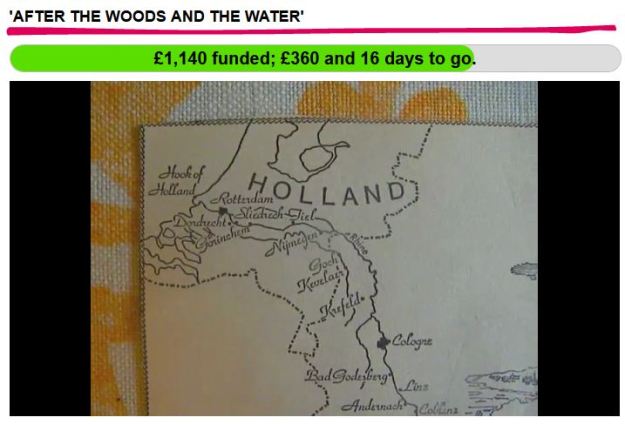
Nick Hunt’s appeal for funds to support his journey in Paddy’s footsteps was launched exactly two weeks ago. The response has been amazing with £1,140 pledged and only £360 needed to reach his target of £1,500.

You have been very generous but with so little now required for success I want to ask that we all consider even a small donation – £1 a week is about £26 for the journey – a final push!

If Nick is able to make this project work it will bring benefits to us all as we can enjoy his jottings from a journey made 78 years after Paddy.

Remember if Nick does not reach the £1,500 target all the donors will get their money back and Nick will receive nothing. This is the way that Crowdfunding works.

You can donate varying amounts and you will receive a range of items from Nick when on his journey to thank you and remind you of your support. Slightly higher donations will permit a mention of your name in his final book about the journey as well as a copy of the book.

This is a very worthwhile and very serious venture requiring a major commitment from Nick of a year of his life, so please visit the WeDidThis website and donate something.

I have said it before, but I will say it again, watching his video on the site and dreaming, just for a moment, that it could be you walking that fabled route has to be worth £10!

£1 a week Hook of Holland to Constantinople – come and meet Nick Hunt tonight Dalston, London

Nick Hunt will be at the kick-off event tonight for his fundraising along with a bunch of other people who are raising funds through WeDidThis.

There will be drinks, and good things to look at with plenty of interesting people to talk to including Nick!

Free music, performances and wine in Dalston Heights from 6.30 to 10.00pm. Details here.

£1 a week from Hook of Holland to Constantinople – funding update

Nick Hunt’s appeal for funds to support his journey in Paddy’s footsteps was launched exactly one week ago. The response has been amazing with £870 raised and only £630 to go to reach his target of £1,500. Nick tells me that donations have poured on from all round the world from Australia to the Czech Republic, from the sunshine state of Florida, and even the Scots have found some change down the back of the sofa!

Many blog readers have contributed and I am asking for another big push this week to reach the target. If Nick does not reach the £1,500 all the donors will get their money back and Nick will receive nothing. This is the way that Crowdfunding works.

You can donate varying amounts and you will receive a range of items from Nick when on his journey to thank you and remind you of your support. Slightly higher donations will permit a mention of your name in his final book about the journey as well as a copy of the book.

This is a very worthwhile and very serious venture requiring a major commitment from Nick of a year of his life, so please visit the WeDidThis website and donate something. Watching his video on the site and dreaming, just for a moment, that it could be you walking that fabled route has to be worth £10!

A pilgrimage to Esztergom

I am not the only one who takes the opportunity to visit some of the places mentioned by Paddy in his books when travelling. Here is a nice note I received recently from Ed Ricketts …
Dear Tom,

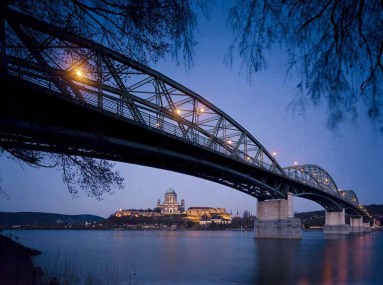
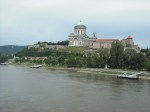
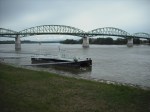
Just writing to say that, in Budapest last weekend with some spare time before a conference, and having just learned of Paddy’s passing, I felt it appropriate to make a brief trip out to Esztergom – the town on a bend in the Danube where, on the bridge, A Time of Gifts ends and Between the Woods and the Water commences.

After a winding 90-minute train ride down a single-track line, I emerged at the end of the line, Esztergom, and into a sleepy provincial eastern European town (the fact that it was Sunday lunchtime probably the defining reason for this). After a good 30 minute walk into the town centre, past a very pleasant main square with some almost northern Italian architecture, you suddenly see the mammoth marble basilica overlooking the town on a hill. This is the seat of the Hungarian Catholic Church, and an important place of pilgrimage. Around the basilica are grouped some nice old cobbled streets and religious buildings, while the Danube flows calmly by.

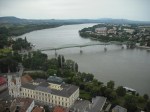
I scrambled up a back way to the basilica, then climbed up onto the cupola which provides an incredible view of the Danube bend and nearby hills (see the attached photos). All the while, I tried to imagine a young and inquisitive countryman with a knapsack doing a similar thing in 1934. What I left until last was walking over the bridge (destroyed in 1944, so it’s sadly not the same structure Paddy tramped over) which now links Slovakia and Hungary. Reading the two books had a considerable effect on me, so this was quite an exciting moment. After a brief meditative pause in the middle, and a few minutes’ ambling on the Slovakian side, I returned over the bridge into Esztergom having toasted Paddy with a small cigar en route.

So a very pleasing day trip overall, with just one slight regret – that I didn’t have the two books with me at the time!

Thanks,

Ed Ricketts

Related article:

Easter 1934 – Paddy reaches the Hungarian border at Esztergom 

£1 a week – Nick explains the reason for his journey

Don’t forget to donate even a small amount to support this project by visiting ….

We Did This

Untitled from Nick Hunt on Vimeo.

£1 a week – from the Hook of Holland to Istanbul, in Paddy’s footsteps

Here is a very exciting venture, and one that if we only had the time I am sure many of us would want to do.

In December, a young writer, Nick Hunt, will set off from London with the aim of walking from the Hook of Holland to Istanbul in the footsteps of Patrick Leigh Fermor, seventy-eight years after Paddy commenced his own, life-changing journey.

Nick intends to report on his journey and to write a book. He is not seeking to copy Paddy as he explains below, but to create his own experience whilst comparing the Europe that he encounters with the one our eighteen year old hero stepped into with such joyful anticipation.

Such things cannot be achieved without money and I am asking if you will make some contribution to ensure that Nick does not starve on his long journey. Who knows he may even need some cash to replace a lost rucksack at some point!

We have the idea of emulating Paddy’s “One Pound a week” concept. If you would like to help Nick on his journey (for which you will receive personal reports and in good time – hopefully not forty-three years like Paddy! – a copy of the book) please visit the page he has set-up with an on-line site that helps to raise money for interesting arts projects – We Did This – and make a donation. Nick needs to meet his target of £1,500 within one month. One Pound per week for a six month journey works out at £26 but I am sure any help you can offer will be very gratefully received!

To find out more and donate visit We Did This

Please visit Nick’s website which has details of the route. And now over to Nick …..

Please fund me with £1 a week to walk Paddy’s route across Europe!

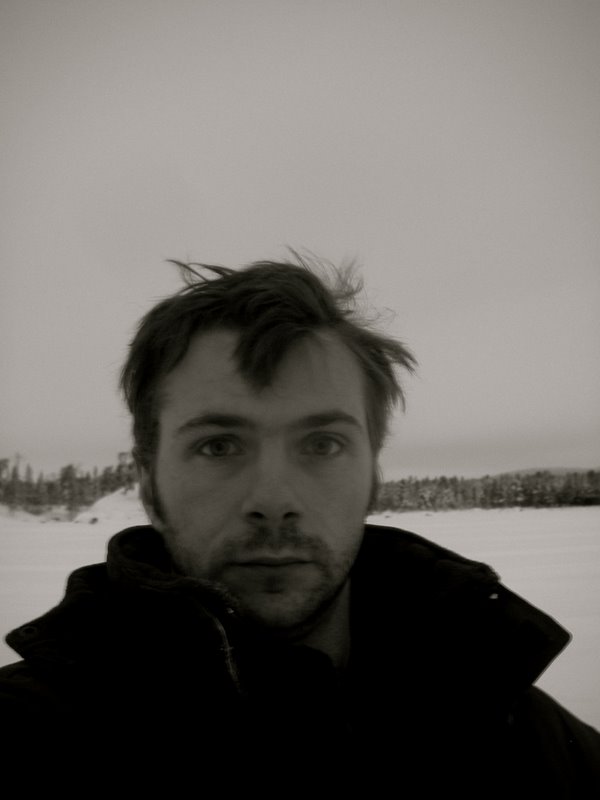
Nick Hunt

On December 9th 2011 – 78 years after Paddy’s great journey from the Hook of Holland to Istanbul – I will set out in his footsteps. Using his writing as a roadmap, his words as a background murmur in my ear, I’ll walk the same route through Holland, Germany, Austria, Slovakia, Hungary, Romania, Bulgaria and Turkey. I’m a freelance journalist and writer, and the journey will be documented through audio recordings and through writing – to produce a series of short radio programmes, and a book of travel journalism, on my return to England.

My intention isn’t to emulate Paddy – who could ever attempt that? – but to explore the ways in which Europe, and the experience of walking it, have changed since he set out. In the intervening years war, politics and progress have reshaped the continent several times over. Obviously towns and cities will have grown, villages will have been swallowed by roads, and certain landscapes will have been altered beyond recognition. But as well as these more tangible changes, I want to explore the deeper shifts in the cultures, traditions and identities of the countries Paddy passed through.

My journey will come at an interesting time, with Europe still undergoing great changes, new patterns of migration and fusions of different cultures, as well as facing great challenges – from the uncertainties thrown up by the economic crisis to the ominous resurgence of right-wing movements across the continent.

‘Everything is going to vanish! They talk of building power-dams across the Danube and I tremble whenever I think of it! They’ll make the wildest river in Europe as tame as a municipal waterworks. All those fish from the East — they would never come back. Never, never, never!’

This prediction was made by a man Paddy met in Persenbeug, Austria, in an inn overlooking the Danube (A Time of Gifts). Much of the reason for me making this journey, almost 80 years later, is to see if these words became true.

Has Europe been tamed? Has everything vanished?

Is adventure still possible in Europe?

As admirers of A Time of Gifts and Between the Woods and the Water will know, Paddy managed to fund his journey on £1 a week (which works out as about £50 today). I’m asking people to support this project by funding me just £1 a week for the duration of the walk, which should take around 6 months.

If you would like to fund me, or just to get in touch with thoughts, ideas, suggestions, you can contact me at scrutiny[at]gmail.com

For a fuller description of the journey, please see my blog: www.afterthewoodsandthewater.wordpress.com

Many thanks!

Nick


Mount Athos: A visit to the Holy Mountain

In February 1936 the young Patrick Leigh Fermor walked along the peninsula that we know as Mount Athos. It was there he celebrated his twenty-first birthday with Russian Orthodox monks. In 2011 the CBS ’60 Minutes’ programme gained access to the Holy Mountain, the first television since 1981. Here is a unique opportunity to take a wider look at the community and beauty of Mount Athos which made such an impression on the young Paddy.

Bob Simon steps back in time when he gets rare access to monks in ancient monasteries on a remote Greek peninsula who have lived a Spartan life of prayer in a tradition virtually unchanged for a thousand years.

The programme is in two parts and if you are dedicated and clever, there are many other ‘extras’ – I have provided some links below. Enjoy!

Part One:

Part One

Part Two:

Part Two

Transcript of Parts One and Two

Extras:

Behind-the-scenes travelogue to holy Mt. Athos

Mt. Athos’ autonomy

Bastions of the Orthodox faith

Extra: Don’t call it art!

Life on Mt. Athos


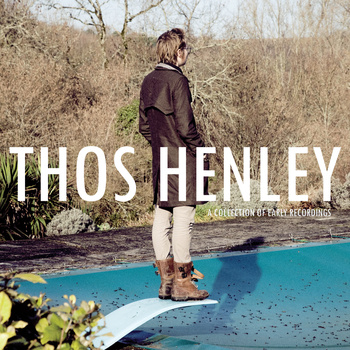
Thos Henley and the inspiration of Patrick Leigh Fermor

Some of you will now be familiar with the work and music of Thos Henley from a few previous articles on the blog. Thos describes Paddy as one his main inspirations.

As you go about your busy lives maybe you can take a few minutes to listen to my favourite Henley song ‘Another Brother’ in which Thos sings about the intellect of Patrick Leigh Fermor’. Click on the picture to play.

Related articles:

Lawrence Durrell and Patrick Leigh Fermor by Thos Henley

I knew Patrick Leigh Fermor through his words, and he will know me by mine

Paddy visits the wonder that is Ohrid

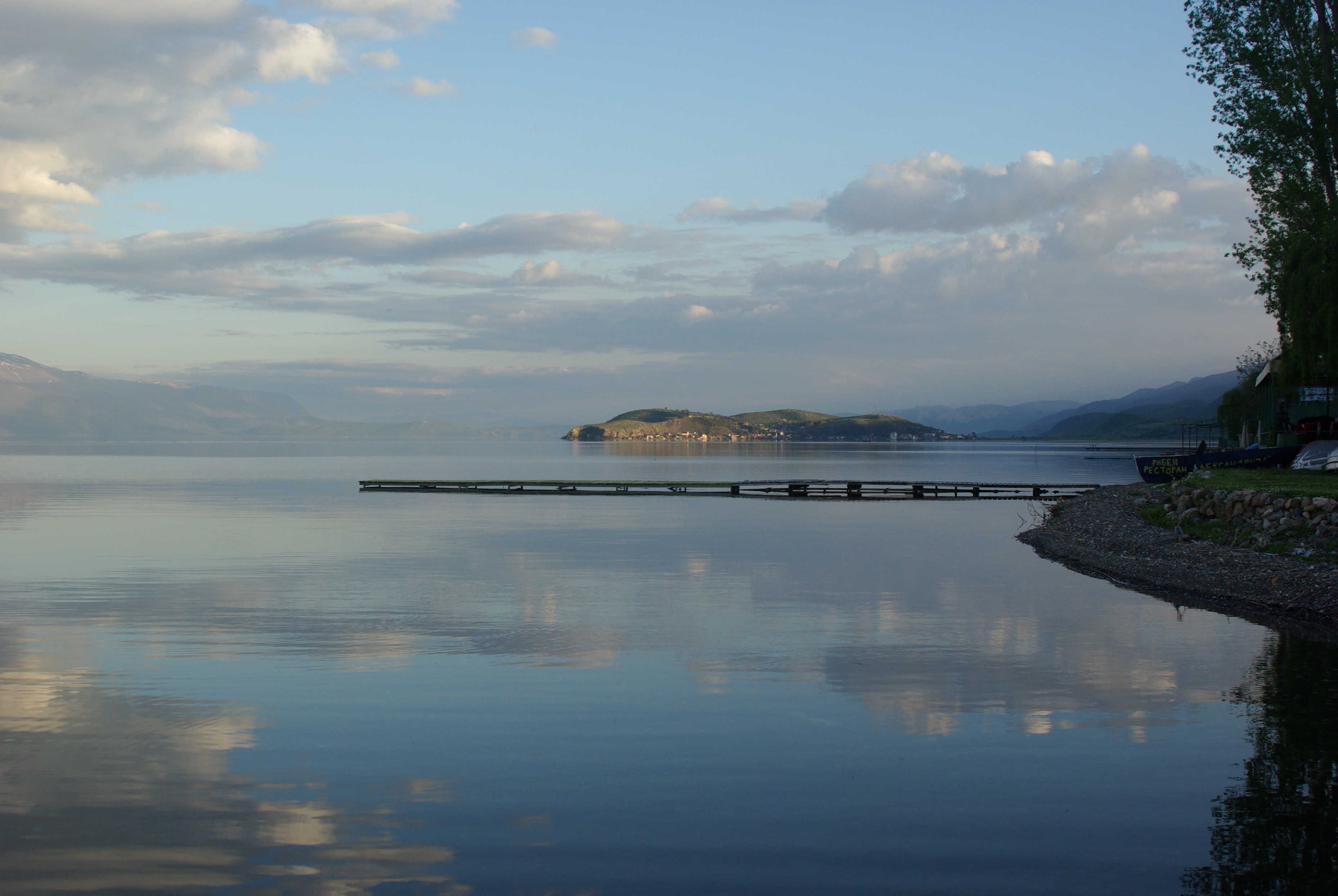
I suppose it is a good thing to aim to be objective in life. It shows wisdom and maturity, and an ability to balance all the arguments. For me however, all objectivity vanishes when I think of Ohrid! The setting of this beautiful city on the edge of the vast and wondrous eponymous lake is simply stunning.

Although he does not state it specifically, I believe Paddy visited Ohrid and its environs when on a motor tour from France to Greece with Joan in her Sunbeam Rapier in 1960. He tells the story to Debo in a letter dated 23/24 October 1960 (see page 67 of In Tearing Haste). Paddy describes visiting “Serbian Macedonia and wonderful lakes with frescoed Byzantine monasteries on the shores … (which) held us up for days.” There is little doubt in my mind that he is referring to Ohrid, and having been there myself I can understand why; it is a wonder that he ever left!
It is said that Ohrid, Macedonia, once had 365 churches although there are now only around twenty-five which remain open. Its name means City of Light and it has over 220 days of sunshine each year. The town creeps up the hillside surrounding a central esplanade and harbour dominated by the statue of St Clement, who was the student of Saint Cyril and his brother Methodius. They were the authors of the Cyrillic alphabet (approx 864 AD) which was created by the Byzantines to bring the Slavic nations into the Orthodox Church rather than let them fall under the influence of Rome during the early days of the schism between the two churches.

Ohrid is full of Byzantine history. The influence of the Empire can be seen everywhere from the statues to the fortress but principally in the churches and the ancient Basilica. The original church of St Clement was destroyed by the Ottomans who built a mosque on the site which has a clear view of the Lake. Clement’s relics were secretly moved by the Christian citizens of Ohrid to the smaller and less important Church of St Mary Psychosostria. Over time this church became known as the Church of St Clement, but the confusion is now ended as in 2000 the Macedonian authorities rebuilt the Church of St Clement on the original site. His relics have been moved back there to rest in peace. The site includes the remains of original Baptistry, and there are many mosaics all in very good condition.

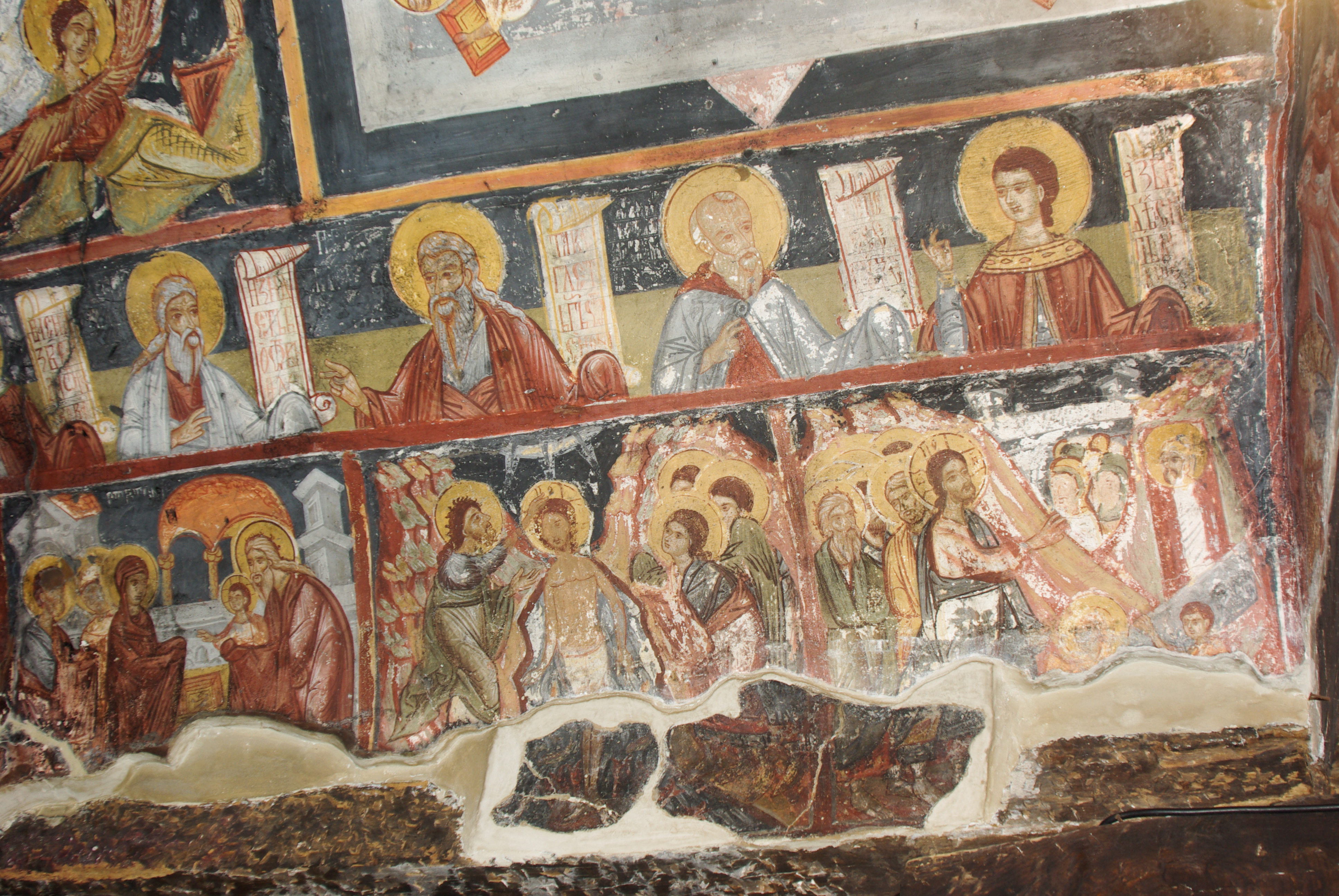
The Church of St Mary is a wonder. Built in 1295 by the deputy Progon Zgur who was a relative of the Emperor Andronicus II Paleologus, it has twenty-nine scenes from the life of the Virgin around the walls. These frescoes are in generally excellent condition with little of the wear or defacement one often finds elsewhere. The reason for this is that most of the frescoes were obliterated by soot from candles. They were cleaned and restored only since 1960. The have to be seen to be understood. The ‘keeper’ of the frescoes is an amazing Macedonian lady with long black hair, with braided pigtails; the church and the frescoes are her passion, probably the centre of her life. She has produced a long book and the frescoes were the subject of her PhD. She says that the fresco of the Virgin that dominates the Apse is painted from lapis lazuli originating in Afghanistan. That one fresco would have cost something in the order of one kilogramme of gold (at today’s prices that is roughly $56,000).

Opposite the Church is the national Icon museum of Macedonia with over forty masterpieces. All this within just a few yards of each other!

If you ever get the chance to visit you will find all this and more. You will also meet friendly people, find good quality low-cost accommodation, and a wealth of Byzantine architecture and art. This CNN video shows many of the places I have written about and I know you will like it. If you do ever visit Ohrid, please contact my friend Katerina Vasileska who runs a tourist business in Ohrid called Lost in Ohrid. She will be happy to arrange good accommodation, local tours, and generally be of assistance during your visit.

Finally, don’t forget that for the intrepid there is an opportunity to walk through Albania to Ohrid in May of 2011 with the Via Egnatia Foundation. See my recent post Walking back to Byzantium along the Via Egnatia where you can find out more and how to register your interest.

Click to play … there is a 30 second ad before the Ohrid movie starts.

Walking back to Byzantium along the Via Egnatia

Have you ever fancied going to Albania? Would you like to walk the route of a famous – and in places intact – Roman road to Byzantium? Visit the Byzantine marvels at Ohrid and experience the sheer romanticism of Lake Ohrid? Then your luck is in as the Via Egnatia Foundation are in the early stages of planning a walk in May 2011.

The likely route is from Elbasan in Albania to Ohrid in Macedonia. There is the possibility of doing the walk in reverse as well, giving a couple of date options.

Full details have yet to be finalised but you can at least register your interest with them by visiting the Via Egnatia Foundation website and telling them you would like to know more.


Some of you know that I made this walk in 2009. You can read an account of my journey here. I hope to make the walk again this year. It will be of interest to those with an interest in Byzantium and those who like Patrick Leigh Fermor: he was a liaison officer in Albania at the start of WW2 and visited Ohrid and its Byzantine churches and chapels in the 1960’s.

Some video of our adventure in 2009:

Dancing in Dardhe

A composite video of the route to Ohrid

Some fool singing The Lumberjack Song

Related article:

Walking to Find Byzantium

Related category:

Via Egnatia

A Winter Afternoon in Cluj

Between the Woods and the Water

I am very fortunate to be able to visit Cluj quite often. We all know a little about the city from Paddy’s visit here during his brief love affair with Angéla in the summer of 1934. Today I find myself here again after a busy week in my company office. It is a cold overcast day, and the low cloud seems to make the sounds of the city travel a long way; the squeals of children playing, dogs barking and the famous Cluj crows cawing as they weave their way between the apartment blocks and the spires and domes of Cluj’s many churches.

Romania is not a country that many people visit on holiday, and Cluj is almost certainly not on many lists. I fail to understand why this is. You only have to visit the (open to public) Facebook page of Visit Romania and look at some of the incredible photographs to see that this country has varied and stunning scenery, and enough history on offer, from the Roman site at Parolissum, the artistic beauty of the painted monasteries of Bukovina or the wooden churches of Maramureş, and the castle of Hunyadi that Paddy visited during his walk south in the area of the Retezat on towards the Danube and the end of his journey as described in Between the Woods and the Water.

At its heart Cluj has wonderful Baroque architecture which dates from its heyday under the Austro-Hungarian Empire. Many of these buildings have fading, crumbling facades. The absence of western chain stores means that the streets are not despoiled by those so familiar signs. I may be wrong, but this general absence of branded outlets means that many Romanians (but to be fair probably only those that can afford it) still have a very individual sense of style.

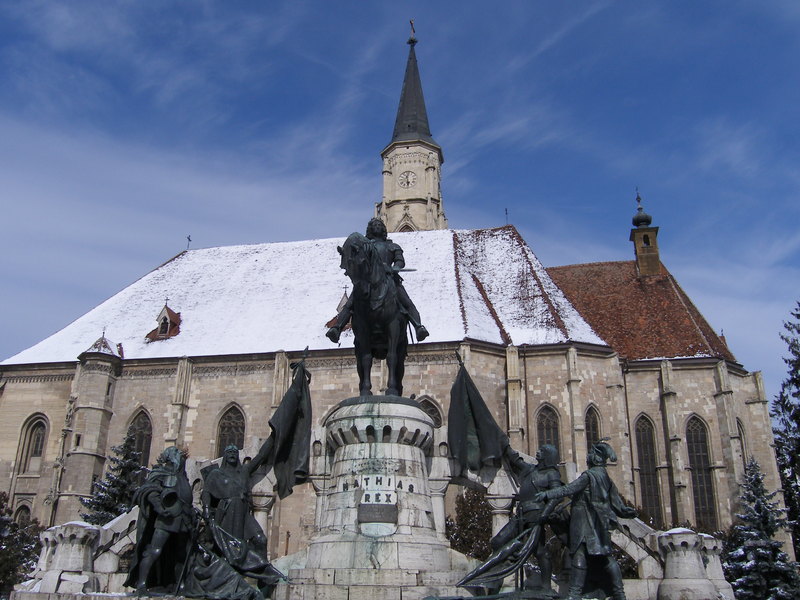
The statue of Matthias Corvinus

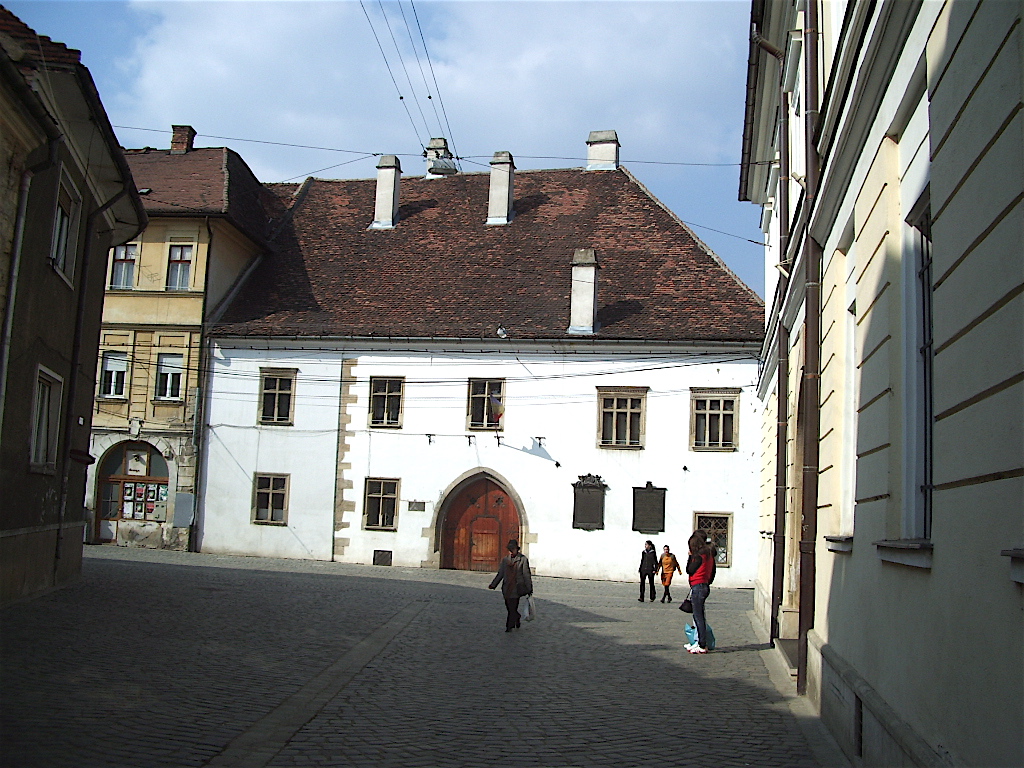
When one wanders just a few yards from the main roads in Cluj one enters a maze of smaller streets, many cobbled, with a myriad of bars, cafes and restaurants which all offer excellent value. Today I walked from the newly restored and very splendid statue of King Matthias Corvinus, past St Michael’s Church, towards Corvinus’ house. It is only a one minute walk. Paddy and Angéla stayed somewhere in those back streets within the sound of the bells of the church; quite where we shall probably never know. I too heard them ringing this evening as I walked to dinner.

Cluj is a very sociable place, possibly because there are something like 100,000 plus students here (an incredible number but that is what I have been told). It is also somewhere that makes you feel quite safe. I am sure it has its moments, but I have never encountered any problems and one feels safer here than in many places in England, particularly late at night.

What started out as just a short article about Cluj today, seems to have ended up as copy for the Romanian Tourist Board, and that is fine. In these difficult financial times, Romania offers a tremendous holiday alternative, and it remains low cost. So when making your plans for 2011 you could do worse than visiting this country, and possibly walking in some of Paddy’s footsteps. Romania could also do with the income. I call that a win win outcome.

Related articles:

Angéla, Paddy, István and Tom in Cluj-Napoca

Angéla and Paddy’s visit to Cluj-Napoca with pdf describing his visit

Links:

Facebook – Visit Romania


Parish Notice – Travels with Paddy forum

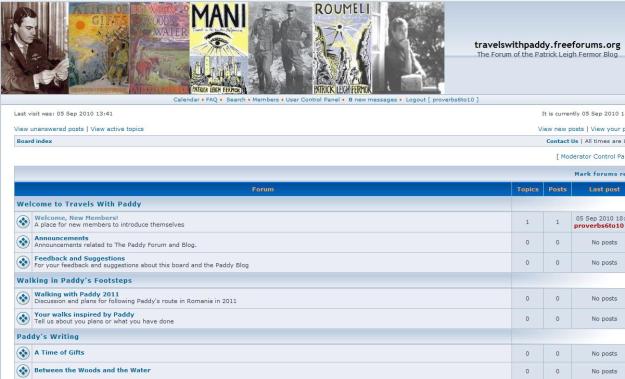
Just a reminder to you all that we now have our own discussion forum for all things related to Paddy.

If you visit the discussion board here (or click the picture) you can register (very easy and no spam) and join in current discussions or create your own topics.

There is a Welcome to New Members area where you can introduce yourself, with or without a pseudonym, and this is now growing.

The other section I would like to draw your attention to is a discussion about walking Paddy’s route in Romania in 2011. It looks like there may be interest in doing something as a group. Go on; have your say!

Some forums have been set up to start us off but you can add your own at any time; just keep it vaguely relevant to Paddy.

Click on the image to go to the forum

The forum will be an important place to discuss not only Paddy and his life, work, and times, but also some pretty exciting ideas, some of which I will be announcing soon.

You will be free to create your own identity or just be yourself. Go on visit the Welcome forum and introduce yourself. I look forward to seeing you there!

Angéla, Paddy, István and Tom in Cluj-Napoca


Matthias Corvin’s house Cluj-Napoca

If the lifespan of a crow can be up to thirty years, it is conceivable that the grandparents of the present day crows of Cluj observed Patrick Leigh Fermor and Angéla on their clandestine assignation to the city in 1934 when they were chauffeured by the understanding István. Their journey was a secret, but maybe the crows saw all and have passed on to their offspring the story of the young Englishman and the unhappily married Hungarian woman who was as ‘nimble as an ibex’.


As the sun set this evening I emerged from a restaurant near the Orthodox Cathedral to the sight and sound of thousands of crows flying westward at rooftop level, weaving in and out of the spires of the Cluj National Theatre. It was as if they were on some raid; they were in the stream, in squadrons of one hundred or more. I could neither see where they had come from, nor where they were going to, but this lasted for more than ten minutes and somehow it made me think of Paddy and Angéla.

The statue of Matthias Corvin dominates the square. St Michael’s church behind.

Cluj is today a fast growing city. The centre is dominated by crumbling Austro-Hungarian Baroque buildings. One can see that in 1934, before the darkness came that engulfed Europe and Romania, the pink and yellow painted walls would have been bright and welcoming to the small party that crept into town that warm August day.

Never missing an opportunity I have followed some of Paddy’s descriptions of his short stay in the city found in ‘Between the Woods and the Water’. He said that he and Angéla took a room near the house of Matthias Corvin who is a hero to both the Hungarians and the Romanians of Transylvania. This part of the old town has substantial houses and I wonder where in those cobbled streets, near the museum, they awoke, entwined, in their ‘handsome vaulted room’ to the sound of ‘recriprocally schismatic bells’. The bells would have sounded from the Gothic Saint Michael’s church in the Matthias Corvin square. His statue, which Paddy describes as magnificent, dominates the open space.

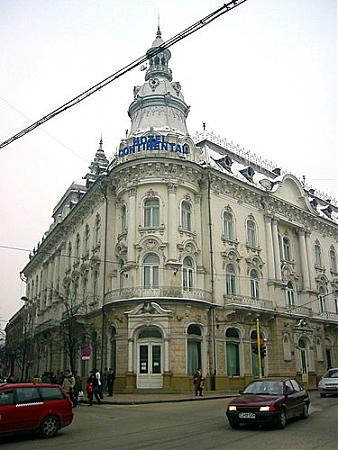
The New York/Continental Hotel

It was in a corner of this square that last night I set out on a search for the New York hotel, where the three of them had such fun and enjoyed an amazing cocktail, only surpassed, so István said, by the one called ‘Flying’ in the Vier Jahrszeiten bar in Munich. I was hoping that the secret of the cocktail had been passed down from generation to generation of barmen, but it was not to be. The hotel which is now named the Continental is closed, and the windows covered in posters proclaiming the Iron Maiden concert that took place last month to celebrate the success of the local football team, CFR-Cluj, in winning the Romanian league. It is a sad sight, but the building is nonetheless very grand with a turret on the corner facing the square and the Bánffy palace, which is now an art museum and next to the Melody nightclub with it’s huge neon sign, in the opposite corner.

So I did not get to sit in the seat of Patrick Leigh Fermor, nor drink his cocktail,  but instead walked in good company to my favourite bar in Cluj – Insomnia – and drank Ursus beer, whilst explaining to my Romanian friends Daniela and Vlad, why Patrick Leigh Fermor is the Greatest Living Englishman.

I knew Patrick Leigh Fermor through his words, and he will know me by mine

I think I am quite privileged to receive so many positive comments about the blog from people I have never met. One thing many agree upon is that Paddy has had a significant impact upon their lives. In some cases reading A Time of Gifts has been life changing, with some literally getting out there on the road and creating their own journey.

One message that really struck a chord was from Thos Henley – after the old abbreviation of Thomas I am told – who was originally from my neck of the woods in Hampshire, England, but who set off on the road two years ago and is now living what I imagine to be a bohemian life somewhere on the left bank of the Seine in Paris. He has even written and recorded some of his own songs, one which includes a reference to Paddy; it is good music and worth listening to. [Edit – I have listened to it a few times now and it really is quite good; have a listen]

Thos’ story is very moving and I asked if he would like to share it with other blog readers. He agreed so over to Thos …

Thos Henley at Paddy's door

“I am a 22 year old musician and a writer from Netley Abbey, Hampshire. Around two years ago I set off the travel France. One of the reasons I did so, was because I had recently discovered Paddy’s work. After this eventful trip all around the country, I settled in Paris, which now acts as my home and I have not been back to England since. In this time I have walked around the largest lakes of Sweden, travelled the expanse of Europe, and released a record in Paris named GOLDEN EUROPE. One of the songs on the record is about my travelling companion on the trip through France. He was my Xan Fielding and in the song I reference Patrick Leigh Fermor. It is called ANOTHER BROTHER and you can find it by clicking here.

Recently, I took a trip with my girlfriend to Greece. We went to Patras and walked to the edge of the Peloponnese. Slowly moving down south we made our way to Kalamata and then Kardamyli. I became good friends with certain locals and on the third day I had a map drawn out for me, with the whereabouts to Paddy’s home.

When I got there, the soles of my shoes had withered away (an overdue happening as I had worn them out for years). I met his house-keeper who spoke a very gentle Greek-English. I was nervous and I could hear Paddy eating his lunch next door and after a few minutes of introducing myself to his assistant I learnt that he was just too old to see anyone. She explained that the emotional toll was too much for the man who had been through it all. Passion carried my persistence but in the end I started to feel like some kind of a stalker and I gave up. Leaving his incredible garden, I heard through an open window, the mumbled low tone of Sir Patrick himself, obviously inquiring about the energetic English boy who had just been at his ocean blue door.

Sitting on the wall that he had made some 20 years or so before my own birth, I began to write him a letter. I explained my story and the fact that in his words I had come to find some sense of freedom in this ever enclosing world in which we all reside. Tears and sweat dripped onto the scribbled words that, no matter how much I tried, would never portray truly what this man meant to me. I wrapped the piece of paper over and around my old Swedish compass. In the letter I had told him I left it for him, as I had no need for it now; it had guided me to his house, where I sat boiling in the Greek sun, and its job, in my eyes, was done.

I swam for hours that day, washing away the heat and the sadness of not meeting ‘my’ Byron. However after reaching my hotel, after the sun had died and the raging fire of the crickets sang in their clicking chorus, I began to see the up side of what I had done. Yes I may not have met the man, but the fact remained that I had been to his home which I wished to visit over my childhood home in England. It was his seas that I wished to swim in over any other ocean in the world and it was his door step where I wrote, what I still hold as the best piece of writing I have done to this day.

This is not an ego talking but personal victory. I can live my life here, in this rainy, grey city of lights, Paris, knowing in myself that Paddy read my words and opened the same compass that I had used for years, its red point quivering on the W. And he would go to sleep that night knowing once more that his life had indeed been the greatest life ever lived and was still just as appreciated as it had always been.

In the end I knew Patrick Leigh Fermor through his words, and he will know me by mine.”

Visit Thos’ MySpace page where there are more photographs, you can find some of his music and videos.

The mystery of The Black Sea Cave

It seems that summer is the time that Paddy’s fans stir themselves to try and find locations associated with his travels. We have had my recent ‘On the Same Steps’ article about the Hofbrauhaus; excerpts from the New York Times frugal traveller following part of the ATOG route; the OPRIG GAGINONANUS challenge; and now the submission of Jean-Marc Mitterer from Switzerland who has been trying to solve the conundrum of the true location of The Black Sea Cave, in the context of the challenge of understanding more about Paddy’s route on his last leg in Bulgaria in 1934.

Jean-Marc wrote to me a while back and we have exchanged a few emails since on this subject. He has read the story very closely (which is found in Words of Mercury but was originally published in Holiday Magazine in May 1965) and has been in contact with academics and others in Bulgaria to see if any more is known to try and narrow down the possible sites.

I hope as ever that someone out there somewhere will be able to comment and add to our shared knowledge about the gaps in Paddy’s life and stories. Here is what Jean-Marc has to say ….

“As you wrote, many readers of Patrick Leigh Fermor’s books imagine travelling back on the route he followed. If the first part of the trip is pretty well documented, this might turn to be a bit more challenging for the third part – Vidin, Sofia, Vitosha, Plovdiv, Veliko Turnovo, Ruse, Southern Romania, Varna, Burgas, ending in Istanbul on New Year’s Day 1935. The publication of the third volume will probably give more details but one point might remain some kind of a mystery: the cave on the Black sea where PLF spent a night in December 1934.

This striking moment of PLF’s trip is described in Words of Mercury.” (Ed: I have added some background here)

Paddy had got lost on the coast and had plunged into either sea water or a pond near the coast. It was December and he was wet through and immediately felt the cold. He was exhausted and both his bootlaces had broken. I guess he was at a real low point, far away from civilisation; wet, cold, hungry and lost. Thoughts must have passed through his mind about how he would survive the night.

“… Breathless and exhausted, I lay on a ledge until spurred on by the cold. At last, lowering my half-shod foot on to what I thought was the surface of a pool, I felt the solidity of sand and the grate of pebbles. Another pace confirmed it; I was on the shore of an inlet. Round the buttress of a cliff a little way up the beach, a faint rectangle of light, surrounded by scattered chinks, leaked astonishingly into the darkness. I crossed the pebbles and I pulled open an improvised door, uttering a last dobar vecher into the measureless cavern beyond. A dozen firelit faces looked up in surprise and consternation from their cross-legged supper, as though a sea monster or a drowned man’s ghost had come in.”

Jean-Marc continues ….

“Its location is very vague: between Varna and Burgas.

PLF tried to retrace it after the war from memory in the area around  Nesebar, but without success.

Early in 2010 Bulgarian speleologists and geography societies were asked about the existence of this place. The answers were disappointing and came with the regularity of clichés. There are well known cave areas between Kavarna and Shabla (north of Varna) and Sozopol and Tsarevo (south of Burgas). But no one knew of anything in-between.

This absence of cave is not only a mismatch with the broad location mentioned in Words of Mercury, but also with the actual situation. The north of Varna can be excluded as between 1913 and the Second World War the area up to Balchik was in Romania and not Bulgaria. The south of Burgas can also be excluded as, apparently, Paddy traveled (sadly) the last bit of his journey by train. [Ed: Is this the case?]

So this place must be between Balchik and Burgas.

Here are the actual elements we know from the article:

1. No human presence seen during his day walk except a lone Tatar fisherman.

2. A cave not very deep but big enough to have hosted more than a dozen (12) people, with room enough to perform wild dances, and to house a fishing boat, equipment, and a flock of 50 goats and up to six dogs.

3. The use of masonry elements [Ed: I believe these to have been rocks or dry stone walling. Paddy said they were interspersed with “branches, planks and flattened petrol tins stamped with Sokony-Vacuum in Cyrillic characters” – I do wonder how Paddy recalled this with his self-admitted “clumsy rudiments of” Bulgarian, his stressed physical and mental state, and the absence of his notebook]

4. The presence of a mixed Greek and Bulgarian population [either in the vicinity] or not too far away.

5. The presence of stalactites (which is a very challenging element; according to one speleologist interviewed the rocks on the coast are not suitable for these geological formations).

6. The proximity to the shoreline – remember PLF saw the light from the cave while walking along the coast. [Ed: my reading indicates that the cave was very near the shore, perhaps no more than 20-50 metres as the later descriptions indicate this and one has to ask how far the fisherman would have wished or been able to carry their boat which was seen in the cave. If any of you have carried wooden boats you will know they are very heavy; porting any great distance is unlikely.]

7. A fisherman with only one hand [with a star tattooed on the back of it.]

According to these elements, the place apparently most suitable must have been between Biala and Sveti Vlas. The area is rocky, little inhabited and the presence of a Greek population is confirmed in old maps. (for an interesting selection of maps visit this site of which perhaps the most relevant is this map)

Considering that such a place, even if it should have been destroyed since then [Ed: can you destroy a cave easily?], should have left some memories. In June 2009 locals in this region – Biala, Obzor, Bania, Emine, Elenite – were asked about the cave. Though elder people remembered many old stories (the visits of King Boris, shipwrecks before the first world war, purchasing fish at the fishermen’s settlements on the coast, etc…) nothing concerning a cave used by people or the memory of a handless fisherman (who could have lived on for a couple of decades after the visit of PLF) could be found.

This is not very encouraging… However, everyone remembered the presence of Greek people in this region and there are still a few elderly Greek people alive.

Tcheren Nos cave view

One cave was mentioned by local people, located on the Tcheren Nos. (between Biala and Shkorpilovtsi). This place is actually big arch (about 50- 80 m long), the deepest part being 15-20m above ground. There is a pond in front of it, with a little river reaching the sea. Currently it is difficult to access the place in the wood, there is no path from the shore, which is about 300- 400 m away, I was there in May 2009 and there were no stalactites or visible masonry, though the presence of black surfaces seems to indicate the presence of soot and human uses (from when ?). Considering the distance to the beach and the situation of the cave, it is difficult to imagine that this could have been the cave Paddy described. [Ed: I agree it is probably too far from the sea as per my earlier comments. However, there is always the chance that some form of change in sea level or silting up of the shoreline has increased the distance of the cave from the beach. Paddy does describe sand and shingle on the floor of the cave. From Jean-Marc’s photographs it does not appear that this exists.]

At this stage, these informal investigations reached a dead-end… Many hypothesis could be built (maybe Paddy’s memory confused some elements – like the presence of the stalactites or the dimensions of the cave) but further research would be useful.

The location of this cave is a fascinating enigma that even PLF seems not to have been able to clarify. I hope that this question will also interest you.

Maybe you would consider that this issue could be raised on your website, with the hope that people having access to the 1935 notes taken by PLF (though if this data existed, I guess they would have been used by PLF during his second visit) or having a specific knowledge about the Bulgarian coast could help. I don’t think Paddy’s work has been translated in the Balkans [Ed; He is certainly known in Romania] and his work appears to be unknown in Bulgaria.

[Ed: Towards the end of his account Paddy again confirms that the cave was near the sea “A few yards off, beyond the twelve adjacent snores, I could hear the gasp of the Black Sea.” What is also useful is an indication of the direction the cave was facing as he could see “three quarters of Orion blazed in an icy slanting lozenge.” Where does Orion lie in the late December sky when in the Balkans?]

For Marion Worsley, after OPRIG GAGINONANUS, and for you all, this is a slightly more difficult challenge; to find the cave on the Black Sea where Paddy was simultaneously saved and experienced one of his wilder, most impromptu experiences.

Perhaps the defining episode of this blog will be the re-discovery this cave?

The challenge is now out there. Truly, finding this cave will place the person that discovers it in the Patrick Leigh Fermor Pantheon. It may be a fool’s errand. Paddy may have at the same time exaggerated and been confused after the passage of time. What is not in doubt is that he spent a night in a Black Sea cave with a polyglot group of Greek fisherman and Bulgarian fisherman. What needs to be done is to find that cave. Jean-Marc has set us upon our course. Will we reach our destination?

To print this article or create a pdf do the following:

1. Copy the url of the article from your browser above

2. Click on the Print Friendly button below – you will be taken to the Print Friendly page

3. Paste your url into box that appears and hey presto you will get a previewed page to print or pdf!

Print

OPRIG GAGINONANUS – a winner!

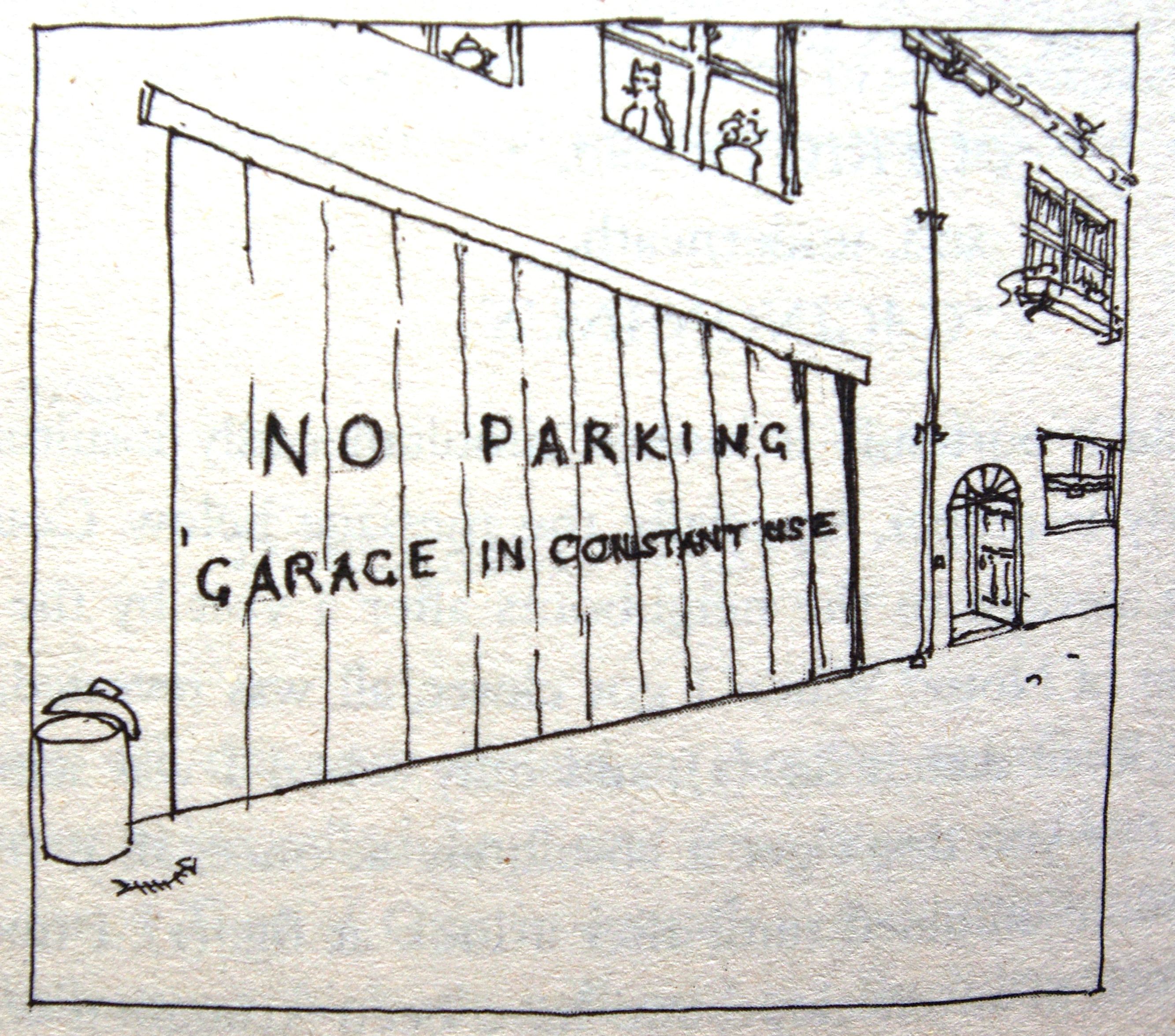
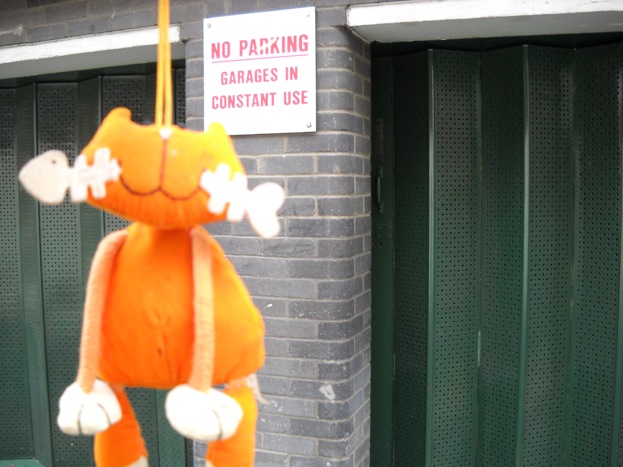
Garage in Constant Use

When the challenge to solve the mystery of OPRIG GAGINONANUS was laid down less than two weeks’ ago, I did not think we would have a winning entry within two days! Marion Worsley from Sussex emailed me from her Blackberry with an accompanying photo to tell me:

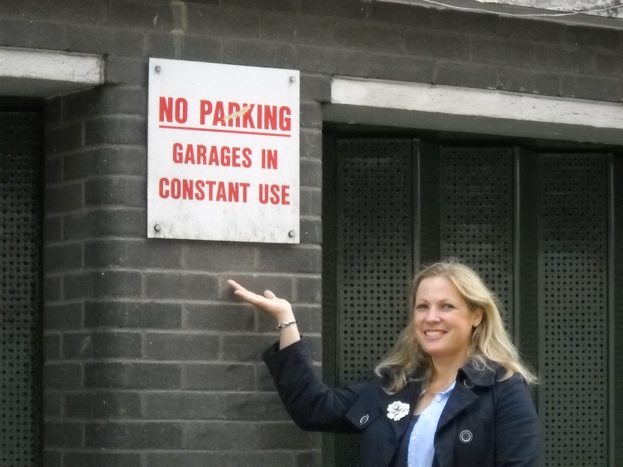
“I am standing in market mews, surrounded by garages and 10 signs to remind any fool who had not spotted the continuous double line that also every garage door is “No Parking.  Garage in Constant Use”.  This is however the only one with a concertina mechanism.  I’m afraid no cat. Could send you a picture of a blue tee shirt hanging out of the window instead? I am now going to walk away as I can see coming towards me the slightly perplexed postman who very kindly directed me to Market Mews but then went on to ask what I was looking for. I vaguely mumbled that I was looking for garage doors, smiled, thanked him and walked on. leaving hanging in the air a question mark over my sanity. I will send you more pictures this evening.

Marion Worsley

Sent from my BlackBerry® wireless device”

Winning entrant Marion Worsley in Market Mews

Remember the challenge was to try to find the location that Paddy had sketched in his letter to Debo Devonshire and if possible photograph the same combination of letters that faced Paddy in 1992. Extra marks were to be awarded for a photograph including a cat.

Later Marion mailed me with more pictures:

Hi Tom

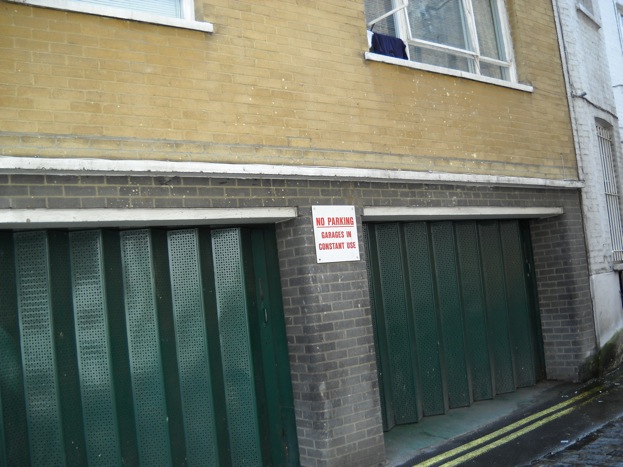
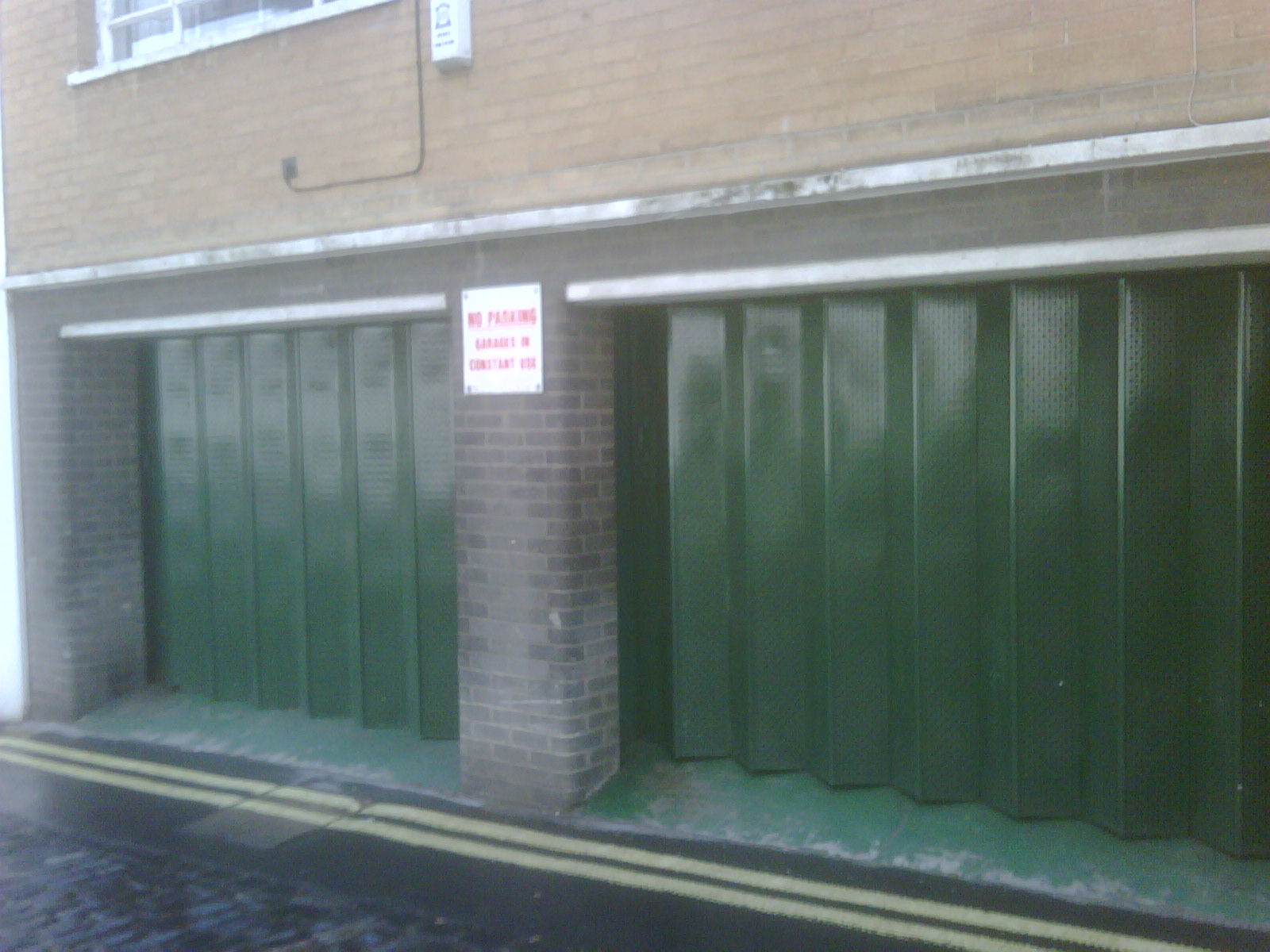
Here are the other photos from Market Mews. Slight artistic license for the cat… but did send you a picture of the tee shirt. I got a tourist who spoke very little English to take the picture.  I think that if I had tried to explain to him why I wanted a picture of myself next to a No Parking sign, he would have been even more confused. He will no doubt go back home and tell his friends that it is true that the English are a little mad. The entire mews consists of garages. I have added pictures of a few more should you want to add them to your Garage picture Collection. For the purists, the concertina garage is between No 9 and No 11 Market Mews.

Kind Regards

Marion”

The concertina doors from a similar perspective to Paddy's OPRIG sketch

From the other angle

It is no surprise that one or two things have changed; the doors seem to have been painted over and the cat has probably passed away. However, I was so pleased that a blog reader was inclined to be more than a little crazy and take up the challenge with such style. The ‘cat’ was a piece of improvised genius.

Very well done to Marion. We are planning an official presentation ceremony ‘on location’ later in the autumn. As you can tell she is a lady with some pretty mad ideas, one of which includes the possibility of walking some of Paddy’s route on 2011. Watch this space!

(For garage door enthusiasts I have posted all of Marion’s photographs in the photo section. It is clear that we are not alone in our obsession with OPRIG. Just Google OPRIG and look at images! I have placed some of these in the photo section.)

Related article:

OPRIG GAGINONANUS

To print this article or create a pdf do the following:

1. Copy the url of the article

2. Click on the Print Friendly button below – you will be taken to the Print Friendly page

3. Paste your url into box that appears and hey presto you will get a previewed page to print or pdf!

Print

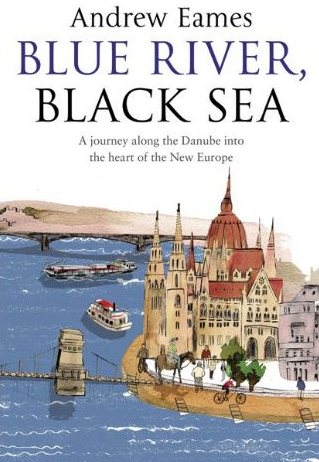
Blue River, Black Sea: A Journey Along the Danube Into the Heart of the New Europe

The following is a piece by Dimiter Kenarov from The Nation which contrasts the journey of Paddy along the banks of the Danube with the more recent account of Andrew Eames, recounted in Blue River, Black Sea. It is clear that if we were to try to follow the foosteps of Paddy that much has changed – I guess that much we knew – but that also the pace of change means that if we are to encounter the last feeble remnants of that post-Austro-Hungarian world, we had better move very fast. This is worth the read.

From Black to Black, a review of Blue River, Black Sea: A Journey Along the Danube Into the Heart of the New Europe
By Andrew Eames.

Every day, at three in the afternoon, I make a trip down the Danube. To travel from Germany’s Black Forest to Romania’s Black Sea takes a matter of minutes, so I try to enjoy myself as much as possible. I sink into a cushy armchair, rev up the stereo and embark on an epic voyage. “Information on the water levels of the Danube River, in centimeters,” the familiar voice on Horizont, the Bulgarian National Radio, announces with the deepest solemnity before reading out the relevant hydrographical values, first in Bulgarian and then in Russian and French. Vienna: 310 (+3); Mohács: 415 (+7); Novi Sad: 162 (-13); Vidin: 380 (+40); Giurgiu: 220 (0).

The captains of river vessels can easily map a course on the Internet, but the daily radio bulletin has remained a fixture in my life. For many years, listening to the fluctuations in the water levels of the Danube was the closest I could get to traveling abroad. Regensburg, Passau, Linz, Vienna: these names mesmerized me. Even places like Bratislava and Budapest, comrades in arms against the decadent West, had the ring of myth to a boy growing up in Bulgaria. Remembering his childhood in the Bulgarian river port of Ruschuk (now Ruse), Elias Canetti wrote, “There, the rest of the world was known as ‘Europe,’ and if someone sailed up the Danube to Vienna, people said he was going to Europe.” If people in Canetti’s immediate circle, at the beginning of the twentieth century, still had the occasional opportunity to waltz up to the palaces of the Habsburgs and back, however, the “Europe” I imagined in the 1980s existed only in a galaxy far, far away. To travel up the river as a tourist during the cold war required visas, special permissions, bureaucratic ballast. To swim across it, a negligible distance of a few hundred meters, was to risk both drowning and the bullets of border guards. For nearly fifty years the Danube was a demolished bridge, a liquid roadblock. The wall may have been in Berlin, but the truly impassable one was an invisible dam on the Danube, somewhere between Vienna and Bratislava.

The Danube—or Ister, as the ancient Greeks called it—is a natural highway of nearly 3,000 kilometers. “The greatest of all the rivers which we know,” declared Herodotus. “A path for the spirit to follow,” wrote Hölderlin, following the footfalls of the Greeks in his hymn “The Ister.” Human tribes traveled west against the current, colonizing the core of the continent, gradually shaping it. Before the Americas, there was Europe. The Romans made a few feeble attempts to bring traffic under control by turning the river into the fortified frontier, or limes, of their empire, but without much success. South of the Danube civilization cowered; in the north, the barbarians bided their time.

There is probably no other geographical element of Europe that has absorbed more political weather than the Danube. Unlike the Russian Volga and the Franco-German Rhine, it has served many masters, as a shield or a spear. In 1683, by the walls of Vienna, John III Sobieski and Charles of Lorraine routed the armies of Kara Mustafa, marking the beginning of the end of the Ottoman Empire. Not long thereafter, in 1704, the Duke of Marlborough and Prince Eugene of Savoy vanquished the Franco-Bavarian alliance at the Battle of Blenheim, an important event in the War of the Spanish Succession. Near the river town of Ulm, Napoleon forced the Austrians to surrender with barely a fight. And Hitler’s Drang nach Osten—yearning for the East—had a strong Danubian stink. “Do not forget,” the elderly Heinrich Heine wrote to the young Karl Marx, “the difference between water and a river is that the latter has a memory, a past, a history.”

It has taken twenty years of European integration for the memories of the cold war to seep away. Quietly meandering across ten countries—Germany, Austria, Slovakia, Hungary, Croatia, Serbia, Bulgaria, Romania, Moldova and Ukraine—and running softly past more than fifty-five towns and cities, including four capitals, the Danube is once again a major route for trade and tourism, diluting national and political borders and linking numerous shoreline communities into a single organism. The Rhine-Main-Danube Canal, completed in 1992, allows ships to navigate passage from the North Sea to the Black, chugging through the heart of the continent. The river’s delta, with its sprawling network of lagoons and marshes, is a Unesco World Heritage Site and an important bird sanctuary—with its own environmental problems, of course. Today, to sail along the Danube is to see the new face of Europe, old as it is. And, luckily for me perhaps, the daily radio bulletins on Horizont are no longer my only means of travel.

Traveling the Danube became a fad in 1829. That was the year two Englishmen, John Andrews and Joseph Pritchard, founded the First Danube Steamship Company, which lured scores of elated pleasure seekers. “A motley crowd on board, such perhaps as never met together on the deck of a steam-boat before,” wrote the Irish journalist and literary editor Michael Quin about one of those early voyages. Standing among Austrians, Moldavians, Jews, Hungarian nobles and Tyrolean emigrants, he traveled in style down the river from Pest (Budapest) to the Ottoman town of Ruschuk. It was a thrilling but perilous undertaking. Unlike the well-trodden path of the Grand Tour, with its picturesque Parisian streetscapes and Florentine galleries, the Danube offered a wilder ride for people with money and a taste for adventure. Although its waters flowed across half the continent, knowledge of the river was scarce and scattered, especially when it came to portions under Ottoman control. Europe was split in two long before the cold war, and the Danube was the main gateway into its eastern, darker territories. The course of “civilization” had gradually reversed directions.

William Beattie, another of those early steamboat passengers, portrayed that division with typical Victorian bigotry. East of Budapest, he wrote in his 1844 travelogue The Danube, the tourist “feels as if he were taking farewell of civilization, and entering upon a vast primeval desert, where man is still a semi-barbarian; and where the arts by which he converts to his use the natural products of the earth are still in their infancy, or wholly unknown.” As far as Beattie was concerned, Eastern Europe might as well have been an island in the middle of the Pacific. Quin was similarly dismayed by the seemingly crude ways of life he encountered but a little bit more optimistic in his vision of the future. He praised “the miracles of the age of steam” and then blithely prophesied, “Those countries, which have hitherto seemed scarcely to belong to Europe, will be rapidly brought within the pale of civilization…and new combinations…will be created, which may give birth to important changes in the distribution of political power on the continent.” He was right, of course: steam did alter the political landscape of Eastern Europe. (Could it be that James Watt was personally responsible for the fall of the Ottoman Empire and the whole contemporary history of the continent?) However, Quin’s journey down the Danube was also a reassertion of his cultural identity and his sunny view about technological progress. As the historian Larry Wolff pointed out in his seminal work Inventing Eastern Europe, “It was Western Europe that invented Eastern Europe as its complementary other half.” And the Danube was the road most inventors took.

So many writers have traveled the Danube that their tributary ink, if channeled into a single stream, would turn the water black. From the Italian naturalist and geographer Luigi Ferdinando Marsigli, who professed to have mastered “the anatomy of the river” and then published in 1726 his magisterial six-volume Opus Danubiale, to the contemporary Hungarian writer Péter Esterházy, with his playful travelogue The Glance of Countess Hahn-Hahn (Down the Danube), published in 1991, the outflow of words has been endless. To look for the authentic Danube would be futile, for nobody can describe the same river twice. “It is I who will say what the Danube is,” Esterházy’s protagonist, the Traveler, insists, as so many others before him have: Germans and Austrians, Hungarians and Russians, as well as the odd Serbian, Romanian and Bulgarian. For some reason, however, it was the British and a few American explorers, outsiders with ever-roving empirical eyes and an insatiable appetite for the foreign, who frequently attempted to distill the Danube’s essence. Some, like Quin and Beattie, were deeply prejudiced against the world they were about to encounter. Others, like the American painter Francis Davis Millet, who paddled downriver in a canoe in 1891, wrote about the local people and their environs with sympathy and understanding. Then there were those who transcended the ranks of mere travelers to join the great writers.

Patrick Leigh Fermor is the best of the lot. In the winter of 1933, at 18, he set out on foot from Rotterdam toward Istanbul—or Constantinople, as his romantic imagination insisted. With just a rucksack on his back and two books in hand—The Oxford Book of English Verse and the poems of Horace—he traversed the better part of the pre-war continent “like a tramp or a pilgrim or a wandering scholar.” His trek along the Danube made up only one leg of his amazing odyssey, but it was the most remarkable one. Poring over his maps and trying to decide whether to head for sunny Venice or press farther east, he writes, “Just in time, the windings of the Middle and the Lower Danube began to reassert their claims and the Carpathians and the Great Hungarian Plain and the Balkan ranges and all these mysterious regions which lay between the Vienna Woods and the Black Sea brought their rival magnetisms into play. Was I really about to trudge through this almost mythical territory?” Continue reading

On the Same Steps as Patrick Leigh Fermor

On the same steps as Paddy

“In the heart of them stood a massive building; my objective, the Hofbräuhaus. A heavy arched door was pouring a raucous and lurching party of Brownshirts onto the trampled snow.

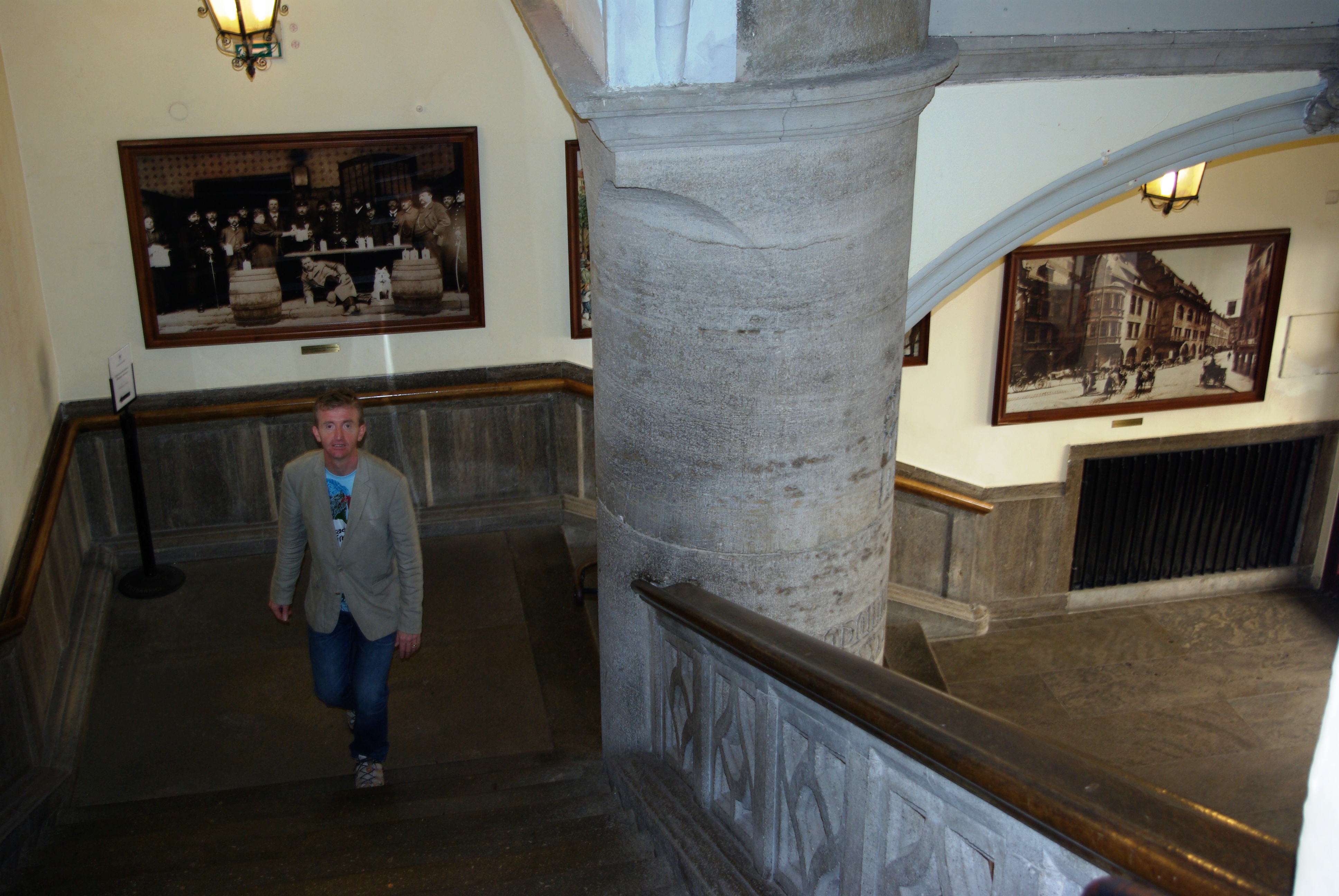
I was back in beer territory. Halfway up the vaulted stairs a groaning Brownshirt, propped against the wall on a swastika’d arm, was unloosing, in a stanchless gush down the steps, the intake of hours. Love’s labour lost.”

Those of you well versed in Paddy’s writing will by now have realised that the above is not my own feeble prose but an excerpt from the passage in A Time of Gifts when Paddy enters Munich’s Hofbräuhaus in January 1934.

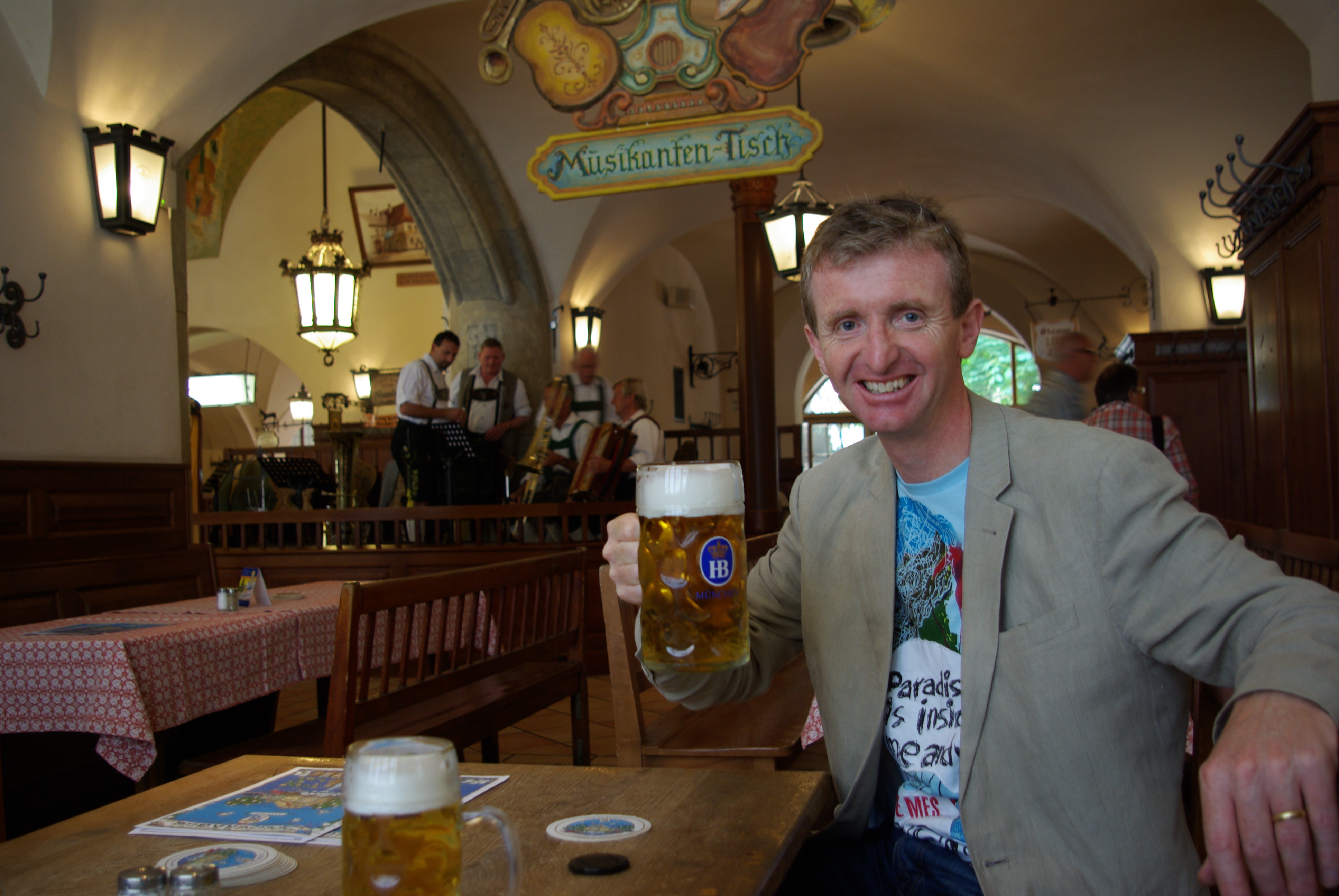
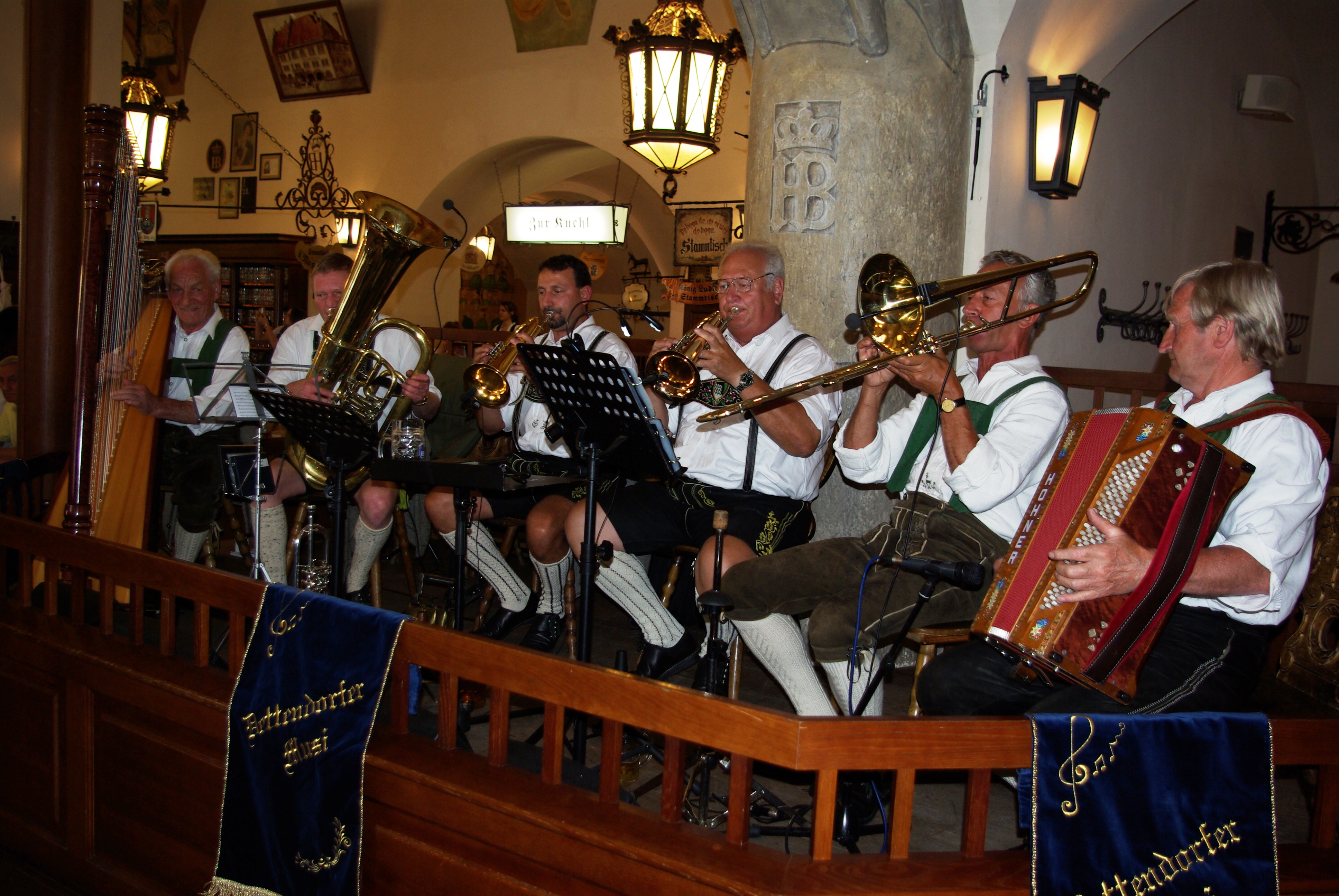
When I entered that vast temple to beer, sausage and sauerkraut at the end of June, I instantly felt like I had been there before, and indeed I had when I read Paddy’s finest work. Instantly I wanted to visit the chamber bursting with SA men singing Lore, lore, lore, and overweight young German burghers ‘as wide as casks ’ who were ‘… nimbly, packing in forkload on forkload of ham, salami, frankfurter, krenwurst, and blutwurst’ lifting stone tankards ‘for long swallows of liquid which sprang out again instantaneously on cheek and brow.’ Had it not been for the fact that this was midday instead of night I am sure I would have found it barely changed, save for the SA men, whose children and grandchildren (all aged now) have taken up residency.

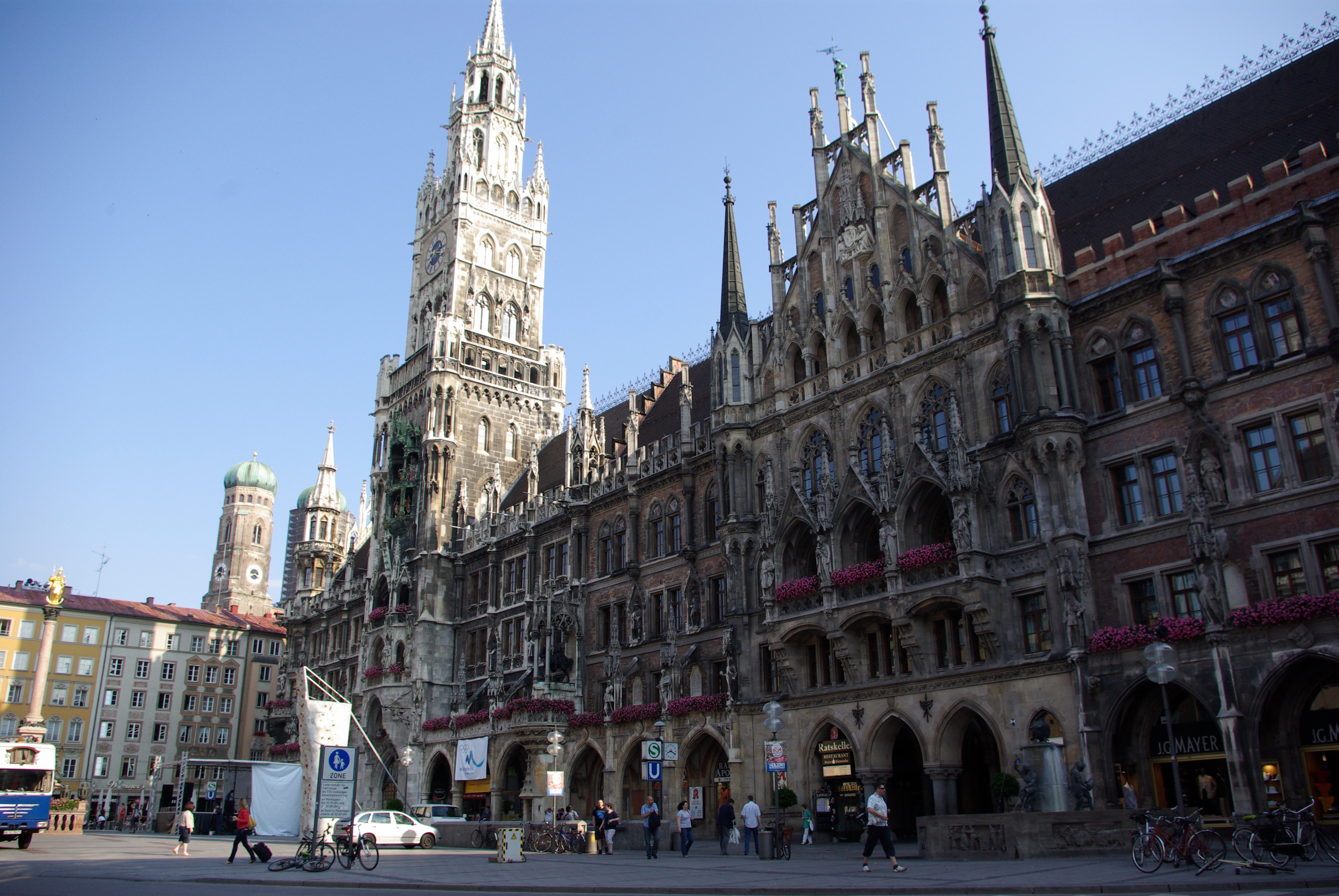
The Rathaus Munich

My wife and I were in Munich after taking the overnight sleeper from Paris Est to Munich on our journey to see the Passion Play (Passionspiele) at Oberammergau. We had arrived at the relatively ungodly hour of seven o’clock in the morning and had seen Munich come to life on a Saturday morning.

At the time the Alt Stadt was almost exclusively ours apart from some stall holders preparing their wares of ripe and juicy, brightly coloured fruit and vegetables for the Saturday market; two young men demonstrating their ability on MX bikes beside a fountain; and a couple of drunks who had obviously made the most of the warm Friday evening and had now belatedly discovered that the party was over.

During the war Munich was severely bombed by the Americans. When on a NATO course at the German Pioneerschule in the 1980’s I remember a particularly loud American officer asking in all seriousness, whilst we were on a tour of the city, when seeing the massive towers and basilica of the Dom, “How the hell did we miss that?”. Well, of course they did not miss it. Seventy per cent of Munich was destroyed by the bombing and after the war there was a serious proposal to abandon the city and rebuild nearby. Fortunately for the Hofbräuhaus (which sustained minor damage) and for us it was decided to rebuild the city. Many of the older buildings, as with so many German cities, were painstakingly restored. The Dom and the Hofbräuhaus were amongst these.

Following a morning of strolling around the centre, visiting some of the sights, drinking känchen’s of schokolade and eating cinnamon flavoured kuchen I was desperate to find the Hofbräuhaus. I was determined not to make the same mistake as Paddy and end up two miles away; although the prospect of doing so and having a couple of himbergeist to see us on our way was not so unappealing!

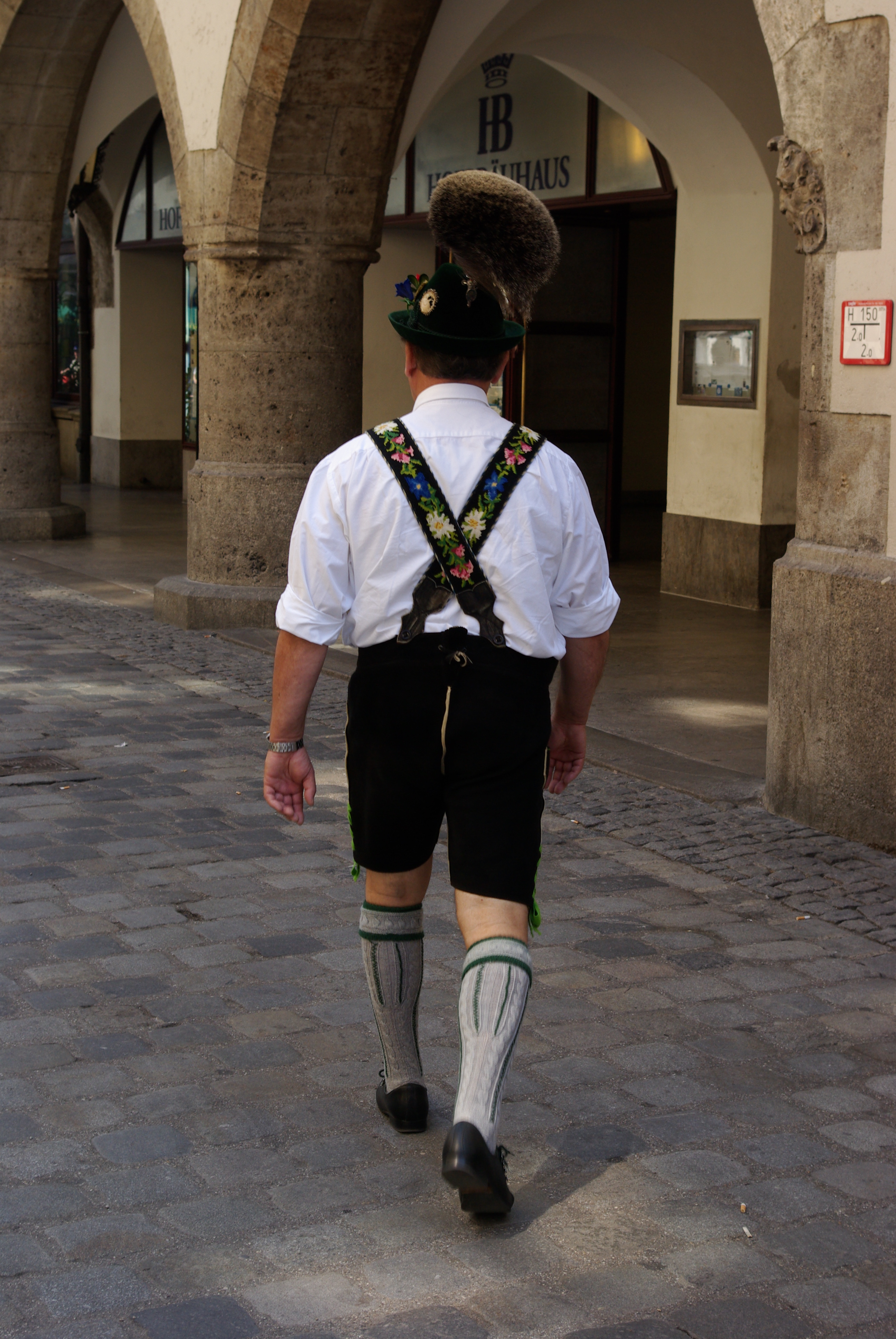
We followed a lederhosen clad gentleman ...

Inadvertently we had somehow attached ourselves to an American tour party and listened patiently whilst the bored German tour guide briefed them all on practical logistics like not entering their PIN number more than twice in those mysterious German cash machines, and what they might see on their one hour of ‘freedom from the group’ until it was time to meet up again, climb into their coach and visit yet another city. When it came to question time I asked where I might find the Hofbräuhaus. The guide looked quizzically at me, thinking I must have some obscure mid-western American accent and told me in all seriousness that eleven o’clock in the morning was rather too early to make such a visit and drink beer. I persisted and reluctantly she gave me the directions.

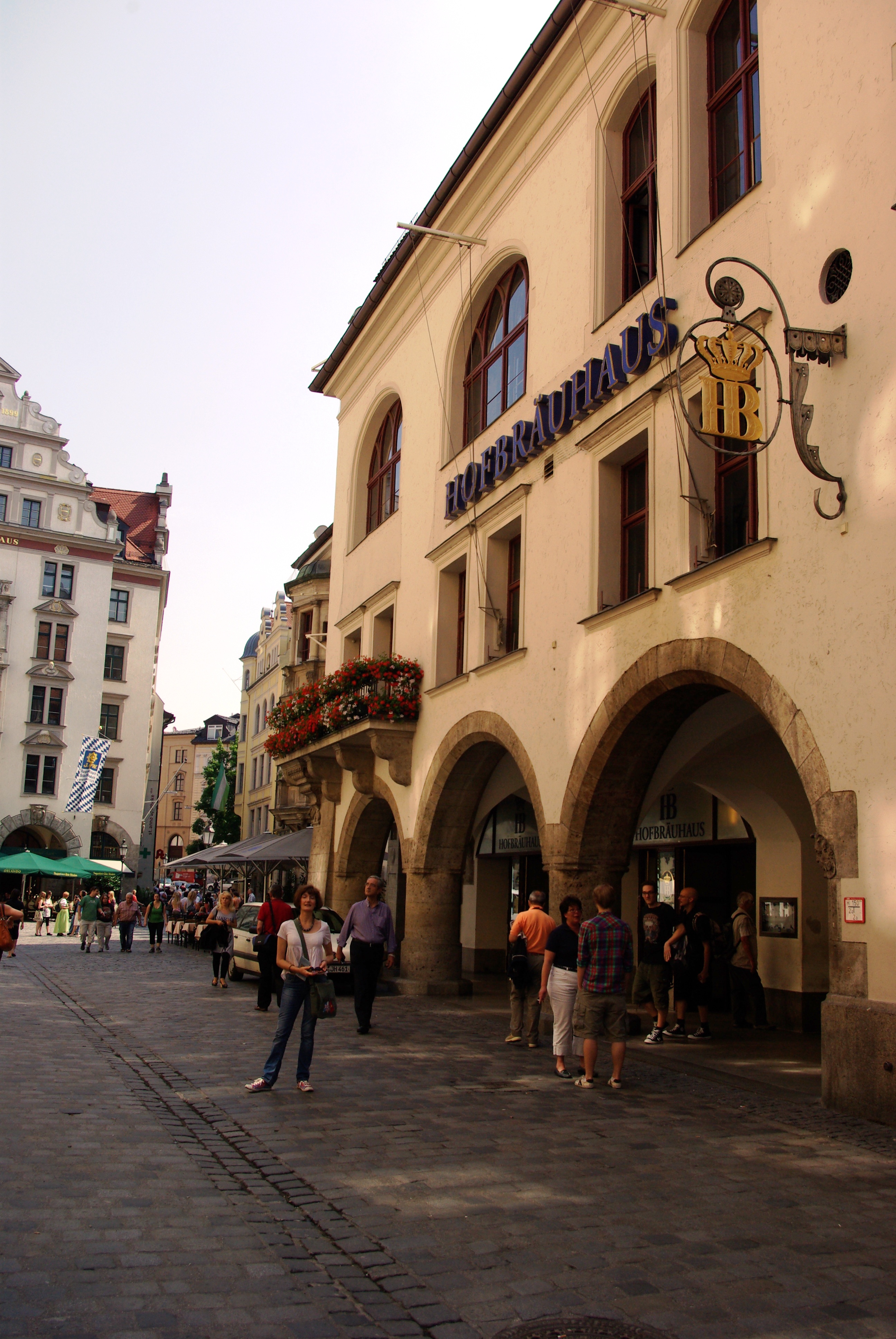
Hofbrauhaus exterior

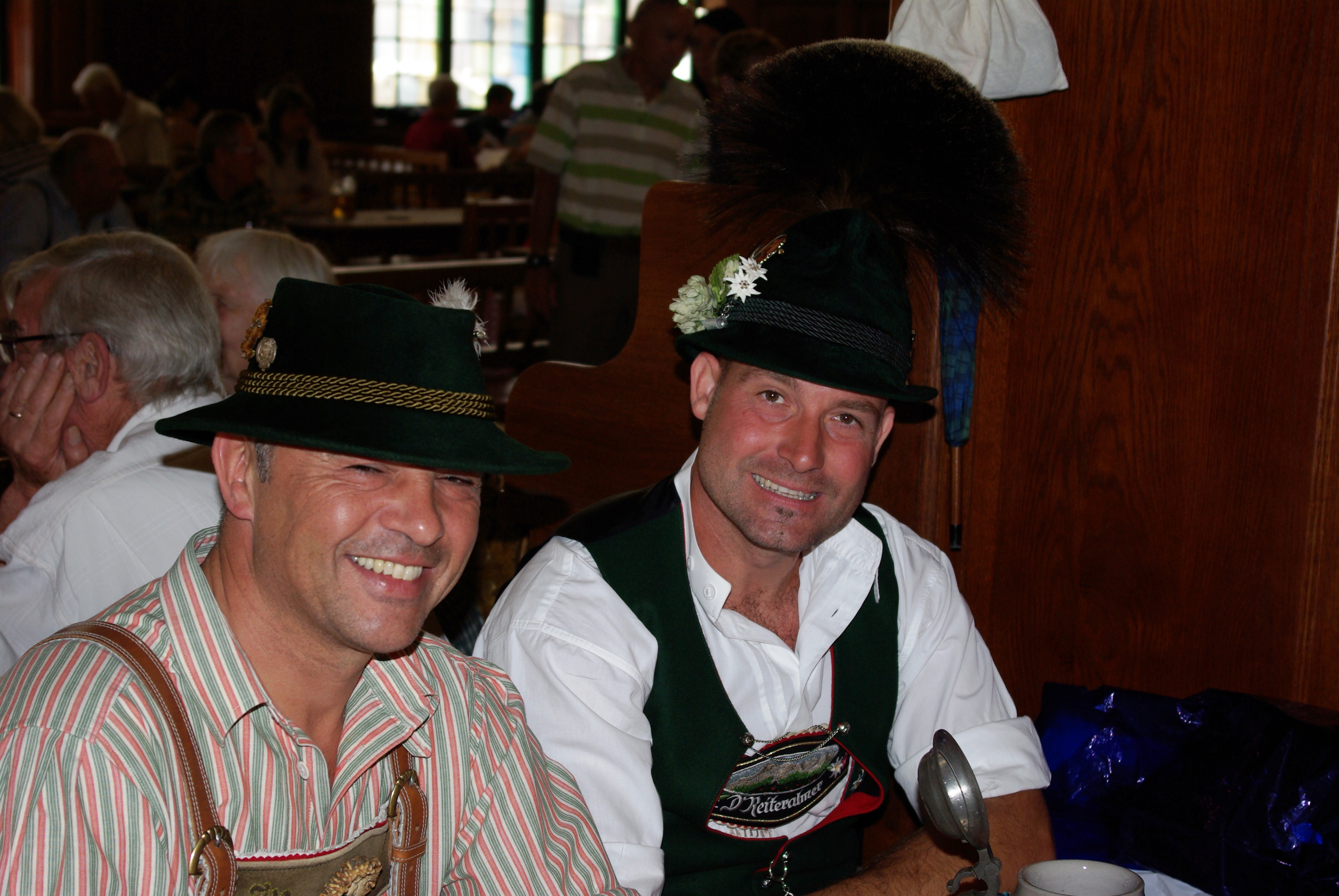
We walked in the sunshine past the old schloss and down a lane to the ‘slanting piazza’ but I do not recall the Virgin on a column presiding over all she surveyed. We followed a lederhosen clad gentleman wearing a traditional Bavarian felt hat which was adorned by the most amazing plume, reminding me of something that may have been worn by a Roman first spear centurion to enable his men to identify him in the midst of battle.

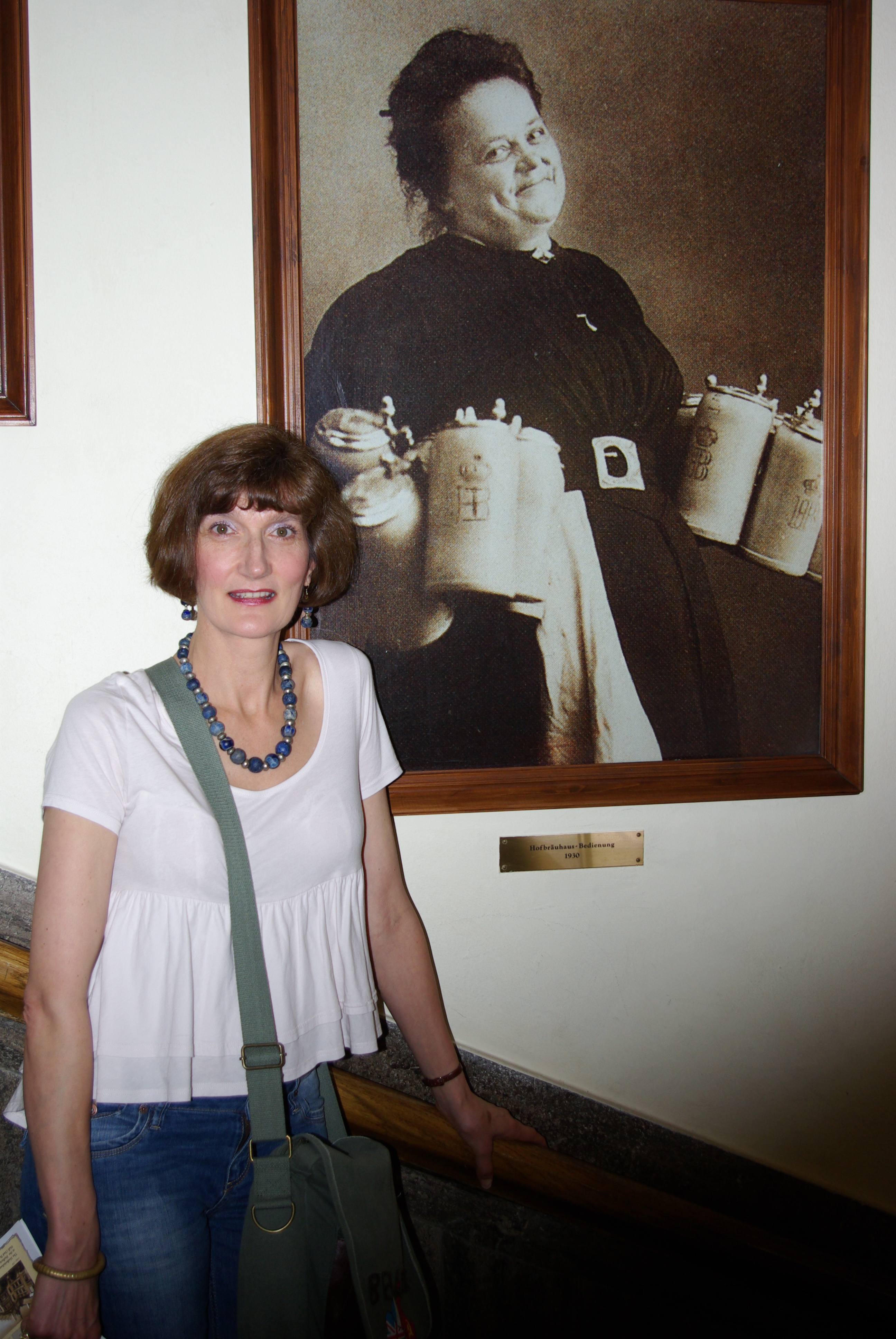
There before us was our goal. Gothic and grand just as Paddy described it, we entered through wide doors underneath Gothic arches and walked up those vaulted stairs which survived the damage of the war. It was here in January 1934 that Paddy encountered his Brownshirt. The steps are now lined with photographs, one of a maternal looking frau holding eight heavy steins full of the cool, golden Hofbräuhaus beer. Perhaps she had served Paddy on that famous, alcohol fuelled night?

Kim considers joining the waitressing team

The Hofbräuhaus has four floors devoted to the adoration of beer, sausage and pretzels. We visited each one. They were all decorated in a different style with a large communal drinking hall, and a number of smaller private function rooms (which are for hire). It is one of these higher floors that Paddy stumbled into when full of SS officers, Gruppen and Sturmbannfuhrers, black from their lightening-flash-collars to the forest of tall boots underneath the table.

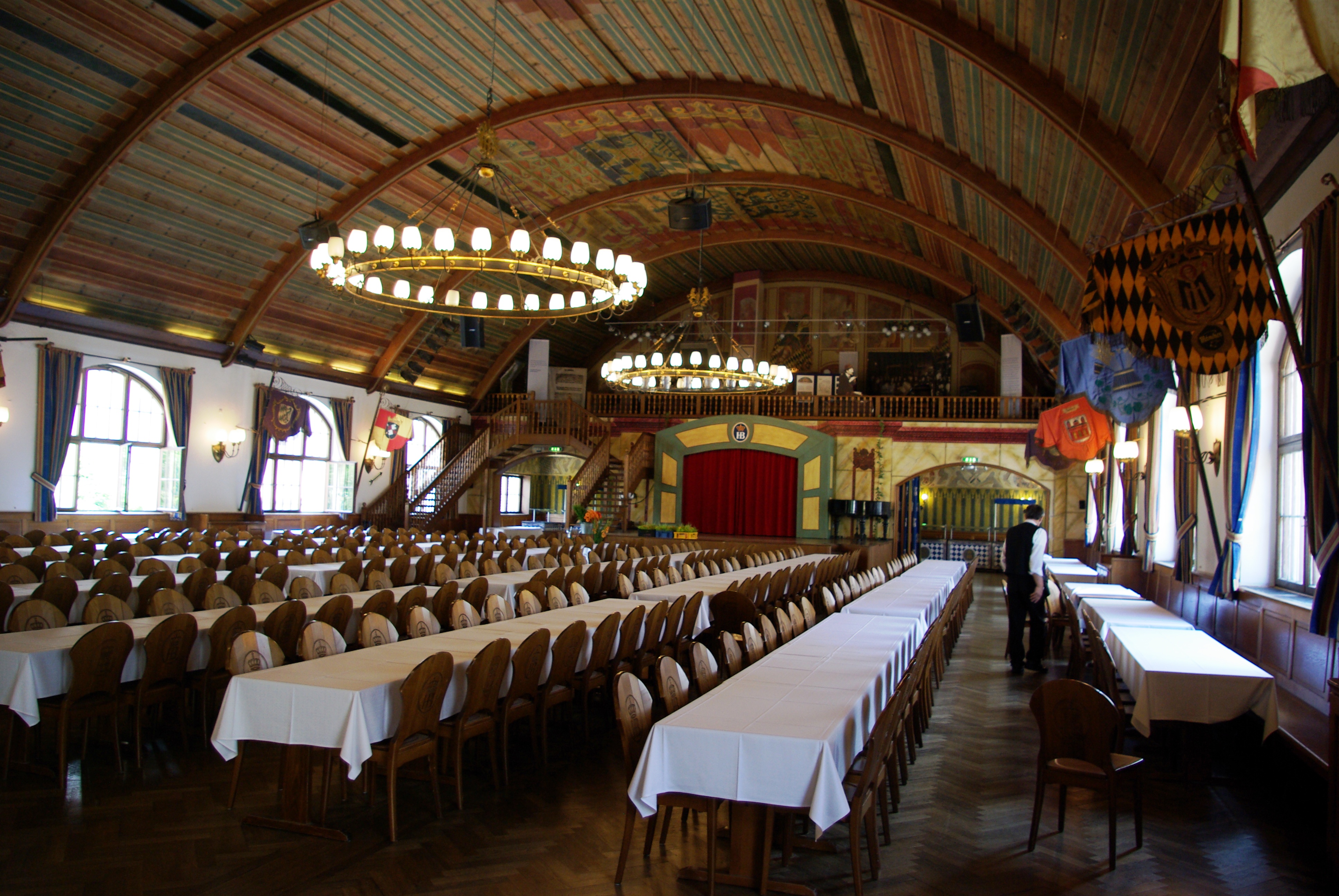
The highest floor is dominated by a large parquet floored room with a vaulted ceiling colourfully decorated with its predominantly pink and blue frescos of Bavarian coats of arms. The Festival Hall was built in 1589. It is light and airy with windows on each side, large chandeliers and dominated by a small stage with heavy, theatrically red velvet curtains. The Hall can seat over 900 on its long tables arrayed in neat rows before the stage, and gives the impression of being eternally ready for a party. Indeed on the occasion of our visit, it was being prepared for the post- Abitur celebration for a very lucky young girl. The mood darkens somewhat when you know that it was in this very room, standing on that very stage that the ambitious politician Adolf Hitler addressed his followers in the early days of the National Socialist Party in the late 1920’s and early 1930’s.

Hofbrauhaus Festival Hall

Given the passage of time this ceased to have any sinister effect, but it is a sobering thought and brought to life a period of history, and its aftermath, that has come to dominate my generation, and certainly those preceding us.

Did Adolf visit here?

It was about this time that I needed to answer the call of nature. Kim and I were virtually alone and I sought out a gentleman’s lavatory. Finding one at the end of a corridor leading from this function room, I hypothesised that perhaps Hitler had, on more than one occasion, made this same trip, perhaps accompanied by colleagues such as Herman Goering, and discussed the finer points of how to grab political power, and achieve revenge on all those who had sought to so humiliate Germany via the Treaty of Versailles.

Like Paddy we were now guided right down to the bottom of the stairs, out of the doors and back in another, larger door on the ground floor. After passing the obligatory ‘Hofbräuhaus shopping experience’ we entered a new hall where the vaults of the great chamber did not fade into infinity through blue strata of smoke as this was, unbelievably, 21st century smoke-free Germany.

Drinking cool beer in The Schwemme

It was here that Paddy found the part of the Bastille he was seeking. The Schwemme is a huge, richly frescoed hall that wound this way and that, past huge stone pillars, toward the altar of Hofbrau beer where an army of male and female waiters attend upon the fountain of beer pouring litre upon litre of the marvelous nectar. And it did not stop there. What Paddy would have missed on a dark, cold, snowy night in 1934 was the courtyard beer garden which by now was filling with locals and tourists all keen to bathe in the unique Hofbräuhaus atmosphere.

If you visit the website of the Hofbräuhaus you will see it includes a list of ‘regulars’; those who attend services on a regular basis, with the specific visit days recorded. They have reserved seats and for larger groups, or even families, whole tables are kept for them so that they can indulge and worship whilst listening to the suitably attired Bavarian band that have a dedicated stage in the centre of the hall.

Hofbrauhaus Regulars

The band plays on

We had arrived early, at around 11.00 am and had spent forty-five minutes or so making our tour of the building. It was quiet, with just a few other like minded souls and the staff getting ready for the rush ahead. By midday we had chosen a table and ordered our first refreshing beer, a Würstlplatte for me and Spanferkel for Kim (read the menu in English here). The Schwemme was now filling with crowds of locals and tourists alike and the band had struck up. If you want to visit the Hofbräuhaus to look around, as we did, I would recommend going early, and you also need to be there pretty early to find a table.

It was a wonderful visit, and one that was brought to life even more as we imagined that young man avoiding Brownshirts and knocking back beer with the farming folk he found in the Schwemme. One thing that has not changed is the hospitality and friendliness of the Bavarian people, and it was with some reluctance that we walked out of the Hofbräuhaus into bright sunshine to catch our train to Oberammergau.

Now, where did I leave my rucksack?

A Long Walk Starts (and Ends) With a Step

I was just taking another look at Matt Gross’ Frugal Travel section of the New York Times and discovered that after writing the piece I published on 13 June he left the NYT. I wonder if he was so inspired by Paddy’s travels that he decided to take off and cover the whole route? Perhaps not. Here is his signing off piece from his NYT Blog.

By MATT GROSS

This weekend’s Travel section cover story — “Frugal Europe, On Foot” — is my last as the paper’s Frugal Traveler columnist. After four years of roaming the world on a budget, from Alabama and Albania to Uruguay and Urumqi, I’m taking a rest, and handing over the illustrious mantle to a new shoestringer, who’ll appear in this space next month.

But for my final feature, I wanted an adventure that would challenge me — physically, psychologically, culturally, linguistically, technologically, logistically and, of course, financially. Maybe a sailing adventure? Done that. A lengthy train journey? Done. A trek into the mountains? Done — on foot and on horseback. I’ve gone round the world, across America and grandly circled Europe, so what was left to be done?

The answer came in the form of Patrick Leigh Fermor, the 95-year-old war hero who’s known as Britain’s greatest living travel writer. His books “A Time of Gifts” and “Between the Woods and the Water” chronicle his nearly penniless journey, in 1933 and 1934, from Rotterdam to Istanbul — on foot. And when I looked at the route he took through the remains of the Austro-Hungarian Empire, I realized I had an adventure in the making: a two-week walking tour that would take me from Vienna through Slovakia to Budapest.

Throughout 180 miles, I dealt with three official languages (German, Slovak, Hungarian) and some unofficial ones (Italian, English, French, Hebrew). I used maps both paper and electronic. I took inspiration from literature: not just Mr. Leigh Fermor’s books but also “The Unnamed,” by Joshua Ferris, “The Road,” by Cormac McCarthy, “The Places in Between,” by Rory Stewart, and “The Long Walk,” by Stephen King (writing as Richard Bachman). I found great bars and restaurants via Twitter and Foursquare — and through common, random luck. I walked till my ankles screamed, and sang to myself during long hours alone.

And when I met new people — as I did just about everywhere — I was amazed, again and again, at their spontaneous generosity, their willingness to feed, shelter and befriend a mysterious stranger attempting to do what few sane travelers would even contemplate.

In other words, I don’t expect you, my readers, to follow precisely in my blistered footsteps, but I hope this story — and all the Frugal Traveler articles I’ve written — will inspire you to set off on your own crazy adventures, confident in the knowledge that no matter how little money you have, the world will, if you embrace it fully, take very good care of you indeed.

Are you inspired? I know I am. It would be a nice idea if perhaps next year we could get a bunch of people together and walk some of the route. On the other hand perhaps it is best to do as Paddy did and make a solo attempt. If anyone has ideas on this get in touch with me tsawford[at]btinternet.com or post a comment below.

Related article:

Walking Paddy’s Route in Mitelleuropa: Frugal Europe, on Foot

Walking Paddy’s Route in Mitelleuropa: Frugal Europe, on Foot

It’s time to be honest now: who amongst the regular readers of this blog, or even those that stumble across us because they have read ‘A Time of Gifts’ or ‘Between the Woods and the Water’, has not thought about following Paddy’s 1930’s route? For myself it is a definite goal. It is an ambition; probably a passion. I had come across the following article but have been inspired to re-produce it by Blog reader Matt who says he first got into Paddy’s work when stationed in Baghdad:

Tom, The New York Times travel writer, Matt Gross, just did an article on PLF. He walked the Vienna to Budapest stretch recently … I first read PLF while stationed in Baghdad four years ago and revisit him often. Living in Heidelberg, I’ve been able to visit some of the places he mentioned specifically and have recommended A Time For Gifts to many of my fellow Americans living here or travelling to Europe. As I’m in the process of moving back to the States, it will be a few years before I’m able to pick up the thread of his travels. I’m not sure if you’re in contact with PLF, but pass him the respects of this Yankee officer. Matt

Frugal Europe, on Foot

First published in the New York Times,  May 23, 2010

The article is written by New York Times’ Frugal Traveler columnist Matt Gross who attempted to follow in the footsteps of Patrick Leigh Fermor. Like all good stories it begins ….

ONCE upon a time, a young man went for a walk. It was December 1933, and an 18-year-old Englishman named Patrick Leigh Fermor put on a pair of hobnail boots and a secondhand greatcoat, gathered up his rucksack and left London on a ship bound for Rotterdam, where he planned to travel 1,400 miles to Istanbul [Ed: Constantinople!] — on foot. He had virtually no money; at best, he’d arrive in, say, Munich to find his mother had sent him £5. But what he did have was an outgoing nature, a sense of adventure, an affinity for languages and a broad network of friends of friends.

 “If I lived on bread and cheese and apples,” he later wrote, “jogging along on fifty pounds a year like Lord Durham with a few noughts knocked off, there would even be some cash left over for papers and pencils and an occasional mug of beer. A new life! Freedom! Something to write about!”

 Something to write about indeed! The books he produced from the yearlong journey — “A Time of Gifts” and “Between the Woods and the Water” — are gorgeously rendered classics that have led many to call Mr. Leigh Fermor, now 95, Britain’s greatest living travel writer. But to my mind, he’s always had another title: the original Frugal Traveler — the embodiment of that idea that, though a wanderer may be penniless, he doesn’t have to suffer.

 And Mr. Leigh Fermor never suffered, thanks to the miracle of human generosity. Peasants gave him baskets of eggs and swigs of raspberry schnapps. Small-town mayors found him beds. The lingering nobility of Europe put him up in their castles, invited him to balls and lent him their horses. When Mr. Leigh Fermor did sleep rough — in hayricks and barns or on the banks of his beloved Danube — he did it by choice, not because (or not merely because) poverty required it. He knew, even at 18, that the world is an experience to be savored in all its multifarious incarnations.

Matt Gross' route

Could a young person (is 35 still young?) with strong legs and little money find the same spirit of hospitality that Mr. Leigh Fermor encountered some 76 years ago? At the end of March, I set out to find the answer. With only two weeks free, my plan was to walk from Vienna to Budapest, a 180-mile route that would connect the old poles of the Austro-Hungarian Empire and track Mr. Leigh Fermor’s trail as closely as possible, taking me along the Danube to Bratislava, the Slovakian capital, and across the plains of Slovakia south to Hungary — through three countries whose languages, cultures and histories could not be more different, or more intertwined.

It was tempting, the day I arrived in Vienna, to just walk east from the airport, but I couldn’t completely skip the Austrian capital, where Mr. Leigh Fermor had spent three weeks among the “crooked lanes” and “facades of broken pediment and tiered shutter.” And so I followed his lead, going into the imperial crypt, where the grandest members of the Hapsburg family lay entombed in elaborate sarcophagi, and into the museums, although I shied away from the most famous in favor of oddities like the International Esperanto Museum. And I luxuriated in storied places like Cafe Alt Wien and Cafe Bendl.

But after two nights in Vienna, I was restless. So I crossed the Danube, put on my 45-pound pack and took off down the Donauradweg, a well-kept biking trail that runs from the river’s source to its mouth at the Black Sea. To my right, the Danube, more green than blue, sparkled in the cool sunlight, and I encountered fishermen tending their rods, elderly sunbathers, nordic hikers poling along and cyclists speeding in both directions.

This first day, I figured, I’d take it easy and do only 15 miles. Ideally, I’d need to hit 18 miles a day — about six hours of walking — to reach my goal. It seemed reasonable, especially with the terrain so uniformly flat. The path, sometimes dirt, sometimes paved, would often stretch so far and straight that I couldn’t imagine I’d ever reach the end, and then I’d finally hit a slight turn and face the same thing: an art-school lesson in perspective, complete with the first low foothills of the Carpathians at the vanishing point — and a scampering rabbit to remind me this was no still life.

Even with such straightforward terrain, there were snags. An attempted shortcut through a fuel depot left me with minor scratches and an extra three miles. But such mistakes have a way of turning out for the best. Had I stayed on the trail, I would have never crossed paths, two hours later, at the edge of Donau-Auen National Park, with Jean-Marc and Marie, newlywed French cyclists who stopped to say hello when they saw a lone hiker in the middle of nowhere. They were taking an extended honeymoon: a two-year bicycle journey from their home in Paris — to Japan!

“Do you know where you’re staying tonight?” I asked. They didn’t. I told them to meet me at Orth an der Donau, a small Austrian town a couple of miles farther down the Danube, where I had arranged for a place to stay via CouchSurfing.org. Maybe, I said, my host could find them somewhere to pitch their tent.

THE host, Roland Hauser, whom we met in front of Orth’s impressive castle, did better than that. He invited them home to his dreamland of soft beds and hot showers. Roland, 26, had traveled from California to Southeast Asia to New Zealand, and his German-accented English was peppered with words like “sí” and “bueno.” That evening, we cooked spaghetti Bolognese, nibbled Südtirolean ham and drank big bottles of beer. I went to sleep marveling at our extraordinary, Fermorian luck.

In the morning, after coffee, I threw out my underwear. This was a strategy to lighten my load — bring old undies and get rid of them day by day. Frankly, I should have done that with everything, as the pack was needlessly heavy. Along with two weeks’ worth of shirts, I had an ultralight down jacket, a waterproof shell and rain pants. A tent and sleeping bag. One pair of jeans and lightweight canvas shoes to change into at day’s end; nothing worse than walking 20 miles and spending the evening in the same clothes. And I packed Mr. Leigh Fermor’s books and Claudio Magris’s “Danube,” which I never had time to read. And my computer and camera gear — work necessities, alas.

When I set off, I was wearing my typical walking outfit: khaki pants by a company in Portland, Ore., called Nau; waterproof running sneakers by Lafuma; good socks (as important as good shoes); and a long-sleeved cotton shirt.

The walk began well. My feet were tender, but the flatness of the Marchfelddamm, a high berm that doubled as biking path and flood deterrent, ensured that I wasn’t struggling. This was the heart of the Donau-Auen National Park: forests of thin trees broken by occasional streams flowing to the Danube. At first, I appreciated the play of light on the water and between the trunks, but hour after plodding hour of unchanging scenery soon became mind-numbing, and I simply marched, putting one foot in front of the other and watching for kilometer markers. It would be 13 miles before I could stop for lunch, and another 10 before I reached my day’s goal: Bratislava.

But there’s a funny thing about long walks. With patience, all those steps add up, and by 2 p.m., I’d crossed a bridge over the Danube and settled into a cafe in the stately town of Hainburg, where an open-faced baguette pizza and glass of beer gave me the courage to face the miles ahead. And soon I found myself trudging along the shoulder of the small highway with cars flying past — and missing the monotonous near-silence of the forest.

Not far off, I could see Bratislava’s hilltop castle — in Mr. Leigh Fermor’s era, a burned-out wreck worked by prostitutes but in the 1950s rebuilt as a stately white-and-red palace — and it teased me with its apparent nearness. Still, I had far to go, past a derelict border post, and through three miles of snaking bike paths, before I crossed the Danube again and was in the heart of Bratislava’s old town, all cobblestones and tile roofs and sidewalk cafes.

After checking into the Hotel Kyjev — a 1970s tower turned budget boutique — I checked myself out: I wasn’t sore, out of breath or even tired. I did have blisters on my feet, but they were easily treated: puncture, drain, clean, bandage. My ankles, however, were terribly swollen, the peroneal tendons in particular, a result (I think) of how my body mechanics had altered with the weight on my back. I popped some ibuprofren, took a shower, then hobbled outside for dinner.

It was the Friday during Passover, and like any wandering Jew, I wanted a Sabbath meal. And thanks to Chabad, the Hasidic Jewish outreach organization, I got one, at the home of the transplanted American rabbi Baruch Myers. He was only too willing to share his food (cucumber salad, gefilte fish), his friendship and his family, including a battalion of adorable children who cheerily walked me through the Passover story.

It wasn’t just this heartfelt welcome that got to me; it was the very existence of a Jewish community in Bratislava. Back in his day, Mr. Leigh Fermor wrote, the Jews “were numerous enough to give a pronounced character to the town.” No longer. The Holocaust had reduced the Jewish population to, in Rabbi Myers’s estimate, 1,000 people. There was a synagogue, a few kosher restaurants, a Jewish museum and even a pension, but few visitors today would see in Bratislava a Jewish-inflected city.

On Saturday, partly inspired by the rabbi and partly because of my feet, I rested and contemplated the future. I had walked 40 miles so far, and if my ankles were any indication, there was no way I’d make the remaining 140. Unless … If I took a train a short way — say, 15 miles northeast — I could certainly walk another 10 miles. I’d be breaking my rules, but those rules were arbitrary. Continue reading