Yearly Archives: 2011

Sir Fitzroy Maclean Bt: Obituary

Maclean was an SAS officer who spent time in Cairo and knew Paddy. His life is quite extraordinary. I recommend reading Maclean’s book, ‘Eastern Approaches’. It starts off a little slowly, but includes a gripping account of a very high profile Soviet show trial. His story really steps up five gears when he joins the fledgling  SAS and is then selected to continue the work of F W D Deakin with Tito in Yugoslavia. Deakin’s book ‘The Embattled Mountain’ is also excellent.

by Frank McLynn

First published in The Independent, 19 June 1996
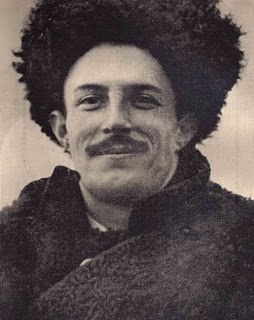
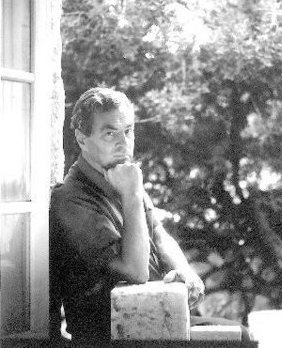
Fitzroy Maclean in Russia in the 1930’s

Fitzroy Maclean owes his place in history to the extraordinary 18 months he spent as Winston Churchill’s special envoy to the Yugoslav leader Josip Tito in 1943-45. He sometimes expressed regret that, as with his hero Bonnie Prince Charlie, the historically significant portion of his life was compressed into 18 months at a comparatively young age. More dispassionate commentators would say that he packed an unbelievable amount into his 85 years. Maclean always believed in the motto that it was better to live a day as a tiger than a year as a donkey, but in fact he managed to combine the excitement of the one with the longevity of the other.

His background as member of a Scottish clan and its Jacobite connection was extremely important to him. “Thank God I am a Maclean” was the family motto.

Born in 1911 in Egypt, the son of an officer in the Cameron Highlanders, Fitzroy inherited from his father the martial tradition and from his mother the love of languages. Educated at Eton and King’s College, Cambridge, where he took a First in Part One of the Classical Tripos, Maclean was initially drawn to the academic life but the crisis in Europe in the early 1930s convinced him he should enter the Diplomatic Service, then a tightly knit body numbering no more than 250 souls. After passing the stiffly competitive examinations, the young Maclean was marked down as “one to note”.

His initial three-year posting was to Paris, which he saw in the troubled context of the Front Populaire years. Then, in 1937, instead of opting for a “fast track” posting to Washington, he made what was considered an eccentric decision to plump for a posting in Russia. He arrived at the time of the great purge trials, and in February 1938 was in court daily for the nine-day trial of Nikolai Bukharin, later memorably recreated in his first book, Eastern Approaches. Through a close friendship with his opposite number in the German embassy, he was able to give advance warning of the likelihood of a Nazi-Soviet pact.

His two years in the Soviet Union were also memorable for the many unauthorised journeys be made to the eastern Soviet Union, principally Samarkand, Bokhara, Tashkent, Batum, Tiflis. He led the Russian secret service agents, who dogged his steps, a merry dance, travelling on trucks and second-class trains. But he was adamant that he made these journeys for his own self- realisation and was never himself a secret agent.

In 1939 he was transferred to London, to the Russian desk of the Foreign Office’s Northern Department. He had always wanted to emulate his father and be a soldier, so when war broke out in September he was eager to sign up with a combat regiment. But the Foreign Office counted as a reserved occupation, and two dull years elapsed. Poring through service regulations, Maclean discovered the loophole he was looking for: on election as an MP, a Foreign Office man was obliged to resign. Using his charm and considerable diplomatic skills, he got himself adopted as the Conservative candidate at the 1941 by-election in Lancaster. He then immediately enlisted as a private in the Cameron Highlanders.

For an Etonian diplomat and prospective Member of Parliament to enter the ranks in such a crack regiment was an extraordinary thing to do, and the singularity of the decision has perhaps not been sufficiently underlined. Rubbing shoulders with tough squaddies from the Gorbals was a key formative process. Elected MP for Lancaster, he was now safe from recall to the Foreign Office.

After basic training Maclean was commissioned as a lieutenant and seconded to an elite commando unit being trained in Cairo to destroy the Baku oilwells on the Caspian – a bizarre project to have been entertained against the property of an ally but one thought necessary if the German army broke through in the Caucasus. The project was soon shelved, so Maclean, at a loose end in Cairo, accepted an invitation from David Stirling to join the newly formed Special Air Service. It is on his daring exploits behind enemy lines with Stirling that his reputation as war hero securely rests.

On one occasion, while trying to mine Benghazi harbour, Maclean posed as an Italian officer and, in fluent Italian, roundly berated the sentries for inattention while mounting sentry duty. Seemingly a man oblivious to danger and with nine lives, Maclean had his only near brush with death after a car crash resulting from Stirling’s reckless style at the wheel. He was unconscious for four days after the crash and later remarked: “David Stirling’s driving was the most dangerous thing in World War Two!”
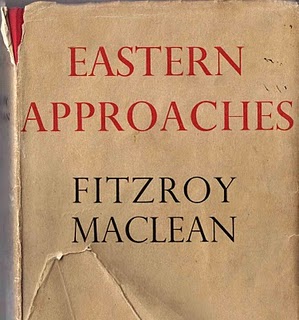
On recovery, Maclean took part in another raid on Benghazi and was then employed by General “Jumbo” Wilson in Persia (Iran) on a further mission, to arrest the pro-Nazi governor-general of Isfahan, General Zahidi. His rapid promotion, from lieutenant to brigadier in two years, provoked envy among his critics. But his success in these missions later led his friend Ian Fleming to base aspects of the character of James Bond on Maclean. More importantly, they convinced Winston Churchill that Maclean was the right man to head a military mission to Tito and the partisans in Yugoslavia.

Since 1941 Tito had been pinning down more and more German divisions in a highly successful guerrilla war. But there was another faction in Yugoslavia: the royalists and their military arm, the Chetniks, led by General Draza Mihailovic. Maclean’s task was to find out, in Churchill’s words, “who was killing the most Germans”, regardless of political ideology or affiliation. Maclean’s unorthodox methods, his refusal to go through channels, and the fact that he was known to have Churchill’s ear, infuriated Special Operations Executive, who felt that he vas meddling in areas that were properly theirs. Friendly critics dubbed Maclean “the Balkan brigadier”, “the Scarlet Pimpernel” and even (from his penchant for Highland dress) “Lothario in a kilt”. Inveterate enemies, like SOE’s Brigadier Mervyn Keble, had a less complimentary spread of nouns and epithets.

Maclean parachuted into Yugolavia with his mission in September 1943. His subordinates were a motley crew, some first-rate technicians, others mere prima donnas such as Randolph Churchill and Evelyn Waugh. Maclean built up a personal rapport with Tito which never faded, established a supply lifeline which ensured that the guerrillas received arms and material from the West, and managed the problem of “cohabitation” with a prickly Soviet military mission, also attached to Tito. He discovered that the partisans were bearing the overwhelming brunt of the war and reported to Churchill accordingly.

For nearly two years, based either on the Adriatic island of Vis or in the Yugoslav interior, Maclean and his companions shared the fluctuating fortunes of Tito and the partisans, culminating in the triumphant battle of Belgrade in October 1944, when the partisans co-operated effectively with Stalin’s Red Army to destroy German military strength in the country. Maclean also acted as go- between in an acrimonious meeting between the Yugoslav leader and Churchill in Naples in August 1944.

When Tito came to supreme power in Yugoslavia after the war and executed Mihailovic, the cry arose that Britain should never have supported Tito and the Communists but should have made Mihailovic and the Chetniks the target for their military aid. For nearly 50 years the canard persisted that Maclean misled Churchill about the true situation in Yugoslavia and, even more absurdly, that he was “soft on Communism”. Several comments are in order.

First, Maclean was always a fervent anti-Communist and man of the Right. But he was a realist, unable to deny the evidence of his senses for ideological reasons, and he had a clear, military, non-political mandate from Churchill. Secondly, Tito would have prevailed in Yugoslavia with or without British aid, but the British connection was all- important psychologically when Tito broke with Stalin in 1948 to pursue an independent, non-aligned, “Third Way” style of Communism. Thirdly, Mihailovic and the Chetniks were the military arm of Greater Serb nationalism. Events since the break-up of Yugoslavia in 1989 have tarnished the credibility of Serb nationalism. It is ironic that it took the horrors of the Yugoslav civil war before the claque of anti-Maclean tongues was finally silenced.
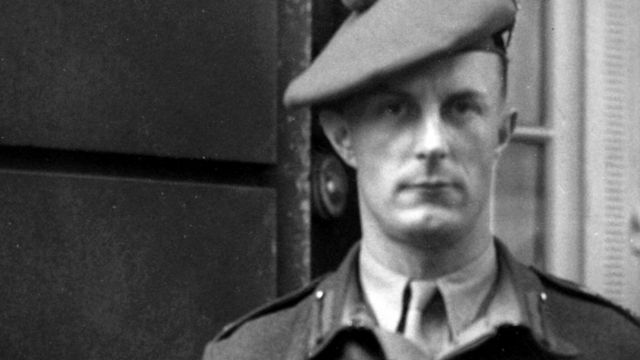
Tito’s calibre as a leader was fully demonstrated by the Herculean task he performed in keeping Yugoslavia united for 35 years after the war. It will be surprising if he does not gain stature as post-war history is reassessed, and such revisionism can only vindicate the correctness of the advice Maclean gave Churchill in 1943-45.

Maclean the war hero found it difficult thereafter to find a niche for his unique talents. His autobiography Eastern Approaches was a best-seller in 1949, though none of the 15 books he wrote afterwards was quite so well received. He continued as Conservative MP for Lancaster until 1959 when, wanting a Scottish constituency, he became the member for Bute and North Ayrshire, and served there until 1974. Churchill appointed him Under-Secretary of War in 1954, where he had an important behind-the- scenes role during the Suez crisis of 1956, but Harold Macmillan sacked him in 1957, allegedly for poor performances in the House.

Created a baronet in 1957, Maclean branched out in other directions. He ran his own hotel, “The Creggans”, on the shore of Loch Fyne. He became a respected associate producer, writer and presenter of television travel documentaries, specialising in Eastern Europe and the Soviet Union. Above all, he was a tireless traveller. He travelled light, with a kitbag containing a Russian novel and an ancient classical author, both in the original. At an age when most people have given up on linguistic ambitions, Maclean continued to hone his knowledge of French, Italian, German, Russian, Serbo- Croat, Latin and Greek.

An admirer of Margaret Thatcher, he steered her through the intricacies of Yugoslav politics, advised her to put her political money on Gorbachev in 1985, and acted as special adviser to the Prince of Wales when he visited Tito in the 1970s.

The steep downward spiral towards disaster in Yugoslavia after Tito’s death in 1980 deeply saddened him. One of only three foreigners allowed to own property in the country during the Tito period, Maclean spent a good part of each year at his seaside villa on the Adriatic island of Korcula.

A man of great physical courage and enormous charm, Fitzroy Maclean was certainly the last of a breed, a real-life imperial adventurer in the tradition of Kim and Richard Hannay and an action man in the mould of Sir Richard Burton and, his own special hero, Bonnie Prince Charlie. He loved food and drink, good conversation and the company of pretty women. The initial image of a haughty, suave, privileged Etonian gave way, for those who knew him well, to a man with an advanced sense of humour and the absurd. The patrician persona masked an essentially simple man, with a rugged humanity that seemed to belie the breadth of his interests; there was nothing of the oddball about Maclean.

Politically he was the kind of Conservative who believes in order and hierarchy rather than original sin, and he expressed an optimistic view of human nature. He liked other human beings and was at ease with people from all walks of life, from dustmen to duchesses.

As his Scottish parliamentary colleague for the last 12 years of his 33 years as a Member of Parliament, writes Tam Dalyell, I never heard Fitzroy Maclean say anything simplistic.

Had the House of Commons been televised when he and his generation, Conservative and Labour, were in the autumn of their parliamentary careers, a different impression would have been created on the viewer. These were people who had come to politics from very different experiences, and had done their apprenticeship not as political researchers, but on the anvil of world war danger. Their presence enhanced the House of Commons as a serious forum of the nation. In the early 1960s it simply would not have occurred to any of the generation of new MPs to be rudish or cheekyish to Maclean and his contemporaries.

Furthermore, as incoming prime minister, Harold Wilson handled the questions of such as Sir Fitzroy Maclean, Brigadier Sir John Smyth Bt VC, Commander Sir John Maitland RN and Air Commodore Sir Arthur Vere Harvey with gingerly deference.

Maclean’s political importance lies not in the office he held as Parliamentary Under-Secretary of State for War but in his personal relationships over 30 years particularly with leading Conservatives, such as Churchill and Macmillan. Harold Wilson knew that Maclean had been one of the prime movers in Macmillan’s visit to Moscow in 1959 which started the thaw. Usually through George Wigg, Maclean reciprocated by offering Wilson as prime minister his best advice and contacts in Eastern Europe.

Unsurprisingly Maclean was cool about Alec Douglas-Home and the only occasion on which I saw Maclean verging on anger was when, in 1971, his foreign secretary had expelled 90 Russian diplomats. “It was an indulgent and expensive gesture which could serve no useful long-term purpose.” Who else, again, but Maclean would tell Winston Churchill to his face that his speech at Fulton, Missouri, in 1946 coining the phrase “Iron Curtain” and ushering in the Cold War was unwise to the point of being ridiculous?

The day after John Smith’s funeral the then government Chief Whip, Richard Ryder, said to me, “As we passed you in our official car the Prime Minister and I wondered who on earth was that man with you bent double struggling up the pavement with such courageous gallantry and tried to place him.””Fitzroy Maclean,” I said “determined to come to say goodbye to his Labour friend of the Scotland/USSR Association.” “A legend,” said Ryder. A legend of courageous gallantry.

Fitzroy Hew Maclean, diplomat, soldier, politician, writer: born Cairo 11 March 1911; MP (Conservative) for Lancaster 1941-59, for Bute and North Ayrshire 1959-74; CBE (mil) 1944; Parliamentary Under-Secretary of State for War 1954-57; Bt 1957; KT 1993; married the Hon Mrs (Veronica) Phipps (nee Fraser; two sons); died 15 June 1996.

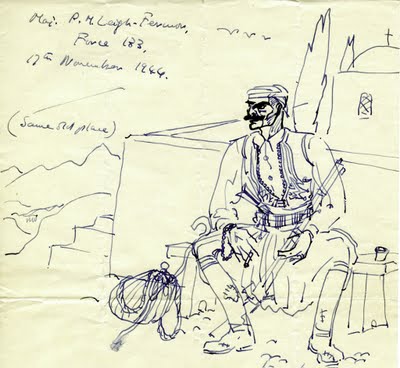
Sir Wanderlust – Portrait von Patrick Leigh Fermor

Here are two more articles from Germany supplied to me by Christian Peters from Koln.

Sir Wanderlust vonWolf Reiser, first published in Travellers World

Travellersworld-Sir Wanderlust-1

Die Heimat der Nomaden, first published in Süddeutsche Zeitung

SZ-MANI-REISER


Paddy’s memorial service

Just a very quick update to inform many of you who have enquired about a date for Paddy’s memorial service.

It is likely that this will not take place until late 2011, perhaps even in December. When I know more I will update you all.

In the meantime there may be a service in Kardamyli but nothing is set yet.

Leigh Fermor’s hidden letters to see the light

It has been 15 years in the making but at last Artemis Cooper’s official biography of Sir Patrick Leigh Fermor has got a publication date. Cooper was first contracted to write an account of the life of her friend, the great travel writer, back in the Nineties but Leigh Fermor had requested that it was not to be published until after his death, which came last Friday at the grand age of 96.  Cooper, wife of historian Antony Beevor and daughter of John Julius Norwich, is now expecting the book to come out late next year with John Murray, also Sir Paddy’s publisher. The delay is believed to be down to a number of private letters — possibly to his late wife, Joan Leigh Fermor— which he did not want to be in the public sphere while he was still alive. Sir Patrick was in his eighties when the book was commissioned and friends confess that they did not expect such a long wait. As a young man he walked across Europe and swam the Bosphorus. He lived for many years in the Peloponnese. Recently, his correspondence with the Duchess of Devonshire, edited by Charlotte Mosley, was published.Cooper, administrator of the Duff Cooper literary prize in memory of her grandfather, is still holding back the exciting details of the book. “It’s not finished yet,” she tells me, dodging questions about the content. “We’ll do it in time for Christmas next year.” Leigh Fermor’s funeral will be held on Thursday in the village of Dumbleton in Gloucestershire, where Joan is buried.
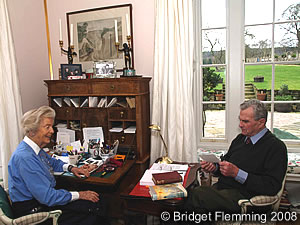
From the Londoner’s Diary in The Evening Standard, 14 June 2011

Economist obituary: Paddy Leigh Fermor

Sir Patrick Leigh Fermor, traveller, writer and war hero, died on June 10th, aged 96

First published in the Economist, Jun 16th 2011

ONE evening in the spring of 1934 19-year-old Patrick Leigh Fermor, making his way on foot from the Hook of Holland to Constantinople, found himself taking tea under flowering horse-chestnut trees at the kastely of Korosladany, in Hungary.

“We sat talking until it was lighting-up time, and indoors pools of lamplight were being kindled with spills along the succession of lavender-smelling rooms. It lit the backs of bindings, pictures, furniture which had reached exactly the right pitch of faded country-house shabbiness, curtains laundered hundreds of times over and music open above the keys of a piano. What music? I can’t remember; but suddenly, sailing into my mind after all these years, there is a bowl on the piano of enormous white and red peonies and a few petals have dropped on the polished floor.”

Wherever he went, the dusty young traveller stumbled on scenes like this. His hosts in the oddest corners of central Europe dressed in black tie for dinner, played ferocious bicycle polo in the courtyard, or catalogued their butterfly collections in cavernous libraries where he could lose himself deliriously among folios, almanacs and scrolls with dangling seals. They lent him pearl-handled pistols and a superb chestnut horse “with more than a touch of Arab to his brow” to take him across the plains. Long Turkish nargileh were indolently smoked, Tokay swigged from cut glass; while, upstairs, staff would be neatly laying out on his bed the rumpled canvas trousers and thin tweed jacket which were the smartest clothes he had, purchased for his odyssey from Millet’s army surplus in the Strand.

He had set out on his great walk for a jumble of reasons, but mostly to have fun. He felt “preternaturally light”, as he left London, “as though I were already away and floating like a djinn escaped from its flask.” Formal education didn’t suit him; the wild, noisy boy couldn’t bear to be hemmed in with rules or bounds, and had been expelled from King’s Canterbury for holding hands with a greengrocer’s daughter. Yet he loved books, especially the tales of Sir Walter Scott and Charles Kingsley’s “Heroes”, and could now see himself as a knight or a wandering scholar, going from castle to castle or, just as happily, sleeping in woods and barns or under the stars.

In his rucksack he carried, besides pencils and notebooks, poetry. As he went he recited Keats, Marlowe and Shakespeare, astonishing the rustics he met—just as he would later amaze his dinner guests, in Worcestershire or in his Elysian house by the sea in deepest Greece, with non-stop recitations, arcane facts, stories and songs, not infrequently ending with “It’s a Long Way to Tipperary” sung in Hindi.

He was a compulsive autodidact, wanting to know the names and nature of everything. Entering a strange region, he would grapple with its history, rifling through the Encyclopedia Britannica and Meyers Konversationslexicon to trace the movements of tribes and the collision of cultures, producing in his books whole page-lists of Klephts and Armatoles, Kroumides and Koniarides, Phanariots of the Sublime Porte and boyars of Moldowallachia, until his readers swooned. With the same high-spirited eagerness, and a flask full of local fire-water, he would run into taverns, caves, shepherd huts and gypsy camps, hungry to pick up the unknown language and join in. Dashing and courteous, splendidly handsome, he wished often for the strange hats he saw, bowler or thin-brimmed, foot-high or scarlet-plumed, in order to flourish them high to all the people who wished him well.

Critics of his two best-loved books, “A Time of Gifts” (1977) and “Between the Woods and the Water” (1986), complained that he swanned through 1930s Europe without noticing the clouds. His visit to the Munich Hofbräuhaus mostly described the enormous girth and appetite of ordinary Bavarians, barely mentioning the black-clad SS men in another room. An encounter with orthodox Jews in Transylvania focused on a reading, which thrilled him, of the Song of Miriam in Hebrew. Though both books were written decades after the event, he added no politics to them. Culture, beauty, romance and laughter were what he saw and cared for.

By the same token, he never wrote about his wartime experience as a liaison officer with the partisan guerrillas in Crete—except to mention the swagger-black boots and mulberry sash of his disguise, and the evenings of drinking raki and cracking walnuts outside their mountain hideouts. He earned his DSO for crazily kidnapping a German general; but the moment he remembered was when that general, one dawn of his captivity, suddenly quoted a line of Horace, Vides ut alta stet nive candidum/Soracte; and Captain Leigh Fermor, aka Michali, finished the next five stanzas for him.

He refused a knighthood almost to the end, pointing out that he had written only a slow handful of books. This was true. He had become famous largely for chronicling a Europe that had been swept away, and had spent a charmed life without a regular job, fed—as he liked to put it—like Elijah, by the ravens. But he had done more. His wandering, writing life evoked the essential unity of Europe, the cultural and linguistic intertwinings and layer upon layer of shared history; and all with a lightness, and an infectious joy, that inspired many others to set out in the same way.

Traveller’s Rest

"I have been lost again in a forest of whiskers for about three weeks, and my old mountain chums are down in the plains now, looking incredibly wild and shaggy"

From the personal blog of John Stathatos, who knew Paddy well and is a photographer based in the Greek island of Kythera.

Patrick Leigh Fermor, ‘Paddy’ to his many friends as well as to the numerous readers for whom he became an admired and much-loved figure, died on June 10th at the age of 96. He had fallen gravely ill in Greece towards the middle of May; when the end became inevitable, he asked to be flown back to England, arriving with less than a day in hand.
Paddy was loved as much for himself as for his writing, not only in England and Greece, his adopted second country, but seemingly also everywhere in the world his books had penetrated. It is almost impossible to think of an equivalent public figure of whom it could be said that throughout a long life lived at high physical and intellectual intensity, he showed true malice towards none, encountering little if any in return.

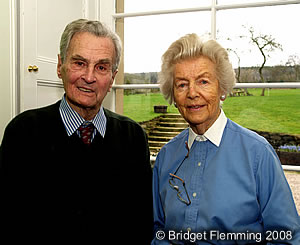
This delightful sketch of himself in Cretan dress was penned at the top of a letter to my mother dated 17th November, 1944; as he explains, “I have been lost again in a forest of whiskers for about three weeks, and my old mountain chums are down in the plains now, looking incredibly wild and shaggy”. Ελαφρύ το χώμα που τον σκέπασε.

John Stathatos

Constantinople on foot, Antibes in a Jaguar – interview with Patrick Leigh Fermor

Nearly twenty years ago I interviewed Patrick Leigh Fermor when he was awarded a small but lustrous French literary prize by the town of Antibes in the south of France. He died today at the age of ninety-six and this account is reprinted here in tribute. To paraphrase Scott Fitzgerald, our count of enchanting witnesses has diminished by one.

By Julian Evans

First published in The Guardian, October 1992. Republished on Julian Evan’s website 10 June 2011.

The first time I rode in a Jaguar was as the guest of a Bordeaux wine merchant who had invited me to lunch at one of the family châteaux (his sister’s, I think). His idea of le chic britannique was to drive with one hand on the wheel and his foot on the floor, down roads lined with broom that swept the flanks of the dusty, hurtling car.

The second time was a few weeks ago, in Antibes. I had an exhibition to go to, followed by lunch and later an award ceremony and dinner for a literary prize.

I had dawdled in my hotel room, wondering how to get to the exhibition. Eventually I decided to order a taxi and took the lift down to the hotel reception. On the apron outside, the sun bouncing off the glossy declivity of its bonnet, a Jaguar was waiting.

The French possess a unique ability to appropriate elements of other nations’ identity and recreate them as their own. Their skyscrapers, their tweed caps and their seasides once belonged somewhere else, and now they’re completely French. In Britain the rakish Jaguar XJ6 is a serious (which means class-conscious) reward of mercantile or political labour. Owning a Jaguar is something a company director rises to. In France a Jaguar is ultimately a toy; a plaything, no stranger to amusement. One begins to suspect the French of a certain income of giving each other Jaguars for Christmas. I say this because, in my experience, there are conventions to the awarding of literary prizes and the provision of chauffeur-driven Jaguars for visiting journalists is not one of them.

The Prix Jacques Audiberti de la Ville d’Antibes, worth 50,000 francs to the laureate, was set up four years ago to honour a writer with a special interest in the Mediterranean. In four years, it has twice been awarded to a British writer, the first time to Lawrence Durrell, and this year to Patrick Leigh Fermor. (The other two laureates, Jacques Lacarrière and Jacqueline de Romilly, have been French.)

Audiberti was a playwright and poet. He was born into the artistic community of Antibes, a cosmopolitan list which, apart from Picasso and Graham Greene, includes Guy de Maupassant, Jules Verne, Scott Fitzgerald, Nicolas de Staël and Nikos Kazantzakis. Audiberti is one of that long roll of second-division writers whom the French enjoy and do not forget. They stay in print, and have streets – and prizes – named after them.

The willingness of this small seaside town to honour foreign writers is one of its obscurer virtues. From the perspective of a country that pays only lip service to literary internationalism (the Booker’s Commonwealth entry requirements are, after all, based on an imperial notion of extended British citizenship), it is interesting.

As Michel Déon, the president of the jury – an Academician and a hugely successful novelist in France and continental Europe – said to me at the award ceremony that evening: ‘I lived in Southend before the war. I remember it as a beautiful place of villas and tennis courts. I think I am the only person to have written a novel set in Southend. But I think I will wait a very long time if I wait for an invitation to go back.’

Antibes is a rich, old town, top-heavy with money and reserve. The villas on the Cap, lived in all year round, are bounded by high white walls inset with electrically operated gates. Behind the walls, massed pines lead down discreetly lit drives to houses and cupolas of shiny stucco: Belgravia-on-Sea. Antibes is a place where, if you step off the tourist rack, you feel you are likely to be asked your business. This is generally a less difficult question to answer if you are in the back of a Jaguar.

The association of literature with the very rich makes it suspect for some, but the town has little to gain from literary huckstering. It has the Musée Picasso in the Château Grimaldi; more wealthy tourists than it can carelessly accommodate; more than enough literary associations. (Graham Greene made it his home for twenty-five years before his death in 1991.) The Jacques Audiberti prize gives the impression of being itself a serious plaything for the town: a chance for it to indulge in some culturally-minded Mediterranean generosity.

Such questions of wealth and vanity would not occur to Patrick Leigh Fermor. He has spent almost sixty years adventuring outside England. For the last twenty-seven years he has lived on the edge of the Taygetus mountains in the Peloponnese in a house he built with his wife, Joan.

He describes this retreat with a flash of pleasure. ‘No social duties, no cocktail parties, no visiting!’ He says it as if reading from an embossed plate outside his front door.

He regards his success in France, where two of his books, A Time of Gifts and Between the Woods and the Water, have recently been translated for the first time, as an incredible stroke of fortune. A linguist, scholar and soldier, he was stationed with resistance forces in Crete for two years in World War Two because he had learnt ‘obsolete Greek’ at school; he organised and carried out the kidnap of the German commander on the island, General Kreipe (who thus became the only German general to reach Cairo).

Fifty years later, he has not lost the diffident speech habits of the officer class. ‘Total delight,’ he says, raising his eyebrows high. ‘Frightfully pleased and honoured. A miracle, really….’

In fact the lightness Leigh Fermor conveys in person predates the war: it goes back to the fag end – the closing bars – of the Jazz Age, when he lived in bohemian circumstances in Mayfair’s Shepherd Market. It is also misleading as a clue to his books. His chronicles of a young man trudging across Europe to Constantinople are a lengthy essay in cheerfulness. Their greatest charm is that he mines every scene for positive impressions, even a Bierkeller in Cologne packed with Brownshirts or a Bratislavan brothel.

There is also an unstudied erudition to his writing. In the case of the brothel, he can name four authors – Lucian, Juvenal, Petronius and Villon – that it conjures up. He has a fascination for language, for its passage through history and dialect; he is able to winkle out in his later book of wanderings in northern Greece the seesaw of fortune that has the Greeks proud to call themselves ‘Romios’ at one era, then turns it into a term of abuse in the next, post-Byzantium. Few writers have explained, as he does in Roumeli: Travels in Northern Greece, a love for a country more eloquently than this:

‘I had begun to grasp, in the past few weeks, one of the great and uncovenanted delights of Greece; a pre-coming-of-age present in my case: a direct and immediate link, friendly and equal on either side, between human beings, something which melts barriers of hierarchy and background and money and, except for a few tribal and historic feuds, politics and nationality as well. It is not a thing which functions in the teeth of convention, but in almost prelapsarian unawareness of its existence. Self-consciousness, awe and condescension (and their baleful remedy of forced egalitarianism), and the feudal hangover and the post-Fall-of-the-Bastille flicker – all the gloomy factors which limit the range of life and deoxygenize the air of Western Europe, are absent. Existence, these glances say, is a torment, an enemy, an adventure and a joke which we are in league to undergo, outwit, exploit and enjoy on equal terms as accomplices, fellow-hedonists and fellow-victims. A stranger begins to realize that the armour which has been irking him and the arsenal he has been lugging about for half a lifetime are no longer needed. Miraculous lightness takes their place.’

Leigh Fermor was born in the second year of the Great War. He roamed free on a Northamptonshire farm for four years as a foster-child, and when his mother and sister came to fetch him they got a small savage back.

He was tamed by degrees, but the lawless years stamped him. Schools couldn’t hold him; a psychiatrist recommended a very advanced school for difficult children near Bury St Edmunds, an exotic paradise where children and staff performed nature-worshipping eurhythmics naked together in a barn. Later he ran away from prep school, and he was sacked from the King’s School in Canterbury after being discovered, at the end of a chain of reckless behaviour, making love to a shopgirl on some upturned apple-baskets.

His gallant and long-suffering mother made attempts to settle him, but her greatest gift was the imagination to see that he had to be allowed freedom. His first wanderings across Europe would nowadays be a stunt for a professional travel writer. Leigh Fermor walked because he was poor, he was young, and he wanted to go as slowly as he could. His rule was that he would only accept lifts in bad weather. He met Robert Byron in a nightclub: ‘dragon-green Byzantium loomed serpent-haunted and gong-tormented’. He set out on 9th December 1933 and did not come back to England until 1937.

Books came later. An illuminating story connects the delay to his close and lifelong attachment to women. (In print these adventures are delicately recounted. A sentence from a description of an affair with a married Hungarian girl in a red skirt sums them up – ‘All had marvellously changed of a sudden… during the next two nights and days, all unentwined moments seemed a waste.’)

This story comes up in a roundabout way when I ask him if Greece is the place where he has been most happy. He begins to talk about Moldavia. When the walk came to an end, he became friends with a family who had a rambling country house there: he stayed for two years.

‘I was very attached to one member of the household, a girl, and we were having an idyllic time, picnics and riding, watching the reaping and all the hayricks being made. We rode all over northern Moldavia and Bessarabia. Suddenly war broke out, and I had no prescient feeling that the war was going to last as long or tear everything up by the roots, so I left a lot of things there, including my great fat battered green diary which had all my travels in.

‘When the Communists took over, the family were given a quarter of an hour to pack and only allowed to take one suitcase each, and this great friend of mine who I adored, saw my diary lying on top of a bookcase. It caught her eye and she chucked it into the bag she took off with her to the Carpathian foothills, where they were forced to settle. I was blacklisted and couldn’t get back to see her for twelve years. Eventually I smuggled myself in, and I arrived at her house and there it was on the table: the diary that all these books are based on. It was a miraculous recovery.’

Leigh Fermor’s miraculous Europe has vanished. The castles he was invited to have been turned into lunatic asylums; the hillocks of Moldavia have been bulldozed; the amiable nineteen-year-old freak that everyone took under their wing has been succeeded by whole populations. But there is a thoroughness – an almost architectural thoroughness – to his re-creation of the journey. The books are a restoration project. Of the final volume, he is ‘making very heavy weather. I go back to a country and follow the route very roughly to see if I am going to drop any terrific bricks – “I sat dreamily in the marketplace and gazed up at the weathercock on the cathedral”, that sort of thing, so I go back to see if the weathercock is visible from there or not. And recently I went back to Bulgaria, and it put me off my stroke frightfully. They were cheerful people, marvellous singers, and now it is entirely soulless, organised in a Marxist sort of way, and with it the death of all joy and pleasure, and’ – he pauses to stare hard into the pre-Marxist past – ‘that upset me terribly.’

His excursion into civilisation this time around might have been expected to put him off his stroke. But he very nearly bounces as he says: ‘Terrific fun.’ Antibes, unlike Bulgaria, is more or less as it was, in the glamour of the Fitzgerald years.

Several events are laid on. There is, in fact, a celebration of British writing. It is Graham Greene’s birthday, and an exhibition of his life is opened on the second floor of the Musée Picasso. The town wanted to name a square in Greene’s honour, but his estate said that things were not done like that in England. (It is difficult not to cavil at British stiffness: our ambassador has twice been invited and has not replied.) The secretary of the prize, Pierre Joannon, throws a lunch at his villa, on a terrace the size of a tennis court, overlooking the Golfe-Juan. Greene’s partner Yvonne Cloetta is there, looking elegant and frail, and so is Vivienne, Paddy Campbell’s widow. ‘If he were still alive,’ she says sweetly, ‘he would kill Peter Mayle.’ I spend some time talking to an American postgraduate with cornflower-blue eyes – she has been awarded the other prize of the day, which provides a grant to a student of Lawrence Durrell’s work – then I mention to M. Joannon that I would love a swim in his pool. He returns with an armful of swimming costumes.

At night the Jaguars ferry the guests down a succession of pine-masked drives, first for the prizegiving, to a villa whose lighted veranda and enormous garden recall Jay Gatsby’s East Egg mansion, and then to dinner at a ‘large, proud, rose-coloured hotel’: the Hôtel du Cap Eden Roc which was the model for Gausse’s Hôtel des Étrangers, the place of Dick and Nicole Diver’s first appearance in Tender Is the Night.

Towards the end of dinner, Leigh Fermor stands to tell the mayor of Antibes in his diffident way what a wonderful gift he has of doing it all so lightly. One of the last and unlikeliest of the Bright Young Things is at home here, despite the social duties, while I retain a brief contrasting memory of the self-conscious beauty contests that are literary prizes in Britain. On the way back to our hotel I am consoled by another Fitzgeraldian moment, as the Jaguar is overfull and I find an American academic with cornflower-blue eyes sitting on my lap in the front seat.

You need to watch the French sometimes. They have a habit of equating writing with glamour that in recent years has led to endless novels with architect heroes and slight storylines in oriental settings. On this occasion, they succeeded in making a robust occidentalist – a virtuoso of the unfinished journey and rescuer of a disappeared past – one of their own. He joins the Jaguar.

Le Monde: Mort de l’écrivain voyageur Patrick Leigh Fermor

By Jean Soublin

First published in Le Monde 17 June 2011

En 1944, le jeune Leigh Fermor, issu de la grande bourgeoisie anglaise, organisait en Crète la résistance contre l’occupant allemand. Il parvint avec ses maquisards à capturer un général SS et l’emmena pour le cacher dans les montagnes avant de l’acheminer vers la mer, d’où on l’enverrait en Egypte. Alors que le soleil apparaissait derrière le mont Ida, l’Allemand murmura le début d’une strophe latine dans laquelle Horace célèbre cette montagne. Le jeune Fermor, bon latiniste lui aussi, continua la strophe. “Ach so, Herr Major !” lui glissa le SS. Cette émotion partagée par deux hommes enracinés dans les mêmes valeurs littéraires a sans doute marqué le jeune Anglais : presque tous les ouvrages qu’il a publiés sont empreints de ce qu’on pourrait qualifier de “Désir d’Europe”. L’envie de connaître, de comprendre, et finalement de chanter sa patrie européenne, ses origines grecques, son histoire commune, ses valeurs partagées.

Son premier ouvrage, publié au début des années cinquante, est pourtant un récit de voyage aux Antilles : The Travellers Tree. Fermor donne ici sa première leçon, magistrale, sur la manière de voyager, de ressentir, de partager et de décrire ce qui compte : les paysages, naturellement, mais surtout la vie des gens, leurs espoirs et leurs découragements. De Trinidad à la Jamaïque, avec un long et passionnant passage sur Haïti, toujours attentif aux croyances : ses commentaires sur le vaudou sont fascinants. On retrouve cette même veine antillaise dans son unique nouvelle : The Violins of Saint Jacques, un petit chef-d’œuvre d’observation attristée, sa seule œuvre de fiction.

Les ouvrages suivants, sont écrits surtout en Grèce, où l’auteur s’est installé au cours des années cinquante et où il passera la plus grande partie de sa vie : Mani et Rouméli décrivent les paysages et les personnages du Péloponnèse. C’est aussi de cette époque que date A Time to Keep Silence : une réflexion religieuse. Fermor y observe la vie monacale dans diverses abbayes françaises et termine en les comparant aux communautés monastiques de Cappadoce. Continue reading

Πάτρικ Λη Φέρμορ, «Ελληνας» από επιλογή, πολίτης του κόσμου

From John Stathatos

An article about Paddy pubished on the 15th in Kathimerini, the leading Greek broadsheet newspaper. The last paragraph is particularly interesting: “The stone-built house which he raised with his own hands in Kardamyli has been left to the Benaki Museum. According to the museum’s director, Angelos Delivorias, “It was his wish that that the house should provide hospitality and a place to work in for a few months to writers and poets visiting Greece” (my translation).

John

=======================================================

Του Σπυρου Γιανναρα

Λίγοι άνθρωποι αξιώνονται να μνημονεύονται ως θρύλοι πριν από τον θάνατό τους. Λίγοι έχουν την ευτυχία να ζήσουν έναν πολυκύμαντο και δημιουργικό βίο σαν του Πάτρικ Λη Φέρμορ. Ο αυτοδίδακτος λόγιος στρατιωτικός, που από ήρωας πολέμου μεταμορφώθηκε σε μεγάλη προσωπικότητα των γραμμάτων, τίμησε με το έργο του τη γενέτειρά του, αλλά και τον επίλεκτο τόπο της καρδιάς του, την Ελλάδα. Ο μεγαλύτερος συγγραφέας ταξιδιωτικής λογοτεχνίας της εποχής μας, σύμφωνα με Βρετανούς ομοτέχνους του, όπως ο Ουίλιαμ Νταλρίμπλ, έγραψε βιβλία για τη «Μάνη» (1958) και τη «Ρούμελη» (1966) σε μια θαυμάσια πρόζα που ενέπνευσε μεγάλους συγγραφείς του είδους, όπως ο διακεκριμένος μαθητής του, Μπρους Τσάτουιν. Δεν είναι τυχαίο, άλλωστε, ότι ο Φέρμορ ήταν εκείνος που σκόρπισε τις στάχτες του Τσάτουιν σ’ ένα βυζαντινό παρεκκλήσι κοντά στο σπίτι του στην Καρδαμύλη. Continue reading

Travel writing: Lost art in search of a lost world

Few authors have been able to equal Patrick Leigh Fermor’s ability to dissolve into the places described in his books.

Editorial, first published in The Guardian 18 June 2011

“I hate the French cookery, and abominate garlick,” Tobias Smollett told his readers 245 years ago, with a snooty disregard for foreigners that runs through too much travel writing today. Describing distant places fairly, curiously and entertainingly has never been easy. Few authors, in any century, have been able to equal Patrick Leigh Fermor’s liquid ability to dissolve into the places described in his books, so that he seemed to be less reporting on than living in them. His death this month, at 96, with the third of his great trilogy of prewar European exploration still unpublished, is a moment to ask what travel writing can still achieve.

Leigh Fermor was lucky, in that he walked through an archaic and aristocratic eastern Europe soon to be obliterated by the second world war. His two greatest books, A Time of Gifts and Between the Woods and the Water, take readers into a time and place that can never exist again, and that, as much as his pitch-perfect writing, is why they are among those few books worth reading many times.

Few of today’s writers have this advantage. They must describe a world in which it is easier to communicate, and travel, than ever before. No teenager setting off from Tower Bridge now would find themselves amid ballgowns, hunting parties and lonely mountaintop shepherds. Facebook and text messaging have brought Bucharest and Birmingham closer. Describing difference has been made harder.

Leigh Fermor was one of the last of the great travel writers whose experience spanned the previous century. A varied assortment, mostly men, wrote books that still stand as classics today: among them Eric Newby, Norman Lewis and Wilfred Thesiger. Jan Morris, still writing, deserves to be among them. Two decades ago, a fresh crop of authors revived the art but then fell victim to their own celebrity, Bruce Chatwin and Paul Theroux included.

Where does travel writing stand now? There are fewer famous authors and fewer sales. Some of the best books involve almost no travel at all: Roger Deakin’s account of wild swimming in Britain, Waterlog, or Neil Ansell’s lovely Deep Country, about the birds and landscape of mid-Wales. William Dalrymple remains an explorer in the classical sense: in From the Holy Mountain he shows Byzantium is not quite destroyed. William Blacker’s Along the Enchanted Way, about eight years living in rural Romania, is the closest modern writing has come to Leigh-Fermor, and not only because the Gypsy and Saxon life he shares is almost gone.

Always, the attraction is the slow pace. There is no need for hurry, no requirement for horror, just immersion in a place and time that is different, even when it is not far from our own.

King’s School Canterbury: Death of Sir Patrick Leigh Fermor

Sir Patrick Leigh Fermor, one of the school’s most distinguished former pupils died on Friday 10 June.

Published on the King’s School Canterbury website 12th June 2011

Born in 1915, Paddy Leigh Fermor was in The Grange from 1929 to 1931, when his school career came to a premature end. For his own view of the school see the final passage in Memories of King’s. He had a distinguished war career, especially in Crete. His involvement in the kidnap of General Kreipe was later the subject of the film Ill Met By Moonlight, directed by another OKS Michael Powell.

He is widely regarded as the best travel writer of the twentieth century. A Time of Gifts (1977) and Between the Woods and the Water (1986) describe his journey across Europe in the mid-1930s.

He returned to the school on several occasions, most recently in 2007 to open the new Grange boarding house.

Many tributes to him can be seen here: Patrick Leigh Fermor.

Related articles:

Some Memories of King’s .. And the final word goes to?

Sir Patrick Leigh Fermor opens new facility at King’s School Canterbury

A review by Paddy of Artemis Cooper’s book Cairo in the War

Artemis Cooper’s introductions and accompanying text to Duff and Diana Cooper’s published letters, A Durable Fire (1983), and to Lady Diana’s Scrapbook (1987), had a strong dash of her grandmother’s humour and lightness of touch; but only a most clairvoyant critic could have predicted Cairo in the War, 1939–1945. Her account, though it sticks punctiliously to fact, is as hard to put down as good fiction . The research is wide, detailed and scrupulous. She lays hold of the military background – the dramas unfolding just off-stage, but threatening to break out of the wings at any moment – with a soldierly grasp; and she seems to have talked at length with all the surviving dramatis personae.

By Patrick Leigh Fermor

First published in The Times Literary Supplement 1 September 1989 (republished online 15 June 2011)

Unleavened by personalities, military history can be heavy on the hand, and politics too, once the urgency has gone. The author’s skill redeems them both. As for the complex country and people on whom the war had impinged, she has segregated the strands with great discernment – the Copts, the Arabs, the Mamelukes, the Ottomans, all the sects and enclaves of the Mediterranean and the Levant, the Helleno-Judaeo-Ptolemaic nexus of Alexandria, the fellahin and the effendis and the nationalists, the rivalries of the Western European powers, with their local allegiances and clients and phobias, and, above all, the reigning Albanian dynasty and the predominating British presence and tutelage.

The author is particularly helpful and fair about the tensions between the last (in the persons of the young King Farouk and the proconsular Ambassador, Sir Miles Lampson), which culminated with British tanks all round the Palace, near-abdication and an enforced change of government: the German advance in the desert was the raison d’état. The enemy was held and driven back; certain froideurs remained at the top; but, astonishingly, the surface of the luxurious, dazzling and hospitable social life was hardly ruffled. At times this resembled the Duchess of Richmond’s ball before Waterloo, at others the Congress of Vienna: “The Kings sit down to dinner and the Queens stand up to dance . . .”. The pool at the Gezira Sporting Club sluiced hangovers away, the willow smacked the leather, polo-balls whizzed there all afternoon, and roulette-balls plopped at the Mohammed Ali after dark. There were enticing restaurants and enterprising night-clubs, party followed party and bedtime often coincided with the first muezzin’s call from the minaret of Ibn Tulun. Guilt about rationed London bit sharp now and then, but for those on short leave from the Desert, not deep.

Among the missions and staffs and the permanent officials, intrigue and gossip were as intense as in Mrs Hauksbee’s Simla. The author is eerily well informed about Groppi’s Horse and the Short-Range Shepherd’s Group and, a fortiori, about GHQ at Grey Pillars and SOE at Rustam Buildings (particularly the latter) and all the cross-currents, promotion-mania and the clashes – eg, “Bolo” Keble and Fitzroy Maclean – the political schisms of Southern Europe and their repercussions in Egypt. The pages on spies and counterespionage and raiding forces are one of the most impressive parts of the book.

The author is perceptive about the frustrations and amusements of all ranks of the assorted armies. There were shaming moments, but on balance it seems that arrogant behaviour towards the Egyptians may have been more frequent among the commissioned than the other ranks. In the case of a pasha who was insulted beyond endurance by a very drunk officer, nemesis was brisk and condign. The oblivious offender was inveigled to the pasha’s house. Most would have kept quiet, Artemis Cooper observes, but he was soon telling everyone, “You’ll never guess what happened to me last night — dashed unpleasant. I got buggered by six Nubians.”

In spite of the strains on high, the diplomatic world, the military, the cosmopolitan, the purely decorative and the intellectual interwove to a surprising degree, and lasting friendships were formed. The contribution of Greeks such as Seferis, and transplanted Greece-addicts like Lawrence Durrell and Robin Fedden, were important here. Poets and writers teemed, and Personal Landscape, the Nilotic equivalent of Horizon, was impressive. The author unfolds the catalogue of personalities with humour and understanding, though she is unduly dismissive of Sir Charles Johnston: cf his sonnet “The Lock”, and his Pushkin translations. The only omissions I can spot are Elizabeth David, the painter Adrian Daintrey and the writer-painter Richard Wyndham. Perhaps she should have included an eccentric cavalryman called Colonel Wintle, who got into hot water for taking a surrendered Italian general to luncheon, in full uniform, at the Turf Club.

The book ends with the calamitous post-war aftermath. Like the abstruse anecdotes, the range and choice of the photographs will promote sighs of delighted recognition and occasional ground teeth, and it is hard to think, on finishing, how this demanding book could have been handled better, more lucidly or more entertainingly.

Related articles:

Sophie Moss Obituary from Daily Telegraph

One Man’s Great Game: Lieutenant Colonel “Billy” McLean

Lawrence Durrell and Patrick Leigh Fermor by Thos Henley

So No More He’ll Go A-Roving

Patrick Leigh Fermor was a maker of paradisiacal sentences that leave the reader hungry for life.

Toward the end of his life, the great writer, war hero and traveler Sir Patrick Leigh Fermor, who died on June 10 at age 96, grew deaf and suffered from poor eyesight, sometimes wearing a rakish eye patch to correct his vision. But when I saw him last September he was still volubly alert, his memory undimmed as he retold stories of World War II. His hair was thick, hardly grayed, and his hands resting on the tablecloth resembled knots of wood. We were seated outside for lunch beneath the Byzantine-styled arches of his villa in southern Greece. Ilex trees cast shadows on the stone walls, and waves washed the rocky beach nearby.

It was good to be back.

by David Mason

First published in The Wall Street Journal, 18 June 2011.

Thirty years ago, my first wife and I had lived in a tiny stone hut next door to this magnificent house on a bay called Kalamitsi, land once considered sacred to the Nereids, sea nymphs of Greek myth. A young would-be writer, I was given the great gift of friendship by Paddy and his wife, Joan. They meant as much to me as models of gracious living as anyone I have ever known. Joan (tall, angular, quiet, unfailingly wise) died in 2003, and Paddy soldiered on in her absence, buoyed by friends and his own unkillable enthusiasm for life.

In September, Paddy talked of the British retreat from northern Greece nearly 70 years earlier, how he and several companions in a Special Operations Executive unit found themselves making a mad dash south with a suitcase of money meant to shore up the Greek war effort. They bought a fishing boat, but it was shot out from under them by dive-bombing Stukas, “sending the suitcase and all that money straight to Davy Jones”—and several British commandos, Paddy among them, into the Aegean to swim for their lives. Following more trials, they made it to Crete in time for another battle and another retreat.

Paddy would return in 1942 to the island by parachute to live in the caves and mountains among shepherds and guerrilla fighters. He is best known for having kidnapped the German commander of the Cretan occupation in 1944—a story often related with romantic dash and brio and even made into a movie. Dirk Bogarde portrayed Paddy onscreen in “Ill Met by Moonlight” (1957). Yet Paddy himself avoided starring roles. The movie was based on a fellow officer’s book on the raid, and Paddy preferred translating a Greek account by George Psychoundakis, “The Cretan Runner” (1955), to writing his own.

Never inclined to introspection, Paddy was endlessly curious about the world, and that curiosity distinguished his life and writing from our confessional age. He insisted that the reference library be near the dining-room table for consultation during mealtime arguments. Once, as he recounted in his lecture, “The Aftermath of Travel,” he started researching “the distribution of crocodiles on the Upper Volta River, where I had never been or ever wanted to go. I took down the right volume of the Encyclopedia, but must have opened it at the wrong page, for three weeks later I had read the complete works of Voltaire, but I still knew nothing about the distribution of those crocodiles.”

What made Paddy famous as a writer—or as famous as a writer’s writer can be—was his narrative of walking from Holland to Constantinople in the early 1930s. The writing was spurred by the unexpected recovery of diaries that he had assumed were lost forever, and what resulted was a pair of masterpieces, “A Time of Gifts” (1977) and “Between the Woods and the Water” (1986). A third volume completing the journey is still awaited. The glacial pace of Paddy’s writing frustrated many readers, but his weaving and unweaving of sentences resulted in some of the richest English prose we have. Here he is in Vienna with a young Frisian Islander who learned his English from reading Shakespeare:

Our way back took us along the Graben and the Kärntnerstrasse. About lamplighting time, I had noticed a small, drifting population of decorative girls who shot unmistakable glances of invitation at passersby. Konrad shook his head. “You must beware, dear young,” he said in a solemn voice. “These are wenches and they are always seeking only pelf. They are wanton, and it is their wont.”

The particular exuberance of his prose came from endless revision, where he added layer upon layer of detail as his mind leapt nimbly across cultures and centuries. He wrote to me in 1985 about the second volume: “I have just put the mss on the Oitylo-Athens bus where it is to be met by the typist, who will get to work on it at once: now for pruning, revision, scissors and paste, the moment I get it back.” His manuscripts were fringed with emendations, often covered with fanciful scrawls and illustrations.

I have a copy of one of them, “Notes on the Hellespont,” sent to me after he had celebrated his 70th birthday by swimming that legendary strait. The typescript is covered not only with marginal arrows and alterations but also with seagulls, clouds and waves drawn with his fountain pen. “I was swimming sidestroke, and began to notice a strange fluctuating and hissing noise under my submerged left ear; it was very eerie, like an echo in a vast dark room below, and I thought it must have been the grinding of pebbles and silt at the bottom of the sea.” Continue reading

An account of Paddy’s funeral

I drove over to Paddy Leigh Fermor’s funeral at Dumbleton today. I have no connection with the family. What follows is just a series of observations for other fans who could not be there, separated only by time and distance.

This account of Paddy’s funeral was written and submitted by’Andy’.

Dumbleton is a small Cotswold village set in green pastoral of unripe wheat fields and hay meadows. The honour guard  was provided by veterans of the Intelligence Corps, PLF’s old regiment. Two uniformed Intelligence Corps soldiers complete with green lanyards were also present.

The church was full – many men in dark suits and several Greeks among them. A cheery woman welcomed us and a choir in blue smocks crammed into the stalls. As the coffin was borne in by four local undertakers the priest, the Rev Nicholas Carter, intoned, ‘I am the resurrection and the light. Whosoever believeth in me shall never die,’  always the most stirring start to a Church of England funeral.

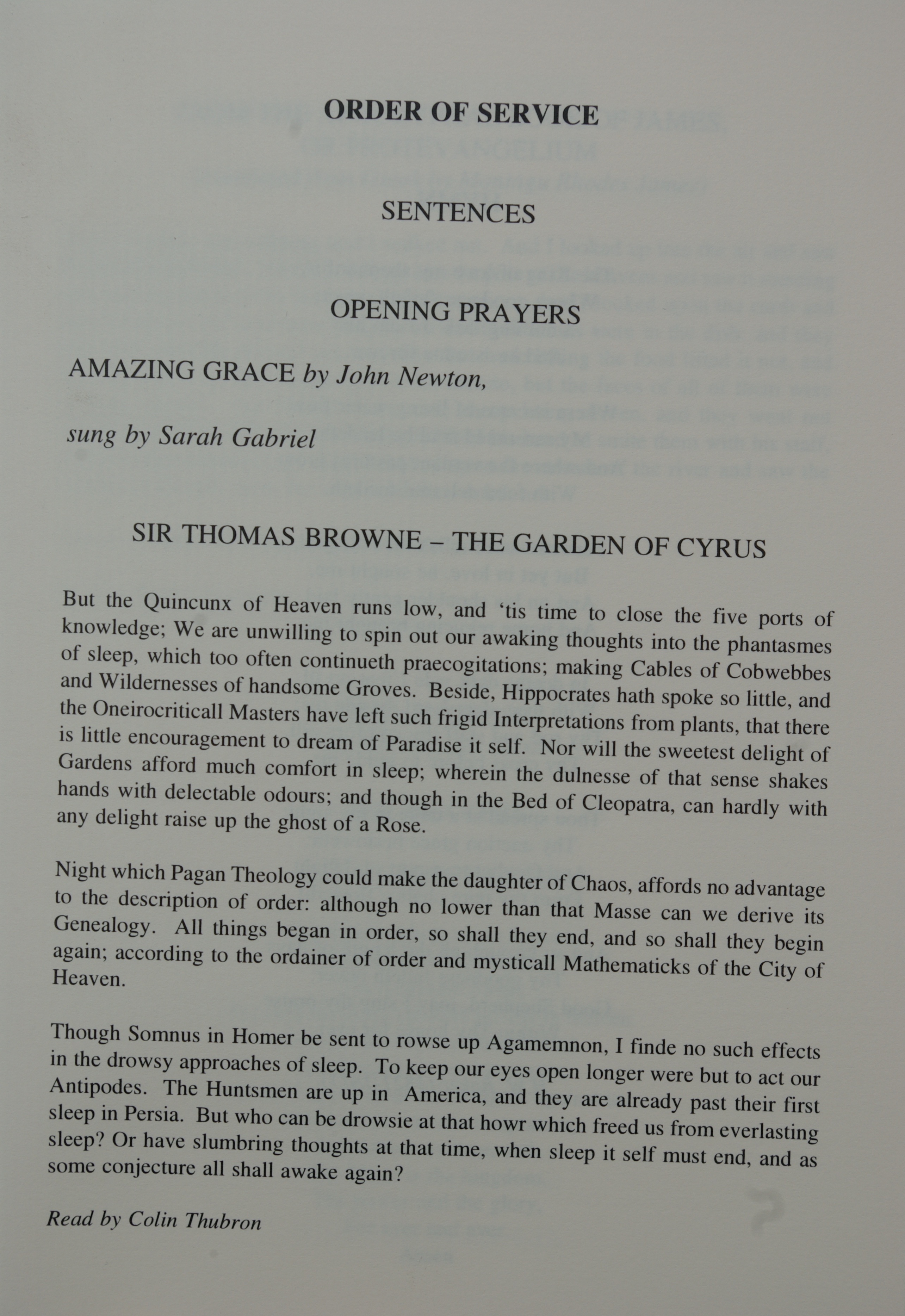
Sarah Gabriel sang, ‘Amazing Grace,’ her voice  filling the church, capturing, perhaps, the loneliness of death and departure. Then Colin Thubron read Sir Thomas Browne – The Garden of Cyrus with its admonition to ‘close the five ports of knowledge.’

We then stood to sing ‘The King of love my shepherd is…’ The second reading was taken from the apocryphal Book of James, chapter XVIII verse two. Mary is just about to give birth to the Christ child. Everything comes to a standstill, frozen for an instance, as the author of their motion is born of woman. The piece was read very competently by Robert Kenward, concluding, ‘And of a sudden all things moved onward in their course.’

The most challenging part of the service must have been the sermon. How does one write and then deliver a eulogy for a man widely revered as the greatest writer in the English language, certainly of his generation, if not the entire cannon?

The genial Reverend Carter mounted the pulpit and cast off with aplomb and  bonhomie.  Comparing PLF’s life to a ‘wine goblet overflowing with rich red wine,’ he paid tribute to PLF’s wide range of interests and uncanny ability to put people at ease – be they mountain shepherds or English aristocrats. ‘He saw himself first as a solider,’ said Carter.  Second he was a writer, using ‘a rich panoply of words.’ Most importantly  he paid tribute to PLF’s love of Greece, the country, its culture, its people and ouzo. The vicar startled the congregation briefly by urging us to take up where Patrick Leigh Fermor had left off. Various journalists and writers shifted uneasily in the pews. The day seemed suddenly hotter. ‘….By swimming the Hellespont aged 70,’ Carter went on. A much more realisable aspiration than equalling PLF’s literary fountain.

Of equal importance was his marriage to Joan, daughter of local family, Eyres-Monsell.  ‘Joan was a soul mate and it was one of the happiest of marriages with always a deep love and affection between them.’ Sir Patrick, as he was referred to throughout, was always, ‘generous of spirit,’ – the sixth sense still extant in the absence of the other five. Deeply compassionate, PLF, was ‘always an English gentlemen, always impeccably dressed and unfailingly polite….He gave of himself unstintingly to all who needed him.

Quoting St John, ‘I am come that you might have life and have it to the full,’ Carter said, it was as if PLF, ‘picked up this quote and shone a torch on it..’  Nicholas Carter went on, ‘He was in constant celebration of being alive.’ And then ended with a traditional Greek blessing. ‘On touching sand may it always turn to gold.’

After the Lord’s Prayer and a rather wonderful hymn written by J. S. B. Monsell 1811 – 1875. Sarah Gabriel sang again. This must have been planned by the ever humorous PLF a while ago. Sarah Gabriel sang  ‘Vedrai Carino,’ from Mozart’s Don Guiovanni.  Reading a translation is well worth it. In the song the peasant girl,  Zerklina, promises to comfort her lover. ‘You’ll see, dearest, if you’re a good boy what a lovely remedy I’ll give you…’ Clearly Patrick Leigh Fermor’s idea of the kingdom of heaven is wonderfully at variance with that of more serious theologians. The song continues, ‘Do you want to know where I keep it?’

The undertakers and Intelligence Corps had taken up their position, ramrod straight before the coffin, before the song commenced. At its conclusion they bore Patrick Leigh Fermor to his final resting place in the east of the country churchyard as Dr Alastair Kiszeley played the ‘Flowers of the Forest’ on the bagpipes outside. A bugler from the Irish Guards – PLF’s first regiment – immaculate in mirror finished boots, scarlet tunic and Bearskin, delivered the Last Post…note perfect.

Afterwards we approached the grave and threw pecks of confetti down. The sun shone throughout.

Behind the church an elderly couple were watering their garden. Despite his many travels and the inspiring association with Greece, Paddy Leigh Fermor lived and died an Englishman. An officer and a gentleman, he lies at home beside his adored wife deep in the English countryside. England may not always realise it but she is the richer for his courage, his bravery and his superlative blessing of her language. Rest in peace.

Related articles:

The Funeral Service of Patrick Leigh Fermor, 16 June 2011

 He was in constant celebration of being alive

From Hellenic Voice: Reflections on the life of Sir Patrick

By Alexander Billinis.

First published in The Hellenic Voice, 15 June 2011

I never had the honor of meeting Sir Patrick Leigh Fermor in person, though I know he often spent time in Hydra, my ancestral island, and I imagine that I must have raced by him some summer, a kid on the way to the rocks we called a beach there. Gone is Greece’s greatest biographer, perhaps the greatest travel writer in history, but his beautiful prose provides him with immortality.

Sir Patrick was born in 1915, in the thick of the First World War. He spent his first years in the English countryside, developing an independent, noble spirit that is the hallmark of the best of English eccentrics. Not for the structure of school, he had his own higher education on foot, traveling at 18 from the London docks via barge to the Dutch coast, and then traveling, mostly on foot, from the Netherlands to Constantinople. He stayed in haystacks, houseboats, small inns, and as his charm, good looks, exceptional facility for languages, and genuine intellect became better known, in palaces and castles.

He chronicled these travels in three books: “A Time of Gifts,” chronicles his travels from the Dutch coast to the Danubian frontiers of Slovakia and Hungary. His second, “Between the Woods and the Water,” describes his journeys and adventures through Hungary and Romania, ending, again, at the Danube bridge at Ruse, thence into Bulgaria. His third volume, about Bulgaria and Turkish Thrace, is currently in manuscript form and we can hope that it will be released as a posthumous tribute to Sir Patrick. I have had the benefit of visiting many of the places Sir Patrick describes, and his books are the perfect companion.

After successfully completing this journey to Constantinople, Sir Patrick went to Greece, the start of his lifelong association with the country. After spending some time in 1930s Greece, he went to Romania with his first great love, the Phanariot-Romanian princess Balasha Cantacuzene. With the coming of war in 1939, Sir Patrick returned to Britain to serve his country.

Sir Patrick’s knowledge of the Balkans resulted in a liaison posting to Greece, where he witnessed firsthand the heroism of the Greek counterattack of the Italian invasion. After the fall of Greece to the Germans, Sir Patrick worked with the Resistance in Crete, spending the greater part of two years as “one of them” and earning the lasting affection of the Cretans, which was mutual. Here “Patrick” became “Michali” as he was affectionately known thereafter in Greece.

It was in Crete that Sir Patrick/Kyrios Michalis, with the help of a small band of British and Greek commandos, and the general constant support of the heroic Cretan people that he pulled off his greatest coup – the capture of the German commandant of Crete, Gen. Kriepe. After a roadside carjacking near Iraklion, on Crete’s north shore, Sir Patrick and company hauled their quarry across Crete’s sheer and beautiful mountain spine to the southern shores where a British ship whisked him to British headquartersin Egypt. Sir Patrick recalls one morning, high in the Cretan mountains, when the general quoted passages from the Roman poet Horace, in Latin. Sir Patrick finished the verse, and the general and he, in the chaos of war, suddenly realized they once, as Sir Patrick said, drank from “the same fountains long before.” Years later, when meeting Sir Patrick again, Gen. Kriepe said that Sir Patrick treated him “wie ein Ritter– like a knight.”

Postwar, Sir Patrick knocked about in various places, including the Caribbean, but by the mid 1950s his center of gravity became Greece. He wrote two books, “Mani: Travels in Southern Greece,” and “Roumeli: Travels in Northern Greece,” which are exceptional biographies of a land he came to love as his own. Many consider them the finest travel books ever written. He and his wife, Joan, an accomplished photographer, eventually chose the Mani for their home, and designed and built a house by themselves in Kardamyli.

Sir Patrick wrote prolifically in a prose from another time. His is an era outside the digital, soundbyte age – an era steeped in the Classics and elegance. It is easy to picture him as a youth in an Austrian schloss, charming his Triestine Greek hostess, dancing in a prewar club in Budapest, or composing

mantinades over raki and cracking walnuts with a pistol butt on some cliff off Mount Ida in Crete. He was at home in all these circumstances, and we have the privilege of vicarious attendance via his rich prose. He remained, as we say in Greek, a

gero potiri,a “tough glass,” and writer Anthony Lane wrote, in 2006, “If you think that you can match him ouzo for ouzo, on a back street in downtown Athens, you better think again.”

His love and knowledge of Greece was profound and profuse, and while his love did not make him blind to her darker sides, his ability to express Greece so beautifully and fundamentally, together with his plethora of friends and admirers in all places, no doubt enhanced Greece’s tourist appeal in the initial stages of the tourism boom. It is a pity that Greece of today, again in profound need, lacks such an erudite, elegant advocate. We could use one.

When writing about the passing of Georgos Katsimbalis, his dear friend, an intellectual giant, and a champion of Greek letters, Fermor wrote, “These pages are filled with landmarks that have vanished, but George, in a very special sense, is not one of them.” The same can be said for Sir Patrick.

Alexander Billinis is a Greek American writer living in Serbia. For readers unfamiliar with Sir Patrick’s writing, he recommends “Words of Mercury,” edited by Artemis Cooper.

The man who fell for Mani’s charms

Patrick Leigh Fermor in Greece in 2001. (Thanassis Stavrakis/Associated Press)

Travel writer Patrick Leigh Fermor, who died last week, called this Peloponnese peninsula home. Andrew Eames makes a pilgrimage.

By Andrew Eames

First published in The Independent, 18 June 2011

Somewhere about 100km beyond ancient Olympia I chucked my navigator out of the window; figuratively speaking, of course. She’d long since lost touch with reality, telling me to do U-turns and take sharp lefts where such things would only have ended in motorway carnage. Underneath me, the A7 unrolled its great tongue of Tarmac imperturbably towards Kalamata and yet she would have had me off the road and into the goat tracks among the prickly pears, so I gave up on her, imagining her left behind, sitting on a rock, still insisting that I recalculate my route.

I had another reason for wanting to enter the Mani peninsula, that middle finger of the southern Peloponnese, without the insistent voice of an out-of-date GPS. I was following the trail of a British writer who had been inspired and nourished by this once-wildest and most isolated region of Greece for well-nigh 50 years. Patrick Leigh Fermor hated wirelesses. He wrote in his book Mani: Travels in the Southern Peloponnese, that he “dreaded the day when the metalled highway would appear through the hills blocked by a column of motorlorries each of them loaded with a howling menagerie of wireless sets for the silent Mani.”

That’ll be me, then. So the silencing of my (wireless) navigator was a tribute, in a way, even though Leigh Fermor himself had just left.

I have long been an admirer of Leigh Fermor, who until his death last week at 96 was, in my opinion, Britain’s greatest living travel writer. My most recent book, Blue River Black Sea, was a journey made partly in his footsteps down the length of the Danube, and it had always been in my plans to make a trip to the Mani sooner or later, with the hope that I might get to meet the great man in his “perfect writer’s house” down by the sea beside Kardamyli. Tragically, I was a couple of days too late, so my journey became something of a pilgrimage instead, a celebration and a comparison between the Mani that Leigh Fermor wrote about in 1958, and the Mani of today.

When Leigh Fermor, with his wife Joan, first crossed into the Mani, he had done so on foot led by his navigator, a taciturn goat-herder called Yorgo, who took him up over the barrier of the Taiyetos mountains, through a “dead, planetary place, a habitat for dragons”, an inferno of rocks whose only living organisms survived “on a memory of water”.

Historically, the Mani’s very inaccessibility had made it an enclave of refugees, feudal villages, vendettas and turf wars. Its rugged infertility meant agriculture was virtually impossible, so its inhabitants tried their hand at everything from piracy to slave trading in order to survive.

For Leigh Fermor, that isolation translated into what he called “an Elysian confine” from the moment he first arrived in Kardamyli, a castellated hamlet on the edge of the sea “whose quiet charm grew with each passing hour”, which became his home. He believed he had found a place “too inaccessible, with too little to do, for it ever to be seriously endangered by tourism”. I would have liked to have asked him if he ever regretted that sentence.

Crossing the Taiyetos today is still something of an ordeal – if you are a car. The A7 fizzles out at Kalamata and it falls to a nimble-footed minor road to try to avoid the worst the mountains can do. The reward for getting through is an eagle’s view of the Mani, across mountains that tumble to the sea, with villages as barely-tolerated ochre encrustations on their elongated toes.

The English have bought houses here, undoubtedly some of them partly due to Leigh Fermor’s book. Package tourism has been drawn inevitably to the village of Stoupa, 7km south of Kardamyli, by the presence of a perfect horseshoe-shaped beach, but it is package tourism in its more restrained manifestation, and very contained.

Just along the coast, tourism is more select and discreet at Agios Nikolaos, a fishing harbour bobbing with caique boats, where the morning recreation is watching the fishermen return and set out their catch beside the harbour wall, a wall that will be lined with fish-restaurant tables when the sunset comes.

Kardamyli itself is not that much changed, largely thanks to its lack of beach; the 17th-century fortress houses are still there, in a more or less tumbledown state and the rest of town is a peaceful web of cobbled lanes, vegetable gardens, and balconied stone houses whiskered with vines and bougainvillea.

Tavernas line the shore, including one run by Lela, Leigh Fermor’s veteran housekeeper. The great man’s property itself, down by the beach at Kalamitsi, 1km south of Kardamyli, is no longer alone, but newer buildings maintain a respectful distance.

There’s talk of turning it into a museum, because the writer was as much revered in local life as in the wider literary world. “We called him Kyr Michalis,” says George Giannakeas, Lela’s son, who grew up as a little boy in the writer’s house. “He used to walk into Kardamyli every day to get the papers, often completely lost in his thoughts.”

I catch up with George as he is readying himself for the journey to the UK for the funeral, so I put the question to him: would Leigh Fermor have regarded the modern Mani as spoilt?

“He didn’t like the changes, but he never criticised. He could understand that everyone needed to benefit. If he didn’t approve of something, he would make positive suggestions. Lots of people spend one or two years here then start complaining, but he would never do that. He could sit and talk to anyone about anything. One of his best friends here was the petrol pump attendant. Every year he invited the villagers to his house for his name day, as he did this year, too. He will be sadly missed.”

Even into his 90s Leigh Fermor remained a great walker, said George, so partly out of tribute to him I tackled a couple of the local trails. From Kardamyli up to Agia Sophia, on a well-made path up through cicada-rich olive terraces, with the shoreline opening up below. And then up the Nupati Gorge, a resinous, scented ravine where I had to walk bent double much of the time, scrambling through ankle-snapping rocks the size of elephant’s skulls, a quick reminder of just how tough it was to move about before the days of roads.

Plenty of early- and late- seasonvisitors do a lot of walking here; the views are magnificent, the landscape pungent with ancient sweat. At this time of year, however, the heat is oppressive, the going too tough to be anything but an ordeal. Far better to stay in the sea breezes and read a good book. If you do, there’s one author I’d recommend.

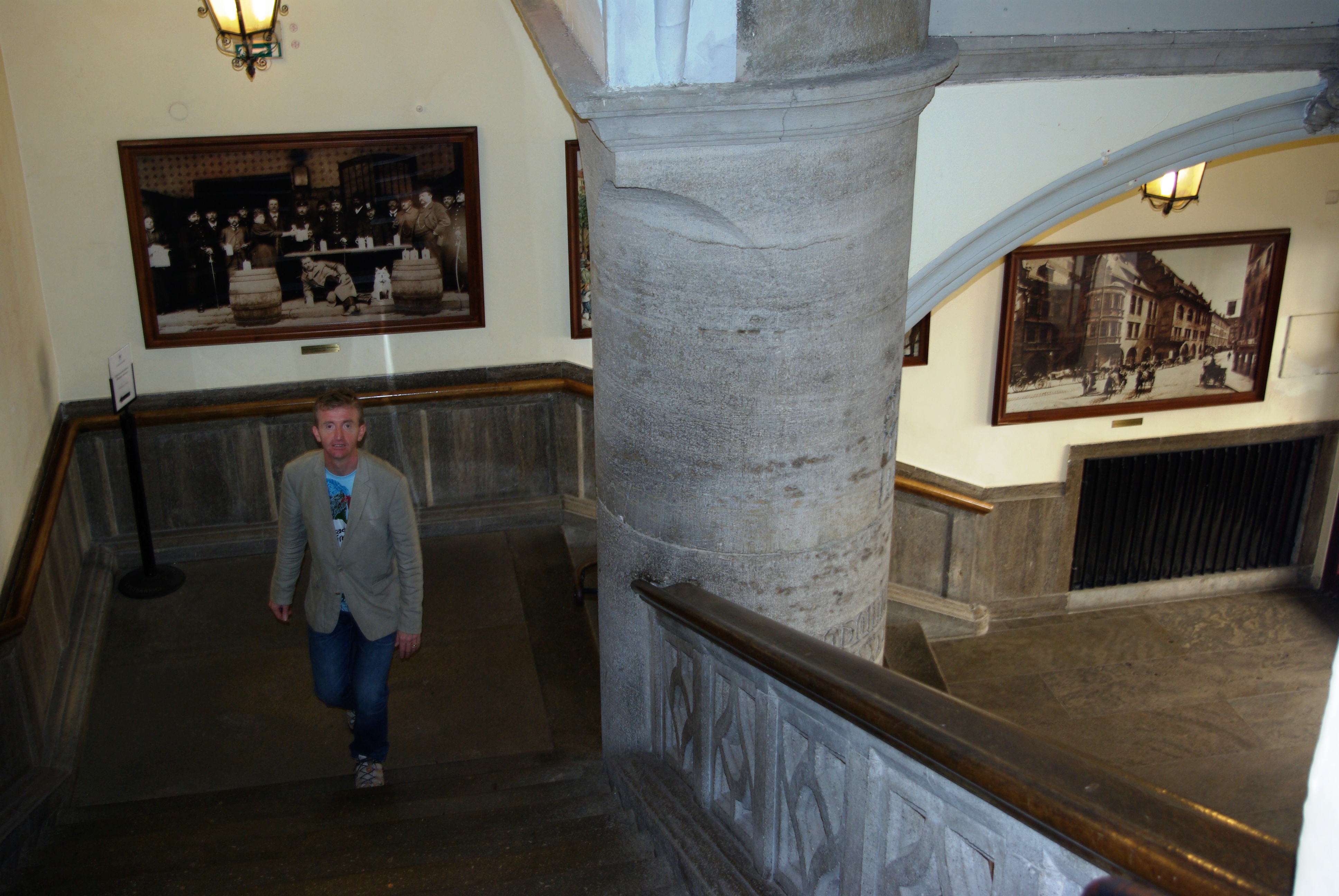
On the same steps as Patrick Leigh Fermor

On the same steps as Paddy

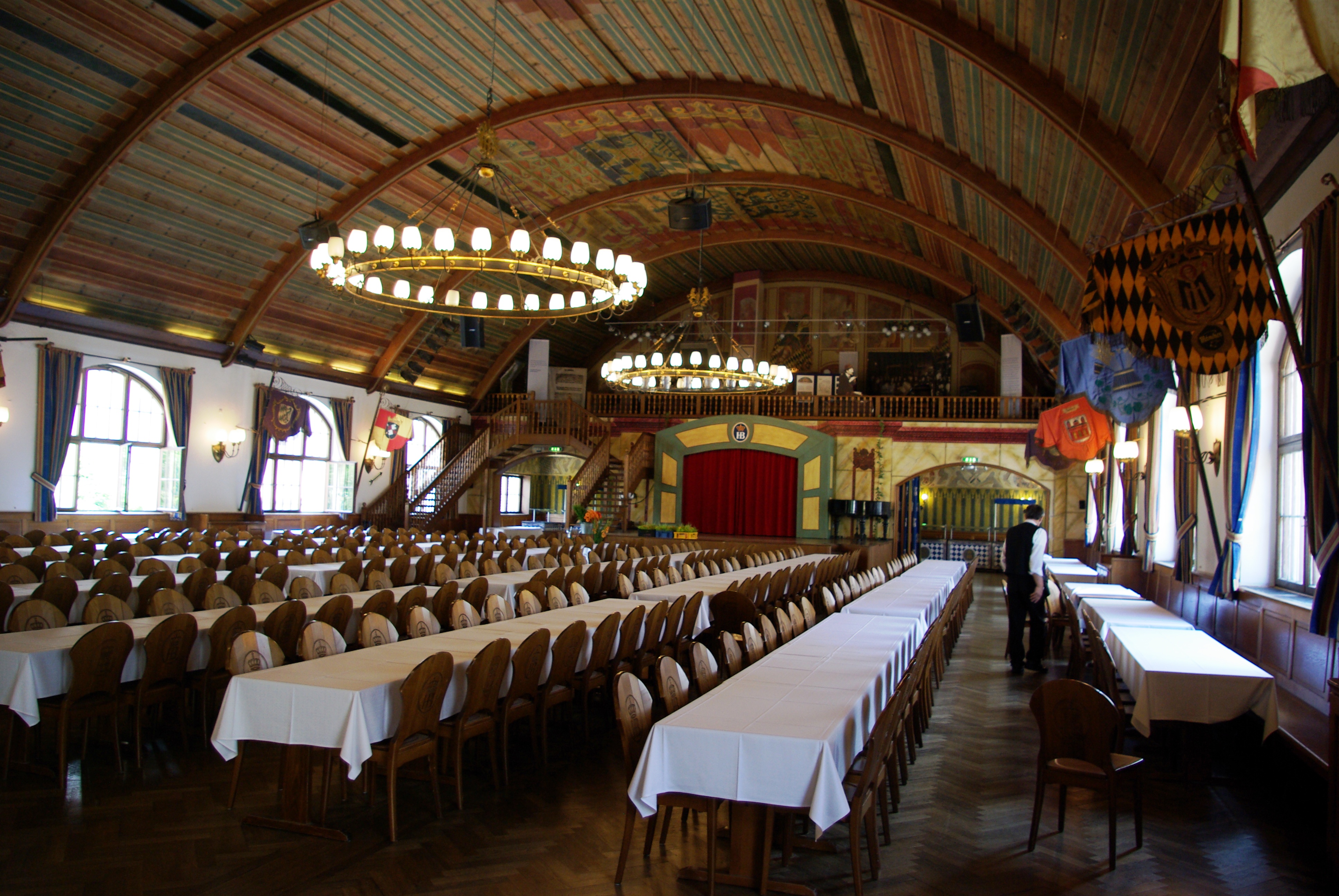
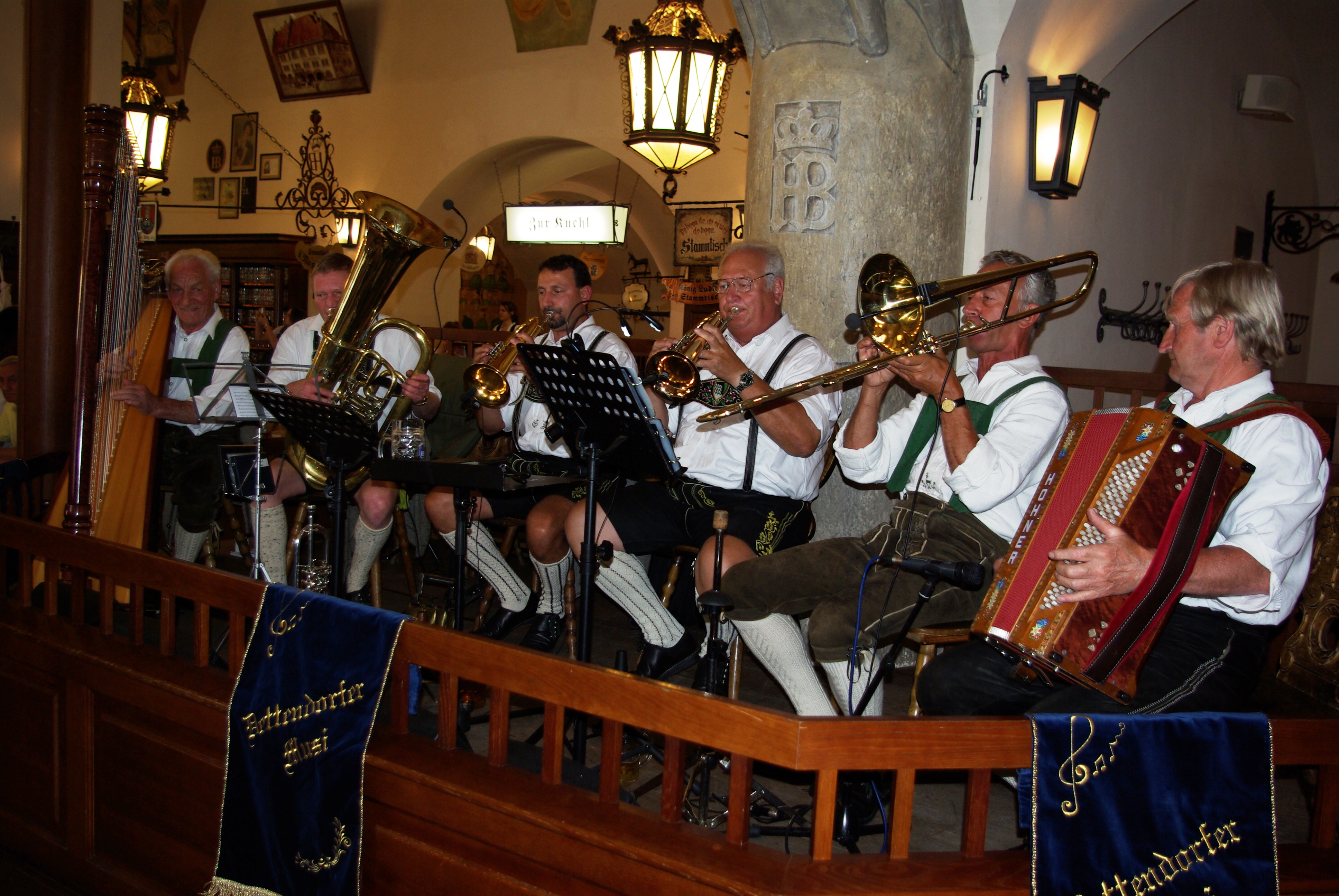
“In the heart of them stood a massive building; my objective, the Hofbräuhaus. A heavy arched door was pouring a raucous and lurching party of Brownshirts onto the trampled snow.

I was back in beer territory. Halfway up the vaulted stairs a groaning Brownshirt, propped against the wall on a swastika’d arm, was unloosing, in a stanchless gush down the steps, the intake of hours. Love’s labour lost.”

By Tom Sawford

Those of you well versed in Paddy’s writing will by now have realised that the above is not my own feeble prose but an excerpt from the passage in A Time of Gifts when Paddy enters Munich’s Hofbräuhaus on a cold January evening in 1934, unaware that his rucsack including his notebook, the volume of Horace’s Odes given to him by his mother, and his last four pounds in the world was about to disappear taken by his neighbour in the jugendherberge .

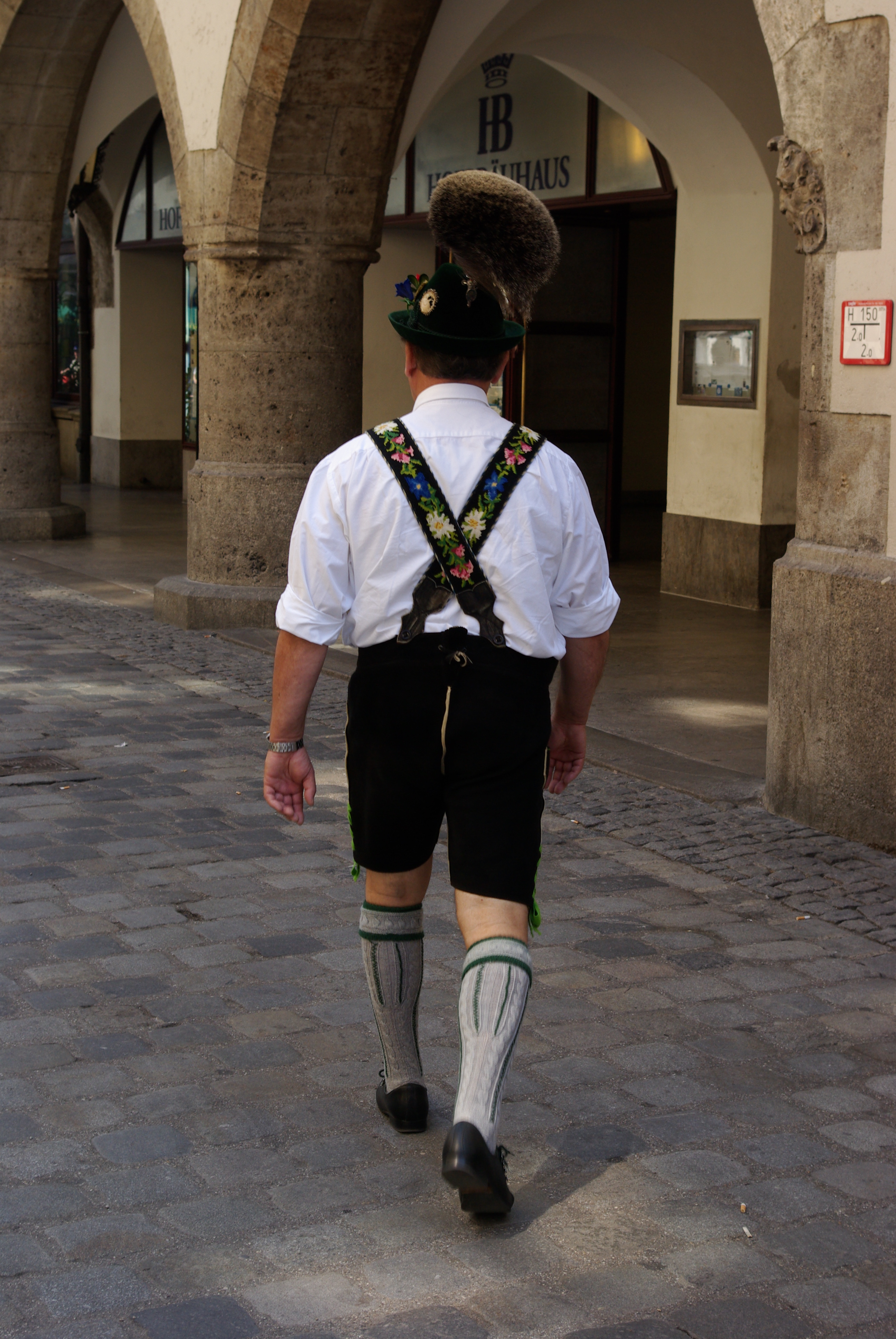
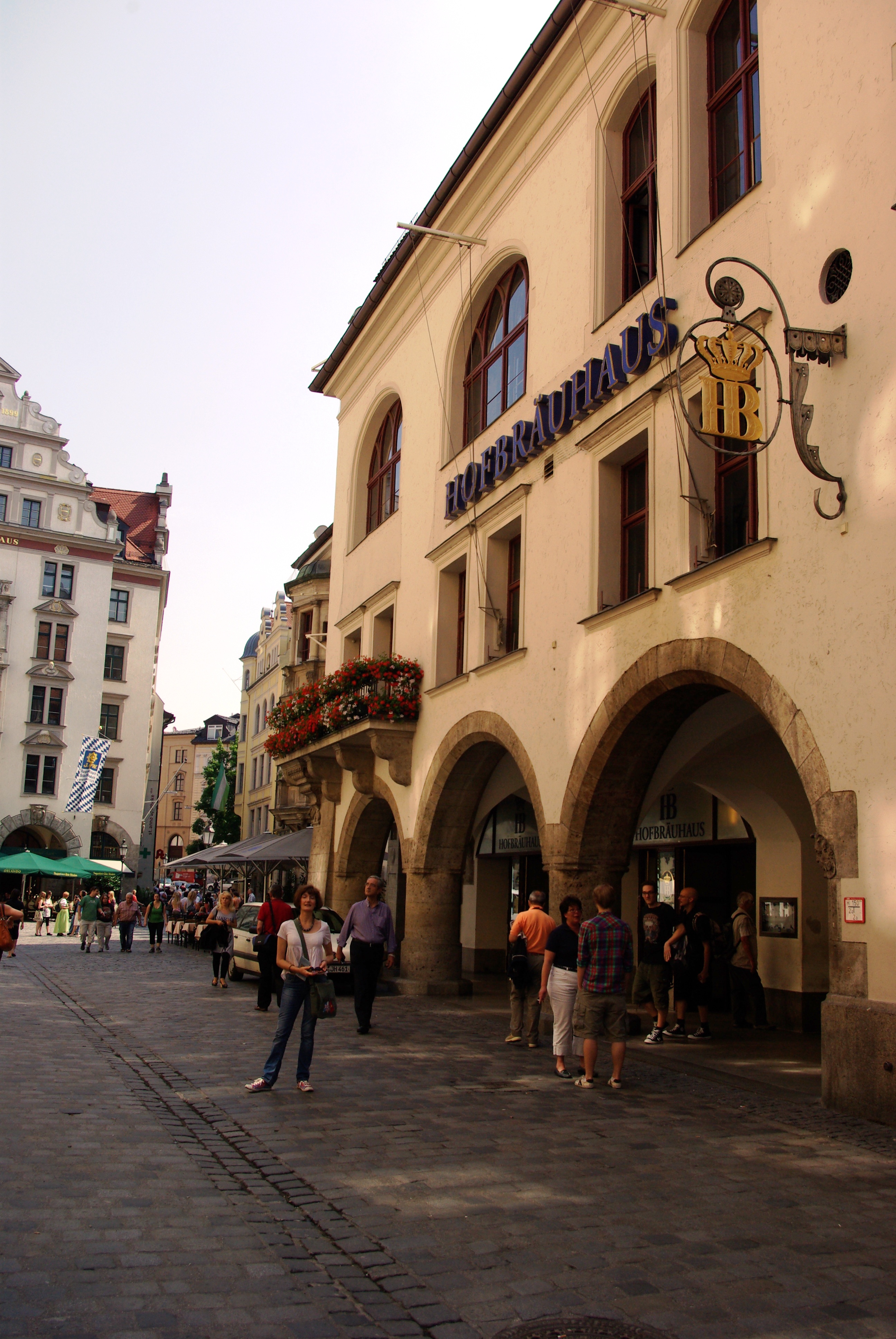
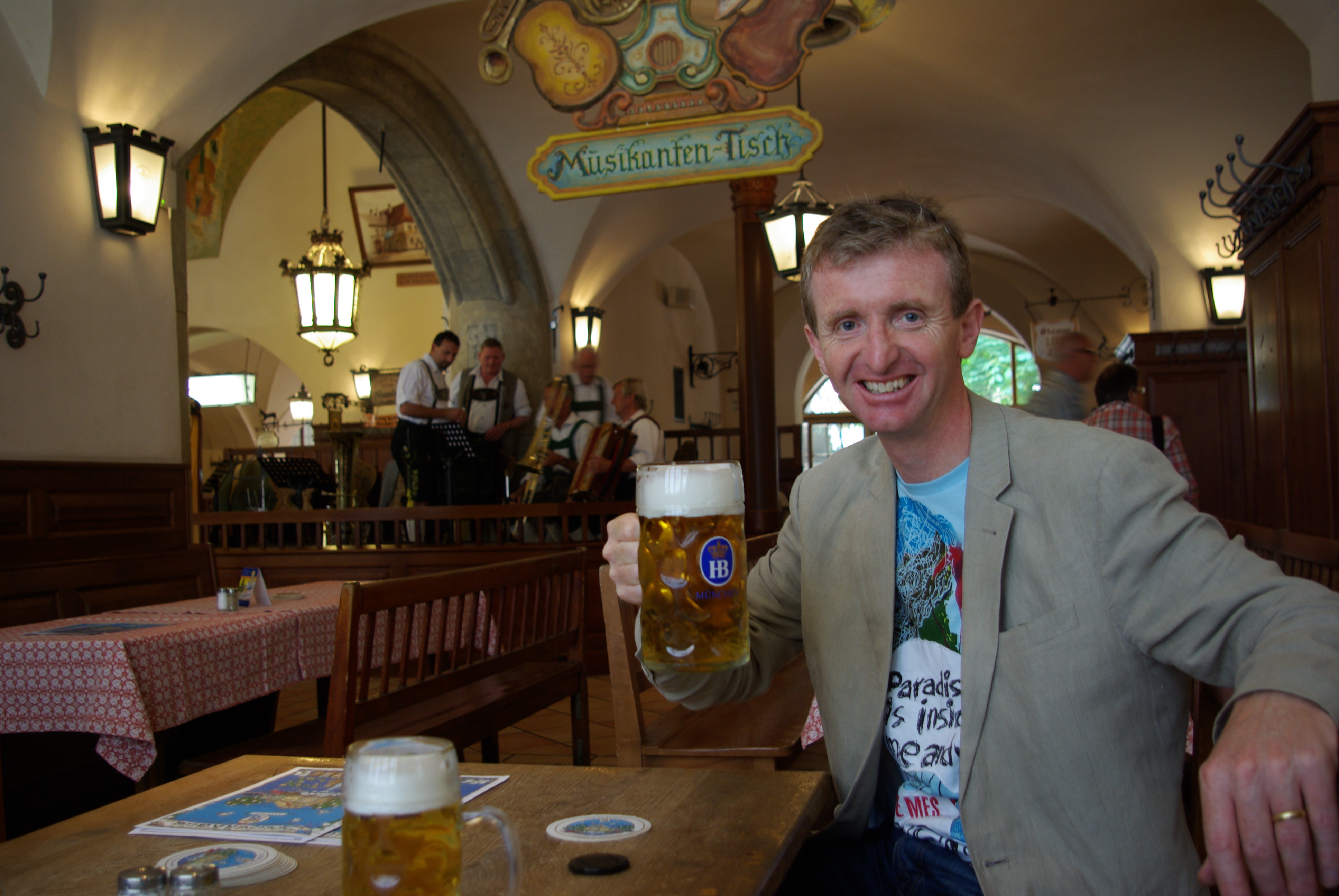
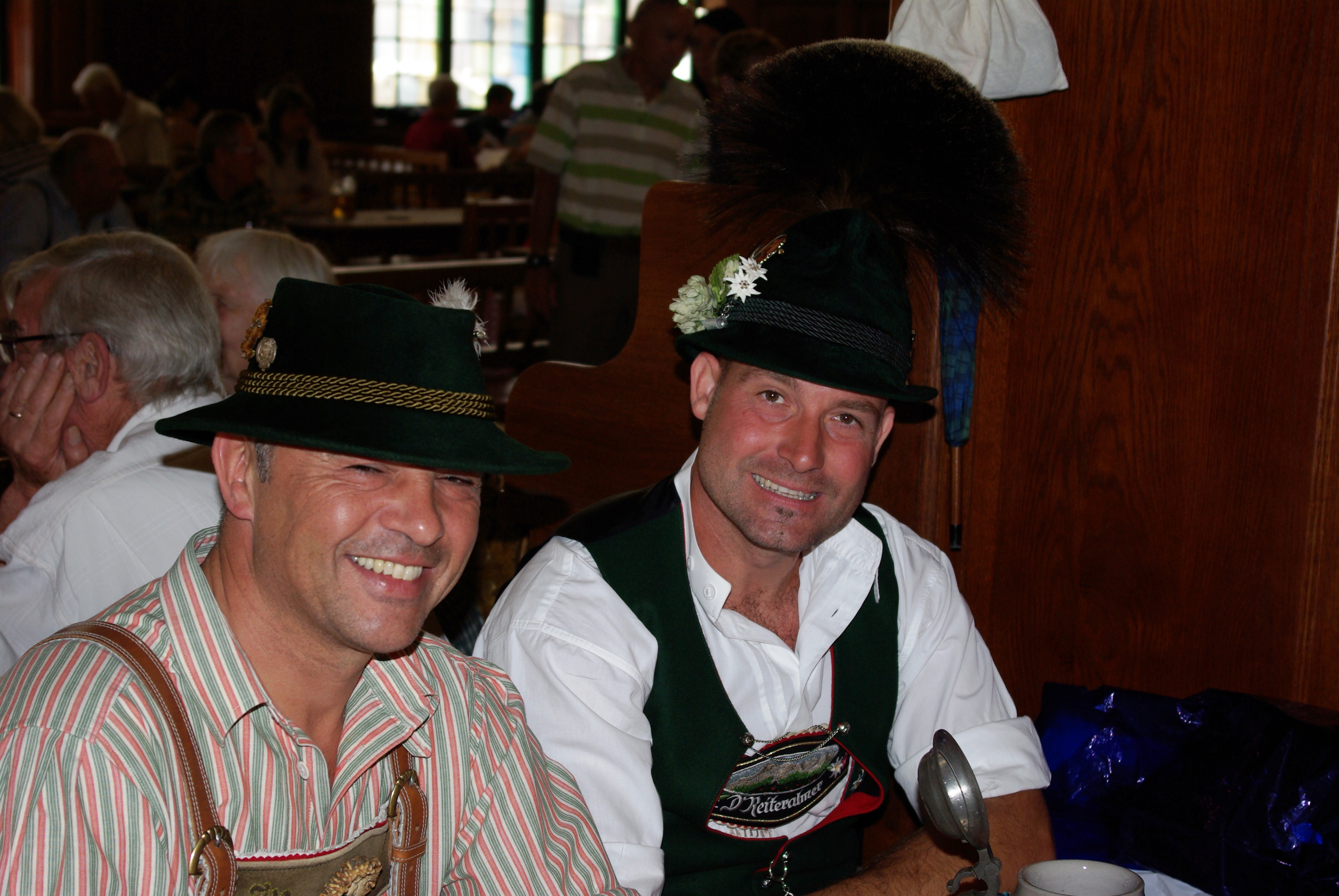
When I entered that vast temple to beer, sausage and sauerkraut, I instantly felt like I had been there before, and indeed I had when I read Paddy’s finest work. Instantly I wanted to visit the chamber bursting with SA men singing ‘Lore, lore, lore’, and overweight young German burghers ‘as wide as casks ’ who were ‘… nimbly, packing in forkload on forkload of ham, salami, frankfurter, krenwurst, and blutwurst’ and lifting stone tankards ‘for long swallows of liquid which sprang out again instantaneously on cheek and brow.’ Had it not been for the fact that this was midday instead of night I am sure I would have found it barely changed, save for the SA men, whose children and grandchildren (all ageing now) have taken up residency.

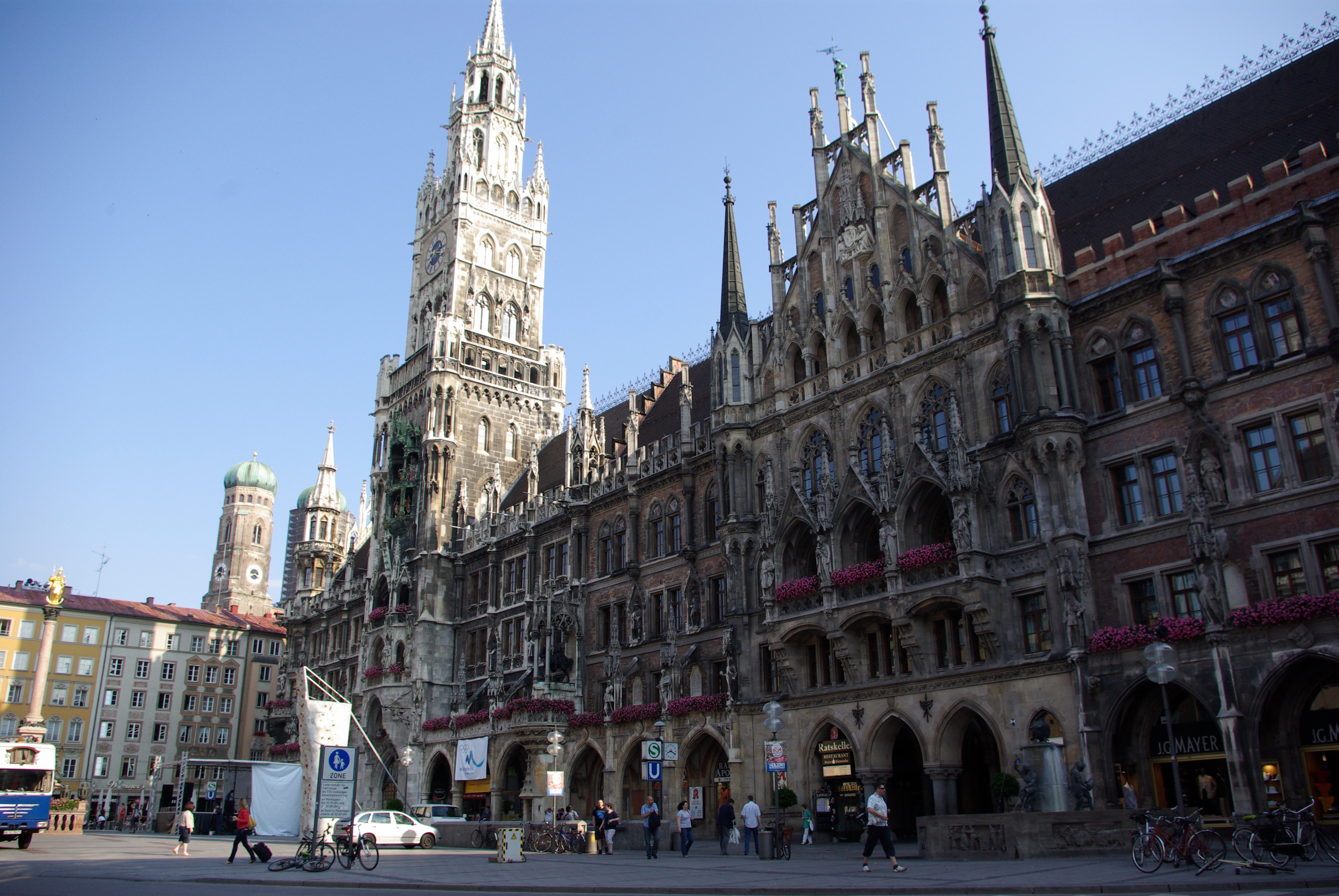
The Rathaus Munich

My wife and I were in Munich after taking the overnight sleeper from Paris Est to Munich on our journey to see the Passionspiele at Oberammergau. We had arrived at the relatively ungodly hour of seven o’clock in the morning and had seen Munich come to life on a Saturday morning.

At that time of day the air has a freshly bathed, cool freshness that excites all the senses. The Alt Stadt was almost exclusively ours apart from some stall holders preparing their wares of ripe and juicy, brightly coloured fruit and vegetables for the Saturday market; two young men demonstrating their ability on MX bikes beside a fountain; and a couple of drunks who had obviously made the most of the warm Friday evening and had now belatedly discovered that the party was over.

During the war Munich was severely bombed by the Americans. I recall when on a NATO course at the German Pioneerschule in the 1980’s a particularly loud American officer asking in all seriousness, whilst we were on a tour of the city, “How the hell did we miss that?” when seeing the massive towers and basilica of the Dom. Well, of course the USAF did not miss it. Seventy per cent of Munich was destroyed by the bombing and after the war there was a serious proposal to abandon the city and rebuild nearby. Fortunately for the Hofbräuhaus (which sustained minor damage), and for us, it was decided to rebuild the city. Many of the older buildings, as with so many German cities, were painstakingly restored. The Dom and the Hofbräuhaus were amongst these.

Following a morning of strolling around the centre, visiting some of the sights, drinking känchen’s of schokolade and eating cinnamon flavoured kuchen I was desperate to find the Hofbräuhaus. I was determined we would not to make the same mistake as Paddy and end up miles away; although the prospect of doing so and having a couple of himbergeist to see us on our way was not so unappealing!

We followed a lederhosen clad gentleman …

Inadvertently we had somehow attached ourselves to an American tour party and listened patiently whilst the bored German tour guide briefed them all on practical logistics like not entering their PIN number more than twice in those mysterious, rapacious German cash machines, and what they might see on their one hour of ‘freedom from the group’ until it was time to meet up again, climb into their coach and visit yet another city – ‘It’s Saturday it must be …..’

When it came to question time I asked where I might find the Hofbräuhaus. The guide looked quizzically at me, thinking I must have some obscure mid-western American accent (when had I joined her group???) and told me in all seriousness that eleven o’clock in the morning was rather too early to make such a visit and drink beer. I persisted and reluctantly she gave me directions.

Hofbrauhaus exterior

We walked in the sunshine past the old schloss and down a lane to the ‘slanting piazza’ but I do not recall the ‘Virgin on a column presiding over all she surveyed.’ We followed a lederhosen clad gentleman wearing a traditional Bavarian felt hat which was adorned by the most amazing plume, reminding me of something that may have been worn by a Roman First Spear Centurion to enable his men to identify him in the midst of battle.

There before us was our goal. Gothic and grand just as Paddy described it. We entered through wide doors underneath the rolling Gothic arches and walked up those vaulted stairs which survived the damage of the war. It was here in January 1934 that Paddy encountered his Brownshirt. The steps are now lined with photographs, one of a maternal looking frau holding eight heavy steins full of the cool, golden Hofbräuhaus beer. Perhaps she had served Paddy on that famous, alcohol fuelled night?

The Hofbräuhaus has four floors devoted to the adoration of beer, sausage and pretzels, where the weary, penitent pilgrim can atone. Each floor is decorated in a different style with a large communal drinking hall, and a number of smaller private function rooms (all of which are for hire). It was on one of these higher floors that Paddy stumbled into the hall full of ‘SS officers, Gruppen and Sturmbannfuhrers, black from their lightening-flash-collars to the forest of tall boots underneath the table.’

The highest floor is dominated by a large parquet floored room with a vaulted ceiling colourfully decorated with the predominantly pink and blue frescos of Bavarian coats of arms. This, the Festival Hall, was built in 1589. It is light and airy with broad windows on each side, large chandeliers and is dominated by a small stage with heavy, theatrically red, velvet curtains. The Hall can seat over 900 on its long tables arrayed in neat rows before the stage, and gives the impression of being eternally ready for a party. Indeed on the occasion of our visit, it was being prepared for the post- Abitur celebration for a very lucky young girl. The mood darkens somewhat when you know that it was in this very room, standing on that same stage, that the ambitious politician Adolf Hitler addressed his followers in the early days of the National Socialist Party in the late 1920’s and early 1930’s.

Hofbrauhaus Festival Hall

Given the passage of time this place has ceased to have any sinister effect, but it is a sobering thought, and it brought to life a period of history, and its aftermath, that has come to dominate my generation, and certainly those preceding us.

In Adolf’s steps?

It was about this time that I needed to answer the call of nature and I sought out a gentleman’s lavatory. Finding one at the end of a corridor leading from The Festival Hall, I hypothesised that perhaps Hitler had, on more than one occasion, made this same trip, accompanied by Herman Göring, and discussed the finer points of how to grab political power, create a Third Reich, and bring revenge on all those who had sought to so humiliate Germany via the Treaty of Versailles.

Like Paddy we were now guided right down to the bottom of the stairs, out of the doors and back through another larger door on the ground floor. After passing the obligatory ‘Hofbräuhaus shopping experience’ we entered a new hall where the ‘vaults of the great chamber’ did not fade ‘into infinity through blue strata of smoke’ as this was, unbelievably, 21st century, smoke-free Germany.

Drinking cool beer in The Schwemme

It was here that Paddy found the part of ‘the Bastille’ he was seeking. The Schwemme is a huge, richly frescoed hall that wound this way and that, past herculean stone pillars, toward the altar of Hofbräu beer where a small army of male and female waiters attend upon the fountain of beer pouring forth litre upon litre of the marvelous nectar. And it did not stop there. What Paddy would have missed on a dark, cold, snowy night in 1934 was the courtyard beer garden which by now was filling with locals and tourists all keen to bathe in the unique Hofbräuhaus atmosphere.

If you visit the website of the Hofbräuhaus you will see it includes a list of ‘regulars’; those who attend ‘services‘ on a regular basis, with the specific visit days recorded. They have reserved seats and for larger groups, or even families, whole tables are kept for them so that they can indulge and worship whilst listening to the suitably attired Bavarian band that have a dedicated stage in the centre of the hall.

Hofbrauhaus Regulars

The band plays on

We had arrived early, at around 11.00 am and had spent forty-five minutes or so making our tour of the building. It was quiet, with just a few other like minded souls wandering around and the staff getting ready for the rush ahead. By midday we had chosen a table and ordered our first refreshing litre of beer, a Würstlplatte  and Spanferkel  (read the menu in English here). The Schwemme was now filling with crowds of locals and tourists alike and the band had struck up. If you want to visit the Hofbräuhaus to look around and then eat and drink as we did, I would recommend going early.

It was a wonderful visit, and one that was brought to life even more as we imagined that young traveller avoiding the Brownshirts and knocking back beer with the farming folk he found in the Schwemme. One thing that has not changed is the hospitality and friendliness of the Bavarian people, and it was with some reluctance that we walked out of the Hofbräuhaus into bright sunshine to a now busy city to catch our train to Oberammergau.

Now, where did I leave my rucksack?

A different version of this article was first published on the Patrick Leigh Fermor blog 26 July 2010.

Patrick Leigh Fermor: A Personal Memoir

One of the downsides of getting older – I am now 62 – is that one’s friends die. Friday, it was the turn of Patrick Leigh Fermor, aged ninety-six, and I am having trouble accepting that he is gone.

By Paul A. Rahe

First published in Ricochet on 12 June 2011.

I first met Paddy in the summer of 1983. I was working then – oddly enough, as I am working right now – on a book on classical Sparta, and I had a grant and a hunch. The Spartan way of life was based on something like slave labor. The Spartans ruled the southernmost two-fifths of the Peloponnesus and drew their livelihood from farms worked by their helots (the word in Greek means captives), who reportedly outnumbered them seven-to-one. In their realm, there were and are two river valleys – one in Laconia and the other in Messenia – divided by a mountain range named Taygetus, and there was and is mountainous terrain elsewhere in Messenia. I had read extensively about the history of slavery, and I was persuaded that there must have been gangs of runaway helots in the hills of Messenia, as there later were in early modern Jamaica and in other locales where servile labor was the norm and there was wilderness nearby. I knew that the Greek resistance during the Second World War had operated in the mountainous country of northern Greece, but I knew little about their operations in the Peloponnesus. A fellow ancient historian who had lived in Greece for some years and had tried to make it as a novelist said to me, when he heard of my hunch, “You ought to talk to Paddy Leigh Fermor. He lives down there, and he fought with the resistance on Crete. He lives in Kardamyle. You should look him up.”

And that is precisely what I did. With the grant I had been given, I bought a plane ticket, and I spent some weeks in the company of a former student who hailed from Thessalonica, exploring the Peloponnesus – by boat, in a rental car, and on foot. Kardamyle was in the Mani – the southernmost prong of the Taygetus range, and it was one of the towns that Agamemnon had offered Achilles in an attempt to get him to take the girl back. When we got there, however, Paddy was away. So I mailed him a brief note and moved on. When we returned, I telephoned him – and he immediately invited the two of us to lunch.

Leyla, who had long been their cook, produced a sumptuous feast. We ate, and we drank, and then we drank some more – and the next thing we knew it was 5 p.m. Paddy and Joan, fearful that we were too intoxicated to successfully traverse the half-mile on foot back to Kardamyle, offered us beds. It was one of the most delightful afternoons that I have ever spent. The historian and journalist Max Hasting has observed that Paddy was “perhaps the most brilliant conversationalist of his time.” Never have I encountered anyone as entertaining.

Paddy was – there is no other word for it – a hero. He lived the strenuous life. There was in him an exuberance that could not be contained. Christopher Marlowe, who was of a similar temperament, managed to make it through the King’s School in Canterbury, but Paddy did not. There was some hanky-panky with the daughter of a greengrocer, but that cannot have been the whole story. “He is a dangerous mixture of sophistication and recklessness,” his housemaster wrote in an official report, “which makes one anxious about his influence on other boys.” I would have been anxious myself.

Not long thereafter, with the support of his mother, who mailed him a fiver from time to time, Paddy set out in December, 1933 by ship for the Hook of Holland – and walked from there to Constantinople and on to Mount Athos and its monasteries. It took him more a year, and you can read about his adventures in two of the books that he later published – A Time of Gifts (1978) and Between the Woods and the Water (1986) – which together constitute what the Germans call a Bildungsroman. In those volumes, you will encounter a world of peasants and aristocrats, of socialists and fascists that no longer exists.

Balasha Cantacuzene

On that journey, Paddy met an older woman. He was nineteen. She was married and thirty-one. You can find a description of the beginning their affair in the second of the two volumes mentioned above. Her name was Bălaşa Cantacuzino, and she was a Romanian princess descended from the Byzantine royal house. When his trip was over, they settled down together, oscillating between Athens and at her country house in Moldavia. Then came the Second World War, and he volunteered for the British army. The two would not meet again until after the fall of Nicolae Ceaușescu in 1989.

During the war, Paddy fought in Albania, Greece, and on Crete. After being evacuated to Cairo, he joined the Special Operations Executive and spent much of the remainder of the war running guerrilla operations in the mountains of Crete. He left the island in May, 1944 under truly exceptional circumstances. On 26 April 1944, on a bet made with friends back in Cairo, Paddy, W. Stanley Moss, and a group of Cretan shepherds kidnapped General Karl Heinrich Georg Ferdinand Kreipe, the German commander on the island.

The two Englishmen dressed up as German police corporals and stopped Kreipe’s car as he was making his way back one evening to his villa near Knossos. Having eliminated the chauffeur, Paddy put on the general’s hat, and Billy Moss drove the car. Kreipe was hidden beneath the back seat – on which three hefty Cretan andartes sat. They then bluffed their way through Heraklion and an addition twenty-two checkpoints before ditching the car and hiking into the mountains – where, for three weeks, they evaded German search parties before being picked up by a British motor launch on the south coast.

At one point, as they neared the top of Mount Ida at the break of dawn, Kreipe quoted the first line of Horace’s ode Ad Thaliarchum – “Vides ut alta stet nive candidum Soracte” (See how Soracte stands white with snow on high), and Paddy finished the poem to its end. “At least,” the general remarked, “I am in the hands of gentlemen.” In the days that followed, before they were evacuated to Cairo, the two discussed Greek tragedy and Latin poetry. In 1972, they would meet again in Athens to tape a television show. Afterwards, Paddy once told me, they went out to dinner and sang old German drinking songs. Well before that time, however, Billy Moss had published a book on the incident entitled Ill Met by Moonlight, and Michael Powell had made a movie with the same name in which Dirke Bogarde was cast as Paddy.

Before the war, Paddy had begun his literary career with a translation of of CP Rodocanachi’s novel Forever Ulysses (1938). Afterwards, he began to write books of his own. The first of these was a travel book, focused on the West Indies and entitled The Traveller’s Tree (1950). It won the Heinemann Foundation Prize for Literature. Soon thereafter he published a novel set in Martinique entitled The Violins of Saint-Jacques (1953), which was turned into an opera by Malcolm Williamson; a meditation on monasticism entitled A Time to Keep Silence (1957); and two travel books focused on two of the wilder regions of Greece: Mani (1958) and Roumeli (1966). That all of these remain in print is no surprise. Five years ago, Paddy was described to me by an Oxford don as the greatest living master of English prose.

In 1984, I was offered by the Institute of Current World Affairs a fellowship two years in length, which would take me to Greece, Turkey, and Cyprus, and I jumped at the chance to situate myself in Istanbul (where I lived in the neighborhood in which Claire Berlinski now resides) and to explore the landscape and experience the seasons in the world within which the ancient Greeks had made their home. I spent most of my time in Turkey, exploring its nooks and crannies and writing long newsletters about contemporary affairs. From time to time, however, I hopped a plane to Greece, interviewed various figures in Athens, and partied with some journalists I knew (Robert Kaplan was based in Athens in those days).

On those occasions, I always took a bus to Kardamyle and spent a few days with Paddy and Joan. Their house, which Paddy had designed himself, was built out of stone and situated on a bluff overlooking the sea. We rose when we chose, ate breakfast separately, and Paddy put pen to paper while Joan saw to the management of the establishment – and I read a novel, a travel book, or something pertinent to the composition of my first book Republics Ancient and Modern (which Paddy would later review for the Christmas books section of The Spectator).

After lunch, where we drank a considerable amount of wine, we would nap. Then, we would go back to work, and, at about 5 p.m., Paddy and I would head off for an extended walk in the mountains. He was about seventy at the time, but he was astonishingly vigorous. Every day he would go for a long swim, disappearing into the drink and reappearing a half hour later. On his seventieth birthday, he swam the Hellespont – something that very few men half that age could manage. (I know. I watched from a motor launch once while a thirty-something friend gave it a try).

Before dinner, there were drinks. “C’est le moment,” Paddy would say, quoting Victor Hugo, “quand les lions vont boire.” Dinner itself was a feast, and it often ended with the singing of songs. Paddy taught me The Foggy, Foggy Dew, and I taught him They Call the Wind Maria. After a week or so, I would take the bus back to Athens and head on to Greek Cyprus or back to Istanbul. On one such occasion, I carried to the British embassy the manuscript of Between the Woods and the Water. From there, I gather, it was sent on by diplomatic pouch to Paddy’s publisher in London. He had served his country well, and his compatriots took good care of him. He was offered a knighthood in 1991 and finally accepted one in 2004.

In the 1990s, when I came to Greece in the summer, I would fly in to the Athens international airport, and then I would generally take a bus across to the domestic airport, go up to the counter, look over the available flights, and book a ticket for an island that I had never visited. Then, after a week or so on, say, Paros, I would go down to the harbor and catch whatever boat there happened to be – for Lemnos or Andros or some other unfamiliar spot. Eventually, after having spent three or four weeks exploring, I would return to Athens and go down to the Mani to see Paddy and Joan. The routine in Kardamyle was the same – except that, towards the end of the millennium, Paddy was less able to hike in the mountains.

After I got married, there was less traveling. In 2003, however, I did manage to see Paddy in England at their country house in Gloucestershire (Joan was the daughter of a Viscount). Ours was a subdued lunch. Joan had died at the age of ninety-one in Kardamyle hardly more than a week before. I last saw him in Kardamyle in March, 2006. I had spent Michaelmas and Hilary Terms as a Visiting Fellow at All Souls College, Oxford, and I was about to take up a similar fellowship at the American Academy in Berlin. There were, however, two weeks in which we had no place to call our own. So my wife, our daughters, and I flew to Greece, rented a car, and, after a brief visit to Athens, headed to Delphi and on from there to the Peloponnesus – where we stopped at Olympia, the Apollo Temple at Vassae, Mycenae, and other sights. I tried to call Paddy, but the Greeks had added a digit to the old number, and I could not figure it out. So we drove to Kardamyle and then out to his house on the outskirts of town, and I rang the bell.

Paddy at home

And there he was – older, quite a bit slower in his gait, but very much himself. “Paul Rahe,” he said. “I don’t believe my eyes. Come in, my dear boy.” And when I mentioned my family, his response was immediate: “Bring them in. You can all stay here.” And so we did. That night we took him to dinner at the restaurant in town that Leyla now runs, and we sat up late talking and drinking. His eyesight was not good. He had glaucoma and in the candlelight at one point was not sure that we were still there. He had had a heart attack and had a pacemaker. He could hardly walk up the drive to the highway. But there was still a twinkle in his eye, and he was as alive as ever.

He was also writing, and in his nineties, after decades of resistance, he had actually learned how to type (no one could read his handwriting). A Time of Gifts and Between the Woods and the Water were intended to be the first two parts of a trilogy. With the third part, he had had a terrible time. After 1989, he had returned to Roumania and Bulgaria to retrace his steps, and it was not as he remembered it. When I visited in the 1990s, I would ask about the third volume, and Joan would pull me aside and tell me not to mention it. “He is having trouble with it. He is very frustrated. That trip back to review his path robbed him of the confidence he had in his memory,” she once said.

When I saw Paddy in 2006, however, he was halfway done with the manuscript, and he was going over it to look for things that could be cut. I gather that somewhere in the house at Kardamyle there is a manuscript and that on the cover it reads “Volume Three.” I wonder what he called it. That last night just over five years ago, he, my wife, and I tried to come up with a title, and we could not think of anything satisfactory.

If and when the third volume of his trilogy does come out, I will buy a copy. Reading it will, I am confident, bring back the man. His other books do. I doubt, however, whether I will ever meet the like again – and that I very much regret. Perhaps the biography that Artemis Cooper is writing will relieve my gloom.

36 Hours only! – Colin Thubron talks about Paddy on BBC Radio 3 Night Waves

At last a (somewhat) decent discussion about Paddy from the BBC. The travel writer Patrick Leigh Fermor died last Friday and his death has been followed by an outpouring of respect and admiration from fellow writers. Colin Thubron talks to Philip Dodd about the man and his writing.

Available to listen on iPlayer only until 10:47PM Mon, 20 Jun 2011.

The discussion starts at 38 Minutes and 10 seconds into the programme. Just click on the picture and then slide the cursor to that point to play. It will buffer very quickly.

The Phoenix Land: The Memoirs of Count Miklós Bánffy

A reminder that Arcadia Books will be republishing Count Miklós Bánffy’s memoirs “The Phoenix Land” in June 2011. The book is already available for pre-order in bookshops such as Waterstones in the UK. and of course on Amazon. Arcadia first published this in 2004 and you can read a Spectator review here.

Bánffy’s memoirs were translated from the Hungarian by his daughter Katalin Bánffy-Jelen and Patrick Thursfield,winners of the Oxford Weidenfeld Translation Prize. Paddy once more offers a foreward. The blurb describes the book as follows:

“The thousand year-old year-old kingdom of Hungary, which formed the major part of the Austro-Hungarian Empire until the last Habsburg fled in 1918, was finally dismembered by the Western Allies by the terms of the peace treaties which followed the First World War. Phoenix-like the Hungarian people survived the horrors of war, the disappointment of the first socialist republic, the disillusion of the brief but terrifying communist rule of Béla Kun, and the bitterness of seeing their beloved country dismembered by the Treaty of Trianon. This is the world that Miklós Bánffy describes in The Phoenix Land.”

I contacted Gary Pulsifer at Arcadia for some further background and to ask him to explain more about why Bánffy is one of their authors. He sent me this, including a little vignette about Paddy and the writing of his introduction:

Tom, two reasons, one general, one specific. The first is that Arcadia specialises in translated fiction. The second is the story and this is it:

When I worked at Peter Owen Publishers I was invited to Tangier by the Hon David Herbert, one of Peter’s authors. He took my partner and me to lunch with his neighbour Patrick Thursfield, who as you know is the Bánffy co-translator. After lunch Patrick gave me the manuscript of THEY WERE COUNTED, which I read while I was on holiday, and was hooked. I tried to persuade Peter Owen to publish the trilogy, but no go, so when I started Arcadia in 1996 volume one was one of our early titles. I became quite close to Patrick, stayed with him in Tangier and saw a lot of him in London and he even once came along to the Frankfurt book fair. He was overjoyed when THEY WERE DIVIDED won the Weidenfeld Translation Prize (this happened at an awards ceremony in Oxford, when Umberto Eco presented the prize).

A funny aside is that Paddy’s forward was written in longhand and he came into our tiny offices to have Daniela de Groote, now our associate publisher, word-process it. Daniela, who is Chilean, hadn’t been in the UK all that long – she had been studying for a PhD here prior to working at Arcadia – and she had some difficulties in understanding Paddy’s upper crust accent as he dictated the foreword. Daniela was also catching a plane to Santiago that afternoon and the whole thing was a little much for her. So much so that I had to leave the office until they were finished . . .

Xan Fielding Obituary

I am reposting this obituary to Xan Fielding at this time as he was Paddy’s very good friend, the one to whom Paddy wrote his open letters at the start of A Time of Gifts and Between the Woods and the Water. Those who have found this site for the first time might wish to read about his friend. At the end is a special tribute written by Paddy.   I believe this to be the only on-line copy and it now includes newly discovered photographs.

==============================================================

After much searching I can bring you what I believe to be the only on-line obituary to Xan Fielding which I have retyped from the Daily Telegraph Second Book of Obituaries: Heroes and Adventurers. This includes a special tribute from Paddy to one of his closest friends.

First published in the Daily Telegraph 20 August 1991

Xan Fielding, the author, translator, journalist and adventurous traveller, who has died in Paris aged 72, lived a charmed life as a Special Operations Executive agent in Crete, France and the Far East during the Second World War.

Short, dark, athletic and a brilliant linguist, he was God’s gift to operations in rugged mountainous regions and wherever his languages were needed.

Major Fielding was awarded the DSO in September 1942, “for going into a town”, as he said later with a typical modesty.
He had a boyish, slightly rebellious spirit which he shared with many of his contemporaries in SOE. His self-confessed, or self-proclaimed, amateurishness certainly belied a tough professionalism, great resourcefulness and bravery in action. Fielding was the sort of man one would be happy to go into the jungle with.

While still in his early twenties he was responsible for clandestine and subversive activities in large areas of enemy-occupied Crete. He survived numerous encounters with German forces, only to be rumbled by the Gestapo in France towards the end of hostilities in Europe.

Even then his luck held. Locked in a death cell at Digne in 1944, he was “sprung” in an audacious move by Christine Granville (nee Krystyna Skarbeck) whose SOE exploits matched his.

Alexander Wallace Fielding was born at Ootacamund, India, on November 26 1918. His family had long links with the Raj and his father was a major in the 50th Sikhs.

Xan’s mother died at his birth and he was largely brought up at Nice, where his grandmother’s family had considerable property. Fluent in French, he subsequently became a proficient classicist at Charterhouse and then studied briefly at Bonn, Munich and Freiberg Universities in Germany. He saw what was happening in that country and was so shocked at the attitude of the Chamberlain government that he came close to joining the Communist party.

At the end of the 1930s Fielding – who had recently been sacked as a sub-editor on the Cyprus Times and was by now unsuccessfully running a bar – found himself a misfit in the Mediterranean colony. Colonial officials abhorred his refusal to adopt their disdainful description of Cypriots as “Cyps”. That he was also reasonably fluent in Greek rendered him suspect to district commissioners, who could not speak the language of the people they administered.

At the outbreak of the Second World War, haunted by the thought that he might find himself trapped in Cyprus for the duration, he fled to Greece and found asylum on St Nicholas, an island owned by the anthropologist, Francis Turville Petre. Fielding dreaded not so much the battlefield as joining the conventional officers’ mess. But eventually news of the fall of France, the Dunkirk evacuation and the Battle of Britain induced a “stab of guilt”.

He returned to the colony and was commissioned into the Cyprus Regiment, which appealed to him on account of its perverse refusal to have any regimental pride.

On hearing in Cairo that Cretans had taken up arms against the Germans, he yearned, as he wrote later, to help lead “this concerted uprising of the technically non-combatant”.

When Crete fell, Fielding was interviewed in Egypt by SOE. He was asked: “Have you any personal objection to committing murder?” His response being deemed acceptable, Fielding was put ashore in Crete with a load of weapons and explosives by Cdr “Crap” Miers, VC, skipper of the submarine Torbay.

Fielding, who had adopted the style and dress of a Greek highland peasant, was accompanied by a First World War veteran, who was inseparable from his solar topee and unrecognisable as the village schoolmaster he was supposed to impersonate.

Fortunately it was not long before he teamed up with the far more kindred spirit of Patrick Leigh Fermor. Sporting a royal blue waistcoat, lined with scarlet shot silk and embroidered with black arabesques – and singing folk songs in several languages – “Paddy” Leigh Fermor enlivened their meetings in desolate mountain hideouts.

Fielding understood the need for reliable intelligence and communications, and he daringly set up his headquarters near Crete’s northern coastal road in the proximity of German units. He experienced, as he put it, a childish excitement in “brushing shoulders with the Wehrmacht” in the corridors of the town hall when calling on the mayor of Crete’s capital, Canea. And he found it entertaining to attend parties given for the Germans by Cretan associates feigning fraternisation.

Operationally, Crete had become a massive transit camp to reinforce the Afrika Korps. Among his intelligence successes Fielding signalled the timetable of transports taking off from the airfield at Maleme, enabling the RAF to intercept them.

After six months he was picked up by a Greek submarine and given a breather in Cairo. This gave him a chance to niggle about the inaccuracy of RAF air drops.

As a result Fielding was invited to observe, from the front turret of a Wellington, a drop arranged for Leigh Fermor high up in the White Mountains. Considerably shaken by the experience – not least the anti-aircraft fire- he returned to the island by Greek submarine at the end of 1942 and never complained again.

Following the Crete mission, he parachuted into the south of France in the summer of 1944. Bearing papers announcing him as Armand Pont-Leve, a young clerk in the Electric Company of Nimes – but codenamed “Cathedrale” – Fielding was received by Francis Cammaerts (alias “Roger”) and also by Christine Granville.

Fielding found them an “imposing pair”. Still in uniform, he felt “rather like a novice in the presence of a prior and prioress”. The canister containing his civilian clothes, with poison pill sewn into the jacket, was missing and he felt something of a freak in the baggy Charlie Chaplin trouserings produced by “Roger”.

Shortly afterwards he was in the Cammaert’s car when it was stopped at a road block near Digne. Questions revealed that SOE staff in Algiers had failed to stamp a current date on his otherwise impeccable papers. Worse Fielding had split a large sum of French money between “Roger” and himself, and the enemy twigged that the notes were all in the same series.

Christine Granville was not with them and news of their arrests reached her on the Italian border. Earlier she had been arrested, but had managed to convince her German interrogators that she was a local peasant girl.

She arrived at Digne prison and passed herself off as “Roger’s” wife – and, for good measure, as a niece of Gen Montgomery. She persuaded an Alsatian named Albert Schenck, a liaison officer between the French prefecture and the German Siercherheitsdienst, to co-operate by reminding him that the Allies had already landed on the Riviera.

Schenck put Christine on to a Belgian, Max Waem, who agreed to help, though his price was two million francs. SOE in Algiers dropped the money in. As a result Fielding and “Roger” were led out of prison. Believing themselves on the way to be shot, they were astonished to be welcomed by Christine who was waiting with a car.

Fielding was awarded the Croix de Guerre in France in 1944. Before the war in Europe ended, he returned to Crete; he was one of the first into liberated Athens.

During the war Fielding would often pass through Cairo, which became a sort of SOE headquarters for the Mediterranean and Middle East, and meet up with kindred spirits such as David Smiley, “Billy” McLean (qv), Peter Kemp (qv) and Alan Hare. In 1945 they decided the place to be was the Far East. As Fielding put it: “I was at a loose end and wanted to see what was going on out there.”

He spent some months in Cambodia, with a Japanese driver fighting the Vietminh. Then came as six-month stint with the Special Intelligence Service in Germany, and an appointment as United Nations observer in the Balkans.

Peacetime, though, brought disillusionment and a disturbing sense of misgiving. But in 1948 an encounter with the Marchioness of Bath at what she described as an “hilarious lunch” predestined the course of much of the rest of his life. She had recently taken up photography in place of painting; he was planning a book on Crete. The upshot was that Daphne Bath accompanied his return to the White Mountains to illustrate the book. They married in 1953.

Xan and Daphne Fielding with Dirk Bogarde on the set of Ill Met by Moonlight

Soon there was another and more welcome distraction. Michael Powell was filming Ill Met by Moonlight – the story of Paddy Leigh Fermor’s wartime abduction of Gen Kreipe, the German commander in Crete – and Fielding was hired as technical adviser. Dirk Bogarde played Leigh Fermor and Fielding lent him his Cretan guerrilla’s cloak and coached him in the part.

Patrick Leigh Fermor writes: After an early essay at painting, Xan Fielding wandered to Greece and the islands, added Greek to his list of languages and acquired a lasting attachment to the Greeks.

His life took on an adventurous and peripatetic turn. Early in 1942 he was landed in plain clothes and by submarine in German-occupied Crete. Germany was in full advance on all fronts and Crete was a strongly galvanised Luftwaffe base for the Desert War. The mountains were full of stray British and Commonwealth soldiers who had broken out of PoW camps or been left behind after the Battle, a mortal danger to the Cretans who hid and fed them.

Gathering and evacuating them from remote caves was among Xan’s first tasks. Establishing a network of agents and signalling information back to Cairo came next followed by parachute drops to the growing guerrilla bands and the e organisation of sabotage, and propaganda while maintaining liaison with the island Resistance leaders.

Light and fine-boned when suitably cloaked and daggered, Xan could be taken for a Cretan. With his determination, humour and intuitive sympathy and his quick mastery of dialect and songs, he made countless friends, and worked there precariously for two years.

In 1944, the war moving west, he was dropped in the Vercors region to the French maquis. He returned to Crete for a final two months before the liberation, then headed for Cambodia on further SOE missions and spent some time on the Tibet border before returning to the West Bank in Greece.

Xan commanded a mixed Allied unit supervising the 1946 elections, and during prolonged leave in Rhodes, his friend Lawrence Durrell – who was press officer there – insisted on printing a set of Fielding’s poems, which make one wish he had written many more. Chafing at Oxford life as a demobilised undergraduate, he worked for a spell with the Beaverbrook Press and found it even less congenial.

These years were perplexed by tangled Dickensian lawsuits in Nice: family property had been unrecoverably misappropriated in the occupation. During that harassing time he wrote Hide and Seek, an exciting account of his experiences in Crete.

Soon after he married Daphne Bath, and they travelled all over the island (of Crete) for his long book The Stronghold, a combination of travel and history.

They first settled in Portugal. Then a long sojourn in the Kasbah of Tangier – perhaps inspired by the film Pepe le Moko – gave rise to his book Corsair Country, the history of the pirates of the Barbary Coast.

Near Uzez in Languedoc, their next long halt, his excellent French suggested translation as a profession and he put more than 30 books into English, including many by Larteguy and Chevalier, and Malrauz’s Les Noyers d’Altenborg [Ed: and perhaps better known Planet of the Apes and Bridge on the River Kwai]

After a friendly separation from Daphne he married Agnes (“Magouche”) Phillips, daughter of Adml John II Magruder, of the United States Navy. They were extremely happy.

Xan and Magouche took root in the Serriana de Ronda, which looks across Adalusian ilex-woods to the Atlas. There he edited the correspondence of his friend and neighbour, Gerald Brennan, with Ralph Partridge, and continued his translations.

Xan’s own book, The Money Spinner, about the Monaco casino – the hazards of gambling had always fascinated him – came out in 1977. Later, Winds of the World gave free rein to his interest in atmospheric commotions and their mythology.

In the winter of 1990 One Man and his Time appeared; it described the life, and the Asian, Ethiopian and Arabian travels, of his old friend “Billy” McLean (qv), the wartime commander of the SOE mission in Albania.

At almost the same time Xan was smitten by cancer and he and Magouche moved to Paris for therapy. Though fatally stricken for the last eight months, he was suddenly, three months ago, granted a reprise which exactly coincided with the ceremonies for the 50th anniversary of the Battle of Crete and the Resistance.

At a special parade of the Greek navy at Souda, he and six Allied officers were decorated with the commemorative medal of the Resistance, and for 10 days he visited scores of mountain friends from 50 years before. His return was everywhere greeted with feasting and songs.

Xan Fielding was a gifted, many-sided, courageous and romantic figure, deeply committed to this friends, civilised and bohemian at the same time, with a thoughtful style leavened by spontaneous gaiety and a dash of recklessness. He was altogether outstanding.

August 20 1991

Audible

The Humanist in the Foxhole

Not so sure about the ‘minor’ bit ….

By Robert D Kaplan

First published in the New York Times, 15 June 2011

PATRICK LEIGH FERMOR, who died last week at age 96 at his home in England, was one of the great minor men of the 20th century. A hero for helping undermine the German occupation of Crete during World War II, he went on to become one of the greatest travel writers of his era.

At first glance, Fermor seems a throwback to the age of derring-do imperialists like T. E. Lawrence. But he did not simply glorify king and country; rather, he combined the traits of a soldier, linguist and humanist, and he appreciated history and culture for their own sake even as he used that wisdom to defend civilization. In today’s world of overly specialized foreign-policy knowledge, in which military men, politicians and academics inhabit disconnected intellectual universes, we need more generalists like Fermor.

Trained in the classics before being expelled from the King’s School in Canterbury, Fermor was the last member of an English-language literary Byzantium, which included Robert Byron, Freya Stark and Lawrence Durrell. Travel writers all, these children of empire had as their lair the Eastern Mediterranean and the greater Middle East.

The absence of electronic distractions gave these writers time to read and hone their intellects, allowing them to describe cultures and landscapes in exquisite but not needlessly florid language. Here is Fermor in his 1966 travel book, “Roumeli,” describing the sounds of the various regions of Greece: “Arcadia is the double flute, Arachova the jingle of hammers on the strings of a dulcimer, Roumeli a klephtic song heckled by dogs and shrill whistles, Epirus the trample of elephants, the Pyrrhic stamp, the heel slapped in the Tsamiko dance, the sigh of Dodonian holm-oaks and Acroceraunian thunder and rain.”

Unlike the young Winston Churchill in Sudan or the Prussian general Helmuth von Moltke journeying through the Ottoman Empire, Fermor and his friends refused to reduce the world to questions of strategy and national interest: they were more taken by culture and landscape, which in fact made them more valuable than most intelligence agents.

Following the Nazi occupation of Crete, Fermor, fluent in both classical and modern Greek, infiltrated the island to help organize the resistance. He and a small band of British agents spent years in the mountains disguised as Cretan shepherds, complete with black turbans and sashes and armed with silver-and-ivory daggers. Fermor organized and carried out the daring 1944 kidnapping of Gen. Heinrich Kreipe, the German commander in Crete, whom Fermor’s group marched to a boat that spirited them to Egypt.

Fermor could have settled comfortably into the War Office, or gone on to an illustrious diplomatic career. But his interests lay elsewhere: he traveled in the Caribbean, lived with French monks and wrote about it all.

He returned to Greece in the 1950s, where he produced his greatest works, “Mani,” about southern Greece, and “Roumeli,” about the north. Here we see his knowledge on full display: in “Roumeli” we are treated to disquisitions on Eastern monasticism, the dying dialect of the Sarakatsan tribe and the secret language of the Kravara, a region north of the Gulf of Corinth.

These are great works of travel, but they are also the gold standard of area expertise. Such expertise can only be built on devotion to subject, with no ulterior motive.

Because America’s own security will rest in a world where tribes matter as much as Twitter, Fermor is an icon of the kind of soldier, diplomat or intelligence expert we will need: someone who can seamlessly move from any one of these jobs to another, who is equally at home reading a terrain map as he is reciting the poetry of the people with whom he is dealing. The more depth and rarity of knowledge we can implant in our officials, the less likely they are to serve up the wrong options in a crisis.

But as Fermor shows, knowledge can’t be selectively learned for utilitarian ends. He was driven by the kind of appreciation of beauty with which life itself is sanctified.

I once visited his house in the Southern Peloponnese, where I fell into his library, pungent from the wood burning in the fireplace. Battered old bindings lay in recessed shelves piled to the ceiling.

At one point I mentioned the Neoplatonist philosopher Georgios Gemistos Plethon. I was suddenly regaled with a disquisition, between sips of retsina, of how Plethon’s remains were exhumed in 1465 by Sigismondo Malatesta, the mercenary commander of a Venetian expeditionary force that held the lower town of Mistra in the Peloponnese. Malatesta, Fermor recalled, refused to withdraw ahead of a Turkish army without first claiming the body of his favorite philosopher. Here was the erudition that flavors every page of Fermor’s books.

The British Empire lasted as long as it did partly because it produced soldier-aesthetes like Fermor, who could talk about medieval Greece as easily as he could the Italian Renaissance, for comparison is necessary for all serious scholarship. America needs men and women like Fermor if it is to maintain its current position in the world.

Robert D. Kaplan is the author of “Mediterranean Winter: The Pleasures of History and Landscape in Tunisia, Sicily, Dalmatia, and the Peloponnese.” He is a senior fellow at the Center for a New American Security and a correspondent for The Atlantic.

This article has been revised to reflect the following correction:

Correction: June 17, 2011

An Op-Ed article on June 15, about the travel writer Patrick Leigh Fermor, misidentified the German general he helped capture during World War II. It was Heinrich Kreipe, an infantry commander operating in Crete, not Werner Kreipe, a Luftwaffe commander. The article also incorrectly stated the school from which Mr. Fermor was expelled. It was the King’s School, Canterbury, not the Royal Military Academy at Sandhurst.

Paddy’s Radio Obituary on Last Word

Listen to the (short) obituary on BBC Radio Four’s Last Word programme. Max Hastings speaks up for Paddy.

Click the image to listen. Paddy’s story starts at 8 minutes in.

The Funeral Service of Patrick Leigh Fermor, 16 June 2011

Related article about Paddy’s funeral:

He was in constant celebration of being alive

He was in constant celebration of being alive

Yesterday we buried Paddy in the rich, copper coloured, breccia marbled soil of Worcestershire, next to his wife and soulmate, Joan. Their graves overlook the entrance to the small churchyard of Saint Peter’s in Dumbleton which dates from Norman times.

by Tom Sawford

Amongst the one hundred or so mourners were members of his family, his friends, and many others  who came simply to pay their respects to a man who had given so much to them either through his friendship, his wartime activities, his writing, or just his simple acts of kindness and support.

The service, led by the Reverend Nicholas Carter, was moving, absorbing, and in fact quite conventional. But was it Paddy who added the interesting twist of a reading not from the New Testament, but from the Apocryphal Book of James, otherwise known as Protevangelium? This was read by Robert Kenwood.

The young British Soprano Sarah Gabriel started the service singing Amazing Grace unaccompanied, which was followed by Paddy’s friend and fellow writer Colin Thubron reading The Garden of Cyrus by Sir Thomas Browne. This was an interesting choice associated as it is with Hermetic wisdom. Whilst it was lovely to listen to, I certainly felt none the wiser after hearing it. As Colin returned to his seat he placed a hand on the Union Flag draped coffin as one might when passing a friend and patting them on the shoulder or forearm.

The first hymn was Baker’s The King of Love My Shepherd Is. It took a little while for the choir and the congregation to get into rhythmic step but once achieved it was sung with passion and meaning.

The hardest job of the day fell the Vicar, the Reverend Nicholas Carter, who like Paddy is apparently something of an exile, spending time living in France as well as ministering to the souls of those fortunate enough to live in the beautiful Vale of Evesham.

It was fortunate that Rev. Carter was a mature, ebullient, slightly rotund man, with a strong character and a voice to match. He admitted that he was ‘between a rock and a hard place’ when trying to say something about Paddy whose life had been full of words; a life as full as a ‘wine goblet overflowing with rich red wine’. How would he be able to do him justice? Wisely he kept the address short and flowing, talking about Paddy’s (or Sir Patrick as he constantly referred to him) achievements as a soldier, writer, walker, friend and most of all as someone who was ‘in constant celebration of being alive’.

The address was followed by prayers and the J S B Monsell hymn To Distant Friends and Close. Sarah Gabriel sang Vedrai Carino from Don Giovanni. A piper in the churchyard played Flowers of the Forest as the pall-bearers carried Paddy’s coffin out of the church, his medals, and his honour of the Order of the Phoenix laying colourful and shining upon a cushion. Members of The Intelligence Corps formed a Guard of Honour as we made our way out into a slightly overcast afternoon.

Paddy’s body was laid to rest with full dignity as a bugler from the Irish Guards played Last Post. After the Silence we looked up in joy and relief as he played Reveille, that tune which summons all old soldiers from their slumbers to join their comrades.

The sky threatened rain as we started to depart; but it hesitated, and finally submitted, with the clouds parting to reveal a blue sky, permitting a warm sun to shine on such a beautiful and peaceful corner of England. After all, how could it rain on the final parade of one who was in constant celebration of being alive?

Related article:

The Funeral Service of Patrick Leigh Fermor, 16 June 2011

Sir Patrick “Paddy” Michael Leigh Fermor, DSO, OBE: 11 February 1915 – 10 June 2011

'A dangerous mixture of sophistication and recklessness': Patrick Leigh Fermor in Saint Malo, France, in 1992 Photograph: Ulf Andersen/Getty Images

Patrick Leigh Fermor at school, Kings' Canterbury

Billy Moss and Paddy Leigh Fermor, Crete 1944

Paddy in uniform

Paddy in Ithaca in 1946 photographed by Joan

Paddy in 1966

Patrick Leigh Fermor with Joan Rayner after their wedding 17th January 1968. (Photo by Evening Standard/Hulton Archive/Getty Images)

Leigh Fermor will be remembered as someone who lived and talked as well as he wrote

At home in The Mani

Paddy on his 94th birthday (February 11, 2009)

Debo and Paddy 2008

Paddy and Debo 2008

We may just forget to die

This post is from Diana Gilliland Wright’s lovely blog entitled “Surprised by Time” which she describes as ‘Outtakes from my work as a historian of the 15th-century intersection of the Byzantines, the Venetians, and the Ottomans.’
I found Paddy through my interest in those very same subjects so it is no surprise that Diana has  corresponded with Paddy … and almost met him …
In 1987, I wrote to Patrick Leigh Fermor asking if I might visit him in Kardamyli, and said I was researching the Villehardouins and their castles.  He replied (that is the return address on his envelope):
Dear Mrs. Hanson,
     Thank you for your letter and the kind and v. encouraging. words.
     I’m going slightly off my rocker about impending calls this summer, and don’t see how I’m going to do any work, so don’t, please, be too upset if it’s no go then: but no harm in trying (0172-73225) when you are in the area.
     I look forward to the Villehardouin book as I know too little about them.  Please forgive tearing haste — Just back from England, where my wife had a hip operation — and best of luck.
                                                                        Yours sincerely
                                                                        Patrick Leigh Fermor

'Please forgive tearing haste ....'

I was in turmoil.  What do you say after you say I am so glad to meet you?     Why would he want to spend any time with me? At Kardamyli I took a room, looked at the “castle,” spent a couple of hours sitting on the rocky beach by his house, obsessing all the while. In the evening I drank too much ouzo and decided I would not be the visitor from Porlock.  In the morning when I paid my bill, I asked the landlady if she knew him.  Of course, she said, he walks by here every day.  I gave her a note and a gift of books I had brought for him and went away sorrowful.  I did not realize for twenty years that the woman with her was Joan, his wife.  I have twice more been invited to visit in the area, and promised introductions, but both times it seemed I would be taking something that was not mine.

The obituaries, and the dozens of articles over the past several years, have filled much space with his walk from London to Constantinople, and his kidnapping of the German general.  Essentially, everything he did was larger than anyone else’s life.  But there is an unmentioned aspect of PLF that moves me deeply.  In A Time of Gifts, he wrote of an extended stay in the Abbey of St. Wandrille de Fontanelle in the 1950s.  Reviewers of the book have assumed that he was there to write a book, and he did considerable work on one.

Few have noticed a the scattered phrases that put this time in deeper perspective: “I managed, with considerable trepidation, to explain my proposal” (16); “depression and unspeakable loneliness” (19); “having finished a flask of Calvados . . . I sat at my desk in a condition of overwhelming gloom and accidie” (22); ” I slept badly and fell asleep during the day, felt restless alone in my cell and depressed by the lack of alcohol, the disappearance of which had caused a sudden halt in the customary monsoon” (28).

Fragments, but I see the Abbey as his shelter while he stopped what must have been years of heavy drinking.  One has only to read Antony Beevor’s Crete: The Battle and the Resistance and notice how frequently PLF is cited and how rarely written about, to understand that the kidnapped general was a distraction from a war in which he saw and participated in the unspeakable.  He needed to drink.
Two anecdotes reflect my emotional response to him.  The first is from a Greek tavern owner in the town where PLF and his Romanian princess stayed before the war: “They were,” he said, “so beautiful.  And they dressed for dinner.”
The second is from a New Zealand writer:
Paddy told him: “You know we are very fortunate, we live in Kardamyli. We are fortunate – we have the mountains. We are fortunate – we have good food. We are fortunate – we have clean air to breathe. We are fortunate – we have the beautiful sea to swim in.”
          “Yes, Paddy, the mountains, the food, the air and the sea,” said the young man, nodding in agreement.
          And then Paddy said to him: “And for all these reasons and more, we may just forget to die.”

Diana Gilliland Wright

http://surprisedbytime.blogspot.com
http://nauplion.net
nauplion@gmail.com

From The Australian: Travel writing titan Patrick Leigh Fermor strode happily with all walks of life

First published in The Australian, 15 June 2011.

OBITUARY: Patrick Leigh Fermor. Author. Born India, February 11, 1915. Died Worcestershire, England, June 10, aged 96.

AN author whose books were deeply rooted in the experience of a remarkable life, Patrick Leigh Fermor was an erudite man whose learning stemmed more from his travels, the people he met and the languages he acquired than from study. The Balkans, and especially Greece and its culture present and past, were the subject of some of his finest books.

He had spent much of World War II in Greece and then Crete, where he organised resistance activity, and distinguished himself by capturing a German general. This exploit was the subject of the 1952 book Ill Met by Moonlight by W. Stanley Moss, which became a film of the same title in 1956, starring Dirk Bogarde as Leigh Fermor and Marius Goring as his German captive.

Patrick Michael Leigh Fermor was born in 1915 in India. After three years at King’s School, Canterbury, where his nonconformist spirit precluded academic distinction, he went to an army crammer in anticipation of a military career.

The curtailment of his formal education was compensated by his intellectual curiosity and by the civilising influence of his mother, who introduced him to the pleasures of art and literature. His gifts did not necessarily fit him for regimental duties or reconcile him to the restrictions of peacetime soldiering. His inclinations were rather those of an 18th-century patrician eager to scan the broader horizons offered by the grand tour. And so, shortly before his 19th birthday instead of joining the army, he sailed to Rotterdam and set out on foot for Constantinople.

That solitary trek across Europe in the mid-1930s developed his linguistic talent – already fluent in French and German, he added Bulgarian, Greek and Romanian to his languages – and also his ability to hit it off with people of various nationalities and walks of life.

Sojourns in palaces and castles would alternate with bivouacs in barns and doss-houses. These adventures and his school career were entertainingly described in two volumes of autobiography, A Time of Gifts (1977) and Between the Woods and the Water (1986).

He returned to Greece immediately after reaching his goal in Turkey. The dignity and gaiety of the shepherds, peasants and fishermen among whom he lived inspired a lifelong contempt for materialistic values as well as a suspicion of the benefits of economic progress. A lack of creature comforts appealed to a latent element of austerity in his nature.

At the outbreak of war he hastened back to England and enlisted. He served as a liaison officer to the Greek forces in Albania and took part in the battles of Greece and Crete.

After the fall of Crete he returned there, one of a handful of English officers, to organise the resistance movement. He endeared himself to the islanders, who saw in him a reflection of their own leventeia (an amalgam of high spirits, humour, quick wits and zest for life).

His flair for guerilla warfare was accompanied by an unsuspected gift for administration, which he exploited with outstanding success in the ambush, capture and evacuation to Egypt of General Kreipe, the German commander.

A bout of rheumatic fever laid him low for several months. No sooner had he recovered than he volunteered for a third mission to Crete before being posted home to take command of an Allied airborne reconnaissance group which, but for the German surrender, would have parachuted into Oflag IV at Colditz to defend the fort and arm the prisoners against the threat of deportation east.

After demobilisation he joined the British Council and was sent as deputy director to the British Institute in Athens. This was an opportunity to broaden his understanding of Greece. As a travelling lecturer, he visited most of the mainland and the Aegean archipelago, studying folklore and customs, assimilating regional dialects, and immersing himself in village life. He had no vocation for teaching, however, and after a year he resigned his position to start writing.

Oddly, his first book was not on a Greek theme. A journey to the Caribbean, sponsored by John Murray, resulted in the publication in 1950 of The Traveller’s Tree. Much of the book was written in the Benedictine abbey of St Wandrille in Normandy, to which he retired for weeks at a time.

These retreats led over the next few years to further investigations into the monkish life. These, notably at the abbey of Solemnes and the Cistercian monastery of La Grande Trappe, with a visit to the rock monasteries of Cappadocia, furnished material for A Time to Keep Silence, published in 1953.

In a succession of temporary havens and during journeys to France, Italy and further visits to Greece, Leigh Fermor completed a translation from the French of Colette’s Chance Acquaintance (1952) and he wrote a novel, The Violins of Saint-Jacques (1953).

His first volume on Greece, Mani (1958), was based on his more recent journey but enhanced by distillations from the experience he had acquired during more than two decades, raising it above the level of mere travel writing. The acclaim he won was repeated eight years later on the publication of its companion volume, Roumeli (1966).

By this time he had settled in Greece, and in 1968 he married Joan Eyres-Monsell, who had accompanied him on his travels ever since the end of the war. They designed the lovely house on a cliff-edge in the southern Peloponnese.

Further publications included Three Letters from the Andes (1991) the collection Words of Mercury (2004) and, in 2008, In Tearing Haste, an entertaining selection of his 50-year correspondence with the Duchess of Devonshire. He was knighted in 2004 and the Greek government made him a Commander of the Order of the Phoenix in February 2007.

Each of his books reveals stylistic virtuosity and imaginativeness. Another striking feature is his polymathy, the ease with which he disserts on a wide range of subjects, to name but a few beginning with the same letter, heraldry, hagiology, Hellenism, headgear (Byzantine) and history (church).

Those who knew Leigh Fermor will not easily forget his laughter, his singing and his infectious enthusiasm. In his company a bus ride became an odyssey; on his lips a mundane event was transformed into a saga.

He was blessed with arete, that Greek quality liable to half-translation as virtue, goodness or valour. His appetite for life was prodigious, and he appreciated the joys of the flesh as well as those of the mind and the spirit.

The pleasure he derived from his youthful foot-slogging was repeated in his late middle age, when he joined expeditions to the Andes and the Himalayas led by his friend Robin Fedden. In his 70th year he swam the Hellespont. He continued to live in Greece until the day before his death.

His wife died in 2003. There were no children.

Christopher Hitchens pays tribute to Patrick Leigh Fermor: The Last of the Scholar Warriors


Sir Patrick Michael Leigh Fermor,by Steve Pyke (1991)

Farewell to Patrick Leigh Fermor and his extraordinary generation.

By Christopher Hitchens

First published in Slate on Monday, June 13, 2011

The death of Sir Patrick Leigh Fermor at the age of 96, commemorated in many obituaries as the end of a celebrated travel writer, in fact brings down the final curtain on an extraordinary group of British irregular warriors whose contribution to the defeat of Hitler, significant in military terms, still managed to recall an age when nobility and even chivalry were a part of warfare. All these men were “travel writers” in their way, in that they were explorers, archaeologists, amateur linguists, anthropologists, and just plain adventurers. Men, as Saki put it so well in The Unbearable Bassington, “who wolves have sniffed at.” But they put their amateur skills to work after the near-collapse of Britain’s conventional forces in 1940 had left most of the European mainland under Nazi control, and after Winston Churchill had sent out a call to “set Europe ablaze” by means of guerrilla warfare.

Suddenly it was found that there were many bright and brave young men, not very well suited to the officers’ mess, who nevertheless had military skills and who had, moreover, back-country knowledge of many tough neighborhoods in the Balkans, the Mediterranean, and the Middle East.

Leigh Fermor had lived in Greece before the war, had taken a part in the revolution of 1935, and had seen the German invasion sweep all before it. He spoke the language and loved the culture and could be fairly inconspicuously infiltrated onto the island of Crete. In 1944, with the help of some British special forces and a team of Cretan partisans, he managed to kidnap the commander of the German occupation, Gen. Heinrich Kreipe, and carry him over a long stretch of arduous terrain before loading him into a fast motorboat that sped him to Egypt and British captivity. The humiliation of the German authorities could not have been more complete. Perhaps resenting this, Gen. Kreipe was at first obnoxious and self-pitying, until the moment came when he was being taken over the crest of Mount Ida and a “brilliant dawn” suddenly broke. According to Leigh Fermor’s memoirs:

“We were all three lying smoking in silence, when the general, half to himself, slowly said: Vides et ulta stet nive candidum Soracte. [“See how Mount Soracte stands out white with deep snow.”] It was the opening of one of the few Horace odes I knew by heart. I went on reciting where he had broken off. … The general’s blue eyes swiveled away from the mountain top to mine and when I’d finished, after a long silence, he said: “Ach so, Herr Major!” It was very strange. “Ja, Herr General.” As though for a moment the war had ceased to exist. We had both drunk at the same fountains long before, and things were different between us for the rest of our time together.”

Have no fear, this did not result in some sickly reconciliation. Several of Kreipe’s colleagues were executed at the end of the war for the atrocious reprisals they took against Cretan civilians. One of Leigh Fermor’s colleagues, another distinguished classicist named Montague Woodhouse, once told me that Greek villagers urged him to strike the hardest possible blows against the Nazis, so as to make the inevitable reprisals worthwhile. He lived up to this by demolishing the Gorgopotamos viaduct in 1942,* wrecking Nazi communications. But the brutality of the combat doesn’t negate that moment of civilized gallantry at Mount Ida, where the idea of culture over barbarism also scored a brief triumph. (Woodhouse went on to become a Conservative politician and active Cold Warrior, but while fighting Hitler he was quite happy to work with Communist and nationalist fighters, and he wrote in his memoirs that “the only bearable war is a war of national liberation.”)

What a cast of literally classic characters this league of gentleman comprised. Bernard Knox went with poet John Cornford to fight for the Spanish Republic, was later parachuted into France and Italy to arrange the covert demolition and sabotage of Vichy and Mussolini, and, after the war, set up the Center for Hellenic Studies at Harvard.* Nicholas Hammond, who had walked rifle in hand over the mountains of Epirus and Macedonia, later suggested from his study of the terrain that those seeking the burial treasure of Philip of Macedon might consider digging at Vergina. (He was right.) Some of the brotherhood was very much to the left: Basil Davidson helped organize Tito’s red partisans in Bosnia, and after the war he went to work with the African rebels who fought against fascist Portugal’s dirty empire. Frank Thompson, brother of the British Marxist historian Edward Thompson, was liaison officer to the resistance in Bulgaria before being betrayed and executed. Others were more ambivalent: Sir Fitzroy Maclean was a Tory aristocrat but helped persuade Churchill that Tito’s forces in Yugoslavia were harder fighters than the monarchists when it came to killing Nazis. On the more traditional side of British derring-do, Billy McLean and Julian Amery emerged from the guerrilla resistance in Albania with a lively hatred of Communism and later took part in several quixotic attempts to “roll back” the Iron Curtain. Col. David Smiley saw irregular action in almost every theater, and in the 1960s and 1970s he organized the almost unique defeat of a Communist insurgency in Oman.

Now the bugle has sounded for the last and perhaps the most Byronic of this astonishing generation. When I met him some years ago, Leigh Fermor (a slight and elegant figure who didn’t look as if he could squash a roach; he was perfectly played by Dirk Bogarde in Ill Met by Moonlight, the movie of the Kreipe operation) was still able to drink anybody senseless, still capable of hiking the wildest parts of Greece, and still producing the most limpidly written accounts of his solitary, scholarly expeditions. (He had also just finished, for a bet, translating P.G. Wodehouse’s story The Great Sermon Handicap into classical Greek.) That other great classicist and rebel soldier T.E. Lawrence, pressed into the service of an imperial war, betrayed the Arabs he had been helping and ended his life as a twisted and cynical recluse. In the middle of a war that was total, Patrick Leigh Fermor fought a clean fight and kept faith with those whose cause he had adopted. To his last breath, he remained curious and open-minded to an almost innocent degree and was a conveyor of optimism and humor to his younger admirers. For as long as he is read and remembered, the ideal of the hero will be a real one.

Christopher Hitchens’ Kindle Single, The Enemy, on the demise of Osama Bin Laden, has just been published.