Sky Arts Book Club takes a look inside The Travel Bookshop in Notting Hill, London and explores the book A Time of Gifts by Patrick Leigh Fermor.
Click the picture to play.


Sky Arts Book Club takes a look inside The Travel Bookshop in Notting Hill, London and explores the book A Time of Gifts by Patrick Leigh Fermor.
Click the picture to play.
The following is a piece by Dimiter Kenarov from The Nation which contrasts the journey of Paddy along the banks of the Danube with the more recent account of Andrew Eames, recounted in Blue River, Black Sea. It is clear that if we were to try to follow the foosteps of Paddy that much has changed – I guess that much we knew – but that also the pace of change means that if we are to encounter the last feeble remnants of that post-Austro-Hungarian world, we had better move very fast. This is worth the read.
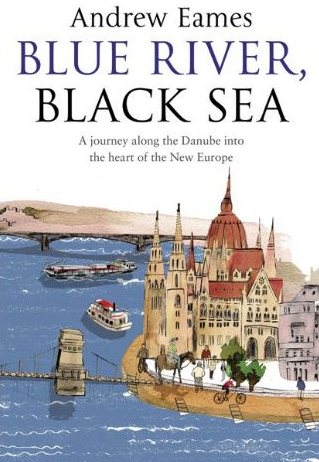
From Black to Black, a review of Blue River, Black Sea: A Journey Along the Danube Into the Heart of the New Europe
By Andrew Eames.
Every day, at three in the afternoon, I make a trip down the Danube. To travel from Germany’s Black Forest to Romania’s Black Sea takes a matter of minutes, so I try to enjoy myself as much as possible. I sink into a cushy armchair, rev up the stereo and embark on an epic voyage. “Information on the water levels of the Danube River, in centimeters,” the familiar voice on Horizont, the Bulgarian National Radio, announces with the deepest solemnity before reading out the relevant hydrographical values, first in Bulgarian and then in Russian and French. Vienna: 310 (+3); Mohács: 415 (+7); Novi Sad: 162 (-13); Vidin: 380 (+40); Giurgiu: 220 (0).
The captains of river vessels can easily map a course on the Internet, but the daily radio bulletin has remained a fixture in my life. For many years, listening to the fluctuations in the water levels of the Danube was the closest I could get to traveling abroad. Regensburg, Passau, Linz, Vienna: these names mesmerized me. Even places like Bratislava and Budapest, comrades in arms against the decadent West, had the ring of myth to a boy growing up in Bulgaria. Remembering his childhood in the Bulgarian river port of Ruschuk (now Ruse), Elias Canetti wrote, “There, the rest of the world was known as ‘Europe,’ and if someone sailed up the Danube to Vienna, people said he was going to Europe.” If people in Canetti’s immediate circle, at the beginning of the twentieth century, still had the occasional opportunity to waltz up to the palaces of the Habsburgs and back, however, the “Europe” I imagined in the 1980s existed only in a galaxy far, far away. To travel up the river as a tourist during the cold war required visas, special permissions, bureaucratic ballast. To swim across it, a negligible distance of a few hundred meters, was to risk both drowning and the bullets of border guards. For nearly fifty years the Danube was a demolished bridge, a liquid roadblock. The wall may have been in Berlin, but the truly impassable one was an invisible dam on the Danube, somewhere between Vienna and Bratislava.
The Danube—or Ister, as the ancient Greeks called it—is a natural highway of nearly 3,000 kilometers. “The greatest of all the rivers which we know,” declared Herodotus. “A path for the spirit to follow,” wrote Hölderlin, following the footfalls of the Greeks in his hymn “The Ister.” Human tribes traveled west against the current, colonizing the core of the continent, gradually shaping it. Before the Americas, there was Europe. The Romans made a few feeble attempts to bring traffic under control by turning the river into the fortified frontier, or limes, of their empire, but without much success. South of the Danube civilization cowered; in the north, the barbarians bided their time.
There is probably no other geographical element of Europe that has absorbed more political weather than the Danube. Unlike the Russian Volga and the Franco-German Rhine, it has served many masters, as a shield or a spear. In 1683, by the walls of Vienna, John III Sobieski and Charles of Lorraine routed the armies of Kara Mustafa, marking the beginning of the end of the Ottoman Empire. Not long thereafter, in 1704, the Duke of Marlborough and Prince Eugene of Savoy vanquished the Franco-Bavarian alliance at the Battle of Blenheim, an important event in the War of the Spanish Succession. Near the river town of Ulm, Napoleon forced the Austrians to surrender with barely a fight. And Hitler’s Drang nach Osten—yearning for the East—had a strong Danubian stink. “Do not forget,” the elderly Heinrich Heine wrote to the young Karl Marx, “the difference between water and a river is that the latter has a memory, a past, a history.”
It has taken twenty years of European integration for the memories of the cold war to seep away. Quietly meandering across ten countries—Germany, Austria, Slovakia, Hungary, Croatia, Serbia, Bulgaria, Romania, Moldova and Ukraine—and running softly past more than fifty-five towns and cities, including four capitals, the Danube is once again a major route for trade and tourism, diluting national and political borders and linking numerous shoreline communities into a single organism. The Rhine-Main-Danube Canal, completed in 1992, allows ships to navigate passage from the North Sea to the Black, chugging through the heart of the continent. The river’s delta, with its sprawling network of lagoons and marshes, is a Unesco World Heritage Site and an important bird sanctuary—with its own environmental problems, of course. Today, to sail along the Danube is to see the new face of Europe, old as it is. And, luckily for me perhaps, the daily radio bulletins on Horizont are no longer my only means of travel.
Traveling the Danube became a fad in 1829. That was the year two Englishmen, John Andrews and Joseph Pritchard, founded the First Danube Steamship Company, which lured scores of elated pleasure seekers. “A motley crowd on board, such perhaps as never met together on the deck of a steam-boat before,” wrote the Irish journalist and literary editor Michael Quin about one of those early voyages. Standing among Austrians, Moldavians, Jews, Hungarian nobles and Tyrolean emigrants, he traveled in style down the river from Pest (Budapest) to the Ottoman town of Ruschuk. It was a thrilling but perilous undertaking. Unlike the well-trodden path of the Grand Tour, with its picturesque Parisian streetscapes and Florentine galleries, the Danube offered a wilder ride for people with money and a taste for adventure. Although its waters flowed across half the continent, knowledge of the river was scarce and scattered, especially when it came to portions under Ottoman control. Europe was split in two long before the cold war, and the Danube was the main gateway into its eastern, darker territories. The course of “civilization” had gradually reversed directions.
William Beattie, another of those early steamboat passengers, portrayed that division with typical Victorian bigotry. East of Budapest, he wrote in his 1844 travelogue The Danube, the tourist “feels as if he were taking farewell of civilization, and entering upon a vast primeval desert, where man is still a semi-barbarian; and where the arts by which he converts to his use the natural products of the earth are still in their infancy, or wholly unknown.” As far as Beattie was concerned, Eastern Europe might as well have been an island in the middle of the Pacific. Quin was similarly dismayed by the seemingly crude ways of life he encountered but a little bit more optimistic in his vision of the future. He praised “the miracles of the age of steam” and then blithely prophesied, “Those countries, which have hitherto seemed scarcely to belong to Europe, will be rapidly brought within the pale of civilization…and new combinations…will be created, which may give birth to important changes in the distribution of political power on the continent.” He was right, of course: steam did alter the political landscape of Eastern Europe. (Could it be that James Watt was personally responsible for the fall of the Ottoman Empire and the whole contemporary history of the continent?) However, Quin’s journey down the Danube was also a reassertion of his cultural identity and his sunny view about technological progress. As the historian Larry Wolff pointed out in his seminal work Inventing Eastern Europe, “It was Western Europe that invented Eastern Europe as its complementary other half.” And the Danube was the road most inventors took.
So many writers have traveled the Danube that their tributary ink, if channeled into a single stream, would turn the water black. From the Italian naturalist and geographer Luigi Ferdinando Marsigli, who professed to have mastered “the anatomy of the river” and then published in 1726 his magisterial six-volume Opus Danubiale, to the contemporary Hungarian writer Péter Esterházy, with his playful travelogue The Glance of Countess Hahn-Hahn (Down the Danube), published in 1991, the outflow of words has been endless. To look for the authentic Danube would be futile, for nobody can describe the same river twice. “It is I who will say what the Danube is,” Esterházy’s protagonist, the Traveler, insists, as so many others before him have: Germans and Austrians, Hungarians and Russians, as well as the odd Serbian, Romanian and Bulgarian. For some reason, however, it was the British and a few American explorers, outsiders with ever-roving empirical eyes and an insatiable appetite for the foreign, who frequently attempted to distill the Danube’s essence. Some, like Quin and Beattie, were deeply prejudiced against the world they were about to encounter. Others, like the American painter Francis Davis Millet, who paddled downriver in a canoe in 1891, wrote about the local people and their environs with sympathy and understanding. Then there were those who transcended the ranks of mere travelers to join the great writers.
Patrick Leigh Fermor is the best of the lot. In the winter of 1933, at 18, he set out on foot from Rotterdam toward Istanbul—or Constantinople, as his romantic imagination insisted. With just a rucksack on his back and two books in hand—The Oxford Book of English Verse and the poems of Horace—he traversed the better part of the pre-war continent “like a tramp or a pilgrim or a wandering scholar.” His trek along the Danube made up only one leg of his amazing odyssey, but it was the most remarkable one. Poring over his maps and trying to decide whether to head for sunny Venice or press farther east, he writes, “Just in time, the windings of the Middle and the Lower Danube began to reassert their claims and the Carpathians and the Great Hungarian Plain and the Balkan ranges and all these mysterious regions which lay between the Vienna Woods and the Black Sea brought their rival magnetisms into play. Was I really about to trudge through this almost mythical territory?” Continue reading

Between the Woods and the Water
I have just returned from Montenegro where I had a holiday with my family. It is a place that is not at the top of the list for most people I guess, but it does attract many Serbians and Russians, particularly to its spectacular coast.
We were attracted because it was different, has spectacular scenery dominated by huge mountains, is relatively unknown, and it also enabled us to visit some very famous Serbian Orthodox monasteries as my wife and I are also very interested in Byzantium and its art (see MyByzantine blog).
On our first night, as I casually flicked through the books left in our villa by the owner and previous visitors, I was surprised to come across a paperback copy of Between the Woods and the Water. It had been read and was in good condition. This gave me the excuse to encourage Kim to read it as she happened to be coming to the end of A Time of Gifts which she was enjoying.
It made me think that many of you who read the blog may have come across Paddy’s work in unusual circumstances, and in faraway places. It would be interesting to hear more; why not paste a comment below or email me (tsawford[at]btinternet.com)? Let’s see who has the most interesting tale to tell!
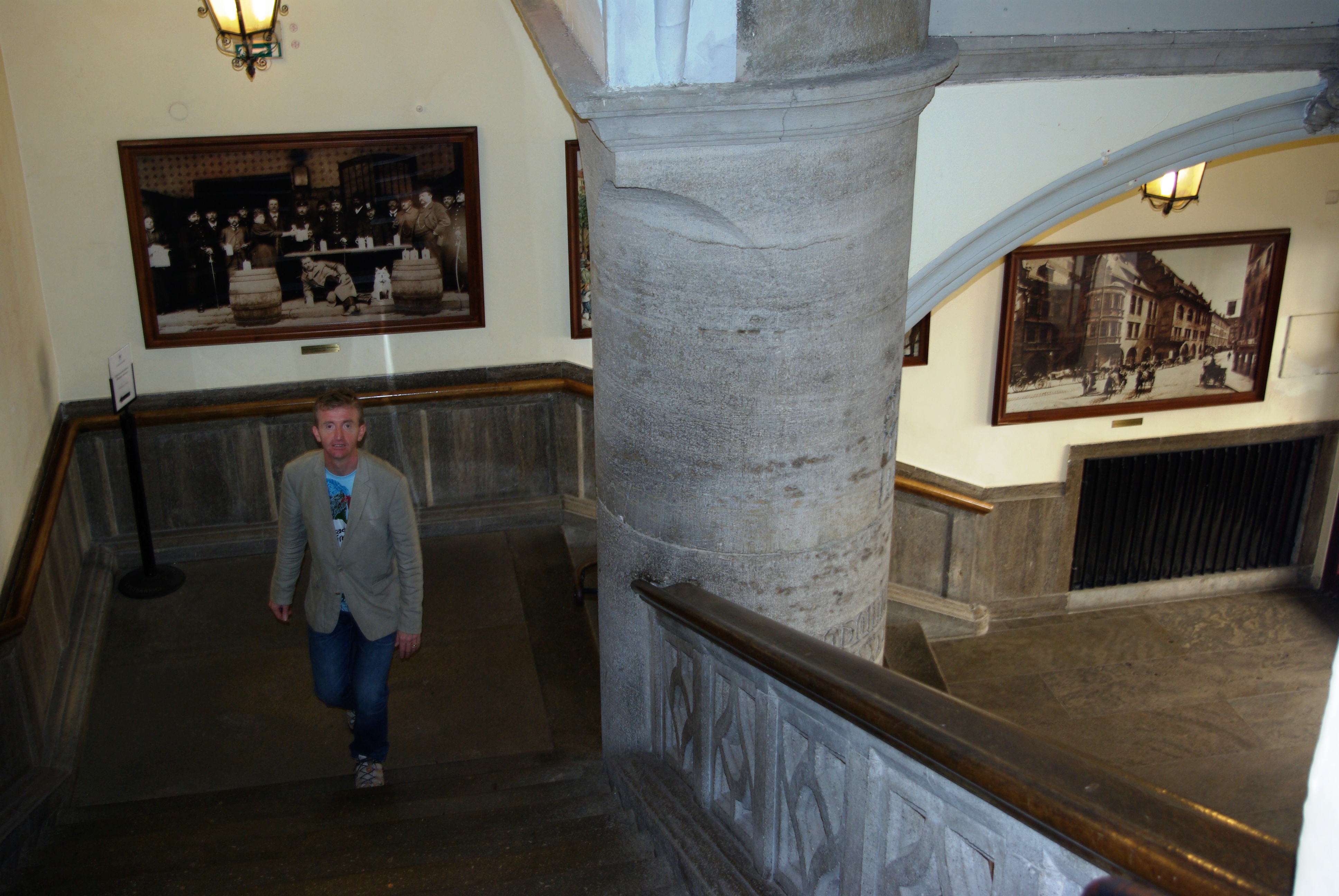
On the same steps as Paddy
“In the heart of them stood a massive building; my objective, the Hofbräuhaus. A heavy arched door was pouring a raucous and lurching party of Brownshirts onto the trampled snow.
I was back in beer territory. Halfway up the vaulted stairs a groaning Brownshirt, propped against the wall on a swastika’d arm, was unloosing, in a stanchless gush down the steps, the intake of hours. Love’s labour lost.”
Those of you well versed in Paddy’s writing will by now have realised that the above is not my own feeble prose but an excerpt from the passage in A Time of Gifts when Paddy enters Munich’s Hofbräuhaus in January 1934.
When I entered that vast temple to beer, sausage and sauerkraut at the end of June, I instantly felt like I had been there before, and indeed I had when I read Paddy’s finest work. Instantly I wanted to visit the chamber bursting with SA men singing Lore, lore, lore, and overweight young German burghers ‘as wide as casks ’ who were ‘… nimbly, packing in forkload on forkload of ham, salami, frankfurter, krenwurst, and blutwurst’ lifting stone tankards ‘for long swallows of liquid which sprang out again instantaneously on cheek and brow.’ Had it not been for the fact that this was midday instead of night I am sure I would have found it barely changed, save for the SA men, whose children and grandchildren (all aged now) have taken up residency.
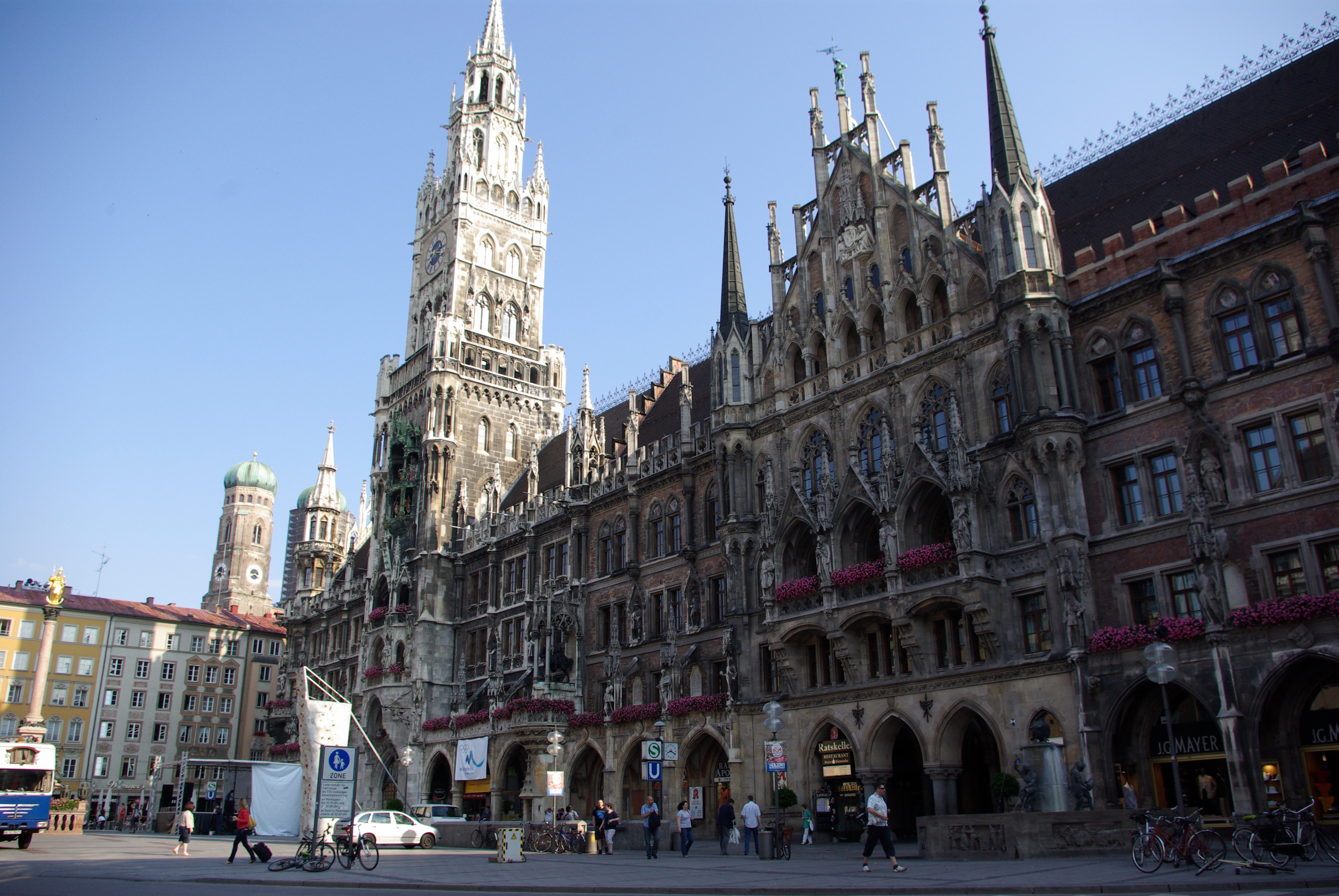
The Rathaus Munich
My wife and I were in Munich after taking the overnight sleeper from Paris Est to Munich on our journey to see the Passion Play (Passionspiele) at Oberammergau. We had arrived at the relatively ungodly hour of seven o’clock in the morning and had seen Munich come to life on a Saturday morning.
At the time the Alt Stadt was almost exclusively ours apart from some stall holders preparing their wares of ripe and juicy, brightly coloured fruit and vegetables for the Saturday market; two young men demonstrating their ability on MX bikes beside a fountain; and a couple of drunks who had obviously made the most of the warm Friday evening and had now belatedly discovered that the party was over.
During the war Munich was severely bombed by the Americans. When on a NATO course at the German Pioneerschule in the 1980’s I remember a particularly loud American officer asking in all seriousness, whilst we were on a tour of the city, when seeing the massive towers and basilica of the Dom, “How the hell did we miss that?”. Well, of course they did not miss it. Seventy per cent of Munich was destroyed by the bombing and after the war there was a serious proposal to abandon the city and rebuild nearby. Fortunately for the Hofbräuhaus (which sustained minor damage) and for us it was decided to rebuild the city. Many of the older buildings, as with so many German cities, were painstakingly restored. The Dom and the Hofbräuhaus were amongst these.
Following a morning of strolling around the centre, visiting some of the sights, drinking känchen’s of schokolade and eating cinnamon flavoured kuchen I was desperate to find the Hofbräuhaus. I was determined not to make the same mistake as Paddy and end up two miles away; although the prospect of doing so and having a couple of himbergeist to see us on our way was not so unappealing!
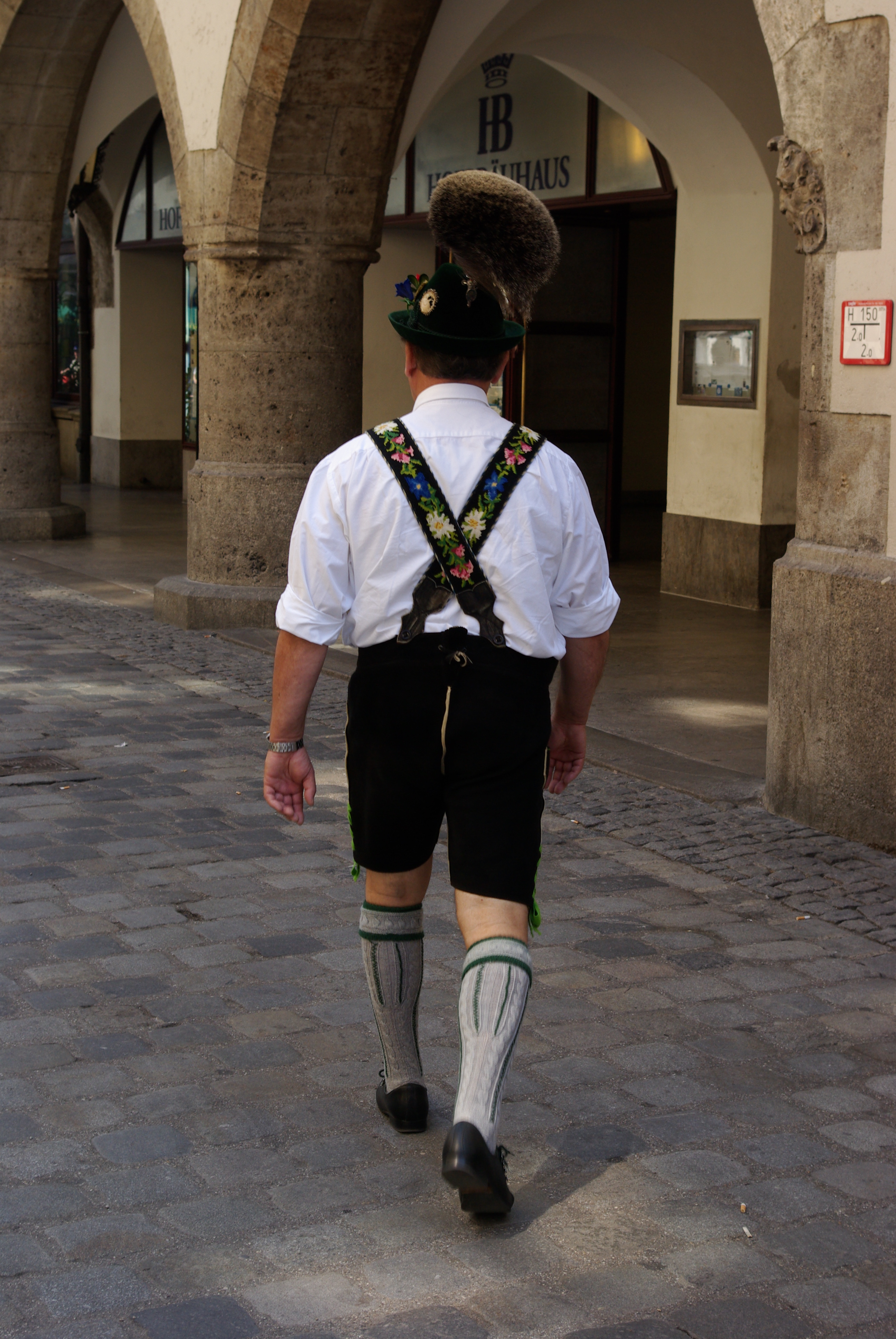
We followed a lederhosen clad gentleman ...
Inadvertently we had somehow attached ourselves to an American tour party and listened patiently whilst the bored German tour guide briefed them all on practical logistics like not entering their PIN number more than twice in those mysterious German cash machines, and what they might see on their one hour of ‘freedom from the group’ until it was time to meet up again, climb into their coach and visit yet another city. When it came to question time I asked where I might find the Hofbräuhaus. The guide looked quizzically at me, thinking I must have some obscure mid-western American accent and told me in all seriousness that eleven o’clock in the morning was rather too early to make such a visit and drink beer. I persisted and reluctantly she gave me the directions.
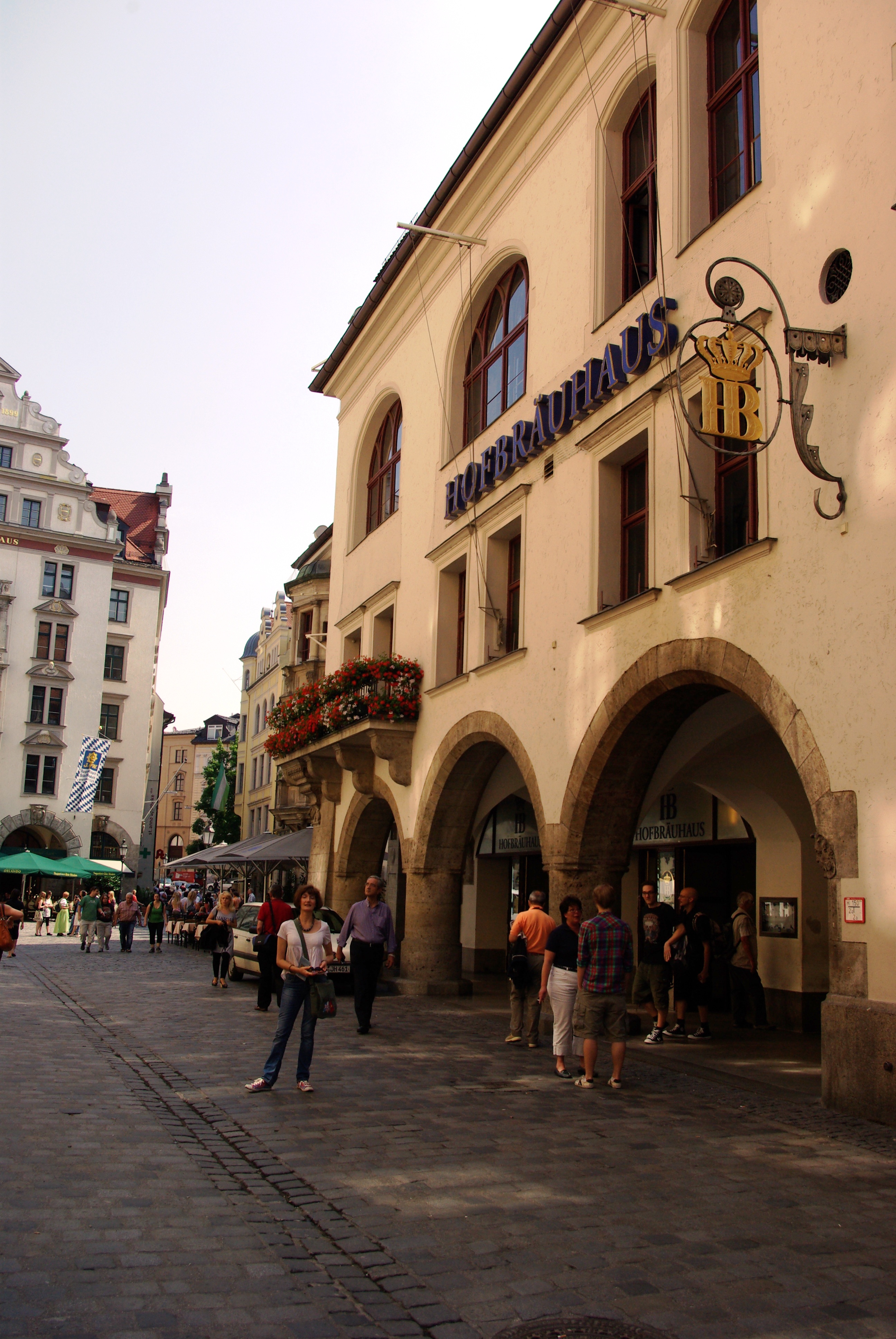
Hofbrauhaus exterior
We walked in the sunshine past the old schloss and down a lane to the ‘slanting piazza’ but I do not recall the Virgin on a column presiding over all she surveyed. We followed a lederhosen clad gentleman wearing a traditional Bavarian felt hat which was adorned by the most amazing plume, reminding me of something that may have been worn by a Roman first spear centurion to enable his men to identify him in the midst of battle.
There before us was our goal. Gothic and grand just as Paddy described it, we entered through wide doors underneath Gothic arches and walked up those vaulted stairs which survived the damage of the war. It was here in January 1934 that Paddy encountered his Brownshirt. The steps are now lined with photographs, one of a maternal looking frau holding eight heavy steins full of the cool, golden Hofbräuhaus beer. Perhaps she had served Paddy on that famous, alcohol fuelled night?
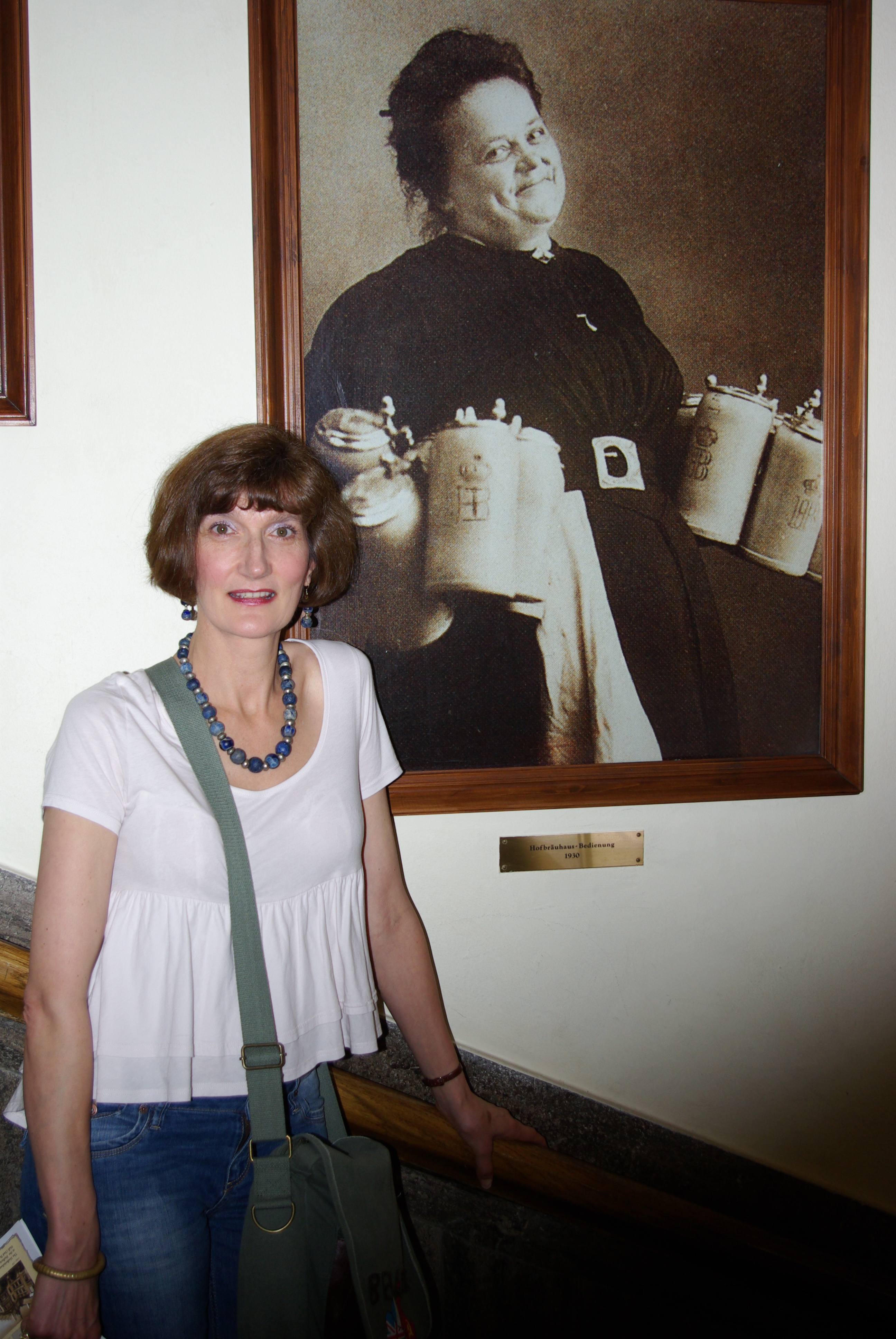
Kim considers joining the waitressing team
The Hofbräuhaus has four floors devoted to the adoration of beer, sausage and pretzels. We visited each one. They were all decorated in a different style with a large communal drinking hall, and a number of smaller private function rooms (which are for hire). It is one of these higher floors that Paddy stumbled into when full of SS officers, Gruppen and Sturmbannfuhrers, black from their lightening-flash-collars to the forest of tall boots underneath the table.
The highest floor is dominated by a large parquet floored room with a vaulted ceiling colourfully decorated with its predominantly pink and blue frescos of Bavarian coats of arms. The Festival Hall was built in 1589. It is light and airy with windows on each side, large chandeliers and dominated by a small stage with heavy, theatrically red velvet curtains. The Hall can seat over 900 on its long tables arrayed in neat rows before the stage, and gives the impression of being eternally ready for a party. Indeed on the occasion of our visit, it was being prepared for the post- Abitur celebration for a very lucky young girl. The mood darkens somewhat when you know that it was in this very room, standing on that very stage that the ambitious politician Adolf Hitler addressed his followers in the early days of the National Socialist Party in the late 1920’s and early 1930’s.
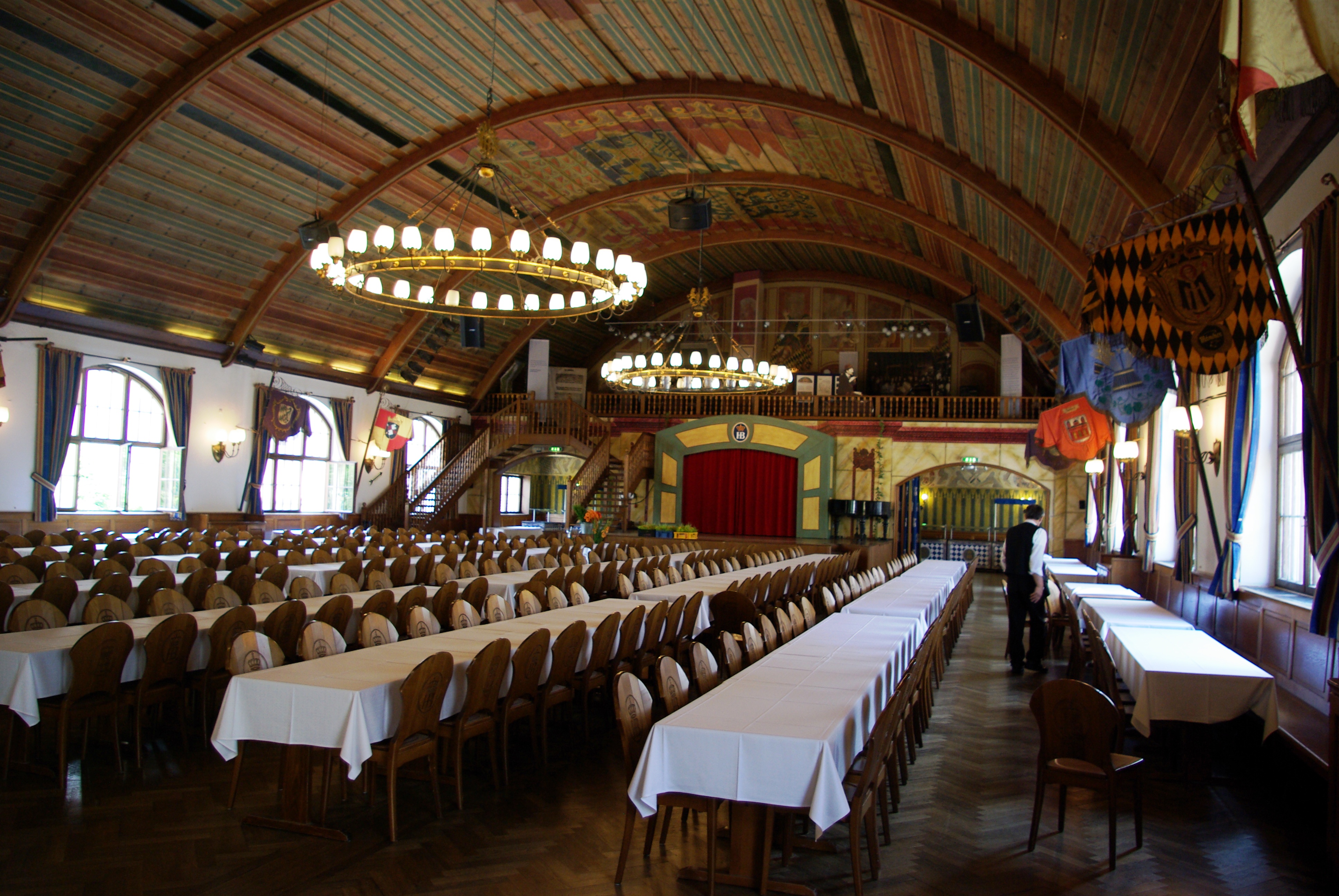
Hofbrauhaus Festival Hall
Given the passage of time this ceased to have any sinister effect, but it is a sobering thought and brought to life a period of history, and its aftermath, that has come to dominate my generation, and certainly those preceding us.
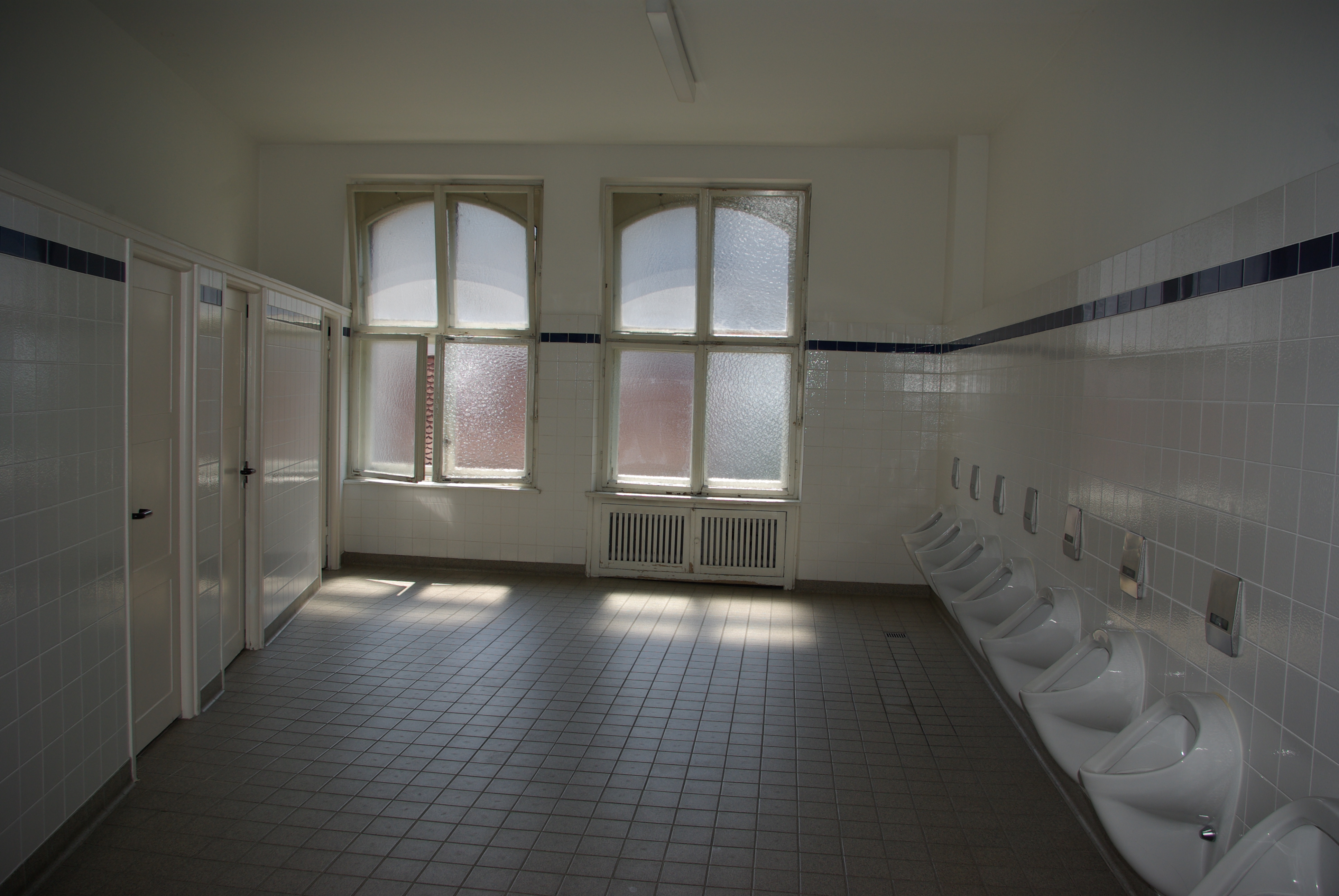
Did Adolf visit here?
It was about this time that I needed to answer the call of nature. Kim and I were virtually alone and I sought out a gentleman’s lavatory. Finding one at the end of a corridor leading from this function room, I hypothesised that perhaps Hitler had, on more than one occasion, made this same trip, perhaps accompanied by colleagues such as Herman Goering, and discussed the finer points of how to grab political power, and achieve revenge on all those who had sought to so humiliate Germany via the Treaty of Versailles.
Like Paddy we were now guided right down to the bottom of the stairs, out of the doors and back in another, larger door on the ground floor. After passing the obligatory ‘Hofbräuhaus shopping experience’ we entered a new hall where the vaults of the great chamber did not fade into infinity through blue strata of smoke as this was, unbelievably, 21st century smoke-free Germany.
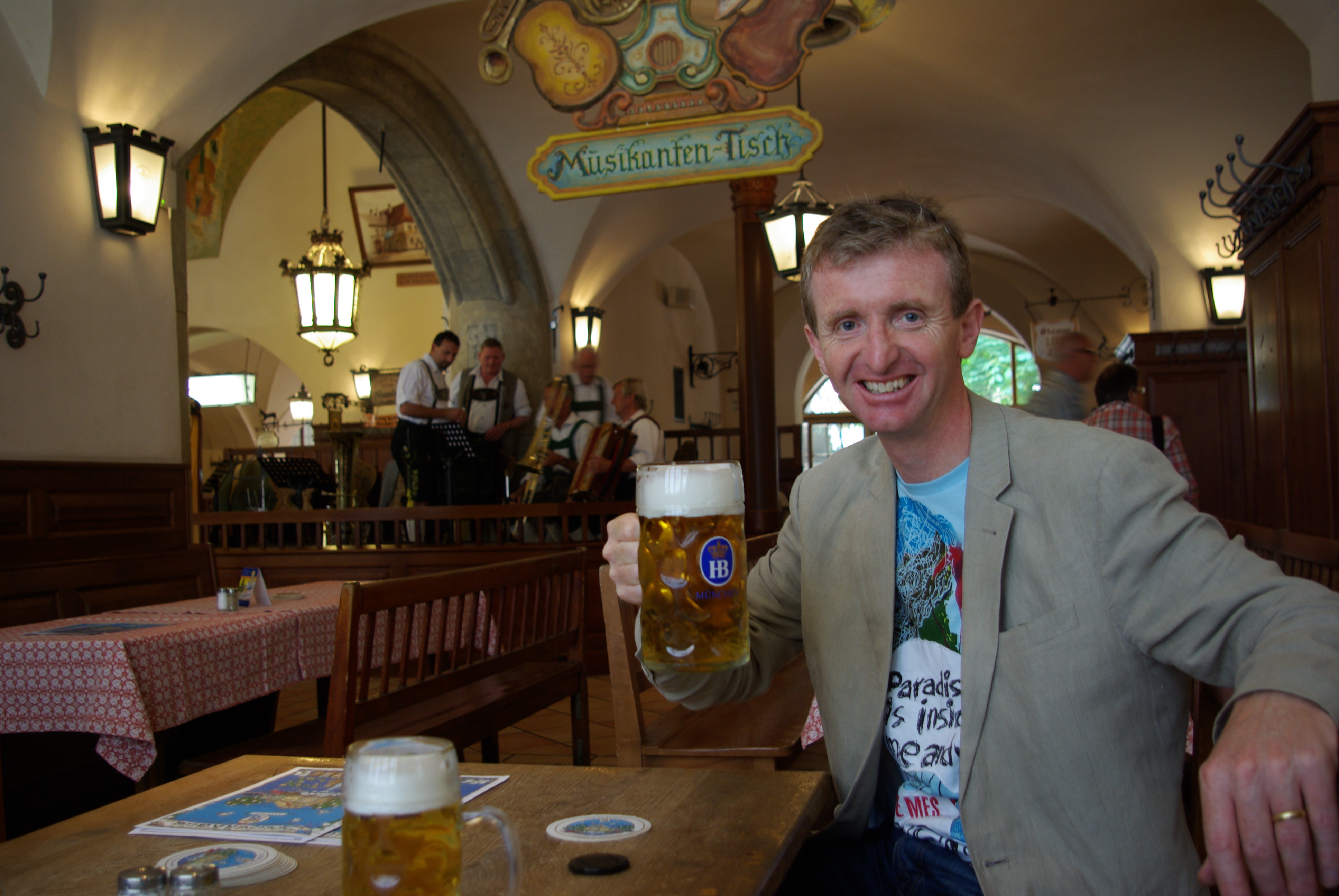
Drinking cool beer in The Schwemme
It was here that Paddy found the part of the Bastille he was seeking. The Schwemme is a huge, richly frescoed hall that wound this way and that, past huge stone pillars, toward the altar of Hofbrau beer where an army of male and female waiters attend upon the fountain of beer pouring litre upon litre of the marvelous nectar. And it did not stop there. What Paddy would have missed on a dark, cold, snowy night in 1934 was the courtyard beer garden which by now was filling with locals and tourists all keen to bathe in the unique Hofbräuhaus atmosphere.
If you visit the website of the Hofbräuhaus you will see it includes a list of ‘regulars’; those who attend services on a regular basis, with the specific visit days recorded. They have reserved seats and for larger groups, or even families, whole tables are kept for them so that they can indulge and worship whilst listening to the suitably attired Bavarian band that have a dedicated stage in the centre of the hall.
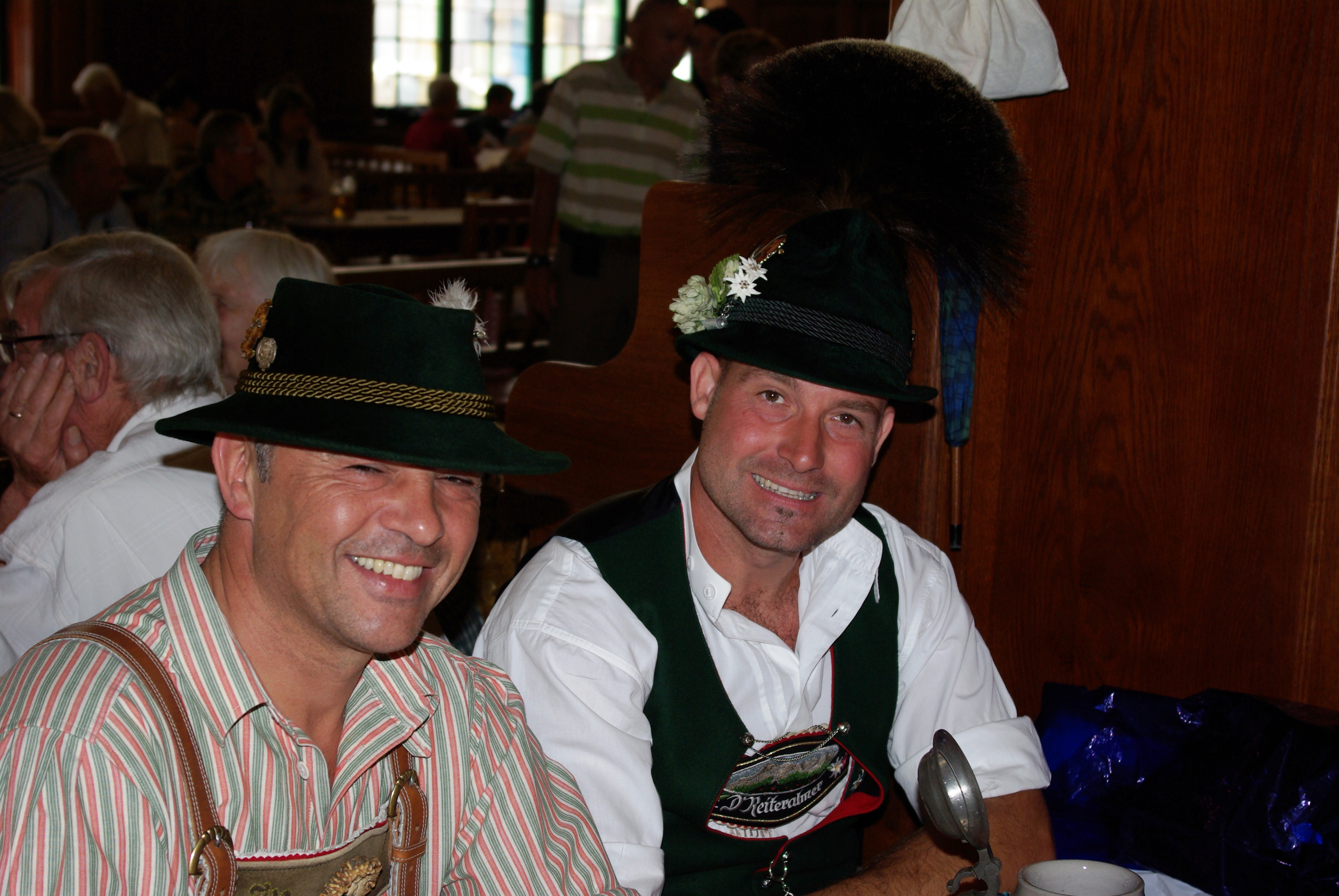
Hofbrauhaus Regulars
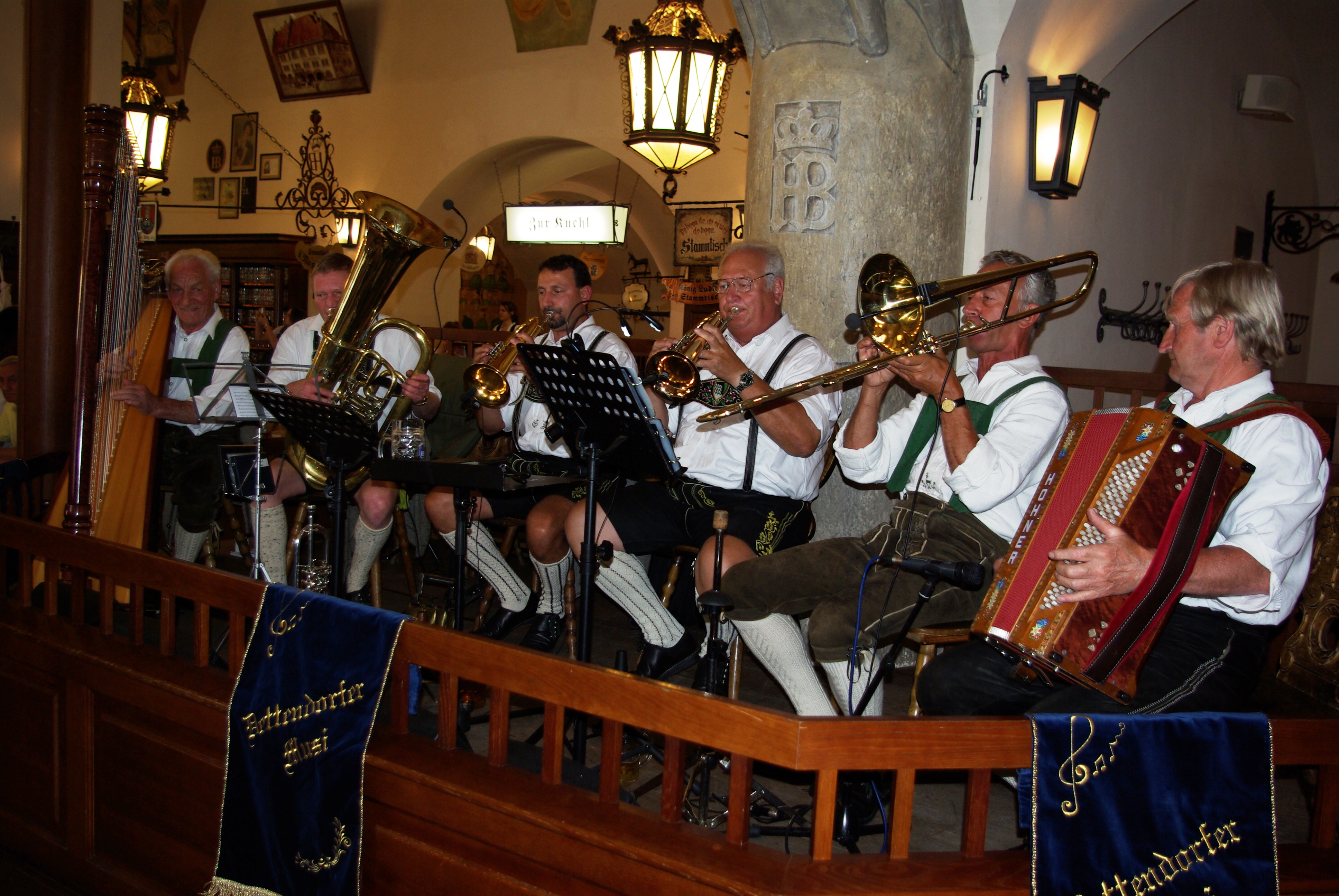
The band plays on
We had arrived early, at around 11.00 am and had spent forty-five minutes or so making our tour of the building. It was quiet, with just a few other like minded souls and the staff getting ready for the rush ahead. By midday we had chosen a table and ordered our first refreshing beer, a Würstlplatte for me and Spanferkel for Kim (read the menu in English here). The Schwemme was now filling with crowds of locals and tourists alike and the band had struck up. If you want to visit the Hofbräuhaus to look around, as we did, I would recommend going early, and you also need to be there pretty early to find a table.
It was a wonderful visit, and one that was brought to life even more as we imagined that young man avoiding Brownshirts and knocking back beer with the farming folk he found in the Schwemme. One thing that has not changed is the hospitality and friendliness of the Bavarian people, and it was with some reluctance that we walked out of the Hofbräuhaus into bright sunshine to catch our train to Oberammergau.
Now, where did I leave my rucksack?
Recently we have been musing in some posts about following Paddy’s route. For many of his fans this is perhaps a dream, but nevertheless, something many would like to make real. Topping that of course is meeting Paddy himself. In this piece, New Zealand author Maggie Rainey-Smith unexpectedly meets Paddy on a trip to Kardamyli on Greece’s Mani Peninsula, where Paddy has lived since the 1960’s. Some of you may have read it but I think it is such a nice article that it is worth re-visiting.
First published in the New Zealand Herald 15 June 2008
The village of Kardamyli is on the west coast of the Mani Peninsula, one of the more traditional and conservative areas of Greece.Recently, I spent two months in Greece chasing the muse, searching for clues, looking for inspiration.
The Mani Peninsula region is famous for the Maniots and their resistance of the Ottoman occupation. It is isolated by the Taygetus mountain range and enclosed by the Aegean and Ionian seas.
The Ottomans failed to infiltrate, but I have to advise that the English have. As I shopped for my Twinings tea and sat outside a cafe in the village of Kardamyli, using the free internet, I lamented the globalisation of this once-remote peninsula.
I wished, for just a moment, that I was back in time when to be a strange woman alone in this small village may have attracted disapproving stares.
In the local bookshop was the very book I’d been looking for: Mani – Travels in the Southern Peloponnese, by Patrick Leigh Fermor. On my terrace overlooking the sea, I opened the book and found myself mesmerised by the most exquisite, evocative travel writing I have ever read. Not only that, I discovered that Fermor is a resident of Kardamyli.
The owner of the bookshop was unimpressed when I asked where Sir Patrick lived, and his lips remained sealed, his expression disapproving. Fermor is almost a saint in Greece.
He was a resistance fighter in Crete during World War II; his exploits were the subject of a film starring Dirk Bogarde (my father was in Crete, but a more modest hero at Maleme, the point where the island was finally lost to the Germans).
At the local cafe, where I made use of the technology, the owner (who looks like a Maniot right out of Fermor’s book, with her blanket of black ringlets and beautiful olive eyes), told me Paddy (as the locals call him) would celebrate his Name Day that very week and that he always opens his home to the locals on that day.
By then, and after one week’s residence, I considered myself a local, and everyone agreed with me.
So with joyous disbelief at my good fortune, on Thursday, November 8, I joined the local villagers at Sir Patrick’s Name Day celebration at his majestic and yet still homely yellow stone house overlooking the Messinian Gulf.
By 10.30am the service in his private chapel was over and we were seated in his lounge – books lining the walls from floor to ceiling: Nancy Mitford, Henry James, James Joyce – eating olives, meatballs, feta and drinking local wine.
On a person’s Name Day you are required to take a gift, and all I had with me was a copy of my first novel About Turns, which I gave to Paddy. He signed my copy of his own book with a personal inscription and a small drawing. We talked about Crete and my dad and his book on the Mani. I gushed, he charmed.
Then the singing began and Paddy was surrounded by adoring local women who toasted him with traditional Name Day songs.
At the end of the singing, Paddy stood and pretended to fire a pistol into the air (an old tradition where real pistols were once used). He is of English and Irish descent. Although his name is Patrick, his Greek Name Day is the day of Michali. Michael is the name he assumed while fighting for the Greek resistance.
With me was an American Orthodox nun who worked in Moscow and a Danish man of the cloth who was studying Byzantine churches. We were Paddy’s “non-local” guests and pinched ourselves to check we weren’t imagining our good fortune.
When it was time to leave, another Michael (Michali), a neighbour of Paddy’s, invited us to his home. We walked through an olive grove up the hill along the coast to another beautiful stone home.
Our new host sold Paddy the land and helped him build his house in 1964. We were feted with fresh coffee and cakes and listened to Michali’s son, who told us that when he decided to leave Kardamyli some years ago to travel, Paddy told him: “You can’t leave.”
And when he returned years later, Paddy told him: “You know we are very fortunate, we live in Kardamyli. We are fortunate – we have the mountains. We are fortunate – we have good food. We are fortunate – we have clean air to breathe. We are fortunate – we have the beautiful sea to swim in.”
“Yes, Paddy, the mountains, the food, the air and the sea,” said the young man, nodding in agreement.
And then Paddy said to him: “And for all these reasons and more, we may just forget to die.”
Sir Patrick Leigh Fermor is 92 years old, he was wearing a double-breasted navy suit when I met him, had a full head of wavy grey-black hair and was still a handsome, charming man with just a slight deafness in one ear.
He spoke with a classical English accent which rather surprised me, considering the years he has spent in Greece.
He is still writing. If you’ve never heard of him, or never read his books, now is the time to start.
By Maggie Rainey-Smith
I was just taking another look at Matt Gross’ Frugal Travel section of the New York Times and discovered that after writing the piece I published on 13 June he left the NYT. I wonder if he was so inspired by Paddy’s travels that he decided to take off and cover the whole route? Perhaps not. Here is his signing off piece from his NYT Blog.
By MATT GROSS
This weekend’s Travel section cover story — “Frugal Europe, On Foot” — is my last as the paper’s Frugal Traveler columnist. After four years of roaming the world on a budget, from Alabama and Albania to Uruguay and Urumqi, I’m taking a rest, and handing over the illustrious mantle to a new shoestringer, who’ll appear in this space next month.
But for my final feature, I wanted an adventure that would challenge me — physically, psychologically, culturally, linguistically, technologically, logistically and, of course, financially. Maybe a sailing adventure? Done that. A lengthy train journey? Done. A trek into the mountains? Done — on foot and on horseback. I’ve gone round the world, across America and grandly circled Europe, so what was left to be done?
The answer came in the form of Patrick Leigh Fermor, the 95-year-old war hero who’s known as Britain’s greatest living travel writer. His books “A Time of Gifts” and “Between the Woods and the Water” chronicle his nearly penniless journey, in 1933 and 1934, from Rotterdam to Istanbul — on foot. And when I looked at the route he took through the remains of the Austro-Hungarian Empire, I realized I had an adventure in the making: a two-week walking tour that would take me from Vienna through Slovakia to Budapest.
Throughout 180 miles, I dealt with three official languages (German, Slovak, Hungarian) and some unofficial ones (Italian, English, French, Hebrew). I used maps both paper and electronic. I took inspiration from literature: not just Mr. Leigh Fermor’s books but also “The Unnamed,” by Joshua Ferris, “The Road,” by Cormac McCarthy, “The Places in Between,” by Rory Stewart, and “The Long Walk,” by Stephen King (writing as Richard Bachman). I found great bars and restaurants via Twitter and Foursquare — and through common, random luck. I walked till my ankles screamed, and sang to myself during long hours alone.
And when I met new people — as I did just about everywhere — I was amazed, again and again, at their spontaneous generosity, their willingness to feed, shelter and befriend a mysterious stranger attempting to do what few sane travelers would even contemplate.
In other words, I don’t expect you, my readers, to follow precisely in my blistered footsteps, but I hope this story — and all the Frugal Traveler articles I’ve written — will inspire you to set off on your own crazy adventures, confident in the knowledge that no matter how little money you have, the world will, if you embrace it fully, take very good care of you indeed.
Are you inspired? I know I am. It would be a nice idea if perhaps next year we could get a bunch of people together and walk some of the route. On the other hand perhaps it is best to do as Paddy did and make a solo attempt. If anyone has ideas on this get in touch with me tsawford[at]btinternet.com or post a comment below.
It’s time to be honest now: who amongst the regular readers of this blog, or even those that stumble across us because they have read ‘A Time of Gifts’ or ‘Between the Woods and the Water’, has not thought about following Paddy’s 1930’s route? For myself it is a definite goal. It is an ambition; probably a passion. I had come across the following article but have been inspired to re-produce it by Blog reader Matt who says he first got into Paddy’s work when stationed in Baghdad:
First published in the New York Times, May 23, 2010
The article is written by New York Times’ Frugal Traveler columnist Matt Gross who attempted to follow in the footsteps of Patrick Leigh Fermor. Like all good stories it begins ….
ONCE upon a time, a young man went for a walk. It was December 1933, and an 18-year-old Englishman named Patrick Leigh Fermor put on a pair of hobnail boots and a secondhand greatcoat, gathered up his rucksack and left London on a ship bound for Rotterdam, where he planned to travel 1,400 miles to Istanbul [Ed: Constantinople!] — on foot. He had virtually no money; at best, he’d arrive in, say, Munich to find his mother had sent him £5. But what he did have was an outgoing nature, a sense of adventure, an affinity for languages and a broad network of friends of friends.
“If I lived on bread and cheese and apples,” he later wrote, “jogging along on fifty pounds a year like Lord Durham with a few noughts knocked off, there would even be some cash left over for papers and pencils and an occasional mug of beer. A new life! Freedom! Something to write about!”
Something to write about indeed! The books he produced from the yearlong journey — “A Time of Gifts” and “Between the Woods and the Water” — are gorgeously rendered classics that have led many to call Mr. Leigh Fermor, now 95, Britain’s greatest living travel writer. But to my mind, he’s always had another title: the original Frugal Traveler — the embodiment of that idea that, though a wanderer may be penniless, he doesn’t have to suffer.
And Mr. Leigh Fermor never suffered, thanks to the miracle of human generosity. Peasants gave him baskets of eggs and swigs of raspberry schnapps. Small-town mayors found him beds. The lingering nobility of Europe put him up in their castles, invited him to balls and lent him their horses. When Mr. Leigh Fermor did sleep rough — in hayricks and barns or on the banks of his beloved Danube — he did it by choice, not because (or not merely because) poverty required it. He knew, even at 18, that the world is an experience to be savored in all its multifarious incarnations.
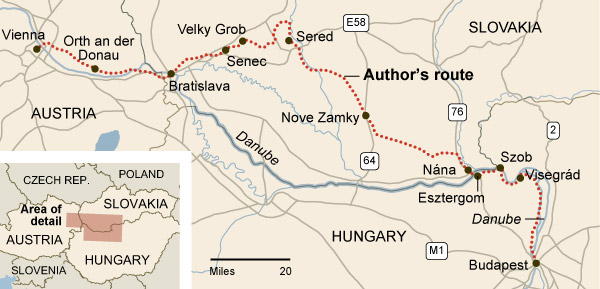
Matt Gross' route
Could a young person (is 35 still young?) with strong legs and little money find the same spirit of hospitality that Mr. Leigh Fermor encountered some 76 years ago? At the end of March, I set out to find the answer. With only two weeks free, my plan was to walk from Vienna to Budapest, a 180-mile route that would connect the old poles of the Austro-Hungarian Empire and track Mr. Leigh Fermor’s trail as closely as possible, taking me along the Danube to Bratislava, the Slovakian capital, and across the plains of Slovakia south to Hungary — through three countries whose languages, cultures and histories could not be more different, or more intertwined.
It was tempting, the day I arrived in Vienna, to just walk east from the airport, but I couldn’t completely skip the Austrian capital, where Mr. Leigh Fermor had spent three weeks among the “crooked lanes” and “facades of broken pediment and tiered shutter.” And so I followed his lead, going into the imperial crypt, where the grandest members of the Hapsburg family lay entombed in elaborate sarcophagi, and into the museums, although I shied away from the most famous in favor of oddities like the International Esperanto Museum. And I luxuriated in storied places like Cafe Alt Wien and Cafe Bendl.
But after two nights in Vienna, I was restless. So I crossed the Danube, put on my 45-pound pack and took off down the Donauradweg, a well-kept biking trail that runs from the river’s source to its mouth at the Black Sea. To my right, the Danube, more green than blue, sparkled in the cool sunlight, and I encountered fishermen tending their rods, elderly sunbathers, nordic hikers poling along and cyclists speeding in both directions.
This first day, I figured, I’d take it easy and do only 15 miles. Ideally, I’d need to hit 18 miles a day — about six hours of walking — to reach my goal. It seemed reasonable, especially with the terrain so uniformly flat. The path, sometimes dirt, sometimes paved, would often stretch so far and straight that I couldn’t imagine I’d ever reach the end, and then I’d finally hit a slight turn and face the same thing: an art-school lesson in perspective, complete with the first low foothills of the Carpathians at the vanishing point — and a scampering rabbit to remind me this was no still life.
Even with such straightforward terrain, there were snags. An attempted shortcut through a fuel depot left me with minor scratches and an extra three miles. But such mistakes have a way of turning out for the best. Had I stayed on the trail, I would have never crossed paths, two hours later, at the edge of Donau-Auen National Park, with Jean-Marc and Marie, newlywed French cyclists who stopped to say hello when they saw a lone hiker in the middle of nowhere. They were taking an extended honeymoon: a two-year bicycle journey from their home in Paris — to Japan!
“Do you know where you’re staying tonight?” I asked. They didn’t. I told them to meet me at Orth an der Donau, a small Austrian town a couple of miles farther down the Danube, where I had arranged for a place to stay via CouchSurfing.org. Maybe, I said, my host could find them somewhere to pitch their tent.
THE host, Roland Hauser, whom we met in front of Orth’s impressive castle, did better than that. He invited them home to his dreamland of soft beds and hot showers. Roland, 26, had traveled from California to Southeast Asia to New Zealand, and his German-accented English was peppered with words like “sí” and “bueno.” That evening, we cooked spaghetti Bolognese, nibbled Südtirolean ham and drank big bottles of beer. I went to sleep marveling at our extraordinary, Fermorian luck.
In the morning, after coffee, I threw out my underwear. This was a strategy to lighten my load — bring old undies and get rid of them day by day. Frankly, I should have done that with everything, as the pack was needlessly heavy. Along with two weeks’ worth of shirts, I had an ultralight down jacket, a waterproof shell and rain pants. A tent and sleeping bag. One pair of jeans and lightweight canvas shoes to change into at day’s end; nothing worse than walking 20 miles and spending the evening in the same clothes. And I packed Mr. Leigh Fermor’s books and Claudio Magris’s “Danube,” which I never had time to read. And my computer and camera gear — work necessities, alas.
When I set off, I was wearing my typical walking outfit: khaki pants by a company in Portland, Ore., called Nau; waterproof running sneakers by Lafuma; good socks (as important as good shoes); and a long-sleeved cotton shirt.
The walk began well. My feet were tender, but the flatness of the Marchfelddamm, a high berm that doubled as biking path and flood deterrent, ensured that I wasn’t struggling. This was the heart of the Donau-Auen National Park: forests of thin trees broken by occasional streams flowing to the Danube. At first, I appreciated the play of light on the water and between the trunks, but hour after plodding hour of unchanging scenery soon became mind-numbing, and I simply marched, putting one foot in front of the other and watching for kilometer markers. It would be 13 miles before I could stop for lunch, and another 10 before I reached my day’s goal: Bratislava.
But there’s a funny thing about long walks. With patience, all those steps add up, and by 2 p.m., I’d crossed a bridge over the Danube and settled into a cafe in the stately town of Hainburg, where an open-faced baguette pizza and glass of beer gave me the courage to face the miles ahead. And soon I found myself trudging along the shoulder of the small highway with cars flying past — and missing the monotonous near-silence of the forest.
Not far off, I could see Bratislava’s hilltop castle — in Mr. Leigh Fermor’s era, a burned-out wreck worked by prostitutes but in the 1950s rebuilt as a stately white-and-red palace — and it teased me with its apparent nearness. Still, I had far to go, past a derelict border post, and through three miles of snaking bike paths, before I crossed the Danube again and was in the heart of Bratislava’s old town, all cobblestones and tile roofs and sidewalk cafes.
After checking into the Hotel Kyjev — a 1970s tower turned budget boutique — I checked myself out: I wasn’t sore, out of breath or even tired. I did have blisters on my feet, but they were easily treated: puncture, drain, clean, bandage. My ankles, however, were terribly swollen, the peroneal tendons in particular, a result (I think) of how my body mechanics had altered with the weight on my back. I popped some ibuprofren, took a shower, then hobbled outside for dinner.
It was the Friday during Passover, and like any wandering Jew, I wanted a Sabbath meal. And thanks to Chabad, the Hasidic Jewish outreach organization, I got one, at the home of the transplanted American rabbi Baruch Myers. He was only too willing to share his food (cucumber salad, gefilte fish), his friendship and his family, including a battalion of adorable children who cheerily walked me through the Passover story.
It wasn’t just this heartfelt welcome that got to me; it was the very existence of a Jewish community in Bratislava. Back in his day, Mr. Leigh Fermor wrote, the Jews “were numerous enough to give a pronounced character to the town.” No longer. The Holocaust had reduced the Jewish population to, in Rabbi Myers’s estimate, 1,000 people. There was a synagogue, a few kosher restaurants, a Jewish museum and even a pension, but few visitors today would see in Bratislava a Jewish-inflected city.
On Saturday, partly inspired by the rabbi and partly because of my feet, I rested and contemplated the future. I had walked 40 miles so far, and if my ankles were any indication, there was no way I’d make the remaining 140. Unless … If I took a train a short way — say, 15 miles northeast — I could certainly walk another 10 miles. I’d be breaking my rules, but those rules were arbitrary. Continue reading
I have just finished reading Three Letters from the Andes published in 1991, but first written by Patrick Leigh Fermor during the month long expedition to the high Andes in Peru in 1971. He was accompanied by good friends, most notably his close friend Andrew Cavendish, 11th Duke of Devonshire.
The original text consists of three letters to his wife Joan and mailed by Paddy to her to try to describe to her much of what happened during the expedition which included some challenging climbing, which for the greater part, Paddy did not join. He describes his principal role as ‘minder of the primus stove’ and this duty enabled him to sleep in the spacious mess tent.

Three Letters from the Andes
The book is enjoyable enough and it does what it says; it describes the journey and I am sure Joan would have enjoyed the letters. Paddy did some editing prior to publication to make them more presentable for general readership (and probably removed any indiscreet comments). However, compared to the more familiar A Time of Gifts and Between the Woods and the Water, this is a lightweight affair. Perhaps it shows how much work Paddy must put into his constant redrafts to expand upon his first thoughts. This is clearly work that had minimal redrafting, and is interesting because of that.
The description of the journey and key events remain in my memory but it did not give the deep pleasure gained by the former books. Just a couple of my favourite bits:
When flying in to Lima the party had to go through Peruvian customs and immigration. Paddy describes the staff as ‘sleepy, rather blank faced … officials who were far from brisk.’ He goes on to describe Andrew Cavendish’s experience. ‘… our passports seemed to puzzle them and Andrew’s proved utterly enigmatic. He got through the last barrier half an hour after they’d finished with the rest of us, murmuring sadly: ‘I can’t deny there are countries where being a duke is a bit of an advantage; but Peru’s not one of them.’
Right at the end of the journey at a dinner given for the party at the British Embassy, Paddy is seated next to a ‘very quiet and very beautiful neighbour called Dona Diana de Dibos’. After a while he realized that she was the sister of Lt Mike Cumberlege, a naval officer who used to ferry partisans and SOE agents into and out of Crete during the German occupation. He had been shot in a concentration camp just four days before VE day. Paddy cheered her up by telling her many stories about her brother that she had never heard before.
Three Letters is short and easy to read. For Paddy fans it is essential reading to complete our picture of him and his life and his various publications. There are probably better ways of spending a few hours, but I don’t think anyone reading it will be disappointed … as long as they don’t expect a short version of ATOG.
A personal view by Max Hastings who thinks that Paddy’s best book is Mani.
First published in the Daily Telegraph 12:01AM GMT 04 Jan 2004
Not long after the Second World War, an English couple chanced upon a remote taverna in the mountains of Greece. As they ate their simple lunch the proprietor, perceiving their nationality, remarked: “We had another English couple here once, before the war. They stayed for weeks. They were so beautiful and so in love. And every night they dressed for dinner!”
It was this last foible that had plainly captivated him, and indeed conjured for his listeners an enchanting vision of young lovers in “the full soup and fish”, as P G Wodehouse would have said, in this lonely Greek inn. All became clear when the innkeeper added: “His name was Lefemor.”
This was, of course, the inimitable Paddy (he has never been known as anything else), though the innkeeper was wrong about the nationality of his other guest – she was in truth a Romanian princess, Balasha Cantacuzene, with whom he enjoyed a romantic idyll through the last few years before the war.
Legend has it that “Lefemor’s” distraught family ordered him home, finally cabling the fare when he pleaded poverty to explain his inability to return. He merely used the money to protract the affair.
Like many stories told both by and about Sir Patrick Leigh Fermor – as he became this week at the age of 88 – this one may be a trifle fanciful, owing as much to soaring imagination as to historical fact. No matter. It is the sort of story about Paddy which ought to be true.
He richly deserves his honour not only for what he has written – some of the finest travel books of all time – but for what he has been. In prose, as I heard one of his oldest friends put it recently, “he possesses an extraordinary gift for expressing beauty in words”.
He has fulfilled the dream of so many upper-class Englishmen of his generation, to live, love, play the hero, sage and wit with a lightness of touch which, translated into the milieu of the kitchen, would produce a souffle of genius.
He was the son of Sir Lewis Leigh Fermor, a geologist who travelled widely and made his reputation in India. “His tall, straight figure might often be seen dancing in Calcutta,” the DNB observes playfully. Paddy’s somewhat erratic schooling terminated at King’s Canterbury, from which he was sacked for some misdemeanour – “holding hands with the greengrocer’s daughter” is his own version, which will serve as well as any other.
Rejecting parental plans for Sandhurst and the Army, in December 1933 at the age of 18 he set out instead to walk to Constantinople, with very little money but some rather grand letters of introduction. The consequence was that for the next 18 months, he was wafted from schloss to schloss across old Europe, plunging his insatiable social, cultural, intellectual and linguistic curiosity into a river of happy encounters.
These he has described in the two volumes, A Time of Gifts (1977) and Between the Woods and the Water (1986). A third instalment of the journey has been long in preparation, but it is unlikely that anyone except his publisher expects it to get finished.
He has always been a slow writer, each of the eight books in his modest output requiring long and painful labour. His dilatoriness has been reinforced, perhaps, by indifference to money. Though he has never had any, somehow God or friends have eagerly provided. He has practised a superior brand of Micawberism, founded upon the belief that something or somebody would turn up, which in his case it always has.
When war came in 1939 he left Baleni, the wonderful Romanian mansion where he had been living with his princess, to join the Irish Guards. Instead, however, he was commissioned into the Intelligence Corps as a Greek speaker. He spent the winter of 1940 as a liaison officer with the Greek Army.
Affectionately sceptical friends say that Paddy’s linguistic fluency is a trifle exaggerated. Sixty years ago an Englishman who heard him gassing away nineteen to the dozen said to a neighbouring Greek woman: “Is he as fluent as he sounds?” She replied: “No. He is simply making a wonderful noise.” This is a little unjust, and of course he has indeed become a master of the Greek language after living in the Peloponnese for so long. He possesses a gift for communicating with his fellow man of any nationality, class or condition, without need for anything as vulgar as a phrasebook. Continue reading
A Review of Artemis Cooper’s “Words of Mercury” by William Dalrymple published in the Guardian.
First published in the Guardian 13 December 2003
William Dalrymple relishes Words of Mercury, a selection from the work of Patrick Leigh Fermor, Britain’s greatest living travel writer.
Skill with the sword usually precludes much competence with the pen. For all that Sir Philip Sidney could write sequences of Petrarchan sonnets as well as lead buccaneering raids on the Spanish Netherlands, or Siegfried Sassoon write his anti-war memoirs while also winning the Military Cross, bookishness and military machismo are rarely found roosting together (after all, it’s no secret, as the old joke goes, that military intelligence is a contradiction in terms).
The great exception to this rule in our own time is Patrick Leigh Fermor. For though he is one of our finest prose stylists and – since the death this summer of his only possible rival, Norman Lewis – without question our greatest living travel writer, he was also responsible for one of the most audacious special operations coups of the second world war.
Leigh Fermor’s own account of the abduction of General Kreipe, the German commander of the Nazi occupation forces in Crete, is published for the first time in Artemis Cooper’s wonderful new anthology of Leigh Fermor’s work, Words of Mercury. The story is a famous one, and in the film version, entitled Ill Met by Moonlight, Paddy was played by the dashing Dirk Bogarde. But in Leigh Fermor’s own account, the climax comes not as the general’s staff car is stopped at night by a British SOE party dressed in stolen German uniforms, nor as the Cretan partisans help smuggle the general into the Cretan highlands and thence to a waiting British submarine; but instead as “a brilliant dawn was breaking over the crest of Mount Ida”: “We were all three lying smoking in silence, when the General, half to himself, slowly said: ‘ Vides ut alta stet nive candidum Socrate’. It was the opening lines of one of the few Horace odes I knew by heart. I went on reciting where he had broken off … The General’s blue eyes swivelled away from the mountain-top to mine – and when I’d finished, after a long silence, he said: ‘Ach so, Herr Major!’ It was very strange. ‘Ja, Herr General.’ As though for a moment, the war had ceased to exist. We had both drunk at the same fountains long before; and things were different between us for the rest of our time together.”
It is an archetypal Leigh Fermor anecdote: beautifully written, fabulously romantic and just a little showy. For Leigh Fermor’s greatest virtues as a writer are also his greatest vices: his incantational love of great waterfalls of words, combined with the wild, scholarly enthusiasms of a brilliant autodidact. On the rare occasions he gets it wrong, Paddy has been responsible for some of the most highly coloured purple passages in travel literature. But at his best he is sublime, unbeatable.
For as well as being a war hero, one of the world’s great long-distance walkers, and as tough a traveller as you could find, Leigh Fermor has always been a writer of great intelligence, sensitivity and profundity. Here he is, for example, describing a French Cistercian monastery, where he says he discovered “the capacity for solitude and the recollectedness and clarity of spirit that accompany the silent monastic life. For in the seclusion of a cell – an existence whose quietness is only varied by the silent meals, the solemnity of ritual and long solitary walks in the woods – the troubled waters of the mind grow still and clear, and much that is hidden away and all that clouds it floats to the surface and can be skimmed away; and after a time one reaches a state of peace that is unthought of in the ordinary world.”
Words of Mercury is a cornucopia, full of the rarest gems, but it is also a rather odd book: part collected journalism, part greatest hits anthology, with a few other surprising odds and ends thrown in, such as a memoir about the eccentric Scottish genealogist Sir Ian Moncrieffe of that Ilk. This tells of Moncrieffe’s huge pleasure in discovering that he was directly descended from “The Blood Countess, Elizabeth Bathory, Monster of Csejthe [who] was convicted in 1610 of the slow murder – in order that their blood might magically preserve her beauty – of more than six hundred girls.” In a similar mood, there is also a letter from Paddy to the editor’s grandmother, Lady Diana Cooper, and a footnote directing the reader towards the “strongly recommended” work of the military historian Antony Beevor, who just happens to be the editor’s husband (though in fairness, it appears that this warm endorsement comes from Leigh Fermor rather than Cooper).
-Read More!>
As you know I trawl the net for Paddy related material to create the best online source of information about PLF and his friends and associates. Some of you may have come across this essay that attempts to analyse Paddy’s style and his literary achievement. In my view it is just one of many that emphasise how great the man is and how unequalled is his prose.
First published in New Criterion, Jan, 2001 by Ben Downing
I have carried the soldier’s musket, the traveler’s stick, the pilgrim’s staff. –Chateaubriand (what a great quote for Paddy!)
The captive must have been exhausted and afraid, but when, on the fourth day of his grueling forced march across Crete, he saw dawn break behind Mount Ida, the sight was so beautiful that it brought to his lips the opening of Horace’s Ode I.ix: “Vides ut alta stet nive candidum/ Soracte,”(1) he murmured. Then, just as he trailed off, one of his captors came in to take the poem over, reciting the rest of its six stanzas. At this, the captive’s startled eyes slanted down from the peak to meet those of his enemy, and, after a long thoughtful silence, he pronounced, “Ach so, Herr Major.” For the captive was a German soldier–the commander of the island’s garrison, no less. General Karl Kreipe (to give him his name) had been abducted on April 26, 1944 by a band of Greek guerrillas led by two English commandos. Over the next three weeks, the kidnappers picked their way across Crete, eluding the thousands of Nazi troops who hunted them, until eventually they were met by a British boat and whisked to Cairo, where Kreipe was handed over and the two commandos promptly awarded the D.S.O. One of these men was W. Stanley Moss, who in 1950 published a riveting account of the escapade, Ill-Met by Moonlight, later filmed by Michael Powell. The other was a certain Patrick Leigh Fermor. Disguised as a shepherd and (like Zeus in his Cretan boyhood) living largely in caves, he had spent much of the previous two years on the island organizing the resistance. Leigh Fermor it was who finished the quotation.
But where had he, who’d never completed high school, learned Horace so well? Had Kreipe asked him this, Leigh Fermor could have answered, savoring the irony, that he’d committed the odes to memory during his teenage Wanderjahr a decade earlier, when, just after Hitler’s rise to power, he’d walked clear across Germany (among other countries) with a volume of Horace for his vade mecum, often reciting the poems to himself as he tramped. About that experience he’d not yet written a public word, and would not do so for many more years. Similarly he held off recounting his aubade with Kreipe. At last, however, in the 1970s, he broached the subjects of his continental traverse and, in an aside to that account, of his fleeting bond with Kreipe. Some things are best waited for: the book in which Leigh Fermor set these matters down, A Time of Gifts (1977), along with its sequel, Between the Woods and the Water (1986), represent not only the capstone of his career but, in my opinion, the finest travel books in the language and a pinnacle of modern English prose, resplendent as Soracte or Ida in deep snow.
The deplorable fact that most Americans, even well-read ones, have never even heard, as I also had not until recently, of a figure who in Britain (to say nothing of Greece, where he lives to this day) is revered and beloved as war hero, author, and bon vivant; who is, in Jan Morris’s words, “beyond cavil the greatest of living travel writers”; and who, in those of the historian John Julius Norwich, “writes English as well as anyone alive”–all this spurs me to correct our oversight of the sublime, the peerless Patrick Leigh Fermor.
His turbulent early life is recounted in the introduction to A Time of Gifts. Shortly after his birth in 1915, his mother and sister went to join his father in India, while he was left behind “so that one of us might survive if the ship were sunk by a submarine.” For four years he was billeted with a Northamptonshire farming family, an experience that proved “the opposite of the ordeal Kipling describes in Baa Baa Black Sheep.” A halcyon period, this, but the taste for boisterous freedom he acquired in the fields made for trouble later on: “Those marvelously lawless years, it seems, had unfitted me for the faintest shadow of constraint.” Especially intolerable to him were academic strictures of any kind, and there ensued a long series of dust-ups and expulsions, hilariously related. At ten he was sent to “a school for difficult children,” among which misfits he lists
the millionaire’s nephew who chased motorcars along country lanes with a stick, the admiral’s pretty and slightly kleptomaniac daughter, the pursuivant’s son with nightmares and an infectious inherited passion for heraldry, the backward, the somnambulists … and, finally, the small bad hats like me who were merely very naughty. Continue reading
Report of the presentation of the Greek Order of the Phoenix to Paddy
First published Ekathimerini online 3 March 2007
By Helbi
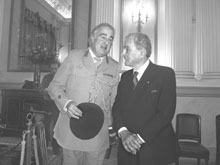
Patrick Leigh Fermor (right) with Colonel Mark Blatherwick, the British defense attache in Athens
The week that passed brought both joy and sorrow to those close to two British heroes who fought for Greece during World War II and whose love for the country never dimmed. The writer Sir Patrick Leigh Fermor, author of famous books such as “Mani” and “Roumeli,” “A Time of Gifts” and “Between Woods and Water,” even settled in Greece, near the Mani village of Kardamyli. This week President Karolos Papoulias bestowed upon him the Order of the Phoenix in the New Year honors for 2007. Ambassador Tassos Kriekoukis, director of protocol for the Foreign Ministry, spoke of “Sir Patrick’s love of writing and traveling but also for Greece, for whose freedom he fought at the side of Greek and British commandos. Who can forget his part in the kidnapping (in wartime Crete) of (German) General Kreipe?” Colonel Mark Blatherwick, the British Defense Attache in Athens, accompanied Sir Patrick Leigh Fermor to the event.
An old interview for our archive. First published in The Guardian Friday 2 March 2007 18.12 GMT
By Helena Smith in Athens
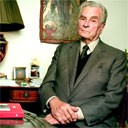
Patrick Leigh Fermor in 2005 - Photograph: Eamonn McCabe
In a rare public appearance, the revered travel writer Patrick Leigh Fermor has revealed that he is only now – aged 92 – learning to type, in order to finish the trilogy that has been at the centre of his writing life for more than 30 years.
Leigh Fermor usually avoids the spotlight these days, to concentrate on his work, but this week made an exception as Greece, his adopted home, awarded him its highest honour, Commander of the Order of the Phoenix
Leigh Fermor, widely acknowledged as Britain’s greatest living travel writer, was unexpectedly told of the award in a letter from the office of Greece’s president last month. “I have no idea why they are doing this but I am deeply honoured and moved,” he told the Guardian after receiving the medal at a lavish ceremony in Athens.
“I think they’ve enjoyed reading my books and heard I was an eager participant, who got in the thick of things during the war,” said the author, who is also known for pulling off one of the greatest coups in Nazi-occupied Europe, orchestrating the capture of General Kreipe, the military commander on Crete – a feat immortalised by the book and film Ill Met by Moonlight.
Friends say Leigh Fermor, who has chronicled Greece for more than 60 years, is these days acutely aware of the passage of time and put aside precious writing time to make the trip from his home in the Mani on the southern Peloponnese. When he was handed the prestigious Travel Writers’ Guild award in 2004, he dispatched his biographer Artemis Cooper to pick up the gong.
Since the second half of the 80s, he has being toiling to complete the third volume of a trilogy depicting his extraordinary journey on foot from Rotterdam to Istanbul at the age of 18.
His painstaking perfectionism means his output has not been prolific. He wrote the first volume of the trilogy, A Time of Gifts – widely considered his greatest work – nearly four decades after the odyssey in 1977. The second, Between the Woods and the Water, was released in 1986. Ever since, fans have been desperate to read the third.
Like many of his generation, the acclaimed soldier-scholar has always written in longhand – delivering his masterpieces to his publisher in great flourishes of scrawl. It’s a process that has been widely blamed for the long gestation periods.
But help is at hand. Paddy, as he is known to his friends, has finally decided that with his handwriting degenerating into unreadability, it is time to type. This year he invested in a 1951 Olivetti (“I wouldn’t get a computer,”) and is currently working his way around the machine’s keyboard, according to friends.
“I’m going to finish that book,” he said. “I’m going home and I’m going to work really hard.”
A 2007 interview with Paddy by Welt Online. The Germans have almost the same fascination for Paddy as we do. Afterall his first adventures took place in Germany (A Time of Gifts) and his part in the kidnap of General Kreipe has a particular fascination.
He also confirms that “Volume Three” is being written – translated by Google – Oh yes, “he says in the rich sunshine,” I will write this book. There is to end on Mount Athos. From there, I have notes for every day.
So here is the Google translated version. The original in German for the purists and the linguists is the next article below.
Stop Press! I have had an offer to translate this properly and when I receive it I will replace the trash from Google. In the meantime, my apologies and enjoy trying to make sense of it!
Resistance fighters, hikers, travel writer Patrick Leigh Fermor went to Istanbul as a young man, kidnapped in 1944 in Crete an army general and now lives in Mani. There he kept on the typewriter by Bruce Chatwin.
Since the sixties, the home of Patrick Leigh Fermor: the Mani peninsula in the Greek Peloponnese.
That there could be his house did not think you would have to climb into a closet or throw himself into a rabbit hole in order to achieve it – this idea comes with the darkness and returns, turned back into the Enchanted.
The way to Patrick Leigh Fermor, the Herodotus of the 20th century, leads, it seems, to the edge of the world and then one step beyond. The shimmering leaves of the olive grove, the giant lemon and the red, Greek past of heavy earth might as well be the props of a dream.
“Paddy” came first in 1952 by Mani
We keep a vigilant group of cypress trees and follow the overgrown path until a sky-blue gate. Do I need a spell, so it opens and appears Fermor, the travel writer, war hero, the legend? Knocking at least seems too little.
With 92 years, Patrick Leigh Fermor of immortality as close as it is today even comes close. His way of fame is just off the beaten track to have the world, behind firmly closed doors or in such places as the taciturn Mani.
Paddy, like not telling the familiar without reverence, came here in 1952 for the first time. How the Spartans and the Byzantines, who fled from Slavs and Turks, and of which he knows everything, he climbed the passes of the up to two and a half meters Taygetos, the Mani, the middle finger of the Peloponnesian hand, centuries made for a natural fortress.

Patrick Leigh Fermor in Berlin
The knocking does not answer
The back of the slopes wrinkly rich almost to the bay. Bruce Chatwin, who came to Paddy as a “guru to worship” or how to overthrow a king, saw eagles soar over the house of Leigh Fermor. Twenty years later, Paddy Chatwin ashes buried – next to a crumbling Byzantine church not far from here. The Mani is famous for its action songs.
Southward, on the faded, twinkling towers over the tiny villages, run, it means that a chasm into Hades. Leigh Fermor found it flooded. “Phosphorgefiedert,” he wrote, dip it into the cold depths and swim “through the heart as a huge sapphire.
We knock in vain to dare us to elaborate the cobbled courtyard and whisper with the housekeeper. It leads us through the garden open arcades, which might as well bend over a cloister.
Leigh Fermor is tattooed like a sailor
Leigh Fermor has written so many monasteries in Europe, in towers of “solid ivory, and if anyone here was an escapist, The doors to the rooms, however, the numerous tables, which depends on the sound of glasses and laughter as a smoke curtain, speak a different language.
Leigh Fermor speaks many. Photographs show it once hung over bursting with charm and zest for life, sometimes almost professorial, and again obviously as a sailor and tattooed.
We wait under the coffered ceiling of the spacious, wonderfully cluttered living room, from which the English poet John Betjeman once wrote that it was “one of the rooms of the world.” On one wall hang paintings by Nicolas Ghika and John Craxton, leaning on a shelf worn, faded volumes of the great English stylist. On the floor there is a band “Sherlock Holmes”. “Enchanting easy, right?”
The family left behind her son with strangers
This could be Merlin: a jumble the gray, wavy hair, sharp features and eons of age in the eyes. Leigh Fermor carries the threadbare sweater a garret of scholars and the trousers of an artist in his studio.
He is of overwhelming kindness, perfectly shaped “upper class”. In the sunlit bay he called almost everyone who comes to the question, “marvelous”: writers, painters, musicians. “They all knew.” – “I am,” he says mildly, “that old.”
“For at least one of us children would remain alive, if a submarine sank the ship,” Paddy was in the care of a small family back in England.
1933 – the first trip to Istanbul
“I ran,” he says, “shouting and screaming across the yard. I never learned discipline. I was a difficult student. “-” Lazy? “-” Disobedience. “Even a psychiatrist who also treated Virginia Woolf was consulted. Paddy still flew from the school. He had kept up with the daughter of the greengrocer’s hands.
The autumn of 1933 found him in a room not far from trouble blowing from London’s Shepherd Market, where he should have been cramming so that at least the military school would take him.
Instead, he took a verse of George Herbert at his word: My way is free, free to the horizon, / Much like the wind. “In December 1933 he embarked for Holland. From there, he wanted to walk into a “green dragon”, Byzantium, which he never called Istanbul.
On the trip report, the fans are waiting until today
He is famous for getting lost in the widely spread European history, which he knows like no other. In Mani, one of his best books, the “opposite of a travel guide,” as he says, there is a footnote, the sheer joy of the strangest here, “and there crafty peoples’ lists of Greece: the Melevi Dervishes of” Tower the winds “, the fire dancers from Mavroleki, the hiking quack Eurytaniens. With the gypsies, whom he met in 1934 in the highlands of the Carpathians, said Patrick Leigh Fermor Latin.
Paddy arrived on New Year’s Day of 1935 in Constantinople, and had better things to do than to write about his trip. He is one of the great English stylists working, slowly, life itself seems always in your way.
It was not until 1977 “was published, the time of the gifts,” which describes his journey from Hoek van Holland to the middle Danube, nine long years later, “between forests and water”, which leads to the Iron Gate. The third book, the description of the phenomenon must last up to Constantinople, is still expected with such longing that leave a few words from the mouth of Paddy’s heave a sigh British press today.
Where Chatwin’s old typewriter?
When Sir Patrick, as he was allowed to call since 2004, was awarded in March in Athens the “Order of the Phoenix,” he told his casual way that he, because his handwriting was always bad, just learn to touch type.
Oh yes, “he says in the rich sunshine,” I will write this book. There is to end on Mount Athos. From there, I have notes for every day. “We are walking through the garden, the Gulf of Messinia in a dozen colors of light blue. On the burnt grass stretches herself a hangover: “His great-grandmother one day was just there.”
The studio is housed in an outbuilding. In an iron chest, which bears the inscription of “Traveller’s Club” that tape, books are stacked on the wall a faded French hunting scene. Somewhere there must be also Chatwin old typewriter, a 51er Olivetti. But where? Where?
Soldier, he was happy because “was always something going on”
On Mount Athos celebrated his 20th Birthday, then went to Athens, as he later went to Paris and Rome. With a Romanian princess, he lived in an old water mill in the Peloponnese, and followed her to finally Balení, the seat of her family in northern Romania.
Russia and the horrors of communism were suddenly within reach. “Many of your friends were communists at that time.” – “I did not speak up,” he says. “ “I was so apolitical.”
In Balení reached him of the war. He, which six years earlier at the Shepherd Market has become clear, “how little I was good for soldiers in peace time,” volunteered. The departure was hasty. “Not even my notebook I took with me. We were so naive. In a few months ago we believed us again. “It took decades. “Were you like a soldier?” – “In a way, yes. “ There was always something going on. ”
In 1944, he kidnapped a German general
Books are also in the bathroom and somewhere between them is a plaque commemorating the Battle of Crete. When she was lost, went back Leigh Fermor as major of the Special Operations Executive to Crete. One and a half years he lived disguised as a shepherd in a cave – “wrapped in white cloth from goat and horribly dirty” – and organized the Cretan resistance against the German occupiers.
The rest is legend, one of the most daring commando raid of the Second World War. One night in April 1944, a large Opel on the road to Knossos, Paddy in a stolen German uniforms on the way. A scuffle and then, at the roadblocks, again and again the cry of “General car.
For days wandered Leigh Fermor, the people and kidnapped the German General Kreipe through the mountains until they reached the coast, and finally Libya (Egypt). On the difficult journey Kreipe murmurs once verses of Horace. Leigh Fermor is one. „Ach so, Herr Major“,
About the death, he never speaks
Paddy has never really written about it. “Ill Met by Moonlight,” the book that tells this story in full, comes from Bill Stanley Moss, his former deputy, and was filmed with Dirk Bogarde as Leigh Fermor.
When it first appeared in 1950, just came Paddy’s first book, “The Traveller’s Tree,” a description of his travels in the Caribbean out. DThen he was – in the UK, famous in Greece “He embodied an idea of the Renaissance,” writes Cooper, Artemis, “a man of action, which is just as much a scholar.”
Cooper, the friend and daughter of a friend is writing Paddy’s biography, when he, as he says, “is just gone.” “But now that you mention it: We never really talk about it.”
The stones for the house came with the donkey
For lunch there are lemon chicken, tzatziki and Retsina. We sit on chairs Andalusian, a Venetian table at the foot of a guillotined by the passage of time Roman Sibyl. Leigh Fermor has picked up in Rome on the way, he collects nothing.
He tells the story of Niko Kolokotronis, the Mauerermeister that the contract was to build his house, because six generations were Kolokotronis wall masters, and played all the violin. That was the beginning of the sixties. In the bay there was no electricity, donkeys brought the stones, and Paddy and his wife Joan were living in tents, until the house was finally finished.
“I scribble in the studio in front of me,” reads a letter from the most beautiful, vibrant with life days in the bay.”Through the window I can see Joan, their army cats invites you to dinner; mass meows to rise, and their tails make waves like the sea.”
A picture of his wife Joan (cats) in her hand
Leigh Fermor demands a picture of the mantel, Joan in the forties, which he portrayed with a pencil. “Come on!” She called from a boat, as Paddy, like his hero, Lord Byron swam the Hellespont. “It took three hours.”
Joan died in June 2003 here.”She was,” he says, his drawing in hand, “in truth much more beautiful.
Original article here.
Widerstandskämpfer, Wanderer, Reiseschriftsteller: Patrick Leigh Fermor ging als junger Mann nach Istanbul, entführte 1944 auf Kreta einen Wehrmachtsgeneral und lebt heute auf Mani. Dort bewahrt er die Schreibmaschine von Bruce Chatwin auf.
Dass es sein Haus gar nicht geben könnte, dass man in einen Schrank steigen oder sich in einen Kaninchenbau stürzen müsste, um es zu erreichen – dieser Gedanke kommt mit der felszerklüfteten Dunkelheit und kehrt tags, ins Verwunschene gewendet, zurück.
Der Weg zu Patrick Leigh Fermor, dem Herodot des 20.Jahrhunderts, führt, scheint’s, an den Rand der Welt und dann noch einen Schritt darüber hinaus. Die flirrenden Blätter des Olivenhains, die riesenhaften Zitronen und die rote, von Vergangenheit schwere griechische Erde könnten ebenso gut die Requisiten eines Traums sein.
“Paddy” kam erstmals 1952 nach Mani
Wir halten auf eine Gruppe wachsamer Zypressen zu und folgen dem zugewachsenen Pfad bis vor eine himmelblaue Pforte. Braucht es einen Zauberspruch, damit sie sich öffnet und Fermor, der Reiseschriftsteller, der Kriegsheld, die Legende erscheint? Klopfen jedenfalls scheint zuwenig.
Mit 92 Jahren ist Patrick Leigh Fermor der Unsterblichkeit so nahe, wie man ihr heute noch nahe kommt. Seine Art Ruhm ist nur abseits des Weltenrummels zu haben, hinter fest verschlossenen Türen oder an so verschwiegenen Orten wie der Mani.
Paddy, wie die Vertrauten nicht ohne Ehrfurcht sagen, kam 1952 zum ersten Mal her. Wie die Spartaner und Byzantiner, die vor Slawen und Osmanen flohen und von denen er alles weiß, erklomm er die Pässe des bis zu zweieinhalbtausend Meter hohen Taygetos, der die Mani, den Mittelfinger der peloponnesischen Hand, Jahrhunderte lang zu einer natürlichen Festung machte.
A personal tribute to PLF from a fan. A song about Paddy’s long walk to Constantinople in “A Time of Gifts” and “Between the Woods and the Water”.
A review of Words of Mercury by Patrick Leigh Fermor, ed Artemis Cooper first published in the Independent
Sunday, 2 November 2003
The overwhelming impression this book left on me was of a lost world of aesthetic public schoolboys, powerful newspaper editors, friendly ambassadors, and an unspoken understanding of what it meant to be upper- middle-class and English. What it meant was easy access to embassies and aristocratic houses around Europe, bicycle polo in Hungary, and the possibility that the next shepherd you met would be an Etonian Special Operations officer, speaking classical Greek. Here you will find the term “middle class” applied in a pejorative sense, rather than in the current usage which has such a wide catchment. That John Murray, the publishers of this book and upper-middle-class publishers par excellence, are no longer family-owned, perhaps confirms that this world has passed. And with it a love of language and literary decoration.
To quote Jan Morris, Paddy Leigh Fermor is beyond doubt the greatest of living travel writers, although the term “travel writing” barely does justice to the beauty, the lustrousness and sensuality of his writing. Take this, for example, speaking of how Greek temples once looked before they were stark ruins: “But the reality of the ruins, re-cohering in cobalt and blood-red, studded with metal, gaudy with idols, shiny with spilt honey and blood and reeking with sacrificial smoke, will have replaced the tinted ivory artefacts that had stolen their place and the void between the cutting of the flutes on the columns and the laying of the tramlines begins to fill up with people and events.”
There are about 40 short pieces divided into headings: Travels, Greece, People, Books and Flotsam. Many of these pieces are from Leigh Fermor’s great books, Mani, Roumeli and A Time of Gifts. (In 55 years he has only written eight books.) Others are from scattered newspaper pieces and obituaries. All the major phases of his life are represented here: the wandering schoolboy heading for Istanbul, the two years just before the war he spent in Romania with a doomed aristocratic family after meeting the daughter of the family in Athens (the woman Artemis Cooper describes as the love of his life), the extraordinary exploits in war-time Special Operations in Crete, where he captured the German General, Heinrich Kreipe, and his post-war exploration of Greece, particularly Mani where he has lived for 40 years in a house he built with his wife Joan, who died recently. Their story will be told by Artemis Cooper in a biography to be published after his death.
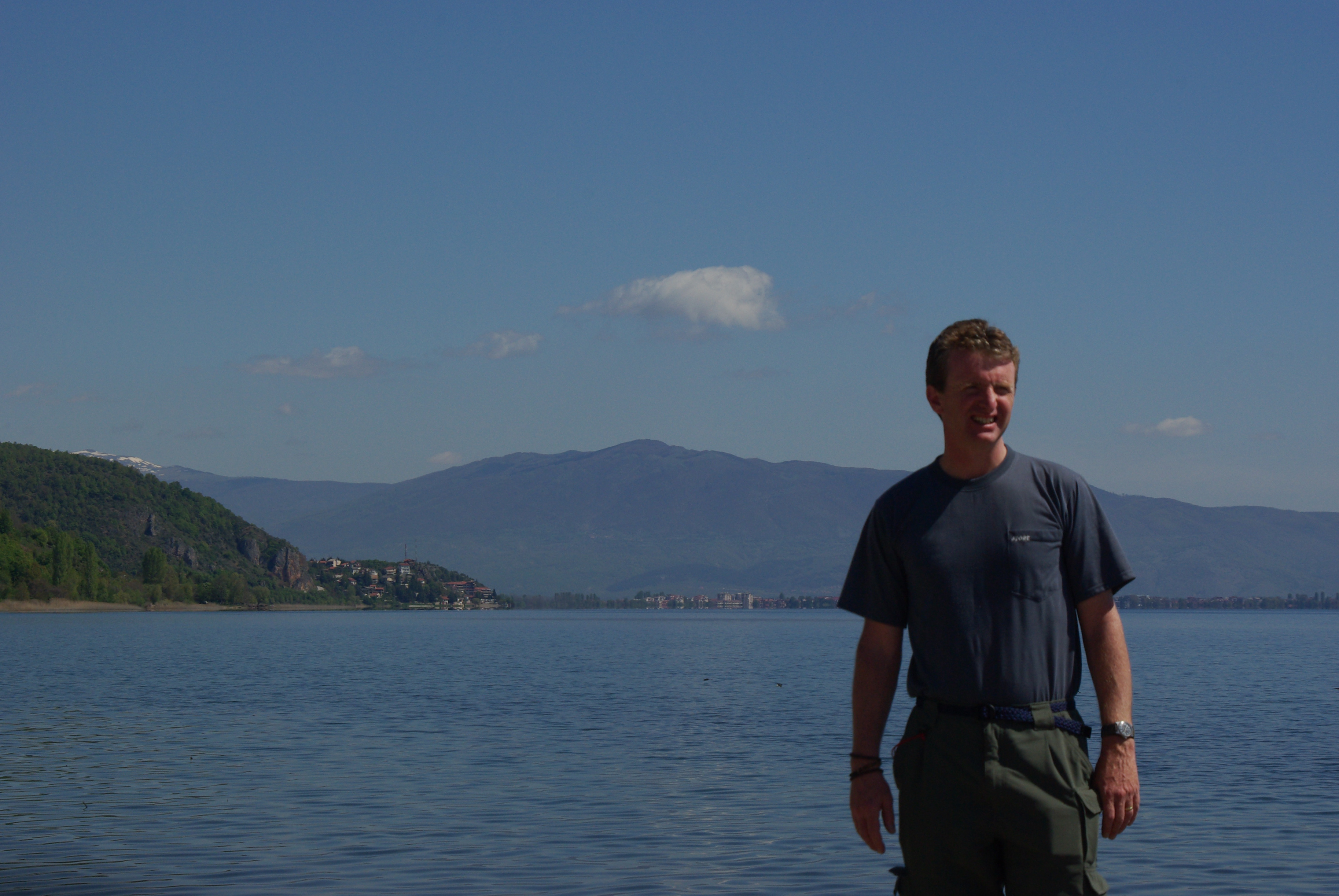
Tom at Lake Ohrid on the Via Egnatia, 2009
My name is Tom Sawford and I live in Winchester, Hampshire, England.
I first became aware of Paddy quite late in life; I guess he is an acquired taste. Maybe you need to have some awareness of the broad range of subject matter that he can, often without warning, cover in his books. Perhaps it is only after formal education, reading widely, developing a broad appreciation for history, and just plain living that you have the ability to grasp some of what he is getting at. A strongly developed vocabulary is also a boon; or at least a dictionary and of course now with access to Google it is possible to quickly research some of the more obscure topics that Paddy assumes mere mortals will be aware of. I remember the first time I read A Time of Gifts and being amused that Paddy clearly expected his readers to have at least a schoolboy/girl grasp of Latin as phrases pour out with no explanation or translation.
But surely that is the attraction of his work. It aims for the highest pinnacles of linguistic and intellectual endeavour and if you like what you read it drags you along with it, drinking from the cup of knowledge that Paddy offers.
He is of course so much more than a writer. It has been said that he is the ‘greatest English travel writer’. I don’t agree with that. I believe he travels to write, having so much more to say than to merely discuss the merits of one hotel over another or the quality of food in Greek fishing villages. In my view he was the “Greatest Living Englishman”. Not that we don’t have other great Englishman (but perhaps less than we once had), but more than that he is that unique person who personifies what was once the mark of an Englishman; educated; heroic, handsome, generous; and modest (to a degree).
Sir Patrick Michael Leigh Fermor DSO OBE lived a full life, and had experiences that few others will likely ever have again. He had lived a pretty full life before the second world war, even living with a Romanian princess who was older than he, and during that conflict he applied his skills to fighting behind German lines, and was unique in achieving the capture, with “Billy” Moss, of the German Garrison Commander of Crete, Major General Kriepe. After the war he travelled, wrote, married, developed long-lasting friendships, and built a house in Greece. My epithet stands because few can match what he has done and also the manner in which he did it.
The purpose of this blog is to bring the life and work of Paddy, and his many colleagues, to the attention of a wider audience, and to create an archive of on-line material. He, and they, deserve to be recognised and remembered in a world that has changed much during their lives, but would be the poorer without them.
If you would like to help with the blog, make a contribution or anything else, please contact me tsawford[at]btinternet.com.
Tom Sawford
April 2010
After what must have seemed an amazing four months to a young man of eighteen, Paddy arrives at the Czechoslovak-Hungarian border at Esztergom, which as he says (p 276 A Time of Gifts) contained ‘the Metropolitan Cathedral of all Hungary’. It is these last closing pages of his first volume that he describes the colourful preparations for an Easter service as he watches from no-man’s land in the middle of the bridge spanning the Danube. It is from this point that he picks up the story in volume two ‘Between the Woods an the Water’.
Wikipedia tells us: Esztergom (Hungarian pronunciation: [ˈɛstɛrɡom], also known by alternative names), is a city in northern Hungary, about 50 km north-west of the capital Budapest. It lies in Komárom-Esztergom county, on the right bank of the river Danube, which forms the border with Slovakia there.
Esztergom was the capital of Hungary from the 10th till the mid-13th century when King Béla IV of Hungary moved the royal seat to Buda.
Esztergom is the seat of the prímás (see Primate) of the Roman Catholic Church in Hungary. It’s also the official seat of the Constitutional Court of Hungary. The city has the Keresztény Múzeum, the largest ecclesiastical collection in Hungary. Its cathedral, Esztergom Basilica is the largest church in Hungary.
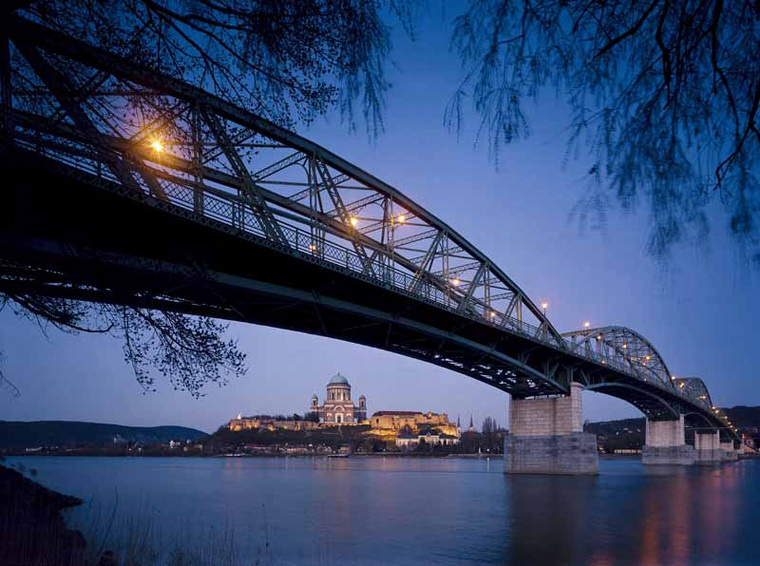
Imagine Paddy standing in the middle of this bridge looking at the cathedral
 Patrick Leigh Fermor