Where in the world have you come across Patrick Leigh Fermor?

Between the Woods and the Water

I have just returned from Montenegro where I had a holiday with my family. It is a place that is not at the top of the list for most people I guess, but it does attract many Serbians and Russians, particularly to its spectacular coast.

We were attracted because it was different, has spectacular scenery dominated by huge mountains, is relatively unknown, and it also enabled us to visit some very famous Serbian Orthodox monasteries as my wife and I are also very interested in Byzantium and its art (see MyByzantine blog).

On our first night, as I casually flicked through the books left in our villa by the owner and previous visitors, I was surprised to come across a paperback copy of Between the Woods and the Water. It had been read and was in good condition. This gave me the excuse to encourage Kim to read it as she happened to be coming to the end of A Time of Gifts which she was enjoying.

It made me think that many of you who read the blog may have come across Paddy’s work in unusual circumstances, and in faraway places. It would be interesting to hear more; why not paste a comment below or email me (tsawford[at]btinternet.com)? Let’s see who has the most interesting tale to tell!

On the Same Steps as Patrick Leigh Fermor

On the same steps as Paddy

“In the heart of them stood a massive building; my objective, the Hofbräuhaus. A heavy arched door was pouring a raucous and lurching party of Brownshirts onto the trampled snow.

I was back in beer territory. Halfway up the vaulted stairs a groaning Brownshirt, propped against the wall on a swastika’d arm, was unloosing, in a stanchless gush down the steps, the intake of hours. Love’s labour lost.”

Those of you well versed in Paddy’s writing will by now have realised that the above is not my own feeble prose but an excerpt from the passage in A Time of Gifts when Paddy enters Munich’s Hofbräuhaus in January 1934.

When I entered that vast temple to beer, sausage and sauerkraut at the end of June, I instantly felt like I had been there before, and indeed I had when I read Paddy’s finest work. Instantly I wanted to visit the chamber bursting with SA men singing Lore, lore, lore, and overweight young German burghers ‘as wide as casks ’ who were ‘… nimbly, packing in forkload on forkload of ham, salami, frankfurter, krenwurst, and blutwurst’ lifting stone tankards ‘for long swallows of liquid which sprang out again instantaneously on cheek and brow.’ Had it not been for the fact that this was midday instead of night I am sure I would have found it barely changed, save for the SA men, whose children and grandchildren (all aged now) have taken up residency.

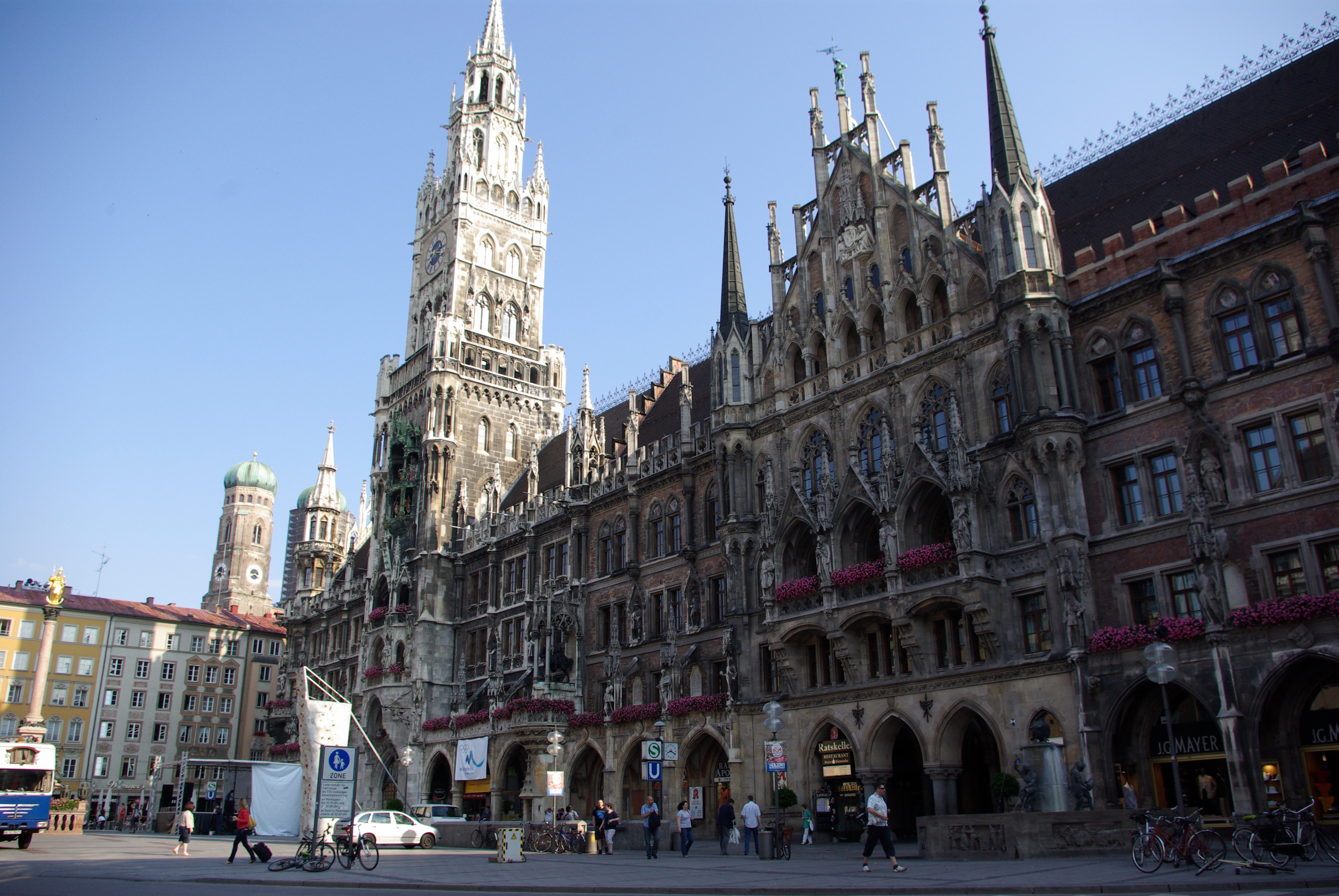
The Rathaus Munich

My wife and I were in Munich after taking the overnight sleeper from Paris Est to Munich on our journey to see the Passion Play (Passionspiele) at Oberammergau. We had arrived at the relatively ungodly hour of seven o’clock in the morning and had seen Munich come to life on a Saturday morning.

At the time the Alt Stadt was almost exclusively ours apart from some stall holders preparing their wares of ripe and juicy, brightly coloured fruit and vegetables for the Saturday market; two young men demonstrating their ability on MX bikes beside a fountain; and a couple of drunks who had obviously made the most of the warm Friday evening and had now belatedly discovered that the party was over.

During the war Munich was severely bombed by the Americans. When on a NATO course at the German Pioneerschule in the 1980’s I remember a particularly loud American officer asking in all seriousness, whilst we were on a tour of the city, when seeing the massive towers and basilica of the Dom, “How the hell did we miss that?”. Well, of course they did not miss it. Seventy per cent of Munich was destroyed by the bombing and after the war there was a serious proposal to abandon the city and rebuild nearby. Fortunately for the Hofbräuhaus (which sustained minor damage) and for us it was decided to rebuild the city. Many of the older buildings, as with so many German cities, were painstakingly restored. The Dom and the Hofbräuhaus were amongst these.

Following a morning of strolling around the centre, visiting some of the sights, drinking känchen’s of schokolade and eating cinnamon flavoured kuchen I was desperate to find the Hofbräuhaus. I was determined not to make the same mistake as Paddy and end up two miles away; although the prospect of doing so and having a couple of himbergeist to see us on our way was not so unappealing!

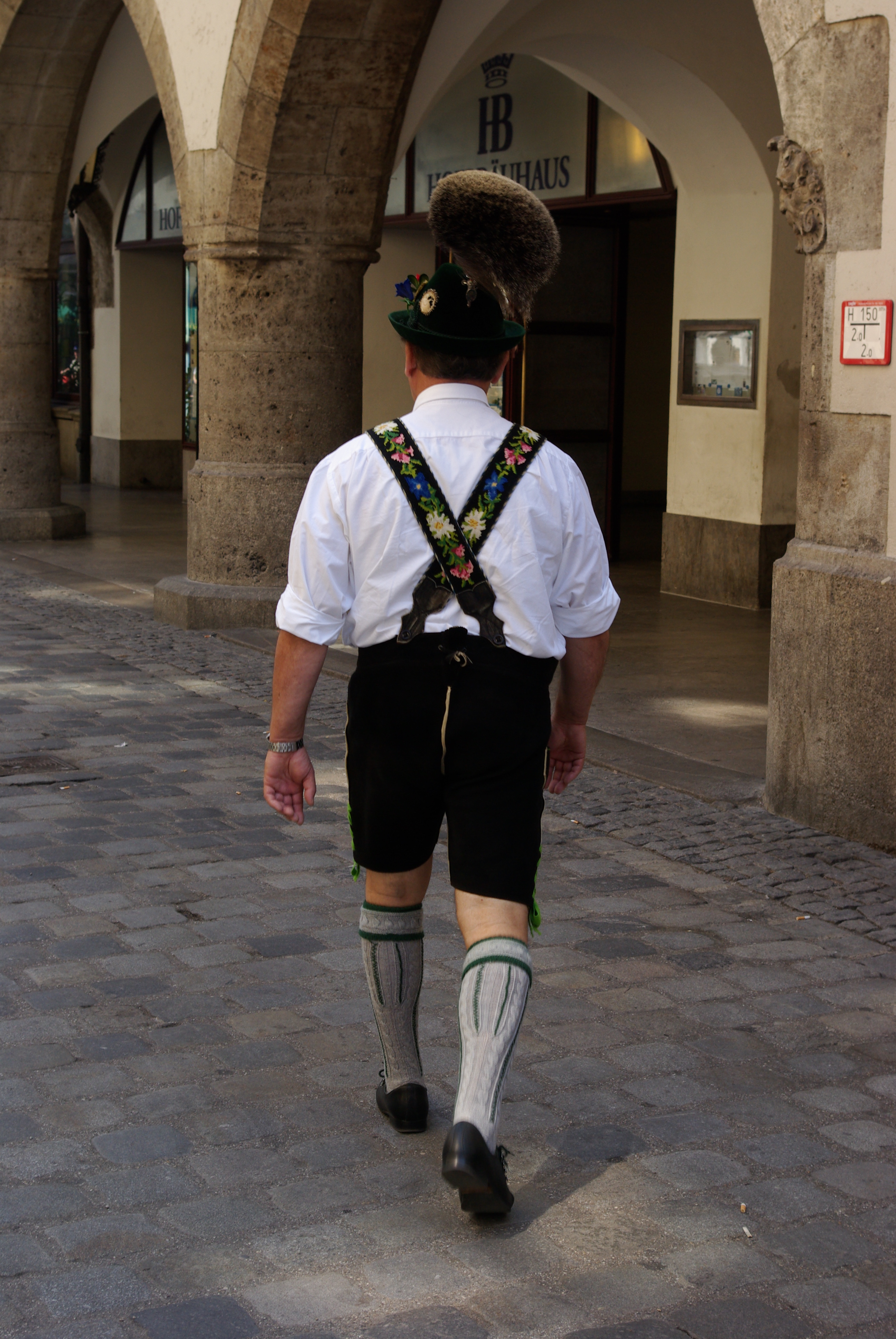
We followed a lederhosen clad gentleman ...

Inadvertently we had somehow attached ourselves to an American tour party and listened patiently whilst the bored German tour guide briefed them all on practical logistics like not entering their PIN number more than twice in those mysterious German cash machines, and what they might see on their one hour of ‘freedom from the group’ until it was time to meet up again, climb into their coach and visit yet another city. When it came to question time I asked where I might find the Hofbräuhaus. The guide looked quizzically at me, thinking I must have some obscure mid-western American accent and told me in all seriousness that eleven o’clock in the morning was rather too early to make such a visit and drink beer. I persisted and reluctantly she gave me the directions.

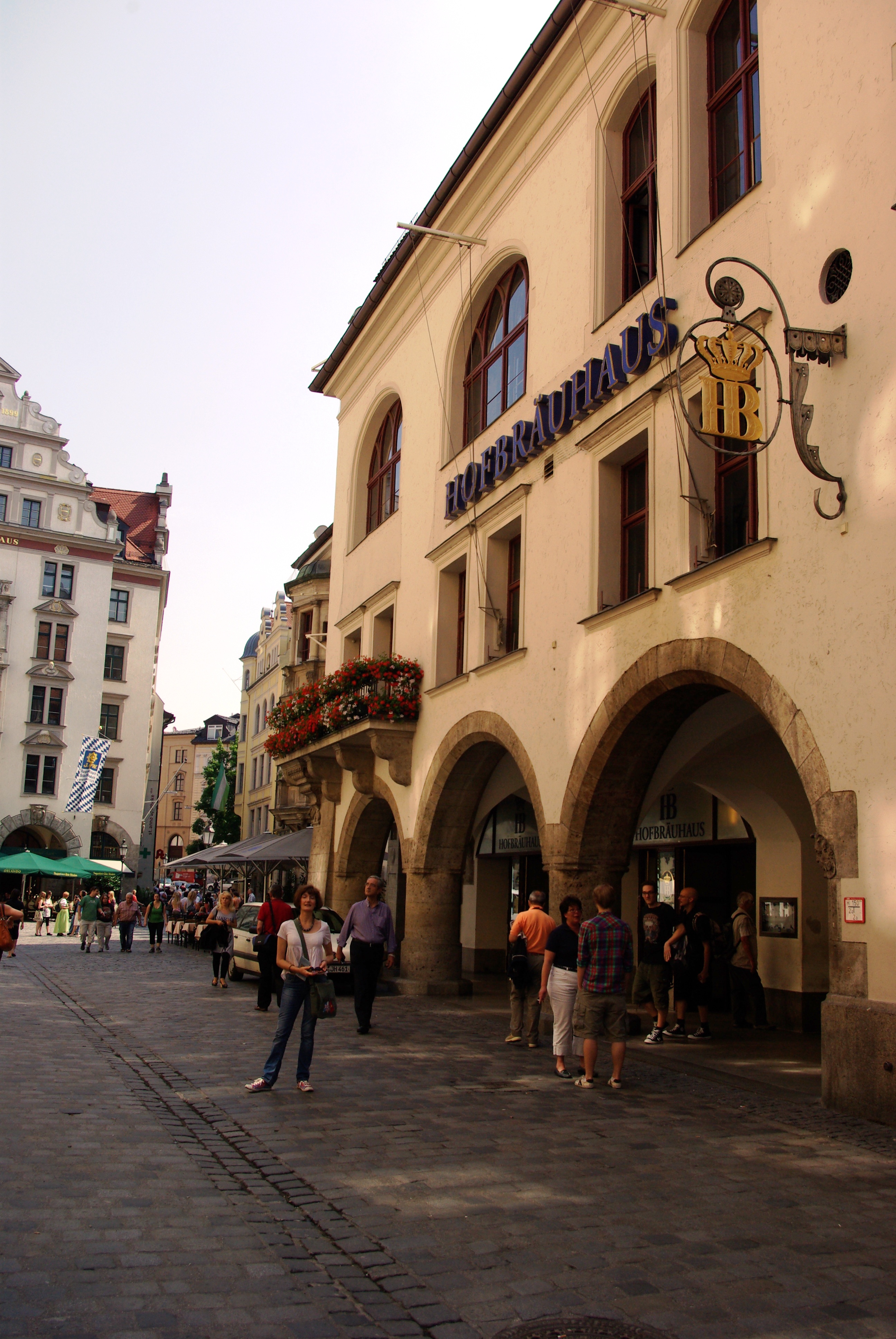
Hofbrauhaus exterior

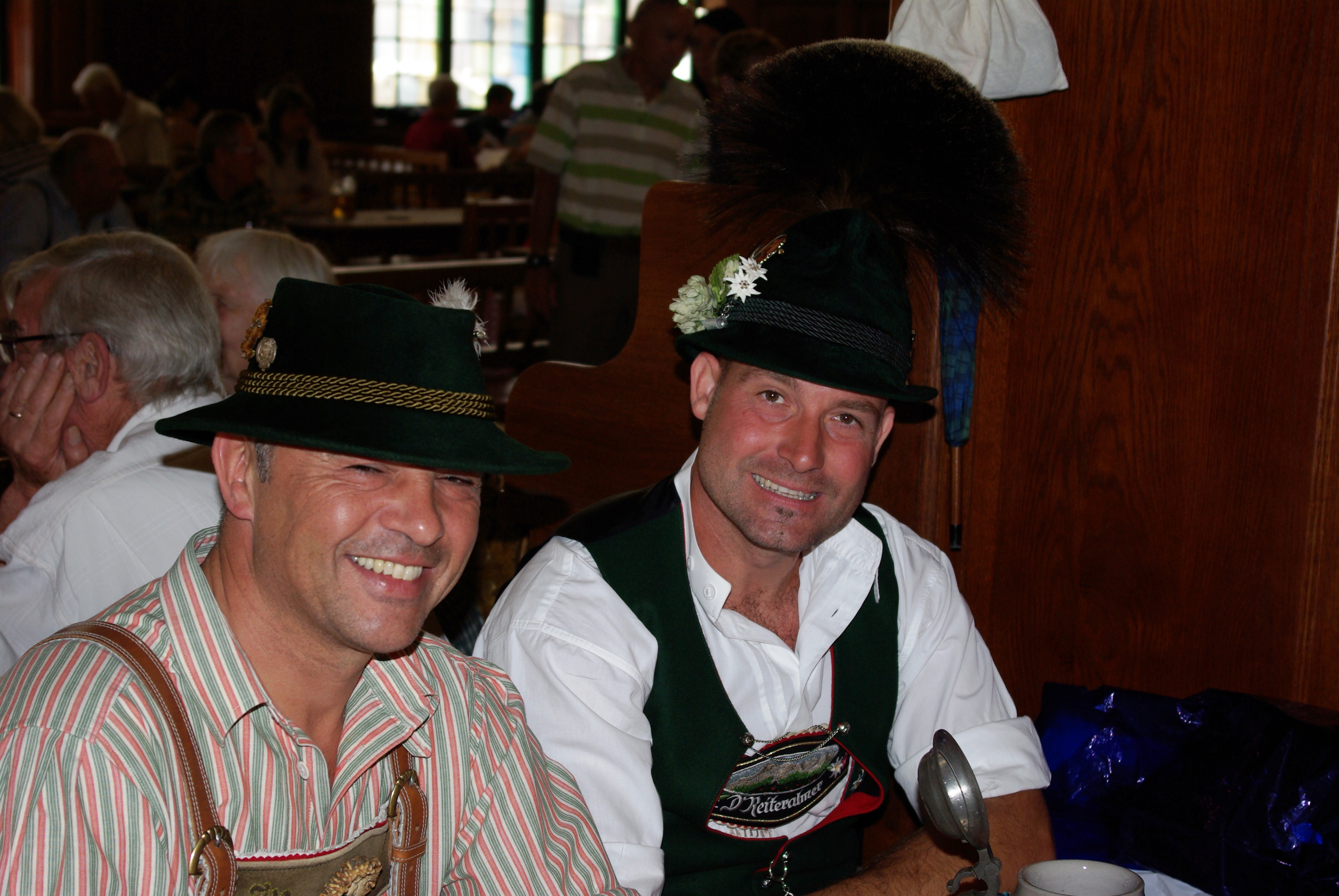
We walked in the sunshine past the old schloss and down a lane to the ‘slanting piazza’ but I do not recall the Virgin on a column presiding over all she surveyed. We followed a lederhosen clad gentleman wearing a traditional Bavarian felt hat which was adorned by the most amazing plume, reminding me of something that may have been worn by a Roman first spear centurion to enable his men to identify him in the midst of battle.

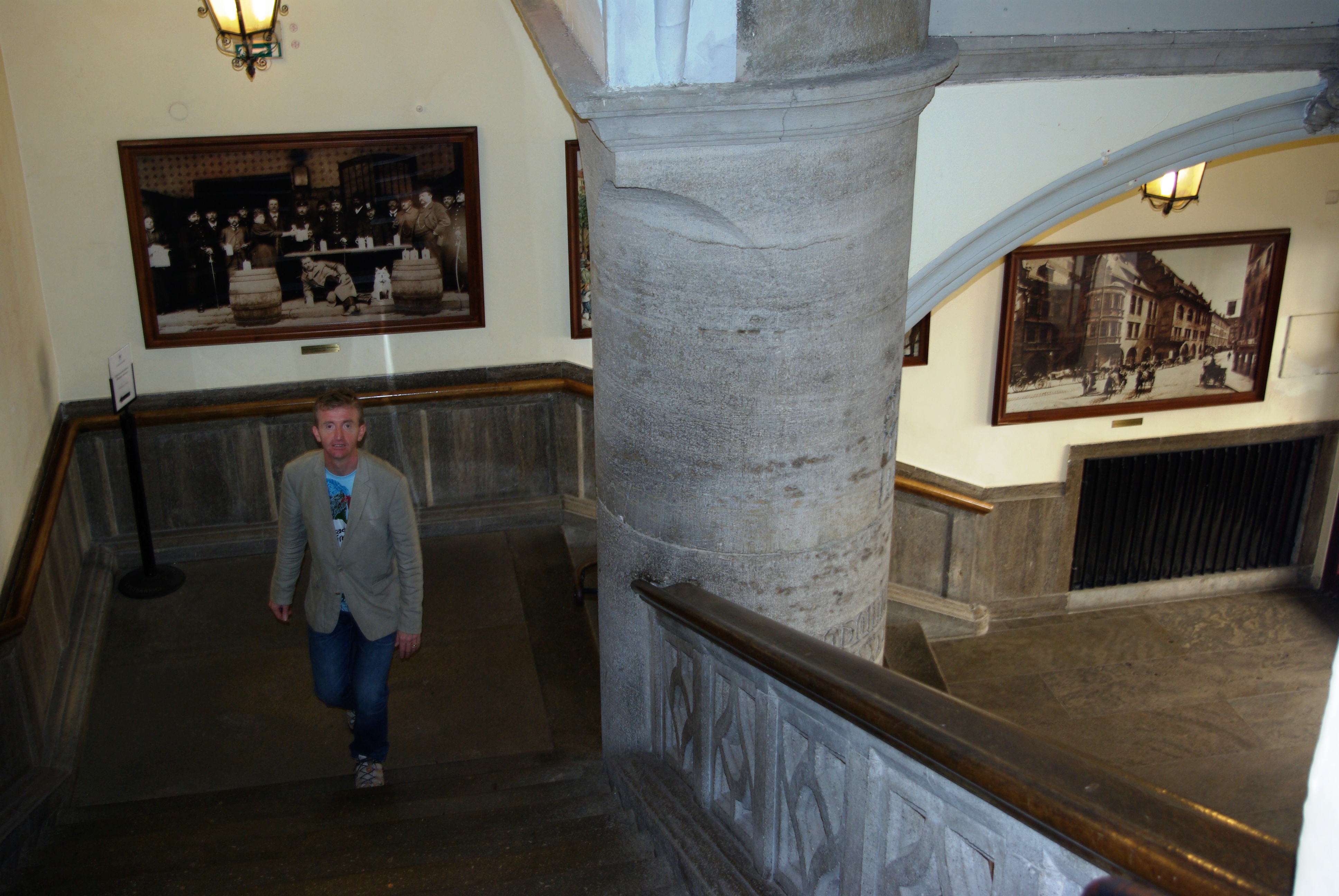
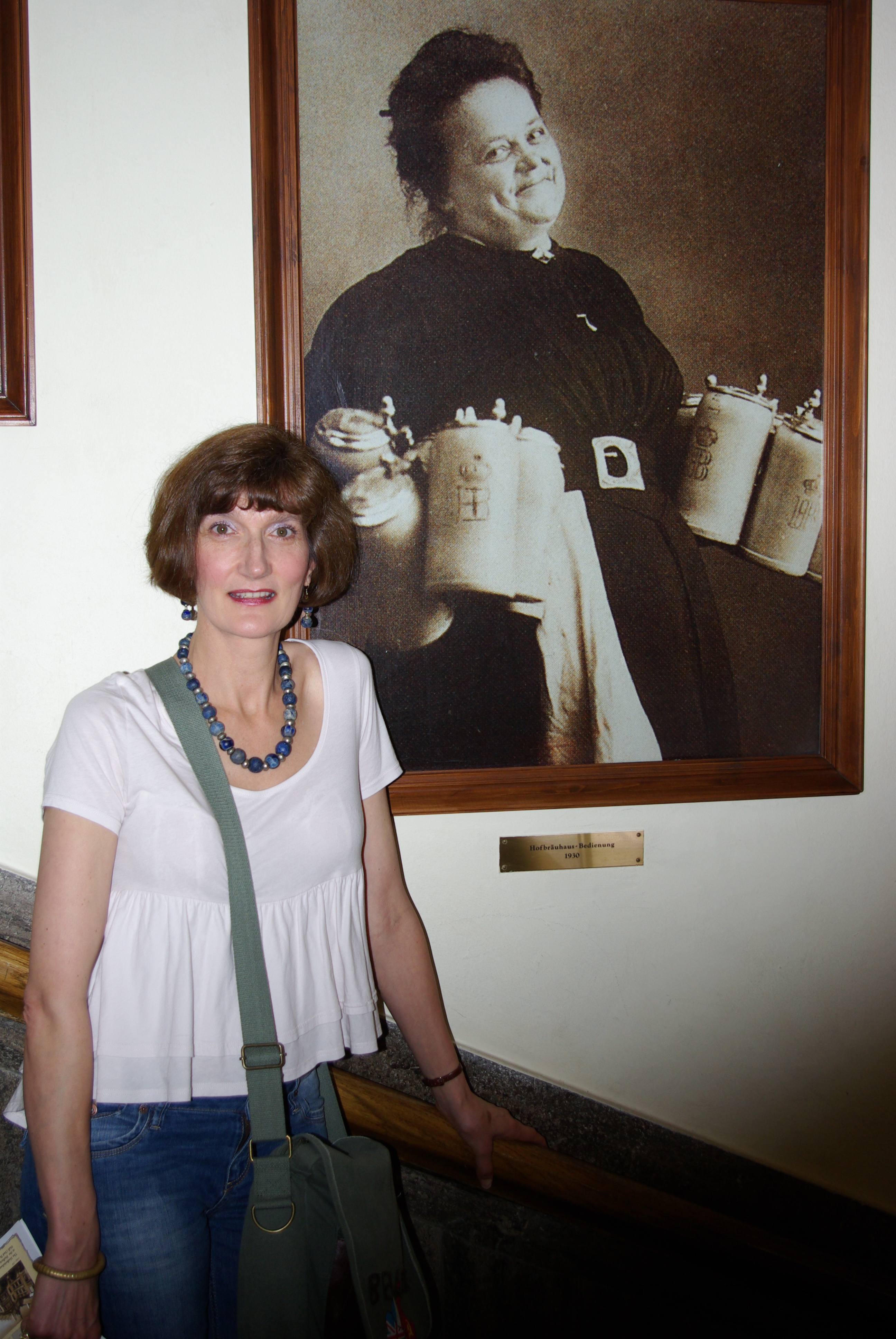
There before us was our goal. Gothic and grand just as Paddy described it, we entered through wide doors underneath Gothic arches and walked up those vaulted stairs which survived the damage of the war. It was here in January 1934 that Paddy encountered his Brownshirt. The steps are now lined with photographs, one of a maternal looking frau holding eight heavy steins full of the cool, golden Hofbräuhaus beer. Perhaps she had served Paddy on that famous, alcohol fuelled night?

Kim considers joining the waitressing team

The Hofbräuhaus has four floors devoted to the adoration of beer, sausage and pretzels. We visited each one. They were all decorated in a different style with a large communal drinking hall, and a number of smaller private function rooms (which are for hire). It is one of these higher floors that Paddy stumbled into when full of SS officers, Gruppen and Sturmbannfuhrers, black from their lightening-flash-collars to the forest of tall boots underneath the table.

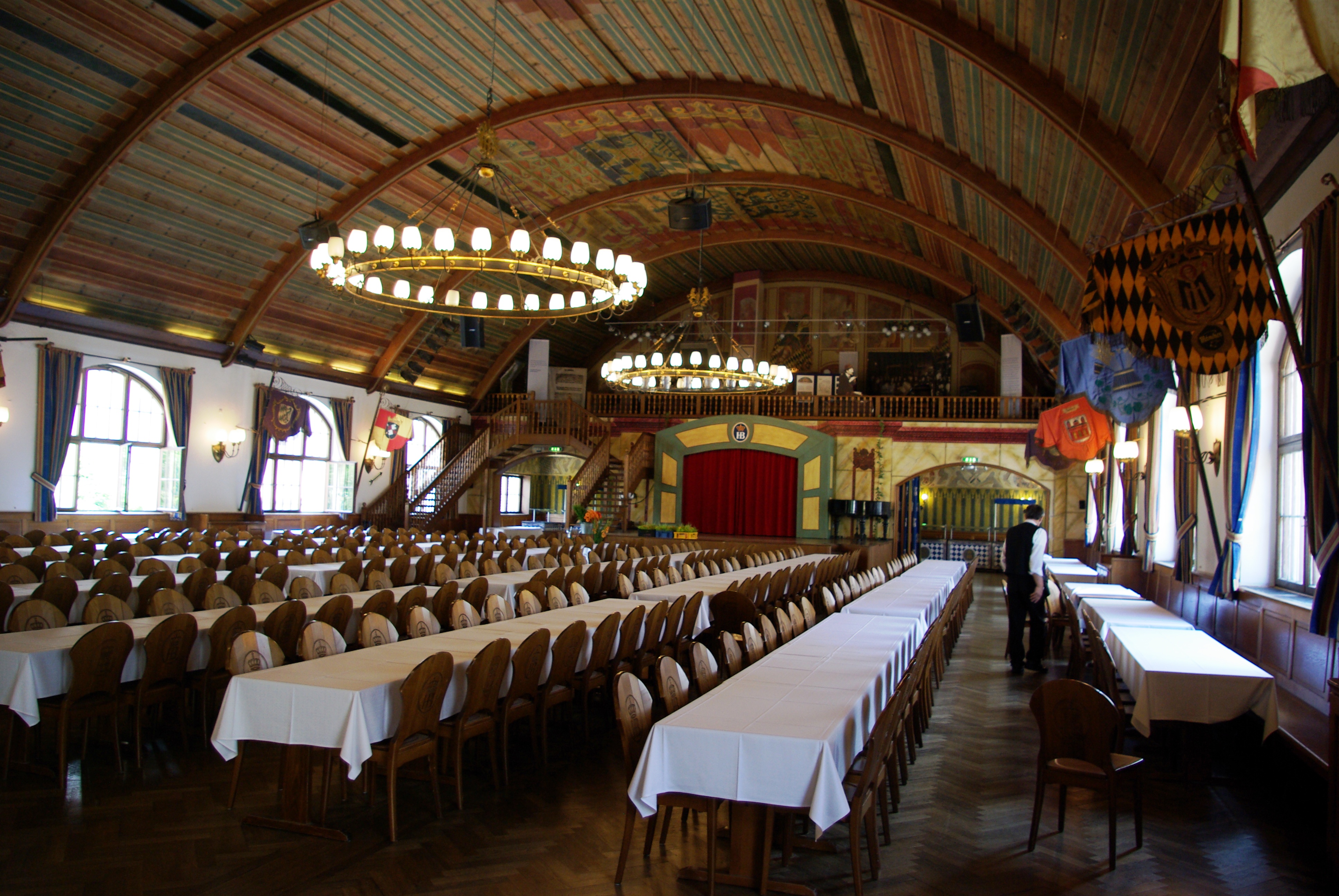
The highest floor is dominated by a large parquet floored room with a vaulted ceiling colourfully decorated with its predominantly pink and blue frescos of Bavarian coats of arms. The Festival Hall was built in 1589. It is light and airy with windows on each side, large chandeliers and dominated by a small stage with heavy, theatrically red velvet curtains. The Hall can seat over 900 on its long tables arrayed in neat rows before the stage, and gives the impression of being eternally ready for a party. Indeed on the occasion of our visit, it was being prepared for the post- Abitur celebration for a very lucky young girl. The mood darkens somewhat when you know that it was in this very room, standing on that very stage that the ambitious politician Adolf Hitler addressed his followers in the early days of the National Socialist Party in the late 1920’s and early 1930’s.

Hofbrauhaus Festival Hall

Given the passage of time this ceased to have any sinister effect, but it is a sobering thought and brought to life a period of history, and its aftermath, that has come to dominate my generation, and certainly those preceding us.

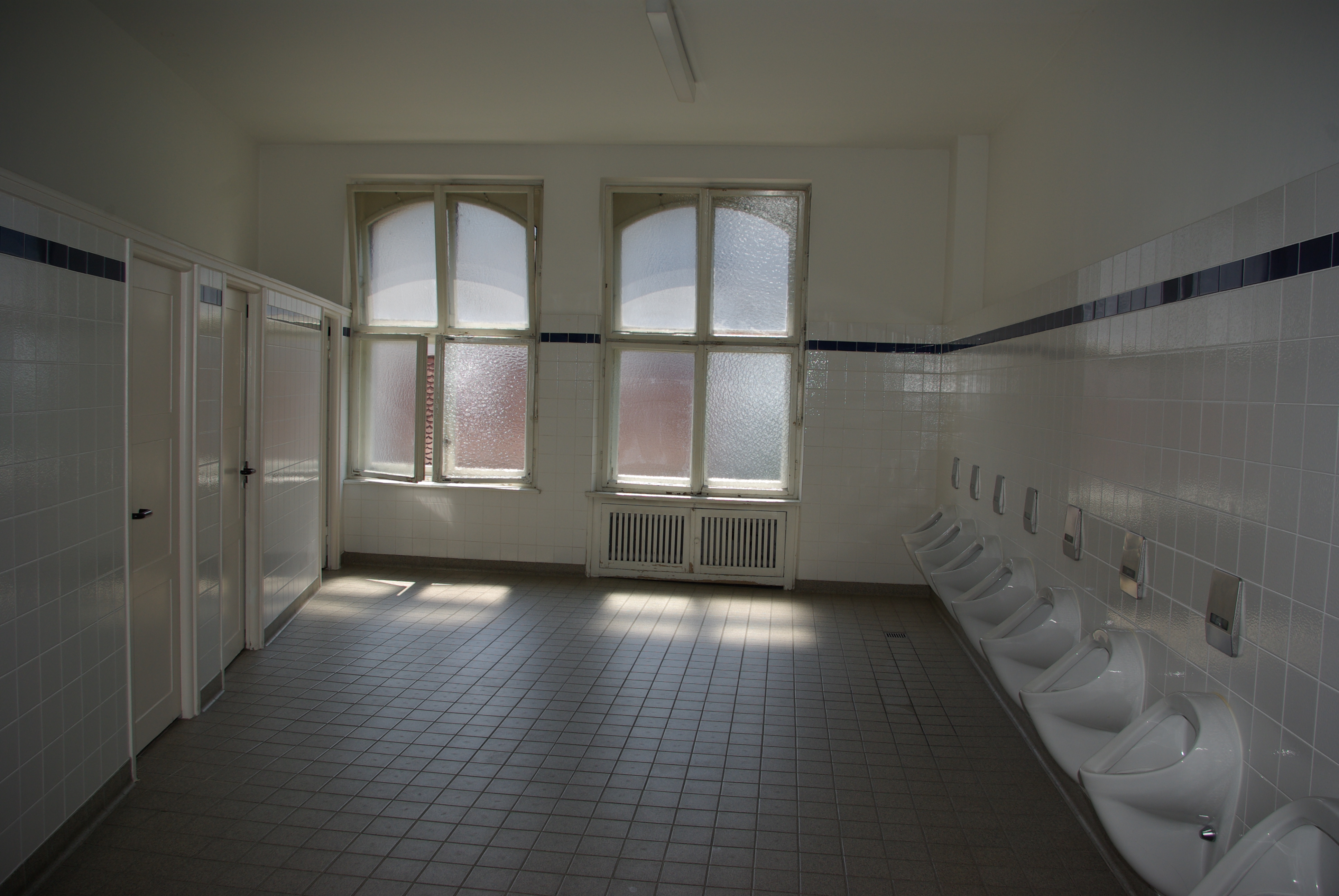
Did Adolf visit here?

It was about this time that I needed to answer the call of nature. Kim and I were virtually alone and I sought out a gentleman’s lavatory. Finding one at the end of a corridor leading from this function room, I hypothesised that perhaps Hitler had, on more than one occasion, made this same trip, perhaps accompanied by colleagues such as Herman Goering, and discussed the finer points of how to grab political power, and achieve revenge on all those who had sought to so humiliate Germany via the Treaty of Versailles.

Like Paddy we were now guided right down to the bottom of the stairs, out of the doors and back in another, larger door on the ground floor. After passing the obligatory ‘Hofbräuhaus shopping experience’ we entered a new hall where the vaults of the great chamber did not fade into infinity through blue strata of smoke as this was, unbelievably, 21st century smoke-free Germany.

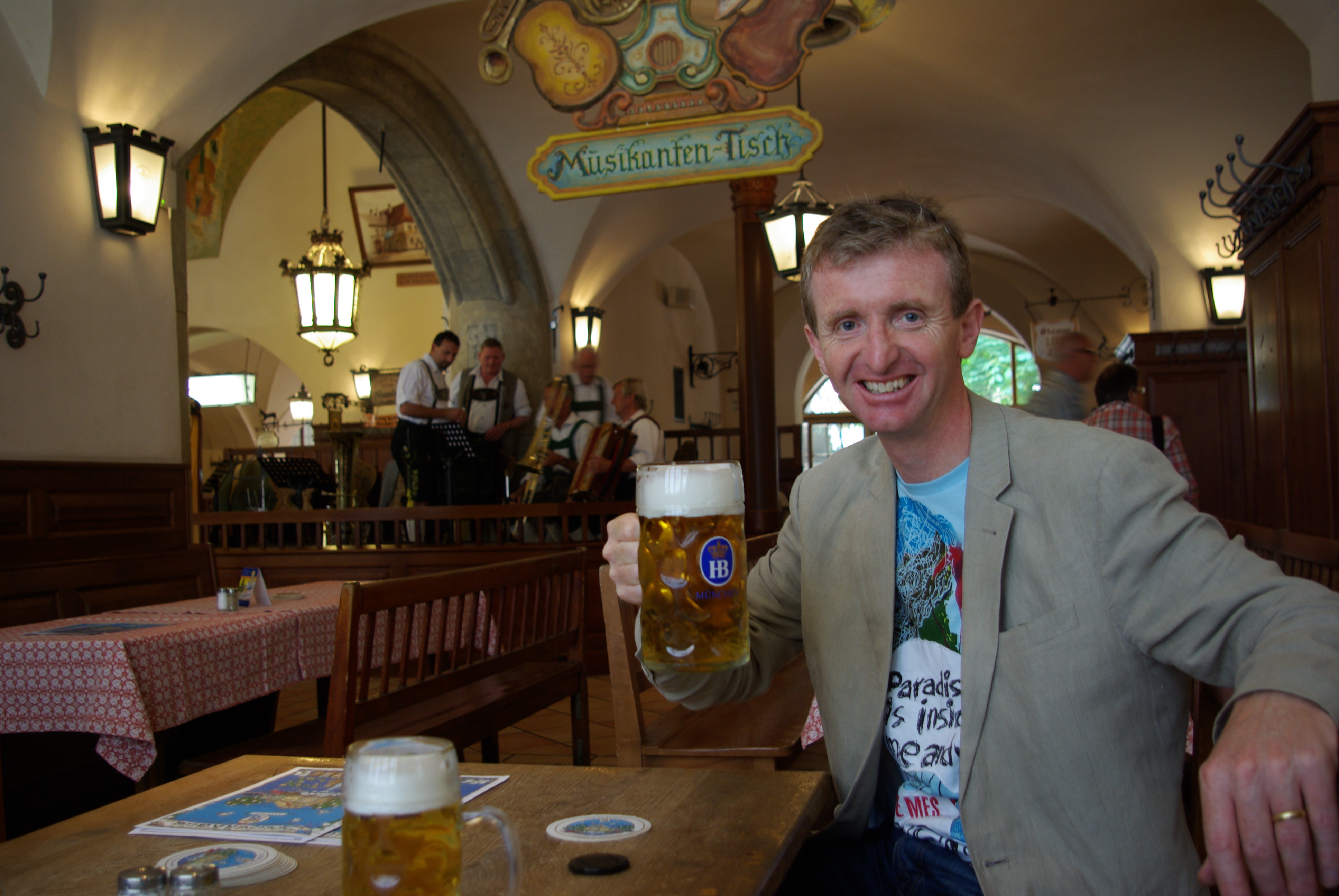
Drinking cool beer in The Schwemme

It was here that Paddy found the part of the Bastille he was seeking. The Schwemme is a huge, richly frescoed hall that wound this way and that, past huge stone pillars, toward the altar of Hofbrau beer where an army of male and female waiters attend upon the fountain of beer pouring litre upon litre of the marvelous nectar. And it did not stop there. What Paddy would have missed on a dark, cold, snowy night in 1934 was the courtyard beer garden which by now was filling with locals and tourists all keen to bathe in the unique Hofbräuhaus atmosphere.

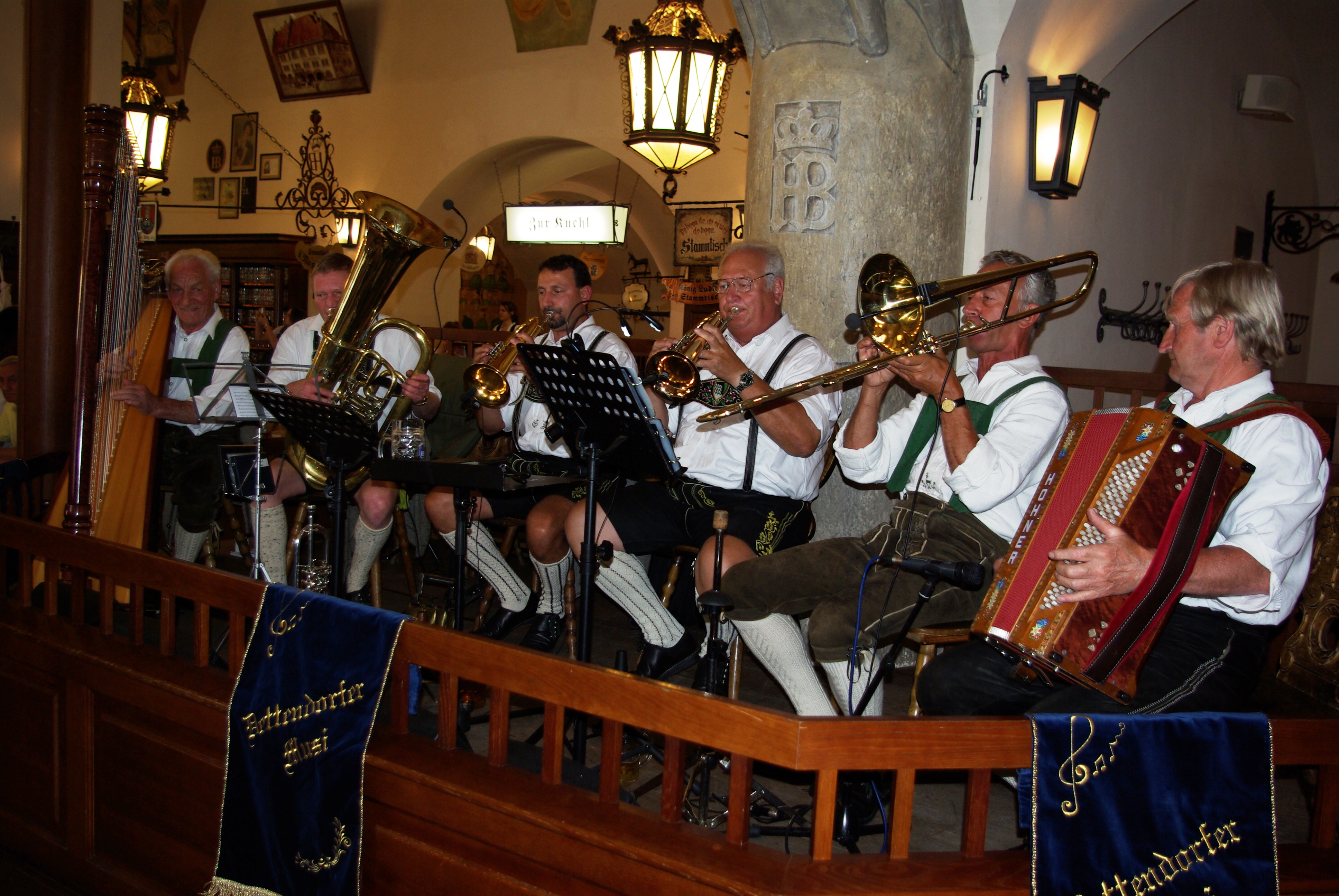
If you visit the website of the Hofbräuhaus you will see it includes a list of ‘regulars’; those who attend services on a regular basis, with the specific visit days recorded. They have reserved seats and for larger groups, or even families, whole tables are kept for them so that they can indulge and worship whilst listening to the suitably attired Bavarian band that have a dedicated stage in the centre of the hall.

Hofbrauhaus Regulars

The band plays on

We had arrived early, at around 11.00 am and had spent forty-five minutes or so making our tour of the building. It was quiet, with just a few other like minded souls and the staff getting ready for the rush ahead. By midday we had chosen a table and ordered our first refreshing beer, a Würstlplatte for me and Spanferkel for Kim (read the menu in English here). The Schwemme was now filling with crowds of locals and tourists alike and the band had struck up. If you want to visit the Hofbräuhaus to look around, as we did, I would recommend going early, and you also need to be there pretty early to find a table.

It was a wonderful visit, and one that was brought to life even more as we imagined that young man avoiding Brownshirts and knocking back beer with the farming folk he found in the Schwemme. One thing that has not changed is the hospitality and friendliness of the Bavarian people, and it was with some reluctance that we walked out of the Hofbräuhaus into bright sunshine to catch our train to Oberammergau.

Now, where did I leave my rucksack?

Meeting Patrick Leigh Fermor in the Mani

Recently we have been musing in some posts about following Paddy’s route. For many of his fans this is perhaps a dream, but nevertheless, something many would like to make real. Topping that of course is meeting Paddy himself. In this piece, New Zealand author Maggie Rainey-Smith unexpectedly meets Paddy on a trip to Kardamyli on Greece’s Mani Peninsula, where Paddy has lived since the 1960’s. Some of you may have read it but I think it is such a nice article that it is worth re-visiting.

First published in the New Zealand Herald 15 June 2008

 
The village of Kardamyli is on the west coast of the Mani Peninsula, one of the more traditional and conservative areas of Greece.Recently, I spent two months in Greece chasing the muse, searching for clues, looking for inspiration.

The Mani Peninsula region is famous for the Maniots and their resistance of the Ottoman occupation. It is isolated by the Taygetus mountain range and enclosed by the Aegean and Ionian seas.

The Ottomans failed to infiltrate, but I have to advise that the English have. As I shopped for my Twinings tea and sat outside a cafe in the village of Kardamyli, using the free internet, I lamented the globalisation of this once-remote peninsula.

I wished, for just a moment, that I was back in time when to be a strange woman alone in this small village may have attracted disapproving stares.

In the local bookshop was the very book I’d been looking for: Mani – Travels in the Southern Peloponnese, by Patrick Leigh Fermor. On my terrace overlooking the sea, I opened the book and found myself mesmerised by the most exquisite, evocative travel writing I have ever read. Not only that, I discovered that Fermor is a resident of Kardamyli.

The owner of the bookshop was unimpressed when I asked where Sir Patrick lived, and his lips remained sealed, his expression disapproving. Fermor is almost a saint in Greece.

He was a resistance fighter in Crete during World War II; his exploits were the subject of a film starring Dirk Bogarde (my father was in Crete, but a more modest hero at Maleme, the point where the island was finally lost to the Germans).

At the local cafe, where I made use of the technology, the owner (who looks like a Maniot right out of Fermor’s book, with her blanket of black ringlets and beautiful olive eyes), told me Paddy (as the locals call him) would celebrate his Name Day that very week and that he always opens his home to the locals on that day.

By then, and after one week’s residence, I considered myself a local, and everyone agreed with me.

So with joyous disbelief at my good fortune, on Thursday, November 8, I joined the local villagers at Sir Patrick’s Name Day celebration at his majestic and yet still homely yellow stone house overlooking the Messinian Gulf.

By 10.30am the service in his private chapel was over and we were seated in his lounge – books lining the walls from floor to ceiling: Nancy Mitford, Henry James, James Joyce – eating olives, meatballs, feta and drinking local wine.

On a person’s Name Day you are required to take a gift, and all I had with me was a copy of my first novel About Turns, which I gave to Paddy. He signed my copy of his own book with a personal inscription and a small drawing. We talked about Crete and my dad and his book on the Mani. I gushed, he charmed.

Then the singing began and Paddy was surrounded by adoring local women who toasted him with traditional Name Day songs.

At the end of the singing, Paddy stood and pretended to fire a pistol into the air (an old tradition where real pistols were once used). He is of English and Irish descent. Although his name is Patrick, his Greek Name Day is the day of Michali. Michael is the name he assumed while fighting for the Greek resistance.

With me was an American Orthodox nun who worked in Moscow and a Danish man of the cloth who was studying Byzantine churches. We were Paddy’s “non-local” guests and pinched ourselves to check we weren’t imagining our good fortune.

When it was time to leave, another Michael (Michali), a neighbour of Paddy’s, invited us to his home. We walked through an olive grove up the hill along the coast to another beautiful stone home.

Our new host sold Paddy the land and helped him build his house in 1964. We were feted with fresh coffee and cakes and listened to Michali’s son, who told us that when he decided to leave Kardamyli some years ago to travel, Paddy told him: “You can’t leave.”

And when he returned years later, Paddy told him: “You know we are very fortunate, we live in Kardamyli. We are fortunate – we have the mountains. We are fortunate – we have good food. We are fortunate – we have clean air to breathe. We are fortunate – we have the beautiful sea to swim in.”

“Yes, Paddy, the mountains, the food, the air and the sea,” said the young man, nodding in agreement.

And then Paddy said to him: “And for all these reasons and more, we may just forget to die.”

Sir Patrick Leigh Fermor is 92 years old, he was wearing a double-breasted navy suit when I met him, had a full head of wavy grey-black hair and was still a handsome, charming man with just a slight deafness in one ear.

He spoke with a classical English accent which rather surprised me, considering the years he has spent in Greece.

He is still writing. If you’ve never heard of him, or never read his books, now is the time to start.

By Maggie Rainey-Smith

Book review: In Tearing Haste: Letters between Deborah Devonshire and Patrick Leigh Fermor from The Scotsman

First published in The Scotsman 13 September 2008

by Roger Hutchinson

THE MARVELLOUS THING ABOUT yours [books],” wrote the Duchess of Devonshire to Patrick Leigh Fermor in May 1974, “is that they never appear.”

Deborah Devonshire professes a pathological dislike of reading. Somewhere in the unfathomable depths of that eccentricity may be discovered the contrary reason for her having been, for over half a century, the favourite correspondent of one of the greatest British authors of the 20th century.

Debo and Paddy had been swapping letters from various parts of the globe for 20 years when she congratulated him on the paucity of his output. When he received that letter he was in fact just finishing A Time of Gifts, the first volume of the travelogue through Europe in the 1930s which would cement his reputation. If we are to believe the Duchess, she has never read a word of it or any of his other works.

This does not mean that their collected letters, expertly compiled by Charlotte Mosley, is entirely non-literary – there are plenty of gems here for the student of the Leigh Fermor oeuvre. It means rather that their friendship was established on broader grounds.

The youngest Mitford sister, Debo Devonshire, clearly possesses oodles of her siblings’ trademark charm, without the family handicap of being mad as a meat-axe. Patrick Leigh Fermor saw and fell for her at an officers’ ball early in the Second World War. She did not so much as notice him until several years later. By the early 1950s Paddy Leigh Fermor was difficult not to notice. Handsome, polyglot, rakish, wildly itinerant and with a war record straight out of a John Buchan novel, he fell upon London society like a wolf on the fold.

He must have been able to pick off debutantes at a hundred paces. But Deborah Mitford was made of sterner stuff. She had set her sights on a duke. PLF would have to settle for best male friend. We should say, one of her best male friends. Her roster of masculine admirers is extraordinary. President John F Kennedy tops the chart, but it winds down through almost every eligible and ineligible man in the developed world. Debo’s good fortune – and now that this engaging anthology has been published, ours too – is that not a single one of them was half so good a writer as her faithful Paddy.

Naturally, most of the words in this collection were authored by PLF. But if Deborah Devonshire has been a foil, she was a perfect one. Chatty, witty, teasing, gossipy, relentlessly cheerful and with more than a hint of modest good sense, her short replies bounce off his beautiful essays like volleys of tennis balls off a cathedral. Continue reading

Subscribe to the Patrick Leigh Fermor blog!

If you would like to keep up to date with the blog postings (of which there are many more to come I assure you!), why not subscribe to the blog? Enter your email, just in the top right where it says ‘Email Subscription’, and you will receive an alert each time a new post appears; that is all. No spam!

I hope you enjoy the posts and ferreting around the blog.

Don’t forget if you have something you would like the world to see that concerns Paddy, or his friends and colleagues, please get in touch with me either by a comment or email tsawford[at]btinternet.com, and I will publish it for you with full credit.

Tom

One Man’s Great Game: Lieutenant Colonel “Billy” McLean

When you get involved with the life and times of Patrick Leigh Fermor, you find all sorts of possible avenues to explore. One group I am trying to bring together on the blog are the occupants of Tara in Cairo during the war. Given my interest in the Balkans, Albania in particular, I followed the route of “Billy” McLean and the British Military Missions to Yugoslavia and Albania which were manned by SOE men. Billy was an occupant of Tara and Xan Fielding wrote his biography. Of course Paddy was there as well.

In the course of my investigations I have read, in the last few weeks, the book Eastern Approaches by Fitzroy MacLean who as a very young Brigadier was personally chosen by Churchill to lead the mission to Tito’s partisans, and Billy McLean’s biography – One Man in His Time. Both books are interesting and I will review them if I have time. I have to say I was a little disappointed in Xan’s writing style, but it is workmanlike and is probably an accurate portrayal.

Billy McLean’s life is absolutely fascinating. He was a real adventurer and never stopped his adventures or travel until he died in 1986. I have dug out his obituary from the Daily Telegraph Second Book of Obituaries – Heroes and Adventurers, and as I did before with Xan Fielding’s obit, I have retyped it word for word as I cannot find an online version.

Go on, explore your own Paddy related avenue, and maybe write to me and we can publish for others to hear about!

First published in the Daily Telegraph, 20 November 1986.

Lieutenant Colonel “Billy” McLean, who has died aged 67, spent 40 years playing his own version of the Great Game. Like some latter-day knight errant, he travelled tirelessly in the Muslim world, working always against the encroaching influence of the Soviet Union, while at the same time seeking adventure among tribal peoples.

McLean’s unusual life often had elements of intrigue that no one else could unravel. “What is Billy really up to?” was a question that would be asked at the bar of White’s Club as he set off on another trip to Jordan or Iran, Morocco or the Yemen.

In McLean’s character there were shades of Buchan and Lawrence and Thesiger. All seemed to coalesce in the Yemen, where from five years, from 1962, McLean helped the royalists under Iman al-Badr to resist President Nassar’s attempts to take over the country. He made numerous reconnaissances in the Yemen desert and many arduous journeys, by camel and on foot, to the royalist forces in their remote mountain strongholds.

It was entirely due to McLean that Britain never followed America in recognising Nassar’s, and the Soviet Union’s, puppet republican government in the Yemen; and it was he who persuaded the Saudis to increase their aid to the Iman’s forces. Thanks also to McLean, the royalists received Western mercenary support and arms from the RAF. Largely as a result of McLean’s efforts, North Yemen did not become one of Nassar’s fiefdoms and did not join its neighbour South Yemen (Aden) in the Communist camp.

Neil Loudon Desmond McLean was born on November 28 1918, a direct descendent of “Gillean of the Battle-Axe”, known in Argyll in the 13th century.

After Eton and Sandhurst (where he rode several winners in point-to-points), McLean was commissioned into the Royal Scots Greys and sent to Palestine [prior to the war] in 1939.

At the end of the following year he went to occupied Abyssinia [Ed: Ethiopia] where he proved himself an outstanding guerrilla leader, as part of Orde Wingate’s Gideon Force. He led a force of Eritrean and Abyssinian irregulars – known as “McLean’s Foot” – against the Italians near Gondar.

His burgeoning career as an irregular soldier continued in Special Operations Executive; in 1943 he led a five man military mission to Albania, to co-ordinate resistance to the Axis powers. Peter Kemp (qv) described his first meeting with McLean when he parachuted into Albania to join the mission: “Approaching up the hill with long, easy strides came a tall figure in jodhpurs and a wide crimson cummerbund, a young man with long fair hair brushed back from a broad forehead and wearing a major’s crown on the shoulder straps of his open-necked army shirt.”

With one break, McLean remained in Albania until the German retreat from that country and inspired those under him with his military skill and courage. He was promoted to lieutenant-colonel at the age of 24.

His contacts with the Albanian communist leader Enver Hoxha turned sour when the left-wing elements of SOE favoured the partisans at the expense of the Zogist faction led by Abas Kupi, which McLean supported against charges of collaboration with the Germans.

In 1945 he volunteered for SOE duties in the Far East, where he became military adviser in Kashgar, Chinese Turkistan. Here he learnt the ways of the Turkis, Uzbeks, Kazaks, Tajiks and Tartars, who were under threat of domination by the Soviet Union, and travelled extensively in Asia. McLean’s fascination and sympathy with Muslim minorities and tribal peoples would continue for the rest of his life. He devoted much of his time to the cause of the Pathans and the Kurds, as well as the royalist Yemenis.

After the war he sought election to Parliament, twice unsuccessfully for the Preston South constituency, in 1950 and 1951. He became Conservative MP for Inverness in 1954, and held the seat until the 1964 general election.

As a Highlander himself, McLean was able to identify with the Celtic character of his constituents. But they could not be expected to appreciate the reasons for his long absences on the Middle East.

While he was an MP, and afterwards, McLean was, as described by a colleague, “a sort of unpaid under-secretary for the Foreign Office”. His political contacts in the Muslim world were probably unique among Westerners, in particular his relationship with King Saud during the Yemen war and his personal friendship with King Hussein over many years. In the mid-1960’s he was involved in an unsuccessful attempt to “spring” a revolutionary leader from jail in Algeria [Ed: using a yacht and accompanied by King Leka of the Albanians who fancied coming along for the ride. The attempt was foiled by the CIA who wanted the ‘kudos’ of freeing the man, which they did some months later].

McLean was always passionate in defence of British interests, as he saw them, which did not always accord with the Government’s view. In his later years, still pursuing those interests he visited Somalia, Iran, Western Sahara, the Pakistan-Afghanistan border, China, Israel, Turkey and Jordan.

In 1979 Harold Macmillan wrote to McLean: “You are one of those people whose services to our dear country are known only to a few.”

By his many friends and admirers he will be remembered as possibly the last of the paladins. While his role may not always have been appreciated in Britain, his independence and total integrity were recognised n all the countries where his influence was felt.

Alongside his flair for guerrilla fighting, he had a passion for secret enterprises, deep-laid schemes, and political complexities. He combined acute political understanding with military gifts ideally suited to irregular warfare.

His comrade-in-arms in Albania and the Yemen, David Smiley, has written of McLean: “His charming character seemed languid and nonchalant to the point of idleness, but underneath this façade he was unusually brave, physically tough and extremely intelligent, with a quick, active and unconventional mind.”

His wisdom, sense of humour, human curiosity and kindness endeared him to a wide circle of contemporary friends and younger people, who saw his values as ones they could respect without sentimentality or danger of being considered old-fashioned. He revelled in argument and banter, and was always interested in the opinions of the younger generation.

McLean was both a keen shot and underwater fisherman: one of his great pleasures was to spear moray eels off the coast of Majorca. He was very partial to Middle Eastern and Chinese cooking.

He married, in 1949, Daska Kennedy (neé Ivanovic), who supported, sustained and understood him during his unconventional life.

Related article:

Xan Fielding Obituary

Short obituary of George Psychoundakis from the BBC

The BBC also covered the death of George with this brief piece.

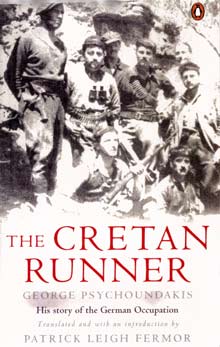
George Psychoundakis, who has died aged 85, became a hero figure to the Resistance in World War II by guiding Allied soldiers over the mountains of Crete so that they could escape the brutal German occupation. Later, he carried messages, wireless sets, batteries and ammunition. Wearing only worn-out boots, he would cover many miles each day. A poor shepherd, he had a love of learning, and formed a lifelong friendship with one of the Resistance officers, the writer Patrick Leigh Fermor. Fermor translated Psychoundakis’s account of his heroics in the Cretan Runner.

Major Stanley Beckinsale obituary

First published in the Telegraph: 12:03AM BST 06 Sep 2004

Major Stanley Beckinsale, who has died aged 84, was a founder member of the para-naval section of the Special Operations Executive (Middle East) and was awarded an MC for evacuating several hundred Allied soldiers from enemy-held Crete.

In May 1941, the Anglo-Anzac forces in Crete were narrowly but decisively defeated by General Student’s airborne force. The para-naval section of SOE Middle East, part of Force 133, based in Cairo, was given the task of putting agents on the island to organise the retrieval of British and Commonwealth servicemen who had taken refuge in the mountains.

 The operation was run from Alexandria by Commander Francis Pool, RNR, a rotund figure known as “Skipper”. He was landed by submarine to make contact with the Cretans who were assisting the fugitives, often at great risk to themselves, and travelled between them on the back of a donkey, dodging the German patrols en route.

A few troops were rescued in this way, but it was considered too great a risk for submarines – and a rusty old trawler from Haifa was chosen for the job. After being fitted with a captured Italian 20mm Breda gun in the stern and six Lewis guns mounted at various points, the vessel was named Hedgehog, and Beckinsale was made second-in-command.

On his first trip to the south coast of Crete, Beckinsale ran into a Force 10 gale. Hedgehog had several tons of concrete fore and aft as ballast, and the former fish-hold was loaded with captured Italian rifles and Army boots for the guerrillas. New Year’s Eve 1942 was spent pumping the bilges and throwing the deck cargo overboard; but on the evening of the fourth day, the crew could see the Cretan mountains looming in the distance and smell the wild thyme on the wind.

The inlet chosen for the landing was little more than a cleft in the rocks with a small beach, well away from the German garrisons. When the signal flashed from the shore, they came in and moored by the light of a full moon. Their agent, Tom Dumbabin, a Fellow of All Souls, emerged from the shadows to report that he had managed to collect 150 Allied soldiers and a Greek Orthodox priest.

They lay up the next day, loaded their passengers and slipped anchor at dusk in order to begin the return trip to Alexandria. But the following morning, the lookout heard the engine of an approaching plane, and they quickly altered course. The deck was strewn with passengers, and Beckinsale hastily covered them all with blankets and ran to his Lewis gun. The Italian Arado circled several times before turning away, apparently satisfied that the ship was a coaster on German business.

Stanley Eustace Beckinsale was born in London on March 9 1920. He went to grammar school at Belvedere, Kent, and then to Reading University, where he read Agriculture and rowed in the VIII. The outbreak of war interrupted his studies and, in 1939, he was commissioned into the 1st Battalion Royal Tank Regiment before being recruited by SOE.

Beckinsale joined Saad, the first para-naval ship in the Red Sea, as an engineer in 1940. The schooner carried a crew of four, and was the only one with a draught shallow enough to carry it over the minefields. After the fall of Massawa, Eritrea, his unit was given the task of cleaning up the Italian garrisons on the islands guarding the entrance. He and his comrades negotiated the surrender of more than 2,000 Italian troops manning the batteries on five separate islands.

In 1942, in a further three operations, Hedgehog landed at Crete, where Beckinsale and his comrades rescued more than 100 additional people who were trapped on the island. The trawler was also instrumental in putting ashore a number of British agents, including Patrick Leigh Fermor (who later kidnapped General Kreipe, the commander of the island’s garrison) and George Jellicoe, of the Special Boat Section, who was on his way to sabotage planes at Heraklion airfield.

On Beckinsale’s last trip to south Crete, Hedgehog docked at Mersa Matruh, escaping just a few hours before Rommel’s Panzers arrived on their way to El Alamein. He later made long-distance reconnaissance trips in his 26ft caique Constantinos, some of which covered 1,000 miles and kept him at sea for more than a month. He was awarded the MC and was also mentioned in dispatches for capturing several Italian schooners.

In 1945 the para-naval section was disbanded. Beckinsale was posted back to England for a spell before spending a year with the Central Commission, Food and Agriculture, in the North Rhine Province of Germany. After being demobilised in the rank of major, he farmed in Oxfordshire for 22 years.

Beckinsale subsequently settled in a village in Wiltshire, where he went into partnership with Tom Thain, a former fellow member of the SOE. Together they formed Dentiststone Restoration, a company specialising in restoring stonework, tracery and statuary; among their clients were Wells and Winchester Cathedrals, Romsey Abbey and the Brighton Pavilion.

He retired in 1990. An avid reader, he particularly enjoyed the study of English history and mediaeval architecture.

Stanley Beckinsale died on August 17. He married first, in 1946, Joyce Bolt, who predeceased him. He married secondly, in 1970, Mary Hackett (née Collins); she survives him with a son and a daughter from his first marriage and a daughter from his second.

Reluctant hero finally accepts his knighthood

I have edited this slightly to remove non-Paddy related stuff. something to add to the archive.

By Nigel Reynolds

First Published in the Telegraph : 12:01AM GMT 31 Dec 2003

Patrick Leigh Fermor, the veteran travel writer, philhellene, scholar and soldier, has finally accepted a knighthood, saying that it would have been “rude” to turn the honour down for a second time.

Leigh Fermor, 88, who lives in Greece where he is treated as a national hero, refused a knighthood in 1991.

 He said at his home in the Peloponnese last night: “I turned it down then because I didn’t think that I deserved it.

“I’d written a few books, that’s all.”

He was among a list of 300 prominent figures from the arts and entertainment world to have declined honours since the Second World War which was disclosed in a leaked Cabinet Office document shortly before Christmas.

The author, hailed by many critics as Britain’s best travel writer, receives his honour for services to literature and to British-Greek relations in the diplomatic and overseas list.

The Cabinet Office refused to discuss his change of heart…

… Leigh Fermor, whose wife, Joan, a photographer, died in the summer aged 91, first sprang to fame working for the SOE organising guerrilla operations in wartime Crete.

In a celebrated episode, for which he was awarded the DSO, he and a friend, disguised as German soldiers, kidnapped Gen Kreipe, the island’s garrison commander. For three weeks they evaded German search parties and Kreipe was eventually taken off Crete by motorboat.

The exploit was turned into the film Ill Met By Moonlight in 1956, with Dirk Bogarde cast as Leigh Fermor.

Until the war, Leigh Fermor had been rootless. After school, at the age of 18 he spent a year walking from Holland to Istanbul and then he roamed the Balkans.

After the war, he built himself a house and settled in the Peloponnese living off his writing, principally about his travels and Greek culture, history and folklore. His best-known books are The Mani, written in 1958, and Roumeli (1966).

Artemis Cooper talks about Words of Mercury

Short and to the point, a little video snippet of Artemis Cooper talking about her work on Words of Mercury.

Click the picture to play!

Artemis Cooper and Words of Mercury

A Long Walk Starts (and Ends) With a Step

I was just taking another look at Matt Gross’ Frugal Travel section of the New York Times and discovered that after writing the piece I published on 13 June he left the NYT. I wonder if he was so inspired by Paddy’s travels that he decided to take off and cover the whole route? Perhaps not. Here is his signing off piece from his NYT Blog.

By MATT GROSS

This weekend’s Travel section cover story — “Frugal Europe, On Foot” — is my last as the paper’s Frugal Traveler columnist. After four years of roaming the world on a budget, from Alabama and Albania to Uruguay and Urumqi, I’m taking a rest, and handing over the illustrious mantle to a new shoestringer, who’ll appear in this space next month.

But for my final feature, I wanted an adventure that would challenge me — physically, psychologically, culturally, linguistically, technologically, logistically and, of course, financially. Maybe a sailing adventure? Done that. A lengthy train journey? Done. A trek into the mountains? Done — on foot and on horseback. I’ve gone round the world, across America and grandly circled Europe, so what was left to be done?

The answer came in the form of Patrick Leigh Fermor, the 95-year-old war hero who’s known as Britain’s greatest living travel writer. His books “A Time of Gifts” and “Between the Woods and the Water” chronicle his nearly penniless journey, in 1933 and 1934, from Rotterdam to Istanbul — on foot. And when I looked at the route he took through the remains of the Austro-Hungarian Empire, I realized I had an adventure in the making: a two-week walking tour that would take me from Vienna through Slovakia to Budapest.

Throughout 180 miles, I dealt with three official languages (German, Slovak, Hungarian) and some unofficial ones (Italian, English, French, Hebrew). I used maps both paper and electronic. I took inspiration from literature: not just Mr. Leigh Fermor’s books but also “The Unnamed,” by Joshua Ferris, “The Road,” by Cormac McCarthy, “The Places in Between,” by Rory Stewart, and “The Long Walk,” by Stephen King (writing as Richard Bachman). I found great bars and restaurants via Twitter and Foursquare — and through common, random luck. I walked till my ankles screamed, and sang to myself during long hours alone.

And when I met new people — as I did just about everywhere — I was amazed, again and again, at their spontaneous generosity, their willingness to feed, shelter and befriend a mysterious stranger attempting to do what few sane travelers would even contemplate.

In other words, I don’t expect you, my readers, to follow precisely in my blistered footsteps, but I hope this story — and all the Frugal Traveler articles I’ve written — will inspire you to set off on your own crazy adventures, confident in the knowledge that no matter how little money you have, the world will, if you embrace it fully, take very good care of you indeed.

Are you inspired? I know I am. It would be a nice idea if perhaps next year we could get a bunch of people together and walk some of the route. On the other hand perhaps it is best to do as Paddy did and make a solo attempt. If anyone has ideas on this get in touch with me tsawford[at]btinternet.com or post a comment below.

Related article:

Walking Paddy’s Route in Mitelleuropa: Frugal Europe, on Foot

Hay Q and A: Who are the three greatest living writers?

Well done William!

The Hay Q&A

We asked some of the leading authors at this year’s Guardian Hay festival a series of questions. Here are their answers

Q4: Who are the three greatest living writers?

William Dalrymple: “Among novelists, Cormac McCarthy; among travel writers, Patrick Leigh Fermor; among short story writers, Jhumpa Lahiri.”

From the Guardian.

Walking Paddy’s Route in Mitelleuropa: Frugal Europe, on Foot

It’s time to be honest now: who amongst the regular readers of this blog, or even those that stumble across us because they have read ‘A Time of Gifts’ or ‘Between the Woods and the Water’, has not thought about following Paddy’s 1930’s route? For myself it is a definite goal. It is an ambition; probably a passion. I had come across the following article but have been inspired to re-produce it by Blog reader Matt who says he first got into Paddy’s work when stationed in Baghdad:

Tom, The New York Times travel writer, Matt Gross, just did an article on PLF. He walked the Vienna to Budapest stretch recently … I first read PLF while stationed in Baghdad four years ago and revisit him often. Living in Heidelberg, I’ve been able to visit some of the places he mentioned specifically and have recommended A Time For Gifts to many of my fellow Americans living here or travelling to Europe. As I’m in the process of moving back to the States, it will be a few years before I’m able to pick up the thread of his travels. I’m not sure if you’re in contact with PLF, but pass him the respects of this Yankee officer. Matt

Frugal Europe, on Foot

First published in the New York Times,  May 23, 2010

The article is written by New York Times’ Frugal Traveler columnist Matt Gross who attempted to follow in the footsteps of Patrick Leigh Fermor. Like all good stories it begins ….

ONCE upon a time, a young man went for a walk. It was December 1933, and an 18-year-old Englishman named Patrick Leigh Fermor put on a pair of hobnail boots and a secondhand greatcoat, gathered up his rucksack and left London on a ship bound for Rotterdam, where he planned to travel 1,400 miles to Istanbul [Ed: Constantinople!] — on foot. He had virtually no money; at best, he’d arrive in, say, Munich to find his mother had sent him £5. But what he did have was an outgoing nature, a sense of adventure, an affinity for languages and a broad network of friends of friends.

 “If I lived on bread and cheese and apples,” he later wrote, “jogging along on fifty pounds a year like Lord Durham with a few noughts knocked off, there would even be some cash left over for papers and pencils and an occasional mug of beer. A new life! Freedom! Something to write about!”

 Something to write about indeed! The books he produced from the yearlong journey — “A Time of Gifts” and “Between the Woods and the Water” — are gorgeously rendered classics that have led many to call Mr. Leigh Fermor, now 95, Britain’s greatest living travel writer. But to my mind, he’s always had another title: the original Frugal Traveler — the embodiment of that idea that, though a wanderer may be penniless, he doesn’t have to suffer.

 And Mr. Leigh Fermor never suffered, thanks to the miracle of human generosity. Peasants gave him baskets of eggs and swigs of raspberry schnapps. Small-town mayors found him beds. The lingering nobility of Europe put him up in their castles, invited him to balls and lent him their horses. When Mr. Leigh Fermor did sleep rough — in hayricks and barns or on the banks of his beloved Danube — he did it by choice, not because (or not merely because) poverty required it. He knew, even at 18, that the world is an experience to be savored in all its multifarious incarnations.

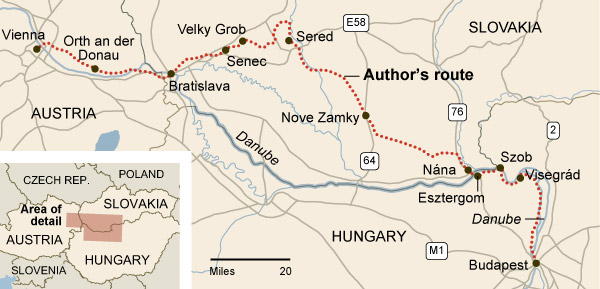
Matt Gross' route

Could a young person (is 35 still young?) with strong legs and little money find the same spirit of hospitality that Mr. Leigh Fermor encountered some 76 years ago? At the end of March, I set out to find the answer. With only two weeks free, my plan was to walk from Vienna to Budapest, a 180-mile route that would connect the old poles of the Austro-Hungarian Empire and track Mr. Leigh Fermor’s trail as closely as possible, taking me along the Danube to Bratislava, the Slovakian capital, and across the plains of Slovakia south to Hungary — through three countries whose languages, cultures and histories could not be more different, or more intertwined.

It was tempting, the day I arrived in Vienna, to just walk east from the airport, but I couldn’t completely skip the Austrian capital, where Mr. Leigh Fermor had spent three weeks among the “crooked lanes” and “facades of broken pediment and tiered shutter.” And so I followed his lead, going into the imperial crypt, where the grandest members of the Hapsburg family lay entombed in elaborate sarcophagi, and into the museums, although I shied away from the most famous in favor of oddities like the International Esperanto Museum. And I luxuriated in storied places like Cafe Alt Wien and Cafe Bendl.

But after two nights in Vienna, I was restless. So I crossed the Danube, put on my 45-pound pack and took off down the Donauradweg, a well-kept biking trail that runs from the river’s source to its mouth at the Black Sea. To my right, the Danube, more green than blue, sparkled in the cool sunlight, and I encountered fishermen tending their rods, elderly sunbathers, nordic hikers poling along and cyclists speeding in both directions.

This first day, I figured, I’d take it easy and do only 15 miles. Ideally, I’d need to hit 18 miles a day — about six hours of walking — to reach my goal. It seemed reasonable, especially with the terrain so uniformly flat. The path, sometimes dirt, sometimes paved, would often stretch so far and straight that I couldn’t imagine I’d ever reach the end, and then I’d finally hit a slight turn and face the same thing: an art-school lesson in perspective, complete with the first low foothills of the Carpathians at the vanishing point — and a scampering rabbit to remind me this was no still life.

Even with such straightforward terrain, there were snags. An attempted shortcut through a fuel depot left me with minor scratches and an extra three miles. But such mistakes have a way of turning out for the best. Had I stayed on the trail, I would have never crossed paths, two hours later, at the edge of Donau-Auen National Park, with Jean-Marc and Marie, newlywed French cyclists who stopped to say hello when they saw a lone hiker in the middle of nowhere. They were taking an extended honeymoon: a two-year bicycle journey from their home in Paris — to Japan!

“Do you know where you’re staying tonight?” I asked. They didn’t. I told them to meet me at Orth an der Donau, a small Austrian town a couple of miles farther down the Danube, where I had arranged for a place to stay via CouchSurfing.org. Maybe, I said, my host could find them somewhere to pitch their tent.

THE host, Roland Hauser, whom we met in front of Orth’s impressive castle, did better than that. He invited them home to his dreamland of soft beds and hot showers. Roland, 26, had traveled from California to Southeast Asia to New Zealand, and his German-accented English was peppered with words like “sí” and “bueno.” That evening, we cooked spaghetti Bolognese, nibbled Südtirolean ham and drank big bottles of beer. I went to sleep marveling at our extraordinary, Fermorian luck.

In the morning, after coffee, I threw out my underwear. This was a strategy to lighten my load — bring old undies and get rid of them day by day. Frankly, I should have done that with everything, as the pack was needlessly heavy. Along with two weeks’ worth of shirts, I had an ultralight down jacket, a waterproof shell and rain pants. A tent and sleeping bag. One pair of jeans and lightweight canvas shoes to change into at day’s end; nothing worse than walking 20 miles and spending the evening in the same clothes. And I packed Mr. Leigh Fermor’s books and Claudio Magris’s “Danube,” which I never had time to read. And my computer and camera gear — work necessities, alas.

When I set off, I was wearing my typical walking outfit: khaki pants by a company in Portland, Ore., called Nau; waterproof running sneakers by Lafuma; good socks (as important as good shoes); and a long-sleeved cotton shirt.

The walk began well. My feet were tender, but the flatness of the Marchfelddamm, a high berm that doubled as biking path and flood deterrent, ensured that I wasn’t struggling. This was the heart of the Donau-Auen National Park: forests of thin trees broken by occasional streams flowing to the Danube. At first, I appreciated the play of light on the water and between the trunks, but hour after plodding hour of unchanging scenery soon became mind-numbing, and I simply marched, putting one foot in front of the other and watching for kilometer markers. It would be 13 miles before I could stop for lunch, and another 10 before I reached my day’s goal: Bratislava.

But there’s a funny thing about long walks. With patience, all those steps add up, and by 2 p.m., I’d crossed a bridge over the Danube and settled into a cafe in the stately town of Hainburg, where an open-faced baguette pizza and glass of beer gave me the courage to face the miles ahead. And soon I found myself trudging along the shoulder of the small highway with cars flying past — and missing the monotonous near-silence of the forest.

Not far off, I could see Bratislava’s hilltop castle — in Mr. Leigh Fermor’s era, a burned-out wreck worked by prostitutes but in the 1950s rebuilt as a stately white-and-red palace — and it teased me with its apparent nearness. Still, I had far to go, past a derelict border post, and through three miles of snaking bike paths, before I crossed the Danube again and was in the heart of Bratislava’s old town, all cobblestones and tile roofs and sidewalk cafes.

After checking into the Hotel Kyjev — a 1970s tower turned budget boutique — I checked myself out: I wasn’t sore, out of breath or even tired. I did have blisters on my feet, but they were easily treated: puncture, drain, clean, bandage. My ankles, however, were terribly swollen, the peroneal tendons in particular, a result (I think) of how my body mechanics had altered with the weight on my back. I popped some ibuprofren, took a shower, then hobbled outside for dinner.

It was the Friday during Passover, and like any wandering Jew, I wanted a Sabbath meal. And thanks to Chabad, the Hasidic Jewish outreach organization, I got one, at the home of the transplanted American rabbi Baruch Myers. He was only too willing to share his food (cucumber salad, gefilte fish), his friendship and his family, including a battalion of adorable children who cheerily walked me through the Passover story.

It wasn’t just this heartfelt welcome that got to me; it was the very existence of a Jewish community in Bratislava. Back in his day, Mr. Leigh Fermor wrote, the Jews “were numerous enough to give a pronounced character to the town.” No longer. The Holocaust had reduced the Jewish population to, in Rabbi Myers’s estimate, 1,000 people. There was a synagogue, a few kosher restaurants, a Jewish museum and even a pension, but few visitors today would see in Bratislava a Jewish-inflected city.

On Saturday, partly inspired by the rabbi and partly because of my feet, I rested and contemplated the future. I had walked 40 miles so far, and if my ankles were any indication, there was no way I’d make the remaining 140. Unless … If I took a train a short way — say, 15 miles northeast — I could certainly walk another 10 miles. I’d be breaking my rules, but those rules were arbitrary. Continue reading

The Travellers Club, C R Cockerell and a Tale of Two Foxes

It should come as no surprise to learn that Paddy is a member of the London gentleman’s club The Travellers Club. The following was sent to me by Blog reader and correspondent James who had scanned it from a copy of “More Tales from the Travellers” which seems to be almost impossible to get hold of in print. I have typed it out exactly as it is printed in the book. It is a speech that Paddy gave to members at an event to celebrate sixty years of membership of the Travellers in 2004. I do hope that you enjoy this wonderful ‘tail’.

In the Library of the Travellers Club

Sixty years is a long time to belong to any institution, let alone one as venerable and distinguished as The Travellers. Sometime, looking back, the lapse of time seems far less, and at others (especially if one dabbles in history at all, as I do now and then) it seems to reach very far back, almost out of sight.

My War-time brother-in-arms, Xan Fielding, and I were put up for the Club when we were in our twenties. Arthur E.E. Reade, our sponsor, was rather older, and a member of long standing when the candidature was set in motion on 1942. We were all three at the time SOE captains dressed up as shepherds, deep in ash and lice, huddling cross-legged over the embers and under the stalactites of a cave in German-occupied Crete. Arthur sealed the envelope putting us up. Obviously it would take some time before it could be handed to the next caique or submarine, longer still to reach Pall Mall. To the south of us, on the other side of the Mediterranean, Rommel was hastening on to El Alamein. Our candidature might take a while.

We asked Arthur what the ‘E.E.’ stood for in his name on the back of the envelope, and he said ‘Essex Edgeworth’. Was this anything to do with Maria Edgeworth, the pre-Jane Austen, Anglo-Irish novelist, we asked, the author of Castle Rackrent? We had just about heard about her.

‘Yes,’ Arthur replied. ‘She was a sort of great-great-aunt.’ This we learned, made him a relative of her uncle, the Abbé Edgeworth de Firmont, the Jesuit son of a convert kinsman who had settled in France and, during the Revolution, became chaplain and confessor to Louis XVI. He accompanied the king to the guillotine where he was reputed to have said, just before the blade fell, ‘Fils de Saint-Louis, montez au ciel!’ He then hastened down the steps and dashed away through the Jacobin crowd.

We also learned that the Club later on was very much the background of those dilettanti who ventured farther east then Venice and Florence in Regency times; particularly the ones who pushed on to Constantinople where, under the auspices of our fellow-member Sir Charles Barry, the amazing British Embassy – damaged by a bomb only a few months ago – was soon to be built. It was of course Barry who designed the premises that surround us at this very moment. Many of these travellers would have hobnobbed with the Ambassador there, Sir Stratford Canning – the ‘Great Elchi’ of Kingslake’s Eothen – who first took up has task at the age of twenty-four and held it all through the Napoleonic Wars, steering Turkey away from hostilities with Russia in order to foil Napoleon’s advances in the north-east.

Canning’s world was the Levant of janissaries and mamelukes, a region wonderfully handled, in those times, by Nelson and by Sir William Sidney Smith of Acre, and by Canning himself. The only communication from London during Canning’s long tour of duty was a very un-urgent and very unimportant enquiry from Wellington’s brother Lord Wellesley, about some antiquarian manuscripts he had vaguely heard about in the archives of the Grand Seraglio. What an example to us all …

Another member born in the same year as Byron and, like him, a sort of Apollo – as one sees by the portrait painted later in Rome by Ingres – was the architect Charles Robert Cockerell. He was the great-nephew of Pepys, and after exploring Italy and Sicily, he had set off from Constantinople into Asia Minor, heading for Troad and Smyrna, and then crossed the Ægean to continue his researches in the Morea. How little the Napoleonic Wars seems to hamper archaeological research!

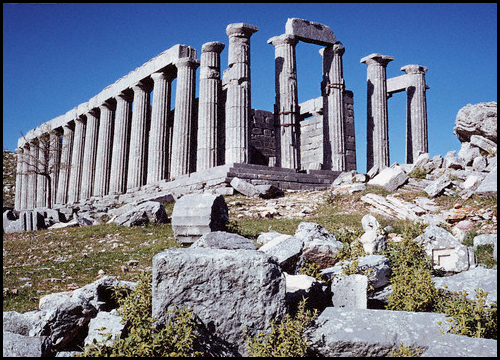
In 1811 Cockerell and three scholarly companions discovered – or rather re-discovered – the lonely and wonderful Temple of Apollo Epicurius at Bassæ, built here by Ictinus to celebrate the end of the plague in the same decade that he put the Parthenon together. The temple at Bassæ combined Doric and Ionic columns and, for the first time, launched the Corinthian styles into the architecture of the world. (I say ‘rediscovered’ because halfway through the eighteenth century the French traveller Bochon had barely set eyes on Bassæ when he was murdered by bandits, who thought the brass buttons on his coat were gold.) A generation later the English party, more soberly dressed, gazed at the temple in wonder. There it stood almost complete in its vast and lonely Arcadian glen, one of the wildest and most haunted regions of the Peloponnese. They were struck dumb.

Temple of Apollo Epicurius at Bassæ

We know the rest of the story: the rescue and reassembly of the frieze that had run round the cella of the temple; the long pourparlers with the Vizir of Tripolitza; the bargaining, the transport of the slabs in a British ship to Zakynthos – Zante, that is – in the newly acquired Ionian Islands; their arrival in England and their final erection on the British Museum, where they were second only to Lord Elgin’s Athenian loot.

The Travellers Club was founded three years after Waterloo and very soon up went Cockerell’s casts of the never-ending conflict that rages just above our heads.

Arriving back to be demobbed at the end of our war, I made a bee-line for Pall Mall. (Xan Fielding and I were members now – Arthur Reade’s letter, three years in transit, had worked.) I dashed upstairs, barely touching Talleyrand’s ramp, and into the Library, to gaze up at the battling Amazons and Greeks and Lapiths and centaurs that girdle this marvellous room. It was a great moment.

I was back in Greece soon afterwards, a peripatetic deputy-director of the British Institute improvising lectures to patriot warriors all over the country, largely about Dante Gabriel Rossetti and the Pre-Raphaelite Brotherhood – and I’m not sure how gripping the whiskered guerrillas found them. Accompanied by Joan, whom I had married, and by Xan Fielding who was still in the Army, we set off in his jeep and drove from Tripoli to Andritsaina into the fierce Arcadian mountains and on to Phigaleia and – at last! – to Bassæ. We trudged the last few miles along goat tracks, reached the austere and silent temple after dark, and dossed down among the pillars. The early sunbeams over Mount Elaios lit up not only the wonderful columns, but also a young fox sitting in the middle of them. He gave us a long pensive look, the trotted off in search of somewhere less crowded.

Back in the Library here, much later, I was led to Davis Watkin’s Life of C. R. Cockerell and settled with it in a corner (where the centaurs seemed to be getting the upper hand) and it fell open on the page where Cockerell and his friends were inspecting the ruins: ‘One day when they were scrambling about amongst the great fallen columns.’ I read. ‘a fox that had made its home deep down amongst the stones, disturbed by the unusual noise, got up and ran away’. I nearly jumped out of my skin. ‘In the light that streamed into its momentarily emptied lair, they discovered a glint of marble, then the first slab of what turned out to be the felled bas-relief – then another and another, and yet another, until the whole wonderful cincture was resurrected and linked together.’

Our fox must have been a descendent of theirs, the great-great-great-great-great-great – in fact, the hundred-and-fortieth great-grand cub of the one that jumped out of its hole on that momentous day a century and a half before. After all, it was only two thousand, three hundred and seventy-odd years since Ictinus and his fifth-century BC team, having finished their task, piled the spirit-levels and hammers and chisels into the panniers of the baggage-train, shut their dividers, coiled their measuring ropes, brushed off the chips and poured a last libation to Apollo and , perhaps, another down their throats – before following our track across the glen; and we were unshakeably convinced that a small fox, ancestor to all the others, must have watched them out of sight.

PATRICK LEIGH FERMOR

The above is the text of a talk given by the author at a Library Dinner in 2004 to celebrate his sixtieth year of membership.

The original scanned pages in pdf format, of which there are three, are here: One, Two, Three


George Psychoundakis – The Cretan Runner’s obituary from The Times

A second obituary of George who as a fit young man risked life and limb running messages for the Cretan resistance and then for the SOE operatives in Crete. Paddy helped to get George out of gaol (when he was mistakenly detained by the Greeks as a deserter) and then translated The Cretan runner into English.

Cretan partisan who wrote an unvarnished account of the wartime occupation

First published in The Times February 23, 2006

AS a runner for the Resistance in Crete during the German occupation, George Psychoundakis carried messages over vast distances across one of the most mountainous regions in Europe. It was a life of constant risk — runners captured by the Germans were often tortured and shot. Wearing worn-out boots and with a minimum of rations, Psychoundakis would cover up to 50 miles in only a few days. The threat from collaborators meant that he often had to avoid villages, thus depriving himself of comforts that would have eased the rigours of his journeys.

Psychoundakis approached his missions with a humour and a charm that made him a popular figure in the Resistance, as well as with the British officers serving under cover. One officer was the writer Patrick Leigh Fermor, with whom Psychoundakis formed a lifelong friendship. It was Leigh Fermor who translated Psychoundakis’s account of life under the occupation, The Cretan Runner, republished in 1998.

In his foreword Leigh Fermor writes how he was captivated by the Cretan’s “gift for play on words, for funny repartee, light verse, improvisation, unpredictable flights of imagination and his instinct for teasing the great . . . which earned him a universal licence as a jester”.

More than merely fleet of foot, Psychoundakis was quick of mind. Before the war, as a shepherd boy, he was fascinated by literature. Among a barely literate population, he had to pester the village priest and the doctor for books, and even composed his own epic poems. Psychoundakis represented the Greek oral tradition: he had even composed a two-hour-long poem about the war. It ended with George firing Leigh Fermor’s pistol into the air, swearing vengeance on the German “ cuckolds”. At night and when the weather was awful, Psychoundakis would sit with his comrades in their caves, reciting the 10,000 lines of the 17th-century Cretan poem, the Erotokritos.

George Psychoundakis was born in 1920, the son of a shepherd from the village of Asi Gonia in Western Crete. The family was very poor — Psychoundakis, his two sisters and brother were raised in a one-room house — and owned only a handful of goats and sheep. After a few years at the village school Psychoundakis too became a shepherd until the German invasion in May 1941.

Had the invasion not happened, it is probable that he would have remained an unknown shepherd, eking out a tough existence on the craggy Cretan landscape. But the occupation allowed him to broaden his horizons, for the contacts he had made with scholarly warriors such as Leigh Fermor gave him the opportunity to make a name for himself as a man of letters.

But the transition from mountain boy to writer was not easy. Despite being awarded the British Empire Medal after the war, Psychoundakis was arrested as a deserter and imprisoned for several months, losing his thick head of hair through worry. Afterwards, he was forced to fight in the civil war, returning to Asi Gonia after two years to find his family poorer than ever.

It was then that he wrote The Cretan Runner. When he and Leigh Fermor met again in 1951, Fermor marvelled at the uniqueness of such a document. Most writing about the occupation had been by the English or the Germans, but here was a heartfelt testament to the horrors of being occupied. The book was published in 1955, and became a great success.

Written in a simplistic style, it is an episodic account of hardships and dangers, with moments of great humour set against a background of murder and torture.

“Nobody talked, but the Germans had positive information. They lined them all up, and, as they refused to speak, prepared to execute the lot. But, before they could press the trigger of their heavy machine-gun, ten Germans fell dead. For some of the village men — about ten — had taken up position along the top of a sheer cliff above the village, from where they could watch every detail, and, at just the right moment, had opened fire. Not a bullet went wide.”

Even after the publication of The Cretan Runner, Psychoundakis continued to live in Asi Gonia. There he translated the Iliad and the Odyssey into his Cretan dialect, and he was honoured by the Academy of Athens. He lived off the land and held a variety of jobs. That one of these was as the caretaker for the nearby German cemetery was a shining example of Psychoundakis’s sense of forgiveness.

He is survived by his wife, Sofia, their son and two daughters.

George Psychoundakis, BEM, shepherd, partisan and writer, was born on November 3, 1920. He died on January 29, 2006, aged 85.

The obituary of Daphne Fielding from The Independent

Paddy was very close to Daphne Fielding. She was the wife of the man who must be considered his best friend (read In Tearing Haste and you will have few doubts).

First published in The Independent 17 December 1997.

Daphne Winifred Louise Vivian, writer: born 11 July 1904; married 1926 Viscount Weymouth (succeeded 1946 as sixth Marquess of Bath, died 1992; two sons, and two sons and one daughter deceased; marriage dissolved 1953), 1953 Xan Fielding (died 1991; marriage dissolved 1978); died 5 December 1997.

Daphne Fielding was a society author in the decades between 1950 and 1980. Having been a part of the world of Bright Young Things in the 1920s, she was well known in society as the Marchioness of Bath, and following her marriage to Xan Fielding she produced a stream of books of easy charm which achieved great popularity. Good-looking when young, in later life she was a tall, handsome figure, and could have been mistaken for a distinguished actress.

Daphne was the daughter of the fourth Lord Vivian and his wife, Barbara, a former Gaiety Girl, who was to marry three further times. The family was eccentric; many years later, her brother the fifth Lord Vivian (who died in 1991), variously a farm labourer in Canada, a publicity manager in San Francisco and a partner of the impresario C.B. Cochran, had the misfortune to be shot in the stomach in 1954 by his mistress Mavis Wheeler, the former wife of Sir Mortimer Wheeler, the archaeologist, a drama which occupied the headlines for many days.

Daphne emerged from a childhood which was a mixture of hilarity and insecurity, later described with relish in her memoirs, Mercury Presides (though Evelyn Waugh declared these as “marred by discretion and good taste”). She passed through Queen’s College in London, and St James’s, Malvern, and gravitated, through her friends the Lygon sisters, to the stimulating world of Oxford in the 1920s, and to that set dominated by Harold Acton, Evelyn Waugh and Brian Howard. The friends she made then were friends for life, a group that gave each other unswerving loyalty despite infidelities and political differences, everlastingly self-protecting; and a group through which she met Viscount Weymouth, heir to the Marquess of Bath.

There was parental opposition to their union, Henry Weymouth’s father declaring that he needed “a steady wife” and finding that Daphne did not fit this category. Weighing in, her father announced that he thought Weymouth an unsuitable husband. They were married in secret at St Paul’s, Knightsbridge, in 1926, and then again considerably more publicly at St Martin-in-the Fields in 1927, the bride dressed by Norman Hartnell. (When eventually they were divorced, there was a prolonged court case before three judges to dissolve that earlier marriage, and regularise the unusual situation.)

Old Lord Bath in 1928 handed the running of the Wiltshire family seat, Longleat, to his son (not without certain misgivings about his capacity for work) and he and Daphne threw themselves wholeheartedly into the management of the estate. They employed Russell Page to redo the gardens and were involved in extensive forestry work. To supplement her income, Daphne wrote articles for newspapers and magazines, which brought her under the protective care of Lord Beaverbrook.

They had four sons and a daughter. The eldest boy died in 1930, just before his first birthday, and the youngest, Lord Valentine Thynne, died after hanging himself in 1979. Her daughter Caroline predeceased her, and she is survived by two sons, the present Marquess and his brother, Lord Christopher, who are on notoriously bad terms. (There was a rumour that at Lord Christopher’s wedding to Antonia Palmer in 1968 the cake was laced with LSD. The Queen was a guest.)

Henry Weymouth spent much of the Second World War as a prisoner of the Germans, which did not help the marriage. In 1946 he succeeded his father as Marquess of Bath. Forced by crippling death duties he opened Longleat to the public in 1949, with an entrance fee of half a crown a head. By 1953 he had added a tearoom and tennis court, laid out a putting green, and floated pedalos for hire on the lake. But the marriage was over and the Baths were divorced in May 1953.

Daphne wrote the first guidebook to Longleat, a lively history of the Thynne family from 1566 to 1949, which she researched and wrote in three weeks. This she followed with Before the Sunset Fades (1953), a slim 30- page book about life above and below stairs at Long- leat, decorated, appropriately, by her old friend and Wiltshire neighbour Cecil Beaton.

In 1953 she married the war hero and travel writer Xan Fielding, a man 14 years her junior, a happy marriage which lasted until 1978. During these years they lived variously in Cornwall, Morocco, Portugal and Uzes, where they settled for some years, surrounded by a variety of pets and visited by their many friends.

While married to Fielding, she wrote her books Mercury Presides (1954) and its sequel, The Nearest Way Home (1970), and a novel, The Adonis Garden (1961), of which Evelyn Waugh wrote that she had “squandered six books in one”, adding, “You have used almost everything that has happened in the last twelve years.”

The Duchess of Jermyn Street, a life of Rosa Lewis of the Cavendish Hotel subsequently serialised on television, was to have been written with the help of George Kinnaird (a writer who also used to help Baroness de Stoekl with her books), but he gave up while going through a divorce. It was published in 1964 and Evelyn Waugh described it as “jolly good but I think full of inaccuracies”.

She wrote a joint life of Lady Cunard and her daughter Nancy, Emerald and Nancy (1968), which her friend Dirk Bogarde judged “light on the intellect”, fearing that Fielding had whitewashed these two monsters on the grounds that “she couldn’t be beastly to chums”; and a portrait of Iris Tree, The Rainbow Picnic (1974).

Raleigh Trevelyan, of Hamish Hamilton, then commissioned her to write a life of Gladys Deacon, the 93-year-old Duchess of Marlborough, whom he had come across while researching his book about the Whitakers of Sicily, Princes Under the Volcano (1972). This was not her usual milieu, since the duchess belonged to the belle epoque and intellectual world of Paris of a generation older than Daphne Fielding. Nevertheless she was able to tap her wide circle of loyal friends for anecdotes. To her surprise a man wrongly described as “a young intellectual” proved to have embarked on the same research. However, her friends closed ranks around her, and a word from Lady Diana Cooper to her biographer, Philip Ziegler, caused him to drop the rival’s incipient Collins contract like a hot potato.

I know this, for I was that rival. Both books were in due course published, hers under the title The Face on the Sphinx (1978). But the story had a happy ending, for those same friends helped me with my life of Cecil Beaton, and Diana Cooper, in her more usual role as peacemaker, effected a successful rapprochement between us. I enjoyed a number of meetings with Daphne in New York in 1981, during which she chatted amicably about our experiences and regaled me with Cecil Beaton stories. I always remember her line about Patrick Leigh Fermor: “Do you know Paddy? He’s such a good friend. He should be turned into pills so that you can take him when you feel low.”

Her friend Robert Heber-Percy averred that Daphne Fielding was a better conversationalist and letter-writer than author of books.

In 1978 Xan Fielding left Daphne for a lady described by her friends as “an older woman”. Bereft but brave, she was lucky to meet once more an old Oxford friend, Ben Kittridge, an American millionaire, with whom she went to live in Arizona until his death in 1981. Thereafter she returned to England and settled in the Old Laundry in the shadow of Badminton, where for two years the fox-hunting 10th Duke of Beaufort (“Master”) lived on, and where, until her death from cancer in 1995, her daughter Caroline lived as the next Duchess of Beaufort.

Daphne Fielding’s last years were spent there. At the famous Horse Trials she could be seen driving about in a tiny self- propelled vehicle and every Sunday she lunched with her son-in-law, where she was a by no means unnoticed figure at the table.

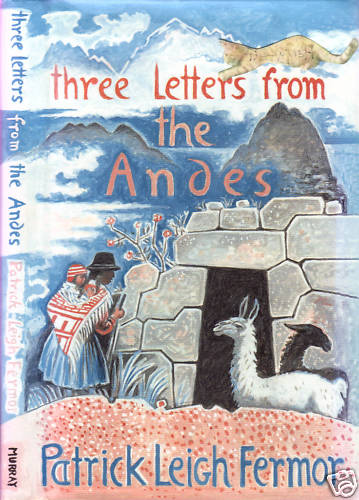
A quick review of Three Letters from the Andes

I have just finished reading Three Letters from the Andes published in 1991, but first written by Patrick Leigh Fermor during the month long expedition to the high Andes in Peru in 1971. He was accompanied by good friends, most notably his close friend Andrew Cavendish, 11th Duke of Devonshire.

The original text consists of three letters to his wife Joan and mailed by Paddy to her to try to describe to her much of what happened during the expedition which included some challenging climbing, which for the greater part, Paddy did not join. He describes his principal role as ‘minder of the primus stove’ and this duty enabled him to sleep in the spacious mess tent.

Three Letters from the Andes

The book is enjoyable enough and it does what it says; it describes the journey and I am sure Joan would have enjoyed the letters. Paddy did some editing prior to publication to make them more presentable for general readership (and probably removed any indiscreet comments). However, compared to the more familiar A Time of Gifts and Between the Woods and the Water, this is a lightweight affair. Perhaps it shows how much work Paddy must put into his constant redrafts to expand upon his first thoughts. This is clearly work that had minimal redrafting, and is interesting because of that.

The description of the journey and key events remain in my memory but it did not give the deep pleasure gained by the former books. Just a couple of my favourite bits:

When flying in to Lima the party had to go through Peruvian customs and immigration. Paddy describes the staff as ‘sleepy, rather blank faced … officials who were far from brisk.’ He goes on to describe Andrew Cavendish’s experience. ‘… our passports seemed to puzzle them and Andrew’s proved utterly enigmatic. He got through the last barrier half an hour after they’d finished with the rest of us, murmuring sadly: ‘I can’t deny there are countries where being a duke is a bit of an advantage; but Peru’s not one of them.’

Right at the end of the journey at a dinner given for the party at the British Embassy, Paddy is seated next to a ‘very quiet and very beautiful neighbour called Dona Diana de Dibos’. After a while he realized that she was the sister of Lt Mike Cumberlege, a naval officer who used to ferry partisans and SOE agents into and out of Crete during the German occupation. He had been shot in a concentration camp just four days before VE day. Paddy cheered her up by telling her many stories about her brother that she had never heard before.

Three Letters is short and easy to read. For Paddy fans it is essential reading to complete our picture of him and his life and his various publications. There are probably better ways of spending a few hours, but I don’t think anyone reading it will be disappointed … as long as they don’t expect a short version of ATOG.

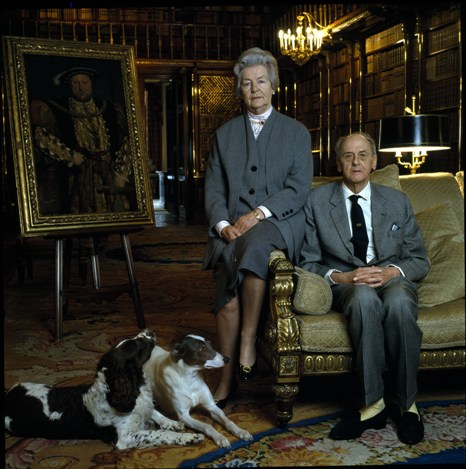
The 11th Duke of Devonshire – The Times obituary

Another obituary of Paddy´s friend. Note links to The Times may not work soon as it goes paid for within weeks.

First published in The Times May 4, 2004

Although descended from a line of dukes reaching back to the end of the 17th century, the 11th Duke of Devonshire did not expect to succeed to the title. Indeed, when he was 18, his father, the 10th Duke, took him to one side and told him that he would have to make his own way in the world. Chatsworth and the other great family houses, pictures and glorious gardens would all go to his elder brother, his father explained. This was the only way that the family’s valuable heritage could be preserved and passed down to future generations.

But things did not work out that way. The 10th Duke’s elder son, the Marquess of Hartington – who married Kathleen (“Kick”) Kennedy, sister of President Kennedy – was killed in action in the last months of the Second World War. His younger brother, Andrew, thus became Marquess of Hartington and heir to the vast ducal estates at the age of 24.

At the age of 21 he had married Deborah (“Debo”) Mitford, the sixth of the 2nd Lord Redesdale’s daughters. She was to prove a remarkable chatelaine, restoring the main family seat, Chatsworth, to the grandeur of 50 years earlier, when it was known as “the Palace on the Peak”. More than that, her salesmanship and the style of her refurbishment made Chatsworth a house that people from all over Britain and the world wanted to see (for decades it has notched up 300,000 paying visitors a year).

This was not something that anyone could have envisaged on their wedding day in 1941, least of all the young couple themselves. A few days beforehand the bride had written to her sister, Diana, then in Holloway prison (she was married to the leader of the British Union of Fascists, Sir Oswald Mosley), saying how sorry she was that they could not be together for her marriage and adding that she and her husband expected to be “very poor”.

But by 1950, at the age of 30, the Marquess of Hartington had become the 11th Duke. His father had died suddenly at the age of 55. The 10th Duke’s great interest had always been in country pursuits. One of these was cutting up fallen trees with a saw for the family fires. It was while doing this at Compton Place, his seaside house in Eastbourne, that he suffered a coronary thrombosis and died.

The 10th Duke was under the impression that he had, in 1946, divested himself of personal ownership of his estates, greatly lessening death duties, which were then the highest the country had ever known. Unfortunately, the arrangements did not pass muster with the Inland Revenue, and the arguments over the Devonshire inheritance went on for 17 years.

In the end, the bulk of the inheritance was saved, but formidable bills had to be met. Hardwick Hall, part castle and part Tudor fort in Derbyshire, with its High Great Chamber – which Sacheverell Sitwell called “the most beautiful room, not in England alone, but in the whole of Europe” – had to be sold to help meet the debts. The family had been living there until the 1950s. Old Masters and rare Italian drawings were also dispatched to the salerooms. Indeed, over the past 20 years alone, paintings from the Devonshire estate have realised more than £26 million, with books raising a further £600,000.

In 1952, two years after succeeding to the title, the Duke bought a pretty, small, terraced house in Mayfair. It was there he brought up his three children. The seller was Anthony Eden (later the Earl of Avon), who had moved to the Foreign Secretary’s official residence in Carlton Gardens.

It was 1959 before Chatsworth was in a condition for the family to move in. By then it was owned by a trust, of which the Duke was just one trustee, and he had leased a suite of rooms for his family. Most of the 175 rooms today bear the constant burden of the visitors who keep the place going. The family rooms are big and spacious, with glorious views and handsome pictures. In the private dining room are portraits of Mary Queen of Scots, Charles I and Henry VIII. But the Duke kept on the terraced house in Mayfair as a London bolt hole.

It is on the inherited landed estates that the commercial action has taken place. Shoots and well-known stretches of river are let. Two hotels have been developed: the fairytale castellated Lismore Castle in Ireland, pitched high above the River Blackwater and once the home of Sir Walter Raleigh, is in constant demand for renting by wealthy Americans.

In the 1980s the Duke came to an agreement with the Inland Revenue, allowing more public access to his estates in the Yorkshire Dales in response to a cut in death duties. This was made possible by a Land Act passed by the Labour Government in 1975. Neither side has disclosed the saving in death duties but it is believed to amount to some millions of pounds.

In the 1990s the Duke decided that if he could get planning permission on the Chatsworth estate for some open-cast coal mining, it would benefit financially for some years to come. Local traditional miners, who had lost their jobs when the mines were closed, were furious. Anne Scargill, married to the Yorkshire miners’ leader, led protesting miners’ wives to Chatsworth, loudspeakers blazing, in opposition to the whole idea. It was a cold day and the Duke met them carrying a large silver tureen of hot consommé laced with sherry. Afterwards, he said that he found Mrs Scargill “absolutely charming”, and added that if he was in her position he, too, would protest. Mrs Scargill’s verdict was: “Such a gent, we couldn’t get cross with him.” She added: “He was dead straight with us too, he said he wanted the open mining because he needed the money.”

He was a tall, slim, fit man and noticeable wherever he went. He wore suits of the finest lightweight worsted, always well brushed and pressed. And there was something else that made him recognisable: as a young man he took to wearing pale lemon socks, and it became a lifetime habit. He made no secret of the fact that he liked clothes and when he went on his summer holidays to Eastbourne he used to wear a boater. He had the youthful figure to carry it off.

Andrew Robert Buxton Cavendish was the younger son of the 10th Duke, who had held junior post in the Colonial and Commonwealth Offices, and his wife, Lady Alice-Mary Cecil (known as “Moucher”) a woman of note in her own right. She was the first Chancellor of the University of Exeter and in Coronation year, and for 16 years subsequently, she was the most senior of the Queen’s ladies-in-waiting, as Mistress of the Robes. Her brother was the 5th Marquis of Salisbury (known as “Bobbity”), who resigned with Eden in 1938, going on to be Leader of the House of Lords and an influential presence in the Tory Party at least until his rash second resignation in 1957.

The Duchess made the bigger impact of the two on their second son. From her he derived his interest in politics and current affairs, a love of books, gardening and much else. She also encouraged him to speak out and question things. Harold Macmillan, who married her husband’s sister, Lady Dorothy Cavendish, had written about how hard the Duchess found it when she moved from the Salisbury seat at Hatfield to Chatsworth: “The Cavendishes went in for long silences which she found trying; the Cecils talked all the time about everything under the sun and had animated and furiously contested verbal contests.”

Andrew Cecil went to Eton and Trinity College, Cambridge, but at the age of 20 he was in the Coldstream Guards and training for the Second World War. In 1944 he led his company to capture a hill during the Italian campaign and held onto it with dwindling supplies and under fire from three sides until relieved. For this he was awarded the Military Cross.

In 1945 and in 1950 he contested Chesterfield unsuccessfully for the Tories in two hard-fought general election campaigns. During one his car was overturned: the Cavendishes had not yet become the popular figures they are today. Harold Macmillan made his wife’s nephew Under-Secretary of State for Commonwealth Relations in 1960, and in 1962 promoted him to be Minister of State. (The Prime Minister would murmur as he made his evening tour of the Smoking Room: “You know, Andrew is awfully good with natives.”) Inevitably the cry of nepotism was raised – never more effectively than in a political pamphlet prepared by the Daily Mirror, which listed all the relatives, whether through blood or marriage, to whom Macmillan had given jobs in his Government. At the time such criticism seemed to be water off a duck’s back so far as the Duke was concerned. But more than 30 years later, in 1996, the Duke criticised the ministerial appointments made by Macmillan as “nepotism of an unacceptable kind in the 20th century”. But by then he had left the Tories, having tired of Margaret Thatcher’s dictatorial tendencies, and become an early member of the Social Democratic Party (actually entertaining Roy Jenkins during one SDP annual conference held in Derbyshire). He never enrolled as a Liberal Democrat, and on his rare visits to the House of Lords sat on the cross benches.

He was a man of many interests, the principal one, perhaps, being books. Requests to his bookseller, Heywood Hill in Curzon Street (which he owned) would frequently come on Monday mornings in the wake of his weekend house guests, one of whom had probably aroused his interest in some subject. Biographies of British prime ministers and American presidents could always be counted upon to appeal. Even so his tastes were catholic. One morning he called up and said: “I want to start a shelf of really good, interesting rogues.” He had been a customer at Heywood Hill since the end of the war, during which it was run for a while by Nancy Mitford, his sister-in-law. He was a little irritated in 1971 when the shop was sold without his being warned beforehand. No one, however, realised that he wanted it. But, in 1991, when it came up for sale again, he promptly bought it, also founding in 1995 the Heywood Hill literary prize of £10,000. This is awarded annually for style, wit and elegance, and is open to publishers, writers, collectors, reviewers and even cartoonists. For years he was a pillar of support to the London Library. When the library raised more than £3 million for its work in 1991, the Duke had helped in various ways, not least lending a room in Pratt’s Club in St James’s where he was proprietor, for use during the appeal. The library made him a vice-president in 1993.

Few other things gave the Duke greater pleasure than the successes of Derby County or Chesterfield in the League or the FA Cup. Their colours were sported and banners unfurled at Chatsworth and over the years there were parties and celebrations. “It is no pose,” he insisted. “When Derby or Chesterfield do well people go around with a spring to their step – I do myself.”

Racing was a challenge that fascinated him, though running horses was never as great a preoccupation for the Cavendishes as it was with the Derbys or the Roseberys. But the Duke won top races, and with horses for which he had not paid a vast sum of money. His best horse was the chestnut mare Park Top, the winner of the King George VI and Queen Elizabeth Stakes and the Coronation Cup in 1969. His only book was written about her. It was Park Top’s failure in the Prix de l’Arc de Triomphe which resulted in the Duke’s good manners snapping. On form, the mare was expected to win, but she failed and the French crowd booed. This annoyed the Duke as she was clearly off-form and he gave them the V-sign, saying afterwards: “The crowd were so unfair to the horse and I did what I saw Harvey Smith do to the establishment at Hickstead.”

Tennis was another interest and well into middle age the Duke had a coach come regularly to give him a game at Chatsworth. He was president of the ruling body, the Lawn Tennis Association, for six years and had been a vice-president of the All England Club at Wimbledon since 1965.

In 1991 the Duke and Duchess celebrated the 50th anniversary of their wedding in an imaginative and original way. It was a great success. They invited all the couples in Derbyshire who had married in 1941 to come to Chatsworth for a full afternoon tea, with bands playing. Some 3,700 people sat down to tea, which was provided by eight field kitchens. Traffic jams were predicted but were minimal as marshals patrolled the approach roads with two-way radios and coloured flags.

In a speech the Duke said that he and his wife had been very lucky in life and they were very happy to share their good fortune with the people of Derbyshire. His speech was cut short by the Duchess, saying in an audible aside: “Come on dear – you are sounding like President Ronald Reagan.”

The Duke served as trustee of the National Gallery, 1960-86; he was Mayor of Buxton, 1952-54; and a member of the Horserace Totalisator Board, 1977-86. He was appointed one of the 24 Knights of the Garter in 1996. Every head of his family from the 1st Duke in 1698 had held this honour before him.


The 11th Duke of Devonshire, KG, MC, was born on January 2, 1920. He died on May 3, 2004, aged 84.

World War II Veterans event British Embassy Athens

An account from the British Embassy Athens website telling of a Greek and British veterans gathering held on 9 March 2009. Of course Paddy was there!

A unique gathering of almost 30 WWII Veterans under the Ambassador’s Residence roof

It was a unique and rare occasion to witness the gathering of almost 30 WWII Veterans under one roof. The British Ambassador, Dr David Landsman, and the British Defence Attaché hosted the gathering at the British Ambassador’s Residence on Monday 9th March. Addressing this “distinguished and unique group of people,” Ambassador, Dr David Landsman said, “We are living in a better world, thanks to the sacrifices you made.”

Opening the event, the Defence Attaché welcomed the Veterans and conducted a brief presentation on the current status of the British Armed Forces. Highlighting the importance of formally recognizing the Armed Forces and our Veterans, he explained that the British Government has now nominated 27th June as a national day of celebration.

Amidst the array of celebrities in the room, a selection took the time to say a few words on behalf of their fellow veterans. Amongst them, Jason Mavrikis MBE, Sir Patrick (Paddy) Leigh Fermor DSO OBE, Themis Marinos (S.O.E.), Air Marshal Constantinos Hatzilakos (RAFA Hellenic Pilots), Lt General Korkas (Sacred Squadron), Captain Rigas Rigopoulos (Levante Flotila)

Obituary: John Smith-Hughes who served in Crete with SOE

Young officer who served in Crete and then joined SOE working with many of Paddy’s colleagues. It is almost certain Paddy and Smith-Hughes met but there is no mention in this obituary.

by Antony Beevor

First published in The Independent Thursday, 17 March 1994

John Smith-Hughes, soldier and barrister: born 27 November 1918; OBE 1945; married 1945 Angela Louvaris (died 1972; one son, one daughter); died Tortola, Virgin Islands 4 March 1994.

LIKE many of those who joined Special Operations Executive in the Middle East, Jack Smith-Hughes possessed considerable intellectual talents matched by a lack of reverence for conventional army pieties. His path to SOE’s headquarters in Cairo had also been decidedly unpredictable.

At the end of 1940, Smith- Hughes, a portly and precocious 22-year-old subaltern in the Royal Army Service Corps, was shipped to Crete as part of the Allied garrison sent to defend the island after the Italian invasion of Greece. When the German airborne invasion took place in May 1941, he was in charge of shipping supplies to outlying detachments from Chania, in north- west Crete. On the night that Brigadier Robert Laycock and Evelyn Waugh landed with the Layforce commandos at Suda Bay, the most chaotic moment of the battle, Smith-Hughes was astonished to find himself walking up and down the jetty for a considerable time with General Bernard Freyberg VC, the Allied commander on the island. Freyberg was worried that the Australian force at Rethymno, on the coast to the east, would not receive the order to withdraw. Unfortunately, this concern for his troops meant that Freyberg was out of touch with his headquarters during several hours while the last Allied counter-attack collapsed in confusion.

The next day, retreat nearly turned into rout. Smith-Hughes was soon one of the 20,000 exhausted men making their way over the White Mountains to the southern coast for evacuation by the Royal Navy. He was one of the unlucky ones. On his way to join the queue on the last evening, he was turned back by an embarkation officer and told not to worry: the warships would be back again the following night. A couple of hours later, he realised that the man had lied to him. Captured by Austrian Alpine troops the next morning, he was marched back over the mountains, the most painful journey of all, to prison camp.

He escaped soon afterwards and hid at the house of Colonel Andreas Papadakis, who later proclaimed himself chief of the Cretan Resistance. George Psychoundakis, ‘The Cretan Runner’, then guided him to the monastery of Preveli on the south coast. Evacuated finally to Egypt by submarine, Smith- Hughes had the satistaction in a Cairo restaurant of encountering the embarkation officer again and telling him exactly what he thought of him.

To his surprise, Smith-Hughes was summoned to SOE’s Cairo headquarters, in Rustum Buildings – known to Cairene taxi-drivers as ‘secret building’. He was then sent back to Crete ‘to feel out the country and see who had influence’. Accompanied by Ralph Stockbridge of Inter-Services Liaison Department, the cover-name for MI6, he landed on 9 October 1941. Smith-Hughes was fortunate not to never encounter a German patrol or roadblock: his Cretan disguise only seemed to draw attention to his unusual bulk, his Britishly pink compexion, and his ungainly walk.

Smith-Hughes and Stockbridge set off to see Papadakis, the only person they knew who claimed to have influence. But Papadakis’s folies de grandeur made him impossible to use as a focus of resistance. Other leaders were sounded out, mainly those rallied by the archaeologist John Pendlebury who had then been executed by German paratroopers during the battle. Smith-Hughes handed over to Monty Woodhouse from Egypt shortly before Christmas and returned to Cairo, where he ran the Cretan desk at SOE headquarters with great skill.

Promoted to major, Smith- Hughes managed to preserve the section from the terrible infighting in Rustum Buildings by moving out to an annexe. It was Smith- Hughes who briefed and backed up Woodhouse’s successor, Tom Dunbabin, another distinguished archaeologist of great courage, and his two deputies, Xan Fielding for western Crete and Patrick Leigh Fermor for eastern Crete. Unusually for SOE in the Middle East, the Cretan section, B5, was neither riven by animosity nor plagued by rivalry with ISLD. Smith-Hughes’s joint mission with Stockbridge laid the foundations for an unusual degree of co-operation between the two organisations, and he managed to maintain it even in the torrid bureaucratic warfare carried out by the ‘Gaberdine swine’ in Cairo.

The Germans did all they could to track down the ‘espionage organisation of Captain Huse’, as one of their reports put it. But perhaps the greatest contribution made by SOE officers in the field and in Cairo was to prevent the latent civil war between the Cretan nationalist EOK and the Communist-dominated EAM-ELAS from exploding into a war to the knife. After the liberation of Heraklion, when a reactionary kapitan shot and wounded one of the Communist andarte leaders, Dunbabin and Smith-Hughes managed to prevent an explosion by driving round the town in open jeeps, and persuading both sides to back away from a battle which would have led to the virtual annihilation of the Communists. The Nationalists, unlike their counterparts on mainland Greece, were untainted by collaboration and much stronger than the Left.

Smith-Hughes, with typical self-deprecating humour, recounted that his most terrifying experience during the war was the formal liberation of Kastelli Kissamou, on the north-west tip of Crete. As a mark of honour, the Cretan kapitan for the area insisted that he should ride with him into the town. Smith- Hughes, who had never felt comfortable with horses, was obliged to overcome his fears, and when the cheering crowds made the horse caracole, he had to hold on to the saddle with both hands.

After the war, Smith-Hughes turned his incisive mind and astonishing memory to the law, first in the Army, and then as a barrister at Tortola in the Virgin Islands, where he became Attorney-General. In 1991, he returned to Crete for the 50th anniversary of the battle and was one of the guests at the memorable all-night glendi in honour of Patrick Leigh Fermor and his Cretan comrades who abducted General Heinrich Kreipe in April 1944.

Zeus Xenios award

First publisjhed in Kathimerini 31 May 2003

FOO YUN CHEE

Greece yesterday paid tribute to 10 individuals, Greeks and foreigners, who, through their works, have helped increase awareness of the country, its culture and peculiarities. The 10 individuals, including writers, a violinist, a director, an entertainer, a composer, a stage designer and a singer follow a path first laid out by the ancient poet Homer, Ioannis Patellis, head of the Greek National Tourism Organization (GNTO) said.

“Homer was the first to advertise the attractions of our country to the outside world,” he said. Contemporary figures such as composers Mikis Theodorakis and Manos Hadjidakis, author Nikos Kazantzakis, opera singers Maria Callas and Agnes Baltsa and the legendary Melina Mercouri, through their achievements, have further continued the tradition of promoting Greece, he said.

Patellis said the success of these well-known personalities in their respective fields had been invaluable in promoting Greece as a tourist destination. The 10 individuals singled out this year have played an equally effective role in raising Greece’s profile abroad, he said. Starting this year, the GNTO intends to honor such individuals with a distinction aptly named Zeus Xenios (god of hospitality). The first Zeus Xenios awards were yesterday bestowed upon French-born Greek TV presenter Nikos Aliagas, Briton Patrick Leigh Fermor (who joined Greeks in fighting the German occupation during World War II and stayed on), Russian doctor of literature and translator of Greek poetry Mikhail Gasparov, Greek violin prodigy Leonidas Kavakos, Greek music composer Periklis Koukos, Greek singer Vicky Leandros, film director John Madden, Greek artist Mina Papatheodorou-Valyraki, Greek stage designer Nikos Petropoulos and Hollywood director-cum-actress Nia Vardalos.

Chatsworth Celebrates the Many Lives of Deborah Devonshire

As you will know by now Deborah Devonshire (one of the famous Mitford sisters), the Dowager Duchess of Devonshire is one of Paddy’s closest friends. Their communication by letters over more than half a century forms the basis for the collection of letters edited by Charlotte Mosley – ‘In Tearing Haste’ – of which I have written before. The seat of the Dukes of Devonshire is Chatsworth in Derbyshire and this year Chatsworth will be staging a special exhibition to celebrates Debo’s 90th birthday. I thought it worth posting details for those who may be interested. For more information please  read the press release below or visit www.chatsworth.org .

In an epic year, Chatsworth is staging a special exhibition throughout 2010 in honour of the 90th birthday of Deborah Devonshire (on March 31), now Dowager Duchess of Devonshire and the last surviving of the famous Mitford sisters.

Andrew and Deborah Devonshire

 Feb 18, 2010 – Sister, mother, wife, Duchess, writer and celebrated national treasure.  Over the years Deborah Devonshire’s path has taken her in many directions creating a life story which is nothing short of fascinating. In an epic year, Chatsworth is staging a special exhibition throughout 2010 in honour of the 90th birthday of Deborah (on March 31), now Dowager Duchess of Devonshire and the last surviving of the famous Mitford sisters, marking the nine eventful decades of her life, illustrating her many interests and achievements.  

Memories of the Dowager’s Mitford ancestry, and her famous siblings, will be evoked with many unique items never seen by visitors before, including numerous letters, plates from the much loved Berlin dinner service sold by her father and purchased by her husband, the Cavendish/Devonshire family tree and the beautiful Renoir painting left to Chatsworth by her sister Pamela.

Visitors will experience a rare insight into the remarkable life of Deborah, illustrated with mementos and keepsakes personally chosen by her Grace including early diaries, the Dowager’s childhood ice skates (skating was an early passion), her nature notebook and a copy of her wedding invitation.  Deborah’s passion for all things outdoors quickly becomes clear.  A keen supporter and participant in all country pursuits, the exhibition will include the Duchess’s gun and game books.  Two of her beautiful handmade walking sticks are also featured, and her love of poultry reflected in a wooden chicken sculpture and her rosettes and prizes for eggs.

Deborah comments: “Putting this exhibition together has meant thinking back over the nine decades of my life so far, and trying to gather together mementos and photographs that will interest visitors to Chatsworth this year. I hope people will enjoy the wide range of things on view, from Paris dresses and works of art I love, to family photographs and a telephone from the gift shop at Graceland. I have been lucky enough to know many fascinating people and be involved in local and national organisations and good causes, and the displays will reflect these.”

In the 1950s, the Dowager had the huge task of restoring Chatsworth after the depressing war years (it had been leased to a girls school), and making it fit for the growing number of visitors, and as a family home. The wallpaper patterns that she used then will be shown alongside the books she wrote later in life, celebrating Chatsworth’s house, collections, garden, food and landscape. Her growing family is represented by glamorous private images of her and her young children by Norman Parkinson.

As Duchess, she was involved in many significant public and state events, and chose to take on many public responsibilities, charitable concerns and interests. The robes she wore to the Queen’s coronation in 1953, at which her son, the present Duke, was page to his grandmother Mary, widow of the 10th Duke, will be on display, alongside presentation objects from public engagements over the last 60 years.

Having known many famous artists and writers, there will be displays of early work by Lucian Freud, sculpted heads of some of the Dowager’s more illustrious artistic friends, by Angela Conner, and the special edition of one of his books given to her by Evelyn Waugh, with blank pages to avoid the bother of actually having to read it.

Deborah continues: “I have known Lucian Freud for well over fifty years, and he remains a great friend and a fascinating person. Being painted by him, when I was in my thirties, was a slow process, as he is not a lightning artist, but I think the result is full of insight – I certainly get more like the picture the older I become.”

Her tastes and style are represented by a number of exquisite couture gowns and other clothes and hats; favourite works of art by Atkinson Grimshaw, Tchelitchev, Jo Self, Epstein, Frink and others; a selection of the jewelled insect brooches she was given by her husband over many decades; and mementos of her hero Elvis Presley, including the Elvis telephone, and a section of fence from Graceland.

After 54 years in charge of Chatsworth [and its estate], Bolton Abbey and Lismore Castle in partnership with her husband, the late Duke, the Dowager’s retirement has not been quiet. Memorabilia relating to her latest books, and forthcoming memoirs, will be on display, together with new photographs taken for the exhibition, including a special image of the Dowager with her seventeen great grandchildren.

Chatsworth re-opens on March 14 and the exhibition runs until 31 October 2010. Entrance is free with house admission. For more information please visit http://www.chatsworth.org

The Duke of Devonshire’s obituary from The Independent

Andrew Cavendish was the 11th Duke of Devonshire, Debo’s beloved husband and a close friend of Paddy for over half a century. Paddy and Andrew shared many long walks and expeditions together some of which are detailed in the book of letters ‘In Tearing Haste’ whilst the most comprehensive account of one of their shared journeys is ‘Three Letters from the Andes’ published in 1991 during which Paddy described his own responsibilities as ‘looking after the primus stove’. 

First published in The Independent Thursday, 6 May 2004 

 Rescuer of Chatsworth and reviver of the family tradition of patronage 

“I am a very rich duke, a most agreeable thing to be, even in these days,” said the hero in Nancy Mitford’s 1945 novel The Pursuit of Love. Her brother-in-law Andrew Cavendish, when he succeeded five years later as 11th Duke of Devonshire, had every reason to disagree. 

Andrew Robert Buxton Cavendish, landowner: born London 2 January 1920; MC 1944; styled 1944-50 Marquess of Hartington, succeeded 1950 as 11th Duke of Devonshire; Mayor of Buxton 1952-54; President, Royal Hospital and Home (formerly Royal Hospital and Home for Incurables), Putney 1954-91; President, Building Societies Association 1954-61; President, Lawn Tennis Association 1955-61; Chairman, Grand Council, British Empire Cancer Campaign 1956-81; Parliamentary Under-Secretary of State for Commonwealth Relations 1960-62; Minister of State, Commonwealth Relations Office 1962-64, and for Colonial Affairs 1963-64; PC 1964; Chancellor, Manchester University 1965-86; Steward, Jockey Club 1966-69; President, National Association for Deaf Children 1978-95; Chairman, Thoroughbred Breeders’ Association 1978-81; President, RNIB 1979-85; Patron in Chief, Polite Society 1991-2004; Vice-President, London Library 1993-2004; KG 1996; married 1941 The Hon Deborah Freeman-Mitford (one son, two daughters, and two sons and one daughter deceased); died Chatsworth, Derbyshire 3 May 2004.  

Born a second son on the second day of 1920, he grew up with no expectation of becoming a duke. His father’s premature death in 1950 left him with huge death duties to pay, and the extra liability of palatial Chatsworth, at a time when smaller houses were going down like ninepins. How he overcame all these difficulties, making Chatsworth habitable and a source of widespread enjoyment, discovering in the process new ways of helping all manner of people and institutions, as well as reviving the family tradition of enlightened patronage, is one of the success stories of our time. 

The Cavendish family roots were in Suffolk, but “Bess of Hardwick”, founder of the dynasty, was born in Derbyshire, in 1518. Successive marriages, the second to Sir William Cavendish, enabled her to expand her property. Quarrels with her fourth husband, the Earl of Shrewsbury, led her to leave the house she had built at Chatsworth, and build another, even larger, at Hardwick itself. Her sons built on this foundation, the second becoming father of the first Duke of Newcastle, the first buying back Chatsworth and created Earl of Devonshire in 1618 (the title came not from any territorial connection, but because it had just become vacant by the death without issue of the previous holder). 

They were royalists in the Civil War, when the family wealth was diminished – save in the library, watched over by Thomas Hobbes, the philosopher. The fourth Earl, of imperious disposition, fell out with the Stuarts and retreated to Chatsworth, which he rebuilt and enlarged. He supported William III, who elevated him to be the first Duke of Devonshire. His son, Steward of the Household to Queen Anne and later to George I, was the first great virtuoso of the family, and built up the collection of old master drawings at Chatsworth. He was the first, too, to succeed on the Turf, buying Flying Childers, “the fleetest horse that ever ran at Newmarket”. 

The second Duke’s son and grandson were both Lord-Lieutenants of Ireland, and between them remodelled the grounds at Chatsworth, the fourth Duke commissioning James Paine to build the new stables. By his marriage to the only daughter of the great Earl of Burlington, architect and connoisseur, more came to Chatsworth, from the Boyle Irish estates to the drawings of Inigo Jones. His son, husband of the famous Georgiana Spencer, was himself a notable figure. Their only son, the sixth Duke, the greatest collector of all, made Chatsworth what it is today. 

“He appears to be disposed to spend a great deal of money,” said the family auditor to his father. “So much the better,” was the memorable reply. “He will have a great deal of money to spend.” He did, enlarging and beautifying Chatsworth with the help of Jeffry Wyatville and Joseph Paxton. He bought wonderful books, marble and antiquities, including a fifth-century bronze head of Apollo, commissioned sculpture from Canova, and for him Paxton built the splendid conservatory at Chatsworth, forerunner of the Crystal Palace. 

But he remained the “Bachelor Duke”: dying childless in 1858, he was succeeded by a cousin who had fortunately inherited much himself, including the wealth and books of the scientist Henry Cavendish and the Compton family estates on the South Coast. He himself invested in industry, built up Eastbourne and gave Cambridge the Cavendish Laboratory. His son reverted to politics (he was the only person to refuse the premiership three times) and horse-racing. The ninth Duke became Governor-General of Canada during the First World War, when Chatsworth was inevitably neglected. All the plants in Paxton’s conservatory died and it had to be pulled down, but gradually life returned to normal. 

So Lord Andrew Cavendish grew up between the wars, when the hereditary peerage had not become a political plaything and leisure was a way of life, not a profession. Devonshire House in London had gone, pulled down to make way for a motor showroom, and so had Chiswick House (now in the care of English Heritage), but the family still owned four other great houses besides Chatsworth and Hardwick. The footmen still wore full livery (lemon coat, dark blue breeches and white stocking) if there were more than six to dinner. 

It was 1938 when his grandfather died, aged 69. Andrew’s father was Under-Secretary of State for Dominion Affairs and abroad, and Andrew was about to leave Eton for Trinity College, Cambridge. He had taken neither very seriously. His father worried about this, as about his occasional flutters on and off the Turf. But an old friend said to him, “Surely you wouldn’t like your son to get good reports?”, and Newmarket turned youthful diversion into an abiding passion. Neither overcame an earlier, deeper and even more long-lasting love of books and reading. A year later his elder brother William, now Marquess of Hartington, came of age, with a series of parties – the last at Chatsworth in August 1939. Then came the war and goodbye to all that. 

Both brothers went into the Coldstream Guards, to be “sorted out” like many others by drill, boots and sergeant-majors. Caterham was varied by escape to London, where Andrew would take Deborah Mitford, the youngest of the six daughters of Lord Redesdale, out to dinner; in April 1941 they married. Then came posting abroad, via North Africa to Italy, where he first saw action; unable to sleep the night before, he read Nigel Balchin’s The Small Back Room, just out, from cover to cover. In the fierce fighting north of Rome in July 1944, he was awarded the MC. His company captured a hill south of Strada, and held it despite being cut off on all sides. The citation records his “endless cheerfulness, energy and disregard of danger”; he himself said, “I got it for being cheerful”, a characteristic self-depreciation. 

That same spring his elder brother married Kathleen Kennedy, sister of the future President of the United States; only four months later he was killed in action in France. This was a crushing blow, still remembered with pain almost 60 years later. Used, by gentle warning from his father, to accept the minor, less demanding role of a younger son, he now found himself pitchforked into new responsibility. When he left the Army, he dutifully stood in the Conservative interest for the neighbouring seat of Chesterfield in 1945 and again in 1950. 

Adjusting to post-war austerity and high taxation was another problem. His father, well advised like his forebears by Currey & Co, made over the estate, the gift dependent on his living for five years. In November 1950, 14 weeks short of this term, he died, aged only 55. 

His estate was then valued at £5.9m, and at the current rate of 80 per cent death duties came out at £4.72m. It was clear that huge economies would have to be made; the question was how to make them without diminishing the sources of revenue needed to maintain what was left. The 11th Duke and his Duchess counted their assets: they were both 30, young, energetic and, untrammelled by conventions now out of date, were prepared to do something different. Time was on their side, and Chatsworth, hitherto more a place just to visit, proved to be the key to the future. Continue reading

But he went for a Burton instead …

I am still thoroughly enjoying ‘In Tearing Haste’ which is my ‘train’ book, read as I travel up and down to London. I am nearing the end but want to share some of my favourite bits. Here are a couple of impromptu PLF rhymes that he passed on to Debo in a letter dated 12 August 1958.

In early August 1958 Paddy and Joan, with Alan the Spy (is this Alan Pryce-Jones who had once been engaged to Joan?), and Roxanne Sedgewick climbed Mount Olympus in Greece. The climb was tough and Joan said that she was to be buried there if she fell down a crevasse. She did not want to be lugged down and placed on a train back to Athens. Paddy wrote her an epitaph:

Bury me here on Olympus
In the home of the lonely wall-creeper
But don’t take me back to Athens, please,
Stretched out on a second class sleeper …

Later that week upon their return the group grew to include Coote Lygon (Lady Dorothy (Coote) Lygon 1912-2001) who was in the WAAF during the war. As she smoked a cigar she told a story using all the regular RAF slang which inspired Paddy to write this:

‘What’s happened to Winko?’ asked Groupie.
The Mess Corporal wagged his old head:
‘He said that he’d fancy a Bass, sir,
But he went for a Burton instead …’

Ind Coope Burton Ale

Publication of Mani from Kathimerini

Selection: Michalis Katsigeras

First published in Kathimerini October 17, 1958

PATRICK LEIGH FERMOR: The latest book by the distinguished British writer and philhellene Patrick Leigh Fermor, titled “Mani,” is to be released in London on December 1. The book describes the region of Mani, its history and customs with the sympathy and wit that generally characterizes all his writing on Greek issues. Leigh Fermor came to Greece for the first time 1935. He has none of the reserve that is usually a characteristic of the British people [Ed –  Huh!!!] and fell in love with Greece at first sight. He learned to speak Greek very quickly and the next year, in 1936, translated Rodokanakis’s “Odysseus” into English. In the years before the war, he travelled a great deal. During the German occupation of Greece, he was sent to Crete where he played a leading role in the abduction of the German General Kreipe. He now lives in Crete, among his Cretan friends.[Ed – not quite true – Paddy was nomadic at this time eventually settling near Kardamyli in the mani] (Ed. Note: “Mani” was translated into Greek by Tzannis Tzannetakis in 1973 when he was in internal exile during the military dictatorship.) POPE PIUS XII: Vatican City – Vatican City’s radio station issued an official announcement today that Pope Pius XII has passed away. His death came at about 3.50 a.m. local time. Italian President Giovanni Gronchi and Prime Minister Amintore Fanfani ordered a period of national mourning.

The obituary of George Psychoundakis aka The Cretan Runner

The Cretan Runner

The obituary that follows is of George Psychoundakis, who as a young man was a runner for the resistance in Crete during the German occupation in World War II. First of all he ran for local partisans groups or andartes, but from about 1941 he did most of his work with the Special Operations Executive.  At the end of the war George was mistakenly taken for a deserter and locked up. He spent around 16 months in gaol and whilst there he wrote his wartime memoires. Somehow Paddy became aware of his incarceration and had George released. He then helped George by translating his memoires into English and sorting out a publisher. The book has been translated into many languages and is called The Cretan Runner. This obituary includes a section written by Paddy at the end.

First published: 12:10AM GMT 18 Feb 2006 in the Telegraph

George Psychoundakis, who died at Canea, Crete, on January 29 aged 85, was best known for his extraordinary account of clandestine life in the Resistance after the German occupation of his island in 1941; the book was translated into English by Patrick (now Sir Patrick) Leigh Fermor, and enjoyed success in Britain as The Cretan Runner.

George Psychoundakis was born on November 3 1920 at the village of Asi Gonia, perched high in a mountain pass in central Crete. He was the eldest of four children, born to a family whose only possessions were a single-room house and a few sheep and goats.

Education at the village school was basic; but unlike most of his fellows George learnt to write as well as read, and gleaned what learning he could from books lent by the schoolteacher and the village priest.

George Psychoundakis during the Resistance

When the German invasion of Crete began, he was 21, a light, wiry, elfin figure who could move among the mountains with speed and agility. While the Germans imposed their rule with the utmost brutality, Psychoundakis was among the many who guided straggling Allied soldiers over the mountains to the south coast, from where they could be evacuated.

As the Resistance grew more organised, Psychoundakis became a runner, carrying messages, wireless sets, batteries and weapons between villages and secret wireless stations, always on foot, always in danger, often exhausted and hungry, over some of the most precipitous terrain in Europe.

It was gruelling work, but in an interview many years later Psychoundakis made light of the hundreds of miles he covered at a run: “I felt as if I were flying, so light and easy – just like drinking a cup of coffee.”

Patrick Leigh Fermor, one of a handful of SOE officers whose job it was to co-ordinate the Cretan resistance, first met Psychoundakis at the end of July 1942 in a rocky hide-out above the village of Vaphé.

The messages Psychoundakis was carrying were twisted into tiny billets and hidden away in his clothes: “They were produced,” wrote Leigh Fermor, “with a comic kind of conjuror’s flourish, after grotesquely furtive glances over the shoulder and fingers laid on lips in a caricature of clandestine security precautions that made us all laugh.” His clothes were in rags, one of his patched boots was held together with a length of wire – but his humour and cheerfulness were infectious.

Humour and danger went hand in hand. Psychoundakis told how a couple of German soldiers decided to help him with an overladen donkey, which was carrying a heavy wireless set under bags of wheat. The Germans beat the poor creature so hard that Psychoundakis was afraid they would knock off the saddle-bags – but mercifully their attention was drawn to some village girls, and the soldiers started flirting with them instead.

He also describes British officers with wry amusement – one had “pyjamas, a washbasin, and a thousand and two mysterious objects. He wore a row of medals on his breast, and had a rucksack full of geological books which he studied all day long.”

At the same time, the harshness of everyday life was everpresent. Near starvation at one point with another SOE officer, Jack Smith-Hughes, Psychoundakis described how they picked broken snail shells off blades of grass and ate them, pretending that each was more delicious than the last.

A bed of springy branches in a dry cave was a luxury: George spent many a night freezing on a rain-soaked mountainside, listening out for German search-parties, knowing what they would do if he were caught. Tales of torture, burning villages and summary executions were all too familiar. On the one occasion he visited England, in 1955, Psychoundakis was awarded the King’s Medal for Courage in the Cause of Freedom. Continue reading

A chronicler of a bygone age a rememberer of things past

An interesting background piece from Kathimerini which mentioned that Vol 3 was due in 2007! This is the first time I have come across a possible publication date. Obviously missed now, and who knows if that is due to editorial problems, being incomplete or perhaps this too will be delayed like his biography until after his death?

Patrick Leigh Fermor keeps alive in shimmering prose the spirit of the Greece he reveres

by Willard Manus, a freelance journalist who lives in the US and spends time in Greece

First published in Kathimerini 20 July 2006.

Reading Patrick Leigh Fermor today is both an exhilarating and depressing experience. Exhilarating because of the depth and brilliance of his prose, depressing because the Greece he portrays so memorably has been hammered to dust by the march of time.

Fermor, who was knighted in 2003, is best known in Greece and in his native Britain, where he was born 92 years ago. «The Traveller’s Tree,» published in 1950, dealt with the journey he made around the Caribbean islands in 1947-48. It won the Heinemann Foundation Prize for Literature, and established him as a writer of note.

His next two books were «A Time to Keep Silence» (1952), which described his stay in various European monasteries, and «The Violins of Saint-Jacque» (1956), a novel. A decade later, he published two books on Greece, «Mani: Travels in the Southern Peloponnese» and «Roumeli: Travels in Northern Greece,» which quickly earned him a reputation as the pre-eminent non-native writer on 20th century Greece.

Fermor’s attachment to Greece goes deep. His first experience of the country dated back to 1933, when, as a rebellious and untamed 19-year-old, he dropped out of Sandhurst and set out on a walking tour of Europe whose eventual destination was Constantinople. Envisioning himself as «a medieval pilgrim, an affable tramp with a knapsack and hobnailed boots,» he embarked, in midwinter, on a journey that eventually spanned three years and took him through the Netherlands, Germany, Austria, Hungary, Romania and, eventually, Greece.

Remarkably, Fermor did not write about his picaresque adventures in pre-war Europe until many years later. «So when ‘A Time of Gifts’ appeared in 1977 and ‘Beneath the Winds and the Water’ in 1986, the life of the mid-30s that he described had been utterly destroyed,» his biographer Artemis Cooper has noted, «and much of the land he had walked over was in the grip of communism for years. Yet his memory recreated this world with an astonishing freshness and immediacy, and recaptured the young man he was then: full of curiosity, optimism and joy in the vibrant diversity of the world.»

The concluding volume of Fermor’s trilogy is scheduled for publication (by John Murray Ltd) in early 2007. Continue reading

Paddy writes to The Times about EOKA and the Cyprus situation in 1956

First published in Kathimerini April 10, 1956

Selection: Michalis Katsigeras

EOKA Slogans (Yes we were born and we will die as Greeks)

EOKA: London, 9 – The National Organization of Cypriot Fighters (EOKA) appears to have transferred its activities from the sunlit shores of the Mediterranean to the foggy banks of the Thames, where it is fast developing into a nightmare. London’s evening papers carried large headlines today revealing EOKA’s terrible plans, to which the British authorities do not appear to be indifferent. The Turkish Embassy has been put under heavy guard. Sources at Scotland Yard have so far maintained a silence regarding the reports of EOKA’s plans, which they appear to be in ignorance of. PATRICK LEIGH FERMOR: A letter from the famous British Philhellene and author, Patrick Leigh Fermor, was published in this week’s Sunday Times. Fermor said that the idea of uniting Cyprus with Greece was contemporaneous with the foreign occupation of the island, but that the issue had received more widespread attention ever since Archbishop Sofronios’s reference to it during his speech to mark the occasion of Britain’s acquisition of the island from the Turkish Sultan in 1878.

A Review of In Tearing Haste: Letters between Deborah Devonshire and Patrick Leigh Fermor from the Spectator

by Anne Chisholm

First published in The Spectator Wednesday, 3rd September 2008

Deborah Devonshire and Patrick Leigh Fermor proof reading In Tearing Haste

Towards the end of this hugely enjoyable volume of letters, selected and edited by the skilful Charlotte Mosley from half a century of correspondence (1954-2007), Deborah Devonshire, by now in her mid-eighties, writes a postcard from Chatsworth to her friend, Patrick Leigh Fermor, aged 90, who lives in Greece. ‘Did you know’, she asks ‘That the Vikings called Constantinople Micklegarth? Well, they did. Much love, Debo.’ To which he replies: ‘I did know, and have written fruity paragraphs about it in that book called Mani. It’s really Micklegard’, going on to explain that grath, gard and grad all denote towns and that Harold Hardraada, the Viking hero, had visited the place many times before invading England, only to be killed by ‘our King Harold’ shortly before William the Conqueror arrived in 1066. ‘I’m still surprised’, Debo writes back ‘I can see you aren’t.’

This exchange contains much of what makes their letters so beguiling and so British. Both are more interested in facts, jokes and stories than in feelings; there is no soul-searching in this fat volume.

Both stay firmly in character: she the non-intellectual, resolutely unimpressed by foreign culture, he the erudite polymath, bursting with knowledge. Linked by deep affection and with many friends in common, they live different lives in different countries, have different tastes, use different language; what they have in common, and what these letters so wonderfully demonstrate, is an unfailing appetite for life.

Having first encountered each other during the war, when Paddy was a dashing soldier and Debo, the youngest of the spectacular Mitford sisters and newly married to Andrew Cavendish, the younger son of a duke, they met again in the mid-1950s. By this time she was 36 and Duchess of Devonshire, châtelaine of a castle in county Waterford and a palace in Derbyshire, helping her husband with his unexpected inheritance and beginning the revival and transformation of Chatsworth. He was 41 and a compulsive traveller, famous for pulling off one of the more dashing exploits of the war by kidnapping a German general in Crete. He was also beginning to be known as a writer, having published a novel and his first travel book. This time they fell for each other, and, one suspects, almost into a love affair; almost, but not quite, as Debo already loved Andrew and Chatsworth and Paddy loved Joan Eyres-Monsell and Greece. She was settled and he was a wanderer, and although they met as often as possible over the years on his visits to England it was on paper that their relationship really belonged. Continue reading

Erotokritos as discussed in Roumeli

There is a very interesting discussion thread about this poem that I stumbled across recently.

Click here to have a look. It includes discussion about translation and some You Tube links. Here is what Paddy has to say about it in Roumeli:

Unknown outside Greece because of the deep vernacular that enshrouds it and its daunting length for a translator-though many, including me, have longingly toyed with the idea-it is one of the great epic poems of Europe. In Crete, this tremendous metrical saga plays the part of the Homeric cycle in Dorian times. Everyone knows it, all can quote vast tracts, and, astonishingly, some of the old men in the mountains, though unable to read and write, could, and still can, recite the whole poem by heart; when one remembers that it is nearly a thousand lines longer than the Odyssey, this feat makes one scratch one’s head with wonder or disbelief. They intone rather than recite it; the voice rises at the caesura and at the end of the first line of a couplet, and drops at the end of the second; now and then to break the monotony, the key shifts. During our winter vigils, it continued for hours; every so often another old man would take over; listening, I occasionally dropped off for an hour or two, and woke to find Erotokritos in the thick of yet another encounter with the Black Knight of Karamania. (He symbolized, at the time the poem first saw the light, the threat of the Ottomans; Turkey had already conquered the rest of Greece, and was soon to submerge Crete itself.) The rhythmic intoning might sway on till daybreak, with some of the listeners rapt, others nodding off or snoring.”

Musically it gets quite passionate as evidenced by these two samples:


Apparently the Erotokritos was written in about 1587. Here are some translated verses:

Of all the gracious things upon this earth
It is fair words that have the greatest worth,
And he who uses them with charm and guile
Can cozen human eyes to weep or smile.

— V. Kornaros, Erotokritos I 887-90 (Stephanides)

Begin your lesson now. It is a rule
That he who starts in time soon leaves the school.

— V. Kornaros, Erotokritos II 1871-2 (Stephanides)

There are full many, sweet, whose tongues are bland,
Who hide a poison phial in the hand.

— V. Kornaros, Erotokritos III 141-2 (Stephanides)

You straighten easily a fresh-cut stake,
Yet when it dries it will but split and break.

— V. Kornaros, Erotokritos III 279-80 (Stephanides)

True is that adage: “He who yields to rule
by woodenheads, becomes himself a fool.”

— V. Kornaros, Erotokritos III 967-8 (Stephanides)

Well said by the prudent who discover:
The heaviest pain lighter ones cover.

— V. Kornaros, Erotokritos III 1287-8 (Ragovin 1, p. 14)

Man shapes his plans as he intends and deems,
And not because of visions and of dreams;
The future is not yet, dreams cannot sway,
Man’s destiny this, that, or any way;
As each one makes his bed, so does he sleep;
The foolish only trysts with shadows keep.

— V. Kornaros, Erotokritos IV 139-144 (Stephanides)

Anyone who wants the great things of this life
Yet does not know he is only travelling the road,
And prides himself on his nobility and boasts of his wealth
-I dismiss him as a nobody, to be thought of as mad,
For these things are flowers which come and go,
They are changed by time, and time often takes them away.

— V. Kornaros, Erotokritos IV 601-6 (Bryans, p. 89)