Ill Met by Moonlight film review

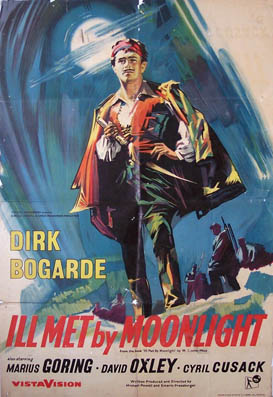
Ill Met by Moonlight movie poster

For a decade and a half, the partnership of Michael Powell and Emeric Pressburger illuminated the cinema with an array of extraordinary films. But the massive reputation the team garnered during and immediately after World War II – The Life and Death of Colonel Blimp, A Canterbury Tale, I Know Where I’m Going!, A Matter of Life and Death, Black Narcissus, and The Red Shoes in just five years! went into steep decline in the Fifties. There were no Archers films at all between The Tales of Hoffmann (’51) and Oh… Rosalinda!! (’55), and both of those were disastrous failures, critically and financially. Perhaps to cover themselves in the ultraconservative British film industry, Powell and Pressburger finished their partnership with two conventional war adventure movies – rattling good yarns that, alas, were widely perceived as rattling just a bit too much.

First published in Film Comment 13th March 1995 v 31:n2. p37(4)

The Battle of the River Plate (’56) was a box-office success and had a royal premiere, but it now looks like the corniest of the Archers movies. An account of Britain’s first major naval victory of WWII, it does have the great virtue of showing actual ships maneuvering about in an actual ocean instead of models in a tank – Powell’s main pleasure in directing the movie, one imagines. But this is exasperatingly offset by far too many shots of actors on studio bridgehead sets being doused with water as they strike poses in front of a cyclorama. The local color Powell provides is a bit sticky, too, given that Uruguay, where the German battleship Graf Spee was forced to seek shelter before being tricked into self-destructing, was and still is a nation notorious for its concealment of Nazis. Peter Finch, as the captain of the Graf Spee, manages an impressive performance, but none of the other actors in a lively cast Anthony Quayle, John Gregson, Patrick Macnee, Anthony Newley, Christopher Lee, John Schlesinger in a bit as a German sailor – has much chance to create a real person. The Germans are all decent fellows, really, whilst the characterization of the Brits is entirely on the level of good-show-chaps caricature.

Powell seemed rather attached to this movie in later years, but had no love at all for the very last Archers film, Ill Met By Moonlight (’57). “I felt imprisoned by the facts,” he was wont to complain; and there were problems with the script Pressburger provided. Ian Christie’s book about Powell, Arrows of Desire, goes so far as to refuse to list the film as a collaboration at all, his filmography (reproduced, incomplete and inaccurate as it is, in Powell’s memoirs) giving Powell’s name alone as writer, producer, and director. Dissension between Powell and Pressburger coincided with antagonism from the Rank Organisation, which refused them money for color. Once the film was finished, so were the Archers.

After Ill Met By Moonlight, then, the deluge. It would be foolish to suggest that the film – miserably renamed Night Ambush for U.S. release and cut by 11 minutes – is anywhere near the level of the team’s masterworks. Even so, it’s more interesting than legend suggests. The (true) story, set in occupied Crete in 1943, concerns the kidnapping of a German general (Marius Goring) by Cretan partisans led by a British officer, Patrick Leigh Fermor (Dirk Bogarde). Film buffs will recall that the real Leigh Fermor was one of the scriptwriters of John Huston’s The Roots of Heaven (also the author of some bestselling travel books). Then again, the film seems to ask, who exactly is the “real” Patrick Leigh Fermor – or the real anyone? Taking its title from a play concerned with dreams and disguises, magic and power, Ill Met By Moonlight is all about questions of identity.

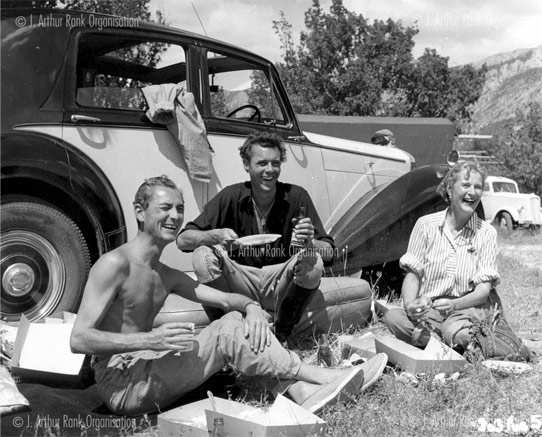
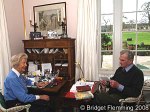
Xan and Daphne Fielding with Dirk Bogarde on the set of Ill Met by Moonlight

Under the credits, we see Dirk Bogarde in uniform; then, unexpectedly, we see him in the flamboyant outfit of a Cretan hill-bandit. A title informs us that Major Leigh Fermor was also known by the Greek code-name “Philidem.” In other words, there are two of him (at least), and on one level the adventure the film is about to unfold reflects a conflict in his personality. It’s a conflict shared, unknowingly, by his Nazi opposite number, the fierce, arrogant General Kreipe (an unlikely “proud Titania,” but it’s true that he “with a monster is in love” – the monster of Nazism). Kreipe’s human side is so rigorously repressed by the demands of war and “glory” that he is genuinely unaware of it; ironically, this humanness, which constitutes the true manhood of this Teuton warrior, is revealed by a boy (equivalent to Shakespeare’s Indian Prince?) – who, in turn, is the most grownup person in the movie.

Ill Met by Moonlight movie poster - Bogarde as Paddy the flamboyant Cretan

If “Philidem” appears under the credits, caped and open-shirted, a romantic dream-figure out of an operetta or a storybook, he is first seen in the film proper as a coarser, more down-to-earth version of the same thing – an ordinary Cretan peasant in a shabby suit, waiting for a bus. When he makes contact with the Resistance, his personality fragments further. To some, he is the mystical Philidem, Pimpernel of the Hellenes and righter of wrongs. To others he is “Major Paddy,” the happy-go-lucky Englishman of popular movie myth conducting war as if it were a branch of amateur theatricals, a gentleman adventurer relying on breeding to get him through and making fun of the whole business. To Bill Moss (David Oxley), the newly arrived junior officer sent to assist him, he is the cool, fast-thinking professional soldier. And to himself? In his quietly passionate defense of Cretan life and culture, he seems someone else again: a scholar and aesthete outraged by the barbarism and folly of war, and by the moronic arrogance shown by his captive toward the Cretan people.

Whatever his persona, Leigh Fermor is a chameleon who never seems to change very radically in himself. Perhaps because he has this quality of seeming all things to all men – and being those things – he remains unfazed by the monolithic might of the German military machine. Fluent in Greek, he can also speak German like a German and is easily able to assume another disguise, that of a faceless Nazi officer. Although he and Moss make fun of themselves – “If only I had a monocle!” muses Moss when Leigh Fermor tells him he “looks like an Englishman dressed like a German, leaning against the Ritz bar” – they are able to effect the kidnapping with an ease that seems appropriately Puckish. General Kreipe is ignominiously thrust onto the floor of his own limousine, gagged, and sat upon by a couple of the peasants he so despises. Kreipe’s rage is compounded by his firm conviction that he has been snatched by “amateurs” – a belief Leigh Fermor and Moss slyly make no objection to, knowing how it will gnaw at his already shaky Master Race self-confidence.

Soon, partisans and captive are up in the hills, where they stay for most of the movie (though the biggest of the film’s mountaineering set-pieces, a nocturnal descent through fog, was filmed on elaborately stylized studio sets). Once there, Kreipe determines to leave a trail for following German troops to pick up on – his cap, buttons from his uniform, even a couple of medals from his impressive display of such baubles never realizing that each emblem of his authority is no sooner dropped than it is retrieved by the vigilant Moss.

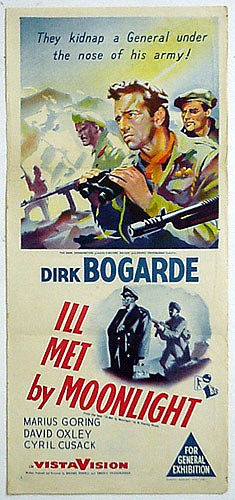
Rare Ill Met by Moonlight movie poster

Among Major Paddy’s partisans is a young war orphan, Nico, who has, while shinning up and down the mountains, much occasion to complain of his need of a pair of boots. Nico knows that the cost of a new pair will always be far beyond him; Kreipe, who has been friendly enough toward him in a rather patronizing way, seizes on this need by showing the boy his own impressive footwear and offering a gold coin with which to buy an identical pair. A German gold coin, he stresses, not one of the sovereigns Leigh Fermor keeps a supply of; it is, in fact, a coin the General is known to keep as a good-luck charm. Nico is impressed by the General’s largesse. But, of course, the Nazi requires a quid pro quo. All Nico has to do, when he goes down the mountain, is tell the searching German patrols where the General is, using the coin as a bona fides. But Kreipe has misjudged the boy (indeed, he can be said to have misjudged the whole of the human race): it never occurs to him that the boy will not do what he says. What Nico actually does is simply point the patrols in the wrong direction, leading them into an ambush; the magic gold coin is lucky for the Greeks, not the Germans. This makes the escape from Crete of the Britishers and their ill-met prisoner the easiest part of their long journey.

Once aboard a British ship, and naked of the symbols of military power, the General seems a new person – not such a bright man, not such a strong man, but also not such a bad man, either. He is visibly moved by the return of his possessions, especially the gold coin: despite his genuine pleasure in Nico’s company, Kreipe had assumed that the boy, like every non-German, is someone who can be bought and sold, and that “friendship” had been merely his gift, and not a privilege from which he might derive spiritual benefit rather than tactical advantage. The very simplicity of Nico’s ruse in deflecting rescue was the, final humiliation, the last stage in General Kreipe’s lengthy symbolic disrobing – which is precisely why his possessions can now be given back to him. If he started this modern midsummer night’s dream as imperious as Oberon, he ends it as foolish as the donkey-headed Nick Bottom. But then, Bottom the simple weaver is always better-liked by everyone than the unearthly and tyrannical monarch of Shakespeare’s enchanted forest.

And from his elaborate humiliation, the stiff-necked German learns a good deal about himself and about humanity. His curt acknowledgment at film’s end that he has been kidnapped not by amateurs but by professionals is also his acknowledgment of his own fallibility and that of the creed he has so proudly espoused. And so he regains a measure of dignity, along with those tokens of an identity he no longer needs. Nico himself get his new pair of boots after all (they belong to Leigh Fermor, who is barefoot in his final exchange with his prisoner), but, by a sad irony, is about to change identity as well: he will wait out the rest of the war far away from Crete in the distant England of which he has heard much but knows nothing. But at least he has a friend – a real friend, now – in General Kreipe, who has learned that the respect of an uneducated boy is worth more than a medal from the Fuhrer. “Gentles, do not reprehend / If you pardon, we shall mend.”

And Patrick Leigh Fermor, aka Major Paddy, aka Philidem – and, if you stretch your imagination just a smidge, aka Robin Goodfellow? – what of him? In the film’s closing moments, he is far from being self-assured intellectual or dashing amateur adventurer or legendary outlaw of the hills. He’s just a tired man who wants to go home and rest up. “How do you feel?” asks Moss. “Flat” is the reply. “You look flat!” says Moss. “I know how I’d like to look …” murmurs Leigh-Fermor wistfully. Moss knows what he’s going to say, and joins in the litany: “Like an Englishman dressed like an Englishman – and leaning against the Ritz bar!” It’s easy to imagine them ordering drinks at that renowned watering-hole with all the suavity required by this little fantasy. Still, the film’s last images of Crete receding in the distance, until all we can see is the sea, suggests that maybe Major Paddy’s heart is really back in those hills in the “fair and fertile” land that has become as much a Powellian landscape of the mind for us as the studio-built Himalayan convent of Black Narcissus or the monochrome Heaven of A Matter of Life and Death. And, as we depart both Crete and this film, we may reflect that being “dressed like an Englishman and leaning against the Ritz bar” would, for Patrick Leigh Fermor constitute yet another disguise. After all, he was Irish.

… now watch the movie trailer.

Ill Met by Moonlight

Related articles:

Patrick Leigh Fermor recounts the kidnap of General Kreipe on video

General’s long trip home

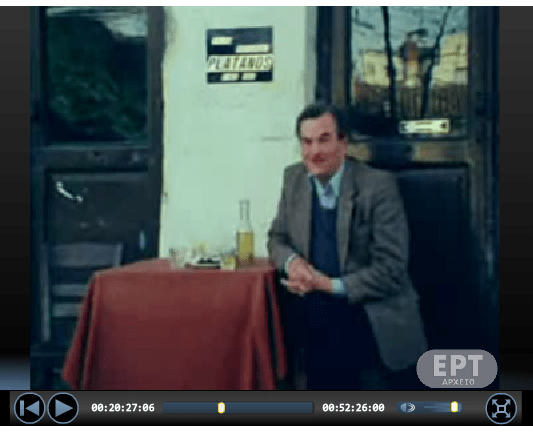
George Katsimbalis documentary Part 2 – Paddy sings about Greek debt!

The second clip of Paddy in a Greek TV documentary about his friend George Katsimbalis. Towards the end of this excerpt Paddy is chanting a 1935 Greek song about the 1932 Greek debt crisis; how appropriate.

My thanks again to Nicolas Paissios for sending me this and the two previous clips.

Click the image to play.

Your cash is worthless – you might as well give it to Nick!

As we face yet another phase of financial Armageddon. As stock markets tumble and the only worthwhile assets to hold are copies of Paddy’s books in first editions, farmland and gold. As Europe’s leaders sun themselves, seemingly oblivious to the death throes of the Euro, it is time for the sprint to the finish line for Nick Hunt’s funding exercise to support his walk from The Hook of Holland to Constantinople on just £1 a week.

Thanks to your amazing generosity we are just £40 away from the target of £1,500. Who will be our sprint champion and help Nick across the finish line by the end of today?

Remember if he does not reach the £1,500 target he will not actually receive a bean.

Watch the video; get inspired, click here and take out your debit card! There are no penalties for giving more than he needs!
Thank you !

To donate visit After the Woods and the Water on WeDidThis.

Untitled from Nick Hunt on Vimeo.

Gone for a walk in Greece

“YOU had better look out if you are going up to Anavriti.” The familiar words sound wonderful when spoken aloud in this cavernous, haunted and as yet sunless gorge. I repeat them, savouring their powerful energy.

Suddenly, I picture the streets of “roasting Sparta” and the Greek barber who, encouraged by his colourful customers, issued the warning as he clipped the dusty hair of a man now regarded as one of the world’s finest travel writers.

The barber’s words subsequently provided the opening salvo of what many believe is the best book in English about Greece.

by Ian Robert Smith

First published in The Australian 30 July 2011

Published in 1958, Patrick Leigh Fermor’s Mani: Travels in the Southern Peloponnese is a dense, erudite and hugely entertaining account of the author’s peregrinations in a region that, at the time, was remote, untamed and singularly archaic. Mani is also, more broadly, an affectionate portrait of a rural Greece where centuries-old customs were fast disappearing — “hammered to powder . . . between the butt of a Coca-Cola bottle and the Iron Curtain” — and for which today’s traveller hunts in vain.

I, too, am going up to Anavriti. And like Leigh Fermor when he came this way with his partner (later wife) Joan in the mid-1950s, I intend to use the village, perched on a spur of the Taygetos range, as a stepping stone into the Mani.

A battered copy of Leigh Fermor’s book resides in the top flap of my rucksack, both talisman and inspiration. Handily within reach in the side pocket is the Anavasi map of the region. Its bundled contours, crossed by the black-dotted lines of footpaths, reflect the momentous regions that await overhead.

Rich in myth and history, the Taygetos dominates the Spartan plain over which it looms like an impenetrable barrier. The northern foothills rise in the wilds of Arcadia. They shoot upwards into a vast, serrated ridge that culminates in the peak of Mt Profitis Ilias — at 2407m, the highest point in the Peloponnese — before dropping away through the Mani Peninsula.

Foothills clad in oak, hornbeam and black pine and daubed with villages buttress the eastern slopes. But the west is wild. Ancient gorges provide means of egress into this planetary world.

Some say this gorge is where the ancient Spartans left unwanted children to die. The rumble of plunging water resounds along its length.

In a large cave, a frescoed chapel, painted ox-blood red, crouches among icons and vases of the white Madonna lilies that grow wild on the slopes. Climbing further, past a sudden and terrifying drop, a curious sound wafts towards me; incoherent initially, it develops into an ethereal chanting that, echoing off the cliffs, sounds strange and beautiful in this wilderness. Bewilderment turns to rapt appreciation as I recognise the monks at Faneromeni Monastery, high above, conducting a Sunday morning service.

Beyond the monastery and a couple of antique threshing floors, Anavriti appears. Dwarfed by the glittering and snow-streaked Taygetos, several belfries and a cluster of stone houses adorn a hillside plumed with walnut, plane and cherry trees.

Not so long ago Anavriti had a thriving tanning and leather-goods industry and a population of several thousand. Nowadays, like most mountain villages in Greece, it is barely inhabited.

I amble along the main street, seeking wide balconies reached “by boxed-in staircases on wooden stilts”. In one such edifice, Leigh Fermor and Joan spent the night. Something similar faces a solitary taverna. Light-headed at finding myself in Anavriti at last, I lunch on spaghetti with rooster and abundant rose wine and, as a jovial crowd materialises, observe clouds thickening around the mountaintops. The taverna owner shrugs when I inquire what they portend, then asks, unhelpfully, whether I have a raincoat, before advising: “Go towards the good.”

This I attempt, only to become drenched, then unpleasantly steamed when the sun reappears, conjuring wondrous aromas from the glistening earth. The experience is chastening and, toiling upwards through fir forest, I conclude that following in the footsteps of literary legends can be tricky. Writing in Mani, Leigh Fermor gives fair warning.

“Feet became cannonballs,” he recounts, “loads turned to lead, hearts pounded, hands slipped on the handles of sticks and rivers of sweat streamed over burning faces and trickled into our mouths like brine.” I arrive, similarly challenged, at the author’s “unattractively alpine wall of mineral”.

It is the flank of Spanakaki Peak and also a crossroads. Intent on the Mani, Leigh Fermor bypassed Profitis Ilias and headed off to the right. Determined to tackle the summit, I veer left, up over a spur with a derelict sheepfold and across a meadow that, as thunder rumbles and rain buckets down, tilts vertically to the watershed. I reach this, hand-over-foot, but discover the view of the Messenian Gulf beyond obscured by thick mist breaking over the ridge.

Visibility shrinks to nothing as I’m engulfed, precipitating a tedious descent, followed by a forced march to the EOS refuge, where I meet a group from Athens who provide food, wine and spirited conversation. Occasionally the talk turns to Greece’s economic troubles and, predictably, as these are young people from the capital, nearly everyone has a sobering tale. They are related simply, without rancour and often with humour; but beneath the levity, disappointment and uncertainty are palpable.

The evening proves unexpectedly affecting and our farewells the next day, when I renew my assault on the summit, are heartfelt. I ascend through meadows thick with ferns, thyme and wildflowers, which give way to barren, stratified limestone, before an opening leads over the watershed. It might well be a door into another world.

Jagged pinnacles roll away to the north. Westward, rumpled slopes sundered by ravines plunge to the shores of the Messenian gulf. Silence reigns. Nothing moves except the clouds rolling across the peaks. I climb through them, tentatively over scree, on to a desolate platform scattered with stone huts and a roofless chapel dedicated to the prophet Elijah and crammed with icons, melted candles and votive offerings left by midsummer devotees.

The moment evokes a heady elation, tempered by disbelief that I am here, alone, atop the Peloponnese. Finally the sight of Kardamyli, fathoms below, reminds me it is time to catch up with Leigh Fermor. A headlong descent begins. Nightfall finds me in the Viros gorge. It is the ancient route to the coast: a massive, 14km-long canyon enclosed by fir-tufted cliffs and paved with boulders worn smooth by winter torrents, and not particularly restful.

Escaping next morning to Exochori, I locate a small chapel with a battered turret astride cicada-haunted olive terraces looking out to sea. In this lovely place, appropriate for a man who wrote so beautifully, the ashes of author Bruce Chatwin are scattered. I pause to pay my respects.

Kardamyli appears, its blond towers jutting above the sea. A cobbled path curls below the ancient acropolis. Nearby, adjacent to the reputed tombs of Castor and Pollux, I fall into conversation with a friendly English couple. Inevitably the name of Leigh Fermor comes up. We are speaking of the blood feuds in Mani when the woman says abruptly: “We’ve heard the funeral is on Thursday.”

Seeing my uncomprehending look, she adds, “You didn’t know? Paddy died last week.”

It was the day before I set out, ostensibly in his footsteps. The news fills me with sadness coupled with bewilderment at the workings of providence. I enter Kardamyli in a valedictory mood, passing through an arched gateway into a dusty square flanked by byzantine towers and a church.

In Mani, Leigh Fermor writes that Kardamyli was “unlike any village I had seen in Greece”. He and Joan loved it so much that they returned several years later and built a house in an olive grove.

Kardamyli remains laid-back and relatively unspoilt, with a long pebble beach, pretty stone houses, a small fishing harbour and friendly people. It is popular with trekkers who tackle the hinterland trails. But my walking days are over for now and my stay is marked by restlessness and an odd nostalgia. Each morning I swim to the wooded islet with the fortified wall and ruined chapel, a few hundred metres offshore. I scribble in cafes, drink with other travellers and dine out every night, once at Lelas, the waterfront taverna owned by the woman who was Leigh Fermor’s original housekeeper. Everyone, it seems, has a Paddy story to tell.

One morning, a strange impulse takes me. Just outside town, a path leaves the road and winds downhill through olive groves throbbing with cicadas. It continues, away from recent development higher up the slope, into a wilderness of trees and yellow grain fields where I pass a whitewashed chapel and, just beyond, a long stone wall, above which a mottled tile roof protrudes. Finally I come to a beach.

It lies just over the rocks, a hermetic cove enfolded by cliffs. A shiver sweeps through me when I realise: this is the place. Pushing through a wooden gate marked Private, I climb a stone staircase that zigzags up to a sprawling garden. Olive trees bestride ancient terraces.

The aromas of rosemary and cypress mingle in the hot, pulsating air. Paths of pebble mosaic thread between judiciously placed tables and benches of slate and a rambling house, built of golden stone, empty now, yet with the accumulations of a long and abundant life in place. An air of recent abandonment prevails. Leigh Fermor died in England.

Standing on the clifftop, beside one of those tables where so many delightful moments must have unfolded, I gaze out past the island to the distant peninsula, a smudge on the horizon. An age passes before I tear myself away.

Patrick Leigh Fermor’s Mani: Travels in the Southern Peloponnese was first published in 1958. The acclaimed war hero and travel writer died on June 10, aged 96.

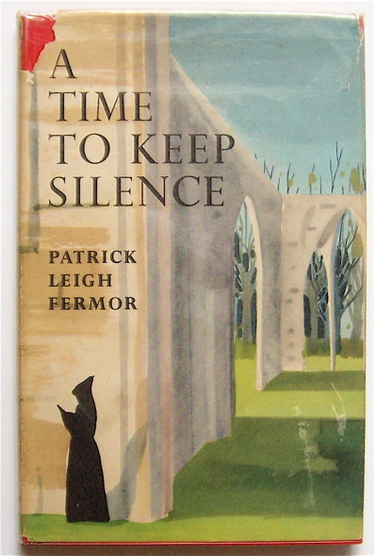
An excerpt from A Time To Keep Silence by Patrick Leigh Fermor

With curiosity and misgiving I walked up hill from the Rouen-Yvetot road towards the Abbey of St. Wandrille. I had spent an abominable night in Rouen in a small hotel near the station where a procession of nightmares had been punctuated by the noise of trains arriving and leaving with a crashing and whistling and an escape of steam and smoke which, after a week’s noctambulism in Paris, turned my night into a period of acute and apparently interminable agony. Even the misty windings of the lower Seine, the fat green fields and Indian files of poplars, among which the bus had travelled next morning, could not dispel my mood of sluggishness and depression; and now, climbing the hot road through the late summer woods, I wondered if my project had not better be abandoned.

By Patrick Leigh Fermor

Use the Print Friendly facility. Print Friendly and PDF

… What I dreaded almost more than success was an immediate failure. If there was no room at the Abbey, or if for some other reason the monks could not receive me, I should have to return to Paris and readjust my plans for the next few weeks. I was arriving unknown and unannounced, a citizen of the heretic island across the Channel, without even the excuse that I wished to go into retreat; I was, in fact, in search of somewhere quiet and cheap to stay while I continued to work on a book that I was writing. A friend in Paris had told me that St. Wandrille was one of the oldest and most beautiful Benedictine Abbeys in France; and I had made my plans and set out . . .

It was Sunday, and the gatehouse was full of visitors who, just emerged from Mass, were buying pictures, medals, rosaries and assorted bondieuserie. A harassed monk in horn-rimmed glasses was answering innumerable questions; and a quarter of an hour had gone by before I managed, with considerable trepidation, to explain my proposal. He listened sympathetically, and asked me to return after he had spoken to the Abbot. When at last his black-robed figure reappeared across the garden, I saw that he was smiling. Seizing my heavy bag, “The most reverend Father Abbot can receive you,” he announced, “and wishes you welcome.”

A few moments later a door had shut out the noise of the Sunday visitors and a silent maze of white staircases and passages swallowed us up. The monk opened a door and said, “Here is your cell.” It was a high seventeenth-century room with a comfortable bed, a prie-dieu, a writing-table, a tapestry chair, a green adjustable reading-lamp, and a rather disturbing crucifix on the whitewashed stone walls. The window looked out over a grassy courtyard, in which a small fountain played, over the grey flank of the monastery buildings and the wall that screened the Abbey from the half-timbered houses of the village. A vista of forest flowed away beyond. In the middle of the writing table stood a large inkwell, a tray full of pens and a pad into which new blotting paper had just been fitted. I had only time to unpack my clothes and papers and books before a great bell began ringing and the monk, who was the guest-master, returned to lead me to the refectory for the midday meal. As we walked, the buildings changed in period from the architecture of the eighteenth and seventeenth centuries to Gothic; and we halted at length by the piscina in an ogival cloister of the utmost beauty, outside a great carved door where several other visitors had also been assembled. The guest-master shepherded us into the refectory in which the Abbot, a tall, white-haired, patrician figure with a black skull-cap and a gold pectoral cross on a green cord, was waiting to receive us. To each of the guests he spoke a few words; and some, sinking upon one knee, kissed the great emerald on his right hand. To me he addressed a polite formula in English that had obviously been acquired at some remote period from a governess. A novice advanced with a silver ewer and a basin; the Abbot poured a little water over our hands, a towel was offered, and our welcome, according to Benedictine custom, was complete.

The singing of grace continued for several minutes; and, when we sat down, I found myself between two visiting priests, their birettas folded flat beside their plates on the long guest-table in the middle of the refectory, just below the Abbot’s dais. Down the walls of this immense hall the tables of the monks were ranged in two unbroken lines, and behind them a row of Romanesque pilasters with interlocking Norman arches formed a shallow arcade. The place had an aura of immense antiquity. Grey stone walls soared to a Gothic timber roof, and, above the Abbot’s table, a giant crucifix was suspended. As the monks tucked their napkins into their collars with a simultaneous and uniform gesture, an unearthly voice began to speak in Latin from the shadows overhead and, peering towards it, I caught sight, at the far end of the refectory, of a pillared bay twenty feet up which projected like a martin’s nest, accessible only by some hidden stairway. This hanging pulpit framed the head and shoulders of a monk, reading from a desk by the light of a lamp which hollowed a glowing alcove out of the penumbra. Loudspeakers relayed his sing-song voice. Meanwhile, the guest-master and a host of aproned monks waited at the tables, putting tureens of vegetable soup before us and dropping into our plates two boiled eggs, which were followed by a dish of potatoes and lentils, then by an endive salad, and finally by discs of camembert, to be eaten with excellent bread from the Abbey bakery. Every now and then a monk left his place, and knelt for a few minutes before the Abbot’s table. At a sign from the Abbot, he would rise, make a deep bow, and withdraw. . . . Inspired probably by Victorian oleographs of monastic life, I had expected a prodigious flow of red wine. The metal jugs on our tables contained, alas, only water.

The recitation had now changed from Latin to French, delivered in the same sepulchral, and, to me, largely unintelligible, monotone. A few proper names emerged — Louis Phillipe, Dupanloup, Lacordaire, Guizot, Thiers, Gambetta, Montalembert — and it was clear that we were listening to a chapter of French nineteenth-century history. This stilted manner of treating a lay text sounded absurd at first and oddly sanctimonious; its original object, I discovered, had been both to act as a curb on histrionic vanity and to minimise the difficulties of the unlearned reader in the days of St. Benedict. Throughout the entire meal no other word was spoken. The tables were cleared, and the monks, their eyes downcast, sat with their hands crossed beneath their scapulars. The Abbot thereupon gave a sharp tap with a little mallet; the reader, abandoning his text, bowed so low over the balustrade that it seemed that he would fall out and then intoned the words Tu autem Domine misercre nobis ; all rose, and bowing to a rectangular position with their hands crossed on their knees, chanted a long thanksgiving. Straightening, they turned and bowed to the Abbot and, still chanting, moved slowly out of the refectory in double file around two sides of the cloisters, into the church and up the central aisle. Here each pair of monks genuflected, inclined their heads one to another, and made their way to opposite stalls. The chanting continued for about eight minutes, then the entry was gravely reversed. As they reached the cloisters, the files of black figures broke up and dispersed throughout the Abbey.

Back in my cell, I sat down before the new blotter and pens and sheets of clean foolscap. I had asked for quiet and solitude and peace, and here it was; all I had to do now was to write. But an hour passed, and nothing happened. It began to rain over the woods outside, and a mood of depression and of unspeakable loneliness suddenly felled me like a hammer-stroke. On the inner side of my door, the printed “Rules for the Guests’ Wing” contained a mass of cheerless information. The monks’ day, I learned, began at 4 a.m., with the offices of Matins and Lauds, followed by periods for private masses and reading and meditation. A guest’s day began at 8:15 with the office of Prime and breakfast in silence. At 10 the Conventual High Mass was sandwiched between Tierce and Sext. Luncheon at 1. Nones and Vespers at 5 p.m. Supper at 7:30, then, at 8:30, Compline and to bed in silence at 9. All meals, the rules pointed out, were eaten in silence: one was enjoined to take one’s “recreation” apart, and only to speak to the monks with the Abbot’s permission; not to make a noise walking about the Abbey; not to smoke in the cloisters; to talk in a low voice, and rigorously to observe the periods of silence. They struck me as impossibly forbidding. So much silence and sobriety! The place assumed the character of an enormous tomb, a necropolis of which I was the only living inhabitant.

The first bell was already ringing for Vespers, and I went down to the cloisters and watched the monks assemble in silence for their processional entrance. They had put on, over their habits and scapulars, black cowls: flowing gowns with hoods into which those of their ordinary habits fitted, and so voluminous that the wearers appeared to glide rather than walk. Their hands were invisibly joined, like those of mandarins, in the folds of their sleeves, and the stooped faces, deep in the tunnel of their pointed hoods, were almost completely hidden. A wonderful garb for anonymity! They were exact echoes of Mrs. Radcliffe’s villainous monastics and of the miscreants of Protestant anti-popish literature. Yet they looked not so much sinister as desperately sad. Only in the refectory and the church was I able to see their faces; and, as I sat at Vespers watching them, now cowled, now uncovered, according to the progress of the liturgy, they appeared preternaturally pale, some of them nearly green. The bone-structure of their faces lay nearly always close beneath the surface. But, though a deep hollow often accentuated the shadow under the cheekbone, their faces were virtually without a wrinkle, and it was this creaseless haggardness that made their faces so distinct from any others. How different, I thought, from the fierce, whiskered, brigand-faces of the Greek monks of Athos or the Meteora, whose eyes smoulder and flash and twinkle under brows that are always tied up in knots of rage or laughter or concentration or suddenly relaxed into bland, Olympian benevolence. The gulf between the cenobites of Rome and those of Byzantium was often in my mind. A cowled figure would flit past in silence, and all at once, with a smile, I would remember Fathers Dionysios and Gabriel, Brothers Theophylaktos, Christ and Polycarp, my bearded, long-haired, cylinder-hatted, war-time hosts and protectors in Crete, pouring out raki, cracking walnuts, singing mountain songs, stripping and assembling pistols, cross-questioning me interminably about Churchill, and snoring under olive trees while the sun’s beams fell perpendicularly on the Libyan Sea. . . . But here, in the Abbey’s boreal shadows, there was never a smile or a frown. No seismic shock of hilarity or anger or fear could ever, I felt, have disturbed the tranquil geography of those monastic features. Their eyelids were always downcast; and, if now and then they were raised, no treacherous glint appeared, nothing but a sedulously cultivated calmness, withdrawal and mansuetude and occasionally an expression of remote and burnt-out melancholy. The muted light in the church suspended a filament between us, reproducing the exact atmosphere of an early seventeenth-century Spanish studio in which — tonsured, waxen, austere and exsanguinous — were bowed in prayer the models of Zurbarán and El Greco. Not for nothing had these painters followed so closely after St. Theresa and St. John of the Cross, and so faithfully portrayed the external stigmata of monastic obedience, prayer, meditation, mortification and mystical experiment — the traces left by the soul’s dark night, by the scaling of heavenly mountains and the exploration of interior mansions. As the monks dispersed after Vespers and, a few hours later, after Compline, I had a sensation of the temperature of life falling to zero, the blood running every second thinner and slower as if the heart might in the end imperceptibly stop beating. These men really lived as if each day were their last, at peace with the world, shriven, fortified by the sacraments, ready at any moment to cease upon the midnight with no pain. Death, when it came, would be the easiest of change-overs. The silence, the appearance, the complexion and the gait of ghosts they had already; the final step would be only a matter of detail. “And then,” I continued to myself, “when the golden gates swing open with an angelic fanfare, what happens then? Won’t these quiet people feel lost among streets paved with beryl and sardonyx and jacinth? After so many years of retirement, they would surely prefer eternal twilight and a cypress or two. . . .” The Abbey was now fast asleep but it seemed ridiculously early — about the moment when friends in Paris (whom I suddenly and acutely missed) were still uncertain where to dine. Having finished a flask of Calvados, which I had bought in Rouen, I sat at my desk in a condition of overwhelming gloom and accidie. As I looked round the white box of my cell, I suffered what Pascal declared to be the cause of all human evils.

Excerpted from A Time To Keep Silence by Patrick Leigh Fermor Copyright 1957, 1982 by Patrick Leigh Fermor. Originally posted on National Public Radio and excerpted by permission of the New York Review of Books.

Use the Print Friendly facility. Print Friendly and PDF

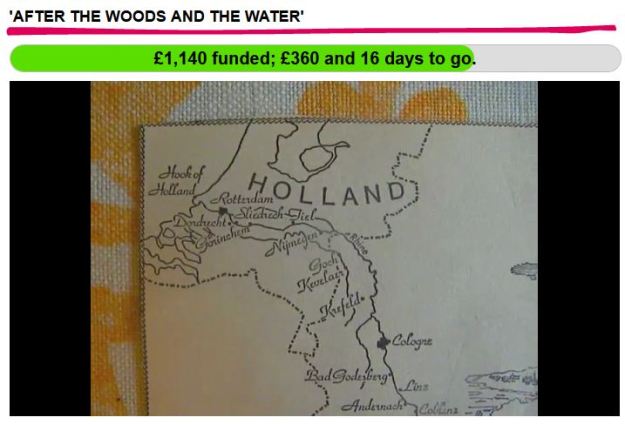
£1 a week from Hook of Holland to Constantinople – a final push!

Nick Hunt’s appeal for funds to support his journey in Paddy’s footsteps was launched exactly two weeks ago. The response has been amazing with £1,140 pledged and only £360 needed to reach his target of £1,500.

You have been very generous but with so little now required for success I want to ask that we all consider even a small donation – £1 a week is about £26 for the journey – a final push!

If Nick is able to make this project work it will bring benefits to us all as we can enjoy his jottings from a journey made 78 years after Paddy.

Remember if Nick does not reach the £1,500 target all the donors will get their money back and Nick will receive nothing. This is the way that Crowdfunding works.

You can donate varying amounts and you will receive a range of items from Nick when on his journey to thank you and remind you of your support. Slightly higher donations will permit a mention of your name in his final book about the journey as well as a copy of the book.

This is a very worthwhile and very serious venture requiring a major commitment from Nick of a year of his life, so please visit the WeDidThis website and donate something.

I have said it before, but I will say it again, watching his video on the site and dreaming, just for a moment, that it could be you walking that fabled route has to be worth £10!

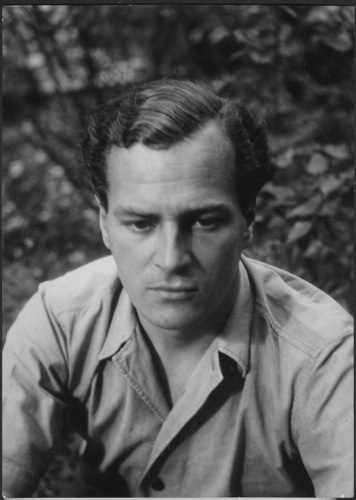
Paddy’s mugshots from his SOE file

Soon I hope to be able to bring you more information from Paddy’s SOE file which is at the National Archive in Kew, courtesy of Steven Kippax who is an SOE historian and researcher .

Here is a taster. The man himself looking pretty dashing but uncompromising for his official SOE mugshot!

A Prince of the Road by Colin Thubron

This is a major essay about Paddy by his good friend Colin Thubron. Perhaps worth printing and reading at your leisure.

Use the Print Friendly facility. Print Friendly and PDF

by Colin Thubron

First published in the New York Review of Books, January 17 2008.

To suggest that Patrick Leigh Fermor is the greatest travel writer alive is to omit a great deal. In Britain and Greece he is a near legend, celebrated not only for his books but for his wartime exploits as a guerrilla leader in occupied Crete, where his abduction of a German general has passed into folklore. He is, perhaps, the last of a breed of writer-travelers whose reputation has an aura of genuine action and courage.

The qualities suited to the travel writer’s trade have always been contradictory. The mental (and physical) robustness necessary for ambitious travel often excludes the sensitivity to record it, and vice versa. So there are travelers who write, and writers who travel—and they rarely converge in the same person.

In Leigh Fermor, they do. The richness of his prose, his polymathic exuberance, and his cultural allusiveness render him less immediately accessible than some of his contemporaries, such as Peter Fleming or Norman Lewis. But his six travel books—one for each decade of his adult life—have secured him a readership drawn to a voice that is omnivorous in its tastes and curiosity, learned without condescension, cultivated but never effete, curiously innocent, occasionally swanky, infectiously joyous. If he is less known in the United States than he is in Britain, it is because Leigh Fermor is deeply European.

His reputation rests, above all, on two pairs of books—about his youthful walk across pre-war Europe, published in 1977 and 1986—and about Greece, published in 1958 and 1966. But then there is A Time to Keep Silence. In the oeuvre of a traveler whose books are full of worldly curiosity, this short reflection on the monastic life sits like a troubled question mark. First published in Britain in 1953, it now appears in the US for the first time. In less than a hundred pages it records the author’s stay in the ancient French monasteries of St. Wandrille, Solesmes, and La Grande Trappe, with a brief excursion to the deserted Byzantine chapels of Cappadocian Turkey.

Yet there are readers for whom A Time to Keep Silence is Leigh Fermor’s finest—if most uncharacteristically elusive—book. In her introduction, the religious historian (and ex-nun) Karen Armstrong writes:

The monks’ monotonous way of life has been deliberately designed to protect them from the distractions of, and the lust for, novelty: they do the same things day after day; they dress alike and shun individuality and personal style. They keep almost perpetual silence….

Nothing could be more antipathetic to everything that Leigh Fermor’s books project and embrace. His persona as a writer brims with “individuality and personal style.” So, of course, does his prose. He is famously gregarious, and a dazzling raconteur. For a traveler so tough, his books are rich in pleasures: in leisure, in wine, in company. History and landscape bring a visceral exhilaration.

In 1952, aged thirty-seven, Leigh Fermor arrived at the Benedictine abbey of St. Wandrille de Fontenelle, near Rouen, in quest not of religious retreat but of somewhere cheap and quiet in which to write his first book, on the Caribbean. The regimen of the monastery—the bloodless gloom of Vespers, the sepulchral mealtime recitations while the monks ate in silence—filled him at first with revulsion:

As I sat at Vespers watching them, now cowled, now uncovered, according to the progress of the liturgy, they appeared preternaturally pale, some of them nearly green. The bone-structure of their faces lay nearly always close beneath the surface. But, though a deep hollow often accentuated the shadow under the cheekbone, their faces were virtually without a wrinkle, and it was this creaseless haggardness that made their faces so distinct from any others. How different, I thought, from the fierce, whiskered, brigand-faces of the Greek monks of Athos or the Meteora, whose eyes smoulder and flash and twinkle under brows that are always tied up in knots of rage or laughter or concentration or suddenly relaxed into bland, Olympian benevolence.

There is no doubt about where Leigh Fermor’s sympathies lay. As for writing, he retired to his cell on the first day in the quiet, and picked up his pen:

But an hour passed, and nothing happened. It began to rain over the woods outside, and a mood of depression and of unspeakable loneliness suddenly felled me like a hammer-stroke.

For three or four days, little changed. He was prey to insomnia and a flat depression. Then he started to sleep. He slept until a few meals and church services a day were his only lucid moments. Then the pattern changed again. His lassitude dwindled away and was succeeded by a “limpid freshness.” He now slept only five hours in twenty-four. It was as if a profound tiredness, rooted in the outside world with its demands on nervous libido and instant response, had overswept him, then receded in this quietude to release a flood of unimpeded energy. “Even the major causes of guilt and anxiety had slid away.”

From the monastery’s library—a magnificent repository of the sacred and secular—he was able to borrow even those heretical books placed on the index or locked in the depository (named the Enfer) as destructive of monastic calm. And as he grew to know them, the monks became, to his charitable and indulgent mind, almost uniformly attractive.

Moving on, he was delayed only two weeks by the abbey of Solesmes, guardian of early Church music, before he reached the great Cistercian monastery of La Grande Trappe in southern Normandy. Among this grimly disciplined and silent order, the cycle that Leigh Fermor had experienced in St. Wandrille—the same tension between tenderness and revulsion—repeated itself more gently. Here the Benedictine dedication to the efficacy of prayer was reinforced by a notion of ferocious penance:

A Trappist monk rises at one or two in the morning according to the season. Seven hours of his day are spent in church, singing the offices, kneeling or standing in silent meditation, often in the dark…. There are no cells. All, from the Abbot downwards, sleep in cubicles in a dormitory on palliasses of straw stretched out on bare planks. Heating does not exist…. A special deaf and dumb language for cases of necessity has been evolved and codified, and the entire lifetime of a lay-brother, who does not participate in the singing of the offices, may pass without the uttering of a word beyond the confessional or his spiritual consultations with the Abbot. A monk on the point of death is removed from his infirmary bed and laid across a bed of straw which is scattered over a cross of ashes. There, after the last ghostly comforts in the presence of the assembled monks, he expires. His body is exposed for a while in the church. No coffin is used at his burial; his face is covered by his hood, and he is lowered into his grave with his habit folded about him.

A Time to Keep Silence evolved, sometimes word for word, from the letters written to Leigh Fermor’s future wife from these brief sojourns in monastic cells. They are touched by the unease of the doubter or atheist (he is never specific) who has intruded into the midst of pious conviction, and by his subsequent gratitude for the monks’ discretion which allowed him to escape any awkward challenge.

But for all the revolution in his feelings—and his brief excursions into the nature of prayer or temptation—it is less the inner journey than Leigh Fermor’s descriptions of monastic life that linger in the memory. He is a master of externals. The somber glamour of ritual and the drama of architecture rise naturally to his pen. In Roumeli, his book on northern Greece, he celebrates the pinnacle monasteries of Meteora with a gusto more immediate to him than the arcane inner lives of the sober monks of Normandy. His brief chapter on the rock chapels of Cappadocia, with which A Time to Keep Silence ends, relaxes into descriptive ease as it portrays a hermit city redolent of the dawn of monastic Christendom, whose human inhabitants have long gone.

Leigh Fermor’s sumptuous and sometimes complicated style has won him many admirers, barely one successful imitator, and a handful of disgruntled critics. When he writes that the quietude of St. Wandrille and his limited contact with the monks “compelled me again and again to seek my parallels in painting,” it sounds less like a limitation than a joyful release. The memory of Old Masters is never far away. In the muted light by which they worship, the monks evoke the canvases of Zurbarán and El Greco. The towering pinnacles of Solesmes remind him of the Rhenish castles of Gustave Doré and Victor Hugo. The wintry landscapes around La Trappe blend with those of Breughel and Bosch.

Sound itself turns visual. Leigh Fermor, in an act of nostalgic remembrance, conjures the ruined English abbeys lifting up their broken arches and emptied rose-windows “as though some tremendous Gregorian chant had been interrupted hundreds of years ago to hang there petrified at its climax ever since”; and the complex chanting of the conventual High Mass elicits an image of the Gregorian notation—with its comet tails and arabesques—printed in the monks’ missals.

These stylistic flourishes would be woeful in lesser hands. But with Leigh Fermor they rarely fail. His early models include Alexander William Kinglake and Norman Douglas, but most potent perhaps was the influence of his precocious near-contemporary, Robert Byron, who died at sea in 1941, and who in The Road to Oxiana, an account of travel in Persia and Afghanistan, interleaved humorous vignettes with some of the most precise and beautiful architectural descriptions in the language. Continue reading

Paddy’s interview on “Private Passions” on BBC iPlayer until midday 7 August

You can listen to the programme for the next seven days ie until midday Sunday 7 August via BBC iPlayer (assuming you can receive where you are).


To listen click here.


Related article:

Paddy interviewed on “Private Passions” for his 90th birthday in 2005

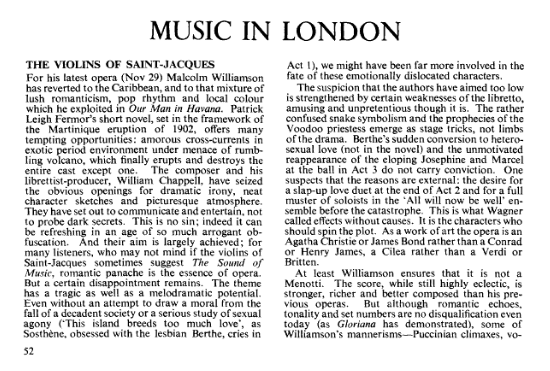
The Violins of Saint-Jacques – Malcolm Williamson opera review

Malcolm Williamson turned Paddy’s 1953 novella, The Violins of Saint-Jacques, into an opera. Here is a snippet from The Musical Times review  Vol. 108, No. 1487, Jan., 1967.

Related article:

Los violines de Patrick Leigh Fermor

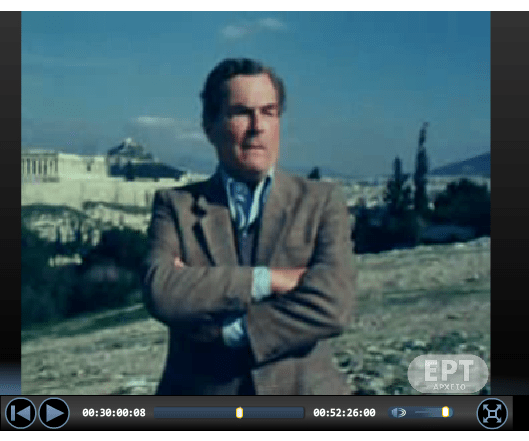
George Katsimbalis documentary Part 1 – by the Acropolis and at the bar

Paddy in a Greek TV documentary about his friend George Katsimbalis. Paddy visits a bar and sings a French song.

My thanks again to Nicolas Paissios for sending me this – and there is one more to come 🙂

Click the image to play.

£1 a week Hook of Holland to Constantinople – come and meet Nick Hunt tonight Dalston, London

Nick Hunt will be at the kick-off event tonight for his fundraising along with a bunch of other people who are raising funds through WeDidThis.

There will be drinks, and good things to look at with plenty of interesting people to talk to including Nick!

Free music, performances and wine in Dalston Heights from 6.30 to 10.00pm. Details here.

Remembering Patrick Leigh Fermor, travel inspiration

This article is from the Lonely Planet site. It is pretty standard fare, but stands out for its last line …. “The excellent https://patrickleighfermor.wordpress.com is highly recommended.” How could I possibly disagree?!!

by Tom Hall, Lonely Planet author

‘My spirits, already high, steadily rose as I walked. I could scarcely believe I was really there; alone, that is, on the move, advancing into Europe, surrounded by all this emptiness and change, with a thousand wonders waiting.’
From A Time of Gifts

It remains one of the finest adventures: Patrick Leigh Fermor, eighteen, restless and craving adventure, hops on a steamer in the shadow of Tower Bridge and, upon arrival at Hook of Holland, sets out for Constantinople on foot. It is 1933. His journey takes him through old Europe, a continent fast falling into war and never to be the same again.

Leigh Fermor’s account of what he called ‘Shanks’ Europe’ is told – though not in full – in the books he is best remembered for, A Time of Gifts (1977) and Between The Woods And The Water (1985). Remarkably, the author wrote them decades after the events described, years which honed his prose but retained the sense of wonder at discovering new lands, languages and cultures, soon to be altered forever.

Read more ….

£1 a week from Hook of Holland to Constantinople – funding update

Nick Hunt’s appeal for funds to support his journey in Paddy’s footsteps was launched exactly one week ago. The response has been amazing with £870 raised and only £630 to go to reach his target of £1,500. Nick tells me that donations have poured on from all round the world from Australia to the Czech Republic, from the sunshine state of Florida, and even the Scots have found some change down the back of the sofa!

Many blog readers have contributed and I am asking for another big push this week to reach the target. If Nick does not reach the £1,500 all the donors will get their money back and Nick will receive nothing. This is the way that Crowdfunding works.

You can donate varying amounts and you will receive a range of items from Nick when on his journey to thank you and remind you of your support. Slightly higher donations will permit a mention of your name in his final book about the journey as well as a copy of the book.

This is a very worthwhile and very serious venture requiring a major commitment from Nick of a year of his life, so please visit the WeDidThis website and donate something. Watching his video on the site and dreaming, just for a moment, that it could be you walking that fabled route has to be worth £10!

Repeat of Paddy’s interview on “Private Passions” Sunday 31 July

The quality of our own link to BBC Radio Three’s Private Passions with Paddy is not the best, but still quite acceptable. However, there is now a chance to hear a repeat of the programme this coming Sunday 31 July at midday BST on BBC Radio 3.

You can find details of the programme here. You should be able to hear on FM and digital radio; possibly satellite TV and of course over the internet if the BBC permits from your location. Thanks to Phyllis Willis for spotting this one. The programme blurb goes as follows:

Sir Patrick Leigh Fermor, travel writer and war hero, died in June at the age of 96. In 2005 he recorded an edition of Private Passions, in which he talked about the music he loved. This is another chance to hear that conversation with Michael Berkeley.

Patrick Leigh Fermor was born in London in 1915, the son of a distinguished geologist. He was brought up in England after his parents left for India, and attended The Kings School, Canterbury, from which he was expelled for holding hands with a local greengrocer’s daughter. At the age of 18 he set off to walk across Europe to Constantinople (now Istanbul), a journey which later inspired his two finest travel books, ‘A Time of Gifts’ (1977) and ‘Between the Woods and the Water’ (1986). After further travels in the Balkans, he fought in Crete and mainland Greece during World War II. His exploits with the Greek Resistance in Crete inspired his fellow-officer Captain Bill Stanley Moss’s book ‘Ill Met by Moonlight’, later adapted as a film, with Dirk Bogarde playing Leigh Fermor. He published his first travel book in 1950, and became widely regarded as Britain’s greatest living travel writer. He divided his time between his beloved Greece and Worcestershire, and was knighted in 2004.

Patrick Leigh Fermor loved music of all kinds, from Greek folksongs to Irving Berlin. His eclectic selection for Private Passions includes an extract from Mozart’s Don Giovanni and the finale of the Sinfonia concertante K364 for violin and viola; part of Schubert’s ‘Trout’ Quintet; part of the Tenebrae Responsories by Victoria; Debussy’s Gigues (from Images); Britten’s arrangement of The Salley Gardens, and Michael Berkeley’s own Variations on Greek Folk Songs for solo viola, inspired by Leigh Fermor’s own celebrated vocal renditions.

Related article:

Paddy interviewed on “Private Passions” for his 90th birthday in 2005

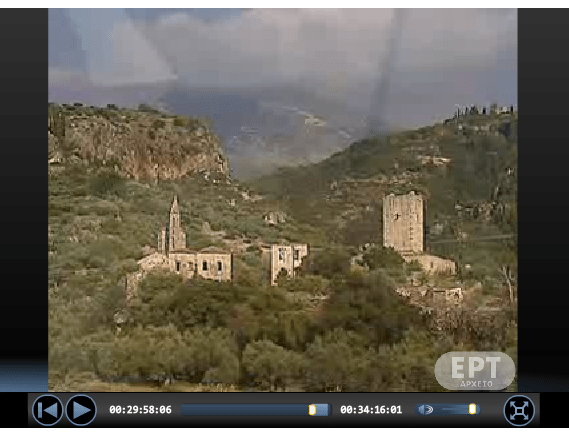
Paddy talks about his home in Kardamyli and the Mani

I doubt this has ever been seen outside of Greece. This video of Paddy is taken from a Greek TV documentary from 1999. We see scenes of Paddy working over his manuscripts, views of the library, dining room and the garden. He talks of his home and the Mani.

I am truly indebted to Nicolas Paissios for sending me this – and there is more to come 🙂


 Click the image to play. Let it run for a while and you will be taken on a journey to Paddy’s house.

Was Paddy the inspiration for the hero of Guns of Navarone?

The following was posted as a comment in Your Paddy Thoughts by Robert Seibert. He asks an interesting question so I thought I would elevate it from deep in a comments page to the main blog site to see if it provokes some debate.

I wonder if there is any connection between PLF’s WW2 deeds and the fictional work “Guns of Navarone”, Alistair MacLean’s 1957 novel and the 1961 film starring Gregory Peck as Capt. Keith Mallory leading a team to destroy German guns on “Navarone”-said to be the real island of Leros. In the movie Mallory is described as the “world’s greatest mountain climber” and “speaks Greek like a Greek and German like a German”-but was chosen mainly because he has survived for a year and a half as a guerrilla with the Cretan resistance. The parallels with Paddy’s exploits seem obvious. Of course “Ill Met by Moonlight” was published in 1950 and the film version in 1957-accounts of the actual Gen. Kreipe abduction. Would be interested in hearing others thoughts about this.

Over to you dear readers …

Photographs of Paddy

A series of photographs that we have come across recently. I am grateful to Thos Henley for finding some of these.

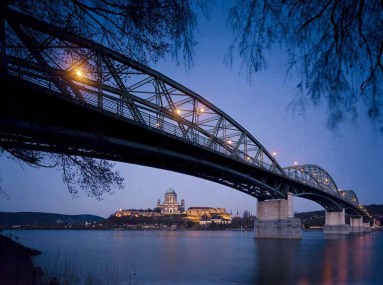
A pilgrimage to Esztergom

I am not the only one who takes the opportunity to visit some of the places mentioned by Paddy in his books when travelling. Here is a nice note I received recently from Ed Ricketts …
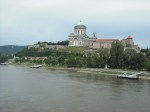
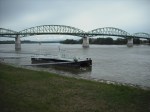
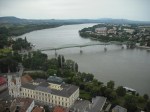
Dear Tom,

Just writing to say that, in Budapest last weekend with some spare time before a conference, and having just learned of Paddy’s passing, I felt it appropriate to make a brief trip out to Esztergom – the town on a bend in the Danube where, on the bridge, A Time of Gifts ends and Between the Woods and the Water commences.

After a winding 90-minute train ride down a single-track line, I emerged at the end of the line, Esztergom, and into a sleepy provincial eastern European town (the fact that it was Sunday lunchtime probably the defining reason for this). After a good 30 minute walk into the town centre, past a very pleasant main square with some almost northern Italian architecture, you suddenly see the mammoth marble basilica overlooking the town on a hill. This is the seat of the Hungarian Catholic Church, and an important place of pilgrimage. Around the basilica are grouped some nice old cobbled streets and religious buildings, while the Danube flows calmly by.

I scrambled up a back way to the basilica, then climbed up onto the cupola which provides an incredible view of the Danube bend and nearby hills (see the attached photos). All the while, I tried to imagine a young and inquisitive countryman with a knapsack doing a similar thing in 1934. What I left until last was walking over the bridge (destroyed in 1944, so it’s sadly not the same structure Paddy tramped over) which now links Slovakia and Hungary. Reading the two books had a considerable effect on me, so this was quite an exciting moment. After a brief meditative pause in the middle, and a few minutes’ ambling on the Slovakian side, I returned over the bridge into Esztergom having toasted Paddy with a small cigar en route.

So a very pleasing day trip overall, with just one slight regret – that I didn’t have the two books with me at the time!

Thanks,

Ed Ricketts

Related article:

Easter 1934 – Paddy reaches the Hungarian border at Esztergom 

Slightly Foxed by Roumeli

There are many keen Paddy bloodhounds out there who send me articles and information about Paddy that I would never find. One such is Hector Parra from Santiago in Chile who has sent me a number of interesting pieces, and this is the latest from London based ‘Slightly Foxed‘ which describes itself as:

“… a rather unusual book review. Friendly and unstuffy, with 96 pages of lively  recommendations for books of lasting interest – books that have stood the test of time and have left their mark on the people who write about them. An eclectic mix, covering all the main categories of fiction and non-fiction. Our contributors are an eclectic bunch too. Some of them you’ll have heard of, some not, all write thoughtfully, elegantly and entertainingly.”

You can give the review a try by clicking here. They also have a bookshop which looks like just the place to spend an hour or so browsing.

On the website they have re-published an article by Tim Mackintosh Smith about Paddy’s Roumeli: Travels in Northern Greece from issue no. 2 of Slightly Foxed (published June 2004) …

by  Tim Mackintosh Smith 

The only time I have been to Greece as it appears on the modern map was when I was barely out of short trousers. I went with that indispensable aid to travel, an aunt, and with the idea that I knew quite a lot about the place. My aorists and iota subscripts, however, were useless; that crucial moment for quoting Simonides on the dead Spartans never turned up. Even the sights were an anticlimax – bones of buildings, hordes of charabancs; the glory that was.

Sex had not yet reared its head, so I didn’t have that distraction. But I remember two other excitements. One was retsina, in unsuitable quantities, the other an experience in Athens when I wandered off alone. There was a demonstration; something, I imagine, to do with collapsing Colonels. It sucked me in and swept me along – bewildered at first, trying to catch hold of something familiar, then encouraged by smiles and guiding hands – until I fell in step, into the rhythm, and ended up chanting with the best of them. When the procession dispersed, having gone nowhere in particular, I was lost, thrilled and intoxicated.

Roumeli had the same effect when I first read it a dozen or so years later; it still does, reading it again another couple of decades on. One is drawn in and immediately disorientated. Who is the outlandish figure in a hairy kilt and hobnailed Ali Baba boots who takes us into the first chapter? A Sarakatsán nomad, apparently . . . The appendix on these people gleefully offers sixteen conflicting derivations for the name. Casting around for the familiar, I plumped for ‘Saracen’, for many features of Sarakatsán life rang bells: the poetry about Turkkilling, for example; the public exposition of bloodied nuptial bed linen; the censing of mothers after birth with nasty-smelling smoke. There were more, and all may be found in the bottom corner of Arabia where I live. But what about the wearing of clothes back to front as a sign of mourning? I had come across that, too – in an account of fourteenth-century Luristan. It was all a long way from the Parthenon.

In fact it is, as Patrick Leigh Fermor admits, off all the standard maps. So too is Leigh Fermor. In 1933, aged 18, he set out to walk from the Hook of Holland to Constantinople (a journey which remains in a sense unfinished, for the third volume of his account of it has yet to appear). During the Second World War he took part in covert operations in Albania and in Crete, where he planned and carried out his celebrated abduction of the German General Kreipe.

He has written on places and subjects as various as the Caribbean and monastic life in Normandy. But Greece is his passion, and for nearly forty years he has lived there on the Mani, the middle prong of the Peloponnese.

Mani, his brilliant wanderings on that peninsula, deliberately involved the reader in ‘the luxury of long digression’. Digressions presuppose progression; in Roumeli – Mani ’s successor, which rambles Greece north of the Gulf of Corinth – there is none. The book visits the hills of Thrace, the monasteries of the Meteora, the cafés of Athens, the scene of Byron’s death at Missolonghi and the parched ravines of Aetolia. But these visits form no greater journey. They are disconnected probings into unknown corners, an odd-and-end odyssey, and the result is a collection of essays, a mézé of red herrings.

There is a ‘main theme’, we are told in the Introduction; but that theme, Leigh Fermor confesses, is ‘a private theory of my own’. The theory – ‘The Helleno-Romaic Dilemma’ – suggests, at some length, that the Greek psyche is a zone of perpetual conflict between the glory that had been Athens and the sorrow that was Byzantium (we can probably now add a third antagonist, the bore that is Europe). All late-night, third-bottle stuff, and hardly the normal matter of A-to-B travel books. But the delight of it all is that, via these disjointed jaunts around the mainland interspersed with mini-cruises in the glittering archipelago of Leigh Fermor’s mind, we get to know a lot about Greece.

The mind, like the land, never fails to surprise – with ideas, and with anecdotes. The one about getting thrashed at billiards by Byron’s ancient great-granddaughter and the subsequent hunt for the poet’s slippers has been deservedly anthologized. But there are more private memories as well, wartime scenes sharpened by danger, polished by moonlight, tempered by time. He recalls an earlier battle too ‘(which I had watched from an empty stork’s nest in the top of an elm)’. I envy him those nonchalant brackets and, even more, that surreal vantage-point. It is also one he adopts when writing, some mental equivalent of the stork’s nest that enables him to see things through to their illogical conclusion: ‘It was a wonder, I thought, as we rocked along under that burning-glass of a sky, that the curling tobacco leaves didn’t catch fire and smoke themselves there and then.’

The Greeks certainly had a word for Patrick Leigh Fermor: idiosyncratic. (Although there is, as it happens, a precedent for the tobacco conceit. The fifteenth-century Persian traveller Abd al-Razzaq noted that, as a result of the intense heat in Oman, the chase became a matter of perfect ease, ‘for the desert was filled with roasted gazelles’.) If idiosyncrasy cannot by definition be imitated, it can certainly inspire. It was another traveller, Freya Stark – whose publisher was also John Murray – who lured me to Arabia over twenty years ago, but it was Patrick Leigh Fermor who led me to write about it. He will keep me writing, and always envious. The works of Freya and the other great twentieth-century travel writers may capture genius loci; in Roumeli and its companions there is something more, unconnected with place – genius libri.

The one thing I envy Leigh Fermor more than any other is his sounds: the sound of names (‘names to make the hair stand on end’; Learish names – where is the Akhond of Swat beside Polycarp of Trikke and Stagoi?); the rhythm of lists; above all, non-verbal sound. In his final chapter, ‘Sounds of the Greek World’, all three come gloriously together in an aural gazetteer of the land he knows inside out and loves to distraction. It goes not from A to B but from A to Ω, dissolving along the way into poetry. It is impossible not to fall into the rhythm and emerge intoxicated.

It is also hard, now, not to wonder what remains of Roumeli: whether the Meteorite monks still cling to their rock pinnacles and the Kravarites of Aetolia remember the old beggars’ jargon; whether the Sarakatsáns, who led us into this unexpected landscape, still live between their summer and winter pastures. Transhumant, tented nomads in the EC? Perhaps only ghosts are left, and this book.

The next big movie …

I have never done this before on the blog, but this is actually so funny that I could not resist it. Normal service will resume tomorrow.

In fact they were hasty. If they had waited a few days they could have had Zhang Ziyi as Wendi Murdoch, and CoCo the Clown as Mr Marbles.

£1 a week – Nick explains the reason for his journey

Don’t forget to donate even a small amount to support this project by visiting ….

We Did This

Untitled from Nick Hunt on Vimeo.

£1 a week – from the Hook of Holland to Istanbul, in Paddy’s footsteps

Here is a very exciting venture, and one that if we only had the time I am sure many of us would want to do.

In December, a young writer, Nick Hunt, will set off from London with the aim of walking from the Hook of Holland to Istanbul in the footsteps of Patrick Leigh Fermor, seventy-eight years after Paddy commenced his own, life-changing journey.

Nick intends to report on his journey and to write a book. He is not seeking to copy Paddy as he explains below, but to create his own experience whilst comparing the Europe that he encounters with the one our eighteen year old hero stepped into with such joyful anticipation.

Such things cannot be achieved without money and I am asking if you will make some contribution to ensure that Nick does not starve on his long journey. Who knows he may even need some cash to replace a lost rucksack at some point!

We have the idea of emulating Paddy’s “One Pound a week” concept. If you would like to help Nick on his journey (for which you will receive personal reports and in good time – hopefully not forty-three years like Paddy! – a copy of the book) please visit the page he has set-up with an on-line site that helps to raise money for interesting arts projects – We Did This – and make a donation. Nick needs to meet his target of £1,500 within one month. One Pound per week for a six month journey works out at £26 but I am sure any help you can offer will be very gratefully received!

To find out more and donate visit We Did This

Please visit Nick’s website which has details of the route. And now over to Nick …..

Please fund me with £1 a week to walk Paddy’s route across Europe!

Nick Hunt

On December 9th 2011 – 78 years after Paddy’s great journey from the Hook of Holland to Istanbul – I will set out in his footsteps. Using his writing as a roadmap, his words as a background murmur in my ear, I’ll walk the same route through Holland, Germany, Austria, Slovakia, Hungary, Romania, Bulgaria and Turkey. I’m a freelance journalist and writer, and the journey will be documented through audio recordings and through writing – to produce a series of short radio programmes, and a book of travel journalism, on my return to England.

My intention isn’t to emulate Paddy – who could ever attempt that? – but to explore the ways in which Europe, and the experience of walking it, have changed since he set out. In the intervening years war, politics and progress have reshaped the continent several times over. Obviously towns and cities will have grown, villages will have been swallowed by roads, and certain landscapes will have been altered beyond recognition. But as well as these more tangible changes, I want to explore the deeper shifts in the cultures, traditions and identities of the countries Paddy passed through.

My journey will come at an interesting time, with Europe still undergoing great changes, new patterns of migration and fusions of different cultures, as well as facing great challenges – from the uncertainties thrown up by the economic crisis to the ominous resurgence of right-wing movements across the continent.

‘Everything is going to vanish! They talk of building power-dams across the Danube and I tremble whenever I think of it! They’ll make the wildest river in Europe as tame as a municipal waterworks. All those fish from the East — they would never come back. Never, never, never!’

This prediction was made by a man Paddy met in Persenbeug, Austria, in an inn overlooking the Danube (A Time of Gifts). Much of the reason for me making this journey, almost 80 years later, is to see if these words became true.

Has Europe been tamed? Has everything vanished?

Is adventure still possible in Europe?

As admirers of A Time of Gifts and Between the Woods and the Water will know, Paddy managed to fund his journey on £1 a week (which works out as about £50 today). I’m asking people to support this project by funding me just £1 a week for the duration of the walk, which should take around 6 months.

If you would like to fund me, or just to get in touch with thoughts, ideas, suggestions, you can contact me at scrutiny[at]gmail.com

For a fuller description of the journey, please see my blog: www.afterthewoodsandthewater.wordpress.com

Many thanks!

Nick


Paddy interviewed on “Private Passions” for his 90th birthday in 2005

Paddy interviewed on Michael Berkeley’s BBC Radio 3 “Private Passions” programme for his 90th birthday in 2005. He talks about his life and the music that has inspired him.

I am indebted to Georg Dalidakis for sending this to me.

Please click below to listen to the programme. Click to arrow to the right to download it to your PC.

Happy listening!

(PS – thanks to Richard for passing on this playlist from the programme)

Archduke Otto von Habsburg

Otto von Habsburg with a bust of himself at Paks, Hungary, in 2005

The funeral of the last heir to the Habsburg throne takes places today in Vienna. By family tradition his heart will be buried separately in a Bedendictine monastery in Hungary at Pannonhalma Archabbey, symbolising I suppose Vienna’s claim on the Hungarian empire. The characters in his early family life feature in Miklós Bánffy’s books. Many of the old aristocrats that Paddy came across in Hungary and Romania had served the collapsed Habsburg Empire.

First published in the Telegraph July 4 2011

Archduke Otto von Habsburg, who died on July 4 aged 98, began his public life as the infant Crown Prince of the multinational Austro-Hungarian Empire, and ended it as Father of the multinational European Parliament.

Within that neatly closed circle lay all the major political dramas of the 20th century, most of which he witnessed and some of which he influenced. He was centre stage for one of them — the unequal struggle against Hitler for the survival of his Austrian homeland, which he tried to conduct as an exiled Pretender in the 1930s. Not for nothing did the Führer call the triumphant march-in of March 12 1938 “Operation Otto”.

All that seemed unimaginable to the world in which young Otto, as he was known, started life during the deceptively tranquil Indian summer of the 650-year-old Habsburg monarchy. He was born third in line to the throne on November 12 1912 in the small Vienna palace of Hetzendorf and christened with a string of names demonstrating that the blood of all the Roman Catholic royal families of Europe flowed in his veins: Franz Josef Otto Robert Maria Anton Karl Max Heinrich Sixtus Xavier Felix Renatus Ludwig Gaetan Pius Ignatius.

His father, the Archduke Karl, was a great-nephew of the ruling Emperor Franz Josef, and was then serving as an infantry major-commander at the regimental barracks in the capital. His mother was the former Princess Zita of Bourbon-Parma, and their marriage the year before had been that rare event in a dynasty plagued with so many matrimonial mishaps and misalliances — a happy union of two people perfectly matched in attractiveness, temperament and lineage. Their firstborn was to follow the prescription almost to the letter in his own marriage 38 years later.

At the time of his birth, the 11-nation monarchy still seemed safe, if somewhat wobbly, and his own time at its helm still fairly distant. One Viennese newspaper hailed the newborn prince as the future monarch who “according to the human calculations, will be called upon to steer the future of Europe in the last quarter of the 20th century”.

The assassination at Sarajevo on June 28 1914 of the heir apparent, Archduke Franz Ferdinand, alongside his morganatic wife, put a brusque end to all such calculations. Indeed, the First World War which broke out six weeks later was to spell the doom of Europe’s continental empires, that of the Habsburgs included.

Half way through the war, in the early hours of November 22 1916, the old emperor Franz Josef, who had ruled for a record-breaking 68 years, died at last.

An era, as well as a reign, was over, but the succession was smooth. Otto’s father automatically became the new emperor, and he, aged four, the new Crown Prince. His first ceremonial appearance came on November 30 1916 when he walked, a tiny figure in a white fur-trimmed tunic, between his parents behind the hearse of the late ruler at the great funeral procession in the capital.

A month later he was greeted with wild enthusiasm by the monarchy’s Magyar subjects when his father was crowned in Budapest as the new King of Hungary. The official photograph shows the young boy, dressed in ermine and velvet with a great white feather in his cap, sitting between his parents in their ornate coronation robes.

He always retained vague memories of those events, but these became much sharper when, two years later, the monarchy collapsed under the combined pressure of domestic upheaval and defeat on the battlefield.

The beginning of November 1918 saw him and his siblings stranded in a royal shooting lodge near Budapest, where an armed revolution had broken out. They were rescued by one of their Bourbon uncles, Prince René, who smuggled them across the border to rejoin their parents in the Schonbrunn Palace of Vienna. Otto had a child’s eye view of the collapse of the monarchy, abandoned by the aristocracy it had created.

On November 11 1918 the Emperor Karl, though not formally abdicating, “renounced participation in the affairs of state”. That same night they fled the deserted palace, heading at first for Eckartsau, their privately owned shooting lodge 40 miles north-east of the capital.

The winter there passed fairly calmly, but by the spring their tiny self-styled “court” was under threat from Left-wing agitators. (Austria had promptly declared itself a Republic after their flight from Vienna.)

Their rescuer now was not a family member but a British Army officer — Lieutenant-Colonel Edward Strutt, dispatched on the personal authority of King George V with orders to escort the beleaguered Austrian emperor and his family to safety. This Strutt accomplished in some style, reassembling their royal train for the journey into Switzerland on March 25 1919. Otto never forgot the experience. Whenever he heard in later life complaints about British indifference to the Habsburgs’ fate he would reply: “Yes, but there was always Strutt.”

The two and a half years of their Swiss exile were marked by the two attempts of the ex-Emperor to regain his Hungarian crown. Both were blocked in Budapest by Miklos Horthy, who had now ensconced himself in power as Regent. After the ignominious failure of the second restoration bid the family were exiled by the allied powers to Madeira, where Karl died, a broken man, on April 1 1922. That same day the nine-year-old Otto heard himself addressed as “Your Majesty” by the tiny household-in-exile. To the end of his days he remembered the shock it gave him: “Now it was my turn.”

Under the protection of their kinsman, King Alfonso XIII of Spain, the family moved to Lequeitio on the Spanish Basque coast. Otto remembered the seven years they spent there as their most tranquil time of exile. They were also, for him, the most hardworking. Under the strict supervision of his mother he took, under various tutors, the Matura (roughly, English A-levels) in both German and Hungarian. His further education was also the motive for their next move — to the gloomy castle of Hams at Steenokkerzeel, in Belgium, so that Otto could take his degree at the nearby university of Louvain. It was at Hams that Otto reached his 18th birthday and was duly declared, in a family ceremony with few outside guests, “in his own right sovereign and head of the house”.

However ghostly that title appeared, it was enough to impress the Austrian-born Adolf Hitler, who was manoeuvring to seize power in Germany. When in the winter of 1931-32 the young Pretender spent a few months studying in Berlin Hitler twice suggested a meeting.

The first invitation came from Prince August Wilhelm of Prussia, the dim-witted Nazi son of the exiled Kaiser, and the second via Goering himself. Otto refused both times on the spurious excuse that he had not come to Berlin to discuss politics (in fact, he was doing nothing but). Hitler was incensed by the snub and it touched off a six-year battle between the two men for the fate of their Austrian homeland.

The climax was reached in February and March of 1938 when a Nazi takeover in Vienna seemed imminent, prompting a short-lived show of defiance from the Austrian Chancellor Kurt Schuschnigg — a monarchist at heart but without the strength of his convictions. His vacillation prompted a remarkably courageous offer from the young Pretender to return from exile to take over the reins of government in order to repel Hitler. Schuschnigg dithered but eventually rejected the idea — perhaps just as well for Otto, who was already high on the Gestapo’s wanted list.

He had moved close to the top of that list by the time, two years after the Anschluss, that German armies swept into France and Belgium. The exiled Habsburgs got away from Hams only a few hours before Goering’s bombers attacked the castle, and then they joined the vast stream of refugees heading south. They eventually reached Lisbon, where they were still being hounded by the Gestapo. President Roosevelt (whom Otto had met in Washington just before the fall of France) then honoured his offer of “hospitality in an emergency” and they were all flown by Clipper seaplane to the United States.

As Otto von Habsburg later admitted, he wasted far too much energy during those wartime years in America on the faction-fighting among Austrian refugee groups instead of concentrating on the broader political picture. But, thanks largely to his personal ties with the President, he was able to repair the image of Austria so tarnished by its supine surrender to Hitler in the Anschluss. And, in the last months of the war, he worked closely with the White House in the vain attempt to lure Horthyite Hungary over to the Allied side.

Churchill, whom he met at the Quebec Conference, warmly supported the vision of a post-war conservative federation in Central Europe. Stalin put paid to those visions, however, and it was to a Communist-controlled Danube Basin that Otto returned in the spring of 1945.

He made a brief foray into Western Austria but was expelled by the reborn Austrian Republic, which had reaffirmed the anti-Habsburg legislation of 1919. He then faced a personal crisis — without a valid passport, a home or any regular income. He solved the last problem by embarking on a career as a journalist and public lecturer. This was exhausting but highly remunerative and, within five years, he had paid off all his wartime debts and was enjoying a comfortable income.

He could now think of finding a home and founding a family. The ideal partner appeared by chance in 1950, when he visited a refugee centre near Munich. Working there as a nurse was Princess Regina of Sachsen-Meiningen, herself a refugee whose father, Duke George III, had died in a Soviet concentration camp. The ideally-matched couple were married a year later and settled in a comfortable villa at Pocking, near Lake Starnberg in Bavaria. Their first five children were all girls, and it was not until 1961 that the birth of Karl Thomas, the first of two sons, assured the line of direct succession.

This prompted Otto to renounce his own dynastic claims and pursue what had long fascinated him, a full-time career in politics. He acquired dual German-Austrian nationality, and in 1979 was elected to the European Parliament as Christian Democrat member for North Bavaria. There he stayed for the next 20 years, becoming the highly regarded Father of the House and its only member to have been born before the First World War.

He proved an accomplished debater with a fluent command of seven European languages. Though he spoke on a variety of topics, his abiding theme was the need to bridge the East-West division of the continent and ultimately to bring all the nations of the old monarchy within the new European Union. He continued to work successfully at this even after his retirement, using the pan-European movement as his principal platform. He had been the president ever since the death of its founder, Count Coudenhove-Kalergi, in 1972.

On October 3 2004, Pope John Paul II beatified Otto’s father, Emperor Karl. It was an important event in Otto von Habsburg’s life, and one that perhaps softened the blow that had occurred five years earlier.

He had hoped that his son Karl would carry on the Habsburg name in the European Parliament, but in 1999 the young archduke — who had been sitting alongside his famous father as a Right-wing member for Western Austria — was dropped by his party after a controversy over the financing of his campaign funds. A subsequent attempt to launch Karl on to the Austrian domestic political scene proved a dire, if gallant, failure.

Otto von Habsburg’s wife, the Archduchess Regina, died in February 2010.

Images of Iasi

Many of you will have read the article written by Ryan Eyre recalling his meeting with Paddy in 2009.

Ryan is now traveling through Europe on his way to take up a teaching position in  (Republic of) Georgia. I think he is in Kiev at the moment but he sent me these images from Iasi in north-eastern Romania. As we know Paddy spent a few happy years in Moldova with Balasha before the war and may well have visited Iasi.

Related article:

The words of Mercury are harsh after the songs of Apollo: Meeting Patrick Leigh Fermor

The Times Literary Supplement: Patrick Leigh Fermor

First published in The Times Literary Supplement, 6 July 2011

There was a time in the early 1950s when, upon arrival in the TLS office of a book about cannibalism or Voodoo, the editor would drop it in an envelope and say, “This is one for Paddy”. Patrick Leigh Fermor, who died last month at the age of ninety-six, is now best known for his connection to Greece and his youthful trek across Central Europe in the direction of Constantinople (as he insisted on calling it). But in his first book, The Traveller’s Tree, an account of a journey by schooner through the Caribbean islands published in 1950, he was in pursuit of “the whole phenomenon of Afro-American religion”. Before long, the TLS was commissioning the former mountain guerrilla fighter and Intelligence Corps Liaison Officer to write on related matters. He could open a review of a book on Haiti in 1953 by telling readers that “The bibliography of Voodoo – or Voudoun, as some purists insist, with little basis, on spelling it – mounts impressively”. A discussion of cannibalism in the correspondence columns of the TLS was just the sort of thing to elicit a contribution from Fermor: “Apropos of the recent letters about the ethical and culinary aspects of cannibalism, may I quote from a book I wrote years ago . . .”.

There followed a list of the gustatory advantages of various folk, according to the palates of the Caribs who “invaded the Caribbean chain, eating all the male Arawaks they could lay hands on and marrying their widows”. The book he wished to quote from was, of course, The Traveller’s Tree (it was by now 1980), which included this pre-Columbian version of a restaurant review:

“French people were considered delicious, and by far the best of the Europeans, and next came the English. The Dutch were dull and rather tasteless, while the Spanish were so stringy and full of gristle as to be practically uneatable.”

In later years, Paddy – as he was known to friend, reader and stranger alike – wrote for this paper on various topics, including Crete, scene of his wartime adventure. In the common run of Grub Street, there are many people one could call on to evaluate an anthology of nonsense – but Poiémate me Zographies se Mikra Paidia, which Paddy reviewed in 1977, was nonsense in modern Greek. In December 1979, he contributed a clamorous, ringing poem on the subject of Christmas:

What franker frankincense, frankly, can rank
in scents with fawn-born dawning
Weak we in Christmas week, lifetime a shriek-
ing streak – lend length and strengthen!
Poultice the harm away, charm the short
solstice day! Send strength and lengthen!

Among other curiosities we found on rooting through the archive was this plea from May 1968: “Patrick Leigh Fermor, author, traveller: biographical information, letters, personal reminiscences for biography”. The requester was J. Marder, writing from Athens. What became of it, and him? An authorized biography by Artemis Cooper is expected to appear at the end of next year.

We have received this “personal reminiscence” from a correspondent:

“In 2005, I was commissioned by a newspaper to write a profile of Patrick Leigh Fermor. A preliminary meeting took place at the West London home of Magouche Fielding, widow of Xan, PLF’s comrade-in-arms, but my editor insisted that no piece about Fermor could appear without a first-hand account of the house which he designed and helped build in the mid-1960s in Mani, at the southernmost tip of the Peloponnese. So it was that, after an overnight stay in Athens and a five-hour drive to the village of Kardamyli, I rang Paddy from a seaside pension.

“‘Good Lord. You’re here already!’ he exclaimed, though all proper warning had been issued. ‘Look here. Come to supper straight away. It’ll be a rotten supper. But come to supper straight away.’ Desiring nothing more than an ouzo followed by a soft pillow, I had the presence of mind to resist. Paddy was understanding. ‘Look here. Come to lunch tomorrow. It’ll be a much better lunch.’ Suppers and lunches, it transpired, were prepared by different maids.

“At about one the following day I set off for the two-kilometre walk from Kardamyli, with directions from a villager. ‘As the road bends to the left, you take the footpath to the right. Go through the olive grove, and arrive at Mr Fermor’s door.’ What could be simpler? There was indeed a bend in the road and a footpath to the right. But there was also another, closer to the bend, up ahead. Then another. After involuntary exploration of hitherto uncharted olive groves and what seemed a sizeable stretch of the Mediterranean coast, I squelched into Paddy’s house from the shore, to find him seated on the sofa reading the TLS. ‘Good Lord. I think you’re the only creature, apart from a goat, who has come in that way. We must have a drink straight away.’ The last was among his favourite phrases.

“Lunch lasted some six hours. (Lemon chicken, with litres of retsina or red Lamia.) Songs in various languages were sung, including a rendering of ‘It’s a Long Way to Tipperary’ in Hindustani. Lost lines of poems were sought. An anecdote about my lately deceased father and his claim to have seen salmon leaping in a narrow Perthshire stream, confirmed only after his death, threw Paddy into a search for the perfect epithet: ‘The corroborating salmon. The justifying salmon. The proving salmon’. Well into the evening, I prepared to leave. ‘Look here. Come to lunch on Sunday’ (this was Friday). I said I would on be on my way back to Athens. He was startled. ‘Good Lord. You’re leaving already? Then come to supper tomorrow.’ I did so, after an all-day hike in the Tagetos mountains which rear up behind the house that Paddy built, as the Gulf of Messenia opens before it. This time, I arrived punctually, to be admitted by the allegedly rotten cook (in fact supper tasted very good). She directed me to Paddy’s study in a separate building in the garden. I knocked before entering, to find him at his desk, alone in Mani on a late March evening, dressed in Jermyn Street shirt, pullover and grey flannels, reading a Loeb Horace. Towers of manuscripts could not obscure him. Among them, perhaps, was a draft of the third and concluding part of his epic walk from the Hook of Holland to Constantinople – the first, though not the last, heroic adventure of Patrick Leigh Fermor.”

The grandest family in publishing

Jock Murray in 1983 (Mercer photography)

A review of a book about Paddy’s publishing house – John Murray. They have quite a line-up of authors, including Jane Austen, Byron, Darwin, Freya Stark and John Betjeman, as well as Paddy.

Jeremy Lewis reviews The Seven Lives of John Murray: the Story of a Publishing Dynasty, 1768-2002 by Humphrey Carpenter

First published in The Telegraph 5 July 2008.

When I started out in publishing 40 years ago, most of the famous firms were fiercely independent, and were housed in elegant if often dilapidated Georgian houses in Bloomsbury, Soho or Covent Garden.

Some, such as André Deutsch or Hamish Hamilton, were run by their founding fathers; others were still family firms, of which Collins was the most muscular, and John Murray the grandest and most upper class.

Murray was famed as the publisher of Byron, Darwin and, more recently, John Betjeman, Kenneth Clark, Osbert Lancaster and Patrick Leigh Fermor; and it had the inestimable advantage of being housed at 50 Albemarle Street, a treasure trove crammed with Byronic memorabilia, marble busts and gold-framed portraits of eminent authors.

Six years ago, the firm was swallowed up by a giant conglomerate and it now operates from a tower block on the Euston Road; Humphrey Carpenter’s history of the firm, completed by other hands after his death in 2005, is an evocation of a vanished age.

Like many of the best-known publishing houses, Murray has strong Scottish connections – reflected most recently in the decision to sell its archives to the National Library of Scotland.

A former Marine from Edinburgh, John McMurray bought a bookselling business in Fleet Street in 1768, dropped the “Mc” in response to an outbreak of Scottophobia, and inaugurated the dynasty that ended with John Murray VII.

As Carpenter observes, “Bookselling and publishing do not necessarily involve the intellect or the imagination; the story of the Murrays is not chiefly about the life of the mind.”

John Murray I’s adage that “if you are able to entertain the ladies your business is done” remains as pertinent as ever, and although Byron berated John Murray II for being “shuffling” and “time-serving”, the family manifested all those qualities traditionally associated with publishers, in that, as Carpenter says, they were both “cautious and adventurous”, and “conservative and innovative at the same time”.

John Murray II was a much more respectable figure than his rakish father. He moved west to Albemarle Street, published Jane Austen’s Emma, rejected a clergyman’s Observations on Diarrhoea, and is best remembered for his turbulent relations with Lord Byron.

He worried about publishing Byron’s more risqué verses, but more often than not the businessman prevailed, and “my sordid propensities got the better of me”.

After the poet’s death, Murray masterminded the burning of his memoirs: he hadn’t read them, but was worried that they might contain references to anal intercourse and incest with his half-sister. Carpenter suggests that putting a match to them enabled Murray to cross the great gulf that separated the tradesman from the gentleman.

Succeeding Murrays liked to think that the memoirs had somehow survived, peering into cupboards and under floorboards in the hope of finding them.

During the 19th century, Murray published On the Origin of Species and travel books by, among others, Isabella Bird and David Livingstone. Fiction received short shrift, but as the firm became ever more established, with royal and aristocratic memoirs looming large, Humphrey Carpenter’s eyes began to glaze over and he found himself writing imaginative accounts of life in Albemarle Street; these have been retained as appendices to a book that is lively enough in its own right and has no need for fictional embellishments.

The revival of the firm in the last century was thanks to the bow-tied, bustling “Jock” Murray, who persuaded his cautious seniors to take on the best-selling Story of San Michele, put up his own money (100 shares in Bovril) to secure the rights to publish Betjeman’s Continual Dew, nudged Freya Stark into print, spotted the potential in Parkinson’s Law, and modestly declared that his “main claim to fame is that I am the only publisher who has typeset in the nude”.

No mention is made of the great diarist James Lees-Milne: a contemporary of Jock at Eton and Magdalen who came to the firm late in his career, he regarded Albemarle Street as his spiritual home, and wrote entertainingly about it.

John Murray VII sold the firm partly because he felt it was increasingly difficult for independent firms to survive, and partly because he didn’t want his sons to have to take up the burden of the family firm.

The Daily Telegraph suggested at the time that “there are fears that its identity could disappear”, and the John Murray of today is less “carriage trade” than it was, and indistinguishable from any other firm of publishers.

Obituary: Sir Wilfred Thesiger

Sir Wilfred Thesiger

The great soldier, explorer and travel writer who may have met Paddy in Egypt.

First published in the Telegraph 26 August 2003

Sir Wilfred Thesiger, who died on Sunday aged 93, was the quintessential English explorer, and the last and greatest of that small band of travellers who sought out the secrets of the desert in the years before Arabia was transformed forever by the oil beneath her sands.

Thesiger’s reputation was established by two epic journeys he made in the 1940s across the Rub ‘al Khali, or Empty Quarter, the most forbidding, least known and least penetrated region of Arabia.

His motive for crossing it was not primarily to reap glory for himself, but to share the hardship of the life of the Bedu and to earn their comradeship. He was not in thrall to the desert itself but, like T E Lawrence, to his admiration of those who lived there: “The harder the life,” ran his credo, “the finer the person.”

The Empty Quarter is the largest sand desert in the world. It covers 250,000 square miles and contains ranges of dunes 100 miles long and 1,000ft high. At noon, the temperature of the surface of the sand reaches 80C.

The first European to traverse this fearsome waste had been Bertram Thomas in 1932, later followed by St John Philby, the father of Kim. But both these had travelled as well-supplied Westerners; Philby had even carried with him a wireless to listen to Test matches. Thesiger’s achievement was to make longer journeys than either, dressed like the Arab tribesmen with whom he rode and rationed to their daily pint of water and handful of dates.

It was a spare, almost monastic way of life, and one in which Thesiger found a near-spiritual contentment. “In the desert,” he wrote, “I found a freedom unattainable in civilisation; a life unhampered by possessions.”

Ostensibly in Arabia to search for the breeding grounds of locusts, Thesiger made his first crossing of the Empty Quarter – a circular journey by camel of some 1,500 miles – in 1946, becoming in the process the first European to see the fabled quicksands of Umm al Sammim. His second expedition, two years later, took him even further through the desert and, in constant peril from hostile Bedu, was still more dangerous.

It was also the most fulfilling experience of Thesiger’s life, albeit a humbling one; for though he withstood the physical hardship, he felt that he rarely matched the standards of behaviour the Bedu expected of themselves.

In the 1950s, as Arabia began to change, he took to the mountains, travelling in remote parts of Kurdistan, the Karakoram and later Afghanistan.

There, on the banks of the Panjshir, he and Eric Newby had the most celebrated meeting between travellers since that of Livingstone and Stanley, with Thesiger (presented in Newby’s account as the hardened professional to his own inept amateur) deriding the attempts of Newby and his companion to blow up their rubber mattress: “God,” he scoffed, “you must be a couple of pansies.”

Thesiger had made his new base, however, in the marshes of Iraq, where he lived for eight years in the 1950s, travelling by canoe and giving basic medical assistance to its inhabitants; he also became expert at circumcision.

His time there, recounted in The Marsh Arabs (1964), together with his precise yet emotionally charged account of his desert journeys, Arabian Sands (1959), gained him a new reputation in late middle age as a writer, albeit one influenced by the romanticised prose of Lawrence and Doughty.

In these books and in his partial autobiography, The Life of My Choice (1987), Thesiger set out his belief that Western civilisation was a corrupting force which had robbed the world of its diversity and stripped the primitive peoples he so admired of their finer traits. It was a floodtide from which he had spent his life trying to escape.

To many he appeared simply an arch-conservative, and critics pointed to the fact that, though Thesiger was horrified by the changes modernity had wrought on the Arab world, the Bedu themselves had not hesitated to swap their camels for cars, a harsh life for one of comfort.

Yet with the passing of time, many others came to share his distaste for the by-products of progress and, with the arrival of such concepts as eco-tourism, Thesiger’s traditionalist concerns now perversely seemed very contemporary.

Paradoxically, one modern invention gave Thesiger an edge over predecessors such as Richard Burton and Wilfrid Scawen Blunt – the camera. Thesiger taught himself to become an excellent photographer and perhaps his most enduring legacy will prove to be his vast photographic record (willed to the Pitt-Rivers Museum in Oxford) of ancient races and ways of life since extinguished within a generation.

His great fortune was to see them just before they were lost from sight; his tragedy that the ones he cared for most have vanished forever.

Wilfred Patrick Thesiger was born on June 3 1910 within the mud walls of the British Legation in Addis Ababa, Abyssinia. His father, a younger son of the 2nd Lord Chelmsford – commander of the force destroyed by the Zulus at Isandhlwana – was Consul-General and Minister at the court of Emperor Menelik.

Billy, as Wilfred was known in his young days, spent his first seven years in Abyssinia, absorbing a spectacle of savage splendour that bred in him his lifelong craving for adventure. At two, he saw the arrival at the British Legation of Crown Prince Lij Yasu’s 1,000-strong war band, resplendent in their scarlet cloaks trimmed with lions’ manes.

At six, he witnessed the victory parade of Ras Tafari, who had triumphed over Lij Yasu in a civil war – wave after wave of glinting spear points and captives in chains. The next year, he went tiger-shooting in India with his uncle, the Viceroy.

Such outlandish tales did not endear him to his fellow pupils at the prep school in England to which he was sent at eight, and Thesiger, already a dominant character who did not take rejection well, retreated within himself. A further blow was the sudden death of his father.

He enjoyed himself more at Eton, which proved another formative influence. Its spartan regime hardened him further and the ancient school also confirmed in him his love of the past. He afterwards retained great affection for the place and had latterly judged its annual travel writing prize, named for him.

Indeed, the simple room in the nursing home near Purley, Surrey, in which he was to live for the last few years of his life appeared almost a re-creation of his Eton study: a single tartan blanket on the bed; a shelf of books by Conrad and Buchan; a drawing of the school presented to him by the pupils.

In 1929 Thesiger went up to Magdalen College, Oxford, to read History, but he enjoyed greater success as a sportsman, winning a Blue at boxing from 1930 to 1933 and captaining the university team in his last year.

He spent his summer vacations working on tramp steamers and fishing trawlers, but the high point of his time at Oxford came in the winter of 1930 when he was invited to Addis Ababa to attend the coronation of Haile Selassie (the former Ras Tafari), who remembered the help afforded by Thesiger’s father during the civil war.

While in Ethiopia, Thesiger took the opportunity to plan his first expedition, a journey north into the Danakil country to search for the destination of the Awash river. This he carried out in 1933, although the Danakil had a murderous reputation for treachery and accounted a warrior’s standing by the number of men he had killed and castrated. The success of Thesiger’s enterprise began, at the age of 23, to make his reputation as an explorer and helped win him a place in the Sudan Political Service.

He served in the Sudan from 1935 to 1940, although he was too unconventional to make a success of it as a career and spent his last years there as a freelance District Officer. He used much of his time to travel as far afield as Chad, and relished the opportunities for hunting lion, which preyed on village cattle. He bagged more than 70, and raised two cubs himself. Thesiger, though, was not a sentimental man, and subsequently shot both the cubs. He did this in the belief that, having been tame, they would grow up to become man-eaters.

On the outbreak of war, Thesiger was assigned to the Sudan Defence Force, and later, under the command of Orde Wingate, helped organise the Abyssinian resistance to the occupying Italians. In May 1941 Thesiger led a flying column which marched 50 miles in a day through sweltering heat to harry a much larger retreating force at Wagidi. Having accomplished this, Thesiger went on to force the surrender of 2,000 Italian troops and the fort at Agibar. His leadership in this action was recognised by the award of the DSO.

Having been recruited by David Stirling, Thesiger later served briefly in the Western Desert with the SAS, but then saw out the rest of the war in some frustration as political adviser to the Abyssinian Crown Prince.

In March 1945 he resigned this post, and while waiting for an aeroplane back to London, was invited to dinner with O B Lean, head of the Middle East Anti-Locust Unit. Lean was looking to employ somebody to investigate locust sites in the Arabian desert; Thesiger had accepted the job before the meal was over.

After leaving Iraq, from 1968 onwards Thesiger lived for much of the year in northern Kenya, with the pastoral Samburu and Turkana peoples, although he dwelt apart from them and, unlike in Arabia, retained his English identity. In reference to this, and to his outsized ears and jutting nose, the tribes called him sangalai, “The Old Bull Elephant Who Walks By Himself”.

Occasionally, Thesiger returned to the flat he kept in Chelsea; but England was an unfamiliar country to him, and he hoped to see out his years in Kenya, with his corpse being left on the hill for the jackals. But after the death of the two Kenyan men whom he had treated as sons, he reluctantly returned to England for good in the mid-1990s, living out his days at the retirement home in Surrey, where he coped valiantly with the effects of Parkinson’s Disease.

He continued to write, publishing several more books, again well illustrated with his own photographs. These included My Kenya Days (1994), Among the Mountains: travels in Asia (1998) and A Vanished World (2001).

Wilfred Thesiger was a Fellow of the Royal Society of Literature and holder of the Founder’s Medal of the Royal Geographical Society, of the Lawrence of Arabia Medal of the Royal Central Asian Society, of the Livingstone Medal of the Royal Scottish Geographical Society and of the Burton Memorial Medal of the Royal Asiatic Society.

He was appointed CBE in 1968 and KBE in 1995. At the coronation of Haile Selassie in 1930, he was awarded the Star of Ethiopia, Third Class.

He never married.

Wanderlust magazine obituary: Sir Patrick Leigh Fermor

Thought you had read all the obits you can and learn nothing new? Well this one is worth a read for Jonathan Lorie’s account of a chance meeting with Paddy at his publisher, John Murray.

by Jonathan Lorie

First published in Wanderlust, 14 June 2011

The death of Sir Patrick Leigh Fermor in June has robbed the travel world of its last great romantic. Here, Jonathan Lorie explains why

Which other travel writer can claim to have ridden in a cavalry and charged across a castle drawbridge with sabres drawn? Lived in a Romanian castle with a princess? Kidnapped a Nazi general and driven his staff car through 22 enemy checkpoints disguised in his uniform?

At 19, Paddy walked across Europe from Rotterdam to Istanbul. At 70, he swum the Hellespont from Europe to Asia. And in between, he lived one of the boldest lives and wrote some of the finest travellers’ tales of the 20th century.

He will best be remembered for the two books that recalled his journey across Europe in the 1930s – an epic walk on foot, sleeping in barns one night and ancestral castles the next, entering an older world of peasants and forests, gypsies and counts, which stretched back unbroken to the days of Charlemagne – but was about to be engulfed by war.

The two memoirs, A Time Of Gifts and Between The Woods And The Water, were written decades later: but their vivid sense of that lost order, their boyish high spirits and their learned yet lyrical prose established them as instant classics. The distinguished author Jan Morris has called him ‘the supreme English travel writer’.

A third book was always planned, but never published. It would have told how he reached that journey’s end, fell in love with the princess and lived on her feudal estate until war separated them. But it would not have recounted his wildest exploit, when he parachuted into war-time Crete to run Resistance operations against the German occupiers. Months of hiding as flea-ridden shepherds in caves culminated in the dramatic kidnap of the enemy general, a feat immortalised in the film Ill Met By Moonlight.

He never went back to the princess, but returned to Greece to build a permanent home in Mani, which became legendary for its elegance and its house guests. John Betjeman called his library overlooking the Mediterranean as ‘one of the rooms of the world’. Travel books followed, on the Caribbean and Greece, then the memoirs in the 1970s and 80s which brought the acclaim of the world. By then, Mani had become a magnet for writers and artists – notably Bruce Chatwin – paying homage to the grand old man. In 2004, aged 89, he was knighted by the Queen.

I met him the next day, in the fading grandeur of his publisher’s office, a peeling stucco townhouse near the Ritz. He was sitting in the Byron room, a Georgian salon filled with bookcases and marble busts, where the great poet’s executors burnt his scandalous letters. It was a fitting setting for a modern writer who loved action and romance and Greece.

Paddy looked up. His handsome face was scowling, but his eyes twinkled as ever. “It’s no good,” he spluttered, jabbing at a letter he was scribbling in fountain pen. “I just can’t remember any more.” What, I asked. “I’m writing to the Spanish ambassador. A poem in medieval French. And I can’t remember the end of it.” He frowned, and then burst into laughter.

Rumours abound that the final, missing volume has been written. Ardent fans pestered him for 30 years about it. He promised he would get round to it. We can only hope he has.

Sir Patrick “Paddy” Michael Leigh Fermor, DSO, OBE

11 February 1915 – 10 June 2011