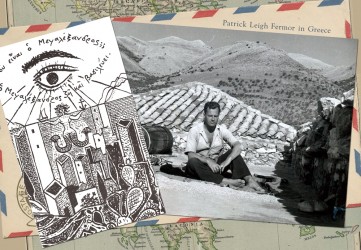
Remembering John Craxton – an influential art giant and a lover of life

John Craxton by Ian Collins

Eleven years ago in London, at the crowded wake for Southwold-linked artist Prunella Clough, I found myself squashed against a figure of legend. This was John Craxton.

by Ian Collins

First published in EADT24, 17 June 2011

At 21 he had been the great – brilliant, handsome, life-and-soul-of-the-party – hope of war-time British art. But he had always wanted out.

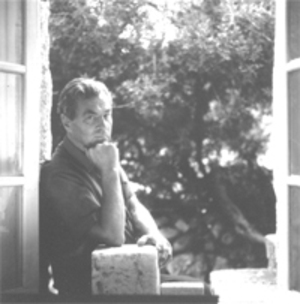
Surveying the flowing white hair, wild moustache and glintful eye in this image of an elderly Cretan chieftain, who even sported a shepherd’s stick and woven rucksack, I said: “Good grief! I thought you were…in Greece.”

Actually, I had somehow imagined him ascended to another kind of Arcadia presaged in his joyful paintings and the ballet sets 
he designed for lover Margot Fonteyn. Rumour had it that Craxton had long since vanished into a Greek idyll. But he came and went, mostly below the radar of an art world he had good reason to scorn.

We went off to the French pub in Soho where he had drunk since 1941, and then to a meal in Chinatown. And so began almost a decade of making merry.

Like many another art writer, I begged to write his biography (while secretly keeping notes from our first meeting). He refused. Hating a slim book from 1948, he had spurned intrusion and hack analysis ever after. Why ruin a friendship?

He changed his mind following a brush with death and my 2005 Making Waves account of artists in Southwold for which he had been a key informant.

We then worked happily together on the picture-led book he wanted, to be published for his 90th birthday, in October 2012. He said I could write the full biography once he was “out of the way”.

John Craxton: Self Portrait 1943

Alas, John died 18 months ago and I am his art executor. The book published this week is his first memorial.

We have just had four launches in London – a preview at Christie’s, and then receptions around exhibitions in Tate Britain, Mayfair’s Osborne Samuel gallery and Heywood Hill’s Bookshop in Curzon Street. The shows go on.

Being charming, John had a charmed collection of friends. One was Sir David Attenborough – whom I asked to speak at his memorial service and on the Radio 4 Last Words programme (an early call since he was off to Australia that afternoon).

He introduces my book (our meetings plotted between his trips to Africa and the North Pole) and this week presented a Craxton profile on BBC2’s The Culture Show.

So: why our obsession with John Craxton? Well, he painted pleasure and lived it, too. He had a matchless love of life.

He had great luck always, and the first was with his musical, Bohemian parents. They raised six children and numerous waifs and strays in a chaotic haven next to Lord’s cricket ground.

The future novelist Elizabeth Jane Howard, sharing a tutor with John at one point and now living in Bungay, says: “They were happy and, like pollen, some of this rubbed off on anyone who came in contact with them.”

Margot Fonteyn and John Craxton, Greece 1951.

One school chum’s father was Eric Kennington, and John was part of the party lent a Walberswick house in the summer of 1937 as a token of thanks for the sculptor’s fine memorial to artist Arthur Dacres Rendall in the churchyard.
John Craxton book cover.John Craxton book cover.

Seventy years later John could recall with perfect clarity the reasons for their delight in Southwold’s painted rood screen.

Another school pal’s dad took him to Paris to see Picasso’s newly-painted Guernica and then, early in the war, a lodger introduced him both to patron Peter Watson and a mercurial young painter called Lucian Freud (fresh from the Cedric Morris and Lett Haines East Anglian School of Painting and Drawing in Dedham).

For more than two years Peter Watson funded their studios in a St John’s Wood maisonette. The close friends became fantastically inventive draughtsmen.

John’s dashing eldest brother was a test pilot for Spitfires, and during the war John and Lucian stayed in the Fens with the family of Joan Bayon, one of brother Tim’s girlfriends.

Along nearby dykes John spied the gnarled and twisted forms of pollarded willows, which he then depicted both as tormented monsters and hiding places for lost boys.

Joan’s father was a scientist who received parcels of beastly corpses for post mortem. The two young artists worked on portraits of 
the contents – John’s ravishing images like those of a latter-day Durer.

From Cambridgeshire he wrote to his friend and patroness E.Q. Nicholson: “The willow trees are nice & amazing but I would prefer an olive tree growing out of a Greek ruin…”

Spotted at the Leicester Galleries – one of the few in London to stay open during the war – John was invited to produce pen-and-ink and lithographic decorations for what became a celebrated book.

John Craxton: Pastoral to P.W.

Visionary Poems and Passages or The Poet’s Eye, an anthology chosen by Geoffrey Grigson, was published by Cowell’s of Suffolk in 1944. John worked on the plates to the very last minute in the Ipswich printshop.

That landed him with the label of a Neo-Romantic artist, recreating the world in his own anxious image. But there was nothing Neo about him: here was the complete individual and original.

Mentored by Graham Sutherland and John Piper, his influences moved from Samuel Palmer and William Blake to Miro and Picasso. He finally met the latter in Paris in 1946 – the year of his liberation.

At a dinner party in Zurich (where Peter Watson had got him an exhibition), he met Lady Norton, wife of the British Ambassador in Athens, who was seeking provisions abroad in a borrowed bomber.

They bonded at once and the return flight carried an extra passenger. The not-quite-stowaway never looked back.

After travels all over the Aegean (and extended stays on Poros and Hydra), he settled in an ancient Venetian house in Crete, on the harbour at Hania, in 1960.

Returning to London for regular, sporadic and then rare exhibitions (also bringing his Greek pictures to life in set and costume designs for Daphnis and Chloe, a 1951 ballet by Suffolk’s Frederick Ashton starring the beloved Margot), he was really ever after an Englishman abroad.

John Craxton: Two Greek Dancers, 1951.

Even if produced in his North London bolt-hole, his scintillating linear paintings celebrated a southern paradise – of cats, goats, drinking and dancing and sleeping sailors, light, heat, colour, rocky landscape and the survival of mythology in everyday existence. For these blissful works he drew on both a revitalised Cubism and Byzantine mosaics.

Sour critics who found his mature art too sunny, decorative, playful and altogether too gay suggested the envy of people left off the guestlist for a life-long party.

An enforced break from Greece during the dictatorship of the Colonels brought African wanderings. A 1970 image of an old lion at a Kenyan watering hole was bought by singer Peter Pears, Benjamin Britten’s partner. It now hangs in a ground-floor study at The Red House in Aldeburgh, which the composer of the opera Death in Venice used when he could no longer climb the stairs to his former workroom.

In fact, Pears had been buying Craxtons since 1950, amassing portraits of Greek dancers and shepherds, as well as haunted war-time landscapes.

Looking at these works it is easy to see why the artist wanted to escape from cold, grey, conflicted and constricted England – as is the sense of exhilarated freedom later conveyed to those he left behind.

Ian’s John Craxton book, introduced by Sir David and with 240 images, is published by Lund Humphries and is available at Amazon.

Nick has arrived in my favourite land and if the gods are with us we may meet in Cluj on Monday.

nickhuntscrutiny's avatarAfter the Woods and the Water

Looking back, the landscapes of my journey are reduced to pure colour. Austria was  frozen white, Slovakia scorched ochre brown, the Hungarian Plain the yellow of rushes and the blue of a cloudless sky. Two weeks walk across the border, and Romania has flooded my mind as the green of unfolding leaves, the explosive white  of blossom, and the dense, mysterious blue of the distant Carpathian Mountains. Water suddenly fills the land – in puddles, leaves and village wells, in swollen rivers, and falling from the sky. Following the Mureș River into Transylvania, through villages of red-tiled roofs and houses peeling to reveal walls of crumbling wattle and daub, filling my bottle with buckets from wells and my hip-flask with powerful homemade țuică, I feel like I’ve entered a land of enormous natural wealth. Away from the highways – made perilous by Turkish truck-drivers racing for the border –…

View original post 817 more words

New book about Paddy published in Greece

I have no further details but this was highlighted on the PLF group on Facebook. Those of you who read Greek may be able to provide more background.

Criss-crossing Europe – this time from Istanbul to Edinburgh!

It is envy time again. I was recently contacted by Owen Martel who made a long walk across Europe last year. His was a slightly different journey to Paddy’s and to our current venturer, Nick Hunt, but nevertheless it must have been exciting. Unfortunately Owen did not hear about Paddy until he was half-way through his journey, and he only read ATOG and BTWW upon completion of his walk.

Dear Tom,

From March to December 2011, I was on foot from Istanbul to Edinburgh; and at one point, while I was laid up with badly damaged feet at a mountain hut in Austria, a fellow traveler showed me the book she was reading and urged me to find it in the original English when my journey was over. Upon settling for three months in Glasgow this past winter, I accordingly tracked down at the public library and read “A Time of Gifts” and “Between the Woods and the Water,” alternately laughing and shaking my head in bewilderment at the all-too-familiar and bafflingly different experiences Patrick Leigh Fermor recounts. While my own route was quite different from his – certainly nothing like the retracing that, I have just learned from your site, Nick Hunt embarked upon almost exactly as I was finishing my own odyssey – the spirit of the thing was highly in keeping, and if you have any interest in this latter-day echo, I’ve posted various aspects of the trip on my blog at Walk Across Europe.

Thank you for running the Patrick Leigh Fermor blog, and for helping to keep this particular sense of possibility alive and well.

Owen Martel

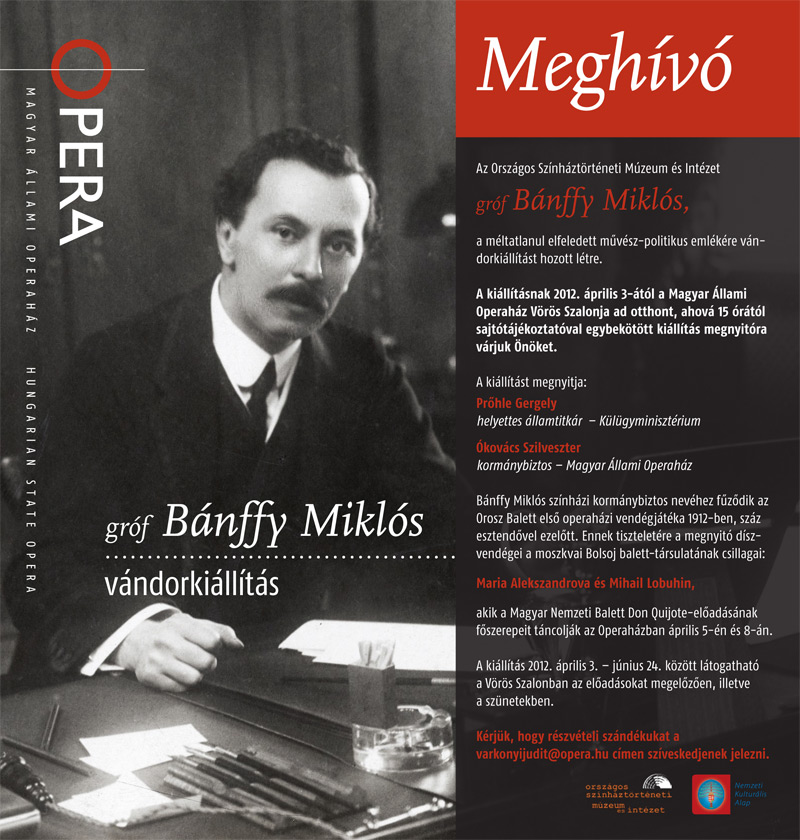
Re-opening of Bánffy exhibition at Budapest Opera House

Zsuzsanna Szebeni, who is the curator of the Count Bánffy exhibition at the Budapest Opera House, contacted me to say that the exhibition has re-opened at the opera house from 3 April 2012. If my Magyar is up to scratch it appears to run until 24 June, but I could be wrong about that! From the 16th of July the exhibition will move to a larger location in the city of Sepsizsentgyörgy or Sfântu Gheorghe (in Romanian), a city which is predominantly Székely Hungarian, and lies to the north-east of Brasov in Transylvania.

Miklos Bánffy was a Transylvanian Count and director of the Budapest Opera House at the end of the Great War. At the same time he planned the very last coronation of a King of Hungary, the last Emperor of the Austro-Hungarian Empire, Charles I. This is all wonderfully described in the English Translation of Bánffy’s memoirs, The Phoenix Land, published by Arcadia Books.

As you will know by now, Paddy wrote the introduction to the English translation of Bánffy’s fictional Transylvanian Trilogy which is wonderful and an absolute must read. Cluj gets many a mention. You can read more about Count Bánffy here on the blog.

You can contact Zsuzsanna as follows: Mobil: +36 20 3304070 and Office: +36 1 3751184/128.

For those of you who speak Magyar you will find this video of interest. For those who don’t I hope that you will enjoy the colourful images!

Estate of Dumbleton travel writer Sir Patrick Leigh Fermor could fetch £150,000

THE estate of travel writer and extraordinary war hero Sir Patrick Leigh Fermor is set to fetch £150,000 at auction.

Sir Patrick died in June 2011, aged 96, and now the first 100 lots of his estate, Mill Farm in Dumbleton, will go under the hammer in May.

It will include decorative objects, books, furniture, modern British and old master pictures, as well as silver objects.

Sir Patrick was a travel writer, who was most famous for his account of his year-long walk from Rotterdam to Istanbul in 1934, when he was 18 years old.

The journey was later published in his popular books A Time of Gifts (1977), and Between the Woods and the Water (1986).

He lived in caves in the mountains of Crete disguised as a shepherd during the Nazi occupation from 1941.

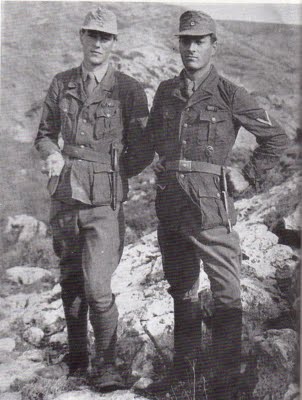
In 1944 he and fellow writer Bill Stanley Moss avoided capture by dressing as German police officers and bluffing their way through 22 different check-points.

After the war, Sir Patrick journeyed around Greece with his wife Joan, devoting much of his time to writing and staying with his artistic and creative friends, including the artist Nico Ghika.

Both Sir Patrick and Joan were very sociable personalities, and some of their many eminent friends and admirers included Alberto Giacometti, Lawrence Durrell, John Betjeman, Lucian Freud and Dowager Duchess of Devonshire, many of whom frequently visited The Mill House where they shared and cultivated a love for the arts.

The auction, at Christie’s in South Kensington, is on May 15. Edit – I can’t find anything specifc on the Christie’s site so I advise contacting them.

From This is Gloucestershire

Patrick Leigh Fermor in Greece – a talk by Artemis Cooper

Paddy’s biographer and good friend, Artemis Cooper, will talk about his life in Greece at the Gannadius Library in Athens at 7.00 pm on 24 May 2012. 

Full details of the event can be found here.

Biographer Artemis Cooper, who is preparing a biography of Patrick Leigh Fermor, will trace his life, experiences, and legacy in Greece from his early travels to the end of his life, on 10 June 2011. She will talk about what drew Patrick Leigh Fermor to Greece in the first place; his ‘participation’ in the Venizelist rebellion of 1935; his early travels in Thrace and Macedonia, and first encounters with the Sarakatsani; his experiences in the war on the Albanian front and Crete, as well as the post-war explorations of Greece that produced Mani and Roumeli. She will also touch on the Cyprus years; his friendship with George Seferis, George Katsimbalis, and Nicos Hadjikyriacos Ghika; how he and his wife came to settle in Kardamyli, and built their house with the architect Nicos Hadjimichalis; how the Greek translation of Mani was undertaken by Tzannis Tzannatakis, while he was in exile in Kythera under the Junta of the Colonels. She will also reflect on his position in the village of Kardamyli and how he is seen in Greece today.

PS – I have been told that there will be a webcast available after the event. I will post the details when I have them.

Transylvanian hay-day – An afternoon’s diversion on the way to Constantinople, 78 years ago.

Between the Woods and the Water

As Nick Hunt is currently in the vicinity of the Hungarian-Romanian border on his walk in Paddy’s footsteps to Constantinople, I thought that it might be an appropriate time to publish this extract. It is one of the most memorable pieces of Paddy’s writing. What a way to spend a hot summer’s afternoon!

by Patrick Leigh Fermor

First published in The Spectator in 1986. This version 18 June 2011.

One day when we were invited to luncheon by some neighbours, István said, ‘Let’s take the horse’ and we followed a roundabout uphill track to look at a remaining piece of forest. ‘Plenty of common oak, thank God,’ he said, turning back in the saddle as we climbed a path through the slanting sunbeams, ‘you can use it for everything.’ The next most plentiful was Turkey oak, very good firewood when dry, also for stable floors and barrel staves. Beech came next, ‘it leaves scarcely any embers’; then yoke elm and common elm, ‘useful for furniture and coffins’. There was plenty of ash, too — handy for tools, axe-helves, hammers, sickles, scythes, spades and hay rakes. Except for a few by the brooks, there were no poplars up there but plenty by the Maros: useless, though, except for troughs and wooden spoons and the like. Gypsies made these. They settled in the garden and courtyard of the kastély with their wives and their children and whittled away until they had finished. ‘There is no money involved,’ István said. ‘We’re supposed to go halves, but, if it’s an honest tribe, we’re lucky to get a third. We do better with some Rumanians from out-of-the-way villages in the mountains, very poor and primitive chaps, but very honest.’

In a clearing we exchanged greetings with a white-haired shepherd leaning on a staff with a steel hook. The heavily embroidered homespun cloak flung across his shoulders and reaching to the ground was a brilliant green. His flock tore at the grass among the tree-stumps all round him. Then a path led steeply downhill through hazel woods with old shells and acorns crunching under the horses’ hooves.

It was a boiling hot day. On the way back from a cheerful feast, we went down to the river to look at some wheat. Overcome by the sight of the cool and limpid flood, we unsaddled in a shady field about the size of a paddock, took off all our clothes, climbed down through the reeds and watercress and dived in. Swimming downstream with lazy breaststroke or merely drifting in the shade of the poplars and the willows, we talked and laughed about our recent fellow guests. The water was dappled with leafy shade near the bank and scattered with thistle-down, and a heron made off down a vista of shadows. Fleets of moorhens doubled their speed and burst noisily out of the river, and wheat, maize and tiers of vineyard were gliding past us when all at once we heard some singing. Two girls were reaping the end of a narrow strip of barley; going by the colours of their skirts and their embroidered tops, braid sashes and kerchiefs, they had come for the harvest from a valley some way off. They stopped as we swam into their ken, and, when we drew level, burst out laughing. Apparently the river was less of a covering than we had thought. They were about 19 or 20, with sunburnt and rosy cheeks and thick dark plaits, and not at all shy. One of them shouted something, and we stopped and trod water in mid-Maros. István interpreted. ‘They say we ought to be ashamed of ourselves,’ he said, ‘and they threaten to find our clothes and run off with them.’

Then he shouted back, ‘You mustn’t be unkind to strangers! You look out, or we’ll come and catch you.’

‘You wouldn’t dare,’ came the answer. ‘Not like that, naked as frogs.’

What are these for?’ István pointed to the branches by the shore. ‘We could be as smartly dressed as Adam.’

‘You’d never catch us! What about your tender white feet in the stubble? Anyway, you’re too respectable. Look at your hair, going bald in front.’

‘It’s not!’ István shouted back.

‘And that young one,’ cried the second girl, ‘he wouldn’t dare.’

István’s blue eye was alight as he translated the last bit. Then without exchanging another word we struck out for the shore as fast as crocodiles and, tearing at poplar twigs and clumps of willow-herb, bounded up the bank. Gathering armfuls of sheaves, the girls ran into the next field, then halted at the illusory bastion of a hay-rick and waved their sickles in mock defiance. The leafy disguise and our mincing gait as we danced across the stubble unloosed more hilarity. They dropped their sickles when we were almost on them and showered us with the sheaves; then ran to the back of the rick. But, one-armed though we were, we caught them there and all four collapsed in a turmoil of hay and barley and laughter.

‘Herrgott!’ I heard István suddenly exclaim — much later on, and a few yards round the curve of the rick — smiting his brow with his hand. ‘Oh God! The bishop! The Gräfin! They’re coming to dinner, and look at the sun!’

It was well down the sky and evening was gathering. The ricks and the poplars and the serried rows of sheaves and haycocks were laying bars of shadow over the mown field and a party of birds was flying home across the forest. István’s hay-entangled hair was comically at variance with his look of consternation and we all laughed. Extracting strands of hay and the clinging barley, we tidied Safta and Ileana’s plaits, disordered by all this rough and tumble, and set off hand in hand with them for the river, István and I on tiptoe. ‘Poor feet,’ they murmured. After goodbyes we dived in and started the long swim back, turning many times to wave and call to those marvellous girls and they waved and answered until they were out of earshot and then, after a bend in the river, out of sight as well.

This piece first appeared in The Spectator in 1986; it forms part of Between the Woods and the Water (John Murray, £8.99). © Patrick Leigh Fermor, 1986.

For our Australian readers: Event – Remembering a great Philhellene, 4 April

Paddy, remembering a great Philhellene, Patrick Leigh Fermor (1915-2011) a talk by Anastasia Anastasiadis will take place as part of the 30th Greek Festival of Sydney

‘Paddy’ arrived in Greece in 1935 — after walking from Holland to Constantinople — and promptly got involved in resisting an attempted coup. As a British liaison officer during World War II, he led the group which kidnapped General Kreipe. In later years Paddy and his wife had a house in Kardamyli (Mani). His acclaimed travel books include two on Greece: Mani and Roumeli.

The talk will take place on Wednesday 4 April at 7:00 pm at the Greek Orthodox Community Club, 206-210 Lakemba Street, Lakemba. Entry is free but for further information contact (02) 9750 0440 or email – greekfestival2@goc.com.au. The talk will be conducted in Greek.

From Neoskosmos.com

New Benaki wing to change cultural landscape

The upcoming opening of a one-of-a-kind museum has been billed as unexpectedly good news, a ray of light with regard to local cultural affairs hard hit by the ongoing crisis. The sixth annex of the Benaki Museum and former residence of prominent modern Greek artist Nikos Hadjikyriakos-Ghika, is scheduled to open its doors to the public in early April. Located at 3 Kriezotou Street in Athens, close to Syntagma Square, it will showcase the Ghika Gallery as well as the Interwar and 1930s Museum. The building was donated to the Benaki Museum by the artist himself.

by Spyros Yannaras

First published in ekathimerini.com

The new Benaki wing, developed thanks to the persistent efforts of the museum’s director Angelos Delivorrias, offers a panorama of leading examples of modern Greek culture, beginning in the 1920s and continuing up to the 1970s.

The museum will be inaugurated on Monday, April 2, while the following day will be dedicated to the numerous donors who have contributed to its development with a guided tour of the premises.

Meanwhile, news of the opening has been greeted with relief, given that only recently the Benaki Museum had launched an appeal with local visual arts fans to contribute to its financing by suggesting a new program for sponsorships and attracting new members.

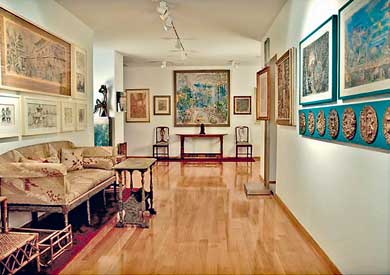
On the Kriezotou building’s top floor, visitors can take a look at Hadjikyriakos-Ghika’s fully restored atelier, complete with his library and brushes. The artist’s unaltered living quarters, including the living room, dining room and his office, are situated on the fourth floor, where his triptych piece, “Kifissia,” is also on display. Furniture and personal items have also been restored, creating the feeling of a lived-in space. The third floor is divided into two areas: The first section includes the artist’s art gallery and the last section of the Interwar Museum, which also takes up the first and second floors. The final touches on the second and third floor are set to take a work-in-progress form in the presence of the audience.

The ground floor, which is also divided into sections, is home to the Litsa Papaspirou Hall, a restored interwar residence showcasing 17th-and 18th-century furniture as well as works by various European artists.

The Ghika Gallery is expected to change the city’s cultural landscape.

Related articles:

Obituary Nikos Hadjikyriakos-Ghikas (Nikos Ghika)

British Philhellene author, Patrick Leigh Fermor, donates Kardamyli home to Benaki

£1 a week – Surprisingly easy to Hungarian padded hands

Nick Hunt by the Danube

Nick Hunt by the Danube

Nick has been making quite an impact with the local press in Austria and Hungary. In a recent piece on his blog entitled “Surprisingly easy to Hungarian padded hands” you can find links to some interesting articles and an explanation of that title.

Sir Patrick Leigh Fermor and The Folio Society

Paddy and George Psychoundakis the “Cretan Runner”

From the Folio Society website.

Ten years ago, The Folio Society decided to publish a book by William Stanley Moss, entitled Ill Met by Moonlight. It told the story of a daring war-time adventure in Crete, in which Moss and Patrick Leigh Fermor, two young SOE officers, kidnapped a German general, spirited him away across the mountains and into captivity. The book was based on the detailed diary kept (entirely against the rules) by Moss, and its undeniably romantic aspects were highlighted when, in 1957, a film was made starring Dirk Bogarde as the dashing Leigh Fermor.

When we planned the book, it occurred to us that Patrick Leigh Fermor, known to his friends as Paddy, had never contributed any kind of comment on it in writing. We assumed there was a good reason for this – a certain delicacy perhaps, since, at the time of the operation, he was already embedded in Crete in a cave under Mount Ida, with the role of facilitating Commando raids on the island, and was dependent on the friendship and loyalty of the local partisans. But we wrote to him anyway and asked if he would contribute an introduction.

He rang up from his home in Greece. It was indeed, he said charmingly, ‘delicate’ and for various reasons he’d always felt the less said the better. We parted genially, my suggesting that we might ask Michael Foot, historian of the Special Operations Executive and an old friend of his, to do it instead. This we did. A week later, Paddy telephoned again. He’d been thinking about it, and he felt that there were things he would like to say: the coup had, in his view, been diminished by being reduced to the level of a ‘tremendous jape’ and he hoped to restore the balance by providing something of the context for the enterprise. He did not wish to interfere with Michael’s introduction, but would contribute a short Afterword, describing his own experience. It would be 500 to 1,000 words. It eventually emerged at 6,500 words, all of which had to be wrested from him in hand to hand combat, so anxious was he that nothing could be misinterpreted. Michael Foot, in the meantime, was triumphant to be able to tell Paddy that General Kreipe (who was not the intended victim of the kidnap, as that gentleman had been moved on) was so unpopular that, when they heard he had been snatched, his officers broke open the champagne.

Most Folio books have their unexpected rewards, but this one had more than most. Through it we met Billy Moss’s daughters who showed us photograph albums and the original diary; Sophie, their Polish mother, a formidably attractive SOE operative who had been based, with Moss and Leigh Fermor, at Tara, the Cairo House; Michael (M R D) Foot, whose own experiences as prisoner of war were at least as hair-raising as the exploits he went on to chronicle; and of course Paddy himself – courageous, witty, modest, famously attractive and – both with this book and The Cretan Runner – a good friend to The Folio Society. We will miss him.

Related article:

A Meeting between Paddy and George Psychoundakis the “Cretan Runner”

London Gazette Moss MC and Fermor DSO announcement

Billy Moss and Patrick Leigh Fermor

A copy of the Supplement to the London Gazette dated 13 July 1944, which announces the award of the Distinguished Service Order to Captain (temporary Major) Leigh Fermor and the Military Cross to Lieutenant (temporary Captain) Stanley Moss.

You can find the pdf here Moss MC and PLF DSO announcement (once open scroll down) or an online link here.

Patrick Leigh Fermor’s 1998 interview with Amalia Negreponte

Amalia Negreponte

I was alerted to this interview by Mark Granelli. As ever we have to be cautious about things that may have got lost in translation but I was a little suspicious about this interview as Paddy appears to go further out on a limb than recorded elsewhere. You will understand what I mean when you read it. Is she being totally honest? 

My reply to Mark was …

Mark – thanks for being such a good sleuth! I will put it up but I am slightly suspicious of this one. Paddy appears more political than I have ever read before. Maybe he opened up to her because she is very pretty, if a little thin.

But without further ado let’s go to the interview which can be found online at Amalia Negreponte’s website on 20 July 2011 ….

War hero, great hellenist, major British author, scholar and soldier, who played a prominent role behind the lines in the Cretan resistance during World War II (kidnapped German general, heading Nazi troops invading Greece). He was widely regarded as “Britain’s greatest living travel writer”, with books including his classic “A Time of Gifts” (1977).  A BBC journalist once described him as “a cross between Indiana Jones, James Bond and Graham Greene”

Patrick Leigh Fermor’s interview to Amalia Negreponti, published in my book:“Hellenists: Greece does not wound them” (LIVANIS publishing company, 1998), pre-published in “TA NEA” in 1998

Born: In England. First traveled to Greece: When he was 19 years old, in 1935, during his tour of Europe. Main bibliography: “Mani”, “Roumeli”, “The Violins of Saint-Jacques”, “Between the Woods and the Water’, “A Time of Gifts”. Lived most of his life after World War II: In Mani (Kardamyli); frequently travelling to England, where he recently passed away, 40 days ago. He will be remembered by all- and certainly by us Greeks- with gratitude, admiration, love.

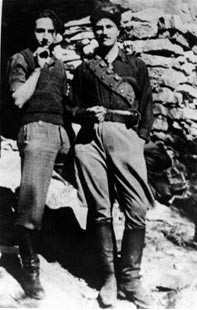
Five images. A man dressed in a British Army uniform, alone, on a snowy mountain – he is in Albania, in 1941. He speaks fluent Greek. The Greek soldiers endearingly call him “The Englishman”. Whenever he can, he talks of poetry and literature. Second image, the same manly uniformed figure, next to Giorgos Seferis, in Cairo. He has just arrived, right after the tragic Battle of Crete. His sorrow is vividly reflected on his face. Third flash. Haifa, 1942. The officer, the blackboard and the class of uniformed men. It is one of the war lessons the officer with the penetrating gaze gives to the Allies.

Crete, 1944:While the British commando takes off the German Army uniform he has deceptively worn, his five Cretan companions and a British officer hold a German officer captive. He is General Heinrich Kreipe – the commander of the German Occupying Forces in Crete – recently kidnapped by the men. On peaceful nights, the captive and the English officer-kidnapper talk of Homer and the great tragedians.

Last image: Mani, 1998, in a small cottage. The man sets aside, just for a moment, his writing – the bookcase is full of his highly acclaimed books. His eyes sparkle. “Greece was in danger. She was suffering. I did what anyone else would have done. Nothing more, nothing less”. Without any need for introductions, he is Paddy. Michael. Filedem. Patrick Leigh Fermor.

Ramrod-straight, soft-spoken, keeping his youthful impetuousness intact. “Dear God! It was nothing!”, he says every once in a while, with extreme modesty and reserve, as soon as he is reminded of his legendary status and heroic activity. He talks of his books with the excitement of a small child.

Whenever he talks of the historical battles – always playing the leading role – he fought in Greece during World War II, he never uses the pronoun “I”. It is always “we”; whether he talks of British soldiers and fellow officers – he keeps mentioning Christopher “Monty” Woodhouse, Xan Fielding, John Pendlebury, the archaeologist-hellenist who died, fighting heroically, during the Battle of Crete – his Cretan companions – George Psychoundakis, Manolis Paterakis, George Tyrakis – or the whole of Greece.

We meet Patrick Leigh Fermor in mid-July at his home, in Kardamyli, Mani, where he permanently lives during the last few decades with his wife, in a cottage he built by himself. The 83-year-old Anglo-Irish Fermor, having fought for Greece throughout his life, throughout her difficult moments with vigour, self-sacrifice and passion that transcends heroism; awarded with all the possible military distinctions for his actions in battle; highly valued throughout the world for his books – they are considered “masterpieces” by the most severe European and American critics – and living a reclusive life, exclusively dealing with what he has been dreaming of since he was a child: book writing.

At the moment, he is fervently preparing the story of his adventures during the entire war. His achievements are known through official documents (Foreign Office), as well as his companions’ and historians’ memoirs. He, however, has remained silent until now.

“Since I was a child, I was determined to become a writer; that’s for sure”, Patrick Leigh Fermor – Paddy, to his friends – remembers. “For that reason – to collect experiences and meet different people and things – and since I wasn’t particularly good at school, I set out, when I was 18 years old, on a journey to Constantinople, a journey that would mark and determine my life”.

The journey lasted a whole year and included the whole of Europe. Alone and moneyless, Fermor sailed from England to the Netherlands and went on, through a snowy landscape, to Germany. He followed the course of the Rhine upstream and turned eastwards, towards the Danube. He crossed the borders to Austria and Czechoslovakia. He borrowed a horse in Hungary, crossed Transylvania, Romania and Bulgaria, over the Balkan mountain range and reached the Black Sea coast: Varna, Nesembar and Burgas; then, across the borders of Turkey, towards Edirne. On January 1, 1935, he reached Constantinople.

At the monasteries

His next stop was Greece. “My love for her was unconditional”. He lived in monasteries of Mount Athos, in Thrace and Macedonia, in Peloponnese and Athens. The few words of ancient Greek he had learnt at school turned, almost magically, to fluent modern Greek and Greece got an eternal hold on him. “And then, around 1936, I returned to England.

The months away from Greece seemed intolerable. That’s why when, in 1941, I joined the Intelligence Corps, I asked to be transferred to Greece, fighting at the time against Italy in Albania. It so happened”. And Patrick Leigh Fermor became an integral part of the Albanian Epic. And, right after that, of the Cretan Resistance. From 1941 until the bloody Battle of Crete, Fermor was there, in the first line, along the Cretan warriors who considered him “more Cretan than the Cretans”, he says with pride. “Where can I begin?

The long night marches, the growth of the Resistance form village to village, from mountain top to plain? Waiting for boats in secluded coves, waiting for drops of ammunition in plateaus, visiting intelligence gathering networks in cities, sending commandos on sabotage missions, escaping German raids, on the mountains, the eagle nests and the crags we used to live… Since the first Axis invasion of Greece, we English felt that we were allies of the only nation left to fight darkness and tyranny.

The rest of the world remained neutral, defeated “in peace” or, worse still, had joined the enemy – through alliances and treaties. When the war came to Crete, the solitary allies – Greece and England – fought hand in hand. And then came 1942. In horror and despair. England was being devastated by heavy bombardments, the Germans were marching at full speed towards Stalingrad, Erwin Rommel’s tanks and canons were hammering our lines in the desert, pushing us back towards our last line of defence, El Alamein; and the USA had not entered the war yet.

My men and I, driven out of Crete after the Battle of Crete on May 20, 1941, crushed and shattered, had escaped towards the Middle East. First Alexandria and Cairo. And then Haifa, near Palestine, where I taught allied officers in a war college. What did I teach? The essentials. Secret landings, sabotage, using enemy arms and ammunition, parachute drops, commando raids, evasion tactics, setting mobile radio stations – everything.

My heart and thought, however, were with Crete, suffering more than ever. Villages were being burnt. Thousands of Cretans were being taken captive. Inhuman tortures and mass executions were on the agenda every single day. But the Cretans had not given up. They were continuing the Resistance, in any possible way, with vigour and stoicism. But not only that. They were also helping, risking their lives and the lives of their own people, the English allies who had been trapped in the highland villages and mountains of Crete. They were taking care of them as if they had been their own children.

It was a great honour. We became and still are the children of the Greek people. I am grateful for that – to be part of such a brave and noble kind of people was the greatest honour for me. We were strangers who came to Greece from afar to take part in the battle, to fight, to shed our blood on your mountains. We, however, risked – of our own accord – our lives, whereas the Greeks who helped us at the time of our greatest weakness did not only risk their lives, but also the lives of their families and the destruction of their villages, their motherland. Therefore, let’s not talk of our own sacrifices…”. “I could no longer resist staying away from Crete – I longed to return there”.

Thus, on July 24, 1942, at midnight, he returned from the Middle East to Crete by fishing boat, assigned a special mission in Central Crete. “Hard times. We were cut off from Africa and any supply shipments, whereas the Germans ravaged Crete, killing and torturing civilians whenever the Resistance struck a blow against them. The only good thing for our Crete out of that period, until 1944, was that we were not affected by the Civil War raging in mainland Greece – we were not aware of it”. At the beginning of 1944, Filedem – who lived on the mountains of Crete, organizing the Resistance disguised as a Cretan shepherd – is ordered to return to Alexandria. “I didn’t want to leave”. However, he couldn’t help it. No matter how reluctant he was, Fermor finally left.

He returned a few months later as the leader of a highly important mission for Crete in particular and Greece in general: the kidnap of the German military governor of Crete. Unfortunately, the target, General Friedrich-Wilhelm Müller, was replaced by General Heinrich Kreipe just before he arrived.

“On February 4, 1944, I was parachuted into Lasithi, Crete. The rest of the team – Stanley Moss, Manolis Paterakis and George Tyrakis – couldn’t follow due to bad weather. During the next two months, they kept trying to join me, but it was impossible. Finally, on April 4, they arrived in Soutsouro by sea. We immediately started hatching the general’s kidnap plan.”

The kidnap

Fermor finally came up with an idea – dressed as a German soldier, he stopped the general’s car on his way home at what was supposed to be a routine check point; the rest of the team took care of the driver and drove the car and the general away – met with success.

Hunted by German patrols, the team moved across the mountains and villages of Crete “in order to evacuate our captive safely, making sure that no reprisals were taken against the civilian population”. Whenever he got off the car, Fermor was met with murderous stares and open enmity by the Cretans due to the German Army uniform he was wearing.

“I realized then what it meant to be a German. I felt lucky not to be one. Upon arriving in Sphachta, where my friend father Giannis Skoulas lived, his wife came out of their house and stared at me in disgust. Full of joy, I tried to embrace her. Get away! She screamed. It’s me, Michalis, I said. No point… It took some time for her to recognize me and get over the repulsion the German Army uniform was causing her”.

The outcome of the mission? General Heinrich Kreipe was sent to Cairo, safe and sound. “We treated him with respect, honour and care! After all, he was our captive”.

Fermor met Kreipe decades later – to discuss World War II. The atmosphere was genial… “He was well-versed in poetry, Latin and ancient Greek – I realized it when we kidnapped him. We had drunk from the same fountains, we had sprouted out of the same roots, well before the war started – and that changed things”. Even the usual reprisals were avoided.

Fermor left a letter to the Germans when he abandoned the general’s car: “Gentlemen, your Commander was taken captive by a British Battle Force under our command (editor’s note: Fermor and Moss). When you read this, the General will be in Cairo. We want to point out that the operation was conducted without any kind of help from the Cretans… Any reprisals against the local population would be unjustifiable and unfair. Auf baldiges Wiedersehen! (editor’s note: the two signatures). PS: We are sorry to leave the car”.

Fermor (his code names during the war were Michalis or Filedem), who was idolized by the Cretans because he constantly put his life at risk for Greece, seems to have been left alone, a symbol of an era of heroes. He transcends the meaning of the term hellenist; he is a philhellene, with all the idealism and struggle the term includes.

He reacts when I ask him whether Greece wounded him. “Of course not! How could she? I devoted my life to Greece; to justice. My success is my greatest satisfaction. I’m hurt when I see people attacking Greece – usually unjustly. I’m hurt when I see strangers treat her contemptuously and scornfully. I’m hurt when they ignore, use and distort history to strike a blow – for example, when they support FYROM.

The Turks

“I don’t want to hear anything more about “bad feelings” of the Greeks towards the Turks. For God’s sake! The Turks seized and illegally occupy Northern Cyprus – it’s a well-known fact. Fewer and fewer Greek are living in Constantinople anymore – as a direct result of the rioting, looting, extermination, murder, coercion and general pogrom they suffer.

Europe should never forget what Greece has offered and act accordingly. I’m not talking of ancient Greece; I’m talking of modern Greece – World War II Greece. Greece prevented the whole of Europe from collapsing when the sky blackened.

They should all remember what Greece stands for. Because ideas change, people die and monuments collapse with the passing of time.

What can’t be destroyed, however, is the spirit of the Greek people – it includes all virtues, it inspires, it shines – just like the light that shines on the Greek mountains: your mountains. Our mountains”.

“In 1941, those of us who survived the Battle of Greece fled to the Middle East. First Alexandria and then Cairo. Right there on the bank of the Nile and the city of Alexander the Great, I had the chance to meet and befriend Giorgos Seferis, who had also taken refuge there. His hard features betrayed an anxiety and a sorrow that transcended our everyday stress about the outcome of the war. In the Middle East during that critical phase of the war when everything seemed lost, Giorgos Seferis was giving his personal battle: in politics and letters – poetry”.

Seferis wrote the poem “Days of June 1941” when Fermor arrived in the Middle East, right after the Battle of Crete.

“The new moon came out over Alexandria with the old moon in her arms while we were walking towards the Gate of the Sun in the heart’s darkness–three friends”.

“There are times when I feel I’m still there”, says Fermor. “Feeling the sorrow for my dead companions and the lost battle, seeing that man with the dark eyes driving away the clouds with his words.

Just words. Words of an educated and scholarly man who had experienced the horror of broken bodies and the pain of loss”.

Fermor takes out an old photograph, depicting the poet and him. Both men are thoughtful. With heavy gazes. “We didn’t stay together long”, Fermor recalls, “I was always on the run – missions and training… “You have to reckon how to move. It’s not enough to feel, to think, to move”, he used to say – exactly the way he wrote.

He was always reserved and cautious. He didn’t talk much; you never got tired of listening to him. Modest and discreet. I respected him at the time. I loved him as a poet later. He was educated and had a breadth of knowledge transcending the borders of nations and civilizations.

Giorgos Seferis recorded our experiences with accuracy and sensitivity. Yes, we had come from all around the world, as he says in the poem “Last Stop”, “from Araby, Egypt, Palestine and Syria”. Although he was very reserved, he never got detached. You could see the accumulated strength inside him”.

An interesting drawing (not) by Paddy

In a recent sale by auctioneer Dominic Winter, there were a number of lots sold from Paddy’s estate. The full list with sale prices can be found at this link. This drawing appears to have sold for £200.

The sale included pictures and books, and one drawing (originally thought to be) by Paddy of a woman, perhaps past her prime, looking forlornly into a mirror and maybe seeing her younger self, or has she been stood up and sees her younger rival staring back at her out of the mirror?

Described as …

489 *  Fermor (Patrick Leigh, 1915-2011). Room interior with seated female figure, pen and ink on paper, some correction fluid, unsigned, 35 x 50 cm (13.75 x 19.75 inches)

It is unsigned but does include some Greek lettering which I can’t make out. Perhaps one of you can help? See comments below about the origin of this drawing!

Urgent! Can we help Nick locate Istvan’s kastely?

I know I could open BTTW but I might still find that I don’t know the answer so I thought in this electronic age the best thing would be to go viral with the question Can we Help Nick Find Istvan’s Kastely?

I received this note from Nick just an hour or so ago …

Tom

Thanks so much for your support with reposting some of my articles. I’m glad people seem to be finding them interesting. I’ve got one question about the Romanian leg of the journey — do you have any idea where Istvan’s kastely was? It’s somewhere east of Zam, near the river Mures, but there’s nothing more specific than that. I’ve had a lot of help on the other kastelys from someone called Ileana who works for this organisation – http://monumenteuitate.blogspot.com/ – involved in restoring and preserving historic buildings in Romania. She contacted me having found my blog somehow, and is really helpful. I’m not sure if she has any more clues about the location of Istvan’s place.
Hope all is well with you. Have you been travelling recently? Best wishes from Budapest… and soon from the Great Hungarian Plain.
Nick
Any clues or answers please email me or add a comment. I am sure we will crack this so thank you in advance!

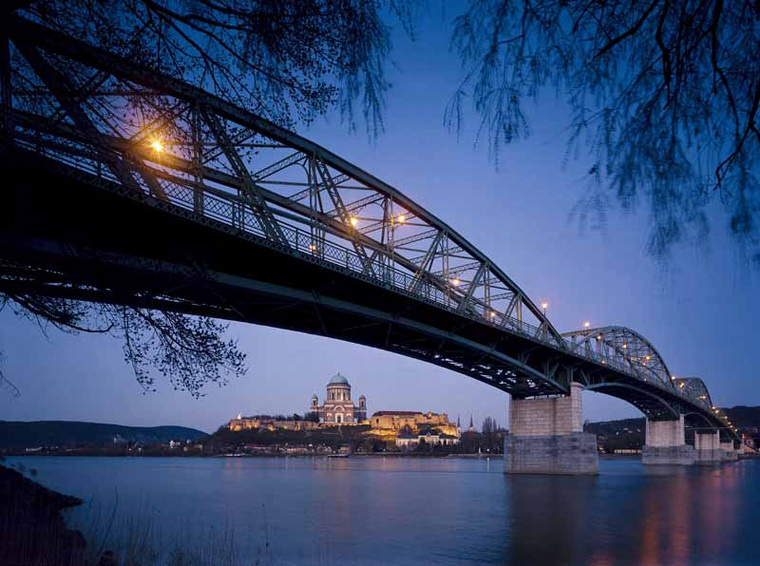
March 2012 – Nick reaches the bridge at Esztergom

Imagine Paddy standing in the middle of this bridge looking at the cathedral

It took Paddy until Easter 1934 to get to this bridge. Nick is moving well now. The bridge at Esztergom was one of my first blog posts back in April 2010!

The bridge linking Slovakia and Hungary, between the towns of Štúrovo and Esztergom, also links A Time of Giftsand Between the Woods and the Water. Here Paddy paused both in his walking and his writing, ‘meditatively poised in no man’s air,’ before crossing into Hungary and the second phase of his journey.

I reached that bridge a week ago (or rather the reconstruction of that bridge — the original was destroyed in 1944), and in a rather unbelievable way came to the very last page of my notebook standing above the Danube … read more

Related article:

Easter 1934 – Paddy reaches the Hungarian border at Esztergom

Patrick Leigh Fermor The Art of Travel broadcast c.1990-1992

A recording of a BBC Radio 4 programme entitled “The Art of Travel” (broadcast c.1990-1992) in which Annette Kobrak interviewed PLF for about 26 minutes concerning his early life and his journey to Constantinople. There is some good discussion about his travels after Between the Woods and the Water, about Bulgaria and into Constantinople.

I am indebted to David Turner for taking the time to convert this to digital and very successfully too – the sound quality is excellent!

You can listen online or download (press the downwards pointing arrow on the right hand side menu bar of the player).

I have updated the Video and Audio page with the programme. Don’t forget to visit to find more interviews with Paddy.

An interview with Sir Fitzroy McLean

Continuing the current theme of SOE and the Balkans, many of you may find this interview with Sir Fitzroy McLean as fascinating as I did.

He talks about this life and his writing, starting with the excellent, Eastern Approaches which covers his time in Moscow, and then his wartime experiences culminating with his evaluation of Tito, and the march on Belgrade.

Related articles:

Sir Fitzroy Maclean Bt: Obituary

Sir William Deakin, historian and founding Warden of St Antony’s College, Oxford

A combination of prefab, garage and potting shed

It is not Prince Charles alone who has opinions about architecture. From the King’s School website archive …

Patrick Leigh Fermor had been a boy in The Grange. Although his school career ended abruptly and prematurely, he always retained great affection for the place and in particular for the buildings.

In 1977 the School was planning to build two new houses in the Precincts: Luxmoore and Mitchinson’s. Leigh Fermor wrote to the Headmaster Peter Pilkington expressing his disappointment with what was envisaged in the Mint Yard: “The first impression made by this side of the project is of a combination of prefab, garage and potting shed…. What would William of Sens have thought? And Harry Austin?”

His response was not merely negative, however. Ten pages of ‘Notes on the Projected New Houses at the King’s School, Canterbury’ included several illustrations of possible alternatives in a variety of architectural styles. Despite his intervention, the School went ahead with the scheme.

Thirty years later, Sir Patrick returned to King’s to open the New Grange on the St Augustine’s site.

Albanian Assignment

David Smiley (left) in Albania with "Billy" McLean

In his Introduction to David Smiley’s Albanian Assignment, Paddy describes Smiley as ‘Lieutenant Jekyll’ and ‘Captain Hyde’, variously at home with his Regiment, the Royal Horse Guards, amongst a “squadron of sabres and scarlet plumes” but also in the “caves, chasms, scorpions and fleas, random rifle-fire and ricochets, explosions, (and) the oaths of muleteers” in Albania or the Arabian peninsula. His life was truly one of excitement and adventure, but one which he was happy to end growing almonds and olives in Southern Spain.

We know little about Albania – it remains Europe’s poorest country and is still almost totally ignored by the media – and perhaps even less about the events there during World War Two. In two important books, Smiley’s Albanian Assignment and Xan Fielding’s biography of Smiley’s colleague “Billy” McLean’ we learn much about what was not so much a war against the invading Italian’s and Germans, but a political war focused on preparations for a civil war between the Nationalist and Royalist factions on the one hand, and Enver Hoxha’s Communists on the other. I enjoyed following Smiley’s route, on the map in the book, through the mountains, including time spent on the beautiful Lake Ohrid. He spent some of his time criss-crossing my own route through Albania along the Via Egnatia which I walked in 2009.

Smiley’s style is very much like I imagine his soldiering would have been; clear and to the point. We don’t have lingering descriptions of the beautiful Albanian landscape but straight to the point analysis of the motives of the participants, and the events that took place during his two SOE missions to Albania between April 1943 and October 1944. He was a man of action, never happier than when ‘blowing something up’.

The situation between the partisan (Communist) resistance and the Royalists was so complex that the mission became intensely political, with McLean and the future British government minister Julian Amery trying to keep the Albanians from fighting each other and instead killing Germans. Smiley was sent off with small cetas of Royalist Albanians and some very brave British NCOs to kill as many Germans as he could and to blow up as many bridges as he could to delay the German withdrawal, with a fair degree of success. But the politics were never far away and once whilst Smiley was setting an ambush against the Germans, they were counter ambushed by Communist partisans.

Albanian Assignment is not a long book. It is easy to read and full of interesting and exciting episodes. It is one of the many amazing stories about the bravery of SOE officers and soldiers punctuated by explosions, forced marches, long and boring tribal meetings, and brave acts, but ultimately the book is dominated by betrayal: of the SOE men on the ground and the people of Albania by Hoxha’s partisans, and those communist officers in the SOE HQ in Bari who would have seen Smiley and McLean handed over to Hoxha for humiliating treatment at best, or being shot at worst. The figure of Kim Philby also appears. After the war, Smiley worked with MI6 to train and insert Albanian nationalists into Albania in order to provoke an insurrection against the fragile Communist regime. Many of the Albanian patriots were shot as they landed on the beaches, just a few managing to escape into Greece. It was Philby who passed on the details of the operation to the Russians who in turn informed Hoxha.

Colonel David Smiley, front 3rd right and band of Albanian fighters

Our by now familiar cast from Tara in Cairo also make an appearance as Smiley joined McLean by living there when not on operations. Paddy not only writes the introduction but Smiley also mentions Paddy’s wartime activities on a couple of occasions. Smiley  continued with a regular military career after the war, ultimately commanding his Regiment, but also carrying on his irregular activities with MI6 and fighting insurgents on the Arabian Peninsula which he describes in the book Arabian Assignment.

David Smiley died in 2009 after a long and eventful life. You can read his Telegraph obituary here. Many of his colleagues had successful post-war careers. “Billy” McLean entered politics and was also engaged in irregular warfare in Arabia. Julian Amery was a leading Conservative politician, and Alan Hare (who was forced to eat his trusty mule during the deprivations of the harsh winter of 1943/44) became chairman of the Financial Times. Many of the communist leadership ended up being purged over the years, with a large number ending up either being shot or committing suicide. Enver Hoxha himself died in 1985 after leading Albania into total isolation and poverty.

Albanian Assignment is available on Amazon and occasional copies may pop-up on eBay.

Related articles:

 Colonel David Smiley: Blues officer and MC recipient – Times obituary

 Colonel David Smiley – Telegraph obituary

 One Man’s Great Game: Lieutenant Colonel “Billy” McLean

 Alan Hare MC – Obituary from The Independent

£1 a week – “The greatest happiness I could know”

The good news is that Nick is alive and well and enjoying the snow in Austria which reminds us of Paddy’s adventures. Read his latest piece on After the Woods and the Water.

With certain exceptions I could not agree more with his closing words …

But walking, I think, brings adventure closer. And in this winter, walking alone through a snow-covered landscape still seems like the greatest happiness I could know.

I am sure Paddy would have concurred.

Geoffrey Household and meetings with Paddy

From the travel writer Stephen J. Bodio’s blog – he was in correspondence for a long time with the thriller writer Geoffrey Household (his Rogue Male is brilliant!), and Geoffrey did mention some meetings with Paddy. Stephen writes ….

Sadly, I never corresponded with Patrick Leigh Fermor, but I did for many years with the adventurous old “suspense” story writer Geoffrey Household (as so many perceptive critics wrote, he was so much more than that, including a naturalist, a regionalist, and a chronicler of the same old lost Europe that Leigh Fermor also celebrated). Some of his best works are still or at least recently in print, though they were written from the thirties into the eighties: Rogue Male, in which an English big game hunter with a secret stalks a Hitler figure until he becomes the prey; 1965’s Dance of the Dwarfs, a cryptozoological novel with several twists; and the one I read first, 1960’s Watcher in the Shadows, still another tale of being stalked. Household’s knowledge of nature and animals gave him an intuition and sympathy for prey that many writers of such novels lacked.*

I will write about Geoffrey’s own work, but that must wait. Suffice to say that in the winter of 86-87, having been recently widowed, I wrote to him asking if he had known PLF, whose Woods & Water I had just finished. I figured with his background– among other things, he had lived in Bucharest and Greece for many years before the war, and been in British Intelligence– he might have. I just wanted to do something new– walk across Europe, perhaps?

Geoffrey wrote back with enthusiasm; we had written to each other for some time, and I think he was worried for me. Of course, he HAD known “Paddy” during the war.

Read more here with images of the letters.

The remains of a BBC interview with Paddy from 2004

The incompetence or just downright negligence of the BBC in relation to their archive never ceases to amaze. In 2004 when Paddy received his Knighthood he made the ‘Faces of the Week’ page on the BBC website. They also included a snippet of an interview with Paddy where he describes the loss of his rucksack in Munich in 1934. I have asked the BBC if they have a copy of the remainder of this interview (date of interview unknown), but their reply was that they had either lost it or it had been erased.

You can listen to the interview on the BBC page here but you will need RealPlayer (remember that?).

Click here to play the interview straight off.

Hobbled in Ulm

The rigours of the road are taking their toll on Nick. He makes an interesting point that we never hear about Paddy encountering such issues (and rarely are these things mentioned in the SOE stories we read). Whilst we may be a little ‘softer’ these days, I suspect that similar injuries may have been encountered but perhaps were not considered important enough to mention. To me all this is fascinating and I like to know about the strains, and the aches, and the blisters!

nickhuntscrutiny's avatarAfter the Woods and the Water

For the past two weeks I’ve been laid up in Ulm, on the outskirts of Bavaria, suffering from Achilles tendon strain. It dates from the sudden steep hills of Baden, when I pigheadedly continued walking despite a nagging pain in my ankle, which increased in jolts and jumps until I was practically hobbling. Luckily I found refuge with exceptionally lovely people who didn’t mind me sitting around  rubbing ice on my feet all day, necking ibuprofen, growing my beard and generally feeling sorry for myself.

It’s been an anxious, frustrating time, but at last I’ve reached the point of no pain, and I’m setting out again tomorrow. The German healthcare system is amazing — I’ve been given free ultrasound therapy and acupuncture, and have been fitted with an ankle support and custom-made insoles for my boots. The most important thing, of course, was simply resting up. And it taught me a lesson…

View original post 213 more words

An obituary of the artist Adrian Daintrey

I am grateful to John Stewart who sent this to me. Adrian Daintrey was a great fried of Diana Cooper and produced a portrait of Paddy in Cretan costume. I cannot find an image of that online. If anyone has one please do forward it.

Adrian Daintrey obit

Daintrey’s Wikipedia page.

Go forth, open the mind and just walk

By Christopher Caldwell

First published in the Financial Times, 30 December 2011

Resolving to take more walks in the new year might sound like promising to take more naps – choosing idleness over work. But a lot of clever people don’t see it that way. One of the better books I read in 2011 was Marcher: Une philosophie (The philosophy of walking), by Frédéric Gros, a Parisian professor and an editor of the papers of Michel Foucault. Mr Gros asks why so many of our most productive writers and philosophers – Rousseau, Kant, Rimbaud, Robert Louis Stevenson, Nietzsche, Jack Kerouac – have also been indefatigable walkers.

The short answer is that those mothers who advise that “a good, brisk walk will clear your head!” are right. When you walk, you leave certain of the burdens of daily life behind, but you pick up others. Walking shows certain commonsensical-looking things to be unfounded and certain improbable-looking things to be true. That is what writers of genius do.

Read more ….

Above the Rhine

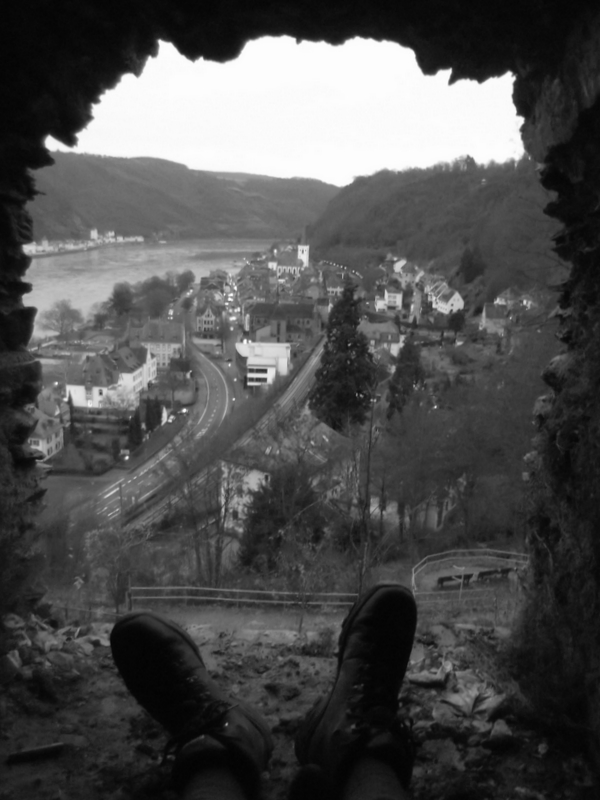
Schloss Burg Rheinfels, above the town of St. Goar on the Rhine

There are a couple of updates from Nick on his After the Woods and the Water blog including some snippets about sleeping rough in some ruined Rhine castles.

He has been experiencing unseasonably warm weather. Whilst this is a good thing I do feel that he needs a few days of snow and ice to really experience how it can be whilst outside in Germany at this time of year. I have happy memories of sleeping in hay barns as a soldier in West Germany, cocooned by the hay which prevented my water bottle from freezing solid in the up to minus 10 degree temperatures! I also remember some wonderful views when the sun shone brightly on the snow covered ground making visibility in the daytime almost unbearable, whilst by night the reflected moonlight was a God-send when on night patrol without the benefit of today’s night vision aids.

Colin Thubron recommends reading A Time of Gifts for 2012

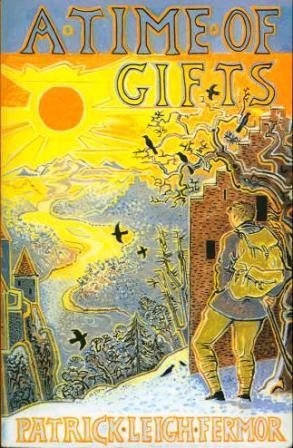
A Time of Gifts, 1977

In the December edition of The Browser, Paddy’s good friend Colin Thubron talks about why A Time of Gifts remains one of this favourite travel books…

This is the first volume of Patrick Leigh Fermor’s journey in 1933-34 from the Hook of Holland, as he called it, to what he insisted on calling Constantinople [Istanbul]. It was to be in three volumes. This one takes him beyond Vienna. The second volume, Between the Woods and the Water, takes him through Hungary to the Balkans. The third volume was going to get him across Romania to Istanbul, but he never wrote it.

Like many people, I love the idea of this young 19-year-old gypsy going off on foot on his own, with just a pound a week, footloose and fancy free, full of delight at the world and fascination at where he’s going. That’s one of the lovely things about the book. It’s beautifully written, very rich prose. It’s model was Norman Douglas – rich in language, vocabulary, scholarship. It’s rather an acquired taste, and may seem old-fashioned to a younger generation.

I love the delight in everything, with all its byways in history or folklore, and the people he meets are so marvellously and generously described. He had such a big heart, a generous spirit. You feel he must have been a delightful companion for anyone to meet on the road. Some people find it a little bit showy-offy, because of all of the stuff he quotes as having by heart – but he did, it’s perfectly true. He had an excellent memory, and into his old age he was a great raconteur.

I know that you knew him quite well. Will you tell us about his character? He died not long ago of course.

Yes, he died [last June]. Well, he was what you would expect. In some ways, he was rather an innocent. He wasn’t an intellectual, but he loved facts and data and history and architecture. He also loved show, and a good story. He was a delightful companion, very funny, and he was a bit original. He would sometimes say something rather fanciful, he had a marvellous imagination. But there was this innocence about him.

It’s as if he was in a time warp, and in rejoining his youth in these two books he was rejoining somebody he still was, in a sense, his sensibility was so young. He hadn’t changed in many ways, he hadn’t been disillusioned. They are very “illusioned” books, if you like. It’s a very wonderful idea to go back to who he was, because he could so easily enter into the spirit of that liberated delight in the world which he kept with him always. He was very frail when he died, but he still kept that with him.

How does travel change a person? It’s a platitude that a physical journey is also an inner journey, but some platitudes are true.

I don’t know really. It’s supposed to broaden the mind. If I look at the travel writers I know and have known, there’s a certain breadth of knowledge. One would hope there’s a breadth of understanding or of sympathy too. Of course, it makes you a sort of amateur. You’re a free agent, you’re the oddball. One can understand why dictators find travellers a threat – you’re not beholden to anyone and you’re doing what you want, which is a marvellous privilege. But what it does to you character-wise, I don’t know.

The title A Time of Gifts comes from a line of poetry by Louis MacNeice …

“For now the time of gifts is gone / O boys that grow, O snows that melt.”

That certainly hints at growth of character.

Yes it does. This was his great extended epiphany, to be suddenly going out travelling. That was the time of gifts for him, when the world opened to him. He was obviously ready for it. He was always on the wrong side of authority in England, and he was expelled from school. He got into a rather posh artist society in London and he was enormously entertaining and fun, and very handsome as a young man. But he hadn’t travelled anywhere. So suddenly to loose yourself on the world was surely his time of gifts.

I love Leigh Fermor’s motto. Solvitur ambulando.

It is solved by walking

Chatwin and Paddy: In the Footsteps of Bruce Chatwin

The link between Bruce Chatwin and Paddy is very strong. They were good friends and Chatwin’s writing has often been compared favourabley with Paddy’s. When Chatwin stayed at Kadamyli he and Paddy often went for long afternoon walks in the Taygetos. This BBC Four programme about Bruce Chatwin’s life includes some significant sections with Paddy:

1. Talking about Bruce generally – programme 2 at around 2 minute 20 seconds.

2. Walking with Bruce’s brother and the scattering of the ashes near Kardamyli – programme 2 at around56 minutes 50 seconds.


My thanks to Thos Henley for sending this to me.

Related article:

Bruce Chatwin’s Journey to Mount Athos